WO2011122178A1 - 粘着シート - Google Patents
粘着シート Download PDFInfo
- Publication number
- WO2011122178A1 WO2011122178A1 PCT/JP2011/053931 JP2011053931W WO2011122178A1 WO 2011122178 A1 WO2011122178 A1 WO 2011122178A1 JP 2011053931 W JP2011053931 W JP 2011053931W WO 2011122178 A1 WO2011122178 A1 WO 2011122178A1
- Authority
- WO
- WIPO (PCT)
- Prior art keywords
- pressure
- sensitive adhesive
- adhesive sheet
- adhesive layer
- compound
- Prior art date
- Legal status (The legal status is an assumption and is not a legal conclusion. Google has not performed a legal analysis and makes no representation as to the accuracy of the status listed.)
- Ceased
Links
Classifications
-
- B—PERFORMING OPERATIONS; TRANSPORTING
- B32—LAYERED PRODUCTS
- B32B—LAYERED PRODUCTS, i.e. PRODUCTS BUILT-UP OF STRATA OF FLAT OR NON-FLAT, e.g. CELLULAR OR HONEYCOMB, FORM
- B32B27/00—Layered products comprising a layer of synthetic resin
-
- C—CHEMISTRY; METALLURGY
- C08—ORGANIC MACROMOLECULAR COMPOUNDS; THEIR PREPARATION OR CHEMICAL WORKING-UP; COMPOSITIONS BASED THEREON
- C08F—MACROMOLECULAR COMPOUNDS OBTAINED BY REACTIONS ONLY INVOLVING CARBON-TO-CARBON UNSATURATED BONDS
- C08F220/00—Copolymers of compounds having one or more unsaturated aliphatic radicals, each having only one carbon-to-carbon double bond, and only one being terminated by only one carboxyl radical or a salt, anhydride ester, amide, imide or nitrile thereof
- C08F220/02—Monocarboxylic acids having less than ten carbon atoms; Derivatives thereof
- C08F220/10—Esters
- C08F220/12—Esters of monohydric alcohols or phenols
- C08F220/16—Esters of monohydric alcohols or phenols of phenols or of alcohols containing two or more carbon atoms
- C08F220/18—Esters of monohydric alcohols or phenols of phenols or of alcohols containing two or more carbon atoms with acrylic or methacrylic acids
- C08F220/1804—C4-(meth)acrylate, e.g. butyl (meth)acrylate, isobutyl (meth)acrylate or tert-butyl (meth)acrylate
-
- C—CHEMISTRY; METALLURGY
- C08—ORGANIC MACROMOLECULAR COMPOUNDS; THEIR PREPARATION OR CHEMICAL WORKING-UP; COMPOSITIONS BASED THEREON
- C08G—MACROMOLECULAR COMPOUNDS OBTAINED OTHERWISE THAN BY REACTIONS ONLY INVOLVING UNSATURATED CARBON-TO-CARBON BONDS
- C08G18/00—Polymeric products of isocyanates or isothiocyanates
- C08G18/06—Polymeric products of isocyanates or isothiocyanates with compounds having active hydrogen
- C08G18/08—Processes
- C08G18/10—Prepolymer processes involving reaction of isocyanates or isothiocyanates with compounds having active hydrogen in a first reaction step
-
- C—CHEMISTRY; METALLURGY
- C08—ORGANIC MACROMOLECULAR COMPOUNDS; THEIR PREPARATION OR CHEMICAL WORKING-UP; COMPOSITIONS BASED THEREON
- C08G—MACROMOLECULAR COMPOUNDS OBTAINED OTHERWISE THAN BY REACTIONS ONLY INVOLVING UNSATURATED CARBON-TO-CARBON BONDS
- C08G18/00—Polymeric products of isocyanates or isothiocyanates
- C08G18/06—Polymeric products of isocyanates or isothiocyanates with compounds having active hydrogen
- C08G18/28—Polymeric products of isocyanates or isothiocyanates with compounds having active hydrogen characterised by the compounds used containing active hydrogen
- C08G18/40—High-molecular-weight compounds
- C08G18/48—Polyethers
- C08G18/4825—Polyethers containing two hydroxy groups
-
- C—CHEMISTRY; METALLURGY
- C08—ORGANIC MACROMOLECULAR COMPOUNDS; THEIR PREPARATION OR CHEMICAL WORKING-UP; COMPOSITIONS BASED THEREON
- C08G—MACROMOLECULAR COMPOUNDS OBTAINED OTHERWISE THAN BY REACTIONS ONLY INVOLVING UNSATURATED CARBON-TO-CARBON BONDS
- C08G18/00—Polymeric products of isocyanates or isothiocyanates
- C08G18/06—Polymeric products of isocyanates or isothiocyanates with compounds having active hydrogen
- C08G18/28—Polymeric products of isocyanates or isothiocyanates with compounds having active hydrogen characterised by the compounds used containing active hydrogen
- C08G18/65—Low-molecular-weight compounds having active hydrogen with high-molecular-weight compounds having active hydrogen
- C08G18/6505—Low-molecular-weight compounds having active hydrogen with high-molecular-weight compounds having active hydrogen the low-molecular compounds being compounds of group C08G18/32 or polyamines of C08G18/38
-
- C—CHEMISTRY; METALLURGY
- C08—ORGANIC MACROMOLECULAR COMPOUNDS; THEIR PREPARATION OR CHEMICAL WORKING-UP; COMPOSITIONS BASED THEREON
- C08L—COMPOSITIONS OF MACROMOLECULAR COMPOUNDS
- C08L33/00—Compositions of homopolymers or copolymers of compounds having one or more unsaturated aliphatic radicals, each having only one carbon-to-carbon double bond, and only one being terminated by only one carboxyl radical, or of salts, anhydrides, esters, amides, imides or nitriles thereof; Compositions of derivatives of such polymers
- C08L33/04—Homopolymers or copolymers of esters
- C08L33/14—Homopolymers or copolymers of esters of esters containing halogen, nitrogen, sulfur, or oxygen atoms in addition to the carboxy oxygen
-
- C—CHEMISTRY; METALLURGY
- C09—DYES; PAINTS; POLISHES; NATURAL RESINS; ADHESIVES; COMPOSITIONS NOT OTHERWISE PROVIDED FOR; APPLICATIONS OF MATERIALS NOT OTHERWISE PROVIDED FOR
- C09J—ADHESIVES; NON-MECHANICAL ASPECTS OF ADHESIVE PROCESSES IN GENERAL; ADHESIVE PROCESSES NOT PROVIDED FOR ELSEWHERE; USE OF MATERIALS AS ADHESIVES
- C09J11/00—Features of adhesives not provided for in group C09J9/00, e.g. additives
- C09J11/02—Non-macromolecular additives
- C09J11/06—Non-macromolecular additives organic
-
- C—CHEMISTRY; METALLURGY
- C09—DYES; PAINTS; POLISHES; NATURAL RESINS; ADHESIVES; COMPOSITIONS NOT OTHERWISE PROVIDED FOR; APPLICATIONS OF MATERIALS NOT OTHERWISE PROVIDED FOR
- C09J—ADHESIVES; NON-MECHANICAL ASPECTS OF ADHESIVE PROCESSES IN GENERAL; ADHESIVE PROCESSES NOT PROVIDED FOR ELSEWHERE; USE OF MATERIALS AS ADHESIVES
- C09J133/00—Adhesives based on homopolymers or copolymers of compounds having one or more unsaturated aliphatic radicals, each having only one carbon-to-carbon double bond, and at least one being terminated by only one carboxyl radical, or of salts, anhydrides, esters, amides, imides, or nitriles thereof; Adhesives based on derivatives of such polymers
- C09J133/04—Homopolymers or copolymers of esters
- C09J133/14—Homopolymers or copolymers of esters of esters containing halogen, nitrogen, sulfur or oxygen atoms in addition to the carboxy oxygen
-
- C—CHEMISTRY; METALLURGY
- C09—DYES; PAINTS; POLISHES; NATURAL RESINS; ADHESIVES; COMPOSITIONS NOT OTHERWISE PROVIDED FOR; APPLICATIONS OF MATERIALS NOT OTHERWISE PROVIDED FOR
- C09J—ADHESIVES; NON-MECHANICAL ASPECTS OF ADHESIVE PROCESSES IN GENERAL; ADHESIVE PROCESSES NOT PROVIDED FOR ELSEWHERE; USE OF MATERIALS AS ADHESIVES
- C09J175/00—Adhesives based on polyureas or polyurethanes; Adhesives based on derivatives of such polymers
- C09J175/04—Polyurethanes
-
- C—CHEMISTRY; METALLURGY
- C09—DYES; PAINTS; POLISHES; NATURAL RESINS; ADHESIVES; COMPOSITIONS NOT OTHERWISE PROVIDED FOR; APPLICATIONS OF MATERIALS NOT OTHERWISE PROVIDED FOR
- C09J—ADHESIVES; NON-MECHANICAL ASPECTS OF ADHESIVE PROCESSES IN GENERAL; ADHESIVE PROCESSES NOT PROVIDED FOR ELSEWHERE; USE OF MATERIALS AS ADHESIVES
- C09J7/00—Adhesives in the form of films or foils
- C09J7/20—Adhesives in the form of films or foils characterised by their carriers
- C09J7/22—Plastics; Metallised plastics
-
- C—CHEMISTRY; METALLURGY
- C09—DYES; PAINTS; POLISHES; NATURAL RESINS; ADHESIVES; COMPOSITIONS NOT OTHERWISE PROVIDED FOR; APPLICATIONS OF MATERIALS NOT OTHERWISE PROVIDED FOR
- C09J—ADHESIVES; NON-MECHANICAL ASPECTS OF ADHESIVE PROCESSES IN GENERAL; ADHESIVE PROCESSES NOT PROVIDED FOR ELSEWHERE; USE OF MATERIALS AS ADHESIVES
- C09J7/00—Adhesives in the form of films or foils
- C09J7/30—Adhesives in the form of films or foils characterised by the adhesive composition
-
- C—CHEMISTRY; METALLURGY
- C09—DYES; PAINTS; POLISHES; NATURAL RESINS; ADHESIVES; COMPOSITIONS NOT OTHERWISE PROVIDED FOR; APPLICATIONS OF MATERIALS NOT OTHERWISE PROVIDED FOR
- C09J—ADHESIVES; NON-MECHANICAL ASPECTS OF ADHESIVE PROCESSES IN GENERAL; ADHESIVE PROCESSES NOT PROVIDED FOR ELSEWHERE; USE OF MATERIALS AS ADHESIVES
- C09J7/00—Adhesives in the form of films or foils
- C09J7/30—Adhesives in the form of films or foils characterised by the adhesive composition
- C09J7/38—Pressure-sensitive adhesives [PSA]
-
- C—CHEMISTRY; METALLURGY
- C09—DYES; PAINTS; POLISHES; NATURAL RESINS; ADHESIVES; COMPOSITIONS NOT OTHERWISE PROVIDED FOR; APPLICATIONS OF MATERIALS NOT OTHERWISE PROVIDED FOR
- C09J—ADHESIVES; NON-MECHANICAL ASPECTS OF ADHESIVE PROCESSES IN GENERAL; ADHESIVE PROCESSES NOT PROVIDED FOR ELSEWHERE; USE OF MATERIALS AS ADHESIVES
- C09J2433/00—Presence of (meth)acrylic polymer
-
- C—CHEMISTRY; METALLURGY
- C09—DYES; PAINTS; POLISHES; NATURAL RESINS; ADHESIVES; COMPOSITIONS NOT OTHERWISE PROVIDED FOR; APPLICATIONS OF MATERIALS NOT OTHERWISE PROVIDED FOR
- C09J—ADHESIVES; NON-MECHANICAL ASPECTS OF ADHESIVE PROCESSES IN GENERAL; ADHESIVE PROCESSES NOT PROVIDED FOR ELSEWHERE; USE OF MATERIALS AS ADHESIVES
- C09J2475/00—Presence of polyurethane
-
- Y—GENERAL TAGGING OF NEW TECHNOLOGICAL DEVELOPMENTS; GENERAL TAGGING OF CROSS-SECTIONAL TECHNOLOGIES SPANNING OVER SEVERAL SECTIONS OF THE IPC; TECHNICAL SUBJECTS COVERED BY FORMER USPC CROSS-REFERENCE ART COLLECTIONS [XRACs] AND DIGESTS
- Y10—TECHNICAL SUBJECTS COVERED BY FORMER USPC
- Y10T—TECHNICAL SUBJECTS COVERED BY FORMER US CLASSIFICATION
- Y10T428/00—Stock material or miscellaneous articles
- Y10T428/26—Web or sheet containing structurally defined element or component, the element or component having a specified physical dimension
- Y10T428/263—Coating layer not in excess of 5 mils thick or equivalent
- Y10T428/264—Up to 3 mils
- Y10T428/265—1 mil or less
-
- Y—GENERAL TAGGING OF NEW TECHNOLOGICAL DEVELOPMENTS; GENERAL TAGGING OF CROSS-SECTIONAL TECHNOLOGIES SPANNING OVER SEVERAL SECTIONS OF THE IPC; TECHNICAL SUBJECTS COVERED BY FORMER USPC CROSS-REFERENCE ART COLLECTIONS [XRACs] AND DIGESTS
- Y10—TECHNICAL SUBJECTS COVERED BY FORMER USPC
- Y10T—TECHNICAL SUBJECTS COVERED BY FORMER US CLASSIFICATION
- Y10T428/00—Stock material or miscellaneous articles
- Y10T428/28—Web or sheet containing structurally defined element or component and having an adhesive outermost layer
- Y10T428/2852—Adhesive compositions
- Y10T428/2878—Adhesive compositions including addition polymer from unsaturated monomer
-
- Y—GENERAL TAGGING OF NEW TECHNOLOGICAL DEVELOPMENTS; GENERAL TAGGING OF CROSS-SECTIONAL TECHNOLOGIES SPANNING OVER SEVERAL SECTIONS OF THE IPC; TECHNICAL SUBJECTS COVERED BY FORMER USPC CROSS-REFERENCE ART COLLECTIONS [XRACs] AND DIGESTS
- Y10—TECHNICAL SUBJECTS COVERED BY FORMER USPC
- Y10T—TECHNICAL SUBJECTS COVERED BY FORMER US CLASSIFICATION
- Y10T428/00—Stock material or miscellaneous articles
- Y10T428/28—Web or sheet containing structurally defined element or component and having an adhesive outermost layer
- Y10T428/2852—Adhesive compositions
- Y10T428/2878—Adhesive compositions including addition polymer from unsaturated monomer
- Y10T428/2887—Adhesive compositions including addition polymer from unsaturated monomer including nitrogen containing polymer [e.g., polyacrylonitrile, polymethacrylonitrile, etc.]
Definitions
- the present invention relates to a pressure-sensitive adhesive sheet, particularly a pressure-sensitive adhesive sheet exhibiting a desired pressure-sensitive adhesive force even when the pressure-sensitive adhesive layer is thinned.
- the pressure-sensitive adhesive has a coating amount, that is, the thickness of the pressure-sensitive adhesive layer to be formed.
- the thickness of the pressure-sensitive adhesive layer varies. Although it sets according to the objective, in order to express the stable adhesive force, making it thinner than 10 micrometers is not performed so much.
- Patent Document 1 by controlling the thickness of the pressure-sensitive adhesive layer made of a two-component cross-linking acrylic pressure-sensitive adhesive to 2 to 10 ⁇ m (2.5 to 3 ⁇ m in the examples), a liquid crystal screen protective film, etc. The removability is improved, that is, the adhesive strength is reduced by thinning.
- Patent Document 2 by controlling the thickness of the pressure-sensitive adhesive layer made of a silicone-based pressure-sensitive adhesive to 0.5 to 20 ⁇ m (1.0 ⁇ m in the examples), it is easy to peel off from the laminated circuit board. The adhesive strength is reduced by thinning.
- Patent Document 3 by using a rubber-based pressure-sensitive adhesive, even if the thickness of the pressure-sensitive adhesive layer is reduced to about 2 to 10 ⁇ m (3 ⁇ m in the examples), the reliability of adhesion to a liquid crystal display or the like does not decrease. In other words, the object is to prevent the adhesive force from being lowered even when the film is thinned.
- Patent Document 4 even if the thickness of the pressure-sensitive adhesive layer is reduced to about 2 to 10 ⁇ m (2 to 7 ⁇ m in the examples) by using a rubber-based pressure-sensitive adhesive, the reliability of adhesion to the optical member does not decrease. In other words, the object is to prevent the adhesive force from being lowered even when the film is thinned.
- the releasability in the wafer processing step is controlled by controlling the total thickness of the two pressure-sensitive adhesive layers made of a crosslinked acrylic pressure-sensitive adhesive to less than 10 ⁇ m (in the example, 3 to 7 ⁇ m per layer). In other words, the adhesive strength is reduced by reducing the film thickness.
- a pressure sensitive adhesive optical film using a pressure sensitive adhesive containing Pt is disclosed, and it is described that the thickness of the pressure sensitive adhesive layer is 1 to 15 ⁇ m. .
- the adhesive force at a thickness of 5 ⁇ m of the adhesive layer is about 6 N / 25 mm, it does not describe the adhesive force when the film is further thinned. .
- the general-purpose pressure-sensitive adhesive sheet has not been proposed for the purpose of thinning the pressure-sensitive adhesive layer to such a level that it can be used for the electronic device or the like.
- the thickness of the pressure-sensitive adhesive layer formed from an acrylic pressure-sensitive adhesive or a rubber pressure-sensitive adhesive in the skin patch sheet is 10 to 80 ⁇ m so that the adhesive strength does not decrease even when the film is thinned. It is not intended to be.
- Patent Document 8 proposes an easy-adhesive pressure-sensitive adhesive sheet suitable as a large-sized pressure-sensitive adhesive sheet for decoration of signs, walls, vehicles, etc., but the thickness of the pressure-sensitive adhesive layer is 7 to 100 ⁇ m, and the film thickness is reduced. However, the purpose is not to prevent the adhesive strength from being lowered (in the embodiment, an estimated value of about 30 ⁇ m).
- Patent Document 9 discloses a pressure-sensitive adhesive composition for a general-purpose pressure-sensitive adhesive sheet containing a urethane resin and an acrylic polymer prepared using two types of chain extenders having three or more functional groups. Yes. However, in the examples, only the initial adhesive force and removability are measured when the thickness of the pressure-sensitive adhesive layer is 25 ⁇ m, and it is not intended to prevent the adhesive force from being lowered even when the film is thinned.
- the present invention has been made in view of such circumstances, and provides a pressure-sensitive adhesive sheet that exhibits high adhesive strength even when the pressure-sensitive adhesive layer is thinned to, for example, 5 ⁇ m or less, that is, the adhesive strength does not decrease due to thinning.
- the purpose is to do.
- the present inventors have intensively studied.
- the present invention is a pressure-sensitive adhesive sheet in which a pressure-sensitive adhesive layer is provided on at least one side of the following (1) substrate, and the pressure-sensitive adhesive constituting the pressure-sensitive adhesive layer has (A) a crosslinkable functional group.
- the present invention it is possible to obtain an adhesive sheet that can exhibit high adhesive force even when the adhesive layer is made thin.
- the amount of pressure-sensitive adhesive applied can be reduced, the cost can be reduced, and the total thickness when multi-layering is performed, which is useful in various fields.
- the pressure-sensitive adhesive sheet of the present invention is a pressure-sensitive adhesive sheet in which a pressure-sensitive adhesive layer is provided on at least one surface of a base material, and the pressure-sensitive adhesive layer comprises (A) an acrylic polymer having a crosslinkable functional group ( B) A pressure-sensitive adhesive containing a urethane resin and containing a compound having two hydroxyl groups and / or amino groups and a compound having three or more as a component of the urethane resin in a specific ratio.
- B A pressure-sensitive adhesive containing a urethane resin and containing a compound having two hydroxyl groups and / or amino groups and a compound having three or more as a component of the urethane resin in a specific ratio.
- the acrylic copolymer having a crosslinkable functional group as component (A) is an acrylic copolymer obtained by polymerizing a monomer mixture containing (meth) acrylic acid ester as a main component.
- This monomer mixture includes a monomer having a crosslinkable functional group that contains (meth) acrylic acid ester as a main component and reacts with a crosslinking agent described later.
- (meth) acrylic acid means both acrylic acid and methacrylic acid.
- Specific examples of the crosslinkable functional group include a carboxyl group, a hydroxyl group, and an amino group.
- a carboxyl group and a hydroxyl group are preferable, and a carboxyl group is particularly preferable from the viewpoint of obtaining high adhesive force by reaction with an isocyanate-based crosslinking agent which is a preferable crosslinking agent described later.
- the (meth) acrylate used as the main component include, for example, methyl (meth) acrylate, ethyl (meth) acrylate, propyl (meth) acrylate, butyl (meth) acrylate, (meth) acrylic Pentyl acid, hexyl (meth) acrylate, cyclohexyl (meth) acrylate, 2-ethylhexyl (meth) acrylate, isooctyl (meth) acrylate, decyl (meth) acrylate, dodecyl (meth) acrylate, (meth) Examples include myristyl acrylate, palmityl (meth) acrylate, stearyl (meth) acrylate, and the like.
- butyl (meth) acrylate particularly n-butyl acrylate is preferred.
- the butyl acrylate unit is contained in an amount of 50% by mass or more from the viewpoint that the adhesive strength does not decrease even if the pressure-sensitive adhesive layer is thinned, and more preferably 70% by mass or more.
- monomers having a crosslinkable functional group include (meth) acrylic acid, itaconic acid, crotonic acid, maleic acid, fumaric acid, and other ethylenically unsaturated carboxylic acids, (meth) acrylic acid 2-hydroxyethyl, 4-hydroxybutyl (meth) acrylate, 2-hydroxypropyl (meth) acrylate, 3-hydroxypropyl (meth) acrylate, 2-hydroxybutyl (meth) acrylate, (meth) acrylic acid (Meth) acrylic acid hydroxyalkyl esters such as 3-hydroxybutyl, (meth) acrylic acid monomethylaminoethyl, (meth) acrylic acid monoethylaminoethyl, (meth) acrylic acid monomethylaminopropyl, (meth) acrylic acid mono (Meth) acrylic acid monoalkylamino acids such as ethylaminopropyl Or the like can be mentioned the kill.
- nitrogen-containing ethylenically unsaturated monomer is further included as a structural component.
- nitrogen-containing ethylenically unsaturated monomers include (meth) acrylamide, N-methylol (meth) acrylamide, N-methyl (meth) acrylamide, methoxyethyl (meth) acrylamide, N-vinylpyrrolidone, N, N -Dimethyl (meth) acrylamide, N, N-diethyl (meth) acrylamide, N, N-diisopropyl (meth) acrylamide, N-vinylcaprolactam, N- (meth) acryloylmorpholine and the like.
- N- (meth) acryloylmorpholine is preferable because it can impart good adhesive strength.
- the nitrogen-containing ethylenically unsaturated monomer may be selected from the monomers having the above-mentioned crosslinkable functional group.
- Component (A) may optionally contain other monomers as constituent components.
- Other monomers include vinyl esters such as vinyl acetate and vinyl propionate, olefins such as ethylene, propylene and isobutylene, halogenated olefins such as vinyl chloride and vinylidene chloride, styrene, methylstyrene and vinyltoluene.
- the amount of the monomer having a crosslinkable functional group is 0.1 to 25% by mass, preferably 0.5 to 20% by mass, more preferably 3%, based on all the monomers constituting the component (A). To 15% by mass. Even when the pressure-sensitive adhesive layer is made thin by preparing a copolymer with a monomer having a crosslinkable functional group in the above range, and making it a pressure-sensitive adhesive composed of a urethane resin described later. Adhesive strength can be expressed.
- the content is preferably 1 to 2% by mass based on all monomers constituting the component (A).
- the monomer in which the nitrogen atom is contained in the monomer having a crosslinkable functional group is included in the nitrogen-containing ethylenically unsaturated monomer.
- the acrylic copolymer having a crosslinkable functional group as component (A) is not particularly limited as to its copolymerization form, and is any of random, block, and graft copolymers. Also good.
- the molecular weight is preferably 300,000 to 1,500,000, more preferably 400,000 to 1,000,000 in terms of weight average molecular weight (Mw) from the viewpoint of adhesive performance and the like. If the Mw is less than 300,000, the cohesive force of the pressure-sensitive adhesive layer is lowered, and the pressure-sensitive adhesive force may be lowered. If it exceeds 1,500,000, the elastic modulus of the pressure-sensitive adhesive layer becomes too high, and the adhesive strength is lowered, which is not preferable.
- said Mw is the value of standard polystyrene conversion measured by the gel permeation chromatography (GPC) method.
- the acrylic copolymer as the component (A) may be used alone or in combination of two or more.
- the acrylic copolymer in the pressure-sensitive adhesive sheet of the present invention can be prepared by a conventional method in the presence or absence of a solvent.
- the solvent include ethyl acetate and toluene
- the polymerization initiator include azobisisobutyronitrile and benzoyl peroxide.
- the polymerization conditions are not particularly limited, and the polymerization is usually performed at 50 to 90 ° C. for 2 to 30 hours.
- the urethane resin as component (B) is obtained by reacting [b3] chain extender with a terminal isocyanate urethane prepolymer obtained by reacting [b1] diol and [b2] polyvalent isocyanate compound. .
- the component (B) comprises a chain extender [b4] a compound having two hydroxyl groups and / or amino groups and [b5] a compound having three or more hydroxyl groups and / or amino groups.
- Low molecular weights such as alkanediols such as 1,3-propanediol, 1,4-butanediol, 1,5-pentanediol, neopentyl glycol, 1,6-hexanediol, 1,7-heptanediol
- alkylene glycol such as diol, ethylene glycol, propylene glycol, diethylene glycol, dipropylene glycol, polyalkylene glycol such as polyethylene glycol, polypropylene glycol, polybutylene glycol, polyoxyalkylene glycol such as polytetramethylene glycol Mention may be made of glycols having a medium molecular weight of several hundred to several thousand.
- a glycol having a molecular weight of about 1000 to 3000 is used as the diol as the component [b1]. Is preferred.
- the diol may be used alone or in combination of two or more.
- polyvalent isocyanate compound which is the [b2] component in the terminal isocyanate urethane prepolymer will be described.
- polyvalent isocyanate compound known aromatic polyisocyanate, aliphatic polyisocyanate, alicyclic polyisocyanate and the like can be used.
- aromatic polyisocyanate examples include 1,3-phenylene diisocyanate, 1,4-phenylene diisocyanate, 4,4′-diphenylmethane diisocyanate (MDI), 2,4-tolylene diisocyanate (2,4-TDI), 2 , 6-Tolylene diisocyanate (2,6-TDI), 4,4′-toluidine diisocyanate, 2,4,6-triisocyanate toluene, 1,3,5-triisocyanate benzene, dianisidine diisocyanate, 4,4 ′ -Diphenyl ether diisocyanate, 4,4 ', 4 "-triphenylmethane triisocyanate, 1,4-tetramethylxylylene diisocyanate, 1,3-tetramethylxylylene diisocyanate and the like.
- MDI 2,4-tolylene diisocyanate
- 2,6-TDI 2,6-tolylene diisocyanate
- aliphatic polyisocyanate examples include trimethylene diisocyanate, tetramethylene diisocyanate, hexamethylene diisocyanate (HMDI), pentamethylene diisocyanate, 1,2-propylene diisocyanate, 2,3-butylene diisocyanate, 1,3-butylene diisocyanate, and dodeca.
- HMDI hexamethylene diisocyanate
- pentamethylene diisocyanate 1,2-propylene diisocyanate
- 2,3-butylene diisocyanate 1,3-butylene diisocyanate
- dodeca examples include methylene diisocyanate and 2,4,4-trimethylhexamethylene diisocyanate.
- Examples of the alicyclic polyisocyanate include 3-isocyanate methyl-3,5,5-trimethylcyclohexyl isocyanate (IPDI), 1,3-cyclopentane diisocyanate, 1,3-cyclohexane diisocyanate, 1,4-cyclohexane diisocyanate, Methyl-2,4-cyclohexane diisocyanate, methyl-2,6-cyclohexane diisocyanate, 4,4'-methylenebis (cyclohexyl isocyanate), 1,4-bis (isocyanatemethyl) cyclohexane, 1,4-bis (isocyanatemethyl) cyclohexane Etc.
- IPDI 3-isocyanate methyl-3,5,5-trimethylcyclohexyl isocyanate
- 1,3-cyclopentane diisocyanate 1,3-cyclohexane diisocyanate
- the polyisocyanate compound may be a trimethylolpropane adduct modified product of the above polyisocyanate, a burette modified product reacted with water, or an isocyanurate modified product containing an isocyanurate ring.
- the polyvalent isocyanate compounds one or more selected from MDI, 2,4-TDI, 2,6-TDI, HMDI, IPDI and modified products thereof are preferable because of the excellent physical properties of the pressure-sensitive adhesive. Furthermore, when importance is attached to weather resistance, at least one selected from HMDI, IPDI and their modified products is particularly preferred.
- the method for preparing the terminal isocyanate urethane prepolymer is not particularly limited, and examples thereof include a method in which [b1] and [b2] and, if necessary, a urethanization catalyst and a solvent are charged into a reactor.
- the mixing ratio of [b1] and [b2] is such that (number of moles of NCO groups) / (number of moles of OH groups) is 1.1 to 3.0 so that isocyanate groups remain at the ends. It is preferable to make it react so that it may become 1.3-2.5. If it is less than 1.1, it tends to gel and tend to thicken. If it exceeds 3.0, the concentration of the unreacted polyvalent isocyanate compound in the terminal isocyanate urethane prepolymer becomes too high, and the chain extension reaction described later occurs. It tends to be difficult.
- the isocyanate group content (NCO%) in the terminal isocyanate urethane prepolymer was measured according to JIS K1603, although it varies depending on the reactivity of [b1] and [b2] used and the blending amount of the chain extender.
- the value is preferably 0.5 to 12% by mass, more preferably 1 to 4% by mass.
- NCO% is less than 0.5% by mass, a sufficient amount of chain extender (described later) cannot be reacted, and when it exceeds 12% by mass, control of the chain extension reaction (described later) tends to be difficult. It is in.
- Examples of the catalyst used in the terminal isocyanate urethane prepolymer formation reaction include known ones such as tertiary amine compounds and organometallic compounds.
- Examples of the tertiary amine compound include triethylamine, triethylenediamine, N, N-dimethylbenzylamine, N-methylmorpholine, 1,8-diazabicyclo [5.4.0] undecene-7 (DBU) and the like.
- Examples of organometallic compounds include tin compounds and non-tin compounds.
- tin compounds include dibutyltin dichloride, dibutyltin oxide, dibutyltin dibromide, dibutyltin dimaleate, dibutyltin dilaurate (DBTDL), dibutyltin diacetate, dibutyltin sulfide, tributyltin sulfide, tributyltin oxide, tributyltin Examples include acetate, triethyltin ethoxide, tributyltin ethoxide, dioctyltin oxide, tributyltin chloride, tributyltin trichloroacetate, tin 2-ethylhexanoate and the like.
- DBTDL dibutyltin dilaurate
- DBTDL dibutyltin diacetate
- dibutyltin sulfide tributyltin sulfide
- non-tin compounds include titanium compounds such as dibutyltitanium dichloride, tetrabutyltitanate, butoxytitanium trichloride, and lead compounds such as lead oleate, lead 2-ethylhexanoate, lead benzoate, and lead naphthenate.
- Iron compounds such as iron 2-ethylhexanoate and iron acetylacetonate, cobalt compounds such as cobalt benzoate and cobalt 2-ethylhexanoate, zinc compounds such as zinc naphthenate and zinc 2-ethylhexanoate, Examples thereof include zirconium naphthenate.
- DBTDL, tin 2-ethylhexanoate, tetrabutyl titanate and the like are preferable.
- the said catalyst may be used independently and may be used together.
- the solvent examples include aromatic hydrocarbons such as toluene and xylene, aliphatic hydrocarbons such as hexane, esters such as ethyl acetate and butyl acetate, ketones such as methyl ethyl ketone (MEK), dimethylformamide, and cyclohexanone. These may be used alone or in combination of two or more.
- aromatic hydrocarbons such as toluene and xylene
- aliphatic hydrocarbons such as hexane
- esters such as ethyl acetate and butyl acetate
- ketones such as methyl ethyl ketone (MEK), dimethylformamide, and cyclohexanone.
- the reaction temperature in the terminal isocyanate urethane prepolymer formation reaction is preferably 120 ° C. or less, more preferably 70 to 100 ° C.
- the reaction temperature exceeds 120 ° C., the allophanate reaction proceeds and it becomes difficult to synthesize a terminal isocyanate group prepolymer having a predetermined molecular weight and structure, and it becomes difficult to control the reaction rate.
- the reaction temperature is 70 to 100 ° C.
- the reaction time is preferably 2 to 20 hours.
- the chain extender [b3] in the present invention comprises a compound [b4] having two hydroxyl groups and / or amino groups and a compound [b5] having three or more hydroxyl groups and / or amino groups, and [b4] / [b5 ]
- the urethane resin as the component (B) is obtained by reacting with the terminal isocyanate urethane prepolymer at a ratio (mass ratio) of 7/3 to 10/0.
- the component [b4] will be described.
- Component [b4] is a compound having two hydroxyl groups and / or amino groups.
- Examples of the component [b4] include aliphatic diol, aliphatic diamine, alkanolamine, bisphenol, aromatic diamine, phenolamine and the like.
- the chain extenders [b3] at least one compound selected from the group consisting of aliphatic diols, aliphatic diamines, alkanolamines, aromatic diamines, and bisphenols is preferable because it can prevent a decrease in adhesive strength.
- Examples of the aliphatic diol include a low molecular weight alkanediol and a low molecular weight alkylene glycol in the diols listed as the component [b1].
- Examples of the aliphatic diamine include ethylenediamine, 1,3-propanediamine, 1,4-butanediamine, 1,5-pentanediamine, 1,6-hexanediamine, and the like.
- Examples of the alkanolamine include monoethanolamine, monopropanolamine, isopropanolamine and the like.
- Examples of bisphenol include bisphenol A.
- Examples of the aromatic diamine include diphenylmethane diamine, tolylenediamine, xylylenediamine, and the like.
- Examples of phenolamine include aminophenol.
- Component [b5] is a compound having three or more hydroxyl groups and / or amino groups.
- polyols such as trimethylolpropane, ditrimethylolpropane, pentaerythritol, dipentaerythritol, 1-amino-2,3-propanediol, 1-methylamino-2,3-propanediol, N Examples include amino alcohols such as-(2-hydroxypropylethanolamine), ethylene oxide or propylene oxide adducts of tetramethylxylylenediamine.
- the amino group and / or hydroxyl group in the component [b4] and the component [b5] are preferably a primary amino group, a secondary amino group, and a primary hydroxyl group from the viewpoint of reactivity with an isocyanate group.
- the chain extension reaction will be described.
- a urethane resin is obtained.
- the above ratio is preferably 8/2 to 9/1.
- [b4] / [b5] is smaller than 7/3, when the pressure-sensitive adhesive layer is thinned, the adhesive strength is reduced, or gelation occurs during the chain extension reaction for preparing the urethane resin. Cannot be obtained.
- Examples of chain extension reactions include: (1) A method in which a solution of an isocyanate group-terminated prepolymer is charged into a reactor, and a chain extender is dropped into the reactor to cause a reaction. (2) A chain extender is charged in the reactor. , A method in which an isocyanate group-terminated prepolymer solution is dropped and reacted, (3) a method in which a solution of an isocyanate group-terminated prepolymer is diluted with a solvent, and then a predetermined amount of a chain extender is charged into the reactor and reacted. Is mentioned. Since the isocyanate group gradually decreases and a uniform resin can be easily obtained, the method (1) or (3) is preferable.
- the amount of chain extenders [b4] and [b5] added varies depending on the NCO group content of the isocyanate group-terminated prepolymer, but the NCO group of the urethane resin after chain extension is 0.01 to 1.0% by mass.
- the amount is preferably 0.05 to 0.2% by mass.
- the amount of the chain extender added is such that the NCO group in the terminal isocyanate group prepolymer is less than 0.01% by mass, the viscosity increases rapidly during the chain extension reaction, and gelation tends to occur. If the amount of the NCO group of the terminal isocyanate group prepolymer exceeds 1.0% by mass, the chain extension becomes insufficient and the urethane resin (B) having a desired molecular weight cannot be obtained.
- the reaction temperature in the chain extension reaction is preferably 80 ° C. or lower. When the reaction temperature exceeds 80 ° C., the reaction rate becomes too fast and it becomes difficult to control the reaction, so that it tends to be difficult to obtain a urethane resin (B) having a desired molecular weight and structure.
- the chain extension reaction is carried out in the presence of a solvent, the boiling point is preferably not higher than the boiling point of the solvent, and particularly 40 to 60 ° C. is preferred in the presence of MEK and ethyl acetate.
- An end terminator may be used to terminate the chain extension reaction. Examples of the terminal terminator include a compound having only one active hydrogen capable of reacting with an isocyanate group or a compound having only one amino group.
- Examples of the compound having only one active hydrogen capable of reacting with an isocyanate group include monool compounds such as methanol and ethanol.
- a compound having a primary amino group or a secondary amino group can be used, and examples thereof include diethylamine and morpholine.
- the compound having one primary amino group has two active hydrogens, but the active hydrogen remaining after the reaction of one active hydrogen is low in reactivity, so that it is substantially equivalent to a monofunctional group.
- the addition amount of the terminal stopper is preferably such that the terminal stopper is 1 mole or more and 2 moles or less with respect to 1 mole of the terminal isocyanate group remaining after the chain extension reaction.
- the addition amount of the terminal terminator is less than 1 mol, an isocyanate group remains after the termination reaction, and the resulting urethane resin becomes unstable. On the other hand, when the addition amount of the terminal terminator exceeds 2 mol, the low molecular weight urethane resin tends to increase.
- the weight average molecular weight of the urethane resin (B) is preferably 10,000 or more in terms of standard polystyrene equivalent molecular weight by GPC. If the weight average molecular weight of the urethane resin is less than 10,000, the adhesive properties, particularly the holding power, tend to be lowered. Moreover, it is preferable that the weight average molecular weights of a urethane resin (B) are 300,000 or less. If the weight average molecular weight exceeds 300,000, gelation may occur. The more preferred weight average molecular weight of the urethane resin (B) is 50,000 to 200,000.
- the (C) crosslinking agent used as necessary together with the acrylic polymer (A) and the urethane resin (B) will be described.
- the crosslinking agent (C) include an isocyanate crosslinking agent, an epoxy crosslinking agent, an aziridine crosslinking agent, a metal chelate crosslinking agent and an amine crosslinking agent, and an amino resin crosslinking agent.
- an isocyanate-based crosslinking agent is preferable from the viewpoint that high adhesive force can be obtained even when the pressure-sensitive adhesive layer is thinned.
- These crosslinking agents may be used alone or in combination of two or more of the same kind.
- isocyanate-based crosslinking agent examples include the same compounds as the polyvalent isocyanate compound as the component [b2].
- the epoxy-based crosslinking agent are not particularly limited as long as they have two or more epoxy groups or glycidyl groups in the molecule, but many include two or more epoxy groups in one molecule.
- the use of functional epoxy compounds is preferred.
- the polyfunctional epoxy compound include diglycidyl ether of bisphenol A and oligomer thereof, diglycidyl ether of hydrogenated bisphenol A and oligomer thereof, orthophthalic acid diglycidyl ester, isophthalic acid diglycidyl ester, terephthalic acid diglycidyl ester, p-oxybenzoic acid glycidyl ester, tetrahydrophthalic acid diglycidyl ester, hexahydrophthalic acid diglycidyl ester, succinic acid diglycidyl ester, adipic acid diglycidyl ester, sebacic acid diglycidyl ester, ethylene glycol diglycidyl ether, propylene glycol Diglycidyl
- the aziridine-based crosslinking agent is not particularly limited, but specific examples thereof include 1,1 ′-(methylene-di-p-phenylene) bis-3,3-aziridinylurea and 1,1 ′-(hexamethylene).
- Bis-3,3-aziridinyl urea, 2,4,6-triaziridinyl-1,3,5-triazine, trimethylolpropane-tris- (2-aziridinylpropionate) and the like can be mentioned. These are used alone or in combination of two or more.
- BXX5134 Alignitrile
- curing agent the Toyo Ink Manufacturing Co., Ltd. product
- metal chelate-based crosslinking agent examples include compounds in which acetylacetone, ethyl acetoacetate, and the like are coordinated to a polyvalent metal such as aluminum, iron, copper, zinc, tin, titanium, nickel, antimony, magnesium, vanadium, chromium, and zirconium. Etc.
- Specific examples of the metal chelate-based crosslinking agent include Nursem aluminum manufactured by Nippon Chemical Industry Co., Ltd., in which acetylacetone is coordinated with aluminum.
- amine-based cross-linking agents include polyamines such as aliphatic polyamines (for example, triethylenetetramine, tetraethylenepentamine, ethylenediamine, N, N-dicinenamylidene-1,6-hexanediamine, trimethylenediamine, hexamethylenediamine carbamate, ethanolamine.
- polyamines such as aliphatic polyamines (for example, triethylenetetramine, tetraethylenepentamine, ethylenediamine, N, N-dicinenamylidene-1,6-hexanediamine, trimethylenediamine, hexamethylenediamine carbamate, ethanolamine.
- amino resin-based crosslinking agents examples include methoxylated methylol urea, methoxylated methylol N, N-ethylene urea, methoxylated methylol dicyandiamide, methoxylated methylol melamine, methoxylated methylol benzoguanamine, butoxylated methylol melamine, butoxylated methylol benzoguanamine, and the like.
- methoxylated methylol melamine, butoxylated methylol melamine, methylolated benzoguanamine and the like can be mentioned.
- the blending amount of the crosslinking agent (C) depends on the amount of the crosslinkable functional group in the component (A), the NCO% in the isocyanate crosslinking agent, the epoxy equivalent in the epoxy crosslinking agent, etc., but the component (A) About 0.01 to 8 parts by mass, preferably 0.05 parts by weight of a crosslinking agent (active ingredient excluding solvent) with respect to 100 parts by mass of the total amount of the acrylic copolymer as the component and the urethane resin as the component (B). To 5 parts by mass, more preferably 0.1 to 3 parts by mass.
- the acrylic copolymer (A) and the urethane resin (B) are blended with a crosslinking agent (C) as necessary and applied to a base sheet or a release sheet, and then 30 to 180 at about 70 to 120 ° C. Adhesiveness can be expressed by heat treatment for about 2 seconds and crosslinking (reaction).
- a UV absorber, an antioxidant, an antiseptic, an antifungal agent, a tackifier, a plasticizer, an antifoaming agent, a wettability adjusting agent, and the like are blended. However, since these components may be eluted under high temperature and high humidity conditions, it is preferable not to mix them as much as possible.
- rosin and its derivatives polyterpenes, terpene phenol resins, coumarone-indene resins, petroleum-based resins, styrene resins, xylene resins, and other tackifiers conventionally used for the purpose of improving adhesive strength should be avoided as much as possible. preferable.
- the pressure-sensitive adhesive sheet of the present invention has a pressure-sensitive adhesive layer comprising the above components on at least one side of a substrate.
- a base material used for the adhesive sheet of this invention All can be used as a base material sheet of a normal adhesive sheet.
- woven fabric or non-woven fabric using fibers such as rayon, acrylic, polyester, etc .
- paper such as fine paper, glassine paper, impregnated paper, coated paper
- metal foil such as aluminum, copper; urethane foam, polyethylene foam, etc.
- Polyester film such as polyethylene terephthalate, polybutylene terephthalate, polyethylene naphthalate, polyurethane film, polyethylene film, polypropylene film, polyvinyl chloride film, polyvinylidene chloride film, polyvinyl alcohol film, ethylene-vinyl acetate copolymer film , Polystyrene films, polycarbonate films, acrylic resin films, norbornene resin films, plastic films such as cycloolefin resin films; laminates of two or more of these It can gel.
- polyethylene terephthalate and polyvinyl chloride film which have relatively good thickness accuracy and surface smoothness required as the film is thinned and are easily available, are particularly preferable.
- the thickness of the substrate is not particularly limited, but is usually 1 to 300 ⁇ m, preferably 6 to 200 ⁇ m, particularly preferably about 12 to 100 ⁇ m.
- the thickness of the pressure-sensitive adhesive layer of the pressure-sensitive adhesive sheet of the present invention is 0.1 to 5 ⁇ m, the value of the present invention can be most extracted. In order to bring out more value, it is preferably 0.3 to 3.8 ⁇ m, more preferably 0.5 to 2.5 ⁇ m, particularly preferably 0.7 to 1.8 ⁇ m.
- the thickness of the pressure-sensitive adhesive layer exceeds 5 ⁇ m, it is natural that sufficient adhesive strength is exhibited. However, even when the thickness of the pressure-sensitive adhesive layer is 5 ⁇ m or less and further reduced to about 1 ⁇ m, the desired adhesive strength can be obtained. There is a feature in showing.
- the pressure-sensitive adhesive layer is protected by a release sheet as necessary.
- the release sheet include paper substrates such as glassine paper, coated paper, cast coated paper, laminated paper obtained by laminating a thermoplastic resin such as polyethylene on these paper substrates, or polyethylene terephthalate, polybutylene terephthalate, polyethylene naphthalate.
- a polyester film such as phthalate or a plastic film such as a polyolefin film such as polypropylene or polyethylene and a release agent such as a silicone resin applied thereto.
- the thickness of the release sheet is not particularly limited, but is usually about 20 to 150 ⁇ m.
- release agents used to form the release agent layer include rubber elastomers such as olefin resins, isoprene resins, butadiene resins, long chain alkyl resins, alkyd resins, fluorine resins, silicone resins, etc. Is used.
- the thickness of the release agent layer formed on the release sheet is not particularly limited. However, when the release agent is applied in a solution state, the thickness is preferably 0.01 to 2.0 ⁇ m, and more preferably 0. 03 to 1.0 ⁇ m. When the release agent layer is formed using a thermoplastic resin such as polyethylene or polypropylene, the thickness of the release agent layer is preferably 3 to 50 ⁇ m, and more preferably 5 to 40 ⁇ m.
- the pressure-sensitive adhesive sheet of the present invention has a desired pressure-sensitive adhesive force even when the pressure-sensitive adhesive layer is thinned to 1 ⁇ m by the specific (A) acrylic copolymer and the specific (B) urethane resin in the pressure-sensitive adhesive layer. Show.
- the manufacturing method of the adhesive sheet of this invention is not specifically limited.
- an acrylic copolymer (A) having a crosslinkable functional group on a base material, a urethane resin (B), a crosslinking agent (C) added as necessary, and an additive added in a small amount are added to an organic solvent.
- the solution dissolved in is directly applied to the substrate using a roll coater, knife coater, roll knife coater, reverse coater, gravure coater, etc., and heat-dried, or it adheres to a release sheet to protect the adhesive layer
- a method of bonding the adhesive layer to the substrate can be employed.
- the organic solvent to be used the organic solvents listed as usable when the urethane resin (B) is prepared by subjecting the terminal isocyanate urethane prepolymer to chain extension reaction can be used.
- the concentration of the solution obtained by diluting the pressure-sensitive adhesive with an organic solvent is 3 to 20% by mass, preferably 5 to 15% by mass from the viewpoint of workability during coating and the formation of a thin and uniform pressure-sensitive adhesive layer. %, More preferably about 10% by mass.
- Mw weight average molecular weight
- Apparatus name HLC-8220GPC, manufactured by Tosoh Corporation Column: TSKgelGMHXL, TSKgelGMMHXL and TSKgel2000HXL sequentially connected
- Solvent tetrahydrofuran Injection amount: 80 ⁇ l
- Measurement temperature 40 ° C
- Flow rate 1 ml / min
- Detector Differential refractometer
- Adhesive strength measurement Adhesive sheet test piece cut to 25 mm x 300 mm in 23 ° C, 50% RH environment after preparation of adhesive sheet (SUS304 steel plate) The sample was affixed to the test sample. Based on JIS Z0237: 2000, the adhesive strength at 24 hours after application was measured at a pulling speed of 300 mm / min by a 180 ° peeling method.
- Example 1 180 parts by mass of a toluene solution of the urethane resin (B1) of Production Example 1 (90 parts by mass of solids), 33.4 parts by mass of an ethyl acetate solution of the acrylic polymer (A1) of Production Example 7 (10 parts by mass of solids) , 3 mass parts of an isocyanate-based crosslinking agent [ethyl acetate solution of trimethylolpropane-modified tolylene diisocyanate, solid content: 75 mass%, trade name: Coronate HL, manufactured by Nippon Polyurethane Co., Ltd.] % was diluted with toluene to obtain a pressure-sensitive adhesive composition solution.
- an isocyanate-based crosslinking agent ethyl acetate solution of trimethylolpropane-modified tolylene diisocyanate, solid content: 75 mass%, trade name: Coronate HL, manufactured by Nippon Polyurethane Co., Ltd.
- This solution was applied to a silicone-treated 38 ⁇ m polyester film (trade name SP-PET381031 manufactured by Lintec Co., Ltd.) so that the thickness of the pressure-sensitive adhesive layer after drying was 1 ⁇ m, and dried at 100 ° C. for 1 minute. It was transferred to a 25 ⁇ m polyester film (trade name: T-100, manufactured by Mitsubishi Polyester Co., Ltd.) to obtain an adhesive sheet.
- a silicone-treated 38 ⁇ m polyester film (trade name SP-PET381031 manufactured by Lintec Co., Ltd.) so that the thickness of the pressure-sensitive adhesive layer after drying was 1 ⁇ m, and dried at 100 ° C. for 1 minute. It was transferred to a 25 ⁇ m polyester film (trade name: T-100, manufactured by Mitsubishi Polyester Co., Ltd.) to obtain an adhesive sheet.
- Examples 2 to 22, Comparative Examples 1 to 10 After blending an ethyl acetate solution of acrylic polymers (A1 to A3), a toluene solution of urethane resins (B1 to B6), and a crosslinking agent (C) at the blending ratio shown in Table 3, the same procedure as in Example 1 was performed. A pressure-sensitive adhesive sheet was obtained. Table 3 shows the blending ratio of each component and the measured adhesive strength in each Example and Comparative Example. In addition, in Table 3, the numerical value of each component shows the mass part of solid content conversion, and solid content means all components other than a solvent in this invention.
- a pressure-sensitive adhesive sheet having a pressure-sensitive adhesive layer formed from a pressure-sensitive adhesive containing urethane resins (B1 to B5) prepared by reacting the chain extender having the above the desired pressure-sensitive adhesive layer can be reduced to 1 ⁇ m. Indicates adhesive strength.
- Example 23 Instead of 25 ⁇ m polyester film [Mitsubishi Polyester, trade name: T-100], 6 ⁇ m polyester film [Toray, trade name: Lumirror, described in Table 4 as 6 ⁇ m PET] A pressure-sensitive adhesive sheet was obtained in the same manner as in Example 10.
- Example 24 Instead of 25 ⁇ m polyester film [trade name: T-100, manufactured by Mitsubishi Polyester Co., Ltd.] 50 ⁇ m vinyl chloride film [containing 24% by weight of a polyester plasticizer as a plasticizer, listed as 50 ⁇ m PVC in the base material column in Table 4 ] was used in the same manner as in Example 10 except that a pressure-sensitive adhesive sheet was obtained.
- Example 25 Instead of 25 ⁇ m polyester film [Mitsubishi Polyester, trade name: T-100], 6 ⁇ m polyester film [Toray, trade name: Lumirror, described in Table 4 as 6 ⁇ m PET] Except for this, a pressure-sensitive adhesive sheet was obtained in the same manner as in Example 13.
- Example 26 Instead of 25 ⁇ m polyester film [trade name: T-100, manufactured by Mitsubishi Polyester Co., Ltd.] 50 ⁇ m vinyl chloride film [containing 24% by weight of a polyester plasticizer as a plasticizer, listed as 50 ⁇ m PVC in the base material column in Table 4 ] was used in the same manner as in Example 13 except that an adhesive sheet was obtained.
- 25 ⁇ m polyester film trade name: T-100, manufactured by Mitsubishi Polyester Co., Ltd.
- 50 ⁇ m vinyl chloride film [containing 24% by weight of a polyester plasticizer as a plasticizer, listed as 50 ⁇ m PVC in the base material column in Table 4 ] was used in the same manner as in Example 13 except that an adhesive sheet was obtained.
- Example 27 A pressure-sensitive adhesive sheet was obtained in the same manner as in Example 13 except that the pressure-sensitive adhesive layer after drying was applied to have a thickness of 5 ⁇ m.
- Table 4 the used 25 ⁇ m polyester film is described as 25 ⁇ m PET in the base material column (the same applies to Examples 28 to 35).
- Example 28 A pressure-sensitive adhesive sheet was obtained in the same manner as in Example 13 except that the thickness of the pressure-sensitive adhesive layer after drying was 10 ⁇ m.
- Example 29 A pressure-sensitive adhesive sheet was obtained in the same manner as in Example 13 except that the pressure-sensitive adhesive layer after drying was applied so as to have a thickness of 20 ⁇ m.
- Example 30 A pressure-sensitive adhesive sheet was obtained in the same manner as in Example 16 except that the pressure-sensitive adhesive layer after drying was applied to have a thickness of 5 ⁇ m.
- Example 31 A pressure-sensitive adhesive sheet was obtained in the same manner as in Example 16 except that the pressure-sensitive adhesive layer after drying was applied to have a thickness of 10 ⁇ m.
- Example 32 A pressure-sensitive adhesive sheet was obtained in the same manner as in Example 16 except that coating was performed so that the thickness of the pressure-sensitive adhesive layer after drying was 20 ⁇ m.
- Example 33 A pressure-sensitive adhesive sheet was obtained in the same manner as in Example 18 except that the thickness of the pressure-sensitive adhesive layer after drying was 5 ⁇ m.
- Example 34 A pressure-sensitive adhesive sheet was obtained in the same manner as in Example 18 except that the pressure-sensitive adhesive layer after drying was applied to have a thickness of 10 ⁇ m.
- Example 35 A pressure-sensitive adhesive sheet was obtained in the same manner as in Example 18 except that the pressure-sensitive adhesive layer after drying was applied so as to have a thickness of 20 ⁇ m.
- Table 4 shows the blending ratio of each component in Examples 23 to 35 and the measured adhesive strength.
- the numerical value of each component shows the mass part of solid content conversion, and solid content means all components other than a solvent in this invention.
- a pressure-sensitive adhesive sheet having a pressure-sensitive adhesive layer formed from a pressure-sensitive adhesive containing urethane resins (B1 to B5) prepared by reacting the chain extender having the above it is desirable regardless of the thickness and type of the substrate. The adhesive strength of is shown. Moreover, a desired adhesive force is exhibited without reducing the thickness of the adhesive layer.
- Adhesive strength does not decrease even when the thickness of the pressure-sensitive adhesive layer is reduced.
- the pressure-sensitive adhesive sheet of the present invention not only serves as a pressure-sensitive adhesive sheet used for temporary bonding during the joining or processing of members of electronic equipment and optical equipment.
- the total thickness can be reduced even when the number of layers is increased, which is useful in various fields.
Landscapes
- Chemical & Material Sciences (AREA)
- Organic Chemistry (AREA)
- Health & Medical Sciences (AREA)
- Chemical Kinetics & Catalysis (AREA)
- Medicinal Chemistry (AREA)
- Polymers & Plastics (AREA)
- Adhesive Tapes (AREA)
- Adhesives Or Adhesive Processes (AREA)
- Laminated Bodies (AREA)
- Polyurethanes Or Polyureas (AREA)
Abstract
Description
電子機器や光学機器の部材の接合または加工時の一時的な接着に用いられる粘着シートにおける粘着剤層の薄膜化については、種々の提案がなされており、粘着力を低下させるための手段として薄膜化する場合もあるが、薄膜化しても粘着力を低下させたくない場合がある。
たとえば、特許文献1においては、2液架橋型のアクリル系粘着剤からなる粘着剤層の厚さを2~10μm(実施例で2.5~3μm)にコントロールすることにより液晶画面保護フィルム等の再剥離性を向上、すなわち、薄膜化により粘着力を低下させている。
特許文献2においては、シリコーン系粘着剤からなる粘着剤層の厚さを0.5~20μm(実施例で1.0μm)にコントロールすることにより、積層回路基板からの剥離をし易く、すなわち、薄膜化により粘着力を低下させている。
特許文献3においては、ゴム系の粘着剤を用いることにより、粘着剤層の厚さを2~10μm(実施例で3μm)程度に薄膜化しても液晶ディスプレイ等への接着信頼性が低下しないように、すなわち、薄膜化しても粘着力を低下させないことを目的としている。
特許文献4においては、ゴム系の粘着剤を用いることにより、粘着剤層の厚さを2~10μm(実施例で2~7μm)程度に薄膜化しても、光学部材に対する接着信頼性が低下しないように、すなわち、薄膜化しても粘着力を低下させないことを目的としている。
特許文献5においては、架橋型のアクリル系粘着剤等からなる2層の粘着剤層の合計厚さを10μm未満(実施例では1層3~7μm)にコントロールすることによりウエハ加工工程における剥離性を向上、すなわち、薄膜化により粘着力を低下させている。
さらに、特許文献6においては、複素環含有アクリルモノマーと(メタ)アクリル酸、ヒドロキシアルキル(メタ)アクリレート、及び、アルキル(メタ)アクリレートからなる重量平均分子量の大きな(メタ)アクリル系ポリマーと架橋剤を含有した粘着剤を用いた粘着型光学フィルム等が開示されており、粘着剤層の厚さは1~15μmであることが記載され、薄膜化しても粘着力を低下させないことを目的としている。しかしながら、特許文献6の実施例においては、粘着剤層の厚さ5μmにおける粘着力が6N/25mm程度であることは記載されているものの、さらに薄膜化した場合の粘着力については記載されていない。
したがって、汎用の粘着シートにおいては、粘着剤層を前記電子機器用等で用いられるようなレベルにまでわざわざ薄膜化することを目的とした改良は提案されていない。
例えば、特許文献7においては、皮膚貼付薬シートにおけるアクリル系粘着剤又はゴム系粘着剤から形成された粘着剤層の厚さを10~80μmとしており、薄膜化した場合でも粘着力が低下しないようにすることを目的とするものではない。
また、特許文献8においては、看板、壁、車両等の装飾用大型粘着シートとして好適な易貼付性粘着シートが提案されているが、粘着剤層の厚さは7~100μmであり、薄膜化した場合でも粘着力が低下しないようにすることを目的とするものではない(実施例では、推定30μm程度)。
さらに、特許文献9においては、官能基を3個以上有する鎖延長剤2種類を使用して調製したウレタン樹脂とアクリル系重合体とを含有する汎用粘着シート用の粘着剤組成物が開示されている。しかしながら、実施例では粘着剤層の厚さ25μmにおいて初期接着力や再剥離性が測定されているだけで、薄膜化した場合でも粘着力が低下しないようにすることを目的とするものではない。
すなわち、本発明は、下記
(1)基材の少なくとも片面に、粘着剤層が設けられてなる粘着シートであって、前記粘着剤層を構成する粘着剤が(A)架橋性官能基を有するアクリル系共重合体と(B)ウレタン樹脂を含有し、該ウレタン樹脂が〔b1〕ジオールと〔b2〕多価イソシアネート化合物とを反応させて得られる末端イソシアネートウレタンプレポリマーに、〔b3〕鎖延長剤を反応させて得られるものであり、前記鎖延長剤が、〔b4〕水酸基及び/又はアミノ基を2つ有する化合物および〔b5〕水酸基及び/又はアミノ基を3つ以上有する化合物からなり、〔b4〕と〔b5〕が質量比で〔b4〕/〔b5〕=7/3~10/0の割合であることを特徴とする粘着シート、
(2)前記〔b1〕ジオールが分子量1000~3000のグリコールである上記(1)に記載の粘着シート、
(3)前記〔b4〕が水酸基及びアミノ基を有する化合物である上記(1)または(2)に記載の粘着シート、
(4)前記架橋性官能基がエチレン性不飽和カルボン酸または(メタ)アクリル酸ヒドロキシアルキルエステル由来のものである上記(1)~(3)のいずれかに記載の粘着シート、
(5)前記(A)を構成する単量体が、さらに窒素含有エチレン性不飽和単量体を構成成分として含んでいる上記(1)~(4)のいずれかに記載の粘着シート、
(6)さらに架橋剤(C)を含有する上記(1)~(5)のいずれかに記載の粘着シート、
(7)前記(A)アクリル系共重合体と(B)ウレタン樹脂を質量比で(A)/(B)=40/60~1/99の割合で含有する上記(1)~(6)のいずれかに記載の粘着シート、
(8)前記アクリル系共重合体の重量平均分子量(Mw)が30万~150万である上記(1)~(7)のいずれかに記載の粘着シートおよび(9)粘着剤層の厚みが0.1~5μmである上記(1)~(8)のいずれかに記載の粘着シートを提供する。
まず、本発明における粘着剤層に用いられる成分(A)である架橋性官能基を有するアクリル系共重合体について説明する。
成分(A)である架橋性官能基を有するアクリル系共重合体は(メタ)アクリル酸エステルを主成分とする単量体混合物を重合して得られたアクリル系共重合体である。この単量体混合物としては、(メタ)アクリル酸エステルを主成分とし、後で述べる架橋剤と反応する架橋性官能基を有する単量体を含む。
なお、本明細書において、(メタ)アクリル酸とは、アクリル酸及びメタクリル酸の両方を意味する。他の類似用語も同様である。
架橋性官能基とは具体的には、カルボキシル基、水酸基、アミノ基等である。これらの中でもカルボキシル基および水酸基が好ましく、後で述べる好ましい架橋剤であるイソシアネート系架橋剤との反応により高い粘着力を得るという観点で、特にカルボキシル基が好ましい。
中でも、(メタ)アクリル酸ブチル、特にアクリル酸n-ブチルが好ましい。(メタ)アクリル酸エステル中、アクリル酸ブチル単位を50質量%以上含むことが粘着剤層を薄膜化しても粘着力が低下しないという観点から好ましく、70質量%以上含むことがさらに好ましい。
前記架橋性官能基を有する単量体の中でも、後で述べる好ましい架橋剤であるイソシアネート系架橋剤との反応性の観点、粘着剤層を薄膜化した場合でも高い粘着力が発現するという観点から、エチレン性不飽和カルボン酸、(メタ)アクリル酸ヒドロキシアルキルエステルが好ましい。
窒素含有エチレン性不飽和単量体の例としては、(メタ)アクリルアミド、N-メチロール(メタ)アクリルアミド、N-メチル(メタ)アクリルアミド、メトキシエチル(メタ)アクリルアミド、N-ビニルピロリドン、N,N-ジメチル(メタ)アクリルアミド、N,N-ジエチル(メタ)アクリルアミド、N,N-ジイソプロピル(メタ)アクリルアミド、N-ビニルカプロラクタム、N-(メタ)アクリロイルモルホリンなどを挙げることができる。これらの中でも、N-(メタ)アクリロイルモルホリンが良好な粘着力を付与し得ることから好ましい。これらは単独で、あるいは、2種以上を組み合わせて使用することができる。
なお、窒素含有エチレン性不飽和単量体は、前述の架橋性官能基を有する単量体から選択されてもよい。
架橋性官能基を有する単量体を上記範囲として共重合体を調製し、それを後で述べるウレタン樹脂と配合した組成物からなる粘着剤とすることにより、粘着剤層を薄膜化した場合でも粘着力を発現させることができる。
Mwが30万未満であると、粘着剤層の凝集力が低下してしまい、粘着力が低下する恐れがある。150万を超えると、粘着剤層の弾性率が高くなりすぎ、粘着力が低下するために好ましくない。
なお、上記Mwは、ゲルパーミエーションクロマトグラフィー(GPC)法により測定した標準ポリスチレン換算の値である。
本発明の粘着シートにおけるアクリル系共重合体の調製は、溶媒の存在下または不存在下、常法により行うことができる。溶媒としては、酢酸エチル、トルエン等を挙げることができ、重合開始剤としては、アゾビスイソブチロニトリル、ベンゾイルパーオキサイド等を挙げることができる。重合条件に関しても特に限定されず、通常50~90℃で2~30時間の条件で行われる。
成分(B)であるウレタン樹脂は〔b1〕ジオールと〔b2〕多価イソシアネート化合物とを反応させて得られる末端イソシアネートウレタンプレポリマーに、〔b3〕鎖延長剤を反応させて得られるものである。さらに成分(B)は鎖延長剤が〔b4〕水酸基及び/又はアミノ基を2つ有する化合物および〔b5〕水酸基及び/又はアミノ基を3つ以上有する化合物からなるものである。
まず、鎖延長剤を反応させる前の末端イソシアネートウレタンプレポリマー中の〔b1〕成分であるジオールについて説明する。
ジオールとしては、1,3-プロパンジオール、1,4-ブタンジオール、1,5-ペンタンジオール、ネオペンチルグリコール、1,6-ヘキサンジオール、1,7-ヘプタンジオールのようなアルカンジオール等低分子量のジオール、エチレングリコール、プロピレングリコール、ジエチレングリコール、ジプロピレングリコールのような低分子量のアルキレングリコール、ポリエチレングリコール、ポリプロピレングリコール、ポリブチレングリコールのようなポリアルキレングリコール、ポリテトラメチレングリコールのようなポリオキシアルキレングリコール等分子量数百から数千の中分子量のグリコール等を挙げることができる。
中でも、得られる末端イソシアネートウレタンプレポリマーが後で述べる鎖延長剤と反応させる際にゲル化しにくいという観点から、〔b1〕成分であるジオールとしては分子量1000~3000程度の中分子量のグリコールを用いることが好ましい。
上記ジオールは1種のみを用いてもよいし2種以上を併用してもよい。
多価イソシアネート化合物としては、公知の芳香族ポリイソシアネート、脂肪族ポリイソシアネート、脂環式ポリイソシアネート等を用いることができる。
芳香族ポリイソシアネートとしては、たとえば、1,3-フェニレンジイソシアネート、1,4-フェニレンジイソシアネート、4,4'-ジフェニルメタンジイソシアネート(MDI)、2,4-トリレンジイソシアネート(2,4-TDI)、2,6-トリレンジイソシアネート(2,6-TDI)、4,4'-トルイジンジイソシアネート、2,4,6-トリイソシアネートトルエン、1,3,5-トリイソシアネートベンゼン、ジアニシジンジイソシアネート、4,4'-ジフェニルエーテルジイソシアネート、4,4',4"-トリフェニルメタントリイソシアネート、1,4-テトラメチルキシリレンジイソシアネート、1,3-テトラメチルキシリレンジイソシアネート等が挙げられる。
脂肪族ポリイソシアネートとしては、たとえば、トリメチレンジイソシアネート、テトラメチレンジイソシアネート、ヘキサメチレンジイソシアネート(HMDI)、ペンタメチレンジイソシアネート、1,2-プロピレンジイソシアネート、2,3-ブチレンジイソシアネート、1,3-ブチレンジイソシアネート、ドデカメチレンジイソシアネート、2,4,4-トリメチルヘキサメチレンジイソシアネート等が挙げられる。
脂環式ポリイソシアネートとしては、たとえば、3-イソシアネートメチル-3,5,5-トリメチルシクロヘキシルイソシアネート(IPDI)、1,3-シクロペンタンジイソシアネート、1,3-シクロヘキサンジイソシアネート、1,4-シクロヘキサンジイソシアネート、メチル-2,4-シクロヘキサンジイソシアネート、メチル-2,6-シクロヘキサンジイソシアネート、4,4'-メチレンビス(シクロヘキシルイソシアネート)、1,4-ビス(イソシアネートメチル)シクロヘキサン、1,4-ビス(イソシアネートメチル)シクロヘキサン等が挙げられる。
多価イソシアネート化合物としては、上記ポリイソシアネートのトリメチロールプロパンアダクト型変性体、水と反応させたビュウレット型変性体、イソシアヌレート環を含有させたイソシアヌレート型変性体であってもよい。
上記多価イソシアネート化合物の中でも、粘着剤の物性が優れることから、MDI、2,4-TDI、2,6-TDI、HMDI、IPDIおよびそれらの変性体から選ばれる1種以上が好ましい。さらに、耐候性を重視する場合には、HMDI、IPDIおよびそれらの変性体から選ばれる1種以上が特に好ましい。
〔b1〕と〔b2〕の配合比は、末端にイソシアネート基が残るようにするために、(NCO基のモル数)/(OH基のモル数)が1.1~3.0となるように反応させることが好ましく、1.3~2.5となるように反応させることがより好ましい。1.1未満ではゲル化して増粘しやすくなる傾向にあり、3.0を超えると末端イソシアネートウレタンプレポリマー中の未反応多価イソシアネート化合物濃度が高くなり過ぎて、後で述べる鎖延長反応が困難になる傾向にある。
末端イソシアネートウレタンプレポリマー生成反応において使用される触媒としては、たとえば、3級アミン系化合物、有機金属系化合物等の公知のものが挙げられる。
3級アミン系化合物としては、トリエチルアミン、トリエチレンジアミン、N,N-ジメチルベンジルアミン、N-メチルモルホリン、1,8-ジアザビシクロ[5.4.0]ウンデセン-7(DBU)等が挙げられる。
有機金属系化合物としては、錫系化合物、非錫系化合物が挙げられる。錫系化合物としては、たとえば、ジブチル錫ジクロリド、ジブチル錫オキシド、ジブチル錫ジブロミド、ジブチル錫ジマレエート、ジブチル錫ジラウレート(DBTDL)、ジブチル錫ジアセテート、ジブチル錫スルフィド、トリブチル錫スルフィド、トリブチル錫オキシド、トリブチル錫アセテート、トリエチル錫エトキシド、トリブチル錫エトキシド、ジオクチル錫オキシド、トリブチル錫クロリド、トリブチル錫トリクロロアセテート、2-エチルヘキサン酸錫等が挙げられる。非錫系化合物としては、たとえば、ジブチルチタニウムジクロリド、テトラブチルチタネート、ブトキシチタニウムトリクロリドなどのチタン系化合物、オレイン酸鉛、2-エチルヘキサン酸鉛、安息香酸鉛、ナフテン酸鉛などの鉛系化合物、2-エチルヘキサン酸鉄、鉄アセチルアセトネートなどの鉄系化合物、安息香酸コバルト、2-エチルヘキサン酸コバルトなどのコバルト系化合物、ナフテン酸亜鉛、2-エチルヘキサン酸亜鉛などの亜鉛系化合物、ナフテン酸ジルコニウムなどが挙げられる。
上記触媒の中でも、DBTDL、2-エチルヘキサン酸錫、テトラブチルチタネート等が好ましい。また、上記触媒は単独で用いてもよいし併用してもよい。
本発明における鎖延長剤〔b3〕は、水酸基及び/又はアミノ基を2つ有する化合物〔b4〕と水酸基及び/又はアミノ基を3つ以上有する化合物〔b5〕からなり、〔b4〕/〔b5〕=7/3~10/0の割合(質量比)で前記末端イソシアネートウレタンプレポリマーと反応させることにより前記(B)成分であるウレタン樹脂が得られる。
成分〔b4〕について説明する。
成分〔b4〕は水酸基及び/又はアミノ基を2つ有する化合物である。
成分〔b4〕としては、脂肪族ジオール、脂肪族ジアミン、アルカノールアミン、ビスフェノール、芳香族ジアミン、フェノールアミン等が挙げられる。鎖延長剤〔b3〕の中でも、粘着力の低下をより防止できることから、脂肪族ジオール、脂肪族ジアミン、アルカノールアミン、芳香族ジアミンならびにビスフェノールからなる群より選ばれる少なくとも1種の化合物が好ましい。
脂肪族ジオールとしては、前記成分〔b1〕として列挙したジオール中の低分子量のアルカンジオールおよび低分子量のアルキレングリコールが挙げられる。
脂肪族ジアミンとしては、たとえば、エチレンジアミン、1,3-プロパンジアミン、1,4-ブタンジアミン、1,5-ペンタンジアミン、1,6-ヘキサンジアミン等が挙げられる。
アルカノールアミンとしては、たとえば、モノエタノールアミン、モノプロパノールアミン、イソプロパノールアミン等が挙げられる。
ビスフェノールとしては、たとえば、ビスフェノールA等が挙げられる。
芳香族ジアミンとしては、たとえば、ジフェニルメタンジアミン、トリレンジアミン、キシリレンジアミン等が挙げられる。
フェノールアミンとしては、たとえば、アミノフェノール等が挙げられる。
成分〔b5〕は水酸基及び/又はアミノ基を3つ以上有する化合物である。
成分〔b5〕としては、トリメチロールプロパン、ジトリメチロールプロパン、ペンタエリスリトール、ジペンタエリスリトールのようなポリオール、1-アミノ-2,3-プロパンジオール、1-メチルアミノ-2,3-プロパンジオール、N-(2-ヒドロキシプロピルエタノールアミン)のようなアミノアルコール、テトラメチルキシリレンジアミンのエチレンオキシドあるいはプロピレンオキシド付加物などが挙げられる。
上記成分〔b4〕および成分〔b5〕におけるアミノ基および又は水酸基は、イソシアネート基との反応性の観点から1級アミノ基、2級アミノ基および1級水酸基であることが好ましい。
鎖延長反応では、末端イソシアネートウレタンプレポリマーに成分〔b4〕と〔b5〕を〔b4〕/〔b5〕=7/3~10/0の割合(質量比)で反応させることにより成分(B)であるウレタン樹脂が得られる。上記割合は、好ましくは8/2~9/1である。
〔b4〕/〔b5〕が7/3より小さくなると粘着剤層を薄膜化した場合、粘着力が低下したり、ウレタン樹脂を調製する鎖延長反応の際、ゲル化してしまうので所望の粘着剤が得られない。
鎖延長反応としては、たとえば、(1)イソシアネート基末端プレポリマーの溶液を反応器に仕込み、その反応器に鎖延長剤を滴下して反応させる方法、(2)鎖延長剤を反応器に仕込み、イソシアネート基末端プレポリマーの溶液を滴下して反応させる方法、(3)イソシアネート基末端プレポリマーの溶液を溶剤で希釈した後、その反応器に鎖延長剤を所定量一括投入して反応させる方法が挙げられる。イソシアネート基が徐々に減少するため均一な樹脂を得やすいことから、(1)または(3)の方法が好ましい。
溶剤としては、末端イソシアネート基末端プレポリマー生成反応に用い得るものと同様のものを使用できる。
鎖延長剤〔b4〕と〔b5〕の添加量は、イソシアネート基末端プレポリマーのNCO基の含有量により異なるが、鎖延長後のウレタン樹脂のNCO基が0.01~1.0質量%となる量であることが好ましく、0.05~0.2質量%となる量であることがより好ましい。鎖延長剤の添加量が、末端イソシアネート基プレポリマー中のNCO基が0.01質量%未満になる量では、鎖延長反応時に急激に増粘してゲル化しやすくなる。末端イソシアネート基プレポリマーのNCO基が1.0質量%になる量を超えると鎖延長が不充分になり所望の分子量のウレタン樹脂(B)が得られない。
鎖延長反応の停止のために末端停止剤を使用してもよい。末端停止剤としては、たとえば、イソシアネート基と反応可能な活性水素を1つだけ有する化合物またはアミノ基を1つだけ有する化合物が挙げられる。
イソシアネート基と反応可能な活性水素を1つだけ有する化合物としては、たとえば、メタノール、エタノールなどのモノオール化合物が挙げられる。
アミノ基を1つだけ有する化合物としては、1級アミノ基または2級アミノ基を有する化合物を使用することができ、たとえば、ジエチルアミン、モルホリンなどが挙げられる。
1級アミノ基を1つ有する化合物は活性水素を2つ有しているが、1つの活性水素が反応した後に残った活性水素は反応性が低いので、実質的に1官能と同等となる。
末端停止剤の添加量は、鎖延長反応後に残存する末端イソシアネート基の1モルに対して、末端停止剤が1モル以上2モル以下となる割合であることが好ましい。末端停止剤の添加量が1モル未満では、停止反応後にイソシアネート基が残るので、得られるウレタン樹脂が不安定になる。一方、末端停止剤の添加量が2モルを超えると低分子量のウレタン樹脂が増加する傾向にある。
より好ましくは、(A)/(B)30/70~10/90である。
(A)/(B)が40/60を超える場合、1/99未満の場合ともに粘着剤層を薄膜化した場合、粘着力が低くなるので好ましくない。
架橋剤(C)としては、イソシアネート系架橋剤、エポキシ系架橋剤、アジリジン系架橋剤、金属キレート系架橋剤およびアミン系架橋剤、アミノ樹脂系架橋剤などを挙げることができる。
中でも、特に粘着剤層を薄膜化した場合でも高い粘着力を得ることができるという観点からイソシアネート系架橋剤が好ましい。これらの架橋剤は単独で用いても良く、同種のもの2種類以上を併用しても良い。
多官能性エポキシ化合物としては、例えば、ビスフェノールAのジグリシジルエーテルおよびそのオリゴマー、水素化ビスフェノールAのジグリシジルエーテルおよびそのオリゴマー、オルソフタル酸ジグリシジルエステル、イソフタル酸ジグリシジルエステル、テレフタル酸ジグリシジルエステル、p-オキシ安息香酸グリシジルエステル、テトラハイドロフタル酸ジグリシジルエステル、ヘキサハイドロフタル酸ジグリシジルエステル、コハク酸ジグリシジルエステル、アジピン酸ジグリシジルエステル、セバシン酸ジグリシジルエステル、エチレングリコールジグリシジルエーテル、プロピレングリコールジグリシジルエーテル、1,4-ブタンジオールジグリシジルエーテル、1,6-ヘキサンジオールジグリシジルエーテルおよびポリアルキレングリコールジグリシジルエーテル類、トリメリット酸トリグリシジルエステル、トリグリシジルイソシアヌレート、1,4-ジグリシジルオキシベンゼン、ジグリシジルプロピレン尿素、グリセロールトリグリシジルエーテル、トリメチロールプロパンジまたはトリグリシジルエーテル、ペンタエリスリトールジまたはトリグリシジルエーテル、グリセロールアルキレンオキサイド付加物のトリグリシジルエーテル、ジグリシジルアニリンのようなジグリシジルアミン等を挙げることができる。
アジリジン系架橋剤としての市販品としては例えば、BXX5134(アジリジン系硬化剤、東洋インキ製造株式会社製)等が挙げられる。
前記アクリル系共重合体(A)、ウレタン樹脂(B)に、必要に応じて架橋剤(C)を配合して基材シートまたは剥離シートに塗布した後、70~120℃程度で30~180秒間程度加熱処理して架橋(反応)させることにより粘着性を発現させることができる。
前記成分以外に本発明の効果を損なわない範囲であれば、紫外線吸収剤、酸化防止剤、防腐剤、防黴剤、粘着付与剤、可塑剤、消泡剤及び濡れ性調整剤等を配合しても良いが、これらの成分が高温高湿条件下において、溶出する可能性があることから極力配合しないことが好ましい。
特に、ロジンおよびその誘導体、ポリテルペン、テルペンフェノール樹脂、クマロン-インデン樹脂、石油系樹脂、スチレン樹脂、キシレン樹脂等、従来から粘着力向上の目的で使用されている粘着付与剤は極力用いない方が好ましい。
本発明の粘着シートに用いられる基材としては、特に制限は無く、通常の粘着シートの基材シートとして用いられているものは全て使用できる。例えば、レーヨン、アクリル、ポリエステル等の繊維を用いた織布または不織布;上質紙、グラシン紙、含浸紙、コート紙等の紙類;アルミ、銅等の金属箔;ウレタン発泡体、ポリエチレン発泡体等の発泡体;ポリエチレンテレフタレート、ポリブチレンテレフタレート、ポリエチレンナフタレートなどのポリエステルフィルム、ポリウレタンフィルム、ポリエチレンフィルム、ポリプロピレンフィルム、ポリ塩化ビニルフィルム、ポリ塩化ビニリデンフィルム、ポリビニルアルコールフィルム、エチレン-酢酸ビニル共重合体フィルム、ポリスチレンフィルム、ポリカーボネートフィルム、アクリル樹脂フィルム、ノルボルネン系樹脂フィルム、シクロオレフィン樹脂フィルム等のプラスチックフィルム;これらの2種以上の積層体などを挙げることができる。これらの中でも、薄膜化に伴って要求される厚み精度、表面平滑性が比較的良好で、入手が容易なポリエチレンテレフタレートおよびポリ塩化ビニルフィルムが特に好ましい。この基材の厚さについては特に制限はないが、通常1~300μm、好ましくは6~200μm、特に好ましくは12~100μm程度である。
本発明の粘着シートの粘着剤層の厚さは0.1~5μmである場合に、本発明の価値を最も引き出すことができる。より価値を引き出すには0.3~3.8μmが好ましく、さらには0.5~2.5μm、特には0.7~1.8μmであることが好ましい。粘着剤層の厚さが5μmを超えると、十分な粘着力を示すのは当然であるが、粘着剤層の厚さを5μm以下、さらに、1μm程度まで薄膜化した場合でも所望の粘着力を示すことに特徴がある。
剥離シート上に形成される剥離剤層の厚さは、特に限定されないが、剥離剤を溶液状態で塗工する場合は0.01~2.0μmであるのが好ましく、より好ましくは、0.03~1.0μmである。
剥離剤層として、ポリエチレンやポリプロピレンなどの熱可塑性樹脂を用いて形成させる場合は、剥離剤層の厚さは、3~50μmであるのが好ましく、5~40μmであるのがより好ましい。
使用される有機溶剤は、前記末端イソシアネートウレタンプレポリマーを鎖延長反応させてウレタン樹脂(B)を調製する際に使用可能なものとして列挙した有機溶媒を使用することができる。
粘着剤を有機溶媒で希釈して得られる溶液の濃度は塗布する際の作業性や薄膜化された均一な粘着剤層を形成させるという観点から、3~20質量%、好ましくは5~15質量%、より好ましくは10質量%程度である。
実施例及び比較例において測定された各特性および性能の評価は以下のようにして行った。
Mwは標準ポリスチレン換算値とし、以下の装置及び条件にて測定した。
装置名:HLC-8220GPC、東ソー社製
カラム:TSKgelGMHXL、TSKgelGMHXLおよびTSKgel2000HXLを順次連結したもの
溶媒:テトラヒドロフラン
注入量:80μl
測定温度:40℃
流速:1ml/分
検出器:示差屈折計
(2)粘着力測定
粘着シート作製後、23℃、50%RH環境下で、25mm×300mmにカットした粘着シート試験片を被着体(SUS304鋼板)に貼付して試験サンプルとした。JIS Z0237:2000に基づき、貼付後24時間時点の粘着力を180°引き剥がし法による引張り速度300mm/分にて測定した。
(1)ウレタン樹脂(B)の製造
[製造例1]
ジオール〔b1〕としてポリプロピレングリコール(PPG、Mw=2000)100質量部、多価イソシアネート化合物〔b2〕としてヘキサメチレンジイソシアネート(HMDI)10.1質量部、触媒としてジブチル錫ジラウレート(DBTDL)0.01質量部を混合し、85℃まで徐々に昇温した後に2時間撹拌し末端イソシアネートウレタンプレポリマーを得た。
得られた末端イソシアネートウレタンプレポリマーにトルエン110質量部を加え室温まで除冷した後に、鎖延長剤〔b4〕として1,4-ブタンジオール(BDO)0.60質量部を滴下し、70℃まで徐々に昇温した後、2時間撹拌しMwが17万のウレタン樹脂(B1)のトルエン溶液を得た。
BDOの使用量を0.54質量部とし、さらに鎖延長剤〔b5〕として、トリメチロールプロパン(TMP)0.06質量部を加えた以外は製造例1と同様にして、Mwが16万のウレタン樹脂(B2)のトルエン溶液を得た。
BDOの使用量を0.48質量部、TMPの使用量を0.12質量部とした以外は製造例2と同様にして、Mwが14万のウレタン樹脂(B3)のトルエン溶液を得た。
BDOの使用量を0.42質量部、TMPの使用量を0.18質量部とした以外は製造例2と同様にして、Mwが16万のウレタン樹脂(B4)のトルエン溶液を得た。
BDOを用いる代わりに、鎖延長剤〔b4〕として、2-アミノエタノール(2-AmE)を0.40質量部用いた以外は製造例1と同様にして、Mwが14万のウレタン樹脂(B5)のトルエン溶液を得た。
BDOの使用量を0.30質量部、TMPの使用量を0.30質量部とした以外は製造例2と同様にして、Mwが14万のウレタン樹脂(B6)のトルエン溶液を得た。
製造例1~6で得られたウレタン樹脂B1~B6の出発原料の種類およびその組成を表1に示す。

[製造例7]
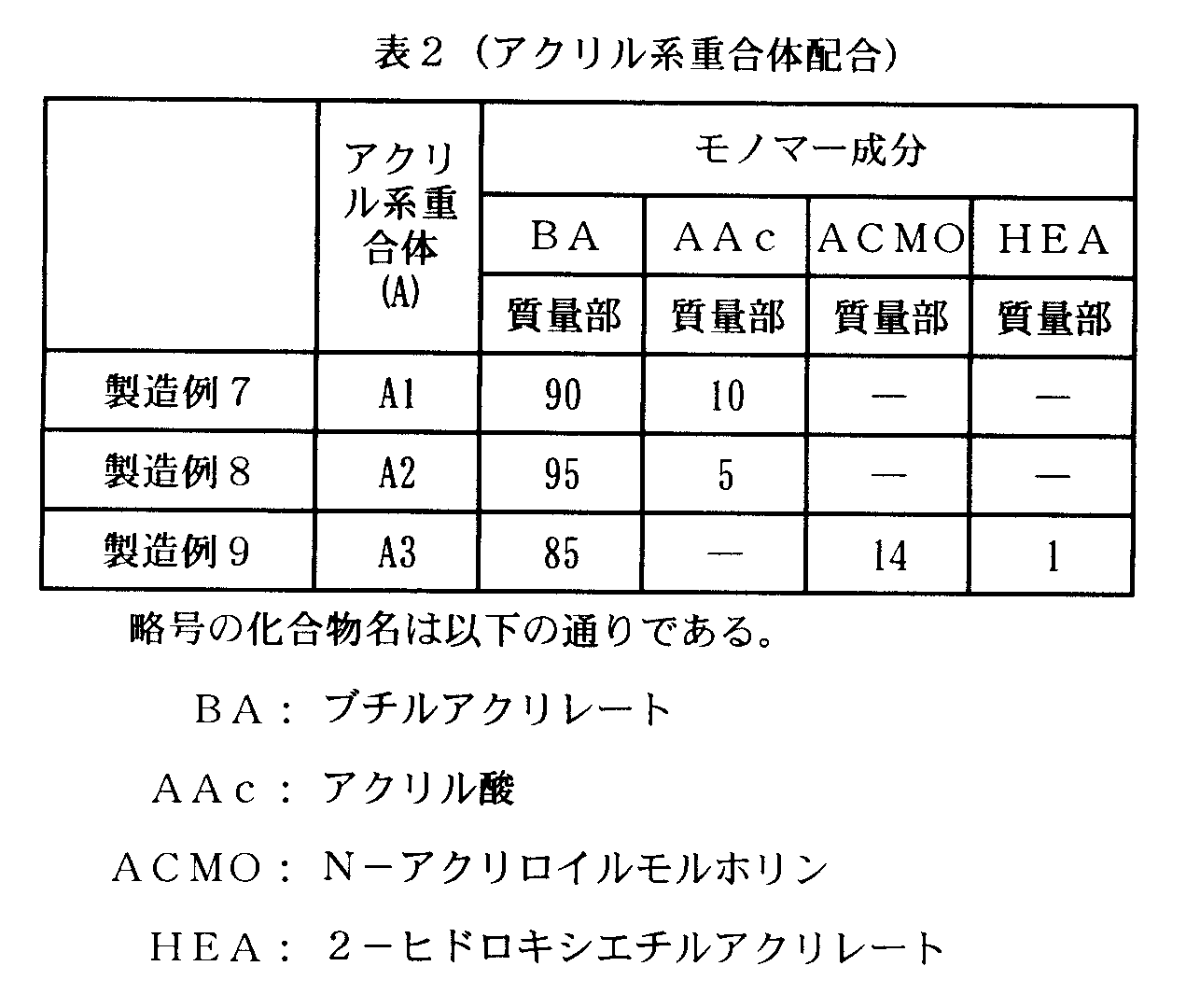
アクリル酸ブチル(BA)90質量部、アクリル酸(AAc)10質量部、酢酸エチル200質量部、重合開始剤として、アゾビスイソブチロニトリル0.2質量部を反応器に入れ混合した。4時間窒素ガスで脱気を行い、60℃まで徐々に昇温した後、24時間撹拌しながら重合反応を行ない、Mwが65万のアクリル系共重合体(A1)の酢酸エチル溶液を得た。
BAの使用量を95質量部、AAcの使用量を5質量部とした以外は製造例7と同様にして重合反応を行い、Mwが65万のアクリル系共重合体(A2)の酢酸エチル溶液を得た。
BA85質量部、N-アクリロイルモルホリン(ACMO)14質量部、アクリル酸2-ヒドロキシエチル(HEA)1質量部、酢酸エチル200質量部、重合開始剤としてアゾビスイソブチロニトリル0.2質量部を混合した。4時間窒素脱気を行い、60℃まで徐々に昇温した後24時間撹拌しながら重合反応を行ない、Mwが60万のアクリル共系重合体(A3)の酢酸エチル溶液を得た。
製造例7~9で得られたアクリル系重合体(A1)~(A3)の出発原料の種類およびその組成を表2に示す。
製造例1のウレタン樹脂(B1)のトルエン溶液180質量部(固形分90質量部)、製造例7のアクリル系重合体(A1)の酢酸エチル溶液33.4質量部(固形分10質量部)、架橋剤としてイソシアネート系架橋剤〔トリメチロールプロパン変性トリレンジイソシアネートの酢酸エチル溶液、固形分75質量%、商品名:コロネートHL、日本ポリウレタン社製〕の3質量部の混合物を固形分が10質量%となるようトルエンで希釈し、粘着剤組成物の溶液を得た。
この溶液をシリコーン処理された38μmポリエステルフィルム〔リンテック社製、商品名SP-PET381031〕に、乾燥後の粘着剤層の厚さが1μmとなるように塗布し、100℃で1分間乾燥した後に、25μmポリエステルフィルム〔三菱ポリエステル社製、商品名:T-100〕に転写させ粘着シートを得た。
表3に示した配合比でアクリル系重合体(A1~A3)の酢酸エチル溶液、ウレタン樹脂(B1~B6)のトルエン溶液、架橋剤(C)を配合した後、実施例1と同様にして、粘着シートを得た。各実施例及び比較例における各成分の配合比と測定された粘着力を併せて表3に記載する。なお、表3中、各成分の数値は固形分換算の質量部を示し、本発明において固形分とは溶剤以外の全成分をいう。
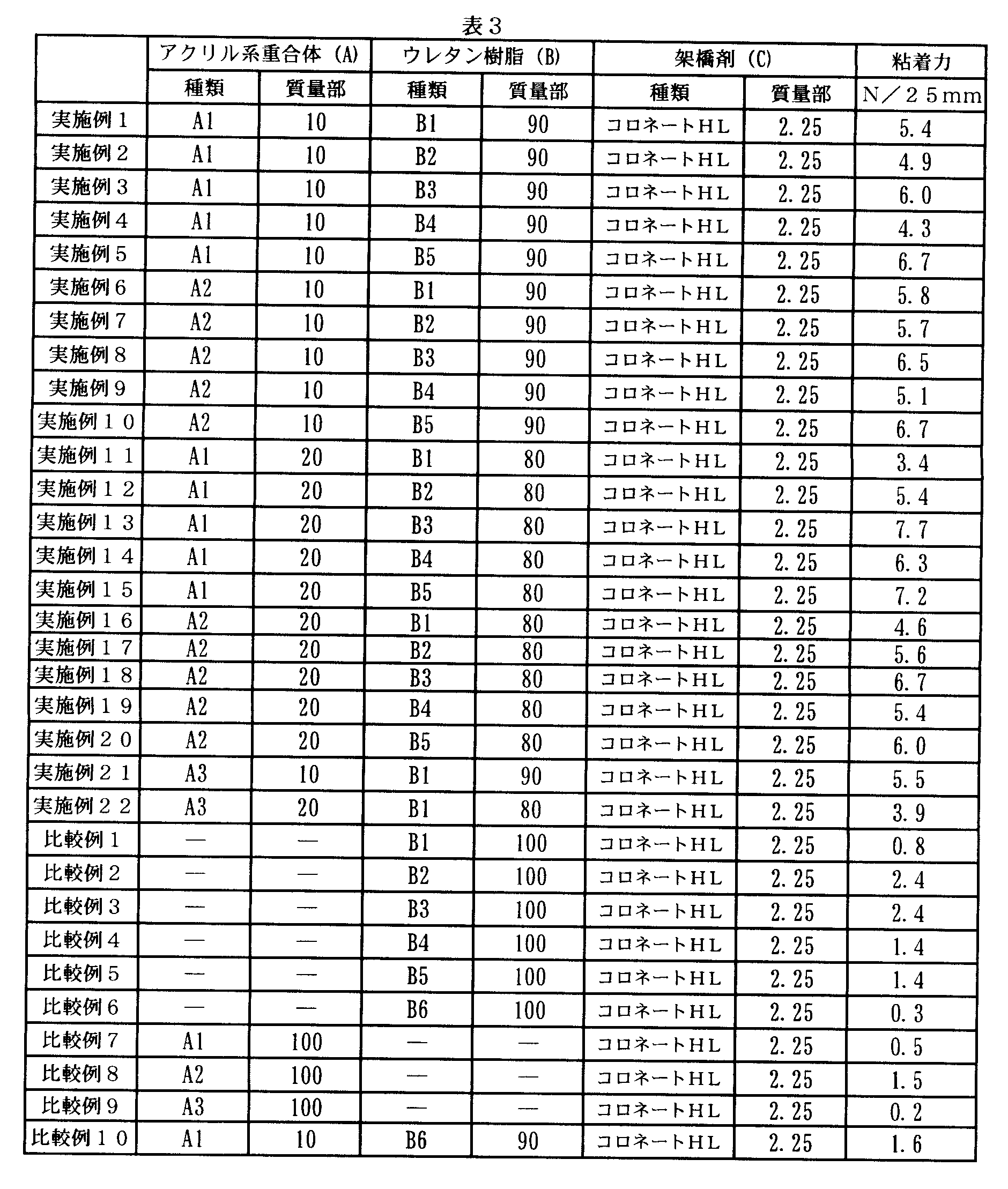
すなわち、架橋性官能基を有するアクリル系重合体(A1~A3)と、末端イソシアネートウレタンプレポリマーに特定の官能基を2個有する1種類の鎖延長剤またはその鎖延長剤と官能基を3つ以上有する鎖延長剤を反応させて調製されたウレタン樹脂(B1~B5)を含有する粘着剤から形成された粘着剤層を有する粘着シートの場合、粘着剤層を1μmまで薄膜化しても所望の粘着力を示す。
25μmポリエステルフィルム[三菱ポリエステル社製、商品名:T-100]の代わりに、6μmポリエステルフィルム[東レ社製、商品名:ルミラー、表4中では基材欄に6μmPETと記載する]を用いたこと以外は実施例10と同様にして、粘着シートを得た。
25μmポリエステルフィルム[三菱ポリエステル社製、商品名:T-100]の代わりに、50μm塩化ビニルフィルム[可塑剤としてポリエステル系可塑剤を24重量%含有、表4中では基材欄に50μmPVCと記載する]を用いたこと以外は実施例10と同様にして、粘着シートを得た。
25μmポリエステルフィルム[三菱ポリエステル社製、商品名:T-100]の代わりに、6μmポリエステルフィルム[東レ社製、商品名:ルミラー、表4中では基材欄に6μmPETと記載する]を用いたこと以外は実施例13と同様にして、粘着シートを得た。
25μmポリエステルフィルム[三菱ポリエステル社製、商品名:T-100]の代わりに、50μm塩化ビニルフィルム[可塑剤としてポリエステル系可塑剤を24重量%含有、表4中では基材欄に50μmPVCと記載する]を用いたこと以外は実施例13と同様にして、粘着シートを得た。
乾燥後の粘着剤層の厚さが5μmとなるように塗布したこと以外は実施例13と同様にして、粘着シートを得た。使用した25μmポリエステルフィルムを表4中では基材欄に25μmPETと記載する(実施例28~35まで同じ)。
乾燥後の粘着剤層の厚さが10μmとなるように塗布したこと以外は実施例13と同様にして、粘着シートを得た。
乾燥後の粘着剤層の厚さが20μmとなるように塗布したこと以外は実施例13と同様にして、粘着シートを得た。
乾燥後の粘着剤層の厚さが5μmとなるように塗布したこと以外は実施例16と同様にして、粘着シートを得た。
乾燥後の粘着剤層の厚さが10μmとなるように塗布したこと以外は実施例16と同様にして、粘着シートを得た。
乾燥後の粘着剤層の厚さが20μmとなるように塗布したこと以外は実施例16と同様にして、粘着シートを得た。
乾燥後の粘着剤層の厚さが5μmとなるように塗布したこと以外は実施例18と同様にして、粘着シートを得た。
乾燥後の粘着剤層の厚さが10μmとなるように塗布したこと以外は実施例18と同様にして、粘着シートを得た。
乾燥後の粘着剤層の厚さが20μmとなるように塗布したこと以外は実施例18と同様にして、粘着シートを得た。

すなわち、架橋性官能基を有するアクリル系重合体(A1~A3)と、末端イソシアネートウレタンプレポリマーに特定の官能基を2個有する1種類の鎖延長剤またはその鎖延長剤と官能基を3つ以上有する鎖延長剤を反応させて調製されたウレタン樹脂(B1~B5)を含有する粘着剤から形成された粘着剤層を有する粘着シートの場合、基材の厚みや種類に依存せずに所望の粘着力を示す。また粘着剤層を薄膜化せずとも所望の粘着力を示す。
Claims (9)
- 基材の少なくとも片面に、粘着剤層が設けられてなる粘着シートであって、前記粘着剤層を構成する粘着剤が(A)架橋性官能基を有するアクリル系共重合体と(B)ウレタン樹脂を含有し、該ウレタン樹脂が〔b1〕ジオールと〔b2〕多価イソシアネート化合物とを反応させて得られる末端イソシアネートウレタンプレポリマーに、〔b3〕鎖延長剤を反応させて得られるものであり、前記鎖延長剤が、〔b4〕水酸基及び/又はアミノ基を2つ有する化合物および〔b5〕水酸基及び/又はアミノ基を3つ以上有する化合物からなり、〔b4〕と〔b5〕が質量比で〔b4〕/〔b5〕=7/3~10/0の割合であることを特徴とする粘着シート。
- 前記〔b1〕ジオールが分子量1000~3000のグリコールである請求項1に記載の粘着シート。
- 前記〔b4〕が水酸基及びアミノ基を有する化合物である請求項1または2に記載の粘着シート。
- 前記架橋性官能基がエチレン性不飽和カルボン酸または(メタ)アクリル酸ヒドロキシアルキルエステル由来のものである請求項1~3のいずれかに記載の粘着シート。
- 前記(A)を構成する単量体が、さらに窒素含有エチレン性不飽和単量体を構成成分として含んでいる請求項1~4のいずれかに記載の粘着シート。
- さらに架橋剤(C)を含有する請求項1~5のいずれかに記載の粘着シート。
- 前記(A)アクリル系共重合体と(B)ウレタン樹脂を質量比で(A)/(B)=40/60~1/99の割合で含有する請求項1~6のいずれかに記載の粘着シート。
- 前記アクリル系共重合体の重量平均分子量(Mw)が30万~150万である請求項1~7のいずれかに記載の粘着シート。
- 粘着剤層の厚みが0.1~5μmである請求項1~8のいずれかに記載の粘着シート。
Priority Applications (4)
| Application Number | Priority Date | Filing Date | Title |
|---|---|---|---|
| US13/638,282 US9458364B2 (en) | 2010-03-31 | 2011-02-23 | Adhesive sheet |
| KR1020127025520A KR101812359B1 (ko) | 2010-03-31 | 2011-02-23 | 점착 시트 |
| JP2012508145A JP5737763B2 (ja) | 2010-03-31 | 2011-02-23 | 粘着シート |
| CN201180017193.6A CN102858898B (zh) | 2010-03-31 | 2011-02-23 | 粘着片 |
Applications Claiming Priority (2)
| Application Number | Priority Date | Filing Date | Title |
|---|---|---|---|
| JP2010-081415 | 2010-03-31 | ||
| JP2010081415 | 2010-03-31 |
Publications (1)
| Publication Number | Publication Date |
|---|---|
| WO2011122178A1 true WO2011122178A1 (ja) | 2011-10-06 |
Family
ID=44711910
Family Applications (1)
| Application Number | Title | Priority Date | Filing Date |
|---|---|---|---|
| PCT/JP2011/053931 Ceased WO2011122178A1 (ja) | 2010-03-31 | 2011-02-23 | 粘着シート |
Country Status (5)
| Country | Link |
|---|---|
| US (1) | US9458364B2 (ja) |
| JP (1) | JP5737763B2 (ja) |
| KR (1) | KR101812359B1 (ja) |
| CN (1) | CN102858898B (ja) |
| WO (1) | WO2011122178A1 (ja) |
Cited By (18)
| Publication number | Priority date | Publication date | Assignee | Title |
|---|---|---|---|---|
| CN102838865A (zh) * | 2012-09-20 | 2012-12-26 | 天津博苑高新材料有限公司 | 一种防伪rfid标签用易碎膜及其制备方法 |
| JP2013032472A (ja) * | 2011-08-03 | 2013-02-14 | Lintec Corp | 両面粘着シート |
| WO2013042560A1 (ja) * | 2011-09-22 | 2013-03-28 | リンテック株式会社 | 難燃粘着シート |
| JP2013072064A (ja) * | 2011-09-29 | 2013-04-22 | Lintec Corp | マーキングフィルム |
| JP2013112788A (ja) * | 2011-11-30 | 2013-06-10 | Lintec Corp | 難燃粘着シート |
| JP2013189562A (ja) * | 2012-03-14 | 2013-09-26 | Lintec Corp | 粘着シート |
| CN103834319A (zh) * | 2012-11-20 | 2014-06-04 | 第一毛织株式会社 | 各向异性导电膜及半导体装置 |
| JP2014111733A (ja) * | 2012-11-06 | 2014-06-19 | Sanyo Chem Ind Ltd | ディスプレイ用粘着剤組成物 |
| JP2015514147A (ja) * | 2012-03-30 | 2015-05-18 | スリーエム イノベイティブ プロパティズ カンパニー | 尿素系及びウレタン系の感圧性接着剤ブレンド |
| CN104718264A (zh) * | 2012-10-19 | 2015-06-17 | 琳得科株式会社 | 粘合剂组合物及粘合片 |
| JP2016186026A (ja) * | 2015-03-27 | 2016-10-27 | リンテック株式会社 | 再剥離性フィルム |
| JP2018062595A (ja) * | 2016-10-14 | 2018-04-19 | 東洋インキScホールディングス株式会社 | 粘着剤および粘着シート |
| KR20200092895A (ko) * | 2019-01-25 | 2020-08-04 | 주식회사 엘지화학 | 표면 보호 필름 및 유기 발광 전자 장치 제조 방법 |
| JPWO2020225919A1 (ja) * | 2019-05-09 | 2020-11-12 | ||
| JP2022507864A (ja) * | 2019-01-25 | 2022-01-18 | エルジー・ケム・リミテッド | 表面保護フィルムおよび有機発光電子装置の製造方法 |
| JP2022507057A (ja) * | 2018-12-05 | 2022-01-18 | エルジー・ケム・リミテッド | 粘着剤組成物、表面保護フィルムおよび有機発光電子装置の製造方法 |
| JP2022513732A (ja) * | 2019-01-25 | 2022-02-09 | エルジー・ケム・リミテッド | 表面保護フィルムおよび有機発光電子装置の製造方法 |
| JP2023536252A (ja) * | 2020-08-18 | 2023-08-24 | エルジー・ケム・リミテッド | 帯電防止剤を含む粘着剤組成物および表面保護フィルム |
Families Citing this family (11)
| Publication number | Priority date | Publication date | Assignee | Title |
|---|---|---|---|---|
| JP5879160B2 (ja) * | 2012-03-06 | 2016-03-08 | 藤森工業株式会社 | 粘着剤組成物及び表面保護フィルム |
| KR20130136173A (ko) * | 2012-06-04 | 2013-12-12 | 삼성전자주식회사 | 지문 기반 단축키를 제공하는 방법, 기계로 읽을 수 있는 저장 매체 및 휴대 단말 |
| US9081130B1 (en) * | 2013-01-09 | 2015-07-14 | Insight Equity A.P.X., Lp | Photochromic polyurethane laminate |
| US10611873B2 (en) * | 2014-12-16 | 2020-04-07 | 3M Innovative Properties Company | Polyurethane pressure-sensitive adhesives |
| SE539637C2 (en) * | 2016-03-16 | 2017-10-24 | Fingerprint Cards Ab | Fingerprint enrollment in smart device |
| EP3545024B1 (en) * | 2016-11-23 | 2024-01-17 | Spartech LLC | Urethane urea acrylic mold casted sheet materials |
| JP6519687B1 (ja) * | 2018-04-12 | 2019-05-29 | 東洋インキScホールディングス株式会社 | 粘着剤、粘着シート、および水酸基末端ウレタンプレポリマーの製造方法 |
| US12275875B2 (en) | 2019-01-25 | 2025-04-15 | Lg Chem, Ltd. | Surface protection film and method for manufacturing organic light emitting electronic device |
| KR102609849B1 (ko) * | 2019-02-28 | 2023-12-04 | 동우 화인켐 주식회사 | 점착 시트 |
| CN115335483B (zh) * | 2020-08-18 | 2024-07-19 | 株式会社Lg化学 | 粘合剂组合物和表面保护膜 |
| KR20230153366A (ko) * | 2021-03-03 | 2023-11-06 | 도요보 가부시키가이샤 | 적층 필름, 적층 필름의 제조 방법, 적층체, 및 적층체의 제조 방법 |
Citations (7)
| Publication number | Priority date | Publication date | Assignee | Title |
|---|---|---|---|---|
| JPS62295982A (ja) * | 1986-06-13 | 1987-12-23 | Toyoda Gosei Co Ltd | モ−ルの取付構造 |
| JPS62297373A (ja) * | 1986-06-18 | 1987-12-24 | Kao Corp | 水性感圧性接着剤組成物 |
| JP2004002827A (ja) * | 2002-04-19 | 2004-01-08 | Sanyo Chem Ind Ltd | 粘着剤組成物 |
| JP2005194366A (ja) * | 2004-01-06 | 2005-07-21 | Lintec Corp | 粘着剤組成物、それを用いた接着性光学機能部材及び液晶表示素子 |
| JP2005325250A (ja) * | 2004-05-14 | 2005-11-24 | Nitto Denko Corp | 金属面貼付用感圧性粘着シート類および金属面を有する物品 |
| WO2007046365A1 (ja) * | 2005-10-18 | 2007-04-26 | Nitto Denko Corporation | 粘着剤組成物、粘着剤層およびその製造方法、ならびに粘着剤付光学部材 |
| JP2009155532A (ja) * | 2007-12-27 | 2009-07-16 | Nippon Carbide Ind Co Inc | 粘着剤組成物および粘着シート |
Family Cites Families (13)
| Publication number | Priority date | Publication date | Assignee | Title |
|---|---|---|---|---|
| US3718712A (en) * | 1971-03-01 | 1973-02-27 | Minnesota Mining & Mfg | Pressure-sensitive adhesives based on cyclic terpene urethane resin |
| US4543405A (en) * | 1984-10-01 | 1985-09-24 | Ppg Industries, Inc. | High solids polyurethane polyols and coating compositions thereof |
| JP3853247B2 (ja) * | 2002-04-16 | 2006-12-06 | 日東電工株式会社 | 電子部品用加熱剥離型粘着シートおよび電子部品の加工方法並びに電子部品 |
| JP2005007618A (ja) | 2003-06-17 | 2005-01-13 | Nihon Micro Coating Co Ltd | フィルムシート |
| CA2574933C (en) * | 2004-07-26 | 2015-05-19 | Synthes (U.S.A.) | Biocompatible, biodegradable polyurethane materials with controlled hydrophobic to hydrophilic ratio |
| DE602005027100D1 (de) * | 2004-09-30 | 2011-05-05 | Asahi Glass Co Ltd | Verfahren zur herstellung von urethanharz und haftklebstoff |
| JP2006281488A (ja) | 2005-03-31 | 2006-10-19 | Lintec Corp | 積層回路基板製造用工程フィルム |
| JP4140736B2 (ja) | 2006-03-15 | 2008-08-27 | 日東電工株式会社 | 粘着型光学フィルム、積層光学フィルムおよび画像表示装置 |
| JP2008102271A (ja) | 2006-10-18 | 2008-05-01 | Nitto Denko Corp | 表面保護フィルムおよび表面保護フィルム付き光学フィルム |
| JP5295533B2 (ja) | 2006-10-31 | 2013-09-18 | 日東電工株式会社 | 表面保護フィルムおよび表面保護フィルム付き光学フィルム |
| JP5196828B2 (ja) | 2007-04-03 | 2013-05-15 | バンドー化学株式会社 | 皮膚貼付薬シート |
| JP5112780B2 (ja) | 2007-08-03 | 2013-01-09 | リンテック株式会社 | 易貼付性粘着シート及びその製造方法 |
| JP2009158503A (ja) | 2007-12-25 | 2009-07-16 | Furukawa Electric Co Ltd:The | ウエハ加工用テープ |
-
2011
- 2011-02-23 JP JP2012508145A patent/JP5737763B2/ja active Active
- 2011-02-23 KR KR1020127025520A patent/KR101812359B1/ko active Active
- 2011-02-23 WO PCT/JP2011/053931 patent/WO2011122178A1/ja not_active Ceased
- 2011-02-23 US US13/638,282 patent/US9458364B2/en active Active
- 2011-02-23 CN CN201180017193.6A patent/CN102858898B/zh active Active
Patent Citations (7)
| Publication number | Priority date | Publication date | Assignee | Title |
|---|---|---|---|---|
| JPS62295982A (ja) * | 1986-06-13 | 1987-12-23 | Toyoda Gosei Co Ltd | モ−ルの取付構造 |
| JPS62297373A (ja) * | 1986-06-18 | 1987-12-24 | Kao Corp | 水性感圧性接着剤組成物 |
| JP2004002827A (ja) * | 2002-04-19 | 2004-01-08 | Sanyo Chem Ind Ltd | 粘着剤組成物 |
| JP2005194366A (ja) * | 2004-01-06 | 2005-07-21 | Lintec Corp | 粘着剤組成物、それを用いた接着性光学機能部材及び液晶表示素子 |
| JP2005325250A (ja) * | 2004-05-14 | 2005-11-24 | Nitto Denko Corp | 金属面貼付用感圧性粘着シート類および金属面を有する物品 |
| WO2007046365A1 (ja) * | 2005-10-18 | 2007-04-26 | Nitto Denko Corporation | 粘着剤組成物、粘着剤層およびその製造方法、ならびに粘着剤付光学部材 |
| JP2009155532A (ja) * | 2007-12-27 | 2009-07-16 | Nippon Carbide Ind Co Inc | 粘着剤組成物および粘着シート |
Cited By (34)
| Publication number | Priority date | Publication date | Assignee | Title |
|---|---|---|---|---|
| JP2013032472A (ja) * | 2011-08-03 | 2013-02-14 | Lintec Corp | 両面粘着シート |
| JP5319857B1 (ja) * | 2011-09-22 | 2013-10-16 | リンテック株式会社 | 難燃粘着シート |
| WO2013042560A1 (ja) * | 2011-09-22 | 2013-03-28 | リンテック株式会社 | 難燃粘着シート |
| US9150760B2 (en) | 2011-09-22 | 2015-10-06 | Lintec Corporation | Flame retardant adhesive sheet |
| JP2013072064A (ja) * | 2011-09-29 | 2013-04-22 | Lintec Corp | マーキングフィルム |
| JP2013112788A (ja) * | 2011-11-30 | 2013-06-10 | Lintec Corp | 難燃粘着シート |
| JP2013189562A (ja) * | 2012-03-14 | 2013-09-26 | Lintec Corp | 粘着シート |
| JP2015514147A (ja) * | 2012-03-30 | 2015-05-18 | スリーエム イノベイティブ プロパティズ カンパニー | 尿素系及びウレタン系の感圧性接着剤ブレンド |
| CN102838865A (zh) * | 2012-09-20 | 2012-12-26 | 天津博苑高新材料有限公司 | 一种防伪rfid标签用易碎膜及其制备方法 |
| CN104718264A (zh) * | 2012-10-19 | 2015-06-17 | 琳得科株式会社 | 粘合剂组合物及粘合片 |
| KR20150076150A (ko) | 2012-10-19 | 2015-07-06 | 린텍 가부시키가이샤 | 점착제 조성물 및 점착 시트 |
| CN107325740B (zh) * | 2012-10-19 | 2020-10-20 | 琳得科株式会社 | 粘合剂组合物及粘合片 |
| CN107286856A (zh) * | 2012-10-19 | 2017-10-24 | 琳得科株式会社 | 粘合剂组合物及粘合片 |
| CN107325740A (zh) * | 2012-10-19 | 2017-11-07 | 琳得科株式会社 | 粘合剂组合物及粘合片 |
| JP2014111733A (ja) * | 2012-11-06 | 2014-06-19 | Sanyo Chem Ind Ltd | ディスプレイ用粘着剤組成物 |
| CN103834319A (zh) * | 2012-11-20 | 2014-06-04 | 第一毛织株式会社 | 各向异性导电膜及半导体装置 |
| JP2016186026A (ja) * | 2015-03-27 | 2016-10-27 | リンテック株式会社 | 再剥離性フィルム |
| JP2018062595A (ja) * | 2016-10-14 | 2018-04-19 | 東洋インキScホールディングス株式会社 | 粘着剤および粘着シート |
| JP2022507057A (ja) * | 2018-12-05 | 2022-01-18 | エルジー・ケム・リミテッド | 粘着剤組成物、表面保護フィルムおよび有機発光電子装置の製造方法 |
| JP7214296B2 (ja) | 2018-12-05 | 2023-01-30 | エルジー・ケム・リミテッド | 粘着剤組成物、表面保護フィルムおよび有機発光電子装置の製造方法 |
| JP7191223B2 (ja) | 2019-01-25 | 2022-12-16 | エルジー・ケム・リミテッド | 表面保護フィルムおよび有機発光電子装置の製造方法 |
| US12146083B2 (en) | 2019-01-25 | 2024-11-19 | Lg Chem, Ltd. | Surface protection film, and method for manufacturing organic light-emitting electronic device |
| JP2022507864A (ja) * | 2019-01-25 | 2022-01-18 | エルジー・ケム・リミテッド | 表面保護フィルムおよび有機発光電子装置の製造方法 |
| JP2022513732A (ja) * | 2019-01-25 | 2022-02-09 | エルジー・ケム・リミテッド | 表面保護フィルムおよび有機発光電子装置の製造方法 |
| KR102475966B1 (ko) | 2019-01-25 | 2022-12-09 | 주식회사 엘지화학 | 표면 보호 필름 및 유기 발광 전자 장치 제조 방법 |
| JP7191224B2 (ja) | 2019-01-25 | 2022-12-16 | エルジー・ケム・リミテッド | 表面保護フィルムおよび有機発光電子装置の製造方法 |
| KR20200092895A (ko) * | 2019-01-25 | 2020-08-04 | 주식회사 엘지화학 | 표면 보호 필름 및 유기 발광 전자 장치 제조 방법 |
| JP2022507931A (ja) * | 2019-01-25 | 2022-01-18 | エルジー・ケム・リミテッド | 表面保護フィルムおよび有機発光電子装置の製造方法 |
| JP7241877B2 (ja) | 2019-01-25 | 2023-03-17 | エルジー・ケム・リミテッド | 表面保護フィルムおよび有機発光電子装置の製造方法 |
| US12279479B2 (en) | 2019-01-25 | 2025-04-15 | Lg Chem, Ltd. | Surface protection film and method for manufacturing organic light-emitting electronic device |
| JPWO2020225919A1 (ja) * | 2019-05-09 | 2020-11-12 | ||
| JP7380683B2 (ja) | 2019-05-09 | 2023-11-15 | 株式会社レゾナック | 接着剤セット及び構造体の製造方法 |
| JP7531975B2 (ja) | 2020-08-18 | 2024-08-13 | エルジー・ケム・リミテッド | 帯電防止剤を含む粘着剤組成物および表面保護フィルム |
| JP2023536252A (ja) * | 2020-08-18 | 2023-08-24 | エルジー・ケム・リミテッド | 帯電防止剤を含む粘着剤組成物および表面保護フィルム |
Also Published As
| Publication number | Publication date |
|---|---|
| CN102858898A (zh) | 2013-01-02 |
| JP5737763B2 (ja) | 2015-06-17 |
| JPWO2011122178A1 (ja) | 2013-07-08 |
| CN102858898B (zh) | 2014-10-08 |
| US9458364B2 (en) | 2016-10-04 |
| KR20130066571A (ko) | 2013-06-20 |
| KR101812359B1 (ko) | 2017-12-26 |
| US20130017392A1 (en) | 2013-01-17 |
Similar Documents
| Publication | Publication Date | Title |
|---|---|---|
| JP5737763B2 (ja) | 粘着シート | |
| JP5857037B2 (ja) | 粘着シート | |
| JP5474297B2 (ja) | 粘着剤組成物および粘着シート | |
| JP5808975B2 (ja) | 両面粘着シート | |
| JP5319857B1 (ja) | 難燃粘着シート | |
| KR101096986B1 (ko) | 우레탄 수지의 제조 방법 및 점착제 | |
| JP5785861B2 (ja) | 難燃粘着シート | |
| JP5864987B2 (ja) | 両面粘着シート | |
| JP6891412B2 (ja) | ウレタン形成性組成物、及びそれを用いたウレタン粘着剤 | |
| JP2013189562A (ja) | 粘着シート | |
| JP2006124528A (ja) | 粘着積層体およびそれを用いた液晶セル用部材 | |
| JP2002038119A (ja) | 感圧性接着剤およびその用途 | |
| JP5841792B2 (ja) | マーキングフィルム | |
| CN113330085A (zh) | 加强用层叠薄膜 | |
| JP5908693B2 (ja) | 改ざん防止用ラベル | |
| JP2009120820A (ja) | 電子部品用粘着シート | |
| CN113365818A (zh) | 加强用层叠薄膜 |
Legal Events
| Date | Code | Title | Description |
|---|---|---|---|
| WWE | Wipo information: entry into national phase |
Ref document number: 201180017193.6 Country of ref document: CN |
|
| 121 | Ep: the epo has been informed by wipo that ep was designated in this application |
Ref document number: 11762418 Country of ref document: EP Kind code of ref document: A1 |
|
| WWE | Wipo information: entry into national phase |
Ref document number: 2012508145 Country of ref document: JP |
|
| ENP | Entry into the national phase |
Ref document number: 20127025520 Country of ref document: KR Kind code of ref document: A |
|
| WWE | Wipo information: entry into national phase |
Ref document number: 13638282 Country of ref document: US |
|
| NENP | Non-entry into the national phase |
Ref country code: DE |
|
| 122 | Ep: pct application non-entry in european phase |
Ref document number: 11762418 Country of ref document: EP Kind code of ref document: A1 |