WO2011108610A1 - 水処理方法及び超純水製造方法 - Google Patents
水処理方法及び超純水製造方法 Download PDFInfo
- Publication number
- WO2011108610A1 WO2011108610A1 PCT/JP2011/054810 JP2011054810W WO2011108610A1 WO 2011108610 A1 WO2011108610 A1 WO 2011108610A1 JP 2011054810 W JP2011054810 W JP 2011054810W WO 2011108610 A1 WO2011108610 A1 WO 2011108610A1
- Authority
- WO
- WIPO (PCT)
- Prior art keywords
- water
- treatment
- urea
- biological
- biological treatment
- Prior art date
- Legal status (The legal status is an assumption and is not a legal conclusion. Google has not performed a legal analysis and makes no representation as to the accuracy of the status listed.)
- Ceased
Links
Images

Classifications
-
- C—CHEMISTRY; METALLURGY
- C02—TREATMENT OF WATER, WASTE WATER, SEWAGE, OR SLUDGE
- C02F—TREATMENT OF WATER, WASTE WATER, SEWAGE, OR SLUDGE
- C02F9/00—Multistage treatment of water, waste water or sewage
-
- C—CHEMISTRY; METALLURGY
- C02—TREATMENT OF WATER, WASTE WATER, SEWAGE, OR SLUDGE
- C02F—TREATMENT OF WATER, WASTE WATER, SEWAGE, OR SLUDGE
- C02F1/00—Treatment of water, waste water, or sewage
- C02F1/58—Treatment of water, waste water, or sewage by removing specified dissolved compounds
-
- C—CHEMISTRY; METALLURGY
- C02—TREATMENT OF WATER, WASTE WATER, SEWAGE, OR SLUDGE
- C02F—TREATMENT OF WATER, WASTE WATER, SEWAGE, OR SLUDGE
- C02F1/00—Treatment of water, waste water, or sewage
- C02F1/70—Treatment of water, waste water, or sewage by reduction
-
- C—CHEMISTRY; METALLURGY
- C02—TREATMENT OF WATER, WASTE WATER, SEWAGE, OR SLUDGE
- C02F—TREATMENT OF WATER, WASTE WATER, SEWAGE, OR SLUDGE
- C02F3/00—Biological treatment of water, waste water, or sewage
- C02F3/02—Aerobic processes
- C02F3/10—Packings; Fillings; Grids
- C02F3/105—Characterized by the chemical composition
- C02F3/106—Carbonaceous materials
-
- C—CHEMISTRY; METALLURGY
- C02—TREATMENT OF WATER, WASTE WATER, SEWAGE, OR SLUDGE
- C02F—TREATMENT OF WATER, WASTE WATER, SEWAGE, OR SLUDGE
- C02F1/00—Treatment of water, waste water, or sewage
- C02F1/28—Treatment of water, waste water, or sewage by sorption
- C02F1/283—Treatment of water, waste water, or sewage by sorption using coal, charred products, or inorganic mixtures containing them
-
- C—CHEMISTRY; METALLURGY
- C02—TREATMENT OF WATER, WASTE WATER, SEWAGE, OR SLUDGE
- C02F—TREATMENT OF WATER, WASTE WATER, SEWAGE, OR SLUDGE
- C02F1/00—Treatment of water, waste water, or sewage
- C02F1/30—Treatment of water, waste water, or sewage by irradiation
- C02F1/32—Treatment of water, waste water, or sewage by irradiation with ultraviolet light
-
- C—CHEMISTRY; METALLURGY
- C02—TREATMENT OF WATER, WASTE WATER, SEWAGE, OR SLUDGE
- C02F—TREATMENT OF WATER, WASTE WATER, SEWAGE, OR SLUDGE
- C02F1/00—Treatment of water, waste water, or sewage
- C02F1/42—Treatment of water, waste water, or sewage by ion-exchange
-
- C—CHEMISTRY; METALLURGY
- C02—TREATMENT OF WATER, WASTE WATER, SEWAGE, OR SLUDGE
- C02F—TREATMENT OF WATER, WASTE WATER, SEWAGE, OR SLUDGE
- C02F1/00—Treatment of water, waste water, or sewage
- C02F1/44—Treatment of water, waste water, or sewage by dialysis, osmosis or reverse osmosis
- C02F1/441—Treatment of water, waste water, or sewage by dialysis, osmosis or reverse osmosis by reverse osmosis
-
- C—CHEMISTRY; METALLURGY
- C02—TREATMENT OF WATER, WASTE WATER, SEWAGE, OR SLUDGE
- C02F—TREATMENT OF WATER, WASTE WATER, SEWAGE, OR SLUDGE
- C02F1/00—Treatment of water, waste water, or sewage
- C02F1/44—Treatment of water, waste water, or sewage by dialysis, osmosis or reverse osmosis
- C02F1/444—Treatment of water, waste water, or sewage by dialysis, osmosis or reverse osmosis by ultrafiltration or microfiltration
-
- C—CHEMISTRY; METALLURGY
- C02—TREATMENT OF WATER, WASTE WATER, SEWAGE, OR SLUDGE
- C02F—TREATMENT OF WATER, WASTE WATER, SEWAGE, OR SLUDGE
- C02F1/00—Treatment of water, waste water, or sewage
- C02F1/46—Treatment of water, waste water, or sewage by electrochemical methods
- C02F1/469—Treatment of water, waste water, or sewage by electrochemical methods by electrochemical separation, e.g. by electro-osmosis, electrodialysis, electrophoresis
- C02F1/4693—Treatment of water, waste water, or sewage by electrochemical methods by electrochemical separation, e.g. by electro-osmosis, electrodialysis, electrophoresis electrodialysis
- C02F1/4695—Treatment of water, waste water, or sewage by electrochemical methods by electrochemical separation, e.g. by electro-osmosis, electrodialysis, electrophoresis electrodialysis electrodeionisation
-
- C—CHEMISTRY; METALLURGY
- C02—TREATMENT OF WATER, WASTE WATER, SEWAGE, OR SLUDGE
- C02F—TREATMENT OF WATER, WASTE WATER, SEWAGE, OR SLUDGE
- C02F1/00—Treatment of water, waste water, or sewage
- C02F1/72—Treatment of water, waste water, or sewage by oxidation
- C02F1/76—Treatment of water, waste water, or sewage by oxidation with halogens or compounds of halogens
-
- C—CHEMISTRY; METALLURGY
- C02—TREATMENT OF WATER, WASTE WATER, SEWAGE, OR SLUDGE
- C02F—TREATMENT OF WATER, WASTE WATER, SEWAGE, OR SLUDGE
- C02F1/00—Treatment of water, waste water, or sewage
- C02F1/72—Treatment of water, waste water, or sewage by oxidation
- C02F1/76—Treatment of water, waste water, or sewage by oxidation with halogens or compounds of halogens
- C02F1/766—Treatment of water, waste water, or sewage by oxidation with halogens or compounds of halogens by means of halogens other than chlorine or of halogenated compounds containing halogen other than chlorine
-
- C—CHEMISTRY; METALLURGY
- C02—TREATMENT OF WATER, WASTE WATER, SEWAGE, OR SLUDGE
- C02F—TREATMENT OF WATER, WASTE WATER, SEWAGE, OR SLUDGE
- C02F2101/00—Nature of the contaminant
- C02F2101/30—Organic compounds
- C02F2101/38—Organic compounds containing nitrogen
-
- C—CHEMISTRY; METALLURGY
- C02—TREATMENT OF WATER, WASTE WATER, SEWAGE, OR SLUDGE
- C02F—TREATMENT OF WATER, WASTE WATER, SEWAGE, OR SLUDGE
- C02F2103/00—Nature of the water, waste water, sewage or sludge to be treated
- C02F2103/02—Non-contaminated water, e.g. for industrial water supply
- C02F2103/04—Non-contaminated water, e.g. for industrial water supply for obtaining ultra-pure water
-
- C—CHEMISTRY; METALLURGY
- C02—TREATMENT OF WATER, WASTE WATER, SEWAGE, OR SLUDGE
- C02F—TREATMENT OF WATER, WASTE WATER, SEWAGE, OR SLUDGE
- C02F2103/00—Nature of the water, waste water, sewage or sludge to be treated
- C02F2103/06—Contaminated groundwater or leachate
-
- C—CHEMISTRY; METALLURGY
- C02—TREATMENT OF WATER, WASTE WATER, SEWAGE, OR SLUDGE
- C02F—TREATMENT OF WATER, WASTE WATER, SEWAGE, OR SLUDGE
- C02F2303/00—Specific treatment goals
- C02F2303/18—Removal of treatment agents after treatment
- C02F2303/185—The treatment agent being halogen or a halogenated compound
-
- C—CHEMISTRY; METALLURGY
- C02—TREATMENT OF WATER, WASTE WATER, SEWAGE, OR SLUDGE
- C02F—TREATMENT OF WATER, WASTE WATER, SEWAGE, OR SLUDGE
- C02F2303/00—Specific treatment goals
- C02F2303/20—Prevention of biofouling
-
- C—CHEMISTRY; METALLURGY
- C02—TREATMENT OF WATER, WASTE WATER, SEWAGE, OR SLUDGE
- C02F—TREATMENT OF WATER, WASTE WATER, SEWAGE, OR SLUDGE
- C02F2305/00—Use of specific compounds during water treatment
- C02F2305/06—Nutrients for stimulating the growth of microorganisms
-
- C—CHEMISTRY; METALLURGY
- C02—TREATMENT OF WATER, WASTE WATER, SEWAGE, OR SLUDGE
- C02F—TREATMENT OF WATER, WASTE WATER, SEWAGE, OR SLUDGE
- C02F3/00—Biological treatment of water, waste water, or sewage
- C02F3/02—Aerobic processes
- C02F3/06—Aerobic processes using submerged filters
-
- C—CHEMISTRY; METALLURGY
- C02—TREATMENT OF WATER, WASTE WATER, SEWAGE, OR SLUDGE
- C02F—TREATMENT OF WATER, WASTE WATER, SEWAGE, OR SLUDGE
- C02F3/00—Biological treatment of water, waste water, or sewage
- C02F3/30—Aerobic and anaerobic processes
- C02F3/302—Nitrification and denitrification treatment
-
- C—CHEMISTRY; METALLURGY
- C02—TREATMENT OF WATER, WASTE WATER, SEWAGE, OR SLUDGE
- C02F—TREATMENT OF WATER, WASTE WATER, SEWAGE, OR SLUDGE
- C02F3/00—Biological treatment of water, waste water, or sewage
- C02F3/30—Aerobic and anaerobic processes
- C02F3/308—Biological phosphorus removal
-
- Y—GENERAL TAGGING OF NEW TECHNOLOGICAL DEVELOPMENTS; GENERAL TAGGING OF CROSS-SECTIONAL TECHNOLOGIES SPANNING OVER SEVERAL SECTIONS OF THE IPC; TECHNICAL SUBJECTS COVERED BY FORMER USPC CROSS-REFERENCE ART COLLECTIONS [XRACs] AND DIGESTS
- Y02—TECHNOLOGIES OR APPLICATIONS FOR MITIGATION OR ADAPTATION AGAINST CLIMATE CHANGE
- Y02W—CLIMATE CHANGE MITIGATION TECHNOLOGIES RELATED TO WASTEWATER TREATMENT OR WASTE MANAGEMENT
- Y02W10/00—Technologies for wastewater treatment
- Y02W10/10—Biological treatment of water, waste water, or sewage
Definitions
- the present invention relates to a raw water treatment method and an ultrapure water production method using treated water treated by the water treatment method, and more particularly, a water treatment method capable of highly removing urea in raw water and the water treatment method. It is related with the manufacturing method of the ultrapure water using the treated water processed by this.
- an ultrapure water production apparatus that produces ultrapure water from raw water such as city water, groundwater, and industrial water basically includes a pretreatment apparatus, a primary pure water production apparatus, and a secondary pure water production apparatus.
- the pretreatment device is composed of agglomeration, levitation, and filtration devices.
- the primary pure water production apparatus is composed of two reverse osmosis membrane separation devices and a mixed bed type ion exchange device, or an ion exchange pure water device and a reverse osmosis membrane separation device. It consists of a low-pressure ultraviolet oxidizer, a mixed bed ion exchanger, and an ultrafiltration membrane separator.
- Patent Documents 1 and 2 describe that TOC in ultrapure water is sufficiently reduced by removing urea from the water supplied to the ultrapure water production apparatus.
- Patent Document 1 describes that a biological treatment apparatus is incorporated in a pretreatment apparatus, and urea in raw water is decomposed by this biological treatment apparatus.
- Patent Document 2 sodium bromide and sodium hypochlorite are added to water to be treated (raw water), and urea in the raw water is changed to (NH 2 ) 2 CO + 3NaBr + 3NaClO ⁇ N 2 + CO 2 + 2H 2 O + 6Na + + 3Br. It is described that it decomposes according to the reaction formula ⁇ + 3Cl ⁇ .
- water obtained by decomposing urea by addition of sodium bromide and sodium hypochlorite is passed through an activated carbon tower, and the remaining It describes that sodium chlorite is decomposed and removed.
- JP-A-6-63592 Japanese Patent Laid-Open No. 9-94585
- Patent Document 1 has poor followability to load fluctuations. Therefore, when the urea concentration in the raw water is greatly increased, the urea removal treatment cannot catch up, and the urea removal performance Decreases, and the concentration of urea remaining in the treated water increases.
- the present invention has been made in view of the above problems, and an object thereof is to provide a water treatment method capable of highly decomposing TOC in raw water, particularly urea. Moreover, an object of this invention is to provide the ultrapure water manufacturing method using this water treatment method.
- the present invention has a biological treatment step in a water treatment method having an oxidation treatment step of adding a water-soluble bromide salt and an oxidizing agent to raw water containing an organic substance.
- a water treatment method is provided (Invention 1).
- invention 1 by treating raw water with a combination of an oxidation treatment carried out by adding a water-soluble bromide salt and an oxidizing agent and a biological treatment that decomposes organic matter by the action of living organisms,
- the action of removing urea by biological treatment can be obtained while suppressing the addition amount of the basic bromide salt and the oxidizing agent. For this reason, it is possible to suppress the load on the ion exchange device in the ultrapure water production process and improve the urea removal performance.
- BOD-utilizing bacteria or nitrifying bacteria are involved in the removal of urea.
- a water-soluble bromide salt and an oxidizing agent are added to the raw water to oxidize and decompose part of the urea in the raw water, while an easily biodegradable organic substance is added to the water supply in the biological treatment process.
- BOD-assimilating bacteria which are heterotrophic bacteria that use organic matter as a carbon source
- inorganic carbon is added as a carbon source by adding an ammonia nitrogen source to the feed water of the biological treatment process.
- the activity and proliferation of autotrophic bacteria using (carbon dioxide, bicarbonate, carbonic acid), so-called nitrifying bacteria, is enhanced.
- urea (NH 2 ) 2 CO is decomposed, so that both ammoniacal nitrogen and inorganic carbon can be ingested. Therefore, it is considered that urea removal performance is enhanced.
- the oxidation treatment step is preferably performed before the biological treatment step (Invention 3).
- this invention First, urea in raw water is roughly removed by an oxidation treatment step, and then residual urea is removed in a biological treatment step, whereby a hardly decomposable organic substance such as urea is obtained. Can be efficiently decomposed and removed.
- the biological treatment is preferably performed by biological treatment means having a biological carrier (Invention 4).
- carrier is activated carbon (invention 5).
- the biological treatment means is a biofilm method using a biological carrier, the outflow of bacterial cells from the biological treatment means can be suppressed more than in the case of a fluidized bed. The effect of the treatment is high, and the effect can be maintained for a long time.
- a chlorine-based oxidant such as hypochlorous acid
- an ammoniacal nitrogen source such as ammoniacal nitrogen source
- bonded chlorine has lower oxidizing power than free chlorine, it may cause oxidative deterioration of the processing member in the subsequent processing, so that the combined chlorine compound can be rendered harmless by reduction treatment.
- the second aspect of the present invention is to produce ultrapure water by treating the treated water obtained by the water treatment method according to the above inventions (Inventions 1 to 6) with a primary pure water device and a secondary pure water device.
- a method for producing ultrapure water is provided (Invention 7).
- TOC in raw water particularly urea
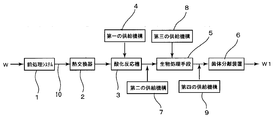
- FIG. 1 is a schematic view showing a treatment apparatus for performing a water treatment method according to an embodiment of the present invention.
- reference numeral 1 denotes a pretreatment system for raw water W supplied from a raw water storage tank (not shown). After the raw water W treated by the pretreatment system 1 is adjusted to a predetermined temperature by the heat exchanger 2, It is supplied to the oxidation reaction tank 3 (hereinafter simply referred to as “reaction tank”).
- This reaction tank 3 has a single tank or a multi-tank structure of two or more tanks, and is provided with a first supply mechanism 4 for supplying a water-soluble bromide salt and an oxidizing agent.
- the reaction tank 3 communicates with the biological treatment means 5, and the biological treatment means 5 continues to the fungus body separation device 6. After being treated by these various devices, the primary pure water device is treated as treated water W ⁇ b> 1. To be supplied.
- the second supply mechanism 7 for supplying the reducing agent is provided at the subsequent stage of the reaction tank 3.
- the biological treatment means 5 is provided with a third supply mechanism 8 for supplying an easily decomposable organic substance or an ammonia nitrogen source, and these can be supplied to the water supply of the biological treatment means 5.
- a fourth supply mechanism 9 for supplying a reducing agent and a slime control agent is provided at the subsequent stage of the biological treatment means 5.
- 10 is piping.
- the treatment apparatus configured as described above implements a reaction tank 3 for carrying out an oxidation treatment step of adding a water-soluble bromide salt and an oxidizing agent to raw water containing organic matter, and a biological treatment step of biologically treating the raw water.
- the raw water W to be treated in the treatment apparatus configured as described above contains organic matter, and can use ground water, river water, city water, other industrial water, recovered water from semiconductor manufacturing processes, and the like. .
- Urea is contained in the organic matter in the raw water (treatment target water) W, and the urea concentration in the raw water W is preferably about 5 to 200 ⁇ g / L, particularly about 5 to 100 ⁇ g / L.
- the pretreatment system 1 a general pretreatment system in the production process of ultrapure water or a treatment similar to this is suitable. Specifically, a treatment system comprising agglomeration, pressurized levitation, filtration, or the like can be used. In addition, when there are few turbid components, such as when using city water as raw
- an alkali bromide such as sodium bromide
- chlorine-based oxidizing agents such as sodium hypochlorite and chlorine dioxide can be used.
- the reducing agent examples include lower oxides such as sulfur dioxide; lower oxyacid salts such as thiosulfate, sulfite, bisulfite, and nitrite; low-valent metal salts such as iron (II) salt; formic acid, An acid, an organic acid such as L-ascorbic acid or a salt thereof; hydrazine, aldehydes, saccharides and the like can be used.
- nitrite, sulfite, iron (II) salt, sulfur dioxide, bisulfite, oxalic acid, L-ascorbic acid or salts thereof can be preferably used.
- the biological treatment means 5 is a means for performing a treatment for decomposing and stabilizing pollutants in wastewater such as sewage by biological action, and includes aerobic treatment and anaerobic treatment.
- organic matter is decomposed by biological treatment through oxygen respiration, nitric acid respiration, fermentation processes, etc., and is gasified or taken into the body of microorganisms and removed as sludge.
- the removal process of nitrogen (nitrification denitrification method) and phosphorus (biological phosphorus removal method) can also be performed.
- a means for performing such biological treatment is generally called a biological reaction tank.
- Such biological treatment means 5 is not particularly limited, but preferably has a fixed bed of biological support. In particular, a fixed bed of a downward flow type with less bacterial cell outflow is preferred.
- the biological treatment means 5 When the biological treatment means 5 is a fixed bed, it is preferable to wash the fixed bed as necessary. As a result, it is possible to prevent the occurrence of blockage of the fixed bed, mudballing, a decrease in the decomposition and removal efficiency of urea, and the like due to the growth of organisms (bacteria).
- this cleaning method There is no particular limitation on this cleaning method. For example, backwashing, that is, flowing the cleaning water in the direction opposite to the direction of passing raw water to fluidize the carrier, discharging sediment out of the system, It is preferable to perform pulverization, exfoliation of a part of the organism, and the like.
- the type of carrier for the fixed bed and activated carbon, anthracite, sand, zeolite, ion exchange resin, plastic molded product, etc. are used, but in order to carry out biological treatment in the presence of an oxidizing agent. It is preferable to use a carrier that consumes less oxidant. However, when there is a possibility that a high concentration of oxidant flows into the biological treatment means, it is preferable to use a carrier such as activated carbon that can decompose the oxidant. By using such activated carbon or the like, even when the concentration of the oxidizing agent in the raw water is high, the cells are prevented from being deactivated or killed.
- the allowable amount of the oxidant flowing into the biological treatment means is increased, and therefore the reduction treatment is performed to reduce the concentration of the oxidant remaining in the water after the oxidation treatment.
- the reduction process can be relaxed.
- the amount of reducing agent added can be reduced, and the control of the amount of reducing agent added can be simplified. Therefore, an increase in ion load in the pure water production process can be further suppressed.
- Examples of the easily decomposable organic substances added to the supply water of the biological treatment means 5 by the third supply mechanism 8 include organic acids such as acetic acid and citric acid, organic acid salts such as sodium acetate, and alcohols such as methanol and ethanol.
- Organic solvents such as acetone and other general-purpose readily biodegradable organic substances can be preferably used. Among these, even if the added organic matter cannot be completely treated and remains in the biologically treated water, it can be removed in the reverse osmosis membrane treatment or ion exchange treatment with ion exchange resin that is performed as a subsequent treatment.
- An organic acid salt such as sodium acetate, which is a natural organic substance, can be used more suitably.
- ammoniacal nitrogen source is not particularly limited, and any organic or inorganic ammoniacal nitrogen source can be suitably used. Among these, even when the added ammoniacal nitrogen source cannot be completely treated and remains in the biologically treated water, it is chlorinated as an ionic ammoniacal nitrogen source from the viewpoint of easy removal in the subsequent treatment.
- Ammonium salts such as ammonium and ammonium sulfate can be preferably used.
- the purpose of adding easily biodegradable organic substances and / or ammonia nitrogen source to the feed water in the biological treatment process is to remove urea by performing only oxidation treatment and biological treatment. Compared with the case where it does, it exists in obtaining higher urea removal performance. For this purpose, it is preferable to obtain and retain cells having better urea removal properties. From this viewpoint, urea and urea derivatives may be added as an ammoniacal nitrogen source. However, since some urea and urea derivatives are not ionic and cannot be expected to be removed in subsequent treatments, when added in a large amount, they cannot be removed even in biological treatment and later treatment, and remain at the end. There is a high possibility of end. Therefore, when urea and urea derivatives are added, a method is preferred in which the addition concentration is minimized and the necessary amount as an ammoniacal nitrogen source is supplemented with an ammonium salt or the like.
- the addition of the reducing agent and / or slime control agent from the fourth supply mechanism 9 in the subsequent stage of the biological treatment means 5 to the pipe 10 and the bacterial cell separation device 6 are not necessarily required, depending on the situation. Any one or more can be provided as appropriate. Specifically, when the oxidant or the like is discharged after the biological treatment means 5 or when the microbial cell is discharged, the reducing agent and / or slime from the fourth supply mechanism 9 as necessary. A control agent can be added to the pipe 10. Of the reducing agent and slime control agent, the same reducing agent as that supplied from the second supply mechanism 7 described above can be used.
- the slime control agent is preferably a bactericide that does not have an adverse effect due to oxidative degradation in the post-RO membrane treatment or ion exchange treatment in a primary pure water device (primary pure system) described later.
- sulfamic acid compound bonded chlorine agent having higher stability than chloramine, hydrogen peroxide, and the like can be used.
- This bacterial cell separation device 6 is an obstacle (clogging of piping) in a subsequent process such as a primary pure water device caused by bacterial cells contained in the treated water of the biological treatment means 5 (microbial cells detached from the biological carrier).
- a primary pure water device caused by bacterial cells contained in the treated water of the biological treatment means 5 (microbial cells detached from the biological carrier).
- membrane filtration a cartridge filter having a pore diameter of about 0.1 ⁇ m was used
- Membrane filtration treatment a cartridge filter having a pore diameter of about 0.1 ⁇ m was used
- Membrane filtration treatment coagulation filtration, and the like can be used.
- the efficiency of decomposition and removal of urea in the biological treatment means 5 in the subsequent stage is reduced by the turbid components. While suppressing, the increase in the pressure loss of the biological treatment means 5 is suppressed.
- the pretreated raw water W is heated by the heat exchanger 2 when the raw water W has a low temperature, and is cooled when the raw water W has a high temperature, and reaches a predetermined water temperature, preferably about 20 to 40 ° C. Adjust the temperature as follows. That is, the reaction in the reaction vessel 3 in which the water-soluble bromide salt and the oxidizing agent described later are added to roughly remove urea is a physicochemical reaction. The higher the water temperature, the higher the reaction rate and the higher the decomposition efficiency. On the other hand, when the water temperature is too high, the reaction tank 3 and the connection pipe 10 need to have heat resistance, leading to an increase in equipment cost.
- the rough removal ability of urea is reduced.
- the water temperature of the biological reaction is 40 ° C. or lower, basically, the higher the water temperature, the higher the biological activity and removal rate.
- the treatment water temperature is preferably about 20 to 40 ° C. Therefore, if the initial temperature of the raw water W is within the above range, nothing needs to be done.
- raw water W the temperature of which is adjusted as necessary
- urea urea is added.
- Oxidative decomposition (rough removal) is performed.
- the addition amount of the water-soluble bromide salt is preferably 0.5 to 50 mg / L (in terms of bromine ion). When the addition amount of the water-soluble bromide salt is less than 0.5 mg / L, the oxidative degradation of the organic component is not sufficient.
- the addition amount exceeds 50 mg / L, although the urea removal effect increases to some extent depending on the addition amount, Not only is there a possibility that the treatment means 5 may be adversely affected, but an increase in the ion load leads to an increase in the load on the primary deionizer in the subsequent stage.
- the load of the primary pure water device for example, an increase in operating cost due to an increase in osmotic pressure in the reverse osmosis membrane treatment, a scale failure due to an increase in salt concentration, or a water sampling amount accompanying an increase in the water supply ion load in the ion exchange treatment Decrease (increased reproduction frequency) and the like.
- the amount of oxidant added varies depending on the type of oxidant used.
- the free effective chlorine concentration is about 1 to 10 mg / L, particularly about 1 to 5 mg / L. Specifically, it may be about 2 mg / L.
- the addition amount of the chlorine-based oxidant is less than 1 mg / L, the oxidative decomposition of the organic component is not sufficient.
- it exceeds 10 mg / L not only the improvement of the effect is obtained, but also the remaining oxidant (Including free chlorine) increases, and the amount of reducing agent added to remove this free chlorine is too large.
- a reducing agent is added from the second supply mechanism 7 to the oxidized raw water W in the reaction tank 3 for reduction treatment.
- This reduction treatment is not always necessary, and may be performed only when the remaining amount of the oxidizing agent is high.
- the addition amount of the reducing agent in the case of performing the reduction treatment it is preferable to add an appropriate addition amount as necessary according to the residual concentration of the oxidizing agent described above. For example, when residual chlorine is reduced using sodium sulfite as a reducing agent, sulfite ions (SO 3 2 ⁇ ) and hypochlorite ions (ClO ⁇ ) may be added so as to be equimolar, which increases the safety factor. In consideration, 1.2 to 3.0 times the amount may be added.
- the oxidizing agent concentration of the treating water Since there is a fluctuation in the oxidizing agent concentration of the treated water, it is more preferable to monitor the oxidizing agent concentration of the treating water and control the reducing agent addition amount according to the oxidizing agent concentration.
- a method may be used in which the oxidant concentration is measured periodically and the addition amount corresponding to the measured concentration is set appropriately.
- the above-mentioned free residual chlorine concentration and the control value of the total residual chlorine concentration are control values on the assumption that the granular activated carbon that is a biological carrier has a residual chlorine removing ability, If the biological carrier has no residual chlorine removing ability, it is necessary to control the residual chlorine non-detection as a control value ( ⁇ 0.02 mg / L ⁇ asCl 2 ).
- examples of the means for detecting the oxidant concentration include an oxidation-reduction potential (ORP).
- ORP oxidation-reduction potential
- residual chlorine a residual chlorine meter (such as a polarographic method) can be used.
- the raw water W is passed through the biological treatment means 5.
- the water flow rate to the biological treatment means 5 is preferably about SV5 to 50 hr ⁇ 1 .
- the temperature of water supplied to the biological treatment means 5 may be room temperature, for example, 10 to 35 ° C., and the pH is preferably approximately neutral, for example, 4 to 8.
- an easily decomposable organic substance or an ammonia nitrogen source is added to the raw water W by the third supply mechanism 8 in the biological treatment means 5.
- the amount of the easily decomposable organic substance is less than 0.1 mg / L, the ability to ingest and decompose urea as a nitrogen source (N source) necessary for decomposing and assimilating this organic substance is not sufficient, but 2 mg Even if / L is exceeded, not only further decomposition of urea cannot be obtained, but also the amount of leak from the biological treatment means 5 becomes too large, which is not preferable.
- the addition amount may be 0.1 to 5 mg / L (converted to NH 4 + ). Specifically, it may be added so that the concentration of ammonium ions in the raw water W is within the above range. If the ammonium ion concentration in the raw water W is less than 0.1 mg / L (converted to NH 4 + ), it becomes difficult to maintain the activity of the nitrifying bacteria group, but even if it exceeds 5 mg / L (converted to NH 4 + ) Further, not only the activity of the nitrifying bacteria group is not obtained, but also the amount of leakage from the biological treatment means 5 becomes too large, which is not preferable.
- the urea concentration in the treated water W1 in the biological treatment means 5 after about 10 to 30 days has elapsed is 5 ⁇ g / L or less, In particular, it can be maintained at about 3 ⁇ g / L or less.
- the above readily decomposable organic substance or ammonia nitrogen source does not need to be added at all times.
- a method of adding only the start-up period at the time of biocarrier exchange or a method of repeating addition and non-addition every certain period, etc. should be used. Can do.
- the ammoniacal nitrogen source there is an effect that the addition cost of the easily decomposable organic substance or the ammoniacal nitrogen source can be reduced.
- free chlorine is present in the biological treatment water, and when ammonium salt or the like is added as an ammoniacal nitrogen source, the free chlorine reacts with ammonium ions to produce combined chlorine (chloramine).
- Bound chlorine is a component that is harder to remove even with activated carbon than free chlorine, and bound chlorine leaks into biologically treated water. Bound chlorine is said to be a component with low oxidizing power compared to free chlorine, but it is also known that free chlorine is generated again from bound chlorine by an equilibrium reaction. May cause oxidative degradation. For the above reasons, it is preferable to perform a reduction treatment as necessary as a post-treatment of the biological treatment means 5.
- slime control agent is a slime disorder such as clogging of pipes and increased differential pressure caused by cells contained in the treated water of the biological treatment means 5 (cells detached from the biological carrier). , RO membrane bio-fouling, etc.) may be added as needed for the purpose of avoidance.
- the microbial cells contained in the treated water of the biological treatment means 5 are removed by the microbial cell separation device 6.
- the addition of the reducing agent and / or slime control agent and the treatment by the bacterial cell separation device 6 may be appropriately performed in accordance with the quality of the biologically treated water from the biological treatment means 5, and the water quality is good. It is not necessary to do it.
- the ultrapure water production method using a water treatment method according to an embodiment of the present invention will be described with reference to FIG.
- the treated water W1 is treated with the primary pure water device 22 and the subsystem (secondary pure water). Further processing is performed by the device.
- the primary pure water device 22 includes a first reverse osmosis membrane (RO) separation device 24, a mixed bed ion exchange device 25, and a second reverse osmosis membrane (RO) separation device 26 in this order.
- the device configuration of the primary pure water device 22 is not limited to such a configuration.
- the sub-system 23 includes a sub-tank 27, a heat exchanger 28, a low-pressure ultraviolet oxidizer 29, a membrane degasser 30, a mixed bed ion exchanger 31, and an ultrafiltration membrane device (fine particle removal) 32. Arranged in this order.
- the apparatus configuration of the subsystem 23 is not limited to such a configuration, and is configured by combining, for example, a UV oxidation processing apparatus, an ion exchange processing apparatus (non-regenerative type), a UF membrane separation apparatus, and the like. May be.
- the treated water W1 treated by the water treatment device 21 is converted into a primary pure water device 22, a first reverse osmosis membrane (RO) separation device 24, a mixed bed ion exchange device 25, a second reverse osmosis membrane ( RO) Separation device 26 removes ion components and the like remaining in treated water W1.
- RO reverse osmosis membrane
- the treated water of the primary pure water device 22 is introduced into the low-pressure ultraviolet oxidizer 29 through the sub-tank 27 and the heat exchanger 28, and the contained TOC component is ionized or decomposed. Further, oxygen and carbon dioxide gas are removed by the membrane deaerator 30, and then the ionized organic substance is removed by the mixed bed ion exchanger 31 at the subsequent stage.
- the treated water of the mixed bed type ion exchange device 31 is further subjected to membrane separation treatment by an ultrafiltration membrane device (fine particle removal) 32, and ultrapure water can be obtained.
- raw water is treated by a combination of an oxidation treatment performed by adding a water-soluble bromide salt and an oxidizing agent and a biological treatment that decomposes organic matter by the action of the organism. Therefore, the load on the ion exchange device in the ultrapure water production process can be suppressed, and the urea removal performance can be enhanced. Furthermore, compared with the case where raw
- an easily biodegradable organic substance is added to the water for the biological treatment process.
- N source nitrogen source
- an ammoniacal nitrogen source increases the activity and growth of autotrophic bacteria using inorganic carbon (carbon dioxide, bicarbonate, carbonic acid) as a carbon source, so-called nitrifying bacteria, and urea (NH 2 ) 2 CO
- inorganic carbon carbon dioxide, bicarbonate, carbonic acid
- urea NH 2
- the biological treatment means 5 sufficiently decomposes and removes urea, and the TOC component, metal ions, etc. By removing the inorganic / organic ion component, high-purity ultrapure water can be efficiently produced.
- Example 1 an embodiment (Example 1) of a water treatment method combining oxidation treatment and biological treatment is combined with oxidation treatment and biological treatment, and an easily biodegradable organic substance or an ammoniacal nitrogen source is added to the biological treatment water supply.
- the present invention will be described in more detail with reference to the following Examples (Examples 2 to 4).
- Example 1 (oxidation treatment and biological treatment)
- reagent urea made by Kishida Chemical Co., Ltd.
- city water Nogimachi water
- pretreatment was not performed because treatment corresponding to pretreatment was performed on purified water.
- the biological treatment was carried out by passing water through a packed column filled with 10 L of cylindrical activated carbon (manufactured by Kurita Kogyo Co., Ltd., Cricol WG160, 10/32 mesh) as a biological carrier.
- the simulated raw water was heated to 30 ° C. using a heat exchanger, oxidized, and continuously supplied to the biological treatment.
- the urea concentration of the oxidized and biologically treated water was measured, the urea concentration was 40 to 60 ⁇ g / L for the oxidized treated water and ⁇ 2 to 2 for the biologically treated water against the urea concentration of 90 to 120 ⁇ g / L for the simulated raw water. It was 3 ⁇ g / L.
- the procedure for urea analysis in this example is as follows. That is, first, the residual chlorine concentration of the test water is measured by the DPD method, and reduced with a considerable amount of sodium bisulfite. (Subsequently, the residual chlorine is measured by the DPD method, and it is confirmed that it is less than 0.02 mg / L.) Next, this reduced test water is treated with an ion exchange resin (manufactured by Kurita Industries, “KR- UM1 ”) is passed through SV50 / hr, deionized, concentrated 10 to 100 times with a rotary evaporator, and then the urea concentration is quantified by the diacetyl monooxime method.
- an ion exchange resin manufactured by Kurita Industries, “KR- UM1 ”
- Example 1 the electrical conductivity of oxidized treated water was 18-22 mS / m, and the electrical conductivity of biologically treated water was 18-22 mS / m.
- Oxidation treatment was performed in a reaction vessel with a residence time of 30 minutes, sodium bromide (Kishida Chemical Co., NaBr) 20 mg / L, and sodium hypochlorite (Kishida Chemical Co., Ltd.) 6 mg / L (as effective chlorine concentration) was carried out.
- Residual chlorine concentration of the oxidation treatment water after reduction treatment is less than 0.02mg / LasCl 2, outflow of residual chlorine was determined not.
- the urea concentration of the oxidation-treated water was 30 to 40 ⁇ g / L.
- the electric conductivity was about 30 mS / m.
- Comparative Example 2 (oxidation treatment only)
- the same treatment as in Comparative Example 1 was performed except that the residence time was 60 minutes.
- the urea concentration of the oxidized water was 2 to 10 ⁇ g / L, and the electrical conductivity was about 30 mS / m.
- the urea concentration of the treated water of Example 1 in which the oxidation treatment and the biological treatment were combined was significantly smaller than the urea concentration of the treated water of Comparative Example 1 and Comparative Example 2 that were only oxidized. .
- the electrical conductivity of the treated water of Example 1 was about 2/3 of the electrical conductivity of the treated water of Comparative Example 1 and Comparative Example 2. Therefore, in Example 1, it was confirmed that the ion load to a back
- Example 2 Using the flow shown in FIG. 1 and FIG. 2, as the raw water W, appropriate amount of reagent urea (manufactured by Kishida Chemical Co., Ltd.) is added to city water (Nogicho water: average urea concentration 10 ⁇ g / L, average TOC concentration 500 ⁇ g / L). What was added was used.
- city water Nogicho water: average urea concentration 10 ⁇ g / L, average TOC concentration 500 ⁇ g / L.
- granular activated carbon as a biological carrier manufactured by Kurita Kogyo Co., Ltd., “Crycol WG160, 10/32 mesh” was filled in 2 L into a cylindrical container and used as a fixed bed.
- granular activated carbon of the biological treatment means 12 a mixture of granular activated carbon 0.6 L and fresh coal 1.4 L extracted from the packed tower, which has been conditioned with the reagent urea and has already developed urea resolution. And what was used was used.
- this raw water W was passed through the biological treatment means 5 in a downward flow.
- the water flow rate SV was 20 / hr (water flow rate per hour ⁇ filled activated carbon amount).
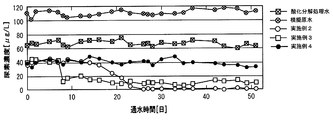
- the urea concentration of the biologically treated water after passing water was analyzed over 50 days. The result is shown in FIG. 3 together with the urea concentration of the raw water W and the urea concentration after the oxidation treatment.
- back washing was performed once a day for 10 minutes.
- the procedure for analyzing the urea concentration is as follows. That is, first, the total residual chlorine concentration of the test water is measured by the DPD method and reduced with a considerable amount of sodium bisulfite (then, the total residual chlorine is measured by the DPD method, and less than 0.02 mg / L). Confirm that it is.) Next, this reduced test water was passed through an ion exchange resin (“KR-UM1”, Kurita Kogyo Co., Ltd.) at SV50 / hr, deionized and concentrated 10 to 100 times with a rotary evaporator. Thereafter, the urea concentration is quantified by the diacetyl monooxime method.
- KR-UM1 Kurita Kogyo Co., Ltd.
- the urea concentration of the feed water was 100 to 120 ⁇ g / L, and the urea concentration of the oxidized water was 60 to 75 ⁇ g / L.
- the urea concentration of treated water was about 40 ⁇ g / L.
- ammonium chloride manufactured by Kishida Chemical Co., Ltd.
- ammoniacal nitrogen source with respect to the raw water W has an ammonium ion concentration of about 0.5 mg / L (converted to NH 4 + ). The addition was always started so that
- urea decreased gradually from around 15 days after the start of water flow (8 days after the start of ammonium chloride addition), and on the 25th day (about 18 days after the start of ammonium chloride addition)
- the urea concentration in the treated water was stable at 3 ⁇ g / L or less.
- Example 3 water was passed in the same manner as in Example 2 except that sodium acetate was constantly added at a TOC concentration of about 0.5 mg / L (carbon conversion) instead of ammonium chloride as an ammoniacal nitrogen source. A test was conducted and the urea concentration was analyzed over 50 days. The results are also shown in FIG.
- the urea decreased gradually from the day after the start of the addition of sodium acetate (8 days after the start of water flow), and then stabilized at a urea concentration of 7 to 20 ⁇ g / L in the biologically treated water.
- Example 4 In Example 2, a water passage test was conducted in the same manner except that ammonium chloride was not added, and the urea concentration was analyzed over 50 days. The results are shown in FIG.
- Example 2 and Example 3 in which an easily biodegradable organic substance and / or an ammonia-based nitrogen source was added to the water for the biological treatment process, compared to Example 4 in which the organic substance or the like was not added. It was confirmed that higher urea removal performance can be obtained.
- Reaction tank (Oxidation reaction tank) 4 ...
- First supply mechanism water-soluble bromide salt, oxidizing agent
- biological treatment means 8 ...
- third supply mechanism Easy-degradable organic matter, ammonia nitrogen source
- Fourth supply mechanism (reduction treatment: reducing agent, slime control agent) 22 ...
- Primary pure water device 23 ...
- Subsystem Synthetic pure water device
- W Raw water W1 ... treated water
Landscapes
- Life Sciences & Earth Sciences (AREA)
- Chemical & Material Sciences (AREA)
- Engineering & Computer Science (AREA)
- Water Supply & Treatment (AREA)
- Organic Chemistry (AREA)
- Hydrology & Water Resources (AREA)
- Environmental & Geological Engineering (AREA)
- Biodiversity & Conservation Biology (AREA)
- Microbiology (AREA)
- Health & Medical Sciences (AREA)
- Molecular Biology (AREA)
- Materials Engineering (AREA)
- Chemical Kinetics & Catalysis (AREA)
- General Chemical & Material Sciences (AREA)
- Treatment Of Water By Oxidation Or Reduction (AREA)
- Biological Treatment Of Waste Water (AREA)
Abstract
Description
図1及び図2に示すフローに基づいて、原水W(模擬原水)として市水(野木町水)に試薬尿素(キシダ化学社製)を必要に応じて適量添加したものを用いた。なお、本実施例においては、原水Wとして市水を用いたので、浄水上で前処理に相当する処理が施されているため、前処理は行わなかった。
酸化処理を、滞留時間30分の反応槽にて、臭化ナトリウム(キシダ化学社製,NaBr)20mg/L、及び次亜塩素酸ナトリウム(キシダ化学社製)6mg/L(有効塩素濃度として)を添加し実施した。
滞留時間を60分としたこと以外は、比較例1同様の処理を実施した。
図1及び図2に示すフローを用いて、原水Wとして市水(野木町水:平均尿素濃度10μg/L、平均TOC濃度500μg/L)に試薬尿素(キシダ化学社製)を必要に応じ適量添加したものを用いた。
実施例2において、アンモニア性の窒素源として塩化アンモニウムの代わりに、酢酸ナトリウムをTOC濃度が約0.5mg/L(炭素換算)の常時添加を行った以外は、実施例2と同様に通水試験を行い、50日間にわたり尿素濃度の分析を行った。その結果を図4にあわせて示す。
実施例2において、塩化アンモニウムの添加を行わなかった以外は、同様に通水試験を行い、50日間にわたり尿素濃度の分析を行った。その結果を図3にあわせて示す。
4…第一の供給機構(水溶性臭化物塩、酸化剤)
5…生物処理手段
8…第三の供給機構(易分解性有機物、アンモニア性の窒素源)
9…第四の供給機構(還元処理:還元剤、スライムコントロール剤)
22…一次純水装置
23…サブシステム(二次純水装置)
W…原水
W1…処理水
Claims (7)
- 有機物を含有する原水に水溶性臭化物塩と酸化剤とを添加する酸化処理工程を有する水処理方法において、
さらに生物処理工程を有することを特徴とする水処理方法。 - 前記生物処理工程の給水に易生分解性の有機物、及び/又はアンモニア性の窒素源を添加することを特徴とする請求項1に記載の水処理方法。
- 前記酸化処理工程を前記生物処理工程の前に行うことを特徴とする請求項1又は2に記載の水処理方法。
- 前記生物処理を生物担持担体を有する生物処理手段により行うことを特徴とする請求項1~3のいずれか一項に記載の水処理方法。
- 前記生物担持担体が活性炭であることを特徴とする請求項4に記載の水処理方法。
- 前記生物処理の後段においてさらに還元処理を行うことを特徴とする請求項1~5のいずれか1項に記載の水処理方法。
- 請求項1~6のいずれか1項に記載の水処理方法で得られた処理水を一次純水装置及び二次純水装置で処理して超純水を製造することを特徴とする超純水製造方法。
Priority Applications (3)
| Application Number | Priority Date | Filing Date | Title |
|---|---|---|---|
| US13/582,475 US20130048558A1 (en) | 2010-03-05 | 2011-03-02 | Water treatment method and ultrapure water producing method |
| KR1020127023762A KR101809769B1 (ko) | 2010-03-05 | 2011-03-02 | 수처리 방법 및 초순수 제조 방법 |
| CN201180012482.7A CN102781849B (zh) | 2010-03-05 | 2011-03-02 | 水处理方法和超纯水制造方法 |
Applications Claiming Priority (4)
| Application Number | Priority Date | Filing Date | Title |
|---|---|---|---|
| JP2010049232A JP5782675B2 (ja) | 2010-03-05 | 2010-03-05 | 水処理方法及び超純水製造方法 |
| JP2010-049232 | 2010-03-05 | ||
| JP2010-152324 | 2010-07-02 | ||
| JP2010152324A JP5789922B2 (ja) | 2010-07-02 | 2010-07-02 | 水処理方法及び超純水製造方法 |
Publications (1)
| Publication Number | Publication Date |
|---|---|
| WO2011108610A1 true WO2011108610A1 (ja) | 2011-09-09 |
Family
ID=44542257
Family Applications (1)
| Application Number | Title | Priority Date | Filing Date |
|---|---|---|---|
| PCT/JP2011/054810 Ceased WO2011108610A1 (ja) | 2010-03-05 | 2011-03-02 | 水処理方法及び超純水製造方法 |
Country Status (5)
| Country | Link |
|---|---|
| US (1) | US20130048558A1 (ja) |
| KR (1) | KR101809769B1 (ja) |
| CN (1) | CN102781849B (ja) |
| TW (1) | TWI568688B (ja) |
| WO (1) | WO2011108610A1 (ja) |
Cited By (2)
| Publication number | Priority date | Publication date | Assignee | Title |
|---|---|---|---|---|
| JP2011183273A (ja) * | 2010-03-05 | 2011-09-22 | Kurita Water Ind Ltd | 水処理方法及び超純水製造方法 |
| CN102976523A (zh) * | 2012-12-03 | 2013-03-20 | 江苏华益科技有限公司 | 一种加成—超临界水氧化法处理含氰基化合物的方法 |
Families Citing this family (15)
| Publication number | Priority date | Publication date | Assignee | Title |
|---|---|---|---|---|
| US20140319078A1 (en) * | 2013-04-29 | 2014-10-30 | Luisa Kling Miller | Process and system for removing urea from an aqueous solution |
| JP6325658B2 (ja) * | 2014-05-08 | 2018-05-16 | オルガノ株式会社 | ろ過処理方法 |
| CN104071921B (zh) * | 2014-06-26 | 2016-06-01 | 合肥工业大学 | 一种含藻废水高效复合式净化方法 |
| CN104829540A (zh) * | 2015-05-28 | 2015-08-12 | 天津市职业大学 | 一种溴氯二甲基海因的合成方法 |
| CN104909502A (zh) * | 2015-06-24 | 2015-09-16 | 南京元凯生物能源环保工程有限公司 | 一种沼液预处理方法 |
| US11286183B2 (en) | 2015-11-19 | 2022-03-29 | Envirosystems Inc. | System and method for treatment of spent caustic wastewater |
| CN106809990A (zh) * | 2017-01-23 | 2017-06-09 | 广州资源环保科技股份有限公司 | 一种污水净化方法 |
| KR102391262B1 (ko) * | 2017-11-28 | 2022-04-28 | 오르가노 가부시키가이샤 | 요소의 분석 방법 및 분석 장치 |
| TWI690496B (zh) * | 2019-02-01 | 2020-04-11 | 兆聯實業股份有限公司 | 水處理系統 |
| CN111252955A (zh) * | 2020-03-18 | 2020-06-09 | 中国电子系统工程第二建设有限公司 | 一种高度去除再生水中尿素的系统及方法 |
| JP7550033B2 (ja) | 2020-11-20 | 2024-09-12 | オルガノ株式会社 | 尿素処理方法及び装置 |
| CN112321099B (zh) * | 2020-12-02 | 2024-02-23 | 中国电子系统工程第二建设有限公司 | 一种处理再生水中尿素的方法 |
| JP7739007B2 (ja) * | 2021-02-17 | 2025-09-16 | オルガノ株式会社 | 尿素処理装置及び処理方法 |
| KR20240171465A (ko) | 2023-05-30 | 2024-12-09 | 한국수자원공사 | 물속에 함유된 우레아를 제거하는 방법 및 장치 |
| KR20250129186A (ko) | 2024-02-22 | 2025-08-29 | 한국수자원공사 | 수처리 장치 및 이를 이용한 수처리 방법 |
Citations (4)
| Publication number | Priority date | Publication date | Assignee | Title |
|---|---|---|---|---|
| JPH0663592A (ja) * | 1992-08-25 | 1994-03-08 | Kurita Water Ind Ltd | 超純水製造装置 |
| JPH07284799A (ja) * | 1994-04-15 | 1995-10-31 | Kurita Water Ind Ltd | 超純水製造装置 |
| JPH0938670A (ja) * | 1995-08-01 | 1997-02-10 | Kurita Water Ind Ltd | 超純水製造装置 |
| US6994793B2 (en) * | 2002-04-19 | 2006-02-07 | Hydro-Trace Incorporated | Process for remediating ground water containing one or more nitrogen compounds |
Family Cites Families (7)
| Publication number | Priority date | Publication date | Assignee | Title |
|---|---|---|---|---|
| JP3919259B2 (ja) * | 1995-07-24 | 2007-05-23 | オルガノ株式会社 | 超純水製造装置 |
| US6398965B1 (en) * | 1998-03-31 | 2002-06-04 | United States Filter Corporation | Water treatment system and process |
| JP2001149974A (ja) * | 1999-12-01 | 2001-06-05 | Kuraray Co Ltd | 排水の処理方法 |
| US6365048B1 (en) * | 2000-07-19 | 2002-04-02 | Board Of Trustees Of Michigan State University | Method for treatment of organic matter contaminated drinking water |
| BR0311900B1 (pt) * | 2002-06-18 | 2012-05-15 | processo para a produção de água purificada a partir da água da reação de fischer-tropsch. | |
| DE102007031113A1 (de) * | 2007-06-29 | 2009-01-02 | Christ Water Technology Ag | Aufbereitung von Wasser mit Hypobromitlösung |
| JP5412834B2 (ja) * | 2009-01-06 | 2014-02-12 | 栗田工業株式会社 | 超純水製造方法及び装置 |
-
2011
- 2011-03-02 US US13/582,475 patent/US20130048558A1/en not_active Abandoned
- 2011-03-02 WO PCT/JP2011/054810 patent/WO2011108610A1/ja not_active Ceased
- 2011-03-02 KR KR1020127023762A patent/KR101809769B1/ko active Active
- 2011-03-02 CN CN201180012482.7A patent/CN102781849B/zh active Active
- 2011-03-04 TW TW100107357A patent/TWI568688B/zh active
Patent Citations (4)
| Publication number | Priority date | Publication date | Assignee | Title |
|---|---|---|---|---|
| JPH0663592A (ja) * | 1992-08-25 | 1994-03-08 | Kurita Water Ind Ltd | 超純水製造装置 |
| JPH07284799A (ja) * | 1994-04-15 | 1995-10-31 | Kurita Water Ind Ltd | 超純水製造装置 |
| JPH0938670A (ja) * | 1995-08-01 | 1997-02-10 | Kurita Water Ind Ltd | 超純水製造装置 |
| US6994793B2 (en) * | 2002-04-19 | 2006-02-07 | Hydro-Trace Incorporated | Process for remediating ground water containing one or more nitrogen compounds |
Cited By (3)
| Publication number | Priority date | Publication date | Assignee | Title |
|---|---|---|---|---|
| JP2011183273A (ja) * | 2010-03-05 | 2011-09-22 | Kurita Water Ind Ltd | 水処理方法及び超純水製造方法 |
| CN102976523A (zh) * | 2012-12-03 | 2013-03-20 | 江苏华益科技有限公司 | 一种加成—超临界水氧化法处理含氰基化合物的方法 |
| CN102976523B (zh) * | 2012-12-03 | 2015-04-22 | 江苏华益科技有限公司 | 一种加成—超临界水氧化法处理含氰基化合物的方法 |
Also Published As
| Publication number | Publication date |
|---|---|
| KR101809769B1 (ko) | 2018-01-18 |
| TW201139300A (en) | 2011-11-16 |
| CN102781849B (zh) | 2015-09-16 |
| US20130048558A1 (en) | 2013-02-28 |
| CN102781849A (zh) | 2012-11-14 |
| KR20130043090A (ko) | 2013-04-29 |
| TWI568688B (zh) | 2017-02-01 |
Similar Documents
| Publication | Publication Date | Title |
|---|---|---|
| WO2011108610A1 (ja) | 水処理方法及び超純水製造方法 | |
| JP5914964B2 (ja) | 超純水製造方法 | |
| TWI568683B (zh) | 水處理方法以及超純水製造方法 | |
| CN102781850B (zh) | 水处理方法及超纯水的制造方法 | |
| JP5412834B2 (ja) | 超純水製造方法及び装置 | |
| JP5516892B2 (ja) | 水処理方法及び超純水製造方法 | |
| JP5789922B2 (ja) | 水処理方法及び超純水製造方法 | |
| WO2012128212A1 (ja) | 水処理方法及び超純水製造方法 | |
| TW202306913A (zh) | 純水製造方法及純水製造裝置 | |
| JP5604913B2 (ja) | 水処理方法及び超純水製造方法 | |
| JP5516874B2 (ja) | 水処理方法及び超純水製造方法 | |
| JP5782675B2 (ja) | 水処理方法及び超純水製造方法 | |
| JP2013208583A (ja) | 水処理方法、水処理システム及び超純水製造方法 | |
| JP5604914B2 (ja) | 水処理方法及び超純水製造方法 | |
| JP2012011357A (ja) | 水処理方法及び超純水製造方法 |
Legal Events
| Date | Code | Title | Description |
|---|---|---|---|
| WWE | Wipo information: entry into national phase |
Ref document number: 201180012482.7 Country of ref document: CN |
|
| 121 | Ep: the epo has been informed by wipo that ep was designated in this application |
Ref document number: 11750719 Country of ref document: EP Kind code of ref document: A1 |
|
| NENP | Non-entry into the national phase |
Ref country code: DE |
|
| ENP | Entry into the national phase |
Ref document number: 20127023762 Country of ref document: KR Kind code of ref document: A |
|
| WWE | Wipo information: entry into national phase |
Ref document number: 13582475 Country of ref document: US |
|
| 122 | Ep: pct application non-entry in european phase |
Ref document number: 11750719 Country of ref document: EP Kind code of ref document: A1 |