WO2011102058A1 - 硬質表面用アルカリ洗浄剤組成物 - Google Patents
硬質表面用アルカリ洗浄剤組成物 Download PDFInfo
- Publication number
- WO2011102058A1 WO2011102058A1 PCT/JP2010/073508 JP2010073508W WO2011102058A1 WO 2011102058 A1 WO2011102058 A1 WO 2011102058A1 JP 2010073508 W JP2010073508 W JP 2010073508W WO 2011102058 A1 WO2011102058 A1 WO 2011102058A1
- Authority
- WO
- WIPO (PCT)
- Prior art keywords
- component
- cleaning
- weight
- general formula
- water
- Prior art date
- Legal status (The legal status is an assumption and is not a legal conclusion. Google has not performed a legal analysis and makes no representation as to the accuracy of the status listed.)
- Ceased
Links
Classifications
-
- C—CHEMISTRY; METALLURGY
- C11—ANIMAL OR VEGETABLE OILS, FATS, FATTY SUBSTANCES OR WAXES; FATTY ACIDS THEREFROM; DETERGENTS; CANDLES
- C11D—DETERGENT COMPOSITIONS; USE OF SINGLE SUBSTANCES AS DETERGENTS; SOAP OR SOAP-MAKING; RESIN SOAPS; RECOVERY OF GLYCEROL
- C11D1/00—Detergent compositions based essentially on surface-active compounds; Use of these compounds as a detergent
- C11D1/66—Non-ionic compounds
- C11D1/83—Mixtures of non-ionic with anionic compounds
-
- C—CHEMISTRY; METALLURGY
- C03—GLASS; MINERAL OR SLAG WOOL
- C03C—CHEMICAL COMPOSITION OF GLASSES, GLAZES OR VITREOUS ENAMELS; SURFACE TREATMENT OF GLASS; SURFACE TREATMENT OF FIBRES OR FILAMENTS MADE FROM GLASS, MINERALS OR SLAGS; JOINING GLASS TO GLASS OR OTHER MATERIALS
- C03C23/00—Other surface treatment of glass not in the form of fibres or filaments
- C03C23/0075—Cleaning of glass
-
- C—CHEMISTRY; METALLURGY
- C11—ANIMAL OR VEGETABLE OILS, FATS, FATTY SUBSTANCES OR WAXES; FATTY ACIDS THEREFROM; DETERGENTS; CANDLES
- C11D—DETERGENT COMPOSITIONS; USE OF SINGLE SUBSTANCES AS DETERGENTS; SOAP OR SOAP-MAKING; RESIN SOAPS; RECOVERY OF GLYCEROL
- C11D3/00—Other compounding ingredients of detergent compositions covered in group C11D1/00
- C11D3/02—Inorganic compounds ; Elemental compounds
- C11D3/04—Water-soluble compounds
- C11D3/044—Hydroxides or bases
-
- C—CHEMISTRY; METALLURGY
- C11—ANIMAL OR VEGETABLE OILS, FATS, FATTY SUBSTANCES OR WAXES; FATTY ACIDS THEREFROM; DETERGENTS; CANDLES
- C11D—DETERGENT COMPOSITIONS; USE OF SINGLE SUBSTANCES AS DETERGENTS; SOAP OR SOAP-MAKING; RESIN SOAPS; RECOVERY OF GLYCEROL
- C11D3/00—Other compounding ingredients of detergent compositions covered in group C11D1/00
- C11D3/16—Organic compounds
- C11D3/20—Organic compounds containing oxygen
- C11D3/2075—Carboxylic acids-salts thereof
- C11D3/2079—Monocarboxylic acids-salts thereof
-
- C—CHEMISTRY; METALLURGY
- C11—ANIMAL OR VEGETABLE OILS, FATS, FATTY SUBSTANCES OR WAXES; FATTY ACIDS THEREFROM; DETERGENTS; CANDLES
- C11D—DETERGENT COMPOSITIONS; USE OF SINGLE SUBSTANCES AS DETERGENTS; SOAP OR SOAP-MAKING; RESIN SOAPS; RECOVERY OF GLYCEROL
- C11D3/00—Other compounding ingredients of detergent compositions covered in group C11D1/00
- C11D3/16—Organic compounds
- C11D3/26—Organic compounds containing nitrogen
- C11D3/33—Amino carboxylic acids
-
- C—CHEMISTRY; METALLURGY
- C11—ANIMAL OR VEGETABLE OILS, FATS, FATTY SUBSTANCES OR WAXES; FATTY ACIDS THEREFROM; DETERGENTS; CANDLES
- C11D—DETERGENT COMPOSITIONS; USE OF SINGLE SUBSTANCES AS DETERGENTS; SOAP OR SOAP-MAKING; RESIN SOAPS; RECOVERY OF GLYCEROL
- C11D3/00—Other compounding ingredients of detergent compositions covered in group C11D1/00
- C11D3/16—Organic compounds
- C11D3/36—Organic compounds containing phosphorus
- C11D3/361—Phosphonates, phosphinates or phosphonites
-
- G—PHYSICS
- G11—INFORMATION STORAGE
- G11B—INFORMATION STORAGE BASED ON RELATIVE MOVEMENT BETWEEN RECORD CARRIER AND TRANSDUCER
- G11B5/00—Recording by magnetisation or demagnetisation of a record carrier; Reproducing by magnetic means; Record carriers therefor
- G11B5/84—Processes or apparatus specially adapted for manufacturing record carriers
- G11B5/8404—Processes or apparatus specially adapted for manufacturing record carriers manufacturing base layers
-
- C—CHEMISTRY; METALLURGY
- C11—ANIMAL OR VEGETABLE OILS, FATS, FATTY SUBSTANCES OR WAXES; FATTY ACIDS THEREFROM; DETERGENTS; CANDLES
- C11D—DETERGENT COMPOSITIONS; USE OF SINGLE SUBSTANCES AS DETERGENTS; SOAP OR SOAP-MAKING; RESIN SOAPS; RECOVERY OF GLYCEROL
- C11D1/00—Detergent compositions based essentially on surface-active compounds; Use of these compounds as a detergent
- C11D1/02—Anionic compounds
- C11D1/04—Carboxylic acids or salts thereof
-
- C—CHEMISTRY; METALLURGY
- C11—ANIMAL OR VEGETABLE OILS, FATS, FATTY SUBSTANCES OR WAXES; FATTY ACIDS THEREFROM; DETERGENTS; CANDLES
- C11D—DETERGENT COMPOSITIONS; USE OF SINGLE SUBSTANCES AS DETERGENTS; SOAP OR SOAP-MAKING; RESIN SOAPS; RECOVERY OF GLYCEROL
- C11D1/00—Detergent compositions based essentially on surface-active compounds; Use of these compounds as a detergent
- C11D1/02—Anionic compounds
- C11D1/04—Carboxylic acids or salts thereof
- C11D1/06—Ether- or thioether carboxylic acids
-
- C—CHEMISTRY; METALLURGY
- C11—ANIMAL OR VEGETABLE OILS, FATS, FATTY SUBSTANCES OR WAXES; FATTY ACIDS THEREFROM; DETERGENTS; CANDLES
- C11D—DETERGENT COMPOSITIONS; USE OF SINGLE SUBSTANCES AS DETERGENTS; SOAP OR SOAP-MAKING; RESIN SOAPS; RECOVERY OF GLYCEROL
- C11D1/00—Detergent compositions based essentially on surface-active compounds; Use of these compounds as a detergent
- C11D1/02—Anionic compounds
- C11D1/12—Sulfonic acids or sulfuric acid esters; Salts thereof
- C11D1/22—Sulfonic acids or sulfuric acid esters; Salts thereof derived from aromatic compounds
-
- C—CHEMISTRY; METALLURGY
- C11—ANIMAL OR VEGETABLE OILS, FATS, FATTY SUBSTANCES OR WAXES; FATTY ACIDS THEREFROM; DETERGENTS; CANDLES
- C11D—DETERGENT COMPOSITIONS; USE OF SINGLE SUBSTANCES AS DETERGENTS; SOAP OR SOAP-MAKING; RESIN SOAPS; RECOVERY OF GLYCEROL
- C11D1/00—Detergent compositions based essentially on surface-active compounds; Use of these compounds as a detergent
- C11D1/66—Non-ionic compounds
- C11D1/72—Ethers of polyoxyalkylene glycols
-
- C—CHEMISTRY; METALLURGY
- C11—ANIMAL OR VEGETABLE OILS, FATS, FATTY SUBSTANCES OR WAXES; FATTY ACIDS THEREFROM; DETERGENTS; CANDLES
- C11D—DETERGENT COMPOSITIONS; USE OF SINGLE SUBSTANCES AS DETERGENTS; SOAP OR SOAP-MAKING; RESIN SOAPS; RECOVERY OF GLYCEROL
- C11D2111/00—Cleaning compositions characterised by the objects to be cleaned; Cleaning compositions characterised by non-standard cleaning or washing processes
- C11D2111/10—Objects to be cleaned
- C11D2111/14—Hard surfaces
- C11D2111/18—Glass; Plastics
Definitions
- the present invention relates to an alkaline detergent composition for hard surfaces, and a glass surface cleaning method using the same.
- Recent memory hard disk drives have been required to reduce the flying height of the magnetic head and reduce the unit recording area in order to increase the recording density for the purpose of increasing the capacity and reducing the diameter. Accordingly, surface quality such as cleanliness required for a polished surface obtained by polishing an object to be polished is also increasing in the manufacturing process of a hard disk.
- the hard disk manufacturing process includes a substrate formation process and a media process.
- the substrate forming step at least a polishing process and a cleaning process are performed a plurality of times in this order on the substrate to be polished, whereby a hard disk substrate is manufactured.
- the media step if necessary, at least one main surface of the hard disk substrate is ground by polishing (texture step), then cleaned (cleaning step), and then at least one main surface of the substrate A magnetic layer is formed on the side (magnetic layer forming step).
- Patent Document 1 discloses an alkaline detergent further comprising a chelating agent and an anionic surfactant as well as a nonionic surfactant as a detergent composition having a high detergency containing a nonionic surfactant. A composition is disclosed.
- a highly alkaline detergent composition containing a nonionic surfactant usually exhibits a cloud point. If the cloud point is low, the product properties are impaired by temperature changes during transportation.
- a highly alkaline detergent composition may contain a nonionic surfactant solubilizer.
- conventional solubilizers can be used at high and low temperatures. Sufficient storage stability could not be obtained, and product properties were impaired by temperature changes during transportation and storage. If the product properties are impaired, when diluting at the time of use, it is not possible to guarantee the use at a normal blending amount / ratio, and the deterioration of the product properties causes defective cleaning.
- the present invention provides an alkaline detergent composition for hard surfaces that achieves both high detergency and high storage stability in a high concentration state, and a glass surface cleaning method performed using the same.
- the alkaline detergent composition for hard surface of the present invention is An alkali agent (component A); A nonionic surfactant (component B); A chelating agent (component C); Water (component D); At least one carboxylic acid compound (component E) selected from the following general formula (1) and general formula (2); Comprising at least one anionic surfactant (component F) selected from a compound represented by the following general formula (3) and a salt thereof;
- the content ratio [component E (% by weight) / component B (% by weight)] is 1 / 1.5 to 15/1.
- the content ratio [component F (wt%) / component B (wt%)] is 10/1 to 1/5,
- the pH at 25 ° C. is 12 or more.
- R 1 is a linear or branched alkyl group having 4 to 8 carbon atoms
- EO is an ethyleneoxy group
- n is an average added mole number of EO
- 1 ⁇ n ⁇ 10 is satisfied.
- R 2 is a linear or branched alkyl group having 4 to 10 carbon atoms.
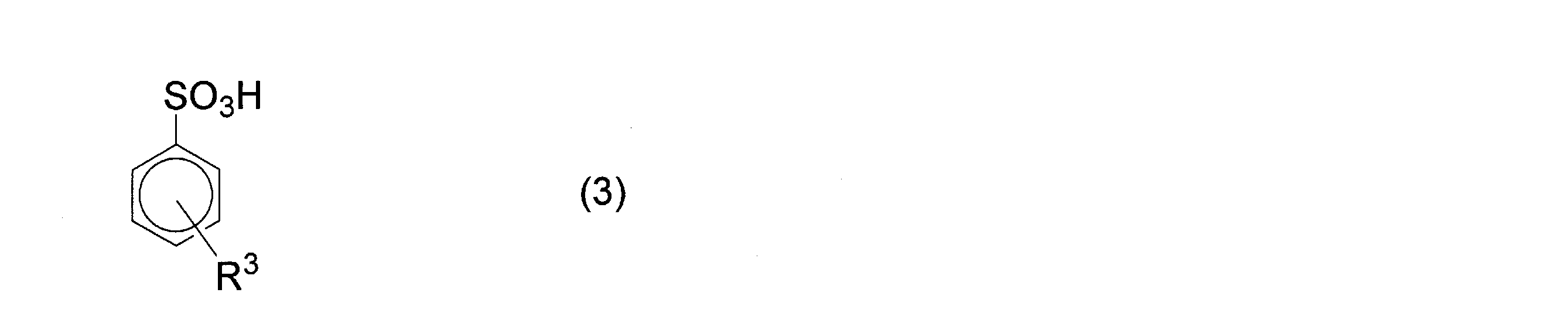
- R 3 is a linear or branched alkyl group having 8 to 18 carbon atoms.
- the glass surface cleaning method of the present invention includes a cleaning step of cleaning a substrate to be cleaned having a glass surface with a diluted solution obtained by diluting the hard surface alkaline cleaning composition of the present invention 10 to 500 times. .
- the content of components other than water (component D) in the hard surface alkaline detergent composition is 10 to 60% by weight.
- both high detergency and high storage stability in a high concentration state are compatible. Therefore, according to the glass surface cleaning method using the hard surface alkaline cleaner composition of the present invention, a highly cleaned glass surface can be obtained.
- the hard surface alkaline detergent composition of the present invention (hereinafter sometimes simply referred to as “cleaner composition”) is a highly alkaline detergent composition having a pH of 12 or more at 25 ° C. And a specific carboxylic acid compound (component E) as a nonionic surfactant solubilizer, and the carboxylic acid compound (component E) and the nonionic surfactant (component B) at a specific content ratio.
- cleaning composition is a highly alkaline detergent composition having a pH of 12 or more at 25 ° C.
- a specific carboxylic acid compound (component E) as a nonionic surfactant solubilizer
- the carboxylic acid compound (component E) and the nonionic surfactant (component B) at a specific content ratio.
- anionic surfactant (component F) and nonionic surfactant (component B) high detergency and high storage stability in a high concentration state are achieved. It is compatible.
- the alkaline agent (component A) contained in the cleaning composition of the present invention may be either an inorganic alkaline agent or an organic alkaline agent.
- the inorganic alkaline agent include ammonia, potassium hydroxide, and sodium hydroxide.
- the organic alkali agent include one or more selected from the group consisting of hydroxyalkylamine, tetramethylammonium hydroxide, and choline. These alkaline agents may be used alone or in combination of two or more.
- hydroxyalkylamine examples include monoethanolamine, diethanolamine, triethanolamine, methylethanolamine, methyldiethanolamine, monopropanolamine, dipropanolamine, tripropanolamine, methylpropanolamine, methyldipropanolamine, aminoethylethanolamine. Etc.
- potassium hydroxide, sodium hydroxide, mono-oxide are used from the viewpoints of improving the fine particle dispersibility of the cleaning composition, improving the storage stability in a high concentration state, and facilitating etching control particularly for glass.
- At least one selected from the group consisting of ethanolamine, methyldiethanolamine, and aminoethylethanolamine is preferable, and at least one selected from the group consisting of potassium hydroxide and sodium hydroxide is more preferable.
- the content of the alkaline agent in the cleaning composition of the present invention is improved from the viewpoint of improving the fine particle dispersibility of the cleaning composition, improving the stability in a high concentration state, and particularly controlling the etching for glass.
- the total content of components other than water is 100% by weight, it is preferably 2 to 60% by weight, more preferably 10 to 50% by weight, and further preferably 30 to 45% by weight.
- the pH of the cleaning composition of the present invention at 25 ° C. is 12 or more, and there is no particular upper limit as long as the glass surface is not damaged. From the viewpoint of improving the dispersibility of the inorganic fine particles, it is preferably 12-14. More preferably, it is 13 to 14, and more preferably 13.0 to 14.0.
- the pH can be measured using a pH meter (manufactured by Toa Denpa Kogyo Co., Ltd., HM-30G), and is a value 40 minutes after immersion of the electrode in the cleaning composition.
- the cleaning composition of the present invention achieves high storage stability in a high concentration state, that is, components other than water in the cleaning composition are uniformly dissolved in water (component D). It is what. Therefore, even in the case of a detergent composition having a pH exceeding 12 in part, any insoluble detergent composition in which any component other than water is not dissolved is excluded from the detergent composition of the present invention. Is done.
- Nonionic surfactant (component B) As the nonionic surfactant (component B) contained in the cleaning composition of the present invention, for example, a nonionic surfactant represented by the following general formula (4) is used for cleaning the cleaning composition. From the viewpoint of improvement in storage property and storage stability in a high concentration state, it is preferable.
- R 4 is an alkyl group having 8 to 18 carbon atoms, an alkenyl group having 8 to 18 carbon atoms, an acyl group having 8 to 18 carbon atoms, or an alkylphenyl group having 14 to 18 carbon atoms.
- EO is an oxyethylene group and PO is an oxypropylene group.
- m and p are the average added moles of EO and PO, respectively. m represents a number from 1 to 20, and p represents a number from 0 to 20.
- R 4 is an alkyl group having 8 to 14 carbon atoms, an alkenyl group having 8 to 14 carbon atoms, an acyl group having 8 to 14 carbon atoms, or 14 to 14 carbon atoms from the viewpoint of further improving the cleaning properties of the cleaning composition.
- the alkyl group having 16 to 14 carbon atoms is more preferable, and an alkyl group having 8 to 14 carbon atoms is more preferable from the viewpoint of achieving both improvement of the cleaning property of the cleaning composition and high storage stability in a high concentration state.
- (EO) m (PO) p may be composed of an oxyethylene group alone, but may be composed of an oxyethylene group and an oxypropylene group.
- the arrangement of EO and PO may be block or random.
- the number of EO blocks and the number of PO blocks may be one each as long as each average added mole number is within the above range, but two or more. There may be.
- the number of EO blocks is two or more, the number of EO repetitions in each block may be the same or different. Even when the number of PO blocks is two or more, the number of PO repetitions in each block may be the same or different.
- the oil has high solubility and high It is preferable at the point which can make water solubility compatible.
- m is preferably 1 to 15, more preferably 1 to 10, from the viewpoint of achieving both water solubility and low foamability.
- p is preferably from 1 to 15, more preferably from 1 to 10 and m + p is preferably from 1 to 30, more preferably from 1 to 20, from the viewpoint of achieving both water solubility and low foamability.
- Specific examples of the compound represented by the general formula (4) include alcohols such as 2-ethylhexanol, octanol, decanol, isodecyl alcohol, tridecyl alcohol, lauryl alcohol, myristyl alcohol, stearyl alcohol, and oleyl alcohol; Examples include compounds obtained by adding an oxyethylene group and / or an oxypropylene group to phenols such as octylphenol, nonylphenol, and dodecylphenol.
- the compound represented by the general formula (4) may be used alone or in combination of two or more.
- the content of the nonionic surfactant in the cleaning composition of the present invention is a component other than water from the viewpoint of improving the cleaning performance of the cleaning composition against organic soil and improving the storage stability in a high concentration state.
- the total content of these is 100% by weight, it is preferably 2 to 35% by weight, more preferably 5 to 30% by weight, and still more preferably 10 to 20% by weight.
- chelating agent (component C) examples include aldonic acids such as gluconic acid and glucoheptonic acid; aminocarboxylic acids such as ethylenediaminetetraacetic acid; hydroxycarboxylic acids such as citric acid and malic acid; amino And phosphonic acids such as trimethylene phosphonic acid and hydroxyethylidene diphosphonic acid; and alkali metal salts, lower amine salts, ammonium salts and alkanolamine salts thereof.
- aldonic acids such as gluconic acid and glucoheptonic acid
- aminocarboxylic acids such as ethylenediaminetetraacetic acid
- hydroxycarboxylic acids such as citric acid and malic acid
- amino And phosphonic acids such as trimethylene phosphonic acid and hydroxyethylidene diphosphonic acid
- alkali metal salts, lower amine salts, ammonium salts and alkanolamine salts thereof examples include alkali metal salts, lower
- gluconic acid aminotrimethylene phosphonic acid, hydroxyethylidene diphosphonic acid, and alkali metal salts thereof, from the viewpoint of improving the cleaning property of the cleaning composition against metallic soil and improving the storage stability in a high concentration state
- Lower amine salts, ammonium salts, or alkanolamine salts are preferred.
- These chelating agents may be used alone or in admixture of two or more.
- the content of the chelating agent in the cleaning composition of the present invention is the content of components other than water from the viewpoint of improving the cleaning property of the cleaning composition against metallic soil and improving the storage stability in a high concentration state.
- the total amount is 100% by weight, it is preferably 5 to 35% by weight, more preferably 10 to 35% by weight, still more preferably 15 to 30% by weight.
- the water (component D) contained in the cleaning composition of the present invention is not particularly limited as long as it can serve as a solvent.
- ultrapure water, pure water, ion exchange water, or distillation Although water etc. can be mentioned, an ultrapure water, a pure water, or ion-exchange water is preferable, and an ultrapure water is more preferable.
- Pure water and ultrapure water can be obtained, for example, by passing tap water through activated carbon, subjecting it to ion exchange treatment, and further distilling it, irradiating it with a predetermined ultraviolet germicidal lamp or passing it through a filter as necessary. Can do.
- the electrical conductivity at 25 ° C.
- the cleaning composition may further contain a water-soluble organic solvent (for example, an alcohol such as ethanol) in addition to the above water as a solvent.
- a water-soluble organic solvent for example, an alcohol such as ethanol
- the solvent included in the cleaning composition is composed only of water. preferable.
- the cleaning composition of the present invention is represented by the ether carboxylate represented by the following general formula (1) and the general formula (2) from the viewpoint of improving the storage stability of the cleaning composition in a high concentration state. And at least one compound selected from fatty acids (component E).
- R 1 has 4 to 4 carbon atoms from the viewpoint of achieving both high storage stability at high temperatures and high storage stability at high temperatures.
- 8 is a linear or branched alkyl group, and the average added mole number n of EO (ethyleneoxy group) is required to satisfy 1 ⁇ n ⁇ 10.
- R 1 has 6 to 8 carbon atoms.
- a linear or branched alkyl group, n is preferably 2 to 10, and n is more preferably 3 to 8;
- R 2 has 4 to 4 carbon atoms from the viewpoint of both improvement in storage stability at high temperature and improvement in storage stability at low temperature of the detergent composition in a high concentration state.
- the straight chain or branched chain alkyl group having 10 straight chain or branched chain is preferable, but the straight chain or branched chain alkyl group having 6 to 9 carbon atoms is preferable.
- Examples of the ether carboxylate represented by the general formula (1) include polyoxyethylene butyl ether acetic acid, polyoxyethylene hexyl ether acetic acid, polyoxyethylene octyl ether acetic acid, and the like. Polyoxyethylene hexyl ether acetic acid and polyoxyethylene octyl ether acetic acid are preferred from the standpoint of improving storage stability at high temperature and storage stability at low temperature, and represented by the general formula (2).
- Examples of the fatty acid include valeric acid, caproic acid, enanthic acid, caprylic acid, pelargonic acid, capric acid, 2-ethylhexylic acid, isononanoic acid and the like.
- ether carboxylate represented by (1) is preferred, in the ether carboxylate represented by (1) and the general formula (2) Among the fatty acids are, from the same viewpoint, ether carboxylate represented by the general formula (1) are preferred. These compounds may be used alone or in admixture of two or more.
- the content of component E in the cleaning composition of the present invention is a component other than water in terms of both improvement in storage stability at high temperatures and improvement in storage stability at low temperatures in a high concentration state.
- the total content is 100%, it is preferably 5 to 60% by weight, more preferably 5 to 40% by weight, and still more preferably 10 to 30% by weight.
- the cleaning composition of the present invention is selected from the compounds represented by the general formula (3) and salts thereof from the viewpoint of improving the cleaning properties of the cleaning composition with respect to the fine particles and improving the storage stability in a high concentration state. At least one anionic surfactant (component F).
- R 3 is a linear or branched alkyl group having 8 to 18 carbon atoms from the viewpoint of improving the detergency for the fine particles of the cleaning composition and improving the storage stability in a high concentration state.
- Group preferably a linear or branched alkyl group having 10 to 14 carbon atoms.
- the bonding position of R 3 is arbitrary, but is preferably bonded to the para position.
- the salt of the compound represented by the general formula (3) include alkali metal salts such as sodium and potassium, alkaline earth metal salts such as calcium, ammonium salts such as tetramethylammonium hydroxide, and alkanolamine salts. And organic amine salts.
- component F examples include sodium octylbenzenesulfonate and sodium dodecylbenzenesulfonate, and sodium dodecylbenzenesulfonate is preferred.
- the content of the anionic surfactant (component F) in the cleaning composition of the present invention is selected from the viewpoint of improving the cleaning properties of the cleaning composition with respect to fine particles and improving the storage stability in a high concentration state.
- the total content of the other components is 100% by weight, it is preferably 2 to 30% by weight, more preferably 2 to 20% by weight, and further preferably 2 to 10% by weight.
- the content ratio of the carboxylic acid compound (component E) to the nonionic surfactant (component B) improves the cleaning properties of the cleaning composition. From the standpoint of improving the storage stability of the cleaning composition at high and low temperatures in a high concentration state, it is 1 / 1.5-1 to 15/1, preferably 1/1 to 12/1. More preferably, it is 1/1 to 5/1.
- the content ratio of the anionic surfactant (component F) to the nonionic surfactant (component B) is used to clean the fine particles of the cleaning composition. From the viewpoint of improving both the stability and storage stability in a high concentration state, the ratio is 10/1 to 1/5, preferably 8/1 to 1/5, more preferably 1/1 to 1/5.
- the cleaning composition of the present invention may contain a water-soluble polymer (component G), a preservative, an antioxidant, an antifoaming agent, and the like.
- the cleaning composition of the present invention may contain a water-soluble polymer, and the water-soluble polymer is preferably a carboxylic acid polymer.
- Carboxylic acid polymers include acrylic acid polymer, methacrylic acid polymer, maleic acid polymer, acrylic acid / methacrylic acid copolymer, acrylic acid / maleic acid copolymer, methacrylic acid / dimethylamino methacrylate.
- An ester copolymer, a methacrylic acid / acrylic acid methyl ester copolymer, and the like can be mentioned.
- the molar ratio of acrylic acid (AA) to 2-acrylamido-2-methylpropanesulfonic acid (AMPS) is 91/9 to A copolymer that is 95/5 is preferred.
- the weight average molecular weight of the water-soluble polymer is preferably from 500 to 150,000, more preferably from 1,000 to 100,000, from the viewpoint of preventing the removal of fine particles due to the expression of agglomeration and obtaining high fine particle removability. 1000 to 50,000 is more preferable.
- the weight average molecular weight of the water-soluble polymer can be determined, for example, by gel permeation chromatography (GPC) under the following conditions.
- the water-soluble polymer may be a salt of the polymer.
- salts include, but are not limited to, alkali metal salts such as sodium salt and potassium salt, monoethanolamine, diethanolamine obtained by adding ethylene oxide, propylene oxide, etc. to ammonia, alkylamine or polyalkylpolyamine, Amino alcohols such as triethanolamine, methylethanolamine, monopropanolamine, dipropanolamine, tripropanolamine, methylpropanolamine, monobutanolamine, aminoethylethanolamine; quaternary ammonium such as tetramethylammonium hydroxide, choline Examples include salts.
- the content of the water-soluble polymer (component G) in the cleaning composition of the present invention is the sum of the contents of components other than water from the viewpoint of improving the dispersibility of fine particles of the cleaning composition and improving rinsing properties.
- it is 100% by weight, it is preferably 1 to 10% by weight, more preferably 2 to 5% by weight.
- the content of components other than water contained in the cleaning composition of the present invention is that the concentration is such that a great effect is exhibited in terms of reducing the cost of the cleaning composition and improving the storage stability of the cleaning composition.
- the total content of water and components other than water is 100% by weight, preferably 10 to 60% by weight, more preferably 15 to 50% by weight. More preferably, it is 15 to 40% by weight.
- the cleaning composition of the present invention is used after being diluted.
- the dilution rate is preferably 10 to 500 times, more preferably 20 to 200 times, and still more preferably 50 to 100 times in consideration of cleaning efficiency.
- the water for dilution may be the same as component D described above.
- a substrate to be cleaned that has a glass surface and has been polished with the abrasive composition on the glass surface is cleaned using the cleaning composition of the present invention.
- a washing step for example, (a) the substrate to be cleaned is immersed in the cleaning composition, and / or (b) the cleaning composition is injected, and the cleaning composition is formed on the surface of the substrate to be cleaned. Is supplied.
- the conditions for immersing the substrate to be cleaned in the cleaning composition are not particularly limited.
- the temperature of the cleaning composition is 20 to 100 ° C. from the viewpoint of safety and operability.
- the immersion time is preferably from 10 seconds to 30 minutes from the viewpoints of cleanability by the cleaning composition and production efficiency.
- ultrasonic vibration is applied to the cleaning composition.
- the frequency of the ultrasonic wave is preferably 20 to 2000 kHz, more preferably 40 to 2000 kHz, and further preferably 40 to 1500 kHz.
- the cleaning agent composition is injected on the surface of the substrate to be cleaned by injecting the cleaning agent composition to which ultrasonic vibration is applied.
- the surface is cleaned by contact, or the cleaning composition is supplied by injection onto the surface of the substrate to be cleaned, and the surface supplied with the cleaning composition is cleaned by rubbing with a cleaning brush. It is preferable.
- the cleaning composition to which ultrasonic vibration is applied is supplied to the surface to be cleaned by injection, and the surface to which the cleaning composition is supplied is cleaned by rubbing with a cleaning brush. Is preferred.
- a spray nozzle As the means for supplying the cleaning composition of the present invention onto the surface of the substrate to be cleaned, known means such as a spray nozzle can be used. Moreover, there is no restriction
- the ultrasonic frequency may be the same as the value preferably adopted in the method (a).
- the glass surface cleaning method of the present invention is a process using known cleaning such as rocking cleaning, cleaning using rotation of a spinner, paddle cleaning, etc., in addition to the method (a) and / or the method (b). One or more of them may be included.
- the substrate to be cleaned to which the glass surface cleaning method of the present invention is preferably applied is, for example, a glass substrate containing aluminosilicate glass or crystallized glass, a glass substrate made of aluminosilicate glass or crystallized glass.
- Hardness indexes represented by Young's modulus and Vickers hardness of these glass substrates are higher than those for general tableware and household glassware.
- the glass substrate for hard disks has a very low roughness of the glass surface (surface average roughness: 3 mm or less) compared to general tableware and household glass products. Therefore, the glass substrate for hard disks has a large contact area with inorganic fine particles, for example, compared with general tableware and household glass products. Has difficult surface properties.
- a hard disk is obtained by forming a magnetic layer having a magnetic recording region and including a metal thin film on these glass substrates for hard disks by a method such as sputtering.
- the metal material constituting the metal thin film include a cobalt alloy that is an alloy of chromium, tantalum, platinum, or the like and cobalt.
- a magnetic layer may be formed in the both main surface side of the glass substrate for hard disks, and may be formed only in one main surface side.
- the polishing process and the cleaning process are repeatedly performed in this order on the substrate to be polished.
- a substrate forming step of forming a glass substrate for hard disk is included.
- the polishing treatment is performed using, for example, an abrasive composition containing inorganic fine particles and a dispersion solvent (for example, water) of the inorganic fine particles.
- the surface roughness X of the substrate to be polished immediately after the final polishing treatment is smaller than the surface roughness Y of the substrate to be polished immediately after the rough polishing treatment, and the surface roughness X is 1/2 or less of the surface roughness Y. It is preferable, it is more preferable that it is 1/3 or less, and it is further more preferable that it is 1/4 or less.
- the surface roughness Y of the substrate to be polished immediately after the rough polishing treatment is preferably 3.0 to 5.0 mm, more preferably 2.0 to 3.0 mm.
- the surface roughness X of the substrate to be polished immediately after the finish polishing treatment is preferably 1.5 to 1.0 mm, and more preferably 0.5 to 1.0 mm.
- the surface roughness X and the surface roughness Y are values obtained by measuring three points at random on one main surface of the glass substrate for hard disk using an atomic force microscope (AFM) and averaging them. It is.
- the measurement conditions are as follows.
- Examples of the inorganic fine particles contained in the abrasive composition generally used for polishing treatment include alumina particles, silica particles, cerium oxide particles, composite oxide particles formed using cerium oxide and zirconium oxide, and the like.
- the inorganic fine particles contained in the abrasive composition used in the rough polishing treatment are preferably cerium oxide particles because they can be polished at high speed.
- Silica particles are preferable because the inorganic fine particles contained in the abrasive composition used in the final polishing treatment improve surface flatness (low roughness).
- the main surface of the substrate to be polished that has undergone the polishing treatment is attached with dirt (inorganic fine particles, organic matter, etc.) derived from the abrasive composition or metal ions derived from equipment such as equipment.
- the cleaning composition of the present invention is preferably used when performing at least the last cleaning processing among the cleaning processing performed a plurality of times.
- a cleaning process (first cleaning process) and a rinsing process (first rinsing process) using the cleaning composition of the present invention.
- Drying treatment (first drying treatment), finish polishing treatment, washing treatment using the cleaning composition of the present invention (second washing treatment), rinsing treatment (second rinsing treatment), and drying treatment (second drying) Processing) is performed in this order.
- first drying treatment finish polishing treatment
- washing treatment using the cleaning composition of the present invention washing treatment using the cleaning composition of the present invention
- second washing treatment washing treatment using the cleaning composition of the present invention
- rinsing treatment (second rinsing treatment)
- drying treatment (second drying) Processing) is performed in this order.
- it is preferable that the cleaning process performed after the rough polishing process and before the first rinsing process is performed once.
- a cleaning process and an rinsing process using an acidic cleaning composition having high solubility of cerium oxide may be performed.
- a cleaning process and an rinsing process using an acidic cleaning composition having high solubility of cerium oxide may be performed.
- the removability of the cerium oxide particle which is easy to carry out chemical adsorption on the glass surface improves, it is preferable.
- the substrates to be cleaned may be cleaned one by one, or a plurality of substrates to be cleaned may be cleaned at once.
- the number of cleaning tanks used for cleaning may be one or more.
- Method for Measuring Cloud Point Cloud point is a temperature at which the aqueous solution starts to become cloudy when the temperature of the aqueous solution containing the nonionic surfactant is raised.
- the temperature of the aqueous solution rises and the movement of water molecules becomes active, the hydrogen bond between the hydrophilic group portion of the surfactant and the water molecule is broken, the surfactant loses solubility, and the aqueous solution becomes cloudy.
- the cloud points of the cleaning compositions of Examples and Comparative Examples shown in Tables 1 and 2 were obtained as follows. (1) First, 10 cc of the cleaning composition is placed in a 30 cc test tube. (2) Put a test tube in a hot tub and raise the temperature of the cleaning composition at a rate of 1 ° C./5 seconds while manually stirring the cleaning composition using a glass rod-shaped thermometer. (3) Read the temperature of the cleaning composition when it becomes turbid even after stirring. (4) Remove the test tube from the hot tub and gradually lower the temperature while stirring the cleaning composition with a stir bar in an atmosphere of 25 ° C. (5) Read the temperature at which the cleaning composition becomes transparent. (6) The above (2) to (5) were repeated twice, and the average value of the temperatures read in (3) was taken as the cloud point.
- Glass HD Substrate Detergency Test Method By polishing with a polishing slurry (abrasive composition) having the following composition, it is contaminated by abrasive particles derived from the polishing slurry, organic stains, and polishing scraps derived from the substrate material. A prepared substrate to be cleaned was prepared. The cleaning property of the diluted solution of the cleaning composition was evaluated using the substrate to be cleaned.
- Polishing machine Double-sided 9B polishing machine (made by Hamai Sangyo Co., Ltd.) Polishing pad: Suede pad polishing agent for final polishing manufactured by FILWEL Co., Ltd. Composition: Colloidal silica slurry (number average particle size 24 nm, 8%; manufactured by Kao Corporation)
- Pre-polishing Load 40g / cm 2 , time 60 seconds, polishing fluid flow rate 100mL / min
- Main polishing Load 100g / cm 2 , time 1200 seconds, polishing fluid flow 100mL / min
- Water rinse load 40g / cm 2 , time 60 seconds, rinse water flow rate 2L / min
- Substrate to be cleaned Glass HD substrate (outer diameter: 65 mm ⁇ , inner diameter: 20 mm ⁇ , thickness: 0.635 mm)
- Cleaning-1 Substrate to be cleaned is immersed (40 ° C.) in a resin tank containing a diluent of a cleaning composition adjusted to the dilution ratio in the table with ultrapure water, and irradiated with ultrasonic waves (40 kHz). Wash for 120 seconds.
- Rinsing-1 The substrate to be cleaned is transferred to a resin tank (40 ° C.) containing ultrapure water, and rinsed for 120 seconds while irradiating with ultrasonic waves (40 kHz). (3) Repeat (1) and (2) again.
- the substrate to be cleaned is transferred from the inside of the resin tank to a scrub cleaning unit in which a cleaning brush is set, and a cleaning liquid composition at room temperature (25 ° C.) is injected onto the cleaning brush to perform the cleaning. Cleaning is performed at 25 ° C. for 5 seconds by pressing the cleaning brush against both surfaces of the substrate while rotating at 400 rpm in the presence of the agent composition.
- a cleaning liquid composition at room temperature (25 ° C.) is injected onto the cleaning brush to perform the cleaning. Cleaning is performed at 25 ° C. for 5 seconds by pressing the cleaning brush against both surfaces of the substrate while rotating at 400 rpm in the presence of the agent composition.
- the cleaning composition one having the same composition as the cleaning composition used in “(1) Cleaning-1” is used.
- Rinsing-2 Transfer the substrate to be cleaned to the next scrub cleaning unit, inject ultra-pure water at room temperature, and press the cleaning brush against both surfaces of the substrate while rotating at 400 rpm, thereby rinsing for 5 seconds. Do.
- Rinse-3 Move to a resin tank containing ultrapure water and rinse at 40 ° C. for 10 seconds.
- Drying Transfer to a resin tank containing warm pure water, soak for 60 seconds, pull up the substrate to be cleaned at a speed of 250 mm / min, and leave it at 60 ° C. for 420 seconds to completely dry the substrate surface.
- the cleaning compositions of Examples 1 to 11 include components A to F, and the content ratio (component E / component B) is 1 / 1.5 to 15/1, and included.
- the quantity ratio (component F / component B) is 10/1 to 1/5, both high detergency and high storage stability are achieved.
- Anionic polymer copolymer sodium salt of acrylic acid and 2-acrylamido-2-methylpropanesulfonic acid 40% by weight aqueous solution [manufactured by Toagosei Co., Ltd., trade name Aron A-6016, weight average molecular weight 12000 (polyethylene Glycol conversion), AA / AMPS weight ratio 80: 20% by weight, molar ratio: 92: 8%]
- a highly purified glass surface of the glass substrate for hard disks can be obtained by diluting the cleaning composition of the present invention as necessary and using the cleaning composition or its diluted solution. Therefore, the present invention can contribute to an improvement in product yield.
Landscapes
- Chemical & Material Sciences (AREA)
- Engineering & Computer Science (AREA)
- Organic Chemistry (AREA)
- Life Sciences & Earth Sciences (AREA)
- Chemical Kinetics & Catalysis (AREA)
- Wood Science & Technology (AREA)
- Oil, Petroleum & Natural Gas (AREA)
- General Chemical & Material Sciences (AREA)
- Health & Medical Sciences (AREA)
- Emergency Medicine (AREA)
- Geochemistry & Mineralogy (AREA)
- Materials Engineering (AREA)
- Inorganic Chemistry (AREA)
- Manufacturing & Machinery (AREA)
- Detergent Compositions (AREA)
- Cleaning By Liquid Or Steam (AREA)
Abstract
Description
アルカリ剤(成分A)と、
非イオン性界面活性剤(成分B)と、
キレート剤(成分C)と、
水(成分D)と、
下記一般式(1)及び一般式(2)から選ばれる少なくとも1種のカルボン酸化合物(成分E)と、
下記一般式(3)で示される化合物及びその塩から選ばれる少なくとも1種のアニオン性界面活性剤(成分F)とを含有してなり、
含有量比〔成分E(重量%)/成分B(重量%)〕が1/1.5~15/1であり、
含有量比〔成分F(重量%)/成分B(重量%)〕が10/1~1/5であり、
25℃でのpHが12以上である。
R1-O-(EO)n-CH2COOH (1)
R2COOH (2)
本発明の洗浄剤組成物に含まれるアルカリ剤(成分A)は、無機アルカリ剤及び有機アルカリ剤のうちのいずれであってもよい。無機アルカリ剤としては、例えば、アンモニア、水酸化カリウム、及び水酸化ナトリウム等が挙げられる。有機アルカリ剤としては、例えば、ヒドロキシアルキルアミン、テトラメチルアンモニウムハイドロオキサイド、及びコリンからなる群より選ばれる一種以上が挙げられる。これらのアルカリ剤は、単独で用いても良く、二種以上を混合して用いても良い。
本発明の洗浄剤組成物に含まれる非イオン性界面活性剤(成分B)としては、例えば、下記の一般式(4)で表される非イオン性界面活性剤が、洗浄剤組成物の洗浄性の向上及び高濃度状態での保存安定性の向上の観点から好ましい。
R4-O-(EO)m(PO)p-H (4)
本発明の洗浄剤組成物に含まれるキレート剤(成分C)としては、グルコン酸、グルコヘプトン酸などのアルドン酸類;エチレンジアミン四酢酸などのアミノカルボン酸類;クエン酸、リンゴ酸などのヒドロキシカルボン酸類;アミノトリメチレンホスホン酸、ヒドロキシエチリデンジホスホン酸などのホスホン酸類;及びこれらのアルカリ金属塩、低級アミン塩、アンモニウム塩、アルカノールアミン塩が挙げられる。中でも金属系汚れに対する洗浄剤組成物の洗浄性の向上と高濃度状態での保存安定性の向上の観点から、グルコン酸、アミノトリメチレンホスホン酸、ヒドロキシエチリデンジホスホン酸及びこれらのアルカリ金属塩、低級アミン塩、アンモニウム塩、又はアルカノールアミン塩が好ましい。これらのキレート剤は、単独で又は2種以上を混合して用いてもよい。
本発明の洗浄剤組成物に含まれる水(成分D)は、溶媒としての役割を果たすことができるものであれば特に制限はなく、例えば、超純水、純水、イオン交換水、又は蒸留水等を挙げることができるが、超純水、純水、又はイオン交換水が好ましく、超純水がより好ましい。尚、純水及び超純水は、例えば、水道水を活性炭に通し、イオン交換処理し、さらに蒸留したものを、必要に応じて所定の紫外線殺菌灯を照射、又はフィルターに通すことにより得ることができる。例えば、25℃での電気伝導率は、多くの場合、純水で1μS/cm以下であり、超純水で0.1μS/cm以下を示す。尚、洗浄剤組成物は、溶媒として上記水に加えて水溶性の有機溶媒(例えば、エタノール等のアルコール)をさらに含んでいてもよいが、洗浄剤組成物に含まれる溶媒は水のみからなると好ましい。
本発明の洗浄剤組成物には、洗浄剤組成物の高濃度状態での保存安定性向上の観点から、下記一般式(1)で表されるエーテルカルボキシレート及び一般式(2)で表される脂肪酸から選ばれる少なくとも1種の化合物(成分E)が含まれる。
高濃度状態における洗浄剤組成物の、高温下での保存安定性の向上と低温下での保存安定性の向上の両立の観点から、前記一般式(2)中、R2は炭素数4~10の直鎖又は分岐鎖のアルキル基であるが、好ましくは炭素数6~9の直鎖又は分岐鎖のアルキル基である。
本発明の洗浄剤組成物には、洗浄剤組成物の微粒子に対する洗浄性の向上と高濃度状態での保存安定性の向上の観点から、一般式(3)で示される化合物及びその塩から選ばれる少なくとも1種のアニオン性界面活性剤(成分F)が含まれる。

本発明の洗浄剤組成物には、成分A~F以外に、水溶性高分子(成分G)、防腐剤、酸化防止剤、消泡剤等が含まれていてもよい。
本発明の洗浄剤組成物には、無機微粒子の分散性を向上させる観点から、水溶性高分子が含まれていてもよく、水溶性高分子としては、カルボン酸系重合体が好ましい。
カラム:G4000PWXL+G2500PWXL(東ソ-社製)
溶離液:0.2Mリン酸バッファ-/CH3CN=9/1(容量比)
流量:1.0mL/min
カラム温度:40℃
検出:RI
サンプルサイズ:0.2mg/mL
標準物質:ポリエチレングリコール換算
本発明のガラス表面の洗浄方法では、ガラス表面を有し当該ガラス表面に対して研磨剤組成物を用いた研磨が施された被洗浄基板を、本発明の洗浄剤組成物を用いて洗浄する洗浄工程を含む。上記洗浄工程では、例えば、(a)被洗浄基板を洗浄剤組成物に浸漬するか、及び/又は、(b)洗浄剤組成物を射出して、被洗浄基板の表面上に洗浄剤組成物が供給される。
原子間力顕微鏡:Veeco製 Nanoscope-IIIa
カンチレバー:NCHV-10
測定エリア:10μm×10μm
走査回数:256
表1及び表2に記載の組成となるように各成分を重量%で配合し、混合することにより、実施例及び比較例の洗浄剤組成物を得た。尚、表中のKOH、NaOHは市販の水溶液(濃度:48重量%)である。
曇点(℃)とは、非イオン性界面活性剤を含む水溶液の温度を上げていったとき、前記水溶液が白濁し始める温度のことである。水溶液の温度が上昇して水分子の運動が活発になると、界面活性剤の親水基部分と水分子との水素結合が切れて、界面活性剤は溶解性を失い、前記水溶液は白濁する。
(1)まず、30ccの試験管に洗浄剤組成物を10cc入れる。
(2)温浴槽に試験管を入れ、ガラス棒状の温度計を用いて手動で洗浄剤組成物を攪拌しながら、洗浄剤組成物の温度を1℃/5秒の速度で上げる。
(3)攪拌しても濁る状態になったところでの洗浄剤組成物の温度を読み取る。
(4)試験管を温浴槽から取り出し、25℃の雰囲気下で、攪拌棒で洗浄剤組成物を攪拌しながら温度を徐々に下げる。
(5)洗浄剤組成物が透明になった温度を読み取る。
(6)前記(2)~(5)を2回繰り返し、(3)で読み取った温度の平均値を曇点とした。
表1及び表2に示された実施例及び比較例の洗浄剤組成物の保存安定性の評価は下記のようにして行った。
(1)まず、50ccのガラス製スクリュー管に洗浄剤組成物を40cc入れる。
(2)60℃と0℃の恒温器のそれぞれに洗浄剤組成物が入った前記スクリュ-管を入れ、1ヶ月間放置する。
(3)これらを1ヵ月後に取り出し、洗浄剤組成物の外観異常(析出物や白濁など)や物性変化(pHや粘度など)を確認する。
A:外観異常がなく、物性変化もない場合
B:どちらか一方でも異常や変化が認められた場合
下記組成の研磨液スラリー(研磨剤組成物)を用いた研磨を施すことにより、研磨液スラリー由来の砥粒や有機系汚れ及び基板材料由来の研磨屑等によって汚染された被洗浄基板を用意した。前記被洗浄基板を用いて洗浄剤組成物の希釈液の洗浄性を評価した。
研磨機:両面9B研磨機(浜井産業社製)
研磨パッド:FILWEL社製仕上げ研磨用スウェードパッド
研磨剤組成物:コロイダルシリカスラリ-(個数平均粒径24nm、8%;花王社製)
予備研磨:荷重 40g/cm2、時間 60秒、研磨液流量 100mL/min
本研磨:荷重 100g/cm2、時間 1200秒、研磨液流量 100mL/min
水リンス:荷重 40g/cm2、時間 60秒、リンス水流量 約2L/min
被洗浄基板:ガラスHD基板(外径:65mmφ、内径:20mmφ、厚さ:0.635mm)
汚染された被洗浄基板を、洗浄装置にて以下の条件で洗浄した。
(1)洗浄-1:超純水で表中の希釈倍率に調整した洗浄剤組成物の希釈液を入れた樹脂槽に被洗浄基板を浸漬(40℃)し、超音波(40kHz)を照射しながら120秒間洗浄する。
(2)すすぎ-1:超純水を入れた樹脂槽(40℃)に被洗浄基板を移し、超音波(40kHz)を照射しながら120秒間すすぎを行う。
(3)再度(1)と(2)を繰り返す。
(4)洗浄-2:樹脂槽内から被洗浄基板を、洗浄ブラシがセットされたスクラブ洗浄ユニットに移し、洗浄ブラシに常温(25℃)の洗浄剤組成物の希釈液を射出し、該洗浄剤組成物の存在下で洗浄ブラシを該基板の両面に400rpmで回転させながら押し当てることにより、洗浄を25℃で5秒間行う。洗浄剤組成物には、「(1)洗浄-1」で用いた洗浄剤組成物と同組成のものを用いる。
(5)すすぎ-2:次のスクラブ洗浄ユニットに被洗浄基板を移し、常温の超純水を射出し、洗浄ブラシを該基板の両面に400rpmで回転させながら押し当てることにより、すすぎを5秒間行う。
(6)再度(4)と(5)を繰り返す。
(7)すすぎ-3:超純水を入れた樹脂槽に移し、10秒間40℃ですすぎを行う。
(8)乾燥:温純水を入れた樹脂槽に移し、60秒間浸漬した後、250mm/minの速度で被洗浄基板を引き上げ、60℃下で420秒間放置し、完全に基板表面を乾燥させる。
10000rpmで回転している洗浄された基板に、光学式微細欠陥検査装置(Candela6100、KLA Tencor社製)のMODE Q-Scatterでレーザーを照射して、欠陥数(基板上の異物数)の測定を実施した。測定は、各実施例、比較例の洗浄剤組成物について10枚ずつの基板について行い平均を取り、比較例1の洗浄剤組成物の欠陥数を100としたときの相対値で洗浄性を評価した。結果を表1、表2に示す。

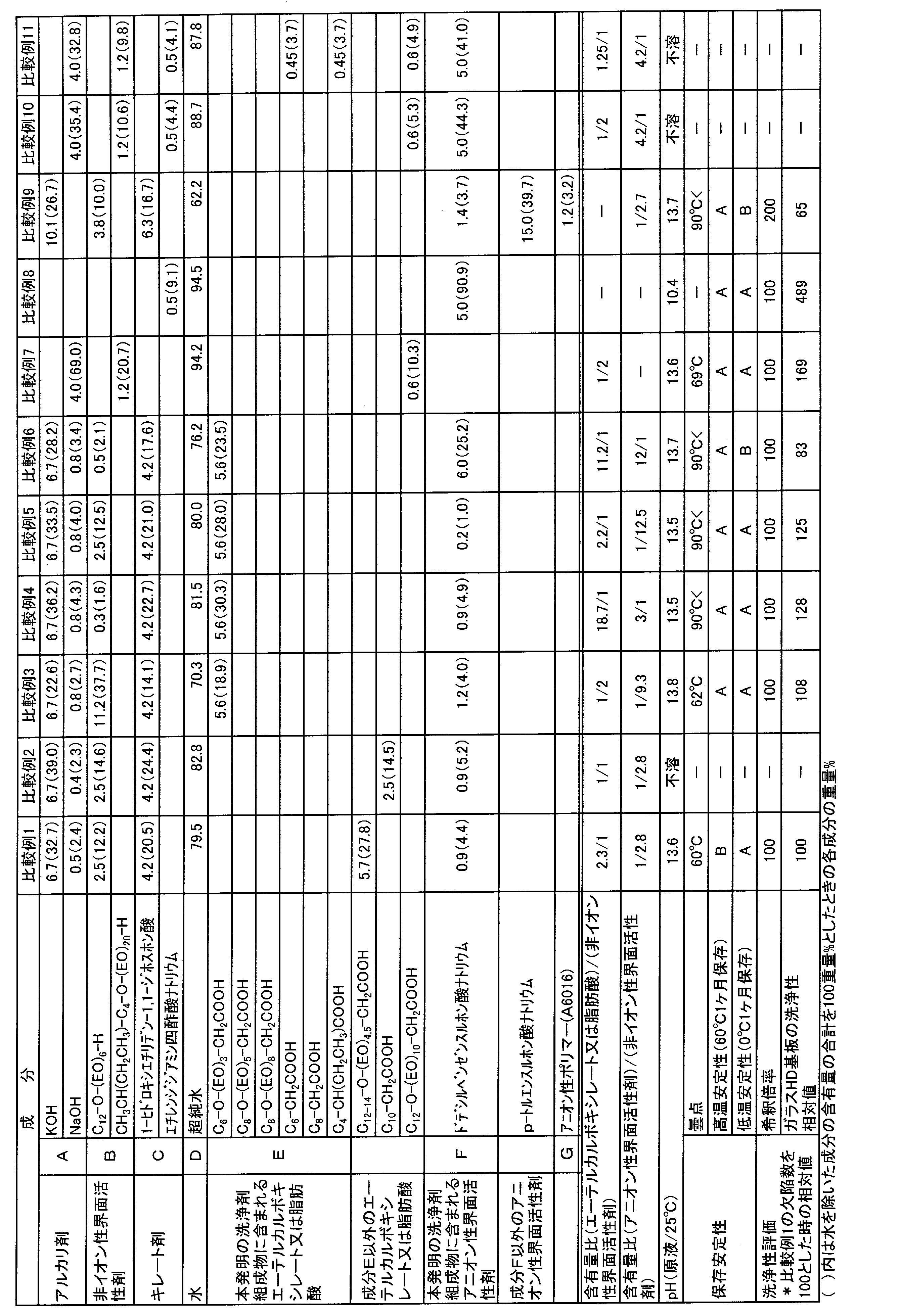
(1)表1および表2中のC(炭素)に付された数値は、炭化水素の炭素数を示す。C12-14-O-(EO)4.5-CH2COOHは、C12-O-(EO)4.5-CH2COOHとC14-O-(EO)4.5-CH2COOHとの混合物である。成分BのR4、成分EのR1、R2は、いずれもアルキル基である。
(2)アニオン性ポリマー:アクリル酸と2-アクリルアミド-2-メチルプロパンスルホン酸の共重合体ナトリウム塩 40重量%水溶液、〔東亞合成社製、商品名アロンA-6016、重量平均分子量12000(ポリエチレングリコール換算)、AA/AMPSの重量比80:20重量%、モル比:92:8%〕
Claims (5)
- アルカリ剤(成分A)と、
非イオン性界面活性剤(成分B)と、
キレート剤(成分C)と、
水(成分D)と、
下記一般式(1)及び一般式(2)から選ばれる少なくとも1種のカルボン酸化合物(成分E)と、
下記一般式(3)で示される化合物及びその塩から選ばれる少なくとも1種のアニオン性界面活性剤(成分F)とを含有してなり、
含有量比〔成分E(重量%)/成分B(重量%)〕が1/1.5~15/1であり、
含有量比〔成分F(重量%)/成分B(重量%)〕が10/1~1/5であり、
25℃でのpHが12以上である、硬質表面用アルカリ洗浄剤組成物。
R1-O-(EO)n-CH2COOH (1)
ただし、一般式(1)中、R1は炭素数4~8の直鎖又は分岐鎖のアルキル基であり、EOはエチレンオキシ基であり、nはEOの平均付加モル数であり、1≦n≦10を満たす。
R2COOH (2)
ただし、一般式(2)中、R2は炭素数4~10の直鎖又は分岐鎖のアルキル基である。

- 前記水(成分D)以外の成分の含有量が10~60重量%である、請求項1に記載の硬質表面用アルカリ洗浄剤組成物。
- 水溶性高分子をさらに含有してなる、請求項1又2に記載の硬質表面用アルカリ洗浄剤組成物。
- ハードディスク基板の洗浄に用いられる、請求項1~3のいずれかの項に記載の硬質表面用アルカリ洗浄剤組成物。
- 請求項1~3のいずれかの項に記載の硬質表面用アルカリ洗浄剤組成物を10~500倍に希釈して得た希釈液で、ガラス表面を有する被洗浄基板を洗浄する洗浄工程を含み、
前記硬質表面用アルカリ洗浄剤組成物の前記水(成分D)以外の成分の含有量が10~60重量%である、ガラス表面の洗浄方法。
Priority Applications (3)
| Application Number | Priority Date | Filing Date | Title |
|---|---|---|---|
| CN201080063910.4A CN102753669B (zh) | 2010-02-16 | 2010-12-27 | 硬质表面用碱性洗涤剂组合物 |
| SG2012060430A SG183327A1 (en) | 2010-02-16 | 2010-12-27 | Alkaline detergent composition for use on hard surfaces |
| US13/577,352 US8506723B2 (en) | 2010-02-16 | 2010-12-27 | Alkaline detergent composition for use on hard surfaces |
Applications Claiming Priority (2)
| Application Number | Priority Date | Filing Date | Title |
|---|---|---|---|
| JP2010-031282 | 2010-02-16 | ||
| JP2010031282A JP5401359B2 (ja) | 2010-02-16 | 2010-02-16 | 硬質表面用アルカリ洗浄剤組成物 |
Publications (1)
| Publication Number | Publication Date |
|---|---|
| WO2011102058A1 true WO2011102058A1 (ja) | 2011-08-25 |
Family
ID=44482667
Family Applications (1)
| Application Number | Title | Priority Date | Filing Date |
|---|---|---|---|
| PCT/JP2010/073508 Ceased WO2011102058A1 (ja) | 2010-02-16 | 2010-12-27 | 硬質表面用アルカリ洗浄剤組成物 |
Country Status (7)
| Country | Link |
|---|---|
| US (1) | US8506723B2 (ja) |
| JP (1) | JP5401359B2 (ja) |
| CN (1) | CN102753669B (ja) |
| MY (1) | MY162166A (ja) |
| SG (1) | SG183327A1 (ja) |
| TW (1) | TWI490332B (ja) |
| WO (1) | WO2011102058A1 (ja) |
Families Citing this family (16)
| Publication number | Priority date | Publication date | Assignee | Title |
|---|---|---|---|---|
| EP2788128B1 (en) * | 2011-12-05 | 2019-05-01 | Ecolab USA Inc. | Low foaming solid sink detergent |
| JP6066552B2 (ja) * | 2011-12-06 | 2017-01-25 | 関東化學株式会社 | 電子デバイス用洗浄液組成物 |
| JP2013151677A (ja) * | 2011-12-28 | 2013-08-08 | Sanyo Chem Ind Ltd | 電子材料用洗浄剤 |
| JP6234673B2 (ja) * | 2012-12-05 | 2017-11-22 | 花王株式会社 | ガラス基板の洗浄方法 |
| CN103074177B (zh) * | 2013-01-21 | 2014-08-06 | 上海艳紫化工科技有限公司 | 家用碱性清洁剂 |
| JP6226144B2 (ja) * | 2014-02-27 | 2017-11-08 | 荒川化学工業株式会社 | 洗浄剤組成物原液、洗浄剤組成物および洗浄方法 |
| JP2015170373A (ja) * | 2014-03-05 | 2015-09-28 | 三洋化成工業株式会社 | 磁気ディスク基板の製造方法 |
| JP2015170372A (ja) * | 2014-03-05 | 2015-09-28 | 三洋化成工業株式会社 | 磁気ディスク基板用洗浄剤 |
| KR101671118B1 (ko) * | 2014-07-29 | 2016-10-31 | 가부시키가이샤 스크린 홀딩스 | 기판 처리 장치 및 기판 처리 방법 |
| KR102000503B1 (ko) * | 2015-03-05 | 2019-07-16 | 닛카카가쿠가부시키가이샤 | 경질 표면용 세정제 조성물 |
| JP2017011225A (ja) * | 2015-06-25 | 2017-01-12 | 株式会社フジミインコーポレーテッド | 研磨方法及び不純物除去用組成物並びに基板及びその製造方法 |
| FR3047488B1 (fr) * | 2016-02-05 | 2020-02-28 | Laboratoires Anios | Compositions detergentes pour le nettoyage dans l'industrie cosmetique et pharmaceutique. |
| CN107721187B (zh) * | 2017-10-31 | 2021-03-23 | 江西沃格光电股份有限公司 | Tft玻璃表面处理液及tft玻璃表面处理方法 |
| US11060051B2 (en) * | 2018-10-12 | 2021-07-13 | Fujimi Incorporated | Composition for rinsing or cleaning a surface with ceria particles adhered |
| CN111763573A (zh) * | 2019-04-02 | 2020-10-13 | 昆山欣谷微电子材料有限公司 | 一种碱性玻璃基板清洗液组合物 |
| EP4013194A1 (en) | 2020-12-11 | 2022-06-15 | Atotech Deutschland GmbH & Co. KG | Aqueous alkaline cleaner solution for glass filler removal and method |
Citations (4)
| Publication number | Priority date | Publication date | Assignee | Title |
|---|---|---|---|---|
| JPH08283974A (ja) * | 1995-04-13 | 1996-10-29 | Olympus Optical Co Ltd | 金属部品用洗浄剤組成物 |
| JP2009021377A (ja) * | 2007-07-11 | 2009-01-29 | Yushiro Chem Ind Co Ltd | 電子材料用洗浄剤組成物及び電子材料の洗浄方法 |
| JP2009084568A (ja) * | 2007-09-14 | 2009-04-23 | Sanyo Chem Ind Ltd | 磁気ディスク基板用洗浄剤 |
| JP2009206481A (ja) * | 2007-12-17 | 2009-09-10 | Sanyo Chem Ind Ltd | 電子材料用洗浄剤及び洗浄方法 |
Family Cites Families (6)
| Publication number | Priority date | Publication date | Assignee | Title |
|---|---|---|---|---|
| JP4322998B2 (ja) | 1999-04-26 | 2009-09-02 | 花王株式会社 | 洗浄剤組成物 |
| JP4038069B2 (ja) | 2002-04-23 | 2008-01-23 | 花王株式会社 | 洗浄剤組成物 |
| JP4140923B2 (ja) | 2006-03-31 | 2008-08-27 | 花王株式会社 | 洗浄剤組成物 |
| MY156416A (en) | 2007-09-14 | 2016-02-26 | Kao Corp | Alkali-type nonionic surfactant composition |
| WO2009035089A1 (ja) * | 2007-09-14 | 2009-03-19 | Sanyo Chemical Industries, Ltd. | 電子材料用洗浄剤 |
| JP2010086563A (ja) | 2008-09-29 | 2010-04-15 | Kao Corp | ハードディスク用ガラス基板用洗浄剤組成物。 |
-
2010
- 2010-02-16 JP JP2010031282A patent/JP5401359B2/ja active Active
- 2010-12-27 MY MYPI2012003671A patent/MY162166A/en unknown
- 2010-12-27 SG SG2012060430A patent/SG183327A1/en unknown
- 2010-12-27 CN CN201080063910.4A patent/CN102753669B/zh active Active
- 2010-12-27 WO PCT/JP2010/073508 patent/WO2011102058A1/ja not_active Ceased
- 2010-12-27 US US13/577,352 patent/US8506723B2/en not_active Expired - Fee Related
-
2011
- 2011-01-24 TW TW100102510A patent/TWI490332B/zh not_active IP Right Cessation
Patent Citations (4)
| Publication number | Priority date | Publication date | Assignee | Title |
|---|---|---|---|---|
| JPH08283974A (ja) * | 1995-04-13 | 1996-10-29 | Olympus Optical Co Ltd | 金属部品用洗浄剤組成物 |
| JP2009021377A (ja) * | 2007-07-11 | 2009-01-29 | Yushiro Chem Ind Co Ltd | 電子材料用洗浄剤組成物及び電子材料の洗浄方法 |
| JP2009084568A (ja) * | 2007-09-14 | 2009-04-23 | Sanyo Chem Ind Ltd | 磁気ディスク基板用洗浄剤 |
| JP2009206481A (ja) * | 2007-12-17 | 2009-09-10 | Sanyo Chem Ind Ltd | 電子材料用洗浄剤及び洗浄方法 |
Also Published As
| Publication number | Publication date |
|---|---|
| US20120302482A1 (en) | 2012-11-29 |
| TWI490332B (zh) | 2015-07-01 |
| SG183327A1 (en) | 2012-09-27 |
| MY162166A (en) | 2017-05-31 |
| CN102753669A (zh) | 2012-10-24 |
| TW201139655A (en) | 2011-11-16 |
| CN102753669B (zh) | 2014-05-28 |
| JP5401359B2 (ja) | 2014-01-29 |
| JP2011168640A (ja) | 2011-09-01 |
| US8506723B2 (en) | 2013-08-13 |
Similar Documents
| Publication | Publication Date | Title |
|---|---|---|
| JP5401359B2 (ja) | 硬質表面用アルカリ洗浄剤組成物 | |
| JP5364319B2 (ja) | アルカリ型非イオン性界面活性剤組成物 | |
| JP2010086563A (ja) | ハードディスク用ガラス基板用洗浄剤組成物。 | |
| CN104853853B (zh) | 玻璃基板的清洗方法 | |
| JP5414577B2 (ja) | 硬質表面用アルカリ洗浄剤組成物 | |
| JP5819638B2 (ja) | 電子材料基板用酸性洗浄剤組成物 | |
| JP5403890B2 (ja) | ハードディスク用基板用の洗浄剤組成物 | |
| JP5711589B2 (ja) | 磁気ディスク基板用洗浄剤 | |
| JP5979744B2 (ja) | ハードディスク製造方法 | |
| JP2014141668A (ja) | 電子材料用洗浄剤 | |
| JP5801051B2 (ja) | ハードディスク用ガラス基板用のアルカリ洗浄剤組成物 | |
| JP7294910B2 (ja) | 磁気ディスク基板用洗浄剤組成物 | |
| JP2014141669A (ja) | 電子材料用洗浄剤 | |
| JP6691540B2 (ja) | ガラス製ハードディスク基板用洗浄剤組成物 | |
| JP2013151677A (ja) | 電子材料用洗浄剤 | |
| JP6208575B2 (ja) | 洗浄剤組成物 | |
| JP7294860B2 (ja) | 磁気ディスク基板用洗浄剤組成物 | |
| JP6239973B2 (ja) | ガラスハードディスク基板の製造方法 | |
| JP5808649B2 (ja) | 電子材料用洗浄剤 | |
| JP2016149176A (ja) | 磁気ディスク基板用洗浄剤及び磁気ディスク基板の製造方法 | |
| JP2015170372A (ja) | 磁気ディスク基板用洗浄剤 |
Legal Events
| Date | Code | Title | Description |
|---|---|---|---|
| WWE | Wipo information: entry into national phase |
Ref document number: 201080063910.4 Country of ref document: CN |
|
| 121 | Ep: the epo has been informed by wipo that ep was designated in this application |
Ref document number: 10846189 Country of ref document: EP Kind code of ref document: A1 |
|
| WWE | Wipo information: entry into national phase |
Ref document number: 13577352 Country of ref document: US |
|
| NENP | Non-entry into the national phase |
Ref country code: DE |
|
| 122 | Ep: pct application non-entry in european phase |
Ref document number: 10846189 Country of ref document: EP Kind code of ref document: A1 |