WO2011087008A1 - 硬化性樹脂組成物、その硬化物からなる光学部材 - Google Patents
硬化性樹脂組成物、その硬化物からなる光学部材 Download PDFInfo
- Publication number
- WO2011087008A1 WO2011087008A1 PCT/JP2011/050330 JP2011050330W WO2011087008A1 WO 2011087008 A1 WO2011087008 A1 WO 2011087008A1 JP 2011050330 W JP2011050330 W JP 2011050330W WO 2011087008 A1 WO2011087008 A1 WO 2011087008A1
- Authority
- WO
- WIPO (PCT)
- Prior art keywords
- meth
- resin composition
- curable resin
- mass
- polymerizable monomer
- Prior art date
- Legal status (The legal status is an assumption and is not a legal conclusion. Google has not performed a legal analysis and makes no representation as to the accuracy of the status listed.)
- Ceased
Links
Images


Classifications
-
- H—ELECTRICITY
- H10—SEMICONDUCTOR DEVICES; ELECTRIC SOLID-STATE DEVICES NOT OTHERWISE PROVIDED FOR
- H10W—GENERIC PACKAGES, INTERCONNECTIONS, CONNECTORS OR OTHER CONSTRUCTIONAL DETAILS OF DEVICES COVERED BY CLASS H10
- H10W74/00—Encapsulations, e.g. protective coatings
- H10W74/40—Encapsulations, e.g. protective coatings characterised by their materials
- H10W74/47—Encapsulations, e.g. protective coatings characterised by their materials comprising organic materials, e.g. plastics or resins
- H10W74/476—Organic materials comprising silicon
-
- H—ELECTRICITY
- H05—ELECTRIC TECHNIQUES NOT OTHERWISE PROVIDED FOR
- H05B—ELECTRIC HEATING; ELECTRIC LIGHT SOURCES NOT OTHERWISE PROVIDED FOR; CIRCUIT ARRANGEMENTS FOR ELECTRIC LIGHT SOURCES, IN GENERAL
- H05B33/00—Electroluminescent light sources
- H05B33/02—Details
- H05B33/04—Sealing arrangements, e.g. against humidity
-
- H—ELECTRICITY
- H10—SEMICONDUCTOR DEVICES; ELECTRIC SOLID-STATE DEVICES NOT OTHERWISE PROVIDED FOR
- H10K—ORGANIC ELECTRIC SOLID-STATE DEVICES
- H10K59/00—Integrated devices, or assemblies of multiple devices, comprising at least one organic light-emitting element covered by group H10K50/00
- H10K59/80—Constructional details
- H10K59/87—Passivation; Containers; Encapsulations
- H10K59/873—Encapsulations
-
- C—CHEMISTRY; METALLURGY
- C08—ORGANIC MACROMOLECULAR COMPOUNDS; THEIR PREPARATION OR CHEMICAL WORKING-UP; COMPOSITIONS BASED THEREON
- C08F—MACROMOLECULAR COMPOUNDS OBTAINED BY REACTIONS ONLY INVOLVING CARBON-TO-CARBON UNSATURATED BONDS
- C08F230/00—Copolymers of compounds having one or more unsaturated aliphatic radicals, each having only one carbon-to-carbon double bond, and containing phosphorus, selenium, tellurium or a metal
- C08F230/04—Copolymers of compounds having one or more unsaturated aliphatic radicals, each having only one carbon-to-carbon double bond, and containing phosphorus, selenium, tellurium or a metal containing a metal
- C08F230/08—Copolymers of compounds having one or more unsaturated aliphatic radicals, each having only one carbon-to-carbon double bond, and containing phosphorus, selenium, tellurium or a metal containing a metal containing silicon
- C08F230/085—Copolymers of compounds having one or more unsaturated aliphatic radicals, each having only one carbon-to-carbon double bond, and containing phosphorus, selenium, tellurium or a metal containing a metal containing silicon the monomer being a polymerisable silane, e.g. (meth)acryloyloxy trialkoxy silanes or vinyl trialkoxysilanes
-
- H—ELECTRICITY
- H10—SEMICONDUCTOR DEVICES; ELECTRIC SOLID-STATE DEVICES NOT OTHERWISE PROVIDED FOR
- H10H—INORGANIC LIGHT-EMITTING SEMICONDUCTOR DEVICES HAVING POTENTIAL BARRIERS
- H10H20/00—Individual inorganic light-emitting semiconductor devices having potential barriers, e.g. light-emitting diodes [LED]
- H10H20/80—Constructional details
- H10H20/85—Packages
- H10H20/852—Encapsulations
- H10H20/854—Encapsulations characterised by their material, e.g. epoxy or silicone resins
-
- H—ELECTRICITY
- H10—SEMICONDUCTOR DEVICES; ELECTRIC SOLID-STATE DEVICES NOT OTHERWISE PROVIDED FOR
- H10K—ORGANIC ELECTRIC SOLID-STATE DEVICES
- H10K59/00—Integrated devices, or assemblies of multiple devices, comprising at least one organic light-emitting element covered by group H10K50/00
- H10K59/80—Constructional details
- H10K59/87—Passivation; Containers; Encapsulations
- H10K59/871—Self-supporting sealing arrangements
- H10K59/8722—Peripheral sealing arrangements, e.g. adhesives, sealants
-
- H—ELECTRICITY
- H10—SEMICONDUCTOR DEVICES; ELECTRIC SOLID-STATE DEVICES NOT OTHERWISE PROVIDED FOR
- H10W—GENERIC PACKAGES, INTERCONNECTIONS, CONNECTORS OR OTHER CONSTRUCTIONAL DETAILS OF DEVICES COVERED BY CLASS H10
- H10W72/00—Interconnections or connectors in packages
- H10W72/071—Connecting or disconnecting
- H10W72/075—Connecting or disconnecting of bond wires
- H10W72/07551—Connecting or disconnecting of bond wires characterised by changes in properties of the bond wires during the connecting
- H10W72/07554—Connecting or disconnecting of bond wires characterised by changes in properties of the bond wires during the connecting changes in dispositions
-
- H—ELECTRICITY
- H10—SEMICONDUCTOR DEVICES; ELECTRIC SOLID-STATE DEVICES NOT OTHERWISE PROVIDED FOR
- H10W—GENERIC PACKAGES, INTERCONNECTIONS, CONNECTORS OR OTHER CONSTRUCTIONAL DETAILS OF DEVICES COVERED BY CLASS H10
- H10W72/00—Interconnections or connectors in packages
- H10W72/50—Bond wires
- H10W72/541—Dispositions of bond wires
- H10W72/547—Dispositions of multiple bond wires
-
- H—ELECTRICITY
- H10—SEMICONDUCTOR DEVICES; ELECTRIC SOLID-STATE DEVICES NOT OTHERWISE PROVIDED FOR
- H10W—GENERIC PACKAGES, INTERCONNECTIONS, CONNECTORS OR OTHER CONSTRUCTIONAL DETAILS OF DEVICES COVERED BY CLASS H10
- H10W72/00—Interconnections or connectors in packages
- H10W72/851—Dispositions of multiple connectors or interconnections
- H10W72/874—On different surfaces
- H10W72/884—Die-attach connectors and bond wires
-
- H—ELECTRICITY
- H10—SEMICONDUCTOR DEVICES; ELECTRIC SOLID-STATE DEVICES NOT OTHERWISE PROVIDED FOR
- H10W—GENERIC PACKAGES, INTERCONNECTIONS, CONNECTORS OR OTHER CONSTRUCTIONAL DETAILS OF DEVICES COVERED BY CLASS H10
- H10W74/00—Encapsulations, e.g. protective coatings
-
- H—ELECTRICITY
- H10—SEMICONDUCTOR DEVICES; ELECTRIC SOLID-STATE DEVICES NOT OTHERWISE PROVIDED FOR
- H10W—GENERIC PACKAGES, INTERCONNECTIONS, CONNECTORS OR OTHER CONSTRUCTIONAL DETAILS OF DEVICES COVERED BY CLASS H10
- H10W90/00—Package configurations
- H10W90/701—Package configurations characterised by the relative positions of pads or connectors relative to package parts
- H10W90/751—Package configurations characterised by the relative positions of pads or connectors relative to package parts of bond wires
- H10W90/756—Package configurations characterised by the relative positions of pads or connectors relative to package parts of bond wires between a chip and a stacked lead frame, conducting package substrate or heat sink
Definitions
- the present invention relates to a curable resin composition, an optical member made of the cured product, a sealing material for a light emitting diode, and a filling material for an organic electroluminescence (EL) display panel.
- EL organic electroluminescence
- Light-emitting diodes have long life and energy saving, and can be reduced in size and weight, and thus have been put to practical use as various light sources.
- the development of organic EL devices as displays that can be made thin and flexible, and surface-emitting illumination that saves energy has become active. These devices are expected to be in great demand in the future as next-generation lighting, displays, or display members.
- the light emitting diode has a structure in which the light emitting element is sealed with a sealing material made of a transparent resin for the purpose of protecting the light emitting element from dust, impact, and the like and increasing light extraction efficiency.
- solid adhesive sealing filled with transparent resin from a panel with a hollow sealing structure for the purpose of improving the light extraction efficiency and visibility and improving the deflection of the glass substrate accompanying the enlargement of the panel Conversion of the structure to a panel is being considered.
- the transparent resin used in these materials not only exhibits high transmittance in the visible light region or the emission wavelength of the light-emitting diode, but also has heat resistance and light resistance to such an extent that coloring is not caused by heat generation or light emission during device operation.
- Many properties are required, such as adhesion to inorganic materials.
- (Meth) acrylic resin typified by polymethylmethacrylate has been used in optical members such as flat panel display members, lenses, and optical waveguides because of its excellent optical properties such as high transmittance in a wide wavelength range. Development to light emitting diodes and organic EL display members is also expected.
- the (meth) acrylic resin is used in these devices, there are problems such as high water absorption, insufficient adhesion, and heat resistance.
- Patent Document 1 discloses (meth) acrylic acid ester having an alicyclic hydrocarbon group for improving heat resistance, for improving adhesiveness
- a technique using a composition containing a (meth) acrylic acid ester having a polyethylene glycol structure is disclosed.
- the blending of the highly polar oligomer promotes an increase in water absorption and a decrease in heat resistance, which may cause a problem when used in the above device.
- the present invention has been made in view of the above circumstances, and the cured product obtained has high heat resistance and low water absorption, as well as an optical member made of the cured product, and sealing for a light emitting diode.
- An object is to provide a material, a filling material for an organic EL display panel, a light emitting diode provided with the sealing material for a light emitting diode, and an organic EL display panel provided with the filling material for an organic EL display panel.
- the first aspect of the present invention for solving the above problems is (A) a (meth) acrylic polymerizable monomer having an alkoxysilane structure, and (B) a (meth) acrylic polymerizable monomer having a carboxyl group. It is a curable resin composition containing a body (however, a silicon atom is not included in the structure) and (C) a (meth) acrylic polymerizable monomer represented by the following general formula (1).
- R 1 or R 3 is independently an acryloyl group or a methacryloyl group
- R 2 is an alkylene group having 3 to 6 carbon atoms
- n is an integer of 2 to 30.
- the (meth) acrylic polymerizable monomer represented by the general formula (1) is a polybutylene glycol di (meth) acrylate. Is a curable resin composition.
- (D) a (meth) acrylic polymerizable monomer in which the substituent of the ester moiety has an alicyclic hydrocarbon structure Is a curable resin composition.
- the (E) ester moiety substituent is a linear or branched alkyl group
- It is a curable resin composition containing a (meth) acrylic polymerizable monomer.
- a curable resin composition further comprising (F) an antioxidant in addition to the constitution of any one of the first to fourth aspects.
- a sixth aspect of the present invention is a curable resin composition that further comprises (G) a polymerization initiator in addition to the structure of any one of the first to fifth aspects.
- a seventh aspect of the present invention is a curable resin composition further containing a (H) (meth) acrylic polymer in addition to the structure of any one of the first to sixth aspects.
- the (A) alkoxysilane structure is included with respect to 100% by mass of the total polymerizable component.
- the (A) alkoxysilane structure is included with respect to 100% by mass of the total polymerizable component.
- a tenth aspect of the present invention is an optical member comprising a cured product of the curable resin composition according to any one of the first to ninth aspects.
- An eleventh aspect of the present invention is a light-emitting diode encapsulant comprising a cured product of the curable resin composition according to any one of the first to ninth aspects.
- a twelfth aspect of the present invention is a filler for an organic EL display panel comprising a cured product of the curable resin composition according to any one of the first to ninth aspects.
- a thirteenth aspect of the present invention is a light emitting diode comprising the light emitting diode sealing material according to the eleventh aspect.
- a fourteenth aspect of the present invention is an organic EL display panel comprising the organic EL display panel filler according to the twelfth aspect.
- cured material obtained has high heat resistance and low water absorption, curable resin composition, the optical member which consists of the hardened
- a light-emitting diode including the light-emitting diode sealing material and an organic EL display panel including the organic EL display panel filler can be provided.
- the curable resin composition of the present invention comprises (A) a (meth) acrylic polymerizable monomer having an alkoxysilane structure (hereinafter referred to as (A) component), and (B) a carboxyl group-containing (meth).
- Acrylic polymerizable monomer (however, silicon atom is not included in the structure) (hereinafter referred to as (B) component) and (C) (meth) acrylic polymerizable represented by the following general formula (1)
- a curable resin composition containing a monomer hereinafter referred to as component (C)).
- R 1 or R 3 is independently an acryloyl group or a methacryloyl group
- R 2 is an alkylene group having 3 to 6 carbon atoms
- n is an integer of 2 to 30.
- (meth) acryl is a general term for acrylic and methacrylic.
- (Meth) acrylate” is a general term for acrylate and methacrylate.
- (Meth) acryloxy” described later is a general term for acryloxy and methacryloxy.
- the “(meth) acryloyl group” is a general term for a methacryloyl group and an acryloyl group.
- the (meth) acrylic polymerizable monomer represented by the general formula (1) is preferably polybutylene glycol (meth) acrylate.
- the curable resin composition of the present invention further contains (D) a (meth) acrylic polymerizable monomer (hereinafter referred to as (D) component) in which the substituent of the ester moiety has an alicyclic hydrocarbon structure. It is preferable to do.
- the curable resin composition of the present invention preferably further comprises (E) a (meth) acrylic polymerizable monomer (hereinafter referred to as (E) component) in which the substituent of the ester moiety is an alkyl group. .
- the curable resin composition of the present invention preferably further contains (F) an antioxidant.
- the curable resin composition of the present invention preferably further contains (G) a polymerization initiator.
- the curable resin composition of the present invention preferably further contains a (H) (meth) acrylic polymer.
- the components (A) to (E) are polymerizable components.
- Component (A) A component is a component which contributes mainly to the heat resistance of the hardened
- the component (A) include compounds represented by the following general formula (a1). CH 2 ⁇ C (R) —COO—R 1 —Si (R 2 ) (R 3 ) (R 4 ) (a1)
- R is a hydrogen atom or a methyl group
- R 1 is an alkylene group
- R 2 to R 4 are each independently an alkoxy group or an alkyl group, and at least one of R 2 to R 4 One is an alkoxy group.
- R may be a hydrogen atom or a methyl group.
- a methyl group is preferable in terms of heat resistance.
- the alkylene group for R 1 may be linear or branched, and is preferably linear.
- the alkylene group preferably has 1 to 5 carbon atoms, particularly preferably 3.
- the alkoxy group of R 2 to R 4 may be either linear or branched, and is preferably linear.
- the alkoxy group preferably has 1 to 4 carbon atoms, particularly preferably 1 or 2.
- the alkyl group of R 2 to R 4 may be either linear or branched, and is preferably linear.
- the alkyl group preferably has 1 to 4 carbon atoms, more preferably 1 or 2, and particularly preferably 1.
- at least one is preferably an alkoxy group, and two or three are preferably alkoxy groups.
- component (A) examples include 3- (meth) acryloxypropylmethyldimethoxysilane, 3- (meth) acryloxypropyltrimethoxysilane, 3- (meth) acryloxypropylmethyldiethoxysilane, 3- (meth) (Meth) acryloxypropyltriethoxysilane, 3- (meth) acryloxypropylmethyldipropoxysilane, 3- (meth) acryloxypropyltripropoxysilane, 3- (meth) acryloxypropylmethyldibutoxysilane, 3- ( And (meth) acryloxypropyltributoxysilane. These may be used alone or in combination of two or more.
- the curable resin composition of the present invention contains only the components (A) to (C) as polymerizable components (when it does not contain the components (D) and (E)), the curable resin composition (
- the amount of component A) is preferably 1 to 70% by weight, more preferably 5 to 65% by weight, and more preferably 10 to 60% by weight when the total amount of components (A) to (C) is 100% by weight. Is more preferable.
- the amount of component A) is preferably 1 to 70% by weight, more preferably 5 to 65% by weight, and more preferably 10 to 60% by weight when the total amount of components (A) to (C) is 100% by weight. Is more preferable.
- cured material obtained and the adhesiveness to an inorganic material become favorable.
- the curable resin composition of the present invention contains any one or both of the component (D) and the component (E) in addition to the components (A) to (C) as the polymerizable component
- the curable resin composition The amount of component (A) in the product is preferably 1 to 35% by weight, more preferably 5 to 30% by weight, with the total amount of components (A) to (E) being 100% by weight. 25 mass% is further more preferable.
- (A) By making the compounding quantity of a component into 1 mass% or more, the heat resistance of the hardened
- a component is a component which contributes mainly to the adhesive improvement to the inorganic material of the hardened
- the component (B) include compounds represented by the following general formula (b1).
- CH 2 C (R) -COO-X (b1)
- R is a hydrogen atom or a methyl group
- X is a hydrogen atom or —R 5 —O—CO—R 6 —COOH
- the R 5 is an alkylene group
- the R 6 is carbonized. It is a hydrogen group.
- the compound in which X is —R 5 —O—CO—R 6 —COOH is a so-called (meth) acryloyloxyalkyl ester of a dicarboxylic acid.
- the alkylene group for R 5 an alkylene group having 1 to 3 carbon atoms is preferable, and an ethylene group is particularly preferable.
- the hydrocarbon group for R 6 may be an aromatic hydrocarbon group or an aliphatic hydrocarbon group. From the viewpoint of transparency, an aliphatic hydrocarbon group is preferred. Examples of the aromatic hydrocarbon group include an arylene group such as a phenylene group.
- the aliphatic hydrocarbon group may be linear, branched or cyclic, and is preferably cyclic from the viewpoint of heat resistance.
- the aliphatic hydrocarbon group may be saturated or unsaturated, and is preferably saturated.
- the aliphatic hydrocarbon group preferably has 1 to 5 carbon atoms, and more preferably 2 to 4 carbon atoms.
- the aliphatic hydrocarbon group is cyclic, the aliphatic hydrocarbon group preferably has 5 to 20 carbon atoms, and more preferably 6 to 10 carbon atoms.
- component (B) examples include (meth) acrylic acid, 2- (meth) acryloyloxyethyl succinate, 2- (meth) acryloyloxyethyl maleate, 2- (meth) acryloyloxyethyl phthalate, hexa And 2- (meth) acryloyloxyethyl hydrophthalate. These may be used alone or in combination of two or more. From the viewpoint of heat resistance, at least one selected from the group consisting of methacrylic acid and 2-methacryloyloxyethyl hexahydrophthalate is preferable, and methacrylic acid is particularly preferable.
- the curable resin composition of the present invention contains only the components (A) to (C) as polymerizable components (when it does not contain the components (D) and (E)), the curable resin composition (
- the blending amount of component B) is preferably 0.05 to 20% by weight, more preferably 0.1 to 15% by weight, assuming that the total blending amount of components (A) to (C) is 100% by weight. More preferably, the content is 5 to 10% by mass.
- cured material obtained becomes favorable.
- the curable resin composition of the present invention contains any one or both of the component (D) and the component (E) in addition to the components (A) to (C) as the polymerizable component
- the curable resin composition The amount of component (B) in the product is preferably 0.05 to 10% by weight, more preferably 0.1 to 5% by weight, with the total amount of components (A) to (E) being 100% by weight. Preferably, 0.3 to 3% by mass is more preferable.
- B) By making the compounding quantity of a component 0.05 mass% or more, the adhesiveness to the inorganic material of the hardened
- the component (C) mainly contributes to the suppression of the curing shrinkage of the curable resin composition of the present invention and the decrease in the elastic modulus and water absorption of the cured product obtained by polymerizing the curable resin composition. It is an ingredient.
- the component (C) is obtained by sealing both ends of polyalkylene glycol with (meth) acrylic acid.
- the polyalkylene glycol di (meth) acrylate represented by the following general formula (1) is used. is there.
- R 1 or R 3 is independently an acryloyl group or a methacryloyl group
- R 2 is an alkylene group having 3 to 6 carbon atoms
- n is the degree of polymerization of the oxyalkylene group.
- the polymerization degree n is preferably 3 to 25, more preferably 5 to 20, and further preferably 7 to 15.
- the degree of polymerization n here means a median value.
- the degree of polymerization is 3 or more, the curing shrinkage and the elastic modulus of the resulting cured product are good.
- the degree of polymerization is 30 or less, the heat resistance is good.
- component (C) examples include polypropylene glycol di (meth) acrylate, polybutylene glycol di (meth) acrylate, polypentylene glycol di (meth) acrylate, polyhexylene glycol di (meth) acrylate and the like. From the viewpoint of heat resistance, polybutylene glycol di (meth) acrylate is particularly preferable.
- the curable resin composition of the present invention contains only the components (A) to (C) as polymerizable components (when it does not contain the components (D) and (E))
- the curable resin composition ( Component C) is preferably 10 to 90% by mass, more preferably 20 to 85% by mass, and 30 to 80% by mass when the total amount of components (A) to (C) is 100% by mass. Is more preferable.
- the curable resin composition of the present invention contains any one or both of the component (D) and the component (E) in addition to the components (A) to (C) as the polymerizable component
- the curable resin composition The amount of component (C) in the product is preferably 10 to 60% by weight, more preferably 20 to 55% by weight, with the total amount of components (A) to (E) being 100% by weight, more preferably 30 to 50 mass% is more preferable.
- the curable resin composition of the present invention can further contain a component (D) for the purpose of suppressing the curing shrinkage rate, improving the heat resistance of the resulting cured product, and reducing the water absorption rate.
- a component (D) for the purpose of suppressing the curing shrinkage rate, improving the heat resistance of the resulting cured product, and reducing the water absorption rate.
- the component (D) include compounds represented by the following general formula (d1).
- CH 2 C (R) —COO—R 7 (d1)
- R is a hydrogen atom or a methyl group
- R 7 is a monovalent alicyclic hydrocarbon group.
- the alicyclic hydrocarbon group for R 7 may be saturated or unsaturated, and is preferably saturated.
- the alicyclic hydrocarbon group may be monocyclic or polycyclic.
- the alicyclic hydrocarbon group preferably has 5 to 20 carbon atoms, more preferably 6 to 12 carbon atoms.
- Specific examples of the component (D) include cyclopentyl (meth) acrylate, cyclohexyl (meth) acrylate, 4-t-butylcyclohexyl (meth) acrylate, isobornyl (meth) acrylate, adamantyl (meth) acrylate, 2-methyl-2 -Adamantyl (meth) acrylate, 2-ethyl-2-adamantyl (meth) acrylate, dicyclopentanyl (meth) acrylate, dicyclopentenyl (meth) acrylate, dicyclopentanyloxyethyl (meth) acrylate, dicyclopentenyl Oxyethyl (meth) acrylate, (1R) -fentyl (meth) acrylate, 1,4-cyclohexanedimethanol di (me
- the curable resin composition of the present invention contains the component (D), the blending amount thereof is preferably 10 to 60% by weight when the total blending amount of the components (A) to (E) is 100% by weight, It is more preferably 20 to 55% by mass, and further preferably 30 to 50% by mass.
- the curable resin composition of the present invention can further contain a component (E) for the purpose of improving the heat resistance of a cured product obtained by polymerizing the curable resin composition of the present invention.
- a component (E) for the purpose of improving the heat resistance of a cured product obtained by polymerizing the curable resin composition of the present invention.
- the component (E) include compounds represented by the following general formula (e1).
- CH 2 C (R) -COO-R 8 (e1)
- R is a hydrogen atom or a methyl group
- R 8 is an alkyl group.
- the alkyl group for R 8 may be linear or branched, and is preferably linear from the viewpoints of transparency and heat resistance.
- the alkyl group preferably has 1 to 12 carbon atoms, and more preferably 1 to 4 carbon atoms.
- component (E) examples include methyl (meth) acrylate, ethyl (meth) acrylate, propyl (meth) acrylate, n-butyl (meth) acrylate, i-butyl (meth) acrylate, and t-butyl (meth).
- the curable resin composition of the present invention includes the component (E), the blending amount thereof is preferably 5 to 40% by weight when the total blending amount of the components (A) to (E) is 100% by weight, 5 to 30% by mass is more preferable, and 5 to 20% by mass is more preferable.
- the curable resin composition of the present invention further comprises (F) an antioxidant (hereinafter referred to as (F) component) for the purpose of improving the heat resistance of a cured product obtained by polymerizing the curable resin composition of the present invention. .) Can be contained.
- an antioxidant hereinafter referred to as (F) component
- component (F) examples include 2,6-di-t-butylphenol, 2,6-di-t-butyl-p-cresol, n-octadecyl-3- (3 ′, 5′-di-t -Butyl-4'-hydroxyphenyl) propionate, tetrakis- [methylene-3- (3 ', 5'-di-t-butyl-4'-hydroxyphenyl) propionate] methane, triethylene glycol bis [3- (3 -T-butyl-5-methyl-4-hydroxyphenyl) propionate], 1,6-hexanediol bis [3- (3,5-di-t-butyl-4-hydroxyphenyl) propionate], etc.
- Inhibitors triphenyl phosphite, trisisodecyl phosphite, tristridecyl phosphite, tris (2,4-di-t-butylphenyl) phosphite It includes phosphorus-based antioxidant or the like is. These may be used alone or in combination of two or more. Of these, phenolic antioxidants are preferred, and of these, n-octadecyl-3- (3 ′, 5′-di-t-butyl-4′-hydroxyphenyl) propionate is preferred because of its excellent effect of improving heat resistance.
- the blending amount of the component (F) in the curable resin composition of the present invention is preferably 0.01 to 3 parts by weight when the total blending amount of the components (A) to (E) is 100 parts by weight.
- the curable resin composition of the present invention can be made into a cured product by further adding (G) a polymerization initiator (hereinafter referred to as (G) component) and carrying out polymerization.
- the kind of the polymerization initiator is not particularly limited, and may be appropriately selected from known polymerization initiators according to the polymerization method.
- examples of the thermal polymerization initiator used in the case of thermal polymerization include organic peroxides and azo compounds.
- organic peroxides include ketone peroxides such as methyl ketone peroxide; 1,1-di (t-hexylperoxy) -3,3,5-trimethylcyclohexane, 1,1-di (t- Peroxyketals such as hexylperoxy) cyclohexane and 1,1-di (t-butylperoxy) cyclohexane; 1,1,3,3, -tetramethylbutyl hydroperoxide, cumene hydroperoxide, p-menthane hydro Hydroperoxides such as peroxides; diacyl peroxides such as dicumyl peroxide, di-t-butyl peroxide, dilauroyl peroxide, dibenzoyl peroxide; bis (4-t-butylcyclohexyl) peroxydicarbonate, Di (2-ethylhexyl) peroxy Peroxydicarbonate such as carbonate; t-butyl peroxid
- azo compound examples include 2,2′-azobisisobutyronitrile, 2,2′-azobis (2-methylbutyronitrile), 2,2′-azobis (2,4-dimethylvaleronitrile). 1,1′-azobis-1-cyclohexanecarbonitrile, dimethyl-2,2′-azobisisobutyrate, 4,4′-azobis-4-cyanovaleric acid, 2,2′-azobis- (2 -Amidinopropane) dihydrochloride and the like. These may be used alone or in combination of two or more.
- At least one selected from the group selected from dilauroyl peroxide and bis (4-t-butylcyclohexyl) peroxydicarbonate Is preferred.
- the blending amount of the component (G) in the curable resin composition of the present invention is preferably 0.05 to 3 parts by weight when the total blending amount of the components (A) to (E) is 100 parts by weight. 1 to 2 parts by mass is more preferable, and 0.3 to 1.5 parts by mass is even more preferable.
- the curable resin composition of the present invention is a (H) (meth) acrylic polymer (hereinafter referred to as (H)) for the purpose of improving the curability and heat resistance of the curable resin composition of the present invention. Component)).
- (H) component By containing (H) component, the polymerization rate in an oxygen contact surface improves. Thereby, the heat resistance of the cured product of the curable resin composition can be improved.
- the component (H) is preferably dissolved in the components (A) to (E) in the curable resin composition of the present invention.
- the dissolution method is not particularly limited, but may be stirred and dissolved at room temperature, or may be stirred and dissolved while heating at about 40 ° C. to 100 ° C.
- the “(meth) acrylic polymer” means a polymer containing 50% by mass or more of (meth) acrylic monomer units in the composition.
- (Meth) acrylic monomer means a monomer having a (meth) acryloyl group.
- “Unit” means a repeating unit constituting a polymer.
- the (meth) acrylic monomer may be a monofunctional monomer or a polyfunctional monomer.
- “monofunctional monomer” means a monomer having one polymerizable group such as a (meth) acryloyl group
- “polyfunctional monomer” means a monomer having two or more polymerizable groups.
- the (meth) acrylic monomer used for the component (H) a monofunctional monomer having one (meth) acryloyl group is particularly preferable.
- (meth) acrylic monomers include (meth) acrylic acid, methyl (meth) acrylate, ethyl (meth) acrylate, propyl (meth) acrylate, n-butyl (meth) acrylate, i-butyl (meth) Acrylate, t-butyl (meth) acrylate, heptyl (meth) acrylate, 2-ethylhexyl (meth) acrylate, n-octyl (meth) acrylate, isooctyl (meth) acrylate, n-nonyl (meth) acrylate, isononyl (meth) Acrylate, decyl (meth) acrylate, lauryl (meth) acrylate, tridecyl (meth) acrylate, stearyl (meth) acrylate, cyclohexyl (meth) acrylate, benzyl (meth) acrylic acid,
- the (meth) acrylic monomer unit contained in the component (H) may be one type or two or more types.
- the proportion of the (meth) acrylic monomer unit is preferably 70% by mass or more, and more preferably 80% by mass or more.
- the upper limit of the said ratio is not specifically limited, 100 mass% may be sufficient.
- the component (H) may contain other monomer units other than the (meth) acrylic monomer units.
- what is copolymerizable with a (meth) acrylic-type monomer should just be mentioned, for example, vinyl-type monomers, such as styrene, are mentioned.
- the component (H) include homopolymers such as polymethyl methacrylate, polyethyl methacrylate, and polybutyl methacrylate; a copolymer comprising methyl methacrylate units and n-butyl methacrylate units, methyl methacrylate units and n -Copolymers such as copolymers comprising butyl acrylate units.
- those containing a methyl methacrylate unit are preferable from the viewpoint of transparency of the cured product, and are composed of a methyl methacrylate unit and an n-butyl methacrylate unit from the viewpoint of solubility in the components (A) to (E).
- a copolymer is particularly preferred.
- the blending amount of the component (H) in the curable resin composition of the present invention is preferably 0.1 to 15 parts by weight when the total blending amount of the components (A) to (E) is 100 parts by weight. 5 to 10 parts by mass is more preferable, and 1 to 8 parts by mass is further preferable.
- the curability and heat resistance are improved without impairing the transparency of the cured product of the curable resin composition. can do.
- the curable resin composition of the present invention includes, for example, a plasticizer, an ultraviolet absorber, an antistatic agent, a lubricant, in order to improve various properties as long as the effects of the present invention are not impaired.
- Various additives such as release agents, dyes, pigments, antifoaming agents, polymerization inhibitors, fillers, conductive agents, and phosphors may be added.
- the curable resin composition of the present invention is preferably produced by adding (G) component at room temperature to a mixture of components (A) to (F) and (H) in advance and mixing them.
- the temperature conditions at the time of mixing the components (A) to (F) and the component (H) are not particularly limited, but may be heated if necessary. When heating, it is preferable to heat at 40 to 100 ° C.
- the curable resin composition of the present invention is preferably made into a cured product by polymerization in a state containing the component (G).
- the polymerization method include polymerization by redox reaction, thermal polymerization, and photopolymerization, and thermal polymerization is preferable because the transparency and heat resistance of the cured product are improved.
- the polymerization conditions in the case of thermal polymerization vary depending on the use of the cured product and are not particularly limited, but the heating temperature should be sufficiently lower than the boiling point of the monomer contained in the curable resin composition. It is effective for obtaining a cured product containing no bubbles. Therefore, the heating temperature is preferably 30 to 160 ° C., more preferably 50 ° C.
- the heating time varies depending on the heating temperature, but is preferably 0.5 to 5 hours, more preferably 1 to 3 hours.
- After the polymerization it is preferable to further carry out after cure. As a result, the amount of residual monomer in the cured product can be reduced, which is effective in improving heat resistance.
- heating at 90 ° C. to 150 ° C. for 0.5 to 3 hours is preferable, and heating at 100 ° C. to 130 ° C. for 1 to 2 hours is more preferable.
- the curable resin composition of the present invention has high heat resistance and low water absorption of the obtained cured product. Therefore, it is useful for an optical member, and particularly useful for a sealing material for light emitting diodes of each color or a filling material for organic EL display panels. Moreover, since the curable resin composition of the present invention can be polymerized by heating at a relatively low temperature to form a cured product, it is suitable for the curing conditions of the filler for organic EL panels described later.
- the optical member of the present invention comprises a cured product of the curable resin composition of the present invention.
- optical members include films and sheets used in light emitting diodes, organic EL display panels, flat panel displays, touch panels, electronic paper, photodiodes, phototransistors, solar cells, lenses, coatings, optical waveguides, sealings. Examples thereof include a stopping material, a filler, an adhesive, a pressure-sensitive adhesive, fine particles, and a pigment dispersion binder.
- the optical member of the present invention is particularly useful for a light-emitting diode encapsulant and an organic EL display panel filler that require high transparency, heat resistance, and adhesion to an inorganic material.
- the sealing material for light emitting diodes of this invention consists of hardened
- FIG. 1 sectional drawing of one Embodiment of the light emitting diode provided with the sealing material for light emitting diodes of this invention is shown.
- a light-emitting diode 100 shown in FIG. 1 includes a light-emitting diode element 2, a package substrate 7 having an electrode (anode) 5 and an electrode (cathode) 6 formed on its surface, and reflectors 4a and 4b provided on the package substrate 7. .
- the light emitting diode element 2 is disposed via a die bonding material 8 at the bottom of a recess formed by the package substrate 7 and the reflectors 4a and 4b, and an electrode (anode) 5 and an electrode (cathode) 6 by bonding wires 3a and 3b. Connected to form a package.
- a light emitting diode sealing material 1 of the present invention is filled in the recess of the package, and the light emitting diode element 2 is sealed.
- a method for molding the light-emitting diode encapsulant a method similar to a general method for molding a light-emitting diode encapsulant can be used.
- the curable resin composition of the present invention is injected into a light emitting diode package and then heated at 50 to 160 ° C. for 1 to 5 hours.
- a composition can be hardened and it can be set as the sealing material for light emitting diodes.
- the filler for organic EL display panels of this invention consists of hardened
- FIG. 2 sectional drawing of one Embodiment of the organic electroluminescent display panel provided with the filler for organic electroluminescent display panels of this invention is shown.
- An organic EL display panel 200 shown in FIG. 2 includes two glass substrates 13a and 13b that are spaced apart from each other, an organic EL light-emitting element 11 formed on the glass substrate 13b, and a passivation 12 that covers the surface of the organic EL element 11. And comprising.
- the peripheral edges of the glass substrates 13a and 13b are sealed with sealing materials 10a and 10b.
- the space formed by the glass substrates 13a and 13b and the sealing materials 10a and 10b is filled with a filling material 9 for an organic EL display panel.
- a thermal polymerization initiator included as the component (G)
- cure by heating is mentioned. If UV irradiation or high-temperature treatment is performed at the time of curing the filler, the organic EL element may be lost, and thus it is preferable to perform heat curing at a relatively low temperature.
- the heating temperature at the time of curing is preferably 30 to 100 ° C., more preferably 40 to 80 ° C. Since the curable resin composition of the present invention can be polymerized and cured by such a relatively low temperature heating, it is suitable for the curing conditions of the filler for organic EL panels.
- the obtained aqueous suspension was filtered through a nylon filter cloth having an opening of 45 ⁇ m, and the filtrate was washed with deionized water. After dehydration, the filtrate was dried at 40 ° C. for 20 hours to obtain a granular (meth) acrylic polymer (hereinafter referred to as polymer A).
- the obtained polymer A had a weight average molecular weight (Mw) of 60,000.
- the weight average molecular weight was determined by dissolving the polymer A in a solvent (tetrahydrofuran) and converting the molecular weight measured using gel permeation chromatography into polystyrene.
- Examples 1 to 19 Each component was blended in the proportions shown in Tables 1 and 2, and stirred at room temperature to obtain a curable resin composition.
- the defoamed curable resin composition was poured into a mold prepared using a tempered glass covered with a polyethylene terephthalate (PET) film and a tube gasket made of vinyl chloride, and the mold was sealed. Thereafter, heat curing was performed at 70 ° C. for 2 hours, and after-curing was further performed at 120 ° C. for 1 hour. The mold was removed to obtain a cured plate-like resin having a thickness of 3 mm. The following physical property evaluation was performed about the obtained curable resin composition and plate-shaped resin cured material of thickness 3mm.
- PET polyethylene terephthalate
- Example 20 Add components (A) to (F) to a reaction vessel equipped with a stirrer, a condenser, and a thermometer in the proportions shown in Table 2, and then add component (H) (polymer A) while stirring. It was. (H) After adding all the components, it heated up at 60 degreeC and stirred for 2 hours, maintaining temperature. After confirming that the polymer A was completely dissolved, the polymer A was cooled to room temperature, and the component (G) (paroyl TCP) was further blended to obtain a curable resin composition. Using this curable resin composition, a plate-shaped village fat cured product having a thickness of 3 mm was prepared and evaluated in the same manner as in Examples 1 to 19.
- the water absorption was measured and evaluated.
- a plate-shaped resin cured product having a thickness of 3 mm was used.
- the plate-shaped resin cured product was dried at 50 ° C. for 24 hours, and the mass after drying was measured. This mass was defined as the pre-test mass.
- This cured resin sheet was immersed in pure water at 70 ° C. for 24 hours. Then, this plate-shaped resin cured product was pulled up from pure water, and after thoroughly wiping off water droplets on the surface, the mass of the plate-shaped resin cured product was measured. This mass was taken as the post-test mass.
- the water absorption was calculated using the following formula (1), and the water absorption was evaluated from the water absorption according to the following criteria.
- Water absorption rate (mass after test ⁇ mass before test) / mass before test ⁇ 100 (1) [Evaluation criteria] ⁇ : Water absorption is less than 1% ⁇ : Water absorption is 1% or more and less than 2% ⁇ : Water absorption is 2% or more and less than 3% ⁇ : Water absorption is 3% or more
- Heat resistance evaluation A heat resistance test was performed using a plate-shaped resin cured product having a thickness of 3 mm, which was allowed to stand for 100 hours in an air atmosphere at 150 ° C.
- the yellowness index (YI) of the resin plate before and after the test was measured using a color difference meter (SE2000, manufactured by Nippon Denshoku Industries Co., Ltd.), and the heat resistance was evaluated from the difference ( ⁇ YI) according to the following criteria.
- YI was measured in the transmission mode. [Evaluation criteria] :: ⁇ YI is less than 2 ⁇ : ⁇ YI is 2 or more and less than 4 ⁇ : ⁇ YI is 4 or more and less than 6 ⁇ : ⁇ YI is 6 or more.
- Examples 1 to 20 all had good water absorption and heat resistance evaluations, and none of the results was x. In particular, in terms of water absorption, the evaluation was good or better in all examples. On the other hand, as shown in Table 2, Comparative Example 1 was evaluated as x for water absorption and heat resistance.
- KBM-503 3-methacryloxypropyltrimethoxysilane (manufactured by Shin-Etsu Chemical Co., Ltd.).
- KBE-503 3-methacryloxypropyltriethoxysilane (manufactured by Shin-Etsu Chemical Co., Ltd.).
- MAA Methacrylic acid (manufactured by Mitsubishi Rayon Co., Ltd.).
- PA 2-methacryloyloxyethyl phthalate (Mitsubishi Rayon Co., Ltd.).
- HH 2-methacryloyloxyethyl hexahydrophthalate (Mitsubishi Rayon Co., Ltd.).
- PEOM Polyethylene glycol dimethacrylate, polymerization degree n ⁇ 14 (manufactured by Shin-Nakamura Chemical Co., Ltd., trade name: NK ester 14G).
- CHMA cyclohexyl methacrylate (Mitsubishi Rayon Co., Ltd.).
- IBXMA Isobornyl methacrylate (manufactured by Mitsubishi Rayon Co., Ltd.).
- FA-513M dicyclopentanyl methacrylate (manufactured by Hitachi Chemical Co., Ltd., trade name: FA-513M).
- MMA Methyl methacrylate (manufactured by Mitsubishi Rayon Co., Ltd.).
- n-BMA normal butyl methacrylate (manufactured by Mitsubishi Rayon Co., Ltd.).
- IR1076 n-octadecyl-3- (3 ′, 5′-di-t-butyl-4′-hydroxyphenyl) propionate (manufactured by Ciba Japan, trade name: IRGANOX1076).
- BHT 2,6-di-t-butyl-p-cresol (manufactured by Honshu Chemical Industry Co., Ltd.).
- TCP bis (4-t-butylcyclohexyl) peroxydicarbonate (manufactured by NOF Corporation, trade name: Parroyl TCP).
- cured material obtained has high heat resistance and low water absorption, curable resin composition, the optical member which consists of the hardened
- SYMBOLS 1 Light emitting diode sealing material, 2 ... Light emitting diode element, 3a ... Bonding wire, 3b ... Bonding wire, 4a ... Reflector, 4b ... Reflector, 5 ... Electrode (anode), 6 ... Electrode (cathode), 7 ... Package Substrate, 8 ... Die bond material, 9 ... Filler for organic EL display panel, 10a ... Sealing material, 10b ... Sealing material, 11 ... Organic EL element, 12 ... Passivation, 13a ... Glass substrate, 13b ... Glass substrate, 100 ... light-emitting diode, 200 ... organic EL display panel
Landscapes
- Polymerisation Methods In General (AREA)
- Graft Or Block Polymers (AREA)
- Addition Polymer Or Copolymer, Post-Treatments, Or Chemical Modifications (AREA)
- Electroluminescent Light Sources (AREA)
Abstract
(A)アルコキシシラン構造を有する(メタ)アクリル系重合性単量体と、(B)カルボキシル基を有する(メタ)アクリル系重合性単量体(ただし、構造中にケイ素原子は含まない)と、(C)下記一般式(1)(一般式(1)において、R1またはR3は、独立してアクリロイル基、またはメタクリロイル基であり、R2は炭素数3~6であるアルキレン基、nは2~30の整数である。)で示される(メタ)アクリル系重合性単量体と、を含有する硬化性樹脂組成物。
Description
本発明は、硬化性樹脂組成物ならびにその硬化物からなる光学部材、発光ダイオード用封止材および有機エレクトロルミネッセンス(EL)ディスプレイパネル用充填材に関する。
本願は、2010年1月14日に、日本に出願された特願2010-005778号に基づき優先権を主張し、その内容をここに援用する。
本願は、2010年1月14日に、日本に出願された特願2010-005778号に基づき優先権を主張し、その内容をここに援用する。
発光ダイオードは、長寿命で省エネルギーであり、小型化、軽量化が可能であるという特徴を有するため、様々な光源として実用化されている。有機ELデバイスは、薄型化、フレキシブル化が可能なディスプレイや、省エネルギーである面発光型の照明としての展開が活発化してきている。これらのデバイスは、今後、次世代の照明、ディスプレイまたはディスプレイ部材として大きな需要が期待されている。
発光ダイオードは、発光素子をほこり、衝撃等から保護すること、および光取り出し効率を上昇させることを目的として、発光素子を透明樹脂からなる封止材によって封止した構造をとる。有機ELディスプレイでは、光取り出し効率や視認性の向上、およびパネルの大型化に伴うガラス基板のたわみを改善することを目的として、中空封止構造のパネルから、透明樹脂を充填した固体密着封止構造のパネルへの転換が検討されている。
これらに用いられる透明樹脂には、可視光領域、または発光ダイオードの発光波長で高い透過率を示すことはもちろんのこと、デバイス作動時の発熱や発光で着色が起こらない程度の耐熱性・耐光性、樹脂のクラックを抑制するための低弾性率、安定した成形性や残留応力抑制のための低硬化収縮率、発光素子を湿気から保護するための低吸水性、デバイスを構成する材料、たとえば金属などの無機材料に対する接着性など、多くの特性が求められる。
発光ダイオードは、発光素子をほこり、衝撃等から保護すること、および光取り出し効率を上昇させることを目的として、発光素子を透明樹脂からなる封止材によって封止した構造をとる。有機ELディスプレイでは、光取り出し効率や視認性の向上、およびパネルの大型化に伴うガラス基板のたわみを改善することを目的として、中空封止構造のパネルから、透明樹脂を充填した固体密着封止構造のパネルへの転換が検討されている。
これらに用いられる透明樹脂には、可視光領域、または発光ダイオードの発光波長で高い透過率を示すことはもちろんのこと、デバイス作動時の発熱や発光で着色が起こらない程度の耐熱性・耐光性、樹脂のクラックを抑制するための低弾性率、安定した成形性や残留応力抑制のための低硬化収縮率、発光素子を湿気から保護するための低吸水性、デバイスを構成する材料、たとえば金属などの無機材料に対する接着性など、多くの特性が求められる。
ポリメチルメタクリレートを代表とする(メタ)アクリル樹脂は、広い波長領域で透過率が高いなど、光学特性に優れることから、従来、フラットパネルディスプレイ部材やレンズ、光導波路などの光学部材に使用されており、発光ダイオードや有機ELディスプレイ部材への展開も期待されている。しかし、上記(メタ)アクリル樹脂は、これらのデバイスに使用するにあたり、吸水性が高いこと、接着性、および耐熱性が不十分であることなどの問題がある。
(メタ)アクリル樹脂の特性を改善する方法として、たとえば特許文献1には、耐熱性向上のために、脂環式炭化水素基を有する(メタ)アクリル酸エステル、接着性の向上のために、ポリエチレングリコール構造を有する(メタ)アクリル酸エステルを配合した組成物を用いる手法が開示されている。
(メタ)アクリル樹脂の特性を改善する方法として、たとえば特許文献1には、耐熱性向上のために、脂環式炭化水素基を有する(メタ)アクリル酸エステル、接着性の向上のために、ポリエチレングリコール構造を有する(メタ)アクリル酸エステルを配合した組成物を用いる手法が開示されている。
しかし、特許文献1記載の方法では、高極性オリゴマーの配合が、吸水性の上昇や、耐熱性の低下を促すため、上記のデバイスに使用するにあたり問題となるおそれがある。
本発明は、上記事情に鑑みてなされたものであって、得られる硬化物の耐熱性が高く、吸水性が低い硬化性樹脂組成物、ならびにその硬化物からなる光学部材、発光ダイオード用封止材、有機ELディスプレイパネル用充填材、ならびに前記発光ダイオード用封止材を備えた発光ダイオード、および前記有機ELディスプレイパネル用充填材を備えた有機ELディスプレイパネルを提供することを目的とする。
本発明は、上記事情に鑑みてなされたものであって、得られる硬化物の耐熱性が高く、吸水性が低い硬化性樹脂組成物、ならびにその硬化物からなる光学部材、発光ダイオード用封止材、有機ELディスプレイパネル用充填材、ならびに前記発光ダイオード用封止材を備えた発光ダイオード、および前記有機ELディスプレイパネル用充填材を備えた有機ELディスプレイパネルを提供することを目的とする。
上記課題を解決する本発明の第1の態様は、(A)アルコキシシラン構造を有する(メタ)アクリル系重合性単量体と、(B)カルボキシル基を有する(メタ)アクリル系重合性単量体(ただし、構造中にケイ素原子は含まない)と、(C)下記一般式(1)で示される(メタ)アクリル系重合性単量体と、を含有する硬化性樹脂組成物である。
 (一般式(1)において、R1またはR3は、独立してアクリロイル基、またはメタクリロイル基であり、R2は炭素数3~6であるアルキレン基、nは2~30の整数である。)
本発明の第2の態様は、前記第1の態様の構成において、前記(C)一般式(1)で示される(メタ)アクリル系重合性単量体が、ポリブチレングリコールジ(メタ)アクリレートである硬化性樹脂組成物である。
本発明の第3の態様は、前記第1または第2の態様の構成に加え、さらに(D)エステル部分の置換基が脂環式炭化水素構造である(メタ)アクリル系重合性単量体を含有する硬化性樹脂組成物である。
本発明の第4の態様は、前記第1~3の態様のいずれかひとつの態様の構成に加え、さらに(E)エステル部分の置換基が直鎖状または分岐鎖状のアルキル基である(メタ)アクリル系重合性単量体を含有する硬化性樹脂組成物である。
本発明の第5の態様は、前記第1~4の態様のいずれかひとつの態様の構成に加え、さらに(F)酸化防止剤を含有する硬化性樹脂組成物である。
本発明の第6の態様は、前記第1~5の態様のいずれかひとつの態様の構成に加え、さらに(G)重合開始剤を含有する硬化性樹脂組成物である。
本発明の第7の態様は、前記第1~6の態様のいずれかひとつの態様の構成に加え、さらに(H)(メタ)アクリル系重合体を含有する硬化性樹脂組成物である。
本発明の第8の態様は、前記第1~7の態様のいずれかひとつの態様の構成に加え、全重合性成分の配合量100質量%に対して、前記(A)アルコキシシラン構造を有する(メタ)アクリル系重合性単量体を1~70質量%、前記(B)カルボキシル基を有する(メタ)アクリル系重合性単量体(ただし、構造中にケイ素原子は含まない)を0.05~20質量%、および前記(C)一般式(1)で示される(メタ)アクリル系重合性単量体を10~90質量%含有する硬化性樹脂組成物である。
本発明の第9の態様は、前記第1~7の態様のいずれかひとつの態様の構成に加え、全重合性成分の配合量100質量%に対して、前記(A)アルコキシシラン構造を有する(メタ)アクリル系重合性単量体を1~35質量%、前記(B)カルボキシル基を有する(メタ)アクリル系重合性単量体(ただし、構造中にケイ素原子は含まない)を0.05~10質量%、および前記(C)一般式(1)で示される(メタ)アクリル系重合性単量体を10~60質量%含有し、さらに(D)エステル部分の置換基が脂環式炭化水素構造である(メタ)アクリル系重合性単量体を10~60質量%、および(E)エステル部分の置換基が直鎖状または分岐鎖状のアルキル基である(メタ)アクリル系重合性単量体を5~40質量%含有する硬化性樹脂組成物である。
本発明の第10の態様は、前記第1~9のいずれかひとつの態様の硬化性樹脂組成物の硬化物からなる光学部材である。
本発明の第11の態様は、前記第1~9のいずれかひとつの態様の硬化性樹脂組成物の硬化物からなる発光ダイオード用封止材である。
本発明の第12の態様は、前記第1~9のいずれかひとつの態様の硬化性樹脂組成物の硬化物からなる有機ELディスプレイパネル用充填材である。
本発明の第13の態様は、前記第11の態様の発光ダイオード用封止材を備えた発光ダイオードである。
本発明の第14の態様は、前記第12の態様の有機ELディスプレイパネル用充填材を備えた有機ELディスプレイパネルである。
本発明の第2の態様は、前記第1の態様の構成において、前記(C)一般式(1)で示される(メタ)アクリル系重合性単量体が、ポリブチレングリコールジ(メタ)アクリレートである硬化性樹脂組成物である。
本発明の第3の態様は、前記第1または第2の態様の構成に加え、さらに(D)エステル部分の置換基が脂環式炭化水素構造である(メタ)アクリル系重合性単量体を含有する硬化性樹脂組成物である。
本発明の第4の態様は、前記第1~3の態様のいずれかひとつの態様の構成に加え、さらに(E)エステル部分の置換基が直鎖状または分岐鎖状のアルキル基である(メタ)アクリル系重合性単量体を含有する硬化性樹脂組成物である。
本発明の第5の態様は、前記第1~4の態様のいずれかひとつの態様の構成に加え、さらに(F)酸化防止剤を含有する硬化性樹脂組成物である。
本発明の第6の態様は、前記第1~5の態様のいずれかひとつの態様の構成に加え、さらに(G)重合開始剤を含有する硬化性樹脂組成物である。
本発明の第7の態様は、前記第1~6の態様のいずれかひとつの態様の構成に加え、さらに(H)(メタ)アクリル系重合体を含有する硬化性樹脂組成物である。
本発明の第8の態様は、前記第1~7の態様のいずれかひとつの態様の構成に加え、全重合性成分の配合量100質量%に対して、前記(A)アルコキシシラン構造を有する(メタ)アクリル系重合性単量体を1~70質量%、前記(B)カルボキシル基を有する(メタ)アクリル系重合性単量体(ただし、構造中にケイ素原子は含まない)を0.05~20質量%、および前記(C)一般式(1)で示される(メタ)アクリル系重合性単量体を10~90質量%含有する硬化性樹脂組成物である。
本発明の第9の態様は、前記第1~7の態様のいずれかひとつの態様の構成に加え、全重合性成分の配合量100質量%に対して、前記(A)アルコキシシラン構造を有する(メタ)アクリル系重合性単量体を1~35質量%、前記(B)カルボキシル基を有する(メタ)アクリル系重合性単量体(ただし、構造中にケイ素原子は含まない)を0.05~10質量%、および前記(C)一般式(1)で示される(メタ)アクリル系重合性単量体を10~60質量%含有し、さらに(D)エステル部分の置換基が脂環式炭化水素構造である(メタ)アクリル系重合性単量体を10~60質量%、および(E)エステル部分の置換基が直鎖状または分岐鎖状のアルキル基である(メタ)アクリル系重合性単量体を5~40質量%含有する硬化性樹脂組成物である。
本発明の第10の態様は、前記第1~9のいずれかひとつの態様の硬化性樹脂組成物の硬化物からなる光学部材である。
本発明の第11の態様は、前記第1~9のいずれかひとつの態様の硬化性樹脂組成物の硬化物からなる発光ダイオード用封止材である。
本発明の第12の態様は、前記第1~9のいずれかひとつの態様の硬化性樹脂組成物の硬化物からなる有機ELディスプレイパネル用充填材である。
本発明の第13の態様は、前記第11の態様の発光ダイオード用封止材を備えた発光ダイオードである。
本発明の第14の態様は、前記第12の態様の有機ELディスプレイパネル用充填材を備えた有機ELディスプレイパネルである。
本発明によれば、得られる硬化物の耐熱性が高く、吸水性が低い硬化性樹脂組成物、ならびにその硬化物からなる光学部材、発光ダイオード用封止材、および有機ELディスプレイパネル用充填材、ならびに前記発光ダイオード用封止材を備えた発光ダイオード、および前記有機ELディスプレイパネル用充填材を備えた有機ELディスプレイパネルを提供できる。
<硬化性樹脂組成物>
本発明の硬化性樹脂組成物は、(A)アルコキシシラン構造を有する(メタ)アクリル系重合性単量体(以下、(A)成分という。)と、(B)カルボキシル基を有する(メタ)アクリル系重合性単量体(ただし、構造中にケイ素原子は含まない)(以下、(B)成分という。)と、(C)下記一般式(1)で示される(メタ)アクリル系重合性単量体(以下、(C)成分という。)と、を含有する硬化性樹脂組成物である。
 (一般式(1)において、R1またはR3は、独立してアクリロイル基、またはメタクリロイル基であり、R2は炭素数3~6であるアルキレン基、nは2~30の整数である。)
なお、本明細書および請求の範囲において、「(メタ)アクリル」とは、アクリルとメタクリルとの総称である。「(メタ)アクリレート」とはアクリレートとメタクリレートとの総称である。後述する「(メタ)アクリロキシ」とは、アクリロキシとメタクリロキシとの総称である。「(メタ)アクリロイル基」とは、メタクリロイル基とアクリロイル基との総称である。
本発明の硬化性樹脂組成物は、前記(C)一般式(1)で示される(メタ)アクリル系重合性単量体が、ポリブチレングリコール(メタ)アクリレートであることが好ましい。
本発明の硬化性樹脂組成物は、さらに(D)エステル部分の置換基が脂環式炭化水素構造である(メタ)アクリル系重合性単量体(以下、(D)成分という。)を含有することが好ましい。
本発明の硬化性樹脂組成物は、さらに(E)エステル部分の置換基がアルキル基である(メタ)アクリル系重合性単量体(以下、(E)成分という。)を含有することが好ましい。
本発明の硬化性樹脂組成物は、さらに(F)酸化防止剤を含有することが好ましい。
本発明の硬化性樹脂組成物は、さらに(G)重合開始剤を含有することが好ましい。
本発明の硬化性樹脂組成物は、さらに(H)(メタ)アクリル系重合体を含有することが好ましい。
上記のうち、(A)~(E)成分が重合性成分である。
本発明の硬化性樹脂組成物は、(A)アルコキシシラン構造を有する(メタ)アクリル系重合性単量体(以下、(A)成分という。)と、(B)カルボキシル基を有する(メタ)アクリル系重合性単量体(ただし、構造中にケイ素原子は含まない)(以下、(B)成分という。)と、(C)下記一般式(1)で示される(メタ)アクリル系重合性単量体(以下、(C)成分という。)と、を含有する硬化性樹脂組成物である。
なお、本明細書および請求の範囲において、「(メタ)アクリル」とは、アクリルとメタクリルとの総称である。「(メタ)アクリレート」とはアクリレートとメタクリレートとの総称である。後述する「(メタ)アクリロキシ」とは、アクリロキシとメタクリロキシとの総称である。「(メタ)アクリロイル基」とは、メタクリロイル基とアクリロイル基との総称である。
本発明の硬化性樹脂組成物は、前記(C)一般式(1)で示される(メタ)アクリル系重合性単量体が、ポリブチレングリコール(メタ)アクリレートであることが好ましい。
本発明の硬化性樹脂組成物は、さらに(D)エステル部分の置換基が脂環式炭化水素構造である(メタ)アクリル系重合性単量体(以下、(D)成分という。)を含有することが好ましい。
本発明の硬化性樹脂組成物は、さらに(E)エステル部分の置換基がアルキル基である(メタ)アクリル系重合性単量体(以下、(E)成分という。)を含有することが好ましい。
本発明の硬化性樹脂組成物は、さらに(F)酸化防止剤を含有することが好ましい。
本発明の硬化性樹脂組成物は、さらに(G)重合開始剤を含有することが好ましい。
本発明の硬化性樹脂組成物は、さらに(H)(メタ)アクリル系重合体を含有することが好ましい。
上記のうち、(A)~(E)成分が重合性成分である。
〔(A)成分〕
(A)成分は、主に、本発明の硬化性樹脂組成物を重合して得られる硬化物の耐熱性と無機材料への接着性の向上に寄与する成分である。
(A)成分としては、たとえば下記一般式(a1)で表される化合物が挙げられる。
CH2=C(R)-COO-R1-Si(R2)(R3)(R4)…(a1)
式(a1)中、Rは水素原子またはメチル基であり、R1はアルキレン基であり、R2~R4はそれぞれ独立にアルコキシ基またはアルキル基であり、R2~R4のうちの少なくとも1つはアルコキシ基である。
Rは水素原子、メチル基のいずれであってもよい。耐熱性の点ではメチル基が好ましい。
R1のアルキレン基は、直鎖状または分岐鎖状のいずれであってもよく、直鎖状であることが好ましい。前記アルキレン基の炭素数は1~5が好ましく、3が特に好ましい。
R2~R4のアルコキシ基は、直鎖状または分岐鎖状のいずれであってもよく、直鎖状であることが好ましい。前記アルコキシ基の炭素数は1~4が好ましく、1または2が特に好ましい。
R2~R4のアルキル基は、直鎖状または分岐鎖状のいずれであってもよく、直鎖状であることが好ましい。前記アルキル基の炭素数は1~4が好ましく、1または2がより好ましく、1が特に好ましい。
R2~R4のうち、少なくとも1つはアルコキシ基であり、2つまたは3つがアルコキシ基であることが好ましい。
(A)成分は、主に、本発明の硬化性樹脂組成物を重合して得られる硬化物の耐熱性と無機材料への接着性の向上に寄与する成分である。
(A)成分としては、たとえば下記一般式(a1)で表される化合物が挙げられる。
CH2=C(R)-COO-R1-Si(R2)(R3)(R4)…(a1)
式(a1)中、Rは水素原子またはメチル基であり、R1はアルキレン基であり、R2~R4はそれぞれ独立にアルコキシ基またはアルキル基であり、R2~R4のうちの少なくとも1つはアルコキシ基である。
Rは水素原子、メチル基のいずれであってもよい。耐熱性の点ではメチル基が好ましい。
R1のアルキレン基は、直鎖状または分岐鎖状のいずれであってもよく、直鎖状であることが好ましい。前記アルキレン基の炭素数は1~5が好ましく、3が特に好ましい。
R2~R4のアルコキシ基は、直鎖状または分岐鎖状のいずれであってもよく、直鎖状であることが好ましい。前記アルコキシ基の炭素数は1~4が好ましく、1または2が特に好ましい。
R2~R4のアルキル基は、直鎖状または分岐鎖状のいずれであってもよく、直鎖状であることが好ましい。前記アルキル基の炭素数は1~4が好ましく、1または2がより好ましく、1が特に好ましい。
R2~R4のうち、少なくとも1つはアルコキシ基であり、2つまたは3つがアルコキシ基であることが好ましい。
(A)成分の具体例としては、3-(メタ)アクリロキシプロピルメチルジメトキシシラン、3-(メタ)アクリロキシプロピルトリメトキシシラン、3-(メタ)アクリロキシプロピルメチルジエトキシシラン、3-(メタ)アクリロキシプロピルトリエトキシシラン、3-(メタ)アクリロキシプロピルメチルジプロポキシシラン、3-(メタ)アクリロキシプロピルトリプロポキシシラン、3-(メタ)アクリロキシプロピルメチルジブトキシシラン、3-(メタ)アクリロキシプロピルトリブトキシシラン等が挙げられる。これらは、1種を単独で用いてもよく、2種以上を併用してもよい。硬化物の透明性、耐熱性、および無機材料への接着性の点から、3-メタクリロキシプロピルメチルジメトキシシラン、3-メタクリロキシプロピルトリメトキシシラン、3-メタクリロキシプロピルメチルジエトキシシラン、および3-メタクリロキシプロピルトリエトキシシランからなる群から選ばれる少なくとも1種が好ましく、3-メタクリロキシプロピルトリメトキシシランが特に好ましい。
本発明の硬化性樹脂組成物が、重合性成分として(A)~(C)成分のみを含む場合((D)成分および(E)成分を含まない場合)、前記硬化性樹脂組成物における(A)成分の配合量は、(A)~(C)成分の全配合量を100質量%とした場合、1~70質量%が好ましく、5~65質量%がより好ましく、10~60質量%がさらに好ましい。1質量%以上とすることで、得られる硬化物の耐熱性、および無機材料への接着性が良好となる。70質量%以下とすることで、得られる硬化物の透明性が良好となる。
本発明の硬化性樹脂組成物が、重合性成分として、(A)~(C)成分に加えて(D)成分および(E)成分のいずれか一方または両方を含む場合、前記硬化性樹脂組成物における(A)成分の配合量は、(A)~(E)成分の全配合量を100質量%とした場合、1~35質量%が好ましく、5~30質量%がより好ましく、10~25質量%がさらに好ましい。(A)成分の配合量を1質量%以上とすることで、得られる硬化物の耐熱性、および無機材料への接着性が良好となる。(A)成分の配合量を35質量%以下とすることで、得られる硬化物の透明性が良好となる。
本発明の硬化性樹脂組成物が、重合性成分として(A)~(C)成分のみを含む場合((D)成分および(E)成分を含まない場合)、前記硬化性樹脂組成物における(A)成分の配合量は、(A)~(C)成分の全配合量を100質量%とした場合、1~70質量%が好ましく、5~65質量%がより好ましく、10~60質量%がさらに好ましい。1質量%以上とすることで、得られる硬化物の耐熱性、および無機材料への接着性が良好となる。70質量%以下とすることで、得られる硬化物の透明性が良好となる。
本発明の硬化性樹脂組成物が、重合性成分として、(A)~(C)成分に加えて(D)成分および(E)成分のいずれか一方または両方を含む場合、前記硬化性樹脂組成物における(A)成分の配合量は、(A)~(E)成分の全配合量を100質量%とした場合、1~35質量%が好ましく、5~30質量%がより好ましく、10~25質量%がさらに好ましい。(A)成分の配合量を1質量%以上とすることで、得られる硬化物の耐熱性、および無機材料への接着性が良好となる。(A)成分の配合量を35質量%以下とすることで、得られる硬化物の透明性が良好となる。
〔(B)成分〕
(B)成分は、主に、本発明の硬化性樹脂組成物を重合して得られる硬化物の無機材料への接着性の向上に寄与する成分である。
(B)成分としては、たとえば下記一般式(b1)で表される化合物が挙げられる。
CH2=C(R)-COO-X …(b1)
式(b1)中、Rは水素原子またはメチル基であり、Xは水素原子または-R5-O-CO-R6-COOHであり、前記R5はアルキレン基であり、前記R6は炭化水素基である。
Xが-R5-O-CO-R6-COOHである化合物は、いわゆるジカルボン酸の(メタ)アクリロイルオキシアルキルエステルである。
R5のアルキレン基としては、炭素数1~3のアルキレン基が好ましく、エチレン基が特に好ましい。
R6の炭化水素基は、芳香族炭化水素基であっても脂肪族炭化水素基であってもよい。透明性の点から、脂肪族炭化水素基が好ましい。
前記芳香族炭化水素基としては、フェニレン基等のアリーレン基が挙げられる。
前記脂肪族炭化水素基は、直鎖状、分岐鎖状または環状のいずれであってもよく、耐熱性の点から、環状であることが好ましい。また、前記脂肪族炭化水素基は、飽和であってもよく不飽和であってもよく、飽和であることが好ましい。前記脂肪族炭化水素基が直鎖状または分岐鎖状の場合、前記脂肪族炭化水素基の炭素数は1~5が好ましく、2~4がより好ましい。前記脂肪族炭化水素基が環状の場合、前記脂肪族炭化水素基の炭素数は5~20が好ましく、6~10がより好ましい。
(B)成分は、主に、本発明の硬化性樹脂組成物を重合して得られる硬化物の無機材料への接着性の向上に寄与する成分である。
(B)成分としては、たとえば下記一般式(b1)で表される化合物が挙げられる。
CH2=C(R)-COO-X …(b1)
式(b1)中、Rは水素原子またはメチル基であり、Xは水素原子または-R5-O-CO-R6-COOHであり、前記R5はアルキレン基であり、前記R6は炭化水素基である。
Xが-R5-O-CO-R6-COOHである化合物は、いわゆるジカルボン酸の(メタ)アクリロイルオキシアルキルエステルである。
R5のアルキレン基としては、炭素数1~3のアルキレン基が好ましく、エチレン基が特に好ましい。
R6の炭化水素基は、芳香族炭化水素基であっても脂肪族炭化水素基であってもよい。透明性の点から、脂肪族炭化水素基が好ましい。
前記芳香族炭化水素基としては、フェニレン基等のアリーレン基が挙げられる。
前記脂肪族炭化水素基は、直鎖状、分岐鎖状または環状のいずれであってもよく、耐熱性の点から、環状であることが好ましい。また、前記脂肪族炭化水素基は、飽和であってもよく不飽和であってもよく、飽和であることが好ましい。前記脂肪族炭化水素基が直鎖状または分岐鎖状の場合、前記脂肪族炭化水素基の炭素数は1~5が好ましく、2~4がより好ましい。前記脂肪族炭化水素基が環状の場合、前記脂肪族炭化水素基の炭素数は5~20が好ましく、6~10がより好ましい。
(B)成分の具体例としては、(メタ)アクリル酸、コハク酸2-(メタ)アクリロイルオキシエチル、マレイン酸2-(メタ)アクリロイルオキシエチル、フタル酸2-(メタ)アクリロイルオキシエチル、ヘキサヒドロフタル酸2-(メタ)アクリロイルオキシエチル等が挙げられる。これらは、1種を単独で用いてもよく、2種以上を併用してもよい。耐熱性の点から、メタクリル酸、およびヘキサヒドロフタル酸2-メタクリロイルオキシエチルからなる群から選ばれるすくなくとも1種が好ましく、メタクリル酸が特に好ましい。
本発明の硬化性樹脂組成物が、重合性成分として(A)~(C)成分のみを含む場合((D)成分および(E)成分を含まない場合)、前記硬化性樹脂組成物における(B)成分の配合量は、(A)~(C)成分の全配合量を100質量%とした場合、0.05~20質量%が好ましく、0.1~15質量%がより好ましく、0.5~10質量%がさらに好ましい。0.05質量%以上とすることで、得られる硬化物の無機材料への接着性が良好となる。20質量%以下とすることで、得られる硬化物の耐熱性、透明性、および吸水率が良好となる。
本発明の硬化性樹脂組成物が、重合性成分として、(A)~(C)成分に加えて(D)成分および(E)成分のいずれか一方または両方を含む場合、前記硬化性樹脂組成物における(B)成分の配合量は、(A)~(E)成分の全配合量を100質量%とした場合、0.05~10質量%が好ましく、0.1~5質量%がより好ましく、0.3~3質量%がさらに好ましい。(B)成分の配合量を0.05質量%以上とすることで、得られる硬化物の無機材料への接着性が良好となる。(B)成分の配合量を10質量%以下とすることで、得られる硬化物の耐熱性、透明性、および吸水率が良好となる。
本発明の硬化性樹脂組成物が、重合性成分として(A)~(C)成分のみを含む場合((D)成分および(E)成分を含まない場合)、前記硬化性樹脂組成物における(B)成分の配合量は、(A)~(C)成分の全配合量を100質量%とした場合、0.05~20質量%が好ましく、0.1~15質量%がより好ましく、0.5~10質量%がさらに好ましい。0.05質量%以上とすることで、得られる硬化物の無機材料への接着性が良好となる。20質量%以下とすることで、得られる硬化物の耐熱性、透明性、および吸水率が良好となる。
本発明の硬化性樹脂組成物が、重合性成分として、(A)~(C)成分に加えて(D)成分および(E)成分のいずれか一方または両方を含む場合、前記硬化性樹脂組成物における(B)成分の配合量は、(A)~(E)成分の全配合量を100質量%とした場合、0.05~10質量%が好ましく、0.1~5質量%がより好ましく、0.3~3質量%がさらに好ましい。(B)成分の配合量を0.05質量%以上とすることで、得られる硬化物の無機材料への接着性が良好となる。(B)成分の配合量を10質量%以下とすることで、得られる硬化物の耐熱性、透明性、および吸水率が良好となる。
〔(C)成分〕
(C)成分は、主に、本発明の硬化性樹脂組成物の硬化収縮率抑制と、前記硬化性樹脂組成物を重合して得られる硬化物の弾性率、および吸水率の低下に寄与する成分である。
(C)成分は、ポリアルキレングリコールの両末端を(メタ)アクリル酸で封上したものであり、具体的には、下記一般式(1)で表されるポリアルキレングリコールジ(メタ)アクリレートである。
 一般式(1)中、R1またはR3は、独立してアクリロイル基、またはメタクリロイル基であり、R2は炭素数3~6であるアルキレン基であり、nはオキシアルキレン基の重合度であり、2~30の整数である。
重合度nは、3~25が好ましく、5~20がより好ましく、7~15がさらに好ましい。ただし、ポリブチレングリコールジ(メタ)アクリレートは一般的に正規分布的にオキシアルキレン基の重合度が異なるオリゴマー種の混合物であるため、ここでの重合度nは中央値を意味する。重合度が3以上の場合、硬化収縮率と、得られる硬化物の弾性率が良好となる。重合度が30以下の場合、耐熱性が良好となる。
(C)成分の具体例としては、ポリプロピレングリコールジ(メタ)アクリレート、ポリブチレングリコールジ(メタ)アクリレート、ポリペンチレングリコールジ(メタ)アクリレート、ポリヘキシレングリコールジ(メタ)アクリレート等が挙げられ、耐熱性の点から、ポリブチレングリコールジ(メタ)アクリレートが特に好ましい。
本発明の硬化性樹脂組成物が、重合性成分として(A)~(C)成分のみを含む場合((D)成分および(E)成分を含まない場合)、前記硬化性樹脂組成物における(C)成分の配合量は、(A)~(C)成分の全配合量を100質量%とした場合、10~90質量%が好ましく、20~85質量%がより好ましく、30~80質量%がさらに好ましい。(C)成分の配合量を10質量%以上、90質量%以下とすることで、前記硬化性樹脂組成物の硬化物の耐熱性、透明性、および無機材料への接着性を損なうことなく、前記硬化性樹脂組成物の硬化収縮率、得られる硬化物の弾性率、および吸水率をより良好にすることができる。
本発明の硬化性樹脂組成物が、重合性成分として、(A)~(C)成分に加えて(D)成分および(E)成分のいずれか一方または両方を含む場合、前記硬化性樹脂組成物における(C)成分の配合量は、(A)~(E)成分の全配合量を100質量%とした場合、10~60質量%が好ましく、20~55質量%がより好ましく、30~50質量%がさらに好ましい。(C)成分の配合量を10質量%以上、60質量%以下とすることで、前記硬化性樹脂組成物の硬化物の耐熱性、透明性、および無機材料への接着性を損なうことなく、前記硬化性樹脂組成物の硬化収縮率、得られる硬化物の弾性率、および吸水率をより良好にすることができる。
(C)成分は、主に、本発明の硬化性樹脂組成物の硬化収縮率抑制と、前記硬化性樹脂組成物を重合して得られる硬化物の弾性率、および吸水率の低下に寄与する成分である。
(C)成分は、ポリアルキレングリコールの両末端を(メタ)アクリル酸で封上したものであり、具体的には、下記一般式(1)で表されるポリアルキレングリコールジ(メタ)アクリレートである。
重合度nは、3~25が好ましく、5~20がより好ましく、7~15がさらに好ましい。ただし、ポリブチレングリコールジ(メタ)アクリレートは一般的に正規分布的にオキシアルキレン基の重合度が異なるオリゴマー種の混合物であるため、ここでの重合度nは中央値を意味する。重合度が3以上の場合、硬化収縮率と、得られる硬化物の弾性率が良好となる。重合度が30以下の場合、耐熱性が良好となる。
(C)成分の具体例としては、ポリプロピレングリコールジ(メタ)アクリレート、ポリブチレングリコールジ(メタ)アクリレート、ポリペンチレングリコールジ(メタ)アクリレート、ポリヘキシレングリコールジ(メタ)アクリレート等が挙げられ、耐熱性の点から、ポリブチレングリコールジ(メタ)アクリレートが特に好ましい。
本発明の硬化性樹脂組成物が、重合性成分として(A)~(C)成分のみを含む場合((D)成分および(E)成分を含まない場合)、前記硬化性樹脂組成物における(C)成分の配合量は、(A)~(C)成分の全配合量を100質量%とした場合、10~90質量%が好ましく、20~85質量%がより好ましく、30~80質量%がさらに好ましい。(C)成分の配合量を10質量%以上、90質量%以下とすることで、前記硬化性樹脂組成物の硬化物の耐熱性、透明性、および無機材料への接着性を損なうことなく、前記硬化性樹脂組成物の硬化収縮率、得られる硬化物の弾性率、および吸水率をより良好にすることができる。
本発明の硬化性樹脂組成物が、重合性成分として、(A)~(C)成分に加えて(D)成分および(E)成分のいずれか一方または両方を含む場合、前記硬化性樹脂組成物における(C)成分の配合量は、(A)~(E)成分の全配合量を100質量%とした場合、10~60質量%が好ましく、20~55質量%がより好ましく、30~50質量%がさらに好ましい。(C)成分の配合量を10質量%以上、60質量%以下とすることで、前記硬化性樹脂組成物の硬化物の耐熱性、透明性、および無機材料への接着性を損なうことなく、前記硬化性樹脂組成物の硬化収縮率、得られる硬化物の弾性率、および吸水率をより良好にすることができる。
〔(D)成分〕
本発明の硬化性樹脂組成物は、硬化収縮率の抑制と、得られる硬化物の耐熱性の向上、および吸水率の低下を目的として、さらに(D)成分を含有することができる。
(D)成分としては、たとえば下記一般式(d1)で表される化合物が挙げられる。
CH2=C(R)-COO-R7 …(d1)
式(d1)中、Rは水素原子またはメチル基であり、R7は1価の脂環式炭化水素基である。
R7の脂環式炭化水素基は、飽和であっても不飽和であってもよく、飽和であることが好ましい。また、前記脂環式炭化水素基は、単環式であっても多環式であってもよい。前記脂環式炭化水素基の炭素数は、5~20が好ましく、6~12がより好ましい。
(D)成分の具体例としては、シクロペンチル(メタ)アクリレート、シクロヘキシル(メタ)アクリレート、4-t-ブチルシクロヘキシル(メタ)アクリレート、イソボルニル(メタ)アクリレート、アダマンチル(メタ)アクリレート、2-メチル-2-アダマンチル(メタ)アクリレート、2-エチル-2-アダマンチル(メタ)アクリレート、ジシクロペンタニル(メタ)アクリレート、ジシクロペンテニル(メタ)アクリレート、ジシクロペンタニルオキシエチル(メタ)アクリレート、ジシクロペンテニルオキシエチル(メタ)アクリレート、(1R)-フェンチル(メタ)アクリレート、1,4-シクロヘキサンジメタノールジ(メタ)アクリレート、トリシクロデカンジメタノールジ(メタ)アクリレート、ノルボルナンジメタノールジ(メタ)アクリレート等が挙げられる。これらは、1種を単独で用いてもよく、2種以上を併用してもよい。耐熱性の点から、シクロヘキシルメタクリレート、イソボルニルメタクリレート、およびジシクロペンタニルメタクリレートからなる群から選ばれる少なくとも1種が好ましく、シクロヘキシルメタクリレートが特に好ましい。
本発明の硬化性樹脂組成物が(D)成分を含む場合、その配合量は、(A)~(E)成分の全配合量を100質量%とした場合、10~60質量%が好ましく、20~55質量%がより好ましく、30~50質量%がさらに好ましい。(D)成分の配合量を10質量%以上、60質量%以下とすることで、前記硬化性樹脂組成物の硬化物の透明性、および無機材料への接着性を損なうことなく、硬化収縮率、耐熱性、および吸水率をより良好にすることができる。
本発明の硬化性樹脂組成物は、硬化収縮率の抑制と、得られる硬化物の耐熱性の向上、および吸水率の低下を目的として、さらに(D)成分を含有することができる。
(D)成分としては、たとえば下記一般式(d1)で表される化合物が挙げられる。
CH2=C(R)-COO-R7 …(d1)
式(d1)中、Rは水素原子またはメチル基であり、R7は1価の脂環式炭化水素基である。
R7の脂環式炭化水素基は、飽和であっても不飽和であってもよく、飽和であることが好ましい。また、前記脂環式炭化水素基は、単環式であっても多環式であってもよい。前記脂環式炭化水素基の炭素数は、5~20が好ましく、6~12がより好ましい。
(D)成分の具体例としては、シクロペンチル(メタ)アクリレート、シクロヘキシル(メタ)アクリレート、4-t-ブチルシクロヘキシル(メタ)アクリレート、イソボルニル(メタ)アクリレート、アダマンチル(メタ)アクリレート、2-メチル-2-アダマンチル(メタ)アクリレート、2-エチル-2-アダマンチル(メタ)アクリレート、ジシクロペンタニル(メタ)アクリレート、ジシクロペンテニル(メタ)アクリレート、ジシクロペンタニルオキシエチル(メタ)アクリレート、ジシクロペンテニルオキシエチル(メタ)アクリレート、(1R)-フェンチル(メタ)アクリレート、1,4-シクロヘキサンジメタノールジ(メタ)アクリレート、トリシクロデカンジメタノールジ(メタ)アクリレート、ノルボルナンジメタノールジ(メタ)アクリレート等が挙げられる。これらは、1種を単独で用いてもよく、2種以上を併用してもよい。耐熱性の点から、シクロヘキシルメタクリレート、イソボルニルメタクリレート、およびジシクロペンタニルメタクリレートからなる群から選ばれる少なくとも1種が好ましく、シクロヘキシルメタクリレートが特に好ましい。
本発明の硬化性樹脂組成物が(D)成分を含む場合、その配合量は、(A)~(E)成分の全配合量を100質量%とした場合、10~60質量%が好ましく、20~55質量%がより好ましく、30~50質量%がさらに好ましい。(D)成分の配合量を10質量%以上、60質量%以下とすることで、前記硬化性樹脂組成物の硬化物の透明性、および無機材料への接着性を損なうことなく、硬化収縮率、耐熱性、および吸水率をより良好にすることができる。
〔(E)成分〕
本発明の硬化性樹脂組成物は、本発明の硬化性樹脂組成物を重合して得られる硬化物の耐熱性の向上を目的として、さらに(E)成分を含有することができる。
(E)成分としては、たとえば下記一般式(e1)で表される化合物が挙げられる。
CH2=C(R)-COO-R8 …(e1)
式(e1)中、Rは水素原子またはメチル基であり、R8はアルキル基である。
R8のアルキル基は、直鎖状、または分岐鎖状のいずれであってもよく、透明性、および耐熱性の点から、直鎖状であることが好ましい。前記アルキル基の炭素数は1~12が好ましく、1~4がより好ましい。
(E)成分の具体例としては、メチル(メタ)アクリレート、エチル(メタ)アクリレート、プロピル(メタ)アクリレート、n-ブチル(メタ)アクリレート、i-ブチル(メタ)アクリレート、t-ブチル(メタ)アクリレート、ペンチル(メタ)アクリレート、ヘキシル(メタ)アクリレート、ヘプチル(メタ)アクリレート、2-エチルヘキシル(メタ)アクリレート、n-オクチル(メタ)アクリレート、イソオクチル(メタ)アクリレート、ノニル(メタ)アクリレート、デシル(メタ)アクリレート、ラウリル(メタ)アクリレート、トリデシル(メタ)アクリレート、ステアリル(メタ)アクリレート等が挙げられる。これらは、1種を単独で用いてもよく、2種以上を併用してもよい。耐熱性、および透明性の点から、メチルメタクリレート、エチルメタクリレート、およびn-ブチルメタクリレートからなる群から選ばれる少なくとも1種が好ましく、硬化収縮率の点から、n-ブチルメタクリレートが特に好ましい。
本発明の硬化性樹脂組成物が(E)成分を含む場合、その配合量は、(A)~(E)成分の全配合量を100質量%とした場合、5~40質量%が好ましく、5~30質量%がより好ましく、5~20質量%がさらに好ましい。(E)成分の配合量を5質量%以上とすることで、前記硬化性樹脂組成物の硬化物の透明性、および無機材料への接着性を損なうことなく、耐熱性をより良好にすることができる。(E)成分の配合量を40質量部以下とすることで、前記硬化性樹脂組成物の硬化収縮率が良好となる。
本発明の硬化性樹脂組成物は、本発明の硬化性樹脂組成物を重合して得られる硬化物の耐熱性の向上を目的として、さらに(E)成分を含有することができる。
(E)成分としては、たとえば下記一般式(e1)で表される化合物が挙げられる。
CH2=C(R)-COO-R8 …(e1)
式(e1)中、Rは水素原子またはメチル基であり、R8はアルキル基である。
R8のアルキル基は、直鎖状、または分岐鎖状のいずれであってもよく、透明性、および耐熱性の点から、直鎖状であることが好ましい。前記アルキル基の炭素数は1~12が好ましく、1~4がより好ましい。
(E)成分の具体例としては、メチル(メタ)アクリレート、エチル(メタ)アクリレート、プロピル(メタ)アクリレート、n-ブチル(メタ)アクリレート、i-ブチル(メタ)アクリレート、t-ブチル(メタ)アクリレート、ペンチル(メタ)アクリレート、ヘキシル(メタ)アクリレート、ヘプチル(メタ)アクリレート、2-エチルヘキシル(メタ)アクリレート、n-オクチル(メタ)アクリレート、イソオクチル(メタ)アクリレート、ノニル(メタ)アクリレート、デシル(メタ)アクリレート、ラウリル(メタ)アクリレート、トリデシル(メタ)アクリレート、ステアリル(メタ)アクリレート等が挙げられる。これらは、1種を単独で用いてもよく、2種以上を併用してもよい。耐熱性、および透明性の点から、メチルメタクリレート、エチルメタクリレート、およびn-ブチルメタクリレートからなる群から選ばれる少なくとも1種が好ましく、硬化収縮率の点から、n-ブチルメタクリレートが特に好ましい。
本発明の硬化性樹脂組成物が(E)成分を含む場合、その配合量は、(A)~(E)成分の全配合量を100質量%とした場合、5~40質量%が好ましく、5~30質量%がより好ましく、5~20質量%がさらに好ましい。(E)成分の配合量を5質量%以上とすることで、前記硬化性樹脂組成物の硬化物の透明性、および無機材料への接着性を損なうことなく、耐熱性をより良好にすることができる。(E)成分の配合量を40質量部以下とすることで、前記硬化性樹脂組成物の硬化収縮率が良好となる。
〔(F)酸化防止剤〕
本発明の硬化性樹脂組成物は、本発明の硬化性樹脂組成物を重合して得られる硬化物の耐熱性の向上を目的として、さらに(F)酸化防止剤(以下、(F)成分という。)を含有することができる。
(F)成分の具体例としては、2,6-ジ-t-ブチルフェノール、2,6-ジ-t-ブチル-p-クレゾール、n-オクタデシル-3-(3’,5’-ジ-t-ブチル-4’-ヒドロキシフェニル)プロピオネート、テトラキス-[メチレン-3-(3’,5’-ジ-t-ブチル-4’-ヒドロキシフェニル)プロピオネート]メタン、トリエチレングリコールビス〔3-(3-t-ブチル-5-メチル-4-ヒドロキシフェニル)プロピオネート〕、1,6-ヘキサンジオールビス〔3-(3,5-ジ-t-ブチル-4-ヒドロキシフェニル)プロピオネート〕等のフェノール系酸化防止剤;トリフェニルホスファイト、トリスイソデシルホスファイト、トリストリデシルホスファイト、トリス(2,4-ジ-t-ブチルフェニル)ホスファイト等のリン系酸化防止剤等が挙げられる。これらは、1種を単独で用いてもよく、2種以上を併用してもよい。
上記の中でもフェノール系酸化防止剤が好ましく、中でも、耐熱性の向上効果に優れることから、n-オクタデシル-3-(3’,5’-ジ-t-ブチル-4’-ヒドロキシフェニル)プロピオネート、テトラキス-[メチレン-3-(3’,5’-ジ-t-ブチル-4’-ヒドロキシフェニル)プロピオネート]メタン、トリエチレングリコールビス〔3-(3-t-ブチル-5-メチル-4-ヒドロキシフェニル)プロピオネート〕、1,6-ヘキサンジオールビス〔3-(3,5-ジ-t-ブチル-4-ヒドロキシフェニル)プロピオネート〕等のプロピオン酸エステル型のフェノール系酸化防止剤が好ましい。
本発明の硬化性樹脂組成物における(F)成分の配合量は、(A)~(E)成分の全配合量を100質量部とした場合、0.01~3質量部が好ましく、0.03~2質量部がより好ましく、0.05~0.5質量部がさらに好ましい。(F)成分の配合量を0.01質量部以上、3質量部以下とすることで、前記硬化性樹脂組成物の硬化物の透明性、および無機材料への接着性を損なうことなく、耐熱性をより良好にすることができる。
本発明の硬化性樹脂組成物は、本発明の硬化性樹脂組成物を重合して得られる硬化物の耐熱性の向上を目的として、さらに(F)酸化防止剤(以下、(F)成分という。)を含有することができる。
(F)成分の具体例としては、2,6-ジ-t-ブチルフェノール、2,6-ジ-t-ブチル-p-クレゾール、n-オクタデシル-3-(3’,5’-ジ-t-ブチル-4’-ヒドロキシフェニル)プロピオネート、テトラキス-[メチレン-3-(3’,5’-ジ-t-ブチル-4’-ヒドロキシフェニル)プロピオネート]メタン、トリエチレングリコールビス〔3-(3-t-ブチル-5-メチル-4-ヒドロキシフェニル)プロピオネート〕、1,6-ヘキサンジオールビス〔3-(3,5-ジ-t-ブチル-4-ヒドロキシフェニル)プロピオネート〕等のフェノール系酸化防止剤;トリフェニルホスファイト、トリスイソデシルホスファイト、トリストリデシルホスファイト、トリス(2,4-ジ-t-ブチルフェニル)ホスファイト等のリン系酸化防止剤等が挙げられる。これらは、1種を単独で用いてもよく、2種以上を併用してもよい。
上記の中でもフェノール系酸化防止剤が好ましく、中でも、耐熱性の向上効果に優れることから、n-オクタデシル-3-(3’,5’-ジ-t-ブチル-4’-ヒドロキシフェニル)プロピオネート、テトラキス-[メチレン-3-(3’,5’-ジ-t-ブチル-4’-ヒドロキシフェニル)プロピオネート]メタン、トリエチレングリコールビス〔3-(3-t-ブチル-5-メチル-4-ヒドロキシフェニル)プロピオネート〕、1,6-ヘキサンジオールビス〔3-(3,5-ジ-t-ブチル-4-ヒドロキシフェニル)プロピオネート〕等のプロピオン酸エステル型のフェノール系酸化防止剤が好ましい。
本発明の硬化性樹脂組成物における(F)成分の配合量は、(A)~(E)成分の全配合量を100質量部とした場合、0.01~3質量部が好ましく、0.03~2質量部がより好ましく、0.05~0.5質量部がさらに好ましい。(F)成分の配合量を0.01質量部以上、3質量部以下とすることで、前記硬化性樹脂組成物の硬化物の透明性、および無機材料への接着性を損なうことなく、耐熱性をより良好にすることができる。
〔(G)重合開始剤〕
本発明の硬化性樹脂組成物は、さらに(G)重合開始剤(以下、(G)成分という。)を加え、重合を行うことで、硬化物とすることができる。
重合開始剤の種類は特に限定されず、重合方法に応じて、公知の重合開始剤のなかから適宜選択すればよい。
たとえば熱重合の場合に用いられる熱重合開始剤としては、有機過酸化物、アゾ化合物等が挙げられる。有機過酸化物の具体例としては、メチルケトンパーオキサイド等のケトンパーオキサイド;1,1-ジ(t-ヘキシルパーオキシ)-3,3,5-トリメチルシクロヘキサン、1,1-ジ(t-ヘキシルパーオキシ)シクロヘキサン、1,1-ジ(t-ブチルパーオキシ)シクロヘキサン等のパーオキシケタール;1,1,3,3,-テトラメチルブチルハイドロパーオキサイド、クメンハイドロパーオキサイド、p-メンタンハイドロパーオキサイド等のハイドロパーオキサイド;ジクミルパーオキサイド、ジ-t-ブチルパーオキサイド、ジラウロイルパーオキサイド、ジベンゾイルパーオキサイド等のジアシルパーオキサイド;ビス(4-t-ブチルシクロヘキシル)パーオキシジカーボネート、ジ(2-エチルヘキシル)パーオキシジカーボネート等のパーオキシジカーボネート;t-ブチルパーオキシ-2-エチルヘキサノエート、t-ヘキシルパーオキシイソプロピルモノカーボネート、t-ブチルパーオキシベンゾエート等のパーオキシエステル等が挙げられる。アゾ化合物の具体例としては、2,2’-アゾビスイソブチロニトリル、2,2’-アゾビス(2-メチルブチロニトリル)、2,2’-アゾビス(2,4-ジメチルバレロニトリル)、1,1’-アゾビス-1-シクロヘキサンカルボニトリル、ジメチル-2,2’-アゾビスイソブチレート、4,4’-アゾビス-4-シアノバレリック酸、2,2’-アゾビス-(2-アミジノプロパン)ジハイドロクロライド等が挙げられる。これらは、1種を単独で用いてもよく、2種以上を併用してもよい。硬化性樹脂組成物への溶解性、および得られる硬化物の耐熱性の点から、ジラウロイルパーオキサイド、およびビス(4-t-ブチルシクロヘキシル)パーオキシジカーボネートから選ばれる群からなる少なくとも1種が好ましい。
本発明の硬化性樹脂組成物における(G)成分の配合量は、(A)~(E)成分の全配合量を100質量部とした場合、0.05~3質量部が好ましく、0.1~2質量部がより好ましく、0.3~1.5質量部がさらに好ましい。(G)成分の配合量を0.05質量部以上、3質量部以下とすることで、前記硬化性樹脂組成物の硬化物の耐熱性、透明性、および無機材料への接着性を損なうことなく、良好な硬化物を得ることができる。
〔(H)(メタ)アクリル系重合体〕
本発明の硬化性樹脂組成物は、本発明の硬化性樹脂組成物の硬化性、および耐熱性を向上することを目的として、さらに(H)(メタ)アクリル系重合体(以下、(H)成分という。)を含有することができる。(H)成分を含有することで、酸素接触面における重合率が向上する。また、それにより、前記硬化性樹脂組成物の硬化物の耐熱性を向上できる。(H)成分は、本発明の硬化性樹脂組成物において、(A)~(E)成分に溶解した状態とすることが好ましい。溶解する方法としては、特に限定はされないが、常温で攪拌溶解してもよいし、40℃~100℃程度に加熱しながら攪拌溶解してもよい。
ここで、「(メタ)アクリル系重合体」とは、組成中に(メタ)アクリル系モノマー単位を50質量%以上含む重合体を意味する。「(メタ)アクリル系モノマー」とは、(メタ)アクリロイル基を有するモノマーを意味する。「単位」は重合体を構成する繰り返し単位を意味する。(メタ)アクリル系モノマーは、単官能モノマーであっても多官能モノマーであってもよい。ここで、「単官能モノマー」とは、(メタ)アクリロイル基等の重合性基を1つ有するモノマーを意味し、「多官能モノマー」とは、重合性基を2つ以上有するモノマーを意味する。(H)成分に用いられる(メタ)アクリル系モノマーとしては、特に、(メタ)アクリロイル基を1つ有する単官能モノマーが好ましい。
(メタ)アクリル系モノマーの具体例としては、(メタ)アクリル酸、メチル(メタ)アクリレート、エチル(メタ)アクリレート、プロピル(メタ)アクリレート、n-ブチル(メタ)アクリレート、i-ブチル(メタ)アクリレート、t-ブチル(メタ)アクリレート、ヘプチル(メタ)アクリレート、2-エチルヘキシル(メタ)アクリレート、n-オクチル(メタ)アクリレート、イソオクチル(メタ)アクリレート、n-ノニル(メタ)アクリレート、イソノニル(メタ)アクリレート、デシル(メタ)アクリレート、ラウリル(メタ)アクリレート、トリデシル(メタ)アクリレート、ステアリル(メタ)アクリレート、シクロヘキシル(メタ)アクリレート、ベンジル(メタ)アクリレート、フェニル(メタ)アクリレート、ジシクロペンテニル(メタ)アクリレート、2-ジシクロペンテノキシエチル(メタ)アクリレート、イソボルニル(メタ)アクリレート、ジシクロペンタニル(メタ)アクリレート、アダマンチル(メタ)アクリレート、メトキシエチル(メタ)アクリレート、エトキシエチル(メタ)アクリレート、ブトキシエチル(メタ)アクリレート、テトラヒドロフルフリル(メタ)アクリレート、2-ヒドロキシエチル(メタ)アクリレート、2-ヒドロキシプロピル(メタ)アクリレート、4-ヒドロキシブチル(メタ)アクリレート、グリシジル(メタ)アクリレート、3-(メタ)アクリロキシプロピルトリメトキシシラン、2-(メタ)アクリロイロキシエチルアシッドホスフェート等が挙げられる。
(H)成分に含まれる(メタ)アクリル系モノマー単位は、1種でも2種以上でもよい。(H)成分中、(メタ)アクリル系モノマー単位の割合は、70質量%以上が好ましく、80質量%以上がより好ましい。前記割合の上限は特に限定されず、100質量%であってもよい。
(H)成分は、(メタ)アクリル系モノマー単位以外の他のモノマー単位を含んでいてもよい。前記他のモノマーとしては、(メタ)アクリル系モノマーと共重合可能なものであればよく、たとえばスチレン等のビニル系モノマーが挙げられる。
(H)成分の好ましい具体例としては、ポリメチルメタクリレート、ポリエチルメタクリレート、およびポリブチルメタクリレート等の単独重合体;メチルメタクリレート単位とn-ブチルメタクリレート単位とからなる共重合体、メチルメタクリレート単位とn-ブチルアクリレート単位とからなる共重合体等の共重合体が挙げられる。これらの中でも、硬化物の透明性の点から、メチルメタクリレート単位を含むものが好ましく、(A)~(E)成分への溶解性の点から、メチルメタクリレート単位とn-ブチルメタクリレート単位とからなる共重合体が特に好ましい。
本発明の硬化性樹脂組成物における(H)成分の配合量は、(A)~(E)成分の全配合量を100質量部とした場合、0.1~15質量部が好ましく、0.5~10質量部がより好ましく、1~8質量部がさらに好ましい。(H)成分の配合量を0.1質量部以上、15質量部以下とすることで、前記硬化性樹脂組成物の硬化物の透明性を損なうことなく、硬化性、および耐熱性を良好にすることができる。
本発明の硬化性樹脂組成物は、さらに(G)重合開始剤(以下、(G)成分という。)を加え、重合を行うことで、硬化物とすることができる。
重合開始剤の種類は特に限定されず、重合方法に応じて、公知の重合開始剤のなかから適宜選択すればよい。
たとえば熱重合の場合に用いられる熱重合開始剤としては、有機過酸化物、アゾ化合物等が挙げられる。有機過酸化物の具体例としては、メチルケトンパーオキサイド等のケトンパーオキサイド;1,1-ジ(t-ヘキシルパーオキシ)-3,3,5-トリメチルシクロヘキサン、1,1-ジ(t-ヘキシルパーオキシ)シクロヘキサン、1,1-ジ(t-ブチルパーオキシ)シクロヘキサン等のパーオキシケタール;1,1,3,3,-テトラメチルブチルハイドロパーオキサイド、クメンハイドロパーオキサイド、p-メンタンハイドロパーオキサイド等のハイドロパーオキサイド;ジクミルパーオキサイド、ジ-t-ブチルパーオキサイド、ジラウロイルパーオキサイド、ジベンゾイルパーオキサイド等のジアシルパーオキサイド;ビス(4-t-ブチルシクロヘキシル)パーオキシジカーボネート、ジ(2-エチルヘキシル)パーオキシジカーボネート等のパーオキシジカーボネート;t-ブチルパーオキシ-2-エチルヘキサノエート、t-ヘキシルパーオキシイソプロピルモノカーボネート、t-ブチルパーオキシベンゾエート等のパーオキシエステル等が挙げられる。アゾ化合物の具体例としては、2,2’-アゾビスイソブチロニトリル、2,2’-アゾビス(2-メチルブチロニトリル)、2,2’-アゾビス(2,4-ジメチルバレロニトリル)、1,1’-アゾビス-1-シクロヘキサンカルボニトリル、ジメチル-2,2’-アゾビスイソブチレート、4,4’-アゾビス-4-シアノバレリック酸、2,2’-アゾビス-(2-アミジノプロパン)ジハイドロクロライド等が挙げられる。これらは、1種を単独で用いてもよく、2種以上を併用してもよい。硬化性樹脂組成物への溶解性、および得られる硬化物の耐熱性の点から、ジラウロイルパーオキサイド、およびビス(4-t-ブチルシクロヘキシル)パーオキシジカーボネートから選ばれる群からなる少なくとも1種が好ましい。
本発明の硬化性樹脂組成物における(G)成分の配合量は、(A)~(E)成分の全配合量を100質量部とした場合、0.05~3質量部が好ましく、0.1~2質量部がより好ましく、0.3~1.5質量部がさらに好ましい。(G)成分の配合量を0.05質量部以上、3質量部以下とすることで、前記硬化性樹脂組成物の硬化物の耐熱性、透明性、および無機材料への接着性を損なうことなく、良好な硬化物を得ることができる。
〔(H)(メタ)アクリル系重合体〕
本発明の硬化性樹脂組成物は、本発明の硬化性樹脂組成物の硬化性、および耐熱性を向上することを目的として、さらに(H)(メタ)アクリル系重合体(以下、(H)成分という。)を含有することができる。(H)成分を含有することで、酸素接触面における重合率が向上する。また、それにより、前記硬化性樹脂組成物の硬化物の耐熱性を向上できる。(H)成分は、本発明の硬化性樹脂組成物において、(A)~(E)成分に溶解した状態とすることが好ましい。溶解する方法としては、特に限定はされないが、常温で攪拌溶解してもよいし、40℃~100℃程度に加熱しながら攪拌溶解してもよい。
ここで、「(メタ)アクリル系重合体」とは、組成中に(メタ)アクリル系モノマー単位を50質量%以上含む重合体を意味する。「(メタ)アクリル系モノマー」とは、(メタ)アクリロイル基を有するモノマーを意味する。「単位」は重合体を構成する繰り返し単位を意味する。(メタ)アクリル系モノマーは、単官能モノマーであっても多官能モノマーであってもよい。ここで、「単官能モノマー」とは、(メタ)アクリロイル基等の重合性基を1つ有するモノマーを意味し、「多官能モノマー」とは、重合性基を2つ以上有するモノマーを意味する。(H)成分に用いられる(メタ)アクリル系モノマーとしては、特に、(メタ)アクリロイル基を1つ有する単官能モノマーが好ましい。
(メタ)アクリル系モノマーの具体例としては、(メタ)アクリル酸、メチル(メタ)アクリレート、エチル(メタ)アクリレート、プロピル(メタ)アクリレート、n-ブチル(メタ)アクリレート、i-ブチル(メタ)アクリレート、t-ブチル(メタ)アクリレート、ヘプチル(メタ)アクリレート、2-エチルヘキシル(メタ)アクリレート、n-オクチル(メタ)アクリレート、イソオクチル(メタ)アクリレート、n-ノニル(メタ)アクリレート、イソノニル(メタ)アクリレート、デシル(メタ)アクリレート、ラウリル(メタ)アクリレート、トリデシル(メタ)アクリレート、ステアリル(メタ)アクリレート、シクロヘキシル(メタ)アクリレート、ベンジル(メタ)アクリレート、フェニル(メタ)アクリレート、ジシクロペンテニル(メタ)アクリレート、2-ジシクロペンテノキシエチル(メタ)アクリレート、イソボルニル(メタ)アクリレート、ジシクロペンタニル(メタ)アクリレート、アダマンチル(メタ)アクリレート、メトキシエチル(メタ)アクリレート、エトキシエチル(メタ)アクリレート、ブトキシエチル(メタ)アクリレート、テトラヒドロフルフリル(メタ)アクリレート、2-ヒドロキシエチル(メタ)アクリレート、2-ヒドロキシプロピル(メタ)アクリレート、4-ヒドロキシブチル(メタ)アクリレート、グリシジル(メタ)アクリレート、3-(メタ)アクリロキシプロピルトリメトキシシラン、2-(メタ)アクリロイロキシエチルアシッドホスフェート等が挙げられる。
(H)成分に含まれる(メタ)アクリル系モノマー単位は、1種でも2種以上でもよい。(H)成分中、(メタ)アクリル系モノマー単位の割合は、70質量%以上が好ましく、80質量%以上がより好ましい。前記割合の上限は特に限定されず、100質量%であってもよい。
(H)成分は、(メタ)アクリル系モノマー単位以外の他のモノマー単位を含んでいてもよい。前記他のモノマーとしては、(メタ)アクリル系モノマーと共重合可能なものであればよく、たとえばスチレン等のビニル系モノマーが挙げられる。
(H)成分の好ましい具体例としては、ポリメチルメタクリレート、ポリエチルメタクリレート、およびポリブチルメタクリレート等の単独重合体;メチルメタクリレート単位とn-ブチルメタクリレート単位とからなる共重合体、メチルメタクリレート単位とn-ブチルアクリレート単位とからなる共重合体等の共重合体が挙げられる。これらの中でも、硬化物の透明性の点から、メチルメタクリレート単位を含むものが好ましく、(A)~(E)成分への溶解性の点から、メチルメタクリレート単位とn-ブチルメタクリレート単位とからなる共重合体が特に好ましい。
本発明の硬化性樹脂組成物における(H)成分の配合量は、(A)~(E)成分の全配合量を100質量部とした場合、0.1~15質量部が好ましく、0.5~10質量部がより好ましく、1~8質量部がさらに好ましい。(H)成分の配合量を0.1質量部以上、15質量部以下とすることで、前記硬化性樹脂組成物の硬化物の透明性を損なうことなく、硬化性、および耐熱性を良好にすることができる。
本発明の硬化性樹脂組成物には、必要に応じて、本発明の効果を損なわない範囲で、種々の特性を向上するために、たとえば可塑剤、紫外線吸収剤、帯電防止剤、潤滑剤、離型剤、染料、顔料、消泡剤、重合禁止剤、充填剤、導電剤、蛍光体等の各種添加剤を添加してもよい。
本発明の硬化性樹脂組成物は、(A)~(F)成分、および(H)成分を予め混合したものに(G)成分を常温で加え、混合することにより、製造することが好ましい。(A)~(F)成分、および(H)成分の混合時の温度条件は、特に限定はされないが、必要であれば、加熱してもよい。加熱する場合は、40~100℃で加熱することが好ましい。
本発明の硬化性樹脂組成物は、(A)~(F)成分、および(H)成分を予め混合したものに(G)成分を常温で加え、混合することにより、製造することが好ましい。(A)~(F)成分、および(H)成分の混合時の温度条件は、特に限定はされないが、必要であれば、加熱してもよい。加熱する場合は、40~100℃で加熱することが好ましい。
本発明の硬化性樹脂組成物は、上述したように、(G)成分を含有する状態で重合を行うことにより、硬化物とすることが好ましい。
重合方法としては、レドックス反応による重合や熱重合、光重合などが挙げられるが、硬化物の透明性、および耐熱性が良好となることから、熱重合が好ましい。
熱重合の場合の重合条件は、この硬化物の用途によっても異なり、特に限定はされないが、加熱温度が前記硬化性樹脂組成物に含有されるモノマーの沸点より、充分に低い温度であることが、気泡を含まない硬化物を得るために有効である。そのため、加熱温度は、30~160℃が好ましく、50℃~100℃がより好ましく、60℃~80℃がさらに好ましい。加熱時間は、加熱温度によって異なるが、0.5~5時間が好ましく、1~3時間がより好ましい。
重合後、さらにアフターキュアーを行うことが好ましい。これにより硬化物中の残存モノマー量を減少させることができ、耐熱性の向上に有効である。アフターキュアーとしては、90℃~150℃で0.5~3時間の加熱が好ましく、100℃~130℃で1~2時間加熱がより好ましい。
重合方法としては、レドックス反応による重合や熱重合、光重合などが挙げられるが、硬化物の透明性、および耐熱性が良好となることから、熱重合が好ましい。
熱重合の場合の重合条件は、この硬化物の用途によっても異なり、特に限定はされないが、加熱温度が前記硬化性樹脂組成物に含有されるモノマーの沸点より、充分に低い温度であることが、気泡を含まない硬化物を得るために有効である。そのため、加熱温度は、30~160℃が好ましく、50℃~100℃がより好ましく、60℃~80℃がさらに好ましい。加熱時間は、加熱温度によって異なるが、0.5~5時間が好ましく、1~3時間がより好ましい。
重合後、さらにアフターキュアーを行うことが好ましい。これにより硬化物中の残存モノマー量を減少させることができ、耐熱性の向上に有効である。アフターキュアーとしては、90℃~150℃で0.5~3時間の加熱が好ましく、100℃~130℃で1~2時間加熱がより好ましい。
本発明の硬化性樹脂組成物は、得られる硬化物の耐熱性が高く、吸水性が低い。そのため、光学部材用として有用であり、特に、各色の発光ダイオード用封止材用、または有機ELディスプレイパネル用充填材用として有用である。また、本発明の硬化性樹脂組成物は、比較的低い温度の加熱で重合し、硬化物とすることが可能なため、後述する有機ELパネル用充填材の硬化条件に適している。
<光学部材>
本発明の光学部材は、本発明の硬化性樹脂組成物の硬化物からなる。
光学部材の例としては、発光ダイオードや有機ELディスプレイパネル、フラットパネルディスプレイ、タッチパネル、電子ペーパー、フォトダイオード、フォトトランジスタ、太陽電池などに使用されるフィルムやシート、レンズ、被覆塗料、光導波路、封止材、充填材、接着剤、粘着剤、微粒子あるいは色素の分散バインダーなどが挙げられる。
本発明の光学部材は、特に、高い透明性や耐熱性、および無機材料への接着性が要求される発光ダイオード用封止材、および有機ELディスプレイパネル用充填材に有用である。
本発明の光学部材は、本発明の硬化性樹脂組成物の硬化物からなる。
光学部材の例としては、発光ダイオードや有機ELディスプレイパネル、フラットパネルディスプレイ、タッチパネル、電子ペーパー、フォトダイオード、フォトトランジスタ、太陽電池などに使用されるフィルムやシート、レンズ、被覆塗料、光導波路、封止材、充填材、接着剤、粘着剤、微粒子あるいは色素の分散バインダーなどが挙げられる。
本発明の光学部材は、特に、高い透明性や耐熱性、および無機材料への接着性が要求される発光ダイオード用封止材、および有機ELディスプレイパネル用充填材に有用である。
<発光ダイオード用封止材>
本発明の発光ダイオード用封止材は、本発明の硬化性樹脂組成物の硬化物からなる。
図1に、本発明の発光ダイオード用封止材を備えた発光ダイオードの一実施形態の断面図を示す。図1に示す発光ダイオード100は、発光ダイオード素子2と、表面に電極(アノード)5および電極(カソード)6が形成されたパッケージ基板7と、パッケージ基板7上に設けられたリフレクター4a,4bと、を備える。発光ダイオード素子2は、パッケージ基板7およびリフレクター4a,4bにより形成された凹部の底部にダイボンド材8を介して配置されるとともに、ボンディングワイヤ3a,3bにより電極(アノード)5および電極(カソード)6に接続されてパッケージを形成している。前記パッケージの凹部内に本発明の発光ダイオード用封止材1が充填され、発光ダイオード素子2が封止されている。
発光ダイオード用封止材の成型方法としては、一般的な発光ダイオード用封止材の成型方法と同様の方法が利用できる。たとえば(G)成分として熱重合開始剤を含む場合、本発明の硬化性樹脂組成物を発光ダイオードのパッケージ内へ注入後、50~160℃の加熱を1~5時間行うことによって前記硬化性樹脂組成物を硬化させ、発光ダイオード用封止材とすることができる。
本発明の発光ダイオード用封止材は、本発明の硬化性樹脂組成物の硬化物からなる。
図1に、本発明の発光ダイオード用封止材を備えた発光ダイオードの一実施形態の断面図を示す。図1に示す発光ダイオード100は、発光ダイオード素子2と、表面に電極(アノード)5および電極(カソード)6が形成されたパッケージ基板7と、パッケージ基板7上に設けられたリフレクター4a,4bと、を備える。発光ダイオード素子2は、パッケージ基板7およびリフレクター4a,4bにより形成された凹部の底部にダイボンド材8を介して配置されるとともに、ボンディングワイヤ3a,3bにより電極(アノード)5および電極(カソード)6に接続されてパッケージを形成している。前記パッケージの凹部内に本発明の発光ダイオード用封止材1が充填され、発光ダイオード素子2が封止されている。
発光ダイオード用封止材の成型方法としては、一般的な発光ダイオード用封止材の成型方法と同様の方法が利用できる。たとえば(G)成分として熱重合開始剤を含む場合、本発明の硬化性樹脂組成物を発光ダイオードのパッケージ内へ注入後、50~160℃の加熱を1~5時間行うことによって前記硬化性樹脂組成物を硬化させ、発光ダイオード用封止材とすることができる。
<有機ELディスプレイパネル用充填材>
本発明の有機ELディスプレイパネル用充填材は、本発明の硬化性樹脂組成物の硬化物からなる。
図2に、本発明の有機ELディスプレイパネル用充填材を備えた有機ELディスプレイパネルの一実施形態の断面図を示す。図2に示す有機ELディスプレイパネル200は、離間配置された2枚のガラス基板13a,13bと、ガラス基板13b上に形成された有機EL発光素子11と、有機EL素子11表面を被覆するパッシベーション12と、を備える。ガラス基板13a,13bの周縁は封止材10a,10bにより封止されている。ガラス基板13a,13bおよび封止材10a,10bにより形成された空間内は有機ELディスプレイパネル用充填材9で充填されている。
有機ELディスプレイパネル用充填材の成型方法としては、たとえば(G)成分として熱重合開始剤を含む場合、封止材となるエポキシ樹脂を光重合で硬化することで中空構造とした2枚のガラス基板間の空間に本発明の硬化性樹脂組成物を注入し、加熱によって硬化させる方法が挙げられる。充填材の硬化時にUV照射や高温処理を行うと有機EL素子の欠損を招く可能性があるため、比較的低い温度の加熱硬化を行うことが好ましい。かかる観点から、硬化時の加熱温度は、30℃~100℃が好ましく、40~80℃がより好ましい。本発明の硬化性樹脂組成物は、このような比較的低い温度の加熱でも重合し、硬化物とすることが可能なため、有機ELパネル用充填材の硬化条件に適している。
本発明の有機ELディスプレイパネル用充填材は、本発明の硬化性樹脂組成物の硬化物からなる。
図2に、本発明の有機ELディスプレイパネル用充填材を備えた有機ELディスプレイパネルの一実施形態の断面図を示す。図2に示す有機ELディスプレイパネル200は、離間配置された2枚のガラス基板13a,13bと、ガラス基板13b上に形成された有機EL発光素子11と、有機EL素子11表面を被覆するパッシベーション12と、を備える。ガラス基板13a,13bの周縁は封止材10a,10bにより封止されている。ガラス基板13a,13bおよび封止材10a,10bにより形成された空間内は有機ELディスプレイパネル用充填材9で充填されている。
有機ELディスプレイパネル用充填材の成型方法としては、たとえば(G)成分として熱重合開始剤を含む場合、封止材となるエポキシ樹脂を光重合で硬化することで中空構造とした2枚のガラス基板間の空間に本発明の硬化性樹脂組成物を注入し、加熱によって硬化させる方法が挙げられる。充填材の硬化時にUV照射や高温処理を行うと有機EL素子の欠損を招く可能性があるため、比較的低い温度の加熱硬化を行うことが好ましい。かかる観点から、硬化時の加熱温度は、30℃~100℃が好ましく、40~80℃がより好ましい。本発明の硬化性樹脂組成物は、このような比較的低い温度の加熱でも重合し、硬化物とすることが可能なため、有機ELパネル用充填材の硬化条件に適している。
以下、本発明を実施例によりさらに詳細に説明する。
〔合成例1〕
撹拌機、冷却管、および温度計を備えた重合装置中に、脱イオン水145部、分散安定剤として、ポリビニルアルコール(ケン化度:80%、重合度:1,700)0.5部を加えて撹拌した。ポリビニルアルコールを完全に溶解した後、撹拌を停止し、メチルメタクリレート40部、n-ブチルメタクリレート60部、2,2′-アゾビスイソブチロニトリル0.1部、n-ドデシルメルカプタン1部、および硫酸ナトリウム0.3部を加えて再度撹拌した。撹拌下で窒素置換を行い、70℃に昇温して重合を行った。重合発熱のピークを検出後、この重合反応物を98℃に昇温して、さらに0.5時間反応を行い、40℃に冷却した。得られた水性懸濁液を目開き45μmのナイロン製濾過布で濾過し、濾過物を脱イオン水で洗浄した。脱水後、前記濾過物を40℃で20時間乾燥させ、粒状の(メタ)アクリル系重合体(以下、ポリマーAと記す。)を得た。得られたポリマーAの重量平均分子量(Mw)は60,000であった。前記重量平均分子量は、ポリマーAを溶剤(テトラヒドロフラン)に溶解し、ゲルパーミュエーションクロマトグラフィを用いて測定した分子量をポリスチレン換算して求めた。
〔実施例1~19〕
表1~2に示した割合で各成分を配合し、室温で撹拌して、硬化性樹脂組成物を得た。次に、ポリエチレンテレフタレート(PET)フィルムで被覆した強化ガラスと塩化ビニル製チューブ状ガスケットを用いて作製した鋳型に、脱泡した上記の硬化性樹脂組成物を流し込み、鋳型を密閉した。その後、70℃で2時間かけて加熱硬化を行い、さらに120℃で1時間かけてアフターキュアーを行った。鋳型を外して、厚さ3mmの板状樹脂硬化物を得た。
得られた硬化性樹脂組成物および厚さ3mmの板状樹脂硬化物について以下の物性評価を行った。結果を表1~2に示す。
〔実施例20〕
撹拌機、冷却管、および温度計を備えた反応容器に、表2に示した割合で、(A)~(F)成分を加え、攪拌しながら、さらに(H)成分(ポリマーA)を加えた。(H)成分を全て加えた後、60℃に昇温し、温度を維持したまま2時間撹拌した。ポリマーAが完全に溶解したことを確認した後、常温まで冷却し、さらに(G)成分(パーロイルTCP)を配合して、硬化性樹脂組成物を得た。この硬化性樹脂組成物を用いて、実施例1~19と同様の方法で、厚さ3mmの板状村脂硬化物を作製し、評価を行った。
〔合成例1〕
撹拌機、冷却管、および温度計を備えた重合装置中に、脱イオン水145部、分散安定剤として、ポリビニルアルコール(ケン化度:80%、重合度:1,700)0.5部を加えて撹拌した。ポリビニルアルコールを完全に溶解した後、撹拌を停止し、メチルメタクリレート40部、n-ブチルメタクリレート60部、2,2′-アゾビスイソブチロニトリル0.1部、n-ドデシルメルカプタン1部、および硫酸ナトリウム0.3部を加えて再度撹拌した。撹拌下で窒素置換を行い、70℃に昇温して重合を行った。重合発熱のピークを検出後、この重合反応物を98℃に昇温して、さらに0.5時間反応を行い、40℃に冷却した。得られた水性懸濁液を目開き45μmのナイロン製濾過布で濾過し、濾過物を脱イオン水で洗浄した。脱水後、前記濾過物を40℃で20時間乾燥させ、粒状の(メタ)アクリル系重合体(以下、ポリマーAと記す。)を得た。得られたポリマーAの重量平均分子量(Mw)は60,000であった。前記重量平均分子量は、ポリマーAを溶剤(テトラヒドロフラン)に溶解し、ゲルパーミュエーションクロマトグラフィを用いて測定した分子量をポリスチレン換算して求めた。
〔実施例1~19〕
表1~2に示した割合で各成分を配合し、室温で撹拌して、硬化性樹脂組成物を得た。次に、ポリエチレンテレフタレート(PET)フィルムで被覆した強化ガラスと塩化ビニル製チューブ状ガスケットを用いて作製した鋳型に、脱泡した上記の硬化性樹脂組成物を流し込み、鋳型を密閉した。その後、70℃で2時間かけて加熱硬化を行い、さらに120℃で1時間かけてアフターキュアーを行った。鋳型を外して、厚さ3mmの板状樹脂硬化物を得た。
得られた硬化性樹脂組成物および厚さ3mmの板状樹脂硬化物について以下の物性評価を行った。結果を表1~2に示す。
〔実施例20〕
撹拌機、冷却管、および温度計を備えた反応容器に、表2に示した割合で、(A)~(F)成分を加え、攪拌しながら、さらに(H)成分(ポリマーA)を加えた。(H)成分を全て加えた後、60℃に昇温し、温度を維持したまま2時間撹拌した。ポリマーAが完全に溶解したことを確認した後、常温まで冷却し、さらに(G)成分(パーロイルTCP)を配合して、硬化性樹脂組成物を得た。この硬化性樹脂組成物を用いて、実施例1~19と同様の方法で、厚さ3mmの板状村脂硬化物を作製し、評価を行った。
(吸水性評価)
吸水率を測定し、評価した。測定には3mm厚の板状樹脂硬化物を用いた。板状樹脂硬化物を50℃で24時間かけて乾燥させ、乾燥後の質量を測定した。この質量を試験前質量とした。この板状樹脂硬化物を70℃の純水に24時間浸漬した。その後、この板状樹脂硬化物を純水から引き上げ、表面の水滴をよくふき取った後、この板状樹脂硬化物の質量を測定した。この質量を試験後質量とした。次の式(1)を用いて吸水率を算出し、前記吸水率から以下の基準で吸水性を評価した。
吸水率=(試験後質量-試験前質量)/試験前質量×100…式(1)
[評価基準]
◎:吸水率が1%未満
○:吸水率が1%以上、2%未満
△:吸水率が2%以上、3%未満
×:吸水率が3%以上
吸水率を測定し、評価した。測定には3mm厚の板状樹脂硬化物を用いた。板状樹脂硬化物を50℃で24時間かけて乾燥させ、乾燥後の質量を測定した。この質量を試験前質量とした。この板状樹脂硬化物を70℃の純水に24時間浸漬した。その後、この板状樹脂硬化物を純水から引き上げ、表面の水滴をよくふき取った後、この板状樹脂硬化物の質量を測定した。この質量を試験後質量とした。次の式(1)を用いて吸水率を算出し、前記吸水率から以下の基準で吸水性を評価した。
吸水率=(試験後質量-試験前質量)/試験前質量×100…式(1)
[評価基準]
◎:吸水率が1%未満
○:吸水率が1%以上、2%未満
△:吸水率が2%以上、3%未満
×:吸水率が3%以上
(耐熱性評価)
3mm厚の板状樹脂硬化物を用いて、150℃の空気雰囲気下で100時間静置する耐熱試験を行った。試験前後の樹脂板のイエローネスインデックス(YI)を、色差計(日本電色工業社製、SE2000)を用いて測定し、その差(ΔYI)から、以下の基準で耐熱性を評価した。YIの測定は、透過モードで行った。
[評価基準]
◎:ΔYIが2未満
○:ΔYIが2以上、4未満
△:ΔYIが4以上、6未満
×:ΔYIが6以上。
3mm厚の板状樹脂硬化物を用いて、150℃の空気雰囲気下で100時間静置する耐熱試験を行った。試験前後の樹脂板のイエローネスインデックス(YI)を、色差計(日本電色工業社製、SE2000)を用いて測定し、その差(ΔYI)から、以下の基準で耐熱性を評価した。YIの測定は、透過モードで行った。
[評価基準]
◎:ΔYIが2未満
○:ΔYIが2以上、4未満
△:ΔYIが4以上、6未満
×:ΔYIが6以上。
〔比較例1〕
表2に示した割合に配合を変更した以外は、実施例と同様の方法で硬化性樹脂組成物を得、この硬化性樹脂組成物を用いて厚さ3mmの板状樹脂硬化物を作製し、物性評価を行った。結果を表2に示す。
表2に示した割合に配合を変更した以外は、実施例と同様の方法で硬化性樹脂組成物を得、この硬化性樹脂組成物を用いて厚さ3mmの板状樹脂硬化物を作製し、物性評価を行った。結果を表2に示す。
表1~2に示すとおり、実施例1~20はいずれも吸水性、および耐熱性の評価が良好であり、結果が×であるものは無かった。特に吸水性においては、全ての実施例において評価が○以上であった。
一方、比較例1は、表2に示すとおり、吸水性、および耐熱性の評価が共に×であった。
一方、比較例1は、表2に示すとおり、吸水性、および耐熱性の評価が共に×であった。
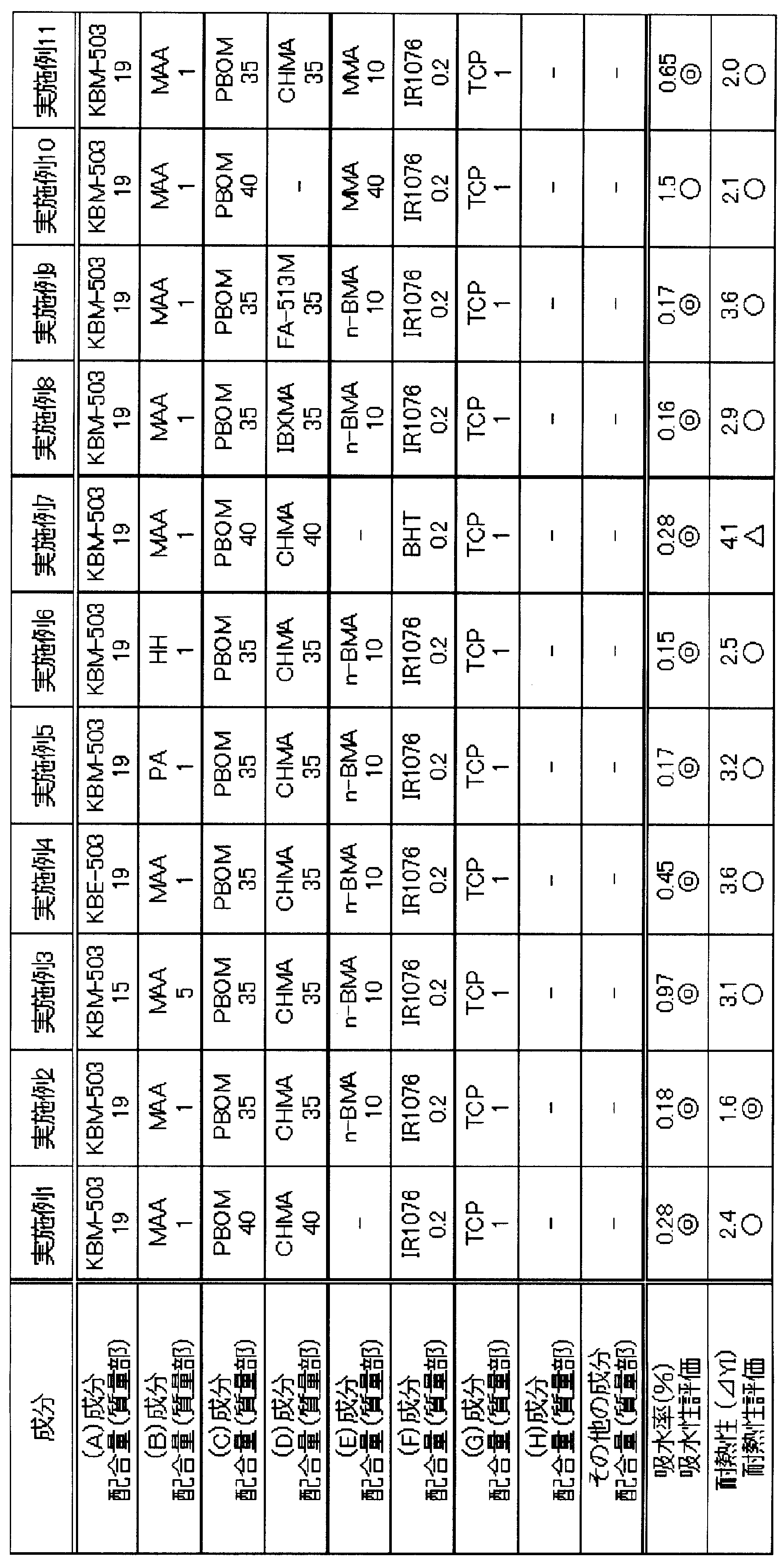

表中の略語は下記の通りである。
KBM-503:3-メタクリロキシプロピルトリメトキシシラン(信越化学業株式会社製)。
KBE-503:3-メタクリロキシプロピルトリエトキシシラン(信越化学工業株式会社製)。
MAA:メタクリル酸(三菱レイヨン株式会社製)。
PA:フタル酸2-メタクリロイルオキシエチル(三菱レイヨン株式会社製)。
HH:ヘキサヒドロフタル酸2-メタクリロイルオキシエチル(三菱レイヨン株式会社製)。
PBOM:ポリブチレングリコールジメタクリレート、重合度n=8~9(三菱レイヨン株式会社製)。
PEOM:ポリエチレングリコールジメタクリレート、重合度n≒14(新中村化学工業株式会社製、商品名:NKエステル14G)。
CHMA:シクロヘキシルメタクリレート(三菱レイヨン株式会社製)。
IBXMA:イソボルニルメタクリレート(三菱レイヨン株式会社製)。
FA-513M:ジシクロペンタニルメタクリレート(日立化成工業株式会社製、商品名:FA-513M)。
MMA:メチルメタクリレート(三菱レイヨン株式会社製)。
n-BMA:ノルマルブチルメタクリレート(三菱レイヨン株式会社製)。
IR1076:n-オクタデシル-3-(3’,5’-ジ-t-ブチル-4’-ヒドロキシフェニル)プロピオネート(チバ・ジャパン株式会社製、商品名:IRGANOX1076)。
BHT:2,6-ジ-t-ブチル-p-クレゾール(本州化学工業株式会社製)。
TCP:ビス(4-t-ブチルシクロヘキシル)パーオキシジカーボネート(日油株式会社製、商品名:パーロイルTCP)。
ポリマーA:合成例1で得たポリマー(メチルメタクリレート/n-ブチルメタクリレート=40/60(モノマー質量比)の共重合体(Mw=60,000))
KBM-503:3-メタクリロキシプロピルトリメトキシシラン(信越化学業株式会社製)。
KBE-503:3-メタクリロキシプロピルトリエトキシシラン(信越化学工業株式会社製)。
MAA:メタクリル酸(三菱レイヨン株式会社製)。
PA:フタル酸2-メタクリロイルオキシエチル(三菱レイヨン株式会社製)。
HH:ヘキサヒドロフタル酸2-メタクリロイルオキシエチル(三菱レイヨン株式会社製)。
PBOM:ポリブチレングリコールジメタクリレート、重合度n=8~9(三菱レイヨン株式会社製)。
PEOM:ポリエチレングリコールジメタクリレート、重合度n≒14(新中村化学工業株式会社製、商品名:NKエステル14G)。
CHMA:シクロヘキシルメタクリレート(三菱レイヨン株式会社製)。
IBXMA:イソボルニルメタクリレート(三菱レイヨン株式会社製)。
FA-513M:ジシクロペンタニルメタクリレート(日立化成工業株式会社製、商品名:FA-513M)。
MMA:メチルメタクリレート(三菱レイヨン株式会社製)。
n-BMA:ノルマルブチルメタクリレート(三菱レイヨン株式会社製)。
IR1076:n-オクタデシル-3-(3’,5’-ジ-t-ブチル-4’-ヒドロキシフェニル)プロピオネート(チバ・ジャパン株式会社製、商品名:IRGANOX1076)。
BHT:2,6-ジ-t-ブチル-p-クレゾール(本州化学工業株式会社製)。
TCP:ビス(4-t-ブチルシクロヘキシル)パーオキシジカーボネート(日油株式会社製、商品名:パーロイルTCP)。
ポリマーA:合成例1で得たポリマー(メチルメタクリレート/n-ブチルメタクリレート=40/60(モノマー質量比)の共重合体(Mw=60,000))
本発明によれば、得られる硬化物の耐熱性が高く、吸水性が低い硬化性樹脂組成物、ならびにその硬化物からなる光学部材、発光ダイオード用封止材、および有機ELディスプレイパネル用充填材、ならびに前記発光ダイオード用封止材を備えた発光ダイオード、および前記有機ELディスプレイパネル用充填材を備えた有機ELディスプレイパネルを提供できるため、産業上極めて有効である。
1…発光ダイオード用封止材、2…発光ダイオード素子、3a…ボンディングワイヤ、3b…ボンディングワイヤ、4a…リフレクター、4b…リフレクター、5…電極(アノード)、6…電極(カソード)、7…パッケージ基板、8…ダイボンド材、9…有機ELディスプレイパネル用充填材、10a…封止材、10b…封止材、11…有機EL素子、12…パッシベーション、13a…ガラス基板、13b…ガラス基板、100…発光ダイオード、200…有機ELディスプレイパネル
Claims (14)
- (A)アルコキシシラン構造を有する(メタ)アクリル系重合性単量体と、(B)カルボキシル基を有する(メタ)アクリル系重合性単量体(ただし、構造中にケイ素原子は含まない)と、(C)下記一般式(1)で示される(メタ)アクリル系重合性単量体と、を含有する硬化性樹脂組成物。
(一般式(1)において、R1またはR3は、独立してアクリロイル基、またはメタクリロイル基であり、R2は炭素数3~6であるアルキレン基、nは2~30の整数である。)
- (C)一般式(1)で示される(メタ)アクリル系重合性単量体が、ポリブチレングリコールジ(メタ)アクリレートである請求項1に記載の硬化性樹脂組成物。
- さらに(D)エステル部分の置換基が脂環式炭化水素構造である(メタ)アクリル系重合性単量体を含有する、請求項1に記載の硬化性樹脂組成物。
- さらに(E)エステル部分の置換基が直鎖状または分岐鎖状のアルキル基である(メタ)アクリル系重合性単量体を含有する、請求項1に記載の硬化性樹脂組成物。
- さらに(F)酸化防止剤を含有する、請求項1に記載の硬化性樹脂組成物。
- さらに(G)重合開始剤を含有する、請求項1に記載の硬化性樹脂組成物。
- さらに(H)(メタ)アクリル系重合体を含有する請求項1に記載の硬化性樹脂組成物。
- 全重合性成分の配合量100質量%に対して、前記(A)アルコキシシラン構造を有する(メタ)アクリル系重合性単量体を1~70質量%、前記(B)カルボキシル基を有する(メタ)アクリル系重合性単量体(ただし、構造中にケイ素原子は含まない)を0.05~20質量%、および前記(C)一般式(1)で示される(メタ)アクリル系重合性単量体を10~90質量%含有する請求項1に記載の硬化性樹脂組成物。
- 全重合性成分の配合量100質量%に対して、前記(A)アルコキシシラン構造を有する(メタ)アクリル系重合性単量体を1~35質量%、前記(B)カルボキシル基を有する(メタ)アクリル系重合性単量体(ただし、構造中にケイ素原子は含まない)を0.05~10質量%、および前記(C)一般式(1)で示される(メタ)アクリル系重合性単量体を10~60質量%含有し、
さらに(D)エステル部分の置換基が脂環式炭化水素構造である(メタ)アクリル系重合性単量体を10~60質量%、および(E)エステル部分の置換基がアルキル基である(メタ)アクリル系重合性単量体を5~40質量%含有する請求項1に記載の硬化性樹脂組成物。 - 請求項1に記載の硬化性樹脂組成物の硬化物からなる光学部材。
- 請求項1に記載の硬化性樹脂組成物の硬化物からなる発光ダイオード用封止材。
- 請求項1に記載の硬化性樹脂組成物の硬化物からなる有機エレクトロルミネッセンスディスプレイパネル用充填材。
- 請求項11に記載の発光ダイオード用封止材を備えた発光ダイオード。
- 請求項12に記載の有機エレクトロルミネッセンスディスプレイパネル用充填材を備えた有機エレクトロルミネッセンスディスプレイパネル。
Priority Applications (1)
| Application Number | Priority Date | Filing Date | Title |
|---|---|---|---|
| JP2011505285A JPWO2011087008A1 (ja) | 2010-01-14 | 2011-01-12 | 硬化性樹脂組成物、その硬化物からなる光学部材 |
Applications Claiming Priority (2)
| Application Number | Priority Date | Filing Date | Title |
|---|---|---|---|
| JP2010-005778 | 2010-01-14 | ||
| JP2010005778 | 2010-01-14 |
Publications (1)
| Publication Number | Publication Date |
|---|---|
| WO2011087008A1 true WO2011087008A1 (ja) | 2011-07-21 |
Family
ID=44304282
Family Applications (1)
| Application Number | Title | Priority Date | Filing Date |
|---|---|---|---|
| PCT/JP2011/050330 Ceased WO2011087008A1 (ja) | 2010-01-14 | 2011-01-12 | 硬化性樹脂組成物、その硬化物からなる光学部材 |
Country Status (3)
| Country | Link |
|---|---|
| JP (1) | JPWO2011087008A1 (ja) |
| TW (1) | TW201130906A (ja) |
| WO (1) | WO2011087008A1 (ja) |
Cited By (7)
| Publication number | Priority date | Publication date | Assignee | Title |
|---|---|---|---|---|
| WO2013154165A1 (ja) * | 2012-04-12 | 2013-10-17 | 三菱レイヨン株式会社 | 二次電池電極バインダ樹脂、二次電池電極組成物、二次電池電極および二次電池 |
| JP2015038188A (ja) * | 2013-06-06 | 2015-02-26 | 東洋合成工業株式会社 | 組成物 |
| JP2016092299A (ja) * | 2014-11-07 | 2016-05-23 | 日立化成株式会社 | 電子部品の製造方法、光半導体素子封止用フィルム状硬化性樹脂組成物及び電子部品 |
| JP2017075198A (ja) * | 2014-02-25 | 2017-04-20 | 日立化成株式会社 | アクリル樹脂組成物及び電子部品 |
| KR20180087247A (ko) * | 2015-11-26 | 2018-08-01 | 가부시끼가이샤 쓰리본드 | 열경화성 조성물 및 그를 이용한 도전성 접착제 |
| JP2019108548A (ja) * | 2019-02-06 | 2019-07-04 | 日立化成株式会社 | アクリル樹脂組成物及び電子部品 |
| JP2020007449A (ja) * | 2018-07-06 | 2020-01-16 | 株式会社コバヤシ | 光硬化性組成物 |
Citations (4)
| Publication number | Priority date | Publication date | Assignee | Title |
|---|---|---|---|---|
| JPH0297439A (ja) * | 1988-10-03 | 1990-04-10 | Mitsubishi Rayon Co Ltd | 合わせ硝子用樹脂組成物 |
| JPH04164910A (ja) * | 1990-10-26 | 1992-06-10 | Mitsubishi Rayon Co Ltd | ポリブチレングリコールジ(メタ)アクリレート及びそれを含む注型重合用樹脂組成物 |
| JPH093145A (ja) * | 1995-06-15 | 1997-01-07 | Kyoeisha Chem Co Ltd | 硬化性樹脂組成物 |
| WO1999055633A1 (fr) * | 1998-04-28 | 1999-11-04 | Mitsubishi Rayon Co., Ltd. | Premix acrylique, faux marbre acrylique et leur production |
-
2011
- 2011-01-12 WO PCT/JP2011/050330 patent/WO2011087008A1/ja not_active Ceased
- 2011-01-12 JP JP2011505285A patent/JPWO2011087008A1/ja active Pending
- 2011-01-12 TW TW100101129A patent/TW201130906A/zh unknown
Patent Citations (4)
| Publication number | Priority date | Publication date | Assignee | Title |
|---|---|---|---|---|
| JPH0297439A (ja) * | 1988-10-03 | 1990-04-10 | Mitsubishi Rayon Co Ltd | 合わせ硝子用樹脂組成物 |
| JPH04164910A (ja) * | 1990-10-26 | 1992-06-10 | Mitsubishi Rayon Co Ltd | ポリブチレングリコールジ(メタ)アクリレート及びそれを含む注型重合用樹脂組成物 |
| JPH093145A (ja) * | 1995-06-15 | 1997-01-07 | Kyoeisha Chem Co Ltd | 硬化性樹脂組成物 |
| WO1999055633A1 (fr) * | 1998-04-28 | 1999-11-04 | Mitsubishi Rayon Co., Ltd. | Premix acrylique, faux marbre acrylique et leur production |
Cited By (9)
| Publication number | Priority date | Publication date | Assignee | Title |
|---|---|---|---|---|
| WO2013154165A1 (ja) * | 2012-04-12 | 2013-10-17 | 三菱レイヨン株式会社 | 二次電池電極バインダ樹脂、二次電池電極組成物、二次電池電極および二次電池 |
| JP2015038188A (ja) * | 2013-06-06 | 2015-02-26 | 東洋合成工業株式会社 | 組成物 |
| JP2017075198A (ja) * | 2014-02-25 | 2017-04-20 | 日立化成株式会社 | アクリル樹脂組成物及び電子部品 |
| JP2016092299A (ja) * | 2014-11-07 | 2016-05-23 | 日立化成株式会社 | 電子部品の製造方法、光半導体素子封止用フィルム状硬化性樹脂組成物及び電子部品 |
| KR20180087247A (ko) * | 2015-11-26 | 2018-08-01 | 가부시끼가이샤 쓰리본드 | 열경화성 조성물 및 그를 이용한 도전성 접착제 |
| JPWO2017090759A1 (ja) * | 2015-11-26 | 2018-09-20 | 株式会社スリーボンド | 熱硬化性組成物およびそれを用いた導電性接着剤 |
| KR102526024B1 (ko) * | 2015-11-26 | 2023-04-25 | 가부시끼가이샤 쓰리본드 | 열경화성 조성물 및 그를 이용한 도전성 접착제 |
| JP2020007449A (ja) * | 2018-07-06 | 2020-01-16 | 株式会社コバヤシ | 光硬化性組成物 |
| JP2019108548A (ja) * | 2019-02-06 | 2019-07-04 | 日立化成株式会社 | アクリル樹脂組成物及び電子部品 |
Also Published As
| Publication number | Publication date |
|---|---|
| TW201130906A (en) | 2011-09-16 |
| JPWO2011087008A1 (ja) | 2013-05-20 |
Similar Documents
| Publication | Publication Date | Title |
|---|---|---|
| CN102311710B (zh) | 粘合剂组合物及利用该粘合剂的光学元件 | |
| TWI743021B (zh) | 透明樹脂層、附黏著劑層之偏光薄膜及影像顯示裝置 | |
| CN102471416B (zh) | 丙烯酸酯类组合物 | |
| WO2011087008A1 (ja) | 硬化性樹脂組成物、その硬化物からなる光学部材 | |
| JP5879963B2 (ja) | 熱硬化性樹脂組成物、その硬化物からなる光学部材 | |
| US10858553B2 (en) | Polarizing film, method for producing same, optical film, and image display device | |
| KR20170062369A (ko) | 광학 필름용 점착제, 점착제층, 광학부재 및 화상표시장치 | |
| KR20120124394A (ko) | 점착제, 광학 부재용 점착제, 점착제층 부착 광학 부재, 화상 표시장치, 활성 에너지선 및/또는 열경화성 점착제 조성물, 점착제 조성물 | |
| KR20170062363A (ko) | 점착제 조성물, 점착필름 및 화상표시장치 | |
| JP2017194572A (ja) | 偏光フィルムおよびその製造方法、光学フィルムおよび画像表示装置 | |
| WO2017183333A1 (ja) | 活性エネルギー線硬化型接着剤組成物、積層偏光フィルムおよびその製造方法、積層光学フィルムおよび画像表示装置 | |
| JP2017193633A (ja) | 活性エネルギー線硬化型接着剤組成物、積層偏光フィルムおよびその製造方法、積層光学フィルムおよび画像表示装置 | |
| JP7207961B2 (ja) | 粘着剤組成物、及びそれを用いた粘着フィルム、表面保護フィルム | |
| JP6500399B2 (ja) | 硬化性樹脂組成物、硬化物、光学部材、レンズ及びカメラモジュール | |
| JP6439277B2 (ja) | 硬化性樹脂組成物、その硬化物、光学部材及びコーティング物 | |
| JP2019085479A (ja) | 光学用粘着剤および光学粘着シート | |
| JP7193286B2 (ja) | 表面保護フィルム | |
| JP6020895B2 (ja) | 硬化性樹脂組成物、硬化物及び光学部材 | |
| JP2010189471A (ja) | 硬化性樹脂組成物、その硬化物からなる封止材および充填剤 | |
| JP2012191196A (ja) | 太陽電池モジュール用封止材、太陽電池モジュールおよびその製造方法 | |
| JP2005302564A (ja) | 色素増感型太陽電池用シール剤 | |
| JP6597060B2 (ja) | 硬化性樹脂組成物、硬化物、光学部材、レンズ及びカメラモジュール | |
| JP2014205785A (ja) | 硬化性樹脂組成物、硬化物及び光学部材 | |
| CN103562236A (zh) | 固化性树脂组合物、其固化物、层叠体及该层叠体的制造方法 | |
| JP2020158591A (ja) | 硬化性樹脂組成物、硬化物および光学部材 |
Legal Events
| Date | Code | Title | Description |
|---|---|---|---|
| WWE | Wipo information: entry into national phase |
Ref document number: 2011505285 Country of ref document: JP |
|
| NENP | Non-entry into the national phase |
Ref country code: DE |
|
| 122 | Ep: pct application non-entry in european phase |
Ref document number: 11732878 Country of ref document: EP Kind code of ref document: A1 |