WO2011058873A1 - 非水系二次電池用正極活物質 - Google Patents
非水系二次電池用正極活物質 Download PDFInfo
- Publication number
- WO2011058873A1 WO2011058873A1 PCT/JP2010/068884 JP2010068884W WO2011058873A1 WO 2011058873 A1 WO2011058873 A1 WO 2011058873A1 JP 2010068884 W JP2010068884 W JP 2010068884W WO 2011058873 A1 WO2011058873 A1 WO 2011058873A1
- Authority
- WO
- WIPO (PCT)
- Prior art keywords
- active material
- positive electrode
- electrode active
- secondary battery
- battery
- Prior art date
- Legal status (The legal status is an assumption and is not a legal conclusion. Google has not performed a legal analysis and makes no representation as to the accuracy of the status listed.)
- Ceased
Links
Images



Classifications
-
- H—ELECTRICITY
- H01—ELECTRIC ELEMENTS
- H01M—PROCESSES OR MEANS, e.g. BATTERIES, FOR THE DIRECT CONVERSION OF CHEMICAL ENERGY INTO ELECTRICAL ENERGY
- H01M10/00—Secondary cells; Manufacture thereof
- H01M10/05—Accumulators with non-aqueous electrolyte
- H01M10/052—Li-accumulators
- H01M10/0525—Rocking-chair batteries, i.e. batteries with lithium insertion or intercalation in both electrodes; Lithium-ion batteries
-
- H—ELECTRICITY
- H01—ELECTRIC ELEMENTS
- H01M—PROCESSES OR MEANS, e.g. BATTERIES, FOR THE DIRECT CONVERSION OF CHEMICAL ENERGY INTO ELECTRICAL ENERGY
- H01M4/00—Electrodes
- H01M4/02—Electrodes composed of, or comprising, active material
- H01M4/36—Selection of substances as active materials, active masses, active liquids
- H01M4/60—Selection of substances as active materials, active masses, active liquids of organic compounds
-
- H—ELECTRICITY
- H01—ELECTRIC ELEMENTS
- H01M—PROCESSES OR MEANS, e.g. BATTERIES, FOR THE DIRECT CONVERSION OF CHEMICAL ENERGY INTO ELECTRICAL ENERGY
- H01M4/00—Electrodes
- H01M4/02—Electrodes composed of, or comprising, active material
- H01M4/36—Selection of substances as active materials, active masses, active liquids
- H01M4/60—Selection of substances as active materials, active masses, active liquids of organic compounds
- H01M4/602—Polymers
- H01M4/606—Polymers containing aromatic main chain polymers
-
- H—ELECTRICITY
- H01—ELECTRIC ELEMENTS
- H01M—PROCESSES OR MEANS, e.g. BATTERIES, FOR THE DIRECT CONVERSION OF CHEMICAL ENERGY INTO ELECTRICAL ENERGY
- H01M4/00—Electrodes
- H01M4/02—Electrodes composed of, or comprising, active material
- H01M4/62—Selection of inactive substances as ingredients for active masses, e.g. binders, fillers
- H01M4/621—Binders
- H01M4/622—Binders being polymers
- H01M4/623—Binders being polymers fluorinated polymers
-
- H—ELECTRICITY
- H01—ELECTRIC ELEMENTS
- H01M—PROCESSES OR MEANS, e.g. BATTERIES, FOR THE DIRECT CONVERSION OF CHEMICAL ENERGY INTO ELECTRICAL ENERGY
- H01M4/00—Electrodes
- H01M4/02—Electrodes composed of, or comprising, active material
- H01M4/62—Selection of inactive substances as ingredients for active masses, e.g. binders, fillers
- H01M4/624—Electric conductive fillers
- H01M4/625—Carbon or graphite
-
- Y—GENERAL TAGGING OF NEW TECHNOLOGICAL DEVELOPMENTS; GENERAL TAGGING OF CROSS-SECTIONAL TECHNOLOGIES SPANNING OVER SEVERAL SECTIONS OF THE IPC; TECHNICAL SUBJECTS COVERED BY FORMER USPC CROSS-REFERENCE ART COLLECTIONS [XRACs] AND DIGESTS
- Y02—TECHNOLOGIES OR APPLICATIONS FOR MITIGATION OR ADAPTATION AGAINST CLIMATE CHANGE
- Y02E—REDUCTION OF GREENHOUSE GAS [GHG] EMISSIONS, RELATED TO ENERGY GENERATION, TRANSMISSION OR DISTRIBUTION
- Y02E60/00—Enabling technologies; Technologies with a potential or indirect contribution to GHG emissions mitigation
- Y02E60/10—Energy storage using batteries
-
- Y—GENERAL TAGGING OF NEW TECHNOLOGICAL DEVELOPMENTS; GENERAL TAGGING OF CROSS-SECTIONAL TECHNOLOGIES SPANNING OVER SEVERAL SECTIONS OF THE IPC; TECHNICAL SUBJECTS COVERED BY FORMER USPC CROSS-REFERENCE ART COLLECTIONS [XRACs] AND DIGESTS
- Y02—TECHNOLOGIES OR APPLICATIONS FOR MITIGATION OR ADAPTATION AGAINST CLIMATE CHANGE
- Y02T—CLIMATE CHANGE MITIGATION TECHNOLOGIES RELATED TO TRANSPORTATION
- Y02T10/00—Road transport of goods or passengers
- Y02T10/60—Other road transportation technologies with climate change mitigation effect
- Y02T10/70—Energy storage systems for electromobility, e.g. batteries
Definitions
- the present invention relates to a positive electrode active material for a non-aqueous secondary battery such as a lithium ion secondary battery, and a non-aqueous secondary battery using the active material.
- Lithium ion secondary batteries are used as a power source for various devices.
- a battery having a higher energy density is required.
- a compound containing a heavy metal such as lithium cobaltate has been mainly used as a positive electrode active material of a lithium ion secondary battery.
- an active material made of a material having a small environmental load is used. Substance is desired.
- 1,4-benzoquinones are known to exhibit a two-electron transfer type oxidation-reduction reaction, and their application has been attempted as a material capable of increasing the capacity (see Patent Document 1).
- the discharge capacity is about half of the theoretical value, and a sufficient real energy density is not obtained. Possible reasons for this include the low conductivity of the organic active material itself and the instability of the radical species generated with charge / discharge.
- 1,4-benzoquinones have the disadvantage that they are easily dissolved in the electrolyte during charging and discharging, and the cycle characteristics are poor.
- the present invention has been made in view of the current state of the prior art described above, and its main purpose is a novel positive electrode active material for a non-aqueous secondary battery having high energy density and excellent cycle characteristics. It is to provide a material made of an organic compound with a small environmental load.
- the present inventor has intensively studied to achieve the above-mentioned purpose. As a result, a benzoquinone compound having a specific substituent was found to be a material with a low environmental load, a high initial discharge capacity, and excellent cycle characteristics, and the present invention was completed here. It came.
- the present invention provides the following positive electrode active material for non-aqueous secondary battery and non-aqueous secondary battery.
- a positive electrode active material for a non-aqueous secondary battery comprising a 1,4-benzoquinone compound having a lower alkoxy group as a substituent as an active ingredient.
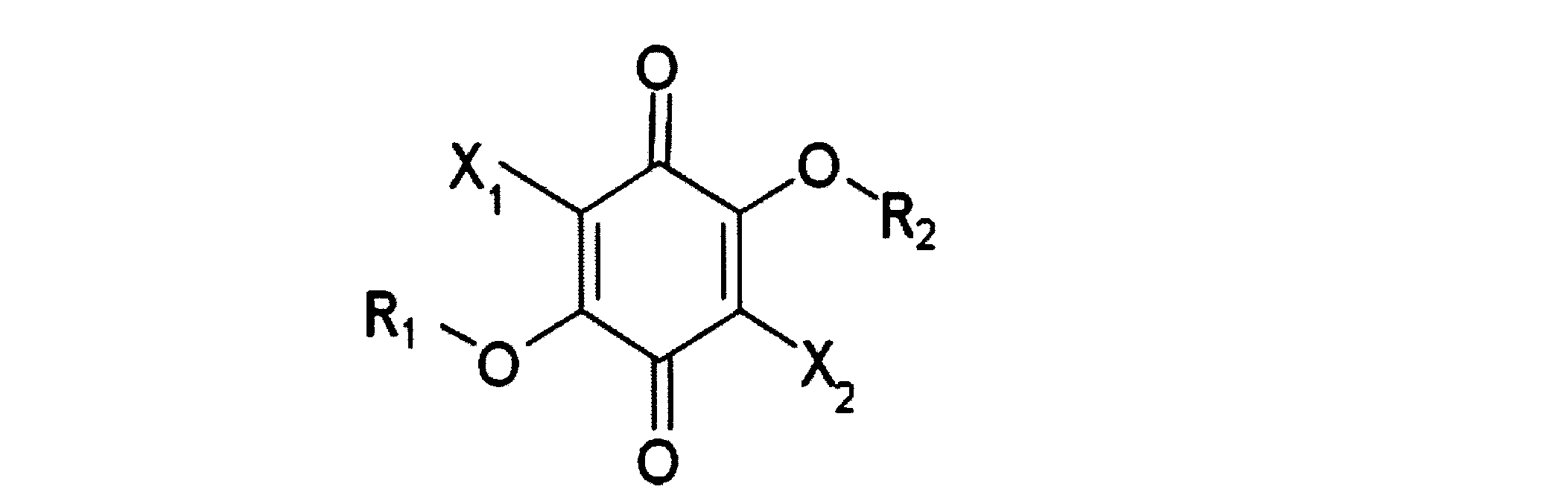
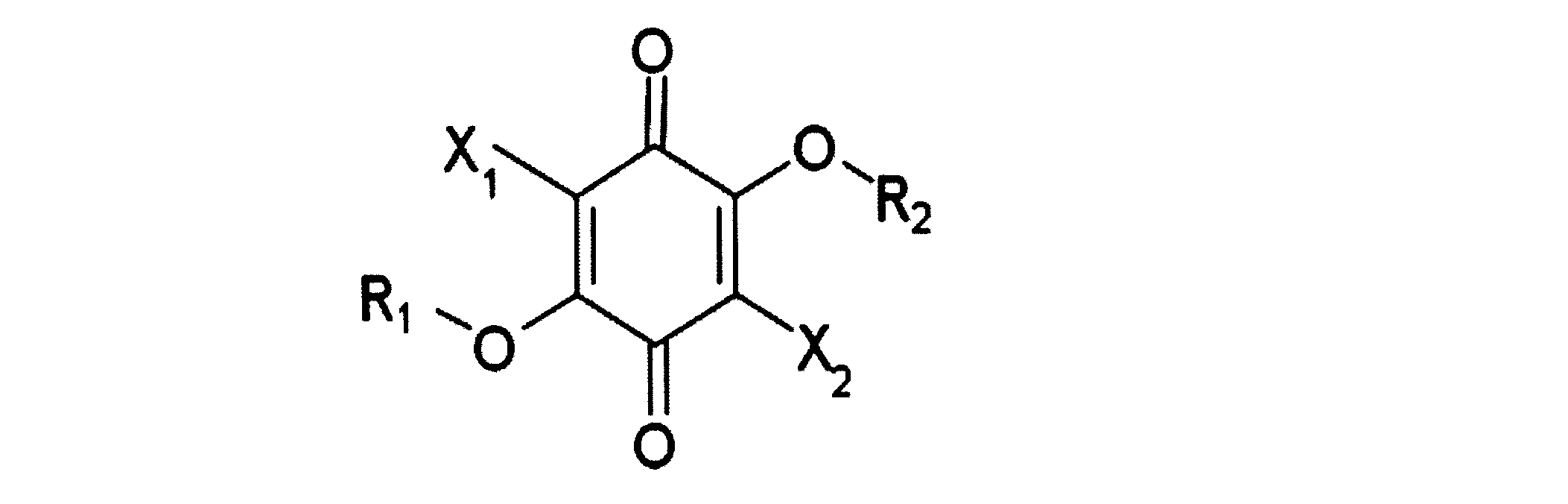
- a 1,4-benzoquinone compound having a lower alkoxy group as a substituent has the following chemical formula
- the positive electrode active material according to Item 1 wherein the positive electrode active material is a compound.
- a non-aqueous secondary battery comprising the positive electrode active material according to Item 1 or 2 as a constituent element. 4).
- Item 4 The nonaqueous secondary battery according to Item 3, comprising a separator made of a solid electrolyte as a constituent element.
- the positive electrode active material for a non-aqueous secondary battery of the present invention comprises a 1,4-benzoquinone compound having a lower alkoxy group as a substituent as an active ingredient.
- the benzoquinone compound has a high initial discharge capacity compared to lithium cobaltate, which has been widely used as a positive electrode active material for lithium ion secondary batteries, and a benquinone compound having no lower alkoxy group. In comparison, it has excellent cycle characteristics. For this reason, by using the 1,4-benzoquinone compound as a positive electrode active material, a non-aqueous secondary battery having a high charge / discharge capacity and good cycle characteristics and a small environmental load can be obtained.
- a 1,4-benzoquinone compound having a lower alkoxy group as a substituent has such excellent characteristics is not necessarily clear, but by having an alkoxy group, a radical produced at the time of charge / discharge is sterically. It is protected and stabilized, and further, a one-dimensional stack structure is formed by the ⁇ - ⁇ interaction. For these reasons, elution into the solvent is suppressed, and the cycle characteristics are considered to be improved.
- the stack structure based on the ⁇ - ⁇ interaction serves as an electron transmission path during charge and discharge, and thus the electron conductivity is increased, and the discharge capacity is considered to be close to the theoretical value.
- 1,4-benzoquinone compound having a lower alkoxy group as a substituent include compounds represented by the following chemical formula.
- R 1 and R 2 are the same or different and each is a lower alkyl group
- X 1 and X 2 are the same or different and each is a hydrogen atom or a halogen atom.
- examples of the lower alkyl group include methyl, ethyl, n-propyl, isopropyl, n-butyl, isobutyl, tert-butyl, sec-butyl, n-pentyl, 1-ethylpropyl, isopentyl, A linear or branched alkyl group having 1 to 6 carbon atoms such as neopentyl, n-hexyl, 1,2,2-trimethylpropyl, 3,3-dimethylbutyl, 2-ethylbutyl, isohexyl, 3-methylpentyl, etc. It can be illustrated. Of these, an alkyl group having 1 to 4 carbon atoms is particularly preferable.
- halogen atom examples include fluorine, chlorine, bromine and the like.
- X 1 and X 2 are particularly preferably hydrogen or fluorine.
- the compound represented by the above chemical formula is a known substance or a substance that can be easily synthesized by a dehydration reaction between dihalodihydroxybenzoquinone and a lower alcohol.
- a non-aqueous secondary battery using a 1,4-benzoquinone compound having a lower alkoxy group as the above-described substituent as a positive electrode active material can be produced by a known method.
- a lithium ion secondary battery For example, a lithium ion secondary battery will be described.
- the 1,4-benzoquinone compound is used as a positive electrode active material, and as a negative electrode active material, a metal lithium that is a known material, a carbon-based material doped with lithium (activated carbon, graphite) ) Etc., and as the electrolyte, for example, a lithium salt such as lithium perchlorate: LiClO 4 and lithium hexafluorophosphate: LiPF 6 is dissolved in a solvent such as ethylene carbonate: EC and dimethyl carbonate: DMC.
- a solvent such as ethylene carbonate: EC and dimethyl carbonate: DMC.
- the non-aqueous secondary battery having such a structure by using a solid electrolyte as a separator, the movement of the positive electrode active material dissolved in the electrolytic solution to the negative electrode can be suppressed, and the cycle characteristics can be greatly improved. Therefore, by using a 1,4-benzoquinone compound having a lower alkoxy group as a positive electrode active material and using a solid electrolyte as a separator, a non-aqueous system having sufficient charge / discharge capacity and very good cycle characteristics A secondary battery can be obtained.
- the lithium ion secondary battery has good conductivity with respect to lithium ions, is stable with respect to the electrolytic solution used, and moves the active material dissolved in the electrolytic solution. If it can prevent, it can be used without particular limitation.
- Specific examples thereof include ion conductive ceramics such as lithium nitride, silicon, thiosilicon, and sulfide glass, polymer electrolytes based on polyethylene oxide, and the like.
- the positive electrode active material for a non-aqueous secondary battery according to the present invention is a material with a low environmental load made of an organic compound containing no heavy metal, and has a sufficient charge / discharge capacity and good cycle characteristics. Therefore, by using the positive electrode active material of the present invention, it is possible to produce a secondary battery having excellent performance with reduced environmental load.
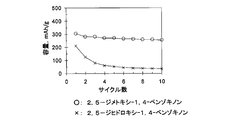
- FIG. 3 is a graph showing the initial discharge capacity measured in Example 1.
- FIG. 3 is a graph showing cycle characteristics measured in Example 1.
- FIG. Example 2 A graph showing the measured initial discharge capacity.
- FIG. 3 is a schematic view of a two-chamber test sealed battery produced in Example 3. 6 is a graph showing cycle characteristics measured in Example 3.
- Example 1 2,5-Dimethoxy-1,4-benzoquinone (Tokyo Kasei Kogyo Co., Ltd.) is used as the positive electrode active material, and acetylene black as the conductive aid and PTFE as the binder are used as the active material: conductive aid.
- Binder (weight ratio) 4: 5: 1 was mixed to prepare a sheet having a thickness of 90 ⁇ m, and pressure-bonded to an aluminum mesh (thickness: 110 ⁇ m) to prepare a positive electrode.
- a lithium foil as a negative electrode material lithium perchlorate / ⁇ -butyllactone (1.0 mol / L) as an electrolyte, and a glass filter as a separator were used to produce a coin cell battery for testing. .
- FIG. 1 shows an initial discharge curve (current density: 10 mA / g).
- the discharge curve has two flat sites at potentials of 2.8 V (vs. Li) and 2.4 V (vs. Li), and it can be seen that this is a two-electron reaction.
- the initial discharge capacity was 315 mAh / g, which was more than double the value of 140 mAh / g of lithium cobaltate, which is a positive electrode material of a normal lithium ion battery, and had a high discharge capacity.
- FIG. 2 is a graph showing the cycle change of the discharge capacity of this battery (current density: 20 mA / g). Further, FIG. 2 also shows the cycle characteristics of a battery using 2,5-dihydroxy-1,4-benzoquinone as the positive electrode active material instead of 2,5-dimethoxy-1,4-benzoquinone.
- the battery using 2,5-dimethoxy-1,4-benzoquinone as the positive electrode active material has a small capacity drop even when charging and discharging are repeated, and 250 mAh / g even after 10 cycles. The capacity exceeding 1 was maintained, and the cycle characteristics were excellent.
- a battery using 2,5-dihydroxy-1,4 benzoquinone as the positive electrode active material has a discharge capacity at the first cycle of about 205 mAh / g, which is about 50% of the theoretical capacity, and the cycle is repeated. As a result, the discharge capacity suddenly decreased.
- Example 2 2,5-difluoro-3,6-dimethoxy-1,4-benzoquinone synthesized according to the method described in PP Sah, SA Peoples, Arzneistoffforschung. 1961, 11, 27-33.
- FIG. 3 shows an initial discharge curve.
- the discharge curves each have two flat sites at a potential between 2.5-3.0 V (vs. Li), reflecting the two-electron reaction.
- the initial discharge capacity is 197 mAh / g, which is slightly smaller than the theoretical capacity of 263 mAh / g assuming a two-electron reaction, but compared with 140 mAh / g of lithium cobaltate as a positive electrode material of a normal lithium ion battery. It had a large discharge capacity.
- the average discharge voltage was higher than that when 2,5-dimethoxy-1,4-benzoquinone was used as the positive electrode active material.
- Example 3 Keegstra, EMD; van der Mieden, V .; Zwikker, JW; Jenneskens, LW; Schouten, A .; Kooijman, H .; Veldman, N .; Spek, AL Chem. Mater. 1996, 8, 1092-1105.
- a two-chamber sealed battery for test was prepared using 2,5-dipropoxy-1,4-benzoquinone synthesized according to the described method as a positive electrode active material and ion-conductive glass as a separator. A schematic diagram of this battery is shown in FIG.
- an aluminum plate was used as the positive electrode current collector, a stainless steel plate was used as the negative electrode current collector, and lithium foil was used as the negative electrode material.
- As the electrolyte solution on the negative electrode side lithium perchlorate / ⁇ -butyllactone (1.0 mol / L) is used, and the electrolyte solution is held on a glass filter so that it is between the negative electrode (lithium foil) and the ion conductive glass. Arranged.
- ion conductive glass 300 ⁇ m thick lithium ion conductive glass ceramics (LICGC) manufactured by OHARA INC. was used and placed between the glass filter and the carbon paper.
- LICGC lithium ion conductive glass ceramics
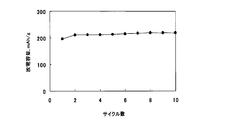
- FIG. 5 shows the measurement results of the cycle characteristics.
- a discharge capacity of about 200 mAh / g per active material is obtained, which is slightly smaller than the theoretical capacity assuming a two-electron reaction, but a large discharge capacity compared to 140 mAh / g of lithium cobaltate as a positive electrode material of a normal lithium ion battery. It was what had.
- this battery had very good cycle characteristics, and almost no reduction in discharge capacity was observed after 10 cycles. This is because the lithium ion conductive ceramic used as the separator is stable to the electrolytic solution and has the function of blocking the passage of the active material dissolved in the electrolyte on the positive electrode side. This is thought to be due to the suppression of movement.
Landscapes
- Chemical & Material Sciences (AREA)
- Chemical Kinetics & Catalysis (AREA)
- Electrochemistry (AREA)
- General Chemical & Material Sciences (AREA)
- Engineering & Computer Science (AREA)
- Materials Engineering (AREA)
- Manufacturing & Machinery (AREA)
- Battery Electrode And Active Subsutance (AREA)
- Secondary Cells (AREA)
Abstract
Description
1. 置換基として低級アルコキシ基を有する1,4-ベンゾキノン化合物を有効成分とする非水系二次電池用正極活物質。
2. 置換基として低級アルコキシ基を有する1,4-ベンゾキノン化合物が、下記化学式
3. 上記項1又は2に記載の正極活物質を構成要素として含む非水系二次電池。
4. 固体電解質からなるセパレーターを構成要素として含む上記項3に記載の非水系二次電池。
本発明の非水系二次電池用正極活物質は、置換基として低級アルコキシ基を有する1,4-ベンゾキノン化合物を有効成分とするものである。該ベンゾキノン化合物は、従来、リチウムイオン二次電池の正極活物質として広く用いられているコバルト酸リチウムと比較して、高い初期放電容量を有し、更に、低級アルコキシ基を有さないベンキノン化合物と比較すると優れたサイクル特性を有するものである。このため、該1,4-ベンゾキノン化合物を正極活物質として用いることによって、充放電容量が高く、サイクル特性も良好な環境負荷の小さい非水系二次電池を得ることができる。
正極活物質として2,5-ジメトキシ-1,4-ベンゾキノン(東京化成工業(株))を用い、これに導電助剤としてのアセチレンブラックと結着剤としてのPTFEを、活物質:導電助剤:結着剤(重量比)=4:5:1の割合で混合して、厚さ90μmのシートを作製し、アルミニウムメッシュ(厚さ:110μm)に圧着することによって、正極を作製した。これを正極材料として用い、負極材料としてリチウム箔、電解液として過塩素酸リチウム/γ-ブチルラクトン(1.0mol/L)を用い、セパレーターとしてガラスフィルターを用いて試験用コイン型電池を作製した。
P. P. Sah, S. A. Peoples, Arzneimittelforschung. 1961, 11, 27-33.に記載の方法に従って合成した2,5-ジフルオロ-3,6-ジメトキシ-1,4-ベンゾキノンを正極活物質として用い、これに導電助剤としてのアセチレンブラックと結着剤としてのPTFEを、活物質:導電助剤:結着剤(重量比)=4:5:1の割合で混合してシートを作製し、アルミニウムメッシュに圧着することによって、正極を作製した。これを正極材料として用い、負極材料としてリチウム箔、電解液としてリチウムビス(ペンタフルオロエタンスルホニル)イミド/γ-ブチルラクトン(3.0mol/L)を用い、セパレーターとしてガラスフィルターを用いて試験用コイン型電池を作製した。
Keegstra, E. M. D.; van der Mieden, V.; Zwikker, J. W.; Jenneskens, L. W.; Schouten, A.; Kooijman, H.; Veldman, N.; Spek, A. L. Chem. Mater. 1996, 8, 1092-1105. に記載の方法に従って合成した2,5-ジプロポキシ-1,4-ベンゾキノンを正極活物質として用い、イオン伝導性ガラスをセパレーターとして用いて二室型の試験用密閉電池を作製した。この電池の概略図を図4に示す。
Claims (4)
- 置換基として低級アルコキシ基を有する1,4-ベンゾキノン化合物を有効成分とする非水溶媒系二次電池用正極活物質。
- 置換基として低級アルコキシ基を有する1,4-ベンゾキノン化合物が、下記化学式

- 請求項1又は2に記載の正極活物質を構成要素として含む非水系二次電池。
- 固体電解質からなるセパレーターを構成要素として含む請求項3に記載の非水系二次電池。
Priority Applications (3)
| Application Number | Priority Date | Filing Date | Title |
|---|---|---|---|
| JP2011540461A JP5517001B2 (ja) | 2009-11-12 | 2010-10-26 | 非水系二次電池用正極活物質 |
| US13/501,158 US20120196182A1 (en) | 2009-11-12 | 2010-10-26 | Positive electrode active material for nonaqueous secondary battery |
| CN201080051173.6A CN102598374B (zh) | 2009-11-12 | 2010-10-26 | 非水二次电池用正极活性物质 |
Applications Claiming Priority (2)
| Application Number | Priority Date | Filing Date | Title |
|---|---|---|---|
| JP2009-258472 | 2009-11-12 | ||
| JP2009258472 | 2009-11-12 |
Publications (1)
| Publication Number | Publication Date |
|---|---|
| WO2011058873A1 true WO2011058873A1 (ja) | 2011-05-19 |
Family
ID=43991532
Family Applications (1)
| Application Number | Title | Priority Date | Filing Date |
|---|---|---|---|
| PCT/JP2010/068884 Ceased WO2011058873A1 (ja) | 2009-11-12 | 2010-10-26 | 非水系二次電池用正極活物質 |
Country Status (4)
| Country | Link |
|---|---|
| US (1) | US20120196182A1 (ja) |
| JP (1) | JP5517001B2 (ja) |
| CN (1) | CN102598374B (ja) |
| WO (1) | WO2011058873A1 (ja) |
Cited By (7)
| Publication number | Priority date | Publication date | Assignee | Title |
|---|---|---|---|---|
| JP2014120450A (ja) * | 2012-12-19 | 2014-06-30 | Jsr Corp | 電極活物質、電極、電池および重合体 |
| JP2015065028A (ja) * | 2013-09-25 | 2015-04-09 | 独立行政法人産業技術総合研究所 | 非水マグネシウム二次電池 |
| JP2016170891A (ja) * | 2015-03-11 | 2016-09-23 | 東洋インキScホールディングス株式会社 | 蓄電デバイス電極形成用組成物、蓄電デバイス電極、及び蓄電デバイス |
| JP2016177910A (ja) * | 2015-03-19 | 2016-10-06 | 東洋インキScホールディングス株式会社 | 蓄電デバイス電極形成用組成物、蓄電デバイス電極、及び蓄電デバイス |
| KR20190130170A (ko) * | 2017-04-10 | 2019-11-21 | 나노텍 인스트러먼츠, 인코포레이티드 | 애노드-보호 중합체 층을 함유하는 리튬 금속 2차 전지 및 제조 방법 |
| US12218346B2 (en) | 2018-06-21 | 2025-02-04 | Honeycomb Battery Company | Method of extending cycle-life of a lithium metal secondary battery |
| WO2025169424A1 (ja) * | 2024-02-08 | 2025-08-14 | Ntt株式会社 | 二次電池 |
Families Citing this family (12)
| Publication number | Priority date | Publication date | Assignee | Title |
|---|---|---|---|---|
| WO2014156511A1 (ja) * | 2013-03-28 | 2014-10-02 | 国立大学法人東北大学 | 蓄電装置およびその電極用材料 |
| KR20140132227A (ko) * | 2013-05-07 | 2014-11-17 | 삼성에스디아이 주식회사 | 리튬 이차 전지용 전해질 및 이를 포함하는 리튬 이차 전지 |
| CN104795566B (zh) * | 2014-06-04 | 2017-09-26 | 中国科学院物理研究所 | 基于醌类结构的电池负极活性材料及其制备方法和用途 |
| DE102014221261A1 (de) * | 2014-10-20 | 2016-04-21 | Robert Bosch Gmbh | Separator und galvanische Zelle mit robuster Trennung von Kathode und Anode |
| US9825323B2 (en) | 2015-01-06 | 2017-11-21 | Toyota Motor Engineering & Manufacturing North America, Inc. | Quinone-based high energy density liquid active material for flow battery |
| US11621420B2 (en) * | 2016-03-11 | 2023-04-04 | University Of Houston System | High ionic conductivity rechargeable solid state batteries with an organic electrode |
| US10910672B2 (en) | 2016-11-28 | 2021-02-02 | Toyota Motor Engineering & Manufacturing North America, Inc. | High concentration electrolyte for magnesium battery having carboranyl magnesium salt in mixed ether solvent |
| CN106910895B (zh) * | 2017-04-06 | 2020-02-21 | 广东工业大学 | 一种有机电极材料及其制备方法和应用 |
| US10680280B2 (en) | 2017-09-26 | 2020-06-09 | Toyota Jidosha Kabushiki Kaisha | 3D magnesium battery and method of making the same |
| CN110429335B (zh) * | 2019-07-26 | 2021-04-06 | 宁德新能源科技有限公司 | 电解液及包含其的电化学装置与电子装置 |
| CN113517467B (zh) * | 2021-07-09 | 2022-07-01 | 苏州科技大学 | 一种半固态锂离子电池 |
| US12176541B2 (en) * | 2022-02-04 | 2024-12-24 | Uchicago Argonne, Llc | Electroactive materials for secondary batteries |
Citations (3)
| Publication number | Priority date | Publication date | Assignee | Title |
|---|---|---|---|---|
| JPS55161374A (en) * | 1979-06-04 | 1980-12-15 | Nec Corp | Cell |
| JPH11144732A (ja) * | 1997-11-04 | 1999-05-28 | Nec Corp | 電池用複合電極とその製造方法 |
| JP2000040527A (ja) * | 1998-07-23 | 2000-02-08 | Nec Corp | 積層型電解質及びそれを用いた電池 |
Family Cites Families (9)
| Publication number | Priority date | Publication date | Assignee | Title |
|---|---|---|---|---|
| JP3039484B2 (ja) * | 1997-10-24 | 2000-05-08 | 日本電気株式会社 | ポリマー電池 |
| JPH11288740A (ja) * | 1998-04-02 | 1999-10-19 | Nec Corp | ポリマー電池 |
| US20020122980A1 (en) * | 1998-05-19 | 2002-09-05 | Fleischer Niles A. | Electrochemical cell with a non-liquid electrolyte |
| JP2000021444A (ja) * | 1998-06-30 | 2000-01-21 | Shin Kobe Electric Mach Co Ltd | 非水電解液二次電池 |
| DE10219423A1 (de) * | 2002-05-02 | 2003-11-20 | Varta Microbattery Gmbh | Verfahren zur Herstellung eines galvanischen Elements |
| CN1564348A (zh) * | 2004-03-29 | 2005-01-12 | 天津大学 | 以苯胺-苯醌复合聚合物作为阴极材料的二次锂电池及制备 |
| CN101185185B (zh) * | 2005-05-31 | 2010-04-07 | 松下电器产业株式会社 | 二次电池和使用了该二次电池的电源系统、以及电源系统的使用方法 |
| CN101263622A (zh) * | 2005-09-14 | 2008-09-10 | 三菱化学株式会社 | 用于一次电池的非水电解液以及使用该电解液的非水电解质一次电池 |
| KR20080105127A (ko) * | 2006-03-30 | 2008-12-03 | 이데미쓰 고산 가부시키가이샤 | 유기 전계발광 소자용 재료 및 이것을 사용한 유기 전계발광 소자 |
-
2010
- 2010-10-26 JP JP2011540461A patent/JP5517001B2/ja active Active
- 2010-10-26 WO PCT/JP2010/068884 patent/WO2011058873A1/ja not_active Ceased
- 2010-10-26 US US13/501,158 patent/US20120196182A1/en not_active Abandoned
- 2010-10-26 CN CN201080051173.6A patent/CN102598374B/zh not_active Expired - Fee Related
Patent Citations (3)
| Publication number | Priority date | Publication date | Assignee | Title |
|---|---|---|---|---|
| JPS55161374A (en) * | 1979-06-04 | 1980-12-15 | Nec Corp | Cell |
| JPH11144732A (ja) * | 1997-11-04 | 1999-05-28 | Nec Corp | 電池用複合電極とその製造方法 |
| JP2000040527A (ja) * | 1998-07-23 | 2000-02-08 | Nec Corp | 積層型電解質及びそれを用いた電池 |
Cited By (8)
| Publication number | Priority date | Publication date | Assignee | Title |
|---|---|---|---|---|
| JP2014120450A (ja) * | 2012-12-19 | 2014-06-30 | Jsr Corp | 電極活物質、電極、電池および重合体 |
| JP2015065028A (ja) * | 2013-09-25 | 2015-04-09 | 独立行政法人産業技術総合研究所 | 非水マグネシウム二次電池 |
| JP2016170891A (ja) * | 2015-03-11 | 2016-09-23 | 東洋インキScホールディングス株式会社 | 蓄電デバイス電極形成用組成物、蓄電デバイス電極、及び蓄電デバイス |
| JP2016177910A (ja) * | 2015-03-19 | 2016-10-06 | 東洋インキScホールディングス株式会社 | 蓄電デバイス電極形成用組成物、蓄電デバイス電極、及び蓄電デバイス |
| KR20190130170A (ko) * | 2017-04-10 | 2019-11-21 | 나노텍 인스트러먼츠, 인코포레이티드 | 애노드-보호 중합체 층을 함유하는 리튬 금속 2차 전지 및 제조 방법 |
| KR102673528B1 (ko) * | 2017-04-10 | 2024-06-12 | 나노텍 인스트러먼츠, 인코포레이티드 | 애노드-보호 중합체 층을 함유하는 리튬 금속 2차 전지 및 제조 방법 |
| US12218346B2 (en) | 2018-06-21 | 2025-02-04 | Honeycomb Battery Company | Method of extending cycle-life of a lithium metal secondary battery |
| WO2025169424A1 (ja) * | 2024-02-08 | 2025-08-14 | Ntt株式会社 | 二次電池 |
Also Published As
| Publication number | Publication date |
|---|---|
| CN102598374B (zh) | 2016-10-19 |
| JPWO2011058873A1 (ja) | 2013-03-28 |
| US20120196182A1 (en) | 2012-08-02 |
| CN102598374A (zh) | 2012-07-18 |
| JP5517001B2 (ja) | 2014-06-11 |
Similar Documents
| Publication | Publication Date | Title |
|---|---|---|
| JP5517001B2 (ja) | 非水系二次電池用正極活物質 | |
| Cuisinier et al. | Unique behaviour of nonsolvents for polysulphides in lithium–sulphur batteries | |
| Sakaebe et al. | Application of room temperature ionic liquids to Li batteries | |
| Veeraraghavan et al. | Study of polypyrrole graphite composite as anode material for secondary lithium-ion batteries | |
| US8895193B2 (en) | Plastic crystal electrolyte with a broad potential window | |
| US8617744B2 (en) | Electricity storage device | |
| US8034484B2 (en) | Electrochemical device and electrode active material for electrochemical device | |
| JP5410277B2 (ja) | シアノ基を有する非水電解液添加剤及びこれを用いた電気化学素子 | |
| JP4162096B2 (ja) | 蓄電デバイス | |
| US9023518B2 (en) | Lithium—sulfur battery with performance enhanced additives | |
| US8932758B2 (en) | Electrode active material, nonaqueous secondary battery electrode, and nonaqueous secondary battery | |
| Boltersdorf et al. | Electrochemical performance of lithium-ion capacitors evaluated under high temperature and high voltage stress using redox stable electrolytes and additives | |
| JP2018525779A (ja) | リチウム−酸素電池 | |
| US20090095942A1 (en) | Positive Electrode Material for Lithium Secondary Battery | |
| WO2011101992A1 (ja) | 非水電解液型二次電池及び非水電解液型二次電池用非水電解液 | |
| Komaba et al. | Fast redox of composite electrode of nitroxide radical polymer and carbon with polyacrylate binder | |
| WO2011129066A1 (ja) | リチウムイオン二次電池 | |
| JP2002093419A (ja) | インドール系化合物を用いた二次電池及びキャパシタ | |
| JP5565814B2 (ja) | 非水系二次電池用正極活物質 | |
| JP2009187880A (ja) | 非水電解液二次電池 | |
| TW201320436A (zh) | 非水電解質二次電池 | |
| JP2011103260A (ja) | 非水系二次電池用正極活物質 | |
| JP2006324179A (ja) | 電極およびそれを用いた電気化学素子 | |
| JP2007305430A (ja) | 電気化学素子 | |
| EP4261973A1 (en) | Self-standing solid electrolyte for solid lithium-air battery cells and method of preparation thereof |
Legal Events
| Date | Code | Title | Description |
|---|---|---|---|
| WWE | Wipo information: entry into national phase |
Ref document number: 201080051173.6 Country of ref document: CN |
|
| 121 | Ep: the epo has been informed by wipo that ep was designated in this application |
Ref document number: 10829833 Country of ref document: EP Kind code of ref document: A1 |
|
| WWE | Wipo information: entry into national phase |
Ref document number: 13501158 Country of ref document: US |
|
| WWE | Wipo information: entry into national phase |
Ref document number: 2011540461 Country of ref document: JP |
|
| NENP | Non-entry into the national phase |
Ref country code: DE |
|
| 122 | Ep: pct application non-entry in european phase |
Ref document number: 10829833 Country of ref document: EP Kind code of ref document: A1 |