WO2011052161A1 - 光半導体封止用硬化性樹脂組成物、及びその硬化物 - Google Patents
光半導体封止用硬化性樹脂組成物、及びその硬化物 Download PDFInfo
- Publication number
- WO2011052161A1 WO2011052161A1 PCT/JP2010/006217 JP2010006217W WO2011052161A1 WO 2011052161 A1 WO2011052161 A1 WO 2011052161A1 JP 2010006217 W JP2010006217 W JP 2010006217W WO 2011052161 A1 WO2011052161 A1 WO 2011052161A1
- Authority
- WO
- WIPO (PCT)
- Prior art keywords
- formula
- component
- resin composition
- optical semiconductor
- curable resin
- Prior art date
- Legal status (The legal status is an assumption and is not a legal conclusion. Google has not performed a legal analysis and makes no representation as to the accuracy of the status listed.)
- Ceased
Links
- 0 [O-][N+](*1)C(C=C=C2)=C2[N+]1[O-] Chemical compound [O-][N+](*1)C(C=C=C2)=C2[N+]1[O-] 0.000 description 3
- ABISHXMZPIIJJP-PECFZYITSA-N CCCc(cc1)ccc1-c1ccc(C/C=C/C=C\C=C(/C)\OCC2OC2)cc1 Chemical compound CCCc(cc1)ccc1-c1ccc(C/C=C/C=C\C=C(/C)\OCC2OC2)cc1 ABISHXMZPIIJJP-PECFZYITSA-N 0.000 description 1
- OFOOVMUFPZPFBF-UHFFFAOYSA-N [O-][NH+](C1=CCCC=C11)O[NH+]1[O-] Chemical compound [O-][NH+](C1=CCCC=C11)O[NH+]1[O-] OFOOVMUFPZPFBF-UHFFFAOYSA-N 0.000 description 1
Classifications
-
- C—CHEMISTRY; METALLURGY
- C08—ORGANIC MACROMOLECULAR COMPOUNDS; THEIR PREPARATION OR CHEMICAL WORKING-UP; COMPOSITIONS BASED THEREON
- C08G—MACROMOLECULAR COMPOUNDS OBTAINED OTHERWISE THAN BY REACTIONS ONLY INVOLVING UNSATURATED CARBON-TO-CARBON BONDS
- C08G59/00—Polycondensates containing more than one epoxy group per molecule; Macromolecules obtained by polymerising compounds containing more than one epoxy group per molecule using curing agents or catalysts which react with the epoxy groups
- C08G59/18—Macromolecules obtained by polymerising compounds containing more than one epoxy group per molecule using curing agents or catalysts which react with the epoxy groups ; e.g. general methods of curing
- C08G59/40—Macromolecules obtained by polymerising compounds containing more than one epoxy group per molecule using curing agents or catalysts which react with the epoxy groups ; e.g. general methods of curing characterised by the curing agents used
- C08G59/42—Polycarboxylic acids; Anhydrides, halides or low molecular weight esters thereof
- C08G59/4284—Polycarboxylic acids; Anhydrides, halides or low molecular weight esters thereof together with other curing agents
-
- C—CHEMISTRY; METALLURGY
- C08—ORGANIC MACROMOLECULAR COMPOUNDS; THEIR PREPARATION OR CHEMICAL WORKING-UP; COMPOSITIONS BASED THEREON
- C08L—COMPOSITIONS OF MACROMOLECULAR COMPOUNDS
- C08L63/00—Compositions of epoxy resins; Compositions of derivatives of epoxy resins
-
- C—CHEMISTRY; METALLURGY
- C08—ORGANIC MACROMOLECULAR COMPOUNDS; THEIR PREPARATION OR CHEMICAL WORKING-UP; COMPOSITIONS BASED THEREON
- C08G—MACROMOLECULAR COMPOUNDS OBTAINED OTHERWISE THAN BY REACTIONS ONLY INVOLVING UNSATURATED CARBON-TO-CARBON BONDS
- C08G59/00—Polycondensates containing more than one epoxy group per molecule; Macromolecules obtained by polymerising compounds containing more than one epoxy group per molecule using curing agents or catalysts which react with the epoxy groups
- C08G59/18—Macromolecules obtained by polymerising compounds containing more than one epoxy group per molecule using curing agents or catalysts which react with the epoxy groups ; e.g. general methods of curing
- C08G59/20—Macromolecules obtained by polymerising compounds containing more than one epoxy group per molecule using curing agents or catalysts which react with the epoxy groups ; e.g. general methods of curing characterised by the epoxy compounds used
-
- C—CHEMISTRY; METALLURGY
- C08—ORGANIC MACROMOLECULAR COMPOUNDS; THEIR PREPARATION OR CHEMICAL WORKING-UP; COMPOSITIONS BASED THEREON
- C08G—MACROMOLECULAR COMPOUNDS OBTAINED OTHERWISE THAN BY REACTIONS ONLY INVOLVING UNSATURATED CARBON-TO-CARBON BONDS
- C08G59/00—Polycondensates containing more than one epoxy group per molecule; Macromolecules obtained by polymerising compounds containing more than one epoxy group per molecule using curing agents or catalysts which react with the epoxy groups
- C08G59/18—Macromolecules obtained by polymerising compounds containing more than one epoxy group per molecule using curing agents or catalysts which react with the epoxy groups ; e.g. general methods of curing
- C08G59/40—Macromolecules obtained by polymerising compounds containing more than one epoxy group per molecule using curing agents or catalysts which react with the epoxy groups ; e.g. general methods of curing characterised by the curing agents used
-
- C—CHEMISTRY; METALLURGY
- C08—ORGANIC MACROMOLECULAR COMPOUNDS; THEIR PREPARATION OR CHEMICAL WORKING-UP; COMPOSITIONS BASED THEREON
- C08G—MACROMOLECULAR COMPOUNDS OBTAINED OTHERWISE THAN BY REACTIONS ONLY INVOLVING UNSATURATED CARBON-TO-CARBON BONDS
- C08G59/00—Polycondensates containing more than one epoxy group per molecule; Macromolecules obtained by polymerising compounds containing more than one epoxy group per molecule using curing agents or catalysts which react with the epoxy groups
- C08G59/18—Macromolecules obtained by polymerising compounds containing more than one epoxy group per molecule using curing agents or catalysts which react with the epoxy groups ; e.g. general methods of curing
- C08G59/40—Macromolecules obtained by polymerising compounds containing more than one epoxy group per molecule using curing agents or catalysts which react with the epoxy groups ; e.g. general methods of curing characterised by the curing agents used
- C08G59/62—Alcohols or phenols
- C08G59/621—Phenols
-
- H—ELECTRICITY
- H10—SEMICONDUCTOR DEVICES; ELECTRIC SOLID-STATE DEVICES NOT OTHERWISE PROVIDED FOR
- H10W—GENERIC PACKAGES, INTERCONNECTIONS, CONNECTORS OR OTHER CONSTRUCTIONAL DETAILS OF DEVICES COVERED BY CLASS H10
- H10W74/00—Encapsulations, e.g. protective coatings
- H10W74/40—Encapsulations, e.g. protective coatings characterised by their materials
-
- H—ELECTRICITY
- H10—SEMICONDUCTOR DEVICES; ELECTRIC SOLID-STATE DEVICES NOT OTHERWISE PROVIDED FOR
- H10H—INORGANIC LIGHT-EMITTING SEMICONDUCTOR DEVICES HAVING POTENTIAL BARRIERS
- H10H20/00—Individual inorganic light-emitting semiconductor devices having potential barriers, e.g. light-emitting diodes [LED]
- H10H20/80—Constructional details
- H10H20/85—Packages
- H10H20/852—Encapsulations
- H10H20/854—Encapsulations characterised by their material, e.g. epoxy or silicone resins
Definitions
- the present invention relates to a curable resin composition for optical semiconductor encapsulation. More specifically, it can be manufactured only by the kneading process, suitable for transfer molding, reactivity and hardness at heat, mold release from mold, prevention of void entrainment, and removal of lead frame from runner resin after mold release (Hereinafter referred to as a gate break process) excellent in curable resin composition for encapsulating an optical semiconductor excellent in lead-free solder resistance after moisture absorption, when there is no resin leakage from the mold and when it is molded and cured, and its
- the present invention relates to an optical semiconductor element sealed with a cured product.
- transfer molding method a low-pressure transfer molding method (hereinafter referred to as transfer molding method) has been adopted as a method for sealing an optical semiconductor element from the viewpoint of mass productivity.
- an epoxy resin has been adopted in terms of a balance of heat resistance, transparency, mechanical properties, and economy.
- the combination of a bisphenol A type epoxy resin and an acid anhydride curing agent is excellent in terms of demoldability from a mold, which is an important item for transfer molding workability, and high heat hardness.
- compositions using hexahydrophthalic anhydride, tetrahydrophthalic anhydride and the like as acid anhydride curing agents have been widely used.
- Patent Document 1 Japanese Patent Laid-Open No. 3-3258
- a metamorphic process or B-stage
- a means for adjusting to mass productivity is provided separately.
- the modification process is regarded as a problem that the economic efficiency is low in the production process of the resin composition. From the viewpoint of the production process of the resin composition, it is desired to obtain a composition suitable for mass productivity at the time of transfer molding only by kneading or mixing process.
- polyfunctional acid anhydrides available on the market are crystalline compounds, and their melting points are usually higher than the temperature range (around 150 °) in which transfer molding is usually performed. Specific examples include TMEG100 (melting point: 178 ° C.) and Nippon Benikane tetracarboxylic acid anhydride (melting point: 190 ° C.). For this reason, when used as a curing agent, the crystals cannot be melted by heat at the transfer molding temperature (around 150 ° C.), and the curing agent that has not melted causes foreign matter.
- the present condition is that examination which uses polyfunctional acid anhydride as a component for sealing materials for optical semiconductors is not fully carried out.
- the polyfunctional acid anhydride curing agent has high adhesion. Therefore, there is a problem that the lead frame frame is difficult to come off from the runner portion. If removed by hand, the lead frame frame will be deformed.
- the gate breakability in the case of using a polyfunctional acid anhydride has not been sufficiently studied.
- it is also important to prevent resin leakage and void entrainment during transfer molding. The examination of the resin composition that can satisfy all of the above problems and workability at the time of transfer molding is still insufficient.
- solder mounting process Fixing a large number of electronic components (including semiconductor elements) on a printed board or the like with solder is called a solder mounting process. Specifically, a semiconductor element sealed with an epoxy resin or the like is mounted on a printed circuit board pre-applied with a solder paste, and a lead-free solder melting furnace (usually called a solder reflow furnace) (The temperature reaches 220 ° C. to 270 ° C. above the melting point of the solder), and the semiconductor element is mounted on a printed circuit board or the like.
- Lead-free solder means solder that does not use lead from the viewpoint of environmental conservation in recent years. Lead-free solder has a high melting temperature, and it is necessary to heat the reflow furnace to 240 ° C. or higher.
- a filler such as silica is contained in an amount of 80% by weight (wt) or more, and means for reducing the moisture absorption amount is taken.
- a sealing resin such as a photodiode or LED
- the sealing material for optical semiconductor elements is more frequently peeled off in the lead-free solder mounting process performed in a moisture-absorbing state than the sealing material for semiconductor elements, and lead-free solder resistance (solder reflow, solder resistance, etc.) It has a very important problem of lowering.
- a sealing material for a semiconductor element usually has a large property obtained by blending a silica filler.
- Patent Document 2 Japanese Patent Laid-Open No. 2001-27508
- Patent Document 3 International Publication No. WO2004 / 0312557
- a terpene skeleton phenol curing agent or biphenyl skeleton epoxy resin is used to improve solder resistance after moisture absorption.
- an optical semiconductor encapsulating material containing There is an example of an optical semiconductor encapsulating material containing.
- these patent documents describe that they are excellent in solder resistance, there is no description about workability at the time of transfer molding, which is a part of the object of the present invention, and demoldability from a mold. No mention is made of such things.
- Patent Document 4 Japanese Patent Laid-Open No. 4-318023
- Patent Document 5 Japanese Patent Laid-Open No. 4-318056
- silica is an essential component, and it is obvious that the cited composition cannot be simply applied to the sealing material for optical semiconductors for the reason mentioned above.
- These patent documents do not describe that they can be used as a sealing material for optical semiconductor elements.
- the effect of filling with silica increases the elastic modulus of the sealing resin by high filling with silica, so that it can be removed from the mold. It is well known that it also works.
- the epoxy resin composition described in Patent Documents 4 and 5 is for optical semiconductor elements as in Patent Documents 2 and 3 under the restriction that silica cannot be filled with a sealing material for optical semiconductor elements. As a sealing material, it does not satisfy market requirements.
- a sealing material for an optical semiconductor element it can be manufactured only by a kneading process, is suitable for transfer molding, and has a mold workability such as mold release from a mold or after moisture absorption.
- a resin composition for a sealing material that also has lead-free solder resistance.
- JP-A-3-3258 Japanese Patent Laid-Open No. 2001-2758 WO2004 / 031257 pamphlet JP-A-4-318023 JP-A-4-318056
- the present invention can be manufactured only by kneading or mixing process, is suitable for mass production at the time of transfer molding, does not cause resin leakage at the time of molding, suppresses entrainment of voids, has high heat hardness, and is released from the mold.
- An object of the present invention is to provide a curable resin composition for encapsulating an optical semiconductor which is excellent in workability during transfer molding, such as the property of a resin and gate break, and also excellent in lead-free solder resistance after moisture absorption.
- the present inventors have found that an epoxy resin composition for optical semiconductors satisfying the above problems can be obtained as a result of intensive studies to solve the above-mentioned problems. That is, the present invention relates to the following (1) to (11).
- a curable resin composition for sealing an optical semiconductor comprising the following components (A) to (F):
- (A) General formula (1) (Wherein R 1 s may be the same or different from each other, and each represents a hydrogen atom, a linear or branched alkyl group having 1 to 8 carbon atoms, or a halogen atom. N is 0 to 10)
- (B) General formula (2) (Wherein R 2 s may be the same as or different from each other, and each represents a hydrogen atom, a linear or branched alkyl group having 1 to 8 carbon atoms, or a halogen atom.
- R 3 represents Which may be the same or different from each other, each represents a hydrogen atom, a linear or branched alkyl group having 1 to 8 carbon atoms, or a halogen atom, and m is an average value of the number of repetitions of 0 to 10. .) An epoxy resin having an epoxy equivalent of 500 to 800 g / eq, (C) an epoxy resin represented by the general formula (2) and having an epoxy equivalent of 850 to 1500 g / eq, (D) A polyfunctional acid anhydride curing agent having two or more carboxyl groups and acid anhydride groups in one molecule, or two or more acid anhydride groups alone,
- (E) At least one selected from the group consisting of compounds represented by the following formulas (15), (18) and (19) as a phenolic curing agent, Formula (15) ⁇ In the formula, o is an average value of the number of repetitions of 0 to 10, R 8 is the following formula (16) (Wherein R 9 may be the same as or different from each other, and each represents a hydrogen atom, a linear or branched alkyl group having 1 to 8 carbon atoms, or a halogen atom) or the following formula ( 17) (Wherein R 10 s may be the same as or different from each other and each represents a hydrogen atom, a linear or branched alkyl group having 1 to 8 carbon atoms, or a halogen atom). ⁇ ,
- Formula (18) (Wherein R 11 s may be the same or different from each other, and each represents a hydrogen atom, a linear or branched alkyl group having 1 to 8 carbon atoms, or a halogen atom).
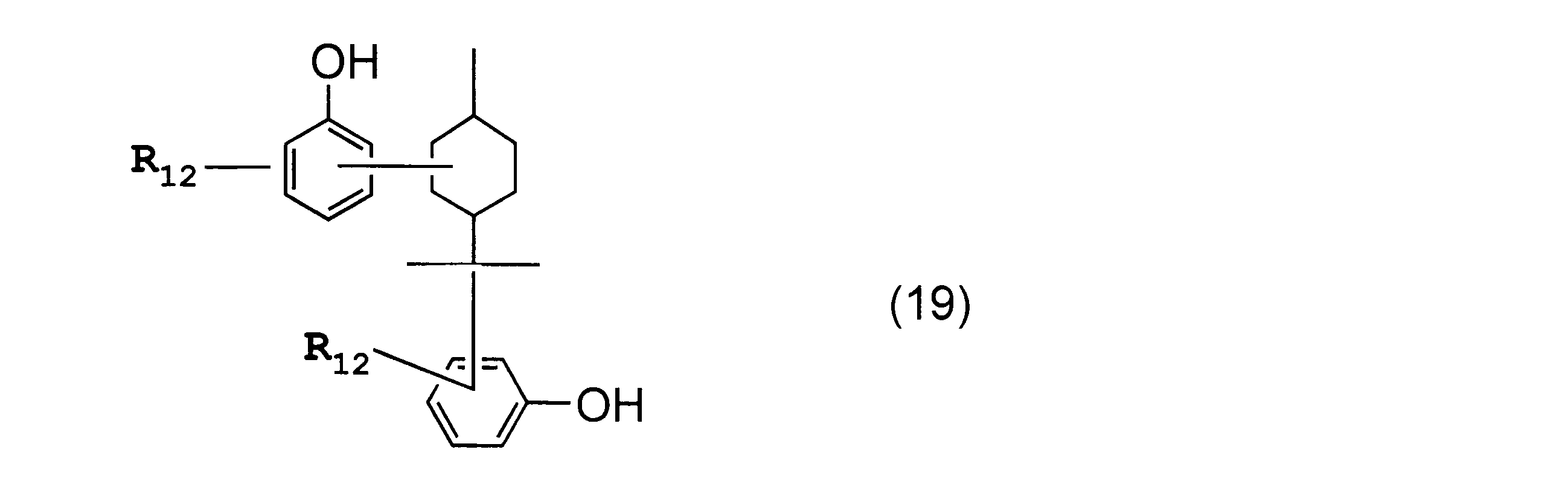
- Formula (19) (Wherein R 12 s may be the same as or different from each other, and each represents a hydrogen atom, a linear or branched alkyl group having 1 to 8 carbon atoms, or a halogen atom), and (F ) A (meth) acrylate having a phosphate group.
- the curable resin composition for optical semiconductor encapsulation according to (1) further comprising (G) a curing accelerator.
- the component (D) is at least one selected from the group consisting of compounds represented by the following formulas (3), (6) and (7)
- the coupling position is not particularly limited. ),
- Formula (6) (Wherein R 5 represents a linear or branched alkylene chain having 1 to 5 carbon atoms which may have a substituent, a cyclohexane skeleton or a benzene skeleton which may have a substituent), Formula (7) (Wherein R 6 represents a linear or branched alkylene group having 1 to 5 carbon atoms which may have a substituent, a cyclohexane skeleton or a benzene skeleton which may have a substituent).
- the component (D) is a compound represented by the following formula (11), formula (12), formula (13) or formula (14)
- the curable resin composition for optical semiconductor sealing of description is a compound represented by the following formula (11), formula (12), formula (13) or formula (14)
- the curable resin composition for optical semiconductor sealing of description is a compound represented by the following formula (11), formula (12), formula (13) or formula (14)
- the curable resin composition for optical semiconductor sealing of description is a compound represented by the following formula (11), formula (12), formula (13) or formula (14)
- the compounding equivalent value of the curing agent component (D) is 0.30 to 0.80 and the compounding equivalent value of the component (E) is 0.20 to 0 with respect to 1 equivalent of epoxy group in the total amount of epoxy resin. Any one of (1) to (7) above, wherein the sum of the blending equivalent value of component (D) and the blending equivalent value of component (E) is in the range of 0.70 to 1.20.
- the curable resin composition for optical semiconductor sealing of description. (9) The curable resin composition for optical semiconductor encapsulation according to any one of (3) to (7), further comprising (G) a curing accelerator.
- the resin composition for encapsulating an optical semiconductor of the present invention can be produced only by kneading or mixing steps, and is excellent in mass productivity in transfer molding.
- the optical semiconductor element sealed with the resin composition is excellent in lead-free solder resistance. That is, the composition has a high reactivity during transfer molding, a short gel time, no resin leakage from the mold, suppresses the entrainment of voids, and has a high hot hardness after molding, so that it can be removed from the mold. It is suitable for mass production because of its excellent moldability and gate breakability, and excellent workability during transfer molding.
- the optical semiconductor element sealed with the resin composition is excellent in lead-free solder resistance after moisture absorption even though the filler is not blended in the resin composition. Therefore, the curable resin composition of the present invention is extremely useful as a sealing material for optical semiconductors.
- the component (A) used in the present invention is a biphenol type epoxy resin represented by the general formula (1).
- R 1 is a hydrogen atom, a methyl group, an ethyl group, a propyl group, a butyl group, a pentyl group, a hexyl group, a heptyl group, an octyl group, or a straight or branched carbon number of 1 -8 alkyl groups, or halogen atoms such as chlorine, bromine and iodine.
- a plurality of the functional groups of R 1 may be the same or different from each other, but all of them are particularly preferably hydrogen atoms.
- n is an average value of the number of repetitions of 0 to 10.
- the softening point of the biphenol type epoxy resin of the component (A) is preferably 50 ° C. or higher. If the softening point is too low, the heat hardness and reactivity are lowered. Moreover, the viscosity at the time of melting of the composition also decreases, and resin leakage or void entrainment occurs during transfer molding.
- the softening point of the component (A) is more preferably 60 ° C. or higher. Although there is no particular upper limit, it is usually 150 ° C. or lower, preferably 120 ° C. or lower.
- an epoxy resin for example, NC-3000, NC-3000H manufactured by Nippon Kayaku Co., Ltd., in which R 1 in the general formula (1) is a hydrogen atom, are commercially available.
- R 1 in the general formula (1) is a hydrogen atom
- a phenol resin is synthesized by condensing a substituted methylene biphenyl compound such as bishalogenomethylbiphenyl and a phenol under acidic conditions. Furthermore, the compound of General formula (1) can be obtained by making this phenol resin and epihalohydrins react in presence of an alkali metal hydroxide. Examples of phenols used in the above reaction include phenol, orthocresol, paracresol, and metacresol. These are preferable examples, but are not limited thereto.
- Both the component (B) and the component (C) used in the present invention are bisphenol type epoxy resins represented by the general formula (2), and the epoxy equivalent of the component (B) is 500 to 800 g / eq, The epoxy equivalent of component (C) is 850 to 1500 g / eq. In the present invention, it is important to use the component (B) and the component (C) together with the component (A).
- R 2 in the general formula (2) is a hydrogen atom, a methyl group, an ethyl group, a propyl group, a butyl group, a pentyl group, a hexyl group, a heptyl group, an octyl group, or a straight or branched carbon number of 1 -8 alkyl groups, or halogen atoms such as chlorine, bromine and iodine.
- a plurality of R 2 functional groups present in the general formula (2) may be the same or different from each other, but those in which all are hydrogen atoms are particularly preferred.
- R 3 in the general formula (2) is a hydrogen atom, a methyl group, an ethyl group, a propyl group, a butyl group, a pentyl group, a hexyl group, a heptyl group, an octyl group, or a straight or branched carbon number of 1 -8 alkyl groups, or halogen atoms such as chlorine, bromine and iodine.
- a plurality of R 3 present in the general formula (2) may be the same or different from each other, but all of them are particularly preferably methyl groups.
- M in the general formula (2) is an average value of the number of repetitions of 0 to 10.
- such epoxy resins include bisphenol A type epoxy resin, bisphenol F type epoxy resin, tetramethyl bisphenol A type epoxy resin, dimethyl bisphenol A type epoxy resin, tetramethyl bisphenol F type epoxy resin, dimethyl bisphenol F type epoxy resin. Resins and the like are listed, and all are available from the market.
- the resin in order to prevent the resin from being deformed by the eject pin used at the time of transfer molding demolding, it is required to exhibit a high heat hardness.
- a bisphenol type epoxy resin of formula (2) having an epoxy equivalent in the range of 500 to 800 g / eq as component (B).
- the epoxy equivalent is preferably in the range of 600 to 700 g / eq. If the epoxy equivalent is too low, even when high heat hardness can be exhibited, the viscosity at the time of melting of the composition tends to decrease, and resin leakage or void entrainment tends to occur during transfer molding.
- an epoxy resin having an epoxy equivalent in the range of 500 to 800 g / eq for example, E1001 and E1002 manufactured by JER (Japan Epoxy Resin) in which R 2 in the general formula (2) is a hydrogen atom and R 3 is a methyl group
- Toto Kasei Examples thereof include YD-012 and YD-902 manufactured by KK.
- the epoxy equivalent of the component (C) bisphenol-type epoxy resin is in the range of 850 to 1500 g / eq, it is preferable because void entrainment is suppressed and other properties are not adversely affected. If the epoxy equivalent is too high, there is no problem in suppressing void entrainment, but it is not preferable because the hot hardness is significantly reduced. Furthermore, the softening point is too high and the handling workability tends to be inferior.
- the above epoxy equivalent is 850 to 1200 g / eq, it is more preferable from the viewpoint of balance between hardness upon heating and suppression of voids.
- the epoxy resin having an epoxy equivalent in the range of 850 to 1500 g / eq include Toto Kasei Co., Ltd. such as E1004 manufactured by JER (Japan Epoxy Resin) in which R 2 in the general formula (2) is a hydrogen atom and R 3 is a methyl group. Examples thereof include YD-904, YD-907, YD-014, YD-017 and the like manufactured by KK.
- the total amount of the epoxy resin used in the composition is 100 wt%, and it is necessary to adjust and blend so that the content ratio of each component (A), component (B), and component (C) satisfies the following conditions. is there.
- the total content of the component (B) and the component (C) is preferably 65 to 90 wt%, more preferably 70 to 90 wt%, still more preferably with respect to the total of the components (A) to (C). Is about 80 to 90 wt%.
- the balance is component (A).
- the amount of the component (A) is too small, the reactivity of the composition is lowered, and further, the hot hardness is lowered, so that the above-mentioned requirements tend not to be satisfied. Moreover, when there are too many components (A), the viscosity at the time of fusion
- the hot hardness may be lowered.
- each component (A), (B), (C) is adjusted within the above range, it is combined with the components (D) to (F) described later, so that reactivity, heat hardness, resin leakage, void entrainment, moisture absorption Since the resin composition of this invention which satisfy
- the total amount of epoxy resin is usually the sum of components (A), (B), and (C). However, if necessary, when other epoxy resins to be described later are added, the total amount may be added.
- the ratio of the total amount of the epoxy resin to the total amount of the curable resin composition of the present invention is about 40 to 90 wt%, preferably 50 to 85 wt%, and more preferably 60 to 85 wt%. It is more preferable when the content of these epoxy resins is the total amount of components (A), (B) and (C).
- other resins can be added as long as the workability during the transfer molding is not adversely affected.
- diglycidyl etherified products other than the above general formula (1) and general formula (2) specifically, polyfunctional epoxy resins, alicyclic epoxy resins, aliphatic epoxy resins, heterocyclic epoxy resins, glycidyl Examples thereof include ester-based epoxy resins, glycidylamine-based epoxy resins, and epoxy resins obtained by glycidylation of halogenated phenols.
- the polyfunctional epoxy resin include glycidyl etherified products of polyphenol compounds and glycidyl etherified products of various novolak resins.
- Examples of glycidyl etherified products of polyphenol compounds include bisphenol S, 4,4′-biphenylphenol, tetramethylbisphenol S, dimethylbisphenol S, tetramethyl-4,4′-biphenol, dimethyl-4,4′-biphenylphenol, 1 -(4-Hydroxyphenyl) -2- [4- (1,1-bis- (4-hydroxyphenyl) ethyl) phenyl] propane, 2,2'-methylene-bis (4-methyl-6-tert-butylphenol ), 4,4′-butylidene-bis (3-methyl-6-tert-butylphenol), trishydroxyphenylmethane, resorcinol, hydroquinone, pyrogallol, phenols having a diisopropylidene skeleton, 1,1-di-4- Full of hydroxyphenylfluorene Phenols having skeleton include glycidyl ethers of poly
- Examples of glycidyl etherified products of various novolak resins include novolak resins made from various phenols such as phenol, cresols, ethylphenols, butylphenols, octylphenols, bisphenol A, bisphenol F, bisphenol S, naphthols, and xylylene skeletons
- Examples thereof include glycidyl etherified products of various novolak resins such as phenol novolac resin, dicyclopentadiene skeleton-containing phenol novolak resin, and fluorene skeleton-containing phenol novolak resin.
- alicyclic epoxy resin examples include alicyclic epoxy resins having an aliphatic skeleton such as cyclohexane such as 3,4-epoxycyclohexylmethyl 3 ′, 4′-cyclohexylcarboxylate.
- aliphatic epoxy resin examples include glycidyl ethers of polyhydric alcohols such as 1,4-butanediol, 1,6-hexanediol, polyethylene glycol, polypropylene glycol, pentaerythritol, and xylylene glycol derivatives.
- heterocyclic epoxy resin examples include heterocyclic epoxy resins having a heterocyclic ring such as an isocyanuric ring and a hydantoin ring.
- glycidyl ester epoxy resin examples include epoxy resins obtained by glycidylation of carboxylic acids such as hexahydrophthalic acid diglycidyl ester and tetrahydrophthalic acid diglycidyl ester.
- Examples of the glycidylamine-based epoxy resins include epoxy resins obtained by glycidylating amines such as aniline, toluidine, p-phenylenediamine, m-phenylenediamine, diaminodiphenylmethane derivatives, and diaminomethylbenzene derivatives.
- Halogenated phenols such as brominated bisphenol A, brominated bisphenol F, brominated bisphenol S, brominated phenol novolak, brominated cresol novolac, chlorinated bisphenol S, and chlorinated bisphenol A are used as epoxy resins obtained by glycidylation of halogenated phenols. Examples thereof include epoxy resins obtained by glycidylation of phenols.
- epoxy resins there are no particular restrictions on the use of these epoxy resins, but those with less colorability are more preferred from the viewpoint of transparency.
- bisphenol S 4,4′-biphenylphenol, tetramethyl-4,4′-biphenol, 1- (4-hydroxyphenyl) -2- [4- (1,1-bis- (4-hydroxyphenyl) Ethyl) phenyl] propane, trishydroxyphenylmethane, resorcinol, 2,6-ditert-butylhydroquinone, phenols having a diisopropylidene skeleton, phenols having a fluorene skeleton such as 1,1-di-4-hydroxyphenylfluorene Glycidylated polyfunctional epoxy resins; phenols, cresols, bisphenol A, bisphenol S, novolak resins made from various phenols such as naphthols, dicyclopentadiene skeleton-containing phenol novolac resins, biphenyl
- these epoxy resins can be used in combination as one or a mixture of two or more as required. Those epoxy resins having an epoxy equivalent of 100 to 1700 g / eq, preferably 200 to 1000 g / eq can be used. Furthermore, the softening point of these epoxy resins is preferably 130 ° C. or lower in consideration of workability during production. These epoxy resins can be appropriately added within the range of 0 to 20 wt% with respect to the total amount of components (A) to (C), if necessary.
- a high reactivity suitable for transfer molding only through a kneading or mixing production process without passing through an aging process, or high heat hardness, prevention of resin leakage and void entrainment, mold release from a mold In order to satisfy all of the subsequent gate breakability and to satisfy lead-free solder resistance after moisture absorption, two or more carboxyl groups and acid anhydride groups are combined in one molecule as component (D), or acid anhydride. It is important to use a polyfunctional acid anhydride curing agent having only two or more physical groups and a phenolic curing agent in combination as the component (E).
- a polyfunctional acid anhydride is used as the component (D) in order to satisfy high reactivity suitable for transfer molding and high heat hardness. If it is a polyfunctional acid anhydride, there will be no restriction
- the polyfunctional acid anhydride represented by Formula (14) is preferable.
- R 4 in the compound of the formula (3) examples include a trivalent group of a cyclohexane ring of the formula (4) or a benzene ring of the formula (5).
- the coupling position is not particularly limited.
- R 4 is a cyclohexane ring of the formula (4), for example, 1,2,4 cyclohexane tricarboxylic acid-1,2 anhydride (manufactured by Mitsubishi Gas Chemical Co., Inc., H-TMA)
- R 4 is a formula (5)
- trimellitic anhydride manufactured by Mitsubishi Gas Chemical Co., Inc.
- R 5 in formula (6) and R 6 in formula (7) a linear or branched alkylene chain having 1 to 8 carbon atoms, a divalent group of a cyclohexane skeleton having a substituent, or And a divalent group of a benzene skeleton.
- substituent include a linear or branched alkyl group having 1 to 8 carbon atoms such as methyl group, ethyl group, propyl group, butyl group, pentyl group, hexyl group, heptyl group, and octyl group, or chlorine, bromine And halogen atoms such as iodine.
- R 5 in formula (6) and R 6 in formula (7) a linear alkylene chain having 1 to 5 carbon atoms is preferable in consideration of workability.
- examples of such a compound include ethylene glycol bis (anhydro trimellitate) (including trimellitic anhydride in part), such as Licacid TMEG-S (hereinafter simply referred to as TMEG-S) or Licacid.
- TMEG-600 (hereinafter simply referred to as TMEG-600) and the like are available on the market as the Ricacid TMEG series (manufactured by Shin Nippon Rika Co., Ltd.).
- at least one selected from the group consisting of formula (3), formula (6) and formula (7) is preferred.
- examples of R 7 in the formula (8) include a tetravalent group of the cyclohexane ring in the formula (9) or a tetravalent group of the benzene ring in the formula (10).
- examples of R 7 in the formula (8) include a tetravalent group of the cyclohexane ring in the formula (9) or a tetravalent group of the benzene ring in the formula (10).
- the cyclohexane ring of the formula (9) pyromellitic anhydride nuclear hydrogenated product
- the benzene ring of the formula (10) pyromellitic anhydride is obtained from the market. It is available.
- the polyfunctional acid anhydride curing agent (D) compounds represented by the above formulas (11) to (14) can be used.
- the compound of the formula (11) is a benzophenone tetracarboxylic acid anhydride
- the compound of the formula (12) is Rikacide TMTA-C (manufactured by Shin Nippon Chemical Co., Ltd.)
- the compound of the formula (13) is Rikacide
- the compound of DSDA (manufactured by Shin Nippon Rika Co., Ltd.) and the compound of formula (14) can be obtained from the market as Jamaicacid TDA-100 (manufactured by Shin Nippon Rika Co., Ltd.).
- R 8 in the formula (15) represents a biphenylene group which may have a substituent of the formula (16) or a phenylene group which may have a substituent of the formula (17).
- o is an average value of the number of repetitions of 0 to 10.
- R 9 in the formula (16), R 10 in the formula (17), R 11 in the formula (18), as R 12 in formula (19) is a hydrogen atom, a methyl group, an ethyl group, a propyl group, A linear or branched alkyl group having 1 to 8 carbon atoms such as a butyl group, a pentyl group, a hexyl group, a heptyl group or an octyl group, or a halogen atom such as chlorine, bromine or iodine. When there are a plurality, they may be the same as or different from each other. Usually, these substituents are preferably hydrogen atoms.
- the component (E) preferably has a softening point of 50 ° C. or higher and 130 ° C. or lower.
- a curing agent examples include GPH-65 and GPH-103 (made by Nippon Kayaku Co., Ltd.) represented by the following formula (20), XYLOCK XEL-3L (produced by Mitsui Chemicals) represented by the following formula (21), YP90 (manufactured by Yasuhara Chemical Co., Ltd.), which is a mixture of the formula (22) and the following formula (23), is available from the market.
- Formula (20) (specific structures of GPH-65 and GPH-103) (Wherein p represents an average value of the number of repetitions of 0 to 10) Formula (21) (Concrete structure of XYLOCK XEL-3L) (In the formula, q represents an average value of the number of repetitions of 0 to 10) Formula (22) Formula (23)
- the curable resin composition of the present invention is used as an encapsulant for optical semiconductors, it is preferable to avoid hindering transparency.
- Component (D) often has a melting point of 150 ° C. or higher. Therefore, when the composition is kneaded or mixed and used with the melting point of the component (D) being 150 ° C. or higher, the cured product is uneven due to the undissolved material of the component (D) or foreign matter remains. become. In order to avoid this problem, it is preferable to use the component (D) in a state where crystals are melted in advance.
- the means is not particularly limited, and examples thereof include a method in which two or more kinds of compounds that can be used as the component (D) are once dissolved and mixed, and the melting point is lowered using the phenomenon of melting point lowering.
- compounds that can be used as component (D) by dissolving component (E) in advance in an organic solvent (for example, methyl ethyl ketone (MEK)) that can dissolve component (E). Mix. Thereafter, the solvent is removed at a temperature close to the melting point of the component (D) with a vacuum heating device, and the melting point of the mixture can be adjusted to be equal to or lower than the transfer molding temperature.
- MEK methyl ethyl ketone
- the component (D) is produced, it is also possible to use a compound in which the compound has two or more kinds so that its melting point is lower than the transfer molding temperature due to the phenomenon of melting point drop.
- the present invention it is an object to provide the resin composition excellent also in the gate break process.
- the gate break process will be described in detail.
- transfer molding there is a gate break process in which the lead frame frame is manually removed from the runner portion after demolding. At this time, it is important that the lead frame does not bend and can be removed easily by hand, and if it is good, the gate breakability is excellent. Conversely, if it cannot be removed unless a considerable force is applied and the lead frame is bent as a result, the gate breakability is inferior. If the lead frame is bent, it cannot proceed to the next process.
- polyfunctional acid anhydride curing agent of component (D), phenolic curing of component (E) The above requirements may not be achieved by simply containing an agent. Therefore, with respect to 1 equivalent of epoxy group in the total amount of epoxy resin, the blending equivalent of polyfunctional acid anhydride curing agent (D) (equivalent of acid anhydride group and carboxyl group) and the blending equivalent of phenolic curing agent (E) ( It is more preferable to control (hydroxyl equivalent) under the following conditions.
- the compounding equivalent value of component (D) is too small, the reactivity at the time of transfer molding is inferior, and further, the hardness at the time of heating is also reduced. Moreover, when the compounding equivalent value of a component (D) is too large, gate break property will be extremely inferior. If the blending equivalent value of component (E) is too large, it will cause a decrease in hardness during heating and a decrease in solder resistance after moisture absorption. Moreover, when the total of the compounding equivalent value of a component (D) and the compounding equivalent value of a component (E) is too small, a glass transition point (henceforth Tg) may become low. On the other hand, if the total is too large, Tg is increased and cracks are likely to occur in the solder mounting process.
- the curing agent component it is preferable to use the curing agent components (D) and (E) together so that the amount becomes 100 wt%.
- Other curing agents can be used as long as they do not cause harmful effects.
- acid anhydride curing agents include aromatic carboxylic anhydrides such as phthalic anhydride, aliphatic carboxylic anhydrides such as azelaic acid, sebacic acid, dodecanedioic acid, tetrahydrophthalic anhydride, hexahydro Examples thereof include alicyclic carboxylic acid anhydrides such as phthalic acid anhydride, nadic acid anhydride, het acid anhydride, and hymic acid anhydride.
- the blending amount of curing agents other than the curing agent components (D) and (E) is about 0 to 0.3 equivalents relative to 1 equivalent of epoxy groups in the total amount of epoxy resin.
- the blending amount of all curing agent components including (D) and (E) is preferably in the range of 0.7 to 1.5 equivalents with respect to 1 equivalent of epoxy groups in the total amount of epoxy resin.
- the purpose of the present invention is for optical semiconductor encapsulation, which is compatible with workability during transfer molding such as reactivity, mold release from mold, gate breakability, etc., and also has excellent lead-free solder resistance after moisture absorption It is to provide a curable resin composition.
- the component (F) can be used by appropriately changing the amount of the composition constituted according to the present invention.
- the object of the present invention can be better achieved by adding preferably within a certain range.
- the content of the component (F) with respect to the total amount of the resin composition of the present invention is preferably in the range of 0.01 wt% to 5.0 wt%.
- the adhesiveness may decrease and solder resistance after moisture absorption may be inferior. If the amount is too large, the adhesiveness may be improved, but the resin composition may have a negative effect on the curing acceleration, and curing after heat curing. A thing becomes fragile and the runner resin part breaks at the time of demolding by transfer molding, and the malfunction that it cannot finally demold may arise. From the viewpoint of the balance between the lead-free solder resistance and the mold release property, it is particularly preferably 0.1 wt% to 2.0 wt%, more preferably 0.1 wt% to 1.0 wt%, based on the total amount of the resin composition. It is good to contain a component (F).
- component (F) may affect the acceleration of curing, the combined use of the component (G) described later is preferable.
- component (G) is added in the range of 0.2 to 3.0, preferably 0.2 to 2.0, the balance between adhesion and curability is good.
- a component (G) curing accelerator can be further used.
- the resin composition of the present invention containing the component (G) is one of the preferred embodiments of the present invention.
- the component (G) is not particularly limited as long as it has a function of promoting the reaction between the epoxy resin and the curing agent.
- the gel time at 150 ° C. needs to be 60 seconds or less from the viewpoint of reactivity.
- the reactivity is adjusted by providing a modification period by means of heating after the composition is adjusted, or adjusted by the amount of the curing accelerator (G). The method of doing etc. is mentioned.
- the method of adjusting the reactivity by heating requires a certain amount of time. Furthermore, it is not preferable in terms of economics and technical difficulty, such as difficulty in determining the timing of metamorphosis.
- the adjustment by the amount of the curing accelerator (G) is excellent in terms of economy and simplicity compared to the above-mentioned modification means because the reactivity can be adjusted only by the control by the addition amount. .
- a gel time measuring machine can be used as an adjustment method based on the amount of the curing accelerator (G).
- the gel time at 150 ° C. is preferably adjusted to 60 seconds or less, and preferably 50 seconds or less. At this time, if the gel time at 150 ° C. is long, the demoldability and tactability at the time of demolding are inferior, and furthermore, the hot hardness cannot be maintained high.
- These accelerators are preferably added so that the gel time is within the range to be adjusted.
- the total amount of the above components (D) to (G) is preferably 10 to 60% by weight, more preferably 15 to 50% by weight, and still more preferably 15 to 40% by weight with respect to the total amount of the resin composition.
- a colorant, a leveling agent, a coupling agent, a lubricant, an adhesion-imparting agent, and the like can be appropriately added to the epoxy resin composition of the present invention depending on the purpose.
- the colorant and phthalocyanine, azo, disazo, quinacridone, anthraquinone, flavantron, perinone, perylene, dioxazine, condensed azo, azomethine series, infrared absorbers, ultraviolet absorbers, and other organic dyes, titanium oxide Inorganic pigments such as lead sulfate, chrome yellow, zinc yellow, chrome vermilion, valve shell, cobalt purple, bitumen, ultramarine, carbon black, chrome green, chromium oxide, cobalt green and the like.
- Leveling agents include oligomers having a molecular weight of 4000 to 12000 made of acrylates such as ethyl acrylate, butyl acrylate, and 2-ethylhexyl acrylate, epoxidized soybean fatty acid, epoxidized abiethyl alcohol, hydrogenated castor oil, and titanium-based coupling agents. Can be mentioned.
- Lubricants include hydrocarbon lubricants such as paraffin wax, micro wax, polyethylene wax, higher fatty acid lubricants such as lauric acid, myristic acid, palmitic acid, stearic acid, arachidic acid, and behenic acid, stearylamide, palmitylamide, oleyl Higher fatty acid amide type lubricants such as amide, methylene bisstearamide, ethylene bisstearamide, hydrogenated castor oil, butyl stearate, ethylene glycol monostearate, pentaerythritol (mono-, di-, tri-, or tetra-) Higher fatty acid ester lubricants such as stearate, alcohol lubricants such as cetyl alcohol, stearyl alcohol, polyethylene glycol, polyglycerol, lauric acid, myristic acid, palmitic acid, stearic acid, arachidic acid, behe Acid, ricinoleic acid, such as magnesium naphthenate,
- phosphite compounds and / or phosphate compounds include di-2-ethylhexyl hydrogen phosphite, dilauryl hydrogen phosphite, dioleyl hydrogen phosphite, methyl acid phosphate, ethyl acid phosphate, isopropyl Acid phosphate, butyl acid phosphate, 2-ethylhexyl acid phosphate, isodecyl acid phosphate, lauryl acid phosphate, tridecyl acid phosphate and the like.
- the addition amount of the phosphite compound and / or phosphite compound is preferably set to 0.01 to 5 wt% in the composition from the viewpoint of adhesiveness, and more preferably in the range of 0.1 to 3 wt%. It is. If the addition amount is small, it is difficult to obtain an adhesive effect, and if the addition amount exceeds the above range, Tg (glass transition point) or the like may be lowered.
- Specific examples of the compound containing S element include n-dodecanethiol, n-nonanethiol, n-pentanethiol, ethylene glycol-bis-3-mercaptopropionate, diethylene glycol-bis-3-mercaptopropionate.
- Pionate triethylene glycol-bis-3-mercaptopropionate, tetraethylene glycol-bis-3-mercaptopropionate, propylene glycol-bis-3-mercaptopropionate, dipropylene glycol-bis-3-mercapto Propionate, tripropylene glycol-bis-3-mercaptopropionate, trimethylolpropane-tris-3-mercaptopropionate, tris- (ethyl-3-mercaptopropionate) isocyanurate, pentaerythris Tall-tetrakis-3-mercaptopropionate, dipentaerythritol-hex-3-mercaptopropionate, tris (3-mercaptopropioamino) -1,3,5-triazine, 3,3′-thiodipropion
- acids dithiodipropionic acid, lauryl thiopropionic acid, thioglycolic acid, ammonium thioglycolate, thio
- tetraethylene glycol-bis-3-mercaptopropionate trimethylolpropane-tris-3-mercaptopropionate, tris- (ethyl-3-mercaptopropionate) isocyanurate, pentaerythritol-tetrakis-3 -Mercaptopropionate and dipentaerythritol-hexa-3-mercaptopropionate, 3,3'-thiodipropionic acid, dithiodipropionic acid, laurylthiopropionic acid, thioglycolic acid, ammonium thioglycolate, thioglycol It is preferable to use acid monoethanolamine, diammonium dithiodiglycolate or the like alone or in combination.
- the addition amount of the said specific thiol compound will not be specifically limited if it is a range which does not impair the characteristic of this invention. From the viewpoint of adhesiveness, it is preferably set to 0.01 to 10 wt% in the composition, and more preferably in the range of 0.1 to 5 wt%. If the addition amount is small, it is difficult to obtain an adhesive effect. If the addition amount exceeds the above range, Tg (glass point transfer) or the like may be lowered.
- These adhesion-imparting agents can be used alone or in combination of two or more.
- Component (A) is an epoxy resin in which R 1 is a hydrogen atom in the general formula (1), and n is an average value of the number of repetitions of 0 to 10,
- component (B) in formula (2), R 2 is a hydrogen atom, R 3 is a methyl group, m is an average value of the number of repetitions of 0 to 10, and an epoxy equivalent is 500 to 800 g / eq.
- Epoxy resin in component (C), in formula (2), R 2 is a hydrogen atom, R 3 is a methyl group, m is an average value of the number of repetitions of 0 to 10, and an epoxy equivalent is 850 to 1500 g / eq.
- the polyfunctional anhydride curing agent of component (D) is the above formula (3), formula (6), formula (7), formula (8), formula (11), formula (12), formula (13) and formula ( 14) at least one acid anhydride selected from the group consisting of polyfunctional acid anhydrides,
- the phenolic curing agent of component (E) has at least one selected from the group consisting of the compounds represented by formulas (15), (18) and (19), and component (F) a phosphate group (Meth) acrylate,
- a curable resin composition for sealing an optical semiconductor 2.
- the compound of formula (3) is trimellitic anhydride
- the compound of formula (6) is ethylene glycol esterified trimellitic anhydride (R 5 in formula (6) is ethylene).
- Compounding equivalent value of curing agent component (E): 0.20 to 0.60 equivalent 10.
- the component (G) is a phosphine (preferably triphenylphosphine).
- the components (A), (B), (C), (D), (E), (F), and (G) if necessary, and other Epoxy resins, other curing agents, other curing accelerators, and, if necessary, additive components such as coupling agents, coloring agents and leveling agents can be blended. If the compounding component is solid, after mixing using a compounding machine such as a Henschel mixer or Nauter mixer, knead at 80-130 ° C using a kneader, extruder, or heating roll, cool, pulverize, and form a powder. The curable resin composition of the invention is obtained.
- a compounding machine such as a Henschel mixer or Nauter mixer
- the compounding component when the compounding component is liquid, it is uniformly dispersed using a planetary mixer or the like to obtain the curable resin composition of the present invention.
- the curable resin composition of the present invention thus obtained is solid, it is molded by a molding machine such as a transfer molding machine so as to seal the optical semiconductor element, and when it is liquid, the optical semiconductor element is sealed.
- a molding machine such as a transfer molding machine
- the optical semiconductor element is sealed.
- After casting or dispensing into a mold it is heated to 100 to 200 ° C. and cured for 20 seconds to 5 hours, and sealed with a cured product of the curable resin composition of the present invention.
- An optical semiconductor element can be obtained.
- the optical semiconductor element of the present invention is an optical semiconductor element such as a light receiving element or a light emitting element sealed with the curable resin composition of the present invention.
- a semiconductor device including the optical semiconductor element for example, DIP (dual Inline package), QFP (quad flat package), BGA (ball grid array), CSP (chip size package), SOP (small outline package), TSOP (thin small outline package), TQFP (think quad flat package), etc. It is done.
- Hardness test Shore A measurement
- Mold preheating temperature 150 ° C
- Setting mold type ⁇ 50mm, thickness 5mm, retention time after injection of 4-chip disk mold: 180 seconds
- Hardness meter Shore A rubber hardness meter measurement timing : After a holding time of 180 seconds, immediately after opening the upper mold, a Shore A measuring instrument was inserted into the surface of the ⁇ 50 mm disk resin, and the maximum value was taken as the Shore A value.
- Tg measurement conditions using a sample molded into a bottom surface of 5 mm ⁇ 5 mm and a length of about 10 mm Measurement was performed in a compression mode using a temperature rising condition of 2 ° C./min using a TII apparatus manufactured by SII (Seiko Instruments). The change point of the linear expansion coefficient was defined as Tg.
- Reflow test lead-free solder resistance
- a 20-pin lead frame type simulated semiconductor element (lead frame material is made of copper, surface silver plated) is set in a transfer mold, and molding is performed so that unfilling does not occur in each sample. After demolding, it was post-cured at 150 ° C. for 4 hours to prepare a sample for a lead-free solder reflow test (hereinafter referred to as “reflow”).
- the reflow test was performed by leaving the sample under high humidity conditions (the following moisture absorption conditions) and then immersing the sample in a lead-free solder melting furnace under the following conditions.
- A-1 epoxy resin
- C-1 bisphenol A type epoxy resin, epoxy equivalent 932 g / eq, manufactured by Toto Kasei Co., Ltd., YD-904 * D-1
- Curing agent Multifunctional acid anhydride curing agent, TMEG-S (purity of trimellitic anhydride, 50% purity of trimellitic anhydride, ethylene glycol ester) 20%), melting point 60 ° C., acid anhydride equivalent 235 g / eq * D-2 (curing agent): polyfunctional acid anhydride curing agent, TMEG-S (purity of trimellitic anhydride, 50% purity of trimellitic anhydride, ethylene glycol ester) 20%), melting point 60 ° C., acid anhydride equivalent 235 g / eq * D-2 (curing agent
- Comparative Examples 1 to 3 In order to confirm the reactivity in each resin using tetrahydrophthalic anhydride, which is a monofunctional acid anhydride used in the examples of Patent Document 1, a composition having the composition shown in Table 1 below was prepared. did. The kneading was melt-kneaded using an S1 kneader manufactured by Kurimoto Steel Co., Ltd., and the obtained kneaded product was cooled and pulverized. The gel time of 150 degreeC was measured with this ground material. Further, the pulverized product was formed into a necessary amount of tablets using a tablet machine, and then molded using a transfer molder with a disk mold preheated at 150 ° C. The results are also shown in Table 1.
- Comparative Examples 4 and 5 Using the polyfunctional acid anhydride which is a component (D), it mix
- compositions of the examples and comparative examples are the compositions shown in the respective tables, and are melt kneaded according to the melting temperature of the resin using a biaxial kneader, and the obtained kneaded material is pulverized and then transferred. It was set as the tablet for molding machines. Using the obtained tablet, a test optical semiconductor element was prepared under the above-described conditions using a transfer molding machine, and used as an evaluation sample. Examples 1, 2 and Comparative Example 6 are shown in Table 4, Examples 3, 4 and Comparative Example 7 are shown in Table 5, Example 5 is shown in Table 6, and Comparative Examples 8 and 9 are shown in Table 7, respectively. It should be noted that foreign matters and voids in the cured product not described in the table were not observed in any of Examples 1 to 5 and Comparative Examples 4 to 9 of the present invention.
- Example of master batch preparation When using a component having a melting point of 150 ° C. or higher as component (D), it is necessary to dissolve and mix component (D) and component (E) in advance to lower the melting point below the transfer molding temperature. is there.
- TMEG-600 melting point 165 ° C.
- D-2 multifunctional curing agent component
- Kajayard GPH-65 softening point 65 ° C.
- Comparative Examples 8 and 9 Then, as Comparative Examples 8 and 9, a test sample was prepared using a resin composition obtained by adding the component (F) to the composition in which the combination of the epoxy resin and the curing agent was outside the scope of the present invention. The results are shown in Table 7 together with the composition.
Landscapes
- Chemical & Material Sciences (AREA)
- Health & Medical Sciences (AREA)
- Chemical Kinetics & Catalysis (AREA)
- Medicinal Chemistry (AREA)
- Polymers & Plastics (AREA)
- Organic Chemistry (AREA)
- Epoxy Resins (AREA)
- Structures Or Materials For Encapsulating Or Coating Semiconductor Devices Or Solid State Devices (AREA)
- Compositions Of Macromolecular Compounds (AREA)
Abstract
Description
しかし、前記酸無水物を使用した場合、混練または混合するなどの単純な調整作業だけでは、ゲル化時間が非常に長い樹脂組成物しか得られない。そのため、該組成物では、金型からの樹脂漏れとボイドの巻き込み等が発生し、トランスファ成型に適しない。そこで、特許文献1(特開平3-3258号公報)では、熟成などによる変成工程(またはBステージ化と言う)を設けて、量産性に合わせる手段を別途講じているのが現状である。該変成工程は、樹脂組成物の製造工程において経済性が悪いことが問題視されている。樹脂組成物の製造工程の観点からは、混練または混合行程のみでトランスファ成型時の量産性に適した組成物を得られることが望まれている。
また、トランスファ成型後にランナー部からリードフレーム枠を外すゲートブレイク工程がある。多官能酸無水物硬化剤は密着性が高い。そのため、ランナー部からリードフレーム枠が外れにくいという課題がある。手で無理矢理外すと、リードフレーム枠が変形するという問題が発生する。多官能酸無水物を使用した場合のゲートブレイク性に関しても十分に検討されていないのが現状である。
光半導体用封止材における作業性を考慮する場合、その他、トランスファ成型時における樹脂漏れ、ボイドの巻き込みなどを防止することが重要である。
上記の課題及びトランスファ成型時の作業性の全てを同時に満足させることができる樹脂組成物の検討は未だ不十分である。
IC、フラッシュメモリ、LSIなどの半導体素子(以降は、光半導体素子と区別するために、「通常半導体素子」と記載する)を封止する場合には、先の鉛フリー半田実装工程での剥離を最小限に抑えるために、シリカなどの充填剤を80重量(wt)%以上含有させ、水分の吸湿量を低下させる手段を講じている。一方、光半導体素子(フォトダイオード、LEDなどの封止樹脂中を光が透過する必要がある場合を示す)を封止する場合、特性上、光線透過率を確保する必要がある。先に記述した充填剤投入という手段は、封止樹脂中ににごりを発生するため、使用することができない。光半導体素子用の封止材は、通常半導体素子の封止材に比べ、吸湿した状態で行われる鉛フリー半田実装工程で剥離が多発し、鉛フリー半田耐性(半田リフロー性、耐半田性などと呼ばれる)が低下するという大変重要な課題を抱えている。つまり、通常半導体素子用の封止材は、シリカ充填剤を配合して特性を得ているところが大きい。つまり、通常半導体素子用の封止材から充填剤を単純に抜くことで、光半導体素子用の封止材に適用することは難しく、充填剤がない状態での封止用樹脂の最適化が必須である。
脱型性を考慮した場合、光半導体素子用の封止材でシリカが充填できない制約下、特許文献4,5に記載のエポキシ樹脂組成物は、特許文献2,3と同様に光半導体素子用の封止材として、市場要求を満足するものではない。
(A)一般式(1)

(B)一般式(2)

で表わされるエポキシ樹脂であってエポキシ当量が500~800g/eqを示すエポキシ樹脂、
(C)前記一般式(2)で表わされるエポキシ樹脂であってエポキシ当量が850~1500g/eqを示すエポキシ樹脂、
(D)1分子中にカルボキシル基と酸無水物基を併せて2ヶ以上、もしくは酸無水物基のみを2ヶ以上有する多官能酸無水物硬化剤、
式(15)




式(19)
(F)リン酸基を有する(メタ)アクリレート。
(3)成分(F)が、下記式(24)

、a+b=3を示す。)で表される化合物である上記(1)又は(2)に記載の光半導体封止用硬化性樹脂組成物。
(4) エポキシ樹脂全量を100wt%として、成分(A)が10~35wt%、成分(B)が20~55wt%、成分(C)が20~55wt%の含有比率である上記(1)~(3)のいずれか一項に記載の光半導体封止用硬化性樹脂組成物。



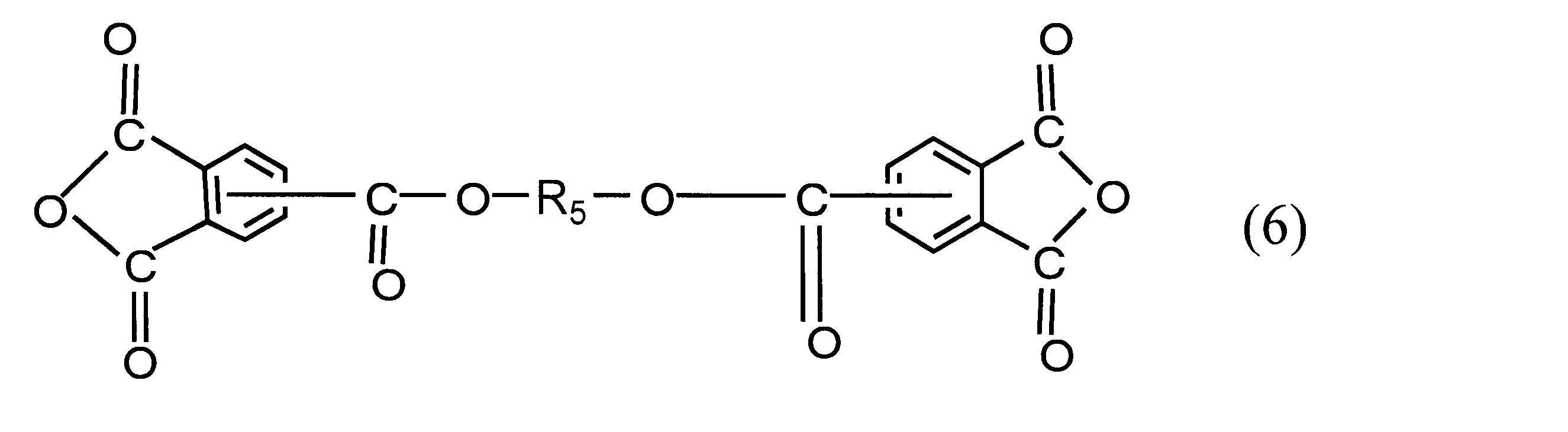
式(7)

なお、式(8)中のR7は下記式(9)又は式(10)を示す。
式(8)



式(11)


(9) 更に(G)硬化促進剤を含有する上記(3)~(7)のいずれか一項に記載の光半導体封止用硬化性樹脂組成物。
(10) 成分(F)と成分(G)との含有比率が重量割合で、成分(F)/成分(G)=0.2~3.0である上記(9)に記載の光半導体封止用硬化性樹脂組成物。
(11) 上記(1)~(10)のいずれか一項に記載の硬化性樹脂組成物を加熱して得られる硬化物で封止された光半導体素子。
即ち、該組成物は、トランスファ成型時における反応性が高く、ゲルタイムが短く、金型からの樹脂漏れを起こさず、ボイドの巻き込みを抑え、成形後の熱時硬度も高く、金型からの脱型性やゲートブレイク性などに優れ、トランスファ成型時の作業性に優れることから量産に適している。また、該樹脂組成物で封止された光半導体素子は、該樹脂組成物に充填剤が配合されていないにもかかわらず、吸湿後の鉛フリー半田耐性に優れている。
よって、本発明の硬化性樹脂組成物は光半導体用封止材として極めて有用である。
本発明で用いられる成分(A)は、前記一般式(1)で示されるビフェノール型エポキシ樹脂である。
一般式(1)において、R1としては、水素原子、メチル基、エチル基、プロピル基、ブチル基、ペンチル基、ヘキシル基、ヘプチル基、オクチル基等の直鎖状または枝分かれ状の炭素数1~8のアルキル基、または塩素、臭素、ヨウ素等のハロゲン原子が挙げられる。一般式(1)において複数存在するR1の前記官能基はそれぞれ互いに同一であっても異なっていてもよいが、全てが水素原子であるものが特に好ましい。一般式(1)中のnは、0~10の繰り返し数の平均値である。
このようなエポキシ樹脂としては、例えば、一般式(1)のR1が水素原子である日本化薬株式会社製のNC-3000、NC-3000Hなどが市場より入手可能である。
また、一般式(1)で表される化合物の製造方法としては、ベンゼン環上に前記アルキル基又はハロゲン原子を有していてもよい4,4’-ビスアルコキシメチルビフェニルまたは4,4‘-ビスハロゲノメチルビフェニル等の置換メチレンビフェニル化合物とフェノール類を酸性条件下縮合することでフェノール樹脂を合成する。さらに、このフェノール樹脂とエピハロヒドリン類とをアルカリ金属水酸化物の存在下に反応させることで、一般式(1)の化合物を得ることができる。なお、上記の反応に使用されるフェノール類としては、フェノール、オルソクレゾール、パラクレゾール、メタクレゾールなどが挙げられる。これらは好ましいものの例示であり、これらに限定されない。
本発明で用いられる成分(B)、成分(C)はともに、前記一般式(2)で表されるビスフェノール型エポキシ樹脂であり、成分(B)のエポキシ当量は500~800g/eqであり、成分(C)のエポキシ当量は850~1500g/eqである。本発明においては、上記成分(A)と共に、この成分(B)及び成分(C)を使用することが重要である。
一般式(2)中のR2としては、水素原子、メチル基、エチル基、プロピル基、ブチル基、ペンチル基、ヘキシル基、ヘプチル基、オクチル基等の直鎖状または枝分かれ状の炭素数1~8のアルキル基、又は塩素、臭素、ヨウ素等のハロゲン原子が挙げられる。一般式(2)において複数存在する前記R2の官能基はそれぞれ互いに同一であっても異なっていてもよいが、全てが水素原子であるものが特に好ましい。
一般式(2)中のR3としては、水素原子、メチル基、エチル基、プロピル基、ブチル基、ペンチル基、ヘキシル基、ヘプチル基、オクチル基等の直鎖状または枝分かれ状の炭素数1~8のアルキル基、又は塩素、臭素、ヨウ素等のハロゲン原子が挙げられる。一般式(2)において複数存在する前記R3はそれぞれ互いに同一であっても異なっていてもよいが、全てがメチル基であるものが特に好ましい。一般式(2)中のmは、0~10の繰り返し数の平均値である。
例えば、このようなエポキシ樹脂としては、ビスフェノールA型エポキシ樹脂、ビスフェノールF型エポキシ樹脂、テトラメチルビスフェノールA型エポキシ樹脂、ジメチルビスフェノールA型エポキシ樹脂、テトラメチルビスフェノールF型エポキシ樹脂、ジメチルビスフェノールF型エポキシ樹脂などがあげられ、いずれも市場より入手することができる。
エポキシ当量が500~800g/eqの範囲にあるエポキシ樹脂として、例えば一般式(2)のR2が水素原子、R3がメチル基であるJER(ジャパンエポキシレジン)製のE1001及びE1002、東都化成株式会社製のYD-012及びYD-902などが挙げられる。
成分(A):10~35wt%
成分(B):20~55wt%
成分(C):20~55wt%
また、上記において、成分(B)及び成分(C)の合計含量は、成分(A)~(C)の合計に対して、65~90wt%が好ましく、より好ましくは70~90wt%、更に好ましくは80~90wt%程度である。残部は成分(A)である。
成分(B)が少なすぎると熱時硬度の低下を引き起こし、また、多すぎると該組成物の溶融時の粘度が低下して、樹脂漏れまたはボイドの巻き込みが発生することがある。
成分(C)が少なすぎると、ボイド巻き込みが発生する。また、多すぎると、熱時硬度の低下を引き起こすことがある。
(A),(B),(C)各成分を前記範囲内で調整すると、後記する成分(D)~(F)と組み合わせることにより、反応性、熱時硬度、樹脂漏れ、ボイド巻き込み、吸湿後の鉛フリー半田耐性に関する要求事項を同時に全て満たす本発明の樹脂組成物を容易に調製することができるので好ましい。
なお、本発明において、エポキシ樹脂全量とは通常は成分(A),(B),(C)の総和である。しかし、必要により、後述する他のエポキシ樹脂も加える場合はその分も加えて総和としても差し支えない。また、本発明の硬化性樹脂組成物の総量に対するエポキシ樹脂全量の割合は40~90wt%程度であり、好ましくは50~85wt%であり、更に好ましくは60~85wt%である。これらのエポキシ樹脂の含量が、成分(A),(B)及び(C)の総量である時、より好ましい。
例えば、前記一般式(1)および一般式(2)以外のジグリシジルエーテル化物、具体的には、多官能エポキシ樹脂、脂環式エポキシ樹脂、脂肪族系エポキシ樹脂、複素環式エポキシ樹脂、グリシジルエステル系エポキシ樹脂、グリシジルアミン系エポキシ樹脂、ハロゲン化フェノール類をグリシジル化したエポキシ樹脂が挙げられる。
多官能エポキシ樹脂としては、ポリフェノール化合物のグリシジルエーテル化物および各種ノボラック樹脂のグリシジルエーテル化物を挙げることができる。ポリフェノール化合物のグリシジルエーテル化物としては、ビスフェノールS、4,4'-ビフェニルフェノール、テトラメチルビスフェノールS、ジメチルビスフェノールS、テトラメチル-4,4'-ビフェノール、ジメチル-4,4'-ビフェニルフェノール、1-(4-ヒドロキシフェニル)-2-[4-(1,1-ビス-(4-ヒドロキシフェニル)エチル)フェニル]プロパン、2,2'-メチレン-ビス(4-メチル-6-tert-ブチルフェノール)、4,4'-ブチリデン-ビス(3-メチル-6-tert-ブチルフェノール)、トリスヒドロキシフェニルメタン、レゾルシノール、ハイドロキノン、ピロガロール、ジイソプロピリデン骨格を有するフェノール類、1,1-ジ-4-ヒドロキシフェニルフルオレン等のフルオレン骨格を有するフェノール類、フェノール化ポリブタジエン等のポリフェノール化合物のグリシジルエーテル化物が挙げられる。各種ノボラック樹脂のグリシジルエーテル化物としては、フェノール、クレゾール類、エチルフェノール類、ブチルフェノール類、オクチルフェノール類、ビスフェノールA、ビスフェノールF、ビスフェノールS、ナフトール類等の各種フェノールを原料とするノボラック樹脂、キシリレン骨格含有フェノールノボラック樹脂、ジシクロペンタジエン骨格含有フェノールノボラック樹脂、フルオレン骨格含有フェノールノボラック樹脂等の各種ノボラック樹脂のグリシジルエーテル化物が挙げられる。
脂肪族系エポキシ樹脂としては1,4-ブタンジオール、1,6-ヘキサンジオール、ポリエチレングリコール、ポリプロピレングリコール、ペンタエリスリトール、キシリレングリコール誘導体等の多価アルコールのグリシジルエーテル類が挙げられる。
複素環式エポキシ樹脂としてはイソシアヌル環、ヒダントイン環等の複素環を有する複素環式エポキシ樹脂が挙げられる。
グリシジルエステル系エポキシ樹脂としてはヘキサヒドロフタル酸ジグリシジルエステル、テトラヒドロフタル酸ジグリシジルエステル等のカルボン酸類をグリシジル化したエポキシ樹脂が挙げられる。
グリシジルアミン系エポキシ樹脂としてはアニリン、トルイジン、p-フェニレンジアミン、m-フェニレンジアミン、ジアミノジフェニルメタン誘導体、ジアミノメチルベンゼン誘導体等のアミン類をグリシジル化したエポキシ樹脂が挙げられる。
ハロゲン化フェノール類をグリシジル化したエポキシ樹脂としてはブロム化ビスフェノールA、ブロム化ビスフェノールF、ブロム化ビスフェノールS、ブロム化フェノールノボラック、ブロム化クレゾールノボラック、クロル化ビスフェノールS、クロル化ビスフェノールA等のハロゲン化フェノール類をグリシジル化したエポキシ樹脂が挙げられる。
本発明においては、熟成工程を経ずに、混練または混合製造工程のみでトランスファ成型に適した高い反応性、または、高い熱時硬度、樹脂漏れとボイド巻き込み防止、金型からの脱型性、後のゲートブレイク性を全て満たし、さらに吸湿後の鉛フリー半田耐性を満足させるためには、成分(D)として1分子中にカルボキシル基と酸無水物基を併せて2ヶ以上、もしくは酸無水物基のみを2ヶ以上有する多官能酸無水物硬化剤、及び、成分(E)としてフェノール系硬化剤を併用することが重要である。
式(3)化合物中のR4としては、式(4)のシクロヘキサン環、または式(5)のベンゼン環の3価の基が挙げられる。結合位置は特に制限は受けない。R4が式(4)のシクロヘキサン環の場合には、例えば1,2,4シクロヘキサントリカルボン酸-1,2無水物(三菱瓦斯化学株式会社製、H-TMA)、R4が式(5)のベンゼン環の場合には、例えばトリメリット酸無水物(三菱瓦斯化学株式会社製)などが市場から入手できる。
式(6)中のR5、及び式(7)中のR6としては、直鎖状または枝分かれ状の炭素数1~8のアルキレン鎖、置換基を有するシクロヘキサン骨格の2価の基、またはベンゼン骨格の2価の基などがあげられる。置換基としては、メチル基、エチル基、プロピル基、ブチル基、ペンチル基、ヘキシル基、ヘプチル基、オクチル基等の直鎖状または枝分かれ状の炭素数1~8のアルキル基、又は塩素、臭素、ヨウ素等のハロゲン原子が挙げられる。通常、式(6)中のR5、及び式(7)中のR6として、作業性を考慮すると、直鎖状の炭素数1~5のアルキレン鎖が好ましい。このような化合物としては、エチレングリコールビス(アンヒドロトリメリテート)(一部トリメリット酸無水物を含む)を挙げることができ、例えば、リカシッドTMEG-S(以下単にTMEG-Sという)又はリカシッドTMEG-600(以下単にTMEG-600という)等、リカシッドTMEGシリーズ(新日本理化株式会社製)として、市場から入手可能である。
通常、式(3)、式(6)及び式(7)からなる群から選ばれる少なくとも1種が好ましい。
その他に、多官能酸無水物硬化剤(D)としては、前記式(11)~式(14)で示される化合物などが使用できる。例えば、式(11)の化合物はベンゾフェノンテトラカルボン酸無水物として、また、式(12)の化合物はリカシッドTMTA-C(新日本理化株式会社製)として、また、式(13)の化合物はリカシッドDSDA(新日本理化株式会社製)として、また、式(14)の化合物はリカシッドTDA-100(新日本理化株式会社製)として、それぞれ市場より入手が可能である。
式(15)中のR8としては、式(16)の置換基を有しても良いビフェニレン基、または式(17)の置換基を有しても良いフェニレン基を示す。式(15)中のoは、0~10の繰り返し数の平均値である。
式(16)中のR9、式(17)中のR10、式(18)中のR11、式(19)中のR12としては、水素原子、メチル基、エチル基、プロピル基、ブチル基、ペンチル基、ヘキシル基、ヘプチル基、オクチル基等の直鎖状または枝分かれ状の炭素数1~8のアルキル基、又は塩素、臭素、ヨウ素等のハロゲン原子を示す。複数存在する場合は、それぞれ互いに同一であっても異なっていてもよい。通常、これらの置換基は水素原子が好ましい。
式(20)(GPH-65、GPH-103の具体的構造)

式(21)(ザイロックXEL-3Lの具体的構造)

式(22)

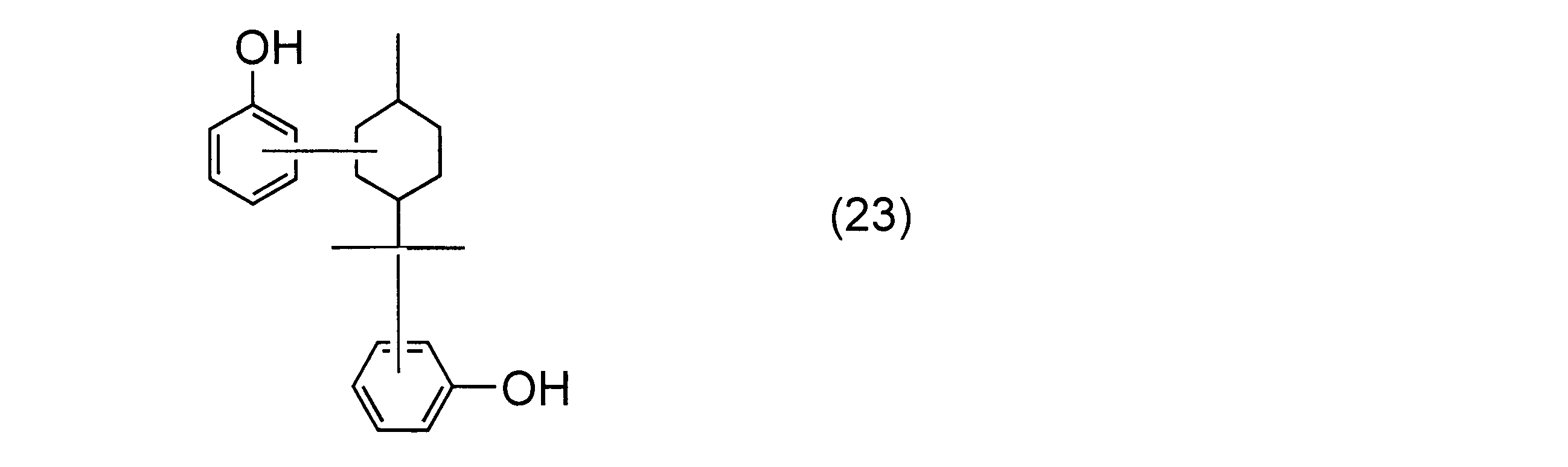
ゲートブレイク工程について詳細に説明をする。
トランスファ成型おいて、脱型後ランナー部からリードフレーム枠を手で取り外すゲートブレイク工程というものがある。この際に、リードフレームが曲がらずに手で無理なく、良好に取り外せることが重要であり、良好な場合はゲートブレイク性に優れるという。
逆に、かなり力を掛けないと取り外すことができず、結果リードフレームが曲がる等の不都合を生じる場合を、ゲートブレイク性に劣るという。リードフレームが曲った場合には、次工程へ進むことができない。
トランスファ成型において、反応性、熱時硬度、ゲートブレイク性、吸湿後の鉛フリー半田耐性を両立するためには、成分(D)の多官能酸無水物硬化剤、成分(E)のフェノール系硬化剤を単に含有するだけでは前記要求事項を達成することができない場合がある。そこで、エポキシ樹脂全量のエポキシ基1当量に対して、多官能酸無水物硬化剤(D)の配合当量(酸無水物基及びカルボキシル基の当量)及びフェノール系硬化剤(E)の配合当量(水酸基当量)を下記の条件で制御することがより好ましい。
硬化剤成分(D)の配合当量値:0.30~0.80当量
硬化剤成分(E)の配合当量値:0.20~0.60当量
〔但し、(成分(D)の配合当量値)+(成分(E)の配合当量値)=0.70~1.20当量の範囲である。〕
また、上記以外にも物性の妨げにならない範囲内で、他の硬化剤を組み合わせて用いることが出来る。例えば、酸無水物硬化剤としては、フタル酸無水物等の芳香族カルボン酸無水物、アゼライン酸、セバシン酸、ドデカン二酸等の脂肪族カルボン酸の無水物、テトラヒドロフタル酸無水物、ヘキサヒドロフタル酸無水物、ナジック酸無水物、ヘット酸無水物、ハイミック酸無水物等の脂環式カルボン酸無水物が挙げられる。 これら硬化剤を併用する場合、硬化剤成分(D)及び(E)以外の硬化剤の配合量は、エポキシ樹脂全量のエポキシ基1当量に対して、0~0.3当量程度であり、成分(D)及び(E)を含めた全硬化剤成分の配合量は、エポキシ樹脂全量のエポキシ基1当量に対して、0.7~1.5当量の範囲が好ましい。
本発明の目的は、反応性、金型からの脱型性、ゲートブレイク性などのトランスファ成型時における作業性を両立しながら、さらに吸湿後の鉛フリー半田耐性にも優れた光半導体封止用硬化性樹脂組成物を提供することである。
成分(F)は、本発明に沿って構成した組成物に対して、量を適宜変更して用いることは差し支えない。好ましくはある範囲内で添加することにより、本発明の目的をよりよく達成できる。本発明の樹脂組成物全量に対する成分(F)の含有量としては、0.01wt%~5.0wt%の範囲が好ましい。少なすぎると、密着性が低下するため吸湿後の半田耐性に劣ることがあり、また多すぎると、密着性は向上するものの、樹脂組成物の硬化促進作用へ悪影響を与え、加熱硬化後の硬化物がもろくなり、トランスファ成型での脱型時にランナー樹脂部が折れ、最終的に脱型できないという不具合が生じることがある。前記鉛フリー半田耐性と脱型性のバランスの点から、特に好ましくは樹脂組成物全量に対して、0.1wt%~2.0wt%の範囲、より好ましくは0.1wt%~1.0wt%で成分(F)を含有するのが良い。
成分(F)は、硬化促進へ影響を与える場合があるので、更に、後述する成分(G)の併用は好ましい。成分(G)を併用する場合、成分(F)との使用比率を制御することでより良い効果を得ることができる。具体的には、成分(F)/成分(G)=0.2~3.0、好ましくは0.2~2.0の範囲で添加すると密着と硬化性のバランスが良い。 成分(F)については、例えば、日本化薬株式会社製のPM-2(下記式(24)でn=0, aが平均で1.5、bが平均で1.5を示す)、PM-21(下記式(24)でn=1, aが平均で1.5、bが平均で1.5を示す)などが市場から入手可能である。
式(24)

成分(G)を含む本発明の樹脂組成物は、本発明の好ましい実施態様の1つである。
成分(G)は、エポキシ樹脂と硬化剤との反応を促進する作用のものであれば特に限定されるものではない。例えば、2-メチルイミダゾール、2-フェニルイミダゾール、2-ウンデシルイミダゾール、2-ヘプタデシルイミダゾール、2-フェニル-4-メチルイミダゾール、1-ベンジル-2-フェニルイミダゾール、1-ベンジル-2-メチルイミダゾール、1-シアノエチル-2-メチルイミダゾール、1-シアノエチル-2-フェニルイミダゾール、1-シアノエチル-2-ウンデシルイミダゾール、2,4-ジアミノ-6(2'-メチルイミダゾール(1'))エチル-s-トリアジン、2,4-ジアミノ-6(2'-ウンデシルイミダゾール(1'))エチル-s-トリアジン、2,4-ジアミノ-6(2'-エチル,4-メチルイミダゾール(1'))エチル-s-トリアジン、2,4-ジアミノ-6(2'-メチルイミダゾール(1'))エチル-s-トリアジン・イソシアヌル酸付加物、2-メチルイミダゾール・イソシアヌル酸の2:3付加物、2-フェニルイミダゾール・イソシアヌル酸付加物、2-フェニル-3,5-ジヒドロキシメチルイミダゾール、2-フェニル-4-ヒドロキシメチル-5-メチルイミダゾール、1-シアノエチル-2-フェニル-3,5-ジシアノエトキシメチルイミダゾールの各種イミダゾール類;及び、それらイミダゾール類とフタル酸、イソフタル酸、テレフタル酸、トリメリット酸、ピロメリット酸、ナフタレンジカルボン酸、マレイン酸、蓚酸等の多価カルボン酸との塩類;ジシアンジアミド等のアミド類;1,8-ジアザ-ビシクロ(5.4.0)ウンデセン-7等のジアザ化合物及び、それらと、フェノール類、前記多価カルボン酸類、又はホスフィン酸類との塩類;テトラブチルアンモニウムブロマイド、セチルトリメチルアンモニウムブロマイド、トリオクチルメチルアンモニウムブロマイド等のアンモニウム塩;トリフェニルホスフィン、テトラフェニルホスホニウムテトラフェニルボレート等のホスフィン類;2,4,6-トリスアミノメチルフェノール等のフェノール類;アミンアダクト;及びこれら硬化剤をマイクロカプセルにしたマイクロカプセル型硬化促進剤;等が挙げられる。これら促進剤の中でも、リードフレームとの密着という観点では、ホスフィン類が好ましい。さらにエポキシ樹脂同士の反応を抑制するという点ではトリフェニルホスフィンがより好ましい。
上記した成分(D)~(G)の総量は、樹脂組成物の総量に対して、10~60wt%が好ましく、より好ましくは15~50wt%であり、更に好ましくは15~40wt%である。
着色剤としては特に制限はなく、フタロシアニン、アゾ、ジスアゾ、キナクリドン、アントラキノン、フラバントロン、ペリノン、ペリレン、ジオキサジン、縮合アゾ、アゾメチン系、赤外線吸収剤、紫外線吸収剤などの各種有機系色素、酸化チタン、硫酸鉛、クロムエロー、ジンクエロー、クロムバーミリオン、弁殻、コバルト紫、紺青、群青、カーボンブラック、クロムグリーン、酸化クロム、コバルトグリーン等の無機顔料が挙げられる。
フォスファイト化合物及び/またはフォスフェイト化合物として、具体的には、ジー2-エチルヘキシルハイドロゼンフォスファイト、ジラウリルハイドロゼンフォスファイト、ジオレイルハイドロゼンフォスファイト、メチルアシッドフォスフェイト、エチルアシッドフォスフェイト、イソプロピルアシッドフォスフェイト、ブチルアシッドフォスフェイト、2-エチルヘキシルアシッドフォスフェイト、イソデシルアシッドフォスフェイト、ラウリルアシッドフォスフェイト、トリデシルアシッドフォスフェイトなどが挙げられる。
これらは単独でもしくは2種以上併せて用いられるが、これに限定されるものではない。そして、上記フォスファイト化合物及び/またはフォスフェイト化合物の添加量は、本発明の特性を損なわない範囲であれば特に限定されるものではない。
また、S元素を含んだ化合物として、具体的には、n-ドデカンチオール、n-ノナンチオール、n-ペンタンチオール、エチレングリコール-ビス-3-メルカプトプロピオネート、ジエチレングリコール-ビス-3-メルカプトプロピオネート、トリエチレングリコール-ビス-3-メルカプトプロピオネート、テトラエチレングリコール-ビス-3-メルカプトプロピオネート、プロピレングリコール-ビス-3-メルカプトプロピオネート、ジプロピレングリコール-ビス-3-メルカプトプロピオネート、トリプロピレングリコール-ビス-3-メルカプトプロピオネート、トリメチロールプロパン-トリス-3-メルカプトプロピオネート、トリス-(エチル-3-メルカプトプロピオネート)イソシアヌレート、ペンタエリスリトール-テトラキス-3-メルカプトプロピオネート、ジペンタエリスリトール-ヘキサ-3-メルカプトプロピオネート、トリス(3-メルカプトプロピオアミノ)-1,3,5-トリアジン、3,3’-チオジプロピオン酸、ジチオジプロピオン酸、ラウリルチオプロピオン酸、チオグリコール酸、チオグリコール酸アンモニウム、チオグリコール酸モノエタノールアミン、ジチオジグリコール酸ジアンモニウム等があげられる。
そして、上記特定のチオール化合物の添加量は、本発明の特性を損なわない範囲であれば特に限定されるものではない。接着性の観点から、該組成物中に0.01~10wt%に設定することが好ましく、より好ましくは0.1~5wt%の範囲である。添加量が少ないと接着性効果が得られにくくなり、また添加量が前記範囲を超えるとTg(ガラス点移転)などの低下を招くおそれがある。これら接着付与剤は、単独でもしくは2種以上併せて用いられることが可能である。
1.成分(A)が、前記一般式(1)において、R1が水素原子、nが0~10の繰り返し数の平均値であるエポキシ樹脂、
成分(B)が、前記一般式(2)において、R2が水素原子、R3がメチル基、mが0~10の繰り返し数の平均値であり、エポキシ当量が500~800g/eqであるエポキシ樹脂,
成分(C)が、前記一般式(2)において、R2が水素原子、R3がメチル基、mが0~10の繰り返し数の平均値であり、エポキシ当量が850~1500g/eqであるエポキシ樹脂,
成分(D)の多官能無水物硬化剤が前記式(3)、式(6)、式(7)、式(8)、式(11)、式(12)、式(13)および式(14)で表される多官能酸無水物からなる群から選択される少なくとも1種の酸無水物、
成分(E)のフェノール系硬化剤が、前記式(15)、(18)及び(19)で表わされる化合物からなる群から選択される少なくと1種、および
成分(F)リン酸基を有する(メタ)アクリレート、
を含有する光半導体封止用硬化性樹脂組成物。
2.成分(D)の多官能無水物硬化剤が前記式(3)又は式(6)で表される多官能酸無水物である上記1に記載の光半導体封止用硬化性樹脂組成物。
3.前記式(3)の化合物がトリメリット酸無水物であり、式(6)の化合物がトリメリット酸無水物のエチレングリコールエステル化物(式(6)のR5がエチレン)である上記2に記載の光半導体封止用硬化性樹脂組成物。
5.成分(F)が式(24)で表されるリン酸メタクリレートである上記1~4の何れか一項に記載の光半導体封止用硬化性樹脂組成物。
6.更に、成分(G)硬化促進剤を含む上記1~5の何れか一項に記載の光半導体封止用硬化性樹脂組成物。
7.樹脂組成物の総量に対して、上記成分(A)、成分(B)および成分(C)の総量の割合が40~90wt%である上記1~6の何れか一項に記載の光半導体封止用硬化性樹脂組成物。
8. エポキシ樹脂の総量に対して、成分(A)が10~35wt%、成分(B)が20~55wt%および成分(C)が20~55wt%の割合で含有し、三者の合計が100wt%(エポキシ樹脂の総量)となるように含有する上記7に記載の光半導体封止用硬化性樹脂組成物。
9.樹脂組成物の総量に対して、成分(D)~(G)の総量が10~60wt%である上記7に記載の光半導体封止用硬化性樹脂組成物。
10.エポキシ樹脂全量のエポキシ基1当量に対して、
硬化剤成分(D)の配合当量値:0.30~0.80当量
硬化剤成分(E)の配合当量値:0.20~0.60当量
であり、成分(D)の配合当量値と成分(E)の配合当量値の合計が0.70~1.20当量の範囲である上記1~9の何れか一項に記載の光半導封止体用硬化性樹脂組成物。
12.樹脂組成物の総量に対して、成分(G)の含量が、0.01~5wt%である上記6~11の何れか一項に記載の光半導体封止用硬化性樹脂組成物。
13. 成分(F)と成分(G)との含有比率が重量割合で、成分(F)/成分(G)=0.2~3.0である上記6~12の何れか一項に記載の光半導体封止用硬化性樹脂組成物。
14.成分(G)がホスフィン類(好ましくはトリフェニルホスフィン)である上記6~13の何れか一項に記載の光半導体封止用硬化性樹脂組成物。
(ゲルタイム試験)
実施例及び比較例で得られた硬化性樹脂組成物を粉砕し、ゲルタイマー試験機にて150℃における硬化性を測定した。
ゲルタイマー試験機:イヨテクニカル株式会社製、モデル2238-001
判定基準
ゲルタイムが60秒以下:○
ゲルタイムが60秒より長い:×
実施例及び比較例で得られた硬化性樹脂組成物をトランスファモールディング成型し、下記条件で熱時の硬度を測定した。
熱時硬度測定条件
金型予熱温度:150℃設定
金型種類:φ50mm、厚さ5mm、4つ取りの円盤金型
金型注入後保持時間:180秒
硬度測定器:ショアAゴム硬度計
測定タイミング:保持時間180秒後、上金型を開けてすぐにφ50mm円盤樹脂の表面にショアA測定器を刺してその最大値をショアAの値とした。
ショアAの判定基準
ショアAが55未満のもの:×
ショアAが55以上で65未満のもの:△
ショアAが65以上のもの:○
(Tg測定)
実施例及び比較例で得られた硬化性樹脂組成物をトランスファモールディング成型し、下記条件で後硬化を実施しTg(ガラス転移点)を測定した。
Tg用サンプル作成条件
金型予熱温度:150℃設定
金型種類:φ50mm、厚さ5mm、4つ取りの円盤金型
金型注入後保持時間:180秒
後硬化:150℃×4時間
サンプル切り出し:底面5mm×5mm、長さ10mm程度に成型したサンプルを用いる
Tg測定条件:SII(セイコーインスツルメンツ)製TMA装置を用いて、昇温条件2℃/分、圧縮モードで測定をした。線膨張係数の変化点をTgとした。
実施例及び比較例で得られた硬化性樹脂組成物を、表面にAg無光沢メッキした模擬銅製リードフレームを使用して、下記条件で評価用サンプルを得た。
成型条件
金型予熱温度:150℃設定
金型種類:模擬リードフレーム金型
金型注入後保持時間:180秒
後硬化条件:150℃、4時間
(金型からの脱型性試験)
トランスファ成型脱型時、下金型ランナー部からの樹脂の抜けやすさについて、その程度について観察をした。
金型からの脱型性の判定基準
ランナー部から樹脂が抜けないものは量産適正がないとして:×
ランナー部から樹脂が抜けるものは、量産適正があるとして:○
(ゲートブレイク性試験)
トランスファ成型脱型後、樹脂ランナーについている模擬リードフレームを手で外す際に、外れ難さの程度について評価した。
ゲートブレイク性の判定基準
外れにくいために、リードフレームが曲がってしまったもの:×
簡単にとれて、リードフレームが曲がらなかったもの:○
さらに、ゲートブレイク後、本来は樹脂が漏れてはならない箇所に樹脂が漏れ出しているかを確認した。
樹脂漏れの判定基準
漏れがある:×
漏れがない:○
(異物観察試験)
さらに、後硬化後の模擬リードフレームの樹脂部を実態光学顕微鏡(倍率50倍)で観察をして、異物があるかを観察した。
(ボイド観察試験)
さらに、後硬化後の模擬リードフレームの樹脂部を実態光学顕微鏡(倍率50倍)で観察をして、ボイドがあるかを観察した。
20ピンリードフレームタイプの模擬半導体素子(リードフレーム素材は銅製、表面銀メッキ処理)をトランスファ金型にセットし、各サンプルで未充填が起きないように成型を行う。脱型後、150℃×4時間後硬化をさせて鉛フリー半田リフロー試験(以降リフロと記述)用のサンプルとした。
リフロ試験を、サンプルを高湿度条件(下記吸湿条件)下に放置後、サンプルを鉛フリー半田溶融炉に下記の条件で浸すことによって行った。
評価は、リフロ試験後に顕微鏡で、リードフレームから剥離をしているリードピン数を数え、その結果を、剥離したリードピン本数/全体リードピン本数(20)で記載した。その結果に基づいて、下記の基準で判定を行った。
リフロを実施前の吸湿条件:30℃70%(相対湿度)中に48時間放置
リフロ時の温度条件:最大到達温度240℃で10秒間保持
リフロの判定基準
0~5/20:剥離耐性があるとして:○
5~10/20:多少剥離耐性があるとして:△
10~20/20:剥離耐性が低いとして:×
*A-1(エポキシ樹脂):ビフェニルノボラック型エポキシ樹脂、エポキシ当量290g/eq、日本化薬株式会社製、NC-3000H
*B-1(エポキシ樹脂):ビスフェノールA型エポキシ樹脂、エポキシ当量670g/eq、東都化成株式会社製、YD-012
*C-1(エポキシ樹脂):ビスフェノールA型エポキシ樹脂、エポキシ当量932g/eq、東都化成株式会社製、YD-904
*D-1(硬化剤):多官能酸無水物硬化剤 新日本理化株式会社製、TMEG-S(トリメリット酸無水物のエチレングリコールエステル化物の純度が50%、トリメリット酸無水物の純度が20%)、融点60℃、酸無水物当量235g/eq
*D-2(硬化剤):多官能酸無水物硬化剤 新日本理化株式会社製、TMEG-600(トリメリット酸無水物のエチレングリコールエステル化物の純度が90%)、融点160℃、酸無水物当量207g/eq
*SD(硬化剤) :単官能酸無水物硬化剤 新日本理化株式会社製、TH(テトラヒドロフタル酸無水物)、酸無水物当量150g/eq
*E-1(硬化剤):ビフェニルノボラック型フェノール樹脂、フェノール当量198g/eq、日本化薬株式会社製、GPH-65、式(20)の化合物
*E-2(硬化剤):テルペンジフェノール樹脂、フェノール当量194g/eq、ヤスハラケミカル株式会社製、YP-90:式(22)と式(23)の混合物
*F-1:リン酸メタクリレート:PM2、日本化薬株式会社製、式(24)の化合物(n=0,aが平均で1.5、bが平均で1.5)
*G-1(硬化促進剤):TPP(トリフェニルフォスフィン)
*G-2(硬化促進剤):2P4MZ(2フェニル4メチルイミダゾール)
特許文献1の実施例で使用されている単官能酸無水物であるテトラヒドロフタル酸無水物を使用して各樹脂における反応性を確認するために、下記表1に示す組成を有する組成物を調製した。混練は栗本鉄鋼株式会社製のS1ニーダーを用いて溶融混練し、得られた混練物を冷却後粉砕した。該粉砕物で150℃のゲルタイムを測定した。さらに該粉砕物をタブレットマシーンで必要量のタブレットを作成後、トランスファ成型機にて、150℃予熱された円盤金型にて成型を実施した。その結果を表1に併記した。
表1
比較例1 比較例2 比較例3
A-1 100部 - -
B-1 - 100部 -
C-1 - - 100部
D-1 - - -
D-2 - - -
SD 51.7部 22.3部 16.0部
E-1 - - -
E-2 - - -
F-1
G-1 1.0部 - -
G-2 - 0.5部 0.5部
ゲルタイム 1分49秒 3分00秒 4分54秒
(判定) (×) (×) (×)
タブレット作業性 作成不可 ベタツキ ベタツキ
(判定) (×) (×) (×)
漏れ性 漏れひどい 漏れひどい 漏れひどい
(判定) (×) (×) (×)
ショアA 測定不可 未硬化 未硬化
(判定) (×) (×) (×)
総合評価 (×) (×) (×)
成分(D)である多官能酸無水物を使用して、下記表2に示す割合で配合し、混練を行った。評価を前記比較例1~3と同様に実施し、その結果を表2に併記した。
比較例4 比較例5
A-1 - -
B-1 100部 -
C-1 - 100部
D-1 30.9部 22.2部
D-2 - -
SD - -
E-1 - -
E-2 - -
G-1 0.52部 0.37部
G-2 - -
ゲルタイム 54秒 48秒
(判定) (○) (○)
タブレット作業性 良好 良好
(判定) (○) (○)
漏れ性 漏れなし 漏れなし
(判定) (○) (○)
ショアA 82 76
(判定) (○) (○)
ゲートブレイク性 変形あり 変形あり
(判定) (×) (×)
総合評価 (×) (×)
次に本発明を実施例で具体的に説明する。
実施例及び比較例の組成物は、何れもそれぞれの表に記載の組成で、二軸ニーダーを使用して樹脂の溶融温度に合わせて、溶融混練し、得られた混練物を粉砕後、トランスファ成型機用のタブレットとした。得られたタブレットを用いて、トランスファ成型機にて、前記した条件で試験用光半導体素子を作成し、評価用サンプルとした。
実施例1,2及び比較例6を表4に、実施例3,4及び比較例7を表5に、実施例5を表6に、比較例8及び9を表7にそれぞれ示した。
なお、表中に記載していない硬化物中の異物及びボイドは、本発明の実施例1~5の何れにおいても、また、比較例4~9においても認められなかった。
成分(D)として、融点が150℃以上の物を使用する場合には、成分(D)と成分(E)をあらかじめ溶解混合して、トランスファ成型温度以下に融点を下げる必要がある。
多官能硬化剤成分(D)としてTMEG-600(融点165℃)(D-2)とフェノール系硬化剤成分(E)としてカハヤードGPH-65(軟化点65℃)(E-1)又はYP-90を下記表3に従い配合した。
さらにその溶液を油浴温度150℃で2時間掛けて真空溶剤除去工程を行い、最終的に室温まで冷却したところ、樹脂状固形物(マスターバッチ1/MB1又はマスターバッチ2/MB2)を得た。顕微鏡にて観察した結果、TMEG-600の溶け残りは観察されなかった。
MB1調製例
D-2 TMEG600:143部
E-2 GPH-65 :100部
溶媒 MEK :200部
MB2調製例
D-2 TMEG600:143部
E-1 YP-90 :100部
溶媒 MEK :200部
*(注)1.溶剤除去後の状態:TMEG-600の溶け残りなし
2.MEKはメチルエチルケトンを表す。
実施例1 実施例2 比較例6
A-1 15.0 部 15.0 部 15.0 部
B-1 42.5 部 42.5 部 42.5 部
C-1 42.5 部 42.5 部 42.5 部
D-1 - - -
D-2 15 部 *1) 15 部 *1) 15 部 *1)
(D2配合当量) 0.45 0.45 0.45
SD - - -
E-1 14.3 部 14.3 部 14.3 部
(E1配合当量) 0.45 0.45 0.45
E-2 - - -
F-1 0.13 部 0.65 部 0 部
F含有量 (0.1 wt%) (0.5 wt%) (0 wt%)
G--1 0.65 部 0.58 部 0.65 部
G含有量 (0.5 wt%) (0.45 wt%) (0.5 wt%)
F/G成分の比 0.2 1.11 0
ゲルタイム 56秒 57秒 57秒
ショアA 67 67 69
(判定) (○) (○) (○)
ゲートブレイク性 変形なし 変形なし 変形なし
(判定) (○) (○) (○)
リフロ時剥離率 5/20 4/20 16/20
(判定) (○) (○) (×)
総合評価 (○) (○) (×)
*1)は、成分D-2(及び成分E-2の一部)について前記MB1の形で配合し、E-2の不足分は、表4記載の量になるよう他成分と共に追加して配合した。
実施例3 実施例4 比較例7
A-1 15.0 部 15.0 部 15.0 部
B-1 42.5 部 42.5 部 42.5 部
C-1 42.5 部 42.5 部 42.5 部
D-1 - - -
D-2 15 部 *1) 15 部 *1) 15 部 *1)
(D2配合当量) 0.45 0.45 0.45
SD - - -
E-1 - - -
E-2 12.6部 12.6部 12.6部
(E2配合当量) 0.4 0.4 0.4
F-1 0.12 部 0.64 部 -
含有量 (0.1 wt%) (0.5 wt%) (0 wt%)
G--1 0.51 部 0.51 部 0.51 部
G含有量 (0.4 wt%) (0.4 wt%) (0.4 wt%)
F/G成分の比 0.2 1.11 0
ゲルタイム 60秒 58秒 50秒
ショアA 65 65 68
(判定) (○) (○) (○)
ゲートブレイク性 変形なし 変形なし 変形なし
(判定) (○) (○) (○)
リフロ時剥離率 4/20 1/20 19/20
(判定) (○) (○) (×)
総合評価 (○) (○) (×)
*1)は、成分D-2(及び成分E-2の一部)について前記MB2の形で配合し、E-1は、表5記載の量になるよう他成分と共に追加して配合した。
実施例5
A-1 15.0 部
B-1 42.5 部
C-1 42.5 部
D-1 16.6 部
(D1配合当量) 0.44
D-2 -
SD -
E-1 12.7 部
(E1配合当量) 0.4
E-2 -
F-1 0.96 部
F含有量 (0.75wt%)
G--1 0.7 部
G含有量 (0.55 wt%)
F/G成分の比 1.37
ゲルタイム 45秒
ショアA 68
(判定) (○)
ゲートブレイク性 変形なし
(判定) (○)
リフロ時剥離率 4/20
(判定) (○)
総合評価 (○)
表4、5、6の結果より、比較例6、7に比べ、成分(F)を含む実施例1,2、3,4、5は、トランスファの作業性に影響を与えることなく、吸湿後のリフロー試験においてリードフレームから樹脂が剥がれる確率が格段に低いことが判明した。
次いで、比較例8,9としてエポキシ樹脂及び硬化剤の組み合わせを、本発明の範囲外とした組成物に、成分(F)を加えた樹脂組成物を用いて、試験サンプルを作成して、前記の試験を行い、その結果を、組成と共に、表7に示した。
比較例8 比較例9
A-1 - -
B-1 20.0部 100部
C-1 80.0部 -
D-1 - 30.9部
(D1配合当量) - 1.0
D-2 14.4部 -
(D2配合当量) 0.6 -
SD - -
E-1 9.2部 -
(D2配合当量) 0.4 -
E-2 - -
E-3 - -
F-1 0.93部 0.98部
G-1 0.50部 0.52部
成分F/G成分の比 2.1 1.9
ゲルタイム 44秒 52秒
(判定) (○) (○)
タブレット作業性 良 好 良 好
(判定) (○) (○)
漏れ性 漏れなし 漏れなし
(判定) (○) (○)
ショアA 68 78
(判定) (○) (○)
異物 なし なし
(判定) (○) (○)
ボイド なし なし
(判定) (○) (○)
ランナー部脱型性 抜ける 抜ける
(判定) (○) (○)
ゲートブレイク性 変形なし 変形あり
(判定) (○) (×)
リフロー時剥離率 16/20 20/20
(判定) (×) (×)
総合評価 (×) (×)
Claims (11)
- 下記(A)~(F)の成分を含有することを特徴とする光半導体封止用硬化性樹脂組成物、
(A)一般式(1)

(式中、R1はそれぞれ互いに同一であっても異なっていてもよく、水素原子、直鎖状または枝分かれ状の炭素数1~8のアルキル基、又はハロゲン原子を示す。nは0~10の繰り返し数の平均値である。)で表わされるエポキシ樹脂、
(B)一般式(2)
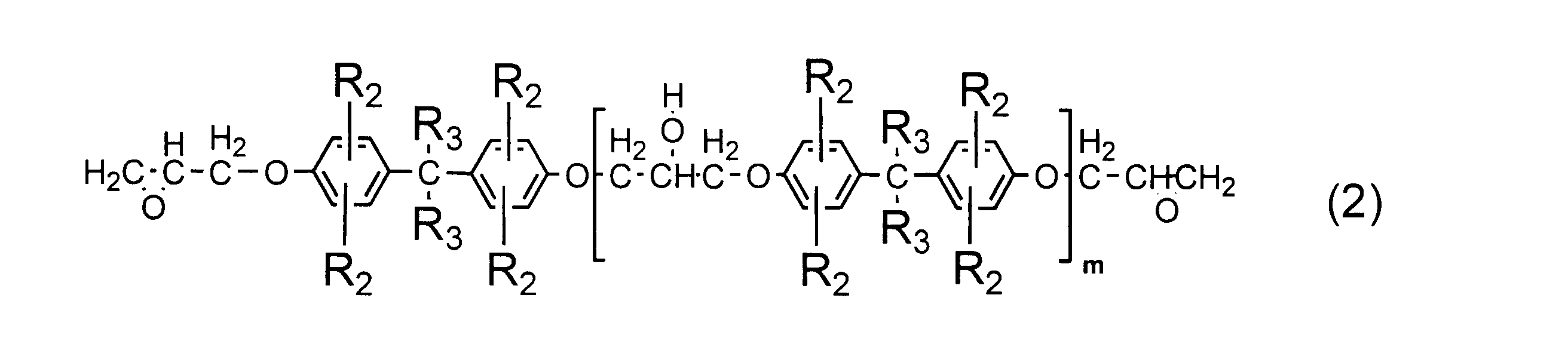
(式中、R2はそれぞれ互いに同一であっても異なっていてもよく、水素原子、直鎖状または枝分かれ状の炭素数1~8のアルキル基、又はハロゲン原子を示す。R3は、それぞれ互いに同一であっても異なっていてもよく、水素原子、直鎖状または枝分かれ状の炭素数1~8のアルキル基、又はハロゲン原子を示す。mは0~10の繰り返し数の平均値である。)
で表わされるエポキシ樹脂であってエポキシ当量が500~800g/eqを示すエポキシ樹脂、
(C)前記一般式(2)で表わされるエポキシ樹脂であってエポキシ当量が850~1500g/eqを示すエポキシ樹脂、
(D)1分子中にカルボキシル基と酸無水物基を併せて2ヶ以上、もしくは酸無水物基のみを2ヶ以上有する多官能酸無水物硬化剤、
(E)フェノール系硬化剤として、下記式(15)、(18)及び(19)で表わされる化合物からなる群から選択される少なくとも1種、
式(15)

{式中、oは0~10の繰り返し数の平均値、R8は下記式(16)

(式中、R9はそれぞれ互いに同一であっても異なっていてもよく、水素原子、直鎖状または枝分かれ状の炭素数1~8のアルキル基、またはハロゲン原子を示す。)または下記式(17)

(式中、R10はそれぞれ互いに同一であっても異なっていてもよく、水素原子、直鎖状または枝分かれ状の炭素数1~8のアルキル基、またはハロゲン原子を示す。)を示す。}、
式(18)

(式中、R11はそれぞれ互いに同一であっても異なっていてもよく、水素原子、直鎖状または枝分かれ状の炭素数1~8のアルキル基、又はハロゲン原子を示す。)及び
式(19)
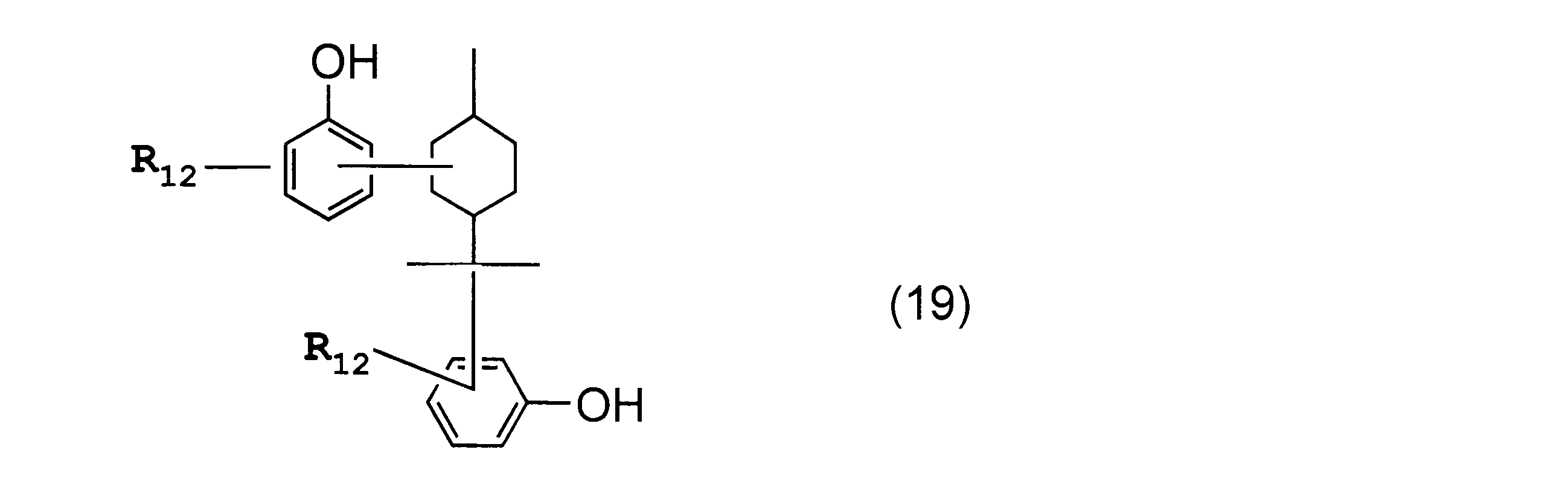
(式中、R12はそれぞれ互いに同一であっても異なっていてもよく、水素原子、直鎖状または枝分かれ状の炭素数1~8のアルキル基、又はハロゲン原子を示す。)、及び
(F)リン酸基を有する(メタ)アクリレート。 - 更に(G)硬化促進剤を含有する、請求項1に記載の光半導体封止用硬化性樹脂組成物。
- 成分(F)が、下記式(24)

(式中、nは0~3の整数、aは1~2の正数、bは1~2の正数を示す。但し
、a+b=3を示す。)で表される化合物である請求項1に記載の光半導体封止用硬化性樹脂組成物。 - エポキシ樹脂全量を100wt%として、成分(A)が10~35wt%、成分(B)が20~55wt%、成分(C)が20~55wt%の含有比率である請求項1に記載の光半導体封止用硬化性樹脂組成物。
- 成分(D)が、下記式(3)、式(6)および式(7)で表される化合物からなる群から選択される少なくとも1種である請求項1に記載の光半導体封止用硬化性樹脂組成物、
式(3)

(式中、R4は、
式(4)

又は、
式(5)

を示し、結合位置は特に制限は受けない。)、
式(6)

(式中、R5は置換基を有してもよい直鎖状または枝分かれ状の炭素数1~5のアルキレン鎖、置換基を有してもよいシクロヘキサン骨格またはベンゼン骨格を示す。)、
式(7)
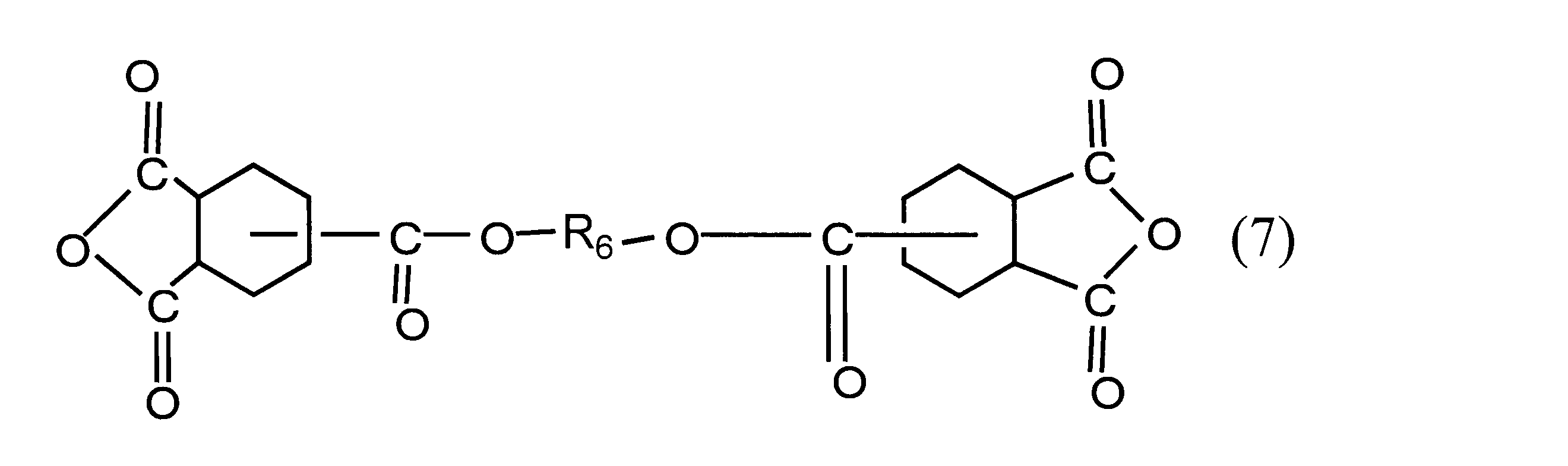
(式中、R6は置換基を有してもよい直鎖状または枝分かれ状の炭素数1~5のアルキレン基、置換基を有してもよいシクロヘキサン骨格またはベンゼン骨格を示す。)。 - 成分(D)が、下記式(8)で表される化合物である請求項1に記載の光半導体封止用硬化性樹脂組成物、なお、式(8)中、R7は下記式(9)又は式(10)を示す。
式(8)

式(9)

式(10)

- 成分(D)が、下記式(11)、式(12)、式(13)または式(14)で表される化合物である請求項1に記載の光半導体封止用硬化性樹脂組成物。
式(11)

式(12)
式(13)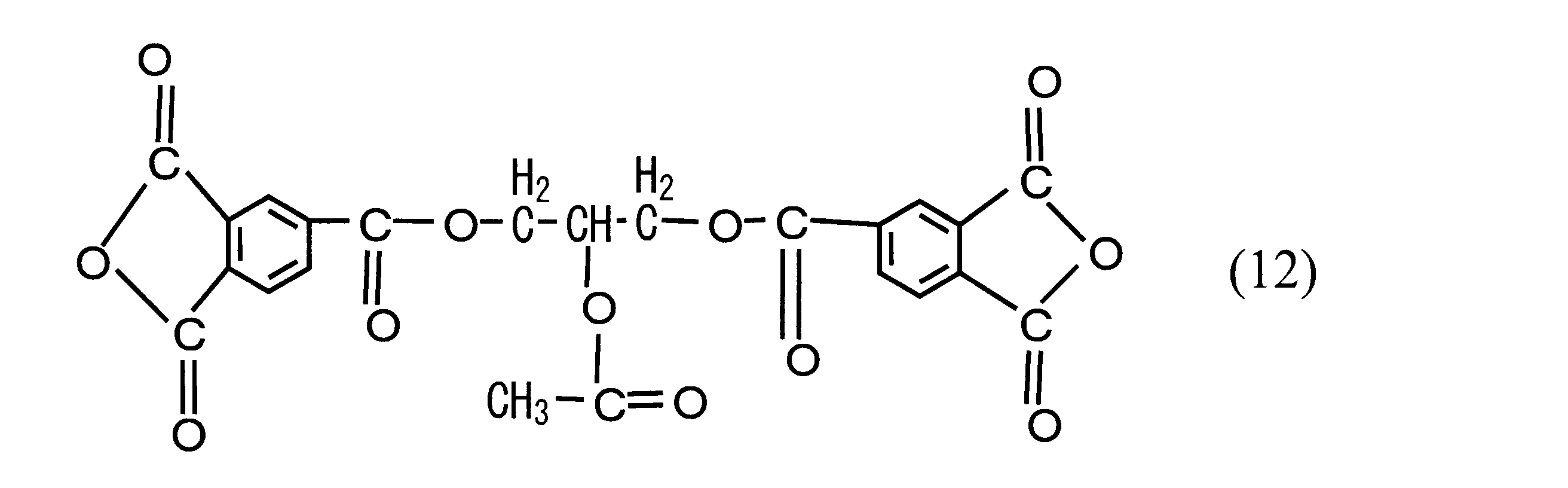
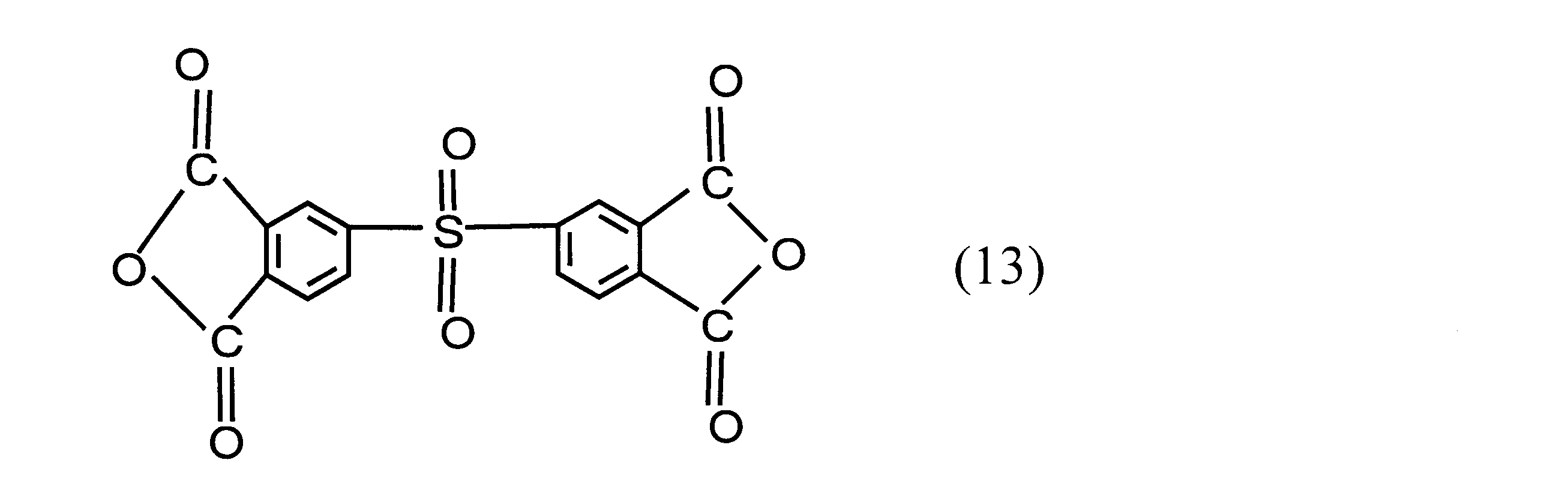
式(14)

- エポキシ樹脂全量のエポキシ基1当量に対して、硬化剤成分(D)の配合当量値が0.30~0.80であり、成分(E)の配合当量値が0.20~0.60であり、成分(D)の配合当量値と成分(E)の配合当量値の合計が0.70~1.20の範囲である請求項1に記載の光半導体封止用硬化性樹脂組成物。
- 更に(G)硬化促進剤を含有する請求項3~7のいずれか一項に記載の光半導体封止用硬化性樹脂組成物。
- 成分(F)と成分(G)との含有比率が重量割合で、成分(F)/成分(G)=0.2~3.0である請求項9に記載の光半導体封止用硬化性樹脂組成物。
- 請求項1に記載の硬化性樹脂組成物を加熱して得られる硬化物で封止された光半導体素子。
Priority Applications (2)
| Application Number | Priority Date | Filing Date | Title |
|---|---|---|---|
| CN2010800492415A CN102597042A (zh) | 2009-10-29 | 2010-10-20 | 光半导体密封用可固化树脂组合物及其固化物 |
| JP2011538235A JPWO2011052161A1 (ja) | 2009-10-29 | 2010-10-20 | 光半導体封止用硬化性樹脂組成物、及びその硬化物 |
Applications Claiming Priority (2)
| Application Number | Priority Date | Filing Date | Title |
|---|---|---|---|
| JP2009248486 | 2009-10-29 | ||
| JP2009-248486 | 2009-10-29 |
Publications (1)
| Publication Number | Publication Date |
|---|---|
| WO2011052161A1 true WO2011052161A1 (ja) | 2011-05-05 |
Family
ID=43921598
Family Applications (1)
| Application Number | Title | Priority Date | Filing Date |
|---|---|---|---|
| PCT/JP2010/006217 Ceased WO2011052161A1 (ja) | 2009-10-29 | 2010-10-20 | 光半導体封止用硬化性樹脂組成物、及びその硬化物 |
Country Status (5)
| Country | Link |
|---|---|
| JP (1) | JPWO2011052161A1 (ja) |
| KR (1) | KR20120095879A (ja) |
| CN (1) | CN102597042A (ja) |
| TW (1) | TW201125887A (ja) |
| WO (1) | WO2011052161A1 (ja) |
Cited By (9)
| Publication number | Priority date | Publication date | Assignee | Title |
|---|---|---|---|---|
| JP2012134446A (ja) * | 2010-11-30 | 2012-07-12 | Jnc Corp | 光ナノインプリント用硬化性組成物および硬化性組成物から得られた硬化膜 |
| JP2014094979A (ja) * | 2012-11-07 | 2014-05-22 | Panasonic Corp | 半導体封止用エポキシ樹脂組成物および半導体装置 |
| CN104080829A (zh) * | 2012-09-28 | 2014-10-01 | Won化学株式会社 | 耐冲击性优秀的热固性环氧树脂组合物 |
| US20140335350A1 (en) * | 2011-12-05 | 2014-11-13 | Hitachi Chemical Company, Ltd. | Method for forming protective film on electrode for touch panel, photosensitive resin composition and photosensitive element, and method for manufacturing touch panel |
| EP2774939A4 (en) * | 2011-10-31 | 2015-07-08 | Toray Industries | EPOXY RESIN COMPOSITION FOR FIBER-REINFORCED COMPOUNDS AND FIBER-REINFORCED COMPOSITE |
| US10042254B2 (en) | 2011-12-05 | 2018-08-07 | Hitachi Chemical Company, Ltd. | Method of forming protective film for touch panel electrode photosensitive resin composition and photosensitive element, and method of manufacturing touch panel |
| WO2019065248A1 (ja) | 2017-09-29 | 2019-04-04 | 日鉄ケミカル&マテリアル株式会社 | 繊維強化複合材料用樹脂組成物及びそれを用いた繊維強化複合材料 |
| US10663861B2 (en) | 2011-12-05 | 2020-05-26 | Hitachi Chemical Company, Ltd. | Method for forming resin cured film pattern, photosensitive resin composition, photosensitive element, method for producing touch panel, and resin cured film |
| KR20200081099A (ko) * | 2018-12-27 | 2020-07-07 | 주식회사 케이씨씨 | 반도체 소자 언더필용 에폭시 수지 조성물 |
Families Citing this family (7)
| Publication number | Priority date | Publication date | Assignee | Title |
|---|---|---|---|---|
| JP5442529B2 (ja) * | 2010-05-10 | 2014-03-12 | 日東電工株式会社 | 光半導体素子封止用エポキシ樹脂組成物およびそれを用いた光半導体装置。 |
| KR101799499B1 (ko) * | 2014-12-24 | 2017-12-20 | 주식회사 엘지화학 | 반도체 접착용 수지 조성물, 접착 필름, 다이싱 다이본딩 필름 및 반도체 장치 |
| JP6283624B2 (ja) * | 2015-05-28 | 2018-02-21 | 日東電工株式会社 | 中空型電子デバイス封止用シート、中空型電子デバイスパッケージの製造方法、及び、中空型電子デバイスパッケージ |
| CN106715631B (zh) * | 2015-07-10 | 2019-07-30 | 株式会社Lg化学 | 半导体用粘合剂组合物和切割管芯粘结膜 |
| TWI719419B (zh) * | 2019-03-11 | 2021-02-21 | 台光電子材料股份有限公司 | 環氧樹脂組成物及由其製成的物品 |
| CN113754863A (zh) * | 2020-06-03 | 2021-12-07 | 日东电工株式会社 | 光半导体密封用树脂成型物 |
| WO2022202335A1 (ja) * | 2021-03-23 | 2022-09-29 | 日本化薬株式会社 | フェノール樹脂混合物、硬化性樹脂組成物及びその硬化物 |
Citations (6)
| Publication number | Priority date | Publication date | Assignee | Title |
|---|---|---|---|---|
| JPH11269452A (ja) * | 1998-03-25 | 1999-10-05 | Sumitomo Bakelite Co Ltd | ダイアタッチペースト |
| JP2001257220A (ja) * | 2000-03-13 | 2001-09-21 | Sumitomo Bakelite Co Ltd | ダイアタッチペースト及び半導体装置 |
| JP2002356538A (ja) * | 2001-03-30 | 2002-12-13 | Toray Ind Inc | 半導体封止用エポキシ樹脂組成物及びそれを用いた半導体装置 |
| JP2005089486A (ja) * | 2003-09-11 | 2005-04-07 | Sumitomo Bakelite Co Ltd | エポキシ樹脂組成物及び半導体装置 |
| JP2008031291A (ja) * | 2006-07-28 | 2008-02-14 | Sumitomo Bakelite Co Ltd | エポキシ樹脂組成物、エポキシ樹脂成形材料及び半導体装置 |
| JP2010202758A (ja) * | 2009-03-03 | 2010-09-16 | Nippon Kayaku Co Ltd | 光半導体封止用硬化性樹脂組成物、及びその硬化物 |
Family Cites Families (2)
| Publication number | Priority date | Publication date | Assignee | Title |
|---|---|---|---|---|
| KR19990036339A (ko) * | 1996-06-12 | 1999-05-25 | 다께다 가즈히꼬 | 광중합 반응 개시제 및 이를 함유하는 에너지선경화성 조성물 |
| TWI368909B (en) * | 2003-08-12 | 2012-07-21 | Nippon Kayaku Kk | Adhesive compostion and optional disc using the same |
-
2010
- 2010-10-20 WO PCT/JP2010/006217 patent/WO2011052161A1/ja not_active Ceased
- 2010-10-20 JP JP2011538235A patent/JPWO2011052161A1/ja active Pending
- 2010-10-20 CN CN2010800492415A patent/CN102597042A/zh active Pending
- 2010-10-20 KR KR1020127010139A patent/KR20120095879A/ko not_active Withdrawn
- 2010-10-27 TW TW099136658A patent/TW201125887A/zh unknown
Patent Citations (6)
| Publication number | Priority date | Publication date | Assignee | Title |
|---|---|---|---|---|
| JPH11269452A (ja) * | 1998-03-25 | 1999-10-05 | Sumitomo Bakelite Co Ltd | ダイアタッチペースト |
| JP2001257220A (ja) * | 2000-03-13 | 2001-09-21 | Sumitomo Bakelite Co Ltd | ダイアタッチペースト及び半導体装置 |
| JP2002356538A (ja) * | 2001-03-30 | 2002-12-13 | Toray Ind Inc | 半導体封止用エポキシ樹脂組成物及びそれを用いた半導体装置 |
| JP2005089486A (ja) * | 2003-09-11 | 2005-04-07 | Sumitomo Bakelite Co Ltd | エポキシ樹脂組成物及び半導体装置 |
| JP2008031291A (ja) * | 2006-07-28 | 2008-02-14 | Sumitomo Bakelite Co Ltd | エポキシ樹脂組成物、エポキシ樹脂成形材料及び半導体装置 |
| JP2010202758A (ja) * | 2009-03-03 | 2010-09-16 | Nippon Kayaku Co Ltd | 光半導体封止用硬化性樹脂組成物、及びその硬化物 |
Cited By (12)
| Publication number | Priority date | Publication date | Assignee | Title |
|---|---|---|---|---|
| JP2012134446A (ja) * | 2010-11-30 | 2012-07-12 | Jnc Corp | 光ナノインプリント用硬化性組成物および硬化性組成物から得られた硬化膜 |
| EP2774939A4 (en) * | 2011-10-31 | 2015-07-08 | Toray Industries | EPOXY RESIN COMPOSITION FOR FIBER-REINFORCED COMPOUNDS AND FIBER-REINFORCED COMPOSITE |
| US9328237B2 (en) | 2011-10-31 | 2016-05-03 | Toray Industries, Inc. | Two-pack type epoxy resin composition for fiber-reinforced composite materials, and fiber-reinforced composite material |
| US20140335350A1 (en) * | 2011-12-05 | 2014-11-13 | Hitachi Chemical Company, Ltd. | Method for forming protective film on electrode for touch panel, photosensitive resin composition and photosensitive element, and method for manufacturing touch panel |
| US10042254B2 (en) | 2011-12-05 | 2018-08-07 | Hitachi Chemical Company, Ltd. | Method of forming protective film for touch panel electrode photosensitive resin composition and photosensitive element, and method of manufacturing touch panel |
| US10663861B2 (en) | 2011-12-05 | 2020-05-26 | Hitachi Chemical Company, Ltd. | Method for forming resin cured film pattern, photosensitive resin composition, photosensitive element, method for producing touch panel, and resin cured film |
| CN104080829A (zh) * | 2012-09-28 | 2014-10-01 | Won化学株式会社 | 耐冲击性优秀的热固性环氧树脂组合物 |
| CN104080829B (zh) * | 2012-09-28 | 2016-03-23 | Won化学株式会社 | 耐冲击性优秀的热固性环氧树脂组合物 |
| JP2014094979A (ja) * | 2012-11-07 | 2014-05-22 | Panasonic Corp | 半導体封止用エポキシ樹脂組成物および半導体装置 |
| WO2019065248A1 (ja) | 2017-09-29 | 2019-04-04 | 日鉄ケミカル&マテリアル株式会社 | 繊維強化複合材料用樹脂組成物及びそれを用いた繊維強化複合材料 |
| KR20200081099A (ko) * | 2018-12-27 | 2020-07-07 | 주식회사 케이씨씨 | 반도체 소자 언더필용 에폭시 수지 조성물 |
| KR102157633B1 (ko) | 2018-12-27 | 2020-09-18 | 주식회사 케이씨씨 | 반도체 소자 언더필용 에폭시 수지 조성물 |
Also Published As
| Publication number | Publication date |
|---|---|
| CN102597042A (zh) | 2012-07-18 |
| TW201125887A (en) | 2011-08-01 |
| JPWO2011052161A1 (ja) | 2013-03-14 |
| KR20120095879A (ko) | 2012-08-29 |
Similar Documents
| Publication | Publication Date | Title |
|---|---|---|
| JPWO2011052161A1 (ja) | 光半導体封止用硬化性樹脂組成物、及びその硬化物 | |
| TWI763877B (zh) | 半導體密封用熱硬化性環氧樹脂薄片、半導體裝置及其製造方法 | |
| CN1320019C (zh) | 光半导体密封用环氧树脂组合物 | |
| JP2010195998A (ja) | 半導体封止用エポキシ樹脂組成物、及び半導体装置 | |
| JP5311563B2 (ja) | 光半導体封止用硬化性樹脂組成物、及びその硬化物 | |
| JP2004203911A (ja) | 封止用樹脂組成物および樹脂封止型半導体装置 | |
| JP2005089486A (ja) | エポキシ樹脂組成物及び半導体装置 | |
| JP5167587B2 (ja) | 半導体封止用エポキシ樹脂組成物及び半導体装置 | |
| JP2004300239A (ja) | 樹脂封止型半導体装置および半導体封止用エポキシ樹脂組成物 | |
| JP4973146B2 (ja) | エポキシ樹脂組成物、封止用エポキシ樹脂組成物及び電子部品装置 | |
| JP3871025B2 (ja) | 半導体封止用エポキシ樹脂組成物及び半導体装置 | |
| JP2003212958A (ja) | エポキシ樹脂組成物及び半導体装置 | |
| JP5367274B2 (ja) | 光半導体素子封止用エポキシ樹脂組成物およびそれを用いた光半導体装置 | |
| JP2007204510A (ja) | 半導体封止用エポキシ樹脂組成物及び半導体装置 | |
| JP2006335894A (ja) | 光半導体用エポキシ樹脂液状組成物 | |
| JP5326975B2 (ja) | 半導体封止用エポキシ樹脂組成物、および半導体装置 | |
| JP2006213849A (ja) | 封止用樹脂組成物および半導体封止装置 | |
| JP2010083956A (ja) | 封止用樹脂組成物および半導体封止装置 | |
| JP5410085B2 (ja) | 光半導体素子封止用エポキシ樹脂組成物およびそれを用いた光半導体装置 | |
| JP2006265487A (ja) | 半導体封止用エポキシ樹脂組成物 | |
| JP2006063191A (ja) | 光半導体封止用エポキシ樹脂組成物及び光半導体装置 | |
| JP5055778B2 (ja) | エポキシ樹脂組成物、エポキシ樹脂成形材料及び半導体装置 | |
| JP2005281623A (ja) | エポキシ樹脂組成物および半導体装置 | |
| JP3863150B2 (ja) | エポキシ樹脂組成物および半導体装置 | |
| JP5332900B2 (ja) | 半導体封止用エポキシ樹脂組成物及び半導体装置 |
Legal Events
| Date | Code | Title | Description |
|---|---|---|---|
| WWE | Wipo information: entry into national phase |
Ref document number: 201080049241.5 Country of ref document: CN |
|
| 121 | Ep: the epo has been informed by wipo that ep was designated in this application |
Ref document number: 10826298 Country of ref document: EP Kind code of ref document: A1 |
|
| WWE | Wipo information: entry into national phase |
Ref document number: 2011538235 Country of ref document: JP |
|
| ENP | Entry into the national phase |
Ref document number: 20127010139 Country of ref document: KR Kind code of ref document: A |
|
| NENP | Non-entry into the national phase |
Ref country code: DE |
|
| 122 | Ep: pct application non-entry in european phase |
Ref document number: 10826298 Country of ref document: EP Kind code of ref document: A1 |