WO2011040459A1 - ベンゾオキサジン環を有する熱硬化性樹脂及びその製造方法 - Google Patents
ベンゾオキサジン環を有する熱硬化性樹脂及びその製造方法 Download PDFInfo
- Publication number
- WO2011040459A1 WO2011040459A1 PCT/JP2010/066939 JP2010066939W WO2011040459A1 WO 2011040459 A1 WO2011040459 A1 WO 2011040459A1 JP 2010066939 W JP2010066939 W JP 2010066939W WO 2011040459 A1 WO2011040459 A1 WO 2011040459A1
- Authority
- WO
- WIPO (PCT)
- Prior art keywords
- thermosetting resin
- formula
- benzoxazine ring
- group
- carbon atoms
- Prior art date
- Legal status (The legal status is an assumption and is not a legal conclusion. Google has not performed a legal analysis and makes no representation as to the accuracy of the status listed.)
- Ceased
Links
- ISWSIDIOOBJBQZ-UHFFFAOYSA-N Oc1ccccc1 Chemical compound Oc1ccccc1 ISWSIDIOOBJBQZ-UHFFFAOYSA-N 0.000 description 1
Images




Classifications
-
- C—CHEMISTRY; METALLURGY
- C08—ORGANIC MACROMOLECULAR COMPOUNDS; THEIR PREPARATION OR CHEMICAL WORKING-UP; COMPOSITIONS BASED THEREON
- C08G—MACROMOLECULAR COMPOUNDS OBTAINED OTHERWISE THAN BY REACTIONS ONLY INVOLVING UNSATURATED CARBON-TO-CARBON BONDS
- C08G73/00—Macromolecular compounds obtained by reactions forming a linkage containing nitrogen with or without oxygen or carbon in the main chain of the macromolecule, not provided for in groups C08G12/00 - C08G71/00
- C08G73/06—Polycondensates having nitrogen-containing heterocyclic rings in the main chain of the macromolecule
-
- C—CHEMISTRY; METALLURGY
- C08—ORGANIC MACROMOLECULAR COMPOUNDS; THEIR PREPARATION OR CHEMICAL WORKING-UP; COMPOSITIONS BASED THEREON
- C08G—MACROMOLECULAR COMPOUNDS OBTAINED OTHERWISE THAN BY REACTIONS ONLY INVOLVING UNSATURATED CARBON-TO-CARBON BONDS
- C08G14/00—Condensation polymers of aldehydes or ketones with two or more other monomers covered by at least two of the groups C08G8/00 - C08G12/00
- C08G14/02—Condensation polymers of aldehydes or ketones with two or more other monomers covered by at least two of the groups C08G8/00 - C08G12/00 of aldehydes
- C08G14/04—Condensation polymers of aldehydes or ketones with two or more other monomers covered by at least two of the groups C08G8/00 - C08G12/00 of aldehydes with phenols
- C08G14/06—Condensation polymers of aldehydes or ketones with two or more other monomers covered by at least two of the groups C08G8/00 - C08G12/00 of aldehydes with phenols and monomers containing hydrogen attached to nitrogen
-
- C—CHEMISTRY; METALLURGY
- C08—ORGANIC MACROMOLECULAR COMPOUNDS; THEIR PREPARATION OR CHEMICAL WORKING-UP; COMPOSITIONS BASED THEREON
- C08G—MACROMOLECULAR COMPOUNDS OBTAINED OTHERWISE THAN BY REACTIONS ONLY INVOLVING UNSATURATED CARBON-TO-CARBON BONDS
- C08G12/00—Condensation polymers of aldehydes or ketones with only compounds containing hydrogen attached to nitrogen
- C08G12/02—Condensation polymers of aldehydes or ketones with only compounds containing hydrogen attached to nitrogen of aldehydes
- C08G12/04—Condensation polymers of aldehydes or ketones with only compounds containing hydrogen attached to nitrogen of aldehydes with acyclic or carbocyclic compounds
- C08G12/06—Amines
-
- C—CHEMISTRY; METALLURGY
- C08—ORGANIC MACROMOLECULAR COMPOUNDS; THEIR PREPARATION OR CHEMICAL WORKING-UP; COMPOSITIONS BASED THEREON
- C08G—MACROMOLECULAR COMPOUNDS OBTAINED OTHERWISE THAN BY REACTIONS ONLY INVOLVING UNSATURATED CARBON-TO-CARBON BONDS
- C08G73/00—Macromolecular compounds obtained by reactions forming a linkage containing nitrogen with or without oxygen or carbon in the main chain of the macromolecule, not provided for in groups C08G12/00 - C08G71/00
- C08G73/06—Polycondensates having nitrogen-containing heterocyclic rings in the main chain of the macromolecule
- C08G73/22—Polybenzoxazoles
-
- C—CHEMISTRY; METALLURGY
- C08—ORGANIC MACROMOLECULAR COMPOUNDS; THEIR PREPARATION OR CHEMICAL WORKING-UP; COMPOSITIONS BASED THEREON
- C08L—COMPOSITIONS OF MACROMOLECULAR COMPOUNDS
- C08L61/00—Compositions of condensation polymers of aldehydes or ketones; Compositions of derivatives of such polymers
- C08L61/20—Condensation polymers of aldehydes or ketones with only compounds containing hydrogen attached to nitrogen
-
- C—CHEMISTRY; METALLURGY
- C08—ORGANIC MACROMOLECULAR COMPOUNDS; THEIR PREPARATION OR CHEMICAL WORKING-UP; COMPOSITIONS BASED THEREON
- C08L—COMPOSITIONS OF MACROMOLECULAR COMPOUNDS
- C08L79/00—Compositions of macromolecular compounds obtained by reactions forming in the main chain of the macromolecule a linkage containing nitrogen with or without oxygen or carbon only, not provided for in groups C08L61/00 - C08L77/00
- C08L79/04—Polycondensates having nitrogen-containing heterocyclic rings in the main chain; Polyhydrazides; Polyamide acids or similar polyimide precursors
Definitions
- the present invention relates to a thermosetting resin having a benzoxazine ring, a method for producing a thermosetting resin, a thermosetting resin composition containing the thermosetting resin, and a molded product, a cured product, and an electron including them. Regarding equipment.
- Thermosetting resin with a benzoxazine ring in the molecular structure has good heat resistance, flame retardancy, electrical insulation, low water absorption, etc. Excellent characteristics not found in other thermosetting resins Therefore, it has been attracting attention as an electronic material such as a laminate and a semiconductor sealing material, and a binding material such as a friction material and a grindstone.
- thermosetting resin having a benzoxazine ring is a thermosetting resin having a structure in which the oxazine ring is adjacent to a benzene ring, and can be produced by reacting a phenol compound, an amine compound, or an aldehyde compound, for example.
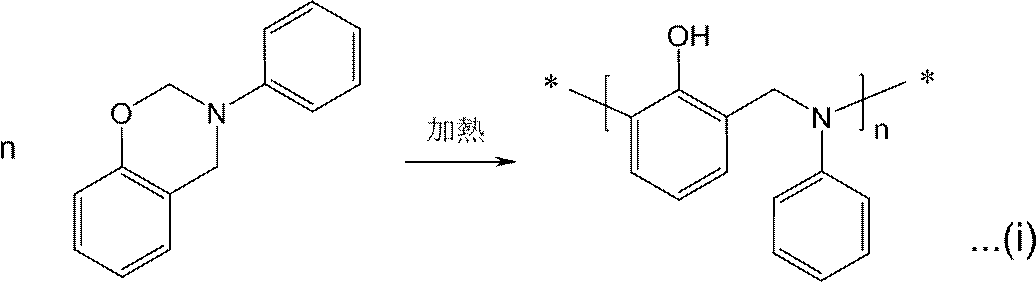
- a thermosetting resin having a benzoxazine ring a thermosetting resin having a benzoxazine ring produced using phenol as a phenol compound, phenol as an amine compound, aniline as an aldehyde compound, and formaldehyde (The left side of the formula (i)).
- thermosetting resin having a benzoxazine ring undergoes ring-opening polymerization by heating to become polybenzoxazine (right side of the formula (i)).
- thermosetting resins having such a benzoxazine ring for example, in Patent Documents 1 and 2 and Non-Patent Document 1, a benzoxazine ring obtained by reacting bifunctional phenols, diamines, and aldehydes. A thermosetting resin having is disclosed.
- thermosetting resins having a benzoxazine ring disclosed in Patent Documents 1 and 2 and Non-Patent Document 1 have room for improvement in terms of dimensional stability, particularly a low thermal expansion coefficient.
- a thermosetting resin molded body having a benzoxazine ring and a cured body obtained by curing the molded body are materials having good physical properties to some extent, but are not sufficient.
- Such a molded body is strongly desired to improve such performance particularly when a cured body of a thermosetting resin having a benzoxazine ring is used in the form of a film or the like.
- the present invention has been made in view of the above circumstances, and has as its main object to provide a thermosetting resin having a benzoxazine ring, which is excellent in dimensional stability.
- thermosetting resin having a benzoxazine ring having a specific structure in the molecule. It came to complete.
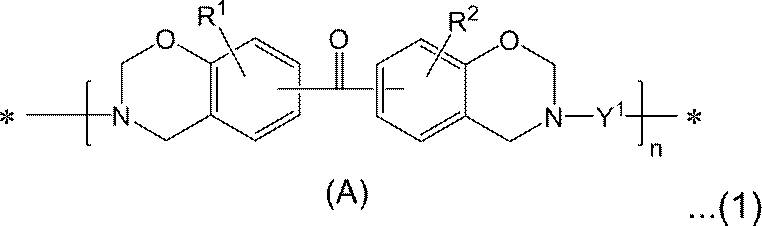
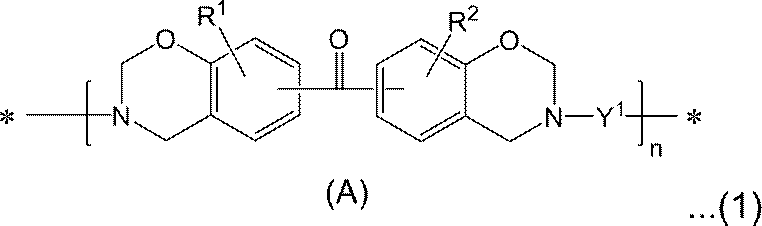
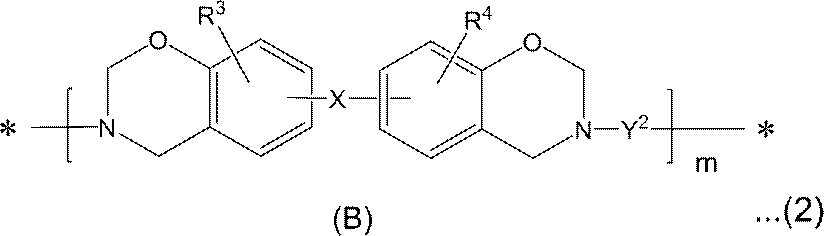
- thermosetting resin having a benzoxazine ring which includes a structure A represented by the following formula (1) and a structure B represented by the following formula (2).
- each of R 1 and R 2 independently represents hydrogen or an organic group having 1 to 20 carbon atoms
- Y 1 is a straight chain that may contain a hetero element having 1 to 20 carbon atoms.
- n represents an integer of 1 to 500. Note that * represents a binding site.
- each of R 3 and R 4 independently represents hydrogen or an organic group having 1 to 20 carbon atoms
- X represents a straight chain which may contain a hetero element having 1 to 20 carbon atoms
- Y 2 represents a linear, branched or cyclic structure having 1 to 20 carbon atoms, which may contain a hetero element.
- m represents an integer of 1 to 500. Note that * represents a binding site.
- thermosetting resin having a benzoxazine ring according to [1] or [2], wherein R 1 and R 2 of the structure A and R 3 and R 4 of the structure B are both hydrogen.
- thermosetting resin according to claim 1 Any one of [1] to [3], wherein the ratio (A / B; molar ratio) of the structure A to the content of the structure B in the thermosetting resin is 1/99 to 99/1.
- thermosetting resin according to claim 1 Any one of [1] to [4], wherein the ratio (A / B; molar ratio) of the structure A to the content of the structure B in the thermosetting resin is 70/30 to 90/10 The thermosetting resin according to claim 1.
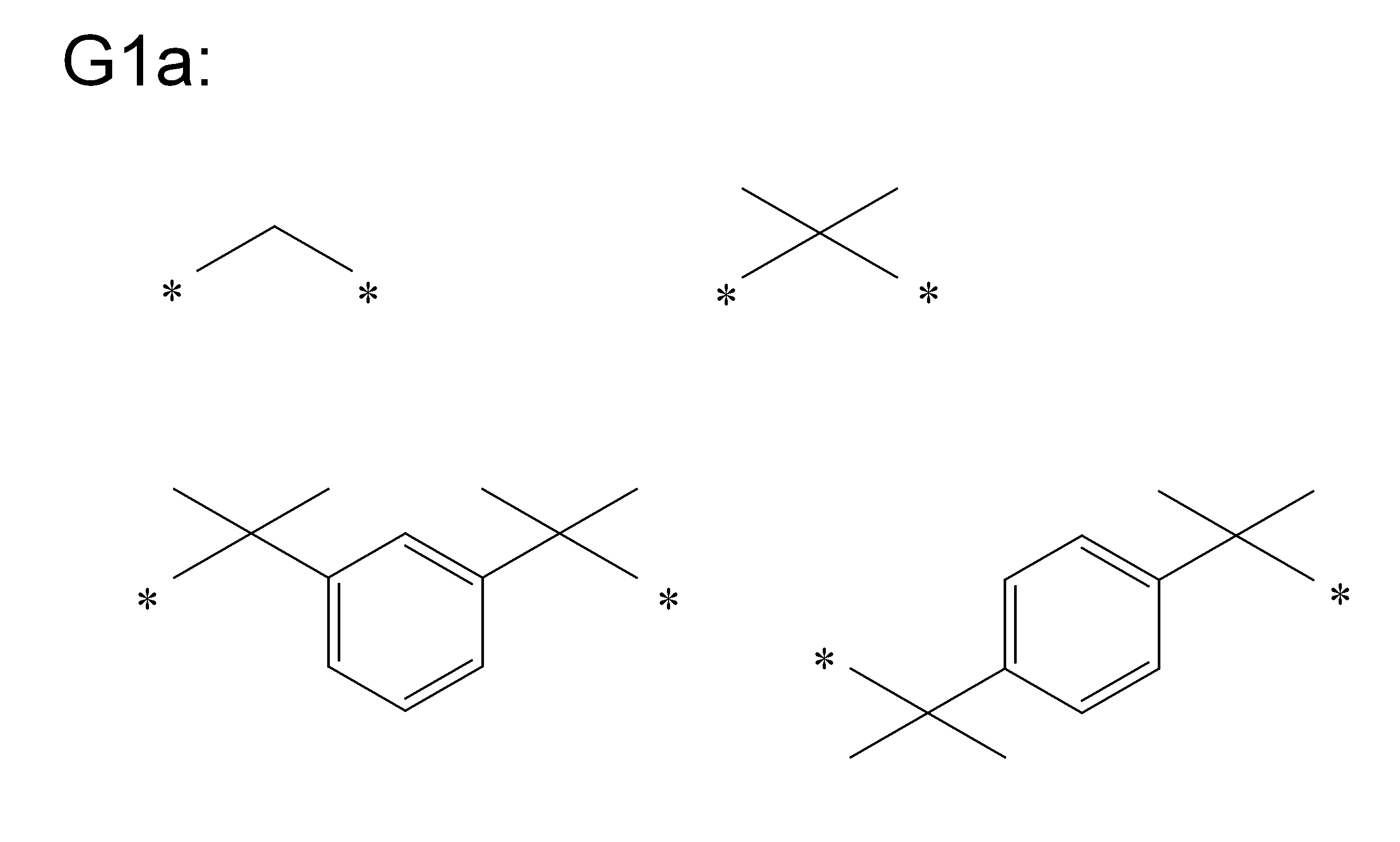
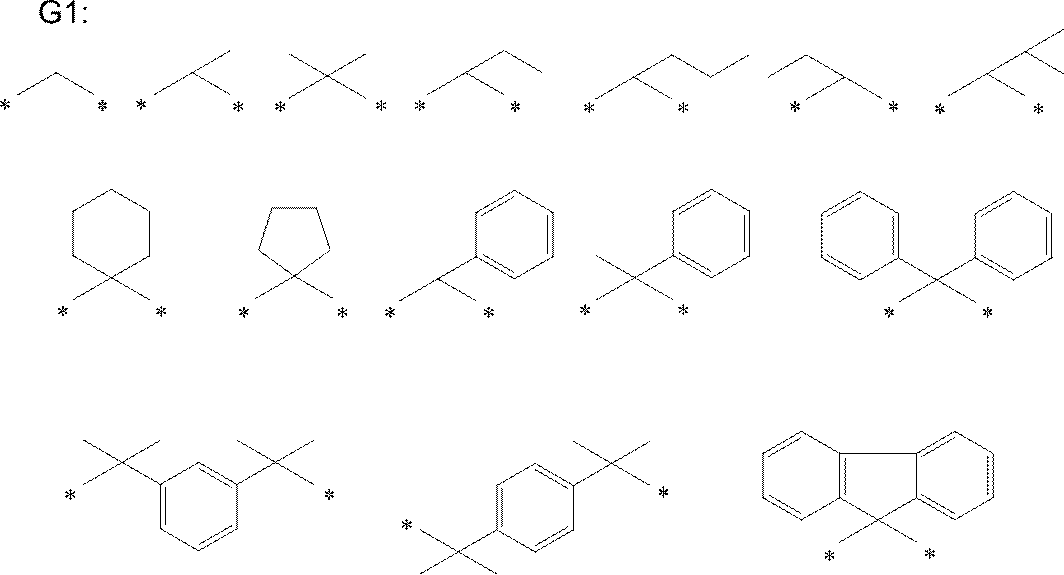
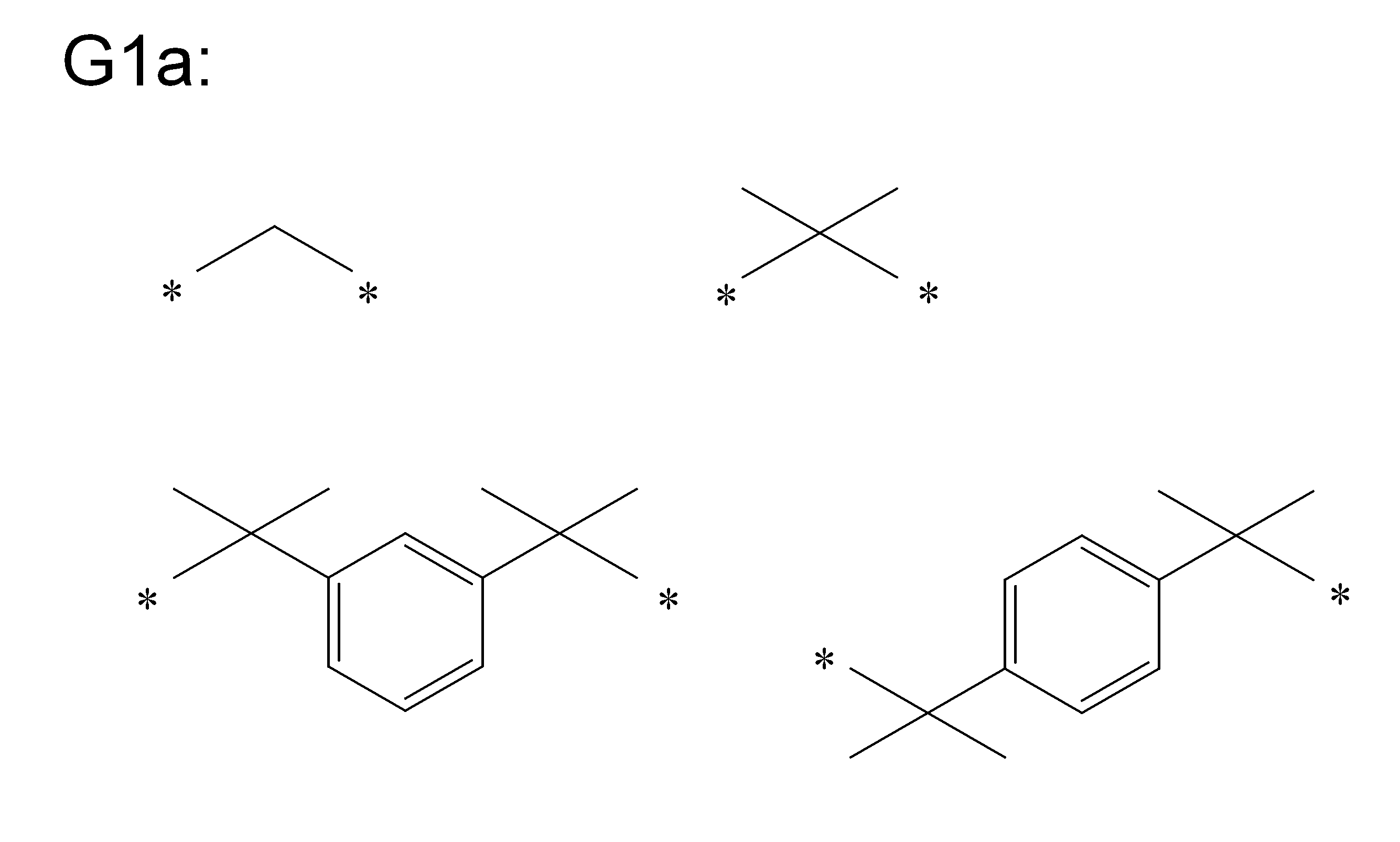
- X is at least one selected from the group consisting of the following group G1a.
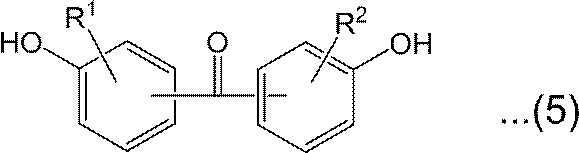
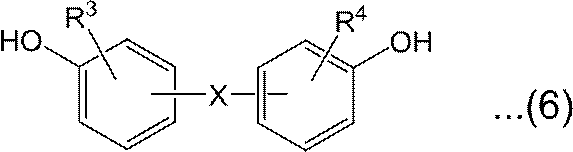
- a thermosetting resin having a benzoxazine ring obtained by reacting a compound represented by the following formula (5), a compound represented by the following formula (6), a diamine compound, and an aldehyde compound.
- R 1 and R 2 each independently represent hydrogen or an organic group having 1 to 20 carbon atoms.
- each of R 3 and R 4 independently represents hydrogen or an organic group having 1 to 20 carbon atoms, and
- X represents a straight chain which may contain a hetero element having 1 to 20 carbon atoms, It represents an aliphatic or aromatic organic group having a branched or cyclic structure.
- R 1 and R 2 each independently represent hydrogen or an organic group having 1 to 20 carbon atoms.
- each of R 3 and R 4 independently represents hydrogen or an organic group having 1 to 20 carbon atoms
- X represents a linear or branched chain having 1 to 20 carbon atoms and optionally containing a hetero element. Or an aliphatic or aromatic organic group having a cyclic structure.
- thermosetting resin having a benzoxazine ring that is excellent in dimensional stability can be provided.
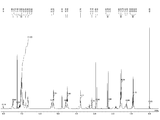
- FIG. 2 is a proton nuclear magnetic resonance spectrum ( 1 H-NMR spectrum) of a thermosetting resin having a benzoxazine ring produced in Example 1.
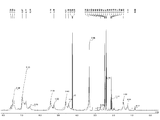
- FIG. 2 is a proton nuclear magnetic resonance spectrum ( 1 H-NMR spectrum) of a thermosetting resin having a benzoxazine ring produced in Example 2.
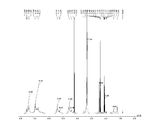
- FIG. 3 is a proton nuclear magnetic resonance spectrum ( 1 H-NMR spectrum) of a thermosetting resin having a benzoxazine ring produced in Example 3.
- FIG. FIG. 4 is a proton nuclear magnetic resonance spectrum ( 1 H-NMR spectrum) of a thermosetting resin having a benzoxazine ring produced in Example 4.
- FIG. 1 H-NMR spectrum 1 H-NMR spectrum
- FIG. 6 is a proton nuclear magnetic resonance spectrum ( 1 H-NMR spectrum) of a thermosetting resin having a benzoxazine ring produced in Example 5.
- FIG. 6 is a proton nuclear magnetic resonance spectrum ( 1 H-NMR spectrum) of a thermosetting resin having a benzoxazine ring produced in Example 6.
- FIG. 7 is a proton nuclear magnetic resonance spectrum ( 1 H-NMR spectrum) of a thermosetting resin having a benzoxazine ring produced in Example 7.
- FIG. 6 is a proton nuclear magnetic resonance spectrum ( 1 H-NMR spectrum) of a thermosetting resin having a benzoxazine ring produced in Example 5.
- FIG. 6 is a proton nuclear magnetic resonance spectrum ( 1 H-NMR spectrum) of a thermosetting resin having a benzoxazine ring produced in Example 5.
- FIG. 6 is a proton nuclear magnetic resonance spectrum ( 1 H-NMR spectrum) of a thermosetting resin having a benzoxazine ring produced in
- the present embodiment a mode for carrying out the present invention (hereinafter simply referred to as “the present embodiment”) will be described in detail.
- the following embodiments are examples for explaining the present invention, and are not intended to limit the present invention to the following contents.
- the present invention can be implemented with appropriate modifications within the scope of the gist thereof.
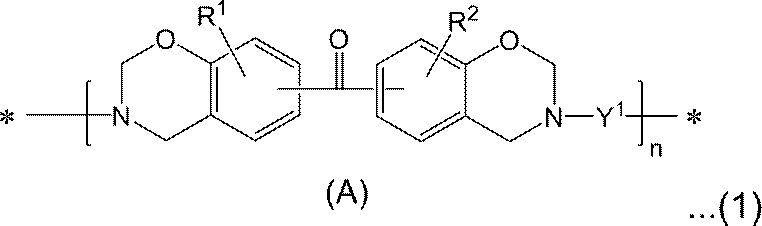
- thermosetting resin having a benzoxazine ring includes a structure A represented by the following formula (1) and a structure B represented by the following formula (2), and has a benzoxazine ring. Resin.
- the skeleton becomes moderately rigid, excellent in dimensional stability, excellent in solubility in organic solvents, and excellent in compatibility with other materials to be blended.
- the selection range is wide for other materials to be blended. (However, the operation of the present embodiment is not limited to this).
- thermosetting resin having a benzoxazine ring according to this embodiment can greatly reduce the coefficient of thermal expansion (CTE) as compared with the conventional one, and therefore has excellent dimensional stability from that viewpoint. It can be set as the thermosetting resin which has.
- each of R 1 and R 2 independently represents hydrogen or an organic group having 1 to 20 carbon atoms
- Y 1 each independently contains a hetero element having 1 to 20 carbon atoms.
- And represents an organic group of an aliphatic or aromatic diamine residue having a linear, branched, or cyclic structure, and n represents an integer of 1 to 500. Note that * represents a binding site.
- each of R 3 and R 4 independently represents hydrogen or an organic group having 1 to 20 carbon atoms
- X represents a straight chain which may contain a hetero element having 1 to 20 carbon atoms
- each Y 2 independently represents a linear, branched, Alternatively, it represents an organic group of an aliphatic or aromatic diamine residue having a cyclic structure
- m represents an integer of 1 to 500. Note that * represents a binding site.
- the ratio of the content of the structure A to the content of the structure B (A / B; molar ratio) in the thermosetting resin is not particularly limited, but is 1/99 to 99/1. Is preferably 10/90 to 90/10, more preferably 50/50 to 90/10, and still more preferably 70/30 to 90/10.
- the resulting resin has a molded body such as a cured film. There is a tendency that the thermal expansion coefficient (CTE) is further reduced.
- the resulting resin tends to further improve the compatibility with other materials and the solubility in a solvent used for blending, and a molded body such as a cured film and the like. There is a tendency that the flexibility at the time of the improvement is further improved.
- the ratio of the contents of the structure A and the structure B here can be obtained by 1 H-NMR.
- Y 1 and Y 2 in formulas (1) and (2) are each independently an aliphatic having a linear, branched, or cyclic structure having 1 to 20 carbon atoms and optionally containing a hetero element. Or represents an organic group of an aromatic diamine residue.
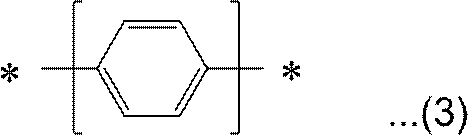
- at least one of Y 1 and Y 2 has a structure represented by the following formula (3).
- at least one of Y 1 and Y 2 is preferably a structure represented by the following formula (4).
- Y 1 and Y 2 may be the same or different.
- * represents a binding site
- * represents a binding site
- M and n in the formulas (1) and (2) may be independently an integer of 1 to 500, and more preferably an integer of 1 to 250.
- thermosetting resin having a benzoxazine ring of the present embodiment reacts a compound represented by the following formula (5), a compound represented by the following formula (6), a diamine compound, and an aldehyde compound. Can be obtained.
- at least a compound represented by the formula (5) and a compound represented by the formula (6) are used as the bifunctional phenol.
- By reacting these bifunctional phenols, diamine compounds, and aldehyde compounds it has a benzoxazine ring containing structure A represented by formula (1) and structure B represented by formula (2).
- a thermosetting resin can be obtained.
- R 1 and R 2 each independently represent hydrogen or an organic group having 1 to 20 carbon atoms.
- the structure is not particularly limited.
- an aliphatic group having a linear, branched, or cyclic structure, which may contain a heteroelement or a functional group, or aromatic It may be a group organic group.
- R 1 and R 2 may be the same or different.
- the functional group include an ether group, an alkoxy group, a ketone group, an ester group, an amide group, and a carboxyl group.
- the carbonyl group may be bonded at any of the ortho, meta, and para positions with respect to the bonding positions of the left and right hydroxyl groups. May be the same position, or may be different as in the ortho position and the para position.
- the bifunctional phenol compound represented by the formula (5) is not particularly limited, and examples thereof include 4,4′-dihydroxybenzophenone (DHBP), bis (4-hydroxyphenyl) sulfone (bisphenol S), 4,4 ′. -Biphenol, 1,4-benzenediol (hydroquinone) and the like. Among these, 4,4'-dihydroxybenzophenone (DHBP) is preferable.
- DHBP 4,4′-dihydroxybenzophenone
- DHBP 4,4'-dihydroxybenzophenone
- the bifunctional phenol compound represented by Formula (5) may be used individually by 1 type, and may use 2 or more types together.
- R 3 and R 4 each independently represent hydrogen or an organic group having 1 to 20 carbon atoms, and X may contain a heteroelement having 1 to 20 carbon atoms. It represents an aliphatic or aromatic organic group having a linear, branched, or cyclic structure.
- R 3 and R 4 are organic groups
- the structure is not particularly limited.
- the functional group include an ether group, an alkoxy group, a ketone group, an ester group, an amide group, and a carboxyl group.
- X may be bonded at any of the ortho, meta, and para positions with respect to the bonding positions of the left and right hydroxyl groups, and the bonding position of X is the right and left benzene rings, It may be the same position, or may be different such as the ortho position and the para position.
- X may be at least one selected from the group consisting of the following group G1.
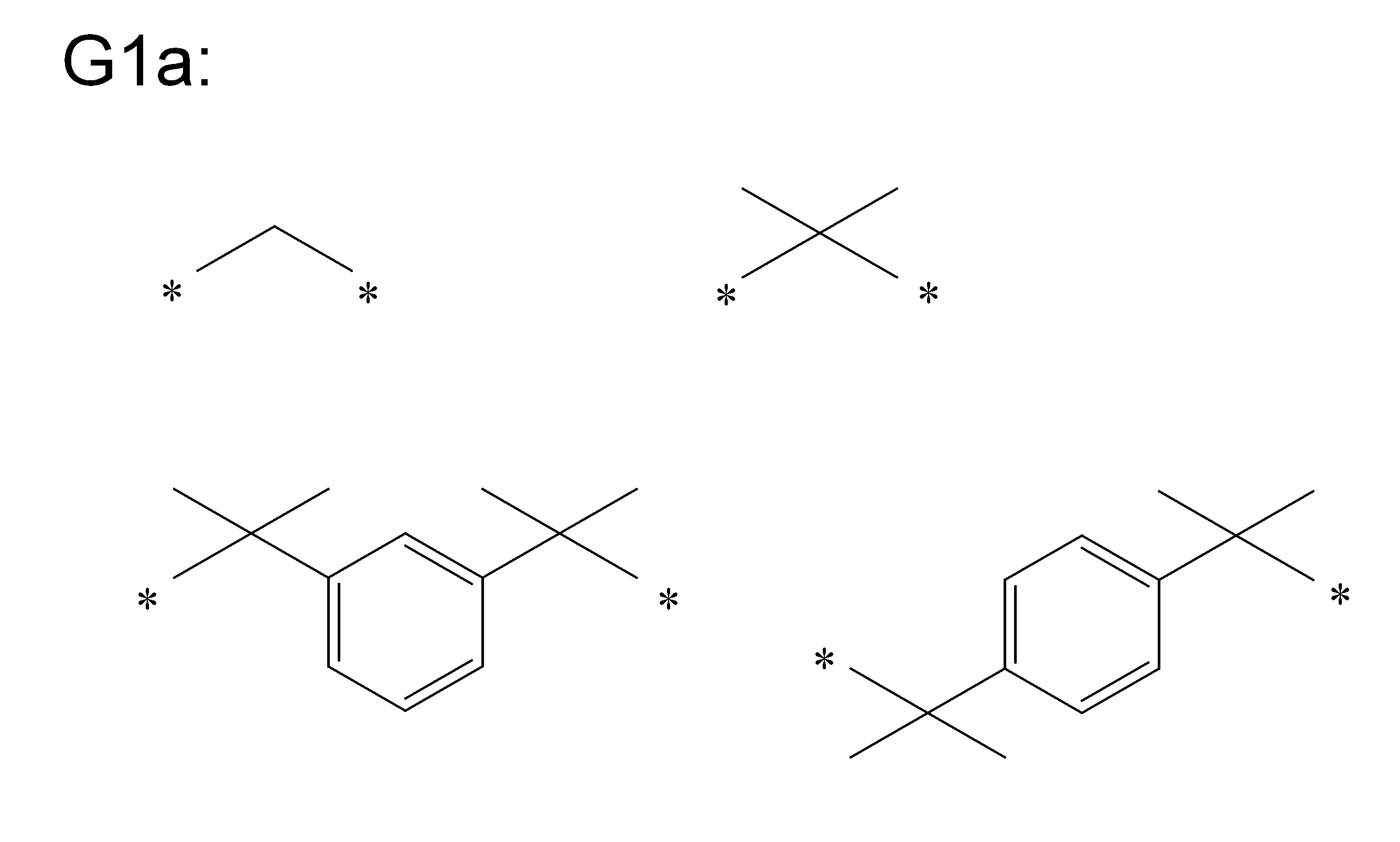
- G1a at least one selected from the group consisting of the following G1a from the viewpoint of compatibility with other materials, solubility in a solvent used for blending, and flexibility when forming a molded body such as a cured film. It is preferable that
- * represents a binding site
- * represents a binding site
- the bifunctional phenol compound represented by the formula (6) is not particularly limited.
- 4,4′-dihydroxydiphenyl-2,2-propane bisphenol A
- 4,4 ′-[1,3- Phenylenebis (1-methyl-ethylidene)] bisphenol bisphenol M
- 4,4 '-[1,4-phenylenebis (1-methyl-ethylidene)] bisphenol bisphenol P
- 4,4'-methylenediphenol (Bisphenol F) etc. are mentioned.
- 4,4′-dihydroxydiphenyl-2,2 from the viewpoint of compatibility with other materials, solubility in a solvent used for blending, and flexibility when forming a molded product such as a cured film.
- -Propane bisphenol A
- the bifunctional phenol compound represented by Formula (6) may be used individually by 1 type, and may use 2 or more types together.
- the diamine compound is not particularly limited, and an aliphatic diamine compound having a linear structure or a branched structure, an alicyclic diamine compound, an aromatic diamine compound, or the like can be used. These may be substituted or unsubstituted, and may contain a hetero element or a functional group.
- the functional group include an ether group, an alkoxy group, a ketone group, an ester group, an amide group, and a carboxyl group.
- the compound represented by the formula (9) and the compound represented by the formula (10) may be cis isomer, trans isomer, or any mixture of cis isomer and trans isomer, respectively.
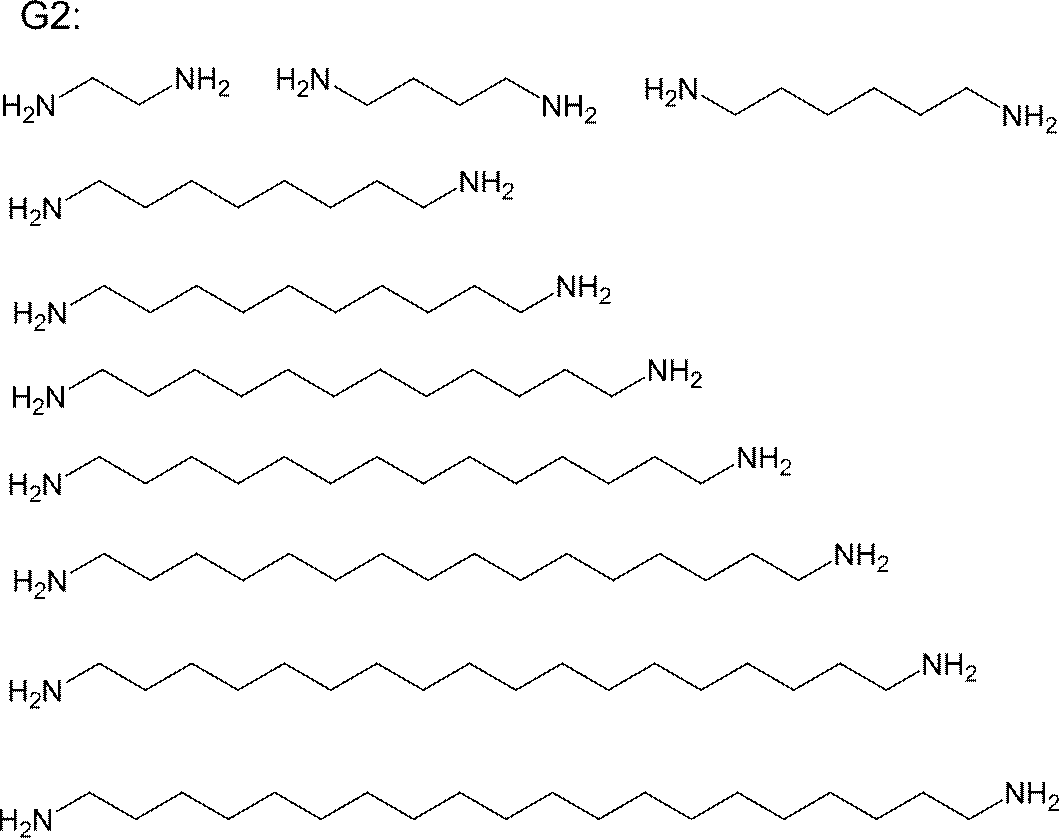
- linear aliphatic diamine compound selected from the group which consists of the following group G2 is mentioned.
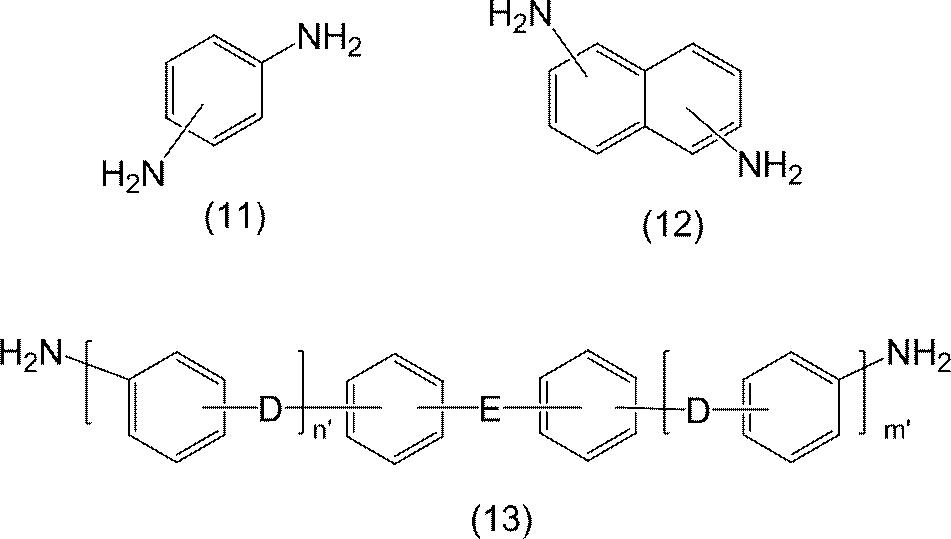
- the compound represented by following formula (11), the compound represented by following formula (12), and the aromatic represented by following formula (13) Examples include diamine compounds.
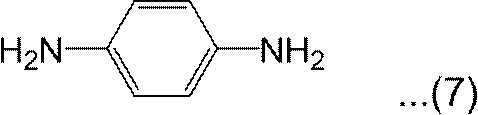
- Examples of the compound represented by the formula (11) include a compound represented by the following formula (7) (p-phenylenediamine).
- each D is independently a direct bond (no atom or atomic group), or a straight, branched, or cyclic structure that may contain a heteroelement or a functional group.
- D may be the same or different.
- E represents a direct bond (no atom or atomic group), or an aliphatic or aromatic organic group having a linear, branched, or cyclic structure, which may contain a hetero element or a functional group. .
- Each of the above aliphatic organic groups or aromatic organic groups may have a substituent.
- substituents examples include an aliphatic hydrocarbon group having a straight chain, branched or cyclic structure having 1 to 20 carbon atoms, or a substituted or unsubstituted aromatic hydrocarbon group.
- functional group examples include an ether group, an alkoxy group, a ketone group, an ester group, an amide group, and a carboxyl group.
- n ′ and m ′ each independently represent an integer of 0 to 10.
- Each aromatic ring of formula (11), formula (12), and formula (13) may have a substituent.
- the substituent is not particularly limited, and examples thereof include an aliphatic hydrocarbon group having a linear, branched, or cyclic structure having 1 to 20 carbon atoms, or an aromatic hydrocarbon group.
- the substituent may contain a hetero element or a functional group.
- examples of the functional group include an ether group, an alkoxy group, a ketone group, an ester group, an amide group, and a carboxyl group.
- D may be bonded at any one of the ortho position, the meta position, and the para position with respect to the bonding positions of the left and right amino groups. It may be the same position, or may be different such as the ortho position and the para position. It is sufficient that E is bonded to any of the ortho, meta, and para positions with respect to the right and left D bonding positions, and the bonding position of E is the same position in the left and right benzene rings. Or it may be different as in the ortho and para positions.
- D may be at least one selected from the group consisting of the following group G3. .
- * represents a binding site
- E may be at least one selected from the group consisting of the following group G4. .
- * represents a binding site
- n ′ and m ′ may independently be an integer of 0 to 10, preferably an integer of 0 to 5, and from the viewpoint of availability, 0 to 1 It is more preferable that
- the diamine compound is a compound represented by the following formula (14).
- E represents a direct bond (no atom or atomic group), an aliphatic having a linear, branched, or cyclic structure, which may contain a hetero element or a functional group, or an aromatic Represents an organic group.
- the functional group include an ether group, an alkoxy group, a ketone group, an ester group, an amide group, and a carboxyl group.
- E in Formula (14) is an aliphatic organic group or an aromatic organic group, each may have a substituent.
- substituents include an aliphatic hydrocarbon group having a straight chain, branched or cyclic structure having 1 to 20 carbon atoms, or a substituted or unsubstituted aromatic hydrocarbon group.
- E may be bonded at any of the ortho position, the meta position, and the para position with respect to the bonding positions of the left and right amino groups. It may be the same position, or may be different such as the ortho position and the para position.
- Examples of the compound represented by the formula (14) include a compound represented by the following formula (8) (4,4′-diaminodiphenylmethane).
- the diamine compound is not particularly limited. Specifically, 3 (4), 8 (9), -bis (aminomethyl) tricyclo [5.2.1.0 2,6 ] decane, 2,5 ( 6) Cycloaliphatic diamine compounds such as -bis (aminomethyl) bicyclo [2.2.1] heptane; 1,2-diaminoethane, 1,6-diaminohexane, 1,10-diaminodecane, 1,12- Linear aliphatic diamine compounds such as diaminododecane, 1,14-diaminotetradecane, and 1,18-diaminooctadecane; branched aliphatic diamine compounds such as tetramethyl-1,3-diaminopropane; p-phenylenediamine, 4, 4′-diaminodiphenylmethane, 4,4′-diamino-3,3′-dimethyldiphenylmethane, 4,4′-
- the amount of the diamine compound used is preferably 0.1 to 2 mol, more preferably 0.3 to 1.8 mol, and more preferably 0.5 to 1.5 mol with respect to 1 mol of all bifunctional phenol compounds. More preferably it is.
- the compound represented by the formula (5) and the formula (6) are represented. It means that the amount of the diamine compound used is within the above range with respect to 1 mol of the total amount of the compound.
- the bifunctional phenol compound By making the amount of the diamine compound used relative to 1 mol of the bifunctional phenol compound 0.1 mol or more, the bifunctional phenol compound is sufficiently reacted without remaining to further increase the molecular weight of the thermosetting resin having a benzoxazine ring. Can be made.
- thermosetting resin having a benzoxazine ring is synthesized by using a bifunctional phenol compound represented by formula (5) and a bifunctional phenol compound represented by formula (6) in combination.
- the amount of the bifunctional phenol compound represented by the formula (6) is preferably 1 to 99 mol%, and preferably 10 to 90 mol% of the total bifunctional phenol. More preferably, it is 10 to 50 mol%, still more preferably 10 to 30 mol%.
- the usage-amount of the bifunctional phenolic compound represented by Formula (6) is said lower limit.
- the resin obtained has a tendency to further improve the compatibility with other materials and the solubility in the solvent used for blending, and the flexibility when formed into a molded body such as a cured film. There is a tendency to further improve.
- the thermal expansion coefficient at the time of setting it as molded objects, such as a cured film, about the resin obtained tends to reduce further. There is.
- Formaldehyde is preferable and can be used with forms, such as paraformaldehyde which is the polymer, and formalin which is aqueous solution. Moreover, it can also be used as a hemiacetal obtained by reacting formaldehyde or paraformaldehyde with an alcohol.
- the alcohol is not particularly limited, and examples thereof include methanol, ethanol, 1-propanol, isopropanol, 1-butanol, and 2-butanol. Among these, methanol is preferable from the viewpoint of ease of distillation. Alcohol may be used individually by 1 type and may use 2 or more types together.
- the amount of the aldehyde compound used is preferably 4 to 8 mol, more preferably 4 to 7 mol, and still more preferably 4 to 6 mol with respect to 1 mol of the diamine compound.
- the amount of the aldehyde compound used is preferably 4 to 8 mol, more preferably 4 to 7 mol, and still more preferably 4 to 6 mol with respect to 1 mol of the diamine compound.
- thermosetting resin having a benzoxazine ring In the method for producing a thermosetting resin having a benzoxazine ring, a monofunctional phenol compound may be further added and reacted together with the bifunctional phenol compound.
- a monofunctional phenol compound When a monofunctional phenol compound is used in combination, a polymer having a reactive end sealed with a benzoxazine ring is produced.
- the molecular weight of the polymer can be controlled during the synthesis reaction, and gelation of the solution can be effectively prevented.
- the storage stability of the thermosetting resin which has a benzoxazine ring can also be improved by sealing the reactive terminal of a polymer. As a result, insolubilization of the thermosetting resin having a benzoxazine ring can be effectively prevented.
- the monofunctional phenol compound is not particularly limited.
- phenol is preferable from the viewpoint of versatility and cost.
- a monofunctional phenol compound may be used individually by 1 type, and may use 2 or more types together.
- the amount of the monofunctional phenol compound used is preferably 0.5 mol or less with respect to 1 mol of all the bifunctional phenol compounds.
- the thermosetting resin having a benzoxazine ring structure can be made higher in molecular weight during the synthesis reaction.
- the remaining amount of the monofunctional phenol can be reduced by sufficiently reacting the monofunctional phenol compound.
- a known solvent can be used as a solvent, but a solvent containing a cyclic ester or a lactone solvent is preferably used as a synthesis solvent.
- a solvent containing a cyclic ester or a lactone solvent is preferably used as a synthesis solvent.
- the cyclic ester or lactone solvent is not particularly limited, and examples thereof include ⁇ -caprolactone, ⁇ -valerolactone, ⁇ -butyrolactone, ⁇ -propiolactone, ⁇ -butyrolactone, ⁇ -valerolactone, ⁇ -caprolactone, and ⁇ -caprolactone.
- cyclic esters such as 3-methyloctano-4-lactone and 4-hydroxy-3-pentenoic acid ⁇ -lactone or lactone solvents.
- highly versatile ⁇ -butyrolactone, ⁇ -caprolactone, ⁇ -valerolactone, and the like are preferable.
- a cyclic ester or lactone solvent may be used individually by 1 type, and may use 2 or more types together.
- the solvent may be a mixed solvent of a cyclic ester or lactone solvent and an alcohol.
- the alcohol is not particularly limited, and examples thereof include methanol, ethanol, 1-propanol, isopropanol, 1-butanol, 2-butanol, isobutanol, 2-methoxyethanol, and 2-ethoxyethanol. Of these, isobutanol and 2-methoxyethanol are preferred. Alcohol may be used individually by 1 type and may use 2 or more types together.
- the mixed solvent of the cyclic ester or lactone solvent and the alcohol is not particularly limited, but a combination of ⁇ -butyrolactone and isobutanol and ⁇ -butyrolactone and 2-methoxyethanol is preferable from the viewpoint of reaction temperature and the like.
- the proportion of the alcohol in the mixed solvent of the cyclic ester or lactone solvent and the alcohol is preferably 50% by volume or less from the viewpoint of allowing the synthesis reaction to proceed efficiently.
- the proportion of the alcohol is 50% by volume or less, the synthesis reaction of the thermosetting resin having a benzoxazine ring can be performed in a short time, so that the synthesis efficiency can be increased.
- the solvent may be a mixed solvent of a cyclic ester or lactone solvent and an aromatic nonpolar solvent.
- the aromatic nonpolar solvent is not particularly limited, and examples thereof include benzene, toluene, xylene, pseudocumene, and mesitylene. Among these, toluene and xylene are preferable because they are versatile and inexpensive.
- An aromatic nonpolar solvent may be used individually by 1 type, and may use 2 or more types together.
- the mixed solvent of the cyclic ester or lactone solvent and the aromatic nonpolar solvent is not particularly limited, but a combination of ⁇ -butyrolactone and toluene, and ⁇ -butyrolactone and xylene is preferable from the viewpoint of reaction temperature and the like.
- the ratio of the aromatic nonpolar solvent in the mixed solvent of the cyclic ester or lactone solvent and the aromatic nonpolar solvent is 50% by volume with respect to the entire mixed solvent from the viewpoint of not reducing the solubility of the raw material.
- the following is preferable.
- the solvent may be a mixed solvent of a cyclic ester or lactone solvent, an aromatic nonpolar solvent, and an alcohol. From the viewpoint of allowing the synthesis reaction to proceed efficiently and not reducing the solubility of the raw material in the solvent, the total of the aromatic nonpolar solvent and the alcohol is 50% by volume or less of the entire mixed solvent. It is preferable.
- the amount of the solvent is preferably such that the molar concentration of the bifunctional phenol compound is 0.1 to 5.0 mol / L, more preferably 0.1 to 4.0 mol / L, and 0.1 to 3 More preferably, it is 0.0 mol / L.
- the concentration of the bifunctional phenol compound By setting the concentration of the bifunctional phenol compound to 5.0 mol / L or less, the gelation of the reaction solution can be effectively suppressed during the synthesis reaction of the thermosetting resin having a benzoxazine ring, and the resulting benzoxazine ring is obtained. Insolubilization of the thermosetting resin having can be prevented.
- the order of adding and mixing the raw materials is not particularly limited.
- a bifunctional phenol compound, a diamine compound, and an aldehyde compound may be sequentially added to the solvent and mixed. It is preferable to add a bifunctional phenol compound, a diamine compound, and a solvent and mix them to obtain a mixed solution, and then add and mix the aldehyde compound with the mixed solution. That is, in the production method according to the present embodiment, a bifunctional phenol compound (such as the compound represented by the above formula (5) and the compound represented by the above formula (6)), a diamine compound, and a solvent are mixed. And a step of further adding an aldehyde compound to the mixed solution and reacting them.
- thermosetting resin in the method for producing a thermosetting resin according to the present embodiment, from the viewpoint of improving the reaction efficiency, heating may be performed, or a bifunctional phenol may be appropriately stirred with a stirrer or a stirrer using a stirrer. A compound or the like may be added and mixed.
- the reaction may be carried out in the presence of an inert gas by purging an inert gas such as nitrogen gas, if necessary.
- the method of heating is not particularly limited, and examples thereof include a method in which a temperature controller such as an oil bath is used to raise the temperature to a predetermined temperature at a stretch and then keep the temperature constant.
- a temperature controller such as an oil bath
- the predetermined temperature at the time of the heating treatment is not particularly limited as long as the synthesis reaction of the thermosetting resin having a benzoxazine ring is made efficient, but the reaction solution temperature is in the range of 10 to 150 ° C. It is preferably 30 to 150 ° C, more preferably 50 to 150 ° C.
- the reaction solution temperature is in the range of 10 to 150 ° C. It is preferably 30 to 150 ° C, more preferably 50 to 150 ° C.
- the method for producing a thermosetting resin according to this embodiment may further include a step of removing water generated by the reaction.
- removing the water generated by the reaction it is possible to shorten the synthesis reaction time of the thermosetting resin having a benzoxazine ring, and to improve the efficiency of the reaction.
- generated water is not specifically limited, The method etc. which azeotrope with the solvent in a reaction solution are mentioned.
- water generated by using an isobaric dropping funnel with a cock, a Dimroth cooler, a Dean-Stark device, or the like can be removed from the reaction system.
- the duration of heating is not particularly limited, but is preferably about 1 to 20 hours, more preferably about 2 to 15 hours after the start of heating.
- the reaction solution may be allowed to cool by being released from contact with a temperature controller such as an oil bath, or may be cooled using a refrigerant or the like. .
- thermosetting resin which concerns on this embodiment makes the solution containing the compound represented by Formula (5), the compound represented by Formula (6), a diamine compound, and an aldehyde compound react. It is preferable to further include a step of washing the solution after the reaction with a basic aqueous solution after the step. By further including the washing step, the unreacted bifunctional phenol compound or monofunctional phenol compound can be efficiently removed from the reaction solution.
- the basic aqueous solution is not particularly limited as long as it is an aqueous solution in which a basic compound is dissolved in water. Although it does not specifically limit as a basic compound, For example, sodium hydroxide, potassium hydroxide, calcium hydroxide etc. are mentioned. Among these, sodium hydroxide is preferable from the viewpoint of versatility.
- the washing step it is preferable to wash the reaction solution with a basic aqueous solution and then wash with distilled water or the like. For example, by washing several times with distilled water, ions derived from a basic aqueous solution such as sodium ions can be effectively removed.
- the method for recovering the thermosetting resin having a benzoxazine ring from the reaction solution is not particularly limited.
- the reaction solution may be filtered after the reaction as a pretreatment.
- thermosetting resin having a benzoxazine ring obtained according to the present embodiment has a high molecular weight, and the ring-opening reaction can be promoted by heating the thermosetting resin, so that a cured product is obtained. Can do.
- the thermosetting resin according to the present embodiment is thermoformed into a final product such as a film, improvement in physical properties such as heat resistance and flexibility can be expected.
- a bifunctional phenolic compound and a diamine compound it is considered that the proportion of the thermosetting resin having a benzoxazine ring obtained after the reaction is kept linear, and as a result, the resin is obtained after the resin is cured.
- the weight average molecular weight (Mw) in terms of polyethylene glycol obtained by gel permeation chromatography (GPC) measurement of the thermosetting resin having a benzoxazine ring according to this embodiment is preferably 2000 to 300000, more Preferably it is 2000-100000, more preferably 3000-50000, and still more preferably 4000-30000.
- the term “thermosetting resin having a high molecular weight benzoxazine ring” refers to a prepolymer type benzoxazine resin, that is, a thermosetting resin having a structure having a benzoxazine ring in a repeating unit. It means that the weight average molecular weight is controlled to about 2,000 to 300,000.
- thermosetting resin By setting the weight average molecular weight of the thermosetting resin to 2000 or more, the heat resistance and flexibility of the final product obtained by the subsequent ring-opening reaction can be increased. Furthermore, the recovery workability of the thermosetting resin having a benzoxazine ring manufactured in the manufacturing method according to the present embodiment can be increased, and the yield can be improved. By setting the weight average molecular weight to 300000 or less, the thermosetting resin having a benzoxazine ring obtained after synthesis can be further improved in solubility in various organic solvents. In addition, compatibility with other thermosetting resins and the like can be ensured.
- thermosetting resin for example, during the synthesis reaction, a part of the reaction solution is collected and has a benzoxazine ring dissolved in the solution.
- the method of controlling the weight average molecular weight of the thermosetting resin which has a benzoxazine ring by measuring the molecular weight of a thermosetting resin by GPC is mentioned.
- thermosetting resin having a benzoxazine ring can have a halogen atom in its structure, and can be produced using a solvent that does not contain a halogen compound as an impurity. It is also possible to use a thermosetting resin that is not contained in.
- the thermosetting resin having a benzoxazine ring may be a curing accelerator, a flame retardant, an inorganic filler, a release agent, an adhesion-imparting agent, a surfactant, a colorant, a coupling agent, a leveling agent, if necessary.
- Other thermosetting resins and the like can be added to form a thermosetting resin composition.
- the thermosetting resin composition having a benzoxazine ring may further contain the above-described solvent.
- a thermosetting resin composition having a benzoxazine ring is suitably used as a binder such as an electronic material such as a laminate or a semiconductor encapsulant, a friction material or a grindstone by being molded or cured by a conventionally known method. Can do.
- thermosetting resin having a benzoxazine ring obtained by the production method of the present embodiment, a molded article obtained by molding or curing a thermosetting resin composition containing the thermosetting resin by a conventionally known method, or curing.
- the body is suitable for applications such as multilayer substrates, laminates, sealants, adhesives, etc. as electronic parts / electronic devices and their materials.
- the molded product of the present embodiment is a molded product obtained by partially curing the thermosetting resin having the benzoxazine ring described above or a thermosetting resin composition containing the same, if necessary, or without curing. .
- the thermosetting resin having the benzoxazine ring described above has moldability before curing, the molded body once cured before curing and then cured ( Cured molded body) or those cured simultaneously with molding (cured body) may be used.
- the dimension and shape in particular are not restrict
- the electronic device of the present embodiment includes any one of the thermosetting resin having the benzoxazine ring, the thermosetting resin composition, the molded body, and the cured body.
- molded articles are suitable for applications such as multilayer boards, laminates, sealants and adhesives that require excellent dimensional stability, especially low thermal expansion coefficient, as electronic parts / electronic devices and their materials. Can be used.
- examples of the electronic device include a mobile phone, a display device, an in-vehicle device, a computer, and a communication device.
- it can be used for aircraft members, automobile members, building members, etc., and is used for forming a circuit that can flow a direct current or alternating current by using as a heat-resistant binder for conductive materials, particularly metal fillers. Also good.
- Measurement was performed at a sample concentration of 1.3% by mass using the following measuring apparatus and solvent.
- Measuring device JEOL, ECX400 (400MHz)
- Solvent Heavy DMSO containing 0.05% by volume of TMS (tetramethylsilane) (dimethyl sulfoxide; manufactured by Sigma-Aldrich) or heavy chloroform containing 0.05% by volume of TMS (manufactured by Cambridge Isotop Laboratories) was used. .
- CTE thermal expansion coefficient
- Example 1 In a 300 mL flask in which a constant pressure dropping funnel with a cock and a Dimroth condenser are set, 200 mL of ⁇ -butyrolactone (manufactured by Wako Pure Chemical Industries, Ltd.), 4,4′-dihydroxybenzophenone (hereinafter referred to as DHBP).
- ⁇ -butyrolactone manufactured by Wako Pure Chemical Industries, Ltd.
- DHBP 4,4′-dihydroxybenzophenone
- thermosetting resin A having a benzoxazine ring had a weight average molecular weight (Mw) of about 10,000.
- Example 2 In a 300 mL flask in which a constant pressure dropping funnel with a cock and a Dimroth condenser were set, 200 mL of ⁇ -butyrolactone (manufactured by Wako Pure Chemical Industries, Ltd.), 7.76 g of DHBP (0.036 mol, manufactured by Wako Pure Chemical Industries, Ltd.), BisA 19.18 g (0.084 mol, manufactured by GE Plastics, Inc.) and MDA 23.89 g (0.12 mol, manufactured by Hodogaya Chemical Co., Ltd., product name “DAM”) were added, and nitrogen gas purge into the system was started ( Flow rate 15 mL / min). The reaction solution was stirred at 100 ° C.
- ⁇ -butyrolactone manufactured by Wako Pure Chemical Industries, Ltd.
- DHBP 0.036 mol, manufactured by Wako Pure Chemical Industries, Ltd.
- BisA 19.18 g 0.084 mol, manufactured by GE Plastics, Inc.
- thermosetting resin B having a benzoxazine ring had a weight average molecular weight (Mw) of about 6000.
- Example 3 In a 300 mL flask in which a constant pressure dropping funnel with a cock and a Dimroth condenser were set, 200 mL of ⁇ -butyrolactone (manufactured by Wako Pure Chemical Industries, Ltd.), 18.12 g of DHBP (0.084 mol, manufactured by Wako Pure Chemical Industries, Ltd.), BisA 8.22 g (0.036 mol, manufactured by GE Plastics, Inc.) and MDA 23.89 g (0.12 mol, manufactured by Hodogaya Chemical Co., Ltd., product name “DAM”) were added, and nitrogen gas purge was started into the system ( Flow rate 15 mL / min). The reaction solution was stirred at 100 ° C.
- ⁇ -butyrolactone manufactured by Wako Pure Chemical Industries, Ltd.
- DHBP 0.084 mol, manufactured by Wako Pure Chemical Industries, Ltd.
- BisA 8.22 g 0.036 mol, manufactured by GE Plastics, Inc.
- thermosetting resin C having a benzoxazine ring had a weight average molecular weight (Mw) of about 8,000.
- Example 4 In a 300 mL flask in which an isostatic dropping funnel with a cock and a Dimroth condenser were set, 200 mL of ⁇ -butyrolactone (manufactured by Wako Pure Chemical Industries, Ltd.), 12.94 g of DHBP (0.06 mol, manufactured by Wako Pure Chemical Industries, Ltd.) , BisA 13.70 g (0.06 mol, manufactured by GE Plastics, Inc.), p-phenylenediamine (hereinafter also referred to as PDA) 12.99 g (0.12 mol, manufactured by Daishin Kasei Kogyo Co., Ltd., product name “Paramin”) ) And nitrogen gas purge into the system was started (flow rate: 15 mL / min).
- PDA p-phenylenediamine
- thermosetting resin D having a benzoxazine ring had a weight average molecular weight (Mw) of about 8,000.
- Example 5 In a 300 mL flask in which an isostatic dropping funnel with a cock and a Dimroth condenser are set, 200 mL of ⁇ -butyrolactone (manufactured by Wako Pure Chemical Industries), 18.12 g of DHBP (0.084 mol, manufactured by Wako Pure Chemical Industries) , BisA 8.22 g (0.036 mol, manufactured by GE Plastics Japan Ltd.), PDA 12.99 g (0.12 mol, manufactured by Daishin Kasei Kogyo Co., Ltd., product name “Paramine”), and nitrogen gas purge into the system Started (flow rate 15 mL / min). The reaction solution was stirred at 100 ° C.
- thermosetting resin E having a benzoxazine ring had a weight average molecular weight (Mw) of about 7000.
- Example 6 In a 300 mL flask in which a constant pressure dropping funnel with a cock and a Dimroth condenser are set, 200 mL of ⁇ -butyrolactone (manufactured by Wako Pure Chemical Industries, Ltd.), 21.99 g of DHBP (0.102 mol, manufactured by Wako Pure Chemical Industries, Ltd.) , BisA 4.11 g (0.018 mol, manufactured by GE Plastics, Inc.), PDA 12.99 g (0.12 mol, manufactured by Daishin Kasei Kogyo Co., Ltd., product name “Paramin”), and nitrogen gas purge into the system Started (flow rate 15 mL / min). The reaction solution was stirred at 100 ° C.
- thermosetting resin F having a benzoxazine ring had a weight average molecular weight (Mw) of about 6000.
- Example 7 In a 300 mL flask in which an isostatic dropping funnel with a cock and a Dimroth condenser were set, 200 mL of ⁇ -butyrolactone (manufactured by Wako Pure Chemical Industries, Ltd.), 23.29 g of DHBP (0.108 mol, manufactured by Wako Pure Chemical Industries, Ltd.) , BisA 2.74 g (0.012 mol, manufactured by Nippon Plastics Co., Ltd.), PDA 12.99 g (0.12 mol, manufactured by Daishin Kasei Kogyo Co., Ltd., product name “Paramine”), and nitrogen gas purge into the system Started (flow rate 15 mL / min). The reaction solution was stirred at 100 ° C.
- thermosetting resin G having a benzoxazine ring had a weight average molecular weight (Mw) of about 7000.
- thermosetting resin H having a benzoxazine ring had a weight average molecular weight of about 16000.
- thermosetting resin prepared in Examples 1 to 3 was dissolved in 5 g of dimethylformamide to obtain a yellow viscous liquid.
- This viscous liquid is applied onto a polyimide (PI) film using an applicator, and is 10 minutes at 80 ° C., 10 minutes at 100 ° C., 10 minutes at 150 ° C., 30 minutes at 180 ° C., 30 minutes at 200 ° C. Minutes, 220 ° C. for 30 minutes, 240 ° C. for 30 minutes, and 260 ° C. for 1 hour, respectively, and thermally cured in an oven.
- a film-like cured product was obtained by this heat curing.
- the cured product was yellow and transparent, and the thickness was 45 ⁇ m.
- thermosetting resin prepared in Examples 4 to 7 was dissolved in 5 g of dimethylformamide to obtain a red viscous liquid.
- This viscous liquid is applied onto a polyimide (PI) film using an applicator, and is 10 minutes at 80 ° C., 10 minutes at 100 ° C., 10 minutes at 150 ° C., 30 minutes at 180 ° C., 30 minutes at 200 ° C. Minutes, 220 ° C. for 30 minutes, 240 ° C. for 30 minutes, and 260 ° C. for 1 hour, respectively, and thermally cured in an oven.
- a film-like cured product (films D to G) was obtained by this heat curing. This cured product was red and transparent and had a thickness of 45 ⁇ m.
- thermosetting resin H produced in Comparative Example 1 was dissolved in 5 g of dimethylformamide to obtain a yellow viscous liquid.
- This viscous liquid is applied on a PI film using an applicator, and is 10 minutes at 80 ° C., 10 minutes at 100 ° C., 10 minutes at 150 ° C., 30 minutes at 180 ° C., 30 minutes at 200 ° C., 220 It was kept at 30 ° C. for 30 minutes and at 240 ° C. for 1 hour, and was thermally cured in an oven.
- a film-like cured product (film H) was obtained by this heat curing.
- the cured product was yellow and transparent and had a thickness of 51 ⁇ m.
- it thermally decomposes when it heats to 260 degreeC it heat-cured by making 240 degreeC into an upper limit.
- thermosetting resin E produced in Example 5 and 5 g of cyclohexanone (manufactured by Wako Pure Chemical Industries, Ltd.) are weighed, and 10 minutes with Awatori Netaro ARE-250 (manufactured by THINKY). When stirred, a uniform solution in which the thermosetting resin E was dissolved was obtained.
- thermosetting resin I having a benzoxazine ring had a weight average molecular weight (Mw) of about 7000.
- thermosetting resin I produced in Comparative Example 3 and 5 g of cyclohexanone (manufactured by Wako Pure Chemical Industries, Ltd.) are weighed, and 10 minutes with Awatori Netaro ARE-250 (manufactured by THINKY). Although stirred, the thermosetting resin I was insoluble.
- Example 16 In a glass container, 0.1 g of thermosetting resin E and 5 g of bisphenol A type epoxy resin RE-410S (liquid, manufactured by Nippon Kayaku Co., Ltd.) are weighed, and Awatori Netaro ARE-250 (manufactured by THINKY) Stir for 10 minutes. When the state of the obtained solution was visually observed, it was uniform.
- thermosetting resin I 0.1 g of thermosetting resin I and 5 g of bisphenol A type epoxy resin RE-410S (liquid, manufactured by Nippon Kayaku Co., Ltd.) are weighed, and Awatori Netaro ARE-250 (manufactured by THINKY Co., Ltd.) Stir for 10 minutes. When the state of the obtained solution was observed visually, it was turbid.
- Example 17 In a glass container, 0.1 g of thermosetting resin E and 5 g of alkylphenol monoglycidyl ether YED122 (liquid, manufactured by Mitsubishi Chemical Corporation) were weighed and stirred for 10 minutes with Awatori Netaro ARE-250 (manufactured by THINKY). . When the state of the obtained solution was visually observed, it was uniform.
- thermosetting resin I 0.1 g of thermosetting resin I and 5 g of alkylphenol monoglycidyl ether YED122 (liquid, manufactured by Mitsubishi Chemical Corporation) were weighed and stirred for 10 minutes with Awatori Netaro ARE-250 (manufactured by THINKY). . When the state of the obtained solution was observed visually, it was turbid.
- thermosetting resin having a benzoxazine ring according to the present invention thermosetting resin composition, molded body and cured body thereof are electronic materials such as laminates and semiconductor encapsulants, and binders such as friction materials and grindstones.
- the present invention has industrial applicability and can be suitably used as various electronic devices.
Landscapes
- Chemical & Material Sciences (AREA)
- Health & Medical Sciences (AREA)
- Chemical Kinetics & Catalysis (AREA)
- Medicinal Chemistry (AREA)
- Polymers & Plastics (AREA)
- Organic Chemistry (AREA)
- Phenolic Resins Or Amino Resins (AREA)
- Macromolecular Compounds Obtained By Forming Nitrogen-Containing Linkages In General (AREA)
Abstract
Description
〔1〕
下記式(1)で表される構造A及び下記式(2)で表される構造Bを含む、ベンゾオキサジン環を有する熱硬化性樹脂。

〔2〕
前記構造AのR1及びR2は、いずれも水素である、〔1〕に記載のベンゾオキサジン環を有する熱硬化性樹脂。
〔3〕
前記構造AのR1及びR2並びに前記構造BのR3及びR4は、いずれも水素である、〔1〕又は〔2〕に記載のベンゾオキサジン環を有する熱硬化性樹脂。
〔4〕
前記熱硬化性樹脂における、前記構造Bの含有量に対する前記構造Aの含有の比率(A/B;モル比)が、1/99~99/1である、〔1〕~〔3〕のいずれか一項に記載の熱硬化性樹脂。
〔5〕
前記熱硬化性樹脂における、前記構造Bの含有量に対する前記構造Aの含有の比率(A/B;モル比)が、70/30~90/10である、〔1〕~〔4〕のいずれか一項に記載の熱硬化性樹脂。
〔6〕
前記Y1又は前記Y2の少なくともいずれかが、下記式(3)で表される構造である、〔1〕~〔5〕のいずれか一項に記載のベンゾオキサジン環を有する熱硬化性樹脂。
〔7〕
前記Y1又は前記Y2の少なくともいずれかが、下記式(4)で表される構造である、〔1〕~〔6〕のいずれか一項に記載のベンゾオキサジン環を有する熱硬化性樹脂。

〔8〕
前記Xは、下記群G1aからなる群より選択される少なくとも一つである、〔1〕~〔7〕のいずれか一項に記載のベンゾオキサジン環を有する熱硬化性樹脂。
〔9〕
下記式(5)で表される化合物と、下記式(6)で表される化合物と、ジアミン化合物と、アルデヒド化合物と、を反応させることにより得られるベンゾオキサジン環を有する熱硬化性樹脂。

〔10〕
前記ジアミン化合物が、下記式(7)で表される化合物、又は下記式(8)で表される化合物の少なくともいずれかである、〔9〕に記載のベンゾオキサジン環を有する熱硬化性樹脂。


ラクトン溶媒中で前記反応を行う、〔9〕又は〔10〕に記載のベンゾオキサジン環を有する熱硬化性樹脂。
〔12〕
下記式(5)で表される化合物と、下記式(6)で表される化合物と、ジアミン化合物と、アルデヒド化合物と、を反応させる工程を含む、ベンゾオキサジン環を有する熱硬化性樹脂の製造方法。


〔13〕
〔1〕~〔11〕のいずれか一項に記載の熱硬化性樹脂、又は〔12〕に記載の製造方法により得られる熱硬化性樹脂を含む熱硬化性樹脂組成物。
〔14〕
〔1〕~〔11〕のいずれか一項に記載の熱硬化性樹脂、〔12〕に記載の製造方法により得られる熱硬化性樹脂、又は〔13〕に記載の熱硬化性樹脂組成物を成形し得られる成形体。
〔15〕
〔14〕に記載の成形体を硬化させて得られる硬化体。
〔16〕
〔14〕に記載の成形体、又は〔15〕に記載の硬化体を含む電子機器。





高速液体クロマトグラフシステム(島津製作所社製)
システムコントローラー:SCL-10A VP
送液ユニット:LC-10AD
VPデガッサー:DGU-12A
示差屈折計(RI)検出器:RID-10A
オートインジェクター:SIL-10AD VP
カラムオーブン:CTO-10AS VP
カラム:SHODEX KD803(排除限界分子量70000)×2(直列)
カラム温度:50℃
流量:0.8mL/分
溶離液:ジメチルホルムアミド(DMF;和光純薬工業社製、安定剤不含、HPLC用。LiBr(臭化リチウム) 10mmol/L含有)
サンプル:0.7質量%
検出器:RI
上記測定条件により、重量平均分子量(Mw)が、20000、14000、10000、8000、6000、4000、3000、2000、1500、1000、900、600、400、300、200の標準ポリエチレングリコール(純正化学社製)を用いて検量線を作成した。標準ポリエチレングリコール換算により、GPC測定により得られたポリエチレングリコール換算値での重量平均分子量(Mw)を測定した。
下記測定装置、溶媒を用いて、サンプル濃度1.3質量%で測定を行った。
測定装置:JEOL製、ECX400(400MHz)
溶媒:TMS(テトラメチルシラン)を0.05体積%含有する重DMSO(ジメチルスルホキシド;シグマアルドリッチ社製)、またはTMSを0.05体積%含有する重クロロホルム(Cambridge Isotope Laboratories社製)を用いた。
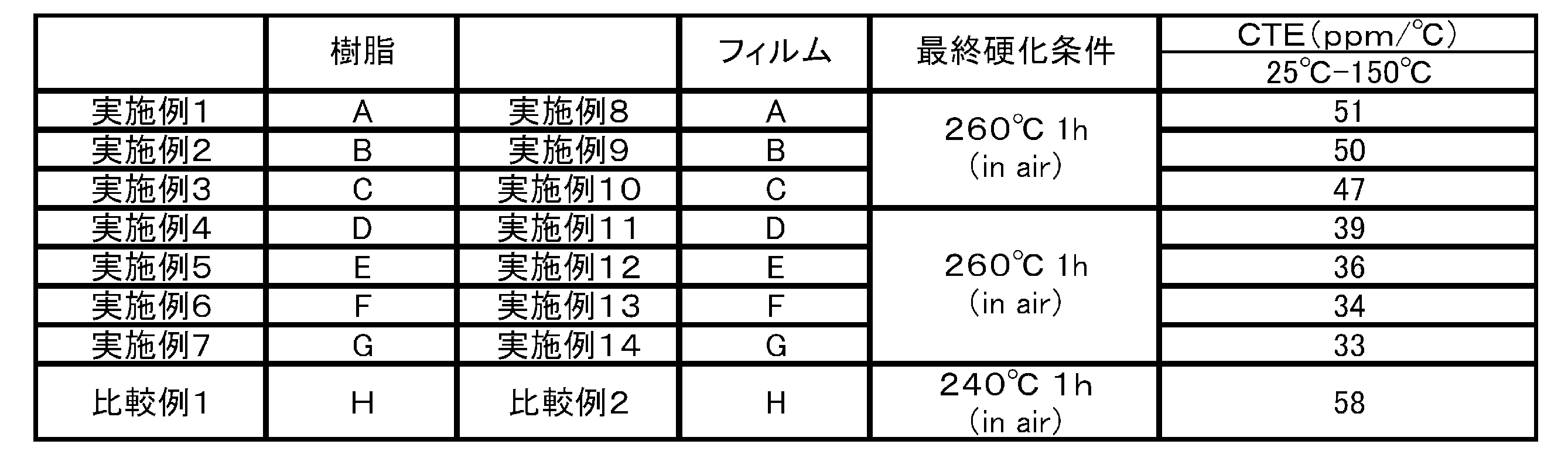
SIIナノテクノロジー社製「TMA/SS6100」を用い、引っ張りモードで、窒素雰囲気下で、荷重5mN、昇温速度5℃/分で測定し、25℃から150℃の熱線膨張率(CTE)の平均値(ppm/℃)を求めた。測定サンプルは、得られたフィルムを幅4mm、長さ20mmにカットし、チャック間の距離が10mmとなるようにセットした。
コック付きの等圧滴下ロート及びジムロート冷却器がセットされた300mLのフラスコ内に、γ-ブチロラクトン200mL(和光純薬工業社製)、4,4’-ジヒドロキシベンゾフェノン(以下、DHBPという。)2.59g(0.012mol、和光純薬工業社製)、ビスフェノールA(以下、BisAという。)24.66g(0.108mol、日本ジーイープラスチックス社製)、4,4’-ジアミノジフェニルメタン(以下、MDAという。)23.89g(0.12mol、保土谷化学工業社製、製品名「DAM」)を投入し、系内へ窒素ガスパージを開始した(流量15mL/分)。反応溶液を100℃で1時間攪拌し、DHBP、BisA、MDAの溶解を確認した後、パラホルムアルデヒド(以下、PFAという。)18.87g(0.58mol、三菱ガス化学社製、純度91.60%)を、前記フラスコ内に添加し、5時間反応させた。このようにして得られた反応溶液を室温まで冷却し、ろ過した後、1Lのメタノール中に注ぎ入れ、生成物を沈殿析出させた。
析出した沈殿固体を減圧乾燥することにより、ベンゾオキサジン環を有する熱硬化性樹脂Aが得られた。得られたベンゾオキサジン環を有する熱硬化性樹脂Aの重量平均分子量(Mw)は約10000であった。
DHBP_MDAのオキサジン環
オキサジン環2位のメチレンプロトンピーク:5.36ppm
オキサジン環4位のメチレンプロトンピーク:4.59ppm
BisA_MDAのオキサジン環
オキサジン環2位のメチレンプロトンピーク:5.26ppm
オキサジン環4位のメチレンプロトンピーク:4.51ppm
BisA由来のメチル基のプロトンピーク:1.54ppm
MDA由来のメチレン基(-CH2-)のプロトンピーク:3.78ppm
コック付きの等圧滴下ロート及びジムロート冷却器がセットされた300mLのフラスコ内に、γ-ブチロラクトン200mL(和光純薬工業社製)、DHBP7.76g(0.036mol、和光純薬工業社製)、BisA19.18g(0.084mol、日本ジーイープラスチックス社製)、MDA23.89g(0.12mol、保土谷化学工業社製、製品名「DAM」)を投入し、系内へ窒素ガスパージを開始した(流量15mL/分)。反応溶液を100℃で1時間攪拌し、DHBP、BisA、MDAの溶解を確認した後、PFA18.87g(0.58mol、三菱ガス化学社製、純度91.60%)を、前記フラスコ内に添加し、3時間反応させた。このようにして得られた反応溶液を室温まで冷却し、ろ過した後、1Lのメタノール中に注ぎ入れ、生成物を沈殿析出させた。
析出した沈殿固体を減圧乾燥することにより、ベンゾオキサジン環を有する熱硬化性樹脂Bが得られた。得られたベンゾオキサジン環を有する熱硬化性樹脂Bの重量平均分子量(Mw)は約6000であった。
DHBP_MDAのオキサジン環
オキサジン環2位のメチレンプロトンピーク:5.36ppm
オキサジン環4位のメチレンプロトンピーク:4.59ppm
BisA_MDAのオキサジン環
オキサジン環2位のメチレンプロトンピーク:5.27ppm
オキサジン環4位のメチレンプロトンピーク:4.51ppm
BisA由来のメチル基のプロトンピーク:1.54ppm
MDA由来のメチレン基のプロトンピーク:3.78ppm
コック付きの等圧滴下ロート及びジムロート冷却器がセットされた300mLのフラスコ内に、γ-ブチロラクトン200mL(和光純薬工業社製)、DHBP18.12g(0.084mol、和光純薬工業社製)、BisA8.22g(0.036mol、日本ジーイープラスチックス社製)、MDA23.89g(0.12mol、保土谷化学工業社製、製品名「DAM」)を投入し、系内へ窒素ガスパージを開始した(流量15mL/分)。反応溶液を100℃で1時間攪拌し、DHBP、BisA、MDAの溶解を確認した後、PFA18.87g(0.58mol、三菱ガス化学社製、純度91.60%)を、前記フラスコ内に添加し、4時間反応させた。このようにして得られた反応溶液を室温まで冷却し、ろ過した後、1Lのメタノール中に注ぎ入れ、生成物を沈殿析出させた。
析出した沈殿固体を減圧乾燥することにより、ベンゾオキサジン環を有する熱硬化性樹脂Cが得られた。得られたベンゾオキサジン環を有する熱硬化性樹脂Cの重量平均分子量(Mw)は約8000であった。
DHBP_MDAのオキサジン環
オキサジン環2位のメチレンプロトンピーク:5.48ppm
オキサジン環4位のメチレンプロトンピーク:4.66ppm
BisA_MDAのオキサジン環
オキサジン環2位のメチレンプロトンピーク:5.31ppm
オキサジン環4位のメチレンプロトンピーク:4.51ppm
BisA由来のメチル基のプロトンピーク:1.49ppm
MDA由来のメチレン基のプロトンピーク:3.68ppm
コック付きの等圧滴下ロート及びジムロート冷却器がセットされた300mLのフラスコ内に、γ-ブチロラクトン 200mL(和光純薬工業社製)、DHBP 12.94g(0.06mol、和光純薬工業社製)、BisA 13.70g(0.06mol、日本ジーイープラスチックス社製)、p-フェニレンジアミン(以下、PDAともいう。) 12.99g(0.12mol、大新化成工業社製、製品名「パラミン」)を投入し、系内へ窒素ガスパージを開始した(流量15mL/分)。反応溶液を100℃で1時間攪拌し、DHBP、BisA、PDAの溶解を確認した後、PFA 18.87g(0.58mol、三菱ガス化学社製、純度91.60%)を、前記フラスコ内に添加し、5時間反応させた。このようにして得られた反応溶液を室温まで冷却し、ろ過した後、1Lのメタノール中に注ぎ入れ、生成物を沈殿析出させた。
析出した沈殿固体を減圧乾燥することにより、ベンゾオキサジン環を有する熱硬化性樹脂Dが得られた。得られたベンゾオキサジン環を有する熱硬化性樹脂Dの重量平均分子量(Mw)は約8000であった。
DHBP_PDAのオキサジン環
オキサジン環2位のメチレンプロトンピーク:5.43ppm
オキサジン環4位のメチレンプロトンピーク:4.61ppm
BisA_PDAのオキサジン環
オキサジン環2位のメチレンプロトンピーク:5.25ppm
オキサジン環4位のメチレンプロトンピーク:4.45ppm
BisA由来のメチル基プロトンピーク:1.48ppm
コック付きの等圧滴下ロート及びジムロート冷却器がセットされた300mLのフラスコ内に、γ-ブチロラクトン 200mL(和光純薬工業社製)、DHBP 18.12g(0.084mol、和光純薬工業社製)、BisA 8.22g(0.036mol、日本ジーイープラスチックス社製)、PDA 12.99g(0.12mol、大新化成工業社製、製品名「パラミン」)を投入し、系内へ窒素ガスパージを開始した(流量15mL/分)。反応溶液を100℃で1時間攪拌し、DHBP、BisA、PDAの溶解を確認した後、PFA 18.87g(0.58mol、三菱ガス化学社製、純度91.60%)を、前記フラスコ内に添加し、4時間反応させた。このようにして得られた反応溶液を室温まで冷却し、ろ過した後、1Lのメタノール中に注ぎ入れ、生成物を沈殿析出させた。
析出した沈殿固体を減圧乾燥することにより、ベンゾオキサジン環を有する熱硬化性樹脂Eが得られた。得られたベンゾオキサジン環を有する熱硬化性樹脂Eの重量平均分子量(Mw)は約7000であった。
DHBP_PDAのオキサジン環
オキサジン環2位のメチレンプロトンピーク:5.44ppm
オキサジン環4位のメチレンプロトンピーク:4.61ppm
BisA_PDAのオキサジン環
オキサジン環2位のメチレンプロトンピーク:5.26ppm
オキサジン環4位のメチレンプロトンピーク:4.46ppm
BisA由来のメチル基のプロトンピーク:1.48ppm
コック付きの等圧滴下ロート及びジムロート冷却器がセットされた300mLのフラスコ内に、γ-ブチロラクトン 200mL(和光純薬工業社製)、DHBP 21.99g(0.102mol、和光純薬工業社製)、BisA 4.11g(0.018mol、日本ジーイープラスチックス社製)、PDA 12.99g(0.12mol、大新化成工業社製、製品名「パラミン」)を投入し、系内へ窒素ガスパージを開始した(流量15mL/分)。反応溶液を100℃で1時間攪拌し、DHBP、BisA、PDAの溶解を確認した後、PFA 18.87g(0.58mol、三菱ガス化学社製、純度91.60%)を、前記フラスコ内に添加し、3時間反応させた。このようにして得られた反応溶液を室温まで冷却し、ろ過した後、1Lのメタノール中に注ぎ入れ、生成物を沈殿析出させた。
析出した沈殿固体を減圧乾燥することにより、ベンゾオキサジン環を有する熱硬化性樹脂Fが得られた。得られたベンゾオキサジン環を有する熱硬化性樹脂Fの重量平均分子量(Mw)は約6000であった。
DHBP_PDAのオキサジン環
オキサジン環2位のメチレンプロトンピーク:5.44ppm
オキサジン環4位のメチレンプロトンピーク:4.61ppm
BisA_PDAのオキサジン環
オキサジン環2位のメチレンプロトンピーク:5.26ppm
オキサジン環4位のメチレンプロトンピーク:4.45ppm
BisA由来のメチル基プロトンピーク:1.48ppm
コック付きの等圧滴下ロート及びジムロート冷却器がセットされた300mLのフラスコ内に、γ-ブチロラクトン 200mL(和光純薬工業社製)、DHBP 23.29g(0.108mol、和光純薬工業社製)、BisA 2.74g(0.012mol、日本ジーイープラスチックス社製)、PDA 12.99g(0.12mol、大新化成工業社製、製品名「パラミン」)を投入し、系内へ窒素ガスパージを開始した(流量15mL/分)。反応溶液を100℃で1時間攪拌し、DHBP、BisA、PDAの溶解を確認した後、PFA 18.87g(0.58mol、三菱ガス化学社製、純度91.60%)を、前記フラスコ内に添加し、4時間反応させた。このようにして得られた反応溶液を室温まで冷却し、ろ過した後、1Lのメタノール中に注ぎ入れ、生成物を沈殿析出させた。
析出した沈殿固体を減圧乾燥することにより、ベンゾオキサジン環を有する熱硬化性樹脂Gが得られた。得られたベンゾオキサジン環を有する熱硬化性樹脂Gの重量平均分子量(Mw)は約7000であった。
DHBP_PDAのオキサジン環
オキサジン環2位のメチレンプロトンピーク:5.43ppm
オキサジン環4位のメチレンプロトンピーク:4.60ppm
BisA_PDAのオキサジン環
オキサジン環2位のメチレンプロトンピーク:5.26ppm
オキサジン環4位のメチレンプロトンピーク:4.45ppm
BisA由来のメチル基プロトンピーク:1.48ppm
コック付きの等圧滴下ロート及びジムロート冷却器がセットされた500mLのフラスコ内に、トルエン190mL及びイソブタノール10mLを、室温条件下で添加混合した。
その後、BisA 27.4g(0.12mol、日本ジーイープラスチックス社製)、2,2’-ビス[4-(4-アミノフェノキシ)フェニル]プロパン(以下、BAPPという。)51.3g(0.125mol、和歌山精化工業社製、製品名「BAPP」)、フェノール0.9g(0.0096mol)を前記フラスコ内に室温下で添加混合した。この時点から系内へ窒素ガスパージを開始した(流量15mL/分)。
反応溶液を油浴に浸し、油浴の温度が65℃になってから、目視で粉状物質がなくなるのを確認した後、PFA19.5g(0.60mol、三菱ガス化学社製、純度91.60%)を、前記フラスコ内に添加し、還流させて2時間反応させた。
その後、反応中に生成した水を、トルエン、イソブタノールと共沸させることで系外に留去しながら反応させた。留去開始後、6時間還流を行った。
このようにして得られた反応溶液を室温まで冷却し、ろ過した後、1Lのメタノール中に注ぎ入れ、生成物を沈殿析出させた。析出した沈殿固体を減圧乾燥することで、ベンゾオキサジン環を有する熱硬化性樹脂Hを得た。得られたベンゾオキサジン環を有する熱硬化性樹脂Hの重量平均分子量は約16000であった。
〔実施例8~10〕
ガラス容器中で、ジメチルホルムアミド5gに、実施例1~3で作製した熱硬化性樹脂を6g溶解させ、黄色の粘調液を得た。この粘調液を、ポリイミド(PI)フィルム上にアプリケータを用いて塗工し、80℃で10分、100℃で10分、150℃で10分、180℃で30分、200℃で30分、220℃で30分、240℃で30分、260℃で1時間それぞれ保持し、オーブン中で熱硬化させた。この熱硬化により、フィルム状の硬化物(フィルムA~C)が得られた。この硬化物は黄色透明であり、厚さは45μmであった。
ガラス容器中で、ジメチルホルムアミド5gに、実施例4~7で作製した熱硬化性樹脂を6g溶解させ、赤色の粘調液を得た。この粘調液を、ポリイミド(PI)フィルム上にアプリケータを用いて塗工し、80℃で10分、100℃で10分、150℃で10分、180℃で30分、200℃で30分、220℃で30分、240℃で30分、260℃で1時間それぞれ保持し、オーブン中で熱硬化させた。この熱硬化により、フィルム状の硬化物(フィルムD~G)が得られた。この硬化物は赤色透明であり、厚さは45μmであった。
ガラス容器中で、ジメチルホルムアミド5gに、比較例1で作製した熱硬化性樹脂Hを5g溶解させ、黄色の粘調液を得た。この粘調液を、PIフィルム上にアプリケータを用いて塗工し、80℃で10分、100℃で10分、150℃で10分、180℃で30分、200℃で30分、220℃で30分、240℃で1時間それぞれ保持し、オーブン中で熱硬化させた。この熱硬化により、フィルム状の硬化物(フィルムH)が得られた。この硬化物は黄色透明であり、厚さは51μmであった。なお、260℃まで加熱すると熱分解してしまうため、240℃を上限として熱硬化させた。
〔実施例15〕
ガラス容器中に、実施例5で製造した熱硬化性樹脂E 0.1g、シクロヘキサノン 5g(和光純薬工業社製)をはかり取り、あわとり練太郎ARE-250(株式会社 THINKY製)で10分間撹拌したところ、熱硬化性樹脂Eが溶解した均一溶液が得られた。
コック付きの等圧滴下ロート及びジムロート冷却器がセットされた300mLのフラスコ内に、γ-ブチロラクトン 200mL(和光純薬工業社製)、DHBP 25.89g(0.12mol、和光純薬工業社製)、PDA 12.99g(0.12mol、大新化成工業社製、製品名「パラミン」)を投入し、系内へ窒素ガスパージを開始した(流量15mL/分)。反応溶液を100℃で1時間攪拌し、DHBP、PDAの溶解を確認した後、PFA 18.87g(0.58mol、三菱ガス化学社製、純度91.60%)を、前記フラスコ内に添加し、4時間反応させた。このようにして得られた反応溶液を室温まで冷却し、ろ過した後、1Lのメタノール中に注ぎ入れ、生成物を沈殿析出させた。
析出した沈殿固体を減圧乾燥することにより、ベンゾオキサジン環を有する熱硬化性樹脂I得られた。得られたベンゾオキサジン環を有する熱硬化性樹脂Iの重量平均分子量(Mw)は約7000であった。
ガラス容器中に、比較例3で製造した熱硬化性樹脂I 0.1g、シクロヘキサノン 5g(和光純薬工業社製)をはかり取り、あわとり練太郎ARE-250(株式会社 THINKY製)で10分間撹拌したが、熱硬化性樹脂Iは不溶であった。
ガラス容器中に、熱硬化性樹脂E 0.1g、ビスフェノールA型エポキシ樹脂RE-410S 5g(液状、日本化薬社製)をはかり取り、あわとり練太郎ARE-250(株式会社 THINKY製)で10分間撹拌した。得られた溶液の状態を目視で観察したところ均一であった。
ガラス容器中に、熱硬化性樹脂I 0.1g、ビスフェノールA型エポキシ樹脂RE-410S 5g(液状、日本化薬社製)をはかり取り、あわとり練太郎ARE-250(株式会社 THINKY製)で10分間撹拌した。得られた溶液の状態を目視で観察したところ混濁状況であった。
ガラス容器中に、熱硬化性樹脂E 0.1g、アルキルフェノールモノグリシジルエーテル YED122 5g(液状、三菱化学社製)をはかり取り、あわとり練太郎ARE-250(株式会社 THINKY製)で10分間撹拌した。得られた溶液の状態を目視で観察したところ均一であった。
ガラス容器中に、熱硬化性樹脂I 0.1g、アルキルフェノールモノグリシジルエーテル YED122 5g(液状、三菱化学社製)をはかり取り、あわとり練太郎ARE-250(株式会社 THINKY製)で10分間撹拌した。得られた溶液の状態を目視で観察したところ混濁状況であった。
Claims (16)
- 下記式(1)で表される構造A及び下記式(2)で表される構造Bを含む、ベンゾオキサジン環を有する熱硬化性樹脂。

- 前記構造AのR1及びR2は、いずれも水素である、請求項1に記載のベンゾオキサジン環を有する熱硬化性樹脂。
- 前記構造AのR1及びR2並びに前記構造BのR3及びR4は、いずれも水素である、請求項1又は2に記載のベンゾオキサジン環を有する熱硬化性樹脂。
- 前記熱硬化性樹脂における、前記構造Bの含有量に対する前記構造Aの含有の比率(A/B;モル比)が、1/99~99/1である、請求項1~3のいずれか一項に記載の熱硬化性樹脂。
- 前記熱硬化性樹脂における、前記構造Bの含有量に対する前記構造Aの含有の比率(A/B;モル比)が、70/30~90/10である、請求項1~4のいずれか一項に記載の熱硬化性樹脂。
- 前記Y1又は前記Y2の少なくともいずれかが、下記式(3)で表される構造である、請求項1~5のいずれか一項に記載のベンゾオキサジン環を有する熱硬化性樹脂。

- 前記Y1又は前記Y2の少なくともいずれかが、下記式(4)で表される構造である、請求項1~6のいずれか一項に記載のベンゾオキサジン環を有する熱硬化性樹脂。

- 前記Xは、下記群G1aからなる群より選択される少なくとも一つである、請求項1~7のいずれか一項に記載のベンゾオキサジン環を有する熱硬化性樹脂。
- 下記式(5)で表される化合物と、下記式(6)で表される化合物と、ジアミン化合物と、アルデヒド化合物と、を反応させることにより得られるベンゾオキサジン環を有する熱硬化性樹脂。


- 前記ジアミン化合物が、下記式(7)で表される化合物、又は下記式(8)で表される化合物の少なくともいずれかである、請求項9に記載のベンゾオキサジン環を有する熱硬化性樹脂。


- ラクトン溶媒中で前記反応を行う、請求項9又は10に記載のベンゾオキサジン環を有する熱硬化性樹脂。
- 下記式(5)で表される化合物と、下記式(6)で表される化合物と、ジアミン化合物と、アルデヒド化合物と、を反応させる工程を含む、ベンゾオキサジン環を有する熱硬化性樹脂の製造方法。


- 請求項1~11のいずれか一項に記載の熱硬化性樹脂、又は請求項12に記載の製造方法により得られる熱硬化性樹脂を含む熱硬化性樹脂組成物。
- 請求項1~11のいずれか一項に記載の熱硬化性樹脂、請求項12に記載の製造方法により得られる熱硬化性樹脂、又は請求項13に記載の熱硬化性樹脂組成物を成形し得られる成形体。
- 請求項14に記載の成形体を硬化させて得られる硬化体。
- 請求項14に記載の成形体、又は請求項15に記載の硬化体を含む電子機器。
Priority Applications (4)
| Application Number | Priority Date | Filing Date | Title |
|---|---|---|---|
| KR1020127007012A KR101202555B1 (ko) | 2009-09-30 | 2010-09-29 | 벤즈옥사진환을 갖는 열경화성 수지 및 그의 제조 방법 |
| US13/496,144 US20120172569A1 (en) | 2009-09-30 | 2010-09-29 | Thermosetting resin having benzoxazine ring and method for producing the same |
| CN2010800441521A CN102781987A (zh) | 2009-09-30 | 2010-09-29 | 具有苯并*嗪环的热固性树脂及其制造方法 |
| JP2010540355A JP4805413B2 (ja) | 2009-09-30 | 2010-09-29 | ベンゾオキサジン環を有する熱硬化性樹脂及びその製造方法 |
Applications Claiming Priority (2)
| Application Number | Priority Date | Filing Date | Title |
|---|---|---|---|
| JP2009228803 | 2009-09-30 | ||
| JP2009-228803 | 2009-09-30 |
Publications (1)
| Publication Number | Publication Date |
|---|---|
| WO2011040459A1 true WO2011040459A1 (ja) | 2011-04-07 |
Family
ID=43826275
Family Applications (1)
| Application Number | Title | Priority Date | Filing Date |
|---|---|---|---|
| PCT/JP2010/066939 Ceased WO2011040459A1 (ja) | 2009-09-30 | 2010-09-29 | ベンゾオキサジン環を有する熱硬化性樹脂及びその製造方法 |
Country Status (6)
| Country | Link |
|---|---|
| US (1) | US20120172569A1 (ja) |
| JP (1) | JP4805413B2 (ja) |
| KR (1) | KR101202555B1 (ja) |
| CN (1) | CN102781987A (ja) |
| TW (1) | TW201120097A (ja) |
| WO (1) | WO2011040459A1 (ja) |
Cited By (4)
| Publication number | Priority date | Publication date | Assignee | Title |
|---|---|---|---|---|
| WO2011125665A1 (ja) * | 2010-03-31 | 2011-10-13 | 積水化学工業株式会社 | ベンゾオキサジン環を有する熱硬化性樹脂組成物及びその製造方法、並びにその成形体及び硬化体 |
| WO2013183679A1 (ja) * | 2012-06-05 | 2013-12-12 | 日産化学工業株式会社 | 接着剤組成物又はアンダーフィル組成物 |
| WO2014156843A1 (ja) * | 2013-03-25 | 2014-10-02 | 日産化学工業株式会社 | 熱硬化性樹脂組成物 |
| WO2014203735A1 (ja) * | 2013-06-21 | 2014-12-24 | 日産化学工業株式会社 | 特定の末端構造を有する重合体を含む熱硬化性樹脂組成物 |
Families Citing this family (5)
| Publication number | Priority date | Publication date | Assignee | Title |
|---|---|---|---|---|
| CN104312148B (zh) * | 2014-10-28 | 2016-11-30 | 青岛申达众创技术服务有限公司 | 一种树脂基摩擦材料及其制备工艺 |
| TWI573813B (zh) * | 2015-11-24 | 2017-03-11 | Nat Chung-Shan Inst Of Science And Tech | Main structure of adamantane - containing oxo - nitrobenzene cyclohexane resin |
| CN109081895B (zh) * | 2018-07-27 | 2021-06-08 | 贵州理工学院 | 一种自增韧苯并噁嗪热固性树脂及其制备方法 |
| TWI800386B (zh) * | 2021-12-16 | 2023-04-21 | 元鴻應用材料股份有限公司 | 一種苯並噁嗪樹脂、其組成物及由其製成的銅箔基板 |
| CN116445144B (zh) * | 2023-06-19 | 2023-08-29 | 西南石油大学 | 一种低收缩高强度植物基树脂堵剂及其制备方法 |
Citations (2)
| Publication number | Priority date | Publication date | Assignee | Title |
|---|---|---|---|---|
| WO2009075746A2 (en) * | 2007-12-06 | 2009-06-18 | Henkel Ag & Co. Kgaa | Curable benzoxazine macromonomers, their preparation and cured products thereof |
| JP2010195991A (ja) * | 2009-02-26 | 2010-09-09 | Sekisui Chem Co Ltd | ベンゾオキサジン環を有する化合物、それを含む熱硬化性樹脂組成物、及びベンゾオキサジン環を有する化合物の製造方法 |
Family Cites Families (3)
| Publication number | Priority date | Publication date | Assignee | Title |
|---|---|---|---|---|
| US20030023007A1 (en) * | 2001-07-27 | 2003-01-30 | Hycomp, Inc. | Enhancement of thermal properties of benzoxazine polymers by use of aromatic polyamines to incorporate internal benzoxazine groups within the monomer |
| CN101421324A (zh) * | 2006-02-20 | 2009-04-29 | 积水化学工业株式会社 | 热固性树脂的制造方法、热固性树脂、含有它的热固性组合物、成形体、固化体以及含有它们的电子设备 |
| WO2009008468A1 (ja) * | 2007-07-10 | 2009-01-15 | Sekisui Chemical Co., Ltd. | ベンゾキサジン構造を有する熱硬化性樹脂及びその製造方法 |
-
2010
- 2010-09-29 JP JP2010540355A patent/JP4805413B2/ja not_active Expired - Fee Related
- 2010-09-29 WO PCT/JP2010/066939 patent/WO2011040459A1/ja not_active Ceased
- 2010-09-29 US US13/496,144 patent/US20120172569A1/en not_active Abandoned
- 2010-09-29 KR KR1020127007012A patent/KR101202555B1/ko not_active Expired - Fee Related
- 2010-09-29 CN CN2010800441521A patent/CN102781987A/zh active Pending
- 2010-09-30 TW TW099133421A patent/TW201120097A/zh unknown
Patent Citations (2)
| Publication number | Priority date | Publication date | Assignee | Title |
|---|---|---|---|---|
| WO2009075746A2 (en) * | 2007-12-06 | 2009-06-18 | Henkel Ag & Co. Kgaa | Curable benzoxazine macromonomers, their preparation and cured products thereof |
| JP2010195991A (ja) * | 2009-02-26 | 2010-09-09 | Sekisui Chem Co Ltd | ベンゾオキサジン環を有する化合物、それを含む熱硬化性樹脂組成物、及びベンゾオキサジン環を有する化合物の製造方法 |
Cited By (12)
| Publication number | Priority date | Publication date | Assignee | Title |
|---|---|---|---|---|
| WO2011125665A1 (ja) * | 2010-03-31 | 2011-10-13 | 積水化学工業株式会社 | ベンゾオキサジン環を有する熱硬化性樹脂組成物及びその製造方法、並びにその成形体及び硬化体 |
| JP5049408B2 (ja) * | 2010-03-31 | 2012-10-17 | 積水化学工業株式会社 | ベンゾオキサジン環を有する熱硬化性樹脂組成物及びその製造方法、並びにその成形体及び硬化体 |
| WO2013183679A1 (ja) * | 2012-06-05 | 2013-12-12 | 日産化学工業株式会社 | 接着剤組成物又はアンダーフィル組成物 |
| JPWO2013183679A1 (ja) * | 2012-06-05 | 2016-02-01 | 日産化学工業株式会社 | 接着剤組成物又はアンダーフィル組成物 |
| WO2014156843A1 (ja) * | 2013-03-25 | 2014-10-02 | 日産化学工業株式会社 | 熱硬化性樹脂組成物 |
| KR20150137052A (ko) * | 2013-03-25 | 2015-12-08 | 닛산 가가쿠 고교 가부시키 가이샤 | 열경화성 수지조성물 |
| US9567435B2 (en) | 2013-03-25 | 2017-02-14 | Nissan Chemical Industries, Ltd. | Thermosetting resin composition |
| JPWO2014156843A1 (ja) * | 2013-03-25 | 2017-02-16 | 日産化学工業株式会社 | 熱硬化性樹脂組成物 |
| KR101967369B1 (ko) | 2013-03-25 | 2019-04-09 | 닛산 가가쿠 가부시키가이샤 | 열경화성 수지조성물 |
| WO2014203735A1 (ja) * | 2013-06-21 | 2014-12-24 | 日産化学工業株式会社 | 特定の末端構造を有する重合体を含む熱硬化性樹脂組成物 |
| JPWO2014203735A1 (ja) * | 2013-06-21 | 2017-02-23 | 日産化学工業株式会社 | 特定の末端構造を有する重合体を含む熱硬化性樹脂組成物 |
| US9657128B2 (en) | 2013-06-21 | 2017-05-23 | Nissan Chemical Industries, Ltd. | Thermosetting resin composition containing polymer having specific terminal structure |
Also Published As
| Publication number | Publication date |
|---|---|
| KR101202555B1 (ko) | 2012-11-19 |
| US20120172569A1 (en) | 2012-07-05 |
| KR20120036380A (ko) | 2012-04-17 |
| JPWO2011040459A1 (ja) | 2013-02-28 |
| JP4805413B2 (ja) | 2011-11-02 |
| TW201120097A (en) | 2011-06-16 |
| CN102781987A (zh) | 2012-11-14 |
Similar Documents
| Publication | Publication Date | Title |
|---|---|---|
| JP4805413B2 (ja) | ベンゾオキサジン環を有する熱硬化性樹脂及びその製造方法 | |
| KR100985625B1 (ko) | 벤조옥사진환을 갖는 열경화성 수지의 제조 방법 | |
| JP6925853B2 (ja) | 新規なベンゾオキサジン樹脂組成物及びその硬化物 | |
| CN101437895B (zh) | 树脂烧结物以及搭载有该树脂烧结物的电子设备 | |
| JP5224978B2 (ja) | ベンゾオキサジン環を有する共重合体からなる熱硬化性樹脂 | |
| JP5498200B2 (ja) | ベンゾオキサジン環を有する熱硬化性樹脂の製造方法、及びベンゾオキサジン環を有する熱硬化性樹脂 | |
| JP2008291070A (ja) | 熱硬化性樹脂の製造方法、及び熱硬化性樹脂 | |
| JPWO2012137840A1 (ja) | ポリベンゾオキサゾール樹脂及びその前駆体 | |
| JP5750004B2 (ja) | 熱硬化性組成物、そのワニスおよびその熱硬化物 | |
| JP5049408B2 (ja) | ベンゾオキサジン環を有する熱硬化性樹脂組成物及びその製造方法、並びにその成形体及び硬化体 | |
| JP2010195991A (ja) | ベンゾオキサジン環を有する化合物、それを含む熱硬化性樹脂組成物、及びベンゾオキサジン環を有する化合物の製造方法 | |
| JP2010053324A (ja) | ベンゾオキサジン環を有する熱硬化性樹脂を含有する樹脂組成物 | |
| KR102253388B1 (ko) | 벤족사진 및 그 제조방법 | |
| JP2011207995A (ja) | 熱硬化性樹脂及びその製造方法、熱硬化性樹脂組成物、成形体、硬化体、並びに電子機器 | |
| JP2012072319A (ja) | ベンゾオキサジン環を有する熱硬化性樹脂の製造方法、及びベンゾオキサジン環を有する熱硬化性樹脂 | |
| JP2007154018A (ja) | 熱硬化性樹脂、その製造方法及び該樹脂を含む熱硬化性組成物、並びにそれから得られる成形体及び該成形体を含む電子機器 | |
| JP2022053324A (ja) | ベンゾオキサジン系熱硬化性樹脂、およびその製造方法 | |
| JP2011213762A (ja) | ベンゾオキサジン環を有する熱硬化性樹脂組成物及びその製造方法、並びに成形体及び硬化体 | |
| TWI522362B (zh) | Polyoxazobenzene and its application and preparation method | |
| JP2007146070A (ja) | 熱硬化性樹脂、その製造方法及び該樹脂を含む熱硬化性組成物、並びにそれから得られる成形体及び該成形体を含む電子機器 | |
| JP4934122B2 (ja) | 低温硬化性組成物 | |
| JP2007106800A (ja) | 熱硬化性樹脂、及びそれを含む熱硬化性組成物、並びにそれから得られる成形体 | |
| JP4937160B2 (ja) | ベンゾオキサジン環構造を有する熱硬化性樹脂を含有する溶液 | |
| JP2011074288A (ja) | 熱硬化性樹脂、及びそれを含む熱硬化性樹脂組成物、並びにそれらから得られる成形体、硬化体 | |
| JP2013185034A (ja) | ベンゾオキサジン樹脂組成物及びその製造方法、並びにその成形体及び硬化体 |
Legal Events
| Date | Code | Title | Description |
|---|---|---|---|
| WWE | Wipo information: entry into national phase |
Ref document number: 201080044152.1 Country of ref document: CN |
|
| WWE | Wipo information: entry into national phase |
Ref document number: 2010540355 Country of ref document: JP |
|
| 121 | Ep: the epo has been informed by wipo that ep was designated in this application |
Ref document number: 10820574 Country of ref document: EP Kind code of ref document: A1 |
|
| WWE | Wipo information: entry into national phase |
Ref document number: 13496144 Country of ref document: US |
|
| ENP | Entry into the national phase |
Ref document number: 20127007012 Country of ref document: KR Kind code of ref document: A |
|
| NENP | Non-entry into the national phase |
Ref country code: DE |
|
| 122 | Ep: pct application non-entry in european phase |
Ref document number: 10820574 Country of ref document: EP Kind code of ref document: A1 |