WO2010074258A1 - 風味増強剤及び香料組成物 - Google Patents
風味増強剤及び香料組成物 Download PDFInfo
- Publication number
- WO2010074258A1 WO2010074258A1 PCT/JP2009/071662 JP2009071662W WO2010074258A1 WO 2010074258 A1 WO2010074258 A1 WO 2010074258A1 JP 2009071662 W JP2009071662 W JP 2009071662W WO 2010074258 A1 WO2010074258 A1 WO 2010074258A1
- Authority
- WO
- WIPO (PCT)
- Prior art keywords
- flavor
- fragrance
- beverage
- tea
- polymerized catechin
- Prior art date
- Legal status (The legal status is an assumption and is not a legal conclusion. Google has not performed a legal analysis and makes no representation as to the accuracy of the status listed.)
- Ceased
Links
Classifications
-
- A—HUMAN NECESSITIES
- A23—FOODS OR FOODSTUFFS; TREATMENT THEREOF, NOT COVERED BY OTHER CLASSES
- A23L—FOODS, FOODSTUFFS OR NON-ALCOHOLIC BEVERAGES, NOT OTHERWISE PROVIDED FOR; PREPARATION OR TREATMENT THEREOF
- A23L2/00—Non-alcoholic beverages; Dry compositions or concentrates therefor; Preparation or treatment thereof
- A23L2/52—Adding ingredients
- A23L2/56—Flavouring or bittering agents
-
- A—HUMAN NECESSITIES
- A23—FOODS OR FOODSTUFFS; TREATMENT THEREOF, NOT COVERED BY OTHER CLASSES
- A23F—COFFEE; TEA; THEIR SUBSTITUTES; MANUFACTURE, PREPARATION, OR INFUSION THEREOF
- A23F3/00—Tea; Tea substitutes; Preparations thereof
- A23F3/16—Tea extraction; Tea extracts; Treating tea extract; Making instant tea
- A23F3/163—Liquid or semi-liquid tea extract preparations, e.g. gels or liquid extracts in solid capsules
-
- A—HUMAN NECESSITIES
- A23—FOODS OR FOODSTUFFS; TREATMENT THEREOF, NOT COVERED BY OTHER CLASSES
- A23F—COFFEE; TEA; THEIR SUBSTITUTES; MANUFACTURE, PREPARATION, OR INFUSION THEREOF
- A23F3/00—Tea; Tea substitutes; Preparations thereof
- A23F3/40—Tea flavour; Tea oil; Flavouring of tea or tea extract
- A23F3/405—Flavouring with flavours other than natural tea flavour or tea oil
-
- A—HUMAN NECESSITIES
- A23—FOODS OR FOODSTUFFS; TREATMENT THEREOF, NOT COVERED BY OTHER CLASSES
- A23L—FOODS, FOODSTUFFS OR NON-ALCOHOLIC BEVERAGES, NOT OTHERWISE PROVIDED FOR; PREPARATION OR TREATMENT THEREOF
- A23L2/00—Non-alcoholic beverages; Dry compositions or concentrates therefor; Preparation or treatment thereof
- A23L2/52—Adding ingredients
-
- A—HUMAN NECESSITIES
- A23—FOODS OR FOODSTUFFS; TREATMENT THEREOF, NOT COVERED BY OTHER CLASSES
- A23L—FOODS, FOODSTUFFS OR NON-ALCOHOLIC BEVERAGES, NOT OTHERWISE PROVIDED FOR; PREPARATION OR TREATMENT THEREOF
- A23L27/00—Spices; Flavouring agents or condiments; Artificial sweetening agents; Table salts; Dietetic salt substitutes; Preparation or treatment thereof
- A23L27/10—Natural spices, flavouring agents or condiments; Extracts thereof
- A23L27/11—Natural spices, flavouring agents or condiments; Extracts thereof obtained by solvent extraction
-
- A—HUMAN NECESSITIES
- A23—FOODS OR FOODSTUFFS; TREATMENT THEREOF, NOT COVERED BY OTHER CLASSES
- A23L—FOODS, FOODSTUFFS OR NON-ALCOHOLIC BEVERAGES, NOT OTHERWISE PROVIDED FOR; PREPARATION OR TREATMENT THEREOF
- A23L27/00—Spices; Flavouring agents or condiments; Artificial sweetening agents; Table salts; Dietetic salt substitutes; Preparation or treatment thereof
- A23L27/88—Taste or flavour enhancing agents
Definitions
- the present invention relates to a flavor enhancer for foods and drinks, and a flavor composition with enhanced flavor.
- fragrances are frequently used to enhance the palatability.
- the stability of the fragrance is generally not high and it decreases or disappears during the heat treatment process such as sterilization and storage, a contrivance for increasing the stability of the fragrance has been made.
- Patent Document 1 discloses a fragrance in which a free amino acid is added to a fragrance and the flavor is enhanced.
- Patent Documents 2 and 3 provide and enhances umami and kokumi by adding a taste enhancer containing tea solvent extract and 3-galloylquinic acid or a salt thereof as active ingredients to food and drink. It is described that the taste of food and drink can be changed to a more complex and deep preferred one, and that it has been effective in consomme soup, coffee beverage, coffee hard candy, orange jelly, milk pudding, etc. ing.
- Patent Document 4 describes a flavor enhancer containing spirrantol as an active ingredient that can enhance the flavor of the food or drink itself without affecting the taste or fragrance of the food or drink with a small amount of addition.
- Patent Document 5 describes that quinolic acid derivatives enhance the aroma and flavor of menthol
- Patent Document 6 describes that black tea extract improves the spice feeling of curry or stew. Has been.
- Patent Document 7 describes a fruit-specific flavor enhancer containing clarified lactic acid bacteria and yeast fermented whey as an active ingredient.
- Patent Document 8 describes aspartic acid. And / or soluble salts thereof and alanine and / or threonine are described to enhance the strawberry-like, grape-like, apple-like and melon-like flavors of foods and drinks.
- Patent Document 9 discloses threonine, lysine or a salt thereof. , Methionine and valine are described to enhance the pineapple-like flavor of food and drink.
- beverages scented with neutral beverages such as water and tea beverages have been developed due to the widespread use of preferences and growing health consciousness.
- flavors, particularly fruit flavors usually give off flavors peculiar to flavors in beverages where acidulants and sweeteners exist (fruit flavors in the case of fruit flavors).
- Neutral beverages to which no fragrance is added have a problem that they are not fragranced even if a fragrance is added, the fragrance is extremely weak, and the residual fragrance is also weak.
- the fragrance solvent affects the flavor of the beverage itself, or in a packaged beverage manufactured through sterilization treatment, the balance of the fragrance changes greatly during heat treatment and storage. was there.
- the existing flavor enhancer enhances the overall flavor of food and drink as it is, for example, in the case of a beverage flavored with a fruit flavor to a tea-based beverage, only the flavor unique to the fruit
- the flavor of the tea serving as the base of the beverage was also enhanced, and it was not possible to selectively enhance only the flavor of the target fragrance.
- An object of the present invention is to provide a flavor enhancer for beverages, which can selectively enhance the flavor of a target fragrance, and a beverage with enhanced flavor containing the same. is there.
- the present inventors have selectively enhanced the flavor of a flavor without affecting the flavor of the food / beverage product itself by the polymer catechin obtained from the tea extract.
- the fruit feeling and refreshing feeling of fruit flavors can be enhanced.
- Addition of polymerized catechins to beverages gives and enhances richness and volume without impairing the flavor of the beverage itself, and added flavors (especially fruit or plant flavors (excluding tea flavors) )) was found to be selectively enhanced, and the present invention was completed.
- the present invention relates to the following.
- the fragrance contains non-polymerized catechins, and the ratio ((a) / (b)) based on the weight of (a) the polymerized catechins and (b) the non-polymerized catechins is 1 or more.
- flavor composition in any one. 9.
- a non-tea beverage comprising a polymerized catechin and a fragrance, wherein the concentration of the polymerized catechin is 0.0050% by weight or more based on the whole beverage.
- a tea-based beverage comprising a polymerized catechin and a fragrance, wherein the concentration of the polymerized catechin is 0.010% by weight or more based on the whole beverage.
- the beverage according to any one of 10 to 16 which is a beverage containing no sweetener and / or sour agent. 18.
- the flavor enhancer of the present invention When added to a beverage, it can be used as an enhancer that enhances the flavor of the blended flavor without affecting the flavor of the beverage itself.
- the flavor enhancer of the present invention particularly acts as an enhancer of fruit fragrance and enhances the fruit feeling and refreshing feeling of the fruit, so that, for example, the fruit flavor of a drink in which a fruit fragrance is added to a neutral tea-based beverage It can be selectively enhanced.
- the beverage containing the polymerized catechin and the fragrance of the present invention is a beverage that has a rich and voluminous feel without sacrificing the flavor of the beverage itself, and has a fragrant and remaining fragrance. Even if it is the form of the container-packed drink manufactured through a sterilization process, flavor is strengthened and it becomes a drink with high palatability.
- the flavor enhancer referred to in the present specification represents an additive for enhancing the flavor of food and drink, specifically, an action for enhancing the scent (scented) felt from the nose immediately before eating the food and drink, Action to enhance at least one, preferably all of the action of enhancing the incense in the mouth felt when eating or drinking foods (when included in the mouth), or the action of enhancing the aroma (residual scent) felt in the aftertaste Means an additive for exhibiting
- polymerized catechin refers to non-polymerized monomeric catechins ((+)-catechin, ( ⁇ )-epicatechin, (+)-gallocatechin, ( ⁇ )-epigallocatechin, ( ⁇ )-Catechin gallate, ( ⁇ )-epicatechin gallate, ( ⁇ )-gallocatechin gallate, ( ⁇ )-epigallocatechin gallate (these are also referred to herein as “non-polymerized catechin”)) Refers to those having a structure in which a plurality of tea-derived enzymes, enzymes, light, etc. are linked together.
- a component analyzed by HPLC under the following conditions refers to a component having the same elution time (reference elution time: 24 minutes) as theaflavin (manufactured by Kurita Research Center).
- the amount of polymerized catechin is obtained by creating a calibration curve using OHBF-B as a standard substance.
- OHBF-B which is a standard substance, is described in, for example, the method described in Chem. Pharm. Bull 37 (12), 3255-3563 (1989) ⁇ , or disclosed in JP 2005-336117 A (Example 3).
- Those synthesized according to the method preferably purified to a purity of 98% or more), those isolated from tea leaves, and the like can be used.
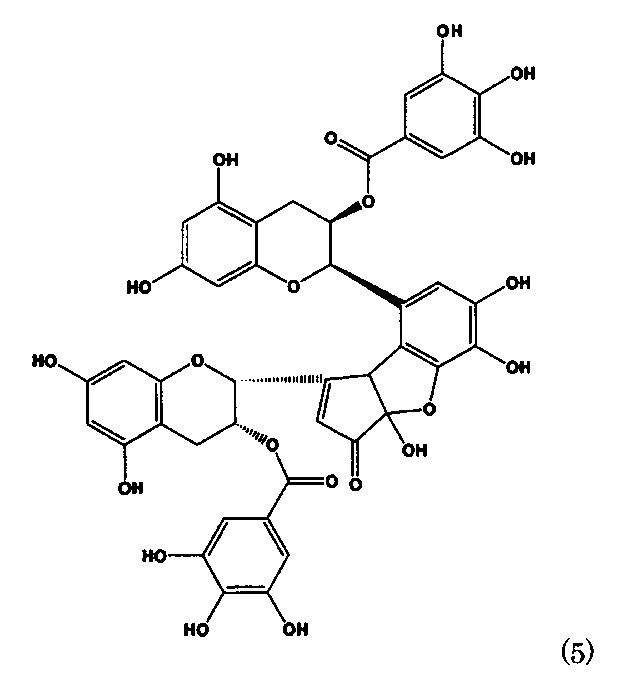
- polymerized catechin specifically, polymerized catechin called by a common name such as thealubidin, and epigallocatechin gallate dimer of the formula (1):
- R 1 and R 2 are each independently H or a galloyl group.
- R 3, R 4 and R 5 are each independently H or a galloyl group.
- Polymerized catechins such as are exemplified.
- the polymerized catechin of the present invention is obtained as a plant extract containing polymerized catechin. Specifically, it is obtained by solvent extraction of tea leaves.
- tea leaves used as raw materials one or more kinds of green tea that is non-fermented tea, oolong tea that is semi-fermented tea, and black tea that is fermented tea can be used. It is recommended to use semi-fermented tea or fermented tea leaves.
- extraction solvent water or hot water, methanol, ethanol, isopropanol, ethyl acetate or the like is used, and extraction is performed with one or a mixture of two or more.
- This solvent extract of tea leaves may be used as it is, but concentrated or purified, that is, by selectively removing components other than polymerized catechins from the solvent extract of tea leaves, the content of polymerized catechins is increased. It is better to use a higher one.
- non-polymerized catechins have a bitter and astringent taste, if the blending amount increases, the taste of the food and drink itself may be impaired. Therefore, as the polymerized catechin of the present invention, it is preferable to use a solvent extract that has been subjected to a treatment for selectively removing non-polymerized catechin from the tea leaf extract.
- the solvent extract subjected to the treatment for selectively removing non-polymerized catechins include those containing polymerized catechins at a concentration 4 times or more that of non-polymerized catechins described in WO2005 / 077384. .
- Polymerized catechin is a soluble component. From the standpoint of preventing precipitation during storage, it is preferable to perform separation and clarification treatment such as centrifugation or filtration from the solvent extract of tea leaves to remove insoluble solids. From this point of view, non-polymerized catechin is also removed. Thus, it is preferable to use a solvent extract of tea leaves with an increased concentration of polymerized catechin.
- the form of the polymerized catechin used in the present invention may be liquid or powdered by spray drying, freeze pulverization, or the like. However, when the food or drink is a beverage, it is concentrated in liquid form from the viewpoint of solubility ( It is preferable to use a polymerized catechin (including isolation and purification).
- the flavor enhancer of the present invention contains polymerized catechin as an active ingredient, and by adding it to a food or drink, the flavor of the flavor contained in the food or drink is enhanced without affecting the flavor of the food or drink itself.
- the food / beverage products to which the flavor enhancer of this invention is added are not limited, Preferably it is used as an additive for drinks. In general, when the food or drink is liquid (beverage), it is more susceptible to the taste of the additive as compared to the solid preparation, but the flavor enhancer of the present invention adds to the flavor of the food and drink itself. It is particularly useful for beverages because of its low impact.
- polymerized catechin is a component that is not easily affected by heat and does not easily disappear during long-term storage, and the food and drink to which the flavor enhancer of the present invention is added are less susceptible to changes over time. Although this mechanism is not clear, it is considered that the polymerized catechin captures or wraps the fragrance component in the food or drink to prevent scattering.
- the flavor enhancer of the present invention is characterized by selectively enhancing the flavor with respect to the flavor added to the food or drink.
- the flavor of the fragrance is enhanced to enrich the aroma, mouth scent, and residual scent.
- the type of the fragrance is not limited, but when the food or drink is a tea beverage, the flavor enhancing effect of the fragrance appears remarkably when a non-tea fragrance (for example, a plant fragrance excluding fruit fragrance or tea fragrance) is added. .
- the fruit fragrance refers to a fragrance exhibiting the flavor of a fruit, and produces a natural fragrance obtained from an edible reproductive part of a seed plant, particularly a part having a sweet pulp associated with the seed, or a fruit fragrance obtained from a natural source.
- a fragrance synthesized for this purpose is also included.
- citrus fruits also called citrus flavors
- citrus flavors range, tangerine, grapefruit, lemon, lime, bergamot, etc.
- apples, grapes, peaches, tropical fruits pineapple, guava, banana, mango, acerola, papaya, passion fruit) , coconut
- other fruits ume, pear, apricot, plum, berry, cherry, strawberry, kiwifruit, melon, etc.
- citrus flavors may be obtained from natural sources such as fruit juices and perfume oils or may be synthesized. If desired, the fruit juice itself can be used as a perfume ingredient.
- the plant fragrance used in the present specification is a fragrance obtained from a part of the plant other than the above fruit fragrance, and refers to a fragrance excluding tea-based fragrances (fragrances exhibiting a tea leaf flavor such as green tea, oolong tea, and black tea).
- flavor obtained from a nut, a bark, a root, and a leaf is mentioned
- flavor obtained from a natural source is also contained.
- plant flavor include cola flavor, mint flavor, jasmine flavor, rose flavor, and coffee flavor.
- These plant flavors may be obtained or synthesized from natural sources such as essential oils and extracts.
- the extract concentrated as necessary with a solvent extract of a plant can be used as a fragrance ingredient.
- the perfume ingredients may be used singly or as a mixture.
- citrus fragrance mixed with lime and lemon, cola fragrance and citrus fragrance, pineapple and orange are exemplified as mixed fragrance.
- the flavor enhancer of the present invention also exerts a remarkable effect on fruit flavor enhancement.
- Foods and drinks having a fruit flavor not only enhance and maintain the fruit feeling, but also have an advantage that a refreshing feeling peculiar to fruit can be imparted. That is, the flavor enhancer of the present invention is particularly effective as a fruit flavor enhancer.
- examples of the food and drink having a fruit flavor include foods and drinks containing fruit-derived components such as fruit juice and pulp, and food and drink having a fruit flavor added thereto.
- the form of the food or drink to which the flavor enhancer of the present invention is added is not particularly limited, but the effect of the drink is exerted remarkably when added to the drink, so the form of the drink is one of the preferred embodiments.
- the flavor enhancer of the present invention is useful for enhancing fruit flavor, among fruit beverages, beverages with fruit flavors, specifically, fruit juice drinks, soft drinks using fruit juices, fruit drinks, fruit-filled Beverages such as beverages that contain fruit juice or pulp, or beverages that do not contain fruit juice or pulp (without addition of fruit juice or pulp) and are only flavored with fruit flavors (for example, water, sports drinks, tea-based beverages, etc.)
- it is a beverage in which fruit juice is diluted or an additive-free beverage that tends to exhibit an effect of improving the flavor, and is a beverage that lacks richness, a feeling of fruit juice, a refreshing feeling, a ripe flavor, etc.
- the amount added to the beverage may be appropriately selected according to the beverage composition and the preference required for the beverage, but is usually effective for the entire beverage.
- Polymer catechin as a component is 0.005 wt% or more and less than 0.05 wt%, preferably 0.01 wt% or more and less than 0.045 wt%, more preferably 0.02 wt% or more and less than 0.04 wt%.
- a plant catechin or a plant extract containing a polymerized catechin preferably a tea leaf extract
- the blending ratio of the polymerized catechin is less than 0.005% by weight, the effect of enhancing the flavor may not be sufficiently obtained.
- the flavor enhancer of the present invention contains polymerized catechin or a plant extract containing polymerized catechin as an active ingredient (preferably tea leaf extract), various other additives depending on the purpose, for example, dispersion Agents, excipients, sweeteners and the like can be included.
- dispersant, excipient, and sweetener include edible substances such as reduced palatinose, various sugars, organic acids or organic acid salts, starch, dextrin, dextran, and powdered milk.
- the flavor enhancer of this invention can contain a solvent or a dispersing agent, for example, water, ethanol, etc. are mentioned.
- the form of the flavor enhancer of the present invention is not particularly limited, and can be any shape such as powder, granule, paste, liquid, and the like.
- the flavor enhancer of the present invention is added to food and drink to enhance the flavor of the fragrance component. By using it in combination with the fragrance, the flavor of the fragrance is selectively enhanced, so the flavor is enhanced. It can be used for a fragrance composition.
- the ratio of the polymerized catechin in the fragrance composition of the present invention is 0.005% by weight or more, preferably 0.01% by weight or more, more preferably 0.02% by weight or more. When the blending ratio of the polymerized catechin is less than 0.005% by weight, the effect of enhancing the flavor may not be sufficiently obtained.
- There is no upper limit of the polymerized catechin in the fragrance composition and it may be set as appropriate according to the type and blending amount of the fragrance and the desired flavor. Since the flavor of the plant extract itself containing the fragrance may inhibit the flavor of the fragrance, the ratio of the fragrance and the polymerized catechin in the fragrance composition of the present invention is 0.05 to 5.0 with respect to 1 part by mass of the fragrance. The amount is preferably about 0.06 to 2.0 parts by mass, more preferably about 0.1 to 2.0 parts by mass.
- a plant extract containing polymerized catechin preferably a tea leaf extract
- a purified product thereof can be used in the same manner as the above flavor enhancer.
- non-polymerized catechins contained in tea leaf extracts may inhibit the flavor of flavors (especially fruit flavors or plant flavors (excluding tea-based flavors)). It is preferable to use one from which catechin has been selectively removed.
- the upper limit of the concentration of non-polymerized catechin in the beverage is 0.025% by weight or less, preferably 0.02% by weight.
- the ratio ((a) / (b) of (a) polymerized catechin and (b) non-polymerized catechin. )) Should be 1 or more, more preferably 1.3 or more, and particularly preferably 1.6 or more.
- the upper limit of (a) / (b) is 3.0 or less, preferably 2. 5 or less is most preferable from the viewpoint of the flavor enhancing action of the polymerized catechin.
- the non-polymerized catechin is not included or adjusted so as to include a minimum amount.
- the non-polymerized catechin is not included. Is an important factor that determines the taste of tea-based beverages, so it is preferable to add a certain amount of non-polymerized catechin.
- the blending ratio of the (a) polymerized catechin is 0.01 to 0.05% by weight, preferably 0.01 to 0.03% by weight, more preferably 0.00%.
- the blending ratio of (b) non-polymerized catechin is 0.002 to 0.025% by weight, preferably 0.01 to 0.02% by weight, based on the whole beverage.
- the ratio is preferably 0.014 to 0.015% by weight, and the ratio ((a) / (b)) based on the weight of (a) polymerized catechin and (b) non-polymerized catechin is 1 or more, more preferably 1 .3 or more, particularly preferably 1.6 or more, and the upper limit of (a) / (b) is 3.0 or less, preferably 2.5 or less.
- the fragrance composition of the present invention is not easily affected by heat, and even when manufactured through heat sterilization such as UHT sterilization or retort sterilization, the decrease in flavor is suppressed, and thus the fragrance composition is manufactured through sterilization. It is preferably used for food and drink, for example, a packaged beverage.
- the fragrance composition of the present invention When the fragrance composition of the present invention is used, a rich and voluminous feeling is imparted and enhanced, and when the fragrance is a fruit fragrance, a plant fragrance or a mixture thereof, the flavor of the fragrance is voluminous, juicy, deep, mild There is an advantage that it can give a feeling of feeling, coolness and ripeness and can realize a flavor close to natural fruits or plants.
- the kind of fruit flavor or plant flavor can be the same as the flavor enhancer described above.
- a mixture of polymerized catechin and fragrance may be added to food and drink as an additive, or polymerized catechin and fragrance are separately added to food and drink and form of food and drink with enhanced flavor. It is good.
- the beverage is the most preferred form as an aspect of the composition of the present invention because the flavor enhancing action is likely to appear in the beverage.
- the proportion of polymerized catechin in the composition is 0.005 to 0.05% by weight, preferably 0.01 to 0.03% by weight, more preferably 0.
- the ratio of the fragrance is usually 0.001 to 1.0% by weight, preferably 0.005 to 0.50% by weight, more preferably 0.01 to 0.03% by weight. About 30% by weight.
- the beverage is a tea-based beverage, the above range is preferable.
- the flavor enhancement action of the polymerized catechin is synergistically enhanced by adding a specific amount of caffeine.
- the amount of caffeine added is 0.005 to 0.03% by weight, preferably 0.01% to 0.025% by weight, more preferably 0.8%. It is about 01 wt% to 0.02 wt%.
- the flavor enhancing effect is likely to appear in foods and drinks having fruit flavors or plant flavors (excluding tea flavors), particularly beverages, fruit flavors or plant flavors in which fruit juice is diluted. It is a beverage with a low Brix added, or a neutral beverage to which neither a fruit flavoring agent nor a plant flavoring agent is added. Among these, a neutral beverage to which neither a sour agent nor a sweetener is added is most effective.
- a beverage in which fruit juice is diluted is specifically a beverage of 50% or less, preferably 30% or less, more preferably 20% or less, still more preferably 10% or less, particularly preferably 5% or less.
- soft drinks such as near water of about 1% of fruit juice and sports drinks are included.
- the fruit juice here includes a plant extract (extract) for convenience.
- the beverage in which the fruit juice is diluted is usually a beverage lacking richness, fruit juice feeling, refreshing feeling or ripe flavor, etc. Gives a juicy, deep, mild, refreshing, full ripeness and a natural fruit and plant-like flavor.
- the drink of fruit juice 50% or less is a relative concentration when the straight fruit juice obtained by squeezing the fruit is taken as 100%, and is a refractometer for sugar shown in JAS standard (Japanese Agricultural Standard of fruit drink). It is a value converted based on the standard of reading (° Brix) or the standard of acidity (%).
- a beverage having a low Brix is specifically a beverage having a Brix of 1.0 or less, preferably 0.8 or less, more preferably 0.6 or less, and particularly preferably 0.5 or less.
- a cola drink of about Brix 0.5 (diet cola drink using a high-intensity sweetener) has a poor flavor of flavor compared to a cola drink prepared by blending a sugar of about Brix 10 (such as sucrose) Although it lacks the spice and citrus feeling peculiar to cola, the beverage of the present invention containing a predetermined concentration of polymerized catechin and cola flavor is as rich as a cola drink having a Brix of about 10.0.
- a beverage to which neither a sour agent nor a sweetener is added is neutral (pH 4.7 to 7.0, preferably pH 5.0 to 7.0, more preferably pH 5.5 to 6.5).
- a beverage having a Brix of 1.0 or less preferably 0.8 or less, more preferably 0.6 or less, particularly preferably 0.5 or less
- water or tea-based beverages having a flavor of fruit flavor or plant flavor.
- fragrances excluding tea-based fragrances
- fruit flavors and plant flavors are unlikely to develop without sour and sweeteners, but the beverage of the present invention containing a predetermined concentration of polymerized catechins and fragrances, Even without the addition of sour and sweeteners, or without the addition of fruit juice or plant extract (extract), it has a gorgeous fragrance unique to fruits or plants and maintains a refreshing mouth odor. You can enjoy the scent of fruit or plant (residual scent) until aftertaste.
- the beverage when the beverage is a tea-based beverage, components such as non-polymerized catechins derived from tea leaves inhibit the flavor of the fragrance, and when the fruit fragrance or plant fragrance is added, the flavor is hardly felt.
- the beverage containing the polymer catechin having a predetermined concentration of the present invention and the fruit flavor or the plant flavor in addition to the base tea-based beverage, the flavor of the fruit flavor or the plant flavor can be enjoyed at the same time.
- the tea-based beverage as used in the present specification refers to the genus Camellia, for example, C. sinensis, C. assamica, Yabukita species and tea leaves made from tea leaves obtained from those hybrids, water, hot water, extraction aids.
- blended the tea leaf extract extracted with the aqueous solution which added the agent is represented.
- Non-fermented teas such as green tea (sencha,nadoha, gyokuro, tencha, roasted tea, etc.), oolong tea (iron kannon, color, golden katsura, wushuiwa tea, etc.)
- fermented teas such as tea and black tea (Darjeeling, Assam, Sri Lanka, etc.), but any tea leaf extract may be used.
- a beverage that does not belong to the tea beverage is referred to as a non-tea beverage.
- the term “acidulant” refers to a component that exhibits acidity, and examples include fruit juices extracted from natural components, fumaric acid, phosphoric acid, citric acid, and lactic acid.
- a sweetener means the component which exhibits sweet taste.
- sucrose isomerized sugar, glucose, fructose, lactose, maltose, xylose, isomerized lactose, fructooligosaccharide, maltooligosaccharide, isomaltoligosaccharide, galactooligosaccharide, coupling sugar, palatinose, maltitol, sorbitol, erythritol, xylitol , Lactitol, palatinit, reduced starch saccharified product, stevia, glycyrrhizin, thaumatin, monelin, aspartame, alitame, saccharin, acesulfame K, sucralose, dulcin, neotame and the like.
- the fragrance composition of the present invention contains a plant extract (preferably a tea leaf extract) containing the fragrance and the polymerized catechin or polymerized catechin as active ingredients.
- various additives such as dispersants, excipients, sweeteners and the like can be included depending on the purpose.
- the dispersant, excipient, and sweetener include edible substances such as reduced palatinose, various sugars, organic acids or organic acid salts, starch, dextrin, dextran, and powdered milk.
- the fragrance composition of the present invention can contain a solvent or a dispersant, and examples thereof include water and ethanol.
- the form of the fragrance composition of the present invention is not particularly limited, and may be any shape such as powder, granule, paste, liquid, and the like.
- the beverage of the present invention includes an antioxidant, a fragrance, an inorganic acid, and an inorganic acid salt.
- additives such as inorganic salts, pigments, emulsifiers, preservatives, seasonings (fragrances), sweeteners, acidulants, fruit juices, pH adjusters, quality stabilizers and the like may be used alone or in combination.
- the flavor composition of the present invention is not easily affected by heat, and even when manufactured through heat sterilization treatment such as UHT sterilization or retort sterilization, the decrease in flavor is suppressed, so Also preferably provided.
- the container can be provided in a normal form such as a molded container mainly composed of polyethylene terephthalate (so-called PET bottle), a metal can, a paper container combined with a metal foil or a plastic film, and a bottle.
- beverages include those that can be consumed without dilution and so-called syrups for dilution and consumption.
- Production of the container-packed beverage of the present invention can be performed by a known method.
- the container can be heat-sterilized after being filled into a container like a metal can, it is determined by the food hygiene law such as retort sterilization.
- retort sterilization Manufactured under different sterilization conditions.
- a plate heat exchanger or the like is used to sterilize at a high temperature for a short time, and then cool to a certain temperature and fill the container.
- the passing liquid was concentrated under reduced pressure to obtain about 900 kg of Brix11 highly polymerized catechin-containing extract (concentrate of oolong tea extract; extract) (hereinafter, extract A).
- extract A Concentrate of oolong tea extract
- Polymerized catechin, non-polymerized catechin and caffeine concentration in the obtained extract A were measured by HPLC under the following conditions. As a result, on the weight basis, the concentration of polymerized catechin was 12000 ppm, the concentration of non-polymerized catechin was 800 ppm, and the concentration of caffeine was 20 ppm.
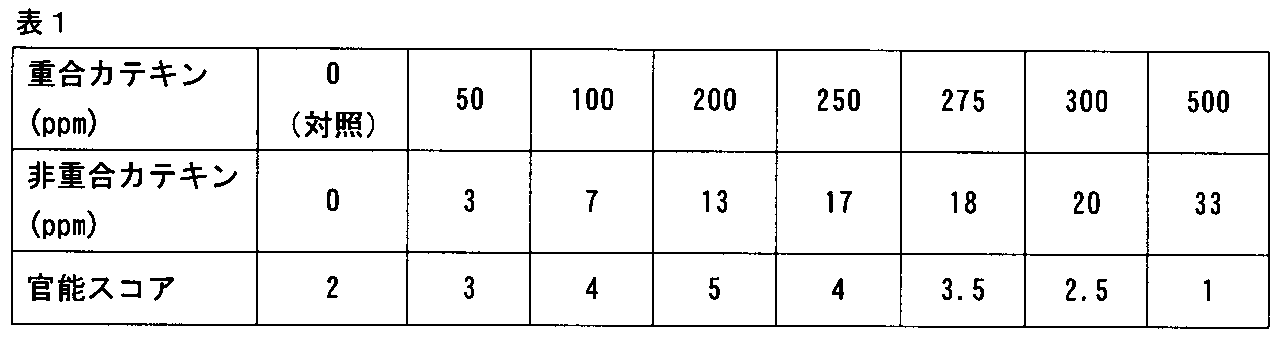
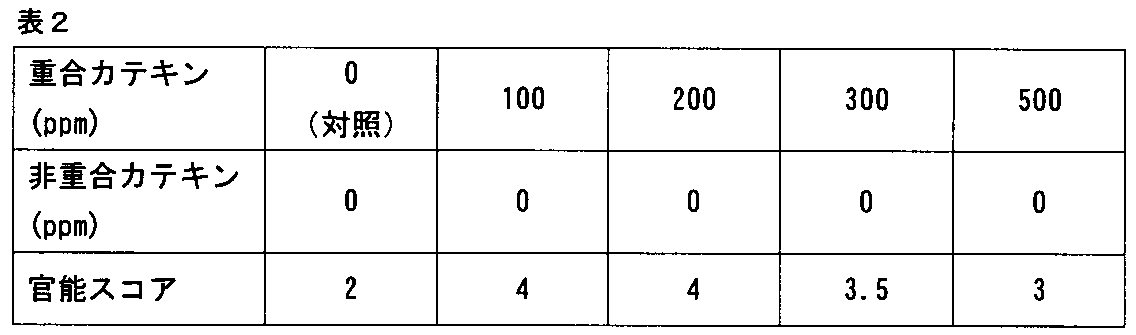
- Example 1 Flavor Enhancement Action of Polymerized Catechin (Extract A) As shown in Table 1, the tea extraction obtained in Production Example 1 was performed so that the polymerized catechin content was 0 to 500 ppm (0 to 0.05 wt%). The product was added to a concentrate (polymerized catechin-containing extract, ie, extract A). To this, 0.15% by weight of lemon flavor was added, then sterilized at 85 ° C. for 10 minutes, cooled to 5 ° C. and lemon flavored water (pH 6.2 to 6.5, Brix 0.01 to 0.00). 46) was produced. This lemon flavored water was subjected to sensory evaluation by three specialized panelists.
- a concentrate polymerized catechin-containing extract, ie, extract A
- lemon flavor was added, then sterilized at 85 ° C. for 10 minutes, cooled to 5 ° C. and lemon flavored water (pH 6.2 to 6.5, Brix 0.01 to 0.00). 46) was produced. This lemon flavored water was subjecte
- Sensory evaluation is based on the enhancement of flavor compared to the control without addition of polymerized catechin (Extract A), that is, from the viewpoint of the strength of lemon flavor.
- Organic evaluation of enhancement of fragrance on the occasion, enhancement of fragrance of aftertaste (residual scent), fruit flavor is not weak (1 point), unchanged (2 points), slightly strong (3 (Point), strong (4 points), and fairly strong (5 points).
- the optimal concentration of polymerized catechin is 50 ppm or more and less than 500 ppm (0.0050 wt% or more and less than 0.05 wt%), and the flavor is enhanced by using polymerized catechin in combination with flavor (fragrance) at this concentration It was suggested that even a beverage after sterilization exhibits a rich flavor.
- Example 2 Flavor enhancement action of polymerized catechin Lemon-flavored water was produced in the same manner as in Example 1 except that the extract A of Example 1 was replaced with the polymerized catechin (purified product) produced in Production Example 2. That is, after adding polymerized catechin to water in an amount of 0 to 500 ppm, 0.15% of lemon flavor was added, sterilized at 85 ° C. for 10 minutes, cooled to 5 ° C., and lemon flavored water (pH 6.0 to 6.5, Brix 0.01 to 0.05) was produced. This lemon flavored water was subjected to sensory evaluation by three specialized panelists.
- Sensory evaluation is based on the enhancement of flavor compared to the control without addition of polymerized catechin, that is, from the viewpoint of the strength of lemon flavor, the enhancement of the scent before the mouth (scented), the scent when contained in the mouth , Enhancement of aftertaste scent (residual scent), compared to the control, fruit flavor is not weak (1 point), unchanged (2 points), slightly strong (3 points), strong (4 points), fairly strong (5 points), was evaluated in five stages.
- Example 2 Similar to Example 1, when polymerized catechin was added, the lemon flavor was enhanced in any of the fragrance, in-mouth scent, and remaining scent. Compared with the case of using the extract A of Example 1 (concentrate of tea extract), the effect of the flavor exhibited by the polymerized catechin is higher when the purified product is used when the addition concentration is high (for example, polymerized catechin 500 ppm). I understand that there are few. From this, when using the plant extract containing polymeric catechin, it was suggested that what improved the refinement
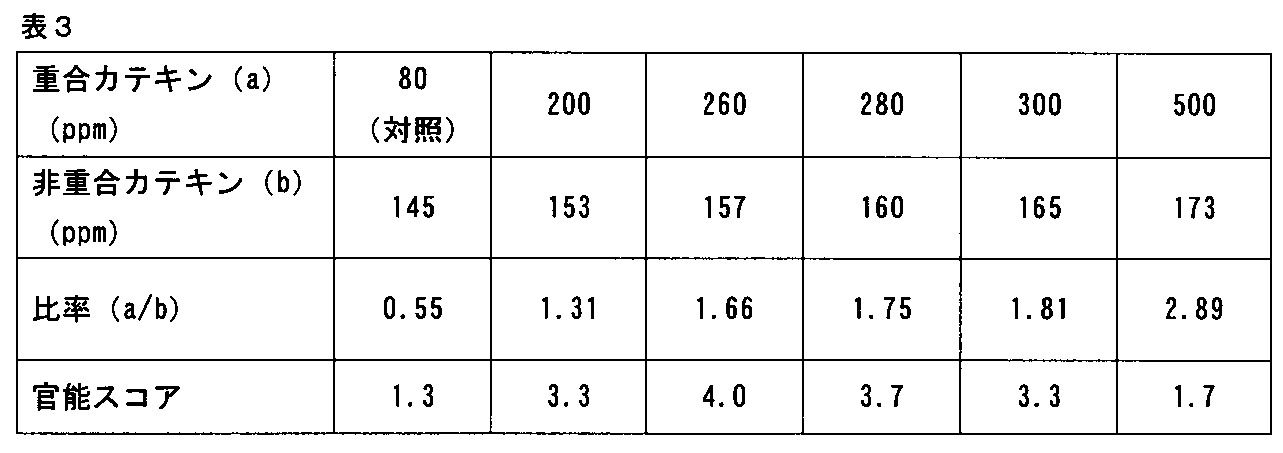
- Example 3 Flavor enhancement effect of polymerized catechin in tea beverage (1) Oolong tea leaves were extracted with 30 times the amount of hot water for 4 minutes to obtain Oolong tea extract. To the obtained oolong tea extract (non-polymerized catechin 145 ppm, polymerized catechin 80 ppm), the extract A obtained in Production Example 1 was added to prepare a oolong tea beverage so that the polymerized catechin was 500, 300, 280, 260, 200 ppm. Then, 0.15% of lemon flavor was added to the mixture, sterilized by heating, and cooled to produce a lemon-flavored oolong tea beverage (pH 5.9, Brix 0.3 to 0.5).
- Oolong tea beverages usually contain non-polymerized catechins at a higher concentration than polymerized catechins (control), but beverages to which the polymerized catechins of the present invention are added are beverages containing polymerized catechins at a higher concentration than non-polymerized catechins.
- it was a tea-based beverage in which the ratio ((a) / (b)) based on weight of polymerized catechin (a) and non-polymerized catechin (b) was 1 or more.
- Increasing the amount of polymerized catechin enhanced the richness and volume of Oolong tea beverage, and the flavor of lemon was selectively enhanced as a flavor.
- This lemon flavor had a juicy, deep, mild, refreshing and ripe flavor and was close to natural lemon fruit.
- Oolong tea beverage with enhanced lemon flavor by polymerized catechins was a fruit-based tea beverage with high drinkability (taste) that can taste both the taste of the base Oolong tea itself and the lemon flavor. .
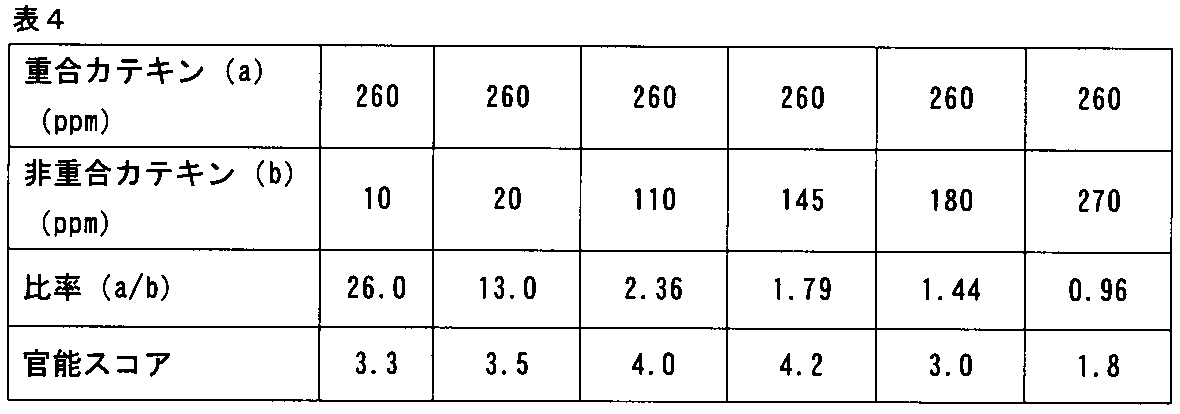
- Example 4 Flavor enhancement effect of polymerized catechin in tea beverage (2) Using the extract A obtained in Production Example 1 and the oolong tea extract obtained in Example 3, six kinds of oolong tea drinks having different ratios of non-polymerized catechin and polymerized catechin shown in Table 4 were prepared. .15% was added, heat sterilized, and cooled to produce a lemon-flavored oolong tea beverage (pH 5.9, Brix 0.3 to 0.5). By 5 expert panelists, the taste of each beverage as a flavored tea, that is, the balance between the flavor of oolong tea and the lemon flavor as a base, was compared by 5 expert panelists to a beverage that did not contain Extract A. As an evaluation, 5 grades (5 points: oolong tea and lemon flavor can be tasted together and delicious strawberry 1 point: either oolong tea or lemon flavor protrudes and the balance is poor and lacks deliciousness).
- the results are shown in Table 4.
- the ratio ((a) / (b)) of polymerized catechin (a) and non-polymerized catechin (b) on a weight basis is 1 or more, preferably 1.3 or more, more preferably 1.
- the beverage to which polymerized catechin was added so as to be 7 or more was a beverage having drinkability as a flavored tea (the lemon flavor was enhanced and the taste of oolong tea and the lemon flavor could be enjoyed in a balanced manner) . From Table 4, it was suggested that the concentration of non-polymerized catechin is preferably 180 ppm or less, more preferably 150 ppm or less.
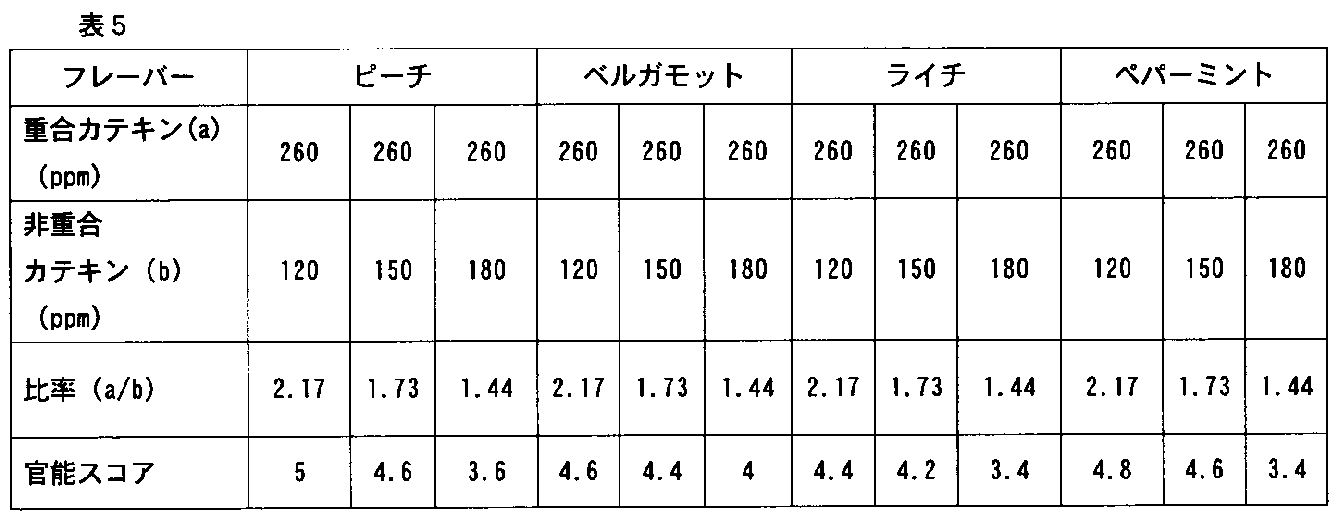
- Example 5 Flavor enhancement effect of polymerized catechin in tea beverage (3) Using the extract A obtained in Production Example 1 and the oolong tea extract obtained in Example 3, three kinds of oolong tea beverages having different ratios of non-polymerized catechin and polymerized catechin shown in Table 5 were prepared. To this was added peach, bergamot, lychee and peppermint flavors. The five flavors (5 points: oolong tea and flavor flavor) can be tasted by five professional panelists regarding the flavor of each beverage as a flavor tea, that is, the balance between the flavor of the base oolong tea and the flavor of the flavor. Delicious rice cake 1 point: Either oolong tea or flavor flavor protrudes and the balance is poor and the taste is not good.
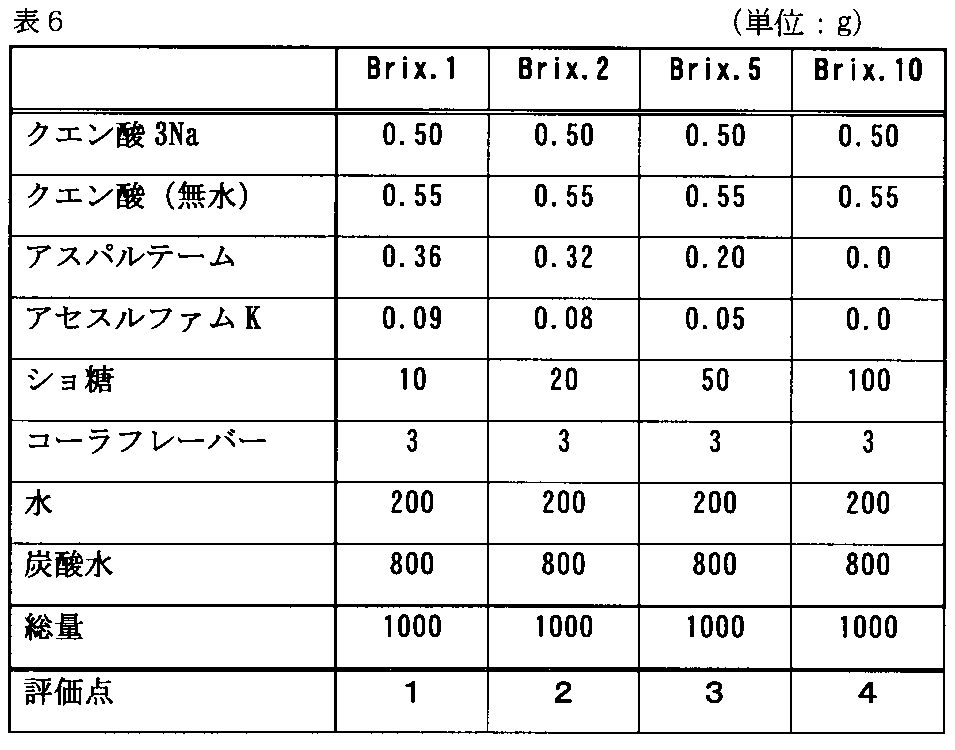
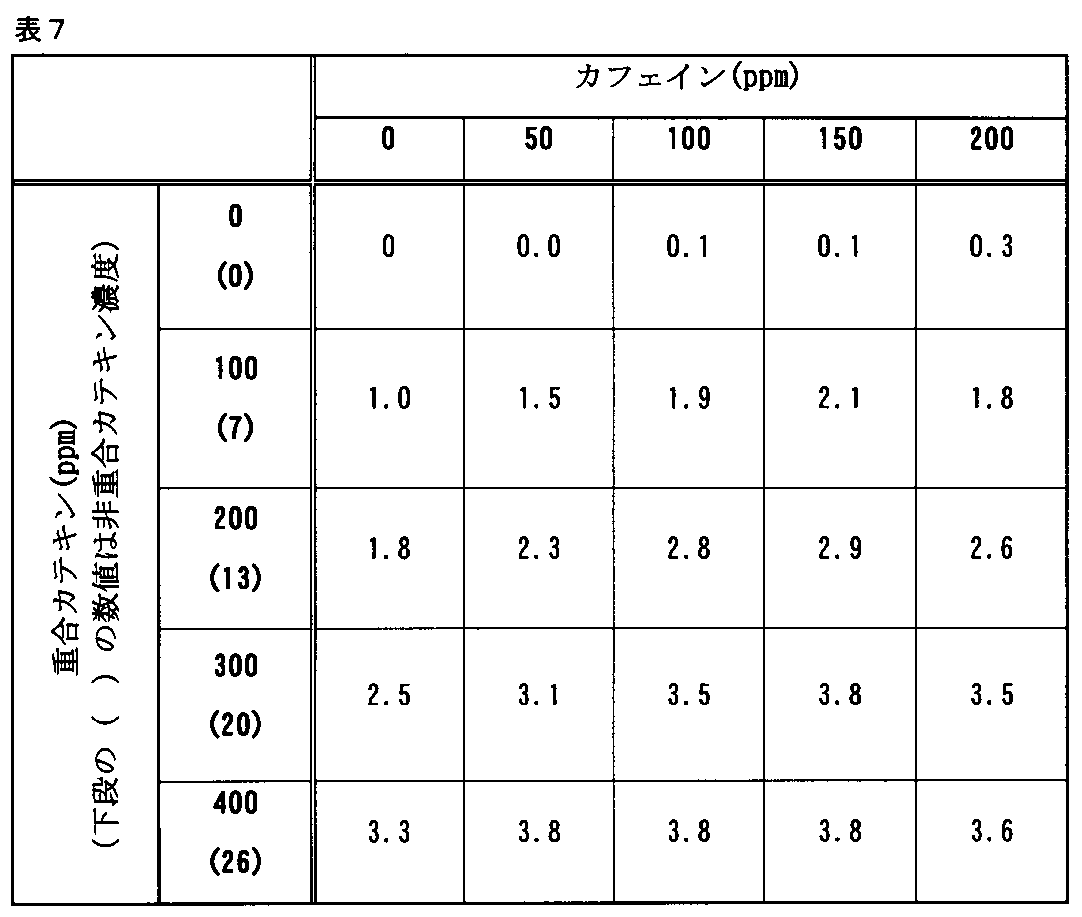
- Example 6 Extract A obtained in Production Example 1 was used as a cola-flavored beverage polymerized catechin. Aspartum 0.4 g and acesulfame K 0.1 g are used as a high-intensity sweetener, 0.55 g of citric acid (anhydrous), 0.5 g of trisodium citrate and 800 g of carbonated water are mixed, and 0 to 200 ppm (0 to 0 ppm) 0.02% by weight) caffeine, 0.3% by weight cola flavor and polymerized catechin extract A having a concentration of 0 to 400 ppm (0 to 0.04% by weight) so that the total amount becomes 1000 g.
- Aspartum 0.4 g and acesulfame K 0.1 g are used as a high-intensity sweetener, 0.55 g of citric acid (anhydrous), 0.5 g of trisodium citrate and 800 g of carbonated water are mixed, and 0 to 200 ppm (0 to 0 ppm) 0.0
- a carbonated beverage having a sweetness of 10, a Brix of about 0.16 to 0.47, and a gas pressure of 3.4 kg / cm 2 was produced by mixing an appropriate amount of water.
- the flavor of the obtained carbonated beverage was evaluated by four professional panelists. The evaluation is based on the brix 1, 2, 5, and 10 carbonated drinks (sweetness 10) produced by blending the sucrose shown in Table 6 from the viewpoints of richness and volume and the strength of the cola flavor. Were scored relatively as 1 point (slightly poor), 2 points (slightly feel), 3 points (feel), 4 points (feel very much).
- Carbonated beverages with a polymerized catechin of 200 ppm and caffeine of 100 ppm or higher, a polymerized catechin of 300 ppm and caffeine of 50 ppm or higher, and a polymerized catechin of 400 ppm with caffeine of 50 ppm or higher are almost equivalent to the richly carbonated beverage of Bri10 prepared with sucrose. ⁇ It was a very tasteful beverage with a sense of volume and flavor.
Landscapes
- Chemical & Material Sciences (AREA)
- Life Sciences & Earth Sciences (AREA)
- Engineering & Computer Science (AREA)
- Food Science & Technology (AREA)
- Polymers & Plastics (AREA)
- Health & Medical Sciences (AREA)
- Nutrition Science (AREA)
- Dispersion Chemistry (AREA)
- Non-Alcoholic Beverages (AREA)
- Tea And Coffee (AREA)
- Seasonings (AREA)
Abstract
Description
1.重合カテキンを有効成分として含有する、風味増強剤。
2.飲料用添加剤である、1に記載の風味増強剤。
3.飲料が茶系飲料である、2に記載の風味増強剤。
4.果実風味の増強剤である、1~3のいずれかに記載の風味増強剤。
5.香料と重合カテキンとを含有する、香料組成物。
6.重合カテキンの濃度が、組成物全体に対して0.0050重量%以上である、5に記載の香料組成物。
7.重合カテキンが、茶葉抽出物由来であることを特徴とする、5又は6に記載の香料組成物。
8.さらに非重合カテキンを含み、(a)含有される重合カテキンと(b)含有される非重合カテキンの重量基準での比率((a)/(b))が1以上である、5~7のいずれかに記載の香料組成物。
9.香料が、果実香料である、5~8のいずれかに記載の香料組成物。
10.重合カテキンと香料とを含有する飲料で、重合カテキンの濃度が飲料全体に対して0.0050重量%以上である、非茶系飲料。
11.重合カテキンと香料とを含有する飲料で、重合カテキンの濃度が飲料全体に対して0.010重量%以上である、茶系飲料。
12.重合カテキンが、茶葉抽出物由来であることを特徴とする、10又は11記載の飲料。
13.さらに非重合カテキンを含み、(a)含有される重合カテキンと(b)含有される非重合カテキンの重量基準での比率((a)/(b))が1以上である、10~12のいずれかに記載の飲料。
14.香料が、果実香料又は植物香料(茶系香料を除く)である10~13のいずれかに記載の飲料。
15.中性飲料(pH4.7~7.0の飲料)である、10~14のいずれかに記載の飲料。
16.Brixが1.0以下である、10~15のいずれかに記載の飲料。
17.甘味料および/または酸味料を含まない飲料である、10~16のいずれかに記載の飲料。
18.茶系飲料である、10~17のいずれかに記載の飲料。
19.風味増強剤の製造のための、又は風味増強のための、重合カテキンの使用。
本発明の風味増強剤は有効成分として重合カテキンを含有する。本明細書でいう「重合カテキン」とは、重合していない単量体のカテキン類((+)-カテキン、(-)-エピカテキン、(+)-ガロカテキン、(-)-エピガロカテキン、(-)-カテキンガレート、(-)-エピカテキンガレート、(-)-ガロカテキンガレート、(-)-エピガロカテキンガレート(これらは、本明細書において、「非重合カテキン」とも記載する))が、茶由来酵素、酵素、光等により複数個連結した構造を持つものをいう。具体的には、以下の条件のHPLCにより分析される成分をいい、テアフラビン(栗田リサーチセンター製)と同じ溶出時間(参考溶出時間:24分)のピークとなる成分をいう。
・移動相:A:水:アセトニトリル:トリフルオロ酢酸=900:100:0.5
B:水:アセトニトリル:トリフルオロ酢酸=200:800:0.5
・流速:1.0ml/min
・カラム温度:40℃
・グラディエント条件;分析開始から5分後まではB液0%、
5分から11分まででB液8%、
11分から21分まででB液10%、
21分から22分まででB液100%、
22分から30分まで100%保持、
30分から31分までで0%
・検出:A280nm (データ採取時間は30分)、ピーク面積で定量。
・注入量:10μL
・標準物質:ウーロンホモビスフラバンB(略記:OHBF-B)

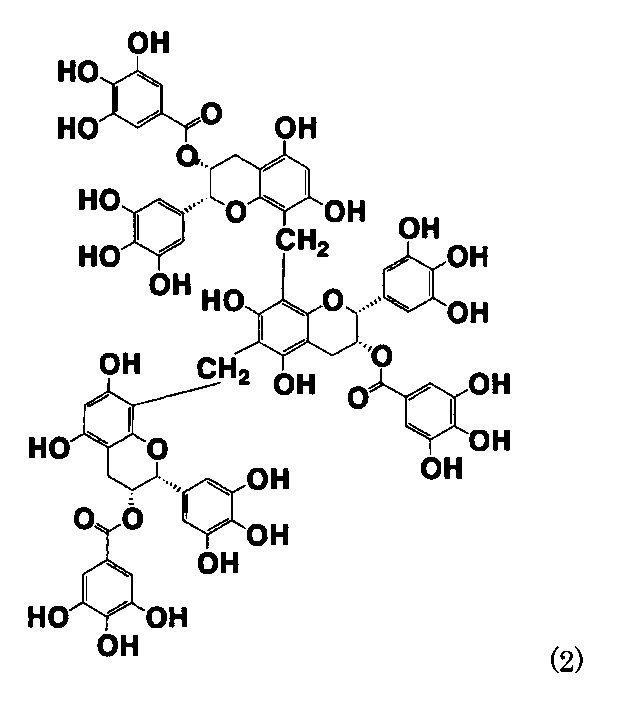
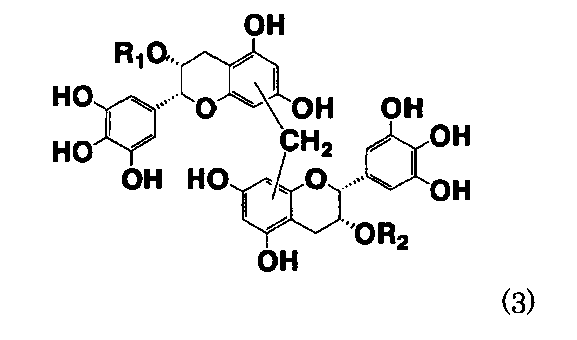
式(4)のエピガロカテキンの三量体:

式(5)のウーロンテアニン-3'-O-ガレート:
本発明の風味増強剤は、重合カテキンを有効成分として含有し、飲食品に添加することにより、飲食品自体の香味に影響を及ぼすことなく、飲食品に含まれる香料の風味を増強するのでフレーバーエンハンサーとして有用である。本発明の風味増強剤が添加される飲食品は限定されないが、好ましくは飲料用添加剤として用いられる。一般に、飲食品が液状(飲料)である場合には、固形剤と比較して添加剤の呈味の影響を受け易いものであるが、本発明の風味増強剤は飲食品自体の香味への影響が少ないという利点から、特に飲料に対して有用なものである。
本発明の風味増強剤は、飲食品に添加して香気成分の風味を増強するものであるが、香料と組み合わせて用いることで、香料の風味を選択的に増強するので、風味が増強された香料組成物に利用できる。
温水(95℃)に0.15重量%の重曹を添加した7800kgの重曹液を用いて、600kgの烏龍茶葉に抽出処理を施し、烏龍茶抽出液約7000kgを得た。この抽出液の液温を60~65℃に保持しながら、400kgの粒状活性炭(クラレ社製GW-H32/60)に通液して非重合カテキン、カフェインを除去した。この通過液(活性炭処理後の液)を減圧濃縮し、Brix11の重合カテキン高含有エキス(烏龍茶抽出物の濃縮物;エキス)(以下、エキスA)約900kgを得た。得られたエキスA中の重合カテキン、非重合カテキン及びカフェイン濃度を、下記条件のHPLCで測定した。その結果、重量基準で、重合カテキンの濃度は12000ppm、非重合カテキンの濃度は800ppm、カフェインの濃度は20ppmであった。
・カラム:TSK-gel ODS-80TsQA(4.6mmφx150mm、東ソー株式会社)
・移動相:A:水:アセトニトリル:トリフルオロ酢酸=900:100:0.5
B:水:アセトニトリル:トリフルオロ酢酸=200:800:0.5
・流速:1.0ml/min
・カラム温度:40℃
・グラディエント条件;分析開始から5分後まではB液0%、
5分から11分まででB液8%、
11分から21分まででB液10%、
21分から22分まででB液100%、
22分から30分まで100%保持、
30分から31分までで0%
・検出:A280nm
・標準物質:烏龍ホモビスフラバンB(OHBF-B)
・重合カテキンのリテンションタイム:約25分のピークでテアフラビンとピークが一致する。
温水(95℃)に0.15重量%の重曹を添加した重曹液を用いて、烏龍茶葉に抽出処理を施し、烏龍茶抽出液を得た。この抽出液を凍結乾燥し、8gを下記の分取クロマトグラムに供した。59.8-70分に溶出する成分をまとめて凍結乾燥を行い、これを重合カテキン(精製品)とした。
・カラム:ODS-10/20(50*300 mm+50*100 mm、 野村化学(株)製)
・移動相:A:水:アセトニトリル:トリフルオロ酢酸=900:100:0.5
B:水:アセトニトリル:トリフルオロ酢酸=200:800:0.5
・流速:60ml/min
・カラム温度:40℃
・グラディエント条件;分析開始から52分後まではB液0%、
52分から52.1分まででA液100%、
52.1分から79分まででA液100%、
79分から81分まででB液100%、
81分から100分までB液100%保持
・検出:A280nm
・注入量:15ml
表1に示すように、重合カテキン含量が0~500ppm(0~0.05重量%)となるように、製造例1で得た茶抽出物の濃縮物(重合カテキン含有エキス、即ちエキスA)に加水した。これに、レモンフレーバーを0.15重量%添加した後、85℃、10分の条件で殺菌し、5℃に冷却してレモン風味水(pH6.2~6.5、Brix0.01~0.46)を製造した。このレモン風味水を専門パネラー3人で官能評価を行った。官能評価は、重合カテキン(エキスA)を添加していない対照と比較したフレーバーの増強作用、即ちレモン風味の強さの観点から、口に含む前の香り(香り立ち)の増強、口に含んだ際の香りの増強、後味の香りの増強(残香)についての総合的な評価とし、対照と比較して、果実風味が弱くない(1点)、変わらない(2点)、少し強い(3点)、強い(4点)、かなり強い(5点)の5段階で評価した。
実施例1のエキスAを製造例2で製造した重合カテキン(精製品)に代える以外は、実施例1と同様にしてレモン風味水を製造した。すなわち、水に重合カテキンを0~500ppmになるように添加した後、レモンフレーバーを0.15%添加し、これを85℃、10分の条件で殺菌し、5℃に冷却してレモン風味水(pH6.0~6.5、Brix0.01~0.05)を製造した。このレモン風味水を専門パネラー3人で官能評価を行った。官能評価は、重合カテキンを添加していない対照と比較したフレーバーの増強作用、即ちレモン風味の強さの観点から、口に含む前の香り(香り立ち)の増強、口に含んだ際の香りの増強、後味の香りの増強(残香)についての総合的な評価とし、対照と比較して、果実風味が弱くない(1点)、変わらない(2点)、少し強い(3点)、強い(4点)、かなり強い(5点)の5段階で評価した。
烏龍茶葉を30倍量の熱水で4分間抽出し、烏龍茶抽出液とした。得られた烏龍茶抽出液(非重合カテキン145ppm、重合カテキン80ppm)に製造例1で得たエキスAを添加し、重合カテキンが500、300、280、260、200ppmになるように烏龍茶飲料を調製し、これにレモンフレーバー0.15%を添加して、加熱殺菌を行い、冷却してレモン風味の烏龍茶飲料(pH5.9、Brix0.3~0.5)を製造した。各飲料のフレーバーティーとしての香味のよさ、即ちベースとなる烏龍茶の風味とレモン風味とのバランスのよさについて、専門パネラー5人により、エキスAを添加していない飲料を対照として、5段階(5点:烏龍茶、レモン風味ともに味わうことができ美味しい⇔1点:烏龍茶、レモン風味いずれかが突出してバランスが悪く美味しさに欠ける)で評価した。
製造例1で得たエキスA及び実施例3で得た烏龍茶抽出液を用い、表4に示す非重合カテキンと重合カテキンの比率が異なる6種類の烏龍茶飲料を調製し、これにレモンフレーバーを0.15%添加して、加熱殺菌を行い、冷却してレモン風味の烏龍茶飲料(pH5.9、Brix0.3~0.5)を製造した。専門パネラー5人により、各飲料のフレーバーティーとしての香味のよさ、即ちベースとなる烏龍茶の風味とレモン風味とのバランスのよさについて、専門パネラー5人により、エキスAを添加していない飲料を対照として、5段階(5点:烏龍茶、レモン風味ともに味わうことができ美味しい⇔1点:烏龍茶、レモン風味いずれかが突出してバランスが悪く美味しさに欠ける)で評価した。
製造例1で得たエキスA及び実施例3で得た烏龍茶抽出液を用い、表5に示す非重合カテキンと重合カテキンの比率が異なる3種類の烏龍茶飲料を調製した。これに、ピーチ、ベルガモット、ライチ、ペパーミントのフレーバーを添加した。各飲料のフレーバーティーとしての香味のよさ、即ちベースとなる烏龍茶の風味とフレーバーの風味とのバランスのよさについて、専門パネラー5人により、5段階(5点:烏龍茶、フレーバー風味ともに味わうことができ美味しい⇔1点:烏龍茶、フレーバー風味いずれかが突出してバランスが悪く美味しさに欠ける)で評価した。
重合カテキンとして製造例1で得たエキスAを用いた。高甘味度甘味料として、アスパルテーム0.4g、アセスルファムK0.1gを用い、クエン酸(無水)0.55g、クエン酸三ナトリウム0.5gと炭酸水800gを混合し、0~200ppm(0~0.02重量%)のカフェイン、0.3重量%のコーラフレーバー及び重合カテキンとして0~400ppm(0~0.04重量%)の濃度となるエキスAを混合した後、全量が1000gとなるように適量の水を混合して、甘味度10、Brix約0.16~0.47、ガス圧3.4kg/cm2の炭酸飲料を製造した。得られた炭酸飲料の風味を専門パネラー4名で評価した。評価は、表6に示すショ糖を配合して製造されるBrix1,2,5,10の炭酸飲料(甘味度10)について、コク・ボリューム感、コーラフレーバーの強さの観点から、その評価点をそれぞれ1点(やや乏しい)、2点(やや感じる)、3点(感じる)、4点(大変感じる)として相対的に評価した。
Claims (9)
- 重合カテキンを有効成分として含有する、風味増強剤。
- 飲料用添加剤である、請求項1に記載の風味増強剤。
- 飲料が茶系飲料である、請求項2に記載の風味増強剤。
- 果実風味の増強剤である、請求項1~3のいずれかに記載の風味増強剤。
- 香料と重合カテキンとを含有する、香料組成物。
- 重合カテキンの濃度が、組成物全体に対して0.0050重量%以上である、請求項5に記載の香料組成物。
- 重合カテキンが、茶葉抽出物由来であることを特徴とする、請求項5又は6に記載の香料組成物。
- さらに非重合カテキンを含み、(a)含有される重合カテキンと(b)含有される非重合カテキンの重量基準での比率((a)/(b))が1以上である、請求項5~7のいずれかに記載の香料組成物。
- 香料が、果実香料である、請求項5~8のいずれかに記載の香料組成物。
Priority Applications (5)
| Application Number | Priority Date | Filing Date | Title |
|---|---|---|---|
| AU2009331076A AU2009331076B2 (en) | 2008-12-26 | 2009-12-25 | Flavor enhancing agent and flavoring composition |
| CN200980157575.1A CN102333458B (zh) | 2008-12-26 | 2009-12-25 | 风味增强剂和香料组合物 |
| NZ593710A NZ593710A (en) | 2008-12-26 | 2009-12-25 | Flavor enhancing agent and flavoring composition |
| US13/141,383 US20110281006A1 (en) | 2008-12-26 | 2009-12-25 | Flavor enhancing agent and flavoring composition |
| US14/316,017 US20140308421A1 (en) | 2008-12-26 | 2014-06-26 | Flavor enhancing agent and flavoring composition |
Applications Claiming Priority (2)
| Application Number | Priority Date | Filing Date | Title |
|---|---|---|---|
| JP2008335192A JP5676078B2 (ja) | 2008-12-26 | 2008-12-26 | 風味増強剤及び香料組成物 |
| JP2008-335192 | 2008-12-26 |
Related Child Applications (2)
| Application Number | Title | Priority Date | Filing Date |
|---|---|---|---|
| US13/141,383 A-371-Of-International US20110281006A1 (en) | 2008-12-26 | 2009-12-25 | Flavor enhancing agent and flavoring composition |
| US14/316,017 Continuation US20140308421A1 (en) | 2008-12-26 | 2014-06-26 | Flavor enhancing agent and flavoring composition |
Publications (1)
| Publication Number | Publication Date |
|---|---|
| WO2010074258A1 true WO2010074258A1 (ja) | 2010-07-01 |
Family
ID=42287862
Family Applications (1)
| Application Number | Title | Priority Date | Filing Date |
|---|---|---|---|
| PCT/JP2009/071662 Ceased WO2010074258A1 (ja) | 2008-12-26 | 2009-12-25 | 風味増強剤及び香料組成物 |
Country Status (7)
| Country | Link |
|---|---|
| US (2) | US20110281006A1 (ja) |
| JP (1) | JP5676078B2 (ja) |
| CN (1) | CN102333458B (ja) |
| AU (1) | AU2009331076B2 (ja) |
| NZ (1) | NZ593710A (ja) |
| TW (1) | TWI492715B (ja) |
| WO (1) | WO2010074258A1 (ja) |
Cited By (1)
| Publication number | Priority date | Publication date | Assignee | Title |
|---|---|---|---|---|
| JP2015047116A (ja) * | 2013-08-30 | 2015-03-16 | サントリー食品インターナショナル株式会社 | 六炭糖を含有する容器詰飲料 |
Families Citing this family (11)
| Publication number | Priority date | Publication date | Assignee | Title |
|---|---|---|---|---|
| JP2013005787A (ja) * | 2011-06-27 | 2013-01-10 | Suntory Holdings Ltd | レモン風味を呈する飲料 |
| EP3636078B1 (en) * | 2013-07-03 | 2022-03-02 | The Coca-Cola Company | Systems and methods for automatically coring, or isolating fiber or whole juice sacs from citrus fruit |
| JP6238350B2 (ja) * | 2013-11-20 | 2017-11-29 | 曽田香料株式会社 | 温州みかん香料又は温州みかん風味飲食品のピール感向上剤、それを添加してなる香料、飲食品又は香粧品 |
| JP6238349B2 (ja) * | 2013-11-20 | 2017-11-29 | 曽田香料株式会社 | 温州みかん香料又は温州みかん風味飲食品の果汁感向上剤、それを添加してなる香料、飲食品又は香粧品 |
| CN105077162B (zh) * | 2015-08-11 | 2018-10-02 | 广州市名花香料有限公司 | 柑橘香精组合物及其制备方法 |
| JP6692161B2 (ja) * | 2015-11-09 | 2020-05-13 | サントリーホールディングス株式会社 | 重合カテキンを含有する飲料 |
| WO2017171062A1 (ja) * | 2016-03-31 | 2017-10-05 | サントリー食品インターナショナル株式会社 | 高濃度イヌリン含有茶飲料 |
| JP6639372B2 (ja) * | 2016-03-31 | 2020-02-05 | サントリーホールディングス株式会社 | 高濃度イヌリン含有茶飲料 |
| CN106343509A (zh) * | 2016-08-31 | 2017-01-25 | 王婧婧 | 一种功能性粽叶味食品添加剂的制备方法 |
| JP2018115282A (ja) * | 2017-01-20 | 2018-07-26 | 日清オイリオグループ株式会社 | 柑橘系香料の香り立ち増強剤と改良香料 |
| JP6336172B2 (ja) * | 2017-04-04 | 2018-06-06 | 花王株式会社 | 容器詰飲料 |
Citations (5)
| Publication number | Priority date | Publication date | Assignee | Title |
|---|---|---|---|---|
| JPH03183453A (ja) * | 1989-09-08 | 1991-08-09 | Maremitsu Izumitani | タンニンを主成分とする味質改良剤、味質改良方法及びタンニンにより味質を改良した食品 |
| WO2005077384A1 (ja) * | 2004-02-17 | 2005-08-25 | Suntory Limited | 高分子ポリフェノール画分を含有するリパーゼ活性阻害剤、茶エキス、およびその製造方法 |
| JP2006246714A (ja) * | 2005-03-08 | 2006-09-21 | Suntory Ltd | 呈味強化発酵茶葉および該茶葉を利用した濃厚呈味烏龍茶飲料 |
| WO2009035047A1 (ja) * | 2007-09-11 | 2009-03-19 | Suntory Holdings Limited | 甘味料の呈味が改善された飲食品 |
| WO2009035048A1 (ja) * | 2007-09-11 | 2009-03-19 | Suntory Holdings Limited | アスパルテームを含有する酸性飲料 |
Family Cites Families (5)
| Publication number | Priority date | Publication date | Assignee | Title |
|---|---|---|---|---|
| US6063428A (en) * | 1996-02-26 | 2000-05-16 | The Procter & Gamble Company | Green tea extract subjected to cation exchange treatment and nanofiltration to improve clarity and color |
| JP3597857B2 (ja) * | 2003-10-31 | 2004-12-08 | 花王株式会社 | 容器詰茶飲料 |
| JP4668553B2 (ja) * | 2004-05-27 | 2011-04-13 | サントリーホールディングス株式会社 | リパーゼ阻害活性および/または抗酸化活性を有するエピガロカテキン二量体および三量体 |
| US7829132B2 (en) * | 2004-11-03 | 2010-11-09 | Unilever Bestfoods, North America Division Of Conopco, Inc. | Consumable tea composition with antioxidants |
| US8962058B2 (en) * | 2005-11-23 | 2015-02-24 | The Coca-Cola Company | High-potency sweetener composition with antioxidant and compositions sweetened therewith |
-
2008
- 2008-12-26 JP JP2008335192A patent/JP5676078B2/ja active Active
-
2009
- 2009-12-25 CN CN200980157575.1A patent/CN102333458B/zh active Active
- 2009-12-25 TW TW098145227A patent/TWI492715B/zh active
- 2009-12-25 NZ NZ593710A patent/NZ593710A/en not_active IP Right Cessation
- 2009-12-25 WO PCT/JP2009/071662 patent/WO2010074258A1/ja not_active Ceased
- 2009-12-25 AU AU2009331076A patent/AU2009331076B2/en not_active Ceased
- 2009-12-25 US US13/141,383 patent/US20110281006A1/en not_active Abandoned
-
2014
- 2014-06-26 US US14/316,017 patent/US20140308421A1/en not_active Abandoned
Patent Citations (5)
| Publication number | Priority date | Publication date | Assignee | Title |
|---|---|---|---|---|
| JPH03183453A (ja) * | 1989-09-08 | 1991-08-09 | Maremitsu Izumitani | タンニンを主成分とする味質改良剤、味質改良方法及びタンニンにより味質を改良した食品 |
| WO2005077384A1 (ja) * | 2004-02-17 | 2005-08-25 | Suntory Limited | 高分子ポリフェノール画分を含有するリパーゼ活性阻害剤、茶エキス、およびその製造方法 |
| JP2006246714A (ja) * | 2005-03-08 | 2006-09-21 | Suntory Ltd | 呈味強化発酵茶葉および該茶葉を利用した濃厚呈味烏龍茶飲料 |
| WO2009035047A1 (ja) * | 2007-09-11 | 2009-03-19 | Suntory Holdings Limited | 甘味料の呈味が改善された飲食品 |
| WO2009035048A1 (ja) * | 2007-09-11 | 2009-03-19 | Suntory Holdings Limited | アスパルテームを含有する酸性飲料 |
Cited By (1)
| Publication number | Priority date | Publication date | Assignee | Title |
|---|---|---|---|---|
| JP2015047116A (ja) * | 2013-08-30 | 2015-03-16 | サントリー食品インターナショナル株式会社 | 六炭糖を含有する容器詰飲料 |
Also Published As
| Publication number | Publication date |
|---|---|
| CN102333458B (zh) | 2016-01-27 |
| AU2009331076B2 (en) | 2015-03-05 |
| AU2009331076A1 (en) | 2011-07-28 |
| CN102333458A (zh) | 2012-01-25 |
| NZ593710A (en) | 2014-06-27 |
| JP5676078B2 (ja) | 2015-02-25 |
| TWI492715B (zh) | 2015-07-21 |
| TW201034585A (en) | 2010-10-01 |
| US20110281006A1 (en) | 2011-11-17 |
| US20140308421A1 (en) | 2014-10-16 |
| JP2010154806A (ja) | 2010-07-15 |
Similar Documents
| Publication | Publication Date | Title |
|---|---|---|
| JP5676078B2 (ja) | 風味増強剤及び香料組成物 | |
| JP3378577B1 (ja) | 飲 料 | |
| TWI432148B (zh) | Improved taste of food and drink | |
| JP5080835B2 (ja) | 発泡性容器詰飲料 | |
| JP5175167B2 (ja) | 高甘味度甘味料を含有する炭酸飲料 | |
| JP6257862B1 (ja) | ステビア含有飲料 | |
| JP2011155891A (ja) | 容器詰紅茶飲料 | |
| JP6257863B1 (ja) | ステビア含有飲料 | |
| JP4569965B2 (ja) | 精製緑茶抽出物の製造法 | |
| JP4940047B2 (ja) | 容器詰飲料 | |
| JP6240366B1 (ja) | 茶重合ポリフェノールとRebD及び/又はRebMとを含有する飲料 | |
| JP2009034075A (ja) | 容器詰飲料 | |
| JP2006042728A (ja) | アミノ酸含有茶飲料 | |
| US8455034B2 (en) | Green tea drink packed in container | |
| JP2003225053A (ja) | 緑茶フレーバーの製造法 | |
| JP4383337B2 (ja) | 高濃度カテキン含有容器詰烏龍茶飲料 | |
| JP6570177B2 (ja) | 果汁感増強方法 | |
| JP6217055B1 (ja) | カテキン類とRebD及び/又はRebMとを含有する飲料 | |
| JP6420009B1 (ja) | ティリロサイド及びアルギニンを含有する飲料 | |
| JP2004166671A (ja) | 緑茶抽出物 | |
| TWI826626B (zh) | 容器裝茶飲料及其製造方法 | |
| JP2009065872A (ja) | 重合カテキン含有飲料 | |
| JP4840003B2 (ja) | 経口用組成物 |
Legal Events
| Date | Code | Title | Description |
|---|---|---|---|
| WWE | Wipo information: entry into national phase |
Ref document number: 200980157575.1 Country of ref document: CN |
|
| 121 | Ep: the epo has been informed by wipo that ep was designated in this application |
Ref document number: 09835054 Country of ref document: EP Kind code of ref document: A1 |
|
| WWE | Wipo information: entry into national phase |
Ref document number: 593710 Country of ref document: NZ |
|
| NENP | Non-entry into the national phase |
Ref country code: DE |
|
| WWE | Wipo information: entry into national phase |
Ref document number: 2009331076 Country of ref document: AU |
|
| ENP | Entry into the national phase |
Ref document number: 2009331076 Country of ref document: AU Date of ref document: 20091225 Kind code of ref document: A |
|
| WWE | Wipo information: entry into national phase |
Ref document number: 13141383 Country of ref document: US |
|
| 122 | Ep: pct application non-entry in european phase |
Ref document number: 09835054 Country of ref document: EP Kind code of ref document: A1 |