WO2010064574A1 - 共重合体、ゴム組成物、架橋ゴム、架橋発泡体およびそれらの用途 - Google Patents
共重合体、ゴム組成物、架橋ゴム、架橋発泡体およびそれらの用途 Download PDFInfo
- Publication number
- WO2010064574A1 WO2010064574A1 PCT/JP2009/069963 JP2009069963W WO2010064574A1 WO 2010064574 A1 WO2010064574 A1 WO 2010064574A1 JP 2009069963 W JP2009069963 W JP 2009069963W WO 2010064574 A1 WO2010064574 A1 WO 2010064574A1
- Authority
- WO
- WIPO (PCT)
- Prior art keywords
- copolymer
- carbon
- ethylene
- weight
- parts
- Prior art date
- Legal status (The legal status is an assumption and is not a legal conclusion. Google has not performed a legal analysis and makes no representation as to the accuracy of the status listed.)
- Ceased
Links
- 0 CC(C1(*)*CC1)*(C*NC1C(O)=C(*)C2=C/C1=C\C(C1)=CCC/C1=C2)=C Chemical compound CC(C1(*)*CC1)*(C*NC1C(O)=C(*)C2=C/C1=C\C(C1)=CCC/C1=C2)=C 0.000 description 2
Images


Classifications
-
- C—CHEMISTRY; METALLURGY
- C08—ORGANIC MACROMOLECULAR COMPOUNDS; THEIR PREPARATION OR CHEMICAL WORKING-UP; COMPOSITIONS BASED THEREON
- C08F—MACROMOLECULAR COMPOUNDS OBTAINED BY REACTIONS ONLY INVOLVING CARBON-TO-CARBON UNSATURATED BONDS
- C08F210/00—Copolymers of unsaturated aliphatic hydrocarbons having only one carbon-to-carbon double bond
- C08F210/16—Copolymers of ethene with alpha-alkenes, e.g. EP rubbers
- C08F210/18—Copolymers of ethene with alpha-alkenes, e.g. EP rubbers with non-conjugated dienes, e.g. EPT rubbers
-
- C—CHEMISTRY; METALLURGY
- C08—ORGANIC MACROMOLECULAR COMPOUNDS; THEIR PREPARATION OR CHEMICAL WORKING-UP; COMPOSITIONS BASED THEREON
- C08L—COMPOSITIONS OF MACROMOLECULAR COMPOUNDS
- C08L23/00—Compositions of homopolymers or copolymers of unsaturated aliphatic hydrocarbons having only one carbon-to-carbon double bond; Compositions of derivatives of such polymers
- C08L23/02—Compositions of homopolymers or copolymers of unsaturated aliphatic hydrocarbons having only one carbon-to-carbon double bond; Compositions of derivatives of such polymers not modified by chemical after-treatment
- C08L23/16—Ethylene-propylene or ethylene-propylene-diene copolymers
-
- C—CHEMISTRY; METALLURGY
- C08—ORGANIC MACROMOLECULAR COMPOUNDS; THEIR PREPARATION OR CHEMICAL WORKING-UP; COMPOSITIONS BASED THEREON
- C08F—MACROMOLECULAR COMPOUNDS OBTAINED BY REACTIONS ONLY INVOLVING CARBON-TO-CARBON UNSATURATED BONDS
- C08F4/00—Polymerisation catalysts
- C08F4/42—Metals; Metal hydrides; Metallo-organic compounds; Use thereof as catalyst precursors
- C08F4/44—Metals; Metal hydrides; Metallo-organic compounds; Use thereof as catalyst precursors selected from light metals, zinc, cadmium, mercury, copper, silver, gold, boron, gallium, indium, thallium, rare earths or actinides
- C08F4/60—Metals; Metal hydrides; Metallo-organic compounds; Use thereof as catalyst precursors selected from light metals, zinc, cadmium, mercury, copper, silver, gold, boron, gallium, indium, thallium, rare earths or actinides together with refractory metals, iron group metals, platinum group metals, manganese, rhenium technetium or compounds thereof
- C08F4/62—Refractory metals or compounds thereof
- C08F4/64—Titanium, zirconium, hafnium or compounds thereof
- C08F4/659—Component covered by group C08F4/64 containing a transition metal-carbon bond
- C08F4/6592—Component covered by group C08F4/64 containing a transition metal-carbon bond containing at least one cyclopentadienyl ring, condensed or not, e.g. an indenyl or a fluorenyl ring
-
- C—CHEMISTRY; METALLURGY
- C08—ORGANIC MACROMOLECULAR COMPOUNDS; THEIR PREPARATION OR CHEMICAL WORKING-UP; COMPOSITIONS BASED THEREON
- C08J—WORKING-UP; GENERAL PROCESSES OF COMPOUNDING; AFTER-TREATMENT NOT COVERED BY SUBCLASSES C08B, C08C, C08F, C08G or C08H
- C08J9/00—Working-up of macromolecular substances to porous or cellular articles or materials; After-treatment thereof
- C08J9/04—Working-up of macromolecular substances to porous or cellular articles or materials; After-treatment thereof using blowing gases generated by a previously added blowing agent
-
- C—CHEMISTRY; METALLURGY
- C08—ORGANIC MACROMOLECULAR COMPOUNDS; THEIR PREPARATION OR CHEMICAL WORKING-UP; COMPOSITIONS BASED THEREON
- C08L—COMPOSITIONS OF MACROMOLECULAR COMPOUNDS
- C08L23/00—Compositions of homopolymers or copolymers of unsaturated aliphatic hydrocarbons having only one carbon-to-carbon double bond; Compositions of derivatives of such polymers
- C08L23/02—Compositions of homopolymers or copolymers of unsaturated aliphatic hydrocarbons having only one carbon-to-carbon double bond; Compositions of derivatives of such polymers not modified by chemical after-treatment
- C08L23/04—Homopolymers or copolymers of ethene
-
- C—CHEMISTRY; METALLURGY
- C08—ORGANIC MACROMOLECULAR COMPOUNDS; THEIR PREPARATION OR CHEMICAL WORKING-UP; COMPOSITIONS BASED THEREON
- C08F—MACROMOLECULAR COMPOUNDS OBTAINED BY REACTIONS ONLY INVOLVING CARBON-TO-CARBON UNSATURATED BONDS
- C08F232/00—Copolymers of cyclic compounds containing no unsaturated aliphatic radicals in a side chain, and having one or more carbon-to-carbon double bonds in a carbocyclic ring system
- C08F232/08—Copolymers of cyclic compounds containing no unsaturated aliphatic radicals in a side chain, and having one or more carbon-to-carbon double bonds in a carbocyclic ring system having condensed rings
-
- C—CHEMISTRY; METALLURGY
- C08—ORGANIC MACROMOLECULAR COMPOUNDS; THEIR PREPARATION OR CHEMICAL WORKING-UP; COMPOSITIONS BASED THEREON
- C08F—MACROMOLECULAR COMPOUNDS OBTAINED BY REACTIONS ONLY INVOLVING CARBON-TO-CARBON UNSATURATED BONDS
- C08F2420/00—Metallocene catalysts
- C08F2420/02—Cp or analog bridged to a non-Cp X anionic donor
-
- C—CHEMISTRY; METALLURGY
- C08—ORGANIC MACROMOLECULAR COMPOUNDS; THEIR PREPARATION OR CHEMICAL WORKING-UP; COMPOSITIONS BASED THEREON
- C08F—MACROMOLECULAR COMPOUNDS OBTAINED BY REACTIONS ONLY INVOLVING CARBON-TO-CARBON UNSATURATED BONDS
- C08F4/00—Polymerisation catalysts
- C08F4/42—Metals; Metal hydrides; Metallo-organic compounds; Use thereof as catalyst precursors
- C08F4/44—Metals; Metal hydrides; Metallo-organic compounds; Use thereof as catalyst precursors selected from light metals, zinc, cadmium, mercury, copper, silver, gold, boron, gallium, indium, thallium, rare earths or actinides
- C08F4/60—Metals; Metal hydrides; Metallo-organic compounds; Use thereof as catalyst precursors selected from light metals, zinc, cadmium, mercury, copper, silver, gold, boron, gallium, indium, thallium, rare earths or actinides together with refractory metals, iron group metals, platinum group metals, manganese, rhenium technetium or compounds thereof
- C08F4/62—Refractory metals or compounds thereof
- C08F4/64—Titanium, zirconium, hafnium or compounds thereof
- C08F4/659—Component covered by group C08F4/64 containing a transition metal-carbon bond
- C08F4/65908—Component covered by group C08F4/64 containing a transition metal-carbon bond in combination with an ionising compound other than alumoxane, e.g. (C6F5)4B-X+
-
- C—CHEMISTRY; METALLURGY
- C08—ORGANIC MACROMOLECULAR COMPOUNDS; THEIR PREPARATION OR CHEMICAL WORKING-UP; COMPOSITIONS BASED THEREON
- C08J—WORKING-UP; GENERAL PROCESSES OF COMPOUNDING; AFTER-TREATMENT NOT COVERED BY SUBCLASSES C08B, C08C, C08F, C08G or C08H
- C08J2201/00—Foams characterised by the foaming process
- C08J2201/02—Foams characterised by the foaming process characterised by mechanical pre- or post-treatments
- C08J2201/026—Crosslinking before of after foaming
-
- C—CHEMISTRY; METALLURGY
- C08—ORGANIC MACROMOLECULAR COMPOUNDS; THEIR PREPARATION OR CHEMICAL WORKING-UP; COMPOSITIONS BASED THEREON
- C08J—WORKING-UP; GENERAL PROCESSES OF COMPOUNDING; AFTER-TREATMENT NOT COVERED BY SUBCLASSES C08B, C08C, C08F, C08G or C08H
- C08J2323/00—Characterised by the use of homopolymers or copolymers of unsaturated aliphatic hydrocarbons having only one carbon-to-carbon double bond; Derivatives of such polymers
- C08J2323/02—Characterised by the use of homopolymers or copolymers of unsaturated aliphatic hydrocarbons having only one carbon-to-carbon double bond; Derivatives of such polymers not modified by chemical after treatment
- C08J2323/16—Ethene-propene or ethene-propene-diene copolymers
-
- C—CHEMISTRY; METALLURGY
- C08—ORGANIC MACROMOLECULAR COMPOUNDS; THEIR PREPARATION OR CHEMICAL WORKING-UP; COMPOSITIONS BASED THEREON
- C08L—COMPOSITIONS OF MACROMOLECULAR COMPOUNDS
- C08L2203/00—Applications
- C08L2203/14—Applications used for foams
-
- C—CHEMISTRY; METALLURGY
- C08—ORGANIC MACROMOLECULAR COMPOUNDS; THEIR PREPARATION OR CHEMICAL WORKING-UP; COMPOSITIONS BASED THEREON
- C08L—COMPOSITIONS OF MACROMOLECULAR COMPOUNDS
- C08L2312/00—Crosslinking
-
- C—CHEMISTRY; METALLURGY
- C08—ORGANIC MACROMOLECULAR COMPOUNDS; THEIR PREPARATION OR CHEMICAL WORKING-UP; COMPOSITIONS BASED THEREON
- C08L—COMPOSITIONS OF MACROMOLECULAR COMPOUNDS
- C08L2314/00—Polymer mixtures characterised by way of preparation
- C08L2314/06—Metallocene or single site catalysts
Definitions
- the present invention relates to a copolymer, a rubber composition containing the copolymer, a crosslinked rubber, a crosslinked foam, and uses thereof. More specifically, a copolymer capable of providing a crosslinked rubber and a crosslinked foam having a low specific gravity and excellent shape retention, a rubber composition containing the copolymer, a crosslinked rubber and a crosslinked foam formed from the composition , As well as their uses.
- EPDM ethylene / propylene / diene copolymer rubber
- EPDM is used for automobile exterior materials such as glass run channels and weatherstrip sponges and radiator hose materials, for example.
- automobile exterior materials such as glass run channels and weatherstrip sponges and radiator hose materials, for example.
- EPDM having excellent foamability is desired.
- Preparation of a foam obtained from a composition containing EPDM requires control of the vulcanization reaction and the foaming reaction. Moreover, in order to improve foamability, it is necessary to increase the viscosity of the foaming medium and the effective amount (gas retention) of the product gas. At that time, for the purpose of improving gas retention and shape stability, it is effective to increase the high molecular weight component of EPDM and to introduce a branched structure into EPDM (for example, see Non-Patent Documents 1 and 2). ). However, a composition containing EPDM having sufficient foamability has not been proposed yet.
- Patent Document 1 uses 5-ethylidene-2-norbornene (ENB) as a diene component, which is excellent in shape retention and kneading workability, and in ethylene / ⁇ -olefin / Non-conjugated diene copolymer rubber is disclosed.
- ENB 5-ethylidene-2-norbornene
- Patent Document 2 discloses an ethylene / ⁇ -olefin / non-conjugated diene copolymer rubber using ENB and dicyclopentadiene as a non-conjugated diene, which is highly foamed and excellent in compression set using the rubber. A sponge is disclosed. Although the composition containing EPDM described in Patent Documents 1 and 2 improves the balance of extrudability, vulcanization speed and mechanical strength of vulcanized rubber as compared with the conventional composition containing EPDM, it is still sufficient. A composition containing EPDM having a good balance has not been obtained.
- Non-Patent Documents 1 and 2 it is necessary to use a large amount of expensive non-conjugated polyenes such as ENB and VNB, so there is still room for improvement from the viewpoint of reducing manufacturing costs. There is.
- An object of the present invention is to provide a rubber composition having sufficient foamability, its use, and a copolymer contained in the rubber composition.
- the present invention also provides a rubber composition capable of obtaining a crosslinked foam having a low specific gravity and excellent shape retention even when the amount of non-conjugated polyene used in obtaining a copolymer is reduced, and the rubber It is an object to provide a crosslinked rubber and a crosslinked foam obtained from the composition.
- the present inventors have found that a rubber composition containing a copolymer using two specific types of polyenes has sufficient foamability and the rubber composition.
- a crosslinked rubber and a crosslinked foam having a low specific gravity and excellent shape retention can be provided, and the present invention has been completed.
- the present invention includes the following matters.
- a copolymer (A) synthesized using a metallocene catalyst comprising a derived structural unit, (1) The structural unit derived from the ⁇ -olefin [B] having 3 to 20 carbon atoms is 10 to 50 mol% in 100 mol% of all structural units, (2) Mol% of structural units derived from non-conjugated polyene [C-1] in which only one carbon / carbon double bond that can be polymerized with a metallocene catalyst is present in one molecule. And a total of mol% of structural units derived from non-conjugated polyene [C-2] in which two carbon / carbon double bonds that can be polymerized with a metallocene catalyst are present in one molecule.
- a copolymer (A) characterized by satisfying the following formula (I). 50> Flow activation energy (Ea) [kJ / mol]> 35 (I) [2] The copolymer (A) according to [1], wherein (4) Mooney viscosity [ML (1 + 4) 100 ° C.] measured at 100 ° C. is 10 to 90.
- [3] Apparent structural unit derived from non-conjugated polyene [C-2] in which two carbon / carbon double bonds polymerizable with a metallocene catalyst are present in one molecule among the carbon / carbon double bonds.
- non-conjugated polyene [C-1] in which only one carbon-carbon double bond polymerizable with a metallocene catalyst exists in one molecule is 5-ethylidene-2-
- a non-conjugated polyene [C-2], which is norbornene (ENB) and has two carbon / carbon double bonds that can be polymerized with a metallocene catalyst among the carbon / carbon double bonds in one molecule, is 5-vinyl.
- the copolymer (A) according to any one of [1] to [3], which is -2-norbornene (VNB).
- R ′ is a hydrogen atom, a hydrocarbyl group having 1 to 20 carbon atoms
- R ′′ is a hydrocarbyl group having 1 to 20 carbon atoms or a hydrogen atom
- M is titanium
- Z * is —SiR * 2 —
- each R * is independently a hydrogen atom or a hydrocarbyl group having 1 to 20 carbon atoms
- a rubber composition comprising the copolymer (A) according to any one of [1] to [5].
- copolymer (A) according to any one of [1] to [5] and an ethylene / ⁇ -olefin / non-conjugated polyene copolymer having 3 to 20 carbon atoms (the copolymer) (Excluding (A)) (B1), one or more ethylene polymers (B) selected from ethylene / ⁇ -olefin copolymer (B2) and ethylene / polar monomer copolymer (B3) A rubber composition containing the rubber composition.
- a rubber composition comprising 100 parts by weight of the copolymer (A) according to any one of [1] to [5] and 1 to 70 parts by weight of a foaming agent.
- a crosslinked foam obtained by crosslinking and foaming the rubber composition according to any one of [6] to [8].
- a crosslinked foam obtained by crosslinking and foaming the rubber composition according to any one of [6] to [8], having a specific gravity of 0.02 to 0.3.
- a cross-linked foam obtained by crosslinking and foaming the rubber composition according to any one of [6] to [8], having a specific gravity of 0.02 to 0.3.
- a highly foamed sponge material comprising the crosslinked foam according to [11].
- a heat-insulating sponge comprising the crosslinked foam according to [11].
- a dam rubber comprising the crosslinked foam described in [11].
- the rubber composition containing the copolymer of the present invention has sufficient foamability and is excellent in kneadability.
- the crosslinked foam of the present invention has a high expansion ratio, the specific gravity is small and the shape stability is excellent, so that it can be suitably used as an automobile exterior material such as a glass run channel or a weather strip sponge, or a radiator hose material. .
- a crosslinked foam having excellent foaming properties can be provided even when the amount of non-conjugated polyene used in obtaining a copolymer is reduced. can do.
- a high-performance sponge can be obtained by using a small amount of the specific ethylene / ⁇ -olefin / non-conjugated polyene copolymer in place of EPDM having a large compression set, which is not suitable for conventional sponges. Can be obtained.
- FIG. 1 shows an example of the shape of a plate-like sponge in the shape stability evaluation of the example.
- FIG. 2 shows a shape example of a chevron (semicircular) sponge and a conceptual diagram of the radius (R) of the arc at the top of the molded body in the shape stability evaluation of the example.
- copolymer (A) rubber composition, cross-linked rubber, cross-linked foam and use thereof of the present invention will be specifically described.
- the copolymer (A) of the present invention comprises ethylene [A], an ⁇ -olefin [B] having 3 to 20 carbon atoms, and a carbon / carbon double bond that can be polymerized with a metallocene catalyst among carbon / carbon double bonds.
- ethylene [A] an ⁇ -olefin [B] having 3 to 20 carbon atoms
- carbon / carbon double bond that can be polymerized with a metallocene catalyst among carbon / carbon double bonds.
- C-1 non-conjugated polyene
- the carbon / carbon double bond that is present only once in one molecule there are two carbon / carbon double bonds that can be polymerized with a metallocene catalyst in one molecule.
- the structural unit is 10 to 50 mol% of 100 mol% of all structural units, and (2) of carbon / carbon double bonds, one carbon / carbon double bond polymerizable with a metallocene catalyst is present in one molecule.
- the ratio ([C-1] / [C-2]) of the structural unit derived from [C-2] is 75/25 to 99.5 / 0.5, and (4) at 100 ° C.
- the measured Mooney viscosity [ML (1 + 4) 100 ° C.] is 10 to 200, and (5) satisfies the following formula (I): And wherein the Succoth.
- the copolymer (A) of the present invention comprises ethylene [A], an ⁇ -olefin [B] having 3 to 20 carbon atoms, and a carbon / carbon double bond that can be polymerized with a metallocene catalyst among carbon / carbon double bonds.
- ethylene [A] an ⁇ -olefin [B] having 3 to 20 carbon atoms
- a carbon / carbon double bond that can be polymerized with a metallocene catalyst among carbon / carbon double bonds.
- a non-conjugated polyene [C-1] in which only one molecule exists in one molecule
- a non-conjugated polyene [C-1] in which two carbon / carbon double bonds that can be polymerized with a metallocene catalyst are present in one molecule.
- ethylene [A] can be polymerized by component [A]
- ⁇ -olefin [B] having 3 to 20 carbon atoms can be polymerized by component [B]
- a metallocene catalyst among carbon / carbon double bonds Non-conjugated polyene [C-1] having only one carbon / carbon double bond in one molecule is component [C-1], and carbon / carbon that can be polymerized with a metallocene catalyst among the carbon / carbon double bonds
- Non-conjugated polyene [C-2] having two double bonds in one molecule is also referred to as component [C-2].
- ⁇ Ingredient [B]> Specific examples of the ⁇ -olefin [B] having 3 to 20 carbon atoms include propylene, 1-butene, 1-pentene, 1-hexene, 4-methyl-1-pentene, 1-heptene, 1- Examples include octene, 1-decene, 1-dodecene, 1-tetradecene, 1-hexadecene, and 1-eicocene. Of these, ⁇ -olefins having 3 to 8 carbon atoms such as propylene, 1-butene, 1-hexene and 1-octene are particularly preferable. Such an ⁇ -olefin is preferable because the raw material cost is relatively low and the obtained copolymer (A) exhibits excellent mechanical properties.
- the copolymer (A) of the present invention contains at least one structural unit derived from an ⁇ -olefin [B] having 3 to 20 carbon atoms, and has 2 or more carbon atoms of 3 to 20 carbon atoms.
- the structural unit derived from the ⁇ -olefin [B] may be included.
- aliphatic polyene examples include 1,4-hexadiene, 1,5-heptadiene, 1,6-octadiene, 1,7-nonadiene, 1,8-decadiene, 1,12- tetradecadiene, 3- Methyl-1,4-hexadiene, 4-methyl-1,4-hexadiene, 5-methyl-1,4-hexadiene, 4-ethyl-1,4-hexadiene, 3,3-dimethyl-1,4-hexadiene, 5-methyl-1,4-heptadiene, 5-ethyl-1,4-heptadiene, 5-methyl-1,5-heptadiene, 6-methyl-1,5-heptadiene, 5-ethyl-1,5-heptadiene, 4-methyl-1,4-octadiene, 5-methyl-1,4-octadiene, 4-ethyl-1,4-octadiene, 5-ethyl-1,4-oct
- Examples of the alicyclic polyene include an alicyclic moiety having one carbon / carbon double bond (unsaturated bond) and an internal olefin bond (carbon / carbon dioxygen) that is not polymerized or poorly polymerized by a metallocene catalyst such as an alkylidene group. And polyene composed of a chain portion having a heavy bond), such as 5-ethylidene-2-norbornene (ENB), 5-propylidene-2-norbornene, and 5-butylidene-2-norbornene. Is mentioned. Of these, 5-ethylidene-2-norbornene (ENB) is preferred. Examples of other alicyclic polyenes include 2-methyl-2,5-norbornadiene, 2-ethyl-2,5-norbornadiene, and the like. These alicyclic polyenes are used alone or in combination.
- the copolymer (A) of the present invention contains a structural unit derived from at least one component [C-1] and contains a structural unit derived from two or more components [C-1]. You may go out.
- Non-conjugated polyene [C-2] in which two carbon / carbon double bonds polymerizable with a metallocene catalyst among the carbon / carbon double bonds exist in one molecule include 5-vinyl-2 -5-alkenyl-2-norbornene such as norbornene (VNB) and 5-allyl-2-norbornene; 2,5-norbornadiene, dicyclopentadiene (DCPD) and tetracyclo [4,4,0,1 2.5 , 1 7.10 ]
- Examples include alicyclic polyenes such as deca-3,8-diene; ⁇ , ⁇ -dienes such as 1,7-octadiene and 1,9-decadiene.
- VNB 5-vinyl-2-norbornene
- dicyclopentadiene 2,5-norbornadiene, 1,7-octadiene and 1,9-decadiene
- VNB 5-vinyl-2-norbornene
- the copolymer (A) of the present invention contains a structural unit derived from at least one component [C-2] and contains a structural unit derived from two or more components [C-2]. You may go out.
- Examples of the copolymer (A) include ethylene / propylene / 4,8-dimethyl-1,4,8-decatriene (DMDT) / 5-vinyl-2-norbornene (VNB) quaternary copolymer, ethylene / propylene. ⁇ 5-butylidene-2-norbornene ⁇ 5-vinyl-2-norbornene (VNB) quaternary copolymer and ethylene ⁇ propylene ⁇ 5-ethylidene-2-norbornene (ENB) ⁇ 5-vinyl-2-norbornene (VNB) A quaternary copolymer is preferable, and an ethylene / propylene / 5-ethylidene-2-norbornene (ENB) / 5-vinyl-2-norbornene (VNB) quaternary copolymer is more preferable.
- DMDT dimethyl-1,4,8-decatriene
- VNB 5-vinyl-2
- the structural unit derived from the ⁇ -olefin [B] having 3 to 20 carbon atoms is 10 to 50 mol% in 100 mol% of all structural units, preferably 25 ⁇ 45 mol%.
- the structural unit (mol%) derived from the component [B] is in the above range, the flexibility of the crosslinked foam obtained from the rubber composition containing the copolymer (A) of the present invention and the mechanical properties at low temperatures are obtained. This is preferable from the viewpoint of characteristics.
- the structural unit derived from ethylene [A] is usually 44 to 89 mol%, preferably 50 to 74 mol%, in 100 mol% of all structural units.
- the structural unit (mol%) derived from the component [A] is in the above range, the flexibility and mechanical properties at low temperature of the crosslinked foam obtained from the rubber composition containing the copolymer (A) of the present invention are included. This is preferable from the viewpoint of characteristics.
- the molar ratio can be determined by 13 C-NMR.
- the copolymer (A) of the present invention is a non-conjugated polyene [C-1] in which only one carbon / carbon double bond that can be polymerized with a metallocene catalyst is present in one molecule.
- the total of mol% of units is 1.0 to 6.0 mol%.
- the total of the mol% is preferably 1.0 to 5.0 mol%.
- the total of the mol% is within the above range because the vulcanization reaction rate can be controlled relatively easily.
- the total mol% can be determined by adding the molar amounts of ENB and VNB determined by 13 C-NMR.
- the copolymer (A) of the present invention is a non-conjugated polyene [C-1] in which only one carbon / carbon double bond that can be polymerized with a metallocene catalyst is present in one molecule.
- the carbon-carbon double bond is derived from a non-conjugated polyene [C-2] that exists in one molecule.
- the ratio ([C-1] / [C-2]) to the mol% of the structural unit is 75/25 to 99.5 / 0.5.
- the ratio of the mol% of the structural unit derived from the component [C-1] to the mol% of the structural unit derived from the component [C-2] is preferably 78/22 to 97/3.
- the vulcanization reactivity and the foaming reaction This is preferable because the balance between gas retention and the balance between the crosslinking activity and the amount of foaming gas generated is excellent.
- the ratio between the mol% of the structural unit derived from the component [C-1] and the mol% of the structural unit derived from the component [C-2] can be determined by 13 C-NMR.
- copolymers obtained from ethylene, propylene, 5-ethylidene-2-norbornene (ENB) and 5-vinyl-2-norbornene (VNB), which are the copolymers (A) of the present invention will be taken as an example, A method for obtaining the requirements (1) to (3) will be specifically shown.
- the mol% of structural units derived from ENB and VNB was calculated.
- the conversion to wt% was performed with the molecular weight of ethylene being 28.05, the molecular weight of propylene being 42.08, and the molecular weight of ENB and VNB being 120.2.
- the copolymer (A) of the present invention has an upper limit of Mooney viscosity [ML (1 + 4) 100 ° C.] measured at 100 ° C. of 200, preferably 100, more preferably 90, particularly preferably 80, most preferably 60. And the lower limit is 10, preferably 20. More specifically, the Mooney viscosity [ML (1 + 4) 100 ° C.] measured at 100 ° C. is 10 to 200, preferably 10 to 90, more preferably 10 to 80, and most preferably 20 to 60. Within this range, a high foam is obtained and the kneading stability is excellent.
- the rubber compound viscosity as a foaming medium can be set relatively easily, and a blending design with excellent kneadability is possible, which is preferable.
- the Mooney viscosity can be measured using a Mooney viscometer (SMV202 type, manufactured by Shimadzu Corporation) according to JIS K6300.
- the copolymer (A) of the present invention satisfies the following formula (I), and preferably satisfies the following formula (I ′).
- the flow activation energy is described below.
- the viscosity of a polymer melt decreases with increasing temperature, as in the case of a simple rheological liquid.
- Tg glass transition temperature
- ⁇ 0 the viscosity
- Viscosity ( ⁇ 0 ) Aexp (Ea / RT) (A) R: Gas constant, A: Frequency factor, Ea: Flow activation energy, T: Absolute temperature Since the flow activation energy does not depend on the molecular weight and molecular weight distribution but is influenced only by the molecular structure, the structure of the polymer It is a useful index that represents information.
- the viscosity of the rubber composition is too low, the retention of foaming gas becomes poor, so the specific gravity cannot be lowered and the appearance is deteriorated. Conversely, if the viscosity of the rubber composition is too high, foaming is difficult. Become. Further, as one of the factors affecting the viscosity of the rubber composition, there is a network formation by a crosslinking reaction of EPDM, and the control of the crosslinking reaction is also important. That is, since the viscosity of the rubber composition is also affected by the crosslinking density of EPDM, it is important to control the crosslinking reaction.
- the molecular design is made to widen the molecular weight distribution of EPDM and the gas retention is improved by introducing a high molecular weight component. Consideration has been made. Further, it is well known in polyethylene that gas retention is improved by introducing long chain branching into the polymer, but in conventional EPDM using a Ziegler catalyst, it is difficult to introduce long chain branching. As described above, since the diene component is not uniformly distributed in the polymer, the crosslinking reaction is unevenly distributed, and as a result, it has been difficult to obtain a sufficiently high foam.
- the diene component is uniformly introduced into the polymer to control the crosslinking activity, and for example, 5-vinyl-2-norbornene ( More long chain branches were introduced by copolymerizing non-conjugated polyenes [C-2] having terminal double bonds such as VNB), and their structural properties were specified by the activation energy of flow. That is, the fact that the flow activation energy satisfies the formula (I) means that many long-chain branches are included in the molecular structure of the copolymer (A) of the present invention, A flow activation energy outside this range means that there are no long-chain branches or few long-chain branches.
- the rubber composition containing the copolymer (A) of this invention was excellent in kneadability, and excellent in the shape stability at the time of preparing a crosslinked foamed body.
- the flow activation energy (Ea) is a master curve indicating the dependence of melt complex viscosity (unit: Pa ⁇ sec) at 190 ° C on frequency (unit: rad / sec) based on the temperature-time superposition principle. Is a numerical value calculated by an Arrhenius type equation from the shift factor (aT) in creating
- the melt complex viscosity-frequency curve of the copolymer (A) at each temperature (T, unit: ° C.) is measured at 190 ° C. based on the temperature-time superposition principle.
- the shift factor (aT) is obtained by superposing on the melt complex viscosity-frequency curve of the polymer (A), and the ln is obtained from each temperature (T) and the shift factor (aT) at the temperature (T) by the least square method.
- a linear approximate expression (I) between (aT) and 1 / (T + 273.16) is calculated.
- Ea is obtained from the slope m of the linear expression (I) and the following expression (II).
- the Y-axis is the melt complex viscosity and the X-axis is the frequency.
- the logarithmic curve of the melt complex viscosity-frequency at 1 moves the frequency aT times and the melt complex viscosity 1 / aT times.
- the correlation coefficient when the linear approximation (i) obtained from the shift factor (aT) at three temperatures of 170 ° C., 190 ° C., and 210 ° C. and the temperature is obtained by the method of least squares is usually 0.99 or more. It is.
- the melt complex viscosity-frequency curve was obtained by measurement using a viscoelasticity measuring apparatus shown below.
- As the test piece a 2 mm thick sheet obtained by pressing the copolymer (A) at 190 ° C. was punched into a disk shape having a diameter of 25 mm.
- the test piece may contain an appropriate amount of an antioxidant (for example, about 1000 ppm).
- Viscoelasticity measuring apparatus RDS-2 (manufactured by Rheometric) Measurement conditions
- Geometry Parallel plate Measurement temperature: 170 ° C, 190 ° C, 210 ° C
- Frequency 0.5-79.577Hz
- Distortion rate 1.0%
- the frequency dependence of the viscosity was measured under the above conditions, and the activation energy of the flow was calculated by the above-mentioned Arrhenius equation.
- the data processing software used was RSI Orchestrator VER. 6. 6. 3 (manufactured by TI Instruments Japan).
- the copolymer having the specific flow activation energy (Ea) can be obtained by adjusting the apparent iodine value described later.
- the copolymer (A) of the present invention preferably further has the following characteristics.
- the copolymer (A) of the present invention is a non-conjugated polyene [C-2] in which two carbon / carbon double bonds that can be polymerized with a metallocene catalyst are present in one molecule.
- the apparent iodine value (IV) of the derived structural unit is preferably 0.1 to 3.0 g / 100 g.
- the upper limit of the apparent iodine value of the component [C-2] is preferably 3.0, more preferably 2.0, and the lower limit is preferably 0.1, more preferably 0.2, and particularly preferably 0.4, most preferably 0.5. More specifically, the apparent iodine value of component [C-2] is more preferably 0.4 to 3.0 g / 100 g, and particularly preferably 0.5 to 3.0 g / 100 g. By adjusting the iodine value, a copolymer having flow activation energy that satisfies the requirement (5) can be obtained.
- the apparent iodine value of the component [C-2] is in the above range because of excellent foamability and kneading stability.
- the apparent iodine value of the component [C-2] can be determined by 1 H-NMR and 13 C-NMR.
- integral values of structural units derived from ethylene, propylene, ENB (3-position peak) and VNB (7-position peak) in the copolymer were determined from 13 C-NMR spectra.
- the molar ratio of structural units derived from ENB and VNB was calculated from the ratio of the obtained integral values, and the weight percent of ENB was determined from the molecular weight of ethylene, propylene, ENB and VNB.
- the integrated value of the peak (a) derived from ENB and the integrated value of the peak (c) derived from the vinyl group of VNB were determined as follows.
- the plurality of peaks in the vicinity of 4.7 to 5.3 ppm include both peak (a) and peak (b).
- the integrated value of the peak (b) derived from two equivalent protons is regarded as twice the integrated value of the peak (c) derived from one proton, It is subtracted from the integrated value of multiple peaks around 4.7 to 5.3 ppm.
- Integrated value of peak (c) derived from vinyl group of VNB Sum of peaks in the vicinity of 5.5 to 6.0 ppm.
- the peaks (a) to (c) of 1) and 2) are represented by the following formulas ( (A), (b) and (c) in (X) and (Y) are shown.
- the apparent iodine value of the structural unit derived from VNB (molecular weight 120.2) was calculated from the following formula using the obtained integrated value.
- the copolymer (A) of the present invention is a copolymer synthesized using a metallocene catalyst as described above.
- a metallocene catalyst a catalyst represented by the following formula (I), (II) or (III) is preferable.
- each R is independently a group or hydrogen atom selected from hydrocarbyl, halohydrocarbyl, silyl, germyl, and combinations thereof, and the number of atoms other than hydrogen contained in the group is 20 or less. It is.
- M is titanium, zirconium or hafnium.
- Y is —O—, —S—, —NR * — or —PR * —.
- R * is a hydrogen atom, hydrocarbyl group, hydrocarbyloxy group, silyl group, halogenated alkyl group or halogenated aryl group, and when R * is not hydrogen, R * represents up to 20 non-hydrogen atoms. contains.
- Z is a divalent group containing boron or a group 14 element and containing nitrogen, phosphorus, sulfur or oxygen, and the divalent group has 60 or less atoms other than hydrogen atoms. is there.
- X is an anionic ligand having 60 or less atoms independently when a plurality of X are present (except for a cyclic ligand in which ⁇ electrons are delocalized).
- X ′ is a neutral linking compound having 20 or less atoms, independently when there are a plurality of X ′.
- P 0, 1 or 2.
- Q is 0 or 1.
- X is halide, hydrocarbyl, hydrocarbyloxy, di (hydrocarbyl) amide, di (hydrocarbyl) phosphide, hydrocarbyl sulfide, silyl group,
- An anionic ligand selected from a halo-substituted derivative, a di (hydrocarbyl) amino-substituted derivative, a hydrocarbyloxy-substituted derivative and a di (hydrocarbyl) phosphino-substituted derivative, wherein the number of atoms other than hydrogen atoms of X is 20 or less is there.
- M is in the +3 oxidation state
- X is allyl, 2- (N, N′-dimethylaminomethyl) phenyl and 2- (N, N′-dimethyl) aminobenzyl.
- M is in an oxidation state of +4, and X is a divalent conjugated diene derivative to form metallacyclopentene with M.
- X ′ is a neutral conjugated or nonconjugated diene which may be substituted with one or more hydrocarbyl groups, and has 40 carbon atoms. It is contained in a number of 1 or less and forms a ⁇ complex with M.
- R 1 and R 2 are a hydrogen atom or an alkyl group having 1 to 6 carbon atoms, and at least one of R 1 and R 2 is not a hydrogen atom.
- R 3 to R 6 are each independently a hydrogen atom or an alkyl group having 1 to 6 carbon atoms.
- R 1 to R 6 may be bonded to each other to form a ring.
- M is titanium
- Y is —O—, —S—, —NR * — or —PR * —.
- Each R * is independently a hydrogen atom, hydrocarbyl group, hydrocarbyloxy group, silyl group, halogenated alkyl group or halogenated aryl group, and when R * is not hydrogen, R * is up to 20 hydrogen atoms; Contains atoms other than.
- Z two binding of the * R * (when R * is not hydrogen) may also form a ring, R * binding to R * and Y bonded to Z * may form a ring.
- P 0, 1 or 2.
- Q is 0 or 1.
- M is in the +4 oxidation state
- X is independently a methyl group or a benzyl group.
- M is in an oxidation state of +3
- X is a 2- (N, N′-dimethyl) aminobenzyl group, or q is 0, and M is In the +4 oxidation state, X is 1,3-butadienyl.
- p is 0, q is 1, M is in an oxidation state of +2, and X is 1,4-diphenyl-1,3-butadiene, 2,4-hexadiene or 1,3-pentadiene.
- R ′ is a hydrogen atom, a hydrocarbyl group, a di (hydrocarbylamino) group, or a hydrocarbyleneamino group, and when R ′ has a carbon atom, the number of carbon atoms is 20 or less.
- R ′′ is a hydrocarbyl group having 1 to 20 carbon atoms or a hydrogen atom.
- M is titanium
- Y is —O—, —S—, —NR * —, —PR * —, —NR 2 * , or —PR 2 * .
- Each of R * is independently a hydrogen atom or a group containing at least one selected from the group consisting of hydrocarbyl, hydrocarbyloxy, silyl, alkyl halide, and aryl halide, when there are a plurality of R * , R * includes atoms of atomic numbers 2 to 20, and two R * s (if R * is not a hydrogen atom) that Z * optionally may form a ring, and R * and Y of Z * R * in the above may form a ring.
- X is a monovalent anionic ligand having 60 or less atoms, excluding a cyclic ligand in which ⁇ electrons are delocalized.
- X ′ is a neutral linking group having 20 or less atoms.
- X ′′ is a divalent anionic ligand having 60 or less atoms.
- P is 0, 1 or 2.
- q is 0 or 1.
- r is 0 or 1.
- q and r are 0 and M is an oxidation state of +4 (except when Y is -NR * 2 or -PR * 2 ), or M is an oxidation state of +3 (provided that , Y is —NR * 2 or —PR * 2 , and X is a halide group, hydrocarbyl group, hydrocarbyloxy group, di (hydrocarbyl) amide group, di (hydrocarbyl) phosphide group, hydrocarbyl sulfide group, and silyl Groups, as well as groups in which these groups are halogen substituted, groups in which these groups are di (hydrocarbyl) amino substituted, groups in which these groups are hydrocarbyloxy substituted and groups in which these groups are di (hydrocarbyl) phosphino substituted
- An anionic ligand selected from the group consisting of the above groups, wherein the group comprises atoms having atomic numbers from 2 to 30.
- X ′′ is a dianionic selected from the group consisting of a hydrocarbazyl group, an oxyhydrocarbyl group, and a hydrocarbylene dioxy group A ligand, wherein X ′′ has an atom number of 2 to 30;
- X is allyl, 2- (N, N-dimethylamino) phenyl, 2- (N, N-dimethylaminomethyl) )
- An anionic stabilizing ligand selected from the group consisting of phenyl and 2- (N, N-dimethylamino) benzyl.
- X ′ is a neutral conjugated diene or neutral diconjugated, optionally substituted with one or more hydrocarbyl groups It is a diene, and the X ′ has a carbon atom number of 40 or less and forms a bond with M by ⁇ - ⁇ interaction.
- R ′ is a hydrogen atom, a hydrocarbyl group having 1 to 20 carbon atoms
- R ′′ is a hydrocarbyl group having 1 to 20 carbon atoms or a hydrogen atom
- M is titanium
- Z * is —SiR * 2 —
- each R * is independently a hydrogen atom or a hydrocarbyl group having 1 to 20 carbon atoms
- hydrocarbyl group having 1 to 20 carbon atoms examples include linear alkyl groups such as a methyl group, an ethyl group, and a butyl group, and branched alkyl groups such as a t-butyl group and a neopentyl group.
- linear alkyloxy groups such as oxy group, ethyloxy group, and butyloxy group, and branched alkyloxy groups such as t-butyloxy group and neopentyloxy group.
- chlorinated, brominated and fluorinated groups and branched alkyl groups examples of the halogenated aryl group include a chlorinated phenyl group and a chlorinated naphthyl group.
- R ′ is preferably a hydrogen atom or methyl, and particularly preferably a hydrogen atom.
- R ′′ is preferably a hydrogen atom or methyl, particularly preferably methyl.
- the polymerization reaction for obtaining the copolymer (A) of the present invention is a copolymerization of non-conjugated polyene (component [C-1] and component [C-2]), particularly non-conjugated polyene [C-2]. It is excellent in the polymerizability of the double bond at the terminal, for example, it can efficiently take in the double bond at the VNB terminal and introduce a long chain branch at a high rate.
- the resulting copolymer (A) has a narrow molecular weight distribution and composition distribution, and a copolymer having a very uniform molecular structure can be prepared.
- the formation of gel-like irregularities on the body surface is significantly suppressed.
- rubber molded products such as crosslinked rubber and crosslinked foamed material containing such a copolymer (A) are excellent in surface appearance and excellent in shape retention because they do not contain gel-like particles. Production stability is also good.
- These catalysts can be prepared by using a well-known synthesis method such as the method disclosed in International Publication No. 98/49212 pamphlet.
- boron compounds include trimethylammonium tetrakis (pentafluorophenyl) borate, di (hydrogenated tallow alkyl) methylammonium tetrakis (pentafluorophenyl) borate, triethylammonium tetrakis (pentafluorophenyl) borate, tripropylammonium tetrakis ( Pentafluorophenyl) borate, tri (n-butyl) ammonium tetrakis (pentafluorophenyl) borate, tri (s-butyl) ammonium tetrakis (pentafluorophenyl) borate, N, N-dimethylanilinium tetrakis (pentafluorophenyl) borate N, N-dimethylanilinium n-butyltris (pentafluorophenyl) borate, N, N-dimethylanilini
- organoaluminum compound is triisobutylaluminum (TIBA).
- the reaction temperature can be raised to 100 ° C because the catalyst is not deactivated even at high temperatures.
- the polymerization pressure is usually in the range of more than 0 MPa to ⁇ 8 MPa (gauge pressure), preferably more than 0 MPa to ⁇ 5 MPa (gauge pressure).
- the reaction time (average residence time when copolymerization is carried out in a continuous process) varies depending on conditions such as catalyst concentration and polymerization temperature, but is usually 0.5 minutes to 5 hours, preferably 10 minutes to 3 hours. .
- molecular weight regulators such as hydrogen can be used.
- the molar ratio (charge ratio) of ethylene [A] to ⁇ -olefin [B] ([A] / [B]) is usually 25/75 to 80/20, preferably 30/70 to 70/30. .
- the molar ratio (charge ratio) between the non-conjugated polyene [C-1] and the non-conjugated polyene [C-2] ([C-1] / [C-2]) is usually 60/40 to 99.5 / 0. .5, preferably 65/35 to 99/1.
- the molar ratio (charge ratio) of ethylene [A] to non-conjugated polyene [C-1] is usually 70/30 to 99/1, preferably 80/20 to 98. / 2.
- the molar ratio (charge ratio) of ethylene [A] to non-conjugated polyene [C-2] is usually 70/30 to 99.9 / 0.1, preferably 80 / 20 to 99.5 / 0.5.
- Polymerization using the above catalyst is preferable because a non-conjugated polyene having a double bond is copolymerized at a high conversion rate, and an appropriate amount of long chain branching can be introduced into the resulting copolymer (A). .
- the copolymer (A) of the present invention thus obtained has 10 to 50 mol% of structural units derived from ⁇ -olefin [B] having 3 to 20 carbon atoms in 100 mol% of all structural units. Preferably, it is 25 to 45 mol%.
- the mol% of the structural unit derived from the non-conjugated polyene [C-1] in which only one carbon / carbon double bond that can be polymerized by a metallocene catalyst exists in one molecule and
- the sum of the mol% of structural units derived from non-conjugated polyene [C-2] in which two carbon-carbon double bonds that can be polymerized with a metallocene catalyst are present in one molecule is 1 It is 0.0 to 6.0 mol%, preferably 1.0 to 5.0 mol%.
- the mol% of the structural unit derived from the non-conjugated polyene [C-1] in which only one carbon / carbon double bond that can be polymerized with a metallocene catalyst exists in one molecule and carbon -Ratio of carbon double bonds that can be polymerized with a metallocene catalyst to mol% of structural units derived from non-conjugated polyene [C-2] in which two carbon double bonds exist in one molecule ([[ C-1] / [C-2]) is 75/25 to 99.5 / 0.5, preferably 78/22 to 97/3.
- Polymerization using the above catalyst is preferable because a non-conjugated polyene having a double bond is copolymerized at a high conversion rate, and an appropriate amount of long chain branching can be introduced into the resulting copolymer (A). .
- the rubber composition of the present invention comprises the copolymer (A).
- the rubber composition of the present invention comprises the copolymer (A), an ethylene / ⁇ -olefin / non-conjugated polyene copolymer having 3 to 20 carbon atoms (excluding the copolymer (A)) (B1), It contains at least one ethylene polymer (B) selected from ethylene / ⁇ -olefin copolymer (B2) and ethylene / polar monomer copolymer (B3).
- the ethylene polymer (B) used in the present invention is an ethylene / ⁇ -olefin / non-conjugated polyene copolymer having 3 to 20 carbon atoms (excluding the copolymer (A)) (B1), ethylene / ⁇ .
- Ethylene / ⁇ -olefin / non-conjugated polyene copolymer having 3 to 20 carbon atoms (B1)
- the ethylene / ⁇ -olefin / non-conjugated polyene copolymer (B1) having 3 to 20 carbon atoms (hereinafter also simply referred to as “copolymer (B1)”) used in the present invention is the copolymer ( Other than A), an ethylene / ⁇ -olefin / non-conjugated polyene copolymer having 3 to 20 carbon atoms.
- the copolymer (B1) contains a structural unit derived from an ⁇ -olefin having 3 to 20 carbon atoms, usually 10 to 50 mol%, preferably 20 to 40 mol%, in 100 mol% of all structural units. It is.
- the structural unit derived from an ⁇ -olefin having 3 to 20 carbon atoms is in the above range because rubber elasticity after crosslinking is excellent.
- Examples of the ⁇ -olefin having 3 to 20 carbon atoms are the same as those already described in the description of the copolymer (A).
- the structural unit derived from the non-conjugated polyene in the copolymer (B1) is usually 0.5 to 5 mol%, preferably 1 to 3 mol% in 100 mol% of all structural units.
- the structural unit derived from the non-conjugated polyene is in the above range because the balance between crosslinking and foaming is excellent.
- non-conjugated polyene examples include 1,4-hexadiene, dicyclopentadiene and 5-ethylidene-2-norbornene. Of these, 5-ethylidene-2-norbornene is preferable.
- copolymer (B1) examples include ethylene / propylene / 5-ethylidene-2-norbornene copolymer, ethylene / propylene / 1,4-hexadiene copolymer, and ethylene / propylene / dicyclopentadiene. Can be mentioned.
- the copolymer (B1) may be produced by a conventionally known method, or a commercially available product may be used.
- commercially available products include Mitsui EPT3090EM (trade name; manufactured by Mitsui Chemicals), Mitsui EPT3092M (trade name; manufactured by Mitsui Chemicals), Nordel IP4640 (trade name; manufactured by Dow Chemical), and Vistalon 7500 (trade name; ExxonMobil). Chemical) and Vistalon V8600 (trade name; manufactured by ExxonMobil Chemical).
- the flow activation energy (Ea) of the copolymer (B1) is usually 5 to 35 kJ / mol. When the flow activation energy (Ea) is in the above range, there are few long chain branches in the molecular structure of the copolymer (B1), and the strength characteristics are excellent.
- the amount of the diene component having a terminal double bond which is a non-conjugated polyene is limited.
- the amount of long chain branching in the molecular structure of the copolymer (B1) is reduced, or the polymerization temperature is not increased too much.
- the method for measuring the activation energy (Ea) of the flow is as already described in the description of the copolymer (A).
- Ethylene / ⁇ -olefin copolymer (B2) The ethylene / ⁇ -olefin copolymer (B2) used in the present invention is an amorphous or low crystalline random or block copolymer comprising ethylene and an ⁇ -olefin having 3 to 20 carbon atoms.
- the density (ASTM D1505) of the ethylene / ⁇ -olefin copolymer (B2) is usually 0.857 to 0.910 g / cm 3 , preferably 0.860 to 0.905 g / cm 3 .
- the melt flow rate (MFR; ASTM D1238) at 190 ° C. and 2.16 kg load of the ethylene / ⁇ -olefin copolymer (B2) is usually 0.1 to 40 g / 10 minutes, preferably 0.5 to 20 g / 10 minutes. It is.
- Examples of the ⁇ -olefin constituting the ethylene / ⁇ -olefin copolymer (B2) include propylene, 1-butene, 1-pentene, 1-hexene, 1-heptene, 1-octene, 1-nonene, 1-decene, Examples thereof include ⁇ -olefins having 3 to 20 carbon atoms such as 1-undecene, 1-dodecene, 1-hexadecene, 1-octadecene, 1-nonadecene, 1-eicocene and 4-methyl-1-pentene.
- ⁇ -olefins having 3 to 10 carbon atoms are preferable, and propylene, 1-butene, 1-hexene and 1-octene are particularly preferable. These ⁇ -olefins may be used singly or in combination of two or more.
- the ethylene / ⁇ -olefin copolymer (B2) usually contains 75 to 95 mol%, preferably 80 to 95 mol% of structural units derived from ethylene, and an ⁇ -olefin having 3 to 20 carbon atoms. Is contained in an amount of usually 5 to 25 mol%, preferably 5 to 20 mol%. However, the total of structural units derived from ethylene and structural units derived from an ⁇ -olefin having 3 to 20 carbon atoms is 100 mol%.
- the ethylene / ⁇ -olefin copolymer (B2) may contain, in addition to the above structural units, structural units derived from other polymerizable monomers as long as the effects of the present invention are not impaired.
- ethylene / ⁇ -olefin copolymer (B2) examples include an ethylene / propylene copolymer, an ethylene / 1-butene copolymer, an ethylene / propylene / 1-butene copolymer, an ethylene / 1- Examples include hexene copolymers and ethylene / 1-octene copolymers. Of these, ethylene / propylene copolymers, ethylene / 1-butene copolymers, ethylene / 1-hexene copolymers and ethylene / 1-octene copolymers are preferred, and ethylene / 1-butene copolymers are preferred. Particularly preferred. These copolymers are usually random or block copolymers, but are preferably random copolymers.
- the crystallinity of the ethylene / ⁇ -olefin copolymer (B2) measured by X-ray diffraction is usually 40% or less, preferably 10 to 30%.
- the melting point (Tm) of the ethylene / ⁇ -olefin copolymer (B2) measured by a differential scanning calorimeter (DSC) is usually 110 ° C. or less, preferably 105 ° C. or less, but the melting point may not be observed.
- DSC measurement about 10 mg of sample was packed in an aluminum pan, (i) heated to 100 ° C./min to 200 ° C. and held for 5 minutes, and then (ii) cooled to ⁇ 150 ° C. at 10 ° C./min. Then, (iii) the temperature is raised to 200 ° C. at 10 ° C./min. Let the temperature of the endothermic peak observed in the temperature rising process of (iii) be the melting point (Tm).
- the molecular weight distribution (Mw / Mn) of the ethylene / ⁇ -olefin copolymer (B2) determined by gel permeation chromatography (GPC) is usually 1.5 to 3.0, preferably 1.7 to 2.5. is there.
- Mw / Mn molecular weight distribution
- Ratio of peak intensities (T ⁇ and T ⁇ ) of methylene groups in structural units derived from ⁇ -olefins having 3 or more carbon atoms obtained from 13 C-NMR spectrum of ethylene / ⁇ -olefin copolymer (B2) (T ⁇ / T ⁇ ) is usually 0.5 or less, preferably 0.4 or less.
- T ⁇ and T ⁇ refer to a methylene group bonded to a tertiary carbon as shown below.
- the 13 value obtained from the 13 C-NMR spectrum of the ethylene / ⁇ -olefin copolymer (B2) and the following formula is usually 0.9 to 1.5, preferably 0.95 to 1.2.
- B value [POE] / (2 ⁇ [PE] [PO]) (Wherein [PE] is the mole fraction of structural units derived from ethylene in the copolymer (B2), and [PO] is structural units derived from ⁇ -olefin in the copolymer (B2). ([POE] is the ratio of the number of ethylene / ⁇ -olefin chains to the total number of dyad chains in the copolymer (B2)).
- This B value is an index representing the distribution of ethylene and ⁇ -olefin having 3 to 20 carbon atoms in the ethylene / ⁇ -olefin copolymer (B2).
- JC Randall (“Macromolecules”, 1982 15, p. 353), J. Ray (“Macromolecules”, 1977, Vol. 10, p. 773), and the like.
- the B value is a 13 C-NMR spectrum of a sample in which about 200 mg of ethylene / ⁇ -olefin copolymer (B2) is uniformly dissolved in 1 ml of hexachlorobutadiene in a 10 mm ⁇ sample tube, usually at a measurement temperature of 120 ° C. It is determined by measurement under conditions of a frequency of 25.05 MHz, a spectral width of 1500 Hz, a pulse repetition time of 4.2 seconds, and a pulse width of 6 ⁇ s.
- the B value is smaller than 1.0, the composition distribution of the ethylene / ⁇ -olefin copolymer (B2) becomes wide, and the handleability may deteriorate.
- the ethylene / ⁇ -olefin copolymer (B2) as described above can be produced by a conventionally known method using a vanadium catalyst, a titanium catalyst or a metallocene catalyst. In particular, it is preferable to use the solution polymerization method described in JP-A-62-1121709.
- Ethylene / polar monomer copolymer (B3) examples include unsaturated carboxylic acid, its salt, its ester (for example, vinyl ester), its amide, carbon monoxide, and sulfur dioxide.
- unsaturated carboxylic acids such as acrylic acid, methacrylic acid, fumaric acid, itaconic acid, maleic anhydride and itaconic anhydride; monovalents such as lithium, sodium and potassium of the unsaturated carboxylic acid Metal salts and salts of polyvalent metals such as magnesium, calcium and zinc; methyl acrylate, ethyl acrylate, isopropyl acrylate, isobutyl acrylate, n-butyl acrylate, isooctyl acrylate, methyl methacrylate, ethyl methacrylate , Isobutyl methacrylate, maleate Carbon monoxide; vinyl esters such as vinyl acetate and vinyl propionate; methyl, unsaturated carboxylic acid esters such as dimethyl maleate and monoethyl maleate and sulfur dioxide and the like.
- monovalents such as lithium, sodium and potassium of the unsaturated carboxylic acid
- Metal salts and salts of polyvalent metals such
- ethylene / acrylic acid copolymers and ethylene / unsaturated carboxylic acid copolymers such as ethylene / methacrylic acid copolymers and ionomers in which part or all of the carboxyl groups are neutralized with the above metals;
- Ethylene / unsaturation such as methyl acrylate copolymer, ethylene / ethyl acrylate copolymer, ethylene / methyl methacrylate copolymer, ethylene / isobutyl acrylate copolymer and ethylene / n-butyl acrylate copolymer
- Carboxylic acid ester copolymers Carboxylic acid ester copolymers; ethylene / isobutyl acrylate / methacrylic acid copolymers and ethylene / unsaturated carboxylic acid ester / unsaturated carboxylic acid copolymers such as ethylene / n-butyl acrylate / methacrylic acid cop
- the content of the polar monomer constituting the ethylene / polar monomer copolymer (B3) is usually 1 to 50% by mass, preferably 5 to 45% by mass, although it depends on the kind of the polar monomer.
- the melt flow rate (MFR) at 190 ° C. under a load of 2160 g of the ethylene / polar monomer copolymer is usually from 0.05 to 500 g / 10 min, preferably from 0.1 to 200 g from the viewpoint of molding processability and mechanical strength. 100 g / 10 min.
- the ethylene / polar monomer copolymer (B3) can be produced by a conventionally known method. Specifically, a copolymer of ethylene and an unsaturated carboxylic acid, an unsaturated carboxylic acid ester, a vinyl ester or the like is obtained by radical polymerization at high temperature and high pressure. Further, a copolymer (ionomer) of ethylene and a metal salt of an unsaturated carboxylic acid can be obtained by reacting a metal compound corresponding to the ethylene / unsaturated carboxylic acid copolymer.
- the ethylene / polar monomer copolymer (B3) is an ethylene / vinyl acetate copolymer
- the content of the structural unit derived from vinyl acetate is usually 10 to 30% by mass, preferably 15 to 30% by mass, more preferably Is 15 to 25% by mass.
- MFR (ASTM D 1238) at 190 ° C. and 2160 g load of the ethylene / vinyl acetate copolymer is usually 0.1 to 50 g / 10 minutes, preferably 0.5 to 20 g / 10 minutes, more preferably 0. .5-5 g / 10 min.
- the ethylene / ⁇ -olefin copolymer (B2) and the ethylene / polar monomer copolymer (B3) have a mass ratio of (B2) / (B3) of usually 100/0 to 20/80, preferably 100 / It is used to be 0 to 30/70.
- the ethylene / polar monomer copolymer (B3) When the ethylene / polar monomer copolymer (B3) is used in the layer structure of the laminate, the resulting crosslinked foam is excellent in adhesion to other layers made of polyurethane, rubber, leather, and the like.
- the ethylene / polar monomer copolymer (B2) / ethylene / polar monomer copolymer (B3) has a mass ratio of 70/30 to 30/70. More preferably, B3) is used.
- the ethylene / polar monomer copolymer (B3) is a copolymer of ethylene and an unsaturated carboxylic acid
- the ethylene / ⁇ -olefin copolymer (B2) and the ethylene / polar monomer copolymer are mixed in the above proportion.
- (B3) is used, a crosslinked foam excellent in tear strength can be obtained.
- the rubber composition of the present invention contains the copolymer (A).
- the rubber composition of the present invention comprises a specific ethylene / ⁇ -olefin / non-conjugated polyene copolymer (A) having 3 to 20 carbon atoms synthesized using a metallocene catalyst, and the copolymer (A).
- ⁇ -olefin / non-conjugated polyene copolymer (B1) having 3 to 20 carbon atoms
- It contains one or more selected ethylene-based polymers (B).
- the rubber composition contains the copolymer (A) in an amount of usually 1 to 90 parts by weight, preferably 10 to 80 parts by weight, and the ethylene polymer (B) is usually 10 to 99 parts by weight, preferably 20 to 20 parts by weight. 90 parts by weight are included. However, the total of the copolymer (A) and the ethylene-based polymer (B) is 100 parts by weight.
- the rubber composition of the present invention includes a foaming agent, a foaming aid, a vulcanizing agent, a vulcanization accelerator, a vulcanizing aid, a reinforcing agent, an inorganic filler, a softening agent, an anti-aging agent (stabilized). Agents), processing aids, activators and hygroscopic agents.
- blowing agent blowing agent examples include inorganic blowing agents such as sodium bicarbonate and sodium carbonate; nitroso compounds such as N, N′-dinitrosopentamethylenetetramine and N, N′-dinitrosotephthalamide; azodicarbonamide And azo compounds such as azobisisobutyronitrile; hydrazide compounds such as benzenesulfonyl hydrazide and 4,4′-oxybis (benzenesulfonyl hydrazide); azide compounds such as calcium azide and 4,4′-diphenyldisulfonyl azide, etc.
- An organic foaming agent is mentioned.
- VINYHALL AC-2F (trade name; manufactured by Eiwa Kasei Kogyo Co., Ltd.), VINYHALL AC # LQ (trade name; manufactured by Eiwa Kasei Kogyo Co., Ltd., azodicarbonamide (abbreviated as ADCA)), Neoselbon N # 1000 SW (trade name: 4,4′-oxybis (benzenesulfonyl hydrazide (abbreviation OBSH)), Cellular D (trade name; manufactured by Eiwa Kasei Kogyo Co., Ltd., N, N′-dinitrosopentamethylenetetramine) Abbreviation DPT)) and the like.
- ADCA azodicarbonamide
- OBSH 4,4′-oxybis (benzenesulfonyl hydrazide
- Cellular D (trade name; manufactured by Eiwa Kasei Kogyo Co., Ltd., N, N′-dinitrosopentamethylenetetramine) Abbrevi
- the blending amount of the foaming agent is usually 1 to 70 parts by weight, preferably 3 to 60 parts by weight with respect to 100 parts by weight of the copolymer (A), from the viewpoint of the amount of foaming gas generated.
- the blending amount of the foaming agent is usually 1 to 70 parts by weight with respect to 100 parts by weight of the total of the copolymer (A) and the ethylene polymer (B).
- the amount is preferably 3 to 60 parts by weight.
- Foaming aid In addition to the foaming agent, a foaming aid may be added to the rubber composition of the present invention as necessary.
- the foaming aid exhibits actions such as lowering the decomposition temperature of the foaming agent, promoting decomposition, or uniforming the bubbles.
- foaming aid examples include organic acids such as salicylic acid, phthalic acid, stearic acid, oxalic acid and citric acid or salts thereof; urea or derivatives thereof.
- examples of commercially available products include cell paste K5 (trade name; manufactured by Eiwa Kasei Kogyo Co., Ltd., urea) and FE-507 (trade name: manufactured by Eiwa Kasei Kogyo Co., Ltd., baking soda).
- the blending amount of the foaming aid is usually 0.1 to 5 parts by weight, preferably 0.5 to 4 parts by weight with respect to 100 parts by weight of the copolymer (A).
- the blending amount of the foaming aid is usually 0.1 to 5 with respect to a total of 100 parts by weight of the copolymer (A) and the ethylene polymer (B). Part by weight, preferably 0.5 to 4 parts by weight.
- the vulcanizing agent vulcanizing agent for example, sulfur-based compounds, organic peroxides, and the like phenolic resins and oxime compounds.
- sulfur compound sulfur, sulfur chloride, sulfur dichloride, morpholine disulfide, alkylphenol disulfide, tetramethylthiuram disulfide, selenium dithiocarbamate and the like are preferable, and sulfur and tetramethylthiuram disulfide are more preferable.
- the compounding amount of the sulfur compound is usually 0.3 to 10 parts by weight, preferably 0.5 to 5.0 parts by weight, more preferably 0.7 to 4 parts by weight based on 100 parts by weight of the copolymer (A). 0.0 part by weight.
- the blending amount is within the above range, there is no bloom on the surface of the obtained crosslinked foamed material, which is preferable since excellent crosslinking properties are exhibited.
- the compounding amount of the sulfur compound is usually 0.3 to 10 with respect to 100 parts by weight of the total of the copolymer (A) and the ethylene polymer (B).
- the blending is by weight, preferably 0.5 to 5.0 parts by weight, more preferably 0.7 to 4.0 parts by weight.
- organic peroxides examples include dicumyl peroxide, 2,5-dimethyl-2,5-di (t-butylperoxy) hexane, 2,5-dimethyl-2,5-di (benzoylperoxy) hexane, 2,5 -Dimethyl-2,5-di (t-butylperoxy) hexyne-3, di-t-butylperoxide, di-t-butylperoxy-3,3,5-trimethylcyclohexane, t-dibutylhydroperoxide, etc. are preferred, More preferred are dicumyl peroxide, di-t-butyl peroxide and di-t-butylperoxy-3,3,5-trimethylcyclohexane.
- the compounding amount of the organic peroxide is usually 0.001 to 0.05 mol, preferably 0.002 to 0.02 mol, more preferably 0.005 to 0.00 mol per 100 g of the copolymer (A). 015 mol.
- the amount of the organic peroxide is within the above range, it is preferable because excellent crosslinking characteristics are exhibited without blooming on the surface of the resulting crosslinked foam.
- the ethylene polymer (B) is contained, the amount of the organic peroxide is usually 0.001 to 0.000 per 100 g in total of the copolymer (A) and the ethylene polymer (B).
- 05 mol preferably 0.002 to 0.02 mol, more preferably 0.005 to 0.015 mol.
- Vulcanization accelerator When a sulfur compound is used as the vulcanizing agent, it is preferable to use a vulcanization accelerator in combination.
- Vulcanization accelerators include N-cyclohexyl-2-benzothiazole sulfenamide, N-oxydiethylene-2-benzothiazole sulfenamide, N, N′-diisopropyl-2-benzothiazole sulfenamide, 2-mercapto Benzothiazole (for example, Sunseller M (trade name; manufactured by Sanshin Chemical Industry Co., Ltd.)), 2- (4-morpholinodithio) benzothiazole (for example, Noxeller MDB-P (trade name; manufactured by Sanshin Chemical Industry Co., Ltd.)) , Thiazoles such as 2- (2,4-dinitrophenyl) mercaptobenzothiazole, 2- (2,6-diethyl-4-morpholinothio) benzothiazole and dibenzothiazyl disulfide; diphenylguanidine, triphenylguanidine and di Guanidines such as orthotolyl guanidine; Alde
- the blending amount of the vulcanization accelerator is usually 0.1 to 20 parts by weight, preferably 0.2 to 15 parts by weight, more preferably 0.5 to 10 parts by weight with respect to 100 parts by weight of the copolymer (A). Part.
- the blending amount of the vulcanization accelerator is usually 0.1 to 100 parts by weight with respect to the total 100 parts by weight of the copolymer (A) and the ethylene polymer (B). 20 parts by weight, preferably 0.2 to 15 parts by weight, more preferably 0.5 to 10 parts by weight.
- the blending amount of the foaming agent, foaming aid, vulcanizing agent, and vulcanization accelerator is in the above-mentioned range because there is no bloom on the surface of the resulting crosslinked foam and excellent crosslinking properties are exhibited.
- Vulcanization auxiliaries include quinone dioximes such as p-quinonedioxime; acrylics such as ethylene glycol dimethacrylate and trimethylolpropane trimethacrylate; diallyl phthalate and triallyl isocyanurate (for example, M- 60 (trade name; manufactured by Nippon Kasei Co., Ltd.)) and the like; other maleimides; divinylbenzene; magnesium oxide / zinc flower (for example, META-Z102 (trade name; manufactured by Inoue Lime Industry Co., Ltd.)). It can select suitably according to the use.
- a vulcanization auxiliary may be used individually by 1 type, and may be used in combination of 2 or more types.
- the blending amount of the vulcanization aid is usually 1 to 20 parts by weight with respect to 100 parts by weight of the copolymer (A).
- the amount of the vulcanization aid is usually 1 to 20 weights with respect to 100 parts by weight of the total of the copolymer (A) and the ethylene polymer (B). Part.
- the rubber composition of the present invention may contain a reinforcing agent or an inorganic filler for the purpose of improving mechanical properties such as tensile strength, tear strength and abrasion resistance.
- carbon such as Asahi # 55G, Asahi # 50HG and Asahi # 60G (trade name; manufactured by Asahi Carbon Co., Ltd.) and seast (SRF, GPF, FEF, MAF, HAF, ISAF, SAF, FT, MT, etc.) Black (manufactured by Tokai Carbon Co., Ltd.); those obtained by surface-treating these carbon blacks with a silane coupling agent; silica; activated calcium carbonate; fine talc and fine silicate. Of these, Asahi # 55G, Asahi # 50HG, and Seast HAF are preferred.
- Examples of the inorganic filler include light calcium carbonate, heavy calcium carbonate, talc and clay, and among them, heavy calcium carbonate is preferable.
- heavy calcium carbonate for example, commercially available whiten SB (trade name; manufactured by Shiraishi Calcium Co., Ltd.) is used.
- the compounding amount of the reinforcing agent or the inorganic filler is usually 30 to 200 parts by weight, preferably 50 to 180 parts by weight, more preferably 70 to 160 parts by weight with respect to 100 parts by weight of the copolymer (A).
- the compounding amount of the reinforcing agent or the inorganic filler is usually 30 to 100 parts by weight with respect to the total of 100 parts by weight of the copolymer (A) and the ethylene polymer (B). 200 parts by weight, preferably 50 to 180 parts by weight, more preferably 70 to 160 parts by weight.
- the rubber composition of the present invention is excellent in kneading processability, and the resulting cross-linked molded product exhibits mechanical properties such as strength and flexibility and compression set. Excellent.
- softener softener examples include process oil (for example, Diana Process Oil PS-430 (trade name; manufactured by Idemitsu Kosan Co., Ltd.)), lubricating oil, paraffin oil, liquid paraffin, petroleum asphalt and petroleum jelly, etc .; coal Coal tar softeners such as tar and coal tar pitch; fatty oil softeners such as mashi oil, linseed oil, rapeseed oil, soybean oil and coconut oil; waxes such as beeswax, carnauba wax and lanolin; ricinoleic acid, palmitic Fatty acids or salts thereof such as acids, stearic acid, barium stearate, calcium stearate and zinc laurate; synthesis of naphthenic acid, pine oil and rosin or derivatives thereof; terpene resins, petroleum resins, atactic polypropylene and coumarone indene resins Polymeric material; Diocti Phthalate, ester-based softeners such as dio
- the blending amount of the softener can be appropriately selected depending on the use.
- the blending amount of the softening agent is at most 200 parts by weight, preferably 150 parts by weight, more preferably 130 parts by weight with respect to 100 parts by weight of the copolymer (A).
- the blending amount of the softening agent is a maximum of 100 parts by weight in total of the copolymer (A) and the ethylene polymer (B), usually 200 parts by weight, preferably Is 150 parts by weight, more preferably 130 parts by weight.
- Anti-aging agent stabilizer
- the rubber composition of the present invention can extend the product life by using an anti-aging agent as in the case of a normal rubber composition.
- anti-aging agent examples include conventionally known anti-aging agents such as amine-based anti-aging agents, phenol-based anti-aging agents and sulfur-based anti-aging agents.
- aromatic secondary amine antioxidants such as phenylbutylamine and N, N′-di-2-naphthyl-p-phenylenediamine; dibutylhydroxytoluene and tetrakis [methylene (3,5-di-t Phenolic antioxidants such as -butyl-4-hydroxy) hydrocinnamate] methane; thioethers such as bis [2-methyl-4- (3-n-alkylthiopropionyloxy) -5-t-butylphenyl] sulfide Anti-aging agent; dithiocarbamate anti-aging agent such as nickel dibutyldithiocarbamate; zinc salt of 2-mercaptobenzoylimidazole and 2-mercaptobenzimidazole; sulfur type such as dilauryl
- the amount of the anti-aging agent is usually 0.3 to 10 parts by weight, preferably 0.5 to 7.0 parts by weight, more preferably 0.7 to 5 parts per 100 parts by weight of the copolymer (A). 0.0 part by weight.
- the blending amount of the antioxidant is usually 0.3 to 10 with respect to 100 parts by weight of the copolymer (A) and the ethylene polymer (B) in total. Parts by weight, preferably 0.5 to 7.0 parts by weight, more preferably 0.7 to 5.0 parts by weight.
- the blending amount of the antioxidant is in the above range since there is no bloom on the surface of the resulting rubber composition and vulcanization is not inhibited.
- processing aids those generally blended into rubber as processing aids can be widely used.
- Specific examples include ricinoleic acid, palmitic acid, lauric acid, stearic acid, stearates, barium stearate, zinc stearate, and calcium stearate. Of these, stearic acid is preferred.
- the amount of the processing aid is usually 10 parts by weight or less, preferably 8.0 parts by weight or less, more preferably 5.0 parts by weight or less with respect to 100 parts by weight of the copolymer (A).
- the amount of the processing aid is usually 10 parts by weight or less with respect to a total of 100 parts by weight of the copolymer (A) and the ethylene polymer (B).
- it is 8.0 weight part or less, More preferably, it is 5.0 weight part or less.
- the blending amount of the processing aid is in the above range since there is no bloom on the surface of the resulting rubber composition and vulcanization is not inhibited.
- Activators As activators, amines such as di-n-butylamine, dicyclohexylamine, monoethanolamine, Acting B (trade name; manufactured by Yoshitsugu Pharmaceutical Co., Ltd.) and Acting SL (trade name; manufactured by Yoshitake Pharmaceutical Co., Ltd.); diethylene glycol, Polyethylene glycol (for example, PEG # 4000 (trade name; manufactured by Lion)), lecithin, triarylate melitrate and zinc compounds of aliphatic and aromatic carboxylic acids (for example, Struktol activator 73, Struktol IB 531 and Struktol FA 541 ( Product name; Scill & Seilacher))), etc .; ZEONET ZP (trade name; made by Nippon Zeon) and other zinc peroxide preparations; octadecyltrimethylammonium bromide; synthetic hydrotalcite; special quaternary ammonium compounds (for example, Arcard 2HF (trade name; manufactured by Lion Akzo)
- the compounding amount of the activator is usually 0.2 to 10 parts by weight, preferably 0.3 to 5 parts by weight, more preferably 0.5 to 4 parts by weight with respect to 100 parts by weight of the copolymer (A). is there.
- the amount of the activator is usually 0.2 to 10 weights with respect to a total of 100 parts by weight of the copolymer (A) and the ethylene polymer (B). Parts, preferably 0.3 to 5 parts by weight, more preferably 0.5 to 4 parts by weight.
- hygroscopic active agent examples include calcium oxide, silica gel, sodium sulfate, molecular sieve, zeolite and white carbon. Of these, calcium oxide is preferred.
- the said hygroscopic agent can be suitably selected according to the use, and can be used individually by 1 type or in mixture of 2 or more types.
- the amount of the hygroscopic agent is usually 0.5 to 15 parts by weight, preferably 1.0 to 12 parts by weight, more preferably 1.0 to 10 parts by weight with respect to 100 parts by weight of the copolymer (A). is there.
- the amount of the hygroscopic agent is usually 0.5 to 15 weights relative to 100 parts by weight of the copolymer (A) and the ethylene polymer (B). Parts, preferably 1.0 to 12 parts by weight, more preferably 1.0 to 10 parts by weight.
- Crosslinked rubber of the present invention can be obtained, for example, by crosslinking the rubber composition by the following two methods.
- a rubber composition containing the above vulcanizing agent is usually mixed with an extrusion molding machine, a calender roll, a press, an injection molding machine, a transfer molding machine, hot air, a glass bead fluidized bed, UHF (ultra-high frequency). Electromagnetic wave), steam, and LCM (hot molten salt tank), etc., are pre-formed into a desired shape by a heating method such as a heating tank, and the preform is introduced into the vulcanizing tank at the same time as the pre-molding or heated.
- Method (i) is usually mixed with an extrusion molding machine, a calender roll, a press, an injection molding machine, a transfer molding machine, hot air, a glass bead fluidized bed, UHF (ultra-high frequency). Electromagnetic wave), steam, and LCM (hot molten salt tank), etc.
- the above-described vulcanizing agent is used, and a vulcanization accelerator and / or a vulcanization aid are used in combination as necessary.
- the heating temperature is generally 140 to 300 ° C., preferably 150 to 270 ° C., more preferably 150 to 250 ° C., usually 0.5 to 30 minutes, preferably 0.5 to 20 minutes, more Preferably, heating is performed for 0.5 to 15 minutes.
- a mold When molding and vulcanizing the rubber composition, a mold may or may not be used. When no mold is used, the rubber composition is usually molded and vulcanized continuously.
- the second method is a method (ii) in which the rubber composition is preformed by the molding method and irradiated with an electron beam.
- an electron beam of 0.1 to 10 MeV is applied to the preformed material so that the absorbed dose is, for example, 0.5 to 35 Mrad, preferably 0.5 to 20 Mrad, more preferably 1 to 10 Mrad. Irradiate.
- the crosslinked foam of the present invention is a crosslinked foam obtained by crosslinking and foaming the rubber composition.
- the cross-linked foam preferably has a specific gravity of 0.02 to 0.3, more preferably 0.02 to 0.20, and most preferably 0.02 to 0.10.
- a foaming agent is added to the rubber composition to perform cross-linking and foaming.
- a rubber composition is extruded into a plate shape using a 60 ⁇ mm extruder equipped with a flat plate die (width 15 mm, wall thickness 4 mm) at a die temperature of 80 ° C. and a cylinder temperature of 60 ° C.
- a method of obtaining a plate-like sponge by crosslinking and foaming by introducing into a vulcanizing tank at the same time as molding and heating at 220 ° C. for 4 minutes can be mentioned.
- the cross-linked foam of the present invention has a low specific gravity due to a high expansion ratio, and is excellent in shape stability. For this reason, if the cross-linked foam of the present invention is used, a lightweight and flexible highly foamed sponge, heat insulating sponge, dam rubber and the like can be obtained with high productivity.
- the crosslinked foam of the present invention is suitably used for, for example, automotive exterior materials such as glass run channels and weatherstrip sponges, and radiator hose materials.
- the physical properties of the copolymer (A) and the rubber composition were measured as follows.
- Apparatus EX400 nuclear magnetic resonance apparatus (manufactured by JEOL Ltd.) Measurement conditions Frequency: 400MHz Pulse width: 6.8 ⁇ sec (45 °) Repetition time: 7.0 seconds Integration count: 512 times Measurement solvent: ODCB-d 4 Measurement temperature: 120 ° C [Mooney viscosity [ML (1 + 4) 100 ° C]] The Mooney viscosity [ML (1 + 4) 100 ° C.] was measured according to JIS K 6300 using a Mooney viscometer (SMV202 type manufactured by Shimadzu Corporation).
- melt complex viscosity-frequency curve (unit of melt complex viscosity; Pa / sec, unit of frequency; Hz) of copolymer (A) at temperatures of 170 ° C. and 210 ° C. (T, units; ° C.) Based on the principle of time superposition, each melt complex viscosity-frequency curve at each temperature (T) is obtained when superposed on the melt complex viscosity-frequency curve of the copolymer (A) at 190 ° C.
- the melt complex viscosity-frequency curve was measured using a viscoelasticity measuring device (rheometric viscoelasticity tester (model RDS-2)). Specifically, as a sample, a 2 mm-thick sheet obtained by pressing the copolymer (A) at 190 ° C. and formed into a disk shape having a diameter of 25 mm ⁇ 2 mm was used, and measured under the following conditions. Went. As data processing software, RSI Orchestrator VER. 6 6 3 (manufactured by TI Instruments Japan) was used. Moreover, it is preferable to mix
- Vulcanization and foaming timing (TP20-TS1, min) was measured using a rotorless rheometer MDR2000P manufactured by Alpha Technologies.
- a preliminary test 6 g of a rubber composition containing an arbitrary amount of a vulcanizing agent and a foaming agent is subjected to a blank test at 160 ° C. for 5 minutes, and a surplus sample protruding from the chamber is removed to obtain a crosslinked foamed foam.
- the body weight W was measured.
- the rubber composition Wg used in the preliminary test was placed in a chamber and measured at 160 ° C. for 20 minutes.
- TP20 (min) which is an index of the foaming speed, is calculated from the time required to reach 20% of the difference between the maximum value and the minimum value of the foaming pressure, and TS1 is calculated from the time required to increase 1 dNm from the minimum value of the crosslinking torque. Calculated. From this, the timing of vulcanization and foaming (TP20-TS1, min) is derived, and when the value becomes negative, it indicates that the foaming reaction is faster than the crosslinking reaction.
- the amount of process oil to be added was changed in order to keep the viscosity of the foaming medium (rubber composition), which is one of the important factors related to foaming, adjusted by the Mooney viscosity of the copolymer rubber used.
- rubber composition which is one of the important factors related to foaming, adjusted by the Mooney viscosity of the copolymer rubber used.
- the kneading conditions were such that the rotor rotation speed was 50 rpm, the floating weight pressure was 3 kg / cm 2 , the kneading time was 5 minutes, and the obtained kneaded product was evaluated in three stages according to the following criteria when discharged.
- BB Some kneading residue is seen, and it is difficult to discharge in one lump.
- AA Plate-like sponge having an arc radius (R) ⁇ 30 mm at the upper part of the molded body (an example of the shape is shown in FIG. 1).
- BB chevron (semicircular) sponge with an arc radius (R) ⁇ 30 mm at the top of the compact (an example of the shape and a conceptual diagram of the arc radius (R) are shown in FIG. 2) [Tensile strength (TB) and tensile elongation (EB)]
- TB tensile strength
- EB tensile elongation
- a tensile test was performed under the conditions of a measurement temperature of 25 ° C. and a tensile speed of 500 mm / min in accordance with the method defined in JIS K 6251, paragraph 3, tensile strength TB (MPa) and tensile elongation at break EB (%) was measured.
- Compression set (CS) Measurement was carried out according to JIS K 6262.
- a foam was cut into a cylindrical shape having a diameter of 30 mm and a thickness of 15 mm or more, and each of two parallel planes of the cylinder was cut from the surface of the parallel plane by 2.5 mm or more to a thickness of 10 mm.
- a cylindrical dumbbell shape was used for cutting out the foam from the foam and cutting out the foam from the surface of the parallel plane.
- the sample was allowed to stand in an environment of 50% compression and 50 ° C. for 6 hours, and measurement was performed 30 minutes after releasing the compression.
- the height of the sample after the heat compression treatment was measured, and the compression set (%) was calculated by the following formula.
- Compression set (%) ⁇ (t 0 -t 1 ) / (t 0 -t 2 ) ⁇ ⁇ 100 t 0 : height before the test of the sample t 1 : height after 30 minutes after the sample is released from compression t 2 : height when the sample is attached to the measurement mold [shape retention ratio] The ratio of the height and diameter of the sponge after foaming and foaming of the rubber composition molded into a cylindrical shape was measured and used as the shape retention rate (%).
- Shape retention ratio (%) (L / D) ⁇ 100
- L Height of cylindrical sponge
- D Inner diameter of cylindrical sponge (maximum horizontal outer shape)
- L represents the length (cm) of the crosslinked product.
- the type A durometer hardness was measured according to JIS K 6253.
- the Asker C hardness was measured at a temperature of 23 ° C. according to “Spring Hardness Test Type C Test Method” described in Appendix 2 of JIS K 7312-1996.
- MFR Melt flow rate
- the measured value at 2.16 kg load was MFR 2
- the measured value at 10 kg load was MFR 10 .
- Example 1 Using a 300 L polymerization vessel equipped with a stirring blade, component [A]: ethylene, component [B]: propylene, component [C-1]: 5-ethylidene-2-norbornene (ENB) and component [C-2]: A quaternary copolymer composed of 5-vinyl-2-norbornene (VNB) was polymerized at 95 ° C.
- component [A] ethylene
- component [B] propylene
- component [C-1] 5-ethylidene-2-norbornene (ENB)
- component [C-2] A quaternary copolymer composed of 5-vinyl-2-norbornene (VNB) was polymerized at 95 ° C.
- VNB 5-vinyl-2-norbornene
- each of the polymerizers was such that (C 6 H 5 ) 3 CB (C 6 F 5 ) 4 was 0.25 mmol / h as a cocatalyst and triisobutylaluminum (TIBA) was 15 mmol / h as an organoaluminum compound. Continuously fed.
- Example 1 it synthesize
- Table 1 shows the polymerization conditions and the physical properties of the obtained copolymer (A).
- Monomer ethylene was continuously supplied to the polymerization vessel at a rate of 170 L / h and propylene at a rate of 375 L / h.
- ENB was continuously fed so that the concentration in the polymerization vessel was 7.5 g / L.
- Hydrogen was used as the molecular weight regulator, and this was supplied so that the hydrogen concentration in the polymerizer gas phase was 3.1 mol%.
- the copolymerization reaction was performed at a temperature of 40 ° C. by circulating cooling water through the outer jacket of the polymerization vessel while maintaining the polymerization pressure at 0.7 MPa.
- a copolymer composed of ethylene, propylene and ENB was obtained as a uniform polymerization solution.
- a small amount of methanol was added to the polymerization solution extracted from the lower part of the polymerization vessel to stop the polymerization reaction.
- the polymer was separated from the solvent by a steam stripping treatment, and then dried under reduced pressure at 80 ° C. overnight.
- a copolymer composed of ethylene, propylene and ENB was obtained at a rate of 265 g per hour.
- Example 8 The rubber composition and sponge (crosslinked foam) of the present invention were obtained by the following production method.
- the rubber composition before vulcanization and foaming in the rubber composition of the present invention was mixed using MIXTRON BB MIXER (Kobe Steel, Ltd., BB-4 type, volume 2.95 L, rotor 4WH).
- 20 parts by weight of polyethylene (trade name; Mirason 27) with respect to 100 parts by weight of the blend (ethylene / propylene / non-conjugated polyene copolymer of Example 1), and “META-Z102” (trade name) 8 parts by weight of Inoue Lime Industry Co., Ltd., 2 parts by weight of stearic acid as a processing aid, and 1 part by weight of “PEG # 4000” (trade name; polyethylene glycol, manufactured by Lion Corporation) as a reinforcing agent.
- PEG # 4000 trade name; polyethylene glycol, manufactured by Lion Corporation
- this rubber compound was extruded under the conditions of a die temperature of 80 ° C. and a cylinder temperature of 60 ° C. using a 50 ⁇ mm extruder equipped with a flat plate die (width 15 mm, thickness 4 mm), and formed into a flat plate shape.
- the molded body was introduced into a vulcanizing tank simultaneously with molding and heated at a temperature of 220 ° C. for 4 minutes to carry out a crosslinking reaction and a foaming reaction to obtain a flat sponge.
- Table 2 shows the physical property values of the flat sponge.
- Example 9 In Example 8, as the copolymer (A) (copolymer rubber), instead of the ethylene / propylene / nonconjugated polyene copolymer of Example 1, the ethylene / propylene / nonconjugated polyene copolymer of Example 2 was used. The same operation as in Example 8 was performed except that coalescence was used. Table 2 shows the physical property values of the flat sponge.
- Example 10 In Example 8, the copolymer (A) was replaced with the ethylene / propylene / nonconjugated polyene copolymer of Example 3 in place of the ethylene / propylene / nonconjugated polyene copolymer of Example 1. This was carried out in the same manner as in Example 8. Table 2 shows the physical property values of the flat sponge.
- Example 11 In Example 8, as the copolymer (A), instead of the ethylene / propylene / non-conjugated polyene copolymer of Example 1, the ethylene / propylene / non-conjugated polyene copolymer of Example 4 was used. This was carried out in the same manner as in Example 8. Table 2 shows the physical property values of the flat sponge.
- Example 12 In Example 8, as the copolymer (A), instead of the ethylene / propylene / non-conjugated polyene copolymer of Example 1, the ethylene / propylene / non-conjugated polyene copolymer of Example 5 was used. This was carried out in the same manner as in Example 8. Table 2 shows the physical property values of the flat sponge.
- Example 13 In Example 12, “Sunseller BUR” (trade name; manufactured by Sanshin Chemical Industry Co., Ltd.) used as a vulcanization accelerator was changed from 1.0 part by weight to 0.5 part by weight and used as a foaming aid. The same procedure as in Example 12 was performed except that “Cell Paste K5” (trade name; manufactured by Eiwa Kasei Kogyo Co., Ltd.) was changed from 1.5 parts by weight to 2.0 parts by weight. Table 2 shows the physical property values of the flat sponge.
- Example 14 In Example 12, “Sunseller BUR” (trade name; manufactured by Sanshin Chemical Industry Co., Ltd.) used as a vulcanization accelerator was changed from 1.0 part by weight to 1.5 parts by weight, and was the same as Example 12. Went to. Table 2 shows the physical property values of the flat sponge.
- Example 15 In Example 12, “Sunseller BUR” (trade name; manufactured by Sanshin Chemical Industry Co., Ltd.) used as a vulcanization accelerator was changed from 1.0 part by weight to 1.5 parts by weight, and used as a foaming aid. The same procedure as in Example 12 was performed except that “Cell Paste K5” (trade name; manufactured by Eiwa Kasei Kogyo Co., Ltd.) was changed from 1.5 parts by weight to 1.0 part by weight. Table 3 shows the physical property values of the flat sponge.
- Example 16 In Example 8, except that the ethylene / propylene / nonconjugated polyene copolymer of Example 6 was used instead of the ethylene / propylene / nonconjugated polyene copolymer of Example 1 as the copolymer (A). This was carried out in the same manner as in Example 8. Table 3 shows the physical property values of the flat sponge.
- Example 17 In Example 8, instead of the ethylene / propylene / non-conjugated polyene copolymer of Example 1 as the copolymer (A), the ethylene / propylene / non-conjugated polyene copolymer of Example 7 was used. This was carried out in the same manner as in Example 8. Table 3 shows the physical property values of the flat sponge.
- Example 8 the copolymer rubber was used except that the ethylene / propylene / non-conjugated polyene copolymer of Comparative Example 1 was used instead of the ethylene / propylene / non-conjugated polyene copolymer of Example 1.
- Table 3 shows the physical property values of the flat sponge.
- Example 8 instead of the ethylene / propylene / nonconjugated polyene copolymer of Example 1 as the copolymer rubber, the ethylene / propylene / nonconjugated polyene copolymer of Comparative Example 2 was used, and a vulcanization accelerator was used.
- the “Sun Pastor BUR” (trade name; manufactured by Sanshin Chemical Industry Co., Ltd.) was changed from 1.0 part by weight to 0.5 part by weight, and “Cell Paste K5” (trade name; Eiwa) was used as a foaming aid.
- the same procedure as in Example 8 was carried out except that (made by Kasei Kogyo Co., Ltd.) was changed from 1.5 parts by weight to 2.0 parts by weight.
- Table 3 shows the physical property values of the flat sponge.
- Example 8 the copolymer rubber was used except that the ethylene / propylene / non-conjugated polyene copolymer of Comparative Example 2 was used instead of the ethylene / propylene / non-conjugated polyene copolymer of Example 1.
- Table 3 shows the physical property values of the flat sponge.
- Example 8 In Example 8, instead of the ethylene / propylene / nonconjugated polyene copolymer of Example 1 as the copolymer rubber, the ethylene / propylene / nonconjugated polyene copolymer of Comparative Example 2 was used, and a vulcanization accelerator was used. "Sunseller BUR” (trade name; manufactured by Sanshin Chemical Industry Co., Ltd.) was changed from 1.0 part by weight to 1.5 parts by weight, and "Cell Paste K5" (trade name; Eiwa) was used as a foaming aid. The same procedure as in Example 8 was carried out except that (made by Kasei Kogyo Co., Ltd.) was changed from 1.5 parts by weight to 1.0 part by weight. Table 3 shows the physical property values of the flat sponge.
- Example 8 As the copolymer rubber, the ethylene / propylene / nonconjugated polyene copolymer of Comparative Example 3 was used instead of the ethylene / propylene / nonconjugated polyene copolymer of Example 1, and a vulcanization accelerator was used.
- the “Sun Pastor BUR” (trade name; manufactured by Sanshin Chemical Industry Co., Ltd.) was changed from 1.0 part by weight to 0.5 part by weight, and “Cell Paste K5” (trade name; Eiwa) was used as a foaming aid.
- the same procedure as in Example 8 was carried out except that (made by Kasei Kogyo Co., Ltd.) was changed from 1.5 parts by weight to 2.0 parts by weight.
- Table 4 shows each physical property value of the flat sponge.
- Example 8 the copolymer rubber was used except that the ethylene / propylene / non-conjugated polyene copolymer of Comparative Example 3 was used instead of the ethylene / propylene / non-conjugated polyene copolymer of Example 1.
- Table 4 shows each physical property value of the flat sponge.
- Example 8 As the copolymer rubber, the ethylene / propylene / nonconjugated polyene copolymer of Comparative Example 4 was used instead of the ethylene / propylene / nonconjugated polyene copolymer of Example 1, and a vulcanization accelerator was used.
- the “Sun Pastor BUR” (trade name; manufactured by Sanshin Chemical Industry Co., Ltd.) was changed from 1.0 part by weight to 0.5 part by weight, and “Cell Paste K5” (trade name; Eiwa) was used as a foaming aid.
- the same procedure as in Example 8 was carried out except that (made by Kasei Kogyo Co., Ltd.) was changed from 1.5 parts by weight to 2.0 parts by weight. Table 4 shows each physical property value of the flat sponge.
- Example 8 the copolymer rubber was used except that the ethylene / propylene / non-conjugated polyene copolymer of Comparative Example 4 was used instead of the ethylene / propylene / non-conjugated polyene copolymer of Example 1.
- Table 4 shows each physical property value of the flat sponge.
- Example 18 Production of Copolymer (A1) Component [A]: ethylene, component [B]: propylene, component [9] continuously at a temperature of 95 ° C. using a polymerization vessel equipped with a 300-liter stirring blade.
- hexane feed amount 41 kg / h
- ethylene feed amount 5.3 kg / h propylene feed amount 5.6 kg / h
- ENB feed amount 900 g / h VNB feed amount
- the polymer was continuously fed to the polymerization vessel at 90 g / h and a hydrogen feed amount of 100 NL / h.
- the compound represented by the formula (VIII) (t-butylamido) dimethyl ( ⁇ 5 -2-methyl-s-indasen-1-yl) silane titanium (II) as the main catalyst ) 1,3-pentadiene was continuously fed to the polymerization vessel so that the feed amount was 0.05 mmol / h.
- (C 6 H 5 ) 3 CB (C 6 F 5 ) 4 was continuously fed to the polymerization reactor so that the concentration was 0.25 mmol / h and triisobutylaluminum (TIBA) was 15 mmol / h.
- a polymerization solution containing 16.6% by weight of a copolymer (A1) composed of ethylene, propylene, ENB and VNB was obtained.
- a small amount of methanol was added to the polymerization solution extracted from the lower part of the polymerization vessel to stop the polymerization reaction.
- the polymer was separated from the solvent by a steam stripping treatment, and then dried under reduced pressure at 80 ° C. overnight.
- the structural unit derived from propylene is 41.2 mol%
- the structural unit derived from non-conjugated polyene is 2.76 mol%
- the structural unit derived from ENB [C-1] The molar ratio of the structural unit derived from VNB [C-2] ([C-1] / [C-2]) is 87.3 / 12.7
- the apparent iodine value of the structural unit derived from VNB is 1 .42 g / 100 g
- Mooney viscosity [ML (1 + 4) 100 ° C.] was 28, and flow activation energy (Ea) was 41.2 kJ / mol.
- Table 5 shows the composition and physical property values of the copolymer (A1).
- Example 19 Production of copolymer (A2) Component [A]: ethylene, component [B]: propylene, component [C] continuously using a polymerization vessel equipped with a stirring blade having a volume of 300 liters at a temperature of 95 ° C.
- hexane feed amount 37.5 kg / h
- ethylene feed amount 3.7 kg / h
- propylene feed amount 3.7 kg / h
- the VNB feed amount was 67 g / h
- the hydrogen feed amount was 20 NL / h.
- the compound represented by the formula (VII) as the main catalyst t-butylamido) dimethyl ( ⁇ 5 -2-methyl-s-indasen-1-yl) silane titanium (II) 1,3-pentadiene was continuously fed to the polymerization vessel so that the feed amount was 0.09 mmol / h.
- (C 6 H 5 ) 3 CB (C 6 F 5 ) 4 was continuously fed to the polymerization reactor so that the concentration was 0.44 mmol / h and triisobutylaluminum (TIBA) was 7.0 mmol / h. .
- a polymerization solution containing 18.0% by weight of a copolymer (A2) composed of ethylene, propylene, ENB and VNB was obtained.
- a small amount of methanol was added to the polymerization solution extracted from the lower part of the polymerization vessel to stop the polymerization reaction.
- the polymer was separated from the solvent by a steam stripping treatment, and then dried under reduced pressure at 80 ° C. overnight.
- the structural unit derived from propylene is 41.1 mol%
- the structural unit derived from non-conjugated polyene is 4.53 mol%
- the structural unit derived from ENB [C-1] The molar ratio of the structural unit derived from VNB [C-2] ([C-1] / [C-2]) is 96.7 / 3.3, and the apparent iodine value of the structural unit derived from VNB is 0. .49 g / 100 g
- Mooney viscosity [ML (1 + 4) 100 ° C.] was 85
- flow activation energy (Ea) was 37.2 kJ / mol.
- Table 5 shows the composition and physical property values of the copolymer (A2).
- the temperature of the autoclave was adjusted so that the internal temperature became 100 ° C., and ethylene was directly supplied so that the pressure became 0.6 MPaG.
- nitrogen was injected into the autoclave, 5 ml of methanol was introduced to terminate the polymerization, and the autoclave was depressurized to the atmospheric pressure.
- 3 liters of methanol was poured and dried under reduced pressure at 130 ° C. for 13 hours to obtain 12 g of ethylene / butene copolymer (B2). This operation was repeated, and the ethylene / butene copolymer (B2) was collected and melt-kneaded.
- the ethylene / 1-butene copolymer (B2) contained 90 mol% of structural units derived from ethylene and 10 mol% of structural units derived from 1-butene in 100 mol% of all structural units.
- Table 6 shows the properties of the ethylene / 1-butene copolymer (B2) after melt-kneading.
- Example 20 30 parts by weight of copolymer (A1) obtained in Example 18 using MIXTRON BB MIXER (manufactured by Kobe Steel, BB-4, volume 2.95 liters, rotor 4WH) B1) “Mitsui EPT3090EM” (trade name; manufactured by Mitsui Chemicals, Inc., 58 wt% structural unit derived from ethylene, 4.3 wt% structural unit derived from 5-ethylidene-2-norbornene (ENB), Mooney viscosity [ ML (1 + 4) 125 ° C.] 58, flow activation energy (Ea) 30.5 kJ / mol, oil extension 10 phr) 77 parts by weight, zinc oxide 5 parts by weight as vulcanization aid, stearin as processing aid 1 part by weight of acid, 130 parts by weight of “Asahi # 60” (trade name; manufactured by Asahi Carbon Co., Ltd.) as a reinforcing agent, and “Whiteon
- a part by weight was blended and kneaded.
- the kneading conditions were a rotor speed of 50 rpm, a floating weight pressure of 3 kg / cm 2 , a kneading time of 5 minutes, and a kneading discharge temperature of 145 ° C.
- the roll gap was 5 mm
- the kneading time was 15 minutes.
- this blend was extruded under conditions of a die temperature of 80 ° C. and a cylinder temperature of 60 ° C. using a 60 ⁇ mm extruder equipped with a hose-shaped die (outer diameter: 18 mm, inner diameter: 13.5 mm) to obtain an unvulcanized hose. .
- This molded body was introduced into the vulcanization tank simultaneously with molding, and was crosslinked by heating at a temperature of 220 ° C. for 5 minutes to obtain a crosslinked hose.
- Table 7 shows the physical property values of the obtained cross-linked hose.
- the hardness, tensile strength and tensile elongation were measured using a press sheet molded at 170 ° C. for 15 minutes.
- Example 20 the copolymer (A1) obtained in Example 18 was not used, and the copolymer (B1) “Mitsui EPT3090EM” was changed from 77 parts by weight to 110 parts by weight.
- a crosslinked rubber was obtained in the same manner as in Example 20 except that “Process oil PS-430” (trade name; manufactured by Idemitsu Kosan Co., Ltd.) was changed from 68 parts by weight to 90 parts by weight.
- Table 7 shows the physical property values of the crosslinked rubber.
- Example 21 30 parts by weight of copolymer (A1) obtained in Example 18 using MIXTRON BB MIXER (manufactured by Kobe Steel, BB-4, volume 2.95 liters, rotor 4WH) B1) “Mitsui EPT3090EM” (trade name; manufactured by Mitsui Chemicals Co., Ltd., 48 wt% structural unit derived from ethylene, 5.2 wt% structural unit derived from 5-ethylidene-2-norbornene (ENB), Mooney viscosity [ ML (1 + 4) 125 ° C] 59, fluid activation energy (Ea) 30.5 kJ / mol, oil expansion amount 10 phr) 77 parts by weight, “META-Z102” (trade name; Inoue Lime Industry) as a vulcanization aid 5 parts by weight), 2 parts by weight of stearic acid as a processing aid, and 2 parts by weight of “Arcade 2HF” (trade name; manufactured by Lion Akzo
- the kneading conditions were a rotor speed of 50 rpm, a floating weight pressure of 3 kg / cm 2 , a kneading time of 5 minutes, and a kneading discharge temperature of 145 ° C.
- the roll gap was 5 mm
- the kneading time was 15 minutes.
- this blend was extruded under the conditions of a die temperature of 80 ° C. and a cylinder temperature of 60 ° C. using a 60 ⁇ mm extruder equipped with a tube die (inner diameter: 12 mm, wall thickness: 1.5 mm) and molded into a tube shape.
- This molded body was introduced into a vulcanizing tank simultaneously with molding and heated at a temperature of 230 ° C. for 5 minutes to perform crosslinking and foaming to obtain sponge rubber.
- Table 8 shows the physical properties of sponge rubber.
- Example 21 the shape retention rate is better than in Comparative Examples 14 and 15. It can be seen that by blending the copolymer (A1) with EPDM, outgassing during foaming is suppressed and the specific gravity is effectively reduced.
- Example 21 instead of the copolymer (A1) obtained in Example 18, Mitsui EPT4021 (trade name; manufactured by Mitsui Chemicals, Inc., 51 wt% structural unit derived from ethylene, structural unit 8 derived from diene) Sponge rubber was obtained in the same manner as in Example 21 except that 1% by weight and Mooney viscosity [ML (1 + 4) 100 ° C.] 24) were used.
- Mitsui EPT4021 trade name; manufactured by Mitsui Chemicals, Inc., 51 wt% structural unit derived from ethylene, structural unit 8 derived from diene
- Sponge rubber was obtained in the same manner as in Example 21 except that 1% by weight and Mooney viscosity [ML (1 + 4) 100 ° C.] 24) were used.
- Table 8 shows the physical properties of sponge rubber.
- Example 15 the copolymer (A1) obtained in Example 18 was not used, and the copolymer (B1) “Mitsui EPT3090EM” was changed from 77 parts by weight to 110 parts by weight. Sponge rubber was obtained in the same manner as in Example 21, except that “oil PS-430” was changed from 65 parts by weight to 62 parts by weight.
- Table 8 shows the physical properties of sponge rubber.
- Example 22 70 parts by weight of the copolymer (A2) obtained in Example 19 using MIXTRON BB MIXER (Kobe Steel Works, BB-4, volume 2.95 liters, rotor 4WH) B1) “Mitsui EPT3092M” (trade name; manufactured by Mitsui Chemicals, structural unit derived from ethylene: 66 wt%, structural unit derived from 5-ethylidene-2-norbornene (ENB), 4.6 wt%, Mooney viscosity [ ML (1 + 4) 125 ° C.] 61, flow activation energy (Ea) 30.9 kJ / mol) 30 parts by weight, “META-Z102” (trade name; manufactured by Inoue Lime Industry Co., Ltd.) as a vulcanization aid 8 Part by weight, 2 parts by weight of stearic acid as a processing aid, 3 parts by weight of “Actiplast” (trade name; manufactured by Rhein Chemie) as an activator, “A2-M
- the kneading conditions were a rotor speed of 50 rpm, a floating weight pressure of 3 kg / cm 2 , a kneading time of 5 minutes, and a kneading discharge temperature of 145 ° C.
- the roll gap was 5 mm
- the kneading time was 15 minutes.
- this blend was extruded under the conditions of a die temperature of 80 ° C. and a cylinder temperature of 60 ° C. using a 60 ⁇ mm extruder equipped with a tube die (inner diameter: 12 mm, wall thickness: 1.5 mm) and molded into a tube shape.
- This molded body was introduced into a vulcanizing tank simultaneously with molding and heated at a temperature of 230 ° C. for 5 minutes to perform crosslinking and foaming to obtain sponge rubber.
- Table 9 shows the physical properties of sponge rubber.
- Example 16 the copolymer (A2) obtained in Example 19 was not used, and instead of 30 parts by weight of “Mitsui EPT3092M” as the copolymer (B1), “Vistalon V8600” (trade name; Exon) Manufactured by Mobil Chemical Co., 51.4% by weight of structural units derived from ethylene, 9.6% by weight of structural units derived from non-conjugated polyene, Mooney viscosity [ML (1 + 4) 125 ° C.] 92, activation energy of flow (Ea ) 32.7 kJ / mol) was used, and “Asahi # 55” (trade name; manufactured by Asahi Carbon Co., Ltd.) was 114 in order to make the Mooney viscosity and scorch time t5 of the blend equal to those in Example 20.
- Example 22 except that the weight was changed from 105 parts by weight to “Diana Process Oil PS-430” (trade name; manufactured by Idemitsu Kosan Co., Ltd.) from 45 parts by weight to 65 parts by weight. In the same manner, sponge rubber was obtained.
- “Diana Process Oil PS-430” (trade name; manufactured by Idemitsu Kosan Co., Ltd.) from 45 parts by weight to 65 parts by weight. In the same manner, sponge rubber was obtained.
- Table 9 shows the physical properties of sponge rubber.
- Example 22 the specific gravity and the shape retention ratio are the same as those in Comparative Example 16, but there are no defects representing the surface appearance important as sponge quality, and the surface is remarkably improved as compared with Comparative Example 16.
- Example 23 15 parts by weight of the copolymer (A1) obtained in Example 18, 85 parts by weight of the ethylene / 1-butene copolymer (B2) obtained in Production Example 1, 3.0 parts by weight of zinc oxide, dicumyl peroxide (DCP) 0.6 part by weight, triallyl cyanurate [trade name; TAC, manufactured by Kayaku Akzo Co., Ltd.] 0.05 part by mass and azodicarbonamide 6.0 part by mass, roll surface temperature After kneading at 120 ° C. for 10 minutes, it was formed into a sheet.
- DCP dicumyl peroxide
- the obtained sheet was filled into a press die (length 150 mm ⁇ width 200 mm ⁇ thickness 15 mm), and pressurized and heated under the conditions of 150 kg / cm 2 , 155 ° C. and 30 minutes to obtain a primary crosslinked foamed body.
- this primary crosslinked foam was compression molded at 150 kg / cm 2 and 155 ° C. for 10 minutes to obtain a secondary crosslinked foam having a length of 160 mm ⁇ width of 250 mm ⁇ thickness of 15 mm.
- Table 10 shows the results of measuring the specific gravity, impact resilience, tear strength, Asker C hardness and compression set of this secondary crosslinked foam.
- Example 23 Secondary cross-linked foaming was carried out in the same manner as in Example 23 except that the copolymer (A1) was not used and the ethylene / 1-butene copolymer (B2) was changed from 85 parts by weight to 100 parts by weight. Got the body.
- Table 10 shows the results of measuring the specific gravity, impact resilience, tear strength, Asker C hardness, and compression set of the obtained secondary crosslinked foam.
- Comparative Example 17 is inferior to compression set for specific gravity in comparison with Example 23.
Landscapes
- Chemical & Material Sciences (AREA)
- Medicinal Chemistry (AREA)
- Organic Chemistry (AREA)
- Polymers & Plastics (AREA)
- Health & Medical Sciences (AREA)
- Chemical Kinetics & Catalysis (AREA)
- Materials Engineering (AREA)
- Engineering & Computer Science (AREA)
- Crystallography & Structural Chemistry (AREA)
- Manufacture Of Porous Articles, And Recovery And Treatment Of Waste Products (AREA)
- Compositions Of Macromolecular Compounds (AREA)
- Addition Polymer Or Copolymer, Post-Treatments, Or Chemical Modifications (AREA)
- Transition And Organic Metals Composition Catalysts For Addition Polymerization (AREA)
Abstract
Description
(1)炭素原子数3~20のα-オレフィン[B]に由来する構造単位が、全構造単位100モル%中、10~50モル%であり、
(2)炭素・炭素二重結合のうちメタロセン触媒で重合可能な炭素・炭素二重結合が、1分子内に1個のみ存在する非共役ポリエン[C-1]に由来する構造単位のモル%および炭素・炭素二重結合のうちメタロセン触媒で重合可能な炭素・炭素二重結合が、1分子内に2個存在する非共役ポリエン[C-2]に由来する構造単位のモル%の合計が1.0~6.0モル%であり、
(3)炭素・炭素二重結合のうちメタロセン触媒で重合可能な炭素・炭素二重結合が、1分子内に1個のみ存在する非共役ポリエン[C-1]に由来する構造単位のモル%と炭素・炭素二重結合のうちメタロセン触媒で重合可能な炭素・炭素二重結合が、1分子内に2個存在する非共役ポリエン[C-2]に由来する構造単位のモル%との比([C-1]/[C-2])が75/25~99.5/0.5であり、
(4)100℃で測定されるムーニー粘度[ML(1+4)100℃]が10~200であり、
(5)下記式(I)を満たすことを特徴とする共重合体(A)。
50>流動の活性化エネルギー(Ea)〔kJ/mol〕>35 ・・・(I)
〔2〕前記(4)100℃で測定されるムーニー粘度[ML(1+4)100℃]が10~90であることを特徴とする〔1〕に記載の共重合体(A)。
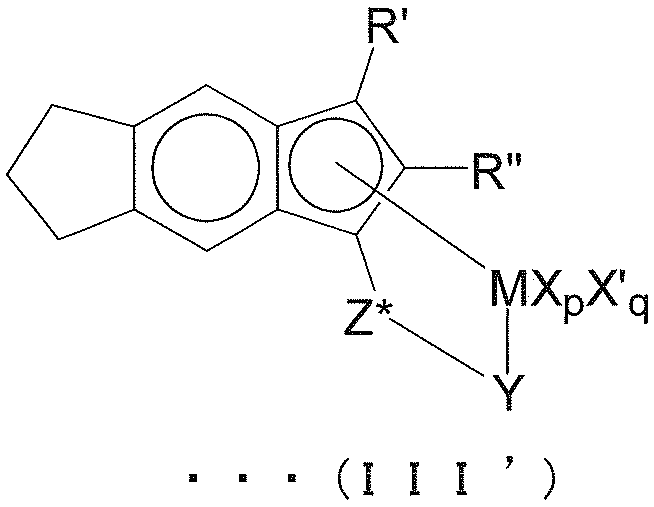
本発明の共重合体(A)は、エチレン[A]、炭素原子数3~20のα-オレフィン[B]、炭素・炭素二重結合のうちメタロセン触媒で重合可能な炭素・炭素二重結合が、1分子内に1個のみ存在する非共役ポリエン[C-1]および炭素・炭素二重結合のうちメタロセン触媒で重合可能な炭素・炭素二重結合が、1分子内に2個存在する非共役ポリエン[C-2]に由来する構造単位を含む、メタロセン触媒を用いて合成される共重合体であって、(1)炭素原子数3~20のα-オレフィン[B]に由来する構造単位が、全構造単位100モル%中、10~50モル%であり、(2)炭素・炭素二重結合のうちメタロセン触媒で重合可能な炭素・炭素二重結合が、1分子内に1個のみ存在する非共役ポリエン[C-1]に由来する構造単位のモル%および炭素・炭素二重結合のうちメタロセン触媒で重合可能な炭素・炭素二重結合が、1分子内に2個存在する非共役ポリエン[C-2]に由来する構造単位のモル%の合計が1.0~6.0モル%であり、(3)炭素・炭素二重結合のうちメタロセン触媒で重合可能な炭素・炭素二重結合が、1分子内に1個のみ存在する非共役ポリエン[C-1]に由来する構造単位のモル%と炭素・炭素二重結合のうちメタロセン触媒で重合可能な炭素・炭素二重結合が、1分子内に2個存在する非共役ポリエン[C-2]に由来する構造単位のモル%との比([C-1]/[C-2])が75/25~99.5/0.5であり、(4)100℃で測定されるムーニー粘度[ML(1+4)100℃]が10~200であり、(5)下記式(I)を満たすことを特徴とする。
なお、本明細書において、前記(1)~(5)をそれぞれ、要件(1)~(5)とも記す。
前記炭素原子数3~20のα-オレフィン[B]としては、具体的には、プロピレン、1-ブテン、1-ペンテン、1-ヘキセン、4-メチル-1-ペンテン、1-ヘプテン、1-オクテン、1-デセン、1-ドデセン、1-テトラデセン、1-ヘキサデセン、1-エイコセン等が挙げられる。これらのうち、特にプロピレン、1-ブテン、1-ヘキセン、1-オクテン等の炭素原子数が3~8のα-オレフィンが好ましい。このようなα-オレフィンは、原料コストが比較的安価であり、かつ得られる共重合体(A)が優れた機械的性質を示すことから好適である。
前記炭素・炭素二重結合のうちメタロセン触媒で重合可能な炭素・炭素二重結合が、1分子内に1個のみ存在する非共役ポリエン[C-1]としては、両末端がビニル基(CH2=CH-)である鎖状ポリエンは含まれず、炭素・炭素二重結合のうち1個が、分子末端にビニル基として存在し、他の炭素・炭素二重結合(C=C)が、分子鎖(主鎖または側鎖)中に内部オレフィンとして存在するもの、例えば、アルキリデン基などの内部オレフィンを有する環状オレフィンが挙げられる。これらの内部オレフィンはメタロセン触媒で重合しないか、ビニル基よりも重合性が劣る。成分[C-1]としては、下記のような脂肪族ポリエン、脂環族ポリエンなどが挙げられる。
前記炭素・炭素二重結合のうち、メタロセン触媒で重合可能な炭素・炭素二重結合が1分子内に2個存在する非共役ポリエン[C-2]の具体例としては、5-ビニル-2-ノルボルネン(VNB)および5-アリル-2-ノルボルネン等の5-アルケニル-2-ノルボルネン;2,5-ノルボルナジエン、ジシクロペンタジエン(DCPD)およびテトラシクロ[4,4,0,12.5,17.10]デカ-3,8-ジエン等の脂環族ポリエン;1,7-オクタジエンおよび1,9-デカジエン等のα,ω-ジエン等などが挙げられる。
本発明の共重合体(A)は、炭素原子数3~20のα-オレフィン[B]に由来する構造単位が、全構造単位100モル%中、10~50モル%であり、好ましくは25~45モル%である。
本発明の共重合体(A)は、炭素・炭素二重結合のうちメタロセン触媒で重合可能な炭素・炭素二重結合が1分子内に1個のみ存在する非共役ポリエン[C-1]に由来する構造単位のモル%および炭素・炭素二重結合のうちメタロセン触媒で重合可能な炭素・炭素二重結合が、1分子内に2個存在する非共役ポリエン[C-2]に由来する構造単位のモル%の合計が1.0~6.0モル%である。前記モル%の合計は、好ましくは1.0~5.0モル%である。
本発明の共重合体(A)は、炭素・炭素二重結合のうちメタロセン触媒で重合可能な炭素・炭素二重結合が、1分子内に1個のみ存在する非共役ポリエン[C-1]に由来する構造単位のモル%と炭素・炭素二重結合のうちメタロセン触媒で重合可能な炭素・炭素二重結合が、1分子内に2個存在する非共役ポリエン[C-2]に由来する構造単位のモル%との比([C-1]/[C-2])が75/25~99.5/0.5である。前記成分[C-1]に由来する構造単位のモル%と成分[C-2]に由来する構造単位のモル%との比は、好ましくは78/22~97/3である。
2)プロピレン;[プロピレン連鎖由来ピークの積分値]+[エチレン-プロピレン連鎖由来ピークの積分値]/2
3)ENB ;ENB-3位ピークの積分値
4)VNB ;VNB-7位ピークの積分値
本発明の共重合体(A)におけるENBに由来する構造(E体、Z体)の化学式および、VNBに由来する構造(endo(n)、exo(x))の化学式を以下に示す。

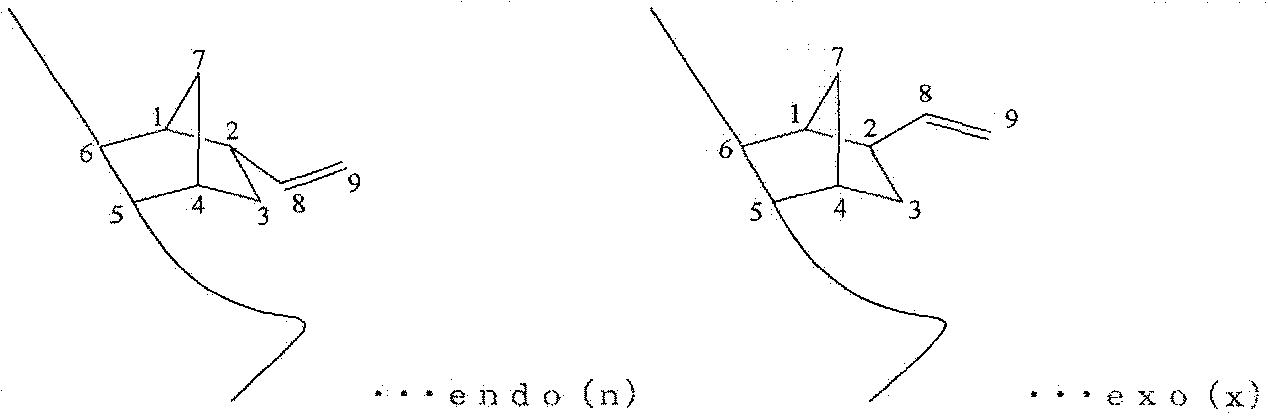
本発明の共重合体(A)は、100℃で測定されるムーニー粘度[ML(1+4)100℃]の上限が200、好ましくは100、より好ましくは90、特に好ましくは80、もっとも好ましくは60であり、下限が10、好ましくは20である。さらに具体的にいえば、100℃で測定されるムーニー粘度[ML(1+4)100℃]は10~200、好ましくは10~90、より好ましくは10~80、もっとも好ましくは20~60である。この範囲にあると高発泡体が得られ、混練安定性に優れる。
本発明の共重合体(A)は、下記式(I)を満たし、好ましくは下記式(I')を満たす。
45>流動の活性化エネルギー(Ea)〔kJ/mol〕>37 ・・・(I')
共重合体(A)の流動の活性化エネルギー(Ea)が35以下の場合は、高発泡な架橋成形体を得ることが難しく、また、50以上の共重合体(A)は、ゲル化してしまい、架橋ゴムおよび架橋発泡体を製造するのが実質的に難しくなる傾向にある。
R;気体定数、A;頻度因子、Ea;流動の活性化エネルギー、T;絶対温度
上記流動の活性化エネルギーは分子量および分子量分布に依存せず、分子構造によってのみ影響を受けることからポリマーの構造情報を表す有用な指標とされる。
ln(aT)=m[1/(T+273.16)]+n ・・・(I)
Ea=0.008314×m ・・・(II)
aT:シフトファクター
Ea:流動の活性化エネルギー(単位;kJ/mol)
T :温度(単位;℃)
n :Y軸切片
上記計算は、例えば、市販の計算ソフトウェア(ティ・エイ・インスツルメント・ジャパン社製;RSI Orchestrator VER. 6. 6. 3)を用いて行う。
測定条件
Geometry:パラレルプレート
測定温度:170℃、190℃、210℃
周波数:0.5~79.577Hz
歪率:1.0%
上記条件で粘度の周波数依存性を測定し、上述したアレニウス型の方程式により流動の活性化エネルギーを算出した。
4.7~5.3ppm付近の複数ピークには、ピーク(a)およびピーク(b)の両方が含まれる。本発明では、ピーク(a)の積分値を求めるために、2つの等価プロトンに由来するピーク(b)の積分値をプロトン1つに由来するピーク(c)の積分値の2倍とみなし、4.7~5.3ppm付近の複数ピークの積分値から引いている。
なお、1)および2)のピーク(a)~(c)は、それぞれ下記式(X)、(Y)中の(a)、(b)および(c)を示す。

なお、ヨウ素(I2)の分子量は253.81である。


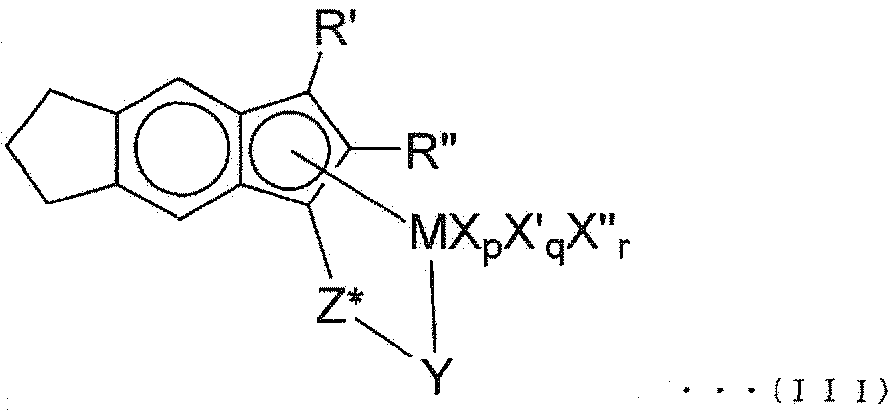


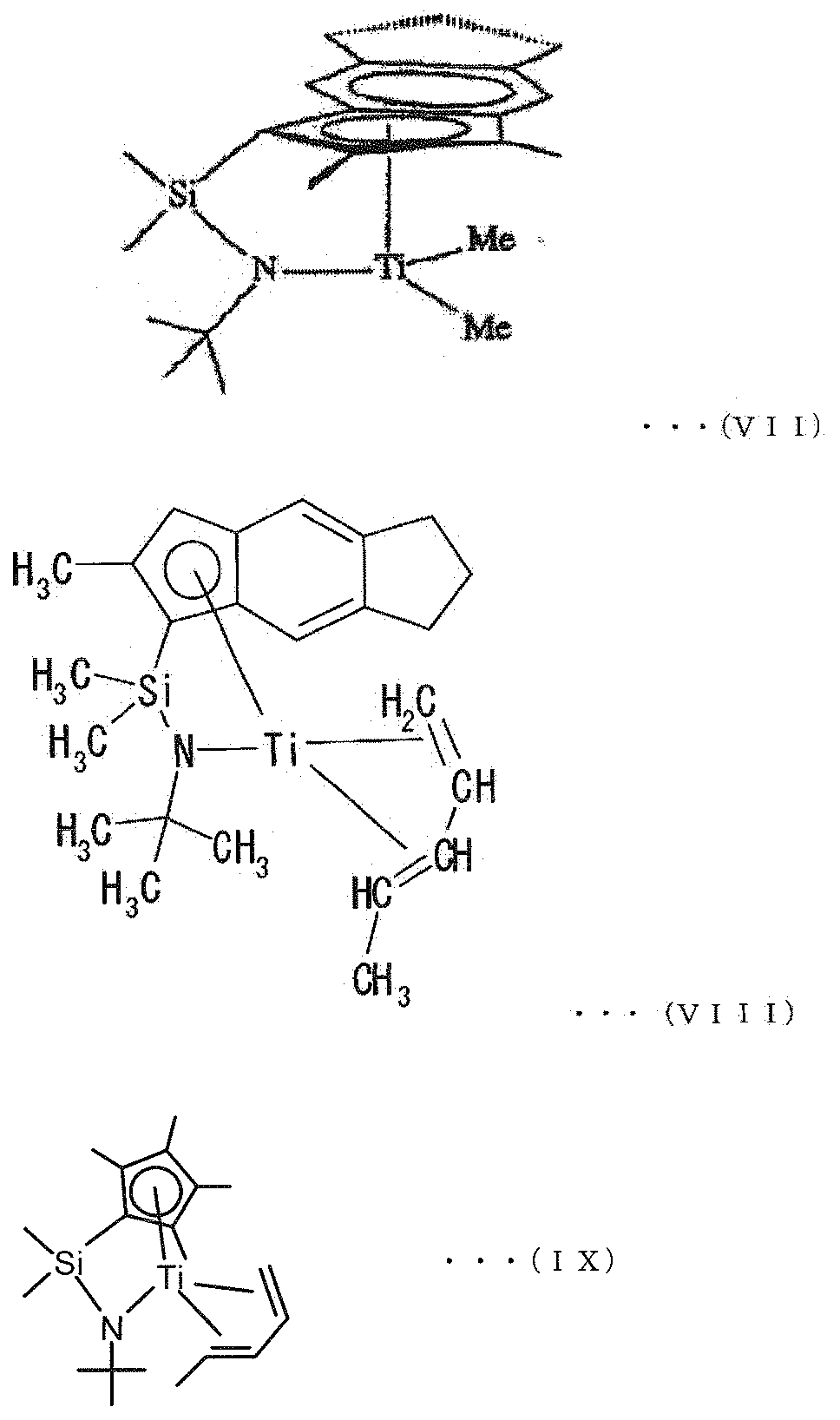
本発明の共重合体(A)は上記メタロセン触媒を主触媒とし、ホウ素系化合物および/またはトリアルキルアルミニウムなどの有機アルミニウム化合物を共触媒として用い、ヘキサンなどの脂肪族炭化水素を溶媒とし、撹拌機付き反応器を用いた連続法またはバッチ法によって合成することができる。
本発明のゴム組成物は、前記共重合体(A)を含むことを特徴とする。
本発明で用いられるエチレン系重合体(B)は、エチレン・炭素原子数3~20のα-オレフィン・非共役ポリエン共重合体(共重合体(A)を除く)(B1)、エチレン・α-オレフィン共重合体(B2)およびエチレン・極性モノマー共重合体(B3)の中から選ばれる1種以上の重合体であることを特徴とする。
本発明で用いられるエチレン・炭素原子数3~20のα-オレフィン・非共役ポリエン共重合体(B1)(以下単に「共重合体(B1)」ともいう。)は、上述した共重合体(A)以外のエチレン・炭素原子数3~20のα-オレフィン・非共役ポリエン共重合体である。
本発明で用いられるエチレン・α-オレフィン共重合体(B2)は、エチレンおよび炭素原子数3~20のα-オレフィンからなる、非晶性または低結晶性のランダムまたはブロック共重合体である。

B値=[POE]/(2・[PE][PO])
(式中、[PE]は共重合体(B2)中のエチレンに由来する構造単位の含有モル分率であり、[PO]は共重合体(B2)中のα-オレフィンに由来する構造単位の含有モル分率であり、[POE]は共重合体(B2)中の全ダイアド(dyad)連鎖に対するエチレン・α-オレフィン連鎖数の割合である。)
このB値は、エチレン・α-オレフィン共重合体(B2)中のエチレンと炭素原子数3~20のα-オレフィンとの分布状態を表す指標であり、J. C. Randall著(「Macromolecules」、1982年、第15巻、p.353)、J. Ray著(「Macromolecules」、1977年、第10巻、p.773)などの報告に基づいて求めることができる。
本発明で用いられるエチレン・極性モノマー共重合体(B3)を構成する極性モノマーとしては、不飽和カルボン酸、その塩、そのエステル(例えばビニルエステルなど)、そのアミド、一酸化炭素および二酸化硫黄などが挙げられ、具体的には、アクリル酸、メタクリル酸、フマル酸、イタコン酸、無水マレイン酸および無水イタコン酸などの不飽和カルボン酸;該不飽和カルボン酸のリチウム、ナトリウムおよびカリウムなどの1価金属の塩ならびにマグネシウム、カルシウムおよび亜鉛などの多価金属の塩;アクリル酸メチル、アクリル酸エチル、アクリル酸イソプロピル、アクリル酸イソブチル、アクリル酸n-ブチル、アクリル酸イソオクチル、メタクリル酸メチル、メタクリル酸エチル、メタクリル酸イソブチル、マレイン酸モノメチル、マレイン酸ジメチルおよびマレイン酸モノエチルなどの不飽和カルボン酸エステル;酢酸ビニルおよびプロピオン酸ビニルのようなビニルエステル;一酸化炭素;二酸化硫黄などが挙げられる。
発泡剤としては、例えば、重炭酸ナトリウムおよび炭酸ナトリウムなどの無機系発泡剤;N,N'-ジニトロソペンタメチレンテトラミンおよびN,N'-ジニトロソテレフタルアミドなどのニトロソ化合物;アゾジカルボンアミドおよびアゾビスイソブチロニトリルなどのアゾ化合物;ベンゼンスルホニルヒドラジドおよび4,4'-オキシビス(ベンゼンスルホニルヒドラジド)などのヒドラジド化合物;カルシウムアジドおよび4,4'-ジフェニルジスルホニルアジドなどのアジド化合物などの有機発泡剤が挙げられる。また、市販品としては、例えば、ビニホールAC-2F(商品名;永和化成工業社製)、ビニホールAC#LQ(商品名;永和化成工業社製、アゾジカルボンアミド(略号ADCA))、ネオセルボンN#1000SW(商品名;永和化成工業社製、4,4'-オキシビス(ベンゼンスルホニルヒドラジド(略号OBSH))、セルラーD(商品名;永和化成工業社製、N,N'-ジニトロソペンタメチレンテトラミン(略号DPT))などが挙げられる。
本発明のゴム組成物には、発泡剤に加えて、必要に応じて発泡助剤を添加してもよい。発泡助剤は、発泡剤の分解温度の低下、分解促進または気泡の均一化などの作用を示す。
加硫剤としては、例えば、硫黄系化合物、有機過酸化物、フェノール樹脂およびオキシム化合物などが挙げられる。
加硫剤として硫黄系化合物を用いる場合、加硫促進剤を併用することが好ましい。
加硫助剤としては、p-キノンジオキシムなどのキノンジオキシム系;エチレングリコールジメタクリレートおよびトリメチロールプロパントリメタクリレートなどのアクリル系;ジアリルフタレートおよびトリアリルイソシアヌレート(例えば、M-60(商品名;日本化成社製))などのアリル系;その他マレイミド系;ジビニルベンゼン;酸化マグネシウム/亜鉛華(例えば、META-Z102(商品名;井上石灰工業社製)など)が挙げられ、その用途に応じて適宜選択することができる。加硫助剤は、一種単独で用いてもよいし、二種以上組み合わせて用いてもよい。
本発明のゴム組成物には、引張強度、引裂強度および耐摩耗性などの機械的性質を向上させる目的で補強剤または無機充填剤を配合してもよい。
軟化剤としては、プロセスオイル(例えば、ダイアナプロセスオイルPS-430(商品名;出光興産社製))、潤滑油、パラフィン油、流動パラフィン、石油アスファルトおよびワセリンなどの石油系軟化剤;コールタールおよびコールタールピッチなどのコールタール系軟化剤;マシ油、アマニ油、ナタネ油、大豆油およびヤシ油などの脂肪油系軟化剤;蜜ロウ、カルナウバロウおよびラノリンなどのロウ類;リシノール酸、パルミチン酸、ステアリン酸、ステアリン酸バリウム、ステアリン酸カルシウムおよびラウリン酸亜鉛などの脂肪酸またはその塩;ナフテン酸、パイン油およびロジンまたはその誘導体;テルペン樹脂、石油樹脂、アタクチックポリプロピレンおよびクマロンインデン樹脂などの合成高分子物質;ジオクチルフタレート、ジオクチルアジペートおよびジオクチルセバケートなどのエステル系軟化剤;その他、マイクロクリスタリンワックス、液状ポリブタジエン、変性液状ポリブタジエン、液状チオコール、炭化水素系合成潤滑油、トール油およびサブ(ファクチス)などが挙げられる。なかでも、石油系軟化剤が好ましく、特にプロセスオイルが好ましい。軟化剤は、一種単独で用いてもよいし、二種以上組み合わせて用いてもよい。
本発明のゴム組成物は、通常のゴム組成物と同様に、老化防止剤を使用することにより、製品寿命を長くすることができる。
加工助剤としては、一般に加工助剤としてゴムに配合されるものを広く使用することができる。具体的には、リシノール酸、パルミチン酸、ラウリン酸、ステアリン酸、ステアリン酸エステル類、ステアリン酸バリウム、ステアリン酸亜鉛およびステアリン酸カルシウムなどが挙げられる。これらのうち、ステアリン酸が好ましい。
活性剤としては、ジ-n-ブチルアミン、ジシクロヘキシルアミン、モノエタノールアミン、アクチングB(商品名;吉冨製薬社製)およびアクチングSL(商品名;吉冨製薬社製)などのアミン類;ジエチレングリコール、ポリエチレングリコール(例えば、PEG#4000(商品名;ライオン社製))、レシチン、トリアリレートメリテートならびに脂肪族および芳香族カルボン酸の亜鉛化合物(例えば、Struktol activator 73、Struktol IB 531およびStruktol FA 541(商品名;Scill&Seilacher社製))などの活性剤;ZEONET ZP(商品名;日本ゼオン社製)などの過酸化亜鉛調製物;オクタデシルトリメチルアンモニウムブロミド;合成ハイドロタルサイト;特殊4級アンモニウム化合物(例えば、アーカード2HF(商品名;ライオン・アクゾ社製))などが挙げられる。これらのうち、ポリエチレングリコール(例えば、PEG#4000(商品名;ライオン社製))およびアーカード2HFが好ましい。この活性剤は、一種単独で用いてもよいし、二種以上組み合わせて用いてもよい。
活性剤としては、酸化カルシウム、シリカゲル、硫酸ナトリウム、モレキュラーシーブ、ゼオライトおよびホワイトカーボンなどが挙げられる。このうち、酸化カルシウムが好ましい。上記吸湿剤はその用途により適宜選択でき、1種単独または2種以上混合して用いることができる。
本発明の架橋ゴムは、例えば、以下に示す2つの方法で上記ゴム組成物を架橋して得られる。
本発明の架橋発泡体は、上記ゴム組成物を架橋発泡成形して得られる架橋発泡体である。該架橋発泡体は、比重が0.02~0.3であることが好ましく、さらに好ましくは0.02~0.20であり、もっとも好ましくは0.02~0.10である。
13C-NMRスペクトルメーターによる強度測定によって求めた。
装置:EX400核磁気共鳴装置(日本電子社製)
測定条件
周波数 :100MHz
パルス幅 :5.1μ秒(45°)
繰り返し時間 :5.5秒
積算回数 :8000回
測定溶媒 :ODCB/C6D4=4/1(体積比)
測定温度 :120℃
〔炭素・炭素二重結合のうちメタロセン触媒で重合可能な炭素・炭素二重結合が、1分子内に2個存在する非共役ポリエン[C-2]に由来する構造単位の見かけのヨウ素価(IV)〕
1H-NMRスペクトルメーターおよび13C-NMRスペクトルメーターにより求めた。
装置:EX400核磁気共鳴装置(日本電子社製)
測定条件
周波数 :400MHz
パルス幅 :6.8μ秒(45°)
繰り返し時間 :7.0秒
積算回数 :512回
測定溶媒 :ODCB-d4
測定温度 :120℃
〔ムーニー粘度[ML(1+4)100℃]〕
ムーニー粘度[ML(1+4)100℃]は、ムーニー粘度計(島津製作所社製SMV202型)を用いて、JIS K 6300に準拠して測定した。
〔流動の活性化エネルギー(Ea)〕
170℃および210℃それぞれの温度(T、単位;℃)における共重合体(A)の溶融複素粘度‐周波数曲線(溶融複素粘度の単位;Pa/sec、周波数の単位;Hz)を、温度‐時間重ね合わせの原理に基づいて、各温度(T)での溶融複素粘度‐周波数曲線毎に、190℃での共重合体(A)の溶融複素粘度‐周波数曲線に重ね合わせた際に得られる各温度(T)でのシフトファクター(aT)とから、最小自乗法により、[ln(aT)]と[1/(T+273.16)]との一次近似式(下記(I)式)を算出した。次に、該一次式の傾きmと下記式(II)とからEaを求めた。
Ea=[0.008314×m] (II)
aT:シフトファクター、Ea:流動の活性化エネルギー(単位;kJ/mol)
T :温度(単位;℃)、n:Y軸切片
上記計算は、市販の計算ソフトウェア(ティ・エイ・インスツルメント・ジャパン社製 RSI Orchestrator VER. 6. 6. 3)を用いて行った。
測定温度:170℃、190℃、210℃
周波数:0.5~79.577Hz
歪率:1.0%
上記条件で粘度の周波数依存性を測定し、上述したアレニウスプロットを導出することで流動の活性化エネルギーを算出した。
未加硫ゴムの物性試験はJIS K6300に準拠して行った。具体的には、ムーニー粘度計(島津製作所社製SMV202型)を用いて、125℃において、ムーニー粘度の変化を測定し、測定開始から最低粘度(Vm)を求め、さらにその最低粘度Vmより5ポイント上昇するまでの時間を求め、これをスコーチ時間(t5、min)とした。
チューブ状スポンジの上部を20mm×20mmの試験片で打ち抜き、表面の汚れをアルコールで拭き取った。この試験片を25℃雰囲気下で自動比重計(東洋精機製作所社製:M-1型)に取り付け、空気中と純水中の質量の差から比重測定を行った。
加硫と発泡のタイミング(TP20-TS1、min)測定は、アルファーテクノロジーズ社製ローターレスレオメーターMDR2000Pを用いて行った。
MIXTRON BB MIXER(神戸製鋼所社製、BB-4型、容積2.95L、ローター4WH)を用いて、共重合体ゴム100重量部に対して、加工助剤としてステアリン酸を2重量部、補強剤として「旭#50G」(商品名;旭カーボン社製)を「旭#50G」(商品名;旭カーボン社製)を30重量部、無機充填剤として「ホワイトンSB」(商品名;白石カルシウム社製)を150重量部および軟化剤として「ダイアナプロセスオイル PS-430」(商品名;出光興産社製)をムーニー粘度値が共重合ゴムのムーニー粘度値〔ML(1+4)100℃〕+20になるように加え混練した。
得られた平板状スポンジ(架橋発泡体)の断面形状を以下のように評価し、下記基準により判定した。
BB:成形体上部の弧の半径(R)<30mmの山形(半円状)スポンジ (形状例および孤の半径(R)の概念図を図2に示す。)
〔引張強度(TB)および引張伸び(EB)〕
チューブ状スポンジの上部を長さ方向に、JIS K 6251(1993年)に記載の3号型ダンベルで打ち抜いて試験片を得た。該試験片を用いて同じくJIS K 6251第3項に規定された方法に従い、測定温度25℃、引張速度500mm/分の条件で引張試験を行い、引張強度TB(MPa)および破断時の引張伸びEB(%)を測定した。
JIS K 6262に準じて測定を行った。サンプルは、発泡体をΦ30mm、厚み15mm以上の円柱形に切り出し、円柱の2つの平行平面のそれぞれについて、該平行平面の表面から2.5mm以上切り取って、厚みを10mmとしたものを用いた。発泡体から円柱形への切り出し、および平行平面の表面からの発泡体切り出しは円柱抜きダンベル型を使用した。
t0:サンプルの試験前の高さ
t1:サンプルを圧縮から開放して30分後の高さ
t2:サンプルの測定金型に取り付けた状態での高さ
〔形状保持率〕
円筒形状に成形したゴム組成物の架橋および発泡後のスポンジの高さおよび直径の比を測定し、形状保持率(%)とした。
L:円筒形状スポンジの高さ
D:円筒形状スポンジの内径(水平方向の外形の最大値)
〔ホースの収縮率〕
未加硫ホースを長さ15cmにカットし、200℃で10分間加熱することによって架橋物を得た。架橋物の長さを測定し、収縮率を算出した。
収縮率(%)=(15-L)/15×100
ここで、Lは架橋物の長さ(cm)を表す。
チューブ状スポンジを長さ方向に30cm切断し、一般にブツと呼ばれる、スポンジ表面の凸になった部分の数を目視でカウントした。
タイプAデュロメータ硬度は、JIS K 6253に従って測定した。
ASTM D1238に従って、190℃の温度下で求めた。
NMR測定装置JEOL-GX270(日本電子社製)を用いて測定した。測定は、サンプル濃度5質量%になるように調整されたヘキサクロロブタジエン/ベンゼン-d6=2/1(体積比)の混合溶液を用いて、67.8MHz、25℃、ベンゼン-d6(128ppm)基準で行う。測定された13C-NMRスペクトルを、リンデマン・アダムスの提案(「Analytical Chemistry」、1971年、第43巻、p.1245)、J. C. Randall著(「Reviews in Macromolecular Chemistry and Physics」、1989年、C29、p.201)に従って解析してTαβ/Tαα強度比を求めた。
撹拌翼を備えた容積300Lの重合器を用いて連続的に、成分[A]:エチレン、成分[B]:プロピレン、成分[C-1]:5-エチリデン-2-ノルボルネン(ENB)および成分[C-2]:5-ビニル-2-ノルボルネン(VNB)からなる四元共重合体の重合反応を95℃にて行った。
実施例1において、エチレン、プロピレン、ENBおよびVNBのフィード量を変更した以外は実施例1と同様の条件で合成した。重合条件および得られた共重合体(A)の物性を表1に示す。
撹拌翼を備えた容積15Lの重合器を用いて、連続的にエチレン、プロピレンおよび5-エチリデン-2-ノルボルネン(ENB)の三元共重合体の重合反応を行った。
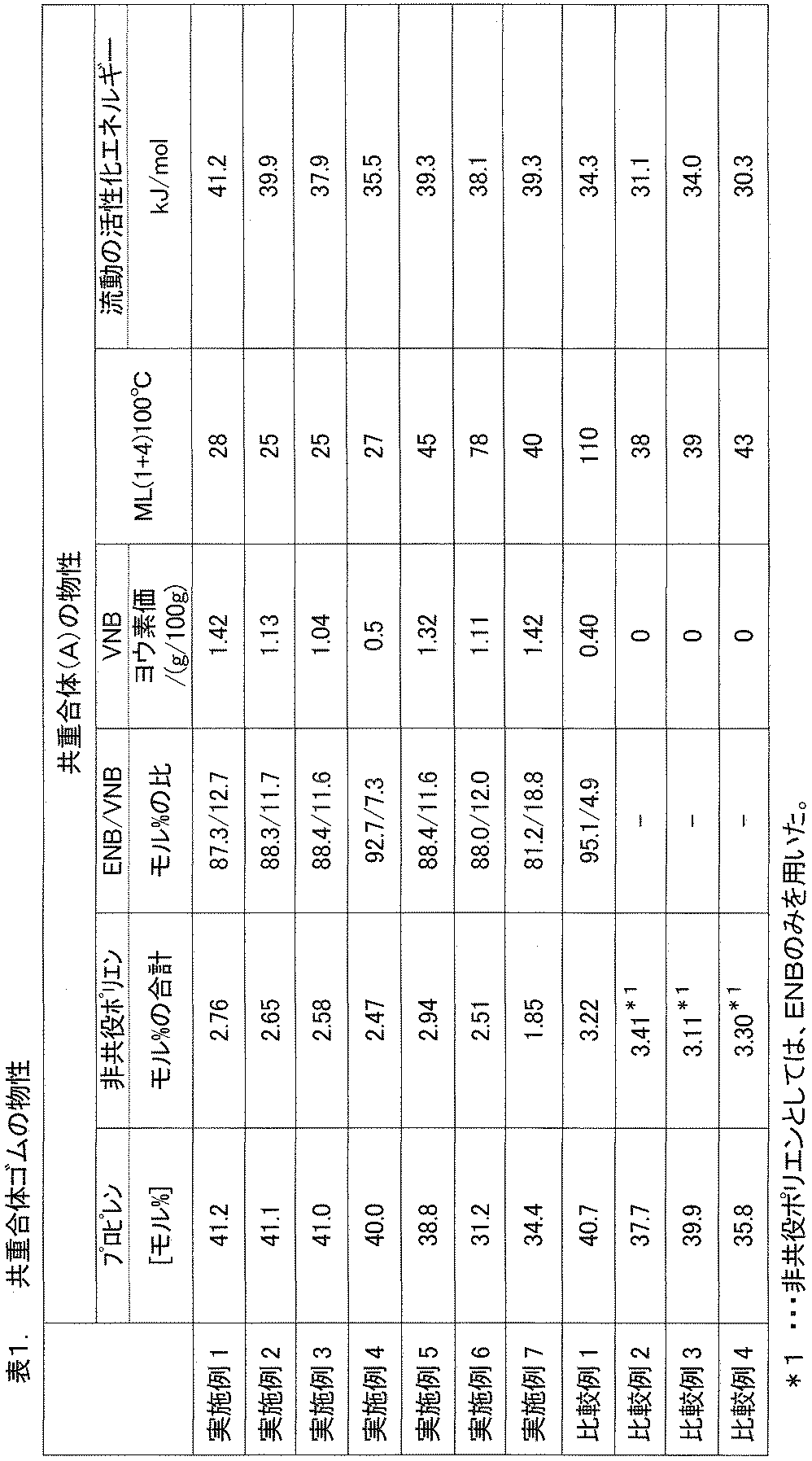
本発明のゴム組成物およびスポンジ(架橋発泡体)は、次のような製造方法によって得た。
実施例8において、共重合体(A)(共重合体ゴム)として、実施例1のエチレン・プロピレン・非共役ポリエン共重合体に代えて、実施例2のエチレン・プロピレン・非共役ポリエン共重合体を用いた以外は、実施例8と同様に行った。平板状スポンジの各物性値を表2に示す。
実施例8において、共重合体(A)として、実施例1のエチレン・プロピレン・非共役ポリエン共重合体に代えて、実施例3のエチレン・プロピレン・非共役ポリエン共重合体を用いた以外は、実施例8と同様に行った。平板状スポンジの各物性値を表2に示す。
実施例8において、共重合体(A)として、実施例1のエチレン・プロピレン・非共役ポリエン共重合体に代えて、実施例4のエチレン・プロピレン・非共役ポリエン共重合体を用いた以外は、実施例8と同様に行った。平板状スポンジの各物性値を表2に示す。
実施例8において、共重合体(A)として、実施例1のエチレン・プロピレン・非共役ポリエン共重合体に代えて、実施例5のエチレン・プロピレン・非共役ポリエン共重合体を用いた以外は、実施例8と同様に行った。平板状スポンジの各物性値を表2に示す。
実施例12において、加硫促進剤として用いた「サンセラーBUR」(商品名;三新化学工業社製)を1.0重量部から0.5重量部に変更し、発泡助剤として用いた「セルペーストK5」(商品名;永和化成工業社製)を1.5重量部から2.0重量部に変更した以外は、実施例12と同様に行った。平板状スポンジの各物性値を表2に示す。
実施例12において、加硫促進剤として用いた「サンセラーBUR」(商品名;三新化学工業社製)を1.0重量部から1.5重量部に変更した以外は、実施例12と同様に行った。平板状スポンジの各物性値を表2に示す。
実施例12において、加硫促進剤として用いた「サンセラーBUR」(商品名;三新化学工業社製)を1.0重量部から1.5重量部に変更し、発泡助剤として用いた「セルペーストK5」(商品名;永和化成工業社製)を1.5重量部から1.0重量部に変更した以外は、実施例12と同様に行った。平板状スポンジの各物性値を表3に示す。
実施例8において、共重合体(A)として、実施例1のエチレン・プロピレン・非共役ポリエン共重合体に代えて、実施例6のエチレン・プロピレン・非共役ポリエン共重合体を用いた以外は、実施例8と同様に行った。平板状スポンジの各物性値を表3に示す。
実施例8において、共重合体(A)として、実施例1のエチレン・プロピレン・非共役ポリエン共重合体に代えて、実施例7のエチレン・プロピレン・非共役ポリエン共重合体を用いた以外は、実施例8と同様に行った。平板状スポンジの各物性値を表3に示す。
実施例8において、共重合体ゴムとして、実施例1のエチレン・プロピレン・非共役ポリエン共重合体に代えて、比較例1のエチレン・プロピレン・非共役ポリエン共重合体を用いた以外は、実施例8と同様に行った。平板状スポンジの各物性値を表3に示す。
実施例8において、共重合体ゴムとして、実施例1のエチレン・プロピレン・非共役ポリエン共重合体に代えて、比較例2のエチレン・プロピレン・非共役ポリエン共重合体を用い、加硫促進剤として用いた「サンセラーBUR」(商品名;三新化学工業社製)を1.0重量部から0.5重量部に変更し、発泡助剤として用いた「セルペーストK5」(商品名;永和化成工業社製)を1.5重量部から2.0重量部に変更した以外は、実施例8と同様に行った。平板状スポンジの各物性値を表3に示す。
実施例8において、共重合体ゴムとして、実施例1のエチレン・プロピレン・非共役ポリエン共重合体に代えて、比較例2のエチレン・プロピレン・非共役ポリエン共重合体を用いた以外は、実施例8と同様に行った。平板状スポンジの各物性値を表3に示す。
実施例8において、共重合体ゴムとして、実施例1のエチレン・プロピレン・非共役ポリエン共重合体に代えて、比較例2のエチレン・プロピレン・非共役ポリエン共重合体を用い、加硫促進剤として用いた「サンセラーBUR」(商品名;三新化学工業社製)を1.0重量部から1.5重量部に変更し、発泡助剤として用いた「セルペーストK5」(商品名;永和化成工業社製)を1.5重量部から1.0重量部に変更した以外は、実施例8と同様に行った。平板状スポンジの各物性値を表3に示す。
実施例8において、共重合体ゴムとして、実施例1のエチレン・プロピレン・非共役ポリエン共重合体に代えて、比較例3のエチレン・プロピレン・非共役ポリエン共重合体を用い、加硫促進剤として用いた「サンセラーBUR」(商品名;三新化学工業社製)を1.0重量部から0.5重量部に変更し、発泡助剤として用いた「セルペーストK5」(商品名;永和化成工業社製)を1.5重量部から2.0重量部に変更した以外は、実施例8と同様に行った。平板状スポンジの各物性値を表4に示す。
実施例8において、共重合体ゴムとして、実施例1のエチレン・プロピレン・非共役ポリエン共重合体に代えて、比較例3のエチレン・プロピレン・非共役ポリエン共重合体を用いた以外は、実施例8と同様に行った。平板状スポンジの各物性値を表4に示す。
実施例8において、共重合体ゴムとして、実施例1のエチレン・プロピレン・非共役ポリエン共重合体に代えて、比較例4のエチレン・プロピレン・非共役ポリエン共重合体を用い、加硫促進剤として用いた「サンセラーBUR」(商品名;三新化学工業社製)を1.0重量部から0.5重量部に変更し、発泡助剤として用いた「セルペーストK5」(商品名;永和化成工業社製)を1.5重量部から2.0重量部に変更した以外は、実施例8と同様に行った。平板状スポンジの各物性値を表4に示す。
実施例8において、共重合体ゴムとして、実施例1のエチレン・プロピレン・非共役ポリエン共重合体に代えて、比較例4のエチレン・プロピレン・非共役ポリエン共重合体を用いた以外は、実施例8と同様に行った。平板状スポンジの各物性値を表4に示す。
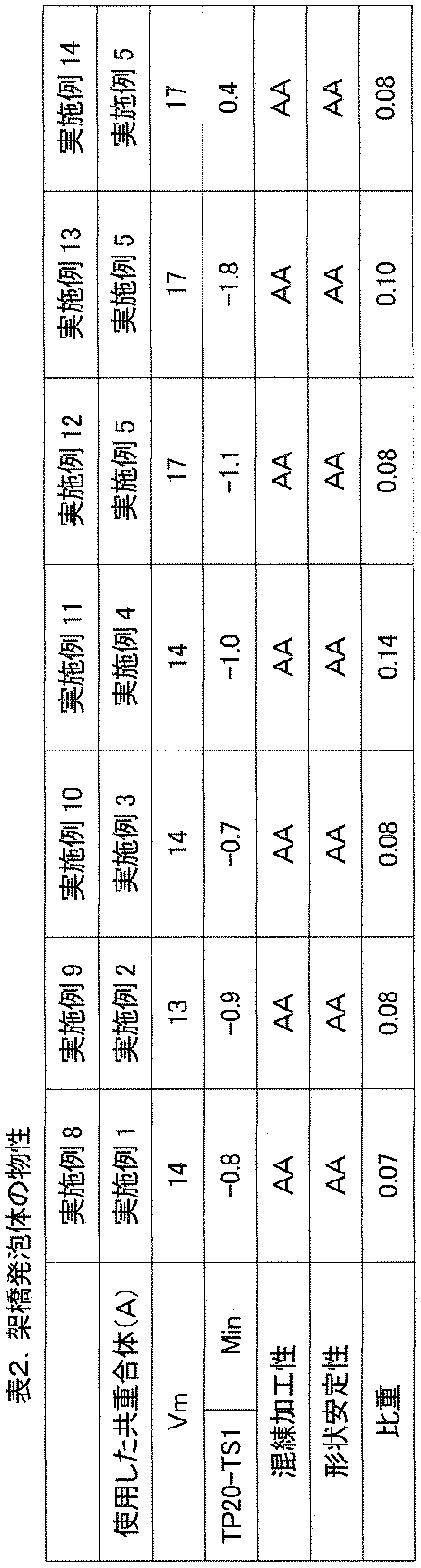
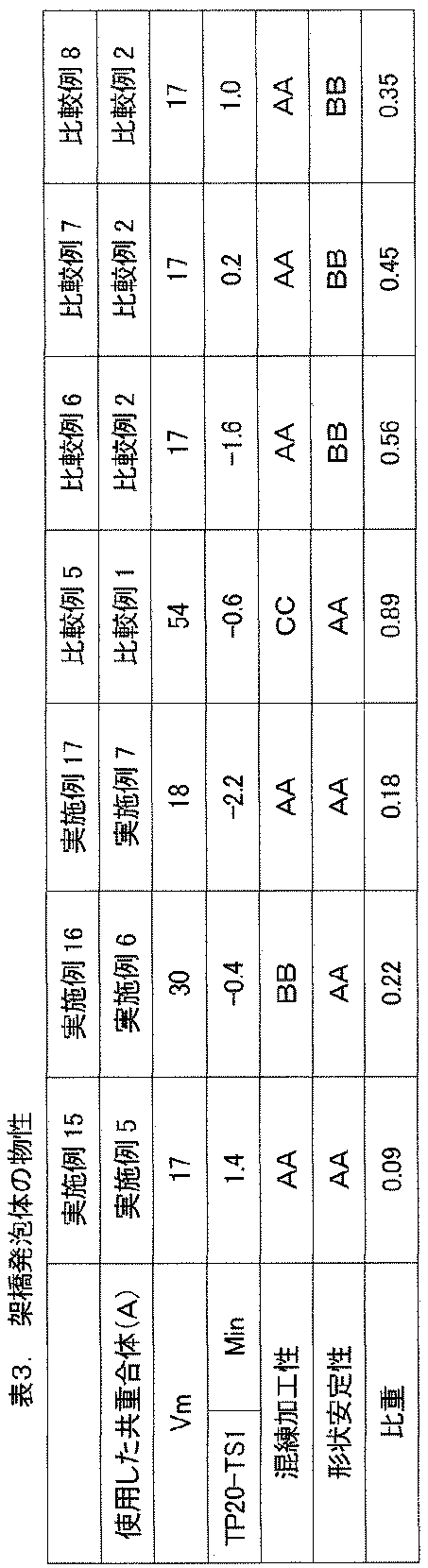
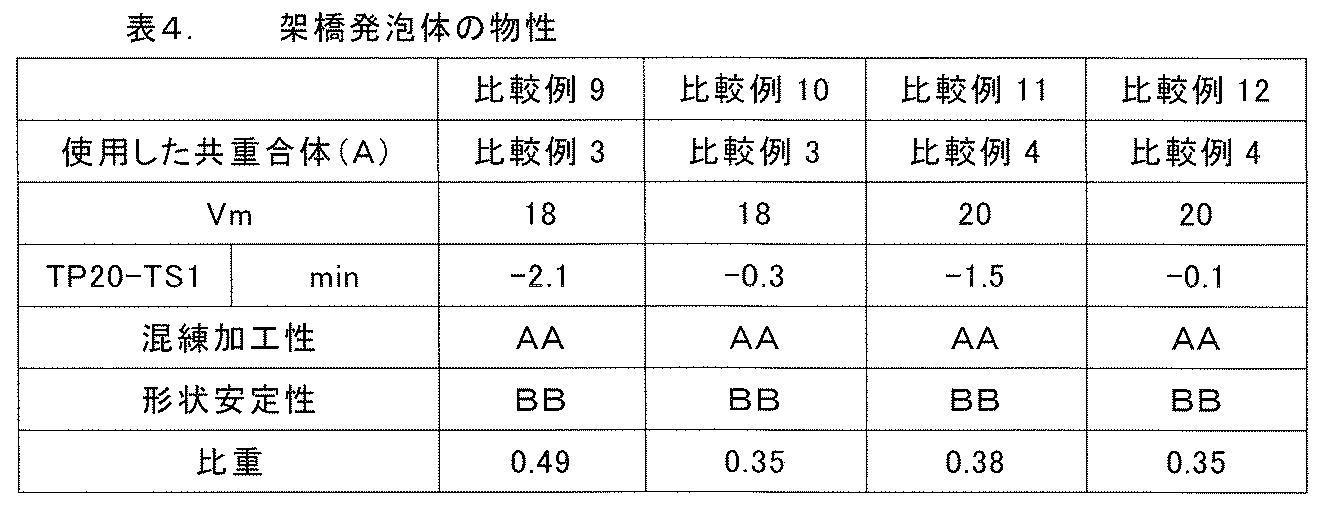
容積300リットルの撹拌翼付き重合器を用いて95℃の温度下で連続的に成分[A]:エチレン、成分[B]:プロピレン、成分[C-1]:5-エチリデン-2-ノルボルネン(ENB)および成分[C-2]:5-ビニル-2-ノルボルネン(VNB)からなる四元共重合体の重合を行った。
容積300リットルの撹拌翼付き重合器を用いて95℃の温度下で連続的に成分[A]:エチレン、成分[B]:プロピレン、成分[C-1]:5-エチリデン-2-ノルボルネン(ENB)および成分[C-2]:5-ビニル-2-ノルボルネン(VNB)からなる四元共重合体の重合を行った。
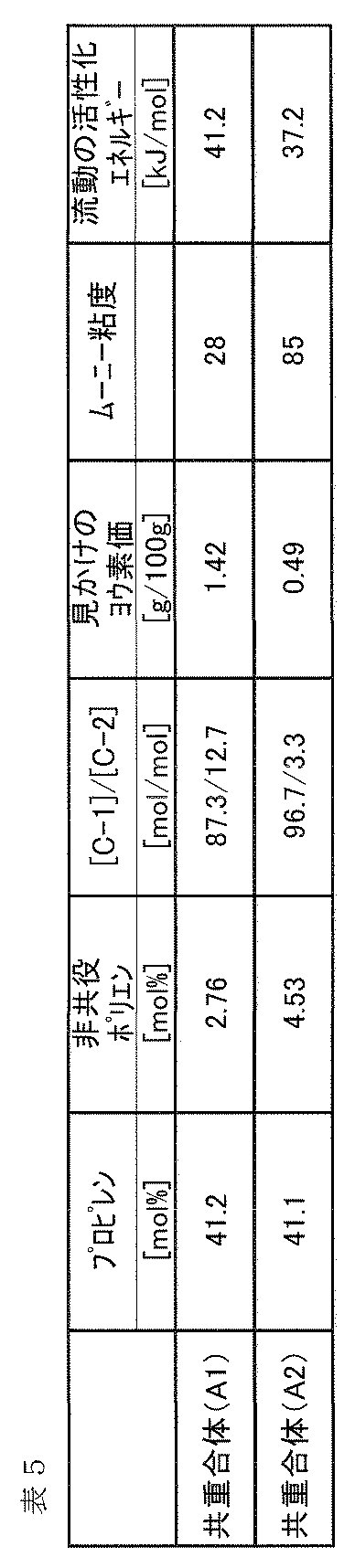
充分に窒素置換した容積1.5リットルの撹拌翼付きSUS製オートクレーブに、室温下でヘプタン750ml、トリイソブチルアルミニウム(TIBA)のヘキサン溶液(濃度1.0mmol/ml)0.15mlを装入した。このオートクレーブに、撹拌翼を回し、かつ、氷冷しながら1-ブテン6g、水素150Nmlを装入した。次にオートクレーブを100℃まで加熱し、さらに、全圧が0.6MPaGとなるようにエチレンで加圧した。オートクレーブの内圧が0.6MPaGになったところで、窒素を圧入して[ジメチル(t-ブチルアミド)(テトラメチル-η5-シクロペンタジエニル)シラン]チタンジクロリドのトルエン溶液(濃度0.001mmol/ml)0.38ml、トリフェニルカルベニウム(テトラキスペンタフルオロフェニル)ボレートのトルエン溶液(濃度0.004mmol/ml)0.38mlを導入し、重合を開始した。その後5分間、オートクレーブを内温100℃になるように温度調節し、かつ、圧力が0.6MPaGとなるように直接的にエチレンの供給を行った。重合開始から5分後、オートクレーブに窒素を圧入してメタノール5mlを導入して重合を停止し、オートクレーブを大気圧まで脱圧した。重合溶液を撹拌しながら3リットルのメタノールを注ぎ、130℃、13時間、減圧下で乾燥して12gのエチレン・ブテン共重合体(B2)を得た。この操作を繰り返して、エチレン・ブテン共重合体(B2)を集め、溶融混練した。
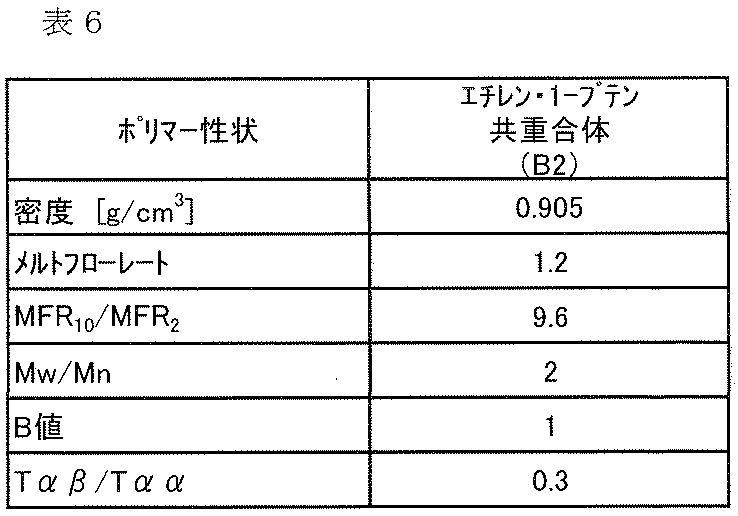
MIXTRON BB MIXER(神戸製鋼所社製、BB-4型、容積2.95リットル、ローター4WH)を用いて、実施例18で得られた共重合体(A1)を30重量部、共重合体(B1)として「三井EPT3090EM」(商品名;三井化学社製、エチレンに由来する構造単位58重量%、5-エチリデン-2-ノルボルネン(ENB)に由来する構造単位4.3重量%、ムーニー粘度[ML(1+4)125℃]58、流動の活性化エネルギー(Ea)30.5kJ/mol、油展量10phr)を77重量部、加硫助剤として酸化亜鉛を5重量部、加工助剤としてステアリン酸を1重量部、補強剤として「旭#60」(商品名;旭カーボン社製)を130重量部、無機充填剤として「ホワイトンSB」(商品名;白石カルシウム社製)を30重量部、軟化剤として「ダイアナプロセスオイル PS-430」(商品名;出光興産社製)を68重量部、活性剤として「PEG#4000」(商品名;ライオン社製)を1重量部配合して混練した。混練条件は、ローター回転数50rpm、フローティングウェイト圧力3kg/cm2、混練時間5分間であり、混練排出温度は145℃であった。
実施例20において、実施例18で得られた共重合体(A1)を使用せず、共重合体(B1)「三井EPT3090EM」を77重量部から110重量部に変更し、軟化剤として「ダイアナプロセスオイル PS-430」(商品名;出光興産社製)を68重量部から90重量部に変更した以外は実施例20と同様にして架橋ゴムを得た。

MIXTRON BB MIXER(神戸製鋼所社製、BB-4型、容積2.95リットル、ローター4WH)を用いて、実施例18で得られた共重合体(A1)を30重量部、共重合体(B1)として「三井EPT3090EM」(商品名;三井化学社製、エチレンに由来する構造単位48重量%、5-エチリデン-2-ノルボルネン(ENB)に由来する構造単位5.2重量%、ムーニー粘度[ML(1+4)125℃]59、流動の活性化エネルギー(Ea)30.5kJ/mol、油展量10phr)を77重量部、加硫助剤として「META-Z102」(商品名;井上石灰工業社製)を5重量部、加工助剤としてステアリン酸を2重量部、活性剤として「アーカード2HF」(商品名;ライオン・アクゾ社製)を2重量部、補強剤として「旭#50」(商品名;旭カーボン社製)を75重量部、「旭#60G」(商品名;旭カーボン社製)を15重量部、無機充填剤として「ホワイトンSB」(商品名;白石カルシウム社製)を30重量部、軟化剤として「ダイアナプロセスオイル PS-430」(商品名;出光興産社製)を65重量部、および活性剤として「PEG#4000」(商品名;ライオン社製)を0.5重量部配合して混練した。混練条件は、ローター回転数50rpm、フローティングウェイト圧力3kg/cm2、混練時間5分間であり、混練排出温度は145℃であった。
実施例21において、実施例18で得られた共重合体(A1)に代えて、三井EPT4021(商品名;三井化学社製、エチレンに由来する構造単位51重量%、ジエンに由来する構造単位8.1重量%、ムーニー粘度[ML(1+4)100℃]24)を使用した以外は実施例21と同様にしてスポンジゴムを得た。
実施例21において、実施例18で得られた共重合体(A1)を使用せず、共重合体(B1)「三井EPT3090EM」を77重量部から110重量部に変更し、軟化剤「ダイアナプロセスオイル PS-430」を65重量部から62重量部に変更した以外は実施例21と同様にしてスポンジゴムを得た。
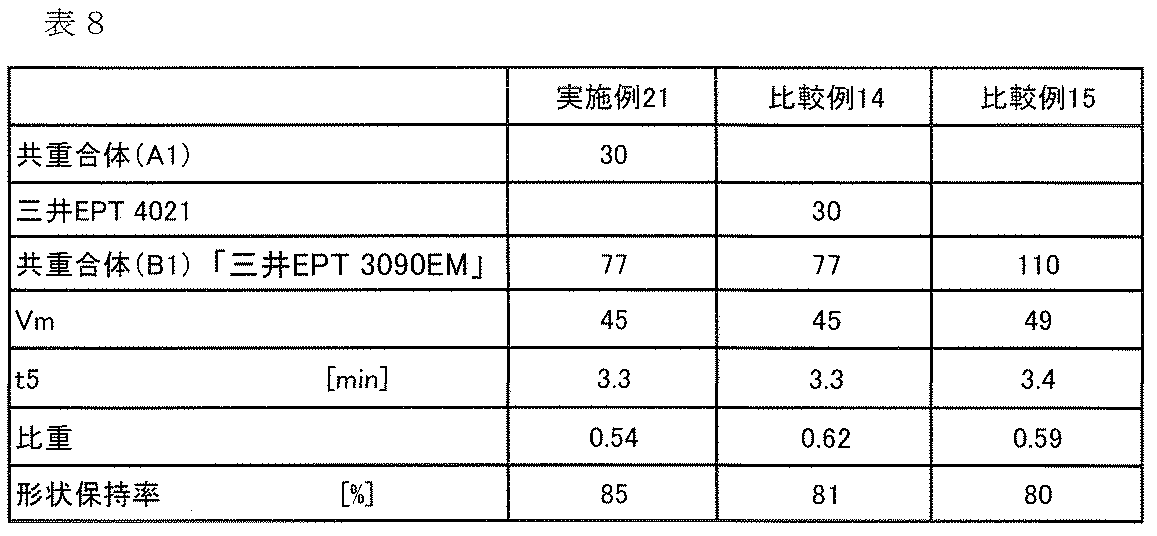
MIXTRON BB MIXER(神戸製鋼所社製、BB-4型、容積2.95リットル、ローター4WH)を用いて、実施例19で得られた共重合体(A2)を70重量部、共重合体(B1)として「三井EPT3092M」(商品名;三井化学社製、エチレンに由来する構造単位66重量%、5-エチリデン-2-ノルボルネン(ENB)に由来する構造単位4.6重量%、ムーニー粘度[ML(1+4)125℃]61、流動の活性化エネルギー(Ea)30.9kJ/mol)を30重量部、加硫助剤として「META-Z102」(商品名;井上石灰工業社製)を8重量部、加工助剤としてステアリン酸を2重量部、活性剤として「アクチプラスト」(商品名;ラインケミー社製)を3重量部、補強剤として「旭#55」(商品名;旭カーボン社製)を114重量部、無機充填剤として「ホワイトンSB」(商品名;白石カルシウム社製)を60重量部、軟化剤として「ダイアナプロセスオイル PS-430」(商品名;出光興産社製)を45重量部、および活性剤として「PEG#4000」(商品名;ライオン社製)を1.0重量部配合して混練した。混練条件は、ローター回転数50rpm、フローティングウェイト圧力3kg/cm2、混練時間5分間であり、混練排出温度は145℃であった。
実施例22において、実施例19で得られた共重合体(A2)を使用せず、共重合体(B1)として「三井EPT3092M」30重量部に代えて、「ビスタロンV8600」(商品名;エクソンモービルケミカル社製、エチレンに由来する構造単位51.4重量%、非共役ポリエンに由来する構造単位9.6重量%、ムーニー粘度[ML(1+4)125℃]92、流動の活性化エネルギー(Ea)32.7kJ/mol)を100重量部使用し、配合物のムーニー粘度とスコーチ時間t5を実施例20と同等にするために、「旭#55」(商品名;旭カーボン社製)を114重量部から105重量部に変更し、「ダイアナプロセスオイル PS-430」(商品名;出光興産社製)を45重量部から65重量部に変更した以外は実施例22と同様にしてスポンジゴムを得た。

実施例18で得られた共重合体(A1)15重量部、製造例1で得られたエチレン・1-ブテン共重合体(B2)85重量部、酸化亜鉛3.0重量部、ジクミルペルオキシド(DCP)0.6重量部、トリアリルシアヌレート[商品名;TAC、化薬アクゾ社製]0.05質量部およびアゾジカルボンアミド6.0質量部からなる混合物を、ロールにより、ロール表面温度120℃で10分間混練した後、シート状に成形した。
実施例23において、共重合体(A1)使用せず、エチレン・1-ブテン共重合体(B2)を85重量部から100重量部に変更した以外は実施例23と同様にして二次架橋発泡体を得た。
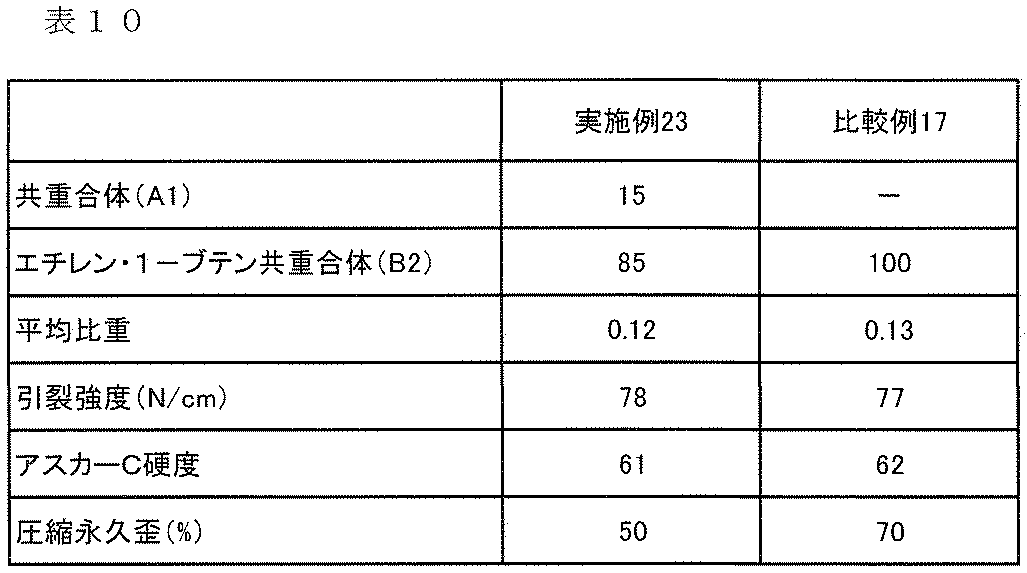
Claims (14)
- エチレン[A]、炭素原子数3~20のα-オレフィン[B]、炭素・炭素二重結合のうちメタロセン触媒で重合可能な炭素・炭素二重結合が、1分子内に1個のみ存在する非共役ポリエン[C-1]および炭素・炭素二重結合のうちメタロセン触媒で重合可能な炭素・炭素二重結合が、1分子内に2個存在する非共役ポリエン[C-2]に由来する構造単位を含む、メタロセン触媒を用いて合成される共重合体(A)であって、
(1)炭素原子数3~20のα-オレフィン[B]に由来する構造単位が、全構造単位100モル%中、10~50モル%であり、
(2)炭素・炭素二重結合のうちメタロセン触媒で重合可能な炭素・炭素二重結合が、1分子内に1個のみ存在する非共役ポリエン[C-1]に由来する構造単位のモル%および炭素・炭素二重結合のうちメタロセン触媒で重合可能な炭素・炭素二重結合が、1分子内に2個存在する非共役ポリエン[C-2]に由来する構造単位のモル%の合計が1.0~6.0モル%であり、
(3)炭素・炭素二重結合のうちメタロセン触媒で重合可能な炭素・炭素二重結合が、1分子内に1個のみ存在する非共役ポリエン[C-1]に由来する構造単位のモル%と炭素・炭素二重結合のうちメタロセン触媒で重合可能な炭素・炭素二重結合が、1分子内に2個存在する非共役ポリエン[C-2]に由来する構造単位のモル%との比([C-1]/[C-2])が75/25~99.5/0.5であり、
(4)100℃で測定されるムーニー粘度[ML(1+4)100℃]が10~200であり、
(5)下記式(I)を満たすことを特徴とする共重合体(A)。
50>流動の活性化エネルギー(Ea)〔kJ/mol〕>35 ・・・(I) - 前記(4)100℃で測定されるムーニー粘度[ML(1+4)100℃]が10~90であることを特徴とする請求項1に記載の共重合体(A)。
- 前記炭素・炭素二重結合のうちメタロセン触媒で重合可能な炭素・炭素二重結合が、1分子内に2個存在する非共役ポリエン[C-2]に由来する構造単位の見かけのヨウ素価が0.1~3.0g/100gであることを特徴とする請求項1または2に記載の共重合体(A)。
- 前記炭素・炭素二重結合のうちメタロセン触媒で重合可能な炭素・炭素二重結合が、1分子内に1個のみ存在する非共役ポリエン[C-1]が5-エチリデン-2-ノルボルネン(ENB)であり、前記炭素・炭素二重結合のうちメタロセン触媒で重合可能な炭素・炭素二重結合が、1分子内に2個存在する非共役ポリエン[C-2]が5-ビニル-2-ノルボルネン(VNB)であることを特徴とする請求項1~3のいずれか一項に記載の共重合体(A)。
- 下記式(III’)で表される構造を有する触媒を用いて合成されることを特徴とする請求項1~4のいずれか一項に記載の共重合体(A)。

- 請求項1~5のいずれか一項に記載の共重合体(A)を含むことを特徴とするゴム組成物。
- 請求項1~5のいずれか一項に記載の共重合体(A)と、
エチレン・炭素原子数3~20のα-オレフィン・非共役ポリエン共重合体(前記共重合体(A)を除く)(B1)、エチレン・α-オレフィン共重合体(B2)およびエチレン・極性モノマー共重合体(B3)の中から選ばれる1種以上のエチレン系重合体(B)とを含有することを特徴とするゴム組成物。 - 請求項1~5のいずれか一項に記載の共重合体(A)100重量部と発泡剤1~70重量部とを含むことを特徴とするゴム組成物。
- 請求項6~8のいずれか一項に記載のゴム組成物を架橋してなることを特徴とする架橋ゴム。
- 請求項6~8のいずれか一項に記載のゴム組成物を架橋発泡成形して得られる架橋発泡体。
- 請求項6~8のいずれか一項に記載のゴム組成物を架橋発泡成形して得られる架橋発泡体であって、比重が0.02~0.3であることを特徴とする架橋発泡体。
- 請求項11に記載の架橋発泡体からなることを特徴とする高発泡スポンジ材。
- 請求項11に記載の架橋発泡体からなることを特徴とする断熱スポンジ。
- 請求項11に記載の架橋発泡体からなることを特徴とするダムラバー。
Priority Applications (5)
| Application Number | Priority Date | Filing Date | Title |
|---|---|---|---|
| CN200980143408.1A CN102203146B (zh) | 2008-12-01 | 2009-11-26 | 共聚物、橡胶组合物、交联橡胶、交联发泡体以及它们的用途 |
| US13/130,746 US9193856B2 (en) | 2008-12-01 | 2009-11-26 | Copolymer, rubber composition, cross-linked rubber, cross-linked foam, and uses thereof |
| KR1020117015021A KR101340131B1 (ko) | 2008-12-01 | 2009-11-26 | 공중합체, 고무 조성물, 가교 고무, 가교 발포체 및 그들의 용도 |
| EP09830341.5A EP2354170B1 (en) | 2008-12-01 | 2009-11-26 | Copolymer, rubber compositions, crosslikned rubber, crosslinked foam, and uses of same |
| JP2010541302A JP5563989B2 (ja) | 2008-12-01 | 2009-11-26 | 共重合体、ゴム組成物、架橋ゴム、架橋発泡体およびそれらの用途 |
Applications Claiming Priority (4)
| Application Number | Priority Date | Filing Date | Title |
|---|---|---|---|
| JP2008306736 | 2008-12-01 | ||
| JP2008-306736 | 2008-12-01 | ||
| JP2009079015 | 2009-03-27 | ||
| JP2009-079015 | 2009-03-27 |
Publications (1)
| Publication Number | Publication Date |
|---|---|
| WO2010064574A1 true WO2010064574A1 (ja) | 2010-06-10 |
Family
ID=42233225
Family Applications (1)
| Application Number | Title | Priority Date | Filing Date |
|---|---|---|---|
| PCT/JP2009/069963 Ceased WO2010064574A1 (ja) | 2008-12-01 | 2009-11-26 | 共重合体、ゴム組成物、架橋ゴム、架橋発泡体およびそれらの用途 |
Country Status (6)
| Country | Link |
|---|---|
| US (1) | US9193856B2 (ja) |
| EP (1) | EP2354170B1 (ja) |
| JP (1) | JP5563989B2 (ja) |
| KR (1) | KR101340131B1 (ja) |
| CN (1) | CN102203146B (ja) |
| WO (1) | WO2010064574A1 (ja) |
Cited By (13)
| Publication number | Priority date | Publication date | Assignee | Title |
|---|---|---|---|---|
| JP2012052032A (ja) * | 2010-09-01 | 2012-03-15 | Mitsui Chemicals Inc | スポンジ用ゴム組成物およびゴム成形体 |
| WO2012102339A1 (ja) * | 2011-01-28 | 2012-08-02 | 三井化学株式会社 | 発泡剤およびその製造方法・形成剤、ゴム組成物、架橋発泡体およびその製造方法、ならびにゴム成形品 |
| JP2012207087A (ja) * | 2011-03-29 | 2012-10-25 | Mitsui Chemicals Inc | 低粘度エチレン系共重合体を含有するゴム組成物およびゴム成形品 |
| JP2012207086A (ja) * | 2011-03-29 | 2012-10-25 | Mitsui Chemicals Inc | エチレン系共重合体、共重合体組成物およびゴム成形品 |
| WO2012157709A1 (ja) * | 2011-05-18 | 2012-11-22 | 三井化学株式会社 | プロピレン系共重合体、プロピレン系共重合体組成物、その成形体およびその発泡体、およびそれらの製造方法 |
| WO2013137231A1 (ja) * | 2012-03-12 | 2013-09-19 | 三井化学株式会社 | 鉄道レール用軌道パッド及び架橋発泡体 |
| JP2013234289A (ja) * | 2012-05-10 | 2013-11-21 | Mitsui Chemicals Inc | エチレン・α−オレフィン・非共役ポリエン共重合体組成物、並びに、この組成物から得られる発泡体及びその成形法 |
| CN103814069A (zh) * | 2011-09-21 | 2014-05-21 | 日东电工株式会社 | 乙烯-丙烯-二烯橡胶发泡体以及密封材料 |
| JP2014114379A (ja) * | 2012-12-10 | 2014-06-26 | Mitsui Chemicals Inc | エチレン・α−オレフィン・非共役ポリエン共重合体組成物、並びに、この組成物から得られる架橋発泡体およびその製造方法 |
| JP2015514825A (ja) * | 2012-03-16 | 2015-05-21 | ダウ グローバル テクノロジーズ エルエルシー | 発泡性組成物、発泡体及びその物品 |
| JP2017043784A (ja) * | 2016-11-24 | 2017-03-02 | 三井化学株式会社 | ウェザーストリップスポンジ |
| WO2017200026A1 (ja) | 2016-05-18 | 2017-11-23 | 株式会社クラレ | 発泡成形体、ダムラバー、ダムラバーとパネルの複合体、音響透過損失を増大させる方法 |
| JP2019178253A (ja) * | 2018-03-30 | 2019-10-17 | 三井化学株式会社 | 発泡体用共重合体組成物及びその発泡体 |
Families Citing this family (32)
| Publication number | Priority date | Publication date | Assignee | Title |
|---|---|---|---|---|
| JP5460795B2 (ja) * | 2011-09-21 | 2014-04-02 | 日東電工株式会社 | エチレン・プロピレン・ジエンゴム発泡体およびシール材 |
| JP5913000B2 (ja) * | 2011-09-21 | 2016-04-27 | 日東電工株式会社 | エチレン・プロピレン・ジエンゴム発泡体、その製造方法およびシール材 |
| TWI498341B (zh) * | 2012-09-28 | 2015-09-01 | Sekisui Chemical Co Ltd | Foamable composition |
| JP6408481B2 (ja) | 2012-11-30 | 2018-10-17 | ダウ グローバル テクノロジーズ エルエルシー | エチレン/αオレフィン/非共役ポリエン系組成物およびそれから形成される発泡体 |
| US9796795B2 (en) | 2015-01-14 | 2017-10-24 | Exxonmobil Chemical Patents Inc. | Tetrahydroindacenyl catalyst composition, catalyst system, and processes for use thereof |
| WO2016171808A1 (en) | 2015-04-20 | 2016-10-27 | Exxonmobil Chemical Patents Inc. | Catalyst composition comprising fluorided support and processes for use thereof |
| US10570572B2 (en) | 2015-03-26 | 2020-02-25 | Mitsui Chemicals, Inc. | Railroad rail track pad composition and railroad rail track pad |
| WO2016196331A1 (en) | 2015-06-05 | 2016-12-08 | Exxonmobil Chemical Patents Inc. | Supported metallocene catalyst systems for polymerization |
| US10294316B2 (en) | 2015-06-05 | 2019-05-21 | Exxonmobil Chemical Patents Inc. | Silica supports with high aluminoxane loading capability |
| US9809664B2 (en) | 2015-06-05 | 2017-11-07 | Exxonmobil Chemical Patents Inc. | Bimodal propylene polymers and sequential polymerization |
| US10280235B2 (en) | 2015-06-05 | 2019-05-07 | Exxonmobil Chemical Patents Inc. | Catalyst system containing high surface area supports and sequential polymerization to produce heterophasic polymers |
| US10759886B2 (en) | 2015-06-05 | 2020-09-01 | Exxonmobil Chemical Patents Inc. | Single reactor production of polymers in gas or slurry phase |
| EP3303422B1 (en) | 2015-06-05 | 2021-03-17 | ExxonMobil Chemical Patents Inc. | Production of heterophasic polymers in gas or slurry phase |
| US10280233B2 (en) | 2015-06-05 | 2019-05-07 | Exxonmobil Chemical Patents Inc. | Catalyst systems and methods of making and using the same |
| US10329360B2 (en) | 2015-06-05 | 2019-06-25 | Exxonmobil Chemical Patents Inc. | Catalyst system comprising supported alumoxane and unsupported alumoxane particles |
| CN109312015B (zh) | 2016-05-03 | 2021-10-26 | 埃克森美孚化学专利公司 | 四氢引达省基催化剂组合物、催化剂体系及其使用方法 |
| US9803037B1 (en) | 2016-05-03 | 2017-10-31 | Exxonmobil Chemical Patents Inc. | Tetrahydro-as-indacenyl catalyst composition, catalyst system, and processes for use thereof |
| US11059918B2 (en) | 2016-05-27 | 2021-07-13 | Exxonmobil Chemical Patents Inc. | Metallocene catalyst compositions and polymerization process therewith |
| CN106009137A (zh) * | 2016-06-30 | 2016-10-12 | 安徽省含山县锦华氧化锌厂 | 一种橡胶硫化剂及其制备方法 |
| EP3478762A1 (en) | 2016-06-30 | 2019-05-08 | Dow Global Technologies, LLC | Ethylene/alpha-olefin/polyene based compositions |
| JP6884865B2 (ja) | 2016-12-26 | 2021-06-09 | ダウ グローバル テクノロジーズ エルエルシー | エチレン/α−オレフィン/非共役ポリエンインターポリマー組成物およびそれから製造された物品 |
| US10703838B2 (en) | 2017-10-31 | 2020-07-07 | Exxonmobil Chemical Patents Inc. | Mixed catalyst systems with four metallocenes on a single support |
| US10899853B2 (en) | 2018-03-19 | 2021-01-26 | Exxonmobil Chemical Patents Inc. | Processes for producing high propylene content PEDM using tetrahydroindacenyl catalyst systems |
| EP3768740B1 (en) * | 2018-03-19 | 2025-02-19 | ExxonMobil Chemical Patents Inc. | Processes for producing high propylene content pedm using tetrahydroindacenyl catalyst systems |
| US11174332B2 (en) | 2018-04-06 | 2021-11-16 | Exxonmobil Chemical Patents Inc. | Compatibilized thermoplastic vulcanizate compositions |
| EP3853265A1 (en) | 2018-09-18 | 2021-07-28 | Arlanxeo Netherlands B.V. | Catalyst mixture |
| US20200172715A1 (en) * | 2018-11-30 | 2020-06-04 | Exxonmobil Chemical Patents Inc. | Blends of Cyclic Olefin Copolymers and Films Prepared Therefrom |
| EP3963005A4 (en) | 2019-04-30 | 2022-11-23 | Dow Global Technologies LLC | ETHYLENE/PROPYLENE/UNCONJUGATED DIENE INTERPOLYMER COMPOSITION |
| US11472828B2 (en) | 2019-10-11 | 2022-10-18 | Exxonmobil Chemical Patents Inc. | Indacene based metallocene catalysts useful in the production of propylene polymers |
| EP4417648A1 (en) * | 2019-10-29 | 2024-08-21 | Mitsui Chemicals, Inc. | Ethylene copolymer composition and use thereof |
| KR102310955B1 (ko) * | 2021-04-19 | 2021-10-07 | 박종규 | 반복 재사용이 가능한 친환경 흡유 스펀지 조성물, 이를 이용하여 제조한 흡유 스펀지 및 이의 제조방법 |
| CA3227158A1 (en) * | 2021-07-29 | 2023-02-02 | James DOEDEN (deceased) | Curable liquid rubber compositions and methods of using same |
Citations (16)
| Publication number | Priority date | Publication date | Assignee | Title |
|---|---|---|---|---|
| JPS62121709A (ja) | 1985-11-21 | 1987-06-03 | Mitsui Petrochem Ind Ltd | 低結晶性エチレン系ランダム共重合体およびその用途 |
| JPH0971616A (ja) * | 1995-06-28 | 1997-03-18 | Mitsui Petrochem Ind Ltd | エチレン系共重合体ゴム、該共重合体ゴムが含まれた加硫可能なゴム組成物並びに該ゴムの製造方法 |
| WO1998049212A1 (en) | 1997-04-30 | 1998-11-05 | The Dow Chemical Company | Ethylene/alpha-olefin/diene interpolymers and their preparation |
| JP2000290414A (ja) * | 1999-04-07 | 2000-10-17 | Mitsui Chemicals Inc | 発泡用ゴム組成物及びその発泡成形体 |
| JP2000344980A (ja) * | 1999-06-09 | 2000-12-12 | Mitsui Chemicals Inc | ウエザーストリップスポンジ成形体及びその製造方法 |
| JP2002037962A (ja) * | 2000-07-25 | 2002-02-06 | Mitsui Chemicals Inc | ゴム組成物 |
| JP2002275302A (ja) * | 2001-03-22 | 2002-09-25 | Sumitomo Chem Co Ltd | ゴム発泡体及び自動車用シール材 |
| JP2003507541A (ja) * | 1999-08-19 | 2003-02-25 | デユポン・ダウ・エラストマーズ・エル・エル・シー | 幅広い分子量分布を示すポリマーブレンド物を単一の反応槽内で製造する方法 |
| JP2004197080A (ja) * | 2002-12-03 | 2004-07-15 | Sumitomo Chem Co Ltd | エチレン−α−オレフィン−非共役ジエン共重合ゴム |
| JP2004197082A (ja) * | 2002-12-03 | 2004-07-15 | Sumitomo Chem Co Ltd | 加硫ゴム |
| JP2004197107A (ja) * | 2002-12-03 | 2004-07-15 | Sumitomo Chem Co Ltd | エチレン−α−オレフィン−非共役ジエン共重合ゴムの製造方法 |
| JP2004292709A (ja) * | 2003-03-27 | 2004-10-21 | Mitsui Chemicals Inc | 共重合体組成物、発泡体および該発泡体からなるウエザーストリップスポンジ |
| JP2005263842A (ja) | 2004-03-16 | 2005-09-29 | Sumitomo Chemical Co Ltd | スポンジ用エチレン−α−オレフィン−非共役ジエン共重合体ゴムおよび組成物 |
| JP2006225415A (ja) | 2005-02-15 | 2006-08-31 | Sumitomo Chemical Co Ltd | スポンジ用ゴム組成物及びスポンジゴム |
| JP2007169339A (ja) * | 2005-12-19 | 2007-07-05 | Tosoh Corp | エチレン系重合体 |
| WO2007077732A1 (ja) * | 2005-12-19 | 2007-07-12 | Tosoh Corporation | エチレン系重合体、エチレン系重合体製造用触媒およびエチレン系重合体の製造方法 |
Family Cites Families (4)
| Publication number | Priority date | Publication date | Assignee | Title |
|---|---|---|---|---|
| TW326450B (en) * | 1995-06-28 | 1998-02-11 | Mitsui Petroleum Chemicals Ind | Ethylene copolymer rubber, vulcanizable rubber composition containing the copolymer rubber, and process for preparing the same |
| WO2002008333A1 (en) | 2000-07-25 | 2002-01-31 | Mitsui Chemicals, Inc. | Curable composition and uses thereof |
| US7005492B2 (en) * | 2002-12-03 | 2006-02-28 | Sumitomo Chemical Company, Limited | Copolymer rubber, and foamed article, vulcanized rubber, profile extrusion molded rubber and hose for water comprising said copolymer rubber |
| US8101254B2 (en) * | 2007-12-05 | 2012-01-24 | Mitsui Chemicals, Inc. | Rubber composition, crosslinked product and foam thereof, molded product therefrom, and use thereof |
-
2009
- 2009-11-26 WO PCT/JP2009/069963 patent/WO2010064574A1/ja not_active Ceased
- 2009-11-26 EP EP09830341.5A patent/EP2354170B1/en active Active
- 2009-11-26 JP JP2010541302A patent/JP5563989B2/ja active Active
- 2009-11-26 KR KR1020117015021A patent/KR101340131B1/ko active Active
- 2009-11-26 CN CN200980143408.1A patent/CN102203146B/zh active Active
- 2009-11-26 US US13/130,746 patent/US9193856B2/en active Active
Patent Citations (16)
| Publication number | Priority date | Publication date | Assignee | Title |
|---|---|---|---|---|
| JPS62121709A (ja) | 1985-11-21 | 1987-06-03 | Mitsui Petrochem Ind Ltd | 低結晶性エチレン系ランダム共重合体およびその用途 |
| JPH0971616A (ja) * | 1995-06-28 | 1997-03-18 | Mitsui Petrochem Ind Ltd | エチレン系共重合体ゴム、該共重合体ゴムが含まれた加硫可能なゴム組成物並びに該ゴムの製造方法 |
| WO1998049212A1 (en) | 1997-04-30 | 1998-11-05 | The Dow Chemical Company | Ethylene/alpha-olefin/diene interpolymers and their preparation |
| JP2000290414A (ja) * | 1999-04-07 | 2000-10-17 | Mitsui Chemicals Inc | 発泡用ゴム組成物及びその発泡成形体 |
| JP2000344980A (ja) * | 1999-06-09 | 2000-12-12 | Mitsui Chemicals Inc | ウエザーストリップスポンジ成形体及びその製造方法 |
| JP2003507541A (ja) * | 1999-08-19 | 2003-02-25 | デユポン・ダウ・エラストマーズ・エル・エル・シー | 幅広い分子量分布を示すポリマーブレンド物を単一の反応槽内で製造する方法 |
| JP2002037962A (ja) * | 2000-07-25 | 2002-02-06 | Mitsui Chemicals Inc | ゴム組成物 |
| JP2002275302A (ja) * | 2001-03-22 | 2002-09-25 | Sumitomo Chem Co Ltd | ゴム発泡体及び自動車用シール材 |
| JP2004197080A (ja) * | 2002-12-03 | 2004-07-15 | Sumitomo Chem Co Ltd | エチレン−α−オレフィン−非共役ジエン共重合ゴム |
| JP2004197082A (ja) * | 2002-12-03 | 2004-07-15 | Sumitomo Chem Co Ltd | 加硫ゴム |
| JP2004197107A (ja) * | 2002-12-03 | 2004-07-15 | Sumitomo Chem Co Ltd | エチレン−α−オレフィン−非共役ジエン共重合ゴムの製造方法 |
| JP2004292709A (ja) * | 2003-03-27 | 2004-10-21 | Mitsui Chemicals Inc | 共重合体組成物、発泡体および該発泡体からなるウエザーストリップスポンジ |
| JP2005263842A (ja) | 2004-03-16 | 2005-09-29 | Sumitomo Chemical Co Ltd | スポンジ用エチレン−α−オレフィン−非共役ジエン共重合体ゴムおよび組成物 |
| JP2006225415A (ja) | 2005-02-15 | 2006-08-31 | Sumitomo Chemical Co Ltd | スポンジ用ゴム組成物及びスポンジゴム |
| JP2007169339A (ja) * | 2005-12-19 | 2007-07-05 | Tosoh Corp | エチレン系重合体 |
| WO2007077732A1 (ja) * | 2005-12-19 | 2007-07-12 | Tosoh Corporation | エチレン系重合体、エチレン系重合体製造用触媒およびエチレン系重合体の製造方法 |
Non-Patent Citations (16)
| Title |
|---|
| ANALYTICAL CHEMISTRY, vol. 43, 1971, pages 1245 |
| B. A. HARRINGTON, M. G. WILLIAMS, AMERICAN CHEMICAL SOCIETY RUBBER DIVISION TECHNICAL MEETING, October 2003 (2003-10-01), pages 14 - 17 |
| C. J. CARMAN, R. A. HARRINGTON, C. E. WILKES, MACROMOLECULES, vol. 10, 1977, pages 536 - 544 |
| G. VAN DER VELDEN, MACROMOLECULES, vol. 16, 1983, pages 85 - 89 |
| HARRI LASAROV, TUULA T. PAKKANEN, MACROMOL. RAPID COMMUN., vol. 20, 1999, pages 356 - 360 |
| HARRI LASAROV, TUULA T. PAKKANEN, MACROMOL. RAPID COMMUN., vol. 22, 2001, pages 434 - 438 |
| HIROSHI KAMEDA, NIPPON GOMU KYOKAISI (THE JOURNAL OF SRIJ)", vol. 69, 1996, pages 365 |
| J. C. RANDALL, MACROMOLECULES, vol. 15, 1982, pages 353 |
| J. C. RANDALL, REVIEWS IN MACROMOLECULAR CHEMISTRY AND PHYSICS, vol. C29, 1989, pages 201 |
| J. RAY, MACROMOLECULES, vol. 10, 1977, pages 773 |
| LINDEMAN·ADAMS, ANALYTICAL CHEMISTRY, vol. 43, 1971, pages 1245 |
| MASAHIRO KAKUGO, YUKIO NAITO, KOOJI MIZUNUMA, TATSUYA MIYATAKE, MACROMOLECULES, vol. 15, 1982, pages 1150 - 1152 |
| MASAYUKI YAMAGUCHI, F. J. STADLER, C. GABRIEL, H. MUNSTEDT, MACROMOLECULAR CHEMISTRY AND PHYSICS, vol. 208, 2007, pages 2449 - 2454 |
| See also references of EP2354170A4 * |
| SEIKEI-KAKOU, vol. 20, no. 7, 2008, pages 400 - 404 |
| TAKASHI HAKUTA, NIPPON GOMU KYOKAISI (THE JOURNAL OF SRIJ, vol. 76, 2003, pages 212 |
Cited By (25)
| Publication number | Priority date | Publication date | Assignee | Title |
|---|---|---|---|---|
| JP2012052032A (ja) * | 2010-09-01 | 2012-03-15 | Mitsui Chemicals Inc | スポンジ用ゴム組成物およびゴム成形体 |
| US9963568B2 (en) * | 2011-01-28 | 2018-05-08 | Mitsui Chemicals, Inc. | Foaming agent and manufacturing method forming agent therefor, rubber composition, cross-linked foam and manufacturing method therefor, and rubber molded article |
| WO2012102339A1 (ja) * | 2011-01-28 | 2012-08-02 | 三井化学株式会社 | 発泡剤およびその製造方法・形成剤、ゴム組成物、架橋発泡体およびその製造方法、ならびにゴム成形品 |
| KR101563795B1 (ko) | 2011-01-28 | 2015-10-27 | 미쓰이 가가쿠 가부시키가이샤 | 발포제 및 그의 제조방법·형성제, 고무 조성물, 가교 발포체 및 그의 제조방법, 및 고무 성형품 |
| JP5680678B2 (ja) * | 2011-01-28 | 2015-03-04 | 三井化学株式会社 | 発泡剤およびその製造方法・形成剤、ゴム組成物、架橋発泡体およびその製造方法、ならびにゴム成形品 |
| JP2012207087A (ja) * | 2011-03-29 | 2012-10-25 | Mitsui Chemicals Inc | 低粘度エチレン系共重合体を含有するゴム組成物およびゴム成形品 |
| JP2012207086A (ja) * | 2011-03-29 | 2012-10-25 | Mitsui Chemicals Inc | エチレン系共重合体、共重合体組成物およびゴム成形品 |
| WO2012157709A1 (ja) * | 2011-05-18 | 2012-11-22 | 三井化学株式会社 | プロピレン系共重合体、プロピレン系共重合体組成物、その成形体およびその発泡体、およびそれらの製造方法 |
| CN103476809A (zh) * | 2011-05-18 | 2013-12-25 | 三井化学株式会社 | 丙烯系共聚物、丙烯系共聚物组合物、其成型体及其发泡体、及它们的制造方法 |
| JPWO2012157709A1 (ja) * | 2011-05-18 | 2014-07-31 | 三井化学株式会社 | プロピレン系共重合体、プロピレン系共重合体組成物、その成形体およびその発泡体、およびそれらの製造方法 |
| US9023906B2 (en) | 2011-05-18 | 2015-05-05 | Mitsui Chemicals, Inc. | Propylene-based copolymer, propylene-based copolymer composition, molded product thereof and foamed product thereof, and production process therefor |
| CN103814069A (zh) * | 2011-09-21 | 2014-05-21 | 日东电工株式会社 | 乙烯-丙烯-二烯橡胶发泡体以及密封材料 |
| CN104136684A (zh) * | 2012-03-12 | 2014-11-05 | 三井化学株式会社 | 铁路铁轨用轨道垫及交联发泡体 |
| WO2013137231A1 (ja) * | 2012-03-12 | 2013-09-19 | 三井化学株式会社 | 鉄道レール用軌道パッド及び架橋発泡体 |
| JPWO2013137231A1 (ja) * | 2012-03-12 | 2015-08-03 | 三井化学株式会社 | 鉄道レール用軌道パッド及び架橋発泡体 |
| CN104136684B (zh) * | 2012-03-12 | 2016-06-15 | 三井化学株式会社 | 铁路铁轨用轨道垫及交联发泡体 |
| JP2015514825A (ja) * | 2012-03-16 | 2015-05-21 | ダウ グローバル テクノロジーズ エルエルシー | 発泡性組成物、発泡体及びその物品 |
| JP2013234289A (ja) * | 2012-05-10 | 2013-11-21 | Mitsui Chemicals Inc | エチレン・α−オレフィン・非共役ポリエン共重合体組成物、並びに、この組成物から得られる発泡体及びその成形法 |
| JP2014114379A (ja) * | 2012-12-10 | 2014-06-26 | Mitsui Chemicals Inc | エチレン・α−オレフィン・非共役ポリエン共重合体組成物、並びに、この組成物から得られる架橋発泡体およびその製造方法 |
| WO2017200026A1 (ja) | 2016-05-18 | 2017-11-23 | 株式会社クラレ | 発泡成形体、ダムラバー、ダムラバーとパネルの複合体、音響透過損失を増大させる方法 |
| KR20190008532A (ko) | 2016-05-18 | 2019-01-24 | 주식회사 쿠라레 | 발포 성형체, 댐 러버, 댐 러버와 패널의 복합체, 음향 투과 손실을 증대시키는 방법 |
| US10815352B2 (en) | 2016-05-18 | 2020-10-27 | Kuraray Co., Ltd. | Molded foam body, dam rubber, composite body of dam rubber and panel, and method for increasing sound transmission loss |
| JP2017043784A (ja) * | 2016-11-24 | 2017-03-02 | 三井化学株式会社 | ウェザーストリップスポンジ |
| JP2019178253A (ja) * | 2018-03-30 | 2019-10-17 | 三井化学株式会社 | 発泡体用共重合体組成物及びその発泡体 |
| JP7088718B2 (ja) | 2018-03-30 | 2022-06-21 | 三井化学株式会社 | 発泡体用共重合体組成物及びその発泡体 |
Also Published As
| Publication number | Publication date |
|---|---|
| JPWO2010064574A1 (ja) | 2012-05-10 |
| US20110233448A1 (en) | 2011-09-29 |
| EP2354170A1 (en) | 2011-08-10 |
| KR101340131B1 (ko) | 2013-12-10 |
| US9193856B2 (en) | 2015-11-24 |
| EP2354170B1 (en) | 2015-10-21 |
| KR20110087343A (ko) | 2011-08-02 |
| CN102203146A (zh) | 2011-09-28 |
| CN102203146B (zh) | 2015-01-21 |
| EP2354170A4 (en) | 2012-06-27 |
| JP5563989B2 (ja) | 2014-07-30 |
Similar Documents
| Publication | Publication Date | Title |
|---|---|---|
| JP5563989B2 (ja) | 共重合体、ゴム組成物、架橋ゴム、架橋発泡体およびそれらの用途 | |
| JP5717342B2 (ja) | 共重合体ゴム、ゴム組成物およびゴム成形体 | |
| JP5357643B2 (ja) | ゴム組成物およびその用途 | |
| KR101576404B1 (ko) | 에틸렌계 공중합체, 당해 공중합체를 포함하는 조성물, 및 에틸렌계 공중합체 또는 조성물로 이루어지는 성형품 및 필름 또는 시트 | |
| US9963568B2 (en) | Foaming agent and manufacturing method forming agent therefor, rubber composition, cross-linked foam and manufacturing method therefor, and rubber molded article | |
| JP5846752B2 (ja) | エチレン系共重合体、架橋されたエチレン系共重合体、およびその成形体 | |
| JP5476172B2 (ja) | 難燃性ゴム組成物およびゴム成形体 | |
| JP5204713B2 (ja) | オレフィン系熱可塑性エラストマー組成物およびその用途 | |
| JP2000256423A (ja) | エチレン系共重合体ゴムおよびその組成物 | |
| JP5912830B2 (ja) | エチレン・α−オレフィン・非共役ポリエン共重合体組成物、並びに、この組成物から得られる発泡体及びその成形法 | |
| JP5846753B2 (ja) | エチレン・α−オレフィン・非共役ポリエン共重合体、架橋された当該エチレン系共重合体およびそれからなる成形体 | |
| JP5925295B2 (ja) | 鉄道レール用軌道パッド | |
| CN107407059A (zh) | 铁路轨道用轨道垫片用组合物及铁路轨道用轨道垫片 | |
| JP6091871B2 (ja) | エチレン・α−オレフィン・非共役ポリエン共重合体組成物、並びに、この組成物から得られる架橋発泡体およびその製造方法 | |
| JP5357846B2 (ja) | スポンジ用ゴム組成物およびゴム成形体 | |
| JP5946331B2 (ja) | エチレン・α−オレフィン非共役ポリエン共重合体ゴムペレット | |
| US20220162369A1 (en) | Olefin resin, crosslinked product thereof, and production methods thereof | |
| JP5808166B2 (ja) | エチレン系共重合体、発泡体用組成物およびそれからなる発泡成形体 | |
| JP2014208739A (ja) | 熱可塑性エラストマー組成物およびその成形体 |
Legal Events
| Date | Code | Title | Description |
|---|---|---|---|
| WWE | Wipo information: entry into national phase |
Ref document number: 200980143408.1 Country of ref document: CN |
|
| 121 | Ep: the epo has been informed by wipo that ep was designated in this application |
Ref document number: 09830341 Country of ref document: EP Kind code of ref document: A1 |
|
| ENP | Entry into the national phase |
Ref document number: 2010541302 Country of ref document: JP Kind code of ref document: A |
|
| WWE | Wipo information: entry into national phase |
Ref document number: 2009830341 Country of ref document: EP |
|
| WWE | Wipo information: entry into national phase |
Ref document number: 13130746 Country of ref document: US |
|
| NENP | Non-entry into the national phase |
Ref country code: DE |
|
| ENP | Entry into the national phase |
Ref document number: 20117015021 Country of ref document: KR Kind code of ref document: A |
|
| WWE | Wipo information: entry into national phase |
Ref document number: 5014/DELNP/2011 Country of ref document: IN |