WO2010053096A1 - 磁気ディスク基板用研磨液組成物 - Google Patents
磁気ディスク基板用研磨液組成物 Download PDFInfo
- Publication number
- WO2010053096A1 WO2010053096A1 PCT/JP2009/068837 JP2009068837W WO2010053096A1 WO 2010053096 A1 WO2010053096 A1 WO 2010053096A1 JP 2009068837 W JP2009068837 W JP 2009068837W WO 2010053096 A1 WO2010053096 A1 WO 2010053096A1
- Authority
- WO
- WIPO (PCT)
- Prior art keywords
- polishing
- magnetic disk
- acid
- disk substrate
- value
- Prior art date
- Legal status (The legal status is an assumption and is not a legal conclusion. Google has not performed a legal analysis and makes no representation as to the accuracy of the status listed.)
- Ceased
Links
Classifications
-
- C—CHEMISTRY; METALLURGY
- C09—DYES; PAINTS; POLISHES; NATURAL RESINS; ADHESIVES; COMPOSITIONS NOT OTHERWISE PROVIDED FOR; APPLICATIONS OF MATERIALS NOT OTHERWISE PROVIDED FOR
- C09G—POLISHING COMPOSITIONS; SKI WAXES
- C09G1/00—Polishing compositions
- C09G1/02—Polishing compositions containing abrasives or grinding agents
-
- B—PERFORMING OPERATIONS; TRANSPORTING
- B24—GRINDING; POLISHING
- B24B—MACHINES, DEVICES, OR PROCESSES FOR GRINDING OR POLISHING; DRESSING OR CONDITIONING OF ABRADING SURFACES; FEEDING OF GRINDING, POLISHING, OR LAPPING AGENTS
- B24B37/00—Lapping machines or devices; Accessories
- B24B37/04—Lapping machines or devices; Accessories designed for working plane surfaces
- B24B37/042—Lapping machines or devices; Accessories designed for working plane surfaces operating processes therefor
- B24B37/044—Lapping machines or devices; Accessories designed for working plane surfaces operating processes therefor characterised by the composition of the lapping agent
-
- B—PERFORMING OPERATIONS; TRANSPORTING
- B24—GRINDING; POLISHING
- B24B—MACHINES, DEVICES, OR PROCESSES FOR GRINDING OR POLISHING; DRESSING OR CONDITIONING OF ABRADING SURFACES; FEEDING OF GRINDING, POLISHING, OR LAPPING AGENTS
- B24B29/00—Machines or devices for polishing surfaces on work by means of tools made of soft or flexible material with or without the application of solid or liquid polishing agents
-
- B—PERFORMING OPERATIONS; TRANSPORTING
- B24—GRINDING; POLISHING
- B24B—MACHINES, DEVICES, OR PROCESSES FOR GRINDING OR POLISHING; DRESSING OR CONDITIONING OF ABRADING SURFACES; FEEDING OF GRINDING, POLISHING, OR LAPPING AGENTS
- B24B37/00—Lapping machines or devices; Accessories
- B24B37/04—Lapping machines or devices; Accessories designed for working plane surfaces
- B24B37/048—Lapping machines or devices; Accessories designed for working plane surfaces of sliders and magnetic heads of hard disc drives or the like
-
- C—CHEMISTRY; METALLURGY
- C01—INORGANIC CHEMISTRY
- C01B—NON-METALLIC ELEMENTS; COMPOUNDS THEREOF; METALLOIDS OR COMPOUNDS THEREOF NOT COVERED BY SUBCLASS C01C
- C01B33/00—Silicon; Compounds thereof
- C01B33/113—Silicon oxides; Hydrates thereof
- C01B33/12—Silica; Hydrates thereof, e.g. lepidoic silicic acid
- C01B33/14—Colloidal silica, e.g. dispersions, gels, sols
-
- C—CHEMISTRY; METALLURGY
- C03—GLASS; MINERAL OR SLAG WOOL
- C03C—CHEMICAL COMPOSITION OF GLASSES, GLAZES OR VITREOUS ENAMELS; SURFACE TREATMENT OF GLASS; SURFACE TREATMENT OF FIBRES OR FILAMENTS MADE FROM GLASS, MINERALS OR SLAGS; JOINING GLASS TO GLASS OR OTHER MATERIALS
- C03C19/00—Surface treatment of glass, not in the form of fibres or filaments, by mechanical means
-
- C—CHEMISTRY; METALLURGY
- C09—DYES; PAINTS; POLISHES; NATURAL RESINS; ADHESIVES; COMPOSITIONS NOT OTHERWISE PROVIDED FOR; APPLICATIONS OF MATERIALS NOT OTHERWISE PROVIDED FOR
- C09K—MATERIALS FOR MISCELLANEOUS APPLICATIONS, NOT PROVIDED FOR ELSEWHERE
- C09K3/00—Materials not provided for elsewhere
- C09K3/14—Anti-slip materials; Abrasives
- C09K3/1409—Abrasive particles per se
-
- C—CHEMISTRY; METALLURGY
- C09—DYES; PAINTS; POLISHES; NATURAL RESINS; ADHESIVES; COMPOSITIONS NOT OTHERWISE PROVIDED FOR; APPLICATIONS OF MATERIALS NOT OTHERWISE PROVIDED FOR
- C09K—MATERIALS FOR MISCELLANEOUS APPLICATIONS, NOT PROVIDED FOR ELSEWHERE
- C09K3/00—Materials not provided for elsewhere
- C09K3/14—Anti-slip materials; Abrasives
- C09K3/1454—Abrasive powders, suspensions and pastes for polishing
- C09K3/1463—Aqueous liquid suspensions
-
- G—PHYSICS
- G11—INFORMATION STORAGE
- G11B—INFORMATION STORAGE BASED ON RELATIVE MOVEMENT BETWEEN RECORD CARRIER AND TRANSDUCER
- G11B5/00—Recording by magnetisation or demagnetisation of a record carrier; Reproducing by magnetic means; Record carriers therefor
- G11B5/84—Processes or apparatus specially adapted for manufacturing record carriers
- G11B5/8404—Processes or apparatus specially adapted for manufacturing record carriers manufacturing base layers
Definitions
- the present invention relates to a polishing liquid composition for a magnetic disk substrate and a method for producing a magnetic disk substrate using the same.
- Patent Document 1 discloses a polishing liquid composition using colloidal silica having a specific particle size distribution. According to this polishing liquid composition, the particle size distribution of the colloidal silica is reduced. It is described that the surface roughness of a memory hard disk substrate can be reduced by sharpening the thickness.
- Patent Document 2 discloses a polishing liquid composition for a polymer glass substrate having a sulfonic acid group. According to this polishing liquid composition, by adding a polymer having a sulfonic acid group, a glass substrate is obtained. It is described that surface roughness and substrate contamination can be improved.
- Patent Document 3 discloses a polishing composition
- colloidal silica as an abrasive, polyacrylic acid ammonium salt as a polishing resistance reducing agent, EDTA-Fe salt as a polishing accelerator, and water due to vibration during polishing. It is disclosed that prevention of chamfer part damage and reduction of defects (scratches, pits) can be achieved.
- Patent Document 4 discloses a polishing liquid composition containing true spherical abrasive particles having a specific particle size distribution. According to this polishing liquid composition, by using true spherical particles, It describes that surface roughness and surface waviness can be improved.
- Patent Documents 5 and 6 disclose polishing compositions containing gold flat sugar-like silica fine particles. According to this polishing liquid composition, the productivity of a magnetic disk substrate can be obtained by using gold flat sugar-like fine particles. It describes that (polishing rate) can be improved.
- the conventional polishing composition is insufficient, and while maintaining productivity (without causing a decrease in polishing rate), scratching and surface roughness of the substrate after polishing are performed. It is necessary to further reduce the maximum value (AFM-Rmax).
- the recording method for magnetic disks has shifted from the horizontal magnetic recording method to the perpendicular magnetic recording method.
- the texture process required for aligning the magnetization direction in the horizontal magnetic recording method is not required, and a magnetic layer is formed directly on the polished substrate surface.
- the required characteristics for quality are becoming stricter.
- the conventional polishing composition cannot satisfactorily satisfy the scratch and surface roughness maximum values (AFM-Rmax) required for the surface of a perpendicular magnetic recording substrate.
- the surface roughness of the substrate can be reduced, but the scratch and surface roughness required for the surface of the perpendicular magnetic recording substrate cannot be sufficiently satisfied.
- the surface roughness of the substrate can be reduced, but the polishing rate is not sufficient and the productivity cannot be satisfied.
- the present invention provides a polishing composition for a magnetic disk substrate that can realize low scratching of the substrate after polishing and reduction of the maximum value of surface roughness (AFM-Rmax) without impairing productivity, and the same.
- a method of manufacturing a magnetic disk substrate is provided.
- the present invention is a polishing composition for a magnetic disk substrate containing colloidal silica and water, wherein the colloidal silica has a ⁇ CV value of 0 to 10%, wherein the ⁇ CV value is determined by a dynamic light scattering method.
- the present invention also relates to a polishing liquid composition for a magnetic disk substrate having an average particle diameter of 1 to 40 nm based on a scattering intensity distribution of a detection angle of 90 ° by the dynamic light scattering method of the colloidal silica.
- the present invention also relates to a method for manufacturing a magnetic disk substrate including a step of polishing a substrate to be polished using the polishing composition for a magnetic disk substrate of the present invention as another aspect.
- a magnetic disk substrate particularly a vertical disk, in which the maximum value of the scratch and the surface roughness (AFM-Rmax) is reduced without significantly impairing the productivity and the surface roughness.
- AFM-Rmax the maximum value of the scratch and the surface roughness
- the present invention can maintain the polishing rate at a level that does not impair the productivity by using a specific colloidal silica. This is based on the knowledge that the recording capacity can be reduced and the demand for a larger recording capacity can be met.
- the present invention is a polishing composition for a magnetic disk substrate, comprising colloidal silica and water, wherein the colloidal silica has a ⁇ CV value of 0 to 10%, wherein the ⁇ CV value is Is obtained by dividing the standard deviation based on the scattering intensity distribution at a detection angle of 30 ° by the dynamic light scattering method by the average particle diameter based on the scattering intensity distribution and multiplying by 100 (CV30), and the scattering at a detection angle of 90 °.
- this invention uses colloidal silica and anionic polymer (water-soluble polymer which has anionic group) which satisfy
- the maximum value (AFM-Rmax) of the scratch and the surface roughness of the substrate after polishing can be further reduced while maintaining the polishing rate in polishing.
- the present invention is a polishing composition for a magnetic disk substrate, which contains colloidal silica, a water-soluble polymer having an anionic group, and water, and the colloidal silica has a ⁇ CV value of 0.
- the colloidal silica has a CV90 value of 1 to 35%, and the colloidal silica has an average particle diameter of 1 to 40 nm based on a scattering intensity distribution at a detection angle of 90 ° by a dynamic light scattering method.
- the present invention relates to a polishing composition for a magnetic disk substrate. By adding a small amount of a water-soluble polymer having an anionic group (preferably having a low molecular weight), the generation of the silica aggregates generated during polishing is suppressed, and the friction vibration during polishing is reduced, thereby reducing the polishing pad.
- the present invention controls colloidal silica by paying attention to the sphericity, surface roughness, and average particle diameter (S2) measured by transmission electron microscope observation in addition to the ⁇ CV value. By doing so, the scratch and surface roughness of the substrate after polishing can be further reduced. That is, the present invention relates to a polishing composition for a magnetic disk substrate, which contains colloidal silica and water as yet another embodiment, and the colloidal silica satisfies all the following requirements (a) to (c).
- a magnetic disk substrate particularly a vertical disk, in which the maximum value of scratch and surface roughness (AFM-Rmax) is reduced without impairing productivity (without causing a decrease in polishing rate). It is possible to produce an effect that a magnetic recording type magnetic disk substrate can be manufactured.
- the ⁇ CV value of colloidal silica is the standard deviation of the particle diameter measured based on the scattering intensity distribution at a detection angle of 30 ° (forward scattering) by the dynamic light scattering method, and the detection angle of 30 by the dynamic light scattering method.
- the present inventors have found that there is a correlation between the ⁇ CV value of colloidal silica and the number of scratches, and that there is a correlation between the ⁇ CV value of colloidal silica and the content of non-spherical silica. .
- the mechanism for reducing scratches is not clear, 50-200 nm silica aggregates (non-spherical silica) produced by agglomeration of primary particles of colloidal silica are the causative substances of scratch generation. Presumed to be reduced.
- D ⁇ / q 2
- the angle dependency shown in the graph plotting ⁇ / q 2 with respect to the scattering vector q 2 the more the average shape of the particles in the dispersion is judged to be spherical, and the angle dependency is The larger the particle size, the more the average shape of the particles in the dispersion is judged to be non-spherical.
- the conventional method using the angular dependence of the diffusion coefficient measured by the dynamic scattering method as an index assumes that the uniform shape of particles is dispersed throughout the system, and the particle shape, particle size, etc. It is a method of detecting and measuring. Therefore, it is difficult to detect non-spherical particles present in a part of the dispersion sample in which spherical particles are predominant.
- the dynamic light scattering method when measuring a spherical particle dispersion solution of 200 nm or less in principle, the measurement result does not depend on the detection angle because the scattering intensity distribution is almost constant regardless of the detection angle. .
- the scattering intensity distribution of dynamic light scattering of a spherical dispersion containing non-spherical particles varies greatly depending on the detection angle due to the presence of non-spherical particles, and the distribution of the scattering intensity distribution becomes broader at lower detection angles. .
- the measurement result of the scattering intensity distribution of dynamic light scattering depends on the detection angle, and the ⁇ CV value, which is one of the indicators of “angle dependency of the scattering intensity distribution measured by the dynamic light scattering method”, is It is considered that a few non-spherical particles existing in the spherical particle dispersion solution can be measured by measuring. Note that the present invention is not limited to these mechanisms.
- scattering intensity distribution means three particle size distributions of sub-micron or less particles obtained by dynamic light scattering (DLS) or quasielastic light scattering (QLS). It means the particle size distribution of scattering intensity among (scattering intensity, volume conversion, number conversion).
- the sub-micron particles have Brownian motion in a solvent, and the intensity of scattered light changes (fluctuates) with time when irradiated with laser light.
- an autocorrelation function is obtained using a photon correlation method (JIS Z 8826), and a diffusion coefficient (D) indicating a Brownian motion velocity is calculated by cumulant method analysis.
- the average particle diameter (d: hydrodynamic diameter) can be obtained using the Einstein-Stokes equation.
- particle size distribution analysis includes histogram method (Marquardt method), Laplace inverse transformation method (CONTIN method), non-negative least square method (NNLS method), etc. There is.
- the polydispersity index (PI) by the cumulant method is generally widely used.
- the average particle size from the particle size distribution analysis by the histogram method (Marquardt method) or the Laplace inverse transform method (CONTIN method)
- d50 the particle size distribution analysis by the histogram method
- CONTIN method Laplace inverse transform method
- angle dependency of the scattering intensity distribution of the particle dispersion means scattering according to the scattering angle when the scattering intensity distribution of the particle dispersion is measured at different detection angles by the dynamic light scattering method.
- the magnitude of fluctuation in intensity distribution For example, if the difference in the scattering intensity distribution between the detection angle of 30 ° and the detection angle of 90 ° is large, it can be said that the angle dependency of the scattering intensity distribution of the particle dispersion is large. Therefore, in this specification, the measurement of the angle dependence of the scattered intensity distribution includes obtaining a difference ( ⁇ CV value) between measured values based on the scattered intensity distribution measured at two different detection angles.
- the forward scattering detection angle is preferably 0 to 80 °, more preferably 0 to 60 °, still more preferably 10 to 50 °, and even more preferably 20 to 40 °.
- the side or backscattering detection angle is preferably 80 to 180 °, more preferably 85 to 175 °. In the present invention, 30 ° and 90 ° are used as two detection angles for obtaining the ⁇ CV value.
- colloidal silica used in the polishing composition of the present invention may be obtained by a known production method or the like produced from an aqueous silicic acid solution.
- the usage form of the silica particles is preferably a slurry from the viewpoint of operability.
- the ⁇ CV value of the colloidal silica used in the present invention is 0 to 10% from the viewpoint of reducing the maximum value of the scratch and the surface roughness (AFM-Rmax) without impairing the productivity and improving the productivity. Yes, preferably 0.01 to 10%, more preferably 0.01 to 7%, and still more preferably 0.1 to 5%.
- the CV90 value of the colloidal silica used in the present invention is 1 to 35%, preferably 5 to 34, from the viewpoint of reducing the maximum value of scratch and surface roughness (AFM-Rmax) without impairing the productivity. %, More preferably 10 to 33%.
- the CV90 value is the standard deviation of the particle diameter measured based on the scattering intensity distribution at the detection angle of 90 ° by the dynamic light scattering method, and the detection angle of 90 by the dynamic light scattering method.
- the “average particle size of colloidal silica” in the present invention is the average particle size based on the scattering intensity distribution measured by the dynamic light scattering method, or the average particle size (S2) measured by observation with a transmission electron microscope.
- average particle diameter of colloidal silica refers to an average particle diameter based on a scattering intensity distribution measured at a detection angle of 90 ° in the dynamic light scattering method. Specifically, these average particle diameters can be obtained by the method described in Examples.
- the average particle size of the colloidal silica used in the present invention is the maximum value of scratch and surface roughness (AFM-) without impairing the productivity. From the viewpoint of reducing (Rmax), it is 1 to 40 nm, preferably 5 to 37 nm, and more preferably 10 to 35 nm. Further, from the same viewpoint, the average particle diameter (S2) measured by transmission electron microscope observation is preferably 1 to 40 nm, more preferably 5 to 37 nm, and further preferably 10 to 35 nm.
- the sphericity ratio measured by observation with a transmission electron microscope of colloidal silica is the projected area (A1) of one silica particle obtained by a transmission electron microscope and the circle whose circumference is the circumference of the particle.
- the ratio to the area (A2) that is, the value of “A1 / A2”, preferably the value of “A1 / A2” for any 50 to 100 colloidal silicas in the polishing composition of the present invention.
- the average value of Specifically, the sphericity of colloidal silica can be measured by the method described in Examples.
- the sphericity of the colloidal silica used in the polishing composition of the present invention is preferably 0.75 to 1, preferably 0.75 to 0.95 is more preferable, and 0.75 to 0.85 is still more preferable.
- the surface roughness of colloidal silica is the specific surface area (SA2) converted from the specific surface area (SA1) measured by the sodium titration method and the average particle diameter (S2) measured by transmission electron microscope observation.
- SA1 / SA2 which is a ratio to the above, is specifically measured by the method described in the examples.
- the specific surface area (SA1) measured by the sodium titration method is to determine the specific surface area of the silica from the consumption of the sodium hydroxide solution when the sodium hydroxide solution is titrated against the silica. It can be said that it reflects the surface area.
- the specific surface area (SA1) increases as the surface of the silica is richer in undulations or ridges.
- the specific surface area (SA2) calculated from the average particle diameter (S2) measured by a transmission electron microscope is calculated assuming that silica is an ideal spherical particle.
- the specific surface area (SA2) decreases as the average particle size (S2) increases.
- the specific surface area indicates the surface area per unit mass, and the value of the surface roughness (SA1 / SA2) is larger as the silica is spherical and has more ridge-like projections on the silica surface. As shown in the figure, the smaller and smoother the ridge-like protrusions on the silica surface, the smaller the value and the value approaches 1.
- the surface roughness of the colloidal silica used in the polishing liquid composition of the present invention is preferably 1.3 or more from the viewpoint of reducing scratches and surface roughness without impairing the productivity. .5 is more preferable, and 1.3 to 2.0 is more preferable.
- Adjustment method of ⁇ CV value examples include the following methods for preventing formation of 50 to 200 nm silica aggregates (non-spherical silica) in the preparation of the polishing liquid composition.
- ⁇ CV can be reduced by removing silica aggregates of 50 to 200 nm by, for example, centrifugation or fine filter filtration (Japanese Patent Laid-Open No. 2006-102829 and Japanese Patent Laid-Open No. 2006-136996).
- a colloidal silica aqueous solution appropriately diluted so that the silica concentration is 20% by weight or less can be removed under conditions where 50 nm particles calculated from the Stokes equation can be removed (for example, 10,000 G or more, centrifuge tube height of about 10 cm).
- ⁇ CV can be reduced by a method of centrifuging for 2 hours or more, a method of pressure filtration using a membrane filter having a pore size of 0.05 ⁇ m or 0.1 ⁇ m (for example, Advantech, Sumitomo 3M, Millipore).
- the colloidal silica particles are usually 1) a mixed solution (seed solution) of less than 10% by weight of No. 3 sodium silicate and seed particles (small particle silica) in a reaction layer, and heated to 60 ° C. or higher. 2) An acidic active silicic acid aqueous solution in which No. 3 sodium silicate is passed through a cation exchange resin and an alkali (alkali metal or quaternary ammonium) are dropped to grow a spherical particle with a constant pH. 3) After aging, it can be obtained by concentrating by evaporation or ultrafiltration (Japanese Patent Laid-Open No. 47-1964, Japanese Patent Publication No. 1-223412, Japanese Patent Publication No.
- the temperature of the reaction layer (evaporates when the boiling point of water is exceeded and the silica is dried at the gas-liquid interface), the pH of the reaction layer (silica particles are likely to be linked below 9), the SiO 2 / M 2 O of the reaction layer (M is an alkali metal or quaternary ammonium), and non-spherical silica can be produced by changing the molar ratio (selectively producing non-spherical silica at 30 to 60) (Japanese Patent Publication No. 8-5657, Patent 2803134, JP 2006-80406, JP 2007-153671). Therefore, in the above-mentioned B), ⁇ CV can be adjusted to be small by performing process control so as not to be a condition for generating non-spherical silica locally in a known spherical colloidal silica production process.
- the method for adjusting the particle size distribution of the colloidal silica is not particularly limited, but a method of giving a desired particle size distribution by adding particles as a new nucleus in the particle growth process in the production stage, or a different particle size Examples thereof include a method of mixing two or more types of silica particles having a distribution to give a desired particle size distribution.
- the content of colloidal silica particles in the polishing liquid composition of the present invention is preferably 0.5% by weight or more, more preferably 1% by weight or more, and further preferably 3% by weight or more, from the viewpoint of improving the polishing rate. More preferably, it is 4% by weight or more, and from the viewpoint of further improving the flatness of the substrate surface, it is preferably 20% by weight or less, more preferably 15% by weight or less, still more preferably 13% by weight or less, and even more. Preferably it is 10 weight% or less. That is, the content of the silica particles is preferably 0.5 to 20% by weight, more preferably 1 to 15% by weight, still more preferably 3 to 13% by weight, and even more preferably 4 to 10% by weight.
- the polishing composition of the present invention is a water-soluble polymer having an anionic group (hereinafter referred to as an anionic water-soluble polymer) from the viewpoint of reducing the maximum value (AFM-Rmax) of scratches and surface roughness of the substrate after polishing. (Also referred to as a molecule).
- the polymer reduces frictional vibration during polishing to prevent the silica agglomerates from dropping from the openings of the polishing pad, and increases the maximum value (AFM-Rmax) of the scratch and surface roughness of the substrate after polishing. It is estimated to decrease.
- anionic group of the anionic water-soluble polymer examples include a carboxylic acid group, a sulfonic acid group, a sulfate ester group, a phosphate ester group, and a phosphonic acid group.
- those having a carboxylic acid group and / or a sulfonic acid group are more preferable from the viewpoint of reducing scratches.
- These anionic groups may take the form of neutralized salts.
- the water-soluble polymer having a carboxylic acid group and / or a sulfonic acid group is selected from the group consisting of a structural unit derived from a monomer having a carboxylic acid group and a structural unit derived from a monomer having a sulfonic acid group. Examples thereof include (co) polymers having at least one structural unit or salts thereof. Examples of the monomer having a carboxylic acid group include itaconic acid, (meth) acrylic acid, maleic acid and the like.
- Examples of the monomer having a sulfonic acid group include isoprene sulfonic acid, 2- (meth) acrylamido-2-methylpropane sulfonic acid, styrene sulfonic acid, methallyl sulfonic acid, vinyl sulfonic acid, allyl sulfonic acid, and isoamyl sulfonic acid. Examples thereof include lensulfonic acid and naphthalenesulfonic acid.
- the anionic water-soluble polymer may contain two or more types of structural units derived from a monomer having a carboxylic acid group and structural units derived from a monomer having a sulfonic acid group.
- anionic water-soluble polymer As an anionic water-soluble polymer, the following general formula (1) is used from the viewpoint of reducing the maximum value (AFM-Rax) of the scratch and the surface roughness of the substrate after polishing without impairing the productivity.
- a polymer having the structural unit represented is preferred.
- R is a hydrogen atom, a methyl group or an ethyl group
- X is a hydrogen atom, an alkali metal atom, an alkaline earth metal atom (1/2 atom), an ammonium group or an organic ammonium group.
- Examples of the (meth) acrylic acid-based (co) polymer having the structural unit represented by the general formula (1) and salts thereof include (meth) acrylic acid / sulfonic acid copolymer, (meth) acrylic acid / maleic acid. Acid copolymers, poly (meth) acrylic acid and their salts are preferred, and (meth) acrylic acid / sulfonic acid copolymers, poly (meth) acrylic acid and their salts are more preferred.
- the anionic water-soluble polymer may be one type of these (co) polymers or may contain two or more types.
- (meth) acrylic acid refers to acrylic acid or methacrylic acid.
- (Meth) acrylic acid / sulfonic acid copolymer refers to a copolymer containing a structural unit derived from (meth) acrylic acid and a structural unit derived from a sulfonic acid group-containing monomer.
- the (meth) acrylic acid / sulfonic acid copolymer may contain two or more structural units derived from the sulfonic acid group-containing monomer.
- the sulfonic acid group-containing monomer is preferably isoprenesulfonic acid or 2- (meth) acrylamide-2-methylpropanesulfonic acid from the viewpoint of reducing scratches, and 2- (meth) acrylamide-2-methylpropanesulfonic acid. Is more preferable.
- 2- (meth) acrylamide-2-methylpropanesulfonic acid refers to 2-acrylamido-2-methylpropanesulfonic acid or 2-methacrylamide-2-methylpropanesulfonic acid.
- the (meth) acrylic acid / sulfonic acid copolymer is a structural unit derived from a monomer other than the sulfonic acid group-containing monomer and the (meth) acrylic acid monomer within the scope of the effects of the present invention. It may contain components.
- the content of the structural unit derived from the sulfonic acid group-containing monomer in the total structural units constituting each of the (meth) acrylic acid / sulfonic acid copolymer or salt thereof is 10 to 90 from the viewpoint of reducing scratches. It can be considered as mol%, 15 to 80 mol%, or 15 to 50 mol%, but preferably 3 to 97 mol%, more preferably 50 to 95 mol%, still more preferably 70 to 90 mol%. %.
- the (meth) acrylic acid monomer containing a sulfonic acid group is counted as a sulfonic acid group-containing monomer.
- Preferred (meth) acrylic acid / sulfonic acid copolymers include (meth) acrylic acid / isoprenesulfonic acid copolymers, (meth) acrylic acid / 2- (meth) acrylamide-2-methyl, from the viewpoint of reducing scratches.
- Examples thereof include propanesulfonic acid copolymer, (meth) acrylic acid / isoprenesulfonic acid / 2- (meth) acrylamido-2-methylpropanesulfonic acid copolymer, and the like.
- (Meth) acrylic acid / maleic acid copolymer refers to a copolymer containing a structural unit derived from (meth) acrylic acid and a structural unit derived from maleic acid.
- the (meth) acrylic acid / maleic acid copolymer is a structural unit component derived from a monomer other than the maleic acid monomer and the (meth) acrylic acid monomer within the scope of the effects of the present invention. You may contain.
- the content of the structural unit derived from maleic acid in all the structural units constituting the (meth) acrylic acid / maleic acid copolymer is 10 to 90 mol%, 20 to 80 mol%, from the viewpoint of reducing nanoscratches, although it is conceivable to be 30 to 70 mol%, it is preferably 5 to 95 mol%, more preferably 50 to 95 mol%, still more preferably 70 to 90 mol%.
- the (co) polymer is obtained by, for example, converting a base polymer containing a diene structure or an aromatic structure into a known method, for example, edited by The Chemical Society of Japan, New Experimental Chemistry Course 14 (Synthesis and Reaction of Organic Compounds III, 1773, 1978).
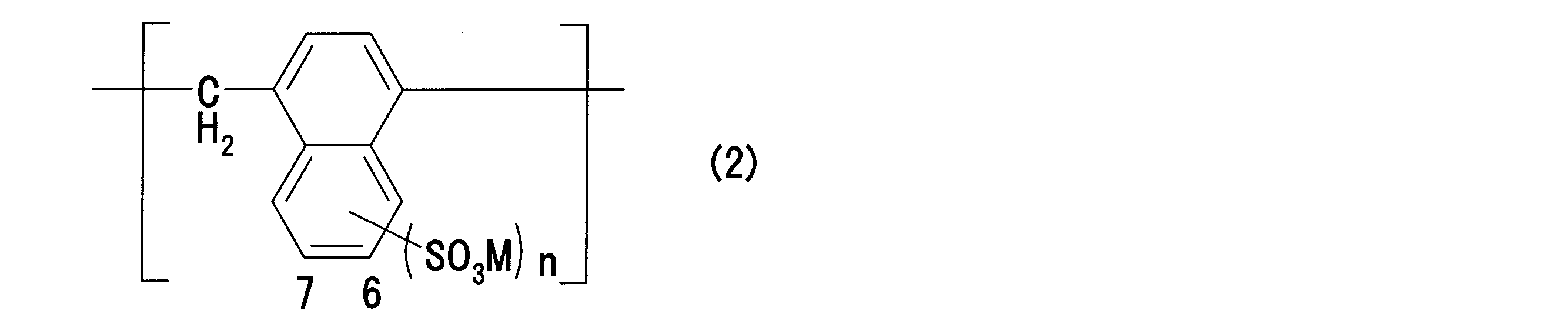
- water-soluble polymer having a carboxylic acid group and / or a sulfonic acid group a polymer having a structural unit represented by the following general formula (2) is also preferably used.
- the polymer having the structural unit represented by the general formula (2) is represented by the general formula (2) occupying in all the structural units of the polymer from the viewpoint of reducing scratches and improving the polishing rate.
- the proportion of the structural unit is preferably a polymer exceeding 50 mol%, more preferably 70 mol% or more, still more preferably 90 mol% or more, still more preferably 97 mol% or more, and in the above general formula (2) It is even more preferable that the polymer is represented only by the repeating structure of the structural unit represented. Furthermore, it is preferable that the molecular terminal of the polymer is blocked with hydrogen.
- M is a hydrogen atom, an alkali metal atom, an alkaline earth metal atom (1/2 atom), an ammonium group or an organic ammonium group, and sodium and potassium are preferable as the alkali metal.
- n is 1 or 2, and is preferably 1 from the viewpoint of improving scratch reduction.
- the “polymer mainly composed of the structural unit represented by the general formula (2)” as a whole n preferably has an average value of 0.5 or more and 1.5 or less.
- the sulfonic acid group (—SO 3 M) may be bonded to any position of the naphthylene group. From the viewpoint of improving scratch reduction, the 6-position or the 7-position Is preferably bonded to the 6 position.
- the general formula (2) can be referred to for the positions of the 6th and 7th positions of the naphthalene group.
- the polymer having the structural unit represented by the general formula (2) may be prepared by a known method, for example, by introducing a sulfonic acid group into a naphthalene monomer using a sulfonating agent such as concentrated sulfuric acid, It can be synthesized by adding formalin water for condensation and further neutralizing with an inorganic salt such as Ca (OH) 2 or Na 2 SO 4 .
- Commercially available products for example, trade name: Dimor N and trade name: Mighty 150, both manufactured by Kao Corporation
- the anionic water-soluble polymer can contain constituent unit components other than those described above.
- examples of other monomers that can be used as structural unit components include aromatic vinyl compounds such as styrene, ⁇ -methylstyrene, vinyltoluene, and p-methylstyrene, methyl (meth) acrylate, and ethyl (meth) acrylate.
- (Meth) acrylic acid alkyl esters such as octyl (meth) acrylate, aliphatic conjugated dienes such as butadiene, isoprene, 2-chloro-1,3-butadiene, 1-chloro-1,3-butadiene, (meth ) Vinyl cyanide compounds such as acrylonitrile and phosphoric acid compounds. These monomers can be used alone or in combination of two or more. Examples of a preferable copolymer of a water-soluble polymer having a carboxylic acid group and / or a sulfonic acid group having other structural unit components include a styrene / isoprenesulfonic acid copolymer from the viewpoint of reducing scratches.
- the counter ion of the water-soluble polymer having an anionic group is not particularly limited, and specific examples include ions of metals, ammonium, alkylammonium and the like.
- Specific examples of the metal include metals belonging to the periodic table (long-period type) 1A, 1B, 2A, 2B, 3A, 3B, 4A, 6A, 7A, or Group 8.
- metals belonging to Group 1A, 3B, or Group 8 are preferable from the viewpoint of surface roughness and nanoscratch reduction, and sodium and potassium belonging to Group 1A are more preferable.
- alkylammonium examples include tetramethylammonium, tetraethylammonium, tetrabutylammonium and the like.
- these salts ammonium salts, sodium salts, and potassium salts are more preferable.
- the weight average molecular weight of the anionic water-soluble polymer is preferably 500 or more and 100,000 or less, more preferably 500 or more and 50,000 or less, still more preferably 500 or more and 20,000 or less, and even more, from the viewpoint of reducing scratches and maintaining productivity. Preferably they are 1000 or more and 10,000 or less, Especially preferably, they are 1500 or more and 5000 or less. Specifically, the weight average molecular weight is measured by the measurement method described in Examples.
- the content of the anionic water-soluble polymer in the polishing liquid composition is preferably 0.001 to 1% by weight or more, more preferably 0.005 to 0.00%, from the viewpoint of achieving both scratch reduction and productivity. It is 5% by weight, more preferably 0.01 to 0.2% by weight, still more preferably 0.01 to 0.1% by weight, and particularly preferably 0.01 to 0.075% by weight.
- the concentration ratio of the colloidal silica and the anionic water-soluble polymer [silica concentration (% by weight) / anionic water-soluble polymer concentration (% by weight)] in the polishing liquid composition improves the polishing rate, From the viewpoint of surface roughness and scratch reduction, it is preferably 5 to 5000, more preferably 10 to 1000, and even more preferably 25 to 500.
- Water in the polishing composition of the present invention is used as a medium, and examples thereof include distilled water, ion exchange water, and ultrapure water. From the viewpoint of the surface cleanliness of the substrate to be polished, ion exchange water and ultrapure water are preferable, and ultrapure water is more preferable.
- the water content in the polishing composition is preferably 60 to 99.4% by weight, more preferably 70 to 98.9% by weight. Moreover, you may mix
- the polishing liquid composition of the present invention preferably contains an acid and / or a salt thereof.
- the acid used in the polishing composition of the present invention is preferably a compound having a pK1 of 2 or less from the viewpoint of improving the polishing rate, and preferably has a pK1 of 1.5 or less from the viewpoint of reducing scratches. More preferably, it is a compound exhibiting strong acidity that cannot be expressed by pK1, more preferably 1 or less.
- Preferred acids include nitric acid, sulfuric acid, sulfurous acid, persulfuric acid, hydrochloric acid, perchloric acid, phosphoric acid, phosphonic acid, phosphinic acid, pyrophosphoric acid, tripolyphosphoric acid, amidosulfuric acid, 2-aminoethylphosphonic acid, 1 -Hydroxyethylidene-1,1-diphosphonic acid, aminotri (methylenephosphonic acid), ethylenediaminetetra (methylenephosphonic acid), diethylenetriaminepenta (methylenephosphonic acid), ethane-1,1, -diphosphonic acid, ethane-1,1,1 2-triphosphonic acid, ethane-1-hydroxy-1,1-diphosphonic acid, ethane-1-hydroxy-1,1,2-triphosphonic acid, ethane-1,2-dicarboxy-1,2-diphosphonic acid, methane Hydroxyphosphonic acid, 2-phosphonobutane-1,2-dicarboxy
- a carboxylic acid etc. are mentioned. Of these, inorganic acids, carboxylic acids, and organic phosphonic acids are preferred from the viewpoint of reducing scratches. Among inorganic acids, phosphoric acid, nitric acid, sulfuric acid, hydrochloric acid, and perchloric acid are more preferable, and phosphoric acid and sulfuric acid are more preferable. Among the carboxylic acids, citric acid, tartaric acid, and maleic acid are more preferable, and citric acid is more preferable.
- 1-hydroxyethylidene-1,1-diphosphonic acid aminotri (methylenephosphonic acid), ethylenediaminetetra (methylenephosphonic acid), and diethylenetriaminepenta (methylenephosphonic acid) are more preferable, and 1-hydroxyethylidene- More preferred are 1,1-diphosphonic acid and aminotri (methylenephosphonic acid).
- acids and salts thereof may be used alone or in combination of two or more, but from the viewpoint of improving the polishing rate, reducing nanoprotrusions and improving the cleaning property of the substrate, use two or more in combination.
- pK1 is a logarithmic value of the reciprocal of the first acid dissociation constant (25 ° C.) of the organic compound or inorganic compound.
- the pK1 of each compound is described in, for example, the revised 4th edition Chemical Handbook (Basic) II, pp316-325 (Edited by Chemical Society of Japan).
- these acid salts there is no particular limitation, and specific examples include ions of metals, ammonium, alkylammonium and the like.
- Specific examples of the metal include metals belonging to the periodic table (long-period type) 1A, 1B, 2A, 2B, 3A, 3B, 4A, 6A, 7A, or Group 8.
- a salt with a metal belonging to Group 1A or ammonium is preferable from the viewpoint of reducing scratches.
- the content of the acid and its salt in the polishing composition is preferably 0.001 to 5% by weight, more preferably 0.01 to 4% by weight, from the viewpoints of improving the polishing rate, reducing the surface roughness and reducing scratches. More preferably, it is 0.05 to 3% by weight, and still more preferably 0.1 to 2.0% by weight.
- the polishing composition of the present invention preferably contains an oxidant.
- an oxidizing agent that can be used in the polishing liquid composition of the present invention from the viewpoint of improving the polishing rate, peroxide, permanganic acid or a salt thereof, chromic acid or a salt thereof, peroxo acid or a salt thereof, oxygen acid or an acid thereof Examples thereof include salts, metal salts, nitric acids, sulfuric acids and the like.
- Examples of the peroxide include hydrogen peroxide, sodium peroxide, barium peroxide, etc.
- examples of the permanganic acid or salt thereof include potassium permanganate
- examples of the chromic acid or salt thereof include chromium.
- Peroxo acids or salts thereof include peroxodisulfuric acid, ammonium peroxodisulfate, peroxodisulfate metal salts, peroxophosphoric acid, peroxosulfuric acid, sodium peroxoborate, and performic acid.
- Peroxyacetic acid, perbenzoic acid, perphthalic acid, etc., and oxygen acids or salts thereof include hypochlorous acid, hypobromite, hypoiodous acid, chloric acid, bromic acid, iodic acid, hypochlorous acid. Examples thereof include sodium chlorate and calcium hypochlorite.
- Metal salts include iron chloride (III), iron sulfate (III), iron nitrate (III), citric acid (III), ammonium iron (III), and the like.
- the oxidizing agent include hydrogen peroxide, iron (III) nitrate, peracetic acid, ammonium peroxodisulfate, iron (III) sulfate, and iron (III) ammonium sulfate.
- hydrogen peroxide is mentioned from the viewpoint that metal ions do not adhere to the surface and are generally used and inexpensive.
- These oxidizing agents may be used alone or in admixture of two or more.
- the content of the oxidizing agent in the polishing liquid composition is preferably 0.01% by weight or more, more preferably 0.05% by weight or more, and further preferably 0.1% by weight or more from the viewpoint of improving the polishing rate.
- it is preferably 4% by weight or less, more preferably 2% by weight or less, and further preferably 1% by weight or less. Therefore, in order to improve the polishing rate while maintaining the surface quality, the content is preferably 0.01 to 4% by weight, more preferably 0.05 to 2% by weight, and still more preferably 0.1 to 1%. % By weight.
- polishing composition of the present invention other components can be blended as necessary.
- other components include a thickener, a dispersant, a rust inhibitor, a basic substance, and a surfactant.
- the content of these other optional components in the polishing composition is preferably 0 to 10% by weight, more preferably 0 to 5% by weight.
- the pH of the polishing composition of the present invention is preferably 3.0 or less from the viewpoint of improving the polishing rate, more preferably 2.5 or less, still more preferably 2.0 or less, and even more preferably 1.8 or less. .
- 0.5 or more is preferable from a viewpoint of surface roughness reduction, More preferably, it is 0.8 or more, More preferably, it is 1.0 or more, More preferably, it is 1.2 or more.
- the waste liquid pH of the polishing composition is preferably 3 or less, more preferably 2.5 or less, still more preferably 2.2 or less, and even more preferably 2.0 or less, from the viewpoint of improving the polishing rate.
- the waste liquid pH of the polishing composition is preferably 0.8 or more, more preferably 1.0 or more, still more preferably 1.2 or more, and even more preferably 1.5 or more. It is.
- the waste liquid pH refers to the polishing waste liquid in the polishing step using the polishing liquid composition, that is, the pH of the polishing liquid composition immediately after being discharged from the polishing machine.
- the polishing liquid composition of the present invention is, for example, a known method comprising water, colloidal silica, and optionally an anionic water-soluble polymer, an acid and / or salt thereof, an oxidizing agent, and other components. Can be prepared by mixing. Under the present circumstances, colloidal silica may be mixed in the state of the concentrated slurry, and may be mixed after diluting with water etc. Although content and density
- Another aspect of the present invention is a method for preparing a polishing liquid composition for a magnetic disk substrate containing colloidal silica, wherein the average particle diameter measured at a detection angle of 90 ° in the dynamic light scattering method is 1 to 40 nm.
- the CV value (CV90) obtained by dividing the standard deviation measured at a detection angle of 90 ° in the dynamic light scattering method by the average particle size and multiplying by 100 is 1 to 35%
- the present invention relates to a method of manufacturing a magnetic disk substrate (hereinafter also referred to as a manufacturing method of the present invention).
- the manufacturing method of the present invention includes a step of polishing a substrate to be polished using the above-described polishing liquid composition of the present invention (hereinafter, also referred to as “polishing process using the polishing liquid composition of the present invention”). It is a manufacturing method of a disk substrate.
- polishing process using the polishing liquid composition of the present invention It is a manufacturing method of a disk substrate.
- the manufacturing method of the present invention is particularly suitable for a method for manufacturing a magnetic disk substrate for perpendicular magnetic recording. Therefore, as another aspect, the manufacturing method of the present invention is a method of manufacturing a magnetic disk substrate for a perpendicular magnetic recording system including a polishing step using the polishing composition of the present invention.
- the substrate to be polished is sandwiched between a surface plate to which a polishing pad such as a non-woven organic polymer polishing cloth is attached.
- a method of polishing the substrate to be polished by moving the surface plate or the substrate to be polished while supplying the polishing composition of the invention to the polishing machine can be mentioned.
- the polishing process using the polishing composition of the present invention is preferably performed in the second stage or more, and more preferably performed in the final polishing process.
- different polishing machines may be used, and when different polishing machines are used, polishing is performed for each polishing process. It is preferable to clean the substrate.
- the polishing composition of the present invention can also be used in cyclic polishing in which the used polishing liquid is reused.
- the polishing machine is not particularly limited, and a known polishing machine for polishing a magnetic disk substrate can be used.
- the production method of the present invention has an average particle size of 1 to 40 nm measured at a detection angle of 90 ° in the dynamic light scattering method, and is measured at a detection angle of 90 ° in the dynamic light scattering method.
- the polishing liquid composition containing the colloidal silica naturally includes the polishing liquid composition of the present invention.
- the polishing pad used in the present invention is not particularly limited, and a polishing pad of a suede type, a nonwoven fabric type, a polyurethane closed-cell foam type, or a two-layer type in which these are laminated can be used. From the viewpoint, a suede type polishing pad is preferable.
- the average pore diameter of the surface member of the polishing pad is preferably 50 ⁇ m or less, more preferably 45 ⁇ m or less, still more preferably 40 ⁇ m or less, and even more preferably 35 ⁇ m or less, from the viewpoint of scratch reduction and pad life.
- the average pore diameter is preferably 0.01 ⁇ m or more, more preferably 0.1 ⁇ m or more, and still more preferably, in order to keep the polishing liquid in the pores and prevent the liquid from running out. It is 1 ⁇ m or more, more preferably 10 ⁇ m or more.
- the maximum value of the pore size of the polishing pad is preferably 100 ⁇ m or less, more preferably 70 ⁇ m or less, still more preferably 60 ⁇ m or less, and particularly preferably 50 ⁇ m or less from the viewpoint of maintaining the polishing rate. Therefore, as another aspect, the production method of the present invention is a production method in which the average pore diameter of the surface member of the polishing pad used in the process using the polishing composition of the present invention is 10 to 50 ⁇ m.
- the polishing load in the polishing step using the polishing liquid composition of the present invention is preferably 5.9 kPa or more, more preferably 6.9 kPa or more, and further preferably 7.5 kPa or more.
- the polishing load refers to the pressure of the surface plate applied to the polishing surface of the substrate to be polished during polishing.
- the polishing load is preferably 20 kPa or less, more preferably 18 kPa or less, and further preferably 16 kPa or less.
- the polishing pressure is preferably 5.9 to 20 kPa, more preferably 6.9 to 18 kPa, and even more preferably 7.5 to 16 kPa.
- the polishing load can be adjusted by applying air pressure or weight to at least one of the surface plate and the substrate to be polished.
- the supply rate of the polishing liquid composition of the present invention in the polishing step using the polishing liquid composition of the present invention is preferably 0.05 to 15 mL / min per 1 cm 2 of the substrate to be polished. More preferably 0.06 to 10 mL / min, still more preferably 0.07 to 1 mL / min, even more preferably 0.08 to 0.5 mL / min, even more preferably 0.12 to 0.5 mL / min. Minutes.
- a method of supplying the polishing composition of the present invention to a polishing machine for example, a method of continuously supplying using a pump or the like can be mentioned.
- supplying the polishing composition to the polishing machine in addition to the method of supplying one component containing all the components, considering the stability of the polishing composition, etc., it is divided into a plurality of compounding component liquids, Two or more liquids can be supplied. In the latter case, for example, the plurality of compounding component liquids are mixed in the supply pipe or on the substrate to be polished to obtain the polishing liquid composition of the present invention.
- Examples of the material of the substrate to be polished preferably used in the present invention include metals, metalloids such as silicon, aluminum, nickel, tungsten, copper, tantalum, and titanium, or alloys thereof, glass, glassy carbon, and amorphous. Examples thereof include glassy substances such as carbon, ceramic materials such as alumina, silicon dioxide, silicon nitride, tantalum nitride, and titanium carbide, and resins such as polyimide resin. Among these, a substrate to be polished containing a metal such as aluminum, nickel, tungsten, copper, or an alloy containing these metals as a main component is preferable. It is particularly suitable for Ni—P plated aluminum alloy substrates and glass substrates such as crystallized glass and tempered glass, among which Ni—P plated aluminum alloy substrates are suitable.
- the present invention it is possible to provide a magnetic disk substrate in which the maximum value (AFM-Rmax) of the scratch and the surface roughness of the polished substrate is highly reduced without impairing the productivity. Therefore, it can be suitably used for polishing a perpendicular magnetic recording type magnetic disk substrate that requires high performance.
- the shape of the substrate to be polished is not particularly limited, and may be, for example, a shape having a flat portion such as a disc shape, a plate shape, a slab shape, or a prism shape, or a shape having a curved surface portion such as a lens.
- a disk-shaped substrate to be polished is suitable.
- its outer diameter is, for example, about 2 to 95 mm
- its thickness is, for example, about 0.5 to 2 mm.
- the present invention relates to a method for polishing a substrate to be polished, which comprises polishing the substrate to be polished while bringing the above-mentioned polishing composition into contact with a polishing pad.
- the substrate to be polished can be polished without impairing the productivity, and both the surface roughness and the scratch are reduced, particularly the magnetic disk substrate of the perpendicular magnetic recording system.
- the substrate to be polished in the polishing method of the present invention include those used in the manufacture of a magnetic disk substrate and a magnetic recording medium substrate as described above. A substrate used for production is preferred.
- the specific polishing method and conditions can be as described above.
- a magnetic disk substrate with reduced surface roughness can be provided without impairing productivity.
- the maximum height Rmax of the surface roughness obtained by observing the surface of the magnetic disk substrate with an atomic force microscope (AFM) is improved to, for example, less than 3 nm, preferably less than 2 nm, more preferably less than 1.5 nm.
- a perpendicular magnetic recording type magnetic disk substrate can be preferably provided.
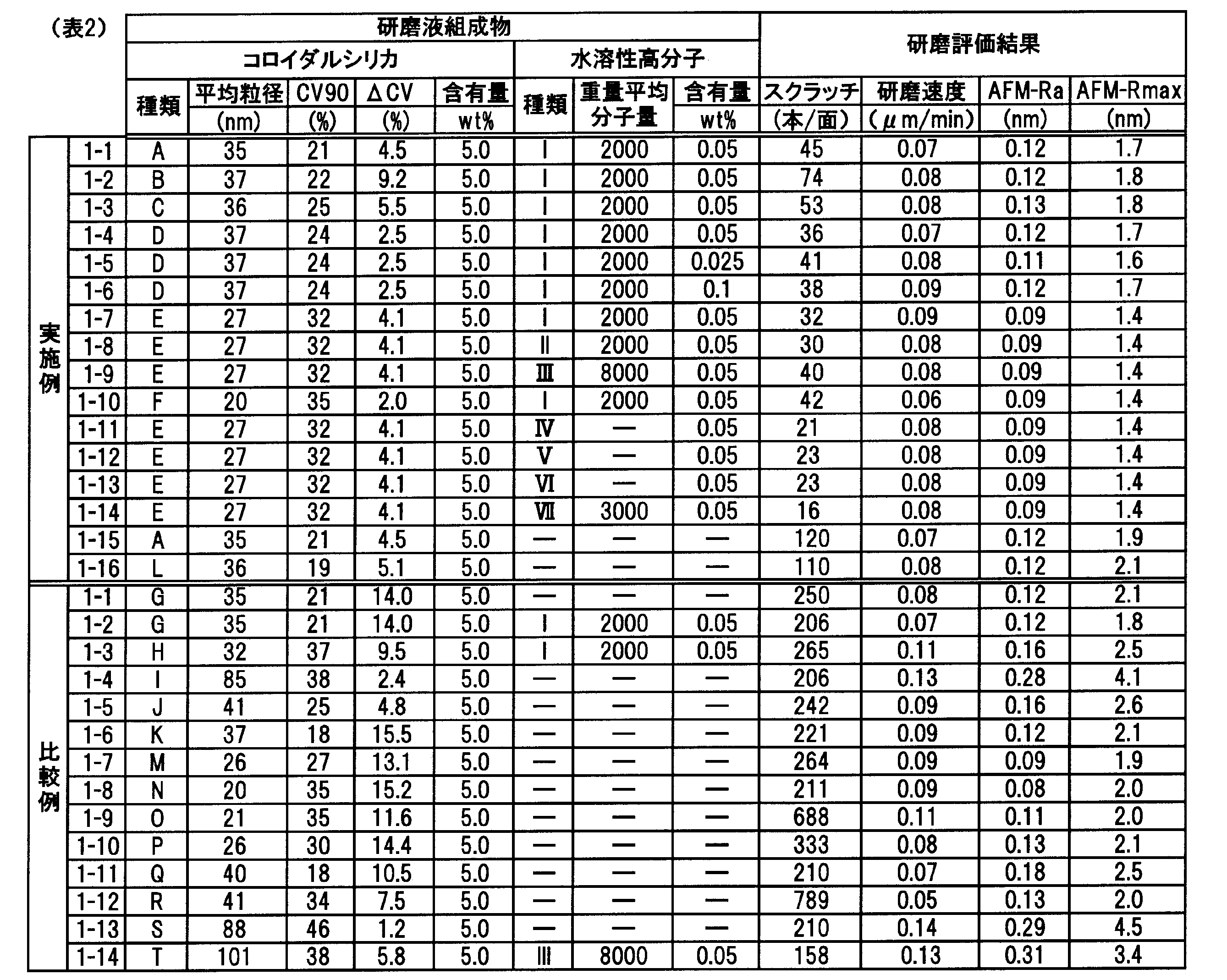
- Polishing liquid compositions (Examples 1-1 to 1-16 and Comparative Examples 1-1 to 1-14) were prepared using colloidal silica and, if necessary, anionic water-soluble polymers shown in Table 1 below. The polished substrate was polished, and the scratch and surface roughness of the polished substrate were evaluated. The evaluation results are shown in Table 2 below.
- a method for preparing the polishing liquid composition, a method for measuring each parameter, a polishing condition (polishing method), and an evaluation method are as follows.
- the average particle size of colloidal silica was determined.
- the CV value was obtained by dividing the standard deviation in the scattering intensity distribution measured according to the above measurement method by the average particle diameter and multiplying by 100 to obtain the CV value.
- [ ⁇ CV value] A value obtained by subtracting the CV value (CV90) of the colloidal silica particles at a detection angle of 90 ° from the CV value (CV30) of the colloidal silica particles at a detection angle of 30 °, which was measured according to the above measurement method, was obtained as a ⁇ CV value.
- the substrate to be polished a substrate obtained by rough polishing an aluminum alloy substrate plated with Ni—P in advance with a polishing composition containing an alumina abrasive was used.
- the substrate to be polished has a thickness of 1.27 mm, an outer diameter of 95 mm, an inner diameter of 25 mm, a center line average roughness Ra measured by AFM (Digital Instrument Nanoscope IIIa Multi Mode AFM), 1 nm, and a long wavelength.
- the amplitude of the undulation (wavelength 0.4 to 2 mm) was 2 nm, and the amplitude of the short wavelength undulation (wavelength 50 to 400 ⁇ m) was 2 nm.
- Polishing tester "Fast double-sided 9B polishing machine” manufactured by Speedfam Polishing pad: Fujibo's suede type (thickness 0.9mm, average hole diameter 30 ⁇ m) Polishing liquid composition supply amount: 100 mL / min (supply rate per 1 cm 2 of polishing substrate: 0.072 mL / min) Lower platen rotation speed: 32.5 rpm Polishing load: 7.9 kPa Polishing time: 4 minutes
- Polishing rate ( ⁇ m / min) weight reduction rate (g / min) / substrate single-sided area (mm 2 ) / Ni—P plating density (g / cm 3 ) ⁇ 10 6 (Substrate single side area: 6597 mm 2 , Ni—P plating density: calculated as 7.9 g / cm 3 )
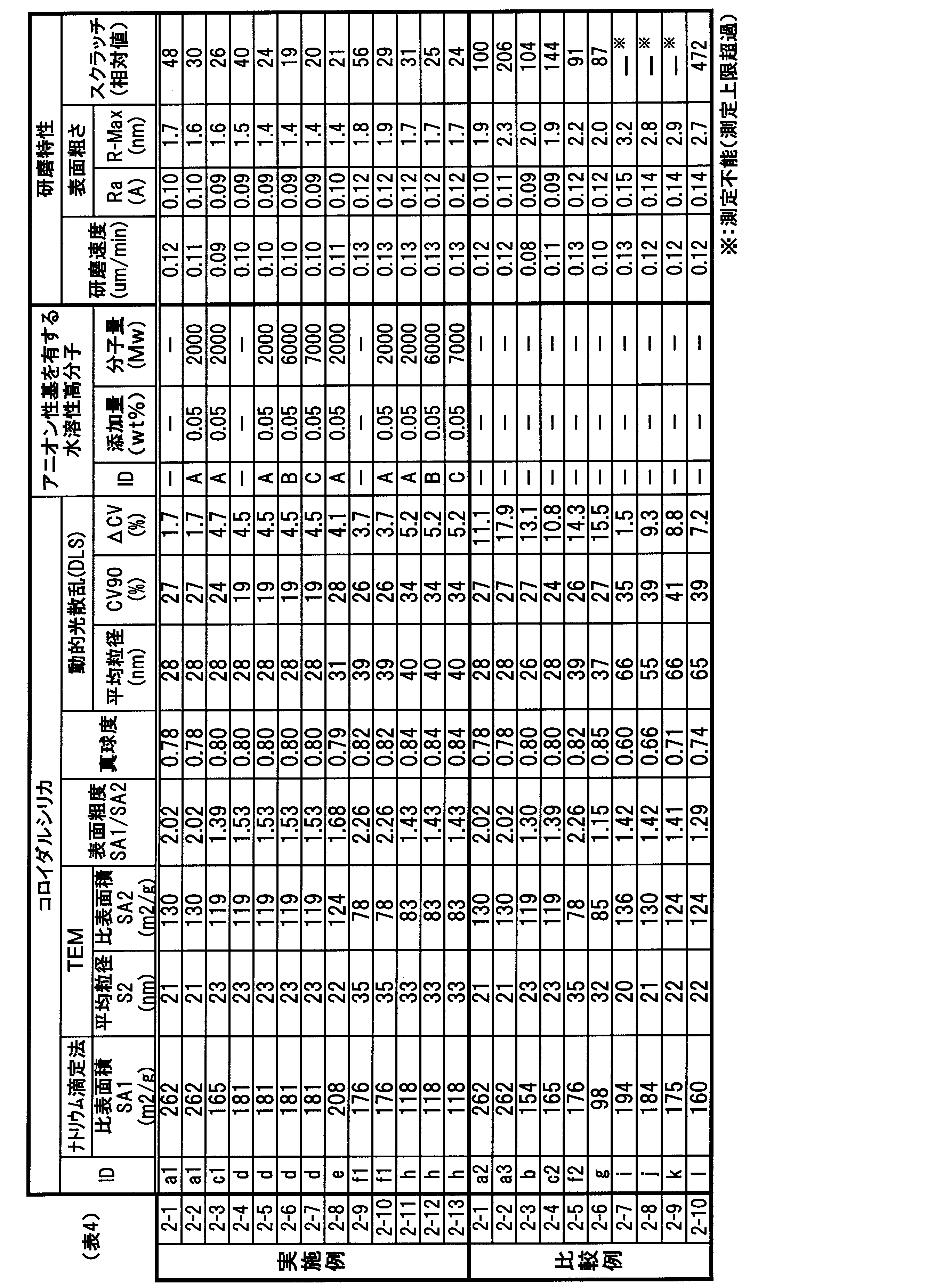
- a polishing composition was prepared using colloidal silica and an anionic water-soluble polymer shown in Table 3 below, and the substrate to be polished was polished, and the polishing rate, the scratch and the surface roughness of the substrate after polishing were evaluated. .
- the evaluation results are shown in Table 4 below.
- a method for preparing the polishing liquid composition, a method for measuring each parameter, a polishing condition (polishing method), and an evaluation method are as follows.
- colloidal silica, anionic water-soluble polymer, sulfuric acid, HEDP and hydrogen peroxide in the polishing composition are 5% by weight, 0.05% by weight (when added) and 0.5% by weight, respectively. 0.1% by weight and 0.5% by weight.
- Colloidal silica a1-a3 has the same SA1, SA2, surface roughness, and true sphericity, but has different ⁇ CV values. The same applies to colloidal silica c1-c2 and f1-f2.
- the area (A2) of the circle to be measured was measured, and the ratio (A1 / A2) between the projected area (A1) of the particles and the area (A2) obtained from the circumference of the particles was calculated as the true sphere ratio.
- the numerical value of following Table 4 calculates these average values, after calculating
- SA2 specific surface area converted from specific surface area (SA1) measured by sodium titration method and average particle diameter (S2) measured by transmission electron microscope observation was obtained, and the ratio ( SA1 / SA2) was calculated as the surface roughness.
- SA1 specific surface area of colloidal silica by sodium titration method
- a sample containing colloidal silica corresponding to 1.5 g as SiO 2 is collected in a beaker and transferred to a constant temperature reaction tank (25 ° C.), and pure water is added to make the liquid volume 90 ml. The following operation is performed in a constant temperature reaction tank maintained at 25 ° C. 2) A 0.1 mol / L hydrochloric acid solution is added so that the pH is 3.6 to 3.7. 3) Add 30 g of sodium chloride, dilute to 150 ml with pure water and stir for 10 minutes.
- a pH electrode is set, and 0.1 mol / L sodium hydroxide solution is added dropwise with stirring to adjust the pH to 4.0.
- a calibration curve is prepared, where X is the titer of 1 mol / L sodium hydroxide solution and Y is the pH value at that time.
- the average value is computed and it is set as the average particle diameter (S2) measured by transmission electron microscope observation.
- the value of the average particle diameter (S2) obtained above is substituted into the following formula (4) to obtain the specific surface area (SA2).
- SA2 6000 / (S2 ⁇ ⁇ ) (4) ( ⁇ : density of sample) ⁇ : 2.2 (in the case of colloidal silica)
- the substrate to be polished As the substrate to be polished, the same substrate as that used in Examples 1-1 to 1-16 and Comparative Examples 1-1 to 1-14 described above, and an aluminum alloy substrate plated with Ni—P was previously used. A substrate that was roughly polished with a polishing composition containing an alumina abrasive was used.
- Polishing tester "Fast double-sided 9B polishing machine” manufactured by Speedfam Polishing pad: Fujibo's suede type (thickness 0.9mm, average hole diameter 30 ⁇ m) Polishing liquid composition supply amount: 100 mL / min (supply rate per 1 cm 2 of polishing substrate: 0.072 mL / min) Lower platen rotation speed: 32.5 rpm Polishing load: 7.9 kPa Polishing time: 8 minutes
- a magnetic disk substrate suitable for high recording density can be provided.
Landscapes
- Chemical & Material Sciences (AREA)
- Engineering & Computer Science (AREA)
- Organic Chemistry (AREA)
- Materials Engineering (AREA)
- Mechanical Engineering (AREA)
- Chemical Kinetics & Catalysis (AREA)
- Life Sciences & Earth Sciences (AREA)
- General Chemical & Material Sciences (AREA)
- Geochemistry & Mineralogy (AREA)
- Manufacturing & Machinery (AREA)
- Dispersion Chemistry (AREA)
- Inorganic Chemistry (AREA)
- Finish Polishing, Edge Sharpening, And Grinding By Specific Grinding Devices (AREA)
- Manufacturing Of Magnetic Record Carriers (AREA)
Abstract
Description
(a)透過型電子顕微鏡観察により測定される真球率が0.75~1
(b)ナトリウム滴定法により測定される比表面積(SA1)と透過型電子顕微鏡観察により測定される平均粒径(S2)から換算される比表面積(SA2)とから算出される表面粗度(SA1/SA2)の値が1.3以上
(c)前記平均粒径(S2)が1~40nm
本明細書においてコロイダルシリカのΔCV値は、動的光散乱法により検出角30°(前方散乱)の散乱強度分布に基づき測定される粒径の標準偏差を、動的光散乱法により検出角30°の散乱強度分布に基づき測定される平均粒径で除して100を掛けた変動係数(CV)の値(CV30)と、動的光散乱法により検出角90°(側方散乱)の散乱強度分布に基づき測定される粒径の標準偏差を、動的光散乱法により検出角90°の散乱強度分布に基づき測定される平均粒径で除して100を掛けた変動係数の値(CV90)との差(ΔCV=CV30-CV90)をいい、動的光散乱法により測定される散乱強度分布の角度依存性を示す値をいう。ΔCV値は、具体的には実施例に記載の方法により測定することができる。
本明細書において「散乱強度分布」とは、動的光散乱法(DLS:Dynamic Light Scattering)又は準弾性光散乱(QLS:Quasielastic Light Scattering)により求められるサブミクロン以下の粒子の3つの粒径分布(散乱強度、体積換算、個数換算)のうち散乱強度の粒径分布のことをいう。通常、サブミクロン以下の粒子は溶媒中でブラウン運動をしており、レーザー光を照射すると散乱光強度が時間的に変化する(ゆらぐ)。この散乱光強度のゆらぎを、例えば、光子相関法(JIS Z 8826)を用いて自己相関関数を求め、キュムラント(Cumulant)法解析により、ブラウン運動速度を示す拡散係数(D)を算出して、さらにアインシュタイン・ストークスの式を用い、平均粒径(d:流体力学的径)を求めることができる。また、粒径分布解析は、キュムラント法による多分散性指数(Polydispersity Index, PI)のほかに、ヒストグラム法(Marquardt法)、ラプラス逆変換法(CONTIN法)、非負最小2乗法(NNLS法)等がある。
(参考資料)
第12回散乱研究会(2000年11月22日開催)テキスト、1.散乱基礎講座「動的光散乱法」(東京大学 柴山充弘教授)
第20回散乱研究会(2008年12月4日開催)テキスト、5.動的光散乱によるナノ粒子の粒径分布測定(同志社大学 森康維先生)
本明細書において「粒子分散液の散乱強度分布の角度依存性」とは、動的光散乱法により異なる検出角で前記粒子分散液の散乱強度分布を測定した場合の、散乱角度に応じた散乱強度分布の変動の大きさをいう。例えば、検出角30°と検出角90°とでの散乱強度分布の差が大きければ、その粒子分散液の散乱強度分布の角度依存性は大きいといえる。よって、本明細書において、散乱強度分布の角度依存性の測定は、異なる2つの検出角で測定した散乱強度分布に基づく測定値の差(ΔCV値)を求めることを含む。
本発明の研磨液組成物に用いられるコロイダルシリカは、ケイ酸水溶液から生成させる公知の製造方法等により得られたものでもよい。シリカ粒子の使用形態としては、操作性の観点からスラリー状であることが好ましい。
本発明における「コロイダルシリカの平均粒径」とは、動的光散乱法により測定される散乱強度分布に基づく平均粒径、又は、透過型電子顕微鏡観察により測定される平均粒径(S2)をいい、特に言及のない場合、「コロイダルシリカの平均粒径」とは、動的光散乱法において検出角90°で測定される散乱強度分布に基づく平均粒径をいう。これらの平均粒径は、具体的には実施例に記載の方法により得ることができる。
本明細書においてコロイダルシリカの透過型電子顕微鏡観察により測定される真球率は、透過型電子顕微鏡により得られるシリカ粒子一個の投影面積(A1)と該粒子の周長を円周とする円の面積(A2)との比、すなわち、「A1/A2」の値であって、好ましくは、本発明の研磨液組成物における任意の50~100個のコロイダルシリカについての「A1/A2」の値の平均値をいう。コロイダルシリカの真球率は、具体的には、実施例に記載の方法により測定されうる。生産性を損なうことなくスクラッチ及び表面粗さを低減する観点から、本発明の研磨液組成物に使用されるコロイダルシリカの真球率は、好ましくは0.75~1であり、0.75~0.95がより好ましく、0.75~0.85がさらに好ましい。
本明細書においてコロイダルシリカの表面粗度は、ナトリウム滴定法により測定される比表面積(SA1)と、透過型電子顕微鏡観察により測定される平均粒径(S2)から換算される比表面積(SA2)との比である「SA1/SA2」の値をいい、具体的には、実施例に記載の方法により測定される。ここで、ナトリウム滴定法により測定される比表面積(SA1)は、シリカに対して水酸化ナトリウム溶液を滴定したときの水酸化ナトリウム溶液の消費量からシリカの比表面積を求めるものであり、実際の表面積を反映したものと言える。具体的には、シリカ表面に起伏または疣状突起などに富むものである程、比表面積(SA1)は大きくなる。一方、透過型電子顕微鏡により測定される平均粒径(S2)から算出される比表面積(SA2)はシリカを理想的な球状粒子と仮定し、算出される。具体的には平均粒径(S2)が大きいほど、比表面積(SA2)は小さくなる。比表面積は単位質量あたりの表面積を示すものであって、表面粗度(SA1/SA2)の値については、シリカが球状であって、シリカ表面に多くの疣状突起を有する程、大きい値を示し、シリカ表面の疣状突起が少なく、平滑である程、小さい値を示し、その値は1に近づく。本発明の研磨液組成物に使用されるコロイダルシリカの表面粗度は、生産性を損なうことなくスクラッチ及び表面粗さを低減する観点から、好ましくは1.3以上であり、1.3~2.5がより好ましく、1.3~2.0がさらに好ましい。
コロイダルシリカのΔCV値の調整方法としては、研磨液組成物の調製で50~200nmのシリカ凝集物(非球状シリカ)を生成しないようにする下記の方法が挙げられる。
A)研磨液組成物のろ過による方法
B)コロイダルシリカ製造時の工程管理による方法
本発明の研磨液組成物は、研磨後の基板のスクラッチ及び表面粗さの最大値(AFM‐Rmax)の低減の観点から、アニオン性基を有する水溶性高分子(以下、アニオン性水溶性高分子ともいう)を含有することが好ましい。該高分子は、研磨時の摩擦振動を低減して研磨パッドの開孔部からのシリカ凝集体の脱落を防止し、研磨後の基板のスクラッチ及び表面粗さの最大値(AFM‐Rmax)を低減するものと推定される。

本発明の研磨液組成物中の水は、媒体として使用されるものであり、蒸留水、イオン交換水、超純水等が挙げられる。被研磨基板の表面清浄性の観点からイオン交換水及び超純水が好ましく、超純水がより好ましい。研磨液組成物中の水の含有量は、60~99.4重量%が好ましく、70~98.9重量%がより好ましい。また、本発明の効果を阻害しない範囲内でアルコール等の有機溶剤を配合してもよい。
本発明の研磨液組成物は、酸及び/又はその塩を含むことが好ましい。本発明の研磨液組成物に使用される酸としては、研磨速度の向上の観点から、その酸のpK1が2以下の化合物が好ましく、スクラッチを低減する観点から、好ましくはpK1が1.5以下、より好ましくは1以下、さらに好ましくはpK1で表せない程の強い酸性を示す化合物である。好ましい酸としては、硝酸、硫酸、亜硫酸、過硫酸、塩酸、過塩素酸、リン酸、ホスホン酸、ホスフィン酸、ピロリン酸、トリポリリン酸、アミド硫酸等の無機酸、2-アミノエチルホスホン酸、1-ヒドロキシエチリデン-1,1-ジホスホン酸、アミノトリ(メチレンホスホン酸)、エチレンジアミンテトラ(メチレンホスホン酸)、ジエチレントリアミンペンタ(メチレンホスホン酸)、エタン-1,1,-ジホスホン酸、エタン-1,1,2-トリホスホン酸、エタン-1-ヒドロキシ-1,1-ジホスホン酸、エタン-1-ヒドロキシ-1,1,2-トリホスホン酸、エタン-1,2-ジカルボキシ-1,2-ジホスホン酸、メタンヒドロキシホスホン酸、2-ホスホノブタン-1,2-ジカルボン酸、1-ホスホノブタン-2,3,4-トリカルボン酸、α-メチルホスホノコハク酸等の有機ホスホン酸、グルタミン酸、ピコリン酸、アスパラギン酸等のアミノカルボン酸、クエン酸、酒石酸、シュウ酸、ニトロ酢酸、マレイン酸、オキサロ酢酸等のカルボン酸等が挙げられる。中でも、スクラッチ低減の観点から、無機酸、カルボン酸、有機ホスホン酸が好ましい。また、無機酸の中では、リン酸、硝酸、硫酸、塩酸、過塩素酸がより好ましく、リン酸、硫酸がさらに好ましい。カルボン酸の中では、クエン酸、酒石酸、マレイン酸がより好ましく、クエン酸がさらに好ましい。有機ホスホン酸の中では、1-ヒドロキシエチリデン-1,1-ジホスホン酸、アミノトリ(メチレンホスホン酸)、エチレンジアミンテトラ(メチレンホスホン酸)、ジエチレントリアミンペンタ(メチレンホスホン酸)がより好ましく、1-ヒドロキシエチリデン-1,1-ジホスホン酸、アミノトリ(メチレンホスホン酸)がさらに好ましい。これらの酸及びその塩は単独で又は2種以上を混合して用いてもよいが、研磨速度の向上、ナノ突起低減及び基板の洗浄性向上の観点から、2種以上を混合して用いることが好ましく、リン酸、硫酸、クエン酸及び1-ヒドロキシエチリデン-1,1-ジホスホン酸からなる群から選択される2種以上の酸を混合して用いることがさらに好ましい。ここで、pK1とは有機化合物又は無機化合物の第一酸解離定数(25℃)の逆数の対数値である。各化合物のpK1は例えば改訂4版化学便覧(基礎編)II、pp316-325(日本化学会編)等に記載されている。
本発明の研磨液組成物は、酸化剤を含むことが好ましい。本発明の研磨液組成物に使用できる酸化剤としては、研磨速度を向上させる観点から、過酸化物、過マンガン酸又はその塩、クロム酸又はその塩、ペルオキソ酸又はその塩、酸素酸又はその塩、金属塩類、硝酸類、硫酸類等が挙げられる。
本発明の研磨液組成物には、必要に応じて他の成分を配合することができる。他の成分としては、増粘剤、分散剤、防錆剤、塩基性物質、界面活性剤等が挙げられる。研磨液組成物中のこれら他の任意成分の含有量は、0~10重量%が好ましく、0~5重量%がより好ましい。
本発明の研磨液組成物のpHは、研磨速度向上の観点から3.0以下が好ましく、より好ましくは2.5以下、さらに好ましくは2.0以下、さらにより好ましくは1.8以下である。また、表面粗さ低減の観点から、0.5以上が好ましく、より好ましくは0.8以上、さらに好ましくは1.0以上、さらにより好ましくは1.2以上である。また、研磨液組成物の廃液pHは、研磨速度向上の観点から3以下が好ましく、より好ましくは2.5以下、さらに好ましくは2.2以下、さらにより好ましくは2.0以下である。また、表面粗さ低減の観点から、研磨液組成物の廃液pHは、0.8以上が好ましく、より好ましくは1.0以上、さらに好ましくは1.2以上、さらにより好ましくは1.5以上である。なお、廃液pHとは、研磨液組成物を用いた研磨工程における研磨廃液、即ち、研磨機より排出された直後の研磨液組成物のpHをいう。
本発明の研磨液組成物は、例えば、水と、コロイダルシリカと、さらに所望により、アニオン性水溶性高分子と、酸及び/又はその塩と、酸化剤と、他の成分とを公知の方法で混合することにより調製できる。この際、コロイダルシリカは、濃縮されたスラリーの状態で混合されてもよいし、水等で希釈してから混合されてもよい。本発明の研磨液組成物中における各成分の含有量や濃度は、上述した範囲であるが、その他の態様として、本発明の研磨液組成物を濃縮物として調製してもよい。
本発明は、その他の態様として、磁気ディスク基板の製造方法(以下、本発明の製造方法ともいう。)に関する。本発明の製造方法は、上述した本発明の研磨液組成物を用いて被研磨基板を研磨する工程(以下、「本発明の研磨液組成物を用いた研磨工程」ともいう。)を含む磁気ディスク基板の製造方法である。これにより、研磨速度の低下を抑制でき、生産性及び研磨後の基板の表面粗さを大きく損なうことなく、研磨後の基板のスクラッチが低減された磁気ディスク基板を好ましくは提供できる。本発明の製造方法は、とりわけ、垂直磁気記録方式用磁気ディスク基板の製造方法に適している。よって、本発明の製造方法は、その他の態様として、本発明の研磨液組成物を用いた研磨工程を含む垂直磁気記録方式用磁気ディスク基板の製造方法である。
本発明で使用される研磨パッドとしては、特に制限はなく、スエードタイプ、不織布タイプ、ポリウレタン独立発泡タイプ、又はこれらを積層した二層タイプ等の研磨パッドを使用することができるが、研磨速度の観点から、スエードタイプの研磨パッドが好ましい。
本発明の研磨液組成物を用いた研磨工程における研磨荷重は、好ましくは5.9kPa以上、より好ましくは6.9kPa以上、さらに好ましくは7.5kPa以上である。これにより、研磨速度の低下を抑制できるため、生産性の向上が可能となる。なお、本発明の製造方法において研磨荷重とは、研磨時に被研磨基板の研磨面に加えられる定盤の圧力をいう。また、本発明の研磨液組成物を用いた研磨工程は、研磨荷重は20kPa以下が好ましく、より好ましくは18kPa以下、さらに好ましくは16kPa以下である。これにより、スクラッチの発生を抑制することができる。したがって、本発明の研磨液組成物を用いた研磨工程において研磨圧力は5.9~20kPaが好ましく、6.9~18kPaがより好ましく、7.5~16kPaがさらに好ましい。研磨荷重の調整は、定盤及び被研磨基板のうち少なくとも一方に空気圧や重りを負荷することにより行うことができる。
本発明の研磨液組成物を用いた研磨工程における本発明の研磨液組成物の供給速度は、スクラッチ低減の観点から、被研磨基板1cm2当たり、好ましくは0.05~15mL/分であり、より好ましくは0.06~10mL/分であり、さらに好ましくは0.07~1mL/分、さらにより好ましくは0.08~0.5mL/分、さらにより好ましくは0.12~0.5mL/分である。
本発明において好適に使用される被研磨基板の材質としては、例えばシリコン、アルミニウム、ニッケル、タングステン、銅、タンタル、チタン等の金属若しくは半金属、又はこれらの合金や、ガラス、ガラス状カーボン、アモルファスカーボン等のガラス状物質や、アルミナ、二酸化珪素、窒化珪素、窒化タンタル、炭化チタン等のセラミック材料や、ポリイミド樹脂等の樹脂等が挙げられる。中でも、アルミニウム、ニッケル、タングステン、銅等の金属や、これらの金属を主成分とする合金を含有する被研磨基板が好適である。特にNi-Pメッキされたアルミニウム合金基板や、結晶化ガラス、強化ガラス等のガラス基板に適しており、中でもNi-Pメッキされたアルミニウム合金基板が適している。
本発明は、その他の態様として、上述した研磨液組成物を研磨パッドに接触させながら被研磨基板を研磨することを含む被研磨基板の研磨方法に関する。本発明の研磨方法を使用することにより、生産性を損なうことなく、被研磨基板の研磨が可能となり、表面粗さ及びスクラッチがともに低減された磁気ディスク基板、特に垂直磁気記録方式の磁気ディスク基板が好ましくは提供される。本発明の研磨方法における前記被研磨基板としては、上述のとおり、磁気ディスク基板や磁気記録用媒体の基板の製造に使用されるものが挙げられ、なかでも、垂直磁気記録方式用磁気ディスク基板の製造に用いる基板が好ましい。なお、具体的な研磨の方法及び条件は、上述のとおりとすることができる。
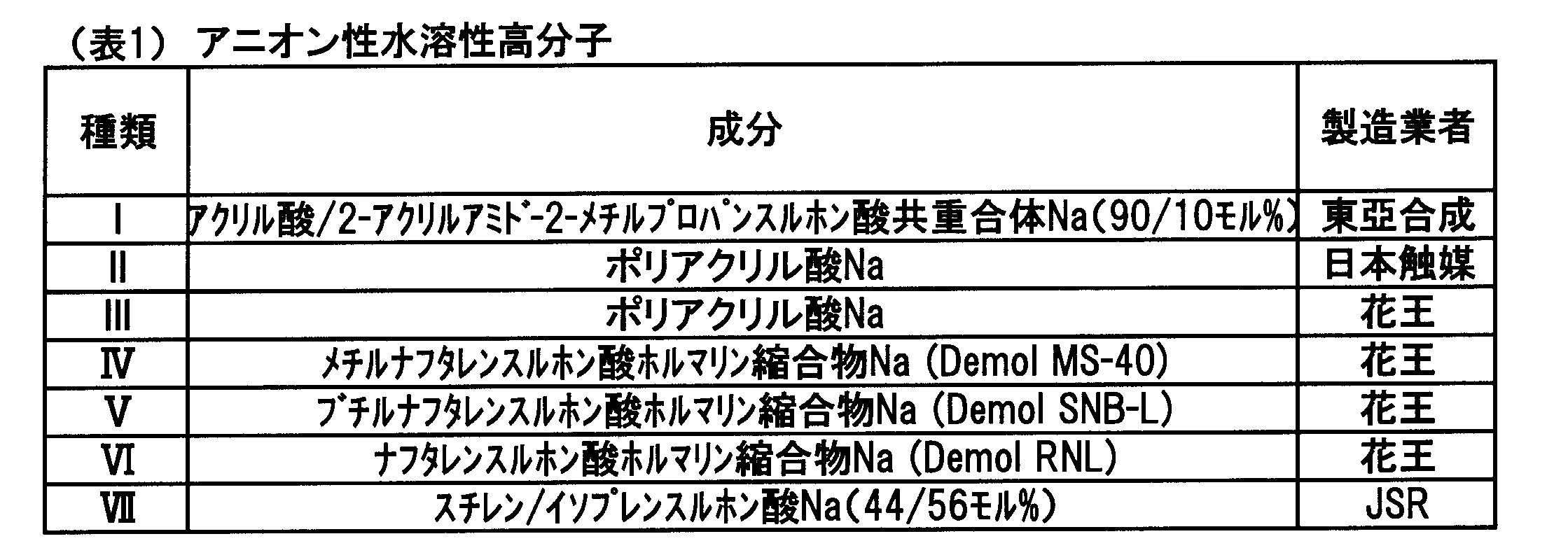
コロイダルシリカ及び必要に応じて下記表1に示したアニオン性水溶性高分子を用いて研磨液組成物(実施例1-1~1-16、比較例1-1~1-14)を調製し、被研磨基板の研磨を行い、研磨後の基板のスクラッチ及び表面粗さを評価した。評価結果を下記表2に示す。研磨液組成物の調製方法、各パラメータの測定方法、研磨条件(研磨方法)、及び、評価方法は、以下のとおりである。
コロイダルシリカ(A~G、K~Q、T:日揮触媒化成工業社製、H~J、S:デュポン・エアプロダクツ・ナノマテリアルズ社製、R:日産化学工業社製)と、下記表1に示したアニオン性水溶性高分子と、硫酸(和光純薬工業社製 特級)と、HEDP(1-ヒドロキシエチリデン-1,1-ジホスホン酸、ソルーシア・ジャパン製 ディクエスト2010)と、過酸化水素水(旭電化製 濃度:35重量%)とをイオン交換水に添加し、これらを混合することにより、下記表2に示すコロイダルシリカ及び必要に応じてアニオン性水溶性高分子を含む実施例1-1~1-16及び比較例1-1~1-14の研磨液組成物を調製した。研磨液組成物中における硫酸、HEDP、過酸化水素の含有量は、それぞれ、0.4重量%、0.1重量%、0.4重量%であった。
〔平均粒径及びCV値〕
上記に示すコロイダルシリカと、硫酸と、HEDPと、過酸化水素水とをイオン交換水に添加し、これらを混合することにより、標準試料を作製した。標準試料中におけるコロイダルシリカ、硫酸、HEDP、過酸化水素の含有量は、それぞれ5重量%、0.4重量%、0.1重量%、0.4重量%であった。この標準試料を大塚電子社製動的光散乱装置DLS-6500により、同メーカーが添付した説明書に従って、200回積算した際の検出角90°におけるCumulant法によって得られる散乱強度分布の面積が全体の50%となる粒径を求め、コロイダルシリカの平均粒径とした。また、CV値は上記測定法に従って測定した散乱強度分布における標準偏差を前記平均粒径で除して100をかけた値をCV値とした。
〔ΔCV値〕
上記測定法に従って測定した、検出角30°におけるコロイダルシリカ粒子のCV値(CV30)から検出角90°におけるコロイダルシリカ粒子のCV値(CV90)を引いた値を求め、ΔCV値とした。
(DLS-6500の測定条件)
検出角:90°
Sampling time: 4(μm)
Correlation Channel: 256(ch)
Correlation Method: TI
Sampling temperature: 26.0(℃)
検出角:30°
Sampling time: 10(μm)
Correlation Channel: 1024(ch)
Correlation Method: TI
Sampling temperature: 26.0(℃)
〔カルボン酸基を有する重合体の重量平均分子量〕
カルボン酸基を有する共重合体の重量平均分子量は、ゲルパーミエーションクロマトグラフィー(GPC)により以下の条件で測定した。
(GPC条件)
カラム:G4000PWXL(東ソー社製)+G2500PWXL(東ソー社製)
溶離液:0.2Mリン酸バッファー/アセトニトリル=9/1(容量比)
流速:1.0mL/min
温度:40℃
検出:210nm
サンプル:濃度5mg/mL(注入量100μL)
検量線用ポリマー:ポリアクリル酸 分子量(Mp):11.5万、2.8万、4100、1250(創和科学(株)及びAmerican Polymer Standards Corp.社製)
スチレン/イソプレンスルホン酸共重合体の重量平均分子量は、ゲルパーミエーションクロマトグラフィー(GPC)により以下の条件で測定した。
(GPC条件)
ガードカラム:TSKguardcolumn α(東ソー製)
カラム:TSKgel αーM+TSKgel αーM (東ソー製)
流速:1.0ml/min
温度:40℃
サンプル濃度:3mg/ml
検出器:RI
換算標準:ポリスチレン
上記のように調製した実施例1-1~1-16及び比較例1-1~1-14の研磨液組成物を用いて、以下に示す研磨条件にて下記被研磨基板を研磨した。次いで、研磨された基板のスクラッチ及び表面粗さを以下に示す条件に基づいて測定し、評価を行った。結果を下記表2に示す。下記表2に示すデータは、各実施例および各比較例につき4枚の被研磨基板を研磨した後、各被研磨基板の両面について測定し、4枚(表裏合わせて計8面)のデータの平均とした。なお、下記表2に示すスクラッチ、表面粗さ、研磨速度の測定方法についても、以下に示す。
被研磨基板としては、Ni-Pメッキされたアルミニウム合金基板を予めアルミナ研磨材を含有する研磨液組成物で粗研磨した基板を用いた。なお、この被研磨基板は、厚さが1.27mm、外径が95mm、内径が25mmであり、AFM(Digital Instrument NanoScope IIIa Multi Mode AFM)により測定した中心線平均粗さRaが1nm、長波長うねり(波長0.4~2mm)の振幅は2nm、短波長うねり(波長50~400μm)の振幅は2nmであった。
研磨試験機:スピードファム社製「両面9B研磨機」
研磨パッド:フジボウ社製スエードタイプ(厚さ0.9mm、平均開孔径30μm)
研磨液組成物供給量:100mL/分(被研磨基板1cm2あたりの供給速度:0.072mL/分)
下定盤回転数:32.5rpm
研磨荷重:7.9kPa
研磨時間:4分間
測定機器:Candela Instruments社製、OSA6100
評価:研磨試験機に投入した基板の中、無作為に4枚を選択し、各々の基板を10000rpmにてレーザーを照射してスクラッチを測定した。その4枚の基板の各々両面にあるスクラッチ数(本)の合計を8で除して、基板面当たりのスクラッチ数を算出した。
AFM(Digital Instrument NanoScope IIIa Multi Mode AFM)を用いて、以下に示す条件にて各基板の内周縁と外周縁との中央部分を表裏1箇所ずつ測定し、中心線平均粗さAFM‐Ra及び最大高さAFM‐Rmaxについて、4枚(表裏合わせて計8面)の平均値をそれぞれ表2に示すAFM‐Ra及びAFM‐Rmaxとした。
(AFMの測定条件)
Mode: Tapping mode
Area: 1×1μm
Scan rate: 1.0Hz
Cantilever: NCH-10V
Line: 512×512
研磨前後の各基板の重さを重量計(Sartorius社製「BP-210S」)を用いて測定し、各基板の重量変化を求め、10枚の平均値を重量減少量とし、それを研磨時間で割った値を重量減少速度とした。この重量減少速度を下記の式に導入し、研磨速度(μm/min)に変換した。
研磨速度(μm/min)=重量減少速度(g/min)/基板片面面積(mm2)/Ni-Pメッキ密度(g/cm3)×106
(基板片面面積:6597mm2、Ni-Pメッキ密度:7.99g/cm3として算出)
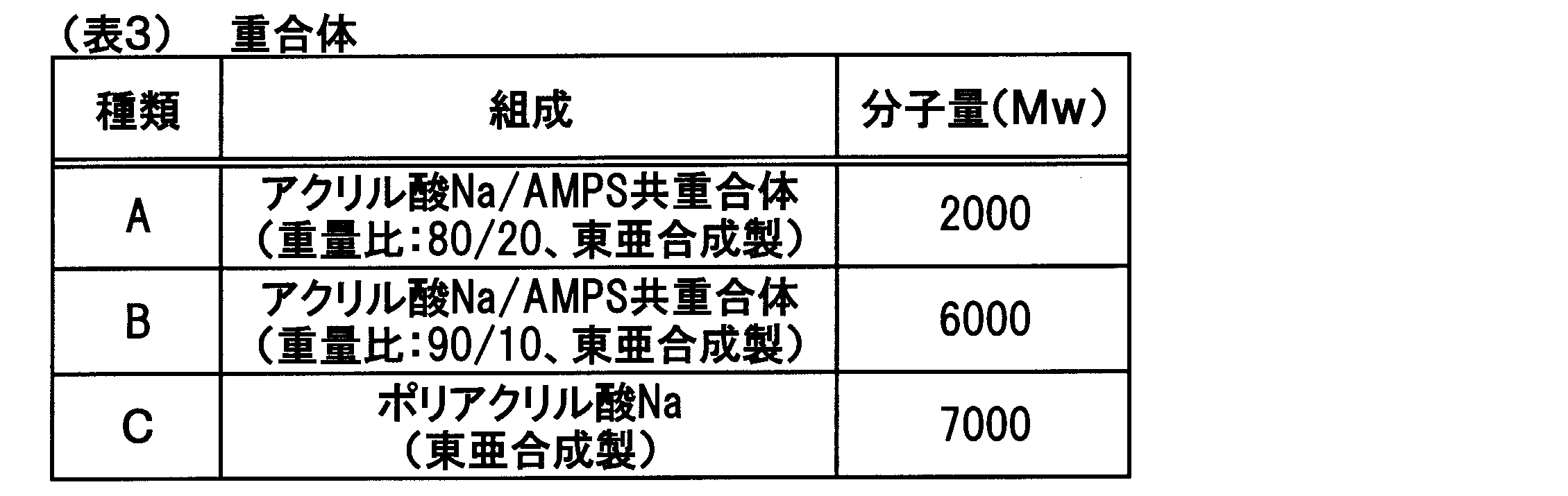
コロイダルシリカ及び下記表3に示したアニオン性水溶性高分子を用いて研磨液組成物を調製し、被研磨基板の研磨を行い、研磨速度、研磨後の基板のスクラッチ及び表面粗さを評価した。評価結果を下記表4に示す。研磨液組成物の調製方法、各パラメータの測定方法、研磨条件(研磨方法)、及び、評価方法は、以下のとおりである。
コロイダルシリカ(下記表4のID:a1-a3、b、c1-c2、d、e、f1-f2、g-l;日揮触媒化成工業社製)と、硫酸(和光純薬工業社製)と、1-ヒドロキシエチリデン-1,1-ジホスホン酸(HEDP、ソルーシア・ジャパン製)と、過酸化水素水(旭電化製)と、選択的に下記表3に示したアニオン性水溶性高分子A-Cとをイオン交換水に添加し、これらを混合することにより、下記表4に示す実施例2-1~2-13及び比較例2-1~2-10の研磨液組成物を調製した。研磨液組成物中におけるコロイダルシリカ、アニオン性水溶性高分子、硫酸、HEDP及び過酸化水素の含有量は、それぞれ、5重量%、0.05重量%(添加した場合)、0.5重量%、0.1重量%及び0.5重量%であった。なお、コロイダルシリカa1-a3は、SA1、SA2、表面粗度及び真球率が同一であるが、ΔCV値が異なるものである。コロイダルシリカc1-c2、及びf1-f2も同様である。
コロイダルシリカを含む試料を、透過型電子顕微鏡(TEM)商品名「JEM-2000FX」(80kV、1~5万倍、日本電子社製)により当該製造業者が添付した説明書に従って試料を観察し、TEM像を写真撮影した。この写真をスキャナで画像データとしてパソコンに取り込み、解析ソフト「WinROOF ver.3.6」(販売元:三谷商事)を用いて粒子一個の投影面積(A1)と該粒子の周長を円周とする円の面積(A2)を計測し、前記粒子の投影面積(A1)と前記粒子の周長から求めた面積(A2)との比(A1/A2)を真球率として算出した。なお、下記表4の数値は、100個のシリカ粒子の真球率を求めた後これらの平均値を算出したものである。
下記に示すとおり、ナトリウム滴定法により測定される比表面積(SA1)及び透過型電子顕微鏡観察により測定される平均粒径(S2)から換算される比表面積(SA2)を得て、それらの比(SA1/SA2)を算出して表面粗度とした。
1)SiO2として1.5gに相当するコロイダルシリカを含む試料をビーカーに採取して恒温反応槽(25℃)に移し、純水を加えて液量を90mlにする。以下の操作は、25℃に保持した恒温反応槽中にて行う。
2)pH3.6~3.7になるように0.1モル/L塩酸溶液を加える。
3)塩化ナトリウムを30g加え、純水で150mlに希釈し、10分間攪拌する。
4)pH電極をセットし、攪拌しながら0.1モル/L水酸化ナトリウム溶液を滴下して、pH4.0に調整する。
5)pH4.0に調整した試料を0.1モル/L水酸化ナトリウム溶液で滴定し、pH8.7~9.3の範囲での滴定量とpH値を4点以上記録して、0.1モル/L水酸化ナトリウム溶液の滴定量をX、その時のpH値をYとして、検量線を作る。
6)下記式(1)からSiO21.5g当たりのpH4.0~9.0までに要する0.1モル/L水酸化ナトリウム溶液の消費量V(ml)を求め、次の〔a〕~〔b〕に従って比表面積SA1[m2/g]を求める。
〔a〕下記式(2)にて、SA1の値を求め、その値が80~350m2/gの範囲にある場合は、その値をSA1とする。
〔b〕下記式(2)によるSA1の値が350m2/gを超える場合は、改めて下記式(3)にて、SA1を求め、その値をSA1とする。
V=(A×f×100×1.5)/(W×C) ・・・(1)
SA1=29.0V-28 ・・・(2)
SA1=31.8V-28 ・・・(3)
但し、上記式(1)における記号の意味は次の通りである。
A:SiO21.5g当たりpH4.0~9.0までに要する0.1モル/L水酸化ナトリウム溶液の滴定量(ml)
f:0.1モル/L水酸化ナトリウム溶液の力価
C:試料のSiO2濃度(%)
W:試料採取量(g)
コロイダルシリカを含む試料を、透過型電子顕微鏡(TEM)商品名「JEM-2000FX」(80kV、1~5万倍、日本電子社製)により当該製造業者が添付した説明書に従って試料を観察し、TEM像を写真撮影する。この写真をスキャナで画像データとしてパソコンに取り込み、解析ソフト「WinROOF ver.3.6」(販売元:三谷商事)を用いて個々のシリカ粒子の円相当径を求め、それを粒子径とする。このようにして、1000個以上のシリカ粒子の粒子径を求めた後、その平均値を算出し、透過型電子顕微鏡観察により測定される平均粒径(S2)とする。次に、上記にて求められた平均粒径(S2)の値を下記式(4)に代入し、比表面積(SA2)を得る。
SA2=6000/(S2×ρ) ・・・(4) (ρ:試料の密度)
ρ:2.2(コロイダルシリカの場合)
コロイダルシリカの平均粒径、CV値、及びΔCV値は、前述の実施例1-1~1-16及び比較例1-1~1-14と同様に測定した。
上記のように調製した実施例2-1~2-13及び比較例2-1~2-10の研磨液組成物を用いて、以下に示す研磨条件にて下記被研磨基板を研磨した。次いで、研磨された基板のスクラッチ及び表面粗さを以下に示す条件に基づいて測定し、評価を行った。結果を下記表4に示す。下記表4に示すデータは、各実施例および各比較例につき4枚の被研磨基板を研磨した後、各被研磨基板の両面について測定し、4枚(表裏合わせて計8面)のデータの平均とした。なお、下記表4に示すスクラッチ、表面粗さ、研磨速度の測定方法についても、以下に示す。
被研磨基板として、前述の実施例1-1~1-16及び比較例1-1~1-14と同様で使用したものと同じ基板であって、Ni-Pメッキされたアルミニウム合金基板を予めアルミナ研磨材を含有する研磨液組成物で粗研磨した基板を用いた。
研磨試験機:スピードファム社製「両面9B研磨機」
研磨パッド:フジボウ社製スエードタイプ(厚さ0.9mm、平均開孔径30μm)
研磨液組成物供給量:100mL/分(被研磨基板1cm2あたりの供給速度:0.072mL/分)
下定盤回転数:32.5rpm
研磨荷重:7.9kPa
研磨時間:8分間
測定機器:KLA Tencor社製、Candela OSA6100
評価:研磨試験機に投入した基板の中、無作為に4枚を選択し、各々の基板を10000rpmにてレーザーを照射してスクラッチを測定した。その4枚の基板の各々両面にあるスクラッチ数(本)の合計を8で除して、基板面当たりのスクラッチ数を算出した。その結果を、下記表4に、比較例2-1を100とした相対値として示す。なお、比較例2-7~2-9では、スクラッチ数が測定上限を超過したため測定できなかった。
表面粗さ及び研磨速度は、前述の実施例1-1~1-16及び比較例1-1~1-14と同様に測定した。その結果を下記表4に示す。
Claims (8)
- コロイダルシリカと水とを含有する磁気ディスク基板用研磨液組成物であって、
前記コロイダルシリカのΔCV値が0~10%であり、ここで、ΔCV値は、動的光散乱法による検出角30°における散乱強度分布に基づく標準偏差を前記散乱強度分布に基づく平均粒径で除して100を掛けた値(CV30)と、検出角90°における散乱強度分布に基づく標準偏差を前記散乱強度分布に基づく平均粒径で除して100を掛けた値(CV90)との差の値(ΔCV=CV30-CV90)であり、
前記コロイダルシリカのCV90値が1~35%であり、かつ、
前記コロイダルシリカの動的光散乱法による検出角90°の散乱強度分布に基づく平均粒径が1~40nmである、磁気ディスク基板用研磨液組成物。 - アニオン性基を有する水溶性高分子をさらに含有する、請求項1記載の磁気ディスク基板用研磨液組成物。
- アニオン性基を有する水溶性高分子が、下記一般式(1)で表わされる構成単位を有する重合体である、請求項2記載の磁気ディスク基板用研磨液組成物。

- アニオン性基を有する水溶性高分子が、下記一般式(2)で表わされる構成単位を有する重合体である、請求項2記載の磁気ディスク基板用研磨液組成物。

- アニオン性基を有する水溶性高分子が、スチレン/イソプレンスルホン酸共重合体である、請求項2記載の磁気ディスク基板用研磨液組成物。
- 前記コロイダルシリカは、下記(a)~(c)の規定を満たす、請求項1~5のいずれかに記載の磁気ディスク基板用研磨液組成物。
(a)透過型電子顕微鏡観察により測定される真球率が0.75~1
(b)ナトリウム滴定法により測定される比表面積(SA1)と、透過型電子顕微鏡観察により測定される平均粒径(S2)から換算される比表面積(SA2)とから算出される表面粗度(SA1/SA2)の値が1.3以上
(c)前記平均粒径(S2)が1~40nm - 請求項1から6のいずれかに記載の磁気ディスク基板用研磨液組成物を用いて被研磨基板を研磨する工程を含む、磁気ディスク基板の製造方法。
- 基板がNi-Pめっきアルミニウム合金基板である、請求項7記載の磁気ディスク基板の製造方法。
Priority Applications (4)
| Application Number | Priority Date | Filing Date | Title |
|---|---|---|---|
| GB1108173.4A GB2477067B (en) | 2008-11-06 | 2009-11-04 | Polishing liquid composition for magnetic disk substrate |
| US13/127,735 US20110203186A1 (en) | 2008-11-06 | 2009-11-04 | Polishing liquid composition for magnetic disk substrate |
| CN200980144360.6A CN102209765B (zh) | 2008-11-06 | 2009-11-04 | 磁盘基板用研磨液组合物 |
| US14/446,156 US20140335763A1 (en) | 2008-11-06 | 2014-07-29 | Polishing liquid composition for magnetic disk substrate |
Applications Claiming Priority (6)
| Application Number | Priority Date | Filing Date | Title |
|---|---|---|---|
| JP2008-285828 | 2008-11-06 | ||
| JP2008285828 | 2008-11-06 | ||
| JP2008-326364 | 2008-12-22 | ||
| JP2008326364 | 2008-12-22 | ||
| JP2008326365 | 2008-12-22 | ||
| JP2008-326365 | 2008-12-22 |
Related Child Applications (2)
| Application Number | Title | Priority Date | Filing Date |
|---|---|---|---|
| US13/127,735 A-371-Of-International US20110203186A1 (en) | 2008-11-06 | 2009-11-04 | Polishing liquid composition for magnetic disk substrate |
| US14/446,156 Division US20140335763A1 (en) | 2008-11-06 | 2014-07-29 | Polishing liquid composition for magnetic disk substrate |
Publications (1)
| Publication Number | Publication Date |
|---|---|
| WO2010053096A1 true WO2010053096A1 (ja) | 2010-05-14 |
Family
ID=42152904
Family Applications (1)
| Application Number | Title | Priority Date | Filing Date |
|---|---|---|---|
| PCT/JP2009/068837 Ceased WO2010053096A1 (ja) | 2008-11-06 | 2009-11-04 | 磁気ディスク基板用研磨液組成物 |
Country Status (6)
| Country | Link |
|---|---|
| US (2) | US20110203186A1 (ja) |
| CN (1) | CN102209765B (ja) |
| GB (1) | GB2477067B (ja) |
| MY (1) | MY150812A (ja) |
| TW (1) | TWI471412B (ja) |
| WO (1) | WO2010053096A1 (ja) |
Cited By (1)
| Publication number | Priority date | Publication date | Assignee | Title |
|---|---|---|---|---|
| CN102971896A (zh) * | 2010-07-09 | 2013-03-13 | 三菱丽阳株式会社 | 非水电解质电池电极用粘合剂树脂组合物及含有该粘合剂树脂组合物的悬浮液组合物、电极以及电池 |
Families Citing this family (21)
| Publication number | Priority date | Publication date | Assignee | Title |
|---|---|---|---|---|
| JPH1142177A (ja) * | 1997-07-28 | 1999-02-16 | Build:Kk | 高い温水耐久性を有する浴槽およびその補修方法 |
| SG172309A1 (en) | 2008-12-22 | 2011-07-28 | Kao Corp | Polishing liquid composition for magnetic-disk substrate |
| JP5622481B2 (ja) * | 2010-08-17 | 2014-11-12 | 昭和電工株式会社 | 磁気記録媒体用基板の製造方法 |
| JP5940270B2 (ja) | 2010-12-09 | 2016-06-29 | 花王株式会社 | 研磨液組成物 |
| JP6273094B2 (ja) * | 2013-03-21 | 2018-01-31 | 株式会社荏原製作所 | 検査用表示装置、欠陥判別方法、検査用表示プログラム |
| KR102264348B1 (ko) | 2013-07-11 | 2021-06-11 | 바스프 에스이 | 부식 저해제로서 벤조트리아졸 유도체를 포함하는 화학-기계적 연마 조성물 |
| JP6138677B2 (ja) * | 2013-12-27 | 2017-05-31 | 花王株式会社 | 磁気ディスク基板用研磨液組成物 |
| MY186419A (en) | 2014-03-28 | 2021-07-22 | Yamaguchi Seiken Kogyo Co Ltd | Polishing composition and method for polishing magnetic disk substrate |
| WO2015146941A1 (ja) | 2014-03-28 | 2015-10-01 | 山口精研工業株式会社 | 研磨剤組成物、および磁気ディスク基板の研磨方法 |
| CN104109482B (zh) * | 2014-06-27 | 2016-04-20 | 河北宇天昊远纳米材料有限公司 | 一种铝合金抛光液及其制备方法 |
| US9481811B2 (en) * | 2015-02-20 | 2016-11-01 | Cabot Microelectronics Corporation | Composition and method for polishing memory hard disks exhibiting reduced edge roll-off |
| KR101861894B1 (ko) * | 2015-05-15 | 2018-05-29 | 삼성에스디아이 주식회사 | 유기막 cmp 슬러리 조성물 및 이를 이용한 연마방법 |
| WO2017051770A1 (ja) * | 2015-09-25 | 2017-03-30 | 山口精研工業株式会社 | 研磨剤組成物、および磁気ディスク基板の研磨方法 |
| JP6659449B2 (ja) * | 2016-05-09 | 2020-03-04 | 山口精研工業株式会社 | 無電解ニッケル−リンめっきされたアルミニウム磁気ディスク基板用研磨剤組成物 |
| JP6734146B2 (ja) * | 2016-08-23 | 2020-08-05 | 山口精研工業株式会社 | 磁気ディスク基板用研磨剤組成物 |
| JP6775453B2 (ja) | 2017-03-23 | 2020-10-28 | 山口精研工業株式会社 | 磁気ディスク基板用研磨剤組成物 |
| JP6940315B2 (ja) * | 2017-06-22 | 2021-09-22 | 山口精研工業株式会社 | 磁気ディスク基板用研磨剤組成物 |
| JP2019016417A (ja) * | 2017-07-04 | 2019-01-31 | 山口精研工業株式会社 | 磁気ディスク基板用研磨剤組成物 |
| JP7122097B2 (ja) * | 2017-10-24 | 2022-08-19 | 山口精研工業株式会社 | 磁気ディスク基板用研磨剤組成物 |
| JP7034667B2 (ja) * | 2017-10-24 | 2022-03-14 | 山口精研工業株式会社 | 磁気ディスク基板用研磨剤組成物 |
| JP6894535B2 (ja) * | 2017-12-27 | 2021-06-30 | 花王株式会社 | アルミニウム製プラッタの製造方法 |
Citations (5)
| Publication number | Priority date | Publication date | Assignee | Title |
|---|---|---|---|---|
| JP2006071497A (ja) * | 2004-09-02 | 2006-03-16 | Hokkaido Univ | 光散乱装置、光散乱測定法、光散乱解析装置および光散乱測定解析法 |
| WO2008018434A1 (en) * | 2006-08-09 | 2008-02-14 | Kao Corporation | Aqueous ink for inkjet recording |
| JP2008137822A (ja) * | 2006-11-30 | 2008-06-19 | Catalysts & Chem Ind Co Ltd | 金平糖状無機酸化物ゾル、その製造方法および前記ゾルを含む研磨剤 |
| JP2008179763A (ja) * | 2006-12-26 | 2008-08-07 | Kao Corp | 研磨液キット |
| WO2008123373A1 (ja) * | 2007-03-27 | 2008-10-16 | Fuso Chemical Co., Ltd. | コロイダルシリカ及びその製造方法 |
Family Cites Families (11)
| Publication number | Priority date | Publication date | Assignee | Title |
|---|---|---|---|---|
| JP3891604B2 (ja) * | 1996-04-17 | 2007-03-14 | 花王株式会社 | 研磨材組成物及びこれを用いた研磨方法 |
| US6258140B1 (en) * | 1999-09-27 | 2001-07-10 | Fujimi America Inc. | Polishing composition |
| KR100826072B1 (ko) * | 2000-05-12 | 2008-04-29 | 닛산 가가쿠 고교 가부시키 가이샤 | 연마용 조성물 |
| KR100481651B1 (ko) * | 2000-08-21 | 2005-04-08 | 가부시끼가이샤 도시바 | 화학 기계 연마용 슬러리 및 반도체 장치의 제조 방법 |
| JP3997152B2 (ja) * | 2002-12-26 | 2007-10-24 | 花王株式会社 | 研磨液組成物 |
| TWI254741B (en) * | 2003-02-05 | 2006-05-11 | Kao Corp | Polishing composition |
| US20070068902A1 (en) * | 2005-09-29 | 2007-03-29 | Yasushi Matsunami | Polishing composition and polishing method |
| TWI411667B (zh) * | 2006-04-28 | 2013-10-11 | Kao Corp | 磁碟基板用之研磨液組成物 |
| JP5008350B2 (ja) * | 2006-07-05 | 2012-08-22 | 花王株式会社 | ガラス基板用の研磨液組成物 |
| JP5137521B2 (ja) * | 2006-10-12 | 2013-02-06 | 日揮触媒化成株式会社 | 金平糖状シリカ系ゾルおよびその製造方法 |
| JP2007320031A (ja) * | 2007-07-24 | 2007-12-13 | Kao Corp | 研磨液組成物 |
-
2009
- 2009-11-04 GB GB1108173.4A patent/GB2477067B/en not_active Expired - Fee Related
- 2009-11-04 MY MYPI20111959 patent/MY150812A/en unknown
- 2009-11-04 US US13/127,735 patent/US20110203186A1/en not_active Abandoned
- 2009-11-04 CN CN200980144360.6A patent/CN102209765B/zh not_active Expired - Fee Related
- 2009-11-04 WO PCT/JP2009/068837 patent/WO2010053096A1/ja not_active Ceased
- 2009-11-06 TW TW98137782A patent/TWI471412B/zh not_active IP Right Cessation
-
2014
- 2014-07-29 US US14/446,156 patent/US20140335763A1/en not_active Abandoned
Patent Citations (5)
| Publication number | Priority date | Publication date | Assignee | Title |
|---|---|---|---|---|
| JP2006071497A (ja) * | 2004-09-02 | 2006-03-16 | Hokkaido Univ | 光散乱装置、光散乱測定法、光散乱解析装置および光散乱測定解析法 |
| WO2008018434A1 (en) * | 2006-08-09 | 2008-02-14 | Kao Corporation | Aqueous ink for inkjet recording |
| JP2008137822A (ja) * | 2006-11-30 | 2008-06-19 | Catalysts & Chem Ind Co Ltd | 金平糖状無機酸化物ゾル、その製造方法および前記ゾルを含む研磨剤 |
| JP2008179763A (ja) * | 2006-12-26 | 2008-08-07 | Kao Corp | 研磨液キット |
| WO2008123373A1 (ja) * | 2007-03-27 | 2008-10-16 | Fuso Chemical Co., Ltd. | コロイダルシリカ及びその製造方法 |
Cited By (1)
| Publication number | Priority date | Publication date | Assignee | Title |
|---|---|---|---|---|
| CN102971896A (zh) * | 2010-07-09 | 2013-03-13 | 三菱丽阳株式会社 | 非水电解质电池电极用粘合剂树脂组合物及含有该粘合剂树脂组合物的悬浮液组合物、电极以及电池 |
Also Published As
| Publication number | Publication date |
|---|---|
| TW201026832A (en) | 2010-07-16 |
| MY150812A (en) | 2014-02-28 |
| CN102209765A (zh) | 2011-10-05 |
| GB2477067B (en) | 2012-10-17 |
| GB2477067A (en) | 2011-07-20 |
| CN102209765B (zh) | 2015-07-01 |
| TWI471412B (zh) | 2015-02-01 |
| GB201108173D0 (en) | 2011-06-29 |
| US20110203186A1 (en) | 2011-08-25 |
| US20140335763A1 (en) | 2014-11-13 |
Similar Documents
| Publication | Publication Date | Title |
|---|---|---|
| JP5630992B2 (ja) | 磁気ディスク基板用研磨液組成物 | |
| CN102209765B (zh) | 磁盘基板用研磨液组合物 | |
| JP5473544B2 (ja) | 磁気ディスク基板用研磨液組成物 | |
| JP5657247B2 (ja) | 研磨液組成物 | |
| JP5769284B2 (ja) | 磁気ディスク基板用研磨液組成物 | |
| JP5289877B2 (ja) | 磁気ディスク基板用研磨液組成物 | |
| JP5940270B2 (ja) | 研磨液組成物 | |
| CN102265339B (zh) | 磁盘基板用研磨液组合物 | |
| JP2009172709A (ja) | 磁気ディスク基板用研磨液組成物 | |
| JP6251033B2 (ja) | 磁気ディスク基板用研磨液組成物 | |
| CN101423746B (zh) | 硬盘基板用研磨液组合物 | |
| JP5394861B2 (ja) | 磁気ディスク基板用研磨液組成物 | |
| WO2010074002A1 (ja) | 磁気ディスク基板用研磨液組成物 | |
| JP5377117B2 (ja) | 粒子分散液中の非球状粒子を検出する方法 | |
| CN101063031B (zh) | 磁盘基板用研磨液组合物 | |
| JP6092623B2 (ja) | 磁気ディスク基板の製造方法 | |
| JP5473587B2 (ja) | 磁気ディスク基板用研磨液組成物 | |
| JP4255976B2 (ja) | 磁気ディスク基板用研磨液組成物 | |
| JP5571915B2 (ja) | 磁気ディスク基板用研磨液組成物 | |
| JP5376934B2 (ja) | 磁気ディスク基板用リンス剤組成物 | |
| JP4373776B2 (ja) | 研磨液組成物 | |
| JP5571926B2 (ja) | 磁気ディスク基板用研磨液組成物 | |
| JP2008094982A (ja) | メモリーハードディスク基板用研磨液組成物 |
Legal Events
| Date | Code | Title | Description |
|---|---|---|---|
| WWE | Wipo information: entry into national phase |
Ref document number: 200980144360.6 Country of ref document: CN |
|
| 121 | Ep: the epo has been informed by wipo that ep was designated in this application |
Ref document number: 09824795 Country of ref document: EP Kind code of ref document: A1 |
|
| WWE | Wipo information: entry into national phase |
Ref document number: 13127735 Country of ref document: US |
|
| NENP | Non-entry into the national phase |
Ref country code: DE |
|
| ENP | Entry into the national phase |
Ref document number: 1108173 Country of ref document: GB Kind code of ref document: A Free format text: PCT FILING DATE = 20091104 |
|
| WWE | Wipo information: entry into national phase |
Ref document number: 1108173.4 Country of ref document: GB |
|
| 122 | Ep: pct application non-entry in european phase |
Ref document number: 09824795 Country of ref document: EP Kind code of ref document: A1 |