WO2010035451A1 - 半硬化体、硬化体、積層体、半硬化体の製造方法及び硬化体の製造方法 - Google Patents
半硬化体、硬化体、積層体、半硬化体の製造方法及び硬化体の製造方法 Download PDFInfo
- Publication number
- WO2010035451A1 WO2010035451A1 PCT/JP2009/004740 JP2009004740W WO2010035451A1 WO 2010035451 A1 WO2010035451 A1 WO 2010035451A1 JP 2009004740 W JP2009004740 W JP 2009004740W WO 2010035451 A1 WO2010035451 A1 WO 2010035451A1
- Authority
- WO
- WIPO (PCT)
- Prior art keywords
- semi
- cured product
- cured body
- cured
- epoxy resin
- Prior art date
- Legal status (The legal status is an assumption and is not a legal conclusion. Google has not performed a legal analysis and makes no representation as to the accuracy of the status listed.)
- Ceased
Links
Images


Classifications
-
- C—CHEMISTRY; METALLURGY
- C08—ORGANIC MACROMOLECULAR COMPOUNDS; THEIR PREPARATION OR CHEMICAL WORKING-UP; COMPOSITIONS BASED THEREON
- C08L—COMPOSITIONS OF MACROMOLECULAR COMPOUNDS
- C08L63/00—Compositions of epoxy resins; Compositions of derivatives of epoxy resins
-
- C—CHEMISTRY; METALLURGY
- C08—ORGANIC MACROMOLECULAR COMPOUNDS; THEIR PREPARATION OR CHEMICAL WORKING-UP; COMPOSITIONS BASED THEREON
- C08G—MACROMOLECULAR COMPOUNDS OBTAINED OTHERWISE THAN BY REACTIONS ONLY INVOLVING UNSATURATED CARBON-TO-CARBON BONDS
- C08G59/00—Polycondensates containing more than one epoxy group per molecule; Macromolecules obtained by polymerising compounds containing more than one epoxy group per molecule using curing agents or catalysts which react with the epoxy groups
- C08G59/14—Polycondensates modified by chemical after-treatment
-
- B—PERFORMING OPERATIONS; TRANSPORTING
- B32—LAYERED PRODUCTS
- B32B—LAYERED PRODUCTS, i.e. PRODUCTS BUILT-UP OF STRATA OF FLAT OR NON-FLAT, e.g. CELLULAR OR HONEYCOMB, FORM
- B32B15/00—Layered products comprising a layer of metal
- B32B15/04—Layered products comprising a layer of metal comprising metal as the main or only constituent of a layer, which is next to another layer of the same or of a different material
- B32B15/08—Layered products comprising a layer of metal comprising metal as the main or only constituent of a layer, which is next to another layer of the same or of a different material of synthetic resin
- B32B15/092—Layered products comprising a layer of metal comprising metal as the main or only constituent of a layer, which is next to another layer of the same or of a different material of synthetic resin comprising epoxy resins
-
- C—CHEMISTRY; METALLURGY
- C08—ORGANIC MACROMOLECULAR COMPOUNDS; THEIR PREPARATION OR CHEMICAL WORKING-UP; COMPOSITIONS BASED THEREON
- C08G—MACROMOLECULAR COMPOUNDS OBTAINED OTHERWISE THAN BY REACTIONS ONLY INVOLVING UNSATURATED CARBON-TO-CARBON BONDS
- C08G59/00—Polycondensates containing more than one epoxy group per molecule; Macromolecules obtained by polymerising compounds containing more than one epoxy group per molecule using curing agents or catalysts which react with the epoxy groups
- C08G59/18—Macromolecules obtained by polymerising compounds containing more than one epoxy group per molecule using curing agents or catalysts which react with the epoxy groups ; e.g. general methods of curing
- C08G59/40—Macromolecules obtained by polymerising compounds containing more than one epoxy group per molecule using curing agents or catalysts which react with the epoxy groups ; e.g. general methods of curing characterised by the curing agents used
- C08G59/62—Alcohols or phenols
-
- C—CHEMISTRY; METALLURGY
- C08—ORGANIC MACROMOLECULAR COMPOUNDS; THEIR PREPARATION OR CHEMICAL WORKING-UP; COMPOSITIONS BASED THEREON
- C08G—MACROMOLECULAR COMPOUNDS OBTAINED OTHERWISE THAN BY REACTIONS ONLY INVOLVING UNSATURATED CARBON-TO-CARBON BONDS
- C08G59/00—Polycondensates containing more than one epoxy group per molecule; Macromolecules obtained by polymerising compounds containing more than one epoxy group per molecule using curing agents or catalysts which react with the epoxy groups
- C08G59/18—Macromolecules obtained by polymerising compounds containing more than one epoxy group per molecule using curing agents or catalysts which react with the epoxy groups ; e.g. general methods of curing
- C08G59/40—Macromolecules obtained by polymerising compounds containing more than one epoxy group per molecule using curing agents or catalysts which react with the epoxy groups ; e.g. general methods of curing characterised by the curing agents used
- C08G59/62—Alcohols or phenols
- C08G59/621—Phenols
-
- C—CHEMISTRY; METALLURGY
- C08—ORGANIC MACROMOLECULAR COMPOUNDS; THEIR PREPARATION OR CHEMICAL WORKING-UP; COMPOSITIONS BASED THEREON
- C08G—MACROMOLECULAR COMPOUNDS OBTAINED OTHERWISE THAN BY REACTIONS ONLY INVOLVING UNSATURATED CARBON-TO-CARBON BONDS
- C08G59/00—Polycondensates containing more than one epoxy group per molecule; Macromolecules obtained by polymerising compounds containing more than one epoxy group per molecule using curing agents or catalysts which react with the epoxy groups
- C08G59/18—Macromolecules obtained by polymerising compounds containing more than one epoxy group per molecule using curing agents or catalysts which react with the epoxy groups ; e.g. general methods of curing
- C08G59/68—Macromolecules obtained by polymerising compounds containing more than one epoxy group per molecule using curing agents or catalysts which react with the epoxy groups ; e.g. general methods of curing characterised by the catalysts used
- C08G59/686—Macromolecules obtained by polymerising compounds containing more than one epoxy group per molecule using curing agents or catalysts which react with the epoxy groups ; e.g. general methods of curing characterised by the catalysts used containing nitrogen
-
- C—CHEMISTRY; METALLURGY
- C08—ORGANIC MACROMOLECULAR COMPOUNDS; THEIR PREPARATION OR CHEMICAL WORKING-UP; COMPOSITIONS BASED THEREON
- C08J—WORKING-UP; GENERAL PROCESSES OF COMPOUNDING; AFTER-TREATMENT NOT COVERED BY SUBCLASSES C08B, C08C, C08F, C08G or C08H
- C08J7/00—Chemical treatment or coating of shaped articles made of macromolecular substances
- C08J7/02—Chemical treatment or coating of shaped articles made of macromolecular substances with solvents, e.g. swelling agents
-
- C—CHEMISTRY; METALLURGY
- C08—ORGANIC MACROMOLECULAR COMPOUNDS; THEIR PREPARATION OR CHEMICAL WORKING-UP; COMPOSITIONS BASED THEREON
- C08J—WORKING-UP; GENERAL PROCESSES OF COMPOUNDING; AFTER-TREATMENT NOT COVERED BY SUBCLASSES C08B, C08C, C08F, C08G or C08H
- C08J7/00—Chemical treatment or coating of shaped articles made of macromolecular substances
- C08J7/04—Coating
- C08J7/0427—Coating with only one layer of a composition containing a polymer binder
-
- C—CHEMISTRY; METALLURGY
- C08—ORGANIC MACROMOLECULAR COMPOUNDS; THEIR PREPARATION OR CHEMICAL WORKING-UP; COMPOSITIONS BASED THEREON
- C08J—WORKING-UP; GENERAL PROCESSES OF COMPOUNDING; AFTER-TREATMENT NOT COVERED BY SUBCLASSES C08B, C08C, C08F, C08G or C08H
- C08J7/00—Chemical treatment or coating of shaped articles made of macromolecular substances
- C08J7/04—Coating
- C08J7/043—Improving the adhesiveness of the coatings per se, e.g. forming primers
-
- C—CHEMISTRY; METALLURGY
- C08—ORGANIC MACROMOLECULAR COMPOUNDS; THEIR PREPARATION OR CHEMICAL WORKING-UP; COMPOSITIONS BASED THEREON
- C08J—WORKING-UP; GENERAL PROCESSES OF COMPOUNDING; AFTER-TREATMENT NOT COVERED BY SUBCLASSES C08B, C08C, C08F, C08G or C08H
- C08J7/00—Chemical treatment or coating of shaped articles made of macromolecular substances
- C08J7/04—Coating
- C08J7/044—Forming conductive coatings; Forming coatings having anti-static properties
-
- C—CHEMISTRY; METALLURGY
- C08—ORGANIC MACROMOLECULAR COMPOUNDS; THEIR PREPARATION OR CHEMICAL WORKING-UP; COMPOSITIONS BASED THEREON
- C08K—Use of inorganic or non-macromolecular organic substances as compounding ingredients
- C08K3/00—Use of inorganic substances as compounding ingredients
- C08K3/34—Silicon-containing compounds
- C08K3/36—Silica
-
- C—CHEMISTRY; METALLURGY
- C08—ORGANIC MACROMOLECULAR COMPOUNDS; THEIR PREPARATION OR CHEMICAL WORKING-UP; COMPOSITIONS BASED THEREON
- C08K—Use of inorganic or non-macromolecular organic substances as compounding ingredients
- C08K9/00—Use of pretreated ingredients
- C08K9/04—Ingredients treated with organic substances
- C08K9/06—Ingredients treated with organic substances with silicon-containing compounds
-
- C—CHEMISTRY; METALLURGY
- C23—COATING METALLIC MATERIAL; COATING MATERIAL WITH METALLIC MATERIAL; CHEMICAL SURFACE TREATMENT; DIFFUSION TREATMENT OF METALLIC MATERIAL; COATING BY VACUUM EVAPORATION, BY SPUTTERING, BY ION IMPLANTATION OR BY CHEMICAL VAPOUR DEPOSITION, IN GENERAL; INHIBITING CORROSION OF METALLIC MATERIAL OR INCRUSTATION IN GENERAL
- C23C—COATING METALLIC MATERIAL; COATING MATERIAL WITH METALLIC MATERIAL; SURFACE TREATMENT OF METALLIC MATERIAL BY DIFFUSION INTO THE SURFACE, BY CHEMICAL CONVERSION OR SUBSTITUTION; COATING BY VACUUM EVAPORATION, BY SPUTTERING, BY ION IMPLANTATION OR BY CHEMICAL VAPOUR DEPOSITION, IN GENERAL
- C23C18/00—Chemical coating by decomposition of either liquid compounds or solutions of the coating forming compounds, without leaving reaction products of surface material in the coating; Contact plating
- C23C18/16—Chemical coating by decomposition of either liquid compounds or solutions of the coating forming compounds, without leaving reaction products of surface material in the coating; Contact plating by reduction or substitution, e.g. electroless plating
- C23C18/1601—Process or apparatus
- C23C18/1633—Process of electroless plating
- C23C18/1646—Characteristics of the product obtained
- C23C18/165—Multilayered product
- C23C18/1653—Two or more layers with at least one layer obtained by electroless plating and one layer obtained by electroplating
-
- C—CHEMISTRY; METALLURGY
- C23—COATING METALLIC MATERIAL; COATING MATERIAL WITH METALLIC MATERIAL; CHEMICAL SURFACE TREATMENT; DIFFUSION TREATMENT OF METALLIC MATERIAL; COATING BY VACUUM EVAPORATION, BY SPUTTERING, BY ION IMPLANTATION OR BY CHEMICAL VAPOUR DEPOSITION, IN GENERAL; INHIBITING CORROSION OF METALLIC MATERIAL OR INCRUSTATION IN GENERAL
- C23C—COATING METALLIC MATERIAL; COATING MATERIAL WITH METALLIC MATERIAL; SURFACE TREATMENT OF METALLIC MATERIAL BY DIFFUSION INTO THE SURFACE, BY CHEMICAL CONVERSION OR SUBSTITUTION; COATING BY VACUUM EVAPORATION, BY SPUTTERING, BY ION IMPLANTATION OR BY CHEMICAL VAPOUR DEPOSITION, IN GENERAL
- C23C18/00—Chemical coating by decomposition of either liquid compounds or solutions of the coating forming compounds, without leaving reaction products of surface material in the coating; Contact plating
- C23C18/16—Chemical coating by decomposition of either liquid compounds or solutions of the coating forming compounds, without leaving reaction products of surface material in the coating; Contact plating by reduction or substitution, e.g. electroless plating
- C23C18/18—Pretreatment of the material to be coated
- C23C18/20—Pretreatment of the material to be coated of organic surfaces, e.g. resins
- C23C18/22—Roughening, e.g. by etching
-
- Y—GENERAL TAGGING OF NEW TECHNOLOGICAL DEVELOPMENTS; GENERAL TAGGING OF CROSS-SECTIONAL TECHNOLOGIES SPANNING OVER SEVERAL SECTIONS OF THE IPC; TECHNICAL SUBJECTS COVERED BY FORMER USPC CROSS-REFERENCE ART COLLECTIONS [XRACs] AND DIGESTS
- Y10—TECHNICAL SUBJECTS COVERED BY FORMER USPC
- Y10T—TECHNICAL SUBJECTS COVERED BY FORMER US CLASSIFICATION
- Y10T428/00—Stock material or miscellaneous articles
- Y10T428/24—Structurally defined web or sheet [e.g., overall dimension, etc.]
- Y10T428/24355—Continuous and nonuniform or irregular surface on layer or component [e.g., roofing, etc.]
-
- Y—GENERAL TAGGING OF NEW TECHNOLOGICAL DEVELOPMENTS; GENERAL TAGGING OF CROSS-SECTIONAL TECHNOLOGIES SPANNING OVER SEVERAL SECTIONS OF THE IPC; TECHNICAL SUBJECTS COVERED BY FORMER USPC CROSS-REFERENCE ART COLLECTIONS [XRACs] AND DIGESTS
- Y10—TECHNICAL SUBJECTS COVERED BY FORMER USPC
- Y10T—TECHNICAL SUBJECTS COVERED BY FORMER US CLASSIFICATION
- Y10T428/00—Stock material or miscellaneous articles
- Y10T428/31504—Composite [nonstructural laminate]
- Y10T428/31511—Of epoxy ether
- Y10T428/31529—Next to metal
Definitions
- the present invention relates to a semi-cured product formed by reacting a resin composition containing an epoxy resin, a curing agent and a silica component to form a reaction product, and then roughening the reaction product, and the semi-curing product.
- the present invention relates to a cured body and a laminate using a body, a method for producing a semi-cured body, and a method for producing a cured body.
- thermosetting resin compositions have been used to form multilayer substrates or semiconductor devices.
- Patent Document 1 discloses a bisphenol A type epoxy resin, a modified phenol novolac type epoxy resin having a phosphaphenanthrene structure in the molecule, a phenol novolac curing agent having a triazine ring in the molecule, and inorganic filling.
- An epoxy resin composition containing a material is disclosed.
- a prepreg, a resin film or a resin varnish formed of an epoxy resin composition is heated at 100 to 200 ° C. for 1 to 90 minutes to form a resin insulating layer, and then the surface of the resin insulating layer is roughened with a roughening liquid. Roughening treatment is described.
- Patent Document 1 the surface roughness of the surface of the roughened resin insulating layer may not be sufficiently reduced. Furthermore, when a metal layer is formed on the surface of the resin insulating layer by plating, the adhesive strength between the resin insulating layer and the metal layer may be low.
- the object of the present invention is to reduce the surface roughness of the roughened surface, and when the metal layer is formed on the surface of the cured body after curing, the adhesion between the cured body and the metal layer is achieved.
- An object of the present invention is to provide a semi-cured product capable of increasing the strength, a cured product and a laminate using the semi-cured product, a method for producing the semi-cured product, and a method for producing the cured product.
- a resin composition containing an epoxy resin, a curing agent, and a silica component whose silica particles having an average particle diameter of 1 ⁇ m or less are surface-treated with a silane coupling agent is added to methyl ethyl ketone at 23 ° C. for 24 hours.
- a semi-cured product is provided that is formed by roughening a reaction product that has been reacted so that the gel fraction after immersion is 90% or more.
- the resin composition is preferably reacted so that the gel fraction after being immersed in methyl ethyl ketone at 23 ° C. for 24 hours is 95% or more. In this case, the surface roughness of the roughened semi-cured surface can be further reduced.
- the arithmetic average roughness Ra of the roughened surface is 0.3 ⁇ m or less, and the ten-point average roughness Rz is 3.0 ⁇ m or less.
- the epoxy resin includes an epoxy resin having a naphthalene structure, an epoxy resin having a dicyclopentadiene structure, an epoxy resin having a biphenyl structure, an epoxy resin having an anthracene structure, It is at least one selected from the group consisting of an epoxy resin having a bisphenol A structure and an epoxy resin having a bisphenol F structure.
- the curing agent includes a phenol compound having a naphthalene structure, a phenol compound having a dicyclopentadiene structure, a phenol compound having a biphenyl structure, and a phenol having an aminotriazine structure. It is at least one selected from the group consisting of a compound, an active ester compound and a cyanate resin.
- the resin composition is in a range of 0.01 to 3 parts by weight of an imidazole silane compound with respect to a total of 100 parts by weight of the epoxy resin and the curing agent. Further contained within.
- the reaction product is roughened at 50 to 80 ° C. for 5 to 30 minutes.
- the reactant is swelled before the roughening treatment.
- the reaction product is swelled at 50 to 80 ° C. for 5 to 30 minutes.
- the cured body according to the present invention is obtained by curing a semi-cured body configured according to the present invention.
- the cured body is obtained by curing the semi-cured body at 130 to 200 ° C.
- the laminate according to the present invention includes a cured body configured according to the present invention and a metal layer formed by plating on the surface of the cured body, and the adhesive strength between the cured body and the metal layer is high. It is 4.9 N / cm or more.
- the method for producing a semi-cured product according to the present invention uses a resin composition containing an epoxy resin, a curing agent, and a silica component whose silica particles having an average particle diameter of 1 ⁇ m or less are surface-treated with a silane coupling agent. And a step of reacting the resin composition to form a reaction product so that the gel fraction after being immersed in methyl ethyl ketone for 24 hours at 23 ° C. is 90% or more, and roughening the reaction product. And a step of forming a semi-cured body.
- a step of swelling the reaction product is further provided before the roughening treatment.
- a cured product is obtained by curing the semi-cured product obtained by the method for producing a semi-cured product at 130 to 200 ° C.
- the semi-cured product according to the present invention comprises a resin composition containing an epoxy resin, a curing agent, and a silica component in which silica particles having an average particle size of 1 ⁇ m or less are surface-treated with a silane coupling agent. Is formed by roughening the reaction product that has been reacted so as to be 90% or more, the surface roughness of the roughened surface can be reduced. Furthermore, when a metal layer such as a copper plating layer is formed on the surface of the cured body formed by curing the semi-cured body, the adhesive strength between the cured body and the metal layer can be increased.
- FIG. 1 is a partially cutaway front sectional view schematically showing a semi-cured body according to an embodiment of the present invention.
- FIG. 2 is a partially cutaway front sectional view showing an example of a laminate in which a metal layer is formed on the surface of a cured body.
- the inventors of the present application prepared a resin composition containing an epoxy resin, a curing agent, and a silica component having silica particles having an average particle diameter of 1 ⁇ m or less surface-treated with a silane coupling agent in methyl ethyl ketone at 23 ° C. for 24 hours.
- the surface roughness of the surface of the roughened semi-cured body is formed by roughening the reaction product so that the gel fraction after immersion is 90% or more. It has been found that the adhesive strength between the cured body and the metal layer can be increased, and the present invention has been completed.
- the resin composition used for forming the semi-cured product according to the present invention contains an epoxy resin, a curing agent, and a silica component having a silica component having an average particle diameter of 1 ⁇ m or less surface-treated with a silane coupling agent. To do.
- the semi-cured product according to the present invention is obtained by roughening a reaction product obtained by reacting the specific resin composition so as to have a gel fraction of 90% or more after being immersed in methyl ethyl ketone at 23 ° C. for 24 hours. Is formed.
- the feature of the present invention is to use the specific resin composition and to react the resin composition so as to satisfy the specific gel fraction.
- the surface roughness of the roughened semi-cured body can be reduced.
- a semi-cured product having an arithmetic average roughness Ra of the roughened surface of 0.3 ⁇ m or less and a ten-point average roughness Rz of 3.0 ⁇ m or less can be obtained.
- the resin composition is preferably reacted so that the gel fraction is 95% or more. In this case, the surface roughness of the surface of the semi-cured body can be further reduced.
- the reaction when reacting the resin composition so that the gel fraction is 90% or more may be a thermosetting reaction, a photocuring reaction, or other trigger such as electron beam curing.
- the reaction may be
- the gel fraction is measured as follows.
- the semi-cured product (reactant) obtained by reacting the resin composition was immersed in methyl ethyl ketone at 23 ° C. for 24 hours, and then the semi-cured product residue was taken out from the methyl ethyl ketone using a mesh.
- the residue removed from methyl ethyl ketone is dried at 23 ° C. for 72 hours. Next, the weight of the residue after drying is measured, and the gel fraction can be calculated by the following formula (1).
- Epoxy resin The epoxy resin contained in the resin composition is an organic compound having at least one epoxy group (oxirane ring).
- the number of epoxy groups per molecule of the epoxy resin is 1 or more.
- the number of the epoxy groups is more preferably 2 or more.
- a conventionally known epoxy resin can be used as the epoxy resin.
- an epoxy resin only 1 type may be used and 2 or more types may be used together.
- the epoxy resin includes an epoxy resin derivative and an epoxy resin hydrogenated product.
- epoxy resin examples include aromatic epoxy resins, alicyclic epoxy resins, aliphatic epoxy resins, glycidyl ester type epoxy resins, glycidyl amine type epoxy resins, glycidyl acrylic type epoxy resins, and polyester type epoxy resins.
- a flexible epoxy resin is preferably used as the epoxy resin.
- the use of a flexible epoxy resin can increase the flexibility of the cured body.
- polyester resin having epoxidized carbon-carbon double bond of (co) polymer mainly composed of conjugated diene compound, carbon-carbon of partially hydrogenated product of (co) polymer mainly composed of conjugated diene compound
- polyester resin having epoxidized carbon-carbon double bond of (co) polymer mainly composed of conjugated diene compound, carbon-carbon of partially hydrogenated product of (co) polymer mainly composed of conjugated diene compound
- Examples include a compound in which a double bond is epoxidized, a urethane-modified epoxy resin, or a polycaprolactone-modified epoxy resin.
- the flexible epoxy resin includes a dimer acid-modified epoxy resin in which an epoxy group is introduced into the molecule of a dimer acid or a dimer acid derivative, or a rubber-modified epoxy in which an epoxy group is introduced into a molecule of a rubber component.
- a dimer acid-modified epoxy resin in which an epoxy group is introduced into the molecule of a dimer acid or a dimer acid derivative
- a rubber-modified epoxy in which an epoxy group is introduced into a molecule of a rubber component.
- examples thereof include resins.
- NBR NBR
- CTBN polybutadiene
- acrylic rubber acrylic rubber
- the flexible epoxy resin preferably has a butadiene skeleton.
- a flexible epoxy resin having a butadiene skeleton By using a flexible epoxy resin having a butadiene skeleton, the flexibility of the cured product can be further enhanced. Further, the elongation of the cured product can be increased over a wide temperature range from a low temperature range to a high temperature range.
- the epoxy resin has a naphthalene type epoxy resin having a naphthalene structure, a dicyclopentadiene type epoxy resin having a dicyclopentadiene structure, a biphenyl type epoxy resin having a biphenyl structure, an anthracene type epoxy resin having an anthracene structure, and a bisphenol A structure. It is preferably at least one selected from the group consisting of a bisphenol A type epoxy resin and a bisphenol F type epoxy resin having a bisphenol F structure. In this case, the surface roughness of the surface of the semi-cured body can be further reduced.
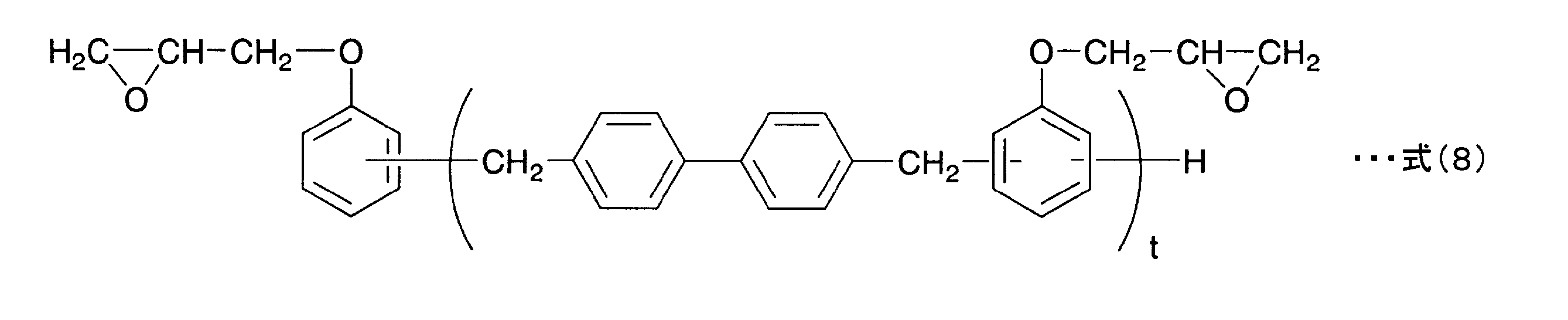
- the biphenyl type epoxy resin is preferably a biphenyl type epoxy resin represented by the following formula (8).
- the linear expansion coefficient of the cured product can be further reduced.
- t represents an integer of 1 to 11.
- the epoxy resin is preferably a naphthalene type epoxy resin, an anthracene type epoxy resin or a dicyclopentadiene type epoxy resin.
- the linear expansion coefficient of the cured product can be lowered. Since the linear expansion coefficient of the cured body can be further reduced, the epoxy resin is more preferably an anthracene type epoxy resin.
- curing agent will not be specifically limited if the said epoxy resin can be hardened.
- the curing agent a conventionally known curing agent can be used.
- the curing agent examples include dicyandiamide, amine compounds, compounds synthesized from amine compounds, hydrazide compounds, melamine compounds, acid anhydrides, phenol compounds (phenol curing agents), active ester compounds, benzoxazine compounds, maleimide compounds, Examples thereof include a heat latent cationic polymerization catalyst, a photolatent cationic polymerization initiator, a cyanate resin, and the like. Derivatives of these curing agents may be used. As for a hardening
- Examples of the amine compound include a chain aliphatic amine compound, a cyclic aliphatic amine compound, and an aromatic amine compound.
- chain aliphatic amine compound examples include ethylenediamine, diethylenetriamine, triethylenetetramine, tetraethylenepentamine, polyoxypropylenediamine, and polyoxypropylenetriamine.
- cycloaliphatic amine compound examples include mensendiamine, isophoronediamine, bis (4-amino-3-methylcyclohexyl) methane, diaminodicyclohexylmethane, bis (aminomethyl) cyclohexane, N-aminoethylpiperazine, and the like. Can be mentioned.
- aromatic amine compound examples include m-xylenediamine, ⁇ - (m / p-aminophenyl) ethylamine, m-phenylenediamine, diaminodiphenylmethane, and ⁇ , ⁇ -bis (4-aminophenyl) -p-diisopropyl.
- aromatic amine compound examples include benzene.
- a tertiary amine compound may be used as the amine compound.
- the tertiary amine compound include N, N-dimethylpiperazine, pyridine, picoline, benzyldimethylamine, 2- (dimethylaminomethyl) phenol, 2,4,6-tris (dimethylaminomethyl) phenol, and the like. .
- Specific examples of compounds synthesized from the above amine compounds include polyaminoamide compounds, polyaminoimide compounds, ketimine compounds, and the like.
- polyaminoamide compound examples include compounds synthesized from the above amine compounds and carboxylic acids.
- carboxylic acid examples include succinic acid, adipic acid, isophthalic acid, terephthalic acid, dihydroisophthalic acid, tetrahydroisophthalic acid, and hexahydroisophthalic acid.
- polyaminoimide compound examples include compounds synthesized from the amine compounds and maleimide compounds.
- maleimide compound examples include diaminodiphenylmethane bismaleimide.
- the compound synthesized from the amine compound include compounds synthesized from the amine compound and an epoxy compound, a urea compound, a thiourea compound, an aldehyde compound, a phenol compound, or an acrylic compound.
- hydrazide compound examples include 1,3-bis (hydrazinocarboethyl) -5-isopropylhydantoin, 7,11-octadecadien-1,18-dicarbohydrazide, eicosanedioic acid dihydrazide, and adipic acid dihydrazide. Is mentioned.
- Examples of the melamine compound include 2,4-diamino-6-vinyl-1,3,5-triazine.
- Examples of the acid anhydride include phthalic anhydride, trimellitic anhydride, pyromellitic anhydride, benzophenonetetracarboxylic anhydride, methyltetrahydrophthalic anhydride, tetrahydrophthalic anhydride, and trialkyltetrahydrophthalic anhydride. , Hexahydrophthalic anhydride or methylhexahydrophthalic anhydride.
- phenol compound examples include phenol novolak, o-cresol novolak, p-cresol novolak, t-butylphenol novolak, dicyclopentadiene cresol, phenol aralkyl resin, ⁇ -naphthol aralkyl resin, ⁇ -naphthol aralkyl resin, or aminotriazine novolak.
- resins examples include resins. These derivatives may be used as the phenol compound.
- a phenol compound only 1 type may be used and 2 or more types may be used together.
- the phenol compound is preferably used as the curing agent.
- the heat resistance and dimensional stability of the cured body can be increased, and the water absorption of the cured body can be lowered.
- the surface roughness of the surface of the semi-cured body can be further reduced. Specifically, the arithmetic average roughness Ra and the ten-point average roughness Rz of the surface of the semi-cured body can be further reduced.
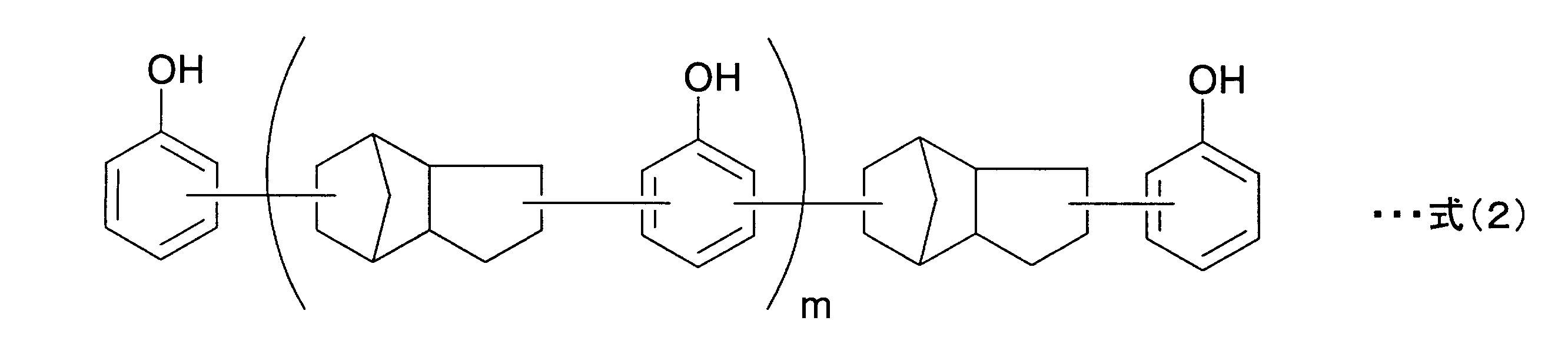
- a phenol compound represented by any one of the following formula (1), the following formula (2), and the following formula (3) is more preferably used.
- the surface roughness of the surface of the semi-cured body can be further reduced.
- R1 represents a methyl group or an ethyl group
- R2 represents hydrogen or a hydrocarbon group
- n represents an integer of 2 to 4.
- m represents an integer of 0-5.
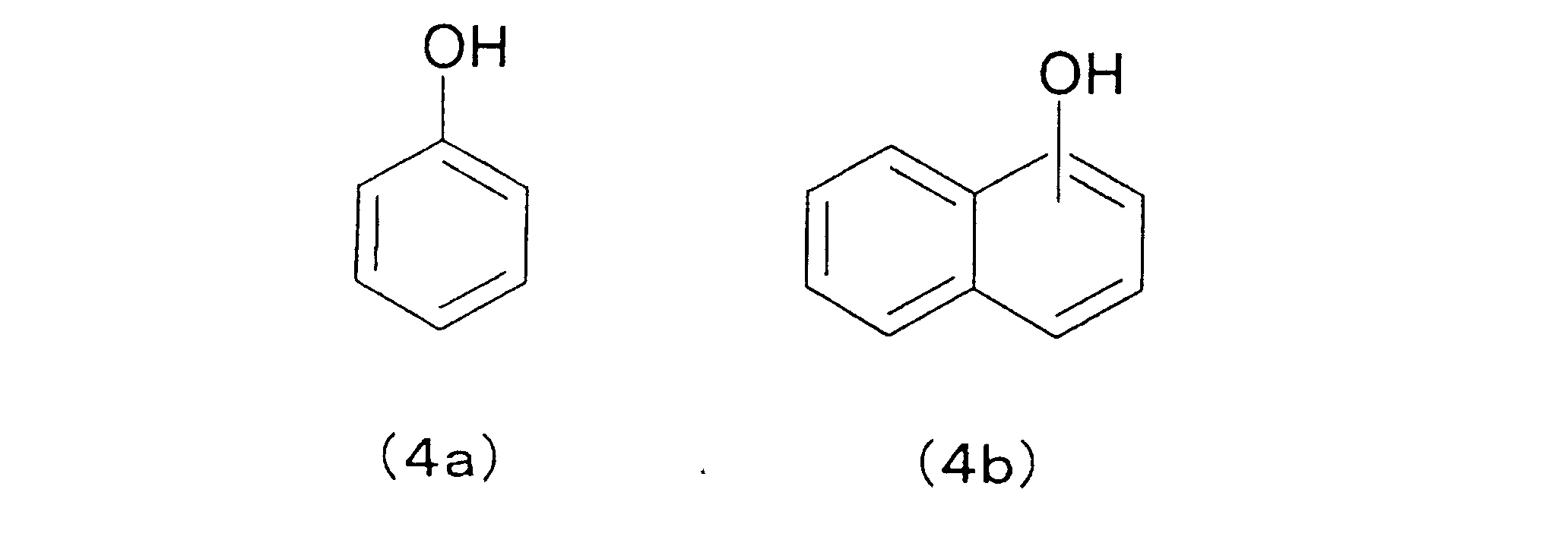
- R3 represents a group represented by the following formula (4a) or the following formula (4b)
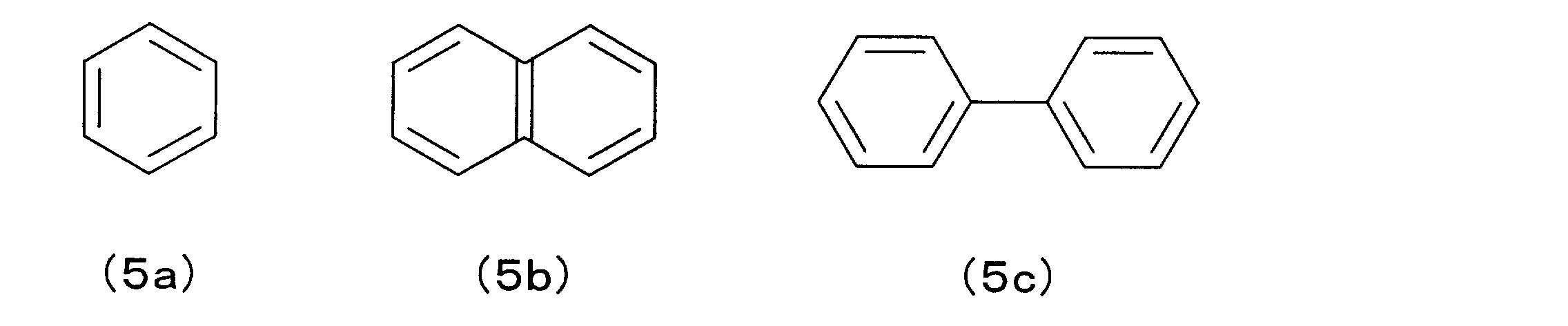
- R4 is represented by the following formula (5a), the following formula (5b) or the following formula (5c)
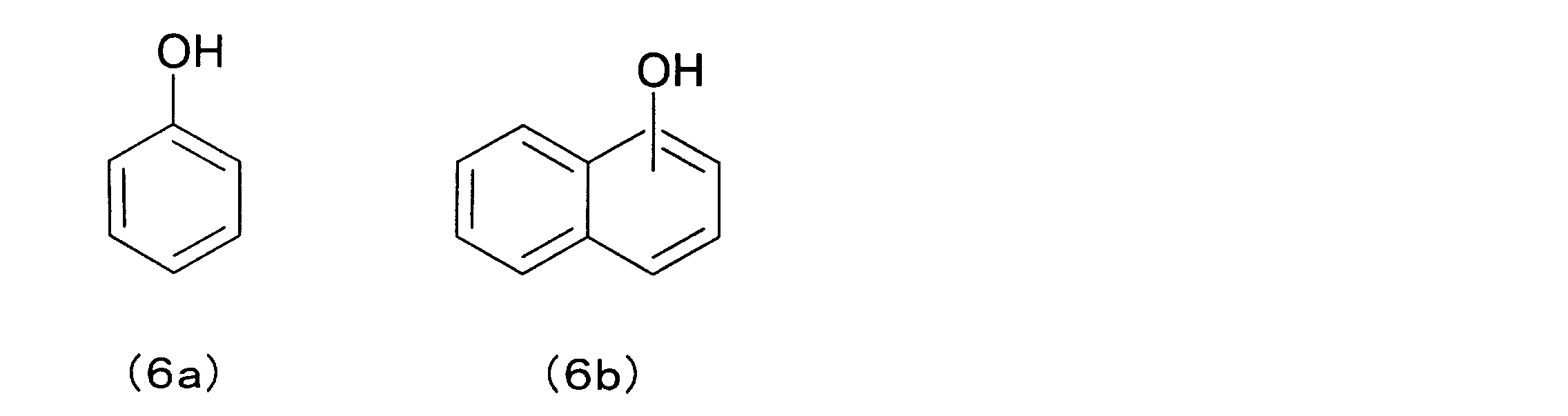
- R5 represents a group represented by the following formula (6a) or the following formula (6b)
- R6 represents hydrogen or an organic group having 1 to 20 carbon atoms
- p represents an integer of 1 to 6
- Q represents an integer of 1 to 6
- r represents an integer of 1 to 11.
- a phenol compound represented by the above formula (3), wherein R4 in the above formula (3) is a group represented by the above formula (5c), is preferred.
- R4 in the above formula (3) is a group represented by the above formula (5c)
- the electrical properties and heat resistance of the cured product can be further enhanced.
- the dimensional stability of the cured body when a thermal history is given can be further enhanced.
- the curing agent is particularly preferably a phenol compound having a structure represented by the following formula (7).
- the electrical characteristics and heat resistance of the cured body can be further enhanced.
- the dimensional stability of the cured body when a thermal history is given can be further enhanced.
- s represents an integer of 1 to 11.
- Examples of the active ester compound include aromatic polyvalent ester compounds. By using the active ester compound, a cured product excellent in dielectric constant and dielectric loss tangent can be obtained. Specific examples of the active ester compound are disclosed in, for example, JP-A-2002-12650.
- Examples of commercial products of the active ester compound include trade names “EPICLON EXB9451-65T” and “EPICLON EXB9460S-65T” manufactured by DIC.
- cyanate ester resin for example, a novolak type sinate ester resin, a bisphenol type cyanate ester resin, a prepolymer partially triazineated, or the like can be used.
- the cyanate ester resin By using the cyanate ester resin, the linear expansion coefficient of the cured product can be further reduced.
- the maleimide compounds include N, N′-4,4-diphenylmethane bismaleimide, N, N′-1,3-phenylene dimaleimide, N, N′-1,4-phenylene dimaleimide, 1,2-bis ( Maleimide) ethane, 1,6-bismaleimide hexane, bis (3-ethyl-5-methyl-4-maleimidophenyl) methane, polyphenylmethanemaleimide, bisphenol A diphenyl ether bismaleimide, 4-methyl-1,3-phenylenebis It is preferably at least one selected from the group consisting of maleimide, 1,6-bismaleimide- (2,2,4-trimethyl) hexane and oligomers thereof, and a maleimide skeleton-containing diamine condensate.
- the said oligomer is an oligomer obtained by condensing the maleimide compound which is a monomer in the maleimide compound mentioned above.
- the maleimide compound is more preferably at least one of polyphenylmethane maleimide and bismaleimide oligomer.
- the bismaleimide oligomer is preferably an oligomer obtained by condensation of phenylmethane bismaleimide and 4,4-diaminodiphenylmethane.
- maleimide compounds examples include polyphenylmethane maleimide (manufactured by Daiwa Kasei Co., Ltd., trade name “BMI-2300”) and bismaleimide oligomer (manufactured by Daiwa Kasei Co., Ltd., trade name “DAIMAID-100H”).
- the curing agent is preferably at least one selected from the group consisting of phenolic compounds, active ester compounds, and cyanate resins.
- the curing agent is preferably a phenol compound or an active ester compound. When these preferable curing agents are used, the resin component is hardly affected by the roughening treatment when the reaction product is roughened.
- the cyanate resin is preferably a cyanate ester resin.
- the active ester compound is preferably an aromatic polyvalent ester compound. By using the aromatic polyvalent ester compound, it is possible to obtain a cured product that is further excellent in dielectric constant and dielectric loss tangent.
- the curing agent is at least selected from the group consisting of a phenol compound having a naphthalene structure, a phenol compound having a dicyclopentadiene structure, a phenol compound having a biphenyl structure, a phenol compound having an aminotriazine structure, an active ester compound, and a cyanate resin.
- a phenol compound having a naphthalene structure is at least selected from the group consisting of a phenol compound having a naphthalene structure, a phenol compound having a dicyclopentadiene structure, a phenol compound having a biphenyl structure, a phenol compound having an aminotriazine structure, an active ester compound, and a cyanate resin.
- One type is particularly preferred.
- the weight average molecular weight of the epoxy resin may affect the formation of a fine rough surface.
- the weight average molecular weight of the curing agent may have a greater influence on the formation of a fine rough surface than the weight average molecular weight of the epoxy resin.
- the weight average molecular weight of the curing agent is preferably 500 or more, and more preferably 1800 or more.
- a preferable upper limit of the weight average molecular weight of the curing agent is 15000.
- the epoxy equivalent of the epoxy resin and the equivalent of the curing agent are large, a fine rough surface is likely to be formed on the surface of the semi-cured body. Furthermore, when the curing agent is solid and the softening temperature of the curing agent is 60 ° C. or higher, a fine rough surface is easily formed on the surface of the semi-cured body.
- the content of the curing agent is preferably in the range of 1 to 200 parts by weight with respect to 100 parts by weight of the epoxy resin.
- a resin composition may not fully harden
- the effect of hardening an epoxy resin may be saturated.
- curing agent is 30 weight part, and a preferable upper limit is 140 weight part.
- the resin composition preferably contains a curing accelerator.
- the curing accelerator is an optional component.
- the curing accelerator is not particularly limited.
- the curing accelerator is preferably an imidazole curing accelerator.
- the imidazole curing accelerator is 2-undecylimidazole, 2-heptadecylimidazole, 2-methylimidazole, 2-ethyl-4-methylimidazole, 2-phenylimidazole, 2-phenyl-4-methylimidazole, 1-benzyl.
- phosphine compounds such as triphenylphosphine, diazabicycloundecene (DBU), diazabicyclononene (DBN), DBU phenol salt, DBN phenol salt, octylate, p- Examples include toluene sulfonate, formate, orthophthalate, and phenol novolac resin salt.
- the content of the curing accelerator is preferably in the range of 0.01 to 3 parts by weight with respect to 100 parts by weight of the epoxy resin.
- a resin composition may not fully harden
- the surface roughness of the semi-cured body can be reduced without adding a curing accelerator.
- the curing accelerator is not added, the curing of the resin composition does not proceed sufficiently, and the Tg may be lowered or the strength of the cured product may not be sufficiently increased.
- the minimum with preferable content of the said hardening accelerator is 0.5 weight part, and a preferable upper limit is 2.0 weight part.
- the resin composition contains a silica component in which silica particles are surface-treated with a silane coupling agent. Only 1 type may be used for a silica component and 2 or more types may be used together.
- the average particle size of the silica particles is 1 ⁇ m or less. When the average particle diameter is 1 ⁇ m or less, a fine rough surface can be formed on the surface of the semi-cured body. In addition, fine holes having an average diameter of about 1 ⁇ m or less can be formed on the surface of the semi-cured body.
- the average particle diameter of the silica particles is preferably 100 nm or more.
- the silica component When the average particle diameter of the silica particles is larger than 1 ⁇ m, the silica component is hardly detached when the reaction product is roughened. In addition, when a plating process is performed to form a metal layer on the surface of the semi-cured body, plating may sink into the gap between the silica component and the resin component that have not been detached. For this reason, when a metal layer is formed as a circuit, there exists a possibility that a malfunction may arise in a circuit.
- a silica component is obtained by roughening treatment.
- the resin component around is hard to be shaved. In this case, if the average particle diameter of the silica particles is larger than 1 ⁇ m, the silica component becomes more difficult to desorb and the roughening peel strength is lowered.
- the median diameter (d50) value of 50% can be adopted as the average particle diameter of the silica particles.
- the average particle size can be measured using a laser diffraction / scattering particle size distribution measuring apparatus.
- a plurality of types of silica particles having different average particle diameters may be used. In consideration of fine packing, it is preferable to use a plurality of types of silica particles having different particle size distributions.
- the resin composition can be suitably used for applications requiring fluidity such as a component-embedded substrate.
- silica component by using silica particles having an average particle diameter of several tens of nanometers, the viscosity of the resin composition can be increased and thixotropic properties can be controlled.
- the maximum particle size of the silica particles is preferably 5 ⁇ m or less.
- the silica component is more easily detached when the reaction product is roughened. Furthermore, relatively large holes are hardly formed on the surface of the semi-cured body, and uniform and fine irregularities can be formed.
- the silica component When a phenol compound, aromatic polyvalent ester compound or benzoxazine compound having any one of naphthalene structure, dicyclopentadiene structure, biphenyl structure and aminotriazine structure is used as a curing agent, The roughening liquid hardly penetrates into the reaction product from the surface, and the silica component is relatively difficult to desorb. However, by using a silica component having a maximum particle size of 5 ⁇ m or less, the silica component can be easily removed. In the case where a fine wiring having an L / S of 15 ⁇ m / 15 ⁇ m or less is formed on the surface of the semi-cured body, it is possible to improve the insulation reliability. Therefore, the maximum particle diameter of silica is preferably 2 ⁇ m or less. Note that “L / S” indicates the dimension (L) in the width direction of the wiring / the dimension (S) in the width direction of the portion where the wiring is not formed.
- the shape of the silica particles is not particularly limited. Examples of the shape of the silica particles include a spherical shape or an indefinite shape. When the reaction product is roughened, the silica component is more easily detached, so that the silica particles are preferably spherical and more preferably spherical.
- the specific surface area of the silica particles is preferably 3 m 2 / g or more. There exists a possibility that the mechanical characteristic of a hardening body may fall that a specific surface area is less than 3 m ⁇ 2 > / g. Furthermore, the adhesion between the cured body and the metal layer may be reduced.
- the specific surface area can be determined by the BET method.
- silica particles crystalline silica obtained by pulverizing natural silica raw material, crushed fused silica obtained by flame melting and pulverizing natural silica raw material, and natural silica raw material obtained by flame melting, pulverizing and flame melting And synthetic silica such as spherical fused silica, fumed silica (Aerosil), or sol-gel silica.
- fused silica is preferably used as the silica particles.
- the silica particles may be used as a silica slurry in a state dispersed in a solvent. By using the silica slurry, workability and productivity can be improved during the production of the resin composition.
- a conventionally known silane compound can be used as the silane coupling agent.
- the silane coupling agent is preferably at least one selected from the group consisting of epoxy silane, amino silane, isocyanate silane, acryloxy silane, methacryloxy silane, vinyl silane, styryl silane, ureido silane, and sulfide silane.
- the silica particles may be surface-treated with an alkoxysilane such as silazane.
- an alkoxysilane such as silazane.
- a silane coupling agent only 1 type may be used and 2 or more types may be used together.
- silica component it is preferable to add the silica component to the resin composition after surface-treating the silica particles with the silane coupling agent to obtain a silica component.
- the dispersibility of the silica component can be further enhanced.
- Examples of the surface treatment of the silica particles with a silane coupling agent include the following first to third methods.
- the dry method includes a method of directly attaching a silane coupling agent to silica particles.
- silica particles are charged into a mixer, and an alcohol solution or an aqueous solution of a silane coupling agent is dropped or sprayed with stirring, and then further stirred and classified by sieving. Thereafter, the silica component can be obtained by dehydrating condensation of the silane coupling agent and the silica particles by heating. The obtained silica component may be used as a silica slurry in a state dispersed in a solvent.
- the second method includes a wet method.
- a silane coupling agent is added while stirring a silica slurry containing silica particles, and after stirring, classification is performed by filtration, drying, and sieving.
- the silica component can be obtained by dehydrating condensation of the silane compound and the silica particles by heating.
- a third method there is a method in which dehydration condensation proceeds by heating and refluxing after adding a silane coupling agent while stirring a silica slurry containing silica particles.
- the obtained silica component may be used as a silica slurry in a state dispersed in a solvent.
- the silica particles and the epoxy resin are combined in a state where they are not sufficiently blended.
- a silica component whose surface is treated with a silane coupling agent when used, when the resin composition is reacted, the silica component and the epoxy resin are combined in a state in which they are sufficiently familiar with each other. The For this reason, the intensity
- the reflow resistance of the cured product can be enhanced by using a silica component in which the silica particles are surface-treated with a silane coupling agent. Further, the water absorption of the cured body can be lowered and the insulation reliability can be increased.
- the content of the silica component is preferably in the range of 10 to 400 parts by weight with respect to a total of 100 parts by weight of the epoxy resin and the curing agent.
- the more preferable lower limit of the content of the silica component is 25 parts by weight, the further preferable lower limit is 43 parts by weight, the more preferable upper limit is 250 parts by weight, and the more preferable upper limit is 100 parts by weight of the total of the epoxy resin and the curing agent. 150 parts by weight.
- the resin composition preferably contains an imidazole silane compound.
- the imidazole silane compound By using the imidazole silane compound, the surface roughness of the surface of the roughened cured body can be further reduced.
- the imidazole silane compound is contained within a range of 0.01 to 3 parts by weight with respect to a total of 100 parts by weight of the epoxy resin and the curing agent.
- the content of the imidazole silane compound is within the above range, the surface roughness of the surface of the roughened cured body can be further reduced, and the roughened adhesive strength between the cured body and the metal layer can be further increased. It can be made even higher.
- the minimum with more preferable content of the said imidazole silane compound is 0.03 weight part, A more preferable upper limit is 2 weight part, Furthermore, a preferable upper limit is 1 weight part.
- the imidazole silane compound is 0.01 to 2% by weight with respect to 100 parts by weight in total of the epoxy resin and the curing agent. It is particularly preferred that it is contained within the range of parts.
- the resin composition may contain an organic layered silicate.
- organic layered silicates examples include organic layered silicates obtained by organically processing layered silicates such as smectite clay minerals, swellable mica, vermiculite, and halloysite.
- organic layered silicate only 1 type may be used and 2 or more types may be used together.
- smectite clay mineral examples include montmorillonite, hectorite, saponite, beidellite, stevensite, and nontronite.
- an organically modified layered silicate obtained by organically treating at least one layered silicate selected from the group consisting of montmorillonite, hectorite and swellable mica is preferably used.
- the average particle diameter of the organically modified layered silicate is preferably 500 nm or less. When the average particle diameter of the organic layered silicate is 500 nm or less, the roughness of the roughened surface can be further reduced.
- the average particle diameter of the organically modified layered silicate is preferably 100 nm or more.
- the median diameter (d50) value of 50% can be adopted as the average particle diameter of the organically modified layered silicate.
- the average particle size can be measured using a laser diffraction / scattering particle size distribution measuring apparatus.
- the content of the organically modified layered silicate is preferably in the range of 0.01 to 3 parts by weight with respect to a total of 100 parts by weight of the epoxy resin and the curing agent.
- the resin composition may contain a resin copolymerizable with the epoxy resin, if necessary, in addition to the epoxy resin.
- the above copolymerizable resin is not particularly limited.
- examples of the copolymerizable resin include phenoxy resin, thermosetting modified polyphenylene ether resin, or benzoxazine resin.
- the copolymerizable resin only one type may be used, or two or more types may be used in combination.
- thermosetting modified polyphenylene ether resin examples include resins obtained by modifying a polyphenylene ether resin with a functional group such as an epoxy group, an isocyanate group, or an amino group.
- a functional group such as an epoxy group, an isocyanate group, or an amino group.
- the said thermosetting modified polyphenylene ether resin only 1 type may be used and 2 or more types may be used together.
- the benzoxazine resin is not particularly limited.
- Specific examples of the benzoxazine resin include a resin in which a substituent having an aryl group skeleton such as a methyl group, an ethyl group, a phenyl group, a biphenyl group, or a cyclohexyl group is bonded to nitrogen of the oxazine ring, or a methylene group, an ethylene group And a resin in which a substituent having an arylene skeleton such as a phenylene group, a biphenylene group, a naphthalene group, or a cyclohexylene group is bonded between nitrogen atoms of two oxazine rings.
- the said benzoxazine resin only 1 type may be used and 2 or more types may be used together.
- the heat resistance of the cured product can be increased, and the water absorption and the linear expansion coefficient can be decreased.
- a benzoxazine monomer or oligomer, or a resin in which a benzoxazine monomer or oligomer is polymerized by ring-opening polymerization of an oxazine ring is included in the benzoxazine resin.
- thermoplastic resins thermosetting resins other than epoxy resins, thermoplastic elastomers, crosslinked rubber, oligomers, inorganic compounds, nucleating agents, antioxidants, aging
- Additives such as inhibitors, heat stabilizers, light stabilizers, UV absorbers, lubricants, flame retardant aids, antistatic agents, antifogging agents, fillers, softeners, plasticizers or colorants may be added Good. Only 1 type may be used for these additives and 2 or more types may be used together.
- thermoplastic resins include polysulfone resins, polyether sulfone resins, polyimide resins, polyetherimide resins, and phenoxy resins.
- polysulfone resins polysulfone resins
- polyether sulfone resins polyimide resins
- polyetherimide resins polyetherimide resins
- phenoxy resins phenoxy resins.
- the said thermoplastic resins only 1 type may be used and 2 or more types may be used together.
- thermosetting resins examples include a polyvinyl benzyl ether resin or a reaction product obtained by a reaction between a bifunctional polyphenylene ether oligomer and chloromethylstyrene.
- a polyvinyl benzyl ether resin or a reaction product obtained by a reaction between a bifunctional polyphenylene ether oligomer and chloromethylstyrene As for the said thermosetting resins, only 1 type may be used and 2 or more types may be used together.
- the preferred lower limit of the content of the thermoplastic resins or the thermosetting resins is 0.5 parts by weight with respect to 100 parts by weight of the epoxy resin.
- the more preferred lower limit is 1 part by weight
- the preferred upper limit is 50 parts by weight
- the more preferred upper limit is 20 parts by weight. If the content of the thermoplastic resin or the thermosetting resin is too small, the elongation and toughness of the cured body may not be sufficiently increased, and if it is too large, the strength of the cured body may be reduced.
- the manufacturing method of the said resin composition is not specifically limited.
- a method for producing the resin composition for example, the epoxy resin, the curing agent, the silica component, and a component to be blended as necessary are added to a solvent, and then dried to remove the solvent. And the like.
- the resin composition may be used after being dissolved in a suitable solvent, for example.
- the application of the resin composition is not particularly limited.
- the resin composition is, for example, a substrate material for forming a core layer or a buildup layer of a multilayer substrate, an adhesive sheet, a laminate, a copper foil with resin, a copper clad laminate, a TAB tape, a printed board, a prepreg, or It is suitably used for varnishes and the like.
- the resin composition is suitably used for applications requiring insulation such as a copper foil with resin, a copper clad laminate, a printed board, a prepreg, an adhesive sheet, or a TAB tape.
- Additive method for forming circuit after forming conductive plating layer on the surface of cured body, build-up substrate etc. where multiple cured body and conductive plating layer are laminated by semi-additive method etc. Preferably used. In this case, the bonding strength between the cured body and the conductive plating layer can be increased.
- the resin composition can also be used as a sealing material or a solder resist.
- the resin composition is also applied to a passive component or a component-embedded substrate in which an active component is required, which requires high-frequency characteristics. Can be used.
- the semi-cured product is obtained by further curing from a slightly cured state called a B stage to a pre-cured state suitable for roughening treatment, that is, a semi-cured state.
- the reaction product can be obtained by reacting the resin composition.
- a semi-cured product can be obtained by roughening the obtained reaction product.
- the semi-cured product according to the present invention is obtained as follows.
- the above resin composition is reacted (precured or semi-cured) so that the gel fraction after being immersed in methyl ethyl ketone for 24 hours at 23 ° C. is 90% or more to obtain a reaction product.
- the heating temperature is not particularly limited.
- the heating temperature is preferably in the range of 130 to 190 ° C.
- the heating temperature is lower than 130 ° C.
- the resin composition is not sufficiently cured, so that the gel fraction tends to be low.
- corrugation of the surface of a semi-hardened body tends to become large.
- the heating temperature is higher than 190 ° C., the curing reaction of the resin composition tends to proceed rapidly. For this reason, the degree of curing tends to be partially different, and as a result, it may be difficult to obtain the uniformity of the unevenness on the surface of the semi-cured body.
- the heating time for reacting the resin composition so that the gel fraction is 90% or more is not particularly limited, but can range from 15 minutes to 3 hours, for example.
- the heating time is short, the resin composition is not sufficiently cured, so that the unevenness of the surface of the semi-cured body after the roughening treatment tends to increase. For this reason, it is preferable that heating time is 30 minutes or more. From the viewpoint of increasing productivity, the heating time is preferably 1 hour or less.
- the reaction product is roughened. Prior to the roughening treatment, the reaction product is preferably subjected to a swelling treatment. However, the reaction product does not necessarily have to undergo a swelling treatment.
- the swelling treatment method for example, a method of treating the reaction product with an aqueous solution or an organic solvent dispersion solution of a compound mainly composed of ethylene glycol or the like is used.
- a 40% by weight ethylene glycol aqueous solution is suitably used.
- a chemical oxidant such as a manganese compound, a chromium compound, or a persulfate compound is used.
- chemical oxidizers are used as an aqueous solution or an organic solvent dispersion after water or an organic solvent is added.
- Examples of the manganese compound include potassium permanganate and sodium permanganate.
- Examples of the chromium compound include potassium dichromate and anhydrous potassium chromate.
- Examples of the persulfate compound include sodium persulfate, potassium persulfate, and ammonium persulfate.
- the above roughening method is not particularly limited.
- For the roughening treatment for example, 30 to 90 g / L permanganic acid or permanganate solution or 30 to 90 g / L sodium hydroxide solution is preferably used.
- the roughening effect is also large. However, when the number of times of roughening treatment exceeds 3, the roughening effect may be saturated, or the resin component on the surface of the semi-cured body is scraped more than necessary, and the silica component is present on the surface of the semi-cured body. It becomes difficult to form holes having a detached shape. For this reason, it is preferable that a roughening process is performed once or twice.
- the above reaction product is preferably roughened at 50 to 80 ° C. for 5 to 30 minutes.
- the reactant is preferably subjected to swelling treatment at 50 to 80 ° C. for 5 to 30 minutes.
- the time for the roughening treatment or the swelling treatment indicates the total time.
- the surface roughness of the surface of the semi-cured product can be further reduced by subjecting the reaction product reacted so that the gel fraction is 90% or more to roughening or swelling under the above conditions.
- FIG. 1 schematically shows a semi-cured body according to an embodiment of the present invention in a partially cutaway front sectional view.
- the surface 1a of the semi-cured body 1 has a hole 1b formed by desorption of the silica component.
- the resin composition is excellent in dispersibility of the silica component because the silica particle contains a silica component whose surface is treated with a silane coupling agent. Therefore, it is difficult to form large holes in the semi-cured body 1 due to desorption of the silica component aggregates. Therefore, the strength of the semi-cured body 1 or the cured body obtained by curing the semi-cured body 1 is hardly locally reduced, and the adhesive strength between the cured body and the metal layer can be further increased. Moreover, in order to make the linear expansion coefficient of a hardening body low, a silica component can be mix
- the hole 1b may be a hole from which about several silica components, for example, about 2 to 10, are separated.
- the resin component in the portion indicated by the arrow A in FIG.
- a phenolic compound having any one of naphthalene structure, dicyclopentadiene structure, biphenyl structure or aminotriazine structure, an aromatic polyvalent ester compound or a compound having a benzoxazine structure is used as a curing agent, silica On the surface of the hole 1b formed by the desorption of the component, a relatively large amount of the resin component is easily scraped.
- the silica particles are treated with a silica component treated with a silane coupling agent, a phenol compound, aromatic compound having any one of naphthalene structure, dicyclopentadiene structure, biphenyl structure and aminotriazine structure is used. Even if an aromatic polyvalent ester compound or a compound having a benzoxazine structure is used as a curing agent, the resin component is not removed more than necessary. For this reason, the intensity
- the arithmetic average roughness Ra of the roughened surface of the semi-cured product obtained as described above is preferably 0.3 ⁇ m or less, and the ten-point average roughness Rz is preferably 3.0 ⁇ m or less.
- the arithmetic average roughness Ra of the roughened surface is more preferably 0.2 ⁇ m or less, and further preferably 0.15 ⁇ m or less.
- the ten-point average roughness Rz of the roughened surface is more preferably 2 ⁇ m or less, and further preferably 1.5 ⁇ m or less. If the arithmetic average roughness Ra is too large or the ten-point average roughness Rz is too large, the transmission speed of the electrical signal in the wiring formed on the surface of the cured body may not be increased.
- the arithmetic average roughness Ra and the ten-point average roughness Rz can be obtained by a measuring method based on JIS B0601-1994.
- the average diameter of the plurality of holes formed on the surface of the semi-cured body 1 or the cured body is preferably 5 ⁇ m or less.
- the average diameter of the plurality of holes is larger than 5 ⁇ m, it may be difficult to form a wiring having a small L / S on the surface of the cured body, and the formed wirings are easily short-circuited.
- the semi-cured body 1 can be subjected to electrolytic plating after being subjected to a known plating catalyst or electroless plating, if necessary. By subjecting the surface of the semi-cured body 1 to plating and curing the semi-cured body 1, a laminate 11 including the cured body and the metal layer 2 can be obtained.
- FIG. 2 shows a partially cut-away front sectional view of a laminate 11 in which a metal layer 2 is formed on a top surface 1a of a cured body 1A obtained by curing the semi-cured body 1 by plating.
- the metal layer 2 reaches in the fine hole 1b formed in the upper surface 1a of the cured body 1A. Therefore, the adhesive strength between the cured body 1A and the metal layer 2 can be increased by the physical anchor effect. Further, in the vicinity of the hole 1b formed by the detachment of the silica component, the resin component is not shaved more than necessary, so that the adhesive strength between the cured body 1A and the metal layer 2 can be increased.
- the cured body 1A is preferably a cured body obtained by curing the semi-cured body 1 at 130 to 200 ° C. In these cases, the adhesive strength between the cured body 1A and the metal layer 2 can be further increased.
- the average particle diameter of the silica component is smaller, fine irregularities can be formed on the surface of the semi-cured body 1. Since the silica component in which silica particles having an average particle diameter of 1 ⁇ m are surface-treated with a silane coupling agent is used, the pores 1b can be made small, and therefore fine irregularities are formed on the surface of the semi-cured body 1. it can. For this reason, L / S which shows the fineness of the wiring of a circuit can be made small.
- the signal processing speed of the wiring can be increased. For example, even if the signal is a high frequency of 5 GHz or more, the surface roughness of the surface of the semi-cured body 1 is small, so the interface between the cured body 1A and the metal layer 2 obtained by curing the semi-cured body 1 It is possible to reduce the loss of the electric signal at.
- silica particles having an average particle size of 1 ⁇ m or less are subjected to surface treatment with a silane coupling agent, so that the variation in surface roughness is small, for example, L / S is 13 ⁇ m.
- a fine wiring of about / 13 ⁇ m can be formed on the surface of the cured body 1A.
- fine wiring with L / S of 10 ⁇ m / 10 ⁇ m or less can be formed on the surface of the cured body 1A without causing a short circuit between the wirings. In the cured body 1A on which such wiring is formed, an electric signal can be transmitted stably and with a small loss.
- a metal foil or metal plating used for shielding or circuit formation, or a plating material used for circuit protection can be used as the material for forming the metal layer 2.
- the plating material examples include gold, silver, copper, rhodium, palladium, nickel, and tin. Two or more kinds of these alloys may be used. A plurality of metal layers may be formed of two or more kinds of plating materials. Furthermore, depending on the purpose, the plating material may contain other metals or substances other than the above metals.
- the metal layer 2 is preferably a copper plating layer formed by a copper plating process.
- the adhesive strength between the cured body 1A and the metal layer 2 is preferably 4.9 N / cm or more.
- Phenol curing agent having a biphenyl structure (Maywa Kasei Co., Ltd., trade name “MEH7851-4H”, corresponding to the phenol compound represented by the above formula (7))
- Active ester curing agent active ester compound, manufactured by DIC, trade name “EPICLON EXB9460S-65T”, toluene solution having a solid content of 65% by weight
- Cyanate ester resin (Ronza, trade name “Primaset BA-230S” 75% by weight methyl ethyl ketone solution)
- Imidazole curing accelerator manufactured by Shikoku Kasei Kogyo Co., Ltd., trade name “2PN-CN”, 1-cyanoethyl-2-methylimidazole
- Silica slurry Silica particles (average particle size 0.3 ⁇ m, specific surface area 18 m 2 / g) surface-treated with aminosilane (manufactured by Shin-Etsu Chemical Co., Ltd., trade name “KBM-573”) 50% by weight of silica component, DMF (N , N-dimethylformamide) and a slurry containing 50% by weight of a silica component (1) Silica particles (average particle size 0.8 ⁇ m, specific surface area 4.3 m 2 / g) surface-treated with aminosilane (manufactured by Shin-Etsu Chemical Co., Ltd., trade name “KBM-573”) 50% by weight of silica component, DMF (N, N-dimethylformamide) 50 wt% silica component containing slurry (2)
- Example 1 (1) Preparation of Resin Composition 53.08 g of the silica component-containing 50 wt% slurry and 7.00 g of DMF were mixed and stirred at room temperature until a uniform solution was obtained. Thereafter, 0.20 g of the above imidazole curing accelerator (trade name “2PN-CN”, manufactured by Shikoku Kasei Kogyo Co., Ltd.) was further added and stirred at room temperature until a uniform solution was obtained.
- the above imidazole curing accelerator trade name “2PN-CN”, manufactured by Shikoku Kasei Kogyo Co., Ltd.
- a release-treated transparent polyethylene terephthalate (PET) film (trade name “PET5011 550”, thickness 50 ⁇ m, manufactured by Lintec Corporation) was prepared.
- the obtained resin composition was applied onto the PET film using an applicator so that the thickness after drying was 50 ⁇ m.
- an uncured product of a sheet-like resin composition having a size of 200 mm long ⁇ 200 mm wide ⁇ 50 ⁇ m thick and in a B-stage state is produced. did.
- Roughening treatment permanganate treatment: The above-mentioned layered sample that had been swollen was placed in a roughened aqueous solution of potassium permanganate (Concentrate Compact CP, manufactured by Atotech Japan Co., Ltd.) at 80 ° C. and rocked at a roughening temperature of 80 ° C. for 15 minutes. Then, after washing
- potassium permanganate Concentrate Compact CP, manufactured by Atotech Japan Co., Ltd.
- cleaning liquid Reduction securigant P, the Atotech Japan company make
- Copper plating treatment The semi-cured body formed on the glass epoxy substrate was subjected to electroless copper plating and electrolytic copper plating in the following procedure.
- the surface of the roughened semi-cured material was treated with an alkali cleaner (cleaner securigant 902) at 60 ° C. for 5 minutes and degreased and washed. After washing, the semi-cured product was treated with a 25 ° C. pre-dip solution (Pre-Dip Neogant B) for 2 minutes. Thereafter, the semi-cured product was treated with an activator solution (activator neogant 834) at 40 ° C. for 5 minutes to attach a palladium catalyst. Next, the semi-cured product was treated with a reducing solution (reducer Neogant WA) at 30 ° C. for 5 minutes.
- an alkali cleaner cleaning securigant 902
- Pre-Dip Neogant B pre-dip solution
- activator neogant 834 activator neogant 834
- the semi-cured product was treated with a reducing solution (reducer Neogant WA) at 30 ° C. for 5 minutes.
- the semi-cured material was placed in a chemical copper solution (basic print gantt MSK-DK, copper print gantt MSK, stabilizer print gantt MSK), and electroless plating was performed until the plating thickness reached about 0.5 ⁇ m.
- a chemical copper solution basic print gantt MSK-DK, copper print gantt MSK, stabilizer print gantt MSK
- electroless plating was performed until the plating thickness reached about 0.5 ⁇ m.
- annealing was performed at a temperature of 120 ° C. for 30 minutes in order to remove the remaining hydrogen gas. All the steps up to the electroless plating step were performed while using a beaker scale with a treatment liquid of 1 L and swinging the semi-cured body.
- electroplating was performed on the semi-cured material that had been subjected to electroless plating until the plating thickness was 25 ⁇ m.
- An electric current of 0.6 A / cm 2 was passed using copper sulfate (reducer Cu) as the electrolytic copper plating.
- the semi-cured body was heated at 180 ° C. for 1 hour to cure the semi-cured body to form a cured body.
- the laminated body in which the copper plating layer was formed on the hardening body was obtained.
- Examples 2 to 11 and Comparative Examples 1 to 5 The types and blending amounts of the materials used were set as shown in Tables 1 and 2 below, and the uncured product of the sheet-shaped resin composition obtained in the production of the above (3) semi-cured product
- the resin composition was prepared in the same manner as in Example 1 except that the reaction conditions for the reaction were set as shown in Tables 1 and 2 below, and an uncured sheet-shaped resin composition, Semi-cured bodies and laminates were prepared.
- the resin composition contains imidazole silane
- the imidazole silane was added together with a curing agent.
- the obtained semi-cured product was cut into a size of 50 mm ⁇ 50 mm to prepare a test sample.
- the initial weight (W1) of this test sample was measured.
- the test sample was immersed in methyl ethyl ketone at 23 ° C. for 24 hours. Thereafter, using a # 400 metal mesh whose weight was measured in advance, the test piece in methyl ethyl ketone was filtered to obtain a test sample residue on the metal mesh.
- the residue was dried with metal mesh at 23 ° C. for 72 hours.
- the total weight of the metal mesh and the residue after drying was measured and the weight of the metal mesh was divided to obtain the weight (W2) of the residue after drying. From the measured value, the gel fraction was calculated by the following formula (1). The average value measured five times was taken as the gel fraction.
- the obtained cured body B was cut into a size of 10 ⁇ 80 mm. Two cured bodies B that were cut were laminated to obtain a test sample having a thickness of 100 ⁇ m. Using a tensile tester (trade name “Tensilon”, manufactured by Orientec Co., Ltd.), a tensile test was performed under the conditions of a distance between chucks of 60 mm and a crosshead speed of 5 mm / min. The degree (%) was measured.
Landscapes
- Chemical & Material Sciences (AREA)
- Chemical Kinetics & Catalysis (AREA)
- Organic Chemistry (AREA)
- Health & Medical Sciences (AREA)
- Medicinal Chemistry (AREA)
- Polymers & Plastics (AREA)
- General Chemical & Material Sciences (AREA)
- Engineering & Computer Science (AREA)
- Materials Engineering (AREA)
- Mechanical Engineering (AREA)
- Metallurgy (AREA)
- Compositions Of Macromolecular Compounds (AREA)
- Laminated Bodies (AREA)
- Epoxy Resins (AREA)
- Treatments Of Macromolecular Shaped Articles (AREA)
Abstract
Description
本発明に係る半硬化体の他の特定の局面では、上記樹脂組成物は、上記エポキシ樹脂及び上記硬化剤の合計100重量部に対して、イミダゾールシラン化合物を0.01~3重量部の範囲内でさらに含有する。
本発明に係る硬化体のある特定の局面では、上記半硬化体を130~200℃で硬化させることにより、硬化体が得られている。
本発明に係る硬化体の製造方法では、上記半硬化体の製造方法により得られた半硬化体を130~200℃で硬化させることにより、硬化体を得る。
W1:メチルエチルケトン浸漬前の半硬化体の重量
W2:乾燥後の半硬化体の残留物の重量
先ず、上記樹脂組成物に含まれる各成分を以下説明する。
上記樹脂組成物に含まれているエポキシ樹脂は、少なくとも1個のエポキシ基(オキシラン環)を有する有機化合物である。上記エポキシ樹脂の1分子当たりのエポキシ基の数は、1以上である。該エポキシ基の数は、2以上であることがより好ましい。
上記硬化剤は、上記エポキシ樹脂を硬化させることができれば特に限定されない。硬化剤として、従来公知の硬化剤を用いることができる。



上記樹脂組成物は硬化促進剤を含有することが好ましい。本発明では、硬化促進剤は任意成分である。硬化促進剤は特に限定されない。
上記樹脂組成物は、シリカ粒子がシランカップリング剤により表面処理されているシリカ成分を含有する。シリカ成分は1種のみが用いられてもよく、2種以上が併用されてもよい。
上記樹脂組成物は、イミダゾールシラン化合物を含有することが好ましい。イミダゾールシラン化合物の使用により、粗化処理された硬化体の表面の表面粗さをより一層小さくすることができる。
上記樹脂組成物の製造方法は特に限定されない。該樹脂組成物の製造方法としては、例えば、上記エポキシ樹脂と、上記硬化剤と、上記シリカ成分と、必要に応じて配合される成分とを、溶剤に添加した後、乾燥し、溶剤を除去する方法等が挙げられる。
半硬化体は、一般に、Bステージと呼ばれる微硬化した状態から、更に硬化を進行させて、粗化処理に適した予備硬化状態、すなわち半硬化状態としたものである。
ビフェニル型エポキシ樹脂(日本化薬社製、商品名「NC-3000-H」)
ビスフェノールA型エポキシ樹脂(日本化薬社製、商品名「RE-310S」)
アントラセン型エポキシ樹脂(ジャパンエポキシレジン社製、商品名「YX8800」)
ナフタレン型エポキシ樹脂(日本化薬社製、商品名「NC-7300L」)
トリアジン骨格含有エポキシ樹脂(日産化学工業社製、商品名「TEPIC-SP」)
ビフェニル構造を有するフェノール硬化剤(明和化成社製、商品名「MEH7851-4H」、上記式(7)で表されるフェノール化合物に相当する)
活性エステル硬化剤(活性エステル化合物、DIC社製、商品名「EPICLON EXB9460S-65T」、固形分65重量%のトルエン溶液)
シアネートエステル樹脂(Ronza社製、商品名「Primaset BA-230S」固形分75重量%のメチルエチルケトン溶液)
イミダゾール硬化促進剤(四国化成工業社製、商品名「2PN-CN」、1-シアノエチル-2-メチルイミダゾール)
シリカ粒子(平均粒子径0.3μm、比表面積18m2/g)がアミノシラン(信越化学工業社製、商品名「KBM-573」)により表面処理されているシリカ成分50重量%と、DMF(N,N-ジメチルホルムアミド)50重量%とを含むシリカ成分50重量%含有スラリー(1)
シリカ粒子(平均粒子径0.8μm、比表面積4.3m2/g)がアミノシラン(信越化学工業社製、商品名「KBM-573」)により表面処理されているシリカ成分50重量%と、DMF(N,N-ジメチルホルムアミド)50重量%とを含むシリカ成分50重量%含有スラリー(2)
N,N-ジメチルホルムアミド(DMF、特級、和光純薬社製)
(イミダゾールシラン化合物)
イミダゾールシラン(日鉱金属社製、商品名「IM-1000」)
(1)樹脂組成物の調製
上記シリカ成分50重量%含有スラリー53.08gと、DMF7.00gとを混合し、均一な溶液となるまで、常温で攪拌した。その後、上記イミダゾール硬化促進剤(四国化成工業社製、商品名「2PN-CN」)0.20gをさらに添加し、均一な溶液となるまで、常温で攪拌した。
離型処理された透明なポリエチレンテレフタレート(PET)フィルム(商品名「PET5011 550」、厚み50μm、リンテック社製)を用意した。このPETフィルム上にアプリケーターを用いて、乾燥後の厚みが50μmとなるように、得られた樹脂組成物を塗工した。次に、100℃のギアオーブン内で12分間乾燥することにより、縦200mm×横200mm×厚み50μmの大きさを有し、かつBステージ状態であるシート状の樹脂組成物の未硬化物を作製した。
得られたシート状の樹脂組成物の未硬化物を、ガラスエポキシ基板(FR-4、品番「CS-3665」、利昌工業社製)に真空ラミネートし、150℃で60分反応(反応条件)させた。このようにして、ガラスエポキシ基板上に反応物を形成し、ガラスエポキシ基板と反応物との積層サンプルを得た。その後、下記の膨潤処理をした後、下記の粗化処理(過マンガン酸塩処理)をした。
80℃の膨潤液(スウェリングディップセキュリガントP、アトテックジャパン社製)に、上記積層サンプルを入れて、膨潤温度80℃で15分間揺動させた。その後、純水で洗浄した。
80℃の過マンガン酸カリウム(コンセントレートコンパクトCP、アトテックジャパン社製)粗化水溶液に、膨潤処理された上記積層サンプルを入れて、粗化温度80℃で15分間揺動させた。その後、25℃の洗浄液(リダクションセキュリガントP、アトテックジャパン社製)により2分間洗浄した後、純水でさらに洗浄した。このようにして、ガラスエポキシ基板上に、粗化処理された半硬化体を形成した。
上記粗化処理の後に、下記の銅めっき処理をした。
ガラスエポキシ基板上に形成された半硬化体に、以下の手順で無電解銅めっき及び電解銅めっき処理を施した。
使用した材料の種類及び配合量を下記の表1,2に示すように設定したこと、並びに上記(3)半硬化体の作製の際に、得られたシート状の樹脂組成物の未硬化物を反応させる際の反応条件を、下記の表1,2に示すように設定したこと以外は実施例1と同様にして、樹脂組成物を調製し、シート状の樹脂組成物の未硬化物、半硬化体及び積層体を作製した。なお、樹脂組成物がイミダゾールシランを含有する場合には、該イミダゾールシランは硬化剤とともに添加した。
(硬化体Bの作製)
実施例及び比較例で得られたシート状の樹脂組成物の未硬化物を150℃で60分加熱し、更に180℃で1時間加熱して硬化させ、硬化体Bを得た。
実施例1~7,9~11で得られたシート状の樹脂組成物の未硬化物を150℃で60分反応させ、半硬化体を得た。また、実施例8及び比較例1~4で得られたシート状の樹脂組成物の未硬化物を130℃で30分反応させ、半硬化体を得た。さらに、比較例5で得られたシート状の樹脂組成物の未硬化物を120℃で30分反応させ、半硬化体を得た。
得られた上記未硬化物を15mm×15mmの大きさに裁断した。裁断された未硬化物を8枚重ね合わせて、積層物を得た。この積層物を150℃で60分加熱し、更に180℃で1時間加熱し、硬化させ、厚み400μmの積層物の硬化体を形成した。誘電率測定装置(品番「HP4291B」、HEWLETT PACKARD社製)を用いて、周波数1GHzにおける常温(23℃)での積層物の誘電率及び誘電正接を測定した。
得られた上記硬化体Bを、3mm×25mmの大きさに裁断した。線膨張率計(品番「TMA/SS120C」、セイコーインスツルメンツ社製)を用いて、引張り荷重2.94×10-2N、昇温速度5℃/分の条件で、裁断された硬化体の23~100℃における平均線膨張率(α1)、及び150~260℃における平均線膨張率(α2)を測定した。
得られた上記硬化体Bを5mm×3mmの大きさに裁断した。粘弾性スペクトロレオメーター(品番「RSA-II」、レオメトリック・サイエンティフィックエフ・イー社製)を用いて、昇温速度5℃/分の条件で、30から250℃まで裁断された硬化体の損失率tanδを測定し、損失率tanδが最大値になる温度(ガラス転移温度Tg)を求めた。
得られた上記硬化体Bを10×80mmの大きさに裁断した。裁断された硬化体Bを2つ積層し、厚み100μmの試験サンプルを得た。引張試験機(商品名「テンシロン」、オリエンテック社製)を用いて、チャック間距離60mm、クロスヘッド速度5mm/分の条件で引張試験を行い、試験サンプルの破断強度(MPa)及び破断点伸度(%)を測定した。
硬化体上に上記銅めっき層が形成された上記積層体の銅めっき層の表面に、10mm幅に切り欠きを入れた。その後、引張試験機(商品名「オートグラフ」、島津製作所社製)を用いて、クロスヘッド速度5mm/分の条件で、硬化体と銅めっき層との接着強度を測定した。得られた測定値を粗化接着強度とした。
非接触式の表面粗さ計(商品名「WYKO」、ビーコ社製)を用いて、上記粗化処理された半硬化体の表面の算術平均粗さRa及び十点平均粗さRzを測定した。
CZ処理銅箔(CZ-8301、メック社製)に、実施例及び比較例で得られたシート状の樹脂組成物の未硬化物を真空中でラミネートし、150℃で60分加熱し、更に180℃で1時間加熱し、硬化させ、銅箔付き硬化体を得た。その後、銅箔の表面に10mm幅に切り欠きを入れた。引張試験機(商品名「オートグラフ」、島津製作所社製)を用いて、クロスヘッド速度5mm/分の条件で、銅箔と硬化体との接着強度を測定し、測定された接着強度を銅接着強度とした。
得られた上記硬化体Bを100mm×100mmの大きさに裁断し、厚み50μmの試験サンプルを得た。得られた試験サンプルを134℃、3atm及び2時間のPCT条件に暴露した。暴露後の試験サンプルの体積抵抗率を、高抵抗率計(三菱化学社製、商品名「ハイレスターUP」)にJボックスUタイプを接続して測定した。


1a…上面
1b…孔
1A…硬化体
2…金属層
11…積層体
Claims (15)
- エポキシ樹脂と、硬化剤と、平均粒子径1μm以下のシリカ粒子がシランカップリング剤により表面処理されたシリカ成分とを含有する樹脂組成物を、メチルエチルケトンに23℃で24時間浸漬した後のゲル分率が90%以上になるように反応させた反応物を粗化処理することにより形成されている、半硬化体。
- 前記ゲル分率が95%以上である、請求項1に記載の半硬化体。
- 粗化処理された表面の算術平均粗さRaが0.3μm以下であり、かつ十点平均粗さRzが3.0μm以下である、請求項1または2に記載の半硬化体。
- 前記エポキシ樹脂が、ナフタレン構造を有するエポキシ樹脂、ジシクロペンタジエン構造を有するエポキシ樹脂、ビフェニル構造を有するエポキシ樹脂、アントラセン構造を有するエポキシ樹脂、ビスフェノールA構造を有するエポキシ樹脂及びビスフェノールF構造を有するエポキシ樹脂からなる群から選択された少なくとも1種である、請求項1~3のいずれか1項に記載の半硬化体。
- 前記硬化剤が、ナフタレン構造を有するフェノール化合物、ジシクロペンタジエン構造を有するフェノール化合物、ビフェニル構造を有するフェノール化合物、アミノトリアジン構造を有するフェノール化合物、活性エステル化合物及びシアネート樹脂からなる群から選択された少なくとも1種である、請求項1~4のいずれか1項に記載の半硬化体。
- 前記樹脂組成物が、前記エポキシ樹脂及び前記硬化剤の合計100重量部に対して、イミダゾールシラン化合物を0.01~3重量部の範囲内でさらに含有する、請求項1~5のいずれか1項に記載の半硬化体。
- 前記反応物が、50~80℃で5~30分粗化処理されている、請求項1~6のいずれか1項に記載の半硬化体。
- 前記粗化処理の前に、前記反応物が膨潤処理されている、請求項1~7のいずれか1項に記載の半硬化体。
- 前記反応物が、50~80℃で5~30分膨潤処理されている、請求項8に記載の半硬化体。
- 請求項1~9のいずれか1項に記載の半硬化体を硬化させることにより得られた硬化体。
- 前記半硬化体を130~200℃で硬化させることに得られた請求項10に記載の硬化体。
- 請求項10又は11に記載の硬化体と、該硬化体の表面にめっき処理により形成された金属層とを備え、
前記硬化体と前記金属層との接着強度が4.9N/cm以上である、積層体。 - 請求項1~9のいずれか1項に記載の半硬化体の製造方法であって、
エポキシ樹脂と、硬化剤と、平均粒子径1μm以下のシリカ粒子がシランカップリング剤により表面処理されたシリカ成分とを含有する樹脂組成物を用いて、メチルエチルケトンに23℃で24時間浸漬した後のゲル分率が90%以上になるように、前記樹脂組成物を反応させて、反応物を形成する工程と、
前記反応物を粗化処理することにより、半硬化体を形成する工程とを備える、半硬化体の製造方法。 - 前記粗化処理の前に、前記反応物を膨潤処理する工程をさらに備える、請求項13に記載の半硬化体の製造方法。
- 請求項13又は14の半硬化体の製造方法により得られた半硬化体を、130~200℃で硬化させることにより、硬化体を得る、硬化体の製造方法。
Priority Applications (4)
| Application Number | Priority Date | Filing Date | Title |
|---|---|---|---|
| JP2009540539A JP4674730B2 (ja) | 2008-09-24 | 2009-09-18 | 半硬化体、硬化体、積層体、半硬化体の製造方法及び硬化体の製造方法 |
| KR1020117009164A KR101050901B1 (ko) | 2008-09-24 | 2009-09-18 | 반경화체, 경화체, 적층체, 반경화체의 제조 방법 및 경화체의 제조 방법 |
| CN2009801374042A CN102164995B (zh) | 2008-09-24 | 2009-09-18 | 半固化物、固化物、叠层体、半固化物的制造方法以及固化物的制造方法 |
| US13/119,017 US20110223383A1 (en) | 2008-09-24 | 2009-09-18 | Semi-cured body, cured body, multilayer body, method for producing semi-cured body, and method for producing cured body |
Applications Claiming Priority (2)
| Application Number | Priority Date | Filing Date | Title |
|---|---|---|---|
| JP2008-244554 | 2008-09-24 | ||
| JP2008244554 | 2008-09-24 |
Publications (1)
| Publication Number | Publication Date |
|---|---|
| WO2010035451A1 true WO2010035451A1 (ja) | 2010-04-01 |
Family
ID=42059464
Family Applications (1)
| Application Number | Title | Priority Date | Filing Date |
|---|---|---|---|
| PCT/JP2009/004740 Ceased WO2010035451A1 (ja) | 2008-09-24 | 2009-09-18 | 半硬化体、硬化体、積層体、半硬化体の製造方法及び硬化体の製造方法 |
Country Status (6)
| Country | Link |
|---|---|
| US (1) | US20110223383A1 (ja) |
| JP (1) | JP4674730B2 (ja) |
| KR (1) | KR101050901B1 (ja) |
| CN (1) | CN102164995B (ja) |
| TW (1) | TW201026734A (ja) |
| WO (1) | WO2010035451A1 (ja) |
Cited By (19)
| Publication number | Priority date | Publication date | Assignee | Title |
|---|---|---|---|---|
| WO2012070387A1 (ja) * | 2010-11-25 | 2012-05-31 | 旭化成イーマテリアルズ株式会社 | エポキシ樹脂および樹脂組成物 |
| WO2012105442A1 (ja) * | 2011-02-02 | 2012-08-09 | 積水化学工業株式会社 | 粗化硬化物及び積層体 |
| JP2012153924A (ja) * | 2011-01-25 | 2012-08-16 | Konica Minolta Ij Technologies Inc | 金属パターンの製造方法 |
| JP2012211269A (ja) * | 2011-03-31 | 2012-11-01 | Sekisui Chem Co Ltd | 予備硬化物、粗化予備硬化物及び積層体 |
| JP2013053329A (ja) * | 2011-09-02 | 2013-03-21 | Osaka Municipal Technical Research Institute | 無電解めっきの前処理皮膜形成用組成物 |
| JP2013082873A (ja) * | 2011-09-28 | 2013-05-09 | Sekisui Chem Co Ltd | Bステージフィルム及び多層基板 |
| KR20140031135A (ko) | 2012-09-03 | 2014-03-12 | 아지노모토 가부시키가이샤 | 경화체, 적층체, 프린트 배선판 및 반도체 장치 |
| KR20140085341A (ko) | 2012-12-27 | 2014-07-07 | 아지노모토 가부시키가이샤 | 조화 경화체, 적층체, 프린트 배선판 및 반도체 장치 |
| US20140342161A1 (en) * | 2011-10-18 | 2014-11-20 | Shengyi Technology Co. Ltd. | Epoxy Resin Composition and Prepreg and Copper Clad Laminate Manufactured by Using the Same |
| KR20150098217A (ko) | 2014-02-19 | 2015-08-27 | 아지노모토 가부시키가이샤 | 지지체 부착 수지 시트 |
| KR20150102691A (ko) | 2014-02-28 | 2015-09-07 | 아지노모토 가부시키가이샤 | 프린트 배선판의 제조 방법 |
| JP2015189834A (ja) * | 2014-03-27 | 2015-11-02 | パナソニックIpマネジメント株式会社 | プリプレグ、金属張積層板、プリント配線板 |
| JP2017019983A (ja) * | 2015-07-10 | 2017-01-26 | 住友精化株式会社 | ベンゾオキサジン樹脂組成物、その製造方法、及び該組成物の用途 |
| JP2019038964A (ja) * | 2017-08-28 | 2019-03-14 | 住友ベークライト株式会社 | 感光性樹脂組成物および電子装置 |
| KR20190051846A (ko) | 2017-11-07 | 2019-05-15 | 아지노모토 가부시키가이샤 | 수지 조성물 |
| JPWO2018220946A1 (ja) * | 2017-06-01 | 2020-04-02 | 株式会社Jcu | 樹脂表面の多段エッチング方法およびこれを利用した樹脂へのめっき方法 |
| JP2021008583A (ja) * | 2019-07-02 | 2021-01-28 | 味の素株式会社 | 樹脂組成物 |
| JP2021042295A (ja) * | 2019-09-10 | 2021-03-18 | 積水化学工業株式会社 | 樹脂材料及び多層プリント配線板 |
| JP2022154466A (ja) * | 2021-03-30 | 2022-10-13 | 三井化学株式会社 | 無電解めっき用プライマー組成物、それを用いた積層体およびその製造方法 |
Families Citing this family (19)
| Publication number | Priority date | Publication date | Assignee | Title |
|---|---|---|---|---|
| KR101148225B1 (ko) * | 2008-09-01 | 2012-05-21 | 세키스이가가쿠 고교가부시키가이샤 | 적층체의 제조 방법 |
| WO2010035452A1 (ja) * | 2008-09-24 | 2010-04-01 | 積水化学工業株式会社 | 樹脂組成物、硬化体及び積層体 |
| CN101967264A (zh) * | 2010-08-31 | 2011-02-09 | 广东生益科技股份有限公司 | 环氧树脂组合物及使用其制作的高频电路基板 |
| JP5234229B1 (ja) | 2011-05-27 | 2013-07-10 | 味の素株式会社 | 樹脂組成物 |
| JP6144003B2 (ja) * | 2011-08-29 | 2017-06-07 | 富士通株式会社 | 配線構造及びその製造方法並びに電子装置及びその製造方法 |
| US8404764B1 (en) * | 2011-09-22 | 2013-03-26 | Elite Material Co., Ltd. | Resin composition and prepreg, laminate and circuit board thereof |
| KR101897955B1 (ko) | 2012-01-23 | 2018-09-12 | 아지노모토 가부시키가이샤 | 수지 조성물 |
| CN103408904A (zh) * | 2013-07-04 | 2013-11-27 | 东莞上海大学纳米技术研究院 | 改性纳米二氧化硅填充环氧树脂组合物、制备方法及制品 |
| CN105408418B (zh) * | 2013-09-30 | 2017-04-26 | 株式会社Lg化学 | 用于半导体封装物的热固性树脂组合物以及使用其的半固化片和覆金属层压板 |
| JP2015072984A (ja) * | 2013-10-02 | 2015-04-16 | イビデン株式会社 | プリント配線板、プリント配線板の製造方法、パッケージ−オン−パッケージ |
| CN103709747B (zh) * | 2013-12-27 | 2017-01-04 | 广东生益科技股份有限公司 | 一种热固性树脂组合物及其用途 |
| CN103694642B (zh) * | 2013-12-27 | 2015-11-25 | 广东生益科技股份有限公司 | 一种热固性树脂组合物及其用途 |
| CN103756257B (zh) * | 2013-12-27 | 2016-01-13 | 广东生益科技股份有限公司 | 一种热固性环氧树脂组合物及其用途 |
| JP6712402B2 (ja) * | 2015-11-13 | 2020-06-24 | 味の素株式会社 | 被覆粒子 |
| KR101765034B1 (ko) * | 2016-04-18 | 2017-08-03 | 도맥 유한회사 | 탄성사용 조성물 및 이를 이용한 탄성사 |
| WO2019004494A1 (ko) * | 2017-06-28 | 2019-01-03 | 도맥 유한회사 | 탄성사용 조성물 및 이를 이용한 탄성사 |
| WO2021108955A1 (zh) * | 2019-12-02 | 2021-06-10 | 中国科学院深圳先进技术研究院 | 一种高频低损耗绝缘胶膜材料及其制备方法 |
| CN114650719B (zh) * | 2021-02-09 | 2025-07-18 | 广州方邦电子股份有限公司 | 电磁屏蔽膜及线路板 |
| CN113831875B (zh) * | 2021-09-18 | 2024-01-09 | 深圳市纽菲斯新材料科技有限公司 | 一种绝缘胶膜及其制备方法和应用 |
Citations (6)
| Publication number | Priority date | Publication date | Assignee | Title |
|---|---|---|---|---|
| JPH08225951A (ja) * | 1995-02-16 | 1996-09-03 | Hitachi Cable Ltd | 熱硬化性樹脂のめっき方法 |
| JP2000313963A (ja) * | 1999-04-28 | 2000-11-14 | Sumitomo Metal Ind Ltd | 樹脂のめっき方法 |
| JP2002088140A (ja) * | 2000-09-13 | 2002-03-27 | Sumitomo Bakelite Co Ltd | エポキシ樹脂組成物、プリプレグ及びそれを用いた銅張積層板 |
| JP2004307650A (ja) * | 2003-04-07 | 2004-11-04 | Hitachi Chem Co Ltd | 封止用エポキシ樹脂成形材料及び半導体装置 |
| WO2007032424A1 (ja) * | 2005-09-15 | 2007-03-22 | Sekisui Chemical Co., Ltd. | 樹脂組成物、シート状成形体、プリプレグ、硬化体、積層板、および多層積層板 |
| JP2008074929A (ja) * | 2006-09-20 | 2008-04-03 | Matsushita Electric Works Ltd | 難燃性エポキシ樹脂組成物、樹脂フィルム、プリプレグ及び多層プリント配線板 |
Family Cites Families (3)
| Publication number | Priority date | Publication date | Assignee | Title |
|---|---|---|---|---|
| JP2003318499A (ja) * | 2002-04-23 | 2003-11-07 | Matsushita Electric Works Ltd | 内層回路用プリプレグ、内層回路用金属張積層板及び多層プリント配線板 |
| TWI281924B (en) * | 2003-04-07 | 2007-06-01 | Hitachi Chemical Co Ltd | Epoxy resin molding material for sealing use and semiconductor device |
| TWI457363B (zh) * | 2005-11-29 | 2014-10-21 | Ajinomoto Kk | 供多層印刷電路板之層間絕緣層用之樹脂組成物 |
-
2009
- 2009-09-18 KR KR1020117009164A patent/KR101050901B1/ko active Active
- 2009-09-18 WO PCT/JP2009/004740 patent/WO2010035451A1/ja not_active Ceased
- 2009-09-18 CN CN2009801374042A patent/CN102164995B/zh active Active
- 2009-09-18 US US13/119,017 patent/US20110223383A1/en not_active Abandoned
- 2009-09-18 JP JP2009540539A patent/JP4674730B2/ja active Active
- 2009-09-23 TW TW98132117A patent/TW201026734A/zh unknown
Patent Citations (6)
| Publication number | Priority date | Publication date | Assignee | Title |
|---|---|---|---|---|
| JPH08225951A (ja) * | 1995-02-16 | 1996-09-03 | Hitachi Cable Ltd | 熱硬化性樹脂のめっき方法 |
| JP2000313963A (ja) * | 1999-04-28 | 2000-11-14 | Sumitomo Metal Ind Ltd | 樹脂のめっき方法 |
| JP2002088140A (ja) * | 2000-09-13 | 2002-03-27 | Sumitomo Bakelite Co Ltd | エポキシ樹脂組成物、プリプレグ及びそれを用いた銅張積層板 |
| JP2004307650A (ja) * | 2003-04-07 | 2004-11-04 | Hitachi Chem Co Ltd | 封止用エポキシ樹脂成形材料及び半導体装置 |
| WO2007032424A1 (ja) * | 2005-09-15 | 2007-03-22 | Sekisui Chemical Co., Ltd. | 樹脂組成物、シート状成形体、プリプレグ、硬化体、積層板、および多層積層板 |
| JP2008074929A (ja) * | 2006-09-20 | 2008-04-03 | Matsushita Electric Works Ltd | 難燃性エポキシ樹脂組成物、樹脂フィルム、プリプレグ及び多層プリント配線板 |
Cited By (28)
| Publication number | Priority date | Publication date | Assignee | Title |
|---|---|---|---|---|
| WO2012070387A1 (ja) * | 2010-11-25 | 2012-05-31 | 旭化成イーマテリアルズ株式会社 | エポキシ樹脂および樹脂組成物 |
| JPWO2012070387A1 (ja) * | 2010-11-25 | 2014-05-19 | 旭化成イーマテリアルズ株式会社 | エポキシ樹脂および樹脂組成物 |
| JP2012153924A (ja) * | 2011-01-25 | 2012-08-16 | Konica Minolta Ij Technologies Inc | 金属パターンの製造方法 |
| JP5216164B2 (ja) * | 2011-02-02 | 2013-06-19 | 積水化学工業株式会社 | 粗化硬化物及び積層体 |
| CN103347940A (zh) * | 2011-02-02 | 2013-10-09 | 积水化学工业株式会社 | 粗糙化固化物及叠层体 |
| WO2012105442A1 (ja) * | 2011-02-02 | 2012-08-09 | 積水化学工業株式会社 | 粗化硬化物及び積層体 |
| KR101415448B1 (ko) * | 2011-02-02 | 2014-07-04 | 세키스이가가쿠 고교가부시키가이샤 | 조화 경화물 및 적층체 |
| JP2012211269A (ja) * | 2011-03-31 | 2012-11-01 | Sekisui Chem Co Ltd | 予備硬化物、粗化予備硬化物及び積層体 |
| JP2013053329A (ja) * | 2011-09-02 | 2013-03-21 | Osaka Municipal Technical Research Institute | 無電解めっきの前処理皮膜形成用組成物 |
| JP2013082873A (ja) * | 2011-09-28 | 2013-05-09 | Sekisui Chem Co Ltd | Bステージフィルム及び多層基板 |
| US20140342161A1 (en) * | 2011-10-18 | 2014-11-20 | Shengyi Technology Co. Ltd. | Epoxy Resin Composition and Prepreg and Copper Clad Laminate Manufactured by Using the Same |
| KR20140031135A (ko) | 2012-09-03 | 2014-03-12 | 아지노모토 가부시키가이샤 | 경화체, 적층체, 프린트 배선판 및 반도체 장치 |
| KR20140085341A (ko) | 2012-12-27 | 2014-07-07 | 아지노모토 가부시키가이샤 | 조화 경화체, 적층체, 프린트 배선판 및 반도체 장치 |
| KR20150098217A (ko) | 2014-02-19 | 2015-08-27 | 아지노모토 가부시키가이샤 | 지지체 부착 수지 시트 |
| KR20150102691A (ko) | 2014-02-28 | 2015-09-07 | 아지노모토 가부시키가이샤 | 프린트 배선판의 제조 방법 |
| JP2015189834A (ja) * | 2014-03-27 | 2015-11-02 | パナソニックIpマネジメント株式会社 | プリプレグ、金属張積層板、プリント配線板 |
| JP2017019983A (ja) * | 2015-07-10 | 2017-01-26 | 住友精化株式会社 | ベンゾオキサジン樹脂組成物、その製造方法、及び該組成物の用途 |
| JP7036817B2 (ja) | 2017-06-01 | 2022-03-15 | 株式会社Jcu | 樹脂表面の多段エッチング方法およびこれを利用した樹脂へのめっき方法 |
| JPWO2018220946A1 (ja) * | 2017-06-01 | 2020-04-02 | 株式会社Jcu | 樹脂表面の多段エッチング方法およびこれを利用した樹脂へのめっき方法 |
| JP2019038964A (ja) * | 2017-08-28 | 2019-03-14 | 住友ベークライト株式会社 | 感光性樹脂組成物および電子装置 |
| KR20190051846A (ko) | 2017-11-07 | 2019-05-15 | 아지노모토 가부시키가이샤 | 수지 조성물 |
| KR20240141673A (ko) | 2017-11-07 | 2024-09-27 | 아지노모토 가부시키가이샤 | 수지 조성물 |
| JP7283274B2 (ja) | 2019-07-02 | 2023-05-30 | 味の素株式会社 | 樹脂組成物 |
| US11725104B2 (en) | 2019-07-02 | 2023-08-15 | Ajinomoto Co., Inc. | Resin composition |
| JP2021008583A (ja) * | 2019-07-02 | 2021-01-28 | 味の素株式会社 | 樹脂組成物 |
| JP2021042295A (ja) * | 2019-09-10 | 2021-03-18 | 積水化学工業株式会社 | 樹脂材料及び多層プリント配線板 |
| JP2022154466A (ja) * | 2021-03-30 | 2022-10-13 | 三井化学株式会社 | 無電解めっき用プライマー組成物、それを用いた積層体およびその製造方法 |
| JP7698837B2 (ja) | 2021-03-30 | 2025-06-26 | 三井化学株式会社 | 無電解めっき用プライマー組成物、それを用いた積層体およびその製造方法 |
Also Published As
| Publication number | Publication date |
|---|---|
| KR20110048593A (ko) | 2011-05-11 |
| TW201026734A (en) | 2010-07-16 |
| JPWO2010035451A1 (ja) | 2012-02-16 |
| CN102164995A (zh) | 2011-08-24 |
| TWI363071B (ja) | 2012-05-01 |
| US20110223383A1 (en) | 2011-09-15 |
| CN102164995B (zh) | 2013-09-04 |
| JP4674730B2 (ja) | 2011-04-20 |
| KR101050901B1 (ko) | 2011-07-20 |
Similar Documents
| Publication | Publication Date | Title |
|---|---|---|
| JP4674730B2 (ja) | 半硬化体、硬化体、積層体、半硬化体の製造方法及び硬化体の製造方法 | |
| JP4686750B2 (ja) | 硬化体及び積層体 | |
| JP4782870B2 (ja) | 硬化体、シート状成形体、積層板及び多層積層板 | |
| JP4911795B2 (ja) | 積層体の製造方法 | |
| KR101184842B1 (ko) | 수지 조성물, 시트형 성형체, 프리프레그, 경화체, 적층판및 다층 적층판 | |
| JP5363841B2 (ja) | エポキシ系樹脂組成物、プリプレグ、硬化体、シート状成形体、積層板および多層積層板 | |
| JP2010053334A (ja) | エポキシ系樹脂組成物、プリプレグ、硬化体、シート状成形体、積層板及び多層積層板 | |
| JP2010100803A (ja) | エポキシ系樹脂組成物、シート状成形体、プリプレグ、硬化体、積層板及び多層積層板 | |
| JP2010083966A (ja) | 樹脂組成物、硬化体及び積層体 | |
| JP2010229227A (ja) | エポキシ樹脂組成物、シート状成形体、プリプレグ、硬化体及び積層板 | |
| JP2010215858A (ja) | エポキシ樹脂組成物、シート状成形体、積層板、プリプレグ、硬化体及び多層積層板 | |
| JP2010229313A (ja) | エポキシ樹脂組成物、シート状成形体、プリプレグ、硬化体、積層板及び多層積層板 | |
| JP2010083965A (ja) | 樹脂組成物、硬化体及び積層体 | |
| JP2013075440A (ja) | 積層体の製造方法及び積層構造体 | |
| JP2010229226A (ja) | エポキシ樹脂組成物、シート状成形体、プリプレグ、硬化体及び積層板 |
Legal Events
| Date | Code | Title | Description |
|---|---|---|---|
| WWE | Wipo information: entry into national phase |
Ref document number: 2009540539 Country of ref document: JP Ref document number: 200980137404.2 Country of ref document: CN |
|
| 121 | Ep: the epo has been informed by wipo that ep was designated in this application |
Ref document number: 09815873 Country of ref document: EP Kind code of ref document: A1 |
|
| NENP | Non-entry into the national phase |
Ref country code: DE |
|
| ENP | Entry into the national phase |
Ref document number: 20117009164 Country of ref document: KR Kind code of ref document: A |
|
| WWE | Wipo information: entry into national phase |
Ref document number: 13119017 Country of ref document: US |
|
| 122 | Ep: pct application non-entry in european phase |
Ref document number: 09815873 Country of ref document: EP Kind code of ref document: A1 |