WO2009154010A1 - 耐水性偏光膜の製造方法 - Google Patents
耐水性偏光膜の製造方法 Download PDFInfo
- Publication number
- WO2009154010A1 WO2009154010A1 PCT/JP2009/051836 JP2009051836W WO2009154010A1 WO 2009154010 A1 WO2009154010 A1 WO 2009154010A1 JP 2009051836 W JP2009051836 W JP 2009051836W WO 2009154010 A1 WO2009154010 A1 WO 2009154010A1
- Authority
- WO
- WIPO (PCT)
- Prior art keywords
- polarizing film
- water
- polymer
- group
- cationic polymer
- Prior art date
- Legal status (The legal status is an assumption and is not a legal conclusion. Google has not performed a legal analysis and makes no representation as to the accuracy of the status listed.)
- Ceased
Links
Classifications
-
- G—PHYSICS
- G02—OPTICS
- G02B—OPTICAL ELEMENTS, SYSTEMS OR APPARATUS
- G02B5/00—Optical elements other than lenses
- G02B5/30—Polarising elements
- G02B5/3025—Polarisers, i.e. arrangements capable of producing a definite output polarisation state from an unpolarised input state
- G02B5/3033—Polarisers, i.e. arrangements capable of producing a definite output polarisation state from an unpolarised input state in the form of a thin sheet or foil, e.g. Polaroid
-
- C—CHEMISTRY; METALLURGY
- C08—ORGANIC MACROMOLECULAR COMPOUNDS; THEIR PREPARATION OR CHEMICAL WORKING-UP; COMPOSITIONS BASED THEREON
- C08J—WORKING-UP; GENERAL PROCESSES OF COMPOUNDING; AFTER-TREATMENT NOT COVERED BY SUBCLASSES C08B, C08C, C08F, C08G or C08H
- C08J7/00—Chemical treatment or coating of shaped articles made of macromolecular substances
- C08J7/04—Coating
-
- G—PHYSICS
- G02—OPTICS
- G02B—OPTICAL ELEMENTS, SYSTEMS OR APPARATUS
- G02B1/00—Optical elements characterised by the material of which they are made; Optical coatings for optical elements
- G02B1/04—Optical elements characterised by the material of which they are made; Optical coatings for optical elements made of organic materials, e.g. plastics
-
- C—CHEMISTRY; METALLURGY
- C09—DYES; PAINTS; POLISHES; NATURAL RESINS; ADHESIVES; COMPOSITIONS NOT OTHERWISE PROVIDED FOR; APPLICATIONS OF MATERIALS NOT OTHERWISE PROVIDED FOR
- C09K—MATERIALS FOR MISCELLANEOUS APPLICATIONS, NOT PROVIDED FOR ELSEWHERE
- C09K2323/00—Functional layers of liquid crystal optical display excluding electroactive liquid crystal layer characterised by chemical composition
- C09K2323/03—Viewing layer characterised by chemical composition
-
- Y—GENERAL TAGGING OF NEW TECHNOLOGICAL DEVELOPMENTS; GENERAL TAGGING OF CROSS-SECTIONAL TECHNOLOGIES SPANNING OVER SEVERAL SECTIONS OF THE IPC; TECHNICAL SUBJECTS COVERED BY FORMER USPC CROSS-REFERENCE ART COLLECTIONS [XRACs] AND DIGESTS
- Y10—TECHNICAL SUBJECTS COVERED BY FORMER USPC
- Y10T—TECHNICAL SUBJECTS COVERED BY FORMER US CLASSIFICATION
- Y10T428/00—Stock material or miscellaneous articles
- Y10T428/24—Structurally defined web or sheet [e.g., overall dimension, etc.]
- Y10T428/24942—Structurally defined web or sheet [e.g., overall dimension, etc.] including components having same physical characteristic in differing degree
Definitions
- the present invention relates to a method for producing a water-resistant polarizing film in which an organic dye is oriented.
- An object of the present invention is to provide a production method for enhancing the water resistance of an organic thin film obtained using an amino compound salt so as to satisfy a level necessary for a polarizing film application.
- the reason why the water resistance of the polarizing film is improved by the production method of the present invention is considered to be that the cationic polymer enters the polarizing film, electrostatically binds to the organic dye having an anionic group, and is immobilized. .
- the gist of the present invention is as follows. (1) The method for producing a water-resistant polarizing film of the present invention is characterized in that a liquid containing a cationic polymer is brought into contact with the surface of a polarizing film containing an organic dye having an anionic group. (2) The method for producing a water-resistant polarizing film of the present invention is characterized in that the anionic group is any one of a sulfonic acid group, a carboxyl group, a phosphoric acid group, and a base thereof. (3) The method for producing a water-resistant polarizing film of the present invention is characterized in that the cationic polymer is a polymer having an amino group or a heterocyclic polymer having a nitrogen atom.
- the cationic polymer is any of diallylamine hydrochloride polymer, diallylamine hydrochloride / maleic acid copolymer, allylamine amide sulfate polymer, and allylamine hydrochloride polymer. It is characterized by.
- the method for producing a water-resistant polarizing film of the present invention includes a step of bringing a liquid containing a cationic polymer into contact with the surface of a polarizing film containing an organic dye having an anionic group. If the manufacturing method of the water-resistant polarizing film of this invention includes the said process, there will be no restriction
- the surface of the polarizing film is washed to remove the liquid containing the excess cationic polymer attached to the surface of the polarizing film.
- the process of drying the polarizing film surface etc. are mentioned.
- the polarizing film before the water resistance treatment used in the present invention contains an organic dye having an anionic group.
- the content of the organic dye having an anionic group is preferably 80% by weight to 100% by weight, more preferably 90% by weight to 100% by weight, based on the total weight of the polarizing film.
- the polarizing film before the water resistance treatment used in the present invention is not particularly limited as long as it contains an organic dye having an anionic group, and may contain any other organic dye or additive.
- additives include surfactants, antioxidants, antistatic agents, ultraviolet absorbers, and antibacterial agents.
- the polarizing film before the water resistance treatment used in the present invention is obtained by casting a coating liquid containing an organic dye having an anionic group and a solvent as described in, for example, JP-A-2007-61755, Can be obtained by orienting.
- the organic dye containing an anionic group used in the present invention has an anionic group in the molecule of the dye.
- the anionic group include a sulfonic acid group, a carboxyl group, a phosphoric acid group, and a base thereof.
- the number of anionic groups (substitution number) of the organic dye is preferably 2 to 4. Since such an organic dye acts as a substituent that imparts solubility to a hydrophilic solvent before contact with a liquid containing a cationic polymer (before water resistance treatment), a coating liquid is prepared. Cheap.
- an anionic group acts as a cross-linking point with the cationic polymer, so that an excellent water-resistant polarizing film can be obtained.
- organic dye containing an anionic group used in the present invention for example, organic dyes described in JP-A No. 2007-126628 and JP-A No. 2006-323377 can be used.
- the organic dyes described in these publications exhibit liquid crystallinity in a solution state and can be aligned by flow when a shear stress is applied in the liquid crystal state.
- the above-mentioned organic dye forms a supramolecular aggregate in a solution, and when a solution containing the supramolecular aggregate is flowed by applying a shear stress, the major axis direction of the supramolecular aggregate is aligned in the flow direction.
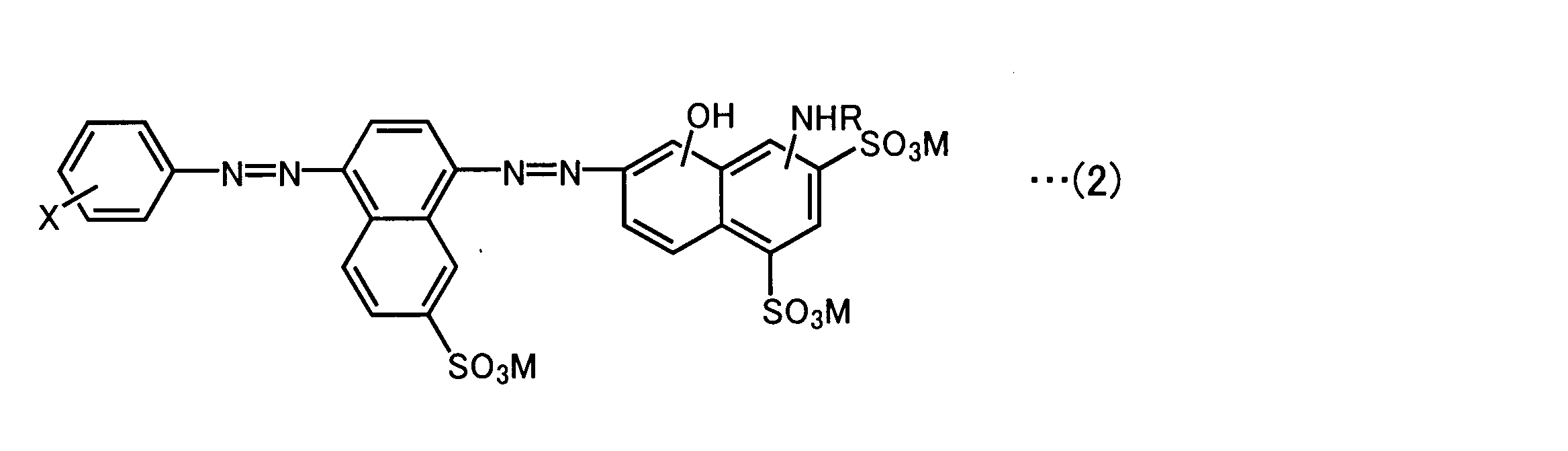
- the azo compound represented by following General formula (1) is preferable, and the azo compound represented by following General formula (2) is more preferable.
- Such an azo compound exhibits a stable liquid crystal phase (lyotropic liquid crystallinity) when dissolved in a solvent, and is excellent in orientation.
- the azo compound has a —SO 3 M group at a specific position, so that the steric hindrance between the —SO 3 M groups is reduced, and the linearity of the molecule is maintained before and after water resistance treatment. As a result, A polarizing film having a high degree of polarization can be obtained.
- Q represents a substituted or unsubstituted phenyl group or a substituted or unsubstituted naphthyl group.
- R represents a hydrogen atom, an alkyl group having 1 to 3 carbon atoms, an acetyl group, a substituted or unsubstituted benzoyl group, or a substituted or unsubstituted phenyl group.
- X represents a hydrogen atom, a halogen atom, a nitro group, a cyano group, an alkyl group having 1 to 4 carbon atoms, an alkoxy group having 1 to 4 carbon atoms, or an —SO 3 M group.
- M is any one of a hydrogen atom, an alkali metal atom, and an alkaline earth metal atom before bringing the liquid containing the cationic polymer into contact with the surface of the polarizing film. . After contacting the liquid containing the cationic polymer, M is part or all of the cationic species of the cationic polymer.
- the azo compound represented by the above general formulas (1) and (2) is, for example, a diazotization and coupling reaction of an aniline derivative and a naphthalenesulfonic acid derivative by a conventional method to obtain a monoazo compound, and further diazotized. It can be obtained by a coupling reaction with an aminonaphthol disulfonic acid derivative.
- the liquid containing the cationic polymer used in the present invention is obtained by dissolving or dispersing the cationic polymer in an arbitrary solvent.
- the above cationic polymer refers to a compound having a cationic group in the main chain or side chain and having a molecular weight of several hundreds or more.
- the cationic polymer may be linear, branched or crosslinked, and the molecular weight is preferably 300 or more, more preferably 1,000 to 1,000,000. .
- the cationic group is not particularly limited, and examples thereof include an amino group, an imino group, an ammonium group, and a group having a nitrogen atom in a part of the ring.
- the cationic polymer examples include polyallylamine, polydiallylamine, polyethyleneimine, dicyandiamide polyalkylenepolyamine, condensate of dialkylamine and epichlorohydrin, polyvinylamine, polyvinylpyridine, polyvinylimidazole, and diallyldimethylammonium salt. Etc.
- the above cationic polymers may be used singly or in combination. Further, it may be used by mixing with a polyvalent metal salt such as an alkaline earth metal salt.
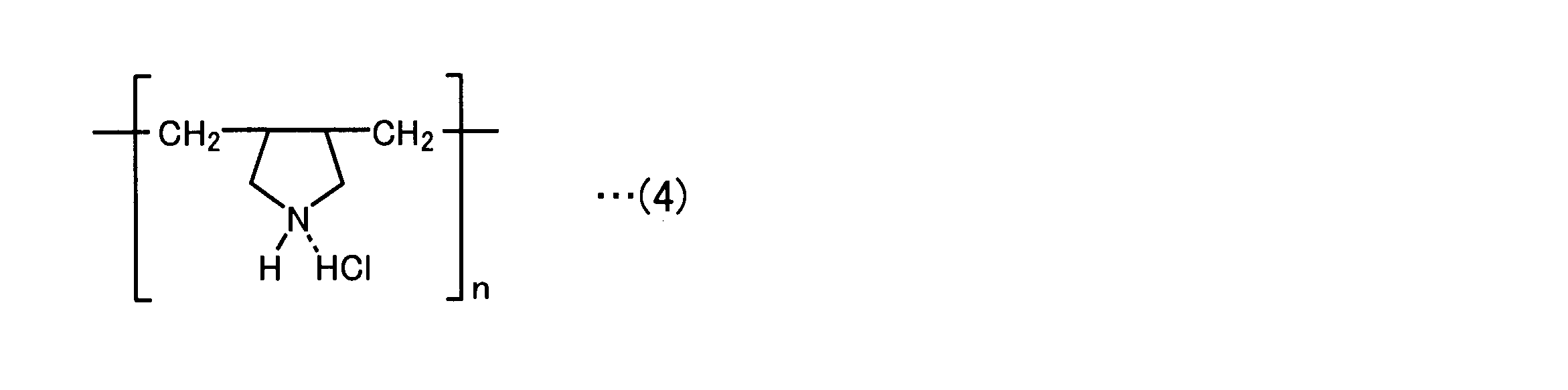
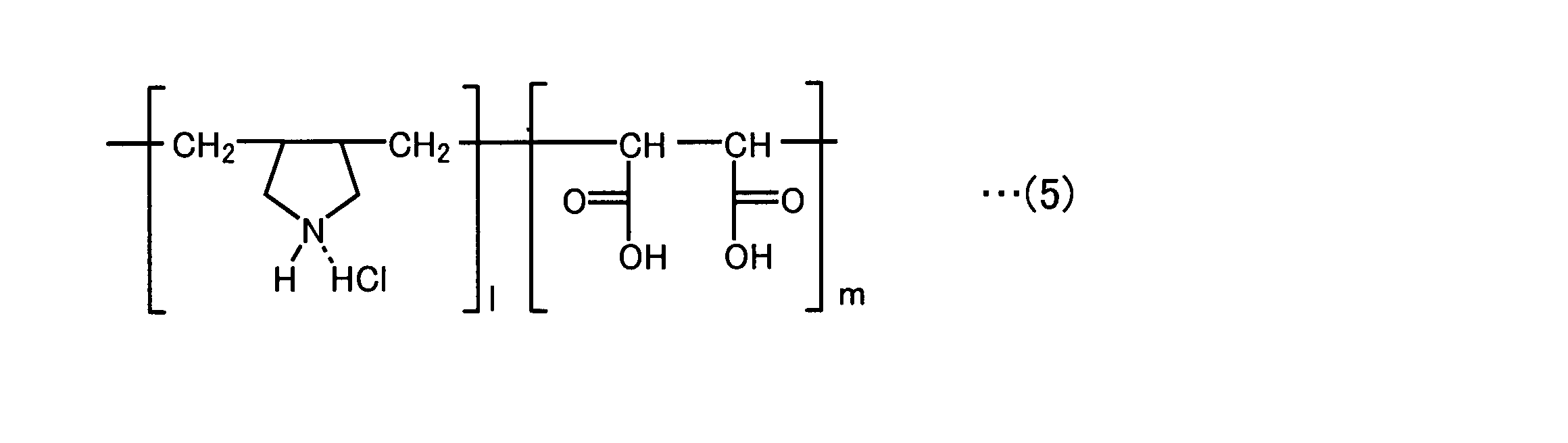
- the cationic polymer is preferably a polymer having an amino group or a heterocyclic polymer having a nitrogen atom, and a diallylamine hydrochloride polymer of the following structural formula (4), a diallylamine hydrochloride / maleic acid copolymer of (5), Or the allylamine amide sulfate polymer of (6) is more preferable.
- a hydrophilic solvent is preferable.
- the hydrophilic solvent is preferably water, alcohols, cellosolves, or a mixed solvent thereof.
- the concentration of the cationic polymer in the liquid containing the cationic polymer used in the present invention is preferably 10% to 50% by weight, more preferably 20% to 30% by weight, based on the total weight of the liquid. is there.
- the means for bringing the liquid containing the cationic polymer into contact with the surface of the polarizing film containing the organic dye having an anionic group used in the present invention and the liquid containing the cationic polymer is applied to the surface of the polarizing film.
- the polarizing film may be immersed in a liquid containing a cationic polymer.
- the water-resistant polarizing film is obtained by bringing a liquid containing a cationic polymer into contact with the surface of a polarizing film containing an organic dye having an anionic group.
- the polarizing film obtained by the present invention contains, for example, the azo compound represented by the general formula (1) or (2), a part or all of M (monovalent cation) in the formula is a cationic polymer. Which is substituted with a cationic species.
- the above water-resistant polarizing film exhibits absorption dichroism in at least one wavelength in the visible light region (wavelength 380 nm to 780 nm).
- the degree of polarization determined from the Y value of the water-resistant polarizing film corrected for visibility is preferably 95% or more.
- the thickness of the water-resistant polarizing film is not particularly limited, but is preferably 0.1 ⁇ m to 10 ⁇ m. When the thickness of the water-resistant polarizing film is less than 1 ⁇ m, the water-resistant polarizing film may be formed on the support in order to ensure self-supporting properties.
- the water-resistant polarizing film obtained by the production method of the present invention is suitably used as a polarizing element.
- Polarizing elements are used in liquid crystal panels such as liquid crystal televisions, computer displays, mobile phones, digital cameras, personal digital assistants, portable game machines, video cameras, and car navigation systems.
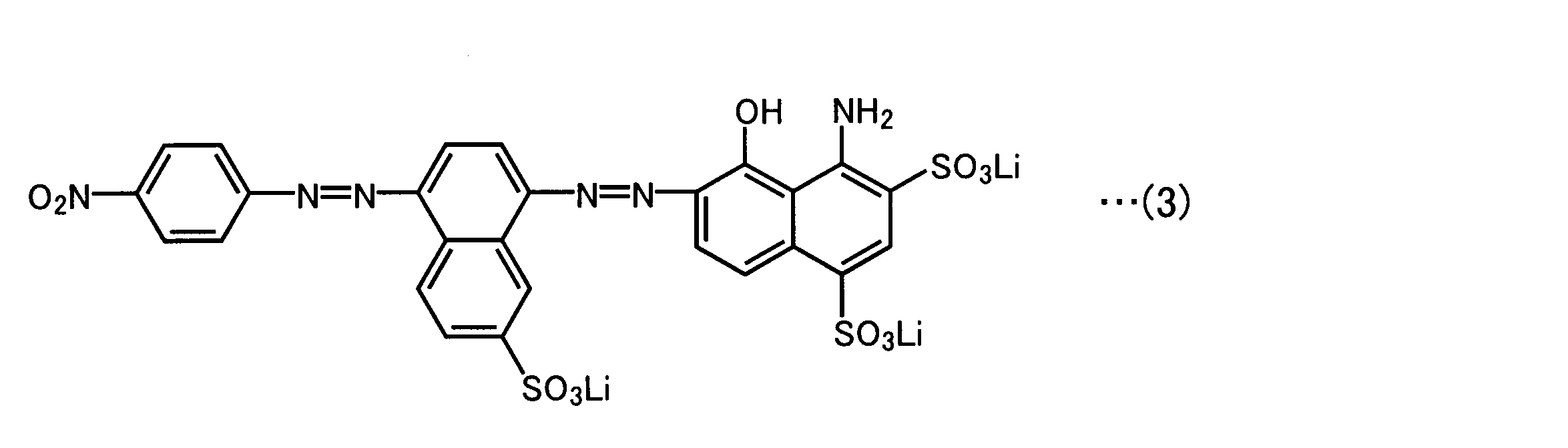
- Example 1 Using 4-nitroaniline and 8-amino-2-naphthalenesulfonic acid in a conventional manner (Toyo Hosoda, “Theoretical Manufacturing, Dye Chemistry, 5th Edition”, issued July 15, 1968, Technique Hall, pages 135-152) Diazotization and coupling reaction were performed to obtain a monoazo compound.
- the resulting monoazo compound is similarly diazotized by a conventional method and further coupled with 1-amino-8-naphthol-2,4-disulfonic acid lithium salt to obtain a crude product, which is salted out with lithium chloride.
- an azo compound of the following structural formula (3) was obtained.
- the azo compound represented by the structural formula (3) was dissolved in ion exchange water to prepare a coating solution having an azo compound concentration of 20% by weight.
- the pH of this coating solution was 7.8.
- the coating liquid was collected with a poly dropper, and sandwiched between two glass slides. When observed with a polarizing microscope at room temperature (23 ° C.), a nematic liquid crystal phase was observed.
- This coating solution is applied to the surface of a norbornene-based polymer film (trade name “ZEONOR” manufactured by ZEON Corporation) that has been subjected to rubbing and corona treatment using a bar coater (product name “MAYER rot HS4” manufactured by BUSCHMAN). Then, it was naturally dried in a thermostatic chamber at 23 ° C. to produce a laminate of a polarizing film and a norbornene polymer film. The thickness of the polarizing film was 0.4 ⁇ m.
- the laminate of the polarizing film and the norbornene-based polymer film was immersed in water containing 25% by weight of diallylamine hydrochloride polymer (product name “PAS-21CL” manufactured by Nittobo Co., Ltd., average molecular weight 110,000) for 30 minutes, Thereafter, the surface of the polarizing film was washed with water and dried.
- the ions (C 4 H 6 N + ) derived from diallylamine hydrochloride polymer were found to be uniform in the water-resistant polarizing film.
- lithium ions (Li + ) were not detected. This confirmed that lithium ions were substituted with ions derived from diallylamine hydrochloride polymer in the water-resistant polarizing film.
- Table 1 shows the evaluation results of optical properties and water resistance tests of the water-resistant polarizing film thus obtained.
- Example 2 A water-resistant polarizing film was prepared in the same manner as in Example 1 except that diallylamine hydrochloride / maleic acid copolymer (trade name “PAS-410” manufactured by Nittobo Co., Ltd.) was used instead of diallylamine hydrochloride polymer.
- Table 1 shows the optical characteristics of the obtained water-resistant polarizing film and the evaluation results of the water resistance test.
- Example 3 A water-resistant polarizing film was produced in the same manner as in Example 1 except that an allylamine amide sulfate polymer (trade name “PAA-SA” manufactured by Nittobo Co., Ltd.) was used instead of the diallylamine hydrochloride polymer. .
- Table 1 shows the optical characteristics of the obtained water-resistant polarizing film and the evaluation results of the water resistance test.
- Example 4 A water-resistant polarizing film was produced in the same manner as in Example 1 except that an allylamine hydrochloride polymer (trade name “PAA-HCL-3L” manufactured by Nittobo Co., Ltd.) was used instead of the diallylamine hydrochloride polymer. did. Table 1 shows the optical characteristics of the obtained water-resistant polarizing film and the evaluation results of the water resistance test.
- an allylamine hydrochloride polymer trade name “PAA-HCL-3L” manufactured by Nittobo Co., Ltd.
- Example 1 A water-resistant polarizing film was produced in the same manner as in Example 1 except that barium chloride was used in place of the diallylamine hydrochloride polymer. Table 1 shows the optical characteristics of the obtained water-resistant polarizing film and the evaluation results of the water resistance test.
- Example 2 A water-resistant polarizing film was produced in the same manner as in Example 1 except that triethylamine (molecular weight 101) was used in place of the diallylamine hydrochloride polymer. Table 1 shows the optical characteristics of the obtained water-resistant polarizing film and the evaluation results of the water resistance test.
- Table 1 shows the optical characteristics of the polarizing film and the evaluation results of the water resistance test before performing the water resistance treatment with the liquid containing the diallylamine hydrochloride polymer in Example 1.
Landscapes
- Physics & Mathematics (AREA)
- General Physics & Mathematics (AREA)
- Optics & Photonics (AREA)
- Chemical & Material Sciences (AREA)
- Health & Medical Sciences (AREA)
- Chemical Kinetics & Catalysis (AREA)
- Medicinal Chemistry (AREA)
- Polymers & Plastics (AREA)
- Organic Chemistry (AREA)
- Polarising Elements (AREA)
- Liquid Crystal (AREA)
Abstract
Description
(1)本発明の耐水性偏光膜の製造方法は、アニオン性基を有する有機色素を含む偏光膜の表面に、カチオン性ポリマーを含む液体を接触させることを特徴とする。
(2)本発明の耐水性偏光膜の製造方法は、アニオン性基が、スルホン酸基、カルボキシル基、リン酸基、およびそれらの塩基のいずれかであることを特徴とする。
(3)本発明の耐水性偏光膜の製造方法は、カチオン性ポリマーが、アミノ基を有するポリマーまたは窒素原子を有する複素環ポリマーであることを特徴とする。
(4)本発明の耐水性偏光膜の製造方法は、カチオン性ポリマーが、ジアリルアミン塩酸塩重合体、ジアリルアミン塩酸塩・マレイン酸共重合体、アリルアミンアミド硫酸塩重合体、アリルアミン塩酸塩重合体のいずれかであることを特徴とする。
本発明の耐水性偏光膜の製造方法は、アニオン性基を有する有機色素を含む偏光膜の表面に、カチオン性ポリマーを含む液体を接触させる工程を含む。本発明の耐水性偏光膜の製造方法は、前記の工程を含むものであれば、特に制限はなく、任意の他の工程を含んでいてもよい。
本発明に用いられる耐水化処理前の偏光膜は、アニオン性基を有する有機色素を含む。アニオン性基を有する有機色素の含有量は、偏光膜の総重量の好ましくは80重量%~100重量%であり、さらに好ましくは90重量%~100重量%である。
本発明に用いられるアニオン性基を含む有機色素は、色素の分子中にアニオン性基を有するものである。アニオン性基としては、スルホン酸基、カルボキシル基、リン酸基、およびそれらの塩基などが挙げられる。有機色素が有するアニオン性基の個数(置換数)は、2~4が好ましい。このような有機色素は、カチオン性ポリマーを含む液体を接触させる前(耐水化処理前)は、アニオン性基が親水性溶媒に対する溶解性を付与する置換基として作用するので、コーティング液を調製しやすい。一方、カチオン性ポリマーを含む液体を接触させた後(耐水化処理後)は、アニオン性基がカチオン性ポリマーとの架橋点として作用するので、優れた耐水性偏光膜が得られる。

本発明に用いられるカチオン性ポリマーを含む液体は、カチオン性ポリマーを任意の溶媒に溶解または分散させたものである。上記のカチオン性ポリマーとは、カチオン性基を主鎖または側鎖に有する、分子量が数百以上の化合物をいう。

本発明の製造方法において、耐水性偏光膜は、アニオン性基を有する有機色素を含む偏光膜の表面に、カチオン性ポリマーを含む液体を接触させて得られる。本発明により得られる偏光膜は、例えば上記の一般式(1)または(2)で表わされるアゾ化合物を含む場合、式中のM(一価陽イオン)の一部または全部が、カチオン性ポリマーのカチオン種で置換されたものである。
本発明の製造方法により得られる耐水性偏光膜は、偏光素子として好適に用いられる。偏光素子は、液晶テレビ、コンピュータディスプレイ、携帯電話、デジタルカメラ、携帯情報端末、携帯ゲーム機、ビデオカメラ、カーナビゲーションなどの液晶パネルに使われる。
4-ニトロアニリンと8-アミノ-2-ナフタレンスルホン酸とを常法(細田豊著「理論製造 染料化学 第5版」昭和43年7月15日技法堂発行、135ページ~152ページ)により、ジアゾ化およびカップリング反応させて、モノアゾ化合物を得た。得られたモノアゾ化合物を同様に常法によりジアゾ化し、さらに1-アミノ-8-ナフトール-2,4-ジスルホン酸リチウム塩とカップリング反応させて粗生成物を得、これを塩化リチウムで塩析することにより下記の構造式(3)のアゾ化合物を得た。
このようにして得られた耐水性偏光膜の、光学特性と耐水試験の評価結果を表1に示す。
ジアリルアミン塩酸塩重合体に代えて、ジアリルアミン塩酸塩・マレイン酸共重合体(日東紡社製 商品名「PAS-410」)を用いたこと以外は、実施例1と同様の方法で耐水性偏光膜を作製した。得られた耐水性偏光膜の光学特性と耐水試験の評価結果を表1に示す。
ジアリルアミン塩酸塩重合体に代えて、アリルアミンアミド硫酸塩重合体(日東紡社製 商品名「PAA-SA」)を用いたこと以外は、実施例1と同様の方法で耐水性偏光膜を作製した。得られた耐水性偏光膜の光学特性と耐水試験の評価結果を表1に示す。
ジアリルアミン塩酸塩重合体に代えて、アリルアミン塩酸塩重合体(日東紡社製 商品名「PAA-HCL-3L」)を用いたこと以外は、実施例1と同様の方法で耐水性偏光膜を作製した。得られた耐水性偏光膜の光学特性と耐水試験の評価結果を表1に示す。
ジアリルアミン塩酸塩重合体に代えて、塩化バリウムを用いたこと以外は、実施例1と同様の方法で耐水性偏光膜を作製した。得られた耐水性偏光膜の光学特性と耐水試験の評価結果を表1に示す。
ジアリルアミン塩酸塩重合体に代えて、トリエチルアミン(分子量101)を用いたこと以外は、実施例1と同様の方法で耐水性偏光膜を作製した。得られた耐水性偏光膜の光学特性と耐水試験の評価結果を表1に示す。
実施例1において、ジアリルアミン塩酸塩重合体を含む液体で耐水化処理を行なう前の偏光膜の光学特性と耐水試験の評価結果を表1に示す。

(1)ジアリルアミン塩酸塩重合体PAS-21CLによる耐水化処理は最も効果が高い。
(2)ジアリルアミン塩酸塩・マレイン酸共重合体PAS-410、アリルアミンアミド硫酸塩重合体PAA-SA、アリルアミン塩酸塩重合体PAA-HCL-3Lによる耐水化処理の効果はほぼ等しい。
(3)塩化バリウムによる耐水化処理は効果がかなり低い。
(4)トリエチルアミンによる耐水化処理は効果がない。
[厚みの測定]
偏光膜の一部を剥離し、三次元非接触表面形状計測システム(菱化システム社製 製品名「Micromap MM5200」)を用いて段差を測定し、偏光膜の厚みを求めた。
二枚のスライドガラスにコーティング液を少量挟み込み、顕微鏡用大型試料加熱冷却ステージ(ジャパンハイテック社製 製品名「10013L」)を備えた偏光顕微鏡(オリンパス社製 商品名「OPTIPHOT-POL」)を用いて観察した。
耐水化処理後の偏光膜と基材の積層体(寸法1cm×2cm)を、ポリカップ容器に入った100mlの水に浸漬して3時間放置した後、水が均一になるように攪拌し、水の波長594nmにおける吸光度を分光器(VARIAN社製 製品名「CARY500i」)で測定した。得られた吸光度から、次式により残存率、溶解率を求めた。
・溶解率(%)=(A1/A0)×100
・残存率(%)=100-溶解率
ここで、A1は3時間放置した後の水の吸光度、A0は偏光膜が完全に溶解した水の吸光度である。
[耐水性偏光膜のイオン分布の測定]
耐水性偏光膜を、精密切断機(MEKONG社製)を用いて斜めに切削し、切削面をTOF-SIMS(ION-TOF社製「TOF-SIMS5」を用いて分析した。条件は、一次イオン加速電圧=25kvとした。
Claims (4)
- アニオン性基を有する有機色素を含む偏光膜の表面に、カチオン性ポリマーを含む液体を接触させることを特徴とする、耐水性偏光膜の製造方法。
- 前記アニオン性基が、スルホン酸基、カルボキシル基、リン酸基、およびそれらの塩基のいずれかであることを特徴とする、請求項1に記載の耐水性偏光膜の製造方法。
- 前記カチオン性ポリマーが、アミノ基を有するポリマーまたは窒素原子を有する複素環ポリマーであることを特徴とする、請求項1に記載の耐水性偏光膜の製造方法。
- 前記カチオン性ポリマーが、ジアリルアミン塩酸塩重合体、ジアリルアミン塩酸塩・マレイン酸共重合体、アリルアミンアミド硫酸塩重合体、アリルアミン塩酸塩重合体のいずれかであることを特徴とする、請求項3に記載の耐水性偏光膜の製造方法。
Priority Applications (2)
| Application Number | Priority Date | Filing Date | Title |
|---|---|---|---|
| US12/999,763 US8597550B2 (en) | 2008-06-20 | 2009-02-04 | Method for producing water-resistant polarizing film |
| CN200980117674.7A CN102026738B (zh) | 2008-06-20 | 2009-02-04 | 耐水性偏光膜的制造方法 |
Applications Claiming Priority (4)
| Application Number | Priority Date | Filing Date | Title |
|---|---|---|---|
| JP2008161200 | 2008-06-20 | ||
| JP2008-161200 | 2008-06-20 | ||
| JP2008-262337 | 2008-10-09 | ||
| JP2008262337A JP5323439B2 (ja) | 2008-06-20 | 2008-10-09 | 耐水性偏光膜の製造方法 |
Publications (1)
| Publication Number | Publication Date |
|---|---|
| WO2009154010A1 true WO2009154010A1 (ja) | 2009-12-23 |
Family
ID=41433928
Family Applications (1)
| Application Number | Title | Priority Date | Filing Date |
|---|---|---|---|
| PCT/JP2009/051836 Ceased WO2009154010A1 (ja) | 2008-06-20 | 2009-02-04 | 耐水性偏光膜の製造方法 |
Country Status (6)
| Country | Link |
|---|---|
| US (1) | US8597550B2 (ja) |
| JP (1) | JP5323439B2 (ja) |
| KR (1) | KR101175084B1 (ja) |
| CN (1) | CN102026738B (ja) |
| TW (1) | TWI398678B (ja) |
| WO (1) | WO2009154010A1 (ja) |
Cited By (1)
| Publication number | Priority date | Publication date | Assignee | Title |
|---|---|---|---|---|
| EP2325678A4 (en) * | 2009-05-12 | 2013-03-06 | Nitto Denko Corp | HYDROREESISING POLARIZING FILM, PROCESS FOR PRODUCING THE SAME, AND IMAGE DISPLAY DEVICE |
Families Citing this family (9)
| Publication number | Priority date | Publication date | Assignee | Title |
|---|---|---|---|---|
| JP5887660B2 (ja) * | 2011-12-07 | 2016-03-16 | 日東電工株式会社 | 耐水性光学異方性フィルムの製造方法 |
| JP6059088B2 (ja) | 2012-06-14 | 2017-01-11 | 日東電工株式会社 | 耐水性有機薄膜、耐水性有機薄膜の製造方法、及び、耐水性有機薄膜を有する画像表示装置 |
| JP6018984B2 (ja) * | 2013-07-31 | 2016-11-02 | 富士フイルム株式会社 | 着色組成物、硬化膜、カラーフィルタ、カラーフィルタの製造方法、固体撮像素子および画像表示装置 |
| JP6643805B2 (ja) | 2014-01-30 | 2020-02-12 | 日東電工株式会社 | 偏光板及び偏光板の製造方法 |
| KR102469691B1 (ko) * | 2015-11-30 | 2022-11-22 | 엘지디스플레이 주식회사 | 액정표시장치 및 그 제조방법 |
| WO2018123691A1 (ja) * | 2016-12-27 | 2018-07-05 | 三菱ケミカル株式会社 | 異方性色素膜形成用組成物及び異方性色素膜 |
| JP7024379B2 (ja) * | 2016-12-27 | 2022-02-24 | 三菱ケミカル株式会社 | 異方性色素膜形成用組成物、異方性色素膜及び偏光素子 |
| JP7024458B2 (ja) * | 2017-03-27 | 2022-02-24 | 三菱ケミカル株式会社 | 異方性色素膜形成用組成物、異方性色素膜及び偏光素子 |
| JP2018205712A (ja) * | 2017-06-01 | 2018-12-27 | 三菱ケミカル株式会社 | 異方性膜形成用組成物、異方性膜、及び光学素子 |
Citations (2)
| Publication number | Priority date | Publication date | Assignee | Title |
|---|---|---|---|---|
| JP2003181989A (ja) * | 2001-12-20 | 2003-07-03 | Nippon Zeon Co Ltd | 積層体及びその製造方法 |
| JP2007241269A (ja) * | 2006-02-10 | 2007-09-20 | Mitsubishi Chemicals Corp | 樹脂組成物、並びに光学素子及び液晶表示素子 |
Family Cites Families (18)
| Publication number | Priority date | Publication date | Assignee | Title |
|---|---|---|---|---|
| JPH1121538A (ja) | 1997-07-07 | 1999-01-26 | Nippon Kayaku Co Ltd | 有機薄膜 |
| US6953607B2 (en) * | 2001-11-02 | 2005-10-11 | Virginia Tech Intellectual Properties, Inc. | Polar ordering of reactive chromophores in layer-by-layer nonlinear optical materials |
| TWI240724B (en) * | 2001-12-17 | 2005-10-01 | Kuraray Co | Polyvinyl alcohol film and polarizing film |
| JP2004347989A (ja) * | 2003-05-23 | 2004-12-09 | Nakan Corp | 偏光膜の製造方法 |
| JP3981648B2 (ja) * | 2003-05-07 | 2007-09-26 | ナカン株式会社 | 偏光膜製造装置 |
| JP4079824B2 (ja) * | 2003-04-28 | 2008-04-23 | 花王株式会社 | インクジェット記録シート |
| JP2005135145A (ja) * | 2003-10-30 | 2005-05-26 | Konica Minolta Photo Imaging Inc | Icカード、icカードの製造方法及びicカードの製造装置 |
| CN100549738C (zh) * | 2005-03-10 | 2009-10-14 | 日本化药株式会社 | 碘系偏光膜及其制造方法和使用该碘系偏光膜的偏光板 |
| JP5200325B2 (ja) * | 2005-04-04 | 2013-06-05 | 三菱化学株式会社 | 湿式成膜法により形成された異方性色素膜及び偏光素子 |
| US20090040609A1 (en) * | 2005-04-21 | 2009-02-12 | Mitsubishi Chemical Corporation | Composition for anisotropic dye film, anisotropic dye film, and polarizing device |
| JP4946149B2 (ja) | 2005-04-21 | 2012-06-06 | 三菱化学株式会社 | 異方性色素膜用組成物、異方性色素膜及び偏光素子 |
| JP2007061755A (ja) | 2005-08-31 | 2007-03-15 | Mitsubishi Chemicals Corp | 光学素子の製造方法 |
| JP2007307885A (ja) * | 2005-11-04 | 2007-11-29 | Ricoh Co Ltd | 画像処理方法、記録物、プログラム、画像処理装置、画像形成装置及び画像形成システム、画像形成方法及びインク |
| JP2007290390A (ja) * | 2006-03-30 | 2007-11-08 | Nippon Paper Industries Co Ltd | インクジェット用記録媒体とその製造方法 |
| JP2007332505A (ja) * | 2006-06-16 | 2007-12-27 | Seiko Pmc Corp | 填料改質剤、填料スラリー及び製紙方法 |
| CN101479347B (zh) * | 2006-06-22 | 2013-08-07 | 日本化药株式会社 | 偶氮化合物和含有该偶氮化合物的染料偏振膜 |
| JP2008246739A (ja) * | 2007-03-29 | 2008-10-16 | Mitsubishi Paper Mills Ltd | インクジェット記録媒体 |
| JP2009093983A (ja) * | 2007-10-11 | 2009-04-30 | Toyota Central R&D Labs Inc | 二次電池 |
-
2008
- 2008-10-09 JP JP2008262337A patent/JP5323439B2/ja not_active Expired - Fee Related
-
2009
- 2009-02-04 KR KR1020107021632A patent/KR101175084B1/ko not_active Expired - Fee Related
- 2009-02-04 CN CN200980117674.7A patent/CN102026738B/zh not_active Expired - Fee Related
- 2009-02-04 US US12/999,763 patent/US8597550B2/en not_active Expired - Fee Related
- 2009-02-04 WO PCT/JP2009/051836 patent/WO2009154010A1/ja not_active Ceased
- 2009-02-11 TW TW098104375A patent/TWI398678B/zh not_active IP Right Cessation
Patent Citations (2)
| Publication number | Priority date | Publication date | Assignee | Title |
|---|---|---|---|---|
| JP2003181989A (ja) * | 2001-12-20 | 2003-07-03 | Nippon Zeon Co Ltd | 積層体及びその製造方法 |
| JP2007241269A (ja) * | 2006-02-10 | 2007-09-20 | Mitsubishi Chemicals Corp | 樹脂組成物、並びに光学素子及び液晶表示素子 |
Cited By (2)
| Publication number | Priority date | Publication date | Assignee | Title |
|---|---|---|---|---|
| EP2325678A4 (en) * | 2009-05-12 | 2013-03-06 | Nitto Denko Corp | HYDROREESISING POLARIZING FILM, PROCESS FOR PRODUCING THE SAME, AND IMAGE DISPLAY DEVICE |
| US8559106B2 (en) | 2009-05-12 | 2013-10-15 | Nitto Denko Corporation | Water-resistant polarizing film, process for producing water-resistant polarizing film, and image display device |
Also Published As
| Publication number | Publication date |
|---|---|
| TWI398678B (zh) | 2013-06-11 |
| US20110097483A1 (en) | 2011-04-28 |
| CN102026738A (zh) | 2011-04-20 |
| TW201000970A (en) | 2010-01-01 |
| US8597550B2 (en) | 2013-12-03 |
| JP5323439B2 (ja) | 2013-10-23 |
| KR20100133995A (ko) | 2010-12-22 |
| CN102026738B (zh) | 2014-04-16 |
| JP2010026479A (ja) | 2010-02-04 |
| KR101175084B1 (ko) | 2012-08-21 |
Similar Documents
| Publication | Publication Date | Title |
|---|---|---|
| JP5323439B2 (ja) | 耐水性偏光膜の製造方法 | |
| JP2012194357A (ja) | 偏光フィルム、コーティング液、及び画像表示装置 | |
| JP5153436B2 (ja) | 耐水性偏光膜の製造方法 | |
| US8168091B2 (en) | Polyvinyl alcohol film composition, and polarizing plate employing the same | |
| US8785607B2 (en) | Method for manufacturing water resistant optically anisotropic film, and image display device | |
| US9297931B2 (en) | Polarizing film, image display device, and method for producing polarizing film | |
| WO2010064512A1 (ja) | 耐水性偏光フィルム、及びその製造方法、及び画像表示装置 | |
| JP5752178B2 (ja) | 耐水性偏光膜の製造方法 | |
| JP2009294566A (ja) | 偏光膜 | |
| JP2010204527A (ja) | 偏光子、画像表示装置、及び偏光子の製造方法 | |
| JP5978529B2 (ja) | 偏光フィルム、画像表示装置、及び偏光フィルムの製造方法 | |
| JP5243989B2 (ja) | 耐水性偏光膜およびその製造方法 | |
| WO2010097853A1 (ja) | 耐水性偏光膜の製造方法 | |
| US9387507B2 (en) | Method for manufacturing water resistant optically anisotropic film, and water resistant optically anisotropic film | |
| US10598829B2 (en) | Water-resistant organic thin-film, method for producing water-resistant organic thin-film, and image display device including water-resistant organic thin-film | |
| JP2007121458A (ja) | 異方性色素膜用基板、異方性色素膜及びその製造方法、並びに偏光素子 |
Legal Events
| Date | Code | Title | Description |
|---|---|---|---|
| WWE | Wipo information: entry into national phase |
Ref document number: 200980117674.7 Country of ref document: CN |
|
| 121 | Ep: the epo has been informed by wipo that ep was designated in this application |
Ref document number: 09766458 Country of ref document: EP Kind code of ref document: A1 |
|
| ENP | Entry into the national phase |
Ref document number: 20107021632 Country of ref document: KR Kind code of ref document: A |
|
| WWE | Wipo information: entry into national phase |
Ref document number: 12999763 Country of ref document: US |
|
| NENP | Non-entry into the national phase |
Ref country code: DE |
|
| 122 | Ep: pct application non-entry in european phase |
Ref document number: 09766458 Country of ref document: EP Kind code of ref document: A1 |