WO2009136546A1 - 固体高分子型燃料電池用の電解質膜およびその製造方法 - Google Patents
固体高分子型燃料電池用の電解質膜およびその製造方法 Download PDFInfo
- Publication number
- WO2009136546A1 WO2009136546A1 PCT/JP2009/057999 JP2009057999W WO2009136546A1 WO 2009136546 A1 WO2009136546 A1 WO 2009136546A1 JP 2009057999 W JP2009057999 W JP 2009057999W WO 2009136546 A1 WO2009136546 A1 WO 2009136546A1
- Authority
- WO
- WIPO (PCT)
- Prior art keywords
- polymer
- electrolyte membrane
- fuel cell
- electrolyte
- base material
- Prior art date
- Legal status (The legal status is an assumption and is not a legal conclusion. Google has not performed a legal analysis and makes no representation as to the accuracy of the status listed.)
- Ceased
Links
Images
Classifications
-
- H—ELECTRICITY
- H01—ELECTRIC ELEMENTS
- H01B—CABLES; CONDUCTORS; INSULATORS; SELECTION OF MATERIALS FOR THEIR CONDUCTIVE, INSULATING OR DIELECTRIC PROPERTIES
- H01B1/00—Conductors or conductive bodies characterised by the conductive materials; Selection of materials as conductors
- H01B1/06—Conductors or conductive bodies characterised by the conductive materials; Selection of materials as conductors mainly consisting of other non-metallic substances
- H01B1/12—Conductors or conductive bodies characterised by the conductive materials; Selection of materials as conductors mainly consisting of other non-metallic substances organic substances
- H01B1/122—Ionic conductors
-
- C—CHEMISTRY; METALLURGY
- C08—ORGANIC MACROMOLECULAR COMPOUNDS; THEIR PREPARATION OR CHEMICAL WORKING-UP; COMPOSITIONS BASED THEREON
- C08G—MACROMOLECULAR COMPOUNDS OBTAINED OTHERWISE THAN BY REACTIONS ONLY INVOLVING UNSATURATED CARBON-TO-CARBON BONDS
- C08G73/00—Macromolecular compounds obtained by reactions forming a linkage containing nitrogen with or without oxygen or carbon in the main chain of the macromolecule, not provided for in groups C08G12/00 - C08G71/00
- C08G73/06—Polycondensates having nitrogen-containing heterocyclic rings in the main chain of the macromolecule
- C08G73/10—Polyimides; Polyester-imides; Polyamide-imides; Polyamide acids or similar polyimide precursors
- C08G73/1042—Copolyimides derived from at least two different tetracarboxylic compounds or two different diamino compounds
-
- C—CHEMISTRY; METALLURGY
- C08—ORGANIC MACROMOLECULAR COMPOUNDS; THEIR PREPARATION OR CHEMICAL WORKING-UP; COMPOSITIONS BASED THEREON
- C08G—MACROMOLECULAR COMPOUNDS OBTAINED OTHERWISE THAN BY REACTIONS ONLY INVOLVING UNSATURATED CARBON-TO-CARBON BONDS
- C08G73/00—Macromolecular compounds obtained by reactions forming a linkage containing nitrogen with or without oxygen or carbon in the main chain of the macromolecule, not provided for in groups C08G12/00 - C08G71/00
- C08G73/06—Polycondensates having nitrogen-containing heterocyclic rings in the main chain of the macromolecule
- C08G73/10—Polyimides; Polyester-imides; Polyamide-imides; Polyamide acids or similar polyimide precursors
- C08G73/1046—Polyimides containing oxygen in the form of ether bonds in the main chain
-
- C—CHEMISTRY; METALLURGY
- C08—ORGANIC MACROMOLECULAR COMPOUNDS; THEIR PREPARATION OR CHEMICAL WORKING-UP; COMPOSITIONS BASED THEREON
- C08G—MACROMOLECULAR COMPOUNDS OBTAINED OTHERWISE THAN BY REACTIONS ONLY INVOLVING UNSATURATED CARBON-TO-CARBON BONDS
- C08G73/00—Macromolecular compounds obtained by reactions forming a linkage containing nitrogen with or without oxygen or carbon in the main chain of the macromolecule, not provided for in groups C08G12/00 - C08G71/00
- C08G73/06—Polycondensates having nitrogen-containing heterocyclic rings in the main chain of the macromolecule
- C08G73/10—Polyimides; Polyester-imides; Polyamide-imides; Polyamide acids or similar polyimide precursors
- C08G73/1046—Polyimides containing oxygen in the form of ether bonds in the main chain
- C08G73/105—Polyimides containing oxygen in the form of ether bonds in the main chain with oxygen only in the diamino moiety
-
- C—CHEMISTRY; METALLURGY
- C08—ORGANIC MACROMOLECULAR COMPOUNDS; THEIR PREPARATION OR CHEMICAL WORKING-UP; COMPOSITIONS BASED THEREON
- C08G—MACROMOLECULAR COMPOUNDS OBTAINED OTHERWISE THAN BY REACTIONS ONLY INVOLVING UNSATURATED CARBON-TO-CARBON BONDS
- C08G73/00—Macromolecular compounds obtained by reactions forming a linkage containing nitrogen with or without oxygen or carbon in the main chain of the macromolecule, not provided for in groups C08G12/00 - C08G71/00
- C08G73/06—Polycondensates having nitrogen-containing heterocyclic rings in the main chain of the macromolecule
- C08G73/10—Polyimides; Polyester-imides; Polyamide-imides; Polyamide acids or similar polyimide precursors
- C08G73/1067—Wholly aromatic polyimides, i.e. having both tetracarboxylic and diamino moieties aromatically bound
-
- C—CHEMISTRY; METALLURGY
- C08—ORGANIC MACROMOLECULAR COMPOUNDS; THEIR PREPARATION OR CHEMICAL WORKING-UP; COMPOSITIONS BASED THEREON
- C08G—MACROMOLECULAR COMPOUNDS OBTAINED OTHERWISE THAN BY REACTIONS ONLY INVOLVING UNSATURATED CARBON-TO-CARBON BONDS
- C08G73/00—Macromolecular compounds obtained by reactions forming a linkage containing nitrogen with or without oxygen or carbon in the main chain of the macromolecule, not provided for in groups C08G12/00 - C08G71/00
- C08G73/06—Polycondensates having nitrogen-containing heterocyclic rings in the main chain of the macromolecule
- C08G73/10—Polyimides; Polyester-imides; Polyamide-imides; Polyamide acids or similar polyimide precursors
- C08G73/1067—Wholly aromatic polyimides, i.e. having both tetracarboxylic and diamino moieties aromatically bound
- C08G73/1071—Wholly aromatic polyimides containing oxygen in the form of ether bonds in the main chain
-
- C—CHEMISTRY; METALLURGY
- C08—ORGANIC MACROMOLECULAR COMPOUNDS; THEIR PREPARATION OR CHEMICAL WORKING-UP; COMPOSITIONS BASED THEREON
- C08J—WORKING-UP; GENERAL PROCESSES OF COMPOUNDING; AFTER-TREATMENT NOT COVERED BY SUBCLASSES C08B, C08C, C08F, C08G or C08H
- C08J5/00—Manufacture of articles or shaped materials containing macromolecular substances
- C08J5/20—Manufacture of shaped structures of ion-exchange resins
-
- C—CHEMISTRY; METALLURGY
- C08—ORGANIC MACROMOLECULAR COMPOUNDS; THEIR PREPARATION OR CHEMICAL WORKING-UP; COMPOSITIONS BASED THEREON
- C08J—WORKING-UP; GENERAL PROCESSES OF COMPOUNDING; AFTER-TREATMENT NOT COVERED BY SUBCLASSES C08B, C08C, C08F, C08G or C08H
- C08J5/00—Manufacture of articles or shaped materials containing macromolecular substances
- C08J5/20—Manufacture of shaped structures of ion-exchange resins
- C08J5/22—Films, membranes or diaphragms
- C08J5/2206—Films, membranes or diaphragms based on organic and/or inorganic macromolecular compounds
- C08J5/2275—Heterogeneous membranes
-
- C—CHEMISTRY; METALLURGY
- C08—ORGANIC MACROMOLECULAR COMPOUNDS; THEIR PREPARATION OR CHEMICAL WORKING-UP; COMPOSITIONS BASED THEREON
- C08L—COMPOSITIONS OF MACROMOLECULAR COMPOUNDS
- C08L79/00—Compositions of macromolecular compounds obtained by reactions forming in the main chain of the macromolecule a linkage containing nitrogen with or without oxygen or carbon only, not provided for in groups C08L61/00 - C08L77/00
- C08L79/04—Polycondensates having nitrogen-containing heterocyclic rings in the main chain; Polyhydrazides; Polyamide acids or similar polyimide precursors
- C08L79/08—Polyimides; Polyester-imides; Polyamide-imides; Polyamide acids or similar polyimide precursors
-
- H—ELECTRICITY
- H01—ELECTRIC ELEMENTS
- H01M—PROCESSES OR MEANS, e.g. BATTERIES, FOR THE DIRECT CONVERSION OF CHEMICAL ENERGY INTO ELECTRICAL ENERGY
- H01M8/00—Fuel cells; Manufacture thereof
- H01M8/10—Fuel cells with solid electrolytes
- H01M8/1004—Fuel cells with solid electrolytes characterised by membrane-electrode assemblies [MEA]
-
- H—ELECTRICITY
- H01—ELECTRIC ELEMENTS
- H01M—PROCESSES OR MEANS, e.g. BATTERIES, FOR THE DIRECT CONVERSION OF CHEMICAL ENERGY INTO ELECTRICAL ENERGY
- H01M8/00—Fuel cells; Manufacture thereof
- H01M8/10—Fuel cells with solid electrolytes
- H01M8/1016—Fuel cells with solid electrolytes characterised by the electrolyte material
- H01M8/1018—Polymeric electrolyte materials
- H01M8/102—Polymeric electrolyte materials characterised by the chemical structure of the main chain of the ion-conducting polymer
- H01M8/1023—Polymeric electrolyte materials characterised by the chemical structure of the main chain of the ion-conducting polymer having only carbon, e.g. polyarylenes, polystyrenes or polybutadiene-styrenes
-
- H—ELECTRICITY
- H01—ELECTRIC ELEMENTS
- H01M—PROCESSES OR MEANS, e.g. BATTERIES, FOR THE DIRECT CONVERSION OF CHEMICAL ENERGY INTO ELECTRICAL ENERGY
- H01M8/00—Fuel cells; Manufacture thereof
- H01M8/10—Fuel cells with solid electrolytes
- H01M8/1016—Fuel cells with solid electrolytes characterised by the electrolyte material
- H01M8/1018—Polymeric electrolyte materials
- H01M8/102—Polymeric electrolyte materials characterised by the chemical structure of the main chain of the ion-conducting polymer
- H01M8/103—Polymeric electrolyte materials characterised by the chemical structure of the main chain of the ion-conducting polymer having nitrogen, e.g. sulfonated polybenzimidazoles [S-PBI], polybenzimidazoles with phosphoric acid, sulfonated polyamides [S-PA] or sulfonated polyphosphazenes [S-PPh]
-
- H—ELECTRICITY
- H01—ELECTRIC ELEMENTS
- H01M—PROCESSES OR MEANS, e.g. BATTERIES, FOR THE DIRECT CONVERSION OF CHEMICAL ENERGY INTO ELECTRICAL ENERGY
- H01M8/00—Fuel cells; Manufacture thereof
- H01M8/10—Fuel cells with solid electrolytes
- H01M8/1016—Fuel cells with solid electrolytes characterised by the electrolyte material
- H01M8/1018—Polymeric electrolyte materials
- H01M8/1041—Polymer electrolyte composites, mixtures or blends
- H01M8/1044—Mixtures of polymers, of which at least one is ionically conductive
-
- H—ELECTRICITY
- H01—ELECTRIC ELEMENTS
- H01M—PROCESSES OR MEANS, e.g. BATTERIES, FOR THE DIRECT CONVERSION OF CHEMICAL ENERGY INTO ELECTRICAL ENERGY
- H01M8/00—Fuel cells; Manufacture thereof
- H01M8/10—Fuel cells with solid electrolytes
- H01M8/1016—Fuel cells with solid electrolytes characterised by the electrolyte material
- H01M8/1018—Polymeric electrolyte materials
- H01M8/1041—Polymer electrolyte composites, mixtures or blends
- H01M8/1053—Polymer electrolyte composites, mixtures or blends consisting of layers of polymers with at least one layer being ionically conductive
-
- C—CHEMISTRY; METALLURGY
- C08—ORGANIC MACROMOLECULAR COMPOUNDS; THEIR PREPARATION OR CHEMICAL WORKING-UP; COMPOSITIONS BASED THEREON
- C08J—WORKING-UP; GENERAL PROCESSES OF COMPOUNDING; AFTER-TREATMENT NOT COVERED BY SUBCLASSES C08B, C08C, C08F, C08G or C08H
- C08J2379/00—Characterised by the use of macromolecular compounds obtained by reactions forming in the main chain of the macromolecule a linkage containing nitrogen with or without oxygen, or carbon only, not provided for in groups C08J2361/00 - C08J2377/00
- C08J2379/04—Polycondensates having nitrogen-containing heterocyclic rings in the main chain; Polyhydrazides; Polyamide acids or similar polyimide precursors
- C08J2379/08—Polyimides; Polyester-imides; Polyamide-imides; Polyamide acids or similar polyimide precursors
-
- H—ELECTRICITY
- H01—ELECTRIC ELEMENTS
- H01M—PROCESSES OR MEANS, e.g. BATTERIES, FOR THE DIRECT CONVERSION OF CHEMICAL ENERGY INTO ELECTRICAL ENERGY
- H01M2300/00—Electrolytes
- H01M2300/0017—Non-aqueous electrolytes
- H01M2300/0065—Solid electrolytes
- H01M2300/0082—Organic polymers
-
- H—ELECTRICITY
- H01—ELECTRIC ELEMENTS
- H01M—PROCESSES OR MEANS, e.g. BATTERIES, FOR THE DIRECT CONVERSION OF CHEMICAL ENERGY INTO ELECTRICAL ENERGY
- H01M2300/00—Electrolytes
- H01M2300/0088—Composites
- H01M2300/0094—Composites in the form of layered products, e.g. coatings
-
- H—ELECTRICITY
- H01—ELECTRIC ELEMENTS
- H01M—PROCESSES OR MEANS, e.g. BATTERIES, FOR THE DIRECT CONVERSION OF CHEMICAL ENERGY INTO ELECTRICAL ENERGY
- H01M8/00—Fuel cells; Manufacture thereof
- H01M8/10—Fuel cells with solid electrolytes
- H01M8/1009—Fuel cells with solid electrolytes with one of the reactants being liquid, solid or liquid-charged
- H01M8/1011—Direct alcohol fuel cells [DAFC], e.g. direct methanol fuel cells [DMFC]
-
- Y—GENERAL TAGGING OF NEW TECHNOLOGICAL DEVELOPMENTS; GENERAL TAGGING OF CROSS-SECTIONAL TECHNOLOGIES SPANNING OVER SEVERAL SECTIONS OF THE IPC; TECHNICAL SUBJECTS COVERED BY FORMER USPC CROSS-REFERENCE ART COLLECTIONS [XRACs] AND DIGESTS
- Y02—TECHNOLOGIES OR APPLICATIONS FOR MITIGATION OR ADAPTATION AGAINST CLIMATE CHANGE
- Y02E—REDUCTION OF GREENHOUSE GAS [GHG] EMISSIONS, RELATED TO ENERGY GENERATION, TRANSMISSION OR DISTRIBUTION
- Y02E60/00—Enabling technologies; Technologies with a potential or indirect contribution to GHG emissions mitigation
- Y02E60/30—Hydrogen technology
- Y02E60/50—Fuel cells
-
- Y—GENERAL TAGGING OF NEW TECHNOLOGICAL DEVELOPMENTS; GENERAL TAGGING OF CROSS-SECTIONAL TECHNOLOGIES SPANNING OVER SEVERAL SECTIONS OF THE IPC; TECHNICAL SUBJECTS COVERED BY FORMER USPC CROSS-REFERENCE ART COLLECTIONS [XRACs] AND DIGESTS
- Y02—TECHNOLOGIES OR APPLICATIONS FOR MITIGATION OR ADAPTATION AGAINST CLIMATE CHANGE
- Y02P—CLIMATE CHANGE MITIGATION TECHNOLOGIES IN THE PRODUCTION OR PROCESSING OF GOODS
- Y02P70/00—Climate change mitigation technologies in the production process for final industrial or consumer products
- Y02P70/50—Manufacturing or production processes characterised by the final manufactured product
Definitions
- the present invention relates to an electrolyte membrane for a polymer electrolyte fuel cell and a method for producing the same.
- PEFC polymer electrolyte fuel cells
- the PEFC electrolyte membrane functions as an electrolyte that conducts protons between the fuel electrode and the oxidation electrode, and can be a partition that separates the fuel supplied to the fuel electrode and the oxidant supplied to the oxidation electrode. Desired. When the functions as the electrolyte and the partition are insufficient, the power generation efficiency of the fuel cell is lowered. Therefore, a polymer electrolyte membrane that is excellent in proton conductivity, electrochemical stability, and mechanical strength, and has low fuel and oxidant permeability is desired.
- perfluorocarbon sulfonic acid having a sulfonic acid group as a proton conductive group for example, “Nafion (registered trademark)” manufactured by DuPont
- Nafion registered trademark
- the perfluorocarbon sulfonic acid membrane is excellent in electrochemical stability, the fluororesin used as a raw material is not a general-purpose product and is very expensive because the synthesis process is complicated. The high cost of the electrolyte membrane is a major obstacle to the practical use of PEFC.
- the perfluorocarbon sulfonic acid membrane easily permeates methanol, and it is difficult to use the perfluorocarbon sulfonic acid membrane as an electrolyte membrane of a direct methanol fuel cell (DMFC) in which a solution containing methanol is supplied to the fuel electrode.
- DMFC direct methanol fuel cell
- Patent Documents 1 to 4 propose electrolyte membranes made of sulfonated polyetheretherketone, sulfonated polyethersulfone, sulfonated polysulfone, and sulfonated polyimide, respectively.
- the resin used as a raw material for these hydrocarbon-based electrolyte membranes is cheaper than the fluororesin, and the use of the electrolyte membrane can reduce the cost of PEFC.
- the performance of the hydrocarbon electrolyte membranes proposed in Patent Documents 1 to 4 is not always sufficient, and the PEFC using the hydrocarbon electrolyte membrane has not yet been put into practical use.
- JP-A-6-93114 Japanese Patent Laid-Open No. 10-45913 JP-A-9-245818 Special table 2000-510511 gazette
- hydrocarbon-based electrolyte membrane is not put into practical use, but it is often pointed out that the contact between the hydrocarbon-based electrolyte membrane and the electrode is not good. If the contact property is poor, it is difficult to reduce contact resistance and improve power generation efficiency.
- Non-patent Document 1 discloses a method of applying Nafion to an electrolyte membrane as another method for improving the contact between the electrolyte membrane and the electrode.
- a sulfonated polyimide membrane is immersed in a Nafion dispersion and dried.
- a Nafion layer is formed on the sulfonated polyimide film.
- a sulfonated polyimide film having a Nafion layer and an electrode are bonded by a hot press method.
- fluororesin can be avoided or suppressed, it is not over that.
- an object of the present invention is to provide a hydrocarbon-based electrolyte membrane having improved contact with an electrode.
- the present invention provides: The electrolyte membrane of the present invention, A pair of electrodes arranged to sandwich the electrolyte membrane; A membrane-electrode assembly is provided.
- the present invention provides: Provided is a fuel cell comprising the membrane-electrode assembly of the present invention as a power generation element.
- the present invention provides: Preparing a substrate containing a hydrocarbon-based electrolyte as a main component; Preparing a solution comprising a first polymer having a hydroxyl group and a second polymer having a proton conducting group; Forming a surface layer containing as a main component a polymer material in which the second polymer is held in a matrix formed by crosslinking the first polymer using the solution; , A method for producing an electrolyte membrane for a polymer electrolyte fuel cell is provided.
- the electrolyte membrane of the present invention has a base material layer and a surface layer laminated on the base material layer.
- the surface layer has a hydroxyl group and a proton conductive group. Hydroxyl groups are thought to increase the flexibility of the surface layer when containing water. Therefore, according to the electrolyte of the present invention, the contact property with the electrode can be improved by the surface layer while securing properties such as mechanical strength and gas barrier properties with the base material layer.
- the characteristics of each layer can be individually adjusted, so that the degree of freedom in design is higher than that in the single-layer configuration.
- the electrolyte membrane of the present invention has improved contact with the electrode as compared with the conventional hydrocarbon electrolyte membrane. Therefore, when the electrolyte membrane of the present invention is used for an MEA of a fuel cell, the time required for activation of the catalyst and the electrolyte (aging time) can be shortened, and the power generation efficiency can be increased.
- the “main component” refers to a component that is contained most by weight%.
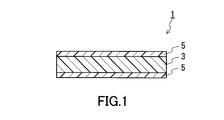
- FIG. 1 is a schematic diagram of a hydrocarbon-based electrolyte membrane of the present embodiment.
- the electrolyte membrane 1 has a base material layer 3 and a surface layer 5.
- the surface layer 5 is a layer laminated on the base material layer 3 and covers the surface of the base material layer 3.
- the surface of the electrolyte membrane 1 is formed by the surface layer 5.
- the surface layer 5 is provided on the upper surface and the lower surface of the base material layer 3 so as to sandwich the base material layer 3. Thereby, the contact property can be improved at both the anode and the cathode.
- the surface layer 5 may be provided only on one side of the base material layer 3.
- the base material layer 3 may be wrapped by the surface layer 5. That is, the side surface of the base material layer 3 may be covered with the surface layer 5.
- the base material layer 3 is a layer containing a hydrocarbon electrolyte as a main component.
- the hydrocarbon-based electrolyte swells with water, but has a property that is insoluble or hardly soluble in water.
- Examples of such a hydrocarbon electrolyte include sulfonated polyimide and sulfonated polyarylene.
- Examples of the sulfonated polyarylene include sulfonated polyetheretherketone and sulfonated polyethersulfone. These resins are cheaper than fluororesins and have excellent methanol barrier properties.
- sulfonated polyimide has a rigid molecular structure and is excellent in thermal or mechanical durability.
- the properties of sulfonated polyimide vary depending on the type of acid anhydride or diamine used as a raw material monomer. Therefore, when sulfonated polyimide is used as the material for the base material layer 3, the properties of the base material layer 3 can be adjusted relatively easily so as to match the properties required for the electrolyte membrane 1.
- sulfonated polyimide does not melt and has low affinity with electrodes. Therefore, the contact property between the electrolyte membrane made of sulfonated polyimide and the electrode is not so good. It has also been pointed out that an electrolyte membrane made of sulfonated polyimide is activated slowly.
- the electrolyte membrane 1 of this embodiment the base material layer 3 is covered with the surface layer 5. Therefore, the contact property between the electrolyte membrane 1 and the electrode is greatly improved as compared with a single sulfonated polyimide membrane. Further, the surface layer 5 can be activated more rapidly than the sulfonated polyimide film (base material layer 3).
- the thickness of the base material layer 3 is not particularly limited, but is preferably in the range of 5 to 300 ⁇ m in order to ensure the strength of the electrolyte membrane 1.
- the surface layer 5 is a layer containing a polymer material having a hydroxyl group and a proton conducting group other than a hydroxyl group.
- proton conducting groups are sulfonic acid groups and phosphoric acid groups, typically sulfonic acid groups.
- the surface layer 5 is a layer having moderate water retention. Proton or water can easily move between the electrolyte membrane 1 and the electrode by having appropriate water retention. Further, the surface layer 5 increases the flexibility of the surface of the electrolyte membrane 1. When the surface is soft, the electrolyte membrane 1 easily follows the unevenness of the electrode. As a result, the contact area between the electrolyte membrane 1 and the electrode is increased, and the contact resistance is also reduced.
- the polymer material constituting the surface layer 5 may include a first polymer having a hydroxyl group and a second polymer having a proton conductive group. More specifically, the first polymer is crosslinked to form a matrix, and the second polymer is held in the matrix.
- the first polymer is often water-soluble due to the influence of having a large number of hydroxyl groups, but a water-insoluble matrix can be formed by crosslinking treatment. Then, the second polymer having a proton conductive group is held in this matrix. In this way, the water-soluble second polymer can be used as the material for the surface layer 5.
- the surface layer 5 can be provided with excellent water retention and flexibility. In such a surface layer 5, water has a high mobility.
- a vinyl resin can be used as the first polymer.
- the vinyl resin are polyvinyl alcohol (PVA) and ethylene-vinyl alcohol copolymer (EVOH), which can be used alone or in combination.
- polyvinyl alcohol can be preferably used.
- PVA polyvinyl alcohol
- EVOH ethylene-vinyl alcohol copolymer
- PVA polyvinyl alcohol
- EVOH ethylene-vinyl alcohol copolymer
- Polysaccharides may be used as the first polymer.
- the polysaccharide at least one selected from the group consisting of chitin, chitosan and cellulose can be used.
- the first polymer a mixture of a vinyl resin and a polysaccharide can also be used.
- a sulfonated polyarylene having water solubility can be suitably used.
- the sulfonated polyarylene include sulfonated polyether ether ketone and sulfonated polyether sulfone.
- the sulfonated polyarylene used for the surface layer 5 may be given water-soluble properties by introducing many sulfonic acid groups.
- the second polymer is selected from the group consisting of polystyrene sulfonic acid, polyvinyl sulfonic acid, poly-2-acrylamido-2-methylpropane sulfonic acid, water-soluble sulfonated polyether ether ketone and water-soluble sulfonated polyether sulfone. At least one of these may be used. All of these have the property of being soluble in water. Similar to the first polymer, it is preferable that the second polymer is water-soluble from the viewpoint that the production method described later can be adopted.
- the magnitude relationship between the water retention of the surface layer 5 and the water retention of the base material layer 3 is not particularly limited.
- the water weight swelling ratio can be adopted as an index of water retention. The higher the water weight swelling rate, the better the water retention.
- the surface layer 5 preferably has a water weight swelling rate of 40 to 200%. Thereby, the surface layer 5 exhibits sufficient water retention and high flexibility, and the effect of improving the contact property between the electrolyte membrane 1 and the electrode is sufficiently obtained.
- the base material layer 3 may also have the same level of water retention as the surface layer 5.
- the water weight swelling rate of the surface layer 5 can be measured by the following procedure.
- the water weight swelling rate of the electrolyte membrane 1 and the water weight swelling rate of the base material layer 3 are individually measured.
- the inherent water weight swelling ratio of the surface layer 5 can be estimated from the obtained measurement values and the dimensions of the respective layers.
- the thickness of the surface layer 5 is not particularly limited, but is preferably in the range of 0.3 to 200 ⁇ m or 1 to 50 ⁇ m. Although depending on the proton conductivity of the base material layer 3, if the surface layer 5 is too thick, the proton conductivity may be too low. On the other hand, if the surface layer 5 is too thin, the effect of the surface layer 5 on the contact property between the electrolyte membrane 1 and the electrode cannot be expected.
- the composition and thickness of the pair of surface layers 5 may be different from each other. This is because there may be a case where it is necessary to separately produce the surface layer 5 suitable for the anode and the surface layer 5 suitable for the cathode.
- the electrolyte membrane 1 shown in FIG. 1 can be manufactured by the following method. First, an electrolyte membrane containing a hydrocarbon-based electrolyte as a main component is prepared. This electrolyte membrane becomes the base material layer 3 and is, for example, a sulfonated polyimide electrolyte membrane. A method for producing a sulfonated polyimide electrolyte membrane is known and disclosed in Non-Patent Document 2, for example.
- a solution containing a first polymer having a hydroxyl group and a second polymer having a proton conductive group is prepared.
- a solvent that does not dissolve the electrolyte membrane that is to constitute the base material layer 3 may be used.
- water is used as the solvent.
- the first polymer and the second polymer need to be water-soluble.
- An aqueous solution of the first polymer and an aqueous solution of the second polymer may be prepared separately, and these aqueous solutions may be mixed and used.
- the ratio of the first polymer and the second polymer in the solution is not particularly limited. However, if there are too many second polymers having proton conducting groups, the mechanical strength of the surface layer 5 is insufficient, or the second polymer is likely to elute from the surface layer 5. On the other hand, when there is too little 2nd polymer
- macromolecule, proton conductivity will be insufficient and the malfunction of the electrolyte membrane 1 will be caused. Considering these points, when PVA is used as the first polymer, the ratio of the first polymer to the second polymer is expressed by weight ratio (first polymer: second polymer) 95: 5 to It may be in the range of 50:50.
- a film suitable as an electrolyte film can be formed by using PVA having a viscosity average molecular weight in the range of 10,000 to 2,000,000.
- a preferred range for the viscosity average molecular weight of PVA is, for example, 50000-200000.
- the concentration of the solution is not particularly limited, but is usually in the range of 1 to 50% by weight. If it is in the range of 3 to 20% by weight, it is easy to form the surface layer 5 having a uniform thickness.
- the solution is applied to the substrate.
- a coating method a dipping method or a spray method can be adopted. According to these methods, a film having a uniform thickness can be efficiently formed on the substrate.
- a dipping method with excellent production efficiency may be employed.
- the film thus formed on the substrate is a precursor film containing the first polymer and the second polymer. In the precursor film, the first polymer is not crosslinked.
- the precursor film formed on the substrate is dried.
- the drying of the precursor film may be performed by heating the precursor film.
- the 1st polymer which crystallizes by heat processing like PVA the presence or absence of the heating at the time of drying affects the characteristic of surface layer 5.
- Proton conductivity and methanol barrier property of the surface layer 5 can be improved by appropriately promoting crystallization of PVA before crosslinking.
- the precursor film can be dried by placing the substrate on which the precursor film is formed in a heat treatment furnace.
- the atmospheric temperature of the heat treatment furnace is not particularly limited as long as it is lower than the melting temperature or decomposition temperature of the precursor film.
- the temperature is preferably from 100 to 180 ° C., which is the temperature at which PVA crystallization proceeds, and is preferably from 120 to 140 ° C. at which PVA crystallization proceeds most.
- the heat treatment time is about several minutes to one hour because PVA crystallizes relatively quickly.
- a step of crosslinking the first polymer is performed.
- the crosslinking agent a crosslinking agent having a plurality of functional groups that react with the hydroxyl groups of the first polymer in the molecule may be used. Specific examples include glutaraldehyde, terephthalaldehyde, and suberoyl chloride.
- the crosslinking step can be performed according to a known method.
- the precursor film is immersed in a solution containing a crosslinking agent (crosslinking solution).
- crosslinking solution a crosslinking agent
- the concentration of the crosslinking solution and the crosslinking time may be appropriately set according to the composition of the precursor film and the type of the crosslinking agent.
- the concentration of the crosslinking solution is 1 to 20% by weight and the crosslinking time is 0.1 to 48 hours.
- the degree of crosslinking varies depending on the concentration of the crosslinking solution and the crosslinking time. Thereby, the water weight swelling rate and hardness of the surface layer 5 can be controlled.
- an acid treatment step for changing the proton conductive group to a proton type may be performed.
- the specific method of an acid treatment process is not specifically limited.
- the electrolyte membrane may be immersed in a 0.5 to 2N hydrochloric acid aqueous solution or sulfuric acid aqueous solution for about 1 to 24 hours.
- the electrolyte membrane 1 shown in FIG. 1 is obtained by performing the above steps.
- the electrolyte membrane 1 may be obtained by preparing a film as the surface layer 5 using a solution containing the first polymer and the second polymer and bonding the film to a substrate. This method is effective when the substrate is soluble in the solution.
- An electrolyte membrane having the structure shown in FIG. 1 can be manufactured by forming a polymer material obtained by these methods into a film shape and bonding it to a base material. Moreover, when adopting such a method, it is not necessary that the first polymer or the second polymer is soluble in water.
- the use of the electrolyte membrane of the present invention is not particularly limited, but is suitable for use as a polymer electrolyte membrane (PEM) of PEFC, particularly as a PFC of DMFC using a solution containing methanol as a fuel.
- PEM polymer electrolyte membrane
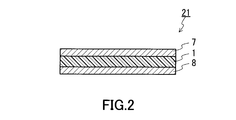
- FIG. 2 An example of the membrane-electrode assembly (MEA) of the present invention is shown in FIG.
- the MEA 21 shown in FIG. 2 includes an electrolyte membrane 1 and a pair of electrodes (anode 7 and cathode 8) disposed so as to sandwich the electrolyte membrane 1 therebetween.
- the electrolyte membrane 1 and the anode 7 are joined to each other.
- the electrolyte membrane 1 and the cathode 8 are joined together.
- the electrolyte membrane 1 and each electrode can be joined by a known technique such as hot pressing or pressure welding.
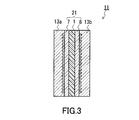
- FIG. 3 An example of the polymer electrolyte fuel cell (PEFC) of the present invention is shown in FIG. 3 .
- the fuel cell 11 shown in FIG. 3 includes an MEA 21 and a pair of separators (an anode separator 13a and a cathode separator 13b) disposed so as to sandwich the MEA 21 therebetween.
- Each member is joined in a state where pressure is applied in a direction perpendicular to the main surface of the member.
- the PEFC aging time and power generation efficiency can be improved by incorporating the MEA 21 using the electrolyte membrane 1 into the PEFC.
- the fuel cell of the present invention may include members other than the members shown in FIG. 3 as necessary. 3 is a so-called single cell, the fuel cell of the present invention may be a stack in which a plurality of such single cells are stacked.
- an aqueous solution of PVA degree of polymerization 3500
- an aqueous solution of sodium polystyrene sulfonate (PSSNa, weight average molecular weight 1000000) concentration 5% by weight
- PSSNa aqueous solution of sodium polystyrene sulfonate
- the mixed solution was stirred until the whole became uniform.
- the sulfonated polyimide electrolyte membrane was immersed in this mixed solution.
- the dimensions of the sulfonated polyimide electrolyte membrane were 10 cm in length, 10 cm in width, and 40 ⁇ m in thickness. After lifting the membrane from the mixed solution, it was dried at 60 ° C. Furthermore, after dipping once more, the membrane was dried at room temperature for 24 hours. In this way, a precursor film containing PVA and PSSNa was formed on the sulfonated polyimide electrolyte film.
- the film obtained above was immersed in a crosslinking solution at room temperature for 4 hours to carry out a crosslinking reaction.
- a crosslinking solution an acetone solution containing 18% by weight of glutaraldehyde and 0.01% by weight of sulfuric acid was used.
- the membrane was washed with pure water and further immersed in a 0.5 mol / liter sulfuric acid aqueous solution at 60 ° C. for 6 hours. Thereby, polystyrene sulfonate sodium (PSSNa) was changed to polystyrene sulfonate (PSSA).
- PSSNa polystyrene sulfonate sodium
- PSSA polystyrene sulfonate
- the membrane was washed with pure water and vacuum dried at room temperature for 24 hours.
- the thickness of the surface layer in this electrolyte membrane was 7 ⁇ m.
- a 30 ⁇ m-thick film made of PVA and PSSNa was prepared using the above mixed solution.
- This film was subjected to a crosslinking treatment under the same conditions as the electrolyte membrane of the example.
- This film is the same as the surface layer of the electrolyte membrane of the example.
- the water weight swelling rate of the film thus obtained was 64%.
- the water weight swelling rate of the sulfonated polyimide electrolyte membrane used as the substrate was 87%.
- a power generation test was performed using the electrolyte membrane of the example. Specifically, after the electrolyte membrane was immersed in water, a power generation test using a passive DMFC was performed.
- a carbon paper manufactured by Toray Industries, Inc., TGP-H-060
- TEC66E50 anode
- TEC10E50E cathode
- perfluorocarbon sulfonic acid manufactured by DuPont,
- a gas diffusion electrode provided with a catalyst layer made of Nafion DE-520 was used.
- the anode, the electrolyte membrane, and the cathode were overlapped, the outer plate of the DMFC was clamped, and the anode, the electrolyte membrane, and the cathode were pressed.
- a methanol aqueous solution having a concentration of 3 mol / liter was used as the fuel.
- the cathode was exposed to air.
- a propeller directly connected to the motor was used as the load.
- a sulfonated polyimide electrolyte membrane used as a substrate in the examples was prepared as an electrolyte membrane of a comparative example (length 10 cm, width 10 cm, thickness 40 ⁇ m). As described above, the water weight swelling ratio of the sulfonated polyimide electrolyte membrane was 87%.
- a power generation test using DMFC was performed on the electrolyte membrane of the comparative example under the same conditions as in the example. As a result, the propeller rotated 20 hours after the fuel supply, but stopped in 5 seconds. The voltage at the time of load was 0.08V.
Landscapes
- Chemical & Material Sciences (AREA)
- Chemical Kinetics & Catalysis (AREA)
- Engineering & Computer Science (AREA)
- Manufacturing & Machinery (AREA)
- Medicinal Chemistry (AREA)
- Polymers & Plastics (AREA)
- Organic Chemistry (AREA)
- Health & Medical Sciences (AREA)
- Sustainable Development (AREA)
- General Chemical & Material Sciences (AREA)
- Life Sciences & Earth Sciences (AREA)
- Sustainable Energy (AREA)
- Electrochemistry (AREA)
- Materials Engineering (AREA)
- Composite Materials (AREA)
- Crystallography & Structural Chemistry (AREA)
- Physics & Mathematics (AREA)
- Spectroscopy & Molecular Physics (AREA)
- Inorganic Chemistry (AREA)
- Fuel Cell (AREA)
- Manufacture Of Macromolecular Shaped Articles (AREA)
- Conductive Materials (AREA)
Priority Applications (3)
| Application Number | Priority Date | Filing Date | Title |
|---|---|---|---|
| CN200980116099.9A CN102017256B (zh) | 2008-05-08 | 2009-04-22 | 固体聚合物型燃料电池用电解质膜及其制造方法 |
| EP09742671.2A EP2276095B1 (en) | 2008-05-08 | 2009-04-22 | Electrolyte film for a solid polymer type fuel cell and method for producing same |
| US12/988,572 US8563194B2 (en) | 2008-05-08 | 2009-04-22 | Electrolyte membrane for polymer electrolyte fuel cell and method of manufacturing the same |
Applications Claiming Priority (2)
| Application Number | Priority Date | Filing Date | Title |
|---|---|---|---|
| JP2008-122759 | 2008-05-08 | ||
| JP2008122759 | 2008-05-08 |
Publications (1)
| Publication Number | Publication Date |
|---|---|
| WO2009136546A1 true WO2009136546A1 (ja) | 2009-11-12 |
Family
ID=41264601
Family Applications (1)
| Application Number | Title | Priority Date | Filing Date |
|---|---|---|---|
| PCT/JP2009/057999 Ceased WO2009136546A1 (ja) | 2008-05-08 | 2009-04-22 | 固体高分子型燃料電池用の電解質膜およびその製造方法 |
Country Status (5)
| Country | Link |
|---|---|
| US (1) | US8563194B2 (https=) |
| EP (1) | EP2276095B1 (https=) |
| JP (1) | JP5358261B2 (https=) |
| CN (1) | CN102017256B (https=) |
| WO (1) | WO2009136546A1 (https=) |
Cited By (1)
| Publication number | Priority date | Publication date | Assignee | Title |
|---|---|---|---|---|
| CN105924865A (zh) * | 2016-05-12 | 2016-09-07 | 盐城工学院 | 一种酸性质子交换膜及其制备方法 |
Families Citing this family (7)
| Publication number | Priority date | Publication date | Assignee | Title |
|---|---|---|---|---|
| CN102738494B (zh) * | 2012-05-18 | 2016-02-17 | 东华大学 | 细菌纤维素/Nafion质子交换混合膜及制备和应用 |
| CN106463751B (zh) * | 2014-07-10 | 2019-04-30 | 日新电机株式会社 | 氧化还原液流电池 |
| KR102006055B1 (ko) * | 2016-09-30 | 2019-07-31 | 고려대학교 산학협력단 | 다공성 유기 고분자 기반 수소 이온 전도 소재 및 이의 제조방법 |
| JP6942322B2 (ja) * | 2017-09-12 | 2021-09-29 | 国立研究開発法人物質・材料研究機構 | プロトン伝導性高分子−合成樹脂複合体、この複合体を含むプロトン伝導性電解質膜、プロトン伝導性高分子−合成樹脂複合体の合成方法、固体高分子電解質形燃料電池及び固体高分子電解質形水電解システム |
| JP7179311B2 (ja) * | 2018-07-30 | 2022-11-29 | 国立研究開発法人物質・材料研究機構 | 積層電解質膜、該電解質膜の製造方法、及び燃料電池 |
| CN116438687A (zh) | 2020-11-26 | 2023-07-14 | 东丽株式会社 | 气体扩散电极基材制品和固体高分子型燃料电池 |
| JP7720625B2 (ja) * | 2022-01-21 | 2025-08-08 | 国立大学法人九州大学 | 積層電解質膜、膜電極接合体及び固体高分子形燃料電池 |
Citations (9)
| Publication number | Priority date | Publication date | Assignee | Title |
|---|---|---|---|---|
| JP2000510511A (ja) | 1996-05-07 | 2000-08-15 | コミッサリア タ レネルジー アトミーク | スルホン化ポリイミド、膜及び燃料電池 |
| JP2001158806A (ja) * | 1999-09-20 | 2001-06-12 | Honda Motor Co Ltd | スルホン基含有ポリビニルアルコール、固体高分子電解質、高分子複合膜、その製造方法、および電極 |
| JP2004006306A (ja) * | 2002-04-17 | 2004-01-08 | Nec Corp | 燃料電池、燃料電池用電極およびそれらの製造方法 |
| JP2005353581A (ja) * | 2004-05-10 | 2005-12-22 | Toray Ind Inc | 電解質膜および膜電極複合体ならびに高分子電解質型燃料電池 |
| JP2006019261A (ja) * | 2004-06-30 | 2006-01-19 | Samsung Sdi Co Ltd | 燃料電池用電解質膜及びこれを含む燃料電池 |
| JP2006031970A (ja) * | 2004-07-12 | 2006-02-02 | Hitachi Chem Co Ltd | プロトン伝導性高分子電解質膜、高分子電解質膜−電極接合体、それらの製造方法及びそれを用いた燃料電池 |
| JP2006140086A (ja) * | 2004-11-15 | 2006-06-01 | Nitto Denko Corp | 耐酸化性の優れた電解質膜 |
| JP2007213936A (ja) * | 2006-02-08 | 2007-08-23 | Honda Motor Co Ltd | 固体高分子型燃料電池用膜−電極構造体及びその製造方法 |
| JP2007311239A (ja) * | 2006-05-19 | 2007-11-29 | National Institute Of Advanced Industrial & Technology | プロトン伝導性電解質膜及びその製造方法、ならびにその用途 |
Family Cites Families (12)
| Publication number | Priority date | Publication date | Assignee | Title |
|---|---|---|---|---|
| US4877529A (en) * | 1988-03-10 | 1989-10-31 | Texaco Inc. | Separation of organic liquids |
| CA2085549A1 (en) * | 1991-12-25 | 1993-06-26 | Noboru Nakano | Fuel cell and electrolyte membrane therefor |
| SG73410A1 (en) | 1992-06-13 | 2000-06-20 | Hoechst Ag | Polymer electrolyte membrane and process for the production thereof |
| JPH0676838A (ja) * | 1992-06-25 | 1994-03-18 | Aqueous Res:Kk | イオン交換膜型燃料電池およびその製造方法 |
| JPH09245818A (ja) * | 1996-02-29 | 1997-09-19 | Aisin Aw Co Ltd | 燃料電池用電解質膜及びその製造方法 |
| JP3861367B2 (ja) * | 1996-04-18 | 2006-12-20 | 住友化学株式会社 | 高分子電解質、その製造方法およびそれを使用してなる燃料電池 |
| US6523699B1 (en) * | 1999-09-20 | 2003-02-25 | Honda Giken Kogyo Kabushiki Kaisha | Sulfonic acid group-containing polyvinyl alcohol, solid polymer electrolyte, composite polymer membrane, method for producing the same and electrode |
| US7361729B2 (en) * | 2000-09-20 | 2008-04-22 | Virginia Tech Intellectual Properties, Inc. | Ion-conducting sulfonated polymeric materials |
| US7700211B2 (en) | 2002-04-17 | 2010-04-20 | Nec Corporation | Fuel cell, fuel cell electrode and method for fabricating the same |
| JP2005154710A (ja) * | 2003-03-10 | 2005-06-16 | Toray Ind Inc | 高分子固体電解質とその製造方法、およびそれを用いた固体高分子型燃料電池 |
| JP4452802B2 (ja) * | 2004-11-26 | 2010-04-21 | 独立行政法人産業技術総合研究所 | ブレンド架橋型高分子電解質膜 |
| TWI272409B (en) * | 2005-02-04 | 2007-02-01 | Optimax Tech Corp | Polarizing film and its manufacturing method |
-
2009
- 2009-04-22 US US12/988,572 patent/US8563194B2/en not_active Expired - Fee Related
- 2009-04-22 WO PCT/JP2009/057999 patent/WO2009136546A1/ja not_active Ceased
- 2009-04-22 CN CN200980116099.9A patent/CN102017256B/zh not_active Expired - Fee Related
- 2009-04-22 JP JP2009104131A patent/JP5358261B2/ja not_active Expired - Fee Related
- 2009-04-22 EP EP09742671.2A patent/EP2276095B1/en not_active Not-in-force
Patent Citations (9)
| Publication number | Priority date | Publication date | Assignee | Title |
|---|---|---|---|---|
| JP2000510511A (ja) | 1996-05-07 | 2000-08-15 | コミッサリア タ レネルジー アトミーク | スルホン化ポリイミド、膜及び燃料電池 |
| JP2001158806A (ja) * | 1999-09-20 | 2001-06-12 | Honda Motor Co Ltd | スルホン基含有ポリビニルアルコール、固体高分子電解質、高分子複合膜、その製造方法、および電極 |
| JP2004006306A (ja) * | 2002-04-17 | 2004-01-08 | Nec Corp | 燃料電池、燃料電池用電極およびそれらの製造方法 |
| JP2005353581A (ja) * | 2004-05-10 | 2005-12-22 | Toray Ind Inc | 電解質膜および膜電極複合体ならびに高分子電解質型燃料電池 |
| JP2006019261A (ja) * | 2004-06-30 | 2006-01-19 | Samsung Sdi Co Ltd | 燃料電池用電解質膜及びこれを含む燃料電池 |
| JP2006031970A (ja) * | 2004-07-12 | 2006-02-02 | Hitachi Chem Co Ltd | プロトン伝導性高分子電解質膜、高分子電解質膜−電極接合体、それらの製造方法及びそれを用いた燃料電池 |
| JP2006140086A (ja) * | 2004-11-15 | 2006-06-01 | Nitto Denko Corp | 耐酸化性の優れた電解質膜 |
| JP2007213936A (ja) * | 2006-02-08 | 2007-08-23 | Honda Motor Co Ltd | 固体高分子型燃料電池用膜−電極構造体及びその製造方法 |
| JP2007311239A (ja) * | 2006-05-19 | 2007-11-29 | National Institute Of Advanced Industrial & Technology | プロトン伝導性電解質膜及びその製造方法、ならびにその用途 |
Non-Patent Citations (3)
| Title |
|---|
| L. WANG ET AL., JOURNAL OF POWER SOURCE, vol. 164, 2007 |
| OKAMOTO ET AL., J. MEMB. SCI., vol. 230, 2004, pages 111 |
| See also references of EP2276095A4 |
Cited By (1)
| Publication number | Priority date | Publication date | Assignee | Title |
|---|---|---|---|---|
| CN105924865A (zh) * | 2016-05-12 | 2016-09-07 | 盐城工学院 | 一种酸性质子交换膜及其制备方法 |
Also Published As
| Publication number | Publication date |
|---|---|
| US20110039185A1 (en) | 2011-02-17 |
| EP2276095A1 (en) | 2011-01-19 |
| CN102017256A (zh) | 2011-04-13 |
| EP2276095B1 (en) | 2014-02-12 |
| CN102017256B (zh) | 2014-01-22 |
| EP2276095A4 (en) | 2011-11-30 |
| US8563194B2 (en) | 2013-10-22 |
| JP5358261B2 (ja) | 2013-12-04 |
| JP2009295572A (ja) | 2009-12-17 |
Similar Documents
| Publication | Publication Date | Title |
|---|---|---|
| JP4327732B2 (ja) | 固体高分子型燃料電池、およびその製造方法 | |
| JP5358261B2 (ja) | 固体高分子型燃料電池用の電解質膜およびその製造方法 | |
| CN101003637B (zh) | 聚合物电解质膜及其制备方法以及采用它的燃料电池 | |
| CN1974639B (zh) | 燃料电池用聚合物电解质膜及燃料电池系统 | |
| US7803495B2 (en) | Polymer electrolyte membrane for fuel cell, method for preparing the same, and fuel cell system comprising the same | |
| JP2006019271A (ja) | 燃料電池用バインダー組成物、膜−電極アセンブリー及び膜−電極アセンブリーの製造方法 | |
| JP2010538416A (ja) | 高分子形燃料電池に用いられるプロトン伝導性高分子電解質膜 | |
| WO2005000949A1 (ja) | 高耐久性を有する高分子電解質膜およびその製造方法 | |
| CN102640338A (zh) | 高分子电解质膜、膜-电极接合体及固体高分子型燃料电池 | |
| CN101682053A (zh) | 膜电极接合体、及具有其的膜电极气体扩散层接合体、固体高分子型燃料电池、以及膜电极接合体的制造方法 | |
| JP2009021230A (ja) | 膜−電極−ガス拡散層−ガスケット接合体及びその製造方法、並びに固体高分子形燃料電池 | |
| JP5557430B2 (ja) | プロトン伝導性高分子電解質膜およびその製造方法ならびにそれを用いた膜−電極接合体および高分子電解質型燃料電池 | |
| JP2002298867A (ja) | 固体高分子型燃料電池 | |
| JP2009021234A (ja) | 膜−電極接合体及びその製造方法、並びに固体高分子形燃料電池 | |
| WO2022244660A1 (ja) | 電解質膜積層体、触媒層付電解質膜、膜電極接合体、水電解式水素発生装置および触媒層付電解質膜の製造方法 | |
| JP2013069535A (ja) | 高分子電解質型燃料電池用膜電極接合体の製造方法 | |
| JP2009021233A (ja) | 膜−電極接合体及びその製造方法、並びに固体高分子形燃料電池 | |
| CN101258188A (zh) | 具有提高的尺寸稳定性的聚合物电解质膜 | |
| JP4821946B2 (ja) | 電解質膜及びその製造方法 | |
| KR20090092592A (ko) | 연료전지용 막전극 접합체 제조방법과 이로부터 제조된막전극 접합체 및 연료전지 | |
| US9819031B2 (en) | Membrane-electrodes assembly for proton exchange fuel cells (PEMFC), and manufacturing method | |
| KR102463011B1 (ko) | 연료 전지용 고분자 전해질 막, 이를 포함하는 연료전지용 막-전극 어셈블리 및 연료 전지 | |
| JP5405783B2 (ja) | 燃料電池用触媒層、燃料電池用触媒層転写シート、燃料電池用ガス拡散電極、燃料電池用膜電極接合体、および燃料電池 | |
| Choudhury et al. | Studies on the Preparation and Characterization of Poly (vinyl alcohol-co-styrenesulfonicacid)-Based Proton Exchange Membranes for Direct Methanol Fuel Cell | |
| JP2012190657A (ja) | 高分子電解質および該高分子電解質を用いた膜電極接合体ならびに燃料電池 |
Legal Events
| Date | Code | Title | Description |
|---|---|---|---|
| WWE | Wipo information: entry into national phase |
Ref document number: 200980116099.9 Country of ref document: CN |
|
| 121 | Ep: the epo has been informed by wipo that ep was designated in this application |
Ref document number: 09742671 Country of ref document: EP Kind code of ref document: A1 |
|
| WWE | Wipo information: entry into national phase |
Ref document number: 12988572 Country of ref document: US |
|
| WWE | Wipo information: entry into national phase |
Ref document number: 2009742671 Country of ref document: EP |
|
| NENP | Non-entry into the national phase |
Ref country code: DE |