WO2007129589A1 - 感光性樹脂組成物 - Google Patents
感光性樹脂組成物 Download PDFInfo
- Publication number
- WO2007129589A1 WO2007129589A1 PCT/JP2007/059020 JP2007059020W WO2007129589A1 WO 2007129589 A1 WO2007129589 A1 WO 2007129589A1 JP 2007059020 W JP2007059020 W JP 2007059020W WO 2007129589 A1 WO2007129589 A1 WO 2007129589A1
- Authority
- WO
- WIPO (PCT)
- Prior art keywords
- photosensitive resin
- group
- mass
- resin composition
- resist pattern
- Prior art date
- Legal status (The legal status is an assumption and is not a legal conclusion. Google has not performed a legal analysis and makes no representation as to the accuracy of the status listed.)
- Ceased
Links
Classifications
-
- G—PHYSICS
- G03—PHOTOGRAPHY; CINEMATOGRAPHY; ANALOGOUS TECHNIQUES USING WAVES OTHER THAN OPTICAL WAVES; ELECTROGRAPHY; HOLOGRAPHY
- G03F—PHOTOMECHANICAL PRODUCTION OF TEXTURED OR PATTERNED SURFACES, e.g. FOR PRINTING, FOR PROCESSING OF SEMICONDUCTOR DEVICES; MATERIALS THEREFOR; ORIGINALS THEREFOR; APPARATUS SPECIALLY ADAPTED THEREFOR
- G03F7/00—Photomechanical, e.g. photolithographic, production of textured or patterned surfaces, e.g. printing surfaces; Materials therefor, e.g. comprising photoresists; Apparatus specially adapted therefor
- G03F7/004—Photosensitive materials
- G03F7/027—Non-macromolecular photopolymerisable compounds having carbon-to-carbon double bonds, e.g. ethylenic compounds
- G03F7/032—Non-macromolecular photopolymerisable compounds having carbon-to-carbon double bonds, e.g. ethylenic compounds with binders
- G03F7/033—Non-macromolecular photopolymerisable compounds having carbon-to-carbon double bonds, e.g. ethylenic compounds with binders the binders being polymers obtained by reactions only involving carbon-to-carbon unsaturated bonds, e.g. vinyl polymers
-
- C—CHEMISTRY; METALLURGY
- C08—ORGANIC MACROMOLECULAR COMPOUNDS; THEIR PREPARATION OR CHEMICAL WORKING-UP; COMPOSITIONS BASED THEREON
- C08F—MACROMOLECULAR COMPOUNDS OBTAINED BY REACTIONS ONLY INVOLVING CARBON-TO-CARBON UNSATURATED BONDS
- C08F2/00—Processes of polymerisation
- C08F2/46—Polymerisation initiated by wave energy or particle radiation
- C08F2/48—Polymerisation initiated by wave energy or particle radiation by ultraviolet or visible light
- C08F2/50—Polymerisation initiated by wave energy or particle radiation by ultraviolet or visible light with sensitising agents
-
- C—CHEMISTRY; METALLURGY
- C08—ORGANIC MACROMOLECULAR COMPOUNDS; THEIR PREPARATION OR CHEMICAL WORKING-UP; COMPOSITIONS BASED THEREON
- C08F—MACROMOLECULAR COMPOUNDS OBTAINED BY REACTIONS ONLY INVOLVING CARBON-TO-CARBON UNSATURATED BONDS
- C08F290/00—Macromolecular compounds obtained by polymerising monomers on to polymers modified by introduction of aliphatic unsaturated end or side groups
- C08F290/02—Macromolecular compounds obtained by polymerising monomers on to polymers modified by introduction of aliphatic unsaturated end or side groups on to polymers modified by introduction of unsaturated end groups
- C08F290/06—Polymers provided for in subclass C08G
-
- G—PHYSICS
- G03—PHOTOGRAPHY; CINEMATOGRAPHY; ANALOGOUS TECHNIQUES USING WAVES OTHER THAN OPTICAL WAVES; ELECTROGRAPHY; HOLOGRAPHY
- G03F—PHOTOMECHANICAL PRODUCTION OF TEXTURED OR PATTERNED SURFACES, e.g. FOR PRINTING, FOR PROCESSING OF SEMICONDUCTOR DEVICES; MATERIALS THEREFOR; ORIGINALS THEREFOR; APPARATUS SPECIALLY ADAPTED THEREFOR
- G03F7/00—Photomechanical, e.g. photolithographic, production of textured or patterned surfaces, e.g. printing surfaces; Materials therefor, e.g. comprising photoresists; Apparatus specially adapted therefor
- G03F7/004—Photosensitive materials
- G03F7/027—Non-macromolecular photopolymerisable compounds having carbon-to-carbon double bonds, e.g. ethylenic compounds
-
- G—PHYSICS
- G03—PHOTOGRAPHY; CINEMATOGRAPHY; ANALOGOUS TECHNIQUES USING WAVES OTHER THAN OPTICAL WAVES; ELECTROGRAPHY; HOLOGRAPHY
- G03F—PHOTOMECHANICAL PRODUCTION OF TEXTURED OR PATTERNED SURFACES, e.g. FOR PRINTING, FOR PROCESSING OF SEMICONDUCTOR DEVICES; MATERIALS THEREFOR; ORIGINALS THEREFOR; APPARATUS SPECIALLY ADAPTED THEREFOR
- G03F7/00—Photomechanical, e.g. photolithographic, production of textured or patterned surfaces, e.g. printing surfaces; Materials therefor, e.g. comprising photoresists; Apparatus specially adapted therefor
- G03F7/004—Photosensitive materials
- G03F7/027—Non-macromolecular photopolymerisable compounds having carbon-to-carbon double bonds, e.g. ethylenic compounds
- G03F7/028—Non-macromolecular photopolymerisable compounds having carbon-to-carbon double bonds, e.g. ethylenic compounds with photosensitivity-increasing substances, e.g. photoinitiators
- G03F7/029—Inorganic compounds; Onium compounds; Organic compounds having hetero atoms other than oxygen, nitrogen or sulfur
-
- G—PHYSICS
- G03—PHOTOGRAPHY; CINEMATOGRAPHY; ANALOGOUS TECHNIQUES USING WAVES OTHER THAN OPTICAL WAVES; ELECTROGRAPHY; HOLOGRAPHY
- G03F—PHOTOMECHANICAL PRODUCTION OF TEXTURED OR PATTERNED SURFACES, e.g. FOR PRINTING, FOR PROCESSING OF SEMICONDUCTOR DEVICES; MATERIALS THEREFOR; ORIGINALS THEREFOR; APPARATUS SPECIALLY ADAPTED THEREFOR
- G03F7/00—Photomechanical, e.g. photolithographic, production of textured or patterned surfaces, e.g. printing surfaces; Materials therefor, e.g. comprising photoresists; Apparatus specially adapted therefor
- G03F7/004—Photosensitive materials
- G03F7/027—Non-macromolecular photopolymerisable compounds having carbon-to-carbon double bonds, e.g. ethylenic compounds
- G03F7/028—Non-macromolecular photopolymerisable compounds having carbon-to-carbon double bonds, e.g. ethylenic compounds with photosensitivity-increasing substances, e.g. photoinitiators
- G03F7/031—Organic compounds not covered by group G03F7/029
-
- G—PHYSICS
- G03—PHOTOGRAPHY; CINEMATOGRAPHY; ANALOGOUS TECHNIQUES USING WAVES OTHER THAN OPTICAL WAVES; ELECTROGRAPHY; HOLOGRAPHY
- G03F—PHOTOMECHANICAL PRODUCTION OF TEXTURED OR PATTERNED SURFACES, e.g. FOR PRINTING, FOR PROCESSING OF SEMICONDUCTOR DEVICES; MATERIALS THEREFOR; ORIGINALS THEREFOR; APPARATUS SPECIALLY ADAPTED THEREFOR
- G03F7/00—Photomechanical, e.g. photolithographic, production of textured or patterned surfaces, e.g. printing surfaces; Materials therefor, e.g. comprising photoresists; Apparatus specially adapted therefor
- G03F7/004—Photosensitive materials
- G03F7/027—Non-macromolecular photopolymerisable compounds having carbon-to-carbon double bonds, e.g. ethylenic compounds
- G03F7/032—Non-macromolecular photopolymerisable compounds having carbon-to-carbon double bonds, e.g. ethylenic compounds with binders
-
- G—PHYSICS
- G03—PHOTOGRAPHY; CINEMATOGRAPHY; ANALOGOUS TECHNIQUES USING WAVES OTHER THAN OPTICAL WAVES; ELECTROGRAPHY; HOLOGRAPHY
- G03F—PHOTOMECHANICAL PRODUCTION OF TEXTURED OR PATTERNED SURFACES, e.g. FOR PRINTING, FOR PROCESSING OF SEMICONDUCTOR DEVICES; MATERIALS THEREFOR; ORIGINALS THEREFOR; APPARATUS SPECIALLY ADAPTED THEREFOR
- G03F7/00—Photomechanical, e.g. photolithographic, production of textured or patterned surfaces, e.g. printing surfaces; Materials therefor, e.g. comprising photoresists; Apparatus specially adapted therefor
- G03F7/004—Photosensitive materials
- G03F7/09—Photosensitive materials characterised by structural details, e.g. supports, auxiliary layers
- G03F7/092—Photosensitive materials characterised by structural details, e.g. supports, auxiliary layers characterised by backside coating or layers, by lubricating-slip layers or means, by oxygen barrier layers or by stripping-release layers or means
Definitions
- the present invention uses a photosensitive resin composition that can be developed with an alkaline aqueous solution, a photosensitive resin laminate in which the photosensitive resin composition is laminated on a support, and the photosensitive resin laminate.
- the present invention relates to a photosensitive resin composition that provides a resist pattern suitable for the manufacture of tape substrates, semiconductor bumps, ITO electrodes and members in the field of flat panel displays, such as address electrodes and electromagnetic wave shields.
- a printed wiring board has been manufactured by a photolithography method.
- the photolithographic method is a method in which a photosensitive resin composition is applied onto a substrate, pattern exposure is performed to polymerize and cure an exposed portion of the photosensitive resin composition, and an unexposed portion is removed with a developer.
- a method of forming a conductor pattern on a substrate by forming a resist pattern on the substrate, forming a conductor pattern by etching or clinging, and then peeling and removing the resist pattern on the substrate.
- a photosensitive resin laminate (hereinafter also referred to as a “dry film resist”) in which a layer (hereinafter also referred to as a “photosensitive resin layer”) having a strength of the photosensitive resin composition and a protective layer as necessary is sequentially laminated. Any of the methods of laminating to the substrate is used. In the production of printed wiring boards, the latter dry film resist is often used. [0004] A method for producing a printed wiring board using the dry film resist will be briefly described below.
- the dry film resist has a protective layer
- it is peeled off from the photosensitive resin layer.
- the photosensitive resin layer and the support are laminated on a substrate such as a copper clad laminate using a laminator so that the substrate, the photosensitive resin layer, and the support are in this order.
- the exposed portion is polymerized and cured by exposing the photosensitive resin layer to ultraviolet rays emitted from an ultra-high pressure mercury lamp, for example, i-line (365 nm) through a photomask having a wiring pattern.
- an ultra-high pressure mercury lamp for example, i-line (365 nm)
- the support is peeled off.
- resist pattern (hereinafter simply referred to as “resist pattern”) cured on the substrate by dissolving or dispersing and removing the unexposed portion of the photosensitive resin layer with a developing solution, for example, an aqueous solution having weak alkalinity. Let it form.
- a known etching process or pattern fitting process is performed using the formed resist pattern as a protective mask.
- the resist pattern is peeled from the substrate to produce a substrate having a conductor pattern, that is, a printed wiring board.
- a high-sensitivity initiator or sensitizer is used in order to increase the sensitivity for improving productivity and to deal with direct drawing by a laser.
- these compositions have good sensitivity, but have a problem that they develop color or lose color when stored for a long time at high temperatures where the hue stability is low.
- Patent Document 1 discloses a photosensitive resin composition to which phenols such as rhodium, idroquinone and catechol are added in order to improve the hue stability of the photosensitive composition.
- Patent Document 2 discloses o tert butyl. Photopolymerizable composition containing phenol derivatives and heterocyclic thiol compounds
- Patent Document 3 describes a photopolymerizable mixture containing an epoxy group-containing compound
- Patent Document 4 describes a photosensitive resin composition containing alkanolamine and malachite green.
- the hue stability of these photosensitive resin compositions is not fully satisfactory, and further improvement in hue stability is required.
- Patent Document 5 features a polymer binder, an ethylenically unsaturated compound, a leuco dye, an organic halogen compound, and a phosphorous acid ester as a composition having high storage stability even at high temperatures.
- a photosensitive composition is described. However, what is shown here is the prevention of coloration of colorless leuco dyes during high-temperature storage! / There is no description or suggestion regarding the anti-bleaching effect. Moreover, it is considered that a resist pattern cannot be formed with the disclosed photosensitive composition.
- the leuco dye is colorless, it is generally known as a chromogenic dye because it changes to a colored dye by acid.
- a leuco dye is used as a material for image recording by heat sensitivity or pressure sensitivity.
- Patent Document 5 discloses a leuco dye, and a specific example thereof is leucocrystal violet! Although leuco crystal violet itself is colorless, it changes to a crystal violet dye by acid and turns purple.
- the basic dye in the invention of the present application is itself colored and does not change its hue when it can be oxidized. This also shows that the coloring mechanism for leuco dyes during high-temperature storage is completely different from the decoloring mechanism for basic dyes.
- Patent Document 1 US Patent No. 3042515
- Patent Document 2 JP-A-60-2945
- Patent Document 3 JP-A-11161001
- Patent Document 4 JP-A-6-148883
- Patent Document 5 Japanese Unexamined Patent Application Publication No. 2004-219690
- the present invention has excellent sensitivity, resolution, and adhesion, color development and decoloration during storage of a dry film, no problem, and good hue stability, which can be developed with an alkaline aqueous solution.
- Photosensitive resin composition, photosensitive resin laminate using the photosensitive resin composition, a method of forming a resist pattern on a substrate using the photosensitive resin laminate, and the resist pattern The purpose is to provide usage.
- R is hydrogen, an alkyl group having 1 to 6 carbon atoms, an aryl group, a pyridyl group, or 1 carbon atom. ⁇ 6 alkoxy groups.
- N aryl amino acid represented by the following general formula ( ⁇ ): 0.001 to 1.0% by mass, characterized in that it contains any one of (1) to (3) Photosensitive resin composition.
- R is an aryl group.
- B and C are each independently a linear or branched alkyl group having 3 or more carbon atoms, or NR (R is a hydrogen atom or an alkyl group), and A is an aryl group.
- a 0 or 1
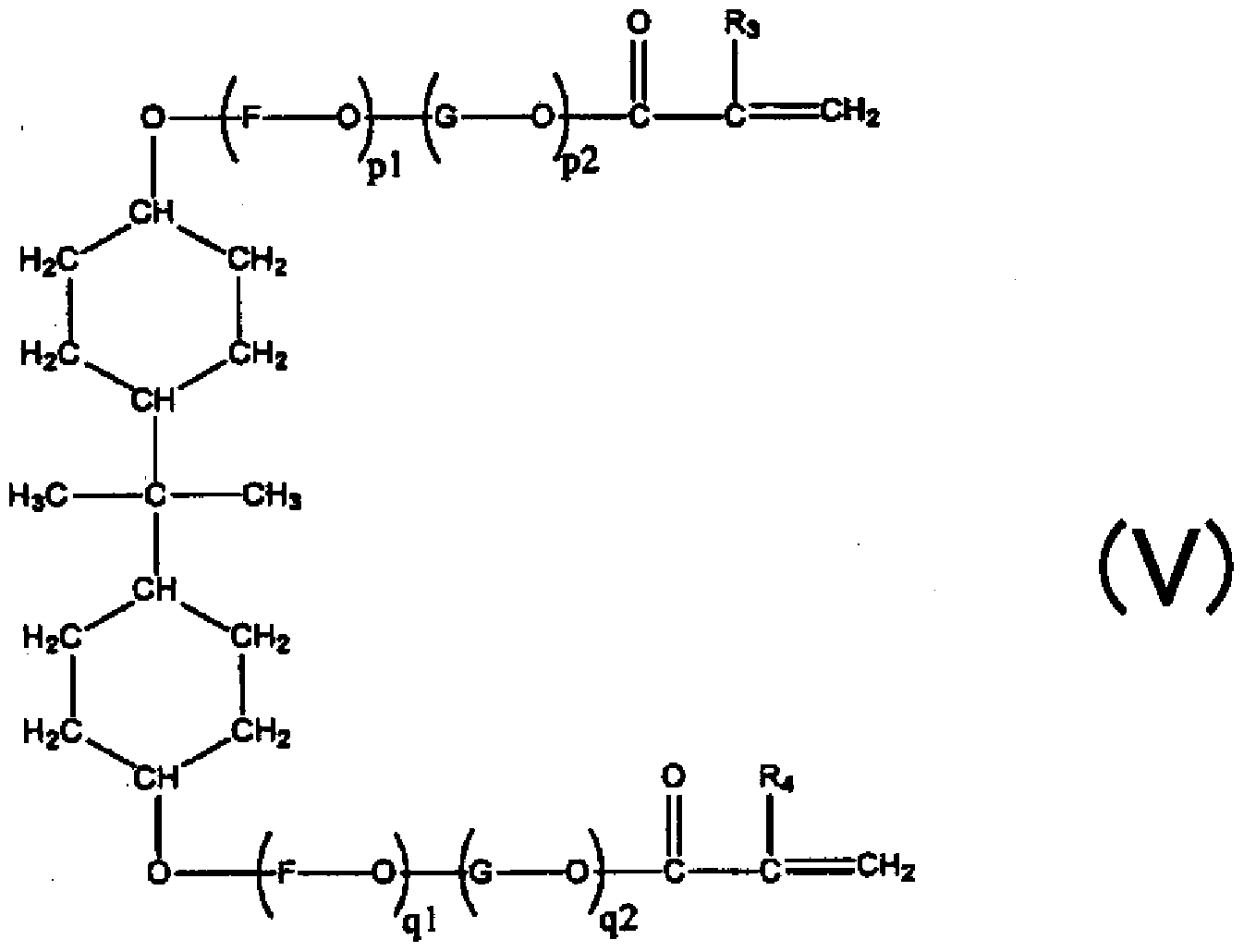
- the addition polymerizable monomer having at least one terminal ethylenically unsaturated group contains at least one of the following general formula (IV) or (V): (1) to (6 ).
- the photosensitive resin composition according to any one of the above.
- the repeating unit of-(DO)-and-(E-O)- may be a block structure None of them may be on the bisphenol group side.
- ml, m2, nl, and n2 are each independently 0 or a positive integer, and their sum is 2-30.
- [Chemical 4] (Wherein R and R are each independently H or CH; and F and G are carbon
- the-(FO) — and — (G—O) — repeating units have a block structure Either of them may or may not be on the cyclohexyl group side.
- pl, p2, q1, and q2 are each independently 0 or a positive integer, and the sum thereof is 2 to 30. )
- a photosensitive resin laminate obtained by laminating the photosensitive resin composition according to any one of (1) to (7) on a support.
- a resist pattern forming method including a lamination step, an exposure step, and a development step for forming a photosensitive resin layer on a substrate using the photosensitive resin laminate according to (8).
- a method for producing a printed wiring board comprising a step of etching or attaching a substrate on which a resist pattern is formed by the method according to (9) or (10).
- a lead frame manufacturing method including a step of etching a substrate on which a resist pattern is formed by the method according to (9) or (10).
- a method for manufacturing a semiconductor package comprising a step of etching or attaching a substrate on which a resist pattern is formed by the method according to (9) or (10).
- a method for producing a substrate having a concavo-convex pattern comprising a step of processing a substrate on which a resist pattern is formed by the method according to (9) or (10) by sand blasting.
- the present invention is a photosensitive resin composition that is excellent in sensitivity, resolution, and adhesiveness, has good hue stability, and can be developed with an alkaline aqueous solution, and a photosensitive resin using the photosensitive resin composition.
- the present invention provides a resin laminate, a method of forming a resist pattern on a substrate using the photosensitive resin laminate, and a use of the resist pattern, and manufactures a printed wiring board, a lead frame, and a semiconductor package. It can be suitably used for the production of flat displays.
- the photosensitive resin composition of the present invention includes (a) an ⁇ , ⁇ unsaturated carboxyl group-containing monomer as a copolymerization component, an acid equivalent of 100 to 600, and a weight average molecular weight of 5,000 to 500, 000 thermoplastic copolymer: 20 to 90% by mass, (b) addition polymerizable monomer having at least one terminal ethylenically unsaturated group: 5 to 75% by mass, (c) photoinitiator: 0.01 ⁇ 30 mass%, (d) Phosphite ester compound: 0.01 to 5 mass%, (e) Basic dye: 0.001 to 0.3 mass% as essential components.
- thermoplastic copolymer includes a, j8-unsaturated carboxyl group-containing monomer as a copolymerization component, and has an acid equivalent of 100 to 600, and a weight. Use an average molecular weight of 5,000 to 500,000.
- the carboxyl group in the thermoplastic copolymer is necessary for the photosensitive resin composition to have developability and releasability with respect to a developing solution and a peeling solution comprising an alkaline aqueous solution.
- the acid equivalent is preferably 100-600 forces, more preferably 250-450. To ensure compatibility with other components in the solvent or composition, particularly (b) addition polymerizable monomer described later From the viewpoint, it is 100 or more, and from the viewpoint of maintaining developability and peelability, it is 600 or less.
- the acid equivalent means the mass (gram) of the thermoplastic copolymer having 1 equivalent of a carboxyl group therein. The acid equivalent is measured by potentiometric titration with 0.1 ImolZL NaOH aqueous solution using Hiranuma Reporting Titer (COM-555).
- the weight average molecular weight of the thermoplastic polymer of the present invention is preferably 5,000 to 500,000. From the viewpoint of maintaining a uniform thickness of the dry film resist and obtaining resistance to the developer, it is 5,000 or more, and from the viewpoint of maintaining developability, it is 500,000 or less. More preferably, the weight average molecular weight is 20,000 force 100,000.
- the weight average molecular weight in this case is a weight average molecular weight measured by gel permeation chromatography (GPC) using a standard polystyrene (Showa Denko Co., Ltd. Shodex STANDARD SM-105) calibration curve. .
- the weight average molecular weight can be measured under the following conditions using gel permeation chromatography manufactured by JASCO Corporation.
- thermoplastic copolymer is preferably a copolymer that has at least one or more of the first monomer described later and at least one or more of the second monomer described later.
- the first monomer is a monomer containing a, j8 unsaturated carboxyl group in the molecule.
- examples thereof include (meth) acrylic acid, fumaric acid, cinnamate, crotonic acid, itaconic acid, maleic anhydride, and maleic acid half ester. Of these, (meth) acrylic acid is particularly preferable.
- the second monomer is a non-acidic monomer having at least one polymerizable unsaturated group in the molecule.
- the amount of the thermoplastic polymer contained in the photosensitive resin composition of the present invention is in the range of 20 to 90% by mass, and preferably in the range of 25 to 70% by mass. This amount is 20% by mass or more from the viewpoint of maintaining alkali developability, and is 90% by mass or less from the viewpoint that the resist pattern formed by exposure sufficiently exhibits the performance as a resist.
- the addition polymerizable monomer having at least one terminal ethylenically unsaturated group used in the photosensitive resin composition of the present invention is not particularly limited, but from the viewpoint of resolution and adhesion, the following general formula It is desirable to contain the compound represented by (IV).
- R and R are each independently H or CH, and D and E have 2 carbon atoms.
- the repeating unit of-(DO)-and-(E-O)- may be a block structure None of them may be on the bisphenol group side.
- ml, m2, nl, and n2 are each independently 0 or a positive integer, and their sum is 2-30.
- Examples of the compound represented by the above general formula (IV) include 2, 2 bis ⁇ (4 attaryloxypolyethyleneoxy) phenol ⁇ propane or 2,2 bis ⁇ (4-methacryloxypolyethyleneoxy) phenol. -Le ⁇ Propane.
- the polyethyleneoxy group possessed by the compound includes monoethyleneoxy group, diethyleneoxy group, triethyleneoxy group, tetraethyleneoxy group, pentaethyleneoxy group, hexaethyleneoxy group, heptaethyleneoxy group, octa Ethyleneoxy, nonaethyleneoxy, decaethyleneoxy, undecaethyleneoxy, dodecaethyleneoxy, tridecaethyleneoxy, tetradecaethyleneoxy, and pentadecaethylene Xy group power is a group power selected A compound that is any group selected is preferred. Further, 2,2bis ⁇ (4-aryloxypolyalkyleneoxy) phenol ⁇ propane or 2,2bis ⁇ (4-methacryloxypolyalkyleneoxy) phenol ⁇ propane can be mentioned.
- Examples of the polyalkyleneoxy group possessed by the compound include a mixture of an ethyleneoxy group and a propyleneoxy group, an adduct having a block structure or a random structure having an otaethyleneoxy group and a dipropyleneoxy group, and a tetra structure.
- An adduct having a block structure of an ethyleneoxy group and a tetrapropyleneoxy group or an adduct having a random structure is preferable.
- 2,2bis ⁇ (4-methacryloxypentaethyleneoxy) phenol ⁇ propane is most preferred.
- the repeating units (FO) and one (GO) — may be a block structure. Any of them may be on the cyclohexyl group side.
- pl, p2, ql and q2 are each independently 0 or a positive integer, and their sum is 2 to 30 o)
- Examples of the compound represented by the general formula (V) include 2, 2 bis ⁇ (4-ataryloxypolyethyleneoxy) cyclohexyl ⁇ propane or 2,2 bis ⁇ (4-methacryloxypolyoxyethylene) cyclohexane. Hexyl ⁇ propane.
- Polyethyleneoxy group possessed by the compound is monoethyleneoxy group, diethyleneoxy group, triethyleneoxy group, tetraethyleneoxy group, pentaethyleneoxy group, hexaethyleneoxy group, heptaethyleneoxy group, octaethylene Group consisting of oxy group, nonaethyleneoxy group, decaethyleneoxy group, undeethylene ethyleneoxy group, dodecaethyleneoxy group, tridecaethyleneoxy group, tetradecaethyleneoxy group, and pentadecaethyleneoxy group Compounds that are any group selected from are preferred.
- the polyalkyleneoxy group possessed by the compound include a mixture of an ethoxy group and a propyloxy group, an adduct having a block structure or a random structure having an octaethyleneoxy group and a dipropyleneoxy group, and An adduct with a block structure or a random structure of a tetraethyleneoxy group and a tetrapropyleneoxy group is preferred.
- 2,2-bis ⁇ (4-methacryloxypentaethyleneoxy) cyclohexyl ⁇ propane is most preferred.
- the content is 5 to 40% by mass in the photosensitive resin composition. It is preferably contained, more preferably 10 to 30% by mass. This amount is 5% by mass or more from the viewpoint of high resolution and high adhesion, and 40% by mass or less from the viewpoint of suppressing cold flow and resist pattern peeling delay.
- a polyfunctional group (meth) acrylate having a urethane group for example, there may also be mentioned urethane compounds of xamethylene diisocyanate and alcohols such as nonapropylene glycol monomethacrylate, and polyfunctional (meth) acrylate of isocyanurate ester compounds.
- the amount of the (b) addition polymerizable monomer contained in the photosensitive resin composition of the present invention is more preferably in the range of 5 to 75% by mass with respect to the entire photosensitive resin composition.
- the range is 15 to 70% by weight. This amount is 5% by mass or more from the viewpoint of suppressing poor curing and development time delay, and is 75% by mass or less from the viewpoint of suppressing cold flow and resist pattern peeling delay.
- the photosensitive resin composition of the present invention contains (c) a photopolymerization initiator.
- the amount of the (c) photopolymerization initiator contained in the photosensitive resin composition of the present invention is in the range of 0.01 to 30% by mass, more preferably 0.05 to: LO% by mass. .
- the viewpoint power for obtaining sufficient sensitivity is also preferably 0.01% by mass or more.
- light is sufficiently transmitted to the surface (bottom surface) of the resist pattern that is in contact with the substrate, providing excellent high resolution and adhesion. From the standpoint of obtaining good properties, 30% by mass or less is preferable.
- a hexaarylbisimidazole derivative (hereinafter referred to as triarylimidazolyl dimer) is preferably used.
- the triarylimidazolyl dimer include, for example, 2- (0-chlorophenol) -4,5 diphenyl-imidazolyl dimer (hereinafter referred to as 2,2,1bis) , 4,, 5, 5, 1 tetraphenyl 1, 1, 1 bisimidazole), 2, 2 ', 5 Tris 1 (o-cross-mouthed) 1— (3, 4 dimethoxy (Phenol) 4, 5, 5, 1-diphenyl imidazolyl dimer, 2, 4 bis (o-cross-phase) —5— (3,4 Dimethoxyphenol) —Diphenol-Louimidazolyl dimer 2, 4, 5 Tris-(o black-mouthed) monodiphenyl imidazolidyl dimer, 2— (o black-mouthed phenol
- 2-(. Single-mouthed phenol) 4,5 diphenyl-imidazolyl dimer is a photopolymerization initiator having a high effect on resolution and strength of a cured film, and is preferably used.
- Photopolymerization initiators other than hexarylbisimidazole include, for example, quinones such as 2-ethyl anthraquinone, otaethyl anthraquinone, 1,2-benzanthraquinone, 2, 3 Benzanthraquinone, 2 Phenylanthraquinone, 2, 3 Diphenyl Ninoleanthraquinone, 1 Black mouth anthraquinone, 1, 4 Naphthoquinone, 9, 10 Phenylanthraquinone, 2-Methyl-1, 4 Naphthoquinone, 2, 3 Dimethylanthraquinone Rollo 2-methylanthraquinone,
- Aromatic ketones such as benzophenone, Michler's ketone [4,4,1bis (dimethinoreamino) benzophenone], and 4,4,1bis (jetylamino) benzophenone, benzoin, Benzoin ethers, such as benzoin ether, benzoin ether, methyl benzoin, and ethyl benzoin,
- Examples of the combination of the above thixanthones and alkylaminobenzoic acid include, for example, a combination of ethylthioxanthone and dimethylaminobenzoate, a combination of 2-chlorothioxanthone and dimethylaminobenzoate, and isopropyl thixanthone and dimethylaminobenzoate. Combination with acid ethyl is mentioned.
- the (C) atharidine compound represented by the following general formula (I) is preferably used as the photopolymerization initiator.
- R represents hydrogen, an alkyl group having 1 to 6 carbon atoms, an aryl group, a pyridyl group, or an alkoxy group having 1 to 6 carbon atoms.
- Specific compounds of the above general formula (I) include, for example, 9 phenylacridine, 9- (4'-tolyl) atalysine, 9- (4'-methoxyphenol) atalysine, 9- (4'-hydroxy (Phenol) Atalidine, 9-Acetylaminoacridine, Benz [a] Phenazine, 9-Methylbenz [a] Phenazine, 2-Styrylquinoline, 9 Ethylatridine, 9 Chloroethylacridine, 9-Methoxyacrylidine, 9 Ethoxy 9- (4-Methylphenyl) atalysine, 9- (4-N-propylphenol) atalysine, 9 (4 n-butylphenol) atalysine, 9- ( 4-tert-Butylphenol) Atariji 9- (4-Methoxyphenyl) atalysine, 9- (4-Ethoxyphenyl) atalysine, 9— (4-
- a dimer of an ataridin compound can also be used.
- Nonane 1 9 methylataridin 1, 6 bis (9-atalidinyl) hexane, 1, 7 bis (9- atalyzyl) heptane, 1, 8 bis (9- atalyzyl) otatan, 1, 9 bis (9- attaridyl) )
- Nonane 1 9 methylataridin 1, 6 bis (9-atalidinyl) hexane, 1, 7 bis (9- atalyzyl) heptane, 1, 8 bis (9- atalyzyl) otatan, 1, 9 bis (9- attaridyl)
- Nonane 1 9 methylataridin 1, 6 bis (9-atalidinyl) hexane
- a pyrazoline compound represented by the following general formula (III) is contained as a photopolymerization initiator.
- the content is 0.001% by mass or more with respect to the entire photosensitive resin composition, from the viewpoint of improving sensitivity and resolution, and the compatibility of the photosensitive resin composition and From the viewpoint of dispersibility in the developer, it is preferably 10% by mass or less based on the entire photosensitive resin composition. More preferably, from 0.005 to 5 mass 0/0, more preferably 0.05 to 2 mass 0/0.
- B and C are each independently a linear or branched alkyl group having 3 or more carbon atoms.
- NR R is a hydrogen atom or an alkyl group
- A is an aryl group, a heterocyclic group,
- each of B and C is preferably a linear or branched alkyl group having 3 to 12 carbon atoms.
- Virazolin compounds represented by the above general formula ( ⁇ ) include 1-Fellow 3- (4-tert-Butylstyryl) -5- (4-tert-Butyl-phenol) pyrazoline, 1,5 bis 1- (4-tertbutylbutyl) 3- (4-tert-butylstyryl) pyrazoline, 1-loop 3- (4-tert-octylstyryl) -5- (4-tert-octyl roof) ) —Pyrazoline, 1,5 Bis— (4—tert-octyl roofyl) — 3— (4-tert-octylstyryl) Pyrazoline, 1 Fluoro 3— (4 dodecyl styryl) 5— (4 —Dodecyl roofing oil) —Virazoline, 1— (4—Dodecyl roofing oil) —3— (4 —Dodecyl roofing oil) —5— (4—Dodecyl roofing oil) —Virazoline, 1—
- the amount of the (d) phosphite ester compound contained in the photosensitive resin composition of the present invention is in the range of 0.01 to 5% by mass with respect to the entire photosensitive resin composition, preferably 0.1 The range is from 1 to 3% by mass.
- the hue stability of the photosensitive composition is good at 0.01% by mass or more, and the curability is good at 5% by mass or less.
- phosphite compounds include 2, 4, 8, 10-tetra-tert-butyl-6- [3- (3-methyl-4-hydroxy-5-tert-butylphenyl) propoxy] dibenzo [d F] [l, 3, 2] dioxaphosfenpine, 2,2-methylenebis (4,6 di tert butylphenol) octyl phosphite, bis (2,4 ditert butylphenol) penta Erythritol diphosphite, tris (2,4 di-ter t-butylphenol) phosphite, 4, 4, -butylidenebis (3-methyl-6-tbutylphenol di-tridecylphosphite, 4, 4, Isopropylidene-di-phenol alkyl phosphite, tris-isodecyl phosphite 4.
- propyl propylene di-phenol alkyl phosphite the alkyl group
- the amount of the basic dye (e) contained in the photosensitive resin composition of the present invention is in the range of 0.001 to 0.3% by mass, preferably 0, based on the total photosensitive resin composition.
- the range is 01 to 0.112% by mass.
- the point power at which sufficient colorability can be recognized is preferably 0.001% by mass or more and 0.3% by mass or less from the viewpoint of maintaining hue stability.
- Basic Green 1 [633-03-03] for example, Aiz en (registered trademark) Diamond Green GH, trade name, manufactured by Hodogaya Chemical Co., Ltd.
- Malachite green oxalate [2437—29—8] for example, Aizen (registered trademark) Malachite Green, trade name, manufactured by Hodogaya Igaku Kogyo
- Brilliant Green [633—03—4] Fuchsin [6 32 — 99—5], Methyl violet [603—47—4], Methyl violet 2B [8004— 8 7-3], Crystal Violet [548—62—9], Methyl Green [82—94—0], Victoria Blue B [2580—56—5], Basic Blue 7 [2390—60—5]
- Aizen Victoria Pure Blue BOH trade name, manufactured by Hodogaya Chemical Co., Ltd.
- Rhodamine B [81—88—9] Rhodamine B [81—88—9]
- (c) In the case of using the above-mentioned ataridine compound as a photopolymerization initiator, it is preferable to use (f) an organic halogen compound in combination from the viewpoint of sensitivity.
- the organic halogen compound (f) include tribromomethyl phenol sulfone, 2-tribromomethyl sulfopyridine, or s-triazine compound represented by the following general formula (VI).
- R, R and R each represent a substituent, and at least one of them is a trihalomethyl group.
- R, R and R may be the same or different
- the amount of the organic halogen compound is preferably 0.01 to 3% by mass with respect to the photosensitive resin composition.
- the content is 0.01% by mass or more, a good contrast is exhibited between the exposed portion and the unexposed portion, and when the content is 3% by mass or less, the hue stability is good.
- N-aryl amino acid represented by the following general formula ( ⁇ ).
- R is an aryl group.
- the content of N-aryl amino acid is preferably 0.001 to 1.0% by mass, more preferably 0.01 to 0.5% by mass, and still more preferably relative to the entire photosensitive resin composition. 0.04 to 0.3 mass%.
- the viewpoint power of sensitivity is preferably 0.001% by mass or more and 1.0% by mass or less from the viewpoint of hue stability.
- N-aryl amino acids include N-phenylglycine, N- (p black-mouthed phenyl) glycine, N- (p bromophenol) glycine, N- (p cyanophyl). Glycine, N— (p-methylphenol) glycine, N-butyl N-phenolglycine, N-ethyl —N-phenylglycine, N-propyl-N-phenylglycine, N-methyl-N-phenylglycine, N— (p-bromophenol -N) N-methylglycine, N- (p-phenyl) N ethylglycine.
- the photosensitive resin composition of the present invention may contain a leuco dye so that the presence or absence of photosensitivity can be visually determined.
- leuco dyes include leuco crystal violet and leucomalachite green.
- Sufficient coloring (color development) can be recognized From the viewpoint, the content is preferably 0.01% by mass or more and 5% by mass or less from the viewpoint of hue stability and good image characteristics with respect to the entire photosensitive resin composition.
- the photosensitive resin composition contains a carboxybenzotriazole compound. That is.
- Examples of the carboxybenzotriazole compound include 4 carboxy 1, 2, 3-benzotriazole, 5 carboxy 1, 2, 3 benzotriazole, N- (N, N di2-ethylhexyl) aminomethylenecarboxy. Examples include benzotriazole, N— (N, N di-2-hydroxyethyl) aminomethylenecarboxybenzotriazole, and N— (N, N di-2-ethylhexyl) aminoethylenecarboxybenzotriazole.
- the photosensitive resin composition contains benzotriazoles and Z or a radical polymerization inhibitor. It is preferable to make it.
- radical polymerization inhibitors include ⁇ -methoxyphenol, hydroquinone, pyrogallol, naphthylamine, tert-butylcatechol, cuprous chloride, 2,6-ditert-butyl-p-cresol, 2,2, -me.
- examples include tylene bis (4-methyl-6-tert-butylphenol), 2,2, monomethylene bis (4-ethyl-6-tert-butylphenol), nitrosohydroxyhydroxyamine aluminum salt, and diphenylnitrosamine.
- benzotriazoles examples include 1, 2, 3 benzotriazole, 1-, 2, 3 benzotriazole, bis (N-2-ethylhexyl) aminomethylene 1, 2, 3 —Benzotriazole, bis (N—2ethylhexyl) aminomethylene-1,2,3 tolyltriazole, and bis (N—2hydroxyethyl) aminomethylene-1,2,3 benzotriazole.
- the amount of addition in the case of containing a radical polymerization inhibitor, a benzotriazole compound, and a carboxybenzotriazole compound is preferably 0.01 to 3% by mass with respect to the photosensitive resin compound. More preferably, it is 0.05 to 1% by mass. This amount is preferably 0.01% by mass or more from the viewpoint of imparting hue stability to the photosensitive resin composition. In addition, the viewpoint power for maintaining sensitivity is more preferably 3% by mass or less.
- the photosensitive resin composition of the present invention may contain a plasticizer, if necessary.
- plasticizers include polyethylene glycol, polypropylene glycol, glycol esters such as polyoxypropylene polyoxyethylene ether, polyoxyethylene monomethyl ether, polyoxypropylene monomethyl ether, and polyoxyethylene polyoxy Propylene monomethyl ether, polyoxyethylene monoethyl ether, polyoxypropylene monoethyl ether, polyoxyethylene polyoxypropylene monoethyl ether, phthalates such as jetyl phthalate, o-toluenesulfonic acid amide, p-toluene Sulfonic acid amide, Tributyl citrate, Triethyl taenoate, Triethyl acetyl citrate, Triacetyl acetyl sulfonate n-propyl, acetyl que Acid tri - n-butyl.
- the addition amount is preferably 5 to 50% by mass, more preferably 5 to 30% by mass in the photosensitive resin composition.
- the viewpoint power of 5% by mass or more is preferred because it suppresses the delay in development time and imparts flexibility to the cured film, and 50% by mass or less is preferred from the viewpoint of suppressing insufficient curing and cold flow.
- the photosensitive resin composition of the present invention may be a photosensitive resin composition preparation solution to which a solvent is added.
- Suitable solvents include ketones typified by methyl ethyl ketone (MEK), as well as alcohols such as methanol, ethanol, and isopropyl alcohol. It is preferable to add a solvent to the photosensitive resin composition such that the viscosity of the photosensitive resin composition preparation liquid is 500 to 4000 mPa ⁇ sec at 25 ° C.
- the photosensitive resin layered product of the present invention has a protective layer on the surface of the photosensitive resin layer opposite to the support of the photosensitive resin layer, if necessary, as a supporting force to support the photosensitive resin layer and the layer. Also good.
- the support used here is preferably transparent so as to transmit light emitted from the exposure light source.
- a support include, for example, polyethylene terephthalate film, polybulualcohol film, polychlorinated bull film, and bull chloride copolymer film.
- films include films, polyvinylidene chloride films, vinylidene chloride copolymer films, polymethyl methacrylate copolymer films, polystyrene films, polyacrylonitrile films, styrene copolymer films, polyamide films, and cellulose derivative films. These films can be stretched if necessary.
- the haze is preferably 5 or less. The thinner the film, the more advantageous in terms of image forming property and economic efficiency, but a film having a thickness of 10 to 30 / ⁇ ⁇ is preferably used because the strength needs to be maintained.
- an important characteristic of the protective layer used in the photosensitive resin laminate is that the protective layer is sufficiently smaller than the support and easily peeled in terms of adhesion to the photosensitive resin layer. It is possible.
- a polyethylene film and a polypropylene film can be preferably used as the protective layer.
- a film having excellent peelability disclosed in JP-A-59-202457 can be used.
- the thickness of the protective layer is 10 to: L 00 m is preferred, and a force of 10 to 50 m is preferred.
- the thickness of the photosensitive resin layer in the photosensitive resin laminate of the present invention is preferably 5 to 10 O ⁇ m, more preferably 7 to 60 / ⁇ ⁇ . As the thickness is thinner, the resolution is improved, and as the thickness is thicker, the film strength is improved.
- a conventionally known method can be adopted as a method of laminating a support, a photosensitive resin layer, and if necessary, a protective layer in order to produce the photosensitive resin laminate of the present invention.
- the photosensitive resin composition used for the photosensitive resin layer is made into the above-mentioned photosensitive resin composition preparation liquid, and first coated on the support using a bar coater or a roll coater. And drying, and a photosensitive resin layer made of the photosensitive resin composition is laminated on the support.
- a photosensitive resin laminate can be prepared by laminating a protective layer on the photosensitive resin layer.
- a resist pattern using the photosensitive resin laminate of the present invention can be formed by a process including a laminating process, an exposure process, and a developing process. An example of a specific method is shown.
- a laminating process is performed using a laminator.
- the photosensitive resin laminate has a protective layer
- the photosensitive resin layer is heated on the substrate surface with a laminator. Crimp and laminate.
- the photosensitive resin layer may be laminated on only one surface of the substrate surface, or may be laminated on both surfaces as necessary.
- the heating temperature at this time is generally 40 to 160 ° C.
- substrate of the obtained resist pattern improves by performing this thermocompression bonding twice or more.
- a two-stage laminator equipped with two rolls may be used for crimping, or it may be repeatedly crimped through the roll several times.
- an exposure process is performed using an exposure machine. If necessary, the support is peeled off and exposed to active light through a photomask.
- the exposure amount is determined from the light source illuminance and the exposure time. It can be measured using a photometer.
- the exposure process use a maskless exposure method.
- maskless exposure exposure is performed directly on the substrate by a drawing apparatus without using a photomask.
- the light source a semiconductor laser having a wavelength of 350 to 410 nm and an ultrahigh pressure mercury lamp are used.
- the drawing pattern is controlled by a computer, and the exposure amount in this case is determined by the illuminance of the exposure light source and the moving speed of the substrate.
- a developing process is performed using a developing device. Exclude any support on the photosensitive resin layer after exposure. Subsequently, the unexposed area is removed by using a developer such as an alkaline aqueous solution to obtain a resist pattern. Na CO or K CO as alkaline aqueous solution
- a surfactant, an antifoaming agent, and a small amount of an organic solvent for promoting development may be mixed.
- the temperature of the developer in the development step is preferably maintained at a constant temperature in the range of 20 to 40 ° C.
- the force at which a resist pattern can be obtained by the above-described steps.
- a heating step of 100 to 300 ° C can be further performed.
- hot air, infrared, or far-infrared heating furnaces can be used.
- the method for producing a printed wiring board of the present invention includes a copper-clad laminate or a flexible board as a substrate. After the resist pattern is formed on the substrate by the above-described resist pattern forming method, the following steps are performed.
- a step of forming a conductor pattern using a known method such as an etching method or a fitting method is performed on the copper surface of the substrate exposed by development.
- a desired printed wiring board is obtained by performing a peeling process in which the resist pattern is peeled off with an aqueous solution having alkalinity stronger than that of the developer.
- the alkaline aqueous solution for stripping (hereinafter also referred to as “stripping solution”) is not particularly limited, but an aqueous solution of NaOH or KOH having a concentration of 2 to 5% by mass is generally used. It is possible to add a small amount of water-soluble solvent to the stripping solution.
- the temperature of the stripping solution in the stripping process is preferably in the range of 40 to 70 ° C! /.
- the lead frame manufacturing method of the present invention is performed by performing the following steps after forming a resist pattern on a metal plate of copper, copper alloy, or iron-based alloy as a substrate by the above-described resist pattern forming method.
- a step of etching the substrate exposed by development to form a conductor pattern is performed. Thereafter, a desired lead frame is obtained by performing a peeling process in which the resist pattern is peeled by the same method as the above-described printed wiring board manufacturing method.
- the method for manufacturing a semiconductor package of the present invention is performed by forming a resist pattern by the above-described resist pattern forming method on a wafer on which a circuit as an LSI has been formed as a substrate, and then performing the following steps.
- a step of forming a conductor pattern by performing columnar plating with copper or solder on the opening exposed by development is performed. Thereafter, by performing a peeling step of peeling the resist pattern by the same method as the method for manufacturing a printed wiring board described above, and further performing a step of removing a thin metal layer other than the columnar tack by etching, Obtain the desired semiconductor package.
- the resist pattern is formed by the sandblasting method using the resist pattern forming method described above. It can be used as a protective mask member when processing the substrate.
- the substrate examples include glass, silicon wafer, amorphous silicon, polycrystalline silicon, ceramic, sapphire, and metal material.
- a resist pattern is formed on these substrates by the same method as the above-described resist pattern forming method. After that, the resist pattern upper force blasting material formed is blown to the desired depth and the sandblasting process is performed, and the resist pattern portion remaining on the substrate is removed from the substrate with a stripping solution.
- the substrate can have a fine concavo-convex pattern.
- known materials are used, for example,
- the photosensitive resin laminates in Examples and Comparative Examples were produced as follows.
- the photosensitive resin composition having the composition shown in Table 1 is thoroughly stirred and mixed, and uniformly applied to the surface of a 16 m-thick polyethylene terephthalate film (Mitsubishi Polyester R310-16) as a support using a bar coater.
- a photosensitive resin layer was formed by drying for 4 minutes in a 95 ° C dryer.
- the thickness of the photosensitive resin layer was 40 m.
- Table 2 describes the symbols shown in Table 1.
- Etch solution resistance, resolution, adhesion, and tenting properties are evaluated using a 1.6 mm thick copper clad laminate with 35 ⁇ m rolled copper foil, and the surface is wet pafrol polished (manufactured by 3M Corporation). Scotch Bright (registered trademark) HD # 600, twice).
- the roll temperature was adjusted to 105 ° C using a hot roll laminator (AL-70, manufactured by Asahi Kasei Co., Ltd.) on a copper-clad laminate that had been leveled and preheated to 60 ° C. Laminated at ° C. Air pressure is 0.335MPa and laminating speed is 1.5 va./min.
- A-70 manufactured by Asahi Kasei Co., Ltd.
- a 21-step tablet made by Stofer is placed on a polyethylene terephthalate film as a support, and a super high pressure mercury lamp (OMW, HMW-201KB) is placed on the photosensitive resin layer for the evaluation.
- OMW super high pressure mercury lamp
- This exposure method is referred to as a batch exposure method.
- the number of step tablet steps is 8 by the following sensitivity evaluation using a direct-drawing exposure system (Hitachi Via Mechatas Co., Ltd., DI exposure machine DE-1AH, light source: GaN blue-violet diode, dominant wavelength 407 ⁇ 3 nm) Exposure was performed with an exposure amount (this exposure method is a direct drawing type exposure method).
- the unexposed portion of the photosensitive resin layer was dissolved and removed in a time twice as long as the minimum development time.
- the minimum development time was defined as the minimum time required for the photosensitive resin layer in the unexposed area to be completely dissolved.
- the substrate for sensitivity and resolution evaluation 15 minutes after lamination was exposed using a 21-step tablet manufactured by Stofer, whose brightness was changed from transparent to black in 21 levels. After exposure, Development was performed with a development time twice as long as the minimum development time, and the cured resist film remained completely!
- Adhesive strength value exceeds 0 m and 50 m or less.
- Adhesion value exceeds 50 m.
- the present invention includes printed wiring board manufacturing, IC chip mounting lead frame manufacturing, metal mask manufacturing, packages such as BGA and CSP manufacturing, tape substrates such as COF and TAB manufacturing, semiconductor bump manufacturing, ITO electrodes and addresses. It can be used in a method for producing an electrode, an electromagnetic wave shield, for example, a partition wall of a flat panel display.
Landscapes
- Physics & Mathematics (AREA)
- General Physics & Mathematics (AREA)
- Spectroscopy & Molecular Physics (AREA)
- Chemical & Material Sciences (AREA)
- Chemical Kinetics & Catalysis (AREA)
- Inorganic Chemistry (AREA)
- Health & Medical Sciences (AREA)
- Medicinal Chemistry (AREA)
- Polymers & Plastics (AREA)
- Organic Chemistry (AREA)
- Structural Engineering (AREA)
- Engineering & Computer Science (AREA)
- Architecture (AREA)
- Materials For Photolithography (AREA)
- Polymerisation Methods In General (AREA)
- Macromonomer-Based Addition Polymer (AREA)
- Manufacturing Of Printed Circuit Boards (AREA)
- Manufacturing Of Printed Wiring (AREA)
Abstract
Description




Claims


Priority Applications (1)
| Application Number | Priority Date | Filing Date | Title |
|---|---|---|---|
| JP2008514438A JP5188391B2 (ja) | 2006-05-09 | 2007-04-26 | 感光性樹脂組成物 |
Applications Claiming Priority (2)
| Application Number | Priority Date | Filing Date | Title |
|---|---|---|---|
| JP2006-130259 | 2006-05-09 | ||
| JP2006130259 | 2006-05-09 |
Publications (1)
| Publication Number | Publication Date |
|---|---|
| WO2007129589A1 true WO2007129589A1 (ja) | 2007-11-15 |
Family
ID=38667697
Family Applications (1)
| Application Number | Title | Priority Date | Filing Date |
|---|---|---|---|
| PCT/JP2007/059020 Ceased WO2007129589A1 (ja) | 2006-05-09 | 2007-04-26 | 感光性樹脂組成物 |
Country Status (4)
| Country | Link |
|---|---|
| JP (1) | JP5188391B2 (ja) |
| KR (1) | KR101036784B1 (ja) |
| CN (1) | CN101438208A (ja) |
| WO (1) | WO2007129589A1 (ja) |
Cited By (11)
| Publication number | Priority date | Publication date | Assignee | Title |
|---|---|---|---|---|
| WO2009022724A1 (ja) * | 2007-08-15 | 2009-02-19 | Asahi Kasei E-Materials Corporation | 感光性樹脂組成物及びその積層体 |
| JP2009186780A (ja) * | 2008-02-06 | 2009-08-20 | Hitachi Chem Co Ltd | 感光性エレメント、これを用いたレジストパターンの形成方法及びプリント配線板の製造方法 |
| JP2010217287A (ja) * | 2009-03-13 | 2010-09-30 | Hitachi Chem Co Ltd | レーザ直接描画露光用感光性樹脂組成物、並びにこれを用いた感光性エレメント、レジストパターンの形成方法及びプリント配線板の製造方法 |
| JP2011028165A (ja) * | 2009-07-29 | 2011-02-10 | Asahi Kasei E-Materials Corp | 感光性樹脂組成物 |
| JP2013068936A (ja) * | 2011-09-06 | 2013-04-18 | Hitachi Chemical Co Ltd | 感光性樹脂組成物、感光性エレメント、レジストパターンの形成方法、及びプリント配線板の製造方法 |
| JP2013080259A (ja) * | 2008-04-28 | 2013-05-02 | Hitachi Chemical Co Ltd | 感光性樹脂組成物、感光性エレメント、レジストパターンの形成方法、及び、プリント配線板の製造方法 |
| JP2013117581A (ja) * | 2011-12-01 | 2013-06-13 | Asahi Kasei E-Materials Corp | 感光性樹脂組成物 |
| JP2013246387A (ja) * | 2012-05-29 | 2013-12-09 | Asahi Kasei E-Materials Corp | 感光性樹脂組成物 |
| JP2015132834A (ja) * | 2015-02-24 | 2015-07-23 | 三菱製紙株式会社 | ケミカルミーリング |
| US9268217B2 (en) | 2013-08-09 | 2016-02-23 | Cheil Industries Inc. | Photosensitive resin composition and light blocking layer using the same |
| US9334399B2 (en) | 2012-12-12 | 2016-05-10 | Cheil Industries Inc. | Photosensitive resin composition and black spacer using the same |
Families Citing this family (3)
| Publication number | Priority date | Publication date | Assignee | Title |
|---|---|---|---|---|
| WO2013084283A1 (ja) | 2011-12-05 | 2013-06-13 | 日立化成株式会社 | タッチパネル用電極の保護膜の形成方法、感光性樹脂組成物及び感光性エレメント |
| WO2013084282A1 (ja) | 2011-12-05 | 2013-06-13 | 日立化成株式会社 | 樹脂硬化膜パターンの形成方法、感光性樹脂組成物及び感光性エレメント |
| CN108205240B (zh) * | 2018-02-01 | 2021-05-07 | 浙江福斯特新材料研究院有限公司 | 一种高光敏性和优异掩孔性能的感光性树脂组合物及应用 |
Citations (7)
| Publication number | Priority date | Publication date | Assignee | Title |
|---|---|---|---|---|
| JP2003057840A (ja) * | 2001-08-10 | 2003-02-28 | Asahi Kasei Corp | 光重合性樹脂組成物の製造方法 |
| JP2003162052A (ja) * | 2001-11-28 | 2003-06-06 | Hitachi Chem Co Ltd | 感光性樹脂組成物、これを用いた感光性エレメント、レジストパターンの形成方法及びプリント配線板の製造方法 |
| JP2003186186A (ja) * | 2001-12-17 | 2003-07-03 | Asahi Kasei Corp | 感光性樹脂組成物 |
| JP2004184878A (ja) * | 2002-12-05 | 2004-07-02 | Asahi Kasei Electronics Co Ltd | 感光性樹脂組成物及びその使用 |
| JP2004219690A (ja) * | 2003-01-15 | 2004-08-05 | Sumitomo Seika Chem Co Ltd | 感光性組成物 |
| JP2005215142A (ja) * | 2004-01-28 | 2005-08-11 | Asahi Kasei Electronics Co Ltd | 感光性樹脂組成物及び積層体 |
| JP2005292289A (ja) * | 2004-03-31 | 2005-10-20 | Nichigo Morton Co Ltd | フォトレジストフィルム |
Family Cites Families (4)
| Publication number | Priority date | Publication date | Assignee | Title |
|---|---|---|---|---|
| JP2002278051A (ja) * | 2001-03-19 | 2002-09-27 | Sumitomo Bakelite Co Ltd | ポジ型感光性樹脂組成物及び半導体装置 |
| US20040087687A1 (en) * | 2002-10-30 | 2004-05-06 | Vantico A&T Us Inc. | Photocurable compositions with phosphite viscosity stabilizers |
| JP4459751B2 (ja) * | 2004-08-11 | 2010-04-28 | 東京応化工業株式会社 | サンドブラスト用感光性樹脂組成物およびこれを用いたサンドブラスト用感光性ドライフィルム |
| JP2006078868A (ja) * | 2004-09-10 | 2006-03-23 | Asahi Kasei Electronics Co Ltd | サンドブラスト用感光性樹脂組成物 |
-
2007
- 2007-04-26 JP JP2008514438A patent/JP5188391B2/ja active Active
- 2007-04-26 CN CNA2007800164705A patent/CN101438208A/zh active Pending
- 2007-04-26 KR KR1020087027205A patent/KR101036784B1/ko not_active Expired - Fee Related
- 2007-04-26 WO PCT/JP2007/059020 patent/WO2007129589A1/ja not_active Ceased
Patent Citations (7)
| Publication number | Priority date | Publication date | Assignee | Title |
|---|---|---|---|---|
| JP2003057840A (ja) * | 2001-08-10 | 2003-02-28 | Asahi Kasei Corp | 光重合性樹脂組成物の製造方法 |
| JP2003162052A (ja) * | 2001-11-28 | 2003-06-06 | Hitachi Chem Co Ltd | 感光性樹脂組成物、これを用いた感光性エレメント、レジストパターンの形成方法及びプリント配線板の製造方法 |
| JP2003186186A (ja) * | 2001-12-17 | 2003-07-03 | Asahi Kasei Corp | 感光性樹脂組成物 |
| JP2004184878A (ja) * | 2002-12-05 | 2004-07-02 | Asahi Kasei Electronics Co Ltd | 感光性樹脂組成物及びその使用 |
| JP2004219690A (ja) * | 2003-01-15 | 2004-08-05 | Sumitomo Seika Chem Co Ltd | 感光性組成物 |
| JP2005215142A (ja) * | 2004-01-28 | 2005-08-11 | Asahi Kasei Electronics Co Ltd | 感光性樹脂組成物及び積層体 |
| JP2005292289A (ja) * | 2004-03-31 | 2005-10-20 | Nichigo Morton Co Ltd | フォトレジストフィルム |
Cited By (12)
| Publication number | Priority date | Publication date | Assignee | Title |
|---|---|---|---|---|
| WO2009022724A1 (ja) * | 2007-08-15 | 2009-02-19 | Asahi Kasei E-Materials Corporation | 感光性樹脂組成物及びその積層体 |
| JP5221543B2 (ja) * | 2007-08-15 | 2013-06-26 | 旭化成イーマテリアルズ株式会社 | 感光性樹脂組成物及びその積層体 |
| JP2009186780A (ja) * | 2008-02-06 | 2009-08-20 | Hitachi Chem Co Ltd | 感光性エレメント、これを用いたレジストパターンの形成方法及びプリント配線板の製造方法 |
| JP2013080259A (ja) * | 2008-04-28 | 2013-05-02 | Hitachi Chemical Co Ltd | 感光性樹脂組成物、感光性エレメント、レジストパターンの形成方法、及び、プリント配線板の製造方法 |
| JP2010217287A (ja) * | 2009-03-13 | 2010-09-30 | Hitachi Chem Co Ltd | レーザ直接描画露光用感光性樹脂組成物、並びにこれを用いた感光性エレメント、レジストパターンの形成方法及びプリント配線板の製造方法 |
| JP2011028165A (ja) * | 2009-07-29 | 2011-02-10 | Asahi Kasei E-Materials Corp | 感光性樹脂組成物 |
| JP2013068936A (ja) * | 2011-09-06 | 2013-04-18 | Hitachi Chemical Co Ltd | 感光性樹脂組成物、感光性エレメント、レジストパターンの形成方法、及びプリント配線板の製造方法 |
| JP2013117581A (ja) * | 2011-12-01 | 2013-06-13 | Asahi Kasei E-Materials Corp | 感光性樹脂組成物 |
| JP2013246387A (ja) * | 2012-05-29 | 2013-12-09 | Asahi Kasei E-Materials Corp | 感光性樹脂組成物 |
| US9334399B2 (en) | 2012-12-12 | 2016-05-10 | Cheil Industries Inc. | Photosensitive resin composition and black spacer using the same |
| US9268217B2 (en) | 2013-08-09 | 2016-02-23 | Cheil Industries Inc. | Photosensitive resin composition and light blocking layer using the same |
| JP2015132834A (ja) * | 2015-02-24 | 2015-07-23 | 三菱製紙株式会社 | ケミカルミーリング |
Also Published As
| Publication number | Publication date |
|---|---|
| KR20080108607A (ko) | 2008-12-15 |
| CN101438208A (zh) | 2009-05-20 |
| JPWO2007129589A1 (ja) | 2009-09-17 |
| JP5188391B2 (ja) | 2013-04-24 |
| KR101036784B1 (ko) | 2011-05-25 |
Similar Documents
| Publication | Publication Date | Title |
|---|---|---|
| WO2007129589A1 (ja) | 感光性樹脂組成物 | |
| US8563223B2 (en) | Photosensitive resin composition and laminate | |
| JP5252963B2 (ja) | 感光性樹脂組成物及び積層体 | |
| JP6514346B2 (ja) | 感光性樹脂組成物 | |
| CN103282829A (zh) | 感光性树脂组合物 | |
| WO2008015983A1 (fr) | Composition de résine photosensible et stratifié | |
| JP6637511B2 (ja) | 感光性樹脂組成物 | |
| KR20120046781A (ko) | 레지스트 재료용 감광성 수지 조성물 및 감광성 수지 적층체 | |
| WO2007010614A1 (ja) | 感光性樹脂組成物及び積層体 | |
| JP5948539B2 (ja) | 感光性樹脂組成物 | |
| JP4885243B2 (ja) | 感光性樹脂組成物及び積層体 | |
| JP2009069465A (ja) | 感光性樹脂組成物 | |
| JP5763944B2 (ja) | 感光性樹脂組成物、感光性樹脂積層体、レジストパターン形成方法及び導体パターン製造方法 | |
| WO2010027061A1 (ja) | 感光性樹脂組成物、感光性樹脂積層体、レジストパターン形成方法並びに導体パターン、プリント配線板、リードフレーム、基材及び半導体パッケージの製造方法 | |
| JP6113976B2 (ja) | 感光性樹脂組成物 | |
| JP5826006B2 (ja) | 感光性樹脂組成物 | |
| JP2012220686A (ja) | 感光性樹脂組成物及びその積層体 | |
| JP5411521B2 (ja) | 感光性樹脂積層体 | |
| JP2015152854A (ja) | 感光性樹脂組成物、感光性樹脂積層体及びレジストパターン形成方法 | |
| JP5469399B2 (ja) | 感光性樹脂組成物 | |
| JP2007101944A (ja) | 感光性樹脂組成物及び積層体 | |
| JP5117235B2 (ja) | 感光性樹脂組成物および積層体 | |
| JP2010271395A (ja) | 感光性樹脂組成物、感光性樹脂積層体、レジストパターン形成方法及び導体パターンの製造方法 | |
| KR20080023352A (ko) | 감광성 수지 조성물 및 적층체 |
Legal Events
| Date | Code | Title | Description |
|---|---|---|---|
| 121 | Ep: the epo has been informed by wipo that ep was designated in this application |
Ref document number: 07742455 Country of ref document: EP Kind code of ref document: A1 |
|
| ENP | Entry into the national phase |
Ref document number: 2008514438 Country of ref document: JP Kind code of ref document: A |
|
| WWE | Wipo information: entry into national phase |
Ref document number: 200780016470.5 Country of ref document: CN Ref document number: 1020087027205 Country of ref document: KR |
|
| NENP | Non-entry into the national phase |
Ref country code: DE |
|
| 122 | Ep: pct application non-entry in european phase |
Ref document number: 07742455 Country of ref document: EP Kind code of ref document: A1 |