WO2007129559A1 - ポリカーボネート系樹脂組成物、それを用いた光学成形体及び照明ユニット - Google Patents
ポリカーボネート系樹脂組成物、それを用いた光学成形体及び照明ユニット Download PDFInfo
- Publication number
- WO2007129559A1 WO2007129559A1 PCT/JP2007/058712 JP2007058712W WO2007129559A1 WO 2007129559 A1 WO2007129559 A1 WO 2007129559A1 JP 2007058712 W JP2007058712 W JP 2007058712W WO 2007129559 A1 WO2007129559 A1 WO 2007129559A1
- Authority
- WO
- WIPO (PCT)
- Prior art keywords
- polycarbonate
- resin composition
- based resin
- mass
- light guide
- Prior art date
- Legal status (The legal status is an assumption and is not a legal conclusion. Google has not performed a legal analysis and makes no representation as to the accuracy of the status listed.)
- Ceased
Links
Classifications
-
- G—PHYSICS
- G02—OPTICS
- G02B—OPTICAL ELEMENTS, SYSTEMS OR APPARATUS
- G02B6/00—Light guides; Structural details of arrangements comprising light guides and other optical elements, e.g. couplings
- G02B6/0001—Light guides; Structural details of arrangements comprising light guides and other optical elements, e.g. couplings specially adapted for lighting devices or systems
- G02B6/0011—Light guides; Structural details of arrangements comprising light guides and other optical elements, e.g. couplings specially adapted for lighting devices or systems the light guides being planar or of plate-like form
- G02B6/0065—Manufacturing aspects; Material aspects
-
- C—CHEMISTRY; METALLURGY
- C08—ORGANIC MACROMOLECULAR COMPOUNDS; THEIR PREPARATION OR CHEMICAL WORKING-UP; COMPOSITIONS BASED THEREON
- C08L—COMPOSITIONS OF MACROMOLECULAR COMPOUNDS
- C08L33/00—Compositions of homopolymers or copolymers of compounds having one or more unsaturated aliphatic radicals, each having only one carbon-to-carbon double bond, and only one being terminated by only one carboxyl radical, or of salts, anhydrides, esters, amides, imides or nitriles thereof; Compositions of derivatives of such polymers
- C08L33/04—Homopolymers or copolymers of esters
- C08L33/06—Homopolymers or copolymers of esters of esters containing only carbon, hydrogen and oxygen, which oxygen atoms are present only as part of the carboxyl radical
-
- C—CHEMISTRY; METALLURGY
- C08—ORGANIC MACROMOLECULAR COMPOUNDS; THEIR PREPARATION OR CHEMICAL WORKING-UP; COMPOSITIONS BASED THEREON
- C08L—COMPOSITIONS OF MACROMOLECULAR COMPOUNDS
- C08L69/00—Compositions of polycarbonates; Compositions of derivatives of polycarbonates
-
- G—PHYSICS
- G02—OPTICS
- G02B—OPTICAL ELEMENTS, SYSTEMS OR APPARATUS
- G02B6/00—Light guides; Structural details of arrangements comprising light guides and other optical elements, e.g. couplings
-
- G—PHYSICS
- G02—OPTICS
- G02F—OPTICAL DEVICES OR ARRANGEMENTS FOR THE CONTROL OF LIGHT BY MODIFICATION OF THE OPTICAL PROPERTIES OF THE MEDIA OF THE ELEMENTS INVOLVED THEREIN; NON-LINEAR OPTICS; FREQUENCY-CHANGING OF LIGHT; OPTICAL LOGIC ELEMENTS; OPTICAL ANALOGUE/DIGITAL CONVERTERS
- G02F1/00—Devices or arrangements for the control of the intensity, colour, phase, polarisation or direction of light arriving from an independent light source, e.g. switching, gating or modulating; Non-linear optics
- G02F1/01—Devices or arrangements for the control of the intensity, colour, phase, polarisation or direction of light arriving from an independent light source, e.g. switching, gating or modulating; Non-linear optics for the control of the intensity, phase, polarisation or colour
- G02F1/13—Devices or arrangements for the control of the intensity, colour, phase, polarisation or direction of light arriving from an independent light source, e.g. switching, gating or modulating; Non-linear optics for the control of the intensity, phase, polarisation or colour based on liquid crystals, e.g. single liquid crystal display cells
- G02F1/133—Constructional arrangements; Operation of liquid crystal cells; Circuit arrangements
- G02F1/1333—Constructional arrangements; Manufacturing methods
- G02F1/1335—Structural association of cells with optical devices, e.g. polarisers or reflectors
-
- C—CHEMISTRY; METALLURGY
- C08—ORGANIC MACROMOLECULAR COMPOUNDS; THEIR PREPARATION OR CHEMICAL WORKING-UP; COMPOSITIONS BASED THEREON
- C08L—COMPOSITIONS OF MACROMOLECULAR COMPOUNDS
- C08L33/00—Compositions of homopolymers or copolymers of compounds having one or more unsaturated aliphatic radicals, each having only one carbon-to-carbon double bond, and only one being terminated by only one carboxyl radical, or of salts, anhydrides, esters, amides, imides or nitriles thereof; Compositions of derivatives of such polymers
- C08L33/04—Homopolymers or copolymers of esters
- C08L33/06—Homopolymers or copolymers of esters of esters containing only carbon, hydrogen and oxygen, which oxygen atoms are present only as part of the carboxyl radical
- C08L33/08—Homopolymers or copolymers of acrylic acid esters
-
- C—CHEMISTRY; METALLURGY
- C08—ORGANIC MACROMOLECULAR COMPOUNDS; THEIR PREPARATION OR CHEMICAL WORKING-UP; COMPOSITIONS BASED THEREON
- C08L—COMPOSITIONS OF MACROMOLECULAR COMPOUNDS
- C08L83/00—Compositions of macromolecular compounds obtained by reactions forming in the main chain of the macromolecule a linkage containing silicon with or without sulfur, nitrogen, oxygen or carbon only; Compositions of derivatives of such polymers
- C08L83/04—Polysiloxanes
Definitions
- the present invention relates to a polycarbonate resin composition suitable for the production of an optical molded body such as a light guide member, an optical molded body and an illumination unit using the same. More specifically, the polycarbonate resin composition (1) containing an acrylic resin as an essential component in a polycarbonate copolymer having a specific repeating structural unit, or the polycarbonate copolymer is preferable. A polycarbonate resin composition (2) comprising a specific amount of polycarbonate resin other than the polycarbonate copolymer and polyorganosiloxane (D), and a light guide member such as a light guide plate in the liquid crystal display field using them.
- Optical molded bodies (optical molded products) used for optical elements such as optical lenses, street light covers, glass and laminated materials for vehicles and building materials, and lighting units using the light guide member To do.
- a light guide plate is one of optical members used for backlight units of various display devices.
- Polycarbonate resin manufactured from bisphenol A (hereinafter sometimes abbreviated as “PC”) is used as the material for light guide plates with a small size of 1 to 7 inches.
- PCs manufactured by Bisphenol A, etc. have excellent transparency, heat resistance, low moisture absorption, mechanical properties, and light guiding performance, and are therefore used in mobile phones, portable game machines, car navigation systems, etc.
- Suitable for optical plates for example, see Patent Document 1) o
- the light guide plate is one of optical members used in lighting units such as backlight units of various display devices, and has an aromatic polycarbonate resin, a vinyl group in a side chain, and a branched siloxane structure.
- a polyorganosiloxane having a specific kinematic viscosity at 25 ° C and containing a specific amount of polyorganosiloxane for light guide plate -Bonate resin compositions are known (see, for example, Patent Document 3).
- Patent Document 3 Japanese Patent Document 3
- light source plates used in edge light type knock lights have been made thinner and smaller, so that the light guide plate itself can also be reduced by making it thinner. Space is desired.
- the light guide plate is molded by injection molding of the polycarbonate resin composition described in Patent Document 1 or Patent Document 2 with the light guide plate, the flowability is low, making it difficult to reduce the thickness of the target light guide plate. It is.
- the polycarbonate resin composition described in Patent Document 3 is used for the light guide plate, a light guide plate having a good hue can be obtained when the molding temperature is low.
- sufficient melt flow is required for thinning the light guide plate. If the molding temperature is increased to ensure the property, the color of the resulting light guide plate, particularly the light-incident side, becomes yellowish due to the thermal deterioration of the carbonate resin, and gas is generated during high temperature molding. It is difficult to obtain a light guide plate with satisfactory performance. Therefore, there is a demand for a molded resin material that can be made thinner and have a larger screen and has excellent light guiding performance.
- Patent Document 1 Japanese Patent Application Laid-Open No. 11 158364
- Patent Document 2 Japanese Patent Laid-Open No. 2005-60628
- Patent Document 3 JP 2004 250557 A
- Patent Document 4 Japanese Patent Laid-Open No. 63-89539
- Patent Document 5 JP 2003 192780 A
- Patent Document 6 Japanese Unexamined Patent Application Publication No. 2003-96179
- Patent Document 7 Japanese Patent Laid-Open No. 2002-348367
- the present invention has been made in order to solve the above problems, and even when an optical molded product (optical molded body) such as a large-screen light guide plate is molded using a polycarbonate resin, Polycarbonate that provides a light guide member (optically molded product) such as a thin-walled light guide plate that has good light guide properties and sufficient moldability, with no deterioration in performance due to gas generation due to yellowing due to thermal deterioration. It is an object of the present invention to provide a system resin composition, an optical molded body such as a light guide member using the resin composition, and an illumination unit.
- a polycarbonate resin comprising a specific amount of acrylic resin (B) having a viscosity average molecular weight of 200,000 to 100,000 to a polycarbonate resin containing a polycarbonate copolymer having a specific repeating structural unit.
- a polycarbonate-based resin composition (2) comprising the composition (1) or a polycarbonate-based resin containing a polycarbonate copolymer having a specific repeating structural unit and a specific amount of polyorganosiloxane (D).
- the present invention provides:
- An illumination unit (a) comprising the optical molded product according to (6) above and a light source.
- An illumination unit (b) comprising the optical molded body according to any one of (16) to (18) and a light source.
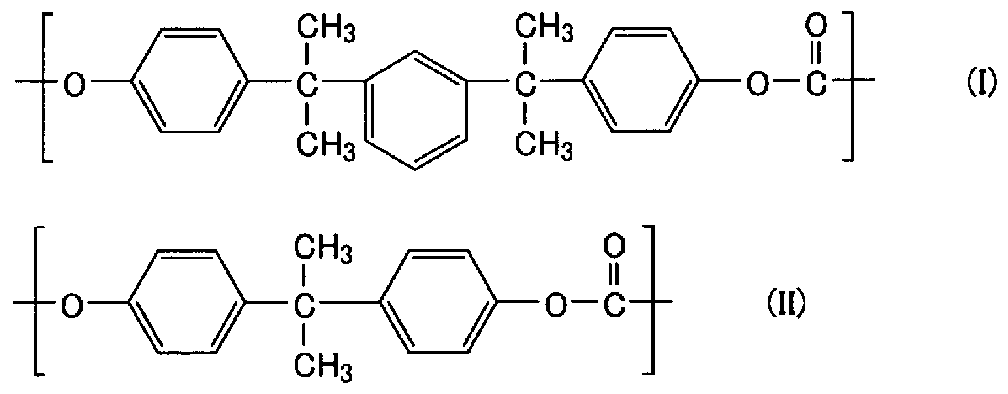
- the polycarbonate copolymer (A) constituting the polycarbonate-based resin composition (1) or (2) of the present invention has the following formulas (I) and (II):
- [0020] represented by the interfacial polymerization method in which ⁇ , ⁇ '-bis (4-hydroxyphenol) and 1m-diisopropylbenzene (hereinafter referred to as bisphenol M) are reacted, or diphenyl carbonate. It can be produced by a polymerization method using a transesterification reaction between a carbonate precursor such as bisphenol A and bisphenol M.
- the molar ratio of the repeating structural unit represented by the above formula ⁇ to the repeating structural unit represented by the above formula ( ⁇ ) is 1:99 to 99. ⁇ 50: 50 is more preferred, and 1: 99-30: 70 is particularly preferred! / ⁇ .
- the molar ratio of the repeating structural unit represented by the formula (I) to the repeating structural unit represented by the formula (II) is from 1:99 to 50:50. If it is within the range, the mechanical properties and the fluidity capable of thinning can be satisfied, and a thin or large light guide plate can be formed satisfactorily.
- the repeating structural unit represented by the above formula (I) and the repeating represented by the above formula (II) is preferably 1:99 to 99: 1, and particularly preferably 1:99 to 30:70.
- the polycarbonate copolymer (A) when the molar ratio is within this range, the mechanical properties and the desired melt fluidity can be satisfied, and the light guide member such as a thin or large light guide plate is excellent. Can be molded.
- the polycarbonate copolymer (A) used in the present invention as a force pulonyl source used, phosgene used in a general polycarbonate interfacial polycondensation method, triphosgene, bromophosgene and the like can be used. Can be used. In the case of the transesterification method, diallyl carbonate or the like can be used, and in the case of the acidic carbo-roiting method, carbonic acid monoxide or the like can be used.
- the terminal terminator used for the production of the polycarbonate copolymer (A) used in the present invention various kinds of compounds can be used as long as they are usually used for polymerization of polycarbonate.
- monovalent phenols can be used.
- phenol, linear or branched (long chain) alkyl group, aliphatic polyester group, and phenol having an aromatic compound as a substituent are used.
- p-tert-butylphenol, p-tamylphenol, p-tert-octylphenol, and phenol are preferred.
- branching agent used in the production of the polycarbonate copolymer (A) of the present invention for example, 1, 1, 1-tris (4 hydroxyphenol) ethane; 4, 4'- [1- [ 4— [1— (4 —Hydroxyphenol) — 1-Methylethyl] phenol] ethylidene] bisphenol; ⁇ , ⁇ ', ⁇ "—Tris (4 hydroxyphenol) 1, 3, 5 Tri Isopropyl benzene; 1— [a-methyl mono a- (4′-hydroxyphenyl) ethyl] —4 -— [ ⁇ ′, ⁇ ′-bis (4 ”-hydroxyphenyl) ethyl] benzene; phloroglysin, Compounds having three or more functional groups such as trimellitic acid and isatin bis ( ⁇ -taresole) can also be used.
- the viscosity of the polycarbonate copolymer (A) used in the present invention is 30 to 70, that is, 10,000 to 28,000 force S in terms of viscosity average molecular weight (Mv), preferably 34 to 62, that is, In terms of Mv, 12,000 to 24,000 power is preferred! /. If the viscosity number power is 30 to 70, a thin-walled or large-sized light guide plate or the like can be formed satisfactorily.
- the polycarbonate-based resin composition obtained in the present invention has a similar viscosity number of 30 to 70, preferably 34 to 62! /.
- the viscosity number is a value measured according to IS01628-4 (1999).
- the polycarbonate-based resin of the present invention is obtained by adding the polycarbonate copolymer (A) to the polycarbonate copolymer (A) from the viewpoint of balancing the mechanical properties according to the application to be used and the shape of the molded product.
- Aromatic polycarbonate resin other than A) can be blended.
- the aromatic polycarbonate resin include those prepared by reacting a commonly used production method, that is, a divalent phenol and a polycarbonate precursor such as phosgene or a carbonate ester compound. it can. Specifically, for example, in a solvent such as methylene chloride, a branching agent is added if necessary in the presence of a known acid acceptor or a terminal terminator (molecular weight regulator). Carbonate such as phenol and phosgene It is produced by a reaction with a thiophene precursor, or by a transesterification reaction between a divalent phenol and a force-bonate precursor such as diphenol carbonate.
- 2,2bis (4-hydroxyphenol) propane (common name: bisphenol A) is suitable.
- bisphenols other than bisphenol A include bis (4 hydroxyphenol) methane; 1,1-bis (4 hydroxyphenol) ethane; 2,2 bis (4 hydroxyphenol) butane; 2, 2-bis (4-hydroxyphenyl) octane; 2, 2 bis (4-hydroxyphenyl) phenyl methane; 2, 2 bis (4-hydroxy 1-methylphenol) propane; bis (4-hydroxyphenyl) 1) 1-bis (4 hydroxy t-butylphenol) propane; 2, 2bis (4hydroxy 1-3 bromophenol) propane; 2, 2bis (4 hydroxy-3,5 dimethylphenol) Propane; 2, 2 bis (4 hydroxy-3 cyclohexane) propane; 2, 2 bis (4 hydroxy-1, 3, 5 dichlorophenol) propane; 2, 2 bis (4-hydroxy 3, 5-dibromophenol) B) Propane and other screws 1, 2-bis (4 hydroxyphenyl) cyclopentan
- Examples of the carbonate compound include diaryl carbonate such as diphenyl carbonate, dialkyl carbonate such as dimethyl carbonate, and jetyl carbonate.
- terminal terminator molecular weight regulator
- various types can be used as long as they are usually used for polymerization of polycarbonate.
- phenol for example, phenol, ⁇ — ⁇ -butylphenol, m-n-butylphenol, p-n-butylphenol, o isobutylphenol, m isobutylphenol, ⁇ -isobutylphenol , O- t-Butylphenol, m-t-Butino Lenoenole, p-t-Butino Leuenore, o-n-Pentinoleuenore, m-n-Pentinoleuenore ⁇ —Pentinolephenol, o—n—Hexinolephenol, m —n—Hexylphenol, ⁇ — ⁇ —Hexylphenol, p—t—octylphenol, o cyclohexylphenol, m— Cyclohexylphenol, p cyclohexyl phenol, o phenyl phenol, m-phenyl phenol, p
- branching agent those described above as the branching agent of the polycarbonate copolymer are used. You can!
- the aromatic polycarbonate resin used in the present invention usually has a viscosity average molecular weight force of 10,000,000 to 100,000, preferably S, more preferably 12,000 to 40,000.
- the blending ratio of the polycarbonate copolymer ( ⁇ ) and the aromatic polycarbonate resin other than the polycarbonate copolymer ( ⁇ ) in the polycarbonate resin of the present invention is expressed by the formula (I If the ratio is such that the content of the repeating structural unit represented by 1) to 99 mol% can be adjusted, the mass ratio is preferably 100: 0 to 30:70, preferably 100: 0 to 40: Better than 60 power! / ⁇ .
- the acrylic resin (resin) used in the polycarbonate resin composition (1) of the present invention is a polymer having at least one monomer unit selected from acrylic acid, acrylic acid ester, acrylonitrile and derivatives thereof as a repeating unit. Yes, it means a homopolymer or a copolymer with styrene, butadiene or the like.
- polyacrylic acid polymethyl methacrylate ( ⁇ ), polyacrylonitrile, acrylate acrylate-acrylic acid 2-chloroethyl copolymer, acrylic acid- ⁇ -butyl-acrylonitrile copolymer, acrylonitrile styrene copolymer And acrylonitrile butadiene copolymer, acrylonitrile butadiene styrene copolymer, and the like.
- polymethyl methacrylate ( ⁇ ) can be particularly preferably used.
- the viscosity average molecular weight of the acrylic resin (wax) is 200 to 100,000, preferably 20,00 to 60,000.
- the viscosity average molecular weight force is 200 to 100,000, the phase separation between the PC copolymer and other PC resins and the acrylic resin does not become too fast during molding. Transparency is obtained.
- Polymethyl methacrylate (PMMA) can be used with known ones. Usually, it is produced by bulk polymerization of methyl methacrylate monomer in the presence of a peroxide or azo polymerization initiator. preferable.
- the viscosity average molecular weight is a value in terms of polystyrene measured by gel permeation chromatography (GPC) method.
- the blending amount of acrylic resin is 0.01 to 3 to 100 parts by mass of polycarbonate resin. It is a mass part, Preferably it is 0.05-1 mass part, More preferably, it is 0.1-0.5 mass part.
- the blending amount of acrylic resin is 0.01 parts by mass or more, the transparency of the molded product is improved, and when it is 3.0 parts by mass or less, the transparency is maintained without impairing other desired physical properties. be able to.
- an alicyclic epoxy compound (C) in order to improve steam resistance (hydrolysis resistance) and transparency, an alicyclic epoxy compound (C) can be blended as necessary.
- the alicyclic epoxy compound (C) used in the present invention is an alicyclic epoxy group, that is, a cycloaliphatic compound having an epoxy group in which one oxygen atom is added to an ethylene bond in the aliphatic ring.
- compounds represented by the following formulas (V) to (XIV) are preferably used.
- the compound represented by the formula (V), the formula (X) or the formula (XIV) is preferable in that it has excellent compatibility with a polycarbonate-based resin and does not impair transparency.
- the compounding amount of the alicyclic epoxy compound (C) is usually 0.001 to 1 part by mass, preferably 0.01 to 1 part by mass, more preferably 100 parts by mass of the polycarbonate-based resin. 0.0005 to 0.8 parts by mass, more preferably 0.01 to 0.5 parts by mass, particularly preferably 0.02 to 0.2 parts by mass.
- the blending amount is 0.01 parts by mass or more, transparency and steam resistance are improved. In addition, at 1 part by mass or less, transparency without causing phase separation is good.
- Polyorganosiloxane used as necessary in the polycarbonate-based resin composition (1) of the present invention and used as an essential component in the polycarbonate-based resin composition (2) of the present invention has a phenol group, It has at least one group selected from diphenyl group, bur group, and alkoxy group. For example, at least one group of methoxy group, ethoxy group, bur group, and full group is introduced into a silicone compound.
- a reactive silicone compound (organosiloxane, etc.) is preferred, and a polyorganosiloxane having a kinematic viscosity at 25 ° C. of 1-1000 mm 2 Z seconds is preferred. Furthermore, higher light guiding performance is required.
- Polyorganosiloxane having a viscosity at 25 ° C. of 1 to 150 mm 2 Z seconds is preferred. If the kinematic viscosity is too small, the low molecular weight component contained in the polyorganosiloxane increases, which may cause molding defects due to gas generation during molding, for example, unfilled, gas burned, and poor transfer. When the kinematic viscosity exceeds 1000 mm 2 Z seconds, it becomes difficult to disperse in the polycarbonate-based resin, and the effect of improving the light guide performance and diffusion performance of the obtained resin composition cannot be obtained.
- polyorganosiloxane (D) has the effect of further improving the thermal stability during molding, such as yellowing due to thermal deterioration during molding, poor appearance such as silver (silver strip), and prevention of air bubbles.
- the addition amount of the polyorganosiloxane is usually 0.01 to 3 parts by mass, preferably 0.02 to 1 parts per 100 parts by mass of the polycarbonate series resin in the polycarbonate series resin composition (1). If the blending amount is 0.01 parts by mass or more, the heat stabilization effect by the above blending is sufficiently exerted, and if it is 3 parts by mass or less, the molded product does not become cloudy. .
- the polycarbonate-based resin composition (2) 0.01 to 1 part by mass, preferably 0.02 to 0.8 part by mass, more preferably 0 to 100 parts by mass of the polycarbonate-based resin. .03 to 0.3 parts by mass.
- the blending ratio exceeds 1 part by mass, the impact on the impact resistance of the resin is increased.
- the blending amount of the polyorganosiloxane is within this range, the thermal stability at the time of molding is improved, and the hue of the resulting molded product is improved without causing fogging or the like in the resulting molded product.
- Examples of the phosphorus stabilizer (E) used in the polycarbonate resin composition (2) of the present invention include phosphoric acid compounds and Z or aromatic phosphine compounds.
- Examples of phosphoric acid compounds include phosphorous acid, phosphoric acid, phosphonous acid, phosphonic acid, and esters thereof.
- Tris-l-phenol phosphate, trimethyl phosphate, tris (2,4-di-tert-butylphenyl) phosphite and dimethyl benzenephosphonate are preferred.
- aromatic phosphine compound for example, the following formula (P)
- X is a hydrocarbon group, at least one of which is an aryl group having 6 to 18 carbon atoms which may have a substituent).
- aryl phosphine compound of P examples include triphenylphosphine, diphenylbutylphosphine, diphenyloctadecylphosphine, tris (p-tolyl) phosphine, and tris ( ⁇ -norphenyl) phosphine.
- Tris (naphthyl) phosphine diphenyl- (hydroxymethyl) monophosphine, diphenyl- (hydroxymethyl) monophosphine, diphenyl ( ⁇ -ethylcarboxyl) monophosphine, tris-one ( ⁇ Le
- Phosphine tris- ( ⁇ fluorophenol) phosphine, diphenol pendylphosphine ⁇ diphenol- 13-cyanethylphosphine, diphenol- ⁇ ( ⁇ -hydroxyphenol) Examples include phosphine and phenylenonaphthylbenzylphosphine. Of these, triphenylphosphine can be particularly preferably used.
- the above phosphorus stabilizers may be used alone or in combination of two or more.
- the amount of the phosphorus stabilizer is preferably 0.001 to 0.5 parts by mass, more preferably 0.005 to 0.3 parts by mass, and still more preferably 100 parts by mass of the polycarbonate resin. Is 0.01 to 0.1 parts by mass. When the amount of the phosphorus stabilizer is within this range, the thermal stability during molding is improved.
- additives may be blended in the polycarbonate-based resin composition (1) or (2) of the present invention as needed, as long as the effects of the present invention are not impaired.
- Stabilizers aliphatic carboxylic acid esters, paraffins, silicone oils, polyethylene wax and other internal lubricants, fluidity modifiers consisting of copolymers of styrene and acrylic compounds, conventional flame retardants, flame retardants Auxiliaries, release agents, antistatic agents, colorants and the like can be mentioned.
- the polycarbonate-based resin composition (1) or (2) of the present invention can be obtained by blending each of the above-described components and melt-kneading as necessary.
- melt-kneading conventional methods can be used.
- ribbon blender, Henschel mixer (trade name), nonbury mixer, drum tumbler mixer, single screw extruder, twin screw extruder, conida. can be performed by a multi-screw extruder or the like.
- the heating temperature for melt kneading is usually 250 to 300 ° C.
- This polycarbonate-based resin composition (1) or (2) has significantly improved melt flowability of the resin, and has improved residence stability in an injection molding machine, etc. It is suitable as a material for an optical molded body such as a light guide member.
- optical molded product (optical molded product) of the present invention formed by molding the polycarbonate-based resin composition (1) or (2) is used in the field of liquid crystal displays, optical parts, glass substitutes, and the like.
- optical component include optical elements such as an optical lens and a light guide member
- glass substitute applications include street lamp covers, laminated glass for vehicles and building materials.
- a light guide member can be preferably exemplified.
- Some light guide members have a plate shape, a rod shape, a spherical shape, and the like. Of these, a plate-like light guide plate can be preferably mentioned.
- a light-emitting diode hereinafter sometimes referred to as LED
- This lighting unit can be suitably used as a liquid crystal display device, a vehicle, a door, a housing, lighting in an interior, and a design part.
- the plate-like light guide plate in the light guide member is preferably produced by injection molding the polycarbonate resin composition.
- the cylinder temperature of the injection molding machine should be about 240 to 400 ° C, preferably about 280 to 380 ° C, and the mold temperature should be about 50 to 130 ° C! / .
- the size and shape of the light guide plate are not particularly limited, and a flat plate or curved plate having a thickness of about 0.1 to 3 mm, preferably about 0.5 to 3 mm may be formed. That is, the shape is not necessarily limited to a flat plate shape, and a curved plate having a lens effect may be appropriately selected depending on the purpose.
- a uniform planar light emitter can be obtained by micro-prism transfer on one or both of the front and back surfaces of the plate. It becomes.
- the microprism is not particularly limited, but a regular tetrahedron is preferable.
- the height is preferably 10 to 300 ⁇ m, more preferably 20 to 200 ⁇ m, and particularly preferably 50 to LOO / zm.
- dot pattern printing can be given or a conical drill can be cut.
- the present invention also provides an illumination unit including a light guide member such as a light guide plate in the optical molded body of the present invention and a light source.
- a light source is arranged on the thick part of a wedge-shaped light guide plate, and an edge-type surface light source body such as a liquid crystal television, a personal computer, or a display is used.
- the lighting unit consisting of As the light source, a fluorescent lamp, a cold cathode tube, an LED, and other self-luminous elements such as an organic electroluminescent element can be used.
- a knock light system or a front light system can be employed.
- a molded product of 35 mm length, 25 mm width and 2. Omm thickness was prepared by injection molding, and measured with a D65 light source using a direct reading haze meter—HGM-20DP made by Suga Test Instruments.
- a 2. Omm-thick molded product was produced by injection molding, and measured with a spectrophotometer 90 made by Nippon Denshoku with a measuring area of 30 ⁇ and the transmission method using a C2 light source.
- the amount of molten resin (mLZsec) flowing out from a nozzle with a diameter of 1 mm and a length of 10 mm was measured under a pressure of 280 ° C and 15.7 MPa in accordance with JIS K7210.
- the flow value (Q value) increases with decreasing melt viscosity.
- Measuring device An edge-type surface light source with a reflective film on the bottom and four LEDs on the edge is formed.
- a light guide plate is placed so that the prism pattern is on the bottom side, one diffusion film, and Two brightness enhancement films were stacked in order to form a surface light emitter.
- the LED was lit at a voltage of 3.25 volts per LED with a force of 4 and a current value of 10 mA.
- Eye Scale 3 as a luminance and chromaticity measuring device, the brightness of the emitted light at the center of the light guide plate was measured.
- the chromaticity difference (x, y) is the difference between the measured value of chromaticity of 5 mm from the non-incident side and the measured value of chromaticity of 5 mm from the incident side (chromaticity difference) in the lighting state of (5) above. ). It is preferable that the chromaticity difference is small because the chromaticity difference between the light incident part and the anti-light incident part is small. Chromaticity was measured using Eye Scale 3 as a luminance chromaticity measuring machine.
- BP A bisphenol A
- This BPA sodium hydroxide aqueous solution was continuously passed through a tubular reactor with an inner diameter of 6 mm and a pipe length of 30 m at a flow rate of 40 L (liter) Zhr, methylene chloride at a flow rate of 15 LZhr, and phosgene at a flow rate of 4. OkgZhr. .
- the tubular reactor used here has a jacket part with a double pipe, and cooling water was passed through the jacket part to keep the discharge temperature of the reaction solution at 40 ° C or lower.
- the reaction solution exiting the tubular reactor was continuously introduced into a 40-liter knotted tank reactor equipped with a retracting blade, and further, BPA's sodium hydroxide aqueous solution 2.8 LZhr, 25
- the reaction was carried out by adding 0.07 LZhr of an aqueous 5% by mass sodium hydroxide solution, 17 LZhr of water, and 1% by mass aqueous triethylamine solution at a flow rate of 0.64 LZhr.
- the reaction liquid overflowing from the tank reactor was continuously extracted and allowed to stand to separate and remove the aqueous phase, and the methylene chloride phase was collected.
- the polycarbonate oligomer thus obtained had a concentration of 320 g / L and a concentration of black mouthform group of 0.75 molZL.
- copolymer (a) The methylene chloride solution of the polycarbonate copolymer obtained by washing was concentrated and pulverized, and the obtained flakes were dried at 100 ° C. under reduced pressure to obtain a copolymer (a).
- the molar ratio of the repeating structural unit derived from BPM and the repeating structural unit derived from BPA determined by 13 C NMR was 12:88.
- PC was changed in the same manner as in Production Example 1 except that the addition amount of bisphenol M potassium hydroxide aqueous solution was changed as follows and the addition of bisphenol A sodium hydroxide aqueous solution was performed. Copolymer (b) was obtained.
- the molar ratio of the repeating structural unit derived from BPM and the repeating structural unit derived from BPA determined by 13 C NMR was 22:78.
- Production Example 3 A PC copolymer (c) was obtained in the same manner as in Production Example 2, except that the amount of PTBP added was changed from 191 g to 160 g.
- the molar ratio of the repeating unit derived from bisphenol M and the repeating unit derived from bisphenol A determined by 13 C-NMR was 22:78.
- a copolymer (d) was obtained in the same manner as in Production Example 1, except that the amounts of bisphenol M in potassium hydroxide, bisphenol A in sodium hydroxide, and PTBP were changed as follows.
- the molar ratio of the repeating structural unit derived from bisphenol M and the repeating structural unit derived from bisphenol A determined by 13 C-NMR was 8:92.
- Bisphenol M649g dissolved in an aqueous solution of KOH347g and sodium nitrite 1.3g in 3.7 liters of water.
- the raw materials were blended at the composition ratio shown in Table 1, and granulated at a resin temperature of 250 ° C by a 40 mm ⁇ extruder with a vent to obtain each pellet.
- the composition of the raw material resin is a PC copolymer (as the copolymers (a) to (c) obtained in the production examples, acrylic resin (B), manufactured by Mitsubishi Rayon Co., Ltd., Dianal BR83. (Viscosity average molecular weight 40, 000), BR87 (Viscosity average molecular weight 25,000), Daicel-Shigaku Kogyo Co., Ltd., Celoxide 2021P was used as the alicyclic epoxy compound (C).
- acrylic resin (B) manufactured by Mitsubishi Rayon Co., Ltd., Dianal BR83. (Viscosity average molecular weight 40, 000), BR87 (Viscosity average molecular weight 25,000), Daicel-Shigaku Kogyo Co., Ltd., Celoxide 2021P was used as the alicyclic epoxy compound (C).
- polycarbonate resin having a viscosity of 39.4, which is only BPA (Idemitsu Kosan Co., Ltd., Taflon FN1500) was used as the aromatic polycarbonate resin.
- organopolysiloxane KR511 organopolysiloxane having a methoxy group and a bur group manufactured by Shin-Etsu Silicone Co., Ltd. is used. did.
- Injection molding machine SG100M-HP, manufactured by Sumitomo Heavy Industries, Ltd.
- Light guide plate shape length 54mm, width 39mm, thickness 0.30mm, 0.35mm or thickness 0.50mm
- Prism V groove
- Table 1 summarizes the evaluation results of Examples 1 to 7 and Comparative Examples 1 and 2.
- the cylinder temperature and injection speed with low fluidity were low and the thickness was 0. Thin wall molding is also possible.
- the brightness is 1800 (cdZm 2 ) or more, and the chromaticity difference is as small as 0.01 or less.
- Example 8 to 16 the raw materials were blended in the composition ratios shown in Table 2, and the pellets were melt-kneaded and extruded at a resin temperature of 280 ° C and a screw speed of lOOrpm using a 40mm ⁇ single screw extruder with a vent.
- Table 2 shows the results of measurement of the type of polycarbonate-based resin composition used, mol% of bisphenol M, viscosity number, and Q value.
- a light guide plate having a length of 54 mm, width of 39 mm, thickness of 0.03 mm, 0.35 mm or 0.5 mm and having a prism: V-groove is formed by injection molding. The total light transmittance, YI-2 value, brightness, and chromaticity difference were evaluated. The results are shown in Table 2.
- Comparative Examples 3 to 5 the raw materials were blended at the composition ratio shown in Table 3, and each pellet was obtained according to Examples 8 to 16, and each pellet obtained was used to obtain Examples 8 to 16.
- the light guide plate was molded according to the above, and the total light transmittance, YI-2 value, luminance, and chromaticity difference were evaluated. The results are shown in Table 3.
- FN1500 represents aromatic polycarbonate resin (manufactured by Idemitsu Kosan Co., Ltd.).
- KF56 (trade name, manufactured by Shin-Etsu Chemical Co., Ltd.)
- the polycarbonate resin composition of the present invention is used as an optical molding material such as a light guide plate
- a thin light guide plate having good light guide performance without yellowing due to thermal deterioration and sufficient moldability can be obtained.
- This light guide plate can be suitably used for glass substitute applications such as optical elements such as a light guide plate in the field of liquid crystal displays, pack lights for liquid crystal display devices, street light covers, laminated glass for vehicles and building materials.
Landscapes
- Physics & Mathematics (AREA)
- Chemical & Material Sciences (AREA)
- Polymers & Plastics (AREA)
- General Physics & Mathematics (AREA)
- Health & Medical Sciences (AREA)
- Organic Chemistry (AREA)
- Medicinal Chemistry (AREA)
- Optics & Photonics (AREA)
- Chemical Kinetics & Catalysis (AREA)
- Engineering & Computer Science (AREA)
- Manufacturing & Machinery (AREA)
- Nonlinear Science (AREA)
- Mathematical Physics (AREA)
- Crystallography & Structural Chemistry (AREA)
- Compositions Of Macromolecular Compounds (AREA)
- Planar Illumination Modules (AREA)
Abstract
Description






Claims


Priority Applications (4)
| Application Number | Priority Date | Filing Date | Title |
|---|---|---|---|
| US12/299,121 US8119228B2 (en) | 2006-05-01 | 2007-04-23 | Polycarbonate resin composition, optical molded body using the same, and illumination unit |
| KR1020087026657A KR101393901B1 (ko) | 2006-05-01 | 2007-04-23 | 폴리카보네이트계 수지 조성물, 그것을 이용한 광학 성형체및 조명 유닛 |
| CN2007800150806A CN101432361B (zh) | 2006-05-01 | 2007-04-23 | 聚碳酸酯系树脂组合物、使用该聚碳酸酯系树脂组合物的光学成形体及照明单元 |
| DE112007001050T DE112007001050T5 (de) | 2006-05-01 | 2007-04-23 | Polycarbonatharz-Zusammensetzung, optischer Formkörper unter Verwendung derselben und Beleuchtungseinheit |
Applications Claiming Priority (4)
| Application Number | Priority Date | Filing Date | Title |
|---|---|---|---|
| JP2006127629A JP5005949B2 (ja) | 2006-05-01 | 2006-05-01 | ポリカーボネート系樹脂組成物、光学成形品及び照明ユニット |
| JP2006-127629 | 2006-05-01 | ||
| JP2006132978A JP5064720B2 (ja) | 2006-05-11 | 2006-05-11 | ポリカーボネート系樹脂組成物、それを用いた光学成形体及び照明ユニット |
| JP2006-132978 | 2006-05-11 |
Publications (1)
| Publication Number | Publication Date |
|---|---|
| WO2007129559A1 true WO2007129559A1 (ja) | 2007-11-15 |
Family
ID=38667667
Family Applications (1)
| Application Number | Title | Priority Date | Filing Date |
|---|---|---|---|
| PCT/JP2007/058712 Ceased WO2007129559A1 (ja) | 2006-05-01 | 2007-04-23 | ポリカーボネート系樹脂組成物、それを用いた光学成形体及び照明ユニット |
Country Status (5)
| Country | Link |
|---|---|
| US (1) | US8119228B2 (ja) |
| KR (1) | KR101393901B1 (ja) |
| DE (1) | DE112007001050T5 (ja) |
| TW (1) | TW200811242A (ja) |
| WO (1) | WO2007129559A1 (ja) |
Cited By (3)
| Publication number | Priority date | Publication date | Assignee | Title |
|---|---|---|---|---|
| JP2011521056A (ja) * | 2008-05-21 | 2011-07-21 | バイエル・マテリアルサイエンス・アクチェンゲゼルシャフト | 低温強度を有するポリカーボネート混合物 |
| WO2013051814A3 (ko) * | 2011-10-04 | 2013-05-30 | 주식회사 엘지화학 | 수지 조성물 및 이를 이용하여 형성된 광학 필름 |
| CN113801454A (zh) * | 2021-08-20 | 2021-12-17 | 深圳市鼎高光电产品有限公司 | 一种户外导光板及其制备方法 |
Families Citing this family (13)
| Publication number | Priority date | Publication date | Assignee | Title |
|---|---|---|---|---|
| JP5030467B2 (ja) * | 2006-04-28 | 2012-09-19 | 出光興産株式会社 | 導光部材及び照明ユニット |
| KR101256336B1 (ko) * | 2006-10-18 | 2013-04-18 | 이데미쓰 고산 가부시키가이샤 | 폴리카보네이트 공중합체, 그 제조 방법, 성형체, 광학 재료 및 전자 사진 감광체 |
| CN102906195B (zh) * | 2010-05-27 | 2016-01-27 | 出光兴产株式会社 | 聚碳酸酯树脂组合物及聚碳酸酯树脂成型体 |
| JP5808425B2 (ja) * | 2011-11-17 | 2015-11-10 | 帝人株式会社 | 導光性能を有する樹脂組成物、それからなる導光成形品および面光源体 |
| JP5879124B2 (ja) | 2011-12-28 | 2016-03-08 | 出光興産株式会社 | ポリカーボネート樹脂組成物ペレットの製造方法 |
| US9701835B2 (en) * | 2013-07-26 | 2017-07-11 | Mitsubishi Engineering-Plastics Corporation | Polycarbonate resin composition for thin optical component, and thin optical component |
| JP6101745B2 (ja) * | 2015-01-07 | 2017-03-22 | 三菱エンジニアリングプラスチックス株式会社 | 薄肉光学部品用ポリカーボネート樹脂組成物および薄肉光学部品 |
| CN104693772A (zh) * | 2015-03-04 | 2015-06-10 | 安徽科聚新材料有限公司 | 一种玻纤云母混合增强聚碳酸酯材料及其制备方法 |
| TWI535772B (zh) * | 2015-03-31 | 2016-06-01 | 長興材料工業股份有限公司 | 光學材料組合物及其用途 |
| EP3305850B1 (en) * | 2015-05-29 | 2022-11-02 | Idemitsu Kosan Co.,Ltd. | Polycarbonate resin composition and molded article of same |
| EP3249013B1 (en) | 2016-02-18 | 2020-07-29 | LG Chem, Ltd. | Polycarbonate resin composition and optical molded article using same |
| KR101912243B1 (ko) * | 2016-02-18 | 2018-10-26 | 주식회사 엘지화학 | 폴리카보네이트 수지 조성물 및 이를 이용한 광학 성형품 |
| JP7285343B2 (ja) | 2019-09-04 | 2023-06-01 | サムスン エスディアイ カンパニー,リミテッド | 硬化型樹脂組成物、それから形成された硬化膜、および前記硬化膜を有する電子装置 |
Citations (3)
| Publication number | Priority date | Publication date | Assignee | Title |
|---|---|---|---|---|
| JPS6389539A (ja) * | 1986-10-03 | 1988-04-20 | Daicel Chem Ind Ltd | 光学式デイスク |
| JP2004027107A (ja) * | 2002-06-27 | 2004-01-29 | Teijin Chem Ltd | 被覆ポリカーボネート板状成形体 |
| JP2005298710A (ja) * | 2004-04-14 | 2005-10-27 | Idemitsu Kosan Co Ltd | 光拡散性樹脂組成物 |
Family Cites Families (8)
| Publication number | Priority date | Publication date | Assignee | Title |
|---|---|---|---|---|
| JP4104707B2 (ja) | 1997-11-27 | 2008-06-18 | 出光興産株式会社 | ポリカーボネート樹脂組成物及び導光板 |
| JP2003096179A (ja) | 2000-12-20 | 2003-04-03 | Mitsui Chemicals Inc | 光学部品用成形材料 |
| JP2002348367A (ja) | 2001-05-25 | 2002-12-04 | Teijin Chem Ltd | 芳香族ポリカーボネート樹脂およびそれからの成形品 |
| JP2003192780A (ja) | 2001-12-27 | 2003-07-09 | Mitsui Chemicals Inc | 光学部品用成形材料 |
| JP4446668B2 (ja) | 2003-02-19 | 2010-04-07 | 三菱エンジニアリングプラスチックス株式会社 | 導光板用芳香族ポリカーボネート樹脂組成物、導光板および面光源体 |
| JP2005060628A (ja) | 2003-08-20 | 2005-03-10 | Teijin Chem Ltd | リフロー耐性に優れたポリカーボネート樹脂 |
| JP4478428B2 (ja) * | 2003-10-07 | 2010-06-09 | 出光興産株式会社 | ポリカーボネート系樹脂組成物及び光学部品 |
| JP5073226B2 (ja) * | 2006-05-11 | 2012-11-14 | 出光興産株式会社 | 光拡散性樹脂組成物及びそれを用いた光拡散板 |
-
2007
- 2007-04-23 WO PCT/JP2007/058712 patent/WO2007129559A1/ja not_active Ceased
- 2007-04-23 DE DE112007001050T patent/DE112007001050T5/de not_active Withdrawn
- 2007-04-23 US US12/299,121 patent/US8119228B2/en not_active Expired - Fee Related
- 2007-04-23 KR KR1020087026657A patent/KR101393901B1/ko not_active Expired - Fee Related
- 2007-04-26 TW TW096114847A patent/TW200811242A/zh unknown
Patent Citations (3)
| Publication number | Priority date | Publication date | Assignee | Title |
|---|---|---|---|---|
| JPS6389539A (ja) * | 1986-10-03 | 1988-04-20 | Daicel Chem Ind Ltd | 光学式デイスク |
| JP2004027107A (ja) * | 2002-06-27 | 2004-01-29 | Teijin Chem Ltd | 被覆ポリカーボネート板状成形体 |
| JP2005298710A (ja) * | 2004-04-14 | 2005-10-27 | Idemitsu Kosan Co Ltd | 光拡散性樹脂組成物 |
Cited By (3)
| Publication number | Priority date | Publication date | Assignee | Title |
|---|---|---|---|---|
| JP2011521056A (ja) * | 2008-05-21 | 2011-07-21 | バイエル・マテリアルサイエンス・アクチェンゲゼルシャフト | 低温強度を有するポリカーボネート混合物 |
| WO2013051814A3 (ko) * | 2011-10-04 | 2013-05-30 | 주식회사 엘지화학 | 수지 조성물 및 이를 이용하여 형성된 광학 필름 |
| CN113801454A (zh) * | 2021-08-20 | 2021-12-17 | 深圳市鼎高光电产品有限公司 | 一种户外导光板及其制备方法 |
Also Published As
| Publication number | Publication date |
|---|---|
| TW200811242A (en) | 2008-03-01 |
| US20090185363A1 (en) | 2009-07-23 |
| KR101393901B1 (ko) | 2014-05-12 |
| KR20080111516A (ko) | 2008-12-23 |
| DE112007001050T5 (de) | 2009-04-02 |
| US8119228B2 (en) | 2012-02-21 |
Similar Documents
| Publication | Publication Date | Title |
|---|---|---|
| WO2007129559A1 (ja) | ポリカーボネート系樹脂組成物、それを用いた光学成形体及び照明ユニット | |
| KR101393822B1 (ko) | 광 확산성 수지 조성물 및 그것을 이용한 광 확산판 | |
| US10995213B2 (en) | Polycarbonate resin composition and molded polycarbonate resin | |
| TWI381019B (zh) | A light diffusing polycarbonate resin composition, and a light diffusion plate using the resin composition | |
| CN103547857B (zh) | 导光体用聚碳酸酯树脂组合物以及由它形成的导光体和面光源体 | |
| WO2006132092A1 (ja) | 光拡散性ポリカーボネート系樹脂組成物、および同樹脂組成物を用いた光拡散板 | |
| CN100393803C (zh) | 聚碳酸酯树脂组合物和光学部件 | |
| CN101432361B (zh) | 聚碳酸酯系树脂组合物、使用该聚碳酸酯系树脂组合物的光学成形体及照明单元 | |
| JP2009280636A (ja) | ガラス繊維強化難燃性ポリカーボネート樹脂組成物及び該樹脂組成物を用いた成形品 | |
| KR20150023415A (ko) | 도광 성능을 갖는 수지 조성물, 그리고 그것으로 이루어지는 도광판 및 면 광원체 | |
| JP6895778B2 (ja) | ポリカーボネート樹脂組成物およびそれからなる成形品 | |
| JP5064720B2 (ja) | ポリカーボネート系樹脂組成物、それを用いた光学成形体及び照明ユニット | |
| WO2007125854A1 (ja) | 導光部材及び照明ユニット | |
| WO2025192177A1 (ja) | ポリカーボネート樹脂組成物およびその成形品 |
Legal Events
| Date | Code | Title | Description |
|---|---|---|---|
| 121 | Ep: the epo has been informed by wipo that ep was designated in this application |
Ref document number: 07742147 Country of ref document: EP Kind code of ref document: A1 |
|
| WWE | Wipo information: entry into national phase |
Ref document number: 200780015080.6 Country of ref document: CN |
|
| WWE | Wipo information: entry into national phase |
Ref document number: 1020087026657 Country of ref document: KR |
|
| WWE | Wipo information: entry into national phase |
Ref document number: 1120070010509 Country of ref document: DE Ref document number: 12299121 Country of ref document: US Ref document number: 5926/CHENP/2008 Country of ref document: IN |
|
| RET | De translation (de og part 6b) |
Ref document number: 112007001050 Country of ref document: DE Date of ref document: 20090402 Kind code of ref document: P |
|
| 122 | Ep: pct application non-entry in european phase |
Ref document number: 07742147 Country of ref document: EP Kind code of ref document: A1 |