WO2005118722A1 - Wässrige beschichtungszusammensetzung mit korrosionsstabilen dünnen deckenden aluminiumpigmenten, verfahren zu deren herstellung und verwendung derselben - Google Patents
Wässrige beschichtungszusammensetzung mit korrosionsstabilen dünnen deckenden aluminiumpigmenten, verfahren zu deren herstellung und verwendung derselben Download PDFInfo
- Publication number
- WO2005118722A1 WO2005118722A1 PCT/EP2005/005879 EP2005005879W WO2005118722A1 WO 2005118722 A1 WO2005118722 A1 WO 2005118722A1 EP 2005005879 W EP2005005879 W EP 2005005879W WO 2005118722 A1 WO2005118722 A1 WO 2005118722A1
- Authority
- WO
- WIPO (PCT)
- Prior art keywords
- coating composition
- aluminum
- pigments
- corrosion protection
- protection layer
- Prior art date
- Legal status (The legal status is an assumption and is not a legal conclusion. Google has not performed a legal analysis and makes no representation as to the accuracy of the status listed.)
- Ceased
Links
Classifications
-
- C—CHEMISTRY; METALLURGY
- C09—DYES; PAINTS; POLISHES; NATURAL RESINS; ADHESIVES; COMPOSITIONS NOT OTHERWISE PROVIDED FOR; APPLICATIONS OF MATERIALS NOT OTHERWISE PROVIDED FOR
- C09C—TREATMENT OF INORGANIC MATERIALS, OTHER THAN FIBROUS FILLERS, TO ENHANCE THEIR PIGMENTING OR FILLING PROPERTIES ; PREPARATION OF CARBON BLACK ; PREPARATION OF INORGANIC MATERIALS WHICH ARE NO SINGLE CHEMICAL COMPOUNDS AND WHICH ARE MAINLY USED AS PIGMENTS OR FILLERS
- C09C1/00—Treatment of specific inorganic materials other than fibrous fillers; Preparation of carbon black
- C09C1/62—Metallic pigments or fillers
- C09C1/64—Aluminium
- C09C1/644—Aluminium treated with organic compounds, e.g. polymers
-
- C—CHEMISTRY; METALLURGY
- C09—DYES; PAINTS; POLISHES; NATURAL RESINS; ADHESIVES; COMPOSITIONS NOT OTHERWISE PROVIDED FOR; APPLICATIONS OF MATERIALS NOT OTHERWISE PROVIDED FOR
- C09C—TREATMENT OF INORGANIC MATERIALS, OTHER THAN FIBROUS FILLERS, TO ENHANCE THEIR PIGMENTING OR FILLING PROPERTIES ; PREPARATION OF CARBON BLACK ; PREPARATION OF INORGANIC MATERIALS WHICH ARE NO SINGLE CHEMICAL COMPOUNDS AND WHICH ARE MAINLY USED AS PIGMENTS OR FILLERS
- C09C1/00—Treatment of specific inorganic materials other than fibrous fillers; Preparation of carbon black
- C09C1/62—Metallic pigments or fillers
- C09C1/64—Aluminium
- C09C1/644—Aluminium treated with organic compounds, e.g. polymers
- C09C1/646—Aluminium treated with organic compounds, e.g. polymers concomitant with mechanical comminution, shaping or abrasion of the particles
-
- C—CHEMISTRY; METALLURGY
- C09—DYES; PAINTS; POLISHES; NATURAL RESINS; ADHESIVES; COMPOSITIONS NOT OTHERWISE PROVIDED FOR; APPLICATIONS OF MATERIALS NOT OTHERWISE PROVIDED FOR
- C09D—COATING COMPOSITIONS, e.g. PAINTS, VARNISHES OR LACQUERS; FILLING PASTES; CHEMICAL PAINT OR INK REMOVERS; INKS; CORRECTING FLUIDS; WOODSTAINS; PASTES OR SOLIDS FOR COLOURING OR PRINTING; USE OF MATERIALS THEREFOR
- C09D5/00—Coating compositions, e.g. paints, varnishes or lacquers, characterised by their physical nature or the effects produced; Filling pastes
- C09D5/02—Emulsion paints including aerosols
- C09D5/024—Emulsion paints including aerosols characterised by the additives
- C09D5/028—Pigments; Filters
-
- C—CHEMISTRY; METALLURGY
- C09—DYES; PAINTS; POLISHES; NATURAL RESINS; ADHESIVES; COMPOSITIONS NOT OTHERWISE PROVIDED FOR; APPLICATIONS OF MATERIALS NOT OTHERWISE PROVIDED FOR
- C09D—COATING COMPOSITIONS, e.g. PAINTS, VARNISHES OR LACQUERS; FILLING PASTES; CHEMICAL PAINT OR INK REMOVERS; INKS; CORRECTING FLUIDS; WOODSTAINS; PASTES OR SOLIDS FOR COLOURING OR PRINTING; USE OF MATERIALS THEREFOR
- C09D5/00—Coating compositions, e.g. paints, varnishes or lacquers, characterised by their physical nature or the effects produced; Filling pastes
- C09D5/38—Paints containing free metal not provided for above in groups C09D5/00 - C09D5/36
-
- C—CHEMISTRY; METALLURGY
- C01—INORGANIC CHEMISTRY
- C01P—INDEXING SCHEME RELATING TO STRUCTURAL AND PHYSICAL ASPECTS OF SOLID INORGANIC COMPOUNDS
- C01P2004/00—Particle morphology
- C01P2004/54—Particles characterised by their aspect ratio, i.e. the ratio of sizes in the longest to the shortest dimension
Definitions
- Aqueous coating composition with corrosion-resistant thin, opaque aluminum pigments process for their preparation and use thereof
- the present invention relates to an aqueous coating composition which contains aluminum pigments provided with an inorganic corrosion protection layer. Furthermore, the invention relates to a method for producing such a coating composition and the use of the coating composition as well as objects coated with the coating composition.
- Aqueous coating compositions with a metallic effect have been known for many years.
- the metallic effect comes from platelet-shaped metal pigments.
- the corrosion-sensitive aluminum pigments must be provided with a protective coating in aqueous coating compositions in order to avoid oxidation of the aluminum pigments with the formation of hydrogen.
- the most brilliant aluminum pigments with the highest luster and flop can currently be assigned to two classes: on the one hand so-called “silver dollar pigments", which are produced by wet grinding of aluminum powder, and on the other hand so-called “PVD pigments”. Silver dollar pigments are characterized by a relatively round shape and a relatively smooth surface compared to metal pigments from the grinding process.
- a coating composition containing silver dollar aluminum pigments is disclosed, for example, in DE 101 00 195 A1.
- a neutralizing mixture of at least two fatty acids is present in the coating composition.
- this coating composition should have a significantly lower tendency to form “clouds”.
- Aluminum pigments produced by wet grinding with a high degree of reflection and high coverage are described, for example, in EP 0 451 785 B2.
- the pigments are characterized by water coverage (spreading value) of 2.5 - 5.0 m 2 / g, a roughness value of 2.0 and less and a form factor dso / h of 90 and more.
- Form factors up to a maximum of 140 are known from the examples of EP 0 451 785 B2.
- no aqueous coating compositions are described here.
- WO 01/81483 A1 describes a pigment preparation which contains aluminum pigments coated with a silicon-oxygen matrix and a binder containing carboxyl groups and having an acid number of 10 to 100 mg KOH / g.
- the aluminum pigments used here are not described in their thickness characteristics. At that time, however, pigments with layer thicknesses above 300 nm were usually commercially available.
- PVD pigments extremely thin (thicknesses: 20 to 50 nm) aluminum pigments are produced. The thickness distribution of these pigments is extremely small.
- aluminum is placed on one in an ultra-high vacuum a release film provided with a release film.
- This release film is usually a polymer.
- the vapor-deposited aluminum is, if possible, separated from the support film in a solvent and the metal film is mechanically or ultrasonically comminuted.
- the production of PVD pigments is described, for example, in J. Seubert and A. Fetz, "PVD Aluminum Pigments: Superior Brillance for Coatings and Graphic Arts", Coatings Journal, Vol. 84, A6 225-264, July 2001, pages 240-245 described.
- PVD pigments Due to their extreme thinness, these PVD pigments have excellent hiding power.
- the thin pigments are so flexible that they literally "nestle" on their surface. Therefore, they should be applied on a smooth surface to develop their optical possibilities.
- Coating compositions that contain PVD pigments in a passivated form enable coatings with a higher gloss and the visually perceptible appearance of a closed metal film.
- coating compositions are also correspondingly expensive due to the expensive PVD pigments.
- Pigment particles can be removed.
- this adherent polymer film can lead to disadvantages. This is noticeable, for example, in the formation of agglomerates that completely destroy the desired decorative effect. Such agglomerates lead to speck formation and increase the tendency of cloud formation.
- PVD pigments Another disadvantage of such PVD pigments is their difficult handling in aqueous coating compositions. Due to their extremely high and smooth specific surface, the tendency to agglomerate is very strong. furthermore coating compositions containing these pigments are relatively difficult to apply. Uniform automotive paint finishes, for example, can only be achieved by hand painting in many thin-layer painting steps. Such sensitive application behavior stands in the way of automation, as is customary for coating compositions with conventional aluminum pigments.
- Aqueous coating compositions which contain conventionally produced pigments - in the form of silver dollars or "cornflake" - in a passivated form are suitable for producing metallic coatings.
- the formation of clouds is caused by an uneven orientation of the aluminum pigments, in particular by practically vertical aluminum pigments in the coating.
- Another object of the invention is an aqueous
- the aqueous coating composition should be easier to apply than an aqueous coating composition which contains PVD pigments.
- an aqueous coating composition which contains at least one film-forming agent which is compatible with water and aluminum pigments provided with at least one inorganic corrosion protection layer, the thickness of the aluminum pigments provided with at least one inorganic corrosion protection layer being less than 160 nm on average.
- Coating compositions are specified in subclaims 2 to 21.
- Grinding media have an individual weight of 2 to 13 mg over a period of at least 15 hours to aluminum pigments
- step (b) Wet chemical coating of the aluminum pigments produced in step (a) with at least one inorganic corrosion protection layer, (c) Mixing of the aluminum pigments coated in step (b) with at least one film-forming agent and a liquid phase to provide the coating composition.
- Preferred developments of the method according to the invention are specified in subclaims 23 to 31.
- the object on which the invention is based is further achieved by the use of the coating composition according to the invention in high-gloss coatings, such as automotive coatings, refinish coatings, industrial coatings, coatings on plastics, wood or glass.
- high-gloss coatings such as automotive coatings, refinish coatings, industrial coatings, coatings on plastics, wood or glass.
- the object is further achieved by an object coated with the coating composition according to the invention.
- the aluminum pigments used in the invention are not PVD pigments, i.e. no aluminum pigments produced by a PVD process (Physical Vapor Deposition process), but aluminum pigments produced by mechanical deformation.
- Aluminum pigments are effect pigments and are characterized by their unique metallic appearance and high opacity. Due to the platelet-like structure of these effect pigments, they are oriented in the application medium parallel to the substrate and create a metallic effect through a combination of many individual mirrors. This metallic effect is particularly pronounced in wet paints.
- Full-tone lacquers are a brightness effect that depends on the observation and / or angle of incidence and is also referred to as a "flop". A good flop is influenced by many properties of the pigments: this is how their orientation, their size and size distribution, and their surface texture play (Roughness) and the edge texture play an important role.
- the driving force for a plane-parallel orientation of the metal pigments is - in addition to interfacial chemistry.
- the form factor is the ratio of the longitudinal dimension d to the thickness h of the pigments.
- the longitudinal extent is mainly determined using laser diffraction methods. As a rule, the dso value of the total throughput curve is used.
- a disturbed orientation of the aluminum pigments in the coating leads to the formation of so-called "clouds", ie to disturbing light-dark shades.
- Water-based paints are becoming increasingly widespread on the market as environmentally friendly systems.
- the aluminum pigments must be provided with a passivating protective layer. Otherwise the reaction with water leads to the oxidation of the pigment - and with it the loss of the effect properties - and the formation of hydrogen (gassing). This is dangerous for safety reasons alone.
- Chromating EP 0 259 592
- SiO 2 coating US 2,885,366, US 3,954,496, EP 0 678 561, DE 195 01 307, EP 0 708 155) are most effective.
- the aluminum pigments are treated with vanadium (EP 0 104 075) or with molybdenum compounds (US 5,480,481 and EP 0 583 919) or a combination thereof (US 4,693,469).
- Coatings with plastic resins EP 0 477 433 have proven to be less efficient.
- Treatment with organophosphorus compounds such as phosphonic acids or phosphoric acids (US 4,808,231) or phosphites (US 5,215,579) and their esters is also far less efficient. This creates gassing stability in relatively mild water-based paint systems, but not in very aggressive systems.
- the corrosion stability of the passivated aluminum pigments initially only plays a role in relation to the gassing stability in the aqueous
- Coating composition In many applications - such as in the largest market segment, automotive paint - the coated object is provided with an additional clear coat. Due to its barrier effect, this provides adequate corrosion protection for the aluminum pigments within the basecoat film.
- Coating composition that provides corrosion protection for the aluminum pigments even in a single-layer coating without additional clear lacquer.
- the fields of application here are consumer electronics, coatings for mobile phones and the automotive industry.
- the passivating inorganic corrosion protection layer of the aluminum pigment preferably contains oxides and / or hydroxides from the group consisting of silicon,
- the inorganic corrosion protection layer can also contain molybdenum peroxides.
- the passivating corrosion protection layer preferably consists of the aforementioned components.
- the corrosion protection layer can also be a mixed layer of aluminum oxides and / or chromium oxides. Such a corrosion protection layer can be obtained by treating the formed aluminum pigments with chromic acid, a so-called chromating.
- the proportion of the corrosion protection layer is preferably less than 20% by weight, based on the total weight of the aluminum pigments provided with the corrosion protection layer.
- a corrosion protection layer is sufficient to obtain sufficient passivation of the aluminum pigments.
- the silicon dioxide surface is also preferably coated with organofunctional silanes.
- a surface modification with organofunctional silanes gives the effect pigment good and controllable wetting properties to the binder.
- the coating composition according to the invention thus allows the extremely thin aluminum pigments to be embedded or embedded in a lacquer or paint layer.
- further corrosion protection of the aluminum pigments is achieved by embedding them in the lacquer or paint layer.
- the organofunctional groups applied to the surface of the SiO 2 protective layer allow reaction with binder components and lead to covalent binding of the aluminum pigments in the lacquer or color layer. Due to the chemical fixation in the lacquer or paint layer, it is no longer necessary to apply a further protective layer, for example a clear lacquer layer.
- a lacquer or color layer produced using the coating composition of the invention has an exceptional gloss and excellent chemical resistance even without a subsequent clear lacquer layer.
- a clear coat must be applied to the pigment-containing basecoat in order to obtain the desired gloss.
- the amount of SiO 2 that is used for a complete coating of the aluminum pigment in order to achieve gassing stability should be as low as possible. High amounts of SiO 2 reduce the opacity of the effect pigment and can adversely affect the optical properties.
- the amount of SiO 2 of the coated aluminum pigments for the coating compositions according to the invention is preferably in a range from 2 to 20% by weight, preferably from 3 to 15% by weight and particularly preferably from 4 to 10% by weight, in each case based on the weight of the entire effect pigment in dry form.
- this SiO 2 content usually results in layer thicknesses of 3 to 20 nm in the SiO 2 layer.
- Coating composition is on average less than 160 nm, preferably 50 to 160 nm, more preferably 60 to 140 nm, particularly preferably 70 to 120 nm and very particularly preferably 75 to 90 nm.
- the aluminum pigments are so thin that they can already lose their optical opacity, i.e. their opacity decreases considerably.
- the desired optical properties are no longer achieved above a total layer thickness of 160 nm.
- the layer thickness of the protective layer is included twice in the total layer thickness of the pigment.
- the layer thickness of the pure aluminum pigment is 120 nm.
- Corrosion layer is preferably in a range from 30 nm to 154 nm, more preferably from 50 nm to 140 nm, even more preferably from 60 nm to 120 nm.
- a layer thickness of 70 to 100 nm has proven to be very suitable. It is assumed that the optical effect of a closed metal film, which gives the visual impression of an essentially structureless, preferably structureless, metal film, is due to the fact that the effect pigments stack on top of one another in the densest manner after application. Due to their thinness, they can be stacked very well without problems such as haze. Such behavior is known from very thin aluminum pigments produced by PVD processes. Such pigments completely nestle against their surface.
- a mixed layer of aluminum and chromium oxide is also preferably used as the inorganic corrosion protection layer.
- This mixed layer is formed by a process known as a chromating process and represents an extremely effective protection against corrosion. The production of such pigments is described in EP 0 259 592, which is hereby incorporated by reference.
- the aluminum pigment is after the deformation of a wet chemical oxidation subjected. This is described per se in EP 0 848 735, which is hereby incorporated by reference.
- the oxidation forms an aluminum oxide / hydroxide layer, which gives the pigment passivating properties.
- this treatment of the aluminum flakes leads to a coloring in the yellowish-gold color range.
- the determination of the average layer thickness of coated aluminum pigments can be carried out by two methods.
- the spreading value method and, on the other hand, the thickness determination by scanning electron micrographs based on cross sections of spray applications of the coating composition are to be mentioned.
- the layer thickness of the aluminum core and the corrosion protection layer can also be differentiated, with a suitable cross-section preparation.
- the spreading value method has long been known for determining the thickness of aluminum pigments.
- DIN 55923 specifies a regulation for measuring the degree of water coverage (spreading) of "Ieafing" pigments. Their application requires that the aluminum pigments in the coating composition be largely isolated.
- the coating composition is coated with an organic solvent, such as acetone or ethyl acetate mixed in a ratio of 1: 1 and subjected to centrifugation (1000 rpm for 5 min), the aluminum pigments sediment and the supernatant is decanted, the sedimented aluminum pigments are redispersed in 10 times the weight of solvent, centrifuged again and the supernatant decanted off This process is repeated 10 to 20 times, after which the aluminum pigments are largely of the film-forming agent and other non-volatile components of the organic solvent, such as acetone or ethyl acetate mixed in a ratio of 1: 1 and subjected to centrifugation (1000 rpm for 5 min), the aluminum pigments sediment and the supernatant is decanted, the sedimented aluminum pigments are redispersed in 10 times the weight of solvent, centrifuged again and the supernatant decanted off This process is repeated 10 to 20 times, after which the aluminum pigments are largely of the film-forming
- Coating composition separately. They are then dispersed in a 10-stage stearic acid solution in white spirit and stirred for 15 minutes. Then they are separated from the solution by filtration and dried. Through this Procedure, stearic acid is adsorbed on the pigments, which gives these "leafing" properties.
- a defined amount of aluminum pigments treated in this way is applied to a water surface in a tub in a volatile organic solvent.
- the pigments spread on the water surface and form a silver metal film.
- they are distributed to a uniform "cloudless" metal film.
- the film is pressed together by two rulers until it shows first folds.
- the film is relaxed again until the folds disappear.
- the area covered by the metal film becomes measured and given on the basis of the weight of the pigment as a spreading value in cm 2 / g (or also in m 2 / g).
- the metal pigments at least on average in the film, are arranged individually next to one another and are therefore present in a single “monolayer” of pigment.
- the average thickness h in nm of the pigments is calculated using the following formula:
- p is the pure physical density of the pigment adsorbed with stearic acid.
- a value of approximately 2.5 g / cm 3 is usually measured here.
- an application of the coating composition is first created and cured.
- a cross section is then made, for example with a microtome.
- the cross section is carefully polished.
- Suspensions of octanephosphonic acid or nanoscale SiO 2 particles are used as polishing agents, for example.
- electron microscopic images are taken of the cross-section. In order to obtain statistically relevant numbers, this should include at least 50, preferably at least 75 and particularly preferably at least 100, particles.
- a suitable grinding preparation one can differentiate between the layer thicknesses of the aluminum core and the corrosion protection layer based on the contrast.
- the azimuthal angle which can usually be estimated with the naked eye, must be corrected. This method also determines the distribution of the thickness ratios.
- the thinness of the aluminum pigments leads to a remarkably high one
- the aluminum pigments coated with a corrosion protection layer have a form factor, which is calculated from the ratio of the mean longitudinal extent to the mean thickness, of preferably more than 120, preferably more than 160, particularly preferably more than 200 and very particularly preferably more than 220.
- the mean longitudinal extent is the d50 value of the total passage distribution, as is usually determined by laser diffraction methods (Frauenhof diffraction).
- the coating compositions according to the invention are based on aqueous coating compositions.
- water is present as a solvent component in a proportion of preferably 50 to 98%, preferably 60 to 95% and particularly preferably 70 to 90%.
- the rest can be composed of various organic solvents. Examples include alcohols such as n-butanol, isopropanol, Dowanol PM, glycols such as butyl glycol, butyl diglycol, ethyl diglycol, and hydrocarbons such as white spirit or solvent naphtha, and heterocyclic compounds such as n-methylpyrrolidone.
- All common water-compatible binders can be used as film-forming components.
- the binders can be curable physically, thermally or thermally in combination with electromagnetic radiation ("dual-cure").
- Thermally curable binders can be self-crosslinking or crosslinking.
- Self-crosslinking binders have both types of complementary reactive groups necessary for curing.
- Crosslinking binders require one Hardener or crosslinker.
- the stoving temperatures are preferably 60 - 190 ° C.
- Examples of binders which can be used are those based on polyurethanes, polyamides, polyureas, melamine resins, polyimides, polyacrylates, polymethacrylates, epoxy resins, polyethers or polyesters. It is also possible to use combinations of these functionalities, for example polyester-polyurethane or polyester-polyether-polyurethane, polyester-polyacrylate or polyacrylate-polyurethane.
- Binders are preferably used which contain carboxyl groups and preferably have an acid number of 10 to 100 mg KOH / g binder, particularly preferably 40 to 80 mg KOH / g binder. These binders more preferably have molecular weights of 500 to 5000 g / mol.
- the ratio of the proportions by weight of aluminum pigment to film-forming agent is 1: 1 to 1:10, preferably 1: 3 to 1: 6 and particularly preferably 1: 4 to 1: 5.
- the coating composition With a ratio by weight of aluminum pigment to film-forming agent of over 1: 1, the coating composition is overpigmented, i.e. the optical effect decreases significantly. In particular, the desired high gloss and appearance of a structureless "closed liquid metal film" are no longer formed. Below a ratio by weight of 1:10, there is too little aluminum pigment in the coating composition to ensure adequate coverage and metallic effect.
- Coating composition also other effect pigments such as pearlescent pigments, the proportion of aluminum pigments can also be reduced more.
- the total amount of the aluminum pigments provided with a corrosion protection layer with an average thickness below 160 nm, based on the total weight of the coating composition according to the invention is preferably less than 10% by weight. Preferably less than 5% by weight and particularly preferably less than 3% by weight are used. Due to the small thickness of the pigments, their opacity is excellent, so that extremely low pigmentation levels are sufficient to achieve the desired visual impression.
- the coating composition can also contain further effect pigments. These include, for example pearlescent pigments with colored pigments such as oxide-coated aluminum Paliocrom ® (Fa. BASF, Germany), interference pigments, or mixtures with other, thicker aluminum pigments (Hydrolan ®, Hydrolux ®, Fa. Eckart, Germany).
- pearlescent pigments with colored pigments such as oxide-coated aluminum Paliocrom ® (Fa. BASF, Germany)
- interference pigments or mixtures with other, thicker aluminum pigments (Hydrolan ®, Hydrolux ®, Fa. Eckart, Germany).
- the ratio of the amounts of thin aluminum pigments used in this case to further effect pigment or binder cannot be given in general and depend on the type of effect pigment used. Pearlescent pigments are far less opaque than aluminum pigments.
- the following compositions based on the total weight of coating composition
- Thin AI pigment with passivating corrosion protection layer 0.5 - 2.0% by weight pearlescent pigment: 5 - 15% by weight
- Film forming agent 5-15% by weight.
- Thin AI pigment with passivating corrosion protection layer 0.5 - 2.0% by weight
- Conventional or colored AI pigment 1.5 - 3.0% by weight
- Film-forming agent 5 - 15% by weight.
- the coating composition according to the invention can contain colorants such as organic and / or inorganic colored pigments and / or dyes.
- the coating composition according to the invention can contain additives such as fillers, reactive diluents, pH regulators such as, for example, organic amines, UV absorbers, light stabilizers, radical scavengers, photoinitiators or coinitiators, crosslinking agents, deaerating agents, slip additives, inhibitors, defoaming agents, emulsifiers, wetting and dispersing agents, Adhesion promoters, leveling agents, film-forming aids, thickeners, flame retardants, desiccants, drying agents, skin preventives, corrosion inhibitors, corrosion protection pigments and / or waxes. Combinations of these additives are possible and preferred.
- the aluminum pigments provided with an inorganic corrosion protection layer are additionally mixed with corrosion-inhibiting organic additives.
- corrosion-inhibiting organic additives examples include organic phosphonic acids and / or their esters, organic phosphoric acids and / or their esters and / or long-chain organic amines with more than 12 carbon atoms.
- This addition of other corrosion-inhibiting additives can further increase the gassing stability of the aluminum pigments.
- the aluminum pigments are initially not provided with an inorganic corrosion protection layer, but rather are formulated together with inorganic corrosion protection pigments in the aqueous coating composition.
- Such a stabilization method is described in EP 1 116 756, which is hereby incorporated by reference.
- the anti-corrosion pigments have a very low solubility in water. After a while, a thin film of the material of the corrosion protection pigment forms on the surface of the aluminum pigments in the aqueous coating composition, which ultimately provides the corrosion protection.
- Various inorganic pigments can be used as corrosion protection pigments. These include, for example, strontium zinc phosphosilicate, zinc aluminum polyphosphate hydrate, zinc calcium aluminum strontium phosphate silicate hydrate, zinc calcium strontium orthophosphate silicate, strontium aluminum polyphosphate hydrate, calcium aluminum polyphosphate silicate hydrate, and sodium and / / or calcium and / or zinc molybdate or phosphomolybdate, zinc phosphate complex or mixtures thereof.
- the total solids content i.e. the non-volatile content in the sense of DIN 53216, the coating compositions according to the invention is 8 to 40%.
- the total solids content is preferably 9 to 30% by weight and particularly preferably 10 to 25% by weight.
- the mechanical durability of the coating after application and curing (drying) of the coating composition is no longer guaranteed.
- the paint contains too little binder. Contents above 40% are known per se from the field of conventional coating compositions - so-called "high-solids" - are not transferable in the present case for aqueous systems with such thin aluminum pigments. The rheology of the coating compositions would be too poor here.
- the coating compositions according to the invention lead to a high-gloss, structureless, metallic coating.
- the effect corresponds to the phenomenon known as "chrome effect”.
- the deformation of the aluminum particles in the process according to the invention is an extremely gentle deformation treatment.
- the grinding media have an individual weight of 5.0 to 12.0 mg.
- Spherical bodies, more preferably balls, are preferably used as grinding media.
- the aluminum pigments obtained are separated from the grinding media, preferably the grinding balls.
- the aluminum pigments obtained can be subjected to a size classification.
- the aluminum pigments can either be transferred in the form of a paste with a defined solid content or else left as a filter cake.
- the deformation can take place in a solvent with a weight ratio of solvent to aluminum particles of 2.8 to 10 and with a weight ratio of the grinding balls to aluminum particles from 20-70 and with lubricants as grinding aids.
- the critical speed n k ri t is an important parameter that indicates when the balls are pressed against the mill wall by the centrifugal forces and therefore practically no grinding takes place:
- the rotational speeds of the ball mill are preferably 25% to 68%, more preferably 50% to 62% of the critical speed ri k rit
- Low speeds of rotation favor a slow deformation of the aluminum particles.
- light grinding balls are preferably also used in the process according to the invention.
- Aluminum powder is preferably used as the aluminum particle.
- the deformation time is at least 15 hours, preferably 15 to 72 hours, more preferably 16 to 50 hours.
- the aluminum particles are for the most part not ground or crushed in the process according to the invention, but are shaped extremely gently over a longer period of time. In this respect, we are talking about deformation and not grinding of the aluminum particles, although grinding media are used for the deformation.
- the aluminum particles used are preferably aluminum powder.
- This aluminum powder is preferably produced in "Atomizem” by atomizing liquid aluminum.
- Film powder made from aluminum foil and waste films can also be used.
- the powder can have a round or spattered shape.
- Aluminum particles in needle form are not used as starting material in the process according to the invention, since these are not deformable into thin effect pigments. It is preferred that the aluminum particles have a spherical to ellipsoidal shape. According to a preferred development, the aluminum powder used is pre-deformed.
- the aluminum powder should preferably have an average diameter of less than 100 ⁇ m and preferably less than 30 ⁇ m, more preferably less than 20 ⁇ m, even more preferably less than 10 ⁇ m.
- the purity of the aluminum used is preferably 99.0 to over 99.5%.
- a variety of compounds can be used as lubricants.
- the long-used fatty acids with alkyl residues of 10 to 24 carbon atoms should be mentioned here.
- Preferably oleic acid or mixtures of oleic acid with stearic acid are used.
- the lubricant should not be used in too small an amount, since otherwise the very large surfaces of the flake-like aluminum pigments produced are insufficient due to the strong shape of the aluminum particles be saturated by adsorbed lubricant. In this case, cold welding can occur. Typical amounts are therefore 1 to 20% by weight, preferably 2 to 15% by weight, of lubricant based on the aluminum weight used.
- solvent is not critical in itself. Common solvents such as white spirit, solvent naphtha etc. can be used.
- alcohols e.g. Isopropanol, ether, ketones, esters etc. are possible.
- the balls preferably used preferably have an individual weight of 2 to 13 mg. It is further preferred that the balls preferably used have an individual weight of 5.0 to 12.0 mg. Spheres with a smooth surface, as round as possible shape and uniform size are preferred.
- the spherical material can be made of steel, glass or ceramic, e.g. Zirconium oxide or corundum.
- the temperatures during the shaping process are preferably in the range from 10 ° C to 70 ° C. Temperatures in a range from 25 ° C. to 45 ° C. are preferred.
- the aluminum pigments produced in this way are extremely advantageously free of adhering polymer films. Therefore, the aluminum pimentos according to the invention do not have the disadvantages of aluminum pigments which still contain residues of the "release coat" and which are obtained in the PVD processes. In addition, their production method is cheaper than the complex PVD production processes.
- the separation of the aluminum pigments produced from the grinding media preferably grinding balls, can be done in a conventional manner by sieving.
- the aluminum pigments are preferably subjected to size classification. This classification should be carried out carefully so as not to destroy the thin aluminum pigments. This can be, for example, wet screening, decanting or separation by sedimentation. The coarse fraction is usually sifted out during wet screening. With the other procedures In particular, the very fine fraction can be separated. The suspension is then separated from excess solvent (for example using a filter press).
- the pigments are used in the form of a filter cake or a paste with a defined solids content.
- SiO 2 as a protective layer, this is preferably applied by the sol-gel method.
- the aluminum pigments are preferably dispersed in the water-based paint from an aluminum pigment paste.
- This paste has a solvent, which was also preferably used to deform the pigments. It is preferably white spirit and / or solvent naphtha, butylglycol or isopropanol.
- the solids content of the aluminum pigment paste is preferably 20 to 65% by weight, more preferably 25 to 60% by weight and particularly preferably 30 to 55% by weight and even more preferably 40 to 50% by weight, in each case based on the total weight of the aluminum paste.
- the pigments can agglomerate, which would significantly impair the optical effect. Furthermore, the higher specific surface area of the thin pigments has a higher solvent requirement in order to be completely wetted. Below 20%, the paste becomes too thin and it is no longer possible to meter it precisely enough without additional stirring steps to add it to the coating composition.
- PVD pigments in coating compositions.
- These are offered - also in a passivated form - in dispersions with solids contents of 10 to 20% by weight (eg Hydroshine® 3001, from Eckart). That is, these PVD pigments can - in contrast to the invention Coating composition - not stored, transported and used in an advantageous pasty form with a lower solvent content.
- the aluminum pigment paste when incorporating into the coating composition, is pasted with solvent and possibly some film-forming agent to form a pigment concentrate.
- Organic solvents such as isopropanol or butyl glycol are preferably used as solvents.
- further wetting agents can also be added to improve the dispersion of the aluminum pigments.
- the film-forming agent can be in a non-neutralized, partially neutralized or even neutralized form. It is preferably in a non-neutralized form and has an acid number of 10 to 100 mg KOH / g binder.
- the weight ratio of aluminum pigment to solvent in this pigment concentrate is 1: 5 to 5: 1, preferably 1: 2 to 2: 1 and particularly preferably about 1: 1.
- This pigment concentrate is then mixed with the liquid phase and the film-forming agent and the other constituents of the coating composition with stirring.
- the coating compositions according to the invention are used in high-gloss coatings such as automotive coatings (OEM and refinishing), industrial coatings or the coating of plastics. In particular, they are used in single-layer paintwork without a clear coat.
- the lacquers produced using the coating composition according to the invention can surprisingly also be used without an additional clear lacquer layer.
- the gloss of such coatings is already comparable to the gloss of conventional lacquers with clear lacquer and conventional aluminum pigments in the base lacquer. This means that large savings can be achieved, particularly in the automotive sector, since a separate clear lacquer coating is not required.
- Suitable substrates for the application are metallic substrates, plastics, wood or glass.
- Objects coated with coating compositions according to the invention include, for example, vehicles such as automobiles, motor vehicle bodies, automotive parts made of metal or plastic, electrical devices such as mobile telephones or furniture.
- the invention relates in particular to the abovementioned articles which are coated with the coating composition according to the invention without a further protective layer, such as a clear lacquer layer, being applied subsequently.
- the pigment produced under a) and b) was in three different colors
- the aluminum pigment paste is predispersed with a dissolver or paddle stirrer together with solvent (e.g. butyl glycol).
- solvent e.g. butyl glycol
- the weight ratio between aluminum paste and solvent is usually 1: 1. Additional wetting agents can accelerate the dispersion process.
- the aluminum slurry is then added to the binder with stirring. This mixture is stirred until it is completely homogenized.
- the rheological properties of the coating composition are adjusted to the respective requirements with suitable thickeners.
- the spray viscosity is set with dist. Water.
- the paint solid is between 10% and 50%.
- the paint viscosity according to DIN 53211 is 15s to 60s.
- the weight ratio of aluminum pigment: binder is between 0.15: 1 to 0.2: 1.
- Paint system 1 is a water-borne metallic effect basecoat.
- the film-forming agent consists of: - 5.0 - 10.0%: -% polyester resin - 8.0 - 15.0%: -% acrylic resin - 8.0 - 15.0%: -%.
- the weight: -% refers to the weight of the entire paint. All binder components are miscible with water.
- Paint system 2 is a low-solid metal effect water-based paint, with the film-forming agent consisting of: - 10.0 - 40.0%: -% acrylic resin, water-dilutable 3.0 - 12.0%: -% polyester resin, water-dilutable.
- This lacquer has been specially designed for the use of PVD aluminum pigments. It is primarily used commercially for OEM and repair painting. Mixing the individual binders achieves the most brilliant possible metallic effect.
- Paint system 3 is a single-layer plastic paint for consumer electronic goods based on:
- the mixing ratios of the binders vary depending on the specific application.
- the aluminum pigment produced under 1 a), b) was compared with a commercially available silver dollar pigment (2156) from Eckart, with a comparable grain size and a PVD pigment (Metalure ® , which is available from the company
- the standard silver dollar pigment was based both on EP 0 259 592 by means of chromating (product: Hydrolux 2156, from Eckart) and with a sol-gel SiO 2 coating (product: Hydrolan 2156, 55900 / G, from. Eckart) stabilized against corrosion.
- the PVD pigment was replaced by a sol-gel SiO 2 -
- the opaque pigmentation level was previously determined in comparative doctor blade prints.
- the coating compositions were applied pneumatically to test sheets using a Langguth automatic spray gun.
- a SATA LP 90 was used as the spray gun.
- the spray parameters for this were:
- the sheet was allowed to flash off for 15 minutes, the paint was baked for 30 minutes at 80 ° C. and a commercially available clear coat was applied.
- the degree of gloss was determined using the Trigloss gloss meter (from Byk.Gardner) at 20 °.
- a flop index can be determined from the brightness values at 15 °, 45 ° and 110 ° according to a formula originally given by DuPont, which well reflects the angle-dependent change in brightness of conventional metallic applications (ABJ Rodriguez, JOCCA, (1992 (4)) Pp. 150 - 153):
- Examples 1 and 5 according to the invention consistently have higher flop values and higher brightness (15 °) than the corresponding comparative examples.
- the gloss is also highest in paint system 2.
- Comparative Example 8 which contains passivated PVD pigments, has the highest gloss in coating system 1.
- This is not surprising since this coating system has been specially optimized for the use of PVD pigments. It is recommended by Eckart for the use of Hydroshine ®.
- the examples according to the invention as well as those comparative examples in which PVD pigments were used have no recognizable structures with the naked eye. The visual impression corresponds to that of a "liquid" metal. All other comparative examples, on the other hand, have a clear structure. Although the human eye is unable to distinguish the individual pigment particles in the coating, one can see particulate structures.
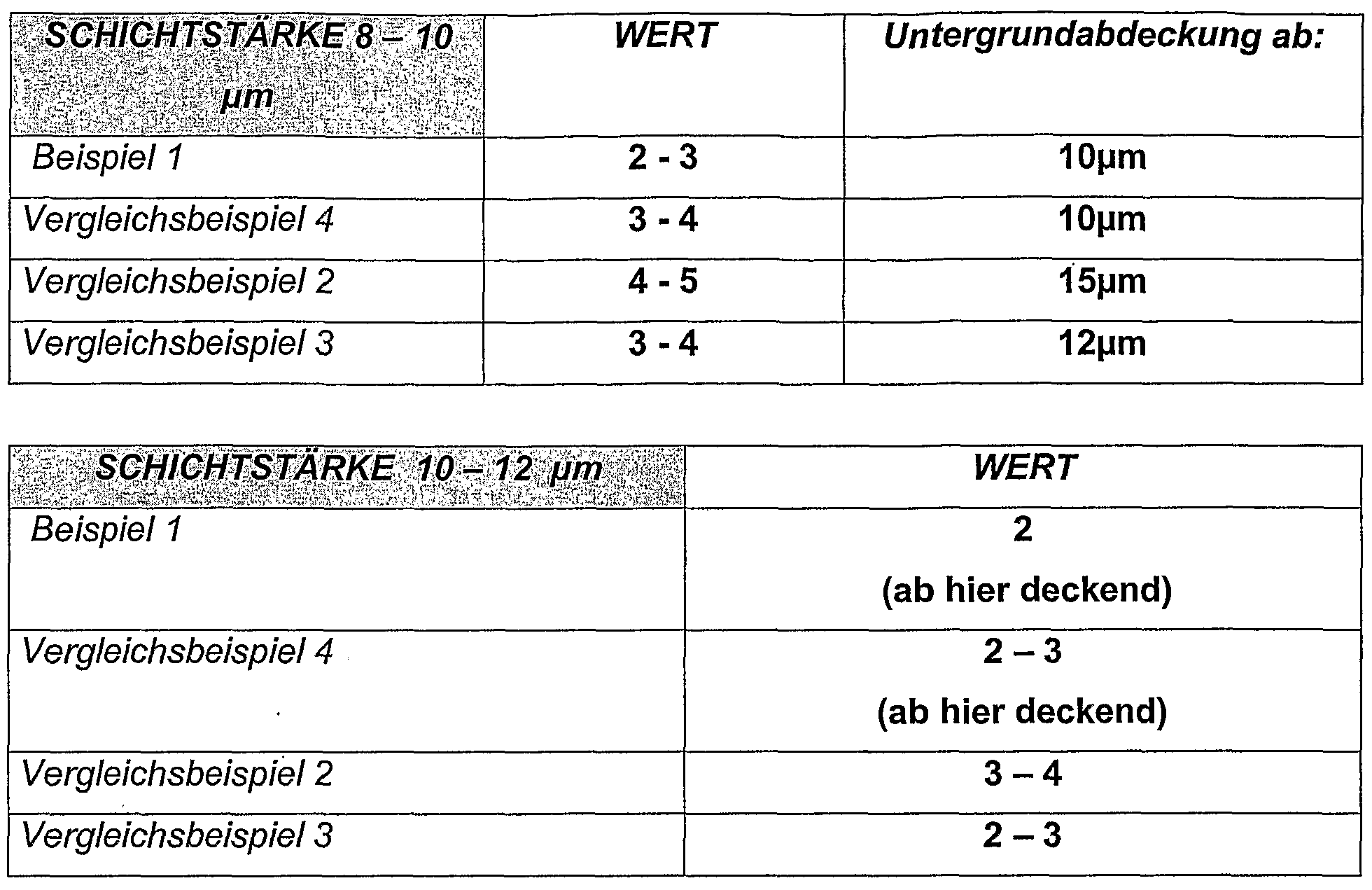
- Cloud formation is the light-dark shades of effect paints. This plays a major role, especially with low paint layers.
- Coating compositions based on coating system 1 were used in each case. Painting was carried out on test boards measuring 70 cm X 30 cm. The
- the conveyor speed was set at 0.8 m / s.
- the spray amount of the gun was 200 ml / min, the hom air was set at 400 NL / min and the atomizing air at 6000 NL / min.
- the film thickness of the dry paint film (wedge) was 5-24 ⁇ m.
- the cloud formation is assessed with the eye depending on the layer thickness.
- the rating scale runs from 1 to 5, whereby:
- Cloud formation occurs preferentially with low layer thicknesses. It is crucial that it occurs to an acceptable extent with a covering layer thickness.
- the layer thickness should be as low as possible. This corresponds to the current trend in the automotive industry towards cover layers with ever smaller layer thicknesses.
- Example 1 according to the invention shows the best results here.
- the example according to the invention is still somewhat better, since it already covers a layer thickness of 10-12 ⁇ m and shows tolerable cloud formation, while comparative example 4 also covers this layer thickness, but only shows tolerable cloud formation at 12-14 ⁇ m ,
- the thin pigments orient themselves best in the lacquer layer.
- the opacity is also significantly better. Both effects result in a lower tendency to cloud formation with thin paint layers.
- a total rating of 0 - 42 points was calculated from a total of 14 drop areas.
- the scores were again subjected to the following grading scheme: 0 - 4 points: grade 1 (very good) 5 - 9 points: grade 2 (good) 10 - 18 points grade 3 (medium) 19 - 28 points grade 4 (bad) 2299 - 4422 PPuunnkkttee: grade 5 (very bad)
- Coating compositions containing the inventive or the PVD pigments pass the test in both cases.
- the chemical resistance scores best for the coating compositions of the invention closely followed by those pigmented with PVD pigments.
- PVD pigments perform best in coating system 2 designed for their use.
- the thin aluminum pigments produced by gentle deformation in the process according to the invention can be used far more universally, so that the coating compositions according to the invention are less subject to fluctuations in their property profile than coating compositions which contain PVD pigments.
- results of the individual lacquer systems with respect to one another have a significantly improved hiding power, improved brightness and flop properties compared to the known silver dollar pigments. With regard to light-dark shading, the new coating compositions show due to the above. Features a previously low tendency towards cloud formation.
- the good embedding in the paint system results in a remarkable chemical resistance of the coating produced using the coating agent according to the invention also in single-layer paint systems.
- the present invention therefore provides aqueous coating compositions which contain aluminum pigments provided with a corrosion protection layer, the aluminum pigments together with the corrosion protection layer having an average layer thickness of less than 160 nm.
- Coating compositions of this type enable the production of a high-gloss metallic coating film without cloud formation and with the visually visible impression of a structureless closed metal film which is pronounced of "liquid metal".
- these coating compositions have a high yield with respect to the aluminum pigments due to their high opacity. These effects are even with previously unattainable low layer thicknesses available.
- the coatings are highly resistant to chemicals in single-layer coatings, even without additional protective clearcoat.
Landscapes
- Chemical & Material Sciences (AREA)
- Organic Chemistry (AREA)
- Life Sciences & Earth Sciences (AREA)
- Engineering & Computer Science (AREA)
- Materials Engineering (AREA)
- Wood Science & Technology (AREA)
- Dispersion Chemistry (AREA)
- Paints Or Removers (AREA)
- Application Of Or Painting With Fluid Materials (AREA)
- Pigments, Carbon Blacks, Or Wood Stains (AREA)
Abstract
Description




Claims
Priority Applications (7)
| Application Number | Priority Date | Filing Date | Title |
|---|---|---|---|
| JP2007513843A JP2008501050A (ja) | 2004-06-01 | 2005-06-01 | 薄く、腐食に対して安定化された、完全被覆アルミニウム顔料を含む水性コーティング組成物、その製造プロセス、およびその使用 |
| MXPA06013639 MX265494B (es) | 2004-06-01 | 2005-06-01 | Composicion acuosa para recubrimiento con pigmentos de aluminio en una capa delgada, resistentes a la corrosion, metodos para su produccion y uso. |
| EP05750476A EP1756234B1 (de) | 2004-06-01 | 2005-06-01 | Wässrige beschichtungszusammensetzung mit korrosionsstabilen dünnen deckenden aluminiumpigmenten, verfahren zu deren herstellung und verwendung derselben |
| CN200580018133.0A CN1997711B (zh) | 2004-06-01 | 2005-06-01 | 含防腐蚀薄涂层铝颜料的水性涂料组合物及其制备方法和应用 |
| DE502005005338T DE502005005338D1 (de) | 2004-06-01 | 2005-06-01 | Wässrige beschichtungszusammensetzung mit korrosionsstabilen dünnen deckenden aluminiumpigmenten, verfahren zu deren herstellung und verwendung derselben |
| CA002568298A CA2568298A1 (en) | 2004-06-01 | 2005-06-01 | Aqueous coating composition with corrosion resistant thin-coat aluminium pigments method for production and use therof |
| US11/628,431 US8709145B2 (en) | 2004-06-01 | 2005-06-01 | Aqueous coating composition with corrosion resistant thin-coat aluminum pigments, method for production and use thereof |
Applications Claiming Priority (2)
| Application Number | Priority Date | Filing Date | Title |
|---|---|---|---|
| DE102004026955.6 | 2004-06-01 | ||
| DE102004026955A DE102004026955A1 (de) | 2004-06-01 | 2004-06-01 | Wässrige Beschichtungszusammensetzung mit korrosionsstabilen dünnen deckenden Aluminiumpigmenten, Verfahren zu deren Herstellung und Verwendung derselben |
Publications (1)
| Publication Number | Publication Date |
|---|---|
| WO2005118722A1 true WO2005118722A1 (de) | 2005-12-15 |
Family
ID=35079390
Family Applications (1)
| Application Number | Title | Priority Date | Filing Date |
|---|---|---|---|
| PCT/EP2005/005879 Ceased WO2005118722A1 (de) | 2004-06-01 | 2005-06-01 | Wässrige beschichtungszusammensetzung mit korrosionsstabilen dünnen deckenden aluminiumpigmenten, verfahren zu deren herstellung und verwendung derselben |
Country Status (10)
| Country | Link |
|---|---|
| US (1) | US8709145B2 (de) |
| EP (1) | EP1756234B1 (de) |
| JP (1) | JP2008501050A (de) |
| CN (1) | CN1997711B (de) |
| AT (1) | ATE407983T1 (de) |
| CA (1) | CA2568298A1 (de) |
| DE (2) | DE102004026955A1 (de) |
| ES (1) | ES2314666T3 (de) |
| MX (1) | MX265494B (de) |
| WO (1) | WO2005118722A1 (de) |
Cited By (8)
| Publication number | Priority date | Publication date | Assignee | Title |
|---|---|---|---|---|
| WO2008077612A2 (de) | 2006-12-22 | 2008-07-03 | Eckart Gmbh | Dünne aluminiumpigmente mit enger dickenverteilung, verfahren zur herstellung derselben und verwendung der aluminiumpigmente |
| DE102007036369A1 (de) | 2007-07-31 | 2009-02-05 | Eckart Gmbh | Metallic-Lack, Verfahren zu seiner Herstellung und Verwendungen desselben |
| WO2009156149A1 (de) | 2008-06-25 | 2009-12-30 | Eckart Gmbh | Pigmentmischung von pvd-aluminiumeffektpigmenten und dünnen aluminiumeffektpigmenten aus vermahlung, verfahren zu deren herstellung sowie deren verwendung |
| DE102008029820A1 (de) | 2008-06-25 | 2009-12-31 | Eckart Gmbh | Mischung aus dünnen Eisen- und Aluminiumeffektpigmenten, Verfahren zu deren Herstellung und deren Verwendung |
| JP2010533747A (ja) * | 2007-07-17 | 2010-10-28 | エッカルト ゲゼルシャフト ミット ベシュレンクテル ハフツング | 薄いアルミニウム効果顔料を含むインクジェット印刷インキおよび方法 |
| DE102010008541A1 (de) | 2010-02-18 | 2011-08-18 | BASF Coatings GmbH, 48165 | Wässrige, pigmentierte Beschichtungsmittel, Verfahren zu deren Herstellung und deren Verwendung zur Herstellung von Mehrschichtlackierungen |
| EP2546295A1 (de) * | 2011-07-14 | 2013-01-16 | LANXESS Deutschland GmbH | Thermoplastische Formmassen mit verbesserter Stabilität gegen Wärmealterung |
| DE102013113885A1 (de) | 2013-12-11 | 2015-06-11 | Eckart Gmbh | Beschichtete Metallpigmente, Verfahren zu deren Herstellung und deren Verwendung, Beschichtungsmittel und Gegenstand |
Families Citing this family (30)
| Publication number | Priority date | Publication date | Assignee | Title |
|---|---|---|---|---|
| DE102005036333A1 (de) * | 2005-07-29 | 2007-02-01 | Eckart Gmbh & Co. Kg | Kosmetische Zusammensetzung zur Erzeugung eines kosmetischen Überzugs mit einem metallisch glänzenden Erscheinungsbild, künstlicher Fingernagel sowie Verwendung von PVD-Aluminiumpigmenten |
| DE102006062270A1 (de) * | 2006-12-22 | 2008-06-26 | Eckart Gmbh & Co. Kg | Aluminiumgrieß für dünne, plättchenförmige Effektpigmente, Verfahren zu dessen Herstellung und Verwendung desselben |
| DE102007023539A1 (de) * | 2007-05-18 | 2008-11-20 | Basf Coatings Ag | Wässrige, pigmentierte Beschichtungsmittel, Verfahren zu deren Herstellung und deren Verwendung zur Herstellung von Mehrschichtlackierungen |
| JP5177377B2 (ja) * | 2007-12-27 | 2013-04-03 | 日本ペイント株式会社 | 水性ベース塗料組成物並びに金属調積層塗膜及びその形成方法 |
| EP2128204A1 (de) | 2008-05-28 | 2009-12-02 | Eckart GmbH | Metalleffektpigment mit Additiv |
| CN101629027B (zh) * | 2009-03-04 | 2012-07-04 | 长沙族兴新材料股份有限公司 | 一种制造新型球形铝颜料的方法 |
| CN101775106B (zh) * | 2010-02-03 | 2011-08-03 | 江苏柏鹤涂料有限公司 | 水性丙烯酸酯-聚氨酯树脂乳液及其应用 |
| DE102010007147A1 (de) | 2010-02-05 | 2011-08-11 | Eckart GmbH, 91235 | Mit SiO2 beschichtete Metalleffektpigmente, Verfahren zur Herstellung dieser Metalleffektpigmente und Verwendung |
| DE102010020507A1 (de) | 2010-05-14 | 2011-11-17 | Eckart Gmbh | Metall-Kationen und phosphor- und/oder schwefelhaltige Anionen aufweisende Metalleffektpigmente, Verfahren zur Herstellung dieser Metalleffektpigmente und Verwendung |
| CN102020905B (zh) * | 2010-12-14 | 2012-10-24 | 惠州市长润发涂料有限公司 | 一种单组份水性哑光清漆及其制备方法 |
| CN102031048B (zh) * | 2010-12-15 | 2012-12-26 | 惠州市长润发涂料有限公司 | 一种水性木器哑光清漆 |
| DE102011055072A1 (de) | 2011-11-04 | 2013-05-08 | Eckart Gmbh | Beschichtete, nasschemisch oxidierte Aluminiumeffektpigmente, Verfahren zu deren Herstellung, Beschichtungsmittel und beschichteter Gegenstand |
| EP3004253A1 (de) * | 2013-05-31 | 2016-04-13 | Hirth, Ulrich-Andreas | Korrosionsbeständige metalleffektpigmente, verfahren zu deren herstellung und verwendung derselben |
| KR101678279B1 (ko) * | 2013-11-04 | 2016-11-21 | 제주대학교 산학협력단 | 유기 및 무기 산화 나노구조물을 함유하는 무독성 페인트 조성물 및 이의 제조 방법 |
| CN104130684A (zh) * | 2013-11-13 | 2014-11-05 | 上海百川通海洋工程有限公司 | 一种单组份抗静电潮气固化聚脲铝粉防腐漆的制备方法 |
| EP2902451A1 (de) | 2014-01-29 | 2015-08-05 | Schlenk Metallic Pigments GmbH | Verfahren zum Beschichten von Metalleffektpigmenten |
| JP6428765B2 (ja) * | 2014-03-31 | 2018-11-28 | Agc株式会社 | 含フッ素樹脂組成物および積層体 |
| EP3290204B1 (de) * | 2015-04-27 | 2019-07-03 | AGC Inc. | Laminierter artikel und verfahren zur herstellung |
| US9765222B2 (en) | 2015-05-06 | 2017-09-19 | Viavi Solutions Inc. | Method of encapsulating pigment flakes with a metal oxide coating |
| CN104817856B (zh) * | 2015-05-18 | 2017-05-31 | 常德金鹏印务有限公司 | 水性铝粉颜料、制备方法和用途 |
| RU2702593C1 (ru) * | 2016-09-30 | 2019-10-08 | Мазда Мотор Корпорейшн | Многослойная покровная пленка и изделие с покрытием |
| KR102541874B1 (ko) * | 2017-12-06 | 2023-06-13 | 엑카르트 게엠베하 | 보호 캡슐화를 가진 판상 pvd 알루미늄 안료 및 보호 캡슐화를 가진 판상 pvd 알루미늄 안료를 제조하는 방법 |
| KR102295853B1 (ko) * | 2019-12-27 | 2021-08-30 | 진 안 박 | 유사-펄 안료 |
| RU2746989C1 (ru) * | 2020-01-28 | 2021-04-23 | Общество с ограниченной ответственностью "СУАЛ-ПМ" | Металлические пигменты с антикоррозийными покрытиями на основе алюминия и/или его сплавов |
| WO2022154001A1 (ja) * | 2021-01-12 | 2022-07-21 | 旭化成株式会社 | 金属顔料、その用途、及び金属顔料の製造方法 |
| CN112940554A (zh) * | 2021-03-12 | 2021-06-11 | 西北工业大学 | 一种以烧结钕铁硼为基体的Zn-Al涂层及其制备方法 |
| CN113604077A (zh) * | 2021-09-16 | 2021-11-05 | 山东银箭金属颜料有限公司 | 一种水性包覆型铝颜料的制备方法 |
| CN113717603B (zh) * | 2021-10-11 | 2022-07-12 | 广西民族大学 | 一种改性氟碳防腐涂料及其制备方法 |
| CN115612321B (zh) * | 2022-09-27 | 2024-01-19 | 常州君合科技股份有限公司 | 一种环保型水性锌铝防腐涂液及其制备方法 |
| CN119707327B (zh) * | 2025-01-08 | 2025-08-12 | 北京工业大学 | 适用于太阳能聚光烧成的水泥生料及其应用 |
Citations (5)
| Publication number | Priority date | Publication date | Assignee | Title |
|---|---|---|---|---|
| US2885366A (en) * | 1956-06-28 | 1959-05-05 | Du Pont | Product comprising a skin of dense, hydrated amorphous silica bound upon a core of another solid material and process of making same |
| EP0451785A1 (de) * | 1990-04-11 | 1991-10-16 | Asahi Kasei Metals Limited | Aluminiumpigment und dessen Herstellungsverfahren |
| WO2001081483A2 (en) * | 2000-04-19 | 2001-11-01 | E.I. Dupont De Nemours And Company | Pigment preparations and water-borne effect base coats prepared therewith |
| WO2004087816A2 (de) * | 2003-04-04 | 2004-10-14 | Eckart Gmbh & Co. Kg | Dünne deckende aluminiumpigmente, verfahren zur herstellung derselben und verwendung der aluminiumpigmente |
| WO2004092261A1 (de) * | 2003-04-16 | 2004-10-28 | Basf Aktiengesellschaft | Verwendung von beschichteten metallischen glanzpigmenten zur pigmentierung von hochmolekularen materialien |
Family Cites Families (33)
| Publication number | Priority date | Publication date | Assignee | Title |
|---|---|---|---|---|
| US3945899A (en) * | 1973-07-06 | 1976-03-23 | Kansai Paint Company, Limited | Process for coating aluminum or aluminum alloy |
| US3954496A (en) * | 1974-10-09 | 1976-05-04 | E. I. Du Pont De Nemours And Company | Preparation of dense silica-encapsulated aluminum flake pigment treated with a carboxylic chromic chloride |
| JPS5916524B2 (ja) * | 1977-07-05 | 1984-04-16 | 石川島播磨重工業株式会社 | 圧延機の駆動装置 |
| US4321087A (en) * | 1978-12-21 | 1982-03-23 | Revlon, Inc. | Process for making metallic leafing pigments |
| AU1875383A (en) | 1982-09-20 | 1984-03-29 | Aluminium Company Of America | Vanadium-stabilized aluminium particles |
| US4808231A (en) * | 1984-09-21 | 1989-02-28 | Silberline Manufacturing Co., Inc. | Inhibitive treatment for aluminum pigments |
| DE3636183A1 (de) | 1986-08-27 | 1988-03-03 | Basf Lacke & Farben | Wasserverduennbare beschichtungszusammensetzungen |
| US4693469A (en) * | 1986-11-06 | 1987-09-15 | Larry Cedar | Aerobic exercise device |
| US4885032A (en) | 1987-08-31 | 1989-12-05 | Nippon Paint Co., Ltd. | Aluminum flake pigment |
| DE4030727A1 (de) * | 1990-09-28 | 1992-04-02 | Eckart Standard Bronzepulver | Kunstharzbeschichtete metallpigmente, verfahren zu ihrer herstellung und ihre verwendung |
| CA2068858C (en) * | 1991-05-17 | 2002-11-12 | Masami Uemae | Aqueous coating composition |
| US5215579A (en) * | 1991-12-26 | 1993-06-01 | Silberline Manufacturing Co., Inc. | Water resistant metal pigment particles |
| US5480481A (en) * | 1992-08-05 | 1996-01-02 | Toyo Aluminum Kabushiki Kaisha | Aluminum pigments |
| JP3200473B2 (ja) | 1992-08-05 | 2001-08-20 | 東洋アルミニウム株式会社 | アルミニウム顔料 |
| US5332713A (en) * | 1993-12-07 | 1994-07-26 | Eastman Kodak Company | Thermal dye transfer dye-donor element containing transferable protection overcoat |
| DE4405492A1 (de) * | 1994-02-21 | 1995-08-24 | Basf Ag | Mehrfach beschichtete metallische Glanzpigmente |
| DE4414079A1 (de) * | 1994-04-22 | 1995-10-26 | Basf Ag | Zweifach gasphasenpassivierte Metallpigmente |
| DE4437752A1 (de) * | 1994-10-21 | 1996-04-25 | Basf Ag | Verfahren zur Herstellung von siliciumoxidbeschichteten Feststoffteilchen |
| DE19501307C2 (de) | 1995-01-18 | 1999-11-11 | Eckart Standard Bronzepulver | Farbige Aluminiumpigmente, Verfahren zu deren Herstellung sowie deren Verwendung |
| DE19635085A1 (de) * | 1996-08-30 | 1998-03-05 | Eckart Standard Bronzepulver | Korrosionsstabile, durch Physical Vapor Deposition hergestellte Aluminiumpigmente und Verfahren zu deren Stabilisierung |
| JPH11106686A (ja) * | 1997-10-08 | 1999-04-20 | Kansai Paint Co Ltd | メタリック仕上げ法 |
| CN1297066A (zh) * | 1999-11-17 | 2001-05-30 | 钟群标 | 铝用电解槽侧部的涂层材料 |
| DE10001437A1 (de) | 2000-01-15 | 2001-07-19 | Eckart Standard Bronzepulver | Fließ- und pumpfähiges Metallpigment-Halbfabrikat zur Herstellung von Farben und Lacken |
| JP3712107B2 (ja) * | 2000-03-22 | 2005-11-02 | Basfコーティングスジャパン株式会社 | メタリック塗装方法 |
| JP4633239B2 (ja) | 2000-09-12 | 2011-02-16 | 昭和アルミパウダー株式会社 | シリカ被覆アルミニウム顔料およびその製造方法 |
| DE10100195A1 (de) * | 2001-01-04 | 2002-08-01 | Basf Coatings Ag | Wäßriger, effektgebender Beschichtungsstoff, Verfahren zu seiner Herstellung und seine Verwendung |
| JP3581339B2 (ja) * | 2001-08-02 | 2004-10-27 | メルク株式会社 | 高耐腐食性薄片状金属顔料、その製造方法、およびそれをベースとする金属光沢干渉発色顔料 |
| JP4610812B2 (ja) | 2001-09-06 | 2011-01-12 | 東洋アルミニウム株式会社 | アルミニウムフレーク顔料の製造方法 |
| JP2003082290A (ja) * | 2001-09-17 | 2003-03-19 | Nippon Paint Co Ltd | 光輝性塗料組成物、塗膜形成方法および複層塗膜 |
| JP2003089758A (ja) * | 2001-09-18 | 2003-03-28 | Merck Ltd | 半透明性金属薄膜を被膜した高彩度薄片状顔料 |
| JP2004124069A (ja) * | 2002-07-31 | 2004-04-22 | Showa Denko Kk | シリカ被覆アルミニウム顔料およびその製造方法並びにその用途 |
| FR2845390B1 (fr) * | 2002-10-03 | 2006-02-24 | Centre Nat Rech Scient | Compositions pigmentaires de particules d'aluminium metallique |
| JP4260454B2 (ja) * | 2002-10-09 | 2009-04-30 | 旭化成ケミカルズ株式会社 | アルミニウム顔料 |
-
2004
- 2004-06-01 DE DE102004026955A patent/DE102004026955A1/de not_active Ceased
-
2005
- 2005-06-01 US US11/628,431 patent/US8709145B2/en active Active
- 2005-06-01 AT AT05750476T patent/ATE407983T1/de not_active IP Right Cessation
- 2005-06-01 WO PCT/EP2005/005879 patent/WO2005118722A1/de not_active Ceased
- 2005-06-01 EP EP05750476A patent/EP1756234B1/de not_active Expired - Lifetime
- 2005-06-01 JP JP2007513843A patent/JP2008501050A/ja active Pending
- 2005-06-01 MX MXPA06013639 patent/MX265494B/es active IP Right Grant
- 2005-06-01 DE DE502005005338T patent/DE502005005338D1/de not_active Expired - Lifetime
- 2005-06-01 CN CN200580018133.0A patent/CN1997711B/zh not_active Expired - Lifetime
- 2005-06-01 CA CA002568298A patent/CA2568298A1/en not_active Abandoned
- 2005-06-01 ES ES05750476T patent/ES2314666T3/es not_active Expired - Lifetime
Patent Citations (5)
| Publication number | Priority date | Publication date | Assignee | Title |
|---|---|---|---|---|
| US2885366A (en) * | 1956-06-28 | 1959-05-05 | Du Pont | Product comprising a skin of dense, hydrated amorphous silica bound upon a core of another solid material and process of making same |
| EP0451785A1 (de) * | 1990-04-11 | 1991-10-16 | Asahi Kasei Metals Limited | Aluminiumpigment und dessen Herstellungsverfahren |
| WO2001081483A2 (en) * | 2000-04-19 | 2001-11-01 | E.I. Dupont De Nemours And Company | Pigment preparations and water-borne effect base coats prepared therewith |
| WO2004087816A2 (de) * | 2003-04-04 | 2004-10-14 | Eckart Gmbh & Co. Kg | Dünne deckende aluminiumpigmente, verfahren zur herstellung derselben und verwendung der aluminiumpigmente |
| WO2004092261A1 (de) * | 2003-04-16 | 2004-10-28 | Basf Aktiengesellschaft | Verwendung von beschichteten metallischen glanzpigmenten zur pigmentierung von hochmolekularen materialien |
Non-Patent Citations (1)
| Title |
|---|
| A. KIEHL, K. GREIWE: "Encapsulated aluminium pigments", PROGRESS IN ORGANIC COATING, vol. 37, 1999, pages 179 - 183, XP002351232 * |
Cited By (18)
| Publication number | Priority date | Publication date | Assignee | Title |
|---|---|---|---|---|
| WO2008077612A3 (de) * | 2006-12-22 | 2008-11-06 | Eckart Gmbh | Dünne aluminiumpigmente mit enger dickenverteilung, verfahren zur herstellung derselben und verwendung der aluminiumpigmente |
| US11427712B2 (en) | 2006-12-22 | 2022-08-30 | Eckart Gmbh | Thin aluminum pigments having a narrow thickness distribution, method for producing same, and use of aluminum pigments |
| WO2008077612A2 (de) | 2006-12-22 | 2008-07-03 | Eckart Gmbh | Dünne aluminiumpigmente mit enger dickenverteilung, verfahren zur herstellung derselben und verwendung der aluminiumpigmente |
| US10407572B2 (en) | 2006-12-22 | 2019-09-10 | Eckart Gmbh | Thin aluminum pigments having a narrow thickness distribution, method for producing same, and use of aluminum pigments |
| JP2010513619A (ja) * | 2006-12-22 | 2010-04-30 | エッカルト ゲゼルシャフト ミット ベシュレンクテル ハフツング | 狭い厚み分布を有する薄いアルミニウム顔料、それを製造するための方法、およびその使用 |
| JP2014159583A (ja) * | 2006-12-22 | 2014-09-04 | Eckart Gmbh | 狭い厚み分布を有する薄いアルミニウム顔料、それを製造するための方法、およびその使用 |
| JP2010533747A (ja) * | 2007-07-17 | 2010-10-28 | エッカルト ゲゼルシャフト ミット ベシュレンクテル ハフツング | 薄いアルミニウム効果顔料を含むインクジェット印刷インキおよび方法 |
| US8361217B2 (en) | 2007-07-31 | 2013-01-29 | Eckart Gmbh | Metallic paint, method for the production thereof, and uses thereof |
| DE102007036369A1 (de) | 2007-07-31 | 2009-02-05 | Eckart Gmbh | Metallic-Lack, Verfahren zu seiner Herstellung und Verwendungen desselben |
| DE102008029821A1 (de) | 2008-06-25 | 2009-12-31 | Eckart Gmbh | Pigmentmischung von PVD-Aluminiumeffektpigmenten und dünnen Aluminiumeffektpigmenten aus Vermahlung, Verfahren zu deren Herstellung sowie deren Verwendung |
| DE102008029820A1 (de) | 2008-06-25 | 2009-12-31 | Eckart Gmbh | Mischung aus dünnen Eisen- und Aluminiumeffektpigmenten, Verfahren zu deren Herstellung und deren Verwendung |
| WO2009156149A1 (de) | 2008-06-25 | 2009-12-30 | Eckart Gmbh | Pigmentmischung von pvd-aluminiumeffektpigmenten und dünnen aluminiumeffektpigmenten aus vermahlung, verfahren zu deren herstellung sowie deren verwendung |
| WO2011101455A1 (de) | 2010-02-18 | 2011-08-25 | Basf Coatings Gmbh | Wässrige, mit blättchenförmigen metalleffektpigmenten pigmentierte beschichtungsmittel, verfahren zu deren herstellung und deren verwendung zur herstellung von mehrschichtlackierung |
| DE102010008541A1 (de) | 2010-02-18 | 2011-08-18 | BASF Coatings GmbH, 48165 | Wässrige, pigmentierte Beschichtungsmittel, Verfahren zu deren Herstellung und deren Verwendung zur Herstellung von Mehrschichtlackierungen |
| US9249316B2 (en) | 2010-02-18 | 2016-02-02 | Basf Coatings Gmbh | Aqueous coating compositions pigmented with flake-form metallic effect pigments, processes for preparing them and use thereof for producing multicoat paint finish |
| EP2546295A1 (de) * | 2011-07-14 | 2013-01-16 | LANXESS Deutschland GmbH | Thermoplastische Formmassen mit verbesserter Stabilität gegen Wärmealterung |
| DE102013113885A1 (de) | 2013-12-11 | 2015-06-11 | Eckart Gmbh | Beschichtete Metallpigmente, Verfahren zu deren Herstellung und deren Verwendung, Beschichtungsmittel und Gegenstand |
| US9624378B2 (en) | 2013-12-11 | 2017-04-18 | Eckart Gmbh | Coated metal pigments, method for the production and use thereof, coating agent and article |
Also Published As
| Publication number | Publication date |
|---|---|
| MXPA06013639A (es) | 2007-03-23 |
| US20080087187A1 (en) | 2008-04-17 |
| CA2568298A1 (en) | 2005-12-15 |
| EP1756234B1 (de) | 2008-09-10 |
| JP2008501050A (ja) | 2008-01-17 |
| US8709145B2 (en) | 2014-04-29 |
| EP1756234A1 (de) | 2007-02-28 |
| CN1997711A (zh) | 2007-07-11 |
| DE102004026955A1 (de) | 2005-12-29 |
| ATE407983T1 (de) | 2008-09-15 |
| DE502005005338D1 (de) | 2008-10-23 |
| ES2314666T3 (es) | 2009-03-16 |
| CN1997711B (zh) | 2013-11-06 |
| MX265494B (es) | 2009-03-30 |
Similar Documents
| Publication | Publication Date | Title |
|---|---|---|
| EP1756234B1 (de) | Wässrige beschichtungszusammensetzung mit korrosionsstabilen dünnen deckenden aluminiumpigmenten, verfahren zu deren herstellung und verwendung derselben | |
| EP2049604B1 (de) | Metallic-lack, verfahren zu seiner herstellung und verwendung desselben | |
| DE19520312B4 (de) | Oxidierte farbige Aluminiumpigmente, Verfahren zu deren Herstellung sowie deren Verwendung | |
| DE69526312T2 (de) | Lichtundurchlässigmachen von optisch variablen Pigmenten für wässerige Beschichtungszusammensetzungen | |
| EP2157138B1 (de) | Dünne, plättchenförmige Eisenpigmente, Verfahren zu deren Herstellung und Verwendung derselben | |
| EP2348074B1 (de) | WEIßES, IR-STRAHLUNG REFLEKTIERENDES PIGMENT, DESSEN HERSTELLUNG UND VERWENDUNG | |
| DE60003765T2 (de) | Schuppenförmiges Pigment mit hoher Orientierung und Verfahren zur Herstellung desselben | |
| DE69615106T2 (de) | Gefärbte Substratteilchen, Verfahren zu deren Herstellung, Harz basierende Mischung und Lack bestehend aus diesen Teilchen und dessen Verwendung | |
| EP2536795B1 (de) | Wässrige, mit blättchenförmigen metalleffektpigmenten pigmentierte beschichtungsmittel, verfahren zu deren herstellung und deren verwendung zur herstellung von mehrschichtlackierung | |
| EP1529085A1 (de) | Kupferbasierende metallflakes, insbesondere aluminium enthaltend, und verfahren zu ihrer herstellung | |
| EP2227508A1 (de) | Metalleffektpigmente, verfahren zu deren herstellung sowie verwendung derselben und pulverlack | |
| EP2933355B1 (de) | Verfahren zum Herstellen einer dunklen Korrosionsschutzbeschichtung | |
| DE10317862A1 (de) | Verwendung von beschichteten metallischen Glanzpigmenten zur Pigmentierung von hochmolekularen Materialien | |
| EP2158280B1 (de) | Wässrige, pigmentierte beschichtungsmittel, verfahren zu deren herstellung und deren verwendung zur herstellung von mehrschichtlackierungen | |
| WO2010031476A2 (de) | Metalleffektpigmentpräparation in kompaktierter form, verfahren zu deren herstellung und verwendung derselben | |
| EP0905204B1 (de) | Oberflächenmodifizierte plättchenförmige Substrate | |
| DE102008029821A1 (de) | Pigmentmischung von PVD-Aluminiumeffektpigmenten und dünnen Aluminiumeffektpigmenten aus Vermahlung, Verfahren zu deren Herstellung sowie deren Verwendung | |
| EP1799783B1 (de) | Wässrige effektpigmentpaste, verfahren zu ihrer herstellung und ihre verwendung | |
| DE10350719A1 (de) | Effektpigmente enthaltende Pigmentpasten, Verfahren zu ihrer Herstellung und ihre Verwendung | |
| EP2303969A1 (de) | Mischung aus dünnen eisen- und aluminiumeffektpigmenten, verfahren zu deren herstellung und deren verwendung | |
| WO2010105731A2 (de) | Beschichtungszusammensetzung | |
| DE10343393A1 (de) | Mit Effektpigmenten pigmentierte, pulverförmige Beschichtungsstoffe, Verfahren zu ihrer Herstellung und ihre Verwendung | |
| DE102005054867A1 (de) | Physikalisch, thermisch und physikalisch und thermisch härtbare, Metalleffektpigmente enthaltende, wässrige Gemische, Verfahren zu ihrer Herstellung und ihre Verwendung | |
| DE19801809A1 (de) | Oberflächenmodifizierte plättchenförmige Substrate |
Legal Events
| Date | Code | Title | Description |
|---|---|---|---|
| AK | Designated states |
Kind code of ref document: A1 Designated state(s): AE AG AL AM AT AU AZ BA BB BG BR BW BY BZ CA CH CN CO CR CU CZ DE DK DM DZ EC EE EG ES FI GB GD GE GH GM HR HU ID IL IN IS JP KE KG KM KP KR KZ LC LK LR LS LT LU LV MA MD MG MK MN MW MX MZ NA NG NI NO NZ OM PG PH PL PT RO RU SC SD SE SG SK SL SM SY TJ TM TN TR TT TZ UA UG US UZ VC VN YU ZA ZM ZW |
|
| AL | Designated countries for regional patents |
Kind code of ref document: A1 Designated state(s): BW GH GM KE LS MW MZ NA SD SL SZ TZ UG ZM ZW AM AZ BY KG KZ MD RU TJ TM AT BE BG CH CY CZ DE DK EE ES FI FR GB GR HU IE IS IT LT LU MC NL PL PT RO SE SI SK TR BF BJ CF CG CI CM GA GN GQ GW ML MR NE SN TD TG |
|
| 121 | Ep: the epo has been informed by wipo that ep was designated in this application | ||
| DPEN | Request for preliminary examination filed prior to expiration of 19th month from priority date (pct application filed from 20040101) | ||
| WWE | Wipo information: entry into national phase |
Ref document number: PA/a/2006/013639 Country of ref document: MX Ref document number: 2568298 Country of ref document: CA |
|
| WWE | Wipo information: entry into national phase |
Ref document number: 2007513843 Country of ref document: JP |
|
| WWE | Wipo information: entry into national phase |
Ref document number: 2005750476 Country of ref document: EP |
|
| NENP | Non-entry into the national phase |
Ref country code: DE |
|
| WWW | Wipo information: withdrawn in national office |
Ref document number: DE |
|
| WWE | Wipo information: entry into national phase |
Ref document number: 200580018133.0 Country of ref document: CN |
|
| WWE | Wipo information: entry into national phase |
Ref document number: 11628431 Country of ref document: US |
|
| WWP | Wipo information: published in national office |
Ref document number: 2005750476 Country of ref document: EP |
|
| WWP | Wipo information: published in national office |
Ref document number: 11628431 Country of ref document: US |
|
| WWG | Wipo information: grant in national office |
Ref document number: 2005750476 Country of ref document: EP |