US10925977B2 - Efficient synthesis of chelators for nuclear imaging and radiotherapy: compositions and applications - Google Patents
Efficient synthesis of chelators for nuclear imaging and radiotherapy: compositions and applications Download PDFInfo
- Publication number
- US10925977B2 US10925977B2 US11/770,395 US77039507A US10925977B2 US 10925977 B2 US10925977 B2 US 10925977B2 US 77039507 A US77039507 A US 77039507A US 10925977 B2 US10925977 B2 US 10925977B2
- Authority
- US
- United States
- Prior art keywords
- chelator
- targeting ligand
- ion
- metal ion
- imaging
- Prior art date
- Legal status (The legal status is an assumption and is not a legal conclusion. Google has not performed a legal analysis and makes no representation as to the accuracy of the status listed.)
- Active, expires
Links
- 0 *C([1*])([2*])C(C)BCCC(F)C([3*])([4*])[2H] Chemical compound *C([1*])([2*])C(C)BCCC(F)C([3*])([4*])[2H] 0.000 description 8
- MSMHMVYLXXZHHJ-SSPBFRJUSA-L CC(=O)SC[C@H](NCCN[C@@H](CSC(C)=O)C(=O)NC1C(O)O[C@H](CO)[C@@H](O)[C@@H]1O)C(=O)NC1C(O)O[C@H](CO)[C@@H](O)[C@@H]1O.COC1O[C@H](CO)[C@@H](O)[C@H](O)C1NC(=O)[C@H](CS)NCCN[C@@H](CS)C(=O)NC1C(OC)O[C@H](CO)[C@@H](O)[C@@H]1O.CSC[C@H](NCCN[C@@H](CSC)C(=O)NC1C(O)O[C@H](CO)[C@@H](O)[C@@H]1O)C(=O)NC1C(O)O[C@H](CO)[C@@H](O)[C@@H]1O.O=C(NC1C(O)O[C@H](CO)[C@@H](O)[C@@H]1O)[C@@H]1CSSC[C@@H](C(=O)NC2C(O)O[C@H](CO)[C@@H](O)[C@@H]2O)NCCN1.O=C(NC1C(O)O[C@H](CO)[C@@H](O)[C@@H]1O)[C@H](CSS(=O)(=O)O[Na])NCCN[C@@H](CSS(=O)(=O)O[Na])C(=O)NC1C(O)O[C@H](CO)[C@@H](O)[C@@H]1O Chemical compound CC(=O)SC[C@H](NCCN[C@@H](CSC(C)=O)C(=O)NC1C(O)O[C@H](CO)[C@@H](O)[C@@H]1O)C(=O)NC1C(O)O[C@H](CO)[C@@H](O)[C@@H]1O.COC1O[C@H](CO)[C@@H](O)[C@H](O)C1NC(=O)[C@H](CS)NCCN[C@@H](CS)C(=O)NC1C(OC)O[C@H](CO)[C@@H](O)[C@@H]1O.CSC[C@H](NCCN[C@@H](CSC)C(=O)NC1C(O)O[C@H](CO)[C@@H](O)[C@@H]1O)C(=O)NC1C(O)O[C@H](CO)[C@@H](O)[C@@H]1O.O=C(NC1C(O)O[C@H](CO)[C@@H](O)[C@@H]1O)[C@@H]1CSSC[C@@H](C(=O)NC2C(O)O[C@H](CO)[C@@H](O)[C@@H]2O)NCCN1.O=C(NC1C(O)O[C@H](CO)[C@@H](O)[C@@H]1O)[C@H](CSS(=O)(=O)O[Na])NCCN[C@@H](CSS(=O)(=O)O[Na])C(=O)NC1C(O)O[C@H](CO)[C@@H](O)[C@@H]1O MSMHMVYLXXZHHJ-SSPBFRJUSA-L 0.000 description 1
- VNZVAEOJSKJXIK-RRGWBFJESA-N O=C(NC1C(O)O[C@H](CO)[C@@H](O)[C@@H]1O)[C@H](CSSC1=CC=CC=C1[N+](=O)[O-])NCCN[C@@H](CSSC1=C([N+](=O)[O-])C=CC=C1)C(=O)NC1C(O)O[C@H](CO)[C@@H](O)[C@@H]1O Chemical compound O=C(NC1C(O)O[C@H](CO)[C@@H](O)[C@@H]1O)[C@H](CSSC1=CC=CC=C1[N+](=O)[O-])NCCN[C@@H](CSSC1=C([N+](=O)[O-])C=CC=C1)C(=O)NC1C(O)O[C@H](CO)[C@@H](O)[C@@H]1O VNZVAEOJSKJXIK-RRGWBFJESA-N 0.000 description 1
Images


Classifications
-
- A—HUMAN NECESSITIES
- A61—MEDICAL OR VETERINARY SCIENCE; HYGIENE
- A61K—PREPARATIONS FOR MEDICAL, DENTAL OR TOILETRY PURPOSES
- A61K47/00—Medicinal preparations characterised by the non-active ingredients used, e.g. carriers or inert additives; Targeting or modifying agents chemically bound to the active ingredient
- A61K47/50—Medicinal preparations characterised by the non-active ingredients used, e.g. carriers or inert additives; Targeting or modifying agents chemically bound to the active ingredient the non-active ingredient being chemically bound to the active ingredient, e.g. polymer-drug conjugates
-
- A—HUMAN NECESSITIES
- A61—MEDICAL OR VETERINARY SCIENCE; HYGIENE
- A61K—PREPARATIONS FOR MEDICAL, DENTAL OR TOILETRY PURPOSES
- A61K49/00—Preparations for testing in vivo
- A61K49/0002—General or multifunctional contrast agents, e.g. chelated agents
-
- A—HUMAN NECESSITIES
- A61—MEDICAL OR VETERINARY SCIENCE; HYGIENE
- A61K—PREPARATIONS FOR MEDICAL, DENTAL OR TOILETRY PURPOSES
- A61K49/00—Preparations for testing in vivo
-
- A—HUMAN NECESSITIES
- A61—MEDICAL OR VETERINARY SCIENCE; HYGIENE
- A61K—PREPARATIONS FOR MEDICAL, DENTAL OR TOILETRY PURPOSES
- A61K49/00—Preparations for testing in vivo
- A61K49/06—Nuclear magnetic resonance [NMR] contrast preparations; Magnetic resonance imaging [MRI] contrast preparations
-
- A—HUMAN NECESSITIES
- A61—MEDICAL OR VETERINARY SCIENCE; HYGIENE
- A61K—PREPARATIONS FOR MEDICAL, DENTAL OR TOILETRY PURPOSES
- A61K51/00—Preparations containing radioactive substances for use in therapy or testing in vivo
- A61K51/02—Preparations containing radioactive substances for use in therapy or testing in vivo characterised by the carrier, i.e. characterised by the agent or material covalently linked or complexing the radioactive nucleus
- A61K51/04—Organic compounds
-
- A—HUMAN NECESSITIES
- A61—MEDICAL OR VETERINARY SCIENCE; HYGIENE
- A61P—SPECIFIC THERAPEUTIC ACTIVITY OF CHEMICAL COMPOUNDS OR MEDICINAL PREPARATIONS
- A61P29/00—Non-central analgesic, antipyretic or antiinflammatory agents, e.g. antirheumatic agents; Non-steroidal antiinflammatory drugs [NSAID]
-
- A—HUMAN NECESSITIES
- A61—MEDICAL OR VETERINARY SCIENCE; HYGIENE
- A61P—SPECIFIC THERAPEUTIC ACTIVITY OF CHEMICAL COMPOUNDS OR MEDICINAL PREPARATIONS
- A61P31/00—Antiinfectives, i.e. antibiotics, antiseptics, chemotherapeutics
-
- A—HUMAN NECESSITIES
- A61—MEDICAL OR VETERINARY SCIENCE; HYGIENE
- A61P—SPECIFIC THERAPEUTIC ACTIVITY OF CHEMICAL COMPOUNDS OR MEDICINAL PREPARATIONS
- A61P35/00—Antineoplastic agents
-
- A—HUMAN NECESSITIES
- A61—MEDICAL OR VETERINARY SCIENCE; HYGIENE
- A61P—SPECIFIC THERAPEUTIC ACTIVITY OF CHEMICAL COMPOUNDS OR MEDICINAL PREPARATIONS
- A61P35/00—Antineoplastic agents
- A61P35/02—Antineoplastic agents specific for leukemia
-
- A—HUMAN NECESSITIES
- A61—MEDICAL OR VETERINARY SCIENCE; HYGIENE
- A61P—SPECIFIC THERAPEUTIC ACTIVITY OF CHEMICAL COMPOUNDS OR MEDICINAL PREPARATIONS
- A61P9/00—Drugs for disorders of the cardiovascular system
-
- A—HUMAN NECESSITIES
- A61—MEDICAL OR VETERINARY SCIENCE; HYGIENE
- A61P—SPECIFIC THERAPEUTIC ACTIVITY OF CHEMICAL COMPOUNDS OR MEDICINAL PREPARATIONS
- A61P9/00—Drugs for disorders of the cardiovascular system
- A61P9/06—Antiarrhythmics
-
- A—HUMAN NECESSITIES
- A61—MEDICAL OR VETERINARY SCIENCE; HYGIENE
- A61P—SPECIFIC THERAPEUTIC ACTIVITY OF CHEMICAL COMPOUNDS OR MEDICINAL PREPARATIONS
- A61P9/00—Drugs for disorders of the cardiovascular system
- A61P9/10—Drugs for disorders of the cardiovascular system for treating ischaemic or atherosclerotic diseases, e.g. antianginal drugs, coronary vasodilators, drugs for myocardial infarction, retinopathy, cerebrovascula insufficiency, renal arteriosclerosis
-
- A—HUMAN NECESSITIES
- A61—MEDICAL OR VETERINARY SCIENCE; HYGIENE
- A61K—PREPARATIONS FOR MEDICAL, DENTAL OR TOILETRY PURPOSES
- A61K51/00—Preparations containing radioactive substances for use in therapy or testing in vivo
- A61K51/02—Preparations containing radioactive substances for use in therapy or testing in vivo characterised by the carrier, i.e. characterised by the agent or material covalently linked or complexing the radioactive nucleus
- A61K51/04—Organic compounds
- A61K51/0491—Sugars, nucleosides, nucleotides, oligonucleotides, nucleic acids, e.g. DNA, RNA, nucleic acid aptamers
Definitions
- the present invention relates generally to the fields of chemical synthesis, imaging, radiotherapy, labeling, chemotherapy, medical therapy, treatment of cardiovascular disease and treatment of cancer. More particularly, the invention concerns novel methods of synthesizing chelator-targeting ligand conjugates.
- Organic methods of synthesis are set forth herein that yield chelator-targeting ligands of high purity in comparison to chelator-targeting conjugates prepared by aqueous methods.
- Methods of imaging a site using these conjugates, as well as kits for preparing these conjugates are also set forth herein.
- Methods of diagnosing and treating diseases i.e., cancers, cardiovascular diseases, infections and inflammation
- diseases i.e., cancers, cardiovascular diseases, infections and inflammation
- Biomedical imaging includes various modalities that are widely used by physicians and researchers to assist with not only the diagnosis of disease in a subject, but also to gain a greater understanding of normal structure and function of the body.
- Exemplary imaging modalities include PET, SPECT, gamma camera imaging, CT, MRI, ultrasound, dual imaging and optical imaging.
- Inorganic metals such as technetium ( 99m Tc), iron, gadolinium, rhenium, manganese, cobalt, indium, platinum, copper, gallium, or rhodium have proved to be a valuable component of many imaging agents.
- Labeling molecules with inorganic metals can be achieved by chelating the metal to combinations of oxygen, sulfur and nitrogen atoms, for example, of particular compounds.
- Chelators such as sulfur colloid, diethylenetriaminepentaacetic acid (DTPA, O 4 ), ethylenediaminetetraacetic acid (EDTA, O 4 ) and 1,4,7,10-tetraazacyclododecane-N,N′,N′′,N′′′-tetraacetic acid (DOTA, N 4 ) have been used for this purpose.
- DTPA diethylenetriaminepentaacetic acid
- EDTA ethylenediaminetetraacetic acid
- DOTA 1,4,7,10-tetraazacyclododecane-N,N′,N′′,N′′′-tetraacetic acid
- inorganic metals that are chelated in this manner are of limited usefulness for imaging because of their fast clearance from the body.
- the preferred radioactive label for imaging agents is technetium ( 99m Tc) due to its favorable half life (6 hrs), ease of production, wide availability, low energy (140 keV) and low cost.
- 99m Tc technetium
- the longer half-life of isotopes such as 99m Tc facilitates shipping of the radiolabelled amino acids to hospitals without an on-site cyclotron or dedicated radiochemistry laboratory.
- attaching 99m Tc to drugs for imaging purposes is often a challenge.
- 188 Re has good characteristics for imaging and for potential therapeutic use because of its high ⁇ energy (2.1 MeV), short physical half-life (16.9 hr) and 155 keV gamma-ray emission for dosimetric and imaging purposes.
- the short physical half-life of 188 Re allows for higher doses compared with long-lived radionuclides. Furthermore, the short half-life reduces the problems of radioactive waste handling and storage.
- 188 Re is available from an in-house generator system similar to a 99m Tc generator.
- 188 Re can be obtained from a 188 W/ 188 Re generator, which makes it very convenient for clinical use. Both 99m Tc and 188 Re emit gamma rays, so the dosimetry generated based on 99m Tc images is expected to be more accurate than that produced using the current standard radioisotope, Y-90.
- PET radiosynthesis must be rapid because the radioisotope will decay during lengthy chemical synthesis and higher risk of radiation exposure may occur during radiosynthesis.
- Cyclotron-based tracers are constrained by the availability of a local cyclotron and its high cost.
- the Food and Drug Administration (FDA) permits radiopharmaceutical production in central commercial facilities under well-controlled conditions, and distributes these to local clinics where they are administered.
- FDA Food and Drug Administration
- radionuclide generator systems that can be produced in a well-controlled facility are embraced by current FDA procedures and have a long history of successful clinical application.
- a generator uses a parent-daughter nuclide pair wherein a relatively long-lived parent isotope decays to a short-lived daughter isotope that is used for imaging.
- the parent isotope which is produced at a cyclotron facility, can be shipped to a clinical site and from which the daughter isotope may be eluted on site for clinical use.
- 68 Ga has a high positron emitting quantity (89% of its total decay), therefore the main consideration with this radionuclide is its spatial resolution, which depends on the positron range (energy), the non-colinearity of annihilating photons, intrinsic properties, size and geometry of the detector and the selection of the reconstruction algorithm. Aspects of the detector design, physical properties and their influence on system spatial resolution have been extensively addressed by many authors, leading to a continuous optimization of hardware.
- 68 Ga-based PET agents possess significant commercial potential because the isotope can be produced from a 68 Ge generator (275-day half-life) on site and serve as a convenient alternative to cyclotron-based PET isotopes, such as 18 F or 13 N.
- imaging agents when such agents are prepared in aqueous (wet) conditions, purification of the agents can sometimes present a problem. Purification in aqueous conditions can be achieved using, for example, size exclusion chromatography, or dialysis with membranes of particular molecular weight cut-offs; for example, dialysis is typically most effective when separating species of molecular weights of 1000 g/mol or higher. However, this method of purification often isolates not only the desired agent, but also any other species that may pass through the membrane. Introduction of impurities into imaging agents may be problematic in future applications of the imaging agents, especially regarding imaging and/or therapeutic uses.
- the “true” imaging agent the “true” imaging agent
- the proper measurement or detection of the “true” imaging agent may be obscured or rendered false due to the presence of the impurities.
- imaging agents have been prepared only via aqueous means.
- the impurities present in these agents can detract from their use as imaging and/or therapeutic agents.
- the present inventors have identified novel methods of synthesizing agents that are, in certain embodiments, conjugates of a chelator and a targeting ligand (also called a targeting moiety). Such agents may be used for imaging, diagnostic, and/or therapeutic purposes, for example. Both organic (solvent) and wet (aqueous) synthetic and purification methods are described, and it is shown that organic synthetic and purification methods result in compounds of higher purity than those prepared/purified by wet chemistry. Compounds of high purity are better candidates for clinical application, for example. Furthermore, certain compounds and methods of the present invention offer wide flexibility and selectivity in terms of (1) available sites of conjugation of a chelator to a targeting ligand and (2) atoms available for chelation to a metal ion.
- one general aspect of the present invention contemplates a method of synthesizing a chelator-targeting ligand conjugate comprising:
- At least one targeting ligand comprising at least one functional group, wherein:
- the chelator pictured above may also be visualized as the following:
- organic medium refers to solutions and purification methods comprising one or more organic solvents.
- Solvent choices for the methods of the present invention will be known to one of ordinary skill in the art. Solvent choices may depend, for example, on which one(s) will facilitate the solubilizing of all the reagents, or, for example, which one(s) will best facilitate the desired reaction (particularly if the mechanism of the reaction is known). Solvents may include, for example, polar solvents and/or non-polar solvents.
- a solvent may be a polar aprotic solvent, such as dimethylsulfoxide.
- Solvents choices include, but are not limited to, dimethylformamide, dimethylsulfoxide, dioxane, methanol, ethanol, hexane, methylene chloride, tetrahydrofuran, and/or acetonitrile.
- solvents include ethanol, dimethylformamide and/or dioxane. More than one solvent may be chosen for any particular reaction or purification procedure. Water may also be admixed into any solvent choice; this can be done to enhance the solubility of one or more reactants, for example.
- only the conjugation between a chelator and a targeting ligand takes place via organic synthesis (that is, in organic media). In some embodiments, only the synthesis of a chelator takes place via organic synthesis. In some embodiments, only the chelation of a valent metal ion takes place via organic synthesis. In certain embodiments, any one or more of these steps take place via organic synthesis.
- chelator that is, a compound that is capable of chelating, or binding, one or more metal ions
- exemplary chelators are described in further detail herein.
- Chelators typically bind to one or more metal ions via an ionic bond.
- the chelator comprises DTPA (diethylenetriaminepentaacetic acid), one or more amino acids, or any combination of one or more of these groups.
- one or more amino acids are selected from the group consisting of glycine and cysteine.
- the chelator is selected from the group consisting of dicysteine, triglycine cysteine and tricysteine glycine.
- the number and choices of amino acids may be limited by their solubility in organic media.
- the chelator is ethylenedicysteine (EC).
- Targeting ligands are also described in further detail herein. While a chelator may be conjugated (that is, chemically attached or bound) to a targeting ligand via any mode known to those of skill in the art (e.g., a covalent bond, an ionic bond, a dative bond, an ion pair), typically the attachment comprises a covalent bond.
- a chelator may be conjugated (that is, chemically attached or bound) to a targeting ligand via any mode known to those of skill in the art (e.g., a covalent bond, an ionic bond, a dative bond, an ion pair), typically the attachment comprises a covalent bond.
- Methods of the present invention may further comprise at least one purification step.
- Any compound of the present invention may be purified via any method known to those of skill in the art. Persons of skill in the art are familiar with such methods, and when those methods may be employed.
- a purification step may be performed after every synthetic step, after every few steps, at various points during the synthesis, and/or at the very end of the synthesis.
- one or more purification steps comprises technique selected from the group consisting of silica gel column chromatography, HPLC (high-performance liquid chromatography) and LC (liquid chromatography).
- purification methods specifically exclude size exclusion chromatography and/or dialysis. Methods of purification are described in more detail below.
- unconjugated chelators and/or chelator-targeting ligand conjugates are generated via synthetic organic methods in very high purity relative to such compounds generated via aqueous methodology.
- an unconjugated chelator, an unprotected chelator, a protected chelator, a chelator-targeting ligand conjugate, or a metal ion-labeled chelator-targeting ligand conjugate generated via organic means is between about 90% and about 99.9% pure, compared to between about 50% and about 70% pure for the aqueous product.
- an unconjugated chelator, an unprotected chelator, a protected chelator, a chelator-targeting ligand conjugate, or a metal ion-labeled chelator-targeting ligand conjugate generated via organic means is about or at least about 60%, 61%, 62%, 63%, 64%, 65%, 66%, 67%, 68%, 69%, 70%, 71%, 72%, 73%, 74%, 75%, 76, 77%, 78%, 79%, 80%, 81%, 82%, 83%, 84%, 85%, 86%, 87%, 88%, 89%, 90%, 91%, 92%, 93%, 94%, 95%, 96%, 97%, 98%, 99%, 99.5%, 99.9% pure, or higher, or any range derivable therein.
- the range is about 70% to about 99.9%. In certain embodiments, the range is about 75% to about 99.9%. In certain embodiments, the range is about 80% to about 99.9%. In certain embodiments, the range is about 85% to about 99.9%. In certain embodiments, the range is about 90% to about 99.9%. In certain embodiments, the range is about 95% to about 99.9%.
- At least one of A, D, E, or F is protected in at least one step using at least one protecting agent, and at least one functional group of the targeting ligand is protected in at least one step using at least one protecting agent.
- Functional groups as described herein, may be those of any type known to one of skill in the art.
- the term “functional group” generally refers to how persons of skill in the art classify chemically reactive groups.
- Non-limiting examples include alkene, alkyne, aryl (e.g., phenyl, pyridinyl), alcohol, aldehyde, ketone, azide, halogen, ester, —COOH, —NH 2 , thiol, a secondary amine, a tertiary amine, —S—, —S(O)— and —S(O) 2 —.
- at least one functional group comprises an atom selected from the group consisting of C, H, O, N, P and S.
- Positions A, B, C, D, E and/or F may comprise one or more functional groups (e.g., —COOH, —NH 2 , thiol, a secondary amine, a tertiary amine, —S—, —S(O)—, or —S(O) 2 —).
- at least one functional group of the targeting ligand comprises an atom selected from the group consisting of O, N, S and P.
- the functional group of the targeting ligand may be, for example, selected from the group consisting of amino, amido, thiol, hydroxyl, ether, ester, carbonyl, carboxylic acid, sulfonamido, thioether, thioester and thiocarbonyl.
- Both the targeting ligand and the chelator will typically have one or more functional groups.
- Functional groups and protecting agents that may be used to generate a protected functional group are described herein. Persons of skill in the art will understand that any functional group may be protected using a protecting agent as necessary, as described herein. As such, a functional group may be protected (e.g., a protected amine, such as —NH-Cbz) or unprotected—also called, “free” (such as —NH 2 ).
- protecting groups are utilized in organic syntheses and not aqueous syntheses.
- one or more protecting groups may be removed.
- the removal of a protecting group can be done at any time during any method or synthesis described herein, but is typically performed when the protecting group is no longer needed and the functional group that is being protected is desired to be “revealed.”
- any compound comprising a chelator described herein e.g., a chelator-targeting ligand conjugate, a metal ion labeled-chelator-targeting ligand conjugate
- a site may be imaged using a metal ion labeled-chelator-targeting ligand conjugate that contains no protecting groups, or contains one or more protecting groups.
- the targeting ligand comprises a leaving group.
- the term “leaving group” generally refers to groups readily displaceable by a nucleophile, such as an amine, an alcohol or a thiol nucleophile. Such leaving groups are well known and include, for example, carboxylates, N-hydroxysuccinimide, N-hydroxybenzotriazole, halides, triflates, tosylates, mesylates, alkoxys, thioalkoxys, sulfonyls and the like.
- the three or more functional groups of the chelator together form a chelate.
- the chelate is selected from the group consisting of NS 2 , N 2 S, S 4 , N 2 S 2 , N 3 S and NS 3 .
- the chelate is an N 2 S 2 chelate.
- Chelates may be that of any type known to those of skill in the art, and are further described herein.
- Other atoms besides N and S may comprise a chelate, such as oxygen.
- chelate may be used as a noun or a verb.
- chelate refers to one or more atoms that are either capable of chelating one or more metal ions, or are chelating to one or more metal ions. Metal ions are described in more detail herein. In some embodiments, only one metal ion coordinates to a chelate.
- a non-limiting example of “chelate” includes “an N 2 S 2 ” chelate: this means that two nitrogen atoms and two sulfur atoms of a chelator are either a) capable of chelating to one or more metal ions or b) are coordinated to (or chelated to) to one or more metal ions. Accordingly, in some embodiments, the chelate is N 2 S 2 .
- a compound comprising a chelate is a chelator. Typically, just one metal ion is chelated to a chelator.
- At least one of A, D, E and F is a thiol.
- the thiol may be protected in at least one step using at least one thiol protecting agent.
- the thiol protecting agent may be any of those known to those of skill in the art.
- the thiol protecting agent may be selected from a group consisting of an alkyl halide, a benzyl halide, a benzoyl halide, a sulfonyl halide, a triphenylmethyl halide, a methoxytriphenylmethyl halide and cysteine.
- At least one of A, D, E and F comprises a primary amine or at least one of B and C comprises a secondary amine.
- at least one amine may be protected in one or more steps using at least one amine protecting agent.
- Amine protecting agents may be any of those known to those of skill in the art.
- the amine protecting group may be selected from the group consisting of benzylchloroformate, p-nitro-chlorobenzylformate, ethylchloroformate, di-tert-butyl-dicarbonate, triphenylmethyl chloride and methoxytriphenylmethyl chloride.
- the chelator is ethylenedicysteine.
- the two thiol groups of ethylenedicysteine are protected using at least one thiol protecting agent (e.g., using two or more equivalents of a thiol protecting agent) and in another step the two amine groups of ethylenedicysteine are protected using at least one amine protecting agent (e.g., using two or more equivalents of an amine protecting agent). Since thiol groups are more reactive than amine groups, thiol groups will typically be protected before amine groups are protected when both are initially unprotected (“free”).
- conjugation between the chelator and a targeting ligand may take place via any method and chemical linkage known to those of skill in the art. That is, the targeting ligand may be conjugated or bound to one or more chelators in any manner known to those of ordinary skill in the art. In certain embodiments, conjugation between the chelator and the targeting ligand takes place in a single step (i.e., a “one-pot” reaction). As is known by those of skill in the art, such one-step reactions are desirable as they save time, help minimize waste reagents and minimize loss of product. Any of A, B, C, D, E, and/or F may participate in conjugation to a targeting ligand.
- any of A, B, C, D, E, and/or F may participate in chelation. Further, any of A, B, C, D, E, and/or F may participate in both chelation and conjugation.
- Such flexibility allows chelators of the present invention to be manipulated in a variety of ways, depending on, for example, the reactivity of a chosen targeting ligand, the selectivity of conjugation desired, the solubility of the reagents, the metal ion desired for chelation, etc. Typically, but not always, conjugation occurs prior to chelation.
- one type of targeting ligand is conjugated to one chelator, but multiple targeting ligands may be conjugated to a single chelator.
- the covalent bond may be of any type known to those of skill in the art. In some embodiments, the covalent bond is selected from the group consisting of an amide bond, an ether bond, an ester bond, a thioether bond, a thioester bond, a sulfonamido bond and a carbon-carbon bond.
- the carbon-carbon bond is typically a single bond, but can also be a double or a triple bond.
- chelators and targeting ligands may comprise functional groups such as halogens and sulfonyls, which act as leaving groups during conjugation.
- the conjugation takes place at one or more functional groups of the chelator selected from the group consisting of carboxylic acid, amine and thiol.
- Targeting ligands may also comprise nucleophilic groups, such as —NH 2 , which may participate in conjugation with an electrophilic chelator. Modes of conjugation are discussed in greater detail below.
- the chelator-targeting ligand conjugate further comprises a linker between the chelator and the targeting ligand.
- a linker may, for example, provide for easier conjugation between the chelator and the targeting ligand by providing a reactive group that facilitates the conjugation reaction.
- the linker may be of any type known to those of skill in the art.
- the linker may be initially attached to the chelator or to the targeting ligand.
- a linker may be attached to the chelator, while another linker is attached to the targeting ligand, such that the two linkers may then be joined.
- the linker is selected from the group consisting of a peptide, glutamic acid, aspartic acid, bromo ethylacetate, ethylene diamine, lysine and any combination of one or more of these groups.
- E and F are each independently selected from the group consisting of —COOH, —NH 2 , or thiol. In some embodiments, E and F are each —COOH. In certain embodiments, the conjugation of at least one targeting ligand takes place at E and/or F. In certain embodiments, each of A and D are each protected by at least one protecting group prior to conjugation.
- At least one functional group of the chelator and at least one functional group of the targeting ligand must be “free” (that is, unprotected by a protecting group) such that the two compounds may be joined together.
- the chelator may further comprise a spacer, X.
- a spacer allows for the proper number and orientation of chelating atoms to chelate a metal ion.
- an alkyl spacer such as (—CH 2 —) n , wherein n is 1-100, may be employed.
- One type of chelator employable in methods of the present invention that comprises an ethylene spacer is ethylenedicysteine (EC).
- X is —CH 2 —C(O)—, —C(O)—CH 2 —, —CH 2 —CH 2 —C(O)—, or —C(O)—CH 2 —CH 2 — and B and/or C is a secondary amine.
- B or C is less nucleophilic than the other.
- B, C and L are depicted as —NH—C(O)—CH 2 —CH 2 —NH—
- the secondary amine of position C will be more nucleophilic than the secondary amine of B.
- C will be more reactive, resulting in selective conjugation of a targeting ligand at position C.
- both positions A and D or E and F are each protected by at least one protecting group prior to conjugation at C.
- amide bonds such as when B, C, and L together form —NH—C(O)—CH 2 —CH 2 —NH—, lies in the fact that reactions wherein a metal ion is chelated to a chelator often take place in acidic media. Amide bonds are relatively resistant to degradation in acidic media, and therefore provide structural stability in the chelator during such chelation reactions.
- X together with B and/or C may comprise an amide bond.
- Chelator-targeting ligand conjugates chelated to a metal ion may function as, for example, imaging and/or diagnostic agents, as described herein. They can also function as therapeutic agents, or agents for dual diagnosis and therapy, or dual imaging and therapy. Accordingly, in certain embodiments, methods of the present invention further comprise chelation of a metal ion to a chelator to generate a metal ion labeled-chelator-targeting ligand conjugate.
- the metal ion may be any of those known to one of ordinary skill in the art.
- the metal ion may be a “cold” (non-radioactive) metal ion, or a radionuclide.
- the metal ion may be selected from the group consisting of a technetium ion, a copper ion, an indium ion, a thallium ion, a gallium ion, an arsenic ion, a rhenium ion, a holmium ion, a yttrium ion, a samarium ion, a selenium ion, a strontium ion, a gadolinium ion, a bismuth ion, an iron ion, a manganese ion, a lutetium ion, a cobalt ion, a platinum ion, a calcium ion and a rhodium ion.
- the cold metal ion may be, for example, selected from the group consisting of Cu-62, As-72, Re-187, Gd-157, Bi-213, Fe-56, Mn-55, an iron ion, a manganese ion, a cobalt ion, a platinum ion and a rhodium ion.
- the metal ion may be a radionuclide, and may be any radionuclide known to those of skill in the art.
- the radionuclide in some embodiments, may be selected from the group consisting of 99m Tc, 188 Re, 186 Re, 153 Sm, 166 Ho, 90 Y, 89 Sr, 67 Ga, 68 Ga, 111 In, 148 Gd, 55 Fe, 225 Ac, 212 Bi, 211 At, 45 Ti, 60 Cu, 61 Cu, 67 Cu, and 64 Cu.
- the metal ion is 99m Tc.
- the method may further comprise the addition of a reducing agent.
- the reducing agent may be that of any known to those of skill in the art.
- the reducing agent comprises an ion selected from the group consisting of a dithionite ion, a stannous ion and a ferrous ion.
- the metal ion is 188 Re.
- the metal ion is 68 Ga.
- the metal ion may be chelated to any chelate known to those of skill in the art, as described herein. Persons of skill in the art recognize that metal ions chelate to varying numbers of atoms depending on, for example, the type of metal, its valency and the atoms available for chelation. For example, three or four atoms of the chelator may chelate to one metal ion. In certain embodiments, a chelated metal ion may be 99m Tc. In certain embodiments, a chelated metal ion may be 186 Re. In certain embodiments, a chelated metal ion may be 187 Re.
- the chelate may be selected from the group consisting of NS 2 , N 2 S, S 4 , N 2 S 2 , N 3 S and NS 3 . In certain embodiments, any one or more of these chelates may not be a chelate of the present invention. In some embodiments, N 3 S is not a chelate. In certain embodiments, the chelate is N 2 S 2 , for example, ethylenedicysteine. Methods of the present invention may further comprise the synthesis of a metal ion labeled-chelator-targeting ligand conjugate wherein the targeting ligand participates with A, B, C, D, E, and/or F in chelation to a metal ion.
- the metal ion can be imaged.
- the imaging can be by any method known to those of ordinary skill in the art. Exemplary methods of imaging are discussed at length in the specification below, and include PET and SPECT.
- metal ion labeled-chelator-targeting ligand conjugates prepared via organic synthesis typically enjoy purities higher than those achieved via aqueous preparations.
- the metal ion labeled-chelator-targeting ligand conjugate generated via organic means is between about 90% and about 99.9% pure, compared to between about 50% and about 70% pure for the aqueous product.
- the metal ion labeled-chelator-targeting ligand conjugate synthesized via organic means is about or at least about 60%, 61%, 62%, 63%, 64%, 65%, 66%, 67%, 68%, 69%, 70%, 71%, 72%, 73%, 74%, 75%, 76, 77%, 78%, 79%, 80%, 81%, 82%, 83%, 84%, 85%, 86%, 87%, 88%, 89%, 90%, 91%, 92%, 93%, 94%, 95%, 96%, 97%, 98%, 99%, 99.5%, 99.9% pure, or higher, or any range derivable therein.
- Any chelator described herein may be chelated to a metal ion.
- a protected chelator may be used, or an unprotected chelator.
- the chelator may be chelated before or after the chelator is purified.
- generation of a metal ion labeled-chelator-targeting ligand conjugate comprises:
- generation of a metal ion labeled-chelator-targeting ligand conjugate comprises:
- any compound described herein comprising one or more protecting groups may, in any particular method, undergo removal of one or more protecting groups.
- a protecting group may be removed, for example, from the chelator moiety, the targeting ligand moiety, or both moieties in one or more steps before or after a chelator-targeting ligand conjugate is chelated to a metal ion, as described herein.
- Protecting groups are described in more detail herein, including their installation and removal.
- generation of a metal ion labeled-chelator-targeting ligand conjugate comprises:
- the method may be carried out in an organic medium.
- the protected chelator may be protected ethylenedicysteine.
- the method may further comprise a purification step, a chelation step comprising chelation of a metal ion, the removal of at least one protecting group, or any combination of these steps.
- any method described herein may comprise a purification step, a chelation step comprising chelation of a metal ion, the removal of at least one protecting group, or any combination of these steps.
- the protected chelator may be about 80% to about 99.9% pure.
- the protected chelator may be about 80% to about 90% pure.
- neither B nor C may be a secondary or a tertiary amine.
- targeting ligand may be of any type known to those of skill in the art, and such ligands are discussed in more detail herein.
- a “targeting ligand” is defined herein to be a molecule or part of a molecule that binds with specificity to another molecule.
- the targeting ligand can be any such molecule known to those of ordinary skill in the art.
- Non-limiting examples of targeting ligands include a tissue-specific ligand, an antimicrobial, an antifungal, or an imaging agent.
- the targeting ligand is a “tissue-specific ligand.”
- tissue-specific ligand is defined herein to refer to a molecule or a part of a molecule that can bind or attach to one or more tissues. The binding may be by any mechanism of binding known to those of ordinary skill in the art.
- tissue-specific ligands include a drug, a DNA topoisomerase inhibitor, a DNA intercalator, an antimetabolite, a disease cell cycle targeting compound, a gene expression marker, an angiogenesis targeting ligand, a tumor marker, a folate receptor targeting ligand, an apoptotic cell targeting ligand, a hypoxia targeting ligand, a disease receptor targeting ligand, a receptor marker, a peptide, a nucleotide, an antibody, an antisense molecule, a siRNA, glutamate pentepeptide, an agent that mimics glucose, amifostine, angiostatin, monoclonal antibody C225, monoclonal antibody CD31, monoclonal antibody CD40, capecitabine, deoxycytidine, fullerene, herceptin, human serum albumin, lactose, quinazoline, thalidomide, transferrin, and trimethyl lysine.
- the tissue-specific ligand may be a drug, such as an anticancer agent.
- anti-cancer agents include tamoxifen, topotecan, LHRH, podophyllotoxin, colchicine, endostatin, tomudex, thiotepa, cyclosphosphamide, busulfan, improsulfan, piposulfan, benzodepa, carboquone, meturedepa, uredepa, altretamine, triethylenemelamine, trietylenephosphoramide, triethiylenethiophosphoramide, trimethylolomelamine, bullatacin, bullatacinone, bryostatin, callystatin, CC-1065, adozelesin, carzelesin, bizelesin, cryptophycin 1, cryptophycin 8, dolastatin, duocarmycin, KW-2189, CB1-TM1, eleutherobin, pancrati
- drugs include cardiovascular drugs.
- Non-limiting examples of such drugs include an antihyperlipoproteinemic agent, an antiarteriosclerotic agent, an antithrombotic agent, a fibrinolytic agent, an antiplatelet agent, a blood coagulant, a thrombolytic agent, an antiarrythmic agent, an antihypertensive agent, a vasopressor, an anti-angiotension II agent, an afterload-preload reduction agent, a diuretic, and an inotropic agent.
- cardiovascular drugs examples include mexiletine, tocamide, moricizine, procainamide, diisopyramide, quinidine, popafenone, flecaimide, encamide, bepridil, verapamil, diltiazem, bretylium, sotalol, amiodarone, ibutilide, propranolol, atropine, adenosine and digoxin. More examples are set forth below.
- the targeting ligand is a DNA topoisomerase inhibitor.
- Non-limiting examples include a fluoroquinolone antibiotic, irinotecan, topotecan, etoposide, teniposide, lurtotecan, exatecan and rubitecan.
- Non-limiting examples of DNA intercalators include 7-aminoactinomycin, ethidium, proflavin, daunomycin, doxorubicin, and thalidomide.
- the targeting ligand is an antimetabolite.
- Non-limiting examples include azathioprine, a mercaptopurine, a pyrimidine, a sulfanilamide drug, methotrexate, tetrahydrofolate, folic acid, pemetrexed, raltitrexed, thioguanine, fludarabine, pentostatin, cladribine, fluorouracil, floxuridine, and gemcitabine.
- the targeting ligand may be a disease cell cycle targeting ligand.
- Non-limiting examples include adenosine, FIAU, FIRU, IVFRU, GCV, PCV, FGCV, FPCV, FHPG, FHBG and guanine.
- the targeting ligand is a gene expression marker.
- the gene expression marker may be an epidermal growth factor receptor ligand.
- the targeting ligand is an angiogenesis targeting ligand.
- Non-limiting examples include a COX-2 inhibitor, anti-EGF receptor, herceptin, angiostatin, or thalidomide.
- Examples of COX-2 inhibitors include celecoxib, rofecoxib, and etoricoxib.
- targeting ligands include tumor markers.
- tumor markers include PSA, ER, PR, CA-125, CA-199, CEA, AFP, an interferon, BRCA1, HER-2/neu, cytoxan, p53 and endostatin.
- the targeting ligand may also be a folate receptor targeting ligand. Examples include folate, methotrexate and tomudex.
- the targeting ligand may also be an apoptotic cell targeting ligand.
- the apoptotic cell targeting ligand may further be defined as a tumor apoptotic cell targeting ligand.
- Non-limiting examples include a TRAIL monoclonal antibody, a substrate of caspase-3 and a Bcl family member.
- a substrate of caspase-3 include a peptide or polypeptide comprising the amino acid sequence aspartic acid-glutamic acid-valine-aspartic acid.
- Bcl family members include Bax, Bcl-xL, Bid, Bad, Bak and Bcl-2
- the targeting ligand is a hypoxia targeting ligand.
- the hypoxia targeting ligand may be a tumor hypoxia targeting ligand, a cardiac ischemia marker, a cardiac viability tissue marker, a congestive heart failure marker, or a rest/stress cardiac tissue marker.
- tumor hypoxia targeting ligands include annexin V, colchicine, a nitroimidazole, mitomycin, metronidazole, 99 mTc-HL91, and Cu-ATSM.
- Non-limiting examples of cardiac ischemia markers include interleukin-6, tumor necrosis factor alpha, matrix metalloproteinase 9, myeloperoxidase, intercellular and vascular adhesion molecules, soluble CD40 ligand, placenta growth factor, high sensitivity C-reactive protein (hs-CRP), ischemia modified albumin (IMA), free fatty acids, and choline.
- cardiac viability tissue markers include phospholipase C, myosin light-chain phosphatase, nitric oxide, prostacyclin, endothelin, thromboxane, L-arginine and L-citrulline.
- Non-limiting examples of congestive heart failure markers include interleukin-1, cardiotrophin-1, insulin-like growth factor, epidermal growth factor, tyrosine kinase receptor, angiotensin II, and metronidazole.
- Non-limiting examples of rest/stress cardiac tissue markers include a mitogen-activated protein kinase, cyclic adenosine monophosphate, phospholipase C, phosphatidylinositol bisphosphate, isositol trisphosphate, diacylglycerol, a tyrosine kinase, and metronidazole.
- Non-limiting examples of peptides contemplated as targeting ligands include neuropeptide Y, calcitonin gene-related peptide, substance P, and vasoactive intestinal peptide.
- Non-limiting examples of nucleotides contemplated as targeting ligands include adenine, thymine, guanine, cytosine, and uracil.
- Non-limiting examples of antibodies contemplated as targeting ligands include an antibody that binds to a troponin, tropomyosin, a sarcolemmal, a collagen, a matrix metalloproteinase, or a tissue inhibitor of a matrix metalloproteinase.
- the targeting ligand is an antisense molecule or an siRNA.
- the targeting ligand may also be glutamate pentapeptide.
- the targeting ligand is an agent that mimics glucose.
- agents that mimic glucose include deoxyglucose, glucosamine, tetraacetylated glucosamine, neomycin, kanamycin, gentamycin, paromycin, amikacin, tobramycin, netilmicin, ribostamycin, sisomicin, micromicin, lividomycin, dibekacin, isepamicin, astromicin and aminoglycoside.
- the agent that mimics glucose is glucosamine.
- the targeting ligand is a disease receptor targeting ligand.
- disease receptor targeting ligands include an estrogen, an androgen, luteinizing hormone, luteinizing hormone releasing hormone (LHRH), transferrin, a progestin, tetraacetate mannose, ⁇ - ⁇ -tyrosine, tyrosine, a tyrosine derivative, estrone, tamoxifen, and ⁇ -methyltyrosine.
- compositions comprising a metal ion labeled-chelator-targeting ligand conjugate synthesized by any of the methods described herein.
- the metal ion labeled-chelator-targeting ligand conjugate comprises ethylenedicysteine chelated to a metal ion selected from the group consisting of 99m Tc, 68 Ga 188 Re, 187 Re and 186 Re;
- the targeting ligand comprises a ligand selected from the group consisting of glucosamine, deoxyglucose, metronidazole, annexin V, guanine and LHRH; and the conjugation between the chelator and the targeting ligand takes place via an amide bond or an ester bond.
- Exemplary anti-cancer compositions include a chelator capable of chelating to a therapeutic radiometallic substance, such as Re-188, Re-187, Re-186, Ho-166, Y-90, Sr-89, or Sm-153, arsenic, cobalt, copper, calcium, selenium, thallium or platinum.
- Other exemplary anti-cancer ligands include, for example, epipodophyllotoxin, vincristine, docetaxel, paclitaxel, daunomycin, doxorubicin, mitoxantrone, topotecan, bleomycin, gemcitabine, fludarabine and 5-FUDR.
- the anti-cancer ligand is methotrexate.
- compositions comprising a chelator-targeting ligand conjugate synthesized by any of the methods described herein.
- the invention contemplates a composition comprising a metal ion labeled-chelator-targeting ligand conjugate synthesized by any of the methods described herein.
- the chelator-targeting ligand conjugate composition may comprise one or more protecting groups at any position of either/both the chelator and/or the targeting ligand, or no protecting groups at all.
- the chelator or chelator-targeting ligand conjugate may or may not comprise a metal ion.
- Embodiments of the present invention also pertain to a composition
- a composition comprising a metal ion-labeled chelator-targeting ligand conjugate synthesized by any of the methods set forth herein.
- the composition may include a pharmaceutically acceptable carriers such as glutamic acid and others mild acids and cold metals.
- the composition comprises (a) the metal ion labeled-chelator-targeting ligand conjugate comprises ethylenedicysteine chelated to a metal ion selected from the group consisting of 99m Tc, 68 Ga, 188 Re, and 187 Re; (b) the targeting ligand comprises a ligand selected from the group consisting of glucosamine, deoxyglucose, metronidazole, annexin V, guanine and LHRH; and (c) the conjugation between the chelator and the targeting ligand takes place via an amide bond or an ester bond.
- the metal ion labeled-chelator-targeting ligand conjugate comprises ethylenedicysteine chelated to a metal ion selected from the group consisting of 99m Tc, 68 Ga, 188 Re, and 187 Re
- the targeting ligand comprises a ligand selected from the group consisting of glucosamine, deoxyglucose, metronidazole,
- a reagent for preparing an imaging agent, a therapeutic agent or a radio/therapeutic agent comprising a metal ion labeled-chelator conjugate prepared by any of the methods set forth herein.
- the reagent is a reagent for preparing a chemotherapeutic agent or a radio/chemotherapeutic agent.
- the metal ion labeled-chelator-targeting ligand conjugate is between about 90% and about 99.9% pure.
- the metal ion labeled-chelator-targeting ligand conjugate comprises ethylenedicysteine.
- kits for preparing an imaging agent, a therapeutic agent, or a radio/therapeutic agent comprising one or more sealed containers and a predetermined quantity of a composition comprising a chelator-targeting ligand conjugate prepared by any method described herein in one or more sealed containers.
- the kit includes a chelator-targeting ligand conjugate that is between about 90% and about 99.9% pure.
- the kit includes a chelator-targeting ligand conjugate that is between about 80% and about 99.9% pure.
- the kit includes a chelator-targeting ligand conjugate that is between about 70% and about 99.9% pure.
- the kit includes an ethylenedicysteine-targeting ligand conjugate.
- the kit further includes a metal ion.
- the metal ion may or may not be a radionuclide.
- the metal ion is a cold metal ion (not a radionuclide).
- the cold metal ion is Re-187.
- the metal ion is a radionuclide. Examples of metal ions include any of those metal ions discussed above.
- the kit includes one or more vials containing a composition comprising disodium hydrogen phosphate dehydrate, mannitol, ascorbic acid, sodium edentate, stannous chloride dehydrate, tartaric acid, or potassium dihydrogen-phosphate, and a pharmaceutically acceptable carrier.
- the chelator-targeting ligand conjugate is between about 90% and about 99.9% pure. In some embodiments, the chelator-targeting ligand conjugate is between about 80% and about 99.9% pure. In some embodiments, the chelator-targeting ligand conjugate is between about 70% and about 99.9% pure. In specific embodiments, the metal ion-labeled chelator-targeting ligand conjugate comprises ethylenedicysteine. In particular embodiments, the metal ion labeled chelator-targeting ligand conjugate is 99m Tc-EC-glucosamine.
- the metal ion labeled chelator-targeting ligand conjugate is 186 Re-EC-glucosamine. In still further embodiments, the metal ion labeled chelator-targeting ligand conjugate is 187 Re-EC-glucosamine.
- Further embodiments pertain to a method of imaging, diagnosing, or treating a subject, comprising administering to the subject a pharmaceutically or diagnostically effective amount of a metal ion labeled chelator-targeting ligand conjugate, wherein the chelator-targeting ligand conjugate is prepared by a method comprising any of the methods set forth above, wherein the disease is imaged, diagnosed, or treated.
- the metal ion labeled-chelator conjugate is between about 90% and about 99.9% pure.
- the metal ion labeled-chelator conjugate is between about 80% and about 99.9% pure.
- the metal ion labeled-chelator conjugate is between about 70% and about 99.9% pure.
- the metal ion labeled-chelator conjugate comprises ethylenedicysteine.
- the metal ion for example, may be any of those metal ions set forth above.
- the hyperproliferative disease is cancer.
- the cancer may be breast cancer, lung cancer, prostate cancer, ovarian cancer, brain cancer, liver cancer, cervical cancer, colon cancer, renal cancer, skin cancer, head and neck cancer, bone cancer, a esophageal cancer, bladder cancer, uterine cancer, lymphatic cancer, stomach cancer, pancreatic cancer, testicular cancer, lymphoma, or leukemia.
- the method is further defined as a method for performing dual radio/chemotherapy.
- Some embodiments further comprise administering one or more secondary forms of therapy of a hyperproliferative disease.
- the secondary form of therapy may be chemotherapy, gene therapy, surgical therapy, radiation therapy, or immunotherapy.
- Certain embodiments pertain to methods of performing dual imaging and therapy in a subject.
- Embodiments of the present invention also generally pertain to methods of diagnosis, assessing efficacy of treatment, or imaging in a subject with known or suspected cardiovascular disease.
- the subject can be any subject, such as a mammal or animal models used to assess the presence of cardiovascular disease.
- the mammal for example, may be a human or member of the monkey species.
- Animal models include dogs, cats, rats, mice or rabbits.
- the subject is a human with known or suspected cardiovascular disease.
- the cardiovascular disease can be any disease of the heart or tissue nourished by the vascular system.
- the vascular system includes coronary arteries, and all peripheral arteries supplying nourishment to the peripheral vascular system and the brain.
- the vascular system includes arteries, veins, arterioles, venules, and capillaries.
- cardiovascular diseases include diseases of the heart, such as myocardial infarction, myocardial ischemia, angina pectoris, congestive heart failure, cardiomyopathy (congenital or acquired), arrhythmia, or valvular heart disease.
- the subject is known or suspected to have myocardial ischemia.
- the subject may be a patient who presents to a clinic with signs or symptoms suggestive of myocardial ischemia or myocardial infarction.
- Imaging of the heart of the subject to diagnose disease may involve administering to the subject a pharmaceutically effective amount of a metal ion labeled chelator-targeting ligand conjugate synthesized using any of the methods set forth herein. Imaging can be performed using any imaging modality known to those of ordinary skill in the art. In particular embodiments, imaging involves use radionuclide-based imaging technology, such as PET or SPECT. In particular embodiments, the metal ion-labeled radionuclide-targeting ligand conjugate is 99m-Tc-EC-glucosamine.
- Glucosamine is not actively taken up by viable myocardial tissue but rather is target specific for regions of ischemia. Severity of ischemia can be visually assessed or graded depending on magnitude of the signal that is measured using any method known to those of ordinary skill in the art.
- imaging using any of the conjugates set forth herein is performed before, during, or after imaging of the heart using a second imaging agent.
- the second imaging agent may be thallium imaged by scintigraphy to would define the region of normal myocardial perfusion (non-ischemic tissue).
- Myocardial perfusion SPECT consist of a combination of a stress modality (exercise or pharmacologic) with rest and stress administration and imaging of radiopharmaceuticals.
- Thallium has excellent physiologic properties for myocardial perfusion imaging. Being highly extracted during the first pass through the coronary circulation, a linear relationship between blood flow to viable myocardium and thallium uptake has been shown during exercise; however, at very high levels of flow, a “roll-off” in uptake occurs.
- As an unbound potassium analogue thallium redistributes over time. Its initial distribution is proportional to regional myocardial perfusion and at equilibrium, the distribution of thallium is proportional to the regional potassium pool, reflecting viable myocardium.
- the mechanisms of thallium redistribution are differential washout rates between hypoperfused but viable myocardium and normal zones and wash-in to initially hypoperfused zones.
- the washout rate of thallium is the concentration gradient between the myocardial cell and the blood. There is slower blood clearance of thallium following resting or low-level exercise injection. Diffuse slow washout rates, mimicking diffuse ischemia, may be observed in normal patients who do not achieve adequate levels of stress. Hyperinsulinemic states slow redistribution, leading to an underestimation of viable myocardium; thus fasting is recommended prior to and for 4 hrs following thallium injection.
- Imaging using any of the metal ion-labeled chelator-targeting ligand conjugates of the present invention may also be performed in conjunction with other diagnostic methods, such as measurement of cardiac isozymes, or cardiac catheterization.
- the imaging may be performed at various intervals following onset of symptoms, or can be performed to assess for changes in myocardial perfusion over time.
- Further embodiments pertain to a method of imaging a site within a subject comprising (a) administering to the subject a diagnostically effective amount of a metal ion labeled-chelator-targeting ligand conjugate, wherein the metal ion-labeled chelator-targeting ligand conjugate is synthesized by any of the methods set forth herein; and (b) detecting a signal from the metal ion labeled-chelator-targeting ligand conjugate that is localized at the site.
- the metal ion labeled-chelator-targeting ligand conjugate is between about 90% and about 99.9% pure.
- the metal ion labeled-chelator-targeting ligand conjugate comprises ethylenedicysteine.
- the signal can be detected by any method known to those of ordinary skill in the art.
- Non-limiting examples of such methods include PET, PET/CT, CT, SPECT, SPECT/CT, MRI, optical imaging and ultrasound.
- the subject can be any subject, such as a mammal or avian species.
- the mammal is a human.
- the site to be imaged can be any site in a subject, and may include, for example, a tumor, heart, lung, esophagus, muscle, intestine, breast, prostate, stomach, bladder, liver, spleen, pancreas, kidney, a tumor, duodenum, jejunum, ileum, cecum, colon, rectum, salivary gland, gall bladder, urinary bladder, trachea, larynx, pharynx, aorta, artery, vein, thymus, lymph node, bone, pituitary gland, thyroid gland, parathyroid gland, adrenal gland, brain, cerebrum, cerebellum, medulla, pons, spinal cord, nerve, skeletal muscle, smooth muscle, bone, testes, epidiymides, prostate, seminal vesicles, penis, ovary, uter
- the method of imaging further comprises performing one or more additional diagnostic or imaging procedures to evaluated the subject for a disease.
- the method of imaging is further defined as a method of performing dual imaging and therapy.
- the disease to be treated is a cardiovascular disease.
- diseases include myocardial infarction, congestive heart failure, cardiomyopathy, valvular heart disease, an arrhythmia, congenital heart disease, and angina pectoris.
- the present invention also generally pertains to methods for imaging the brain or spinal cord (neuroendocrine system) of a subject, comprising administering to a subject one or more of the conjugates of the present invention.
- the chelate is conjugated to a targeting ligand that is capable of crossing the blood-brain barrier of a subject.
- a targeting ligand is an amino acid, such as tyrosine or an analog of tyrosine such as alpha-methyl tyrosine.
- Other examples include somatostatin, octreotide, and tryptophan.
- the present invention also generally pertains methods of treating a subject with a disorder of the central nervous system of a subject.
- the disorder of the central nervous system may be, for example, a neurodegenerative disease such as Parkinson's disease, Huntington's disease, amyotrophic lateral sclerosis, Alzheimer disease, or a neuroendocrine tumor.
- neuroendocrine tumors include primary and metastatic brain tumors.
- primary brain tumors include astrocytomas, glioblastomas, oligodendrogliomas, ependymomas, mixed gliomas, mixed glio-neuronal tumors (tumors displaying a neuronal, as well as a glial component, e.g.
- the tumor may be a metastatic tumor.
- the disorder of the central nervous system is an inflammatory disease.
- the disease may be an infectious disease, or an immune disease.
- the present invention also pertains to a method of determining the purity of a composition comprising a metal ion labeled-chelator-targeting ligand conjugate of unknown purity is also contemplated by the present invention, said method comprising:
- Quantitative analysis may be performed via any technique known to those of skill in the art.
- quantitative analysis is performed by technique selected from the group consisting of autoradiography, dialysis, mass spectroscopy, melting point determination, ultra violet analysis, colorimetric analysis, high-performance liquid chromatography, thin-layer chromatography and nuclear magnetic resonance analysis.
- compositions comprising a chelator-targeting ligand conjugate, wherein the chelator is of the following formula:
- the protecting group may be of any type described herein.
- the targeting ligand may be of any type described herein.
- the composition has the proviso that when A and D are each —NH 2 , neither B nor C is a secondary or a tertiary amine.
- the composition may comprise a chelator-targeting ligand conjugate that is between about 70% and about 99.9% pure.
- the composition may comprise a chelator-targeting ligand conjugate that is between about 80% and about 99.9% pure.
- the composition may comprise a chelator-targeting ligand conjugate that is between about 85% and about 99.9% pure.
- the composition may comprise a chelator-targeting ligand conjugate that is between about 90% and about 99.9% pure.
- the composition may comprise a chelator-targeting ligand conjugate that is between about 95% and about 99.9% pure.
- the composition may, in certain embodiments, be further defined as a metal ion labeled-chelator-targeting ligand conjugate, as discussed herein.
- composition comprising a chelator-targeting ligand conjugate, wherein the chelator is of the following formula:
- the targeting ligand may be of any type described herein.
- the composition has the proviso that when A and D are each —NH 2 , neither B nor C is a secondary or a tertiary amine.
- the composition may comprise a chelator-targeting ligand conjugate that is between about 70% and about 99.9% pure.
- the composition may comprise a chelator-targeting ligand conjugate that is between about 80% and about 99.9% pure.
- the composition may comprise a chelator-targeting ligand conjugate that is between about 85% and about 99.9% pure.
- the composition may comprise a chelator-targeting ligand conjugate that is between about 90% and about 99.9% pure.
- the composition may comprise a chelator-targeting ligand conjugate that is between about 95% and about 99.9% pure.
- the composition may, in certain embodiments, be further defined as a metal ion labeled-chelator-targeting ligand conjugate, as discussed herein.
- the composition may be further defined as 99m Tc-EC-glucosamine.
- the composition may be further defined as 186 Re-EC-glucosamine.
- the composition may be further defined as 187 Re-EC-glucosamine.
- organic medium refers to solutions (e.g., reaction solutions) and purification methods comprising one or more organic solvents (also called “solvents” herein).
- Solvent choices for the methods of the present invention will be known to one of ordinary skill in the art. Solvent choices may depend, for example, on which one(s) will facilitate the solubilizing of all the reagents, or, for example, which one(s) will best facilitate the desired reaction (particularly if the mechanism of the reaction is known). Solvents may include, for example, polar solvents and non-polar solvents.
- Solvents choices include, but are not limited to, dimethylformamide, dimethylsulfoxide, dioxane, methanol, ethanol, hexane, methylene chloride and acetonitrile.
- solvents include ethanol, dimethylformamide and dioxane. More than one solvent may be chosen for any particular reaction or purification procedure. Water (i.e., an aqueous component) may also be admixed into any solvent choice; water is typically added to facilitate solubilization of all the reagents.
- the organic component of the organic medium by volume, is about or at least about 20%, 25%, 30%, 35%, 40%, 45%, 50%, 55%, 60%, 65%, 70%, 75%, 80%, 85%, 90%, 95%, or 100% organic solvent compared to the aqueous component.
- conjugated and “conjugated” is defined herein as chemically joining within the same molecule.
- two or more molecules and/or atoms may be conjugated together via a covalent bond, forming a single molecule.
- the two molecules may be conjugated to each other via a direct connection (e.g., where the compounds are directly attached via a covalent bond) or the compounds may be conjugated via an indirect connection (e.g., where the two compounds are covalently bonded to one or more linkers, forming a single molecule).
- a metal atom may be conjugated to a molecule via a chelation interaction.
- amine generally refers to how persons of skill in the art classify chemically reactive groups.
- functional groups include carbon-carbon bonds (including single, double and triple bonds), hydroxyl (or alcohol), amine, sulfhydryl (or thiol), amide, ether, ester, thioether, thioester, carboxylic acid and carbonyl groups.
- amine and “amino” and other similar pairs of words such as “hydroxy” and “hydroxyl” refer to the same functional moiety and thus are used interchangeably.
- amine may refer to either or both —NH 2 and —NH—.
- chelate may be used as a noun or a verb.
- chelate refers to one or more atoms that are either capable of chelating one or more metal ions, or are chelating to one or more metal ions. In preferred embodiments, only one metal ion coordinates to a chelate.
- a non-limiting example of “chelate” includes “an N 2 S 2 ” chelate: this means that two nitrogen atoms and two sulfur atoms of a chelator are either a) capable of chelating to one or more metal ions or b) are coordinated to (or chelated to) to one or more metal ions (preferably just one metal ion).
- chelate refers to the process of a metal ion becoming coordinated or chelated to, for example, a chelator or a chelator-targeting ligand conjugate.
- an “unconjugated chelator” refers to a chelator that is not conjugated to a targeting ligand.
- an “unprotected chelator” refers to a chelator that does not comprise any protecting groups.
- a “protected chelator” refers to a chelator that comprises at least one protecting group.
- an “unprotected targeting ligand” refers to a targeting ligand that does not comprise any protecting groups.
- a “protected targeting ligand” refers to a targeting ligand that comprises at least one protecting group.
- nucleophile or “nucleophilic” generally refers to atoms bearing one or more lone pairs of electrons. Such terms are well known in the art and include —NH 2 , thiolate, carbanion and alcoholate (also known as hydroxyl).
- Electrophilic generally refers to species that react with nucleophiles. Electrophilic groups typically have a partial positive charge. Such a term is well known in the art and includes the carbon of a carbon bonded to a leaving group such as a halogen, sulfonyl, or a quaternary amino group.
- leaving group generally refers to groups readily displaceable by a nucleophile, such as an amine, and alcohol or a thiol nucleophile.
- a nucleophile such as an amine, and alcohol or a thiol nucleophile.
- Such leaving groups are well known and include carboxylates, N-hydroxysuccinimide, N-hydroxybenzotriazole, halogen (halides), triflates, tosylates, mesylates, alkoxy, thioalkoxy, sulfonyls and the like.
- alkyl refers to a straight, branched or cyclic carbon-carbon or hydrocarbon chain, optionally including alkene or alkyne bonding, containing 1-30 carbons.
- Lower alkyl refers to alkyl radicals comprising 1-4 carbons. Non-limiting examples of lower alkyls include methyl, ethyl, propyl, butyl and isopropyl.
- Substituted alkyl refers to an alkyl radical substituted with at least one atom known to those of skill in the art.
- one or more substituents may be selected from the group consisting of hydrogen, halogen, oxo (e.g., ether), hydroxy, alkoxy, silyloxy, cycloalkyl, acyl, aryl, acetyl, carbonyl, thiocarbonyl, cyano, azido, amido, aminocarbonyl, amino, —NH-alkyl, —N(alkyl) 2 , —NH-cycloalkyl, —N(cycloalkyl) 2 , —NH-aryl, —N(aryl) 2 , trialkylsilyloxy, acyloxy, acylamino, bis-acylamino, ester, NO, NO 2 and sulfo (e.g., thioether, thioester, sulfonamido, sulfonyl).
- oxo e.g., ether
- aryl refers to a carbocyclic aromatic group, including but not limited to those selected from the group consisting of phenyl, naphthyl, indenyl, indanyl, azulenyl, fluorenyl, and anthracenyl; or a heterocyclic aromatic group, including but not limited to those selected from the group consisting of furyl, furanyl, thienyl, pyridyl, pyrrolyl, oxazolyl, thiazolyl, imidazolyl, pyrazolyl, pyrazolinyl, pyrazolidinyl, isoxazolyl, isothiazolyl, oxadiazolyl, triazolyl, thiadiazolyl, pyridazinyl, pyrimidinyl, pyrazinyl, triazinyl, trithianyl, indolizinyl, indolyl, isoindolyl, indolin
- Aryl groups may independently contain one or more functional groups as substituents.
- substituents may be selected from the group consisting of hydrogen, alkyl, halogen, oxo (e.g., ether), hydroxy, alkoxy, silyloxy, cycloalkyl, acyl, aryl, acetyl, carbonyl, thiocarbonyl, cyano, amido, aminocarbonyl, amino, —NH-alkyl, —N(alkyl) 2 , —NH-cycloalkyl, —N(cycloalkyl) 2 , —NH-aryl, —N(aryl) 2 , trialkylsilyloxy, acyloxy, acylamino, bis-acylamino, ester, NO, NO 2 and sulfo (e.g., thioether, thioester, sulfonamido, sulfonyl).
- cycloalkyl refers to carbocycles or heterocycles of three or more atoms, the ring atoms of which may be optionally substituted with C, S, O or N, and the ring atoms of which may comprise one or more functional group as substituents.
- Substituents may be selected, in some embodiments, from the group consisting of hydrogen, alkyl, halogen, oxo (e.g., ether), hydroxy, alkoxy, silyloxy, cycloalkyl, acyl, aryl, acetyl, carbonyl, thiocarbonyl, cyano, azido, amido, aminocarbonyl, amino, —NH-alkyl, —N(alkyl) 2 , —NH-cycloalkyl, —N(cycloalkyl) 2 , —NH-aryl, —N(aryl) 2 , trialkylsilyloxy, acyloxy, acylamino, bis-acylamino, ester, NO, NO 2 and sulfo (e.g., thioether, thioester, sulfonamido, sulfonyl).
- oxo e.g., ether
- amino acid refers to any of the naturally occurring amino acids, as well as synthetic analogs (e.g., D-stereoisomers of the naturally occurring amino acids, such as D-threonine) and derivatives thereof.
- ⁇ -Amino acids comprise a carbon atom to which is bonded an amino group, a carboxyl group, a hydrogen atom, and a distinctive group referred to as a “side chain.” Amino acids comprising an additional methylene group in their backbone are often called ⁇ -amino acids.
- side chains of naturally occurring amino acids include, for example, hydrogen (e.g., as in glycine), alkyl (e.g., as in alanine, valine, leucine, isoleucine, proline), substituted alkyl (e.g., as in threonine, serine, methionine, cysteine, aspartic acid, asparagine, glutamic acid, glutamine, arginine, and lysine), arylalkyl (e.g., as in phenylalanine and tryptophan), substituted arylalkyl (e.g., as in tyrosine), and heteroarylalkyl (e.g., as in histidine).
- hydrogen e.g., as in glycine
- alkyl e.g., as in alanine, valine, leucine, isoleucine, proline
- substituted alkyl e.g., as in threonine,
- Unnatural amino acids are also known in the art, as set forth in, for example, Williams (1989); Evans et al. (1990); Pu et al. (1991); Williams et al (1991); and all references cited therein.
- the present invention includes the side chains of unnatural amino acids as well.
- primary amine refers to amines, as derivatives of ammonia (NH 3 ), in which one (primary), two (secondary) or three (tertiary) of the hydrogens have been replaced by carbon, wherein said carbon may be attached to any other atom.
- said carbon (C) is comprised in X of the formula shown above, a hydrocarbon group (e.g., —CH 2 —), —CH(E)(CHAR 1 R 2 ), —CH(F)(CHDR 3 R 4 ), or a —C(O)— group, wherein A, D, E, F, X, R 1 , R 2 , R 3 and R 4 are as defined herein.
- a hydrocarbon group e.g., —CH 2 —
- —CH(E)(CHAR 1 R 2 ) —CH(F)(CHDR 3 R 4
- a —C(O)— group e.g., —C(O)— group
- Compounds as described herein may contain one or more asymmetric centers and thus can occur as racemates and racemic mixtures, single enantiomers, diastereomeric mixtures and individual diasteromers. All possible stereoisomers of the all the compounds described herein, unless otherwise noted, are contemplated as being within the scope of the present invention.
- the chiral centers of the compounds of the present invention can have the S- or the R-configuration, as defined by the IUPAC 1974 Recommendations. The present invention is meant to comprehend all such isomeric forms of the compounds of the invention.
- the claimed invention is also intended to encompass salts of any of the synthesized compounds of the present invention.
- salt(s) as used herein, is understood as being acidic and/or basic salts formed with inorganic and/or organic acids and bases.
- Zwitterions are understood as being included within the term “salt(s)” as used herein, as are quaternary ammonium salts such as alkylammonium salts.
- Nontoxic, pharmaceutically acceptable salts are preferred as described below, although other salts may be useful, as for example in isolation or purification steps.
- Non-limiting examples of acid addition salts include but are not limited to acetate, adipate, alginate, aspartate, benzoate, benzenesulfonate, bisulfate, butyrate, citrate, camphorate, camphorsulfonate, cyclopentanepropionate, digluconate, dodecylsulfate, ethanesulfonate, fumarate, glucoheptanoate, glycerophosphate, hemisulfate, heptanoate, hexanoate, hydrochloride, hydrobromide, hydroiodide, 2-hydroxyethanesulfonate, lactate, maleate, methanesulfonate, 2-naphthalenesulfonate, nicotinate, oxalate, pectinate, persulfate, 3-phenylpropionate, picrate, pivalate, propionate, succinate, tartrate, thiocyanate
- Non-limiting examples of basic salts include but are not limited to ammonium salts; alkali metal salts such as sodium, lithium, and potassium salts; alkaline earth metal salts such as calcium and magnesium salts; salts comprising organic bases such as amines (e.g., dicyclohexylamine, alkylamines such as t-butylamine and t-amylamine, substituted alkylamines, aryl-alkylamines such as benzylamine, dialkylamines, substituted dialkylamines such as N-methyl glucamine (especially N-methyl D-glucamine), trialkylamines, and substituted trialkylamines); and salts comprising amino acids such as arginine, lysine and so forth.
- amines e.g., dicyclohexylamine, alkylamines such as t-butylamine and t-amylamine, substituted alkylamines, aryl-alkyl
- the basic nitrogen-containing groups may be quaternized with agents such as lower alkyl halides (e.g. methyl, ethyl, propyl, and butyl chlorides, bromides and iodides), dialkyl sulfates (e.g. dimethyl, diethyl, dibutyl, and diamyl sulfates), long chain halides (e.g. decyl, lauryl, myristyl and stearyl chlorides, bromides and iodides), arylalkyl halides (e.g. benzyl and phenethyl bromides) and others known in the art.
- lower alkyl halides e.g. methyl, ethyl, propyl, and butyl chlorides, bromides and iodides
- dialkyl sulfates e.g. dimethyl, diethyl, dibutyl, and diamyl sulfates
- the term “about” is used to indicate that a value includes the inherent variation of error for the device, the method being employed to determine the value, or the variation that exists among the study subjects.
- “about” can be within 10%, preferably within 5%, more preferably within 1%, and most preferably within 0.5%.
- the words “comprising” (and any form of comprising, such as “comprise” and “comprises”), “having” (and any form of having, such as “have” and “has”), “including” (and any form of including, such as “includes” and “include”) or “containing” (and any form of containing, such as “contains” and “contain”) are inclusive or open-ended and do not exclude additional, unrecited elements or method steps.
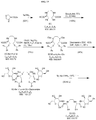
- FIG. 1 Non-limiting example of an organic synthesis of ethylenedicysteine-glucosamine (EC-G).
- E-G ethylenedicysteine-glucosamine
- FIG. 2 Non-limiting example of an organic synthesis of rhenium-ethylenedicysteine-glucosamine (Re-EC-G).
- FIG. 3 [ 3 H]Thymidine incorporation assay using Re-EC-G and a lymphoma cell line.
- FIG. 4 Comparison of cellular uptake of Ec-G in crude form or prep HPLC-purified form.
- FIG. 5 Mass spectrometry of EC-G.
- FIG. 6 Radio-TLC (thin layer chromatography) of 68 Ga-EC-G.
- FIG. 7 Analytic radio-HPLC of 68 Ga-EC-G. (a) UV detection; (b) NaI detection.
- FIGS. 8A and 8B Stability of 68 Ga-EC-G in dog serum as shown by radio-TLC.
- (b) 100 ⁇ L 68 Ga-EC-G in 100 ⁇ L dog serum, time 0;
- (c) time 30 min.;
- (d) time 60 min.;
- (e) time 120 min.;
- 68 Ga-EC-BSA Stability of 68 Ga-EC-BSA.
- FIG. 9 Stability of 68 Ga-EC-G in dog serum as analyzed in a protein binding assay.
- FIG. 10 In vitro uptake study of 68 Ga-labeled compounds in breast cancer cell line 13762.
- FIG. 11 Planar images of the 99m Tc-EC-ESMOLOL derivative (300 ⁇ Ci/rat) in breast tumor-bearing rats.
- H/UM heart/upper mediastinum count density (counts/pixel) ratios at 15-45 minutes.
- FIG. 12 68 Ga-EC-TML PET imaging in a New Zealand white rabbit.
- FIG. 13 Non-limiting example of an organic synthesis of ethylenedicysteine-glucosamine (EC-G).
- E-G ethylenedicysteine-glucosamine
- the present inventors have identified novel synthetic methods for the preparation of chelator-targeting ligand conjugates optionally chelated to one or more metal ions.
- the present invention further provides syntheses of chelators, such as unconjugated chelators, protected chelators (that is, chelators wherein one or more functional groups are protected using a protecting agent) and metal ion labeled-chelators (that is, chelators that are chelated to one or more metal ions).
- These synthetic methods comprise, generally, the use of organic solvents and synthetic organic procedures and purification methods. Methods based on wet (aqueous) chemistry are also provided. Compounds of the present invention resulting from such organic chemistry methods are high in purity, especially when compared to compounds prepared by wet chemistry.
- a preferred chelator is ethylenedicysteine.
- the targeting ligand can be, for example, a tissue-targeting moiety, a diagnostic moiety, or a therapeutic moiety.
- the metal ions chelated to compounds of the present invention may further render the compound useful for imaging, diagnostic, or therapeutic use. Compounds of the present invention, methods of their synthesis and use are further described below.
- Chelators employed in the method of the present invention generally comprise one or more atoms capable of chelating to one or more metal ions. Chelators comprising three or four atoms available for chelation are preferred. Typically, a chelator chelates to one metal ion.
- Chelation of a metal ion to a chelator can be by any method known to those of ordinary skill in the art. Methods of chelation (also called coordination) are described in more detail below. Atoms available for chelation are known to those of skill in the art, and typically comprise O, N or S. In preferred embodiments, the atoms available for chelation are selected from the group consisting of N and S. In certain preferred embodiments, the metal ion is chelated to a group of atoms, referred to herein as “chelates,” selected from the group consisting of NS 2 , N 2 S, S 4 , N 2 S 2 , N 3 S and NS 3 . Chelation can also occur among both the chelator and the targeting ligand—i.e., both the chelator and the targeting ligand may contribute atoms that chelate the same metal ion.
- the chelator comprises compounds incorporating one or more amino acids.
- Amino acids will typically be selected from the group consisting of cysteine and glycine.
- the chelator may comprise three cysteines and one glycine or three glycines and one cysteine.
- a spacer may connect one amino acid to another.
- chelators in general, comprise a variety of functional groups.
- functional groups include hydroxy, thiol, amine, amido and carboxylic acid.
- Bis-aminoethanethiol (BAT) dicarboxylic acids may constitute a chelator employed in the method of the present invention.
- the BAT dicarboxylic acid is ethylenedicysteine (EC).
- BAT dicarboxylic acids are capable of acting as tetradentate ligands, and are also known as diaminodithiol (DADT) compounds. Such compounds are known to form stable Tc(V)O-complexes on the basis of efficient binding of the oxotechnetium group to two thiol-sulfur and two amine-nitrogen atoms.
- the 99m Tc labeled diethylester ( 99m Tc-L,L-ECD) is known as a brain agent.
- 99m Tc-L,L-ethylenedicysteine ( 99m Tc-L,L-EC) is its most polar metabolite and was discovered to be excreted rapidly and efficiently in the urine.
- 99m Tc-L,L-EC has been used as a renal function agent.
- Other metals such as indium, rhenium, gallium, copper, holmium, platinum, gadolinium, lutetium, yttrium, cobalt, calcium and arsenic may also be chelated to BAT dicarboxylic acids such as EC.
- Chelators of the present invention may comprise one or more spacers.
- amino acids and their derivatives may be joined by one or more spacers.
- An example of two amino acids joined by a spacer includes ethylenedicysteine, described above.
- spacers are well known to those of ordinary skill in the art. These spacers, in general, provide additional flexibility to the overall compound that may facilitate chelation of one or more metal ions to the chelator.
- Non-limiting examples of spacers include alkyl groups of any length, such as ethylene (—CH 2 —CH 2 —), ether linkages, thioether linkages, amine linkages and any combination of one or more of these groups.
- multiple chelators that is, two or more linked together are capable of forming an overall molecule that may chelate to one or more, or more typically two or more, metal ions. That is, each chelator that makes up the overall molecule may each chelate to a single separate metal ion.
- a “protecting group,” as used herein, is defined as a group used for the purpose of this temporary blockage.
- the function of a protecting group is to protect one or more functional groups (e.g., —NH 2 , —SH, —COOH) during subsequent reactions which would not proceed well, either because the free (in other words, unprotected) functional group would react and be functionalized in a way that is inconsistent with its need to be free for subsequent reactions, or the free functional group would interfere in the reaction.
- functional groups e.g., —NH 2 , —SH, —COOH
- a “protecting agent” is used to install the protecting group.
- a protecting agent is admixed with a compound featuring a functional group that is to be protected, and the protecting agent forms a covalent bond with that functional group.
- the functional group is “protected” by a protecting group (and effectively rendered unreactive) by the covalent bond that formed with the protecting agent.
- Multiple functional groups can be protected in one or more steps using properly selected protecting agents. Such proper selection is understood by those of skill in the art. Such selection is often based upon the varying reactivity of the functional groups to be protected: thus, more reactive groups (such as sulfur/thiol) are typically protected before less reactive groups (such as amine) are protected.
- a protecting group When a protecting group is no longer needed, it is removed by methods well known to those skilled in the art.
- Agents used to remove the protecting group are typically called deprotecting agents.
- Protecting groups are typically readily removable (as is known to those skilled in the art) by methods employing deprotecting agents that are well known to those skilled in the art. For instance, acetate ester and carbamate protecting groups may be easily removed using mild acidic or basic conditions, yet benzyl and benzoyl ester protecting groups need much stronger acidic or basic conditions. It is well known that certain deprotecting agents remove some protective groups and not others, while other deprotecting agents remove several types of protecting groups from several types of functional groups.
- Birch reduction reactions using liquid ammonia and sodium deprotect benzyl groups from thiols (or sulfur, more particularly) or carbamate groups from nitrogen, but not acetate groups from oxygen.
- a first deprotecting agent may be used to remove one type of protecting group, followed by the use of a second deprotecting agent to remove a second type of protecting group, and so on.
- Amine protecting groups are well known to those skilled in the art. See, for example, Greene and Wuts (1999), Chapter 7. These protecting groups can be installed via protecting agents well known to those of skill in the art. Removal of these groups is also well known to those of skill in the art.
- the amine protecting group may be selected from the group consisting of t-butoxycarbonyl, benzyloxycarbonyl, formyl, trityl, acetyl, trichloroacetyl, dichloroacetyl, chloroacetyl, trifluoroacetyl, difluoroacetyl, fluoroacetyl, benzyl chloroformate, 4-phenylbenzyloxycarbonyl, 2-methylbenzyloxycarbonyl, 4-ethoxybenzyloxycarbonyl, 4-fluorobenzyloxycarbonyl, 4-chlorobenzyloxycarbonyl, 3-chlorobenzyloxycarbonyl, 2-chlorobenzyloxycarbonyl, 2,4-dichlorobenzyloxycarbonyl, 4-bromobenzyloxycarbonyl, 3-bromobenzyloxycarbonyl, 4-nitrobenzyloxycarbonyl, 4-cyanobenzyloxycarbonyl,
- the protecting agent for amine protection is selected from the group consisting of benzylchloroformate, p-nitro-chlorobenzylformate, ethylchloroformate, di-tert-butyl-dicarbonate, triphenylmethyl chloride and methoxytriphenylmethyl chloride.
- the protecting group is benzyloxycarbonyl, installed by the protecting agent benzyloxychloroformate.
- Thiol protecting groups are well known to those skilled in the art. See, for example, Greene and Wuts (1999), Chapter 6. These protecting groups can be installed via protecting agents well known to those of skill in the art. Removal of these groups is also well known to those of skill in the art.
- a thiol protecting group may be selected from the group consisting of acetamidomethyl, benzamidomethyl, 1-ethoxyethyl, benzoyl, triphenylmethyl, t-butyl, benzyl, adamantyl, cyanoethyl, acetyl and trifluoroacetyl.
- the protecting agent for thiol protection is selected from the group consisting of an alkyl halide, a benzyl halide, a benzoyl halide, a sulfonyl halide, a triphenylmethyl halide, a methoxytriphenylmethyl halide and cysteine.
- Non-limiting examples of these protecting agents include ethyl halides, propyl halides and acetyl halides.
- Halides may comprise chloro, bromo or iodo, for example.
- the protecting group is benzyl, installed by the protecting agent benzyl chloride.
- Hydroxy (or alcohol) protecting groups are well known to those skilled in the art. See, for example, Greene and Wuts (1999), Chapter 2. These protecting groups can be installed via protecting agents well known to those of skill in the art. Removal of these groups is also well known to those of skill in the art.
- a suitable hydroxy protecting group may be selected from the group consisting of esters or ethers.
- Esters such as acetate, benzoyl, tert-butylcarbonyl and trifluoroacetyl groups are removable by acidic or basic conditions.
- Ethers such as methoxy, ethoxy and tri-benzylmethyl are removable by stronger acidic or basic conditions.
- a preferred protecting group is an acetate ester.
- Carbonyl protecting groups are well known to those skilled in the art. See, for example, Greene and Wuts (1999), Chapter 4. Such protecting groups may protect, for example, ketones or aldehydes, or the carbonyl present in esters, amides, esters and the like. These protecting groups can be installed via protecting agents well known to those of skill in the art. Removal of these groups is also well known to those of skill in the art.
- a carbonyl protecting group may be selected from the group consisting of dimethylacetal, dimethylketal, diisopropylacetal, diisopropylketal, enamines and enol ethers.
- Carboxylic acid protecting groups are well known to those skilled in the art. See, for example, Greene and Wuts (1999), Chapter 5. Removal of these groups is also well known to those of skill in the art.
- a suitable carboxylic acid protecting group may be selected from the group consisting of amides or esters, for example.
- Amides such as sulfonamide, para-nitroaniline, benzylamide and benzolyamide may be hydrolyzed in acidic conditions.
- Esters such as methyl ester, ethyl ester and benzyl ester may be hydrolyzed by acidic or basic conditions.
- a preferred protecting group is an amide.
- compositions that will function to chelate one or more metal ions.
- the targeting ligands of the present invention may also participate in chelating one or more metal ions.
- a “metal ion” is defined herein to refer to a metal ion that is capable of forming a bond, such as a non-covalent bond, with one or more atoms or molecules. The other atom(s) or molecule(s) may be negatively charged.
- the metal ion may be selected from the group consisting of Tc-99m, Cu-60, Cu-61, Cu-62, Cu-67, In-111, Tl-201, Ga-67, Ga-68, As-72, Re-186, Re-187, Re-188, Ho-166, Y-90, Sm-153, Sr-89, Gd-157, Bi-212, Bi-213, Fe-56, Mn-55, Lu-177, a iron ion, a arsenic ion, a selenium ion, a thallium ion, a manganese ion, a cobalt ion, a platinum ion, a rhenium ion, a calcium ion and a rhodium ion
- the metal ion may be a radionuclide.
- a radionuclide is an isotope of artificial or natural origin that exhibits radioactivity.
- the radionuclide is selected from the group consisting of 99m Tc, 188 Re, 186 Re, 153 Sm, 166 Ho, 90 Y, 89 Sr, 67 Ga, 68 Ga, 111 In, 178 Gd, 55 Fe, 225 Ac, 212 Bi, 211 At, 45 Ti, 60 Cu, 61 Cu, 67 Cu, and 64 Cu.
- the metal ion is rhenium or a radionuclide such as 99m Tc, 188 Re, or 68 Ga.
- a reducing agent may need to accompany one of the radionuclides, such as 99m Tc.
- Non-limiting examples of such reducing agents include a dithionite ion, a stannous ion and a ferrous ion.
- a “gamma emitter” is herein defined as an agent that emits gamma energy of any range.
- One of ordinary skill in the art would be familiar with the various metal ions that are gamma emitters.
- the physical half-life of the radionuclide should be as short as the imaging procedure will allow. To allow for examinations to be performed on any day and at any time of the day, it is advantageous to have a source of the radionuclide always available at the clinical site.
- 99m Tc is a preferred radionuclide because it emits gamma radiation at 140 keV, it has a physical half-life of 6 hours, and it is readily available on-site using a molybdenum-99/technetium-99m generator.
- a molybdenum-99/technetium-99m generator One of ordinary skill in the art would be familiar with methods to determine optimal radioimaging in humans.
- the metal ion is a therapeutic metal ion.
- the metal ion is a therapeutic radionuclide that is a beta-emitter.
- a beta emitter is any agent that emits beta energy of any range. Examples of beta-emitters include Re-188, Re-187, Re-186, Ho-166, Y-90, Bi-212, Bi-213, and Sn-153.
- the beta-emitters may or may not also be gamma-emitters.
- One of ordinary skill in the art would be familiar with the use of beta-emitters in the treatment of hyperproliferative disease, such as cancer.
- the metal ion is a therapeutic metal ion that is not a beta emitter or a gamma emitter.
- the therapeutic metal ion may be platinum, cobalt, copper, arsenic, selenium, calcium or thallium.
- Compositions including these therapeutic metal ions may be applied in methods directed to the treatment of diseases such as hyperproliferative diseases, cardiovascular disease, infections, and inflammation. Examples of hyperproliferative diseases include cancers. Methods of performing dual chemotherapy and radiation therapy that involve the compositions of the present invention are discussed in greater detail below.
- a “targeting ligand” is defined herein to be a molecule or part of a molecule that binds with specificity to another molecule.
- One of ordinary skill in the art would be familiar with the numerous agents that can be employed as targeting ligands in the context of the present invention.
- targeting ligands include disease cell cycle targeting compounds, angiogenesis targeting ligands, tumor apoptosis targeting ligands, disease receptor targeting ligands, gene expression markers, drug-based ligands, antimicrobials, tumor hypoxia targeting ligands, an antisense molecule, an agent that mimics glucose, amifostine, angiostatin, EGF receptor ligands, capecitabine, COX-2 inhibitors, deoxycytidine, fullerene, herceptin, human serum albumin, lactose, leuteinizing hormone, pyridoxal, quinazoline, thalidomide, transferrin, and trimethyl lysine.
- the targeting ligand is an antibody. Any antibody is contemplated as a targeting ligand in the context of the present invention.
- the antibody may be a monoclonal antibody.
- the monoclonal antibody is an antibody directed against a tumor marker.
- the monoclonal antibody is monoclonal antibody C225, monoclonal antibody CD31, or monoclonal antibody CD40.
- a single targeting ligand, or more than one such targeting ligand, may be conjugated to a chelator of the present invention.
- any number of targeting ligands may be conjugated to the chelators set forth herein.
- a conjugate of the present invention may comprise a single targeting ligand.
- a conjugate may comprise only two targeting ligands.
- a targeting ligand may comprise three or more targeting ligands. In any situation where a conjugate comprises two or more targeting ligands, the targeting ligands may be the same or different.
- the targeting ligands can be bound to the chelator in any manner, including for example covalent bonds, ionic bonds and hydrogen bonds.
- the targeting ligand may be bound to the chelator in an amide linkage, an ester linkage, or a carbon-carbon bond linkage of any length. If two or more targeting ligands are bound to a chelator, the modes of binding may be the same or different.
- the linkage comprises a linker.
- linkers include peptides, glutamic acid, aspartic acid, bromo ethylacetate, ethylene diamine, lysine and any combination of one or more of these groups.
- the targeting ligand is a tissue-specific ligand, which is conjugated to the chelator.
- a “tissue-specific ligand” is defined herein to refer to a molecule or a part of a molecule that can bind or attach to one or more tissues. The binding may be by any mechanism of binding known to those of ordinary skill in the art. Examples include therapeutic agents, antimetabolites, apoptotic agents, bioreductive agents, signal transductive therapeutic agents, receptor responsive agents, or cell cycle specific agents.
- the tissue may be any type of tissue, such as a cell.
- the cell may be the cell of a subject, such as a cancer cell.
- the tissue-targeting ligand is a tissue-targeting amino acid sequence that is conjugated to a chelator that is capable of binding to a metal ion.
- a targeting ligand is a drug, or “therapeutic ligand,” which is defined herein to refer to any therapeutic agent.
- a “therapeutic agent” or “drug” is defined herein to include any compound or substance that can be administered to a subject, or contacted with a cell or tissue, for the purpose of treating a disease or disorder, or preventing a disease or disorder, or treating or preventing an alteration or disruption of a normal physiologic process.
- the therapeutic ligand may be an anti-cancer moiety, such as a chemotherapeutic agent.
- the therapeutic ligand is a therapeutic amino acid sequence that is conjugated to the therapeutic amino acid sequence. Such conjugates are discussed further in other parts of this specification.
- anti-cancer ligands include any chemotherapeutic agent known to those of ordinary skill in the art.
- chemotherapeutic agents include, but are not limited to, cisplatin (CDDP), carboplatin, procarbazine, mechlorethamine, cyclophosphamide, camptothecin, ifosfamide, melphalan, chlorambucil, busulfan, nitrosurea, dactinomycin, daunorubicin, doxorubicin, bleomycin, plicomycin, mitomycin, etoposide (VP16), tamoxifen, raloxifene, estrogen receptor binding agents, taxol, gemcitabien, navelbine, farnesyl-protein transferase inhibitors, transplatinum, 5-fluorouracil, vincristin, vinblastin and methotrexate, or any analog or derivative variant of the foregoing.
- the anti-cancer ligands include, but are
- chemotherapeutic agents may be used in accordance with the present invention.
- the term “chemotherapy” refers to the use of drugs to treat cancer.
- a “chemotherapeutic agent” is used to connote a compound or composition that is administered in the treatment of cancer. These agents or drugs are categorized by their mode of activity within a cell, for example, whether and at what stage they affect the cell cycle. Alternatively, an agent may be characterized based on its ability to directly cross-link DNA, to intercalate into DNA, or to induce chromosomal and mitotic aberrations by affecting nucleic acid synthesis. Most chemotherapeutic agents fall into the following categories: alkylating agents, antimetabolites, antitumor antibiotics, mitotic inhibitors, and nitrosoureas.
- chemotherapeutic agents include alkylating agents such as thiotepa and cyclosphosphamide; alkyl sulfonates such as busulfan, improsulfan and piposulfan; aziridines such as benzodepa, carboquone, meturedepa, and uredepa; ethylenimines and methylamelamines including altretamine, triethylenemelamine, trietylenephosphoramide, triethiylenethiophosphoramide and trimethylolomelamine; acetogenins (especially bullatacin and bullatacinone); a camptothecin (including the synthetic analogue topotecan); bryostatin; callystatin; CC-1065 (including its adozelesin, carzelesin and bizelesin synthetic analogues); cryptophycins (particularly cryptophycin 1 and cryptophycin 8); dolastatin; duocarmycin (including the synthetic an
- anti-hormonal agents that act to regulate or inhibit hormone action on tumors
- SERMs selective estrogen receptor modulators
- aromatase inhibitors that inhibit the enzyme aromatase, which regulates estrogen production in the adrenal glands, such as, for example, 4(5)-imidazoles, aminoglutethimide, megestrol acetate, exemestane, formestanie, fadrozole, vorozole, letrozole, and anastrozole
- anti-androgens such as flutamide, nilutamide, bicalutamide, leuprolide, and goserelin; as well as troxacitabine (a 1,3-dio
- anti-cancer agents include those drugs of choice for cancer chemotherapy listed in Table 1:
- Interferon also may be curative in patients with chronic phase CML who achieve a complete cytogenetic response (about 10%); it is the treatment of choice for patents >80 years old with newly diagnosed chronic phase CML and for all patients who are not candidates for an allgensic bone marrow transplant. Chemotherapy alone is palliative. 10 If a second chronic phase is achieved with any of these combinations, allogeneic bone marrow transplant should be considered. Bone marrow transplant in second chronic phase may be curative for 30% to 35% of patients with CML. 11 Limited-stage Hodgkin's disease (stages 1 and 2) is curable by radiotherapy. Disseminated disease (stages 3b and 4) require chemotherapy. Some intermediate stages and selected clinical situations may benefit from both. + Available in the USA only for investigational use.
- a “cardiovascular drug” is defined herein to refer to any therapeutic agent that can be applied in the treatment or prevention of a disease of the heart and/or blood vessels.
- the cardiovascular drug is an agent that lowers the concentration of one of more blood lipids and/or lipoproteins, known herein as an “antihyperlipoproteinemic,” which can be applied in the treatment of atherosclerosis and thickenings or blockages of vascular tissues.
- an antihyperlipoproteinemic an agent that lowers the concentration of one of more blood lipids and/or lipoproteins, known herein as an “antihyperlipoproteinemic,” which can be applied in the treatment of atherosclerosis and thickenings or blockages of vascular tissues.
- examples include an aryloxyalkanoic/fibric acid derivative, a resin/bile acid sequesterant, a HMG CoA reductase inhibitor, a nicotinic acid derivative, a thyroid hormone or thyroid hormone analog, a miscellaneous agent or a combination thereof.
- Non-limiting examples of aryloxyalkanoic/fibric acid derivatives include beclobrate, benzafibrate, binifibrate, ciprofibrate, clinofibrate, clofibrate (atromide-S), clofibric acid, etofibrate, fenofibrate, gemfibrozil (lobid), nicofibrate, pirifibrate, ronifibrate, simfibrate and theofibrate.
- Non-limiting examples of resins/bile acid sequestrants include cholestyramine (cholybar, questran), colestipol (colestid) and polidexide.
- Non-limiting examples of HMG CoA reductase inhibitors include lovastatin (mevacor), pravastatin (pravochol) or simvastatin (zocor).
- Non-limiting examples of nicotinic acid derivatives include nicotinate, acepimox, niceritrol, nicoclonate, nicomol and oxiniacic acid.
- Non-limiting examples of thyroid hormones and analogs thereof include etoroxate, thyropropic acid and thyroxine.
- miscellaneous antihyperlipoproteinemics include acifran, azacosterol, benfluorex, ⁇ -benzalbutyramide, camitine, chondroitin sulfate, clomestrone, detaxtran, dextran sulfate sodium, 5,8,11,14,17-eicosapentaenoic acid, eritadenine, furazabol, meglutol, melinamide, mytatrienediol, ornithine, ⁇ -oryzanol, pantethine, pentaerythritol tetraacetate, ⁇ -phenylbutyramide, pirozadil, probucol (lorelco), ⁇ -sitosterol, sultosilic acid-piperazine salt, tiadenol, triparanol and xenbucin.
- Non-limiting examples of an antiarteriosclerotic include pyridinol carbamate.
- the cardiovascular drug is an agent that aids in the removal or prevention of blood clots.
- antithrombotic and/or fibrinolytic agents include anticoagulants, anticoagulant antagonists, antiplatelet agents, thrombolytic agents, thrombolytic agent antagonists or combinations thereof.
- antithrombotic agents include aspirin and wafarin (coumadin.
- anticoagulant examples include acenocoumarol, ancrod, anisindione, bromindione, clorindione, coumetarol, cyclocumarol, dextran sulfate sodium, dicumarol, diphenadione, ethyl biscoumacetate, ethylidene dicoumarol, fluindione, heparin, hirudin, lyapolate sodium, oxazidione, pentosan polysulfate, phenindione, phenprocoumon, phosvitin, picotamide, tioclomarol and warfarin.
- Non-limiting examples of antiplatelet agents include aspirin, a dextran, dipyridamole (persantin), heparin, sulfinpyranone (anturane) and ticlopidine (ticlid).
- Non-limiting examples of thrombolytic agents include tissue plasminogen activator (activase), plasmin, pro-urokinase, urokinase (abbokinase) streptokinase (streptase), antistreplase/APSAC (eminase).
- the cardiovascular drug is a blood coagulant.
- a blood coagulation promoting agent include thrombolytic agent antagonists and anticoagulant antagonists.
- anticoagulant antagonists include protamine and vitamin K1.
- Non-limiting examples of thrombolytic agent antagonists include aminocaproic acid (amicar) and tranexamic acid (amstat).
- Non-limiting examples of antithrombotics include anagrelide, argatroban, cilostazol, daltroban, defibrotide, enoxaparin, fraxiparine, indobufen, lamoparan, ozagrel, picotamide, plafibride, tedelparin, ticlopidine and triflusal.
- the cardiovascular drug may be an antiarrythmic agent.
- antiarrhythmic agents include Class I antiarrythmic agents (sodium channel blockers), Class II antiarrythmic agents (beta-adrenergic blockers), Class II antiarrythmic agents (repolarization prolonging drugs), Class IV antiarrhythmic agents (calcium channel blockers) and miscellaneous antiarrythmic agents.
- Non-limiting examples of sodium channel blockers include Class IA, Class IB and Class IC antiarrhythmic agents.
- Class IA antiarrhythmic agents include dispyramide (norpace), procainamide (pronestyl) and quinidine (quinidex).
- Class IB antiarrhythmic agents include lidocaine (xylocaine), tocamide (tonocard) and mexiletine (mexitil).
- Class IC antiarrhythmic agents include encamide (enkaid) and flecaimide (tambocor).
- Non-limiting examples of a beta blocker otherwise known as a ⁇ -adrenergic blocker, a ⁇ -adrenergic antagonist or a Class II antiarrhythmic agent, include acebutolol (sectral), alprenolol, amosulalol, arotinolol, atenolol, befunolol, betaxolol, bevantolol, bisoprolol, bopindolol, bucumolol, bufetolol, bufuralol, bunitrolol, bupranolol, butidrine hydrochloride, butofilolol, carazolol, carteolol, carvedilol, celiprolol, cetamolol, cloranolol, dilevalol, epanolol, esmolol (brevibloc), indenolol, la
- the beta blocker comprises an aryloxypropanolamine derivative.
- aryloxypropanolamine derivatives include acebutolol, alprenolol, arotinolol, atenolol, betaxolol, bevantolol, bisoprolol, bopindolol, bunitrolol, butofilolol, carazolol, carteolol, carvedilol, celiprolol, cetamolol, epanolol, indenolol, mepindolol, metipranolol, metoprolol, moprolol, nadolol, nipradilol, oxprenolol, penbutolol, pindolol, propranolol, talinolol, tertatolol, timolol
- Non-limiting examples of an agent that prolong repolarization also known as a Class III antiarrhythmic agent, include amiodarone (cordarone) and sotalol (brissace).
- Non-limiting examples of a calcium channel blocker otherwise known as a Class IV antiarrythmic agent, include an arylalkylamine (e.g., bepridile, diltiazem, fendiline, gallopamil, phenylamine, terodiline, verapamil), a dihydropyridine derivative (felodipine, isradipine, nicardipine, nifedipine, nimodipine, nisoldipine, nitrendipine) a piperazine derivative (e.g., cinnarizine, flunarizine, lidoflazine) or a miscellaneous calcium channel blocker such as bencyclane, etafenone, magnesium, mibefradil or
- a calcium channel blocker comprises a long-acting dihydropyridine (nifedipine-type) calcium antagonist.
- miscellaneous antiarrhymic agents include adenosine (adenocard), digoxin (lanoxin), acetamide, ajmaline, amoproxan, aprindine, bretylium tosylate, bunaftine, butobendine, capobenic acid, cifenline, diisopyramide, hydroquinidine, indecamide, ipratropium bromide, lidocaine, lorajmine, lorcamide, meobentine, moricizine, pirmenol, prajmaline, propafenone, pyrinoline, quinidine polygalacturonate, quinidine sulfate and viquidil.
- cardiovascular drugs include antihypertensive agents.
- antihypertensive agents include sympatholytic, alpha/beta blockers, alpha blockers, anti-angiotensin II agents, beta blockers, calcium channel blockers, vasodilators and miscellaneous antihypertensives.
- an alpha blocker also known as an ⁇ -adrenergic blocker or an ⁇ -adrenergic antagonist
- an alpha blocker include amosulalol, arotinolol, dapiprazole, doxazocin, ergoloid mesylates, fenspiride, indoramin, labetalol, nicergoline, prazosin, terazosin, tolazoline, trimazosin and yohimbine.
- an alpha blocker may comprise a quinazoline derivative.
- Non-limiting examples of quinazoline derivatives include alfuzosin, bunazosin, doxazocin, prazosin, terazosin and trimazosin.
- an antihypertensive agent is both an alpha and beta adrenergic antagonist.
- Non-limiting examples of an alpha/beta blocker comprise labetalol (normodyne, trandate).
- Non-limiting examples of anti-angiotension II agents include angiotensin converting enzyme inhibitors and angiotension II receptor antagonists.
- Non-limiting examples of angiotension converting enzyme inhibitors include alacepril, enalapril (vasotec), captopril, cilazapril, delapril, enelaprilat, fosinopril, lisinopril, moveltopril, perindopril, quinapril and ramipril.
- Non-limiting examples of an angiotensin II receptor blocker also known as an angiotension II receptor antagonist, an ANG receptor blocker or an ANG-II type-1 receptor blocker (ARBS)
- Non-limiting examples of a sympatholytic include a centrally acting sympatholytic or a peripherally acting sympatholytic.
- Non-limiting examples of a centrally acting sympatholytic also known as an central nervous system (CNS) sympatholytic, include clonidine (catapres), guanabenz (wytensin) guanfacine (tenex) and methyldopa (aldomet).
- Non-limiting examples of a peripherally acting sympatholytic include a ganglion blocking agent, an adrenergic neuron blocking agent, a ⁇ -adrenergic blocking agent or a alpha1-adrenergic blocking agent.
- Non-limiting examples of a ganglion blocking agent include mecamylamine (inversine) and trimethaphan (arfonad).
- Non-limiting of an adrenergic neuron blocking agent include guanethidine (ismelin) and reserpine (serpasil).
- Non-limiting examples of a ⁇ -adrenergic blocker include acenitolol (sectral), atenolol (tenormin), betaxolol (kerlone), carteolol (cartrol), labetalol (normodyne, trandate), metoprolol (lopressor), nadanol (corgard), penbutolol (levatol), pindolol (visken), propranolol (inderal) and timolol (blocadren).
- Non-limiting examples of alpha1-adrenergic blocker include prazosin (minipress), doxazocin (cardura) and terazosin (hytrin).
- a cardiovasculator therapeutic agent may comprise a vasodilator (e.g., a cerebral vasodilator, a coronary vasodilator or a peripheral vasodilator).
- a vasodilator comprises a coronary vasodilator.
- Non-limiting examples of a coronary vasodilator include amotriphene, bendazol, benfurodil hemisuccinate, benziodarone, chloracizine, chromonar, clobenfurol, clonitrate, dilazep, dipyridamole, droprenilamine, efloxate, erythritol tetranitrane, etafenone, fendiline, floredil, ganglefene, herestrol bis( ⁇ -diethylaminoethyl ether), hexobendine, itramin tosylate, khellin, lidoflanine, mannitol hexanitrane, medibazine, nicorglycerin, pentaerythritol tetranitrate, pentrinitrol, perhexyline, pimefylline, trapidil, tricromyl, trimet
- a vasodilator may comprise a chronic therapy vasodilator or a hypertensive emergency vasodilator.
- a chronic therapy vasodilator include hydralazine (apresoline) and minoxidil (loniten).
- a hypertensive emergency vasodilator include nitroprusside (nipride), diazoxide (hyperstat IV), hydralazine (apresoline), minoxidil (loniten) and verapamil.
- miscellaneous antihypertensives include ajmaline, ⁇ -aminobutyric acid, bufeniode, cicletainine, ciclosidomine, a cryptenamine tannate, fenoldopam, flosequinan, ketanserin, mebutamate, mecamylamine, methyldopa, methyl 4-pyridyl ketone thiosemicarbazone, muzolimine, pargyline, pempidine, pinacidil, piperoxan, primaperone, a protoveratrine, raubasine, rescimetol, rilmenidene, saralasin, sodium nitroprusside, ticrynafen, trimethaphan camsylate, tyrosinase and urapidil.
- an antihypertensive may comprise an arylethanolamine derivative, a benzothiadiazine derivative, a N-carboxyalkyl(peptide/lactam) derivative, a dihydropyridine derivative, a guanidine derivative, a hydrazines/phthalazine, an imidazole derivative, a quanternary ammonium compound, a reserpine derivative or a sulfonamide derivative.
- arylethanolamine derivatives include amosulalol, bufuralol, dilevalol, labetalol, pronethalol, sotalol and sulfinalol.
- Non-limiting examples of benzothiadiazine derivatives include althizide, bendroflumethiazide, benzthiazide, benzylhydrochlorothiazide, buthiazide, chlorothiazide, chlorthalidone, cyclopenthiazide, cyclothiazide, diazoxide, epithiazide, ethiazide, fenquizone, hydrochlorothiazide, hydroflumethiazide, methyclothiazide, meticrane, metolazone, paraflutizide, polythiazide, tetrachlormethiazide and trichloromethiazide.
- Non-limiting examples of N-carboxyalkyl(peptide/lactam) derivatives include alacepril, captopril, cilazapril, delapril, enalapril, enelaprilat, fosinopril, lisinopril, moveltipril, perindopril,
- Non-limiting examples of dihydropyridine derivatives include amlodipine, felodipine, isradipine, nicardipine, nifedipine, nilvadipine, nisoldipine and nitrendipine.
- Non-limiting examples of guanidine derivatives include bethanidine, debrisoquin, guanabenz, guanacline, guanadrel, guanazodine, guanethidine, guanfacine, guanochlor, guanoxabenz and guanoxan.
- Non-limiting examples of hydrazines/phthalazines include budralazine, cadralazine, dihydralazine, endralazine, hydracarbazine, hydralazine, pheniprazine, pildralazine and todralazine.
- Non-limiting examples of imidazole derivatives include clonidine, lofexidine, phentolamine, tiamenidine and tolonidine.
- Non-limiting examples of quanternary ammonium compounds include azamethonium bromide, chlorisondamine chloride, hexamethonium, pentacynium bis(methylsulfate), pentamethonium bromide, pentolinium tartrate, phenactropinium chloride and trimethidinium methosulfate.
- Non-limiting examples of reserpine derivatives include bietaserpine, deserpidine, rescinnamine, reserpine and syrosingopine.
- Non-limiting examples of sulfonamide derivatives include ambuside, clopamide, furosemide, indapamide, quinethazone, tripamide and xipamide.
- vasopressors generally are used to increase blood pressure during shock, which may occur during a surgical procedure.
- a vasopressor also known as an antihypotensive, include amezinium methyl sulfate, angiotensin amide, dimetofrine, dopamine, etifelmin, etilefrin, gepefrine, metaraminol, midodrine, norepinephrine, pholedrine and synephrine.
- cardiovascular drugs include agents that can be applied in the treatment or prevention of congestive heart failure.
- agents for the treatment of congestive heart failure include anti-angiotensin II agents, afterload-preload reduction treatment, diuretics and inotropic agents.
- agents for the treatment of congestive heart failure include anti-angiotensin II agents, afterload-preload reduction treatment, diuretics and inotropic agents.
- afterload-preload reduction agents include hydralazine (apresoline) and isosorbide dinitrate (isordil, sorbitrate).
- Non-limiting examples of a diuretic include a thiazide or benzothiadiazine derivative (e.g., althiazide, bendroflumethiazide, benzthiazide, benzylhydrochlorothiazide, buthiazide, chlorothiazide, chlorothiazide, chlorthalidone, cyclopenthiazide, epithiazide, ethiazide, ethiazide, fenquizone, hydrochlorothiazide, hydroflumethiazide, methyclothiazide, meticrane, metolazone, paraflutizide, polythiazide, tetrachloromethiazide, trichloromethiazide), an organomercurial (e.g., chlormerodrin, meralluride, mercamphamide, mercaptomerin sodium, mercumallylic acid, mercumatilin dodium, mercur
- Non-limiting examples of a positive inotropic agent also known as a cardiotonic, include acefylline, an acetyldigitoxin, 2-amino-4-picoline, aminone, benfurodil hemisuccinate, bucladesine, cerberosine, camphotamide, convallatoxin, cymarin, denopamine, deslanoside, digitalin, digitalis, digitoxin, digoxin, dobutamine, dopamine, dopexamine, enoximone, erythrophleine, fenalcomine, gitalin, gitoxin, glycocyamine, heptaminol, hydrastinine, ibopamine, a lanatoside, metamivam, milrinone, nerifolin, oleandrin, ouabain, oxyfedrine, prenalterol, proscillaridine, resibufogenin, scillaren, sci
- an intropic agent is a cardiac glycoside, a beta-adrenergic agonist or a phosphodiesterase inhibitor.
- a cardiac glycoside includes digoxin (lanoxin) and digitoxin (crystodigin).
- Non-limiting examples of a ⁇ -adrenergic agonist include albuterol, bambuterol, bitolterol, carbuterol, clenbuterol, clorprenaline, denopamine, dioxethedrine, dobutamine (dobutrex), dopamine (intropin), dopexamine, ephedrine, etafedrine, ethylnorepinephrine, fenoterol, formoterol, hexoprenaline, ibopamine, isoetharine, isoproterenol, mabuterol, metaproterenol, methoxyphenamine, oxyfedrine, pirbuterol, procaterol, protokylol, reproterol, rimiterol, ritodrine, soterenol, terbutaline, tretoquinol, tulobuterol and xamoterol.
- Non-limiting examples of a phosphodiesterase inhibitor include aminone (inocor).
- Antianginal agents may comprise organonitrates, calcium channel blockers, beta blockers and combinations thereof.
- organonitrates also known as nitrovasodilators, include nitroglycerin (nitro-bid, nitrostat), isosorbide dinitrate (isordil, sorbitrate) and amyl nitrate (aspirol, vaporole).
- Disease cell cycle targeting compounds refers to compounds that target agents that are upregulated in proliferating cells.
- Compounds used for this purpose can be used to measure various parameters in cells, such as tumor cell DNA content.
- nucleoside analogues are nucleoside analogues.
- pyrimidine nucleoside e.g., 2′-fluoro-2′-deoxy-5-iodo-1- ⁇ -D-arabinofuranosyluracil [FIAU], 2′-fluoro-2′-deoxy-5-iodo-1- ⁇ -D-ribofuranosyl-uracil [FIRU], 2′-fluoro-2′-5-methyl-1- ⁇ -D-arabinofuranosyluracil [FMAU], 2′-fluoro-2′-deoxy-5-iodovinyl-1- ⁇ -D-ribofuranosyluracil [IVFRU]
- acycloguanosine 9-[(2-hydroxy-1-(hydroxymethyl)ethoxy)methyl]guanine (GCV) and 9-[4-hydroxy-3-(hydroxy-methyl)butyl]guanine (PCV) (Tjuvajev et al., 2002; Gambhir
- Angiogenesis targeting ligands refers to agents that can bind to neovascularization or revascularization of tissue. For example, the neovascularization of tumor cells or revascularization of myocardium tissue. Agents that are used for this purpose are known to those of ordinary skill in the art for use in performing various measurements, including measurement of the size of a tumor vascular bed and measurement of tumor volume. Some of these agents bind to the vascular wall. One of ordinary skill in the art would be familiar with the agents that are available for use for this purpose.
- angiogenesis targeting refers to the use of an agent to bind to neovascular tissue.
- agents that are used for this purpose are known to those of ordinary skill in the art for use in performing various tumor measurements, including measurement of the size of a tumor vascular bed, and measurement of tumor volume. Some of these agents bind to the vascular wall.
- a tumor angiogenesis targeting ligand is a ligand that is used for the purpose of tumor angiogenesis targeting as defined above.
- angiogenesis targeting ligands include COX-2 inhibitors, anti-EGF receptor ligands, herceptin, angiostatin, C225 and thalidomide.
- COX-2 inhibitors include, for example, celecoxib, rofecoxib, etoricoxib and analogs of these agents.
- Tumor apoptosis targeting refers to use of an agent to bind to a cell that is undergoing apoptosis or at risk of undergoing apoptosis. These agents are generally used to provide an indicator of the extent or risk of apoptosis, or programmed cell death, in a population of cells, such as a tumor and cardiac tissue. One of ordinary skill in the art would be familiar with agents that are used for this purpose.
- a “tumor apoptosis targeting ligand” is a ligand that is capable of performing “tumor apoptosis targeting” as defined in this paragraph.
- the targeting ligand of the present invention may include TRAIL (TNF-related apoptosis inducing ligand) monoclonal antibody.
- TRAIL is a member of the tumor necrosis factor ligand family that rapidly induces apoptosis in a variety of transformed cell lines.
- the targeting ligand of the present invention may also comprise a substrate of caspase-3, such as peptide or chelator that includes the 4 amino acid sequence aspartic acid-glutamic acid-valine-aspartic acid.
- caspase-3 substrate for example, a peptide or chelator that includes the amino acid sequence aspartic acid-glutamic acid-valine-aspartic acid
- Bcl family members include, for example, Bax, Bcl-xL, Bid, Bad, Bak and Bcl-2.
- Bcl-2 One of ordinary skill in the art would be familiar with the Bcl family, and their respective substrates.
- Apoptosis suppressors are targets for drug discovery, with the idea of abrogating their cytoprotective functions and restoring apoptosis sensitivity to tumor cells (Reed, 2003).
- disease receptor targeting certain agents are exploited for their ability to bind to certain cellular receptors that are overexpressed in disease states, such as cancer, neurological diseases and cardiovascular diseases.
- receptors which are targeted include estrogen receptors, androgen receptors, pituitary receptors, transferrin receptors and progesterone receptors.
- agents that can be applied in disease-receptor targeting include androgen, estrogen, somatostatin, progesterone, transferrin, luteinizing hormone and luteinizing hormone antibody.
- radiolabeled ligands such as pentetreotide, octreotide, transferrin and pituitary peptide, bind to cell receptors, some of which are overexpressed on certain cells. Since these ligands are not immunogenic and are cleared quickly from the plasma, receptor imaging would seem to be more promising compared to antibody imaging.
- the folate receptor is included herein as another example of a disease receptor.
- Folate receptors are overexposed on many neoplastic cell types (e.g., lung, breast, ovarian, cervical, colorectal, nasopharyngeal, renal adenocarcinomas, malignant melanoma and ependymomas), but primarily expressed only several normal differentiated tissues (e.g., choroid plexus, placenta, thyroid and kidney) (Weitman et al., 1992a; Campbell et al., 1991; Weitman et al., 1992b; Holm et al., 1994; Ross et al., 1994; Franklin et al., 1994; Weitman et al., 1994).
- FRs have been used to deliver folate-conjugated protein toxins, drug/antisense oligonucleotides and liposomes into tumor cells overexpressing the folate receptors (Ginobbi et al., 1997; Leamon and Low, 1991; Leamon and Low, 1992; Leamon et al., 1993; Lee and Low, 1994).
- bispecific antibodies that contain anti-FR antibodies linked to anti-T cell receptor antibodies have been used to target T cells to FR-positive tumor cells and are currently in clinical trials for ovarian carcinomas (Canevari et al., 1993; Bolhuis et al., 1992; Patrick et al., 1997; Coney et al., 1994; Kranz et al., 1995).
- folate receptor targeting ligands include folic acid and analogs of folic acid.
- Preferred folate receptor targeting ligands include folate, methotrexate and tomudex.
- Folic acid as well as antifolates such as methotrexate enter into cells via high affinity folate receptors (glycosylphosphatidylinositol-linked membrane folate-binding protein) in addition to classical reduced-folate carrier system (Westerhof et al., 1991; Orr et al., 1995; Hsueh and Dolnick, 1993).
- the targeting ligand is a cardiac ischemia marker.
- a cardiac ischemia marker is a ligand that is relatively selective for ischemic cardiac tissue.
- Non-limiting examples of cardiac ischemia markers include interleukin-6, tumor necrosis factor alpha, matrix metalloproteinase 9, myeloperoxidase, intercellular and vascular adhesion molecules, soluble CD40 ligand, placenta growth factor, high sensitivity C-reactive protein (hs-CRP), ischemia modified albumin (IMA), free fatty acids, and choline.
- the targeting ligand is a viability cardiac tissue marker.
- a viability cardiac tissue marker refers to a ligand that is relatively selective for viable cardiac tissue compared to nonviable cardiac tissue.
- Non-limiting examples of cardiac viability tissue markers include those selected from the group consisting of phospholipase C, myosin light-chain phosphatase, nitric oxide, prostacyclin, endothelin, thromboxane, L-arginine and L-citrulline.
- the targeting ligand is a congestive heart failure marker.
- a congestive heart failure marker is a ligand that is relatively selective for cardiac tissue of a heart in congestive heart failure compared to normal healthy heart tissue.
- Non-limiting examples of congestive heart failure markers include those selected from the group consisting of interleukin-1, cardiotrophin-1, insulin-like growth factor, epidermal growth factor, tyrosine kinase receptor and angiotensin II.
- the targeting ligand is a rest/stress cardiac tissue marker.
- a rest/stress cardiac tissue marker is a ligand that is relatively selective for cardiac tissue that is stressed compared to non-stressed (at rest) cardiac tissue, or vice versa.
- Non-limiting examples of rest/stress cardiac tissue markers include those selected from the group consisting of mitogen-activated protein kinase, cyclic adenosine monophosphate, phospholipase C, phosphatidylinositol bisphosphate, isositol trisphosphate, diacylglycerol and tyrosine kinases.
- Certain drug-based ligands can be applied in measuring the pharmacological response of a subject to a drug.
- a wide range of parameters can be measured in determining the response of a subject to administration of a drug.
- One of ordinary skill in the art would be familiar with the types of responses that can be measured. These responses depend in part upon various factors, including the particular drug that is being evaluated, the particular disease or condition for which the subject is being treated, and characteristics of the subject.
- drug-based ligands examples include carnitine, puromycin, verapamil, digoxin, prazosin, quinidine, diisopyramide, theophylline, protease inhibitors nifedipine, diltiazem, flecaimide, amiodarone, sotalol, adenosine, dopamine dobutamine, inamrinone, milrinone, spironolactone, prazosin, aspirin and warfarin.
- antimicrobials include ampicillin, amoxicillin, penicillin, clindamycin, gentamycin, kanamycin, neomycin, natamycin, nafcillin, rifampin, tetracycline, vancomycin, bleomycin, doxycyclin, amikacin, netilmicin, streptomycin, tobramycin, loracarbef, ertapenem, imipenem, meropenem, cefadroxil, cefazolin, cephalexin, cefaclor, cefamandole, cefoxitin, cefprozil, cefuroxime, cefixime, cefdinir, cefditoren, cefoperazone, cefotaxime, cefpodoxime, ceftazidime, ceftibuten, ceftizoxime, ceftriaxone, cefe
- Antifungals include natamycin, rimocidin, filipin, nystatin, amphotericin B, miconazole, ketoconazole, clotrimazole, econazole, bifonazole, butocanazole, finticonazole, isoconazole, oxiconazole, sertaconazole, sulconazole, tioconazole, fluconazole, itraconazole, ravuconazole, posaconazole, voriconazole, terconazole, terbinafine, amorolfine, naftifine, butenafine, anidulafungin, caspofungin, micafungin, ciclopirox, flucytosine, griseofulvin, gentian violet, haloprogin, tolnaftate, undecyclenic acid, amantadine, polymycin, acyclovir and ganciclovir for fungi.
- Agents that mimic glucose are also contemplated for inclusion as targeting ligands. Such agents can also be considered “glucose analogs” or “glucose derivatives.”
- Glucose is utilized by living organisms through the glycolysis pathway.
- Compounds such as neomycin, kanamycin, gentamycin, amikacin, tobramycin, netilmicin, ribostamycin, sisomicin, micromicin, lividomycin, dibekacin, isepamicin, and astromicin belong to a group called aminoglycosides.
- agents that mimic glucose typically have a glucose ring structure. Exceptions exist, however, such as puromycin, which has a pentose ring structure, but which can still be considered an agent that mimics glucose.
- aminoglycosides are used as antibiotics that block the glycolysis pathway by their property of being structurally similar to glucose and thus, they are functionally considered as agents that mimic glucose. When these aminoglycosides are used in imaging studies, there are no detectable pharmacological effects.
- aminoglycosides are functionally utilized through the glycolytic pathway by virtue of their structural similarity to glucose and block the glycolysis pathway. Hence, aminoglycosides are considered to mimic or simulate glucose in structural and functional manner.
- Non-limiting examples of chemical structures with their PubChem Database (NCBI) identifier CID number are as follows: Amikacin CID 37768; Aminoglycoside CID 191574; Astromicin CID 65345; Deoxy-glucose CID 439268; D-glucosamine CID 441477; Dibekacin CID 3021; Gentamicin CID 3467; Glucose CID 5793; Isepamicin CID 456297; Kanamycin CID 5460349; Lividomycin CID 72394; Micromicin CID 107677; Neomycin CID 504578; Netilmicin CID 441306; Puromycin CID 439530; Ribostamycin CID 33042; Sisomicin CID 36119; and Tobramycin CID 36294.
- NCBI PubChem Database
- references which describe the glycolysis blocking by aminoglycosides include, for example, Tachibana et al., 1976; Borodina et al., 2005; Murakami et al., 1996; Hoelscher et al., 2000; Yang et al., 2004; Michalik et al., 1989; Murakami et al., 1997; Diamond et al., 1978; Hostetler and Hall, 1982; Benveniste and Davies, 1973; Hu, 1998; Yanai et al., 2006; Myszka et al., 2003; Nakae and Nakae, 1982; Ozmen et al., 2005; and Tod et al., 2000.
- Preferred agents that mimic glucose, or sugars include neomycin, kanamycin, gentamycin, paromycin, amikacin, tobramycin, netilmicin, ribostamycin, sisomicin, micromicin, lividomycin, dibekacin, isepamicin, astromicin, and aminoglycosides glucose and glucosamine.
- the targeting ligand is a tumor hypoxia targeting ligand.
- tumor cells are more sensitive to conventional radiation in the presence of oxygen than in its absence; even a small percentage of hypoxic cells within a tumor could limit the response to radiation (Hall, 1988; Bush et al., 1978; Gray et al., 1958).
- Hypoxic radioresistance has been demonstrated in many animal tumors but only in few tumor types in humans (Dische, 1991; Gatenby et al., 1988; Nordsmark et al., 1996).
- the occurrence of hypoxia in human tumors, in most cases, has been inferred from histology findings and from animal tumor studies. In vivo demonstration of hypoxia requires tissue measurements with oxygen electrodes and the invasiveness of these techniques has limited their clinical application.
- Misonidazole an example of a tumor hypoxia targeting ligand, is a hypoxic cell sensitizer, and labeling MISO with different radioisotopes (e.g., 18 F, 123 I, 99m Tc) may be useful for differentiating a hypoxic but metabolically active tumor from a well-oxygenated active tumor by PET or planar scintigraphy.
- FMISO Fluoromisonidazole
- PET with its ability to monitor cell oxygen content through [ 18 F]FMISO, has a high potential to predict tumor response to radiation (Koh et al., 1992; Valk et al., 1992; Martin et al, 1989; Rasey et al., 1989; Rasey et al., 1990; Yang et al., 1995).
- PET gives higher resolution without collimation, however, the cost of using PET isotopes in a clinical setting is prohibitive.
- Antisense molecules interact with complementary strands of nucleic acids, modifying expression of genes.
- DNA strand 1 sense strand
- DNA strand 2 antisense strand (copied to) ⁇ RNA strand (sense).
- Enzyme-dependent antisense includes forms dependent on RNase H activity to degrade target mRNA, including single-stranded DNA, RNA, and phosphorothioate antisense. Double stranded RNA acts as enzyme-dependent antisense through the RNAi/siRNA pathway, involving target mRNA recognition through sense-antisense strand pairing followed by target mRNA degradation by the RNA-induced silencing complex (RISC).
- RISC RNA-induced silencing complex
- Steric blocking antisense RNase-H independent antisense
- Steric blocking antisense includes 2′-O alkyl (usually in chimeras with RNase-H dependent antisense), peptide nucleic acid (PNA), locked nucleic acid (LNA) and Morpholino antisense.
- PNA peptide nucleic acid
- LNA locked nucleic acid
- Morpholino antisense Cells can produce antisense RNA molecules naturally, which interact with complementary mRNA molecules and inhibit their expression.
- Antisense nucleic acid molecules have been used experimentally to bind to mRNA and prevent expression of specific genes. Antisense therapies are also in development; the FDA has approved a phosphorothioate antisense oligo, fomivirsen (Vitravene), for human therapeutic use.
- the targeting ligand is an imaging moiety.
- an “imaging moiety” is a part of a molecule that is a agent or compound that can be administered to a subject, contacted with a tissue, or applied to a cell for the purpose of facilitating visualization of particular characteristics or aspects of the subject, tissue, or cell through the use of an imaging modality. Imaging modalities are discussed in greater detail below. Any imaging agent known to those of ordinary skill in the art is contemplated as an imaging moiety of the present invention.
- the compositions can be applied in multimodality imaging techniques. Dual imaging and multimodality imaging are discussed in greater detail in the specification below.
- the imaging moiety is a contrast media.
- contrast media include CT contrast media, MRI contrast media, optical contrast media, ultrasound contrast media, or any other contrast media to be used in any other form of imaging modality known to those of ordinary skill in the art.
- Examples include diatrizoate (a CT contrast agent), a gadolinium chelate (an MRI contrast agent) and sodium fluorescein (an optical contrast media). Additional examples of contrast media are discussed in greater detail in the specification below.
- One of ordinary skill in the art would be familiar with the wide range of types of imaging agents that can be employed as imaging moieties in the chelators of the present invention.
- Reagents for preparation of the compositions of the present invention can be obtained from any source.
- a wide range of sources are known to those of ordinary skill in the art.
- the reagents can be obtained from commercial sources such as Sigma-Aldrich Chemical Company (Milwaukee, Wis.), from chemical synthesis, or from natural sources.
- one vendor of radionuclides is Cambridge Isotope Laboratories (Andover, Mass.).
- the reagents may be isolated and purified using any technique known to those of ordinary skill in the art, as described herein.
- the free unbound metal ions can be removed with, for example, ion-exchange resin or by adding a transchelator (e.g., glucoheptonate, gluconate, glucarate, or acetylacetonate).
- a transchelator e.g., glucoheptonate, gluconate, glucarate, or acetylacetonate.
- Disulfide formation and nucleophilic attack of the anomeric center in the glucosamine moiety of certain compounds of the present invention can be problematic.
- these unwanted reactions may occur at the thiol groups and/or the amino groups in EC-glucosamine (EC-G): these are the major side reactions that may cause the instability of EC-G.
- the typically low yield of the deprotection step with Na/NH 3 to get the primary product of EC-G may yield low purity (see FIGS. 1 and 13 ).
- APIs active pharmaceutical ingredients
- EC-G analogs such as those shown below, which are intermediate products in certain preparations may be used as APIs. These analogs, in certain embodiments, may yield high purity in the scale up process.
- purification refers to any measurable increase in purity relative to the purity of the material before purification. Purification of every compound of the present invention is generally possible, including the purification of intermediates as well as purification of the final products. The purification step is not always included in the general methodologies explained below, but one of ordinary skill in the art will understand that compounds can generally be purified at any step.
- purification methods include gel filtration, size exclusion chromatography (also called gel filtration chromatography, gel permeation chromatography or molecular exclusion), dialysis, distillation, recrystallization, sublimation, derivatization, electrophoresis, silica gel column chromatography and high-performance liquid chromatography (HPLC), including normal-phase HPLC and reverse-phase HPLC.
- size exclusion chromatography and/or dialysis are specifically excluded as forms of purification of compounds of the present invention.
- Purification of compounds via silica gel column chromatography or HPLC offer the benefit of yielding desired compounds in very high purity, often higher than when compounds are purified via other methods. Radiochemical purity of compounds of the present invention can also be determined.
- radiochemical purity is well-known in the art and include chromatographic methods in conjunction with radioactivity detection methods (e.g., autoradiography analyses). Examples of comparisons of purity of compounds made via organic and wet methodologies and purified by varying methods are provided below.
- Methods of determining the purity of compounds are well known to those of skill in the art and include, in non-limiting examples, autoradiography, mass spectroscopy, melting point determination, ultra violet analysis, calorimetric analysis, (HPLC), thin-layer chromatography and nuclear magnetic resonance (NMR) analysis (including, but not limited to, 1H and 13C NMR).
- a calorimetric method could be used to titrate the purity of a chelator or chelator-targeting ligand conjugate.
- the purity of an unknown compound may be determined by comparing it to a compound of known purity: this comparison may be in the form of a ratio whose measurement describes the purity of the unknown.
- Software available on varying instruments e.g., spectrophotometers, HPLCs, NMRs can aid one of skill in the art in making these determinations, as well as other means known to those of skill in the art.
- the chelator may comprises ethylenedicysteine (EC).
- EC ethylenedicysteine
- the preparation of ethylenedicysteine (EC) is described in U.S. Pat. No. 6,692,724. Briefly, EC may be prepared in a two-step synthesis according to the previously described methods (Ratner and Clarke, 1937; Blondeau et al., 1967; each incorporated herein by reference). The precursor, L-thiazolidine-4-carboxylic acid, was synthesized and then EC was then prepared. It is often also important to include an antioxidant in the composition to prevent oxidation of the ethylenedicysteine.
- the preferred antioxidant for use in conjunction with the present invention is vitamin C (ascorbic acid). However, it is contemplated that other antioxidants, such as tocopherol, pyridoxine, thiamine, or rutin may also be useful.
- Chelators may also comprise amino acids joined together by spacers.
- spacer may comprise, as described above, an alkyl spacer such as ethylene.
- Amide bonds may also join one or more amino acids together to form a chelator.
- Examples of synthetic methods for the preparation of such chelators include solid-phase synthesis and solution-phase synthesis. Such methods are described, for example, in Bodansky, 1993 and Grant, 1992.
- the present invention further provides a method of organically synthesizing chelator-targeting ligand conjugates.
- the method includes obtaining, for example, a chelator such as ethylenedicysteine (EC) as described above and admixing the EC with a thiol protecting group in an organic medium in order to protect both free thiols, resulting in an S—S′-bis-protected-EC, which is then admixed with an amino protecting group in an organic/aqueous medium in order to protect both free amines, resulting in an S—S′-bis-protected-N,N′-bis-protected-EC.
- a chelator such as ethylenedicysteine (EC) as described above
- a thiol protecting group in an organic medium in order to protect both free thiols
- S—S′-bis-protected-EC an amino protecting group in an organic/aqueous medium in order to protect both free amines
- Thiol groups are more reactive than nitrogen groups; thus, thiol groups are typically protected first. As described above, persons of skill in the art will be familiar with the proper ordering of the installation of protecting groups depending on the types of functional groups present on the chelator. This protected EC is then conjugated to a targeting ligand of any type described herein via any mode of conjugation described herein followed by removal of the thiol and amino protecting groups, which results in a chelator-targeting ligand conjugate.
- conjugation between a chelator and a targeting ligand takes place in one step.
- the conjugation comprises a covalent attachment of a chelator to a targeting ligand, wherein the covalent attachment occurs in one step.
- one-step procedures are preferable as they minimize time, reagents, waste and loss of product.
- Benefits of synthesizing chelator-targeting ligand conjugates via methods of the present invention using organic synthesis include, for example, obtaining conjugates of high purity relative to conjugates obtained via aqueous synthesis, and the efficient synthesis and purification of small-molecule compounds (e.g., 1000 g/mol or less). These benefits allow for conjugates that can be utilized in imaging, diagnostic, and/or therapeutic experiments and/or clinical trials.
- the present invention further provides a method of organically synthesizing chelator-targeting ligand conjugates chelated to a metal ion for imaging, diagnostic, or therapeutic use.
- the method includes, for example, first obtaining a chelator, such as EC.
- EC may then admixed with a metal ion, which may be a radionuclide or any other metal ion as described herein, in an organic medium in order to chelate to the EC via an N 2 S 2 chelate. See, e.g., FIG. 2 .
- Other methods of chelation are described herein (e.g., chelates of any combination of O, N and S) and chelation may occur by any method described herein.
- metals such as technetium, indium, rhenium, gallium, copper, holmium, platinum, gadolinium, lutetium, yttrium, cobalt, calcium and arsenic can be chelated with a chelator such as EC.
- a chelator such as EC.
- the EC chelated to a metal ion (“chelated EC”) is then admixed with a targeting ligand, optionally protected with one or more protecting groups, in the presence of an organic medium in order to generate a chelator-targeting ligand conjugate chelated to a metal ion.
- the mode of conjugation may be via any mode described herein and may take place in one step or in more than one step.
- Benefits of synthesizing metal ion-labeled chelator-targeting ligand conjugates via methods of the present invention using organic synthesis include, for example, obtaining conjugates of high purity relative to conjugates obtained via aqueous synthesis, and the efficient synthesis and purification of small-molecule compounds (e.g., 1000 g/mol or less). These benefits allow for conjugates that can be utilized in imaging, diagnostic, and/or therapeutic experiments and/or clinical trials.
- the present invention further provides a method of synthesizing chelator-targeting ligand conjugates in an aqueous medium.
- Chelator-targeting ligand conjugates were prepared, in general, as a means of comparing the relative purity of such or similar products when synthesized in organic mediums.
- the method includes, for example, first obtaining a chelator, such as EC. EC is then dissolved in a basic aqueous solution and coupling agents of any type described herein are added. The targeting ligand is then added to this solution to generate the chelator-targeting ligand conjugate.
- the present invention further provides a method of synthesizing, in an aqueous medium, chelator-targeting ligand conjugates chelated to a metal ion.
- chelator-targeting ligands conjugates chelated to a metal ion were prepared as a means of comparing the relative purity of such or similar products when synthesized in organic mediums.
- the method commences, in one embodiment, with obtaining a chelator chelated to a metal ion as described above (“Organic Synthesis of Chelator-Targeting Ligand Conjugates Chelated to a Metal Ion”).
- This chelator chelated to a metal ion may be, for example, chelated EC as described above. Chelation may occur by any method described herein. Chelated EC may be dissolved in a basic aqueous solution and coupling agents, as described herein, are added along with a targeting ligand of any type described herein in order to generate a chelator-targeting ligand conjugate chelated to a metal ion.
- the present invention contemplates methods for conjugating a targeting ligand to a chelator (optionally chelated to a metal ion).
- the targeting ligand may be of any type described herein.
- One of ordinary skill in the art will be familiar with the means of conjugating targeting ligands to various functional groups. Most commonly, as between the chelator and the targeting ligand, one acts as the nucleophile and one acts as the electrophile such that conjugation takes place via a covalent bond.
- covalent bonds include an amide bond, an ester bond, a thioester bond and a carbon-carbon bond. In preferred embodiments, the conjugation takes place via an amide or ester bond.
- the conjugation takes place at one or more functional groups of the chelator selected from the group consisting of carboxylic acid, amine and thiol.
- chelators and targeting ligands may comprise functional groups such as halogens and sulfonyls which act as leaving groups during conjugation.
- Targeting ligands may also comprise nucleophilic groups, such as —NH 2 , which may participate in conjugation with an electrophilic chelator.
- Coupling agents are reagents used to facilitate the coupling of a chelator to a targeting ligand. Such agents are well known to those of ordinary skill in the art and may be employed in certain embodiments of methods of the present invention.
- Examples of coupling agents include, but are not limited to, sulfo-N-hydroxysuccinimide (sulfo-NHS), dimethylaminopyridine (DMAP), diazabicyclo[5.4.0]undec-7-ene (DBU), 1-ethyl-3-(3-dimethylaminopropyl)carbodiimide (EDAC) and dicyclohexylcarbodiimide (DCC).
- Other carbodiimides are also envisioned as coupling agents.
- Coupling agents are discussed, for example, in Bodansky, 1993 and Grant, 1992. These coupling agents may be used singly or in combination with each other or other agents to facilitate conjugation.
- urea is typically formed. The urea by-product may be removed by filtration. The conjugated product may then be purified by, for example, silica gel column chromatography or HPLC.
- the ligands for use in conjunction with the present invention will possess functional groups that are able to conjugate to one or more functional groups of a chelator, such as EC.
- a targeting ligand may possess a halogenated position that will react with a free amine of a chelator to form the conjugate.
- a desired ligand may still be conjugated to a chelator, such as EC, by adding a linker, such as ethylenediamine, amino propanol, diethylenetriamine, aspartic acid, polyaspartic acid, glutamic acid, polyglutamic acid, cysteine, glycine or lysine.
- U.S. Pat. No. 6,737,247 discloses several linkers which may be used with the present invention and is hereby incorporated by reference in its entirety without disclaimer.
- U.S. Pat. No. 5,605,672 discloses several “preferred backbones” which may be used as linkers in the present invention and is hereby incorporated by reference in its entirety.
- the chelator may be conjugated to a linker, and the linker is conjugated to the targeting ligand.
- more than one linker may be used; for example, a chelator may be conjugated to a linker, and the linker is conjugated to a second linker, wherein the second linker is conjugated to the targeting ligand.
- two, three, four, or more linkers that are conjugated together may be used to conjugate a chelator and targeting ligand.
- Some chelators such as EC are water soluble.
- the chelator-targeting ligand conjugate chelated to a metal ion of the invention is water soluble.
- Many of the targeting ligands used in conjunction with the present invention will be water soluble, or will form a water soluble compound when conjugated to the chelator. If the targeting ligand is not water soluble, however, a linker which will increase the solubility of the ligand may be used.
- Linkers may attach to, for example, an aliphatic or aromatic alcohol, amine, peptide or to a carboxylic acid. Linkers may be, for example, either poly amino acids (peptides) or amino acids such as glutamic acid, aspartic acid or lysine. Table 2 illustrates preferred linkers for specific drug functional groups.
- Benefits of synthesizing chelator-targeting ligand conjugates optionally chelated to one or more valent metal ions via methods of the present invention using organic synthesis include, for example, obtaining conjugates of high purity relative to conjugates obtained via aqueous synthesis, and the efficient synthesis and purification of small-molecule compounds (e.g., 1000 g/mol or less). These benefits allow for conjugates that can be utilized in imaging, diagnostic, and/or therapeutic experiments and/or clinical trials.
- the present invention further contemplates methods for the chelation (also called coordination) of one or more metal ions to a chelator or a chelator-targeting ligand conjugate.
- chelation steps may take place in organic media.
- chelation takes place in aqueous media.
- the chelator and the targeting ligand may each contribute to the chelation of the metal ion.
- the metal ion is chelated only to the chelator.
- the chelated metal ion may be bound via, for example, an ionic bond, a covalent bond, or a coordinate covalent bond (also called a dative bond). Methods of such coordination are well known to those of ordinary skill in the art.
- coordination may occur by admixing a metal ion into a solution containing a chelator. In another embodiment, coordination may occur by admixing a metal ion into a solution containing a chelator-targeting ligand conjugate. In one embodiment, chelation occurs to the chelator, with or without a targeting ligand, via an N 2 S 2 chelate formed by the chelator, such as ethylenedicysteine (EC). The chelator and the targeting ligand may each be protected by one or more protecting groups before or after chelation with the metal ion.
- EC ethylenedicysteine
- Chelation may occur at any atom or functional group of a chelator or targeting ligand that is available for chelation.
- the chelation may occur, for example, at one or more N, S, O or P atoms.
- Non-limiting examples of chelation groups include NS 2 , N 2 S, S 4 , N 2 S 2 , N 3 S and NS 3 , and O 4 .
- a metal ion is chelated to three or four atoms.
- the chelation occurs among one or more thiol, amine or carboxylic acid functional groups.
- the chelation in particular embodiments, may be to a carboxyl moiety of glutamate, aspartate, an analog of glutamate, or an analog of aspartate. These embodiments may include multiple metal ions chelated to poly(glutamate) or poly(aspartate) chelators. In some embodiments, chelation of the metal ion is to a targeting ligand, such as to carboxyl groups of a tissue-specific ligand. In preferred embodiments, the chelation is between one or more thiol groups and one or more amine groups of the chelator.
- the metal ion may be technetium, indium, rhenium, gallium, copper, holmium, platinum, gadolinium, lutetium, yttrium, cobalt, calcium, arsenic, or any isotope thereof. Any metal ion described herein may be chelated to a compound of the present invention.
- the metal ion when the metal ion is technetium it is preferred that the Tc be in the +4 oxidation state.
- the preferred reducing agent for use this purpose is stannous ion in the form of stannous chloride (SnCl 2 ) to reduce the Tc to its +4 oxidation state.
- stannous chloride SnCl 2
- other reducing agents such as dithionate ion or ferrous ion may be useful in conjunction with the present invention.
- the reducing agent may be a solid phase reducing agent. The amount of reducing agent can be important as it is necessary to avoid the formation of a colloid.
- Tc pertechnetate it is preferable, for example, to use from about 10 to about 100 ⁇ g SnCl 2 per about 100 to about 300 mCi of Tc pertechnetate.
- the most preferred amount is about 0.1 mg SnCl 2 per about 200 mCi of Tc pertechnetate and about 2 mL saline. This typically produces enough Tc-EC-targeting ligand conjugate for use in 5 patients.
- measuring a signal can involve use of gamma-camera imaging of a 111-In-octreotide-SSRT2A reporter system.
- Radionuclide imaging modalities are diagnostic cross-sectional imaging techniques that map the location and concentration of radionuclide-labeled radiotracers.
- PET positron emission tomography
- SPECT single photon emission computed tomography
- CT and MRI provide considerable anatomic information about the location and the extent of tumors, these imaging modalities cannot adequately differentiate invasive lesions from edema, radiation necrosis, grading or gliosis.
- PET and SPECT can be used to localize and characterize tumors by measuring metabolic activity.
- PET and SPECT provide information pertaining to information at the cellular level, such as cellular viability.
- a patient ingests or is injected with a slightly radioactive substance that emits positrons, which can be monitored as the substance moves through the body.
- positrons a slightly radioactive substance that emits positrons
- patients are given glucose with positron emitters attached, and their brains are monitored as they perform various tasks. Since the brain uses glucose as it works, a PET image shows where brain activity is high.
- SPECT single-photon emission computed tomography
- the major difference between the two is that instead of a positron-emitting substance, SPECT uses a radioactive tracer that emits low-energy photons. SPECT is valuable for diagnosing coronary artery disease, and already some 2.5 million SPECT heart studies are done in the United States each year.
- PET radiopharmaceuticals for imaging are commonly labeled with positron-emitters such as 11 C, 13 N, 15 O, 18 F, 82 Rb, 62 Cu, and 68 Ga.
- SPECT radiopharmaceuticals are commonly labeled with positron emitters such as 99m Tc, 201 Tl, and 67 Ga.
- brain imaging PET and SPECT radiopharmaceuticals are classified according to blood-brain-barrier permeability (BBB), cerebral perfusion and metabolism receptor-binding, and antigen-antibody binding (Saha et al., 1994).
- the blood-brain-barrier SPECT agents such as 99m TcO4-DTPA, 201 Tl, and [ 67 Ga]citrate are excluded by normal brain cells, but enter into tumor cells because of altered BBB.
- SPECT perfusion agents such as [ 123 I]IMP, [ 99m Tc]HMPAO, [ 99m Tc]ECD are lipophilic agents, and therefore diffuse into the normal brain.
- Important receptor-binding SPECT radiopharmaceuticals include [ 123 I]QNE, [ 123 I]IBZM, and [ 123 I]iomazenil. These tracers bind to specific receptors, and are of importance in the evaluation of receptor-related diseases.
- CT Computerized tomography
- a computer is programmed to display two-dimensional slices from any angle and at any depth.
- contrast agents aid in assessing the vascularity of a soft tissue or bone lesion.
- the use of contrast agents may aid the delineation of the relationship of a tumor and adjacent vascular structures.
- CT contrast agents include, for example, iodinated contrast media. Examples of these agents include iothalamate, iohexyl, diatrizoate, iopamidol, ethiodol and iopanoate. Gadolinium agents have also been reported to be of use as a CT contrast agent (see, e.g., Henson et al., 2004). For example, gadopentate agents has been used as a CT contrast agent (discussed in Strunk and Schild, 2004).
- Magnetic resonance imaging is an imaging modality that is newer than CT that uses a high-strength magnet and radio-frequency signals to produce images.
- the most abundant molecular species in biological tissues is water. It is the quantum mechanical “spin” of the water proton nuclei that ultimately gives rise to the signal in imaging experiments.
- MRI Magnetic resonance imaging
- the sample to be imaged is placed in a strong static magnetic field (1-12 Tesla) and the spins are excited with a pulse of radio frequency (RF) radiation to produce a net magnetization in the sample.
- RF radio frequency
- Various magnetic field gradients and other RF pulses then act on the spins to code spatial information into the recorded signals. By collecting and analyzing these signals, it is possible to compute a three-dimensional image which, like a CT image, is normally displayed in two-dimensional slices.
- Contrast agents used in MR imaging differ from those used in other imaging techniques. Their purpose is to aid in distinguishing between tissue components with identical signal characteristics and to shorten the relaxation times (which will produce a stronger signal on T1-weighted spin-echo MR images and a less intense signal on T2-weighted images).
- Examples of MRI contrast agents include gadolinium chelates, manganese chelates, chromium chelates, and iron particles.
- CT and MRI provide anatomical information that aid in distinguishing tissue boundaries and vascular structure.
- the disadvantages of MRI include lower patient tolerance, contraindications in pacemakers and certain other implanted metallic devices, and artifacts related to multiple causes, not the least of which is motion (Alberico et al, 2004).
- CT on the other hand, is fast, well tolerated, and readily available but has lower contrast resolution than MRI and requires iodinated contrast and ionizing radiation (Alberico et al., 2004).
- a disadvantage of both CT and MRI is that neither imaging modality provides functional information at the cellular level. For example, neither modality provides information regarding cellular viability.
- Optical imaging is another imaging modality that has gained widespread acceptance in particular areas of medicine.
- Examples include optical labelling of cellular components, and angiography such as fluorescein angiography and indocyanine green angiography.
- optical imaging agents include, for example, fluorescein, a fluorescein derivative, indocyanine green, Oregon green, a derivative of Oregon green derivative, rhodamine green, a derivative of rhodamine green, an eosin, an erythrosin, Texas red, a derivative of Texas red, malachite green, nanogold sulfosuccinimidyl ester, cascade blue, a coumarin derivative, a naphthalene, a pyridyloxazole derivative, cascade yellow dye, or dapoxyl dye.
- Ultrasound imaging has been used noninvasively to provide realtime cross-sectional and even three-dimensional images of soft tissue structures and blood flow information in the body.
- High-frequency sound waves and a computer to create images of blood vessels, tissues and organs.
- Ultrasound imaging of blood flow can be limited by a number of factors such as size and depth of the blood vessel.
- Ultrasonic contrast agents include perfluorine and perfluorine analogs, which are designed to overcome these limitations by helping to enhance grey-scale images and Doppler signals.
- Certain embodiments of the present invention pertain to methods of imaging a site within a subject using two imaging modalities that involve measuring a first signal and a second signal from the imaging moiety-chelator-metal ion complex.
- the first signal is derived from the metal ion and the second signal is derived from the imaging moiety.
- any imaging modality known to those of ordinary skill in the art can be applied in these embodiments of the present imaging methods.
- the imaging modalities are performed at any time during or after administration of the composition comprising the diagnostically effective amount of the composition of the present invention.
- the imaging studies may be performed during administration of the dual imaging composition of the present invention, or at any time thereafter.
- the first imaging modality is performed beginning concurrently with the administration of the dual imaging agent, or about 1 sec, 1 hour, 1 day, or any longer period of time following administration of the dual imaging agent, or at any time in between any of these stated times.
- the second imaging modality may be performed concurrently with the first imaging modality, or at any time following the first imaging modality.
- the second imaging modality may be performed about 1 sec, about 1 hour, about 1 day, or any longer period of time following completion of the first imaging modality, or at any time in between any of these stated times.
- the first and second imaging modalities are performed concurrently such that they begin at the same time following administration of the agent.
- One of ordinary skill in the art would be familiar with performance of the various imaging modalities contemplated by the present invention.
- the same imaging device is used to perform a first imaging modality and a second imaging modality.
- a different imaging device is used to perform the second imaging modality.
- One of ordinary skill in the art would be familiar with the imaging devices that are available for performance of a first imaging modality and a second imaging modality, and the skilled artisan would be familiar with use of these devices to generate images.
- compositions of the present invention include a metal ion chelated to a chelator as set forth above.
- the metal ion is a radionuclide.
- Radiolabeled agents, compounds, and compositions provided by the present invention are provided having a suitable amount of radioactivity.
- Radiolabeled imaging agents provided by the present invention can be used for visualizing sites in a mammalian body.
- the imaging agents are administered by any method known to those of ordinary skill in the art.
- administration may be in a single unit injectable dose.
- a unit dose to be administered has a radioactivity of about 0.01 mCi to about 300 mCi, preferably 10 mCi to about 200 mCi.
- the solution to be injected at unit dosage is from about 0.01 mL to about 10 mL.
- imaging can be performed. Imaging of a site within a subject, such as an organ or tumor can take place, if desired, in hours or even longer, after the radiolabeled reagent is introduced into a patient. In most instances, a sufficient amount of the administered dose will accumulate in the area to be imaged within about 0.1 of an hour. As set forth above, imaging may be performed using any method known to those of ordinary skill in the art. Examples include PET, SPECT, and gamma scintigraphy.
- the radiolabel is a gamma-radiation emitting radionuclide and the radiotracer is located using a gamma-radiation detecting camera.
- the imaged site is detectable because the radiotracer is chosen either to localize at a pathological site (termed positive contrast) or, alternatively, the radiotracer is chosen specifically not to localize at such pathological sites (termed negative contrast).
- kits for preparing an imaging or diagnostic agent include one or more sealed containers that contain a predetermined quantity of a chelator-targeting ligand conjugate.
- the kit further includes a sealed container containing a metal ion.
- the metal ion may be a radionuclide or a cold metal ion.
- a kit of the present invention may include a sealed vial containing a predetermined quantity of a chelator of the present invention and a sufficient amount of reducing agent to label the compound with a metal ion.
- the kit includes a metal ion that is a radionuclide.
- the radionuclide is 99m Tc.
- the chelator is conjugated to a targeting ligand that can be any of those targeting ligands discussed elsewhere in this application.
- the kit may also contain conventional pharmaceutical adjunct materials such as, for example, pharmaceutically acceptable salts to adjust the osmotic pressure, buffers, preservatives and the like.
- an antioxidant is included in the composition to prevent oxidation of the chelator moiety.
- the antioxidant is vitamin C (ascorbic acid).
- any other antioxidant known to those of ordinary skill in the art, such as tocopherol, pyridoxine, thiamine, or rutin, may also be used.
- the components of the kit may be in liquid, frozen, or dry form. In a preferred embodiment, kit components are provided in lyophilized form.
- the cold (that is, non-radioactivity containing) instant kit is considered to be a commercial product.
- the cold instant kit could serve a radiodiagnostic purpose by adding pertechnetate to vial with API and bulking agents (agents which have not been tested yet).
- the technology is known as the “shake and shoot” method to those of skill in the art.
- the preparation time of radiopharmaceuticals would be less than 15 min.
- the same kit could also encompass chelators or chelator-targeting ligand conjugates that could be chelated with different metals for different imaging applications. For instance, copper-61 (3.3 hrs half life) for PET; gadolinium for MRI.
- the cold kit itself could be used for prodrug purposes to treat disease.
- the kit could be applied in tissue-specific targeted imaging and therapy.
- compositions wherein a therapeutic moiety is conjugated to a chelator of the present invention.
- a metal ion is chelated to a chelator or to both a chelator and its conjugated targeting ligand
- the composition of the present invention may, in certain embodiments, be useful in dual imaging and therapy.
- the therapeutic moiety is a moiety that is an agent known or suspected to be of benefit in the treatment or prevention of hyperproliferative disease in a subject.
- the subject may be an animal, such as a mammal. In certain particular embodiments, the subject is a human.
- the metal ion is a therapeutic metal ion (e.g., Re-188, Re-187, Re-186, Ho-166, Y-90, Sr-89, and Sm-153), and the chelator-metal ion chelate is an agent that is a therapeutic agent (rather than an imaging agent) that can be applied in the treatment or prevention of a hyperproliferative disease.
- a therapeutic metal ion e.g., Re-188, Re-187, Re-186, Ho-166, Y-90, Sr-89, and Sm-153
- the chelator-metal ion chelate is an agent that is a therapeutic agent (rather than an imaging agent) that can be applied in the treatment or prevention of a hyperproliferative disease.
- a hyperproliferative disease is herein defined as any disease associated with abnormal cell growth or abnormal cell turnover.
- the hyperproliferative disease may be cancer.
- cancer as used herein is defined as an uncontrolled and progressive growth of cells in a tissue.
- a skilled artisan is aware other synonymous terms exist, such as neoplasm or malignancy or tumor.
- Any type of cancer is contemplated for treatment by the methods of the present invention.
- the cancer may be breast cancer, lung cancer, ovarian cancer, brain cancer, liver cancer, cervical cancer, colon cancer, renal cancer, skin cancer, head and neck cancer, bone cancer, esophageal cancer, bladder cancer, uterine cancer, stomach cancer, pancreatic cancer, testicular cancer, lymphoma, or leukemia.
- the cancer is metastatic cancer.
- the compositions of the present invention are suitable for dual chemotherapy and radiation therapy (radiochemotherapy).
- the chelator as set forth herein may be chelated to a metal ion that is a therapeutic metal ion, as well as a targeting ligand that is a therapeutic moiety (such as an anti-cancer moiety).
- a therapeutic metal ion may be chelated to both a chelator and its targeting ligand conjugate.
- the metal ion may be a beta-emitter.
- a beta emitter is any agent that emits beta energy of any range. Examples of beta emitters include Re-188, Re-187, Re-186, Ho-166, Y-90, and Sn-153.
- Re-188, Re-187, Re-186, Ho-166, Y-90, and Sn-153 are examples of beta emitters.
- chemotherapeutic protocols and radiation therapy protocols that can applied in the administration of the compounds of the present invention.
- these agents may be used in combination with other therapeutic modalities directed at treatment of a hyperproliferative disease, such as cancer.
- one of ordinary skill in the art would be familiar with selecting an appropriate dose for administration to the subject.
- the protocol may involve a single dose, or multiple doses. The patient would be monitored for toxicity and response to treatment using protocols familiar to those of ordinary skill in the art.
- compositions of the present invention comprise a therapeutically or diagnostically effective amount of a composition of the present invention.
- pharmaceutically acceptable or “therapeutically effective” or “diagnostically effective” refers to molecular entities and compositions that do not produce an adverse, allergic or other untoward reaction when administered to an animal, such as, for example, a human, as appropriate.
- the preparation of therapeutically effective or diagnostically effective compositions will be known to those of skill in the art in light of the present disclosure, as exemplified by Remington's Pharmaceutical Sciences, 18th Ed. Mack Printing Company, 1990, incorporated herein by reference.
- preparations should meet sterility, pyrogenicity, general safety and purity standards as required by the FDA Office of Biological Standards.
- compositions comprising a therapeutically effective amount or “a composition comprising a diagnostically effective amount” includes any and all solvents, dispersion media, coatings, surfactants, antioxidants, preservatives (e.g., antibacterial agents, antifungal agents), isotonic agents, absorption delaying agents, salts, preservatives, drugs, drug stabilizers, gels, binders, excipients, disintegration agents, lubricants, sweetening agents, flavoring agents, dyes, such like materials and combinations thereof, as would be known to one of ordinary skill in the art. Except insofar as any conventional carrier is incompatible with the active ingredient, its use in the present compositions is contemplated.
- preservatives e.g., antibacterial agents, antifungal agents
- isotonic agents e.g., absorption delaying agents, salts, preservatives, drugs, drug stabilizers, gels, binders, excipients, disintegration agents, lubricants, sweetening agents
- compositions of the present invention may comprise different types of carriers depending on whether it is to be administered in solid, liquid or aerosol form, and whether it need to be sterile for such routes of administration as injection.
- the compositions of the present invention can be administered intravenously, intradermally, intraarterially, intraperitoneally, intralesionally, intracranially, intraarticularly, intraprostaticaly, intrapleurally, intratracheally, intranasally, intravitreally, intravaginally, intrarectally, topically, intratumorally, intramuscularly, intraperitoneally, subcutaneously, subconjunctival, intravesicularlly, mucosally, intrapericardially, intraumbilically, intraocularally, orally, topically, locally, injection, infusion, continuous infusion, localized perfusion bathing target cells directly, via a catheter, via a lavage, in lipid compositions (e.g., liposomes), or by other method or any combination of the forgoing as would be known to one
- compositions of the present invention administered to a patient can be determined by physical and physiological factors such as body weight, severity of condition, the tissue to be imaged, the type of disease being treated, previous or concurrent imaging or therapeutic interventions, idiopathy of the patient, and on the route of administration.
- the practitioner responsible for administration will, in any event, determine the concentration of active ingredient(s) in a composition and appropriate dose(s) for the individual subject.
- compositions may comprise, for example, at least about 0.1% of the chelator-metal ion chelate.
- the an active compound may comprise between about 2% to about 75% of the weight of the unit, or between about 25% to about 60%, for example, and any range derivable therein.
- a dose may also comprise from about 0.1 mg/kg/body weight to about 1000 mg/kg/body weight or any amount within this range, or any amount greater than 1000 mg/kg/body weight per administration.
- the composition may comprise various antioxidants to retard oxidation of one or more component.
- the prevention of the action of microorganisms can be brought about by preservatives such as various antibacterial and antifungal agents, including, but not limited to parabens (e.g., methylparabens, propylparabens), chlorobutanol, phenol, sorbic acid, thimerosal or combinations thereof.
- parabens e.g., methylparabens, propylparabens
- chlorobutanol phenol
- sorbic acid thimerosal or combinations thereof.
- compositions of the present invention may be formulated in a free base, neutral or salt form.
- Pharmaceutically acceptable salts include the salts formed with the free carboxyl groups derived from inorganic bases such as for example, sodium, potassium, ammonium, calcium or ferric hydroxides; or such organic bases as isopropylamine, trimethylamine, histidine or procaine.
- a carrier can be a solvent or dispersion medium comprising, but not limited to, water, ethanol, polyol (e.g., glycerol, propylene glycol, liquid polyethylene glycol, etc.), lipids (e.g., triglycerides, vegetable oils, liposomes) and combinations thereof.
- the proper fluidity can be maintained, for example, by the use of a coating, such as lecithin; by the maintenance of the required particle size by dispersion in carriers such as, for example liquid polyol or lipids; by the use of surfactants such as, for example hydroxypropylcellulose; or combinations thereof such methods.
- isotonic agents such as, for example, sugars, sodium chloride or combinations thereof.
- Sterile injectable solutions may be prepared using techniques such as filtered sterilization.
- dispersions are prepared by incorporating the various sterilized active ingredients into a sterile vehicle which contains the basic dispersion medium and/or the other ingredients.
- the preferred methods of preparation are vacuum-drying or freeze-drying techniques which yield a powder of the active ingredient plus any additional desired ingredient from a previously sterile-filtered liquid medium thereof.
- the liquid medium should be suitably buffered if necessary and the liquid diluent first rendered isotonic prior to injection with sufficient saline or glucose.
- the preparation of highly concentrated compositions for direct injection is also contemplated, where the use of DMSO (dimethylsulfoxide) as solvent is envisioned to result in extremely rapid penetration, delivering high concentrations of the active agents to a small area.
- DMSO dimethylsulfoxide
- composition must be stable under the conditions of manufacture and storage, and preserved against the contaminating action of microorganisms, such as bacteria and fungi. It will be appreciated that endotoxin contamination should be kept minimally at a safe level, for example, less that 0.5 ng/mg protein.
- prolonged absorption of an injectable composition can be brought about by the use in the compositions of agents delaying absorption, such as, for example, aluminum monostearate, gelatin or combinations thereof.
- compositions can be applied in the treatment of diseases, such as cancer and cardiovascular disease, along with another agent or therapy method. Treatment with these compositions of the present invention may precede or follow the other therapy method by intervals ranging from minutes to weeks. In embodiments where another agent is administered, one would generally ensure that a significant period of time did not expire between the time of each delivery, such that the agents would still be able to exert an advantageously combined effect on the cell. For example, it is contemplated that one may administer two, three, three or more doses of one agent substantially simultaneously (i.e., within less than about a minute) with the compositions of the present invention.
- a therapeutic agent or method may be administered within about 1 minute to about 48 hours or more prior to and/or after administering a therapeutic amount of a composition of the present invention, or prior to and/or after any amount of time not set forth herein.
- a composition of the present invention may be administered within of from about 1 day to about 21 days prior to and/or after administering another therapeutic modality, such as surgery or gene therapy. In some situations, it may be desirable to extend the time period for treatment significantly, however, where several weeks (e.g., about 1 to 8 weeks or more) lapse between the respective administrations.
- A a conjugate of the present invention
- B the secondary agent, which can be any other therapeutic agent or method
- Cancer therapies also include a variety of combination therapies with both chemical and radiation based treatments.
- Combination chemotherapies include, for example, cisplatin (CDDP), carboplatin, procarbazine, mechlorethamine, cyclophosphamide, camptothecin, ifosfamide, melphalan, chlorambucil, busulfan, nitrosurea, dactinomycin, daunorubicin, doxorubicin, bleomycin, plicomycin, mitomycin, etoposide (VP16), tamoxifen, raloxifene, estrogen receptor binding agents, taxol, gemcitabien, navelbine, farnesyl-protein transferase inhibitors, transplatinum, 5-fluorouracil, vincristin, vinblastin and methotrexate, or any analog or derivative variant of the foregoing.
- CDDP cisplatin
- carboplatin carboplatin
- DNA damaging factors include what are commonly known as ⁇ -rays, X-rays, and/or the directed delivery of radioisotopes to tumor cells.
- Other forms of DNA damaging factors are also contemplated such as microwaves and UV-irradiation. It is most likely that all of these factors effect a broad range of damage on DNA, on the precursors of DNA, on the replication and repair of DNA, and on the assembly and maintenance of chromosomes.
- Dosage ranges for X-rays range from daily doses of 50 to 200 roentgens for prolonged periods of time (3 to 4 wk), to single doses of 2000 to 6000 roentgens.
- Dosage ranges for radioisotopes vary widely, and depend on the half-life of the isotope, the strength and type of radiation emitted, and the uptake by the neoplastic cells.
- the terms “contacted” and “exposed,” when applied to a cell, are used herein to describe the process by which a therapeutic construct and a chemotherapeutic or radiotherapeutic agent are delivered to a target cell or are placed in direct juxtaposition with the target cell. To achieve cell killing or stasis, both agents are delivered to a cell in a combined amount effective to kill the cell or prevent it from dividing.
- Immunotherapeutics generally, rely on the use of immune effector cells and molecules to target and destroy cancer cells.
- the immune effector may be, for example, an antibody specific for some marker on the surface of a tumor cell.
- the antibody alone may serve as an effector of therapy or it may recruit other cells to actually effect cell killing.
- the antibody also may be conjugated to a drug or toxin (chemotherapeutic, radionucleotide, ricin A chain, cholera toxin, pertussis toxin, etc.) and serve merely as a targeting agent.
- the effector may be a lymphocyte carrying a surface molecule that interacts, either directly or indirectly, with a tumor cell target.
- Various effector cells include cytotoxic T cells and NK cells.
- Immunotherapy could be used as part of a combined therapy, in conjunction with gene therapy.
- the general approach for combined therapy is discussed below.
- the tumor cell must bear some marker that is amenable to targeting, i.e., is not present on the majority of other cells.
- Common tumor markers include carcinoembryonic antigen, prostate specific antigen, urinary tumor associated antigen, fetal antigen, tyrosinase (p97), gp68, TAG-72, HMFG, Sialyl Lewis Antigen, MucA, MucB, PLAP, estrogen receptor, laminin receptor, erb B and p155.
- the secondary treatment is a gene therapy in which a therapeutic composition is administered before, after, or at the same time as the therapeutic agents of the present invention. Delivery of a therapeutic amount of a composition of the present invention in conjunction with a vector encoding a gene product will have a combined anti-hyperproliferative effect on target tissues.
- Curative surgery is a cancer treatment that may be used in conjunction with other therapies, such as the treatment of the present invention, chemotherapy, radiotherapy, hormonal therapy, gene therapy, immunotherapy and/or alternative therapies. Curative surgery includes resection in which all or part of cancerous tissue is physically removed, excised, and/or destroyed. Tumor resection refers to physical removal of at least part of a tumor. In addition to tumor resection, treatment by surgery includes laser surgery, cryosurgery, electrosurgery, and miscopically controlled surgery (Mohs' surgery). It is further contemplated that the present invention may be used in conjunction with removal of superficial cancers, precancers, or incidental amounts of normal tissue.
- the present invention generally pertains to a method of synthesizing a chelator, such as EC, comprising at least three functional groups, the method comprising obtaining a chelator and either:
- Any method of synthesis as described herein, such as this, may take place in an organic medium, as described herein.
- the method may further comprise at least one purification step, as described herein.
- Chelators, functional groups, metal ions and modes of chelation and conjugation that may be used in the methods of the present invention are familiar to those of ordinary skill in the art and are described herein.
- the chelator may further comprise a spacer as described herein, such as ethylene. Such chelators are useful intermediates for the preparation of chelator-targeting ligand conjugates.
- the method comprises protecting at least one first functional group of the chelator with a first protecting agent to generate a firstly protected chelator.
- the first functional group is a thiol functional group.
- the first protecting agent is a thiol protecting agent.
- the thiol protecting agent is selected from a group consisting of an alkyl halide, a benzyl halide, a benzoyl halide, a sulfonyl halide, a triphenylmethyl halide, a methoxytriphenylmethyl halide and cysteine.
- the method may, in some embodiments, comprise protecting a second functional group with a second protecting agent to generate a secondly protected chelator.
- the first functional group comprises at least one thiol functional group and the second functional group comprises at least one amine functional group.
- a thiol functional group is first protected with a thiol protecting agent and then an amine functional group is protected with an amine protecting agent.
- an amine protecting agent is selected from the group consisting of benzylchloroformate, p-nitro-chlorobenzylformate, ethylchloroformate, di-tert-butyl-dicarbonate, triphenylmethyl chloride and methoxytriphenylmethyl chloride.
- An example of a chelator that may be prepared comprises ethylenedicysteine, wherein the two thiol groups of ethylenedicysteine are protected with two equivalents of a thiol protecting agent followed by protection of the two amine groups of ethylenedicysteine with two equivalents of an amine protecting agent. Since thiol groups are more reactive than amine groups, thiol groups will typically be protected before amine groups are protected.
- the method further comprises removing one or more protecting groups from any composition described herein comprising one or more protecting groups.
- the protecting groups may be removed, for example, from the chelator moiety, the targeting ligand moiety, or both moieties in one or more steps before or after a chelator-targeting ligand conjugate is chelated to a metal ion, as described herein.
- Protecting groups are described in more detail herein, including their installation and removal.
- composition of the present invention may be purified via any method known to those of skill in the art. Methods of purification are described in more detail herein.
- the firstly protected chelator is between about 90% and about 99.9% pure.
- the secondly protected chelator is between about 90% and about 99.9% pure.
- methods of the present invention further comprise conjugation of a chelator to a targeting ligand, wherein the targeting ligand and/or the chelator comprises at least one functional group to form a chelator-targeting ligand conjugate.
- a functional group of the targeting ligand is protected by at least one protecting agent prior to conjugation to the chelator.
- at least one functional group is a carboxylic acid functional group.
- the functional groups of the chelator and the targeting ligand together form a chelate. Chelation of the metal ion to the chelator can be by any method known to those of ordinary skill in the art.
- a chelator-targeting ligand conjugate of the present invention may further comprise a linker between the chelator and the targeting ligand, as described herein.
- the targeting ligand may of any type known to those of skill in the art, and such ligands are discussed in more detail herein.
- the chelator, protecting agents, functional groups, mode of conjugation, targeting ligand, method of removing a protecting group, mode of chelation and metal ion may be that of any type described herein.
- the method may take place in an organic medium, as described herein.
- the method may comprise one or more purification steps, as described herein.
- at least one functional group of the targeting ligand is protected by at least one protecting agent prior to conjugation.
- three or four atoms of the chelator are available for chelation.
- the chelator, functional groups, mode of conjugation, targeting ligand, mode of chelation and metal ion may be that of any type described herein.
- the method may take place in an organic medium, as described herein.
- the method may comprise on or more purification steps, as described herein.
- at least one functional group of the targeting ligand is protected by at least one protecting agent prior to conjugation.
- the method may further comprise the removal of all protecting groups from the metal ion labeled-chelator-targeting ligand conjugate.
- the method also contemplates, in certain embodiments, at least one functional group of the targeting ligand being protected by at least one protecting agent prior to conjugation.
- kits for preparing an imaging agent, a chemotherapeutic agent, or a radio/chemotherapeutic agent comprising one or more sealed containers, and a predetermined quantity of any composition as described herein in one or more of the sealed containers.
- the present invention also contemplates, in some embodiments, an imaging, chemotherapeutic, or radio/chemotherapeutic agent, comprising any composition as described herein.
- the present invention contemplates a method of imaging or treating a subject, comprising administering to the subject a pharmaceutically effective amount of any composition as described herein.
- the subject may be a mammal, such as a human.
- Embodiments of the present invention also generally pertain to methods of diagnosis, treatment, or imaging in a subject with known or suspected heart disease.
- the subject can be any subject, such as a mammal or avian species.
- the mammal for example, may be a dog, cat, rat, mouse, or human.
- the subject is a human with known or suspected cardiovascular disease.
- the cardiovascular disease can be any disease of the heart or of a blood vessel.
- the blood vessel may be a coronary vessel, or may be a vessel other than a coronary vessel.
- the vessel may be an artery, vein, arteriole, venule, or capillary.
- cardiovascular diseases include diseases of the heart, such as myocardial infarction, myocardial ischemia, angina pectoris, congestive heart failure, cardiomyopathy (congenital or acquired), arrhythmia, or valvular heart disease.
- the subject is known or suspected to have myocardial ischemia.
- the subject may be a patient who presents to a clinic with signs or symptoms suggestive of myocardial ischemia or myocardial infarction.
- Imaging of the heart of the subject to diagnose disease may involve administering to the subject a pharmaceutically effective amount of a metal ion labeled chelator-targeting ligand conjugate synthesized using any of the methods set forth herein. Imaging can be performed using any imaging modality known to those of ordinary skill in the art. In particular embodiments, imaging involves use radionuclide-based imaging technology, such as PET or SPECT. In particular embodiments, the metal ion-labeled radionuclide-targeting ligand conjugate is 99m-Tc-EC-glucosamine.
- Glucosamine is actively taken up by viable myocardial tissue. Areas of ischemic myocardium would take up less or no conjugate. Severity of ischemia can be visually assessed or graded depending on magnitude of the signal that is measured using any method known to those of ordinary skill in the art.
- imaging using any of the conjugates set forth herein is performed before, during, or after imaging of the heart using a second imaging modality.
- the second imaging modality may be thallium scintigraphy.
- Myocardial Perfusion SPECT consist of a combination of a stress modality (exercise or pharmacologic) with rest and stress administration and imaging of radiopharmaceuticals.
- Thallium has excellent physiologic properties for myocardial perfusion imaging. Being highly extracted during the first pass through the coronary circulation, a linear relationship between blood flow to viable myocardium and thallium uptake has been shown during exercise; however, at very high levels of flow, a “roll-off” in uptake occurs.
- As an unbound potassium analogue thallium redistributes over time. Its initial distribution is proportional to regional myocardial perfusion and at equilibrium, the distribution of thallium is proportional to the regional potassium pool, reflecting viable myocardium.
- the mechanisms of thallium redistribution are differential washout rates between hypoperfused but viable myocardium and normal zones and wash-in to initially hypoperfused zones.
- the washout rate of thallium is the concentration gradient between the myocardial cell and the blood. There is slower blood clearance of thallium following resting or low-level exercise injection. Diffuse slow washout rates, mimicking diffuse ischemia, may be observed in normal patients who do not achieve adequate levels of stress. Hyperinsulinemic states slow redistribution, leading to an underestimation of viable myocardium; thus fasting is recommended prior to and for 4 hrs following thallium injection.
- Imaging using any of the metal ion-labeled chelator-targeting ligand conjugates of the present invention may also be performed in conjunction with other diagnostic methods, such as measurement of cardiac isozymes, or cardiac catheterization.
- the imaging may be performed at various intervals following onset of symptoms, or can be performed to assess for changes in myocardial perfusion over time.
- Non-Limiting Example of an Organic Synthesis of N,N-Ethylenedicysteine-Glucosamine See FIG. 1 .
- Step 1 Synthesis of S,S′-Bis-benzyl-N,N′-ethylenedicysteine (Bz-EC)
- Benzyl chloride (5.063 g, 40 mmol) was dissolved in dioxane (30 mL) and stirred. The reaction was stirred for 30 min. The pH of the solution was adjusted to 2 with concentrated HCl. The precipitate was filtered and washed with water and recrystallized from trifluoroacetic acid, yielding 79.0% (3.5454 g), m.p. 227-229° C. (dec.) (reported 229-230° C.). The structure of Bz-EC was confirmed by H-1 and C-13 NMR.
- Step 2 Synthesis of S,S′-Bis-benzyl-N,N′-bis-CBZ ethylenedicysteine (Cbz-Bz-EC)
- Bz-EC (2.243 g, 5 mmol) was dissolved in sodium carbonate (1.20 g, 11.2 mmol) solution and the pH was adjusted to 10 using 1N NaOH. The final aqueous volume was 30 mL. Benzyl chloroformate (233 mL, 16.5 mmol) was dissolved in dioxane (0.75 mL) and stirred. The pH was adjusted to 10 by adding solid Na 2 CO 3 . The reaction mixture was stirred for 2 hours and extracted with diethyl ether to remove the excess benzyl chloroformate (CBZ). The pH of the aqueous layer was adjusted to 2 with 1N HCl and extracted with ethyl acetate.
- Step 3 Synthesis of S,S′-Bis-benzyl-N,N′-bis-CBZ ethylenedicysteine-glucosamine (tetra acetate) Conjugate (Cbz-Bz-EC-G-4-Ac)
- the molecular ion was 861 which contains the matrix 187 and parent ion 674 (EC-G bis-acetylated). The major ion (100%) was 656 which was from the loss of water.
- EC-G bis-acetylated compound 200 mg was further purified by dissolving in sodium carbonate and stirring for 2 hours. The product, EC-G, was then lyophilized, yielding a weight of 70 mg. H-1 NMR and C-13 NMR of EC-G were then obtained. C-13 NMR of EC-G showed 16 major carbon peaks. The mass spectra of EC-G was difficult to obtain due to its hydrophilicity and its tendency to be retained on the mass spectrometry column.
- EC-G bis-acetylated compound is less hydrophilic than EC-G; thus, mass spectra of EC-G bis-acetylated could be obtained. Mass spectra of EC-G showed that there was small impurity from EC-G bis-acetylated compound resulting from incomplete hydrolysis procedure.
- H-1 and C-13 NMR of EC-G were close to the predicted values of EC-G. Although 10 carbon peaks are expected for the symmetric structure of EC-G, glucosamine has 12 carbons instead of 6 carbons, suggesting that glucosamine has two configurations.
- H-1 NMR experimental values appeared to have a somewhat different profile than the predicted values; however, C-13 NMR experimental values of glucosamine were close to the predicted values of glucosamine. Thus, EC-G appears to have two configurations.
- Re-EC-G was used as a reference standard for 99m Tc-EC due to the similarity in structure and lipophilicity.
- Synthesis of cold Re-EC-G is shown in FIG. 2 .
- small metal sodium chips 144.8 mg, 6.3 mmol
- EC 536.8 mg, 2.0 mmol
- the reaction mixture was stirred for 1 hour at room temperature in order to form EC-Na salt.
- Triphenylphosphine rhenium chloride (ReOCl 3 (PPh 3 ) 2 , 1.8329 g, 2.2 mmol) was added.
- Re-EC 818.4 mg, 80% yield.
- the structure of Re-EC was confirmed by H-1 and C-13 NMR and mass spectrometry. Re has two isomeric molecular weights which are 185 and 187. Therefore, it distinctively shows two parent ions with 40:60 ratios.
- Prep-HPLC (7.8 ⁇ 300 mm C-18 column, Waters) (flow rate: 0.5 mL/min, 100% water, UV 235 nm) was used to purify the crude product, 180-240 mg (yield 60%).
- H-1 and C-13 NMR of EC-G after prep-HPLC showed additional peaks suggesting impurities from mono EC-G or EC-glucosamine, sulfo-NHS and EDAC.
- Prep-HPLC purification of the raw EC-G yielded some incremental improvement to the chemical purity; however, when the raw EC-G is labeled with 99m Tc in the presence of tin(II) chloride, a greater than 95% radiochemical purity of 99m Tc-EC-G can be achieved using gluconate as a transchelator (as shown in radio-TLC and HPLC analysis).
- in vitro cell culture assays were performed. Briefly, the cellular uptake was determined in tumor cells (50,000 cells/well) incubated with 99m Tc-EC-G (2 ⁇ Ci/well) at various time intervals. The cellular uptake assay showed no marked difference between raw (unpurified) EC-G and prep-HPLC purified EC-G ( FIG. 4 )
- In vitro stability studies were determined either using cell culture or dissolving EC-G in water. There was a 10-15% decrease in cellular uptake using 99m Tc-EC-G after 2-4 weeks. The useful life of EC-G in water appears to be 17.26 days.
- In vivo imaging studies showed no marked difference between EC-G synthesized from aqueous and organic reactions.
- Re-EC 255.8 mg, 0.5 mmol
- Re-EC 255.8 mg, 0.5 mmol
- NaOH 1N, 4.5 mL
- sulfo-NHS 217.1 mg, 1 mmol
- D-glucosamine hydrochloride salt 41.3 mg, 2 mmol
- 1-Ethyl-3-(3-dimethylaminopropyl)carbodiimide-HCl EDAC
- D-Glucosamine was derivatized for colorimetric assays. Briefly, to a solution of D-glucosamine hydrochloride (25 g, 0.12 mol) in a freshly prepared aqueous solution of 1N NaOH (120 mL) under stirring was added p-anisaldehyde (17 mL, 0.14 mol). After 30 min., crystallization began and the mixture was refrigerated overnight.
- Raw EC-G (50 mg) was hydrolyzed using 1N NaOH. Anisaldehyde was added to the reaction solution. After 2 hours, the reaction mixture was extracted with chloroform. The chloroform layer, which contained unreacted anisaldehyde, was evaporated under nitrogen. The reacted anisaldehyde weight was used to determine the amount of glucosamine in the D-glucosamine-anisaldehyde adduct.
- a standard curve of sulfo-NHS was generated at UV 272 nm.
- Raw EC-G was dissolved in water. From the standard curve, the amount of sulfo-NHS in EC-G was determined at UV 272 nm.
- the amount of 1-ethyl-3-(3-dimethylaminopropyl)carbodiimide-HCl (EDAC) was calculated by subtracting EC, glucosamine and sulfo-NHS from total EC-G weight shown in Table 3.
- the phosphorylated glucose and NADH were then assayed at a wavelength of 340 nm.
- the peaks of FDG (340 and 347 nm), glucose (301 and 342 nm), EC-G (303 and 342 nm) and G (302 and 342 nm) were obtained.
- a colorimetric assay was used to determine the amount of glucosamine.
- a solution of copper sulfate (6.93 g in 100 mL water) and sodium potassium tartrate (34.6 g in 100 mL water containing 10 g NaOH) was prepared.
- EC-G (25 mg) and glucosamine (standard) were added with basic copper tartrate solution until no visualization of copper oxide red precipitate existed.
- the amount of glucosamine in EC-G was 8.7 mg (35% w/w) determined from titration volume (Table 3).
- D-glucosamine hydrochloride 25 g, 0.12 mol was added to a freshly prepared aqueous solution of 1N NaOH (120 mL) under stirring and then p-anisaldehyde (17 mL, 0.14 mol) was added to the mixture. After 30 min., the crystallization began and the mixture was refrigerated overnight.
- the precipitated product was filtered and washed with cold water (60 mL), followed by a mixture of EtOH-Et 2 O (1:1) to yield 2-deoxy-2-[p-methoxybenzylidene(amino)]-D-glucopyranose (D-glucosamine-anisaldehyde, 32.9408 g, 110.8 mmol, 95.5% yield) m.p. 165-166° C.
- Raw EC-G 50 mg was hydrolyzed using 1N NaOH. Anisaldehyde was added to the reaction solution. After 30 min., the crystallization began and the mixture was refrigerated overnight.
- the precipitated product was filtered and washed with cold water and the melting point was determined to be 165-166° C. (containing 18 mg glucosamine).
- a colorimetric assay was used to determine the amount of EC.
- a solution of iodine (0.1 mol/L) 13 g along with 36 g KI in 1000 mL water) was prepared and EC-G (25.2 mg) and EC (25 mg) (standard) were added to the iodine solution.
- EC-G 25.2 mg
- EC 25 mg
- standard a pale white solid was precipitated, but no precipitate was noted in the EC-G.
- a titration method was used (yellowish color (persists more than 5 min.)) to determine the amount of EC in the EC-G.
- Each 1 mL of iodine solution that was used equals 13.4 mg of EC.
- the amount of EC in the EC-G was 7.6 mg (30.2% w/w).
- Example 1 outlined the synthesis of S,S′-Bis-benzyl-N,N′-ethylenedicysteine (Bz-EC). Briefly, EC (2.684 g, 10 mmol) was dissolved in 1N NaOH (40 mL). Benzyl chloride (5.063 g, 40 mmol) was dissolved in dioxane (30 mL) and added to a stirred mixture. After 30 min., the pH of the solution was adjusted to 2 with concentrated HCl. The precipitate was filtered and washed with water and recrystallized from trifluoroacetic acid.
- the assay for N-hydroxysulfosuccinimide was determined by UV (268 nm). A standard curve of sulfo-NHS was produced at UV 268 nm. Under this UV absorbance, poor absorbance was observed for EC-G and EDAC. Raw EC-G (50 ⁇ g/mL) was dissolved in water and the absorbance was measured at 268 nm. The estimated sulfo-NHS was 35 ⁇ 5% (w/w).
- TLC Thin-layered chromatography
- HPLC high performance liquid chromatography
- the chemical purity of the organic and aqueous synthesized EC-G were 95.64% and 90.52%, respectively.
- EC-G synthesized from the organic reaction was more pure than EC-G synthesized from the aqueous reaction.
- Both the organic and aqueous synthesized EC-G were labeled with 99m Tc and loaded (20 ⁇ L, 1 mg/mL EC-G) on a C-18 reverse phase column (Waters, semi-prep, 7.8 ⁇ 300 mm).
- the retention time (Rt) values of 99m Tc-EC-G and cold Re-EC-G (the reference standard from the organic synthesis) were between 11.7-13.5 min.
- Retention time of the aqueous 99m Tc-EC-G is in the range of cold Re-EC-G measured by HPLC at 272 nm.
- FIG. 6 shows the improved purity of the organic product (a) over the aqueous product (b).
- FIG. 7 represents purification performed on a C-18 column (Puresil, 4.6 ⁇ 150 mm, Waters, Milford, Mass.) and eluted with water using a flow rate of 0.5 ml/min. Detection was performed via UV and NaI.
- FIG. 8 depicts the results of a study of the stability of 68 Ga-EC-G in dog serum as shown by radio-TLC.
- 100 ⁇ L 68 Ga-EC-G (0.7 mg/0.7 ml, pH 7.5, 865 ⁇ Ci) were added to 100 ⁇ L dog serum and incubated for 0, 30, 60 and 120 minutes.
- FIG. 9 depicts the results of a study of the stability of 68 Ga-EC-G in dog serum as analyzed in a protein binding assay.
- a control sample was incubated with 68 Ga-EC-bovine serum albumin (BSA) in dog serum.
- BSA 68 Ga-EC-bovine serum albumin
- 100 ⁇ L 68 Ga-EC-G (0.7 mg/0.7 ml, pH 7.5, 865 ⁇ Ci) were added to 100 ⁇ L dog serum and incubated for 0, 30, 60 and 120 minutes, the activity counted, then 200 ⁇ L MeOH was added and the sample vortexed, centrifuged for 1 minute, and then supernatant and precipitate were each counted.
- the counts determined in the precipitate are indicative of the degree of binding between 68 Ga-EC-G and proteins in the dog serum.
- the protein binding rate increased from 18.6% to 51.5% after 2 hrs, suggesting the targeting potential of 68 Ga-EC-G.
- FIG. 10 depicts results from an in vitro uptake study of 68 Ga-labeled compounds in breast cancer cell line 13762.
- Cellular uptake of 68 Ga-EC and 68 Ga-EC-G in 13762 cells (1 ⁇ Ci/50,000 cells per well).
- Cellular uptake of 68 Ga-EC-G was significantly (p ⁇ 0.01) higher than control 68 Ga-EC at 0.5-2 hrs.
- FIG. 11 shows planar scintigraphy images of a 99m Tc-EC-ESMOLOL derivative (300 ⁇ Ci/rat) in breast tumor-bearing rats.
- the numbers are heart/upper mediastinum (H/UM) count density (count/pixel) ratios at 15-45 minutes.
- the line profile in FIG. 11 shows a high cardiac region count/pixels ratio in comparison to laterally located tissues.
- EC-Benzhydrol-Cbz-Glucosamine can be dissolved in ethyl acetate and precipitated out by adding MTBE or n-Hexane. This was envisioned as a method of obtaining pure a penultimate species in a method of obtaining EC-G.
- the purity (HPLC) of EC-Benzhydrol-Cbz-Glucosamine before this trituration treatment was about 64%. After trituration, the purity was about 68% (MTBE) or 65%-80% (n-Hexane).
- Another envisioned method for purifying the product is through use of a biotage cartridge, as since the silica gel in these cartridges is more active than flash grade silica gel.
- compositions and methods disclosed and claimed herein can be made and executed without undue experimentation in light of the present disclosure. While the compositions and methods of this invention have been described in terms of preferred embodiments, it will be apparent to those of skill in the art that variations may be applied to the compositions and methods and in the steps or in the sequence of steps of the method described herein without departing from the concept, spirit and scope of the invention. More specifically, it will be apparent that certain agents which are both chemically and physiologically related may be substituted for the agents described herein while the same or similar results would be achieved. All such similar substitutes and modifications apparent to those skilled in the art are deemed to be within the spirit, scope and concept of the invention as defined by the appended claims.
Landscapes
- Health & Medical Sciences (AREA)
- Life Sciences & Earth Sciences (AREA)
- General Health & Medical Sciences (AREA)
- Veterinary Medicine (AREA)
- Public Health (AREA)
- Animal Behavior & Ethology (AREA)
- Chemical & Material Sciences (AREA)
- Medicinal Chemistry (AREA)
- Pharmacology & Pharmacy (AREA)
- Epidemiology (AREA)
- Engineering & Computer Science (AREA)
- Nuclear Medicine, Radiotherapy & Molecular Imaging (AREA)
- Chemical Kinetics & Catalysis (AREA)
- Organic Chemistry (AREA)
- General Chemical & Material Sciences (AREA)
- Bioinformatics & Cheminformatics (AREA)
- Optics & Photonics (AREA)
- Physics & Mathematics (AREA)
- Proteomics, Peptides & Aminoacids (AREA)
- Cardiology (AREA)
- Heart & Thoracic Surgery (AREA)
- Molecular Biology (AREA)
- Biotechnology (AREA)
- Biochemistry (AREA)
- Oncology (AREA)
- Radiology & Medical Imaging (AREA)
- Communicable Diseases (AREA)
- Urology & Nephrology (AREA)
- Rheumatology (AREA)
- Pain & Pain Management (AREA)
- Hematology (AREA)
- Vascular Medicine (AREA)
- Medicines Containing Antibodies Or Antigens For Use As Internal Diagnostic Agents (AREA)
- Medicines That Contain Protein Lipid Enzymes And Other Medicines (AREA)
- Pharmaceuticals Containing Other Organic And Inorganic Compounds (AREA)
- Peptides Or Proteins (AREA)
- Medicinal Preparation (AREA)
Priority Applications (25)
| Application Number | Priority Date | Filing Date | Title |
|---|---|---|---|
| US11/770,395 US10925977B2 (en) | 2006-10-05 | 2007-06-28 | Efficient synthesis of chelators for nuclear imaging and radiotherapy: compositions and applications |
| CN200780044931A CN101678118A (zh) | 2006-10-05 | 2007-07-02 | 用于核成像和放射疗法的螯合剂的有效合成:组合物和应用 |
| PL07799253T PL2079486T3 (pl) | 2006-10-05 | 2007-07-02 | Skuteczna synteza chelatorów do obrazowania nuklearnego i radioterapii: kompozycje i zastosowania |
| HUE07799253A HUE038650T2 (hu) | 2006-10-05 | 2007-07-02 | Nukleáris képalkotáshoz és sugárterápiához használt kelátorok (kelátképzõk) hatékony szintézise: összetételek és alkalmazások |
| KR1020147032732A KR101606366B1 (ko) | 2006-10-05 | 2007-07-02 | 핵영상화 및 방사선요법용 킬레이터의 효과적인 합성:조성물 및 적용 |
| BRPI0719532-0A BRPI0719532B1 (pt) | 2006-10-05 | 2007-07-02 | Método para sintetizar um conjudago de agente quelante/ligante de direcionamento, composto obtenível pelo referido método, uso do referido composto no tratamento de uma doença cardiovascular ou câncer e kit para preparar um agente de imageamento, um agente terapêutico ou um agente radio/terapêutico |
| CA2893683A CA2893683C (en) | 2006-10-05 | 2007-07-02 | Imaging of cardiovascular disease with metal ion labeled-chelator-targeting ligand conjugates |
| PT77992535T PT2079486T (pt) | 2006-10-05 | 2007-07-02 | Síntese eficiente de quelantes para imagiologia nuclear e radioterapia: composições e aplicações |
| ES07799253.5T ES2674910T3 (es) | 2006-10-05 | 2007-07-02 | Síntesis eficiente de quelantes para imagenología nuclear y radioterapia: Composiciones y aplicaciones |
| AU2007308022A AU2007308022B2 (en) | 2006-10-05 | 2007-07-02 | Efficient synthesis of chelators for nuclear imaging and radiotherapy: compositions and applications |
| CN201410806662.8A CN104800862A (zh) | 2006-10-05 | 2007-07-02 | 用于核成像和放射疗法的螯合剂的有效合成:组合物和应用 |
| JP2009531499A JP5541922B2 (ja) | 2006-10-05 | 2007-07-02 | 核イメージングおよび放射線療法のためのキレート剤の効率的な合成ならびに組成物および用途 |
| KR1020097009291A KR101513003B1 (ko) | 2006-10-05 | 2007-07-02 | 핵영상화 및 방사선요법용 킬레이터의 효과적인 합성:조성물 및 적용 |
| TR2018/08820T TR201808820T4 (tr) | 2006-10-05 | 2007-07-02 | Nükleer görüntüleme ve radyoterapi için şelatörlerin etkili sentezi: bileşimler ve uygulamalar. |
| DK07799253.5T DK2079486T3 (en) | 2006-10-05 | 2007-07-02 | EFFECTIVE SYNTHESIS OF CHELATING AGENTS FOR NUCLEAR IMAGE AND RADIOTHERAPY: COMPOSITIONS AND APPLICATIONS |
| SI200732040T SI2079486T1 (en) | 2006-10-05 | 2007-07-02 | Effective synthesis of chelators for nuclear imaging and radiotherapy: composition and use |
| RU2009111350/04A RU2512491C2 (ru) | 2006-10-05 | 2007-07-02 | Эффективный синтез хелаторов для ядерной томографии и радиотерапии: составы и применение |
| CA2664826A CA2664826C (en) | 2006-10-05 | 2007-07-02 | Efficient synthesis of chelators for nuclear imaging and radiotherapy: compositions and applications |
| PCT/US2007/072669 WO2008045604A2 (en) | 2006-10-05 | 2007-07-02 | Efficient synthesis of chelators for nuclear imaging and radiotherapy: compositions and applications |
| EP07799253.5A EP2079486B1 (de) | 2006-10-05 | 2007-07-02 | Effiziente synthese von chelatoren für nuklearbildgebung und radiotherapie: zusammensetzungen und anwendungen |
| NO20091379A NO343348B1 (no) | 2006-10-05 | 2009-04-03 | Syntese av chelatorer og slike forbindelser for nukleær bildebehandling og diagnose |
| IL197972A IL197972A (en) | 2006-10-05 | 2009-04-05 | Nucleus synthesis method for nuclear imaging and radiotherapy |
| IL217542A IL217542A (en) | 2006-10-05 | 2012-01-15 | Use of radiolabelled clips for the preparation of drugs for imaging, diagnosis or treatment of cardiovascular diseases |
| US13/562,879 US10814013B2 (en) | 2006-10-05 | 2012-07-31 | Efficient synthesis of chelators for nuclear imaging and radiotherapy: compositions and applications |
| HK16100758.4A HK1212634A1 (zh) | 2006-10-05 | 2016-01-22 | 用於核成像和放射疗法的螫合剂的有效合成:组合物和应用 |
Applications Claiming Priority (2)
| Application Number | Priority Date | Filing Date | Title |
|---|---|---|---|
| US82834706P | 2006-10-05 | 2006-10-05 | |
| US11/770,395 US10925977B2 (en) | 2006-10-05 | 2007-06-28 | Efficient synthesis of chelators for nuclear imaging and radiotherapy: compositions and applications |
Related Child Applications (1)
| Application Number | Title | Priority Date | Filing Date |
|---|---|---|---|
| US13/562,879 Division US10814013B2 (en) | 2006-10-05 | 2012-07-31 | Efficient synthesis of chelators for nuclear imaging and radiotherapy: compositions and applications |
Publications (2)
| Publication Number | Publication Date |
|---|---|
| US20080107598A1 US20080107598A1 (en) | 2008-05-08 |
| US10925977B2 true US10925977B2 (en) | 2021-02-23 |
Family
ID=38667097
Family Applications (2)
| Application Number | Title | Priority Date | Filing Date |
|---|---|---|---|
| US11/770,395 Active 2030-12-17 US10925977B2 (en) | 2006-10-05 | 2007-06-28 | Efficient synthesis of chelators for nuclear imaging and radiotherapy: compositions and applications |
| US13/562,879 Active 2028-01-21 US10814013B2 (en) | 2006-10-05 | 2012-07-31 | Efficient synthesis of chelators for nuclear imaging and radiotherapy: compositions and applications |
Family Applications After (1)
| Application Number | Title | Priority Date | Filing Date |
|---|---|---|---|
| US13/562,879 Active 2028-01-21 US10814013B2 (en) | 2006-10-05 | 2012-07-31 | Efficient synthesis of chelators for nuclear imaging and radiotherapy: compositions and applications |
Country Status (20)
| Country | Link |
|---|---|
| US (2) | US10925977B2 (de) |
| EP (1) | EP2079486B1 (de) |
| JP (1) | JP5541922B2 (de) |
| KR (2) | KR101513003B1 (de) |
| CN (2) | CN101678118A (de) |
| AU (1) | AU2007308022B2 (de) |
| BR (1) | BRPI0719532B1 (de) |
| CA (2) | CA2664826C (de) |
| DK (1) | DK2079486T3 (de) |
| ES (1) | ES2674910T3 (de) |
| HK (1) | HK1212634A1 (de) |
| HU (1) | HUE038650T2 (de) |
| IL (2) | IL197972A (de) |
| NO (1) | NO343348B1 (de) |
| PL (1) | PL2079486T3 (de) |
| PT (1) | PT2079486T (de) |
| RU (1) | RU2512491C2 (de) |
| SI (1) | SI2079486T1 (de) |
| TR (1) | TR201808820T4 (de) |
| WO (1) | WO2008045604A2 (de) |
Families Citing this family (44)
| Publication number | Priority date | Publication date | Assignee | Title |
|---|---|---|---|---|
| US20100104511A1 (en) * | 2006-11-22 | 2010-04-29 | The Board Of Regents Of The University Of Texas System | Methods and compositions using chelator-antibody conjugates |
| US9993437B2 (en) | 2007-12-06 | 2018-06-12 | The Regents Of The University Of California | Mesoporous silica nanoparticles for biomedical applications |
| EP2268320A4 (de) * | 2008-03-24 | 2014-10-01 | Univ Texas | Bildgeführte therapie von myokard-erkrankung: zusammensetzung, herstellung und anwendungen |
| CN101518656B (zh) * | 2009-04-14 | 2010-12-01 | 上海师范大学 | 一种两亲超顺磁性磁共振造影剂 |
| US20110085969A1 (en) * | 2009-10-09 | 2011-04-14 | Rollo F David | Chelator-targeting ligand conjugates for cardiovascular imaging |
| US20120207795A1 (en) | 2010-07-13 | 2012-08-16 | The Regents Of The University Of California | Cationic polymer coated mesoporous silica nanoparticles and uses thereof |
| GB201017088D0 (en) | 2010-08-20 | 2010-11-24 | Ge Healthcare Ltd | Imaging tuberculosis |
| EP2691401A4 (de) * | 2011-03-30 | 2014-05-21 | Luna Innovations Inc | Kontrastmittel zur anzielung von biomarkern und ihre anwendung in einer mrt-bildgebung zum nachweis atherosklerotischer plaque |
| US10220004B2 (en) | 2011-07-14 | 2019-03-05 | The Regents Of The University Of California | Method of controlled delivery using sub-micron-scale machines |
| EP2830666B1 (de) * | 2012-03-26 | 2020-01-08 | Board of Regents, The University of Texas System | Effiziente synthese von ethylenedicystein-zuckerkonjugaten für bildgebung und therapie |
| CN102743770B (zh) * | 2012-06-18 | 2017-07-21 | 申宝忠 | 一种靶向性分子成像探针及活体分子成像方法 |
| CN102827208B (zh) * | 2012-09-25 | 2015-01-14 | 北京师范大学 | 99mTcO核标记蛋氨酸氨荒酸盐配合物的制备方法和应用 |
| WO2014146780A1 (en) * | 2013-03-18 | 2014-09-25 | Qiagen Gmbh | Stabilization and isolation of extracellular nucleic acids |
| JP6163698B2 (ja) * | 2013-03-21 | 2017-07-19 | 国立大学法人 千葉大学 | マクロファージマンノース受容体を認識する新規多糖金属錯体化合物、及び、その医薬組成物 |
| CN103408477B (zh) * | 2013-08-22 | 2015-06-10 | 陈鹏飞 | 一种含砷配位化合物及其制备方法 |
| CN105849568B (zh) * | 2013-11-14 | 2018-05-04 | 恩多塞特公司 | 用于正电子发射断层术的化合物 |
| GB201402132D0 (en) * | 2014-02-07 | 2014-03-26 | South African Nuclear Energy | A method of producing ethylenedicysteine deoxyglucosamine (ECDG) or a salt thereof and its application in a kit |
| WO2015200187A1 (en) | 2014-06-27 | 2015-12-30 | Reiley Pharmaceuticals, Inc. | Conjugates derived from non-steroidal anti-inflammatory drugs and methods of use thereof in imaging |
| WO2016004048A2 (en) | 2014-06-30 | 2016-01-07 | Blend Therapeutics, Inc. | Targeted conjugates and particles and formulations thereof |
| GB201417067D0 (en) | 2014-09-26 | 2014-11-12 | South African Nuclear Energy | Radiopharmaceutical conjugate |
| GB201421161D0 (en) * | 2014-11-28 | 2015-01-14 | Ge Healthcare As | Metal complex formulations |
| CN105801360B (zh) * | 2014-12-30 | 2018-09-14 | 广西梧州制药(集团)股份有限公司 | 一种二溴己六醇的制备方法 |
| CN105801351A (zh) * | 2014-12-30 | 2016-07-27 | 广西梧州制药(集团)股份有限公司 | 阳离子交换树脂提升己六醇溴化反应收率的用途 |
| CN105801362A (zh) * | 2014-12-30 | 2016-07-27 | 广西梧州制药(集团)股份有限公司 | 大孔型阳离子交换树脂提升卫矛醇溴化反应收率的用途 |
| CN105801361B (zh) * | 2014-12-30 | 2019-02-19 | 广西梧州制药(集团)股份有限公司 | 一种二取代卫矛醇的合成方法 |
| CN105801356A (zh) * | 2014-12-30 | 2016-07-27 | 广西梧州制药(集团)股份有限公司 | 弱酸型阳离子交换树脂提升卫矛醇溴化反应收率的用途 |
| EP3242688B1 (de) | 2015-01-09 | 2020-01-29 | Reiley Pharmaceuticals, Inc. | Auf cox-2 abzielende, platinhaltige konjugate und deren verwendung bei der behandlung von tumoren und krebs |
| KR102651945B1 (ko) * | 2015-07-07 | 2024-03-26 | 파이브 일레븐 파마 인크. | Hbed-비스포스포네이트, 이의 방사성금속 접합체 및 이의 진단치료제로서의 용도 |
| RU2614695C2 (ru) * | 2015-08-12 | 2017-03-28 | Федеральное государственное бюджетное научное учреждение "Научно-исследовательский институт кардиологии" | Субстрат для производства радиофармпрепарата на основе 99mTc |
| HK1259311A1 (zh) | 2015-10-28 | 2019-11-29 | Tva (Abc), Llc | Sstr靶向綴合物及其顆粒和製劑 |
| WO2017090047A1 (en) * | 2015-11-27 | 2017-06-01 | Technology Innovation Momentum Fund (Israel) Limited Partnership | Glucosamine and derivatives thereof in imaging |
| EP3541431B1 (de) * | 2016-11-16 | 2024-04-17 | The General Hospital Corporation | Myeloperoxidasekontrastmittel |
| JP6329302B2 (ja) * | 2017-05-10 | 2018-05-23 | 国立大学法人千葉大学 | マクロファージマンノース受容体を認識する新規多糖金属錯体化合物、及び、その医薬組成物 |
| CN107607504B (zh) * | 2017-09-04 | 2020-10-13 | 苏州晓松科技开发有限公司 | 一种用于显现金属客体上生物物证痕迹的生物荧光显现剂及显现方法 |
| JP7604397B2 (ja) | 2019-05-20 | 2024-12-23 | エンドサイト・インコーポレイテッド | Psmaコンジュゲートの調製方法 |
| CN111362828A (zh) * | 2020-03-30 | 2020-07-03 | 山西医科大学 | 一种18f标记的氟丙酰化鸟氨酸及其制备方法和应用 |
| CN112209970B (zh) * | 2020-10-21 | 2021-10-29 | 北京师范大学 | 一种锝-99m标记含异腈的谷氨酸-脲衍生物的制备方法和应用 |
| KR20230109709A (ko) * | 2020-11-19 | 2023-07-20 | 세레신 인코포레이티드 | 알츠하이머병, 인지 장애 및 기타 뇌 변화 질환의 방사성 의약품 케톤 및 이중 추적자 영상 |
| AU2022262350B2 (en) | 2021-04-20 | 2026-05-07 | Terrapower Isotopes, Llc | Titania based generators for ac-225 generation |
| TWI886408B (zh) * | 2021-09-09 | 2025-06-11 | 原創生醫股份有限公司 | 用於超音波造影之金屬複合物及其用途 |
| WO2023077375A1 (en) * | 2021-11-04 | 2023-05-11 | Shenzhen Xpectvision Technology Co., Ltd. | In vivo xrf agent |
| CN115583989B (zh) * | 2022-12-09 | 2023-02-28 | 烟台蓝纳成生物技术有限公司 | 一种靶向sstr2的化合物及其制备方法和应用 |
| WO2025059044A1 (en) * | 2023-09-12 | 2025-03-20 | Curadel Surgical Innovations, Inc. | Targeting ligands for disease-targeted imaging agents and methods of use therefor |
| WO2025174884A2 (en) * | 2024-02-14 | 2025-08-21 | University Of Iowa Research Foundation | Conjugates |
Citations (132)
| Publication number | Priority date | Publication date | Assignee | Title |
|---|---|---|---|---|
| US4141654A (en) | 1977-05-23 | 1979-02-27 | James V. Massey, III | Standard for calibrating and/or verifying instrument accuracy |
| US4181654A (en) | 1978-07-24 | 1980-01-01 | The United States Of America As Represented By The United States Department Of Energy | 2,3-Dihydroxybenzoic acid amides of tetraazaalkanes and tetaaza cycloalkanes |
| US4279992A (en) | 1978-03-13 | 1981-07-21 | Miles Laboratories, Inc. | Specific binding assay employing an enzyme-cleavable substrate as label |
| US4418068A (en) | 1981-04-03 | 1983-11-29 | Eli Lilly And Company | Antiestrogenic and antiandrugenic benzothiophenes |
| US4507466A (en) | 1983-01-07 | 1985-03-26 | The Dow Chemical Corporation | Dense star polymers having core, core branches, terminal groups |
| US4558120A (en) | 1983-01-07 | 1985-12-10 | The Dow Chemical Company | Dense star polymer |
| US4568737A (en) | 1983-01-07 | 1986-02-04 | The Dow Chemical Company | Dense star polymers and dendrimers |
| US4587329A (en) | 1984-08-17 | 1986-05-06 | The Dow Chemical Company | Dense star polymers having two dimensional molecular diameter |
| US4631337A (en) | 1983-01-07 | 1986-12-23 | The Dow Chemical Company | Hydrolytically-stable dense star polyamine |
| US4694064A (en) | 1986-02-28 | 1987-09-15 | The Dow Chemical Company | Rod-shaped dendrimer |
| US4713975A (en) | 1986-05-30 | 1987-12-22 | The Dow Chemical Company | Dense star polymers for calibrating/characterizing sub-micron apertures |
| US4730968A (en) | 1986-09-08 | 1988-03-15 | David Diperstein | Self-tapping, self-aligning thread repair insert |
| US4732863A (en) | 1984-12-31 | 1988-03-22 | University Of New Mexico | PEG-modified antibody with reduced affinity for cell surface Fc receptors |
| US4737550A (en) | 1983-01-07 | 1988-04-12 | The Dow Chemical Company | Bridged dense star polymers |
| US4789542A (en) | 1986-04-29 | 1988-12-06 | The United States Of America As Represented By The United States Department Of Energy | Radioiodinated glucose analogues for use as imaging agents |
| US4824659A (en) | 1985-06-07 | 1989-04-25 | Immunomedics, Inc. | Antibody conjugates |
| US4832940A (en) | 1985-10-22 | 1989-05-23 | Nycomed As | Method of locating or imaging activated T-lymphocytes with a targeting polypeptide |
| US4857599A (en) | 1988-02-08 | 1989-08-15 | The Dow Chemical Company | Modified dense star polymers |
| US4861869A (en) | 1986-05-29 | 1989-08-29 | Mallinckrodt, Inc. | Coupling agents for joining radionuclide metal ions with biologically useful proteins |
| US4871779A (en) | 1985-12-23 | 1989-10-03 | The Dow Chemical Company | Ion exchange/chelation resins containing dense star polymers having ion exchange or chelate capabilities |
| US4925650A (en) | 1988-11-16 | 1990-05-15 | Mallinckrodt, Inc. | Technetium -99m complex for examining the renal function |
| US4965392A (en) | 1987-03-26 | 1990-10-23 | Neorx Corporation | Chelating compounds for metal-radionuclide labeled proteins |
| US4988496A (en) | 1988-05-31 | 1991-01-29 | Neorx Corporation | Metal radionuclide chelating compounds for improved chelation kinetics |
| US5013556A (en) | 1989-10-20 | 1991-05-07 | Liposome Technology, Inc. | Liposomes with enhanced circulation time |
| WO1991016076A1 (en) | 1990-04-17 | 1991-10-31 | Mallinckrodt Medical, Inc. | Method and kit for preparing technetium-99m complexes |
| US5071965A (en) | 1988-07-19 | 1991-12-10 | Mallinckrodt Medical, Inc. | Novel tc-99m complexes |
| US5087616A (en) | 1986-08-07 | 1992-02-11 | Battelle Memorial Institute | Cytotoxic drug conjugates and their delivery to tumor cells |
| US5108921A (en) | 1989-04-03 | 1992-04-28 | Purdue Research Foundation | Method for enhanced transmembrane transport of exogenous molecules |
| US5164294A (en) | 1988-05-17 | 1992-11-17 | Syntex (U.S.A.) Inc. | Method for immunochromatographic analysis |
| US5242679A (en) | 1985-01-14 | 1993-09-07 | Neorx Corporation | Metal radionuclide labeled proteins for diagnosis and therapy |
| JPH05508162A (ja) | 1990-06-18 | 1993-11-18 | マリンクロッド・メディカル・インコーポレイテッド | イソニトリルリガンド含有金属―放射性核種錯化合物 |
| US5279811A (en) | 1987-02-18 | 1994-01-18 | The Du Pont Merck Pharmaceutical Company | Ester-substituted diaminedithiols and radiolabeled complexes thereof |
| US5310536A (en) | 1992-02-06 | 1994-05-10 | Mallinckrodt Medical, Inc. | Ligands for improving metal chelate formation kinetics |
| US5356793A (en) | 1990-03-15 | 1994-10-18 | Nitta Gelatin Inc. | Method for testing the sensitivity of anticancer drug |
| US5364613A (en) | 1989-04-07 | 1994-11-15 | Sieving Paul F | Polychelants containing macrocyclic chelant moieties |
| US5412072A (en) | 1989-05-11 | 1995-05-02 | Research Development Corp. Of Japan | Water soluble high molecular weight polymerized drug preparation |
| WO1995028966A1 (en) | 1994-04-20 | 1995-11-02 | Nycomed Salutar Inc | Dendrimeric compounds |
| US5474756A (en) | 1986-01-23 | 1995-12-12 | Bracco International B.V. | Method for imaging mammalian tissue using 1-substituted-1,4,7-tricarboxymethyl-1,4,7,10-tetraazacyclododecane and analogs |
| US5517993A (en) | 1991-09-24 | 1996-05-21 | Imarx Pharmaceutical Corp. | Copolymers and their use as contrast agents in magnetic resonance imaging and in other applications |
| US5534241A (en) | 1993-07-23 | 1996-07-09 | Torchilin; Vladimir P. | Amphipathic polychelating compounds and methods of use |
| US5541287A (en) | 1992-06-09 | 1996-07-30 | Neorx Corporation | Pretargeting methods and compounds |
| US5601800A (en) | 1991-11-08 | 1997-02-11 | Curators Of The University Of Missouri | New multifunctional ligands for potential use in the design therapeutic or diagnostic radiopharmaceutical imaging agents |
| US5605672A (en) | 1993-06-09 | 1997-02-25 | The General Hospital Corporation | Blood pool imaging composition and method of its use |
| US5605671A (en) | 1992-10-05 | 1997-02-25 | The Regents Of The University Of Michigan | Radiolabeled neutrophil activating peptides for imaging |
| US5608060A (en) | 1992-06-09 | 1997-03-04 | Neorx Corporation | Biotinidase-resistant biotin-DOTA conjugates |
| US5609847A (en) | 1993-09-28 | 1997-03-11 | Cytogen Corporation | Treatment methods using metal-binding targeted polypeptide constructs |
| US5620675A (en) | 1992-06-23 | 1997-04-15 | Diatech, Inc. | Radioactive peptides |
| US5635603A (en) | 1993-12-08 | 1997-06-03 | Immunomedics, Inc. | Preparation and use of immunoconjugates |
| US5643883A (en) | 1995-01-19 | 1997-07-01 | Uab Research Foundation | Glucose-6-phosphate uptake inhibitors and novel uses thereof |
| US5648063A (en) | 1981-07-24 | 1997-07-15 | Schering Aktiengesellschaft | Sterile composition comprising a chelate complex for magnetic resonance imaging |
| WO1997033552A1 (en) | 1996-03-12 | 1997-09-18 | Pg-Txl Company, L.P. | Water soluble paclitaxel prodrugs |
| US5670132A (en) | 1994-09-20 | 1997-09-23 | Immunomedics, Inc. | Modified radioantibody fragments for reduced renal uptake |
| US5684149A (en) | 1993-01-22 | 1997-11-04 | Research Foundation Of State University Of New York | Metal complexes for promoting catalytic cleavage of RNA by transesterification |
| US5688488A (en) | 1989-04-03 | 1997-11-18 | Purdue Research Foundation | Composition and method for tumor imaging |
| US5688487A (en) | 1991-10-29 | 1997-11-18 | Bracco International B.V. | Diagnostic imaging methods using rhenium and technetium complexes containing a hypoxia-localizing moiety |
| US5716596A (en) | 1992-06-23 | 1998-02-10 | Diatide, Inc. | Radioactively labeled somatostatin-derived peptides for imaging and therapeutic uses |
| WO1998008859A1 (en) | 1996-08-27 | 1998-03-05 | University Of Utah Research Foundation | Bioconjugates and delivery of bioactive agents |
| US5730968A (en) | 1994-03-31 | 1998-03-24 | Sterling Winthrop Inc. | Segmented chelating polymers as imaging and therapeutic agents |
| US5830431A (en) | 1995-06-07 | 1998-11-03 | Mallinckrodt Medical, Inc. | Radiolabeled peptide compositions for site-specific targeting |
| WO1998048848A1 (en) | 1997-04-25 | 1998-11-05 | Mallinckrodt Inc. | Method for the preparation of facial metal tricarbonyl compounds and their use in the labelling of biologically active substrates |
| US5834266A (en) | 1993-02-12 | 1998-11-10 | President & Fellows Of Harvard College | Regulated apoptosis |
| JPH10307138A (ja) | 1997-05-08 | 1998-11-17 | Nihon Medi Physics Co Ltd | 腫瘍診断剤および治療剤 |
| US5877289A (en) | 1992-03-05 | 1999-03-02 | The Scripps Research Institute | Tissue factor compositions and ligands for the specific coagulation of vasculature |
| US5880281A (en) | 1996-06-21 | 1999-03-09 | Dibra S.P.A. | Process for the preparation of tetraazamacrocycles |
| US5891468A (en) | 1996-10-11 | 1999-04-06 | Sequus Pharmaceuticals, Inc. | Fusogenic liposome compositions and method |
| US5908777A (en) | 1995-06-23 | 1999-06-01 | University Of Pittsburgh | Lipidic vector for nucleic acid delivery |
| WO1999027100A1 (en) | 1997-11-25 | 1999-06-03 | Genentech, Inc. | Fibroblast growth factor-19 |
| WO1999039748A1 (en) | 1998-02-06 | 1999-08-12 | Nycomed Imaging As | Targeting immunoreagents useful in therapeutic and diagnostic compositions and methods |
| US5951964A (en) | 1993-06-04 | 1999-09-14 | Diatide, Inc. | Technetium-99m labeled peptides for imaging |
| US5955605A (en) | 1995-02-21 | 1999-09-21 | Neorx Corporation | Biotinidase resistant biotin-DOTA conjugates |
| US5955053A (en) | 1996-05-06 | 1999-09-21 | Emory University | Metal chelates as pharmaceutical imaging agents, processes of making such and uses thereof |
| US5958374A (en) | 1994-03-28 | 1999-09-28 | The Regents Of The University Of California | Method for preparing radionuclide-labeled chelating agent-ligand complexes |
| WO1999049901A1 (en) | 1998-03-30 | 1999-10-07 | Pg-Txl Company, L.P. | Water soluble paclitaxel derivatives |
| WO1999056792A1 (en) | 1998-05-07 | 1999-11-11 | Immunomedics, Inc. | Positron emission tomography using gallium-68 chelates |
| US5986074A (en) | 1996-05-06 | 1999-11-16 | Emory University | Metal chelates as pharmaceutical imaging agents, processes of making such and uses thereof |
| WO1999061512A1 (en) | 1998-05-23 | 1999-12-02 | University Of Strathclyde | Polyamino acid vesicles |
| US6033884A (en) | 1992-03-20 | 2000-03-07 | Baylor College Of Medicine | Nucleic acid transporter systems and methods of use |
| US6071490A (en) | 1998-05-07 | 2000-06-06 | Immunomedics, Inc. | Position emission tomography using gallium-68 chelates |
| US6071533A (en) | 1996-11-12 | 2000-06-06 | The Regents Of The University Of California | Preparation of stable formulations of lipid-nucleic acid complexes for efficient in vivo delivery |
| US6083741A (en) | 1994-11-17 | 2000-07-04 | Imperial College Of Science Technology And Medicine | Internalisation of DNA, using conjugates of poly-l-lysine and an integrin receptor ligand |
| US6096874A (en) | 1990-10-01 | 2000-08-01 | Board Of Regents, The University Of Texas System | High affinity tamoxifen derivatives |
| WO2000045857A2 (de) | 1999-02-01 | 2000-08-10 | Schering Aktiengesellschaft | Metallmakrozyklen für zweischritt-strahlentherapieformen |
| US6113946A (en) | 1992-04-03 | 2000-09-05 | The Regents Of The University Of California | Self-assembling polynucleotide delivery system comprising dendrimer polycations |
| US6117551A (en) | 1996-12-18 | 2000-09-12 | Toray Industries, Inc. | Carbon fiber prepreg, and a production process thereof |
| WO2000053233A1 (en) | 1999-03-10 | 2000-09-14 | Lotus Biochemical Corporation | Use of protein conformation for the protection and release of chemical compounds |
| WO2000061788A2 (en) | 1999-04-13 | 2000-10-19 | Fannin Bioscience, Inc. | Poly(dipeptide) as a drug carrier |
| US6187286B1 (en) | 1996-12-27 | 2001-02-13 | The General Hospital Corporation | Tumor imaging agents, methods and kits |
| US6197278B1 (en) | 1997-04-30 | 2001-03-06 | The Board Of Trustees Of The Leland Stanford Junior University | Method of imaging cell death in vivo |
| US6232295B1 (en) | 1994-10-12 | 2001-05-15 | Jon Faiz Kayyem | Cell-specific contrast agent and gene delivery vehicles |
| US6251866B1 (en) | 1997-08-05 | 2001-06-26 | Watson Laboratories, Inc. | Conjugates targeted to the interleukin-2 receptor |
| WO2001049324A2 (en) | 1999-12-30 | 2001-07-12 | Novartis Ag | Novel colloid synthetic vectors for gene therapy |
| WO2001072279A2 (en) | 2000-03-24 | 2001-10-04 | Boston Scientific Limited | Medical emulsion for lubrication and delivery of drugs |
| WO2001079258A1 (en) | 2000-04-12 | 2001-10-25 | Human Genome Sciences, Inc. | Albumin fusion proteins |
| WO2001080906A2 (en) | 2000-04-20 | 2001-11-01 | The University Of British Columbia | Radiometal complexes of 2-pyrrolylthiones for imaging a therapy |
| EP1156091A1 (de) | 2000-05-16 | 2001-11-21 | Infineon Technologies AG | Polierflüssigkeit und Verfahren zur Strukturierung von Metallen und Metalloxiden |
| WO2001088106A2 (en) | 2000-05-12 | 2001-11-22 | Wolfgang Knecht | Novel deoxyribonucleside kinase enzyme multi-substrate variants |
| WO2001091807A2 (en) | 2000-06-02 | 2001-12-06 | Board Of Regents | Ethylenedicysteine (ec)-drug conjugates |
| WO2001097843A2 (en) | 2000-06-22 | 2001-12-27 | University Of Iowa Research Foundation | Methods for enhancing antibody-induced cell lysis and treating cancer |
| WO2002006209A1 (fr) | 2000-07-19 | 2002-01-24 | Universite De Bretagne Occidentale | Procede de synthese de la n1, n3-bis (2-aminoethyl)propane-1,3-diamine, intermediaires de synthese, produits ainsi obtenus et leur application a la synthese de cyclam |
| WO2002011677A2 (en) | 2000-08-09 | 2002-02-14 | Imclone Systems Incorporated | Treatment of hyperproliferative diseases with epidermal growth factor receptor antagonists |
| WO2002039995A2 (en) | 2000-11-16 | 2002-05-23 | Pharmacia & Upjohn Company | Combination therapy for estrogen-dependent disorders |
| WO2002043775A2 (en) | 2000-11-20 | 2002-06-06 | GODFREY, Cullen, M. | Paramagnetic metal ion-based macrocyclic contrast agents |
| JP2002516823A (ja) | 1998-05-28 | 2002-06-11 | パーカー ヒューズ インスティテュート | 脳腫瘍の治療のためのキナゾリン |
| JP2002522382A (ja) | 1998-08-03 | 2002-07-23 | シグマ−タウ・ヘルスサイエンス・ソシエタ・ペル・アチオニ | カルニチンおよびカロテノイドを含む抗酸化、抗増殖組成物 |
| WO2002056692A1 (en) | 2000-12-22 | 2002-07-25 | Bristol-Myers Squibb Company | Methods for modulating tumor growth and metastasis |
| US6440389B1 (en) | 2000-07-19 | 2002-08-27 | The General Hospital Corporation | Fluorescent agents for real-time measurement of organ function |
| JP2002241307A (ja) | 2001-02-19 | 2002-08-28 | Yasuhiko Tabata | 光増感剤を含有する超音波治療用活性酸素発生剤 |
| US20030013772A1 (en) | 2000-02-23 | 2003-01-16 | Murphy Michael A. | Composition, synthesis and therapeutic applications of polyamines |
| WO2003009874A1 (de) | 2001-07-20 | 2003-02-06 | Schering Ag | Makrocyclische metallkomplexe und deren verwendung zur herstellung von konjugaten mit biomolekülen |
| US6521209B1 (en) | 1996-07-31 | 2003-02-18 | California Institute Of Technology | Bifunctional detection agents |
| US20030053954A1 (en) | 1995-06-02 | 2003-03-20 | Meade Thomas J. | Magnetic resonance imaging agents for the detection of physiological agents |
| WO2003051403A1 (en) | 2001-12-13 | 2003-06-26 | Dow Global Technologies Inc. | Treatment of osteomyelitis with radiopharmaceuticals |
| US20030143235A1 (en) | 1998-12-18 | 2003-07-31 | Cheesman Edward H. | Vitronectin receptor antagonist pharmaceuticals |
| US20030152512A1 (en) | 2001-11-13 | 2003-08-14 | Milind Rajopadhye | Imaging thrombus with glycoprotein llb/llla antagonists |
| US6610269B1 (en) | 1997-04-24 | 2003-08-26 | Amersham Health As | Contrast agents |
| US6613305B1 (en) | 1995-11-13 | 2003-09-02 | Mayo Foundation For Medical Education & Research | Radionuclide labeling of vitamin B12 and coenzymes thereof |
| US20030198597A1 (en) | 2002-04-22 | 2003-10-23 | Meade Thomas J. | Novel macrocyclic activatible magnetic resonance imaging contrast agents |
| US20030206865A1 (en) | 2001-07-20 | 2003-11-06 | Schering Ag | Conjugates of macrocyclic metal complexes with biomolecules and their use for the production of agents for NMR diagnosis and radiodiagnosis as well as radiotherapy |
| US6656450B2 (en) | 2000-07-17 | 2003-12-02 | California Institute Of Technology, Inc. | Macrocyclic magnetic resonance imaging contrast agents |
| US6673333B1 (en) | 2000-05-04 | 2004-01-06 | Research Corporation Technologies, Inc. | Functional MRI agents for cancer imaging |
| US20040029815A1 (en) | 2002-03-29 | 2004-02-12 | Threshold Pharmaceuticals, Inc. | Compositions and methods for treating cancer |
| US6692724B1 (en) | 1999-10-25 | 2004-02-17 | Board Of Regents, The University Of Texas System | Ethylenedicysteine (EC)-drug conjugates, compositions and methods for tissue specific disease imaging |
| US6713046B1 (en) | 1997-10-27 | 2004-03-30 | Research Corporation Technologies | Magnetic resonance imaging agents for the delivery of therapeutic agents |
| US6737247B2 (en) | 2000-10-19 | 2004-05-18 | The General Hospital Corporation | Imaging of enzymatic activity |
| WO2004044227A2 (en) | 2002-11-07 | 2004-05-27 | Board Of Regents, The University Of Texas System | Ethylenedicysteine (ec)-drug conjugates, compositions and methods for tissue specific disease imaging |
| WO2004062574A2 (en) | 2003-01-13 | 2004-07-29 | Bracco Imaging S.P.A. | Improved linkers for radiopharmaceutical compounds |
| US20050079133A1 (en) | 1999-10-25 | 2005-04-14 | Yang David J. | Ethylenedicysteine (EC)-drug conjugates, compositions and methods for tissue specific disease imaging |
| WO2006016784A1 (en) | 2004-08-13 | 2006-02-16 | Lg Electronics Inc. | Establishment of radio resource control connection in wireless communication system |
| WO2006074272A2 (en) | 2005-01-05 | 2006-07-13 | Board Of Regents, The University Of Texas System | Conjugates for dual imaging and radiochemotherapy: composition, manufacturing, and applications |
| US7121923B1 (en) | 2006-04-20 | 2006-10-17 | Martin P. Gottlieb | Dual position sharpening device |
| US20070009428A1 (en) | 2005-07-06 | 2007-01-11 | Syud Faisal A | Compounds and methods for enhanced delivery to disease targets |
| US7261875B2 (en) | 2001-12-21 | 2007-08-28 | Board Of Regents, The University Of Texas System | Dendritic poly (amino acid) carriers and methods of use |
Family Cites Families (12)
| Publication number | Priority date | Publication date | Assignee | Title |
|---|---|---|---|---|
| US5849261A (en) * | 1991-02-08 | 1998-12-15 | Diatide, Inc. | Radiolabeled vasoactive intestinal peptides for diagnosis and therapy |
| US5496533A (en) | 1992-07-31 | 1996-03-05 | Australian Nuclear Science & Technology Organisation | Rhenium complexes |
| JPH07126165A (ja) | 1993-10-29 | 1995-05-16 | Masao Oguro | 腫瘍治療剤 |
| DK0798309T3 (da) | 1996-03-28 | 2003-03-31 | Nihon Mediphysics Co Ltd | Diagnostisk middel for glycometabolisk funktion |
| US6005083A (en) | 1997-03-28 | 1999-12-21 | Neorx Corporation | Bridged aromatic substituted amine ligands with donor atoms |
| FR2769220B1 (fr) * | 1997-10-03 | 2000-03-10 | Oreal | Composition oxydante et utilisations pour la teinture, pour la deformation permanente ou pour la decoloration des fibres keratiniques |
| EP1289571B1 (de) | 2000-05-12 | 2004-07-21 | University Hospital | Prochelators von radiometall markierten molekülen |
| US7121926B2 (en) * | 2001-12-21 | 2006-10-17 | Micron Technology, Inc. | Methods for planarization of group VIII metal-containing surfaces using a fixed abrasive article |
| US20050255038A1 (en) | 2002-04-12 | 2005-11-17 | A And D Bioscience, Inc. | Conjugates comprising cancer cell specific ligands, a sugar and diagnostic agents and uses thereof |
| US20050024380A1 (en) | 2003-07-28 | 2005-02-03 | Lin Lin | Method for reducing random access memory of IC in display devices |
| US9050378B2 (en) | 2003-12-10 | 2015-06-09 | Board Of Regents, The University Of Texas System | N2S2 chelate-targeting ligand conjugates |
| US8758723B2 (en) | 2006-04-19 | 2014-06-24 | The Board Of Regents Of The University Of Texas System | Compositions and methods for cellular imaging and therapy |
-
2007
- 2007-06-28 US US11/770,395 patent/US10925977B2/en active Active
- 2007-07-02 EP EP07799253.5A patent/EP2079486B1/de active Active
- 2007-07-02 PL PL07799253T patent/PL2079486T3/pl unknown
- 2007-07-02 CN CN200780044931A patent/CN101678118A/zh active Pending
- 2007-07-02 CN CN201410806662.8A patent/CN104800862A/zh active Pending
- 2007-07-02 HU HUE07799253A patent/HUE038650T2/hu unknown
- 2007-07-02 KR KR1020097009291A patent/KR101513003B1/ko active Active
- 2007-07-02 AU AU2007308022A patent/AU2007308022B2/en not_active Ceased
- 2007-07-02 KR KR1020147032732A patent/KR101606366B1/ko active Active
- 2007-07-02 ES ES07799253.5T patent/ES2674910T3/es active Active
- 2007-07-02 BR BRPI0719532-0A patent/BRPI0719532B1/pt not_active IP Right Cessation
- 2007-07-02 PT PT77992535T patent/PT2079486T/pt unknown
- 2007-07-02 WO PCT/US2007/072669 patent/WO2008045604A2/en not_active Ceased
- 2007-07-02 JP JP2009531499A patent/JP5541922B2/ja active Active
- 2007-07-02 CA CA2664826A patent/CA2664826C/en not_active Expired - Fee Related
- 2007-07-02 RU RU2009111350/04A patent/RU2512491C2/ru not_active Application Discontinuation
- 2007-07-02 CA CA2893683A patent/CA2893683C/en not_active Expired - Fee Related
- 2007-07-02 DK DK07799253.5T patent/DK2079486T3/en active
- 2007-07-02 SI SI200732040T patent/SI2079486T1/en unknown
- 2007-07-02 TR TR2018/08820T patent/TR201808820T4/tr unknown
-
2009
- 2009-04-03 NO NO20091379A patent/NO343348B1/no not_active IP Right Cessation
- 2009-04-05 IL IL197972A patent/IL197972A/en active IP Right Grant
-
2012
- 2012-01-15 IL IL217542A patent/IL217542A/en active IP Right Grant
- 2012-07-31 US US13/562,879 patent/US10814013B2/en active Active
-
2016
- 2016-01-22 HK HK16100758.4A patent/HK1212634A1/zh unknown
Patent Citations (151)
| Publication number | Priority date | Publication date | Assignee | Title |
|---|---|---|---|---|
| US4141654A (en) | 1977-05-23 | 1979-02-27 | James V. Massey, III | Standard for calibrating and/or verifying instrument accuracy |
| US4279992A (en) | 1978-03-13 | 1981-07-21 | Miles Laboratories, Inc. | Specific binding assay employing an enzyme-cleavable substrate as label |
| US4181654A (en) | 1978-07-24 | 1980-01-01 | The United States Of America As Represented By The United States Department Of Energy | 2,3-Dihydroxybenzoic acid amides of tetraazaalkanes and tetaaza cycloalkanes |
| US4418068A (en) | 1981-04-03 | 1983-11-29 | Eli Lilly And Company | Antiestrogenic and antiandrugenic benzothiophenes |
| US5648063A (en) | 1981-07-24 | 1997-07-15 | Schering Aktiengesellschaft | Sterile composition comprising a chelate complex for magnetic resonance imaging |
| US4507466A (en) | 1983-01-07 | 1985-03-26 | The Dow Chemical Corporation | Dense star polymers having core, core branches, terminal groups |
| US4558120A (en) | 1983-01-07 | 1985-12-10 | The Dow Chemical Company | Dense star polymer |
| US4568737A (en) | 1983-01-07 | 1986-02-04 | The Dow Chemical Company | Dense star polymers and dendrimers |
| US4631337A (en) | 1983-01-07 | 1986-12-23 | The Dow Chemical Company | Hydrolytically-stable dense star polyamine |
| US4737550A (en) | 1983-01-07 | 1988-04-12 | The Dow Chemical Company | Bridged dense star polymers |
| US4587329A (en) | 1984-08-17 | 1986-05-06 | The Dow Chemical Company | Dense star polymers having two dimensional molecular diameter |
| US4732863A (en) | 1984-12-31 | 1988-03-22 | University Of New Mexico | PEG-modified antibody with reduced affinity for cell surface Fc receptors |
| US5242679A (en) | 1985-01-14 | 1993-09-07 | Neorx Corporation | Metal radionuclide labeled proteins for diagnosis and therapy |
| US4824659A (en) | 1985-06-07 | 1989-04-25 | Immunomedics, Inc. | Antibody conjugates |
| US4832940A (en) | 1985-10-22 | 1989-05-23 | Nycomed As | Method of locating or imaging activated T-lymphocytes with a targeting polypeptide |
| US4871779A (en) | 1985-12-23 | 1989-10-03 | The Dow Chemical Company | Ion exchange/chelation resins containing dense star polymers having ion exchange or chelate capabilities |
| US5674470A (en) | 1986-01-23 | 1997-10-07 | Bracco Diagnostics Inc. | Method for imaging mammalian tissue using 1-substituted- 4,7,10-tricarboxymethyl-1,4,7,10-tetraazacyclododecane and analogs |
| US6143274A (en) | 1986-01-23 | 2000-11-07 | Tweedle; Michael F. | Method for imaging and radiopharmaceutical therapy using 1-substituted-4,7,10-tricarboxymethyl-1,4,7,10-tetraazacyclododecane and analogs |
| US5474756A (en) | 1986-01-23 | 1995-12-12 | Bracco International B.V. | Method for imaging mammalian tissue using 1-substituted-1,4,7-tricarboxymethyl-1,4,7,10-tetraazacyclododecane and analogs |
| US5846519A (en) | 1986-01-23 | 1998-12-08 | Bracco Diagnostics Inc. | Method for imaging mammalian tissue using 1-substituted-1,4,7-tricarboxymethyl-1,4,7,10-tetraazacyclododecane and analogs |
| US4694064A (en) | 1986-02-28 | 1987-09-15 | The Dow Chemical Company | Rod-shaped dendrimer |
| US4789542A (en) | 1986-04-29 | 1988-12-06 | The United States Of America As Represented By The United States Department Of Energy | Radioiodinated glucose analogues for use as imaging agents |
| US4861869A (en) | 1986-05-29 | 1989-08-29 | Mallinckrodt, Inc. | Coupling agents for joining radionuclide metal ions with biologically useful proteins |
| US4713975A (en) | 1986-05-30 | 1987-12-22 | The Dow Chemical Company | Dense star polymers for calibrating/characterizing sub-micron apertures |
| US5087616A (en) | 1986-08-07 | 1992-02-11 | Battelle Memorial Institute | Cytotoxic drug conjugates and their delivery to tumor cells |
| US4730968A (en) | 1986-09-08 | 1988-03-15 | David Diperstein | Self-tapping, self-aligning thread repair insert |
| US5279811A (en) | 1987-02-18 | 1994-01-18 | The Du Pont Merck Pharmaceutical Company | Ester-substituted diaminedithiols and radiolabeled complexes thereof |
| US4965392A (en) | 1987-03-26 | 1990-10-23 | Neorx Corporation | Chelating compounds for metal-radionuclide labeled proteins |
| US4857599A (en) | 1988-02-08 | 1989-08-15 | The Dow Chemical Company | Modified dense star polymers |
| US5164294A (en) | 1988-05-17 | 1992-11-17 | Syntex (U.S.A.) Inc. | Method for immunochromatographic analysis |
| US4988496A (en) | 1988-05-31 | 1991-01-29 | Neorx Corporation | Metal radionuclide chelating compounds for improved chelation kinetics |
| US5071965A (en) | 1988-07-19 | 1991-12-10 | Mallinckrodt Medical, Inc. | Novel tc-99m complexes |
| US4925650A (en) | 1988-11-16 | 1990-05-15 | Mallinckrodt, Inc. | Technetium -99m complex for examining the renal function |
| US5688488A (en) | 1989-04-03 | 1997-11-18 | Purdue Research Foundation | Composition and method for tumor imaging |
| US5416016A (en) | 1989-04-03 | 1995-05-16 | Purdue Research Foundation | Method for enhancing transmembrane transport of exogenous molecules |
| US5820847A (en) | 1989-04-03 | 1998-10-13 | Purdue Research Foundation | Method for targeting a diagnostic agent to cells |
| US5108921A (en) | 1989-04-03 | 1992-04-28 | Purdue Research Foundation | Method for enhanced transmembrane transport of exogenous molecules |
| US5635382A (en) | 1989-04-03 | 1997-06-03 | Purdue Research Foundation | Method for enhancing transmembrane transport of exogenous molecules |
| US5364613A (en) | 1989-04-07 | 1994-11-15 | Sieving Paul F | Polychelants containing macrocyclic chelant moieties |
| US5412072A (en) | 1989-05-11 | 1995-05-02 | Research Development Corp. Of Japan | Water soluble high molecular weight polymerized drug preparation |
| US5013556A (en) | 1989-10-20 | 1991-05-07 | Liposome Technology, Inc. | Liposomes with enhanced circulation time |
| US5356793A (en) | 1990-03-15 | 1994-10-18 | Nitta Gelatin Inc. | Method for testing the sensitivity of anticancer drug |
| US5268163A (en) | 1990-04-17 | 1993-12-07 | Mallinckrodt Medical, Inc. | Method of preparing a radiolabelled technetium complex and kit for performing said method |
| WO1991016076A1 (en) | 1990-04-17 | 1991-10-31 | Mallinckrodt Medical, Inc. | Method and kit for preparing technetium-99m complexes |
| JPH05508162A (ja) | 1990-06-18 | 1993-11-18 | マリンクロッド・メディカル・インコーポレイテッド | イソニトリルリガンド含有金属―放射性核種錯化合物 |
| US6096874A (en) | 1990-10-01 | 2000-08-01 | Board Of Regents, The University Of Texas System | High affinity tamoxifen derivatives |
| US5517993A (en) | 1991-09-24 | 1996-05-21 | Imarx Pharmaceutical Corp. | Copolymers and their use as contrast agents in magnetic resonance imaging and in other applications |
| US5688487A (en) | 1991-10-29 | 1997-11-18 | Bracco International B.V. | Diagnostic imaging methods using rhenium and technetium complexes containing a hypoxia-localizing moiety |
| US5601800A (en) | 1991-11-08 | 1997-02-11 | Curators Of The University Of Missouri | New multifunctional ligands for potential use in the design therapeutic or diagnostic radiopharmaceutical imaging agents |
| US5310536A (en) | 1992-02-06 | 1994-05-10 | Mallinckrodt Medical, Inc. | Ligands for improving metal chelate formation kinetics |
| US5877289A (en) | 1992-03-05 | 1999-03-02 | The Scripps Research Institute | Tissue factor compositions and ligands for the specific coagulation of vasculature |
| US6033884A (en) | 1992-03-20 | 2000-03-07 | Baylor College Of Medicine | Nucleic acid transporter systems and methods of use |
| US6113946A (en) | 1992-04-03 | 2000-09-05 | The Regents Of The University Of California | Self-assembling polynucleotide delivery system comprising dendrimer polycations |
| US5541287A (en) | 1992-06-09 | 1996-07-30 | Neorx Corporation | Pretargeting methods and compounds |
| US5608060A (en) | 1992-06-09 | 1997-03-04 | Neorx Corporation | Biotinidase-resistant biotin-DOTA conjugates |
| US5847121A (en) | 1992-06-09 | 1998-12-08 | Neorx Corporation | Production of nitro-benzyl-dota via direct peptide cyclization |
| US5620675A (en) | 1992-06-23 | 1997-04-15 | Diatech, Inc. | Radioactive peptides |
| US5716596A (en) | 1992-06-23 | 1998-02-10 | Diatide, Inc. | Radioactively labeled somatostatin-derived peptides for imaging and therapeutic uses |
| US5605671A (en) | 1992-10-05 | 1997-02-25 | The Regents Of The University Of Michigan | Radiolabeled neutrophil activating peptides for imaging |
| US5684149A (en) | 1993-01-22 | 1997-11-04 | Research Foundation Of State University Of New York | Metal complexes for promoting catalytic cleavage of RNA by transesterification |
| US6054436A (en) | 1993-02-12 | 2000-04-25 | Board Of Trustees Of Leland S. Stanford Jr. Univ. | Regulated apoptosis |
| US5834266A (en) | 1993-02-12 | 1998-11-10 | President & Fellows Of Harvard College | Regulated apoptosis |
| US5951964A (en) | 1993-06-04 | 1999-09-14 | Diatide, Inc. | Technetium-99m labeled peptides for imaging |
| US5605672A (en) | 1993-06-09 | 1997-02-25 | The General Hospital Corporation | Blood pool imaging composition and method of its use |
| US5534241A (en) | 1993-07-23 | 1996-07-09 | Torchilin; Vladimir P. | Amphipathic polychelating compounds and methods of use |
| US5609847A (en) | 1993-09-28 | 1997-03-11 | Cytogen Corporation | Treatment methods using metal-binding targeted polypeptide constructs |
| US5635603A (en) | 1993-12-08 | 1997-06-03 | Immunomedics, Inc. | Preparation and use of immunoconjugates |
| US5958374A (en) | 1994-03-28 | 1999-09-28 | The Regents Of The University Of California | Method for preparing radionuclide-labeled chelating agent-ligand complexes |
| US5730968A (en) | 1994-03-31 | 1998-03-24 | Sterling Winthrop Inc. | Segmented chelating polymers as imaging and therapeutic agents |
| WO1995028966A1 (en) | 1994-04-20 | 1995-11-02 | Nycomed Salutar Inc | Dendrimeric compounds |
| US5670132A (en) | 1994-09-20 | 1997-09-23 | Immunomedics, Inc. | Modified radioantibody fragments for reduced renal uptake |
| US6232295B1 (en) | 1994-10-12 | 2001-05-15 | Jon Faiz Kayyem | Cell-specific contrast agent and gene delivery vehicles |
| US6083741A (en) | 1994-11-17 | 2000-07-04 | Imperial College Of Science Technology And Medicine | Internalisation of DNA, using conjugates of poly-l-lysine and an integrin receptor ligand |
| US5643883A (en) | 1995-01-19 | 1997-07-01 | Uab Research Foundation | Glucose-6-phosphate uptake inhibitors and novel uses thereof |
| US5955605A (en) | 1995-02-21 | 1999-09-21 | Neorx Corporation | Biotinidase resistant biotin-DOTA conjugates |
| US20030053954A1 (en) | 1995-06-02 | 2003-03-20 | Meade Thomas J. | Magnetic resonance imaging agents for the detection of physiological agents |
| US5830431A (en) | 1995-06-07 | 1998-11-03 | Mallinckrodt Medical, Inc. | Radiolabeled peptide compositions for site-specific targeting |
| US5908777A (en) | 1995-06-23 | 1999-06-01 | University Of Pittsburgh | Lipidic vector for nucleic acid delivery |
| US6613305B1 (en) | 1995-11-13 | 2003-09-02 | Mayo Foundation For Medical Education & Research | Radionuclide labeling of vitamin B12 and coenzymes thereof |
| US6262107B1 (en) | 1996-03-12 | 2001-07-17 | Pg-Txl Company L.P. | Water soluble paclitaxel prodrugs |
| US20010034363A1 (en) | 1996-03-12 | 2001-10-25 | Chun Li | Water soluble paclitaxel derivatives |
| US5977163A (en) | 1996-03-12 | 1999-11-02 | Pg-Txl Company, L. P. | Water soluble paclitaxel prodrugs |
| WO1997033552A1 (en) | 1996-03-12 | 1997-09-18 | Pg-Txl Company, L.P. | Water soluble paclitaxel prodrugs |
| US5986074A (en) | 1996-05-06 | 1999-11-16 | Emory University | Metal chelates as pharmaceutical imaging agents, processes of making such and uses thereof |
| US5955053A (en) | 1996-05-06 | 1999-09-21 | Emory University | Metal chelates as pharmaceutical imaging agents, processes of making such and uses thereof |
| US5880281A (en) | 1996-06-21 | 1999-03-09 | Dibra S.P.A. | Process for the preparation of tetraazamacrocycles |
| US6521209B1 (en) | 1996-07-31 | 2003-02-18 | California Institute Of Technology | Bifunctional detection agents |
| WO1998008859A1 (en) | 1996-08-27 | 1998-03-05 | University Of Utah Research Foundation | Bioconjugates and delivery of bioactive agents |
| US5891468A (en) | 1996-10-11 | 1999-04-06 | Sequus Pharmaceuticals, Inc. | Fusogenic liposome compositions and method |
| US6071533A (en) | 1996-11-12 | 2000-06-06 | The Regents Of The University Of California | Preparation of stable formulations of lipid-nucleic acid complexes for efficient in vivo delivery |
| US6117551A (en) | 1996-12-18 | 2000-09-12 | Toray Industries, Inc. | Carbon fiber prepreg, and a production process thereof |
| US6187286B1 (en) | 1996-12-27 | 2001-02-13 | The General Hospital Corporation | Tumor imaging agents, methods and kits |
| US6610269B1 (en) | 1997-04-24 | 2003-08-26 | Amersham Health As | Contrast agents |
| WO1998048848A1 (en) | 1997-04-25 | 1998-11-05 | Mallinckrodt Inc. | Method for the preparation of facial metal tricarbonyl compounds and their use in the labelling of biologically active substrates |
| US6197278B1 (en) | 1997-04-30 | 2001-03-06 | The Board Of Trustees Of The Leland Stanford Junior University | Method of imaging cell death in vivo |
| JPH10307138A (ja) | 1997-05-08 | 1998-11-17 | Nihon Medi Physics Co Ltd | 腫瘍診断剤および治療剤 |
| US6251866B1 (en) | 1997-08-05 | 2001-06-26 | Watson Laboratories, Inc. | Conjugates targeted to the interleukin-2 receptor |
| US6713046B1 (en) | 1997-10-27 | 2004-03-30 | Research Corporation Technologies | Magnetic resonance imaging agents for the delivery of therapeutic agents |
| WO1999027100A1 (en) | 1997-11-25 | 1999-06-03 | Genentech, Inc. | Fibroblast growth factor-19 |
| WO1999039748A1 (en) | 1998-02-06 | 1999-08-12 | Nycomed Imaging As | Targeting immunoreagents useful in therapeutic and diagnostic compositions and methods |
| WO1999049901A1 (en) | 1998-03-30 | 1999-10-07 | Pg-Txl Company, L.P. | Water soluble paclitaxel derivatives |
| US6071490A (en) | 1998-05-07 | 2000-06-06 | Immunomedics, Inc. | Position emission tomography using gallium-68 chelates |
| WO1999056792A1 (en) | 1998-05-07 | 1999-11-11 | Immunomedics, Inc. | Positron emission tomography using gallium-68 chelates |
| WO1999061512A1 (en) | 1998-05-23 | 1999-12-02 | University Of Strathclyde | Polyamino acid vesicles |
| JP2002516823A (ja) | 1998-05-28 | 2002-06-11 | パーカー ヒューズ インスティテュート | 脳腫瘍の治療のためのキナゾリン |
| JP2002522382A (ja) | 1998-08-03 | 2002-07-23 | シグマ−タウ・ヘルスサイエンス・ソシエタ・ペル・アチオニ | カルニチンおよびカロテノイドを含む抗酸化、抗増殖組成物 |
| US20030143235A1 (en) | 1998-12-18 | 2003-07-31 | Cheesman Edward H. | Vitronectin receptor antagonist pharmaceuticals |
| WO2000045857A2 (de) | 1999-02-01 | 2000-08-10 | Schering Aktiengesellschaft | Metallmakrozyklen für zweischritt-strahlentherapieformen |
| WO2000053233A1 (en) | 1999-03-10 | 2000-09-14 | Lotus Biochemical Corporation | Use of protein conformation for the protection and release of chemical compounds |
| WO2000061788A2 (en) | 1999-04-13 | 2000-10-19 | Fannin Bioscience, Inc. | Poly(dipeptide) as a drug carrier |
| US20010041189A1 (en) | 1999-04-13 | 2001-11-15 | Jingya Xu | Poly(dipeptide) as a drug carrier |
| US6692724B1 (en) | 1999-10-25 | 2004-02-17 | Board Of Regents, The University Of Texas System | Ethylenedicysteine (EC)-drug conjugates, compositions and methods for tissue specific disease imaging |
| US7223380B2 (en) | 1999-10-25 | 2007-05-29 | Board Of Regents, The University Of Texas System | Ethylenedicysteine (EC)-drug conjugates, compositions and methods for tissue specific disease imaging |
| US7067111B1 (en) | 1999-10-25 | 2006-06-27 | Board Of Regents, University Of Texas System | Ethylenedicysteine (EC)-drug conjugates, compositions and methods for tissue specific disease imaging |
| US20050079133A1 (en) | 1999-10-25 | 2005-04-14 | Yang David J. | Ethylenedicysteine (EC)-drug conjugates, compositions and methods for tissue specific disease imaging |
| US7229604B2 (en) | 1999-10-25 | 2007-06-12 | Board Of Regents, The University Of Texas System | Ethylenedicysteine (EC)-drug conjugates, compositions and methods for tissue specific disease imaging |
| WO2001049324A2 (en) | 1999-12-30 | 2001-07-12 | Novartis Ag | Novel colloid synthetic vectors for gene therapy |
| US20030013772A1 (en) | 2000-02-23 | 2003-01-16 | Murphy Michael A. | Composition, synthesis and therapeutic applications of polyamines |
| WO2001072279A2 (en) | 2000-03-24 | 2001-10-04 | Boston Scientific Limited | Medical emulsion for lubrication and delivery of drugs |
| WO2001079258A1 (en) | 2000-04-12 | 2001-10-25 | Human Genome Sciences, Inc. | Albumin fusion proteins |
| WO2001080906A2 (en) | 2000-04-20 | 2001-11-01 | The University Of British Columbia | Radiometal complexes of 2-pyrrolylthiones for imaging a therapy |
| US6673333B1 (en) | 2000-05-04 | 2004-01-06 | Research Corporation Technologies, Inc. | Functional MRI agents for cancer imaging |
| WO2001088106A2 (en) | 2000-05-12 | 2001-11-22 | Wolfgang Knecht | Novel deoxyribonucleside kinase enzyme multi-substrate variants |
| EP1156091A1 (de) | 2000-05-16 | 2001-11-21 | Infineon Technologies AG | Polierflüssigkeit und Verfahren zur Strukturierung von Metallen und Metalloxiden |
| WO2001091807A2 (en) | 2000-06-02 | 2001-12-06 | Board Of Regents | Ethylenedicysteine (ec)-drug conjugates |
| WO2001097843A2 (en) | 2000-06-22 | 2001-12-27 | University Of Iowa Research Foundation | Methods for enhancing antibody-induced cell lysis and treating cancer |
| US6656450B2 (en) | 2000-07-17 | 2003-12-02 | California Institute Of Technology, Inc. | Macrocyclic magnetic resonance imaging contrast agents |
| US6440389B1 (en) | 2000-07-19 | 2002-08-27 | The General Hospital Corporation | Fluorescent agents for real-time measurement of organ function |
| WO2002006209A1 (fr) | 2000-07-19 | 2002-01-24 | Universite De Bretagne Occidentale | Procede de synthese de la n1, n3-bis (2-aminoethyl)propane-1,3-diamine, intermediaires de synthese, produits ainsi obtenus et leur application a la synthese de cyclam |
| WO2002011677A2 (en) | 2000-08-09 | 2002-02-14 | Imclone Systems Incorporated | Treatment of hyperproliferative diseases with epidermal growth factor receptor antagonists |
| US6737247B2 (en) | 2000-10-19 | 2004-05-18 | The General Hospital Corporation | Imaging of enzymatic activity |
| WO2002039995A2 (en) | 2000-11-16 | 2002-05-23 | Pharmacia & Upjohn Company | Combination therapy for estrogen-dependent disorders |
| WO2002043775A2 (en) | 2000-11-20 | 2002-06-06 | GODFREY, Cullen, M. | Paramagnetic metal ion-based macrocyclic contrast agents |
| WO2002056692A1 (en) | 2000-12-22 | 2002-07-25 | Bristol-Myers Squibb Company | Methods for modulating tumor growth and metastasis |
| JP2002241307A (ja) | 2001-02-19 | 2002-08-28 | Yasuhiko Tabata | 光増感剤を含有する超音波治療用活性酸素発生剤 |
| US20030206865A1 (en) | 2001-07-20 | 2003-11-06 | Schering Ag | Conjugates of macrocyclic metal complexes with biomolecules and their use for the production of agents for NMR diagnosis and radiodiagnosis as well as radiotherapy |
| WO2003009874A1 (de) | 2001-07-20 | 2003-02-06 | Schering Ag | Makrocyclische metallkomplexe und deren verwendung zur herstellung von konjugaten mit biomolekülen |
| US20030152512A1 (en) | 2001-11-13 | 2003-08-14 | Milind Rajopadhye | Imaging thrombus with glycoprotein llb/llla antagonists |
| WO2003051403A1 (en) | 2001-12-13 | 2003-06-26 | Dow Global Technologies Inc. | Treatment of osteomyelitis with radiopharmaceuticals |
| US7261875B2 (en) | 2001-12-21 | 2007-08-28 | Board Of Regents, The University Of Texas System | Dendritic poly (amino acid) carriers and methods of use |
| US20040029815A1 (en) | 2002-03-29 | 2004-02-12 | Threshold Pharmaceuticals, Inc. | Compositions and methods for treating cancer |
| US20030198597A1 (en) | 2002-04-22 | 2003-10-23 | Meade Thomas J. | Novel macrocyclic activatible magnetic resonance imaging contrast agents |
| US20040166058A1 (en) | 2002-11-07 | 2004-08-26 | Board Of Regents, The University Of Texas System | Ethylenedicysteine (EC)-drug conjugates, compositions and methods for tissue specific disease imaging |
| WO2004044227A2 (en) | 2002-11-07 | 2004-05-27 | Board Of Regents, The University Of Texas System | Ethylenedicysteine (ec)-drug conjugates, compositions and methods for tissue specific disease imaging |
| WO2004062574A2 (en) | 2003-01-13 | 2004-07-29 | Bracco Imaging S.P.A. | Improved linkers for radiopharmaceutical compounds |
| US20060241018A1 (en) | 2003-01-13 | 2006-10-26 | De Haen Christoph | Linkers for radiopharmaceutical compounds |
| WO2006016784A1 (en) | 2004-08-13 | 2006-02-16 | Lg Electronics Inc. | Establishment of radio resource control connection in wireless communication system |
| US20060182687A1 (en) | 2005-01-05 | 2006-08-17 | Board Of Regents, The University Of Texas System | Conjugates for dual imaging and radiochemotherapy: composition, manufacturing, and applications |
| WO2006074272A2 (en) | 2005-01-05 | 2006-07-13 | Board Of Regents, The University Of Texas System | Conjugates for dual imaging and radiochemotherapy: composition, manufacturing, and applications |
| US20070009428A1 (en) | 2005-07-06 | 2007-01-11 | Syud Faisal A | Compounds and methods for enhanced delivery to disease targets |
| US7121923B1 (en) | 2006-04-20 | 2006-10-17 | Martin P. Gottlieb | Dual position sharpening device |
Non-Patent Citations (530)
Also Published As
Similar Documents
| Publication | Publication Date | Title |
|---|---|---|
| US10814013B2 (en) | Efficient synthesis of chelators for nuclear imaging and radiotherapy: compositions and applications | |
| US8758723B2 (en) | Compositions and methods for cellular imaging and therapy | |
| EP3222615B1 (de) | Psma-bindende stoffe und verwendungen davon | |
| US20170281806A1 (en) | Chelator-targeting ligand conjugates for cardiovascular imaging | |
| AU2017204979B2 (en) | 18/19F-labelled compounds which target the prostate specific membrane antigen | |
| EP3708192A1 (de) | Ether- und alkyl-phospholipid-verbindungen zur krebsbehandlung sowie zur abbildung und erkennung von krebsstammzellen | |
| PL239934B1 (pl) | Pochodne inhibitorów PSMA do znakowania ⁹⁹ᵐTc poprzez HYNIC, zestaw radiofarmaceutyczny, preparat radiofarmaceutyczny oraz ich zastosowanie w diagnostyce raka prostaty | |
| HK1132672A (en) | Efficient synthesis of chelators for nuclear imaging and radiotherapy: compositions and applications | |
| HK1132672B (en) | Efficient synthesis of chelators for nuclear imaging and radiotherapy: compositions and applications | |
| WO2011124713A1 (en) | Labelled huprine derivatives and their use in medical imaging |
Legal Events
| Date | Code | Title | Description |
|---|---|---|---|
| AS | Assignment |
Owner name: THE BOARD OF REGENTS OF THE UNIVERSITY OF TEXAS SYSTEM, TEXAS Free format text: ASSIGNMENT OF ASSIGNORS INTEREST;ASSIGNORS:YANG, DAVID J.;YU, DONGFANG;REEL/FRAME:019760/0694 Effective date: 20070824 Owner name: THE BOARD OF REGENTS OF THE UNIVERSITY OF TEXAS SY Free format text: ASSIGNMENT OF ASSIGNORS INTEREST;ASSIGNORS:YANG, DAVID J.;YU, DONGFANG;REEL/FRAME:019760/0694 Effective date: 20070824 |
|
| AS | Assignment |
Owner name: CELL POINT, LLC, TEXAS Free format text: ASSIGNMENT OF ASSIGNORS INTEREST;ASSIGNOR:THOMPSON, ANDREW S.;REEL/FRAME:028412/0874 Effective date: 20120529 |
|
| AS | Assignment |
Owner name: BRYANT, JERRY, TEXAS Free format text: SECURITY INTEREST;ASSIGNOR:CELL POINT, L.L.C.;REEL/FRAME:045560/0192 Effective date: 20180101 Owner name: COLIP, TERRY ALLEN, COLORADO Free format text: SECURITY INTEREST;ASSIGNOR:CELL POINT, L.L.C.;REEL/FRAME:045560/0192 Effective date: 20180101 Owner name: COLIP, GREGORY RUSSELL, TEXAS Free format text: SECURITY INTEREST;ASSIGNOR:CELL POINT, L.L.C.;REEL/FRAME:045560/0192 Effective date: 20180101 |
|
| STPP | Information on status: patent application and granting procedure in general |
Free format text: FINAL REJECTION MAILED |
|
| STPP | Information on status: patent application and granting procedure in general |
Free format text: DOCKETED NEW CASE - READY FOR EXAMINATION |
|
| STPP | Information on status: patent application and granting procedure in general |
Free format text: NON FINAL ACTION MAILED |
|
| STCF | Information on status: patent grant |
Free format text: PATENTED CASE |
|
| CC | Certificate of correction | ||
| MAFP | Maintenance fee payment |
Free format text: PAYMENT OF MAINTENANCE FEE, 4TH YR, SMALL ENTITY (ORIGINAL EVENT CODE: M2551); ENTITY STATUS OF PATENT OWNER: SMALL ENTITY Year of fee payment: 4 |