US10900034B2 - Guide RNA with chemical modifications - Google Patents
Guide RNA with chemical modifications Download PDFInfo
- Publication number
- US10900034B2 US10900034B2 US14/757,204 US201514757204A US10900034B2 US 10900034 B2 US10900034 B2 US 10900034B2 US 201514757204 A US201514757204 A US 201514757204A US 10900034 B2 US10900034 B2 US 10900034B2
- Authority
- US
- United States
- Prior art keywords
- certain embodiments
- guide rna
- modification
- sequence
- synthetic
- Prior art date
- Legal status (The legal status is an assumption and is not a legal conclusion. Google has not performed a legal analysis and makes no representation as to the accuracy of the status listed.)
- Active, expires
Links
- 0 *C1=CC([N+](=O)[O-])=C(N([H])[H])N([H])C1=O.*N1/C=C\N2C(=O)N=C(N([H])[H])N=C12.P Chemical compound *C1=CC([N+](=O)[O-])=C(N([H])[H])N([H])C1=O.*N1/C=C\N2C(=O)N=C(N([H])[H])N=C12.P 0.000 description 4
- SKAXYDJJHYLGPO-UHFFFAOYSA-M COCC(CCCCNC(C)=O)COP(=O)([O-])OC Chemical compound COCC(CCCCNC(C)=O)COP(=O)([O-])OC SKAXYDJJHYLGPO-UHFFFAOYSA-M 0.000 description 1
- UTLIPFYIWNAUQZ-UHFFFAOYSA-M COCC(COP(=O)([O-])OC)NC(=O)CCNC(C)=O Chemical compound COCC(COP(=O)([O-])OC)NC(=O)CCNC(C)=O UTLIPFYIWNAUQZ-UHFFFAOYSA-M 0.000 description 1
Images




Classifications
-
- C—CHEMISTRY; METALLURGY
- C12—BIOCHEMISTRY; BEER; SPIRITS; WINE; VINEGAR; MICROBIOLOGY; ENZYMOLOGY; MUTATION OR GENETIC ENGINEERING
- C12N—MICROORGANISMS OR ENZYMES; COMPOSITIONS THEREOF; PROPAGATING, PRESERVING, OR MAINTAINING MICROORGANISMS; MUTATION OR GENETIC ENGINEERING; CULTURE MEDIA
- C12N15/00—Mutation or genetic engineering; DNA or RNA concerning genetic engineering, vectors, e.g. plasmids, or their isolation, preparation or purification; Use of hosts therefor
- C12N15/09—Recombinant DNA-technology
- C12N15/11—DNA or RNA fragments; Modified forms thereof; Non-coding nucleic acids having a biological activity
- C12N15/111—General methods applicable to biologically active non-coding nucleic acids
-
- C—CHEMISTRY; METALLURGY
- C07—ORGANIC CHEMISTRY
- C07H—SUGARS; DERIVATIVES THEREOF; NUCLEOSIDES; NUCLEOTIDES; NUCLEIC ACIDS
- C07H21/00—Compounds containing two or more mononucleotide units having separate phosphate or polyphosphate groups linked by saccharide radicals of nucleoside groups, e.g. nucleic acids
- C07H21/02—Compounds containing two or more mononucleotide units having separate phosphate or polyphosphate groups linked by saccharide radicals of nucleoside groups, e.g. nucleic acids with ribosyl as saccharide radical
-
- C—CHEMISTRY; METALLURGY
- C12—BIOCHEMISTRY; BEER; SPIRITS; WINE; VINEGAR; MICROBIOLOGY; ENZYMOLOGY; MUTATION OR GENETIC ENGINEERING
- C12N—MICROORGANISMS OR ENZYMES; COMPOSITIONS THEREOF; PROPAGATING, PRESERVING, OR MAINTAINING MICROORGANISMS; MUTATION OR GENETIC ENGINEERING; CULTURE MEDIA
- C12N15/00—Mutation or genetic engineering; DNA or RNA concerning genetic engineering, vectors, e.g. plasmids, or their isolation, preparation or purification; Use of hosts therefor
- C12N15/09—Recombinant DNA-technology
- C12N15/11—DNA or RNA fragments; Modified forms thereof; Non-coding nucleic acids having a biological activity
- C12N15/113—Non-coding nucleic acids modulating the expression of genes, e.g. antisense oligonucleotides; Antisense DNA or RNA; Triplex- forming oligonucleotides; Catalytic nucleic acids, e.g. ribozymes; Nucleic acids used in co-suppression or gene silencing
-
- C—CHEMISTRY; METALLURGY
- C12—BIOCHEMISTRY; BEER; SPIRITS; WINE; VINEGAR; MICROBIOLOGY; ENZYMOLOGY; MUTATION OR GENETIC ENGINEERING
- C12N—MICROORGANISMS OR ENZYMES; COMPOSITIONS THEREOF; PROPAGATING, PRESERVING, OR MAINTAINING MICROORGANISMS; MUTATION OR GENETIC ENGINEERING; CULTURE MEDIA
- C12N15/00—Mutation or genetic engineering; DNA or RNA concerning genetic engineering, vectors, e.g. plasmids, or their isolation, preparation or purification; Use of hosts therefor
- C12N15/09—Recombinant DNA-technology
- C12N15/87—Introduction of foreign genetic material using processes not otherwise provided for, e.g. co-transformation
- C12N15/90—Stable introduction of foreign DNA into chromosome
- C12N15/902—Stable introduction of foreign DNA into chromosome using homologous recombination
- C12N15/907—Stable introduction of foreign DNA into chromosome using homologous recombination in mammalian cells
-
- C—CHEMISTRY; METALLURGY
- C12—BIOCHEMISTRY; BEER; SPIRITS; WINE; VINEGAR; MICROBIOLOGY; ENZYMOLOGY; MUTATION OR GENETIC ENGINEERING
- C12N—MICROORGANISMS OR ENZYMES; COMPOSITIONS THEREOF; PROPAGATING, PRESERVING, OR MAINTAINING MICROORGANISMS; MUTATION OR GENETIC ENGINEERING; CULTURE MEDIA
- C12N9/00—Enzymes; Proenzymes; Compositions thereof; Processes for preparing, activating, inhibiting, separating or purifying enzymes
- C12N9/14—Hydrolases (3)
- C12N9/16—Hydrolases (3) acting on ester bonds (3.1)
- C12N9/22—Ribonucleases [RNase]; Deoxyribonucleases [DNase]
-
- C—CHEMISTRY; METALLURGY
- C12—BIOCHEMISTRY; BEER; SPIRITS; WINE; VINEGAR; MICROBIOLOGY; ENZYMOLOGY; MUTATION OR GENETIC ENGINEERING
- C12Q—MEASURING OR TESTING PROCESSES INVOLVING ENZYMES, NUCLEIC ACIDS OR MICROORGANISMS; COMPOSITIONS OR TEST PAPERS THEREFOR; PROCESSES OF PREPARING SUCH COMPOSITIONS; CONDITION-RESPONSIVE CONTROL IN MICROBIOLOGICAL OR ENZYMOLOGICAL PROCESSES
- C12Q1/00—Measuring or testing processes involving enzymes, nucleic acids or microorganisms; Compositions therefor; Processes of preparing such compositions
- C12Q1/68—Measuring or testing processes involving enzymes, nucleic acids or microorganisms; Compositions therefor; Processes of preparing such compositions involving nucleic acids
- C12Q1/6876—Nucleic acid products used in the analysis of nucleic acids, e.g. primers or probes
-
- C—CHEMISTRY; METALLURGY
- C12—BIOCHEMISTRY; BEER; SPIRITS; WINE; VINEGAR; MICROBIOLOGY; ENZYMOLOGY; MUTATION OR GENETIC ENGINEERING
- C12N—MICROORGANISMS OR ENZYMES; COMPOSITIONS THEREOF; PROPAGATING, PRESERVING, OR MAINTAINING MICROORGANISMS; MUTATION OR GENETIC ENGINEERING; CULTURE MEDIA
- C12N2310/00—Structure or type of the nucleic acid
- C12N2310/10—Type of nucleic acid
-
- C—CHEMISTRY; METALLURGY
- C12—BIOCHEMISTRY; BEER; SPIRITS; WINE; VINEGAR; MICROBIOLOGY; ENZYMOLOGY; MUTATION OR GENETIC ENGINEERING
- C12N—MICROORGANISMS OR ENZYMES; COMPOSITIONS THEREOF; PROPAGATING, PRESERVING, OR MAINTAINING MICROORGANISMS; MUTATION OR GENETIC ENGINEERING; CULTURE MEDIA
- C12N2310/00—Structure or type of the nucleic acid
- C12N2310/10—Type of nucleic acid
- C12N2310/20—Type of nucleic acid involving clustered regularly interspaced short palindromic repeats [CRISPR]
-
- C—CHEMISTRY; METALLURGY
- C12—BIOCHEMISTRY; BEER; SPIRITS; WINE; VINEGAR; MICROBIOLOGY; ENZYMOLOGY; MUTATION OR GENETIC ENGINEERING
- C12N—MICROORGANISMS OR ENZYMES; COMPOSITIONS THEREOF; PROPAGATING, PRESERVING, OR MAINTAINING MICROORGANISMS; MUTATION OR GENETIC ENGINEERING; CULTURE MEDIA
- C12N2310/00—Structure or type of the nucleic acid
- C12N2310/30—Chemical structure
- C12N2310/31—Chemical structure of the backbone
- C12N2310/312—Phosphonates
-
- C—CHEMISTRY; METALLURGY
- C12—BIOCHEMISTRY; BEER; SPIRITS; WINE; VINEGAR; MICROBIOLOGY; ENZYMOLOGY; MUTATION OR GENETIC ENGINEERING
- C12N—MICROORGANISMS OR ENZYMES; COMPOSITIONS THEREOF; PROPAGATING, PRESERVING, OR MAINTAINING MICROORGANISMS; MUTATION OR GENETIC ENGINEERING; CULTURE MEDIA
- C12N2310/00—Structure or type of the nucleic acid
- C12N2310/30—Chemical structure
- C12N2310/31—Chemical structure of the backbone
- C12N2310/315—Phosphorothioates
-
- C—CHEMISTRY; METALLURGY
- C12—BIOCHEMISTRY; BEER; SPIRITS; WINE; VINEGAR; MICROBIOLOGY; ENZYMOLOGY; MUTATION OR GENETIC ENGINEERING
- C12N—MICROORGANISMS OR ENZYMES; COMPOSITIONS THEREOF; PROPAGATING, PRESERVING, OR MAINTAINING MICROORGANISMS; MUTATION OR GENETIC ENGINEERING; CULTURE MEDIA
- C12N2310/00—Structure or type of the nucleic acid
- C12N2310/30—Chemical structure
- C12N2310/32—Chemical structure of the sugar
- C12N2310/321—2'-O-R Modification
-
- C—CHEMISTRY; METALLURGY
- C12—BIOCHEMISTRY; BEER; SPIRITS; WINE; VINEGAR; MICROBIOLOGY; ENZYMOLOGY; MUTATION OR GENETIC ENGINEERING
- C12N—MICROORGANISMS OR ENZYMES; COMPOSITIONS THEREOF; PROPAGATING, PRESERVING, OR MAINTAINING MICROORGANISMS; MUTATION OR GENETIC ENGINEERING; CULTURE MEDIA
- C12N2310/00—Structure or type of the nucleic acid
- C12N2310/30—Chemical structure
- C12N2310/32—Chemical structure of the sugar
- C12N2310/322—2'-R Modification
-
- C—CHEMISTRY; METALLURGY
- C12—BIOCHEMISTRY; BEER; SPIRITS; WINE; VINEGAR; MICROBIOLOGY; ENZYMOLOGY; MUTATION OR GENETIC ENGINEERING
- C12N—MICROORGANISMS OR ENZYMES; COMPOSITIONS THEREOF; PROPAGATING, PRESERVING, OR MAINTAINING MICROORGANISMS; MUTATION OR GENETIC ENGINEERING; CULTURE MEDIA
- C12N2310/00—Structure or type of the nucleic acid
- C12N2310/30—Chemical structure
- C12N2310/32—Chemical structure of the sugar
- C12N2310/323—Chemical structure of the sugar modified ring structure
-
- C—CHEMISTRY; METALLURGY
- C12—BIOCHEMISTRY; BEER; SPIRITS; WINE; VINEGAR; MICROBIOLOGY; ENZYMOLOGY; MUTATION OR GENETIC ENGINEERING
- C12N—MICROORGANISMS OR ENZYMES; COMPOSITIONS THEREOF; PROPAGATING, PRESERVING, OR MAINTAINING MICROORGANISMS; MUTATION OR GENETIC ENGINEERING; CULTURE MEDIA
- C12N2310/00—Structure or type of the nucleic acid
- C12N2310/30—Chemical structure
- C12N2310/32—Chemical structure of the sugar
- C12N2310/323—Chemical structure of the sugar modified ring structure
- C12N2310/3231—Chemical structure of the sugar modified ring structure having an additional ring, e.g. LNA, ENA
-
- C—CHEMISTRY; METALLURGY
- C12—BIOCHEMISTRY; BEER; SPIRITS; WINE; VINEGAR; MICROBIOLOGY; ENZYMOLOGY; MUTATION OR GENETIC ENGINEERING
- C12N—MICROORGANISMS OR ENZYMES; COMPOSITIONS THEREOF; PROPAGATING, PRESERVING, OR MAINTAINING MICROORGANISMS; MUTATION OR GENETIC ENGINEERING; CULTURE MEDIA
- C12N2310/00—Structure or type of the nucleic acid
- C12N2310/30—Chemical structure
- C12N2310/33—Chemical structure of the base
- C12N2310/333—Modified A
-
- C—CHEMISTRY; METALLURGY
- C12—BIOCHEMISTRY; BEER; SPIRITS; WINE; VINEGAR; MICROBIOLOGY; ENZYMOLOGY; MUTATION OR GENETIC ENGINEERING
- C12N—MICROORGANISMS OR ENZYMES; COMPOSITIONS THEREOF; PROPAGATING, PRESERVING, OR MAINTAINING MICROORGANISMS; MUTATION OR GENETIC ENGINEERING; CULTURE MEDIA
- C12N2310/00—Structure or type of the nucleic acid
- C12N2310/30—Chemical structure
- C12N2310/33—Chemical structure of the base
- C12N2310/335—Modified T or U
-
- C—CHEMISTRY; METALLURGY
- C12—BIOCHEMISTRY; BEER; SPIRITS; WINE; VINEGAR; MICROBIOLOGY; ENZYMOLOGY; MUTATION OR GENETIC ENGINEERING
- C12N—MICROORGANISMS OR ENZYMES; COMPOSITIONS THEREOF; PROPAGATING, PRESERVING, OR MAINTAINING MICROORGANISMS; MUTATION OR GENETIC ENGINEERING; CULTURE MEDIA
- C12N2310/00—Structure or type of the nucleic acid
- C12N2310/30—Chemical structure
- C12N2310/34—Spatial arrangement of the modifications
- C12N2310/346—Spatial arrangement of the modifications having a combination of backbone and sugar modifications
-
- C—CHEMISTRY; METALLURGY
- C12—BIOCHEMISTRY; BEER; SPIRITS; WINE; VINEGAR; MICROBIOLOGY; ENZYMOLOGY; MUTATION OR GENETIC ENGINEERING
- C12N—MICROORGANISMS OR ENZYMES; COMPOSITIONS THEREOF; PROPAGATING, PRESERVING, OR MAINTAINING MICROORGANISMS; MUTATION OR GENETIC ENGINEERING; CULTURE MEDIA
- C12N2310/00—Structure or type of the nucleic acid
- C12N2310/30—Chemical structure
- C12N2310/35—Nature of the modification
- C12N2310/351—Conjugate
- C12N2310/3517—Marker; Tag
-
- C—CHEMISTRY; METALLURGY
- C12—BIOCHEMISTRY; BEER; SPIRITS; WINE; VINEGAR; MICROBIOLOGY; ENZYMOLOGY; MUTATION OR GENETIC ENGINEERING
- C12N—MICROORGANISMS OR ENZYMES; COMPOSITIONS THEREOF; PROPAGATING, PRESERVING, OR MAINTAINING MICROORGANISMS; MUTATION OR GENETIC ENGINEERING; CULTURE MEDIA
- C12N2310/00—Structure or type of the nucleic acid
- C12N2310/30—Chemical structure
- C12N2310/35—Nature of the modification
- C12N2310/352—Nature of the modification linked to the nucleic acid via a carbon atom
- C12N2310/3521—Methyl
-
- C—CHEMISTRY; METALLURGY
- C12—BIOCHEMISTRY; BEER; SPIRITS; WINE; VINEGAR; MICROBIOLOGY; ENZYMOLOGY; MUTATION OR GENETIC ENGINEERING
- C12N—MICROORGANISMS OR ENZYMES; COMPOSITIONS THEREOF; PROPAGATING, PRESERVING, OR MAINTAINING MICROORGANISMS; MUTATION OR GENETIC ENGINEERING; CULTURE MEDIA
- C12N2310/00—Structure or type of the nucleic acid
- C12N2310/30—Chemical structure
- C12N2310/35—Nature of the modification
- C12N2310/353—Nature of the modification linked to the nucleic acid via an atom other than carbon
- C12N2310/3533—Halogen
-
- C—CHEMISTRY; METALLURGY
- C12—BIOCHEMISTRY; BEER; SPIRITS; WINE; VINEGAR; MICROBIOLOGY; ENZYMOLOGY; MUTATION OR GENETIC ENGINEERING
- C12N—MICROORGANISMS OR ENZYMES; COMPOSITIONS THEREOF; PROPAGATING, PRESERVING, OR MAINTAINING MICROORGANISMS; MUTATION OR GENETIC ENGINEERING; CULTURE MEDIA
- C12N2310/00—Structure or type of the nucleic acid
- C12N2310/50—Physical structure
- C12N2310/53—Physical structure partially self-complementary or closed
- C12N2310/531—Stem-loop; Hairpin
-
- C—CHEMISTRY; METALLURGY
- C12—BIOCHEMISTRY; BEER; SPIRITS; WINE; VINEGAR; MICROBIOLOGY; ENZYMOLOGY; MUTATION OR GENETIC ENGINEERING
- C12N—MICROORGANISMS OR ENZYMES; COMPOSITIONS THEREOF; PROPAGATING, PRESERVING, OR MAINTAINING MICROORGANISMS; MUTATION OR GENETIC ENGINEERING; CULTURE MEDIA
- C12N2320/00—Applications; Uses
- C12N2320/50—Methods for regulating/modulating their activity
- C12N2320/51—Methods for regulating/modulating their activity modulating the chemical stability, e.g. nuclease-resistance
-
- C—CHEMISTRY; METALLURGY
- C12—BIOCHEMISTRY; BEER; SPIRITS; WINE; VINEGAR; MICROBIOLOGY; ENZYMOLOGY; MUTATION OR GENETIC ENGINEERING
- C12N—MICROORGANISMS OR ENZYMES; COMPOSITIONS THEREOF; PROPAGATING, PRESERVING, OR MAINTAINING MICROORGANISMS; MUTATION OR GENETIC ENGINEERING; CULTURE MEDIA
- C12N2320/00—Applications; Uses
- C12N2320/50—Methods for regulating/modulating their activity
- C12N2320/53—Methods for regulating/modulating their activity reducing unwanted side-effects
-
- C—CHEMISTRY; METALLURGY
- C12—BIOCHEMISTRY; BEER; SPIRITS; WINE; VINEGAR; MICROBIOLOGY; ENZYMOLOGY; MUTATION OR GENETIC ENGINEERING
- C12N—MICROORGANISMS OR ENZYMES; COMPOSITIONS THEREOF; PROPAGATING, PRESERVING, OR MAINTAINING MICROORGANISMS; MUTATION OR GENETIC ENGINEERING; CULTURE MEDIA
- C12N2330/00—Production
- C12N2330/30—Production chemically synthesised
- C12N2330/31—Libraries, arrays
Definitions
- the present invention relates to the field of molecular biology.
- the present invention relates to the clusters of regularly interspaced short palindromic repeats (CRISPR) technology.
- CRISPR regularly interspaced short palindromic repeats
- the native prokaryotic CRISPR-Cas system comprises an array of short repeats with intervening variable sequences of constant length (i.e., clusters of regularly interspaced short palindromic repeats, or “CRISPR”), and CRISPR-associated (“Cas”) proteins.
- CRISPR regularly interspaced short palindromic repeats
- Cas CRISPR-associated proteins.
- the RNA of the transcribed CRISPR array is processed by a subset of the Cas proteins into small guide RNAs, which generally have two components as discussed below. There are at least three different systems: Type I, Type II and Type III. The enzymes involved in the processing of the RNA into mature crRNA are different in the 3 systems.
- the guide RNA comprises two short, non-coding RNA species referred to as CRISPR RNA (“crRNA”) and trans-acting RNA (“tracrRNA”).
- the gRNA forms a complex with a Cas nuclease.
- the gRNA:Cas nuclease complex binds a target polynucleotide sequence having a protospacer adjacent motif (“PAM”) and a protospacer, which is a sequence complementary to a portion of the gRNA.
- PAM protospacer adjacent motif
- the recognition and binding of the target polynucleotide by the gRNA:Cas nuclease complex induces cleavage of the target polynucleotide.
- the native CRISPR-Cas system functions as an immune system in prokaryotes, where gRNA:Cas nuclease complexes recognize and silence exogenous genetic elements in a manner analogous to RNAi in eukaryotic organisms, thereby conferring resistance to exogenous genetic elements such as plasmids and phages.
- sgRNA single-guide RNA
- gRNA including a sgRNA
- Specificity refers to the ability of a particular gRNA:Cas nuclease complex to bind to and/or cleave a desired target sequence, whereas little or no binding and/or cleavage of polynucleotides different in sequence and/or location from the desired target occurs.
- specificity refers to minimizing off-target effects of the gRNA:Cas nuclease complex.
- Stability refers to the ability of the gRNA to resist degradation by enzymes, such as nucleases, and other substances that exist in intra-cellular and extra-cellular environments.
- gRNA including sgRNA
- gRNA having increased resistance to nucleolytic degradation, increased binding affinity for the target polynucleotide, and/or reduced off-target effects while, nonetheless, having gRNA functionality.
- Further considerations relevant to developing a gRNA include transfectability and immunostimulatory properties.
- gRNA including sgRNA, having efficient and titratable transfectability into cells, especially into the nuclei of eukaryotic cells, and having minimal or no immunostimulatory properties in the transfected cells.
- Another important consideration for gRNA is to provide an effective means for delivering it into and maintaining it in the intended cell, tissue, bodily fluid or organism for a duration sufficient to allow the desired gRNA functionality.
- FIG. 1 is a set of diagrams showing a schematic model of an exemplary CRISPR-Cas system.
- the exemplary system shown here is a Type II system having a Cas nuclease.
- the Cas nuclease is the Cas9 nuclease.
- the Cas9 nuclease recognizes a PAM sequence (here, the PAM sequence is a 3-nt sequence of NGG, where N is A, G, C or T, but other PAM sequences are known to exist).
- the sgRNA includes a guide sequence, a crRNA sequence or segment, and tracrRNA sequence or segment. The guide sequence of the sgRNA hybridizes with the DNA target directly upstream of the PAM sequence.
- Cas9 mediates a double-stranded break upstream of the PAM sequence (arrows).
- FIG. 2A is a diagram showing an exemplary CRISPR-Cas9-mediated cleavage assay.
- FIG. 2B is a table showing components and their concentrations for a biochemical cleavage assay used to generate the data in FIG. 4 .
- FIG. 2C is a diagram showing titration of Streptococcus pyogenes Cas9 nuclease for the biochemical cleavage assay.
- FIG. 2D is a diagram showing titration of an exemplary sgRNA for the biochemical cleavage assay.
- a sgRNA named kanC1 is targeted to a complementary sequence in the kanamycin resistance gene.
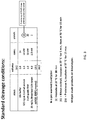
- FIG. 3 shows exemplary conditions and procedures for the biochemical cleavage assay which uses purified components in vitro.
- FIG. 4 is a table showing the data obtained using exemplary modified guide RNAs in the cleavage assay.
- FIG. 5A shows an exemplary guide RNA disclosed in the application.
- FIG. 5B shows an exemplary single guide RNA (sgRNA) disclosed in the application.
- sgRNA single guide RNA
- FIG. 6 is a table showing exemplary guide RNAs having at least two chemical modifications (e.g., a first modification and a second modification). Each number represents a modification as indicated and each “x” indicates the combination of modifications in a guide RNA.
- the first and second modifications are present on a single nucleotide. In certain embodiments, the first and second modifications are present on separate nucleotides.
- FIG. 7 shows exemplary types of guide RNAs having at least three chemical modifications.
- the lower part of FIG. 7 lists several types of modifications.
- the table in the upper part of FIG. 7 indicates how a double modification (“double mod,” a combination of two types of modifications) can be combined with a single modification (“single mod,” one type of modification).
- An “x” indicates the presence of the corresponding double mod and single mod in a guide RNA.
- FIGS. 8A and 8B show fluorophore-modified CLTA1 sgRNAs for in vitro testing.
- the RNA sequence (SEQ ID NO: 135) of a sgRNA for CLTA1 is shown, including a position where a fluorescent dye or a label could be attached to the sgRNA.
- Target DNA is SEQ ID NO: 134.
- FIG. 8B shows a structure determined by Xray crystallography of a Cas9:sgRNA complex, as reported in Nishimasu et al., Cell 2014, 156, 1-15.
- FIG. 9A shows CLTA1 sgRNAs modified with 2-thiouridine at certain locations (positions 3, 9 and 11) in an effort to improve specificity for the target CTLA1.
- Top strand and bottom strand sequences (respectively) of the CTLA1 targets are: ON1 (SEQ ID NOs: 136 and 137); OFF1 (SEQ ID NOs: 138 and 139); OFF2 (SEQ ID NOs: 140 and 141); and OFF3 (SEQ ID NOs: 142 and 143).
- FIG. 9B shows that gRNA modified with 2-thioU (SEQ ID NO: ###) can increase target specificity of the gRNAs when off-target sites involve U-G wobble pairing.
- CTLA1_2thioU+11 had much lower cleavage of the off-target sequence CLTA1 OFF3, which has a T to C mutation at the 11 position in the 5′ strand.
- Top strand and bottom strand sequences (respectively) of the CTLA1 targets are: ON1 (SEQ ID NOs: 136 and 137); OFF1 (SEQ ID NOs: 138 and 139); and OFF3 (SEQ ID NOs: 142 and 143).
- FIG. 10 shows the guide RNA scaffold secondary structure, displaying noncovalent binding interactions with amino acids of Cas9, as reported in Jiang et al., Science (2015) 348:6242, 1477-81.
- FIGS. 11A and 11B illustrate experimental results showing that gene disruption in human cell lines, with high frequencies of indels and homologous recombination (HR), can be achieved using synthesized and chemically modified sgRNAs disclosed herein, as reported in Hendel et al., Nat. Biotechnol. (2015) 33:9, 985-9.
- FIGS. 12A, 12B, 12C and 12D illustrate experimental results showing that chemically modified sgRNAs as described herein can be used to achieve high frequencies of gene disruption or targeted genome editing in stimulated primary human T cells as well as in CD34+ hematopoietic stem and progenitor cells (HSPCs), as reported in Hendel et al., Nat. Biotechnol . (2015) 33:9, 985-9.
- HSPCs hematopoietic stem and progenitor cells
- This invention is based, at least in part, on an unexpected discovery that certain chemical modifications to gRNA are tolerated by the CRISPR-Cas system.
- certain chemical modifications believed to increase the stability of the gRNA, to alter the thermostability of a gRNA hybridization interaction, and/or to decrease the off-target effects of Cas:gRNA complexation do not substantially compromise the efficacy of Cas:gRNA binding to, nicking of, and/or cleavage of the target polynucleotide.
- gRNA including sgRNA
- certain chemical modifications are believed to provide gRNA, including sgRNA, having efficient and titratable transfectability into cells, especially into the nuclei of eukaryotic cells, and/or having minimal or no immunostimulatory properties in the transfected cells.
- Certain chemical modifications are believed to provide gRNA, including sgRNA, which can be effectively delivered into and maintained in the intended cell, tissue, bodily fluid or organism for a duration sufficient to allow the desired gRNA functionality.
- guide RNA generally refers to an RNA molecule (or a group of RNA molecules collectively) that can bind to a Cas protein and aid in targeting the Cas protein to a specific location within a target polynucleotide (e.g., a DNA).
- a guide RNA can comprise a crRNA segment and a tracrRNA segment.
- crRNA or “crRNA segment” refers to an RNA molecule or portion thereof that includes a polynucleotide-targeting guide sequence, a stem sequence, and, optionally, a 5′-overhang sequence.
- tracrRNA refers to an RNA molecule or portion thereof that includes a protein-binding segment (e.g., the protein-binding segment is capable of interacting with a CRISPR-associated protein, such as a Cas9).
- guide RNA encompasses a single guide RNA (sgRNA), where the crRNA segment and the tracrRNA segment are located in the same RNA molecule.
- guide RNA also encompasses, collectively, a group of two or more RNA molecules, where the crRNA segment and the tracrRNA segment are located in separate RNA molecules.
- Scaffold refers to the portions of guide RNA molecules comprising sequences which are substantially identical or are highly conserved across natural biological species. Scaffolds include the tracrRNA segment and the portion of the crRNA segment other than the polynucleotide-targeting guide sequence at or near the 5′ end of the crRNA segment, excluding any unnatural portions comprising sequences not conserved in native crRNAs and tracrRNAs.
- nucleic acid refers to a DNA molecule, an RNA molecule, or analogs thereof.
- nucleic acid refers to DNA molecules such as cDNA, genomic DNA or synthetic DNA and RNA molecules such as a guide RNA, messenger RNA or synthetic RNA.
- nucleic acid and polynucleotide include single-stranded and double-stranded forms.
- modified nucleotide in the context of an oligonucleotide or polynucleotide includes but is not limited to (a) end modifications, e.g., 5′ end modifications or 3′ end modifications, (b) nucleobase (or “base”) modifications, including replacement or removal of bases, (c) sugar modifications, including modifications at the 2′, 3′, and/or 4′ positions, and (d) backbone modifications, including modification or replacement of the phosphodiester linkages.
- modified nucleotide generally refers to a nucleotide having a modification to the chemical structure of one or more of the base, the sugar, and the phosphodiester linkage or backbone portions, including nucleotide phosphates.
- Z and P refer to the nucleotides, nucleobases, or nucleobase analogs developed by Steven Benner and colleagues as described for example in “Artificially expanded genetic information system: a new base pair with an alternative hydrogen bonding pattern” Yang, Z., Hutter, D., Sheng, P., Sismour, A. M. and Benner, S. A. (2006) Nucleic Acids Res., 34, 6095-101, the contents of which is hereby incorporated by reference in its entirety.
- xA”, “xG”, “xC”, “xT”, or “x(A,G,C,T)” and “yA”, “yG”, “yC”, “yT”, or “y(A,G,C,T)” refer to nucleotides, nucleobases, or nucleobase analogs as described by Krueger et al in “Synthesis and Properties of Size-Expanded DNAs: Toward Designed, Functional Genetic Systems”; Andrew T. Krueger, Haige Lu, Alex H. F. Lee, and Eric T. Kool (2007) Acc. Chem. Res., 40, 141-50, the contents of which is hereby incorporated by reference in its entirety.
- Unstructured Nucleic Acid refers to nucleotides, nucleobases, or nucleobase analogs as described in U.S. Pat. No. 7,371,580, the contents of which is hereby incorporated by reference in its entirety.
- An unstructured nucleic acid, or UNA, modification is also referred to as a “pseudo-complementary” nucleotide, nucleobase or nucleobase analog (see e.g., Lahoud et al. (1991) Nucl. Acids Res., 36:10, 3409-19).
- PACE internucleotide phosphodiester linkage analogs containing phosphonoacetate or thiophosphonoacetate groups, respectively. These modifications belong to a broad class of compounds comprising phosphonocarboxylate moiety, phosphonocarboxylate ester moiety, thiophosphonocarboxylate moiety and thiophosphonocarboxylate ester moiety.
- linkages can be described respectively by the general formulae P(CR 1 R 2 ) n COOR and (S)—P(CR 1 R 2 ) n COOR wherein n is an integer from 0 to 6 and each of R 1 and R 2 is independently selected from the group consisting of H, an alkyl and substituted alkyl.
- modification refers to a chemical moiety, or portion of a chemical structure, which differs from that found in unmodified ribonucleotides, namely adenosine, guanosine, cytidine, and uridine ribonucleotides.
- modification may refer to type of modification.
- “same modification” means same type of modification
- “the modified nucleotides are the same” means the modified nucleotides have the same type(s) of modification while the base (A, G, C, U, etc.) may be different.
- a guide RNA with “two modifications” is a guide RNA with two types of modifications, which may or may not be in the same nucleotide, and each type may appear in multiple nucleotides in the guide RNA.
- a guide RNA with “three modifications” is a guide RNA with three types of modifications, which may or may not be in the same nucleotide, and each type may appear in multiple nucleotides.
- target polynucleotide refers to a polynucleotide containing a target nucleic acid sequence.
- a target polynucleotide may be single-stranded or double-stranded, and, in certain embodiments, is double-stranded DNA. In certain embodiments, the target polynucleotide is single-stranded RNA.
- a “target nucleic acid sequence” or “target sequence,” as used herein, means a specific sequence or the complement thereof that one wishes to bind to, nick, or cleave using a CRISPR system.
- hybridization or “hybridizing” refers to a process where completely or partially complementary polynucleotide strands come together under suitable hybridization conditions to form a double-stranded structure or region in which the two constituent strands are joined by hydrogen bonds.
- partial hybridization includes where the double-stranded structure or region contains one or more bulges or mismatches.
- cleavage refers to breaking of the covalent phosphodiester linkage in the ribosylphosphodiester backbone of a polynucleotide.
- cleavage or “cleaving” encompass both single-stranded breaks and double-stranded breaks. Double-stranded cleavage can occur as a result of two distinct single-stranded cleavage events. Cleavage can result in the production of either blunt ends or staggered ends.
- CRISPR-associated protein refers to a wild type Cas protein, a fragment thereof, or a mutant or variant thereof.
- the term “Cas mutant” or “Cas variant” refers to a protein or polypeptide derivative of a wild type Cas protein, e.g., a protein having one or more point mutations, insertions, deletions, truncations, a fusion protein, or a combination thereof.
- the “Cas mutant” or “Cas variant” substantially retains the nuclease activity of the Cas protein.
- the “Cas mutant” or “Cas variant” is mutated such that one or both nuclease domains are inactive.
- the “Cas mutant” or “Cas variant” has nuclease activity. In certain embodiments, the “Cas mutant” or “Cas variant” lacks some or all of the nuclease activity of its wild-type counterpart.
- nuclease domain of a Cas protein refers to the polypeptide sequence or domain within the protein which possesses the catalytic activity for DNA cleavage.
- a nuclease domain can be contained in a single polypeptide chain, or cleavage activity can result from the association of two (or more) polypeptides.
- a single nuclease domain may consist of more than one isolated stretch of amino acids within a given polypeptide. Examples of these domains include RuvC-like motifs (amino acids 7-22, 759-766 and 982-989 in SEQ ID NO: 1) and HNH motif (aa 837-863). See Gasiunas et al. (2012) Proc. Natl. Acad. Sci. USA, 109:39, E2579-E2586 and WO2013176772.
- a synthetic guide RNA that has “gRNA functionality” is one that has one or more of the functions of naturally occurring guide RNA, such as associating with a Cas protein, or a function performed by the guide RNA in association with a Cas protein.
- the functionality includes binding a target polynucleotide.
- the functionality includes targeting a Cas protein or a gRNA:Cas protein complex to a target polynucleotide.
- the functionality includes nicking a target polynucleotide.
- the functionality includes cleaving a target polynucleotide.
- the functionality includes associating with or binding to a Cas protein.
- the functionality is any other known function of a guide RNA in a CRISPR-Cas system with a Cas protein, including an artificial CRISPR-Cas system with an engineered Cas protein.
- the functionality is any other function of natural guide RNA.
- the synthetic guide RNA may have gRNA functionality to a greater or lesser extent than a naturally occurring guide RNA.
- a synthetic guide RNA may have greater functionality as to one property and lesser functionality as to another property in comparison to a similar naturally occurring guide RNA.
- a “Cas protein having a single-strand nicking activity” refers to a Cas protein, including a Cas mutant or Cas variant, that has reduced ability to cleave one of two strands of a dsDNA as compared to a wild type Cas protein.
- a Cas protein having a single-strand nicking activity has a mutation (e.g., amino acid substitution) that reduces the function of the RuvC domain (or the HNH domain) and as a result reduces the ability to cleave one strand of the target DNA.
- Such variants include the D10A, H839A/H840A, and/or N863A substitutions in S. pyogenes Cas9, and also include the same or similar substitutions at equivalent sites in Cas9 enzymes of other species.
- portion refers to any portion of the sequence (e.g., a nucleotide subsequence or an amino acid subsequence) that is smaller than the complete sequence.
- Portions of polynucleotides can be any length, for example, at least 5, 10, 15, 20, 25, 30, 40, 50, 75, 100, 150, 200, 300 or 500 or more nucleotides in length.
- a portion of a guide sequence can be about 50%, 40%, 30%, 20%, 10% of the guide sequence, e.g., one-third of the guide sequence or shorter, e.g., 7, 6, 5, 4, 3, or 2 nucleotides in length.
- derived from in the context of a molecule refers to a molecule isolated or made using a parent molecule or information from that parent molecule.
- a Cas9 single mutant nickase and a Cas9 double mutant null-nuclease are derived from a wild-type Cas9 protein.
- substantially identical in the context of two or more polynucleotides (or two or more polypeptides) refers to sequences or subsequences that have at least about 60%, at least about 70%, at least about 80%, at least about 90%, about 90-95%, at least about 95%, at least about 98%, at least about 99% or more nucleotide (or amino acid) sequence identity, when compared and aligned for maximum correspondence using a sequence comparison algorithm or by visual inspection.
- the “substantial identity” between polynucleotides exists over a region of the polynucleotide at least about 50 nucleotides in length, at least about 100 nucleotides in length, at least about 200 nucleotides in length, at least about 300 nucleotides in length, at least about 500 nucleotides in length, or over the entire length of the polynucleotide.
- the “substantial identity” between polypeptides exists over a region of the polypeptide at least about 50 amino acid residues in length, at least about 100 amino acid residues in length, or over the entire length of the polypeptide.
- FIG. 1 Shown in FIG. 1 is a diagram of CRISPR-Cas9-mediated sequence-specific cleavage of DNA.
- the guide RNA is depicted as sgRNA with an exemplary 20-nucleotide (20-nt) guide sequence (other guide sequences may be, for example, from about 15 to about 30 nts in length) within the 5′ domain, an internally positioned base-paired stem, and a 3′ domain.
- the guide sequence is complementary to an exemplary 20-nt target sequence in a DNA target.
- the stem corresponds to a repeat sequence in crRNA and is complementary to a sequence in the tracrRNA.
- the 3′ domain of the guide RNA corresponds to the 3′ domain of the tracrRNA that binds a Cas9 nuclease.
- the Cas9:guide RNA complex binds and cleaves a target DNA sequence or protospacer directly upstream of a PAM sequence recognized by Cas9.
- a 3-nt PAM sequence is exemplified; however other PAM sequences, including 4-nt and 5-nt PAM sequences are known.
- both strands of the target sequence in DNA are cleaved by Cas9 at the sites indicated by arrows.
- the present invention comprises a chemically modified guide RNA that has guide RNA functionality.
- a guide RNA that comprises any backbone or internucleotide linkage other than a natural phosphodiester internucleotide linkage possesses a chemical modification and therefore is a chemically modified guide RNA.
- the retained functionality includes binding a Cas protein.
- the retained functionality includes binding a target polynucleotide. In certain embodiments, the retained functionality includes targeting a Cas protein or a gRNA:Cas protein complex to a target polynucleotide. In certain embodiments, the retained functionality includes nicking a target polynucleotide by a gRNA:Cas protein complex. In certain embodiments, the retained functionality includes cleaving a target polynucleotide by a gRNA:Cas protein complex. In certain embodiments, the retained functionality is any other known function of a guide RNA in a CRISPR-Cas system with a Cas protein, including an artificial CRISPR-Cas system with an engineered Cas protein. In certain embodiments, the retained functionality is any other function of a natural guide RNA.
- a nucleotide sugar modification incorporated into the guide RNA is selected from the group consisting of 2′-O—C 1-4 alkyl such as 2′-O-methyl (2′-OMe), 2′-deoxy (2′-H), 2′-O—C 1-3 alkyl-O—C 1-3 alkyl such as 2′-methoxyethyl (“2′-MOE”), 2′-fluoro (“2′-F”), 2′-amino (“2′-NH 2 ”), 2′-arabinosyl (“2′-arabino”) nucleotide, 2′-F-arabinosyl (“2′-F-arabino”) nucleotide, 2′-locked nucleic acid (“LNA”) nucleotide, 2′-unlocked nucleic acid (“ULNA”) nucleotide, a sugar in L form (“L-sugar”), and 4′-thioribosyl nucleotide.
- an internucleotide linkage modification incorporated into the guide RNA is selected from the group consisting of: phosphorothioate “P(S)” (P(S)), phosphonocarboxylate (P(CH 2 ) n COOR) such as phosphonoacetate “PACE” (P(CH 2 COO ⁇ )), thiophosphonocarboxylate ((S)P(CH 2 ) n COOR) such as thiophosphonoacetate “thioPACE” ((S)P(CH 2 COO ⁇ )), alkylphosphonate (P(C 1-3 alkyl) such as methylphosphonate —P(CH 3 ), boranophosphonate (P(BH 3 )), and phosphorodithioate (P(S) 2 ).
- P(S) phosphorothioate
- P(CH 2 ) n COOR such as phosphonoacetate “PACE” (P(CH 2 COO ⁇ )
- a nucleobase (“base”) modification incorporated into the guide RNA is selected from the group consisting of: 2-thiouracil (“2-thioU”), 2-thiocytosine (“2-thioC”), 4-thiouracil (“4-thioU”), 6-thioguanine (“6-thioG”), 2-aminoadenine (“2-aminoA”), 2-aminopurine, pseudouracil, hypoxanthine, 7-deazaguanine, 7-deaza-8-azaguanine, 7-deazaadenine, 7-deaza-8-azaadenine, 5-methylcytosine (“5-methylC”), 5-methyluracil (“5-methylU”), 5-hydroxymethylcytosine, 5-hydroxymethyluracil, 5,6-dehydrouracil, 5-propynylcytosine, 5-propynyluracil, 5-ethynylcytosine, 5-ethynyluracil, 5-allyluracil (“5-allylU
- one or more isotopic modifications are introduced on the nucleotide sugar, the nucleobase, the phosphodiester linkage and/or the nucleotide phosphates.
- modifications include nucleotides comprising one or more 15 N, 13 C, 14 C, Deuterium, 3 H, 32 P, 125 I, 131 I atoms or other atoms or elements used as tracers.
- an “end” modification incorporated into the guide RNA is selected from the group consisting of: PEG (polyethyleneglycol), hydrocarbon linkers (including: heteroatom (O,S,N)-substituted hydrocarbon spacers; halo-substituted hydrocarbon spacers; keto-, carboxyl-, amido-, thionyl-, carbamoyl-, thionocarbamaoyl-containing hydrocarbon spacers), spermine linkers, dyes including fluorescent dyes (for example fluoresceins, rhodamines, cyanines) attached to linkers such as for example 6-fluorescein-hexyl, quenchers (for example dabcyl, BHQ) and other labels (for example biotin, digoxigenin, acridine, streptavidin, avidin, peptides and/or proteins).
- PEG polyethyleneglycol
- hydrocarbon linkers including: heteroatom (O,S,N)-substitute
- an “end” modification comprises a conjugation (or ligation) of the guide RNA to another molecule comprising an oligonucleotide (comprising deoxynucleotides and/or ribonucleotides), a peptide, a protein, a sugar, an oligosaccharide, a steroid, a lipid, a folic acid, a vitamin and/or other molecule.
- an oligonucleotide comprising deoxynucleotides and/or ribonucleotides
- an “end” modification incorporated into the guide RNA is located internally in the guide RNA sequence via a linker such as for example 2-(4-butylamidofluorescein)propane-1,3-diol bis(phosphodiester) linker (depicted below), which is incorporated as a phosphodiester linkage and can be incorporated anywhere between two nucleotides in the guide RNA.
- a linker such as for example 2-(4-butylamidofluorescein)propane-1,3-diol bis(phosphodiester) linker (depicted below), which is incorporated as a phosphodiester linkage and can be incorporated anywhere between two nucleotides in the guide RNA.
- linkers include for example by way of illustration, but are not limited to:
- the end modification comprises a terminal functional group such as an amine, a thiol (or sulfhydryl), a hydroxyl, a carboxyl, carbonyl, thionyl, thiocarbonyl, a carbamoyl, a thiocarbamoyl, a phoshoryl, an alkene, an alkyne, an halogen or a functional group-terminated linker, either of which can be subsequently conjugated to a desired moiety, for example a fluorescent dye or a non-fluorescent label or tag or any other molecule such as for example an oligonucleotide (comprising deoxynucleotides and/or ribonucleotides, including an aptamer), an amino acid, a peptide, a protein, a sugar, an oligosaccharide, a steroid, a lipid, a folic acid, a vitamin.
- a terminal functional group such as
- the conjugation employs standard chemistry well-known in the art, including but not limited to coupling via N-hydroxysuccinimide, isothiocyanate, DCC (or DCI), and/or any other standart method as described in “Bioconjugate Techniques” by Greg T. Hermanson, Publisher Eslsevier Science, 3 rd ed. (2013), the contents of which are incorporated herein by reference in their entireties.
- the label or dye is attached or conjugated to a modified nucleotide in the gRNA.
- a fluorescent dye or other moiety such as a non-fluorescent label or tag (for example biotin, avidin, streptavidin, or moiety containing an isotopic label such as 15 N, 13 C, 14 C, Deuterium, 3 H, 32 P, 125 I and the like) or any other molecule such as for example an oligonucleotide (comprising deoxynucleotides and/or ribonucleotides including an aptamer), an amino acid, a peptide, a protein, a sugar, an oligosaccharide, a steroid, a lipid, a folic acid, a vitamin or other molecule can be effectuated using the so-called “click” chemistry or the so-called “squarate” conjugation chemistry.
- the “click” chemistry refers to the [3+2] cyclo
- the conjugation can be effectuated by alternative cycloaddition such as Diels-Alder [4+2] cycloaddition of a ⁇ -conjugated diene moiety with an alkene moiety.
- alternative cycloaddition such as Diels-Alder [4+2] cycloaddition of a ⁇ -conjugated diene moiety with an alkene moiety.
- the “squarate” conjugation chemistry links two moieties each having an amine via a squarate derivative to result in a squarate conjugate that contains a squarate moiety (see e.g., Tietze et al. (1991) Chem. Ber., 124, 1215-21, the contents of which are hereby incorporated by reference in their entirety).
- a fluorescein containing a linker amine is conjugated to an oligoribonucleotide containing an amine through a squarate linker as described in the scheme below.
- An example of the squarate linker is depicted in the following scheme:
- a chemical modification incorporated into the guide RNA is selected from the group consisting of 2′-O—C 1-4 alkyl, 2′-H, 2′-O—C 1-3 alkyl-O—C 1-3 alkyl, 2′-F, 2′-NH 2 , 2′-arabino, 2′-F-arabin, 4′-thioribosyl, 2-thioU, 2-thioC, 4-thioU, 6-thioG, 2-aminoA, 2-aminopurine, pseudouracil, hypoxanthine, 7-deazaguanine, 7-deaza-8-azaguanine, 7-deazaadenine, 7-deaza-8-azaadenine, 5-methylC, 5-methylU, 5-hydroxymethylcytosine, 5-hydroxymethyluracil, 5,6-dehydrouracil, 5-propynylcytosine, 5-propynyluracil, 5-ethynylcytosine, 5-ethynyluracil,
- certain unnatural base pairs e.g., isoG and isoC, Z base and P base; see Zhang et al. (2015) J. Am. Chem. Soc .
- These modifications can be used to prevent misfolding of the guide RNA scaffold with other domains of a guide RNA sequence.
- FIG. 10 shows the guide RNA scaffold secondary structure, displaying interactions with amino acids of Cas9. Most of the guide RNA nitrogenous bases are not involved in binding interactions with Cas9 protein.
- the flanking sequences of the sgRNA scaffold increase the likelihood of misfolding and hence misfunction.
- the 20 nt guide targeting sequence, 5′ of the scaffold region, is user-specified for each target, thus the likelihood of misfolding is variable or target-specific.
- many emerging CRISPR-Cas applications append functional sequences 3′ of the scaffold, such as CRISPRdisplay (Schechner et al., Nat. Methods 2015) and CRISPR-i/-a (Chen et al., Cell 2013), which are riboswitches or aptamers that also need to correctly and independently fold to function properly. To ensure that each of the functional domains (i.e.
- the structurally conserved scaffold base pairs can be substituted with unnatural, orthogonal base pairs (e.g., isoG and isoC; Z base and P base), and in some embodiments, substituted exclusively with unnatural, orthogonal base pairs.
- unnatural, orthogonal base pairs e.g., isoG and isoC; Z base and P base
- substituted exclusively with unnatural, orthogonal base pairs e.g., substituted exclusively with unnatural, orthogonal base pairs.
- the sgRNA scaffold sequences will not stably interact in a secondary structure with elements of the target-pairing guide sequence or other non-native domains incorporated in the guide RNA such as any aptamer sequences or any non-native 5′ or 3′ overhangs on the guide RNA.
- the unnatural, orthogonal base pairs mentioned above could be incorporated in any non-native overhangs or aptamers that may be present, thus to prevent secondary structures involving misfolding of the scaffold sequence(s).
- the present technology provides a guide RNA having at least one modification, constituting a modified gRNA.
- the modified gRNA comprises 1, 2, 3, 4, 5, 6, 7, 8, 9, 10, 11, 12, 13, 14, 15, 16, 17, 18, 19, 20, 21, 22, 23, 24, 25, 26, 27, 28, 29, 30, 31, 32, 33, 34, 35, 36, 37, 38, 39, 40, 41, 42, 43, 44, 45, 46, 47, 48, 49 or 50 modified nucleotides.
- the modified gRNA comprises at least 55, 60, 65, 70, 75, 80, 85, 90, 95, 100, 110, 120, 130 or 140 modified nucleotides.
- all nucleotides are modified.
- all the modifications are the same.
- all the modified nucleotides have the same type of modification.
- the modified gRNA comprises a combination of differently modified nucleotides. In certain embodiments, the modified gRNA comprises two or more modified nucleotides. In certain embodiments, the modified gRNA comprises three or more modified nucleotides. In certain embodiments, the modified nucleotides are arranged contiguously. In certain embodiments, the modified gRNA comprises at least one contiguous stretch of modified nucleotides.
- the modified gRNA comprises a contiguous stretch of at least 2, 3, 4, 5, 6, 7, 8, 9, 10, 11, 12, 13, 14, 15, 16, 17, 18, 19, 20, 21, 22, 23, 24, 25, 26, 27, 28, 29, 30, 31, 32, 33, 34, 35, 36, 37, 38, 39, 40, 41, 42, 43, 44, 45, 46, 47, 48, 49 or 50 modified nucleotides.
- Each modified nucleotide may independently comprise one or more types of modifications.
- no modified nucleotides are contiguous, or some but not all are contiguous, in the sequence of the modified gRNA.
- the modification is within the 5′ portion of the guide RNA. In certain embodiments, the modification is within the first five (5) nucleotides of the 5′ portion of the guide RNA. In certain embodiments, the modification is within the first three (3) nucleotides of the 5′ portion of the guide RNA. In certain embodiments, the modification is within the 3′ portion of the guide RNA. In certain embodiments, the modification is within the last five (5) nucleotides of the 3′ portion of the guide RNA. In certain embodiments, the modification is within the last three (3) nucleotides of the 3′ portion of the guide RNA. In certain embodiments, the modification is within the internal region (i.e., between the 5′ end and the 3′ end) of the guide RNA.
- the modification is incorporated in the 5′ portion or the 3′ portion of the guide RNA, particularly within the first 5 or 10 nucleotides of the 5′ portion or within the last 5 or 10 nucleotides of the 3′ portion to, for example, protect the RNA from degradation by nucleases or for other purposes.
- the modification is in both the 5′ portion and the 3′ portion of the guide RNA, particularly within the first 5 or 10 nucleotides of the 5′ portion and within the last 5 or 10 nucleotides of the 3′ portion to, for example, protect the RNA from degradation by nucleases or for other purposes.
- more than one type of modification is present in both the 5′ portion and the 3′ portion of the guide RNA.
- a guide RNA comprises 40 or fewer, alternatively 20 or fewer, alternatively 15 or fewer, alternatively 10 or fewer, alternatively 5 or fewer, alternatively 3 or fewer deoxyribonucleotide residues in the 5′ or 3′ portion of the guide RNA.
- the modification is within the crRNA segment of the guide RNA. In certain embodiments, the modification is within the guide sequence of the crRNA. In certain embodiments, the modification is within the first five (5) nucleotides of the crRNA segment. In certain embodiments, the modification is within the first three (3) nucleotides of the crRNA segment. In certain embodiments, the modification is within a 5′-overhang on the crRNA segment. In certain embodiments, the modification is within the tracrRNA segment of the guide RNA. In certain embodiments, the modification is within the last five (5) nucleotides of the tracrRNA segment of the guide RNA. In certain embodiments, the modification is within the last three (3) nucleotides of the tracrRNA segment of the guide RNA.
- the modification when the guide RNA is a single guide RNA, the modification is located within the loop of the guide RNA. In certain embodiments, one or more modifications is within the loop L region. In certain embodiments, the modification comprises a dye, a non-fluorescent label, or a tag conjugated to a linker incorporated between two nucleotides as described above, for example by conjugation to a 2-(3-(dye/label/tag-amido)propanamido)propane-1,3-diol bis(phosphodiester) linker or to a modified base of a nucleotide in the loop or L region.
- the modification comprises an end modification, such as a 5′ end modification or a 3′ end modification.
- end modifications include, but are not limited to phosphorylation (as natural phosphate or polyphosphate or as modified phosphohate groups such as for example, alkylphosphonate, phosphonocarboxylate, phosphonoacetate, boranophosphonate, phosphorothioate, phosphorodithioate and the like), biotinylation, conjugating or conjugated molecules, linkers, dyes, labels, tags, functional groups (such as for example but not limited to 5′-amino, 5′-thio, 5′-amido, 5′carboxy and the like), inverted linkages, or hydrocarbon moieties which may comprise ether, polyethylene glycol (PEG), ester, hydroxyl, aryl, halo, phosphodiester, bicyclic, heterocyclic or other organic functional group.
- the end modification comprises dimethoxytrityl.
- the modification comprises a modified base.
- “unmodified” bases include the purine bases adenine (A) and guanine (G), and the pyrimidine bases thymine (T), cytosine (C) and uracil (U).
- modified bases include, but are not limited to, synthetic and natural bases such as 2-thioU, 2-thioC, 4-thioU, 6-thioG, 2-aminoA, 2-aminoP, pseudouracil, hypoxanthine, 7-deazaguanine, 7-deaza-8-azaguanine, 7-deazaadenine, 7-deaza-8-azaadenine, 5-methylC, 5-methylU, 5-hydroxymethylcytosine, 5-hydroxymethyluracil, 5,6-dehydrouracil, 5-propynylcytosine, 5-propynyluracil, 5-ethynylcytosine, 5-ethynyluracil, 5-allylU, 5-allylC, 5-aminoallyl-uracil, and 5-aminoallyl-cytosine.
- synthetic and natural bases such as 2-thioU, 2-thioC, 4-thioU, 6-thioG, 2-aminoA, 2-aminoP, pseudouracil, hypoxanthine,
- the modification comprises an abasic nucleotide.
- the modification comprises a nonstandard purine or pyrimidine structure, such as Z or P, isoC or isoG, UNA, 5-methylpyrymidine, x(A,G,C,T) or y(A,G,C,T).
- the modified gRNA comprises 1, 2, 3, 4, 5, 6, 7, 8, 9, 10, 11, 12, 13, 14, 15, 16, 17, 18, 19, 20, 21, 22, 23, 24, 25, 26, 27, 28, 29, 30, 31, 32, 33, 34, 35, 36, 37, 38, 39, 40, 41, 42, 43, 44, 45, 46, 47, 48, 49 or 50 modified bases.
- the modified gRNA comprises at least 55, 60, 65, 70, 75, 80, 85, 90, 95, 100, 110, 120, 130 or 140 modified bases. In certain embodiments, all bases in a gRNA are modified.
- the modification comprises a modified sugar.
- modified sugars include, but are not limited to, sugars having modifications at the 2′ position or modifications at the 4′ position.
- the sugar comprises 2′-O—C 1-4 alkyl, such as 2′-O-methyl (2′-OMe).
- the sugar comprises 2′-O—C 1-3 alkyl-O—C 1-3 alkyl, such as 2′-methoxyethoxy (2′-O—CH 2 CH 2 OCH 3 ) also known as 2′-O-(2-methoxyethyl) or 2′-MOE.
- the sugar comprises 2′-halo, such as 2′-F, 2′-Br, 2′-Cl, or 2′-I.
- the sugar comprises 2′-NH 2 .
- the sugar comprises 2′-H (e.g., a deoxynucleotide).
- the sugar comprises 2′-arabino or 2′-F-arabino.
- the sugar comprises 2′-LNA or 2′-ULNA.
- the sugar comprises a 4′-thioribosyl.
- the modified gRNA comprises 1, 2, 3, 4, 5, 6, 7, 8, 9, 10, 11, 12, 13, 14, 15, 16, 17, 18, 19, 20, 21, 22, 23, 24, 25, 26, 27, 28, 29, 30, 31, 32, 33, 34, 35, 36, 37, 38, 39, 40, 41, 42, 43, 44, 45, 46, 47, 48, 49 or 50 modified sugars.
- the modified gRNA comprises at least 55, 60, 65, 70, 75, 80, 85, 90, 95, 100, 110, 120, 130 or 140 modified sugars. In certain embodiments, all sugars in a gRNA are modified.
- the modification comprises a modified backbone (i.e., an internucleotide linkage other than a natural phosphodiester).
- modified internucleotide linkages include, but are not limited to, a phosphorothioate internucleotide linkage, a chiral phosphorothioate internucleotide linkage, a phosphorodithioate internucleotide linkage, a boranophosphonate internucleotide linkage, a C 1-4 alkyl phosphonate internucleotide linkage such as a methylphosphonate internucleotide linkage, a boranophosphonate internucleotide linkage, a phosphonocarboxylate internucleotide linkage such as a phosphonoacetate internucleotide linkage, a phosphonocarboxylate ester internucleotide linkage such as a phosphonoacetate ester internucleotide
- the modified gRNA comprises 1, 2, 3, 4, 5, 6, 7, 8, 9, 10, 11, 12, 13, 14, 15, 16, 17, 18, 19, 20, 21, 22, 23, 24, 25, 26, 27, 28, 29, 30, 31, 32, 33, 34, 35, 36, 37, 38, 39, 40, 41, 42, 43, 44, 45, 46, 47, 48, 49 or 50 modified internucleotide linkages.
- the modified gRNA comprises at least 55, 60, 65, 70, 75, 80, 85, 90, 95, 100, 110, 120, 130 or 140 modified internucleotide linkages. In certain embodiments, all internucleotide linkages in a gRNA are modified.
- the modification is a 2′-O—C 1-4 alkyl, 2′-H, 2′-O—C 1-3 alkyl-O—C 1-3 alkyl, 2′-F, 2′-NH 2 , 2′-arabino, 2′-F-arabino, 2′-LNA, 2′-ULNA, 4′-thioribosyl, 2-thioU, 2-thioC, 4-thioU, 6-thioG, 2-aminoA, 2-aminoP, pseudouracil, hypoxanthine, 7-deazaguanine, 7-deaza-8-azaguanine, 7-deazaadenine, 7-deaza-8-azaadenine, 5-MeC, 5-MeU, 5-hydroxymethylcytosine, 5-hydroxymethyluracil, 5,6-dehydrouracil, 5-propynylcytosine, 5-propynyluracil, 5-ethynylcytosine, 5-ethynyluracil,
- the modified nucleotide comprises a 2′-O-methyl-3′-phosphorothioate. In certain embodiments, the modified nucleotide comprises a 2′-O-methyl-3′-phosphonoacetate. In certain embodiments, the modified nucleotide comprises a 2′-O-methyl-3′-thiophosphonoacetate. In certain embodiments, the modified nucleotide comprises a Z base. In certain embodiments, the modified nucleotide comprises a 2′-halo-3′-phosphorothioate. In certain embodiments, the modified nucleotide comprises a 2′-halo-3′-phosphonoacetate.
- the modified nucleotide comprises a 2′-halo-3′-thiophosphonoacetate. In certain embodiments, the modified nucleotide comprises a 2′-fluoro-3′-phosphorothioate. In certain embodiments, the modified nucleotide comprises a 2′-fluoro-3′-phosphonoacetate. In certain embodiments, the modified nucleotide comprises a 2′-fluoro-3′-thiophosphonoacetate.
- the guide RNA comprises an oligonucleotide represented by Formula (I): W—Y or Y—W (I)
- W represents a nucleotide or a stretch of nucleotides of the oligonucleotide comprising at least one modification and Y represents an unmodified portion of the oligonucleotide.
- W is within the 5′ portion of the guide RNA. In certain embodiments, W is at least partially within the first five (5) nucleotides of the 5′ portion of the guide RNA. In certain embodiments, W is at least partially within the first three (3) nucleotides of the 5′ portion of the guide RNA. In certain embodiments, W is within the 3′ portion of the guide RNA. In certain embodiments, W is at least partially within the last five (5) nucleotides of the 3′ portion of the guide RNA. In certain embodiments, W is at least partially within the last three (3) nucleotides of the 3′ portion of the guide RNA. In certain embodiments, W is within the internal region (i.e., between the 5′ end and the 3′ end) of the guide RNA.
- W comprises an end modification, such as a 5′ end modification or a 3′ end modification as described above.
- the end modification comprises dimethoxytrityl.
- W comprises a modified base as described above.
- W comprises 1, 2, 3, 4, 5, 6, 7, 8, 9, 10, 11, 12, 13, 14, 15, 16, 17, 18, 19, 20, 21, 22, 23, 24, 25, 26, 27, 28, 29, 30, 31, 32, 33, 34, 35, 36, 37, 38, 39, 40, 41, 42, 43, 44, 45, 46, 47, 48, 49 or 50 modified bases.
- W comprises at least 55, 60, 65, 70, 75, 80, 85, 90, 95, 100, 110, 120, 130 or 140 modified bases.
- all bases in a gRNA are modified.
- W comprises a modified sugar as described above.
- W comprises 1, 2, 3, 4, 5, 6, 7, 8, 9, 10, 11, 12, 13, 14, 15, 16, 17, 18, 19, 20, 21, 22, 23, 24, 25, 26, 27, 28, 29, 30, 31, 32, 33, 34, 35, 36, 37, 38, 39, 40, 41, 42, 43, 44, 45, 46, 47, 48, 49 or 50 modified sugars.
- W comprises at least 55, 60, 65, 70, 75, 80, 85, 90, 95, 100, 110, 120, 130 or 140 modified sugars.
- all sugars in a gRNA are modified.
- W comprises a modified backbone (i.e., an internucleotide linkage other than a phosphodiester) as described above.
- W comprises more than one, such as 2, 3, 4, 5, 6, 7, 8, 9, 10, 11, 12, 13, 14, 15, 16, 17, 18, 19, 20, 21, 22, 23, 24, 25, 26, 27, 28, 29, 30, 31, 32, 33, 34, 35, 36, 37, 38, 39, 40, 41, 42, 43, 44, 45, 46, 47, 48, 49 or 50 modified internucleotide linkages.
- W comprises at least 55, 60, 65, 70, 75, 80, 85, 90, 95, 100, 110, 120, 130 or 140 modified internucleotide linkages.
- all internucleotide linkages in a gRNA are modified.
- W comprises a 2′-O—C 1-4 alkyl, 2′-H, 2′-O—C 1-3 alkyl-O—C 1-3 alkyl, 2′-F, 2′-NH 2 , 2′-arabino, 2′-F-arabino, 2′-LNA, 2′-ULNA, 4′-thioribosyl, 2-thioU, 2-thioC, 4-thioU, 6-thioG, 2-aminoA, 2-aminoP, pseudouracil, hypoxanthine, 7-deazaguanine, 7-deaza-8-azaguanine, 7-deazaadenine, 7-deaza-8-azaadenine, 5-MeC, 5-MeU, 5-hydroxymethylcytosine, 5-hydroxymethyluracil, 5,6-dehydrouracil, 5-propynylcytosine, 5-propynyluracil, 5-ethynylcytosine, 5-ethynyluracil, 5-
- W comprises a 2′-O-methyl and a 3′-phosphorothioate group on the same nucleotide. In certain embodiments, W comprises a 2′-O-methyl and a 3′-phosphonoacetate group on the same nucleotide. In certain embodiments, W comprises a 2′-O-methyl and 3 1 -thiophosphonoacetate group on the same nucleotide. In certain embodiments, W comprises a 2′-F and a 3′-phosphorothioate group on the same nucleotide. In certain embodiments, W comprises a 2′-F and a 3′-phosphonoacetate group on the same nucleotide. In certain embodiments, W comprises a 2′-F and 3 1 -thiophosphonoacetate group on the same nucleotide.
- W comprises 1, 2, 3, 4, 5, 6, 7, 8, 9, 10, 11, 12, 13, 14, 15, 16, 17, 18, 19 or 20 modified nucleotides.
- each of the modified nucleotides comprises the same modification.
- W comprises a combination of variously modified nucleotides.
- W comprises two or more modified nucleotides.
- W comprises three or more modified nucleotides.
- the modified nucleotides are not arranged contiguously in the sequence, or at least not entirely, as one or more unmodified nucleotides may intercede. In certain embodiments, the modified nucleotides are arranged contiguously.
- W comprises at least one contiguous stretch of modified nucleotides. In certain embodiments, W comprises a contiguous stretch of at least three (3) modified nucleotides. In certain embodiments, W comprises a contiguous stretch of at least four (4) modified nucleotides. In certain embodiments, W comprises a contiguous stretch of at least five (5) modified nucleotides.
- the guide RNA comprises an oligonucleotide represented by Formula (II): M m N n (II)
- each N independently represents an unmodified ribonucleotide
- each M represents a modified nucleotide and is independently selected from the group consisting of a 2′-O-methyl ribonucleotide, a 3′-P(S) ribonucleotide, a 3′-PACE ribonucleotide, a 3′-thioPACE ribonucleotide, a 2′-O-methyl-3′-P(S)-ribonucleotide, a 2′-O-methyl-3′-PACE ribonucleotide, a 2′-O-methyl-3′-thioPACE ribonucleotide, a Z nucleotide, and a 2′-deoxynucleotide;
- each M is at any position of the sequence of the guide RNA
- any given M is the same or different from any other M, and any given N is the same or different from any other N;
- each of m and n are independently selected from an integer between 0 and 219, provided that 50 ⁇ m+n ⁇ 220, and m is not 0.
- m+n 150.
- each M is modified with one or more moieties independently selected from the group consisting of 2′-F, 2-thiouracil, 4-thiouracil, 2-aminoadenine, hypoxanthine, 5-methylcytosine, 5-methyluracil, 5-allylaminouracil, squarate linkage, a triazolo linkage, and a 2-(4-butylamidofluorescein)propane-1,3-diol bis(phosphodiester) linkage.
- M comprises a dye attached through a linker.
- each M is independently selected from the group consisting of a 2′-O-methyl ribonucleotide, a 2′-O-methyl-3′-P(S) ribonucleotide, a 2′-O-methyl-3′-PACE ribonucleotide, and a 2′-O-methyl-3′-thioPACE ribonucleotide.
- each M is independently selected from the group consisting of a 2′-O-methyl-3′-PACE ribonucleotide and a 2′-O-methyl-3′-thioPACE ribonucleotide.
- any given M is the same or different from any other M. In certain embodiments, where m>1, each M has the same modification.
- each M is a 2′-O-methyl-3′-PACE ribonucleotide
- m is selected from an integer between 1 and 10
- each N is independently selected from the group consisting of A, U, C, and G
- n is selected from an integer between 1 and 149, provided 50 ⁇ m+n ⁇ 150.
- each M is a 2′-O-methyl-3′-PACE ribonucleotide
- m is selected from an integer between 1 and 5
- each N is independently selected from the group consisting of A, U, C, and G
- n is selected from an integer between 1 and 149, provided 50 ⁇ m+n ⁇ 150.
- each M is a 2′-O-methyl-3′-PACE ribonucleotide
- m is selected from an integer between 2 and 5
- each N is independently selected from the group consisting of A, U, C, and G
- n is selected from an integer between 1 and 148, provided 50 ⁇ m+n ⁇ 150.
- m is 1.
- m is 2.
- m is 3.
- m is 4.
- m is 5.
- each M is a 2′-O-methyl-3′-thioPACE ribonucleotide
- m is selected from an integer between 1 and 10
- each N is independently selected from the group consisting of A, U, C, and G
- n is selected from an integer between 1 and 149, provided 50 ⁇ m+n ⁇ 150.
- each M is a 2′-O-methyl-3′-thioPACE ribonucleotide
- m is selected from an integer between 1 and 5
- each N is independently selected from the group consisting of A, U, C, and G
- n is selected from an integer between 1 and 149, provided 50 ⁇ m+n ⁇ 150.
- each M is a 2′-O-methyl-3′-thioPACE ribonucleotide
- m is selected from an integer between 2 and 5
- each N is independently selected from the group consisting of A, U, C, and G
- n is selected from an integer between 1 and 148, provided 50 ⁇ m+n ⁇ 150.
- m is 1.
- m is 2.
- m is 3.
- m is 4.
- m is 5.
- each M is a 2′-O-methyl ribonucleotide
- m is selected from an integer between 1 and 40
- each N is independently selected from the group consisting of A, U, C, and G
- n is selected from an integer between 1 and 149, provided 50 ⁇ m+n ⁇ 150.
- each M is a 2′-O-methyl ribonucleotide
- m is selected from an integer between 1 and 25
- each N is independently selected from the group consisting of A, U, C, and G
- n is selected from an integer between 1 and 149, provided 50 ⁇ m+n ⁇ 150.
- each M is a 2′-O-methyl ribonucleotide
- m is selected from an integer between 1 and 20
- each N is independently selected from the group consisting of A, U, C, and G
- n is selected from an integer between 1 and 149, provided 50 ⁇ m+n ⁇ 150.
- m is 1.
- m is 2.
- m is 3.
- m is 4.
- m is 5.
- m is 10.
- m is 15.
- m is 20.
- m is 30.
- m is 40.
- each M is a 2′-deoxynucleotide
- m is selected from an integer between 1 and 30
- each N is independently selected from the group consisting of A, U, C, and G
- n is selected from an integer between 1 and 149, provided 50 ⁇ m+n ⁇ 150.
- each M is 2′-deoxynucleotide
- m is selected from an integer between 1 and 20
- each N is independently selected from the group consisting of A, U, C, and G
- n is selected from an integer between 1 and 149, provided 50 ⁇ m+n ⁇ 150.
- m is 5.
- m is 10.
- m is 15.
- m is 20.
- m is 30.
- each M is a 2′-O-methyl-3′-P(S) ribonucleotide
- m is selected from an integer between 1 and 10
- each N is independently selected from the group consisting of A, U, C, and G
- n is selected from an integer between 1 and 149, provided 50 ⁇ m+n ⁇ 150.
- each M is a 2′-O-methyl-3′-P(S) ribonucleotide
- m is selected from an integer between 1 and 5
- each N is independently selected from the group consisting of A, U, C, and G
- n is selected from an integer between 1 and 149, provided 50 ⁇ m+n ⁇ 150.
- m is 1.
- m is 2.
- m is 3.
- m is 4.
- m is 5.
- each M is a Z nucleotide, m is selected from an integer between 1 and 10, each N is independently selected from the group consisting of A, U, C, and G, and n is selected from an integer between 1 and 149, provided 50 ⁇ m+n ⁇ 150. In certain embodiments, each M is a Z nucleotide, m is selected from an integer between 1 and 5, each N is independently selected from the group consisting of A, U, C, and G, and n is selected from an integer between 1 and 149, provided 50 ⁇ m+n ⁇ 150. In certain embodiments, m is 1. In certain embodiments, m is 2. In certain embodiments, m is 3. In certain embodiments, m is 4. In certain embodiments, m is 5.
- the modification is a stability-altering modification.
- the modification increases nuclease resistance of the guide RNA relative to a guide RNA without the modification, thus it enhances the guide RNA stability.
- the stability-altering modification is a stability-enhancing modification.
- the stability-enhancing modification comprises a 2′-O-methyl or a 2′-O—C 1-4 alkyl nucleotide.
- the stability-enhancing modification comprises a 2′-halo nucleotide, such as 2′-F, 2′-Br, 2′-Cl, or 2′-I.
- the stability-enhancing modification comprises a 2′MOE or a 2′-O—C 1-3 alkyl-O—C 1-3 alkyl. In certain embodiments, the stability-enhancing modification comprises a 2′-NH 2 nucleotide. In certain embodiments, the stability-enhancing modification comprises a 2′-H (or 2′-deoxy) nucleotide. In certain embodiments, the stability-enhancing modification comprises a 2′-arabino or a 2′-F-arabino. In certain embodiments, the stability-enhancing modification comprises a 4′-thioribosyl sugar moiety. In certain embodiments, the stability-enhancing modification comprises a 3′-phosphorothioate group.
- the stability-enhancing modification comprises a 3′-phosphonoacetate group. In certain embodiments, the stability-enhancing modification comprises a nucleotide containing a 3′-thiophosphonoacetate group. In certain embodiments, the stability-enhancing modification comprises a nucleotide containing a 3′-methylphosphonate group. In certain embodiments, the stability-enhancing modification comprises a nucleotide containing a 3′-boranophosphate group. In certain embodiments, the stability-enhancing modification comprises a nucleotide containing a 3′-phosphorodithioate group. In certain embodiments, the stability-enhancing modification comprises a locked nucleic acid (“LNA”) nucleotide. In certain embodiments, the stability-enhancing modification comprises an unlocked nucleic acid (“ULNA”) nucleotide.
- LNA locked nucleic acid
- ULNA unlocked nucleic acid
- the stability-enhancing modification comprises a 2′-O-methyl and a 3′-phosphorothioate group on the same nucleotide. In certain embodiments, the stability-enhancing modification comprises a 2′-O-methyl and a 3′-phosphonoacetate group on the same nucleotide. In certain embodiments, the stability-enhancing modification comprises a 2′-O-methyl and a 3′-thiophosphonoacetate group on the same nucleotide. In certain embodiments, the stability-enhancing modification comprises a 2′-fluoro and a 3′-phosphorothioate group on the same nucleotide.
- the stability-enhancing modification comprises a 2′-fluoro and a 3′-phosphonoacetate group on the same nucleotide. In certain embodiments, the stability-enhancing modification comprises a 2′-fluoro and a 3′-thiophosphonoacetate group on the same nucleotide.
- the modification is a specificity-altering modification.
- specificity enhancement may be achieved by enhancing on-target binding and/or cleavage, or reducing off-target binding and/or cleavage, or a combination of both.
- specificity reduction may be achieved, for example, by reducing on-target binding and/or cleavage, or increasing off-target binding and/or cleavage, or a combination of both.
- the specificity-altering modification comprises a 2′-O-methyl. In certain embodiments, the specificity-altering modification comprises a 2′-halo, such as 2′-fluoro.
- the specificity-altering modification comprises a 2-thiouracil base (2-thioU). In certain embodiments, the specificity-altering modification comprises 2-thioC. In certain embodiments, the specificity-altering modification comprises 4-thioU. In certain embodiments, the specificity-altering modification comprises 6-thioG. In certain embodiments, the specificity-altering modification comprises 2-aminoA. In certain embodiments, the specificity-altering modification comprises a 2-aminopurine. In certain embodiments, the specificity-altering modification comprises pseudouracil. In certain embodiments, the specificity-altering modification comprises hypoxanthine. In certain embodiments, the specificity-altering modification comprises 7-deazaguanine.
- the specificity-altering modification comprises 7-deaza-8-azaguanine. In certain embodiments, the specificity-altering modification comprises 7-deazaadenine. In certain embodiments, the specificity-altering modification comprises 7-deaza-8-azaadenine. In certain embodiments, the specificity-altering modification comprises 5-methylC. In certain embodiments, the specificity-altering modification comprises 5-methylU. In certain embodiments, the specificity-altering modification comprises 5-hydroxymethylcytosine. In certain embodiments, the specificity-altering modification comprises 5-hydroxymethyluracil. In certain embodiments, the specificity-altering modification comprises 5,6-dehydrouracil. In certain embodiments, the specificity-altering modification comprises 5-propynylcytosine.
- the specificity-altering modification comprises 5-propynyluracil. In certain embodiments, the specificity-altering modification comprises 5-ethynylcytosine. In certain embodiments, the specificity-altering modification comprises 5-ethynyluracil. In certain embodiments, the specificity-altering modification comprises 5-allylU. In certain embodiments, the specificity-altering modification comprises 5-allylC. In certain embodiments, the specificity-altering modification comprises 5-aminoallylU. In certain embodiments, the specificity-altering modification comprises 5-aminoallylC. In certain embodiments, the specificity-altering modification comprises an abasic nucleotide. In certain embodiments, the specificity-altering modification comprises a Z base.
- the specificity-altering modification comprises P base. In certain embodiments, the specificity-altering modification comprises a UNA base. In certain embodiments, the specificity-altering modification comprises isoC. In certain embodiments, the specificity-altering modification comprises isoG. In certain embodiments, the specificity-altering modification comprises 5-methyl-pyrimidine. In certain embodiments, the specificity-altering modification comprises x(A,G,C,T). In certain embodiments, the specificity-altering modification comprises y(A,G,C,T).
- the specificity-altering modification comprises a phosphorothioate internucleotide linkage. In certain embodiments, the specificity-altering modification comprises a phosphonoacetate internucleotide linkage. In certain embodiments, the specificity-altering modification comprises a thiophosphonoacetate internucleotide linkage. In certain embodiments, the specificity-altering modification comprises a methylphosphonate internucleotide linkage. In certain embodiments, the specificity-altering modification comprises a boranophosphate internucleotide linkage. In certain embodiments, the specificity-altering modification comprises a phosphorodithioate internucleotide linkage. In certain embodiments, the specificity-altering modification comprises a ULNA. In certain embodiments, the specificity-altering modification comprises an LNA.
- the modification alters RNA base pairing by, for example, altering the melting temperature (Tm) of the guide RNA relative to a guide RNA without the modification. In certain embodiments, the modification lowers the Tm of the guide RNA relative to a guide RNA without the modification. In certain embodiments, the modification raises the Tm of the guide RNA relative to a guide RNA without the modification.
- Tm melting temperature
- the specificity-altering modification lowers the Tm of a base pairing interaction.
- the modification that lowers the Tm of the base pairing interaction is a 2′-deoxy, as it is well-known in the art that DNA/DNA base pairs have lower Tm than their respective counterpart in RNA/DNA duplexes.
- the modification that lowers the Tm of the base pairing interaction is 2-thiouracil, which slightly lowers Tm of G-U wobble pair.
- the modification that lowers the Tm of the base pairing interaction is a phosphorothioate internucleotide linkage or a phosphorodithioate internucleotide linkage, which lower the Tm by ⁇ 0.5° C.
- the modification that lowers the Tm of the base pairing interaction is a boranophosphonate internucleotide linkage, which lowers the Tm by ⁇ 0.5-0.8° C. per modification. In certain embodiments, the modification that lowers the Tm of the base pairing interaction is a phosphonoacetate internucleotide linkage, which lowers the Tm by ⁇ 1.3° C. per modification. In certain embodiments, the modification that lowers the Tm of the base pairing interaction is unlocked nucleic acid (“ULNA”), which lowers the Tm by ⁇ 5-8° C. per modification. In certain embodiments, the modification that lowers the Tm of the base pairing interaction is 2′-O-methyl-3′-methylphosphonate.
- ULNA unlocked nucleic acid
- the specificity-altering modification raises the Tm of a base pairing interaction.
- the modification that raises the Tm of the base pairing interaction is a 2′-O-methyl, which raises Tm by ⁇ 0.5-0.7° C. per modification.
- the modification that raises the Tm of the base pairing interaction is a 2′-F, which raises Tm by ⁇ 1° C. per modification.
- the modification that raises the Tm of the base pairing interaction is a 2-thiouracil, which raises Tm of A-U pair (and, as noted above, slightly lowers Tm of G-U wobble pair).
- the modification that raises the Tm of the base pairing interaction is a 4-thiouracil, which raises Tm of G-U wobble pair and slightly raises Tm of A-U pair.
- the modification that raises the Tm of the base pairing interaction is a 2-amino-adenine, which raises Tm of its base pairing with U by ⁇ 1° C. per modification.
- the modification that raises the Tm of the base pairing interaction is a 5-methyl-uracil (5-methylU) (see, e.g., Wang & Kool (1995) Biochemistry, 34, 4125-32).
- the modification that raises the Tm of the base pairing interaction is a 5-methyl-cytosine (5-methylC).
- the modification that raises the Tm of the base pairing interaction is a locked nucleic acid (“LNA”), which raises Tm by 2-10° C. per modification.
- LNA locked nucleic acid
- the modification alters transfection efficiency of the guide RNA relative to a guide RNA without the modification. In certain embodiments, the modification increases transfection efficiency of the guide RNA relative to a guide RNA without the modification. In certain embodiments, the modification decreases transfection efficiency of the guide RNA relative to a guide RNA without the modification. In certain embodiments, the modification neutralizes the anionic charge on phosphate to allow passive diffusion into cells. In certain embodiments, the charge-neutralizing modification comprises a phosphonoacetate alkyl ester internucleotide linkage, such as a phosphonoacetate methyl ester internucleotide linkage.
- the modification alters the immunostimulatory effect of the guide RNA relative to a guide RNA without the modification. It was initially discovered that unmethylated bacterial DNA and synthetic analogs thereof are ligands for TLR9 (see Hemmi et al. (2000) Nature, 408, 740-5). The stimulation of TLR9 can be mitigated in the dinucleotide motif for example by modifying the C and G residues.
- 5-methylcytosine, 2-aminocytosine, 2-thiocytosine, 5-methylisocytosine, P nucleobase (6-( ⁇ -D-2′-Deoxyribofuranosyl)-3,4-dihydro-8H-pyrimido[4,5-c][1,2]oxazin-7-one), and 2′-O-methylcytosine all result in loss or decrease in TLR9 stimulation.
- use of 6-thioguanine, 2,6-diaminopurine, 2-aminopurine, xanthosine, inosine, 7-deazaxanthosine, isoguanine, 8-oxoguanine, nebularine, 8-bromoguanine, K-nucleobase (2-amino-N-methoxyadenosine), and/or 2′-O-methylguanine can result in loss or decrease in TLR9 stimulation.
- use of phosphodiester modifications can lower or eliminate the TLR9 response.
- synthetically incorporated phosphorothioates can decrease the TLR9 response to a limited extent, as is thought to result from the presence of two stereoisomers of each phosphorothioate in synthetic RNA.
- synthetically incorporated phosphorothioates can decrease the TLR9 response to a limited extent, as is thought to result from the presence of two stereoisomers of each phosphorothioate in synthetic RNA.
- phosphorothioate-modified DNA lacking CpG motifs stimulate TLR9 to a rather small extent.
- the negative charge on the phosphorus is an important element for recognition by TLR9 and therefore removing the negative charge using alkylphosphonates can result in loss or decrease in TLR9 stimulation.
- phosphonoacetate (PACE) internucleotide linkages between deoxynucleosides in 5′ and 3′ terminal sequences can significantly increase the TLR9 response; however, the use of thiophosphonoacetate (thioPACE) internucleotide linkages between deoxynucleosides in 5′ and 3′ terminal sequences can result in loss or decrease in TLR9 stimulation.
- use of sugar modifications that the favor C3′-endo conformation such as 2′-O-methyl modifications can be incorporated at 5′ and 3′ termini to decrease the TLR9 response.
- TLR 7 and TLR8 can be stimulated by molecules containing 7-deazaguanine and by single-stranded RNA (see, e.g., Heil et al. (2004) Science, 303, 1526-9).
- TLR3 has been implicated in cellular immunoresponses to virus-derived double-stranded RNA.
- these TLR responses can be mitigated for example by using 2′-O-methyl modifications, modified phosphodiester linkages containing sulfur, or modifications that decrease internucleotide negative charge such as methylphosphonate and/or phosphonoacetate internucleotide linkages.
- the modification enhances stability and specificity of the guide RNA relative to a guide RNA without the modification. In certain embodiments, the modification enhances stability and transfection efficiency of the guide RNA relative to a guide RNA without the modification. In certain embodiments, the modification enhances specificity and transfection efficiency of the guide RNA relative to a guide RNA without the modification. In certain embodiments, the modification enhances the overall efficacy of the guide RNA relative to a guide RNA without the modification.
- the present technology provides a guide RNA having a combination of two or more modifications.
- the two modifications are on the same nucleotide (for example, one nucleotide comprises a 2′-O-methyl and a 3′-thiophosphonoacetate moiety). In other embodiments, the two modifications are on two different nucleotides (for example, one nucleotide has a 2-thioU base and another nucleotide has a 2′-O-methyl group).
- each modification in the guide RNA is the same. In certain embodiments, at least one modification in the guide RNA is different from at least one other modification in the guide RNA. In certain embodiments, a single nucleotide within the guide RNA possesses two or more modifications.
- the guide RNA comprises a combination of different types of modifications, and at least one type in the combination exists in multiple places in the guide RNA In certain embodiments, at least one type in the combination appears 1, 2, 3, 4, 5, 6, 7, 8, 9, 10, 11, 12, 13, 14, 15, 16, 17, 18, 19 or 20 times in the guide RNA.
- At least one type of the modifications in the combination appears in two or more modified nucleotides. In certain embodiments, at least one type of the modifications in the combination appears in three or more modified nucleotides. In certain embodiments, the modified nucleotides are not arranged contiguously in the sequence, or at least not entirely, as one or more unmodified nucleotides may intercede. In certain embodiments, the modified nucleotides are arranged contiguously. In certain embodiments, the guide RNA comprises a stretch of contiguous modified nucleotides of the same type.
- the stretch has at least 2, 3, 4, 5, 6, 7, 8, 9, 10, 11, 12, 13, 14, 15, 16, 17, 18, 19, 20, 21, 22, 23, 24, 25, 26, 27, 28, 29, 30, 31, 32, 33, 34, 35, 36, 37, 38, 39, or 40 modified nucleotides.
- At least one type of the modifications in the combination is within the 5′ portion of the guide RNA. In certain embodiments, at least one type of the modifications in the combination is within the first five (5) nucleotides of the 5′ portion of the guide RNA. In certain embodiments, at least one type of the modifications in the combination is within the first three (3) nucleotides of the 5′ portion of the guide RNA. In certain embodiments, at least one type of the modifications in the combination is within the 3′ portion of the guide RNA. In certain embodiments, at least one type of the modifications in the combination is within the last five (5) nucleotides of the 3′ portion of the guide RNA.
- At least one type of the modifications in the combination is within the last three (3) nucleotides of the 3′ portion of the guide RNA. In certain embodiments, at least one type of the modifications in the combination is within the internal region (i.e., between the 5′ end and the 3′ end) of the guide RNA.
- At least one type of the modifications in the combination is incorporated in the 5′ portion or 3′ portion of the guide RNA, particularly within the first 5 or 10 nucleotides of the 5′ portion or within the last 5 or 10 nucleotides of the 3′ portion to, for example, protect the RNA from degradation by nucleases or for other purposes.
- at least one type of the modifications in the combination is in the 5′ portion and at least one type of the modifications in the combination is in the 3′ portion of the guide RNA, particularly within the first 5 or 10 nucleotides of the 5′ portion and within the last 5 or 10 nucleotides of the 3′ portion to, for example, protect the RNA from degradation by nucleases or for other purposes.
- a guide RNA comprises 20 or fewer, alternatively 15 or fewer, alternatively 15 or fewer, alternatively 10 or fewer, alternatively 5 or fewer, alternatively 3 or fewer deoxyribonucleotide residues in the 5′ portion of the guide RNA.
- At least one type of the modifications in the combination is within the crRNA segment of the guide RNA. In certain embodiments, at least one type of the modifications in the combination is within the guide sequence of the crRNA. In certain embodiments, at least one type of the modifications in the combination is within the first five (5) nucleotides of the crRNA segment. In certain embodiments, at least one type of the modifications in the combination is within the first three (3) nucleotides of the crRNA segment. In certain embodiments, at least one type of the modifications in the combination is within the tracrRNA segment of the guide RNA. In certain embodiments, at least one type of the modifications in the combination is within the last five (5) nucleotides of the tracrRNA segment of the guide RNA. In certain embodiments, at least one type of the modifications in the combination is within the last three (3) nucleotides of the tracrRNA segment of the guide RNA.
- a first type of modification in the combination is within the 5′ portion of the guide RNA and a second type of modification in the combination is within the internal region (i.e., between the 5′ end and the 3′ end) of the guide RNA.
- the first type of modification is within the first five (5) nucleotides of the 5′ portion of the guide RNA.
- the first type of modification is within the first three (3) nucleotides of the 5′ portion of the guide RNA.
- a first type of modification in the combination is within the internal region (i.e., between the 5′ end and the 3′ end) of the guide RNA and a second type of modification in the combination is within the 3′ portion of the guide RNA.
- the second type of modification is within the last five (5) nucleotides of the 3′ portion of the guide RNA.
- the second type of modification is within the last three (3) nucleotides of the 3′ portion of the guide RNA.
- a first type of modification in the combination is within the 5′ portion of the guide RNA and a second type of modification in the combination is within the 3′ portion of the guide RNA.
- the first type of modification is within the first five (5) nucleotides of the 5′ portion of the guide RNA.
- the first type of modification is within the first three (3) nucleotides of the 5′ portion of the guide RNA.
- the second type of modification is within the last five (5) nucleotides of the 3′ portion of the guide RNA.
- the second type of modification is within the last three (3) nucleotides of the 3′ portion of the guide RNA.
- a first type of modification in the combination is within the 5′ portion of the guide RNA
- a second type of modification in the combination is within the internal region (i.e., between the 5′ end and the 3′ end) of the guide RNA
- a third type of modification in the combination is within the 3′ portion of the guide RNA.
- the first type of modification is within the first five (5) nucleotides of the 5′ portion of the guide RNA.
- the first type of modification is within the first three (3) nucleotides of the 5′ portion of the guide RNA.
- the third type of modification is within the last five (5) nucleotides of the 3′ portion of the guide RNA.
- the third type of modification is within the last three (3) nucleotides of the 3′ portion of the guide RNA.
- a first type of modification in the combination is within the crRNA segment of the guide RNA and a second type of modification in the combination is within the tracr segment.
- the first type of modification is within the guide sequence of the crRNA.
- the first type of modification is within the first five (5) nucleotides of the crRNA segment.
- the first type of modification is within the first three (3) nucleotides of the crRNA segment.
- the second type of modification is within the last five (5) nucleotides of the tracrRNA segment of the guide RNA.
- the second type of modification is within the last three (3) nucleotides of the tracrRNA segment of the guide RNA.
- a first type and a second type of modification in the combination are within the crRNA segment of the guide RNA.
- the first type of modification is within the guide sequence of the crRNA.
- the first type of modification is within the first five (5) nucleotides of the crRNA segment.
- the first type of modification is within the first three (3) nucleotides of the crRNA segment.
- a first type and a second type of modification in the combination are within the crRNA segment of the guide RNA and a third type of modification in the combination is within the tracr segment.
- the first type of modification is within the guide sequence of the crRNA.
- the first type of modification is within the first five (5) nucleotides of the crRNA segment.
- the first type of modification is within the first three (3) nucleotides of the crRNA segment.
- the third type of modification is within the last five (5) nucleotides of the tracrRNA segment of the guide RNA.
- the third type of modification is within the last three (3) nucleotides of the tracrRNA segment of the guide RNA.
- At least one of the modifications in the combination comprises an end modification, such as a 5′ end modification or a 3′ end modification as described above.
- the end modification comprises dimethoxytrityl.
- the modified gRNA comprises 1, 2, 3, 4, 5, 6, 7, 8, 9, 10, 11, 12, 13, 14, 15, 16, 17, 18, 19, 20, 21, 22, 23, 24, 25, 26, 27, 28, 29, 30, 31, 32, 33, 34, 35, 36, 37, 38, 39, or 40 modified bases.
- the modified gRNA comprises at least 55, 60, 65, 70, 75, 80, 85, 90, 95, 100, 110, 120, 130 or 140 modified bases. In certain embodiments, all bases in a gRNA are modified.
- the modified gRNA comprises 1, 2, 3, 4, 5, 6, 7, 8, 9, 10, 11, 12, 13, 14, 15, 16, 17, 18, 19, 20, 21, 22, 23, 24, 25, 26, 27, 28, 29, 30, 31, 32, 33, 34, 35, 36, 37, 38, 39, or 40 modified sugars.
- the modified gRNA comprises at least 55, 60, 65, 70, 75, 80, 85, 90, 95, 100, 110, 120, 130 or 140 modified sugars. In certain embodiments, all sugars in a gRNA are modified.
- the modified gRNA comprises 1, 2, 3, 4, 5, 6, 7, 8, 9, 10, 11, 12, 13, 14, 15, 16, 17, 18, 19, 20, 21, 22, 23, 24, 25, 26, 27, 28, 29, 30, 31, 32, 33, 34, 35, 36, 37, 38, 39, or 40 modified internucleotide linkages.
- the modified gRNA comprises at least 55, 60, 65, 70, 75, 80, 85, 90, 95, 100, 110, 120, 130 or 140 modified internucleotide linkages.
- all internucleotide linkages in a gRNA are modified.
- At least one of the modifications in the combination comprises a 2′-O-methyl, a 2′-fluoro, a 2′-amino, a 2′-deoxy, a 2′-arabino, a 2′-F-arabino, a 2-thiouracil, a 2-aminoadenine, a 5-methylcytosine, a 5-aminoallyluracil, a Z base, a 3′-phosphorothioate, a 3′-phosphonoacetate, a 3′-phosphonoacetate ester, a 3′-thiophosphonoacetate, a 3′-thiophosphonoacetate ester, a 3′-methylphosphonate, a 3′-boranophosphonate, a 3′-phosphorodithioate, or combinations thereof.
- At least one of the modifications in the combination comprises a 2′-O-methyl, a 2′-deoxy, a Z base, a phosphorothioate internucleotide linkage, a phosphonoacetate internucleotide linkage, a thiophosphonoacetate internucleotide linkage, or combinations thereof.
- at least one of the modifications in the combination comprises a 2′-F, a 2-thioU, a 4-thioU, a 2-aminoA, a 5-methylC, a 5-methylU, a 5-aminoallylU, or combinations thereof.
- At least one of the modifications in the combination is an “end” modification such as terminal phosphate, a PEG, a terminal amine, a terminal linker such as a hydrocarbon linker, a substituted hydrocarbon linker, a squarate linker, a triazolo linker, an internal linker such as 2-(4-butylamidofluorescein)propane-1,3-diol bis(phosphodiester) linker, a linker conjugated to a dye, a linker conjugated to a non-fluorescent label, a linker conjugated to a tag or a linker conjugated to a solid support such as for example a bead or microarray.
- end modification such as terminal phosphate, a PEG, a terminal amine, a terminal linker such as a hydrocarbon linker, a substituted hydrocarbon linker, a squarate linker, a triazolo linker, an internal linker such as 2-(4-butylamid
- At least two of the modifications in the combination comprise a 2′-O-methyl nucleotide and phosphorothioate internucleotide linkage, a 2′-O-methyl nucleotide and phosphonoacetate internucleotide linkage, or a 2′-O-methyl nucleotide and thiophosphonoacetate internucleotide linkage.
- At least two of the modifications in the combination comprise a 2′-O-methyl nucleotide and phosphonocarboxylate internucleotide linkage, a 2′-O-methyl nucleotide and phosphonocarboxylate ester internucleotide linkage, a 2′-O-methyl nucleotide and thiophosphonocarboxylate internucleotide linkage, a 2′-O-methyl nucleotide and thiophosphonocarboxylate ester internucleotide linkage, or combinations thereof.
- the modifications in the combination further comprise a 2-thiouracil, 2-thiocytosine, 4-thiouracil, 6-thioguanine, 2-aminoadenine, 2-aminopurine, pseudouracil, inosine, 7-deazaguanine, 7-deaza-8-azaguanine, 7-deazaadenine, 7-deaza-8-azaadenine, 5-methylcytosine, 5-methyluracil, 5-hydroxymethylcytosine, 5-hydroxymethyluracil, 5,6-dehydrouracil, 5-propynylcytosine, 5-propynyluracil, 5-ethynylcytosine, 5-ethynyluracil, 5-allyluracil, 5-allylcytosine, 5-aminoallyl-uracil, 5-aminoallyl-cytosine, or an abasic nucleotide.
- At least one of the modifications in the combination comprises a 2′-O-methyl-3′-phosphorothioate. In certain embodiments, at least one of the modifications in the combination comprises a 2′-O-methyl-3′-phosphonoacetate. In certain embodiments, at least one of the modifications in the combination comprises a 2′-O-methyl-3′-thiophosphonoacetate. In certain embodiments, at least one of the modifications in the combination comprises a 2′-halo-3′-phosphorothioate. In certain embodiments, at least one of the modifications in the combination comprises a 2′-halo-3′-phosphonoacetate.
- At least one of the modifications in the combination comprises a 2′-halo-3′-thiophosphonoacetate. In certain embodiments, at least one of the modifications in the combination comprises a 2′-fluoro-3′-phosphorothioate. In certain embodiments, at least one of the modifications in the combination comprises a 2′-fluoro-3′-phosphonoacetate. In certain embodiments, at least one of the modifications in the combination comprises a 2′-fluoro-3′-thiophosphonoacetate. Possible combinations of at least two or three modifications are represented in FIG. 6 and FIG. 7 respectively and are incorporated herein by reference.
- the guide RNA comprises an oligonucleotide represented by Formula (III) or Formula (IV): W—Y-Q (III); or Y—W—X-Q (IV)
- Q and W each independently represent a nucleotide or a stretch of nucleotides of the oligonucleotide comprising at least one modification and Y and X each independently represent an unmodified portion of the oligonucleotide.
- W is within the 5′ portion of the guide RNA. In certain embodiments, W is at least partially within the first five (5) nucleotides of the 5′ portion of the guide RNA. In certain embodiments, W is at least partially within the first three (3) nucleotides of the 5′ portion of the guide RNA. In certain embodiments, W is within the internal region (i.e., between the 5′ end and the 3′ end) of the guide RNA.
- Q is within the 3′ portion of the guide RNA. In certain embodiments, Q is at least partially within the last five (5) nucleotides of the 3′ portion of the guide RNA. In certain embodiments, Q is at least partially within the last three (3) nucleotides of the 3′ portion of the guide RNA. In certain embodiments, Q is within the internal region (i.e., between the 5′ end and the 3′ end) of the guide RNA.
- W comprises an end modification as described above, such as a 5′ end or a 3′ end modification.
- the end modification comprises dimethoxytrityl.
- At least one of W or Q comprises a modified base as described above.
- at least one of W or Q comprises 1, 2, 3, 4, 5, 6, 7, 8, 9, 10, 11, 12, 13, 14, 15, 16, 17, 18, 19, 20, 21, 22, 23, 24, 25, 26, 27, 28, 29, 30, 31, 32, 33, 34, 35, 36, 37, 38, 39, 40, 41, 42, 43, 44, 45, 46, 47, 48, 49, or 50 modified bases.
- at least one of W or Q comprises more than one modified base, such as 2, 3, 4, 5, 6, 7, 8, 9, 10, 11, 12, 13, 14, 15, 16, 17, 18, 19 or 20 modified bases.
- At least one of W or Q comprises a modified sugar as described above.
- at least one of W or Q comprises 1, 2, 3, 4, 5, 6, 7, 8, 9, 10, 11, 12, 13, 14, 15, 16, 17, 18, 19, 20, 21, 22, 23, 24, 25, 26, 27, 28, 29, 30, 31, 32, 33, 34, 35, 36, 37, 38, 39, 40, 41, 42, 43, 44, 45, 46, 47, 48, 49, or 50 modified sugars.
- at least one of W or Q comprises more than one, such as 2, 3, 4, 5, 6, 7, 8, 9, 10, 11, 12, 13, 14, 15, 16, 17, 18, 19 or 20 modified sugars.
- At least one of W or Q comprises a modified backbone (i.e., an internucleotide linkage other than a phosphodiester) as described above.
- at least one of W or Q comprises 1, 2, 3, 4, 5, 6, 7, 8, 9, 10, 11, 12, 13, 14, 15, 16, 17, 18, 19, 20, 21, 22, 23, 24, 25, 26, 27, 28, 29, 30, 31, 32, 33, 34, 35, 36, 37, 38, 39, 40, 41, 42, 43, 44, 45, 46, 47, 48, 49, or 50 modified internucleotide linkages.
- at least one of W or Q comprises more than one, such as 2, 3, 4, 5, 6, 7, 8, 9, 10, 11, 12, 13, 14, 15, 16, 17, 18, 19 or 20 modified internucleotide linkages.
- At least one of W or Q comprises a 2′-O-methyl nucleotide, a 2′-F nucleotide, a 2′-amino nucleotide, a 2′-deoxy nucleotide, a 2-thiouridine nucleotide, a 2-aminoadeosine nucleotide, a 6-thioguanosine nucleotide, a 5-methylcytidine nucleotide, a 5-aminoallyluridine nucleotide, a Z nucleotide, a 3′-phosphorothioate internucleotide linkage, a 3′-phosphorothioate internucleotide linkage, a 3′-phosphonoacetate internucleotide linkage, a 3′-phosphonoacetate ester internucleotide linkage, a 3′-thiophosphonoacetate internucleotide linkage, a 3′-O-methyl nu
- At least one of W or Q comprises a 2′-O-methyl and a 3′-phosphorothioate group on the same nucleotide. In certain embodiments, at least one of W or Q comprises a 2′-O-methyl and a 3′-phosphonoacetate group linkage on the same nucleotide. In certain embodiments, at least one of W or Q comprises a 2′-O-methyl and 3′-thiophosphonoacetate group on the same nucleotide. In certain embodiments, at least one of W or Q comprises a 2′-F and a 3′-phosphorothioate group on the same nucleotide.
- At least one of W or Q comprises a 2′-F and a 3′-phosphonoacetate group linkage on the same nucleotide. In certain embodiments, at least one of W or Q comprises a 2′-F and 3′-thiophosphonoacetate group on the same nucleotide.
- At least one of W or Q comprises 1, 2, 3, 4, 5, 6, 7, 8, 9, 10, 11, 12, 13, 14, 15, 16, 17, 18, 19 or 20 modified nucleotides.
- each of the modified nucleotides within at least one of W or Q comprises the same modification or modifications.
- W comprises a modified nucleotide that is different than a modified nucleotide in Q.
- at least one of W or Q comprises two or more modified nucleotides.
- at least one of W or Q comprises three or more modified nucleotides.
- the modified nucleotides are not arranged contiguously in the sequence, or at least not entirely, as one or more unmodified nucleotides may intercede. In certain embodiments, the modified nucleotides are arranged contiguously. In certain embodiments, at least one of W or Q comprises at least one contiguous stretch of modified nucleotides. In certain embodiments, at least one of W or Q comprises a contiguous stretch of at least three (3) modified nucleotides. In certain embodiments, at least one of W or Q comprises a contiguous stretch of at least four (4) modified nucleotides. In certain embodiments, at least one of W or Q comprises a contiguous stretch of at least five (5) modified nucleotides.
- the guide RNA comprises a nucleotide sequence of Formula (V) or Formula (VI): M m N n M′ m′ N′ n′ (Formula V); or M m N n M′ m′ N′ n′ M′′ m′′ (Formula VI)
- each M independently represents a modified ribonucleotide
- each N independently represents an unmodified ribonucleotide
- each M′ independently represents a modified ribonucleotide
- each N′ independently represents an unmodified ribonucleotide
- each M′′ independently represents a modified ribonucleotide
- n is an integer between 0 and 130
- m′ is an integer between 0 and 10
- n′ is an integer between 0 and 130
- m′′ is an integer between 0 and 10 provided that m+m′+m′′ is greater than or equal to 1 and 50 ⁇ m+n+m′+n′+m′′ ⁇ 150.
- each M is independently selected from the group consisting of a 2′-O-methyl ribonucleotide, a 2′-O-methyl-3′-P(S) ribonucleotide, a 2′-O-methyl-3′-PACE ribonucleotide, a 2′-O-methyl-3′-thioPACE ribonucleotide, and a 2′-deoxynucleotide.
- each M is independently selected from the group consisting of a 2′-O-methyl ribonucleotide, a 2′-O-methyl-3′-P(S) ribonucleotide, a 2′-O-methyl-3′-PACE ribonucleotide, and a 2′-O-methyl-3′-thioPACE ribonucleotide.
- each M is independently selected from the group consisting of a 2′-O-methyl-3′-PACE ribonucleotide and a 2′-O-methyl-3′-thioPACE ribonucleotide.
- any given M is the same or different from any other M.
- each M comprises the same modification or modifications.
- each M′ is independently selected from the group consisting of a 2′-O-methyl ribonucleotide, a 2′-O-methyl-3′-P(S) ribonucleotide, a 2′-O-methyl-3′-PACE ribonucleotide, a 2′-O-methyl-3′-thioPACE ribonucleotide, and a 2′-deoxynucleotide.
- each M′ is independently selected from the group consisting of a 2′-O-methyl ribonucleotide, a 2′-O-methyl-3′-P(S) ribonucleotide, a 2′-O-methyl-3′-PACE ribonucleotide, and a 2′-O-methyl-3′-thioPACE ribonucleotide.
- each M′ is independently selected from the group consisting of a 2′-O-methyl-3′-PACE ribonucleotide and a 2′-O-methyl-3′-thioPACE ribonucleotide.
- any given M′ is the same or different from any other M′.
- each M′ comprises the same modification or modifications.
- each M′′ is independently selected from the group consisting of a 2′-O-methyl ribonucleotide, a 2′-O-methyl-3′-P(S) ribonucleotide, a 2′-O-methyl-3′-PACE ribonucleotide, a 2′-O-methyl-3′-thioPACE ribonucleotide, and a 2′-deoxynucleotide.
- each M′′ is independently selected from the group consisting of a 2′-O-methyl ribonucleotide, a 2′-O-methyl-3′-P(S) ribonucleotide, a 2′-O-methyl-3′-PACE ribonucleotide, and a 2′-O-methyl-3′-thioPACE ribonucleotide.
- each M′′ is independently selected from the group consisting of a 2′-O-methyl-3′-PACE ribonucleotide and a 2′-O-methyl-3′-thioPACE ribonucleotide.
- any given M′′ is the same or different from any other M′′.
- each M′′ comprises the same modification or modifications.
- each M is a 2′-O-methyl-3′-PACE ribonucleotide
- m is selected from an integer between 1 and 10
- each N is independently selected from the group consisting of A, U, C, and G
- n is selected from an integer between 10 and 130
- each M′ is independently selected from the group consisting of a 2′-O-methyl ribonucleotide, a 2′-O-methyl-3′-P(S)ribonucleotide, a 2′-O-methyl-3′-PACE ribonucleotide, a 2′-O-methyl-3′-thioPACE ribonucleotide, a 2′-deoxynucleotide, and a Z nucleotide;
- m′ is selected from an integer between 1 and 10;
- each N is independently selected from the group consisting of A, U, C, and G; and
- n′ is selected from an integer between 0 and 130.
- each M′ is a 2′-O-methyl-3′-PACE ribonucleotide. In certain embodiments, each M′ is a 2′-O-methyl-3′-thioPACE ribonucleotide. In certain embodiments, each M′ is a 2′-O-methyl ribonucleotide. In certain embodiments, each M′ is a 2′-O-methyl-3′-P(S) ribonucleotide. In certain embodiments, each M′ is a Z nucleotide.
- each M is a 2′-O-methyl-3′-thioPACE ribonucleotide; m is selected from an integer between 1 and 10; each N is independently selected from the group consisting of A, U, C, and G; n is selected from an integer between 10 and 130; each M′ is independently selected from the group consisting of a 2′-O-methyl ribonucleotide, a 2′-O-methyl-3′-P(S) ribonucleotide, a 2′-O-methyl-3′-PACE ribonucleotide, a 2′-O-methyl-3′-thioPACE ribonucleotide, a 2′-deoxynucleotide, and a Z nucleotide; m′ is selected from an integer between 1 and 10; each N is independently selected from the group consisting of A, U, C, and G; and n′ is selected from an integer between 0 and 130.
- each M′ is a 2′-O-methyl-3′-PACE ribonucleotide. In certain embodiments, each M′ is a 2′-O-methyl-3′-thioPACE ribonucleotide. In certain embodiments, each M′ is a 2′-O-methyl ribonucleotide. In certain embodiments, each M′ is a 2′-O-methyl-3′-P(S) ribonucleotide. In certain embodiments, each M′ is a Z nucleotide.
- each M is a 2′-O-methyl-3′-P(S) ribonucleotide; m is selected from an integer between 1 and 10; each N is independently selected from the group consisting of A, U, C, and G; n is selected from an integer between 10 and 130; each M′ is independently selected from the group consisting of a 2′-O-methyl ribonucleotide, a 2′-O-methyl-3′-P(S) ribonucleotide, a 2′-O-methyl-3′-PACE ribonucleotide, a 2′-O-methyl-3′-thioPACE ribonucleotide, a 2′-deoxynucleotide, and a Z nucleotide; m′ is selected from an integer between 1 and 10; each N is independently selected from the group consisting of A, U, C, and G; and n′ is selected from an integer between 0 and 130.
- each M′ is a 2′-O-methyl-3′-PACE ribonucleotide. In certain embodiments, each M′ is a 2′-O-methyl-3′-thioPACE ribonucleotide. In certain embodiments, each M′ is a 2′-O-methyl ribonucleotide. In certain embodiments, each M′ is a 2′-O-methyl-3′-P(S)ribonucleotide. In certain embodiments, each M′ is a Z nucleotide.
- each M is independently selected from the group consisting of a 2′-O-methyl ribonucleotide, a 2′-O-methyl-3′-P(S) ribonucleotide, a 2′-O-methyl-3′-PACE ribonucleotide, a 2′-O-methyl-3′-thioPACE ribonucleotide, a 2′-deoxynucleotide, and a Z nucleotide; m is selected from an integer between 0 and 10; each N is independently selected from the group consisting of A, U, C, and G; n is selected from an integer between 10 and 15; each M′ is a 2′-O-methyl ribonucleotide; m′ is selected from an integer between 1 and 5; each N is independently selected from the group consisting of A, U, C, and G; and n′ is selected from an integer between 0 and 130.
- each M is a 2′-O-methyl-3′-PACE ribonucleotide. In certain embodiments, each M is a 2′-O-methyl-3′-thioPACE ribonucleotide. In certain embodiments, each M is a 2′-O-methyl ribonucleotide. In certain embodiments, each M is a 2′-O-methyl-3′-P(S)ribonucleotide. In certain embodiments, m is 0; n is selected from an integer between 10 and 15, m′ is selected from an integer between 1 and 5; and n′ is selected from an integer between 0 and 130.
- At least one of the modifications in the combination is a stability-altering modification. In certain embodiments, at least one of the modifications in the combination increases nuclease resistance of the guide RNA relative to a guide RNA without the modification, thus it enhances the stability of the guide RNA.
- At least one of the modifications in the combination is a stability-enhancing modification as described above.
- At least one of the modifications in the combination is a specificity-altering modification as described above.
- At least one of the modifications in the combination alters RNA base pairing. In certain embodiments, at least one of the modifications in the combination lowers the Tm of a base pairing interaction as described above. In certain embodiments, at least one of the modifications in the combination raises the Tm of a base pairing interaction as described above.
- At least one of the modifications in the combination alters transfection efficiency of the guide RNA relative to a guide RNA without the modification. In certain embodiments, at least one of the modifications in the combination increases transfection efficiency of the guide RNA relative to a guide RNA without the modification. In certain embodiments, at least one of the modifications in the combination decreases transfection efficiency of the guide RNA relative to a guide RNA without the modification. In certain embodiments, at least one of the transfection-increasing modifications in the combination comprises a phosphonoacetate alkyl ester internucleotide linkage, such as a phosphonoacetate methyl ester internucleotide linkage.
- At least one of the modifications in the combination enhances stability and specificity of the guide RNA relative to a guide RNA without the modification. In certain embodiments, at least one of the modifications in the combination enhances stability and transfection efficiency of the guide RNA relative to a guide RNA without the modification. In certain embodiments, at least one of the modifications in the combination enhances specificity and transfection efficiency of the guide RNA relative to a guide RNA without the modification.
- At least one of the modifications in the combination alters the secondary structure of the guide RNA.
- This modification alters the base-pairing of any of the RNA/RNA internal duplexes in the guide RNA.
- Some of these modifications increase the base pairing of the RNA/RNA structure or alternatively increase the Tm of the RNA/RNA duplex, whereas other modifications decrease the base pairing (or Tm) of the RNA/RNA duplex or duplexes.
- Such modifications include base modified nucleotides, particularly UNA nucleotides such as the 2-thiouridine and 2-aminoadenosine pair, the Z/P nucleotide pair, the isoC/isoG pair, the 6-thioG/5-methylpyrimidine pair, and nucleotides with modifications on the sugar or the internucleotide linkages as discussed before.
- the combination includes at least one modification or a set of modifications that increases nucleases resistance (i.e., stability) with at least one modification or a set of modifications that increases specificity (i.e., reduces off-target effects).
- the combination includes at least one modification or a set of modifications that increases nucleases resistance (i.e., stability) with at least one modification or a set of modifications that raises the Tm of some bases pairing in the guide RNA.
- the combination includes at least one modification or a set of modifications that increases nucleases resistance (i.e., stability) with at least one modification or a set of modifications that lowers the Tm of some bases pairing of the guide RNA.
- the combination includes at least one modification or a set of modifications that increases nuclease resistance (i.e., stability), at least one modification or a set of modifications that increases the Tm of some bases paring in the guide RNA, and at least one modification or a set of modifications that decreases the Tm of some base paring elsewhere in the guide RNA.
- the combination includes at least one modification or a set of modifications that increases nuclease resistance (i.e., stability) and at least one modification or a set of modifications that increases the binding of the guide RNA to Cas protein.
- the combination includes at least one modification or a set of modifications that increases nuclease resistance (i.e., stability) and at least one modification or a set of modifications that decreases the binding of the guide RNA to Cas protein.
- the guide RNA comprises a combination of the different types of modifications.
- the guide RNA is able to form a complex with a CRISPR-associated-protein.
- the CRISPR-associated protein is provided by or is derived from a CRISPR-Cas type II system, which has an RNA-guided polynucleotide binding and/or nuclease activity.
- the CRISPR-associated protein is Cas9, a Cas9 mutant, or a Cas9 variant.
- the CRISPR-associated protein is the Cas9 nuclease from Streptococcus pyogenes .
- the CRISPR-associated protein is the Cas9 nuclease from Streptococcus thermophilus .
- the CRISPR-associated protein is the Cas9 nuclease from Staphylococcus aureus .
- the synthetic guide RNA or a synthetic guide RNA:CRISPR-associated protein complex maintains functionality of natural guide RNA or a complex that does not have modified nucleotides.
- the functionality includes binding a target polynucleotide.
- the functionality includes nicking a target polynucleotide.
- the functionality includes cleaving a target polynucleotide.
- the target polynucleotide is within a nucleic acid in vitro.
- the target polynucleotide is within the genome of a cell in vivo or in vitro (such as in cultured cells or cells isolated from an organism). In certain embodiments, the target polynucleotide is a protospacer in DNA.
- the crRNA segment comprises from 25 to 80 nucleotides. In certain embodiments, the crRNA segment comprises a guide sequence that is capable of hybridizing to a target sequence. In certain embodiments, the guide sequence is complementary to the target sequence or a portion thereof. In certain embodiments, the guide sequence comprises from 15 to 30 nucleotides. In certain embodiments, the crRNA segment comprises a stem sequence. In certain embodiments, the stem sequence comprises from 10 to 50 nucleotides. In certain embodiments, the crRNA segment comprises a 5′-overhang sequence. In certain embodiments, the 5′-overhang sequence comprises from 1 to 10 nucleotides, alternatively 1 to 5 nucleotides, alternatively 1, 2 or 3 nucleotides.
- the crRNA comprises both (i) a guide sequence that is capable of hybridizing to a target sequence and (ii) a stem sequence.
- the crRNA comprises (i) a 5′-overhang sequence, (ii) a guide sequence that is capable of hybridizing to a target sequence, and (iii) a stem sequence.
- the tracrRNA segment comprises a nucleotide sequence that is partially or completely complementary to the stem sequence of the crRNA segment.
- the tracrRNA segment comprises at least one more duplex structure.
- the guide RNA is a single guide RNA. In certain embodiments, the guide RNA is a single guide RNA, wherein the crRNA segment and the tracrRNA segment are linked through a loop L. In certain embodiments, the loop L comprises 1, 2, 3, 4, 5, 6, 7, 8, 9, or 10 nucleotides. In certain embodiments, the loop L comprises a nucleotide sequence of GNRA, wherein N represents A, C, G, or U and R represents A or G. In certain embodiments, the loop L comprises a nucleotide sequence of GAAA. In certain embodiments, the guide RNA comprises more than one loop.
- the guide RNA comprises a 5′ portion (i.e., the 5′ half) and a 3′ portion (i.e., the 3′ half).
- the crRNA segment is 5′ (i.e., upstream) of the tracrRNA segment.
- the tracrRNA segment is 5′ relative to the crRNA segment.
- the guide RNA comprises at least two separate RNA strands, for example, a crRNA strand and a separate tracrRNA strand. See, for example, FIG. 5A .
- each of the strands is a synthetic strand comprising one or more modifications.
- at least one of the strands is a synthetic strand comprising one or more modifications.
- the strands function together to guide binding, nicking, or cleaving of a target polynucleotide by a Cas protein, such as Cas9.
- the crRNA sequence and the tracrRNA sequence are on separate stands and hybridize to each other via two complementary sequences to form a stem or duplex.
- the guide RNA is a single guide RNA comprising a crRNA sequence and a tracrRNA sequence. See, for example, FIG. 5B .
- the crRNA sequence and the tracrRNA sequence are connected by a loop sequence or “loop.”
- a single guide RNA comprises a 5′ portion and a 3′ portion, wherein the crRNA sequence is upstream of the tracrRNA sequence.
- the total length of the two RNA pieces can be about 50-220 (e.g., about 55-200, 60-190, 60-180, 60-170, 60-160, 60-150, 60-140, 60-130, and 60-120) nucleotides in length, such as about 60, 70, 80, 90, 100, 110, 120, 130, 140, 150, 160, 170, 180, 190, 200, or 220 nucleotides in length.
- the single guide RNA e.g., FIG.
- 5B can be about 50-220 (e.g., about 55-200, 60-190, 60-180, 60-170, 60-160, 60-150, 60-140, 60-130, and 60-120) nucleotides in length, such as about 60, 70, 80, 90, 100, 110, 120, 130, 140, 150, 160, 170, 180, 190, 200, or 220 nucleotides in length.
- 50-220 e.g., about 55-200, 60-190, 60-180, 60-170, 60-160, 60-150, 60-140, 60-130, and 60-120 nucleotides in length, such as about 60, 70, 80, 90, 100, 110, 120, 130, 140, 150, 160, 170, 180, 190, 200, or 220 nucleotides in length.
- the synthetic guide RNA comprises (i) a crRNA sequence that comprises (a) a guide sequence (e.g., segment G 1 -G n , where each G represents a nucleotide in the guide sequence) capable of hybridizing to a target sequence in a nucleic acid, (b) a first stem sequence (e.g., segment X 1 -X n , where each X represents a nucleotide in the first stem sequence) capable of hybridizing partially or completely to a second stem sequence, and, optionally (c) a 5′-overhang sequence (e.g., segment O 1 -O n , where each 0 represents a nucleotide in the overhang sequence), and (ii) a tracrRNA sequence that comprises the second stem sequence (e.g., segment Y 1 -Y n , where each Y represents a nucleotide in the second stem sequence).
- a guide sequence e.g., segment G 1 -G n , where
- the tracrRNA sequence further comprises segment T 1 -T n , where each T represents a nucleotide in the tracrRNA sequence.
- the synthetic guide RNA shown in FIG. 5A includes one or more modifications.
- the synthetic guide RNA shown in FIG. 5B includes one or more modifications.
- the modification is located at any point along the length of the crRNA, the tracrRNA, or the single guide RNA comprising a crRNA segment, a tracrRNA segment, and, optionally, a loop.
- any nucleotide represented by O, G, X, Y, or T in the synthetic guide RNA shown in FIGS. 5A and 5B may be a modified nucleotide.
- the guide RNA shown in FIG. 5B represents a single guide RNA (sgRNA) where the crRNA segment and the tracrRNA segment are connected by a loop having the sequence GNRA, wherein N represents A, C, G, or U, and R represents A or G.
- the crRNA segment of the guide RNA is 25-70 (e.g., 30-60, 35-50, or 40-45) nucleotides in length.
- the guide sequence is 12-30 (e.g., 16-25, 17-20, or 15-18) nucleotides in length.
- a 5′ portion of the crRNA does not hybridize or only partially hybridizes with the target sequence. For example, there can be a 5′-overhang on the crRNA segment.
- the single guide RNA comprises a central portion including the stem sequence of the crRNA segment, the stem sequence of the tracrRNA segment, and, optionally, a loop that covalently connects the crRNA segment to the tracrRNA segment.
- the central segment of the single guide RNA is 8-60 (e.g., 10-55, 10-50, or 20-40) nucleotides in length.
- the tracrRNA segment of the guide RNA is 10-130 (e.g., 10-125, 10-100, 10-75, 10-50, or 10-25) nucleotides in length.
- the tracrRNA segment includes one or more hairpin or duplex structures in addition to any hairpin or duplex structure in the central segment.
- the tracrRNA is truncated compared to a reference tracrRNA, such as a naturally existing mature tracrRNA.
- a reference tracrRNA such as a naturally existing mature tracrRNA.
- a range of lengths has been shown to function in both the separate type ( FIG. 5A ) and the chimeric sgRNA type ( FIG. 5B ).
- tracrRNA may be truncated from its 3′ end by at least 1, 2, 3, 4, 5, 6, 7, 8, 9, 10, 15, 20, 25, 30, 35 or 40 nts.
- the tracrRNA molecule may be truncated from its 5′ end by at least 1, 2, 3, 4, 5, 6, 7, 8, 9, 10, 15, 20, 25, 30, 35, 40, 45, 50, 55, 60, 65, 70, 75 or 80 nts.
- the tracrRNA molecule may be truncated from both the 5′ and 3′ end, e.g., by at least 1, 2, 3, 4, 5, 6, 7, 8, 9, 10, 15 or 20 nts from the 5′ end and at least 1, 2, 3, 4, 5, 6, 7, 8, 9, 10, 15, 20, 25, 30, 35 or 40 nts from the 3′ end.
- the tracrRNA is untruncated.
- the disclosed modifications are in the crRNA segment or the tracrRNA segment or both. In certain embodiments, the disclosed modifications are in the guide sequence of the crRNA segment. In certain embodiments, the disclosed modifications are in the stem sequence of the crRNA segment. In certain embodiments, the disclosed modifications are in the 5′-overhang sequence of the crRNA segment. In certain embodiments, the disclosed modifications are in the stem sequence of the tracrRNA segment. In certain embodiments, the disclosed modifications are in the loop sequence of the guide RNA. In certain embodiments, the disclosed modifications are in the 5′ portion of the guide RNA. In certain embodiments, the disclosed modifications are in the 3′ portion of the guide RNA. In certain embodiments, the disclosed modifications are in the 5′ portion of the guide RNA and the 3′ portion of the guide RNA.
- guide RNAs including single guide RNAs (sgRNAs; see FIGS. 1 and 5B ) are produced by chemical synthesis using the art of synthetic organic chemistry.
- the synthetic guide RNAs described herein can be chemically synthesized.
- the synthetic guide RNAs can be synthesized using TC chemistry by the method described in Dellinger et al. (2011) J. Am. Chem. Soc., 133, 11540, U.S. Pat. No. 8,202,983, and US Patent Application 2010/0076183A1, the contents of which are incorporated by reference in their entireties.
- TC chemistry refers to the composition and methods of using RNA monomeric nucleotide precursors protected on the 2′-hydroxyl moiety by a thionocarbamate protecting group, to synthesize unmodified RNA or modified RNA comprising one or more modified nucleotides.
- RNAs as long as 200 mers or more
- TC-RNA chemistry allows one to produce guide RNAs with special features capable of outperforming those enabled by the four predominant ribonucleotides (A, C, G and U).
- Some synthetic guide RNAs described herein can also be made using methods known in the art that include in vitro transcription and cell-based expression. For example, 2′-fluoro NTPs can be incorporated into synthetic guide RNAs produced by cell-based expression.
- Synthesis of guide RNAs can also be accomplished by chemical or enzymatic synthesis of RNA sequences that are subsequently ligated together by enzymes, or chemically ligated by chemical ligation, including but not limited to cyanogen bromide chemistry, “click” chemistry as published by R. Kumar et al. (2007) J. Am. Chem. Soc., 129, 6859-64, or squarate conjugation chemistry as described by K. Hill in WO2013176844 titled “Compositions and methods for conjugating oligonucleotides.”
- a guide RNA disclosed herein can be used to perform various CRISPR-mediated functions (including but not limited to editing genes, regulating gene expression, cleaving target sequences, and binding to target sequences) in vitro or in vivo, such as in cell-free assays, in intact cells, or in whole organisms.
- CRISPR-mediated functions including but not limited to editing genes, regulating gene expression, cleaving target sequences, and binding to target sequences
- the RNA can be delivered into cells or whole organisms in any manner known in the art.
- the present invention provides a set or library of multiple guide RNAs.
- the library contains two or more guide RNAs disclosed herein.
- the library can contain from about 10 to about 10 7 individual members, e.g., about 10 to about 10 2 , about 10 2 to about 10 3 , about 10 3 to about 10 5 , from about 10 5 to about 10 7 members.
- An individual member of the library differs from other members of the library at least in the guide sequence, i.e., the DNA targeting segment of the gRNA.
- each individual member of a library can contain the same or substantially the same nucleotide sequence for the tracrRNA segment as all the other members of the library. In this way, the library can comprise members that target different polynucleotides or different sequences in one or more polynucleotides.
- the library comprises at least 10 2 unique guide sequences. In certain embodiments, the library comprises at least 10 3 unique guide sequences. In certain embodiments, the library comprises at least 10 4 unique guide sequences. In certain embodiments, the library comprises at least 10 5 unique guide sequences. In certain embodiments, the library comprises at least 10 6 unique guide sequences. In certain embodiments, the library comprises at least 10 7 unique guide sequences. In certain embodiments, the library targets at least 10 different polynucleotides. In certain embodiments, the library targets at least 10 2 different polynucleotides. In certain embodiments, the library targets at least 10 3 different polynucleotides. In certain embodiments, the library targets at least 10 4 different polynucleotides. In certain embodiments, the library targets at least 10 5 different polynucleotides. In certain embodiments, the library targets at least 10 6 different polynucleotides. In certain embodiments, the library targets at least 10 7 different polynucleotides.
- the library comprises a collection of guide RNAs having the same sequence and the same modifications in a progressively shifted window that moves across the sequence of the members in the library.
- the windows collectively cover the entire length of the RNA.
- the library allows one to conduct high-throughput, multi-target genomic manipulations and analyses.
- only the DNA-targeting segments of the guide RNAs are varied, while the Cas protein-binding segment is the same.
- a first portion of the library comprises guide RNAs possessing a Cas-binding segment that recognizes, binds and directs a particular Cas protein and a second portion of the library comprises a different Cas-binding segment that recognizes, binds and directs a different Cas protein (e.g., a Cas protein from a different species), thereby allowing the library to function with two or more orthogonal Cas proteins.
- induced expression of a first orthogonal Cas protein utilizes the portion of the library which interacts with the first orthogonal Cas protein.
- induced expression of a first and second orthogonal Cas protein utilizes the portions of the library which interact with the first and second orthogonal Cas proteins, respectively.
- induced expression of the first and second orthogonal Cas proteins occur at different times. Accordingly, one can carry out large-scale gene editing or gene regulation by specifically manipulating or modifying multiple targets as specified in the library.
- the library is an “arrayed” library, namely a collection of different features or pools of features in an addressable arrangement. For example, features of an array can be selectively cleaved and transferred to a microtiter plate such that each well in the plate contains a known feature or a known pool of features.
- the library is synthesized in a 48-columns or in a 96-columns microtiter plate format or in a 384-columns plate.
- synthesis of the guide RNA of this invention may be conducted on a solid support having a surface to which chemical entities may bind.
- guide RNAs being synthesized are attached, directly or indirectly, to the same solid support and may form part of an array.
- An “array” is a collection of separate molecules of known monomeric sequence each arranged in a spatially defined and a physically addressable manner, such that the location of each sequence is known.
- An “array,” or “microarray” used interchangeably herein includes any one-dimensional, two-dimensional or substantially two-dimensional (as well as a three-dimensional) arrangement of addressable regions bearing a particular chemical moiety or moieties (such as ligands, e.g., biopolymers such as polynucleotide or oligonucleotide sequences (nucleic acids), polypeptides (e.g., proteins), carbohydrates, lipids, etc.) associated with that region.
- ligands e.g., biopolymers such as polynucleotide or oligonucleotide sequences (nucleic acids), polypeptides (e.g., proteins), carbohydrates, lipids, etc.
- An array is “addressable” when it has multiple regions of different moieties (e.g., different polynucleotide sequences) such that a region (i.e., a “feature” of the array) at a particular predetermined location (i.e., an “address”) on the array will detect a particular target or class of targets (although a feature may incidentally detect non-targets of that feature).
- Array features are typically, but need not be, separated by intervening spaces. The number of features that can be contained on an array will largely be determined by the surface area of the substrate, the size of a feature and the spacing between features. Arrays can have densities of up to several hundred thousand or more features per cm 2 , such as 2,500 to 200,000 features/cm 2 . The features may or may not be covalently bonded to the substrate.
- Suitable solid supports may have a variety of forms and compositions and derive from naturally occurring materials, naturally occurring materials that have been synthetically modified, or synthetic materials.
- suitable support materials include, but are not limited to, silicas, silicon and silicon oxides, teflons, glasses, polysaccharides such as agarose (e.g., Sepharose® from Pharmacia) and dextran (e.g., Sephadex® and Sephacyl®, also from Pharmacia), polyacrylamides, polystyrenes, polyvinyl alcohols, copolymers of hydroxyethyl methacrylate and methyl methacrylate, and the like.
- the solid support is a plurality of beads.
- the initial monomer of the guide RNAs to be synthesized on the substrate surface can be bound to a linker which in turn is bound to a surface hydrophilic group, e.g., a surface hydroxyl moiety present on a silica substrate.
- a universal linker is used.
- the initial monomer is reacted directly with, e.g., a surface hydroxyl moiety.
- guide RNAs can be synthesized first according to the present invention, and attached to a solid substrate post-synthesis by any method known in the art.
- the present invention can be used to prepare arrays of guide RNAs wherein the oligonucleotides are either synthesized on the array, or attached to the array substrate post-synthesis. Subsequently, the guide RNAs or a pool or a plurality of pools of guide RNAs can optionally and selectively be cleaved from the array substrate and be used as a library or libraries.
- a functional CRISPR-Cas system also requires a protein component (e.g., a Cas protein, which may be a Cas nuclease) that provides a desired activity, such as target binding or target nicking/cleaving.
- a desired activity such as target binding or target nicking/cleaving.
- the desired activity is target binding.
- the desired activity is target nicking or target cleaving.
- the desired activity also includes a function provided by a polypeptide that is covalently fused to a Cas protein, as disclosed herein.
- the desired activity also includes a function provided by a polypeptide that is covalently fused to a nuclease-deficient Cas protein, as disclosed herein.
- the Cas protein can be introduced into an in vitro or in vivo system as a purified or non-purified (i) Cas protein or (ii) mRNA encoded for expression of the Cas protein or (iii) linear or circular DNA encoded for expression of the protein. Any of these 3 methods of providing the Cas protein are well known in the art and are implied interchangeably when mention is made herein of a Cas protein or use of a Cas protein.
- the Cas protein is constitutively expressed from mRNA or DNA.
- the expression of Cas protein from mRNA or DNA is inducible or induced.
- the Cas protein is chemically synthesized (see e.g., Creighton, “Proteins: Structures and Molecular Principles,” W.H. Freeman & Co., NY, 1983), or produced by recombinant DNA technology as described herein.
- skilled artisans may consult Frederick M. Ausubel et al., “Current Protocols in Molecular Biology,” John Wiley & Sons, 2003; and Sambrook et al., “Molecular Cloning, A Laboratory Manual,” Cold Spring Harbor Press, Cold Spring Harbor, N.Y., 2001).
- the Cas protein is provided in purified or isolated form. In certain embodiments, the Cas protein is provided at about 80%, about 90%, about 95%, or about 99% purity. In certain embodiments, the Cas protein is provided as part of a composition. In certain embodiments, the Cas protein is provided in aqueous compositions suitable for use as, or inclusion in, a composition for an RNA-guided nuclease reaction. Those of skill in the art are well aware of the various substances that can be included in such nuclease reaction compositions.
- a Cas protein is provided as a recombinant polypeptide.
- the recombinant polypeptide is prepared as a fusion protein.
- a nucleic acid encoding the Cas protein is linked to another nucleic acid encoding a fusion partner, e.g., glutathione-s-transferase (GST), 6 ⁇ -His epitope tag, or M13 Gene 3 protein.
- GST glutathione-s-transferase
- 6 ⁇ -His epitope tag or M13 Gene 3 protein.
- Suitable host cells can be used to expresses the fusion protein.
- the fusion protein is isolated by methods known in the art.
- the fusion protein can be further treated, e.g., by enzymatic digestion, to remove the fusion partner and obtain the Cas protein.
- Cas protein:guide RNA complexes can be made with recombinant technology using a host cell system or an in vitro translation-transcription system known in the art. Details of such systems and technology can be found in e.g., WO2014144761 WO2014144592, WO2013176772, US20140273226, and US20140273233, the contents of which are incorporated herein by reference in their entireties.
- a Cas protein comprises a protein derived from a CRISPR-Cas type I, type II, or type III system, which has an RNA-guided polynucleotide binding and/or nuclease activity.
- suitable Cas proteins include Cas3, Cas4, Cas5, Cas5e (or CasD), Cash, Cas6e, Cas6f, Cas7, Cas8a1, Cas8a2, Cas8b, Cas8c, Cas9, Cas10, Cas10d, CasF, CasG, CasH, Csy1, Csy2, Csy3, Cse1 (or CasA), Cse2 (or CasB), Cse3 (or CasE), Cse4 (or CasC), Csc1, Csc2, Csa5, Csn2, Csm2, Csm3, Csm4, Csm5, Csm6, Cmr1, Cmr3, Cmr4, Cm
- the Cas protein is derived from a type II CRISPR-Cas system. In certain embodiments, the Cas protein is or is derived from a Cas9 protein. In certain embodiments, the Cas protein is or is derived from a bacterial Cas9 protein, including those identified in WO2014144761. In certain embodiments, the Cas protein is or is derived from a Streptococcus sp. or Staphylococcus sp. Cas9 protein. In certain embodiments, the Cas protein is or is derived from the Streptococcus thermophilus Cas9 protein. In certain embodiments, the Cas protein is or is derived from a the Streptococcus pyogenes Cas9 protein. In certain embodiments, the Cas protein is or is derived from the Staphylococcus aureus Cas9 protein. In certain embodiments, the Cas protein is or is derived from the Streptococcus thermophilus Cas9 protein.
- the wild type Cas protein is a Cas9 protein. In certain embodiments, the wild type Cas9 protein is the Cas9 protein from S. pyogenes (SEQ ID NO: 1). In certain embodiments, the protein or polypeptide can comprise, consist of, or consist essentially of a fragment of SEQ ID NO: 1.
- a Cas protein includes at least one RNA binding domain, which interacts with the guide RNA.
- the Cas protein is modified to increase nucleic acid binding affinity and/or specificity, alter an enzymatic activity, and/or change another property of the protein.
- nuclease i.e., DNase, RNase
- the Cas protein can be truncated to remove domains that are not essential for the function of the protein.
- the Cas protein is truncated or modified to optimize the activity of the effector domain.
- the Cas protein includes a nuclear localization sequence (NLS) that effects importation of the NLS-tagged Cas protein into the nucleus of a living cell.
- the Cas protein includes two or more modifications.
- the Cas protein can be a mutant of a wild type Cas protein (such as Cas9) or a fragment thereof.
- the Cas protein can be derived from a mutant Cas protein.
- the amino acid sequence of the Cas9 protein can be modified to alter one or more properties (e.g., nuclease activity, binding affinity, stability, etc.) of the protein.
- domains of the Cas9 protein not involved in RNA-guided cleavage can be eliminated from the protein such that the modified Cas9 protein is smaller than the wild type Cas9 protein.
- the present system utilizes the Cas9 protein from S. pyogenes , either as encoded in bacteria or codon-optimized for expression in eukaryotic cells. Shown below is the amino acid sequence of wild type S. pyogenes Cas9 protein sequence (SEQ ID No. 1, Uniprot No. Q99ZW2.
- a Cas9 protein generally has at least two nuclease (e.g., DNase) domains.
- a Cas9 protein can have a RuvC-like nuclease domain and an HNH-like nuclease domain.
- the RuvC and HNH domains work together to cut both strands in a target site to make a double-stranded break in the target polynucleotide.
- a mutant Cas9 protein is modified to contain only one functional nuclease domain (either a RuvC-like or an HNH-like nuclease domain).
- the mutant Cas9 protein is modified such that one of the nuclease domains is deleted or mutated such that it is no longer functional (i.e., the nuclease activity is absent).
- the mutant is able to introduce a nick into a double-stranded polynucleotide (such protein is termed a “nickase”) but not able to cleave the double-stranded polynucleotide.
- nickase such protein is termed a “nickase”
- an aspartate to alanine (D10A) conversion in a RuvC-like domain converts the Cas9-derived protein into a nickase.
- H840A histidine to alanine
- N863A arsparagine to alanine
- both the RuvC-like nuclease domain and the HNH-like nuclease domain are modified or eliminated such that the mutant Cas9 protein is unable to nick or cleave the target polynucleotide.
- all nuclease domains of the Cas9-derived protein are modified or eliminated such that the Cas9-derived protein lacks all nuclease activity.
- a Cas9 protein that lacks some or all nuclease activity relative to a wild-type counterpart nevertheless, maintains target recognition activity to a greater or lesser extent.
- any or all of the nuclease domains can be inactivated by one or more deletion mutations, insertion mutations, and/or substitution mutations using well-known methods, such as site-directed mutagenesis, PCR-mediated mutagenesis, and total gene synthesis, as well as other methods known in the art.
- the “Cas mutant” or “Cas variant” is at least 50% (e.g., any number between 50% and 100%, inclusive, e.g., 50%, 60%, 70%, 80%, 90%, 95%, 98%, and 99%) identical to SEQ ID NO: 1.
- the “Cas mutant” or “Cas variant” binds to an RNA molecule (e.g., a sgRNA).
- the “Cas mutant” or “Cas variant” is targeted to a specific polynucleotide sequence via the RNA molecule.
- the Cas protein is fused to another protein or polypeptide heterologous to the Cas protein to create a fusion protein.
- the heterologous sequence includes one or more effector domains, such as a cleavage domain, a transcriptional activation domain, a transcriptional repressor domain, or an epigenetic modification domain. Additional examples of the effector domain include a nuclear localization signal, cell-penetrating or translocation domain, or a marker domain.
- the effector domain is located at the N-terminal, the C-terminal, or in an internal location of the fusion protein.
- the Cas protein of the fusion protein is or is derived from a Cas9 protein.
- the Cas protein of the fusion protein is or is derived from a modified or mutated Cas protein in which all the nuclease domains have been inactivated or deleted. In certain embodiments, the Cas protein of the fusion protein is or is derived from a modified or mutated Cas protein that lacks nuclease activity. In certain embodiments, the RuvC and/or HNH domains of the Cas protein are modified or mutated such that they no longer possess nuclease activity.
- the effector domain of the fusion protein is a cleavage domain.
- a “cleavage domain” refers to a domain that cleaves DNA.
- the cleavage domain can be obtained from any endonuclease or exonuclease.
- Non-limiting examples of endonucleases from which a cleavage domain can be derived include restriction endonucleases and homing endonucleases. See, for example, New England Biolabs Catalog or Belfort et al. (1997) Nucleic Acids Res. 25, 3379-88.
- cleave DNA is known (e.g., 51 Nuclease; mung bean nuclease; pancreatic DNase I; micrococcal nuclease; yeast HO endonuclease). See also Linn et al. (eds.) “Nucleases,” Cold Spring Harbor Laboratory Press, 1993. One or more of these enzymes (or functional fragments thereof) can be used as a source of cleavage domains.
- the cleavage domain can be derived from a type II-S endonuclease.
- Type II-S endonucleases cleave DNA specifically at sites that are typically several base pairs away from the DNA recognition site of the endonuclease and, as such, have separable recognition and cleavage domains. These enzymes generally are monomers that transiently associate to form dimers to cleave each strand of DNA at staggered locations.
- suitable type II-S endonucleases include BfiI, BpmI, BsaI, BsgI, BsmBI, BsmI, BspMI, FokI, MboII, and SapI.
- the cleavage domain of the fusion protein is a FokI cleavage domain or a fragment or derivative thereof. See Miller et al. (2007) Nat. Biotechnol. 25, 778-85; Szczpek et al. (2007) Nat. Biotechnol. 25, 786-93; Doyon et al. (2011) Nat. Methods, 8, 74-81.
- the effector domain of the fusion protein is a transcriptional activation domain.
- a transcriptional activation domain interacts with transcriptional control elements and/or transcriptional regulatory proteins (i.e., transcription factors, RNA polymerases, etc.) to increase and/or activate transcription of a gene.
- the transcriptional activation domain is a herpes simplex virus VP16 activation domain, VP64 (which is a tetrameric derivative of VP16), a NF ⁇ B p65 activation domain, p53 activation domains 1 and 2, a CREB (cAMP response element binding protein) activation domain, an E2A activation domain, or an NFAT (nuclear factor of activated T-cells) activation domain.
- the transcriptional activation domain is Gal4, Gcn4, MLL, Rtg3, Gln3, Oaf1, Pip2, Pdr1, Pdr3, Pho4, or Leu3.
- the transcriptional activation domain may be wild type, or it may be a modified or truncated version of the original transcriptional activation domain.
- the effector domain of the fusion protein is a transcriptional repressor domain.
- a transcriptional repressor domain interacts with transcriptional control elements and/or transcriptional regulatory proteins (i.e., transcription factors, RNA polymerases, etc.) to decrease and/or prohibit transcription of a gene.
- the transcriptional repressor domains is inducible cAMP early repressor (ICER) domains, Kruppel-associated box A (KRAB-A) repressor domains, YY1 glycine rich repressor domains, Sp1-like repressors, E(spI) repressors, I ⁇ B repressor, or MeCP2.
- the effector domain of the fusion protein is an epigenetic modification domain.
- epigenetic modification domains alter gene expression by modifying the histone structure and/or chromosomal structure.
- the epigenetic modification domains is a histone acetyltransferase domain, a histone deacetylase domain, a histone methyltransferase domain, a histone demethylase domain, a DNA methyltransferase domain, or a DNA demethylase domain.
- the fusion protein further comprises at least one additional domain.
- suitable additional domains include nuclear localization signals (NLSs), cell-penetrating or translocation domains, and marker domains.
- NLS generally comprises a stretch of basic amino acids. See, e.g., Lange et al. (2007) J. Biol. Chem., 282, 5101-5.
- the NLS is a monopartite sequence, such as PKKKRKV (SEQ ID NO: 2) or PKKKRRV (SEQ ID NO: 3).
- the NLS is a bipartite sequence.
- the NLS is KRPAATKKAGQAKKKK (SEQ ID NO: 4).
- the fusion protein comprises at least one cell-penetrating domain.
- the cell-penetrating domain is a cell-penetrating peptide sequence derived from the HIV-1 TAT protein.
- the TAT cell-penetrating sequence can be GRKKRRQRRRPPQPKKKRKV (SEQ ID NO: 5).
- the cell-penetrating domain is TLM (PLSSIFSRIGDPPKKKRKV; SEQ ID NO: 6), a cell-penetrating peptide sequence derived from the human hepatitis B virus.
- the cell-penetrating domain is MPG (GALFLGWLGAAGSTMGAPKKKRKV; SEQ ID NO: 7 or GALFLGFLGAAGSTMGAWSQPKKKRKV; SEQ ID NO: 8).
- the cell-penetrating domain is Pep-1 (KETWWETWWTEWSQPKKKRKV; SEQ ID NO: 9), VP22, a cell penetrating peptide from Herpes simplex virus, or a polyarginine peptide sequence.
- the fusion protein comprises at least one marker domain.
- marker domains include fluorescent proteins, purification tags, and epitope tags.
- the marker domain is a fluorescent protein.
- suitable fluorescent proteins include green fluorescent proteins (e.g., GFP, GFP-2, tagGFP, turboGFP, EGFP, Emerald, Azami Green, Monomeric Azami Green, CopGFP, AceGFP, ZsGreen1), yellow fluorescent proteins (e.g. YFP, EYFP, Citrine, Venus, YPet, PhiYFP, ZsYellow1), blue fluorescent proteins (e.g.
- EBFP EBFP2, Azurite, mKalama1, GFPuv, Sapphire, T-sapphire), cyan fluorescent proteins (e.g. ECFP, Cerulean, CyPet, AmCyan1, Midoriishi-Cyan), red fluorescent proteins (mKate, mKate2, mPlum, DsRed monomer, mCherry, mRFP1, DsRed-Express, DsRed2, DsRed-Monomer, HcRed-Tandem, HcRedl, AsRed2, eqFP611, mRasberry, mStrawberry, Jred), orange fluorescent proteins (mOrange, mKO, Kusabira-Orange, Monomeric Kusabira-Orange, mTangerine, tdTomato) and any other suitable fluorescent protein.
- cyan fluorescent proteins e.g. ECFP, Cerulean, CyPet, AmCyan1, Midoriishi-C
- the marker domain is a purification tag and/or an epitope tag.
- tags include, but are not limited to, glutathione-S-transferase (GST), chitin binding protein (CBP), maltose binding protein, thioredoxin (TRX), poly(NANP), tandem affinity purification (TAP) tag, myc, AcV5, AU1, AU5, E, ECS, E2, FLAG, HA, nus, Softag 1, Softag 3, Strep, SBP, Glu-Glu, HSV, KT3, S, S1, T7, V5, VSV-G, 6 ⁇ His, biotin carboxyl carrier protein (BCCP), and calmodulin.
- GST glutathione-S-transferase
- CBP chitin binding protein
- TRX thioredoxin
- poly(NANP) tandem affinity purification
- TAP tandem affinity purification
- the present invention provides a method for cleaving a target polynucleotide with a Cas protein.
- the method comprises contacting the target polynucleotide with (i) a guide RNA or a set of guide RNA molecules described herein, and (ii) a Cas protein.
- the method results in a double-strand break in the target polynucleotide.
- the Cas protein is a Cas protein having a single-strand nicking activity.
- the method results in a single-strand break in the target polynucleotide.
- a complex comprising a guide RNA and Cas protein having a single-strand nicking activity is used for sequence-targeted single-stranded DNA cleavage, i.e., nicking.
- the present invention provides a method for cleaving two or more target polynucleotides with a Cas protein.
- the method comprises contacting the target polynucleotides with (i) a set of guide RNA molecules described herein, and (ii) a Cas protein.
- the method results in double-strand breaks in the target polynucleotides.
- the Cas protein is a Cas protein having a single-strand nicking activity.
- the method results in single-strand breaks in the target polynucleotides.
- a complex comprising a guide RNA and Cas protein having a single-strand nicking activity is used for sequence-targeted single-stranded DNA cleavage, i.e., nicking.
- the present invention provides a method for binding a target polynucleotide with a Cas protein.
- the method comprises contacting the target polynucleotide with (i) a guide RNA or a set of guide RNA molecules described herein and (ii) a Cas protein, to result in binding of the target polynucleotide with the Cas protein.
- the Cas protein is a Cas variant.
- the Cas variant lacks some or all nuclease activity relative to a counterpart wild-type Cas protein.
- the present invention provides a method for binding two or more target polynucleotides with a Cas protein.
- the method comprises contacting the target polynucleotides with (i) a set of RNA molecules described herein and (ii) a Cas protein, to result in binding of the target polynucleotides with the Cas protein.
- the Cas protein is a Cas variant.
- the Cas variant lacks some or all nuclease activity relative to a counterpart wild-type Cas protein.
- the present invention provides a method for targeting a Cas protein to a target polynucleotide.
- the method comprises contacting the Cas protein with a guide RNA or a set of guide RNA molecules described herein.
- the method results in formation of a guide RNA:Cas protein complex.
- the Cas protein is a wild type Cas9 protein.
- the Cas protein is a mutant or variant of a Cas9 protein.
- the Cas protein is a Cas protein having a single-strand nicking activity.
- the Cas protein is a Cas protein lacking nuclease activity (e.g., a nuclease-deficient mutant of Cas protein).
- the Cas protein is part of a fusion protein (e.g., a fusion protein comprising (i) the Cas protein and (ii) a heterologous polypeptide).
- the present invention provides a method for targeting a Cas protein to two or more target polynucleotides.
- the method comprises contacting the Cas protein with a set of guide RNA molecules described herein.
- the method results in formation of a guide RNA:Cas protein complex.
- the Cas protein is a wild type Cas9 protein.
- the Cas protein is a mutant or variant of a Cas9 protein.
- the Cas protein is a Cas protein having a single-strand nicking activity.
- the Cas protein is a Cas protein lacking nuclease activity (e.g., a nuclease-deficient mutant of Cas protein).
- the Cas protein is part of a fusion protein (e.g., a fusion protein comprising (i) the Cas protein or and (ii) a heterologous polypeptide).
- the guide RNA is introduced into a cell by transfection.
- Techniques for RNA transfection are known in the art and include electroporation and lipofection. Effective techniques for RNA transfection depend mostly on cell type. See, e.g., Lujambio et al. (Spanish National Cancer Centre) Cancer Res . February 2007, which describes transfection of HTC-116 colon cancer cells and uses Oligofectamine (Invitrogen) for transfection of commercially obtained, modified miRNA or precursor miRNA. See also, Cho et al. (Seoul National Univ.) Nat. Biotechnol .
- RNA has been delivered in non-pathogenic E. coli coated with Invasin protein (to facilitate uptake into cells expressing ⁇ -1 integrin protein) and with the E. coli encoded to express lysteriolysin O pore-forming protein to permit the shRNA to pass from the E. coli into the cytoplasm. See also Cho et al. (Seoul National Univ.) Nat. Biotechnol. March 2013.
- the guide RNA is introduced or delivered into cells. Technologies that can be used for delivery of guide RNA include those that utilize encapsulation by biodegradable polymers, liposomes, or nanoparticles. Such polymers, liposomes, and nanoparticles can be delivered intravenously.
- guide RNA can be injected into a tissue site or administered systemically. In vivo delivery can also be effected by a beta-glucan delivery system, such as those described in U.S. Pat. Nos. 5,032,401 and 5,607,677, and U.S. Publication No. 2005/0281781, which are hereby incorporated by reference in their entirety.
- guide RNA or a delivery vehicle containing guide RNA is targeted to a particular tissue or body compartment.
- synthetic carriers are decorated with cell-specific ligands or aptamers for receptor uptake, e.g., RNA encased in cyclodextrin nanoparticles coated with PEG and functionalized with human transferrin protein for uptake via the transferrin receptor which is highly expressed in tumor cells. Further approaches are described herein below or known in the art.
- modified guide RNA was introduced into K562 cells, human primary T cells, and CD34+ hematopoietic stem and progenitor cells (HSPCs).
- the modified guide RNA significantly enhanced genome editing efficiencies in human cells, including human primary T cells and CD34+ HSPCs as compared to unmodified guide RNA.
- FIGS. 11A and 11B illustrate experimental results showing that gene disruption in human cell lines can be achieved by high frequencies of indels or by cleavage-stimulated homologous recombination using synthesized and chemically modified sgRNAs disclosed herein.
- Gene disruption by mutagenic NHEJ was measured by deep sequencing of PCR amplicons ( FIG. 12A ) or gene addition by HR at the three loci IL2RG, HBB and CCR5 in K562 cells induced by Cas9 in combination with synthetic sgRNAs ( FIG. 12B ).
- the synthetic sgRNAs were delivered at 1 ⁇ g (light shade) or 20 ⁇ g (dark shade) per 1 million cells.
- Cas9 was expressed from a plasmid (2 ⁇ g) and for HR experiments 5 ⁇ g of GFP-encoding donor plasmid was included.
- FIGS. 12A, 12B, 12C and 12D illustrate experimental results showing that chemically modified sgRNAs as described herein can be used to achieve high frequencies of gene disruption or targeted genome editing in stimulated primary human T cells and CD34+ hematopoietic stem and progenitor cells (HSPCs).
- HSPCs hematopoietic stem and progenitor cells
- FIG. 12A illustrates results from primary human T cells nucleofected with 10 ⁇ g of a synthetic CCR5 sgRNAs and either 15 ⁇ g Cas9 mRNA or 1 ⁇ g Cas9-encoding plasmid. 1 ⁇ g sgRNA plasmid encoding both the sgRNA and Cas9 protein was included for comparison.
- FIG. 12B illustrates results from stimulated T cells.
- the cells were nucleofected as above, but with 15 ⁇ g Cas9 protein complexed with a 2.5 molar excess of the indicated synthetic CCR5 sgRNAs.
- a 2.4-fold improvement in indel frequencies of the MS-modified sgRNA over the unmodified sgRNA (30.7% vs. 12.8%) was observed for chemically modified sgRNAs when delivered complexed with Cas9 protein.
- FIG. 12C illustrates results from human peripheral blood CD34+HSPCs.
- FIG. 12D illustrates results from stimulated T cells or mobilized human peripheral blood CD34+ HSPCs.
- One million cells were nucleofected with 15 ⁇ g Cas9 mRNA and 10 ⁇ g of the indicated synthetic CCR5 sgRNAs.
- a recent study showed that the simultaneous use of two sgRNAs could improve gene disruption in human primary T cells and in CD34+ HSPCs. See, e.g., Mandal et al. (2014) Cell Stem Cell, 15, 643-52.
- MS- and MSP-modified CCR5 sgRNAs were chemically synthesized with the sequences reported in Mandal study (termed ‘D’ and ‘Q’), which cut 205 base pairs apart. When used in combination, the amount of each sgRNA was 5 ⁇ g.
- the ‘D’ sgRNA alone gave rise to 56.0% and 56.3% indels for the MS- and MSP-modified sgRNA, respectively, and the ‘Q’ sgRNA gave rise to 62.6% and 69.6% indels, respectively.
- Examples of other uses include genomic editing and gene expression regulation as described below.
- the present invention provides a method for genomic editing to modify a DNA sequence in vivo or in vitro (“in vitro” includes, without being limited to, a cell-free system, a cell lysate, an isolated component of a cell, and a cell outside of a living organism).
- the DNA sequence may comprise a chromosomal sequence, an episomal sequence, a plasmid, a mitochondrial DNA sequence, or a functional intergenic sequence, such as an enhancer sequence or a DNA sequence for a non-coding RNA.
- the method comprises contacting the DNA sequence with (i) a guide RNA or a set of guide RNA molecules described herein, and (ii) a Cas protein.
- the DNA sequence is contacted outside of a cell.
- the DNA sequence is located in the genome within a cell and is contacted in vitro or in vivo.
- the cell is within an organism or tissue.
- the cell is a human cell, a non-human mammalian cell, a stem cell, a non-mammalian vertebrate cell, an invertebrate cell, a plant cell, a single cell organism, or an embryo.
- the guide RNA aids in targeting the Cas protein to a targeted site in the DNA sequence.
- the Cas protein cleaves at least one strand of the DNA sequence at the targeted site.
- the Cas protein cleaves both strands of the DNA sequence at the targeted site.
- the method further comprises introducing the Cas protein into a cell or another system.
- the Cas protein is introduced as a purified or non-purified protein.
- the Cas protein is introduced via an mRNA encoding the Cas protein.
- the Cas protein is introduced via a linear or circular DNA encoding the Cas protein.
- the cell or system comprises a Cas protein or a nucleic acid encoding a Cas protein.
- a double-stranded break can be repaired via an error-prone, non-homologous end-joining (“NHEJ”) repair process.
- NHEJ non-homologous end-joining
- a double-stranded break can be repaired by a homology-directed repair (HDR) process such that a donor sequence in a donor polynucleotide can be integrated into or exchanged with the targeted DNA sequence.
- HDR homology-directed repair
- the method further comprises introducing at least one donor polynucleotide into the cell or system.
- the donor polynucleotide comprises at least one homologous sequence having substantial sequence identity with a sequence on either side of the targeted site in the DNA sequence.
- the donor polynucleotide comprises a donor sequence that can be integrated into or exchanged with the DNA sequence via homology-directed repair, such as homologous recombination.
- the donor polynucleotide includes an upstream homologous sequence and a downstream homologous sequence, each of which have substantial sequence identity to sequences located upstream and downstream, respectively, of the targeted site in the DNA sequence.
- sequence similarities permit, for example, homologous recombination between the donor polynucleotide and the targeted DNA sequence such that the donor sequence can be integrated into (or exchanged with) the DNA sequence targeted.
- the target site(s) in the DNA sequence spans or is adjacent to a mutation, e.g., point mutation, a translocation or an inversion which may cause or be associated with a disorder.
- the method comprises correcting the mutation by introducing into the cell or system at least one donor polynucleotide comprising (i) a wild type counterpart of the mutation and (ii) at least one homologous sequence having substantial sequence identity with a sequence on one side of the targeted site in the DNA sequence.
- the donor polynucleotide comprises a homologous sequence having substantial sequence identity with a sequence on both sides of the targeted site in the DNA sequence.
- the donor polynucleotide comprises an exogenous sequence that can be integrated into or exchanged with the targeted DNA sequence via a homology-directed repair process, such as homologous recombination.
- the exogenous sequence comprises a protein coding gene, which, optionally, is operably linked to an exogenous promoter control sequence.
- a cell upon integration of the exogenous sequence, a cell can express a protein encoded by the integrated gene.
- the exogenous sequence is integrated into the targeted DNA sequence such that its expression in the recipient cell or system is regulated by the exogenous promoter control sequence. Integration of an exogenous gene into the targeted DNA sequence is termed a “knock in.”
- the exogenous sequence can be a transcriptional control sequence, another expression control sequence, an RNA coding sequence, and the like.
- the donor polynucleotide comprises a sequence that is essentially identical to a portion of the DNA sequence at or near the targeted site, but comprises at least one nucleotide change.
- the donor sequence comprises a modified or mutated version of the DNA sequence at or near the targeted site such that, upon integration or exchange with the targeted site, the resulting sequence at the targeted site comprises at least one nucleotide change.
- the at least one nucleotide change is an insertion of one or more nucleotides, a deletion of one or more nucleotides, a substitution of one or more nucleotides, or combinations thereof.
- the cell may produce a modified gene product from the targeted DNA sequence.
- the methods are for multiplex applications.
- the methods comprise introducing a library of guide RNAs into the cell or system.
- the library comprises at least 100 unique guide sequences.
- the library comprises at least 1,000 unique guide sequences.
- the library comprises at least 10,000 unique guide sequences.
- the library comprises at least 100,000 unique guide sequences.
- the library comprises at least 1,000,000 unique guide sequences.
- the library targets at least 10 different polynucleotides or at least 10 different sequences within one or more polynucleotides.
- the library targets at least 100 different polynucleotides or at least 100 different sequences within one or more polynucleotides. In certain embodiments, the library targets at least 1,000 different polynucleotides or at least 1,000 different sequences within one or more polynucleotides. In certain embodiments, the library targets at least 10,000 different polynucleotides or at least 10,000 different sequences within one or more polynucleotides. In certain embodiments, the library targets at least 100,000 different polynucleotides or at least 100,000 different sequences within one or more polynucleotides. In certain embodiments, the library targets at least 1,000,000 different polynucleotides or at least 1,000,000 different sequences within one or more polynucleotides.
- Embodiments of the present invention are useful in methods for genomic editing to modify a target polynucleotide, for example a DNA sequence, in a mammalian cell.
- the DNA sequence is a chromosomal sequence. In certain embodiments, the DNA sequence is a protein-coding sequence. In certain embodiments, the DNA sequence is a functional intergenic sequence, such as an enhancer sequence or a non-coding sequence. In certain embodiments, the DNA is part of a human gene.
- the human gene is the clathrin light chain (CLTA1) gene, the human interleukin 2 receptor gamma (IL2RG) gene, the human cytotoxic T-lymphocyte-associated protein 4 (CLTA4) gene, the human protocadherin alpha 4 (PCDHA4) gene, the human engrailed homeobox 1 (EN1) gene), the human hemoglobin beta (HBB) gene, which can harbor mutations responsible for sickle cell anemia and thalassemias, or the human chemokine (C-C motif) receptor 5 (CCR5) gene which encodes a co-receptor of HIV.
- CLTA1 clathrin light chain
- IL2RG human interleukin 2 receptor gamma
- CLTA4 human cytotoxic T-lymphocyte-associated protein 4
- PCDHA4 human protocadherin alpha 4
- EN1 human engrailed homeobox 1
- HBB human hemoglobin beta
- CCR5 human chemokine receptor 5
- the mammalian cell is a human cell.
- the human cell is a primary human cell.
- the primary human cell is a human primary T cell.
- the human primary T cell may be stimulated or unstimulated.
- the human cell is a stem/progenitor cell, such as a CD34+ hematopoietic stem and progenitor cell (HSPC).
- the human cell is from a cultured cell line, for example such as can be obtained commercially. Exemplary cell lines include K562 cells, a human myelogenous leukemia line.
- the cell is within a living organism. In certain other embodiments, the cell is outside of a living organism.
- the method comprises contacting the DNA sequence with (i) a guide RNA or a set of guide RNA molecules described herein, and (ii) a Cas protein.
- the method further comprises introducing or delivering the guide RNA into the cell.
- the guide RNA is introduced into a cell by transfection. Techniques for RNA transfection are known in the art and include electroporation and lipofection.
- the guide RNA is introduced into a cell (and, more particularly, a cell nucleus) by nucleofection. Techniques for nucleofection are known in the art and may utilize nucleofection devices such as the Lonza Nucleofector 2b or the Lonza 4D-Nucleofector and associated reagents.
- the method further comprises introducing or delivering the Cas protein into the cell.
- the Cas protein is introduced as a purified or non-purified protein.
- the Cas protein is introduced via an mRNA encoding the Cas protein.
- the mRNA encoding the Cas protein is introduced into the cell by transfection.
- the mRNA encoding the Cas protein is introduced into a cell (and, more particularly, a cell nucleus) by nucleofection.
- the method employs ribonucleoprotein (RNP)-based delivery such that the Cas protein is introduced into the cell in a complex with the guide RNA.
- RNP ribonucleoprotein
- a Cas9 protein may be complexed with a guide RNA in a Cas9:gRNA complex, which allows for co-delivery of the gRNA and Cas protein.
- the Cas:gRNA complex may be nucleofected into cells.
- the method employs an all-RNA delivery platform.
- the guide RNA and the mRNA encoding the Cas protein are introduced into the cell simultaneously or substantially simultaneously (e.g., by co-transfection or co-nucleofection).
- co-delivery of Cas mRNA and modified gRNA results in higher editing frequencies as compared to co-delivery of Cas mRNA and unmodified gRNA.
- gRNA having 2′-O-methyl-3′-phosphorothioate (MS), or 2′-O-methyl-3′-thioPACE (MSP) incorporated at three terminal nucleotides at both the 5′ and 3′ ends provide higher editing frequencies as compared to unmodified gRNA.
- the guide RNA and the mRNA encoding the Cas protein are introduced into the cell sequentially; that is, the guide RNA and the mRNA encoding the Cas protein are introduced into the cell at different times.
- the time period between the introduction of each agent may range from a few minutes (or less) to several hours or days.
- gRNA is delivered first, followed by delivery of Cas mRNA 4, 8, 12 or 24 hours later.
- Cas mRNA is delivered first, followed by delivery of gRNA 4, 8, 12 or 24 hours later.
- delivery of modified gRNA first, followed by delivery of Cas mRNA results in higher editing frequencies as compared to delivery of unmodified gRNA followed by delivery of Cas mRNA.
- the gRNA is introduced into the cell together with a DNA plasmid encoding the Cas protein.
- the gRNA and the DNA plasmid encoding the Cas protein are introduced into the cell by nucleofection.
- an RNP-based delivery platform or an all-RNA delivery platform provides lower cytotoxicity in primary cells than a DNA plasmid-based delivery system.
- the method provides significantly enhanced genome editing efficiencies in human cells, including human primary T cells and CD34+HSPCs.
- modified gRNA increases the frequency of insertions or deletions (indels), which may be indicative of mutagenic NHEJ and gene disruption, relative to unmodified gRNA.
- modified gRNA having 2′-O-methyl-3′-phosphorothioate (MS) or 2′-O-methyl-3′-thioPACE (MSP) incorporated at three terminal nucleotides at both the 5′ and 3′ ends increases the frequency of indels relative to unmodified gRNA.
- co-delivery of modified gRNA and Cas mRNA to human primary T cells increases the frequency of indels as compared to co-delivery of unmodified gRNA and Cas mRNA.
- modified gRNA having 2′-O-methyl-3′-phosphorothioate (MS) or 2′-O-methyl-3′-thioPACE (MSP) incorporated at three terminal nucleotides at both the 5′ and 3′ ends increases the frequency of indels in human primary T cells relative to unmodified gRNA.
- modified gRNA improves gRNA stability relative to unmodified gRNA.
- gRNA having 2′-O-methyl (M) incorporated at three terminal nucleotides at both the 5′ and 3′ ends modestly improves stability against nucleases and also improves base pairing thermostability over unmodified gRNA.
- gRNA having 2′-O-methyl-3′-phosphorothioate (MS) or 2′-O-methyl-3′-thioPACE (MSP) incorporated at three terminal nucleotides at both the 5′ and 3′ ends dramatically improves stability against nucleases relative to unmodified gRNA. It is contemplated that gRNA end modifications enhance intracellular stability against exonucleases, thus enabling increased efficacy of genome editing when Cas mRNA and gRNA are co-delivered or sequentially delivered into human cells.
- modified gRNA stimulates gene targeting, which, in turn, allows for gene editing by, for example, homologous recombination or NHEJ.
- gRNA having 2′-O-methyl-3′-phosphorothioate (MS), or 2′-O-methyl-3′-thioPACE (MSP) incorporated at three terminal nucleotides at both the 5′ and 3′ ends stimulates higher levels of homologous recombination than unmodified gRNA.
- modified gRNA retains high specificity.
- the ratio of on-target to off-target indel frequencies is improved with modified gRNA as compared to unmodified gRNA.
- modified gRNA delivered in an RNP complex with a Cas protein provides significantly better on-target:off-target ratios compared to a DNA plasmid-based delivery system.
- the guide RNA described herein is used for regulating transcription or expression of a gene of interest.
- a fusion protein comprising a Cas protein (e.g., a nuclease-deficient Cas9) and a transcription activator polypeptide is used to increase transcription of a gene.
- a fusion protein comprising a Cas protein (e.g., a nuclease-deficient Cas9) and a repressor polypeptide is used to knock-down gene expression by interfering with transcription of the gene.
- the present invention provides a method for regulating the expression of a gene of interest in vivo or in vitro.
- the method comprises introducing into a cell or another system (i) a synthetic guide RNA described herein, and (ii) a fusion protein.
- the fusion protein comprises a Cas protein and an effector domain, such as a transcriptional activation domain, a transcriptional repressor domain, or an epigenetic modification domain.
- the fusion protein comprises a mutated Cas protein, such as a Cas9 protein that is a null nuclease.
- the Cas protein contains one or more mutations, such as D10A, H840A and/or N863A.
- the fusion protein is introduced into the cell or system as a purified or non-purified protein. In certain embodiments, the fusion protein is introduced into the cell or system via an mRNA encoding the fusion protein. In certain embodiments, the fusion protein is introduced into the cell or system via a linear or circular DNA encoding the fusion protein.
- the guide RNA aids in directing the fusion protein to a specific target polynucleotide comprising a chromosomal sequence, an episomal sequence, a plasmid, a mitochondrial DNA sequence, or a functional intergenic sequence, such as an enhancer or the DNA sequence for a non-coding RNA.
- the effector domain regulates expression of a sequence in the target polynucleotide.
- a guide RNA for modulating gene expression can be designed to target any desired endogenous gene or sequence encoding a functional RNA.
- a genomic target sequence can be selected in proximity of the transcription start site of the endogenous gene, or alternatively, in proximity of the translation initiation site of the endogenous gene.
- the target sequence is in a region of the DNA that is traditionally termed the “promoter proximal” region of a gene. In certain embodiments, the target sequence lies in a region from about 1,000 base pairs upstream of the transcription start site to about 1,000 base pairs downstream of the transcription start site. In certain embodiments, the target sequence is remote from the start site for transcription of the gene (e.g., on another chromosome).
- the methods are for multiplex applications.
- the methods comprise introducing a library of guide RNAs into the cell or system.
- the library comprises at least 100, at least 1,000, at least 10,000, at least 100,000, or at least 1,000,000 unique guide sequences.
- the library targets at least 10 different polynucleotides or at least 10 different sequences within one or more polynucleotides.
- the library targets at least 100 different polynucleotides or at least 100 different sequences within one or more polynucleotides.
- the library targets at least 1,000 different polynucleotides or at least 1,000 different sequences within one or more polynucleotides.
- the library targets at least 10,000 different polynucleotides or at least 10,000 different sequences within one or more polynucleotides. In certain embodiments, the library targets at least 100,000 different polynucleotides or at least 100,000 different sequences within one or more polynucleotides. In certain embodiments, the library targets at least 1,000,000 different polynucleotides or at least 1,000,000 different sequences within one or more polynucleotides.
- kits containing reagents for performing the above-described methods including producing gRNA:Cas protein complex and/or supporting its activity for binding, nicking or cleaving target polynucleotide.
- one or more of the reaction components e.g., one or more guide RNAs and Cas proteins, for the methods disclosed herein, can be supplied in the form of a kit for use.
- the kit comprises a Cas protein or a nucleic acid encoding the Cas protein, and one or more guide RNAs described herein or a set or library of guide RNAs.
- the kit includes one or more other reaction components.
- an appropriate amount of one or more reaction components is provided in one or more containers or held on a substrate.
- kits examples include, but are not limited to, one or more different polymerases, one or more host cells, one or more reagents for introducing foreign nucleic acid into host cells, one or more reagents (e.g., probes or PCR primers) for detecting expression of the guide RNA and/or the Cas mRNA or protein or for verifying the status of the target nucleic acid, and buffers, transfection reagents or culture media for the reactions (in 1 ⁇ or more concentrated forms).
- the kit includes one or more of the following components: biochemical and physical supports; terminating, modifying and/or digesting reagents; osmolytes; and apparati for reaction, transfection and/or detection.
- the reaction components used can be provided in a variety of forms.
- the components e.g., enzymes, RNAs, probes and/or primers
- the components can be suspended in an aqueous solution or bound to a bead or as a freeze-dried or lyophilized powder or pellet.
- the components when reconstituted, form a complete mixture of components for use in an assay.
- the kits of the invention can be provided at any suitable temperature.
- a kit or system may contain, in an amount sufficient for at least one assay, any combination of the components described herein.
- one or more reaction components may be provided in pre-measured single use amounts in individual, typically disposable, tubes or equivalent containers.
- a RNA-guided nuclease reaction can be performed by adding a target nucleic acid, or a sample or cell containing the target nucleic acid, to the individual tubes directly.
- the amount of a component supplied in the kit can be any appropriate amount and may depend on the market to which the product is directed.
- the container(s) in which the components are supplied can be any conventional container that is capable of holding the supplied form, for instance, microfuge tubes, microtiter plates, ampoules, bottles, or integral testing devices, such as fluidic devices, cartridges, lateral flow, or other similar devices.
- kits can also include packaging materials for holding the container or combination of containers.
- packaging materials for such kits and systems include solid matrices (e.g., glass, plastic, paper, foil, micro-particles and the like) that hold the reaction components or detection probes in any of a variety of configurations (e.g., in a vial, microtiter plate well, microarray, and the like).
- the kits may further include instructions recorded in a tangible form for use of the components.
- ⁇ 4-kb PAM-addressable DNA targets were prepared by preparative PCR amplification of plasmid-borne human sequences (here, a sequence from the human clathrin light chain CLTA gene).
- plasmid-borne human sequences here, a sequence from the human clathrin light chain CLTA gene.
- 50 fmoles of linearized DNA target in the presence of 50 nM sgRNA, 39 nM recombinant purified Cas9 protein S.
- RNAs as listed in FIG. 4 were chemically synthesized. Briefly, individual RNA strands were synthesized and HPLC purified. All oligonucleotides were quality control approved on the basis of chemical purity by HPLC analysis and full-length strand purity by mass spectrometry analysis. Each of these guide RNAs was designed to target the human CLTA gene.
- chemically modified nucleotides were incorporated into guide RNAs in an effort to improve certain properties.
- properties include improved nuclease resistance of the guide RNA, reduced off-target effects of a gRNA:Cas protein complex (also known as improved specificity), improved efficacy of gRNA:Cas protein complex when cleaving, nicking or binding a target polynucleotide, improved transfection efficiency, and/or improved organelle localization such as nuclear localization.
- modified RNA While the use of modified RNA is known (e.g., to block nucleotlytic degradation in certain applications), it is widely known that one cannot simply incorporate modifications at any or all positions in an RNA sequence and expect it to function, particularly when the RNA sequence needs to complex with a protein or an enzyme to exert certain functions. Thus, it was not predictable whether these guide RNAs could tolerate chemical modifications at a variety of nucleotide positions while performing sufficient or improved function in a CRISPR-Cas system. In fact, it was unexpected that the guide RNA can tolerate specific modifications to the extent instantiated and tested, especially at several of the positions tested.
- Target DNA constructs were for human DNA targets (sequences from the human clathrin light chain (CLTA1) gene, the human Interleukin 2 Receptor Gamma (IL2RG) gene, the human cytotoxic T-lymphocyte-associated protein 4 (CLTA4) gene, the human protocadherin alpha 4 (PCDHA4) gene, and the human engrailed homeobox 1 (EN1) gene), along with off-target DNA constructs differing from the target DNA by one or more nucleotides.
- human DNA targets sequences from the human clathrin light chain (CLTA1) gene, the human Interleukin 2 Receptor Gamma (IL2RG) gene, the human cytotoxic T-lymphocyte-associated protein 4 (CLTA4) gene, the human protocadherin alpha 4 (PCDHA4) gene, and the human engrailed homeobox 1 (EN1) gene
- off-target DNA constructs differing from the target DNA by one or more nucleotides.
- Table 3 sets forth the guide RNA constructs and their sequences, along with DNA constructs used for assessing the ability of those guide RNA constructs to target and cleave.
- the first 20 nucleotides at the 5′ end are complementary to the target sequence in target DNA.
- ON target constructs comprise the 20 nt target sequence.
- OFF target constructs comprise most of the same 20 nucleotides as the target DNA, with 1, 2 or 3 nucleotide differences. Accordingly, the guide RNA is mostly, but not completely, complementary to the sequence of the OFF target constructs.
- the OFF target constructs are based on gene sequences known to occur in the human genome.
- the DNA target constructs in Table 3 had the following sequences:
- RNA oligomers were chemically synthesized.
- the guide RNA oligomers were synthesized on an ABI 394 Synthesizer (Life Technologies, Carlsbad, Calif., USA) using 2′-O-thionocarbamate-protected nucleoside phosphoramidites according to procedures described in Dellinger et al. (2011) J. Am. Chem. Soc., 133, 11540-56.
- 2′-O-methyl phosphoramidites were incorporated into RNA oligomers under the same conditions as the 2′-O-thionocarbamate protected phosphoramidites.
- RNAs 2′-O-methyl-3-O-(diisopropylamino)phosphinoacetic acid-1,1-dimethylcyanoethyl ester-5′-O-dimethoxytrityl nucleosides used for synthesis of thiophosphonoacetate (thioPACE)-modified RNAs were synthesized essentially according to published methods. See Dellinger et al. (2003) 1 Am. Chem. Soc., 125, 940-50; and Threlfall et al. (2012) Org. Biomol. Chem., 10, 746-54.
- thioPACE thiophosphonoacetate
- the iodine oxidation step after the coupling reaction was replaced by a sulfurization step using a 0.05 M solution of 3-((N,N-dimethylaminomethylidene)amino)-3H-1,2,4-dithiazole-5-thione in a pyridine-acetonitrile (3:2) mixture for 6 min.
- oligonucleotides were purified using reversed-phase high-performance liquid chromatography (HPLC) and analyzed by liquid chromatography-mass spectrometry (LC-MS) using an Agilent 1290 Infinity series LC system coupled to an Agilent 6520 Q-TOF (time-of-flight) mass spectrometer (Agilent Technologies, Santa Clara, Calif., USA).
- the yields for the synthesis and purification of the sgRNAs were estimated using deconvolution of mass spectra obtained from LC-MS-derived total ion chromatograms.
- the chemical synthesis of the 100-mer sgRNAs typically yielded 25-35% full-length product from a nominal 1 micromole scale synthesis.
- Reversed-phase HPLC purification using ion pairing buffer conditions typically gave 20% yield from the crude product with an estimated purity of the final sgRNA in the range of 90% to 95%.
- chemically modified nucleotides were incorporated into guide RNAs in an effort to improve certain properties.
- Such properties include improved nuclease resistance of the guide RNA (also known as improved stability), reduced off-target effects of a gRNA:Cas protein complex (also known as improved specificity), improved efficacy of gRNA:Cas protein complex when cleaving, nicking or binding a target polynucleotide, improved transfection efficiency, and/or improved organelle localization.
- the assay results in Tables 3 and 4 indicate that: (1) In guide RNAs, many positions can tolerate a variety of chemical modifications; (2) 5′ and 3′ ends of guide RNAs will tolerate a wide variety of end-protecting modifications, and such modifications are useful to inhibit exonucleolytic RNA degradation; (3) 2-ThioU can be used to deter off-target interactions involving G-U wobble pairings, thereby increasing the specificity of guide pairing by inhibiting off-target hybridization interactions; (4) 5′ Extensions are generally well-tolerated; (5) Surface exposed regions of the guide RNA (as inferred from published crystal structures) are tolerant of extensively modifying U's to 5-methylU's, which potentially make the modified RNA more likely to elude immune responses such as stimulated by unmodified RNA; and (6) For RNA folding, G-C pairs are stronger and more stable than A-U pairs. At least one guide RNA is tolerant of replacing some G-C pairs with 2′-O-methylA-2′-O-methylU pairs that are more
- the present example shows that 2′-O-methyl modifications are tolerated at the 5′ and 3′ ends of dual-guide RNAs (as shown by entry 12 in Tables 3 and 4) and single-guide RNAs (entries 143-146, 169-170), thus allowing end-protection to stabilize gRNAs against exonucleases.
- 2′-O-methyl modifications are tolerated at most but not all internal positions, thus allowing stabilization against various nucleases including endonucleases (entries 146, 153-168, 174-179).
- the present example also demonstrates that not every position in guide RNAs will tolerate 2′-O-methyls (as shown by entries 151-152 and 171-173), suggesting that too many consecutive 2′-O-methyl modifications at the 5′ end (e.g., 26 or more consecutive 2′-O-methyl-modified nucleotides), or too many 2′-O-methyl modifications of C and U nucleotides downstream (3′) of the 5′-terminal 20mer guide sequence is not well tolerated (e.g., the inhibitory effect of one or both 2′-O-methyluracils at sequence positions +56 and +69 in entries 171-173 as revealed by the positions tested in entries 154-156).
- a gRNA comprising 15 or more, alternatively 17 or more, alternatively 18 or more, alternatively 20 2′-O-methyl modifications throughout the 20mer guide sequence is used for in vitro methods as described herein, such as genomic editing to modify a DNA sequence in vitro, regulating the expression of a gene of interest in vitro, cleaving a DNA target sequence in vitro, and other uses.
- the present example also shows that fluorophore or dye labels are tolerated in every loop of the three known stem-loops in CRISPR-Cas9 guide RNAs (entry 116). Such labels are also tolerated in a 5′ overhang on the guide sequence (entry 114), tolerated at additional locations in sgRNAs (entry 114), and tolerated in a loop in tracrRNA used in dual-guide applications (entry 11).
- a phosphodiester-linked fluorophore (no ribose ring) that essentially takes the place of a nucleotide (entries 114 & 116), and a dye label (Cy5) covalently coupled to 5-aminoallylU incorporated in a guide RNA (entry 11).
- the present example also shows that Z bases are tolerated in synthetic guide RNAs, particularly as modifications of synthetic guide RNAs in which some C's are replaced with Z bases (entries 290-291).
- the present example also shows that several other bases are tolerated at various positions, as shown in Tables 3 and 4.
- the present example further shows that the 5′ and 3′ ends of guide RNAs can tolerate a wide variety of end-protecting modifications. Such modifications can be used to inhibit exonucleolytic RNA degradation. Support for the tolerance of such modifications can be found in Hendel et al., Nat. Biotechnol . (2015) 33:9, 985-9. Additional support for modifications at the 5′ and 3′ ends of guide RNAs is provided by entries 143-144, 185-223, 241-257, 258-266, and 272-279 in Tables 3 and 4.
- the guide RNA comprises 7 or fewer modified nucleotides at a 5′ end or a 3′ end or at each of 5′ and 3′ ends, alternatively 6 or fewer, alternatively 5 or fewer, alternatively 4 or fewer, alternatively 3 or fewer, alternatively 2 or fewer, alternatively 1. Dual-guide RNAs can be protected similarly (entries 12-15).
- the present example further shows that 2-thioU can be used to deter off-target interactions involving G-U wobble pairings, thereby increasing the specificity of guide sequence pairing by inhibiting off-target hybridization interactions (entries 16-39).
- One of the base pairs involved in hybridization between the guide RNA and CLTA1 OFF-target 3 (also referred to as “CLTA1 OFF3-target” or “CLTA1 OFF3”) is a G-U wobble pair. Replacing the corresponding U in the guide RNA with a 2-thioU reduces cleavage from 100% (entry 8) to 59% (entry 39).
- the present example also shows that 5′-overhang sequences attached to the guide sequence are generally well-tolerated (see entries 83-95, 114, and 206-223).
- a bulky dimethoxytrityl (dmt) group at the 5′ end was well tolerated (entry 95).
- the chromatographic properties of dmt can be used to facilitate purification of full-length synthetic RNAs from incompletely elongated byproducts which are generally produced during synthesis.
- the synthetic guide RNA comprises a 5′-overhang sequence, for example, comprising a short polynucleotide sequence of 15 or fewer nucleotides which is complementary to the guide sequence and is covalently linked at its 3′ end to the 5′ end of the guide sequence by a polymeric linker such as a polynucleotide or similarphosphodiester-based linker, in which the linker can be 5 or more consecutive uridine nucleotides, alternatively 6 or 7.
- a polymeric linker such as a polynucleotide or similarphosphodiester-based linker
- the present example also shows that surface exposed regions of the guide RNA (as inferred from crystal structures published by others) are tolerant of extensively modifying uracils nucleotides to 5-methyluracils (5-methylU's) (entry 288), which can make the modified RNA more likely to elude immune responses such as stimulated by unmodified RNA.
- the 5′ and 3′ ends of a synthetic guide RNA are potentially immunostimulatory, and the present example shows that 5′ and 3′ ends are tolerant of 5-methylU modifications (entry 288).
- the present example also shows that a synthetic guide RNA is tolerant of replacing some G-C pairs with 2′-O-methylA-2′-O-methylU pairs which are more stable thermodynamically than unmodified A-U pairs (see the non-terminal-2′-O-methylU and complementary-2′-O-methylA modifications in entries 292-293).
- This is advantageous because it is known that, for folded RNAs, G-C pairs are stronger and more stable than A-U pairs.
- Replacement of G-C pairs with such thermostabilized A-U pairs in synthetic guide RNAs allows for improved folding of active structures by preventing misfolded structures that involve unintended G-C pair(s), as can be predicted by RNA folding algorithms in common use.
- a synthetic guide RNA comprising:
- the synthetic guide RNA of embodiment A1 or A2 comprising a 2′-halo moiety selected from 2′-fluoro, 2′-chloro, 2′-bromo and 2′-iodo.
- the synthetic guide RNA of any one of the preceding embodiments comprising a phosphorothioate group.
- A5 The synthetic guide RNA of any one of the preceding embodiments, comprising a PACE group.
- A6 The synthetic guide RNA of any one of the preceding embodiments, comprising a thioPACE group.
- A8 The synthetic guide RNA of any one of the preceding embodiments, comprising a 2-thiouracil.
- the synthetic guide RNA of any one of the preceding embodiments comprising a 4-thiouracil.
- the synthetic guide RNA of any one of the preceding embodiments comprising a 2-aminoadenine.
- the synthetic guide RNA of any one of the preceding embodiments comprising a hypoxanthine.
- the synthetic guide RNA of any one of the preceding embodiments comprising a 5-methylcytosine.
- the synthetic guide RNA of any one of the preceding embodiments comprising a 5-methyluracil.
- the synthetic guide RNA of any one of the preceding embodiments comprising a 5-aminoallyl-uracil.
- the synthetic guide RNA of any one of the preceding embodiments comprising a Z ribonucleotide.
- A16 The synthetic guide RNA of any one of the preceding embodiments, comprising a Z deoxyribonucleotide.
- A17 The synthetic guide RNA of any one of the preceding embodiments, comprising a squarate conjugation.
- the synthetic guide RNA of any one of the preceding embodiments comprising a dye linker.
- the synthetic guide RNA of any one of the preceding embodiments comprising a nucleotide with 2′-O-methyl and 3′-phosphorothioate.
- the synthetic guide RNA of any one of the preceding embodiments comprising a nucleotide with 2′-O-methyl and 3′′-PACE.
- the synthetic guide RNA of any one of the preceding embodiments comprising a nucleotide with 2′-O-methyl and 3′-thioPACE.
- the synthetic guide RNA of any one of the preceding embodiments comprising a nucleotide with 2′-deoxy and 3′-PACE.
- the synthetic guide RNA of any one of the preceding embodiments comprising a 5-methylcytidine.
- A25 The synthetic guide RNA of any one of the preceding embodiments, comprising a methylphosphonate.
- A26 The synthetic guide RNA of any one of the preceding embodiments, comprising an ester of PACE, wherein the ester is optionally a methyl ester.
- the synthetic guide RNA of any one of the preceding embodiments comprising a a single RNA strand comprising both the cr RNA segment and the tracr RNA segment.
- the synthetic guide RNA of any one of the preceding embodiments comprising a modified nucleotide at a 5′ end, 3′ end, or both 5′ end and 3′ end of each RNA strand.
- A30 The synthetic guide RNA of any one of the preceding embodiments, comprising a modified nucleotide in the guide sequence.
- A31 The synthetic guide RNA of any one of the preceding embodiments, comprising a modified nucleotide 5′ to the guide sequence.
- the synthetic guide RNA of any one of the preceding embodiments comprising a modified nucleotide in the stem sequence.
- A33 The synthetic guide RNA of any one of the preceding embodiments, comprising a modified nucleotide in the scaffold region.
- the synthetic guide RNA of any one of the preceding embodiments comprising at least one unnatural, orthogonal base pair in the scaffold region, wherein the base pair is independently selected from isoG-isoC and Z base-P base.
- the synthetic guide RNA of any one of the preceding embodiments comprising a 2′-amino group.
- A36 The synthetic guide RNA of any one of the preceding embodiments, comprising a phosphorodithioate linkage group.
- A37 The synthetic guide RNA of any one of the preceding embodiments, comprising a boranophosphonate linkage group.
- the synthetic guide RNA of any one of the preceding embodiments comprising an unlocked nucleic acid modification (ULNA).
- ULNA unlocked nucleic acid modification
- the synthetic guide RNA of any one of the preceding embodiments comprising a locked nucleic acid modification (LNA).
- LNA locked nucleic acid modification
- the synthetic guide RNA of any one of the preceding embodiments comprising an unstructured nucleic acid modification (UNA).
- UNA unstructured nucleic acid modification
- the synthetic guide RNA of any one of the preceding embodiments comprising a 2′-MOE.
- the synthetic guide RNA of any one of the preceding embodiments comprising a 2′-arabino.
- the synthetic guide RNA of any one of the preceding embodiments comprising a 4′-thioribose.
- a method for cleaving or nicking a target polynucleotide comprising contacting the target polynucleotide with a CRISPR-associated protein and the synthetic guide RNA of any one of the preceding embodiments, and cleaving or nicking the target polynucleotide.
- a method for binding a target polynucleotide comprising contacting the target polynucleotide with a CRISPR-associated protein and the synthetic guide RNA of any one of the preceding embodiments,
- a synthetic guide RNA comprising:
- the synthetic guide RNA of embodiment 1, comprising a 2′-O-methyl moiety, a 2′-deoxy moiety, a Z base, a phosphorothioate internucleotide linkage, a phosphonoacetate internucleotide linkage, a thiophosphonoacetate internucleotide linkage, or combinations thereof.
- the synthetic guide RNA of embodiment 1 or 2 comprising one or more modifications selected from the group consisting of a 2′-O-methyl nucleotide with a 3′-phosphorothioate group, a 2′-O-methyl nucleotide with a 3′-phosphonocarboxylate group, a 2′-O-methyl nucleotide with a 3′-phosphonoacetate group, a 2′-O-methyl nucleotide with a 3′-thiophosphonocarboxylate group, a 2′-O-methyl nucleotide with a 3′-thiophosphonoacetate group, a 2′-deoxy nucleotide with a 3′-phosphonoacetate group, a 2′-deoxy nucleotide with a 3′-thiophosphonoacetate group, and a Z base.
- the synthetic guide RNA of embodiment 1, 2 or 3, comprising one or more modifications selected from the group consisting of a 2′-fluororibosyl, a 2-thiouracil base, a 4-thiouracil base, a 2-aminoadenine base, an hypoxanthine base, a 5-methylcytosine base, a 5-methyluracil base, a methylphosphonate internucleotide linkage, a 5-aminoallyluracil base, a squarate linkage, a triazolo linkage, a dye conjugated to a nucleotide, and combinations thereof.
- the synthetic guide RNA of any of the preceding embodiments comprising a modification selected from the group consisting of a 2′-MOE, 2′-amino, 2′-F-arabino, 2′-LNA, 2′-ULNA, 3′-methylphosphonate, 3′-boranophosphonate, 3′-phosphorodithioate, 2′-OMe-3′-P(S) 2 , 2′-OMe-3′-P(CH 3 ), 2′-OMe-3′-P(BH 3 ), 4′-thioribosyl, L-sugar, 2-thiocytosine, 6-thioguanine, 2-aminopurine, pseudouracil, 7-deazaguanine, 7-deaza-8-azaguanine, 7-deazaadenine, 7-deaza-8-azaadenine, 5-hydroxymethylcytosine, 5-hydroxymethyluracil, 5,6-dehydrouracil, 5-propynylcytosine, 5-propynyl, 5-
- the synthetic guide RNA of any one of the preceding embodiments comprising at least two modifications; wherein a first modification is a stability-enhancing modification and a second modification is a specificity-altering modification.
- the synthetic guide RNA of any one of embodiments 6-13, wherein the stability-enhancing modification comprises a phosphorothioate internucleotide linkage, a phosphonoacetate internucleotide linkage, a thiophosphonoacetate internucleotide linkage, a methylphosphonate internucleotide linkage, a boranophosphate internucleotide linkage, or a phosphorodithioate internucleotide linkage.
- the synthetic guide RNA any one of embodiments 6-15, wherein the stability-enhancing modification comprises a 2′-O-methyl-3′-phosphorothioate nucleotide, a 2′-O-methyl-3′-phosphonoacetate nucleotide, or a 2′-O-methyl-3′-thiophosphonoacetate nucleotide.
- the synthetic guide RNA of any one of embodiments 6-16, wherein the stability-enhancing modification comprises a 2′-fluoro-3′-phosphorothioate nucleotide, a 2′-fluoro-3′-phosphonoacetate nucleotide, or a 2′-fluoro-3′-thiophosphonoacetate nucleotide.
- the synthetic guide RNA of any one of embodiment 18 or 19, wherein the specificity-altering modification comprises a 2-thiouracil, a 4-thiouracil or a 2-aminoadenine.
- the synthetic guide RNA of any one of embodiments 18-20, wherein the specificity-altering modification comprises a phosphorothioate internucleotide linkage, a phosphonoacetate internucleotide linkage, a thiophosphonoacetate internucleotide linkage, a methylphosphonate internucleotide linkage, a boranophosphate internucleotide linkage, or a phosphorodithioate internucleotide linkage.
- the synthetic guide RNA of any one of the preceding embodiments comprising a fluorescent dye or a label.
- each N independently represents an unmodified nucleotide and each M is selected from a 2′-O-methyl ribonucleotide, a 2′-O-methyl-3′-P(S) ribonucleotide, a 2′-O-methyl-3′-PACE ribonucleotide, a 2′-O-methyl-3′-thioPACE ribonucleotide, and a 2′-deoxynucleotide;
- each M is at any position in the sequence of the guide RNA
- n is an integer between 0 and 219, and 50 ⁇ m+n ⁇ 220.
- each M, M′ and M′′ independently represent a modified nucleotide and each N and N′ independently represent an unmodified ribonucleotide
- any given M is the same or different from any other M
- any given N is the same or different from any other N
- any given M′ is the same or different from any other M′
- any given N′ is the same or different from any other N′
- any given M′′ is the same or different from any other M′′
- m is an integer between 0 and 40
- n is an integer between 20 and 130
- m′ is an integer between 0 and 10
- n′ is an integer between 0 and 50
- m′′ is an integer between 0 and 10 provided that m+m′+m′′ is greater than or equal to 1.
- M and M′ each represent a modified nucleotide and N and N′ each represent an unmodified ribonucleotide
- any given M is the same or different from any other M
- any given N is the same or different from any other N
- any given M′ is the same or different from any other M′
- any given N′ is the same or different from any other N′
- n and n′ are each independently selected from an integer between 0 and 50, and wherein m and m′ are each independently selected from an integer between 0 and 25, provided that m+m′ is greater than or equal to 1.
- M and M′ each represent a modified nucleotide and N and N′ each represent an unmodified ribonucleotide
- any given M is the same or different from any other M
- any given N is the same or different from any other N
- any given M′ is the same or different from any other M′
- any given N′ is the same or different from any other N′
- n, m′, and n′ are each independently selected from an integer between 0 and 40, provided that m+m′ is greater than or equal to 1.
- M and M′ each represent a modified nucleotide and N and N′ each represent an unmodified ribonucleotide
- any given M is the same or different from any other M
- any given N is the same or different from any other N
- any given M′ is the same or different from any other M′
- any given N′ is the same or different from any other N′
- n is an integer between 0 and 130
- m is an integer between 0 and 40
- n′ is an integer between 0 and 130
- m′ is an integer between 0 and 40, provided that m+m′ is greater than or equal to 1.
- each M is independently selected from the group consisting of a 2′-modified nucleotide, a 3′-modified nucleotide, and combinations thereof.
- the synthetic guide RNA of embodiment 48 wherein the 2′-modified nucleotide is selected from the group consisting of a 2′-deoxy nucleotide, a 2′-O-methyl nucleotide, a 2′-fluoro nucleotide, and a 2′-O—C 1-3 alkyl-O—C 1-3 alkyl nucleotide.
- the synthetic guide RNA of embodiment 48, wherein the 3′-modified nucleotide is selected from the group consisting of a 3′-phosphonoacetate nucleotide and a 3′-thiophosphonoacetate nucleotide.
- the synthetic guide RNA of embodiment 48, wherein the combination of the 2′-modified nucleotide and the 3′-modified nucleotide comprises a 2′-O-methyl-3′-phosphorothioate nucleotide, a 2′-O-methyl-3′-phosphonoacetate nucleotide, or a 2′-O-methyl-3′-thiophosphonoacetate nucleotide.
- a method for cleaving a target polynucleotide comprising contacting the target polynucleotide with a CRISPR-associated protein and the synthetic guide RNA of any one of the preceding embodiments and cleaving the target polynucleotide.
- exogenous or endogenous template polynucleotide comprises at least one sequence having substantial sequence identity with a sequence on either side of the cleavage site.
- a method of modifying a target polynucleotide in a cell comprising introducing into the cell the synthetic guide RNA of any one of embodiments 1-51 and introducing into the cell a CRISPR-associated protein or a nucleic acid that expresses a CRISPR-associated protein in the cell.
- a method of altering expression of at least one gene product in a cell comprising introducing into the cell the synthetic guide RNA of any one of embodiments 1-51 and further introducing into the cell a CRISPR-associated-protein or a nucleic acid that expresses a CRISPR-associated protein in the cell, wherein the cell contains and expresses a DNA molecule having a target sequence and encoding the gene product.
- a set or library of RNA molecules comprising two or more synthetic guide RNAs of any one of embodiments 1-51.
- kits comprising the synthetic guide RNA of any one of embodiments 1-51 or the set or library of RNA molecules of embodiment 71.
- kit of embodiment 72 further comprising a CRISPR-associated protein or a nucleic acid encoding the CRISPR-associated protein.
- the synthetic guide RNA of any of the preceding embodiments having a single RNA strand or two separate complementary RNA strands, wherein the guide RNA comprises at least one stability-enhancing modification at both ends of each RNA strand.
- a synthetic guide RNA comprising:
- the synthetic guide RNA of embodiment C2 wherein the stability-enhancing modification comprises a 2′-O-methyl moiety, a Z base, a 2′-deoxy nucleotide, a phosphorothioate internucleotide linkage, a phosphonoacetate (PACE) internucleotide linkage, or a thiophosphonoacetate (thioPACE) internucleotide linkage, or combinations thereof.
- the stability-enhancing modification comprises a 2′-O-methyl moiety, a Z base, a 2′-deoxy nucleotide, a phosphorothioate internucleotide linkage, a phosphonoacetate (PACE) internucleotide linkage, or a thiophosphonoacetate (thioPACE) internucleotide linkage, or combinations thereof.
- the synthetic guide RNA of any of the foregoing embodiments comprising less than 26 consecutive 2′-O-methyl modified nucleotides at a 5′ end of the guide RNA.
- the synthetic guide RNA of any of the foregoing embodiments comprising a Z base replacing a cytosine in the synthetic guide RNA.
- the synthetic guide RNA of any of the foregoing embodiments comprising at least one 2-thiouracil at a position corresponding to a uridine that can engage in U-G wobble pairing with a potential off-target sequence.
- the synthetic guide RNA of any of the foregoing embodiments comprising one or more modifications selected from the group consisting of a 2′-O-methyl nucleotide with a 3′-phosphorothioate group, a 2′-O-methyl nucleotide with a 3′-phosphonoacetate group, a 2′-O-methyl nucleotide with a 3′-thiophosphonoacetate group, and a 2′-deoxy nucleotide with a 3′-phosphonoacetate group.
- the synthetic guide RNA any of the foregoing embodiments, comprising up to 50 modifications.
- the synthetic guide RNA of any of the foregoing embodiments comprising a single RNA strand or two separate RNA strands, and one or more modifications at a 5′ end of each RNA strand, at a 3′ end of each RNA strand, or at both a 5′ end and a 3′ end of each RNA strand.
- the synthetic guide RNA of any of the foregoing embodiments comprising 7 or fewer consecutive modified nucleotides at a 5′ end or at a 3′ end or at each of 5′ and 3′ ends.
- the synthetic guide RNA of any of the foregoing embodiments comprising one or more 5-methyluridine nucleotides at one or more of a 5′ end, a 3′ end, or a stem-loop.
- the synthetic guide RNA of embodiment C15, wherein said one or more modifications is independently selected from a 2-thiouracil (2-thioU), a 4-thiouracil (4-thioU), a 2-aminoadenine, a 2′-O-methyl, a 2′-fluoro, a 5-methyluridine, a 5-methylcytidine, and a locked nucleic acid modification (LNA).
- 2-thiouracil (2-thioU) a 4-thiouracil (4-thioU)
- 2-aminoadenine a 2′-O-methyl
- a 2′-fluoro a 5-methyluridine
- LNA locked nucleic acid modification
- the synthetic guide RNA of any of the foregoing embodiments comprising one or more 2′-O-methylA-2′-O-methylU base pairs.
- the synthetic guide RNA of any of the foregoing embodiments, wherein the specificity-altering modification comprises a 2-thiouracil, a 4-thiouracil, a 2-aminoadenine, a 2′-O-methyl, a 2′-fluoro, a LNA, a phosphorothioate linkage, a phosphorodithioate linkage, a boranophosphonate linkage, a phosphonoacetate linkage, a thiophosphonoacetate linkage, an ULNA, a 2′-deoxy, a 5-methyluridine, a 5-methylcytidine, or combinations thereof.
- the specificity-altering modification comprises a 2-thiouracil, a 4-thiouracil, a 2-aminoadenine, a 2′-O-methyl, a 2′-fluoro, a LNA, a phosphorothioate linkage, a phosphorodithioate linkage, a borano
- the synthetic guide RNA of any of the foregoing embodiments comprising a fluorescent dye or a label.
- a method for genomic editing to modify a DNA sequence, or regulating the expression of a gene of interest, or cleaving a target polynucleotide comprising: contacting the DNA sequence, the gene of interest, or the target polynucleotide with a CRISPR-associated protein and the synthetic guide RNA of any of the foregoing embodiments, and editing, regulating or cleaving the DNA sequence, the gene of interest or the target polynucleotide.
- RNA molecules comprising two or more synthetic guide RNAs of any of the foregoing embodiments.
- kits comprising the synthetic guide RNA of any of the foregoing embodiments.
- RNA molecules comprising two or more synthetic guide RNAs of any of the foregoing embodiments.
Landscapes
- Life Sciences & Earth Sciences (AREA)
- Health & Medical Sciences (AREA)
- Genetics & Genomics (AREA)
- Chemical & Material Sciences (AREA)
- Engineering & Computer Science (AREA)
- Organic Chemistry (AREA)
- Molecular Biology (AREA)
- Zoology (AREA)
- Wood Science & Technology (AREA)
- Biomedical Technology (AREA)
- Bioinformatics & Cheminformatics (AREA)
- Biotechnology (AREA)
- General Engineering & Computer Science (AREA)
- Biochemistry (AREA)
- General Health & Medical Sciences (AREA)
- Microbiology (AREA)
- Physics & Mathematics (AREA)
- Biophysics (AREA)
- Plant Pathology (AREA)
- Proteomics, Peptides & Aminoacids (AREA)
- Analytical Chemistry (AREA)
- Medicinal Chemistry (AREA)
- Mycology (AREA)
- Cell Biology (AREA)
- Immunology (AREA)
- Pharmaceuticals Containing Other Organic And Inorganic Compounds (AREA)
- Measuring Or Testing Involving Enzymes Or Micro-Organisms (AREA)
Priority Applications (5)
| Application Number | Priority Date | Filing Date | Title |
|---|---|---|---|
| US14/757,204 US10900034B2 (en) | 2014-12-03 | 2015-12-03 | Guide RNA with chemical modifications |
| US15/607,295 US10337001B2 (en) | 2014-12-03 | 2017-05-26 | Guide RNA with chemical modifications |
| US17/103,678 US20210079389A1 (en) | 2014-12-03 | 2020-11-24 | Guide rna with chemical modifications |
| US18/332,464 US20230416733A1 (en) | 2014-12-03 | 2023-06-09 | Guide rna with chemical modifications |
| US18/883,302 US20250092389A1 (en) | 2014-12-03 | 2024-09-12 | Guide rna with chemical modifications |
Applications Claiming Priority (4)
| Application Number | Priority Date | Filing Date | Title |
|---|---|---|---|
| US201462087211P | 2014-12-03 | 2014-12-03 | |
| US201562146189P | 2015-04-10 | 2015-04-10 | |
| US201562256095P | 2015-11-16 | 2015-11-16 | |
| US14/757,204 US10900034B2 (en) | 2014-12-03 | 2015-12-03 | Guide RNA with chemical modifications |
Related Child Applications (2)
| Application Number | Title | Priority Date | Filing Date |
|---|---|---|---|
| US15/607,295 Continuation US10337001B2 (en) | 2014-12-03 | 2017-05-26 | Guide RNA with chemical modifications |
| US17/103,678 Continuation US20210079389A1 (en) | 2014-12-03 | 2020-11-24 | Guide rna with chemical modifications |
Publications (2)
| Publication Number | Publication Date |
|---|---|
| US20160289675A1 US20160289675A1 (en) | 2016-10-06 |
| US10900034B2 true US10900034B2 (en) | 2021-01-26 |
Family
ID=56092183
Family Applications (5)
| Application Number | Title | Priority Date | Filing Date |
|---|---|---|---|
| US14/757,204 Active 2037-11-10 US10900034B2 (en) | 2014-12-03 | 2015-12-03 | Guide RNA with chemical modifications |
| US15/607,295 Active US10337001B2 (en) | 2014-12-03 | 2017-05-26 | Guide RNA with chemical modifications |
| US17/103,678 Pending US20210079389A1 (en) | 2014-12-03 | 2020-11-24 | Guide rna with chemical modifications |
| US18/332,464 Abandoned US20230416733A1 (en) | 2014-12-03 | 2023-06-09 | Guide rna with chemical modifications |
| US18/883,302 Pending US20250092389A1 (en) | 2014-12-03 | 2024-09-12 | Guide rna with chemical modifications |
Family Applications After (4)
| Application Number | Title | Priority Date | Filing Date |
|---|---|---|---|
| US15/607,295 Active US10337001B2 (en) | 2014-12-03 | 2017-05-26 | Guide RNA with chemical modifications |
| US17/103,678 Pending US20210079389A1 (en) | 2014-12-03 | 2020-11-24 | Guide rna with chemical modifications |
| US18/332,464 Abandoned US20230416733A1 (en) | 2014-12-03 | 2023-06-09 | Guide rna with chemical modifications |
| US18/883,302 Pending US20250092389A1 (en) | 2014-12-03 | 2024-09-12 | Guide rna with chemical modifications |
Country Status (8)
| Country | Link |
|---|---|
| US (5) | US10900034B2 (enExample) |
| EP (2) | EP4400584A3 (enExample) |
| JP (2) | JP7068821B2 (enExample) |
| KR (2) | KR102629128B1 (enExample) |
| CN (1) | CN107250148B (enExample) |
| AU (1) | AU2015355546B2 (enExample) |
| CA (1) | CA2969619A1 (enExample) |
| WO (1) | WO2016089433A1 (enExample) |
Cited By (12)
| Publication number | Priority date | Publication date | Assignee | Title |
|---|---|---|---|---|
| WO2016089433A1 (en) | 2014-12-03 | 2016-06-09 | Agilent Technologies, Inc. | Guide rna with chemical modifications |
| US20210230636A1 (en) * | 2019-07-23 | 2021-07-29 | Kabushiki Kaisha Toshiba | Nucleic acid delivery carrier, nucleic acid delivery carrier set, nucleic acid delivery composition, and nucleic acid delivery method |
| US11193141B2 (en) | 2015-09-25 | 2021-12-07 | The Board Of Trustees Of The Leland Stanford Junior University | Nuclease-mediated genome editing of primary cells and enrichment thereof |
| WO2022256448A2 (en) | 2021-06-01 | 2022-12-08 | Artisan Development Labs, Inc. | Compositions and methods for targeting, editing, or modifying genes |
| WO2022266538A2 (en) | 2021-06-18 | 2022-12-22 | Artisan Development Labs, Inc. | Compositions and methods for targeting, editing or modifying human genes |
| WO2023167882A1 (en) | 2022-03-01 | 2023-09-07 | Artisan Development Labs, Inc. | Composition and methods for transgene insertion |
| US20230340468A1 (en) * | 2021-09-14 | 2023-10-26 | Agilent Technologies, Inc. | Methods for using guide rnas with chemical modifications |
| WO2023225410A2 (en) | 2022-05-20 | 2023-11-23 | Artisan Development Labs, Inc. | Systems and methods for assessing risk of genome editing events |
| US11851652B2 (en) | 2015-04-06 | 2023-12-26 | The Board Of Trustees Of The Leland Stanford Junior | Compositions comprising chemically modified guide RNAs for CRISPR/Cas-mediated editing of HBB |
| US11884915B2 (en) | 2021-09-10 | 2024-01-30 | Agilent Technologies, Inc. | Guide RNAs with chemical modification for prime editing |
| US12270043B2 (en) | 2021-02-25 | 2025-04-08 | Celyntra Therapeutics Sa | Compositions and methods for targeting, editing, or modifying genes |
| US12390538B2 (en) | 2023-05-15 | 2025-08-19 | Nchroma Bio, Inc. | Compositions and methods for epigenetic regulation of HBV gene expression |
Families Citing this family (179)
| Publication number | Priority date | Publication date | Assignee | Title |
|---|---|---|---|---|
| WO2013066438A2 (en) | 2011-07-22 | 2013-05-10 | President And Fellows Of Harvard College | Evaluation and improvement of nuclease cleavage specificity |
| US9163284B2 (en) | 2013-08-09 | 2015-10-20 | President And Fellows Of Harvard College | Methods for identifying a target site of a Cas9 nuclease |
| US9359599B2 (en) | 2013-08-22 | 2016-06-07 | President And Fellows Of Harvard College | Engineered transcription activator-like effector (TALE) domains and uses thereof |
| US9322037B2 (en) | 2013-09-06 | 2016-04-26 | President And Fellows Of Harvard College | Cas9-FokI fusion proteins and uses thereof |
| US9526784B2 (en) | 2013-09-06 | 2016-12-27 | President And Fellows Of Harvard College | Delivery system for functional nucleases |
| US9340799B2 (en) | 2013-09-06 | 2016-05-17 | President And Fellows Of Harvard College | MRNA-sensing switchable gRNAs |
| US20150166984A1 (en) | 2013-12-12 | 2015-06-18 | President And Fellows Of Harvard College | Methods for correcting alpha-antitrypsin point mutations |
| LT3105328T (lt) | 2014-02-11 | 2020-07-10 | The Regents Of The University Of Colorado, A Body Corporate | Daugiakomponentis genomo konstravimas, sudarantis sąlygas crispr |
| AU2015298571B2 (en) | 2014-07-30 | 2020-09-03 | President And Fellows Of Harvard College | Cas9 proteins including ligand-dependent inteins |
| AU2015367378A1 (en) | 2014-12-17 | 2017-06-15 | Proqr Therapeutics Ii B.V. | Targeted RNA editing |
| JP2017538427A (ja) | 2014-12-18 | 2017-12-28 | インテグレイテッド ディーエヌエイ テクノロジーズ インコーポレイテッド | Crispr系組成物及び使用方法 |
| US12129471B2 (en) | 2015-02-23 | 2024-10-29 | Vertex Pharmaceuticals Incorporated | Materials and methods for treatment of human genetic diseases including hemoglobinopathies |
| WO2016135558A2 (en) | 2015-02-23 | 2016-09-01 | Crispr Therapeutics Ag | Materials and methods for treatment of hemoglobinopathies |
| JP2018519811A (ja) | 2015-06-29 | 2018-07-26 | アイオーニス ファーマシューティカルズ, インコーポレーテッドIonis Pharmaceuticals,Inc. | 修飾crispr rna及び修飾単一crispr rnaならびにその使用 |
| US11279928B2 (en) | 2015-06-29 | 2022-03-22 | Massachusetts Institute Of Technology | Compositions comprising nucleic acids and methods of using the same |
| EP4339287A3 (en) | 2015-07-31 | 2024-05-22 | Regents Of The University Of Minnesota | Modified cells and methods of therapy |
| EP3159407A1 (en) * | 2015-10-23 | 2017-04-26 | Silence Therapeutics (London) Ltd | Guide rnas, methods and uses |
| WO2017070632A2 (en) | 2015-10-23 | 2017-04-27 | President And Fellows Of Harvard College | Nucleobase editors and uses thereof |
| EP3371306B8 (en) | 2015-11-04 | 2023-02-22 | Vertex Pharmaceuticals Incorporated | Materials and methods for treatment of hemoglobinopathies |
| WO2017136794A1 (en) * | 2016-02-03 | 2017-08-10 | Massachusetts Institute Of Technology | Structure-guided chemical modification of guide rna and its applications |
| US10767175B2 (en) | 2016-06-08 | 2020-09-08 | Agilent Technologies, Inc. | High specificity genome editing using chemically modified guide RNAs |
| EP3475424A1 (en) | 2016-06-22 | 2019-05-01 | ProQR Therapeutics II B.V. | Single-stranded rna-editing oligonucleotides |
| CN109688820B (zh) | 2016-06-24 | 2023-01-10 | 科罗拉多州立大学董事会(法人团体) | 用于生成条形码化组合文库的方法 |
| WO2018027078A1 (en) | 2016-08-03 | 2018-02-08 | President And Fellows Of Harard College | Adenosine nucleobase editors and uses thereof |
| AU2017308889B2 (en) | 2016-08-09 | 2023-11-09 | President And Fellows Of Harvard College | Programmable Cas9-recombinase fusion proteins and uses thereof |
| US11352647B2 (en) | 2016-08-17 | 2022-06-07 | The Broad Institute, Inc. | Crispr enzymes and systems |
| WO2018039438A1 (en) | 2016-08-24 | 2018-03-01 | President And Fellows Of Harvard College | Incorporation of unnatural amino acids into proteins using base editing |
| WO2018041973A1 (en) | 2016-09-01 | 2018-03-08 | Proqr Therapeutics Ii B.V. | Chemically modified single-stranded rna-editing oligonucleotides |
| EP3516061A1 (en) | 2016-09-23 | 2019-07-31 | Synthena AG | Mixed tricyclo-dna, 2'-modified rna oligonucleotide compositions and uses thereof |
| CA3034931A1 (en) | 2016-09-23 | 2018-03-29 | Board Of Trustees Of Southern Illinois University | Tuning crispr/cas9 activity with chemically modified nucleotide substitutions |
| WO2018055577A1 (en) * | 2016-09-23 | 2018-03-29 | Synthena Ag | Mixed tricyclo-dna, 2'-modified rna oligonucleotide compositions and uses thereof |
| US10669539B2 (en) * | 2016-10-06 | 2020-06-02 | Pioneer Biolabs, Llc | Methods and compositions for generating CRISPR guide RNA libraries |
| WO2018068053A2 (en) | 2016-10-07 | 2018-04-12 | Integrated Dna Technologies, Inc. | S. pyogenes cas9 mutant genes and polypeptides encoded by same |
| US11242542B2 (en) | 2016-10-07 | 2022-02-08 | Integrated Dna Technologies, Inc. | S. pyogenes Cas9 mutant genes and polypeptides encoded by same |
| KR20240007715A (ko) | 2016-10-14 | 2024-01-16 | 프레지던트 앤드 펠로우즈 오브 하바드 칼리지 | 핵염기 에디터의 aav 전달 |
| EP4338799A3 (en) | 2016-10-18 | 2024-06-05 | Regents of the University of Minnesota | Tumor infiltrating lymphocytes and methods of therapy |
| EP3315125A1 (en) | 2016-10-31 | 2018-05-02 | Silence Therapeutics (London) Ltd | Lipid nanoparticle formulation |
| US11732258B2 (en) | 2016-11-02 | 2023-08-22 | President And Fellows Of Harvard College | Engineered guide RNA sequences for in situ detection and sequencing |
| WO2018094356A2 (en) * | 2016-11-18 | 2018-05-24 | Genedit Inc. | Compositions and methods for target nucleic acid modification |
| CA3044101A1 (en) | 2016-11-22 | 2018-05-31 | Integrated Dna Technologies, Inc. | Crispr/cpf1 systems and methods |
| EP3551757A1 (en) | 2016-12-08 | 2019-10-16 | Intellia Therapeutics, Inc. | Modified guide rnas |
| WO2018111947A1 (en) | 2016-12-12 | 2018-06-21 | Integrated Dna Technologies, Inc. | Genome editing enhancement |
| WO2018118587A1 (en) * | 2016-12-22 | 2018-06-28 | Agenovir Corporation | Modified polynucleotides for antiviral therapy |
| JP7383478B2 (ja) | 2016-12-22 | 2023-11-20 | インテリア セラピューティクス,インコーポレイテッド | アルファ1アンチトリプシン欠乏症を治療するための組成物および方法 |
| WO2018119359A1 (en) | 2016-12-23 | 2018-06-28 | President And Fellows Of Harvard College | Editing of ccr5 receptor gene to protect against hiv infection |
| AU2017388379A1 (en) * | 2016-12-28 | 2019-06-06 | Ionis Pharmaceuticals, Inc. | Modified CRISPR RNA and uses thereof |
| US11274300B2 (en) | 2017-01-19 | 2022-03-15 | Proqr Therapeutics Ii B.V. | Oligonucleotide complexes for use in RNA editing |
| KR102709603B1 (ko) | 2017-02-28 | 2024-09-27 | 보르 바이오파마 인크. | 계통 특이적 단백질의 억제를 위한 조성물 및 방법 |
| US20180258485A1 (en) * | 2017-03-07 | 2018-09-13 | The Regents Of The University Of Colorado, A Body Corporate | Boranephosphonate Detection Probes and Methods For Producing and Using the Same |
| KR20190123328A (ko) | 2017-03-09 | 2019-10-31 | 프레지던트 앤드 펠로우즈 오브 하바드 칼리지 | 암 백신 |
| WO2018165504A1 (en) | 2017-03-09 | 2018-09-13 | President And Fellows Of Harvard College | Suppression of pain by gene editing |
| CN110914310A (zh) | 2017-03-10 | 2020-03-24 | 哈佛大学的校长及成员们 | 胞嘧啶至鸟嘌呤碱基编辑器 |
| EP3596217A1 (en) | 2017-03-14 | 2020-01-22 | Editas Medicine, Inc. | Systems and methods for the treatment of hemoglobinopathies |
| IL306092A (en) | 2017-03-23 | 2023-11-01 | Harvard College | Nucleic base editors that include nucleic acid programmable DNA binding proteins |
| WO2018183808A1 (en) | 2017-03-31 | 2018-10-04 | Agenovir Corporation | Antiviral therapeutic |
| EP3622070A2 (en) | 2017-05-10 | 2020-03-18 | Editas Medicine, Inc. | Crispr/rna-guided nuclease systems and methods |
| US11166985B2 (en) | 2017-05-12 | 2021-11-09 | Crispr Therapeutics Ag | Materials and methods for engineering cells and uses thereof in immuno-oncology |
| BR112019023608A2 (pt) | 2017-05-12 | 2020-05-26 | Crispr Therapeutics Ag | Materiais e métodos para células manipuladas e seus usos em imuno-oncologia |
| US11560566B2 (en) | 2017-05-12 | 2023-01-24 | President And Fellows Of Harvard College | Aptazyme-embedded guide RNAs for use with CRISPR-Cas9 in genome editing and transcriptional activation |
| CN108977442B (zh) * | 2017-06-05 | 2023-01-06 | 广州市锐博生物科技有限公司 | 用于dna编辑的系统及其应用 |
| US10011849B1 (en) | 2017-06-23 | 2018-07-03 | Inscripta, Inc. | Nucleic acid-guided nucleases |
| US9982279B1 (en) | 2017-06-23 | 2018-05-29 | Inscripta, Inc. | Nucleic acid-guided nucleases |
| CN111511375A (zh) | 2017-06-30 | 2020-08-07 | 因提玛生物科学公司 | 用于基因治疗的腺相关病毒载体 |
| EP3652312A1 (en) | 2017-07-14 | 2020-05-20 | Editas Medicine, Inc. | Systems and methods for targeted integration and genome editing and detection thereof using integrated priming sites |
| EP3658573A1 (en) | 2017-07-28 | 2020-06-03 | President and Fellows of Harvard College | Methods and compositions for evolving base editors using phage-assisted continuous evolution (pace) |
| EP3676376B1 (en) | 2017-08-30 | 2025-01-15 | President and Fellows of Harvard College | High efficiency base editors comprising gam |
| EP3681637A4 (en) * | 2017-09-11 | 2021-06-02 | Synthego Corporation | SYSTEM AND PROCEDURE FOR BIOPOLYMER SYNTHESIS |
| JP7422069B2 (ja) | 2017-09-19 | 2024-01-25 | トロピック バイオサイエンシーズ ユーケー リミテッド | 真核細胞において遺伝子発現をサイレンシングするための非コードrna分子の特異性の改変 |
| KR102907044B1 (ko) | 2017-10-02 | 2026-01-02 | 진에딧 인코포레이티드 | 변형된 cpf1 가이드 rna |
| CA3082251A1 (en) | 2017-10-16 | 2019-04-25 | The Broad Institute, Inc. | Uses of adenosine base editors |
| MA50849A (fr) | 2017-10-26 | 2020-09-02 | Vertex Pharma | Substances et procédés pour le traitement d'hémoglobinopathies |
| US20210277392A1 (en) * | 2017-11-02 | 2021-09-09 | The Governors Of The University Of Alberta | Chemically-modified guide rnas to improve crispr-cas protein specificity |
| JP2021505587A (ja) | 2017-12-05 | 2021-02-18 | バーテックス ファーマシューティカルズ インコーポレイテッドVertex Pharmaceuticals Incorporated | Crispr−cas9改変cd34+ヒト造血幹・前駆細胞及びその使用 |
| US12406749B2 (en) | 2017-12-15 | 2025-09-02 | The Broad Institute, Inc. | Systems and methods for predicting repair outcomes in genetic engineering |
| US11268092B2 (en) | 2018-01-12 | 2022-03-08 | GenEdit, Inc. | Structure-engineered guide RNA |
| US20190233816A1 (en) * | 2018-01-26 | 2019-08-01 | Massachusetts Institute Of Technology | Structure-guided chemical modification of guide rna and its applications |
| MA51787A (fr) | 2018-02-05 | 2020-12-16 | Vertex Pharma | Substances et méthodes de traitement d'hémoglobinopathies |
| EP3749768A1 (en) | 2018-02-05 | 2020-12-16 | Vertex Pharmaceuticals Incorporated | Materials and methods for treatment of hemoglobinopathies |
| CN110573184B (zh) * | 2018-02-09 | 2025-05-13 | 俄亥俄州立创新基金会 | Rna纳米结构,其制备方法和用途 |
| IL277234B2 (en) * | 2018-03-14 | 2026-03-01 | Editas Medicine Inc | Systems and methods for treating hemoglobin diseases |
| US20210363518A1 (en) * | 2018-03-19 | 2021-11-25 | University Of Massachusetts | Modified guide rnas for crispr genome editing |
| WO2019183572A1 (en) * | 2018-03-23 | 2019-09-26 | Refuge Biotechnologies, Inc. | Gene regulation via conditional nuclear localization of gene modulating polypeptides |
| WO2019213776A1 (en) * | 2018-05-11 | 2019-11-14 | UNIVERSITé LAVAL | Crispr/cas9 system and uses thereof |
| US20200063100A1 (en) | 2018-05-11 | 2020-02-27 | Crispr Therapeutics Ag | Methods and compositions for treating cancer |
| CN112654710A (zh) | 2018-05-16 | 2021-04-13 | 辛瑟高公司 | 用于指导rna设计和使用的方法和系统 |
| GB201808146D0 (en) | 2018-05-18 | 2018-07-11 | Proqr Therapeutics Ii Bv | Stereospecific Linkages in RNA Editing Oligonucleotides |
| WO2019226953A1 (en) | 2018-05-23 | 2019-11-28 | The Broad Institute, Inc. | Base editors and uses thereof |
| US11833225B2 (en) * | 2018-05-24 | 2023-12-05 | Crispr Therapeutics Ag | Methods and compositions for efficient gene deletion |
| JP7832761B2 (ja) * | 2018-06-08 | 2026-03-18 | インテリア セラピューティクス,インコーポレイテッド | 遺伝子編集のための修飾されたガイドrna |
| EP3810801B1 (en) * | 2018-06-25 | 2022-09-28 | Bionano Genomics, Inc. | Labeling of dna |
| AU2019291918B2 (en) * | 2018-06-29 | 2025-06-12 | Editas Medicine, Inc. | Synthetic guide molecules, compositions and methods relating thereto |
| EP3820495A4 (en) | 2018-07-09 | 2022-07-20 | The Broad Institute Inc. | RNA-PROGRAMMABLE EPIGENETIC RNA MODIFIERS AND THEIR USES |
| EP3820503A4 (en) * | 2018-07-13 | 2022-07-13 | Allele Biotechnology & Pharmaceuticals, Inc. | METHODS FOR HIGH SPECIFICITY GENOME EDITING |
| CA3110837A1 (en) * | 2018-08-28 | 2020-03-05 | Vor Biopharma Inc. | Genetically engineered hematopoietic stem cells and uses thereof |
| WO2020047477A1 (en) * | 2018-08-31 | 2020-03-05 | City Of Hope | Cationic compounds for delivery of nucleic acids |
| WO2020092453A1 (en) | 2018-10-29 | 2020-05-07 | The Broad Institute, Inc. | Nucleobase editors comprising geocas9 and uses thereof |
| JP7553100B2 (ja) * | 2018-12-12 | 2024-09-18 | 国立大学法人九州大学 | ゲノム編集された細胞の製造方法 |
| US12351837B2 (en) | 2019-01-23 | 2025-07-08 | The Broad Institute, Inc. | Supernegatively charged proteins and uses thereof |
| GB201901873D0 (en) * | 2019-02-11 | 2019-04-03 | Proqr Therapeutics Ii Bv | Antisense oligonucleotides for nucleic acid editing |
| GB201903521D0 (en) | 2019-03-14 | 2019-05-01 | Tropic Biosciences Uk Ltd | No title |
| GB201903520D0 (en) | 2019-03-14 | 2019-05-01 | Tropic Biosciences Uk Ltd | Modifying the specificity of non-coding rna molecules for silencing genes in eukaryotic cells |
| GB201903519D0 (en) | 2019-03-14 | 2019-05-01 | Tropic Biosciences Uk Ltd | Introducing silencing activity to dysfunctional rna molecules and modifying their specificity against a gene of interest |
| WO2020191241A1 (en) | 2019-03-19 | 2020-09-24 | The Broad Institute, Inc. | Methods and compositions for editing nucleotide sequences |
| WO2020214842A1 (en) | 2019-04-17 | 2020-10-22 | The Broad Institute, Inc. | Adenine base editors with reduced off-target effects |
| CA3138633A1 (en) | 2019-04-30 | 2020-11-05 | Crispr Therapeutics Ag | Allogeneic cell therapy of b cell malignancies using genetically engineered t cells targeting cd19 |
| AU2020280103A1 (en) | 2019-05-23 | 2021-12-23 | Vor Biopharma Inc. | Compositions and methods for CD33 modification |
| SG11202113253SA (en) | 2019-06-07 | 2021-12-30 | Scribe Therapeutics Inc | Engineered casx systems |
| US20220259617A1 (en) | 2019-06-13 | 2022-08-18 | The General Hospital Corporation | Engineered human-endogenous virus-like particles and methods of use thereof for delivery to cells |
| KR20220034717A (ko) * | 2019-07-19 | 2022-03-18 | 신테고 코포레이션 | 안정화된 crispr 복합체 |
| AU2020338011A1 (en) | 2019-08-28 | 2022-03-10 | Vor Biopharma Inc. | Compositions and methods for CLL1 modification |
| WO2021041977A1 (en) | 2019-08-28 | 2021-03-04 | Vor Biopharma, Inc. | Compositions and methods for cd123 modification |
| JP2022548957A (ja) * | 2019-09-19 | 2022-11-22 | モデルナティエックス インコーポレイテッド | キャップガイド及びrnaマッピングのためのその使用方法 |
| JP7689949B2 (ja) | 2019-10-03 | 2025-06-09 | アーティサン ディベロップメント ラブズ インコーポレイテッド | 操作されたデュアルガイド核酸を有するcrisprシステム |
| US12435330B2 (en) | 2019-10-10 | 2025-10-07 | The Broad Institute, Inc. | Methods and compositions for prime editing RNA |
| CN114502566B (zh) | 2019-10-11 | 2025-02-11 | 住友化学株式会社 | 核酸寡聚物的制造方法 |
| US12521451B2 (en) | 2019-11-08 | 2026-01-13 | Regeneron Pharmaceuticals, Inc. | CRISPR and AAV strategies for x-linked juvenile retinoschisis therapy |
| AU2020382219A1 (en) | 2019-11-13 | 2022-05-12 | Crispr Therapeutics Ag | Manufacturing process for making T cells expressing chimeric antigen receptors |
| US20230227820A1 (en) * | 2019-11-28 | 2023-07-20 | Korea University Research And Business Foundation | Rna interference-inducing nucleic acid comprising 8-oxoguanine, modified nucleic acid binding to microrna comprising 8-oxoguanine, and uses thereof |
| WO2021119006A1 (en) * | 2019-12-09 | 2021-06-17 | Caribou Biosciences, Inc. | Crispr abasic restricted nucleotides and crispr accuracy via analogs |
| AU2020401206A1 (en) * | 2019-12-11 | 2022-07-14 | Intellia Therapeutics, Inc. | Modified guide RNAs for gene editing |
| CA3162019A1 (en) | 2019-12-20 | 2021-06-24 | Gemma NAVARRO | Lipid nanoparticles for delivery of nucleic acids |
| CN115003680B (zh) | 2020-01-29 | 2025-01-28 | 住友化学株式会社 | 制备核酸寡聚物的方法 |
| KR20220133878A (ko) | 2020-01-29 | 2022-10-05 | 스미또모 가가꾸 가부시끼가이샤 | 핵산 올리고머의 제조 방법 |
| CN115335387A (zh) | 2020-03-27 | 2022-11-11 | 住友化学株式会社 | 核酸寡聚物的制造方法 |
| CA3177481A1 (en) | 2020-05-08 | 2021-11-11 | David R. Liu | Methods and compositions for simultaneous editing of both strands of a target double-stranded nucleotide sequence |
| BR112023001272A2 (pt) | 2020-07-24 | 2023-04-04 | Massachusetts Gen Hospital | Partículas semelhantes a vírus aprimoradas e métodos de uso das mesmas para entrega às células |
| EP4204565A1 (en) | 2020-08-28 | 2023-07-05 | Vor Biopharma Inc. | Compositions and methods for cll1 modification |
| EP4204564A1 (en) | 2020-08-28 | 2023-07-05 | Vor Biopharma Inc. | Compositions and methods for cd123 modification |
| EP4211245A1 (en) | 2020-09-14 | 2023-07-19 | Vor Biopharma Inc. | Compositions and methods for cd5 modification |
| WO2022056489A1 (en) | 2020-09-14 | 2022-03-17 | Vor Biopharma, Inc. | Compositions and methods for cd38 modification |
| WO2022061115A1 (en) | 2020-09-18 | 2022-03-24 | Vor Biopharma Inc. | Compositions and methods for cd7 modification |
| CA3193089A1 (en) | 2020-09-18 | 2022-03-24 | Jamie KERSHNER | Constructs and uses thereof for efficient and specific genome editing |
| KR20230074205A (ko) | 2020-09-24 | 2023-05-26 | 스미또모 가가꾸 가부시끼가이샤 | 핵산 올리고머의 제조 방법 |
| WO2022067240A1 (en) | 2020-09-28 | 2022-03-31 | Vor Biopharma, Inc. | Compositions and methods for cd6 modification |
| WO2022072643A1 (en) | 2020-09-30 | 2022-04-07 | Vor Biopharma Inc. | Compositions and methods for cd30 gene modification |
| WO2022075816A1 (ko) * | 2020-10-08 | 2022-04-14 | 주식회사 진코어 | Crispr/cas12f1(cas14a1) 시스템 효율화를 위한 엔지니어링 된 가이드 rna 및 이의 용도 |
| CA3199623A1 (en) | 2020-10-27 | 2022-05-05 | Vor Biopharma Inc. | Compositions and methods for treating hematopoietic malignancy |
| WO2022094245A1 (en) | 2020-10-30 | 2022-05-05 | Vor Biopharma, Inc. | Compositions and methods for bcma modification |
| WO2022104090A1 (en) | 2020-11-13 | 2022-05-19 | Vor Biopharma Inc. | Methods and compositions relating to genetically engineered cells expressing chimeric antigen receptors |
| CN112266951B (zh) * | 2020-11-23 | 2021-07-20 | 广东省农业科学院植物保护研究所 | 一种生物素标记引物延伸方法及其应用 |
| WO2022115878A1 (en) * | 2020-11-30 | 2022-06-02 | The Board Of Trustees Of The Leland Stanford Junior University | Crispr/cas-mediated gene editing of human stem cells |
| AU2021392719B2 (en) | 2020-12-03 | 2025-08-14 | Scribe Therapeutics Inc. | Engineered class 2 type v crispr systems |
| AU2021413252A1 (en) | 2020-12-31 | 2023-06-08 | Vor Biopharma Inc. | Compositions and methods for cd34 gene modification |
| WO2022217086A1 (en) | 2021-04-09 | 2022-10-13 | Vor Biopharma Inc. | Photocleavable guide rnas and methods of use thereof |
| CN113512767B (zh) * | 2021-04-30 | 2022-09-23 | 天津诺禾致源生物信息科技有限公司 | 用于构建small RNA文库的接头、试剂盒及small RNA文库的构建方法 |
| WO2022266139A2 (en) | 2021-06-14 | 2022-12-22 | Graphite Bio, Inc. | Methods to genetically engineer hematopoietic stem and progenitor cells for red cell specific expression of therapeutic proteins |
| WO2023278834A1 (en) * | 2021-07-02 | 2023-01-05 | The J. David Gladstone Institutes, A Testamentary Trust Established Under The Will Of J. David Gladstone | Kinetic barcoding to enhance specificity of crispr/cas reactions |
| WO2023283585A2 (en) | 2021-07-06 | 2023-01-12 | Vor Biopharma Inc. | Inhibitor oligonucleotides and methods of use thereof |
| WO2023283495A1 (en) * | 2021-07-09 | 2023-01-12 | The Brigham And Women's Hospital, Inc. | Crispr-based protein barcoding and surface assembly |
| EP4381062A1 (en) | 2021-08-02 | 2024-06-12 | Vor Biopharma Inc. | Compositions and methods for gene modification |
| EP4763287A2 (en) | 2021-09-03 | 2026-06-24 | CureVac SE | Novel lipid nanoparticles for delivery of nucleic acids |
| EP4408991A2 (en) | 2021-09-27 | 2024-08-07 | Vor Biopharma Inc. | Fusion polypeptides for genetic editing and methods of use thereof |
| EP4410770A4 (en) | 2021-09-28 | 2026-03-25 | Sumitomo Chemical Co | PROCESS FOR THE PRODUCTION OF PURIFIED DICHLOROACETIC ACID |
| EP4426836A1 (en) * | 2021-11-03 | 2024-09-11 | Intellia Therapeutics, Inc. | Modified guide rnas for gene editing |
| EP4430186A1 (en) | 2021-11-09 | 2024-09-18 | Vor Biopharma Inc. | Compositions and methods for erm2 modification |
| WO2023122508A2 (en) * | 2021-12-23 | 2023-06-29 | Mammoth Biosciences, Inc. | Programmable nuclease-based assay improvements |
| US20250179531A1 (en) | 2022-02-25 | 2025-06-05 | Vor Biopharma Inc. | Compositions and methods for homology-directed repair gene modification |
| EP4488282A4 (en) | 2022-03-23 | 2025-11-19 | Sumitomo Chemical Co | PROCESS FOR THE PRODUCTION OF NUCLEIC ACID OLIGOMERS |
| CN118974256A (zh) | 2022-03-29 | 2024-11-15 | 锐正基因(苏州)有限公司 | 用于治疗转甲状腺素蛋白淀粉样变性的组合物和方法 |
| US20250295695A1 (en) | 2022-04-04 | 2025-09-25 | Vor Biopharma Inc. | Compositions and methods for mediating epitope engineering |
| WO2024015925A2 (en) | 2022-07-13 | 2024-01-18 | Vor Biopharma Inc. | Compositions and methods for artificial protospacer adjacent motif (pam) generation |
| CN119403816A (zh) | 2022-07-22 | 2025-02-07 | 住友化学株式会社 | 寡核苷酸的制造方法 |
| EP4563559A4 (en) | 2022-07-28 | 2026-07-15 | Sumitomo Chemical Co | THIONIZATION SOLUTION |
| EP4590820A2 (en) | 2022-09-22 | 2025-07-30 | Accuredit Therapeutics (Suzhou) Co., Ltd. | Compositions and methods for treatment of hypercholesterolemia and/or cardiovascular disease |
| WO2024073751A1 (en) | 2022-09-29 | 2024-04-04 | Vor Biopharma Inc. | Methods and compositions for gene modification and enrichment |
| JP7825064B2 (ja) | 2022-10-27 | 2026-03-05 | 住友化学株式会社 | オリゴヌクレオチドの製造方法 |
| WO2024137533A1 (en) | 2022-12-19 | 2024-06-27 | Graphite Bio, Inc. | Improved peptide inhibitors of p53 binding protein 53bp1 |
| WO2024138131A1 (en) * | 2022-12-22 | 2024-06-27 | Trustees Of Tufts College | Expanding applications of zgtc alphabet in protein expression and gene editing |
| WO2024140737A1 (en) * | 2022-12-26 | 2024-07-04 | Huidagene Therapeutics Co., Ltd. | Modified guide rna and uses thereof |
| WO2024143276A1 (ja) | 2022-12-26 | 2024-07-04 | 住友化学株式会社 | オリゴヌクレオチドの製造方法 |
| US20260234701A1 (en) * | 2023-02-01 | 2026-08-13 | University Hospitals Cleveland Medical Center | Crispr technologies for diagnostic applications |
| WO2024168312A1 (en) | 2023-02-09 | 2024-08-15 | Vor Biopharma Inc. | Methods for treating hematopoietic malignancy |
| KR20250153298A (ko) | 2023-03-08 | 2025-10-24 | 큐어백 에스이 | 핵산 전달을 위한 신규의 지질 나노입자 제형 |
| TW202444388A (zh) * | 2023-04-07 | 2024-11-16 | 美商建南德克公司 | 經修飾的引導rna |
| KR20260007576A (ko) * | 2023-04-28 | 2026-01-14 | 빔 테라퓨틱스, 인크. | 변형된 가이드 rna |
| WO2025030010A1 (en) | 2023-08-01 | 2025-02-06 | Vor Biopharma Inc. | Compositions comprising genetically engineered hematopoietic stem cells and methods of use thereof |
| WO2025076141A1 (en) | 2023-10-03 | 2025-04-10 | Inari Agriculture Technology, Inc. | Viral delivery of grna to the scion |
| WO2025229953A1 (ja) | 2024-04-30 | 2025-11-06 | 住友化学株式会社 | オリゴヌクレオチドの製造方法 |
| WO2026020120A1 (en) * | 2024-07-19 | 2026-01-22 | University Of Massachusetts | Increasing cas9 genome editing fidelity through attenuation of guide rna watson-crick base pairing potential |
Citations (135)
| Publication number | Priority date | Publication date | Assignee | Title |
|---|---|---|---|---|
| US5032401A (en) | 1989-06-15 | 1991-07-16 | Alpha Beta Technology | Glucan drug delivery system and adjuvant |
| US20050281781A1 (en) | 2004-06-16 | 2005-12-22 | Ostroff Gary R | Drug delivery product and methods |
| US7371580B2 (en) | 2001-08-24 | 2008-05-13 | Agilent Technologies, Inc. | Use of unstructured nucleic acids in assaying nucleic acid molecules |
| US20100076183A1 (en) | 2008-09-22 | 2010-03-25 | Dellinger Douglas J | Protected monomer and method of final deprotection for rna synthesis |
| US8202983B2 (en) | 2007-05-10 | 2012-06-19 | Agilent Technologies, Inc. | Thiocarbon-protecting groups for RNA synthesis |
| WO2013126794A1 (en) | 2012-02-24 | 2013-08-29 | Fred Hutchinson Cancer Research Center | Compositions and methods for the treatment of hemoglobinopathies |
| WO2013141680A1 (en) | 2012-03-20 | 2013-09-26 | Vilnius University | RNA-DIRECTED DNA CLEAVAGE BY THE Cas9-crRNA COMPLEX |
| WO2013142578A1 (en) | 2012-03-20 | 2013-09-26 | Vilnius University | RNA-DIRECTED DNA CLEAVAGE BY THE Cas9-crRNA COMPLEX |
| WO2013176772A1 (en) | 2012-05-25 | 2013-11-28 | The Regents Of The University Of California | Methods and compositions for rna-directed target dna modification and for rna-directed modulation of transcription |
| WO2013176844A1 (en) | 2012-05-21 | 2013-11-28 | Agilent Technologies, Inc. | Compositions and methods for conjugating oligonucleotides |
| WO2014039684A1 (en) | 2012-09-07 | 2014-03-13 | Dow Agrosciences Llc | Fad3 performance loci and corresponding target site specific binding proteins capable of inducing targeted breaks |
| WO2014039702A2 (en) | 2012-09-07 | 2014-03-13 | Dow Agrosciences Llc | Fad2 performance loci and corresponding target site specific binding proteins capable of inducing targeted breaks |
| US20140090113A1 (en) | 2012-09-07 | 2014-03-27 | Dow Agrosciences Llc | Engineered transgene integration platform (etip) for gene targeting and trait stacking |
| WO2014065596A1 (en) | 2012-10-23 | 2014-05-01 | Toolgen Incorporated | Composition for cleaving a target dna comprising a guide rna specific for the target dna and cas protein-encoding nucleic acid or cas protein, and use thereof |
| WO2014071219A1 (en) | 2012-11-01 | 2014-05-08 | Factor Bioscience Inc. | Methods and products for expressing proteins in cells |
| WO2014089290A1 (en) | 2012-12-06 | 2014-06-12 | Sigma-Aldrich Co. Llc | Crispr-based genome modification and regulation |
| WO2014089513A1 (en) | 2012-12-06 | 2014-06-12 | Synthetic Genomics, Inc. | Autonomous replication sequences and episomal dna molecules |
| WO2014089533A2 (en) | 2012-12-06 | 2014-06-12 | Synthetic Genomics, Inc. | Algal mutants having a locked-in high light acclimated phenotype |
| WO2014093655A2 (en) | 2012-12-12 | 2014-06-19 | The Broad Institute, Inc. | Engineering and optimization of systems, methods and compositions for sequence manipulation with functional domains |
| WO2014093718A1 (en) | 2012-12-12 | 2014-06-19 | The Broad Institute, Inc. | Methods, systems, and apparatus for identifying target sequences for cas enzymes or crispr-cas systems for target sequences and conveying results thereof |
| US20140170753A1 (en) | 2012-12-12 | 2014-06-19 | Massachusetts Institute Of Technology | Crispr-cas systems and methods for altering expression of gene products |
| WO2014093709A1 (en) | 2012-12-12 | 2014-06-19 | The Broad Institute, Inc. | Methods, models, systems, and apparatus for identifying target sequences for cas enzymes or crispr-cas systems for target sequences and conveying results thereof |
| WO2014093712A1 (en) | 2012-12-12 | 2014-06-19 | The Broad Institute, Inc. | Engineering of systems, methods and optimized guide compositions for sequence manipulation |
| WO2014093595A1 (en) | 2012-12-12 | 2014-06-19 | The Broad Institute, Inc. | Crispr-cas component systems, methods and compositions for sequence manipulation |
| WO2014093694A1 (en) | 2012-12-12 | 2014-06-19 | The Broad Institute, Inc. | Crispr-cas nickase systems, methods and compositions for sequence manipulation in eukaryotes |
| WO2014093688A1 (en) | 2012-12-12 | 2014-06-19 | 1Massachusetts Institute Of Technology | Compositions and methods for functional nucleic acid delivery |
| WO2014093635A1 (en) | 2012-12-12 | 2014-06-19 | The Broad Institute, Inc. | Engineering and optimization of improved systems, methods and enzyme compositions for sequence manipulation |
| WO2014093622A2 (en) | 2012-12-12 | 2014-06-19 | The Broad Institute, Inc. | Delivery, engineering and optimization of systems, methods and compositions for sequence manipulation and therapeutic applications |
| WO2014093701A1 (en) | 2012-12-12 | 2014-06-19 | The Broad Institute, Inc. | Functional genomics using crispr-cas systems, compositions, methods, knock out libraries and applications thereof |
| WO2014099750A2 (en) | 2012-12-17 | 2014-06-26 | President And Fellows Of Harvard College | Rna-guided human genome engineering |
| US20140273037A1 (en) | 2013-03-15 | 2014-09-18 | System Biosciences, Llc | Compositions and methods directed to crispr/cas genomic engineering systems |
| US20140273233A1 (en) | 2013-03-15 | 2014-09-18 | Sigma-Aldrich Co., Llc | Crispr-based genome modification and regulation |
| WO2014144761A2 (en) | 2013-03-15 | 2014-09-18 | The General Hospital Corporation | Increasing specificity for rna-guided genome editing |
| US20140273235A1 (en) | 2013-03-15 | 2014-09-18 | Regents Of The University Of Minnesota | ENGINEERING PLANT GENOMES USING CRISPR/Cas SYSTEMS |
| WO2014145599A2 (en) | 2013-03-15 | 2014-09-18 | The Broad Institute, Inc. | Recombinant virus and preparations thereof |
| WO2014153118A1 (en) | 2013-03-14 | 2014-09-25 | The Board Of Trustees Of The Leland Stanford Junior University | Treatment of diseases and conditions associated with dysregulation of mammalian target of rapamycin complex 1 (mtorc1) |
| WO2014150624A1 (en) | 2013-03-14 | 2014-09-25 | Caribou Biosciences, Inc. | Compositions and methods of nucleic acid-targeting nucleic acids |
| US20140295555A1 (en) | 2003-12-29 | 2014-10-02 | Allan Mishra | Method of culturing cells |
| US20140294773A1 (en) | 2011-12-30 | 2014-10-02 | Wageningen Universiteit | Modified cascade ribonucleoproteins and uses thereof |
| WO2014159719A1 (en) | 2013-03-14 | 2014-10-02 | Scrips Health | Methods of isolating nucleic acids |
| WO2014039970A9 (en) | 2012-09-07 | 2014-10-09 | Dow Agrosciences Llc | Fluorescence activated cell sorting (facs) enrichment to generate plants |
| WO2014165349A1 (en) | 2013-04-04 | 2014-10-09 | Trustees Of Dartmouth College | Compositions and methods for in vivo excision of hiv-1 proviral dna |
| WO2014165825A2 (en) | 2013-04-04 | 2014-10-09 | President And Fellows Of Harvard College | Therapeutic uses of genome editing with crispr/cas systems |
| US20140309487A1 (en) | 2013-04-16 | 2014-10-16 | Regeneron Pharmaceuticals, Inc. | Targeted modification of rat genome |
| WO2014172470A2 (en) | 2013-04-16 | 2014-10-23 | Whitehead Institute For Biomedical Research | Methods of mutating, modifying or modulating nucleic acid in a cell or nonhuman mammal |
| WO2014172458A1 (en) | 2013-04-16 | 2014-10-23 | University Of Washington Through Its Center For Commercialization | Activating an alternative pathway for homology-directed repair to stimulate targeted gene correction and genome engineering |
| WO2014186585A2 (en) | 2013-05-15 | 2014-11-20 | Sangamo Biosciences, Inc. | Methods and compositions for treatment of a genetic condition |
| US20140349400A1 (en) | 2013-03-15 | 2014-11-27 | Massachusetts Institute Of Technology | Programmable Modification of DNA |
| WO2014191518A1 (en) | 2013-05-29 | 2014-12-04 | Cellectis | A method for producing precise dna cleavage using cas9 nickase activity |
| WO2014191521A2 (en) | 2013-05-29 | 2014-12-04 | Cellectis | New compact scaffold of cas9 in the type ii crispr system |
| US20140357523A1 (en) | 2013-05-29 | 2014-12-04 | Agilent Technologies, Inc. | Method for fragmenting genomic dna using cas9 |
| WO2014191128A1 (en) | 2013-05-29 | 2014-12-04 | Cellectis | Methods for engineering t cells for immunotherapy by using rna-guided cas nuclease system |
| US20140364333A1 (en) | 2013-03-15 | 2014-12-11 | President And Fellows Of Harvard College | Methods for Live Imaging of Cells |
| WO2014197568A2 (en) | 2013-06-04 | 2014-12-11 | President And Fellows Of Harvard College | Rna-guideded transcriptional regulation |
| WO2014201015A2 (en) | 2013-06-11 | 2014-12-18 | The Regents Of The University Of California | Methods and compositions for target dna modification |
| WO2014204726A1 (en) | 2013-06-17 | 2014-12-24 | The Broad Institute Inc. | Delivery and use of the crispr-cas systems, vectors and compositions for hepatic targeting and therapy |
| WO2014204725A1 (en) | 2013-06-17 | 2014-12-24 | The Broad Institute Inc. | Optimized crispr-cas double nickase systems, methods and compositions for sequence manipulation |
| WO2014204728A1 (en) | 2013-06-17 | 2014-12-24 | The Broad Institute Inc. | Delivery, engineering and optimization of systems, methods and compositions for targeting and modeling diseases and disorders of post mitotic cells |
| WO2015006294A2 (en) | 2013-07-10 | 2015-01-15 | President And Fellows Of Harvard College | Orthogonal cas9 proteins for rna-guided gene regulation and editing |
| WO2015006498A2 (en) | 2013-07-09 | 2015-01-15 | President And Fellows Of Harvard College | Therapeutic uses of genome editing with crispr/cas systems |
| WO2015006437A1 (en) | 2013-07-10 | 2015-01-15 | Majzoub Joseph A | Mrap2 knockouts |
| WO2015013583A2 (en) | 2013-07-26 | 2015-01-29 | President And Fellows Of Harvard College | Genome engineering |
| US20150044191A1 (en) | 2013-08-09 | 2015-02-12 | President And Fellows Of Harvard College | Methods for identifying a target site of a cas9 nuclease |
| US20150044772A1 (en) | 2013-08-09 | 2015-02-12 | Sage Labs, Inc. | Crispr/cas system-based novel fusion protein and its applications in genome editing |
| WO2015026883A1 (en) | 2013-08-22 | 2015-02-26 | E. I. Du Pont De Nemours And Company | Plant genome modification using guide rna/cas endonuclease systems and methods of use |
| US20150064149A1 (en) | 2013-09-04 | 2015-03-05 | Mice With Horns, LLC. | Materials and methods for correcting recessive mutations in animals |
| US20150064708A1 (en) | 2013-09-04 | 2015-03-05 | Dow Agrosciences Llc | Rapid Targeting Assay in Crops for Determining Donor Insertion |
| WO2015030881A1 (en) | 2013-08-27 | 2015-03-05 | Recombinetics, Inc. | Efficient non-meiotic allele introgression |
| US20150071906A1 (en) | 2013-09-06 | 2015-03-12 | President And Fellows Of Harvard College | Delivery system for functional nucleases |
| WO2015035162A2 (en) | 2013-09-06 | 2015-03-12 | President And Fellows Of Harvard College | Cas9 variants and uses thereof |
| WO2015035139A2 (en) | 2013-09-06 | 2015-03-12 | Prisident And Fellows Of Harvard College | Switchable cas9 nucleases and uses thereof |
| US20150071946A1 (en) | 2013-09-06 | 2015-03-12 | The Johns Hopkins University | Tumor-specific retrotransposon insertions |
| WO2015033293A1 (en) | 2013-09-04 | 2015-03-12 | Csir | Site-specific nuclease single-cell assay targeting gene regulatory elements to silence gene expression |
| US20150079680A1 (en) | 2013-09-18 | 2015-03-19 | Kymab Limited | Methods, cells & organisms |
| WO2015040075A1 (en) | 2013-09-18 | 2015-03-26 | Genome Research Limited | Genomic screening methods using rna-guided endonucleases |
| US20150098954A1 (en) | 2013-10-08 | 2015-04-09 | Elwha Llc | Compositions and Methods Related to CRISPR Targeting |
| WO2015054375A2 (en) | 2013-10-08 | 2015-04-16 | International Rice Research Institute | Drought-resistant cereal grasses and related materials and methods |
| WO2015052133A1 (en) | 2013-10-08 | 2015-04-16 | Eberhard Karls Universitaet Tuebingen Medizinische Fakultaet | Permanent gene correction by means of nucleotide-modified messenger rna |
| WO2015052231A2 (en) | 2013-10-08 | 2015-04-16 | Technical University Of Denmark | Multiplex editing system |
| WO2015066636A2 (en) | 2013-11-04 | 2015-05-07 | Dow Agrosciences Llc | Optimal maize loci |
| US20150128307A1 (en) | 2013-11-04 | 2015-05-07 | Dow Agrosciences Llc | Optimal Soybean Loci |
| US20150128309A1 (en) | 2013-11-04 | 2015-05-07 | Dow Agrosciences Llc | Optimal Maize Loci |
| WO2015066637A1 (en) | 2013-11-04 | 2015-05-07 | Dow Agrosciences Llc | A universal donor system for gene targeting |
| US20150128308A1 (en) | 2013-11-04 | 2015-05-07 | Dow Agrosciences Llc | Optimal Soybean Loci |
| US20150133315A1 (en) | 2013-11-07 | 2015-05-14 | Massachusetts Institute Of Technology | Cell-based genomic recorded accumulative memory |
| WO2015070083A1 (en) | 2013-11-07 | 2015-05-14 | Editas Medicine,Inc. | CRISPR-RELATED METHODS AND COMPOSITIONS WITH GOVERNING gRNAS |
| US20150140664A1 (en) | 2013-11-19 | 2015-05-21 | President And Fellows Of Harvard College | Large Gene Excision and Insertion |
| WO2015075056A1 (en) | 2013-11-19 | 2015-05-28 | Thermo Fisher Scientific Baltics Uab | Programmable enzymes for isolation of specific dna fragments |
| WO2015089462A1 (en) | 2013-12-12 | 2015-06-18 | The Broad Institute Inc. | Delivery, use and therapeutic applications of the crispr-cas systems and compositions for genome editing |
| WO2015089465A1 (en) | 2013-12-12 | 2015-06-18 | The Broad Institute Inc. | Delivery, use and therapeutic applications of the crispr-cas systems and compositions for hbv and viral diseases and disorders |
| WO2015089354A1 (en) | 2013-12-12 | 2015-06-18 | The Broad Institute Inc. | Compositions and methods of use of crispr-cas systems in nucleotide repeat disorders |
| WO2015089427A1 (en) | 2013-12-12 | 2015-06-18 | The Broad Institute Inc. | Crispr-cas systems and methods for altering expression of gene products, structural information and inducible modular cas enzymes |
| WO2015089486A2 (en) | 2013-12-12 | 2015-06-18 | The Broad Institute Inc. | Systems, methods and compositions for sequence manipulation with optimized functional crispr-cas systems |
| WO2015089277A1 (en) | 2013-12-12 | 2015-06-18 | The Regents Of The University Of California | Methods and compositions for modifying a single stranded target nucleic acid |
| WO2015089406A1 (en) | 2013-12-12 | 2015-06-18 | President And Fellows Of Harvard College | Cas variants for gene editing |
| WO2015089473A1 (en) | 2013-12-12 | 2015-06-18 | The Broad Institute Inc. | Engineering of systems, methods and optimized guide compositions with new architectures for sequence manipulation |
| WO2015089419A2 (en) | 2013-12-12 | 2015-06-18 | The Broad Institute Inc. | Delivery, use and therapeutic applications of the crispr-cas systems and compositions for targeting disorders and diseases using particle delivery components |
| US20150315576A1 (en) | 2012-11-01 | 2015-11-05 | Massachusetts Institute Of Technology | Genetic device for the controlled destruction of dna |
| US20150315252A1 (en) | 2013-06-11 | 2015-11-05 | Clontech Laboratories, Inc. | Protein enriched microvesicles and methods of making and using the same |
| WO2015184262A1 (en) | 2014-05-30 | 2015-12-03 | The Board Of Trustees Of The Leland Stanford Junior University | Compositions and methods of delivering treatments for latent viral infections |
| US20150344836A1 (en) | 2014-05-30 | 2015-12-03 | Ohio State Innovation Foundation | Agrobacterium Strains for Plant Transformation and Related Materials and Methods |
| WO2015200334A1 (en) | 2014-06-23 | 2015-12-30 | Regeneron Pharmaceuticals, Inc. | Nuclease-mediated dna assembly |
| WO2015200378A1 (en) | 2014-06-23 | 2015-12-30 | The General Hospital Corporation | Genomewide unbiased identification of dsbs evaluated by sequencing (guide-seq) |
| WO2015200555A2 (en) | 2014-06-25 | 2015-12-30 | Caribou Biosciences, Inc. | Rna modification to engineer cas9 activity |
| WO2015200725A1 (en) | 2014-06-25 | 2015-12-30 | Cold Spring Harbor Laboratory | Methods and compositions for inhibiting growth and epithelial to mesenchymal transition (emt) in cancer cells |
| US20160030477A1 (en) | 2014-07-30 | 2016-02-04 | Sangamo Biosciences, Inc. | Gene correction of scid-related genes in hematopoietic stem and progenitor cells |
| WO2016022363A2 (en) | 2014-07-30 | 2016-02-11 | President And Fellows Of Harvard College | Cas9 proteins including ligand-dependent inteins |
| US20160046959A1 (en) | 2013-03-15 | 2016-02-18 | Carlisle P. Landel | Reproducible method for testis-mediated genetic modification (tgm) and sperm-mediated genetic modification (sgm) |
| WO2014204723A9 (en) | 2013-06-17 | 2016-02-25 | The Broad Institute Inc. | Oncogenic models based on delivery and use of the crispr-cas systems, vectors and compositions |
| WO2016033315A2 (en) | 2014-08-27 | 2016-03-03 | New England Biolabs, Inc. | Synthon formation |
| WO2016033246A1 (en) | 2014-08-27 | 2016-03-03 | Caribou Biosciences, Inc. | Methods for increasing cas9-mediated engineering efficiency |
| WO2014204724A9 (en) | 2013-06-17 | 2016-03-24 | The Broad Institute Inc. | Delivery, engineering and optimization of tandem guide systems, methods and compositions for sequence manipulation |
| WO2016049657A1 (en) | 2014-09-26 | 2016-03-31 | Two Pore Guys, Inc. | Target sequence detection by nanopore sensing of synthetic probes |
| WO2016046288A1 (en) | 2014-09-26 | 2016-03-31 | Philip Morris Products S.A | Reducing tobacco specific nitrosamines through alteration of the nitrate assimilation pathway |
| WO2016049024A2 (en) | 2014-09-24 | 2016-03-31 | The Broad Institute Inc. | Delivery, use and therapeutic applications of the crispr-cas systems and compositions for modeling competition of multiple cancer mutations in vivo |
| WO2016049251A1 (en) | 2014-09-24 | 2016-03-31 | The Broad Institute Inc. | Delivery, use and therapeutic applications of the crispr-cas systems and compositions for modeling mutations in leukocytes |
| WO2016049163A2 (en) | 2014-09-24 | 2016-03-31 | The Broad Institute Inc. | Use and production of chd8+/- transgenic animals with behavioral phenotypes characteristic of autism spectrum disorder |
| WO2016057951A2 (en) | 2014-10-09 | 2016-04-14 | Life Technologies Corporation | Crispr oligonucleotides and gene editing |
| WO2016057800A1 (en) | 2014-10-09 | 2016-04-14 | The Regents Of The University Of California | Targeted disruption of a csf1-dap12 pathway member gene for the treatment of neuropathic pain |
| WO2016057755A1 (en) | 2014-10-09 | 2016-04-14 | Anthrogenesis Corporation | Placenta-derived adherent cell exosomes and uses thereof |
| WO2016070037A2 (en) | 2014-10-31 | 2016-05-06 | Massachusetts Institute Of Technology | Massively parallel combinatorial genetics for crispr |
| WO2016069283A1 (en) | 2014-10-31 | 2016-05-06 | The Trustees Of The University Of Pennsylvania | Altering gene expression in cart cells and uses thereof |
| WO2016073079A2 (en) | 2014-09-26 | 2016-05-12 | Yale University | Compositions and methods for biocontainment of microorganisms |
| US20160168592A1 (en) | 2013-07-09 | 2016-06-16 | President And Fellows Of Harvard College | Multiplex RNA-Guided Genome Engineering |
| US20160206566A1 (en) | 2014-10-31 | 2016-07-21 | President And Fellows Of Harvard College | Delivery of cas9 via arrdc1-mediated microvesicles (armms) |
| US20160298097A1 (en) | 2013-11-19 | 2016-10-13 | President And Fellows Of Harvard College | Mutant Cas9 Proteins |
| US20160339064A1 (en) | 2011-02-04 | 2016-11-24 | Katherine Rose Kovarik | Method and System for Treating Cancer Cachexia |
| US20170051296A1 (en) | 2013-03-15 | 2017-02-23 | Cibus Us Llc | Methods and compositions for increasing efficiency of targeted gene modification using oligonucleotide-mediated gene repair |
| WO2017106767A1 (en) | 2015-12-18 | 2017-06-22 | The Scripps Research Institute | Production of unnatural nucleotides using a crispr/cas9 system |
| WO2017106657A1 (en) | 2015-12-18 | 2017-06-22 | The Broad Institute Inc. | Novel crispr enzymes and systems |
| WO2017106414A1 (en) | 2015-12-18 | 2017-06-22 | Danisco Us Inc. | Methods and compositions for polymerase ii (pol-ii) based guide rna expression |
| WO2017105991A1 (en) | 2015-12-18 | 2017-06-22 | Danisco Us Inc. | Methods and compositions for t-rna based guide rna expression |
| WO2017104404A1 (ja) | 2015-12-18 | 2017-06-22 | 国立研究開発法人科学技術振興機構 | 遺伝子改変非ヒト生物、卵細胞、受精卵、及び標的遺伝子の改変方法 |
| WO2017106569A1 (en) | 2015-12-18 | 2017-06-22 | The Regents Of The University Of California | Modified site-directed modifying polypeptides and methods of use thereof |
| US20170298383A1 (en) | 2014-09-26 | 2017-10-19 | Pioneer Hi-Bred International, Inc. | Wheat ms1 polynucleotides, polypeptides, and methods of use |
Family Cites Families (2)
| Publication number | Priority date | Publication date | Assignee | Title |
|---|---|---|---|---|
| CA2969619A1 (en) | 2014-12-03 | 2016-06-09 | Agilent Technologies, Inc. | Guide rna with chemical modifications |
| CN107787367B (zh) * | 2015-04-06 | 2021-10-26 | 里兰斯坦福初级大学理事会 | 用于crispr/cas介导的基因调控的化学修饰的引导rna |
-
2015
- 2015-12-03 CA CA2969619A patent/CA2969619A1/en active Pending
- 2015-12-03 AU AU2015355546A patent/AU2015355546B2/en active Active
- 2015-12-03 EP EP24165113.2A patent/EP4400584A3/en active Pending
- 2015-12-03 KR KR1020177018311A patent/KR102629128B1/ko active Active
- 2015-12-03 EP EP15866342.7A patent/EP3227447B1/en active Active
- 2015-12-03 JP JP2017529610A patent/JP7068821B2/ja active Active
- 2015-12-03 US US14/757,204 patent/US10900034B2/en active Active
- 2015-12-03 CN CN201580075275.4A patent/CN107250148B/zh active Active
- 2015-12-03 WO PCT/US2015/000143 patent/WO2016089433A1/en not_active Ceased
- 2015-12-03 KR KR1020247002012A patent/KR102763527B1/ko active Active
-
2017
- 2017-05-26 US US15/607,295 patent/US10337001B2/en active Active
-
2020
- 2020-11-24 US US17/103,678 patent/US20210079389A1/en active Pending
-
2022
- 2022-02-14 JP JP2022020615A patent/JP7579820B2/ja active Active
-
2023
- 2023-06-09 US US18/332,464 patent/US20230416733A1/en not_active Abandoned
-
2024
- 2024-09-12 US US18/883,302 patent/US20250092389A1/en active Pending
Patent Citations (174)
| Publication number | Priority date | Publication date | Assignee | Title |
|---|---|---|---|---|
| US5607677A (en) | 1989-06-15 | 1997-03-04 | Alpha-Beta Technology, Inc. | Glucan drug delivery system and adjuvant |
| US5032401A (en) | 1989-06-15 | 1991-07-16 | Alpha Beta Technology | Glucan drug delivery system and adjuvant |
| US7371580B2 (en) | 2001-08-24 | 2008-05-13 | Agilent Technologies, Inc. | Use of unstructured nucleic acids in assaying nucleic acid molecules |
| US20140295555A1 (en) | 2003-12-29 | 2014-10-02 | Allan Mishra | Method of culturing cells |
| US20050281781A1 (en) | 2004-06-16 | 2005-12-22 | Ostroff Gary R | Drug delivery product and methods |
| US8202983B2 (en) | 2007-05-10 | 2012-06-19 | Agilent Technologies, Inc. | Thiocarbon-protecting groups for RNA synthesis |
| US20100076183A1 (en) | 2008-09-22 | 2010-03-25 | Dellinger Douglas J | Protected monomer and method of final deprotection for rna synthesis |
| US20160339064A1 (en) | 2011-02-04 | 2016-11-24 | Katherine Rose Kovarik | Method and System for Treating Cancer Cachexia |
| US20140294773A1 (en) | 2011-12-30 | 2014-10-02 | Wageningen Universiteit | Modified cascade ribonucleoproteins and uses thereof |
| WO2013126794A1 (en) | 2012-02-24 | 2013-08-29 | Fred Hutchinson Cancer Research Center | Compositions and methods for the treatment of hemoglobinopathies |
| WO2013141680A1 (en) | 2012-03-20 | 2013-09-26 | Vilnius University | RNA-DIRECTED DNA CLEAVAGE BY THE Cas9-crRNA COMPLEX |
| WO2013142578A1 (en) | 2012-03-20 | 2013-09-26 | Vilnius University | RNA-DIRECTED DNA CLEAVAGE BY THE Cas9-crRNA COMPLEX |
| WO2013176844A1 (en) | 2012-05-21 | 2013-11-28 | Agilent Technologies, Inc. | Compositions and methods for conjugating oligonucleotides |
| WO2013176772A1 (en) | 2012-05-25 | 2013-11-28 | The Regents Of The University Of California | Methods and compositions for rna-directed target dna modification and for rna-directed modulation of transcription |
| CN104854241A (zh) | 2012-05-25 | 2015-08-19 | 埃玛纽埃尔·沙尔庞捷 | 用于rna定向的靶dna修饰和用于rna定向的转录调节的方法和组合物 |
| EP2800811A1 (en) | 2012-05-25 | 2014-11-12 | The Regents of The University of California | Methods and compositions for rna-directed target dna modification and for rna-directed modulation of transcription |
| US20170166893A1 (en) * | 2012-05-25 | 2017-06-15 | The Regents Of The University Of California | Methods and compositions for rna-directed target dna modification and for rna-directed modulation of transcription |
| EP3241902B1 (en) | 2012-05-25 | 2018-02-28 | The Regents of The University of California | Methods and compositions for rna-directed target dna modification and for rna-directed modulation of transcription |
| WO2014039684A1 (en) | 2012-09-07 | 2014-03-13 | Dow Agrosciences Llc | Fad3 performance loci and corresponding target site specific binding proteins capable of inducing targeted breaks |
| US20140090113A1 (en) | 2012-09-07 | 2014-03-27 | Dow Agrosciences Llc | Engineered transgene integration platform (etip) for gene targeting and trait stacking |
| WO2014039702A2 (en) | 2012-09-07 | 2014-03-13 | Dow Agrosciences Llc | Fad2 performance loci and corresponding target site specific binding proteins capable of inducing targeted breaks |
| WO2014039970A9 (en) | 2012-09-07 | 2014-10-09 | Dow Agrosciences Llc | Fluorescence activated cell sorting (facs) enrichment to generate plants |
| EP2893006A1 (en) | 2012-09-07 | 2015-07-15 | Dow AgroSciences LLC | Fad3 performance loci and corresponding target site specific binding proteins capable of inducing targeted breaks |
| EP2892321A2 (en) | 2012-09-07 | 2015-07-15 | Dow AgroSciences LLC | Fad2 performance loci and corresponding target site specific binding proteins capable of inducing targeted breaks |
| US20140090116A1 (en) | 2012-09-07 | 2014-03-27 | Sangamo Biosciences, Inc. | Fad2 performance loci and corresponding target site specific binding proteins capable of inducing targeted breaks |
| US20150067921A1 (en) | 2012-09-07 | 2015-03-05 | Sangamo Biosciences, Inc. | Fad3 performance loci and corresponding target site specific binding proteins capable of inducing targeted breaks |
| WO2014065596A1 (en) | 2012-10-23 | 2014-05-01 | Toolgen Incorporated | Composition for cleaving a target dna comprising a guide rna specific for the target dna and cas protein-encoding nucleic acid or cas protein, and use thereof |
| US20150315576A1 (en) | 2012-11-01 | 2015-11-05 | Massachusetts Institute Of Technology | Genetic device for the controlled destruction of dna |
| WO2014071219A1 (en) | 2012-11-01 | 2014-05-08 | Factor Bioscience Inc. | Methods and products for expressing proteins in cells |
| WO2014089533A2 (en) | 2012-12-06 | 2014-06-12 | Synthetic Genomics, Inc. | Algal mutants having a locked-in high light acclimated phenotype |
| WO2014089290A1 (en) | 2012-12-06 | 2014-06-12 | Sigma-Aldrich Co. Llc | Crispr-based genome modification and regulation |
| WO2014089513A1 (en) | 2012-12-06 | 2014-06-12 | Synthetic Genomics, Inc. | Autonomous replication sequences and episomal dna molecules |
| WO2014093694A1 (en) | 2012-12-12 | 2014-06-19 | The Broad Institute, Inc. | Crispr-cas nickase systems, methods and compositions for sequence manipulation in eukaryotes |
| WO2014093688A1 (en) | 2012-12-12 | 2014-06-19 | 1Massachusetts Institute Of Technology | Compositions and methods for functional nucleic acid delivery |
| US20140242664A1 (en) * | 2012-12-12 | 2014-08-28 | The Broad Institute, Inc. | Engineering of systems, methods and optimized guide compositions for sequence manipulation |
| US8906616B2 (en) | 2012-12-12 | 2014-12-09 | The Broad Institute Inc. | Engineering of systems, methods and optimized guide compositions for sequence manipulation |
| WO2014093622A2 (en) | 2012-12-12 | 2014-06-19 | The Broad Institute, Inc. | Delivery, engineering and optimization of systems, methods and compositions for sequence manipulation and therapeutic applications |
| WO2014093635A1 (en) | 2012-12-12 | 2014-06-19 | The Broad Institute, Inc. | Engineering and optimization of improved systems, methods and enzyme compositions for sequence manipulation |
| WO2014093661A2 (en) | 2012-12-12 | 2014-06-19 | The Broad Institute, Inc. | Crispr-cas systems and methods for altering expression of gene products |
| WO2014093701A1 (en) | 2012-12-12 | 2014-06-19 | The Broad Institute, Inc. | Functional genomics using crispr-cas systems, compositions, methods, knock out libraries and applications thereof |
| US20150322432A1 (en) | 2012-12-12 | 2015-11-12 | 1Massachusetts Institute Of Technology | Compositions and methods for functional nucleic acid delivery |
| WO2014093595A1 (en) | 2012-12-12 | 2014-06-19 | The Broad Institute, Inc. | Crispr-cas component systems, methods and compositions for sequence manipulation |
| WO2014093712A1 (en) | 2012-12-12 | 2014-06-19 | The Broad Institute, Inc. | Engineering of systems, methods and optimized guide compositions for sequence manipulation |
| WO2014093709A1 (en) | 2012-12-12 | 2014-06-19 | The Broad Institute, Inc. | Methods, models, systems, and apparatus for identifying target sequences for cas enzymes or crispr-cas systems for target sequences and conveying results thereof |
| US20140170753A1 (en) | 2012-12-12 | 2014-06-19 | Massachusetts Institute Of Technology | Crispr-cas systems and methods for altering expression of gene products |
| WO2014093718A1 (en) | 2012-12-12 | 2014-06-19 | The Broad Institute, Inc. | Methods, systems, and apparatus for identifying target sequences for cas enzymes or crispr-cas systems for target sequences and conveying results thereof |
| WO2014093655A2 (en) | 2012-12-12 | 2014-06-19 | The Broad Institute, Inc. | Engineering and optimization of systems, methods and compositions for sequence manipulation with functional domains |
| WO2014099750A2 (en) | 2012-12-17 | 2014-06-26 | President And Fellows Of Harvard College | Rna-guided human genome engineering |
| WO2014099744A1 (en) | 2012-12-17 | 2014-06-26 | President And Fellows Of Harvard College | Rna-guided human genome engineering |
| US20160138027A1 (en) | 2013-03-14 | 2016-05-19 | The Board Of Trustees Of The Leland Stanford Junior University | Treatment of diseases and conditions associated with dysregulation of mammalian target of rapamycin complex 1 (mtorc1) |
| WO2014159719A1 (en) | 2013-03-14 | 2014-10-02 | Scrips Health | Methods of isolating nucleic acids |
| WO2014150624A1 (en) | 2013-03-14 | 2014-09-25 | Caribou Biosciences, Inc. | Compositions and methods of nucleic acid-targeting nucleic acids |
| WO2014153118A1 (en) | 2013-03-14 | 2014-09-25 | The Board Of Trustees Of The Leland Stanford Junior University | Treatment of diseases and conditions associated with dysregulation of mammalian target of rapamycin complex 1 (mtorc1) |
| US20160046959A1 (en) | 2013-03-15 | 2016-02-18 | Carlisle P. Landel | Reproducible method for testis-mediated genetic modification (tgm) and sperm-mediated genetic modification (sgm) |
| WO2014144761A2 (en) | 2013-03-15 | 2014-09-18 | The General Hospital Corporation | Increasing specificity for rna-guided genome editing |
| US20140273235A1 (en) | 2013-03-15 | 2014-09-18 | Regents Of The University Of Minnesota | ENGINEERING PLANT GENOMES USING CRISPR/Cas SYSTEMS |
| US20140295557A1 (en) | 2013-03-15 | 2014-10-02 | The General Hospital Corporation | Using Truncated Guide RNAs (tru-gRNAs) to Increase Specificity for RNA-Guided Genome Editing |
| WO2014144592A2 (en) | 2013-03-15 | 2014-09-18 | The General Hospital Corporation | Using truncated guide rnas (tru-grnas) to increase specificity for rna-guided genome editing |
| WO2014145599A2 (en) | 2013-03-15 | 2014-09-18 | The Broad Institute, Inc. | Recombinant virus and preparations thereof |
| US20140349400A1 (en) | 2013-03-15 | 2014-11-27 | Massachusetts Institute Of Technology | Programmable Modification of DNA |
| WO2014144288A1 (en) | 2013-03-15 | 2014-09-18 | The General Hospital Corporation | Using rna-guided foki nucleases (rfns) to increase specificity for rna-guided genome editing |
| US20170051296A1 (en) | 2013-03-15 | 2017-02-23 | Cibus Us Llc | Methods and compositions for increasing efficiency of targeted gene modification using oligonucleotide-mediated gene repair |
| US20140273233A1 (en) | 2013-03-15 | 2014-09-18 | Sigma-Aldrich Co., Llc | Crispr-based genome modification and regulation |
| US20140273226A1 (en) | 2013-03-15 | 2014-09-18 | System Biosciences, Llc | Crispr/cas systems for genomic modification and gene modulation |
| US20140273037A1 (en) | 2013-03-15 | 2014-09-18 | System Biosciences, Llc | Compositions and methods directed to crispr/cas genomic engineering systems |
| US20140364333A1 (en) | 2013-03-15 | 2014-12-11 | President And Fellows Of Harvard College | Methods for Live Imaging of Cells |
| WO2014152432A2 (en) | 2013-03-15 | 2014-09-25 | The General Hospital Corporation | Rna-guided targeting of genetic and epigenomic regulatory proteins to specific genomic loci |
| WO2014165825A2 (en) | 2013-04-04 | 2014-10-09 | President And Fellows Of Harvard College | Therapeutic uses of genome editing with crispr/cas systems |
| WO2016057821A2 (en) | 2013-04-04 | 2016-04-14 | President And Fellows Of Harvard College | Therapeutic uses of genome editing with crispr/cas systems |
| WO2014165349A1 (en) | 2013-04-04 | 2014-10-09 | Trustees Of Dartmouth College | Compositions and methods for in vivo excision of hiv-1 proviral dna |
| WO2014172458A1 (en) | 2013-04-16 | 2014-10-23 | University Of Washington Through Its Center For Commercialization | Activating an alternative pathway for homology-directed repair to stimulate targeted gene correction and genome engineering |
| WO2014172470A2 (en) | 2013-04-16 | 2014-10-23 | Whitehead Institute For Biomedical Research | Methods of mutating, modifying or modulating nucleic acid in a cell or nonhuman mammal |
| US20140309487A1 (en) | 2013-04-16 | 2014-10-16 | Regeneron Pharmaceuticals, Inc. | Targeted modification of rat genome |
| US20140310828A1 (en) | 2013-04-16 | 2014-10-16 | Regeneron Pharmaceuticals, Inc. | Targeted modification of rat genome |
| WO2014186585A2 (en) | 2013-05-15 | 2014-11-20 | Sangamo Biosciences, Inc. | Methods and compositions for treatment of a genetic condition |
| WO2014191518A1 (en) | 2013-05-29 | 2014-12-04 | Cellectis | A method for producing precise dna cleavage using cas9 nickase activity |
| WO2014191521A2 (en) | 2013-05-29 | 2014-12-04 | Cellectis | New compact scaffold of cas9 in the type ii crispr system |
| US20140357523A1 (en) | 2013-05-29 | 2014-12-04 | Agilent Technologies, Inc. | Method for fragmenting genomic dna using cas9 |
| WO2014191128A1 (en) | 2013-05-29 | 2014-12-04 | Cellectis | Methods for engineering t cells for immunotherapy by using rna-guided cas nuclease system |
| WO2014197568A2 (en) | 2013-06-04 | 2014-12-11 | President And Fellows Of Harvard College | Rna-guideded transcriptional regulation |
| US20150315252A1 (en) | 2013-06-11 | 2015-11-05 | Clontech Laboratories, Inc. | Protein enriched microvesicles and methods of making and using the same |
| WO2014201015A2 (en) | 2013-06-11 | 2014-12-18 | The Regents Of The University Of California | Methods and compositions for target dna modification |
| WO2014204724A9 (en) | 2013-06-17 | 2016-03-24 | The Broad Institute Inc. | Delivery, engineering and optimization of tandem guide systems, methods and compositions for sequence manipulation |
| WO2014204723A9 (en) | 2013-06-17 | 2016-02-25 | The Broad Institute Inc. | Oncogenic models based on delivery and use of the crispr-cas systems, vectors and compositions |
| WO2014204728A8 (en) | 2013-06-17 | 2015-07-09 | The Broad Institute Inc. | Delivery, engineering and optimization of systems, methods and compositions for targeting and modeling diseases and disorders of post mitotic cells |
| WO2014204728A1 (en) | 2013-06-17 | 2014-12-24 | The Broad Institute Inc. | Delivery, engineering and optimization of systems, methods and compositions for targeting and modeling diseases and disorders of post mitotic cells |
| WO2014204726A1 (en) | 2013-06-17 | 2014-12-24 | The Broad Institute Inc. | Delivery and use of the crispr-cas systems, vectors and compositions for hepatic targeting and therapy |
| WO2014204725A1 (en) | 2013-06-17 | 2014-12-24 | The Broad Institute Inc. | Optimized crispr-cas double nickase systems, methods and compositions for sequence manipulation |
| WO2015006498A2 (en) | 2013-07-09 | 2015-01-15 | President And Fellows Of Harvard College | Therapeutic uses of genome editing with crispr/cas systems |
| US20160168592A1 (en) | 2013-07-09 | 2016-06-16 | President And Fellows Of Harvard College | Multiplex RNA-Guided Genome Engineering |
| WO2016057835A2 (en) | 2013-07-09 | 2016-04-14 | President And Fellows Of Harvard College | THERAPEUTIC USES OF GENOME EDITING WITH CRISPR/Cas SYSTEMS |
| WO2015006437A1 (en) | 2013-07-10 | 2015-01-15 | Majzoub Joseph A | Mrap2 knockouts |
| WO2015006294A2 (en) | 2013-07-10 | 2015-01-15 | President And Fellows Of Harvard College | Orthogonal cas9 proteins for rna-guided gene regulation and editing |
| WO2015013583A2 (en) | 2013-07-26 | 2015-01-29 | President And Fellows Of Harvard College | Genome engineering |
| US20150044192A1 (en) | 2013-08-09 | 2015-02-12 | President And Fellows Of Harvard College | Methods for identifying a target site of a cas9 nuclease |
| US20160090622A1 (en) | 2013-08-09 | 2016-03-31 | President And Fellows Of Harvard College | Methods for identifying a target site of a cas9 nuclease |
| US20150044772A1 (en) | 2013-08-09 | 2015-02-12 | Sage Labs, Inc. | Crispr/cas system-based novel fusion protein and its applications in genome editing |
| US20150044191A1 (en) | 2013-08-09 | 2015-02-12 | President And Fellows Of Harvard College | Methods for identifying a target site of a cas9 nuclease |
| WO2015026886A1 (en) | 2013-08-22 | 2015-02-26 | E. I. Du Pont De Nemours And Company | Methods for producing genetic modifications in a plant genome without incorporating a selectable transgene marker, and compositions thereof |
| WO2015026885A1 (en) | 2013-08-22 | 2015-02-26 | Pioneer Hi-Bred International, Inc. | Genome modification using guide polynucleotide/cas endonuclease systems and methods of use |
| WO2015026883A1 (en) | 2013-08-22 | 2015-02-26 | E. I. Du Pont De Nemours And Company | Plant genome modification using guide rna/cas endonuclease systems and methods of use |
| WO2015030881A1 (en) | 2013-08-27 | 2015-03-05 | Recombinetics, Inc. | Efficient non-meiotic allele introgression |
| US20150156996A1 (en) | 2013-08-27 | 2015-06-11 | Recombinetics, Inc. | Livestock with genetically modified prolactin receptor |
| WO2015033293A1 (en) | 2013-09-04 | 2015-03-12 | Csir | Site-specific nuclease single-cell assay targeting gene regulatory elements to silence gene expression |
| US20150064708A1 (en) | 2013-09-04 | 2015-03-05 | Dow Agrosciences Llc | Rapid Targeting Assay in Crops for Determining Donor Insertion |
| US20150064149A1 (en) | 2013-09-04 | 2015-03-05 | Mice With Horns, LLC. | Materials and methods for correcting recessive mutations in animals |
| WO2015035162A2 (en) | 2013-09-06 | 2015-03-12 | President And Fellows Of Harvard College | Cas9 variants and uses thereof |
| WO2015035136A2 (en) | 2013-09-06 | 2015-03-12 | President And Fellows Of Harvard College | Delivery system for functional nucleases |
| US20150071906A1 (en) | 2013-09-06 | 2015-03-12 | President And Fellows Of Harvard College | Delivery system for functional nucleases |
| US20150118216A1 (en) | 2013-09-06 | 2015-04-30 | President And Fellows Of Harvard College | Delivery of negatively charged proteins using cationic lipids |
| WO2015035139A2 (en) | 2013-09-06 | 2015-03-12 | Prisident And Fellows Of Harvard College | Switchable cas9 nucleases and uses thereof |
| US20150071946A1 (en) | 2013-09-06 | 2015-03-12 | The Johns Hopkins University | Tumor-specific retrotransposon insertions |
| US20160257974A1 (en) | 2013-09-18 | 2016-09-08 | Kymab Limited | Methods, Cells & Organisms |
| WO2015040075A1 (en) | 2013-09-18 | 2015-03-26 | Genome Research Limited | Genomic screening methods using rna-guided endonucleases |
| US20150079680A1 (en) | 2013-09-18 | 2015-03-19 | Kymab Limited | Methods, cells & organisms |
| WO2015054253A1 (en) | 2013-10-08 | 2015-04-16 | Sangamo Biosciences, Inc. | Methods and compositions for gene correction using nucleotide-modified messenger rna |
| WO2015054375A2 (en) | 2013-10-08 | 2015-04-16 | International Rice Research Institute | Drought-resistant cereal grasses and related materials and methods |
| WO2015052231A2 (en) | 2013-10-08 | 2015-04-16 | Technical University Of Denmark | Multiplex editing system |
| WO2015053995A1 (en) | 2013-10-08 | 2015-04-16 | Elwha Llc | Compositions and methods related to crispr targeting |
| US20150098954A1 (en) | 2013-10-08 | 2015-04-09 | Elwha Llc | Compositions and Methods Related to CRISPR Targeting |
| WO2015052133A1 (en) | 2013-10-08 | 2015-04-16 | Eberhard Karls Universitaet Tuebingen Medizinische Fakultaet | Permanent gene correction by means of nucleotide-modified messenger rna |
| US20150128308A1 (en) | 2013-11-04 | 2015-05-07 | Dow Agrosciences Llc | Optimal Soybean Loci |
| WO2015066637A1 (en) | 2013-11-04 | 2015-05-07 | Dow Agrosciences Llc | A universal donor system for gene targeting |
| US20150128309A1 (en) | 2013-11-04 | 2015-05-07 | Dow Agrosciences Llc | Optimal Maize Loci |
| US20150128307A1 (en) | 2013-11-04 | 2015-05-07 | Dow Agrosciences Llc | Optimal Soybean Loci |
| WO2015066636A2 (en) | 2013-11-04 | 2015-05-07 | Dow Agrosciences Llc | Optimal maize loci |
| WO2015070083A1 (en) | 2013-11-07 | 2015-05-14 | Editas Medicine,Inc. | CRISPR-RELATED METHODS AND COMPOSITIONS WITH GOVERNING gRNAS |
| US20150133315A1 (en) | 2013-11-07 | 2015-05-14 | Massachusetts Institute Of Technology | Cell-based genomic recorded accumulative memory |
| WO2015075056A1 (en) | 2013-11-19 | 2015-05-28 | Thermo Fisher Scientific Baltics Uab | Programmable enzymes for isolation of specific dna fragments |
| US20150140664A1 (en) | 2013-11-19 | 2015-05-21 | President And Fellows Of Harvard College | Large Gene Excision and Insertion |
| US20160298097A1 (en) | 2013-11-19 | 2016-10-13 | President And Fellows Of Harvard College | Mutant Cas9 Proteins |
| WO2015089473A1 (en) | 2013-12-12 | 2015-06-18 | The Broad Institute Inc. | Engineering of systems, methods and optimized guide compositions with new architectures for sequence manipulation |
| WO2015089486A2 (en) | 2013-12-12 | 2015-06-18 | The Broad Institute Inc. | Systems, methods and compositions for sequence manipulation with optimized functional crispr-cas systems |
| WO2015089462A1 (en) | 2013-12-12 | 2015-06-18 | The Broad Institute Inc. | Delivery, use and therapeutic applications of the crispr-cas systems and compositions for genome editing |
| WO2015089465A1 (en) | 2013-12-12 | 2015-06-18 | The Broad Institute Inc. | Delivery, use and therapeutic applications of the crispr-cas systems and compositions for hbv and viral diseases and disorders |
| WO2015089354A1 (en) | 2013-12-12 | 2015-06-18 | The Broad Institute Inc. | Compositions and methods of use of crispr-cas systems in nucleotide repeat disorders |
| WO2015089427A1 (en) | 2013-12-12 | 2015-06-18 | The Broad Institute Inc. | Crispr-cas systems and methods for altering expression of gene products, structural information and inducible modular cas enzymes |
| WO2015089351A1 (en) | 2013-12-12 | 2015-06-18 | The Broad Institute Inc. | Compositions and methods of use of crispr-cas systems in nucleotide repeat disorders |
| WO2015089277A1 (en) | 2013-12-12 | 2015-06-18 | The Regents Of The University Of California | Methods and compositions for modifying a single stranded target nucleic acid |
| WO2015089406A1 (en) | 2013-12-12 | 2015-06-18 | President And Fellows Of Harvard College | Cas variants for gene editing |
| WO2015089419A2 (en) | 2013-12-12 | 2015-06-18 | The Broad Institute Inc. | Delivery, use and therapeutic applications of the crispr-cas systems and compositions for targeting disorders and diseases using particle delivery components |
| WO2015184259A1 (en) | 2014-05-30 | 2015-12-03 | The Board Of Trustees Of The Leland Stanford Junior University | Compositions and methods to treat latent viral infections |
| WO2015184262A1 (en) | 2014-05-30 | 2015-12-03 | The Board Of Trustees Of The Leland Stanford Junior University | Compositions and methods of delivering treatments for latent viral infections |
| US20150344836A1 (en) | 2014-05-30 | 2015-12-03 | Ohio State Innovation Foundation | Agrobacterium Strains for Plant Transformation and Related Materials and Methods |
| WO2015184268A1 (en) | 2014-05-30 | 2015-12-03 | The Board Of Trustees Of The Leland Stanford Junior University | Compositions and methods of delivering treatments for latent viral infections |
| WO2015200334A1 (en) | 2014-06-23 | 2015-12-30 | Regeneron Pharmaceuticals, Inc. | Nuclease-mediated dna assembly |
| US9822407B2 (en) | 2014-06-23 | 2017-11-21 | The General Hospital Corporation | Genomewide unbiased identification of DSBs evaluated by sequencing (GUIDE-Seq) |
| WO2015200378A1 (en) | 2014-06-23 | 2015-12-30 | The General Hospital Corporation | Genomewide unbiased identification of dsbs evaluated by sequencing (guide-seq) |
| WO2015200725A1 (en) | 2014-06-25 | 2015-12-30 | Cold Spring Harbor Laboratory | Methods and compositions for inhibiting growth and epithelial to mesenchymal transition (emt) in cancer cells |
| WO2015200555A2 (en) | 2014-06-25 | 2015-12-30 | Caribou Biosciences, Inc. | Rna modification to engineer cas9 activity |
| WO2016022363A2 (en) | 2014-07-30 | 2016-02-11 | President And Fellows Of Harvard College | Cas9 proteins including ligand-dependent inteins |
| US20160030477A1 (en) | 2014-07-30 | 2016-02-04 | Sangamo Biosciences, Inc. | Gene correction of scid-related genes in hematopoietic stem and progenitor cells |
| WO2016033315A2 (en) | 2014-08-27 | 2016-03-03 | New England Biolabs, Inc. | Synthon formation |
| WO2016033246A1 (en) | 2014-08-27 | 2016-03-03 | Caribou Biosciences, Inc. | Methods for increasing cas9-mediated engineering efficiency |
| WO2016049163A2 (en) | 2014-09-24 | 2016-03-31 | The Broad Institute Inc. | Use and production of chd8+/- transgenic animals with behavioral phenotypes characteristic of autism spectrum disorder |
| WO2016049024A2 (en) | 2014-09-24 | 2016-03-31 | The Broad Institute Inc. | Delivery, use and therapeutic applications of the crispr-cas systems and compositions for modeling competition of multiple cancer mutations in vivo |
| WO2016049251A1 (en) | 2014-09-24 | 2016-03-31 | The Broad Institute Inc. | Delivery, use and therapeutic applications of the crispr-cas systems and compositions for modeling mutations in leukocytes |
| WO2016049657A1 (en) | 2014-09-26 | 2016-03-31 | Two Pore Guys, Inc. | Target sequence detection by nanopore sensing of synthetic probes |
| WO2016073079A2 (en) | 2014-09-26 | 2016-05-12 | Yale University | Compositions and methods for biocontainment of microorganisms |
| US20170298383A1 (en) | 2014-09-26 | 2017-10-19 | Pioneer Hi-Bred International, Inc. | Wheat ms1 polynucleotides, polypeptides, and methods of use |
| WO2016046288A1 (en) | 2014-09-26 | 2016-03-31 | Philip Morris Products S.A | Reducing tobacco specific nitrosamines through alteration of the nitrate assimilation pathway |
| WO2016057800A1 (en) | 2014-10-09 | 2016-04-14 | The Regents Of The University Of California | Targeted disruption of a csf1-dap12 pathway member gene for the treatment of neuropathic pain |
| WO2016057951A2 (en) | 2014-10-09 | 2016-04-14 | Life Technologies Corporation | Crispr oligonucleotides and gene editing |
| WO2016057755A1 (en) | 2014-10-09 | 2016-04-14 | Anthrogenesis Corporation | Placenta-derived adherent cell exosomes and uses thereof |
| US20160206566A1 (en) | 2014-10-31 | 2016-07-21 | President And Fellows Of Harvard College | Delivery of cas9 via arrdc1-mediated microvesicles (armms) |
| WO2016070037A2 (en) | 2014-10-31 | 2016-05-06 | Massachusetts Institute Of Technology | Massively parallel combinatorial genetics for crispr |
| WO2016069282A1 (en) | 2014-10-31 | 2016-05-06 | The Trustees Of The University Of Pennsylvania | Altering gene expression in modified t cells and uses thereof |
| WO2016069283A1 (en) | 2014-10-31 | 2016-05-06 | The Trustees Of The University Of Pennsylvania | Altering gene expression in cart cells and uses thereof |
| WO2017106767A1 (en) | 2015-12-18 | 2017-06-22 | The Scripps Research Institute | Production of unnatural nucleotides using a crispr/cas9 system |
| WO2017106657A1 (en) | 2015-12-18 | 2017-06-22 | The Broad Institute Inc. | Novel crispr enzymes and systems |
| WO2017106414A1 (en) | 2015-12-18 | 2017-06-22 | Danisco Us Inc. | Methods and compositions for polymerase ii (pol-ii) based guide rna expression |
| WO2017105991A1 (en) | 2015-12-18 | 2017-06-22 | Danisco Us Inc. | Methods and compositions for t-rna based guide rna expression |
| WO2017104404A1 (ja) | 2015-12-18 | 2017-06-22 | 国立研究開発法人科学技術振興機構 | 遺伝子改変非ヒト生物、卵細胞、受精卵、及び標的遺伝子の改変方法 |
| WO2017106569A1 (en) | 2015-12-18 | 2017-06-22 | The Regents Of The University Of California | Modified site-directed modifying polypeptides and methods of use thereof |
Non-Patent Citations (131)
Cited By (16)
| Publication number | Priority date | Publication date | Assignee | Title |
|---|---|---|---|---|
| WO2016089433A1 (en) | 2014-12-03 | 2016-06-09 | Agilent Technologies, Inc. | Guide rna with chemical modifications |
| US11851652B2 (en) | 2015-04-06 | 2023-12-26 | The Board Of Trustees Of The Leland Stanford Junior | Compositions comprising chemically modified guide RNAs for CRISPR/Cas-mediated editing of HBB |
| US11193141B2 (en) | 2015-09-25 | 2021-12-07 | The Board Of Trustees Of The Leland Stanford Junior University | Nuclease-mediated genome editing of primary cells and enrichment thereof |
| US11492646B2 (en) | 2015-09-25 | 2022-11-08 | The Board Of Trustees Of The Leland Stanford Junior University | Nuclease-mediated genome editing of primary cells |
| US12584149B2 (en) | 2015-09-25 | 2026-03-24 | The Board Of Trustees Of The Leland Stanford Junior University | Nuclease-mediated genome editing of primary cells and related kits |
| US11634732B2 (en) | 2015-09-25 | 2023-04-25 | The Board Of Trustees Of The Leland Stanford Junior University | Pharmaceutical compositions comprising gene-corrected primary cells |
| US20210230636A1 (en) * | 2019-07-23 | 2021-07-29 | Kabushiki Kaisha Toshiba | Nucleic acid delivery carrier, nucleic acid delivery carrier set, nucleic acid delivery composition, and nucleic acid delivery method |
| US12319932B2 (en) | 2021-02-25 | 2025-06-03 | Celyntra Therapeutics Sa | Compositions and methods for targeting, editing, or modifying genes |
| US12270043B2 (en) | 2021-02-25 | 2025-04-08 | Celyntra Therapeutics Sa | Compositions and methods for targeting, editing, or modifying genes |
| WO2022256448A2 (en) | 2021-06-01 | 2022-12-08 | Artisan Development Labs, Inc. | Compositions and methods for targeting, editing, or modifying genes |
| WO2022266538A2 (en) | 2021-06-18 | 2022-12-22 | Artisan Development Labs, Inc. | Compositions and methods for targeting, editing or modifying human genes |
| US11884915B2 (en) | 2021-09-10 | 2024-01-30 | Agilent Technologies, Inc. | Guide RNAs with chemical modification for prime editing |
| US20230340468A1 (en) * | 2021-09-14 | 2023-10-26 | Agilent Technologies, Inc. | Methods for using guide rnas with chemical modifications |
| WO2023167882A1 (en) | 2022-03-01 | 2023-09-07 | Artisan Development Labs, Inc. | Composition and methods for transgene insertion |
| WO2023225410A2 (en) | 2022-05-20 | 2023-11-23 | Artisan Development Labs, Inc. | Systems and methods for assessing risk of genome editing events |
| US12390538B2 (en) | 2023-05-15 | 2025-08-19 | Nchroma Bio, Inc. | Compositions and methods for epigenetic regulation of HBV gene expression |
Also Published As
| Publication number | Publication date |
|---|---|
| US10337001B2 (en) | 2019-07-02 |
| JP2022078083A (ja) | 2022-05-24 |
| CN107250148B (zh) | 2021-04-16 |
| JP2017537626A (ja) | 2017-12-21 |
| EP4400584A2 (en) | 2024-07-17 |
| KR102763527B1 (ko) | 2025-02-05 |
| EP4400584A3 (en) | 2024-10-16 |
| US20210079389A1 (en) | 2021-03-18 |
| US20250092389A1 (en) | 2025-03-20 |
| JP7068821B2 (ja) | 2022-05-17 |
| KR102629128B1 (ko) | 2024-01-25 |
| KR20170084334A (ko) | 2017-07-19 |
| CA2969619A1 (en) | 2016-06-09 |
| EP3227447A4 (en) | 2018-07-11 |
| JP7579820B2 (ja) | 2024-11-08 |
| CN107250148A (zh) | 2017-10-13 |
| US20180051281A1 (en) | 2018-02-22 |
| AU2015355546A1 (en) | 2017-07-13 |
| EP3227447A1 (en) | 2017-10-11 |
| US20160289675A1 (en) | 2016-10-06 |
| US20230416733A1 (en) | 2023-12-28 |
| WO2016089433A1 (en) | 2016-06-09 |
| AU2015355546B2 (en) | 2021-10-14 |
| KR20240013283A (ko) | 2024-01-30 |
| EP3227447B1 (en) | 2024-04-24 |
Similar Documents
| Publication | Publication Date | Title |
|---|---|---|
| US20250092389A1 (en) | Guide rna with chemical modifications | |
| US10767175B2 (en) | High specificity genome editing using chemically modified guide RNAs | |
| EP3956449B1 (en) | Methods and compositions for editing rnas | |
| US20220033858A1 (en) | Crispr oligoncleotides and gene editing | |
| US10526590B2 (en) | Compounds and methods for CRISPR/Cas-based genome editing by homologous recombination | |
| Khosravi et al. | Site-directed RNA editing: recent advances and open challenges | |
| Lin et al. | Pseudouridines in RNAs: switching atoms means shifting paradigms | |
| CN115651927A (zh) | 编辑rna的方法和组合物 | |
| US20150376645A1 (en) | Supercoiled minivectors as a tool for dna repair, alteration and replacement | |
| Mizu et al. | Enhancement of the antisense effect of polysaccharide–polynucleotide complexes by preventing the antisense oligonucleotide from binding to proteins in the culture medium | |
| US20250145974A1 (en) | Engineered cas-phi proteins and uses thereof | |
| WO2024006824A2 (en) | Effector proteins, compositions, systems and methods of use thereof | |
| CA3026372C (en) | High specificity genome editing using chemically modified guide rnas | |
| Mazzotti | Developing light-activated nucleic acids for gene knockdown in cell-free and living systems |
Legal Events
| Date | Code | Title | Description |
|---|---|---|---|
| AS | Assignment |
Owner name: AGILENT TECHNOLOGIES, INC., CALIFORNIA Free format text: ASSIGNMENT OF ASSIGNORS INTEREST;ASSIGNORS:RYAN, DANIEL E;DELLINGER, DOUGLAS J;SAMPSON, JEFFREY R;AND OTHERS;SIGNING DATES FROM 20160203 TO 20160216;REEL/FRAME:039161/0492 |
|
| STPP | Information on status: patent application and granting procedure in general |
Free format text: RESPONSE TO NON-FINAL OFFICE ACTION ENTERED AND FORWARDED TO EXAMINER |
|
| STPP | Information on status: patent application and granting procedure in general |
Free format text: FINAL REJECTION MAILED |
|
| STPP | Information on status: patent application and granting procedure in general |
Free format text: RESPONSE AFTER FINAL ACTION FORWARDED TO EXAMINER |
|
| STPP | Information on status: patent application and granting procedure in general |
Free format text: ADVISORY ACTION MAILED |
|
| STPP | Information on status: patent application and granting procedure in general |
Free format text: RESPONSE AFTER FINAL ACTION FORWARDED TO EXAMINER |
|
| STPP | Information on status: patent application and granting procedure in general |
Free format text: DOCKETED NEW CASE - READY FOR EXAMINATION |
|
| STPP | Information on status: patent application and granting procedure in general |
Free format text: EX PARTE QUAYLE ACTION MAILED |
|
| STPP | Information on status: patent application and granting procedure in general |
Free format text: RESPONSE TO EX PARTE QUAYLE ACTION ENTERED AND FORWARDED TO EXAMINER |
|
| STPP | Information on status: patent application and granting procedure in general |
Free format text: AWAITING TC RESP., ISSUE FEE NOT PAID |
|
| STCF | Information on status: patent grant |
Free format text: PATENTED CASE |
|
| IPR | Aia trial proceeding filed before the patent trial and appeal board: inter partes review |
Free format text: TRIAL NO: IPR2022-00403 Opponent name: SYNTHEGO CORPORATION Effective date: 20220105 |
|
| MAFP | Maintenance fee payment |
Free format text: PAYMENT OF MAINTENANCE FEE, 4TH YEAR, LARGE ENTITY (ORIGINAL EVENT CODE: M1551); ENTITY STATUS OF PATENT OWNER: LARGE ENTITY Year of fee payment: 4 |
|
| IPRC | Patent trial and appeal board: inter partes review certificate |
Kind code of ref document: K1 Free format text: INTER PARTES REVIEW CERTIFICATE; TRIAL NO. IPR2022-00403, JAN. 5, 2022 INTER PARTES REVIEW CERTIFICATE FOR PATENT 10,900,034, ISSUED JAN. 26, 2021, APPL. NO. 14/757,204, DEC. 3, 2015 INTER PARTES REVIEW CERTIFICATE ISSUED APR. 21, 2026 Effective date: 20260421 |