EP4545658A1 - Stahl zum presshärten und aus einem solchen stahl hergestelltes pressgehärtetes teil - Google Patents
Stahl zum presshärten und aus einem solchen stahl hergestelltes pressgehärtetes teil Download PDFInfo
- Publication number
- EP4545658A1 EP4545658A1 EP24219187.2A EP24219187A EP4545658A1 EP 4545658 A1 EP4545658 A1 EP 4545658A1 EP 24219187 A EP24219187 A EP 24219187A EP 4545658 A1 EP4545658 A1 EP 4545658A1
- Authority
- EP
- European Patent Office
- Prior art keywords
- steel sheet
- precoating
- aluminum
- manufacturing
- steel
- Prior art date
- Legal status (The legal status is an assumption and is not a legal conclusion. Google has not performed a legal analysis and makes no representation as to the accuracy of the status listed.)
- Pending
Links
Images

Classifications
-
- B—PERFORMING OPERATIONS; TRANSPORTING
- B21—MECHANICAL METAL-WORKING WITHOUT ESSENTIALLY REMOVING MATERIAL; PUNCHING METAL
- B21B—ROLLING OF METAL
- B21B1/00—Metal-rolling methods or mills for making semi-finished products of solid or profiled cross-section; Sequence of operations in milling trains; Layout of rolling-mill plant, e.g. grouping of stands; Succession of passes or of sectional pass alternations
- B21B1/22—Metal-rolling methods or mills for making semi-finished products of solid or profiled cross-section; Sequence of operations in milling trains; Layout of rolling-mill plant, e.g. grouping of stands; Succession of passes or of sectional pass alternations for rolling plates, strips, bands or sheets of indefinite length
-
- B—PERFORMING OPERATIONS; TRANSPORTING
- B21—MECHANICAL METAL-WORKING WITHOUT ESSENTIALLY REMOVING MATERIAL; PUNCHING METAL
- B21D—WORKING OR PROCESSING OF SHEET METAL OR METAL TUBES, RODS OR PROFILES WITHOUT ESSENTIALLY REMOVING MATERIAL; PUNCHING METAL
- B21D22/00—Shaping without cutting, by stamping, spinning, or deep-drawing
- B21D22/02—Stamping using rigid devices or tools
- B21D22/022—Stamping using rigid devices or tools by heating the blank or stamping associated with heat treatment
-
- B—PERFORMING OPERATIONS; TRANSPORTING
- B23—MACHINE TOOLS; METAL-WORKING NOT OTHERWISE PROVIDED FOR
- B23K—SOLDERING OR UNSOLDERING; WELDING; CLADDING OR PLATING BY SOLDERING OR WELDING; CUTTING BY APPLYING HEAT LOCALLY, e.g. FLAME CUTTING; WORKING BY LASER BEAM
- B23K26/00—Working by laser beam, e.g. welding, cutting or boring
- B23K26/02—Positioning or observing the workpiece, e.g. with respect to the point of impact; Aligning, aiming or focusing the laser beam
-
- B—PERFORMING OPERATIONS; TRANSPORTING
- B23—MACHINE TOOLS; METAL-WORKING NOT OTHERWISE PROVIDED FOR
- B23K—SOLDERING OR UNSOLDERING; WELDING; CLADDING OR PLATING BY SOLDERING OR WELDING; CUTTING BY APPLYING HEAT LOCALLY, e.g. FLAME CUTTING; WORKING BY LASER BEAM
- B23K26/00—Working by laser beam, e.g. welding, cutting or boring
- B23K26/20—Bonding
- B23K26/21—Bonding by welding
-
- B—PERFORMING OPERATIONS; TRANSPORTING
- B32—LAYERED PRODUCTS
- B32B—LAYERED PRODUCTS, i.e. PRODUCTS BUILT-UP OF STRATA OF FLAT OR NON-FLAT, e.g. CELLULAR OR HONEYCOMB, FORM
- B32B15/00—Layered products comprising a layer of metal
- B32B15/01—Layered products comprising a layer of metal all layers being exclusively metallic
- B32B15/012—Layered products comprising a layer of metal all layers being exclusively metallic one layer being formed of an iron alloy or steel, another layer being formed of aluminium or an aluminium alloy
-
- C—CHEMISTRY; METALLURGY
- C21—METALLURGY OF IRON
- C21D—MODIFYING THE PHYSICAL STRUCTURE OF FERROUS METALS; GENERAL DEVICES FOR HEAT TREATMENT OF FERROUS OR NON-FERROUS METALS OR ALLOYS; MAKING METAL MALLEABLE, e.g. BY DECARBURISATION OR TEMPERING
- C21D1/00—General methods or devices for heat treatment, e.g. annealing, hardening, quenching or tempering
- C21D1/62—Quenching devices
- C21D1/673—Quenching devices for die quenching
-
- C—CHEMISTRY; METALLURGY
- C21—METALLURGY OF IRON
- C21D—MODIFYING THE PHYSICAL STRUCTURE OF FERROUS METALS; GENERAL DEVICES FOR HEAT TREATMENT OF FERROUS OR NON-FERROUS METALS OR ALLOYS; MAKING METAL MALLEABLE, e.g. BY DECARBURISATION OR TEMPERING
- C21D6/00—Heat treatment of ferrous alloys
- C21D6/002—Heat treatment of ferrous alloys containing Cr
-
- C—CHEMISTRY; METALLURGY
- C21—METALLURGY OF IRON
- C21D—MODIFYING THE PHYSICAL STRUCTURE OF FERROUS METALS; GENERAL DEVICES FOR HEAT TREATMENT OF FERROUS OR NON-FERROUS METALS OR ALLOYS; MAKING METAL MALLEABLE, e.g. BY DECARBURISATION OR TEMPERING
- C21D6/00—Heat treatment of ferrous alloys
- C21D6/005—Heat treatment of ferrous alloys containing Mn
-
- C—CHEMISTRY; METALLURGY
- C21—METALLURGY OF IRON
- C21D—MODIFYING THE PHYSICAL STRUCTURE OF FERROUS METALS; GENERAL DEVICES FOR HEAT TREATMENT OF FERROUS OR NON-FERROUS METALS OR ALLOYS; MAKING METAL MALLEABLE, e.g. BY DECARBURISATION OR TEMPERING
- C21D6/00—Heat treatment of ferrous alloys
- C21D6/008—Heat treatment of ferrous alloys containing Si
-
- C—CHEMISTRY; METALLURGY
- C21—METALLURGY OF IRON
- C21D—MODIFYING THE PHYSICAL STRUCTURE OF FERROUS METALS; GENERAL DEVICES FOR HEAT TREATMENT OF FERROUS OR NON-FERROUS METALS OR ALLOYS; MAKING METAL MALLEABLE, e.g. BY DECARBURISATION OR TEMPERING
- C21D8/00—Modifying the physical properties of ferrous metals or ferrous alloys by deformation combined with, or followed by, heat treatment
- C21D8/02—Modifying the physical properties of ferrous metals or ferrous alloys by deformation combined with, or followed by, heat treatment during manufacturing of plates or strips
-
- C—CHEMISTRY; METALLURGY
- C21—METALLURGY OF IRON
- C21D—MODIFYING THE PHYSICAL STRUCTURE OF FERROUS METALS; GENERAL DEVICES FOR HEAT TREATMENT OF FERROUS OR NON-FERROUS METALS OR ALLOYS; MAKING METAL MALLEABLE, e.g. BY DECARBURISATION OR TEMPERING
- C21D8/00—Modifying the physical properties of ferrous metals or ferrous alloys by deformation combined with, or followed by, heat treatment
- C21D8/02—Modifying the physical properties of ferrous metals or ferrous alloys by deformation combined with, or followed by, heat treatment during manufacturing of plates or strips
- C21D8/0221—Modifying the physical properties of ferrous metals or ferrous alloys by deformation combined with, or followed by, heat treatment during manufacturing of plates or strips characterised by the working steps
- C21D8/0226—Hot rolling
-
- C—CHEMISTRY; METALLURGY
- C21—METALLURGY OF IRON
- C21D—MODIFYING THE PHYSICAL STRUCTURE OF FERROUS METALS; GENERAL DEVICES FOR HEAT TREATMENT OF FERROUS OR NON-FERROUS METALS OR ALLOYS; MAKING METAL MALLEABLE, e.g. BY DECARBURISATION OR TEMPERING
- C21D8/00—Modifying the physical properties of ferrous metals or ferrous alloys by deformation combined with, or followed by, heat treatment
- C21D8/02—Modifying the physical properties of ferrous metals or ferrous alloys by deformation combined with, or followed by, heat treatment during manufacturing of plates or strips
- C21D8/0221—Modifying the physical properties of ferrous metals or ferrous alloys by deformation combined with, or followed by, heat treatment during manufacturing of plates or strips characterised by the working steps
- C21D8/0236—Cold rolling
-
- C—CHEMISTRY; METALLURGY
- C21—METALLURGY OF IRON
- C21D—MODIFYING THE PHYSICAL STRUCTURE OF FERROUS METALS; GENERAL DEVICES FOR HEAT TREATMENT OF FERROUS OR NON-FERROUS METALS OR ALLOYS; MAKING METAL MALLEABLE, e.g. BY DECARBURISATION OR TEMPERING
- C21D8/00—Modifying the physical properties of ferrous metals or ferrous alloys by deformation combined with, or followed by, heat treatment
- C21D8/02—Modifying the physical properties of ferrous metals or ferrous alloys by deformation combined with, or followed by, heat treatment during manufacturing of plates or strips
- C21D8/0247—Modifying the physical properties of ferrous metals or ferrous alloys by deformation combined with, or followed by, heat treatment during manufacturing of plates or strips characterised by the heat treatment
- C21D8/0263—Modifying the physical properties of ferrous metals or ferrous alloys by deformation combined with, or followed by, heat treatment during manufacturing of plates or strips characterised by the heat treatment following hot rolling
-
- C—CHEMISTRY; METALLURGY
- C21—METALLURGY OF IRON
- C21D—MODIFYING THE PHYSICAL STRUCTURE OF FERROUS METALS; GENERAL DEVICES FOR HEAT TREATMENT OF FERROUS OR NON-FERROUS METALS OR ALLOYS; MAKING METAL MALLEABLE, e.g. BY DECARBURISATION OR TEMPERING
- C21D8/00—Modifying the physical properties of ferrous metals or ferrous alloys by deformation combined with, or followed by, heat treatment
- C21D8/02—Modifying the physical properties of ferrous metals or ferrous alloys by deformation combined with, or followed by, heat treatment during manufacturing of plates or strips
- C21D8/0278—Modifying the physical properties of ferrous metals or ferrous alloys by deformation combined with, or followed by, heat treatment during manufacturing of plates or strips involving a particular surface treatment
-
- C—CHEMISTRY; METALLURGY
- C21—METALLURGY OF IRON
- C21D—MODIFYING THE PHYSICAL STRUCTURE OF FERROUS METALS; GENERAL DEVICES FOR HEAT TREATMENT OF FERROUS OR NON-FERROUS METALS OR ALLOYS; MAKING METAL MALLEABLE, e.g. BY DECARBURISATION OR TEMPERING
- C21D9/00—Heat treatment, e.g. annealing, hardening, quenching or tempering, adapted for particular articles; Furnaces therefor
- C21D9/46—Heat treatment, e.g. annealing, hardening, quenching or tempering, adapted for particular articles; Furnaces therefor for sheet metals
-
- C—CHEMISTRY; METALLURGY
- C22—METALLURGY; FERROUS OR NON-FERROUS ALLOYS; TREATMENT OF ALLOYS OR NON-FERROUS METALS
- C22C—ALLOYS
- C22C21/00—Alloys based on aluminium
- C22C21/02—Alloys based on aluminium with silicon as the next major constituent
-
- C—CHEMISTRY; METALLURGY
- C22—METALLURGY; FERROUS OR NON-FERROUS ALLOYS; TREATMENT OF ALLOYS OR NON-FERROUS METALS
- C22C—ALLOYS
- C22C38/00—Ferrous alloys, e.g. steel alloys
- C22C38/001—Ferrous alloys, e.g. steel alloys containing N
-
- C—CHEMISTRY; METALLURGY
- C22—METALLURGY; FERROUS OR NON-FERROUS ALLOYS; TREATMENT OF ALLOYS OR NON-FERROUS METALS
- C22C—ALLOYS
- C22C38/00—Ferrous alloys, e.g. steel alloys
- C22C38/002—Ferrous alloys, e.g. steel alloys containing In, Mg, or other elements not provided for in one single group C22C38/001 - C22C38/60
-
- C—CHEMISTRY; METALLURGY
- C22—METALLURGY; FERROUS OR NON-FERROUS ALLOYS; TREATMENT OF ALLOYS OR NON-FERROUS METALS
- C22C—ALLOYS
- C22C38/00—Ferrous alloys, e.g. steel alloys
- C22C38/02—Ferrous alloys, e.g. steel alloys containing silicon
-
- C—CHEMISTRY; METALLURGY
- C22—METALLURGY; FERROUS OR NON-FERROUS ALLOYS; TREATMENT OF ALLOYS OR NON-FERROUS METALS
- C22C—ALLOYS
- C22C38/00—Ferrous alloys, e.g. steel alloys
- C22C38/04—Ferrous alloys, e.g. steel alloys containing manganese
-
- C—CHEMISTRY; METALLURGY
- C22—METALLURGY; FERROUS OR NON-FERROUS ALLOYS; TREATMENT OF ALLOYS OR NON-FERROUS METALS
- C22C—ALLOYS
- C22C38/00—Ferrous alloys, e.g. steel alloys
- C22C38/06—Ferrous alloys, e.g. steel alloys containing aluminium
-
- C—CHEMISTRY; METALLURGY
- C22—METALLURGY; FERROUS OR NON-FERROUS ALLOYS; TREATMENT OF ALLOYS OR NON-FERROUS METALS
- C22C—ALLOYS
- C22C38/00—Ferrous alloys, e.g. steel alloys
- C22C38/18—Ferrous alloys, e.g. steel alloys containing chromium
- C22C38/22—Ferrous alloys, e.g. steel alloys containing chromium with molybdenum or tungsten
-
- C—CHEMISTRY; METALLURGY
- C22—METALLURGY; FERROUS OR NON-FERROUS ALLOYS; TREATMENT OF ALLOYS OR NON-FERROUS METALS
- C22C—ALLOYS
- C22C38/00—Ferrous alloys, e.g. steel alloys
- C22C38/18—Ferrous alloys, e.g. steel alloys containing chromium
- C22C38/26—Ferrous alloys, e.g. steel alloys containing chromium with niobium or tantalum
-
- C—CHEMISTRY; METALLURGY
- C22—METALLURGY; FERROUS OR NON-FERROUS ALLOYS; TREATMENT OF ALLOYS OR NON-FERROUS METALS
- C22C—ALLOYS
- C22C38/00—Ferrous alloys, e.g. steel alloys
- C22C38/18—Ferrous alloys, e.g. steel alloys containing chromium
- C22C38/28—Ferrous alloys, e.g. steel alloys containing chromium with titanium or zirconium
-
- C—CHEMISTRY; METALLURGY
- C22—METALLURGY; FERROUS OR NON-FERROUS ALLOYS; TREATMENT OF ALLOYS OR NON-FERROUS METALS
- C22C—ALLOYS
- C22C38/00—Ferrous alloys, e.g. steel alloys
- C22C38/18—Ferrous alloys, e.g. steel alloys containing chromium
- C22C38/32—Ferrous alloys, e.g. steel alloys containing chromium with boron
-
- C—CHEMISTRY; METALLURGY
- C22—METALLURGY; FERROUS OR NON-FERROUS ALLOYS; TREATMENT OF ALLOYS OR NON-FERROUS METALS
- C22C—ALLOYS
- C22C38/00—Ferrous alloys, e.g. steel alloys
- C22C38/18—Ferrous alloys, e.g. steel alloys containing chromium
- C22C38/38—Ferrous alloys, e.g. steel alloys containing chromium with more than 1.5% by weight of manganese
-
- C—CHEMISTRY; METALLURGY
- C22—METALLURGY; FERROUS OR NON-FERROUS ALLOYS; TREATMENT OF ALLOYS OR NON-FERROUS METALS
- C22C—ALLOYS
- C22C38/00—Ferrous alloys, e.g. steel alloys
- C22C38/18—Ferrous alloys, e.g. steel alloys containing chromium
- C22C38/40—Ferrous alloys, e.g. steel alloys containing chromium with nickel
- C22C38/44—Ferrous alloys, e.g. steel alloys containing chromium with nickel with molybdenum or tungsten
-
- C—CHEMISTRY; METALLURGY
- C22—METALLURGY; FERROUS OR NON-FERROUS ALLOYS; TREATMENT OF ALLOYS OR NON-FERROUS METALS
- C22C—ALLOYS
- C22C38/00—Ferrous alloys, e.g. steel alloys
- C22C38/18—Ferrous alloys, e.g. steel alloys containing chromium
- C22C38/40—Ferrous alloys, e.g. steel alloys containing chromium with nickel
- C22C38/46—Ferrous alloys, e.g. steel alloys containing chromium with nickel with vanadium
-
- C—CHEMISTRY; METALLURGY
- C22—METALLURGY; FERROUS OR NON-FERROUS ALLOYS; TREATMENT OF ALLOYS OR NON-FERROUS METALS
- C22C—ALLOYS
- C22C38/00—Ferrous alloys, e.g. steel alloys
- C22C38/18—Ferrous alloys, e.g. steel alloys containing chromium
- C22C38/40—Ferrous alloys, e.g. steel alloys containing chromium with nickel
- C22C38/48—Ferrous alloys, e.g. steel alloys containing chromium with nickel with niobium or tantalum
-
- C—CHEMISTRY; METALLURGY
- C22—METALLURGY; FERROUS OR NON-FERROUS ALLOYS; TREATMENT OF ALLOYS OR NON-FERROUS METALS
- C22C—ALLOYS
- C22C38/00—Ferrous alloys, e.g. steel alloys
- C22C38/18—Ferrous alloys, e.g. steel alloys containing chromium
- C22C38/40—Ferrous alloys, e.g. steel alloys containing chromium with nickel
- C22C38/50—Ferrous alloys, e.g. steel alloys containing chromium with nickel with titanium or zirconium
-
- C—CHEMISTRY; METALLURGY
- C22—METALLURGY; FERROUS OR NON-FERROUS ALLOYS; TREATMENT OF ALLOYS OR NON-FERROUS METALS
- C22C—ALLOYS
- C22C38/00—Ferrous alloys, e.g. steel alloys
- C22C38/18—Ferrous alloys, e.g. steel alloys containing chromium
- C22C38/40—Ferrous alloys, e.g. steel alloys containing chromium with nickel
- C22C38/54—Ferrous alloys, e.g. steel alloys containing chromium with nickel with boron
-
- C—CHEMISTRY; METALLURGY
- C23—COATING METALLIC MATERIAL; COATING MATERIAL WITH METALLIC MATERIAL; CHEMICAL SURFACE TREATMENT; DIFFUSION TREATMENT OF METALLIC MATERIAL; COATING BY VACUUM EVAPORATION, BY SPUTTERING, BY ION IMPLANTATION OR BY CHEMICAL VAPOUR DEPOSITION, IN GENERAL; INHIBITING CORROSION OF METALLIC MATERIAL OR INCRUSTATION IN GENERAL
- C23C—COATING METALLIC MATERIAL; COATING MATERIAL WITH METALLIC MATERIAL; SURFACE TREATMENT OF METALLIC MATERIAL BY DIFFUSION INTO THE SURFACE, BY CHEMICAL CONVERSION OR SUBSTITUTION; COATING BY VACUUM EVAPORATION, BY SPUTTERING, BY ION IMPLANTATION OR BY CHEMICAL VAPOUR DEPOSITION, IN GENERAL
- C23C2/00—Hot-dipping or immersion processes for applying the coating material in the molten state without affecting the shape; Apparatus therefor
- C23C2/04—Hot-dipping or immersion processes for applying the coating material in the molten state without affecting the shape; Apparatus therefor characterised by the coating material
- C23C2/12—Aluminium or alloys based thereon
-
- B—PERFORMING OPERATIONS; TRANSPORTING
- B21—MECHANICAL METAL-WORKING WITHOUT ESSENTIALLY REMOVING MATERIAL; PUNCHING METAL
- B21B—ROLLING OF METAL
- B21B1/00—Metal-rolling methods or mills for making semi-finished products of solid or profiled cross-section; Sequence of operations in milling trains; Layout of rolling-mill plant, e.g. grouping of stands; Succession of passes or of sectional pass alternations
- B21B1/22—Metal-rolling methods or mills for making semi-finished products of solid or profiled cross-section; Sequence of operations in milling trains; Layout of rolling-mill plant, e.g. grouping of stands; Succession of passes or of sectional pass alternations for rolling plates, strips, bands or sheets of indefinite length
- B21B2001/225—Metal-rolling methods or mills for making semi-finished products of solid or profiled cross-section; Sequence of operations in milling trains; Layout of rolling-mill plant, e.g. grouping of stands; Succession of passes or of sectional pass alternations for rolling plates, strips, bands or sheets of indefinite length by hot-rolling
-
- B—PERFORMING OPERATIONS; TRANSPORTING
- B32—LAYERED PRODUCTS
- B32B—LAYERED PRODUCTS, i.e. PRODUCTS BUILT-UP OF STRATA OF FLAT OR NON-FLAT, e.g. CELLULAR OR HONEYCOMB, FORM
- B32B2605/00—Vehicles
-
- C—CHEMISTRY; METALLURGY
- C21—METALLURGY OF IRON
- C21D—MODIFYING THE PHYSICAL STRUCTURE OF FERROUS METALS; GENERAL DEVICES FOR HEAT TREATMENT OF FERROUS OR NON-FERROUS METALS OR ALLOYS; MAKING METAL MALLEABLE, e.g. BY DECARBURISATION OR TEMPERING
- C21D2211/00—Microstructure comprising significant phases
- C21D2211/001—Austenite
-
- C—CHEMISTRY; METALLURGY
- C21—METALLURGY OF IRON
- C21D—MODIFYING THE PHYSICAL STRUCTURE OF FERROUS METALS; GENERAL DEVICES FOR HEAT TREATMENT OF FERROUS OR NON-FERROUS METALS OR ALLOYS; MAKING METAL MALLEABLE, e.g. BY DECARBURISATION OR TEMPERING
- C21D2211/00—Microstructure comprising significant phases
- C21D2211/002—Bainite
-
- C—CHEMISTRY; METALLURGY
- C21—METALLURGY OF IRON
- C21D—MODIFYING THE PHYSICAL STRUCTURE OF FERROUS METALS; GENERAL DEVICES FOR HEAT TREATMENT OF FERROUS OR NON-FERROUS METALS OR ALLOYS; MAKING METAL MALLEABLE, e.g. BY DECARBURISATION OR TEMPERING
- C21D2211/00—Microstructure comprising significant phases
- C21D2211/005—Ferrite
-
- C—CHEMISTRY; METALLURGY
- C21—METALLURGY OF IRON
- C21D—MODIFYING THE PHYSICAL STRUCTURE OF FERROUS METALS; GENERAL DEVICES FOR HEAT TREATMENT OF FERROUS OR NON-FERROUS METALS OR ALLOYS; MAKING METAL MALLEABLE, e.g. BY DECARBURISATION OR TEMPERING
- C21D2211/00—Microstructure comprising significant phases
- C21D2211/008—Martensite
Definitions
- the present invention relates to steel parts that are hot formed and press hardened through a cooling step achieved by holding the parts in the press tool.
- These parts are used as structural elements in automotive vehicles for anti-intrusion or energy absorption functions.
- Such parts can also be used for example for the fabrication of tools or parts for agricultural machinery.
- Automotive parts such as front or rear rails, roof rails, B-pillars, and chassis parts such as lower control arms, engine cradles, need more particularly these properties.
- the press hardening process has been disclosed in the publication GB1490 535 .
- a hardened steel part is obtained by heating a steel blank to a temperature at which the steel is transformed into austenite and then hot formed in a press.
- the blank is simultaneously rapidly cooled in the press tool and held so to prevent distortion thus obtaining a martensitic and/or bainitic microstructure.
- the steel used may have the following composition: C ⁇ 0.4%, 0.5-2.0%Mn, S and P ⁇ 0.05, 0.1-0.5% Cr, 0.05-0.5% Mo, ⁇ 0.1% Ti, 0.005-0.01% B, ⁇ 0.1%Al.
- this publication does not provide a solution for obtaining simultaneously high mechanical resistance and elongation, good bendability and weldability.
- the publication EP2137327 discloses the press hardening of a steel blank with a composition containing: 0.040-0.100% C, 0.80-2.00% Mn, ⁇ 0.30% Si, ⁇ 0.005% S, ⁇ 0.030% P, 0.01-0.070% Al, 0.015-0.100% Al, 0.030-0.080% Ti, ⁇ 0.009% N, ⁇ 0.100% Cu, Ni, Mo, ⁇ 0.006% Ca.
- a tensile strength higher than 500 MPa can be obtained.
- due to the nature of the microstructure, which is equiaxed ferrite it is not possible to achieve very high tensile strength level.
- the document EP1865086 discloses a steel composition
- a steel composition comprising 0.1-0.2% C, 0.05-0.3% Si, 0.8-1.8% Mn, 0.5-1.8% Ni, ⁇ 0.015% P, ⁇ 0.003% S, 0.0002-0.008% B, optionally 0.01-0.1% Ti, optionally 0.01-0.05% Al, optionally 0.002-0.005% N.
- This composition makes it possible to manufacture a press hardened part with a tensile strength higher than 1000 MPa and with elongation higher than 10%.
- this steel is costly to manufacture.
- the document EP1881083 discloses a press hardened part made from a steel alloy containing 0.11-0.18% C, 0.10-0.30% Si, 1.60-2.20% Mn, ⁇ 0.0015% P, ⁇ 0.010% S, 1.00-2.00% Cr, ⁇ 0.020% N, 0.020-0.060% Nb, 0.001-0.004%B, 0.001-0.050%Ti.
- the part has a tensile strength higher than 1200 MPa and a total elongation more than 12 %.
- this steel is costly to manufacture.
- press hardened part and a manufacturing process that would not have the previous limitations. It is more particularly desired to have a press hardened steel part with a thickness comprised between 0,8 and 4 mm and a yield stress YS comprised between 700 and 950 MPa, a tensile stress TS comprised between 950 and 1200 MPa, and a high ductility characterized by a bending angle higher to 75°.
- press hardened parts As heavily deformed areas in the press hardened parts, such as for example the radii zones, are subjected to high stress concentration during further service conditions or during vehicles collisions, it is also desirable to have press hardened parts which would display higher ductility in these deformed zones. It is also desirable to have press hardened parts which would be easily weldable, and press hardened welded joints with high ductility and free from significant softening in the Heat Affected Zones.
- a first object of the present invention is a press hardened steel part with a steel chemical composition
- a steel chemical composition comprising, in weight: 0.062% ⁇ C ⁇ 0.095%, 1.4% ⁇ Mn ⁇ 1.9%, 0.2% ⁇ Si ⁇ 0.5%, 0.020% ⁇ Al ⁇ 0.070%, 0.02% ⁇ Cr ⁇ 0.1%, wherein 1.5% ⁇ (C+Mn+Si+Cr) ⁇ 2.7%, 0.040% ⁇ Nb ⁇ 0.060%, 3.4 x N ⁇ Ti ⁇ 8 x N, wherein: 0.044% ⁇ (Nb + Ti) ⁇ 0,090%, 0.0002 ⁇ B ⁇ 0.004%, 0.001% ⁇ N ⁇ 0.007%, 0.0005% ⁇ S ⁇ 0.003%, 0.001% ⁇ P ⁇ 0.020% optionally: 0.0001% ⁇ Ca ⁇ 0.003%, the remainder being Fe and unavoidable impurities, and wherein the microstructure comprises, in the majority of the part, in
- the composition is such that: 0.0005 ⁇ B ⁇ 0.004%.
- the composition is such that: 1.7% ⁇ (C + Mn+ Si+ Cr) ⁇ 2.3%.
- the C content of the steel part is such that: 0.065% ⁇ C ⁇ 0.095%
- the microstructure comprises at least 5% in surface fraction of self-tempered martensite.
- the sum of fresh martensite and of self-tempered martensite surface fractions is preferably comprised between 65 and 100%.
- the average size of titanium nitrides is less than 2 micrometers in the outer zones comprised between one quarter thickness of the part, and the closest surface of the part.
- the average length of sulfides is less than 120 micrometers in the outer zones comprised between one quarter thickness of the part, and the closest surface of the part.
- the press hardened steel part comprises at least one hot deformed zone (A) with a deformation quantity higher than 0.15, and at least one zone (B) having experienced the same cooling cycle in press hardening than zone (A), wherein the deformation quantity is less than 0.05.
- the difference in hardness between the zone (B) and the hot deformed zone (A) is preferably more than 20 HV.
- the average lath width of the martensitic-bainitic structure in the hot deformed zone (A) is reduced by more than 50% as compared to the lath width of the martensitic-bainitic structure in the zone (B).
- the average lath width of the martensitic-bainitic structure in the hot deformed zone (A) is less than 1 ⁇ m.
- the average lath width of the martensitic-bainitic structure in the zone (B) is preferably comprised between 1 and 2.5 ⁇ m.
- the press hardened steel part is coated with a metallic coating.
- the metallic coating is preferably zinc-based alloy or zinc alloy.
- the metallic coating is aluminum-based alloy or aluminum alloy.
- the press hardened part has a yield stress comprised between 700 and 950 MPa, a tensile stress TS comprised between 950 and 1200 MPa, and a bending angle higher than 75°.
- the press hardened steel part has a variable thickness.
- variable thickness is produced by a continuous flexible rolling process.
- Another object of the invention is a press hardened Laser welded steel part, wherein at least one first steel part of the weld is an Al coated part as described above, welded with at least at least one second steel part, the composition of which contains from 0.065 to 0.38% of carbon in weight, and wherein the weld metal between the first steel part and the second steel part has an aluminum content less than 0.3% in weight, and wherein the first steel part, the second steel part, and the weld metal, are press hardened in the same operation.
- the invention has also for object a process for manufacturing a press hardened steel part comprising the following and successive steps:
- the cold rolling ratio is comprised between 50 and 80%.
- the annealing temperature Ta is preferably comprised between 800 and 850°C, and very preferably between 800 and 835°C.
- the blank is cold formed before heating said blank at said temperature Tm.
- the hot forming is performed with a deformation quantity higher than 0.15 in at least one hot deformed zone of the part,
- the annealed steel sheet is precoated with metallic precoating, before cutting the annealed steel blank to a predetermined shape.
- the metallic precoating is preferably zinc, or zinc-based alloy, or zinc alloy.
- the metallic precoating is aluminum, or aluminum-based alloy, or aluminum alloy.
- the sheet is precoated with at least one intermetallic layer containing Al and iron, and optionally silicon, and the precoating contains neither free Al, nor ⁇ 5 phase of Fe3Si2Al12 type , nor ⁇ 6 phase of Fe2Si2Al9 type.
- the metallic precoating comprises a layer of aluminum or an aluminum-based alloy or an aluminum alloy, topped by a layer of zinc or zinc-based alloy or a zinc alloy.
- the invention has also for object a process for manufacturing a press hardened Laser welded steel part, comprising the successive following steps of:
- the holding duration Dm is comprised between 1 and 6 minutes
- the invention has also for object the use of a part as described above, or manufactured according to a process as described above, for the manufacturing of structural or safety parts of vehicles.
- the press hardened steel parts are manufactured from a steel sheet having a specific composition, the elements being expressed in weight percentage:
- microstructure of the press hardened steel part according to the invention will be now described.
- This microstructure description applies to the majority of the press hardened steel part, which means that this microstructure is present in at least 95% of the volume of the press hardened part in order to achieve the desired mechanical properties.
- the microstructure may be locally different in some zones of the part, which account for less than 5% of the volume of this part.
- the majority of the hardened part contains more than 50% of martensite in surface fraction.
- the surface fraction is determined through the following method: a specimen is cut from the press hardened part, polished and etched with a reagent known per se, so as to reveal the microstructure. The section is afterwards examined through optical or scanning electron microscope. The determination of the surface fraction of each constituent (martensite, bainite, ferrite, austenite) is performed with image analysis through a method known per se.
- martensite may be present as fresh martensite and/or as self-tempered martensite.
- the specific features of these sub-constituents can be determined through electron microscope observations:
- the sum of fresh martensite and of self-tempered martensite surface fractions in the press hardened part is comprised between 65 and 100%.
- Such condition contributes to achieve a tensile strength of at least 950 MPa, when the cooling rate in press hardening is comprised between 40 and 360°C/s in a temperature range between 750 and 450°C.
- the microstructure of the press hardened parts contains, in surface fraction, at least 5% of self-tempered martensite.
- increased ductility and bendability is obtained, as compared to the situation wherein the microstructure contains only fresh martensite.
- the average size of titanium nitrides must be controlled to this end.
- the average size of TiN may be determined through observations by Scanning or Transmission Electron Microscopy observations. More specifically, it has been determined that the average size of TiN must be limited in the outer zones near the surface of the press hardened part, which are the most strained zones during bending. These zones are comprised between one quarter thickness of the part, and the closest surface of the part.
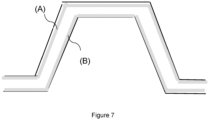
- Such outer zones, parallel to the main surfaces of the press hardened parts, are illustrated as an example on a schematic drawing of a press hardened Hat-shaped part (or "omega" shaped) on figure 7 , wherein they are referred to as (A) and (B). It will be understood that such illustration of the outer zones is not limited to this specific hat-shaped geometry, but applies to any press hardened part geometry.
- the average size of TiN is not less than 2 micrometers, damage is initiated at the boundaries between the rectangular-shaped titanium nitrides and the matrix, and the bending angle may be less than 75°.
- This press hardened part described above may be uncoated or optionally coated.
- the coating may be aluminum-based alloy or aluminum alloy.
- the coating may be also zinc-based alloy or zinc alloy.
- the press hardened steel part of the invention can have a thickness which is not uniform but which can vary.
- the parts with non-uniform thickness can be produced by continuous flexible rolling, i.e. by a process wherein the sheet thickness obtained after rolling is variable in the rolling direction, in relationship with the load which has been applied through the rollers to the sheet during the rolling process.
- vehicle parts with varying thickness such as front and rear rails, seat cross members, tunnel arches, pillars, dash panel cross members, or door rings.
- a semi-product in the form of cast slab or ingot, able to be further hot-rolled, is provided with the steel composition described above.
- the thickness of this semi-product is typically comprised between 50 and 250 mm.
- This semi-product is hot-rolled so to obtain a hot-rolled steel sheet and coiled at a temperature Tc.
- the coiling temperature must not be higher than 550°C, otherwise a too important precipitation of niobium carbonitrides occurs, which induces hardening and increases difficulties for the further cold rolling step.
- Tc does not exceed 550°C, at least 50% of free niobium remains in the steel sheet.
- Tc must also not be lower than Ms so to avoid martensite formation which makes the cold rolling step more difficult.
- the thickness of the hot rolled steel sheet may be in the typical range of 1.5- 4 mm.
- the steel sheets may be directly annealed with the process described below.
- the hot-rolled sheets are pickled in usual conditions and further cold rolled.
- the cold rolling ratio is defined in the following manner: if to designates the thickness before cold rolling, and t f the thickness after cold rolling, the rolling ratio is : (t i - t f )/t i .
- the cold rolling ratio is typically comprised between 50 and 80%.
- the hot rolled, or hot rolled and further cold rolled sheet is annealed in the intercritical range Ac1-Ac3, at a temperature Ta selected so to obtain less than 10% of unrecrystallized fraction.
- a temperature Ta selected so to obtain less than 10% of unrecrystallized fraction.
- An annealing temperature Ta comprised between 800 and 850 °C makes it possible to obtain this result.
- An annealing temperature in the preferred range of 800-835°C makes it possible to achieve very stable results.
- the annealed steel sheet is then cut to a predetermined shape so to obtain a flat blank that is able to be hot formed in a further step.
- the blank before the heating and hot forming steps in press, the blank can be cold formed so to obtain a predeformed blank. This cold predeformation makes it possible to reduce the amount of deformation in the next hot forming step.
- the heated blank is extracted from the heating device, which can be for example a heating furnace.
- the heated blank is transferred into a forming press, the transfer duration Dt being less than 10 s. This transfer must be fast enough so to avoid the formation of polygonal ferrite before the hot deformation in the press, otherwise there is a risk that the tensile strength of the press hardened part becomes less than 950 MPa.
- the heated blank is thereafter hot formed in a forming press, so to obtain a formed part.
- the modes and quantities of deformation differ from one place to another because of the geometry of the final part and of the forming tools. For example, some zones may be in expansion, while other are deformed in restraint.
- ⁇ b expresses the amount of strain introduced by the hot forming process in each zone of the press hardened part.
- the part is then kept within the tooling of the forming press so as to ensure a proper cooling rate and to avoid part distortion due to shrinkage and phase transformations.
- the part mainly cools by conduction through heat transfer with the tools.
- the tools may include coolant circulation so as to increase the cooling rate, or heating cartridges so as to lower cooling rates.
- the cooling rates can be adjusted through the implementation of such means.
- the formed part is first cooled in a temperature range between 750 and 450°C, at a cooling rate CR1 comprised between 40 and 360°C/s. Within this range, a transformation of austenite into martensite, eventually of bainite, occurs.
- the part is cooled in a temperature range comprised 450°C and 250°C, at a cooling rate CR2 between 15 to 150°C/s, slower than the cooling rate CR1, i.e. than CR2 ⁇ CR1.
- a cooling rate CR2 between 15 to 150°C/s, slower than the cooling rate CR1, i.e. than CR2 ⁇ CR1.
- the self-tempering of the martensite may occur at a certain degree, i.e. fine carbides precipitate. Toughness is increased through this self-tempering step.
- Parts obtained through the described method have a thickness which is typically comprised between 0.8 and 4mm.
- the inventors have found a method to obtain high ductility in the zones of the press hardened part wherein high stress concentration is experienced during the use of the part: when the zones in the forming press are deformed with an equivalent strain ⁇ b higher than 0.15, the inventors have shown that the structure of these deformed zones is finer and that softer and more ductile phases, can be obtained in these regions.
- the inventors have compared not deformed or little deformed zones (the later designating zones wherein ⁇ b ⁇ 0.05) with zones wherein strain has been applied with an amount higher than 0.15.
- the hardness of the highly strained zones decreases of more than 20 HV1 (HV1 being the Vickers Hardness measured under 1kgf load) as compared to unstrained or little strained zones in the press hardened part.
- HV1 being the Vickers Hardness measured under 1kgf load
- This local softening corresponds to a toughness increase.
- the amount of the softening remains limited which means that the yield stress and tensile strength requirements are fulfilled in these deformed zones.
- the average martensitic (fresh or self-tempered)/bainitic lath size L s has been measured in little or highly deformed zones. After proper etching to reveal the microstructure, the lath size is determined by the intercept method which is known per se. In the zones wherein the applied strain is higher than 0.15, the average bainitic/martensitic lath size width is less than 1 ⁇ m. By comparison, the average lath size L s in little deformed zones is in the range of 1-2.5 ⁇ m. It has been also put into evidence that the application of strain level higher than 0.15 reduces the lath size of more than 50%, as compared to little deformed zones.This reduction of the lath size increases the resistance to eventual crack initiation and propagation.
- Another object of the invention is a press hardened welded steel part with aluminum coating, which takes advantage of the high mechanical properties of the press hardened part: for manufacturing such part, at least one first steel sheet with the composition above, coated with Al, or Al-based alloy, or Al alloy, is provided. Together with this first sheet, at least a second steel sheet, also precoated with Al, or Al-based alloy, or Al alloy, is provided.
- the sheets may have the same compositions or different compositions, and the same thickness or different thicknesses. In the case of different compositions, it has been put into evidence that the carbon content of the second steel has to be comprised between 0.065 and 0.38% in weight, so to create a weld having the desired ductility properties.
- the first and second sheets are welded along one of their respective peripheral sides. On these peripheral sides, a part of the thickness of the Al precoating is removed. This removal can be performed through pulsed Laser ablation, or through mechanical ablation. The aim of this ablation is to avoid that a too high quantity of Al of the precoating is molten and incorporated in the weld metal. According to the initial Al precoating thickness, and to the sheet thicknesses, the quantity of Al to be removed by ablation may be more of less high.
- the inventors have shown that the ablation conditions must be adapted so that the Al content in the weld metal created between the first and the second sheet, is less than 0.3% in weight. Otherwise, either brittle intermetallics may precipitate in the weld, or the high Al content could prevent the transformation into austenite when heating before press forming, due to the alphagene character of aluminum.
- the first and second sheets may be press hardened in the conditions described above, without the risk of cracks during hot forming.
- Table 2 details the press hardening conditions, i.e. the heating temperature Tm, the heating duration Dm, the transfer duration Dt, and the cooling rates CR1 and CR2, which have been applied.
- Table 2. Press hardening conditions Condition Tm (°C) Dm (min.) Dt (s) CR1 (°C/s) CR2 (°C/s) A 900 4 6 291 89 B 905 4 8 50 22 C 870 5 5 45 18 D 900 4 5 450 250 E 940 10 6 185 45 Underlined values: not corresponding to the invention. Yield stress YS and tensile strength TS have been determined on the press hardened parts, using 20x 80 mm 2 specimens according to Standard ISO (EN 10002-1)
- Critical bending angle has been determined on press hardened parts of 60x60 mm 2 supported by two rollers, according to VDA-238 bending Standard.
- the bending effort is exerted by a 0.4mm radius sharp punch.
- the spacing between the rollers and the punch is equal to the thickness of the tested parts, a clearance of 0.5mm being added.
- the crack apparition is detected since it coincides with a load decrease in the load-displacement curve. Tests are interrupted when the load decreases more than 30N of its maximal value.
- the bending angle ( ⁇ ) of each sample is measured after unloading and thus after specimen spring-back. Five samples along each direction (rolling direction and transverse direction) are bent so to obtain an average value ⁇ A of the bending angle
- the fracture strain is determined through bending specimens in plane strain conditions, which is the most severe condition in view of vehicle collision. From these tests, it is possible to determine the critical displacement of the specimens when fracture occurs.
- Finite Element Analysis allows modeling the bending of such specimen, i.e. to know the strain level which is present in the bent zone for such critical displacement. This strain in such critical conditions is the fracture strain of the material.
- Table 3 The results of such mechanical tests are presented in Table 3.
- the test conditions associate the steel composition and the press hardening compositions.
- I1B refers for example to the steel composition I1 tested with the condition B.
- TiN and sulfides have been performed by using optical micrography, Scanning Electron Microscopy associated to X-microanalysis. These observations have been performed in the zones located near the surfaces of the specimens, wherein the strain is the most important in bending mode. These sub-surface zones are located between one quarter thickness, and the closest surface of the parts. In each case, it was determined if the average size of TiN exceeded 2 ⁇ m, and if the average size of the sulfides exceeded 120 ⁇ m.
- compositions and press hardening conditions correspond to the invention and the desired microstructural features are obtained. As a consequence, high tensile properties, high ductility and impact resistance are achieved.
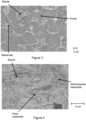
- the microstructure of the parts I1B and I2A, as observed by Scanning Electron Microscope, is illustrated respectively on the figures 1 and 2 . Some details concerning the constituents have been highlighted on the micrographs.
- the C, Mn, Cr, Nb contents do not fulfill the conditions of invention. Even if the press hardening conditions are in accordance with the ranges of the invention, the quantity of self-tempered martensite is insufficient and the bending angle and fracture strain do not meet the requested values.
- the heating temperature Tm is insufficient.
- the ferrite surface fraction is too high and the martensite surface fraction is too low.
- the yield stress of 700 MPa cannot be reached.
- the Nb and the S contents do not fulfill the conditions of the invention.
- the microstructure of the part R4A is illustrated on the figure 4 .
- Compositions of steels I4A and R4A are very similar, except for Nb and S contents. From the comparison of figure 1 and 4 , it may be seen that the prior austenitic grain size is larger in the absence of Nb, which in turns causes the formation of martensite laths with increased length, which offer less resistance to crack propagation.
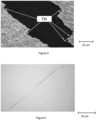
- R4A has higher sulfur content, thus causing the formation of elongated MnS as illustrated on figure 6 .
- These elongated sulfides are located near the outer zones comprised between one quarter thickness and the closest surface of the part. As a consequence, the critical bending angle and the fracture strain are too low.
- the amount of HAZ softening is less pronounced in the press hardened part I2A, manufactured according to the invention, than in the reference part R1A. Even in spite of the presence of this softened zone, no elongation loss is measured for the condition of invention I2A, while the elongation loss is significant for reference part R1A.
- Precoated Al-Si steel sheets with the compositions I2 and R1 were provided. As explained above, the fabrication process makes it possible to produce blanks with strict flatness tolerances which allow Laser welding. Furthermore, a steel sheet, 1.5mm thick, precoated with 25 ⁇ m thick Al-Si, having the composition of table 5, was also provided. Table 5: Composition of steel R5 (weight %) C Mn Si Al Cr Nb Ti V Mo Ni B N S P R5 0.34 0.63 0.56 0.04 0.36 0.04 0.03 0.03 0.19 0.4 0.003 0.005 0.002 0.004
- this steel makes it possible to obtain tensile strength UTS of about 2000 MPa.
- All these Al-Si precoated steel blanks were ablated on one of their peripheral sides.
- the metallic portion of the Al-Si coating was removed, while the intermetallic layer between the steel substrate and the precoating was left in place.
- This ablation was performed through a YAG Laser, 4kW, with a focus spot of 1mm 2 , on the upper and lower sides on the precoated sheets.
- the strained zone shows hardness decrease of 25 HV. As estimated from this hardness value, the UTS of this strained zone is about 1050 MPa, which fulfills the requested value.
- the strained zone displays a reduction of more than 50% as compared to the little strained or unstrained zones.
- the finer lath structure in the deformed zones makes it possible to achieve increased toughness in the zones that are the most critical during the use of the part.
- the steel parts manufactured according to the invention can be used with profit for the fabrication of structural or safety parts of vehicles.
Landscapes
- Chemical & Material Sciences (AREA)
- Engineering & Computer Science (AREA)
- Mechanical Engineering (AREA)
- Materials Engineering (AREA)
- Metallurgy (AREA)
- Organic Chemistry (AREA)
- Physics & Mathematics (AREA)
- Thermal Sciences (AREA)
- Crystallography & Structural Chemistry (AREA)
- Optics & Photonics (AREA)
- Plasma & Fusion (AREA)
- Chemical Kinetics & Catalysis (AREA)
- Heat Treatment Of Articles (AREA)
- Heat Treatment Of Sheet Steel (AREA)
- Heat Treatment Of Steel (AREA)
- Coating With Molten Metal (AREA)
- Medicines Containing Antibodies Or Antigens For Use As Internal Diagnostic Agents (AREA)
- Materials For Photolithography (AREA)
- Laser Beam Processing (AREA)
Priority Applications (1)
| Application Number | Priority Date | Filing Date | Title |
|---|---|---|---|
| MA71265A MA71265A (fr) | 2015-07-09 | 2016-06-10 | Acier pour trempe à la presse et pièce trempée à la presse fabriquée à partir d'un tel acier |
Applications Claiming Priority (5)
| Application Number | Priority Date | Filing Date | Title |
|---|---|---|---|
| PCT/IB2015/001156 WO2017006144A1 (en) | 2015-07-09 | 2015-07-09 | Steel for press hardening and press hardened part manufactured from such steel |
| EP16732746.9A EP3320119B1 (de) | 2015-07-09 | 2016-06-10 | Stahl zum presshärten und aus solch einem stahl hergestelltes pressgehärtetes teil |
| PCT/IB2016/000788 WO2017006159A1 (en) | 2015-07-09 | 2016-06-10 | Steel for press hardening and press hardened part manufactured from such steel |
| EP23180573.0A EP4234746B1 (de) | 2015-07-09 | 2016-06-10 | Stahl zum presshärten und aus solch einem stahl hergestelltes pressgehärtetes teil |
| EP19194169.9A EP3604564B1 (de) | 2015-07-09 | 2016-06-10 | Stahl zum presshärten und aus solch einem stahl hergestelltes pressgehärtetes teil |
Related Parent Applications (4)
| Application Number | Title | Priority Date | Filing Date |
|---|---|---|---|
| EP23180573.0A Division-Into EP4234746B1 (de) | 2015-07-09 | 2016-06-10 | Stahl zum presshärten und aus solch einem stahl hergestelltes pressgehärtetes teil |
| EP23180573.0A Division EP4234746B1 (de) | 2015-07-09 | 2016-06-10 | Stahl zum presshärten und aus solch einem stahl hergestelltes pressgehärtetes teil |
| EP16732746.9A Division EP3320119B1 (de) | 2015-07-09 | 2016-06-10 | Stahl zum presshärten und aus solch einem stahl hergestelltes pressgehärtetes teil |
| EP19194169.9A Division EP3604564B1 (de) | 2015-07-09 | 2016-06-10 | Stahl zum presshärten und aus solch einem stahl hergestelltes pressgehärtetes teil |
Publications (1)
| Publication Number | Publication Date |
|---|---|
| EP4545658A1 true EP4545658A1 (de) | 2025-04-30 |
Family
ID=53718047
Family Applications (5)
| Application Number | Title | Priority Date | Filing Date |
|---|---|---|---|
| EP23180573.0A Active EP4234746B1 (de) | 2015-07-09 | 2016-06-10 | Stahl zum presshärten und aus solch einem stahl hergestelltes pressgehärtetes teil |
| EP19194169.9A Active EP3604564B1 (de) | 2015-07-09 | 2016-06-10 | Stahl zum presshärten und aus solch einem stahl hergestelltes pressgehärtetes teil |
| EP19194164.0A Active EP3591079B1 (de) | 2015-07-09 | 2016-06-10 | Stahl zum presshärten und aus solch einem stahl hergestelltes pressgehärtetes teil |
| EP24219187.2A Pending EP4545658A1 (de) | 2015-07-09 | 2016-06-10 | Stahl zum presshärten und aus einem solchen stahl hergestelltes pressgehärtetes teil |
| EP16732746.9A Active EP3320119B1 (de) | 2015-07-09 | 2016-06-10 | Stahl zum presshärten und aus solch einem stahl hergestelltes pressgehärtetes teil |
Family Applications Before (3)
| Application Number | Title | Priority Date | Filing Date |
|---|---|---|---|
| EP23180573.0A Active EP4234746B1 (de) | 2015-07-09 | 2016-06-10 | Stahl zum presshärten und aus solch einem stahl hergestelltes pressgehärtetes teil |
| EP19194169.9A Active EP3604564B1 (de) | 2015-07-09 | 2016-06-10 | Stahl zum presshärten und aus solch einem stahl hergestelltes pressgehärtetes teil |
| EP19194164.0A Active EP3591079B1 (de) | 2015-07-09 | 2016-06-10 | Stahl zum presshärten und aus solch einem stahl hergestelltes pressgehärtetes teil |
Family Applications After (1)
| Application Number | Title | Priority Date | Filing Date |
|---|---|---|---|
| EP16732746.9A Active EP3320119B1 (de) | 2015-07-09 | 2016-06-10 | Stahl zum presshärten und aus solch einem stahl hergestelltes pressgehärtetes teil |
Country Status (16)
| Country | Link |
|---|---|
| US (4) | US11319610B2 (de) |
| EP (5) | EP4234746B1 (de) |
| JP (5) | JP6640885B2 (de) |
| KR (1) | KR101921441B1 (de) |
| CN (7) | CN110117753B (de) |
| BR (1) | BR112017023444B1 (de) |
| CA (3) | CA3191853C (de) |
| ES (4) | ES3018021T3 (de) |
| FI (2) | FI4234746T3 (de) |
| HU (4) | HUE055394T2 (de) |
| MA (5) | MA61994B1 (de) |
| MX (3) | MX391301B (de) |
| PL (4) | PL3320119T3 (de) |
| RU (1) | RU2686728C1 (de) |
| UA (1) | UA119508C2 (de) |
| WO (2) | WO2017006144A1 (de) |
Families Citing this family (57)
| Publication number | Priority date | Publication date | Assignee | Title |
|---|---|---|---|---|
| WO2017017485A1 (en) * | 2015-07-30 | 2017-02-02 | Arcelormittal | A method for the manufacture of a phosphatable part starting from a steel sheet coated with a metallic coating based on aluminium |
| WO2017098302A1 (en) * | 2015-12-09 | 2017-06-15 | Arcelormittal | Vehicle underbody structure comprising a reinforcement element between a longitudinal beam and a lowerside sill part |
| WO2018220412A1 (fr) * | 2017-06-01 | 2018-12-06 | Arcelormittal | Procede de fabrication de pieces d'acier a haute resistance mecanique et ductilite amelioree, et pieces obtenues par ce procede |
| WO2018220430A1 (en) | 2017-06-02 | 2018-12-06 | Arcelormittal | Steel sheet for manufacturing press hardened parts, press hardened part having a combination of high strength and crash ductility, and manufacturing methods thereof |
| DE102017210201A1 (de) * | 2017-06-19 | 2018-12-20 | Thyssenkrupp Ag | Verfahren zur Herstellung eines mit einem metallischen, vor Korrosion schützenden Überzug versehenen Stahlbauteils |
| CN110945148B (zh) * | 2017-07-25 | 2023-01-24 | 塔塔钢铁艾默伊登有限责任公司 | 用于制备热成形零件的钢带材、片材或坯料,零件,和用于将坯料热成形为零件的方法 |
| JP7326247B2 (ja) | 2017-07-25 | 2023-08-15 | タタ、スティール、アイモイデン、ベスローテン、フェンノートシャップ | 熱間成形された部品を製造するための鋼ストリップ、シート又はブランク、部品、及びブランクを部品に熱間成形する方法 |
| MX2020004592A (es) | 2017-11-02 | 2020-08-24 | Ak Steel Properties Inc | Acero templado en prensa con propiedades personalizadas. |
| WO2019092483A1 (en) | 2017-11-10 | 2019-05-16 | Arcelormittal | Cold rolled and heat treated steel sheet and a method of manufacturing thereof |
| KR102020411B1 (ko) | 2017-12-22 | 2019-09-10 | 주식회사 포스코 | 가공성이 우수한 고강도 강판 및 이의 제조방법 |
| KR102020412B1 (ko) | 2017-12-22 | 2019-09-10 | 주식회사 포스코 | 충돌특성 및 성형성이 고강도 강판 및 이의 제조방법 |
| KR101999015B1 (ko) * | 2017-12-24 | 2019-07-10 | 주식회사 포스코 | 취성균열 전파 저항성이 우수한 구조용 강재 및 그 제조방법 |
| US11168379B2 (en) | 2018-02-12 | 2021-11-09 | Ford Motor Company | Pre-conditioned AlSiFe coating of boron steel used in hot stamping |
| WO2019166852A1 (en) * | 2018-02-27 | 2019-09-06 | Arcelormittal | Method for producing a press-hardened laser welded steel part and press-hardened laser welded steel part |
| TWI651418B (zh) * | 2018-03-30 | 2019-02-21 | 日商新日鐵住金股份有限公司 | 合金化熔融鍍鋅鋼板 |
| KR102451642B1 (ko) | 2018-06-22 | 2022-10-11 | 닛폰세이테츠 가부시키가이샤 | 강판, 테일러드 블랭크, 열간 프레스 성형품, 강관, 중공상 ??칭 성형품, 강판의 제조 방법, 테일러드 블랭크의 제조 방법, 열간 프레스 성형품의 제조 방법, 강관의 제조 방법 및 중공상 ??칭 성형품의 제조 방법 |
| CN111332367B (zh) * | 2018-12-18 | 2023-02-03 | 通用汽车环球科技运作有限责任公司 | 加压硬化焊接钢合金部件 |
| PL3899066T3 (pl) * | 2018-12-18 | 2024-02-12 | Arcelormittal | Hartowana w prasie część o wysokiej odporności na opóźnione pękanie oraz sposób jej wytwarzania |
| US20220072658A1 (en) | 2018-12-24 | 2022-03-10 | Arcelormittal | Method for producing a welded steel blank and associated welded steel blank |
| WO2020208399A1 (en) * | 2019-04-09 | 2020-10-15 | Arcelormittal | Assembly of an aluminium component and of a press hardened steel part having an alloyed coating comprising silicon, iron, zinc, optionally magnesium, the balance being aluminum |
| WO2020229877A1 (en) * | 2019-05-15 | 2020-11-19 | Arcelormittal | A cold rolled martensitic steel and a method for it's manufacture |
| DE102019114090A1 (de) | 2019-05-27 | 2020-12-03 | Salzgitter Flachstahl Gmbh | Verfahren zur Herstellung eines geschweißten Bauteils aus einem umgeformten hochfesten Stahl und Bauteil hierzu |
| DE102019126378A1 (de) * | 2019-09-30 | 2021-04-01 | Salzgitter Flachstahl Gmbh | Verfahren zur Herstellung eines pressgehärteten Stahlblechbauteils mit einem aluminiumbasierten Überzug sowie eine Ausgangsplatine und ein pressgehärtetes Stahlblechbauteil hieraus |
| DE102019215053A1 (de) * | 2019-09-30 | 2021-04-01 | Thyssenkrupp Steel Europe Ag | Verfahren zur Herstellung eines zumindest teilweise vergüteten Stahlblechbauteils und zumindest teilweise vergütetes Stahlblechbauteil |
| CN111041162B (zh) * | 2019-11-25 | 2021-10-15 | 苏州普热斯勒先进成型技术有限公司 | 一种用于提高产品最大弯曲角度的方法 |
| UA127573C2 (uk) * | 2019-12-18 | 2023-10-11 | Арселорміттал | Холоднокатаний і відпалений сталевий лист і спосіб його виготовлення |
| CN113025876A (zh) | 2019-12-24 | 2021-06-25 | 通用汽车环球科技运作有限责任公司 | 高性能压制硬化钢组件 |
| CN113025877A (zh) * | 2019-12-24 | 2021-06-25 | 通用汽车环球科技运作有限责任公司 | 高性能压制硬化钢 |
| KR102747960B1 (ko) * | 2020-01-16 | 2024-12-31 | 닛폰세이테츠 가부시키가이샤 | 핫 스탬프 성형체 |
| MX2022007980A (es) | 2020-01-16 | 2022-07-05 | Nippon Steel Corp | Carroceria estampada en caliente. |
| KR102273869B1 (ko) * | 2020-06-02 | 2021-07-06 | 현대제철 주식회사 | 알루미늄계 도금 블랭크, 이의 제조방법 및 알루미늄계 도금 블랭크 제조장치 |
| JP2023539781A (ja) * | 2020-09-07 | 2023-09-19 | アルセロールミタル | 鋼の鍛造された部品及びその製造方法 |
| KR102393785B1 (ko) * | 2020-09-16 | 2022-05-03 | 현대제철 주식회사 | 마르텐사이트 강재의 경도 예측 방법 및 시스템 |
| WO2022064256A1 (en) * | 2020-09-25 | 2022-03-31 | Arcelormittal | Side structure for a motor vehicle |
| WO2022129995A1 (en) * | 2020-12-16 | 2022-06-23 | Arcelormittal | Coated steel sheet and high strength press hardened steel part and method of manufacturing the same |
| WO2022129994A1 (en) * | 2020-12-16 | 2022-06-23 | Arcelormittal | Coated steel sheet and high strength press hardened steel part and method of manufacturing the same |
| CN112962021B (zh) * | 2021-01-25 | 2022-06-10 | 唐山钢铁集团有限责任公司 | 激光拼焊后用于整体热冲压成形的强塑钢板及生产方法 |
| KR102938353B1 (ko) * | 2021-02-15 | 2026-03-17 | 닛폰세이테츠 가부시키가이샤 | 핫 스탬프 성형체 |
| CN115261742B (zh) | 2021-04-30 | 2023-06-13 | 宝山钢铁股份有限公司 | 一种抗拉强度1000MPa热冲压部件及其制造方法 |
| FR3123659A1 (fr) * | 2021-06-02 | 2022-12-09 | Ascometal France Holding Sas | Pièce en acier mise en forme à chaud et procédé de fabrication |
| KR102440343B1 (ko) * | 2021-06-30 | 2022-09-05 | 현대제철 주식회사 | 알루미늄계 도금 블랭크 및 이의 제조방법 |
| CN117769607A (zh) * | 2021-07-30 | 2024-03-26 | 现代制铁株式会社 | 用于热压的钢板和使用其制造的铝镀覆坯料 |
| JP2023538796A (ja) * | 2021-07-30 | 2023-09-12 | ヒュンダイ スチール カンパニー | 熱間プレス用鋼板及びそれを用いて製造されたアルミニウム系メッキブランク |
| WO2023020932A1 (de) * | 2021-08-19 | 2023-02-23 | Thyssenkrupp Steel Europe Ag | Stahl mit verbesserten verarbeitungseigenschaften zur umformung bei erhöhten temperaturen |
| CN118302546A (zh) * | 2021-08-19 | 2024-07-05 | 蒂森克虏伯钢铁欧洲股份公司 | 用于在高温下成型的、具有改进加工特性的钢材 |
| WO2023041954A1 (en) * | 2021-09-14 | 2023-03-23 | Arcelormittal | High strength high slenderness part having excellent energy absorption |
| WO2023041953A1 (en) * | 2021-09-14 | 2023-03-23 | Arcelormittal | High strength press hardened steel part and method of manufacturing the same |
| CN115961212A (zh) * | 2021-10-12 | 2023-04-14 | 通用汽车环球科技运作有限责任公司 | 具有拼接的机械与腐蚀性质的组件 |
| WO2024023553A1 (en) * | 2022-07-28 | 2024-02-01 | Arcelormittal | Method for manufacturing a coated press hardened steel part having an improved appearance and corresponding steel part |
| WO2024023552A1 (en) * | 2022-07-28 | 2024-02-01 | Arcelormittal | Method for manufacturing a coated press hardened steel part having an improved appearance and corresponding steel part |
| CN115612924B (zh) * | 2022-09-19 | 2023-09-12 | 攀钢集团攀枝花钢铁研究院有限公司 | 一种铅铋堆用铁素体/马氏体耐热钢及其制备方法 |
| CN115652218B (zh) * | 2022-11-17 | 2023-06-06 | 育材堂(苏州)材料科技有限公司 | 一种低碳的高韧性热冲压成形构件及钢板 |
| CN116727586B (zh) * | 2023-07-18 | 2026-01-30 | 西部超导材料科技股份有限公司 | Ti5331钛合金大规格棒材的锻造方法 |
| CN117139842B (zh) * | 2023-09-26 | 2026-03-10 | 本钢板材股份有限公司 | 一种2000MPa级热冲压钢酸轧工序激光焊接工艺控制方法 |
| WO2025114756A1 (en) | 2023-12-01 | 2025-06-05 | Arcelormittal | High bendability press-hardened steel part and method of manufacturing the same |
| WO2025242935A1 (de) * | 2024-06-19 | 2025-11-27 | Thyssenkrupp Steel Europe Ag | Blechformteil mit verbesserten umformeigenschaften |
| CN119571207B (zh) * | 2025-02-07 | 2025-05-23 | 小米汽车科技有限公司 | 钢板基体、预镀层钢板及其制备方法、热冲压成型构件及其制备方法和汽车结构件 |
Citations (5)
| Publication number | Priority date | Publication date | Assignee | Title |
|---|---|---|---|---|
| GB1490535A (en) | 1973-11-06 | 1977-11-02 | Norrbottens Jaernverk Ab | Manufacturing a hardened steel article |
| FR2780984A1 (fr) | 1998-07-09 | 2000-01-14 | Lorraine Laminage | Tole d'acier laminee a chaud et a froid revetue et comportant une tres haute resistance apres traitement thermique |
| EP1865086A1 (de) | 2006-06-07 | 2007-12-12 | ThyssenKrupp Steel AG | Mangan-Bor-Stahl, aus einem solchen Stahl hergestelltes Flachprodukt und Verfahren zu dessen Herstellung |
| EP1881083A1 (de) | 2006-07-19 | 2008-01-23 | Benteler Stahl/Rohr Gmbh | Werkstück aus einer hochfesten Stahllegierung und dessen Verwendung |
| EP2137327A1 (de) | 2007-03-14 | 2009-12-30 | ArcelorMittal France | Stahl für werkzeugloses warmformen oder abschrecken mit erhöhter biegbarkeit |
Family Cites Families (40)
| Publication number | Priority date | Publication date | Assignee | Title |
|---|---|---|---|---|
| JPS63213619A (ja) * | 1987-02-27 | 1988-09-06 | Nisshin Steel Co Ltd | 加工性に優れ溶接軟化のない高強度ステンレス鋼材の製造方法 |
| JP3305952B2 (ja) | 1996-06-28 | 2002-07-24 | トヨタ自動車株式会社 | センターピラーリーンフォースの高周波焼入れ強化方法 |
| CN1169991C (zh) * | 2001-10-19 | 2004-10-06 | 住友金属工业株式会社 | 具有优异的可加工性和成型精度的薄钢板及其制造方法 |
| JP2004025247A (ja) * | 2002-06-26 | 2004-01-29 | Jfe Steel Kk | 高強度化部品の製造方法 |
| JP4443910B2 (ja) | 2003-12-12 | 2010-03-31 | Jfeスチール株式会社 | 自動車構造部材用鋼材およびその製造方法 |
| JP4470701B2 (ja) * | 2004-01-29 | 2010-06-02 | Jfeスチール株式会社 | 加工性および表面性状に優れた高強度薄鋼板およびその製造方法 |
| US7442268B2 (en) * | 2004-11-24 | 2008-10-28 | Nucor Corporation | Method of manufacturing cold rolled dual-phase steel sheet |
| JP4427462B2 (ja) * | 2005-01-21 | 2010-03-10 | 新日本製鐵株式会社 | 車両用鋼部材及びその製造方法 |
| CN100447280C (zh) * | 2005-10-10 | 2008-12-31 | 燕山大学 | 冲压级低碳钢热轧薄板及其制造方法 |
| EP2009127A1 (de) | 2007-06-29 | 2008-12-31 | ArcelorMittal France | Verfahren zur Herstellung eines galvanisierten oder Galvanneal-Stahlblechs durch DFF-Regulierung |
| EP2009129A1 (de) | 2007-06-29 | 2008-12-31 | ArcelorMittal France | Verfahren zur Herstellung eines galvanisierten oder Galvanneal-Stahlblechs durch DFF-Regulierung |
| EP2009128A1 (de) | 2007-06-29 | 2008-12-31 | ArcelorMittal France | Verzinkter oder Galvanneal-Siliziumstahl |
| KR101010971B1 (ko) | 2008-03-24 | 2011-01-26 | 주식회사 포스코 | 저온 열처리 특성을 가지는 성형용 강판, 그 제조방법,이를 이용한 부품의 제조방법 및 제조된 부품 |
| CN101250618A (zh) | 2008-04-03 | 2008-08-27 | 上海交通大学 | Fe-32%Ni合金的晶粒超细化方法 |
| EP2123786A1 (de) | 2008-05-21 | 2009-11-25 | ArcelorMittal France | Verfahren zur Herstellung von kalt gewalzten Zweiphasen-Stahlblechen mit sehr hoher Festigkeit und so hergestellte Bleche |
| CN101280352B (zh) * | 2008-05-21 | 2010-06-09 | 钢铁研究总院 | 热成型马氏体钢零件制备方法 |
| JP4837712B2 (ja) | 2008-09-18 | 2011-12-14 | 新日本製鐵株式会社 | ホットプレス成型方法、成型品および自動車用部品 |
| JP2010174275A (ja) | 2009-01-28 | 2010-08-12 | Jfe Steel Corp | 熱間打ち抜き性に優れたダイクエンチ用鋼板及びダイクエンチ工法による部材の製造方法 |
| JP4623233B2 (ja) * | 2009-02-02 | 2011-02-02 | Jfeスチール株式会社 | 高強度溶融亜鉛めっき鋼板およびその製造方法 |
| PL2436797T3 (pl) | 2009-05-27 | 2017-06-30 | Nippon Steel & Sumitomo Metal Corporation | Blacha stalowa cienka o dużej wytrzymałości, blacha stalowa cienka cynkowana ogniowo i stopowa blacha stalowa cienka cynkowana ogniowo o doskonałych parametrach zmęczenia, wydłużenia i właściwościach przy zderzeniu oraz sposób wytwarzania wspomnianych blach stalowych cienkich |
| CN101660097B (zh) | 2009-08-13 | 2011-05-04 | 丁家伟 | 高硼高铬低碳耐磨合金钢及其制备方法 |
| CN102021482B (zh) | 2009-09-18 | 2013-06-19 | 宝山钢铁股份有限公司 | 一种冷轧热镀锌双相钢及其制造方法 |
| WO2011108764A1 (ja) | 2010-03-05 | 2011-09-09 | 新日本製鐵株式会社 | 靭性に優れた機械構造用高強度シームレス鋼管とその製造方法 |
| TR201815190T4 (tr) | 2011-03-03 | 2018-11-21 | Nippon Steel Corp | Sac metal eğme yöntemi ve sac metal ürünü. |
| RU2562654C2 (ru) * | 2011-05-13 | 2015-09-10 | Ниппон Стил Энд Сумитомо Метал Корпорейшн | Горячештампованное изделие, способ изготовления горячештампованного изделия, энергопоглощающий элемент и способ изготовления энергопоглощающего элемента |
| WO2013014481A1 (fr) * | 2011-07-26 | 2013-01-31 | Arcelormittal Investigación Y Desarrollo Sl | Pièce d'acier soudée préalablement mise en forme à chaud à très haute résistance mécanique et procédé de fabrication |
| KR101344537B1 (ko) * | 2011-10-28 | 2013-12-26 | 현대제철 주식회사 | 고강도 강판 및 그 제조 방법 |
| KR101353634B1 (ko) * | 2011-11-18 | 2014-01-21 | 주식회사 포스코 | 용접성과 강도가 우수한 저합금 냉연강판 및 그 제조방법 |
| CN104040007B (zh) | 2012-01-13 | 2016-08-24 | 新日铁住金株式会社 | 冷轧钢板及其制造方法 |
| WO2014002289A1 (ja) | 2012-06-28 | 2014-01-03 | Jfeスチール株式会社 | 冷間加工性、被削性および焼入れ性に優れた高炭素鋼管およびその製造方法 |
| RU2599934C2 (ru) | 2012-08-15 | 2016-10-20 | Ниппон Стил Энд Сумитомо Метал Корпорейшн | Стальной лист для горячей штамповки, способ его изготовления и изделие из горячештампованного стального листа |
| KR101461715B1 (ko) * | 2012-09-05 | 2014-11-14 | 주식회사 포스코 | 초고강도 냉연강판 및 그의 제조방법 |
| WO2014037627A1 (fr) | 2012-09-06 | 2014-03-13 | Arcelormittal Investigación Y Desarrollo Sl | Procede de fabrication de pieces d'acier revêtues et durcies a la presse, et tôles prerevêtues permettant la fabrication de ces pieces |
| KR101449134B1 (ko) | 2012-10-15 | 2014-10-08 | 주식회사 포스코 | 용접성 및 굽힘가공성이 우수한 초고강도 냉연강판 및 그 제조방법 |
| KR101318060B1 (ko) | 2013-05-09 | 2013-10-15 | 현대제철 주식회사 | 인성이 향상된 핫스탬핑 부품 및 그 제조 방법 |
| DE102013009232A1 (de) * | 2013-05-28 | 2014-12-04 | Salzgitter Flachstahl Gmbh | Verfahren zur Herstellung eines Bauteils durch Warmumformen eines Vorproduktes aus Stahl |
| DE102013108046A1 (de) | 2013-07-26 | 2015-01-29 | Thyssenkrupp Steel Europe Ag | Verfahren und Vorrichtung zum partiellen Härten von Halbzeugen |
| ES2662381T3 (es) | 2013-09-18 | 2018-04-06 | Nippon Steel & Sumitomo Metal Corporation | Pieza estampada en caliente y método de fabricación de la misma |
| US20170029914A1 (en) | 2013-11-29 | 2017-02-02 | Nippon Steel & Sumitomo Metal Corporation | Hot formed steel sheet component and method for producing the same as well as steel sheet for hot forming |
| WO2016039728A1 (en) | 2014-09-09 | 2016-03-17 | Halliburton Energy Services, Inc. | Hybrid check valve |
-
2015
- 2015-07-09 WO PCT/IB2015/001156 patent/WO2017006144A1/en not_active Ceased
-
2016
- 2016-06-10 MX MX2017016548A patent/MX391301B/es unknown
- 2016-06-10 WO PCT/IB2016/000788 patent/WO2017006159A1/en not_active Ceased
- 2016-06-10 ES ES23180573T patent/ES3018021T3/es active Active
- 2016-06-10 RU RU2018104810A patent/RU2686728C1/ru active
- 2016-06-10 BR BR112017023444-0A patent/BR112017023444B1/pt active IP Right Grant
- 2016-06-10 EP EP23180573.0A patent/EP4234746B1/de active Active
- 2016-06-10 FI FIEP23180573.0T patent/FI4234746T3/fi active
- 2016-06-10 ES ES19194164T patent/ES2878899T3/es active Active
- 2016-06-10 FI FIEP19194169.9T patent/FI3604564T3/fi active
- 2016-06-10 MA MA61994A patent/MA61994B1/fr unknown
- 2016-06-10 EP EP19194169.9A patent/EP3604564B1/de active Active
- 2016-06-10 KR KR1020177035286A patent/KR101921441B1/ko active Active
- 2016-06-10 MA MA47998A patent/MA47998B1/fr unknown
- 2016-06-10 US US15/741,290 patent/US11319610B2/en active Active
- 2016-06-10 EP EP19194164.0A patent/EP3591079B1/de active Active
- 2016-06-10 CN CN201910399705.8A patent/CN110117753B/zh active Active
- 2016-06-10 HU HUE19194164A patent/HUE055394T2/hu unknown
- 2016-06-10 MA MA71265A patent/MA71265A/fr unknown
- 2016-06-10 PL PL16732746T patent/PL3320119T3/pl unknown
- 2016-06-10 JP JP2017565956A patent/JP6640885B2/ja active Active
- 2016-06-10 ES ES16732746T patent/ES2763454T3/es active Active
- 2016-06-10 CA CA3191853A patent/CA3191853C/en active Active
- 2016-06-10 HU HUE16732746A patent/HUE048028T2/hu unknown
- 2016-06-10 CN CN201910398708.XA patent/CN110195150B/zh active Active
- 2016-06-10 PL PL19194169.9T patent/PL3604564T3/pl unknown
- 2016-06-10 MA MA47702A patent/MA47702B1/fr unknown
- 2016-06-10 PL PL23180573.0T patent/PL4234746T3/pl unknown
- 2016-06-10 CA CA2990356A patent/CA2990356C/en active Active
- 2016-06-10 EP EP24219187.2A patent/EP4545658A1/de active Pending
- 2016-06-10 HU HUE19194169A patent/HUE064099T2/hu unknown
- 2016-06-10 CN CN201910398786.XA patent/CN110195151B/zh active Active
- 2016-06-10 EP EP16732746.9A patent/EP3320119B1/de active Active
- 2016-06-10 CN CN201910398780.2A patent/CN110144443B/zh active Active
- 2016-06-10 UA UAA201801163A patent/UA119508C2/uk unknown
- 2016-06-10 MA MA042368A patent/MA42368A/fr unknown
- 2016-06-10 PL PL19194164T patent/PL3591079T3/pl unknown
- 2016-06-10 CN CN201910398727.2A patent/CN110205449B/zh active Active
- 2016-06-10 CA CA3058829A patent/CA3058829C/en active Active
- 2016-06-10 CN CN201910401468.4A patent/CN110144444B/zh active Active
- 2016-06-10 ES ES19194169T patent/ES2967397T3/es active Active
- 2016-06-10 CN CN201680036507.XA patent/CN107810281B/zh active Active
- 2016-06-10 HU HUE23180573A patent/HUE070723T2/hu unknown
-
2017
- 2017-12-15 MX MX2022004076A patent/MX2022004076A/es unknown
- 2017-12-15 MX MX2022004075A patent/MX2022004075A/es unknown
-
2019
- 2019-12-25 JP JP2019233860A patent/JP6970172B2/ja active Active
- 2019-12-25 JP JP2019233861A patent/JP6971299B2/ja active Active
-
2021
- 2021-10-01 US US17/491,785 patent/US11814696B2/en active Active
- 2021-10-27 JP JP2021175214A patent/JP7299956B2/ja active Active
- 2021-10-27 JP JP2021175215A patent/JP7299957B2/ja active Active
-
2023
- 2023-10-09 US US18/377,943 patent/US12398438B2/en active Active
-
2025
- 2025-07-31 US US19/286,302 patent/US20250354232A1/en active Pending
Patent Citations (6)
| Publication number | Priority date | Publication date | Assignee | Title |
|---|---|---|---|---|
| GB1490535A (en) | 1973-11-06 | 1977-11-02 | Norrbottens Jaernverk Ab | Manufacturing a hardened steel article |
| FR2780984A1 (fr) | 1998-07-09 | 2000-01-14 | Lorraine Laminage | Tole d'acier laminee a chaud et a froid revetue et comportant une tres haute resistance apres traitement thermique |
| US6296805B1 (en) * | 1998-07-09 | 2001-10-02 | Sollac | Coated hot- and cold-rolled steel sheet comprising a very high resistance after thermal treatment |
| EP1865086A1 (de) | 2006-06-07 | 2007-12-12 | ThyssenKrupp Steel AG | Mangan-Bor-Stahl, aus einem solchen Stahl hergestelltes Flachprodukt und Verfahren zu dessen Herstellung |
| EP1881083A1 (de) | 2006-07-19 | 2008-01-23 | Benteler Stahl/Rohr Gmbh | Werkstück aus einer hochfesten Stahllegierung und dessen Verwendung |
| EP2137327A1 (de) | 2007-03-14 | 2009-12-30 | ArcelorMittal France | Stahl für werkzeugloses warmformen oder abschrecken mit erhöhter biegbarkeit |
Non-Patent Citations (4)
| Title |
|---|
| ANONYMOUS: "Steel for hot stamping-Usibor, extract from the product catalogue - European edition", 28 January 2014 (2014-01-28), pages 9PP, XP002755755, Retrieved from the Internet <URL:http://automotive.arcelormittal.com/saturnus/sheets/E_EN.pdf> [retrieved on 20160322] * |
| ANONYMOUS: "Update Client magazine, Flat Carbon Europe", November 2011 (2011-11-01), XP002755758, Retrieved from the Internet <URL:http://flateurope.arcelormittal.com/flipflop/fce/Update/EN_UpdateFCE_November11/index.html> [retrieved on 20160322] * |
| P. NORMAN, G. WIKLUND, P. JANIAK, N. MALMBERG, A.F.H. KAPLAN: "Comparison of 22MnB5-steel with and without AlSi-coating during laser hybrid arc welding", NORWEGIAN UNIVERSITY OF SCIENCE AND TECHNOLOGY, 29 June 2011 (2011-06-29), Trondheim, pages 1 - 9, XP002755757 * |
| R. VIERSTRAETE, W. EHLING, F. PINARD, L. CRETTEUR, A. PIC, Q. YIN: "Laser ablation for hardening laser welded steel blanks", INDUSTRIAL LASER SOLUTION FOR MANUFACTURING, 26 January 2010 (2010-01-26), Tulsa, pages 1 - 13, XP002755756, Retrieved from the Internet <URL:www.industrial-lasers.com/articles/2010/01/laser-ablation...> [retrieved on 20160321] * |
Also Published As
Similar Documents
| Publication | Publication Date | Title |
|---|---|---|
| US12398438B2 (en) | Process for manufacturing a press hardened laser welded steel part | |
| US12398439B2 (en) | Steel sheet for manufacturing press hardened parts, press hardened part having a combination of high strength and crash ductility, and manufacturing methods thereof |
Legal Events
| Date | Code | Title | Description |
|---|---|---|---|
| PUAI | Public reference made under article 153(3) epc to a published international application that has entered the european phase |
Free format text: ORIGINAL CODE: 0009012 |
|
| STAA | Information on the status of an ep patent application or granted ep patent |
Free format text: STATUS: REQUEST FOR EXAMINATION WAS MADE |
|
| 17P | Request for examination filed |
Effective date: 20241211 |
|
| AC | Divisional application: reference to earlier application |
Ref document number: 3320119 Country of ref document: EP Kind code of ref document: P Ref document number: 3604564 Country of ref document: EP Kind code of ref document: P Ref document number: 4234746 Country of ref document: EP Kind code of ref document: P |
|
| AK | Designated contracting states |
Kind code of ref document: A1 Designated state(s): AL AT BE BG CH CY CZ DE DK EE ES FI FR GB GR HR HU IE IS IT LI LT LU LV MC MK MT NL NO PL PT RO RS SE SI SK SM TR |