EP4465206A2 - Integriertes verbrauchsmaterialdatenverwaltungssystem und plattform - Google Patents
Integriertes verbrauchsmaterialdatenverwaltungssystem und plattform Download PDFInfo
- Publication number
- EP4465206A2 EP4465206A2 EP24191213.8A EP24191213A EP4465206A2 EP 4465206 A2 EP4465206 A2 EP 4465206A2 EP 24191213 A EP24191213 A EP 24191213A EP 4465206 A2 EP4465206 A2 EP 4465206A2
- Authority
- EP
- European Patent Office
- Prior art keywords
- assay
- consumable
- data
- identifier
- plate
- Prior art date
- Legal status (The legal status is an assumption and is not a legal conclusion. Google has not performed a legal analysis and makes no representation as to the accuracy of the status listed.)
- Pending
Links
Images
























































Classifications
-
- G—PHYSICS
- G06—COMPUTING OR CALCULATING; COUNTING
- G06F—ELECTRIC DIGITAL DATA PROCESSING
- G06F16/00—Information retrieval; Database structures therefor; File system structures therefor
- G06F16/20—Information retrieval; Database structures therefor; File system structures therefor of structured data, e.g. relational data
- G06F16/25—Integrating or interfacing systems involving database management systems
- G06F16/252—Integrating or interfacing systems involving database management systems between a Database Management System and a front-end application
-
- B—PERFORMING OPERATIONS; TRANSPORTING
- B01—PHYSICAL OR CHEMICAL PROCESSES OR APPARATUS IN GENERAL
- B01L—CHEMICAL OR PHYSICAL LABORATORY APPARATUS FOR GENERAL USE
- B01L3/00—Containers or dishes for laboratory use, e.g. laboratory glassware; Droppers
- B01L3/50—Containers for the purpose of retaining a material to be analysed, e.g. test tubes
- B01L3/508—Rigid containers without fluid transport within
- B01L3/5085—Rigid containers without fluid transport within for multiple samples, e.g. microtitration plates
- B01L3/50853—Rigid containers without fluid transport within for multiple samples, e.g. microtitration plates with covers or lids
-
- B—PERFORMING OPERATIONS; TRANSPORTING
- B01—PHYSICAL OR CHEMICAL PROCESSES OR APPARATUS IN GENERAL
- B01L—CHEMICAL OR PHYSICAL LABORATORY APPARATUS FOR GENERAL USE
- B01L3/00—Containers or dishes for laboratory use, e.g. laboratory glassware; Droppers
- B01L3/54—Labware with identification means
- B01L3/545—Labware with identification means for laboratory containers
-
- B—PERFORMING OPERATIONS; TRANSPORTING
- B01—PHYSICAL OR CHEMICAL PROCESSES OR APPARATUS IN GENERAL
- B01L—CHEMICAL OR PHYSICAL LABORATORY APPARATUS FOR GENERAL USE
- B01L9/00—Supporting devices; Holding devices
- B01L9/06—Test-tube stands; Test-tube holders
-
- B—PERFORMING OPERATIONS; TRANSPORTING
- B01—PHYSICAL OR CHEMICAL PROCESSES OR APPARATUS IN GENERAL
- B01L—CHEMICAL OR PHYSICAL LABORATORY APPARATUS FOR GENERAL USE
- B01L9/00—Supporting devices; Holding devices
- B01L9/52—Supports specially adapted for flat sample carriers, e.g. for plates, slides, chips
- B01L9/523—Supports specially adapted for flat sample carriers, e.g. for plates, slides, chips for multisample carriers, e.g. used for microtitration plates
-
- C—CHEMISTRY; METALLURGY
- C40—COMBINATORIAL TECHNOLOGY
- C40B—COMBINATORIAL CHEMISTRY; LIBRARIES, e.g. CHEMICAL LIBRARIES
- C40B60/00—Apparatus specially adapted for use in combinatorial chemistry or with libraries
- C40B60/12—Apparatus specially adapted for use in combinatorial chemistry or with libraries for screening libraries
-
- F—MECHANICAL ENGINEERING; LIGHTING; HEATING; WEAPONS; BLASTING
- F24—HEATING; RANGES; VENTILATING
- F24F—AIR-CONDITIONING; AIR-HUMIDIFICATION; VENTILATION; USE OF AIR CURRENTS FOR SCREENING
- F24F11/00—Control or safety arrangements
- F24F11/30—Control or safety arrangements for purposes related to the operation of the system, e.g. for safety or monitoring
-
- G—PHYSICS
- G01—MEASURING; TESTING
- G01N—INVESTIGATING OR ANALYSING MATERIALS BY DETERMINING THEIR CHEMICAL OR PHYSICAL PROPERTIES
- G01N21/00—Investigating or analysing materials by the use of optical means, i.e. using sub-millimetre waves, infrared, visible or ultraviolet light
- G01N21/75—Systems in which material is subjected to a chemical reaction, the progress or the result of the reaction being investigated
- G01N21/76—Chemiluminescence; Bioluminescence
-
- G—PHYSICS
- G01—MEASURING; TESTING
- G01N—INVESTIGATING OR ANALYSING MATERIALS BY DETERMINING THEIR CHEMICAL OR PHYSICAL PROPERTIES
- G01N27/00—Investigating or analysing materials by the use of electric, electrochemical, or magnetic means
- G01N27/26—Investigating or analysing materials by the use of electric, electrochemical, or magnetic means by investigating electrochemical variables; by using electrolysis or electrophoresis
-
- G—PHYSICS
- G01—MEASURING; TESTING
- G01N—INVESTIGATING OR ANALYSING MATERIALS BY DETERMINING THEIR CHEMICAL OR PHYSICAL PROPERTIES
- G01N33/00—Investigating or analysing materials by specific methods not covered by groups G01N1/00 - G01N31/00
- G01N33/48—Biological material, e.g. blood, urine; Haemocytometers
- G01N33/50—Chemical analysis of biological material, e.g. blood, urine; Testing involving biospecific ligand binding methods; Immunological testing
- G01N33/53—Immunoassay; Biospecific binding assay; Materials therefor
-
- G—PHYSICS
- G01—MEASURING; TESTING
- G01N—INVESTIGATING OR ANALYSING MATERIALS BY DETERMINING THEIR CHEMICAL OR PHYSICAL PROPERTIES
- G01N35/00—Automatic analysis not limited to methods or materials provided for in any single one of groups G01N1/00 - G01N33/00; Handling materials therefor
- G01N35/00584—Control arrangements for automatic analysers
- G01N35/00722—Communications; Identification
- G01N35/00732—Identification of carriers, materials or components in automatic analysers
-
- G—PHYSICS
- G01—MEASURING; TESTING
- G01N—INVESTIGATING OR ANALYSING MATERIALS BY DETERMINING THEIR CHEMICAL OR PHYSICAL PROPERTIES
- G01N35/00—Automatic analysis not limited to methods or materials provided for in any single one of groups G01N1/00 - G01N33/00; Handling materials therefor
- G01N35/00584—Control arrangements for automatic analysers
- G01N35/0092—Scheduling
-
- G—PHYSICS
- G01—MEASURING; TESTING
- G01N—INVESTIGATING OR ANALYSING MATERIALS BY DETERMINING THEIR CHEMICAL OR PHYSICAL PROPERTIES
- G01N35/00—Automatic analysis not limited to methods or materials provided for in any single one of groups G01N1/00 - G01N33/00; Handling materials therefor
- G01N35/0099—Automatic analysis not limited to methods or materials provided for in any single one of groups G01N1/00 - G01N33/00; Handling materials therefor comprising robots or similar manipulators
-
- G—PHYSICS
- G01—MEASURING; TESTING
- G01N—INVESTIGATING OR ANALYSING MATERIALS BY DETERMINING THEIR CHEMICAL OR PHYSICAL PROPERTIES
- G01N35/00—Automatic analysis not limited to methods or materials provided for in any single one of groups G01N1/00 - G01N33/00; Handling materials therefor
- G01N35/02—Automatic analysis not limited to methods or materials provided for in any single one of groups G01N1/00 - G01N33/00; Handling materials therefor using a plurality of sample containers moved by a conveyor system past one or more treatment or analysis stations
- G01N35/028—Automatic analysis not limited to methods or materials provided for in any single one of groups G01N1/00 - G01N33/00; Handling materials therefor using a plurality of sample containers moved by a conveyor system past one or more treatment or analysis stations having reaction cells in the form of microtitration plates
-
- G—PHYSICS
- G06—COMPUTING OR CALCULATING; COUNTING
- G06K—GRAPHICAL DATA READING; PRESENTATION OF DATA; RECORD CARRIERS; HANDLING RECORD CARRIERS
- G06K7/00—Methods or arrangements for sensing record carriers, e.g. for reading patterns
- G06K7/10—Methods or arrangements for sensing record carriers, e.g. for reading patterns by electromagnetic radiation, e.g. optical sensing; by corpuscular radiation
- G06K7/14—Methods or arrangements for sensing record carriers, e.g. for reading patterns by electromagnetic radiation, e.g. optical sensing; by corpuscular radiation using light without selection of wavelength, e.g. sensing reflected white light
- G06K7/1404—Methods for optical code recognition
- G06K7/1408—Methods for optical code recognition the method being specifically adapted for the type of code
- G06K7/1413—1D bar codes
-
- G—PHYSICS
- G06—COMPUTING OR CALCULATING; COUNTING
- G06Q—INFORMATION AND COMMUNICATION TECHNOLOGY [ICT] SPECIALLY ADAPTED FOR ADMINISTRATIVE, COMMERCIAL, FINANCIAL, MANAGERIAL OR SUPERVISORY PURPOSES; SYSTEMS OR METHODS SPECIALLY ADAPTED FOR ADMINISTRATIVE, COMMERCIAL, FINANCIAL, MANAGERIAL OR SUPERVISORY PURPOSES, NOT OTHERWISE PROVIDED FOR
- G06Q10/00—Administration; Management
- G06Q10/08—Logistics, e.g. warehousing, loading or distribution; Inventory or stock management
- G06Q10/087—Inventory or stock management, e.g. order filling, procurement or balancing against orders
-
- G—PHYSICS
- G06—COMPUTING OR CALCULATING; COUNTING
- G06Q—INFORMATION AND COMMUNICATION TECHNOLOGY [ICT] SPECIALLY ADAPTED FOR ADMINISTRATIVE, COMMERCIAL, FINANCIAL, MANAGERIAL OR SUPERVISORY PURPOSES; SYSTEMS OR METHODS SPECIALLY ADAPTED FOR ADMINISTRATIVE, COMMERCIAL, FINANCIAL, MANAGERIAL OR SUPERVISORY PURPOSES, NOT OTHERWISE PROVIDED FOR
- G06Q10/00—Administration; Management
- G06Q10/10—Office automation; Time management
-
- G—PHYSICS
- G16—INFORMATION AND COMMUNICATION TECHNOLOGY [ICT] SPECIALLY ADAPTED FOR SPECIFIC APPLICATION FIELDS
- G16H—HEALTHCARE INFORMATICS, i.e. INFORMATION AND COMMUNICATION TECHNOLOGY [ICT] SPECIALLY ADAPTED FOR THE HANDLING OR PROCESSING OF MEDICAL OR HEALTHCARE DATA
- G16H10/00—ICT specially adapted for the handling or processing of patient-related medical or healthcare data
- G16H10/40—ICT specially adapted for the handling or processing of patient-related medical or healthcare data for data related to laboratory analysis, e.g. patient specimen analysis
-
- G—PHYSICS
- G16—INFORMATION AND COMMUNICATION TECHNOLOGY [ICT] SPECIALLY ADAPTED FOR SPECIFIC APPLICATION FIELDS
- G16H—HEALTHCARE INFORMATICS, i.e. INFORMATION AND COMMUNICATION TECHNOLOGY [ICT] SPECIALLY ADAPTED FOR THE HANDLING OR PROCESSING OF MEDICAL OR HEALTHCARE DATA
- G16H40/00—ICT specially adapted for the management or administration of healthcare resources or facilities; ICT specially adapted for the management or operation of medical equipment or devices
- G16H40/40—ICT specially adapted for the management or administration of healthcare resources or facilities; ICT specially adapted for the management or operation of medical equipment or devices for the management of medical equipment or devices, e.g. scheduling maintenance or upgrades
-
- G—PHYSICS
- G16—INFORMATION AND COMMUNICATION TECHNOLOGY [ICT] SPECIALLY ADAPTED FOR SPECIFIC APPLICATION FIELDS
- G16H—HEALTHCARE INFORMATICS, i.e. INFORMATION AND COMMUNICATION TECHNOLOGY [ICT] SPECIALLY ADAPTED FOR THE HANDLING OR PROCESSING OF MEDICAL OR HEALTHCARE DATA
- G16H40/00—ICT specially adapted for the management or administration of healthcare resources or facilities; ICT specially adapted for the management or operation of medical equipment or devices
- G16H40/60—ICT specially adapted for the management or administration of healthcare resources or facilities; ICT specially adapted for the management or operation of medical equipment or devices for the operation of medical equipment or devices
- G16H40/67—ICT specially adapted for the management or administration of healthcare resources or facilities; ICT specially adapted for the management or operation of medical equipment or devices for the operation of medical equipment or devices for remote operation
-
- B—PERFORMING OPERATIONS; TRANSPORTING
- B01—PHYSICAL OR CHEMICAL PROCESSES OR APPARATUS IN GENERAL
- B01L—CHEMICAL OR PHYSICAL LABORATORY APPARATUS FOR GENERAL USE
- B01L2200/00—Solutions for specific problems relating to chemical or physical laboratory apparatus
- B01L2200/02—Adapting objects or devices to another
- B01L2200/023—Adapting objects or devices to another adapted for different sizes of tubes, tips or container
-
- B—PERFORMING OPERATIONS; TRANSPORTING
- B01—PHYSICAL OR CHEMICAL PROCESSES OR APPARATUS IN GENERAL
- B01L—CHEMICAL OR PHYSICAL LABORATORY APPARATUS FOR GENERAL USE
- B01L2200/00—Solutions for specific problems relating to chemical or physical laboratory apparatus
- B01L2200/14—Process control and prevention of errors
- B01L2200/143—Quality control, feedback systems
-
- B—PERFORMING OPERATIONS; TRANSPORTING
- B01—PHYSICAL OR CHEMICAL PROCESSES OR APPARATUS IN GENERAL
- B01L—CHEMICAL OR PHYSICAL LABORATORY APPARATUS FOR GENERAL USE
- B01L2300/00—Additional constructional details
- B01L2300/02—Identification, exchange or storage of information
- B01L2300/021—Identification, e.g. bar codes
-
- B—PERFORMING OPERATIONS; TRANSPORTING
- B01—PHYSICAL OR CHEMICAL PROCESSES OR APPARATUS IN GENERAL
- B01L—CHEMICAL OR PHYSICAL LABORATORY APPARATUS FOR GENERAL USE
- B01L2300/00—Additional constructional details
- B01L2300/04—Closures and closing means
- B01L2300/041—Connecting closures to device or container
- B01L2300/042—Caps; Plugs
-
- B—PERFORMING OPERATIONS; TRANSPORTING
- B01—PHYSICAL OR CHEMICAL PROCESSES OR APPARATUS IN GENERAL
- B01L—CHEMICAL OR PHYSICAL LABORATORY APPARATUS FOR GENERAL USE
- B01L2300/00—Additional constructional details
- B01L2300/08—Geometry, shape and general structure
- B01L2300/0809—Geometry, shape and general structure rectangular shaped
- B01L2300/0829—Multi-well plates; Microtitration plates
-
- G—PHYSICS
- G01—MEASURING; TESTING
- G01N—INVESTIGATING OR ANALYSING MATERIALS BY DETERMINING THEIR CHEMICAL OR PHYSICAL PROPERTIES
- G01N35/00—Automatic analysis not limited to methods or materials provided for in any single one of groups G01N1/00 - G01N33/00; Handling materials therefor
- G01N2035/00346—Heating or cooling arrangements
- G01N2035/00356—Holding samples at elevated temperature (incubation)
-
- G—PHYSICS
- G01—MEASURING; TESTING
- G01N—INVESTIGATING OR ANALYSING MATERIALS BY DETERMINING THEIR CHEMICAL OR PHYSICAL PROPERTIES
- G01N35/00—Automatic analysis not limited to methods or materials provided for in any single one of groups G01N1/00 - G01N33/00; Handling materials therefor
- G01N35/10—Devices for transferring samples or any liquids to, in, or from, the analysis apparatus, e.g. suction devices, injection devices
- G01N2035/1027—General features of the devices
- G01N2035/103—General features of the devices using disposable tips
-
- G—PHYSICS
- G05—CONTROLLING; REGULATING
- G05B—CONTROL OR REGULATING SYSTEMS IN GENERAL; FUNCTIONAL ELEMENTS OF SUCH SYSTEMS; MONITORING OR TESTING ARRANGEMENTS FOR SUCH SYSTEMS OR ELEMENTS
- G05B2219/00—Program-control systems
- G05B2219/30—Nc systems
- G05B2219/40—Robotics, robotics mapping to robotics vision
- G05B2219/40269—Naturally compliant robot arm
-
- G—PHYSICS
- G06—COMPUTING OR CALCULATING; COUNTING
- G06F—ELECTRIC DIGITAL DATA PROCESSING
- G06F8/00—Arrangements for software engineering
- G06F8/60—Software deployment
- G06F8/61—Installation
-
- H—ELECTRICITY
- H04—ELECTRIC COMMUNICATION TECHNIQUE
- H04B—TRANSMISSION
- H04B1/00—Details of transmission systems, not covered by a single one of groups H04B3/00 - H04B13/00; Details of transmission systems not characterised by the medium used for transmission
- H04B1/38—Transceivers, i.e. devices in which transmitter and receiver form a structural unit and in which at least one part is used for functions of transmitting and receiving
- H04B1/3827—Portable transceivers
Definitions
- One aspect of the present invention is an automated assay system for conducting biological assays, e.g., immunoassays, and more particularly electrochemiluminescent (ECL) immunoassays.
- the inventive automated assay system is capable of performing assay runs with reproducible results. Probable human or machine errors that may occur in the preparation for an assay run (e.g., sample or calibrator dilution), the loading of the assay consumables onto an instrument, and during an assay run have been identified and minimized.
- Other aspects include consumables, instruments, loading carts, software, data deployable bundles, computer-readable media, and methods, for performing biological assays.
- Variables that have been minimized in the different aspects of the invention include one or more of the following. Variations in sample concentration among the wells within multi-well assay trays caused by evaporation of liquid during incubation are minimized. The positions and locations of the robotic system's gripper pads and pipettor for a particular assay system are trained by a precision training plate. Heat exchangers are provided to maintain a selected operating temperature in the assay system. Identical assay runs were completed substantially within the expected time period to ensure reproducibility. Consumables for specific assays are provided in kits to ensure that the proper consumables and amounts thereof are available for the assay runs. The loading of consumables to the assay system is standardized to minimized errors.
- Specialized assay consumable storage units on an assay instrument minimize loading and assay execution errors.
- an assay instrument e.g., a plate hotel, a plate carrier, a reserve pipet tip container carrier, a trough carrier
- a user interface guides the users through the loading of the consumables and selection of the assay protocol to run.
- a loading cart is provided to serve as an intermediate consumable loading station to assist the users to properly load the consumables into the assay system.
- the inventive assay system's operational and performance qualifications have been automated and a validation kit is provided to ensure that the qualifications are properly executed and reproducible.
- a specialized plate reader is configured to read the assay plates in an order than minimizes differences in timing between the addition of read buffer to the time of reading the signal from one well to another even within in a single plate.
- Various background signal noises in the ECL reader are measured and offset from the actual ECL readings. The ability of the pipettor and plate washer to dispense and/or aspirate are calibrated.
- One embodiment of the invention is an assay system configured to use an assay consumable in the conduct of an assay, said assay consumable comprising an assay consumable identifier including an assay consumable identifier comprising a data deployable bundle (DDB) for said assay consumable, and said assay system comprises:
- a further embodiment of the invention is a data deployable bundle (DDB) including one or more data files comprising consumable data related to an assay consumable and use thereof in an assay system, said one or more data files include a DDB unique identifier, DDB version, a DDB xml file, consumable static information, consumable processing information, and combinations thereof.
- DDB data deployable bundle
- An additional embodiment includes a computer readable medium having stored thereon a computer program which, when executed by a computer system operatively connected to an assay system, causes the assay system to perform a method of conducting an assay on said assay system, wherein said assay system is configured to use an assay consumable in the conduct of said assay, said assay consumable comprising an assay consumable identifier including the DDB described herein, and said assay system comprises:
- a holder for assay reagents comprising at least two areas configured to receive at least one or two reagent containers and at least one or two holes or windows configured to view at least one or two consumable identifier that are located on the bottom of the reagent containers.
- the at least two areas can be at least two different sizes to receive the at least two reagent containers of different sizes.
- the at least two areas and the at least two holes or windows can be circular and the at least two holes or windows may be smaller in diameter than the at least two areas, or the at least two areas and the at least two holes or windows may be rectilinear and the holes or windows may be smaller than the at least two areas.
- the holder may comprise a frame, at least one optional insert, and at least one optional mask.
- the mask can be attached to the top of the frame, and the insert may be positioned within the frame and below the mask.
- the two areas of the holder may comprise columnar holes in the frame or the optional insert or both.
- the at least two areas may comprise holes in the mask.
- the at least two holes may be transparent plastic-coated holes in the frame.
- the footprint dimensions of the holder preferably comply with ANSI-SLAS dimensions for a multi-well plate.
- the height of the holder may also comply with the ANSI-SLAS height for a multi-well plate.
- the mask may define a plurality of mask areas, wherein the number of mask areas can be the same or fewer than the number of areas in the container, frame, or insert and the mask can limit the number of assay containers received by the assay reagent container.
- the mask comprises labels for the at least one or two reagent containers.
- the holder may have an assay consumable identifier affixed thereon.
- the assay consumable identifier is located on a bottom, a side, or a top surface of the container.
- the holder may also comprise one further reagent container.
- the further reagent container comprises an assay reagent.
- the assay reagent can be a reagent for a V-PLEX, U-PLEX, immunogenicity (IG), pharmacokinetic (PK), or custom assay.
- the labels can define assay reagents for a V-PLEX, U-PLEX, immunogenicity (IG), pharmacokinetic (PK), or custom assay.
- the assay reagent container or the frame can be made from conductive plastic.
- the holder may have a lid.
- the lid may be fully or substantially.
- the reagent containers may comprise assay consumable identifiers located on their bottoms, viewable from the bottom of the containers.
- the at least two areas are configured to accept at least one tube and at least one vial.
- the consumable identifiers can be, but are not limited to, 2-D or 1-D bar codes.
- the 2-D or 1-D barcode can be printed on a plastic puck that is inserted into a recess of the bottom of said tube or vial, or printed on a foil disk that is heat sealed against a recess on the bottom of the tube or vial.
- the assay tubes or vials include one or more tubes or vials with one or more of the following assay reagents: (i) a calibration material; (ii) a control material; (iii) a capture reagent; (iv) a detection reagent; (v) a diluent or (vi) a linker reagent.
- the present invention is also related to a lid configured to cover a top surface of a multi-well plate, comprising a skirt dependent on a top portion of the lid, wherein the skirt is adapted to fit around an outer perimeter of the top surface of the multi-well plate, wherein the top surface of the plate is sized and dimensioned to contact the outer parameter of the multi-well plate.
- the lid is optionally hydrophobic.
- the lid can be made from a hydrophobic polymer, or bottom surface of the top portion of the lid can be rendered hydrophobic.
- the bottom surface can be microetched to create a roughen surface to trap air, such that the bottom surface exhibits Cassie-Baxter behavior as a barrier against moisture.
- the bottom surface can be coated with a hydrophobic coating or a surfactant.
- the lid may also have a plurality of dimples extending from the top portion of the lid toward the multi-well plate. The plurality of dimples can correspond to the plurality of wells in the multi-well plate, and the plurality of dimples is configured to extend into the plurality of wells.
- the present invention is also related to another lid configured to be attached to a reagent container and adapted to allow a probe to enter and exit, comprising a top surface, wherein the top surface comprises a pattern of cuts separating the top surface into segments, wherein the segments flex downward when the probe enters the reagent container and substantially return their original orientation when the probe exits.
- the probe can be at least one pipette tip.
- the pattern of cuts may comprise at least one curvilinear line, at least one serpentine line, at least one substantially circular line or parallel linear lines.
- the lid can be made from non-elastomeric material or an elastomeric material. The lid can be used for covering a reagent trough.
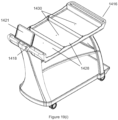
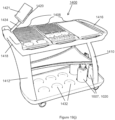
- the plurality of slots on the loading cart can be defined on a top surface of the at least one tray or on both surfaces, i.e., the tray is reversible.
- the slots can be slots of different sizes adapted to receive the plurality of consumables of different sizes.
- the support for the computer screen can be an adjustable support.
- the adjustable support can be rotatable substantially about a vertical axis and/or tiltable about an axis that is substantially orthogonal to the vertical axis.
- the at least one shelf is a top shelf.
- the cart may also have a bottom shelf and/or a middle shelf.
- the cart may have a compartment under the at least one tray or top tray and the compartment is adapted to store a coolant.
- the compartment may also have a drainage port, and the compartment's bottom surface may be concave.
- the mobile body of the curt should be supported by at least one caster wheel, and the caster wheel can be a hubless caster wheel.
- the loading cart may hole a plurality of consumables, such as at least one multi-well plate, and the at least one multi-well plate may comprise at least one assay plate or at least one dilution plate.
- the plurality of consumables may comprise at least one container of a reagent.
- the plurality of consumables may comprise at least one tube or at least one trough.
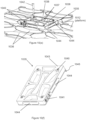
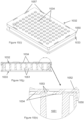
- An example of the tray is illustrated in Figures 19(a)-19(j) .
- the present invention is also related to a method of instructing a user to load consumables onto an assay system comprising using the loading cart discussed above and/or hereinafter.
- the method may comprise arranging a plurality of consumables on the loading station in accordance to a first arrangement displayed by a user interface on the screen.
- the present invention is further related to a method for loading consumables to conduct an assay into an assay system, comprising steps of:
- the at least two opposite gripping areas in one embodiment are bordered by raised lines.
- the at least two opposite areas comprises at least a pair of divots that are sized and dimensioned to receive a corresponding pair of protrusions on the gripper arm.
- the pair of protrusions may comprise distal ends of removable screws attached to the gripper arm.
- the at least a pair of divots may comprise an upper pair and a lower pair.
- the plate is preferably made of cast aluminum and/or is machined from cast aluminum, and can be anodized.
- a further aspect relates to a plate for teaching or training an automated instrument, the plate being sized and dimensioned to the size and dimensions of an ANSI-SLAS-format assay plate and comprising an outer rectangular perimeter and at least one support member connecting a first side of the rectangular perimeter to a second side of the perimeter, wherein at least one reference pad is located on a first major surface of the plate and corresponds to a location of at least one well in the ANSI-SLAS-format assay plate, wherein a location of the at least one reference pad in one dimension of a three-dimensional coordinate system is measurable by a probe of an assay system when the plate is positioned in a plate carrier in the assay system.
- a further aspect relates to a method of training or teaching a robotic gripper or pipettor comprising using the plate described above.
- the method of training or teaching a robotic gripper using the plate described above comprises at least one of the following steps:
- the shelving assembly may comprise an M x N rectilinear array of sets of vertically aligned storage units, wherein M and N are integers.
- a top horizontal member of the shelving assembly may comprise alignment features for an ANSI SLAS compliant container bottom.
- the top horizontal member may also comprise alignment features for a lid of an assay reagent holder that is larger than an ANSI SLAS compliant container bottom.
- Additional assays include an assay system comprising a housing, wherein the housing includes a continuous glass member, wherein a touch screen for a computer screen is formed by a first portion of the continuous glass member and an array of pressure transducers, and wherein a sound emitter is formed by a second portion of the continuous glass member and at least one sound exciter.
- the instruction to the user interface in this automated assay system may further include an instruction to load consumables from a kit, and/or an instruction to load consumables to an intermediate consumable loading station, which may comprise a mobile cart.
- the instruction may further comprise an instruction to the robotic controlled pipettor to obtain its vertical position using a training plate, which may include an instruction to obtain its horizontal position.
- the instruction further comprises an instruction to the robotic controlled gripper arm to obtain its vertical position using a training plate, which may include an instruction to obtain its horizontal position.
- the ECL reader validation comprises at least one of the following steps:
- the at least one processor preferably executes at least two instructions, preferably at least three instructions, or preferably at least four instructions.
- a further aspect of the present invention relates to a method for operating an automated assay system to minimize potential errors in loading consumables for an assay and running the assay,
- the instruction to the user interface in this method may further include an instruction to load consumables from a kit, and/or an instruction to load consumables to an intermediate consumable loading station, which may comprise a mobile cart.
- the instruction may further comprise an instruction to the robotic controlled pipettor to obtain its vertical position using a training plate, which may include an instruction to obtain its horizontal position.
- the instruction further comprises an instruction to the robotic controlled gripper arm to obtain its vertical position using a training plate, which may include an instruction to obtain its horizontal position.
- the at least one instruction further comprises an instruction to execute a qualification procedure.
- the qualification procedure comprises at least one of the following steps:
- the ECL reader validation comprises at least one of the following steps:
- the at least one processor preferably executes at least two instructions, preferably at least three instructions, or preferably at least four instructions.
- the invention also relates to an automated assay system configured to use assay consumables in the conduct of an assay, said assay system comprises at least one processor and at least one storage medium,
- This automated assay system comprises more than one component and an update to one component does not require a revalidation of all the components.
- the master organizer serves as a conduit to pass information among the plurality of components. At least one of these components is further separated into sub-components, wherein each sub-component operates substantially independently of each other and has substantially no interaction with each other, and wherein a sub-master organizer is connected to the sub-components and the sub-master organizer instructs each sub-component when to operate.
- an update preferably a software update, to one sub-component does not require a revalidation of all the sub-components.
- the invention further relates to an assay system configured to use assay consumables in the conduct of a first assay, wherein the first assay comprises a unique assay identifier, said assay system comprises
- the general assay protocol may contain assaying steps for a V-PLEX assay, a U-PLEX assay, an immunogenicity assay, a pharmacokinetic assay, or a custom sandwich assay.
- the general assay protocol may also contain assaying steps for serology assays, which identify antibodies in the serum or other bodily fluids.
- Additional assay systems relate to an automated assay system configured to minimize user, instrument, and assay method variations, the system comprising at least one of:
- the automated assay system is configured to minimize user, instrument, and assay method variations, the system comprising a robotic gripper arm and a robotic pipettor and also comprising software and an instrument component for at least one of:
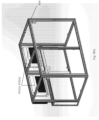
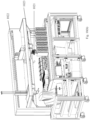
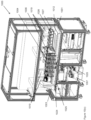
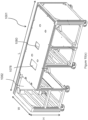
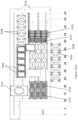
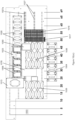
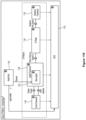
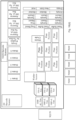
- an automated assay system comprising a robotic gripper arm and a robotic pipettor, and comprising at least the following additional components: (a) a plate carrier, (b) a tip box carrier, (c) five optionally heatable shakers, (d) an air cooling and handling system, (e) an assay consumable storage unit for assay reagents, (f) an assay consumable storage unit for immediate-use tips, (g) an assay consumable storage unit for reserve tips, (h) an assay consumable storage unit for plates, (i) positions for affixing assay consumable storage units for tubes and troughs, and (j) a platform or table or both; wherein said components (a)-(c) and (e)-(h) are located on said platform or table within the system in substantially the same position in relation to each other as shown in Figure 10(a) , (b) , (c) , (l) , (n) , or (o) , and wherein component (d) is located on a
- This assay system may further comprise a plate washer located below the platform and/or table, and the platform or table has an opening for accessing said plate washer.
- the platform can be attached to and be supported by the table.
- the assay system may further comprise an assay reader, preferably an ECL reader, located below said platform or table.
- the platform or table also has an opening for disposing of waste, and a chute for solid waste extending from above said waste opening, through said waste opening, and below said waste opening.
- At least one waste container is located below said platform or table.
- a laptop computer is provided to control said robotic gripper, said robotic pipettor, and said components (c) and (d).
- the assay system may also comprise containers for wash buffer and liquid waste below said plate washer.
- the components of this assay system can be located relative to each other substantially as shown in Fig, 10(c) , (l) , (n) .
- the components can also be located relative to each other as shown in one or a combination of Figure 10(a)-(d) , (l)-(p) (s) , and (u) .
- the components may have dimensions within 10% of those shown in any of the Figures or discussed in the specification.
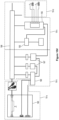
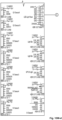
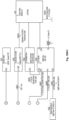
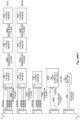
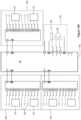
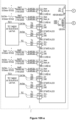
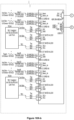
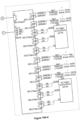
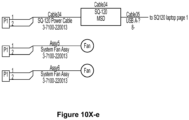
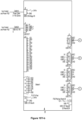
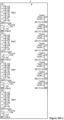
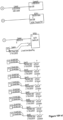
- the electrical and data wiring of this assay system may follow the wiring diagram of one or a combination of Figure 10(v)-(y) .
- One or more universal power system (UPS) can be supplied below the platform or deck.
- the components below the platform or deck are preferably separated into compartments as shown in Figure 10(a) , (b) , or (c) .
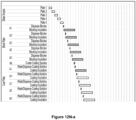
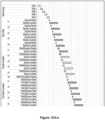
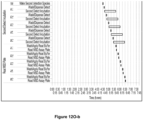
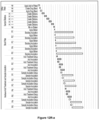
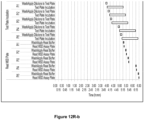
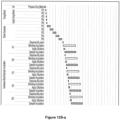
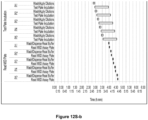
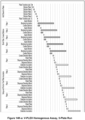
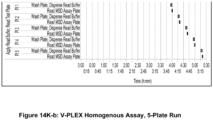
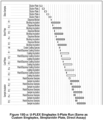
- the present invention further includes an automated method of performing an assay comprising the sequence and timing of any of Figures 9(d) , 12(m)-(p) , 12(r)-(s) , 13(d)-(f) , 14(d) , (f)-(l) , 15(b) , 15(d)-(h) , 16(b) , 17(b) , 17(d)-(h) .
- the invention relates to an automated assays system comprising
- the process of this system may further comprise one or more of the following steps:
- the steps are preferably carried out under temperature control able to maintain 20-24°C ⁇ 1°C, and the measurement is an ECL measurement.
- the measurement can also be a multiplexed measurement.
- Additional automated assay systems relate to an automated assays system comprising
- a further aspect relates to an automated assay system comprising
- Figures that are presented in subparts on separate drawing sheets, e.g., Figures 10V-a -, 10V-b , 10V-c and 10V-d , and have two suffixes separated by a hyphen are enlarged portions of a single drawing, e.g., Fig. 10(v) or 10V . These enlarged Figures are referred in the specification hereinbelow collectively and without the second suffix, e.g., as Fig. 10(v) or 10V .
- sample is intended to mean any biological fluid, cell, tissue, organ or combinations or portions thereof, which includes or potentially includes a biomarker of a disease of interest.
- a sample can be a histologic section of a specimen obtained by biopsy, or cells that are placed in or adapted to tissue culture.
- a sample further can be a subcellular fraction or extract, or a crude or substantially pure nucleic acid molecule or protein preparation.
- the samples that are analyzed in the assays of the present invention are blood, peripheral blood mononuclear cells (PBMC), isolated blood cells, serum and plasma.
- PBMC peripheral blood mononuclear cells
- Other suitable samples include biopsy tissue, intestinal mucosa, saliva, cerebral spinal fluid, and urine.
- the assay consumables and systems used in the present invention include a variety of devices and configurations.
- the assay system used in the present invention includes an assay reader capable of conducting a biological assay using an assay consumable.
- the assay consumable comprises an identifier (referred to alternatively throughout the specification as an identifier, a consumable identifier, or an assay consumable identifier) and the assay system, assay reader or a component thereof comprises an identifier controller that interacts with the identifier.
- the identifier is associated with information concerning the assay consumable, which can include but is not limited to, how the consumable is manufactured and handled prior to use and how the consumable is used in an assay system (referred to collectively as "consumable data").
- the assay system is configured to use an assay consumable in the conduct of an assay, and the assay system includes an identifier controller adapted to (i) read consumable data from an assay consumable identifier associated with the assay consumable; (ii) access consumable data associated with an assay consumable that is indexed by an assay consumable identifier, wherein the consumable data are stored locally on the assay system or assay reader or remotely on a vendor computing system; and optionally, (iii) erase consumable data associated with the assay consumable identifier; and/or (iv) write consumable data indexed to the consumable identifier to the assay system and/or a remote data table.
- an identifier controller adapted to (i) read consumable data from an assay consumable identifier associated with the assay consumable; (ii) access consumable data associated with an assay consumable that is indexed by an assay consumable identifier, wherein the consumable data are stored locally on the assay system or assay reader
- the invention provides an assay system configured to use an assay consumable in the conduct of an assay, wherein the assay consumable includes an assay consumable identifier as described herein and the assay system includes (a) a storage medium comprising consumable data repository; and (b) an identifier controller adapted to read information from the consumable identifier.
- the system comprises a storage medium including a consumable data repository comprising local consumable data.
- the local consumable data stored to the assay system includes consumable identification and/or configuration information and one or more steps of an assay protocol that can be applied by the system in the conduct of an assay using a consumable.
- the assay consumable identifier includes information that can be used to identify a specific consumable, e.g., lot specific information for a given lot of consumables and/or information that is specific to an individual consumable, and the corresponding local consumable data stored to the assay system includes information that is used to identify a consumable associated with the system, e.g., as a member of a given lot or as an individual consumable within a lot and it also includes information that is used by the system once the consumable is identified to carry out an assay protocol using that consumable.
- a specific consumable e.g., lot specific information for a given lot of consumables and/or information that is specific to an individual consumable
- the corresponding local consumable data stored to the assay system includes information that is used to identify a consumable associated with the system, e.g., as a member of a given lot or as an individual consumable within a lot and it also includes information that is used by the system once the consumable is identified to carry out an assay protocol
- the consumable data can include one or more analytical tools that can be applied by the system to analyze and interpret data generated using that consumable, system and/or consumable technical support information or combinations thereof.
- the system can also be configured to receive updates to the consumable data repository from a remote storage medium, wherein those updates include additional consumable data, including but not limited to additional consumable identification and/or configuration information, assay protocol information, and one or more of the following: (x) one or more analytical tools that can be applied by the system to analyze data and interpreted results generated during and/or after the conduct of an assay, (y) assay system maintenance information, (z) system-consumable promotional information, and (xx) system and/or consumable technical support information.
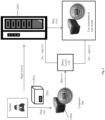
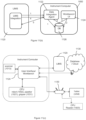
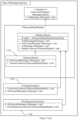
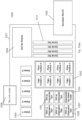
- Figure 1 shows how consumable data are generated, stored and used by the manufacturer, distributor, or supplier (referred to herein as "vendor").
- the vendor generates a consumable and/or a set or lot of consumables (101) and for that consumable or lot of consumables, consumable data are generated using a consumable data (CD) creation system (102) and associated with a consumable identifier (103) indexed to the consumable or lot of consumables (step i).
- the consumable data are generated by the consumable vendor before, during and/or after the individual consumable and/or lot of consumables are made and/or distributed.
- the CD creation system generates a database of CD information for that consumable or lot, i.e., a CD database, to which consumable data are stored.
- the CD database is sent to a CD Server (104) which includes a master repository of all consumable data.
- the CD creation system stores information that is used to associate a given consumable identifier with consumable data in the master repository.
- the CD creation system and/or CD Server are located on a remote computing system, i.e., a computing system remote from the assay system and/or the customer or customer, e.g., a site maintained by the vendor.
- the vendor generates consumable data for a consumable or lot (a) and associates that information with a consumable identifier (b) indexed to that consumable or lot.
- the CD system also (step ii) generates a CD database; (step iii) stores consumable data to the CD database; and (step iv) sends the CD database to the CD Server (c), which includes a master repository of all consumable data.
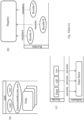
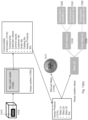
- Figure 2 illustrates one method of distributing consumable data to a customer or designated user of a customer (referred to collectively herein as a "customer").
- the vendor Upon receipt of an order from a customer or when the consumable or lot is manufactured (step i), the vendor generates, stores and sends a CD database to the CD server (201) (step ii).
- the CD database can include order fulfillment information, i.e., a summary of the components of the order for a given customer so that the system can verify that all components of the order have been supplied to the customer.
- the customer receives the consumable (202), including consumable identifier (203), and contacts the consumable with the assay system (204) in preparation for the conduct of an assay (step iii), the system reads and/or accesses the data associated with the assay consumable identifier (203) and that information is used by the system to identify the consumable (202) (step iv).
- the system reviews the consumable data stored locally on the system in a local storage medium (referred to in Fig. 2 as "local CD") to identify that consumable data stored to the storage medium that can be used for the conduct of an assay using a given consumable. If the storage medium includes the consumable data for that consumable or lot, the consumables can be used in the system (step v).
- the system can query the customer for that consumable data and the customer can communicate with the vendor to receive the requisite consumable data, e.g., via email, compact diskette, memory card/stick, flash drive, web data storage service, etc. (step vi).
- the vendor sends consumable data binary files (including but not limited to encrypted XML files) to the customer, e.g., as an email attachment to a customer email account, the customer loads that file attachment to the assay system and the system software stores the consumable data to the local system consumable data repository.
- the consumable/lot of consumables can then be used in the instrument (step vii).
- the CD server can be connected to the system via a direct interface which can automatically obtain the consumable data from the CD server if it is not available on the system locally.
- the vendor generates, stores and sends a CD database to the CD server for a consumable order and/or lot of consumables, as shown in Fig. 2 and as described above. Thereafter the customer receives the consumable, order and/or lot and contacts the system with the consumable identifier to enable the system to identify the consumable or lot.
- the system software queries the system consumable data repository for the consumable data associated with that consumable identifier and if that consumable data are available locally on the system, the software will adjust the system based on the consumable data, if necessary.
- the system will either (i) prompt the customer to manually obtain the consumable data from the vendor, or (ii) automatically, via a direct interface with the CD server, obtain the consumable data from the CD server and store that information locally on the system consumable data repository.
- the software adjusts the system based on the consumable data, if necessary, and conducts an assay.
- the consumable or lot can be used in the system to conduct an assay and display the assay results to the customer.
- the system software adjusts the output to the customer based on the consumable data.
- the CD server can periodically send consumable data for new lots of consumables/consumable types to a customer assay system, e.g., via email, CD, memory card/stick, flash drive and/or via a remote interface between the system and the CD server.
- the storage medium comprises a consumable data repository including the consumable data and the assay system is configured to receive updates to the repository from a remote storage medium, e.g., via email, CD, memory card/stick, flash drive and/or via a remote interface.
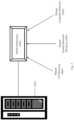
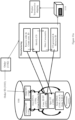
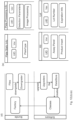
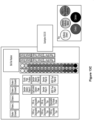
- Figure 3 illustrates the verification of the consumable data by the system software and the consequences of that procedure.
- the customer inserts the consumable (301), with consumable identifier (302), into the system (303) (or otherwise contacts the consumable identifier with the controller on the system) and the system software identifies the consumable via the consumable identifier (302).
- the system will attempt to associate that identifier with the consumable data stored locally on the system repository. If the consumable data are verified and valid, the system will process the consumable and display the results of that processing step to the customer. But if the consumable data are invalid or unverifiable, although the consumable will be processed by the system, the results of that analysis will not be displayed or otherwise available to the customer until the consumable data are verified by the system software.
- the invention provides a method of controlling customer access to an assay system and/or assay consumable by a vendor wherein the system comprises a system identifier, and the method includes receiving the system identifier from a customer, wherein the system identifier is sent to a vendor computing system; identifying the system identifier by the vendor; and performing an operation comprising:
- the system identifier includes information that uniquely identifies the assay system, e.g., a serial number or other identification code that is generated and used by the vendor to identify the assay system.
- the system identifier is generated by the vendor during or after the manufacturing process and/or as the system is being prepared for shipment or transfer to a customer.
- the step of enabling access includes the step of sending an access code from the vendor to the customer, thereby enabling access to the system.
- the access code can be a full or a partial access code that enables different functionalities in the system.
- the access code is a partial access code that enables the system to operate in a demonstration mode.
- the partial access code can be time-limited.
- the access code can be a full access code that enables the system to be fully operational.
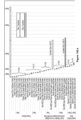
- the CD server (401) includes a master repository (402) that comprises one or more directories of (i) consumable data; (ii) system data; and (iii) customer data.
- the data contained in one or more of directories (i)-(iii) can be supplied to the master repository by an interface between the CD server and one or more supplemental vendor directories.
- the master repository comprises (i) a master customer data directory (403); (ii) a master system identifier directory (404); and (iii) a master customer data directory (405).
- customer data are supplied to the CD server via an interface to a supplemental vendor-customer directory that maintains customer data.
- Customer data can be stored in one or more supplemental vendor-customer directories, each connected via an interface to the CD server.
- the master CD database comprises a plurality of CD directories, each generated for a consumable or lot of consumables.
- the master system identifier directory includes the unique system identifiers for each system manufactured and/or distributed by the vendor.
- the master customer directory and/or supplemental vendor-customer directories that interface with the CD server include information related to each customer of the vendor, e.g., contact information for the customer and individual customers at that customer, billing information, pricing information, shipping information, order history, etc.
- a vendor when a system is manufactured and/or prepared for shipment, a vendor generates a system identifier for that system.
- the system identifier is stored in the master system identifier directory or available via an interface between a supplemental vendor directory to the CD server. If the system is ordered by a customer, order information, e.g., purchase order, a related quote, pricing, terms and conditions of sale or lease, related service agreements, etc., and customer information is stored to the master customer directory and/or to one or more supplemental vendor-customer directories that interface with the CD server.
- order information e.g., purchase order, a related quote, pricing, terms and conditions of sale or lease, related service agreements, etc.
- customer information is stored to the master customer directory and/or to one or more supplemental vendor-customer directories that interface with the CD server.
- the unique system identifier for that system is associated with the customer that has purchased that system in the master repository, as well as any information regarding related purchases by that customer.
- Shipping information for that system to the customer is also available in the customer directories(s) and once the system is shipped the customer receives a shipping confirmation, a copy of which is also stored in the customer directories.
- the customer receives the system and in a preferred embodiment, once installation and training on the system is completed, if required, the system software connects to the CD server via a remote interface between the system and the CD server to enable interaction between the two.
- the system initially connects to the CD server to confirm that system installation, and training is completed and successful and the CD server records that confirmation.
- the customer receives a confirmation code, system login, and/or email address from the system once the system is installed and training is completed and the customer can login to the CD server via that confirmation code, system login and/or email, thereby providing a customer login to the CD server that provides a separate vendor-customer interface without a direct connection between the system and the CD server.
- the separate vendor-customer interface can be a portal on a vendor hosted customer accessible website via a password and/or the customer and the CD server can communicate via an email exchange server configured to send and receive emails between customers and the CD server (referred to collectively as an "indirect interface" between the customer and the CD server).
- the vendor can communicate with the customer via a direct system-CD interface (referred to as a "direct interface") and/or via an indirect interface.
- a direct interface referred to as a "direct interface”
- an indirect interface the customer can then purchase consumables, the system will read the consumable identifier and confirm consumable data is stored locally, receive consumable data from the CD server, directly or indirectly, if necessary, and then the system will be enabled to use that consumable or lot.
- the customer and vendor can interact in a variety of ways and because the vendor has the ability to track customer-specific use information for the system and consumables purchase and/or used by the customer, communication between the parties can be more meaningful and productive. For example, the customer can browse and/or purchase vendor products, receive customer assistance, schedule service calls, etc. via the direct or indirect interface. Because the vendor is able to track customer activity and purchases so closely via the consumable identifier/CD server, the vendor can tailor its interactions with the customer based on that information. For example, because the vendor is aware of the customer's order history, the vendor can send the customer promotional materials for products related to those products the customer has purchased/used in the past.
- the vendor can send the customer preventative maintenance tips and reminders, general or specific customer training and seminars based on the customer's unique needs (and informed by tracking consumable data for that customer), and information regarding system service, warranty repairs, service contract information and reminders, etc.
- the vendor tracks use of consumables by an assay customer and the consumable data stored to the assay system includes system-consumable use information.
- the assay system is configured to send system-consumable use information directly or indirectly to the CD server. If a direct interface is enabled between the system and the CD server, system-consumable use information can be sent automatically. If, however, the direct interface is not enabled, system-consumable use information can be provided indirectly by the customer to the CD server. In this embodiment, the system can periodically prompt the customer to provide system-consumable use information to the vendor via the indirect interface.
- the vendor can maintain a directory of customer consumable information to track consumable use and information from that directory is used to send consumable data, via the direct or indirect interface, which can be relevant to a customer based on prior consumable and/or system use. If the direct interface is enabled, the assay system can be configured to receive assay system maintenance and/or promotional information from a vendor computing system related to an individual customer's prior consumable and/or system use.
- the vendor can also track and/or convey system maintenance information to the customer, e.g., monitoring system and/or system components usage, service history, system troubleshooting information, the results of diagnostics run on the system, control charting, periodic maintenance scheduling, warranty information regarding the system and/or a components thereof, or combinations thereof.
- the system software can be programmed to monitor various components of the system and automatically or when prompted, send monitoring reports to a remote computing system and/or to a service technician. If a direct interface is not enabled, the system can prompt the customer to send monitoring reports to the CD server via an indirect interface. In addition or alternatively, such system monitoring reports can be accessed by a service technician charged with the task of maintaining and/or servicing the system on site or remotely.
- the CD server monitors system component usage and/or warranty information and based on standard system component lifetimes and/or warranty terms, schedules periodic system/component maintenance and/or upgrades by a service technician.
- the CD server can maintain a log of the service history for a given assay system and schedule a service call by a service technician (this can be done using either a direct or indirect interface).
- the remote computing system can also send an individual assay system software upgrades via a direct or indirect interface.
- system software including, but not limited to, expected motor positions during normal usage, positional errors for each expected motor position, corrective actions and/or attempted corrective actions taken by the system in the event of a motor positioning error, and error frequencies; component usage, e.g., the approximate time the component has been powered on in the system, and in a preferred embodiment, the system also tracks the relative lifespan of that component under normal use conditions; locking mechanisms attempts, re-attempts, and failures; bar code identifier controller attempts, re-attempts, and failures; approximate temperature of one or more components in the system, error warnings, database performance and capacity, instrument hard disk capacity, software and firmware version and patches, customer login/logout, system startup and shutdown, and the like.
- the system software can also be programmed to monitor the time the analyzer camera has been powered on and approximate temperature, the use cycle of latches within the system, bar code identifier controller attempts, re-attempts, and failures, consumable locking and unlocking events, ECL waveform voltage and integrated current, image processing analysis accuracies and failures, consumable type, kit, owner, consumable identifier (e.g. bar code), and time stamp for each consumable run in the system, or combinations thereof. Still further, the system software can also monitor experiments conducted in the system, e.g., when, by whom, and which type of consumable(s) were used in that experiment. Such system-use monitoring information can be sent via a direct and/or indirect interface, to the CD server to enable the vendor to schedule appropriate support, service and/or maintenance on the system.
- a vendor can provide use and/or purchasing assistance. For example, a vendor can track consumable use and purchase history and based on the consumable data for a given lot or consumable, the vendor can monitor the expiration data of a given lot or consumable and notify the customer of an approaching expiration date for a lot or consumable. Tracking use of an assay system/consumable type can also enable a vendor to track a relative schedule/frequency of consumable use and notify the customer that the customer's consumable supply needs to be replenished. If a direct interface is enabled, the system can also be configured to order/reorder consumables and the system can be further configured to track and confirm consumable orders from a vendor.
- a direct interface is not enabled, the system can monitor consumable use and inventory and prompt the customer to replenish a supply of one or more consumables.
- a system receives lot size information via the consumable identifier and by monitoring consumable usage, it can prompt the customer when the available consumable supply in a given lot has been diminished to a minimum level.
- the vendor can send the customer information regarding custom assay design services for a specific custom consumable type based on the customer's order/consumable use history.
- a direct or indirect interface can also provide customer training modules, consulting services, and/or live customer service assistance capabilities to facilitate the customer experience (i.e., live-chatting) (referred to collectively as system and/or consumable technical support information).
- tracking consumable/system use enables the vendor to send promotional material to the customer, e.g., when a new type or lot of consumables historically used by a given end-customer, the vendor computing system sends consumable data to the customer regarding those new products.
- promotional materials can also relate to new assay systems that might be of interest to the customer based on that customer's prior usage.
- the remote computing system can also send a customer literature references that can relate to one or more consumables/systems used by a given customer.
- the assay systems contemplated by the present invention are used to conduct any type of diagnostic or analytical method known in the art.
- Such analytical methods include but are not limited to clinical chemistry assays (e.g., measurements of pH, ions, gases and metabolites), hematological measurements, nucleic acid amplification assays (e.g., polymerase chain reaction (PCR) and ligase chain reaction assays), immunoassays (e.g., direct, sandwich and/or competitive immunoassays and serological assays), oligonucleotide ligation assays, and nucleic acid hybridization assays.
- clinical chemistry assays e.g., measurements of pH, ions, gases and metabolites
- nucleic acid amplification assays e.g., polymerase chain reaction (PCR) and ligase chain reaction assays
- immunoassays e.g., direct, sandwich and/or competitive immunoassays and serological assays
- Any biological reagent that might be used in such analytical methods can be used in such systems, including but not limited to nucleic acids, nucleotides, oligonucleotides, DNA, RNA, PNA, primers, probes, antibodies or fragments thereof, antigens, small molecules, e.g., drugs or prodrugs, streptavidin, avidin, and biotin.
- These systems can be portable, e.g., hand-held, and/or operated within a fixed laboratory or field setting, alone or in combination with one or more additional components, assay devices or systems.
- These systems can be used in a variety of applications, from field operations to laboratory settings, in a wide variety of industries, including but not limited to, medical, clinical, forensic, pharmaceutical, environmental, veterinary, biological, chemical, agricultural, waste management, hazardous chemical, drug testing, and in defense applications, e.g., for the detection of biological warfare agents.
- the assay systems, assay readers, and consumables used in the present invention can detect an analyte of interest by any suitable method, including but not limited to, optical, electromechanical, radiowave, electromagnetic, colorimetric, fluorimetric, chemiluminescent, electrochemiluminescent, radiochemical, nuclear magnetic resonance, enzymatic, fluorescent, particle-count, and cell-count based detection.
- the assay consumable includes devices in which one or more steps of an assay process are conducted and such devices can include one or more test sites where an assay measurement is conducted.
- the assay consumable includes at least one assay test site for an assay.
- a test site can include a plurality of distinct assay domains, at least two of the domains including reagents for measuring different analytes.
- the consumable can include a plurality of test sites for a plurality of individual assays.
- the assay consumable can be a component that provides a reagent or other assay component that is used by the system to conduct an assay.
- the assay consumable can be a container with one or more compartments for holding assay reagents.
- the assay consumable (or test sites therein) can be single use or it can be reusable.
- the assay consumable can be configured to conduct one test or multiple tests (sequentially or in parallel).
- a consumable with multiple test sites can be configured to use all of its test sites in parallel, to use its test sites at different times (e.g., assigning unused test sites to be used as new samples are delivered to the assay system), or a combination of both modes of operation can be enabled.
- the assay consumable can be any structure useful in diagnostic applications and that structure can be dictated by the particular assay format or detection method employed by the device.
- assay consumables suitable for use with the invention include, but are not limited to, test tubes, cuvettes, flow cells, assay cartridges and cassettes (which can include integrated fluidics for assay processing), multi-well plates, slides, assay chips, lateral flow devices (e.g., strip tests), flow-through devices (e.g., dot blots), pipette tips, solid phase supports for biological reagents and the like.
- test sites in the assay consumable are defined by compartments in the assay consumable, e.g., wells, chambers, channels, flow cells and the like.
- the assay consumable and/or test sites can include one or more components used to carry out an assay measurement according to one or more specific detection methodologies.
- components can include, but are not limited to, lateral flow matrices, filtration matrices, optical windows, sensors (e.g., electrochemical and optical sensors), solid phase supports for binding reactions (e.g., coated slides, chips, beads, pins, coated filtration or lateral flow matrices, tubes and the like), reagents (dry or in liquid form), electrodes, analyte selective membranes and the like.
- the assay consumable can be a device that incorporates a conventional lateral flow test strip, e.g., an immunoassay test strip, as an assay medium.
- the device is molded to include an identifier or the identifier is affixed to the device without any modification to the structure of the device and/or the assay medium.
- the device is placed within the analytical system, i.e., the assay system, for analysis and before, during or after the performance of the assay, the identifier controller within, affixed to or associated with the assay system reads the data contained on the identifier and uses that data in the assay or after the assay is completed by the system.
- the assay consumable and accompanying assay system or assay reader is capable of performing a multiplex assay.
- a multiplex assay is a type of assay in which multiple measurements are performed on a single sample, e.g., by distributing samples across multiple test sites and/or by carrying out multiple measurements on volumes of samples in individual test sites.
- the multiple measurements can include, but are not limited to, (i) multiple replicates of a measurement for an analyte; (ii) multiple measurements of a certain analyte (i.e., multiple non-identical measurements for the same analyte, e.g., measurements that differ in format or in the identity of the assay reagents that are employed); and/or (iii) measurements of multiple different analytes.
- an assay consumable is configured to carry out, in one or more test sites, multiplex measurements that include at least two assays for two different analytes.
- Multiplex measurements that can be used with the invention include, but are not limited to, multiplex measurements (i) that involve the use of multiple sensors; (ii) that use discrete assay domains on a surface (e.g., an array) that are distinguishable based on location on the surface; (iii) that involve the use of reagents coated on particles that are distinguishable based on a particle property, such as size, shape, color, etc.; (iv) that produce assay signals that are distinguishable based on optical properties (e.g., absorbance or emission spectrum), (v) that are based on temporal properties of an assay signal (e.g., time, frequency or phase of a signal), and/or (vi) that are based on some other assay characteristic.
- multiplex measurements i) that involve the use of multiple sensors; (ii) that use discrete assay domains on a surface (e.g., an array) that are distinguishable based on location on the surface; (iii) that involve the use of reagent
- interpretation of multiplexed assay results can involve the use of multiplexing information, such as the identity of the assays carried out in each test site and, within a test site, any assay characteristics (identity of specific sensors, location and identity of assay domains, etc.) that are used to distinguish assays carried out in a test site and/or that are used to tie a specific assay identity to the corresponding assay signal.
- multiplexing information such as the identity of the assays carried out in each test site and, within a test site, any assay characteristics (identity of specific sensors, location and identity of assay domains, etc.) that are used to distinguish assays carried out in a test site and/or that are used to tie a specific assay identity to the corresponding assay signal.
- an assay test site comprises a plurality of distinct assay domains and each domain comprises one or more reagents for measuring a different analyte.
- Multiplexing information including the location, identity, and composition of each assay domain, is used to identify the assay signal generated at each domain and connect it to a determination of the presence or amount of the corresponding analyte (a process which can include the application of additional consumable data such as signal thresholds and/or calibration parameters).
- Such multiplexing information can be provided as consumable data and/or associated with the consumable identifier.
- a test site can be configured to carry out a plurality of multiplexed measurements (e.g., it can include a plurality of distinct assay domains, wherein each domain comprises reagents for measuring a different analyte).
- the assay consumable can include a plurality of test sites. Information regarding the exact configuration of the one or more test sites, assay domains, and/or one or more sectors in a consumable can be included in the information saved to the assay consumable identifier and/or provided as consumable data.
- This information can include the location and identity of the test sites, assay domains, and/or one or more sectors as well as multiplexing information (as described above) including the number, identity and differentiating characteristics of the individual measurements within a test site, assay domain, and/or sector (e.g., the specific locations, identities and/or assay reagents of assay domains within each test site).
- multiplexing information including the number, identity and differentiating characteristics of the individual measurements within a test site, assay domain, and/or sector (e.g., the specific locations, identities and/or assay reagents of assay domains within each test site).
- the use of a test site, assay domain, and/or sector in an assay consumable can also be recorded to the identifier to track the use of the consumable in an assay system.
- the identifier and/or consumable data can also include information concerning the assay format and specific processing steps to be used for an assay consumable or test site, assay domain, and/or sector of an assay consumable.
- the identifier and/or consumable data can also include information concerning analytical methods that should be applied by the system once an assay is conducted to analyze the output of an assay in a given test site, assay domain, and/or sector and, optionally, to provide results that combine the output from multiple assays in a test site, assay domain, and/or sectors.
- test sites can be configured in any suitable configuration, depending on the geometry of the consumable and/or the type of assay conducted with the consumable.
- the test sites are configured as wells and/or chambers in the assay consumable.
- the assay consumable of the present invention can be a multi-well plate (e.g., a 24-, 96, 384- or 1536-well plate), and the wells of the plate can further comprise a plurality (e.g., 2 or more, 4 or more, 7 or more, 25 or more, 64 or more, 100 or more, etc.) of distinct assay domains.
- Multi-domain multi-well plates that are adapted to allow assay measurements to be conducted using electrode induced luminescence measurements (e.g., electrochemiluminescence measurements) are described in U.S. Application Ser. No. 10/238,391, entitled “Methods and Reader for Conducting Multiple Measurements on a Sample", filed on Sep. 10, 2002 , hereby incorporated by reference.
- the exact configuration of the domains, test sites, and/or sectors in an assay consumable, as well as the specific identity of each domain, test site, and/or sector and the reagents bound to that domain/test site/sector can be included in the information saved to the assay consumable identifier and/or provided as consumable data.
- the use of a given domain, test site, and/or sector in an assay consumable can also be recorded to the identifier to track the use of the consumable in an assay system.
- Assay consumables can be used in a plurality of diverse assays and this diversity leads to a variety of suitable configurations of the associated consumable.
- the same analyte is measured at different assay domains within a test site, the different assay domains being designed to measure a different property or activity of the analyte.
- Information concerning the assay format that can be used in an assay consumable, test site and/or assay domain can also be saved to the assay consumable identifier and/or provided as consumable data.
- the identifier and/or consumable data can also include information concerning analytical methods that should be applied by the system once an assay is conducted to analyze the output of an assay in a given test site and/or domain and compare that output to an assay in a separate test site and/or domain.
- Such assay consumables include one or more, and in one embodiment, a plurality of test sites and/or assay domains for conducting one or more assay measurements simultaneously or sequentially.
- the test sites can be configured as wells and/or chambers.
- These test sites and/or assay domains comprise one or more electrodes for inducing luminescence from materials in the test sites and/or assay domains.
- the assay consumables can further comprise assay reagents in liquid or dry form, e.g., in the test sites, e.g., wells or chambers, of the consumable.
- an assay consumable or multi-well assay plate can include several additional elements, e.g., a plate top, plate bottom, wells, working electrodes, counter electrodes, reference electrodes, dielectric materials, electrical connections, and assay reagents.
- the wells of the plate can be defined by holes or openings in the plate top, or as indentations or dimples on a surface of a plate.
- the plates can have any number of wells of any size or shape, arranged in any pattern or configuration and can be composed of a variety of different materials.
- Exemplary embodiments of consumables that can be used in the present invention include industry standard formats for the number, size, shape and configuration of the plate and wells, e.g., 96-, 384-, and 1536-well plates, with the wells configured in two-dimensional arrays.
- Other formats can include single well plates, 2-well plates, 6-well plates, 24-well plates, and 6144-well plates.
- Multi-well assay plates can be used once or can be used multiple times and are well suited to applications where the plates are disposable.
- Various configurations for suitable assay plates can be used in the present invention, including but not limited to those depicted in Figs. 11A , 12A , 13A , 13B , 14A , 15 , and 16A of U.S. Application Ser. No.
- Assay consumables can be used in an assay reader that can be used to induce and measure luminescence, e.g., electrode induced luminescence or electrochemiluminescence, in assays conducted in or on assay consumables, e.g., multi-well assay plates.
- the assay reader can also induce and/or measure current and/or voltage, for example, at an electrode.
- the assay reader can incorporate, for example, one or more photodetectors; a light tight enclosure; mechanisms to transport the assay plates into and out of the assay reader (and in particular, into and out of a light tight enclosure); mechanisms to align and orient the assay plates with the photodetector(s) and/or with electrical contacts; additional mechanisms to track and identify plates (e.g.
- the assay reader can also include mechanisms to store, stack, move and/or distribute one or more multi-well assay plates (e.g. plate stackers and/or plate conveyors).
- the assay reader can be configured to measure light from multi-well assay plates by measuring light sequentially from a plurality of sectors or regions of the plate (i.e., a grouping of a plurality of adjacent assay domains within a plate) and/or from the entire plate substantially simultaneously or simultaneously.
- the assay reader can also incorporate additional microprocessors and computers to control certain functions within the system and to aid in the storage, analysis and presentation of data.
- Various configurations for suitable assay readers can be used in the present invention, including but not limited to those depicted in Figs. 17 to 23 of U.S. Application Ser. No. 2004/0022677 , incorporated herein by reference.
- the assay reader is an apparatus described and claimed in U.S. Application Serial No. 14/147,216 , published as US 2014/0191109 and WO 2014/107576 , the disclosure of which is incorporated herein by reference. Particular embodiments of the assay reader are illustrated in the Figures of U.S. Serial No. 14/147,216 and certain of those figures are reproduced herein.
- Figs. 5(a)-(b) show a front and rear view, respectively, of apparatus 500 with a stylized cover
- Figs. 5(c)-(d) show the corresponding front and rear views, respectively, of the apparatus without the cover. As shown, e.g., in Fig.
- the apparatus includes a light detection subsystem 510 and a plate handling subsystem 520.
- the plate handling subsystem 620 includes a light tight enclosure 630 comprising a housing 631 having a housing top 632, bottom 633, front 634, and rear 635.
- the housing also includes a plurality of alignment features and the housing is adapted to receive a removable drawer.
- the removable drawer 640 is shown in Fig. 7 , being in the partially opened or closed position. Referring to Fig.
- the housing top 632 also includes one or more plate introduction (and ejection) apertures, 636 and 637, respectively, through which plates are lowered onto or removed from the plate translation stage (manually or mechanically).
- a sliding light-tight door (shown in Fig. 6(c) as 639) is used to seal the plate introduction apertures 636, 637 from environmental light prior to carrying out luminescence measurements.
- the housing top also includes an identifier controller to read and process data associated with an identifier on the plates.
- the identifier controller is a bar code reader (638) mounted via a light-tight seal over an aperture in the housing top, where the bar code reader is configured to read consumable identifiers (e.g.
- the consumable identifier e.g. bar code
- an identifier controller can be provided separately from the apparatus.
- the assay reader is a MESO QuickPlex SQ 120, available from Meso Scale Discovery, Rockville, MD.
- an assay system can include the following components: (i) a sample rack subassembly (810); (ii) a light-tight enclosure (820); (iii) an auxiliary plate subassembly (830); (iv) a pipettor subassembly (840); (v) a pipetting tip storage/disposal compartment (850); (vi) a liquid reagent subassembly (860); (vii) a well-wash subassembly (870); and (viii) a power supply (880).
- the apparatus is also attached to a computer through a user interface (not shown). This system enables fully automated random access analysis of samples using array-based multiplexed multi-well plate consumables.
- the apparatus achieves enhanced sensitivity and high sample throughput. It may be adapted for use with any of a variety of detection techniques, e.g., changes in optical absorbance, emission of luminescence or radiation, changes in light scattering and/or changes in a magnetic field.
- the apparatus is configured to detect the emission of luminescence, e.g., fluorescence, phosphorescence, chemiluminescence and electrochemiluminescence (ECL).
- ECL electrochemiluminescence
- the apparatus is configured to detect ECL. All the biological reagents required for an assay are provided in the apparatus, thus minimizing the consumable and reagent requirements for the apparatus.
- the apparatus depicted in Fig. 8 further comprises one or more consumable identifier controllers (not shown), either incorporated within the housing of the apparatus and/or positioned outside of the apparatus housing.
- the assay system (900) includes a plurality of subsystems positioned on a table or platform (901), wherein each subsystem is operatively connected to a robotic subsystem (902) configured to access and move one or more consumables, e.g., multi-well assay plates, from one subsystem of the assay system to another.
- a robotic subsystem 902 configured to access and move one or more consumables, e.g., multi-well assay plates, from one subsystem of the assay system to another.
- the plurality of subsystems include an assay reader (903); an assay consumable storage unit (904); a pipetting subassembly (905) comprising at least one pipetting probe (906) affixed to a pipetting head gantry (907) that provides X, Y, and Z motion of the probe to and from a pipetting tip washing station (908) and a plate washing subassembly (909)); an orbital shaking subassembly (910); a liquid reagent subassembly (911); and an electronic subassembly, including a computer (912).
- the computer also includes a user interface (not shown).
- the assay system can also include a multi-well plate preparation platform (913) positioned on the table (901) and configured to enable pipetting of liquids to and/or from one or more wells of a multi-well assay plate positioned on the preparation platform.
- the platform (913) is positioned on a linear track that enables movement of the platform in a direction parallel to the plane of the table to and/or from the pipetting subassembly (905).
- the platform and/or one or more subcomponents of the pipetting subassembly are configured to move in the X, Y, and/or Z direction relative to one another.
- the robotic subsystem is configured to move one or more plates to and/or from the plate preparation platform, the plate washing subassembly, the orbital shaking subasssembly, the assay reader, and the consumable storage unit.
- the assay system can further comprise an enclosure (914) including one or more environmental control units, e.g., thermoelectric cooling units (915(i) and 915(ii) respectively), disposed within the enclosure.
- the enclosure is configured to encase the assay system in order to maintain the internal temperature within the enclosure to approximately 20-30°C.
- the assay system depicted in Fig. 9(a) is configured to process multi-well assay plates that have been subjected to an offline sample preparation step, which can be performed manually, using an automated sample preparation system, or using an automated sample preparation system integrated with the assay system via an additional robotic subsystem.
- the reagents used in the conduct of an assay in the assay plates can be provided in one or more additional assay plate, e.g., a reagent plate and/or a dilution plate, i.e., a plate including a specific reagent used in the conduct of an assay.
- sample can be added offline to a sample plate
- the system uses one or more diluents and reagents that can be stored in a diluent plate and/or reagent plate, respectively, and the assay can be conducted in a test plate, i.e., a plate to which sample and/or reagents are added during one or more processing steps by the system.
- the system processes plates in batch-mode, i.e., all wells of a plate are operated on or processed simultaneously by the system before moving to the next step and/or the next plate.
- batch-mode i.e., all wells of a plate are operated on or processed simultaneously by the system before moving to the next step and/or the next plate.
- the system is configured to use 96-well multi-well plates, all 96 wells of a plate are subjected to each processing step in the assay system simultaneously before the system moves to the next step and/or the next plate.
- Fig. 9(d) shows the sequence of operations of the assay system operating in batch mode.
- a first system operation cycle includes the following steps: (a) one set of plates is moved into the storage unit of the assay system, the set including a sample plate, a diluent plate, and a test plate; (b) diluent and sample are taken from the diluent and sample plates, respectively, and added to the test plate; and (c) the test plate is moved to the orbital shaking subassembly and the sample and diluent plates are returned to the storage unit. Cycle 1 is completed when the first test plate of the set has completed a first incubation.
- the second system operation cycle includes the steps of (a) moving the test plate to the plate washing subsystem and washing the test plate; (b) moving the test plate and a detection antibody solution plate to the plate preparation platform; (c) adding detection antibody solution to the test plate; and (d) moving the test plate to the orbital shaking subassembly and returning the detection antibody solution plate to the storage unit. Cycle 2 is completed when the first test plate has completed the second incubation.
- the third system operation cycle includes the following steps: (a) move a test plate to the plate washing subsystem and wash the test plate; (b) move the test plate and a read buffer plate to the plate preparation platform; (c) add read buffer to the test plate; (d) move the test plate to the assay reader and return the read buffer plate to the storage unit; (e) read a signal from the assay reader and move the test plate from the assay reader to the storage unit.
- the assay system is configured to move a plate from one subsystem to another up to every three minutes (3 min/plate).
- the assay reader integrated with the assay system 900 is an assay reader as described herein, e.g., apparatus 500, illustrated in Figs. 5-7 .
- the assay reader is the apparatus described and claimed in U.S. Application Serial No. 14/147,216 , the disclosure of which is incorporated herein by reference.
- the assay reader is a MESO QuickPlex SQ 120, available from Meso Scale Discovery, Rockville, MD.
- the assay reader is a MESO SECTOR S600, available from Meso Scale Discovery, Rockville, MD.
- the assay consumable storage unit (904) can be configured to store any type of consumable used in the conduct of an assay in the assay reader.
- the storage unit is a multi-well plate storage unit configured to store a plurality of multi-well assay plates.
- the plate storage assembly is configured as a shelving subassembly comprising a plurality of shelving units each sized to accommodate a multi-well assay plate.
- the shelving subassembly comprises a housing including a housing top, housing back, left and right housing walls and a plurality of storage units disposed within the housing, wherein each storage unit includes a plate introduction aperture.
- the shelving subassembly can comprise an M x N rectilinear array of storage units, wherein M and N are integers, e.g., a 2 x 1, 2 x 2, 3 x 3, or 4 x 4 array.
- the subassembly comprises a 2 x 1 array of storage units.
- the shelving subassembly is a 2 x 1 array of twenty storage units.
- the pipetting subassembly (alone or in combination with the platform) provides for independent X, Y, and Z motion of a probe so as to allow it to access sample plates, reagent plates, and/or test plates (as required).
- the pipetting subassembly can also include the appropriate pumps and valves for controlling the pipettors and/or probes (not shown).
- a pump is used to drive fluids through the pipetting subassembly.
- One skilled in the art will be able to select appropriate pumps for use in the apparatus including, but not limited to diaphragm pumps, peristaltic pumps, and syringe (or piston) pumps.
- the pump also includes a multi-port valve to allow the pump to push and pull fluids from different fluidic lines. Alternatively, multiple pumps can be used to independently control fluidics in different fluidic lines.
- the pipetting probe can use fixed or disposable pipetting tips.
- the pipetting probe uses fixed pipetting tips.
- disposable pipetting tips can be stored in a pipetting tip storage/disposal compartment (not shown).
- the arm/track of the pipettor subassembly allows for access of the probe to the tip storage/disposal compartment for tip loading on the pipetting probe and tip removal after use.
- the fluidic lines connected to the pipetting probes may also be connected to working fluids or diluents so that the probes can be used to deliver these fluids/diluents to wells.
- the pipetting probes may include fluid sensing capability, e.g., using capacitive sensors to detect when the probes contact fluid in a tube or well.
- the pipetting probe includes a multi-channel pipetting probe enabling simultaneous fluid transfer to a plurality of wells of a multi-well plate.
- the pipetting probe includes a 96-channel pipetting head capable of simultaneous fluid transfer to a 96 well plate.
- the pipetting head and corresponding fixed pipetting tips are available from Apricot Designs, Covena, CA. In general, if fixed pipetting tips are used, they are supplied by the supplier of the pipetting probe, e.g., Apricot Designs, Covena, CA.
- the tips can be stored and disposed of in a tip compartment, including a housing for one or more individual drawers that can accommodate a standard disposable tip box (available from Axygen, Qiagen or Rainin) and a removable waste container for used pipetting tips.
- a standard disposable tip box available from Axygen, Qiagen or Rainin
- the pipettor probe is translated horizontally to locate the shaft in the slot and then translated vertically until the pipette tip is pulled off by the bracket.
- the specific slot that is used is chosen using a set pattern or a random pattern such that the used pipette tips are distributed evenly along the width of the waste container.
- the dimensions of the tips vary according to the dimensions of the pipetting probe, the volume of the sample/reagents dispensed and/or the dimensions of the plates within which the tip is placed. In one embodiment, the tip volume ranges from approximately 100 ⁇ L to 550 ⁇ L. In another embodiment, the tip volume ranges from about 100 ⁇ L to 250 ⁇ L.
- the plate washing subassembly can be any suitable commercial microtitre plate washing system, e.g., a plate washing subassembly available from BioTek Instruments, Inc., Winooski, VT, including but not limited to the 405 Touch Washer, 405 LS Washer, Elc405x Select Deep Well Washer, or the Elx50 Washer.
- the robotic subsystem can be any suitable tabletop commercial robotic system, e.g., systems available from Precise Automation, Inc., Fremont, CA.
- the liquid reagent subassembly includes a plurality of liquid reagent and waste compartments and for use in one or more steps of an assay conducted in the apparatus.
- a reagent/waste compartment comprises a compartment body that encloses an internal volume and a reagent or waste port for delivering reagent or receiving waste.
- the volume of the compartments in the subassembly are adjustable such that the relative proportion of the volume of the compartment body occupied by reagent and waste can be adjusted, e.g., as reagent is consumed in assays and returned to a compartment as waste.
- the total internal volume of the compartment body may be less than about 2, less than about 1.75, less than about 1.5, or less than about 1.25 times the volume of liquid stored in the body, e.g., the volume of reagent originally provided in the compartment, thus minimizing the space required for waste and reagent storage, and allowing for convenient one-step reagent replenishment and waste removal.
- the apparatus has a reagent compartment slot configured to receive the compartment, and provide fluidic connection to the waste and reagent ports, optionally via "push-to-connect” or "quick connect” fittings.
- the reagent and/or waste compartments are removable.
- the reagent and/or waste compartments are removable and the apparatus further includes a sensor, e.g., an optical sensor, to monitor the fluid level(s) in the reagent and/or waste compartments.
- the liquid reagent subassembly may include electronic scales to monitor the weight of fluid in the reagent and waste reservoirs for real-time tracking of reagent use and availability. Once the reagent and/or waste compartments reach a certain minimal or maximal capacity, as detected by the sensor or scale, the apparatus alerts the user to remove the reagent or waste compartment to replenish and/or empty the contents.
- the motor of the pipetting probe is in communication with the sensor or scale and when the reagent and/or waste compartments reach the minimal or maximal capacity, the pipetting probe motor is disabled by the apparatus, e.g., the probe sensor relays information regarding the capacity of the compartment to the instrument software, which then halts further pipetting action.
- the reagent and waste compartments may be provided as collapsible bags located in the subassembly body.
- One of the reagent and waste compartments may be provided as a collapsible bag and the other may be provided as the compartment body itself (i.e., the volume in the compartment body excluding the volume defined by any collapsible bags in the compartment body).
- the reagent cartridge may further comprise one or more additional collapsible reagent and/or waste compartments connected to one or more additional reagent and/or waste ports.
- one or the other of the reagent and waste compartments may be constructed from blow-molded plastic. Additionally or alternatively, waste can be pumped to an external drain or container.
- the liquid reagent subassembly also includes a reagent reservoir that is used during the conduct of an assay in the apparatus.
- each reagent compartment is connected via a fluidic line to a reagent reservoir that houses a volume of reagent used during the assay. Fluidic lines to the pipettor subassembly lead directly from the reagent reservoir.
- reagent is stored in a reagent compartment and a predetermined volume of reagent is dispensed from the reagent compartment to the reagent reservoir.
- the apparatus draws fluids for use in an assay from the reagent reservoir.
- the reagent compartment and reagent reservoir can be each connected to an independent fluid sensor.
- the fluid sensor in the reservoir monitors the internal volume within the reservoir and if the internal volume decreases below a predetermined level, reagent is dispensed from the reagent compartment to the reservoir. Likewise, if the internal volume of the reagent compartment decreases below a predetermined level, the fluid sensor signals to the operator to replace or refill the reagent container.
- the dual reagent compartment/reservoir assembly enables the apparatus to continually supply fluid to an assay as the assay is conducted by the apparatus as fluid is replaced in the reagent compartment without interrupting the assay processing by the instrument.
- the orbital shaking subassembly (910) is a counterbalanced assay consumable shaking apparatus as described and claimed in USSN 62/143,557, filed April 6, 2015 , the disclosure of which is hereby incorporated herein by reference in its entirety.
- the orbital shaking apparatus comprises (a) an orbital shaker assembly comprising a horizontal orbiting platform, and (b) an assay consumable storage assembly positioned on the platform.
- the storage assembly comprises (i) a shelving subassembly comprising a plurality of sets of vertically aligned storage units, within each storage unit is sized to accommodate a consumable and comprises a consumable latching mechanism; and (ii) a counterweight positioned within the storage assembly at a height corresponding to the center of mass of the storage assembly and the orbiting platform.
- the orbital shaking apparatus further comprises a rotating axle extending from the shaker assembly to the storage assembly in a vertical direction and the counterweight is operatively connected to the rotating axle.
- the assay system illustrated in Fig. 9 can include a table or platform, e.g., 901, or the system can be built and configured on a laboratory benchtop.
- the assay system is positioned on a table including one or more shelving units (916 and 917, respectively) positioned below the table top (901) and configured to house one or more elements or subsystems of the assay system.
- the various subsystems can be distributed across the benchtop in the same X-Y plane (not shown).
- FIG. 10 A further embodiment of an assay system of the invention is shown in Figure 10 and its subparts.
- the assay system (1000) includes a plurality of subsystems positioned on a table (1001), wherein each subsystem is operatively connected to a robotic subsystem (1002) configured to access and move one or more consumables, e.g., multi-well assay plates, from one subsystem of the assay system to another.
- the robotic subsystem of the instrument depicted in Figure 10 and its subparts includes one or more pipetting subsystem (1021), each including one or more pipetting tip head(s), e.g., a multi-channel pipetting tip head, which is used to dispense/draw fluids to/from wells of a multi-well plate.
- the pipetting subsystem is affixed to a gantry (1022) within the robotic system that enables the pipetting tip head to move throughout the assay system in the X, Y, and Z direction.
- the plurality of subsystems within the assay system includes an assay reader (1003); an assay consumable storage unit (1004); a plate washing subassembly (1005)); a plate shaking subassembly (1006) comprising one or more independent plate shaking apparatuses (e.g., as described above in reference to Fig.
- shaker 910 has its own assay consumable storage unit and can shake and incubate a number of plates at the same time); a liquid reagent subassembly (1007); a solid waste storage unit (1008) and a liquid waste storage unit (1020); and an electronic enclosure (1009) configured to house a system control computer, keyboard, display, wireless router, and a power supply (not shown).
- Electronic components are designated as elements (1010, 1011), which is shown in Figure 10(a) to be under reader (1003) can also be positioned in electronic enclosure (1009).
- the assay system can also include a platform (1012) positioned on a table (1001) and configured to enable pipetting of liquids to and/or from one or more wells of a multi-well assay plate positioned on the preparation platform.
- the robotic subsystem is configured to move one or more plates to and/or from the platform, the plate washing subassembly, the shaking subasssembly, the assay reader, and the consumable storage unit.
- the platform comprises a consumable identifier controller (e.g., a bar code reader (1013)) configured to read assay consumable identifiers, e.g., positioned on a multi-well plate, e.g., positioned on the bottom of a plate or tubes placed in a reagent rack or tube holder; a pipetting tip storage compartment (1014) configured to house pipetting tip boxes of varying size tips, as needed (e.g., 1015 and 1016, 1000 ⁇ l and 350 ⁇ l tips, respectively); one or more sample/reagent tube carriers (1017) and one or more reagent troughs positioned in one or more corresponding carriers (1018).
- a consumable identifier controller e.g., a bar code reader (1013)
- assay consumable identifiers e.g., positioned on a multi-well plate, e.g., positioned on the bottom of a plate or tubes placed in a reagent rack or tube holder
- the system includes a second consumable identifier controller (1023) positioned above the platform and configured to read an identifier on the side of a plate(s) and/or reagent rack; and a third consumable identifier controller (not shown) configured to read an identifier on a consumable box located outside of the system housing (not shown).
- the third consumable identifier controller is remote from the assay system, affixed to the outer housing of the assay system, or positioned on a front or side panel of the housing of the assay system and configured to enable the user to contact a consumable identifier, e.g., on a plate or kit, with the third consumable identifier controller before the consumable is used in the system.
- the assay system can further include one or more environmental control units, e.g., thermoelectric cooling units or TECs (1019), disposed within the assay system.
- environmental control units e.g., thermoelectric cooling units or TECs (1019)
- TECs are illustrated with assay system (1000), any environmental control systems, heat exchangers or cooling devices can be used.
- the instrument shown in Figure 10 and its subparts is configured to conduct all sample processing steps on-board as well as all assay processing steps required in the conduct of an assay.
- the user-interface of the assay system of Figure 10 and its subparts is configured to display to the user stepwise instructions for appropriate sample/reagent preparation steps that should be performed manually before the system conducts the assay.
- the sample/reagent preparation steps and individual assay steps performed by one or more subsystems of the assay system may differ from one assay protocol to another.
- FIG 10(c) Another iteration of the inventive assay system (1000) is illustrated in Figure 10(c) . Some of the components shown in Figures 10(a)-(b) are omitted for clarity.
- This iteration contains one or more catching trays (1024) positioned below platform (1012) and above table (1001) to catch and hold liquid spilled from the various reagents, diluents, buffers during the operations of assay system (1000).
- Catching trays (1024) preferably have flow channels (1025) defined thereon to direct the flow of spilled liquid from trays (1024) toward waste storage unit (1008).
- the flow channels include a perimeter channel (1025b) to lead liquid away from the edges of trays (1024) and internal flow channels (1025a) leading to waste assembly (1008).
- flow channels (1025) have absorbent materials disposed therein to absorb spilled liquids and/or wick the liquids towards waste assembly (1020), as best illustrated in Figure 10(d) .
- flow channels (1025) may be coated with a surfactant to reduce flow resistance.
- platform (1012) also contains additional raised podiums (1026), which are designed to hold extra disposable tips or to host additional components such as individual shakers (1006) thereby illustrating the expandable nature of assay system (1000).
- a plurality of holes (1027) is provided on platform (1012) to receive additional labwares or other functional components.
- the assay reader used in assay system 1000 is an assay reader as described herein, e.g., apparatus 500, illustrated in Figs. 5-7 .
- the assay reader is the apparatus described and claimed in U.S. Application Serial No. 14/147,216 , the disclosure of which is incorporated herein by reference.
- the assay reader is a MESO QuickPlex SQ 120, available from Meso Scale Discovery, Rockville, MD.
- the assay reader is a MESO SECTOR S600, available from Meso Scale Discovery, Rockville, MD.
- the assay consumable storage unit (1004) can be configured to store any type of consumable used in the conduct of an assay in the assay reader.
- the storage unit is a multi-well plate storage unit configured to store a plurality of multi-well assay plates.
- the plate storage assembly is configured as a shelving subassembly comprising a plurality of shelving units each sized to accommodate a multi-well assay plate.
- the shelving subassembly comprises a housing including a housing top, housing back, housing left and right housing walls and a plurality of storage units disposed within the housing, wherein each storage unit includes a plate introduction aperture.
- the shelving subassembly can comprise an M x N rectilinear array of storage units, wherein M and N are integers, e.g., a 2 x 1, 2 x 2, 3 x 3, 4 x 4, 5 x 6 or 6 x 5 array.
- the subassembly comprises a 2 x 1 array of storage units.
- the storage subassembly comprises a 2 x 1 array of twenty storage units.
- assay consumable storage unit (1004) is redesigned to have both ornamental as well as functional aspects.
- the assay consumable storage unit is a single integral unit with a number of parallel shelfing surfaces (1072) connected by a number of vertical supports (1074), as shown in Figure 10(r) .
- Each storage unit on the top row comprises raised corners (1076), which are sized and dimensioned to retain the lids of reagent or kitted racks, illustrated in Figure 18 and its subparts below, when a technician or robotic system (1002) places an assay plate or rack thereon.
- the bottom horizontal shelf of assay consumable storage unit is securely bolted by itself in a cantilever manner to platform (1012).
- the upper assembly of the assay consumable storage unit is secured to the bottom horizontal shelf using a plurality, preferably two or more, alignment pins are used to maintain consistent positioning of the upper assembly.
- the alignment pins are located off of the X and/or Y center lines to minimize the incorrect alignment of the bottom horizontal shelf and the upper assembly.
- a number of thumb screws preferably three or more, are used to secure the assay consumable storage unit together.
- a number of Z-direction adjusting screws preferably at least three, are provided to level the assay consumable storage unit (1004), if necessary.
- An advantage of having the bottom horizontal shelf installed separately from the upper assembly is the ease of removing the assay consumable storage unit (1004) for service and access to the components behind the unit (1004).
- the alignment pins and the thumb screws further allow for the ease and accurate reattachment of the upper assembly to the bottom horizontal shelf thereafter.
- the pipetting subassembly (1021) is supported on gantry (1022) and powered by one or more motors to provide independent X, Y, and Z motions to a probe, such as one or more pipette tips, so as to allow it to access troughs, tubes and/or plates (as required).
- the pipetting subassembly (1021) also includes the appropriate pumps and valves for controlling the pipettors and/or probes, and optionally, a pipetting tip washing subassembly (not shown).
- a pump is used to drive fluids through the pipetting subassembly.
- each pipette tip is independently controllable or independently dispensable by the controlling software, controller and motor(s).
- one or more pipette tips can dispense or take up liquids independently of the other pipette tips. Additionally, the spacing between adjacent pipette tips can be varied by the controlling software and motors. These degrees of freedom allow the assay machine (1000) to perform a wide range of assays, calibrations, self-diagnostics, etc.
- One skilled in the art will be able to select appropriate pumps for use in the apparatus including, but not limited to diaphragm pumps, peristaltic pumps, and syringe (or piston) pumps.
- the pump also includes a multi-port valve to allow the pump to push and pull fluids from different fluidic lines. Alternatively, multiple pumps can be used to independently control fluidics in different fluidic lines.
- the pipetting subassembly comprises air displacement pipettors.
- the pipetting probes may include fluid sensing capability, e.g., using ultrasonic capacitive or pressure sensors to detect when the probes contact fluid in a tube or well as a means of minimizing the external wetted surface of the probe and detection of the presence of liquid in the container.
- the pipetting probe includes a multi-channel pipetting probe enabling fluid transfer to a plurality of wells of a multi-well plate either through all the pipette tips or through a selected number of pipette tips less than all the available pipette tips.
- the pipetting probe includes an 8-channel pipetting head capable of simultaneous and independent fluid transfer to one or more channels into a multi-well plate or one or more tubes or troughs.
- the pipetting probe can include a 12-, 96- or 384-channel pipetting head.
- the pipetting subassembly is supplied by Tecan Group LTD, Switzerland.
- a capacitance sensor is designed between the pipette tips or pipettor and the pipetting deck to detect contact of the disposable tip with the surface of the liquid contained within a tube, plate or rack found on a pipetting deck.
- the pipetting deck is preferably conductive and the pipette tips/pipettor is also conductive so that a voltage potential can be applied therebetween.
- a common capacitor is a parallel-plate capacitor, which consists of two conductive plates electrically insulated from each other by a dielectric material.
- the capacitance is inversely proportional to the distance between the two plates.
- the capacitance change that occurs when a single dielectric's thickness e.g., the air between the pipette tip and the liquid in a plate or rack
- the capacitance change that occurs when a single dielectric's thickness e.g., the air between the pipette tip and the liquid in a plate or rack
- the capacitance change that occurs when a single dielectric's thickness e.g., the air between the pipette tip and the liquid in a plate or rack
- the present inventors have determined that the sensitivity of a particular capacitive sensing system used to detect liquid in conventional tubes and vials can be significantly increased by the use of a conductive plate or rack, made from a plastic with a conductive additive, such as carbon, metal, or metal ions.
- a conductive plate or rack made from a plastic with a conductive additive, such as carbon, metal, or metal ions.
- the liquid levels held in conventional tubes and vials contained in said rack can be determined using the capacitive sensor.
- 500 ⁇ l tubes should be filled by at least 50%, preferably at least 40% or 30% and more preferably at least 10%.
- 2 ml tubes should be filled by at least 20%, preferably at least 15% or 10% and more preferably at least 5%.
- 4 mL vials with flat bottoms should be filled by at least 25%, more preferably at least 12.5%.
- 4 mL vials with concave bottoms should be filled by at least 10%, more preferably at least 5%.
- the pipetting probe uses disposable pipetting tips that are stored in a pipetting tip storage compartment (1014, 1026).
- Disposable pipetting tips can be stored in one or more standard disposable tip box (e.g., 1015 and 1016, available from Tecan Group LTD, Switzerland) and used tips can be stored in a removable waste container (1008) for used pipetting tips.
- the dimensions of the tips vary according to the dimensions of the pipetting probe, the volume of the sample/reagents dispensed and/or the dimensions of the plates within which the tip is placed. In one embodiment, the tip volume ranges from approximately 1000 ⁇ L to 50 ⁇ L. In another embodiment, the tip volume ranges from about 1000 ⁇ L to 350 ⁇ L.
- the pipetting subassembly (1021) provides independent X, Y, and Z motions for a probe or pipette tips so as to allow them to access troughs, tubes, vials, racks and/or plates.
- the present inventors have invented a training plate designed to initialize the assay system (1000) before first use or periodically thereafter, so that the X, Y and Z positions of the pipetting subassembly (1021) and its pipette tips, as well as the X, Y, Z, G (grip distance) and R (rotational) the robotic system (1002) and its gripper pads (1031) can be pin point with higher accuracy and repeatability.
- a training or teaching plate (1035) is positioned on platform (1012).
- training plate (1035) has a similar dimensions and size as an industry standard assay plate (ANSI SLAS 1-2004), and is designed to fit into a slot (1036), also known as a plate carrier (1036), that is designed to receive the assay plate.
- Training plate (1035) can be a solid rectangular prism or preferably is hollow with a rigid perimeter and internal web members designed to provide stiffness and rigidity. Internal web members including curved members (1037) and substantially linear elements (1038) are provided for rigidity and stability. As shown, the curved members (1037) have opposite concavity.
- One or more reference points or pads (1040) are defined on a top surface of training plate (1035).
- a probe such as a pipette tip (1042) connected to the robotic system (1002) or preferably to the pipette subsystem or pipettor (1021), is brought into close proximity with a reference pad (1040), or preferably within 0.1 mm of reference pad (1040) to determine a vertical or Z-reference point.
- probe (1042) does not contact reference pad (1040) to ensure that the probe is not deformed or bent by the contact.
- the capacitance sensor for the pipette subsystem (1021) described above can be used in this initialization process with an electrically conductive training plate (1035) to determine the Z-reference point and the Z-maximum values for the labwares without having probe (1042) touching reference pad (1040).
- the initialization process can be completed with a substrate thinner than about 0.1 mm being moved back-and-forth between probe (1042) and reference pads (1040).
- the Z-reference point is determined.
- a proximity sensor based on a magnetic field that varies a function of a distance between probe (1042) and reference pad (1040) can be used.
- An exemplary magnetic proximity sensor includes the Hall-effect sensor.
- an optical distance sensor is used. Suitable optical distance sensors are commercially available from Keyence America, SensoPart, Omega Engineering, among others. The optical sensor is attached to or replaces probe (1042), and is then used to measure the distance to reference pad(s) (1040).
- This Z-reference point is selected to be in the middle of a corner well on an X-Y plane in an industry standard ANSI SLAS 1-2004 96-well microplate (8 rows x 12 columns) and in the vertical Z-direction at or near a top surface of the an industry standard ANSI SLAS 1-2004 plate.
- the dimensions and tolerances of an industry standard ANSI SLAS 1-2004 are discussed below.
- the Z-reference point is used to calculate the Z-maximum values or the highest height in the vertical direction for all the labwares.
- having accurate Z-maximum values for the labwares improves the reliability of the pipetting and placement and movement of the labwares.
- the training plate (1035) may be reversible, i.e., the bottom surface has the same features as the top side.
- the X-reference and Y-reference points are also determined in addition to the Z-reference point(s).
- probe (1042) is brought into contact with at least two reference pads (1040) and a Cartesian coordinate (x,y,z) is recorded for each reference pad.
- Training plate (1035) can also be used to initialize the positions of the gripper pads (1031) or to align the gripper pads to the assay plate(s) on platform (1012). Accurate and consistent alignment are preferred to achieve the proper get (retrieve) and put (insert) coordinates for the assay plates or any other plates, racks, troughs, tubes, etc. Gripping areas (1044) are provided on the long sides and the short sides of training plate (1035) as best shown in Figure 10(f) . During initialization or alignments, with training plate (1035) positioned on platform (1012) robotic system (1002) positions its gripper pads (1031) on either the short sides or the long sides of training plate (1035).
- Gripper pads (1031) would be positioned within the gripping areas (1044), which are the areas defined by a number of raised lines, in order to pick up and move training plate (1035). As the gripper pads (1031) do so, relative distance between the pads (Grip Distance), the location of the training plate in X, Y space, the orientation (in degrees) of the gripper pads (Rotational coordinate), as well as the Z-elevation are also known and recorded by the processor that controls the robotic system (1002). This alignment information is stored and is used to direct the robotic gripper pads (1031) to get or put the labwares in the proper places.
- the outer perimeter of a first surface (1043) containing the reference pads (1040) of training plate (1035) is smaller than the outer perimeter of the opposite surface (1045), which has a bead line (1041) surrounding the perimeter to provide the larger outer perimeter.
- opposite surface (1045) with the larger diameter and tighter tolerance is inserted into a nest on platform (1012). This allows for a snug fit and more accurate and repeatable positioning of reference pads (1040).
- first surface (1043) with the smaller perimeter is inserted into the nest on platform (1012). This allows gripper pads (1031) to lift training plate (1035) without having to over any frictional force caused by the contacts between the training plate and the nest.
- the training plates (1035) can be individually machined, preferably by a computer numerical control (CNC) milling machine, to achieve tight tolerances.
- the training plates can be machined to a flatness of within 5 thousandth of one inch or 0.127 mm.
- CCM Coordinate Measuring Machine
- the tolerances can be stored in any memory device and used to reconcile possible differences in measurements when different training plates are used to initialize and re-calibrate one assay machine.
- training plates (1035) is made from cast aluminum for its rigidity, strength and light weight.
- a preferred cast aluminum is ATP 5 (Aluminum Tooling Plate 5) or similar metals.
- ATP 5 Alignment Tooling Plate 5
- a suitable metal should have density in the range of about 2,400 to about 3,000 kg/m 3 , a hardness in the range of about 60 to about 80HB, a tensile strength in the range of about 250 to about 300 MPa and a yield strength in the range of about 100 to about 150 MPa.
- Other suitable materials include but are not limited to stainless steel, brass, titanium and hard polymers such as polycarbonate and polystyrene.
- a reference pad (1040) preferably has a diameter about 1.46 mm ⁇ 10% and the distance from the center of the reference pad (1040) to a side of the training plate (1035) is about 7 mm ⁇ 10%.
- the four reference pads (1040) correspond to the center of the four corner wells in a 96-well microplate, discussed above.
- training plate (1035) is anodized and more preferably gold anodized.
- Each training plate (1035) has a part number and a revision number affixed and preferably edged thereon, and a serial number affixed thereon.
- FIG. 10(aa) and 10(bb) Another embodiment of training plate (1035) is illustrated in Figures 10(aa) and 10(bb) , which is substantially similar to that shown in Figure 10(f) , except that gripping areas (1044) are not bordered by the raised lines. Instead, the raised lines are replaced by two rows of two dimple or divots (1044a) and (1044b).
- a pair of small screws e.g., size M1.5, are attached through gripper pads (1031) of robotic arm (1002) so that the distal ends of the screws protrude through the gripper pads.
- the screws are conventional screws and are selected to work with this embodiment of training plate (1035), and the plate comprises spaces to store the screws and a tool, such as an Allen wrench, to install and remove the screws.
- Slots (1044c) are provided on one or more sides of training plate (1035), preferably on the short sides. Slots (1044c) have a number of holes (1044d) as shown in Figures 10(aa) and 10(bb) , each is sized and dimensioned to receive and hole a single screw. Preferably, these holes (1044d) are threaded similar to the screws. The screw heads are tucked within slots (1044c).
- Elongated slot (1044e) is also provided for the tool, and has a single hole (1044f) for the body of the tool, e.g., an Allen wrench, to be inserted into the body of training plate (1035).
- One or more internal holes (1044g) can be provided to accommodate the length of the tool. The head of the tool can be tucked/inserted into elongated slot (1044e), so as not to stick out of the training plate.
- the training plate may have a barcode with its serial number affixed to it to allow automated access to stored dimensional information for the training plate.
- the plate washing subassembly can be any suitable commercial microtitre plate washing system, e.g., a plate washing subassembly available from BioTek Instruments, Inc., Winooski, VT, including but not limited to the 405 Touch Washer, 405 LS Washer, Elc405x Select Deep Well Washer, or the Elx50 Washer.
- the robotic subsystem can be any suitable tabletop commercial robotic system, e.g., systems available from Tecan Group LTD, Switzerland.
- the plate shaking subassembly comprises a counterbalanced assay consumable shaking apparatus as described and claimed in USSN 62/143,557, filed April 6, 2015 , the disclosure of which is hereby incorporated herein by reference in its entirety, and described herein in reference to Fig. 9(a) .
- the shaking subassembly can include a 2 x 3, 2 x 4, or 2 x 6 array of twenty storage units.
- plate shakers (1006) are individual thermo-shakers that have heaters to maintain the assay plates disposed thereon at an elevated temperature. Such thermo-shakers are commercially available as BioShake 3000-T elm shakers from Q. Instruments from Jena, Germany.
- plate shakers (1006) can maintain a temperature that is about 3°C higher than the operating temperature of the assay system and up to about 37°C with a tolerance of about ⁇ 0.5°C. Samples, buffers, reagents, etc. contained in the wells of assay plates can be mixed and incubated on these shakers.
- lids are designed for these vessels.
- exemplary trough lids (1028) are illustrated.
- Lids (1028) are shaped and dimensioned to fit firmly over reagent troughs (1018).
- Lids (1028) have a top (1029) and side walls sized and dimensioned to fit over the top of trough (1018) with a pattern of cuts (1030) created for example by a laser cutter on top (1029). Cuts (1030) are designed to allow top (1029) to flex and to allow pipette subassembly or pipettor (1021) to insert pipette tips into reagent troughs (1018) to retrieve the reagent, as shown.
- cuts (1030) allow the top to return to its original configuration. Any pattern of cuts (1030) can be used so long as the top (1029) flexes to allow the pipette tips to enter and substantially resumes its original configuration when the pipette tips are withdrawn. Exemplary patterns of cuts (1030) are shown in Figure 10(h) ; however, the present invention is not limited to any particular cut pattern.
- Lids (1028) limit the exposure of the reagents contained in troughs (1018) to the internal space in the assay system (1000) only to the combined area of the cuts.
- open troughs may contain buffer such as tripropylamine (TPA), which can evaporate resulting in losses.
- TPA tripropylamine
- Limiting the exposure limits the evaporation.
- a second top (1029') with another cut pattern for example in the opposite orientation can be placed on the top or bottom of top (1029) to create a tortuous path for the evaporated gas to escape.
- Lids (1028) can be made from relatively rigid material or non-elastomeric material, such as polyester, high density polyethylene (HDPE) or polycarbonate, and flexibility of top (1029) is provided by the cut patterns (1030).
- lids (1028) can be made from an elastomeric material such as natural or synthetic rubber to improve flexibility and optionally the cuts are made with sharp cutting implements instead of laser cutters to minimize the lost material and the combined area of the cuts.
- lids (1028) are thermoformed or vacuum formed and cuts (1030) are die cut. Thermoforming is a process of heating a plastic sheet and forming its shape with air pressure on a mold and vacuum forming is a similar process but vacuum is used instead of air pressure.
- an elastomeric block can be inserted between troughs.
- Such elastomeric blocks has a main body with a protrusion on each side that faces an adjacent trough.
- Each block then would have two protrusions, and preferably the protrusion has different size and/or volume depending on the amount of gripping desired.
- the protrusion facing an end trough should have a larger volume than the protrusion facing a center trough.
- Plate lids (1032), as illustrated in Figure 10(i) has no cut pattern since plate lids (1032) are placed on assay plate (1031) after the processing steps are completed and the assay plates (1031) are incubated and mixed on shakers (1006). As discussed above, shakers (1006) may be heated to the proper incubation temperature. Elevated temperatures promote evaporation particularly when exposed to ambient conditions inside assay system (1000).
- Lids (1032) preferably comprise a plurality of downward facing dimples (1034). Evaporated vapor from the sample/reagent mixture in the wells (1051) within the assay plate (1033) preferably condenses at dimples (1034) and the condensate would drop back into the wells (1051).
- one dimple (1034) is positioned above each well (1051) in the assay plate (1033). For example, for a 96-well assay plate, 96 downward facing dimples are provided on lid (1032).
- lid (1032) comprises a skirt (1050) dependent on a top surface.
- the outer perimeter of the top surface rests on the outer perimeter of assay plate (1033) creating a contact line at (1052).
- the contact line (1052) provides a flow restriction or a seal to restrict or keep evaporated gas from leaving the enclosure between assay plate (1033) and lid (1032).
- lid (1032) has no structural rib on its bottom surface to interfere with the contacts at contact line (1052).
- These secondary contact lines (1053) present another obstacle discouraging the evaporated vapor from escaping.
- the effectiveness of secondary contact lines (1053) for each well (1051) depends on the flatness of lid (1032) and the flatness of the top surface of assay plate (1033). Dimples (1034) along with skirt (1050) also help prevent lid (1032) from sliding off assay plate (1051) during the shaking and incubating period on shaker (1006). Additionally, dimples (1034) also act as the condensation enhancers to promote condensation of the evaporation back into the wells (1051).
- the plate lid is preferably made of polystyrene, polypropylene or cyclic olefin copolymer (COC) or any other material commonly used in biological studies.
- lid (1032) is preferably made from a hydrophobic polymer or other hydrophobic materials and/or the bottom of lid (1032) is coated with a hydrophobic coating or rendered hydrophobic.
- the bottom surface of lid (1032) can be made hydrophobic by microetching the surface to create micro-sized air pockets. These micro-sized pockets can create a rough micro-topography, which acts as a buffer of air that prevents liquids from sticking to the surface. This is also known as the "lotus effect" after the hydrophobic nature of the lotus leaves. This effect was also observed on the skin of geckos. The rough micro-topography does not allow for water to aggregate together preventing wide distribution. Aggregated water would form larger droplets and fall away from the lid thereby promoting condensation. Microetching can be accomplished by a laser source known as TresClean (http://cordis.europa.eu/project/rcn/200832 _ en.html) . Hydrophobic surfaces also have antimicrobial properties due to its ability to repel moisture.
- Suitable hydrophobic polymers include, but are not limited to, poly(tetrafluorethene), polypropylene, polyamides, polyvinylidene, polyethylene, polysiloxanes, polyvinylidene fluoride, polyglactin, lyophilized dura matter, silicone, rubber, and/or mixtures thereof.
- Suitable hydrophobic coatings may also include, but are not limited to, polyethylene, paraffin, oils, jellies, pastes, greases, waxes, polydimethylsiloxane, poly(tetrafluorethene), polyvinylidene fluoride, tetrafluoroethylene-perfluoroalkyl vinyl-ether copolymer, fluorinated ethylene propylene, poly(perfluorooctylethylene acrylate), polyphosphazene, polysiloxanes, silica, carbon black, alumina, titania, hydrated silanes, silicone, and/or mixtures thereof.
- Suitable hydrophobic coatings may also include surfactants, such as perfluorooctanoate, perfluorooctanesulfonate, ammonim lauryl sulfate, sodium laureth sulfate, alkyl benzene sulfonate, a sulfated or sulfonated fatty material, salts of sulfated alkyl aryloxypolyalkoxy alcohol, alkylbenzene sulfonates, sodium dodecyl benzenesulfonate, fluorosurfactants, sodium lauryl sulfate, sulfosuccinate blend, sodium dioctyl sulfosuccinate, sodium sulfosuccinate, sodium 2-ethylhexyl sulfate, ethoxylated acetylenic alcohols, high ethylene oxide octyl phenols, high ethylene oxide nonyl phenols
- materials the outer perimeter of the top of plate (1033) rests on the outer perimeter of assay plate (1051) that form contact line (1052) can be roughened, e.g., by a wire brush or similar instruments to increase the tortuous path for gases and vapors thereby minimizing the amount of vapor escaping.
- the bottom surface of lid (1032) can be roughened to increase its hydrophobicity, discussed above, to exhibit Cassie-Baxter behavior. It is known that microstructuring a surface amplifies the natural tendency of a surface, and in certain instances if the roughened surface can entrap vapor (such as air or other gases) the hydrophobicity of the surface may be further enhanced (Cassie-Baxter equation).
- bottom surface of lid (1032) can be microstructured using methods known in the art including, but not limited to, creating patterns or textures on surfaces using micromachining, lithography (photolithographic, soft lithographic (nano imprint lithography, capillary force lithography, micromolding in capillaries, microtransfer molding), e-beam lithography), and plasma etching; as well as chemical bath deposition, chemical vapor deposition, electrochemical deposition, layer-by-layer deposition via electrostatic assembly, colloidal assembly, sol-gel methods, nanosphere lithography, water droplet condensation induced pattern formation, and/or microabrasion. Hydrophobic materials, coatings and surface treatments are disclosed in published international patent application WO 2012/003111 , which is incorporated herein by reference in its entirety.
- a gasket can be placed proximate to contact line (1052), preferably on the outer perimeter of lid (1032) adjacent to skirt (1050).
- One or more stacking features (1057) can be positioned on the top of the lid (1032) around its perimeter, so that multiple lids (1032) can be stacked on top of each other without sliding off.
- the liquid reagent subassembly (1007) includes a plurality of liquid reagent and waste compartments and for use in one or more steps of an assay conducted in the apparatus.
- a reagent/waste compartment comprises a compartment body that encloses an internal volume and a reagent or waste port for delivering reagent or receiving waste.
- the volumes of the compartments in the subassembly can adjustable such that the relative proportions of the volumes of the compartment body occupied by reagent and waste can be adjusted, e.g., as reagent is consumed in assays and returned to a compartment as waste.
- the total internal volume of the compartment body may be less than about 2, less than about 1.75, less than about 1.5, or less than about 1.25 times the volume of liquid stored in the body, e.g., the volume of reagent originally provided in the compartment, thus minimizing the space required for waste and reagent storage, and allowing for convenient one-step reagent replenishment and waste removal.
- the apparatus has a reagent compartment slot configured to receive the compartment, and provide fluidic connection to the waste and reagent ports, optionally via "push-to-connect” or "quick connect” fittings.
- the reagent and/or waste compartments are removable.
- the reagent and/or waste compartments are removable and the apparatus further includes a sensor, e.g., an optical sensor, to monitor the fluid level(s) in the reagent and/or waste compartments.
- the liquid reagent subassembly may include electronic scales to monitor the weight of fluid in the reagent and waste reservoirs for real-time tracking of reagent use and availability. Once the reagent and/or waste compartments reach a certain minimal or maximal capacity, as detected by the sensor or scale, the apparatus alerts the user to remove the reagent or waste compartment to replenish and/or empty the contents.
- Other liquid level detectors can be used.
- One exemplary liquid level detector comprises a plurality of thermistors arranged vertically within each compartment, e.g., at 1 ⁇ 4, 1 ⁇ 2, 3 ⁇ 4 and full marks. Due to the different heat capacity of liquid and air/vapor, a thermistor submerged in liquid produces a different electrical signal than one located in air or vapor.
- Another liquid level detector comprises a capacitor with one conductive plate at the top of the liquid and the other conductive plate at the bottom of the compartment. The measurable capacitance of the liquid between the two plates varies the distance between the two plates, as described above, indicating the amount of liquid contained in the compartment.
- the pump or motor of the pipetting subsystem (1021) is in communication with these sensors or scales and when the reagent and/or waste compartments reach the minimal or maximal capacity, the pipetting probe motor is disabled by the apparatus, e.g., the probe sensor relays information regarding the capacity of the compartment to the instrument software, which then halts further pipetting action.
- the reagent and waste compartments may be provided by collapsible bags located in the subassembly body.
- One of the reagent and waste compartments may be provided by a collapsible bag and the other may be provided by the compartment body itself (i.e., the volume in the compartment body excluding the volume defined by any collapsible bags in the compartment body).
- the reagent and waste compartments can be housed in the same container and separated by a flexible, movable or elastic membrane or separator.
- the reagent cartridge may further comprise one or more additional collapsible reagent and/or waste compartments connected to one or more additional reagent and/or waste ports.
- one or the other of the reagent and waste compartments may be constructed from blow-molded plastic.
- assay system (1000) is capable of controlling the internal temperature when its panels or doors (1056) are closed. While illustrated in Figures 10(a)-(c) without its housing and doors in order to show the internal components, assay system (1000) comprises front doors and/or panels designated generally as (1056). These doors and panels are closed before assay system (1000) executes a run. Once the system starts a run, it is preferred that the internal air temperature, in the area above and near the platform where the assay steps are performed, remains within a range of about 20°C to about 24°C, inclusively. Once an operating temperature is selected depending on the particular assay being run, the selected temperature is preferably maintained within ⁇ 1°C.
- the temperature control area may be defined as from the front of the platform (1012) or assay consumable storage unit (1004) to about six inches in front of the back of the deck or to the back of the deck.
- the control area may also extend from the left to the right of platform (1012), or from position 26 to position 49, as shown in Figure 10(u) , e.g., to cover the length of all shakers (1006).
- Assay system (1000) also has temperature sensors located at a number of locations to monitor the temperature(s) inside the assay system. The temperature readings are monitored by the system's software, described herein, and the user is notified if the operating temperature is outside of operating range.
- the temperature of liquid in a lidded MSD plate placed on the plate shaker with the shaker temperature control turned off should rise by no more than 2°C above the ambient deck temperature over a duration of two hours.
- the selected operating temperature is maintained, notwithstanding the heat produced by plate shaking apparatus (1006), which may also incubate the assay plates at an elevated temperature as discussed above, and assay reader (1003), which contains electromechanical components and thermoelectric coolers for optical sensors such as charge-coupled device (CCD) or complementary metal-oxide semiconductor (CMOS) devices that generate heat.
- the selected operating temperature is maintained by a number of TECs (1019), as best illustrated in Figure 10(c) .
- six TECs (1019) are used; however, any number can be deployed.
- two TECs are focused on reader (1003) to dissipate the heat generated by the reader.
- the remaining TECs are used to control the selected operating temperature and some of the remaining TECs may focus on the optionally heated shakers (1006). Additionally, some of the cooling is directed to the electronic equipment (1010, 1011) or the electronic equipment housed in electronic enclosure (1009), discussed below.
- TEC (1019) absorbs heat near its midsection, as shown by arrows (1046), and produces cool air at the top and bottom as shown by arrows (1047). Cool air (1047) flows toward the front of assay system (1000) cooling the enclosure, and is turned around by the closed doors or panels (1056) and returns as warm air (1046), where the heat is absorbed by TEC (1019).
- Figure 10(n) shows a top view, where all six exemplary TECs (1019) are illustrated. The return warm air is directed toward certain areas proximate the center of the TECs.
- FIG 10(o) which is a perspective view, shows with more detail the flow paths of the warm and cool air and baffles (1048).
- Each baffle (1048) preferably encloses one or more TECs (1019), as shown, forcing cool air (1047) to flow upward and downward, as discussed above.
- Baffles (1048) also guide the returning warm air to the sides of the baffles where heat is exchanged by the TECs. Additional heat exchange occurs on the hot side of the TECs outside of the enclosure of assay machine (1000), where the heat absorbed from inside the assay machine is exchanged with atmospheric air.
- shakers (1006) may be raised above platform (1002) to allow air to flow underneath as well as over the top of shakers to improve the convection heat transfer.
- FIG 10(p) illustrates a cooling of electronic equipment (1010, 1011), which preferably are housed in electronic enclosure (1009). Cooling of enclosure (1009) employs chimney effect, by taking cool air (1047) from the bottom and pulling it upward to cool electronic equipment (1010, 1011) and ejects warm air (1046) through cooling channel (1049) to the outside of assay machine (1000).
- cooling channel (1049) is positioned away from the main portion of assay machine (1000) and is positioned adjacent to an outer wall or skin of the system, as shown, for more effective heat removal.
- One or more fans are used to draw in cool ambient air and to push the air within electronic enclosure (1009) to cool and to eject warmed air through chimney (1049).
- At least one computer screen or tablet (1058) is attached to a glass surface (1060) of assay system (1000).
- the pressure transducers commonly used in touch screen are attached or adhered directly to the glass surface (1060) and rely on the glass surface (1060) of assay system (1000) to transmit the pressure exerted by the fingertips of the users to the transducers to generate electrical currents signals to the CPU of the tablet or computer.
- Also rely on the same glass surface (1060) to generate sound waves are at least one sound exciter (1062). Sound exciter (1062) is also attached or adhered to glass surface (1060).
- Exciter (1062) vibrates glass surface (1060) to create sound. Both the touch screen and sound exciter can be used for the graphical user interface (GUI) or user interface (UI), described herein.
- GUI graphical user interface
- UI user interface
- a minimum distance between the exciter and the pressure transducers/touch screen is preferably established. While human audible frequency ranges from about 20 Hz to about 20kHz, typical human speech occupies a significantly smaller range, e.g., from about 2048 Hz to about 8192 Hz (7 th to 8 th octave).
- the pressure transducers in tablet (1058) are designed, selected or tuned so that they are not responsive in the human speech range, so that the same glass surface (1060) can be shared by a visual device and an audio device.
- the glass surface (1060) or other surfaces on the front of assay system (1000) may contain lights, such as LED lights or light strings.
- the LED lights are located on the door handles of the assay system and can also be located on the top of the assay system. These lights may illuminate different colors depending on the status of the immunoassay being run. In one example, the lights may communicate a satisfactory run by emitting a constant green or blue light, flashing or pulsing green or blue while the system is running, emitting yellow or red when an error is detected, and emitting white when the assay is completed. The same colors can also be displayed on tablet (1058).
- a flange system (1063) which includes a main hanging part (1066) and a movable bracket (1064) movably mounted on rail (1065) to allow bracket (1064) to be adjusted up and down in the Z-direction.
- Main hanging part (1066) has a pair of C-shaped openings (1067) adapted to be mounted to support (1068) on bracket (1064).
- the horizontal position (X-Y plane) of door or panel (1056) can also be adjusted by cam (1070).
- Cam (1070) can have any shape, including a circular lug eccentrically mounted onto bracket (1064). More specifically, cam (1070) is attached via an axis that is spaced apart from the center of the circular lug. A nut, preferably polygonal and more preferably hexagonal, is attached to the lug at the eccentric axis. Rotation of the nut would move main hanging body (1066) horizontally on the X-Y plane. The horizontal movement of the main hanging body (1066) is limited by the shape of opening (1069). In other words, opening (1069) has a horizontal oval shape which allows the connecting bolt a small amount of movement inside the oval shape.
- flange system (1063) allows the door or flange (1056) to be adjusted in two directions to ensure that assay system (1000) can be closed appropriately.
- Flange system (1063) can be used on any and all doors and panels on the assay system.
- a video camera is positioned within the enclosure of assay system (1000) to record assay runs and to stream the video to remote locations, where the user or technician can monitor the assay runs, without having to be present at the assay system.
- the video can also be saved and stored for future reference.
- the video camera can be mounted on a frame of assay system (1000) described below.
- Assay system (1000) is designed to be stable and as shown in Figure 10(s) table (1001) that support platform (1012), all permanent components and labwares/consumables, has a length (L) of 85 inches ⁇ n %, a height (H) of about 28 inches ⁇ n % not including the caster wheels, and a width (W) of 33 inches ⁇ n%.
- each caster wheel has a height of about 4.5 inches ⁇ n%.
- the opening (1078) for the plate washer (1005) is about 5.5 inches ⁇ n% x 10 inches ⁇ n%.
- the opening (1080) for the solid waste storage unit is about 4.5 inches ⁇ n% x 6 inches ⁇ n%.
- the opening (1082) for the reader (1003) has a length (L direction) of about 16 inches ⁇ n%.
- the tolerance n% is preferably 10%, more preferably 5% and more preferably 2.5%.
- frame (1084) has a height (H) of about 52 inches ⁇ n%, a front overhang height (H front) of about 30 inches ⁇ n%, a length (L) of about 84.5 inches ⁇ n%, a width (W) on top of about 34.5 inches ⁇ n%.
- the bottom support has a long width (W2 bot) of about 33 inches ⁇ n% and a short width (W1 bot) of about 18 inches ⁇ n%.
- the tolerance n% is preferably 10%, more preferably 5% and more preferably 2.5%.
- Reader (1003) is advantageously positioned within recessed opening (1082) and plate washer (1005) is positioned within recessed opening (1078) to provide clearance for the movements of robotic system (1002)'s gripper pads (1031) and pipette system or pipettor (1021) and to make room for the labwares and consumables on platform (1012). Reader (1003) is also positioned away from the center, e.g., on a side of table (1001) so that the heat it generates is kept away from the center of the assay system and is more readily dissipated. Both gripper pads (1031) and pipette system or pipettor (1021) share the same gantry (1022) in order to save space.
- the assay consumable storage unit (1004) is cantilevered to the front edge of platform (1012) and the shakers (1006) are located toward the back of platform (1012), as discussed above, to make room for the labwares or consumables on the platform, and allows the lab technician to load the consumables from the front and the gripper pads to take and put the consumables from the back.
- the combination of the dimensions of the table (1001) and frame (1084) and the locations/elevations of the major components described herein provides for the stability and space saving for assay system (1000).
- FIG. 10(u) A top view of the layout of labwares of assay system is illustrated in Figure 10(u) .
- Also shown on Figure 10(u) are pipette tips (1015) and (1016), shakers (1006), tube carriers (1017) and troughs (1018).
- platform (1012) comprises lines of holes (1027) numbered from 1 to 69 for ease of referencing the locations of the labwares relative to holes (1027).
- One or more grid position clips (1027a) are sized and dimensioned to fit into holes (1027) on platform (1012) to assist in the positioning of the labwares.
- First consumable identifier controller 1013 is located closer to shakers 1006, and pipette tips (1015) and (1016) are omitted showing tip carrier (1026) below).
- An exemplary location for second identifier controller (1023), e.g., second bar code reader is shown.
- FIG. 10(v)-(y) Exemplary electrical and electronic connections for assay system (1000) are shown in Figures 10(v)-(y) .
- Figure 10(v) shows the power and internet connections.
- Power and ethernet module (1085) is shown on the left and in connection to UPS (1086).
- UPS (1086) provides emergency power to assay system (1000) when power is cutoff.
- UPS (1086) is also connected to the processors (1087) for the reader (1003) and the assay system (1000), as well as router (1088).
- UPS (1086) is also connected to washer (1005) and its pump and to the robotic system (1002).
- the subparts of each of Figures 10(v)-10(y) delineated by broken lines and individually labeled are enlarged and shown on individual drawing sheets.
- Figure 10(w) continues the wiring diagram of Figure 10(v) and shows the electrical contact the right side.
- Figure 10(w) shows that the UPS is connected to another power source (1089), which is a 300W AC and 24 V DC unit.
- Power source (1089) supplies a stepped down power to DC power module at 5V DC at 24 A.
- This 5V power module supplies power to a number of sensors on both sides, such waste bucker sensors, plate washer sensors, etc. on its left side.
- panel (1091) that powers the light panels and to illuminate the left and right doors (1092).
- Panel (1091) also supplies power and signals to exciter (1062),touch screen (1058) and bar code reader (1013).
- Figure 10(x) continues the diagrams of Figure 10(w) and shows a control and power PCB (1093), which is connected to six TECs (1019) and their associated sensors (1094). Control and power PCB (1093) also powers fans (1095) and reader (1003).
- Figure 10(y) shows deck control PCD (1096) that powers five shakers (1006), bar code reader (1098) and thermistor sensors (1099) used to monitor temperatures associated with assay reader (1000).
- Fig. 10(z) is a top view showing a plate carrier (1036) and a tip carrier (1026).
- additional microprocessors and computers in the assay system can interact with the assay consumable identifier by transferring data and commands to/from the identifier to the various microprocessors/controllers throughout the system to perform various operations of the components listed above within the assay system, as described below.
- the system can adjust the assay parameters prior to initiating an assay based on the consumable data saved to the identifier and/or stored or provided as consumable data via a direct or indirect interface. Thereafter, the system makes the appropriate electrical, fluidic and/or optical connections to the consumable (making use of electrical, fluidic and/or optical connectors on the consumable and system) and conducts an assay using the consumable.
- the sample can be introduced into the consumable prior to inserting the consumable in the system. Alternatively, the sample is introduced by a component of the system after the consumable is inserted in the system.
- the assay can also involve adding one or more assay reagents to the consumable and instructions for adding those various assay reagents can be saved to the identifier and/or provided as consumable data and the system adds those reagents to the consumable before or during the assay according to the instructions saved to the assay consumable identifier and/or provided as consumable data, as further described below.
- the assay consumable is a cartridge and the consumable further comprises an element selected from one or more fluidic components, one or more detection components, one or more assay cells, reagents for carrying out an assay, working electrodes, counter electrodes, reference electrodes, dielectric materials, electrical connections, dried and/or liquid assay reagents, or combinations thereof.
- the cartridge can further comprise at least one assay cell that comprises a plurality of distinct assay test sites and/or domains, each of these test sites and/or domains comprising reagents for measuring a different analyte.
- the assay consumable described therein is an assay cartridge that incorporates one or more fluidic components such as compartments, wells, chambers, fluidic conduits, fluid ports/vents, valves, and the like and/or one or more detection components such as electrodes, electrode contacts, sensors (e.g. electrochemical sensors, fluid sensors, mass sensors, optical sensors, capacitive sensors, impedance sensors, optical waveguides, etc.), detection windows (e.g.
- Such consumables can also comprise reagents for carrying out an assay such as binding reagents, detectable labels, sample processing reagents, wash solutions, buffers, etc.
- the reagents can be present in liquid form, solid form and/or immobilized on the surface of solid phase supports present in the cartridge.
- the consumables include all the components necessary for carrying out an assay.
- the assay consumable is used in connection with a consumable assay reader adapted to receive the consumable and carry out certain operations on the consumable such as controlling fluid movement, supplying power, conducting physical measurements on the cartridge, and the like.
- such assay consumable cartridges have one or more assay test sites (e.g., wells, compartments, chambers, conduits, flow cells, etc.) that can include one or more assay domains (e.g., discrete locations on a assay test site surface where an assay reaction occurs and/or where an assay dependent signal, such as an electrochemical or an electrode induced luminescence signal is induced) for carrying out a plurality of assay measurements.
- assay domains are supported on assay electrodes (in one embodiment, an array of assay electrodes, e.g., a one dimensional array of assay electrodes) so as to permit the conduct of assays based on electrochemical or electrode induced luminescence measurements.
- the assay domains are, optionally, defined by a dielectric layer deposited on the electrodes.
- the assay consumables can have one or more attributes that make them suitable for use in "point of care" clinical measurements, e.g., small size, low cost, disposability, multiplexed detection, ease of use, etc.
- the assay consumable cartridge can comprise the necessary electronic components and/or active mechanical components for carrying out an assay measurement, e.g., one or more sources of electrical energy, ammeters, potentiometers, light detectors, temperature monitors or controllers, pumps, valves, etc. Alternatively, some or all of the electronic and/or active mechanical components are arranged within a separate assay reader.
- the assay reader would also have the appropriate electrical, fluidic and/or optical connections to the assay consumable for carrying out an assay using the consumable. Using such an arrangement, the assay consumable can be designed to be low cost and disposable while the assay reader (which holds the more expensive and complex components) is reusable.
- the information associated with the assay consumable identifier and/or provided as consumable data can include information that is used to control or adjust one or more of the assay system components prior to and/or during the conduct of an assay using the assay consumable.
- the assay consumable can be a container holding one or more assay reagents, including but not limited to one or more buffers, diluents, and/or reagents used by the assay system in the conduct of an assay.
- the assay consumable identifier can be affixed to the container and/or affixed to a packaging for the container.
- the assay consumable identifier comprises memory for storing information related to the consumable, its history and/or its use.
- the memory is non-volatile memory.
- Non-volatile memory is computer memory that can retain the stored information without power. Examples of non-volatile memory which can be used in the consumable identifier include, but are not limited to, electronic non-volatile memory (e.g., read-only memory and flash memory), magnetic memory (e.g., hard disks, floppy disk drives, and magnetic tape), optical memory (optical disc drives) and hybrids of these approaches (e.g., magneto-optical memory).
- the assay consumable identifier comprises EPROM (erasable programmable read-only memory), a type of programmable read-only memory that can be erased by exposing it to ultraviolet light. Once erased, it can be reprogrammed with new or modified data.
- the assay consumable identifier comprises EEPROM (electronically erasable programmable read-only memory) a class of non-volatile electronic memory that can be electrically erased and reprogrammed without exposure to UV light.
- An EEPROM can be written to or programmed more than once and can be selectively programmed (the customer can alter the value of certain cells without erasing the programming of the other cells). Therefore, sections of data can be erased and replaced without needing to alter or reinstall the rest of the chip's programming.
- the assay consumable identifier comprises flash memory, a specific type of EEPROM that is erased and programmed in large blocks.
- flash memory is technically a type of EEPROM
- the term "EEPROM” is generally used to refer specifically to non-flash EEPROM which is erasable in small blocks, typically bytes. Because erase cycles are slow, the large block sizes used in flash memory erasing give it a significant speed advantage over conventional EEPROM when writing large amounts of data.
- the assay consumable identifier comprises a smart card, chip card, or integrated circuit card (ICC) (referred to collectively as “ICCs”).
- ICCs integrated circuit card
- the ICC electronic components are supported on a card that is, typically, made of plastic such as PVC or ABS.
- the card can include an embedded hologram to avoid counterfeiting.
- Contact ICCs have conductive contact pads.
- the contact pads on the ICC make contact with electrical connectors in the identifier controller to allow for transfer of information between the identifier controller and the ICC, for example, allowing the identifier controller to read, erase or write information on the ICC.
- RFID radio frequency identification
- An RFID system consists of an antenna and a transceiver, which read the radio frequency and transfers the information to a processing device, and a transponder, or tag, which is an integrated circuit containing the RF circuitry and information to be transmitted.
- Identification can also be accomplished by reading a consumable identifier (e.g. bar code).
- a consumable identifier e.g. bar code
- RFID eliminates the need for line-of-sight reading that bar coding depends on.
- RFID scanning can be done at greater distances than bar code scanning.
- High frequency RFID systems 850 MHz to 950 MHz and 2.4 GHz to 2.5 GHz offer transmission ranges of more than 90 feet, although wavelengths in the 2.4 GHz range are absorbed by water (the human body) and therefore has limitations.
- the non-volatile memory used in the present invention is comprising an EEPROM, flash memory, ICC or combinations thereof.
- the non-volatile memory is an EEPROM.
- the non-volatile memory is an RFID.
- the non-volatile memory is a consumable identifier (e.g. bar code), including but not limited to a one- or two-dimensional consumable identifier (e.g. bar code), or combinations thereof.
- two or more non-volatile memory components can be used in the present invention.
- a first assay consumable comprising a first identifier can be used in the assay system
- an additional assay consumable comprising an additional identifier can also be used in the assay system.
- Each identifier can include the same or different type of memory. However, for each different form of memory, there will be a separate identifier controller. And certain consumable data can be stored on one identifier and other consumable data on an additional identifier of the same or different type.
- one assay consumable used in the system can comprise an EEPROM or RFID as an identifier, whereas the system can also use an additional assay consumable comprising, e.g., a consumable identifier (e.g. bar code) as an identifier.
- the assay system would comprise an identifier controller capable of interfacing with the first identifier, i.e., the EEPROM or RFID, and the system will further comprise an additional controller that will interface with the consumable identifier (e.g. bar code).
- the assay system of the present invention includes an identifier controller that controls the operation of the non-volatile memory and other components of the assay system.
- the identifier controller optionally includes a micro-controller to interface with the non-volatile memory over a communication interface, which can incorporate conventional interface architectures and protocols such as I 2 C, a two line serial bus protocol.
- the microcontroller addresses the non-volatile memory and performs write, read and erase operations on the memory.
- the consumable identifier can be located on the consumable or it can be a separate component. In either case, the system can be designed to have a unique identifier for each consumable. Alternatively, the system can be configured so that one separate consumable identifier is used to hold information relating to a plurality of consumables.
- each package of consumables has a package-specific identifier mounted on the package (or, alternatively, supplied in the package) that holds information relating to the plurality of consumables in the package.
- each consumable also carries an additional unique consumable-specific identifier attached to the consumable. This consumable-specific identifier is used primarily to uniquely identify the consumable and link it to information on the package-specific identifier. In this embodiment, lot information content and/or non-editable identifiers such as consumable identifiers (e.g. bar codes) can be used.
- the various components of the assay system can be housed together in a single unit or can be housed separately.
- the assay system can include an assay reader and an identifier controller as separate units.
- the assay system provides for communication (which can be wired or wireless communication) directly between the assay reader and identifier controller or, alternately, indirectly through additional components of the assay system.
- the identifier controller is housed within the assay reader.
- the assay reader can be configured such that insertion of the consumable into the assay reader during the conduct of an assay also enables communication between the consumable identifier and the identifier controller (e.g., a port into which the consumable is inserted includes components for processing and/or reading the consumable and also includes components, such as electrical contacts or a radio transmitter, for communicating with the consumable identifier).
- the consumable when the consumable is loaded into the assay system, electrical contacts are made between the controller and the identifier. The controller is then able to read, erase and/or write consumable data from/to the identifier.
- the assay reader can have separate ports for processing/reading a consumable and for communicating with the consumable identifier. The customer places the assay consumable or packaging in or in proximity to the controller port such that the controller makes electrical contact with the identifier to enable the controller to read, erase and/or write consumable data.
- the identifier comprises non-volatile memory comprising an RFID tag, a consumable identifier (e.g. bar code), an EPROM, an EEPROM or combination thereof. Still further, the identifier can comprise an EEPROM comprising flash memory and ICC. In a specific embodiment, the identifier is a consumable identifier (e.g., a one- or two-dimensional bar code).
- the identifier is programmed, e.g., during the manufacturing process or when the consumable is prepared for shipment.
- the identifier is associated with consumable data which can be used before, during or after an assay or a step of a multi-step assay to control the operation of the assay system, assay reader or a component of the assay system.
- consumable data can be used before, during or after an assay or a step of a multi-step assay to control the operation of the assay system, assay reader or a component of the assay system.
- some or all of the information required for use of a given consumable can be provided as consumable data.
- consumable data can include any information used to uniquely identify a particular assay or assay step, assay consumable, consumable domain(s), biological reagent or sample or to distinguish a particular assay, assay step, assay consumable, consumable domain(s), biological reagent or sample from other assay consumables, consumable domains, biological reagents or samples.
- Consumable data can include consumable information, sample information, chain of custody information, consumable/test site information, assay process information, consumable security information, or combinations thereof.
- Consumable data can further include information related to one or more analytical tools that can be applied by the system to analyze data generated during and/or after the conduct of an assay, assay system maintenance information, system-consumable promotional information, and/or system and/or consumable technical support information.
- each type of consumable data is described in more detail below and it should be understood that each type of consumable data can be associated with the consumable identifier and/or provided as consumable data.
- Consumable data can include consumable identification and configuration information that includes but is not limited to lot identification information, lot specific analysis parameters, manufacturing process information, raw materials information, expiration date, Material Safety Data Sheet (MSDS) information, product insert information (i.e., any information that might be included or described in a product insert that would accompany the assay consumable, e.g., the assay type, how the assay is performed, directions for use of the assay consumable, assay reagents, or both, etc.), threshold and/or calibration data for one or more reagents used in the assay consumable or in an assay or a step of a multi-step assay, and the location of individual assay reagents and/or samples within one or more test sites of the assay consumable.
- MSDS Material Safety Data Sheet
- the consumable data can also include lot identification information, i.e., information that is used to identify a particular lot of assay consumables, which is distinct from lot-specific analysis parameters, which includes that information that is unique to a given lot that can be used by the system, e.g., to conduct an assay with a consumable from that lot or to analyze assay results derived from a consumable from that lot.
- lot identification information i.e., information that is used to identify a particular lot of assay consumables, which is distinct from lot-specific analysis parameters, which includes that information that is unique to a given lot that can be used by the system, e.g., to conduct an assay with a consumable from that lot or to analyze assay results derived from a consumable from that lot.
- the lot-specific analysis parameters can include, but are not limited to, the following: (i) the revision level that determines the schema used to interpret the information; (ii) the consumable type; (iii) the date of manufacture; (iv) the lot number; (v) the date of expiration; (vi) a cross-talk correction matrix, to account for chemical cross-reactivity; (vii) a threshold for assays to be conducted in the consumable and each internal negative control; (viii) a range for each internal positive control; (ix) ranges for each assay to be conducted in the cartridge for the positive control sample; (x) a software checksum to ensure integrity of the data; (xi) in-well (or in-test site) control acceptance ranges; (xii) assay names and/or identifiers; (xiii) information concerning assay quality control, including negative and positive quality control materials that are used to verify the operation of the assay reader
- Consumable data can include sample information, such as the location of samples within at least one test site of the assay consumable, assay results obtained on the assay consumable for the sample, and the identify of samples that have been and/or will be assay in the assay consumable.
- the consumable data can also relate to chain of custody, e.g., information regarding the control, transfer and/or analysis of the sample and/or an assay consumable.
- Chain of custody information can be selected from customer identification, sample identification, time and date stamp for an assay, the location of the assay system in a laboratory during the assay, calibration and QC (quality control) status of the assay system during the assay, custody and/or location information for the assay consumable before and after the conduct of the assay, assay results for a given sample, as well as customer created free text comments input before, during or after an assay is processed by the system.
- chain of custody information can include time, date, manufacturing personnel or processing parameters for one or more steps during the manufacture of the assay consumable, custody, location and/or storage conditions for the assay consumable following manufacture and/or between steps during the manufacture of the assay consumable.
- Consumable data can also include consumable/test site information, such as consumable type and structure, the location and identity (e.g., the structure, composition, sequence, concentration and/or origin) of assay reagents included within an assay consumable, and the location and identity of assay reagents within an assay test site of the assay consumable.
- the consumable data can be used to distinguish a first test site within that consumable from a different test site within the consumable.
- the consumable data can include sample information comprising the location of samples within at least one test site of the assay consumable; assay results obtained on the assay consumable for the sample; identity of samples that have been and/or will be assayed in the assay consumable; or combinations thereof.
- the consumable data is consumable/test site information comprising consumable type and structure; location and identity of assay reagents included with the assay consumable; location and identity of assay reagents within an assay test site of the assay consumable; or combinations thereof.
- consumable/test site information can include information concerning assays previously performed by an assay reader or system on one or more test sites of the consumable, and information concerning assays to be performed by a assay reader on one or more test sites within the consumable. Therefore, once the assay is conducted by the system, the controller can be used to write the results of the assay to the identifier.
- Such information includes, but is not limited to raw or analyzed data collected by the system during the assay (wherein analyzed data is data that has been subjected to statistical analysis after collection and raw data is data that has not been subjected to such statistical analysis), a list of test sites and/or domains within the assay consumable used during a given assay, a schedule of events to be conducted on an assay consumable or a test site and/or domain within an assay consumable, a list of those test sites and/or domains of the assay device that have not be subjected to an assay, assay or system errors that resulted during a given assay or assay step, or combinations thereof.
- consumable data can be used as a security mechanism, e.g., to confirm that the correct assay consumable is being used in the system (referred to herein as "consumable security information").
- the consumable data can include a digital signature to prove that the consumable was manufactured by the designated vendor.
- the controller will disable the system, assay reader or a component thereof.
- the consumable data can be used to detect the proper placement of the assay consumable in the system, e.g., the proper orientation of the assay consumable or a portion thereof, in the assay system, such that the controller will disable the system, assay reader or a component thereof until the assay consumable is placed in the correct orientation.
- the consumable data can also be used to detect a defect in the assay consumable or an assay test site and/or domain and the controller will disable the system, assay reader or a component thereof accordingly.
- the controller can disallow the use of the assay consumable in its entirety or direct the assay reader to disallow the use of a test site and/or domain or a set of test site and/or domain in the assay consumable.
- the assay reader can perform a diagnostic analysis on the assay consumable and/or a test site and/or domain therein to identify defects therein and the controller will write the results of that diagnostic analysis to the identifier on the consumable. If the consumable is later used in a different assay reader, the results of this diagnostic analysis will be read by the controller and used by the assay reader to adjust the use of that consumable or a test site and/or domain in that consumable accordingly.
- the assay consumable can be subjected to a quality control process during or after its manufacture and the results of that quality control analysis can be written to the identifier for later use and/or verification by the customer of the assay consumable in an assay reader.
- the consumable data can also include authorization information for consumables or test site and/or domain thereof or biological reagents, such as information regarding whether a particular customer has a valid license to use a particular consumable or biological reagent, including the number of times the customer is permitted to use the particular consumable or biological reagent in a particular assay and the limitations, if any, on that use, e.g., whether the customer's license is for research purposes only.
- Such information can also include validation information regarding whether a particular consumable or biological reagent has been subject to a recall or has otherwise become unsuitable or unauthorized for use.
- the recall information and an optional last recall check date and/or timestamp can be written to the identifier and/or provided as consumable data.
- the consumable data can further include information regarding the origin of a biological reagent used in an assay consumable, test site and/or domain, including for example an identification of an original sample from which it was derived or the number of generations removed it is from an original sample.
- an assay reagent used in an assay is an antibody
- the consumable data can include the identification of the hybridoma from which the antibody was derived, e.g., the ATCC accession number for that hybridoma.
- biological samples or reagents that are provided in or with the consumables described above can be licensed separately from systems designed to operate on the biological reagents.
- the assay system, assay reader or a component thereof is coupled to a network that allows the system to communicate over public and/or private networks with computer systems that are operated by or on behalf of the customers, manufacturers and/or licensors of the biological reagents, consumables or systems.
- a limited license can provide for the use of licensed biological reagents, consumables or systems for a particular biological analysis on only licensed systems.
- a system can authenticate a biological reagent, consumable or system based on, for example, a digital signature contained in the identifier associated with a particular consumable and/or provided as consumable data, if a particular customer has a valid license.
- the identifier and/or consumable data can also be used to provide for a one time use such that biological reagents cannot be refilled for use with the same authentication.
- identifier when the identifier is read by a system, assay reader or component thereof that has access to a public or private data network operated by or on behalf of the customers, manufacturers and/or licensors of the biological reagents, consumables or systems, certain consumable data can be communicated to the assay system and read, written or erased locally via the identifier/controller on the assay system.
- recall and/or license information can be a subset of consumable data that is available via a direct and/or indirect interface, whereas additional consumable data e.g., lot-specific information, expiration date, calibration data, consumable specific information, assay domain information, assay results information, consumable security information, or combinations thereof, can be stored locally on the identifier and otherwise unavailable via the network connections on the assay system.
- recall, license and/or consumable security information can be available via the network connections on the assay system and/or stored to the storage medium as consumable data and the remaining consumable data is stored locally on the identifier.
- the assay system or assay reader includes system hardware, system firmware, system data acquisition and control software, and method or consumable data.
- the system hardware includes electronic control and data processing circuitry, such as a microprocessor or microcontroller, memory, and non-volatile storage.
- the system hardware also includes physical devices to manipulate biological reagents such as robotics and sample pumps.
- the system firmware includes low-level, computer-readable instructions for carrying out basic operations in connection with the system hardware.
- the system firmware includes microprocessor instructions for initializing operations on a microprocessor in the system hardware.
- the system data acquisition and control software is higher-level software that interfaces with the system firmware to control the system hardware for more specific operations such as operating a charge coupled device (CCD) to acquire visual luminescence information regarding a particular biological analysis.
- the data acquisition and control software includes a software-implemented state machine providing, for example, the following states: (i) idle; (ii) running; (iii) paused; and (iv) error.
- the state machine when the state machine is in the idle state, it can receive an instruction from the general purpose machine to perform a particular data acquisition or system control operation.
- the general purpose computer opens a TCP/IP socket connection to the system, determines whether the system is in the idle state and then begins transmitting instructions and/or parameters.
- an encrypted TCP/IP connection is established, using, for example, the SSH protocol.
- the instructions and/or parameters can be in the form of ASCII encoded, human readable consumable and/or method information that defines the behavior of the biological system.
- the consumables and/or methods are stored in the form of ASCII text files.
- the general purpose computer uses the FTP protocol to transfer the ASCII text files to the system.
- the method and/or consumable information is stored in and read from the identifier.
- the method and/or consumable information can be stored in the form of an ASCII text file in the identifier, but it is understood that the information can be represented in other data formats without departing from the present teachings.
- the consumable, macro, and/or method information includes parameters that can be used by the system data acquisition and control software to perform specific data acquisition and system control operations.
- the method and/or consumable information contains sequences of operations to be performed by the system or control parameters for use in connection with the data acquisition or control software.
- the consumable data can include assay process information concerning the individual assay parameters that should be applied by the system or assay reader during the assay.
- such consumable data can include a sequence of steps for a given assay, the identity, concentration and/or quantity of assay reagents that should be used or added during the assay or during a particular step of an assay, e.g., buffers, diluents, and/or calibrators that should be used in that assay.
- the consumable data can also include the type or wavelength of light that should be applied and/or measured by the system or assay reader during the assay or a particular step of a multi-step assay; the temperature that should be applied by the system or assay reader during the assay; the incubation time for an assay; and statistical or other analytical methods that should be applied by the system or assay reader to the raw data collected during the assay.
- one or more steps of an assay protocol can be tailored to an individual consumable or lot of consumables.
- One or more steps of a protocol can differ from consumable lot to lot and/or from individual consumable to consumable within a given lot and the consumable data stored to the system includes instructions to tailor those steps of the assay protocol.
- This type of consumable data can be used by the system to adjust one or more operations performed by the system before, during and/or after the conduct of an assay by the system.
- this type of consumable data can optionally be adjusted by the system user at the user's discretion. For example, dilution steps in an assay protocol can be adjusted to account for lot to lot or consumable to consumable differences.
- the amount of diluent added and/or the nature of the diluent can be altered based on such differences.
- the amount of a given reagent that can be added during the conduct of an assay, an incubation period and/or temperature for one or more steps of an assay can also be dependent on lot to lot or consumable to consumable differences.
- consumable data can be saved to the storage medium of the system.
- the consumable data comprises information that directly or indirectly controls a component of the assay system, e.g., one or more photodetectors, a light tight enclosure; mechanisms to transport the assay consumables into and out of the assay reader; mechanisms to align and orient the assay consumables with the one or more photodetector(s) and/or with electrical contacts in the assay reader; additional mechanisms and/or data storage media to track and/or identify assay consumables; one or more sources of electrical energy to induce luminescence; mechanisms to store, stack, move and/or distribute one or more consumables; mechanisms to measure light from a consumable during the assay sequentially, substantially simultaneously or simultaneously from a plurality of test sites of the consumable; or combinations thereof.
- a component of the assay system e.g., one or more photodetectors, a light tight enclosure
- mechanisms to transport the assay consumables into and out of the assay reader e.g., mechanisms to align and orient the assay consumables with the one or more
- the consumable data can also include assay process information comprising assay parameters to be applied by the assay reader during the assay; a sequence of steps to be applied by the assay reader during the assay; the identity, concentration, and/or quantity of assay reagents to be used or added during the assay; the type or wavelength of light to be applied and/or measured by the assay reader during the assay; the temperature to be applied by the assay reader during the assay; an incubation time for the assay; statistical or analytical methods to be applied by the assay reader to raw data collected during the assay; or combinations thereof (such assay process information can optionally be adjusted by the user).
- assay process information comprising assay parameters to be applied by the assay reader during the assay; a sequence of steps to be applied by the assay reader during the assay; the identity, concentration, and/or quantity of assay reagents to be used or added during the assay; the type or wavelength of light to be applied and/or measured by the assay reader during the assay; the temperature to
- the assay conducted with the consumable is a multi-step assay and the assay process information relates to a step or step(s) of the multi-step assay.
- the consumable/test site information comprises information concerning assays previously performed by a assay reader on one or more test sites of the consumable; information concerning assays to be performed by an assay reader or a component thereof on one or more test sites within the consumable; or combinations thereof.
- the consumable data can additionally include information regarding a consumable, test site, domain, sector, or a biological reagent or sample as individual operations are performed on that consumable, test site, domain, sector, or biological reagent or sample, for example during manufacture of the consumable, test site, domain, sector, or biological reagent or while an assay or step is being performed on the consumable, test site, domain, sector, or biological reagent or sample.
- an assay consumable includes a plurality of assay test sites, domains, and/or sectors
- the assay system can perform an assay or step of a multi-step assay on a single test site, domain and/or sector of the assay consumable.
- the controller records the results of that assay, e.g., the raw or analyzed data generated during the assay or assay step, to the identifier, and/or the controller records which test site, domain and/or sector of the assay consumable were used during the assay or assay step and/or which test site, domain and/or sector of the assay consumable have yet to be used.
- the assay consumable can be stored for later use and when the customer is ready to use another test site, domain and/or sector of the assay consumable, the controller reads the consumable data stored on the identifier of the assay consumable to identify which test site, domain and/or sector has been used, has yet to be used, and/or the results of those assays. The controller can then instruct the assay system, assay reader or component thereof to conduct an assay or assay step on an unused test site, domain and/or sector.
- a given assay protocol can require a set of consumables of a particular type. Therefore, if the customer inputs a specific type of assay consumable, e.g., a multi-well assay plate, for use in a particular assay protocol, one or more additional assay consumables can be required to carry out that assay protocol in the system, e.g., one or more reagents can be required for use with that multi-well assay plate.
- Each of the required consumables can include a consumable identifier with information concerning the consumable requirements for an assay protocol.
- the system When one of the required consumables is input into the assay system and the identifier controller interacts with the consumable identifier for that consumable, the system will take an inventory of the components present in the system and compare the results to the consumable requirements associated with the consumable identifier and/or stored to the storage medium and/or provided as consumable data. If any required consumables are not present or are present in insufficient supply, the system will prompt the customer to input the additional required consumables for that assay protocol based on the information stored on the required consumable identifier. If two or more assay consumables are used in the system, the instrument will correctly identify a first assay consumable and any associated consumables based on the consumable requirements associated with the identifiers associated with each consumable.
- the system will verify that the assay consumable and associated consumables are loaded on the system before the sample is run. In the case where only the first assay consumable is loaded into the system without the corresponding associated consumable, the system will prompt the customer to load the associated consumable if the instrument does not identify the associated consumable within the system within a predefined period of time. The system will notify the customer if mismatched assay consumables are loaded on the instrument. The system will not run samples if there are no available matched sets of assay consumables (e.g., multi-well assay plates and given reagents for a particular assay). The system will check for assay consumable expiration prior to the start of an assay and the system will alert the customer and prevent the use of an expired consumable. The system will not process a sample if the consumables have expired prior to sample aspiration. If a partially used assay consumable is installed into a different instrument, consumable usage will automatically start with the next available unused well.
- assay consumable e.g.,
- the identifier can also be used to track the time a given assay consumable is present in the assay system. Therefore, when an assay consumable is inserted into or contacted with an assay system, a timer is initiated in the assay system and the start time is recorded to the identifier. When the assay is initiated by the system on the consumable or a test site, domain and/or sector within the consumable, the time is also recorded to the identifier. If the instrument, system or a component thereof is shutdown (e.g., by turning the power off), the timer is stopped and that time is recorded to the identifier. Thus, whenever the timer is stopped, the accumulated onboard time is recorded to the identifier.
- the consumable data further includes one or more analytical tools that can be applied by the system to analyze data generated during and/or after the conduct of an assay.
- analytical tools can include instructions for the customer and/or the system to generate a specific output by the system software after the conduct of an assay, e.g., a tailored data report and/or format for the results of the analysis based on the consumable data.
- the analytical tools can further include one or more statistical algorithms that can be applied by the system to the data.
- the consumable data can include a selection of two or more statistical algorithms that can be used to analyze data resulting from use of a given consumable and the customer can optionally select the appropriate algorithm for the desired data analysis.
- the consumable data can also include information that can be used by the customer to select the appropriate algorithm for his or her needs, e.g., technical notes or literature references related to algorithm selection.
- Analytical tools can differ from consumable lot to lot and/or from individual consumable to consumable within a given lot.
- the consumable data is used by the system to adjust the analytical processing tools applied by the system software in the conduct of an assay or after the assay is completed and the results are generated and/or displayed.
- Such analytical processing tools include but are not limited to assay thresholds and/or calibration curves that can be applied to one or more steps of an assay protocol that can also be altered based on consumable differences.
- the consumable data can include a project management tool that schedules the conduct of one or more assays or steps thereof using a given consumable in the system or with a set of consumables.
- such analytical processing tools can optionally be adjusted by the system user at the user's discretion.
- Analytical tools can be sent to the customer via a direct or indirect interface between the system and the customer.
- Consumable data can further comprise system maintenance information to the customer, including but not limited to system monitoring reports, system components usage, service history, system troubleshooting information, the results of diagnostics run on the system, control charting, periodic maintenance scheduling, warranty information regarding the system and/or a components thereof, or combinations thereof.
- the system software can be programmed to monitor various components of the system and automatically or when prompted, send monitoring reports to a remote computing system and/or to a service technician. If a direct interface is not enabled, the system can prompt the customer to send monitoring reports to the CD server via an indirect interface. In addition or alternatively, such system monitoring reports can be accessed by a service technician charged with the task of maintaining and/or servicing the system on site or remotely.
- a service technician can communicate with a customer regarding service of or assistance with an instrument via a direct or indirect interface.
- the CD server monitors system component usage and/or warranty information and based on standard system component lifetimes and/or warranty terms, schedules periodic system/component maintenance and/or upgrades by a service technician.
- the system can be programmed to automatically monitor such information on the system and it can periodically prompt the customer to send the CD server the output of such monitoring activities via an indirect interface if a direct interface is not enabled to enable a service technician to assess the status of the system and to determine if system service or maintenance is required.
- the CD server can maintain a log of the service history for a given assay system and schedule a service call by a service technician (this can be done using either a direct or indirect interface).
- the remote computing system can also send an individual assay system software upgrades via a direct or indirect interface.
- consumable data includes promotional materials, e.g., when a new type or lot of consumables becomes available, especially those products historically used by a given customer.
- promotional materials can also relate to new assay systems, modifications to a current system, and/or optional attachments or improvements to a current system, especially those modifications, attachments or improvements that specifically relate to a system the customer owns or operates and/or those modifications, attachments or improvements that might be of interest to the customer based on that customer's prior usage.
- Consumable data of this type can also include literature references, brochures, product inserts, technical and application notes, technical presentations, conference information, and promotional seminars, especially those that can relate to one or more consumables/systems used by a given customer.
- Such promotional information can be provided to the customer via a direct or indirect interface between the customer and vendor.
- Consumable data also includes technical support information that can assist the customer in the use of a consumable or system, e.g., product insert and data sheet information, information related to associated products intended to be used with that consumable, instructions for use, training materials, tutorials, recommended usage and/or storage information, data analysis templates, template reports, calibration curves, lot specific QC data, verified limits of quantitation, and trouble-shooting methods and/or algorithms.
- the consumable data can also include a reagent catalog number, reagent lot specific information, reagent manufacture dates, reagent expiration dates, instructions for use, training materials, tutorials, recommended usage and/or storage, and the like.
- Technical support information can also include receiving feedback or assistance via a direct or indirect interface with a technical support representative, e.g., customer training modules, consulting services, and/or live customer service assistance capabilities to facilitate the customer experience (i.e., live-chatting). It will be understood that technical support information can relate to a consumable, system, or both.
- a technical support representative e.g., customer training modules, consulting services, and/or live customer service assistance capabilities to facilitate the customer experience (i.e., live-chatting). It will be understood that technical support information can relate to a consumable, system, or both.
- Table 1 includes a list of consumable data that can be associated with a consumable identifier and/or exchanged between a CD server and a system via a direct or indirect interface.
- Table 1. Types of Consumable Data Examples of Consumable Data Consumable identification and/or configuration information • Consumable type • Consumable description/configuration • Consumable lot number • Consumable expiration date • Certificate of analysis • Lot specific quality control data • Catalog number • Associated consumables • Verified limits of quantitation • Shipping manifest for complete order • Recommended storage conditions • Product insert • Chain of custody information Assay protocol steps • Instructions for use in the system Analytical tools that can be applied by the system • Data analysis templates • Report templates • Calibration curves • Statistical analyses that can be applied to a data set • Control Charting • Assay thresholds • Project management scheduler Assay system maintenance information • Preventative maintenance tips & reminders for system or components thereof • Service reminders & scheduling for service visits • Warranty information for system or components thereof • System software upgrades/patches • Service history information • Individual system component monitoring
- FIG. 11 A specific embodiment of a data association workflow, a process in which certain data are associated with and stored to a consumable identifier, is illustrated in Fig. 11 .
- the vendor receives a request for a consumable, either from a sales order or from an internal request to replenish existing inventory.
- the vendor maintains a central database (1100) for various types of data, as described herein and the central database also includes one or more processors (1101) configured to process data queries, extract data from one or more databases or data tables within the central database, and generate, send, and/or store data sets in response to a data query.
- the order (1102) has a unique identifier associated with it, e.g., an order number (1103), and that order number is stored in one or more vendor data tables, e.g., an order data table (1104).
- Each customer whether external or internal, is also associated with a unique identifier, e.g., a customer number (1105), and each customer number is stored to a customer data table.
- the customer data table includes customer contact information, shipping address(es), etc., for one or more individuals or organizations associated with that customer. For example, if the customer is a company with many locations, that customer can be uniquely identified by a single customer number, each associated in the customer data table with the various locations of the company, or each location of the company can be uniquely identified by a single customer number.
- the customer data table can also include one or more subdirectories or data tables for internal departments. Therefore, the customer data table includes the unique customer number for a customer (e.g., customer X), the order data table includes each unique order number (e.g., order Y), and there is also a customer-order association data table (1106) that stores an association between each customer and its orders (e.g., customer X-order number Y).
- customer X unique customer number
- order data table includes each unique order number (e.g., order Y)
- customer-order association data table (1106) that stores an association between each customer and its orders (e.g., customer X-order number Y).
- a unique consumable identifier for that specific consumable is created (e.g., as described hereinabove, a consumable identifier (e.g. bar code)) and the consumable identifier is stored to a consumable identifier data table (1107). Therefore, in one embodiment, all data uniquely associated with that consumable is associated with the consumable identifier and it is also stored in the consumable identifier data table.
- different types of data related to a product e.g., quality-related data or manufacturing-related data can be stored in individual data-specific data tables and each entry is indexed by the consumable identifier.
- the consumable identifier data table or data is stored to a series of individual data-specific data tables indexed by a consumable identifier and if data are needed about that consumable, the consumable identifier is scanned via a consumable identifier controller and the data associated with that consumable are downloaded to a computing system requesting data about that consumable.
- the system also includes a customer number-order number-consumable identifier association data table (1108), such that for each customer, order and consumable, there is a unique association stored to the data table between customer X, order number Y and consumable identifier Z (customer X-order number Y-consumable identifier Z).
- Additional unique identifiers can also be associated with an order, e.g., a catalog number, a sales person number, order subcomponents, etc. Each association with the order number can be stored in one or more additional data tables in the system. Based on the type of consumable requested in the order, the technician queries one or more manufacturing and/or order fulfillment data tables in the system to identify the set of consumable data required for the manufacture of that consumable or fulfillment of that order (consumable specification data table (1109)). The data is associated with the consumable identifier, the consumable is manufactured or the order is fulfilled, and an additional set of consumable data associated with the manufacture of that consumable or fulfillment of that order is associated with the consumable identifier.
- the consumable data associated with that consumable or lot thus far in the manufacturing process is saved to the consumable identifier data table.
- the manufacturing process can also include a quality control system in which the product is subjected to one or more quality control steps. Unique data stemming from each quality control step performed on the consumable or lot are associated with the consumable identifier and the consumable identifier data table and/or a quality data-specific data table are updated to include this data.
- the consumable or lot (1110) is then transferred to a shipping department, shipping event-data is associated with the consumable identifier, e.g., packaging date, shipping date, etc., and the consumable identifier data table and/or a shipping-specific data table are updated accordingly.
- Fig. 11 and the accompanying description pertains to a consumable, consumable data, etc.
- the same process outlined in Fig. 11 can be used to associate data with an instrument, a kit that includes a plurality of components, etc.
- the consumable is a kit containing a plurality of components
- the consumable specification data table will provide a list of the components of the kit and each component of the kit will include a unique component identifier that is associated with the kit identifier in the system.
- consumable (lot and/or instrument) data is generated by a vendor before, during and/or after the individual consumable and/or lot of consumables are made and/or distributed.
- the CD creation system generates a database of CD information for that consumable or lot, i.e., a CD database, to which consumable data is stored.
- the CD database is sent to a CD Server (104) which includes a master repository of all consumable data.
- the CD creation system stores information that is used to associate a given consumable identifier with consumable data in the master repository.
- the CD creation system and/or CD Server are located on a remote computing system, i.e., a computing system remote from the assay system and/or the customer or customer, e.g., a site maintained by the vendor.
- the remote computing system is a data hub or cloud-based computing system, e.g., a system hosted by a third party (e.g., Amazon Web Services) but maintained by the vendor.
- the data hub can include any suitable data structure, e.g., each customer can have a separate data structure on the data hub which is secured and distinct from other customer data structures on the data hub. As illustrated in Fig.
- the vendor upon receipt of an order from a customer or when the consumable or lot is manufactured (step i), the vendor generates, stores and sends a CD database to the CD server (201) on the data hub (step ii).
- the CD database can include order fulfillment information, i.e., a summary of the components of the order for a given customer so that the system can verify that all components of the order have been supplied to the customer.
- the customer receives the consumable (202), including consumable identifier (203), and contacts the consumable with the assay system (204) in preparation for the conduct of an assay (step iii), the system reads the information associated with the consumable identifier (203) and that information is used by the system to identify the consumable (202) (step iv).
- the system reviews the consumable data stored locally on the system in a local storage medium (referred to in Fig. 2 as "local CD") to identify that consumable data stored to the storage medium that can be used for the conduct of an assay using a given consumable. If the storage medium includes the consumable data for that consumable or lot, the consumables can be used in the system (step v). If the storage medium does not include consumable data for that particular consumable or lot of consumables, the system can query the customer for that consumable data and the customer can communicate with the vendor to receive the requisite consumable data, e.g., via email, compact diskette, memory card/stick, flash drive, web data storage service, etc. (step vi).
- local CD a local storage medium
- the vendor sends consumable data binary files (including but not limited to encrypted XML files) to the customer, e.g., as an email attachment to a customer email account, the customer loads that file attachment to the assay system and the system software stores the consumable data to the local system consumable data repository.
- the consumable/lot of consumables can then be used in the instrument (step vii).
- the CD server can be connected to the system via a direct interface which can automatically obtain the consumable data from the CD server if it is not available on the system locally.
- the vendor generates, stores and sends a CD database to the CD server for a consumable order and/or lot of consumables, as shown in Fig. 2 and as described above. Thereafter the customer receives the consumable, order and/or lot and contacts the system with the consumable identifier to enable the system to identify the consumable or lot.
- the system software queries the system consumable data repository for the consumable data associated with that consumable identifier and if that consumable data is available locally on the system, the software will adjust the system based on the consumable data, if necessary.
- the system will either (i) prompt the customer to manually obtain the consumable data from the vendor, or (ii) automatically, via a direct interface with the CD server, obtain the consumable data from the CD server and store that information locally on the system consumable data repository.
- the software adjusts the system based on the consumable data, if necessary, and conducts an assay.
- the consumable or lot can be used in the system to conduct an assay and display the assay results to the customer.
- the system software adjusts the output to the customer based on the consumable data.
- consumable and/or instrument data can be sent to the data hub via the software so that the vendor can collect data relevant to the customer, instrument, consumable, and/or vendor.
- the software can be programmed on the instrument to automatically collect this data and/or it can be an optional element selected by the customer upon installation of the instrument.
- the following consumable data is collected by the instrument and sent to the data hub: specific consumable identifiers used on an instrument at a customer location as well as the analysis layout for experiments performed using one or more specific consumables.
- the software can collect the following consumable data: consumable statistics, e.g., detection signal, CVs, averages, image centers; performance of controls and calibrators, e.g., % recovery, detection signal data; the identity of consumable identifiers uploaded on one or more instruments connected to the network; audit logs; and/or instrument logs.
- consumable statistics e.g., detection signal, CVs, averages, image centers
- performance of controls and calibrators e.g., % recovery, detection signal data
- the identity of consumable identifiers uploaded on one or more instruments connected to the network e.g., audit logs; and/or instrument logs.
- LIMS Lab Information Management System
- LIMS Lab Information Management System
- DIA Data Integration Agent
- DIA Application Programming Interface
- UI user interface
- DB database
- LIMS (1120) sends a request (arrow 1) to DIA (1122).
- DIA (1122) then forwards and/or translates request (arrow 1) to DB (1126).
- Workbench (1124) which is connected to DB (1126), uses the UI to guide the user/lab technician through the assay protocol(s), and assay system (1000) or another assay system (900) runs the immunoassay and reports the results to DB (1126) as raw ECL data (arrow 3) and/or as ECL data with analysis (arrow 2) from reader (1003).
- DIA (1122) retrieves ECL data from DB (1126) and converts the ECL data to XML (Extensible Markup Language) and sends to LIMS (1120) (arrow 5).
- LIMS (1120) may send queries to DIA (1122) through connection (arrow 4) concerning the status of the assay run.
- Figure 11(c) illustrates the relationship between Workbench/UI (1124) with the other systems and processors in assay system (1000).
- Workbench/UI (1124) is connected to the components that have their own processors, such as robotic system (1002) which includes pipettor (1021) and gripper pads (1031).
- Workbench/UI (1124) is also connected to tablet (1058), which actually displays the UI, and the processor of reader (1003), either by wires or preferably wirelessly through router (1130).
- Workbench/UI (1124) is also connected to LIMS (1120).
- a bar code scanner or consumer ID controller (1013) would read a consumable identifier (e.g. bar code) or unique ID from any labwares or assay kit.
- the consumable identifier e.g. bar code
- unique ID would inform Workbench/UI of the type of labware or assay to be run from the kit. If any additional information or data is necessary, it can be downloaded from an external server or the cloud (1130).
- the software that runs assay system (1000) comprises three major components:
- the Workbench/UI would send a request to the instrument control system, which has three listening modules: (i) the system listener (1132), the command listener (1134) and the error command listener (1136).
- System listener (1132) listens for requests during the qualification of the assay system before use and during regular maintenance, which are described below in connection with the operational and performance qualification system.
- Command listener (1134) listens for requests to instruct the robotic system, including pipettor (1021) and robotic gripper pads (1031) to perform the steps of the immunoassay.
- Error Response Listener (1136) listens for error codes broadcast from the various components of the assay system (1000).
- Errors are classified into three types: (i) unrecoverable errors that result in data losses, such as communication error with reader (1003), (ii) unattended recoverable errors, which are errors detected by software but does not require user intervention to recover, such as single sample not detected and (iii) interactive recoverable errors, such as the doors to assay system (1000) were not properly closed.
- an error would return a flag in the result file and would produce a visual or audio alert.
- the instrument control portion of the software would take control of shutting down the instrument using a universal power system (UPS), which should be stored in the instrument.
- UPS universal power system
- the UI portion of the software is built using plug-ins, also known as applications or applets.
- plug-ins also known as applications or applets.
- an assay system is validated or qualified, operators generally do not want to re-validate or re-qualify the system due to a software update.
- Re-validation is necessary when the components of a software system are interconnected. In other words, when one component depends on inputs or instructions from other components in order to function then the components are interconnected.
- an inventive feature of the UI or Workbench is that its components are decoupled from each other. This means that each component can be a standalone piece of software. These standalone pieces only need minimal instructions from a master organizer to execute.
- a master organizer (labeled as OSGI) (1140) is connected to the components of the UI platform.
- master organizer (1140) is shown as a bus or a message bus, and is connected to a number of components, such as security/log-in/log-off component (1142), UI (1144), application framework (1146) and event framework (1148).
- Other components such as the instrument control component and data services component discussed above, can connect to the master organizer bus (1140).
- An application can be created by an application implementation (1150) which obtains the codes from a storage medium, such as base application (1152) which may reside in application framework (1146).
- Base application (1152) stores codes that can be accessed by application implementation (1150) to be used by the UI during an assay run.
- the application created by application implementation (1150) may be kept or removed when master organizer (1140) directs shutdown framework (1142) to shut down, as illustrated in Figure 11(e) .
- Application implementation (1150) which is shown to be outside of the UI platform, can be another software component connected to the master organizer bus.
- Figs. 12(a)-(l) illustrate an exemplary software framework for collection, deployment and location of Global Product Data (GPD) for multi-well assay kits and plates available from Meso Scale Discovery, Rockville, MD. While the following description and the accompanying figures specifically relate to plates and kits, it will be understood that the software framework and methods described herein are also applicable to assay systems, instruments, and additional assay consumables beyond plates and kits.
- GPS Global Product Data
- an assay system includes a unique identifier, as described above, and that identifier is associated with a DDB for that assay system, which can include but is not limited to, system identifier authentication, assay system information, and other technical data related to the assay system, for example:
- Each DDB has a DDB identifier (UID), a version number and a deployable bundle description file.
- the UID and version number together uniquely identify a DDB.
- the description file describes the DDB contents and the instructions for processing the DDB, including a description of steps required to integrate the DDB into the local assay system software package.
- the DDB provides the deployment framework for distributing a GPD. Data contained within the DDB can be in separate file structures or in one file structure. The format of the files can be XML, key-value pairs, etc.
- the DDB can be distributed via multiple forms such as a vendor e-commerce site or an email attachment.
- the DDB includes a unique DDB UID and version.
- a DDB can include data that will be persisted to the local data store, e.g., the DDB UID and version. Data is persisted in order to efficiently access types of data required during system operation if the DDB includes a large dataset. Data is persisted by identifying one or more data types in a DDB and storing that data in a local database that is structured for a type(s) of data. In one embodiment, the entire contents of a DDB are persisted, i.e., locally restructured in separate datasets.
- the DDB UID, version, plate static data (data about the plate type), and/or plate processing data (data used to process and/or run a plate) is persisted.
- the DDB UID, version, and plate static data is persisted.
- the software determines if a DDB has data to persist and if the data has already been persisted by using the DDB UID and version. After persisting DDB data that needs persistence to the data store, the DDB UID and version is saved to track what has been stored. This eliminates unnecessary data store operations on the same DDB by detecting that the data has already been stored.
- Fig. 12(d) illustrates how different software versions of DDB can coexist in the software.
- the software is configured to upgrade previous data format versions and the software is backward compatible with older DDB versions.
- the DDB may provide downgrades to previous data format versions. By providing downgrades, the DDB can be backward compatible with previous software versions.
- DDBs do not need to be re-released to work with new software versions and one DDB can be created that works on multiple versions of software.
- the DDB files are upgraded and/or downgraded, as needed, one or more files are locally stored and/or persisted, and a DDB processor (factory) transforms the raw class data into a data type or format that can be used by the software to perform an assay or assay step on the assay system.
- a DDB processor factory transforms the raw class data into a data type or format that can be used by the software to perform an assay or assay step on the assay system.
- a typical DDB for a plate can include the following consumable data:
- Fig. 12(f) illustrates an example of how a GPD DDB is deployed
- Fig. 12(g) is a diagram of one example of the DDB xml and the files within a GPD DDB.
- the DDB xml describes the data within the DDB and how to process it
- the GPD is a container of data that references the data by UID and version
- the GPI to GPD mapping provides the indexing data for the associated GPI.
- Fig. 12(g) shows that other data can also be bundled inside the DDB.
- Fig. 12(h) shows how GPD data is located.
- the software includes a GPD service processor that interacts with the registry to locate GPD data. Using the GPD, the software identifies the type of data needed for a given consumable and the properties of the data and filters the registry for the required data. As described above, if the required data is not included in the local registry, the GPD service queries the Master Repository for the required data and downloads that data locally. Most searches use the UID as a search criterion and a UID can be obtained from the GPI to GPD mappings.
- a GPD factory takes a UID and retrieves the GPD data from the appropriate data store for the system software (in the example illustrated in Fig.
- Client 1 is e.g., assay system software
- Client 2 is, e.g., an associated standalone software system that provides the user-interface functionality of the software in Client 1, e.g., at a remote laptop or desktop computer).
- a GPD service implementation can support both and allow each DDB to define what is exposed.
- Fig. 12(i) illustrates option (b), in which a factory is responsible for accessing the final data.
- the assay system software interacts with the GPD Service to access the data and the GPD Service internally uses a registry to search for the requested data or a GPD Factory that can provide the data.
- the GPD Factory is registered as a provider of the data and it retrieves the data from a data store and returns it.
- a vendor manufactures a lot of consumables, e.g., plates, each plate having a GPI.
- the software identifies the type of data needed for that plate and the properties of the data and filters the registry for the required data.
- the GPD service queries the Master Repository for the required data and downloads that data locally.
- the software queries the local and remote databases for that UID and it locally installs the required GPD which can be immediately used to process that individual plate or used at a later time if another plate from the same lot is processed by the system.
- a GPD goes through different stages in its lifecycle from installation to retirement of the data. These stages include but are not limited to:
- the GPD may include a generic assay protocol, e.g., the steps in an assay, that contains all the steps for a number of assays preferably within one type of assay, e.g., immunoassays which include pharmacokinetic assays, immunogenicity assays, U-PLEX, V-PLEX assays and other types of assay. Certain specific assay protocols within one type of assays may not need all of the steps in the generic assay protocol. Instead of preparing unique assay protocol for each specific assay, the inventive GPD includes a generic assay protocol as well as an instrument parameter file associated with the GPI of the specific assay.
- a generic assay protocol e.g., the steps in an assay, that contains all the steps for a number of assays preferably within one type of assay, e.g., immunoassays which include pharmacokinetic assays, immunogenicity assays, U-PLEX, V-PLEX assays and other types of assay. Certain
- a protocol or script of a streptavidin plate, indirect assay is shown.
- This protocol or script contains a number of steps, including but not limited to dilute samples for plates 1-5, blocking plates, coating plates, incubating samples, preparing first detect incubation, preparing second detect incubation and reading assay plate.
- the second detect steps are not activated, as shown in Figure 12 (n) .
- Another assay may not need the coating plate steps, as shown in Figure 12(o) , and another assay in this type of assays may not need the coating plate steps and the second detect steps are not needed, as shown in Figure 12(p) .
- this protocol could serve as the generic protocol for custom sandwich immunoassay, which includes pharmacokinetic assays.
- the generic protocol is preferably a part of the GPD.
- the instrument parameter file associated with the GPI unique to Assay 1.
- the instrument parameter file would include a number of flags or switches. Each flag or switch would be ON ("1" or “true") or OFF ("0" or "false”).
- all the flags in the instrument parameter files would be ON.
- Assay 2 the flags associated with the second detect would be OFF, while the remaining flags would be ON.
- Assay 3 the flags associated with the coating of the plates would be OFF, while the remaining flags would be ON.
- the flags associated with the coating of the plates and the second detect would be OFF, while the remaining flags would be ON.
- the generic protocol would be the same for all of these exemplary Assays 1-4, and other compatible assays in this type of assays, but the instrument parameter files of Assays 1-4, which are much smaller file in size than the generic protocol, are different.
- An exemplary instrument parameter file is illustrated in Figure 12(q) , which is a computer readable file in text format. A number of flags are located at the bottom of this text file. Some of the flags are ON or true and some are OFF or false.
- Assays 1-4 include pharmacokinetic assays.
- the GPI of this particular assay e.g., the consumable identifier (e.g. bar code) on the outer box of the kit containing the labwares and consumables for this particular assays, such as the assay kits available from Meso Scale Diagnostics, is read by a bar code reader or other processor.
- the GPI is mapped onto its associated GPD by the assay system's processor.
- This processor would then determine whether the generic protocol or script is included in the assay system's processor/memory and whether the instrument parameter file associated with the GPI is already stored in the system's memory. If not, the processor can download the generic protocol, which is preferably stored in binary format to minimize its size, and the instrument parameter file, which can be stored in text format from an external system or server, or from the cloud.
- FIG. 12 Another table below illustrates another example of the generic protocol or script for the bridging immunogenicity assays and a specific instrument parameter file associated with the GPI for IG assay with acid treatment and another specific instrument parameter file associated with the BPI for IG assay without acid treatment.
- the embodiment of the protocol or scripts shown in connection with Figures 12(m)-(s) may represent best practices recommended to the user.
- the user interface may allow further fine tuning to the user/lab technician by allowing the user a number of options to turn other features ON or OFF immediately before the commencement of an assay run.
- the user interface may allow one of more of the following non-limiting options to the user/lab technician.
- FIG. 13(a) shows a schematic representation of certain of the subsystems in the assay system (1300) involved in the conduct of an assay positioned on a table or platform (1301), wherein each subsystem is operatively connected to a robotic subsystem (not shown).
- the plurality of subsystems include an assay reader (1302); an assay consumable storage unit (1303); a plate washing subassembly (1304); a plate shaking subassembly (1305);
- the platform comprises a consumable identifier controller (e.g., a bar code reader (1306)) configured to read assay consumable identifiers, e.g., positioned on a multi-well plate; a pipetting tip storage compartment (1307) configured to house pipetting tip boxes of varying size tips, as needed (e.g., 1308 and 1309, 1000 ⁇ l and 350 ⁇ l tips, respectively) and further including a pipetting tip disposal chute (1310) connected to a waste compartment (not shown); and one or more sample/reagent tube carriers (1311).
- a consumable identifier controller e.g., a bar code reader (1306)
- pipetting tip storage compartment 1307) configured to house pipetting tip boxes of varying size tips, as needed (e.g., 1308 and 1309,
- Calibrators are samples with known concentration of analytes relevant to the assay used to determine the fit curve to apply to the unknown samples. Calibrators are generally provided in high concentration and is diluted to prepare solutions of lower concentration. Typically, up to eight (8) points are used to prepare the fit curve. Control are also samples with known concentration of analyte relevant to the assay used to determine the system performance and whether the assay is performing accurately. Either calibrators or controls are used in the immunoassays, and in some assays both calibrators and controls are used.
- the appropriate consumables and reagents are loaded onto the assay system, as depicted in Fig. 13(c) .
- disposable pipetting tips are loaded onto the platform
- empty dilution plates, empty test plates, and pre-loaded sample plates are loaded onto the platform
- troughs are filled with ECL read buffer and sample diluent and loaded into the trough carriers on the platform
- the reagent rack is loaded with empty antibody blend tubes, control vials, calibrator vials, detection antibody tubes, and antibody diluent tubes.
- the software can display the subsystem layout depicted in Fig. 13(c) on the user-interface, highlighting each subsystem to aide in the proper placement of each consumable or reagent in the subsystem.
- the software prompts the user to close the doors to the assay system, the software locks the doors to the system and initiates a loading confirmation script that is configured to confirm that each consumable and reagent has been properly loaded in the instrument in the correct position and orientation. If any consumable or reagent has been improperly loaded, the system doors will unlock and the software will display a warning on the user-interface, instructing the user to manually adjust the improperly loaded consumable or reagent.
- the protocol for the conduct of a V-PLEX, e.g., cytokine, assay, on the assay system is shown in Fig. 13(d) .
- each step of the protocol corresponds to one or more substeps and subsystem operations, and the software includes the required scripts and subscripts needed to instruct the system to perform each step, substep and operation required to complete the assay.
- the sequence of steps in the assay protocol and timing of events is shown in Fig. 13(e) and a summary of the steps is provided in Fig. 13(f) .
- Figs. 14(a)-(i) illustrate the conduct of a V-PLEX assay on the assay system depicted in Fig. 14 .
- V-PLEX assays are commercially available from Meso Scale Discovery, LLC. (Rockville, MD).
- Fig. 14(a) illustrates the layout of various subsystems in the assay system.
- Fig. 14(b) shows the configuration of the plate storage subassembly for the conduct of one or more V-PLEX assays in the assay system and likewise, Fig.
- FIG. 14(c) shows the orientation of reagent tubes and troughs in the tube carrier (panel (i)), trough carrier (panel (ii)), and reagent racks (panel (iii)).
- Figs. 14(d)-(i) show various assay protocols for V-PLEX kits, and as described above, the protocol that should be used with a given item number or catalog number is consumable data that is associated with the consumable identifier of the kit and the kit subcomponents.
- Figs. 14(j) and (k) show two exemplary timing sequences or scripts for the V-PLEX protocols.
- Fig. 14(l) shows an updated protocol for Sthe V-PLEX step-wise protocol sequence shown in Fig. 14(d) .
- the assay system and software described herein can be configured to conduct a plurality of different types of assays and based on the type of assay and protocol, the user-interface is configured to display step by step instructions to the user for the appropriate preparation of samples and/or reagents for use in the assay system.
- the assay system and software are also configured to conduct U-PLEX and S-PLEX assays (available from Meso Scale Discovery, Rockville, MD). Both U-PLEX and S-PLEX assays require a certain number of preparation and optional optimization steps, the software is configured to display individualized stepwise protocols to the user for those preparation and optimization steps.
- the U-PLEX protocol requires one or more reagents to be prepared according to a specific reagent preparation protocol and those steps are displayed to the user via the user-interface prior to conducting the assay on the assay system.
- Figs. 15(a)-(b) illustrate the assay protocol as conducted on the assay system for a single plate U-PLEX assay
- Figs. 15(c)-(f) illustrate the assay protocol as conducted on the assay system for a multi-plate U-PLEX assay.
- Figs. 15(g) and (h) show two exemplary timing sequences or scripts for the U-PLEX protocols.
- the assay system can be configured to perform the following types of assays and the software is configured to lead the user through the sample/reagent preparation steps via the user-interface:
- U-PLEX AND V-PLEX assays when automated to run in an assay system may have the following steps:
- Immunogenicity is the property of enabling a substance to provoke an immune response by generating an anti-drug antibody or the degree to which a substance possesses this property.
- Bridging IG assays are used to detect the presence of these anti-drug antibodies in samples in order to characterize an immune response to a drug substance.
- Fig. 16(a) shows a complex used to in a bridging immunogenicity (IG) assay on the Meso Scale Discovery's MULTI-SPOT ® or MULTI-ARRAY ® platforms (available from Meso Scale Discovery, LLC., Rockville, MD).
- a biotinylated drug, SULFO-TAG TM labeled (STAG) drug, and the anti-drug antibody (ADA) are incubated together and the biotinylated drug and STAG drug each bind to different sections of the ADA.
- Drug/ADA complex is incubated on an MSD test plate containing spots of streptavidin or avidin and biotinylated drug binds to the streptavidin or avidin in the plate spots ( Fig. 16(a) ).
- a standard IG assay protocol block diagram is shown in Fig. 16(b) .
- Fig. 16(d) illustrates an exemplary deck layout is to be used for bridging IG assays performed on the assay system (1000) that do not include acid treatment.
- IG assays are preferably optimized prior to implementation in a laboratory.
- the standard IG protocol includes multiple parameters that can be assessed during optimization, including but not limited to: (i) duration of incubations; (ii) plate type(s); (iii) anti-drug antibody selection; (iv) concentration of biotinylated drug; (v) concentration of STAG-drug; (vi) determination of minimum dilution ratio (MDR); (vii) assessment of assay response to free drug in the sample; and/or (viii) assessment of acid dissociation to improve free drug tolerance.
- MDR minimum dilution ratio
- a System Development Pack which includes set of sample incubation plates (0.3 mL), sample dilution plates (1.1 mL), plate lids, reagent tubes, and a kit that may include the following components: Table 1.
- the Development Pack itself, as well as each component within it includes a consumable identifier (e.g. bar code) with consumable data associated therewith.
- the system bar code reader reads the consumable identifiers (e.g. bar codes), and downloads and installs the DDB stored to that consumable identifier (e.g. bar code).
- the DDB includes a DDB unique identifier, DDB version, a DDB xml file, consumable static information, consumable processing information, and combinations thereof.
- the system then identifies relevant consumable data from the local data repository and/or from one or more remote consumable data databases required to process that consumable, adjusts one or more operations performed or that will be performed by the system before, during and/or after the conduct of an assay based on that consumable data, including but not limited to the appropriate protocols and optimization parameters for an IG assay.
- a specific embodiment of an IG optimization workflow is shown in Fig. 16(c) , and includes the following steps: (i) screen various anti-drug antibodies; (ii) optimize biotinylated drug and STAG-labeled drug concentrations; (iii) perform sample matrix tolerance assessment; and/or (iv) perform free drug tolerance assessment.
- the user may also evaluate whether or not to use an acid dissociation protocol as part of the final protocol; additionally, users may evaluate multiple assay plate types at each step of the process (e.g., QUICKPLEX ® 96 Well STREPTAVIDIN GOLD TM Plate vs. QUICKPLEX ® 96 Well High Bind Avidin Gold Plate).
- the user may elect to skip one or more of these steps and the software allows the user to skip one or more steps and/or manually enter parameters/data, e.g., drug concentration, which would be generated in the skipped step.
- the consumable data for the Development Pack includes the protocol for the IG optimization workflow and each of the steps or sub-protocols that are conducted for that consumable.
- the first step of this embodiment of the IG optimization workflow is ADA Selection and the system prompts the user in the design of an experiment on the system that is used by the system to determine the proper ADA as a control for the assay.
- the user-interface will prompt the user to enter the following data on the anti-drug antibodies to be tested:
- the user-interface also prompts the user to (i) select the length of incubations (30 min to 4 hours on-instrument or a user-determined length of time off-instrument), (ii) whether to include an acid dissociation step, (iii) add plates of varying types, if needed, (iv) select whether or not to apply the same reagents to all plates.
- the experiment can be conducted on up to 5 plates.
- the system then conducts the ADA selection experiment and displays the results of that experiment on the user-interface to enable the user to select the ADA most suitable as an assay control.
- the user-interface then prompts the user to conduct a second experiment to determine the concentration of biotinylated drug and STAG-labeled drug to use in the assay (the relative affinities of biotinylated drug and SULFO-TAG labeled drug for the ADA can differ).
- the user interface prompts the user to make the following selections for this optimization experiment:
- the experiment can be conducted on up to 5 plates.
- the system then conducts the drug concentration optimization experiment and displays the results of that experiment on the user-interface.
- the user-interface prompts the user to conduct a third experiment to determine the minimum dilution ratio (MDR) for each sample matrix which enables the user to evaluate the signal produced by the assay in the presence of differing sample matrix concentrations.
- MDR minimum dilution ratio
- the experiment can be conducted on up to 5 plates.
- the system then conducts the MDR optimization experiment and displays the results of that experiment on the user-interface.
- the user-interface prompts the user to conduct a fourth free drug tolerance assessment experiment to determine the effects of free drug on the assay and whether the use of acid dissociation is necessary to improve the free drug tolerance of the assay.
- the user has the option to perform the protocol with or without acid dissociation and/or to perform a comparison between an untreated and an acid-treated plate.
- the user interface prompts the user to make the following selections for the free drug tolerance assessment experiment:
- the experiment can be conducted on up to 5 plates.
- the system then conducts the free drug tolerance assessment experiment and displays the results of that experiment on the user-interface.
- Immunogenicity (IG) assays when automated to run in an assay system such as assay system (1000) or (900) may have the following steps:
- the standard PK protocol includes multiple parameters that can be optimized, including but not limited to:
- Loading cart (1400) may also include a hand-held or fixed mount barcode scanner (not shown) for scanning barcodes on consumables.
- top shelf (1406) is designed to receive a number of trays (1408). Although three trays (1408) are shown, any number of trays of any size can be used and the present invention is not limited to any number of trays or any tray sizes.
- Each tray (1408) can have any configuration. Three exemplary configurations are illustrated in Figure 19(c) .
- Tray (1408a) has a plurality of slots (1422) that can store tube carriers (1017) and carriers for troughs, such as troughs (1018), shown in Figure 10(a) and square slots (1424) for labwares such as assay plates, dilution plates, sample plates, reagent racks, carriers for pipette tips (1015, 1016), etc.
- the concentration of free tag should be the highest in the 1 st column and lowest or zero in the final column.
- the concentration of free tag from one column to the next is a geometric series where the concentration is decreased by a factor of N, where N is less than 1.0.
- the concentration from column to column from the first to the penultimate column decrease by a multiple of 0.4.
- the assay plate is read by the ECL reader, which preferably is already qualified. Consistent readings that also decreased by a factor of N from column to column from the ECL reader would qualify the pipettor.
- the plate washer's dispensing function is tested.
- the washer dispenses a predetermined amount of wash buffer, e.g., 300 ⁇ l, into each well in an assay plate. Since the amount of wash buffer and the volume and shape of each well are known, the liquid level in each well should also be known.
- the pipettor using the capacitive liquid level sensing, discussed above, is used to gauge the liquid levels in the well. In one example, an eight-pipette system can check the liquid level from one column to the next until all 12 columns in a 96-well assay plate are checked. Consistent reading of the liquid level in each well would qualify the plate washer's dispensing capability.
- the entire qualification process may stop to conserve qualification consumables.
- the above qualification process should be completed before the assay system (900, 1000) is first used, and should be repeated about once a year. More frequent re-qualification, e.g., monthly, quarterly, semi-annually, is preferred for certain applications.
- the operation and performance qualification can be automated and the user/technician can be guided or prompted by the user interface on the assay system to load the consumable, preferably from a qualification kit, and activate the qualification.
- the operation and performance qualification of the system may be evaluated for PASS/FAIL criteria by the software running the assay system, without requiring user interaction.
- the calibration standards discussed in this section can be included in the samples, such as the samples to be tested and are accessible to the controlling software automated assay system, or stored in memory.
- the present inventors have discovered that for certain assays the wait time from the time the read buffer is added to the wells in the multi-well assay plate to the time the wells are read by the ECL reader needs to be monitored.
- the difference in wait time from well to well should not be more than a relatively short period, e.g., 1 minute or less, preferably 50, 40, 30, or 20 seconds.
- the preferred pipettor with eight tips deposits the read buffer in a 8x12 multi-well assay plate one column at a time for 12 times from left to right, as illustrated in Figure 20(a) .
- the preferred reader, the SQ 120 reads the same assay plate in blocks of four wells in a counterclockwise spiral from the upper right corner, as illustrated in Figure 20(b) . This counterclockwise spiral superimposed on the read pattern for individual wells in the well blocks is illustrated in Figure 20(c) .
- the present inventors revised the reading pattern from counterclockwise spiral to column to column as shown in Figures 20(d)-(e) to better match the pattern of read buffer pipetting. Additionally, the timing of pipetting the read buffer is stretched out to take into account the speed of the ECL reader. More specifically, about 15 seconds pause were inserted between pipetting the read buffer from column 2 to column 3, from column 4 to column 5, from column 6 to column 7, from column 8 to column 9, and from column 10 to column 11 on the plate
- the data shows that the time durations for key sequence operations in the same assay runs are highly reproducible, and that the time durations for running the same assay over multiple days are substantially the same.
- “Substantially the same” includes, but is not limited, that the time duration are close so that the ECL reading are accurate or repeatable or both.
- Another time duration data is presented in Figure 13(f) and shows similar results.
- the invention is directed to holder for assay reagents, assay kits, lids, loading carts adapted to be used with an assay system, assay preparation systems for preparing assay components, methods of instructing a user to load consumables onto an assay system, methods for loading consumables to conduct an assay into an assay system, plates sized and dimensioned to the size and dimensions of an ANSI-SLAS-format assay plate, methods of training or teaching a robotic gripper or pipettor, methods for training a robotic controlled probe of an assay system, assay consumable storage unit, automated assay systems, methods for operating an automated assay system, automated methods of performing an assay, and data deployable bundles (DDB) including one or more data files comprising consumable data related to an assay consumable and use thereof in an assay system according to the following embodiments:
- DDB data deployable bundles
Landscapes
- Engineering & Computer Science (AREA)
- Health & Medical Sciences (AREA)
- Chemical & Material Sciences (AREA)
- Business, Economics & Management (AREA)
- Physics & Mathematics (AREA)
- General Health & Medical Sciences (AREA)
- General Physics & Mathematics (AREA)
- Life Sciences & Earth Sciences (AREA)
- Analytical Chemistry (AREA)
- Chemical Kinetics & Catalysis (AREA)
- Immunology (AREA)
- Biochemistry (AREA)
- Pathology (AREA)
- General Business, Economics & Management (AREA)
- Entrepreneurship & Innovation (AREA)
- Human Resources & Organizations (AREA)
- Strategic Management (AREA)
- Economics (AREA)
- Theoretical Computer Science (AREA)
- Clinical Laboratory Science (AREA)
- Biomedical Technology (AREA)
- Marketing (AREA)
- Tourism & Hospitality (AREA)
- Quality & Reliability (AREA)
- Operations Research (AREA)
- Hematology (AREA)
- Public Health (AREA)
- Primary Health Care (AREA)
- Medical Informatics (AREA)
- Epidemiology (AREA)
- Robotics (AREA)
- Data Mining & Analysis (AREA)
- Molecular Biology (AREA)
- Accounting & Taxation (AREA)
- Development Economics (AREA)
- Finance (AREA)
- Databases & Information Systems (AREA)
- Organic Chemistry (AREA)
- General Engineering & Computer Science (AREA)
- Medicinal Chemistry (AREA)
Applications Claiming Priority (4)
| Application Number | Priority Date | Filing Date | Title |
|---|---|---|---|
| US201562195956P | 2015-07-23 | 2015-07-23 | |
| PCT/US2016/043755 WO2017015636A1 (en) | 2015-07-23 | 2016-07-22 | Integrated consumable data management system & platform |
| EP17831450.6A EP3488031B1 (de) | 2016-07-22 | 2017-01-20 | Integriertes datenmanagementsystem für verbrauchsmaterial und plattform |
| PCT/US2017/014360 WO2018017156A1 (en) | 2016-07-22 | 2017-01-20 | Integrated consumable data management system & platform |
Related Parent Applications (1)
| Application Number | Title | Priority Date | Filing Date |
|---|---|---|---|
| EP17831450.6A Division EP3488031B1 (de) | 2015-07-23 | 2017-01-20 | Integriertes datenmanagementsystem für verbrauchsmaterial und plattform |
Publications (2)
| Publication Number | Publication Date |
|---|---|
| EP4465206A2 true EP4465206A2 (de) | 2024-11-20 |
| EP4465206A3 EP4465206A3 (de) | 2025-04-09 |
Family
ID=57835308
Family Applications (2)
| Application Number | Title | Priority Date | Filing Date |
|---|---|---|---|
| EP16828668.0A Pending EP3329277A4 (de) | 2015-07-23 | 2016-07-22 | System und plattform zur integrierten verbrauchsstoffdatenverwaltung |
| EP24191213.8A Pending EP4465206A3 (de) | 2015-07-23 | 2017-01-20 | Integriertes verbrauchsmaterialdatenverwaltungssystem und plattform |
Family Applications Before (1)
| Application Number | Title | Priority Date | Filing Date |
|---|---|---|---|
| EP16828668.0A Pending EP3329277A4 (de) | 2015-07-23 | 2016-07-22 | System und plattform zur integrierten verbrauchsstoffdatenverwaltung |
Country Status (8)
| Country | Link |
|---|---|
| US (7) | US11300579B2 (de) |
| EP (2) | EP3329277A4 (de) |
| JP (7) | JP6981975B2 (de) |
| KR (5) | KR102658441B1 (de) |
| CN (5) | CN113358860B (de) |
| AU (5) | AU2016297652A1 (de) |
| CA (2) | CA3171618A1 (de) |
| WO (1) | WO2017015636A1 (de) |
Families Citing this family (79)
| Publication number | Priority date | Publication date | Assignee | Title |
|---|---|---|---|---|
| ES2904514T3 (es) * | 2015-04-06 | 2022-04-05 | Meso Scale Technologies Llc | Sistema de alto rendimiento para realizar ensayos mediante el uso de electroquimioluminiscencia que incluye un aparato de agitación de consumibles |
| KR102658441B1 (ko) * | 2015-07-23 | 2024-04-16 | 메소 스케일 테크놀러지즈, 엘엘시 | 통합된 소모품 데이터 관리 시스템 및 플랫폼 |
| US10818157B1 (en) * | 2016-06-02 | 2020-10-27 | Tuway American Group, Inc. | Hygiene compliance and monitoring system |
| JP7227911B2 (ja) * | 2017-01-27 | 2023-02-22 | ロンザ リミテッド | 自動化システムを動的に制御すること |
| EP3578992B1 (de) * | 2017-02-06 | 2021-06-23 | Hitachi High-Tech Corporation | Automatisierter analysator |
| CN110494757B (zh) * | 2017-03-24 | 2024-03-15 | 简·探针公司 | 用于电容式流体水平检测和装卸容器的系统和方法 |
| US11354617B1 (en) | 2018-03-12 | 2022-06-07 | Amazon Technologies, Inc. | Managing shipments based on data from a sensor-based automatic replenishment device |
| US11137479B1 (en) | 2018-03-20 | 2021-10-05 | Amazon Technologies, Inc. | Product specific correction for a sensor-based device |
| US11023855B1 (en) | 2018-03-21 | 2021-06-01 | Amazon Technologies, Inc. | Managing electronic requests associated with items stored by automatic replenishment devices |
| US10909610B1 (en) | 2018-03-21 | 2021-02-02 | Amazon Technologies, Inc. | Method, system and computer-readable medium for automatic replenishment of items utilizing a sensor-based device |
| US10846780B2 (en) | 2018-03-21 | 2020-11-24 | Amazon Technologies, Inc. | Order quantity and product recommendations based on sensor data |
| US10373118B1 (en) | 2018-03-21 | 2019-08-06 | Amazon Technologies, Inc. | Predictive consolidation system based on sensor data |
| US10853870B2 (en) | 2018-03-22 | 2020-12-01 | Amazon Technologies, Inc. | Product and lid identification for sensor-based device |
| US11010711B1 (en) * | 2018-03-23 | 2021-05-18 | Amazon Technologies, Inc. | Test-enabled measurements for a sensor-based device |
| US11361011B1 (en) | 2018-04-26 | 2022-06-14 | Amazon Technologies, Inc. | Sensor-related improvements to automatic replenishment devices |
| US10936163B2 (en) | 2018-07-17 | 2021-03-02 | Methodical Mind, Llc. | Graphical user interface system |
| US10307755B1 (en) * | 2018-07-19 | 2019-06-04 | Bioceryx Inc. | Apparatuses and methods for sample-specific self-configuration |
| US11506677B2 (en) | 2018-12-21 | 2022-11-22 | Opentrons LabWorks Inc. | Systems and methods for pipette robots |
| JP7429990B2 (ja) * | 2018-12-21 | 2024-02-09 | ケノタ インク. | フローアッセイアナライザ |
| AU2020232954B2 (en) | 2019-03-01 | 2026-01-15 | Meso Scale Technologies, Llc. | Electrochemiluminescent labeled probes for use in immunoassay methods, methods using such and kits comprising same |
| JP7105529B2 (ja) * | 2019-03-27 | 2022-07-25 | 株式会社日立ハイテク | 自動分析装置 |
| JP7273993B2 (ja) * | 2019-04-23 | 2023-05-15 | メソ スケール テクノロジーズ エルエルシー | 分析物間のクロストークが低減されたアッセイプレート内の複数の分析物を測定するシステム、および、そのクロストークを低減する方法 |
| KR20220044681A (ko) | 2019-05-03 | 2022-04-11 | 메소 스케일 테크놀러지즈, 엘엘시 | 샘플내 하나 이상의 표적 핵산 분석물을 검출하기 위한 키트, 및 이를 제조 및 이용하는 방법 |
| IL289749B1 (en) | 2019-07-16 | 2026-02-01 | Meso Scale Technologies Llc | Testing instruments, methods and reagents |
| US20220333180A1 (en) * | 2019-09-10 | 2022-10-20 | Jiaxing Accunome Biotechnology Co., Ltd. | Instrument and method for extracting and detecting nucleic acids |
| LU101493B1 (en) * | 2019-11-22 | 2021-05-26 | Stratec Se | Rack for automated analyzer |
| US20230021837A1 (en) | 2019-11-26 | 2023-01-26 | Meso Scale Technologies, Llc. | Methods and kits for detecting autoimmune diseases |
| US20210162398A1 (en) * | 2019-12-03 | 2021-06-03 | RPI Consulting, LLC | Medical testing device |
| US11537269B2 (en) | 2019-12-27 | 2022-12-27 | Methodical Mind, Llc. | Graphical user interface system |
| US10839181B1 (en) | 2020-01-07 | 2020-11-17 | Zebra Technologies Corporation | Method to synchronize a barcode decode with a video camera to improve accuracy of retail POS loss prevention |
| US12553913B2 (en) * | 2020-02-24 | 2026-02-17 | Siemens Healthcare Diagnostics Inc. | System for transporting and mixing samples |
| WO2021176924A1 (ja) * | 2020-03-05 | 2021-09-10 | 株式会社日立ハイテク | 自動分析装置 |
| WO2021222827A1 (en) | 2020-05-01 | 2021-11-04 | Meso Scale Technologies, Llc. | Methods and kits for virus detection |
| JP7791110B2 (ja) | 2020-05-15 | 2025-12-23 | メソ スケール テクノロジーズ エルエルシー | 自動化対応の取り外し可能な蓋及び使用方法 |
| WO2021236584A1 (en) | 2020-05-19 | 2021-11-25 | Meso Scale Technologies, Llc. | Methods, compositions, and kits for nucleic acid detection |
| US10991185B1 (en) | 2020-07-20 | 2021-04-27 | Abbott Laboratories | Digital pass verification systems and methods |
| CN111849758A (zh) * | 2020-08-18 | 2020-10-30 | 上海基灵生物科技有限公司 | 全自动实时荧光定量pcr检测系统 |
| US20220065888A1 (en) * | 2020-08-30 | 2022-03-03 | PrepFree LLC | Pipette accessory for reliable liquid handling |
| WO2022051485A2 (en) | 2020-09-02 | 2022-03-10 | Meso Scale Technologies,Llc. | Kits for detecting one or more target analytes in a sample and methods of making and using the same |
| EP4232202A4 (de) * | 2020-10-26 | 2025-03-12 | Veritas Diagnostic LLC | Mikrofluidische plattform und verfahren zur elektrostatisch verstärkten, erregungsmodulierten quantitativen reverse-transkriptase-polymerasekettenreaktionsanalyse |
| JP2024507652A (ja) | 2021-01-11 | 2024-02-21 | メソ スケール テクノロジーズ エルエルシー | アッセイシステムの較正システム及び方法 |
| KR20240065037A (ko) * | 2021-03-04 | 2024-05-14 | 메소 스케일 테크놀러지즈, 엘엘시 | 검정용 패키징 및 관련 방법들 |
| WO2022204090A1 (en) * | 2021-03-23 | 2022-09-29 | Cell Signaling Technology, Inc. | Quick response (qr) code system |
| US20240287572A1 (en) | 2021-04-16 | 2024-08-29 | Meso Scale Technologies, Llc. | Methods, compositions, and kits for detecting hydrolase enzyme activity |
| US12590979B2 (en) | 2021-04-23 | 2026-03-31 | Siemens Healthcare Diagnostics Inc. | Analyzer having automatic test type sensing |
| US20220404360A1 (en) | 2021-05-21 | 2022-12-22 | Meso Scale Technologies, Llc. | Assays for viral strain determination |
| JP2024526217A (ja) | 2021-06-28 | 2024-07-17 | メソ スケール テクノロジーズ エルエルシー | アッセイシグナル増幅のための方法、組成物及びキット |
| US20240329067A1 (en) * | 2021-07-15 | 2024-10-03 | Beckman Coulter, Inc. | Fluid handling systems with function checks |
| KR20240109974A (ko) | 2021-07-21 | 2024-07-12 | 메쏘디컬 마인드, 엘엘씨. | 그래픽 사용자 인터페이스 시스템 가이드 모듈 |
| CN114819792A (zh) * | 2021-07-23 | 2022-07-29 | 香港科技大学 | 试剂追踪单元和试剂追踪系统 |
| US20230168161A1 (en) * | 2021-08-27 | 2023-06-01 | Vectornate Usa Inc | Automatic preprocessing apparatus for biopsy |
| CN113960322B (zh) * | 2021-08-30 | 2025-01-10 | 长沙米淇仪器设备有限公司 | 生物医药综合性实验设备及物联网控制方法 |
| US12289861B2 (en) * | 2021-11-12 | 2025-04-29 | Jetcool Technologies Inc. | Liquid-in-liquid cooling system for electronic components |
| EP4184177B1 (de) * | 2021-11-18 | 2025-03-26 | F. Hoffmann-La Roche AG | Verfahren zur fluidvolumenverfolgung in einem laborsystem oder -gerät |
| CN114236144B (zh) * | 2021-12-03 | 2025-08-01 | 中翰盛泰生物技术股份有限公司 | 一种流水全自动免疫检测系统及其检测方法 |
| JP7670858B2 (ja) * | 2021-12-13 | 2025-04-30 | 株式会社日立ハイテク | 試薬保管庫、および自動分析装置 |
| CN114200151A (zh) * | 2022-02-17 | 2022-03-18 | 宁波海壹生物科技有限公司 | 一种全自动化学发光免疫分析仪管理系统 |
| US12461729B2 (en) | 2022-03-08 | 2025-11-04 | Reliance Jio Infocomm Usa, Inc. | Cloud automation site design and method |
| US12177073B2 (en) | 2022-04-05 | 2024-12-24 | Reliance Jio Infocomm Usa, Inc. | Cloud automation microbots and method of use |
| JP2023163878A (ja) * | 2022-04-28 | 2023-11-10 | シスメックス株式会社 | 検体ラック搬送装置、それを備えた分析装置、および検体容器からこぼれた検体を回収する方法 |
| US12254332B2 (en) | 2022-05-02 | 2025-03-18 | Reliance Jio Infocomm Usa, Inc. | Automated bot for error-free racking-stacking |
| US12603813B2 (en) | 2022-05-23 | 2026-04-14 | Reliance Jio Infocomm Usa, Inc. | Cloud automation agents and method of use |
| WO2023245184A1 (en) | 2022-06-17 | 2023-12-21 | Meso Scale Technologies, Llc. | Viral strain serology assays |
| US20240103002A1 (en) | 2022-09-23 | 2024-03-28 | Meso Scale Technologies, Llc. | Orthopoxvirus serology assays |
| CN115664646B (zh) * | 2022-09-28 | 2023-09-15 | 成都海泰方圆科技有限公司 | 一种数据备份方法及装置 |
| KR102500433B1 (ko) * | 2022-11-01 | 2023-02-16 | 주식회사 큐로드 | 소프트웨어의 품질보증을 위한 테스트 케이스 자동생성 방법, 장치 및 컴퓨터프로그램 |
| EP4638775A1 (de) | 2022-12-20 | 2025-10-29 | Meso Scale Technologies, LLC | Testverfahren und kits |
| CN120770016A (zh) | 2023-01-09 | 2025-10-10 | 方法思维有限责任公司 | 用于质量控制的图形用户界面系统 |
| AU2024208789A1 (en) * | 2023-01-11 | 2025-07-24 | Regeneron Pharmaceuticals, Inc. | Systems and methods for a regulatory-compliant automated assay |
| US20240266044A1 (en) | 2023-01-25 | 2024-08-08 | Methodical Mind, Llc | Laboratory coordination devices, methods, and systems |
| USD1094761S1 (en) | 2023-03-24 | 2025-09-23 | Quantum Valley Investment Fund LP | EPR instrument |
| EP4710273A1 (de) * | 2023-05-10 | 2026-03-18 | Alamar Biosciences, Inc. | Vollautomatisches instrumentensystem für biochemische tests |
| WO2025010373A1 (en) * | 2023-07-06 | 2025-01-09 | Persperion Diagnostics Inc. | Touch-based biomarker monitoring system |
| IT202300017577A1 (it) * | 2023-08-24 | 2025-02-24 | Eos S R L | Apparecchiatura per la identificazione, il controllo di qualita’ e per la miscelazione di contenitori di campioni biologici e microbiologici |
| WO2025049305A1 (en) | 2023-08-25 | 2025-03-06 | Meso Scale Technologies, Llc. | Viral strain serology assays |
| US20250272698A1 (en) * | 2024-02-23 | 2025-08-28 | Robert Hoose | Systems And Methods For Verifying Authenticity Of Pharmaceuticals |
| CN118262887B (zh) * | 2024-05-30 | 2024-08-13 | 江西云数医院管理有限公司 | 一种医用耗材管控方法、系统、存储介质及电子设备 |
| CN120428982A (zh) * | 2024-10-08 | 2025-08-05 | 荣耀终端股份有限公司 | 应用的扫描安装方法和电子设备 |
| CN119361115B (zh) * | 2024-12-25 | 2025-06-03 | 醒雾(深圳)生物技术有限公司 | 鼻部雾化器的推送管理方法及相关设备 |
Citations (5)
| Publication number | Priority date | Publication date | Assignee | Title |
|---|---|---|---|---|
| US20040022677A1 (en) | 2001-06-29 | 2004-02-05 | Favor Of Meso Scale Technologies, Llc | Assay plates, reader systems and methods for luminescence test measurements |
| US20040189311A1 (en) | 2002-12-26 | 2004-09-30 | Glezer Eli N. | Assay cartridges and methods of using the same |
| US20110143947A1 (en) | 2009-07-27 | 2011-06-16 | Meso Scale Technologies, Llc | Assay Apparatuses, Consumables and Methods |
| WO2012003111A2 (en) | 2010-07-02 | 2012-01-05 | Societe Bic | Hydrogen membrane separator |
| US20140191109A1 (en) | 2013-01-04 | 2014-07-10 | Meso Scale Technologies, Llc | Assay Apparatuses, Methods and Reagants |
Family Cites Families (66)
| Publication number | Priority date | Publication date | Assignee | Title |
|---|---|---|---|---|
| JPS6026182B2 (ja) * | 1977-02-15 | 1985-06-22 | 日本テクトロン株式会社 | 臨床化学自動分析装置 |
| JPS6020450A (ja) * | 1983-07-13 | 1985-02-01 | Matsushita Electronics Corp | 高圧ナトリウムランプ |
| JP2535239B2 (ja) * | 1990-03-13 | 1996-09-18 | 三共株式会社 | 酵素免疫測定装置 |
| AU656826B2 (en) | 1991-10-31 | 1995-02-16 | Microscan, Inc. | Specimen processing and analyzing systems with associated fluid dispensing apparatus |
| US5357095A (en) * | 1992-07-16 | 1994-10-18 | Schiapparelli Biosystems, Inc. | Reagent bottle identification and reagent monitoring system for a chemical analyzer |
| US5456360A (en) * | 1994-09-30 | 1995-10-10 | The Perkin-Elmer Corporation | Holder assembly for reaction tubes |
| US5578270A (en) | 1995-03-24 | 1996-11-26 | Becton Dickinson And Company | System for nucleic acid based diagnostic assay |
| JP3419142B2 (ja) * | 1995-03-31 | 2003-06-23 | スズキ株式会社 | 酵素免疫反応測定装置 |
| JPH09127123A (ja) | 1995-10-31 | 1997-05-16 | Hitachi Ltd | 臨床用自動分析装置 |
| US6325114B1 (en) * | 2000-02-01 | 2001-12-04 | Incyte Genomics, Inc. | Pipetting station apparatus |
| JP2001330604A (ja) * | 2000-05-18 | 2001-11-30 | Matsushita Electric Ind Co Ltd | 薬物候補物質の検出システムおよび検出方法 |
| JP2004532983A (ja) | 2001-05-03 | 2004-10-28 | アフィメトリックス インコーポレイテッド | 高スループットマイクロアレイスポッティングシステムおよび方法 |
| US20040072195A1 (en) * | 2002-01-25 | 2004-04-15 | Hunkapiller Michael W. | Single-tube, ready-to-use assay kits, and methods using same |
| WO2003065146A2 (en) * | 2002-01-25 | 2003-08-07 | Applera Corporation | Methods for placing, accepting, and filling orders for products and services |
| US20040014097A1 (en) * | 2002-05-06 | 2004-01-22 | Mcglennen Ronald C. | Genetic test apparatus and method |
| KR20030089167A (ko) | 2002-05-17 | 2003-11-21 | (주)바이오넥스 | 액체 분배 및 처리 시스템 |
| JP2004110159A (ja) | 2002-09-13 | 2004-04-08 | Ricoh Co Ltd | データ転送制御装置 |
| JP2004170159A (ja) | 2002-11-18 | 2004-06-17 | Hitachi Koki Co Ltd | 自動分注装置 |
| JP3701654B2 (ja) | 2003-01-10 | 2005-10-05 | 株式会社椿本チエイン | コード読み取りシステム |
| US7083106B2 (en) * | 2003-09-05 | 2006-08-01 | Cytyc Corporation | Locally storing biological specimen data to a slide |
| US8371051B2 (en) | 2003-09-12 | 2013-02-12 | Corning Incorporated | System to label plates |
| JP2005147680A (ja) * | 2003-11-11 | 2005-06-09 | Teitsu Engineering Co Ltd | 検体容器及び検体容器収納ラック |
| US7187286B2 (en) * | 2004-03-19 | 2007-03-06 | Applera Corporation | Methods and systems for using RFID in biological field |
| GB0415860D0 (en) * | 2004-07-15 | 2004-08-18 | Oxford Immunotec Ltd | Solid supports |
| EP1866653A4 (de) | 2005-03-07 | 2009-08-26 | Novx Systems Inc | Analyseautomat |
| US20060246576A1 (en) | 2005-04-06 | 2006-11-02 | Affymetrix, Inc. | Fluidic system and method for processing biological microarrays in personal instrumentation |
| KR101931899B1 (ko) | 2005-05-09 | 2018-12-21 | 테라노스, 인코포레이티드 | 현장진료 유체 시스템 및 그 용도 |
| JP2006317253A (ja) * | 2005-05-12 | 2006-11-24 | Matsushita Electric Ind Co Ltd | プレート情報管理装置およびプレート情報管理方法 |
| US7883015B2 (en) * | 2005-05-17 | 2011-02-08 | Roche Diagnostics Operations, Inc. | Host apparatus and method providing calibration and reagent information to a measurement apparatus which makes use of a consumable reagent in a measuring process |
| US8932542B2 (en) | 2005-09-26 | 2015-01-13 | Qiagen Gmbh | Apparatus for processing biological material |
| CN103235147B (zh) * | 2005-12-21 | 2015-08-12 | 梅索斯卡莱科技公司 | 分析装置的液体分配器 |
| WO2007121324A1 (en) * | 2006-04-12 | 2007-10-25 | Sage Science, Inc. | Apparatus for guiding sample and reagent manipulations and receptacles for holding same |
| US20070244897A1 (en) * | 2006-04-18 | 2007-10-18 | David Voskuil | Methods and systems for change management for a group policy environment |
| US20080003667A1 (en) | 2006-05-19 | 2008-01-03 | Affymetrix, Inc. | Consumable elements for use with fluid processing and detection systems |
| US7688207B2 (en) * | 2006-07-28 | 2010-03-30 | Abbott Laboratories Inc. | System for tracking vessels in automated laboratory analyzers by radio frequency identification |
| US8703492B2 (en) | 2007-04-06 | 2014-04-22 | Qiagen Gaithersburg, Inc. | Open platform hybrid manual-automated sample processing system |
| ES2447875T3 (es) | 2007-10-02 | 2014-03-13 | Theranos, Inc. | Dispositivos modulares para punto de cuidados y usos de los mismos |
| US8222048B2 (en) | 2007-11-05 | 2012-07-17 | Abbott Laboratories | Automated analyzer for clinical laboratory |
| US20110223062A1 (en) | 2008-11-21 | 2011-09-15 | Yusuke Minemura | Automatic analysis device |
| US8309036B2 (en) * | 2009-05-15 | 2012-11-13 | Gen-Probe Incorporated | Method for separating viscous materials suspended from a pipette |
| US8715574B2 (en) * | 2009-06-19 | 2014-05-06 | Abbott Laboratories | System for managing inventory of bulk liquids |
| EP2459994A4 (de) * | 2009-07-27 | 2017-11-22 | Meso Scale Technologies, LLC | Vorrichtungen und verfahren zur verwaltung von assay-informationen |
| JP5872786B2 (ja) | 2010-04-19 | 2016-03-01 | エフ.ホフマン−ラ ロシュ アーゲーF. Hoffmann−La Roche Aktiengesellschaft | マルチウェル・プレートを備えたカセット |
| CN108491681A (zh) * | 2010-07-27 | 2018-09-04 | 梅索磅秤技术有限公司 | 消耗品数据管理 |
| WO2012030999A1 (en) | 2010-08-31 | 2012-03-08 | Canon U.S. Life Sciences, Inc. | Air cooling systems and methods for microfluidic devices |
| US8662392B2 (en) | 2010-11-12 | 2014-03-04 | Gen-Probe Incorporated | System and method for tracking items during a process |
| BR112013016562B8 (pt) | 2010-12-06 | 2023-12-26 | Aktivax Inc | Cartucho para uso com um dispositivo de entrega de agente benéfico que tem um reservatório preenchível |
| US8774029B1 (en) * | 2011-05-27 | 2014-07-08 | Cellco Partnership | Web application server configuration deployment framework |
| JP6097297B2 (ja) * | 2011-09-09 | 2017-03-15 | ジェン−プローブ・インコーポレーテッド | 自動試料操作器具、システム、プロセス、及び方法 |
| US9447536B2 (en) | 2011-10-14 | 2016-09-20 | Delaware Capital Formation, Inc. | Intelligent network for chemical dispensing system |
| EP2631007A1 (de) * | 2012-02-22 | 2013-08-28 | Roche Diagniostics GmbH | Vorrichtung zur Parallelisierung und Leistungssteigerung in Mikroarray-Immunoassays mit einer festen, nicht porösen Erfassungszone |
| EP2656918B1 (de) * | 2012-04-27 | 2016-11-09 | Eppendorf AG | Kit |
| US10267814B2 (en) | 2012-05-11 | 2019-04-23 | Shimadzu Corporation | Reagent preparation support equipment, program for implementation thereof, and computer-readable recording medium on which this program is recorded |
| US20140252079A1 (en) | 2013-03-11 | 2014-09-11 | Promega Corporation | Analyzer with machine readable protocol prompting |
| AU2014248813B2 (en) * | 2013-03-11 | 2016-05-19 | Cue Health Inc. | Systems and methods for detection and quantification of analytes |
| AU2013202805B2 (en) | 2013-03-14 | 2015-07-16 | Gen-Probe Incorporated | System and method for extending the capabilities of a diagnostic analyzer |
| EP2787352A1 (de) | 2013-04-05 | 2014-10-08 | F. Hoffmann-La Roche AG | Analysesystem für eine biologische Probe |
| CN203432984U (zh) * | 2013-08-23 | 2014-02-12 | 深圳市爱康生物科技有限公司 | 多能质控槽 |
| JP6171728B2 (ja) * | 2013-08-26 | 2017-08-02 | ウシオ電機株式会社 | 試薬キット及び測定用ソフトウェアサーバ |
| WO2015072941A1 (en) | 2013-11-15 | 2015-05-21 | Anatolia Tani Ve Biyoteknoloji Urunleri Arastirma Gelistirme Sanayi Ve Ticaret Anonim Sirketi | Laboratory automation system |
| EP2884285B1 (de) * | 2013-12-13 | 2024-07-24 | F. Hoffmann-La Roche AG | Versorgungsmodul für einen automatischen Analysator |
| GB201322082D0 (en) | 2013-12-13 | 2014-01-29 | Ge Healthcare Bio Sciences Ab | Floatable microplate |
| EP3198284B1 (de) | 2014-09-27 | 2022-03-30 | Trace-Ability, Inc. | Palettenbasierte systeme zur charakterisierung von analyten |
| KR102658441B1 (ko) | 2015-07-23 | 2024-04-16 | 메소 스케일 테크놀러지즈, 엘엘시 | 통합된 소모품 데이터 관리 시스템 및 플랫폼 |
| WO2018017156A1 (en) | 2016-07-22 | 2018-01-25 | Meso Scale Technologies, Llc. | Integrated consumable data management system & platform |
| CA3090116A1 (en) * | 2018-01-30 | 2019-08-08 | Life Technologies Corporation | Instruments, devices and consumables for use in a workflow of a smart molecular analysis system |
-
2016
- 2016-07-22 KR KR1020227021312A patent/KR102658441B1/ko active Active
- 2016-07-22 KR KR1020247012188A patent/KR20240052891A/ko active Pending
- 2016-07-22 CN CN202110512717.4A patent/CN113358860B/zh active Active
- 2016-07-22 AU AU2016297652A patent/AU2016297652A1/en not_active Abandoned
- 2016-07-22 EP EP16828668.0A patent/EP3329277A4/de active Pending
- 2016-07-22 WO PCT/US2016/043755 patent/WO2017015636A1/en not_active Ceased
- 2016-07-22 CN CN202510546958.9A patent/CN120405162A/zh active Pending
- 2016-07-22 CN CN201680055383.XA patent/CN108139390B/zh active Active
- 2016-07-22 KR KR1020187005337A patent/KR102413700B1/ko active Active
- 2016-07-22 CA CA3171618A patent/CA3171618A1/en active Pending
- 2016-07-22 JP JP2018523388A patent/JP6981975B2/ja active Active
- 2016-07-22 CA CA2992983A patent/CA2992983C/en active Active
- 2016-07-22 US US15/746,688 patent/US11300579B2/en active Active
-
2017
- 2017-01-20 CN CN201780054008.8A patent/CN110139953B/zh active Active
- 2017-01-20 JP JP2019503407A patent/JP6903735B2/ja active Active
- 2017-01-20 US US16/319,731 patent/US11119111B2/en active Active
- 2017-01-20 CN CN202310769251.5A patent/CN117012359A/zh active Pending
- 2017-01-20 KR KR1020247035039A patent/KR20240156646A/ko active Pending
- 2017-01-20 EP EP24191213.8A patent/EP4465206A3/de active Pending
- 2017-01-20 KR KR1020197005355A patent/KR102721701B1/ko active Active
-
2021
- 2021-06-23 JP JP2021104243A patent/JP7160998B2/ja active Active
- 2021-08-26 US US17/412,688 patent/US11686739B2/en active Active
- 2021-11-18 JP JP2021188224A patent/JP7478127B2/ja active Active
-
2022
- 2022-02-24 US US17/679,663 patent/US11733254B2/en active Active
- 2022-09-13 AU AU2022231693A patent/AU2022231693A1/en not_active Abandoned
- 2022-10-13 JP JP2022165042A patent/JP7541062B2/ja active Active
-
2023
- 2023-05-24 US US18/323,082 patent/US20240003925A1/en active Pending
- 2023-06-29 AU AU2023204139A patent/AU2023204139B2/en active Active
- 2023-07-18 US US18/354,382 patent/US12360130B2/en active Active
-
2024
- 2024-04-19 JP JP2024068236A patent/JP7803996B2/ja active Active
- 2024-08-15 JP JP2024135521A patent/JP2024178158A/ja active Pending
- 2024-11-14 AU AU2024264661A patent/AU2024264661A1/en active Pending
-
2025
- 2025-06-30 US US19/254,739 patent/US20260092936A1/en active Pending
- 2025-10-31 AU AU2025259995A patent/AU2025259995A1/en active Pending
Patent Citations (6)
| Publication number | Priority date | Publication date | Assignee | Title |
|---|---|---|---|---|
| US20040022677A1 (en) | 2001-06-29 | 2004-02-05 | Favor Of Meso Scale Technologies, Llc | Assay plates, reader systems and methods for luminescence test measurements |
| US20040189311A1 (en) | 2002-12-26 | 2004-09-30 | Glezer Eli N. | Assay cartridges and methods of using the same |
| US20110143947A1 (en) | 2009-07-27 | 2011-06-16 | Meso Scale Technologies, Llc | Assay Apparatuses, Consumables and Methods |
| WO2012003111A2 (en) | 2010-07-02 | 2012-01-05 | Societe Bic | Hydrogen membrane separator |
| US20140191109A1 (en) | 2013-01-04 | 2014-07-10 | Meso Scale Technologies, Llc | Assay Apparatuses, Methods and Reagants |
| WO2014107576A2 (en) | 2013-01-04 | 2014-07-10 | Meso Scale Technologies, Llc | Assay apparatuses, methods and reagents |
Also Published As
Similar Documents
| Publication | Publication Date | Title |
|---|---|---|
| US12360130B2 (en) | Integrated consumable data management system and platform | |
| EP3488031B1 (de) | Integriertes datenmanagementsystem für verbrauchsmaterial und plattform | |
| HK40102326A (zh) | 集成消耗品数据管理系统和平台 |
Legal Events
| Date | Code | Title | Description |
|---|---|---|---|
| PUAI | Public reference made under article 153(3) epc to a published international application that has entered the european phase |
Free format text: ORIGINAL CODE: 0009012 |
|
| STAA | Information on the status of an ep patent application or granted ep patent |
Free format text: STATUS: THE APPLICATION HAS BEEN PUBLISHED |
|
| AC | Divisional application: reference to earlier application |
Ref document number: 3488031 Country of ref document: EP Kind code of ref document: P |
|
| AK | Designated contracting states |
Kind code of ref document: A2 Designated state(s): AL AT BE BG CH CY CZ DE DK EE ES FI FR GB GR HR HU IE IS IT LI LT LU LV MC MK MT NL NO PL PT RO RS SE SI SK SM TR |
|
| REG | Reference to a national code |
Ref country code: DE Ref legal event code: R079 Free format text: PREVIOUS MAIN CLASS: G06K0019080000 Ipc: G16H0010400000 |
|
| RIC1 | Information provided on ipc code assigned before grant |
Ipc: G06F 9/445 20180101ALI20241213BHEP Ipc: G06F 8/61 20180101ALI20241213BHEP Ipc: G06Q 10/10 20230101ALI20241213BHEP Ipc: G01N 35/10 20060101ALI20241213BHEP Ipc: G01N 35/00 20060101ALI20241213BHEP Ipc: B01L 9/00 20060101ALI20241213BHEP Ipc: B01L 9/06 20060101ALI20241213BHEP Ipc: B01L 3/00 20060101ALI20241213BHEP Ipc: G06K 19/08 20060101ALI20241213BHEP Ipc: G01N 35/02 20060101ALI20241213BHEP Ipc: C40B 60/04 20060101ALI20241213BHEP Ipc: G16H 10/40 20180101AFI20241213BHEP Ipc: G06Q 10/087 20230101ALI20241213BHEP |
|
| PUAL | Search report despatched |
Free format text: ORIGINAL CODE: 0009013 |
|
| AK | Designated contracting states |
Kind code of ref document: A3 Designated state(s): AL AT BE BG CH CY CZ DE DK EE ES FI FR GB GR HR HU IE IS IT LI LT LU LV MC MK MT NL NO PL PT RO RS SE SI SK SM TR |
|
| RIC1 | Information provided on ipc code assigned before grant |
Ipc: G06Q 10/087 20230101ALI20250306BHEP Ipc: G06F 9/445 20180101ALI20250306BHEP Ipc: G06F 8/61 20180101ALI20250306BHEP Ipc: G06Q 10/10 20230101ALI20250306BHEP Ipc: G01N 35/10 20060101ALI20250306BHEP Ipc: G01N 35/00 20060101ALI20250306BHEP Ipc: B01L 9/00 20060101ALI20250306BHEP Ipc: B01L 9/06 20060101ALI20250306BHEP Ipc: B01L 3/00 20060101ALI20250306BHEP Ipc: G06K 19/08 20060101ALI20250306BHEP Ipc: G01N 35/02 20060101ALI20250306BHEP Ipc: C40B 60/04 20060101ALI20250306BHEP Ipc: G16H 10/40 20180101AFI20250306BHEP |
|
| STAA | Information on the status of an ep patent application or granted ep patent |
Free format text: STATUS: REQUEST FOR EXAMINATION WAS MADE |
|
| 17P | Request for examination filed |
Effective date: 20251008 |
|
| STAA | Information on the status of an ep patent application or granted ep patent |
Free format text: STATUS: EXAMINATION IS IN PROGRESS |
|
| 17Q | First examination report despatched |
Effective date: 20260226 |