EP4403142B1 - Prothetischer finger mit gelenkverbindungen - Google Patents
Prothetischer finger mit gelenkverbindungen Download PDFInfo
- Publication number
- EP4403142B1 EP4403142B1 EP24164010.1A EP24164010A EP4403142B1 EP 4403142 B1 EP4403142 B1 EP 4403142B1 EP 24164010 A EP24164010 A EP 24164010A EP 4403142 B1 EP4403142 B1 EP 4403142B1
- Authority
- EP
- European Patent Office
- Prior art keywords
- segment
- proximal
- digit
- distal
- rotation
- Prior art date
- Legal status (The legal status is an assumption and is not a legal conclusion. Google has not performed a legal analysis and makes no representation as to the accuracy of the status listed.)
- Active
Links
Images








Classifications
-
- A—HUMAN NECESSITIES
- A61—MEDICAL OR VETERINARY SCIENCE; HYGIENE
- A61F—FILTERS IMPLANTABLE INTO BLOOD VESSELS; PROSTHESES; DEVICES PROVIDING PATENCY TO, OR PREVENTING COLLAPSING OF, TUBULAR STRUCTURES OF THE BODY, e.g. STENTS; ORTHOPAEDIC, NURSING OR CONTRACEPTIVE DEVICES; FOMENTATION; TREATMENT OR PROTECTION OF EYES OR EARS; BANDAGES, DRESSINGS OR ABSORBENT PADS; FIRST-AID KITS
- A61F2/00—Filters implantable into blood vessels; Prostheses, i.e. artificial substitutes or replacements for parts of the body; Appliances for connecting them with the body; Devices providing patency to, or preventing collapsing of, tubular structures of the body, e.g. stents
- A61F2/50—Prostheses not implantable in the body
- A61F2/54—Artificial arms or hands or parts thereof
- A61F2/58—Elbows; Wrists ; Other joints; Hands
- A61F2/583—Hands; Wrist joints
- A61F2/586—Fingers
-
- A—HUMAN NECESSITIES
- A61—MEDICAL OR VETERINARY SCIENCE; HYGIENE
- A61F—FILTERS IMPLANTABLE INTO BLOOD VESSELS; PROSTHESES; DEVICES PROVIDING PATENCY TO, OR PREVENTING COLLAPSING OF, TUBULAR STRUCTURES OF THE BODY, e.g. STENTS; ORTHOPAEDIC, NURSING OR CONTRACEPTIVE DEVICES; FOMENTATION; TREATMENT OR PROTECTION OF EYES OR EARS; BANDAGES, DRESSINGS OR ABSORBENT PADS; FIRST-AID KITS
- A61F2/00—Filters implantable into blood vessels; Prostheses, i.e. artificial substitutes or replacements for parts of the body; Appliances for connecting them with the body; Devices providing patency to, or preventing collapsing of, tubular structures of the body, e.g. stents
- A61F2/50—Prostheses not implantable in the body
- A61F2/54—Artificial arms or hands or parts thereof
- A61F2/58—Elbows; Wrists ; Other joints; Hands
- A61F2/583—Hands; Wrist joints
-
- A—HUMAN NECESSITIES
- A61—MEDICAL OR VETERINARY SCIENCE; HYGIENE
- A61F—FILTERS IMPLANTABLE INTO BLOOD VESSELS; PROSTHESES; DEVICES PROVIDING PATENCY TO, OR PREVENTING COLLAPSING OF, TUBULAR STRUCTURES OF THE BODY, e.g. STENTS; ORTHOPAEDIC, NURSING OR CONTRACEPTIVE DEVICES; FOMENTATION; TREATMENT OR PROTECTION OF EYES OR EARS; BANDAGES, DRESSINGS OR ABSORBENT PADS; FIRST-AID KITS
- A61F2/00—Filters implantable into blood vessels; Prostheses, i.e. artificial substitutes or replacements for parts of the body; Appliances for connecting them with the body; Devices providing patency to, or preventing collapsing of, tubular structures of the body, e.g. stents
- A61F2/50—Prostheses not implantable in the body
- A61F2/68—Operating or control means
- A61F2/70—Operating or control means electrical
-
- B—PERFORMING OPERATIONS; TRANSPORTING
- B25—HAND TOOLS; PORTABLE POWER-DRIVEN TOOLS; MANIPULATORS
- B25J—MANIPULATORS; CHAMBERS PROVIDED WITH MANIPULATION DEVICES
- B25J15/00—Gripping heads and other end effectors
- B25J15/0009—Gripping heads and other end effectors comprising multi-articulated fingers, e.g. resembling a human hand
-
- B—PERFORMING OPERATIONS; TRANSPORTING
- B25—HAND TOOLS; PORTABLE POWER-DRIVEN TOOLS; MANIPULATORS
- B25J—MANIPULATORS; CHAMBERS PROVIDED WITH MANIPULATION DEVICES
- B25J15/00—Gripping heads and other end effectors
- B25J15/02—Gripping heads and other end effectors servo-actuated
- B25J15/0253—Gripping heads and other end effectors servo-actuated comprising parallel grippers
- B25J15/0293—Gripping heads and other end effectors servo-actuated comprising parallel grippers having fingers directly connected to actuator
-
- A—HUMAN NECESSITIES
- A61—MEDICAL OR VETERINARY SCIENCE; HYGIENE
- A61F—FILTERS IMPLANTABLE INTO BLOOD VESSELS; PROSTHESES; DEVICES PROVIDING PATENCY TO, OR PREVENTING COLLAPSING OF, TUBULAR STRUCTURES OF THE BODY, e.g. STENTS; ORTHOPAEDIC, NURSING OR CONTRACEPTIVE DEVICES; FOMENTATION; TREATMENT OR PROTECTION OF EYES OR EARS; BANDAGES, DRESSINGS OR ABSORBENT PADS; FIRST-AID KITS
- A61F2/00—Filters implantable into blood vessels; Prostheses, i.e. artificial substitutes or replacements for parts of the body; Appliances for connecting them with the body; Devices providing patency to, or preventing collapsing of, tubular structures of the body, e.g. stents
- A61F2/50—Prostheses not implantable in the body
- A61F2002/5038—Hinged joint, e.g. with transverse axle restricting the movement
-
- A—HUMAN NECESSITIES
- A61—MEDICAL OR VETERINARY SCIENCE; HYGIENE
- A61F—FILTERS IMPLANTABLE INTO BLOOD VESSELS; PROSTHESES; DEVICES PROVIDING PATENCY TO, OR PREVENTING COLLAPSING OF, TUBULAR STRUCTURES OF THE BODY, e.g. STENTS; ORTHOPAEDIC, NURSING OR CONTRACEPTIVE DEVICES; FOMENTATION; TREATMENT OR PROTECTION OF EYES OR EARS; BANDAGES, DRESSINGS OR ABSORBENT PADS; FIRST-AID KITS
- A61F2/00—Filters implantable into blood vessels; Prostheses, i.e. artificial substitutes or replacements for parts of the body; Appliances for connecting them with the body; Devices providing patency to, or preventing collapsing of, tubular structures of the body, e.g. stents
- A61F2/50—Prostheses not implantable in the body
- A61F2002/5072—Prostheses not implantable in the body having spring elements
- A61F2002/5073—Helical springs, e.g. having at least one helical spring
-
- A—HUMAN NECESSITIES
- A61—MEDICAL OR VETERINARY SCIENCE; HYGIENE
- A61F—FILTERS IMPLANTABLE INTO BLOOD VESSELS; PROSTHESES; DEVICES PROVIDING PATENCY TO, OR PREVENTING COLLAPSING OF, TUBULAR STRUCTURES OF THE BODY, e.g. STENTS; ORTHOPAEDIC, NURSING OR CONTRACEPTIVE DEVICES; FOMENTATION; TREATMENT OR PROTECTION OF EYES OR EARS; BANDAGES, DRESSINGS OR ABSORBENT PADS; FIRST-AID KITS
- A61F2/00—Filters implantable into blood vessels; Prostheses, i.e. artificial substitutes or replacements for parts of the body; Appliances for connecting them with the body; Devices providing patency to, or preventing collapsing of, tubular structures of the body, e.g. stents
- A61F2/50—Prostheses not implantable in the body
- A61F2/54—Artificial arms or hands or parts thereof
- A61F2/58—Elbows; Wrists ; Other joints; Hands
- A61F2/583—Hands; Wrist joints
- A61F2/586—Fingers
- A61F2002/587—Thumbs
-
- A—HUMAN NECESSITIES
- A61—MEDICAL OR VETERINARY SCIENCE; HYGIENE
- A61F—FILTERS IMPLANTABLE INTO BLOOD VESSELS; PROSTHESES; DEVICES PROVIDING PATENCY TO, OR PREVENTING COLLAPSING OF, TUBULAR STRUCTURES OF THE BODY, e.g. STENTS; ORTHOPAEDIC, NURSING OR CONTRACEPTIVE DEVICES; FOMENTATION; TREATMENT OR PROTECTION OF EYES OR EARS; BANDAGES, DRESSINGS OR ABSORBENT PADS; FIRST-AID KITS
- A61F2/00—Filters implantable into blood vessels; Prostheses, i.e. artificial substitutes or replacements for parts of the body; Appliances for connecting them with the body; Devices providing patency to, or preventing collapsing of, tubular structures of the body, e.g. stents
- A61F2/50—Prostheses not implantable in the body
- A61F2/68—Operating or control means
- A61F2002/6836—Gears specially adapted therefor, e.g. reduction gears
-
- A—HUMAN NECESSITIES
- A61—MEDICAL OR VETERINARY SCIENCE; HYGIENE
- A61F—FILTERS IMPLANTABLE INTO BLOOD VESSELS; PROSTHESES; DEVICES PROVIDING PATENCY TO, OR PREVENTING COLLAPSING OF, TUBULAR STRUCTURES OF THE BODY, e.g. STENTS; ORTHOPAEDIC, NURSING OR CONTRACEPTIVE DEVICES; FOMENTATION; TREATMENT OR PROTECTION OF EYES OR EARS; BANDAGES, DRESSINGS OR ABSORBENT PADS; FIRST-AID KITS
- A61F2/00—Filters implantable into blood vessels; Prostheses, i.e. artificial substitutes or replacements for parts of the body; Appliances for connecting them with the body; Devices providing patency to, or preventing collapsing of, tubular structures of the body, e.g. stents
- A61F2/50—Prostheses not implantable in the body
- A61F2/68—Operating or control means
- A61F2/70—Operating or control means electrical
- A61F2002/701—Operating or control means electrical operated by electrically controlled means, e.g. solenoids or torque motors
-
- A—HUMAN NECESSITIES
- A61—MEDICAL OR VETERINARY SCIENCE; HYGIENE
- A61F—FILTERS IMPLANTABLE INTO BLOOD VESSELS; PROSTHESES; DEVICES PROVIDING PATENCY TO, OR PREVENTING COLLAPSING OF, TUBULAR STRUCTURES OF THE BODY, e.g. STENTS; ORTHOPAEDIC, NURSING OR CONTRACEPTIVE DEVICES; FOMENTATION; TREATMENT OR PROTECTION OF EYES OR EARS; BANDAGES, DRESSINGS OR ABSORBENT PADS; FIRST-AID KITS
- A61F2/00—Filters implantable into blood vessels; Prostheses, i.e. artificial substitutes or replacements for parts of the body; Appliances for connecting them with the body; Devices providing patency to, or preventing collapsing of, tubular structures of the body, e.g. stents
- A61F2/50—Prostheses not implantable in the body
- A61F2/76—Means for assembling, fitting or testing prostheses, e.g. for measuring or balancing, e.g. alignment means
- A61F2002/7615—Measuring means
Definitions
- prosthetics are described, in particular prosthetic digits.
- Prosthetic digits are useful for amputees missing natural fingers. Existing solutions to prosthetic digits do not sufficiently mimic natural fingers and so functionality is not fully restored. Improvements to prosthetic digits are therefore desirable.
- US2013/175816 discloses a prosthtic digit.
- a prosthetic digit comprises a mount, a proximal segment, a middle segment, a distal segment, a proximal link, a distal link, and an actuator.
- the mount is configured to attach to a hand.
- the proximal segment is rotatably attached to the mount at a first pivot
- the middle segment is rotatably attached to the proximal and distal segments.
- the proximal link is rotatably attached to the mount and rotatably attached to the middle segment at a second pivot.
- the distal link is rotatably attached to the proximal link and rotatably attached to the distal segment at a third pivot.
- the actuator is coupled with the mount and the proximal segment, and the actuator is configured to cause the proximal segment to rotate about the first pivot, where rotation of the proximal segment about the first pivot causes the middle and distal segments to rotate.
- a prosthetic digit in another aspect, comprises a mount, a plurality of articulating segments comprising a proximal articulating segment, and an actuator.
- the mount is configured to attach to a hand.
- the proximal segment is rotatably attached to the mount at a first pivot and is rotatably attached to the actuator at a first joint.
- the first joint is located offset from the first pivot, such that linear actuation output by the actuator imposes a force at the first joint to cause the proximal segment to rotate about the first pivot.
- a prosthetic hand is described that includes the prosthetic digit.
- a prosthetic digit in another aspect, comprises a mount, a proximal segment, a middle segment, a distal segment, a proximal expandable link, and an actuator.
- the mount is configured to attach to a hand.
- the proximal segment is rotatably attached to the mount, and the middle segment is rotatably attached to the proximal and distal segments.
- the proximal expandable link is rotatably coupled with the mount and configured to expand linearly such that the middle and distal segments can rotate independently of rotation of the proximal segment.
- the actuator is in mechanical communication with the middle and distal segments and configured to cause the middle and distal segments to rotate. In some embodiments, the actuator is in mechanical communication with the proximal segment via a tendon.
- the prosthetic digit further comprises a distal link rotatably coupled with the proximal expandable link and with the distal segment.
- the proximal expandable link comprises a proximal portion, a distal portion, and a spring, where the proximal portion is in mechanical communication with the distal portion via the spring.
- a prosthetic digit in another aspect, comprises a mount, a plurality of articulating segments, and an actuator.
- the mount is configured to attach to a hand.
- the plurality of articulating segments comprise a proximal articulating segment.
- the proximal segment is rotatably attached to the mount at a first pivot, the proximal segment is rotatably attached to the actuator at a first joint, and the first joint is located offset from the first pivot, such that linear actuation output by the actuator imposes a force at the first joint to cause the proximal segment to rotate about the first pivot
- the digits mimic natural fingers by having three articulating segments, including a proximal, middle and distal segment.
- the segments are articulated by an actuator and rotatably connected mechanical links configured to contribute to and/or cause rotation of the digit segments.
- Some versions may use one or more tendons to apply opening and closing forces to the digit.
- Other version may not need a tendon to effect articulation of the segments.
- Rotation of a proximal segment causes rotation of the middle and distal segments via mechanical interaction of the links.
- the digit may have an actuator that outputs linear actuation to cause rotation of the proximal segment and/or proximal link.
- the actuator may linearly translate a housing that is rotatably connected to the proximal segment at a joint.
- the housing pushes on the proximal segment at the joint to create a torque on the segment about an offset pivot.
- the pivot may be a pin attaching the proximal segment to the proximal link.
- the pivot is at a location offset from the joint.
- the proximal link may be linearly expandable and retractable to allow for variable relative rotational positions of the digit segments.
- the distal digit segment may rotate independent of rotation of the proximal digit segment. The digit may thus have multiple degrees of freedom with only a single actuator.
- the rotated digit may provide articulation that mimics a natural finger and thus fully surrounds both small and large objects to provide and restore enhanced gripping functionality to amputees.
- the digit provides space, weight and power savings due to the need for only a single actuator.
- the segments may provide movement similar to movement of respective human phalanges in sound natural fingers.
- the digit includes transmission features for a worm wheel rotation by a lead screw.
- a keyed member such as a central axle is spring-biased and transmits rotation from the worm wheel to the digit while allowing for manual rotation of the digit without damaging the worm wheel or other components.
- FIGS. 1A-1B are side and front views, respectively, of a lower arm prosthetic system 100 including a lower arm stump 112 having four prosthetic digits 120 and a prosthetic thumb 130 attached to the stump 112.
- FIG. 1A is a side view of the system 100.
- FIG. 1B is a front or palm-side view of the system 100.
- the prosthetic digits 120 and/or thumb 130 may be any of the prosthetic digits described herein.
- the digits 120 may be connected to the end of the lower arm stump 112, as shown in FIG. 1A , or to a residual natural palm 114, as shown in FIG. 1B .
- the digits 120 and thumb 130 are grasping an object 140, shown as a round object such as a can or ball.
- the digits 120 are surrounding the object 140 such that the object 140 may be held securely by the system 100.
- the rotatable capability of the segments of the digits 120 allows for this secure grasp.
- the shape of the object 140 has a width and contour that allows the articulating digits 120 to provide a secure grasp.
- the digits 120 have various articulating segments that may rotate at various angles with respect to the adjacent segment. In some embodiments, the segments may rotate accordingly to a fixed angular relation, such that only certain sizes and shapes of objects 140 may be securely grasped. In some embodiments, the segments may rotate accordingly to a variable angular relation, such that only different sizes and shapes of objects 140 may be securely grasped.
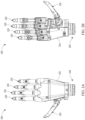
- FIGS. 2A-2B are back and front views, respectively, of a prosthetic hand 200 incorporating embodiments of prosthetic digits 220 and a prosthetic thumb 230.
- the hand 200 has a palm portion 252 attached to proximal ends of the digits 220 and thumb 230.
- the hand 200 may have a wrist 254 that may rotate, which may allow for rotation of the palm portion 252, and the digits 220 and thumb 230 attached thereto, about a longitudinal axis defined by the wrist 254.
- the prosthetic digits 220 may be any of the prosthetic digits described herein.
- the prosthetic digits 220 may rotate according to a fixed or variable angular relation among the articulating digit segments, as described with respect to the system 100 of FIGS. 1A-1B .
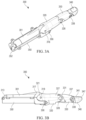
- FIGS. 3A-3D are various views of an embodiment of a prosthetic digit 300.
- the digit 300 may be used with the system 100 or hand 200.
- the digit 300 includes an actuator 301, a mount 350, a proximal segment 320, a middle segment 330, and a distal segment 340.
- the segments may articulate, for example rotate, relative to each other.
- the digit 300 includes mechanically-connected links, which may be rigid, as further described herein, for example with respect to FIGS 3D-3G .
- the segments 320, 330, 340 may provide natural movement similar to that provided respectively by proximal, middle and distal phalanges of a sound natural finger.
- the mount 350 and/or the actuator 301 may be connected with and/or located within, partially or completely, the arm stump 112, the residual palm 114, or the prosthetic palm 252.
- the proximal segment 320 may rotate relative to the mount 350 and/or the actuator 301.
- the middle segment 330 may rotate relative to the proximal segment 320.
- the distal segment 340 may rotate relative to the middle segment 330.
- the actuator 301 includes a proximal end 313 and extends to a distal end 317.
- the proximal end 313 may attach to a hand, palm, etc.
- the distal end 317 attaches to a proximal end 321 of the proximal segment 320.
- the proximal segment 320 is rotatable relative to the actuator 301 about the joint 318.
- the actuator 301 may apply a normal force to the proximal segment 320 at the joint 318 to cause the proximal segment 320 to pivot about an offset first pivot 356, as further described herein.
- the proximal segment 320 extends from the proximal end 321 to a distal end 327.
- the distal end 327 attaches to a proximal end 331 of the middle segment 330.
- the middle segment 330 is rotatable relative to the proximal segment 320 about the joint 328.
- the middle segment 330 extends from the proximal end 331 to a distal end 337.
- the distal end 337 attaches to a proximal end 341 of the distal segment 340.
- the distal segment 340 is rotatable relative to the middle segment 330 about the joint 338.
- the rotatable connections at the joints 318, 328, 338 may include pin connections, hinges, and/or other suitable features for providing a rotatable engagement.
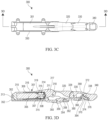
- FIG. 3D is a cross-section view of the digit 300, as taken along the line 3D-3D indicated in FIG. 3C .
- the digit 300 may include the actuator 301.
- the actuator 301 may be a linear actuator.
- the actuator 301 produces or results in linear motion.
- the actuator 301 may include a motor 305 supplied with power from a battery, which may be in the hand or other location.
- a support 310 such as a motor mount or other structure, may carry or otherwise support the actuator 301.
- the support 310 may have an pin 302 or other suitable feature in a proximal end thereof to secure, for example rotatably attach, the support 310 with the mount 350.
- the actuator 301 includes a housing 311.
- the housing 311 extends axially and defines a cavity 315 therein.
- the cavity 315 may be a cylindrical opening extending axially through the housing 311.
- a proximal end of the housing 311 may be open to the cavity 315.
- a distal end of the housing 310 for example at the distal end 37 of the actuator 301, connects with the proximal segment 320 at the joint 318.
- the housing 311 translates axially to cause rotation of the proximal segment 320, as further described herein.
- the motor 305 may be supported, for example a fixed portion thereof, by the support 310. There may be a bushing 306 rotationally supporting a rotating portion of the motor 305, which may be located within and/or supported by the support 310.
- the motor 305 may include a shaft 307 extending therefrom, for example extending distally therefrom, that is rotated about an axis along which the shaft 307 extends.
- a cap 308, such as a nut, may attach to a distal end of the shaft 307.
- a leadscrew 314 having external threads 319 thereon may be positioned about the shaft 307 and secured in place by the cap 308.
- the leadscrew 314 may be a nut having external threads or other suitable features that engage corresponding internal structure of the housing 311 to translate the housing 311 back and forth.
- the actuator 301 may output linear motion to cause rotation of the digit 300, as further described.
- the motor 305 or other portions of the actuator 301 may use or provide rotary, linear, cyclic and/or other types of motion.
- the actuator 301 is in mechanical communication with the leadscrew 314 having external threads 319.
- the actuator 301 rotates the leadscrew 314.
- the external threads 319 of the leadscrew 314 are in mechanical communication with internal threads 316 of the housing 311.
- the internal threads 316 may be located along the cavity 315 of the housing 311.
- the housing 311 may move relative to the support 310.
- the actuator 301 may rotate about the pin 302 to accommodate the rotating proximal segment 320.
- the joint 318 may translate slightly during rotation, and the distal end of the housing 311 may move accordingly such that the actuator 301 rotates slightly at the pin 302.
- the actuator 301 may rotate counterclockwise as oriented in FIG. 3D during a distal movement of the housing 311 for a closing rotational movement of the segments 320, 330, 340.
- the actuator 301 may rotate clockwise as oriented in FIG. 3D during a proximal movement of the housing 311 for an opening rotational movement of the segments 320, 330, 340.
- Other configurations of the digit 300 may result in opposite rotations of the actuator 310 during opening and closing of the segments 320, 330, 340.
- the digit 300 includes a mount 350, a proximal link 360, and a distal link 370.
- the mount 350 extends from a proximal end 352 to a distal end 354.
- the proximal link 360 extends from a proximal end 362 to a distal end 364.
- the distal link 370 extends from a proximal end 372 to a distal end 374.
- the proximal end 352 of the mount 350 may be attached to a proximal end of the actuator 301, for example rotatably attached thereto.
- the mount 350 such as at the proximal end 352 and/or other locations, may be attached to a hand, such as a prosthetic hand. Further details of the mount 350 are described herein, for example with respect to FIG. 3H .
- the distal end 354 of the mount 350 is rotatably attached to the proximal end 362 of the proximal link 360 about a connection 358.
- the mount 350 is also rotatably attached to the proximal segment 320 of the digit 300 about a first pivot 356.
- the first pivot 356 is located between the proximal and distal ends 352, 354 of the mount 350.
- the proximal link 360 is rotatably attached to the middle segment 330 of the digit 300 about a second pivot 366.
- the second pivot 366 is located between the proximal and distal ends 362, 364 of the proximal link 360.
- the proximal link 360 may include a dogleg, where the proximal end 362 extends along a first axis and the distal end 364 extends a long a second axis that is at an angle relative to the first axis.
- the second pivot 366 may be located at or near the vertex of the dogleg of the proximal link 360.
- the distal end 364 of the proximal link 360 is rotatably attached to the proximal end 372 of the distal link 370 about a connection 368.
- the distal end 374 of the distal link 370 is rotatably attached to the distal segment 340 of the digit 300 about a third pivot 376.
- the digit segments 320, 330, 340 are, respectively, rotatably attached to the links 320, 330, 340 at, respectively, the pivots 356, 366, 376.
- the segments 320, 330, 340 are rotatably attached to each other at the joint 318, which rotatably connects the proximal segment 320 to the middle segment 330, and at the joint 328, which rotatably connects the middle segment 330 to the distal segment 340.
- the links 350, 360, 370 are rotatably attached to each other at the connection 358, which rotatably connects the mount 350 to the proximal link 360, and at the connection 368, which rotatably connects the proximal link 360 to the distal link 370.
- All or some of the rotatable connections at the joints 318, 328, 338, at the pivots 356, 366, 376, and at the connections 358, 368 may include pins, hinges, and/or other suitable features for providing a rotatable engagement.
- the axes of rotation for the joints 318, 328, 338, pivots 356, 366, 376, and connections 358, 368 may be perpendicular to a longitudinal axis of the digit 300.
- Such longitudinal axis may be defined by the fully extended digit 300, for example as shown in FIG. 3F .
- the longitudinal axis may be defined by the direction of linear movement provided by the actuator 301, for example the direction of linear movement of the leadscrew 314.
- the rotation axes for the joints 318, 328, 338, pivots 356, 366, 376, and connections 358, 368 may be parallel to each other.
- the locations of the joints 318, 328, 338, pivots 356, 366, 376, and connections 358, 368 may change as the digit 300 rotates, for example some or all of these the locations may change relative to the support 310 and/or relative to the mount 350.
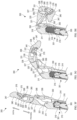
- FIG. 3E is a partially exploded perspective view of the prosthetic digit 400.
- the mount 350 includes an elongated proximal portion 351 defining a cavity 353 therein.
- the proximal end 352 includes a proximal wall 355 having openings 302A extending therethrough.
- the pin 302 of the support 310 may extend through the openings 302A to rotatably connect the proximal ends of the actuator 301 and mount 351. This allows the actuator 301 to rotate slightly at the proximal end as needed for digit actuation.
- the mount 350 includes a series of tabs 351A to connect the mount 350 to a hand, such as the prosthetic hand 200 or the palm 114.
- the mount 350 may fixedly attach to the hand.
- the mount 350 includes two distally extending forks 357.
- the forks 357 extend from the distal end of the portion 351.
- the forks 357 define a space therebetween that receives a proximal portion of the proximal segment 320.
- the forks 357 include openings 357A that receive therein the pivot 356.
- the pivot 356 is shown as a pin with rollers.
- the mount 350 includes a prong 354A extending distally from the proximal end of the portion 351.
- the prong 354A is located between the forks 357.
- the prong 354A is at the proximal end 354 of the mount 350.
- the prong 354A includes an opening 356A therethrough that receives therein a central portion of the pivot 356.
- the pivot 356 may thus rotate within the openings 356A, 357A, and/or provide an axle about which the proximal segment 320 rotates.
- the prong 354A includes an opening 358A at a distal end thereof.
- the opening 358A receives therein the connection 358, shown as a pin.
- the connection 358 may thus rotate within the openings 358A, and/or provide an axle about which the proximal link 360 rotates, as described herein.
- the actuator 301 includes the joint 318, shown as a pin.
- the joint 318 is received into openings 318A of the proximal segment 320.
- the joint 318 may be a shear pin that is pushed by the housing 311 axially to impart a force on the proximal segment 320 at the openings 318A.
- the joint 318 is offset from the pivot 356. Thus pushing on the joint 318 will create a torque on the proximal segment about the pivot 356.
- the axes of rotation of the joint 318 and pivot 356 may be parallel to each other.
- the middle segment 330 includes one or more openings 328A which receives the joint 328 therein.
- the joint 328 is shown as a pin.
- the joint 328 may thus rotate within the openings 328A, and/or provide an axle about which the proximal and middle segments 320, 330 rotate, as described herein.
- the distal segment 340 includes one or more openings 338A which receives the joint 338 therein.
- the joint 338 is shown as a pin.
- the joint 338 may thus rotate within the openings 338A, and/or provide an axle about which the middle and distal segments 330, 340 rotate, as described herein.
- the middle and distal segments 330, 340 may rotate as the proximal segment 320 rotates due to interaction of the mount 350 and links 360, 370 as further described. As shown, for example in FIG. 3H , the distal segment 340 may completely close such that the distal segment 340 is parallel or near parallel with the proximal segment 320. In some embodiments, the distal segment 340 may rotate through this parallel position such that at full rotation the distal segment 340 is angled back toward the middle segment 320. The distal segment 340 may contact the proximal segment 320 in the fully rotated configuration.
- Such full or more complete closure of the distal segment 340 provides advantageous gripping capability with the digit 300 and more fully restores lost sound finger dexterity to a user, such as an amputee.
- the features described herein, such as the configuration and interaction of the mount 350, links 360, 370 and segments 320, 330, 340, among other things, contribute to such advantages.
- the actuator 301 may rotate the leadscrew 314 having the external thread.
- the external threads of the leadscrew 314 mechanically communicate with internal threads 316 of the housing 311.
- the actuator 301 may rotate the leadscrew 314 in a first rotational direction to cause the housing 311 to move, for example to translate, distally relative to the leadscrew 314.
- the leadscrew 314 may remain axially stationary.
- the housing 311 moves farther distally as shown sequentially from FIG. 3F to FIG. 3G to FIG. 3H .
- the direction of rotation of the digit 300 may be reversed (e.g., from FIG. 3H to FIG. 3G to FIG. 3F ) by the actuator 301 rotating the leadscrew 314 in a second rotational direction, that is opposite to the first rotational direction, to cause the housing 311 to move, for example to translate, proximally relative to the leadscrew 314.
- the clockwise rotation of the proximal segment 320 about the first pivot 356 causes clockwise rotation of the proximal segment 320 relative to the housing 311 about the joint 318.
- the proximal segment 320 rotates clockwise as shown sequentially viewed from FIG. 3F to FIG. 3G to FIG. 3H .
- these movements may be reversed, where the housing 311 is moved proximally to cause the proximal end 321 of the proximal segment 320 to move proximally and rotate counterclockwise about the first pivot 356 and the joint 318.
- a pinned or other type connection at the joint 318 as described herein may allow for such pushing and pulling forces by the housing 311 to be transferred to the proximal segment 320.
- the middle segment 330 also rotates clockwise with the rotating proximal segment 320 due to the connection of the two segments 320, 330 at the joint 328.
- the middle segment 320 may be constrained from rotating farther in the counterclockwise direction, for instance the configuration shown in FIG. 3F may be the limit of rotation of the middle segment 330 relative to the proximal segment 320 about the joint 328.
- the proximal link 360 also rotates clockwise due to the connection of the middle segment 320 and the proximal link 360 at the second pivot 366. Further, the proximal link 360 is translationally constrained by the mount 350 at the rotatable connection 358. The proximal link 360 thus rotates clockwise about the connection 358.
- the joint 328 is offset from the second pivot 366 as shown. Thus a torque may be imposed on the middle segment 320 about the pivot 366.
- the axes of rotation of the joint 328 and second pivot 366 may be parallel.
- proximal link 360 rotates clockwise about the connection 358, this also causes the distal link 370 to rotate clockwise due to the translational constraint between the proximal link 320 and the distal link 330 at the rotatable connection 368.
- distal link 330 rotates clockwise, the distal segment 340 is translationally constrained by the distal link 330 at the third pivot 376.
- the distal segment 340 also rotates relative to the middle segment 330 about the rotatable connection at the joint 338.
- the joint 338 is offset from the third pivot 376 as shown.
- a torque may be imposed on the distal segment 340 about the pivot 376.
- the axes of rotation of the joint 338 and third pivot 376 may be parallel. The distal segment 340 thus rotates farther clockwise about the third pivot 376 to provide the closed configuration shown in FIG. 3H .
- the digit 300 may be rotated in the counterclockwise direction sequentially from the configurations shown in FIG. 3H to FIG. 3G to FIG. 3F .
- the counterclockwise rotation operates in reverse as described above with respect to the clockwise rotation.
- proximal movement of the proximal end 321 of the proximal segment 320 pulls proximally at the joint 318 and causes the proximal segment 320 to rotate counterclockwise about the pivot 356, which causes the middle segment 330 and proximal link 360 to rotate counterclockwise respectively about the joint 328 and pivot 366, which causes the distal segment 340 and distal link 370 to rotate counterclockwise respectively about the joint 338 and pivot 376.
- FIGS. 4A-4D are various views of another embodiment of a prosthetic digit 400.
- the digit 400 may be used with the system 100 or hand 200.
- the digit 400 includes a mount 410, a proximal segment 420, a middle segment 430, and a distal segment 440.
- the mount 410 and segments 420, 430, 440 may have the same or similar features and/or functions as the mount 350 and segments 320, 330, 340, and thus may articulate, for example rotate, relative to each other.
- the digit 400 includes mechanically-connected rigid links including an expandable proximal link 450, as further described herein, for example with respect to FIGS 4D-7D .
- the mount 410 and segments 420, 430, 440 may be rotatably attached at joints 418, 428, 438, which may have the same or similar features and/or functions as the joints 318, 328, 338, respectively. However, the mount 410 may not have a linearly translatable portion.
- the digit 400 may have an actuator 404, which may have the same or similar features and/or functions as the actuator 301, except as otherwise described.
- FIG. 4D is a cross-section view of the digit 400, as taken along the line 4D-4D indicated in FIG. 4C .
- the mount 410 may support the actuator 404.
- the actuator 404 may include a housing 403 extending proximally.
- the housing 403 may be used to house features for rotation of the segments 420, 430, 440, such as a spring 486 that provides a force in a proximal direction on a plunger 481 attached to a proximal end 482 of a return tendon 480, as further described herein. Some embodiments may not include the return tendon 480.
- the actuator 404 may include a motor 405 supplied with power from a battery, which may be in the hand or other location.
- the motor 405 may be in mechanical communication with an output shaft 409 that extends, for example distally, therefrom.
- a worm gear 414 having external threads 419 thereon may be attached to the shaft 409. Actuation of the motor 405 causes motion to be transmitted via a gearbox to the shaft 409 to rotate the worm gear 414.
- the digit 400 may include a worm wheel 412 having external teeth 416 thereon. The threads 419 of the worm gear 414 contact the teeth 416 of the worm wheel 412 to cause rotational motion of the worm wheel 412.
- the worm wheel 412 may be rotated a first rotational direction to cause a first rotation of the digit 400 in a first direction (e.g. to close the digit 400).
- the worm wheel may have pulley features that attach to and wrapingly receive therearound a proximal end of an actuation tendon 470, as further described.
- the worm wheel 412 may be rotated in a second rotational direction that is opposite the first rotational direction to allow for a second rotation of the digit 400 in a second direction that is opposite the first direction (e.g. to open the digit), which movement may be caused by the return tendon 480, as further described.
- Some embodiments may not include the actuation tendon 470 or return tendon 480.
- the digit 400 includes an expandable proximal link 450.
- the link 450 is attached to the worm wheel 412. Rotation of the worm wheel 412 in a first rotational direction for a first angular amount causes a corresponding rotation of the link 450 in the first rotational direction for the first angular amount.
- the link 450 may expand.
- the link 450 or a portion thereof may extend distally relative to the worm wheel 412.
- the link 450 includes a proximal end 452 and extends to a distal end 454.
- the proximal end 452 includes a fixed portion 451, such as a cylinder.
- the distal end 454 includes a housing 459, such as a piston.
- the link 450 may include a spring 456, such as an extension spring.
- the link 450 may expand as it is rotated to allow for multiple degrees of freedom rotation of the digit 40.
- the housing 459 may expand distally relative to the fixed portion 451.
- the spring 456 may bias the housing 459 in the proximal direction.
- the housing 459 may retract in the proximal direction relative to the fixed portion 451. Further details of the link 450 are described herein, for example with respect to FIGS. 5A-5E .
- the link 450 is attached to the middle segment 430 of the digit 400.
- the distal end 454 of the link 450 may be rotatably attached to the middle segment 430 at the connection 458.
- the middle segment 430 may include an ear 432 that rotatably connects with the link 450.
- the connection 458 may include a pin or other feature that extends through the link 450 and ear 432 at the connection 458.
- the link 450 may extend between two of the ears 432, with one ear 432 on either lateral side of the distal end 454 of the link 450 at the connection 458.
- the digit 400 may include a distal link 460.
- the distal link 460 extends from a proximal end 462 to a distal end 464.
- the proximal end 462 may be rotatably attached to the ear 432 at a connection 461.
- the ear 432 may include a rounded slot 433.
- the connection 461 may include a pin or other feature that extends through the link 460 and rounded slot 433 at the connection 461.
- the connection 461 allows the proximal end 462 of the distal link 460 to rotate within and move along the slot 433 as the digit 400 articulates, for example as the middle segment 430 rotates relative to the proximal segment 420 and/or as the distal segment 440 rotates relative to the middle segment 430.
- the distal link 460 is attached to the distal segment 440.
- the distal end 464 of the distal link 460 may be rotatably attached to the distal segment 440 at the connection 468.
- the connection 468 may include a pin or other feature that extends through the distal link 460 and distal segment 440 at the connection 468.
- the distal segment 440 may include an ear 442 having an opening therethrough and with which the distal link 460 is attached.
- the distal end 464 of the link 460 may extend between two of the ears 442, with one ear 442 on either lateral side of the distal end 464 of the link 460 at the connection 468.
- FIGS. 5A-5E are various views of the proximal expandable link 450.
- FIG. 5A is a perspective view of the link 450
- FIG. 5B is a top view
- FIG. 5C is a side view in an unexpanded configuration
- FIG. 5D is a side view in an expanded configuration
- FIG. 5E is a cross-section view as taken along the line 5E-5E shown in FIG. 5B .
- the proximal link 450 may include an extension 453. There may be two extensions 453 extending proximally, for example forming a clevis type connection.
- the extensions 453 may each include an opening 455 therethrough.
- the extensions 453 may define a space 457 therebetween.
- the extensions 453 may laterally surround the worm wheel 412 when installed with the worm wheel 412 located in the space 457, and a pin or other feature may extend through the openings 455 and a central opening of the worm wheel 412 to connect the link 450 with the worm wheel 412.
- the housing 459 may move linearly with respect to the fixed portion 451.
- the fixed portion 451 may define a longitudinal axis along which the housing 459 may translate.
- a spring 456 may be located within the link 450. As shown in FIG. 5E , a proximal end of the spring 456 may be located within the fixed portion 451 and be attached to a proximal end of the link 450. A distal end of the spring 456 may attach to a proximal end of the housing 459. In some embodiments, the spring 456 may extend through and attach to the housing 459.
- FIG. 5D shows the link 450 expanded relative to the configuration in FIG. 5C . The expanded housing 459 will stretch the spring 456.
- the spring 456 will exert a restoring force on the housing 459 and bias the housing proximally.
- the link 450 may then return to the configuration shown in FIG. 5C .
- the link 450 may repeatedly extend and retract as the finger is rotated to close the digit 400 and then rotated back to open the digit 400.
- the link 450 may therefore expand during rotation of the digit 400, as further described herein, for example with respect to FIGS. 6A-6D .
- the link 450 may not expand during rotation of the digit 400 for added degrees of freedom, as further described herein, for example with respect to FIGS. 7A-7D .
- FIGS. 6A-6D are sequential views of the prosthetic digit 400 shown in various rotated configurations.
- the sequential views illustrate an embodiment of the middle and distal segments 430, 440 rotating as the proximal segment 420 also rotates.
- the rotation of the segments 420, 430, 440 may be due to the configuration and interaction of the mount 410, segments 420, 430, 440 and links 450, 460.
- the proximal segment 420 may rotate relative to the mount 410 about the joint 418 (see FIGS. 4A-4B ).
- the actuator 404 may cause the worm gear 414 to rotate and thereby rotate the worm wheel 412.
- the link 450 may rotate with the rotating worm wheel 412.
- the link 450 may rotate the same or similar angular amount as the angular amount that the worm wheel 412 rotates. For example, rotation of the worm wheel 412 by fifteen degrees clockwise may cause a corresponding fifteen degree rotation of the link 450, etc.
- rotation of the link 450 may cause the proximal segment 420 to rotate.
- the link 450 may be attached with the proximal segment 420, such that rotation of the link 450 in a first or second rotational direction may cause a corresponding rotation of the proximal segment 420 in the first or second rotational direction, respectively.
- rotation of the worm wheel 412 may not cause the link 450 or proximal segment 420 to rotate.
- the link 450 may be rotatably connected to the worm wheel.
- the middle and distal segments 430, 440 may thus rotate while the proximal segment 420 does not rotate or rotates less as compared to a full rotation, as further described with respect to FIGS. 7A-7D .
- actuation of the digit segments may be provided by the actuation tendon 470 attached to the worm wheel 412 and to the various segments 420, 430, 440, such that rotation of the worm wheel 412 will cause the tendon to pull in (shorten) to cause rotation of the segments 420, 430, 440.
- the return tendon 480 may rotate the digit 400 in the opposite direction, as described herein, and the worm wheel 412 may rotate in the opposite direction to allow the actuation tendon to pay out (lengthen).
- the digit 400 may include the actuation tendon 470.
- the tendon 470 extends from a proximal end 472 attached to the worm wheel 412 to a distal end 474 attached to an attachment 478 of the middle segment 430.
- the tendon 470 extends distally from the worm wheel 412 and around an idler 476, such as a pulley, which may or may not rotate, and that is connected to the proximal segment 420.
- an idler 476 such as a pulley, which may or may not rotate, and that is connected to the proximal segment 420.
- the proximal end 472 of the tendon 470 wraps around the worm wheel 412.
- the tendon 470 effectively shortens in length and thus pulls on the attachment 478 and applies a force on the idler 476, causing the middle and proximal segments, to which the attachment 478 and idler 476 are respectively attached, to rotate in the clockwise direction as oriented.
- the digit 400 may include the return tendon 480.
- the return tendon 480 extends from a proximal end 481 attached to the plunger 481.
- the plunger 481 is biased in the proximal direction by a compression spring 486 inside the housing 403.
- the tendon 480 extends from the housing 403 in a distal direction around an idler 485, such as a pulley, which may or may not rotate, to a distal end 484 of the tendon 480 attached to an attachment 483 of the proximal segment 420.
- the attachment 483 pulls on the return tendon 480 causing the plunger 481 to move distally and compress or further compress the spring 486.
- the spring 486 compresses further as the digit 400 rotates further clockwise.
- the spring 486 thus applies a biasing force in the proximal direction to the plunger 481, biasing the tendon 480 in the proximal direction, and applying an opening or counterclockwise force to the proximal segment 420 via the attachment 483.
- the spring 486 may be a constant force spring to apply a constant return force to the segment 420 in various rotational positions.
- the biasing force on the return tendon 480 causes the proximal segment 420 to rotate open, or in the counterclockwise direction as oriented.
- the spring-loaded expandable link 450 as described herein, then pulls proximally on the middle segment 430 at the connection 458 to rotate the middle segment 430 counterclockwise about the joint 428.
- the ear 432 may then rotate counterclockwise about the joint 428 to rotate the connection 461 of the distal link 460 counterclockwise about the joint 428 to rotate the distal segment 440 counterclockwise as well.
- the tendons 470, 480 are just one example of how to effect articulation of the segments 420, 430, 440 in the prosthetic digit 400 having the expandable link 450.
- Some embodiments of the digit 400 having the expandable link 450 may not include the actuation tendon 470 and/or the return tendon 480.
- features other than tendons may be used, such as other links, connections, joints, segments, etc. Therefore, the embodiments shown and described herein for articulation of the segments 420, 430, 440 are merely example embodiments of how the prosthetic digit 400 with the expandable link 450 may be implemented.
- the rotatable connection 458 of the link 450 with the middle segment 430 translates or sweeps a rotational path.
- the middle segment 430 is translationally constrained with the distal end 459 of the link 450 at the connection 458.
- the middle segment 430 thus rotates relative to the link 450 about the connection 458 as the middle segment 430 is rotating to open or close the digit 400.
- the middle segment 430 also rotates relative to the proximal segment 420 about the joint 428 (see FIGS. 4A-4B ).
- connection 461 at the proximal end 462 of the distal link 460 moves along the slot 433.
- the connection 461 may include a pin sliding along the slot 433. This allows the ear 432 to rotate relative to the distal link 460.
- the distal link 460 thus rotates relative to the middle segment 430.
- the distal segment 440 also rotates due to the connection 468 between the distal link 460 and the distal segment 440.
- the distal segment 440 rotates relative to the middle segment 430 about the joint 438.
- the mount 410 or a portion thereof may extend along an Axis 1.
- the proximal segment 420 may extend along an Axis 2.
- the Axes 1,2 may form an angle A between them.
- the angle A may be the angular configuration of the proximal segment 420 relative to the mount 410.
- the angle A may range from zero degrees (e.g., in FIG. 6A ) to ninety degrees or more (e.g., in FIG. 6D ).
- the angle A may be negative fifteen, negative ten, negative five, zero, five, ten, fifteen, twenty, twenty-five, thirty, thirty-five, forty, forty-five, fifty, fifty-five, sixty, sixty-five, seventy, seventy-five, eighty, eighty-five, ninety, ninety-five, one hundred, one hundred five, one hundred ten, or one hundred fifteen degrees, or other lesser, greater or in between angular amounts.
- the various values for the angle A may apply to any of the articulated configurations of the prosthetic digit 400 shown in any of FIGS. 6A-6D and other configurations.
- the angle A may change as the digit 400 rotates, for example as the middle and distal segments 430, 440 rotate. As shown, the angle A may increase from the relatively open configuration of FIG. 6B to the relatively closed configuration of FIG. 6D , and vice versa. The angle A may be dependent on the amount of rotation of the middle and distal segments 430, 440, or vice versa. In some embodiments, the angle A may not change as the digit 400 rotates, for example as the middle and distal segments 430, 440 rotate. For example, the angle A may not change from the relatively open configuration of FIG. 6B to the relatively closed configuration of FIG. 6D , and vice versa. In some embodiments, the angle A may change by a small amount from the relatively open configuration of FIG.
- the angle A therefore may not be dependent on the amount of rotation of the middle and distal segments 430, 440, or vice versa, as further described herein, for example with respect to FIGS. 7A-7D .
- the digit 400 may rotate as described to have the closed configuration shown in FIG. 6D .
- the Axis 2 along which the proximal segment 420 extends may be at about ninety degrees to the Axis 1.
- the middle segment 420 may be rotated to about parallel with the Axis 1. In some embodiments, the middle segment 420 may not be parallel with the Axis 1 in the closed configuration.
- the distal segment 440 is rotated clockwise to be adjacent to the proximal segment 420. The segments 420, 430, 440 may thus rotate to provide a small closed grip with the digit 400.
- FIGS. 7A-7D are sequential views of the prosthetic digit 400 performing a rotation with added degrees of freedom.
- the digit 400 is shown in various rotated configurations where the middle and distal segments 430, 440 rotate independently of rotation of the proximal segment 420 due to interaction of the links 450, 460.
- the digit 400 may rotate similarly as described with respect to FIGS. 6A-6D , except as otherwise described.
- the digit 400 may rotate to grab or cover an object having an irregular outer surface or contour.
- the rotational path of the digit 400 shown in FIGS. 6A-6D may not adequately cover or grasp the object due to the irregular outer surface.
- the proximal and/or middle segments 420, 430 may be prevented from rotating clockwise beyond an angular amount.
- the middle and/or distal segments 430, 440 may continue to rotate to provide the desired functionality.
- FIGS. 7A-7D shown an example embodiment of rotation of the digit 400 where the proximal segment 420 does not rotate or does not completely rotate clockwise, while the middle and distal segments 430, 440 rotate clockwise.
- the link 450 may have a first axial length in FIG. 7A for instance where the digit 400 is straightened out, a second axial length in FIG. 7B where the digit 400 has partially rotated, a third axial length in FIG. 7C where the digit 400 is rotated farther but not completely, and a fourth axial length in FIG. 7D where the digit 400 is fully rotated.
- the first length may be shorter than each of the second, third and fourth lengths.
- the second length may be shorter than each of the third and fourth lengths.
- the third length may be shorter than the fourth length.
- the middle and distal segments 430, 440 rotate as described with respect to FIGS. 6A-6D .
- the expanding and retracting link 450 allows the middle and distal segments 430, 440 to rotate without rotation or full rotation of the proximal segment 420.
- the link 450 may not rotate.
- the link 450 may partially rotate.
- a tendon may be used to cause rotation of the middle and distal segments 430, 440 when the proximal segment 420 does not rotate or does not fully rotate.
- a tendon may be attached to the worm wheel 412 to cause rotation, as described with respect to FIGS. 6A-6D .
- FIGS. 8A-8B are various views of another embodiment of a prosthetic digit 500.
- the digit 500 may be used with the system 100 or hand 200.
- the digit 500 includes a mount 510, a proximal segment 520, a middle segment 530, and a distal segment 540.
- the mount 510 and segments 520, 530, 540 may have the same or similar features and/or functions as respectively the mounts 350, 450 and segments 320, 330, 340, 420, 430, 440, and thus may articulate, for example rotate, relative to each other, etc.
- the digit 500 includes mechanically-connected rigid links, including a proximal link 560 and a distal link 570.
- the links 560, 570 may have the same or similar features and/or functions as the links 360, 370.
- the mount 510 may be rotatably attached to the proximal end of the proximal link 560 about a connection 558.
- the proximal link 560 is rotatably attached to the middle segment 530 of the digit 500 about a pivot 566.
- the proximal link 560 may include a dogleg, where the proximal end of the proximal link 560 extends along a first axis and the distal end of the proximal link extends along a second axis that is at an angle relative to the first axis.
- the pivot 566 may be located at or near the vertex of the dogleg of the proximal link 560.
- the distal end of the proximal link 560 is rotatably attached to the proximal end of the distal link 570 about a connection 568.
- the distal end of the distal link 570 is rotatably attached to the distal segment 540 of the digit 500 about a pivot 576.
- the digit 500 includes an actuator 504, which may have the same or similar features and/or functions as the actuators 301, 404, except as otherwise described.
- the actuator 504 may include a motor 515 supplied with power from a battery, which may be in the hand or other location.
- the motor 515 may have an output shaft that extends, for example distally, therefrom, and that mechanically communicates with an off-axis shaft 509.
- the actuator 504 includes a worm wheel 512 and a worm gear 514, which may have the same or similar features and/or functions as respectively the worm wheel and worm gear 412, 414, except as otherwise described.
- the worm gear 514 having external threads 519 thereon may be in mechanical communication with the shaft 509 via the threads 519.
- Actuation of the motor 515 causes motion to be transmitted via a pinion gear 513 (see FIGS. 9B and 9C ) to the shaft 509 to rotate the worm gear 514.
- the worm wheel 512 may have external teeth 516 thereon.
- only a portion of the outer circumference of the worm wheel 512 includes external teeth 516 (e.g., the portion of the outer circumference of the worm wheel 512 positioned adjacent to the worm gear 514).
- the remainder of the outer circumference of the worm wheel 512 may be smooth or otherwise not have teeth.
- This configuration can advantageously allow for a compact worm wheel 512 and worm gear 514 system.
- the threads 519 (see FIGS, 9B and 9C ) of the worm gear 514 contact the teeth 516 of the worm wheel 512 to cause rotational motion of the worm wheel 512.
- the worm wheel 512 may be rotated a first rotational direction to cause a first rotation of the digit 500 in a first direction (e.g.
- the worm wheel 512 may be rotated in a second rotational direction that is opposite the first rotational direction to allow for a second rotation of the digit 500 in a second direction that is opposite the first direction (e.g. to open the digit).
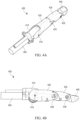
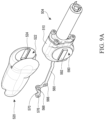
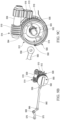
- FIGS. 9A-9C are various views of the actuator 504 of the digit 500.
- FIG. 9A is a partial exploded view of the actuator 504, and FIGS. 9B and 9C show the actuator 504 with various features removed or hidden for clarity.
- the actuator 504 of the digit 500 may comprise a central axle 590 having a drive key 592 configured to engage a portion of the proximal segment 520 of the digit 500.
- the drive key 592 is positioned on an outer surface of the central axle 590 and has an extended length and width protruding outwardly from the outer surface of the central axle 590.
- An inner surface 522 of the proximal segment 520 of the digit 500 may comprise a mating feature 524, such as a recess, opening, and/or groove, with a shape that corresponds with the shape of the drive key 592 of the central axle 590.
- the mating feature 524 of the proximal segment 520 may receive the drive key 592 of the central axle 590 therein to transmit a rotational force from the central axle 590 to the proximal segment 520.
- the ratio of the rotational angle of the drive key 592 to the rotational angle of the proximal segment 520 is 1:1.
- the central axle 590 includes a first drive key 592 protruding outwardly in a first direction from a first outer surface of the central axle 590 and a second drive key 592 protruding outwardly from a second outer surface of the central axle 590 in a second direction that is opposite the first direction.
- the proximal segment 520 may include a first inner surface 522 with a first mating feature 524 for receiving the first drive key 592 and a second inner surface 522 with a second mating feature 524 for receiving the second drive key 592.
- the central axle 590 may include one or more drive tabs 594.
- the drive tabs 594 may each have an extended, arcuate length and width protruding axially from an inner surface of the central axle 590.
- the central axle 590 includes a first drive tab 594 and a second drive tab 594 positioned radially opposite the first drive tab 594.
- the worm wheel 512 may include one or more corresponding drive tabs 518.
- the worm wheel 512 may include a first drive tab 518 and a second drive tab 518 positioned radially opposite the first drive tab 518.
- the drive tabs 518 of the worm wheel 512 may extend radially inward from an inner surface of the worm wheel 512 toward a central axis of the worm wheel 512.
- the drive tabs 518 of the worm wheel 512 may be positioned between the first and second drive tabs 594 of the central axle 590.
- one or more of the drive tabs 594 of the central axle 590 engages one or more of the drive tabs 518 of the worm wheel 512 (e.g., contacts, abuts, connects to, etc.) to transmit a rotational force of the worm wheel 512 to the central axle 590.
- the drive mechanism of the digit 500 may include a spring 503 (e.g., a torsion spring).
- the spring 503 may be coupled to (e.g., circumferentially surround) an axially extending member 502 that extends axially along the central axis of the worm wheel 512 and/or central axle 590.
- the spring 503 may be configured to rotationally bias the worm wheel 512 in an angular direction to maintain the relative positions of the central axle 590 and the worm wheel 512.
- the spring 503 may include a flange 508 that extends further radially outward than the rest of the spring 503. The flange 508 may engage one of the drive tabs 518 of the worm wheel 512.
- the worm wheel 512 and the central axle 590 are positioned such that one of the drive tabs 594 of the central axle 590 abuts a first surface of one of the drive tabs 518 of the worm wheel 512 and the flange 508 abuts a second surface of the drive tab 518 opposite the first surface of the drive tab 518.
- This configuration enables the rotational force of the worm wheel 512 to be transmitted to the central axle 590 while maintaining the relative positions of the worm wheel 512 and the central axle 590.
- This configuration also allows the digit 500 to be closed independent of the drive mechanism of the digit 500, as further described below.
- the digit 500 may be opened and/or closed with or without utilizing the actuator 504.
- the digit 500 can have a worm wheel driven movement mode (e.g., driven by the actuator 504) and a manual movement mode (e.g., driven by an external force).
- a worm wheel driven movement mode e.g., driven by the actuator 504
- a manual movement mode e.g., driven by an external force
- the actuator 504 does not drive the worm wheel 512.
- the actuator 504 and the worm wheel 512 remain stationary.
- the central axle 590 rotates in response to the application of an external force to the digit 500 while the worm wheel 512 remains stationary because the spring flange 508 allows for rotational movement when its spring biasing force is overcome.
- the rotation of the central axle 590 may cause the segments 520, 530, 540 of the digit 500 to rotate to a closed position.
- the projections 518 of the worm wheel 512 may limit the range of rotation of one or more of the drive tabs 594 of the central axle 590 and therefore the range of rotation of the central axle 590.
- the spring 503 may rotate and store energy due to the manual movement of the digit 500 to the closed position due to the application of an external force to the digit 500. In some embodiments, when the external force is removed from the digit 500, the spring 503 may use the stored potential energy to rotate and cause the digit 500 to return to the open position.
- the manual movement mode of the digit 500 can advantageously serve as a mechanical protection system when external forces act on the digit 500, such as when a user falls on the digit 500 or applies pressure to the digit 500 to get up from a chair, etc.
- the manual closure of the digit 500 may allow the external load to be supported by components of the digit 500 other than the drive mechanism (e.g., gearbox). This can prevent damage that may otherwise have been caused to the drive mechanism of the digit 500.
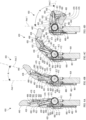
- FIG. 10 illustrates the positions of encoders 505, 506 within the digit 500.
- the digit 500 includes a plurality of encoders 505, 506 mounted to the gearbox.
- the digit 500 includes a first type of encoder for the worm wheel driven movement mode and a second type of encoder for the manual movement mode.
- the digit 500 may include a potentiometer strip encoder 506 and a magnetometer encoder 505.
- the potentiometer strip encoder 506 may be coupled to the worm wheel 512.
- the magnetometer encoder 505 may be positioned between the potentiometer strip encoder 506 and the pinion gear 513.
- the potentiometer strip encoder 506 may measure the position of the digit 500 by measuring the absolute position of the motor drive.
- the magnetometer encoder 505 may be an absolute magnetic hall effect encoder.
- the magnetometer encoder 505 may measure the position of the digit 500 by measuring the degree of rotation of a diametrically magnetized axial magnet disposed within the axially extending member 502 at the center of the central axle 590.
- FIG. 11 is a cross-sectional view of a portion of the digit 500 illustrating waterproof seals 507 within the digit 500.
- the digit 500 may be waterproof (e.g., rated IP68).
- the digit 500 may include seals 507, such as O-ring seals, lip seals, and/or other dynamic seals, to seal the components within the central axle 590 from water ingress.
- the seals 507 may be positioned in gaps between the central axle 590 and the mount 510.
Landscapes
- Health & Medical Sciences (AREA)
- Engineering & Computer Science (AREA)
- Transplantation (AREA)
- Orthopedic Medicine & Surgery (AREA)
- Biomedical Technology (AREA)
- Cardiology (AREA)
- Oral & Maxillofacial Surgery (AREA)
- Heart & Thoracic Surgery (AREA)
- Vascular Medicine (AREA)
- Life Sciences & Earth Sciences (AREA)
- Animal Behavior & Ethology (AREA)
- General Health & Medical Sciences (AREA)
- Public Health (AREA)
- Veterinary Medicine (AREA)
- Mechanical Engineering (AREA)
- Robotics (AREA)
- Prostheses (AREA)
Claims (15)
- Eine Fingerprothese (300), bestehend aus:einer Halterung (350), die so ausgelegt ist, dass sie an einer Hand (200) befestigt werden kann;einem proximalen Segment (320), einem mittleren Segment (330) und einem distalen Segment (340), wobei das proximale Segment drehbar an der Halterung an einem ersten Drehgelenk (356) angebracht ist, während das mittlere Segment drehbar mit dem proximalen und dem distalen Segment verbunden ist;einem Aktuator (301), der mit der Halterung und dem proximalen Segment verbunden ist und ein Gehäuse (311) mit einem Hohlraum (315) aufweist; undeiner Leitspindel (314) mit Außengewinde (319) in mechanischer Verbindung mit dem Innengewinde des Gehäuses;wobei die Drehung der Leitspindel eine axiale Translation des Gehäuses entlang einer durch den Hohlraum definierten Achse verursacht, und wobei die axiale Translation des Gehäuses das proximale Segment veranlasst, sich um das erste Drehgelenk zu drehen, was dazu führt, dass sich die mittleren und distalen Segmente drehen.
- Fingerprothese nach Anspruch 1, wobei die Leitspindel (314) während der Drehung axial stationär bleibt.
- Fingerprothese nach einem der Ansprüche 1 bis 2, wobei die axiale Translation des Gehäuses (311) in distaler Richtung dazu führt, dass sich ein proximales Ende (321) des proximalen Segments (320) distal bewegt.
- Fingerprothese nach einem der Ansprüche 1 bis 3, wobei die Drehung des proximalen Segments (320) dazu führt, dass sich die proximalen, mittleren (330) und distalen (340) Segmente gleichzeitig drehen.
- Fingerprothese nach einem der Ansprüche 1 bis 4, die ferner Folgendes umfasst:ein proximales Gelenk (360), drehbar mit der Halterung (350) verbunden und drehbar mit dem mittleren Segment (330) an einem zweiten Drehgelenk (366) verbunden; undein distales Gelenk (370), drehbar mit dem proximalen Gelenk verbunden und drehbar mit dem distalen Segment (340) an einem dritten Drehgelenk (376) verbunden.
- Fingerprothese nach Anspruch 5 mit einem Motor (305), der konfiguriert ist, die Leitspindel (314) zu drehen.
- Fingerprothese nach einem der Ansprüche 5 bis 6, wobei die Drehung des proximalen Segments (320) um das erste Drehgelenk (356) die Drehung des proximalen Gelenks verursacht..
- Fingerprothese nach einem der Ansprüche 1 bis 7, wobei das proximale Segment (320) drehbar mit der Halterung (350) an einem Gelenk (318) verbunden ist, das sich während der Drehung der Leitspindel (314) translatorisch bewegt.
- Eine Handprothese (200) mit einer Fingerprothese (300) nach einem der Ansprüche 1 bis 8.
- Handprothese nach Anspruch 9, mit einer Stütze (310), die drehbar mittels eines Bolzens (302) an der Halterung (350) angebracht ist, wobei der Aktuator (301) sich um den Bolzen als Reaktion auf die axiale Translation des Gehäuses (311) dreht, um die Rotation des proximalen Segments (320) anzupassen.
- Ein Verfahren zum Drehen einer Fingerprothese (300), das Folgendes beinhaltet:Drehen einer Leitspindel (314) um eine erste Achse;Translation eines Gehäuses (311) eines Aktuators (301) entlang der ersten Achse;Drehen eines proximalen Segments (320) der Fingerprothese um eine zweite Achse als Reaktion auf die Translation des Gehäuses, wobei die zweite Achse senkrecht zur ersten Achse steht; undDrehen eines mittleren Segments (330) und eines distalen Segments der Fingerprothese als Reaktion auf die Drehung des proximalen Segments.
- Verfahren nach Anspruch 11, das ferner das gleichzeitige Drehen des mittleren Segments (330) und des distalen Segments (340) als Reaktion auf die Drehung des proximalen Segments (320) umfasst.
- Verfahren nach einem der Ansprüche 11 bis 12, das die Translation eines proximalen Endes (321) des proximalen Segments (320) in distaler Richtung als Reaktion auf die Translation des Gehäuses (311) umfasst.
- Verfahren nach einem der Ansprüche 11 bis 13, das die beschränkte Drehung des mittleren Segments (330) auf ein Rotationslimit relativ zum proximalen Segment (320) um ein erstes Gelenk (328) umfasst, wobei das erste Gelenk das mittlere Segment und das proximale Segment drehbar miteinander verbindet.
- Verfahren nach einem der Ansprüche 11 bis 14, das die beschränkte Drehung des distalen Segments (340) auf ein Rotationslimit relativ zum mittleren Segment (330) um ein zweites Gelenk (368) umfasst, wobei das zweite Gelenk das distale Segment und das mittlere Segment drehbar miteinander verbindet
Applications Claiming Priority (3)
| Application Number | Priority Date | Filing Date | Title |
|---|---|---|---|
| US201962832166P | 2019-04-10 | 2019-04-10 | |
| EP20718831.9A EP3952794B1 (de) | 2019-04-10 | 2020-04-08 | Prothetische ziffer mit gelenkverbindungen |
| PCT/IB2020/053373 WO2020208557A1 (en) | 2019-04-10 | 2020-04-08 | Prosthetic digit with articulating links |
Related Parent Applications (2)
| Application Number | Title | Priority Date | Filing Date |
|---|---|---|---|
| EP20718831.9A Division EP3952794B1 (de) | 2019-04-10 | 2020-04-08 | Prothetische ziffer mit gelenkverbindungen |
| EP20718831.9A Division-Into EP3952794B1 (de) | 2019-04-10 | 2020-04-08 | Prothetische ziffer mit gelenkverbindungen |
Publications (3)
| Publication Number | Publication Date |
|---|---|
| EP4403142A2 EP4403142A2 (de) | 2024-07-24 |
| EP4403142A3 EP4403142A3 (de) | 2024-08-07 |
| EP4403142B1 true EP4403142B1 (de) | 2025-06-25 |
Family
ID=70285784
Family Applications (2)
| Application Number | Title | Priority Date | Filing Date |
|---|---|---|---|
| EP24164010.1A Active EP4403142B1 (de) | 2019-04-10 | 2020-04-08 | Prothetischer finger mit gelenkverbindungen |
| EP20718831.9A Active EP3952794B1 (de) | 2019-04-10 | 2020-04-08 | Prothetische ziffer mit gelenkverbindungen |
Family Applications After (1)
| Application Number | Title | Priority Date | Filing Date |
|---|---|---|---|
| EP20718831.9A Active EP3952794B1 (de) | 2019-04-10 | 2020-04-08 | Prothetische ziffer mit gelenkverbindungen |
Country Status (4)
| Country | Link |
|---|---|
| US (2) | US12427040B2 (de) |
| EP (2) | EP4403142B1 (de) |
| CN (1) | CN113853181A (de) |
| WO (1) | WO2020208557A1 (de) |
Families Citing this family (8)
| Publication number | Priority date | Publication date | Assignee | Title |
|---|---|---|---|---|
| GB201403265D0 (en) | 2014-02-25 | 2014-04-09 | Touch Emas Ltd | Prosthetic digit for use with touchscreen devices |
| SE542072C2 (en) * | 2017-06-19 | 2020-02-18 | Tendo Ab | A device for pivoting a body member around a joint |
| US10973660B2 (en) | 2017-12-15 | 2021-04-13 | Touch Bionics Limited | Powered prosthetic thumb |
| EP4403142B1 (de) | 2019-04-10 | 2025-06-25 | Touch Bionics Limited | Prothetischer finger mit gelenkverbindungen |
| WO2021053557A1 (en) | 2019-09-18 | 2021-03-25 | Touch Bionics Limited | Prosthetic digits and actuators |
| US11931270B2 (en) | 2019-11-15 | 2024-03-19 | Touch Bionics Limited | Prosthetic digit actuator |
| US20230338170A1 (en) | 2022-04-25 | 2023-10-26 | Touch Bionics Limited | Sensor system and method for control of prosthetic devices |
| CN117359667A (zh) * | 2023-11-22 | 2024-01-09 | 广州小鹏汽车科技有限公司 | 机械手 |
Family Cites Families (275)
| Publication number | Priority date | Publication date | Assignee | Title |
|---|---|---|---|---|
| DE309367C (de) | ||||
| US760102A (en) | 1903-09-23 | 1904-05-17 | Azro H Pettit | Artificial limb. |
| US1253823A (en) | 1917-03-19 | 1918-01-15 | Edward Walter Hobbs | Artificial arm and hand and actuating means therefor. |
| DE319092C (de) | 1917-09-07 | 1920-02-24 | Hans Kresser | Kuenstliche Hand |
| DE323970C (de) | 1919-05-08 | 1920-08-13 | Gemeinnuetzige Ges Fuer Bescha | Kuenstliche Hand |
| US1507683A (en) | 1924-03-18 | 1924-09-09 | Livingston Artificial Limb Com | Artificial limb |
| GB239004A (en) * | 1924-07-07 | 1925-09-03 | Livingston Artificial Limb Com | Improvements in artificial limbs |
| GB326970A (en) | 1929-02-26 | 1930-03-27 | Joseph Willie Levasseur | Improvements in artificial hands |
| US2477463A (en) | 1945-09-28 | 1949-07-26 | Otterman Joyce | Artificial arm |
| US2549716A (en) | 1946-01-31 | 1951-04-17 | Simpson John Harold | Mechanical artifical hand |
| US2445711A (en) | 1946-06-17 | 1948-07-20 | Fitch And Sons Inc | Mechanical movement |
| US2592842A (en) | 1948-07-10 | 1952-04-15 | Samuel W Alderson | Shoulder harness for artificial arms |
| US2586293A (en) | 1950-02-27 | 1952-02-19 | Hispano Suiza Suisse Sa | Spinning spindle mechanism, in particular of the worm and worm wheel drive type |
| US2669727A (en) | 1951-07-24 | 1954-02-23 | Opuszenski Theodore | Artificial hand |
| US2983162A (en) | 1958-12-10 | 1961-05-09 | United Shoe Machinery Corp | Strain wave gearing-spring preloading |
| US3509583A (en) | 1965-09-09 | 1970-05-05 | Bendix Corp | Electro-mechanical hand having tactile sensing means |
| US3582857A (en) | 1968-09-27 | 1971-06-01 | Weston Instruments Inc | Worm-driven adjustable potentiometers |
| US3641832A (en) | 1969-03-26 | 1972-02-15 | Hitachi Ltd | A worm-gear-type speed reduction device for an elevator |
| SE344991B (de) | 1970-06-24 | 1972-05-08 | Brundell & Jonsson Ab | |
| US3683423A (en) | 1971-01-19 | 1972-08-15 | Russell S Crapanzano | Gravity activated prosthetic device |
| US3837010A (en) | 1972-03-16 | 1974-09-24 | Parke Davis & Co | Prosthetic elbow with resilient locking assembly |
| US3751995A (en) | 1972-06-02 | 1973-08-14 | Usm Corp | Sequential rotary and linear actuating mechanism |
| US3866246A (en) | 1972-11-14 | 1975-02-18 | Us Navy | Shoulder disarticulation prosthetic system |
| US3883900A (en) | 1973-09-07 | 1975-05-20 | Liberty Mutual Insurance Compa | Bioelectrically controlled prosthetic member |
| FR2250692B1 (de) | 1973-11-09 | 1978-02-24 | Automatisme & Technique | |
| DE2434834C2 (de) | 1974-07-19 | 1985-07-25 | Werner Dr.-Ing. 2000 Hamburg Ohm | Getriebemotor |
| US3922930A (en) | 1974-12-23 | 1975-12-02 | Nasa | Remotely operable articulated manipulator |
| AT338410B (de) | 1975-09-18 | 1977-08-25 | Viennatone Gmbh | Getriebe fur eine orthese, prothese od.dgl. |
| DE2607499C3 (de) | 1976-02-25 | 1982-04-08 | Messerschmitt-Bölkow-Blohm GmbH, 8000 München | Antriebseinrichtung für die Finger einer künstlichen Hand |
| JPS5311456A (en) | 1976-07-15 | 1978-02-01 | Agency Of Ind Science & Technol | Thumb driving mechanism in artificial fingers |
| FR2367217A1 (fr) | 1976-10-07 | 1978-05-05 | Mueller Georg Kugellager | Roulements a billes pour charge radiale, a contact oblique pour charge radiale et a contact oblique pour charge axiale |
| US4094016A (en) | 1976-12-04 | 1978-06-13 | Gary Eroyan | Artificial hand and forearm |
| GB1585256A (en) | 1977-07-01 | 1981-02-25 | Steeper Roehampton Ltd Hugh | Device for applying a controlled torque |
| US4398110A (en) | 1982-05-05 | 1983-08-09 | Westinghouse Electric Corp. | Harmonic electric actuator |
| US4558704A (en) | 1983-12-15 | 1985-12-17 | Wright State University | Hand control system |
| US4577127A (en) | 1983-12-21 | 1986-03-18 | Westinghouse Electric Corp. | Lightweight electric robotic actuator |
| US4813303A (en) | 1984-08-31 | 1989-03-21 | Mandreles, Inc. | Power drive speed reducer |
| US4623354A (en) | 1984-10-22 | 1986-11-18 | Northwestern University | Myoelectrically controlled artificial hand |
| US4660702A (en) | 1985-04-24 | 1987-04-28 | Dana Corporation | Clutch release bearing |
| US4678952A (en) | 1985-08-13 | 1987-07-07 | Intelledex Incorporated | Sealed joint for a robot and the like |
| US4973215A (en) | 1986-02-18 | 1990-11-27 | Robotics Research Corporation | Industrial robot with servo |
| US4822238A (en) | 1986-06-19 | 1989-04-18 | Westinghouse Electric Corp. | Robotic arm |
| US4808187A (en) | 1987-10-05 | 1989-02-28 | Iowa State University Research Foundation, Inc. | Tactile stimulus receptor for a hand prosthesis |
| US4990162A (en) | 1988-03-21 | 1991-02-05 | Children's Hospital At Stanford | Rotary hand prosthesis |
| US5501498A (en) | 1988-08-31 | 1996-03-26 | The Trustees Of The University Of Pennsylvania | Methods and apparatus for mechanically intelligent grasping |
| US5062673A (en) | 1988-12-28 | 1991-11-05 | Kabushiki Kaisha Toyota Chuo Kenkyusho | Articulated hand |
| US4946380A (en) | 1989-05-30 | 1990-08-07 | University Of Southern California | Artificial dexterous hand |
| US5355063A (en) | 1990-11-01 | 1994-10-11 | Westinghouse Electric Corp. | Robotic system for servicing the heat exchanger tubes of a nuclear steam generator |
| US5413611A (en) | 1992-07-21 | 1995-05-09 | Mcp Services, Inc. | Computerized electronic prosthesis apparatus and method |
| GB9404830D0 (en) * | 1994-03-12 | 1994-04-27 | Lothian Health Board | Hand prosthesis |
| US5605071A (en) | 1995-06-06 | 1997-02-25 | Itt Automotive Electrical Systems, Inc. | Enveloped worm gear clutch wedgelock responsive to reaction force |
| DE19725414A1 (de) | 1997-06-17 | 1998-12-24 | Bosch Gmbh Robert | Elektromotorischer Stellantrieb zum Einsatz in technischen Einrichtungen, insbesondere in Kraftfahrzeugen |
| GB9722403D0 (en) | 1997-10-24 | 1997-12-24 | Royal Infirmary Of Edinburgh N | Upper limb prosthesis |
| DE19854762C2 (de) | 1998-11-27 | 2002-07-18 | Marc Franke | Künstliche Hand |
| US6344062B1 (en) | 1999-03-18 | 2002-02-05 | The State University Rutgers | Biomimetic controller for a multi-finger prosthesis |
| EP1043003B1 (de) | 1999-03-22 | 2004-05-19 | Advanced Control Research Ltd. | Gliederprothesen |
| JP3086452B1 (ja) | 1999-05-19 | 2000-09-11 | 原田電子工業株式会社 | 義肢用可動指、その可動指を用いた義手、およびその可動指用制御装置 |
| WO2000069375A1 (en) | 1999-05-19 | 2000-11-23 | Rutgers, The State University Of New Jersey | Dexterous prosthetic hand |
| US6517132B2 (en) | 2000-04-04 | 2003-02-11 | Honda Giken Kogyo Kabushiki Kaisha | Multifinger hand device |
| US6423099B1 (en) | 2000-05-22 | 2002-07-23 | Motion Control, Inc. | Safety clutch for a prosthetic grip |
| US6591707B2 (en) | 2000-07-31 | 2003-07-15 | Asmo Co., Ltd. | Geared motor having worm wheel drivingly connected to output shaft |
| US20050102037A1 (en) | 2001-01-23 | 2005-05-12 | Hiroshi Matsuda | Multi-finger hand device |
| DE10105814C1 (de) | 2001-10-20 | 2002-09-12 | Oechsler Ag | Wellgetriebe mit haubenförmigem Abtriebsring |
| US6786112B2 (en) | 2001-02-08 | 2004-09-07 | Oechsler Ag | Harmonic drive with crowned drive ring |
| JP2002243000A (ja) | 2001-02-19 | 2002-08-28 | Harmonic Drive Syst Ind Co Ltd | 波動歯車減速機を備えたアクチュエータ |
| JP2002310242A (ja) | 2001-04-17 | 2002-10-23 | Murakami Corp | ウォームギヤの軸受け構造 |
| GB0117383D0 (en) | 2001-07-17 | 2001-09-05 | Steeper Hugh Ltd | A gripper device |
| SE0102835D0 (sv) | 2001-08-27 | 2001-08-27 | Bergomed Ab | Tumme vid mekanisk hand |
| SE0102836L (sv) | 2001-08-27 | 2003-02-28 | Bergomed Ab | Mekanisk hand med den mänskliga handens gripförmåga |
| SE0102833D0 (sv) | 2001-08-27 | 2001-08-27 | Bergomed Ab | Drivanordning vid en fingerprotes |
| SE0102831D0 (sv) | 2001-08-27 | 2001-08-27 | Bergomed Ab | Anordning vid en handprotes |
| JP4121262B2 (ja) | 2001-10-02 | 2008-07-23 | カヤバ工業株式会社 | 動力伝達装置の製造方法および電動パワーステアリング装置の製造方法 |
| KR100451412B1 (ko) | 2001-11-09 | 2004-10-06 | 한국과학기술연구원 | 다지 로봇 핸드 |
| US7029500B2 (en) | 2002-04-12 | 2006-04-18 | James Jay Martin | Electronically controlled prosthetic system |
| JP3893453B2 (ja) | 2002-04-16 | 2007-03-14 | 独立行政法人産業技術総合研究所 | 義手 |
| AU2002951193A0 (en) | 2002-09-04 | 2002-09-19 | Northern Sydney Area Health Service | Movement faciliatation device |
| WO2004028753A2 (en) | 2002-09-26 | 2004-04-08 | Barrett Technology, Inc. | Intelligent, self-contained robotic hand |
| JP2004224280A (ja) | 2003-01-24 | 2004-08-12 | Koyo Seiko Co Ltd | 電動式パワーステアリング装置 |
| DE20301116U1 (de) | 2003-01-24 | 2003-03-20 | Chen, Sen-Jung, Taipeh/T'ai-pei | Myoelektrisch gesteuerte künstliche Hand |
| WO2004091997A1 (ja) | 2003-04-18 | 2004-10-28 | Koyo Seiko Co. Ltd. | 電動パワーステアリング装置 |
| US6908489B2 (en) | 2003-08-21 | 2005-06-21 | Daniel Dean Didrick | Articulated artificial finger assembly |
| US20070276303A1 (en) | 2003-10-08 | 2007-11-29 | New School Technologies, Llc | Gripping Device and Method |
| JP2007516854A (ja) | 2003-12-30 | 2007-06-28 | ストライダー ラブス,インコーポレイテッド | 伸縮式の手のひらを有するロボットハンド |
| DE102004003665B4 (de) | 2004-01-24 | 2006-02-23 | Pierburg Gmbh | Stellvorrichtung |
| US7811334B2 (en) | 2004-02-12 | 2010-10-12 | Ossur Hf. | System and method for motion-controlled foot unit |
| WO2005081382A1 (de) | 2004-02-17 | 2005-09-01 | Robert Bosch Gmbh | Getriebe-antriebseinheit |
| US8142370B2 (en) | 2004-11-09 | 2012-03-27 | Northeastern University | Electro-rheological fluid brake and actuator devices and orthotic devices using the same |
| WO2006053137A2 (en) | 2004-11-12 | 2006-05-18 | Mark Stark | Artificial hand |
| JP2006159320A (ja) | 2004-12-03 | 2006-06-22 | Sharp Corp | ロボットハンド |
| CA2592042C (en) | 2004-12-22 | 2014-12-16 | Oessur Hf | Systems and methods for processing limb motion |
| US20060189899A1 (en) | 2005-01-10 | 2006-08-24 | Flaherty J Christopher | Joint movement apparatus |
| US20060212129A1 (en) | 2005-03-16 | 2006-09-21 | Lake Joseph C | Partial hand prosthesis |
| US7316304B2 (en) | 2005-06-10 | 2008-01-08 | Warn Industries, Inc. | Four-wheel drive center disconnect electric actuator |
| GB2455427B (en) | 2005-10-11 | 2009-12-02 | Panasonic Corp | Motion Assistance Apparatus |
| GB0524284D0 (en) | 2005-11-29 | 2006-01-04 | Touch Emas Ltd | Prosthesis |
| DE102005061313A1 (de) | 2005-12-20 | 2007-08-16 | Otto Bock Healthcare Ip Gmbh & Co. Kg | Handprothese |
| DE102005061312A1 (de) | 2005-12-20 | 2007-08-16 | Otto Bock Healthcare Ip Gmbh & Co. Kg | Handprothese |
| DE102005061266A1 (de) | 2005-12-20 | 2007-08-16 | Otto Bock Healthcare Ip Gmbh & Co. Kg | Handprothese sowie Kraftübertragungseinrichtung |
| DE102006006966A1 (de) | 2005-12-23 | 2007-08-16 | Otto Bock Healthcare Ip Gmbh & Co. Kg | Schaltkupplung für Prothesen |
| JP4614879B2 (ja) | 2005-12-28 | 2011-01-19 | 株式会社ハーモニック・ドライブ・システムズ | 密閉型のウォームギヤ式指関節ユニット |
| CN100336639C (zh) | 2006-01-20 | 2007-09-12 | 哈尔滨工业大学 | 欠驱动自适应假手的拇指机构 |
| WO2007126854A2 (en) | 2006-03-28 | 2007-11-08 | Alfred E. Mann Institute For Biomedical Engineering At The University Of Southern California | Biomimetic tactile sensor |
| US8298293B2 (en) | 2006-04-28 | 2012-10-30 | College Park Industries, Inc. | Prosthetic sensing systems and methods |
| DE102006020777B4 (de) | 2006-05-03 | 2010-08-12 | Otto Bock Healthcare Gmbh | Prothesengelenk |
| US7837640B2 (en) | 2006-07-21 | 2010-11-23 | Simbex Llc | Dynamic body protector |
| US7841223B2 (en) | 2006-10-12 | 2010-11-30 | Burndy Technology Llc | Rocker switch |
| CN101522100B (zh) | 2006-10-13 | 2012-02-08 | 皇家飞利浦电子股份有限公司 | 可切换的关节约束系统 |
| DE102007005858A1 (de) | 2007-02-01 | 2008-08-14 | Otto Bock Healthcare Products Gmbh | Prothesenfinger |
| US8821587B2 (en) | 2007-02-06 | 2014-09-02 | Deka Products Limited Partnership | Apparatus for control of a prosthetic |
| WO2008098072A2 (en) | 2007-02-06 | 2008-08-14 | Hanger Orthopedic Group Inc. | System and method for using a digit to position a prosthetic or orthotic device |
| US9381099B2 (en) | 2007-02-06 | 2016-07-05 | Deka Products Limited Partnership | Arm prosthetic device |
| US8449624B2 (en) | 2007-02-06 | 2013-05-28 | Deka Products Limited Partnership | Arm prosthetic device |
| CA2679633C (en) | 2007-02-06 | 2017-07-11 | Christopher C. Langenfeld | Arm prosthetic device |
| US10426638B2 (en) | 2007-02-06 | 2019-10-01 | Deka Products Limited Partnership | Arm prosthetic device |
| US8979943B2 (en) | 2007-02-06 | 2015-03-17 | Deka Products Limited Partnership | Arm prosthetic device |
| DE102007035965B4 (de) | 2007-07-30 | 2016-08-11 | Otto Bock Healthcare Products Gmbh | Prothetische Greifeinheit |
| US7922773B1 (en) | 2008-05-16 | 2011-04-12 | Rehabilitation Institute Of Chicago | Method and apparatus for prosthetic limb rotation control |
| US20100016990A1 (en) | 2008-07-21 | 2010-01-21 | Kulite Semiconductor Products, Inc. | Microelectromechanical system (MEMS) employing wireless transmission for providing sensory signals |
| WO2010018358A2 (en) | 2008-08-11 | 2010-02-18 | Rslsteeper Group Limited | A device resembling a part of the human body which is able to be actuated |
| KR100895872B1 (ko) | 2008-10-31 | 2009-04-30 | 이승호 | 전자 의수 |
| DE102008056520B4 (de) | 2008-11-08 | 2017-10-19 | Stefan Schulz | Fingerelement |
| KR20100053005A (ko) | 2008-11-12 | 2010-05-20 | 삼성전자주식회사 | 조인트유닛의 전기연결장치와 이를 구비한 로봇 |
| US8052185B2 (en) | 2009-04-09 | 2011-11-08 | Disney Enterprises, Inc. | Robot hand with humanoid fingers |
| GB0910920D0 (en) | 2009-06-24 | 2009-08-05 | Touch Emas Ltd | Method of controlling a prosthesis |
| EP2510906B1 (de) | 2009-07-02 | 2015-06-10 | RSL Steeper Group Limited | Prothese und prothetische Vorrichtung |
| DE102009037898B4 (de) | 2009-08-19 | 2011-09-15 | Otto Bock Healthcare Products Gmbh | Greifeinrichtung |
| EP2467102B1 (de) | 2009-08-20 | 2017-03-01 | Vanderbilt University | Gelenkig ausgeführte mechanische vorrichtungen |
| EP2480173B1 (de) | 2009-09-22 | 2016-11-23 | Memic Innovative Surgery Ltd. | Mechanischem finger |
| GB0916895D0 (en) | 2009-09-25 | 2009-11-11 | Touch Emas Ltd | Prosthetic apparatus and method |
| US8425620B2 (en) | 2009-12-08 | 2013-04-23 | Hdt Engineering Services, Inc. | Modular limb segment connector |
| CA2783542C (en) | 2009-12-14 | 2015-10-13 | Hdt Robotics, Inc. | One motor finger mechanism |
| PL221882B1 (pl) | 2010-01-14 | 2016-06-30 | Michał Wasielewski | Modułowa proteza ręki człowieka z modularnymi, mechanicznie niezależnymi modułami palców |
| DE102010005690B4 (de) | 2010-01-25 | 2012-04-19 | Otto Bock Healthcare Products Gmbh | Verstelleinrichtung für eine prothetische Einrichtung und Verfahren zum Betreiben einer solchen Verstelleinrichtung |
| US8662552B2 (en) | 2010-02-23 | 2014-03-04 | Massachusetts Institute Of Technology | Dexterous and compliant robotic finger |
| GB201003573D0 (en) | 2010-03-04 | 2010-04-21 | Touch Emas Ltd | Hand prothesis |
| TWI404610B (zh) | 2010-05-03 | 2013-08-11 | Univ Nat Taiwan Science Tech | 夾持機構 |
| US20110278061A1 (en) | 2010-05-13 | 2011-11-17 | Farnan Brian P | System to enable gloved hands to interact with electronic touchscreen devices |
| WO2011146815A1 (en) | 2010-05-20 | 2011-11-24 | Ohio University | Mechanical capstan amplifier |
| US8337568B2 (en) | 2010-07-14 | 2012-12-25 | Charles Colin Macduff | Mechanical prosthetic finger device |
| US8747486B2 (en) * | 2010-09-24 | 2014-06-10 | Gifu University | Humanoid electric hand |
| US8739315B2 (en) | 2010-10-25 | 2014-06-03 | Jmi Sportswear Pte. Ltd. | Garment with non-penetrating touch-sensitive features |
| US20120330432A1 (en) | 2011-06-22 | 2012-12-27 | The Chinese University Of Hong Kong | Finger prosthesis |
| DE102011110101A1 (de) | 2011-08-13 | 2013-02-14 | Stefan Schulz | Verfahren zum Bewegen und Halten eines Fingergliedes |
| GB201116060D0 (en) | 2011-09-16 | 2011-11-02 | Touch Emas Ltd | Method of controlling a prosthesis |
| US8605049B2 (en) | 2011-09-28 | 2013-12-10 | Jennifer Spencer | Bulk resistive glove |
| GB201200167D0 (en) | 2012-01-05 | 2012-02-15 | Rsl Steeper Group Ltd | An artificial hand component |
| US8920519B2 (en) | 2012-02-01 | 2014-12-30 | The Johns Hopkins University | Multiple grasp prosthetic terminal device |
| JP5880106B2 (ja) | 2012-02-14 | 2016-03-08 | 豊田合成株式会社 | 高分子アクチュエータの取付構造 |
| US8795387B1 (en) | 2012-02-16 | 2014-08-05 | Matthew William Razink | Prosthetic wrist |
| CN103259365B (zh) | 2012-02-17 | 2018-01-16 | 德昌电机(深圳)有限公司 | 驱动装置 |
| EP2825134B1 (de) | 2012-03-14 | 2020-06-03 | Vanderbilt University | System und verfahren zur bereitstellung eines biomechanisch geeigneten laufgangs in stromgetriebenen vorrichtungen für die unteren gliedmassen |
| US20130268094A1 (en) | 2012-04-10 | 2013-10-10 | Ford Global Technologies, Llc | Add-on capacitive touchscreen aid |
| ITPI20120049A1 (it) | 2012-04-20 | 2013-10-21 | Prensilia S R L | Protesi di mano multifunzionale autocontenuta |
| WO2013172968A1 (en) | 2012-05-15 | 2013-11-21 | Vanderbilt University | Stair ascent and descent control for powered lower limb devices |
| DE102012009699A1 (de) | 2012-05-15 | 2013-11-21 | Pohlig Gmbh | Prothese oder Prothesenüberzug |
| FR2991224B1 (fr) | 2012-06-04 | 2014-06-27 | Commissariat Energie Atomique | Bras d`exosquelette a actionneur |
| US8951303B2 (en) | 2012-06-11 | 2015-02-10 | Ut-Battelle, Llc | Freeform fluidics |
| WO2013185231A1 (en) | 2012-06-13 | 2013-12-19 | Universite Laval | Underactuated anthropomorphic gripping mechanism |
| JP5882145B2 (ja) | 2012-06-22 | 2016-03-09 | 独立行政法人国立高等専門学校機構 | 電動義手 |
| US9072614B2 (en) | 2012-06-23 | 2015-07-07 | Season 4, Llc | Artificial hand |
| GB201213030D0 (en) | 2012-07-23 | 2012-09-05 | Touch Emas Ltd | Improvements in or relating to prosthetics and orthotics |
| US8984736B2 (en) | 2012-08-10 | 2015-03-24 | Therapeutic Recreation Systems, Inc. | Prosthetic device for handling a ball |
| US11351042B2 (en) | 2012-08-12 | 2022-06-07 | 5Th Element Limited | Automated hand |
| US9814604B2 (en) | 2012-08-12 | 2017-11-14 | 5Th Element Limited | Gripping device |
| FR2994831B1 (fr) | 2012-08-29 | 2015-08-21 | Oscar Feltrin | Prothese de main. |
| JP5580378B2 (ja) | 2012-08-31 | 2014-08-27 | ファナック株式会社 | エンドエフェクタ取付部に装着されるカバーを有する多関節ロボット |
| US8999003B2 (en) | 2012-08-31 | 2015-04-07 | The Johns Hopkins University | Control system for prosthetic limb |
| US9861499B2 (en) | 2012-09-18 | 2018-01-09 | Rehabilitation Institute Of Chicago | Gripping device with switchable opening modes |
| GB201218291D0 (en) | 2012-10-11 | 2012-11-28 | Rsl Steeper Group Ltd | A prosthetic or robot part |
| US9320621B2 (en) | 2012-10-18 | 2016-04-26 | Motion Control | Hand prosthesis |
| WO2014066753A1 (en) | 2012-10-25 | 2014-05-01 | Cornell University | Robotic apparatus, method, and applications |
| JP5928303B2 (ja) | 2012-11-07 | 2016-06-01 | 豊田合成株式会社 | 電動義手 |
| DK177559B1 (en) | 2012-11-29 | 2013-10-14 | Invencon Aps | Aid grabbing tool with force activated gripping function |
| DK177548B1 (en) | 2012-11-29 | 2013-10-07 | Invencon Aps | Aid grabbing tool with hand operated gripper that can be pushed aside |
| ITPI20130004A1 (it) | 2013-01-16 | 2014-07-17 | Machinale S R L Fab | Struttura protesica per amputazione mano |
| GB201302025D0 (en) | 2013-02-05 | 2013-03-20 | Touch Emas Ltd | Improvements in or relating to prosthetics |
| US9017422B2 (en) | 2013-02-14 | 2015-04-28 | The United States Of America As Represented By The Secretary Of The Navy | Prosthetic weight-lifting tool for amputees |
| US9463085B1 (en) | 2013-02-20 | 2016-10-11 | Daniel Theobald | Actuator with variable attachment connector |
| US20140251056A1 (en) | 2013-03-06 | 2014-09-11 | Agilent Technologies, Inc. | Robotic arm assembly with angular contact cartridge bearings |
| WO2014136958A1 (ja) | 2013-03-08 | 2014-09-12 | 国立大学法人九州大学 | ハンドエグゾスケルトン装置 |
| US9474630B2 (en) | 2013-03-12 | 2016-10-25 | Invisible Hand Enterprises, Llc | Joint and digit |
| US9913737B2 (en) | 2013-03-13 | 2018-03-13 | Mark Hunter | Mechanical finger |
| US20140277588A1 (en) | 2013-03-15 | 2014-09-18 | Eli Robert Patt | System and method for providing a prosthetic device with non-tactile sensory feedback |
| JP2014184027A (ja) | 2013-03-25 | 2014-10-02 | Seiko Epson Corp | 指アシスト装置 |
| US9370430B2 (en) | 2013-03-29 | 2016-06-21 | RCM Enterprise, LLC | Bio-mechanical prosthetic full finger |
| ITPI20130023A1 (it) | 2013-03-29 | 2014-09-30 | Zionamento Sant Anna | Metodo e dispositivo per la realizzazione di impronte digitali artificiali. |
| US9468540B2 (en) | 2013-04-04 | 2016-10-18 | Thk Co., Ltd. | Articulated mechanism, finger, and hand |
| WO2014179704A1 (en) | 2013-05-02 | 2014-11-06 | Vanderbilt University | Coordinated control for an arm prosthesis |
| DE102013007539A1 (de) | 2013-05-03 | 2014-11-06 | Otto Bock Healthcare Products Gmbh | Künstlicher Finger |
| ES2661538T3 (es) | 2013-06-12 | 2018-04-02 | Otto Bock Healthcare Gmbh | Control de dispositivo de extremidad |
| US9364364B2 (en) | 2013-07-01 | 2016-06-14 | Faye Annette Williams | Simple prosthesis for manually-challenged persons |
| US9474631B2 (en) | 2013-07-22 | 2016-10-25 | Invisible Hand Enterprises, Llc | Gripping device with switchable prehension modes |
| US8803844B1 (en) | 2013-10-02 | 2014-08-12 | DigiPuppets LLC | Capacitive finger puppet for use on touchscreen devices |
| US20150112448A1 (en) | 2013-10-23 | 2015-04-23 | Kurt W. Scott | Hybrid Prosthetic Hand |
| US20150151433A1 (en) * | 2013-12-02 | 2015-06-04 | Harris Corporation | Compact robotic gripper |
| WO2015095459A1 (en) | 2013-12-18 | 2015-06-25 | Board Of Regents, The University Of Texas System | Robotic finger exoskeleton |
| KR101550609B1 (ko) | 2013-12-30 | 2015-09-08 | 현대자동차 주식회사 | 엔진용 피스톤 어셈블리 장착장치 |
| CN103705323B (zh) | 2014-01-14 | 2016-03-23 | 哈尔滨工业大学 | 具有自锁功能的电机内置式模块化假手指 |
| WO2015120083A1 (en) | 2014-02-04 | 2015-08-13 | Rehabilitation Institute Of Chicago | Modular and lightweight myoelectric prosthesis components and related methods |
| GB201403265D0 (en) | 2014-02-25 | 2014-04-09 | Touch Emas Ltd | Prosthetic digit for use with touchscreen devices |
| WO2015134336A2 (en) | 2014-03-02 | 2015-09-11 | Drexel University | Wearable devices, wearable robotic devices, gloves, and systems, methods, and computer program products interacting with the same |
| CN104887364B (zh) | 2014-03-03 | 2018-11-02 | 精工爱普生株式会社 | 指关节驱动装置 |
| JP6269171B2 (ja) | 2014-03-05 | 2018-01-31 | セイコーエプソン株式会社 | 指関節駆動装置 |
| CN103830025B (zh) | 2014-03-18 | 2015-08-19 | 哈尔滨工业大学 | 具有力位及触觉感知功能的两自由度模块化假手拇指 |
| US9744055B2 (en) | 2014-04-10 | 2017-08-29 | The University Of Akron | Antagonistically actuated shape memory alloy manipulator |
| US9333096B2 (en) | 2014-04-21 | 2016-05-10 | The University Of Massachusetts | Prosthetic limb |
| US9718187B2 (en) | 2014-06-11 | 2017-08-01 | Canon Kabushiki Kaisha | Robot controlling method, robot apparatus, program, recording medium, and method for manufacturing assembly component |
| CN204274727U (zh) | 2014-11-26 | 2015-04-22 | 丹阳假肢厂有限公司 | 仿生手大拇指 |
| GB2537899B (en) | 2015-04-30 | 2018-02-21 | Hy5Pro As | Control of digits for artificial hand |
| GB2537900B (en) | 2015-04-30 | 2018-02-21 | Hy5Pro As | Hydraulic pump assembly for artificial hand |
| US9629731B2 (en) | 2015-05-15 | 2017-04-25 | RCM Enterprise, LLC | Bidirectional biomechanical prosthetic full finger configured for abduction and adduction with MCP pivot and multiple-finger ring |
| EP3785675A3 (de) | 2015-05-15 | 2021-05-12 | RCM Enterprise, LLC | Bidirektionaler biomechanischer prothetischer voller finger für abduktion und adduktion mit mcp-gelenk |
| US9974667B1 (en) | 2015-05-28 | 2018-05-22 | Blain Joseph Cazenave | Electromagnetic actuation mechanism for individual digit control of an artificial hand |
| US20160367383A1 (en) | 2015-06-19 | 2016-12-22 | Rehabilitation Institute Of Chicago | Lockable Finger System and Related Methods |
| GB201511826D0 (en) | 2015-07-06 | 2015-08-19 | Trw Ltd | A gearbox assembly for an electric power steering assembly |
| DE202016009210U1 (de) | 2015-10-05 | 2024-03-28 | 5Th Element Limited | Automatisierte Hand |
| CN106037999B (zh) | 2015-11-18 | 2018-03-02 | 杭州若比邻机器人科技有限公司 | 假肢手指 |
| CN106038005B (zh) | 2015-11-18 | 2018-01-30 | 杭州若比邻机器人科技有限公司 | 假肢手的一般假肢手指的安装结构 |
| CN106038003B (zh) | 2015-11-18 | 2018-03-02 | 杭州若比邻机器人科技有限公司 | 假肢拇指 |
| EP3398563B1 (de) | 2015-12-31 | 2020-12-16 | Mand.Ro Co., Ltd. | Elektronische künstliche hand |
| US10045866B2 (en) | 2016-04-01 | 2018-08-14 | Michael Armbruster | Prosthetic attachment |
| ITUA20163457A1 (it) | 2016-05-16 | 2017-11-16 | Univ Pisa | Mano artificiale |
| US10758379B2 (en) | 2016-05-25 | 2020-09-01 | Scott MANDELBAUM | Systems and methods for fine motor control of fingers on a prosthetic hand to emulate a natural stroke |
| FR3052354A1 (fr) | 2016-06-08 | 2017-12-15 | Oscar Feltrin | Prothese cinematique de main partielle |
| CN106038007B (zh) | 2016-07-04 | 2017-11-07 | 中国科学院深圳先进技术研究院 | 仿生假肢手 |
| AU201711357S (en) | 2016-09-08 | 2017-05-22 | 5Th Element Ltd | An automated hand |
| MX375247B (es) | 2016-09-23 | 2025-03-06 | Univ Mexico Nac Autonoma | Manipulador robotico configurable accionado por medio de actuadores y tendones. |
| CH712952A1 (de) | 2016-09-26 | 2018-03-29 | Appsocial Org Stiftung | Fremdkraftbetätigbare Prothese. |
| US20180098862A1 (en) | 2016-10-07 | 2018-04-12 | REHABILITATION INSTITUTE OF CHICAGO d/b/a Shirley Ryan AbilityLab | Injection molded prosthetic limb system and related methods |
| US10376389B2 (en) | 2016-11-01 | 2019-08-13 | Glenn Gaston | Myoelectric prosthesis and method |
| CN106491250B (zh) | 2016-11-08 | 2018-09-07 | 哈尔滨工业大学 | 用于残疾人假手的电机内置式高仿耦合拇指 |
| EP3545833A1 (de) | 2016-11-22 | 2019-10-02 | Fundación Tecnalia Research & Innovation | Verfahren und system zur rehabilitation paretischer gliedmassen |
| IT201600120646A1 (it) | 2016-11-29 | 2018-05-29 | Giovanni Antonio Zappatore | Mano robotica sottoattuata |
| DE102016125724B3 (de) | 2016-12-27 | 2018-05-03 | Otto Bock Healthcare Products Gmbh | Befestigungsanordnung einer Prothesenhand an einem Unterarmschaft und Prothesensystem |
| CA3053240A1 (en) | 2017-01-12 | 2018-07-19 | Deka Products Limited Partnership | Prosthetic device |
| DE102017000229A1 (de) | 2017-01-14 | 2018-07-19 | Stefan Schulz | Handprothesengrundkörper |
| US20180207005A1 (en) | 2017-01-23 | 2018-07-26 | Chien-Wen Chen | Prosthetic hand |
| US20180221177A1 (en) | 2017-02-03 | 2018-08-09 | David Kaltenbach | Digital interface system and method |
| EP3589242A2 (de) | 2017-02-28 | 2020-01-08 | Ambionics International Limited | Prothesengliedmasse |
| CN106994694A (zh) | 2017-03-02 | 2017-08-01 | 上海岭先机器人科技股份有限公司 | 一种拟人全驱动五指灵巧机械手 |
| US20180256365A1 (en) | 2017-03-13 | 2018-09-13 | Edward J. McCarron | Stimulus Transmission and Remote Sensing System |
| JP6513118B2 (ja) * | 2017-03-30 | 2019-05-15 | ダブル技研株式会社 | 指機構およびマニピュレータ |
| JP7009072B2 (ja) * | 2017-03-30 | 2022-01-25 | ダブル技研株式会社 | 指機構およびこの指機構を組み込んだ人間型ハンド |
| ES1187509Y (es) | 2017-03-31 | 2017-10-03 | Centro Ortopedico Tecnologico S L U | Prótesis microeléctrica |
| WO2018218129A1 (en) | 2017-05-25 | 2018-11-29 | Vanderbilt University | Upper extremity assistance device |
| DE102017005765B4 (de) | 2017-06-20 | 2020-02-13 | Stefan Schulz | Fingerelement |
| DE102017005761B4 (de) | 2017-06-20 | 2020-02-13 | Stefan Schulz | Grundglied für ein Fingerelement |
| DE102017005764B4 (de) | 2017-06-20 | 2020-02-13 | Stefan Schulz | Grundglied für ein Fingerelement |
| DE102017005762B4 (de) | 2017-06-20 | 2020-02-13 | Stefan Schulz | Fingerelement |
| US10973660B2 (en) | 2017-12-15 | 2021-04-13 | Touch Bionics Limited | Powered prosthetic thumb |
| EP3737340A4 (de) | 2018-01-09 | 2021-10-13 | Unlimited Tomorrow, Inc. | Prothesenarm mit adaptivem griff |
| CN108272537A (zh) | 2018-03-25 | 2018-07-13 | 唐山云时代网络科技有限公司 | 一种模块式多自由度欠驱动仿生假肢手 |
| CN110340913B (zh) | 2018-04-08 | 2025-02-25 | 上海傲意信息科技有限公司 | 一种机械仿生手及其大拇指模块 |
| US11168497B2 (en) | 2018-05-29 | 2021-11-09 | Magna Closures Inc. | Power actuator with self disengaging clutch unit |
| GB2606117B (en) | 2018-06-08 | 2023-03-15 | Epic Inventing Inc | Prosthetic hand |
| CN108544518B (zh) | 2018-06-14 | 2024-05-28 | 五邑大学 | 一种主动双模式绳驱动五指灵巧机械手 |
| CN108852566B (zh) | 2018-07-26 | 2024-05-31 | 深圳市心流科技有限公司 | 手指模块及假肢 |
| US11547581B2 (en) | 2018-12-20 | 2023-01-10 | Touch Bionics Limited | Energy conservation of a motor-driven digit |
| CN109620487B (zh) | 2019-02-19 | 2020-07-28 | 上海理工大学 | 一种假肢拇指机构 |
| US11399967B2 (en) | 2019-03-29 | 2022-08-02 | Psyonic, Inc. | System and method for a prosthetic hand having sensored brushless motors |
| CN109893307A (zh) | 2019-03-29 | 2019-06-18 | 东北大学 | 基于3d打印的带气囊的棘轮止动机械假肢及使用方法 |
| EP4403142B1 (de) | 2019-04-10 | 2025-06-25 | Touch Bionics Limited | Prothetischer finger mit gelenkverbindungen |
| EP3972537B1 (de) | 2019-05-21 | 2023-11-15 | Touch Bionics Limited | Betätigungssysteme für fingerprothesen |
| DE102019210090B4 (de) | 2019-07-09 | 2021-12-02 | Hochschule Karlsruhe, Technik und Wirtschaft | Verfahren zur Detektion eines Durchrutschens beim Greifen eines Objekts mit einem Greifer |
| WO2021053557A1 (en) | 2019-09-18 | 2021-03-25 | Touch Bionics Limited | Prosthetic digits and actuators |
| US11931270B2 (en) | 2019-11-15 | 2024-03-19 | Touch Bionics Limited | Prosthetic digit actuator |
| CA3166332A1 (en) | 2020-01-23 | 2021-07-29 | Universite Laval | Mechanical finger for gripper |
| EP4153099A4 (de) | 2020-05-19 | 2024-07-03 | RCM Enterprise L.L.C. | Angetriebener finger mit verriegelungsgestellmechanismus |
| DE102020115097A1 (de) | 2020-06-05 | 2021-12-09 | Stefan Schulz | Mittelhandelement mit Volumen für eine Handprothese |
| CN112873252B (zh) | 2021-01-12 | 2025-08-15 | 河北工业大学 | 一种模块化灵巧手机械结构 |
| US12295866B2 (en) | 2021-04-02 | 2025-05-13 | Rcm Enterprise L.L.C. | Biomedical finger assembly for use with capacitive panels |
| WO2023080796A1 (en) | 2021-11-02 | 2023-05-11 | 5Th Element Limited | An automated hand |
| US20240299192A1 (en) | 2023-03-07 | 2024-09-12 | Touch Bionics Limited | Prosthetic thumb with rotation and compound flexion |
| US20240299193A1 (en) | 2023-03-07 | 2024-09-12 | Touch Bionics Limited | Prosthetic hand with waterproof cover and filament attachment for digits |
| US20240390164A1 (en) | 2023-05-25 | 2024-11-28 | Rcm Enterprise L.L.C. | Biomedical finger assembly for use with capacitive panels and methods for manufacturing same |
-
2020
- 2020-04-08 EP EP24164010.1A patent/EP4403142B1/de active Active
- 2020-04-08 US US17/602,247 patent/US12427040B2/en active Active
- 2020-04-08 EP EP20718831.9A patent/EP3952794B1/de active Active
- 2020-04-08 CN CN202080034357.5A patent/CN113853181A/zh active Pending
- 2020-04-08 WO PCT/IB2020/053373 patent/WO2020208557A1/en not_active Ceased
-
2025
- 2025-09-09 US US19/323,838 patent/US20260053644A1/en active Pending
Also Published As
| Publication number | Publication date |
|---|---|
| US20260053644A1 (en) | 2026-02-26 |
| EP4403142A2 (de) | 2024-07-24 |
| CN113853181A (zh) | 2021-12-28 |
| WO2020208557A1 (en) | 2020-10-15 |
| EP3952794A1 (de) | 2022-02-16 |
| US12427040B2 (en) | 2025-09-30 |
| EP3952794B1 (de) | 2024-05-22 |
| EP4403142A3 (de) | 2024-08-07 |
| US20220160521A1 (en) | 2022-05-26 |
Similar Documents
| Publication | Publication Date | Title |
|---|---|---|
| EP4403142B1 (de) | Prothetischer finger mit gelenkverbindungen | |
| EP3972537B1 (de) | Betätigungssysteme für fingerprothesen | |
| US12527672B2 (en) | Prosthetic digits and actuators | |
| CN109758275B (zh) | 一种驱动绳索与四连杆机构组合式欠驱动仿生假肢手指 | |
| US20190380846A1 (en) | Modular and lightweight myoelectric prosthesis components and related methods | |
| US20240245532A1 (en) | Prosthetic digit actuator | |
| EP1024768B1 (de) | Obergliedmassen-prothese | |
| EP3140085B1 (de) | Betätigung einer hand zur bereitstellung an einem humanoiden roboter | |
| WO2010018358A2 (en) | A device resembling a part of the human body which is able to be actuated | |
| CN107928995A (zh) | 一种基于扭簧离合器的下肢外骨骼膝关节 | |
| EP3481604B1 (de) | Hand zur ausstattung eines humanoiden roboters | |
| CN209827112U (zh) | 一种驱动绳索与四连杆机构组合式欠驱动仿生假肢手指 | |
| CN209933081U (zh) | 轮系式欠驱动仿生假肢手指 | |
| CN109674562B (zh) | 轮系式欠驱动仿生假肢手指 | |
| Nasser et al. | Design of a low cost, highly functional, multi-fingered hand prosthesis |
Legal Events
| Date | Code | Title | Description |
|---|---|---|---|
| PUAI | Public reference made under article 153(3) epc to a published international application that has entered the european phase |
Free format text: ORIGINAL CODE: 0009012 |
|
| STAA | Information on the status of an ep patent application or granted ep patent |
Free format text: STATUS: REQUEST FOR EXAMINATION WAS MADE |
|
| PUAL | Search report despatched |
Free format text: ORIGINAL CODE: 0009013 |
|
| 17P | Request for examination filed |
Effective date: 20240328 |
|
| AC | Divisional application: reference to earlier application |
Ref document number: 3952794 Country of ref document: EP Kind code of ref document: P |
|
| AK | Designated contracting states |
Kind code of ref document: A2 Designated state(s): AL AT BE BG CH CY CZ DE DK EE ES FI FR GB GR HR HU IE IS IT LI LT LU LV MC MK MT NL NO PL PT RO RS SE SI SK SM TR |
|
| AK | Designated contracting states |
Kind code of ref document: A3 Designated state(s): AL AT BE BG CH CY CZ DE DK EE ES FI FR GB GR HR HU IE IS IT LI LT LU LV MC MK MT NL NO PL PT RO RS SE SI SK SM TR |
|
| RIC1 | Information provided on ipc code assigned before grant |
Ipc: A61F 2/58 20060101AFI20240703BHEP |
|
| GRAP | Despatch of communication of intention to grant a patent |
Free format text: ORIGINAL CODE: EPIDOSNIGR1 |
|
| STAA | Information on the status of an ep patent application or granted ep patent |
Free format text: STATUS: GRANT OF PATENT IS INTENDED |
|
| INTG | Intention to grant announced |
Effective date: 20250123 |
|
| GRAS | Grant fee paid |
Free format text: ORIGINAL CODE: EPIDOSNIGR3 |
|
| GRAA | (expected) grant |
Free format text: ORIGINAL CODE: 0009210 |
|
| STAA | Information on the status of an ep patent application or granted ep patent |
Free format text: STATUS: THE PATENT HAS BEEN GRANTED |
|
| AC | Divisional application: reference to earlier application |
Ref document number: 3952794 Country of ref document: EP Kind code of ref document: P |
|
| AK | Designated contracting states |
Kind code of ref document: B1 Designated state(s): AL AT BE BG CH CY CZ DE DK EE ES FI FR GB GR HR HU IE IS IT LI LT LU LV MC MK MT NL NO PL PT RO RS SE SI SK SM TR |
|
| P01 | Opt-out of the competence of the unified patent court (upc) registered |
Free format text: CASE NUMBER: APP_23957/2025 Effective date: 20250520 |
|
| REG | Reference to a national code |
Ref country code: GB Ref legal event code: FG4D |
|
| REG | Reference to a national code |
Ref country code: CH Ref legal event code: EP |
|
| REG | Reference to a national code |
Ref country code: CH Ref legal event code: EP |
|
| REG | Reference to a national code |
Ref country code: IE Ref legal event code: FG4D |
|
| REG | Reference to a national code |
Ref country code: DE Ref legal event code: R096 Ref document number: 602020053616 Country of ref document: DE |
|
| PG25 | Lapsed in a contracting state [announced via postgrant information from national office to epo] |
Ref country code: FI Free format text: LAPSE BECAUSE OF FAILURE TO SUBMIT A TRANSLATION OF THE DESCRIPTION OR TO PAY THE FEE WITHIN THE PRESCRIBED TIME-LIMIT Effective date: 20250625 |
|
| REG | Reference to a national code |
Ref country code: LT Ref legal event code: MG9D |
|
| PG25 | Lapsed in a contracting state [announced via postgrant information from national office to epo] |
Ref country code: NO Free format text: LAPSE BECAUSE OF FAILURE TO SUBMIT A TRANSLATION OF THE DESCRIPTION OR TO PAY THE FEE WITHIN THE PRESCRIBED TIME-LIMIT Effective date: 20250925 Ref country code: GR Free format text: LAPSE BECAUSE OF FAILURE TO SUBMIT A TRANSLATION OF THE DESCRIPTION OR TO PAY THE FEE WITHIN THE PRESCRIBED TIME-LIMIT Effective date: 20250926 |
|
| PG25 | Lapsed in a contracting state [announced via postgrant information from national office to epo] |
Ref country code: BG Free format text: LAPSE BECAUSE OF FAILURE TO SUBMIT A TRANSLATION OF THE DESCRIPTION OR TO PAY THE FEE WITHIN THE PRESCRIBED TIME-LIMIT Effective date: 20250625 |
|
| PG25 | Lapsed in a contracting state [announced via postgrant information from national office to epo] |
Ref country code: HR Free format text: LAPSE BECAUSE OF FAILURE TO SUBMIT A TRANSLATION OF THE DESCRIPTION OR TO PAY THE FEE WITHIN THE PRESCRIBED TIME-LIMIT Effective date: 20250625 |
|
| PG25 | Lapsed in a contracting state [announced via postgrant information from national office to epo] |
Ref country code: RS Free format text: LAPSE BECAUSE OF FAILURE TO SUBMIT A TRANSLATION OF THE DESCRIPTION OR TO PAY THE FEE WITHIN THE PRESCRIBED TIME-LIMIT Effective date: 20250925 |
|
| PG25 | Lapsed in a contracting state [announced via postgrant information from national office to epo] |
Ref country code: LV Free format text: LAPSE BECAUSE OF FAILURE TO SUBMIT A TRANSLATION OF THE DESCRIPTION OR TO PAY THE FEE WITHIN THE PRESCRIBED TIME-LIMIT Effective date: 20250625 |
|
| REG | Reference to a national code |
Ref country code: NL Ref legal event code: MP Effective date: 20250625 |
|
| PG25 | Lapsed in a contracting state [announced via postgrant information from national office to epo] |
Ref country code: NL Free format text: LAPSE BECAUSE OF FAILURE TO SUBMIT A TRANSLATION OF THE DESCRIPTION OR TO PAY THE FEE WITHIN THE PRESCRIBED TIME-LIMIT Effective date: 20250625 |
|
| PG25 | Lapsed in a contracting state [announced via postgrant information from national office to epo] |
Ref country code: PT Free format text: LAPSE BECAUSE OF FAILURE TO SUBMIT A TRANSLATION OF THE DESCRIPTION OR TO PAY THE FEE WITHIN THE PRESCRIBED TIME-LIMIT Effective date: 20251027 |
|
| REG | Reference to a national code |
Ref country code: AT Ref legal event code: MK05 Ref document number: 1805696 Country of ref document: AT Kind code of ref document: T Effective date: 20250625 |
|
| PG25 | Lapsed in a contracting state [announced via postgrant information from national office to epo] |
Ref country code: IS Free format text: LAPSE BECAUSE OF FAILURE TO SUBMIT A TRANSLATION OF THE DESCRIPTION OR TO PAY THE FEE WITHIN THE PRESCRIBED TIME-LIMIT Effective date: 20251025 |
|
| PG25 | Lapsed in a contracting state [announced via postgrant information from national office to epo] |
Ref country code: AT Free format text: LAPSE BECAUSE OF FAILURE TO SUBMIT A TRANSLATION OF THE DESCRIPTION OR TO PAY THE FEE WITHIN THE PRESCRIBED TIME-LIMIT Effective date: 20250625 Ref country code: SM Free format text: LAPSE BECAUSE OF FAILURE TO SUBMIT A TRANSLATION OF THE DESCRIPTION OR TO PAY THE FEE WITHIN THE PRESCRIBED TIME-LIMIT Effective date: 20250625 |
|
| PG25 | Lapsed in a contracting state [announced via postgrant information from national office to epo] |
Ref country code: CZ Free format text: LAPSE BECAUSE OF FAILURE TO SUBMIT A TRANSLATION OF THE DESCRIPTION OR TO PAY THE FEE WITHIN THE PRESCRIBED TIME-LIMIT Effective date: 20250625 |
|
| PG25 | Lapsed in a contracting state [announced via postgrant information from national office to epo] |
Ref country code: PL Free format text: LAPSE BECAUSE OF FAILURE TO SUBMIT A TRANSLATION OF THE DESCRIPTION OR TO PAY THE FEE WITHIN THE PRESCRIBED TIME-LIMIT Effective date: 20250625 |
|
| PG25 | Lapsed in a contracting state [announced via postgrant information from national office to epo] |
Ref country code: EE Free format text: LAPSE BECAUSE OF FAILURE TO SUBMIT A TRANSLATION OF THE DESCRIPTION OR TO PAY THE FEE WITHIN THE PRESCRIBED TIME-LIMIT Effective date: 20250625 |
|
| PG25 | Lapsed in a contracting state [announced via postgrant information from national office to epo] |
Ref country code: SK Free format text: LAPSE BECAUSE OF FAILURE TO SUBMIT A TRANSLATION OF THE DESCRIPTION OR TO PAY THE FEE WITHIN THE PRESCRIBED TIME-LIMIT Effective date: 20250625 |
|
| PG25 | Lapsed in a contracting state [announced via postgrant information from national office to epo] |
Ref country code: ES Free format text: LAPSE BECAUSE OF FAILURE TO SUBMIT A TRANSLATION OF THE DESCRIPTION OR TO PAY THE FEE WITHIN THE PRESCRIBED TIME-LIMIT Effective date: 20250625 |
|
| PGFP | Annual fee paid to national office [announced via postgrant information from national office to epo] |
Ref country code: GB Payment date: 20260325 Year of fee payment: 7 |
|
| PG25 | Lapsed in a contracting state [announced via postgrant information from national office to epo] |
Ref country code: DK Free format text: LAPSE BECAUSE OF FAILURE TO SUBMIT A TRANSLATION OF THE DESCRIPTION OR TO PAY THE FEE WITHIN THE PRESCRIBED TIME-LIMIT Effective date: 20250625 |
|
| PG25 | Lapsed in a contracting state [announced via postgrant information from national office to epo] |
Ref country code: IT Free format text: LAPSE BECAUSE OF FAILURE TO SUBMIT A TRANSLATION OF THE DESCRIPTION OR TO PAY THE FEE WITHIN THE PRESCRIBED TIME-LIMIT Effective date: 20250625 |
|
| PLBE | No opposition filed within time limit |
Free format text: ORIGINAL CODE: 0009261 |
|
| STAA | Information on the status of an ep patent application or granted ep patent |
Free format text: STATUS: NO OPPOSITION FILED WITHIN TIME LIMIT |