EP4247632B1 - Verbundbaumaterialien und herstellungsverfahren - Google Patents
Verbundbaumaterialien und herstellungsverfahren Download PDFInfo
- Publication number
- EP4247632B1 EP4247632B1 EP21827284.7A EP21827284A EP4247632B1 EP 4247632 B1 EP4247632 B1 EP 4247632B1 EP 21827284 A EP21827284 A EP 21827284A EP 4247632 B1 EP4247632 B1 EP 4247632B1
- Authority
- EP
- European Patent Office
- Prior art keywords
- layer
- polymeric fibers
- fibers
- type
- polymeric
- Prior art date
- Legal status (The legal status is an assumption and is not a legal conclusion. Google has not performed a legal analysis and makes no representation as to the accuracy of the status listed.)
- Active
Links
Images



Classifications
-
- D—TEXTILES; PAPER
- D04—BRAIDING; LACE-MAKING; KNITTING; TRIMMINGS; NON-WOVEN FABRICS
- D04H—MAKING TEXTILE FABRICS, e.g. FROM FIBRES OR FILAMENTARY MATERIAL; FABRICS MADE BY SUCH PROCESSES OR APPARATUS, e.g. FELTS, NON-WOVEN FABRICS; COTTON-WOOL; WADDING ; NON-WOVEN FABRICS FROM STAPLE FIBRES, FILAMENTS OR YARNS, BONDED WITH AT LEAST ONE WEB-LIKE MATERIAL DURING THEIR CONSOLIDATION
- D04H5/00—Non woven fabrics formed of mixtures of relatively short fibres and yarns or like filamentary material of substantial length
- D04H5/04—Non woven fabrics formed of mixtures of relatively short fibres and yarns or like filamentary material of substantial length strengthened or consolidated by applying or incorporating chemical or thermo-activatable bonding agents in solid or liquid form
-
- B—PERFORMING OPERATIONS; TRANSPORTING
- B29—WORKING OF PLASTICS; WORKING OF SUBSTANCES IN A PLASTIC STATE IN GENERAL
- B29C—SHAPING OR JOINING OF PLASTICS; SHAPING OF MATERIAL IN A PLASTIC STATE, NOT OTHERWISE PROVIDED FOR; AFTER-TREATMENT OF THE SHAPED PRODUCTS, e.g. REPAIRING
- B29C70/00—Shaping composites, i.e. plastics material comprising reinforcements, fillers or preformed parts, e.g. inserts
- B29C70/04—Shaping composites, i.e. plastics material comprising reinforcements, fillers or preformed parts, e.g. inserts comprising reinforcements only, e.g. self-reinforcing plastics
- B29C70/06—Fibrous reinforcements only
- B29C70/08—Fibrous reinforcements only comprising combinations of different forms of fibrous reinforcements incorporated in matrix material, forming one or more layers, and with or without non-reinforced layers
- B29C70/081—Combinations of fibres of continuous or substantial length and short fibres
-
- B—PERFORMING OPERATIONS; TRANSPORTING
- B32—LAYERED PRODUCTS
- B32B—LAYERED PRODUCTS, i.e. PRODUCTS BUILT-UP OF STRATA OF FLAT OR NON-FLAT, e.g. CELLULAR OR HONEYCOMB, FORM
- B32B29/00—Layered products comprising a layer of paper or cardboard
- B32B29/002—Layered products comprising a layer of paper or cardboard as the main or only constituent of a layer, which is next to another layer of the same or of a different material
-
- B—PERFORMING OPERATIONS; TRANSPORTING
- B32—LAYERED PRODUCTS
- B32B—LAYERED PRODUCTS, i.e. PRODUCTS BUILT-UP OF STRATA OF FLAT OR NON-FLAT, e.g. CELLULAR OR HONEYCOMB, FORM
- B32B29/00—Layered products comprising a layer of paper or cardboard
- B32B29/02—Layered products comprising a layer of paper or cardboard next to a fibrous or filamentary layer
-
- B—PERFORMING OPERATIONS; TRANSPORTING
- B32—LAYERED PRODUCTS
- B32B—LAYERED PRODUCTS, i.e. PRODUCTS BUILT-UP OF STRATA OF FLAT OR NON-FLAT, e.g. CELLULAR OR HONEYCOMB, FORM
- B32B29/00—Layered products comprising a layer of paper or cardboard
- B32B29/04—Layered products comprising a layer of paper or cardboard next to a particulate layer
-
- B—PERFORMING OPERATIONS; TRANSPORTING
- B32—LAYERED PRODUCTS
- B32B—LAYERED PRODUCTS, i.e. PRODUCTS BUILT-UP OF STRATA OF FLAT OR NON-FLAT, e.g. CELLULAR OR HONEYCOMB, FORM
- B32B3/00—Layered products comprising a layer with external or internal discontinuities or unevennesses, or a layer of non-planar shape; Layered products comprising a layer having particular features of form
- B32B3/26—Layered products comprising a layer with external or internal discontinuities or unevennesses, or a layer of non-planar shape; Layered products comprising a layer having particular features of form characterised by a particular shape of the outline of the cross-section of a continuous layer; characterised by a layer with cavities or internal voids ; characterised by an apertured layer
- B32B3/263—Layered products comprising a layer with external or internal discontinuities or unevennesses, or a layer of non-planar shape; Layered products comprising a layer having particular features of form characterised by a particular shape of the outline of the cross-section of a continuous layer; characterised by a layer with cavities or internal voids ; characterised by an apertured layer characterised by a layer having non-uniform thickness
-
- B—PERFORMING OPERATIONS; TRANSPORTING
- B32—LAYERED PRODUCTS
- B32B—LAYERED PRODUCTS, i.e. PRODUCTS BUILT-UP OF STRATA OF FLAT OR NON-FLAT, e.g. CELLULAR OR HONEYCOMB, FORM
- B32B5/00—Layered products characterised by the non- homogeneity or physical structure, i.e. comprising a fibrous, filamentary, particulate or foam layer; Layered products characterised by having a layer differing constitutionally or physically in different parts
- B32B5/02—Layered products characterised by the non- homogeneity or physical structure, i.e. comprising a fibrous, filamentary, particulate or foam layer; Layered products characterised by having a layer differing constitutionally or physically in different parts characterised by structural features of a fibrous or filamentary layer
-
- B—PERFORMING OPERATIONS; TRANSPORTING
- B32—LAYERED PRODUCTS
- B32B—LAYERED PRODUCTS, i.e. PRODUCTS BUILT-UP OF STRATA OF FLAT OR NON-FLAT, e.g. CELLULAR OR HONEYCOMB, FORM
- B32B5/00—Layered products characterised by the non- homogeneity or physical structure, i.e. comprising a fibrous, filamentary, particulate or foam layer; Layered products characterised by having a layer differing constitutionally or physically in different parts
- B32B5/02—Layered products characterised by the non- homogeneity or physical structure, i.e. comprising a fibrous, filamentary, particulate or foam layer; Layered products characterised by having a layer differing constitutionally or physically in different parts characterised by structural features of a fibrous or filamentary layer
- B32B5/022—Non-woven fabric
-
- B—PERFORMING OPERATIONS; TRANSPORTING
- B32—LAYERED PRODUCTS
- B32B—LAYERED PRODUCTS, i.e. PRODUCTS BUILT-UP OF STRATA OF FLAT OR NON-FLAT, e.g. CELLULAR OR HONEYCOMB, FORM
- B32B5/00—Layered products characterised by the non- homogeneity or physical structure, i.e. comprising a fibrous, filamentary, particulate or foam layer; Layered products characterised by having a layer differing constitutionally or physically in different parts
- B32B5/02—Layered products characterised by the non- homogeneity or physical structure, i.e. comprising a fibrous, filamentary, particulate or foam layer; Layered products characterised by having a layer differing constitutionally or physically in different parts characterised by structural features of a fibrous or filamentary layer
- B32B5/024—Woven fabric
-
- B—PERFORMING OPERATIONS; TRANSPORTING
- B32—LAYERED PRODUCTS
- B32B—LAYERED PRODUCTS, i.e. PRODUCTS BUILT-UP OF STRATA OF FLAT OR NON-FLAT, e.g. CELLULAR OR HONEYCOMB, FORM
- B32B5/00—Layered products characterised by the non- homogeneity or physical structure, i.e. comprising a fibrous, filamentary, particulate or foam layer; Layered products characterised by having a layer differing constitutionally or physically in different parts
- B32B5/16—Layered products characterised by the non- homogeneity or physical structure, i.e. comprising a fibrous, filamentary, particulate or foam layer; Layered products characterised by having a layer differing constitutionally or physically in different parts characterised by features of a layer formed of particles, e.g. chips, powder or granules
-
- B—PERFORMING OPERATIONS; TRANSPORTING
- B32—LAYERED PRODUCTS
- B32B—LAYERED PRODUCTS, i.e. PRODUCTS BUILT-UP OF STRATA OF FLAT OR NON-FLAT, e.g. CELLULAR OR HONEYCOMB, FORM
- B32B5/00—Layered products characterised by the non- homogeneity or physical structure, i.e. comprising a fibrous, filamentary, particulate or foam layer; Layered products characterised by having a layer differing constitutionally or physically in different parts
- B32B5/22—Layered products characterised by the non- homogeneity or physical structure, i.e. comprising a fibrous, filamentary, particulate or foam layer; Layered products characterised by having a layer differing constitutionally or physically in different parts characterised by the presence of two or more layers which are next to each other and are fibrous, filamentary, formed of particles or foamed
- B32B5/24—Layered products characterised by the non- homogeneity or physical structure, i.e. comprising a fibrous, filamentary, particulate or foam layer; Layered products characterised by having a layer differing constitutionally or physically in different parts characterised by the presence of two or more layers which are next to each other and are fibrous, filamentary, formed of particles or foamed one layer being a fibrous or filamentary layer
- B32B5/26—Layered products characterised by the non- homogeneity or physical structure, i.e. comprising a fibrous, filamentary, particulate or foam layer; Layered products characterised by having a layer differing constitutionally or physically in different parts characterised by the presence of two or more layers which are next to each other and are fibrous, filamentary, formed of particles or foamed one layer being a fibrous or filamentary layer another layer next to it also being fibrous or filamentary
-
- B—PERFORMING OPERATIONS; TRANSPORTING
- B32—LAYERED PRODUCTS
- B32B—LAYERED PRODUCTS, i.e. PRODUCTS BUILT-UP OF STRATA OF FLAT OR NON-FLAT, e.g. CELLULAR OR HONEYCOMB, FORM
- B32B5/00—Layered products characterised by the non- homogeneity or physical structure, i.e. comprising a fibrous, filamentary, particulate or foam layer; Layered products characterised by having a layer differing constitutionally or physically in different parts
- B32B5/22—Layered products characterised by the non- homogeneity or physical structure, i.e. comprising a fibrous, filamentary, particulate or foam layer; Layered products characterised by having a layer differing constitutionally or physically in different parts characterised by the presence of two or more layers which are next to each other and are fibrous, filamentary, formed of particles or foamed
- B32B5/24—Layered products characterised by the non- homogeneity or physical structure, i.e. comprising a fibrous, filamentary, particulate or foam layer; Layered products characterised by having a layer differing constitutionally or physically in different parts characterised by the presence of two or more layers which are next to each other and are fibrous, filamentary, formed of particles or foamed one layer being a fibrous or filamentary layer
- B32B5/26—Layered products characterised by the non- homogeneity or physical structure, i.e. comprising a fibrous, filamentary, particulate or foam layer; Layered products characterised by having a layer differing constitutionally or physically in different parts characterised by the presence of two or more layers which are next to each other and are fibrous, filamentary, formed of particles or foamed one layer being a fibrous or filamentary layer another layer next to it also being fibrous or filamentary
- B32B5/262—Layered products characterised by the non- homogeneity or physical structure, i.e. comprising a fibrous, filamentary, particulate or foam layer; Layered products characterised by having a layer differing constitutionally or physically in different parts characterised by the presence of two or more layers which are next to each other and are fibrous, filamentary, formed of particles or foamed one layer being a fibrous or filamentary layer another layer next to it also being fibrous or filamentary characterised by one fibrous or filamentary layer being a woven fabric layer
-
- B—PERFORMING OPERATIONS; TRANSPORTING
- B32—LAYERED PRODUCTS
- B32B—LAYERED PRODUCTS, i.e. PRODUCTS BUILT-UP OF STRATA OF FLAT OR NON-FLAT, e.g. CELLULAR OR HONEYCOMB, FORM
- B32B5/00—Layered products characterised by the non- homogeneity or physical structure, i.e. comprising a fibrous, filamentary, particulate or foam layer; Layered products characterised by having a layer differing constitutionally or physically in different parts
- B32B5/22—Layered products characterised by the non- homogeneity or physical structure, i.e. comprising a fibrous, filamentary, particulate or foam layer; Layered products characterised by having a layer differing constitutionally or physically in different parts characterised by the presence of two or more layers which are next to each other and are fibrous, filamentary, formed of particles or foamed
- B32B5/24—Layered products characterised by the non- homogeneity or physical structure, i.e. comprising a fibrous, filamentary, particulate or foam layer; Layered products characterised by having a layer differing constitutionally or physically in different parts characterised by the presence of two or more layers which are next to each other and are fibrous, filamentary, formed of particles or foamed one layer being a fibrous or filamentary layer
- B32B5/26—Layered products characterised by the non- homogeneity or physical structure, i.e. comprising a fibrous, filamentary, particulate or foam layer; Layered products characterised by having a layer differing constitutionally or physically in different parts characterised by the presence of two or more layers which are next to each other and are fibrous, filamentary, formed of particles or foamed one layer being a fibrous or filamentary layer another layer next to it also being fibrous or filamentary
- B32B5/265—Layered products characterised by the non- homogeneity or physical structure, i.e. comprising a fibrous, filamentary, particulate or foam layer; Layered products characterised by having a layer differing constitutionally or physically in different parts characterised by the presence of two or more layers which are next to each other and are fibrous, filamentary, formed of particles or foamed one layer being a fibrous or filamentary layer another layer next to it also being fibrous or filamentary characterised by one fibrous or filamentary layer being a non-woven fabric layer
-
- B—PERFORMING OPERATIONS; TRANSPORTING
- B32—LAYERED PRODUCTS
- B32B—LAYERED PRODUCTS, i.e. PRODUCTS BUILT-UP OF STRATA OF FLAT OR NON-FLAT, e.g. CELLULAR OR HONEYCOMB, FORM
- B32B7/00—Layered products characterised by the relation between layers; Layered products characterised by the relative orientation of features between layers, or by the relative values of a measurable parameter between layers, i.e. products comprising layers having different physical, chemical or physicochemical properties; Layered products characterised by the interconnection of layers
- B32B7/02—Physical, chemical or physicochemical properties
- B32B7/022—Mechanical properties
-
- B—PERFORMING OPERATIONS; TRANSPORTING
- B32—LAYERED PRODUCTS
- B32B—LAYERED PRODUCTS, i.e. PRODUCTS BUILT-UP OF STRATA OF FLAT OR NON-FLAT, e.g. CELLULAR OR HONEYCOMB, FORM
- B32B7/00—Layered products characterised by the relation between layers; Layered products characterised by the relative orientation of features between layers, or by the relative values of a measurable parameter between layers, i.e. products comprising layers having different physical, chemical or physicochemical properties; Layered products characterised by the interconnection of layers
- B32B7/04—Interconnection of layers
- B32B7/12—Interconnection of layers using interposed adhesives or interposed materials with bonding properties
-
- D—TEXTILES; PAPER
- D04—BRAIDING; LACE-MAKING; KNITTING; TRIMMINGS; NON-WOVEN FABRICS
- D04H—MAKING TEXTILE FABRICS, e.g. FROM FIBRES OR FILAMENTARY MATERIAL; FABRICS MADE BY SUCH PROCESSES OR APPARATUS, e.g. FELTS, NON-WOVEN FABRICS; COTTON-WOOL; WADDING ; NON-WOVEN FABRICS FROM STAPLE FIBRES, FILAMENTS OR YARNS, BONDED WITH AT LEAST ONE WEB-LIKE MATERIAL DURING THEIR CONSOLIDATION
- D04H1/00—Non-woven fabrics formed wholly or mainly of staple fibres or like relatively short fibres
- D04H1/40—Non-woven fabrics formed wholly or mainly of staple fibres or like relatively short fibres from fleeces or layers composed of fibres without existing or potential cohesive properties
- D04H1/58—Non-woven fabrics formed wholly or mainly of staple fibres or like relatively short fibres from fleeces or layers composed of fibres without existing or potential cohesive properties by applying, incorporating or activating chemical or thermoplastic bonding agents, e.g. adhesives
-
- D—TEXTILES; PAPER
- D04—BRAIDING; LACE-MAKING; KNITTING; TRIMMINGS; NON-WOVEN FABRICS
- D04H—MAKING TEXTILE FABRICS, e.g. FROM FIBRES OR FILAMENTARY MATERIAL; FABRICS MADE BY SUCH PROCESSES OR APPARATUS, e.g. FELTS, NON-WOVEN FABRICS; COTTON-WOOL; WADDING ; NON-WOVEN FABRICS FROM STAPLE FIBRES, FILAMENTS OR YARNS, BONDED WITH AT LEAST ONE WEB-LIKE MATERIAL DURING THEIR CONSOLIDATION
- D04H1/00—Non-woven fabrics formed wholly or mainly of staple fibres or like relatively short fibres
- D04H1/40—Non-woven fabrics formed wholly or mainly of staple fibres or like relatively short fibres from fleeces or layers composed of fibres without existing or potential cohesive properties
- D04H1/58—Non-woven fabrics formed wholly or mainly of staple fibres or like relatively short fibres from fleeces or layers composed of fibres without existing or potential cohesive properties by applying, incorporating or activating chemical or thermoplastic bonding agents, e.g. adhesives
- D04H1/593—Non-woven fabrics formed wholly or mainly of staple fibres or like relatively short fibres from fleeces or layers composed of fibres without existing or potential cohesive properties by applying, incorporating or activating chemical or thermoplastic bonding agents, e.g. adhesives to layered webs
-
- D—TEXTILES; PAPER
- D04—BRAIDING; LACE-MAKING; KNITTING; TRIMMINGS; NON-WOVEN FABRICS
- D04H—MAKING TEXTILE FABRICS, e.g. FROM FIBRES OR FILAMENTARY MATERIAL; FABRICS MADE BY SUCH PROCESSES OR APPARATUS, e.g. FELTS, NON-WOVEN FABRICS; COTTON-WOOL; WADDING ; NON-WOVEN FABRICS FROM STAPLE FIBRES, FILAMENTS OR YARNS, BONDED WITH AT LEAST ONE WEB-LIKE MATERIAL DURING THEIR CONSOLIDATION
- D04H1/00—Non-woven fabrics formed wholly or mainly of staple fibres or like relatively short fibres
- D04H1/40—Non-woven fabrics formed wholly or mainly of staple fibres or like relatively short fibres from fleeces or layers composed of fibres without existing or potential cohesive properties
- D04H1/58—Non-woven fabrics formed wholly or mainly of staple fibres or like relatively short fibres from fleeces or layers composed of fibres without existing or potential cohesive properties by applying, incorporating or activating chemical or thermoplastic bonding agents, e.g. adhesives
- D04H1/64—Non-woven fabrics formed wholly or mainly of staple fibres or like relatively short fibres from fleeces or layers composed of fibres without existing or potential cohesive properties by applying, incorporating or activating chemical or thermoplastic bonding agents, e.g. adhesives the bonding agent being applied in wet state, e.g. chemical agents in dispersions or solutions
- D04H1/645—Impregnation followed by a solidification process
-
- D—TEXTILES; PAPER
- D04—BRAIDING; LACE-MAKING; KNITTING; TRIMMINGS; NON-WOVEN FABRICS
- D04H—MAKING TEXTILE FABRICS, e.g. FROM FIBRES OR FILAMENTARY MATERIAL; FABRICS MADE BY SUCH PROCESSES OR APPARATUS, e.g. FELTS, NON-WOVEN FABRICS; COTTON-WOOL; WADDING ; NON-WOVEN FABRICS FROM STAPLE FIBRES, FILAMENTS OR YARNS, BONDED WITH AT LEAST ONE WEB-LIKE MATERIAL DURING THEIR CONSOLIDATION
- D04H3/00—Non-woven fabrics formed wholly or mainly of yarns or like filamentary material of substantial length
- D04H3/08—Non-woven fabrics formed wholly or mainly of yarns or like filamentary material of substantial length characterised by the method of strengthening or consolidating
- D04H3/12—Non-woven fabrics formed wholly or mainly of yarns or like filamentary material of substantial length characterised by the method of strengthening or consolidating with filaments or yarns secured together by chemical or thermo-activatable bonding agents, e.g. adhesives, applied or incorporated in liquid or solid form
-
- B—PERFORMING OPERATIONS; TRANSPORTING
- B32—LAYERED PRODUCTS
- B32B—LAYERED PRODUCTS, i.e. PRODUCTS BUILT-UP OF STRATA OF FLAT OR NON-FLAT, e.g. CELLULAR OR HONEYCOMB, FORM
- B32B2250/00—Layers arrangement
- B32B2250/20—All layers being fibrous or filamentary
-
- B—PERFORMING OPERATIONS; TRANSPORTING
- B32—LAYERED PRODUCTS
- B32B—LAYERED PRODUCTS, i.e. PRODUCTS BUILT-UP OF STRATA OF FLAT OR NON-FLAT, e.g. CELLULAR OR HONEYCOMB, FORM
- B32B2260/00—Layered product comprising an impregnated, embedded, or bonded layer wherein the layer comprises an impregnation, embedding, or binder material
- B32B2260/02—Composition of the impregnated, bonded or embedded layer
- B32B2260/028—Paper layer
-
- B—PERFORMING OPERATIONS; TRANSPORTING
- B32—LAYERED PRODUCTS
- B32B—LAYERED PRODUCTS, i.e. PRODUCTS BUILT-UP OF STRATA OF FLAT OR NON-FLAT, e.g. CELLULAR OR HONEYCOMB, FORM
- B32B2260/00—Layered product comprising an impregnated, embedded, or bonded layer wherein the layer comprises an impregnation, embedding, or binder material
- B32B2260/04—Impregnation, embedding, or binder material
- B32B2260/046—Synthetic resin
-
- B—PERFORMING OPERATIONS; TRANSPORTING
- B32—LAYERED PRODUCTS
- B32B—LAYERED PRODUCTS, i.e. PRODUCTS BUILT-UP OF STRATA OF FLAT OR NON-FLAT, e.g. CELLULAR OR HONEYCOMB, FORM
- B32B2262/00—Composition or structural features of fibres which form a fibrous or filamentary layer or are present as additives
- B32B2262/02—Synthetic macromolecular fibres
-
- B—PERFORMING OPERATIONS; TRANSPORTING
- B32—LAYERED PRODUCTS
- B32B—LAYERED PRODUCTS, i.e. PRODUCTS BUILT-UP OF STRATA OF FLAT OR NON-FLAT, e.g. CELLULAR OR HONEYCOMB, FORM
- B32B2262/00—Composition or structural features of fibres which form a fibrous or filamentary layer or are present as additives
- B32B2262/06—Vegetal fibres
- B32B2262/062—Cellulose fibres, e.g. cotton
- B32B2262/067—Wood fibres
-
- B—PERFORMING OPERATIONS; TRANSPORTING
- B32—LAYERED PRODUCTS
- B32B—LAYERED PRODUCTS, i.e. PRODUCTS BUILT-UP OF STRATA OF FLAT OR NON-FLAT, e.g. CELLULAR OR HONEYCOMB, FORM
- B32B2262/00—Composition or structural features of fibres which form a fibrous or filamentary layer or are present as additives
- B32B2262/10—Inorganic fibres
- B32B2262/101—Glass fibres
-
- B—PERFORMING OPERATIONS; TRANSPORTING
- B32—LAYERED PRODUCTS
- B32B—LAYERED PRODUCTS, i.e. PRODUCTS BUILT-UP OF STRATA OF FLAT OR NON-FLAT, e.g. CELLULAR OR HONEYCOMB, FORM
- B32B2262/00—Composition or structural features of fibres which form a fibrous or filamentary layer or are present as additives
- B32B2262/14—Mixture of at least two fibres made of different materials
-
- B—PERFORMING OPERATIONS; TRANSPORTING
- B32—LAYERED PRODUCTS
- B32B—LAYERED PRODUCTS, i.e. PRODUCTS BUILT-UP OF STRATA OF FLAT OR NON-FLAT, e.g. CELLULAR OR HONEYCOMB, FORM
- B32B2264/00—Composition or properties of particles which form a particulate layer or are present as additives
- B32B2264/02—Synthetic macromolecular particles
-
- B—PERFORMING OPERATIONS; TRANSPORTING
- B32—LAYERED PRODUCTS
- B32B—LAYERED PRODUCTS, i.e. PRODUCTS BUILT-UP OF STRATA OF FLAT OR NON-FLAT, e.g. CELLULAR OR HONEYCOMB, FORM
- B32B2307/00—Properties of the layers or laminate
- B32B2307/30—Properties of the layers or laminate having particular thermal properties
- B32B2307/306—Resistant to heat
- B32B2307/3065—Flame resistant or retardant, fire resistant or retardant
-
- B—PERFORMING OPERATIONS; TRANSPORTING
- B32—LAYERED PRODUCTS
- B32B—LAYERED PRODUCTS, i.e. PRODUCTS BUILT-UP OF STRATA OF FLAT OR NON-FLAT, e.g. CELLULAR OR HONEYCOMB, FORM
- B32B2307/00—Properties of the layers or laminate
- B32B2307/50—Properties of the layers or laminate having particular mechanical properties
- B32B2307/536—Hardness
-
- B—PERFORMING OPERATIONS; TRANSPORTING
- B32—LAYERED PRODUCTS
- B32B—LAYERED PRODUCTS, i.e. PRODUCTS BUILT-UP OF STRATA OF FLAT OR NON-FLAT, e.g. CELLULAR OR HONEYCOMB, FORM
- B32B2307/00—Properties of the layers or laminate
- B32B2307/50—Properties of the layers or laminate having particular mechanical properties
- B32B2307/546—Flexural strength; Flexion stiffness
-
- B—PERFORMING OPERATIONS; TRANSPORTING
- B32—LAYERED PRODUCTS
- B32B—LAYERED PRODUCTS, i.e. PRODUCTS BUILT-UP OF STRATA OF FLAT OR NON-FLAT, e.g. CELLULAR OR HONEYCOMB, FORM
- B32B2307/00—Properties of the layers or laminate
- B32B2307/70—Other properties
- B32B2307/726—Permeability to liquids, absorption
- B32B2307/7265—Non-permeable
-
- B—PERFORMING OPERATIONS; TRANSPORTING
- B32—LAYERED PRODUCTS
- B32B—LAYERED PRODUCTS, i.e. PRODUCTS BUILT-UP OF STRATA OF FLAT OR NON-FLAT, e.g. CELLULAR OR HONEYCOMB, FORM
- B32B2307/00—Properties of the layers or laminate
- B32B2307/70—Other properties
- B32B2307/732—Dimensional properties
-
- B—PERFORMING OPERATIONS; TRANSPORTING
- B32—LAYERED PRODUCTS
- B32B—LAYERED PRODUCTS, i.e. PRODUCTS BUILT-UP OF STRATA OF FLAT OR NON-FLAT, e.g. CELLULAR OR HONEYCOMB, FORM
- B32B2307/00—Properties of the layers or laminate
- B32B2307/70—Other properties
- B32B2307/732—Dimensional properties
- B32B2307/734—Dimensional stability
-
- B—PERFORMING OPERATIONS; TRANSPORTING
- B32—LAYERED PRODUCTS
- B32B—LAYERED PRODUCTS, i.e. PRODUCTS BUILT-UP OF STRATA OF FLAT OR NON-FLAT, e.g. CELLULAR OR HONEYCOMB, FORM
- B32B2419/00—Buildings or parts thereof
-
- B—PERFORMING OPERATIONS; TRANSPORTING
- B32—LAYERED PRODUCTS
- B32B—LAYERED PRODUCTS, i.e. PRODUCTS BUILT-UP OF STRATA OF FLAT OR NON-FLAT, e.g. CELLULAR OR HONEYCOMB, FORM
- B32B2607/00—Walls, panels
Definitions
- This invention relates to systems and methods for fabricating plastic composites (PCs) and, more particularly, to systems and methods for plastic composites that employ recycled carpet waste as a component of the composite.
- Optional and/or preferable features are defined in the dependent claims.
- use of the top and/or bottom layers of resin-impregnated paper (and/or a fiberglass film) can significantly improve various performance characteristics of the composite building materials including, for example, greater stiffness, greater resistance to mechanical damage, less moisture absorption, and greater resistance to dimensional changes caused by moisture or temperature variations.
- the use of top and/or bottom layers of resin-impregnated paper was found to reduce the coefficient of thermal expansion (CTE) by as much as a factor of ten (e.g., CTE was reduced from 6.00E-05 to 6.00E-06).
- CTE coefficient of thermal expansion
- top and/or bottom layers of resin-impregnated paper was found to reduce linear expansion caused by moisture absorption by a factor of about eight (e.g., linear expansion of a 6.1 meter board submerged in water for 144 hours was reduced from 2.5 cm to 0.33 cm).
- use of the top and/or bottom layers of resin-impregnated paper and/or the fiberglass film can provide a smoother exterior surface, which can improve an overall appearance of the final product and/or can achieve a more consistent or improved adhesion with surface coatings, such as paints or clear coats.
- Use of the top and/or bottom layers of resin-impregnated paper or fiberglass film can also make manufacturing processes more consistent and/or reliable, for example, by reducing the adhesion of carpet or binding agent materials to press components during heating and pressure cycles, as described herein.
- a "fiber” can be a thread or filament having a length that is longer than its diameter (e.g., by a factor of about 10, 30, 100, 300, 1000, 3000, 10000, or more). Diameters of carpet fibers and other polymer fibers described herein can be, for example, from about 10 microns to about 50 microns, or about 30 microns.
- a "film” can be a thin, flexible sheet of material having a thickness that is smaller than its length and/or width (e.g., by a factor of about 10, 30, 100, 300, 1000, 3000, 10000, or more). Thicknesses of BOPP and other films described herein can be, for example, from about 10 microns to about 40 microns, or about 25 microns.
- a "filler” can be or include a material that is added to or present in the composite building materials described herein. Inclusion of a filler does not require that any other ingredients or components also be present in the composite building materials.
- the layer may include only the filler and no other ingredients or components.
- the layer may include other ingredients or components, such as, for example, a binding agent and/or polymeric fibers.
- the composite 10 may incorporate natural fibers to help provide the composite with the appearance and feel of a natural wood product.
- natural fibers such as wood fillers or the like, include wood chips, wood flour, wood flakes, wood shavings, sawdust, flax, jute, abaca, hemp, kenaf, rice hulls, like materials, and combinations thereof.
- the sizes of the various natural fibers is not critical and may range from that of sawdust and wood flour, up to and exceeding 1" (2.54cm) long wood chips, though fibers and chips less than about 0.5" (1.27cm) may be preferred.
- PCs are used interchangeably herein to describe plastic composite boards or sheets made from recycled carpet waste or components thereof and optionally including one or more additives.
- other composite products may be manufactured utilizing, in whole or in part, recycled carpet waste.
- the carpet waste can include selvedge, post-industrial carpet waste, post-consumer carpet waste, and/or waste carpet reclaimed from landfills.
- Post-industrial carpet waste refers generally to waste material produced as a byproduct to the manufacturing process, such as trimmed carpet segments, as well as to carpet that fails to pass quality or other inspections, thus rendering it unsuitable for consumer use.
- Post-consumer carpet waste refers generally to carpet waste that is generated during installation at a consumer site or that is removed from a consumer site during demolition and/or replacement. Regardless, the terms selvedge, carpet waste, waste carpet, reclaimed waste, recycled waste, and similar terms are used herein interchangeably and may be used in the processes described herein interchangeably.
- the first step in the size reduction phase includes reducing the waste to a manageable size for the remainder of the process.
- a combination of a shredder/chopper and grinder (Process Option A), or a major capacity grinder (Process Option B) is used to process the materials to smaller sizes.
- Process Option A may be used to reduce carpet waste to pellets or granules that may be further processed into various PC products.
- the shredder/chopper first reduces the selvedge or carpet waste to chunks approximately 7.62 cm square (7.62cm x 7.62cm, i.e. three inches square (3" x 3")), although other sizes are contemplated, depending on the equipment used.
- the waste optionally can be run through a separator which acts as a hammer mill/cyclone to remove the dirt from the carpet waste.
- a separator acts as a hammer mill/cyclone to remove the dirt from the carpet waste.
- some of the carpet backing containing inorganic fillers may also be removed.
- All of the components of carpet may be used, not only one component, such as the carpet fibers, as certain methods may disclose.
- manufacturing time is decreased, since the step of component separation may not be utilized.
- the slightly size reduced material, due to the hammer mill effect, is ready for the next step, the agglomeration process, while the dirt and carpet backing materials that may have been removed from the small chunks can be disposed.
- This grinder step may also be used to reduce the size of the granules, and/or the granules may be further reduced in size by a pulverizer.
- a pulverizer may be used to reduce the particle size to 8-16 mesh. This is the equivalent of about 0.04" (0.1016cm) to about 0.10" (0.254cm).
- the fiberizer changes the surface characteristics of the fibers, giving them a fuzz-like surface with greater surface area and a different bulk density.
- the fiberizing step is again optional, and may not be required for all end uses of the composite products.
- the fibers pass through a blender where wood or natural fibers, synthetic fibers (i.e., fiberglass), inorganic fillers, or mineral fillers (if any) may be added. Once the blending of the fibers and added materials is complete, the blend is ready for the composite production process.
- the addition of water may achieve a desired moisture content for the material and prepare the material for the binding agent.
- the water and the MDI can react to form a binding agent that includes polyurea.
- the material is blown through a tube that has water and MDI introduced into it. The blowing action causes the air to become turbulent which allows the water and MDI to evenly coat the material.
- the binding agent is applied in this manner to the granules or fibers at a concentration of about 1% to about 20% of the total weight of the granules plus any other additives. Concentrations between about 2% to about 10% and about 5% to about 6% are also contemplated. Generally, higher concentrations of resin produce composite sheets with higher moduli of elasticity and rupture.
- This coated carpet waste dries rapidly under ambient conditions, allowing the granules or fibers to continue to flow without adhering to one another. Accordingly, once coated and dried, the resin coated particles need not be used immediately, and may be stored and/or transported for later use.
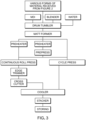
- the MDI-coated carpet waste and other additives are conveyed to a mat forming station that includes conveyors, metering scales, spreader heads and a control management system.
- the spreading equipment distributes the material onto a forming belt such that the spread material becomes a mat which has a generally uniform thickness, width and initial density.
- Board properties may be determined by the shape of the carpet waste composite particles/fibers and by their position in the formed mat. Additionally, the forming station can distribute more than one type of material for a multi-layered board.
- the spreader head in the forming station could spread a mat of fibers on the forming belt, then a second spreader head could spread a mat of pellets on top of the fibers, then a third spread head could spread a top layer of fibers onto the pellets.
- Many different combinations of materials can be spread onto the forming belt to make various types of boards.
- the number of layers per board also can be varied.
- a board could be manufactured to have an outer layer of carpet waste with a fiberglass core, or an outer layer comprising carpet waste pellets, and carpet waste fiber underlayers with a carpet waste pellet core.
- the forming belt then transports the mat into a pre-heater, a pre-press, or directly to a press machine.
- the pre-heater and pre-press may be utilized to reduce total processing time of the composite sheet. Due to the thermal inertia and thickness of the material, heat from the press platens or rolls may take longer to penetrate the total thickness of the mat, thereby extending process time and costs. Preheating brings the temperature of the entire mat up to a higher starting temperature.
- the pre-heater can be located directly ahead of a press (e.g., a hydraulic press) and can be used to preheat the mat after the mat has been formed and/or pre-pressed, as described herein.
- composite sheets are manufactured using a cycle press, which may have single or multi-daylight openings. Ranges of various process parameters for manufacturing various embodiments of PCs utilizing recycled carpet waste in a cycle press are presented in Table A-1, below.
- the composite material is transferred into the cycle press where it is subjected to temperature and pressure from a top and bottom platen that compresses the mat to a predetermined thickness or height.
- the elevated temperature and pressure activates the binding agent and, depending on the temperature, melts certain of the carpet components while leaving others unmelted, to produce in a finished board or sheet.
- steam may be injected into the mat to ensure thorough heating of the binding agent and bonding of the composite material.
- the cycle press may also use an active cooling cycle to reduce the temperature of the board before it exits the press.
- the platens may be engraved with a pattern to give the board outer surface a structured pattern.
- TABLE A-1 Composite Sheet Processing Parameters (Cycle Press) Range High Low Total Time for heating material, during press-cycle [sec] 360 60 Temperature of Heating Plates [ °F ] 600 (315.556°C) 100 (37.7778°C) Pressure of Heating Press [psi] 600 (4.137MPa) 150 (1.03421MPa) Internal Temperature of Board [°F] 500 (260°C) 340 (171.111°C) Cure Time [sec] 400 30 Transition Time from Heating to Cooling Press [sec] 600 0 Total Time for cooling material, during press-cycle [sec] 360 60 Temperature of Cooling Plates [ °F ] 300 (148.889°C) 32 (0°C) Pressure of Cooling Press [psi] 600 (4.137MPa) 150 (1.03421MPa) Internal Temperature of
- Final internal temperatures of the composite being compressed within the cycle press will be dependent at least in part on the temperature of the platens and compression time. If left in the cycle press for a sufficient period of time, the internal temperatures of the composite material will generally equal those of the platens, the ranges of which are given above.
- Final internal temperatures up to about 250°F (121.111°C), about 300°F (148.889°C), about 340°F (171.111°C), about 350°F (176.667°C), about 400°F (204.444°C), about 420°F (215.556°C), and about 480°F (248.889°C) have produced composite sheets displaying acceptable performance.
- Table C-2 presents information for a PC utilizing PF as the binding agent, that results in significantly lower, though still acceptable, MOR and MOE values.
- Binders MDI 0.0% UF 0.0% MUF 0.0% PF 5.0% Wood filler 0.0% Color 0.0% Fire Retardant 0.0% Fiberglass 0.0% Mold Inhibitor 0.0% total 100% Thickness (inch) 0.250 (0.635cm) Density (pcf) 48.0 MOR (psi) 971 (6.69481MPa) MOE (psi) 49,600 (341.97996 MPa) Tensile - Perpendicular [IB] (psi) 716 (4.93665MPa) Tensile - Parallel (psi) 58 (0.399896MPa) Linear Expansion 0.54% Thickness Swell (inch) 0.007 (0.01778cm) Thickness Swell (%) 2.97%
- Binder type and amount may be varied to adjust cost or other properties.
- additives such as fire retardants may be added to produce a composite sheet having a Class A fire rating.
- Composite products that will be decorated may first pass through a sander. This smoothing of the surface prepares the product for coating, transfers, and laminating.
- the sanded or embossed composite product may be coated with primers, finish paints, or stains.
- the coating application employs various conventional spray techniques using exhaust systems to remove the excess spray and solvents. Either penetrating or film-forming coatings may also be applied, and the choice is dependent on the desired finished product appearance and application.
- the sanded composite product can also act as a core to which decorative and protective layer(s) may be hot stamped from a foil or film or laminated to achieve improved physical and visual enhancement.
- U.S. Patent Application Serial No. 11/054,258, filed February 9, 2005 and published as U.S. Patent Application Publication No. 2006/0147693
- the composite product also may be decorated using transfer foils.
- transfer foil has the desired color and/or pattern on a polymeric substrate, and is brought into contact with the surface of the product using stamping equipment designed for the specific application. Using heat and pressure, the color and/or pattern is transferred from the foil to the product. The heat required for the transfer activates an adhesive layer on the surface of the profile ensuring bonding of the decoration to the profile. With the color and/or pattern now on the composite product, the spent foil is then collected for disposal, and the finished product has the desired decorated effect.
- Another decorating method that may be employed is lamination.
- Several materials may be used as the laminate surface, such as wood veneers, synthetic veneers, foils, films, and polymeric sheets.
- the application of rigid laminates like wood veneers is done using conventional laminating equipment.
- an adhesive system (either a wet adhesive system or a hot-melt adhesive system) employing a primer and an adhesive is applied to the PC substrate.
- the rigid surface laminate is then applied to the substrate and heat and pressure are applied. After heating and pressing, the laminated product is then set for a fixed period of time to allow the adhesive system to cure.
- the composite product is the substrate.
- the adhesive system usually a hot-melt adhesive, is applied to the composite product.
- the rigid veneer is then placed on the adhesive layer forming a sandwich of composite product, adhesive, and rigid laminate. The sandwich is then pressed to secure the bond of the laminate to the composite product. After curing, the laminated product with the desired decorative appearance is ready for packaging.
- foil laminating This technique can be referred to as wrapping; wherein, the composite product profile is wrapped in the decorative foil. After the composite product profile has been sanded, the profile passes through a wrapping device that takes the foil wrap from a coil then applies the adhesive (and primer, if required) to the foil. In a continuous process, the foil wrap is then passed over the composite product profile. Using a series of rollers, the foil wrap is shaped to the composite product profile.
- the foil wrap may incorporate an integral topcoat material, such as polyurethane, acrylic, or other protective materials, for physical property enhancement. If, however, the foil wrap integrates only the decorative elements, then the wrapped composite product will require a separate topcoat for certain applications.
- a composite material 50 includes a core layer 52, a top layer 54 disposed above the core layer 52, a bottom layer 56 disposed below the core layer 52, a top surface layer 58 disposed above the top layer 54, and a bottom surface layer 60 disposed below the bottom layer 56.
- the composite material 50 can be in the form of a sheet or board having a thickness T, a width W, and a length L.
- the thickness T can be, for example, from about 6 mm to about 40 mm
- the length L can be from about 10 cm to about 5 m
- the width W can be from about 25 mm to about 1.2 m.
- Table D includes low, typical, and high values for the thicknesses (e.g., average thicknesses) of the composite material 50, the core layer 52, the top layer 54, the bottom layer 56, the top surface layer 58, and the bottom surface layer 60, in accordance with certain examples.
- the values for the core layer thickness T1, the top layer thickness T2, and the bottom layer thickness T3 are presented as percentages of the total thickness T. In some examples, when the total thickness T is high (e.g., about 40 mm), the values for the top layer thickness T2 and the bottom layer thickness T3 can be near the lower ends of the respective ranges of the table (e.g., near 5% of the total thickness T).
- the values for the top layer thickness T2 and the bottom layer thickness T3 can be near the upper ends of the respective ranges in the table (e.g., near 40% of the total thickness T).
- Such values for the top layer thickness T2 and the bottom layer thickness T3 can be used to achieve desired performance characteristics for the composite material 50 (e.g., a desired stiffness) and/or may be used to achieve a substantially uniform combined thickness of the core layer 52, the top layer 54, and the bottom layer 56, as described below.
- Table D Average thickness values for composite material.
- the core layer 52, the top layer 54, and the bottom layer 56 can each include polymeric fibers, a binding agent, and optionally one or more fillers and/or additives.
- the polymeric fibers can be or include, for example, nylon fibers, polyester fibers, polypropylene fibers, bicomponent fibers, other types of fibers, or any combination thereof, and can be derived from carpet, carpet waste, automotive headliners, insulation materials, or other sources, as described herein.
- polymeric fibers derived from carpet or carpet waste can be referred to herein as "carpet fiber.” Additionally or alternatively, polymeric fibers can be obtained from scrap, used, new, and/or recycled fiber sources, such as, for example, interior automotive surface materials (e.g., automotive headliners, sidewalls, floor mats, or automotive fabrics), thermal insulation materials, sound insulation materials, industrial or commercial fabrics (e.g., polyester woven fabric), cushions, pads, carpet tiles, product waste or recycling streams, or any combination thereof.
- interior automotive surface materials e.g., automotive headliners, sidewalls, floor mats, or automotive fabrics
- thermal insulation materials e.g., sound insulation materials
- industrial or commercial fabrics e.g., polyester woven fabric
- the core layer 52, the top layer 54, and/or the bottom layer 56 can include any portion of carpet or carpet waste, including face fibers, backing, inorganic materials, contaminants (e.g., dirt or sand), and/or adhesives.
- the core layer 52, the top layer 54, and/or the bottom layer 56 may include only one or more portions of the carpet or carpet waste, such as face fibers.
- the binding agent can be or include, for example, a polyurea, a polyurethane, an isocyanate, one or more polyols, or other suitable binding agent materials or precursors.
- the binding agent can be or include a polyurea derived from a reaction between MDI and water.
- the binding agent can be or include a polyurethane derived from a reaction between MDI (or other isocyanate) and a polyol.
- the polyol can be or include, for example, a polyether polyol or a polyester polyol, such as polyethylene oxide, polyethylene glycol, or polypropylene glycol.
- the polyurethane can be or include a foam, such as a rigid polyurethane foam and/or a closed-cell polyurethane foam.
- the reaction to form the polyurethane foam can utilize or involve auxiliary materials, such as one or more catalysts, foaming agents, and/or stabilizers.
- auxiliary materials such as one or more catalysts, foaming agents, and/or stabilizers.
- foamed materials can significantly reduce a weight of the resulting composite materials.
- the binding agent can include or be derived from MDI (or other isocyanate), urea formaldehyde (UF), melamine urea formaldehyde (MUF), phenol formaldehyde (PF), and/or one or more polyols.
- the fillers for the core layer 52, the top layer 54, and the bottom layer 56 can be or include, for example, polymeric fillers, natural fiber fillers, inorganic fillers (e.g., mineral fillers), and/or fiberglass.
- the polymeric fillers can be or include various single layer films and/or multilayer films, which can be or include, for example, barrier packaging films.
- Such polymeric fillers can include, for example, single or multilayer films having biaxially oriented polypropylene (BOPP), nylon, polyvinylidene dichloride (PVDC), ethylene vinyl alcohol (EVOH), metallic or other impervious materials or layers, or any combination thereof.
- BOPP biaxially oriented polypropylene
- PVDC polyvinylidene dichloride
- EVOH ethylene vinyl alcohol
- Such polymeric fillers can be obtained or derived from food packaging or other scrap or waste sources.
- BOPP and/or other films can be shredded and/or granulated (e.g., to form particles) prior to being used as a filler, as described herein.
- polymeric fillers can be or include recycled polymeric materials obtained from a recycling facility, such as a materials recovery facility (e.g., MRF residuals) or a commercial waste disposal operation.
- the polymeric fillers can be or include fibers that are recycled or sourced from used, old, or waste fiber materials (e.g., manufacturing scrap), including clothing (e.g., jackets, shirts, and/or pants), paint rollers, and shoddy fiber (e.g., from cushions).
- Other suitable polymeric fillers can include, for example, granulated or shredded polyethylene, polypropylene, polyester, and/or nylon, in film or non-film form.
- the composite building materials described herein can include polymeric filler (e.g., polymeric film particles) but little or no polymeric fibers.
- Such composite building materials can include, for example, binding agent and polymeric filler, and optionally one or more additional fillers and/or additives. It is presently discovered that such composite building materials having polymeric filler but little or no polymeric fibers can have certain performance benefits over composites that include polymeric fibers or greater amounts of polymeric fibers.
- the improved performance benefits can include, for example, less water absorption, which can result in composites that exhibit less swelling due to moisture exposure and/or fewer issues related to mold or mildew.
- polymeric fillers such as BOPP or barrier packaging films can be generally impervious to water and/or can absorb little or no moisture.
- polymeric fiber e.g., carpet fiber
- polymeric fiber e.g., carpet fiber
- composites made with polymeric fibers (and little or no polymeric film materials) may exhibit more thermal expansion and/or contraction due to temperature changes, compared to composites made with polymeric film materials (and little or no polymeric fibers).
- a concentration of filler can be different in the core layer 52 than in the top layer 54 and/or the bottom layer 56. This can allow the amount of filler in the composite material 50 to be adjusted by changing the thickness of the core layer 52, relative to the thicknesses of the top layer 54 and the bottom layer 56. For example, if the core layer 52 contains a higher concentration of certain fillers (e.g., natural fiber filler), the amount of filler in the composite material 50 can be increased by increasing a thickness of the core layer 52. In this way, material properties of the composite material 50 can be adjusted by varying relative thicknesses of the core layer 52, the top layer 54, and the bottom layer 56.
- certain fillers e.g., natural fiber filler
- the top surface layer 58 and/or the bottom surface layer 60 can be or include a mat, web, or film of fiberglass fibers (referred to herein as a "fiberglass film").
- the fiberglass fibers can be woven or non-woven to form the fiberglass film.
- the fiberglass film can be impregnated with or otherwise include a resin, such as a phenolic resin (e.g., PF), MDI, MUF, UF, latex, epoxy, polyester, polyethylene, polypropylene, like materials, or any combination thereof.
- the fiberglass film can have a thickness from about 0.001 inches (0.025 mm) to about 0.003 inches (0.076 mm).
- the fiberglass film can have a thickness from about 0.005 inches (0.13 mm) to about 0.020 inches (0.51 mm).
- the fiberglass film can be or include, for example, ADVANTEX glass strand mat, UNIFILO filament mat, HYDROSTRAND, or SUSTAINA, available from OWENS CORNING.
- the fiberglass film can be or include a laminated film and/or a multi-layer film.
- Laver Composition Low Typical High Core Layer Polymeric Fiber (wt %) 0 45 98 Average/Median Length of Polymeric Fibers (mm) 2 30 50 Total Filler (wt %) 0 45 98 Natural Fiber Filler (wt %) 0 0 75 Polymeric Filler (e.g., BOPP) (wt %) 0 45 98 Inorganic Filler (wt %) 0 0 50 Fiberglass Filler (wt %) 0 0 98 Total Additives (wt %) 0 4 25 Total Binding Agent (e.g., MDI + water) (wt %) 2 6 10 Top and Bottom Layers Polymeric Fiber (wt.
- Polymeric Filler e.g., BOPP
- the composite materials described herein may include the core layer 52 and at least one surface layer of resin-impregnated paper and/or fiberglass film (e.g., the top surface layer 58 and/or the bottom surface layer 60), but may not include top and bottom layers of polymeric fiber (e.g., the top layer 54 and/or the bottom layer 56).
- a substantially uniform (e.g., less than 20%, 10%, or 5% thickness variation) core layer can be obtained by using shorter polymeric fibers (e.g., 13 mm average length) than may be used when the top and bottom layers of polymeric fiber are included.
- the shorter fibers can fill in voids, interstitial spaces, or valleys formed by the longer fibers.
- the longer polymeric fibers can have an average length greater than about 8 mm, greater than about 30 mm, or from about 8 mm to about 50 mm.
- the shorter polymeric fibers can have an average length less than about 25 mm, less than about 13 mm, or from about 1 mm to about 25 mm.
- the single core layer 52 can be formed using, for example, rotating brushes, pick rollers, air laying, and/or similar devices, which can adjust or rearrange a mat of fibers to make the mat more uniform or smooth, prior to heating or compression. Such techniques can avoid or reduce the need for using the top and/or bottom layers of polymeric fiber to achieve polymeric fiber mats that are substantially uniform in thickness.
- the granulated fiber materials can be or include, for example, individual polymeric fibers that have been reduced in size or length, separated from one another, and/or not bonded together (e.g., with adhesive).
- the surface fiber granulator 84a and the core fiber granulator 84c can deliver the granulated fiber materials to a surface fiber storage 86a and a core fiber storage 86c.
- polymeric filler materials such as BOPP (or other single or multilayer films, as described herein), and/or MRF residuals
- a filler shredder 82b which can deliver shredded polymeric fillers to a filler granulator 84b, which can deliver granulated polymeric fillers to a filler storage 86b.
- the granulated polymeric fillers can include particles or chips of BOPP films (e.g., films of BOPP that have been reduced in size or converted to small pieces), other polymeric films (e.g., films that include or are formed from polymers or materials other than BOPP), packaging films, barrier packaging films, MRF residuals, or other suitable polymeric filler materials.
- binding agent components such as MDI 86 and water 88 (and optionally a polyol and/or auxiliary materials for creating a polyurethane foam), can be added to the granulated fiber materials and the granulated polymeric filler.
- the granulated fiber materials from the surface fiber storage 86a and the granulated filler from the filler storage 86b can be mixed with MDI 86 and water 88 in a surface mixer 90.
- the granulated fiber materials from the core fiber storage 86c and the granulated filler from the filler storage 86b can be mixed with MDI 86 and water 88 in a core mixer 92.
- the bottom layer former 94a, the core layer former 94b, and the top layer former 94c can be used to generate a bottom layer 96a, a core layer 96b, and a top layer 96c, respectively, from the respective mixtures of fiber, filler, MDI, and water.
- One or more dissolving rollers 98 can be used to form these layers.
- the bottom layer former 94a, the core layer former 94b, the top layer former 94c, and/or the dissolving rollers 98 can utilize or include rotating brushes, pick rollers, air laying, and/or similar devices.
- the bottom layer 96a, the core layer 96b, and the top layer 96c are formed on a bottom sheet 100 or web of phenolic paper and/or fiberglass film traveling on a conveyor 102 in a process direction 104, preferably at a constant or near constant speed.
- One or more scales 106 can be used to measure a weight of the bottom layer 96a, the core layer 96b, and/or the top layer 96c.
- the bottom sheet 100 of phenolic paper and/or fiberglass film can be obtained from a roll 108 or other source.
- the binding agent when the binding agent includes a polyurethane (e.g., a polyurethane foam), the bottom layer 96a, the core layer 96b, and the top layer 96c can include polyurethane precursors, such as a polyol, MDI (or other isocyanate), water, and/or auxiliary materials (e.g., catalysts, foaming agents, and/or stabilizers).
- a polyurethane e.g., a polyurethane foam
- auxiliary materials e.g., catalysts, foaming agents, and/or stabilizers.
- the hydraulic press 118 can apply additional heat and pressure to convert the compressed mat 112 with the top sheet 114 into panels or sheets of a composite material 120.
- the heat and pressure in the hydraulic press 118 can further compress the bottom layer 96a, the core layer 96b, and the top layer 96c until a desired final thickness is reached.
- the heat and pressure can cure the MDI (or other binding agent) and/or can cure the resin in the phenolic paper or fiberglass film.
- a resin, binding agent, or glue can be applied to the bottom sheet 100 and/or the top sheet 114 (or other composite layers) using spray nozzles, a roller, a blade, or other coating techniques, for example, to achieve bonding between the bottom sheet 100 and/or the top sheet 114 and other composite layers.
- the heat and pressure in the hydraulic press 118 can trigger a reaction between one or more polyurethane precursors to form a polyurethane.
- the polyurethane can include a polyurethane foam that expands to fill an entire space between platens in the hydraulic press 118.
- the polyurethane foam can expand to fill any voids or interstitial spaces between polymeric fibers and/or filler materials in the bottom layer 96a, the core layer 96b, and/or the top layer 96c.
- use of polyurethane foam as a binding agent can require less compression or pressing of polymeric fiber and/or filler materials.
- a separation distance between the platens can be set to a predetermined value, and the polyurethane foam can expand to fill a gap or space between the platens.
- the polyurethane foam can act as a matrix that carries or holds the polymeric fibers and/or fillers, which can be distributed throughout the polyurethane foam.
- the polyurethane foam when a polyurethane foam is formed and/or used in the composite materials described herein, the polyurethane foam can occupy a significant portion (e.g., greater than 25%, greater than 50%, or more) of a total volume of the resulting composite, such that the bottom layer 96a, the core layer 96b, and/or the top layer 96c may not need to include as much polymeric fiber and/or filler materials.
- the resulting composite can have a weight percentage of polymeric fiber and/or filler materials that is lower by 10%, 20%, 30%, 40%, 50%, or more.
- the polyurethane foam can result in composite materials are not as heavy as non-foamed composites (e.g., lighter or lower in density by 10%, 20%, 30%, 40%, 50%, or more).
- foamed composites can have a density from about 20 lb/ft 3 (320 kg/m 3 ) to about 45 lb/ft 3 (721 kg/m 3 ).
- Non-foamed composites can have a density from about 35 lb/ft 3 (561 kg/m 3 ) to about 70 lb/ft 3 (1120 kg/m 3 ).
- the polyurethane foam can be more water resistant than other binding agents described herein.
- the closed cells of the polyurethane foam can prevent water from infiltrating into the composite materials described herein.
- composite materials produced using a rigid polyurethane foam can be stronger or stiffer than other composite materials described herein. The added strength or stiffness can be due to the polyurethane foam connecting polymeric fibers and/or fillers in a single matrix.
- the phenolic paper can be applied after the bottom layer 96a, the core layer 96b, and the top layer 96c have been heated and pressed by the pre-press 110 and/or the hydraulic press 118 to form a composite.
- the phenolic paper (or fiberglass film) can be bonded to the resulting composite (e.g., using a glue) and the resin in the phenolic paper (or fiberglass film) can be cured (e.g., by applying heat).
- the composite materials described herein can be formed using a single layer of binding agent, polymeric fibers, polymeric films, and/or other fillers or additives, as described herein and shown in FIG. 5B .
- the manufacturing process 80 can be modified to form or include the core layer 96b but not the bottom layer 96a and the top layer 96c.
- the sheets of composite material After the sheets of composite material have been formed, the sheets can be cooled and cut to desired shapes and sizes, and various finishing processes can be utilized to form a finished product. For example, edges or other portions of the composite sheet can be subjected to thermal or heat treatments in which an open flame, infrared radiation, or a hot roller melts polymeric material and/or closes any open structures or pores of the composition, thereby reducing or eliminating pathways for moisture absorption. Additionally or alternatively, the composite material can be coated with one or more coatings, such as water-based paint (e.g., latex paint or acrylic paint), solvent based paint, two-part catalyst paint, nano-based coatings, and/or UV cured coatings.
- water-based paint e.g., latex paint or acrylic paint
- solvent based paint e.g., solvent based paint
- two-part catalyst paint e.g., two-part catalyst paint
- nano-based coatings e.g., UV cured coatings.
- one or more sealants e.g., siliconebased sealant materials
- the finishing processes can include surface treatments, such as embossing (inside or after the hydraulic press 118), molding, and/or digital printing (e.g., performed on the phenolic paper or fiberglass film before or after the hydraulic press 118).
- Embossing can be performed using one or more engraved plates or belts in the hydraulic press 118.
- the engraved plates can emboss a realistic wood pattern into a top or bottom layer of phenolic paper or fiberglass film.
- embossing can be performed after the hydraulic press, for example, in a finishing process using a flat press and/or a roll embosser.
- the digital printing can be performed, for example, to add a printed texture resembling natural wood, stone, tile, brick, or other building material.
- One or more coatings can be applied (e.g., to the phenolic paper or fiberglass film), such as a powder coating or a clear coat.
- a masonry finish can be obtained or simulated by gluing or affixing aggregate materials, stucco, and/or cementitious materials or products to an exterior surface of the composite materials described herein.
- metal materials e.g., aluminum sheets
- the finishing processes can include one or more of the following steps, in any combination.
- the cooled panels from the hydraulic press can be ripped or cut into boards of various widths, for example, using a multi-gang rip saw.
- the boards can be transferred automatically to a linear finishing line, which can align the boards from side-to-side and/or end-to-end.
- the boards can then be processed using various finishing steps, which can depend on the specific product being manufactured. These finishing steps can include, for example, deburring (sanding), thermal treatment (e.g., flame treatment tunnel or hot roller), edge banding or other edge application, and/or molding (e.g., in a shaper).
- the composite product can go through a laser QA system, for example, to confirm dimensions (e.g., width and thickness) and/or detect any surface imperfections. Boards can be rejected automatically based on the QA system.
- the resulting boards can go through as many as three cycles of painting and drying.
- Two coats of primer or sealer can be applied to edges or an entire board, with each coat preferably being dried in an infrared thermal oven.
- a final coating of top paint can then be applied and dried.
- a cooling step can be used to remove heat from the product prior to automatic packaging, to prevent sticking of boards.
- Protective coatings or packing materials can be applied prior to shipment. Boards can be sub-bundled, if desired, and/or automatically palletized, and pallets can be wrapped and labeled.
- FIG. 10 is a flowchart of an example method 130 of manufacturing a composite building material.
- a core layer having a first type of polymeric fibers (e.g., carpet fibers) and a first binding agent is formed (step 132).
- the first type of polymeric fibers has a first average fiber length.
- a top layer having a second type of polymeric fibers (e.g., carpet fibers) and a second binding agent is formed (step 134).
- the second type of polymeric fibers has a second average fiber length different than the first average fiber length.
- a bottom layer having the second type of polymeric fibers and the second binding agent is formed (step 136).
- At least one surface layer of resin-impregnated paper (or fiberglass film) is applied (step 138) above the top layer or below the bottom layer.
- the composite building material is formed by heating and pressing (step 140) the core layer and the at least one surface layer of resin-impregnated paper (or fiberglass film), with the core layer positioned between the top layer and the bottom layer.
- step 136 is performed before step 132, which is performed before step 134.
- the first type of polymeric fibers and the second type of polymeric fibers can include fibers having the same or similar chemical composition and/or fiber diameters.
- FIG. 11 is a flowchart of an example method 150 of manufacturing a composite building material.
- a core layer is formed (step 152) that includes a binding agent at least one of polymeric fibers or polymeric film particles (e.g., polymeric fibers, polymeric film particles, or both polymeric fibers and polymeric film particles).
- At least one surface layer of resin-impregnated paper (or fiberglass film) is applied (step 154) above or below the core layer.
- the core layer and the at least one surface layer of resin-impregnated paper (or fiberglass film) are heated and pressed (step 156) to form the composite building material.
- a variety of polymeric fiber lengths can be used to achieve composite building materials having a variety of performance characteristics.
- longer polymeric fibers e.g., 25 mm or longer
- shorter polymeric fibers e.g., less than 25 mm
- the shorter polymeric fibers can be used to produce boards that have smoother exterior surfaces and/or may be easier to mold and/or shape in a finishing process.
- the shorter polymeric fibers and/or higher fiber densities
- the shorter fibers can be used to achieve smoother exterior surfaces, as described herein.
- a variety of composite materials having carpet fiber and optionally a top and/or bottom surface layer of phenolic paper were produced in accordance with the composites and methods described herein. Table F lists various parameters related to the composition and structure of two examples of these composite materials that were used for performance testing. Samples of the composite materials were produced using a two daylight, hydraulic press from DIEFFENBACHER, with cycle times of approximately 10 minutes. Platen temps in the press for Example A were approximately 410-420 °F (210-216 °C) and for Example B were approximately 390 °F (199 °C). The phenolic paper for the top and bottom surface layers was obtained from PANELTECH (of Hoquiam, WA). Table F. Parameter values for example composite materials.
- Table G illustrates results from performance tests that were performed on the example composite materials listed in Table F.
- the results indicate that the coefficient of thermal expansion (CTE; as measured using ASTM D6341 - 16) for Example A was 0.00003 to 0.00006 m/m °C, and the CTE for Example B was 0.000006 to 0.000008 m/m °C.
- the results also indicate that linear expansion of a 6.1 m (20 ft) board due to a 50 °C temperature change (from - 10 °C to 40 °C) was 1.7 to 3.3 cm for Example A and 0.33 to 0.43 cm for Example B.
- Example B included phenolic paper on the top and bottom surfaces while Example A did not include any phenolic paper.
- this reduction in CTE and linear thermal expansion can significantly improve the performance of the composite materials described herein for various building applications, particularly where substantial temperature variations (e.g., of 30 °C or more) may be encountered.
- building applications can include, for example, exterior decking, siding, trim boards, and/or roofing.
- the reduction in CTE achieved through the use of phenolic paper can render the composite materials commercially viable.
- composite materials that do not utilize phenolic paper on top and/or bottom surfaces may be susceptible to large or excessive amounts of thermal expansion, which can cause installed products to bend, warp, become unfastened or loose, become less visibly attractive, and/or destroy or damage neighboring installed materials.
- Table G Performance parameters for the example composite materials.
- Example B Coefficient of Thermal Expansion (m/m °C) 3.0E-05 to 6.0E-05 6.0E-06 to 8.0E-06 Linear Thermal Expansion of 6.1 m Board due to 50 °C Temperature Change (cm) 1.7 to 3.3 0.33 to 0.43 Linear Expansion of 6.1 m Board due to Submersion in Water for 24 hours (cm) 1.3 0.23 Linear Expansion of 6.1 m Board due to Submersion in Water for 144 hours (cm) 2.5 0.33
- Example B The results in Table G also indicate that expansion due to moisture absorption was significantly lower for Example B, compared to Example A.
- linear expansion of a 6.1 m (20 ft) board due to submersion in water at 20 °C for 24 hours was 1.3 cm for Example A and 0.23 cm for Example B.
- linear expansion of a 6.1 m (20 ft) board due to submersion in water at 20 °C for 144 hours was 2.5 cm for Example A and 0.33 cm for Example B.
- the significant reduction in expansion due to moisture absorption (e.g., as much as a factor of about 8) achieved with Example B (and with similar samples in other experiments) is believed to be primarily due to the use of phenolic paper, rather than any other differences between the samples).
- this reduction in moisture expansion can significantly improve the performance of the composite materials described herein for various building applications where exposure to moisture may be encountered.
- building applications can include, for example, exterior decking, siding, trim boards, and/or roofing.
- the reduction in CTE achieved through the use of phenolic paper can render the composite materials commercially viable.
- composite materials that do not utilize phenolic paper on top and/or bottom surfaces may be susceptible to large or excessive amounts of moisture expansion, which can cause installed products to bend, warp, become unfastened or loose, become less visibly attractive, and/or destroy neighboring installed materials.
- phenolic paper as described herein, can significantly improve various performance parameters related to mechanical strength. For example, such experiments indicate that modulus of elasticity, modulus of rupture, and/or yield strength can increase by a factor of 2, 5, 10, or more, due to the use of phenolic paper (e.g., on top and/or bottom surfaces) in the composite materials described herein.
- Use of the fiberglass mats described herein can similarly improve various performance parameters related to mechanical strength (e.g., modulus of elasticity and modulus of rupture), thermal expansion, and/or moisture expansion.
- the use of fiberglass mats can improve fire resistance, increase water resistance, increase hardness, and/or increase puncture resistance.
- Composite materials that do not utilize phenolic paper and/or fiberglass films may have inadequate stiffness or mechanical strength. This can result in product failure or excessive product bending or displacement, and/or may present a safety hazard.
- each numerical value presented herein for example, in a table, a chart, or a graph, is contemplated to represent a minimum value or a maximum value in a range for a corresponding parameter. Accordingly, when added to the claims, the numerical value provides express support for claiming the range, which may lie above or below the numerical value, in accordance with the teachings herein. Absent inclusion in the claims, each numerical value presented herein is not to be considered limiting in any regard.
- substantially nonuniform thickness can refer to one or more layers having a ratio of a minimum thickness to a maximum thickness that is less than 0.5, less than 0.4, less than 0.3, less than 0.2, less than 0.1, or less than 0.05.
- substantially uniform thickness can refer to one or more layers having a ratio of a minimum thickness to a maximum thickness that is greater than 0.5, greater than 0.6, greater than 0.7, greater than 0.8, greater than 0.9, or greater than 0.95.
- a reference to "A and/or B", when used in conjunction with open-ended language such as “comprising” can refer, in one embodiment, to A only (optionally including elements other than B); in another embodiment, to B only (optionally including elements other than A); in yet another embodiment, to both A and B (optionally including other elements); etc.
- the phrase "at least one,” in reference to a list of one or more elements, should be understood to mean at least one element selected from any one or more of the elements in the list of elements, but not necessarily including at least one of each and every element specifically listed within the list of elements and not excluding any combinations of elements in the list of elements.
- This definition also allows that elements may optionally be present other than the elements specifically identified within the list of elements to which the phrase "at least one" refers, whether related or unrelated to those elements specifically identified.
- At least one of A and B can refer, in one embodiment, to at least one, optionally including more than one, A, with no B present (and optionally including elements other than B); in another embodiment, to at least one, optionally including more than one, B, with no A present (and optionally including elements other than A); in yet another embodiment, to at least one, optionally including more than one, A, and at least one, optionally including more than one, B (and optionally including other elements); etc.
Landscapes
- Engineering & Computer Science (AREA)
- Textile Engineering (AREA)
- Chemical & Material Sciences (AREA)
- Chemical Kinetics & Catalysis (AREA)
- General Chemical & Material Sciences (AREA)
- Mechanical Engineering (AREA)
- Composite Materials (AREA)
- Life Sciences & Earth Sciences (AREA)
- Wood Science & Technology (AREA)
- Dispersion Chemistry (AREA)
- Laminated Bodies (AREA)
- Dry Formation Of Fiberboard And The Like (AREA)
Claims (15)
- Verbundbaumaterial, Folgendes umfassend:eine Kernschicht, die eine erste Art von Polymerfasern und ein erstes Bindemittel umfasst, wobei die erste Art von Polymerfasern eine erste durchschnittliche Faserlänge aufweist;eine Deckschicht, die oberhalb der Kernschicht angeordnet ist und eine zweite Art von Polymerfasern und ein zweites Bindemittel umfasst, wobei die zweite Art von Polymerfasern eine zweite durchschnittliche Faserlänge aufweist, die sich von der ersten durchschnittlichen Faserlänge unterscheidet, wobei die zweite durchschnittliche Faserlänge kleiner als die erste durchschnittliche Faserlänge ist, sodass eine durchschnittliche Länge von Polymerfasern in der Kernschicht größer als eine durchschnittliche Länge von Polymerfasern in der Deckschicht ist;eine optionale Unterschicht, die unterhalb der Kernschicht angeordnet ist und die zweite Art von Polymerfasern und das zweite Bindemittel umfasst, wobei eine durchschnittliche Länge von Polymerfasern in der Kernschicht größer ist als eine durchschnittliche Länge von Polymerfasern in der optionalen Unterschicht; undmindestens eine Oberflächenschicht aus harzimprägniertem Papier, die oberhalb der Deckschicht oder unterhalb der optionalen Unterschicht angeordnet ist,wobei die erste Art von Polymerfasern und die zweite Art von Polymerfasern komprimiert sind,wobei mindestens eine von der ersten Art von Polymerfasern oder der zweiten Art von Polymerfasern Fasern umfasst, die von mindestens einer von einer Quelle für Altfasern, einer Quelle für gebrauchte Fasern, einer Quelle für wiederverwertete Fasern oder einer beliebigen Kombination davon abgeleitet sind,wobei das erste Bindemittel und das zweite Bindemittel von Methylendiphenyldiisocyanat (MDI) abgeleitet sind und mindestens eines von einem Polyharnstoff oder einem Polyurethan umfassen,wobei die Kernschicht eine im Wesentlichen ungleichmäßige Dicke aufweist und die Kernschicht, die Deckschicht und die optionale Unterschicht zusammen eine im Wesentlichen gleichmäßige Dicke aufweisen und wobei die Kernschicht, die Deckschicht, die optionale Unterschicht und die mindestens eine Oberflächenschicht eine Platte oder ein Blech bilden.
- Verbundbaumaterial nach Anspruch 1, wobei mindestens eine von der ersten Art von Polymerfasern oder der zweiten Art von Polymerfasern Fasern umfasst, die von mindestens einem von Teppich, Fahrzeughimmel, Fahrzeugseitenwänden, Geweben für Fahrzeuge, Isoliermaterialien oder einer beliebigen Kombination davon abgeleitet sind.
- Verbundbaumaterial nach Anspruch 1, wobei die erste durchschnittliche Faserlänge größer als etwa 25 mm ist.
- Verbundbaumaterial nach Anspruch 1, wobei die im Wesentlichen ungleichmäßige Dicke eine unregelmäßige Dicke mit Höhen und Tiefen umfasst, wobei die im Wesentlichen ungleichmäßige Dicke eine minimale Dicke und eine maximale Dicke umfasst und wobei die minimale Dicke weniger als die Hälfte der maximalen Dicke beträgt.
- Verbundbaumaterial nach Anspruch 1, wobei die im Wesentlichen gleichmäßige Dicke eine minimale Dicke und eine maximale Dicke umfasst und wobei die minimale Dicke mindestens 90 % der maximalen Dicke beträgt.
- Verbundbaumaterial nach Anspruch 1, wobei mindestens eine von der Kernschicht, der Deckschicht oder der optionalen Unterschicht einen Polymerfüllstoff umfasst, der Partikel umfasst, die aus mindestens einem von biaxial ausgerichtetem Polypropylen, einer Polymerfolie, einer Verpackungsfolie, einer Barriereverpackungsfolie, einem MRF-Rest oder einer beliebigen Kombination davon gebildet sind.
- Verbundbaumaterial nach Anspruch 1, wobei mindestens eine von der Kernschicht, der Deckschicht oder der optionalen Unterschicht mindestens eines von einem anorganischen Füllstoff, einem Naturfaserfüllstoff oder Glasfaser umfasst.
- Verbundbaumaterial nach Anspruch 1, wobei mindestens eines von (i) der Kernschicht mindestens einen Füllstoff oder Zusatzstoff umfasst, der nicht in der Deckschicht oder der optionalen Unterschicht vorhanden ist, oder (ii) mindestens eines von der Deckschicht oder der optionalen Unterschicht mindestens einen Füllstoff oder Zusatzstoff umfasst, der nicht in der Kernschicht vorhanden ist.
- Verbundbaumaterial nach Anspruch 1, wobei die mindestens eine Oberflächenschicht aus harzimprägniertem Papier Phenolpapier umfasst.
- Verbundbaumaterial nach Anspruch 1, wobei die Platte oder das Blech zur Verwendung in einem Bauprodukt konfiguriert ist und wobei das Bauprodukt mindestens eines von Außenverkleidungen, Blenden, Leisten, Paneelen, Bedachung oder Bodenbelag umfasst.
- Verfahren zum Herstellen eines Verbundbaumaterials, wobei das Verfahren die folgenden Schritte umfasst:Bilden einer Kernschicht, die eine erste Art von Polymerfasern und ein erstes Bindemittel umfasst, wobei die erste Art von Polymerfasern eine erste durchschnittliche Faserlänge aufweist;Bilden einer Deckschicht, die eine zweite Art von Polymerfasern und ein zweites Bindemittel umfasst, wobei die zweite Art von Polymerfasern eine zweite durchschnittliche Faserlänge aufweist, die sich von der ersten durchschnittlichen Faserlänge unterscheidet, wobei die zweite durchschnittliche Faserlänge kleiner als die erste durchschnittliche Faserlänge ist, sodass eine durchschnittliche Länge von Polymerfasern in der Kernschicht größer als eine durchschnittliche Länge von Polymerfasern in der Deckschicht ist;optional Bilden einer Unterschicht, die die zweite Art von Polymerfasern und das zweite Bindemittel umfasst, wobei eine durchschnittliche Länge von Polymerfasern in der Kernschicht größer ist als eine durchschnittliche Länge von Polymerfasern in der optionalen Unterschicht;Aufbringen mindestens einer Oberflächenschicht aus harzimprägniertem Papier oberhalb der Deckschicht oder unterhalb der optionalen Unterschicht; undErwärmen und Pressen der Kernschicht zwischen der Deckschicht und der optionalen Unterschicht und der mindestens einen Oberflächenschicht aus harzimprägniertem Papier, um das Verbundbaumaterial zu bilden,wobei die erste Art von Polymerfasern und die zweite Art von Polymerfasern komprimiert sind,wobei mindestens eine von der ersten Art von Polymerfasern oder der zweiten Art von Polymerfasern Fasern umfasst, die von mindestens einer von einer Quelle für Altfasern, einer Quelle für gebrauchte Fasern, einer Quelle für wiederverwertete Fasern oder einer beliebigen Kombination davon abgeleitet sind,wobei das erste Bindemittel und das zweite Bindemittel von Methylendiphenyldiisocyanat (MDI) abgeleitet sind und mindestens eines von einem Polyharnstoff oder einem Polyurethan umfassen,wobei die Kernschicht eine im Wesentlichen ungleichmäßige Dicke aufweist und die Kernschicht, die Deckschicht und die optionale Unterschicht zusammen eine im Wesentlichen gleichmäßige Dicke aufweisen und wobei das Verbundbaumaterial eine Platte oder ein Blech umfasst.
- Verfahren nach Anspruch 11, wobei mindestens eine von der ersten Art von Polymerfasern oder der zweiten Art von Polymerfasern Fasern umfasst, die von mindestens einem von Teppich, Fahrzeughimmel, Fahrzeugseitenwänden, Geweben für Fahrzeuge, Isoliermaterialien oder einer beliebigen Kombination davon abgeleitet sind.
- Verfahren nach Anspruch 11, wobei das Bilden der Kernschicht das Mischen der ersten Art von Polymerfasern mit dem ersten Bindemittel umfasst und wobei das Bilden der Deckschicht und der optionalen Unterschicht das Mischen der zweiten Art von Polymerfasern mit dem zweiten Bindemittel umfasst.
- Verfahren nach Anspruch 11, wobei das Aufbringen der mindestens einen Oberflächenschicht das Aufbringen einer Oberflächenschicht von der mindestens einen Oberflächenschicht oberhalb der Deckschicht umfasst.
- Verfahren nach Anspruch 11, wobei das Bilden der Kernschicht den Zusatz von Polymerfolienpartikeln umfasst und wobei die Polymerfolienpartikel mindestens eines von biaxial ausgerichtetem Polypropylen, einer Verpackungsfolie, einer Barriereverpackungsfolie oder einer beliebigen Kombination davon umfassen.
Applications Claiming Priority (3)
| Application Number | Priority Date | Filing Date | Title |
|---|---|---|---|
| US202063115318P | 2020-11-18 | 2020-11-18 | |
| US17/216,858 US11572646B2 (en) | 2020-11-18 | 2021-03-30 | Composite building materials and methods of manufacture |
| PCT/US2021/059863 WO2022109118A1 (en) | 2020-11-18 | 2021-11-18 | Composite building materials and methods of manufacture |
Publications (3)
| Publication Number | Publication Date |
|---|---|
| EP4247632A1 EP4247632A1 (de) | 2023-09-27 |
| EP4247632B1 true EP4247632B1 (de) | 2025-04-16 |
| EP4247632C0 EP4247632C0 (de) | 2025-04-16 |
Family
ID=79025312
Family Applications (1)
| Application Number | Title | Priority Date | Filing Date |
|---|---|---|---|
| EP21827284.7A Active EP4247632B1 (de) | 2020-11-18 | 2021-11-18 | Verbundbaumaterialien und herstellungsverfahren |
Country Status (4)
| Country | Link |
|---|---|
| US (1) | US11572646B2 (de) |
| EP (1) | EP4247632B1 (de) |
| CA (1) | CA3202139A1 (de) |
| WO (1) | WO2022109118A1 (de) |
Families Citing this family (3)
| Publication number | Priority date | Publication date | Assignee | Title |
|---|---|---|---|---|
| US20230415709A1 (en) * | 2022-06-24 | 2023-12-28 | Newpark Mats & Integrated Services Llc | Mat and support surface formed from recycled material |
| WO2024167767A1 (en) * | 2023-02-06 | 2024-08-15 | Material Innovations Llc | Composite building materials and methods of manufacture |
| GB2628755A (en) * | 2023-03-28 | 2024-10-09 | Maplex Tech Limited | Methods for the manufacturing of composite boards from textile and wood fibers |
Family Cites Families (397)
| Publication number | Priority date | Publication date | Assignee | Title |
|---|---|---|---|---|
| NL281286A (de) | 1954-07-08 | 1900-01-01 | ||
| US3478134A (en) | 1960-05-23 | 1969-11-11 | American Mach & Foundry | Process for the manufacture of bowling pins |
| US3511750A (en) | 1965-10-20 | 1970-05-12 | Owens Illinois Inc | Laminates including pulp-thermoplastic boards |
| US3471355A (en) | 1966-03-01 | 1969-10-07 | Allied Chem | Panel molding structure |
| US3560324A (en) | 1966-11-23 | 1971-02-02 | Nat Distillers Chem Corp | Flexwood laminates comprising a layer of thermoplastic resin-cellulose fiber particle mixture and a layer of cellulosic fiber |
| US3669823A (en) * | 1969-06-04 | 1972-06-13 | Curlator Corp | Non-woven web |
| US3717534A (en) | 1970-08-06 | 1973-02-20 | Sun Oil Co | Method for preparing laminated article of cellulosic and polymeric layers |
| US3864201A (en) | 1970-10-06 | 1975-02-04 | Lion Fat Oil Co Ltd | Thermoplastic resins loaded with filler bonded to cover layers |
| US3856724A (en) | 1971-01-29 | 1974-12-24 | Texaco Inc | Reinforced thermoplastic compositions |
| US3804693A (en) * | 1971-05-17 | 1974-04-16 | Gen Electric | Paper base laminates and method for the manufacture thereof |
| US3801417A (en) | 1971-12-03 | 1974-04-02 | Glass Lab Co | Decorative molding and method of forming same |
| US3959434A (en) | 1972-07-17 | 1976-05-25 | M. Lowenstein & Sons, Inc. | Three dimensional decorative material and process for producing same |
| US3936554A (en) | 1972-07-17 | 1976-02-03 | M. Lowenstein & Sons, Inc. | Three dimensional decorative material and process for producing same |
| US4154893A (en) | 1972-09-15 | 1979-05-15 | Conrad Goldman | Production of thermoplastic billets and preforms |
| US4044188A (en) * | 1972-10-02 | 1977-08-23 | Allied Chemical Corporation | Stampable thermoplastic sheet reinforced with multilength fiber |
| US3970324A (en) | 1973-03-05 | 1976-07-20 | American Marine Industries, Inc. | Foam-filled, cellular structural product |
| IT1009562B (it) | 1974-01-15 | 1976-12-20 | Anic Spa | Procedimento per la fabbricazione di strutture composite costituite da materiali cellulosici e polime rici |
| DE2444420A1 (de) | 1974-09-17 | 1976-03-25 | Paturle Sa Ets | Konstruktionsmaterial sowie verfahren zu seiner herstellung |
| US4028159A (en) | 1974-06-19 | 1977-06-07 | Champion International Corporation | Resin reclamation in carpet manufacture |
| JPS5162883A (en) | 1974-11-28 | 1976-05-31 | Hara Kk | Kyookasenibanno seizoohoo |
| DE2457848A1 (de) | 1974-12-06 | 1976-06-10 | Klaus Lesti | Presstoffkoerper |
| US4158646A (en) | 1975-05-05 | 1979-06-19 | The General Tire & Rubber Company | Method for reprocessing scrap from fabric reinforced thermoplastic sheet |
| US4025686A (en) | 1975-06-26 | 1977-05-24 | Owens-Corning Fiberglas Corporation | Molded composite article and method for making the article |
| US3995980A (en) | 1975-10-28 | 1976-12-07 | Nora S. Smith | Extruded panel product apparatus |
| US4045603A (en) | 1975-10-28 | 1977-08-30 | Nora S. Smith | Construction material of recycled waste thermoplastic synthetic resin and cellulose fibers |
| DE2722774A1 (de) | 1977-05-20 | 1978-11-23 | Franz Dr Matejcek | Verfahren zur verwertung von textilen abfaellen |
| US4212928A (en) | 1978-12-12 | 1980-07-15 | Union Carbide Corporation | Wood-polymer composites |
| IT1110672B (it) | 1979-03-12 | 1985-12-23 | Merak Spa | Strutture composite a base di fibre poliolefiniche e relativo procedimento per ottenerle |
| DE2941051A1 (de) * | 1979-10-10 | 1981-04-23 | Bayer Ag, 5090 Leverkusen | Verfahren zur herstellung von faserverstaerkten formkoerpern |
| FR2477463A1 (fr) | 1980-03-07 | 1981-09-11 | Ugine Kuhlmann | Procede de fabrication d'un composite polyfluorure de vinylidene et polymere non compatible par coextrusion-moulage |
| JPS5780047A (en) | 1980-11-04 | 1982-05-19 | Fuji Photo Film Co Ltd | Laminated sheet |
| DE3121765A1 (de) | 1981-06-02 | 1982-12-16 | Basf Ag, 6700 Ludwigshafen | Waessrige pigmentpasten und deren verwendung |
| US4463043A (en) | 1981-08-26 | 1984-07-31 | Sprinkmann Sons Corporation | Building panel |
| US4459334A (en) | 1981-10-08 | 1984-07-10 | Rmax, Inc. | Composite building panel |
| DE3147989A1 (de) | 1981-12-04 | 1983-06-16 | Hoechst Ag, 6230 Frankfurt | Dekoratives, insbesondere plattenfoermiges formteil, verfahren zu seiner herstellung und seine verwendung |
| US4382108A (en) | 1981-12-21 | 1983-05-03 | The Upjohn Company | Novel compositions and process |
| US4480061A (en) | 1982-12-28 | 1984-10-30 | E. I. Du Pont De Nemours And Company | Wood-like articles made from cellulosic filler loaded ethylene interpolymers |
| US4438166A (en) | 1983-02-04 | 1984-03-20 | The Celotex Corporation | Structural laminate and method for making same |
| US4695501A (en) | 1984-04-10 | 1987-09-22 | Fibre Converters, Inc. | Thermoformable composite articles |
| US4567987A (en) | 1984-08-27 | 1986-02-04 | Champion International Corporation | Easy opening pinch bottom bag |
| AT390396B (de) | 1987-10-23 | 1990-04-25 | Isovolta | Verfahren zum herstellen eines gegebenenfalls plattenfoermigen kunstharz-hochdruckformkoerpers sowie vorprodukt zum einsatz bei einem solchen verfahren |
| US5002624A (en) | 1988-04-22 | 1991-03-26 | Impact Extrusions, Inc. | Method for making composite sheet material |
| US4942084A (en) | 1988-06-30 | 1990-07-17 | Prince Kendall W | Reconstituted wood veneer covered structural elements |
| JPH02150303A (ja) | 1988-12-01 | 1990-06-08 | Daiken Trade & Ind Co Ltd | Wpc化粧木質板およびその製造方法 |
| GB9002374D0 (en) | 1990-02-02 | 1990-04-04 | Don & Low Holdings Ltd | Improvements in or relating to composite sheet material |
| DK0454059T3 (da) | 1990-04-23 | 1995-10-09 | Nippon Zeon Co | Formede kompositgenstande |
| GB2245894B (en) | 1990-05-21 | 1993-02-24 | Canadian Forest Prod | Suppression of degradation of lignocellulose/polyethylene compositions |
| US5045389A (en) | 1990-05-23 | 1991-09-03 | Pmc, Inc. | Carpet padding comprising cover film, and prime and rebond foam layers |
| CA2049492A1 (en) | 1990-08-30 | 1992-03-01 | Robert L. Post | Resin composition |
| GB9020343D0 (en) | 1990-09-18 | 1990-10-31 | Armstrong World Ind Inc | Decorative surface covering and method of manufacture |
| US5275862A (en) | 1991-02-14 | 1994-01-04 | Axis, Inc. | Multi-ply panel board with shaped edge |
| US5217655A (en) | 1991-07-09 | 1993-06-08 | Envirotrust Technologies Inc. | Methods for preparation of composite materials |
| DE69228662T2 (de) | 1991-12-10 | 1999-07-29 | Mitsubishi Chemical Corp., Tokio/Tokyo | Verfahren zur Herstellung von faserverstärkten Kunststoffplatten aus Polypropylen |
| DE4391633T1 (de) | 1992-04-09 | 1995-02-23 | Sanyo Chemical Ind Ltd | Polymerverbundstoff, Formteil daraus und Laminat |
| US5981067A (en) | 1992-08-31 | 1999-11-09 | Andersen Corporation | Advanced compatible polymer wood fiber composite |
| US5773138A (en) | 1992-08-31 | 1998-06-30 | Andersen Corporation | Advanced compatible polymer wood fiber composite |
| US20020106498A1 (en) | 1992-08-31 | 2002-08-08 | Andersen Corporation | Advanced polymer wood composite |
| US6004668A (en) | 1992-08-31 | 1999-12-21 | Andersen Corporation | Advanced polymer wood composite |
| CA2100320C (en) | 1992-08-31 | 2011-02-08 | Michael J. Deaner | Advanced polymer wood composite |
| CA2100319C (en) | 1992-08-31 | 2003-10-07 | Michael J. Deaner | Advanced polymer/wood composite structural member |
| US5912315A (en) | 1992-10-21 | 1999-06-15 | Sanyo Chemical Industries, Ltd. | Polymer composite, its molded article, and laminate |
| JPH06155432A (ja) | 1992-11-25 | 1994-06-03 | Mitsui Toatsu Chem Inc | コンクリート型枠材の製造方法 |
| US5441801A (en) | 1993-02-12 | 1995-08-15 | Andersen Corporation | Advanced polymer/wood composite pellet process |
| US6063473A (en) | 1993-02-26 | 2000-05-16 | Xymid L.L.C. | Abrasion-resistant composite sheet |
| US5648138A (en) | 1993-03-24 | 1997-07-15 | Tingley; Daniel A. | Reinforced wood structural member |
| US5641553A (en) | 1993-03-24 | 1997-06-24 | Tingley; Daniel A. | Cellulose surface material adhered to a reinforcement panel for structural wood members |
| US5294384A (en) | 1993-03-25 | 1994-03-15 | Monsanto Company | Thermoplastic composition and method for producing thermoplastic composition by melt blending carpet |
| US5498667A (en) | 1993-03-25 | 1996-03-12 | Monsanto Company | Thermoplastic composition and method for producing thermoplastic composition by melt blending carpet |
| US5393536A (en) | 1993-04-05 | 1995-02-28 | Crane Plastics Company | Coextrusion apparatus |
| DE4338199C2 (de) | 1993-07-08 | 2002-08-01 | Gerhard Kampffmeyer | Formstück und Verfahren zur Herstellung des Formstücks |
| US5858522A (en) | 1993-08-30 | 1999-01-12 | Formtech Enterprises, Inc. | Interfacial blending agent for natural fiber composites |
| US5738935A (en) | 1993-08-30 | 1998-04-14 | Formtech Enterprises, Inc. | Process to make a composite of controllable porosity |
| US5516472A (en) | 1993-11-12 | 1996-05-14 | Strandex Corporation | Extruded synthetic wood composition and method for making same |
| US6017830A (en) | 1993-12-07 | 2000-01-25 | Brown; Christopher | Flexible composite sheathing material |
| US5728741A (en) | 1994-02-09 | 1998-03-17 | Collins & Aikman Floorcoverings, Inc. | Process of recycling waste polymeric material and an article utilizing the same |
| US6860953B1 (en) | 1994-02-09 | 2005-03-01 | Collins & Aikman Floorcoverings, Inc. | Process for manufacturing a floor covering having a foamed backing formed from recycled polymeric material |
| CA2135267C (en) | 1994-02-10 | 2008-02-26 | Sadao Nishibori | Synthetic wood meal, method and apparatus for manufacturing the same; synthetic wood board including the synthetic wood meal, method and apparatus of extrusion molding therefor |
| US5425805A (en) | 1994-03-02 | 1995-06-20 | Scitex Digital Printing, Inc. | Waterfast dyes for ink jet recording fluids |
| US5786280A (en) | 1994-06-23 | 1998-07-28 | Eduard Kusters Maschinenfabrik Gmbh & Co. Kg | Molded part and method of its production |
| US5662994A (en) | 1994-06-23 | 1997-09-02 | Eduard Kusters Maschinenfabrik Gmbh & Co. Kg | Molded part and method of its production |
| EP0688643A3 (de) | 1994-06-23 | 1996-11-27 | Kuesters Eduard Maschf | Formteil und Verfahren zu seiner Herstellung |
| SE503861C2 (sv) | 1994-10-24 | 1996-09-23 | Perstorp Flooring Ab | Förfarande för framställning av en golvlist |
| US5496648A (en) | 1994-11-04 | 1996-03-05 | Held; Russell K. | Formable composite laminates with cellulose-containing polymer resin sheets |
| US5792529A (en) | 1994-12-21 | 1998-08-11 | Intek Weatherseal Products, Inc. | Reinforced plastic extrusion |
| US5535945A (en) | 1995-02-27 | 1996-07-16 | Basf Corportion | Carpet recycling process and system |
| US5804641A (en) | 1995-04-12 | 1998-09-08 | Nippon Eisei Center Co., Ltd. | Foamable composition for creating a barrier to prevent attack of humidity, fungi and insects |
| US5601912A (en) | 1995-04-27 | 1997-02-11 | Ellingson; Robert | Composite cellular coextrusion with recycled components |
| US6316016B1 (en) | 1995-05-24 | 2001-11-13 | Nippon Eisei Center Co., Ltd. | Method and composition for creating a protective barrier |
| SE504353C2 (sv) | 1995-06-19 | 1997-01-20 | Perstorp Ab | Förfarande för framställning av ett dekorativt härdplastlaminat |
| BE1009547A3 (nl) | 1995-08-23 | 1997-05-06 | Dsm Nv | Werkwijze voor het herverwerken van polyamidehoudend tapijtafval. |
| US5626939A (en) | 1995-09-05 | 1997-05-06 | Georgia Tech | Synthetic wood from waste fibrous waste products |
| US5744210A (en) | 1995-11-01 | 1998-04-28 | Larry J. Winget | Natural wood-covered plastic part such as a vehicle part and method of manufacturing same |
| JP3173993B2 (ja) | 1995-11-10 | 2001-06-04 | 株式会社豊田中央研究所 | 複合樹脂の製造方法 |
| US5722603A (en) | 1995-11-28 | 1998-03-03 | Alliedsignal Inc. /Dsm N.V. | Process for separation and recovery of waste carpet components |
| US20040126515A1 (en) | 1995-12-27 | 2004-07-01 | Yarmoska Bruce S. | Wood-plastic composite having improved strength |
| US7348067B1 (en) | 1995-12-28 | 2008-03-25 | The Hoffman Group | Composite paperboards and method of making composite paperboards |
| US5948524A (en) | 1996-01-08 | 1999-09-07 | Andersen Corporation | Advanced engineering resin and wood fiber composite |
| US6383652B1 (en) | 1996-01-30 | 2002-05-07 | Tt Technologies, Inc. | Weatherable building products |
| US6011091A (en) | 1996-02-01 | 2000-01-04 | Crane Plastics Company Limited Partnership | Vinyl based cellulose reinforced composite |
| JP3658714B2 (ja) | 1996-02-09 | 2005-06-08 | アイン興産株式会社 | 木質合成板の模様形成方法 |
| SE504501C2 (sv) | 1996-02-28 | 1997-02-24 | Perstorp Ab | Förfarande för framställning av ett dekorativt härdplastlaminat med ytstruktur |
| US6756412B2 (en) | 1996-04-25 | 2004-06-29 | Georgia Composites, Inc. | Fiber-reinforced recycled thermoplastic composite and method |
| US6271270B1 (en) | 1996-04-25 | 2001-08-07 | Georgia Composites | Fiber-reinforced recycled thermoplastic composite |
| WO1997042004A1 (en) | 1996-05-03 | 1997-11-13 | Minnesota Mining And Manufacturing Company | Method of making a porous abrasive article |
| US5847016A (en) | 1996-05-16 | 1998-12-08 | Marley Mouldings Inc. | Polymer and wood flour composite extrusion |
| DE19625110A1 (de) | 1996-06-17 | 1997-12-18 | Finacor Anstalt | Kunststoff-Recyclingverfahren und Verfahren zur Herstellung von Kunststoffwerkstoffen |
| JPH105096A (ja) | 1996-06-24 | 1998-01-13 | Shinichi Sakamoto | 敷布や布団類のずれ防止具 |
| US5789477A (en) | 1996-08-30 | 1998-08-04 | Rutgers, The State University | Composite building materials from recyclable waste |
| ZA977909B (en) | 1996-09-04 | 1999-03-03 | Dow Chemical Co | Compositions comprising a substantially random interpolymer of at least one alpha-olefin and at least one vinylidene aromatic monomer or hindered aliphatic vinylidene monomer |
| US5735092A (en) | 1996-09-23 | 1998-04-07 | Bridgestone/Firestone, Inc. | Composite roofing members having improved dimensional stability and related methods |
| US5827462A (en) | 1996-10-22 | 1998-10-27 | Crane Plastics Company Limited Partnership | Balanced cooling of extruded synthetic wood material |
| US5866264A (en) | 1996-10-22 | 1999-02-02 | Crane Plastics Company Limited Partnership | Renewable surface for extruded synthetic wood material |
| US6117924A (en) | 1996-10-22 | 2000-09-12 | Crane Plastics Company Limited Partnership | Extrusion of synthetic wood material |
| US6180257B1 (en) | 1996-10-29 | 2001-01-30 | Crane Plastics Company Limited Partnership | Compression molding of synthetic wood material |
| US6344504B1 (en) | 1996-10-31 | 2002-02-05 | Crane Plastics Company Limited Partnership | Extrusion of synthetic wood material |
| US5836128A (en) | 1996-11-21 | 1998-11-17 | Crane Plastics Company Limited Partnership | Deck plank |
| GB9625068D0 (en) | 1996-12-02 | 1997-01-22 | Marlit Ltd | Method for production of lignocellulosic composite materials |
| US5908701A (en) | 1996-12-10 | 1999-06-01 | The Dow Chemical Company | Preparation of filled reactive polyurethane carpet backing formulations using an in-line continuous mixing process |
| US6821614B1 (en) | 1996-12-11 | 2004-11-23 | Boise Cascade Corporation | Apparatus and method for continuous formation of composites having filler and thermoactive materials, and products made by the method |
| KR100295574B1 (ko) | 1997-01-27 | 2001-10-24 | 이병걸 | 섬유수지복합부재및그제조방법 |
| US6357197B1 (en) | 1997-02-05 | 2002-03-19 | Andersen Corporation | Polymer covered advanced polymer/wood composite structural member |
| US5919575A (en) | 1997-03-04 | 1999-07-06 | Rock-Tenn Company | Plastic laminated structural board and method for making same |
| US6083601A (en) | 1997-03-19 | 2000-07-04 | Royal Wood, Inc. | Foam wood extrusion product |
| SE509109C2 (sv) | 1997-04-21 | 1998-12-07 | Perstorp Ab | Förfarande vid framställning av avnötningsbeständiga härdplastlaminat |
| US6122877A (en) | 1997-05-30 | 2000-09-26 | Andersen Corporation | Fiber-polymeric composite siding unit and method of manufacture |
| JP2002507231A (ja) | 1997-06-27 | 2002-03-05 | ザ、プロクター、エンド、ギャンブル、カンパニー | 脂肪酸を含有する構造化された非水性液体洗剤組成物 |
| JP3188672B2 (ja) | 1997-06-30 | 2001-07-16 | 東セロ株式会社 | 樹脂複合フィルム被覆木質化粧材およびその製造方法 |
| DE19734338B4 (de) | 1997-07-03 | 2006-06-14 | Vöst, Günther | Verfahren zum Herstellen von Platten aus zerkleinerten Kunststoffabfällen |
| US6194051B1 (en) | 1997-07-15 | 2001-02-27 | Bradley Corporation | Composite structural components for outdoor use |
| US6096403A (en) | 1997-07-21 | 2000-08-01 | Henkel Corporation | Reinforced structural members |
| EP1002016B1 (de) | 1997-08-08 | 2005-02-23 | E.I. Du Pont De Nemours And Company | Durch delamination abziehbare versiegelung mit verbesserten antiblock-eigenschaften |
| US6305920B1 (en) | 1998-01-18 | 2001-10-23 | Boricel Corporation | Nonwoven fibrous product forming apparatus |
| SE9703281L (sv) | 1997-09-11 | 1999-03-12 | Perstorp Ab | Förfarande för framställning av härdplastlaminat |
| US6133349A (en) | 1997-09-24 | 2000-10-17 | Hughes Processing, Inc. | Acrylonitrile/styrene/acrylic/filler compositions and methods for making same |
| US5883191A (en) | 1997-09-24 | 1999-03-16 | Hughes Processing, Inc. | Acrylonitrile/styrene/acrylic polymeric materials and methods for making same |
| EP1022400A1 (de) | 1997-09-26 | 2000-07-26 | Ibiden Co., Ltd. | Feuerfestes verbundbaumaterial, methode zur herstellung desselben, gipsplatte und harzzusammensetzung |
| FR2771939B1 (fr) | 1997-12-10 | 2000-01-14 | Rossignol Sa | Noyau pour surf de neige |
| US6605245B1 (en) | 1997-12-11 | 2003-08-12 | Boise Cascade Corporation | Apparatus and method for continuous formation of composites having filler and thermoactive materials |
| EP1045952B1 (de) | 1998-01-08 | 2006-09-13 | Acell Holdings Limited | Wetterbeständige paneele |
| US6054207A (en) | 1998-01-21 | 2000-04-25 | Andersen Corporation | Foamed thermoplastic polymer and wood fiber profile and member |
| CA2284751C (en) | 1998-02-04 | 2003-02-11 | Mannington Mills, Inc. | Surface coverings containing fused recycled material and processes of making the same |
| US6344268B1 (en) | 1998-04-03 | 2002-02-05 | Certainteed Corporation | Foamed polymer-fiber composite |
| US6180211B1 (en) | 1998-04-03 | 2001-01-30 | Russell K. Held | Composite laminate and method therefor |
| DE59908743D1 (de) | 1998-04-15 | 2004-04-08 | Rcc Regional Compact Car Ag Ku | Strukturbauteil aus faserverstärktem thermoplastischem kunststoff |
| EP0950510A1 (de) | 1998-04-15 | 1999-10-20 | Sommer Revêtements France S.A. | Verfahren zur Herstellung eines Bodenbelages mit einem Holz- oder holzähnlichem Zierschicht und die so hergestellten Produkte |
| US6297176B1 (en) | 1998-07-15 | 2001-10-02 | Harodite Industries, Inc. | Non-fiberglass sound absorbing moldable thermoplastic structure |
| US6306318B1 (en) | 1998-09-14 | 2001-10-23 | Selectech, Inc. | Process for producing a molded product from recycled carpet waste |
| EP1140489A1 (de) | 1998-10-23 | 2001-10-10 | The Dow Chemical Company | Mehrschichtstrukturen |
| US6211275B1 (en) | 1998-11-10 | 2001-04-03 | New Jersey Institute Of Technology | Wood substitute composition and process for producing same |
| US20080010924A1 (en) | 2006-07-12 | 2008-01-17 | Pietruczynik Christopher B | Exterior building material having a hollow thin wall profile and an embossed low gloss surface |
| US7258913B2 (en) | 2002-10-28 | 2007-08-21 | Certainteed Corp. | Plastic fencing system reinforced with fiberglass reinforced thermoplastic composites |
| US20070092701A1 (en) | 2005-10-11 | 2007-04-26 | Jeng Jong P | Building material having a fluorocarbon based capstock layer and process of manufacturing same with less dimensional distortion |
| KR20010093816A (ko) | 1998-12-11 | 2001-10-29 | 엔도 마사루 | 복합경화체와 그 제조방법 및 그 복합경화체를 이용한판상 건축재료 및 복합건축재료 |
| CA2353886A1 (en) | 1998-12-11 | 2000-06-22 | Ibiden Co., Ltd. | Composite building materials |
| GB2345311B (en) | 1998-12-29 | 2003-05-21 | Draftex Ind Ltd | Flexible channel shaped strip structure |
| WO2000049246A1 (fr) | 1999-02-16 | 2000-08-24 | Ibiden Co., Ltd. | Materiau de construction composite et son procede de production, et materiau de plancher composite |
| JP3587717B2 (ja) | 1999-03-18 | 2004-11-10 | 株式会社ジェイエスピー | 押出し発泡複合体の製造方法及び発泡複合体 |
| US6265037B1 (en) | 1999-04-16 | 2001-07-24 | Andersen Corporation | Polyolefin wood fiber composite |
| US6280667B1 (en) | 1999-04-19 | 2001-08-28 | Andersen Corporation | Process for making thermoplastic-biofiber composite materials and articles including a poly(vinylchloride) component |
| NL1011950C2 (nl) | 1999-05-03 | 2000-11-09 | Jaap Stuiver | Plaat met een geschuimde kern en een hoog gehalte aan vulmiddel op cellulose basis. |
| US6971211B1 (en) | 1999-05-22 | 2005-12-06 | Crane Plastics Company Llc | Cellulosic/polymer composite material |
| US6241168B1 (en) | 1999-06-10 | 2001-06-05 | Lear Corporation | Recycling of carpet scrap and compositions employing ultralow density polyethylene (ULDPE) |
| KR20010007235A (ko) | 1999-06-17 | 2001-01-26 | 마크 에스. 아들러 | 내후성, 감소된 광택 및 고충격을 제공하는 캡스톡 조성물및 그 제조방법 |
| JP2001072817A (ja) | 1999-06-28 | 2001-03-21 | Okura Ind Co Ltd | 樹脂組成物、及び成形品 |
| JP3763784B2 (ja) | 1999-09-13 | 2006-04-05 | 旭化成せんい株式会社 | エステル形成性モノマーの製造方法 |
| US6784230B1 (en) | 1999-09-23 | 2004-08-31 | Rohm And Haas Company | Chlorinated vinyl resin/cellulosic blends: compositions, processes, composites, and articles therefrom |
| GB9924414D0 (en) | 1999-10-16 | 1999-12-15 | New Transducers Ltd | Panels |
| GB9928554D0 (en) | 1999-12-02 | 2000-02-02 | Enigma Nv | Production of high added value products from wastes |
| CA2397676C (en) | 1999-12-20 | 2004-07-06 | Francis William Maine | Method and apparatus for forming composite material and composite material therefrom |
| SE516696C2 (sv) | 1999-12-23 | 2002-02-12 | Perstorp Flooring Ab | Förfarande för framställning av ytelement vilka innefattar ett övre dekorativt skikt samt ytelement framställda enlit förfarandet |
| US6531210B1 (en) | 1999-12-30 | 2003-03-11 | United States Gypsum Company | Application of methylenediphenyldiisocyanate for producing gypsum/wood fiber board |
| US6716522B2 (en) | 2000-01-26 | 2004-04-06 | Sekisui Chemical Co., Ltd. | Molded article from thermoplastic composite material and method for producing the same |
| WO2001058663A1 (en) | 2000-02-08 | 2001-08-16 | Siegfried Niedermair | Method of manufacturing coated timber |
| US20030087079A1 (en) | 2000-02-10 | 2003-05-08 | Masashi Okabe | Polyolefin resin composite laminate |
| US20040142160A1 (en) | 2000-03-06 | 2004-07-22 | Mikron Industries, Inc. | Wood fiber polymer composite extrusion and method |
| US6662515B2 (en) | 2000-03-31 | 2003-12-16 | Crane Plastics Company Llc | Synthetic wood post cap |
| WO2001076869A1 (en) | 2000-04-11 | 2001-10-18 | Bacon Forrest C | Water-resistant plywood substitutes made from recycled carpets or textiles |
| MXPA02010080A (es) | 2000-04-14 | 2003-04-25 | Du Pont | Acabado decorativo ionomerico, co-extruido de capas multiples. |
| US6586504B1 (en) | 2000-04-26 | 2003-07-01 | P & M Signs | Wood and plastic composite material and methods for making same |
| US7279058B2 (en) | 2000-05-03 | 2007-10-09 | L&P Property Management Company | Composite carpet cushion and process |
| DE10024097A1 (de) | 2000-05-18 | 2001-11-29 | Otto Bock Orthopaedische Ind G | Verbundwerkstoff |
| US20040058163A1 (en) | 2000-05-18 | 2004-03-25 | Peter Gansen | Composite material |
| US6592962B2 (en) | 2000-06-09 | 2003-07-15 | Dow Global Technologies Inc. | Fiber-reinforced thermoplastic composite bonded to wood |
| NO20005869L (no) | 2000-06-16 | 2001-12-17 | Ein Kohsah Co Ltd | Laminert fotokatalytisk massepapir og fremgangsmåte til fremstilling av samme |
| US20040003888A1 (en) | 2000-07-11 | 2004-01-08 | Laurence Mott | Process for the manufacture of an improved floor element |
| AU2001271160A1 (en) | 2000-07-11 | 2002-01-21 | Pergo Ab | A process for the manufacturing of an improved core for decorative laminates anda decorative laminate obtained by the process |
| AU2001267993A1 (en) | 2000-07-11 | 2002-01-21 | Pergo Ab | A process for the manufacturing of an improved decorative laminate and a decorative laminate obtained by the process |
| AU2001271159A1 (en) | 2000-07-11 | 2002-01-21 | Pergo Ab | A process for the manufacturing of an improved decorative laminate and a decorative laminate obtained by the process |
| US6852405B2 (en) | 2000-07-17 | 2005-02-08 | Atofina | Acrylic polymer capstock with improved adhesion to structural plastics |
| US6579605B2 (en) | 2000-07-31 | 2003-06-17 | Crane Plastics Company Llc | Multilayer synthetic wood component |
| SE0003550L (sv) | 2000-10-03 | 2002-04-04 | Pergo Ab | Förfarande för framställning av ytelement |
| US20030154662A1 (en) | 2000-10-30 | 2003-08-21 | Andersen Corporation | Hollow profile decking system comprising plank and anchor using anchor flange construction |
| WO2002042041A1 (en) | 2000-11-23 | 2002-05-30 | Hi-Tech Engineering Limited | Composite products |
| SE520926C2 (sv) | 2000-12-11 | 2003-09-16 | Pergo Ab | Förfarande för framställning av ett dekorativt laminat med ljuddämpande elastomerskikt |
| DE10062341A1 (de) | 2000-12-14 | 2002-06-20 | Interplast Kunststoffe Gmbh | Verbundplatte, vorzugsweise aus Kunststoff und Verfahren zu deren Herstellung |
| US6863972B2 (en) | 2001-01-09 | 2005-03-08 | Crane Plastics Company Llc | Synthetic wood component having a foamed polymer backing |
| US20060006564A1 (en) | 2001-01-16 | 2006-01-12 | Debesh Maldas | Process for making modified cellulosic filler from recycled plastic waste and forming wood substitute articles |
| US6578368B1 (en) | 2001-01-19 | 2003-06-17 | Crane Plastics Company Llc | Cryogenic cooling of extruded and compression molded materials |
| GB0101630D0 (en) | 2001-01-23 | 2001-03-07 | Amylum Europ Nv | Method for preparing composite materials containing natural binders |
| US7045590B2 (en) | 2001-02-14 | 2006-05-16 | Mohawk Brands, Inc. | Use of waste carpet as filler |
| US6786988B1 (en) | 2001-02-14 | 2004-09-07 | Mohawk Brands Inc. | Use of waste carpet as filler |
| JP2002241514A (ja) | 2001-02-19 | 2002-08-28 | Daiya Plastic Kk | 抗ブロッキング性に優れたエチレン系樹脂フィルムおよびその製造方法 |
| US6841023B2 (en) | 2001-02-21 | 2005-01-11 | Pergo (Europe) Ab | Process for the manufacturing of an improved core for decorative laminates and a decorative laminate obtained by the process |
| US6866081B1 (en) | 2001-03-09 | 2005-03-15 | Larson Manufacturing Company Of South Dakota, Inc. | Exterior door or window having extruded composite frame |
| DE60229728D1 (de) | 2001-03-12 | 2008-12-18 | Gen Cable Technologies Corp | Verfahren zur herstellung von zusammensetzungen mit thermoplastischen und aushärtbaren polymeren und durch solche verfahren hergestellte artikel |
| SE520381C2 (sv) | 2001-03-14 | 2003-07-01 | Pergo Ab | Förfarande för framställning av dekorativa paneler |
| KR100874786B1 (ko) | 2001-03-29 | 2008-12-18 | 엑손모빌 케미칼 패턴츠 인코포레이티드 | 이오노머 적층체 및 이오노머 적층체로부터 제조된 제품 |
| US20040161623A1 (en) | 2001-03-29 | 2004-08-19 | Domine Joseph D | Ionomer laminates and articles formed from ionomer laminates |
| SE0101620D0 (sv) | 2001-05-10 | 2001-05-10 | Pergo Ab | Embossed decorative boards |
| US6526712B2 (en) | 2001-05-21 | 2003-03-04 | Advanced Environmental Recycling Technologies, Inc. | Extruded composite interlocking corner assembly |
| AU2002312489A1 (en) | 2001-06-15 | 2003-01-02 | International Paper Company | Cellulose-polymer composites and related manufacturing methods |
| US6692815B2 (en) | 2001-06-15 | 2004-02-17 | Vinylex Corporation | Extruded plastic lumber and method of manufacture |
| JP2003003018A (ja) | 2001-06-18 | 2003-01-08 | Sekisui Chem Co Ltd | 木質系成型品用樹脂組成物 |
| GB0115276D0 (en) | 2001-06-22 | 2001-08-15 | Univ Leeds | Fabrics |
| SE520783C2 (sv) | 2001-06-28 | 2003-08-26 | Pergo Europ Ab | Förfarande för framställning av dekorativa ytelement |
| US6758996B2 (en) | 2001-07-13 | 2004-07-06 | Kadant Composites Inc. | Cellulose-reinforced thermoplastic composite and methods of making same |
| US20040247845A1 (en) | 2001-08-02 | 2004-12-09 | Toshio Abe | Composite material-use fiber base material |
| WO2003013806A1 (en) | 2001-08-10 | 2003-02-20 | Dow Global Technologies Inc. | Wood treatment composition and method of use |
| US20040161993A1 (en) | 2001-09-06 | 2004-08-19 | Gary Tripp | Inorganic fiber insulation made from glass fibers and polymer bonding fibers |
| US6872674B2 (en) | 2001-09-21 | 2005-03-29 | Eastman Chemical Company | Composite structures |
| CN1320063C (zh) | 2001-10-17 | 2007-06-06 | 三仪股份有限公司 | 抗菌性复合粒子和抗菌性树脂组合物 |
| US20050206029A1 (en) | 2001-10-24 | 2005-09-22 | Moore Roy E Jr | Method for recycling carpet and articles made therefrom |
| CA2463881A1 (en) | 2001-10-24 | 2003-05-01 | Infiltrator Systems, Inc. | A method for recycling carpet and articles made therefrom |
| US6632863B2 (en) | 2001-10-25 | 2003-10-14 | Crane Plastics Company Llc | Cellulose/polyolefin composite pellet |
| US20030087574A1 (en) | 2001-11-02 | 2003-05-08 | Latimer Margaret Gwyn | Liquid responsive materials and personal care products made therefrom |
| US8071491B2 (en) | 2001-11-07 | 2011-12-06 | FledForm Technologies, LLC | Process, composition and coating of laminate material |
| US20030096094A1 (en) | 2001-11-19 | 2003-05-22 | Hayduke John A. | Wood composite material |
| CA2363976C (en) | 2001-11-26 | 2005-04-26 | Jim Pratt | Guard rail system |
| SE524373C2 (sv) | 2001-12-05 | 2004-08-03 | Pergo Ab | Ströapparat samt förfarande för att förse en yta med hårda partiklar |
| SE525681C2 (sv) | 2001-12-07 | 2005-04-05 | Pergo Ab | Strukturerade paneler med matchad yta |
| US20030124940A1 (en) | 2001-12-31 | 2003-07-03 | Michael Rajendran S. | Tunable or adjustable liner for selectively absorbing sound energy and related methods |
| CA2366430A1 (en) | 2002-01-02 | 2003-07-02 | Chengjie Zhang | Composite plastic materials produced from waste materials and method of producing same |
| JP4103399B2 (ja) | 2002-01-22 | 2008-06-18 | 旭硝子株式会社 | 含フッ素樹脂粉体塗料組成物および塗膜を有する物品 |
| US6865849B1 (en) | 2002-01-24 | 2005-03-15 | Crane Plastics Company Llc | Top course molding |
| US6569947B1 (en) | 2002-01-25 | 2003-05-27 | E. I. Du Pont De Nemours And Company | Ionomer/high density polyethylene blends with improved impact |
| SE523935C2 (sv) | 2002-01-25 | 2004-06-01 | Pergo Ab | Förfarande för matchning av ytpanelers dekorsektioner |
| SE0200945D0 (sv) | 2002-03-27 | 2002-03-27 | Pergo Ab | A process for the manufacturing of decorative panels |
| CA2426230C (en) | 2002-04-18 | 2012-04-10 | Lonza, Inc. | Extruded non-wood fiber plastic composites |
| US6972144B2 (en) | 2002-04-19 | 2005-12-06 | Hunter Paine Enterprises, Llc | Composite structural material and method of making same |
| US20030207634A1 (en) | 2002-05-03 | 2003-11-06 | Holeschovsky Ulrich B. | Composite structure made of urethane and woven backing materials |
| AU2003218295C1 (en) | 2002-05-07 | 2008-10-30 | Nien Made Enterprises Co., Ltd | Strengthened thermoplastic |
| US20050170141A1 (en) | 2002-05-13 | 2005-08-04 | Bacon Forrest C. | Roofing materials made with nylon fiber composites |
| CA2399354C (en) | 2002-08-21 | 2004-04-20 | Star-Plast Holdings Inc. | Extruded wood imitation component and process |
| WO2004041534A1 (en) | 2002-09-12 | 2004-05-21 | Wilson Richard C | Thermoplastic laminate structure with a wood veneer core |
| DE60334183D1 (de) | 2002-09-18 | 2010-10-28 | Toray Industries | Faserplatte und Verfahren zu ihrer Herstellung |
| US7390591B2 (en) | 2002-10-15 | 2008-06-24 | Polyplus Battery Company | Ionically conductive membranes for protection of active metal anodes and battery cells |
| AU2003279259A1 (en) | 2002-10-15 | 2004-05-04 | Dow Global Technologies Inc. | Method of preparing carpet backing using recycled carpet scrap |
| US6844049B2 (en) | 2002-10-30 | 2005-01-18 | Hossein Amin-Javaheri | Polyvinyl chloride/wood composite having a natural wood grain finish and a method for creating the finish |
| GB0225937D0 (en) | 2002-11-06 | 2002-12-11 | Britax Aircraft Interiors Uk L | Composite sheet material |
| US7788866B2 (en) | 2002-11-09 | 2010-09-07 | Woodguard, Inc. | Method and apparatus for protecting a substrate |
| US7186457B1 (en) | 2002-11-27 | 2007-03-06 | Crane Plastics Company Llc | Cellulosic composite component |
| US20070235705A1 (en) | 2003-02-27 | 2007-10-11 | Crane Plastics Company Llc | Composite fence |
| US6814826B1 (en) | 2003-03-03 | 2004-11-09 | Mohawk Brands, Inc. | Use of waste carpet as backing filler for floor coverings |
| WO2004083541A2 (en) | 2003-03-17 | 2004-09-30 | Tech-Wood International Ltd | Reinforced profile |
| US7169464B2 (en) | 2003-04-30 | 2007-01-30 | Conservation Roofing Systems, Inc. | Aligned extrudate structure |
| US20040241392A1 (en) | 2003-06-02 | 2004-12-02 | Vincent Sorrentino | Polyurethane and rigid substrate composite |
| US20050287347A1 (en) | 2003-06-02 | 2005-12-29 | Pavilion Furniture, Inc. | Polyurethane and rigid substrate composite with fasteners |
| US8216659B2 (en) | 2003-07-01 | 2012-07-10 | Dzs, Llc | Spring-like textured composite floorcovering |
| US7507464B2 (en) | 2003-07-01 | 2009-03-24 | Certainteed Corporation | Extruded variegated plastic siding panels |
| WO2005007384A1 (en) | 2003-07-03 | 2005-01-27 | Ticona, Llc | Method of making coextruded polyacetal articles with a shaped profile and a melt-bonded thermoplastic elastomer layer, and such an article |
| US7409796B2 (en) | 2003-07-09 | 2008-08-12 | Rael Sacks | Extruded landscape edging strip and method of making same |
| US20050019539A1 (en) | 2003-07-22 | 2005-01-27 | Mark Pike | Fiber matrix composite material made from recycled carpet |
| US20050058822A1 (en) | 2003-08-04 | 2005-03-17 | Ittel Steven Dale | Fiber-reinforced thermoplastic matrices |
| US20050037176A1 (en) | 2003-08-11 | 2005-02-17 | Domine Joseph Dominic | Articles made from wood substrates crosshead extruded with ionomers |
| US7025408B2 (en) | 2003-08-20 | 2006-04-11 | Great Dane Limited Partnership | Liner panel having barrier layer |
| US20050049329A1 (en) | 2003-08-25 | 2005-03-03 | Faulkner Roger W. | Wood-like polymer composites and production methods therefor |
| JP2007504304A (ja) | 2003-08-29 | 2007-03-01 | バテル・メモリアル・インスティテュート | 増加した弾性率を有する構造コンポジット |
| US20050087904A1 (en) | 2003-10-24 | 2005-04-28 | Bryan Robert J. | Manufacture of extruded synthetic wood structural materials |
| US20090056257A1 (en) | 2003-10-24 | 2009-03-05 | Crane Building Products Llc | Foaming of simulated stone structures |
| US7175905B2 (en) | 2003-11-17 | 2007-02-13 | Barry James Curtis | Composite coated/encapsulated wood products and methods to produce the same |
| US20050115182A1 (en) | 2003-12-01 | 2005-06-02 | Heiland Enterprises, Inc. | Shingle design and method of applying |
| US7674303B2 (en) | 2003-12-17 | 2010-03-09 | Kela Energy, Llc | Methods for binding particulate solids |
| US20050136272A1 (en) | 2003-12-23 | 2005-06-23 | Vanrheenen Paul | Gloss reducing polymer composition |
| CA2548550A1 (en) | 2003-12-29 | 2005-07-14 | Seiki Kogyo Co., Ltd. | Weather-resistant synthetic wood material |
| US20050170157A1 (en) | 2004-01-29 | 2005-08-04 | Armela Luis P. | Composite products and methods of forming such products |
| US8455574B2 (en) | 2004-02-19 | 2013-06-04 | E I Du Pont De Nemours And Company | Composite compositions comprising cellulose and polymeric components |
| WO2005090709A1 (ja) | 2004-03-05 | 2005-09-29 | Tajima Incorporated | シート材料、ブロック状シート材料、シート材料の製造方法及びタイルカーペットから繊維形成層ユニットとバッキング層とを分離回収する方法 |
| US20050238884A1 (en) | 2004-04-27 | 2005-10-27 | Peters David D | Urethane acrylate composition structure |
| JP2005312782A (ja) | 2004-04-30 | 2005-11-10 | Sankyo Frontier Co Ltd | 無公害タイプのリサイクルカーペットおよびその製造方法 |
| US7410687B2 (en) | 2004-06-08 | 2008-08-12 | Trex Co Inc | Variegated composites and related methods of manufacture |
| KR200370449Y1 (ko) | 2004-06-22 | 2004-12-17 | 주식회사 엘지화학 | 합성수지를 이용한 표면층 및 목질계 보드를 포함하는마루바닥재 |
| NZ530339A (en) | 2004-06-23 | 2007-01-26 | Nz Forest Research Inst Ltd | Method for producing wood fibre pellets |
| US20060010824A1 (en) | 2004-07-15 | 2006-01-19 | Waters Eric S | Cladding assembly and method of cladding posts |
| US20060032175A1 (en) | 2004-07-30 | 2006-02-16 | Mannington Mills, Inc. | Flooring products and methods of making the same |
| US20060057319A1 (en) | 2004-09-11 | 2006-03-16 | Gleich Klaus F | Methods and systems for making fiber reinforced products and resultant products |
| US7431980B2 (en) | 2004-11-08 | 2008-10-07 | Azdel, Inc. | Composite thermoplastic sheets including natural fibers |
| US7473722B2 (en) | 2004-11-08 | 2009-01-06 | Certain Teed Corp. | Polymer-fiber composite building material with bulk and aesthetically functional fillers |
| WO2006071908A1 (en) | 2004-12-28 | 2006-07-06 | Exxonmobil Chemical Patents Inc. | Metallized ionomer laminates, composite articles, and processes for making the same |
| TW200635830A (en) | 2004-12-29 | 2006-10-16 | Hunter Paine Entpr Llc | Composite structural material and method of making the same |
| US20060147693A1 (en) | 2005-01-04 | 2006-07-06 | James Przybylinski | Foil or film laminated enhanced natural fiber/polymer composite |
| US20060165972A1 (en) | 2005-01-27 | 2006-07-27 | Chimelak Robert R | Lightweight, high-strength load bearing floor structure |
| CA2596372A1 (en) | 2005-01-28 | 2006-08-03 | Sustainable Solutions, Inc. | Composite web and process for manufacture from post-industrial scrap |
| WO2006087269A1 (en) | 2005-02-15 | 2006-08-24 | Ciba Specialty Chemicals Holding Inc. | Stabilization of natural composites |
| DE102005010565C5 (de) | 2005-03-04 | 2015-03-12 | Rehau Ag + Co. | Leichtbauplatte und Verfahren zu ihrer Herstellung |
| US7951852B2 (en) | 2005-04-07 | 2011-05-31 | Isp Investments Inc. | Free-flowing composition of a biocide and a processing additive therewith for incorporation into a polymer or plastic matrix product |
| US20060234026A1 (en) | 2005-04-18 | 2006-10-19 | Huusken Robert W M | Non-combustible high pressure laminate |
| US20060267238A1 (en) | 2005-05-31 | 2006-11-30 | Walter Wang | Polymer wood composite material and method of making same |
| US20070009743A1 (en) | 2005-07-06 | 2007-01-11 | Reinhard Kessing | Three layer composite panel from recycled polyurethanes |
| US8268737B1 (en) | 2005-10-04 | 2012-09-18 | Building Materials Investment Corporation | Facer and construction materials made therewith |
| WO2007056629A2 (en) | 2005-11-03 | 2007-05-18 | Dow Global Technologies Inc. | Structural insulation sheathing |
| US8367172B2 (en) | 2005-11-03 | 2013-02-05 | Flexform Technologies, Llc | Blow-molded composite compositions and methods |
| US8298646B2 (en) | 2005-11-04 | 2012-10-30 | Integrity Composites Llc | Composite wood replacement article |
| US8065849B2 (en) | 2005-11-24 | 2011-11-29 | James Edward Douglass | Decking plank |
| US8167275B1 (en) | 2005-11-30 | 2012-05-01 | The Crane Group Companies Limited | Rail system and method for assembly |
| EP1954758A4 (de) | 2005-12-01 | 2008-12-31 | Arkema France | Fluorpolymermodifizierte acryldeckzusammensetzung |
| US20070141316A1 (en) | 2005-12-19 | 2007-06-21 | Mcgrath Ralph D | Tri-extruded WUCS glass fiber reinforced plastic composite articles and methods for making such articles |
| US20070154669A1 (en) | 2006-01-04 | 2007-07-05 | Polygon Company | Veil material for implements |
| US20070154689A1 (en) | 2006-01-04 | 2007-07-05 | Hughes Thomas B | Composite products contaning a transparent or translucent capstock |
| CN1821295A (zh) | 2006-01-11 | 2006-08-23 | 高建国 | 聚烯烃(pe,pp)/橡木粉/离聚体制备木塑复合材料 |
| US7875655B2 (en) | 2006-01-20 | 2011-01-25 | Material Innovations, Llc | Carpet waste composite |
| EP1991608A4 (de) | 2006-02-23 | 2011-07-20 | Robert N Clausi | Hoch gefülltte verbundwerkstoffe |
| US20070212531A1 (en) | 2006-03-07 | 2007-09-13 | Mcintyre Dan | Process for recycling fiber material and binder with novel injection mold and parts made thereby |
| KR20070111293A (ko) | 2006-05-17 | 2007-11-21 | 주식회사 엘지생활건강 | 나무 질감을 갖는 포장용 트레이 |
| CN101015929A (zh) | 2006-05-24 | 2007-08-15 | 徐凌秀 | 一种稻草高聚物复合木材及其制备方法 |
| US20070275207A1 (en) | 2006-05-24 | 2007-11-29 | Higgins Kenneth B | Carpet tile and related methods |
| US8696958B1 (en) | 2006-08-21 | 2014-04-15 | Flowery Branch | Molded composite manufacturing process and products thereof |
| US20080233336A1 (en) | 2006-09-19 | 2008-09-25 | Giannopoulos Rene C | Carpet Tiles and Methods Of Making Same |
| US20080075915A1 (en) | 2006-09-21 | 2008-03-27 | Environx | Composite Pad of Fiber and Foam and Related Process |
| US20080093763A1 (en) | 2006-10-06 | 2008-04-24 | Douglas Mancosh | Multi-color fiber-plastic composites and systems and methods for their fabrication |
| US20080102263A1 (en) | 2006-10-17 | 2008-05-01 | Emil Radoslav | Low density structural laminate |
| US7846548B2 (en) | 2006-10-27 | 2010-12-07 | Certainteed Corporation | Fence or decking materials with enhanced solar reflectance |
| KR20090084914A (ko) | 2006-11-01 | 2009-08-05 | 맬러드 크리크 폴리머스 아이엔씨. | 엔지니어드 목재 제품 |
| CA2670351A1 (en) | 2006-11-22 | 2008-06-05 | Material Innovations, Llc. | Wood-plastic composites using recycled carpet waste and systems and methods of manufacturing |
| US20080213562A1 (en) | 2006-11-22 | 2008-09-04 | Przybylinski James P | Plastic Composites Using Recycled Carpet Waste and Systems and Methods of Recycling Carpet Waste |
| US7887726B1 (en) | 2006-11-24 | 2011-02-15 | Novana, Inc. | Self-reinforced composite made of recycled materials and process of making the same |
| EP2125311B1 (de) | 2007-01-22 | 2016-06-01 | Mobius Technologies GmbH | Verbundplatte mit festem polyurethanbinder und herstellungsverfahren dafür |
| CN101679670B (zh) | 2007-05-14 | 2012-10-31 | 陶氏环球技术公司 | 含惰性无机填料的低密度取向聚合物组合物 |
| US7913960B1 (en) | 2007-08-22 | 2011-03-29 | The Crane Group Companies Limited | Bracketing system |
| EP2207847B1 (de) | 2007-11-16 | 2012-11-14 | E. I. du Pont de Nemours and Company | Mehrlagige gegenstände, enthaltend bimodale ionomerzusammensetzungen |
| US9783996B2 (en) | 2007-11-19 | 2017-10-10 | Valinge Innovation Ab | Fibre based panels with a wear resistance surface |
| US8343613B2 (en) | 2008-02-12 | 2013-01-01 | Exxonmobil Chemical Patents Inc. | Anti-skid sheet for thermoformed articles |
| US7727327B2 (en) | 2008-04-29 | 2010-06-01 | James Glessner | Low embodied energy concrete mixture |
| US20110115116A1 (en) | 2008-06-20 | 2011-05-19 | De Amorim Novais Da Costa Nobrega Joao Miguel | Method for preparing coated binder units |
| US20100003431A1 (en) | 2008-07-02 | 2010-01-07 | John Raybuck | Composite materials |
| US20100021753A1 (en) | 2008-07-25 | 2010-01-28 | E. I. Du Pont De Nemours And Company | Multizone wood polymer composite article |
| US8038789B2 (en) | 2008-09-09 | 2011-10-18 | Ceramatec, Inc. | Pervious concrete comprising a geopolymerized pozzolanic ash binder |
| DE102008046481A1 (de) | 2008-09-09 | 2010-03-11 | Rehau Ag + Co. | Verbundwerkstoff |
| CA2743930C (en) | 2008-11-14 | 2016-12-13 | Shaw Industries Group, Inc. | Polyurethane foam pad and methods of making and using same |
| CN201295961Y (zh) | 2008-12-09 | 2009-08-26 | 吴章康 | 增强型结构用木塑复合板 |
| MY147002A (en) | 2008-12-19 | 2012-10-15 | Wong Chiang Heng | Nail-plated composite structural system |
| WO2010071879A2 (en) | 2008-12-19 | 2010-06-24 | Fiber Composites, Llc | Wood-plastic composites utilizing ionomer capstocks and methods of manufacture |
| CN101830070A (zh) | 2009-03-13 | 2010-09-15 | 微细科技股份有限公司 | 制备仿木材料的热塑性弹性体组合物及利用该组合物制造仿木材料的方法 |
| CN101538356B (zh) | 2009-04-21 | 2011-06-29 | 上海世鹏聚氨酯科技发展有限公司 | 纳米废粉煤灰增强聚氨酯聚脲弹性材料及制备方法和用途 |
| JP2012525281A (ja) | 2009-04-30 | 2012-10-22 | ビーエーエスエフ ソシエタス・ヨーロピア | 順に重ねて配置された二以上の木材層を含む複合材料 |
| US9410026B1 (en) | 2009-05-22 | 2016-08-09 | Columbia Insurance Company | Rebond polyurethane foam comprising reclaimed carpet material and methods for the manufacture of same |
| US8439161B2 (en) | 2009-06-12 | 2013-05-14 | Precision Fabrics Group, Inc. | Acoustically tunable sound absorption articles |
| WO2010144969A1 (en) | 2009-06-19 | 2010-12-23 | Eze Board Australia Pty Ltd | Production of perlite and fiber based composite panel board |
| CN201420361Y (zh) | 2009-06-22 | 2010-03-10 | 刘叶丰 | 塑木复合地板 |
| JP5933433B2 (ja) | 2009-07-17 | 2016-06-08 | カーボン ファイバー プリフォームズ リミテッド | 繊維マトリックス及び繊維マトリックスの作成方法 |
| WO2011011124A1 (en) | 2009-07-23 | 2011-01-27 | Exxonmobil Chemical Patents Inc. | Polypropylene-based elastomer coating compositions |
| US20110045250A1 (en) | 2009-08-20 | 2011-02-24 | Vic De Zen | Extrusion process and product |
| PL2524090T3 (pl) | 2010-01-11 | 2022-06-13 | Välinge Innovation AB | Pokrycie powierzchni z konstrukcją blokującą |
| DE102010001719B4 (de) | 2010-02-09 | 2013-09-26 | Georg-August-Universität Göttingen Stiftung Öffentlichen Rechts | Verfahren zur Herstellung von Verbundwerkstoffen |
| US8518312B2 (en) | 2010-03-01 | 2013-08-27 | Jean-Jacques Katz | Lightweight, multi-layered structural composites using recycled landfill-bound scrap |
| DK3305492T3 (da) | 2010-03-15 | 2020-12-07 | Gfsi Group Llc | Kompositmaterialer og tilhørende fremgangsmåder |
| US10227470B2 (en) | 2010-03-15 | 2019-03-12 | Washington State University | Recycled composite materials and related methods |
| WO2012009514A1 (en) | 2010-07-14 | 2012-01-19 | Biovation, Llc | Cellulosic biolaminate composite assembly and related methods |
| GB2482030B (en) | 2010-07-16 | 2015-11-04 | Acell Ind Ltd | Composite materials and uses thereof |
| CA2811970A1 (en) | 2010-08-06 | 2012-02-09 | Material Innovations, Llc | Composite building materials and methods of manufacture |
| US20120052760A1 (en) | 2010-09-01 | 2012-03-01 | Nyloboard Llc | Structural substitutes made from polymer fibers |
| US20130280976A1 (en) | 2010-09-01 | 2013-10-24 | Nyloboard Llc | Structural substitutes made from polymer fibers |
| HRP20200576T1 (hr) | 2011-01-13 | 2020-09-18 | Blmh Technologies Inc. | Postupak za oblikovanje vatrootpornog proizvoda od celuloze i povezani uređaj |
| CA2825526C (en) | 2011-01-27 | 2015-12-29 | Polyone Corporation | Low gloss capstock |
| FI20115570A7 (fi) | 2011-06-09 | 2012-12-10 | Ekolite Oy | Menetelmä luonnonkuitukomposiittimateriaalin valmistamiseksi, aikaan saadut tuotteet ja niiden sovellusmenetelmät |
| US20120315471A1 (en) | 2011-06-13 | 2012-12-13 | Douglas Mancosh | Composites Utilizing Polymeric Capstocks and Methods of Manufacture |
| US9221104B2 (en) | 2011-08-08 | 2015-12-29 | Columbia Insurance Company | Carpet waste composite product and method for making same |
| JP6135065B2 (ja) | 2011-08-18 | 2017-05-31 | 住友化学株式会社 | 熱可塑性エラストマー組成物の製造方法 |
| US9254624B2 (en) | 2011-11-18 | 2016-02-09 | Kittrich Corporation | Non-slip supportive carpet underlay |
| CN102555003B (zh) | 2012-01-11 | 2015-08-05 | 宁波大世界家具研发有限公司 | 一种木纤维复合材料制作的整体式木门 |
| JP6653574B2 (ja) | 2012-05-30 | 2020-02-26 | マグマ フロアリング リミテッド ライアビリティ カンパニー | ポリマー混成物、得られたパネル及びその製法 |
| US20140018502A1 (en) | 2012-07-15 | 2014-01-16 | Ronald Matthew Sherga | Thermoformed Structural Composites |
| AU2014205040A1 (en) | 2013-01-11 | 2015-07-30 | Mmw Equine Therapy Pty Ltd | Composite boards comprising cellulosic plant material |
| EP2754688A1 (de) | 2013-01-11 | 2014-07-16 | Spanolux N.V. Div. Balterio | Zusammensetzung, Verfahren zur Herstellung einer Zusammensetzung und Oberflächenabdeckung |
| BR112015017405A2 (pt) | 2013-01-24 | 2017-07-11 | Georgia Pacific Chemicals Llc | composições que incluem agentes hidrofobizantes e estabilizantes e métodos para preparação e utilização das mesmas |
| NL2010303C2 (en) | 2013-02-14 | 2014-08-18 | Spw France Sarl | Furniture of recycled polyurethane and a panel for such furniture. |
| BR112015021558A2 (pt) | 2013-03-04 | 2017-07-18 | 3M Innovative Properties Co | artigos abrasivos de não tecido contendo partículas abrasivas formadas |
| EP2969561A4 (de) | 2013-03-15 | 2016-11-02 | Nyloboard Llc | Struktursubstitute aus polymerfasern |
| EP2969252A4 (de) | 2013-03-15 | 2016-12-21 | Nyloboard Llc | Holzbeschichtungsverfahren für ein substrat |
| PL2952344T3 (pl) | 2014-06-06 | 2020-09-07 | Upm Plywood Oy | Ognioodporna płyta ze sklejki jako materiał na podłogi oraz sposób jej wytwarzania |
| WO2015196134A1 (en) | 2014-06-20 | 2015-12-23 | Solazyme, Inc. | Wood composites |
| US9447547B2 (en) | 2014-09-23 | 2016-09-20 | Joe Penland, Jr. | Mat construction with environmentally resistant core |
| JP2016068300A (ja) | 2014-09-29 | 2016-05-09 | 株式会社KbボードプラスF | 複合板材およびその製造方法 |
| US20150044434A1 (en) | 2014-10-28 | 2015-02-12 | Fiber Composites, Llc | Systems and Methods for Generating Surface Patterns on Composite Building Materials |
| CN115195247B (zh) | 2014-10-29 | 2024-10-18 | 韩华阿德公司 | 包括具有连接层的膜的复合制品 |
| WO2017082914A1 (en) | 2015-11-12 | 2017-05-18 | Boral Ip Holdings (Australia) Pty Limited | Filled polyurethane composites with size-graded fillers |
| US10377868B2 (en) | 2015-12-17 | 2019-08-13 | Boral Ip Holdings (Australia) Pty Limited | Filled polyurethane composites with organic and inorganic fibers |
| US20180094763A1 (en) | 2016-09-30 | 2018-04-05 | Michael Sean Ragiel | Bonded Insulation Product Batt From Spent Carpet And Waste |
| EP3397444A4 (de) | 2017-03-10 | 2019-06-19 | GFSI Group LLC | Recycling von windturbinenschaufeln |
| WO2018175957A1 (en) | 2017-03-23 | 2018-09-27 | Gfsi Group Llc | Frame-mounted wire saw cutting systems and methods |
| CN207432396U (zh) | 2017-08-15 | 2018-06-01 | 周健雄 | 一种多层木板 |
| US20200061725A1 (en) | 2017-10-20 | 2020-02-27 | Gfsi Group Llc | Vehicle-mounted wire saw for cutting used wind turbine blades |
| WO2019094411A2 (en) | 2017-11-08 | 2019-05-16 | Continuus Material Recovery, Llc | Converting recyclable materials into manufacturing products |
| WO2020028914A1 (en) | 2018-08-03 | 2020-02-06 | Gfsi Group Llc | Recycled composite materials and related methods |
| CN109397807A (zh) | 2018-12-17 | 2019-03-01 | 深圳市数优科技有限公司 | 复合酚醛树脂板和复合酚醛树脂板的制造方法 |
| US11060290B1 (en) | 2019-12-20 | 2021-07-13 | Continuus Materials Intellectual Property, Llc | Roof cover board derived from engineered recycled content |
| US11514408B2 (en) | 2020-06-16 | 2022-11-29 | Continuus Materials Intellectual Property, Llc | System and method for waste diversion |
| US11603450B2 (en) | 2020-08-31 | 2023-03-14 | Continuus Materials Intellectual Property, Llc | High-carbon recovered paper and plastic materials with reduced endotoxin levels |
-
2021
- 2021-03-30 US US17/216,858 patent/US11572646B2/en active Active
- 2021-11-18 WO PCT/US2021/059863 patent/WO2022109118A1/en not_active Ceased
- 2021-11-18 CA CA3202139A patent/CA3202139A1/en active Pending
- 2021-11-18 EP EP21827284.7A patent/EP4247632B1/de active Active
Also Published As
| Publication number | Publication date |
|---|---|
| US20220154393A1 (en) | 2022-05-19 |
| CA3202139A1 (en) | 2022-05-27 |
| WO2022109118A1 (en) | 2022-05-27 |
| EP4247632A1 (de) | 2023-09-27 |
| EP4247632C0 (de) | 2025-04-16 |
| US11572646B2 (en) | 2023-02-07 |
Similar Documents
| Publication | Publication Date | Title |
|---|---|---|
| US11773592B2 (en) | Carpet waste composite | |
| US20120077890A1 (en) | Composite Building Materials and Methods of Manufacture | |
| EP4247632B1 (de) | Verbundbaumaterialien und herstellungsverfahren | |
| EP2252441A2 (de) | Recycelte teppichabfälle verwendende kunststoffverbundstoffe und systeme und verfahren zum recyceln von teppichabfall | |
| EP4212330A1 (de) | Verbundplatten mit klebstoff und getrennten fragmentschichten | |
| CA2369783A1 (en) | Method of manufacturing dimensionally stable cellulosic fibre-based composite board and product | |
| US12172421B2 (en) | Composite building materials and methods of manufacture | |
| US20180339425A1 (en) | Process for preparing a wood chip board | |
| WO2024167767A1 (en) | Composite building materials and methods of manufacture | |
| CZ2006567A3 (cs) | Zpusob recyklace plošných prvku strešního obložení vozidel a výrobek z prvku strešního obložení vozidel | |
| EP4032943A1 (de) | Verfahren zur herstellung von komponenten aus sonnenblumenkernschalen, insbesondere polymer-/biokompositen, formkörper und laminate aus sonnenblumenkernschalen und deren verwendung | |
| WO2025101532A1 (en) | Composite panels with adhesive and separate fragment layers |
Legal Events
| Date | Code | Title | Description |
|---|---|---|---|
| STAA | Information on the status of an ep patent application or granted ep patent |
Free format text: STATUS: UNKNOWN |
|
| STAA | Information on the status of an ep patent application or granted ep patent |
Free format text: STATUS: THE INTERNATIONAL PUBLICATION HAS BEEN MADE |
|
| PUAI | Public reference made under article 153(3) epc to a published international application that has entered the european phase |
Free format text: ORIGINAL CODE: 0009012 |
|
| STAA | Information on the status of an ep patent application or granted ep patent |
Free format text: STATUS: REQUEST FOR EXAMINATION WAS MADE |
|
| 17P | Request for examination filed |
Effective date: 20230516 |
|
| AK | Designated contracting states |
Kind code of ref document: A1 Designated state(s): AL AT BE BG CH CY CZ DE DK EE ES FI FR GB GR HR HU IE IS IT LI LT LU LV MC MK MT NL NO PL PT RO RS SE SI SK SM TR |
|
| DAV | Request for validation of the european patent (deleted) | ||
| DAX | Request for extension of the european patent (deleted) | ||
| STAA | Information on the status of an ep patent application or granted ep patent |
Free format text: STATUS: EXAMINATION IS IN PROGRESS |
|
| 17Q | First examination report despatched |
Effective date: 20240425 |
|
| RAP1 | Party data changed (applicant data changed or rights of an application transferred) |
Owner name: RISE BUILDING PRODUCTS LLC |
|
| GRAP | Despatch of communication of intention to grant a patent |
Free format text: ORIGINAL CODE: EPIDOSNIGR1 |
|
| STAA | Information on the status of an ep patent application or granted ep patent |
Free format text: STATUS: GRANT OF PATENT IS INTENDED |
|
| INTG | Intention to grant announced |
Effective date: 20241111 |
|
| GRAS | Grant fee paid |
Free format text: ORIGINAL CODE: EPIDOSNIGR3 |
|
| GRAA | (expected) grant |
Free format text: ORIGINAL CODE: 0009210 |
|
| STAA | Information on the status of an ep patent application or granted ep patent |
Free format text: STATUS: THE PATENT HAS BEEN GRANTED |
|
| AK | Designated contracting states |
Kind code of ref document: B1 Designated state(s): AL AT BE BG CH CY CZ DE DK EE ES FI FR GB GR HR HU IE IS IT LI LT LU LV MC MK MT NL NO PL PT RO RS SE SI SK SM TR |
|
| REG | Reference to a national code |
Ref country code: GB Ref legal event code: FG4D |
|
| REG | Reference to a national code |
Ref country code: CH Ref legal event code: EP |
|
| REG | Reference to a national code |
Ref country code: IE Ref legal event code: FG4D |
|
| REG | Reference to a national code |
Ref country code: DE Ref legal event code: R096 Ref document number: 602021029349 Country of ref document: DE |
|
| U01 | Request for unitary effect filed |
Effective date: 20250512 |
|
| U07 | Unitary effect registered |
Designated state(s): AT BE BG DE DK EE FI FR IT LT LU LV MT NL PT RO SE SI Effective date: 20250521 |
|
| PG25 | Lapsed in a contracting state [announced via postgrant information from national office to epo] |
Ref country code: ES Free format text: LAPSE BECAUSE OF FAILURE TO SUBMIT A TRANSLATION OF THE DESCRIPTION OR TO PAY THE FEE WITHIN THE PRESCRIBED TIME-LIMIT Effective date: 20250416 |
|
| PG25 | Lapsed in a contracting state [announced via postgrant information from national office to epo] |
Ref country code: NO Free format text: LAPSE BECAUSE OF FAILURE TO SUBMIT A TRANSLATION OF THE DESCRIPTION OR TO PAY THE FEE WITHIN THE PRESCRIBED TIME-LIMIT Effective date: 20250716 Ref country code: GR Free format text: LAPSE BECAUSE OF FAILURE TO SUBMIT A TRANSLATION OF THE DESCRIPTION OR TO PAY THE FEE WITHIN THE PRESCRIBED TIME-LIMIT Effective date: 20250717 |
|
| PG25 | Lapsed in a contracting state [announced via postgrant information from national office to epo] |
Ref country code: PL Free format text: LAPSE BECAUSE OF FAILURE TO SUBMIT A TRANSLATION OF THE DESCRIPTION OR TO PAY THE FEE WITHIN THE PRESCRIBED TIME-LIMIT Effective date: 20250416 |
|
| PG25 | Lapsed in a contracting state [announced via postgrant information from national office to epo] |
Ref country code: HR Free format text: LAPSE BECAUSE OF FAILURE TO SUBMIT A TRANSLATION OF THE DESCRIPTION OR TO PAY THE FEE WITHIN THE PRESCRIBED TIME-LIMIT Effective date: 20250416 |
|
| PG25 | Lapsed in a contracting state [announced via postgrant information from national office to epo] |
Ref country code: RS Free format text: LAPSE BECAUSE OF FAILURE TO SUBMIT A TRANSLATION OF THE DESCRIPTION OR TO PAY THE FEE WITHIN THE PRESCRIBED TIME-LIMIT Effective date: 20250716 |
|
| PG25 | Lapsed in a contracting state [announced via postgrant information from national office to epo] |
Ref country code: IS Free format text: LAPSE BECAUSE OF FAILURE TO SUBMIT A TRANSLATION OF THE DESCRIPTION OR TO PAY THE FEE WITHIN THE PRESCRIBED TIME-LIMIT Effective date: 20250816 |
|
| U20 | Renewal fee for the european patent with unitary effect paid |
Year of fee payment: 5 Effective date: 20251126 |
|
| PGFP | Annual fee paid to national office [announced via postgrant information from national office to epo] |
Ref country code: GB Payment date: 20251127 Year of fee payment: 5 |
|
| PG25 | Lapsed in a contracting state [announced via postgrant information from national office to epo] |
Ref country code: SM Free format text: LAPSE BECAUSE OF FAILURE TO SUBMIT A TRANSLATION OF THE DESCRIPTION OR TO PAY THE FEE WITHIN THE PRESCRIBED TIME-LIMIT Effective date: 20250416 |
|
| PG25 | Lapsed in a contracting state [announced via postgrant information from national office to epo] |
Ref country code: CZ Free format text: LAPSE BECAUSE OF FAILURE TO SUBMIT A TRANSLATION OF THE DESCRIPTION OR TO PAY THE FEE WITHIN THE PRESCRIBED TIME-LIMIT Effective date: 20250416 |
|
| PG25 | Lapsed in a contracting state [announced via postgrant information from national office to epo] |
Ref country code: SK Free format text: LAPSE BECAUSE OF FAILURE TO SUBMIT A TRANSLATION OF THE DESCRIPTION OR TO PAY THE FEE WITHIN THE PRESCRIBED TIME-LIMIT Effective date: 20250416 |