EP4122954B1 - Neuartige glp-1-analoga - Google Patents
Neuartige glp-1-analoga Download PDFInfo
- Publication number
- EP4122954B1 EP4122954B1 EP22177403.7A EP22177403A EP4122954B1 EP 4122954 B1 EP4122954 B1 EP 4122954B1 EP 22177403 A EP22177403 A EP 22177403A EP 4122954 B1 EP4122954 B1 EP 4122954B1
- Authority
- EP
- European Patent Office
- Prior art keywords
- amino
- group
- compound
- moiety
- ethoxy
- Prior art date
- Legal status (The legal status is an assumption and is not a legal conclusion. Google has not performed a legal analysis and makes no representation as to the accuracy of the status listed.)
- Active
Links
Images





Classifications
-
- C—CHEMISTRY; METALLURGY
- C07—ORGANIC CHEMISTRY
- C07K—PEPTIDES
- C07K14/00—Peptides having more than 20 amino acids; Gastrins; Somatostatins; Melanotropins; Derivatives thereof
- C07K14/435—Peptides having more than 20 amino acids; Gastrins; Somatostatins; Melanotropins; Derivatives thereof from animals; from humans
- C07K14/575—Hormones
- C07K14/605—Glucagons
-
- A—HUMAN NECESSITIES
- A61—MEDICAL OR VETERINARY SCIENCE; HYGIENE
- A61K—PREPARATIONS FOR MEDICAL, DENTAL OR TOILETRY PURPOSES
- A61K38/00—Medicinal preparations containing peptides
- A61K38/16—Peptides having more than 20 amino acids; Gastrins; Somatostatins; Melanotropins; Derivatives thereof
- A61K38/17—Peptides having more than 20 amino acids; Gastrins; Somatostatins; Melanotropins; Derivatives thereof from animals; from humans
- A61K38/22—Hormones
- A61K38/26—Glucagons
-
- A—HUMAN NECESSITIES
- A61—MEDICAL OR VETERINARY SCIENCE; HYGIENE
- A61K—PREPARATIONS FOR MEDICAL, DENTAL OR TOILETRY PURPOSES
- A61K9/00—Medicinal preparations characterised by special physical form
- A61K9/0012—Galenical forms characterised by the site of application
- A61K9/0053—Mouth and digestive tract, i.e. intraoral and peroral administration
-
- A—HUMAN NECESSITIES
- A61—MEDICAL OR VETERINARY SCIENCE; HYGIENE
- A61P—SPECIFIC THERAPEUTIC ACTIVITY OF CHEMICAL COMPOUNDS OR MEDICINAL PREPARATIONS
- A61P3/00—Drugs for disorders of the metabolism
- A61P3/04—Anorexiants; Antiobesity agents
-
- A—HUMAN NECESSITIES
- A61—MEDICAL OR VETERINARY SCIENCE; HYGIENE
- A61P—SPECIFIC THERAPEUTIC ACTIVITY OF CHEMICAL COMPOUNDS OR MEDICINAL PREPARATIONS
- A61P3/00—Drugs for disorders of the metabolism
- A61P3/08—Drugs for disorders of the metabolism for glucose homeostasis
- A61P3/10—Drugs for disorders of the metabolism for glucose homeostasis for hyperglycaemia, e.g. antidiabetics
-
- A—HUMAN NECESSITIES
- A61—MEDICAL OR VETERINARY SCIENCE; HYGIENE
- A61K—PREPARATIONS FOR MEDICAL, DENTAL OR TOILETRY PURPOSES
- A61K38/00—Medicinal preparations containing peptides
Definitions
- the present disclosure relates to novel Glucagon like Peptide-1 (GLP-1) (7-38) analogs having an amino acid sequence with Leu or Ile at the C-terminal.
- the new analogs are potent GLP-1 agonists with reduced adverse effect and improved duration of action.
- the present disclosure further relates to acylated derivatives of the new analogs, which have further improved potency and duration of action and are suitable for oral administration.
- the analogs disclosed herein are acylated with protracting moieties, which increase the duration of activity of the compounds.
- the analogs disclosed herein may be useful in treatment of diabetes and obesity.
- Glucagon-like peptide-1 (GLP-1) is a hormone that is mainly produced in enteroendocrine L cells of the gut and is secreted into the blood stream when food containing fat, protein hydrolysate and/or glucose enters the duodenum.
- GLP-1 is derived from the cell-specific post-translational processing of the preproglucagon gene. Initially, the peptide GLP-1(1-37) was identified from this processing, but it was the two N -terminally truncated products, GLP-1(7-37) (SEQ ID NO: 1) and GLP-1(7-36) amide, that were found to recognize the pancreatic receptor and which were determined to be the active species in vivo.
- GLP-1 has been found to stimulate insulin secretion, thereby causing glucose uptake by cells and decreased serum glucose levels.
- GLP-1 agonists are available for the treatment for Type 2 Diabetes Mellitus (T2DM) as favored drugs as they are devoid of hypoglycemia and with a positive benefit of weight loss.
- T2DM Type 2 Diabetes Mellitus
- the endogenous substance, GLP-1(7-37) and GLP-1(7-36)amide are cleaved by peptidases and thus have a very short half-life. Efforts were made to improve the performance by developing GLP-1 analogues with improved half-life.
- the first drug approved in 2005 was Exenatide with twice a day dosing at dose level 10 mcg and was found to show a significant improvement in HbA1c, a marker of glucose control.
- Novo Nordisk developed Liraglutide ( United States Patent No. 6,268,343 ) (SEQ ID NO: 2) with once a day dosing of 1.8 mg, s.c./day and approved in 2010.
- Further research and development produced once a week products like, Albiglutide developed by GSK and Dulaglutide developed by Eli Lilly.
- Semaglutide International Publication No. WO 2006/097537 A2
- Semaglutide (International Publication No. WO 2006/097537 A2 )
- Semaglutide (International Publication No. WO 2006/097537 A2 )
- Semaglutide (SEQ ID NO: 3) is marketed under the brand name Ozempic ® . It is administered as a once-weekly subcutaneous injection.
- GLP-1 (7-35) derivatives having added several residues of arginine and/or lysine to the C-terminus thereof to provide high bioavailability via mucous membranes.
- the US '594 patent further discloses that these derivative can be conferred with resistance to dipeptidyl peptidase IV (DPP-IV) by substituting amino acid 8 in its GLP-1 amino acid sequence with Ser, or with resistance to trypsin by substituting amino acids 26 and 34 with Gln and Asn, respectively.
- DPP-IV dipeptidyl peptidase IV
- 7,893,017 B2 discloses acylated GLP-1 analog wherein the GLP-1 analog is stabilized against DPP-IV by modification of at least one amino acid residue in positions 7 and 8 relative to the sequence GLP-1 (7-37) and wherein said acylation is a diacid attached directly to the C-terminal amino acid residue of said GLP-1 analog.
- United States Patent No. 8,951,959 B2 discloses a DPP-IV resistant GLP-1 (7-37) analogue having a non-proteogenic amino acid residue containing trifluromethyl group in position 8 relative to the sequence GLP-1, and is acylated with a moiety comprising two acidic groups to the lysine residue in position 26.
- WO 2017/149070 A1 discloses GLP-1 analogues having a Trp at a position corresponding to position 8 of GLP-1 (7-37) and these Trp8 compounds were shown to be very stable against degradation by DPP-IV.
- WO 2004/103390A2 discloses that the modification at the P' 1 position (corresponding to 9 position in case of GLP-1 (7-37)) can produce GLP-1 analogues with greatly reduced susceptibility to enzyme-mediated (such as DPP-IV) cleavage relative to the native substrate, yet retain the biological activity of the native substrate.
- the WO ⁇ 390 further discloses GLP-1 (7-37) analogues having an amino acid with tetrasubstituted C ⁇ carbon (such as tert- leucine) at position 9 provides GLP-analogues with resistant to degradation by DPP-IV.
- DPP-IV resistant GLP-1 agonists are disclosed in patent publications such as International Publication Nos. WO 2007/030519 A2 , WO 2004/078777 A2 , WO 2007/039140 A1 , WO 2014/209886 A1 , WO 2012/016419 A1 , WO 2017/211922 A2 , WO 2016/198544 A1 and WO 2013/051938 A2 .
- acylated GLP-1 analogs wherein the GLP-1 analogues are attached to lipophilic substituent optionally via a linker to provide longer duration of action.
- United States Patent No. 8,603,972 B2 discloses monoacylated derivatives of GLP-1 analogues wherein Lys residue at position 37 or 38 of GLP-1 analogue is acylated.
- WO 2016/083499 A1 discloses acylated GLP-1 analogues wherein the Lys residue of GLP-1 analogues is attached to two protracting moieties via a branched linker.
- WO 2009/030771 A1 and WO 2018/083335 A1 disclose various acylating agents (side chain) which can be attached to Lys residue of GLP-1 analogues to provide longer duration of action.
- exendin-4 peptide analogues having Gly, Ser or functionalized Ser, e.g., Ser (OCH 3 ), D-Ser or functionalized D-Ser, e.g., D-Ser(OCH3), Aib, Ala, or D-Ala at position 2 of exendin-4 amino acid sequence.
- GLP-1 analogues are disclosed in patent applications such as International Publication Nos. WO 2005/027978 A2 , WO 1998/008871 A1 , WO 1999/043705 A1 , WO 1999/043706 A1 , WO 1999/043707 A1 , WO 1999/043708 A1 , WO 2000/034331 A2 , WO 2009/030771 A1 , WO 2011/080103 A1 , WO 2012/140117 A1 , WO 2012/062803 A1 , WO 2012/062804 A1 , WO 2013/037690 A1 , WO 2014/202727 A1 , WO 2015/000942 A1 , WO 2015/022400 A1 , WO 2016/083499 A1 , WO 2016/097108 A1 and WO 2017/149070 A1 .
- GLP-1 analogs which have optimum desired properties in terms of stability and duration of action.
- polypeptide comprising the amino acid sequence:
- polypeptides of the present disclosure are potent GLP-1 agonists with fewer adverse effects. Further, the polypeptides of the present disclosure are stable and have long duration of action and are suitable for oral administration.
- the present disclosure provides a stable long acting GLP-1 analog, which does not require frequent subcutaneous dosing and is also suitable for oral administration. It was surprisingly found that the addition of an extra Leu at the C terminal of the sequence produced peptides with significantly improved potency and duration of action when compared to the parent peptide. The peptides with an extra Ile also showed similar effect of improved potency and duration of action when compared to the parent peptide. Additionally, the disclosure herein demonstrates moieties, which can be appended to peptides which are analogs of GLP-1(7-37) via acylation reaction to produce compounds with significantly improved potency and longer duration of action. The protracting moieties of the disclosed compounds have more stable bonds, which are less susceptible to cleavage by biological enzymes. Thus, the compounds disclosed herein are more stable and require less frequent administration adding to patient compliance. Accordingly, in some embodiments, the disclosure provides a polypeptide comprising the amino acid sequence:
- X21 can be acylated with the protracting moieties reported in United States Patent Nos. 6,268,343 , 8,951,959 B2 , 8,603,972 B2 , 8,648,041 B2 , 9,758,560 B2 , 9,006,178 B2 , 9,266,940 B2 , 9,708,383 B2 and United States Patent Application Publication Nos. US 2015/0152157 A1 and US 2015/0133374 A1 ; International Publication Nos. WO 2009/030771 A1 , WO 2006/097537 A2 and WO 2018/083335 A1 .
- the X21 Lys is acylated at its side chain amino ( ⁇ amino) group with a moiety comprising a fatty acid group.
- the fatty acid group may be attached to X21 Lys via a linker. Accordingly, in some embodiments, the present disclosure provides a polypeptide comprising the amino acid sequence:
- the amino acid at X2 is selected from Ser, Ser(OMe), D-Ser, D-Ser(OMe), Ala or Aib.
- X2 is Aib.
- X3 is absent.
- X33 is Leu.
- X33 is Ile.
- X21 is Lys wherein the side chain amino ( ⁇ amino) group of Lys is acylated with a moiety: ⁇ -Q-T-U-W-Y-Z wherein W is selected from a group consisting of -C(O)-NH-(CH 2 ) 3-4 -NH-], -C(O)-C(CH 3 ) 2 -NH-] and
- X21 is Lys wherein the side chain amino ( ⁇ amino) group of Lys is acylated with a moiety: ⁇ -Q-T-U-W-Y-Z wherein U and W both are absent and Z is -C(O)-(CH 2 ) n -CH 3 wherein n is an integer 14.
- X21 is Lys wherein the side chain amino ( ⁇ amino) group of Lys is acylated with a moiety: ⁇ -Q-T-U-W-Y-Z , wherein W is -C(O)-CH 2 -O-(CH 2 ) 2 -O-(CH 2 ) 2 -NH-].
- X21 is Lys wherein the side chain amino ( ⁇ amino) group of Lys is acylated with a moiety: ⁇ -Q-T-U-W-Y-Z, wherein W is -C(O)-C(CH 3 ) 2 -NH-].
- X21 is Lys wherein the side chain amino ( ⁇ amino) group of Lys is acylated with a moiety: ⁇ -Q-T-U-W-Y-Z, wherein W is -C(O)-NH-(CH 2 ) 4 -NH-].
- X21 is Lys wherein the side chain amino ( ⁇ amino) group of Lys is acylated with a moiety: ⁇ -Q-T-U-W-Y-Z, wherein W is -C(O)-NH-(CH 2 ) 3 -NH-].
- X21 is Lys wherein the side chain amino ( ⁇ amino) group of Lys is acylated with a moiety: ⁇ -Q-T-U-W-Y-Z, wherein W is
- X21 is Lys wherein the side chain amino ( ⁇ amino) group of Lys is acylated with a moiety: ⁇ -Q-T-U-W-Y-Z, wherein Z is -C(O)-(CH 2 ) n -COOH, wherein n is integer 16.
- X21 is Lys wherein the side chain amino ( ⁇ amino) group of Lys is acylated with a moiety: ⁇ -Q-T-U-W-Y-Z , wherein Z is -C(O)-(CH 2 ) n -CH 3 wherein n is an integer 14.
- the present disclosure provides a polypeptide comprising the amino acid sequence:
- the present disclosure provides a polypeptide comprising the amino acid sequence:
- the present disclosure provides a polypeptide comprising the amino acid sequence:
- X21 is Lys wherein the side chain amino ( ⁇ amino) group of Lys is acylated with a moiety: ⁇ -Q-T-U-W-Y-Z, wherein W is -C(O)-NH-(CH 2 ) 4 -NH-].
- X21 is Lys wherein the side chain amino ( ⁇ amino) group of Lys is acylated with a moiety: ⁇ -Q-T-U-W-Y-Z, wherein W is -C(O)-NH-(CH 2 ) 3 -NH-].
- the disclosure provides a polypeptide comprising the amino acid sequence:
- X21 is Lys wherein the side chain amino ( ⁇ amino) group of Lys is acylated with a moiety: ⁇ -Q-T-U-W-Y-Z, wherein Z is -C(O)-(CH 2 ) n -COOH wherein n is integer 16.
- X21 is Lys wherein the side chain amino ( ⁇ amino) group of Lys is acylated with a moiety: ⁇ -Q-T-U-W-Y-Z, wherein Z is -C(O)-(CH 2 ) n -CH 3 wherein n is integer 14.
- the present disclosure provides a polypeptide comprising the amino acid sequence:
- the present disclosure provides a polypeptide comprising the amino acid sequence:
- X21 is Lys wherein the side chain amino ( ⁇ amino) group of Lys is acylated with a moiety: ⁇ -Q-T-U-W-Y-Z, wherein W is -C(O)-NH-(CH 2 ) 3-4 -NH-].
- X21 is Lys wherein the side chain amino ( ⁇ amino) group of Lys is acylated with a moiety: ⁇ -Q-T-U-W-Y-Z, wherein W is -C(O)-CH 2 -O-(CH 2 ) 2 -O-(CH 2 ) 2 -NH-;
- X21 is Lys wherein the side chain amino ( ⁇ amino) group of Lys is acylated with a moiety: ⁇ -Q-T-U-W-Y-Z, wherein W is -C(O)-C(CH 3 ) 2 -NH-]
- X21 is lipid modified Lys wherein the side chain amino ( ⁇ amino) group of Lys is acylated with a moiety ⁇ -Q-T-U-W-Y-Z which is represented by the moieties provided in Table 1 Table 1: Representative moieties for group ⁇ -Q-T-U-W-Y-Z Designation Moiety Moiety A Moiety B Moiety C Moiety D Moiety E Moiety F
- the present disclosure provides a polypeptide according to any one of the preceding embodiments, which is selected from the peptides provided in Table 2: Table 2: Representative polypeptide compounds of present disclosure Comp. # Structure* Seq ID 1 SEQ ID NO: 05 2 SEQ ID NO:: 06 3 SEQ ID NO: 07 4 SEQ ID NO: 08 5 SEQ ID NO:: 09 6 SEQ ID NO: 10 7 SEQ ID NO:: 05 8 SEQ ID NO: 11 9 SEQ ID NO: 12 10 SEQ ID NO: 13 11 SEQ ID NO: 14 12 SEQ ID NO: 10 13 SEQ ID NO: 05 14 SEQ ID NO:: 09 15 SEQ ID NO:: 11 16 SEQ ID NO: 05 17 SEQ ID NO: 05 18 SEQ ID NO: 05 * Unless stated otherwise, all the amino acids in the structures have L configuration at ⁇ position. D when used as a prefix to amino acid in the sequence denotes the D configuration of the amino acid. For example ( D Ser) denotes that Serine amino acid in
- Ser(OMe) as described herein in the disclosure is amino acid serine with its hydroxyl group methylated and has following structure.
- polypeptide sequences mentioned in the disclosure are represented by the single letter code of the amino acids as approved by IUPAC.
- the polypeptides of the present disclosure surprisingly showed significant reduction in the blood glucose when subjected to an oral glucose tolerance test (OGTT) in SD rats.
- OGTT oral glucose tolerance test
- the percentage reduction of blood glucose in SD rats when challenged with oral glucose was significantly lower than the corresponding polypeptides which lacked the additional Leu or Ile at X33 position.
- polypeptide compound of the present disclosure can be prepared by methods described herein below. The process involves two steps, involving preparation of the parent linear peptide and subsequent attachment of fatty acid chain to the parent peptide.
- the peptides described herein may be prepared by chemical synthesis using solid-phase techniques such as those described in G. Barany and R. B. Merrifield, "The Peptides: Analysis, Synthesis, Biology”; Volume 2-"Special Methods in Peptide Synthesis, Part A", pp. 3-284, E. Gross and J. Meienhofer, Eds., Academic Press, New York, 1980 ; and in J. M. Stewart and J. D. Young, “Solid-Phase Peptide Synthesis", 2nd Ed., Pierce Chemical Co., Rockford, Ill., 1984 .
- the desired strategy is based on the Fmoc (9-Fluorenylmethyloxycarbonyl) group for temporary protection of the ⁇ -amino group, in combination with protecting groups such as tert -butyl (-tBu), tert- butyloxycarbonyl (-Boc), trityl (-Trt) groups for temporary protection of the amino acid side chains (see for example E. Atherton and R. C. Sheppard, "The Fluorenylmethoxycarbonyl Amino Protecting Group", in “The Peptides: Analysis, Synthesis, Biology”; Volume 9-”Special Methods in Peptide Synthesis, Part C", pp. 1-38, S. Undenfriend and J. Meienhofer, Eds., Academic Press, San Diego, 1987 ).
- protecting groups such as tert -butyl (-tBu), tert- butyloxycarbonyl (-Boc), trityl (-Trt) groups for temporary
- the peptides can be synthesized in a stepwise manner on an insoluble polymer support (also referred to as "resin") starting from the C-terminus of the peptide.
- a synthesis is begun by appending the C-terminal amino acid of the peptide to the resin through formation of an amide or ester linkage. This allows the eventual release of the resulting peptide as a C-terminal amide or carboxylic acid, respectively.
- the C-terminal amino acid and all other amino acids used in the synthesis are required to have their ⁇ -amino groups and side chain functionalities (if present) differentially protected such that the ⁇ -amino protecting group may be selectively removed during the synthesis.
- the coupling of an amino acid is performed by activation of its carboxyl group as an active ester and reaction thereof with the unblocked ⁇ -amino group of the N -terminal amino acid appended to the resin.
- the sequence of ⁇ -amino group deprotection and coupling is repeated until the entire peptide sequence is assembled.
- the peptide is then released from the resin with concomitant deprotection of the side chain functionalities, usually in the presence of appropriate scavengers to limit side reactions.
- the resulting peptide is finally purified by reverse phase HPLC.
- the parent peptide can then be coupled to the fatty acid chain by coupling the activated fatty acid chain with the parent peptide.
- the fatty acid chain may be made by methods well known in organic chemistry.
- the fatty acid chain can be made using solid phase synthetic methods which enables preparation of linear fatty acid chains.
- linear peptides synthesized were purified by preparative HPLC procedure as outlined below:
- the compounds of the present disclosure were analyzed by the LCMS as outlined below: Mass spectra were recorded on LCMS using Waters Acquity ® QDa ® , Waters Micromass Quattro Micro API or Thermo scientific LCQ Fleet TM .
- the test solution was prepared by dissolving a suitable quantity of analyte in diluent with a final concentration from 1 ⁇ g/ml to 50 ⁇ g/ml depending on the ionization of analyte.
- the test solution was infused at a rate of about 10 ⁇ l to 50 ⁇ l per minute into LCMS for 1 min and mass spectra were recorded in Electro Spray Ionization (ESI) positive or negative mode and in an appropriate mass range.
- ESI Electro Spray Ionization
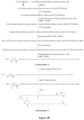
- the activated fatty acid side chain, Moiety A-OSu was prepared by solid phase synthesis using 2-chlorotrityl chloride resin as schematically represented in Figure 1A .
- 2-[2-(2-Fmoc-aminoethoxy)ethoxy]acetic acid (Intermediate-1) was attached to 2-chlorotrityl chloride resin in presence of N , N '-di-isopropylethylamine (DIPEA) which yielded 2-[2-(2-Fmoc-aminoethoxy)ethoxy] acetic acid-2-Cl-Trt-Resin.
- DIPEA N '-di-isopropylethylamine
- the intermediate-1 can be prepared by coupling of 2-[2-(2-amino ethoxy)-ethoxy] acetic acid with Fmoc N-hydroxysuccinimide ester.
- intermediate-1 is available commercially and can be procured as such.
- the Fmoc protecting group was removed by selective de-blocking of amino group of 2-[2-(2-Fmoc-aminoethoxy)ethoxy] acetic acid-2-Cl-Trt-Resin using piperidine and the free amino group was then coupled to 2-[2-(2-Fmoc-aminoethoxy)ethoxy]acetic acid using 1-hydroxybenztriazole(HOBt) and N , N '-di-isopropylcarbodiimide (DIPC) which yielded 2-[2-[2-[[2-[2-[2-(2-Fmoc-aminoethoxy)ethoxy]acetyl] amino]ethoxy]ethoxy]acetic acid-2-Cl-Trt-Resin .
- DIPC 1-hydroxybenztriazole
- the Fmoc group was then removed by selective de-blocking of amino group of 2-[2-[2-[[2-[2-(2-Fmoc-aminoethoxy)ethoxy]acetyl] amino]ethoxy]ethoxy]acetic acid-2-Cl-Trt-Resin using piperidine and the free amino group was then coupled to Fmoc-Glu-OtBu using HOBt and DIPC to obtain 2-[2-[2-[2-[2-[2-[2-[2-[2-[2-[2-[2-[[[[(4 S )-4-Fmoc-amino-5- tert -butoxy-5-oxo-pentanoyl]amino]ethoxy]ethoxy]acetyl]amino]ethoxy]ethoxy] acetic acid-2-Cl-Trt-Resin.
- the intermediate 2 was then cleaved from 2-Cl-Trt-Resin using trifluoroethanol:DCM (1:1).
- the resultant compound was then reacted with N -hydroxysuccinimide (HOSu) in presence of isobutyl chloroformate (IBCF) and N -methylmorpholine (NMM) followed by de-protection with trifluoroacetic acid to yield the title compound (Moiety A-OSu, intermediate-3).
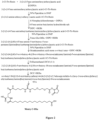
- the whole process can also be depicted as schematically represented in Figure 1B .
- L-Glutamic acid alpha- tert -butyl ester (H-Glu-OtBu) was reacted with palmitic acid in presence of IBCF and NMM to yield CH 3 -(CH 2 ) 14 -C(O)-Glu-OtBu, which was then reacted with HOSu in the presence of IBCF and NMM to yield CH 3 -(CH 2 ) 14 -C(O)-Glu(OSu)-OtBu, which was then de-protected with trifluoroacetic acid to yield Moiety B-OSu.
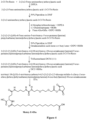
- the activated fatty acid side chain, Moiety C-OSu was prepared using solid phase synthesis using 2-chlorotrityl chloride resin as schematically represented in Figure 2 .
- 2-[2-(2-Fmoc-aminoethoxy)ethoxy]acetic acid was attached to 2-chlorotrityl chloride resin in presence of DIPEA to yield 2-[2-(2-Fmoc-aminoethoxy)ethoxy]acetic acid-2-Cl-Trt-Resin.
- the Fmoc protecting group was removed by selective de-blocking of amino group using piperidine and the free amino group was then activated using p-nitrophenylchlroformate in THF and DIPEA followed by reaction with Fmoc-amino butylamine hydrochloride salt in THF: DMAc and DIPEA, which yielded 2-[2-[2-(4-Fmoc-aminobutylcarbamoylamino)ethoxy]ethoxy]acetic acid-2-Cl-Trt-Resin.
- Fmoc group was removed by selective de-blocking using piperidine and the free amino group was then coupled to Fmoc-Glu-OtBu using of HOBt and DIPC, which yielded 2-[2-[2-[4-[[(4 S )-4-Fmoc-amino-5-tert-butoxy-5-oxo-pentanoyl]amino] butylcarbamoylamino]ethoxy]ethoxy]acetic acid-2-Cl-Trt-Resin.
- the fatty acid side chain was prepared using solid phase synthesis using 2-chlorotrityl chloride resin as schematically represented in Figure 3 .
- 2-[2-(2-Fmoc-aminoethoxy)ethoxy]acetic acid was attached to 2-chlorotrityl chloride resin in presence of DIPEA to yield 2-[2-(2-Fmoc-aminoethoxy)ethoxy]acetic acid-2-Cl-Trt-Resin.
- the Fmoc protecting group was removed by selective de-blocking of amino group using piperidine followed by coupling with Fmoc-Aib-OH in THF: DMAc using DIPC and HOBt which yielded 2-[2-[2-[(2-Fmoc-amino-2-methyl-propanoyl)amino]ethoxy]ethoxy]acetic acid-2-Cl-Trt-Resin.
- the Fmoc group was removed by selective de-blocking using piperidine and the free amino group was coupled with Fmoc-Glu-OtBu using HOBt and DIPC to yield 2-[2-[2-[[2-[[(4S)-4-Fmoc-amino-5-tert-butoxy-5-oxo-pentanoyl]amino]-2-methyl-propanoyl] amino] ethoxy]ethoxy]acetic acid-2-Cl-Trt-Resin.
- the Fmoc group of the resultant compound was selectively de-blocked using piperidine and the free amino group was then coupled with octadecanedioic acid mono tert butyl ester to give 2-[2-[2-[[2-[[(4 S )-5-tert-butoxy-4-[(18- tert -butoxy-18-oxo-octadecanoyl)amino]-5-oxo-pentanoyl]amino]-2-methyl-propanoyl]-amino]ethoxy]ethoxy]acetic acid-2-Cl-Trt-Resin.
- the fatty acid side chain was prepared using solid phase synthesis using 2-chlorotrityl chloride resin as schematically represented in Figure 4 .
- 2-[2-(2-Fmoc-aminoethoxy)ethoxy]acetic acid was attached to 2-chlorotrityl chloride resin in presence of DIPEA to yield 2-[2-(2-Fmoc-aminoethoxy)ethoxy]acetic acid-2-Cl-Trt-Resin.
- the Fmoc protecting group was removed by selective de-blocking of amino group using piperidine and the free amino group was then activated using p-nitrophenylchloroformate in THF and DIPEA followed by reaction with 1,3-diaminopropane in THF: DMAc in presence of DIPEA using HOBt to form NH 2 -(CH 2 ) 3 -NH-C(O)- ⁇ (2-(2-amino-ethoxy)-ethoxy ⁇ -acetic acid-2-Cl-Trt-Resin.
- the fatty acid side chain was prepared using solid phase synthesis using 2-chlorotrityl chloride resin as schematically represented in Figure 5 .
- 2-[2-(2-Fmoc-amino ethoxy)ethoxy]acetic acid was attached to 2-chlorotrityl chloride resin in presence of DIPEA to yield 2-[2-(2-Fmoc-aminoethoxy)ethoxy]acetic acid-2-Cl-Trt-Resin.
- the Fmoc protecting group was removed by selective de-blocking of amino group using piperidine and the free amino group was then activated using p-nitrophenylchloroformate in THF and DIPEA followed by reaction with 4-amino-Boc-piperidine in THF: DMAc in presence of DIPEA using HOBt which yielded (2-[2-[2-(4-Boc-piperidylcarbamoylamino) ethoxy]ethoxy]acetic acid -2-Cl-Trt-Resin.
- the obtained compound was then further attached to 2-chlorotrityl chloride resin in presence of DIPEA to yield 2-[2-[2-(4-Fmoc-piperidylcarbamoylamino)ethoxy]ethoxy]acetic acid-2-Cl-Trt-Resin.
- the Fmoc group was removed by selective de-blocking using piperidine and the free amino group was then coupled with Fmoc-Glu-OtBu using HOBt and DIPC, which yielded 2-[2-[2-[[[1-[(4 S )-4-amino-5- tert -butoxy-5-oxo-pentanoyl]-4-piperidyl]carbamoylamino]ethoxy]ethoxy]acetic acid-2-Cl-Trt-Resin.
- the resultant compound was selectively de-blocked using piperidine and was then coupled with octadecanedioic acid mono tert-butyl ester to give 2-[2-[2-[[1-[(4 S )-5-tert-butoxy-4-[(18- tert -butoxy-18-oxo-octadecanoyl)amino]-5-oxo-pentanoyl]-4-piperidyl] carbamoylamino]ethoxy]ethoxy]acetic acid-2-Cl-Trt-Resin.
- the parent peptide was synthesized by solid-phase method.
- the starting resin used for synthesis was Wang resin.
- Fmoc protected Leucine was used for coupling with the Wang resin.
- the coupling was performed by using diisopropylcarbodiimide, N- hydroxybenzotriazole (DIC-HOBt) as coupling reagent in presence of 4-dimethylaminopyridine (DMAP) which yielded Fmoc-Leu-Wang Resin.
- DMAP 4-dimethylaminopyridine
- Selective deblocking of amino group of Fmoc-Leu-Wang Resin using piperidine followed by coupling with Fmoc-Gly-OH using HOBt and DIPC yielded Fmoc-Gly-Leu-Wang Resin. This completes one cycle.
- Acetic anhydride and diisopropylethyl amine/pyridine was used to terminate the uncoupled amino groups at every amino acid coupling.
- the side chain of the Fmoc-protected amino acids were protected orthogonally, e.g., hydroxyl group of Serine, Tyrosine or Threonine were protected with tert -butyl (-tBu) group, amino and guanido group of Lysine and Arginine were protected with tert -butyloxycarbonyl (-Boc) and 2,2,4,6,7-pentamethyldihydrobenzofuran-5-sulfonyl (-Pbf) group respectively, the imidazole of histidine was protected with trityl (-Trt) and carboxylic acid groups of aspartic acid or glutamic acid were protected with -tBu group.
- linear peptides of the compounds 2, 3, 5, 9, 10 and 12 were prepared by solid phase method as per the analogous process given for Example 1, Part A. Grafting of activated fatty acid chain, Moiety A-OSu by following the process of Example 1, Part B over the respective linear peptides afforded compound 2, 3, 5, 9, 10 and 12.
- the linear peptides of the Compound 4 and 11 were prepared by solid phase method as per the analogous process given for Example 2, Part A except here Fmoc protected D-Leucine was first coupled with Wang resin and then sequentially other amino acids were coupled. Grafting of activated fatty acid chain, Moiety A-OSu over the respective linear peptide by following the process of Example 2, Part B afforded the Compound 4 and 11.
- the linear peptide was prepared by solid phase method as per the analogous process given for Example 2, Part A except here Fmoc protected Isoleucine was first coupled with Wang resin and then sequentially other amino acids were coupled. The grafting of activated fatty acid chain, Moiety A-OSu over the linear peptide by following the process of Example 2, Part B afforded the Compound 8.
- the linear peptide was prepared by solid phase method as per the analogous process given for Example 2, Part A.
- the linear peptide was prepared by solid phase method as per the analogous process given for Example 2, Part A.
- the linear peptide was prepared by solid phase method as per the analogous process given for Example 2, Part A starting with Fmoc protected Isoleucine was first coupled with Wang resin and then sequentially other amino acids were coupled. The grafting of activated fatty acid chain, Moiety C-OSu over the linear peptide by following analogous process of Example 2, Part B afforded the Compound 15.
- Table 3 Characterization data of representative compounds of the present disclosure
- Example 14 Oral Glucose tolerance test (OGTT) in rats; Single Injection; 1mg/kg
- the polypeptides of the present disclosure have shown significant glucose lowering effect compared to the control group when studied in Oral Glucose Tolerance Test (OGTT) in rats.
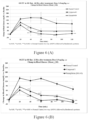
- Figure 6 provides change in blood glucose level from time 0 to 120 min after 22 hrs and 46 hrs in the test group administered Compound 1 and the semaglutide treatment group.
- the Compound 1 showed statistically significant reduction in blood glucose level with p ⁇ 0.001 vs normal control in ANOVA followed by Bonferroni's posttests.
- the glucose lowering effect of the Compound 1 was superior to the glucose lowering effect observed with semaglutide ( see Figure 6A ).
- Table 4 Effect of treatment on food intake and body weight on Day 2 Food Consumption (g) (day 0 to day 2) Body Weight (g) (Day 2) Mean SD Mean SD % Change vs Baseline Normal Control 33.0 4.7 480.6 15.6 8.89 Compound 1 2.63*** 2.5 365.6 21.0 -9.33 Semaglutide 5.03*** 3.4 428.1 42.3 -7.65 *p ⁇ 0.05, **p ⁇ 0.01, ***p ⁇ 0.001 vs Normal Control; one way ANOVA followed by Bonferroni's posttests Table 5 : Effect of treatment on food intake and body weight on Day 4 Food Consumption (g) (day 0 to day 4) Body Weight (g) (Day 4) Mean SD Mean SD % Change vs Baseline Normal Control 90.5 5.6 491.3 16.9 2.1 Compound 1 43.25*** ,## 2.8 436.2* 21.1 -7.5 Semaglutide 55.73*** 4.1 427.2 42.3 -5.3 *p ⁇ 0.05, **p ⁇ 0.01, ***p ⁇ 0.001 vs Normal Control; one way
- the compound 6 which differs from liraglutide in having an additional Leu at 32nd position and the compound 7 which differs from liraglutide by having 2nd amino acid Ala replaced with Aib and having Leu as an additional 32nd amino acid showed blood glucose lowering effect at 24 hrs which was significantly higher than liraglutide (Table 6).
- Table 7 provides the reduction in AUC of blood glucose for the representative compounds of present invention (Compound 1, 13 and 16) in comparison with the control group after 1 day, 7 days and 14 days of administration.
- Compounds 1 and 13 were studied and compared with semaglutide in one experiment (Exp. 1) and Compound 16 was studied and compared with semaglutide in a separate experiment (Exp. 2). After 168 hrs of injection, the Compound 1, 13 and 16 of present invention showed about 60 % reduction in blood glucose AUC when compared to time zero blood glucose level. On the other hand, semaglutide showed just about 25 % reduction in blood glucose level with respect to time zero blood glucose level.
- Example 15 Reduction of HbAlc in db/db type 2 diabetic mice after chronic treatment
- test group animals administered with the Compound 1 showed statistically significant reduction in blood glucose levels as compared to the diabetic control group (see Figure 7 ), and the effect was superior to semaglutide treatment group in latter phase of the study.
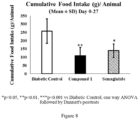
- the test group animals administered with Compound 1 showed significant reduction in food intake as can be seen in the results provided in Figure 8.
- Figure 8 provides cumulative food intake from 0 to 27 th day by control and db/db mice treated with the test compound. Both the test compound and semaglutide showed a statistically significant reduction in food intake as compared to the diabetic control group. Further, the test compound showed a significantly lower food intake, as compared to semaglutide.
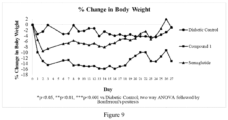
- the Compound 1 has also shown significant reduction in body weight when compared to diabetic control group.
- Figure 9 provides the result of % change in body weight for control and test group from day 0 to day 27. The test Compound 1 showed a significant reduction of -16% as compared to -8% as observed in semaglutide treatment group (see Figure 09 ).
- HbA1c In diabetes mellitus, higher amounts of HbA1c, indicating poorer control of blood glucose levels, have been associated with cardiovascular disease, nephropathy, neuropathy, and retinopathy.
- Compound 1 showed statistically significant reduction in HbA1c level in db/db type 2 diabetic mice after chronic treatment.
- Table 9 below and Figure 10 provide the level of HbA1c at 0 and 27 days in Diabetic control group and group after chronic treatment with the Compound 1. The effect was statistically significant even when compared to semaglutide.
- Table 9 Effect of treatment on % HbAlc levels in db/db mice Time Point (Days) % HbA1c Diabetic Control (DC) Compound 1 Semaglutide Mean SD n Mean SD n % Change vs DC Mean SD n % Change vs DC 0 4.70 0.52 6 4.87 0.59 6 - 5.05 0.35 5 - 27 7.30 1.17 6 3.73*** ## 0.86 6 -3.57 5.03*** 0.69 5 -2.26 *p ⁇ 0.05, **p ⁇ 0.01, ***p ⁇ 0.001 vs Diabetic Control; two way ANOVA followed by Bonferroni's posttests #p ⁇ 0.05, ##p ⁇ 0.01, ###p ⁇ 0.001 vs Semaglutide; one way ANOVA followed by Bonferroni's posttests
- test Compound 1, 13 and 16 were studied and compared with semaglutide for their effect on HbA1c & insulin level and cumulative food consumption, body weight change and blood glucose AUC.
- the study was performed in similar manner as above on diabetic mouse model. The animals were divided into three treatment groups - a diabetic control group, a test group and a semaglutide treatment group.
- the representative compounds of the present disclosure, Compound 1, Compound 13 and Compound 16, were injected subcutaneously at 3.04 or 6.078 nM dose (every alternate day up to day 28 (q2d*15). The same dosage regimen was administered in semaglutide treatment group. Measurements of blood glucose levels and body weight were done daily.
- %HbA1c Insulin was measured on Day 0, day 14 and day 29. Cumulative food intake and body weight change was calculated on day 14 and 29.
- %HbA1c Insulin data was analyzed by two way ANOVA followed by Bonferroni's posttests using PRISM (Graph Pad version 5.03). Whereas Blood Glucose AUC, Body weight change and Cumulative food intake data was analyzed by one way ANOVA followed by Bonferroni's posttests using PRISM (Graph Pad version 5.03). From day 29 to day 45, animals were kept on recovery period during which no drug treatment was given. Blood Glucose and Body weight was measured during this period. On day 45, Body weight Changes, %HbA1c, Insulin was measured.
Landscapes
- Health & Medical Sciences (AREA)
- Chemical & Material Sciences (AREA)
- Life Sciences & Earth Sciences (AREA)
- Medicinal Chemistry (AREA)
- Organic Chemistry (AREA)
- General Health & Medical Sciences (AREA)
- Diabetes (AREA)
- Animal Behavior & Ethology (AREA)
- Pharmacology & Pharmacy (AREA)
- Public Health (AREA)
- Veterinary Medicine (AREA)
- Endocrinology (AREA)
- Engineering & Computer Science (AREA)
- Bioinformatics & Cheminformatics (AREA)
- Nuclear Medicine, Radiotherapy & Molecular Imaging (AREA)
- Obesity (AREA)
- General Chemical & Material Sciences (AREA)
- Chemical Kinetics & Catalysis (AREA)
- Hematology (AREA)
- Proteomics, Peptides & Aminoacids (AREA)
- Gastroenterology & Hepatology (AREA)
- Zoology (AREA)
- Molecular Biology (AREA)
- Genetics & Genomics (AREA)
- Epidemiology (AREA)
- Biophysics (AREA)
- Toxicology (AREA)
- Biochemistry (AREA)
- Emergency Medicine (AREA)
- Child & Adolescent Psychology (AREA)
- Immunology (AREA)
- Nutrition Science (AREA)
- Physiology (AREA)
- Peptides Or Proteins (AREA)
- Medicines That Contain Protein Lipid Enzymes And Other Medicines (AREA)
- Transmission And Conversion Of Sensor Element Output (AREA)
Claims (21)
- Polypeptid, umfassend die Aminosäuresequenz:(a)oder
 (b)oder
 (c)oder
 (d)oder
 (e)oder
 (f)oder
 (g)oder
 (h)oder
 (i)oder
 (j)oder
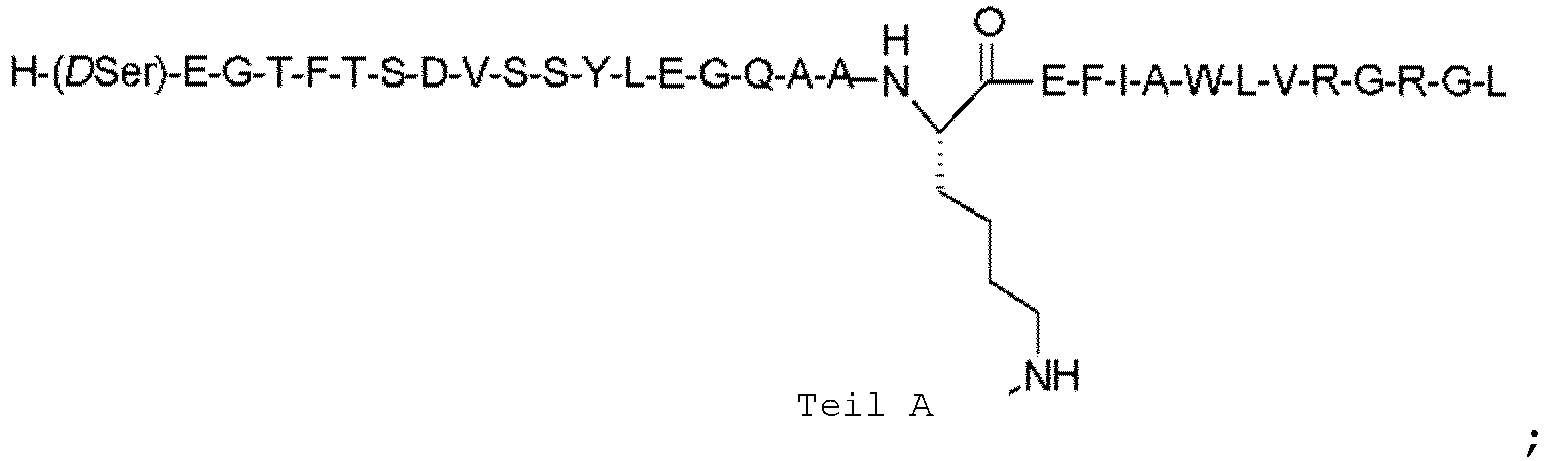 (k)oder
 (l)oder
 (m)oder
 (n)oder
 (o)oder
 (p)oder
 (q)oder
 (r)
(r) wobei DSer ein Serinrest mit einer D-Konfiguration ist und DLeu ein Leucinrest mit einer D-Konfiguration ist;wobei Ser(OMe) ein Serinrest mit folgender Struktur ist:
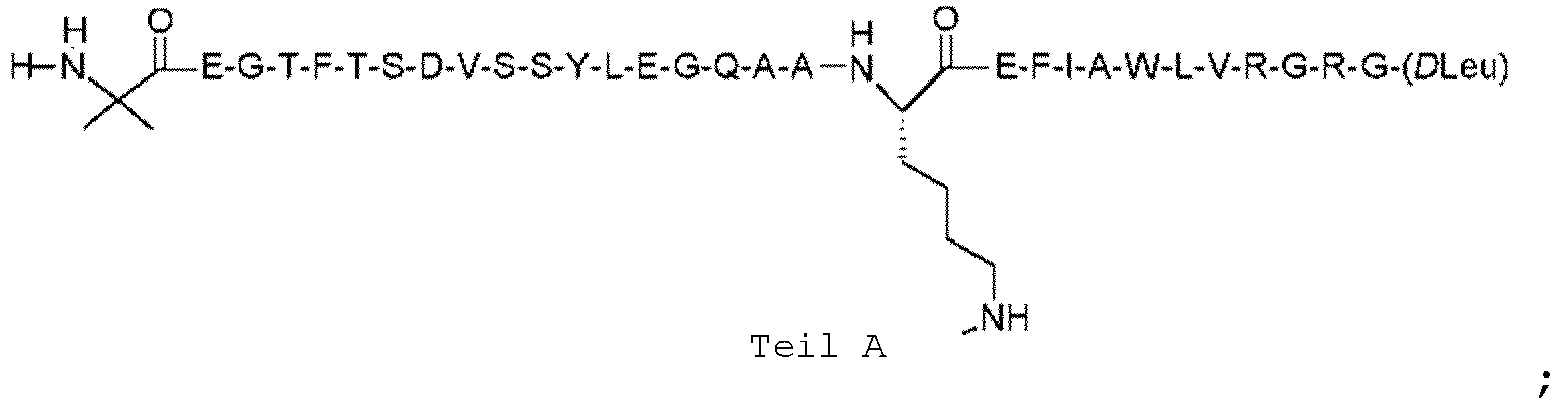
 wobei Teil A folgende Struktur hat:
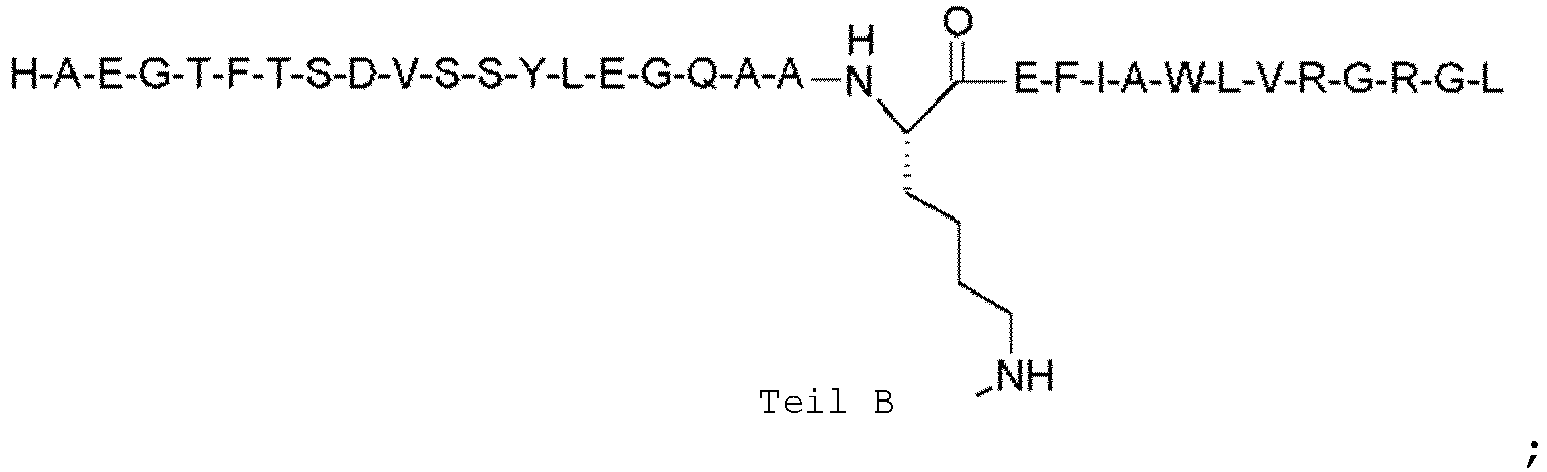
 wobei Teil B folgende Struktur hat:
 wobei Teil C folgende Struktur hat:
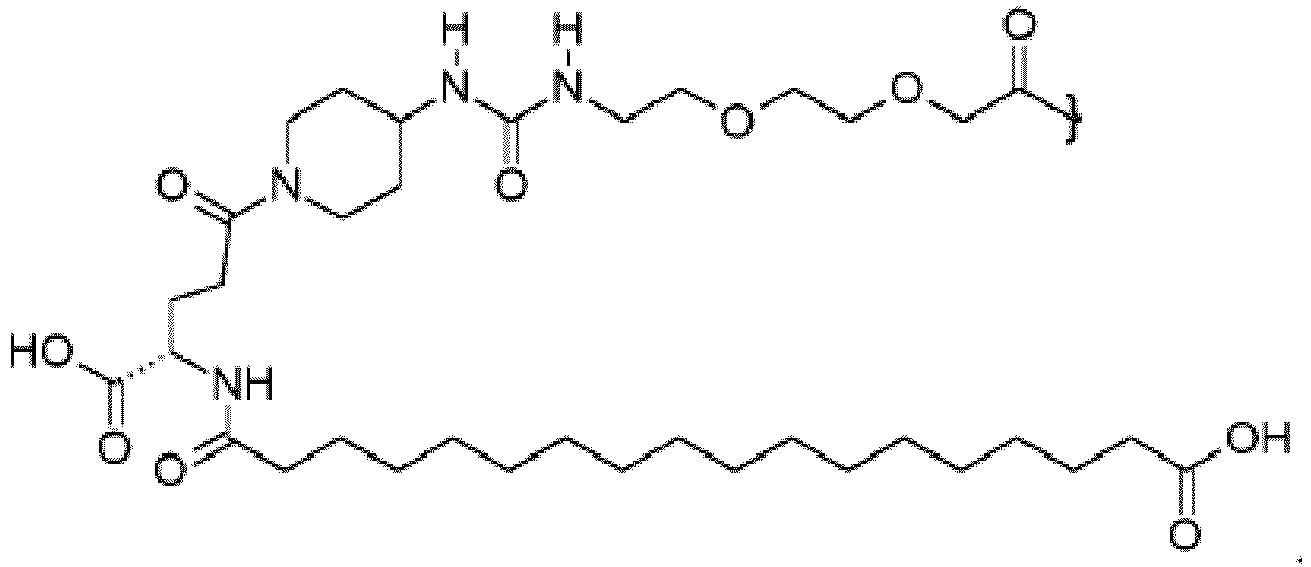
 wobei Teil D folgende Struktur hat:
 wobei Teil E folgende Struktur hat:
 wobei Teil F folgende Struktur hat:
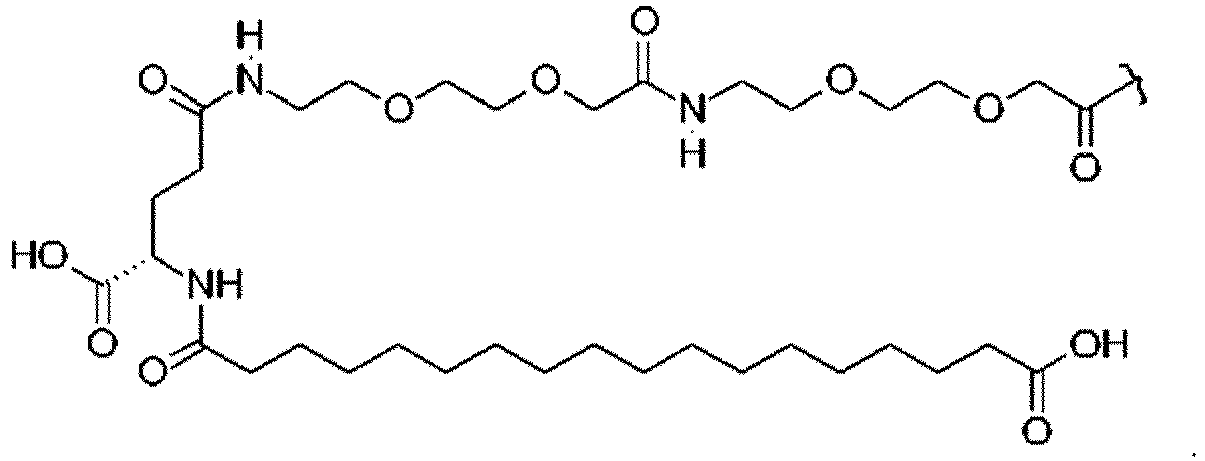
- Polypeptid nach Anspruch 1, wobei das Polypeptid folgende Aminosäuresequenz umfasst:wobei Teil A folgende Struktur hat:

- Polypeptid nach Anspruch 1, wobei das Polypeptid folgende Aminosäuresequenz umfasst:
 wobei Ser(OMe) ein Serinrest mit folgender Struktur ist:
 wobei Teil A folgende Struktur hat:
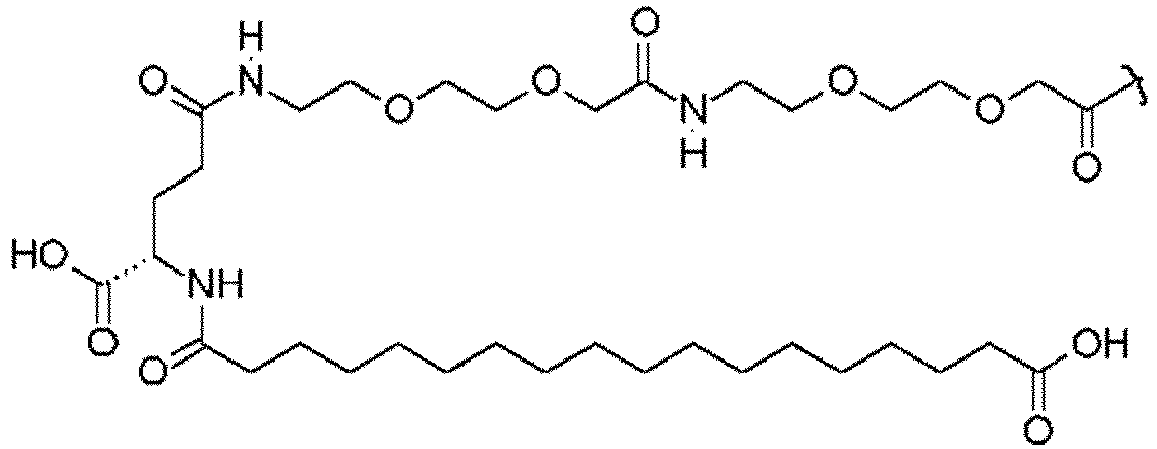
- Polypeptid nach Anspruch 1, wobei das Polypeptid folgende Aminosäuresequenz umfasst:wobei Teil A folgende Struktur hat:

- Polypeptid nach Anspruch 1, wobei das Polypeptid folgende Aminosäuresequenz umfasst:wobei DLeu ein Leucinrest mit einer D-Konfiguration ist; und wobei Teil A folgende Struktur hat:


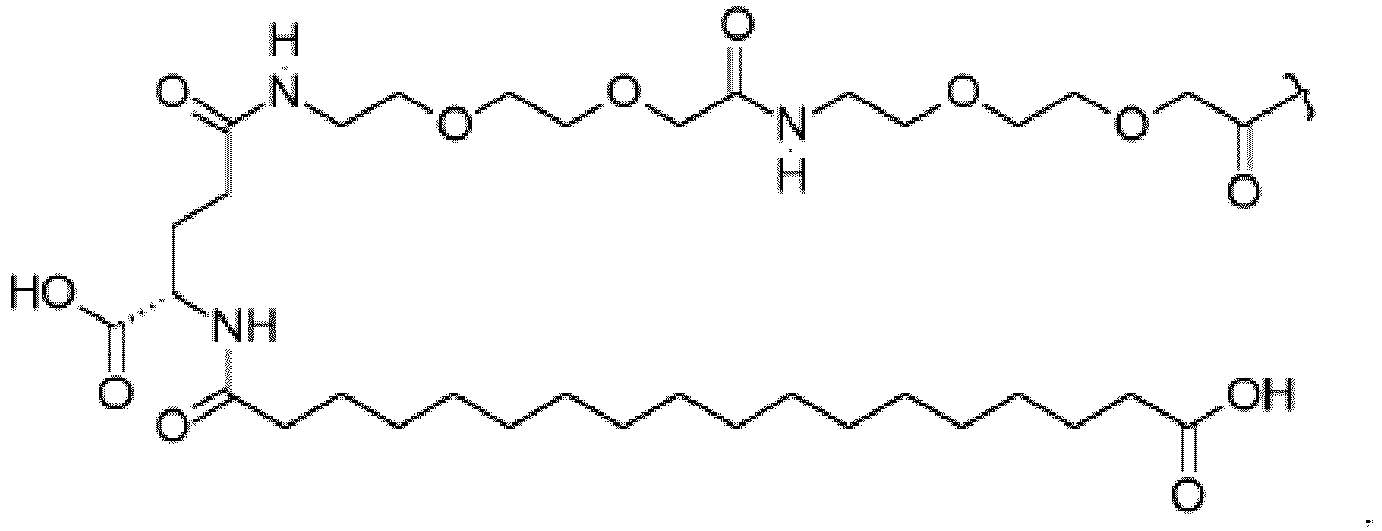
- Polypeptid nach Anspruch 1, wobei das Polypeptid folgende Aminosäuresequenz umfasst:wobei Teil A folgende Struktur hat:

- Polypeptid nach Anspruch 1, wobei das Polypeptid folgende Aminosäuresequenz umfasst:wobei Teil B folgende Struktur hat:


- Polypeptid nach Anspruch 1, wobei das Polypeptid folgende Aminosäuresequenz umfasst:wobei Teil B folgende Struktur hat:


- Polypeptid nach Anspruch 1, wobei das Polypeptid folgende Aminosäuresequenz umfasst:wobei Teil A folgende Struktur hat:


- Polypeptid nach Anspruch 1, wobei das Polypeptid folgende Aminosäuresequenz umfasst:
 wobei DSer ein Serinrest mit einer D-Konfiguration ist und DLeu ein Leucinrest mit einer D-Konfiguration ist;wobei Ser(OMe) ein Serinrest mit folgender Struktur ist:
 wobei Teil A folgende Struktur hat:
- Polypeptid nach Anspruch 1, wobei das Polypeptid folgende Aminosäuresequenz umfasst:
 wobei DSer ein Serinrest mit einer D-Konfiguration ist; undwobei Teil A folgende Struktur hat:
- Polypeptid nach Anspruch 1, wobei das Polypeptid folgende Aminosäuresequenz umfasst:
 wobei DSer ein Leucinrest mit einer D-Konfiguration ist; undwobei Teil A folgende Struktur hat:
- Polypeptid nach Anspruch 1, wobei das Polypeptid folgende Aminosäuresequenz umfasst:wobei Teil A folgende Struktur hat:


- Polypeptid nach Anspruch 1, wobei das Polypeptid folgende Aminosäuresequenz umfasst:wobei Teil C folgende Struktur hat:


- Polypeptid nach Anspruch 1, wobei das Polypeptid folgende Aminosäuresequenz umfasst:wobei Teil C folgende Struktur hat:
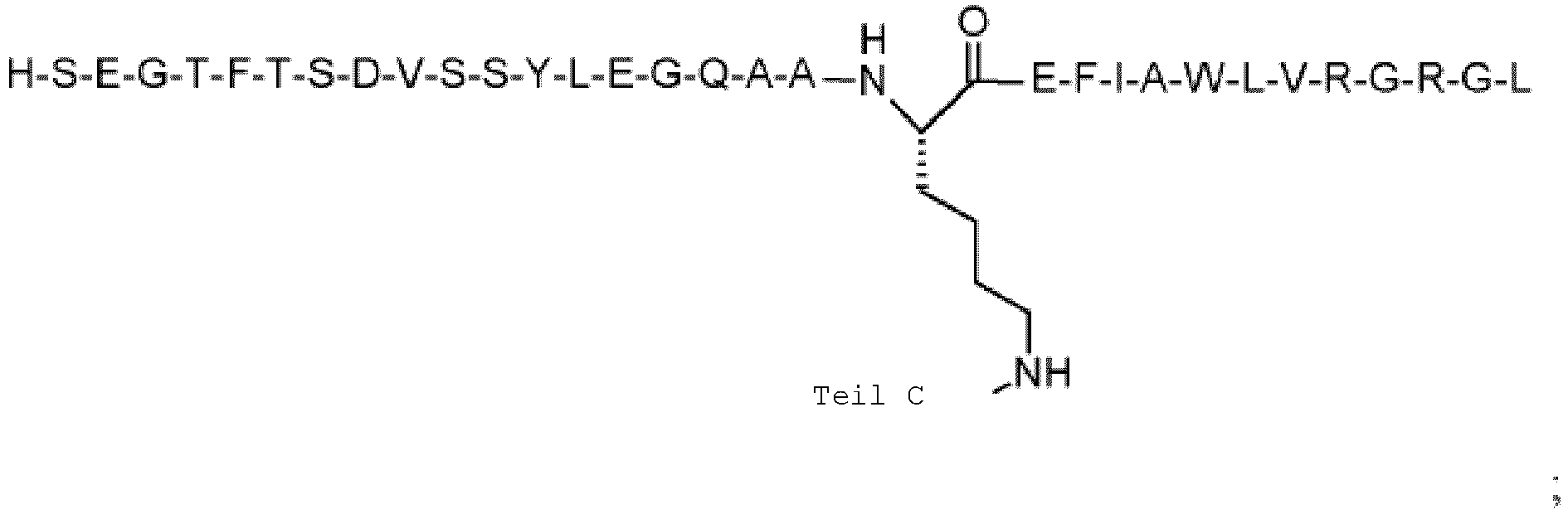
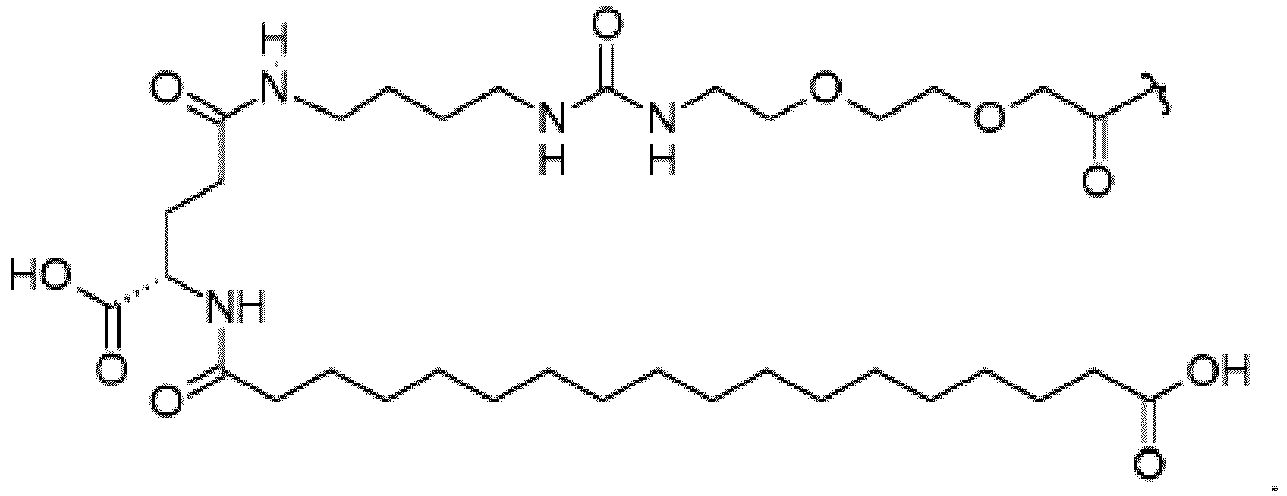
- Polypeptid nach Anspruch 1, wobei das Polypeptid folgende Aminosäuresequenz umfasst:wobei Teil C folgende Struktur hat:


- Polypeptid nach Anspruch 1, wobei das Polypeptid folgende Aminosäuresequenz umfasst:wobei Teil D folgende Struktur hat:
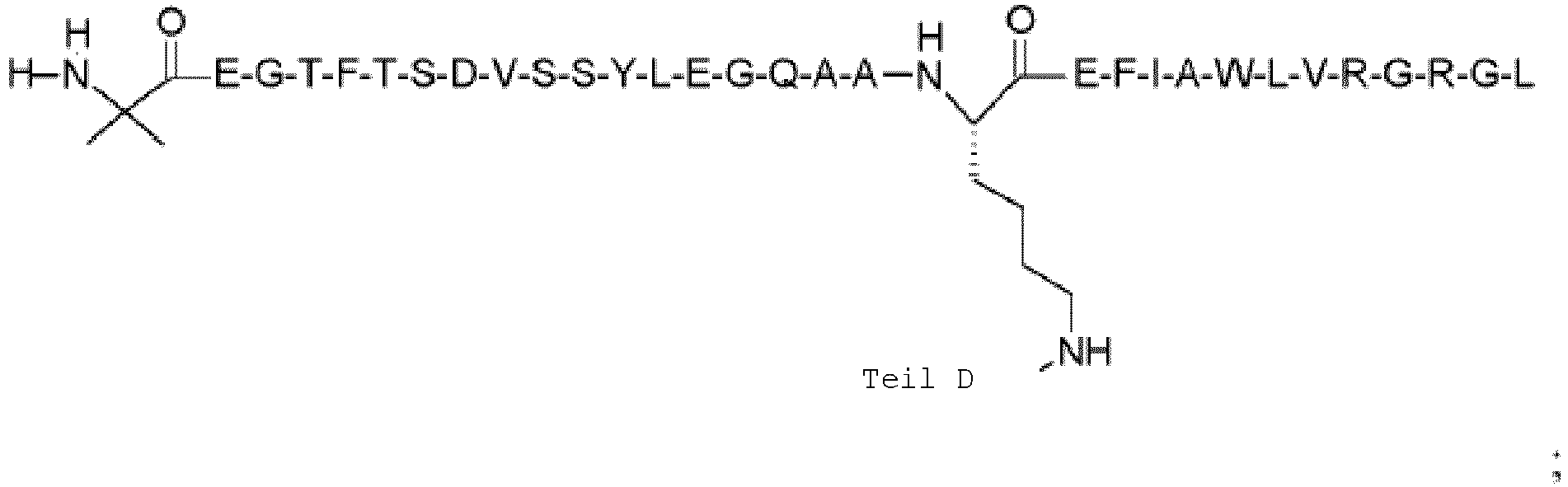

- Polypeptid nach Anspruch 1, wobei das Polypeptid folgende Aminosäuresequenz umfasst:wobei Teil E folgende Struktur hat:


- Polypeptid nach Anspruch 1, wobei das Polypeptid folgende Aminosäuresequenz umfasst:wobei Teil F folgende Struktur hat:

- Polypeptid nach einem der vorhergehenden Ansprüche zur Verwendung bei der Behandlung von Diabetes.
- Polypeptid nach einem der Ansprüche 1 bis 19 zur Verwendung bei der Behandlung von Fettleibigkeit.
Priority Applications (5)
| Application Number | Priority Date | Filing Date | Title |
|---|---|---|---|
| SM20240241T SMT202400241T1 (it) | 2018-04-05 | 2019-04-05 | Analoghi del glp-1 innovativi |
| RS20240706A RS65639B1 (sr) | 2018-04-05 | 2019-04-05 | Novi glp-1 analozi |
| EP24161843.8A EP4364751A3 (de) | 2018-04-05 | 2019-04-05 | Neuartige glp-1-analoga |
| HRP20240749TT HRP20240749T1 (hr) | 2018-04-05 | 2019-04-05 | Novi analozi glp-1 |
| SI201930764T SI4122954T1 (sl) | 2018-04-05 | 2019-04-05 | Novi analogi GLP-1 |
Applications Claiming Priority (5)
| Application Number | Priority Date | Filing Date | Title |
|---|---|---|---|
| IN201821013109 | 2018-04-05 | ||
| IN201821040474 | 2018-10-26 | ||
| IN201821040468 | 2018-10-26 | ||
| PCT/IB2019/052835 WO2019193576A1 (en) | 2018-04-05 | 2019-04-05 | Novel glp-1 analogues |
| EP19724915.4A EP3774862B1 (de) | 2018-04-05 | 2019-04-05 | Neuartige glp-1-analoga |
Related Parent Applications (1)
| Application Number | Title | Priority Date | Filing Date |
|---|---|---|---|
| EP19724915.4A Division EP3774862B1 (de) | 2018-04-05 | 2019-04-05 | Neuartige glp-1-analoga |
Related Child Applications (1)
| Application Number | Title | Priority Date | Filing Date |
|---|---|---|---|
| EP24161843.8A Division EP4364751A3 (de) | 2018-04-05 | 2019-04-05 | Neuartige glp-1-analoga |
Publications (2)
| Publication Number | Publication Date |
|---|---|
| EP4122954A1 EP4122954A1 (de) | 2023-01-25 |
| EP4122954B1 true EP4122954B1 (de) | 2024-04-03 |
Family
ID=66589592
Family Applications (3)
| Application Number | Title | Priority Date | Filing Date |
|---|---|---|---|
| EP19724915.4A Active EP3774862B1 (de) | 2018-04-05 | 2019-04-05 | Neuartige glp-1-analoga |
| EP24161843.8A Pending EP4364751A3 (de) | 2018-04-05 | 2019-04-05 | Neuartige glp-1-analoga |
| EP22177403.7A Active EP4122954B1 (de) | 2018-04-05 | 2019-04-05 | Neuartige glp-1-analoga |
Family Applications Before (2)
| Application Number | Title | Priority Date | Filing Date |
|---|---|---|---|
| EP19724915.4A Active EP3774862B1 (de) | 2018-04-05 | 2019-04-05 | Neuartige glp-1-analoga |
| EP24161843.8A Pending EP4364751A3 (de) | 2018-04-05 | 2019-04-05 | Neuartige glp-1-analoga |
Country Status (33)
| Country | Link |
|---|---|
| US (7) | US11447535B2 (de) |
| EP (3) | EP3774862B1 (de) |
| JP (2) | JP7250814B2 (de) |
| KR (2) | KR20250065720A (de) |
| CN (3) | CN117964735A (de) |
| AU (3) | AU2019247936C1 (de) |
| BR (1) | BR112020020419A2 (de) |
| CA (1) | CA3095988A1 (de) |
| CL (1) | CL2020002574A1 (de) |
| CO (1) | CO2020012425A2 (de) |
| CY (1) | CY1125528T1 (de) |
| DK (2) | DK3774862T3 (de) |
| EC (1) | ECSP20070185A (de) |
| ES (2) | ES2980707T3 (de) |
| FI (1) | FI4122954T3 (de) |
| HR (2) | HRP20221054T1 (de) |
| HU (2) | HUE060135T2 (de) |
| IL (1) | IL277483B1 (de) |
| JO (1) | JOP20200251B1 (de) |
| LT (2) | LT3774862T (de) |
| MX (2) | MX2020010505A (de) |
| MY (1) | MY202560A (de) |
| PE (1) | PE20211417A1 (de) |
| PH (1) | PH12020551591A1 (de) |
| PL (2) | PL4122954T3 (de) |
| PT (2) | PT4122954T (de) |
| RS (2) | RS63523B1 (de) |
| SG (1) | SG11202009467YA (de) |
| SI (2) | SI4122954T1 (de) |
| SM (2) | SMT202400241T1 (de) |
| UA (1) | UA128210C2 (de) |
| WO (1) | WO2019193576A1 (de) |
| ZA (1) | ZA202306729B (de) |
Families Citing this family (14)
| Publication number | Priority date | Publication date | Assignee | Title |
|---|---|---|---|---|
| RS63523B1 (sr) * | 2018-04-05 | 2022-09-30 | Sun Pharmaceutical Ind Ltd | Novi glp-1 analozi |
| TWI829687B (zh) | 2018-05-07 | 2024-01-21 | 丹麥商諾佛 儂迪克股份有限公司 | 包含glp-1促效劑與n-(8-(2-羥基苯甲醯基)胺基)辛酸之鹽的固體組成物 |
| EP3930757A1 (de) | 2019-03-01 | 2022-01-05 | President And Fellows Of Harvard College | Verfahren und zusammensetzungen zur proteinabgabe |
| TW202216746A (zh) * | 2020-06-22 | 2022-05-01 | 印度商太陽製藥工業有限公司 | 長效型glp-1/gip雙重促效劑 |
| CN116171164A (zh) * | 2020-10-17 | 2023-05-26 | 太阳医药工业有限公司 | Glp-1/gip双重激动剂 |
| CN114685646B (zh) * | 2020-12-31 | 2023-04-07 | 厦门赛诺邦格生物科技股份有限公司 | 一种多肽侧链类似物的制备方法及其应用 |
| WO2022159395A1 (en) | 2021-01-20 | 2022-07-28 | Viking Therapeutics, Inc. | Compositions and methods for the treatment of metabolic and liver disorders |
| MX2024003236A (es) | 2021-09-15 | 2024-06-19 | Viking Therapeutics Inc | Composiciones y metodos para el tratamiento de trastornos metabolicos y hepaticos. |
| EP4429704A4 (de) | 2021-11-10 | 2025-11-05 | I2O Therapeutics Inc | Ionische flüssigkeitszusammensetzungen |
| CN116514952B (zh) * | 2022-10-13 | 2024-02-02 | 江苏师范大学 | 一类glp-1类似物及其应用 |
| EP4724471A1 (de) | 2023-06-09 | 2026-04-15 | Sun Pharmaceutical Industries Limited | Duale glp-1/gip-, glp-1/gcg-doppel- und glp-1/gip/gcg-dreifachrezeptoragonisten |
| CN121368489A (zh) | 2023-06-20 | 2026-01-20 | 太阳医药工业有限公司 | 用于治疗代谢障碍的glp-1类似物 |
| CN117756914B (zh) * | 2023-12-15 | 2024-09-03 | 瀚晖制药有限公司 | 依柯胰岛素的制备方法 |
| WO2025163615A1 (en) | 2024-01-31 | 2025-08-07 | Sun Pharmaceutical Industries Ltd. | High level production of glp1 analogues |
Family Cites Families (58)
| Publication number | Priority date | Publication date | Assignee | Title |
|---|---|---|---|---|
| US6849708B1 (en) | 1986-05-05 | 2005-02-01 | The General Hospital Corporation | Insulinotropic hormone and uses thereof |
| IL128332A0 (en) | 1996-08-30 | 2000-01-31 | Novo Nordisk As | GLP-1 derivatives |
| US6268343B1 (en) | 1996-08-30 | 2001-07-31 | Novo Nordisk A/S | Derivatives of GLP-1 analogs |
| JP2002512175A (ja) | 1998-02-27 | 2002-04-23 | ノボ ノルディスク アクティーゼルスカブ | Glp−1類似体の誘導体類 |
| EP1062240B1 (de) | 1998-02-27 | 2010-04-28 | Novo Nordisk A/S | N-terminal veränderte glp-1 abkömmlinge |
| AU2610599A (en) | 1998-02-27 | 1999-09-15 | Novo Nordisk A/S | N-terminally truncated glp-1 derivatives |
| JP2003522099A (ja) | 1998-02-27 | 2003-07-22 | ノボ ノルディスク アクティーゼルスカブ | 遅延作用プロファイルを有するglp−1のglp−1誘導体及びエキセンジン |
| FR2777283B1 (fr) | 1998-04-10 | 2000-11-24 | Adir | Nouveaux composes peptidiques analogues du glucagon-peptide- 1 (7-37), leur procede de preparation et les compositions pharmaceutiques qui les contiennent |
| DE69922043T2 (de) | 1998-12-07 | 2005-11-24 | Société de Conseils de Recherches et d'Applications Scientifiques S.A.S. | Glp-1 analoge |
| ATE424413T1 (de) | 2000-06-16 | 2009-03-15 | Lilly Co Eli | Analoge des glucagon-ähnlichen peptids-1 |
| BR0116024A (pt) | 2000-12-07 | 2005-12-13 | Lilly Co Eli | Proteìna de fusão heteróloga e uso da mesma |
| MXPA04006679A (es) | 2002-01-08 | 2004-11-10 | Lilly Co Eli | Analogos extendidos de peptido-1 de tipo glucagon. |
| CA2502118A1 (en) | 2002-10-11 | 2004-05-06 | Sanwa Kagaku Kenkyusho Co., Ltd. | Glp-1 derivatives and transmicosal absorption preparations thereof |
| WO2004078777A2 (en) | 2003-03-04 | 2004-09-16 | Biorexis Pharmaceutical Corporation | Dipeptidyl-peptidase protected proteins |
| AU2004240630B2 (en) | 2003-05-15 | 2010-10-07 | Trustees Of Tufts College | Stable analogs of peptide and polypeptide therapeutics |
| KR101241862B1 (ko) | 2003-09-19 | 2013-03-13 | 노보 노르디스크 에이/에스 | 신규 glp-1 유도체 |
| EP1711523B1 (de) | 2003-12-16 | 2012-10-10 | Ipsen Pharma | Glp-1-analoga |
| US7893017B2 (en) | 2004-10-07 | 2011-02-22 | Novo Nordisk A/S | Protracted GLP-1 compounds |
| TWI372629B (en) | 2005-03-18 | 2012-09-21 | Novo Nordisk As | Acylated glp-1 compounds |
| JP5755398B2 (ja) * | 2005-03-18 | 2015-07-29 | ノヴォ ノルディスク アー/エス | 伸長されたglp−1化合物 |
| EP1883419A4 (de) | 2005-05-06 | 2010-08-04 | Bayer Pharmaceuticals Corp | Glucagon-like peptid-1 (glp-1)-rezeptoragonisten und deren pharmakologische verwendungsverfahren |
| BRPI0615573A2 (pt) | 2005-09-08 | 2011-05-24 | Tufts College | análogos de glp-1 estabilizados |
| PL1767545T3 (pl) | 2005-09-22 | 2010-04-30 | Biocompatibles Uk Ltd | Polipeptydy fuzyjne GLP-1 (glukagonopodobny peptyd-1) o zwiększonej odporności na peptydazy |
| US20100261637A1 (en) | 2007-09-05 | 2010-10-14 | Novo Nordisk A/S | Peptides derivatized with a-b-c-d- and their therapeutical use |
| US8980830B2 (en) | 2007-10-30 | 2015-03-17 | Indiana University Research And Technology Corporation | Peptide compounds exhibiting glucagon antagonist and GLP-1 agonist activity |
| EP2512518A1 (de) | 2009-12-16 | 2012-10-24 | Novo Nordisk A/S | Glp-1-rezeptoragonistverbindungen mit modifiziertem n-terminus |
| BR112012027545B1 (pt) | 2010-04-27 | 2020-09-24 | Betta Pharmaceuticals Co., Ltd. | Composto, composição farmacêutica, uso da composição farmacêutica e uso de um composto |
| WO2012016419A1 (zh) | 2010-08-06 | 2012-02-09 | 浙江贝达药业有限公司 | Glp-1衍生物及其应用 |
| EP2637698B1 (de) | 2010-11-09 | 2022-04-20 | Novo Nordisk A/S | Zweifach acylierte glp-1-derivate |
| RU2602601C2 (ru) | 2011-04-12 | 2016-11-20 | Ново Нордиск А/С | Дважды ацилированные производные glp-1 |
| WO2012150503A2 (en) | 2011-05-03 | 2012-11-08 | Zealand Pharma A/S | Glu-glp-1 dual agonist signaling-selective compounds |
| EP2753642B8 (de) | 2011-09-06 | 2017-12-13 | Novo Nordisk A/S | Glp-1-derivate |
| EP2578599A1 (de) | 2011-10-07 | 2013-04-10 | LanthioPep B.V. | Cyclische Analoga von GLP-1 und GLP-1-verwandten Peptiden |
| JP6250034B2 (ja) | 2012-05-08 | 2017-12-20 | ノヴォ ノルディスク アー/エス | 二重アシル化されたglp−1誘導体 |
| ES2629735T3 (es) | 2012-05-08 | 2017-08-14 | Novo Nordisk A/S | Derivados de GLP-1 doblemente acilados |
| KR20150023690A (ko) | 2012-06-14 | 2015-03-05 | 사노피 | 엑센딘-4 펩타이드 유사체 |
| UA116217C2 (uk) | 2012-10-09 | 2018-02-26 | Санофі | Пептидна сполука як подвійний агоніст рецепторів glp1-1 та глюкагону |
| TWI617574B (zh) | 2012-12-11 | 2018-03-11 | 梅迪繆思有限公司 | 用於治療肥胖之升糖素與glp-1共促效劑 |
| HK1211232A1 (en) | 2012-12-21 | 2016-05-20 | Sanofi | Exendin-4 derivatives as dual glp1/gip or trigonal glp1/gip/glucagon agonists |
| KR20160021183A (ko) | 2013-06-20 | 2016-02-24 | 노보 노르디스크 에이/에스 | Glp-1 유도체 및 그것의 용도 |
| WO2014209886A1 (en) | 2013-06-23 | 2014-12-31 | Wisconsin Alumni Research Foundation | Alpha/beta-polypeptide analogs of glucagon-like peptid-1 |
| WO2015000942A1 (en) | 2013-07-04 | 2015-01-08 | Novo Nordisk A/S | Derivatives of glp-1 like peptides, and uses thereof |
| US10266577B2 (en) | 2013-08-15 | 2019-04-23 | Novo Nordisk A/S | GLP-1 derivatives, and uses thereof |
| WO2015055801A1 (en) * | 2013-10-17 | 2015-04-23 | Zealand Pharma A/S | Acylated glucagon analogues |
| SG10201805039UA (en) | 2013-12-13 | 2018-07-30 | Medimmune Ltd | Protease resistant peptides |
| WO2015086733A1 (en) | 2013-12-13 | 2015-06-18 | Sanofi | Dual glp-1/glucagon receptor agonists |
| EP3080155A1 (de) | 2013-12-13 | 2016-10-19 | Sanofi | Exendin-4-peptidanaloga als duale glp-1/glucagon-rezeptoragonisten |
| JP6730278B2 (ja) | 2014-11-27 | 2020-07-29 | ノヴォ ノルディスク アー/エス | Glp−1誘導体及びその使用 |
| WO2016097108A1 (en) | 2014-12-17 | 2016-06-23 | Novo Nordisk A/S | Glp-1 derivatives and uses thereof |
| TWI726889B (zh) | 2015-06-10 | 2021-05-11 | 英商梅迪繆思有限公司 | 蛋白酶抗性之脂化肽 |
| WO2017035432A1 (en) | 2015-08-26 | 2017-03-02 | Robert Doyle | Coagonists of glucagon-like peptide 1 receptor and neuropeptide y2 receptor |
| WO2017149070A1 (en) | 2016-03-03 | 2017-09-08 | Novo Nordisk A/S | Glp-1 derivatives and uses thereof |
| AU2017277594A1 (en) | 2016-06-09 | 2019-02-07 | Medimmune Limited | Protease-resistant mono-lipidated peptides |
| MA46780A (fr) | 2016-11-07 | 2019-09-11 | Novo Nordisk As | Esters à dchbs actif de composés peg et leur utilisation |
| TW201833131A (zh) | 2016-12-02 | 2018-09-16 | 法商賽諾菲公司 | 作為胜肽類glp1/升糖素/gip受體促效劑之新化合物 |
| WO2018178796A1 (en) | 2017-03-27 | 2018-10-04 | Sun Pharmaceutical Industries Limited | Method for making kex1 protease sensitive polypeptides using yeast strain |
| KR102829589B1 (ko) | 2018-03-09 | 2025-07-04 | 프레제니우스 카비 입섬 에스. 알. 엘. | 리라글루티드, 세마글루티드 및 glp-1의 화학-효소적 합성 |
| RS63523B1 (sr) * | 2018-04-05 | 2022-09-30 | Sun Pharmaceutical Ind Ltd | Novi glp-1 analozi |
-
2019
- 2019-04-05 RS RS20220814A patent/RS63523B1/sr unknown
- 2019-04-05 CN CN202311777728.0A patent/CN117964735A/zh active Pending
- 2019-04-05 AU AU2019247936A patent/AU2019247936C1/en active Active
- 2019-04-05 SI SI201930764T patent/SI4122954T1/sl unknown
- 2019-04-05 SM SM20240241T patent/SMT202400241T1/it unknown
- 2019-04-05 KR KR1020257013603A patent/KR20250065720A/ko active Pending
- 2019-04-05 UA UAA202006178A patent/UA128210C2/uk unknown
- 2019-04-05 ES ES22177403T patent/ES2980707T3/es active Active
- 2019-04-05 CN CN201980037166.1A patent/CN112236444B/zh active Active
- 2019-04-05 LT LTEPPCT/IB2019/052835T patent/LT3774862T/lt unknown
- 2019-04-05 MX MX2020010505A patent/MX2020010505A/es unknown
- 2019-04-05 HR HRP20221054TT patent/HRP20221054T1/hr unknown
- 2019-04-05 ES ES19724915T patent/ES2925678T3/es active Active
- 2019-04-05 PT PT221774037T patent/PT4122954T/pt unknown
- 2019-04-05 CN CN202510743440.4A patent/CN120554480A/zh active Pending
- 2019-04-05 SI SI201930322T patent/SI3774862T1/sl unknown
- 2019-04-05 FI FIEP22177403.7T patent/FI4122954T3/fi active
- 2019-04-05 PL PL22177403.7T patent/PL4122954T3/pl unknown
- 2019-04-05 CA CA3095988A patent/CA3095988A1/en active Pending
- 2019-04-05 EP EP19724915.4A patent/EP3774862B1/de active Active
- 2019-04-05 LT LTEP22177403.7T patent/LT4122954T/lt unknown
- 2019-04-05 PE PE2020001535A patent/PE20211417A1/es unknown
- 2019-04-05 HU HUE19724915A patent/HUE060135T2/hu unknown
- 2019-04-05 RS RS20240706A patent/RS65639B1/sr unknown
- 2019-04-05 DK DK19724915.4T patent/DK3774862T3/da active
- 2019-04-05 HR HRP20240749TT patent/HRP20240749T1/hr unknown
- 2019-04-05 KR KR1020207031696A patent/KR102801994B1/ko active Active
- 2019-04-05 HU HUE22177403A patent/HUE067499T2/hu unknown
- 2019-04-05 JP JP2020553627A patent/JP7250814B2/ja active Active
- 2019-04-05 EP EP24161843.8A patent/EP4364751A3/de active Pending
- 2019-04-05 US US16/376,190 patent/US11447535B2/en active Active
- 2019-04-05 SG SG11202009467YA patent/SG11202009467YA/en unknown
- 2019-04-05 MY MYPI2020004864A patent/MY202560A/en unknown
- 2019-04-05 DK DK22177403.7T patent/DK4122954T3/da active
- 2019-04-05 BR BR112020020419-6A patent/BR112020020419A2/pt unknown
- 2019-04-05 EP EP22177403.7A patent/EP4122954B1/de active Active
- 2019-04-05 SM SM20220352T patent/SMT202200352T1/it unknown
- 2019-04-05 PL PL19724915.4T patent/PL3774862T3/pl unknown
- 2019-04-05 WO PCT/IB2019/052835 patent/WO2019193576A1/en not_active Ceased
- 2019-04-05 PT PT197249154T patent/PT3774862T/pt unknown
-
2020
- 2020-08-04 US US16/985,207 patent/US11242373B2/en active Active
- 2020-09-21 IL IL277483A patent/IL277483B1/en unknown
- 2020-09-29 PH PH12020551591A patent/PH12020551591A1/en unknown
- 2020-10-02 CO CONC2020/0012425A patent/CO2020012425A2/es unknown
- 2020-10-04 JO JOJO/P/2020/0251A patent/JOP20200251B1/ar active
- 2020-10-05 MX MX2024007688A patent/MX2024007688A/es unknown
- 2020-10-05 CL CL2020002574A patent/CL2020002574A1/es unknown
- 2020-11-05 EC ECSENADI202070185A patent/ECSP20070185A/es unknown
- 2020-12-28 US US17/134,982 patent/US11485766B2/en active Active
-
2022
- 2022-08-01 US US17/816,577 patent/US11873328B2/en active Active
- 2022-08-12 US US17/819,466 patent/US11866477B2/en active Active
- 2022-09-06 CY CY20221100590T patent/CY1125528T1/el unknown
-
2023
- 2023-03-22 JP JP2023045498A patent/JP2023078367A/ja active Pending
- 2023-06-01 AU AU2023203430A patent/AU2023203430B2/en active Active
- 2023-06-30 ZA ZA2023/06729A patent/ZA202306729B/en unknown
- 2023-11-21 US US18/515,712 patent/US12421289B2/en active Active
-
2024
- 2024-05-17 US US18/667,531 patent/US20240376175A1/en active Pending
-
2025
- 2025-10-02 AU AU2025242190A patent/AU2025242190A1/en active Pending
Also Published As
Similar Documents
| Publication | Publication Date | Title |
|---|---|---|
| EP4122954B1 (de) | Neuartige glp-1-analoga | |
| CN106928341B (zh) | 定点单取代聚乙二醇化Exendin类似物及其制备方法 | |
| JP2007056023A (ja) | 親油性のペプチドホルモン誘導体 | |
| HK40086836A (en) | Novel glp-1 analogues | |
| HK40086836B (en) | Novel glp-1 analogues | |
| HK40103760A (en) | Novel glp-1 analogues | |
| HK40044876A (en) | Novel glp-1 analogues | |
| HK40044876B (en) | Novel glp-1 analogues | |
| EA049274B1 (ru) | Новые аналоги glp-1 |
Legal Events
| Date | Code | Title | Description |
|---|---|---|---|
| REG | Reference to a national code |
Ref country code: HR Ref legal event code: TUEP Ref document number: P20240749T Country of ref document: HR |
|
| PUAI | Public reference made under article 153(3) epc to a published international application that has entered the european phase |
Free format text: ORIGINAL CODE: 0009012 |
|
| STAA | Information on the status of an ep patent application or granted ep patent |
Free format text: STATUS: THE APPLICATION HAS BEEN PUBLISHED |
|
| AC | Divisional application: reference to earlier application |
Ref document number: 3774862 Country of ref document: EP Kind code of ref document: P |
|
| AK | Designated contracting states |
Kind code of ref document: A1 Designated state(s): AL AT BE BG CH CY CZ DE DK EE ES FI FR GB GR HR HU IE IS IT LI LT LU LV MC MK MT NL NO PL PT RO RS SE SI SK SM TR |
|
| P01 | Opt-out of the competence of the unified patent court (upc) registered |
Effective date: 20230424 |
|
| STAA | Information on the status of an ep patent application or granted ep patent |
Free format text: STATUS: REQUEST FOR EXAMINATION WAS MADE |
|
| 17P | Request for examination filed |
Effective date: 20230717 |
|
| RBV | Designated contracting states (corrected) |
Designated state(s): AL AT BE BG CH CY CZ DE DK EE ES FI FR GB GR HR HU IE IS IT LI LT LU LV MC MK MT NL NO PL PT RO RS SE SI SK SM TR |
|
| REG | Reference to a national code |
Ref country code: HK Ref legal event code: DE Ref document number: 40086836 Country of ref document: HK |
|
| GRAP | Despatch of communication of intention to grant a patent |
Free format text: ORIGINAL CODE: EPIDOSNIGR1 |
|
| STAA | Information on the status of an ep patent application or granted ep patent |
Free format text: STATUS: GRANT OF PATENT IS INTENDED |
|
| INTG | Intention to grant announced |
Effective date: 20231024 |
|
| GRAS | Grant fee paid |
Free format text: ORIGINAL CODE: EPIDOSNIGR3 |
|
| GRAA | (expected) grant |
Free format text: ORIGINAL CODE: 0009210 |
|
| STAA | Information on the status of an ep patent application or granted ep patent |
Free format text: STATUS: THE PATENT HAS BEEN GRANTED |
|
| AC | Divisional application: reference to earlier application |
Ref document number: 3774862 Country of ref document: EP Kind code of ref document: P |
|
| AK | Designated contracting states |
Kind code of ref document: B1 Designated state(s): AL AT BE BG CH CY CZ DE DK EE ES FI FR GB GR HR HU IE IS IT LI LT LU LV MC MK MT NL NO PL PT RO RS SE SI SK SM TR |
|
| REG | Reference to a national code |
Ref country code: CH Ref legal event code: EP |
|
| REG | Reference to a national code |
Ref country code: DE Ref legal event code: R096 Ref document number: 602019049827 Country of ref document: DE |
|
| REG | Reference to a national code |
Ref country code: IE Ref legal event code: FG4D |
|
| REG | Reference to a national code |
Ref country code: MA Ref legal event code: VAGR Ref document number: 59093 Country of ref document: MA Kind code of ref document: B1 |
|
| REG | Reference to a national code |
Ref country code: PT Ref legal event code: SC4A Ref document number: 4122954 Country of ref document: PT Date of ref document: 20240605 Kind code of ref document: T Free format text: AVAILABILITY OF NATIONAL TRANSLATION Effective date: 20240531 |
|
| REG | Reference to a national code |
Ref country code: DK Ref legal event code: T3 Effective date: 20240606 |
|
| REG | Reference to a national code |
Ref country code: FI Ref legal event code: FGE |
|
| REG | Reference to a national code |
Ref country code: SE Ref legal event code: TRGR |
|
| REG | Reference to a national code |
Ref country code: GR Ref legal event code: EP Ref document number: 20240401272 Country of ref document: GR Effective date: 20240716 |
|
| REG | Reference to a national code |
Ref country code: NL Ref legal event code: FP |
|
| REG | Reference to a national code |
Ref country code: SK Ref legal event code: T3 Ref document number: E 44449 Country of ref document: SK |
|
| REG | Reference to a national code |
Ref country code: HR Ref legal event code: ODRP Ref document number: P20240749T Country of ref document: HR Payment date: 20240604 Year of fee payment: 6 |
|
| REG | Reference to a national code |
Ref country code: HR Ref legal event code: T1PR Ref document number: P20240749 Country of ref document: HR |
|
| REG | Reference to a national code |
Ref country code: ES Ref legal event code: FG2A Ref document number: 2980707 Country of ref document: ES Kind code of ref document: T3 Effective date: 20241002 |
|
| REG | Reference to a national code |
Ref country code: HU Ref legal event code: AG4A Ref document number: E067499 Country of ref document: HU |
|
| PG25 | Lapsed in a contracting state [announced via postgrant information from national office to epo] |
Ref country code: LV Free format text: LAPSE BECAUSE OF FAILURE TO SUBMIT A TRANSLATION OF THE DESCRIPTION OR TO PAY THE FEE WITHIN THE PRESCRIBED TIME-LIMIT Effective date: 20240403 |
|
| PG25 | Lapsed in a contracting state [announced via postgrant information from national office to epo] |
Ref country code: LV Free format text: LAPSE BECAUSE OF FAILURE TO SUBMIT A TRANSLATION OF THE DESCRIPTION OR TO PAY THE FEE WITHIN THE PRESCRIBED TIME-LIMIT Effective date: 20240403 |
|
| REG | Reference to a national code |
Ref country code: DE Ref legal event code: R097 Ref document number: 602019049827 Country of ref document: DE |
|
| PG25 | Lapsed in a contracting state [announced via postgrant information from national office to epo] |
Ref country code: EE Free format text: LAPSE BECAUSE OF FAILURE TO SUBMIT A TRANSLATION OF THE DESCRIPTION OR TO PAY THE FEE WITHIN THE PRESCRIBED TIME-LIMIT Effective date: 20240403 |
|
| PG25 | Lapsed in a contracting state [announced via postgrant information from national office to epo] |
Ref country code: EE Free format text: LAPSE BECAUSE OF FAILURE TO SUBMIT A TRANSLATION OF THE DESCRIPTION OR TO PAY THE FEE WITHIN THE PRESCRIBED TIME-LIMIT Effective date: 20240403 Ref country code: MC Free format text: LAPSE BECAUSE OF FAILURE TO SUBMIT A TRANSLATION OF THE DESCRIPTION OR TO PAY THE FEE WITHIN THE PRESCRIBED TIME-LIMIT Effective date: 20240403 |
|
| PLBE | No opposition filed within time limit |
Free format text: ORIGINAL CODE: 0009261 |
|
| STAA | Information on the status of an ep patent application or granted ep patent |
Free format text: STATUS: NO OPPOSITION FILED WITHIN TIME LIMIT |
|
| 26N | No opposition filed |
Effective date: 20250106 |
|
| REG | Reference to a national code |
Ref country code: HR Ref legal event code: ODRP Ref document number: P20240749 Country of ref document: HR Payment date: 20250401 Year of fee payment: 7 |
|
| PGFP | Annual fee paid to national office [announced via postgrant information from national office to epo] |
Ref country code: NL Payment date: 20250427 Year of fee payment: 7 |
|
| PGFP | Annual fee paid to national office [announced via postgrant information from national office to epo] |
Ref country code: LU Payment date: 20250428 Year of fee payment: 7 |
|
| PGFP | Annual fee paid to national office [announced via postgrant information from national office to epo] |
Ref country code: FI Payment date: 20250425 Year of fee payment: 7 |
|
| PGFP | Annual fee paid to national office [announced via postgrant information from national office to epo] |
Ref country code: PL Payment date: 20250403 Year of fee payment: 7 Ref country code: DE Payment date: 20250429 Year of fee payment: 7 |
|
| PGFP | Annual fee paid to national office [announced via postgrant information from national office to epo] |
Ref country code: GB Payment date: 20250428 Year of fee payment: 7 Ref country code: ES Payment date: 20250602 Year of fee payment: 7 Ref country code: DK Payment date: 20250425 Year of fee payment: 7 |
|
| PGFP | Annual fee paid to national office [announced via postgrant information from national office to epo] |
Ref country code: IS Payment date: 20250408 Year of fee payment: 7 Ref country code: HU Payment date: 20250422 Year of fee payment: 7 Ref country code: NO Payment date: 20250429 Year of fee payment: 7 |
|
| PGFP | Annual fee paid to national office [announced via postgrant information from national office to epo] |
Ref country code: BE Payment date: 20250428 Year of fee payment: 7 |
|
| PGFP | Annual fee paid to national office [announced via postgrant information from national office to epo] |
Ref country code: HR Payment date: 20250401 Year of fee payment: 7 |
|
| PGFP | Annual fee paid to national office [announced via postgrant information from national office to epo] |
Ref country code: PT Payment date: 20250401 Year of fee payment: 7 |
|
| PGFP | Annual fee paid to national office [announced via postgrant information from national office to epo] |
Ref country code: FR Payment date: 20250425 Year of fee payment: 7 |
|
| PGFP | Annual fee paid to national office [announced via postgrant information from national office to epo] |
Ref country code: MT Payment date: 20250520 Year of fee payment: 7 Ref country code: BG Payment date: 20250417 Year of fee payment: 7 Ref country code: GR Payment date: 20250430 Year of fee payment: 7 |
|
| PGFP | Annual fee paid to national office [announced via postgrant information from national office to epo] |
Ref country code: CH Payment date: 20250501 Year of fee payment: 7 |
|
| PGFP | Annual fee paid to national office [announced via postgrant information from national office to epo] |
Ref country code: AT Payment date: 20250521 Year of fee payment: 7 |
|
| PGFP | Annual fee paid to national office [announced via postgrant information from national office to epo] |
Ref country code: SK Payment date: 20250521 Year of fee payment: 7 |
|
| PGFP | Annual fee paid to national office [announced via postgrant information from national office to epo] |
Ref country code: CZ Payment date: 20250401 Year of fee payment: 7 |
|
| PGFP | Annual fee paid to national office [announced via postgrant information from national office to epo] |
Ref country code: IE Payment date: 20250428 Year of fee payment: 7 |
|
| PGFP | Annual fee paid to national office [announced via postgrant information from national office to epo] |
Ref country code: SI Payment date: 20250530 Year of fee payment: 7 Ref country code: SE Payment date: 20250507 Year of fee payment: 7 |
|
| VSFP | Annual fee paid to validation state [announced via postgrant information from national office to epo] |
Ref country code: MA Payment date: 20240605 Year of fee payment: 6 |
|
| VSFP | Annual fee paid to validation state [announced via postgrant information from national office to epo] |
Ref country code: MA Payment date: 20250521 Year of fee payment: 7 |
|
| PG25 | Lapsed in a contracting state [announced via postgrant information from national office to epo] |
Ref country code: IT Free format text: LAPSE BECAUSE OF NON-PAYMENT OF DUE FEES Effective date: 20240405 |
|
| PGFP | Annual fee paid to national office [announced via postgrant information from national office to epo] |
Ref country code: CY Payment date: 20250407 Year of fee payment: 7 |
|
| PGFP | Annual fee paid to national office [announced via postgrant information from national office to epo] |
Ref country code: SM Payment date: 20260323 Year of fee payment: 8 |
|
| PGFP | Annual fee paid to national office [announced via postgrant information from national office to epo] |
Ref country code: LT Payment date: 20260318 Year of fee payment: 8 |
|
| PG25 | Lapsed in a contracting state [announced via postgrant information from national office to epo] |
Ref country code: IT Free format text: LAPSE BECAUSE OF NON-PAYMENT OF DUE FEES Effective date: 20240405 |
|
| PGFP | Annual fee paid to national office [announced via postgrant information from national office to epo] |
Ref country code: RO Payment date: 20260326 Year of fee payment: 8 Ref country code: IT Payment date: 20250422 Year of fee payment: 7 |
|
| PGRI | Patent reinstated in contracting state [announced from national office to epo] |
Ref country code: IT Effective date: 20240902 |
|
| PGFP | Annual fee paid to national office [announced via postgrant information from national office to epo] |
Ref country code: RS Payment date: 20260319 Year of fee payment: 8 |
|
| PGFP | Annual fee paid to national office [announced via postgrant information from national office to epo] |
Ref country code: TR Payment date: 20260325 Year of fee payment: 8 |