EP3896054A2 - Fluorverbindungen - Google Patents
Fluorverbindungen Download PDFInfo
- Publication number
- EP3896054A2 EP3896054A2 EP21178677.7A EP21178677A EP3896054A2 EP 3896054 A2 EP3896054 A2 EP 3896054A2 EP 21178677 A EP21178677 A EP 21178677A EP 3896054 A2 EP3896054 A2 EP 3896054A2
- Authority
- EP
- European Patent Office
- Prior art keywords
- group
- compounds
- alkyl
- compounds according
- ppm
- Prior art date
- Legal status (The legal status is an assumption and is not a legal conclusion. Google has not performed a legal analysis and makes no representation as to the accuracy of the status listed.)
- Granted
Links
- 0 CCSC(CCOC(C(*)F)(F)F)COC(C(*)F)(F)F Chemical compound CCSC(CCOC(C(*)F)(F)F)COC(C(*)F)(F)F 0.000 description 7
Classifications
-
- C—CHEMISTRY; METALLURGY
- C07—ORGANIC CHEMISTRY
- C07C—ACYCLIC OR CARBOCYCLIC COMPOUNDS
- C07C69/00—Esters of carboxylic acids; Esters of carbonic or haloformic acids
- C07C69/62—Halogen-containing esters
- C07C69/65—Halogen-containing esters of unsaturated acids
- C07C69/653—Acrylic acid esters; Methacrylic acid esters; Haloacrylic acid esters; Halomethacrylic acid esters
-
- C—CHEMISTRY; METALLURGY
- C09—DYES; PAINTS; POLISHES; NATURAL RESINS; ADHESIVES; COMPOSITIONS NOT OTHERWISE PROVIDED FOR; APPLICATIONS OF MATERIALS NOT OTHERWISE PROVIDED FOR
- C09D—COATING COMPOSITIONS, e.g. PAINTS, VARNISHES OR LACQUERS; FILLING PASTES; CHEMICAL PAINT OR INK REMOVERS; INKS; CORRECTING FLUIDS; WOODSTAINS; PASTES OR SOLIDS FOR COLOURING OR PRINTING; USE OF MATERIALS THEREFOR
- C09D5/00—Coating compositions, e.g. paints, varnishes or lacquers, characterised by their physical nature or the effects produced; Filling pastes
-
- C—CHEMISTRY; METALLURGY
- C07—ORGANIC CHEMISTRY
- C07C—ACYCLIC OR CARBOCYCLIC COMPOUNDS
- C07C323/00—Thiols, sulfides, hydropolysulfides or polysulfides substituted by halogen, oxygen or nitrogen atoms, or by sulfur atoms not being part of thio groups
- C07C323/10—Thiols, sulfides, hydropolysulfides or polysulfides substituted by halogen, oxygen or nitrogen atoms, or by sulfur atoms not being part of thio groups containing thio groups and singly-bound oxygen atoms bound to the same carbon skeleton
- C07C323/11—Thiols, sulfides, hydropolysulfides or polysulfides substituted by halogen, oxygen or nitrogen atoms, or by sulfur atoms not being part of thio groups containing thio groups and singly-bound oxygen atoms bound to the same carbon skeleton having the sulfur atoms of the thio groups bound to acyclic carbon atoms of the carbon skeleton
- C07C323/12—Thiols, sulfides, hydropolysulfides or polysulfides substituted by halogen, oxygen or nitrogen atoms, or by sulfur atoms not being part of thio groups containing thio groups and singly-bound oxygen atoms bound to the same carbon skeleton having the sulfur atoms of the thio groups bound to acyclic carbon atoms of the carbon skeleton the carbon skeleton being acyclic and saturated
-
- A—HUMAN NECESSITIES
- A62—LIFE-SAVING; FIRE-FIGHTING
- A62D—CHEMICAL MEANS FOR EXTINGUISHING FIRES OR FOR COMBATING OR PROTECTING AGAINST HARMFUL CHEMICAL AGENTS; CHEMICAL MATERIALS FOR USE IN BREATHING APPARATUS
- A62D3/00—Processes for making harmful chemical substances harmless or less harmful, by effecting a chemical change in the substances
- A62D3/02—Processes for making harmful chemical substances harmless or less harmful, by effecting a chemical change in the substances by biological methods, i.e. processes using enzymes or microorganisms
-
- A—HUMAN NECESSITIES
- A62—LIFE-SAVING; FIRE-FIGHTING
- A62D—CHEMICAL MEANS FOR EXTINGUISHING FIRES OR FOR COMBATING OR PROTECTING AGAINST HARMFUL CHEMICAL AGENTS; CHEMICAL MATERIALS FOR USE IN BREATHING APPARATUS
- A62D3/00—Processes for making harmful chemical substances harmless or less harmful, by effecting a chemical change in the substances
- A62D3/10—Processes for making harmful chemical substances harmless or less harmful, by effecting a chemical change in the substances by subjecting to electric or wave energy or particle or ionizing radiation
- A62D3/17—Processes for making harmful chemical substances harmless or less harmful, by effecting a chemical change in the substances by subjecting to electric or wave energy or particle or ionizing radiation to electromagnetic radiation, e.g. emitted by a laser
- A62D3/176—Ultraviolet radiations, i.e. radiation having a wavelength of about 3nm to 400nm
-
- C—CHEMISTRY; METALLURGY
- C07—ORGANIC CHEMISTRY
- C07C—ACYCLIC OR CARBOCYCLIC COMPOUNDS
- C07C319/00—Preparation of thiols, sulfides, hydropolysulfides or polysulfides
- C07C319/02—Preparation of thiols, sulfides, hydropolysulfides or polysulfides of thiols
- C07C319/12—Preparation of thiols, sulfides, hydropolysulfides or polysulfides of thiols by reactions not involving the formation of mercapto groups
-
- C—CHEMISTRY; METALLURGY
- C07—ORGANIC CHEMISTRY
- C07F—ACYCLIC, CARBOCYCLIC OR HETEROCYCLIC COMPOUNDS CONTAINING ELEMENTS OTHER THAN CARBON, HYDROGEN, HALOGEN, OXYGEN, NITROGEN, SULFUR, SELENIUM OR TELLURIUM
- C07F7/00—Compounds containing elements of Groups 4 or 14 of the Periodic Table
- C07F7/02—Silicon compounds
- C07F7/08—Compounds having one or more C—Si linkages
- C07F7/18—Compounds having one or more C—Si linkages as well as one or more C—O—Si linkages
- C07F7/1804—Compounds having Si-O-C linkages
-
- C—CHEMISTRY; METALLURGY
- C07—ORGANIC CHEMISTRY
- C07F—ACYCLIC, CARBOCYCLIC OR HETEROCYCLIC COMPOUNDS CONTAINING ELEMENTS OTHER THAN CARBON, HYDROGEN, HALOGEN, OXYGEN, NITROGEN, SULFUR, SELENIUM OR TELLURIUM
- C07F7/00—Compounds containing elements of Groups 4 or 14 of the Periodic Table
- C07F7/02—Silicon compounds
- C07F7/08—Compounds having one or more C—Si linkages
- C07F7/18—Compounds having one or more C—Si linkages as well as one or more C—O—Si linkages
- C07F7/1804—Compounds having Si-O-C linkages
- C07F7/1872—Preparation; Treatments not provided for in C07F7/20
- C07F7/188—Preparation; Treatments not provided for in C07F7/20 by reactions involving the formation of Si-O linkages
-
- C—CHEMISTRY; METALLURGY
- C09—DYES; PAINTS; POLISHES; NATURAL RESINS; ADHESIVES; COMPOSITIONS NOT OTHERWISE PROVIDED FOR; APPLICATIONS OF MATERIALS NOT OTHERWISE PROVIDED FOR
- C09D—COATING COMPOSITIONS, e.g. PAINTS, VARNISHES OR LACQUERS; FILLING PASTES; CHEMICAL PAINT OR INK REMOVERS; INKS; CORRECTING FLUIDS; WOODSTAINS; PASTES OR SOLIDS FOR COLOURING OR PRINTING; USE OF MATERIALS THEREFOR
- C09D4/00—Coating compositions, e.g. paints, varnishes or lacquers, based on organic non-macromolecular compounds having at least one polymerisable carbon-to-carbon unsaturated bond ; Coating compositions, based on monomers of macromolecular compounds of groups C09D183/00 - C09D183/16
-
- C—CHEMISTRY; METALLURGY
- C09—DYES; PAINTS; POLISHES; NATURAL RESINS; ADHESIVES; COMPOSITIONS NOT OTHERWISE PROVIDED FOR; APPLICATIONS OF MATERIALS NOT OTHERWISE PROVIDED FOR
- C09D—COATING COMPOSITIONS, e.g. PAINTS, VARNISHES OR LACQUERS; FILLING PASTES; CHEMICAL PAINT OR INK REMOVERS; INKS; CORRECTING FLUIDS; WOODSTAINS; PASTES OR SOLIDS FOR COLOURING OR PRINTING; USE OF MATERIALS THEREFOR
- C09D5/00—Coating compositions, e.g. paints, varnishes or lacquers, characterised by their physical nature or the effects produced; Filling pastes
- C09D5/16—Antifouling paints; Underwater paints
-
- C—CHEMISTRY; METALLURGY
- C09—DYES; PAINTS; POLISHES; NATURAL RESINS; ADHESIVES; COMPOSITIONS NOT OTHERWISE PROVIDED FOR; APPLICATIONS OF MATERIALS NOT OTHERWISE PROVIDED FOR
- C09D—COATING COMPOSITIONS, e.g. PAINTS, VARNISHES OR LACQUERS; FILLING PASTES; CHEMICAL PAINT OR INK REMOVERS; INKS; CORRECTING FLUIDS; WOODSTAINS; PASTES OR SOLIDS FOR COLOURING OR PRINTING; USE OF MATERIALS THEREFOR
- C09D5/00—Coating compositions, e.g. paints, varnishes or lacquers, characterised by their physical nature or the effects produced; Filling pastes
- C09D5/16—Antifouling paints; Underwater paints
- C09D5/1606—Antifouling paints; Underwater paints characterised by the anti-fouling agent
- C09D5/1612—Non-macromolecular compounds
- C09D5/1625—Non-macromolecular compounds organic
Definitions
- the present invention relates to new compounds with fluorinated end groups and their use in z. B. dirt-repellent coatings.
- Dirt-repellent coatings e.g. B. in the display industry consist primarily of perfluorinated compounds that can be attached to surfaces by means of siloxane groups.
- Dirt-repellent coatings in the textile industry mainly consist of perfluorinated compounds that can be attached to surfaces using acrylate, methacrylate or siloxane groups. Because of their chemical stability, these compounds have come under criticism over the years, as the perfluorinated part of this class of material cannot be broken down naturally. In addition, it is not clear what influence these durable materials have on the biosphere and whether they lead to bioaccumulation in different animal species.
- the perfluorinated group Rf is preferably selected from the groups: CF 3 - (CF 2 ) 0-3 -, CF 3 - (CF 2 ) 0-3 -O-, CF 3 - (CF 2 ) 0-3 -O- (CF 2 ) 1-3 -, CF 3 - (CF 2 ) 0-3 -O- (CF 2 ) 1-3 -O-, CF 3 - (CF 2 ) 0-3 -O- (CF 2 ) 1-3 -O-CF 2 - , CF 3 - (CF 2 ) 0-3 O- (CF 2 -O) 1-8 - and CF 3 - (CF 2 ) 0-3 -O- (CF 2 -O) 1-8 -CF 2 -.
- the perfluorinated group Rf is particularly preferably selected from the groups: CF 3 - (CF 2 ) 1-2 -, CF 3 - (CF 2 ) 1-2 -O-, CF 3 -O- (CF 2 ) 1-3 -, CF 3 -O- (CF 2 ) 1 -3 -O-, CF 3 - (CF 2 ) 1-2 -O-CF2-, CF 3 -O- (CF 2 ) 1-2 -O-CF 2 -, CF 3 -O- (CF 2 -O) 1-8 - and CF 3 -O- (CF 2 -O) 1-8 -CF 2 -.
- the perfluorinated group Rf can also preferably be selected from the groups CF 3 - (CF 2 ) 0-3 -, CF 3 - (CF 2 ) 0-3 -O-, CF 3 -O- (CF 2 ) 1- 3 - and CF 3 -O- (CF 2 ) 1- 3 -O-, in particular from the groups CF 3 - (CF 2 ) 1-2 -, CF 3 - (CF 2 ) 1-2 -O-, CF 3 -O- (CF 2 ) 1-2 - and CF 3 -O- (CF 2 ) 1-3 -O- can be selected.
- the group R is preferably H or C1-C3 alkyl, in particular H or a methyl group.
- L is preferably a single bond or a saturated or unsaturated, branched or unbranched hydrocarbon unit, optionally containing heteroatoms and / or functional groups.
- L is particularly preferably a single bond or a saturated, branched or unbranched alkylene group, optionally containing heteroatoms and / or functional groups.
- the group X is an anchor group which is suitable for preventing the compounds of the formula (I) from adhering to substrate surfaces, such as, for. B. textiles or glass surfaces to enable.
- the group X is preferably a reactive group which forms a covalent bond to substrate surfaces.
- X is preferably an ethylenically unsaturated group, in particular an acrylate or methacrylate group, an alkoxysilane group or a halosilane group.
- X can be a -SiR ' 3 , where the groups R' are independently alkyl, OH, halogen, alkoxy or aryloxy, where at least one group R 'is not an alkyl group.
- R ' is preferably an alkoxy group OR "with R" being C1-C4-alkyl, in particular C1- or C2-alkyl.
- X is preferably an alkoxysilane group —Si (OR “ 3 ) 3 , where R" is C1-C4-alkyl, in particular C1- or C2-alkyl.
- X is preferably an acrylate or methacrylate group.
- m is preferably 1-3, in particular 1 or 2.
- n is preferably 1-3, especially 1.
- Rf a perfluorinated alkyl group, optionally containing heteroatoms
- R " C1-C4- Alkyl, in particular C1- or C2-alkyl
- R ''' H or an alkyl group, preferably H or methyl
- R 1 being H or C1-C4-alkyl, preferably H or CH 3 .
- the perfluorinated group Rf can also preferably be selected from the groups CF 3 - (CF 2 ) 0-3 -, CF 3 - (CF 2 ) 0-3 -O-, CF 3 -O- (CF 2 ) 1- 3 - and CF 3 -O- (CF 2 ) 1- 3 -O-, in particular from the groups CF 3 - (CF 2 ) 1-2 -, CF 3 - (CF 2 ) 1-2 -O-, CF 3 -O- (CF 2 ) 1-2 - and CF 3 -O- (CF 2 ) 1-2 -O- can be selected.
- Particularly preferred here are compounds of the formulas (Ic) to (Ih) and / or (I'a), (I'c) and (I'e), in particular with the preferred Rf, R ", R"'and R 1 groups.
- One advantage of the new compounds is that they are easily degradable. They have specific predetermined breaking points in the molecule. In this way, corresponding low-molecular fragments can arise that are permeable to the atmosphere and can thus be decomposed in the stratosphere under UV light.
- Hydrofluoroethers of the following structure can be e.g. B. by hydrolysis and oxidation into volatile and UV decomposable compounds. The decomposition products can then be washed out of the atmosphere with the rain, transferred to the soil and mineralized there.
- the group X represents a reactive anchor group which is particularly suitable for z. B. to adhere to glass surfaces (e.g. trialkoxysilanes).
- the compounds of the formulas (I) and (I ') can be easily synthesized.
- Those used for the preparation of the compounds of formula (I) Starting materials are commercially available and / or their preparation starting from commercially available starting materials is familiar to the person skilled in the art, or they can be prepared analogously to known synthesis processes, e.g. B. radical addition see: AA II'in et al., Russian Journal of Applied Chemistry, 2007, Vol. 80, No. 3, pp. 405-418 .
- trimethoxysilanes can then simply be dispersed in a suitable solvent and applied to the surface to be treated, e.g. B. glass, are applied.
- the trimethoxysilane hydrolyzes through humidity and forms z. B. a permanent covalent bond with the SiOH groups of the glass.
- Compounds according to the invention with acrylate or methacrylate groups can be, for. B. by reacting the corresponding alcohols with the Acids or acid anhydrides are prepared by methods known to those skilled in the art.
- the corresponding compounds of the formula (I ') can be prepared by reacting the corresponding perfluoroolefins with the corresponding thio compounds. Examples include the reaction of perfluoropropyl vinyl ethers with 2-mercaptoethanol or 1,4-dimercaptobutane-2,3-diol and the further conversion to compounds of the formula (I'c) or (I'e).
- the perfluorinated group Rf is preferably selected from the groups: CF 3 - (CF 2 ) 0-3 -, CF 3 - (CF 2 ) 0-3 -O-, CF 3 - (CF 2 ) 0-3 -O- (CF 2 ) 1-3 -, CF 3 - (CF 2 ) 0-3 -O- (CF 2 ) 1-3 -O-, CF 3 - (CF 2 ) 0-3 -O- (CF 2 ) 1-3 -O-CF 2 -, CF 3 - (CF 2 ) 0-3 O- (CF 2 -O) 1-8 - and CF 3 - (CF 2 ) 0-3 -O- (CF 2 - O) 1-8 -CF 2 -.
- the perfluorinated group Rf is particularly preferably selected from the groups: CF 3 - (CF 2 ) 1-2 -, CF 3 - (CF 2 ) 1-2 -O-, CF 3 -O- (CF 2 ) 1-2 -, CF 3 -O- (CF 2 ) 1-3 -O-, CF 3 - (CF 2 ) 1-2 -O-CF2-, CF 3 -O- (CF 2 ) 1-2 -O-CF 2 -, CF 3 -O- (CF 2 -O) 1-8 - and CF 3 -O- (CF 2 -O) 1-8 -CF 2 -, especially CF 3 - (CF 2 ) 1-2 - , CF 3 - (CF 2 ) 1-2 -O- and CF 3 -O- (CF 2 ) 1-3 -O-.
- Alkyl group containing heteroatoms is as described above and R 1 is H or C1-C4-alkyl, preferably H or CH 3 :
- the perfluorinated group Rf is selected from the groups: CF 3 - (CF 2 ) 1-2 -, CF 3 - (CF 2 ) 1 -2 -O-, CF 3 -O- (CF 2 ) 1-3 -, CF 3 -O- (CF 2 ) 1-3 -O-, CF 3 - (CF 2 ) 1-2 -O-CF2 -, CF 3 -O- (CF 2 ) 1-2 -O-CF 2 -, CF 3 -O- (CF 2 -O) 1-8 - and CF 3 -O- (CF 2 -O) 1- 8 -CF 2 -.
- the perfluorinated group Rf can also preferably be selected from the groups CF 3 - (CF 2 ) 0-3 -, CF 3 - (CF 2 ) 0-3 -O-, CF 3 -O- (CF 2 ) 1- 3 - and CF 3 -O- (CF 2 ) 1- 3 -O-, in particular from the groups CF 3 - (CF 2 ) 1-2 -, CF 3 - (CF 2 ) 1-2 -O-, CF 3 -O- (CF 2 ) 1-2 - and CF 3 -O- (CF 2 ) 1-2 -O- can be selected.
- no fluorine-containing salts are formed in step a).
- no perfluorinated compounds are formed in step a).
- the fluorine-containing compounds formed in step a) preferably have a sufficiently high vapor pressure to be able to pass or be converted easily into the gas phase, preferably at normal pressure.
- the compounds according to the invention can be used alone or as a mixture, also with other fluorinated and / or non-fluorinated compounds, in particular for the production of functional coatings and surface modifications of all kinds on objects for both indoor and outdoor areas.
- all surfaces can be coated, in particular glass, ceramics, enamel, metals, plastics, elastomers, natural substances, textiles, if necessary after a suitable pretreatment.
- Another object of the present invention is the use of the compounds of the formula (I) and / or (I ') according to the invention, or the preferred compounds of the formulas (Ia) to (Ih) and / or (I'a) to (I 'h), and the preferred embodiments described above for the preparation of, e.g. B. dirt-repellent and / or hydrophobic, coatings, in particular for textile finishing and glass coating, z. B. of coatings in the display industry.
- the coatings can also contain solvents , Additives, surfactants, auxiliaries and Contain fillers. Examples are silicone particles and, if necessary, surface-modified pigments.
- Preferred areas of use are, for example, the use of the compounds according to the invention in coatings for optical elements or textiles, such as. B. use in anti-fingerprint coatings, e.g. B. for displays, optical lenses, spectacle glasses, lenses for cameras, binoculars, window panes or mirrors, or as a water repellent for textile finishing.
- anti-fingerprint coatings e.g. B. for displays, optical lenses, spectacle glasses, lenses for cameras, binoculars, window panes or mirrors, or as a water repellent for textile finishing.
- the application of the compounds according to the invention or mixtures containing them to a suitable surface can take place over the entire surface or over part of the surface by various coating processes known to the person skilled in the art, e.g. B. by means of CVD, PVD, spray coating, ink-jet, offset processes.
- the present invention relates to all of the uses mentioned here of compounds to be employed according to the invention.
- the particular use of compounds of the formulas (I) and / or (I '), or of the preferred compounds of the formulas (Ia) to (Ih) and / or (I'a) to (I'h), for those mentioned Purposes is known to the person skilled in the art, so that the use of the compounds to be used according to the invention does not cause any problems.
- the invention also relates to agents which contain at least one of the compounds according to the invention, it also being possible for the agents to contain solvents, additives, surfactants, auxiliaries and fillers
- the invention also relates to coated objects, in particular the objects mentioned above, the coating of which was produced using at least one compound according to the invention.
- coated objects in particular the objects mentioned above, the coating of which was produced using at least one compound according to the invention.
- Displays optical lenses, spectacle glasses, lenses for cameras, binoculars, window panes, mirrors and textiles.
- 77.30 g of perfluoropropyl vinyl ether are heated with 52.21 g of 2-mercaptoethanol, 40 ml of acetonitrile and 12 g of potassium carbonate in a pressure reactor at 100 ° C. for 18 hours.
- the reaction mixture is mixed with 25 ml of water and 25 ml of MTBE and the phases are separated.
- the aqueous phase is extracted with 2 ⁇ 25 ml MTBE and the combined organic phase is washed with 70 ml water and 70 ml saturated NaCl solution.
- the extract is dried over sodium sulfate, the solvent is removed and the raw material is distilled (bp 45-49 ° C. at 0.1 mbar).
Landscapes
- Chemical & Material Sciences (AREA)
- Organic Chemistry (AREA)
- Life Sciences & Earth Sciences (AREA)
- Engineering & Computer Science (AREA)
- Materials Engineering (AREA)
- Wood Science & Technology (AREA)
- Chemical Kinetics & Catalysis (AREA)
- Health & Medical Sciences (AREA)
- General Health & Medical Sciences (AREA)
- General Chemical & Material Sciences (AREA)
- Emergency Management (AREA)
- Toxicology (AREA)
- Business, Economics & Management (AREA)
- Physics & Mathematics (AREA)
- Optics & Photonics (AREA)
- Electromagnetism (AREA)
- Biochemistry (AREA)
- Biomedical Technology (AREA)
- Microbiology (AREA)
- Molecular Biology (AREA)
- Organic Low-Molecular-Weight Compounds And Preparation Thereof (AREA)
- Addition Polymer Or Copolymer, Post-Treatments, Or Chemical Modifications (AREA)
- Paints Or Removers (AREA)
Abstract
Description
- Gegenstand der vorliegenden Erfindung sind neue Verbindungen mit fluorierten Endgruppen und deren Verwendung in z. B. schmutzabweisenden Beschichtungen.
- Schmutzabweisende Beschichtungen z. B. in der Displayindustrie bestehen vornehmlich aus perfluorierten Verbindungen, die mittels Siloxangruppen an Oberflächen angebunden werden können. Schmutzabweisende Beschichtungen in der Textilindustrie bestehen vornehmlich aus perfluorierten Verbindungen, die mittels Acrylat, Methacrylat oder Siloxangruppen an Oberflächen angebunden werden können. Aufgrund Ihrer chemischen Stabilität sind diese Verbindungen über die Jahre in Kritik geraten, da der perfluorierte Anteil dieser Materialklasse auf natürlichem Wege nicht abgebaut werden kann. Darüber hinaus ist nicht eindeutig geklärt, welchen Einfluss diese langlebigen Materialien auf die Biosphäre haben und ob sie in unterschiedlichen Tierarten zur Bioaccumulation führen.
- Es besteht daher Bedarf an alternativen Substanzen für schmutzabweisende Beschichtungen.
- Ein erster Gegenstand der vorliegenden Erfindung sind Verbindungen der Formeln (I) oder (I')
(Rf-CHF-CF2-O-CHR)m-L-(X)n (I)
(Rf-CHF-CF2-S-CHR)m-L-(X)n (I')
wobei - Rf = eine perfluorierte, ggf. Heteroatome enthaltende Alkylgruppe ist,
- R = H oder eine Alkylgruppe ist,
- L = eine Einfachbindung oder eine bivalente organische Gruppe ist,
- X = eine Ankergruppe,
- m ≥ 1 ist
- und n ≥ 1 ist.
- Bevorzugt ist die perfluorierte Gruppe Rf ausgewählt aus den Gruppen:
CF3-(CF2)0-3-, CF3-(CF2)0-3-O-, CF3-(CF2)0-3-O-(CF2)1-3-,
CF3-(CF2)0-3-O-(CF2)1-3-O-, CF3-(CF2)0-3-O-(CF2)1-3-O-CF2-,
CF3-(CF2)0-3O-(CF2-O)1-8- und CF3-(CF2)0-3-O-(CF2-O)1-8-CF2-.
- Insbesondere bevorzugt ist die perfluorierte Gruppe Rf ausgewählt aus den Gruppen:
CF3-(CF2)1-2-, CF3-(CF2)1-2-O-, CF3-O-(CF2)1-3-, CF3-O-(CF2)1-3-O-,
CF3-(CF2)1-2-O-CF2-, CF3-O-(CF2)1-2-O-CF2-, CF3-O-(CF2-O)1-8-
und
CF3-O-(CF2-O)1-8-CF2-.
- In einer Variante kann die perfluorierte Gruppe Rf auch bevorzugt aus den Gruppen CF3-(CF2)0-3-, CF3-(CF2)0-3-O-, CF3-O-(CF2)1-3- und CF3-O-(CF2)1- 3-O-, insbesondere aus den Gruppen CF3-(CF2)1-2-, CF3-(CF2)1-2-O-, CF3-O-(CF2)1-2- und CF3-O-(CF2)1-3-O- ausgewählt sein.
- Bevorzugt ist die Gruppe R gleich H oder C1-C3 Alkyl, insbesondere H oder eine Methylgruppe.
- L ist bevorzugt eine Einfachbindung oder eine gesättigte oder ungesättigte, verzweigte oder unverzweigte, ggf. Heteroatome und/oder funktionelle Gruppen enthaltende, Kohlenwasserstoffeinheit. Insbesondere bevorzugt ist L eine Einfachbindung oder eine gesättigte, verzweigte oder unverzweigte, ggf. Heteroatome und/oder funktionelle Gruppen enthaltende, Alkylengruppe.
- Die Gruppe X ist eine Ankergruppe, die geeignet ist, eine Haftung der Verbindungen der Formel (I) auf Substratoberflächen, wie z. B. Textilien oder Glasoberflächen, zu ermöglichen. D. h. die Gruppe X ist bevorzugt eine reaktive Gruppe, die eine kovalente Bindung zu Substratoberflächen ausbildet.
- X ist bevorzugt eine ethylenisch ungesättigte Gruppe, insbesondere eine Acrylat- oder Methacrylatgruppe, eine Alkoxysilangruppe oder eine Halogensilangruppe.
- X kann eine -SiR'3 sein, wobei die Gruppen R' unabhängig voneinander gleich Alkyl, OH, Halogen, Alkoxy oder Aryloxy sind, wobei mindestens ein Gruppe R' keine Alkylgruppe ist. Bevorzugt ist R' eine Alkoxygruppe OR" mit R" gleich C1-C4-Alkyl, insbesondere C1-oder C2-Alkyl.
- Insbesondere für die Anbindung an Glasoberflächen ist X bevorzugt eine Alkoxysilangruppe -Si(OR"3)3, wobei R" gleich C1-C4-Alkyl, insbesondere C1- oder C2-Alkyl, ist.
- In einer besonders bevorzugten Variante der Erfindung, insbesondere für die Anbindung an Textiloberflächen, ist X bevorzugt eine Acrylat- oder Methacrylatgruppe.
- m ist bevorzugt 1-3, insbesondere 1 oder 2.
- n ist bevorzugt 1-3, insbesondere 1.
- Besonders vorteilhaft sind Verbindungen der Formeln (I) und (I'), in denen eine oder mehrere der Variablen die bevorzugten Bedeutungen haben. Vor Allem Verbindungen, in denen alle Variablen die bevorzugten Bedeutungen haben, sind vorteilhaft. Insbesondere bevorzugt sind Verbindungen mit:
Rf = CF3-(CF2)1-2-, CF3-(CF2)1-2-O-, CF3-O-(CF2)1-3-, CF3-O-(CF2)1-3-O-,
CF3-(CF2)1-2-O-CF2-, CF3-O-(CF2)1-2-O-CF2-, CF3-O-(CF2-O)1-8-
und
CF3-O-(CF2-O)1-8-CF2-,
- R = H oder CH3,
- L = eine Einfachbindung oder eine C1-C4-Alkylengruppe, die ggf. verzweigt ist und/oder eine funktionelle Gruppe enthält,
- X = eine Alkoxysilangruppe -Si(OR"3)3, mit R" gleich C1- oder C2-Alkyl, ist, und m = 1 oder 2 ist und n = 1 ist.
- Insbesondere bevorzugt sind auch Verbindungen mit:
Rf = CF3-(CF2)1-2-, CF3-(CF2)1-2-O-, CF3-O-(CF2)1-3-, CF3-O-(CF2)1-3-O-,
CF3-(CF2)1-2-O-CF2-, CF3-O-(CF2)1-2-O-CF2-, CF3-O-(CF2-O)1-8-
und
CF3-O-(CF2-O)1-8-CF2-,
- R = H oder CH3,
- L = eine Einfachbindung oder eine C1-C4-Alkylengruppe, die ggf. verzweigt ist und/oder Heteroatome, insbesondere O, und/oder eine funktionelle Gruppe, insbesondere OH, enthält,
- X = eine Acrylat oder Methacrylatgruppe ist, und
- m = 1 oder 2 ist und n = 1 ist.
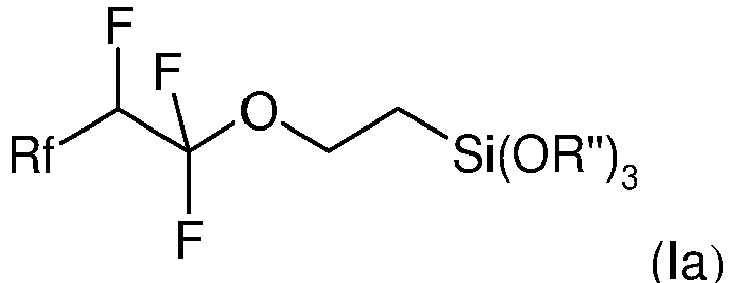
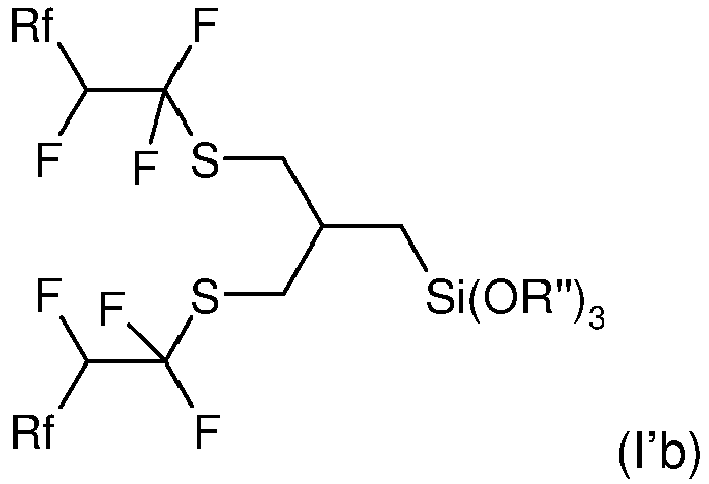
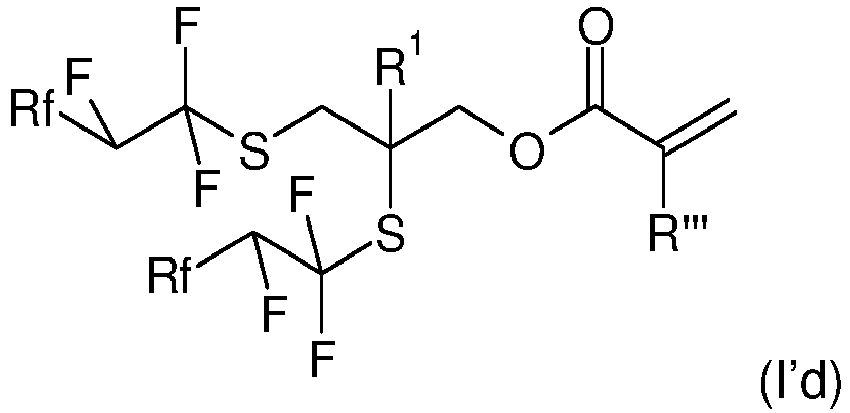
- Insbesondere bevorzugt sind Verbindungen der Formeln (Ia) bis (Ih) und/oder (I'a) bis (I'h), wobei Rf = eine perfluorierte, ggf. Heteroatome enthaltende, Alkylgruppe ist, R"=gleich C1-C4-Alkyl, insbesondere C1- oder C2-Alkyl, R'''= H oder eine Alkylgruppe ist, bevorzugt gleich H oder Methyl ist, und R1 gleich H oder C1-C4-Alkyl, bevorzugt H oder CH3.





- Bevorzugt sind Verbindungen der Formeln (Ia) bis (Ih) und/oder (I'a) bis (I'h), in denen die perfluorierte Gruppe Rf ausgewählt ist aus den Gruppen:
CF3-(CF2)0-3-, CF3-(CF2)0-3-O-, CF3-(CF2)0-3-O-(CF2)1-3-,
CF3-(CF2)0-3-O-(CF2)1-3-O-, CF3-(CF2)0-3-O-(CF2)1-3-O-CF2-,
CF3-(CF2)0-30-(CF2-O)1-8- und CF3-(CF2)0-3-O-(CF2-O)1-8-CF2-.
- Insbesondere bevorzugt sind Verbindungen der Formeln (Ia) bis (Ih) und/oder (I'a) bis (I'h), in denen die perfluorierte Gruppe Rf ausgewählt ist aus den Gruppen:
CF3-(CF2)1-2-, CF3-(CF2)1-2-O-, CF3-O-(CF2)1-3-, CF3-O-(CF2)1-3-O-,
CF3-(CF2)1-2-O-CF2-, CF3-O-(CF2)1-2-O-CF2-, CF3-O-(CF2-O)1-8-
und
CF3-O-(CF2-O)1-8-CF2-.
- In einer Variante kann die perfluorierte Gruppe Rf auch bevorzugt aus den Gruppen CF3-(CF2)0-3-, CF3-(CF2)0-3-O-, CF3-O-(CF2)1-3- und CF3-O-(CF2)1- 3-O-, insbesondere aus den Gruppen CF3-(CF2)1-2-, CF3-(CF2)1-2-O-, CF3-O-(CF2)1-2- und CF3-O-(CF2)1-2-O- ausgewählt sein.
- Insbesondere solche Verbindungen der Formeln (Ia) bis (Ih) und/oder (I'a) bis (I'h) sind bevorzugt, in denen Rf eine der bevorzugten oder besonders bevorzugten Gruppen ist und R" = C1- oder C2-Alkyl und/oder R'''= H oder Methyl ist. Besonders bevorzugt sind hierbei Verbindungen der Formeln (Ic) bis (Ih) und/oder (I'a), (I'c) und (I'e), insbesondere mit den bevorzugten Rf-, R"-, R'''-und R1-Gruppen.
- Ein Vorteil der neuen Verbindungen ist, dass sie leicht abbaubar sind. Sie weisen gezielte Sollbruchstellen im Molekül auf. So können entsprechende niedermolekulare Bruchstücke entstehen, die atmosphärengängig sind und somit in der Stratosphäre unter UV Licht zersetzt werden können. Hydrofluorether der folgenden Struktur lassen sich z. B. durch Hydrolyse und Oxidation in leicht flüchtige und UV zersetzbare Verbindungen umwandeln. Die Zersetzungsprodukte können dann mit dem Regen aus der Atmosphäre ausgewaschen, in den Boden überführt und dort mineralisiert werden.

- Die Gruppe X stellt dabei eine reaktive Ankergruppe dar, die besonders geeignet ist um z. B. auf Glasoberflächen zu haften (z.B. Trialkoxysilane).
- Die Verbindungen der Formeln (I) und (I') lassen sich leicht synthetisieren. Die für die Herstellung der Verbindungen der Formel (I) verwendeten Ausgangsstoffe sind kommerziell erhältlich und/oder ihre Herstellung ausgehend von kommerziell erhältlichen Edukten ist dem Fachmann geläufig oder sie können in Analogie zu bekannten Syntheseverfahren hergestellt werden, z. B. radikalische Addition siehe: A. A. II'in et al., Russian Journal of Applied Chemistry, 2007, Vol. 80, No. 3, pp. 405-418.
- Die bevorzugten Verbindungen der Formel (I) und (I'), die der Substanzklasse der Organosilane angehören, lassen sich durch folgende einfache Synthese realisieren, wie für die Methoxysilane der Formel (I) beispielhaft gezeigt ist:

- Um verzweigte Hydrofluorethersilane zu erhalten, werden die Perfluorolefine mit bifunktionellen Hydroxyalkenen umgesetzt.

- Die Trimethoxysilane können dann einfach in einem geeigneten Lösungsmittel dispergiert werden und auf die zu behandelnde Oberfläche, z. B. Glas, aufgebracht werden. Durch Luftfeuchtigkeit hydrolysiert das Trimethoxysilan und bildet z. B. mit den SiOH Gruppen des Glases eine kovalente dauerhafte Verbindung.
- Erfindungsgemäße Verbindungen mit Acrylat- oder Methacrylatgruppen können z. B. durch Umsetzung der entsprechenden Alkohole mit den Säuren oder Säureanhydriden nach dem Fachmann bekannten Methoden hergestellt werden.
- Die entsprechenden Verbindungen der Formel (I') können über die Umsetzung der entsprechenden Perfluorolefine mit den entsprechenden Thioverbindungen hergestellt werden. Beispielhaft sei die Reaktion von Perfluorpropylvinylethern mit 2-Mercaptoethanol oder 1,4-Dimercaptobutane-2,3-diol genannt und die weitere Umsetzung zu Verbindungen der Formel (I'c) bzw. (I'e).
- Gegenstand der Erfindung ist auch ein Verfahren zur Herstellung von Verbindungen der Formel (I') gemäß einem oder mehreren der Ansprüche 1 bis 14 umfassend a) die Umsetzung von Perfluoralkylvinylethern der Formel Rf-CF=CF2 mit Mercaptoalkoholen der Formel (HS)x-Alkyl-(OH)y zu Verbindungen der Formel (Rf-CHF-CF2-S)x-Alkyl-(OH)y und b) die Umsetzung der in a) hergestellten Verbindungen mit ungesättigten Säuren oder -säureanhydriden, wobei Rf = eine perfluorierte, ggf. Heteroatome enthaltende, Alkylgruppe ist und x und y unabhängig voneinander ≥ 1 sind.
- Bevorzugt ist die perfluorierte Gruppe Rf ausgewählt aus den Gruppen: CF3-(CF2)0-3-, CF3-(CF2)0-3-O-, CF3-(CF2)0-3-O-(CF2)1-3-, CF3-(CF2)0-3-O-(CF2)1-3-O-, CF3-(CF2)0-3-O-(CF2)1-3-O-CF2-, CF3-(CF2)0-3O-(CF2-O)1-8- und CF3-(CF2)0-3-O-(CF2-O)1-8-CF2-. Insbesondere bevorzugt ist die perfluorierte Gruppe Rf ausgewählt aus den Gruppen: CF3-(CF2)1-2-, CF3-(CF2)1-2-O-, CF3-O-(CF2)1-2-, CF3-O-(CF2)1-3-O-, CF3-(CF2)1-2-O-CF2-, CF3-O-(CF2)1-2-O-CF2-, CF3-O-(CF2-O)1-8- und CF3-O-(CF2-O)1-8-CF2-, insbesondere CF3-(CF2)1-2-, CF3-(CF2)1-2-O- und CF3-O-(CF2)1-3-O-.
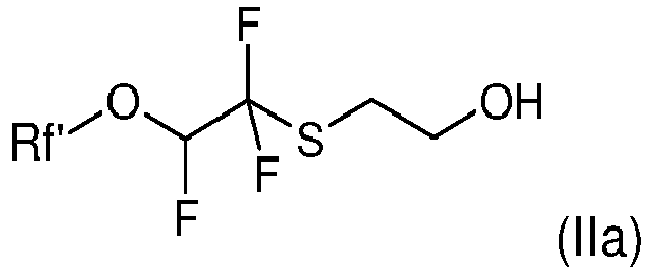
- Bevorzugte schwefelhaltige Zwischenprodukte sind dabei Verbindungen der Formeln (II), (III) und (IV), wobei Rf = eine perfluorierte, ggf.
- Heteroatome enthaltende Alkylgruppe wie vorstehend beschrieben ist und R1 gleich H oder C1-C4-Alkyl, bevorzugt H oder CH3 ist:


- Bevorzugt sind Verbindungen der Formeln (II), (III) und (IV), in denen die perfluorierte Gruppe Rf ausgewählt ist aus den Gruppen: CF3-(CF2)0-3-, CF3-(CF2)0-3-O-, CF3-(CF2)0-3-O-(CF2)1-3-, CF3-(CF2)0-3-O-(CF2)1-3-O-, CF3-(CF2)0-3-O-(CF2)1-3-O-CF2-, CF3-(CF2)0-3O-(CF2-O)1-8- und CF3-(CF2)0-3-O-(CF2-O)1-8-CF2-. Insbesondere bevorzugt sind Verbindungen der Formeln (II), (III) und (IV), in denen die perfluorierte Gruppe Rf ausgewählt ist aus den Gruppen: CF3-(CF2)1-2-, CF3-(CF2)1-2-O-, CF3-O-(CF2)1-3-, CF3-O-(CF2)1-3-O-, CF3-(CF2)1-2-O-CF2-, CF3-O-(CF2)1-2-O-CF2-, CF3-O-(CF2-O)1-8- und CF3-O-(CF2-O)1-8-CF2-.
- In einer Variante kann die perfluorierte Gruppe Rf auch bevorzugt aus den Gruppen CF3-(CF2)0-3-, CF3-(CF2)0-3-O-, CF3-O-(CF2)1-3- und CF3-O-(CF2)1- 3-O-, insbesondere aus den Gruppen CF3-(CF2)1-2-, CF3-(CF2)1-2-O-, CF3-O-(CF2)1-2- und CF3-O-(CF2)1-2-O- ausgewählt sein.
- Insbesondere solche Verbindungen der Formeln (II), (III) und (IV) sind bevorzugt, in denen Rf eine der bevorzugten oder besonders bevorzugten Gruppen ist und R1 gleich H oder CH3 ist.
- Besonders bevorzugt sind Verbindungen der Formeln (IIa), (IIIa) und (IVa) mit Rf' = CF3-(CF2)1-2-, CF3-O-(CF2)1-3-, CF3-(CF2)1-2-O-CF2-, CF3-O-(CF2)1-2-O-CF2- und CF3-O-(CF2-O)1-8-CF2- und R1 = H oder CH3:


- Die in den Beispielen aufgezeigten Synthesen können analog für die Herstellung weiterer Verbindungen der Formeln (I), (I'), (Ia)-(Ih) und (I'a)-(I'h) angewendet werden, bzw. auch zur Herstellung weiterer Zwischenprodukte der Formeln (II), (III) und (IV).
- Der Abbau der Verbindungen der Formeln (I) und (I'), bevorzugt der Verbindungen der Formeln (Ia) bis (Ih) und (I'a) bis (I'h) kann bevorzugt durch ein Verfahren zum Abbau von fluorhaltigen Verbindungen umfassend die folgenden Schritte erfolgen:
- a) biologische und/oder abiotischer Abbau des Kohlenstoffgerüsts der fluorhaltigen Verbindungen unter Bildung von, vorzugsweise nicht toxischen, fluorhaltigen Verbindungen, bevorzugt mit einem ausreichend hohen Dampfdruck,
- b) Überführen der in Schritt a) gebildeten fluorhaltigen Verbindungen in eine Gasphase,
- c) Abbau der in Schritt a) gebildeten fluorhaltigen zu niedermolekularen Verbindungen durch UV-Bestrahlung in der Gasphase,
- d) Überführen der in Schritt c) gebildeten niedermolekularen Verbindungen aus der Gasphase in eine flüssige und/oder feste Phase,
- e) Mineralisierung der Schritt c) gebildeten niedermolekularen Verbindungen der flüssigen und/oder festen Phase.
- Bevorzugt werden in Schritt a) keine fluorhaltigen, Salze gebildet. Insbesondere werden in Schritt a) keine perfluorierten Verbindungen gebildet. Bevorzugt weisen die in Schritt a) gebildeten fluorhaltigen Verbindungen einen ausreichend hohen Dampfdruck auf, um leicht in die Gasphase überzugehen oder überführt werden zu können, bevorzugt bei Normaldruck.
- Die erfindungsgemäßen Verbindungen können alleine oder als Gemisch, auch mit anderen fluorierten und/oder nicht fluorierten Verbindungen, verwendet werden, insbesondere zur Herstellung von funktionellen Überzügen und Oberflächenmodifikationen aller Art auf Gegenständen sowohl für Innen- wie auch für Außenbereiche.
- Prinzipiell können alle Oberflächen beschichtet werden, insbesondere Glas, Keramik, Emaille, Metalle, Kunststoffe, Elastomere, Naturstoffe, Textilien, gegebenenfalls nach einer geeigneten Vorbehandlung.
- Ein weiterer Gegenstand der vorliegenden Erfindung ist die Verwendung der erfindungsgemäßen Verbindungen der Formel (I) und/oder (I'), bzw. der bevorzugten Verbindungen der Formeln (la) bis (Ih) und/oder (I'a) bis (I'h), und den vorstehend beschriebenen bevorzugten Ausführungsformen zur Herstellung von, z. B. schmutzabweisenden und/oder hydrophoben, Beschichtungen, insbesondere auch zur Textilausrüstung und Glasbeschichtung, z. B. von Beschichtungen in der Displayindustrie.
- Neben den Verbindungen der Formeln (I) und/oder (I'), bzw. der bevorzugten Verbindungen der Formeln (la) bis (Ih) und/oder (I'a) bis (I'h), können die Beschichtungen auch Lösemittel, Additive, Tenside, Hilfs- und Füllstoffe enthalten. Beispielhaft seien auch Silikonpartikel und, ggf. oberflächenmodifizierte, Pigmente genannt.
- Bevorzugte Einsatzgebiete sind beispielsweise die Verwendung der erfindungsgemäßen Verbindungen in Beschichtungen für optische Elemente oder Textilien, wie z. B. die Verwendung in Antifingerprint Coatings, z. B. für Displays, optische Linsen, Brillengläser, Objektive für Kameras, Ferngläser, Fensterscheiben oder Spiegel, oder als Hydrophobiermittel zur Textilausrüstung.
- Die Aufbringung der erfindungsgemäßen Verbindungen oder sie enthaltenden Mischungen auf eine geeignete Oberfläche kann, vollflächig oder teilflächig, durch verschiedene dem Fachmann bekannte Beschichtungsprozesse erfolgen, z. B. mittels CVD-, PVD-, Spray-Coating-, Ink-Jet-, Offset-Prozessen.
- Alle hier genannten Verwendungen erfindungsgemäß einzusetzender Verbindungen sind Gegenstand der vorliegenden Erfindung. Die jeweilige Anwendung von Verbindungen der Formeln (I) und/oder (I'), bzw. der bevorzugten Verbindungen der Formeln (la) bis (Ih) und/oder (I'a) bis (I'h), zu den genannten Zwecken ist dem Fachmann bekannt, so dass der Einsatz der erfindungsgemäß einzusetzenden Verbindungen keine Probleme bereitet.
- Gegenstand der Erfindung sind auch Mittel, in denen mindestens eine der erfindungsgemäßen Verbindungen enthalten ist, wobei die Mittel auch Lösemittel, Additive, Tenside, Hilfs- und Füllstoffe enthalten können
- Gegenstand der Erfindung sind auch beschichtete Gegenstände, insbesondere die vorstehend genannten Gegenstände, deren Beschichtung unter Verwendung von mindestens einer erfindungsgemäßen Verbindung hergestellt wurde. Bevorzugt sind Displays, optische Linsen, Brillengläser, Objektive für Kameras, Ferngläser, Fensterscheiben, Spiegel und Textilien.
- Die folgenden Beispiele erläutern die vorliegende Erfindung näher, ohne den Schutzbereich zu beschränken.
-
- TEMPO
- 2,2,6,6-Tetramethylpiperidinyloxyl
- THF
- Tetrahydrofuran
- MTBE
- tert-Butylmethylether
- RT
- Raumtemperatur
-

-

- 100g 2,3-Dihydroxy-propylacetat, 595 g Perfluorpropylvinylether, 134 g Kaliumcarbonat und 460 g Acetonitril werden in einem Druckbehälter bei 80°C 70 Std gerührt. Der Innendruck steigt während der Reaktion auf 4 bar. Das Reaktionsprodukt wird mit 100 ml Acetonitril aus dem Reaktor gewaschen, das Gemisch wird filtriert und das Lösungsmittel am Rotationsverdampfer abgetrennt und das Rohprodukt bei vermindertem Druck (Sdp 75 °C bei 0,3 mbar) destilliert. Ausbeut e: 533 g = 80%.
1 H-NMR: 6,8 ppm (m, 2 H, -CFH); 4,8 ppm (m,1 H, -OCH); 4,3 ppm (m, 4H, -CH2); 2,1 ppm (s, 3 H, O=CCH3) -

- 30 g Ester werden mit 20 ml Methanol, 0,5 g Natriummethylat, 27 mg Ru-MACHO (Takasago International, JP) für 12 Std bei 50 bar und 40 °C in einem Druckreaktor mit Wasserstoff hydriert. Das Reaktionsgemisch wird mit 50 ml Methyl-tert.butylether und 50 ml Wasser versetzt, die organische Phase abgetrennt und über NaSO4 getrocknet. Das Produkt wird vom Lösungsmittel befreit und im Vakuum destilliert (Sdp.: 74°C bei 0,4 mbar). Ausbeute: 20 g = 70%).
1 H-NMR: 6,8 ppm (m, 2 H, -CFH); 4,8 - 4,3 ppm (m, 5H, -CH2); -

- 10 g Fluoralkoholalkohol werden mit 0,5 g Toluol-4-sulfonsäure-Monohydrat in 35 ml Toluol gelöst. Dann werden unter Rühren 2,7 g Methacrylsäureanhydrid langsam zugegeben und die Reaktionsmischung für 24h bei 110 °C gerührt. Der auf Raumtemperatur abgekühlte Ansatz wird mit 25 mL Wasser und 25 mL MTBE versetzt und im Scheidetrichter abgetrennt. Anschließend wird die wässrige Phase zweimal mit 25 mL MTBE gewaschen. Die vereinigte organische Phase wird Natriumsulfat getrocknet und filtriert. Anschließend das Lösungsmittel am Rotationsverdampfer destilliert. Ausbeute: 9,98g
1H-NMR: 6,8 ppm (m, 2 H, -CFH); 6,0 ppm (d, 1H, =CH); 5,6 ppm (d, 1H,=CH); 4,8 - 4,3 ppm (m, 5H, -CH2); 1,7 ppm (s, 3H, -CH3) -

-

- 8,63 g Perfluorpropylvinylether werden mit 2,5g 1,4-Dimercaptobutane-2,3-diol, 25 ml Acetonitril und 0,67 g Kaliumcarbonat in einem Druckreaktor für 18 Std auf 120°C erhitzt. Das Reaktionsgemisch wird mit 25 ml Wasser und 25 ml MTBE versetzt und die Phasen getrennt. Die wässrige Phase wird mit 2x25mL MTBE extrahiert und die vereinigte organische Phase mit 70mL Wasser und 70mL gesättigter NaCI-Lösung gewaschen. Das Extrakt wird über Natriumsulfat getrocknet und das Lösemittel destilliert. Ausbeute: 9,82g = 88%
1H-NMR: 6,8 ppm (d, 2 H, -CFH); 3,6 ppm (m, 2H, -CHOH); 3,0 ppm (m, 4H, -SCH2); -

- 10 g Fluoralkoholalkohol werden mit 0,5 g Toluol-4-sulfonsäure-Monohydrat in 35 ml Toluol gelöst. Dann werden unter Rühren 4,5 g Methacrylsäureanhydrid langsam zugegeben und die Reaktionsmischung für 24h bei 110 °C gerührt. Der auf Raumtemperatur abgekühlte Ansatz wird mit 25 mL Wasser und 25 mL MTBE versetzt und im Scheidetrichter abgetrennt. Anschließend wird die wässrige Phase zweimal mit 25 mL MTBE gewaschen. Die vereinigte organische Phase wird Natriumsulfat getrocknet und filtriert. Anschließend das Lösungsmittel am Rotationsverdampfer destilliert. Ausbeute: 14,5 g
1H-NMR: 6,8 ppm (m, 2 H, -CFH); 6,0 ppm (d,2H, =CH); 5,6 ppm (d,2H,=CH); 3,6 ppm (m, 2H, -OCH-); 3,0 ppm (m, 4H, -SCH2); 1,6 ppm (s, 6H, -CH3) -

-

- 77,30 g Perfluorpropylvinylether werden mit 52,21 g 2-Mercaptoethanol 40 ml Acetonitril und 12 g Kaliumcarbonat in einem Druckreaktor für 18 Std auf 100°C erhitzt. Das Reaktionsgemisch wird mit 25 ml Wasser und 25 ml MTBE versetzt und die Phasen getrennt. Die wässrige Phase wird mit 2x25mL MTBE extrahiert und die vereinigte organische Phase mit 70mL Wasser und 70mL gesättigter NaCI-Lösung gewaschen. Das Extrakt wird über Natriumsulfat getrocknet, das Lösemittel entfernt und das Rohmaterial destilliert (Sdp 45-49 °C bei 0,1 mbar). Ausbeute: 63,40g = 63%
1 H-NMR: 6,8 ppm (dt, 1 H, -CFH); 3,6 ppm (t, 2H, -CH2O-); 3,1 ppm (t, 2H, -SCH2); -

- 10 g Fluoralkoholalkohol werden mit 0,5 g Toluol-4-sulfonsäure-Monohydrat in 60 ml Toluol gelöst. Dann werden unter Rühren 4,5 g Methacrylsäureanhydrid langsam zugegeben und die Reaktionsmischung für 24h bei 110 °C gerührt. Der auf Raumtemperatur abgekühlte Ansatz wird mit 25 mL Wasser und 25 mL MTBE versetzt und im Scheidetrichter abgetrennt. Anschließend wird die wässrige Phase zweimal mit 25 mL MTBE gewaschen. Die vereinigte organische Phase wird Natriumsulfat getrocknet, filtriert und das Lösungsmittel am Rotationsverdampfer entfernt. Ausbeute: 11,30 g = 94%
1H-NMR: 7,1 ppm (m, 1 H, -CFH); 6,1 ppm (m, 1H, =CH); 5,7 ppm (m,1H,=CH); 4,3 ppm (t, 2H, -CH2O-); 3,2 ppm (t,2H, -SCH2); 1,9 ppm (s, 3H, -CH3) -

-

- 5 g 3-Hydroxy-2-hydroxymethyl-2-methylpropionsäuremethylester, 20 ml 1,1,2,2,3,3-Hexafluoro-1-trifluoromethoxy-3-trifluorovinyloxypropan 60 ml Acetonitril und 6 g Kaliumcarbonat werden in einem Druckreaktor bei 80°C 20 h gerührt. Es stellte sich ein Druck von 1,5bar ein. Die Reaktion wird abgebrochen und das Reaktionsgemisch mit Wasser und MTBE versetzt. Die Phasen werden getrennt und die wässrige Phase mit 2x50mL MTBE extrahiert. Anschließend wird die vereinigte organische Phase mit 70mL Wasser und 70mL NaCI-Lösung gewaschen. Das Extrakt wird über Natriumsulfat getrocknet und das Lösemittel destilliert.
Auswaage: 20,58g 75%
1H-NMR: 6,6 ppm (m, 2 H, -CFH); 4,2 ppm (dd, 4H, -CH2O); 3,7 ppm (s,3H, -OCH3); 1,25 ppm (s, 3H CCH3) -

- 20 g Ester werden mit 15 ml Methanol, 0,3 g Natriummethylat, 15 mg Katalysator für 12 Std bei 50 bar und 40 °C in eine m Druckreaktor mit Wasserstoff hydriert. Das Reaktionsgemisch wird mit 50 ml Methyl-tert.butylether und 50 ml Wasser versetzt, die organische Phase abgetrennt und über NaSO4 getrocknet. Das Produkt wird vom Lösungsmittel befreit und im Vakuum destilliert (Sdp.: 95°C bei 0,1 mbar). Ausbeute: 16 g = 82%).
1H-NMR: 6,6 ppm (m, 2 H, -CFH); 6,1 ppm (m,1H, =CH); 5,7 ppm (m,1H,=CH); 4,3-4,1 ppm (m, 6H, -CH2O); 1,3 ppm (s, 3H CCH3) -

- 10 g Fluoralkoholalkohol werden mit 0,5 g Toluol-4-sulfonsäure-Monohydrat in 35 ml Toluol gelöst. Dann werden unter Rühren 2 g Methacrylsäureanhydrid langsam zugegeben und die Reaktionsmischung für 24h bei 110 °C gerührt. Der auf Raumtemperatur abgekühlte Ansatz wird mit 25 mL Wasser und 25 mL MTBE versetzt und im Scheidetrichter abgetrennt. Anschließend wird die wässrige Phase zweimal mit 25 mL MTBE gewaschen und die vereinigte organische Phase wird mit Natriumsulfat getrocknet und filtriert. Das Lösungsmittel wird am Rotationsverdampfer entfernt. Ausbeute: 10.5 g = 96%
1H-NMR: 6,6 ppm (m, 2 H, -CFH); 6,2 ppm (m,1H, =CH); 5,7 ppm (m,1H,=CH); 4,3-4,1 ppm (m, 6H, -CH2O); 1,9 ppm (s, 3H, -CH3); 1,25 ppm (s, 3H CCH3) -

-

- 3,56 g But-2-en1,4-diol und 26,87 g Perfluorovinyloxypropan werden mit 2,84 g KOH und 27,5 g Acetonitril in einem Autoklaven auf 80°C erhitzt und 24 h bei dieser Temperatur zur Reaktion gebracht. Der Innendruck fällt dabei von anfangs 2,6 bar auf 1 bar. Der Ansatz wird nach Abkühlen auf Raumtemperatur filtriert und das Lösungsmittel destilliert. Das Lösemittel wird im Vakuum entfernt. Rohausbeute Ausbeute: m=30,28g Das Rohprodukt wird in 30 ml Acetonitril gelöst, mit 20 ml Toluol versetzt, wodurch ein weißes Gel ausfällt. Der Niederschlag wird über wenig Kieselgel abfiltriert und mit 20 ml Acetonitril nachgewaschen. Nach Entfernung des Lösungsmittels wird der Rückstand getrocknet. Ausbeute: m= 24,8g
1H-NMR: 6,7 ppm (m, 2 H, -CFH); 6,0 ppm (s,2H, =CH); 4,6 ppm (s, 4H, - CH2O) ; -

- In einem 100mL 4-Halskolben werden unter Eiskühlung und unter Argon 0,15 g Hexachloroplatin (IV)-säure- Hexahydrat (∼40%Pt) und 10 g Perfluoroolefin in 12 ml abs. THF vorgelegt. Unter Rühren und Eiskühlung werden 1,84 ml Trichlorsilan über eine Spritze zum Ansatz zugegeben, so dass die IT 5°C nicht überschreitet. Der Ansatz auf 60°C geheizt und bei dieser Temperatur 4h zur Reaktion gebracht. Anschließend wird unter Argon über Nacht auf RT abgekühlt. Es wird mit 5mL Trimethylorthoformiat versetzt und anschließend 2mL MeOH zugegeben. Die Temperatur steigt dabei um 5K auf 33°C. Es wird auf 50°C erwärmt und 2h bei dieser Temperatur gerührt. Der Ansatz wird abgekühlt, das Lösemittel entfernt und der Rückstand im Vakuum getrocknet. Rohausbeute: m=18,95g Der Ansatz wird bei 120 °C in einer Kugelrohrdestille im Hochvakuum aufgereinigt.
1H-NMR: 6,7 ppm (dt, 2 H, -CFH); 3,8 ppm (m,4 H, -OCH2); 3,5 ppm (s,9H, -OCH3); 1,4 ppm (m,2 H, -CH2); 0,6 ppm (m,1 H, -SiCH); -

-

- 10,0 g Allyloxy-1,2-propandiol werden mit 60,4 g Perfluorovinyloxypropane, 13,6 g Kaliumcarbonat und 46,5 g Acetonitril im Autoklaven bei 80°C für 48h zur Reaktion gebracht. Nach Beendigung wird der Ansatz filtriert und das Lösemittel im Vakuum entfernt. Ausbeute: m=50,2g
- Das Produkt wird im Vakuum destilliert (64-65°C bei 3 mbar)
1H-NMR: 6,8 ppm (d, 2 H, -CFH); 5,9 ppm (m, 1 H, CH); 5,3 ppm (d, 1H, =CH2), 5,2 ppm (d, 1H, =CH2), 4,8 ppm (d, 1H, =CH) 4,2 ppm (m,2 H, - OCH2); 4,0 ppm (m,2 H, -OCH2); 3,8 ppm (m,2 H, -OCH2) -

- In einem 100mL 4-Halskolben werden unter Eiskühlung und unter Argon 0,15 g Hexachloroplatin (IV)-säure- Hexahydrat (∼40%Pt) und 10 g Perfluoroolefin in 12 ml abs. THF vorgelegt. Unter Rühren und Eiskühlung werden 1,84 ml Trichlorsilan über eine Spritze zum Ansatz zugegeben so dass die IT 5°C nicht überschreitet. Der Ansatz auf 60°C geheizt und bei dieser Temperatur 4h zur Reaktion gebracht. Anschließend wird unter Argon über Nacht auf RT abgekühlt. Es wird mit 5mL Trimethylorthoformiat versetzt und anschließend 2mL MeOH zugegeben. Es wird auf 50°C erwärmt und 6h bei dieser Temperatur gerührt. Der Ansatz wird abgekühlt, das Lösemittel entfernt und der Rückstand im Vakuum getrocknet. Rohausbeute: m=15,2g
Das Produkt wird in der Kugelrohrdestille aufgereinigt. 115°@ C 0,01 mbar 1H-NMR: 6,8 ppm (d, 2 H, -CFH); 5,9 ppm (m, 1H, CH); 4,2 ppm (m, 2H, - OCH2); 4,0 ppm (m, 2H, -OCH2); 3,5 ppm (s, 9H,-OCH3); 3,4 ppm (m, 2H, - OCH2) 1,5-0,6ppm (m, 4H, CH2-CH2-Si-)
Claims (21)
- Verbindungen der Formel (I')
(Rf-CHF-CF2-S-CHR)m-L-(X)n (I')
wobeiRf = eine perfluorierte, ggf. Heteroatome enthaltende, Alkylgruppe ist,R = H oder eine Alkylgruppe ist,L = eine Einfachbindung oder eine bivalente organische Gruppe ist,X = eine Ankergruppe,m ≥ 1 istund n ≥ 1 ist. - Verbindungen gemäß Anspruch 1, dadurch gekennzeichnet, dass die Gruppe Rf aus den Gruppen CF3-(CF2)0-3-, CF3-(CF2)0-3-O-, CF3-(CF2)0-3-O-(CF2)1-3-, CF3-(CF2)0-3-O-(CF2)1-3-O-, CF3-(CF2)0-3-O-(CF2)1-3-O-CF2-, CF3-(CF2)0-3-O-(CF2-O)1-8- und CF3-(CF2)0-3-O-(CF2-O)1-8-CF2- ausgewählt ist.
- Verbindungen gemäß einem oder mehreren der Ansprüche 1 bis 2, dadurch gekennzeichnet, dass die Gruppe Rf aus den Gruppen CF3-(CF2)1-2-, CF3-(CF2)1-2-O-, CF3-O-(CF2)1-3-, CF3-O-(CF2)1-2-O-, CF3-(CF2)1-2-O-CF2-, CF3-O-(CF2)1-2-O-CF2-, CF3-O-(CF2-O)1-8- und CF3-O-(CF2-O)1-8-CF2- ausgewählt ist.
- Verbindungen gemäß einem oder mehreren der Ansprüche 1 bis 3, dadurch gekennzeichnet, dass die Gruppe R gleich H oder C1-C3 Alkyl ist.
- Verbindungen gemäß einem oder mehreren der Ansprüche 1 bis 4, dadurch gekennzeichnet, dass die Gruppe R gleich H oder eine Methylgruppe ist.
- Verbindungen gemäß einem oder mehreren der Ansprüche 1 bis 5, dadurch gekennzeichnet, dass die Gruppe L eine Einfachbindung oder eine gesättigte, verzweigte oder unverzweigte, ggf. funktionelle Gruppen enthaltende, Alkylengruppe ist.
- Verbindungen gemäß einem oder mehreren der Ansprüche 1 bis 6, dadurch gekennzeichnet, dass die Gruppe X eine ethylenisch ungesättigte Gruppe, eine Alkoxysilangruppe, eine Silanolgruppe oder eine Halogensilangruppe.
- Verbindungen gemäß einem oder mehreren der Ansprüche 1 bis 7, dadurch gekennzeichnet, dass die Gruppe X eine Acrylat- oder Methacrylatgruppe ist.
- Verbindungen gemäß einem oder mehreren der Ansprüche 1 bis 7, dadurch gekennzeichnet, dass die Gruppe X gleich -SiR'3 ist, wobei die Gruppen R' unabhängig voneinander gleich Alkyl, OH, Halogen, Alkoxy oder Aryloxy sind, wobei mindestens ein Gruppe R' keine Alkylgruppe ist.
- Verbindungen gemäß Anspruch 9, dadurch gekennzeichnet, dass R' eine Alkoxygruppe OR" mit R" gleich C1-C4-Alkyl.
- Verbindungen gemäß Anspruch 10, dadurch gekennzeichnet, dass R" gleich C1-oder C2-Alkyl ist.
- Verbindungen gemäß einem oder mehreren der Ansprüche 1 bis 11, dadurch gekennzeichnet, dass m und n unabhängig voneinander gleich 1-3 sind.
- Verbindungen gemäß einem oder mehreren der Ansprüche 1 bis 12, dadurch gekennzeichnet, dass sie einer der Formeln (I'a) bis (I'h) entsprechen


- Verbindungen gemäß Anspruch 13, dadurch gekennzeichnet, dass Rf gleich CF3-(CF2)1-2-, CF3-(CF2)1-2-O-, CF3-O-(CF2)1-3- oder CF3-O-(CF2)1-2-O- ist.
- Verwendung von Verbindungen gemäß einem oder mehreren der Ansprüche 1 bis 14 zur Herstellung von funktionellen Überzügen und Oberflächenmodifikationen, insbesondere von schmutzabweisenden Beschichtungen.
- Verfahren zum Abbau von fluorhaltigen Verbindungen umfassend die folgenden Schritte:a) biologischer und/oder abiotischer Abbau des Kohlenstoffgerüsts der fluorhaltigen Verbindungen unter Bildung von fluorhaltigen Verbindungen,b) Überführen der in Schritt a) gebildeten fluorhaltigen Verbindungen in eine Gasphase,c) Abbau der in Schritt a) gebildeten fluorhaltigen Verbindungen zu niedermolekularen Verbindungen durch UV-Bestrahlung in der Gasphase,d) Überführen der in Schritt c) gebildeten niedermolekularen Verbindungen aus der Gasphase in eine flüssige und/oder feste Phase,Mineralisierung der in Schritt c) gebildeten niedermolekularen Verbindungen in der Flüssigen und/oder festen Phase.
- Mittel enthaltend mindesten eine Verbindungen gemäß einem oder mehreren der Ansprüche 1 bis 14 und einen für den jeweiligen Verwendungszweck geeigneten Träger sowie ggf. weitere Additive.
- Beschichteter Gegenstand, dessen Beschichtung unter Verwendung von mindestens einer Verbindung gemäß einem oder mehreren der Ansprüche 1 bis 14 hergestellt wurde.
- Verfahren zur Herstellung von Verbindungen der Formel (I') gemäß einem oder mehreren der Ansprüche 1 bis 14 umfassend a) die Umsetzung von Perfluoralkylvinylethern der Formel Rf-CF=CF2 mit Mercaptoalkoholen der Formel (HS)x-Alkyl-(OH)y zu Verbindungen der Formel (Rf-CHF-CF2-S)x-Alkyl-(OH)y und b) die Umsetzung der in a) hergestellten Verbindungen mit ungesättigten Säuren oder - säureanhydriden, wobei Rf = eine perfluorierte, ggf. Heteroatome enthaltende, Alkylgruppe ist und x und y unabhängig voneinander ≥ 1 sind.
- Verbindungen der Formel (II)

Rf ausgewählt ist aus den Gruppen: CF3-(CF2)1-2-, CF3-(CF2)1-2-O-, CF3-O-(CF2)1-3-, CF3-O-(CF2)1-3-O-, CF3-(CF2)1-2-O-CF2-, CF3-O-(CF2)1-2-O-CF2-, CF3-O-(CF2-O)1-8- und CF3-O-(CF2-O)1-8-CF2-. - Verbindungen der Formeln (III) oder (IV)


Rf = eine perfluorierte, ggf. Heteroatome enthaltende, Alkylgruppe ist und R1 = gleich H oder C1-C4-Alkyl ist.
Applications Claiming Priority (3)
| Application Number | Priority Date | Filing Date | Title |
|---|---|---|---|
| EP14004337 | 2014-12-19 | ||
| PCT/EP2015/002530 WO2016096129A1 (de) | 2014-12-19 | 2015-12-16 | Fluorverbindungen |
| EP15817072.0A EP3233784B1 (de) | 2014-12-19 | 2015-12-16 | Verbindungen mit fluorierten endgruppen und deren verwendung in schmutzabweisenden beschichtungen |
Related Parent Applications (2)
| Application Number | Title | Priority Date | Filing Date |
|---|---|---|---|
| EP15817072.0A Division EP3233784B1 (de) | 2014-12-19 | 2015-12-16 | Verbindungen mit fluorierten endgruppen und deren verwendung in schmutzabweisenden beschichtungen |
| EP15817072.0A Division-Into EP3233784B1 (de) | 2014-12-19 | 2015-12-16 | Verbindungen mit fluorierten endgruppen und deren verwendung in schmutzabweisenden beschichtungen |
Publications (3)
| Publication Number | Publication Date |
|---|---|
| EP3896054A2 true EP3896054A2 (de) | 2021-10-20 |
| EP3896054A3 EP3896054A3 (de) | 2021-11-24 |
| EP3896054B1 EP3896054B1 (de) | 2023-07-12 |
Family
ID=52144364
Family Applications (2)
| Application Number | Title | Priority Date | Filing Date |
|---|---|---|---|
| EP15817072.0A Active EP3233784B1 (de) | 2014-12-19 | 2015-12-16 | Verbindungen mit fluorierten endgruppen und deren verwendung in schmutzabweisenden beschichtungen |
| EP21178677.7A Active EP3896054B1 (de) | 2014-12-19 | 2015-12-16 | Fluorverbindungen |
Family Applications Before (1)
| Application Number | Title | Priority Date | Filing Date |
|---|---|---|---|
| EP15817072.0A Active EP3233784B1 (de) | 2014-12-19 | 2015-12-16 | Verbindungen mit fluorierten endgruppen und deren verwendung in schmutzabweisenden beschichtungen |
Country Status (7)
| Country | Link |
|---|---|
| US (2) | US11118066B2 (de) |
| EP (2) | EP3233784B1 (de) |
| JP (1) | JP6959864B2 (de) |
| KR (1) | KR102497892B1 (de) |
| CN (3) | CN107108456A (de) |
| ES (1) | ES2911353T3 (de) |
| WO (1) | WO2016096129A1 (de) |
Families Citing this family (13)
| Publication number | Priority date | Publication date | Assignee | Title |
|---|---|---|---|---|
| CN107513127A (zh) | 2016-06-17 | 2017-12-26 | 默克专利股份有限公司 | 含氟聚合物 |
| DE102016013066A1 (de) * | 2016-11-03 | 2018-05-03 | Merck Patent Gmbh | Fluortenside |
| WO2019063452A1 (de) | 2017-09-26 | 2019-04-04 | Merck Patent Gmbh | Verfahren zur herstellung von fluorierten verbindungen |
| EP3687983B1 (de) | 2017-09-26 | 2022-02-23 | Merck Patent GmbH | Fluorverbindungen |
| TWI797212B (zh) | 2017-12-13 | 2023-04-01 | 美商3M新設資產公司 | 在介電流體及電裝置中之全氟化1-烷氧基丙烯 |
| US11673861B2 (en) | 2017-12-13 | 2023-06-13 | 3M Innovative Properties Company | Perfluorinated 1-alkoxypropenes, compositions, and methods and apparatuses for using same |
| KR102739483B1 (ko) | 2017-12-13 | 2024-12-05 | 쓰리엠 이노베이티브 프로퍼티즈 컴파니 | 하이드로플루오로올레핀 에테르, 조성물, 장치 및 이의 사용 방법 |
| US11866548B2 (en) | 2019-07-26 | 2024-01-09 | Moresco Corporation | Perfluoropolyether compound, lubricant, and magnetic disk |
| WO2021213916A1 (en) | 2020-04-20 | 2021-10-28 | Merck Patent Gmbh | Fluorinated silazane polymers for functional coatings |
| EP4204467A1 (de) | 2020-08-25 | 2023-07-05 | Merck Patent GmbH | Fluorhaltige polymere |
| CN116096697A (zh) * | 2020-09-09 | 2023-05-09 | 默克专利股份有限公司 | 制备具有不饱和端基的氟醚化合物的方法 |
| KR20220105255A (ko) * | 2021-01-19 | 2022-07-27 | 삼성디스플레이 주식회사 | 지문방지 코팅용 화합물, 이를 포함하는 디스플레이 보호층 및 전자 장치 |
| WO2024096358A1 (ko) | 2022-11-04 | 2024-05-10 | 주식회사 엘지화학 | 홀로그램 기록 매체 및 이를 포함하는 광학 소자 |
Family Cites Families (25)
| Publication number | Priority date | Publication date | Assignee | Title |
|---|---|---|---|---|
| JPS5052019A (de) * | 1973-09-13 | 1975-05-09 | ||
| DE3138235A1 (de) | 1981-09-25 | 1983-04-07 | Wacker-Chemie GmbH, 8000 München | "hexafluoropropyl-oxy-alkyl-silane" |
| JP2563960B2 (ja) | 1988-03-05 | 1996-12-18 | 株式会社トクヤマ | 含フッ素エーテル化合物及びその製造方法 |
| US6255535B1 (en) | 1999-12-22 | 2001-07-03 | Dyneon Llc | Fluorine containing allylethers and higher homologs |
| CA2451542A1 (en) | 2001-06-18 | 2002-12-27 | Honeywell International Inc. | Fluorine-containing compounds and polymers derived therefrom |
| AU2003244294A1 (en) | 2002-06-27 | 2004-01-19 | Asahi Glass Company, Limited | Fluorine-containing alcohols and process for production thereof |
| US20050107645A1 (en) * | 2002-06-27 | 2005-05-19 | Asahi Glass Company Limited | Fluorine-containing alcohol and method for its production |
| EP1535892A4 (de) * | 2002-07-03 | 2006-08-02 | Asahi Glass Co Ltd | Fluorierte ungesättigte verbindung und verfahren zu deren herstellung |
| US20050113609A1 (en) | 2002-07-03 | 2005-05-26 | Asahi Glass Company Limited | Fluorine-containing unsaturated compound and method for its production |
| JP2004043402A (ja) | 2002-07-15 | 2004-02-12 | Asahi Glass Co Ltd | 含フッ素不飽和化合物およびその製造方法 |
| JP4001372B2 (ja) * | 2002-12-27 | 2007-10-31 | 株式会社リコー | 静電荷像現像用トナー、現像剤、画像形成方法および画像形成装置 |
| WO2005054256A1 (ja) * | 2003-12-04 | 2005-06-16 | Asahi Glass Company, Limited | 含フッ素化合物、撥水性組成物および薄膜 |
| CN101142165B (zh) * | 2005-03-15 | 2010-05-19 | 株式会社德山 | (甲基)丙烯酸含氟烷基酯的制造方法 |
| JP4822265B2 (ja) | 2006-03-13 | 2011-11-24 | 独立行政法人産業技術総合研究所 | 含フッ素ポリエーテル化合物およびその製造方法 |
| US7737307B2 (en) | 2007-08-06 | 2010-06-15 | E. I. Du Pont De Nemours And Company | Fluorinated nonionic surfactants |
| JP5881269B2 (ja) | 2008-01-03 | 2016-03-09 | ダイキン工業株式会社 | フルオロエーテルカルボン酸及びその製造方法、界面活性剤、それを利用した含フッ素ポリマーの製造方法並びに水性分散体 |
| US8263800B2 (en) * | 2008-07-01 | 2012-09-11 | E. I. Du Pont De Nemours And Company | Partially fluorinated sulfonated surfactants |
| US8173848B2 (en) * | 2008-07-01 | 2012-05-08 | E.I. Du Pont De Nemours And Company | Fluorinated alcohols |
| WO2010003931A1 (en) * | 2008-07-08 | 2010-01-14 | Solvay Solexis S.P.A. | Process for the manufacture of fluorosurfactants |
| JP2012087092A (ja) | 2010-10-19 | 2012-05-10 | Daikin Industries Ltd | 含フッ素スルホン、含フッ素チオエーテル、含フッ素チオエーテルの製造方法、及び、含フッ素スルホンの製造方法 |
| US8614347B2 (en) | 2011-04-26 | 2013-12-24 | The Trustees Of The University Of Pennsylvania | Fluorous dendrimers and methods for production thereof |
| US8697831B2 (en) | 2011-06-22 | 2014-04-15 | E I Du Pont De Nemours And Company | Process for preparing polyamides comprising fluoroether functionalized aromatic moieties |
| JP6096531B2 (ja) * | 2013-02-25 | 2017-03-15 | キヤノンファインテック株式会社 | 含フッ素アルコキシシラン化合物、コーティング剤、及び撥水膜 |
| WO2015050740A1 (en) * | 2013-10-04 | 2015-04-09 | 3M Innovative Properties Company | Fluoroalkylsilanes and coatings therefrom |
| JP6612766B2 (ja) * | 2014-02-21 | 2019-11-27 | メルク パテント ゲゼルシャフト ミット ベシュレンクテル ハフツング | フッ素化界面活性剤 |
-
2015
- 2015-12-16 KR KR1020177019860A patent/KR102497892B1/ko active Active
- 2015-12-16 EP EP15817072.0A patent/EP3233784B1/de active Active
- 2015-12-16 JP JP2017533230A patent/JP6959864B2/ja active Active
- 2015-12-16 ES ES15817072T patent/ES2911353T3/es active Active
- 2015-12-16 WO PCT/EP2015/002530 patent/WO2016096129A1/de not_active Ceased
- 2015-12-16 CN CN201580069303.1A patent/CN107108456A/zh active Pending
- 2015-12-16 CN CN202310046714.5A patent/CN115960127A/zh active Pending
- 2015-12-16 EP EP21178677.7A patent/EP3896054B1/de active Active
- 2015-12-16 US US15/536,671 patent/US11118066B2/en active Active
- 2015-12-16 CN CN202310046715.XA patent/CN115960128A/zh active Pending
-
2021
- 2021-07-16 US US17/377,912 patent/US11898058B2/en active Active
Non-Patent Citations (1)
| Title |
|---|
| A. A. LI'IN ET AL., RUSSIAN JOURNAL OF APPLIED CHEMISTRY, vol. 80, no. 3, 2007, pages 405 - 418 |
Also Published As
| Publication number | Publication date |
|---|---|
| CN115960128A (zh) | 2023-04-14 |
| US20210340383A1 (en) | 2021-11-04 |
| US20170349760A1 (en) | 2017-12-07 |
| JP6959864B2 (ja) | 2021-11-05 |
| US11118066B2 (en) | 2021-09-14 |
| CN115960127A (zh) | 2023-04-14 |
| EP3896054A3 (de) | 2021-11-24 |
| JP2018503616A (ja) | 2018-02-08 |
| KR102497892B1 (ko) | 2023-02-08 |
| CN107108456A (zh) | 2017-08-29 |
| US11898058B2 (en) | 2024-02-13 |
| EP3233784A1 (de) | 2017-10-25 |
| EP3233784B1 (de) | 2021-10-27 |
| KR20170097714A (ko) | 2017-08-28 |
| EP3896054B1 (de) | 2023-07-12 |
| ES2911353T3 (es) | 2022-05-18 |
| WO2016096129A1 (de) | 2016-06-23 |
Similar Documents
| Publication | Publication Date | Title |
|---|---|---|
| EP3896054B1 (de) | Fluorverbindungen | |
| EP0743313A2 (de) | Carbosilan-Dendrimere, Carbosilan-Hybridmaterialien, Verfahren zu deren Herstellung und ein Verfahren zur Herstellung von Lacken aus den Carbosilan-Dendrimeren | |
| DE2518392C2 (de) | Neue Kohlensäure-alkyl-cycloalkylester, deren Herstellung und Verwendung | |
| JP2014001152A (ja) | アミノ基と保護された水酸基を有する有機ケイ素化合物及びその製造方法 | |
| WO2016096128A1 (de) | Fluorverbindungen | |
| JP2010285406A (ja) | アミノ基を有する有機ケイ素化合物及びその製造方法 | |
| JPH02243695A (ja) | 有機ケイ素化合物 | |
| DE102012208471A1 (de) | Verfahren zur Herstellung von Feststoffen aus Alkalisalzen von Silanolen | |
| JP6428677B2 (ja) | 有機ケイ素化合物およびそれを含む硬化性組成物 | |
| DE2263819B2 (de) | Verfahren zur Herstellung von a- Alkoxy w-siloxanolen | |
| JP4471361B2 (ja) | 新規なフロロアルキル基含有アセチレンアルコールおよびその製造方法 | |
| DE69230274T2 (de) | Verfahren zur Herstellung von Zwischenverbindungen für Vitamin-D-Derivate sowie Verbindungen | |
| JP6727643B2 (ja) | 化合物、表面処理剤、及び表面処理方法 | |
| JPS59152367A (ja) | メルカプトカルボン酸多価アルコ−ルエステル類の精製法 | |
| JP2688469B2 (ja) | (メタ)アクリル官能基含有有機けい素化合物の製造方法 | |
| DE2039728B2 (de) | Verfahren zur herstellung von alkenylalkoxysilanen | |
| WO2005121156A1 (de) | Fluorhaltige silicium-verbindungen | |
| DE102012203271A1 (de) | Formkörper mit hydrophilen Oberflächen | |
| JP2020097542A (ja) | アルコキシシリル基含有フッ素化合物の製造方法、表面処理組成物の製造方法、および表面処理された部材の製造方法 | |
| DEF0017415MA (de) | ||
| DE102006045594A1 (de) | Verfahren zur Herstellung von wasserfreiem 3-Butin-2-ol hoher chemischer Reinheit |
Legal Events
| Date | Code | Title | Description |
|---|---|---|---|
| PUAI | Public reference made under article 153(3) epc to a published international application that has entered the european phase |
Free format text: ORIGINAL CODE: 0009012 |
|
| STAA | Information on the status of an ep patent application or granted ep patent |
Free format text: STATUS: REQUEST FOR EXAMINATION WAS MADE |
|
| 17P | Request for examination filed |
Effective date: 20210610 |
|
| AC | Divisional application: reference to earlier application |
Ref document number: 3233784 Country of ref document: EP Kind code of ref document: P |
|
| AK | Designated contracting states |
Kind code of ref document: A2 Designated state(s): AL AT BE BG CH CY CZ DE DK EE ES FI FR GB GR HR HU IE IS IT LI LT LU LV MC MK MT NL NO PL PT RO RS SE SI SK SM TR |
|
| PUAL | Search report despatched |
Free format text: ORIGINAL CODE: 0009013 |
|
| AK | Designated contracting states |
Kind code of ref document: A3 Designated state(s): AL AT BE BG CH CY CZ DE DK EE ES FI FR GB GR HR HU IE IS IT LI LT LU LV MC MK MT NL NO PL PT RO RS SE SI SK SM TR |
|
| RIC1 | Information provided on ipc code assigned before grant |
Ipc: A62D 101/22 20070101ALN20211020BHEP Ipc: C09D 4/00 20060101ALN20211020BHEP Ipc: C07C 69/653 20060101ALI20211020BHEP Ipc: A62D 3/176 20070101ALI20211020BHEP Ipc: A62D 3/02 20070101ALI20211020BHEP Ipc: C07F 7/18 20060101ALI20211020BHEP Ipc: C07C 323/12 20060101ALI20211020BHEP Ipc: C07C 69/54 20060101AFI20211020BHEP |
|
| STAA | Information on the status of an ep patent application or granted ep patent |
Free format text: STATUS: EXAMINATION IS IN PROGRESS |
|
| 17Q | First examination report despatched |
Effective date: 20220926 |
|
| GRAP | Despatch of communication of intention to grant a patent |
Free format text: ORIGINAL CODE: EPIDOSNIGR1 |
|
| STAA | Information on the status of an ep patent application or granted ep patent |
Free format text: STATUS: GRANT OF PATENT IS INTENDED |
|
| RIC1 | Information provided on ipc code assigned before grant |
Ipc: A62D 101/22 20070101ALN20230301BHEP Ipc: C09D 4/00 20060101ALN20230301BHEP Ipc: C07C 69/653 20060101ALI20230301BHEP Ipc: A62D 3/176 20070101ALI20230301BHEP Ipc: A62D 3/02 20070101ALI20230301BHEP Ipc: C07F 7/18 20060101ALI20230301BHEP Ipc: C07C 323/12 20060101ALI20230301BHEP Ipc: C07C 69/54 20060101AFI20230301BHEP |
|
| INTG | Intention to grant announced |
Effective date: 20230405 |
|
| GRAS | Grant fee paid |
Free format text: ORIGINAL CODE: EPIDOSNIGR3 |
|
| GRAA | (expected) grant |
Free format text: ORIGINAL CODE: 0009210 |
|
| STAA | Information on the status of an ep patent application or granted ep patent |
Free format text: STATUS: THE PATENT HAS BEEN GRANTED |
|
| P01 | Opt-out of the competence of the unified patent court (upc) registered |
Effective date: 20230519 |
|
| AC | Divisional application: reference to earlier application |
Ref document number: 3233784 Country of ref document: EP Kind code of ref document: P |
|
| AK | Designated contracting states |
Kind code of ref document: B1 Designated state(s): AL AT BE BG CH CY CZ DE DK EE ES FI FR GB GR HR HU IE IS IT LI LT LU LV MC MK MT NL NO PL PT RO RS SE SI SK SM TR |
|
| REG | Reference to a national code |
Ref country code: CH Ref legal event code: EP |
|
| REG | Reference to a national code |
Ref country code: DE Ref legal event code: R096 Ref document number: 502015016494 Country of ref document: DE |
|
| REG | Reference to a national code |
Ref country code: IE Ref legal event code: FG4D Free format text: LANGUAGE OF EP DOCUMENT: GERMAN |
|
| REG | Reference to a national code |
Ref country code: LT Ref legal event code: MG9D |
|
| REG | Reference to a national code |
Ref country code: NL Ref legal event code: MP Effective date: 20230712 |
|
| PG25 | Lapsed in a contracting state [announced via postgrant information from national office to epo] |
Ref country code: NL Free format text: LAPSE BECAUSE OF FAILURE TO SUBMIT A TRANSLATION OF THE DESCRIPTION OR TO PAY THE FEE WITHIN THE PRESCRIBED TIME-LIMIT Effective date: 20230712 |
|
| PG25 | Lapsed in a contracting state [announced via postgrant information from national office to epo] |
Ref country code: GR Free format text: LAPSE BECAUSE OF FAILURE TO SUBMIT A TRANSLATION OF THE DESCRIPTION OR TO PAY THE FEE WITHIN THE PRESCRIBED TIME-LIMIT Effective date: 20231013 |
|
| PG25 | Lapsed in a contracting state [announced via postgrant information from national office to epo] |
Ref country code: ES Free format text: LAPSE BECAUSE OF FAILURE TO SUBMIT A TRANSLATION OF THE DESCRIPTION OR TO PAY THE FEE WITHIN THE PRESCRIBED TIME-LIMIT Effective date: 20230712 |
|
| PG25 | Lapsed in a contracting state [announced via postgrant information from national office to epo] |
Ref country code: IS Free format text: LAPSE BECAUSE OF FAILURE TO SUBMIT A TRANSLATION OF THE DESCRIPTION OR TO PAY THE FEE WITHIN THE PRESCRIBED TIME-LIMIT Effective date: 20231112 |
|
| PG25 | Lapsed in a contracting state [announced via postgrant information from national office to epo] |
Ref country code: SE Free format text: LAPSE BECAUSE OF FAILURE TO SUBMIT A TRANSLATION OF THE DESCRIPTION OR TO PAY THE FEE WITHIN THE PRESCRIBED TIME-LIMIT Effective date: 20230712 Ref country code: RS Free format text: LAPSE BECAUSE OF FAILURE TO SUBMIT A TRANSLATION OF THE DESCRIPTION OR TO PAY THE FEE WITHIN THE PRESCRIBED TIME-LIMIT Effective date: 20230712 Ref country code: PT Free format text: LAPSE BECAUSE OF FAILURE TO SUBMIT A TRANSLATION OF THE DESCRIPTION OR TO PAY THE FEE WITHIN THE PRESCRIBED TIME-LIMIT Effective date: 20231113 Ref country code: NO Free format text: LAPSE BECAUSE OF FAILURE TO SUBMIT A TRANSLATION OF THE DESCRIPTION OR TO PAY THE FEE WITHIN THE PRESCRIBED TIME-LIMIT Effective date: 20231012 Ref country code: LV Free format text: LAPSE BECAUSE OF FAILURE TO SUBMIT A TRANSLATION OF THE DESCRIPTION OR TO PAY THE FEE WITHIN THE PRESCRIBED TIME-LIMIT Effective date: 20230712 Ref country code: LT Free format text: LAPSE BECAUSE OF FAILURE TO SUBMIT A TRANSLATION OF THE DESCRIPTION OR TO PAY THE FEE WITHIN THE PRESCRIBED TIME-LIMIT Effective date: 20230712 Ref country code: IS Free format text: LAPSE BECAUSE OF FAILURE TO SUBMIT A TRANSLATION OF THE DESCRIPTION OR TO PAY THE FEE WITHIN THE PRESCRIBED TIME-LIMIT Effective date: 20231112 Ref country code: HR Free format text: LAPSE BECAUSE OF FAILURE TO SUBMIT A TRANSLATION OF THE DESCRIPTION OR TO PAY THE FEE WITHIN THE PRESCRIBED TIME-LIMIT Effective date: 20230712 Ref country code: GR Free format text: LAPSE BECAUSE OF FAILURE TO SUBMIT A TRANSLATION OF THE DESCRIPTION OR TO PAY THE FEE WITHIN THE PRESCRIBED TIME-LIMIT Effective date: 20231013 Ref country code: FI Free format text: LAPSE BECAUSE OF FAILURE TO SUBMIT A TRANSLATION OF THE DESCRIPTION OR TO PAY THE FEE WITHIN THE PRESCRIBED TIME-LIMIT Effective date: 20230712 Ref country code: ES Free format text: LAPSE BECAUSE OF FAILURE TO SUBMIT A TRANSLATION OF THE DESCRIPTION OR TO PAY THE FEE WITHIN THE PRESCRIBED TIME-LIMIT Effective date: 20230712 |
|
| PG25 | Lapsed in a contracting state [announced via postgrant information from national office to epo] |
Ref country code: PL Free format text: LAPSE BECAUSE OF FAILURE TO SUBMIT A TRANSLATION OF THE DESCRIPTION OR TO PAY THE FEE WITHIN THE PRESCRIBED TIME-LIMIT Effective date: 20230712 |
|
| REG | Reference to a national code |
Ref country code: DE Ref legal event code: R097 Ref document number: 502015016494 Country of ref document: DE |
|
| PG25 | Lapsed in a contracting state [announced via postgrant information from national office to epo] |
Ref country code: SM Free format text: LAPSE BECAUSE OF FAILURE TO SUBMIT A TRANSLATION OF THE DESCRIPTION OR TO PAY THE FEE WITHIN THE PRESCRIBED TIME-LIMIT Effective date: 20230712 Ref country code: RO Free format text: LAPSE BECAUSE OF FAILURE TO SUBMIT A TRANSLATION OF THE DESCRIPTION OR TO PAY THE FEE WITHIN THE PRESCRIBED TIME-LIMIT Effective date: 20230712 Ref country code: EE Free format text: LAPSE BECAUSE OF FAILURE TO SUBMIT A TRANSLATION OF THE DESCRIPTION OR TO PAY THE FEE WITHIN THE PRESCRIBED TIME-LIMIT Effective date: 20230712 Ref country code: DK Free format text: LAPSE BECAUSE OF FAILURE TO SUBMIT A TRANSLATION OF THE DESCRIPTION OR TO PAY THE FEE WITHIN THE PRESCRIBED TIME-LIMIT Effective date: 20230712 Ref country code: CZ Free format text: LAPSE BECAUSE OF FAILURE TO SUBMIT A TRANSLATION OF THE DESCRIPTION OR TO PAY THE FEE WITHIN THE PRESCRIBED TIME-LIMIT Effective date: 20230712 Ref country code: SK Free format text: LAPSE BECAUSE OF FAILURE TO SUBMIT A TRANSLATION OF THE DESCRIPTION OR TO PAY THE FEE WITHIN THE PRESCRIBED TIME-LIMIT Effective date: 20230712 |
|
| PLBE | No opposition filed within time limit |
Free format text: ORIGINAL CODE: 0009261 |
|
| STAA | Information on the status of an ep patent application or granted ep patent |
Free format text: STATUS: NO OPPOSITION FILED WITHIN TIME LIMIT |
|
| PG25 | Lapsed in a contracting state [announced via postgrant information from national office to epo] |
Ref country code: IT Free format text: LAPSE BECAUSE OF FAILURE TO SUBMIT A TRANSLATION OF THE DESCRIPTION OR TO PAY THE FEE WITHIN THE PRESCRIBED TIME-LIMIT Effective date: 20230712 |
|
| 26N | No opposition filed |
Effective date: 20240415 |
|
| PG25 | Lapsed in a contracting state [announced via postgrant information from national office to epo] |
Ref country code: SI Free format text: LAPSE BECAUSE OF FAILURE TO SUBMIT A TRANSLATION OF THE DESCRIPTION OR TO PAY THE FEE WITHIN THE PRESCRIBED TIME-LIMIT Effective date: 20230712 |
|
| REG | Reference to a national code |
Ref country code: CH Ref legal event code: PL |
|
| PG25 | Lapsed in a contracting state [announced via postgrant information from national office to epo] |
Ref country code: LU Free format text: LAPSE BECAUSE OF NON-PAYMENT OF DUE FEES Effective date: 20231216 |
|
| PG25 | Lapsed in a contracting state [announced via postgrant information from national office to epo] |
Ref country code: MC Free format text: LAPSE BECAUSE OF FAILURE TO SUBMIT A TRANSLATION OF THE DESCRIPTION OR TO PAY THE FEE WITHIN THE PRESCRIBED TIME-LIMIT Effective date: 20230712 |
|
| REG | Reference to a national code |
Ref country code: BE Ref legal event code: MM Effective date: 20231231 |
|
| PG25 | Lapsed in a contracting state [announced via postgrant information from national office to epo] |
Ref country code: MC Free format text: LAPSE BECAUSE OF FAILURE TO SUBMIT A TRANSLATION OF THE DESCRIPTION OR TO PAY THE FEE WITHIN THE PRESCRIBED TIME-LIMIT Effective date: 20230712 Ref country code: LU Free format text: LAPSE BECAUSE OF NON-PAYMENT OF DUE FEES Effective date: 20231216 |
|
| REG | Reference to a national code |
Ref country code: IE Ref legal event code: MM4A |
|
| PG25 | Lapsed in a contracting state [announced via postgrant information from national office to epo] |
Ref country code: IE Free format text: LAPSE BECAUSE OF NON-PAYMENT OF DUE FEES Effective date: 20231216 |
|
| PG25 | Lapsed in a contracting state [announced via postgrant information from national office to epo] |
Ref country code: BE Free format text: LAPSE BECAUSE OF NON-PAYMENT OF DUE FEES Effective date: 20231231 |
|
| PG25 | Lapsed in a contracting state [announced via postgrant information from national office to epo] |
Ref country code: CH Free format text: LAPSE BECAUSE OF NON-PAYMENT OF DUE FEES Effective date: 20231231 |
|
| PG25 | Lapsed in a contracting state [announced via postgrant information from national office to epo] |
Ref country code: IE Free format text: LAPSE BECAUSE OF NON-PAYMENT OF DUE FEES Effective date: 20231216 Ref country code: CH Free format text: LAPSE BECAUSE OF NON-PAYMENT OF DUE FEES Effective date: 20231231 Ref country code: BE Free format text: LAPSE BECAUSE OF NON-PAYMENT OF DUE FEES Effective date: 20231231 |
|
| PG25 | Lapsed in a contracting state [announced via postgrant information from national office to epo] |
Ref country code: BG Free format text: LAPSE BECAUSE OF FAILURE TO SUBMIT A TRANSLATION OF THE DESCRIPTION OR TO PAY THE FEE WITHIN THE PRESCRIBED TIME-LIMIT Effective date: 20230712 |
|
| PG25 | Lapsed in a contracting state [announced via postgrant information from national office to epo] |
Ref country code: BG Free format text: LAPSE BECAUSE OF FAILURE TO SUBMIT A TRANSLATION OF THE DESCRIPTION OR TO PAY THE FEE WITHIN THE PRESCRIBED TIME-LIMIT Effective date: 20230712 |
|
| REG | Reference to a national code |
Ref country code: AT Ref legal event code: MM01 Ref document number: 1587009 Country of ref document: AT Kind code of ref document: T Effective date: 20231216 |
|
| PG25 | Lapsed in a contracting state [announced via postgrant information from national office to epo] |
Ref country code: AT Free format text: LAPSE BECAUSE OF NON-PAYMENT OF DUE FEES Effective date: 20231216 |
|
| PG25 | Lapsed in a contracting state [announced via postgrant information from national office to epo] |
Ref country code: CY Free format text: LAPSE BECAUSE OF FAILURE TO SUBMIT A TRANSLATION OF THE DESCRIPTION OR TO PAY THE FEE WITHIN THE PRESCRIBED TIME-LIMIT; INVALID AB INITIO Effective date: 20151216 |
|
| PG25 | Lapsed in a contracting state [announced via postgrant information from national office to epo] |
Ref country code: HU Free format text: LAPSE BECAUSE OF FAILURE TO SUBMIT A TRANSLATION OF THE DESCRIPTION OR TO PAY THE FEE WITHIN THE PRESCRIBED TIME-LIMIT; INVALID AB INITIO Effective date: 20151216 |
|
| REG | Reference to a national code |
Ref country code: DE Ref legal event code: R081 Ref document number: 502015016494 Country of ref document: DE Owner name: SUSONITY COMMERCIAL GMBH, DE Free format text: FORMER OWNER: MERCK PATENT GESELLSCHAFT MIT BESCHRAENKTER HAFTUNG, 64293 DARMSTADT, DE |
|
| REG | Reference to a national code |
Ref country code: GB Ref legal event code: 732E Free format text: REGISTERED BETWEEN 20250925 AND 20251001 |
|
| PG25 | Lapsed in a contracting state [announced via postgrant information from national office to epo] |
Ref country code: TR Free format text: LAPSE BECAUSE OF FAILURE TO SUBMIT A TRANSLATION OF THE DESCRIPTION OR TO PAY THE FEE WITHIN THE PRESCRIBED TIME-LIMIT Effective date: 20230712 |
|
| PGFP | Annual fee paid to national office [announced via postgrant information from national office to epo] |
Ref country code: GB Payment date: 20251219 Year of fee payment: 11 |
|
| PGFP | Annual fee paid to national office [announced via postgrant information from national office to epo] |
Ref country code: FR Payment date: 20251229 Year of fee payment: 11 |
|
| PGFP | Annual fee paid to national office [announced via postgrant information from national office to epo] |
Ref country code: DE Payment date: 20251231 Year of fee payment: 11 |