EP3895215B1 - Back-illuminated sensor and a method of manufacturing a sensor - Google Patents
Back-illuminated sensor and a method of manufacturing a sensor Download PDFInfo
- Publication number
- EP3895215B1 EP3895215B1 EP19895404.2A EP19895404A EP3895215B1 EP 3895215 B1 EP3895215 B1 EP 3895215B1 EP 19895404 A EP19895404 A EP 19895404A EP 3895215 B1 EP3895215 B1 EP 3895215B1
- Authority
- EP
- European Patent Office
- Prior art keywords
- epitaxial layer
- layer
- boron
- type dopant
- image sensor
- Prior art date
- Legal status (The legal status is an assumption and is not a legal conclusion. Google has not performed a legal analysis and makes no representation as to the accuracy of the status listed.)
- Active
Links
Images




Classifications
-
- H—ELECTRICITY
- H10—SEMICONDUCTOR DEVICES; ELECTRIC SOLID-STATE DEVICES NOT OTHERWISE PROVIDED FOR
- H10F—INORGANIC SEMICONDUCTOR DEVICES SENSITIVE TO INFRARED RADIATION, LIGHT, ELECTROMAGNETIC RADIATION OF SHORTER WAVELENGTH OR CORPUSCULAR RADIATION
- H10F39/00—Integrated devices, or assemblies of multiple devices, comprising at least one element covered by group H10F30/00, e.g. radiation detectors comprising photodiode arrays
- H10F39/011—Manufacture or treatment of image sensors covered by group H10F39/12
-
- H—ELECTRICITY
- H10—SEMICONDUCTOR DEVICES; ELECTRIC SOLID-STATE DEVICES NOT OTHERWISE PROVIDED FOR
- H10F—INORGANIC SEMICONDUCTOR DEVICES SENSITIVE TO INFRARED RADIATION, LIGHT, ELECTROMAGNETIC RADIATION OF SHORTER WAVELENGTH OR CORPUSCULAR RADIATION
- H10F39/00—Integrated devices, or assemblies of multiple devices, comprising at least one element covered by group H10F30/00, e.g. radiation detectors comprising photodiode arrays
- H10F39/011—Manufacture or treatment of image sensors covered by group H10F39/12
- H10F39/024—Manufacture or treatment of image sensors covered by group H10F39/12 of coatings or optical elements
-
- H—ELECTRICITY
- H10—SEMICONDUCTOR DEVICES; ELECTRIC SOLID-STATE DEVICES NOT OTHERWISE PROVIDED FOR
- H10F—INORGANIC SEMICONDUCTOR DEVICES SENSITIVE TO INFRARED RADIATION, LIGHT, ELECTROMAGNETIC RADIATION OF SHORTER WAVELENGTH OR CORPUSCULAR RADIATION
- H10F39/00—Integrated devices, or assemblies of multiple devices, comprising at least one element covered by group H10F30/00, e.g. radiation detectors comprising photodiode arrays
- H10F39/011—Manufacture or treatment of image sensors covered by group H10F39/12
- H10F39/026—Wafer-level processing
-
- H—ELECTRICITY
- H10—SEMICONDUCTOR DEVICES; ELECTRIC SOLID-STATE DEVICES NOT OTHERWISE PROVIDED FOR
- H10F—INORGANIC SEMICONDUCTOR DEVICES SENSITIVE TO INFRARED RADIATION, LIGHT, ELECTROMAGNETIC RADIATION OF SHORTER WAVELENGTH OR CORPUSCULAR RADIATION
- H10F39/00—Integrated devices, or assemblies of multiple devices, comprising at least one element covered by group H10F30/00, e.g. radiation detectors comprising photodiode arrays
- H10F39/10—Integrated devices
- H10F39/12—Image sensors
- H10F39/199—Back-illuminated image sensors
-
- H—ELECTRICITY
- H10—SEMICONDUCTOR DEVICES; ELECTRIC SOLID-STATE DEVICES NOT OTHERWISE PROVIDED FOR
- H10F—INORGANIC SEMICONDUCTOR DEVICES SENSITIVE TO INFRARED RADIATION, LIGHT, ELECTROMAGNETIC RADIATION OF SHORTER WAVELENGTH OR CORPUSCULAR RADIATION
- H10F39/00—Integrated devices, or assemblies of multiple devices, comprising at least one element covered by group H10F30/00, e.g. radiation detectors comprising photodiode arrays
- H10F39/80—Constructional details of image sensors
-
- H—ELECTRICITY
- H10—SEMICONDUCTOR DEVICES; ELECTRIC SOLID-STATE DEVICES NOT OTHERWISE PROVIDED FOR
- H10F—INORGANIC SEMICONDUCTOR DEVICES SENSITIVE TO INFRARED RADIATION, LIGHT, ELECTROMAGNETIC RADIATION OF SHORTER WAVELENGTH OR CORPUSCULAR RADIATION
- H10F39/00—Integrated devices, or assemblies of multiple devices, comprising at least one element covered by group H10F30/00, e.g. radiation detectors comprising photodiode arrays
- H10F39/80—Constructional details of image sensors
- H10F39/805—Coatings
Definitions
- the present application relates to image sensors suitable for sensing radiation in deep UV (DUV) and vacuum UV (VUV) wavelengths, and to methods for making such image sensors. These sensors are suitable for use in photomask, reticle, or wafer inspection systems and for other applications.
- DUV deep UV
- VUV vacuum UV
- the integrated circuit industry requires inspection tools with increasingly higher resolution to resolve ever smaller features of integrated circuits, photomasks, reticles, solar cells, charge coupled devices etc., as well as detect defects whose sizes are of the order of, or smaller than, those feature sizes.
- Inspection systems operating at short wavelengths can provide such resolution in many cases.
- inspection systems operating over a relatively broad range of wavelengths, such as a wavelength range that includes wavelengths in the near UV, DUV, and/or VUV ranges, can be advantageous because a broad range of wavelengths can reduce the sensitivity to small changes in layer thicknesses or pattern dimensions that can cause large changes in reflectivity at an individual wavelength.
- a photon with a vacuum wavelength of 250 nm has energy of approximately 5 eV.
- the bandgap of silicon dioxide is about 10 eV.
- silicon dioxide as grown on a silicon surface must have some dangling bonds at the interface with the silicon because the silicon dioxide structure cannot perfectly match that of the silicon crystal.
- the single dioxide is amorphous, there will be dangling bonds within the material.
- two high-energy photons may arrive near the same location within a very short time interval (nanoseconds or picoseconds), which can lead to electrons being excited to the conduction band of the silicon dioxide by two absorption events in rapid succession or by two-photon absorption.
- a further requirement for sensors used for inspection, metrology and related applications is high sensitivity. As explained above, high signal-to-noise ratios are required. If the sensor does not convert a large fraction of the incident photons into signal, then a higher intensity light source would be required in order to maintain the same inspection or measurement speed compared with an inspection or metrology system with a more efficient sensor. A higher intensity light source would expose the instruments optics and the sample being inspected or measured to higher light intensities, possibly causing damage or degradation over time. A higher intensity light source would also be more expensive or, particularly at DUV and VUV wavelengths, may not be available. Silicon reflects a high percentage of DUV and VUV light incident on it.
- silicon with a 2 nm oxide layer on its surface (such as a native oxide layer) reflects approximately 65% of the light incident on it.
- Growing an oxide layer of about 21nm on the silicon surface reduces the reflectivity to close to 40% for wavelengths near 193 nm.
- a detector with 40% reflectivity is significantly more efficient than one with 65% reflectivity, but lower reflectivity, and hence higher efficiency, is desirable.
- U.S Patents 9,496,425 , 9,818,887 and 10,121,914 all to Chern et al., describe image sensor structures and methods of making image sensors that include a boron layer deposited on, at least, an exposed back surface of the image sensor.
- Different ranges of temperature for deposition of the boron are disclosed, including a range of about 400-450°C and a range of about 700-800°C.
- the inventors have discovered that one advantage of a higher deposition temperature for the boron, such as a deposition temperature between about 600°C and about 900°C, is that at such temperatures boron diffuses into the silicon providing a very thin, heavily p-type doped silicon layer on the light-sensitive back surface.
- a method of fabricating a back-thinned image sensor with a boron layer and boron doping on its back surface while allowing formation of metal interconnects on a relatively flat wafer would allow the use of finer design rules (such as the design rules corresponding to a 0.35 ⁇ m process or finer).
- Such a method would allow narrower metal lines connecting to critical features such as the floating diffusion, enabling smaller floating-diffusion capacitance and higher charge to voltage conversions ratios.
- Finer design rules also allow more interconnect lines per unit area of the sensor and allow more flexibility in connecting the circuits on the image sensor.
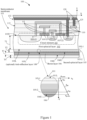
- Fig. 1 is a cross-sectional side view depicting a portion of an image sensor 100 configured to sense deep ultraviolet (DUV) radiation, vacuum ultraviolet (VUV) radiation, extreme ultraviolet (EUV) radiation or charged particles according to an exemplary embodiment of the present invention.
- Image sensor 100 includes a semiconductor membrane 101 including a circuit element 103 formed on an upper (first) surface 102U of a first epitaxial layer and metal interconnects 110 and 120 formed over circuit element 103, a second epitaxial layer 105 disposed on a lower (second) surface 102L of first epitaxial layer 102, a pure boron layer 106 disposed on a lower surface 105L of second epitaxial layer 105, and an optional anti-reflection coating 108 disposed on a lower (outward-facing) surface 106L of pure boron layer 106.
- DUV deep ultraviolet
- VUV vacuum ultraviolet
- EUV extreme ultraviolet
- first epitaxial layer 102 comprises a layer of lightly p-doped epitaxial silicon having a thickness T1 in a range of 10 ⁇ m to 40 ⁇ m and a p-type (e.g., boron) dopant concentration in a range of about 10 13 cm -3 to 10 14 cm -3 .
- a p-type (e.g., boron) dopant concentration in a range of about 10 13 cm -3 to 10 14 cm -3 .
- Circuit element 103 includes a sensor device (e.g., a light sensitive device such as a photodiode) and associated control transistors that are formed on (i.e., into and over) an upper (first) surface 102U of first epitaxial layer 102 using known techniques.
- circuit element 103 includes spaced-apart n+ doped diffusion regions 103-11, 103-12 and 103-12 that extend from upper surface 102U into corresponding portions of epitaxial layer 102, and polycrystalline silicon (polysilicon) gate structures 103-21 and 103-22 that are respectively separated from upper surface 102U by intervening gate oxide layers.
- First metal interconnects 110 and second metal interconnects 120 are formed over circuit element 103 and are operably electrically connected to associated regions of circuit element 103 using known techniques.
- First metal interconnects 110 are formed in or on one or more dielectric layers 112 deposited over circuit element 103, and first metal vias 115 extend through dielectric layers 112 using known via formation techniques.
- Second metal interconnects 120 are formed in a second dielectric layer 122 that is disposed over first metal interconnects 110, and second metal vias 125 extend through one or both dielectric layers 112 and 122.
- a protection layer (not shown in Fig.
- circuit element 103 depicted in Fig. 1 is formed between first metal interconnects 110 and second metal interconnects 120, and all second metal vias 125 comprise at least one of aluminum and copper and extend through this protection layer.
- the exemplary diffusion regions and gate structures forming circuit element 103 depicted in Fig. 1 are arbitrarily configured for illustrative purposes and provided solely to for purposes of describing exemplary circuit element structures and is not intended to represent a functional sensor device or to limit the appended claims.
- Second epitaxial layer 105 is disposed on lower surface 102L of first epitaxial layer 102 and has a thickness T2 in the range of 1nm to 100nm, and more preferably in the range of about 2nm and about 20nm.
- second epitaxial layer 105 is formed using processing techniques described below such that second epitaxial layer 105 has a p-type dopant concentration gradient d np that systematically increases from a minimum (lowest) p-type doping concentration n p-min at lower surface 102L to a maximum (highest) p-type doping concentration n p-max at upper surface 106U.
- a benefit gained by simultaneoulsy forming p-type dopant concentration gradient d np and second epitaxial layer 105 in this manner is the ability to create p-type dopant concentration gradient d np at substantially lower processing temperatures (i.e., about 450°C or lower) than that required to form a similar p-type dopant concentration gradient within first epitaxial layer 102 (i.e., forming a similar gradient by diffusing a p-type dopant into first epitaxial layer 101 requires a processing temperature of at least 700°C, preferably about 800°C or higher), thereby preserving thermal budget and reducing total manufacturing costs by way of facilitating the use of low-cost metallization materials (e.g., aluminum and copper).
- substantially lower processing temperatures i.e., about 450°C or lower
- forming a similar gradient by diffusing a p-type dopant into first epitaxial layer 101 requires a processing temperature of at least 700°C, preferably about 800°C or higher
- forming p-type dopant concentration gradient d np within second epitaxial layer 105 greatly enhances control over the rate at which the p-type dopant concentration changes within gradient d np , which facilitates different gradient patterns (e.g., linear or parabolic) that may be used to further enhance the ability of image sensor (circuit element) 103 to efficiently detect high-energy photons.
- the exemplary embodiment of Fig. 1 depicts the systematic increase of p-type dopant concentration gradient d np as a continuous linear increase as a function of the negative-Y-axis direction.
- the gradual increase of p-type dopant concentration gradient d np may be defined by any function of the thickness (negative-Y-axis) direction, such as a continuously curved increase (e.g., the change in doping concentration as a function of layer thickness follows a parabolic curve) or a discontinuous (step-wise) increase by way of varying the introduction of P-type dopant material during the second epitaxial layer formation process.
- first-to-be-formed layer portions i.e., incremental layer portions generated during a given time period that occurs relatively early in the second epitaxial layer formation process
- a p-type dopant concentration n p1 of a (first) intermediate layer portion 105-1 of second epitaxial layer 105 is equal to or lower than a p-type dopant concentration n p2 of a (second) intermediate layer portion 105-1 of second epitaxial layer 105.
- p-type dopant concentration gradient d np varies in a continuously increasing manner relative to thickness (e.g., consistent with the linear function depicted in the example shown in Fig.
- p-type dopant concentration n p1 of intermediate layer portion 105-1 is higher (greater) than minimum p-type doping concentration n p-min and p-type dopant concentration n p2 of intermediate layer portion 105-2 is lower (less) than maximum p-type doping concentration n p-max .
- p-type dopant concentration gradient d np varies in a step-wise increasing manner
- a particular p-type dopant concentration may remain the same for thickness-wise regions of second epitaxial layer 105 (e.g., p-type dopant concentration n p1 of intermediate layer portion 105-1 may be equal to minimum p-type doping concentration n p-min ).
- maximum p-type doping concentration n p-max is approximately 10 20 cm -3
- minimum p-type doping concentration n p-min is greater than or approximately equal to a dopant concentration of first epitaxial layer 101.
- pure boron layer 106 is formed using techniques described below such that pure boron layer 106 has a thickness T3 in the range of 2 nm and 10 nm.
- pure boron layer 106 comprises a boron concentration of 80% or higher, with inter-diffused silicon atoms and oxygen atoms predominantly making up the remaining 20% or less.
- thickness T3 of pure boron layer 106 is in the range of 3 nm to 10 nm
- optional anti-reflection coating 108 comprises a silicon dioxide layer deposited on a lower (outward-facing) surface 106L of pure boron layer 106.
- Figure 2 illustrates an exemplary technique 200 for fabricating an image sensor.
- the circuit elements can be created in step 201 using standard semiconductor processing steps including lithography, deposition, ion implantation, annealing, and etching.
- CCD and/or CMOS sensor elements and devices may also be created in step 201.
- These circuit elements are created in a first epitaxial (epi) layer on the front-side surface of the wafer.
- the first epitaxial layer is about 10 ⁇ m to 40 ⁇ m thick.
- the first epitaxial layer is lightly p (p-) doped.
- the first epitaxial layer resistivity is between about 10 and 100 ⁇ cm.
- Metal interconnects are created in step 201 using any suitable metal including aluminum, copper, tungsten, molybdenum or cobalt.
- refractory metals such as tungsten or molybdenum to form first metal interconnects and associated metal vias may allow high temperatures (such as temperatures greater than about 600°C) in subsequent steps, in particular in steps 209 and/or 211.
- temperatures in subsequent steps are limited to about 450°C or lower, any convenient metal, including copper and aluminum may be used to form second metal interconnects and associated metal vias.
- the front-side surface of the wafer can be protected.
- This protection may include depositing one or more protective layers on top of the circuit elements formed during step 201.
- the one or more protective layers may comprise silicon dioxide, silicon nitride or other material.
- This protection may include attaching the wafer to a handling wafer, such as a silicon wafer, a quartz wafer, or a wafer made of other material.
- the handling wafer may include through-wafer vias for connecting to the circuit elements.
- Step 205 involves thinning the wafer from the back-side so as to expose the first epitaxial layer in, at least, the active sensor areas. This step may involve polishing, etching, or both. In some embodiments, the entire wafer is back-thinned. In other embodiments, only the active sensor areas are thinned all the way to the first epitaxial layer.
- Step 207 includes cleaning and preparing the back-side surface prior to deposition of a second epitaxial layer. During this cleaning, the native oxide and any contaminants, including organics and metals, should be removed from the back-side surface. In one embodiment, this cleaning can be performed using a dilute HF solution or using an RCA clean process. After cleaning, the wafer can be dried using the Marangoni drying technique or a similar technique to leave the surface dry and free of water marks.
- the wafer is protected in a controlled environment between steps 207 and 208 (e.g. in a vacuum environment or in an environment purged with a dry, inert gas such as nitrogen) to minimize native oxide regrowth after the cleaning.
- a controlled environment between steps 207 and 208 (e.g. in a vacuum environment or in an environment purged with a dry, inert gas such as nitrogen) to minimize native oxide regrowth after the cleaning.
- a second epitaxial silicon layer is grown (deposited) on, at least, the exposed portion of the first epitaxial layer.
- the second epitaxial layer is grown by molecular-beam epitaxy (MBE) or other process at a temperature of about 350°C or lower.
- the second epitaxial layer is grown by a chemical vapor deposition (CVD) or plasma-enhanced CVD (PECVD) process at a temperature of about 450°C or lower.
- CVD chemical vapor deposition
- PECVD plasma-enhanced CVD
- second epitaxial layer 105A may be grown in a reaction chamber using a gas G containing both silicon and a p-type dopant such as boron, so as to create a p-doped epitaxial silicon layer.
- gas G early in the deposition process gas G includes a relatively low amount P0 of p-type dopant, whereby a first layer portion 105A0 is formed such that a minimum p-type dopant concentration n p-min is generated adjacent to surface 102L of first epi layer 102.
- the amount (concentration) of the p-type dopant in gas G is increased according to a selected schedule while maintaining the same amount of silicon such that the p-type dopant concentration in the second epitaxial layer portions disposed further from the first epitaxial layer is increased.
- the deposition process gas G includes an intermediate amount P1 of p-type dopant that is greater than amount P0 used at the point indicated in Fig. 3A , whereby an intermediate layer portion 105A1 is formed with an intermediate p-type dopant concentration n p-int that is greater than minimum p-type dopant concentration n p-min .
- gas G used to grow the second epitaxial layer may include silicon or boron in elemental form, or may include precursors such as silane for silicon or diborane for boron.
- boron is deposited on the surface of the second epitaxial layer.
- this deposition can be done using diborane, or a diborane-hydrogen mixture, diluted in nitrogen at a temperature between about 300°C and about 450°C, thereby creating a high-purity amorphous boron layer.
- the deposition may be done at a temperature lower than about 350°C, for example, by using a gas containing elemental boron.
- the thickness of the deposited boron layer depends on the intended application for the sensor. Typically, the boron layer thickness will be between about 2 nm and 20 nm, preferably between about 3 nm and 10 nm.
- the minimum thickness is set by the need for a pinhole-free uniform film, whereas the maximum thickness depends on the absorption of the photons or charged particles of interest by the boron, as well as the maximum length of time that the wafer can be kept at the deposition temperature.
- other layers may be deposited on top of the boron layer.
- These other layers may include anti-reflection coatings comprised of one or more materials, such as silicon dioxide, silicon nitride, aluminum oxide, hafnium dioxide, magnesium fluoride, and lithium fluoride.
- These other layers may include a thin protective layer comprising a metal such as aluminum, ruthenium, tungsten or molybdenum.
- ALD ALD-dodeposition
- An advantage of using an ALD process for depositing these layers is that ALD processes typically allow very precise (single monolayer) control of the thickness of the deposited layer(s).
- other layers may be deposited on top of the boron layer after step 213.
- the protective front-side layer may be removed in step 213.
- holes or vias can be opened or exposed in the handling wafer and/or protective front-side layer, or through-silicon vias around the edges of the device can be exposed, thereby allowing connection to the circuit elements.
- the resulting structure may be packed in a suitable package.
- the packing step may comprise flip-chip bonding or wire bonding of the device to a substrate.
- the package may include a window that transmits wavelengths of interest, or may comprise a flange or seal for interface to a vacuum seal.
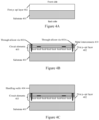
- Figures 4A-4G illustrate exemplary cross-sections of a wafer subjected to method 200 ( Figure 2 ).
- Figure 4A illustrates a first epitaxial (epi) layer 402 formed on the front side of a substrate 401.
- First epi layer 402 is preferably a p- epi layer.
- the first epi layer resistivity is between about 100 and 1000 ⁇ cm.
- Figure 4B illustrates various circuit elements 403 including interconnects that can be formed on the first epi layer 402 as described in step 201 above). Because the interconnects are formed on the wafer while the substrate is still hundreds of microns thick and hence not severely warped, these interconnects can be formed using normal sub-micron CMOS processing techniques and may include multiple layers of high-density metal interconnects.
- the metal interconnects comprise a metal such as copper, aluminum, tungsten, molybdenum or cobalt. In one embodiment, the metal interconnects consist entirely of refractory metals.
- multiple through-silicon vias (TSV) 403A are created around one, or more, edges of the image sensor array in order to allow connection to the circuit elements 403.
- Figure 4C illustrates a handling wafer 404 attached to the top surface of first epi layer 402 over circuit elements 403 (step 203). Note that the through-silicon vias are shown but not labeled so as not to overly complicate the drawings. In an alternative embodiment, a protective layer can be used instead of, or in addition to, handling wafer 404. In one embodiment (not shown), vias are formed in handling wafer 404 to allow connection to the circuit elements 403.
- Figure 4D illustrates the wafer after the substrate (e.g., substrate 401 shown in Fig. 4C ) is back-thinned to form the semiconductor membrane mentioned above or removed to expose a back-side (lower) surface 402L of first epi layer 402 (i.e., opposite to the surface on which circuit elements 403 are formed and to which handling wafer 404 is attached).
- a native oxide may form on back-side surface 402L, which is exposed by the back-thinning process.
- Figure 4E illustrates the wafer after a cleaning and preparation of the back-side surface 402L is completed (step 207) to prepare first epi layer 402 for the formation of a second epitaxial (epi) layer.
- Figure 4F illustrates the wafer after a second epi layer 405 is formed on back-side surface 402L of first epi layer 402, and a pure boron layer 406 is formed on a lower surface 405L of second epi layer 405are respectively (steps 208 and 209).
- In-situ p-type doping of the second epi layer 405 during growth creates a dopant concentration profile that increases from the bottom (back-side) surface 402L of first epi layer 402 to lower surface 405L of pure boron layer 406.
- Figure 4G illustrates one or more optional anti-reflection or protection layers 408 deposited bottom/lower surface 406L of pure boron layer 406. At least one of the layers may be deposited using an ALD process.
- Figure 4H illustrates the wafer after etching and deposition steps create metal pads 407 so as to allow electrical connection to the TSVs 403A (step 213). Note that if vias are formed in handling wafer 404, then metal pad 407 should be formed on the top surface of handling wafer 404.
- a p-type doped second epitaxial layer may be deposited on a back-side surface of a first epitaxial layer.
- the second epitaxial layer is subsequently coated with a boron layer on its photo-sensitive surface. Because the second epitaxial layer includes a concentration gradient of the p-type dopant which has its maximum value adjacent to the boron, the image sensor has high efficiency even for short-wavelength light, or low-energy charged particles, which may penetrate only a few nm, or a few tens of nm into the epitaxial layers.
- Figure 5 illustrates an exemplary detector assembly 500 incorporating an image sensor 504, a silicon interposer 502 and other electronics in accordance with certain embodiments of the present invention.
- various circuit elements of the assembly 500 may be disposed on or built into the interposer 502.
- one or more amplification circuits e.g., charge conversion amplifier
- one or more conversion circuits 508 e.g., analog-to-digital conversion circuits, i.e. digitizers 508
- one or more driver circuits 506 may be disposed on or built into the interposer 502.
- the one or more driver circuits 506 may include a timing/serial drive circuit.
- the one or more driver circuits 506 may include, but are not limited to, clock driver circuitry or reset driver circuitry.
- one or more decoupling capacitors may be disposed on or built into the interposer 502.
- one or more serial transmitters maybe disposed on or built into the interposer 502.
- one or more of amplification circuits, analog-to-digital converter circuits and driver circuits may be included in light sensitive sensor 504, reducing the number of (or eliminating the need for) circuits such as 506 and 508.
- one or more support structures may be disposed between the bottom surface of the light sensitive array sensor 504 and the top surface of the interposer 502 in order to provide physical support to the sensor 504.
- a plurality of solder balls 516 may be disposed between the bottom surface of the light sensitive array sensor 504 and the top surface of the interposer 502 in order to provide physical support to the sensor 504. It is recognized herein that while the imaging region of the sensor 504 might not include external electrical connections, the back-thinning of the sensor 504 causes the sensor 504 to become increasingly flexible. As such, solder balls 516 may be utilized to connect the sensor 504 to the interposer 502 in a manner that reinforces the imaging portion of the sensor 504.
- an underfill material may be disposed between the bottom surface of the light sensitive array sensor 504 and the top surface of the interposer 502 in order to provide physical support to the sensor 504.
- an epoxy resin may be disposed between the bottom surface of the light sensitive array sensor 504 and the top surface of the interposer 502.
- the interposer 502 and the various additional circuitry are disposed on a surface of a substrate 510.
- the substrate 510 includes a substrate having high thermal conductivity (e.g., ceramic substrate).
- the substrate 510 is configured to provide physical support to the sensor 504/interposer 502 assembly, while also providing a means for the assembly 500 to efficiently conduct heat away from the imaging sensor 504 and the various other circuitry (e.g., digitizer 506, driver circuitry 508, amplifier, and the like).
- the substrate may include any rigid highly heat conductive substrate material known in the art.
- the substrate 510 may include, but is not limited to, a ceramic substrate.
- the substrate 510 may include, but is not limited to, aluminum nitride.
- the substrate 510 may be configured to provide an interface to a socket or an underlying printed circuit board (PCB).
- PCB printed circuit board
- the substrate 510 may provide interconnection between the interposer 502 and a socket or a PCB via interconnects 512.
- the substrate 510 may be operatively coupled to an underlying PCB and further electrically coupled to a socket or PCB in a variety of ways, all of which are interpreted to be within the scope of the present invention.
Landscapes
- Solid State Image Pick-Up Elements (AREA)
- Internal Circuitry In Semiconductor Integrated Circuit Devices (AREA)
- Photometry And Measurement Of Optical Pulse Characteristics (AREA)
- Light Receiving Elements (AREA)
Applications Claiming Priority (3)
| Application Number | Priority Date | Filing Date | Title |
|---|---|---|---|
| US201862778445P | 2018-12-12 | 2018-12-12 | |
| US16/562,396 US11114491B2 (en) | 2018-12-12 | 2019-09-05 | Back-illuminated sensor and a method of manufacturing a sensor |
| PCT/US2019/065575 WO2020123571A1 (en) | 2018-12-12 | 2019-12-11 | Back-illuminated sensor and a method of manufacturing a sensor |
Publications (3)
| Publication Number | Publication Date |
|---|---|
| EP3895215A1 EP3895215A1 (en) | 2021-10-20 |
| EP3895215A4 EP3895215A4 (en) | 2022-08-17 |
| EP3895215B1 true EP3895215B1 (en) | 2025-05-28 |
Family
ID=71072930
Family Applications (1)
| Application Number | Title | Priority Date | Filing Date |
|---|---|---|---|
| EP19895404.2A Active EP3895215B1 (en) | 2018-12-12 | 2019-12-11 | Back-illuminated sensor and a method of manufacturing a sensor |
Country Status (8)
| Country | Link |
|---|---|
| US (1) | US11114491B2 (https=) |
| EP (1) | EP3895215B1 (https=) |
| JP (1) | JP7616998B2 (https=) |
| KR (1) | KR102727771B1 (https=) |
| CN (1) | CN113169201B (https=) |
| IL (1) | IL283238B2 (https=) |
| TW (1) | TWI814961B (https=) |
| WO (1) | WO2020123571A1 (https=) |
Families Citing this family (7)
| Publication number | Priority date | Publication date | Assignee | Title |
|---|---|---|---|---|
| US12613197B2 (en) | 2019-12-03 | 2026-04-28 | Kla Corporation | Low-reflectivity back-illuminated image sensor |
| WO2021108921A1 (en) * | 2019-12-05 | 2021-06-10 | Aurora Solar Technologies (Canada) Inc. | Systems and methods of characterizing semiconductor materials |
| US11848350B2 (en) * | 2020-04-08 | 2023-12-19 | Kla Corporation | Back-illuminated sensor and a method of manufacturing a sensor using a silicon on insulator wafer |
| WO2022133642A1 (zh) * | 2020-12-21 | 2022-06-30 | 中芯国际集成电路制造(北京)有限公司 | 半导体结构的形成方法 |
| US12015046B2 (en) * | 2021-02-05 | 2024-06-18 | Kla Corporation | Back-illuminated sensor with boron layer deposited using plasma atomic layer deposition |
| US20240243143A1 (en) * | 2023-01-12 | 2024-07-18 | Kla Corporation | Boron-Coated Back-Illuminated Image Sensor With Fluoride-Based Anti-Reflection Coating |
| US12610640B2 (en) * | 2023-10-31 | 2026-04-21 | Kla Corporation | Back-illuminated sensor and method of making same |
Family Cites Families (252)
| Publication number | Priority date | Publication date | Assignee | Title |
|---|---|---|---|---|
| US3755704A (en) | 1970-02-06 | 1973-08-28 | Stanford Research Inst | Field emission cathode structures and devices utilizing such structures |
| US3870917A (en) | 1971-05-10 | 1975-03-11 | Itt | Discharge device including channel type electron multiplier having ion adsorptive layer |
| GB1444951A (en) | 1973-06-18 | 1976-08-04 | Mullard Ltd | Electronic solid state devices |
| GB1536412A (en) | 1975-05-14 | 1978-12-20 | English Electric Valve Co Ltd | Photocathodes |
| US4210922A (en) | 1975-11-28 | 1980-07-01 | U.S. Philips Corporation | Charge coupled imaging device having selective wavelength sensitivity |
| NL7611593A (nl) | 1976-10-20 | 1978-04-24 | Optische Ind De Oude Delft Nv | Werkwijze voor het in een beeldversterkerbuis aanbrengen van een lichtabsorberende, voor elek- tronen doorlaatbare laag. |
| JPS5946111B2 (ja) * | 1977-02-14 | 1984-11-10 | 株式会社日立製作所 | 光検出半導体装置 |
| JPS58146B2 (ja) | 1980-10-14 | 1983-01-05 | 浜松テレビ株式会社 | フレ−ミング管 |
| US4348690A (en) | 1981-04-30 | 1982-09-07 | Rca Corporation | Semiconductor imagers |
| US4644221A (en) | 1981-05-06 | 1987-02-17 | The United States Of America As Represented By The Secretary Of The Army | Variable sensitivity transmission mode negative electron affinity photocathode |
| US4555731A (en) | 1984-04-30 | 1985-11-26 | Polaroid Corporation | Electronic imaging camera with microchannel plate |
| US4760031A (en) | 1986-03-03 | 1988-07-26 | California Institute Of Technology | Producing CCD imaging sensor with flashed backside metal film |
| US4853595A (en) | 1987-08-31 | 1989-08-01 | Alfano Robert R | Photomultiplier tube having a transmission strip line photocathode and system for use therewith |
| NL8902271A (nl) | 1989-09-12 | 1991-04-02 | Philips Nv | Werkwijze voor het verbinden van twee lichamen. |
| US5120949A (en) | 1991-01-17 | 1992-06-09 | Burle Technologies, Inc. | Semiconductor anode photomultiplier tube |
| JP2828221B2 (ja) | 1991-06-04 | 1998-11-25 | インターナショナル・ビジネス・マシーンズ・コーポレイション | レーザー光波長変換装置 |
| US5144630A (en) | 1991-07-29 | 1992-09-01 | Jtt International, Inc. | Multiwavelength solid state laser using frequency conversion techniques |
| US5563702A (en) | 1991-08-22 | 1996-10-08 | Kla Instruments Corporation | Automated photomask inspection apparatus and method |
| US5376810A (en) | 1992-06-26 | 1994-12-27 | California Institute Of Technology | Growth of delta-doped layers on silicon CCD/S for enhanced ultraviolet response |
| US5227313A (en) | 1992-07-24 | 1993-07-13 | Eastman Kodak Company | Process for making backside illuminated image sensors |
| US5272096A (en) * | 1992-09-29 | 1993-12-21 | Motorola, Inc. | Method for making a bipolar transistor having a silicon carbide layer |
| US5315126A (en) | 1992-10-13 | 1994-05-24 | Itt Corporation | Highly doped surface layer for negative electron affinity devices |
| US5428392A (en) | 1992-11-20 | 1995-06-27 | Picker International, Inc. | Strobing time-delayed and integration video camera system |
| US5475227A (en) | 1992-12-17 | 1995-12-12 | Intevac, Inc. | Hybrid photomultiplier tube with ion deflector |
| US5326978A (en) | 1992-12-17 | 1994-07-05 | Intevac, Inc. | Focused electron-bombarded detector |
| US5760809A (en) | 1993-03-19 | 1998-06-02 | Xerox Corporation | Recording sheets containing phosphonium compounds |
| FI940740A0 (fi) | 1994-02-17 | 1994-02-17 | Arto Salokatve | Detektor foer paovisning av fotoner eller partiklar, foerfarande foer framstaellning av detektorn och maetningsfoerfarande |
| US6271916B1 (en) | 1994-03-24 | 2001-08-07 | Kla-Tencor Corporation | Process and assembly for non-destructive surface inspections |
| US5493176A (en) | 1994-05-23 | 1996-02-20 | Siemens Medical Systems, Inc. | Photomultiplier tube with an avalanche photodiode, a flat input end and conductors which simulate the potential distribution in a photomultiplier tube having a spherical-type input end |
| US20080315092A1 (en) | 1994-07-28 | 2008-12-25 | General Nanotechnology Llc | Scanning probe microscopy inspection and modification system |
| EP0702221A3 (en) | 1994-09-14 | 1997-05-21 | Delco Electronics Corp | Sensor integrated on a chip |
| JPH08241977A (ja) | 1995-03-03 | 1996-09-17 | Hamamatsu Photonics Kk | 半導体装置の製造方法 |
| JPH10508987A (ja) | 1995-05-19 | 1998-09-02 | ドクトル・ヨハネス・ハイデンハイン・ゲゼルシャフト・ミト・ベシュレンクテル・ハフツング | 光検出器素子及びその製造方法 |
| JP3405620B2 (ja) | 1995-05-22 | 2003-05-12 | 松下電器産業株式会社 | 固体撮像装置 |
| US5731584A (en) | 1995-07-14 | 1998-03-24 | Imec Vzw | Position sensitive particle sensor and manufacturing method therefor |
| US6362484B1 (en) | 1995-07-14 | 2002-03-26 | Imec Vzw | Imager or particle or radiation detector and method of manufacturing the same |
| JP4306800B2 (ja) | 1996-06-04 | 2009-08-05 | ケーエルエー−テンカー テクノロジィース コーポレイション | 表面検査用光学走査システム |
| US5999310A (en) | 1996-07-22 | 1999-12-07 | Shafer; David Ross | Ultra-broadband UV microscope imaging system with wide range zoom capability |
| US5717518A (en) | 1996-07-22 | 1998-02-10 | Kla Instruments Corporation | Broad spectrum ultraviolet catadioptric imaging system |
| US5742626A (en) | 1996-08-14 | 1998-04-21 | Aculight Corporation | Ultraviolet solid state laser, method of using same and laser surgery apparatus |
| US5760899A (en) | 1996-09-04 | 1998-06-02 | Erim International, Inc. | High-sensitivity multispectral sensor |
| US6201257B1 (en) | 1996-10-10 | 2001-03-13 | Advanced Scientific Concepts, Inc. | Semiconductor X-ray photocathodes devices |
| US5940685A (en) | 1996-10-28 | 1999-08-17 | The United States Of America As Represented By The Secretary Of The Air Force | Fabrication of UV-sensitive back illuminated CCD image sensors |
| US6064759A (en) | 1996-11-08 | 2000-05-16 | Buckley; B. Shawn | Computer aided inspection machine |
| JPH10171965A (ja) | 1996-12-05 | 1998-06-26 | Toshiba Corp | 積算型エリアセンサの画像入力方法及びその装置 |
| US6107619A (en) | 1997-07-14 | 2000-08-22 | California Institute Of Technology | Delta-doped hybrid advanced detector for low energy particle detection |
| US6608676B1 (en) | 1997-08-01 | 2003-08-19 | Kla-Tencor Corporation | System for detecting anomalies and/or features of a surface |
| US6201601B1 (en) | 1997-09-19 | 2001-03-13 | Kla-Tencor Corporation | Sample inspection system |
| US6403963B1 (en) | 1997-09-29 | 2002-06-11 | California Institute Of Technology | Delta-doped CCD's as low-energy particle detectors and imagers |
| US6278119B1 (en) | 1997-10-21 | 2001-08-21 | California Institute Of Technology | Using a delta-doped CCD to determine the energy of a low-energy particle |
| JPH11274465A (ja) * | 1998-01-20 | 1999-10-08 | Nikon Corp | 固体撮像装置、受光素子、並びに半導体の製造方法 |
| US6297879B1 (en) | 1998-02-27 | 2001-10-02 | Micron Technology, Inc. | Inspection method and apparatus for detecting defects on photomasks |
| US6376985B2 (en) | 1998-03-31 | 2002-04-23 | Applied Materials, Inc. | Gated photocathode for controlled single and multiple electron beam emission |
| US6162707A (en) | 1998-05-18 | 2000-12-19 | The Regents Of The University Of California | Low work function, stable thin films |
| DE19829172A1 (de) | 1998-06-30 | 2000-01-05 | Univ Konstanz | Verfahren zur Herstellung von Antireflexschichten |
| US6373869B1 (en) | 1998-07-30 | 2002-04-16 | Actinix | System and method for generating coherent radiation at ultraviolet wavelengths |
| US6013399A (en) | 1998-12-04 | 2000-01-11 | Advanced Micro Devices, Inc. | Reworkable EUV mask materials |
| US6535531B1 (en) | 2001-11-29 | 2003-03-18 | Cymer, Inc. | Gas discharge laser with pulse multiplier |
| US6285018B1 (en) | 1999-07-20 | 2001-09-04 | Intevac, Inc. | Electron bombarded active pixel sensor |
| US6657178B2 (en) | 1999-07-20 | 2003-12-02 | Intevac, Inc. | Electron bombarded passive pixel sensor imaging |
| US6307586B1 (en) | 1999-07-20 | 2001-10-23 | Intevac, Inc. | Electron bombarded active pixel sensor camera incorporating gain control |
| US6549647B1 (en) | 2000-01-07 | 2003-04-15 | Cyberoptics Corporation | Inspection system with vibration resistant video capture |
| US6711283B1 (en) | 2000-05-03 | 2004-03-23 | Aperio Technologies, Inc. | Fully automatic rapid microscope slide scanner |
| JP2002033473A (ja) | 2000-07-17 | 2002-01-31 | Hamamatsu Photonics Kk | 半導体装置 |
| US6879390B1 (en) | 2000-08-10 | 2005-04-12 | Kla-Tencor Technologies Corporation | Multiple beam inspection apparatus and method |
| US6507147B1 (en) | 2000-08-31 | 2003-01-14 | Intevac, Inc. | Unitary vacuum tube incorporating high voltage isolation |
| US7136159B2 (en) | 2000-09-12 | 2006-11-14 | Kla-Tencor Technologies Corporation | Excimer laser inspection system |
| JP2002184302A (ja) | 2000-12-18 | 2002-06-28 | Hamamatsu Photonics Kk | 半導体光電陰極 |
| US6704339B2 (en) | 2001-01-29 | 2004-03-09 | Cymer, Inc. | Lithography laser with beam delivery and beam pointing control |
| US6545281B1 (en) | 2001-07-06 | 2003-04-08 | The United States Of America As Represented By The United States Department Of Energy | Pocked surface neutron detector |
| JP3573725B2 (ja) | 2001-08-03 | 2004-10-06 | 川崎重工業株式会社 | X線顕微鏡装置 |
| JP2003043533A (ja) | 2001-08-03 | 2003-02-13 | Kitakyushu Foundation For The Advancement Of Industry Science & Technology | レーザーの第二高調波の方向を一定に保つための自動追尾装置 |
| US7015452B2 (en) | 2001-10-09 | 2006-03-21 | Itt Manufacturing Enterprises, Inc. | Intensified hybrid solid-state sensor |
| US6747258B2 (en) | 2001-10-09 | 2004-06-08 | Itt Manufacturing Enterprises, Inc. | Intensified hybrid solid-state sensor with an insulating layer |
| EP1444718A4 (en) | 2001-11-13 | 2005-11-23 | Nanosciences Corp | PHOTO CATHODE |
| JP4068340B2 (ja) | 2001-12-17 | 2008-03-26 | エルピーダメモリ株式会社 | 半導体集積回路装置 |
| FR2834345B1 (fr) | 2001-12-27 | 2004-03-26 | Essilor Int | Article d'optique comportant une lame quart d'onde et son procede de fabrication |
| US7130039B2 (en) | 2002-04-18 | 2006-10-31 | Kla-Tencor Technologies Corporation | Simultaneous multi-spot inspection and imaging |
| JP4165129B2 (ja) | 2002-06-21 | 2008-10-15 | 三菱電機株式会社 | 裏面入射型固体撮像素子 |
| US20040021061A1 (en) | 2002-07-30 | 2004-02-05 | Frederik Bijkerk | Photodiode, charged-coupled device and method for the production |
| US7446474B2 (en) | 2002-10-10 | 2008-11-04 | Applied Materials, Inc. | Hetero-junction electron emitter with Group III nitride and activated alkali halide |
| US7283166B1 (en) | 2002-10-15 | 2007-10-16 | Lockheed Martin Corporation | Automatic control method and system for electron bombarded charge coupled device (“EBCCD”) sensor |
| US7126699B1 (en) | 2002-10-18 | 2006-10-24 | Kla-Tencor Technologies Corp. | Systems and methods for multi-dimensional metrology and/or inspection of a specimen |
| AU2003294822A1 (en) | 2002-12-09 | 2004-06-30 | Quantum Semiconductor Llc | Cmos image sensor |
| US20040169248A1 (en) * | 2003-01-31 | 2004-09-02 | Intevac, Inc. | Backside thinning of image array devices |
| US7005637B2 (en) | 2003-01-31 | 2006-02-28 | Intevac, Inc. | Backside thinning of image array devices |
| US6990385B1 (en) | 2003-02-03 | 2006-01-24 | Kla-Tencor Technologies Corporation | Defect detection using multiple sensors and parallel processing |
| GB2398118B (en) | 2003-02-07 | 2006-03-15 | Imp College Innovations Ltd | Photon arrival time detection |
| US7141785B2 (en) | 2003-02-13 | 2006-11-28 | Micromass Uk Limited | Ion detector |
| US7957066B2 (en) | 2003-02-21 | 2011-06-07 | Kla-Tencor Corporation | Split field inspection system using small catadioptric objectives |
| US7471315B2 (en) | 2003-03-14 | 2008-12-30 | Aptina Imaging Corporation | Apparatus and method for detecting and compensating for illuminant intensity changes within an image |
| US7813406B1 (en) | 2003-10-15 | 2010-10-12 | The United States Of America As Represented By The Administrator Of The National Aeronautics And Space Administration | Temporal laser pulse manipulation using multiple optical ring-cavities |
| US7166878B2 (en) | 2003-11-04 | 2007-01-23 | Sarnoff Corporation | Image sensor with deep well region and method of fabricating the image sensor |
| US7023126B2 (en) | 2003-12-03 | 2006-04-04 | Itt Manufacturing Enterprises Inc. | Surface structures for halo reduction in electron bombarded devices |
| US7321468B2 (en) | 2003-12-15 | 2008-01-22 | Carl Zeiss Laser Optics Gmbh | Method and optical arrangement for beam guiding of a light beam with beam delay |
| US7313155B1 (en) | 2004-02-12 | 2007-12-25 | Liyue Mu | High power Q-switched laser for soft tissue ablation |
| JP2005241290A (ja) | 2004-02-24 | 2005-09-08 | Toshiba Corp | 画像入力装置及び検査装置 |
| US7035012B2 (en) | 2004-03-01 | 2006-04-25 | Coherent, Inc. | Optical pulse duration extender |
| JP4365255B2 (ja) | 2004-04-08 | 2009-11-18 | 浜松ホトニクス株式会社 | 発光体と、これを用いた電子線検出器、走査型電子顕微鏡及び質量分析装置 |
| US7301263B2 (en) | 2004-05-28 | 2007-11-27 | Applied Materials, Inc. | Multiple electron beam system with electron transmission gates |
| KR100688497B1 (ko) | 2004-06-28 | 2007-03-02 | 삼성전자주식회사 | 이미지 센서 및 그 제조방법 |
| US7141791B2 (en) | 2004-09-07 | 2006-11-28 | Kla-Tencor Technologies Corporation | Apparatus and method for E-beam dark field imaging |
| JP4500641B2 (ja) | 2004-09-29 | 2010-07-14 | 株式会社日立ハイテクノロジーズ | 欠陥検査方法およびその装置 |
| US7609303B1 (en) | 2004-10-12 | 2009-10-27 | Melexis Tessenderlo Nv | Low noise active pixel image sensor using a modified reset value |
| US7455565B2 (en) | 2004-10-13 | 2008-11-25 | The Board Of Trustees Of The Leland Stanford Junior University | Fabrication of group III-nitride photocathode having Cs activation layer |
| US7952633B2 (en) | 2004-11-18 | 2011-05-31 | Kla-Tencor Technologies Corporation | Apparatus for continuous clocking of TDI sensors |
| US7609309B2 (en) | 2004-11-18 | 2009-10-27 | Kla-Tencor Technologies Corporation | Continuous clocking of TDI sensors |
| US7432517B2 (en) | 2004-11-19 | 2008-10-07 | Asml Netherlands B.V. | Pulse modifier, lithographic apparatus, and device manufacturing method |
| WO2006076671A2 (en) | 2005-01-13 | 2006-07-20 | Whitehead Institute For Biomedical Research | Method and apparatus for uv imaging |
| JP4751617B2 (ja) | 2005-01-21 | 2011-08-17 | 株式会社日立ハイテクノロジーズ | 欠陥検査方法及びその装置 |
| US7723215B2 (en) * | 2005-02-11 | 2010-05-25 | Sarnoff Corporation | Dark current reduction in back-illuminated imaging sensors and method of fabricating same |
| US7238583B2 (en) | 2005-02-11 | 2007-07-03 | Sarnoff Corporation | Back-illuminated imaging device and method of fabricating same |
| US7485486B2 (en) | 2005-03-18 | 2009-02-03 | Intersil Americas Inc. | Photodiode for multiple wavelength operation |
| DE602006004913D1 (de) | 2005-04-28 | 2009-03-12 | Semiconductor Energy Lab | Verfahren und Vorrichtung zur Herstellung von Halbleitern mittels Laserstrahlung |
| US7531826B2 (en) | 2005-06-01 | 2009-05-12 | Intevac, Inc. | Photocathode structure and operation |
| EP1734584A1 (en) | 2005-06-14 | 2006-12-20 | Photonis-DEP B.V. | Electron bombarded image sensor array device as well as such an image sensor array |
| US7345825B2 (en) | 2005-06-30 | 2008-03-18 | Kla-Tencor Technologies Corporation | Beam delivery system for laser dark-field illumination in a catadioptric optical system |
| JP5063875B2 (ja) | 2005-07-27 | 2012-10-31 | パナソニック株式会社 | 光半導体装置の製造方法 |
| JP4491391B2 (ja) | 2005-08-05 | 2010-06-30 | 株式会社日立ハイテクノロジーズ | 欠陥検査装置及び欠陥検査方法 |
| JP5403852B2 (ja) | 2005-08-12 | 2014-01-29 | 株式会社荏原製作所 | 検出装置及び検査装置 |
| WO2007032217A1 (ja) | 2005-09-16 | 2007-03-22 | Matsushita Electric Industrial Co., Ltd. | コンポジット材料、及びこれを用いた光学部品 |
| JP4925085B2 (ja) | 2005-09-20 | 2012-04-25 | 株式会社メガオプト | 深紫外レーザー光の発生方法および深紫外レーザー装置 |
| EP1938059A4 (en) | 2005-09-21 | 2009-09-30 | Rjs Technology Inc | SYSTEM AND METHOD FOR OBTAINING A SENSOR ELEMENT OR A HIGH DYNAMIC RANGE OF SENSORS MATRIX |
| JP4939033B2 (ja) | 2005-10-31 | 2012-05-23 | 浜松ホトニクス株式会社 | 光電陰極 |
| US7715459B2 (en) | 2005-11-01 | 2010-05-11 | Cymer, Inc. | Laser system |
| JP2007133102A (ja) | 2005-11-09 | 2007-05-31 | Canon Inc | 反射防止膜を有する光学素子及びそれを有する露光装置 |
| US7247835B2 (en) | 2005-12-20 | 2007-07-24 | Keng Yeam Chang | Optical navigation device, and method for manufacturing same |
| US7528943B2 (en) | 2005-12-27 | 2009-05-05 | Kla-Tencor Technologies Corporation | Method and apparatus for simultaneous high-speed acquisition of multiple images |
| KR100768200B1 (ko) | 2006-02-01 | 2007-10-17 | 삼성에스디아이 주식회사 | 광학 필터 및 이를 채용한 플라즈마 디스플레이 패널 |
| JP4992446B2 (ja) | 2006-02-24 | 2012-08-08 | ソニー株式会社 | 固体撮像装置及びその製造方法、並びにカメラ |
| JP4911494B2 (ja) | 2006-03-18 | 2012-04-04 | 国立大学法人大阪大学 | 波長変換光学素子、波長変換光学素子の製造方法、波長変換装置、紫外線レーザ照射装置およびレーザ加工装置 |
| JP4706850B2 (ja) | 2006-03-23 | 2011-06-22 | 富士フイルム株式会社 | ノズルプレートの製造方法、液滴吐出ヘッド及び画像形成装置 |
| WO2007112058A2 (en) | 2006-03-24 | 2007-10-04 | Applied Materials, Inc. | Carbon precursors for use during silicon epitaxial firm formation |
| US7113325B1 (en) | 2006-05-03 | 2006-09-26 | Mitsubishi Materials Corporation | Wavelength conversion method with improved conversion efficiency |
| WO2007146938A2 (en) | 2006-06-13 | 2007-12-21 | Invent Technologies Llc | Apparatus and method for deep ultraviolet optical microscopy |
| US7457330B2 (en) | 2006-06-15 | 2008-11-25 | Pavilion Integration Corporation | Low speckle noise monolithic microchip RGB lasers |
| JP2008034836A (ja) * | 2006-07-03 | 2008-02-14 | Univ Kinki | 固体撮像素子 |
| US8482197B2 (en) | 2006-07-05 | 2013-07-09 | Hamamatsu Photonics K.K. | Photocathode, electron tube, field assist type photocathode, field assist type photocathode array, and field assist type electron tube |
| US7791170B2 (en) | 2006-07-10 | 2010-09-07 | Taiwan Semiconductor Manufacturing Company, Ltd. | Method of making a deep junction for electrical crosstalk reduction of an image sensor |
| US7800040B2 (en) | 2006-09-21 | 2010-09-21 | California Institute Of Technology | Method for growing a back surface contact on an imaging detector used in conjunction with back illumination |
| KR100826407B1 (ko) | 2006-10-12 | 2008-05-02 | 삼성전기주식회사 | 자외선 수광용 포토 다이오드 및 이를 포함하는 이미지센서 |
| KR100874954B1 (ko) | 2006-12-04 | 2008-12-19 | 삼성전자주식회사 | 후면 수광 이미지 센서 |
| US20080173903A1 (en) | 2006-12-28 | 2008-07-24 | Fujifilm Corporation | Solid-state image pickup element |
| JP5342769B2 (ja) | 2006-12-28 | 2013-11-13 | 浜松ホトニクス株式会社 | 光電陰極、電子管及び光電子増倍管 |
| US9771666B2 (en) | 2007-01-17 | 2017-09-26 | Crystal Is, Inc. | Defect reduction in seeded aluminum nitride crystal growth |
| WO2008088838A1 (en) | 2007-01-17 | 2008-07-24 | Crystal Is, Inc. | Defect reduction in seeded aluminum nitride crystal growth |
| US8755417B1 (en) | 2007-04-16 | 2014-06-17 | Kla-Tencor Corporation | Coherent light generation below about two-hundred nanometers |
| US20110073982A1 (en) | 2007-05-25 | 2011-03-31 | Armstrong J Joseph | Inspection system using back side illuminated linear sensor |
| US7586108B2 (en) | 2007-06-25 | 2009-09-08 | Asml Netherlands B.V. | Radiation detector, method of manufacturing a radiation detector and lithographic apparatus comprising a radiation detector |
| US8138485B2 (en) | 2007-06-25 | 2012-03-20 | Asml Netherlands B.V. | Radiation detector, method of manufacturing a radiation detector, and lithographic apparatus comprising a radiation detector |
| US8848199B2 (en) | 2007-07-10 | 2014-09-30 | Massachusetts Institute Of Technology | Tomographic phase microscopy |
| US8325337B2 (en) | 2007-07-13 | 2012-12-04 | Purdue Research Foundation | Time resolved raman spectroscopy |
| US7999342B2 (en) | 2007-09-24 | 2011-08-16 | Taiwan Semiconductor Manufacturing Company, Ltd | Image sensor element for backside-illuminated sensor |
| JP5039495B2 (ja) | 2007-10-04 | 2012-10-03 | ルネサスエレクトロニクス株式会社 | マスクブランク検査方法、反射型露光マスクの製造方法、反射型露光方法および半導体集積回路の製造方法 |
| US7525649B1 (en) | 2007-10-19 | 2009-04-28 | Kla-Tencor Technologies Corporation | Surface inspection system using laser line illumination with two dimensional imaging |
| US7605376B2 (en) | 2007-10-29 | 2009-10-20 | Fairchild Imaging, Inc. | CMOS sensor adapted for dental x-ray imaging |
| JP5132262B2 (ja) | 2007-11-02 | 2013-01-30 | 三菱電機株式会社 | 裏面入射型リニアイメージセンサ、その駆動方法、及びその製造方法 |
| US7838833B1 (en) | 2007-11-30 | 2010-11-23 | Kla-Tencor Technologies Corporation | Apparatus and method for e-beam dark imaging with perspective control |
| US7741666B2 (en) | 2008-02-08 | 2010-06-22 | Omnivision Technologies, Inc. | Backside illuminated imaging sensor with backside P+ doped layer |
| US8803075B2 (en) | 2008-04-18 | 2014-08-12 | Saint-Gobain Ceramics & Plastics, Inc. | Radiation detector device |
| EP2281307A4 (en) * | 2008-05-28 | 2011-06-29 | Sarnoff Corp | REAR-LIGHTED ILLUMINATOR WITH ULTRA-THIN SILICIUM ON INSULATOR SUBSTRATES |
| US7714287B1 (en) | 2008-06-05 | 2010-05-11 | Kla-Tencor Corporation | Apparatus and method for obtaining topographical dark-field images in a scanning electron microscope |
| JP2010003755A (ja) | 2008-06-18 | 2010-01-07 | Mitsubishi Electric Corp | 波長変換レーザ装置 |
| JP5305377B2 (ja) | 2008-06-26 | 2013-10-02 | 株式会社フジクラ | ラマン光増幅を用いた光伝送システム |
| US8471939B2 (en) | 2008-08-01 | 2013-06-25 | Omnivision Technologies, Inc. | Image sensor having multiple sensing layers |
| US7723686B2 (en) | 2008-08-14 | 2010-05-25 | Hanvision Co., Ltd. | Image sensor for detecting wide spectrum and method of manufacturing the same |
| US20120170021A1 (en) | 2008-09-02 | 2012-07-05 | Phillip Walsh | Method and apparatus for providing multiple wavelength reflectance magnitude and phase for a sample |
| JP5444899B2 (ja) * | 2008-09-10 | 2014-03-19 | ソニー株式会社 | 固体撮像装置の製造方法、および固体撮像装置の製造基板 |
| US7875948B2 (en) | 2008-10-21 | 2011-01-25 | Jaroslav Hynecek | Backside illuminated image sensor |
| US7880127B2 (en) | 2008-10-27 | 2011-02-01 | Itt Manufacturing Enterprises, Inc. | Apparatus and method for aligning an image sensor including a header alignment means |
| US7952096B2 (en) | 2008-12-08 | 2011-05-31 | Omnivision Technologies, Inc. | CMOS image sensor with improved backside surface treatment |
| US8017427B2 (en) | 2008-12-31 | 2011-09-13 | Omnivision Technologies, Inc. | Backside-illuminated (BSI) image sensor with backside diffusion doping |
| EP2380047B1 (en) | 2009-01-22 | 2018-07-11 | BAE Systems Information and Electronic Systems Integration Inc. | Corner cube enhanced photocathode |
| US8624971B2 (en) | 2009-01-23 | 2014-01-07 | Kla-Tencor Corporation | TDI sensor modules with localized driving and signal processing circuitry for high speed inspection |
| US8175373B2 (en) | 2009-02-16 | 2012-05-08 | Kla-Tencor Corporation | Use of design information and defect image information in defect classification |
| KR20100103238A (ko) | 2009-03-13 | 2010-09-27 | 삼성전자주식회사 | 에피 웨이퍼 제조 방법 및 그에 의해 제조된 에피 웨이퍼, 및 상기 에피 웨이퍼로 제조한 이미지 센서 |
| US20100301437A1 (en) | 2009-06-01 | 2010-12-02 | Kla-Tencor Corporation | Anti-Reflective Coating For Sensors Suitable For High Throughput Inspection Systems |
| US7985658B2 (en) | 2009-06-08 | 2011-07-26 | Aptina Imaging Corporation | Method of forming substrate for use in imager devices |
| US8553217B2 (en) | 2009-06-19 | 2013-10-08 | Kla-Tencor Corporation | EUV high throughput inspection system for defect detection on patterned EUV masks, mask blanks, and wafers |
| NL2004539A (en) | 2009-06-22 | 2010-12-23 | Asml Netherlands Bv | Object inspection systems and methods. |
| EP2454749A4 (en) | 2009-07-17 | 2013-09-04 | Kla Tencor Corp | ENERGY ANALYZER OF CHARGED PARTICLES |
| WO2011031810A2 (en) | 2009-09-11 | 2011-03-17 | Massachusetts Institute Of Technology | Electronic shutter with photogenerated charge extinguishment capability for back-illuminated image sensors |
| US9023152B2 (en) | 2009-09-17 | 2015-05-05 | Kla-Tencor Corporation | CLBO crystal growth |
| CN102035085B (zh) | 2009-10-08 | 2014-03-05 | 群康科技(深圳)有限公司 | 导电结构及其制造方法 |
| US8629384B1 (en) | 2009-10-26 | 2014-01-14 | Kla-Tencor Corporation | Photomultiplier tube optimized for surface inspection in the ultraviolet |
| US8828852B2 (en) | 2009-12-10 | 2014-09-09 | California Institute Of Technology | Delta-doping at wafer level for high throughput, high yield fabrication of silicon imaging arrays |
| CN102640015B (zh) | 2009-12-15 | 2014-10-22 | 圣戈本陶瓷及塑料股份有限公司 | 用于分析由辐射检测器输出的电脉冲的辐射检测系统和方法 |
| EP2346094A1 (en) | 2010-01-13 | 2011-07-20 | FEI Company | Method of manufacturing a radiation detector |
| EP2526566B1 (en) | 2010-01-21 | 2018-03-07 | Roper Scientific, Inc. | Solid state back-illuminated photon sensor and its method of fabrication |
| PT2525824T (pt) | 2010-01-22 | 2017-07-13 | Univ Leland Stanford Junior | Inibição da sinalização de axl em terapêutica antimetastática |
| US8558234B2 (en) | 2010-02-11 | 2013-10-15 | California Institute Of Technology | Low voltage low light imager and photodetector |
| CN102859338A (zh) | 2010-03-29 | 2013-01-02 | 因特瓦克公司 | 时间分辨光致发光成像系统和光伏电池检验的方法 |
| JP5663925B2 (ja) | 2010-03-31 | 2015-02-04 | ソニー株式会社 | 固体撮像装置、および、その製造方法、電子機器 |
| NL2006556A (en) | 2010-05-13 | 2011-11-15 | Asml Holding Nv | Optical system, inspection system and manufacturing method. |
| US8269223B2 (en) | 2010-05-27 | 2012-09-18 | The United States Of America As Represented By The Secretary Of The Army | Polarization enhanced avalanche photodetector and method thereof |
| US9024344B2 (en) | 2010-06-15 | 2015-05-05 | California Institute Of Technology | Surface passivation by quantum exclusion using multiple layers |
| JP5918756B2 (ja) * | 2010-06-15 | 2016-05-18 | カリフォルニア インスティチュート オブ テクノロジー | 多層ドーピングを用いる量子排除による表面不活性化 |
| US9123622B2 (en) | 2010-06-23 | 2015-09-01 | California Institute Of Technology | Atomic layer deposition of high performance anti reflection coatings on delta-doped CCDs |
| WO2011163510A2 (en) | 2010-06-23 | 2011-12-29 | California Institute Of Technology | Atomic layer deposition of chemical passivation layers and high performance anti-reflection coatings on back-illuminated detectors |
| US8310021B2 (en) | 2010-07-13 | 2012-11-13 | Honeywell International Inc. | Neutron detector with wafer-to-wafer bonding |
| US8686331B2 (en) | 2010-08-08 | 2014-04-01 | Kla-Tencor Corporation | Dynamic wavefront control of a frequency converted laser system |
| US9165971B2 (en) | 2010-10-25 | 2015-10-20 | California Institute Of Technology | Atomically precise surface engineering for producing imagers |
| KR101908749B1 (ko) | 2010-12-16 | 2018-10-16 | 케이엘에이-텐코 코포레이션 | 웨이퍼 검사 |
| US8669512B2 (en) | 2010-12-28 | 2014-03-11 | Technion Research & Development Foundation Limited | System and method for analyzing light by three-photon counting |
| US8513587B2 (en) | 2011-01-24 | 2013-08-20 | Taiwan Semiconductor Manufacturing Company, Ltd. | Image sensor with anti-reflection layer and method of manufacturing the same |
| US8455971B2 (en) | 2011-02-14 | 2013-06-04 | Taiwan Semiconductor Manufacturing Company, Ltd. | Apparatus and method for improving charge transfer in backside illuminated image sensor |
| JP2012175067A (ja) | 2011-02-24 | 2012-09-10 | Sony Corp | 撮像素子、製造方法、および電子機器 |
| JP2012189385A (ja) | 2011-03-09 | 2012-10-04 | Fujifilm Corp | 放射線画像検出装置の保守方法 |
| US9318870B2 (en) | 2011-05-06 | 2016-04-19 | Kla-Tencor Corporation | Deep ultra-violet light sources for wafer and reticle inspection systems |
| JP5731444B2 (ja) | 2011-07-07 | 2015-06-10 | 富士フイルム株式会社 | 放射線検出器、放射線画像撮影装置、及び放射線画像撮影システム |
| US9920438B2 (en) | 2011-07-07 | 2018-03-20 | Massachusetts Institute Of Technology | Methods and apparatus for ultrathin catalyst layer for photoelectrode |
| US9279774B2 (en) | 2011-07-12 | 2016-03-08 | Kla-Tencor Corp. | Wafer inspection |
| ITTO20110649A1 (it) | 2011-07-19 | 2013-01-20 | St Microelectronics Srl | Dispositivo di fotorivelazione con copertura protettiva e antiriflesso, e relativo metodo di fabbricazione |
| US8873596B2 (en) | 2011-07-22 | 2014-10-28 | Kla-Tencor Corporation | Laser with high quality, stable output beam, and long life high conversion efficiency non-linear crystal |
| US8871557B2 (en) | 2011-09-02 | 2014-10-28 | Electronics And Telecommunications Research Institute | Photomultiplier and manufacturing method thereof |
| WO2013036576A1 (en) | 2011-09-07 | 2013-03-14 | Kla-Tencor Corporation | Transmissive-reflective photocathode |
| US8748828B2 (en) | 2011-09-21 | 2014-06-10 | Kla-Tencor Corporation | Interposer based imaging sensor for high-speed image acquisition and inspection systems |
| US20130077086A1 (en) | 2011-09-23 | 2013-03-28 | Kla-Tencor Corporation | Solid-State Laser And Inspection System Using 193nm Laser |
| US8872159B2 (en) | 2011-09-29 | 2014-10-28 | The United States Of America, As Represented By The Secretary Of The Navy | Graphene on semiconductor detector |
| US9250178B2 (en) | 2011-10-07 | 2016-02-02 | Kla-Tencor Corporation | Passivation of nonlinear optical crystals |
| US9123608B2 (en) | 2011-12-09 | 2015-09-01 | Taiwan Semiconductor Manufacturing Company, Ltd. | Backside illuminated CMOS image sensor |
| US10197501B2 (en) | 2011-12-12 | 2019-02-05 | Kla-Tencor Corporation | Electron-bombarded charge-coupled device and inspection systems using EBCCD detectors |
| US9389166B2 (en) | 2011-12-16 | 2016-07-12 | Kla-Tencor Corporation | Enhanced high-speed logarithmic photo-detector for spot scanning system |
| US8754972B2 (en) | 2012-02-01 | 2014-06-17 | Kla-Tencor Corporation | Integrated multi-channel analog front end and digitizer for high speed imaging applications |
| US9496425B2 (en) * | 2012-04-10 | 2016-11-15 | Kla-Tencor Corporation | Back-illuminated sensor with boron layer |
| US10079257B2 (en) | 2012-04-13 | 2018-09-18 | Taiwan Semiconductor Manufacturing Co., Ltd. | Anti-reflective layer for backside illuminated CMOS image sensors |
| US20130313440A1 (en) | 2012-05-22 | 2013-11-28 | Kla-Tencor Corporation | Solid-State Laser And Inspection System Using 193nm Laser |
| KR101914231B1 (ko) | 2012-05-30 | 2018-11-02 | 삼성디스플레이 주식회사 | 주사 전자 현미경을 이용한 검사 시스템 |
| US8658973B2 (en) | 2012-06-12 | 2014-02-25 | Kla-Tencor Corporation | Auger elemental identification algorithm |
| US8953869B2 (en) | 2012-06-14 | 2015-02-10 | Kla-Tencor Corporation | Apparatus and methods for inspecting extreme ultra violet reticles |
| US9406711B2 (en) | 2012-06-15 | 2016-08-02 | Taiwan Semiconductor Manufacturing Company, Ltd. | Apparatus and method for backside illuminated image sensors |
| US9601299B2 (en) | 2012-08-03 | 2017-03-21 | Kla-Tencor Corporation | Photocathode including silicon substrate with boron layer |
| NL2011568A (en) | 2012-10-31 | 2014-05-06 | Asml Netherlands Bv | Sensor and lithographic apparatus. |
| US8921782B2 (en) | 2012-11-30 | 2014-12-30 | Kla-Tencor Corporation | Tilt-imaging scanning electron microscope |
| US9426400B2 (en) | 2012-12-10 | 2016-08-23 | Kla-Tencor Corporation | Method and apparatus for high speed acquisition of moving images using pulsed illumination |
| US10115663B2 (en) | 2012-12-29 | 2018-10-30 | Monolithic 3D Inc. | 3D semiconductor device and structure |
| US8912615B2 (en) | 2013-01-24 | 2014-12-16 | Osi Optoelectronics, Inc. | Shallow junction photodiode for detecting short wavelength light |
| US8929406B2 (en) | 2013-01-24 | 2015-01-06 | Kla-Tencor Corporation | 193NM laser and inspection system |
| US9529182B2 (en) | 2013-02-13 | 2016-12-27 | KLA—Tencor Corporation | 193nm laser and inspection system |
| US9608399B2 (en) | 2013-03-18 | 2017-03-28 | Kla-Tencor Corporation | 193 nm laser and an inspection system using a 193 nm laser |
| US9478402B2 (en) | 2013-04-01 | 2016-10-25 | Kla-Tencor Corporation | Photomultiplier tube, image sensor, and an inspection system using a PMT or image sensor |
| CN103227183B (zh) | 2013-04-08 | 2015-08-19 | 上海华力微电子有限公司 | 一种抑制背照式cmos图像传感器电学互扰的方法 |
| US11180866B2 (en) | 2013-04-10 | 2021-11-23 | Kla Corporation | Passivation of nonlinear optical crystals |
| US9350921B2 (en) | 2013-06-06 | 2016-05-24 | Mitutoyo Corporation | Structured illumination projection with enhanced exposure control |
| US9305949B2 (en) | 2013-11-01 | 2016-04-05 | Omnivision Technologies, Inc. | Big-small pixel scheme for image sensors |
| US9347890B2 (en) | 2013-12-19 | 2016-05-24 | Kla-Tencor Corporation | Low-noise sensor and an inspection system using a low-noise sensor |
| US9748294B2 (en) * | 2014-01-10 | 2017-08-29 | Hamamatsu Photonics K.K. | Anti-reflection layer for back-illuminated sensor |
| US9410901B2 (en) * | 2014-03-17 | 2016-08-09 | Kla-Tencor Corporation | Image sensor, an inspection system and a method of inspecting an article |
| US10748730B2 (en) * | 2015-05-21 | 2020-08-18 | Kla-Tencor Corporation | Photocathode including field emitter array on a silicon substrate with boron layer |
| JP6803137B2 (ja) * | 2015-09-30 | 2020-12-23 | 浜松ホトニクス株式会社 | 裏面入射型固体撮像素子 |
| JP6862129B2 (ja) * | 2016-08-29 | 2021-04-21 | キヤノン株式会社 | 光電変換装置および撮像システム |
| US10026728B1 (en) * | 2017-04-26 | 2018-07-17 | Semiconductor Components Industries, Llc | Semiconductor device having biasing structure for self-isolating buried layer and method therefor |
-
2019
- 2019-09-05 US US16/562,396 patent/US11114491B2/en active Active
- 2019-12-11 WO PCT/US2019/065575 patent/WO2020123571A1/en not_active Ceased
- 2019-12-11 KR KR1020217021571A patent/KR102727771B1/ko active Active
- 2019-12-11 EP EP19895404.2A patent/EP3895215B1/en active Active
- 2019-12-11 IL IL283238A patent/IL283238B2/en unknown
- 2019-12-11 CN CN201980079474.0A patent/CN113169201B/zh active Active
- 2019-12-11 JP JP2021532242A patent/JP7616998B2/ja active Active
- 2019-12-12 TW TW108145610A patent/TWI814961B/zh active
Also Published As
| Publication number | Publication date |
|---|---|
| WO2020123571A1 (en) | 2020-06-18 |
| CN113169201B (zh) | 2024-09-24 |
| EP3895215A4 (en) | 2022-08-17 |
| KR102727771B1 (ko) | 2024-11-07 |
| IL283238A (en) | 2021-07-29 |
| EP3895215A1 (en) | 2021-10-20 |
| IL283238B1 (en) | 2024-08-01 |
| KR20210091349A (ko) | 2021-07-21 |
| JP7616998B2 (ja) | 2025-01-17 |
| TWI814961B (zh) | 2023-09-11 |
| TW202105701A (zh) | 2021-02-01 |
| CN113169201A (zh) | 2021-07-23 |
| JP2022511102A (ja) | 2022-01-28 |
| IL283238B2 (en) | 2024-12-01 |
| US11114491B2 (en) | 2021-09-07 |
| US20200194476A1 (en) | 2020-06-18 |
Similar Documents
| Publication | Publication Date | Title |
|---|---|---|
| EP3895215B1 (en) | Back-illuminated sensor and a method of manufacturing a sensor | |
| US11114489B2 (en) | Back-illuminated sensor and a method of manufacturing a sensor | |
| US10269842B2 (en) | Anti-reflection layer for back-illuminated sensor | |
| US11848350B2 (en) | Back-illuminated sensor and a method of manufacturing a sensor using a silicon on insulator wafer | |
| US8264019B2 (en) | Multiplexed output two terminal photodiode array for imaging applications and related fabrication process | |
| TWI921844B (zh) | 偵測器裝置及相關方法 | |
| TW202547318A (zh) | 偵測器裝置及相關方法 |
Legal Events
| Date | Code | Title | Description |
|---|---|---|---|
| STAA | Information on the status of an ep patent application or granted ep patent |
Free format text: STATUS: THE INTERNATIONAL PUBLICATION HAS BEEN MADE |
|
| PUAI | Public reference made under article 153(3) epc to a published international application that has entered the european phase |
Free format text: ORIGINAL CODE: 0009012 |
|
| STAA | Information on the status of an ep patent application or granted ep patent |
Free format text: STATUS: REQUEST FOR EXAMINATION WAS MADE |
|
| 17P | Request for examination filed |
Effective date: 20210705 |
|
| AK | Designated contracting states |
Kind code of ref document: A1 Designated state(s): AL AT BE BG CH CY CZ DE DK EE ES FI FR GB GR HR HU IE IS IT LI LT LU LV MC MK MT NL NO PL PT RO RS SE SI SK SM TR |
|
| DAV | Request for validation of the european patent (deleted) | ||
| DAX | Request for extension of the european patent (deleted) | ||
| A4 | Supplementary search report drawn up and despatched |
Effective date: 20220718 |
|
| RIC1 | Information provided on ipc code assigned before grant |
Ipc: H01L 27/146 20060101AFI20220712BHEP |
|
| P01 | Opt-out of the competence of the unified patent court (upc) registered |
Effective date: 20230526 |
|
| REG | Reference to a national code |
Ref country code: DE Ref legal event code: R079 Ipc: H10F0039120000 Ref country code: DE Ref legal event code: R079 Ref document number: 602019070636 Country of ref document: DE Free format text: PREVIOUS MAIN CLASS: H01L0027146000 Ipc: H10F0039120000 |
|
| GRAP | Despatch of communication of intention to grant a patent |
Free format text: ORIGINAL CODE: EPIDOSNIGR1 |
|
| STAA | Information on the status of an ep patent application or granted ep patent |
Free format text: STATUS: GRANT OF PATENT IS INTENDED |
|
| RIC1 | Information provided on ipc code assigned before grant |
Ipc: H10F 39/12 20250101AFI20250107BHEP |
|
| INTG | Intention to grant announced |
Effective date: 20250122 |
|
| GRAS | Grant fee paid |
Free format text: ORIGINAL CODE: EPIDOSNIGR3 |
|
| GRAA | (expected) grant |
Free format text: ORIGINAL CODE: 0009210 |
|
| STAA | Information on the status of an ep patent application or granted ep patent |
Free format text: STATUS: THE PATENT HAS BEEN GRANTED |
|
| AK | Designated contracting states |
Kind code of ref document: B1 Designated state(s): AL AT BE BG CH CY CZ DE DK EE ES FI FR GB GR HR HU IE IS IT LI LT LU LV MC MK MT NL NO PL PT RO RS SE SI SK SM TR |
|
| REG | Reference to a national code |
Ref country code: GB Ref legal event code: FG4D |
|
| REG | Reference to a national code |
Ref country code: CH Ref legal event code: EP |
|
| REG | Reference to a national code |
Ref country code: DE Ref legal event code: R096 Ref document number: 602019070636 Country of ref document: DE |
|
| REG | Reference to a national code |
Ref country code: IE Ref legal event code: FG4D |
|
| REG | Reference to a national code |
Ref country code: NL Ref legal event code: FP |
|
| PG25 | Lapsed in a contracting state [announced via postgrant information from national office to epo] |
Ref country code: FI Free format text: LAPSE BECAUSE OF FAILURE TO SUBMIT A TRANSLATION OF THE DESCRIPTION OR TO PAY THE FEE WITHIN THE PRESCRIBED TIME-LIMIT Effective date: 20250528 Ref country code: ES Free format text: LAPSE BECAUSE OF FAILURE TO SUBMIT A TRANSLATION OF THE DESCRIPTION OR TO PAY THE FEE WITHIN THE PRESCRIBED TIME-LIMIT Effective date: 20250528 |
|
| REG | Reference to a national code |
Ref country code: LT Ref legal event code: MG9D |
|
| PG25 | Lapsed in a contracting state [announced via postgrant information from national office to epo] |
Ref country code: NO Free format text: LAPSE BECAUSE OF FAILURE TO SUBMIT A TRANSLATION OF THE DESCRIPTION OR TO PAY THE FEE WITHIN THE PRESCRIBED TIME-LIMIT Effective date: 20250828 Ref country code: GR Free format text: LAPSE BECAUSE OF FAILURE TO SUBMIT A TRANSLATION OF THE DESCRIPTION OR TO PAY THE FEE WITHIN THE PRESCRIBED TIME-LIMIT Effective date: 20250829 |
|
| PG25 | Lapsed in a contracting state [announced via postgrant information from national office to epo] |
Ref country code: PL Free format text: LAPSE BECAUSE OF FAILURE TO SUBMIT A TRANSLATION OF THE DESCRIPTION OR TO PAY THE FEE WITHIN THE PRESCRIBED TIME-LIMIT Effective date: 20250528 |
|
| PG25 | Lapsed in a contracting state [announced via postgrant information from national office to epo] |
Ref country code: BG Free format text: LAPSE BECAUSE OF FAILURE TO SUBMIT A TRANSLATION OF THE DESCRIPTION OR TO PAY THE FEE WITHIN THE PRESCRIBED TIME-LIMIT Effective date: 20250528 |
|
| PG25 | Lapsed in a contracting state [announced via postgrant information from national office to epo] |
Ref country code: HR Free format text: LAPSE BECAUSE OF FAILURE TO SUBMIT A TRANSLATION OF THE DESCRIPTION OR TO PAY THE FEE WITHIN THE PRESCRIBED TIME-LIMIT Effective date: 20250528 |
|
| PG25 | Lapsed in a contracting state [announced via postgrant information from national office to epo] |
Ref country code: RS Free format text: LAPSE BECAUSE OF FAILURE TO SUBMIT A TRANSLATION OF THE DESCRIPTION OR TO PAY THE FEE WITHIN THE PRESCRIBED TIME-LIMIT Effective date: 20250828 |
|
| PG25 | Lapsed in a contracting state [announced via postgrant information from national office to epo] |
Ref country code: IS Free format text: LAPSE BECAUSE OF FAILURE TO SUBMIT A TRANSLATION OF THE DESCRIPTION OR TO PAY THE FEE WITHIN THE PRESCRIBED TIME-LIMIT Effective date: 20250928 |
|
| PG25 | Lapsed in a contracting state [announced via postgrant information from national office to epo] |
Ref country code: LV Free format text: LAPSE BECAUSE OF FAILURE TO SUBMIT A TRANSLATION OF THE DESCRIPTION OR TO PAY THE FEE WITHIN THE PRESCRIBED TIME-LIMIT Effective date: 20250528 |
|
| REG | Reference to a national code |
Ref country code: AT Ref legal event code: MK05 Ref document number: 1799408 Country of ref document: AT Kind code of ref document: T Effective date: 20250528 |
|
| PG25 | Lapsed in a contracting state [announced via postgrant information from national office to epo] |
Ref country code: SM Free format text: LAPSE BECAUSE OF FAILURE TO SUBMIT A TRANSLATION OF THE DESCRIPTION OR TO PAY THE FEE WITHIN THE PRESCRIBED TIME-LIMIT Effective date: 20250528 Ref country code: AT Free format text: LAPSE BECAUSE OF FAILURE TO SUBMIT A TRANSLATION OF THE DESCRIPTION OR TO PAY THE FEE WITHIN THE PRESCRIBED TIME-LIMIT Effective date: 20250528 Ref country code: DK Free format text: LAPSE BECAUSE OF FAILURE TO SUBMIT A TRANSLATION OF THE DESCRIPTION OR TO PAY THE FEE WITHIN THE PRESCRIBED TIME-LIMIT Effective date: 20250528 |
|
| PGFP | Annual fee paid to national office [announced via postgrant information from national office to epo] |
Ref country code: NL Payment date: 20251226 Year of fee payment: 7 |
|
| PGFP | Annual fee paid to national office [announced via postgrant information from national office to epo] |
Ref country code: BE Payment date: 20251229 Year of fee payment: 7 |
|
| PG25 | Lapsed in a contracting state [announced via postgrant information from national office to epo] |
Ref country code: CZ Free format text: LAPSE BECAUSE OF FAILURE TO SUBMIT A TRANSLATION OF THE DESCRIPTION OR TO PAY THE FEE WITHIN THE PRESCRIBED TIME-LIMIT Effective date: 20250528 |
|
| PG25 | Lapsed in a contracting state [announced via postgrant information from national office to epo] |
Ref country code: EE Free format text: LAPSE BECAUSE OF FAILURE TO SUBMIT A TRANSLATION OF THE DESCRIPTION OR TO PAY THE FEE WITHIN THE PRESCRIBED TIME-LIMIT Effective date: 20250528 |
|
| PG25 | Lapsed in a contracting state [announced via postgrant information from national office to epo] |
Ref country code: RO Free format text: LAPSE BECAUSE OF FAILURE TO SUBMIT A TRANSLATION OF THE DESCRIPTION OR TO PAY THE FEE WITHIN THE PRESCRIBED TIME-LIMIT Effective date: 20250528 Ref country code: SK Free format text: LAPSE BECAUSE OF FAILURE TO SUBMIT A TRANSLATION OF THE DESCRIPTION OR TO PAY THE FEE WITHIN THE PRESCRIBED TIME-LIMIT Effective date: 20250528 |
|
| PG25 | Lapsed in a contracting state [announced via postgrant information from national office to epo] |
Ref country code: IT Free format text: LAPSE BECAUSE OF FAILURE TO SUBMIT A TRANSLATION OF THE DESCRIPTION OR TO PAY THE FEE WITHIN THE PRESCRIBED TIME-LIMIT Effective date: 20250528 |
|
| REG | Reference to a national code |
Ref country code: DE Ref legal event code: R097 Ref document number: 602019070636 Country of ref document: DE |
|
| PLBE | No opposition filed within time limit |
Free format text: ORIGINAL CODE: 0009261 |
|
| STAA | Information on the status of an ep patent application or granted ep patent |
Free format text: STATUS: NO OPPOSITION FILED WITHIN TIME LIMIT |
|
| REG | Reference to a national code |
Ref country code: CH Ref legal event code: L10 Free format text: ST27 STATUS EVENT CODE: U-0-0-L10-L00 (AS PROVIDED BY THE NATIONAL OFFICE) Effective date: 20260409 |
|
| PGFP | Annual fee paid to national office [announced via postgrant information from national office to epo] |
Ref country code: DE Payment date: 20251229 Year of fee payment: 7 |