EP3853065B1 - Kindersitz zur anbringung auf einem kraftfahrzeugsitz - Google Patents
Kindersitz zur anbringung auf einem kraftfahrzeugsitz Download PDFInfo
- Publication number
- EP3853065B1 EP3853065B1 EP19765449.4A EP19765449A EP3853065B1 EP 3853065 B1 EP3853065 B1 EP 3853065B1 EP 19765449 A EP19765449 A EP 19765449A EP 3853065 B1 EP3853065 B1 EP 3853065B1
- Authority
- EP
- European Patent Office
- Prior art keywords
- anchoring means
- anchoring
- child seat
- configuration
- seat
- Prior art date
- Legal status (The legal status is an assumption and is not a legal conclusion. Google has not performed a legal analysis and makes no representation as to the accuracy of the status listed.)
- Active
Links
Images


Classifications
-
- B—PERFORMING OPERATIONS; TRANSPORTING
- B60—VEHICLES IN GENERAL
- B60N—SEATS SPECIALLY ADAPTED FOR VEHICLES; VEHICLE PASSENGER ACCOMMODATION NOT OTHERWISE PROVIDED FOR
- B60N2/00—Seats specially adapted for vehicles; Arrangement or mounting of seats in vehicles
- B60N2/90—Details or parts not otherwise provided for
-
- B—PERFORMING OPERATIONS; TRANSPORTING
- B60—VEHICLES IN GENERAL
- B60N—SEATS SPECIALLY ADAPTED FOR VEHICLES; VEHICLE PASSENGER ACCOMMODATION NOT OTHERWISE PROVIDED FOR
- B60N2/00—Seats specially adapted for vehicles; Arrangement or mounting of seats in vehicles
- B60N2/24—Seats specially adapted for vehicles; Arrangement or mounting of seats in vehicles for particular purposes or particular vehicles
- B60N2/26—Seats specially adapted for vehicles; Arrangement or mounting of seats in vehicles for particular purposes or particular vehicles for children
- B60N2/266—Seats specially adapted for vehicles; Arrangement or mounting of seats in vehicles for particular purposes or particular vehicles for children with detection or alerting means responsive to presence or absence of children; with detection or alerting means responsive to improper locking or installation of the child seats or parts thereof
- B60N2/268—Seats specially adapted for vehicles; Arrangement or mounting of seats in vehicles for particular purposes or particular vehicles for children with detection or alerting means responsive to presence or absence of children; with detection or alerting means responsive to improper locking or installation of the child seats or parts thereof detecting or alerting means responsive to the installation of the child seats in the vehicle
-
- B—PERFORMING OPERATIONS; TRANSPORTING
- B60—VEHICLES IN GENERAL
- B60N—SEATS SPECIALLY ADAPTED FOR VEHICLES; VEHICLE PASSENGER ACCOMMODATION NOT OTHERWISE PROVIDED FOR
- B60N2/00—Seats specially adapted for vehicles; Arrangement or mounting of seats in vehicles
- B60N2/24—Seats specially adapted for vehicles; Arrangement or mounting of seats in vehicles for particular purposes or particular vehicles
- B60N2/26—Seats specially adapted for vehicles; Arrangement or mounting of seats in vehicles for particular purposes or particular vehicles for children
- B60N2/28—Seats readily mountable on, and dismountable from, existing seats or other parts of the vehicle
- B60N2/2803—Adaptations for seat belts
- B60N2/2806—Adaptations for seat belts for securing the child seat to the vehicle
- B60N2/2809—Adaptations for seat belts for securing the child seat to the vehicle with additional tether connected to the top of the child seat and passing above the top of the back-rest
-
- B—PERFORMING OPERATIONS; TRANSPORTING
- B60—VEHICLES IN GENERAL
- B60N—SEATS SPECIALLY ADAPTED FOR VEHICLES; VEHICLE PASSENGER ACCOMMODATION NOT OTHERWISE PROVIDED FOR
- B60N2/00—Seats specially adapted for vehicles; Arrangement or mounting of seats in vehicles
- B60N2/24—Seats specially adapted for vehicles; Arrangement or mounting of seats in vehicles for particular purposes or particular vehicles
- B60N2/26—Seats specially adapted for vehicles; Arrangement or mounting of seats in vehicles for particular purposes or particular vehicles for children
- B60N2/28—Seats readily mountable on, and dismountable from, existing seats or other parts of the vehicle
- B60N2/2821—Seats readily mountable on, and dismountable from, existing seats or other parts of the vehicle having a seat and a base part
-
- B—PERFORMING OPERATIONS; TRANSPORTING
- B60—VEHICLES IN GENERAL
- B60N—SEATS SPECIALLY ADAPTED FOR VEHICLES; VEHICLE PASSENGER ACCOMMODATION NOT OTHERWISE PROVIDED FOR
- B60N2/00—Seats specially adapted for vehicles; Arrangement or mounting of seats in vehicles
- B60N2/24—Seats specially adapted for vehicles; Arrangement or mounting of seats in vehicles for particular purposes or particular vehicles
- B60N2/26—Seats specially adapted for vehicles; Arrangement or mounting of seats in vehicles for particular purposes or particular vehicles for children
- B60N2/28—Seats readily mountable on, and dismountable from, existing seats or other parts of the vehicle
- B60N2/2887—Fixation to a transversal anchorage bar, e.g. isofix
-
- B—PERFORMING OPERATIONS; TRANSPORTING
- B60—VEHICLES IN GENERAL
- B60N—SEATS SPECIALLY ADAPTED FOR VEHICLES; VEHICLE PASSENGER ACCOMMODATION NOT OTHERWISE PROVIDED FOR
- B60N2/00—Seats specially adapted for vehicles; Arrangement or mounting of seats in vehicles
- B60N2/90—Details or parts not otherwise provided for
- B60N2/919—Positioning and locking mechanisms
- B60N2002/948—Positioning and locking mechanisms the actuation of the positioning or locking mechanism for one seat part being dependent on the position of another seat part, e.g. the seats floor lock being unlocked when the back-rest is inclined or the backrest can be tilted only when the seat is in its rear position
-
- B—PERFORMING OPERATIONS; TRANSPORTING
- B60—VEHICLES IN GENERAL
- B60N—SEATS SPECIALLY ADAPTED FOR VEHICLES; VEHICLE PASSENGER ACCOMMODATION NOT OTHERWISE PROVIDED FOR
- B60N2/00—Seats specially adapted for vehicles; Arrangement or mounting of seats in vehicles
- B60N2/90—Details or parts not otherwise provided for
- B60N2002/981—Warning systems, e.g. the seat or seat parts vibrates to warn the passenger when facing a danger
Definitions
- the invention relates to a child seat for attachment to a motor vehicle seat according to claim 1.
- Child safety seats for attachment to a motor vehicle seat are well known in the prior art. It is also known that child seats of this type can be anchored on or in the motor vehicle, for example by means of upper anchoring means (e.g. Top Tether) and lower anchoring means (e.g. Isofix). There is a risk that an anchoring device (e.g. the top tether) is not installed correctly, for example not fastened or not tensioned sufficiently. In the event of an accident, this implies an increased risk of injury.
- upper anchoring means e.g. Top Tether
- lower anchoring means e.g. Isofix
- FR 2 861 658 A1 describes a child seat with a top tether and bottom fastener, where a warning signal is given if only either the top tether or the bottom fastener is correctly installed. If neither top tether nor bottom fasteners or both systems are correctly installed, no warning will be given.
- the lower fastening means is an Isofix anchorage, this solution is comparatively complicated and expensive, since Isofix pawls are usually designed to be movable and the connection of the sensors in the Isofix pawls must therefore follow the movement.
- EP 3 256 343 A1 describes a child safety seat with a seating area and a backrest, wherein the child safety seat can be converted from a compact configuration in which the seating area is folded against the backrest, to a use configuration in which a child can sit in the child safety seat, and vice versa.
- the child seat also has a top tether, and in one embodiment, the transition from the compact configuration to the use configuration cannot occur until the top tether is secured and sufficiently tensioned. This is a comparatively complex solution that can only be used with a certain type of child seat (e.g. not with baby seats).
- EP 2 072 325 A2 discloses an anti-misuse mechanism for a child restraint system.
- EP 0 714 806 A2 discloses a child safety seat for an automobile in which preventing means are configured so as to be able to prevent attachment of a connecting means.
- the object of the invention is to propose a simple, inexpensive and yet safe solution for ensuring that the child seat is anchored as correctly as possible.
- the user of the child seat reliably reminded of the correct installation of an anchorage device (especially the top anchorage device).
- a child seat for attachment to a motor vehicle seat comprising a first anchoring means for anchoring the child seat (on the vehicle) and/or a seat unit of the child seat (on a base) and a second anchoring means for anchoring the child seat (on the vehicle) and/or a seat unit of the child seat (on a base).
- the first anchoring means is preferably an upper anchoring means and the second anchoring means is preferably a lower anchoring means.
- the first anchoring means can form a lower anchoring means (preferably for anchoring the child seat to the vehicle) and the second anchoring means can form an upper anchoring means (preferably for anchoring the child seat to the vehicle and/or for anchoring the seat unit to the base).
- the first anchoring means is preferably designed so that it can assume at least a first and a second configuration, with anchoring (or anchoring possibility, in particular in the sense of a state in which the corresponding anchoring means also actually can fulfill its anchoring function) of the second anchoring means is blocked.
- a core idea of the invention is that the first anchoring means can be reconfigured and the particular configuration present is causally related to the extent to which the second anchoring means can act (anchoring) (that is, can form an anchorage).
- the causal relationship can be direct or indirect.
- An indirect connection (interaction) means in particular that the blocking does not result from a (physical) contact between the first and second anchoring means, but is transmitted, for example by a transmission device, in which configuration the first anchoring means is located and, accordingly, the second anchoring means (by a separate blocking device, for example) is blocked or not.
- a direct connection or a direct interaction is to be understood in particular that the first anchoring means is in physical contact with the second anchoring means, e.g. is engaged with at least a portion of the second anchoring means.
- the first and second anchoring means preferably form a first and second anchoring device, respectively.
- the first and/or second anchoring means can (each) form an independent subassembly and/or (possibly each) have a weight that is less than 10%, preferably less than 5%, of the total weight of the child seat. Parts forming seat surfaces of the child seat (such as a seat area or a backrest per se) are preferably not part of the (respective) anchoring means.
- the first and/or second anchoring means can also be formed from a plurality of assemblies (each at least or exactly two assemblies).
- Anchoring preferably does not imply that a seat area is pivoted (or possibly adjusted in some other way) relative to a backrest.
- a seat area can be pivotable (possibly adjustable in another way) relative to a backrest or not (for example, be rigidly connected to the backrest).
- Blocking or preventing anchoring means in particular that (fixed) anchoring is impossible or at least (significantly) more difficult, e.g. B. in that a further actuating means must then be actuated and/or (manual) access to the respective anchoring means is restricted.
- An upper anchoring means is to be understood in particular as an anchoring means which is partially or completely arranged (held or at least deflected) in an upper area of the child seat or the seat unit (for example within the top 50%, preferably the top 20%; if the height of the Child seat or the seat unit is variable, this applies in particular to that (usage) configuration of the child seat in which the maximum height is reached).
- the upper anchoring means comprises a top tether, this can be held or at least deflected in the upper area of the seat. Specifically, a top tether strap (above) can be deflected and routed down inside the seat.
- the top tether can be attached to the lower anchoring means, especially if this has to be structurally resilient anyway.
- the upper anchoring means in particular the top tether, can optionally be arranged/held in a detachable manner.
- the upper anchoring means can optionally extend between an upper holding or deflection point and an anchoring point on the vehicle, with this anchoring point being able to lie, for example, on the vehicle floor (thus possibly even below the lower anchoring means).
- a lower anchoring means is preferably to be understood as an anchoring means which is (partially or completely) arranged (held or at least deflected) in a lower area of the child seat or the seat unit (for example in the lower 50%, preferably lower 20% is arranged ; if the height of the child seat or the seat unit is variable, this applies in particular to that (usage) configuration of the child seat in which the maximum height is reached).
- the upper anchoring means may (at least largely, preferably entirely) overlie the lower anchoring means (at least as far as its point of attachment to the child seat or seating unit is concerned).
- An arrangement of the upper anchoring means i.e. in particular the point at which the upper anchoring means is arranged or attached to the child seat or the seat unit
- the upper anchoring means is particularly preferably a top tether and the lower anchoring means is an Isofix anchoring.
- the child seat can be designed with or without a base (part). If the child seat is designed with a base, it preferably comprises a seat unit which is configured (detachable and/or adjustable, for example rotatable) with respect to the base.
- the seat unit then preferably includes the actual seat, i.e. in particular a seating area and a backrest (which, for example in the form of a baby seat, do not necessarily have to be structurally separated from one another).
- the child seat or the seat unit can generally be designed with a structurally separate seat area and backrest. Seat area and backrest can be mutually adjustable (z. B. pivotable) or not.
- the child seat can be a baby seat or a "classic" child seat for larger children.
- the seat if the seat is designed as an infant carrier, it can possibly (only) include a one-piece shell for accommodating the baby or child and its own belt system, possibly a headrest and possibly other components.
- this delimitation can be defined, for example, by a kink (or the like).
- the risk of operating errors can be at least reduced.
- this at least achieves (preferred configurations are described below) that the user is made aware in at least one configuration of the first anchoring means that this particular configuration is present (namely by blocking the action of the second anchoring means).
- This promotes (even in the most general case) at least the knowledge of the user that different configurations can be relevant with regard to the first anchoring means (or that the first anchoring means "exists” at all).
- the first and second anchoring means may be structurally separate from one another (so that a connection is created, for example, only via a seat shell or backrest and/or seating area, but not directly connection is present) and/or functionally separated from each other (apart from the interaction between the configuration of the first anchoring means on the one hand and the blocking or non-blocking of the action of the second anchoring means on the other hand).
- the first and second anchoring means are preferably not connected to one another by a strap.
- the first anchoring means can assume a third configuration.
- an anchoring (or effect) of the second anchoring means is preferably not blocked (the third configuration therefore preferably corresponds to the second configuration in this regard).
- the second configuration is preferably a configuration of the first anchoring means in which anchoring or action of the second anchoring means is/is not blocked.
- the second anchoring means can be designed so that it can assume at least a first and a second configuration.
- the first configuration preferably corresponds to a non-use configuration in which the second anchoring means do not anchor the child seat or the seat unit, and/or the second configuration preferably corresponds to a use configuration in which the second anchoring means anchor the child seat or the seat unit.
- the second anchoring means can optionally assume a third configuration.
- anchoring of the second anchoring means is preferably made possible (but possibly not implemented).
- Enabling anchoring of the second anchoring means is to be understood as meaning that it is configured in such a way that anchoring can be carried out by the user (by connecting the second anchoring means to its installation location or corresponding installation locations), i.e. the second anchoring means is not fundamentally configured in this way (produce) is that such a (fixed) connection or attachment is prevented.
- First and/or third configurations of the first and/or second anchoring means are preferably non-use configurations.
- a non-use configuration is preferably understood to mean that the anchoring means is configured to be unanchored or non-anchoring.
- the second configuration of the first and/or second anchoring means is preferably a usage configuration, in particular in the sense that the anchoring means is actually anchored or has an anchoring effect.
- a configuration of the respective anchoring means can be understood to mean an inherent state of the same (e.g. a mechanical stress inherent in the anchoring means and/or a position of components of the respective anchoring means relative to one another) and/or a state of the respective anchoring means in relation to a component outside of the anchoring means (e.g. another component of the child seat and/or the seat unit and/or the vehicle). If the various configurations are configurations that are defined by a position relative to the vehicle or another component to be considered external to the child seat, this may imply that at least one corresponding sensor device of the child seat per se indicates these different positions, so that these different configurations/positions can be recognized on the child seat itself or the seat unit itself.
- the child seat can have a first (rear or upper) section for contacting a backrest of the vehicle and a second (lower) section for contacting a seat surface of the vehicle seat.
- both the at least one first (upper) anchoring means and the at least one second (lower) anchoring means can each be located either in a first configuration (non-use configuration), in which the corresponding anchoring means does not secure the child seat to the vehicle, or in a second Configuration (use configuration) are located in which the corresponding anchoring means attaches the child seat to the vehicle.
- the at least one first (upper) anchoring means in its first configuration prevents a transfer of the at least one second (lower) anchoring means from the first to the second configuration, wherein more preferably the at least one first (upper) anchoring means can also assume a third configuration, in which it neither secures the child seat to the vehicle nor prevents the transfer of the at least one second (lower) anchoring means. So it should be used to install the Child seat (or the seat unit) to be ensured in particular that the at least one first (upper) anchoring means is not in the first configuration.
- the first anchoring means preferably comprises a strap and/or a top tether (or is designed as such).
- the top tether preferably comprises a strap, an element for connection to the vehicle, e.g. a hook, and indicators if necessary.
- the first and second configurations of the first anchoring means can then preferably each be characterized by a (minimum) tension of the strap (possibly the strap of the top tether) (in particular compared to a/the third configuration).
- a (mechanical) tension value of the belt can be above (or optionally, according to a first alternative, at) a threshold value(s).
- a/the third configuration can be characterized in that the threshold value is not reached (or possibly, according to a second alternative, is assumed).
- the first anchoring means (with a proximal end) can in particular be arranged (in particular fastened and/or deflected) on or in the vicinity of the upper end of the child seat or the seat unit. Furthermore, the first (upper) anchoring means (in particular at a distal end) can have at least one first fastening means which can interact with a first counterpart located in/on the vehicle or the base (in order to ultimately implement the anchoring).
- the second anchoring means can comprise an anchorage with at least one anchorage arm, in particular an Isofix anchorage.
- the at least one second (lower) anchoring means can have two (rigid) anchoring arms, at the ends of which there are second fastening means which can interact with second counterparts located on the vehicle or on the base. In particular, these can be Isofix arms.
- the at least one anchoring arm (the at least or exactly two anchoring arms) can be slid towards and away from the backrest (of the child seat or the seat unit) in guide elements provided for this purpose on the underside of the child seat (or the seat unit).
- the first configuration of the anchoring arm(s) preferably corresponding to a retracted position in the child seat (away from the backrest of the vehicle seat), in which more preferably the second fastening means do not engage with the second counterparts (or with the at least one second counterpart) can work together.
- the second configuration of the at least one anchoring arm(s) can correspond to an extended position towards the backrest of the vehicle seat, in which the second fastening means interact with the at least one second (possibly the two second) counterpart(s).
- the anchoring arms can be connected to each other in order to move together (towards or away from the backrest of the vehicle seat or the base) if necessary, but this does not have to be the case.
- the first (upper) anchoring means is preferably in its first configuration capable of preventing movement of at least one anchor arm (the at least one anchor arm) out of its first position or configuration (and into its second or third position or configuration).
- the first fastening means of the first (upper) anchoring means can engage, for example, in a guide element of at least one anchoring arm (the at least one anchoring arm), so that movement of the corresponding anchoring arm out of the first configuration is blocked.
- the anchoring arm(s) blocks an engagement position for the (at least one) first fastener in the guide member(s).
- the first configuration of the second (lower) anchoring means can preferably be achieved in that the (at least one) first fastening means of the second (upper) anchoring means engages directly in at least one of the second fastening means (of the respective anchoring arm) and thus an interaction of the corresponding second fastener prevented with the associated second counterpart.
- the second anchoring means may comprise a belt anchor.
- a belt anchor is to be understood in particular as a device which has a belt (section) and/or is designed to accommodate (guide) a belt (section).
- the belt anchorage can therefore include a belt guide and/or a belt.
- the belt anchorage can be designed for (or as) a latch system.
- the second (lower) anchoring means can comprise a belt guide intended to guide at least one belt for fastening the child seat to a vehicle seat (or the seat unit to the base).
- This belt can be a vehicle belt (lap belt section and/or diagonal belt section) or a belt belonging to the child seat, for example according to the latch system.
- the first attachment means of the first (upper) anchoring means is preferably engageable in a designated receptacle in the belt guide to thereby allow the belt to be received in the belt guide to block. It should preferably no longer be possible (prevented) for the first fastening means (the first/upper anchoring means) to engage in the seat of the belt guide once the belt has been received in the belt guide.
- the child seat is a seat that is not (detachably) attached to a base but (directly) attached to the vehicle or vehicle seat.
- the child seat may also comprise a seat unit and a base, with first (upper) and second (lower) anchoring means preferably being attached to the base in preferred embodiments (respectively).
- the seat unit can optionally have seat attachment means independent of the first (upper) and second (lower) anchoring means for (detachably) attaching the seat unit to the base.
- the child seat can also have a seat unit and a base, with the at least one first (upper) anchoring means being located on the seat unit and the second (lower) anchoring means being located through Seat attachment means for (detachably) attachment of the seat unit can be realized on the base. Additional fastening means can then optionally be provided for fastening the base to the vehicle (or vehicle seat).
- the at least one first fastening means can preferably directly engage the second (lower anchoring means) and its cooperation with a corresponding counterpart (corresponding counterparts) prevent or block.
- the second (lower) anchoring means can have at least one rod, for example, with the at least one associated counterpart being able to have at least one snap hook (or vice versa).
- At least one sensor means is preferably provided for determining whether the respective anchoring means is in a specific configuration. More preferably, the sensing means is configured to determine whether the first (upper) anchoring means is in the third configuration. Alternatively or additionally, the sensor means can also be configured (or further corresponding sensor means can be provided) to determine whether the first and/or the second anchoring means is/are in the first and/or second configuration. If corresponding information can be obtained by the sensor means, overall security is improved.
- the first (upper) anchoring means is in its third configuration (in which it in particular allows anchoring by the second anchoring means, but does not have an anchoring effect itself or does not have a firmly anchoring effect) for a corresponding evaluation and/or or display (in particular for a corresponding alarm device, as explained further below).
- the sensor means can be a sensor means that is configured to detect the presence of a predefined (minimum) mechanical stress.
- the sensor means can act as a switch, preferably a contact switch, even more preferably a toggle switch, which is triggered in particular when the predefined (minimum) voltage is exceeded and/or undershot.
- the sensor means preferably (directly) switch the alarm device on and/or off, so that it generates or no longer generates an alarm (or other) display.
- other types of sensor means are also suitable for controlling the alarm device, in which case the control can also take place purely electronically.
- a spring in particular a torsion or torsion spring, can be assigned to a strap (section) of the first (upper) anchoring means.
- a first leg of the leg spring is then preferably supported on the belt (section) (e.g. via a bracket section or a section which runs at least essentially parallel to an axis of rotation of the torsion spring or leg spring), and
- the second leg is supported or mounted in a stationary manner relative to a main body of the child seat or the seat unit and/or on the sensor means (switch).
- a spring constant or a force required to actuate the sensor means (switch) are then preferably matched to one another in such a way that the belt (section) is forced to take a detour through the first leg when the (minimum) tension is not present.
- the (minimum) voltage is exceeded, this leads to a force on the first leg, which is transmitted by the spring and acts on the sensor means (switch) by means of the second leg, so that this (this) switches off the alarm device. If the (minimum) voltage falls below again, the alarm device can be switched on again by the reverse process.
- An alarm device is preferably provided, which is further preferably configured to generate an alarm if (possibly only in this case) the first anchoring means is in its third configuration, in particular configured as a non-use configuration.
- the alarm can be, for example, an audible alarm and/or a visual alarm.
- a visual alarm may include colored indicators, particularly red and green, and/or illuminants (e.g., LEDs).
- the first anchoring means may be configured to anchor the child seat to the vehicle and/or to anchor a seat unit (of a child seat with base) to the base. Alternatively or additionally, the same can apply to the second anchoring means. If a base is provided, the first anchoring means, the base (and thus indirectly the seat unit) on the Anchor the vehicle or anchor the seat unit (and thus indirectly the base) to the vehicle. Alternatively or additionally, the same can apply to the second anchoring means.
- the configurations of the (respective) anchoring means can change as a result of different mechanical stresses, in particular belt tensions and/or through different positions of at least one element of the respective anchoring means, in particular in relation to a further element of the anchoring means and/or a further element outside of the anchoring means, for example the child seat and /or installation location.
- At least one first fastening means can be provided for fastening the first anchoring means to the vehicle and/or the base, with the first fastening means preferably in a first position securing the second anchoring means (indirectly or directly) - if necessary at least one second fastening means of the second anchoring means (indirectly or immediately) - blocked and in a second position preferably unblocked.
- the first (upper) anchoring means is assigned a tensioning device, in particular a belt tensioning device, for introducing a (mechanical) tension into the anchoring means, in particular when it is anchored (creating the anchorage).
- the first (upper) anchoring means comprises a strap (section)
- the first and the second configuration of the first (upper) anchoring means can additionally advantageously be coupled to a (minimum) tension of the strap (section). More preferably, the (minimum) tension cannot be applied solely by the weight of the first (upper) anchoring means.
- the first (upper) anchoring means can have a (in particular manually operable) belt tensioning device. In the simplest case, it can be a (purely) mechanical solution (known from harness belts or rucksacks) based on friction. Ratches or other configurations are also conceivable.
- the belt (section) of the first (upper) anchoring means can be tightened by means of the belt tensioning device when the first (upper) anchoring means attaches the child seat to the vehicle (or the seat unit to the base or the vehicle) or when the first (upper) anchoring means prevents the second (lower) anchoring means from being transferred from its first to its second position (configuration) (and for example with the guide element or the belt guide of the second (lower) anchoring means).
- a necessary (minimum) voltage can be applied, for example.
- the above object is also achieved by a motor vehicle with a seat of the above type.
- first anchoring means of a child seat for (directly or indirectly) blocking an anchoring or anchoring possibility of a second anchoring means of the child seat.
- first anchoring means is an upper anchoring means and the second anchoring means is a lower anchoring means.
- first anchoring means can form a lower anchoring means and the second anchoring means can form an upper anchoring means.
- the above object is also achieved by a method for installing a child seat, in particular of the above type, in a motor vehicle, in particular of the above type, the child seat having a first anchoring means for anchoring the child seat (to the vehicle) and/or a seat unit of the child seat ( to a base) and a second anchoring means for anchoring the child seat (to the vehicle) and/or a seat unit of the child seat (to a base), the first anchoring means preferably forming an upper anchoring means and the second anchoring means preferably forming a lower anchoring means (or vice versa the first anchoring means forming a lower anchoring means and the second anchoring means forming an upper anchoring means), the second anchoring means being (becomes) initially blocked in such a way that anchoring thereof is (is) prevented, whereupon a configuration change of the first anchoring means takes place so that the Anchoring of the second anchoring means is no longer prevented.
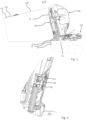
- a child seat 100 is arranged on a vehicle seat 10 .
- the vehicle seat has a seat surface 11 and a backrest 12 .
- at least one first counterpart 20 and at least one second counterpart 21 are provided.
- the counterparts 20, 21 are preferably components/structures that are suitable for receiving the corresponding anchoring means in such a way that the anchoring means and thus the child seat can be (safely) anchored.
- the child seat 100 comprises a first section 101 (seat section), a second section 102 (backrest), a first (upper) anchoring means 120 with first fastening means 121 and a second (lower) anchoring means 110 with second fastening means 111.
- the second anchoring means can preferably be an Isofix anchorage.
- the second anchoring means can be a belt anchorage (latch system).
- the first anchoring means is preferably a top tether. This can be, for example, on the roof of the vehicle, on a (rear) shelf, a rear panel (as in 1 ) or a floor (of a back room).
- the first anchoring means (120) is designed such that it can assume at least a first and a second configuration, wherein when the first configuration is assumed by the first anchoring means (120), anchoring (anchoring possibility) of the second anchoring means (110) is blocked.
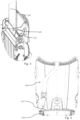
- Figures 4-6 show the first configuration of the first anchoring means 120
- Figures 1-3 show the second configuration of the first anchoring means 120
- Figures 7-9 show a third configuration of the first anchoring means 120.
- the first anchoring means 120 is fixed to the vehicle via the fastening means 121 .
- the first anchoring means 120 e.g. a belt or belt section thereof
- the first anchoring means 120 is under (mechanical) tension.
- a spring 130 (see 2 and 3 ) is prestressed.
- a movable element 131 (here, for example, as part of the spring or integrally formed on it, optionally in the form of a bracket or a web) is brought into a specific position, which changes from the rest position (such as in Figures 8 and 9 shown) differs.
- a corresponding sensor device can be used to determine whether the first anchoring means 120 is under mechanical stress. Specifically, this can mean that there is no indication (e.g. acoustic alarm and/or light signal). In contrast, in the relaxed position according to Figures 7-9 a corresponding indication (alarm and/or optical signal) takes place, so that the user recognizes that a specific configuration of the first anchoring means has been adopted (namely the third configuration). Furthermore, one recognizes that the second anchoring means 110 in the second configuration according to Figures 1-3 can have an anchoring effect or forms an anchorage (specifically in cooperation with the second counterpart 21). The second configuration corresponds to a usage configuration.
- the first anchoring means 120 In the first configuration of the first anchoring means 120 (see Figures 4-6 ) the first anchoring means is also under (mechanical) tension since it is located, concretely hooked (as an optional feature), at a lower end 132 of the backrest (second section) 102 .
- the first and second configurations therefore have in common that in both configurations the first anchoring means 120 is under (mechanical) tension, but differ in that in the case of the first configuration the anchoring means 120 is held on the child seat (specifically the lower end 132) and in In the case of the second configuration, the child seat is held externally (only) (e.g. to an anchor point of the vehicle) in relation to the child seat.
- the first anchoring means 120 blocks a travel path of the second anchoring means 110 (specifically an (Isofix) arm of the second anchoring means 110), so that it is the position according to 1 can not reach and thus no anchoring with the second counterpart 21 can produce.
- the second anchoring means 110 is thus blocked in the first configuration of the first anchoring means 120 .
- the fastening means 121 of the first anchoring means 120 is free (that is, held neither on the vehicle nor on the child seat), so that the spring (device) 130 has a different position (deviating from Figures 1-6 ) occupies. This deviating position can then likewise be correspondingly detected, so that, for example, an indication (alarm and/or optical display) which can be recognized by the user can take place.
- the third configuration of the first anchoring means 120 thus differs from the first configuration and the second configuration in particular in that the first anchoring means is not under any (sufficient) (mechanical) tension (which is linked to the additional difference that the first fastening means 121 of the first anchoring means 120 is free).
Landscapes
- Engineering & Computer Science (AREA)
- Aviation & Aerospace Engineering (AREA)
- Transportation (AREA)
- Mechanical Engineering (AREA)
- Health & Medical Sciences (AREA)
- Child & Adolescent Psychology (AREA)
- General Health & Medical Sciences (AREA)
- Seats For Vehicles (AREA)
- Motor Or Generator Frames (AREA)
Applications Claiming Priority (2)
| Application Number | Priority Date | Filing Date | Title |
|---|---|---|---|
| DE202018105300.0U DE202018105300U1 (de) | 2018-09-17 | 2018-09-17 | Kindersitz zur Anbringung auf einem Kraftfahrzeugsitz |
| PCT/EP2019/073645 WO2020057984A1 (de) | 2018-09-17 | 2019-09-05 | Kindersitz zur anbringung auf einem kraftfahrzeugsitz |
Publications (3)
| Publication Number | Publication Date |
|---|---|
| EP3853065A1 EP3853065A1 (de) | 2021-07-28 |
| EP3853065C0 EP3853065C0 (de) | 2023-06-07 |
| EP3853065B1 true EP3853065B1 (de) | 2023-06-07 |
Family
ID=67875453
Family Applications (1)
| Application Number | Title | Priority Date | Filing Date |
|---|---|---|---|
| EP19765449.4A Active EP3853065B1 (de) | 2018-09-17 | 2019-09-05 | Kindersitz zur anbringung auf einem kraftfahrzeugsitz |
Country Status (9)
| Country | Link |
|---|---|
| US (1) | US11479153B2 (pl) |
| EP (1) | EP3853065B1 (pl) |
| JP (1) | JP7459066B2 (pl) |
| KR (1) | KR102806624B1 (pl) |
| CN (1) | CN112912274B (pl) |
| DE (1) | DE202018105300U1 (pl) |
| ES (1) | ES2953742T3 (pl) |
| PL (1) | PL3853065T3 (pl) |
| WO (1) | WO2020057984A1 (pl) |
Families Citing this family (2)
| Publication number | Priority date | Publication date | Assignee | Title |
|---|---|---|---|---|
| DE202018105300U1 (de) | 2018-09-17 | 2019-12-20 | Cybex Gmbh | Kindersitz zur Anbringung auf einem Kraftfahrzeugsitz |
| CN117015671A (zh) * | 2021-01-29 | 2023-11-07 | 婴芙乐公司 | 用于儿童汽车座椅的顶部系绳阻尼器 |
Family Cites Families (19)
| Publication number | Priority date | Publication date | Assignee | Title |
|---|---|---|---|---|
| GB2260695A (en) | 1991-10-09 | 1993-04-28 | Autoliv Dev | "improvements in or relating to a child safety arrangement" |
| GB9424050D0 (en) * | 1994-11-29 | 1995-01-18 | Britax Roemer Kindersicherheit Gmbh | Child safety seat |
| GB2329114A (en) * | 1997-09-11 | 1999-03-17 | Ford Motor Co | Child seat anchorage |
| JP3901905B2 (ja) | 2000-02-18 | 2007-04-04 | 株式会社東海理化電機製作所 | チャイルドシート固定装置 |
| JP2003025881A (ja) * | 2001-07-11 | 2003-01-29 | Johnson Controls Automotive Systems Corp | 車両用シート |
| JP4090820B2 (ja) * | 2002-08-29 | 2008-05-28 | 本田技研工業株式会社 | チャイルドシートの取付構造 |
| DE10335255A1 (de) * | 2003-08-01 | 2005-03-03 | Daimlerchrysler Ag | Sicherheitsvorrichtung für einen in seiner Längsstellung bewegbaren Fahrzeugsitz |
| FR2861658B1 (fr) | 2003-10-29 | 2006-12-29 | Ampafrance | Siege pour enfant pour vehicule automobile et dispositif de controle de sa bonne mise en place, embase et vehicule correspondant |
| JP5248093B2 (ja) | 2007-12-10 | 2013-07-31 | トヨタ紡織株式会社 | 係止具の係止構造 |
| GB0724901D0 (en) * | 2007-12-20 | 2008-01-30 | Britax Excelsior | Misuse prevention apparatus |
| US8235463B2 (en) * | 2010-02-05 | 2012-08-07 | Ford Global Technologies, Llc | Child seat tethering system |
| US8256840B2 (en) * | 2010-06-10 | 2012-09-04 | Britax Child Safety, Inc. | Apparatus and method for attaching a child safety seat to a vehicle seat |
| FR2978711B1 (fr) | 2011-08-01 | 2013-08-09 | Dorel France Sa | Siege auto pour enfant empechant une mauvaise installation d'une sangle superieure d'ancrage |
| FR2978710B1 (fr) | 2011-08-01 | 2013-08-09 | Dorel France Sa | Siege auto pour enfant comprenant un indicateur de mauvaise installation d'une sangle superieure d'ancrage |
| FR3032400B1 (fr) | 2015-02-09 | 2018-01-05 | Dorel France Sa | Siege auto pour enfant pliable equipe d’une sangle de top tether |
| US9688166B2 (en) * | 2015-09-17 | 2017-06-27 | Ford Global Technologies, Llc | Rotatable anchors providing enhanced child restraint system interface accessibility |
| DE112017000786T5 (de) * | 2016-02-11 | 2018-11-15 | Joyson Safety Systems Acquisition Llc | Sitzgurt- und kindersitzankerbasiertes Belegungsdetektionssystem |
| US11225220B2 (en) * | 2018-04-04 | 2022-01-18 | Shield Restraint Systems, Inc. | Energy absorbing devices for use with webs |
| DE202018105300U1 (de) | 2018-09-17 | 2019-12-20 | Cybex Gmbh | Kindersitz zur Anbringung auf einem Kraftfahrzeugsitz |
-
2018
- 2018-09-17 DE DE202018105300.0U patent/DE202018105300U1/de active Active
-
2019
- 2019-09-05 EP EP19765449.4A patent/EP3853065B1/de active Active
- 2019-09-05 JP JP2021514580A patent/JP7459066B2/ja active Active
- 2019-09-05 PL PL19765449.4T patent/PL3853065T3/pl unknown
- 2019-09-05 ES ES19765449T patent/ES2953742T3/es active Active
- 2019-09-05 WO PCT/EP2019/073645 patent/WO2020057984A1/de not_active Ceased
- 2019-09-05 KR KR1020217011192A patent/KR102806624B1/ko active Active
- 2019-09-05 US US17/277,184 patent/US11479153B2/en active Active
- 2019-09-05 CN CN201980070068.8A patent/CN112912274B/zh active Active
Also Published As
| Publication number | Publication date |
|---|---|
| CN112912274A (zh) | 2021-06-04 |
| CN112912274B (zh) | 2023-06-20 |
| EP3853065C0 (de) | 2023-06-07 |
| KR102806624B1 (ko) | 2025-05-12 |
| US11479153B2 (en) | 2022-10-25 |
| US20220055503A1 (en) | 2022-02-24 |
| DE202018105300U1 (de) | 2019-12-20 |
| KR20210059755A (ko) | 2021-05-25 |
| WO2020057984A1 (de) | 2020-03-26 |
| ES2953742T3 (es) | 2023-11-15 |
| JP7459066B2 (ja) | 2024-04-01 |
| JP2022500301A (ja) | 2022-01-04 |
| EP3853065A1 (de) | 2021-07-28 |
| PL3853065T3 (pl) | 2023-12-11 |
Similar Documents
| Publication | Publication Date | Title |
|---|---|---|
| DE69514766T2 (de) | Kindersicherheitssitz für Kraftfahrzeuge | |
| DE69406558T2 (de) | Rückhalte- und Aufprallschutzsitz für Kinder | |
| EP1517810B1 (de) | Befestigungsrahmen sowie rückhaltevorrichtung mit befestigungsrahmen | |
| EP2627533B1 (de) | Sitzverankerungselement für kindersicherheitssitze oder babyträger | |
| DE2424787A1 (de) | Sicherheitsgurtretraktor mit einer durch zwei antriebe betaetigte traegheitsvorrichtung | |
| DE3216015A1 (de) | Verankerung fuer das gurtschloss eines sicherheitsgurtes | |
| EP2241476A1 (de) | Fahrzeugkindersitz | |
| EP1885577A2 (de) | Kindersitz für fahrzeuge | |
| DE4341119A1 (de) | Vormontierte Trägereinheit für die Funktionsteile eines Sicherheitsgurtsystems | |
| DE3136475A1 (de) | Schwimmende schlosslagerung fuer einen sitzgurtaufwickler | |
| DE19738802C1 (de) | Befestigungsvorrichtung für Kindersitz | |
| EP3853065B1 (de) | Kindersitz zur anbringung auf einem kraftfahrzeugsitz | |
| DE19840837C2 (de) | Höheneinstellvorrichtung für einen D-Ring | |
| DE69009162T2 (de) | Fahrzeugsitz mit in dem Sitzgestell integrierten Befestigungspunkten für einen Sicherheitsgurt. | |
| DE102005007428A1 (de) | Fahrzeugsitz für ein Fahrzeug, insbesondere für ein Kraftfahrzeug | |
| DE10046203A1 (de) | Zusatzverriegelung für Fahrzeugsitz-Längseinstellvorrichtung | |
| DE19522686C1 (de) | Dreipunktgurtsystem für ein Kraftfahrzeug | |
| DE2622556A1 (de) | Fahrzeug, insbesondere kraftfahrzeug, mit im wesentlichen horizontal verstellbaren sitzen | |
| DE60207369T2 (de) | Fahrzeugsitz | |
| DE102005043333B4 (de) | Kraftfahrzeugsitz mit einem in der Höhe verstellbaren Sitzkissen und einem mit dem Sitzkissen verbundenen Befestigungspunkt für einen Sicherheitsgurt | |
| DE602004011747T2 (de) | Vorrichtung für Anzeigen eine korrekte Spannung des Sicherheitsgurtes | |
| DE102019124295A1 (de) | Fahrzeugsitz mit Crash-Verriegelungseinrichtung | |
| DE102009034584A1 (de) | Befestigungseinrichtung für einen Gurtbandumlenker | |
| DE102004023395B3 (de) | Kopfstütze für einen Fahrzeugsitz | |
| DE60302871T2 (de) | Eine Sicherheitsgurtvorrichtung |
Legal Events
| Date | Code | Title | Description |
|---|---|---|---|
| STAA | Information on the status of an ep patent application or granted ep patent |
Free format text: STATUS: UNKNOWN |
|
| STAA | Information on the status of an ep patent application or granted ep patent |
Free format text: STATUS: THE INTERNATIONAL PUBLICATION HAS BEEN MADE |
|
| PUAI | Public reference made under article 153(3) epc to a published international application that has entered the european phase |
Free format text: ORIGINAL CODE: 0009012 |
|
| STAA | Information on the status of an ep patent application or granted ep patent |
Free format text: STATUS: REQUEST FOR EXAMINATION WAS MADE |
|
| 17P | Request for examination filed |
Effective date: 20210316 |
|
| AK | Designated contracting states |
Kind code of ref document: A1 Designated state(s): AL AT BE BG CH CY CZ DE DK EE ES FI FR GB GR HR HU IE IS IT LI LT LU LV MC MK MT NL NO PL PT RO RS SE SI SK SM TR |
|
| DAV | Request for validation of the european patent (deleted) | ||
| DAX | Request for extension of the european patent (deleted) | ||
| GRAP | Despatch of communication of intention to grant a patent |
Free format text: ORIGINAL CODE: EPIDOSNIGR1 |
|
| STAA | Information on the status of an ep patent application or granted ep patent |
Free format text: STATUS: GRANT OF PATENT IS INTENDED |
|
| INTG | Intention to grant announced |
Effective date: 20221020 |
|
| GRAS | Grant fee paid |
Free format text: ORIGINAL CODE: EPIDOSNIGR3 |
|
| GRAA | (expected) grant |
Free format text: ORIGINAL CODE: 0009210 |
|
| STAA | Information on the status of an ep patent application or granted ep patent |
Free format text: STATUS: THE PATENT HAS BEEN GRANTED |
|
| AK | Designated contracting states |
Kind code of ref document: B1 Designated state(s): AL AT BE BG CH CY CZ DE DK EE ES FI FR GB GR HR HU IE IS IT LI LT LU LV MC MK MT NL NO PL PT RO RS SE SI SK SM TR |
|
| REG | Reference to a national code |
Ref country code: GB Ref legal event code: FG4D Free format text: NOT ENGLISH |
|
| REG | Reference to a national code |
Ref country code: CH Ref legal event code: EP Ref country code: AT Ref legal event code: REF Ref document number: 1574031 Country of ref document: AT Kind code of ref document: T Effective date: 20230615 Ref country code: DE Ref legal event code: R096 Ref document number: 502019008100 Country of ref document: DE |
|
| U01 | Request for unitary effect filed |
Effective date: 20230705 |
|
| U07 | Unitary effect registered |
Designated state(s): AT BE BG DE DK EE FI FR IT LT LU LV MT NL PT SE SI Effective date: 20230712 |
|
| REG | Reference to a national code |
Ref country code: LT Ref legal event code: MG9D |
|
| PG25 | Lapsed in a contracting state [announced via postgrant information from national office to epo] |
Ref country code: NO Free format text: LAPSE BECAUSE OF FAILURE TO SUBMIT A TRANSLATION OF THE DESCRIPTION OR TO PAY THE FEE WITHIN THE PRESCRIBED TIME-LIMIT Effective date: 20230907 |
|
| U20 | Renewal fee for the european patent with unitary effect paid |
Year of fee payment: 5 Effective date: 20230929 |
|
| REG | Reference to a national code |
Ref country code: ES Ref legal event code: FG2A Ref document number: 2953742 Country of ref document: ES Kind code of ref document: T3 Effective date: 20231115 |
|
| PG25 | Lapsed in a contracting state [announced via postgrant information from national office to epo] |
Ref country code: RS Free format text: LAPSE BECAUSE OF FAILURE TO SUBMIT A TRANSLATION OF THE DESCRIPTION OR TO PAY THE FEE WITHIN THE PRESCRIBED TIME-LIMIT Effective date: 20230607 Ref country code: HR Free format text: LAPSE BECAUSE OF FAILURE TO SUBMIT A TRANSLATION OF THE DESCRIPTION OR TO PAY THE FEE WITHIN THE PRESCRIBED TIME-LIMIT Effective date: 20230607 Ref country code: GR Free format text: LAPSE BECAUSE OF FAILURE TO SUBMIT A TRANSLATION OF THE DESCRIPTION OR TO PAY THE FEE WITHIN THE PRESCRIBED TIME-LIMIT Effective date: 20230908 |
|
| PG25 | Lapsed in a contracting state [announced via postgrant information from national office to epo] |
Ref country code: SK Free format text: LAPSE BECAUSE OF FAILURE TO SUBMIT A TRANSLATION OF THE DESCRIPTION OR TO PAY THE FEE WITHIN THE PRESCRIBED TIME-LIMIT Effective date: 20230607 |
|
| PG25 | Lapsed in a contracting state [announced via postgrant information from national office to epo] |
Ref country code: IS Free format text: LAPSE BECAUSE OF FAILURE TO SUBMIT A TRANSLATION OF THE DESCRIPTION OR TO PAY THE FEE WITHIN THE PRESCRIBED TIME-LIMIT Effective date: 20231007 |
|
| PG25 | Lapsed in a contracting state [announced via postgrant information from national office to epo] |
Ref country code: SM Free format text: LAPSE BECAUSE OF FAILURE TO SUBMIT A TRANSLATION OF THE DESCRIPTION OR TO PAY THE FEE WITHIN THE PRESCRIBED TIME-LIMIT Effective date: 20230607 Ref country code: SK Free format text: LAPSE BECAUSE OF FAILURE TO SUBMIT A TRANSLATION OF THE DESCRIPTION OR TO PAY THE FEE WITHIN THE PRESCRIBED TIME-LIMIT Effective date: 20230607 Ref country code: RO Free format text: LAPSE BECAUSE OF FAILURE TO SUBMIT A TRANSLATION OF THE DESCRIPTION OR TO PAY THE FEE WITHIN THE PRESCRIBED TIME-LIMIT Effective date: 20230607 Ref country code: IS Free format text: LAPSE BECAUSE OF FAILURE TO SUBMIT A TRANSLATION OF THE DESCRIPTION OR TO PAY THE FEE WITHIN THE PRESCRIBED TIME-LIMIT Effective date: 20231007 Ref country code: CZ Free format text: LAPSE BECAUSE OF FAILURE TO SUBMIT A TRANSLATION OF THE DESCRIPTION OR TO PAY THE FEE WITHIN THE PRESCRIBED TIME-LIMIT Effective date: 20230607 |
|
| REG | Reference to a national code |
Ref country code: DE Ref legal event code: R097 Ref document number: 502019008100 Country of ref document: DE |
|
| PLBE | No opposition filed within time limit |
Free format text: ORIGINAL CODE: 0009261 |
|
| STAA | Information on the status of an ep patent application or granted ep patent |
Free format text: STATUS: NO OPPOSITION FILED WITHIN TIME LIMIT |
|
| REG | Reference to a national code |
Ref country code: CH Ref legal event code: PL |
|
| 26N | No opposition filed |
Effective date: 20240308 |
|
| PG25 | Lapsed in a contracting state [announced via postgrant information from national office to epo] |
Ref country code: MC Free format text: LAPSE BECAUSE OF FAILURE TO SUBMIT A TRANSLATION OF THE DESCRIPTION OR TO PAY THE FEE WITHIN THE PRESCRIBED TIME-LIMIT Effective date: 20230607 |
|
| REG | Reference to a national code |
Ref country code: IE Ref legal event code: MM4A |
|
| PG25 | Lapsed in a contracting state [announced via postgrant information from national office to epo] |
Ref country code: IE Free format text: LAPSE BECAUSE OF NON-PAYMENT OF DUE FEES Effective date: 20230905 |
|
| PG25 | Lapsed in a contracting state [announced via postgrant information from national office to epo] |
Ref country code: CH Free format text: LAPSE BECAUSE OF NON-PAYMENT OF DUE FEES Effective date: 20230930 |
|
| PG25 | Lapsed in a contracting state [announced via postgrant information from national office to epo] |
Ref country code: IE Free format text: LAPSE BECAUSE OF NON-PAYMENT OF DUE FEES Effective date: 20230905 Ref country code: CH Free format text: LAPSE BECAUSE OF NON-PAYMENT OF DUE FEES Effective date: 20230930 |
|
| U20 | Renewal fee for the european patent with unitary effect paid |
Year of fee payment: 6 Effective date: 20240930 |
|
| PG25 | Lapsed in a contracting state [announced via postgrant information from national office to epo] |
Ref country code: CY Free format text: LAPSE BECAUSE OF FAILURE TO SUBMIT A TRANSLATION OF THE DESCRIPTION OR TO PAY THE FEE WITHIN THE PRESCRIBED TIME-LIMIT; INVALID AB INITIO Effective date: 20190905 |
|
| PG25 | Lapsed in a contracting state [announced via postgrant information from national office to epo] |
Ref country code: HU Free format text: LAPSE BECAUSE OF FAILURE TO SUBMIT A TRANSLATION OF THE DESCRIPTION OR TO PAY THE FEE WITHIN THE PRESCRIBED TIME-LIMIT; INVALID AB INITIO Effective date: 20190905 |
|
| PGFP | Annual fee paid to national office [announced via postgrant information from national office to epo] |
Ref country code: PL Payment date: 20250902 Year of fee payment: 7 |
|
| PGFP | Annual fee paid to national office [announced via postgrant information from national office to epo] |
Ref country code: GB Payment date: 20250923 Year of fee payment: 7 |
|
| U20 | Renewal fee for the european patent with unitary effect paid |
Year of fee payment: 7 Effective date: 20250930 |
|
| PG25 | Lapsed in a contracting state [announced via postgrant information from national office to epo] |
Ref country code: TR Free format text: LAPSE BECAUSE OF FAILURE TO SUBMIT A TRANSLATION OF THE DESCRIPTION OR TO PAY THE FEE WITHIN THE PRESCRIBED TIME-LIMIT Effective date: 20230607 |
|
| PGFP | Annual fee paid to national office [announced via postgrant information from national office to epo] |
Ref country code: ES Payment date: 20251015 Year of fee payment: 7 |