EP3787702B1 - Dermale füllstoffe und deren anwendungen - Google Patents
Dermale füllstoffe und deren anwendungen Download PDFInfo
- Publication number
- EP3787702B1 EP3787702B1 EP19725422.0A EP19725422A EP3787702B1 EP 3787702 B1 EP3787702 B1 EP 3787702B1 EP 19725422 A EP19725422 A EP 19725422A EP 3787702 B1 EP3787702 B1 EP 3787702B1
- Authority
- EP
- European Patent Office
- Prior art keywords
- collagen
- crosslinked
- plant
- derivative
- rhcollagen
- Prior art date
- Legal status (The legal status is an assumption and is not a legal conclusion. Google has not performed a legal analysis and makes no representation as to the accuracy of the status listed.)
- Active
Links
Images
























Classifications
-
- A—HUMAN NECESSITIES
- A61—MEDICAL OR VETERINARY SCIENCE; HYGIENE
- A61L—METHODS OR APPARATUS FOR STERILISING MATERIALS OR OBJECTS IN GENERAL; DISINFECTION, STERILISATION OR DEODORISATION OF AIR; CHEMICAL ASPECTS OF BANDAGES, DRESSINGS, ABSORBENT PADS OR SURGICAL ARTICLES; MATERIALS FOR BANDAGES, DRESSINGS, ABSORBENT PADS OR SURGICAL ARTICLES
- A61L27/00—Materials for grafts or prostheses or for coating grafts or prostheses
- A61L27/14—Macromolecular materials
- A61L27/20—Polysaccharides
-
- A—HUMAN NECESSITIES
- A61—MEDICAL OR VETERINARY SCIENCE; HYGIENE
- A61K—PREPARATIONS FOR MEDICAL, DENTAL OR TOILETRY PURPOSES
- A61K8/00—Cosmetics or similar toiletry preparations
- A61K8/02—Cosmetics or similar toiletry preparations characterised by special physical form
- A61K8/04—Dispersions; Emulsions
- A61K8/042—Gels
-
- A—HUMAN NECESSITIES
- A61—MEDICAL OR VETERINARY SCIENCE; HYGIENE
- A61K—PREPARATIONS FOR MEDICAL, DENTAL OR TOILETRY PURPOSES
- A61K8/00—Cosmetics or similar toiletry preparations
- A61K8/18—Cosmetics or similar toiletry preparations characterised by the composition
- A61K8/30—Cosmetics or similar toiletry preparations characterised by the composition containing organic compounds
- A61K8/64—Proteins; Peptides; Derivatives or degradation products thereof
- A61K8/65—Collagen; Gelatin; Keratin; Derivatives or degradation products thereof
-
- A—HUMAN NECESSITIES
- A61—MEDICAL OR VETERINARY SCIENCE; HYGIENE
- A61K—PREPARATIONS FOR MEDICAL, DENTAL OR TOILETRY PURPOSES
- A61K8/00—Cosmetics or similar toiletry preparations
- A61K8/18—Cosmetics or similar toiletry preparations characterised by the composition
- A61K8/72—Cosmetics or similar toiletry preparations characterised by the composition containing organic macromolecular compounds
- A61K8/73—Polysaccharides
- A61K8/735—Mucopolysaccharides, e.g. hyaluronic acid; Derivatives thereof
-
- A—HUMAN NECESSITIES
- A61—MEDICAL OR VETERINARY SCIENCE; HYGIENE
- A61L—METHODS OR APPARATUS FOR STERILISING MATERIALS OR OBJECTS IN GENERAL; DISINFECTION, STERILISATION OR DEODORISATION OF AIR; CHEMICAL ASPECTS OF BANDAGES, DRESSINGS, ABSORBENT PADS OR SURGICAL ARTICLES; MATERIALS FOR BANDAGES, DRESSINGS, ABSORBENT PADS OR SURGICAL ARTICLES
- A61L27/00—Materials for grafts or prostheses or for coating grafts or prostheses
- A61L27/14—Macromolecular materials
- A61L27/22—Polypeptides or derivatives thereof, e.g. degradation products
- A61L27/24—Collagen
-
- A—HUMAN NECESSITIES
- A61—MEDICAL OR VETERINARY SCIENCE; HYGIENE
- A61L—METHODS OR APPARATUS FOR STERILISING MATERIALS OR OBJECTS IN GENERAL; DISINFECTION, STERILISATION OR DEODORISATION OF AIR; CHEMICAL ASPECTS OF BANDAGES, DRESSINGS, ABSORBENT PADS OR SURGICAL ARTICLES; MATERIALS FOR BANDAGES, DRESSINGS, ABSORBENT PADS OR SURGICAL ARTICLES
- A61L27/00—Materials for grafts or prostheses or for coating grafts or prostheses
- A61L27/14—Macromolecular materials
- A61L27/26—Mixtures of macromolecular compounds
-
- A—HUMAN NECESSITIES
- A61—MEDICAL OR VETERINARY SCIENCE; HYGIENE
- A61L—METHODS OR APPARATUS FOR STERILISING MATERIALS OR OBJECTS IN GENERAL; DISINFECTION, STERILISATION OR DEODORISATION OF AIR; CHEMICAL ASPECTS OF BANDAGES, DRESSINGS, ABSORBENT PADS OR SURGICAL ARTICLES; MATERIALS FOR BANDAGES, DRESSINGS, ABSORBENT PADS OR SURGICAL ARTICLES
- A61L27/00—Materials for grafts or prostheses or for coating grafts or prostheses
- A61L27/36—Materials for grafts or prostheses or for coating grafts or prostheses containing ingredients of undetermined constitution or reaction products thereof, e.g. transplant tissue, natural bone, extracellular matrix
- A61L27/3683—Materials for grafts or prostheses or for coating grafts or prostheses containing ingredients of undetermined constitution or reaction products thereof, e.g. transplant tissue, natural bone, extracellular matrix subjected to a specific treatment prior to implantation, e.g. decellularising, demineralising, grinding, cellular disruption/non-collagenous protein removal, anti-calcification, crosslinking, supercritical fluid extraction, enzyme treatment
- A61L27/3687—Materials for grafts or prostheses or for coating grafts or prostheses containing ingredients of undetermined constitution or reaction products thereof, e.g. transplant tissue, natural bone, extracellular matrix subjected to a specific treatment prior to implantation, e.g. decellularising, demineralising, grinding, cellular disruption/non-collagenous protein removal, anti-calcification, crosslinking, supercritical fluid extraction, enzyme treatment characterised by the use of chemical agents in the treatment, e.g. specific enzymes, detergents, capping agents, crosslinkers, anticalcification agents
-
- A—HUMAN NECESSITIES
- A61—MEDICAL OR VETERINARY SCIENCE; HYGIENE
- A61L—METHODS OR APPARATUS FOR STERILISING MATERIALS OR OBJECTS IN GENERAL; DISINFECTION, STERILISATION OR DEODORISATION OF AIR; CHEMICAL ASPECTS OF BANDAGES, DRESSINGS, ABSORBENT PADS OR SURGICAL ARTICLES; MATERIALS FOR BANDAGES, DRESSINGS, ABSORBENT PADS OR SURGICAL ARTICLES
- A61L27/00—Materials for grafts or prostheses or for coating grafts or prostheses
- A61L27/50—Materials characterised by their function or physical properties, e.g. injectable or lubricating compositions, shape-memory materials, surface modified materials
- A61L27/56—Porous materials, e.g. foams or sponges
-
- A—HUMAN NECESSITIES
- A61—MEDICAL OR VETERINARY SCIENCE; HYGIENE
- A61Q—SPECIFIC USE OF COSMETICS OR SIMILAR TOILETRY PREPARATIONS
- A61Q19/00—Preparations for care of the skin
- A61Q19/08—Anti-ageing preparations
-
- B—PERFORMING OPERATIONS; TRANSPORTING
- B33—ADDITIVE MANUFACTURING TECHNOLOGY
- B33Y—ADDITIVE MANUFACTURING, i.e. MANUFACTURING OF THREE-DIMENSIONAL [3D] OBJECTS BY ADDITIVE DEPOSITION, ADDITIVE AGGLOMERATION OR ADDITIVE LAYERING, e.g. BY 3D PRINTING, STEREOLITHOGRAPHY OR SELECTIVE LASER SINTERING
- B33Y70/00—Materials specially adapted for additive manufacturing
-
- C—CHEMISTRY; METALLURGY
- C07—ORGANIC CHEMISTRY
- C07K—PEPTIDES
- C07K14/00—Peptides having more than 20 amino acids; Gastrins; Somatostatins; Melanotropins; Derivatives thereof
- C07K14/435—Peptides having more than 20 amino acids; Gastrins; Somatostatins; Melanotropins; Derivatives thereof from animals; from humans
- C07K14/78—Connective tissue peptides, e.g. collagen, elastin, laminin, fibronectin, vitronectin or cold insoluble globulin [CIG]
-
- C—CHEMISTRY; METALLURGY
- C08—ORGANIC MACROMOLECULAR COMPOUNDS; THEIR PREPARATION OR CHEMICAL WORKING-UP; COMPOSITIONS BASED THEREON
- C08B—POLYSACCHARIDES; DERIVATIVES THEREOF
- C08B37/00—Preparation of polysaccharides not provided for in groups C08B1/00 - C08B35/00; Derivatives thereof
- C08B37/006—Heteroglycans, i.e. polysaccharides having more than one sugar residue in the main chain in either alternating or less regular sequence; Gellans; Succinoglycans; Arabinogalactans; Tragacanth or gum tragacanth or traganth from Astragalus; Gum Karaya from Sterculia urens; Gum Ghatti from Anogeissus latifolia; Derivatives thereof
- C08B37/0063—Glycosaminoglycans or mucopolysaccharides, e.g. keratan sulfate; Derivatives thereof, e.g. fucoidan
- C08B37/0072—Hyaluronic acid, i.e. HA or hyaluronan; Derivatives thereof, e.g. crosslinked hyaluronic acid (hylan) or hyaluronates
-
- C—CHEMISTRY; METALLURGY
- C08—ORGANIC MACROMOLECULAR COMPOUNDS; THEIR PREPARATION OR CHEMICAL WORKING-UP; COMPOSITIONS BASED THEREON
- C08B—POLYSACCHARIDES; DERIVATIVES THEREOF
- C08B37/00—Preparation of polysaccharides not provided for in groups C08B1/00 - C08B35/00; Derivatives thereof
- C08B37/006—Heteroglycans, i.e. polysaccharides having more than one sugar residue in the main chain in either alternating or less regular sequence; Gellans; Succinoglycans; Arabinogalactans; Tragacanth or gum tragacanth or traganth from Astragalus; Gum Karaya from Sterculia urens; Gum Ghatti from Anogeissus latifolia; Derivatives thereof
- C08B37/0063—Glycosaminoglycans or mucopolysaccharides, e.g. keratan sulfate; Derivatives thereof, e.g. fucoidan
- C08B37/0075—Heparin; Heparan sulfate; Derivatives thereof, e.g. heparosan; Purification or extraction methods thereof
-
- C—CHEMISTRY; METALLURGY
- C08—ORGANIC MACROMOLECULAR COMPOUNDS; THEIR PREPARATION OR CHEMICAL WORKING-UP; COMPOSITIONS BASED THEREON
- C08H—DERIVATIVES OF NATURAL MACROMOLECULAR COMPOUNDS
- C08H1/00—Macromolecular products derived from proteins
-
- C—CHEMISTRY; METALLURGY
- C08—ORGANIC MACROMOLECULAR COMPOUNDS; THEIR PREPARATION OR CHEMICAL WORKING-UP; COMPOSITIONS BASED THEREON
- C08H—DERIVATIVES OF NATURAL MACROMOLECULAR COMPOUNDS
- C08H1/00—Macromolecular products derived from proteins
- C08H1/06—Macromolecular products derived from proteins derived from horn, hoofs, hair, skin or leather
-
- C—CHEMISTRY; METALLURGY
- C08—ORGANIC MACROMOLECULAR COMPOUNDS; THEIR PREPARATION OR CHEMICAL WORKING-UP; COMPOSITIONS BASED THEREON
- C08L—COMPOSITIONS OF MACROMOLECULAR COMPOUNDS
- C08L5/00—Compositions of polysaccharides or of their derivatives not provided for in groups C08L1/00 or C08L3/00
- C08L5/08—Chitin; Chondroitin sulfate; Hyaluronic acid; Derivatives thereof
-
- C—CHEMISTRY; METALLURGY
- C08—ORGANIC MACROMOLECULAR COMPOUNDS; THEIR PREPARATION OR CHEMICAL WORKING-UP; COMPOSITIONS BASED THEREON
- C08L—COMPOSITIONS OF MACROMOLECULAR COMPOUNDS
- C08L89/00—Compositions of proteins; Compositions of derivatives thereof
-
- C—CHEMISTRY; METALLURGY
- C08—ORGANIC MACROMOLECULAR COMPOUNDS; THEIR PREPARATION OR CHEMICAL WORKING-UP; COMPOSITIONS BASED THEREON
- C08L—COMPOSITIONS OF MACROMOLECULAR COMPOUNDS
- C08L89/00—Compositions of proteins; Compositions of derivatives thereof
- C08L89/04—Products derived from waste materials, e.g. horn, hoof or hair
-
- C—CHEMISTRY; METALLURGY
- C08—ORGANIC MACROMOLECULAR COMPOUNDS; THEIR PREPARATION OR CHEMICAL WORKING-UP; COMPOSITIONS BASED THEREON
- C08L—COMPOSITIONS OF MACROMOLECULAR COMPOUNDS
- C08L89/00—Compositions of proteins; Compositions of derivatives thereof
- C08L89/04—Products derived from waste materials, e.g. horn, hoof or hair
- C08L89/06—Products derived from waste materials, e.g. horn, hoof or hair derived from leather or skin, e.g. gelatin
-
- C—CHEMISTRY; METALLURGY
- C12—BIOCHEMISTRY; BEER; SPIRITS; WINE; VINEGAR; MICROBIOLOGY; ENZYMOLOGY; MUTATION OR GENETIC ENGINEERING
- C12N—MICROORGANISMS OR ENZYMES; COMPOSITIONS THEREOF; PROPAGATING, PRESERVING, OR MAINTAINING MICROORGANISMS; MUTATION OR GENETIC ENGINEERING; CULTURE MEDIA
- C12N15/00—Mutation or genetic engineering; DNA or RNA concerning genetic engineering, vectors, e.g. plasmids, or their isolation, preparation or purification; Use of hosts therefor
- C12N15/09—Recombinant DNA-technology
- C12N15/63—Introduction of foreign genetic material using vectors; Vectors; Use of hosts therefor; Regulation of expression
- C12N15/79—Vectors or expression systems specially adapted for eukaryotic hosts
- C12N15/82—Vectors or expression systems specially adapted for eukaryotic hosts for plant cells, e.g. plant artificial chromosomes (PACs)
- C12N15/8241—Phenotypically and genetically modified plants via recombinant DNA technology
- C12N15/8242—Phenotypically and genetically modified plants via recombinant DNA technology with non-agronomic quality (output) traits, e.g. for industrial processing; Value added, non-agronomic traits
- C12N15/8257—Phenotypically and genetically modified plants via recombinant DNA technology with non-agronomic quality (output) traits, e.g. for industrial processing; Value added, non-agronomic traits for the production of primary gene products, e.g. pharmaceutical products, interferon
-
- A—HUMAN NECESSITIES
- A61—MEDICAL OR VETERINARY SCIENCE; HYGIENE
- A61K—PREPARATIONS FOR MEDICAL, DENTAL OR TOILETRY PURPOSES
- A61K2800/00—Properties of cosmetic compositions or active ingredients thereof or formulation aids used therein and process related aspects
- A61K2800/40—Chemical, physico-chemical or functional or structural properties of particular ingredients
- A61K2800/59—Mixtures
-
- A—HUMAN NECESSITIES
- A61—MEDICAL OR VETERINARY SCIENCE; HYGIENE
- A61K—PREPARATIONS FOR MEDICAL, DENTAL OR TOILETRY PURPOSES
- A61K2800/00—Properties of cosmetic compositions or active ingredients thereof or formulation aids used therein and process related aspects
- A61K2800/80—Process related aspects concerning the preparation of the cosmetic composition or the storage or application thereof
- A61K2800/81—Preparation or application process involves irradiation
-
- A—HUMAN NECESSITIES
- A61—MEDICAL OR VETERINARY SCIENCE; HYGIENE
- A61K—PREPARATIONS FOR MEDICAL, DENTAL OR TOILETRY PURPOSES
- A61K2800/00—Properties of cosmetic compositions or active ingredients thereof or formulation aids used therein and process related aspects
- A61K2800/80—Process related aspects concerning the preparation of the cosmetic composition or the storage or application thereof
- A61K2800/91—Injection
-
- A—HUMAN NECESSITIES
- A61—MEDICAL OR VETERINARY SCIENCE; HYGIENE
- A61L—METHODS OR APPARATUS FOR STERILISING MATERIALS OR OBJECTS IN GENERAL; DISINFECTION, STERILISATION OR DEODORISATION OF AIR; CHEMICAL ASPECTS OF BANDAGES, DRESSINGS, ABSORBENT PADS OR SURGICAL ARTICLES; MATERIALS FOR BANDAGES, DRESSINGS, ABSORBENT PADS OR SURGICAL ARTICLES
- A61L2400/00—Materials characterised by their function or physical properties
- A61L2400/06—Flowable or injectable implant compositions
-
- A—HUMAN NECESSITIES
- A61—MEDICAL OR VETERINARY SCIENCE; HYGIENE
- A61L—METHODS OR APPARATUS FOR STERILISING MATERIALS OR OBJECTS IN GENERAL; DISINFECTION, STERILISATION OR DEODORISATION OF AIR; CHEMICAL ASPECTS OF BANDAGES, DRESSINGS, ABSORBENT PADS OR SURGICAL ARTICLES; MATERIALS FOR BANDAGES, DRESSINGS, ABSORBENT PADS OR SURGICAL ARTICLES
- A61L2430/00—Materials or treatment for tissue regeneration
- A61L2430/34—Materials or treatment for tissue regeneration for soft tissue reconstruction
Definitions
- Photoinitiated and double crosslinked dermal fillers comprising plant-derived human collagen, and cellular growth promoting scaffolds, as well as methods of using the dermal fillers in some instances, for soft tissue augmentation.
- Collagens are the main proteins responsible for the structural integrity of vertebrates and many other multicellular organisms. Collagen comprises the main compsonent of connective tissue and is the most abundant protein in mammals, comprising approximately 30% of the protein found in the body. Loss or deterioration of collagen can occur as the result of aging or injury ( Olsen et al, Adv Drug Deliv Rev. 2003 Nov. 28; 55(12):1547-67 ).
- Collagen is also a component of tendons.
- Tendinopathy a common injury usually associated with sports and physical activities, is associated with degeneration and disordered arrangement of the tendon's collagen fibers. Healing of injured tendons requires an orchestrated activity of specific cells and an extended presence of relevant growth factors (GFs) at the vicinity of the injury.
- GFs growth factors
- Tendinopathy is nowadays the leading reason for consultation for a musculoskeletal complaint ( Kaux et al. (Jan. 2011) J. Sport. Sci. Med. January:238-253 ).
- Tendinopathy refers to a variety of painful conditions that develop in and around tendons and ligaments which are likely arising from an imbalance between pathological changes due to tendon overuse and the consequent regenerative responses ( Andres et al. (2008) Clin. Orthop.
- Tendinopathy is associated with degeneration and disordered arrangement of collagen ( Maffulli et al. (2003) Clin. Sport. Med. 22:675-692 ), sometimes associated with fibers micro tears, increase in vascularity and presence of a mild inflammation ( Khan et al. (1999) Sport. Med. 27(6):393-408 ). Clinically, it is characterized by onset of tendon stiffness, activity-related pain, decrease in functionality and sometimes localized swelling (Kaux 2011; Andres 2008). Collagen fibers present unequal and irregular crimping, loosening, and increased waviness instead of the normal tight, parallel, bundled appearance (Mafulli 2003).
- PRP is the plasma fraction of blood containing high concentration of platelets.
- platelets Upon injection to the injured site, platelets release various types of growth factors (GFs) which are thought to promote the healing process.
- GFs growth factors
- vasculo-endothelial growth factor (VEGF) vasculo-endothelial growth factor (VEGF), transforming beta growth factor (TGF-beta), platelet derived growth factor (PDGF), platelet derived epidermal growth factor (PDEGF), fibroblast growth factors (bFGF), epidermal growth factors (EGF) and hepatocyte growth factors (HGF) have been reported (Delong 2016; Yuan 2013; Harrison et al. (2011) Am. J. Sports Med. 39(4):729-734 ).
- VEGF vasculo-endothelial growth factor
- TGF-beta transforming beta growth factor
- PDGF platelet derived growth factor
- PEGF platelet derived epidermal growth factor
- bFGF
- Collagen serves as the predominant component and primary structural-mechanical determinant of most tissue extra cellular matrix (ECM) [see, for example, Kadler K. birth Defects Res C Embryo Today. 2004; 72:1-11 ; Kadler KE, Baldock C, Bella J, Boot-Handford RP. J Cell Sci. 2007; 120:1955-1958 .; Kreger ST. Biopolymers. 2010 93(8): 690-707 ].
- Tropocollagen typically consists of three left-handed helices (usually two identical helices and a third distinct helix) of procollagen joining to form a right-handed triple-helical tropocollagen, resulting on the formation of fibrils.
- the conformation and most of the properties of native collagen are determined by the triple helix domain which composes more than 95% of the molecule.
- This domain consists of three alpha chains, each containing approximately 1,000 amino acids, wrapped in a rope-like fashion to form a tight, triple helix structure.
- the triple helix is wound in such a way that peptide bonds linking adjacent amino acids are buried within the interior of the molecule, such that the collagen molecules are resistant to attack by proteases, such as pepsin.
- Type I collagen represents the prototypical fibrillar collagen and is the major collagen type in most tissues, including bone, tendon, skin, aorta, and lung. Type I collagen fibers provide for great tensile strength and limited extensibility. The most abundant molecular form of type I collagen is a heterotrimer composed of two different alpha chains [alpha 1(I)] 2 and alpha 2(1) ( Inkinen, Connective Tissue Formation in Wound healing an Experimental Study, Academic Dissertation, Sep. 2003. University of Helsinki, Faculty of Science, Department of Biosciences, Division of Biochemistry ).
- the three polypeptide chains are constructed from a repeating Gly-X-Y triplet, where X and Y can be any amino acid but are frequently the imino acids proline and hydroxyproline.
- Collagen is particularly rich in glycine, proline, and hydroxyproline amino acid residues, and the protein sequence of a strand of collagen often has a repeating amino acid sequence.
- Procollagen is modified by the addition of hydroxyl groups on proline and lysine residues. These hydroxylation reactions are catalyzed, respectively, by prolyl-4-hydroxylase and lysyl-hydroxylase. Hydroxyl groups on the lysine residues are then glycosylated, and the triple helix is subsequently formed.
- fibril-forming collagens are synthesized as precursor procollagens containing globular N- and C-terminal extension propeptides.
- the biosynthesis of procollagen is a complex process involving a number of different post-translational modifications including proline and lysine hydroxylation, N-linked and O-linked glycosylation and both intra- and inter-chain disulphide-bond formation.
- the enzymes carrying out these modifications act in a coordinated fashion to ensure the folding and assembly of a correctly aligned and thermally stable triple-helical molecule.
- the triconstituent polypeptide chains are assembled within the rough endoplasmic reticulum (RER) to form procollagen.
- RER rough endoplasmic reticulum
- P4H prolyl-4-hydroxylase
- the stability of the final triple-helical structure of collagen is highly dependent on the P4H-mediated hydroxylation of collagen chains.
- Lysyl hydroxylase (LH, EC 1.14.11.4), galactosyltransferase (EC 2.4.1.50) and glucosyltransferase (EC 2.4.1.66) are enzymes involved in posttranslational modifications of collagens. They sequentially modify lysyl residues in specific positions to hydroxylysyl, galactosylhydroxylysyl and glucosylgalactosyl hydroxylysyl residues. These structures are unique to collagens and essential for their functional activity ( Wang et al. (2002) Matrix Biology, 21(7): 559-566 ).
- a single human enzyme, lysyl hydroxylase 3 (LH3) can catalyze all three consecutive steps in hydroxylysine linked carbohydrate formation ( Wang et al. (2002) Matrix Biology, 21(7): 559-566 ).
- the three pro-alpha chains then associate via their C-propeptides to form a trimeric molecule where the Gly-X-Y repeat region forms a nucleation point at its C-terminal end, ensuring correct alignment of the chains.
- the Gly-X-Y region then folds in a C-toN direction to form a triple helix ( Khoshnoodi et al. (2006) J. Biol. Chem. 281:38117-38121 ).
- the temporal relationship between polypeptide chain modification and triple-helix formation is crucial as hydroxylation of proline residues is required to ensure stability of the triple helix at body temperature, once formed, the triple helix no longer serves as a substrate for the hydroxylation enzyme.
- the C-propeptides (and to a lesser extent the N-propeptides) keep the procollagen soluble during its passage out of the cell ( Bulleid et al. (2000) Biochem. Socy. Transact., 28(4): 350-353 ).
- propeptides are removed by procollagen N- and C-proteinases, thereby triggering spontaneous self-assembly of collagen molecules into fibrils ( Hulines, 2002, J.
- Native collagen is generally present in connective tissue as telopeptide-containing collagen molecules packed side by side in the form of fibrils.
- Each longitudinal course is composed of molecules aligned in end-to-end dispositions with slight longitudinal spaces staggered relative to the next successive laterally adjacent longitudinal course. In this way, gaps are generated between facing end regions of successive molecules in a given longitudinal course and bound by the staggered sides of the molecules in the parallel longitudinal courses laterally adjacent thereto.
- Dispersal and solubilization of native animal collagen can be achieved using various proteolytic enzymes which disrupt the intermolecular bonds and remove the immunogenic non-helical telopeptides without affecting the basic, rigid triple-helical structure which imparts the desired characteristics of collagen (see U.S. Pat. Nos. 3,934,852 ; 3,121,049 ; 3,131,130 ; 3,314,861 ; 3,530,037 ; 3,949,073 ; 4,233,360 and 4,488,911 for general methods for preparing purified soluble collagen).
- the resulting soluble atelocollagen can be subsequently purified by repeated precipitation at low pH and high ionic strength, followed by washing and re-solublization at low pH. Nevertheless, the soluble preparation is typically contaminated with crosslinked collagen chains which decrease the homogeneity of the protein preparation.
- Type I collagen Due to its unique characteristics and diverse profile in human body functions, collagen has been selected from a variety of biocompatible materials for use in tissue repair to support structural integrity, induce cellular infiltration and promote tissue regeneration. Among the 5 major collagen types, Type I collagen is the most abundant form of collagen in the human body.
- Type I collagen can self-assemble into a fibrillar hydrogel capable of supporting tissue cells through bioactive adhesion sites. Addition of methacrylate groups to the collagen creates collagen methacrylate (CMA), which is more resistant to degradation ( Gaudet et al. Biointerphases (2012) 7:25-33 ). Thiolation of collagen can improve cohesion and mucoadhesion and affects swelling ability ( Duggan et al., Eur. J. Pharm. Biopharm. (April 2015) 91:75-81 ).
- CMA collagen methacrylate
- Thiolation of collagen can improve cohesion and mucoadhesion and affects swelling ability ( Duggan et al., Eur. J. Pharm. Biopharm. (April 2015) 91:75-81 ).
- Collagen's unique properties have contributed to its use in regenerative medicine products.
- Collagen provides biomaterials with characteristics necessary for a myriad of applications including pharmaceutical (haemostatic compresses, sponges, healing dressings), medical (prostheses such as cardiac valves, tendons and ligaments, skin substitutes, filling agents), odontological (gum implants/gum disease) and cosmetic (additive, anti-wrinkling agent, microcontainer for perfumed substances).
- pharmaceutical haemostatic compresses, sponges, healing dressings
- medical prostheses such as cardiac valves, tendons and ligaments, skin substitutes, filling agents
- odontological gaum implants/gum disease
- cosmetic additive, anti-wrinkling agent, microcontainer for perfumed substances.
- the collagen-based products manufactured in all of the aforementioned markets require vast amounts of raw collagen materials for their production.
- Human and animal-derived collagens such as from cadaver or animal sources (bovine, porcine, or equine), and collagen-based products have been used for application, injection, implantation, and oral ingestion. Uses include pre-molding into desired shapes for repair or partial replacement of damaged bone or cartilage structures, injections into damaged joints, and injections as dermal fillers.
- animal-derived collagen including human-derived collagen
- human-derived collagen is problematic due to the possible risks of contamination by non-conventional infectious agents. While the risks raised by bacterial or viral contamination can be fully controlled, prions are less containable and present considerable health risks.
- infectious agents which appear to have a protein-like nature, are involved in the development of degenerative animal encephalopathy (sheep trembling disease, bovine spongiform encephalopathy) and human encephalopathy (Creutzfeld-Jacob disease, Gerstmann-Straussler syndrome, and kuru disease).
- Other diseases e.g., acquired immune deficiency syndrome [AIDS], hepatitis, rabies, some cancers
- AIDS acquired immune deficiency syndrome
- rabies some cancers
- treatment with human or animal collagen triggers cellular or humoral immune responses, including allergies.
- the quality of the collagen generally decreases with the age of the source cadaver or organism or may decrease subject to other factors.
- the extraction process causes significant structural damage which compromises its biological and mechanical functions ( Stein et al. (2009) Biomacromolecules 10(9):2640-2645 ; Shilo et al. (2013) Tissue Eng. Part A 19(13-14):1519-1526 ; Shoseyov et at (2013) Tiss. Eng. Part A 19(13-14):1527 ).
- the protein is purified to homogeneity through a cost-effective industrial process taking advantage of collagen's unique properties. See also WO 2006/035442 , WO 2009/053985 .
- rhCollagen can form functional three-dimensional (3D) matrices and scaffolding, with applications in additive manufacturing (AM), a process in which a 3D object is manufactured in a layerwise manner utilizing a computer model of the objects, via 3D bio-printing. Moreover, rhCollagen generally lacks the immunogenicity and disease transfer problems of tissue-extracted collagen.
- Methods of producing collagen in a plant by expressing at least one type of a collagen alpha chain and enabling its accumulation in a subcellular compartment devoid of endogenous P4H activity are available ( US Pat. 8,455,717 ), as are methods of generating atelocollagen from a non-animal cell-derived human telopeptide-comprising collagen via treatment with a protease ( US Pat. 8,759,487 ).
- Type I collagen and rhCollagen are considered candidates for use as a major component of a building material in 3D-bioprinting. Scaffolding of various types has been used for cosmetic and other reconstructive applications.
- dermal fillers for soft tissue augmentation, e.g., the reduction of wrinkles.
- One possible method for the use of dermal fillers includes injection of a polymerizable dermal filler material into the desired area, followed by the contouring or molding of the filler into the desired conformation. Polymerization and crosslinking of the material by one of various methods can transform the monomers in the injected material to form polymers and chains, which can form networks, retaining the desired molded conformation. There are a number of methods to form polymers and to crosslink polymers. One method involves light-reactive reagents and light-induced reactions which create reactive species in a monomer solution. See, e.g., US Pat.
- WO 2013/106715 and WO 2013/067293 describe hydrogels comprising water and a hyaluronic acid component cross-linked to a collagen component, for soft tissue augmentation.
- WO 2016/057603 describes a method of manufacturing a biopolymer macroscopic system comprising two, at least partially cross-linked, biopolymers, including hyaluronic acid and collagen, and their use as dermal fillers.
- WO 2010/053918 describes polymeric hydrogels comprising cross-linked elastin and further comprising collagen and/or hyaluronic acid and their use in dermal filling and tissue expansion.
- US 2007/186312 describes collagen producing plants and methods of generating and using same. More particularly, an approach for generating plants capable of producing high levels of hydroxylated collagen chains which are capable of forming native triple helix type I collagen fibers.
- WO200/08019 describes polymer formulations for the delivery of bioactive agents.
- tissue-derived collagens or non-collagen polymers e.g., poly(vinyl alcohol), hyaluronic acid, or polyethylene glycol.
- tissue extracted collagen is limited due to its sensitivity to temperature and ionic strength hich drives spontaneous gel formation at temperatures higher than 20°C, under physiological conditions [see, for example, PureCol, Advanced BioMatrix, Inc.].
- the typical temperature dependent formation of gel of tissue extracted collagens hampers significantly the precise fluidity. Keeping the collagens at low temperature until application is a possible solution for this phenomenon but implies a serious technical limitation.
- Another solution is the use of gelatin, the denatured form of collagen which does not become gel-like under these conditions.
- gelatin lacks the genuine tissue and cell interactions of native collagen and thus crucial biological functions are lost. Moreover, the viscosity makes it more difficult to be injected under the dermis using fine-gauge needles and also makes it more difficult to spread and mold it into smaller cavities.
- WO 2018/225076 describes collagen-based formulations for use in additive manufacturing of three-dimensional collagen-containing objects.
- the present invention provides a polymerizable solution comprising: (i) a cross-linkable, plant derived type 1 recombinant human collagen (rhCollagen); (ii) a photoinitiator and (iii) a hyaluronic acid (HA) or modified derivative thereof, a poly(vinyl alcohol) (PVA) or modified derivative thereof, a polyethylene glycol (PEG) or modified derivative thereof, oxidized cellulose (OC) or a modified derivate thereof, polymethylmethacrylate (PMMA) microspheres or a modified derivative thereof, tricalcium phosphate (TCP) or a modified derivative thereof, calcium hydroxylapatite (CaHA) or a modified derivative thereof, carboxymethylcellulose or a modified derivative thereof, crystalline nanocellulose (CNC) or a modified derivative thereof, or a combination thereof; for use in a therapeutic method of tissue augmentation comprising: (a) introducing a polymerizable solution into the tissue space under an epidermis and (b)
- the present invention further provides a non-therapeutic use of a polymerizable solution comprising: (i) a cross-linkable, plant-derived type 1 recombinant human collagen (rhCollagen); (ii) a photoinitiator; and (iii) a hyaluronic acid (HA) or modified derivative thereof, a poly(vinyl alcohol) (PVA) or modified derivative thereof, a polyethylene glycol (PEG) or modified derivative thereof, oxidized cellulose (OC) or a modified _derivate thereof, polymethylmethacrylate (PMMA) microspheres or a modified derivative thereof, tricalcium phosphate (TCP) or a modified derivative thereof, calcium hydroxylapatite (CaHA) or a modified derivative thereof, carboxymethylcellulose or a modified derivative thereof, crystalline nanocellulose (CNC) or a modified derivative thereof, or a combination thereof, wherein said non-therapeutic use is in a cosmetic method of tissue augmentation comprising: (a) introducing a
- a double crosslinked dermal filler comprising:
- the plant-derived human collagen comprises
- the crosslinker linking the crosslinked hyalurinoic acid differs from the crosslinker linking the plant-derived human collagen with the crosslinked hyaluronic acid; or the ratio of crosslinked hyaluronic acid to the plant-derived human collagen comprises a range between 4:1 to 1:2; or a combination thereof.
- the crosslinker crosslinking hyaluronic acid and the crosslinker crosslinking the plant-derived human collagen are independently selected from 1, 4-butanediol diglycidyl ether (BBDE), 1-[3-(Dimethylamino)propyl]-3-ethylcarbodiimidemethiodide (EDC), N,N'-dicyclohexylcarbodiimide (DCC), N,N'-diisopropylcarbodiimide (DIC), [Please advise other possible crosslinkers].
- BBDE 1, 4-butanediol diglycidyl ether
- EDC 1-[3-(Dimethylamino)propyl]-3-ethylcarbodiimidemethiodide
- DCC N,N'-dicyclohexylcarbodiimide
- DIC N,N'-diisopropylcarbodiimide
- a method of preparing a double crosslinked dermal filler comprising plant-derived human collagen crosslinked to crosslinked hyaluronic acid comprising the steps of
- the plant-derived human collagen comprises type 1 recombinant human collagen (rhCollagen); or the crosslinker linking the crosslinked hyalurinoic acid of step (a_ differs from the crosslinker linking the plant-derived human collagen with the crosslinked hyaluronic acid of step (e); or a combination thereof.
- rhCollagen type 1 recombinant human collagen
- the crosslinker linking the crosslinked hyalurinoic acid of step (a_ differs from the crosslinker linking the plant-derived human collagen with the crosslinked hyaluronic acid of step (e); or a combination thereof.
- the ratio of crosslinked hyaluronic acid to the plant-derived human collagen comprises a range between 4:1 to 1:2; or the crosslinker crosslinking hyaluronic acid and the crosslinker crosslinking the plant-derived human collagen are independently selected from 1, 4-butanediol diglycidyl ether (BBDE), 1-[3-(Dimethylamino)propyl]-3-ethylcarbodiimidemethiodide(EDC),N,N'-dicyclohexylcarbodiimide (DCC), N,N'-diisopropylcarbodiimide (DIC); or a combination thereof.
- BBDE 4-butanediol diglycidyl ether
- EDC 1-[3-(Dimethylamino)propyl]-3-ethylcarbodiimidemethiodide(EDC),N,N'-dicyclohexylcarbodiimide (DCC), N,N'-diiso
- a method of filling a tissue space under an epidermis comprising:
- the polymerizable solution components are introduced into the tissue space independently at about the same location and about the same time, wherein the cross-linkable, plant-derived human collagen and the photoinitiatior are introduced together and independently from said hyaluronic acid (HA) or modified derivative thereof, said poly(vinyl alcohol) (PVA) or modified derivative thereof, said polyethylene glycol (PEG) or modified derivative thereof, oxidized cellulose (OC) or said modified derivate thereof, polymethylmethacrylate (PMMA) microspheres or said modified derivative thereof, tricalcium phosphate (TCP) or said modified derivative thereof, calcium hydroxylapatite (CaHA) or said modified derivative thereof, carboxymethylcellulose or said modified derivative thereof, crystalline nanocellulose (CNC) or said modified derivative thereof, or said combination thereof, are introduced into the tissue space independently at about the same time.
- HA hyaluronic acid
- PVA poly(vinyl alcohol)
- PEG polyethylene glycol
- OC oxidized cellulose
- PMMA
- the method further includes a step of molding or sculpting the polymerizable solution or the components of the polymerizable solution, into a desired configuration in the tissue space, wherein said step is concomitant with, or subsequent to, the step of applying light.
- the polymerizable solution components are introduced into the tissue space together as a mixture, wherein the cross-linkable, plant-derived human collagen and the photoinitiatior are introduced together with said hyaluronic acid (HA) or modified derivative thereof, or said poly(vinyl alcohol) (PVA) or modified derivative thereof, or said polyethylene glycol (PEG) or modified derivative thereof, or said oxidized cellulose (OC) or said modified derivate thereof, or said polymethylmethacrylate (PMMA) microspheres or said modified derivative thereof, or said tricalcium phosphate (TCP) or said modified derivative thereof, or said calcium hydroxylapatite (CaHA) or said modified derivative thereof, or said carboxymethylcellulose or said modified derivative thereof, or said crystalline nanocellulose (CNC) or said modified derivative thereof, or a combination thereof.
- HA hyaluronic acid
- PVA poly(vinyl alcohol)
- PEG polyethylene glycol
- OC oxidized cellulose
- PMMA polymethylmethacrylate
- the polymerizable solution components are introduced into the tissue space independent from one another, wherein the cross-linkable, plant-derived human collagen and the photoinitiatior are introduced together and independently from said hyaluronic acid (HA) or modified derivative thereof, or said poly(vinyl alcohol) (PVA) or modified derivative thereof, or said polyethylene glycol (PEG) or modified derivative thereof, or said oxidized cellulose (OC) or said modified derivate thereof, or said polymethylmethacrylate (PMMA) microspheres or said modified derivative thereof, or said tricalcium phosphate (TCP) or said modified derivative thereof, or said calcium hydroxylapatite (CaHA) or said modified derivative thereof, or said carboxymethylcellulose or said modified derivative thereof, or said crystalline nanocellulose (CNC) or said modified derivative thereof, or said combination thereof.
- HA hyaluronic acid
- PVA poly(vinyl alcohol)
- PEG polyethylene glycol
- OC oxidized cellulose
- PMMA polymethylmethacrylate
- the method further includes a step of molding or sculpting the polymerizable solution or the components of the polymerizable solution, into a desired configuration in the tissue space, wherein said step is concomitant with, or subsequent to, the step of applying light.
- the method is non-therapeutic, and the molding or sculpting step reduces lines, folds, fine lines, wrinkles, or scars, or a combination thereof.
- the ratio of HA to MA-rhCollagen is 1:1, 2:1, 3:1, 4:1, 5:1, 6:1, 1:2, 1:3, 1:4, 1:5, 1:6, or 0:1.
- a method of filling a tissue space under an epidermis comprising introducing a double crosslinked dermal filler into the tissue space, wherein the double crosslinked dermal filler comprises:
- the plant-derived human collagen is type 1 human recombinant collagen (rhcollagen), or an MA or Thiolated derivative thereof; or the modified derivative of hyaluronic acid (HA), poly(vinyl alcohol) (PVA), polyethylene glycol (PEG), oxidized cellulose (OC), polymethylmethacrylate (PMMA) microspheres, tricalcium phosphate (TCP), calcium hydroxylapatite (CaHA), carboxymethylcellulose, or crystalline nanocellulose (CNC) comprises a methacrylated or thiolated derivative; or a combination thereof.
- HA hyaluronic acid
- PVA poly(vinyl alcohol)
- PEG polyethylene glycol
- OC oxidized cellulose
- PMMA polymethylmethacrylate
- TCP tricalcium phosphate
- CaHA calcium hydroxylapatite
- carboxymethylcellulose or crystalline nanocellulose
- the ratio of crosslinked HA to the plant-derived human collagen is 1:1, 2:1, 3:1, 4:1, 5:1, 6:1, 1:2, 1:3, 1:4, 1:5, 1:6, or 0:1.
- the method is non-therapeutic, and reduces lines, folds, fine lines, wrinkles, or scars, or a combination thereof.
- Dislcosed herein in one aspect is a polymerizable or non-polymerizable solution for use for tissue augmentation, wherein
- the cross-linkable, plant-derived human collagen is methacrylated or thiolated; or the polymerizable solution further comprises a hyaluronic acid (HA) or a modified derivative thereof or a photopolymerizable modified derivative thereof, a poly(vinyl alcohol) (PVA) or a modified derivative thereof or a photopolymerizable modified derivative thereof, a polyethylene glycol (PEG) or a modified derivative thereof or a photopolymerizable modified derivative thereof, polymethylmethacrylate (PMMA) microspheres or a modified derivative thereof or a photopolymerizable modified derivative thereof, tricalcium phosphate (TCP) or a modified derivative thereof or a photopolymerizable modified derivative thereof, calcium a hydroxylapatite (CaHA) or a modified derivative thereof or a photopolymerizable modified derivative thereof, a carboxymethylcellulose or a modified derivative thereof or a photopolymerizable modified derivative thereof, a crystalline nanocellulose (HA) or a
- the tissue augmentation is required as a result of any medical or dental (gum implants/gum disease) condition.
- the tissue augmentation reduces lines, folds, fine lines, wrinkles, or scars, or a combination thereof.
- Dislcosed herein in one aspect is a method of inducing a cellular growth promoting scaffold in a tissue space under an epidermis comprising introducing a solution into the tissue space, the solution comprising:
- the plant-derived collagen comprises type 1 recombinant human collagen (rhCollagen); or the source of the at least one growth factor comprises a plasma or a platelet-rich plasma; or the collagen-comprising tissue comprises skin; or any combination thereof.
- rhCollagen type 1 recombinant human collagen
- the source of the at least one growth factor comprises a plasma or a platelet-rich plasma
- the collagen-comprising tissue comprises skin; or any combination thereof.
- the method is non-therapuetic and the cellular growth promoting scaffold fills in tissue space reducing lines, folds, fine lines, wrinkles, or scars, or a combination thereof.
- a solution for use inducing a cellular growth promoting scaffold comprising a plant-derived human collagen and at least one growth factor or source thereof, wherein the use comprises injecting said solution into a tissue space under an epidermis and wherein said use is for promoting healing or replacement due to degradation or injury of a collagen-comprising skin tissue.
- the plant-derived collagen comprises type 1 recombinant human collagen (rhCollagen); or the source of the at least one growth factor comprises a plasma or a platelet-rich plasma; or the collagen-comprising tissue comprises skin; or any combination thereof.
- rhCollagen type 1 recombinant human collagen
- the source of the at least one growth factor comprises a plasma or a platelet-rich plasma
- the collagen-comprising tissue comprises skin; or any combination thereof.
- the rhCollagen comprises a methacrylate or thiol derivative thereof.
- the solution used in the method further comprises a hyaluronic acid (HA) or modified derivative thereof, a poly(vinyl alcohol) (PVA) or modified derivative thereof, a polyethylene glycol (PEG) or modified derivative thereof, oxidized cellulose (OC) or a modified derivate thereof, polymethylmethacrylate (PMMA) microspheres or a modified derivative thereof, tricalcium phosphate (TCP) or a modified derivative thereof, calcium hydroxylapatite (CaHA) or a modified derivative thereof, carboxymethylcellulose or a modified derivative thereof, crystalline nanocellulose (CNC) or a modified derivative thereof, or a combination thereof, and a photoinitiator to induce polymerization prior to, on concomitant with, application of visible light; or a crosslinked hyaluronic acid or a crosslinked PVA, or a crosslinked PGE, or a crosslinked OC, wherein the plant-derived human collagen is crosslinked to the crosslinked hyaluronic acid
- PVA poly
- the method is non-therapuetic and the cellular growth promoting scaffold fills in tissue space reducing lines, folds, fine lines, wrinkles, or scars, or a combination thereof.
- a solution for use inducing a cellular growth promoting scaffold comprising a plant-derived human collagen and at least one growth factor or source thereof, wherein the use comprises injecting said solution into a tissue space under an epidermis and wherein said use is for promoting healing or replacement due to degradation or injury of a collagen-comprising tissue.
- the source of the at least one growth factor comprises a plasma or a platelet-rich plasma; or the plant-derived collagen comprises type 1 recombinant human collagen (rhCollagen); or the collagen-comprising tissue comprises skin; or a combination thereof.
- the solution for use further comprises a hyaluronic acid (HA) or modified derivative thereof, a poly(vinyl alcohol) (PVA) or modified derivative thereof, a polyethylene glycol (PEG) or modified derivative thereof, oxidized cellulose (OC) or a modified derivate thereof, polymethylmethacrylate (PMMA) microspheres or a modified derivative thereof, tricalcium phosphate (TCP) or a modified derivative thereof, calcium hydroxylapatite (CaHA) or a modified derivative thereof, carboxymethylcellulose or a modified derivative thereof, crystalline nanocellulose (CNC) or a modified derivative thereof, or a combination thereof, and a photoinitiator to induce polymerization prior to, on concomitant with, application of visible light; or a crosslinked hyaluronic acid or a crosslinked PVA, or a crosslinked PGE, or a crosslinked OC, wherein the plant-derived human collagen is crosslinked to the crosslinked hyaluronic acid or crosslinked
- a method of filling a tissue space under an epidermis comprising: (a) introducing a polymerizable solution into the tissue space, wherein the polymerizable solution comprises: (i) a cross-linkable, plant-derived human collagen; and (ii) a photoinitiator; and applying light to the surface of the epidermis superficial to said space to induce polymerization.
- the polymerizable solution further includes a step of molding or sculpting the polymerizable solution into a desired configuration in the tissue space, wherein said step is concomitant with, or subsequent to, the step of applying light.
- the method is non-therapeutic, and the molding or sculpting step reduces lines, folds, fine lines, wrinkles, or scars, or a combination thereof.
- the cross-linkable, plant-derived human collagen is methacrylated or thiolated type 1 human recombinant collagen (rhcollagen).
- photoinitiated dermal fillers and double crosslinked dermal fillers, and cellular growth promoting scaffolds are disclosed herein.
- Any reference to the invention providing a method of treatment is to be interpreted as referring to compositions for use in said method.
- Collagen-producing plants can be used to produce collagen chains as well as collagen, but such chains are incorrectly hydroxylated and thus self-assembly thereof, whether in planta or not, leads to collagen which is inherently unstable in contrast to the plant-derived human collagen of the present application.
- a method of filling a tissue space under an epidermis comprising:
- the method further comprises, prior to, or concomitant with, the step of applying light, molding or sculpting the polymerizable solution into a desired configuration in the tissue space.
- the molding or sculpting step reduces lines, folds, fine lines, wrinkles, or scars.
- the polymer solution further comprises a filler comprising a hyaluronic acid (HA) or a modified derivative thereof, a poly(vinyl alcohol) (PVA) or a modified derivative thereof, polyethylene glycol (PEG) or a modified derivative thereof, oxidized cellulose (OC) or a modified derivative thereof, or a combination thereof.
- HA hyaluronic acid
- PVA poly(vinyl alcohol)
- PEG polyethylene glycol
- OC oxidized cellulose
- the isolated plant-derived human collagen is optionally formulated, such as with hyaluronic acid (HA), poly(vinyl alcohol) (PVA), polyethylene glycol (PEG), oxidized cellulose (OC), polymethylmethacrylate (PMMA) microspheres, tricalcium phosphate (TCP), calcium hydroxylapatite (CaHA), carboxymethylcellulose, crystalline nanocellulose (CNC) or a combination thereof.
- HA hyaluronic acid
- PVA poly(vinyl alcohol)
- PEG polyethylene glycol
- OC oxidized cellulose
- PMMA polymethylmethacrylate
- TCP tricalcium phosphate
- CaHA calcium hydroxylapatite
- carboxymethylcellulose crystalline nanocellulose
- CNC crystalline nanocellulose
- Modified derivatives include, but are not limited to, photopolymerizable versions of, e.g., HA, PVA, PEG, or OC. Modifications include, but are not limited to, methacrylation or thiolation.
- the light source is selected from light-emitting diode (LED), laser, xenon lamp, and the like.
- methacrylate rhCollagen crosslinks under illumination conditions only to itself. In some aspects, in formulations disclosed herein methacrylate rhCollagen crosslinks under illumination conditions to thiolated rhCollagen. In some aspects, in formulations disclosed herein methacrylate rhCollagen crosslinks under illumination conditions to any MA/thiolated additive. In some aspects, in formulations disclosed herein methacrylate rhCollagen crosslinks under illumination conditions to methacrylated HA. In some aspects, in formulations disclosed herein methacrylate rhCollagen crosslinks under illumination conditions to thiolated HA.
- methacrylate rhCollagen crosslinks under illumination conditions to methacrylated PVA in formulations disclosed herein methacrylate rhCollagen crosslinks under illumination conditions to methacrylated PVA. In some aspects, in formulations disclosed herein methacrylate rhCollagen crosslinks under illumination conditions to thiolated PVA. In some aspects, in formulations disclosed herein methacrylate rhCollagen crosslinks under illumination conditions to methacrylated PEG. In some aspects, in formulations disclosed herein methacrylate rhCollagen crosslinks under illumination conditions to thiolated PEG. In some aspects, in formulations disclosed herein methacrylate rhCollagen crosslinks under illumination conditions to methacrylated OC. In some aspects, in formulations disclosed herein methacrylate rhCollagen crosslinks under illumination conditions to thiolated OC.
- An IPN may encompass two entangled networks, each one crosslinked to itself and not crosslinked to the other.
- crosslinked formulation includes a ratio of non-modified rhCollagen to tune the stiffness following crosslinking (with light) without reducing the final total amount of rhCollagen, as non modified rhCollagen cannot crosslink under illumination, therefore does not enhance the final stiffness.
- Methacrylated HA may also be added to this final formulation.
- the HA or MA-HA may be crossedlinked to itself using a crosslinker, for example but not limited to BDDE, as described in Example 23.
- the crosslinker crosslinking HA or MA-HA comprises Divinyl Sulfone (DVS) or glutaraldehyde.
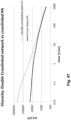
- the BDDE crosslinked HA or MA-HA is not further crosslinked to rhCollagen or MA-rhCollagen, creating what is called an interpenetrated network ( FIG. 49 left-hand side).
- the plant-derived collagen comprises rhCollagen.
- the plant-derived collagen is obtained from a genetically modified plant.
- the genetically modified plant is a genetically modified plant selected from the group consisting of tobacco, maize, alfalfa, rice, potato, soybean, tomato, wheat, barley, canola, carrot, and cotton.
- the genetically modified plant is a tobacco plant.
- the genetically modified plant comprises an expressible sequence of at least one gene sequence of human deoxyribonucleic acid (DNA) selected from the group consisting of: COL1, COL2, P4H-alpha, P4H-beta, and LH3.
- the plant-derived human collagen comprises at least modified one human collagen alpha-1 chain as set forth in SEQ ID NO: 3 and as expressed in the genetically modified plant; and at least one modified human collagen alpha-2 chain as set forth in SEQ ID NO: 6 and as expressed in the genetically modified plant; and wherein the genetically modified plant further expresses an exogenous prolyl-4-hydroxylase (P4H).
- the method further comprises expressing an exogenous polypeptide selected from the group consisting of lysyl hydroxylase (LH), protease N, and protease C.
- LH lysyl hydroxylase
- protease N ase N
- protease C a polypeptide selected from the group consisting of lysyl hydroxylase (LH), protease N, and protease C.
- LH lysyl hydroxylase
- protease N protease N
- protease C protease C.
- the human collagen alpha-1 chain is encoded by a sequence as set forth in SEQ ID NO: 1.
- the human collagen alpha-2 chain is encoded by a sequence as set forther in SEQ ID NO: 4.
- the exogenous P4H is a mammalian P4H.
- the exogenous P4H is a human P4H.
- the method further comprises targeting the human collagen alpha-1 to a vacuole of the plant or the genetically modified plant and digesting it with ficin.
- the method further comprises targeting the human collagen alpha-2 to a vacuole of the plant or the genetically modified plant and digesting it with ficin.
- the plant-derived human collagen is atelocollagen.
- the plant-derived human collagen is atelocollagen having an amino acid (AA) sequence derived from SEQ ID NO: 1 and SEQ ID NO: 4.
- Atelocollagen is derived by enzymatic digestion (e.g., with ficin) of procollagen, which is the product of SEQ ID NO: 1 and SEQ ID NO: 4.
- the photoinitiator induces polymerization of the polymerizable solution in response to visible light.
- the visible light has a wavelength of 390-800 nm.
- the photoinitiator is selected from the group consisting of Eosyn Y+ triethanolamine, riboflavin, and the like.
- the photoinitiator induces polymerization of the polymerizable solution in response to ultraviolet (uv) light.
- the photoinitiator is selected from the group consisting of lithium phenyl-2,4,6-trimethylbenzoylphosphinate (LAP) or 1-[4 2-hydroxy-1-[4-(2-hydroxyethoxy)phenyl]-2-methylpropan-1-one (IRGACURE ® 2959).
- the photoinitiator induces polymerization of the polymerizable solution in response to infrared light.
- the polymerizable solution is introduced into the tissue space via a hollow needle or canula in the range of 27 gauge to 33 gauge.
- the polymerizable solution in the tissue space is molded or sculpted into the desired configuration via manual massage.
- the polymerizable solution in the tissue space is molded or sculpted into the desired configuration using a molding or sculpting implement.
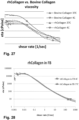
- the polymerizable solution in the tissue space is essentially non-gellable at room temperature. In another aspect, the polymerizable solution in the tissue space is essentially non-gellable at 37°C. In yet another aspect, the polymerizable solution comprising the plant-derived human collagen has a reduced viscosity at room temperature in comparison with an analogous polymerizable solution comprising a tissue-extracted human or animal-derived collagen, for example but not limited to bovine or procine or equine collagen in the same concentration and fomulation. In another aspect, the polymerizable solution comprising the plant-derived human collagen has a reduced viscosity at 37°C in comparison with an analogous polymerizable solution comprising a tissue-extracted human or animal-derived collagen in the same concentration and formulation.
- animal-derived collagen may encompass bovine or procine or equine collagen or rat tail collagen and is in contrast to human derived collagen.
- the polymerizable solution comprising the plant-derived human collagen is introduced into the tissue space with a reduced force at room temperature as compared with an analogous polymerizable solution comprising a tissue-extracted human or animal-derived collagen in the same concentration and formulation.
- the polymerizable solution comprising the plant-derived human collagen is introduced into the tissue space with a reduced force at 37°C as compared with an analogous polymerizable solution comprising a tissued-extracted human or animal-derived collagen in the same concentration and formulation.
- a polymerizable solution injected into a tissue space under an epidermis to reduce lines, folds, fine lines, wrinkles, or scars
- the polymerizable solution comprising a methacrylated or thiolated cross-linkable, plant-derived human collagen and a photoinitiator to induce polymerization prior to, on concomitant with, application of visible light, and molding or sculpting the polymerizable solution into a desired configuration to reduce lines, folds, fine lines, wrinkles, or scars.
- the polymer solution further comprises a filler comprising a hyaluronic acid (HA) or a modified derivative thereof, a poly(vinyl alcohol) (PVA) or a modified derivative thereof, polyethylene glycol (PEG) or a modified derivative thereof, oxidized cellulose (OC) or a modified derivative thereof, polymethylmethacrylate (PMMA) microspheres or a modified derivative thereof, tricalcium phosphate (TCP) or a modified derivative thereof, calcium hydroxylapatite (CaHA) or a modified derivative thereof, carboxymethylcellulose or a modified derivative thereof, crystalline nanocellulose (CNC) or a modified derivative thereof, or a combination of any of these.
- HA hyaluronic acid
- PVA poly(vinyl alcohol)
- PEG polyethylene glycol
- OC oxidized cellulose
- PMMA polymethylmethacrylate
- TCP tricalcium phosphate
- CaHA calcium hydroxylapatite
- CNC crystalline nanocellulose
- Modified derivatives include, but are not limited to, photopolymerizable versions of, e.g., HA, PVA, PEG, OC, PMMA, TCP, CaHA, carboxymethylceullose, or CNC. Modifications include, but are not limited to, methacrylation or thiolation.
- a method of filling a tissue space under an epidermis comprising:
- the instant technology relates, in part, to cosmetic and medical collagen-based polymerizable fillers that form a moldable composition, polymerizable on photoactivation with a light source, such as a visible light source.
- the polymerizable filler comprises a cross-linkable, plant-derived human collagen along with a photoinitiator.
- the present technology of interest has the advantage of permitting in situ formation of a custom, contoured dermal filler or implant, typically without invasive surgical intervention or general anesthesia.
- the collagen-based polymerizable solution is introduced into a tissue space under the skin (that is, under the epidermis), and polymerization is induced by exposure to visible light applied to the skin surface, that is, from outside of the body or outside of the skin, or to the epidermis.
- the in situ polymerization methods provide cosmetic and medical corrective and/or enhancement procedures using a polymerizable solution comprising a polymer component capable of forming an insoluble crosslinked crosslinking network on activation with a visible light source.
- a dermal filler or cellular growth promoting scaffold disclosed herein is for cosmetic use. In some aspects, a dermal filler or cellular growth promoting scaffold disclosed herein is for medical corrective use. In some aspects, a dermal filler or cellular growth promoting scaffold disclosed herein is for use in an enhancement procedure, for example but not limited to tissue augmentation. In some aspects, a double crosslinked dermal filler disclosed herein is for cosmetic use. In some aspects, a double crosslinked dermal filler disclosed herein is for medical corrective use. In some aspects, a double crosslinked dermal filler disclosed herein is required as a result of a medical or or dental (gum implants/gum disease) condition.
- a double crosslinked dermal filler disclosed herein is required as a result of a medical condition requiring skin augmentation.
- a double crosslinked dermal filler disclosed herein is for use in an enhancement procedure, for example but not limited to tissue augmentation.
- a photocurable dermal filler disclosed herein is for cosmetic use.
- a photocurable dermal filler disclosed herein is for medical corrective use.
- a photocurable dermal filler disclosed herein is required as a result of a medical or or dental (gum implants/gum disease) condition.
- a photocurable dermal filler disclosed herein is required as a result of a medical condition requiring skin augmentation.
- a photocurable dermal filler disclosed herein is for use in an enhancement procedure, for example but not limited to tissue augmentation.
- a cellular growth promoting scaffold disclosed herein is for cosmetic use.
- a cellular growth promoting scaffold disclosed herein is for medical corrective use.
- a cellular growth promoting scaffold dermal filler disclosed herein is required as a result of a medical or or dental (gum implants/gum disease) condition.
- a cellular growth promoting scaffold dermal filler disclosed herein is required as a result of a medical condition requiring skin augmentation.
- medical corrective use includes treating tendinitis.
- a cellular growth promoting scaffold disclosed herein is for use in an enhancement procedure, for example but not limited to tissue augmentation.
- tissue augmentation is of a skin tissue.
- use of the dermal fillers including cellular growth promoting scaffolds disclosed herein is in a human.
- use of the dermal fillers including cellular growth promoting scaffolds disclosed herein in a human reduces lines, folds, fine lines, wrinkles, or scars, or any combination thereof.
- the reduction of lines, folds, fine lines, wrinkles, or scars, or any combination thereof is for cosmetic purposes.
- the reduction of lines, folds, fine lines, wrinkles, or scars, or any combination thereof is for cosmetic purposes.
- use of the dermal fillers including cellular growth promoting scaffolds disclosed herein in a human augments tissue, for example but not limited to, epidermal or dermal tissue.
- tissue augmentation is for cosmetic purposes.
- tissue augmentation is for medical treatment.
- tissue augmentation is part of an enhancement procedure.
- tissue augmentation is part of a skin enhancement procedure.
- tissue augmentation is required as a result of any medical or dental (gum disease/gum implants) condition.
- a dermal filler for use described herein comprsises an interpenetrated (IPN) network or a semi-interpenetrated (Semi-IPN) network, in which the different components may be crosslined to themselves but are not crosslinked to each other.
- an IPN or semi-IPN dermal filler comprises rhCollagen and a filler, such as hyaluronic acid (HA), poly(vinyl alcohol) (PVA), polyethylene glycol (PEG), oxidized cellulose (OC), or a derivative thereof, or a combination thereof.
- an IPN or semi-IPN comprises rhCollagen and a crosslinked HA.
- an IPN or semi-IPN comprises a rhCollagen derivative, for example but not limited to a methacrylated rhCollagen or a thiol rhCollagen and or a derivative of a filler, for example but not limited to a methacrylated HA, PVA, PEG, or OC, or a thiolated HA, PVA, PEG, or OC, or a combination thereof.
- a rhCollagen derivative for example but not limited to a methacrylated rhCollagen or a thiol rhCollagen and or a derivative of a filler, for example but not limited to a methacrylated HA, PVA, PEG, or OC, or a thiolated HA, PVA, PEG, or OC, or a combination thereof.
- an IPN or Semi-IPN network or a double crosslinked network comprising a dermal filler comprises a ratio of filler, for example but not limited to HA, PVA, PEG, or OC to rhCollagen of 1:1, 2:1, 3:1, 4:1, 5:1, 6:1, 1:2 , 1:3, 1:4, 1:5, 1:6, or 0:1.
- an IPN or Semi-IPN network comprising a dermal filler comprises a ratio of MA-filler, for example but not limited to HA, PVA, PEG, or OC to rhCollagen is 1:1, 2:1, 3:1, 4:1, 5:1 , 6:1, 1:2 , 1:3, 1:4, 1:5, 1:6, or 0:1.
- an IPN or Semi-IPN network comprising a dermal filler comprises a ratio of filler, for example but not limited to HA, PVA, PEG, or OC to MA-rhCollagen is 1:1, 2:1, 3:1, 4:1, 5:1, 6:1, 1:2, 1 3, 1:4, 1:5, 1:6, or 0:1.
- an IPN or Semi-IPN network comprising a dermal filler comprises a ratio of MA-filler to MA-rhCollagen is 1:1, 2:1, 3:1, 4:1, 5:1, 6:1, 1:2, 1:3, 1:4, 1:5, 1:6, or 0:1.
- an IPN or Semi-IPN or double crosslinked network comprising a dermal filler comprises a ratio of HA to rhCollagen of 1:1, 2:1, 3:1, 4:1, 5:1, 6:1, 1:2 , 1:3, 1:4, 1:5, 1:6, or 0:1.
- an IPN or Semi-IPN or double crosslinked network comprising a dermal filler comprises a ratio of MA-HA to rhCollagen is 1:1, 2:1, 3:1, 4:1, 5:1, 6:1, 1:2, 1:3, 1:4, 1:5, 1:6, or 0:1.
- an IPN or Semi-IPN network comprising a dermal filler comprises a ratio of HA to MA-rhCollagen is 1:1, 2:1, 3:1, 4:1, 5:1, 6:1, 1:2 , 1:3, 1:4, 1:5, 1:6, or 0:1.
- an IPN or Semi-IPN network comprising a dermal filler comprises a ratio of MA-HA to MA-rhCollagen is 1:1, 2:1, 3:1, 4:1, 5:1, 6:1, 1:2 , 1:3, 1:4, 1:5, 1:6, or 0:1.
- an IPN or Semi-IPN or double crosslinked network comprising a dermal filler comprises a ratio of filler to rhCollagen of 1:1, 2:1, 3:1, 4:1, 5:1, 6:1, 1:2 , 1:3, 1:4, 1:5, 1:6, or 0:1.
- an IPN or Semi-IPN or double crosslinked network comprising a dermal filler comprises a ratio of MA-HA, or MA-PVA, or MA-PEG, or MA-OC to rhCollagen is 1:1, 2:1, 3:1, 4:1, 5:1, 6:1, 1:2 , 1:3, 1:4, 1:5, 1:6, or 0:1.
- an IPN or Semi-IPN network comprising a dermal filler comprises a ratio of MA-HA, or MA-PVA, or MA-PEG, or MA-OC to MA-rhCollagen is 1:1, 2:1, 3:1, 4:1, 5:1, 6:1, 1:2 , 1:3, 1:4, 1:5, 1:6, or 0:1.
- an IPN or Semi-IPN network comprising a dermal filler comprises a ratio of MA-HA, or MA-PVA, or MA-PEG, or MA-OC to MA-rhCollagen is 1:1, 2:1, 3:1, 4:1,5:1, 6:1, 1:2,1:3,1:4, 1:5, 1:6, or 0:1.
- an IPN or Semi-IPN network comprising a dermal filler or a double crosslinked dermal filler comprises a cellular growth promoting scaffold.
- a dermal filler for use described herein comprsises an photocurable dermal filler, in which at least one of the componenent, for example but not limited to rhCollagen comprises a methacrylate-rhCollagen derivative or a thiol-rhCollagen derivative.
- a curable dermal filler comprises rhCollagen and a filler, such as hyaluronic acid (HA), poly(vinyl alcohol) (PVA), polyethylene glycol (PEG), oxidized cellulose (OC), or a derivative thereof, or a combination thereof.
- photocurable dermal filler comprises MA-rhCollagen and a HA or a derivative thereof.
- photocurable dermal filled comprises a rhCollagen derivative, for example but not limited to a methacrylated rhCollagen or a thiol rhCollagen and or a derivative of a filler, for example but not limited to a methacrylated HA, PVA, PEG, or OC, or a thiolated HA, PVA, PEG, or OC, or a combination thereof.
- a rhCollagen derivative for example but not limited to a methacrylated rhCollagen or a thiol rhCollagen and or a derivative of a filler, for example but not limited to a methacrylated HA, PVA, PEG, or OC, or a thiolated HA, PVA, PEG, or OC, or a combination thereof.
- photocurable dermal filler comprises a ratio of filler, for example but not limited to HA, PVA, PEG, or OC, or a derivative thereof, to rhCollagen of 1:1, 2:1, 3:1, 4:1, 5:1, 6:1, 1:2 , 1:3, 1:4, 1:5, 1:6, or 0:1.
- a photocurable dermal filler comprises a ratio of filler, for example but not limited to HA, PVA, PEG, or OC, or a derivative thereof, to MA-rhCollagen of 1:1, 2:1, 3:1, 4:1, 5:1, 6:1, 1:2 , 1:3, 1:4,1:5, 1:6, or 0:1.
- a photocurable dermal filler comprises a ratio of filler, for example but not limited to HA, PVA, PEG, or OC to Thiol-rhCollagen is 1:1, 2:1, 3:1, 4:1, 5:1, 6:1, 1:2 , 1:3,1:4, 1:5, 1:6, or 0:1.
- a photocurable dermal filler comprises a ratio of MA-filler to MA-rhCollagen is 1:1, 2:1, 3:1, 4:1, 5:1, 6:1, 1:2 , 1:3, 1:4, 1:5, 1:6, or 0:1.
- a photocurable dermal filler comprises a ratio of HA to MA-rhCollagen of 1:1,2:1, 3:1, 4:1, 5:1, 6:1, 1:2, 1:3, 1:4, 1:5, 1:6, or 0:1, 1:3, 1:4, 1:5, or 0:1.
- a photocurable dermal filler comprises a ratio of MA-HA to MA-rhCollagen is 1:1, 2:1, 3:1, 4:1, 5:1, 6:1, 1:2 ,1:3, 1:4, 1:5, 1:6, or 0:1.
- a photocurable dermal filler comprises a ratio of PVA, PEG, or OC to MA-rhCollagen is 1:1, 2:1, 3:1, 4:1, 5:1, 6:1, 1:2 , 1:3, 1:4, 1:5, 1:6, or 0:1.
- a photocurable dermal filler comprises a ratio of MA-PVA, MA-HA-, or OC to MA-rhCollagen is 1:1, 2:1, 3:1, 4:1, 5:1, 6:1, 1:2 , 1:3, 1:4, 1:5, 1:6, or 0:1.
- the HA components of a photocurable dermal filler comprises a crosslinked HA or a crosslinked MA-HA.
- range format various aspects of dermal fillers and their uses, may be presented in a range format. It should be understood that the description in range format is merely for convenience and brevity and should not be construed as an inflexible limitation on the scope of the invention. Accordingly, the description of a range should be considered to have specifically disclosed all the possible sub ranges as well as individual numerical values within that range. For example, description of a range such as from 1:1 to 6:1 should be considered to have specifically disclosed sub ranges such as from 1.1:1, 1.2:1, 1.3:1 to 5.9:1, from 1:1.1 to 1:1.9, etc., as well as individual numbers within that range and fractions thereof, for example, 1, 2, 3, 4, 5, and 6. This applies regardless of the breadth of the range.
- the instant disclosure provides a dermal filler that for a tissue space under an epidermis comprising a cross-linkable, plant-derived human collagen, either alone or together with a filler, such as hyaluronic acid (HA), poly(vinyl alcohol) (PVA), polyethylene glycol (PEG), oxidized cellulose (OC), or a combination thereof, which may be crosslinked, to provide a dermal filler that forms a water insoluble, crosslinked polymer preparation in situ on visible light activation in the presence of a photoinitiator.
- HA hyaluronic acid
- PVA poly(vinyl alcohol)
- PEG polyethylene glycol
- OC oxidized cellulose
- the collagen is methacrylated or thiolated.
- the dermal filler provide for uses described herein forms an IPN or semi-IPN network. In some aspects, the dermal filler provide for uses described herein forms a double crosslinked network.
- a double crosslinked dermal filler provided for uses described herein comprsises rhCollagen that is crosslinked to a crosslinked filler, such as crosslinked hyaluronic acid (HA), crosslinked poly(vinyl alcohol) (PVA), crosslinked polyethylene glycol (PEG), or crosslinked oxidized cellulose (OC), or a crosslinked derivative thereof, or a combination thereof.
- a double crosslinked dermal filler provided for uses described herein comprsises rhCollagen that is further crosslinked to methacrylated or thiolated-crosslinked filler, such as HA, PVA, PEG, or OC.
- the ratio of crosslinked filler to rhCollagen is 1:1, 2:1, 3:1, 4:1, 5:1, 6:1, 1:2 , 1:3, 1:4, 1:5, 1:6, or 0:1.
- the ratio of MA-filler to rhCollagen is 1:1, 2:1,3:1, 4:1, 5:1, 6:1, 1:2 , 1:3, 1:4, 1:5, 1:6, or 0:1.
- the ratio of crosslinked filler to MA-rhCollagen is 1:1, 2:1, 3:1, 4:1, 5:1, 6:1, 1:2 , 1:3, 1 :4, 1:5, 1:6, or 0:1.
- the ratio of MA- filler to MA-rhCollagen is 1:1, 2:1, 3:1, 4:1, 5:1, 6:1, 1:2 1:3, 1:4, 1:5, 1:6, or 0:1.
- the ratio of thiolated-filler to rhCollagen is 1:1, 2:1, 3:1, 4:1, 5:1, 6:1, 1:2 , 1:3, 1:4, 1:5, 1:6, or 0:1.
- the ratio of crosslinked filler to thiolated-rhCollagen is 1:1, 2:1, 3:1, 4:1, 5:1, 6:1, 1:2 , 1:3, 1:4, 1:5, 1:6, or 0:1.
- the ratio of thiolated-filler to thiolated-rhCollagen is 1:1, 2:1, 3:1, 4:1, 5:1, 6:1, 1:2 , 1:3, 1:4,1:5, 1:6, or 0:1.
- crosslinked HA or crosslinked MA-HA is further crosslinked to rhCollagen or methacrylated rhCollagen or thiol rhCollagen, resulting in a double crosslinked dermal filler.
- the ratio of crosslinked HA to rhCollagen or methacrylated rhCollagen or thiol rhCollagen is 1:1, 2:1, 3:1, 4:1, 5:1, 6:1, 1:2 , 1:3, 1:4, 1:5, 1:6, or 0:1.
- the ratio of crosslinked MA-HA to rhCollagen or methacrylated rhCollagen or thiol rhCollagen is 1:1, 2:1, 3:1, 4:1, 5:1, 6:1, 1:2 , 1:3, 1:4, 1:5, 1:6, or 0:1.
- the ratio of crosslinked MA-HA to rhCollagen or methacrylated rhCollagen or thiol rhCollagen is 1:1, 2:1, 3:1, 4:1, 5:1, 6:1, 1:2 , 1:3, 1:4, 1:5, 1:6, or 0:1.
- crosslinked PVA, PEG, or OC or crosslinked MA-PVA, MA-PEG, or MA-OC is further crosslinked to rhCollagen or methacrylated rhCollagen, resulting in a double crosslinked dermal filler.
- the ratio of crosslinked PVA, PEG, or OC to rhCollagen is 1:1, 2:1, 3:1, 4:1, 5:1, 6:1, 1:2 , 1:3, 1:4, 1:5, 1:6, or 0:1.
- the ratio of crosslinked MA- PVA, MA-PEG, or MA-OC to rhCollagen is 1:1, 2:1, 3:1, 4:1, 5:1, 6:1, 1:2 , 1:3, 1:4, 1:5, 1:6, or 0:1.
- the ratio of crosslinked PVA, PEG, or OC to MA-rhCollagen is 1:1, 2:1, 3:1, 4:1, 5:1, 6:1, 1:2 , 13, 1:4, 1 :5, 1:6, or 0:1.
- the ratio of crosslinked MA-PVA, MA-PEG, or MA-OC to MArhCollagen or thiol rhCollagen is 1:1, 2:1, 3:1, 4:1, 5:1, 6:1, 1:2 , 1:3, 1:4, 1:5, 1:6, or 0:1.
- crosslinked thiol- PVA, thiol-PEG, or thiol-OC is further crosslinked to rhCollagen or methacrylated rhCollagen, resulting in a double crosslinked dermal filler.
- the ratio of crosslinked thiol- PVA, thiol-PEG, or thiol-OC to rhCollagen is 1:1, 2:1, 3:1, 4:1, 5:1, 6:1, 1:2 , 1:3, 1:4, 1:5, 1:6, or 0:1.
- the ratio of crosslinked thiol-PVA, thiol-PEG, or thiol-OC to MArhCollagen or thiol rhCollagen is 1:1, 2:1,3:1,4:1, 5:1, 6:1, 1:2,1:3,1:4, 1:5, 1:6, or 0:1.
- any water-soluble coupling agent may be used that can crosslink hyaluronic acid to collagen.
- a coupling agent include carbodiimides such as N,N'-dicyclohexylcarbodiimide (DCC), N,N'-diisopropylcarbodiimide (DIC), or 1 -ethyl-3-(3-dimethylaminopropyl)carbodiimide (EDC), etc.
- Carbodiimide coupling agents may facilitate ester or amide bond formation without becoming part of the linkage.
- an ester bond or an amide bond may comprise atoms from a carboxylate group from one of hyaluronic acid or collagen, and a hydroxyl group or an amine group from the other.
- other coupling agents that become part of the crosslinking group may be used.
- the concentration of a coupling agent may vary.
- a coupling agent may be present at about 2 mM to about 150 mM, about 2 mM to about 50 mM, about 20 mM to about 100 mM, or about 50 mM.
- the coupling agent is EDC that is present at a concentration of about 20 mM to about 100 mM, about 2 mM to about 50 mM, or about 50 mM.
- the coupling agent is EDC that is present at an amount of EDC equal to 10 to 100-fold the number of free amines in the rhcollagen. In some aspects, the coupling agent is EDC that is present at an amount of EDC equal to 50-fold the number of free amines in the rhcollagen. Increasing the carbodiimide concentration up to about 50 mM may result in a crosslinked macromolecular matrix with greater hydrogel stiffness and/or less swelling.
- a dermal filler comprising double crosslinking wherein the filler is crosslinked to itself and then also crosslinked to the rhCollagen, is distinct from a dermal filler that comprises direct cross linking of collagen and HA using a single type of cross linker in a single reaction.
- the properties of such dermal fillers differ.
- the present polymerizable solution can be used to block or fill various lumens and voids just below a skin surface.
- the instant technology provides a method of tissue augmentation in a host, such as a human patient, wherein said polymerizable solution of interest is introduced at a site of interest using methods known in the art, such as injecting the polymerizable solution at or in a tissue site in need of augmentation and once applied, exposing the overlying body surface to a visible light to cause polymerization of the deposited polymerizable solution.
- “Augmentation” means the repair, prevention or alleviation of defects, particularly defects due to loss or absence of tissue, by providing, augmenting, or replacing such tissue with a polymer or network or interest. Augmentation is also meant to include supplementation of a natural structure or feature, that is, a building of adding to an existing body part, for example, to increase the size thereof, such as lips, nose, breast, ears, portions of organs, chin, cheeks and so on.
- tissue augmentation can include the filling or reduction of lines, folds, wrinkles, scars, minor facial depressions, cleft lips, superficial wrinkles and the like, such as, in or on the face, neck, hands, feet, fingers, and toes.; the correction of minor deformities due to aging or disease, including in the hands and feet, fingers and toes; the augmentation of the vocal cords or glottis to rehabilitate speech; the dermal filling of sleep lines and expression lines; the replacement of dermal and subcutaneous tissue lost due to aging; the augmentation of lips; the filling of wrinkles and the orbital groove around the eye; the augmentation of the breast; the augmentation of the chin; the augmentation of the check and/or nose; the filling of indentations in soft tissue, dermal or subcutaneous, due to, e.g., overzealous liposuction or other trauma; the filling of acne or traumatic scars and rhytids; the filling of nasolabia
- the polymerizable solution of interest in some aspects, encompasses a polymerizable solution which has a viscosity suitable for ready extrusion through a delivery means, such as a fine surgical needle (e.g., needles having a gauge of at least 27 gauge, at least 33 gauge or finer) at the temperature of use.
- a solution that is, "injectable” is one having a texture and viscosity which permits flow through a suitable delivery device, such as, a surgical needle, other surgical instrument, or other delivery means such as an equipment used in endoscopic or percutaneous discectomy procedures.
- the polymerizable solution of interest thus is injectable through a suitable applicator, such as a catheter, a cannula, a needle, a syringe, tubular apparatus and so on, as known in the art.
- the polymerizable solution can be manipulated, massaged, molded, or sculpted into the desired contours in the tissue space, typically after photoinitation of polymerization has been triggered.
- the manipulation, massage, molding, or sculpting takes place during the gelation process.
- the polymerizable, polymerizing, or partially polymerized solution can be shaped by external manipulation, using, for example, a shaping means, such as, a surgical depressor or other tool or instrument with a flat or curved surface, fingers, the palm, a knuckle and so on.
- the genetically modified, cross-linkable, plant-derived human collagen of the present method provides an improved collagen-containing dermal filler and improved methods of dermal filling by enabling the use of smaller gauge needles and a decreased force of injection, as well as by its ability to fill smaller tissue spaces.
- the "expression force" of an injection includes the force required for injection from the needle or cannula.
- a “gel” is a semirigid slab or cylinder of an organic polymer used as a medium for the separation of macromolecules.
- a gel is a substantially dilute cross-linked system, which exhibits no flow when in the steady-state. Gels are principally liquid by weight yet behave as partly as solids due to a three-dimensional cross-linked network within the liquid while retaining some properties of a liquid, such as deformability. It is the crosslinking within the fluid that gives a gel its structure (hardness) and contributes to the adhesive stick (tack). As a result, gels can be viewed as a dispersion of liquid molecules within a solid, i.e., liquid particles dispersed within a solid medium. "Gelation time” is the time it takes for the polymerizable solution to form a gel.
- hydrogel is a network of polymer chains that are hydrophilic, sometimes found as a colloidal gel in which water is the dispersion medium. Hydrogels are highly absorbent (e.g., able to contain over 90% water) polymeric networks and have a flexibility very similar to natural tissue, due to their significant water content.
- a “polymer” is a macromolecule composed of a series of repeating subunits.
- the basic repeating subunit is known as a "monomer.”
- polymers are known for their tensile strength and elasticity.
- a “photoinitiator” is a molecule that creates reactive species (free radicals, cations or anions) when exposed to radiation (UV or visible).
- the photoinitiator of the present invention induces polymerization of the polymerizable solution.
- photoinitiators useful in the present method include, but are not limited to lithium phenyl-2,4,6-trimethylbenzoylphosphinate (LAP), 1-[4 2-hydroxy-1-[4-(2-hydroxyethoxy)phenyl]-2-methylpropan-1-one (IRGACURE ® 2959), Eosin Y + Triethanolamin, or riboflavin.
- Methacrylate is an ester or salt derived from methacrylic acid. Methacrylates are common monomers in polymer plastics, forming the acrylate polymers. Addition of methacrylate groups to collagen results in collagen methacrylate (rhCollagen-MA or MA-rhCollagen) which is photocurable. Addition of methacrylate groups to hyaluronic acid (HA) results in hyaluronic acid-methacrylate (HAMA or MA-HA) which is photocurable.
- collagen methacrylate rhCollagen-MA or MA-rhCollagen
- HA hyaluronic acid
- HAMA or MA-HA hyaluronic acid-methacrylate
- rhCollagen used in a dermal filler described herein comprises a combination of non-modified rhCollagen and MA-rhCollagen.
- the ratio of non-modified rhCollagen to MA-rhCollagen is about 1:0, 1:1, 1:2,1:3,1:4, 0:1,2:1,3:1, or 4:1.
- the final concentration range of MA-rhCollagen comprises between about 0-12 mg/ml. In some aspects, the final concentration range of non-modified rhCollagen comprises between about 0-12 mg/ml.
- the final concentration range of MA- rhCollagen comprises between about 0-12 mg/ml, and the final concentration range of non-modified rhCollagen comprises between about 0-12 mg/ml. In some aspects, the final concentration range of MA-rhCollagen comprises between about 0 mg/ml-6 mg/ml. In some aspects, the final concentration range of non-modified rhCollagen comprises between about 0 mg/ml-6 mg/ ml. In some aspects, the final concentration of MA-rhCollagen comprises about 0, 1, 2, 3, 4, 5, 6, 7, 8, 9, 10, 11, or 12 mg/ml. In some aspects, the final concentration of non-modified-rhCollagen comprises about 0, 1, 2, 3, 4, 5, 6, 7, 8, 9, 10, 11, or 12 mg/ml.
- a thiol is an organosulfur compound that contains a carbon-bonded sulfhydryl (R-SH) group (where R represents an alkyl or other organic substituent). Thiolation of collagen can improve cohesion and mucoadhesion properties and affects swelling ability.
- Light is a form of electromagnetic radiation.
- “Visible light” is light having a wavelength in the rangel of 380-800 nm or at least 390-700 nm.
- “Ultraviolet light” has shorter wavelengths, while “infrared” has longer wavelengths.
- An illuminating means can be a light source suitable for activating the photoinitiator used, and which can activate the photoinitiator from outside of the body. While thermal initiators can be used and thus, an infrared source used, and ultraviolet-activated initiators can be used, and thus, a suitable ultraviolet source used, a preferred light source is a white light source. Thus, a suitable photoinitiator is used, so that the maximum absorption of the initiator and the light source are tuned. As mentioned hereinabove, one such visible light source is light-emitting diode (LED).
- LED light-emitting diode
- suitable light sources can be used so long as gelation occurs in the body, at the site, under the skin surface and so on, such as, by applying the electromagnetic radiation to the body, to the site as needed, or from above the skin surface.
- the electromagnetic radiation is applied at an intensity, for a time and for a duration that enables gelation.
- the light source can be situated above the skin surface or directly on the skin surface, typically above the location of the molded or sculpted polymerizable solution.
- the monomer solution of some aspects can contain any of a variety of other materials, such as, inert materials, such as, preservatives, fillers, excipients or diluents, pharmacologically active molecules or agents, such as a small molecule or a biological, cells and so on, as known in the pharmaceutic arts.
- inert materials such as, preservatives, fillers, excipients or diluents
- pharmacologically active molecules or agents such as a small molecule or a biological, cells and so on, as known in the pharmaceutic arts.
- a suitable inert or biologically active agent can be added to the monomer solution.
- the active agent may exert a pharmacologic action locally at the site or in the vicinity of the polymerized or networked structure of interest, or can be released from the formed scaffold, matrix or network to move though the adjoining tissue spaces or may enter the circulatory system for a less local effect.
- the polymeriziable solution methods of interest also can be used in combination with other dermatology, orthopedic, cosmetic, and other medical treatments.
- the polymerizable solution is mixed with a known filler to provide a composition which is moldable, contourable, has a long residence time and so on.
- fillers include, but are not limited to, hyaluronic acid (HA), poly(vinyl alcohol) (PVA), polyethylene glycol (PEG), oxidized cellulose (OC), or modified derivatives thereof, or a combination thereof.
- the polymerizable solution in a semiliquid phase is independently injected into the dermis as is a known filler also in a semiliquid phase, that together will provide a composition which is moldable, contourable, has a long residence time and so on.
- fillers examples include, but are not limited to, hyaluronic acid (HA), poly(vinyl alcohol) (PVA), polyethylene glycol (PEG), oxidized cellulose (OC), or modified derivatives thereof, or a combination thereof.
- HA hyaluronic acid
- PVA poly(vinyl alcohol)
- PEG polyethylene glycol
- OC oxidized cellulose
- the polymerizable solution in a semiliquid phase is injected into the dermis as a mixture that together will provide a composition which is moldable, contourable, has a long residence time and so on.
- fillers that may be injected mixed with rhCollagen include, but are not limited to, hyaluronic acid (HA), poly(vinyl alcohol) (PVA), polyethylene glycol (PEG), oxidized cellulose (OC), or modified derivatives thereof, or a combination thereof.
- HA hyaluronic acid
- PVA poly(vinyl alcohol)
- PEG polyethylene glycol
- OC oxidized cellulose
- a cellular growth promoting scaffold in a tissue space under an epidermis comprising introducing a solution into the tissue space, the solution comprising: (a) a plant-derived human collagen; and (b) at least one growth factor or source thereof.
- the source of the at least one growth factor comprises a plasma or a platelet-rich plasma.
- the cellular growth promoting scaffold promotes healing or replacement due to degradation or injury of a collagen-comprising tissue.
- the collagen-comprising tissue is selected from the group consisting of a tendon, a ligament, skin, a cornea, a cartilage, a blood vessel, an intestine, an intervertebral disc, a muscle, a bone, or a tooth.
- the cellular growth promoting scaffold promotes healing of tendinitis.
- the plant-derived collagen comprises rhCollagen.
- the plant-derived collagen is obtained from a genetically modified plant.
- the genetically modified plant is a genetically modified plant selected from the group consisting of tobacco, maize, alfalfa, rice, potato, soybean, tomato, wheat, barley, canola, carrot, and cotton.
- the genetically modified plant is a tobacco plant.
- the genetically modified plant comprises an expressible sequence of at least one gene sequence of human deoxyribonucleic acid (DNA) selected from the group consisting of: COL1, COL2, P4H-alpha, P4H-beta, and LH3.
- DNA human deoxyribonucleic acid
- the plant-derived human collagen comprises at least modified one human collagen alpha-1 chain as set forth in SEQ ID NO: 3 and as expressed in the genetically modified plant; and at least one modified human collagen alpha-2 chain as set forth in SEQ ID NO: 6 and as expressed in the genetically modified plant; and the genetically modified plant further expresses an exogenous prolyl-4-hydroxylase (P4H).
- P4H prolyl-4-hydroxylase
- the method further comprises expressing an exogenous polypeptide selected from the group consisting of lysyl hydroxylase (LH), protease N, and protease C.
- the human collagen alpha-1 chain is encoded by a sequence as set forth in SEQ ID NO: 1.
- the human collagen alpha-2 chain is encoded by a sequence as set forth in SEQ ID NO: 2.
- the exogenous P4H is a mammalian P4H. In one particular aspect, the exogenous P4H is a human P4H.
- the method further comprises targeting the human collagen alpha- 1 to a vacuole of the plant or the genetically modified plant and digesting it with ficin. In one aspect, the method further comprises targeting the human collagen alpha-2 to a vacuole of the plant or the genetically modified plant and digesting it with ficin.
- the plant-derived human collagen is atelocollagen.
- the term “dermal filler” encompasses in some aspects a solution comprising a plant-derived human collagen, for example a type 1 recombinant human collagen (rhCollagen) or a derivative thereof.
- the term “dermal filler” also encompass in some aspects, a solution comprising a plant-derived human collagen, for example a type 1 recombinant human collagen (rhCollagen) or a derivative thereof, and a filler or a derivative thereof, or a crosslinked filler or a derivative thereof, having all the same meanings and qualities, wherein a dermal filler may be used to augment tissue structure, or may be used for reducing lines, folds, fine lines, wrinkles, or scars, or any combination thereof.
- dermal fillers described herein comprise different formulation, for example but not limited to:
- cellular growth promoting scaffold encompasses dermal fillers comprising collagen and an autologous platelet rich plasma (PRP) fraction of blood or components thereof.
- PRP does not include “cells” but membranous vesicles (of cellular origin) containing growth factors and plasma components like fibrinogen and pro-thrombin.
- a "cellular growth promoting scaffold” encompasses dermal fillers comprising collagen and an autologous platelet rich plasma (PRP) fraction of blood or components thereof, and an at least additional filler component.
- a cellular growth promototing scaffold comprises a dermal filler that may be an IPN networks, a semi-IPN networks, or a double crosslinked dermal filler that further comprises an autologous platelet rich plasma (PRP) fraction of blood containing high concentration of platelets, wherein the autologous PRP fraction of blood containing high concentration of platelets, wherein the platelets release various types of growth factors (GFs) comprising vasculo-endothelial growth factor (VEGF), transforming beta growth factor (TGF-beta), platelet derived growth factor (PDGF), platelet derived epidermal growth factor (PDEGF), fibroblast growth factors (bFGF), epidermal growth factors (EGF) or hepatocyte growth factors (HGF), or a combination thereof.
- GFs growth factors comprising vasculo-endothelial growth factor (VEGF), transforming beta growth factor (TGF-beta), platelet derived growth factor (PDGF), platelet derived epidermal growth factor (PDEGF
- a cellular growth promototing scaffold comprises a dermal filler comprising an IPN networks, a semi-IPN networks, or a double crosslinked dermal filler that further comprises, and at least one growth factor comprising vasculo-endothelial growth factor (VEGF), transforming beta growth factor (TGF-beta), platelet derived growth factor (PDGF), platelet derived epidermal growth factor (PDEGF), fibroblast growth factors (bFGF), epidermal growth factors (EGF) or hepatocyte growth factors (HGF), or a combination thereof.
- a cellular growth promototing scaffold comprises a dermal filler comprising an IPN networks, a semi-IPN networks, or a double crosslinked dermal filler that further comprises, and a subset or fraction of PRP components.
- a dermal filler described herein comprises a polymerizable solution. In some aspects, a dermal filler described herein comprises a non-polymerizable solution. In some aspects, polymerization of a dermal filler solution occurs in vivo. In some aspects, components of a polymerizable dermal filler solution are injected together and then polymerized to form the cured dermal filler. In some aspects, components of a polymerizable dermal filler solution are injected independenetly and then polymerized to form the cured dermal filler.
- An example of the unique approach of independently injection dermal filler components may in some aspects comprising, injecting a filler into the skin dermis, for example but not limited to HA or a deriviative thereof, and separately injecting a methacrylated or thiol-rhCollagen into the skin dermis within close proximity of the first injection, wherein the components are in a semiliquid phase, and then crosslinking in situ.
- This approach in some aspects allows for easier injection and in situ sculturing prior to curing the dermal filler components together by light polymerization.
- a dermal filler provided herein is used in a method of soft tissue augmentation.
- a dermal filler provided herein enhances cell proliferation.
- a dermal filler provided and used in a method of soft tissue augmentation degrades over time.
- a dermal filler provided herein is used in a method of soft tissue augmentation wherein the dermal filler fills a tissue space under an epidermis.
- a dermal filler provided herein is used in a method of soft tissue augmentation, wherein the use reduces lines, folds, fine lines, wrinkles, or scars.
- the solution comprising the plant-derived human collagen has a reduced viscosity at room temperature in comparison with an analogous solution comprising a tissue-extracted human or animal-derived collagen in the same concentration and formulation.
- the solution comprising the plant-derived human collagen has a reduced viscosity at 37°C in comparison with an analogous solution comprising a tissue-extracted human or animal-derived collagen in the same concentration and formulation.
- the solution comprising the plant-derived human collagen is introduced into the tissue space with a reduced force at room temperature as compared with an analogous solution comprising a tissue-extracted human or animal-derived collagen in the same concentration and formulation.
- the solution comprising the plant-derived human collagen is introduced into the tissue space with a reduced force at 37°C as compared with an analogous solution comprising a tissued-extracted human or animal-derived collagen in the same concentration and formulation.
- the solution comprising the plant-derived human collagen has an increased scaffolding formation or promotes an increase in cellular growth as compared with an analogous solution comprising a tissue-extracted human or animal-derived collagen in the same concentration and formulation.
- a solution injected into a tissue space under an epidermis to induce a cellular growth promoting scaffold comprising a plant-derived human collagen and at least one growth factor or source thereof, to promote healing or replacement due to degradation or injury of a collagen-comprising tissue.
- the source of the at least one growth factor comprises a plasma or a platelet-rich plasma.
- the collagen-comprising tissue is selected from the group consisting of a tendon, a ligament, skin, a cornea, a cartilage, a blood vessel, an intestine, an intervertebral disc, a muscle, a bone, or a tooth.
- the cellular growth promoting scaffold promotes healing of tendinitis.
- the collagen-comprising tissue is skin.
- a genetically modified plant which is capable of expressing at least one type of a collagen alpha chain and accumulating it in a subcellular compartment which is devoid of endogenous P4H activity.
- the phrase "genetically modified plant” refers to any lower (e.g. moss) or higher (vascular) plant or a tissue or an isolated cell thereof (e.g., of a cell suspension) which is stably or transiently transformed with an exogenous polynucleotide sequence.
- plants include tobacco, maize, alfalfa, rice, potato, soybean, tomato, wheat, barley, canola, cotton, carrot as well as lower plants such as moss.
- collagen chain refers to a collagen subunit such as the alpha 1 or 2 chains of collagen fibers, preferably type I fibers.
- collagen refers to an assembled collagen trimer, which in the case of type I collagen includes two alpha 1 chains and one alpha 2 chain.
- a collagen fiber is collagen which is devoid of terminal propeptides C and N.
- subcellular compartment devoid of endogenous P4H activity refers to any compartmentalized region of the cell which does not include plant P4H or an enzyme having plant-like P4H activity.
- subcellular compartments include the vacuole, apoplast and cytoplasm as well as organelles such as the chloroplast, mitochondria and the like.
- Any type of collagen chain can be expressed by the genetically modified plant of the present invention.
- Examples include fibril-forming collagens (types I, II, III, V, and XI), networks forming collagens (types IV, VIII, and X), collagens associated with fibril surfaces (types IX, XII, and XIV), collagens which occur as transmembrane proteins (types XIII and XVII), or form 11-nm periodic beaded filaments (type VI).
- the collagen chain expressed is an alpha 1 and/or 2 chain of type I collagen.
- the expressed collagen alpha chain can be encoded by any polynucleotide sequences derived from any mammal.
- the sequences encoding collagen alpha chains are human and are set forth by SEQ ID NOs: 1 and 4.
- alpha collagen chains expressed in plants may or may not include their terminal propeptides (i.e. propeptide C and propeptide N).
- procollagen by plant proteolytic activity Processing of procollagen by plant proteolytic activity is different then normal processing in human and that propeptide C is removed by plant proteolytic activity although the cleavage site is unknown. Cleavage of the C propeptide may take place on a procollagen peptide before the assembly of trimmer (association of three C-Propeptides is essential for initiating the assembly of trimmers).
- N-propeptide cleavage by plant proteolytic activity takes place in mature plants but not in plantlets. Such cleavage removes 2 amino acids from the N telopeptide (2 out of 17).
- the C-propeptides maintain the procollagen soluble during its passage through the animal cell (Bulleid et al., 2000) and are expected to have a similar effect in the plant cell.
- propeptides are removed by procollagen N- and C-proteinases, thereby triggering spontaneous self-assembly of collagen molecules into fibrils. Removal of the propeptides by procollagen N- and C-proteinases lowers the solubility of procollagen by >10000-fold and is necessary and sufficient to initiate the self-assembly of collagen into fibers.
- telopeptides At the ends of the triple-helical domain, which ensure correct registration of the collagen molecules within the fibril structure and lower the critical concentration for self-assembly.
- Pepsin can cleave the propeptides during production of collagen.
- pepsin damages the telopeptides and as a result, pepsin-extracted collagen is unable to form ordered fibrillar structures.
- Protein disulfide isomerase that forms the beta subunit of human P4H was shown to bind to the C-propeptide prior to trimmer assembly thereby also acting as a molecular chaperone during chain assembly.
- human Procollagen I N-proteinase and Procollagen C-proteinase expressed in different plants may generate collagen that is more similar to the native human collagen and can form ordered fibrillar structures.
- the genetically modified plant of the present invention can also express the respective protease (i.e. C or N or both).
- protease i.e. C or N or both.
- Polynucleotide sequences encoding such proteases are exemplified by SEQ ID NOs: 18 (Protease C) and 20 (Protease N).
- proteases can be expressed such that they are accumulated in the same subcellular compartment as the collagen chain.
- Accumulation of the expressed collagen chain in a subcellular compartment devoid of endogenous P4H activity can be effected via any one of several approaches.
- the expressed collagen chain can include a signal sequence for targeting the expressed protein to a subcellular compartment such as the apoplast or an organelle (e.g. chloroplast).
- a signal sequence for targeting the expressed protein to a subcellular compartment such as the apoplast or an organelle (e.g. chloroplast).
- suitable signal sequences include the chloroplast transit peptide (included in Swiss-Prot entry P07689, amino acids 1-57) and the mitochondrion transit peptide (included in Swiss-Prot entry P46643, amino acids 1-28).
- the Examples section which follows provides additional examples of suitable signal sequences as well as guidelines for employing such signal sequences in expression of collagen chains in plant cells.
- sequence of the collagen chain can be modified in a way which alters the cellular localization of collagen when expressed in plants.
- the ER of plants includes a P4H which is incapable of correctly hydroxylating collagen chains.
- Collagen alpha chains natively include an ER targeting sequence which directs expressed collagen into the ER where it is post-translationally modified (including incorrect hydroxylation).
- removal of the ER targeting sequence will lead to cytoplasmic accumulation of collagen chains which are devoid of post translational modification including any hydroxylations.
- Example 1 of the Examples section which follows describes generation of collagen sequences which are devoid of ER sequences.
- collagen chains can be expressed and accumulated in a DNA containing organelle such as the chloroplast or mitochondria. Further description of chloroplast expression is provided hereinbelow.
- hydroxylation of alpha chains is required for assembly of a stable type I collagen. Since alpha chains expressed by the genetically modified plant of the present invention accumulate in a compartment devoid of endogenous P4H activity, such chains must be isolated from the plant, plant tissue or cell and in-vitro hydroxylated. Such hydroxylation can be achieved by the method described by Turpeenniemi-Hujanen and Myllyla (Concomitant hydroxylation of proline and lysine residues in collagen using purified enzymes in vitro. Biochim Biophys Acta. 1984 Jul. 16; 800(1):59-65 ).
- the genetically modified plant of the present invention preferably also co-expresses P4H which is capable of correctly hydroxylating the collagen alpha chain(s) [i.e., hydroxylating only the proline (Y) position of the Gly-X-Y triplets].
- P4H is an enzyme composed of two subunits, alpha and beta. Both are needed to form an active enzyme while the Beta subunit also posses a chaperon function.
- the P4H expressed by the genetically modified plant of the present invention is preferably a human P4H which is encoded by, for example, SEQ ID NOs:12 and 14.
- P4H mutants which exhibit enhanced substrate specificity, or P4H homologues can also be used.
- a suitable P4H homologue is exemplified by an Arabidopsis oxidoreductase identified by NCBI accession NP_179363. Pairwise alignment of this protein sequence and a human P4H alpha subunit conducted by the present inventors revealed the highest homology between functional domains of any known P4H homologs of plants.
- the coding sequence thereof is preferably modified accordingly (addition of signal sequences, deletions which may prevent ER targeting etc).
- collagen is also modified by Lysyl hydroxylase, galactosyltransferase and glucosyltransferase. These enzymes sequentially modify lysyl residues in specific positions to hydroxylysyl, galactosylhydroxylysyl and glucosylgalactosyl hydroxylysyl residues.
- Lysyl hydroxylase 3 LH3
- the genetically modified plant of the present invention preferably also expresses mammalian LH3.
- An LH3 encoding sequence such as that set forth by SEQ ID NO: 22 can be used for such purposes.
- the collagen chain(s) and modifying enzymes described above can be expressed from a stably integrated or a transiently expressed nucleic acid construct which includes polynucleotide sequences encoding the alpha chains and/or modifying enzymes (e.g. P4H and LH3) positioned under the transcriptional control of plant functional promoters.
- a nucleic acid construct (which is also termed herein as an expression construct) can be conFIG.d for expression throughout the whole plant, defined plant tissues or defined plant cells, or at define developmental stages of the plant.
- Such a construct may also include selection markers (e.g. antibiotic resistance), enhancer elements and an origin of replication for bacterial replication.
- constructs including two expressible inserts preferably include an individual promoter for each insert, or alternatively such constructs can express a single transcript chimera including both insert sequences from a single promoter.
- the chimeric transcript includes an IRES sequence between the two insert sequences such that the downstream insert can be translated therefrom.
- plant promoter or “promoter” includes a promoter which can direct gene expression in plant cells (including DNA containing organelles).
- a promoter can be derived from a plant, bacterial, viral, fungal or animal origin.
- Such a promoter can be constitutive, i.e., capable of directing high level of gene expression in a plurality of plant tissues, tissue specific, i.e., capable of directing gene expression in a particular plant tissue or tissues, inducible, i.e., capable of directing gene expression under a stimulus, or chimeric, i.e., formed of portions of at least two different promoters.
- the plant promoter employed can be a constitutive promoter, a tissue specific promoter, an inducible promoter or a chimeric promoter.
- constitutive plant promoters include, without being limited to, CaMV35S and CaMV19S promoters, FMV34S promoter, sugarcane bacilliform badnavirus promoter, CsVMV promoter, Arabidopsis ACT2/ACT8 actin promoter, Arabidopsis ubiquitin UBQI promoter, barley leaf thionin BTH6 promoter, and rice actin promoter.
- tissue specific promoters include, without being limited to, bean phaseolin storage protein promoter, DLEC promoter, PHS promoter, zein storage protein promoter, conglutin gamma promoter from soybean, AT2S1 gene promoter, ACT11 actin promoter from Arabidopsis, napA promoter from Brassica napus and potato patatin gene promoter.
- the inducible promoter is a promoter induced by a specific stimuli such as stress conditions comprising, for example, light, temperature, chemicals, drought, high salinity, osmotic shock, oxidant conditions or in case of pathogenicity and include, without being limited to, the light-inducible promoter derived from the pea rbcS gene, the promoter from the alfalfa rbcS gene, the promoters DRE, MYC and MYB active in drought; the promoters INT, INPS, prxEa, Ha hsp17.7G4 and RD21 active in high salinity and osmotic stress, and the promoters hsr203J and str246C active in pathogenic stress.
- stress conditions comprising, for example, light, temperature, chemicals, drought, high salinity, osmotic shock, oxidant conditions or in case of pathogenicity and include, without being limited to, the light-inducible promoter derived from the pea r
- the promoter utilized by the present invention is a strong constitutive promoter such that over expression of the construct inserts is effected following plant transformation.
- any of the construct types used in the present invention can be co-transformed into the same plant using same or different selection markers in each construct type.
- the first construct type can be introduced into a first plant while the second construct type can be introduced into a second isogenic plant, following which the transgenic plants resultant therefrom can be crossed and the progeny selected for double transformants. Further self-crosses of such progeny can be employed to generate lines homozygous for both constructs.
- nucleic acid constructs into both monocotyledonous and dicotyledenous plants
- Potrykus I., Annu. Rev. Plant. Physiol., Plant. Mol. Biol. (1991) 42:205-225 ; Shimamoto et al., Nature (1989) 338:274-276 ).
- Such methods rely on either stable integration of the nucleic acid construct or a portion thereof into the genome of the plant, or on transient expression of the nucleic acid construct in which case these sequences are not inherited by a progeny of the plant.
- nucleic acid construct can be directly introduced into the DNA of a DNA containing organelle such as a chloroplast.
- the Agrobacterium system includes the use of plasmid vectors that contain defined DNA segments that integrate into the plant genomic DNA. Methods of inoculation of the plant tissue vary depending upon the plant species and the Agrobacterium delivery system. A widely used approach is the leaf disc procedure which can be performed with any tissue explant that provides a good source for initiation of whole plant differentiation. Horsch et al. in Plant Molecular Biology Manual A5, Kluwer Academic Publishers, Dordrecht (1988) p. 1-9 . A supplementary approach employs the Agrobacterium delivery system in combination with vacuum infiltration. The Agrobacterium system is especially viable in the creation of transgenic dicotyledenous plants.
- DNA transfer into plant cells There are various methods of direct DNA transfer into plant cells. In electroporation, protoplasts are briefly exposed to a strong electric field. In microinjection, the DNA is mechanically injected directly into the cells using very small micropipettes. In microparticle bombardment, the DNA is adsorbed on microprojectiles such as magnesium sulfate crystals, tungsten particles or gold particles, and the microprojectiles are physically accelerated into cells or plant tissues.
- microprojectiles such as magnesium sulfate crystals, tungsten particles or gold particles
- Viruses that have been shown to be useful for the transformation of plant hosts include CaMV, TMV and BV. Transformation of plants using plant viruses is described in U.S. Pat. No. 4,855,237 (BGV ), EP-A 67,553 (TMV ), Japanese Published Application No. 63-14693 (TMV ), EPA 194,809 (BV ), EPA 278,667 (BY); and Gluzman, Y. et al., Communications in Molecular Biology: Viral Vectors, Cold Spring Harbor Laboratory, New York, pp. 172-189 (1988 ). Pseudovirus particles for use in expressing foreign DNA in many hosts, including plants, is described in WO 87/06261 .
- the constructions can be made to the virus itself.
- the virus can first be cloned into a bacterial plasmid for ease of constructing the desired viral vector with the foreign DNA. The virus can then be excised from the plasmid. If the virus is a DNA virus, a bacterial origin of replication can be attached to the viral DNA, which is then replicated by the bacteria. Transcription and translation of this DNA will produce the coat protein which will encapsidate the viral DNA.
- the virus is an RNA virus, the virus is generally cloned as a cDNA and inserted into a plasmid. The plasmid is then used to make all of the constructions. The RNA virus is then produced by transcribing the viral sequence of the plasmid and translation of the viral genes to produce the coat protein(s) which encapsidate the viral RNA.
- a plant viral nucleic acid in which the native coat protein coding sequence has been deleted from a viral nucleic acid, a non-native plant viral coat protein coding sequence and a non-native promoter, preferably the subgenomic promoter of the non-native coat protein coding sequence, capable of expression in the plant host, packaging of the recombinant plant viral nucleic acid, and ensuring a systemic infection of the host by the recombinant plant viral nucleic acid, has been inserted.
- the coat protein gene may be inactivated by insertion of the non-native nucleic acid sequence within it, such that a protein is produced.
- the recombinant plant viral nucleic acid may contain one or more additional non-native subgenomic promoters.
- Each non-native subgenomic promoter is capable of transcribing or expressing adjacent genes or nucleic acid sequences in the plant host and incapable of recombination with each other and with native subgenomic promoters.
- Non-native (foreign) nucleic acid sequences may be inserted adjacent the native plant viral subgenomic promoter or the native and a non-native plant viral subgenomic promoters if more than one nucleic acid sequence is included.
- the non-native nucleic acid sequences are transcribed or expressed in the host plant under control of the subgenomic promoter to produce the desired products.
- a recombinant plant viral nucleic acid is provided as in the first aspect except that the native coat protein coding sequence is placed adjacent one of the non-native coat protein subgenomic promoters instead of a non-native coat protein coding sequence.
- a recombinant plant viral nucleic acid in which the native coat protein gene is adjacent its subgenomic promoter and one or more non-native subgenomic promoters have been inserted into the viral nucleic acid.
- the inserted non-native subgenomic promoters are capable of transcribing or expressing adjacent genes in a plant host and are incapable of recombination with each other and with native subgenomic promoters.
- Non-native nucleic acid sequences may be inserted adjacent the non-native subgenomic plant viral promoters such that said sequences are transcribed or expressed in the host plant under control of the subgenomic promoters to produce the desired product.
- a recombinant plant viral nucleic acid is provided as in the third aspect except that the native coat protein coding sequence is replaced by a non-native coat protein coding sequence.
- the viral vectors are encapsidated by the coat proteins encoded by the recombinant plant viral nucleic acid to produce a recombinant plant virus.
- the recombinant plant viral nucleic acid or recombinant plant virus is used to infect appropriate host plants.
- the recombinant plant viral nucleic acid is capable of replication in the host, systemic spread in the host, and transcription or expression of foreign gene(s) (isolated nucleic acid) in the host to produce the desired protein.
- a technique for introducing exogenous nucleic acid sequences to the genome of the chloroplasts involves the following procedures. First, plant cells are chemically treated so as to reduce the number of chloroplasts per cell to about one. Then, the exogenous nucleic acid is introduced via particle bombardment into the cells with the aim of introducing at least one exogenous nucleic acid molecule into the chloroplasts. The exogenous nucleic acid is selected such that it is integratable into the chloroplast's genome via homologous recombination which is readily effected by enzymes inherent to the chloroplast.
- the exogenous nucleic acid includes, in addition to a gene of interest, at least one nucleic acid stretch which is derived from the chloroplast's genome.
- the exogenous nucleic acid includes a selectable marker, which serves by sequential selection procedures to ascertain that all or substantially all of the copies of the chloroplast genomes following such selection will include the exogenous nucleic acid. Further details relating to this technique are found in U.S. Pat. Nos. 4,945,050 ; and 5,693,507 .
- a polypeptide can thus be produced by the protein expression system of the chloroplast and become integrated into the chloroplast's inner membrane.
- transformation approaches can be used to produce collagen chains and/or modifying enzymes as well as assembled collagen (with or without propeptides) in any species of plant, or plant tissue or isolated plants cell derived therefrom.
- Preferred plants are those which are capable of accumulating large amounts of collagen chains, collagen and/or the processing enzymes described herein, such plants may also be selected according to their resistance to stress conditions and the ease at which expressed components or assembled collagen can be extracted.
- examples of preferred plants include tobacco, maize, alfalfa, rice, potato, soybean, tomato, wheat, barley, canola and cotton.
- Collagen fibers are extensively used in the food and cosmetics industry, thus, although collagen fiber components (alpha chains) and modifying enzymes expressed by plants find utility in industrial synthesis of collagen, complete collagen production in plants is preferred for its simplicity and cost effectiveness.
- collagen alpha 1 chain can be isolated from a plant expressing collagen alpha 1 and P4H (and optionally LH3) and mixed with a collagen alpha 2 chain which is isolated from a plant expressing collagen alpha 2 and P4H (and optionally LH3 and protease C and/or N). Since collagen alpha 1 chain self assembles into a triple helix by itself, it may be necessary to denature such a homo-trimer prior to mixing and renaturation with the collagen alpha 2 chain.
- a first plant expressing collagen alpha 1 and P4H (and optionally LH3 and protease C and/or N) can be crossed with a second (and preferably isogenic) plant which expresses collagen alpha 2 or alternatively, a first plant expressing both alpha chains can be crossed with a second plant expressing P4H and optionally LH3 and protease C and/or N.
- a single plant expressing collagen alpha 1 and 2, P4H and LH3 (and optionally protease C and/or N) can be generated via several transformation events each designed for introducing one more expressible components into the cell. In such cases, stability of each transformation event can be verified using specific selection markers.
- transformation and plant breeding approaches can be used to generate any plant, expressing any number of components.
- plants which express collagen alpha 1 and 2 chains, P4H, LH3 and at least one protease (e.g. protease C and/or N).
- protease C and/or N e.g. protease C and/or N.
- Progeny resulting from breeding or alternatively multiple-transformed plants can be selected, by verifying presence of exogenous mRNA and/or polypeptides by using nucleic acid or protein probes (e.g. antibodies).
- nucleic acid or protein probes e.g. antibodies
- the latter approach is preferred since it enables localization of the expressed polypeptide components (by for example, probing fractionated plants extracts) and thus also verifies a potential for correct processing and assembly. Examples of suitable probes are provided in the Examples section which follows
- preferred cultivating conditions are those which increase free proline accumulation in the cultivated plant.
- Free proline accumulates in a variety of plants in response to a wide range of environmental stresses including water deprivation, salinization, low temperature, high temperature, pathogen infection, heavy metal toxicity, anaerobiosis, nutrient deficiency, atmospheric pollution and UV-irradiation (Hare and Cress, 1997).
- Free proline may also accumulate in response to treatment of the plant or soil with compounds such as ABA or stress inducing compounds such as copper salt, paraquate, salicylic acid and the like.
- collagen-expressing progeny can be grown under different stress conditions (e.g. different concentrations of NaCl ranging from 50 mM up to 250 mM).
- different stress conditions e.g. different concentrations of NaCl ranging from 50 mM up to 250 mM.
- the effect of various stress conditions on collagen expression will examined and optimized with respect to plant viability, biomass and collagen accumulation.
- Plant tissues/cells are preferably harvested at maturity, and the collagen fibers are isolated using well know prior art extraction approaches, one such approach is detailed below.
- Leaves of transgenic plants are ground to a powder under liquid nitrogen and the homogenate is extracted in 0.5 M acetic acid containing 0.2 M NaCl for 60 h at 4°C. Insoluble material is removed by centrifugation. The supernatant containing the recombinant collagen is salt-fractionated at 0.4 M and 0.7 M NaCl. The 0.7 M NaCl precipitate, containing the recombinant heterotrimeric collagen, is dissolved in and dialyzed against 0.1 M acetic acid and stored at -20°C (following Ruggiero et al., 2000).
- disclosed herein is a method of processing procollagen in order to generate homogeneous, soluble, fibril-forming atelocollagen.
- certain plant-derived proteases e.g. papain
- proteases are not capable of cleaving the propeptide portion from soluble procollagen without proteolytic cleavage within the helical region (even though they are capable of removing telopeptides from telocollagen originating from animal sources), while other proteases (e.g. esperase, savinase) do not effectively cleave the propeptide region from soluble procollagen, thereby hindering effective fibrillogenesis.
- the present inventors uncovered that only particular plant-derived proteases such as ficin, and bacterial-derived proteases such as neutrase and subtilisin may be used to correctly cleave the propeptide portion (including the telopeptides) from soluble procollagen to generate a homogeneous preparation of soluble atelocollagen ( FIGS. 13 , 15 , 17 , 19 , and 20 ) without digesting the helical region of the non-animal procollagen.
- the present inventors showed that a recombinant trypsin is also capable of correct cleavage ( FIG. 26 ).
- the present inventors further showed that cleavage with ficin allows the resultant atelocollagen to retain its fibrillogenic capacity (Table 5 of the Examples section herein below).
- a method of generating atelocollagen comprises contacting a human recombinant telopeptide-comprising collagen with a protease selected from the group consisting of neutrase, subtilisin, recombinant trypsin, recombinant pepsin and ficin, wherein the human recombinant telopeptide-comprising collagen is expressed in a non-animal cell, thereby generating the atelocollagen.
- telopeptide-comprising collagen refers to a soluble collagen molecule which comprises telopeptides that are longer than the telopeptide remnants comprised in atelocollagen.
- the telopeptide-comprising collagen may be procollagen which comprises full length propeptides.
- the telopeptide-comprising collagen may be a procollagen molecule which comprises partially digested propeptides.
- the telopeptide-comprising collagen may be telocollagen.
- procollagen refers to a collagen molecule (e.g. human) that comprises either an N-terminal propeptide, a C-terminal propeptide or both.
- exemplary human procollagen amino acid sequences are set forth by SEQ ID NOs: 30, 31, 36, and 37.
- telocollagen refers to collagen molecules that lack both the N- and C-terminal propeptides typically comprised in procollagen but still contain the telopeptides.
- the telopeptides of fibrillar collagen are the remnants of the N- and C-terminal propeptides following digestion with native N/C proteinases.
- Recombinant human telocollagen may be generated in cells which have been transformed to express both exogenous human procollagen and the respective protease (i.e. C or N or both).
- protease i.e. C or N or both.
- Polynucleotide sequences encoding such proteases are exemplified by SEQ ID NOs: 39 (Protease C) and 40 (Protease N).
- proteases can be expressed such that they are accumulated in the same subcellular compartment as the collagen chain, as further described herein below.
- telocollagen refers to collagen molecules lacking both the N- and C-terminal propeptides typically comprised in procollagen and at least a portion of its telopeptides but including a sufficient portion of its telopeptides such that under suitable conditions it is capable of forming fibrils.
- atelocollagen Any type of atelocollagen may be generated according to the methods disclosed herein. Examples include fibril-forming collagens (types I, II, III, V, and XI), network-forming collagens (types IV, VIII, and X), collagens associated with fibril surfaces (types IX, XII, and XIV), collagens which occur as transmembrane proteins (types XIII and XVII), or form 11-nm periodic beaded filaments (type VI). According to one aspect, the atelocollagen comprises an alpha-1 and/ or alpha-2 chain of type I collagen.
- the recombinant human procollagen or telocollagen may be expressed in any non-animal cell, including but not limited to plant cells and other eukaryotic cells such as yeast and fungus.
- Plants in which the human procollagen or telocollagen may be produced may be of lower (e.g. moss and algae) or higher (vascular) plant species, including tissues or isolated cells and extracts thereof (e.g. cell suspensions).
- Preferred plants are those which are capable of accumulating large amounts of collagen chains, collagen and/or the processing enzymes described herein below. Such plants may also be selected according to their resistance to stress conditions and the ease at which expressed components or assembled collagen can be extracted.
- Examples of plants in which human procollagen may be expressed include, but are not limited to tobacco, maize, alfalfa, rice, potato, soybean, tomato, wheat, barley, canola, carrot, lettuce and cotton.
- Production of recombinant human procollagen is typically effected by stable or transient transformation with an exogenous polynucleotide sequence encoding human procollagen.
- Exemplary polynucleotide sequences encoding human procollagen are set forth by SEQ ID NOs: 32, 33, 41, and 42.
- telocollagen production of human telocollagen is typically effected by stable or transient transformation with an exogenous polynucleotide sequence encoding human procollagen and at least one exogenous polynucleotide sequence encoding the relevant protease.
- the stability of the triple-helical structure of collagen requires the hydroxylation of prolines by the enzyme prolyl-4-hydroxylase (P4H) to form residues of hydroxyproline within the collagen chain.
- P4H prolyl-4-hydroxylase
- plants are capable of synthesizing hydroxyproline-containing proteins
- the prolyl hydroxylase that is responsible for synthesis of hydroxyproline in plant cells exhibits relatively loose substrate sequence specificity as compared with mammalian P4H.
- production of collagen containing hydroxyproline only in the Y position of Gly-X-Y triplets requires co-expression of collagen and human or mammalian P4H genes.
- the procollagen or telocollagen is expressed in a subcellular compartment of a plant that is devoid of endogenous P4H activity so as to avoid incorrect hydroxylation thereof.
- the phrase "subcellular compartment devoid of endogenous P4H activity" refers to any compartmentalized region of the cell which does not include plant P4H or an enzyme having plant-like P4H activity.
- the subcellular compartment is a vacuole.
- Accumulation of the expressed procollagen in a subcellular compartment devoid of endogenous P4H activity can be affected via any one of several approaches.
- the expressed procollagen/telocollagen can include a signal sequence for targeting the expressed protein to a subcellular compartment such as the apoplast or an organelle (e.g. chloroplast).
- a signal sequence for targeting the expressed protein to a subcellular compartment such as the apoplast or an organelle (e.g. chloroplast).
- suitable signal sequences include the chloroplast transit peptide (included in Swiss-Prot entry P07689, amino acids 1-57) and the Mitochondrion transit peptide (included in Swiss-Prot entry P46643, amino acids 1-28).
- sequence of the procollagen can be modified in a way which alters the cellular localization of the procollagen when expressed in plants.
- P4H is an enzyme composed of two subunits, alpha and beta as set forth in Genbank Nos. P07237 and P13674. Both subunits are necessary to form an active enzyme, while the beta subunit also possesses a chaperon function.
- the P4H expressed by the genetically modified cells of the present invention is preferably a human P4H which is encoded by, for example, SEQ ID NOs: 34 and 35.
- P4H mutants which exhibit enhanced substrate specificity, or P4H homologues can also be used.
- a suitable P4H homologue is exemplified by an Arabidopsis oxidoreductase identified by NCBI accession no: NP_179363.
- the coding sequence thereof is preferably modified accordingly (e.g., by addition or deletion of signal sequences).
- collagen is also modified by Lysyl hydroxylase, galactosyltransferase and glucosyltransferase. These enzymes sequentially modify lysyl residues in specific positions to hydroxylysyl, galactosylhydroxylysyl and glucosylgalactosyl hydroxylysyl residues at specific positions.
- Lysyl hydroxylase 3 LH3
- Genbank No. 060568 can catalyze all three consecutive modifying steps as seen in hydroxylysine-linked carbohydrate formation.
- the genetically modified cells disclosed herein may also express mammalian LH3.
- An LH3 encoding sequence such as that set forth by SEQ ID NO: 38 can be used for such purposes.
- the procollagen (s) and modifying enzymes described above can be expressed from a stably integrated or a transiently expressed nucleic acid construct which includes polynucleotide sequences encoding the procollagen alpha chains and/or modifying enzymes (e.g. P4H and LH3) positioned under the transcriptional control of functional promoters.
- a nucleic acid construct (which is also termed herein as an expression construct) can be configured for expression throughout the whole organism (e.g. plant, defined tissues or defined cells), and/or at defined developmental stages of the organism.
- Such a construct may also include selection markers (e.g. antibiotic resistance), enhancer elements and an origin of replication for bacterial replication.
- constructs including two expressible inserts preferably include an individual promoter for each insert, or alternatively such constructs can express a single transcript chimera including both insert sequences under a single promoter.
- the chimeric transcript may include an intraribosomal entry region (IRES) sequence between the two insert sequences such that the downstream insert can be translated therefrom.
- IRS intraribosomal entry region
- procollagen-expressing progeny are identified, such plants are further cultivated under conditions which maximize expression thereof.
- Progeny resulting from transformed plants can be selected, by verifying presence of exogenous mRNA and/or polypeptides by using nucleic acid or protein probes (e.g. antibodies).
- nucleic acid or protein probes e.g. antibodies.
- the latter approach enables localization of the expressed polypeptide components (by for example, probing fractionated plants extracts) and thus also verifies the plant's potential for correct processing and assembly of the foreign protein.
- telopeptide-comprising collagen is typically harvested.
- Plant tissues/cells are preferably harvested at maturity, and the procollagen molecules are isolated using extraction approaches.
- the harvesting is effected such that the procollagen remains in a state that it can be cleaved by protease enzymes.
- a crude extract is generated from the transgenic plants of the present disclosure and subsequently contacted with the protease enzymes. An exemplary method for generating a plant crude extract is described in the Examples section herein under.
- propeptide or telopeptide-comprising collagen may be purified from the genetically engineered cells of the present disclosure prior to incubation with protease, or alternatively may be purified following incubation with the protease. Still alternatively, the propeptide or telopeptide-comprising collagen may be partially purified prior to protease treatment and then fully purified following protease treatment. Yet alternatively, the propeptide or telopeptide-comprising collagen may be treated with protease concomitant with other extraction/purification procedures.
- Exemplary methods of purifying or semi-purifying the telopeptide-comprising collagen of the present invention include, but are not limited to, salting out with ammonium sulfate or the like and/or removal of small molecules by ultrafiltration.
- proteases are capable of correctly cleaving recombinant propeptide or telopeptide-comprising collagen. These include certain plant derived proteases e.g. ficin (EC 3.4.22.3) and certain bacterial derived proteases e.g. subtilisin (EC 3.4.21.62), neutrase.
- plant derived proteases e.g. ficin (EC 3.4.22.3)
- bacterial derived proteases e.g. subtilisin (EC 3.4.21.62)
- neutrase neutrase.
- recombinant enzymes such as rhTrypsin and rhPepsin
- Such enzymes are commercially available e.g.
- Ficin from Fig tree latex (Sigma, catalog #F4125 and Europe Biochem), Subtilisin from Bacillus licheniformis (Sigma, catalog #P5459) Neutrase from bacterium Bacillus amyloliquefaciens (Novozymes, catalog #PW201041) and TrypZean.TM., a recombinant human trypsin expressed in corn (Sigma catalog #T3449).
- the procollagen or telocollagen is preferably contacted with the proteases under conditions such that the proteases are able to cleave the propeptides or telopeptides therefrom.
- the conditions are determined according to the particular protease selected.
- procollagen may be incubated with a protease for up to 15 hours, at a concentration of 1-25 mg/ml and a temperature of about 10-20°C.
- the generated atelocollagen may be further purified e.g. by salt precipitation, as described in the Examples section below so that the end product comprises a purified composition of atelocollagen having been processed from plant or plant-cell generated procollagen by a protease selected from the group consisting of neutrase, subtilisin, ficin and recombinant human trypsin and analyzed using methods known in the art (e.g. size analysis via Coomassie staining, Western analysis, etc.).
- the atelocollagen may be resolubilized by addition of acidic solutions (e.g. 10 mM HCl). Such acidic solutions are useful for storage of the purified atelocollagen.
- acidic solutions e.g. 10 mM HCl
- the present inventors have shown that following digestion with ficin, the atelocollagen maintains its ability to form fibrils upon neutralization of the above described acid solutions.
- at least 70% of the purified and resolubilized atelocollagen generated according to the method of the present invention is capable of forming fibrils.
- at least 88% of the purified and resolubilized atelocollagen generated according to the method of the present invention is capable of forming fibrils.
- the ability to form fibrils demonstrates that the generated atelocollagen is useful for medical purposes including, but not limited to cosmetic surgery, healing aid for burn patients, reconstruction of bone and a wide variety of dental, orthopedic and surgical purposes.
- Type I collagen is considered a perfect candidate for use as a major component of a building material in 3D-bioprinting.
- tissue extracted collagen for this purpose is limited due to its sensitivity to temperature and ionic strength which drives spontaneous gel formation at temperatures higher than 20 °C, under physiological conditions [see, for example, PureCol, Advanced BioMatrix, Inc.].
- the typical temperature-dependent formation of gel of tissue extracted-collagens hampers significantly the precise fluidity during printing. Keeping the printing media at low temperature until application is a possible solution for this phenomenon but implies a serious technical limitation.
- Another solution is the use of gelatin, the denatured form of collagen which does not become gel-like under these conditions. However, gelatin lacks the genuine tissue and cell interactions of native collagen and thus crucial biological functions are lost.
- a genetically modified plant which is capable of expressing at least one type of a collagen alpha chain and accumulating it in a subcellular compartment which is devoid of endogenous P4H activity.
- Type I collagen and rhCollagen are considered candidates for use as a major component of a building material in 3D-bioprinting. Scaffolding of various types has been used for cosmetic and other reconstructive applications.
- dermal fillers for soft tissue augmentation, e.g., the reduction of wrinkles.
- One possible method for the use of dermal fillers includes injection of a polymerizable dermal filler material into the desired area, followed by the contouring or molding of the filler into the desired conformation. Polymerization and cross-linking of the material by one of various methods can transform the monomers in the injected material to form polymers and chains, which can form networks, retaining the desired molded conformation. There are a number of methods to form polymers and to crosslink polymers. One method involves light-reactive reagents and light-induced reactions which create reactive species in a monomer solution.
- tissue-derived collagens or non-collagen polymers e.g., poly(vinyl alcohol) or hyaluronic acid.
- tissue extracted collagen is limited due to its sensitivity to temperature and ionic strength which drives spontaneous gel formation at temperatures higher than 20°C, under physiological conditions [see, for example, PureCol, Advanced BioMatrix, Inc.].
- the typical temperature-dependent formation of gel of tissue extracted-collagens hampers significantly the precise fluidity. Keeping the collagens at low temperature until application is a possible solution for this phenomenon but implies a serious technical limitation.
- Another solution is the use of gelatin, the denatured form of collagen which does not become gel-like under these conditions.
- gelatin lacks the genuine tissue and cell interactions of native collagen and thus crucial biological functions are lost. Moreover, the viscosity makes it more difficult to be injected under the dermis using fine-gauge needles and also makes it more difficult to spread and mold it into smaller cavities.
- the disclosure herein provides a method of filling a tissue space under an epidermis comprising: introducing a polymerizable solution into the tissue space, the polymerizable solution comprising: a cross-linkable, plant-derived human collagen and a photoinitiator; and applying light to the surface of the epidermis superficial to said space to induce polymerization.
- the disclosure herein further provides a method of filling a tissue space under an epidermis, further comprising: a step of molding or sculpting the polymerizable solution into a desired configuration in the tissue space, wherein said step is concomitant with, or subsequent to, the step of applying light.
- the disclosure herein further provides a method of filling a tissue space under an epidermis, wherein the molding or sculpting step reduces lines, folds, fine lines, wrinkles, or scars.
- the disclosure herein further provides a method of filling a tissue space under an epidermis, wherein the cross-linkable, plant-derived human collagen is methacrylated or thiolated.
- the disclosure herein further provides a method of filling a tissue space under an epidermis, the polymer solution further comprising a hyaluronic acid (HA) or modified derivative thereof, a poly(vinyl alcohol) (PVA) or modified derivative thereof, a polyethylene glycol (PEG) or modified derivative thereof, oxidized cellulose (OC) or a modified derivate thereof, polymethylmethacrylate (PMMA) microspheres or a modified derivative thereof, tricalcium phosphate (TCP) or a modified derivative thereof, calcium hydroxylapatite (CaHA) or a modified derivative thereof, carboxymethylcellulose or a modified derivative thereof, crystalline nanocellulose (CNC) or a modified derivative thereof, or a combination thereof.
- HA hyaluronic acid
- PVA poly(vinyl alcohol)
- PEG polyethylene glycol
- OC oxidized cellulose
- PMMA polymethylmethacrylate
- TCP tricalcium phosphate
- CaHA calcium hydroxylapati
- the disclosure herein further provides a method of filling a tissue space under an epidermis, wherein the modified derivative of hyaluronic acid (HA), a poly(vinyl alcohol) (PVA), polyethylene glycol (PEG), oxidized cellulose (OC), polymethylmethacrylate (PMMA) microspheres, tricalcium phosphate (TCP), calcium hydroxylapatite (CaHA), carboxymethylcellulose, or crystalline nanocellulose (CNC) comprises a photopolymerizable modified derivative.
- HA hyaluronic acid
- PVA poly(vinyl alcohol)
- PEG polyethylene glycol
- OC oxidized cellulose
- PMMA polymethylmethacrylate
- TCP tricalcium phosphate
- CaHA calcium hydroxylapatite
- carboxymethylcellulose or crystalline nanocellulose
- the disclosure herein further provides a method of filling a tissue space under an epidermis wherein the modified derivative of hyaluronic acid (HA), a poly(vinyl alcohol) (PVA), polyethylene glycol (PEG), oxidized cellulose (OC), polymethylmethacrylate (PMMA) microspheres, tricalcium phosphate (TCP), calcium hydroxylapatite (CaHA), carboxymethylcellulose, or crystalline nanocellulose (CNC) comprises a methacrylated or thiolated derivative.
- HA hyaluronic acid
- PVA poly(vinyl alcohol)
- PEG polyethylene glycol
- OC oxidized cellulose
- PMMA polymethylmethacrylate
- TCP tricalcium phosphate
- CaHA calcium hydroxylapatite
- carboxymethylcellulose or crystalline nanocellulose
- the disclosure herein further provides a method of filling a tissue space under an epidermis, wherein the plant-derived collagen comprises rhCollagen.
- the disclosure herein further provides a method of filling a tissue space under an epidermis, wherein the plant-derived collagen is obtained from a genetically modified plant.
- the disclosure herein further provides a method of filling a tissue space under an epidermis, wherein the genetically modified plant is a genetically modified plant selected from the group consisting of tobacco, maize, alfalfa, rice, potato, soybean, tomato, wheat, barley, canola, carrot, and cotton.
- the genetically modified plant is a genetically modified plant selected from the group consisting of tobacco, maize, alfalfa, rice, potato, soybean, tomato, wheat, barley, canola, carrot, and cotton.
- the disclosure herein further provides a method of filling a tissue space under an epidermis, wherein the genetically modified plant is a tobacco plant.
- the disclosure herein further provides a method of filling a tissue space under an epidermis, wherein the genetically modified plant comprises an expressible sequence of at least one gene sequence of human deoxyribonucleic acid (DNA) selected from the group consisting of: COL1, COL2, P4H-alpha, P4H-beta, and LH3.
- DNA human deoxyribonucleic acid
- the disclosure herein further provides a method of filling a tissue space under an epidermis, wherein the plant-derived human collagen comprises at least modified one human collagen alpha-1 chain as set forth in SEQ ID NO: 3 and as expressed in the genetically modified plant; and at least one modified human collagen alpha-2 chain as set forth in SEQ ID NO: 6 and as expressed in the genetically modified plant; and wherein the genetically modified plant further expresses an exogenous prolyl-4-hydroxylase (P4H).
- P4H prolyl-4-hydroxylase
- the disclosure herein further provides a method of filling a tissue space under an epidermis, further comprising expressing an exogenous polypeptide selected from the group consisting of lysyl hydroxylase (LH), protease N, and protease C.
- an exogenous polypeptide selected from the group consisting of lysyl hydroxylase (LH), protease N, and protease C.
- the disclosure herein further provides a method of filling a tissue space under an epidermis, wherein the human collagen alpha-1 chain is encoded by a sequence as set forth in SEQ ID NO: 1.
- the disclosure herein further provides a method of filling a tissue space under an epidermis, wherein the human collagen alpha-2 chain is encoded by a sequence as set forth in SEQ ID NO: 2.
- the disclosure herein further provides a method of filling a tissue space under an epidermis, wherein the exogenous P4H is a mammalian P4H.
- the disclosure herein further provides a method of filling a tissue space under an epidermis, wherein the exogenous P4H is a human P4H.
- the disclosure herein further provides a method of filling a tissue space under an epidermis, further comprising targeting the human collagen alpha-1 to a vacuole of the plant or the genetically modified plant and digesting it with ficin.
- the disclosure herein further provides a method of filling a tissue space under an epidermis, further comprising targeting the human collagen alpha-2 to a vacuole of the plant or the genetically modified plant and digesting it with ficin.
- the disclosure herein further provides a method of filling a tissue space under an epidermis, wherein the plant-derived human collagen is atelocollagen.
- the disclosure herein further provides a method of filling a tissue space under an epidermis, wherein the light source comprises a light-emitting diode (LED), laser, or xenon lamp.
- the light source comprises a light-emitting diode (LED), laser, or xenon lamp.
- the disclosure herein further provides a method of filling a tissue space under an epidermis, wherein the photoinitiator induces polymerization of the polymerizable solution in response to visible light.
- the disclosure herein further provides a method of filling a tissue space under an epidermis, wherein the visible light has a wavelength of 390-700 nm.
- the disclosure herein further provides a method of filling a tissue space under an epidermis, wherein the photoinitiator is selected from the group consisting of Eosin Y+ triethanolamine or riboflavin.
- the disclosure herein further provides a method of filling a tissue space under an epidermis, wherein the photoinitiator induces polymerization of the polymerizable solution in response to ultraviolet (uv) light.
- the disclosure herein further provides a method of filling a tissue space under an epidermis, wherein the photoinitiator is selected from the group consisting of lithium phenyl-2,4,6-trimethylbenzoylphosphinate (LAP) or 1-[4 2-hydroxy-1-[4-(2-hydroxyethoxy)phenyl]-2-methylpropan-1-one (IRGACURE ® 2959).
- LAP lithium phenyl-2,4,6-trimethylbenzoylphosphinate
- IIRGACURE ® 2959 1-[4 2-hydroxy-1-[4-(2-hydroxyethoxy)phenyl]-2-methylpropan-1-one
- the disclosure herein further provides a method of filling a tissue space under an epidermis, wherein the photoinitiator induces polymerization of the polymerizable solution in response to infrared light.
- the disclosure herein further provides a method of filling a tissue space under an epidermis, wherein the polymerizable solution is introduced into the tissue space via a hollow needle or canula in the range of 27-gaugeto 33-gauge.
- the disclosure herein further provides a method of filling a tissue space under an epidermis, wherein the polymerizable solution in the tissue space is molded or sculpted into the desired configuration via manual massage.
- the disclosure herein further provides a method of filling a tissue space under an epidermis, wherein the polymerizable solution in the tissue space is molded or sculpted into the desired configuration using a molding or sculpting implement.
- the disclosure herein further provides a method of filling a tissue space under an epidermis, wherein the polymerizable solution in the tissue space is essentially non-gellable at room temperature.
- the disclosure herein further provides a method of filling a tissue space under an epidermis, wherein the polymerizable solution in thetissue space is essentially non-gellable at 37°C.
- the disclosure herein further provides a method of filling a tissue space under an epidermis, wherein the polymerizable solution comprising the plant-derived human collagen has a reduced viscosity at room temperature in comparison with an analogous polymerizable solution comprising a tissue-extracted human or bovine collagen in the same concentration and formulation.
- the disclosure herein further provides a method of filling a tissue space under an epidermis, wherein the polymerizable solution comprising the plant-derived human collagen has a reduced viscosity at 37°C in comparison with an analogous polymerizable solution comprising a tissue-extracted human or bovine collagen in the same concentration and formulation.
- the disclosure herein further provides a method of filling a tissue space under an epidermis, wherein the polymerizable solution comprising the plant-derived human collagen is introduced into the tissue space with a reduced force at room temperature as compared with an analogous polymerizable solution comprising a tissue-extracted human or bovine collagen in the same concentration and formulation.
- the disclosure herein further provides a method of filling a tissue space under an epidermis, wherein the polymerizable solution comprising the plant-derived human collagen is introduced into the tissue space with a reduced force at 37°C as compared with an analogous polymerizable solution comprising a tissued-extracted human or bovine collagen in the same concentration and formulation.
- the disclosure herein further provides a method of filling a tissue space under an epidermis, wherein the polymerizable solution comprising the plant-derived human collagen has an increased tissue augmentation as compared with an analogous polymerizable solution comprising a tissue-extracted human or bovine collagen in the same concentration and formulation.
- the disclosure herein further provides a use of a polymerizable solution injected into a tissue space under an epidermis to reduce lines, folds, fine lines, wrinkles, or scars, the polymerizable solution comprising a cross-linkable, plant-derived human collagen and a photoinitiator to induce polymerization prior to, on concomitant with, application of visible light, and molding or sculpting the polymerizable solution into a desired configuration to reduce lines, folds, fine lines, wrinkles, or scars.
- the disclosure herein further provides a use of a polymerizable solution injected into a tissue space under an epidermis to reduce lines, folds, fine lines, wrinkles, or scars, wherein the cross-linkable, plant-derived human collagen is methacrylated or thiolated.
- the disclosure herein further provides a use of a polymerizable solution injected into a tissue space under an epidermis to reduce lines, folds, fine lines, wrinkles, or scars, wherein the polymer solution further comprises a hyaluronic acid (HA) or a modified derivative thereof, a poly(vinyl alcohol) (PVA) or a modified derivative thereof, a polyethylene glycol (PEG) or a modified derivative thereof, polymethylmethacrylate (PMMA) microspheres or a modified derivative thereof, tricalcium phosphate (TCP) or a modified derivative thereof, calcium hydroxylapatite (CaHA) or a modified derivative thereof, carboxymethylcellulose or a modified derivative thereof, crystalline nanocellulose (CNC) or a modified derivative thereof, or a combination thereof.
- HA hyaluronic acid
- PVA poly(vinyl alcohol)
- PEG polyethylene glycol
- PMMA polymethylmethacrylate
- TCP tricalcium phosphate
- CaHA calcium
- the disclosure herein further provides a use of a polymerizable solution injected into a tissue space under an epidermis to reduce lines, folds, fine lines, wrinkles, or scars, wherein the modified derivative of hyaluronic acid (HA), a poly(vinyl alcohol) (PVA), polyethylene glycol (PEG), oxidized cellulose (OC), polymethylmethacrylate (PMMA) microspheres, tricalcium phosphate (TCP), calcium hydroxylapatite (CaHA), carboxymethylcellulose, or crystalline nanocellulose (CNC) comprises a photopolymerizable modified derivative.
- HA hyaluronic acid
- PVA poly(vinyl alcohol)
- PEG polyethylene glycol
- OC oxidized cellulose
- PMMA polymethylmethacrylate
- TCP tricalcium phosphate
- CaHA calcium hydroxylapatite
- carboxymethylcellulose or crystalline nanocellulose
- the disclosure herein further provides a use of a polymerizable solution injected into a tissue space under an epidermis to reduce lines, folds, fine lines, wrinkles, or scars, wherein the modified derivative of hyaluronic acid (HA), a poly(vinyl alcohol) (PVA), polyethylene glycol (PEG), oxidized cellulose (OC), polymethylmethacrylate (PMMA) microspheres, tricalcium phosphate (TCP), calcium hydroxylapatite (CaHA), carboxymethylcellulose, or crystalline nanocellulose (CNC) comprises a methacrylated orthiolated derivative.
- HA hyaluronic acid
- PVA poly(vinyl alcohol)
- PEG polyethylene glycol
- OC oxidized cellulose
- PMMA polymethylmethacrylate
- TCP tricalcium phosphate
- CaHA calcium hydroxylapatite
- carboxymethylcellulose or crystalline nanocellulose
- the disclosure herein further provides a method of filling a tissue space under an epidermis comprising: introducing a polymerizable solution into the tissue space, the polymerizable solution comprising a cross-linkable, plant-derived human collagen.
- the disclosure herein further provides a method of filling a tissue space under an epidermis, further comprising: a step of molding or sculpting the polymerizable solution into a desired configuration in the tissue space.
- the disclosure herein further provides a method of filling a tissue space under an epidermis, wherein the molding or sculpting step reduces lines, folds, fine lines, wrinkles, or scars.
- the disclosure herein further provides a method of filling a tissue space under an epidermis, the polymerizable solution further comprising a hyaluronic acid (HA) or modified derivative thereof, a poly(vinyl alcohol) (PVA) or modified derivative thereof, a polyethylene glycol (PEG) or modified derivative thereof, oxidized cellulose (OC) or a modified derivate thereof, polymethylmethacrylate (PMMA) microspheres or a modified derivative thereof, tricalcium phosphate (TCP) or a modified derivative thereof, calcium hydroxylapatite (CaHA) or a modified derivative thereof, carboxymethylcellulose or a modified derivative thereof, crystalline nanocellulose (CNC) or a modified derivative thereof, or a combination thereof.
- HA hyaluronic acid
- PVA poly(vinyl alcohol)
- PEG polyethylene glycol
- OC oxidized cellulose
- PMMA polymethylmethacrylate
- TCP tricalcium phosphate
- CaHA calcium hydroxy
- the disclosure herein further provides a method of filling a tissue space under an epidermis, wherein the plant-derived collagen comprises rhCollagen.
- the disclosure herein further provides a method of filling a tissue space under an epidermis, wherein the plant-derived collagen is obtained from a genetically modified plant.
- the disclosure herein further provides a method of filling a tissue space under an epidermis, wherein the genetically modified plant is a genetically modified plant selected from the group consisting of tobacco, maize, alfalfa, rice, potato, soybean, tomato, wheat, barley, canola, carrot, and cotton.
- the genetically modified plant is a genetically modified plant selected from the group consisting of tobacco, maize, alfalfa, rice, potato, soybean, tomato, wheat, barley, canola, carrot, and cotton.
- the disclosure herein further provides a method of filling a tissue space under an epidermis, wherein the genetically modified plant is a tobacco plant.
- the disclosure herein further provides a method of filling a tissue space under an epidermis, wherein the genetically modified plant comprises an expressible sequence of at least one gene sequence of human deoxyribonucleic acid (DNA) selected from the group consisting of: COL1, COL2, P4H-alpha, P4H-beta, and LH3.
- DNA human deoxyribonucleic acid
- the disclosure herein further provides a method of filling a tissue space under an epidermis, wherein the plant-derived human collagen comprises at least modified one human collagen alpha-1 chain as set forth in SEQ ID NO: 3 and as expressed in the genetically modified plant; and at least one modified human collagen alpha-2 chain as set forth in SEQ ID NO: 6 and as expressed in the genetically modified plant; and wherein the genetically modified plant further expresses an exogenous prolyl-4-hydroxylase (P4H).
- P4H prolyl-4-hydroxylase
- the disclosure herein further provides a method of filling a tissue space under an epidermis, further comprising expressing an exogenous polypeptide selected from the group consisting of lysyl hydroxylase (LH), protease N, and protease C.
- an exogenous polypeptide selected from the group consisting of lysyl hydroxylase (LH), protease N, and protease C.
- the disclosure herein further provides a method of filling a tissue space under an epidermis, wherein the human collagen alpha-1 chain is encoded by a sequence as set forth in SEQ ID NO: 1.
- the disclosure herein further provides a method of filling a tissue space under an epidermis, wherein the human collagen alpha-2 chain is encoded by a sequence as set forth in SEQ ID NO: 2.
- the disclosure herein further provides a method of filling a tissue space under an epidermis, wherein the exogenous P4H is a mammalian P4H.
- the disclosure herein further provides a method of filling a tissue space under an epidermis, wherein the exogenous P4H is a human P4H.
- the disclosure herein further provides a method of filling a tissue space under an epidermis, further comprising targeting the human collagen alpha-1 to a vacuole of the plant or the genetically modified plant and digesting it with ficin.
- the disclosure herein further provides a method of filling a tissue space under an epidermis, further comprising targeting the human collagen alpha-2 to a vacuole of the plant or the genetically modified plant and digesting it with ficin.
- the disclosure herein further provides a method of filling a tissue space under an epidermis, wherein the plant-derived human collagen is atelocollagen.
- the disclosure herein further provides a method of filling a tissue space under an epidermis, wherein the polymerizable solution is introduced into the tissue space via a hollow needle or canula in the range of 27-gauge to 33-gauge.
- the disclosure herein further provides a method of filling a tissue space under an epidermis, wherein the polymerizable solution in the tissue space is molded or sculpted into the desired configuration via manual massage.
- the disclosure herein further provides a method of filling a tissue space under an epidermis, wherein the polymerizable solution in the tissue space is molded or sculpted into the desired configuration using a molding or sculpting implement.
- the disclosure herein further provides a method of filling a tissue space under an epidermis, wherein the polymerizable solution in the tissue space is essentially non-gellable at room temperature.
- the disclosure herein further provides a method of filling a tissue space under an epidermis, wherein the polymerizable solution in the tissue space is essentially non-gellable at 37°C.
- the disclosure herein further provides a method of filling a tissue space under an epidermis, wherein the polymerizable solution comprising the plant-derived human collagen has a reduced viscosity at room temperature in comparison with an analogous polymerizable solution comprising a tissue-extracted human or bovine collagen in the same concentration and formulation.
- the disclosure herein further provides a method of filling a tissue space under an epidermis, wherein the polymerizable solution comprising the plant-derived human collagen has a reduced viscosity at 37°C in comparison with an analogous polymerizable solution comprising a tissue-extracted human or bovine collagen in the same concentration and formulation.
- the disclosure herein further provides a method of filling a tissue space under an epidermis, wherein the polymerizable solution comprising the plant-derived human collagen is introduced into the tissue space with a reduced force at room temperature as compared with an analogous polymerizable solution comprising a tissue-extracted human or bovine collagen in the same concentration and formulation.
- the disclosure herein further provides a method of filling a tissue space under an epidermis, wherein the polymerizable solution comprising the plant-derived human collagen is introduced into the tissue space with a reduced force at 37°C as compared with an analogous polymerizable solution comprising a tissued-extracted human or bovine collagen in the same concentration and formulation.
- the disclosure herein further provides a method of filling a tissue space under an epidermis, wherein the polymerizable solution comprising the plant-derived human collagen has an increased tissue augmentation as compared with an analogous polymerizable solution comprising a tissue-extracted human or bovine collagen in the same concentration and formulation.
- the disclosure herein further provides a use of a polymerizable solution injected into a tissue space under an epidermis to reduce lines, folds, fine lines, wrinkles, or scars, the polymerizable solution comprising a cross-linkable, plant-derived human collagen and molding or sculpting the polymerizable solution into a desired configuration to reduce lines, folds, fine lines, wrinkles, or scars.
- the disclosure herein further provides a method of inducing a cellular growth scaffold in a tissue space under an epidermis comprising introducing a solution into the tissue space, the solution comprising: a plant-derived human collagen and at least one growth factor or source thereof.
- the disclosure herein further provides a method of inducing a cellular growth scaffold in a tissue space under an epidermis, wherein the source of the at least one growth factor comprises a plasma or a platelet-rich plasma.
- the disclosure herein further provides a method of inducing a cellular growth scaffold in a tissue space under an epidermis, wherein the cellular growth scaffold promotes healing or replacement due to degradation or injury of a collagen-comprising tissue.
- the disclosure herein further provides a method of inducing a cellular growth scaffold in a tissue space under an epidermis, wherein the collagen-comprising tissue is selected from the group consisting of a tendon, a ligament, skin, a cornea, a cartilage, a blood vessel, an intestine, an intervertebral disc, a muscle, a bone, or a tooth.
- the disclosure herein further provides a method of inducing a cellular growth scaffold in a tissue space under an epidermis, wherein the cellular growth scaffold promotes healing of tendinitis.
- the disclosure herein further provides a method of inducing a cellular growth scaffold in a tissue space under an epidermis, wherein the plant-derived collagen comprises rhCollagen.
- the disclosure herein further provides a method of inducing a cellular growth scaffold in a tissue space under an epidermis, wherein the plant-derived collagen is obtained from a genetically modified plant.
- the disclosure herein further provides a method of inducing a cellular growth scaffold in a tissue space under an epidermis, wherein the genetically modified plant is a genetically modified plant selected from the group consisting of tobacco, maize, alfalfa, rice, potato, soybean, tomato, wheat, barley, canola, carrot, and cotton.
- the genetically modified plant is a genetically modified plant selected from the group consisting of tobacco, maize, alfalfa, rice, potato, soybean, tomato, wheat, barley, canola, carrot, and cotton.
- the disclosure herein further provides a method of inducing a cellular growth scaffold in a tissue space under an epidermis, wherein the genetically modified plant is a tobacco plant.
- the disclosure herein further provides a method of inducing a cellular growth scaffold in a tissue space under an epidermis, wherein the genetically modified plant comprises an expressible sequence of at least one gene sequence of human deoxyribonucleic acid (DNA) selected from the group consisting of: COL1, COL2, P4H-alpha, P4H-beta, and LH3.
- DNA human deoxyribonucleic acid
- the disclosure herein further provides a method of inducing a cellular growth scaffold in a tissue space under an epidermis, wherein the plant-derived human collagen comprises at least modified one human collagen alpha-1 chain as set forth in SEQ ID NO: 3 and as expressed in the genetically modified plant; and at least one modified human collagen a lpha-2 chain as set forth in SEQ ID NO: 6 and as expressed in the genetically modified plant; and wherein the genetically modified plant further expresses an exogenous prolyl-4-hydroxylase (P4H).
- P4H prolyl-4-hydroxylase
- the disclosure herein further provides a method of inducing a cellular growth scaffold in a tissue space under an epidermis, further comprising expressing an exogenous polypeptide selected from the group consisting of lysyl hydroxylase (LH), protease N, and protease C.
- the disclosure herein further provides a method of inducing a cellular growth scaffold in a tissue space under an epidermis, wherein the human collagen alpha-1 chain is encoded by a sequence as set forth in SEQ ID NO: 1.
- the disclosure herein further provides a method of inducing a cellular growth scaffold in a tissue space under an epidermis, wherein the human collagen alpha-2 chain is encoded by a sequence as set forth in SEQ ID NO: 2.
- the disclosure herein further provides a method of inducing a cellular growth scaffold in a tissue space under an epidermis, wherein the exogenous P4H is a mammalian P4H.
- the disclosure herein further provides a method of inducing a cellular growth scaffold in a tissue space under an epidermis, wherein the exogenous P4H is a human P4H.
- the disclosure herein further provides a method of inducing a cellular growth scaffold in a tissue space under an epidermis, further comprising targeting the human collagen alpha-1 to a vacuole of the plant or the genetically modified plant and digesting it with ficin.
- the disclosure herein further provides a method of inducing a cellular growth scaffold in a tissue space under an epidermis, further comprising targeting the human collagen alpha-2 to a vacuole of the plant or the genetically modified plant and digesting it with ficin.
- the disclosure herein further provides a method of inducing a cellular growth scaffold in a tissue space under an epidermis, wherein the plant-derived human collagen is atelocollagen.
- the disclosure herein further provides a method of inducing a cellular growth scaffold in a tissue space under an epidermis, wherein the solution comprising the plant-derived human collagen has a reduced viscosity at room temperature in comparison with an analogous solution comprising a tissue-extracted human or bovine collagen in the same concentration and formulation.
- the disclosure herein further provides a method of inducing a cellular growth scaffold in a tissue space under an epidermis, wherein the solution comprising the plant-derived human collagen has a reduced viscosity at 37°C in comparison with an analogous solution comprising a tissue-extracted human or bovine collagen in the same concentration and formulation.
- the disclosure herein further provides a method of inducing a cellular growth scaffold in a tissue space under an epidermis, wherein the solution comprising the plant-derived human collagen is introduced into the tissue space with a reduced force at room temperature as compared with an analogous solution comprising a tissue-extracted human or bovine collagen in the same concentration and formulation.
- the disclosure herein further provides a method of inducing a cellular growth scaffold in a tissue space under an epidermis, wherein the solution comprising the plant-derived human collagen is introduced into the tissue space with a reduced force at 37°C as compared with an analogous solution comprising a tissued-extracted human or bovine collagen in the same concentration and formulation.
- the disclosure herein further provides a method of inducing a cellular growth scaffold in a tissue space under an epidermis, wherein the solution comprising the plant-derived human collagen has an increased scaffolding formation or promotes an increase in cellular growth as compared with an analogous solution comprising a tissue-extracted human or bovine collagen in the same concentration and formulation.
- the disclosure herein further provides a use of a solution injected into a tissue space under an epidermis to induce a cellular growth scaffold, the solution comprising a plant-derived human collagen and at least one growth factor or source thereof, to promote healing or replacement due to degradation or injury of a collagen-comprising tissue.
- the disclosure herein further provides a use of a solution injected into a tissue space under an epidermis to induce a cellular growth scaffold, wherein the source of the at least one growth factor comprises a plasma or a platelet-rich plasma.
- a As used herein, the singular form “a”, “an” and “the” include plural references unless the context clearly dictates otherwise. For example, the term “a molecule” also includes a plurality of molecules.
- compositions, method or structure may include additional ingredients, steps and/or parts, but only if the additional ingredients, steps and/or parts do not materially alter the basic and novel characteristics of the claimed composition, method or structure.
- method refers to manners, means, techniques and procedures for accomplishing a given task including, but not limited to, those manners, means, techniques and procedures either known to, or readily developed from known manners, means, techniques and procedures by practitioners of the chemical, pharmacological, biological, biochemical and medical arts.
- the phrase "genetically modified plant” encompasses any lower (e.g. moss) or higher (vascular) plant or a tissue or an isolated cell thereof (e.g., of a cell suspension) which is stably or transiently transformed with an exogenous polynucleotide sequence.
- plants include but are not limited to tobacco, maize, alfalfa, rice, potato, soybean, tomato, wheat, barley, canola, cotton, carrot as well as lower plants such as moss.
- collagen chain encompasses a collagen subunit such as the alpha 1 or 2 chains of collagen fibers, preferably type I fibers.
- collagen refers to an assembled collagen trimer, which in the case of type I collagen includes two alpha 1 chains and one alpha 2 chain.
- a collagen fiber is collagen which is devoid of terminal propeptides C and N.
- telopeptide-comprising collagen encompasses a soluble collagen molecule which comprises telopeptides that are longer than the telopeptide remnants comprised in atelocollagen.
- the telopeptide-comprising collagen maybe procollagen which comprises full length propeptides.
- the telopeptide-comprising collagen may be a procollagen molecule which comprises partially digested propeptides.
- the telopeptide-comprising collagen may be telocollagen.
- procollagen encompasses a collagen molecule (e.g. human) that comprises either an N-terminal propeptide, a C-terminal propeptide or both.
- exemplary human procollagen amino acid sequences are set forth by SEQ ID NOs: 1, 2, 7 and 8.
- telocollagen encompasses collagen molecules that lack both the N- and C-terminal propeptides typically comprised in procollagen but still contain the telopeptides.
- the telopeptides of fibrillar collagen are the remnants of the N- and C-terminal propeptides following digestion with native N/C proteinases.
- Recombinant human telocollagen may be generated in cells which have been transformed to express both exogenous human procollagen and the respective protease (i.e. C or N or both).
- Polynucleotide sequences encoding such proteases are exemplified by SEQ ID Nos: 10 (Protease C) and 11 (Protease N). Such proteases can be expressed such that they are accumulated in the same subcellular compartment as the collagen chain, as further described herein below.
- telocollagen encompasses collagen molecules lacking both the N- and C-terminal propeptides typically comprised in procollagen and at least a portion of its telopeptides, but including a sufficient portion of its telopeptides such that under suitable conditions it is capable of forming fibrils. Any type of atelocollagen may be generated according to the method of the present invention.
- atelocollagen comprises an alpha 1 and/or 2 chain of type I collagen.
- dermal fillers disclosed herein may in some aspects comprise genetically modified forms of collagen/atelocollagen--for example collagenase-resistant collagens and the like.
- plant promoter or “promoter” includes a promoter which can direct gene expression in cells (including DNA-containing organelles) of plants, fungus and yeast.
- a promoter can be derived from a plant, bacterial, viral, fungal or animal origin.
- Such a promoter can be constitutive, i.e., capable of directing high levels of gene expression in a plurality of tissues, tissue specific, i.e., capable of directing gene expression in a particular tissue or tissues, inducible, i.e., capable of directing gene expression under a stimulus, or chimeric, i.e., formed of portions of at least two different promoters.
- subcellular compartment devoid of endogenous P4H activity refers to any compartmentalized region of the cell which does not include plant P4H or an enzyme having plant-like P4H activity.
- subcellular compartments include the vacuole, apoplast and cytoplasm as well as organelles such as the chloroplast, mitochondria and the like.
- building material encompasses the phrases “uncured building material” or “uncured building material formulation” and collectively describes the materials that are used to sequentially form the layers, as described herein.
- This phrase encompasses uncured materials which form the final object, namely, one or more uncured modeling material formulation(s), and optionally also uncured materials used to form a support, namely uncured support material formulations.
- An uncured building material can comprise one or more modeling formulations and can be dispensed such that different parts of the object are made upon curing different modeling formulations, and hence are made of different cured modeling materials or different mixtures of cured modeling materials.
- bioprinting means practicing an additive manufacturing process while utilizing one or more bio-ink formulation(s) that comprises biological components via methodology that is compatible with an automated or semi-automated, computer-aided, additive manufacturing system as described herein (e.g., a bioprinter or a bioprinting system).
- the term "object” describes a final product of the additive manufacturing which comprises, in at least a portion thereof, biological components.
- This term refers to the product obtained by a bioprinting method as described herein, after removal of the support material, if such has been used as part of the uncured building material.
- the biological components include recombinant human collagen, as described, for example, in WO 2006/035442 , WO 2009/053985 .
- object refers to a whole object or a part thereof.
- curable material is a compound (monomeric or oligomeric or polymeric compound) which, when exposed to a curing condition, as described herein, solidifies or hardens to form a cured modeling material as defined herein.
- Curable materials are typically polymerizable materials, which undergo polymerization and/or cross-linking when exposed to a suitable energy source.
- curable materials are thermo-responsive materials, which solidify or harden upon exposure to a temperature change (e.g., heating or cooling).
- curable materials are biological materials which undergo a reaction to form a hardened or solid material upon a biological reaction (e.g., an enzymatically-catalyzed reaction).
- a "curing condition” encompasses a curing energy (e.g., temperature, radiation) and/or a material or reagent that promotes curing.
- a curing energy e.g., temperature, radiation
- a material or reagent that promotes curing.
- a curable material is a photopolymerizable material, which polymerizes or undergoes cross-linking upon exposure to radiation, as described herein, and in some aspects the curable material is a UV-curable or visible light-curable material, which polymerizes or undergoes cross-linking upon exposure to UV-vis radiation, as described herein.
- a curable material can be a monomer, an oligomer or a short-chain polymer, each being polymerizable as described herein.
- curable encompasses the terms “polymerizable” and “cross-linkable”.
- aeroponics is the process of growing plants in an air or mist environment without the use of soil or an aggregate medium (known as “geoponics”).
- hydroponics is the process of growing plants without soil (“geoponics”), using mineral nutrient solutions in a water solvent.
- the "endosphere” comprises all endophytes of a plant.
- an “exudate” is a fluid emitted by an organism through pores or a wound. “Exudation” is the process of emitting an “exudate.”
- hydroponics is the process of growing plants without soil (“geoponics”), using mineral nutrient solutions in a water solvent.
- progression or “integression hybridization” is the movement of a gene (i.e., “gene flow”) from the gene pool of one species into the gene pool of another species via repeated backcrossing of an interspecific hybrid with one of its parent species, distinct from simple hybridization and resulting in a complex mix of parental genes.
- the "metabolome” is the complete set of small molecule chemicals found within a “biological sample” (including, but not limited to, a cell, an organelle, an organ, a tissue, a tissue extract, a biofluid, or an organism).
- the small molecule chemicals of the metabolome may be "endogenous metabolites” or “exogenous chemicals.”
- Endogenous metabolites are naturally produced by an organism and include, but are not limited to, amino acids, organic acids, nucleic acids, fatty acids, amines, sugars, vitamins, cofactors, pigments, and antibiotics.
- Exogenous chemicals are not naturally produced by the organism and include, but are not limited to, drugs, environmental contaminants, food additives, toxins, and other xenobiotics.
- the "endogenous metabolome” is comprised of the endogenous metabolites, while the “exogenous metabolome” is comprised of the “exogenous chemicals.”
- the “endogenous metabolome” is comprised of a “primary metabolome” and a “secondary metabolome,” especially with respect to plants, fungi, and prokaryotes.
- the "primary metabolome” is comprised of "primary metabolites” (i.e., metabolites directly involved in normal growth, development, and reproduction of the organism), while the “secondary metabolome” is comprised of “secondary metabolites (i.e., metabolites not directly involved in the normal growth, development, or reproduction of the organism). Secondary metabolites often have significant ecological functions.
- a “metabolite” is usually a small molecule having a molecular weight of less than 1500 Da.
- a “metabolite” can include, but is not limited to, a glycolipid, a polysaccharide, a short peptide, a small oligonucleotide, an organic acid, a taxane, an alkaloid, and strigolactone, while very large macromolecules (e.g., proteins, mRNA, rRNA, and DNA) are not generally not metabolites and are not part of the metabolome.
- SILVA database is the SILVA ribosomal RNA database.
- PCR polymerase chain reaction
- PCR Basics from background to Bench, Springer Verlag, 2000 ; Eckert et al., 1991.
- PCR Methods and Applications 1:17 Additional suitable amplification methods include the ligase chain reaction (LCR), transcription amplification and self-sustained sequence replication, and nucleic acid-based sequence amplification (NASBA).
- LCR ligase chain reaction
- NASBA nucleic acid-based sequence amplification
- methods for RNA and protein isolation, characterization, and the like and for protein expression are known to a person skilled in the art.
- FIGS. 1a -d Constructions of expression cassettes and vectors used in this work are illustrated in FIGS. 1a -d (see also US Pat. 8,455,717 ). All of the coding sequences in this work were optimized for expression in tobacco and chemically synthesized with desired flanking regions ( SEQ ID NOs: 1,4,7,12,14,16,18,20,22 ) .
- FIG. 1a See also US Pat. 8,455,717 .
- FIG. 1c The synthetic genes coding for Proteinase C and Proteinase N ( SEQ ID NOs: 18, 20 ) fused either to the vacuolar signal or to the apoplast signal (encoded by SEQ ID NO: 7 ) were cloned in expression cassettes composed of a Chrysanthemum rbcS1 promoter and 5' UTR ( SEQ ID NO: 10 ) and a Chrysanthemum rbcS1 3'UTR and terminator ( SEQ ID NO: 11 ).
- FIG. 1d The synthetic gene coding for LH3 ( SEQ ID NO: 22 ) with flanking Strawberry vein banding virus (SVBV) promoter (NCBI accession AF331666 REGION: 623.950 version AF331666.1 GI:13345788) and terminated by Agrobacterium octopin synthase (OCS) terminator (NCBI accession Z37515 REGION: 1344.1538 version Z37515.1 GI:886843) fused either to the vacuolar signal or to the apoplast signal (encoded by SEQ ID NO: 7 ) or without signals was cloned in the multiple cloning site of the pBINPLUS vector carrying the expression cassettes of Coll and P4H beta.
- SVBV flanking Strawberry vein banding virus
- OCS Agrobacterium octopin synthase
- FIG. 2 Co-transformations schemes utilizing the expression cassettes described in FIGS. 1a- d into a host plant are illustrated in FIG. 2 .
- Each expression cassette insert is represented by a short name of the coding sequence.
- the coding sequences and related SEQ ID NOs. are described in Table 1.
- Each co-transformation is preformed by two pBIN PLUS binary vectors.
- Each rectangle represents a single pBINPLUS vector carrying one, two or three expression cassettes. Promoters and terminators are specified in FIGS. 1a -d.
- Synthetic polynucleotide sequences encoding the proteins listed in Table 1 below were designed and optimized for expression in tobacco plants.
- Plant expression vectors were constructed as taught in Example 1, the composition of each constructed expression vector was confirmed via restriction analysis and sequencing.
- Expression vectors including the following expression cassettes were constructed:
- Each of the above described coding sequences was either translationally fused to a vacuole transit peptide or to an apoplasm transit peptide or was devoid of any transit peptide sequences, in which case cytoplasmic accumulation is expected.
- Tobacco plants (Nicotiana tabacum, Samsun NN) were transformed with the above described expression vectors according to the transformation scheme taught in FIG. 2 .
- FIG. 3 illustrates the results of one multiplex PCR screen.
- W.T. is a wild type tobacco. Positive collagen bands are visible in plants that are PCR positive for collagen type! alpha 1 or alpha 2 or both. Positive control band of 500 ng collagen type I from human placenta (#CC050 from Chemicon Inc.) represents about 0.3% of the total soluble proteins (about 150 ⁇ g) in the samples from the transgenic plants.
- the present data also clearly shows that crossing two plants each expressing a different collagen chain type is advantageous in that it enables selection of plants expressing optimal levels of each chain type and subsequent plant crossing to achieve the desired collagen producing plant.
- Collagen produced by the plants of the present invention includes the native propeptides and therefore is expected to form a larger protein then the human control that was purified by proteolysis.
- the calculated molecular weight of Collagen alpha 1 and alpha 2 chains without hydroxylations or glycosylations are the following: Coll with propeptides--i36 kDa, Coll without propeptides-95 kDa, Col2 with propeptides--127 kDa, Coll without propeptides--92 kDa.
- the digestion was terminated by addition of 20 ⁇ I 4X sample application buffer containing 10% betamercaptoethanol and 8% SDS, the samples were boiled for 7 minutes and centrifuged for 7 minutes at 13000 rpm. 50 ⁇ l of the supernatant were loaded onto a 10% polyacrylamide gel and tested with anti-Collagen I antibody ((#AB745 from Chemicon Inc.) using a standard Western blot procedure. Positive controls were samples of 500 ng human collagen 1 (#CC050 from Chemicon Inc., extracted from human placenta by pepsin digestion) which was added to 50 ⁇ l total soluble proteins extracted from w.t. tobacco.
- Two bands in transformants #2-9 may represent dimers or trimers, which are stable following 7 minutes of boiling with SDS and mercaptoethanol. Similar bands are visible in human collagen (upper panel) and in transformants #3-5. A possible explanation is a covalent bond between two peptides in different triple helixes (cross link), formed following oxidative deamination of two lysines by Lysine oxidase.
- Pepsin digestion was initiated by adding to each sample 4.5 ⁇ l of 0.1M HCl and 4 ⁇ l of 2.5 mg/ml Pepsin in 10 mM acetic acid. The samples were incubated for 30 minutes at room temperature (about 22°C). The digestion was terminated by adding 5 ⁇ l of unbuffered 1 M Tris. Each sample was mixed with 22 ⁇ l 4X Sample application buffer containing 10% beta-mercapto-ethanol and 8% SDS, boiled for 7 minutes and centrifuged for 7 minutes in 13000 rpm. 40 ⁇ l of the supernatant were loaded in a 10% polyacrylamide gel and tested with anti-Collagen I antibody ((#AB745 from Chemicon Inc.) in a standard Western blot procedure. Positive control was sample of about 50 ng human collagen I (#CC050 from Chemicon Inc., extracted from human placenta by pepsin digestion) added to total soluble proteins from w.t. tobacco.
- collagen triple helix that formed in plant #13-6 was resistant to denaturation at 42°C. Cleavage of the propetides is first visible at 33°C and gradually increases in efficiency when the temperature is raised to 38°C and again to 42°C. The cleaved collagen triple helix domain shows a similar migration on the gel to the migration of the pepsin treated human collagen.
- the human collagen that was used in this experiment was extracted from human placenta by pepsin proteolysis and therefore lacks the propeptides and some of the telopeptides.
- Tobacco P4H cDNA was cloned and used as a probe to determine conditions and treatments that would induce endogenous P4H expression.
- Northern blot analysis ( FIG. 7 ) clearly shows that P4H is expressed at relatively high levels in the shoot apex and at low levels in leaves. P4H level was induced significantly in leaves 4 hours following abrasion treatment ("wounded" in the lower panel). Similar results were achieved using other stress conditions (not shown).
- Detection of human P4H alpha and beta subunits and collagen type I alpha 1 and alpha 2 chains in transgenic tobacco plants was effected using anti-human P4H alpha subunit antibody (#63-163 from ICN Biomedicals Inc.), anti-human P4H beta subunit antibody (#NMAB2701 from Chemicon Inc.) and anti-Collagen I antibody (#AB745 from Chemicon Inc.). The results of a Western blot probed with these antibodies are shown in FIG. 8 .
- P4H alpha, P4H beta and collagen 1 alpha 1 and alpha 2 bands was confirmed in plant 13-6 (also transformed also with human LH3).
- the calculated molecular weights of P4H alpha and beta including the vacuolar signal peptide are 65.5 kDa and 53.4 kDa respectively.
- the calculated molecular weights of Collagen alpha 1 and alpha 2 chains with propeptides, without hydroxylations or glycosylations are 136 kDa and 127 kDa respectively.
- the 20-279 parental tobacco plant line was generated by co-transformation with an expression vector expressing P4Hbeta+LH3 and another expression vector expressing P4Halpha.
- Each gene is preceded by a vacuolar targeting determinant of aleurain, a plant vacuolar thiol protease,
- the 2-300 parental tobacco plant line was generated by co-transformation with an expression vector expressing coll and another expression vector expressing col2.
- Each gene is preceded by a vacuolar targeting determinant of aleurain, a plant vacuolar thiol protease.
- the 13-652 plant was generated by co-transformation of tobacco plant with an expression vector encoding Coll, P4Hbeta and LH3 and a second expression vector encoding Col2 and P4H alpha.
- Each gene is preceded by a vacuolar targeting determinant of aleurain, a plant vacuolar thiol protease, Cassette sequences included in the vectors are described in Example 1 above.
- the membrane was blocked for 30 min at room temperature in 3% (g/v) skim milk (Difco), and then reacted with either commercial rabbit anti-human collagen type I polyclonal antibodies (Chemicon), for overnight (o.n.) at room temperature.
- the membrane was rinsed with water 3-5 times and then washed for 30 min in TBS.
- a secondary antibody [goat anti rabbit-IgG antibody conjugated to alkaline phosphatase (AP) (Chemicon)] for 2 hours at room temperature, the membrane was rinsed with water for 3-5 times and washed for 30 min in TBS.
- Immunodetection was effected with nitrotetrazolium blue chloride (NBT, Sigma) and 5-bromo-4-chloro-3-indolyl phosphate p-toluidine salt (BCIP, Sigma), at room temperature for 2 hour-o.n.
- NBT nitrotetrazolium blue chloride
- BCIP 5-bromo-4-chloro-3-indolyl phosphate p-toluidine salt
- tobacco plants transgenic for vacuolar targeted collagen express Pro-alpha-1 and Pro-alpha-2 (lane 1).
- Collagen from dark grown vacuolar targeted plants exhibited similar stability (lane 2), substantiating the exceptional stability of collagen generated according to the teachings of the present invention
- Collagen extraction and enzymatic reaction In a blender, 300 g of tobacco leaves were blended in a chilled extraction buffer (600 ml of 100 mM Tris-HCl pH 7.5 containing 360 mg potasium-meta-bisulfite, 530 mg L-Cysteine and 1 g EDTA) supplemented with 5 g PVPP and 2 g of activated carbon (see also US Pat. 8,759,487 ). Blending was performed 5 times for 1-minute intervals to keep temperatures below 15°C. Crude extract was filtered through a gauze pad and centrifuged for 30 min, 25000 g, 5°C. The supernatant was collected; CaCl 2 was added to a final concentration of 10 mM. The supernatant was divided into 10 ml samples. The desired enzyme was added to each 10 ml sample, according to the conditions set forth in Table 3 herein below.
- Enzyme description Ficin from Fig tree latex (Sigma, catalog #F4125), Subtilisin from Bacillus licheniformis (Sigma, catalog #P5459-5gr), Bromelain from pineapple stem (Sigma, catalog #B4882-10gr), Papain from Carica papaya (Fluka, Catalog #76220-25gr), Savinase 6.0 t type W from the alkalophilic bacterium Bacillus lentus (Novozymes, catalog #PX92500501), Neutrase 1.5 MG from bacterium Bacillus amyloliquefaciens (Novozymes, catalog #PW201041), Protamex, a commercial Bacillus proteinase complex (Novozymes, catalog #PW2A1021), Alcalase 3.0 T, Bacillus subtilis alkaline proteinase (Novozymes, catalog #PJ90000901), Esperase 6.0 T, alkalophilic bacterium Bacillus lentus (No
- TRYPZEAN TM a recombinant trypsin expressed in corn was purchased from Sigma Chemical Co. (catalog #: T3449).
- atelocollagen concentration The concentration of atelocollagen generated according to Examples 9-10 was assayed by two methods as follows: SIRCOL TM assay: SIRCOL TM collagen assay kit was purchased from Biocolor Ltd. (Cat. No 85000). This assay is based on the interaction of the Sirius Red dye with the collagen triple helix. The analysis was performed according to the supplier's instruction manual, 4th edition, 2002. Bovine collagen standard was used to prepare a calibration curve (0 to 50 ⁇ g collagen). Three samples of 10-50 ⁇ l of the collagen solution in 10 mM HCl were placed into a 1.5 ml Eppendorf tube, and the volume was brought to 100 ⁇ l with 0.5 M acetic acid.
- SDS-PAGE Instant Blue assay Samples were boiled for 5 min in SAB buffer (reducing conditions) and centrifuged at 12,000 rpm for 5 min, prior to loading on a SDS PAGE, 8% acrylamide. The gel was run in a Mini Protean 3 unit (BioRad #165-3301, 165-3302). Instant Blue reagent (Novexin #ISB01L) was applied to the gel until the protein was visualized as blue bands on the gel. The gel was rinsed with water and dried. Concentration of the collagen bands was calculated by densitometry, against a human standard loaded on the same gel.
- Coomassie analysis Samples of collagen (in 10 mM HCl) were titered to pH 7.5 using 1M Tris. Sample Application Buffer containing 10% beta-mercaptoethanol and 8% SDS was added by diluting it fourfold in the 30 ⁇ l of pH titered samples. The samples were boiled for 7 minutes. 30 ⁇ l of the supernatant were loaded on to a 10% polyacrylamide gel and separated for 2 hours at 100 volts. The gel was transfer to a Coomassie-based solution for 1 hour with shaking. The Coomassie dye was removed using a standard destain solution.
- the grinding control sample reflects pellets derived from tobacco leaves immediately prior to resuspension in extraction buffer.
- the "D” control samples reflect the same pellets following resuspension in extraction buffer.
- "K” control samples include ficin-digested procollagen in 10 mM HCl. To monitor background ficin-independent protease activity, ficin-free cleavage samples were always prepared in parallel to all ficin digestion tests.
- the supernatant was carefully poured through four layers of gauze pad.
- the pellets were resuspended in 200 ml of 250 mM acetic acid and 2M NaCl for 5 minutes using a magnetic stirrer.
- the suspension was centrifuged at 25,000 g, for 40 min at 5°C. Traces of supernatant were eliminated from the glass vials.
- the pellets were redissolved in 200 ml of 0.5 M acetic acid at room temperature for 1 hour. Elimination of nonsoluble matter was performed by centrifugation at 16,000 g, 30 min, 15°C.
- the supernatant was poured through 12 layers of gauze pad.
- Collagen was precipitated by slowly adding NaCl to a final concentration of 3M with constant stirring for 20 min at R.T. The solution was incubated at 4°C. for 8 hours up to O.N. Collection of collagen was performed by centrifugation at 25,000 g, for 2 hours at 5°C. Following aspiration of the supernatant, the pellet was redissolved in 200 ml of 0.5 M acetic acid using a magnetic stirrer at R.T. for 1 hour. Elimination of nonsoluble matter was performed by centrifugation at 16,000 g, 30 min, 15°C. The supernatant was poured through 12 layers of gauze pad. Collagen was precipitated by slowly adding NaCl to a final concentration of 3M with constant stirring for 20 min at R.T.
- the solution was incubated at 4°C for 8 hours. Collagen was collected by centrifugation at 2,000 g, for 2 hours at 5°C. Supernatent was aspirated. The pellet was redissolved in 40 ml of 10 mM HCl by pipetation and vortexing for 5 min at R.T. The solution was transferred to a dialysis bag (MWCO 14,000 Da) and dialyzed for 4 hours against 4 L of 10 mM HCl at 4°C. This dialysis was repeated O.N.
- Sterilization of the collagen was performed by filtering the solution first through a 0.45 ⁇ m filter, then through a 0.2 ⁇ M filter using a 30 ml syringe. Collagen was further concentrated via ultrafiltration using a Vivaspin PES 20 ml filtration tube (Vivascience, #VS2041, MWCO 100'000). Centrifugation was performed for 45 min at 5000 g at 5°C until the volume was reduced to 0.75 ml.
- Pellets (collected as described in Example 10), up to saturation in 25% ammonium sulfate (AMS)) were resuspended in a buffer (Buffer A: 4.5 mM potassium metadisulfite, 12.5 mM L-cystein, 7.5 mM EDTA dissolved in 0.1 M sodium phosphate buffer, titrated to pH 7.5 with 10 M NaOH or 6 N HCl) at a ratio of 4.36 g pellet:200 mL ice cold buffer. Samples were then stirred for 20 min at 15°C.
- Buffer A 4.5 mM potassium metadisulfite, 12.5 mM L-cystein, 7.5 mM EDTA dissolved in 0.1 M sodium phosphate buffer, titrated to pH 7.5 with 10 M NaOH or 6 N HCl
- Fibrillogenesis Fibrillogenesis is regarded as a collagen functionality test. Hence, the ability of purified collagen digested by ficin to form fibrils is an essential property of the obtained product.
- Test method The pH of the collagen-containing solution (duplicate samples) was neutralized to pH 6.7 with sodium phosphate, pH 11.2, and then incubated at 27+/-2 ⁇ C for 6 hours. Samples were centrifuged to sediment the hydrogel which was formed. Protein concentration of both pre and post-neutralization (supernatant) samples was determined via the Lowry method. PURECOL TM (Purchased from NUTACON, Cat No. 5409) was employed as positive control and gelatin as a negative control.
- Example 7 Extraction and Purification of Collagen from Transgenic Plants in the Presence of Trypsin and Pepsin.
- CJD Creutzfeldt-Jakob disease
- the purification of collagen from transgenic plants was performed using bovine pancreatic Trypsin and the digestive protease Pepsin, both of which catalyze the hydrolysis of proteins in the animal digestive system.
- the following examples illustrate the identification of a protease from a non-animal source suitable for use in the collagen purification process.
- Example 8 Collagen Extraction and its Enzymatically-Induced Digestion.
- Collagen purifications from 450 gr leaves of transgenic plants were performed followed by procollagen digestion with Ficin ( FIG. 19 ) or Subtilisin ( FIG. 20 ).
- Samples of the collagen at the various stages of the purification process were analyzed by Western analysis. Propeptide digestion by ficin and subtilisin led to the desirable degree of processing of Collagen 1 and Collagen 2. Bands of lower molecular weight were observed on the Western blots throughout the purification process, however, these bands appeared in the plant extracts prior to the incubation with the enzyme (lanes 3-4) and also in the pig-derived collagen control sample (positive control) ( FIG. 19 ).
- the supernatant was saturated to 25% ammonium sulfate and stirred for 1 hour (5°C).
- the pellet (6880 rpm, 5°C, 30 min) was resuspended (in extraction buffer) in 15% of the volume collected after the first centrifugation step. Removal of propeptides was enabled by a 3 hr digestion, 15°C. with 5 mg/L ficin (Biochem Europe). The sample was centrifuged (11,000 rpm, 15°C, 30 min) and the mature collagen was precipitated using 3 M NaCl (NaCl was added slowly while stirring and left O.N. at 4°C).
- the dialyzed solution was filtered through a 0.45 micron fiber (previously washed with 10 mM HCl) and then through a 0.25 micron filter. The samples were finally concentrated in a Vivaspin (Vivascience) filtration tube (100 kDa).
- atelocollagen generated according to Examples 9-10 was assayed by two methods as follows as described in the Methods section.
- the resulting concentrations obtained for several typical preparations digested with ficin, are listed in Table 4, herein below:
- Digestion kinetics of procollagen by pharmaceutical-grade ficin Similar experiments were carried out on procollagen-expressing tobacco leaf pellets to determine the appropriate conditions for procollagen digestion by pharmaceutical-grade ficin. Pellets were resuspended and incubated with increasing concentrations of pharmaceutical-grade ficin (2.5-10 mg/L), at 15°C for 0.5-3 hrs. Digestion efficiency was determined by immunodetection of collagen chains on Western blots. As is shown in FIGS. 23A-C , increasing ficin concentrations led to increased collagen yield and decreased procollagen levels. The most effective digestion of procollagen with pharma-grade ficin was seen at 10 mg/L, after a 1-hour reaction time.
- Both EDTA and L-cystein are additives present in the extraction buffer at early stages of the collagen purification process.
- the essentiality of these two components to effective ficin-dependent collagen cleavage was determined.
- Procollagen post-AMS pellets were resuspended in extraction buffer containing increasing concentrations of EDTA (8-80 mM) and L-cystein (10-100 mM), and incubated with ficin (10 mg/L) at 15°C for 1 hour, at pH 7.5.
- a pronounced enhancing effect was observed on digestion efficiency in the presence of 10 mM L-cystein ( FIG. 25 , lanes 7-10), with no apparent contribution of EDTA to ficin-dependent collagen output ( FIG. 25 , lanes 7 vs. 8-10).
- Fibrillogenesis of collagen extracted from ficin-induced cleavage of procollagen Following ficin-induced digestion, fibrillogenesis assays were performed to determine the resultant collagen's ability to form fibrils, the ultimate method of determining the collagen's functionality. Table 5, herein below summarizes fibrillogenesis results as determined following ficin cleavage of procollagen using two variant protocols. Both protocols A and B, differing in reaction buffer pH and salt content yielded significant percentage of collagen fibrils. Thus, the proteolysis reaction parameters developed and optimized herein, lead to functional collagen at high yields.
- TRYPZEAN TM Procollagen-expressing tobacco leaf pellets resuspended in extraction buffer (pH 7.5) enriched with EDTA (7.5 mM) and L-cystein (12.5 mM), were incubated with TRYPZEAN TM (30-100 mg/L) for 1-3 hours at 15°C. Within 1 hour, doses of 60 and 100 mg/L TRYPZEAN TM efficiently cleaved procollagen to yield two distinct alpha collagen chains, with no detectable over-digestion ( FIG. 26 ). Thus, procollagen treatment with TRYPZEAN TM at pH 7.5 lead to its effective digestion to collagen chains alpha-1 and alpha-2.
- Examples 7-13 describe the identification of a non-mammalian protease suitable for use in the process of purification of collagen derived from plants. Proteases from bacterial and plant sources were examined and three enzymes were found suitable for the collagen propeptides digestion, namely, neutrase, subtilisin. TRYPZEAN TM and ficin.
- Neutrase and Subtilisin are both secreted by the bacteria Bacillus sp. Subtilisin is primarily (>90%) used in detergents and household cleaning products. Approximately 10% of subtilisin use is towards technical applications such as protein hydrolysis, leather treatment, and in the textile and cosmetics industries. Standard use of subtilisin in the collagen purification process at higher concentration is problematic due to overdigestion of collagen. Neutrase is mainly used in the beverage alcohol industry and in cheese ripening. In Examples 7-13, described herein above, neutrase was only effective in digesting the propeptides at high concentrations and at least 6 hours were required for desirable digestion results.
- Ficin being a natural enzyme extracted for Fig latec plant ( Ficus carica ), is available commercially at several grades including a pharmaceutical grade from several sources at low cost It is used in the food industries: alcohol and beer industries, hydrolisation of proteins, meat processing, baking industry, and in the preparation of pet food and health food. It is also applied in the pharmaceutical industry in contact lens cleansers, cancer treatment, anti-arthritis treatments, and digestive aids as well as in the cosmetic and textile industries.
- rhCollagen Human recombinant collagen (rhCollagen) type I expressed and isolated from transgenic tobacco plants was produced and supplied by CollPlant Ltd (Israel).
- Type I Bovine Collagen (PureCol) was purchased from Advanced Biomatrix, USA. Methacrylic anhydride, glycidyl methacrylate, triethylaminc, tetrabutylammonium bromide, 2,4,6-Trinitrobenzenesulfonic acid (TNBS), 2-Hydroxy-4'-(2-hydroxyethoxy)-2-methylpropiophenone (Irgacure 2959), sodium phosphate monobasic anhydrous, HCl 1N, HCl ⁇ 37%, sodium bicarbonate and NaOH were purchased from Sigma Aldrich Ltd, Israel Phosphate buffered saline (PBS), ⁇ 10 PBS, Foetal Bovine Serum (FBS), DMEM high glucose and penicilin/streptomicin were purchased from Biological
- Fibrillogenesis buffer sodium phosphate dibasic was dissolved in double distilled water (DDW) to final concentration of 162mM. The solution was titrated to pH 11.2 with 10N NaOH.
- Phosphate Buffer Saline preparation 39 ml of 0.1M Sodium phosphate monobasic solution were mixed with 61 ml of 0.1M sodium phosphate dibasic solution and final volume adjusted to 200ml with DDW. Final pH was adjusted to 7 with concentrated NaOH or HCl as needed. NaCl was added to final concentration of 150mM.
- Washing buffer HCl was added to the fibrillogenesis buffer to reach a final concentration of 16.2mM sodium phosphate dibasic and 10mM HCl. pH was adjusted to 7.2-7.4 with 10N NaOH.
- Photoinitiator 10% (v/v) stock solution Irgacure 2959 was dissolved in ethanol absolute/PBS 1:1 solution to a final concentration of 100 mg/mL.
- Fibrillar rhCollagen-methacrylamide and monomeric rhCollagen-methacrylamide were prepared by reaction of lysine and hydroxylysine collagen residues with methacrylic anhydride in aqueous medium as described below and stored at 4 °C light protected until further use.
- fibrillar rhCollagen-methacrylamide was synthesized either in washing buffer, fibrillogenesis buffer or DDW, at room temperature (R.T.) or at 12 °C.
- fibrillar collagen-MA was synthesized in DDW as follow: monomeric rhCollagen 3-4mg/mL solution in 10Mm HCl, (COLLAGE TM ) was mixed with fibrillogenesis buffer at 9:1 v/v ratio and stirred for 1hr at R.T, receiving fibrils. The solution was centrifuge at 7500 rpm at 4°C for 30 minutes, discarding the supernatant.
- the pellet was re-suspended in equal volume of washing buffer and centrifuged at the same conditions. After that, the sediment fibrils were re-suspended in DDW to 10 mg/mL. Concentration was confirmed by percent solid measurements.
- Methacrylic anhydride (MA) was added drop-wise under nitrogen flow at room temperature at 10 to 20 molar ratio with respect to collagen lysines, and the reaction solution pH was monitored over time and adjusted to pH 7 with 10N NaOH.
- the mixture was dialyzed against washing buffer (pH 7) using 10kDa cutoff dialysis tubing (Spectrum Laboratories Inc, CA, US) for 3 days at 4°C with at least 6 changes of the dialysate (washing buffer in this case), to remove reaction by-products and eventually lyophilized for 3-4 days.
- 200mM MOPS, phosphate, or Tris buffers with the addition of 150 mM NaCl were used.
- 200mM MOPS and 150mM NaCl were added to 3-4 mg/mL COLLAGE TM and stirred at RT until clear solution was obtained. Thereafter, 10 to 20-fold excess of methacrylic anhydride was added drop-wisely under nitrogen flow at 12°C, and the pH was adjusted over time to pH 7 with 10N NaOH. After 24 hours reaction, the mixture was dialyzed against 10mM HCl and 20mM NaCl (pH 2) with 10kDa cutoff dialysis tubing for 3 days at 4°C with at least 6 changes of the dialysate, followed by 3-4 days lyophilization.
- 500mg of HA were functionalized as described by Leach et al. [ Leach et.al. 2002, Biotechnology and Bioengineering, vol. 82, no. 5 ]. Briefly, 1.8 ml of triethylamine, 1.8 ml of glycidyl methacrylate, and 1.8 g of tetrabutyl ammonium bromide were added separately to 50 ml of 10 mg/mL HA solution in DDW and thoroughly mixed before the next component was added. The reaction was mixed overnight at room temperature and the HAMA precipitated in 20-fold volume of acetone and re-dissolved in DDW. The precipitation process was repeated twice to eliminate all the reaction residues. The material was eventually lyophilized.
- PureCol and Collage TM in PBS 8ml of monomeric collagen solutions (3 mg/mL in 10mM HCl), either rhCollagen (COLLAGE TM ) or bovine collagen (PureColl) were neutralized by adding 1ml of PBS X10. The solution was then brought to pH 7-7.5 by titration with 0.1N NaOH. Eventually double distillated water was added to reach a final volume of 10ml. Samples were incubated at 37 °C for at least 90 min before measurements were performed (either at 37 °C or 4 °C).
- COLLAGE TM in fibrillogenesis buffer 9 ml of monomeric rhCollagen (COLLAGE TM ) solution (3.79 mg/mL in 10 mM HCl) was neutralized by adding 1ml of fibrillogenesis buffer. Samples were incubated at 37 °C for at least 90 min before measurements were performed (either at 37 °C or 4 °C).
- Fibrillar rhCollagen-methacrylamide in PBS Lyophilized fibrillar rhCollagen-MA prepared in DDW and dialyzed vs. washing buffer (according to what described above with 10-fold excess of MA) were dissolved in PBS to a concentration of 10 mg/mL. Samples were incubated at 37 °C for at least 90 min before measurements were performed (either at 37 °C or 4 °C).
- rhCollagen-methacrylamide in DMEM Lyophilized fibrillar rhCollagen-methacrylamide (15-fold excess of MA, prepared and dialyzed in washing buffer, according to the description above) was dissolved in DMEM medium to final concentrations of 20 and 26 mg/mL.
- Hyaluronic Acid was added to a solution of fibrillar rhCollagen-MA to obtain final concentrations of 10 mg/mL HA and 20 mg/mL rhCollagen-MA in DMEM medium.
- rhCollagen-methacrylamide/Hyaluronic Acid methacrylate (HA-MA) in DMEM Hyaluronic Acid methacrylate (see above) was added to a solution of fibrillar rhCollagen-MA to obtain final concentrations of 10 mglmL HA-MA and 20 mg/mL rhCollagen-MA in DMEM medium.
- rhCollagen-MA crosslinked scaffolds were formed in two different preparations, aimed to be examined in two individual experiments.
- first preparation 1-2 wt% fibrillar rhCollagen-MA synthesized with 10-fold excess of the methacrylic reagent were dissolved in PBS 0.1 M at R.T, then Irgacure 2959 0.1% was added and 1 mL final volume of solutions was injected into a discoid mold.
- curing process was performed from a distance of 1.5 cm for 7 and 10 seconds at an averaged intensity of 670 mW/cm2 using mercury light source, ending up in crosslinked scaffolds.
- the second preparation included 2 different batches of fibrillar rhCollagen-MA, synthesized with 15- and 20-fold excess of the methacrylic reagent. 1-2 wt% were dissolved in PBS 0.1 M, and Irgacure 2959 0.1% was added to achieve a final volume of 1.5 mL. In order to obtain highly crosslinked scaffolds, curing process was performed from a distance of 2 cm for 60 seconds at an averaged intensity of 420 mW/cm 2 .
- the assay protocol was similar to the one reported by Sashidhar et al. [ Sashidhar R.B., Capoor, A.K., Ramana, D, Journal of Immunological Methods.1994, 167, 121-127 ], and based on Habeeb [ Habeeb A.F.S.A, Analytical Biochemistry. 1966, 14, 328-336 ]. Briefly, freshly prepared 0.4 mL of 0.01 % (v/v) TNBS was added to 0.4 mL of 0.1-2 mg/mL fibrillar rhCollagen-MA in sodium bicarbonate 4%.
- Viscosity measurements were performed on a HAAKE RHEOSTRESS600 TM rheometer (Thermo Electron Corporation) with a temperature-controlled cell chamber, using a C60/1°Ti cone-plate set up. Viscosity was measured on 1 mL sample in a rotational ramp mode, shear rate ranging from 0.0001 to 1000 sec-1 at 4°C, 25°C and 37°C.
- the extent of modification of rhCollagen was quantified using TNBS colorimetric assay.
- the assay quantifies the molar content of free, non-reacted ⁇ -amino groups derived from lysine and hydroxyl lysine, and subsequently the degree of functionalization.
- the degree of functionalization of fibrillar rhCollagen 10, 15 and 20-fold different batches was determined by TNBS assay, as shown in Table 6.
- Bovine collagen solid lines shows clear temperature dependence of the zero-shear rate viscosity ( ⁇ 0) i.e. the viscosity plateau at low shear rate values, having at 37 °C (red) ⁇ 0 values that are more than one order of magnitude higher than the values at 4 °C (blue).
- rhCollagen shows no significant difference between ⁇ 0 values at 4 °C and 37 °C.
- rhCollagen neutralized in FB shows a very similar behavior ( FIG. 28 ), i.e. the viscosity at 4 °C and 37 °C is almost identical.
- FIG. 29 shows the viscosity of fibrillar rhCollagen-MA at 4 °C (blue line) and 37 °C (red line). Although the profiles are not identical the zero shear rate values are around 1000 cP at both temperatures.
- FIG. 30 shows the viscosity of rhCollagen-MA dissolved in DMEM at 25 °C.
- the typical shear thinning behavior of the rhCollagen seen in FIGS. 27 and 28 is maintained also for the rhCollagen-MA with and without the addition of HA/HA-MA.
- rhCollagen-MA is not crosslinked and that in order to achieve crosslinking, one needs to add a photoinitiator and light.
- FIG. 31 Rheological analysis of 1mL discs over time at 37 °C performed in the first experiment are presented in FIG. 31 .
- the upper graph reports loss and storage moduli and the tan (delta) before UV curing while the lower graph reports the values after UV curing (upon addition of photoinitiator).
- the data demonstrates that the storage modulus of the rhCollagen-MA increases by 2-fold upon illumination in the presence of photoinitiator.
- the results point on the capability of controlling the scaffold properties by changing the rhCollagen-MA concentration. High differences between G' and G' values, and close-to-zero tan (delta) values of the crosslinked discs indicate on their elastic-like behavior.
- G' - storage moduli; G" - loss moduli; G' the "storage/elastic modulus” represents the energy fraction of G* stored by the gel during deformation and used to recover the original shape afterwards.
- G' measures the elastic behavior of a gel or how much it can recover its shape after shear deformation.
- vulcanized rubber is a purely elastic material as it deforms instantly under stress and completely recovers its shape after the stress is removed (i.e., G* ⁇ G').
- G" the “loss/viscous modulus” represents the energy fraction of G* lost on shear deformation through internal friction.
- G" is not directly related to viscosity because HA filler is not purely viscous. Instead, this term reflects the inability of the gel to recover its shape completely after the shear stress is removed.
- Example 15 Procedure for Obtaining and Processing rhCollagen from Tobacco Plants.
- Tobacco plants genetically modified as described above are grown, and the leaves are harvested and prepared for initial upstream extraction and purification ( FIGS. 33A-C ).
- the leaves are subject to mechanical shredding (step A ), and the pulp is removed from the slurry, while the procollagen containing moiety is retained and subjected to enzymatic digestion to convert procollagen to collagen ( steps B-C ).
- the pulp is again discarded, and the collagen containing moiety is retained from the slurry ( step C ).
- the sample undergoes a first centrifugation for a first clearing step, after which the pellet is discarded ( steps D-F ).
- the protein is precipitated (H pellet), and the supernatant is discarded (steps G-H ).
- the H pellet can be frozen at -20°C for storage.
- the H pellet is resuspended to yield a protein suspension, followed by a third centrifugation, after which the pellet is discarded ( steps I-J ).
- a depth filter is used to clear the suspension, which is subjected to salting out with NaCl to precipitate the collagen ( steps K-L ).
- a fourth centrifugation yields a collagen pellet, and the supernatant is discarded ( step M ).
- the collagen pellet is resuspended in HCl to yield solubilized collagen (step N ).
- ultrafiltration concentration and diafiltration
- steps O-P bulk concentrated collagen
- steps O-P the purified collagen is stored in its final container ( step Z ).
- Example 16 Viscosity and Polymerization of thCollagen Methacrylate with Additives.
- the viscosity of 5mg/ml rhCollagen methacrylate enriched with different additives is shown in FIGS. 31-37 .
- PVAMA polyvinyl alcohol methacrylate
- HAMA hyaluronic acid methacrylate
- OC oxidized cellulose
- Example 17 Injectable rhCollagen/Platelet Rich Plasma Scaffold.
- Injectable rhCollagen/Platelet Rich Plasma (PRP) scaffold was investigated as a scaffold and healing implement for tendonophathy.
- a slow-degrading rhCollagen matrix combined with a source of growth factors (GFs), such as platelet rich plasma (PRP) was injected at the vicinity of the injured tendon in an effort to provide the required support to enhance the healing of injured tendon.
- the treatment used a matrix made of plant derived recombinant human Type I collagen (rhCollagen) mixed with PRP, which supports extended release of growth factors at the injured site and promotes healing.
- rhCollagen-PRP The effect of the rhCollagen-PRP matrix was compared to PRP, in vitro and in vivo, in supporting proliferation of fibroblasts, clot degradation, release of GFs and tendon healing in a collagenase-induced Achilles tendon tendinopathy rat model.
- rhCollagen-PRP demonstrated a superior performance compared to PRP alone in vitro and in vivo. These results are encouraging with respect to the use of the rhCollagen matrix combined with PRP in a clinical trial for a tendinopathy indication.
- Granulocyte free PRP was prepared using Tropocell PRP kit (ESTAR, Israel) according to the manufacturer instructions.
- human blood was collected from healthy human volunteers (Helsinky permission number 2012068).
- blood was withdrawn from Hsd:Sprague DawleySD rats (Harlan).
- RhCollagen matrix/PRP syringes containing lyophilized cross-linked rhCollagen were hydrated with PRP or saline to obtain a final concentration of 20 mg/ml rhCollagen.
- Thrombin activated PRP human PRP was mixed with purified Thrombin (Sigma Aldrich, Israel) to obtain final concentration of 100 IU/ml.
- CaCl2 activated PRP (control): rat PRP was mixed with CaC12 (Merck, Israel) to obtain a final concentration of 20Mm
- GFs normal human dermal fibroblasts
- proliferation was assessed.
- Cell viability and proliferation were compared upon GFs diffusion from either a matrix composed of the crosslinked rhCollagen matrix combined with PRP or from a clot composed of thrombin activated PRP.
- the rhCollagen matrix combined with PRP or thrombin activated PRP (200 ⁇ l each), were injected into transwells (Thincerts TM 24 well 8.0 ⁇ m, Greiner bio-one, Israel) placed on top of a 24 well plate (Thermo scientific, Israel) and incubated at 37°C for 20 minutes to enable clot formation.
- nHDF Normal human dermal fibroblasts
- DMEM Dulbecco's Modified Eagle's Medium
- FBS Fetal Bovine Serum
- nHDF in 0.5 ml DMEM, 1% FBS were seeded as control. Samples were tested in triplicates 7 and 10 days after seeding using cell proliferation kit WST-1 (Roche, Israel) according to the manufacturer instructions.
- Hsd Sprague Dawley SD rats weighing 230g ⁇ 20% were chosen for the animal experiments. Animals were given a unique animal identification ear number and randomly assigned to a specific group. Animals were housed in individually ventilated (IVC) cages in dedicated heat, ventilation, air conditioning (HVAC) animal facility. Temperature and humidity were monitored continuously. Animals were provided ad libitum a commercial rodent diet (Harlan Teklad TRM Ra/Mouse Diet) and allowed free access to autoclaved water. The facility had no exposure to outside light and is maintained on automatic alternating cycles of 12 hours light and 12 hours dark. All animals were treated according to the guidelines for laboratory animal treatment and care, and all protocols were approved by the local Institutional Animal Care and Use Committee. No abnormalities were detected in any of the animals throughout the entire study period. No statistically significant differences were found in mean group body weight values and gain. All gains were within the range of normally expected values at termination.
- Injection sites on the backs of 34 female Sprague Dawley rats were shaved and marked. Each rat was injected at four distanced locations with 0.5 ml of the same formulation on the dorsal plane, two sites in the anterior portion and two sites in the posterior portion of the rat's back. Animals were sacrificed at time-points 1, 7, 14, 21, 30, and 45 days post-treatment (10 or 12 animals per group, 2 animals per time point). At each time point, the injection sites were exposed and assessed macroscopically. The skin at the injection sites was gently separated from the muscle using scissors, the sites washed with 0.25ml DMEM, 1% PBS (Biological Industries, Israel) and the clot extracted and weighed.
- the washing medium was transferred to an Eppendorf tube (1.5-2ml) while the extracted clot was transferred to a 6 or 12 wells plate. Once weighed, the clot was combined with the respective washing medium, cut with scissors and minced with a pestle to promote the release of GFs from the clot to the surrounding medium. The Eppendorf tubes were then centrifuged for at least 5 minutes to separate between the clot's pellet and the medium Supernatants were collected and stored at -80°C until assayed. A control (T0) containing -0.5 ml of the respective formulation was formed in vitro following the same procedure as described above without injecting into the animal. At the end of the study, PDGF and VEGF contents in the preserved supernatants were assessed by ELISA (Quantikine ELISA Mouse/rat PDGF and Quantikine ELISA Rat VEGF, R&D Systems, Israel).
- the healing properties of the rhCollagen matrix combined with PRP and of PRP alone were compared in a collagenase induced tendonopathy model in 36 male Sprague Dawley rats (18 rats per group, 6 animals per time point). The experiment was performed at Harlan Laboratories Israel Ltd. (Ness Ziona, Israel).
- a tunnel was then created under the tendon sheath using a cannula and 50 ⁇ l of rhCollagen combined with PRP or PRP alone were injected into the pre-created canal. Animals were sacrificed at 3, 7, and 14 days post-treatment. The treated tendons were excised and preserved for histopathological evaluation.
- Tissues were embedded in paraffin and serially cut into 4-5 microns thick samples. The slides were stained with Hematoxilyn & Eosin (H&E) for histopathological examination and blinded evaluated by a pathologist.
- H&E Hematoxilyn & Eosin
- FIG. 39 Lower, panel A show an elongated shape and already arrived to full confluence 7 days after seeding while cells cultured in the presence of thrombin activated PRP were hardly alive, which may point to toxic effect of the thrombin in this experimental setup.
- FIG. 39 Lower, panel B Cells cultured in the presence of only medium showed very limited viability ( FIG. 39 Lower, panel C ).
- the degradation profile of the injected formulations was determined by weighing the matrices at different time points following subcutaneous injections into rats.
- FIGS. 41A-B GFs content in the injection site as a function of time was assessed by ELISA for PDGF and VEGF ( FIGS. 41A-B ).
- PDGF content at time 0 was similar in the rhCollagen matrix in combination with PRP and in the activated PRP treatments ( FIG. 41A ), suggesting that the PDGFs content at day 0 is a sole contribution of the GFs rich platelets brought by PRP.
- the PDGF content at the injection site was lower than the detection limit already 1 day after injection and remained undetectable along the whole study, in agreement with the rapid clot degradation ( FIG. 40 ).
- a different picture is shown when PRP was incorporated in the rhCollagen matrix ( FIG. 41A ).
- PDGF content gradually increased from day 1 to day 14 and decreased again until completely eliminated towards day 45, in concomitance with the scaffolds degradation ( FIG. 40 ).
- the PDGF content in the rhCollagen matrix alone group increased starting from day 7 and followed the pattern shown by the matrix combined with PRP group.
- the VEGF content at day 0 was lower than the detection limit for all formulations and remained at baseline level in the activated PRP group ( FIGS. 41A-B and 42 ).
- the VEGF profile of the rhCollagen matrix combined with PRP shows a brisk increase in VEGF content around day 7 followed by a steep decrease to day 14 and a plateau until day 30, VEGF eventually decreases at day 45 in concomitance with scaffold degradation ( FIG. 41B ).
- the integration of the nominal content of PDGF and VEGF over the whole study for each formulation is summarized in FIG. 42 . It is clear that the GFs content at the injection site is much higher upon injection of the rhCollagen matrix alone or combined with PRP compared to activated PRP alone.
- the healing properties of the rhCollagen matrix combined with PRP in comparison to PRP alone were assessed in a rat model for tendinopathy and evaluated by histopathological analysis at different time points. Tendon healing and inflammation were quantified by scoring the level of mature fibrosis, the presence of mononuclear inflammatory cells and the presence of immature granulation tissue (score 0-5 as described in Table 7).
- FIGS. 43A-C The cumulative values of the histopathological scores associated with each treatment are depicted in FIGS. 43A-C .
- the group treated with the rhCollagen matrix combined with PRP displayed a slightly more mature fibrosis when compared to the PRP treated group, specifically at day 3 and 14. This is consistent and correlated to the lower level of immature granulation displayed by the group treated with the rhCollagen matrix combined with PRP at day 14 ( FIG. 43C ).
- FIG. 43B the group treated with the rhCollagen matrix combined with PRP displays a decrease in inflammation as indicated by the low presence of mononuclear inflammatory cells at all time points, especially at day 3 and 14.
- the GFs content profile is not monotonic as it would have been expected by a standard release profile.
- the PDGF profile in the rhCollagen matrix with PRP treatment demonstrated a first steep decrease in the first day, very similar to the case of PRP alone, followed however, by a gradual increase up to day 21 and a final decrease to reach undetectable levels in concomitance with the scaffold degradation.
- rhCollagen alone showed a similar pattern of gradual increase in PDGF content during the first couple of weeks and decrease towards the complete degradation of the scaffold.
- the rhCollagen with PRP scaffold therefore combines the benefits provided by the trapped PRP (early GFs release) to those provided by the rhCollagen scaffold itself which highly promotes and enhances cells recruitment and proliferation.
- the VEGF content profile while upon PRP injection the VEGF level remained extremely low along the whole study, injection of the rhCollagen matrix combined with PRP resulted in an increase in the VEGF level within the first week to eventually decrease in concomitance with the scaffold degradation.
- the VEGF level in the group treated with the rhCollagen matrix alone was still higher than in the PRP alone group but showed a different profile than in that of the rhCollagen matrix with PRP, especially at day 7.
- Example 18 Use of a Plant-Derived Human Recombinant Collagen as a Dermal Filler.
- a human transgenic collagen (rhCollagen) is produced and isolated from a plant (e.g., a genetically engineered tobacco plant) and then used as a dermal filler.
- the genetically modified plant comprises an expressible sequence of at least one gene sequence of human deoxyribonucleic acid (DNA) selected from the group consisting of: COL1, COL2, P4H-alpha, P4H-beta, and LH3.
- the plantderived human collagen comprises at least modified one human collagen alpha-1 chain as set forth in SEQ ID NO: 3 and as expressed in the genetically modified plant; and at least one modified human collagen alpha-2 chain as set forth in SEQ ID NO: 6 and as expressed in the genetically modified plant; and the genetically modified plant further expresses an exogenous prolyl-4-hydroxyiase (P4H) (e.g., a human or other mammalian P4H).
- P4H prolyl-4-hydroxyiase
- the genetically modified plant further expresses an exogenous polypeptide selected from the group consisting of lysyl hydroxylase (LH), protease N, and protease C.
- the human collagen alpha-1 chain is encoded by a sequence as set forth in SEQ ID NO: 1
- the human collagen alpha-2 chain is encoded by a sequence as set forth in SEQ ID NO: 2.
- the human collagen alpha-1 chain and/or alpha-2 chain is targeted to a vacuole of the plant or the genetically modified plant and digesting it with ficin, resulting in human atelocollagen.
- the rhCollagen is modified or is formulated with other substances, including those known in the art for dermal fillers.
- modification include, but are not limited to, methacrylation and/or thiolation.
- other substances include, but are not limited to, hyaluronic acid (HA) or a modified derivative thereof, poly(vinyl alcohol) (PVA) or a modified derivative thereof, polyethylene glycol (PEG) or a modified derivative thereof, oxidized cellulose (OC) or a modified derivative thereof, or a combination of any of these.
- HA hyaluronic acid
- PVA poly(vinyl alcohol)
- PEG polyethylene glycol
- OC oxidized cellulose
- PMMA polymethylmethacrylate
- TCP tricalcium phosphate
- CaHA calcium hydroxylapatite
- CNC carboxymethylcellulose
- Modified derivatives of HA, PVA, PEG, or OC include, but are not limited to, photopolymerizable derivatives.
- Modifications of HA, PVA, PEG, or OC include, but are not limited to, methacrylation and/or thiolation.
- Examples of other substances include, but are not limited to, polymerizing agents or initiators, such as a photoinitiator (e.g., sensitive to visible, ultraviolet (uv), or infrared light).
- a photoinitiator e.g., sensitive to visible, ultraviolet (uv), or infrared light
- Examples of visible light photoinitiators include, but are not limited to, Eosin Y+ triethanolamine or riboflavin.
- Examples of ultraviolet photoinitiators include, but are not limited to, lithium phenyl-2,4,6-trimethylbenzoylphosphinate (LAP) or 1-[4 2-hydroxy-1-[4-(2-hydroxyethoxy)phenyl]-2-methylpropan-1-one (IRGACURE ® 2959).
- tissue-extracted collagen An inherent property of tissue-extracted collagen is gelation at room temperature. At relative low concentrations (e.g., 5-15 mg/ml) in physiological buffer, tissue-extracted collagen forms a gel when transformed from cold (approximately 4°C) to room temperature.
- rhCollagen has a relatively low viscosity (in the same concentration and formulation) that allows injection through narrow gauge needles or cannulae (27-gauge to 33-gauge) using a relatively decreased expression force, as well as better penetration into tinier spaces, and greater flexibility in post-injection modulation (sculpting).
- the rhCollagen is placed in a syringe having a fine-gauge needle or cannula (27-gauge to 33-gauge) and is injected into a cavity or space below the dermis.
- the injected rhCollagen is then molded, sculpted, or otherwise manipulated into the desired position (e.g., via manual massage or with a molding or sculpting implement, such as a surgical depressor).
- Polymerization may be initiated before, during, or after this process by exposure to a light source (e.g., a light-emitting diode (LED), laser, or xenon lamp) located on or above the dermis overlying the injected formulation.
- a light source e.g., a light-emitting diode (LED), laser, or xenon lamp
- Example 19 Use of a Modified Plant-Derived Human Recombinant Collagen Formulated with a Photoinitiator and Additive
- the rhCollagen is modified by methacrylation, as decribed in Example 18.
- the modified rhCollagen is prepared as a polymerizable solution formulation with a photoinitiator (e.g., Eosin Y+ triethanolamine or riboflavin).
- a photoinitiator e.g., Eosin Y+ triethanolamine or riboflavin.
- Hyaluronic acid (HA), poly(vinyl alcohol) (PVA), polyethylene glycol (PEG), oxidized cellulose (OC), polymethylmethacrylate (PMMA) microspheres, tricalcium phosphate (TCP), calcium hydroxylapatite (CaHA), carboxymethylcellulose, crystalline nanocellulose (CNC) or some combination thereof are included.
- the forumlation is placed in a syringe having a fine-gauge needle or a cannula (27-gauge to 33-gauge and is injected into a cavity or space below the dermis.
- the injected formulation is then molded, sculpted, or otherwise manipulated, either manually or with an appropriate surgical instrument, into the desired position during or after exposure to a light source (e.g., a visible light source), as described in Example 18.
- a light source e.g., a visible light source
- Example 20 Use of a Modified Plant-Derived Human Recombinant Collagen Formulated with a Photoinitiator and Modified Additive.
- the rhCollagen is modified by methacrylation or thiolation as in Example 19.
- the modified rhCollagen is prepared as a polymerizable solution formulation with a photoinitiator (e.g., Eosin Y+ triethanolamine or riboflavin), as described in Example 18.
- a photoinitiator e.g., Eosin Y+ triethanolamine or riboflavin
- a modified derivative of hyaluronic acid (HA), poly(vinyl alcohol) (PVA), polyethylene glycol (PEG), oxidized cellulose (OC), or some combination thereof is included and is modified by methacrylation or thiolation.
- the forumlation is placed in a syringe having a fine-gauge needle or a cannula (27-gauge to 33-gauge and is injected into a cavity or space below the dermis.
- the injected formulation is then molded, sculpted, or otherwise manipulated, either manually or with an appropriate surgical instrument, into the desired position during or after exposure to a light source (e.g., a visible light source), as described in Example 18.
- a light source e.g., a visible light source
- Example 21 Comparative Injectability and Viscosity of Crosslinked Hyaluronic Acid with Collagens.
- HA crosslinked hyaluronic acid
- rhCollagen either monomeric or fibrillated, crosslinked or not crosslinked
- rhCollagen either monomeric or fibrillated, crosslinked or not crosslinked
- Example 22 Transdermal Polymerization of Recombinant Human Collagen Methacrylate (rhCollagenMA).
- a liquid solution of recombinant human collagen methacrylate (rhCollagenMA) with Eosin Y/TEA as photoinitiator injected underneath a mouse skin patch ( FIG. 48A ), was transdermally polymerized by illuminating the skin with LED white light from a white LED torch for 6 minutes.
- the rhCollagenMA polymerizes under the skin when illuminated for 6 minutes with a small LED torch in the presence of eosinY/TEA as photoinitiator.
- the dermal fillers are composed of type I recombinant human Collagen (rhCollagen) or its modified form, methacrylated rhCollagen (MA-rhCol) and crosslinked hyaluronic acid (HA).
- rhCollagen type I recombinant human Collagen
- MA-rhCol methacrylated rhCollagen
- HA crosslinked hyaluronic acid
- the double crosslinked product wherein crosslinked-HA is further crosslinked to rhCollagen ( Fig. 49 ), is designed to be a scaffold wherein hyaluronic acid provides the structural support and void filling, while the rhCollagen enhances cell proliferation promoting tissue regeneration.
- the scaffold will eventually degrade leaving the newly formed tissue.
- Another objective is to analyze the double crosslinked dermal filler, examining the lifting effect (tissue augmentation) provided by crosslinked-HA, with tissue regeneration promoted by type I rhCollagen.
- High Molecular Weight Hyaluronic Acid (range 700KDa-3MDa, preferably 1.5M Da) was dissolved under alkaline conditions (pH 12-13, e.g. in 0.3N Na(OH)) at a concentration ranging between 50 to 200 mg/ml (preferably 100mg/ml).
- Crosslinker 1, 4-butanediol diglycidyl ether (BDDE) was added to the solvent in a ratio ranging between 1 to 50% of the HA disaccharides amounts (preferably 6, 8, 10%) prior to dissolving the HA.
- the HA comprises methacrylated-HA (MA-HA).
- HA crosslinking was done at room Temp for 24 h.
- Lower molecular weight HA (50KDa to 1000KDa, preferably 300 to 700 KDa) ranging between 1 to 30% of the total HA amount (preferably 5-10%) was dissolved in water at a concentration ranging between 10 to 100 mg/ml (preferably 30mg/ml).
- the HA comprises methacrylated-HA (MA-HA).
- HCl Prior to mixing the non-crosslinked HA with the crosslinked HA, HCl is added to the non-crosslinked HA in an amount necessary to neutralize the pH of the crosslinked HA.
- Phosphate buffer (PB) and NaCl are added to a final concentration of 0.1M PB and 0.2M NaCl.
- rhCollagen Prior to mixing the rhCollagen with HA, rhCollagen is brought to 0.1M in PB+0.2M NaCl.
- HA crosslinked + non-crosslinked HA
- rhCollagen in a ratio HA:rhColalgen ranging between (6:1, 5:1, 4:1, 3:1, 2:1, 1:1,1:2, 1:3,1:4,1:5, 1:6) and kept at 2-8°C.
- the final concentration of HA is between about 5- 50 mg/ml.
- the final concentration of rhCollagen or MA-rhCollagen is between about 1-50 mg/ml.
- EDC 1-[3-(Dimethylamino)propyl]-3-ethylcarbodiimide methiodide
- the double crosslinked material was then dialyzed vs. either PBS, 1mM HCl or vs. low phosphate buffer (Low phosphate buffer preparation: (a) Stock solution: 162 mM Sodium phosphate dibasic brought to pH 11.2 with 10 N Na(OH); (b)dilute the stock solution 1:1000 in 0.1mM HCL.
- Low phosphate buffer preparation (a) Stock solution: 162 mM Sodium phosphate dibasic brought to pH 11.2 with 10 N Na(OH); (b)dilute the stock solution 1:1000 in 0.1mM HCL.
- Storage and loss moduli were measured, e.g., using a HAAKE-RHEO STRESS 600 TM instrument (THERMO SCIENTIFIC TM ) using a cone (1-degree) vs. plate configuration (C35/1). Frequency sweep measurements were performed at a constant deformation (e.g., 0.8%) with a range of frequencies (e.g., 0.02-100 Hz). Optionally various ratios or crosslinking ratios of one or both components were tested. First and second crosslinking can be tuned to control the final product storage and loss moduli.
- Injectability measurements were taken, e.g., using a MULTITEST 1-/i MECMESIN TM machine as a function of plunger displacement (mm) to observe expression force.
- Injectability measurements were taken using a MULTITEST 1-/i MECMESIN TM machine, as described above. 1 ml LUER-LOK TM syringes (BECTON-DICKINSON TM ) and 30G needles were used for Formulations 2, 2A, and 3 (Table 8). Expression force as a function of plunger displacement of representative double crosslinked Formulations 2, 2A, and 3 (Table 8) was compared to a commercially available dermal filler, also using a 30G needle.
- the two-step double cross linking uses two-types of crosslinker.
- the 1st step includes HA and BDDE as crosslinker.
- collagen and non-crosslinked HA are added and cross linking is achieved using EDC. It is expected that the difference in cross linking chemistry and sequence of actions, as compared to all other methodsof dermal filler preparation, should result in dermal filler compositions having different properties including mechanical properties, tissue interaction, and degradation rate.
- the first and second crosslinking can be adjusted to control the final product storage and loss moduli. As shown in FIG. 52 , the expression force required to inject the double crosslinked formulations through a 30G needle was significantly lower than the expression foce required to inject the commercially available dermal filler.
- Formulations 2 and 2A were compared with a commercially available dermal filler product following subcutaneous injections. Inflammation is the first step in the regeneration process, as long as it is not too severe.
- the average histology scores at day 7 post subcutaneous injections are compared to the commercially available dermal filler in Table 9.
- double crosslinked formulations have a higher fibrosis score and a higher inflammation level than the commercially available dermal filler, indicating a more advanced process of tissue regeneration.
- Fig. 56 shows representative histology images at day 7 post subcutaneous injection of formulations 2, 2A, or control. Arrows point to the enhanced inflammation reaction in formulation 2 and 2A (but still not severe) indicating initiation of tissue regeneration. "Blebs" refer to bullae formed by the injected material.
- Histology scores for the samples shown in Fig. 56 are presented as a bar graph in Fig. 57 , wherein the higher inflammation scores and fibrosis scores for double crosslinked Formulaitons 2 and 2A indicate they shown improved tissue regeneration compared with control.
- Double Crosslinked formulatios have been developed to have easy injection through 27 to 32 G needles and a wide range of stiffness G'-G". Histology results following one-week injection show enhanced initiation of the tissue regeneration process.
- the photocurable formulation is a semi IPN before curing and ends up being an IPN (interpenetrated network) after curing. Meaning two entangled networks, each one crosslinked to itself and not crosslinked to the other.
- a mixture of rhCollagen and Methacrylated rhCollagen was added to already crosslinked HA, crosslinked as in Example 23, to a final concentration of 1 - 10 mg/ml wherein the ratio between the methacryalted to non-methacrylated rhCollagen is 1:0, 1:1, 1:2, 1:3, 1:4, 0:1. 2:1, 3:1, or 4:1.
- the final concentration range of MA-rhCollagen is 0-12/mg/ml and the final concentration range of non-modified rhCollagen is 0-12 mg/ml.
- the ratio of the crosslinked HA To MA-rhCollagen is 1:1, 2:1, 3:1, 4:1, 5:1, 6:1, 1:2 , 1:3, 1:4, 1:5, 1:6, or 0:1.
- the final concentration of HA is 12-25 mg/ml, the final concentratil of rhCollagen (MA + non-modified) is 1-24 mg/ml.
- Visible light photoinitiator was added to the mixture (e.g. compositions of Eosin Y, triethanolamine and N-vinylpyrrolidone).
- Formulations of highly crosslinked hyaluronic acid (HA) were mixed with combinations of rhCollagen and/or rH Collagen methacrylate at 3 different representative ratios with a constant amount of visible light photoinitiator, using the above methods, as shown in Table 10.
- Highly BDDE crosslinked HA but could be any other crosslinker as well, or even a standard commercial filler made of only crosslinked HA
- the result is a crosslinking of the HA and a crosslinking of the entangled rhColMA after curing. This forms an interpenetrated network where the HA is crosslinked to itself and the collagen is crosslinked to itself within the HA network.
- Storage and loss moduli were measured using a HAAKE-RHEO STRESS 600 TM instrument (THERMO SCIENTIFIC TM ) using a cone (1°) vs. plate configuration (C35/1). Frequency sweep measurements were performed at a constant deformation of 0.8% with a frequency ranging from 0.02 Hz to 100 Hz.
- Injectability measurements were taken using a MULTITEST 1-i MECMESIN TM machine, as described above for Formulations 4, 5, and 6 and for highly crosslinked HA as a control. 1 ml LUER-LOK TM syringes (BECTON-DICKINSON TM ) and 30G needles were used for all samples (Table 10). Expression force as a function of plunger displacement (12 mm/min) of representative Formulations 4, 5, and 6 (Table 10) was compared to highly crosslinked HA.
- FIG. 53 shows a comparison of storage moduli before and after photocuring of Formulations 4, 5, and 6 with highly crosslinked HA (see Table 10).
- the arrow represents "Trend": the stiffness increase as the quantity of rhColMA increases.
- the expression force required for the injection of Formulations 4,5, and 6 through a 30G needle was lower than the expression force required for the crosslinked HA alone, allowing easier usability for the physician and easier injection at fine lines and delicate areas of the patient.
- the material stiffness can be adjusted to be significantly higher than crosslinked HA alone (see FIGS. 53 and 54 ).
- Formulation 4 has a higher fibrosis score and a higher inflammation level than the highly crosslinked HA, indicating a more advanced process of tissue regeneration.
- Fig. 58 and Fig. 59 show that Formula 4 has a higher inflammation score and fibrosis score than control dermal filler, indicating improved initiation of tissue regeneration process with the dermal filler of Formula 4.
- the photo curable filler was developed to have a relative low stiffness before injection allowing easy injection through 27-32G needles but a significant improve in stiffness (tunable) following photocuring. Stiffness can be tuned by controlling the final ratio between rhCol and rhColMA. This technology allows the physician to sculpture the filler to the desired shape before fixing it with the pbotocuring illumination. The injected material strongly adheres to the sourroundy tissue. Preliminary in vivo results indicate initiation of regeneration process.
- Example 25 In vivo Animal Studies: Independent Injection of Dermal Filler Components
- sample formulation components HA or its methacrylated derivative, and methacrylated rhCollagen and photoinitiator
- sample formulation components for evaluation will be injected subcutaneously to the back of male Sprague Dawley rats and the injection sites followed for up to 20 days. Injections will be at about the same time (immediately one after the other), at the same location. Component solutions may be massaged in situ prior to or concurrent with or following crosslinking.
- the subcutaneous rat model is chosen as it is the simplest model to estimate biocompatibility, lifting effect and persistence. Moreover, Hillel at al. published a validation study for this specific model ( Dermatol Surg 2012; 38:471-478 ).
- Animals will be sedated with Ketamine/Xylasine prior to each treatment. The animal's back will be shaved, and the injection sites marked on the shaved skin. Each rat will be injected with 0.2 ml of the formulation using 27.5-32G needle at distanced locations on the dorsal plane, over all, 6 injections per rat.
- the formulations will be crosslinked post injection by transdermal illumination of the injection site with a white light LED torch for 2 minutes.
- each bleb will be measured with caliper, and the ellipsoid volume of each bleb [(4/3)( ⁇ )(1/2 height)(1/2length)(1/2 width)] calculated.
- Animals will be sacrificed at time-points for example but not limited to 7, 14, and 21 days post-treatment.
- injections sites will be exposed and assessed macroscopically, and the blebs collected for histological assessment. Injections sites (including the blebs) will be excised with the overlying skin and, fixed in 4% formalin and embedded in paraffin.
- Paraffin blocks will be sectioned at approximately 3-5 microns thickness, put on a glass slide, stained with Hematoxylin & Eosin (H&E) and Masson trichrome and covered by an automated machine. The histology evaluation of all the slides will be performed using a light microscope (Olympus BX60, serial NO. 7D04032).
- Images will be taken at magnification of X4. Image acquisition will be performed only on pathological changes and of representative animals.
- Example 24 Similar results to those obtained in Example 24 are expected, wherein the separate, independent injection of components of the photocurable dermal filler may provide increased case of injection, for example due to decreased viscosity of the components compared with the formulation mix.
Landscapes
- Health & Medical Sciences (AREA)
- Chemical & Material Sciences (AREA)
- Life Sciences & Earth Sciences (AREA)
- Medicinal Chemistry (AREA)
- General Health & Medical Sciences (AREA)
- Genetics & Genomics (AREA)
- Organic Chemistry (AREA)
- Engineering & Computer Science (AREA)
- Molecular Biology (AREA)
- Animal Behavior & Ethology (AREA)
- Public Health (AREA)
- Veterinary Medicine (AREA)
- Epidemiology (AREA)
- Chemical Kinetics & Catalysis (AREA)
- Dermatology (AREA)
- Polymers & Plastics (AREA)
- Biochemistry (AREA)
- Transplantation (AREA)
- Oral & Maxillofacial Surgery (AREA)
- Zoology (AREA)
- Biomedical Technology (AREA)
- Biophysics (AREA)
- Materials Engineering (AREA)
- Wood Science & Technology (AREA)
- Biotechnology (AREA)
- General Engineering & Computer Science (AREA)
- Bioinformatics & Cheminformatics (AREA)
- Birds (AREA)
- Physics & Mathematics (AREA)
- Microbiology (AREA)
- Dispersion Chemistry (AREA)
- Plant Pathology (AREA)
- Pharmacology & Pharmacy (AREA)
- Cell Biology (AREA)
- Gastroenterology & Hepatology (AREA)
- Proteomics, Peptides & Aminoacids (AREA)
- Toxicology (AREA)
- Botany (AREA)
- General Chemical & Material Sciences (AREA)
- Gerontology & Geriatric Medicine (AREA)
Claims (8)
- Polymerisierbare Lösung, umfassend:(i) ein vernetzbares, aus Pflanzen gewonnenes rekombinantes menschliches Kollagen vom Typ 1 (rhCollagen);(ii) einen Photoinitiator; und(iii) eine Hyaluronsäure (HA) oder ein modifiziertes Derivat davon, einen Polyvinylalkohol (PVA) oder ein modifiziertes Derivat davon, ein Polyethylenglykol (PEG) oder ein modifiziertes Derivat davon, oxidierte Cellulose (OC) oder ein modifiziertes Derivat davon, Polymethylmethacrylat(PMMA-)Mikrokügelchen oder ein modifiziertes Derivat davon, Tricalciumphosphat (TCP) oder ein modifiziertes Derivat davon, Calciumhydroxylapatit (CaHA) oder ein modifiziertes Derivat davon, Carboxymethylcellulose oder ein modifiziertes Derivat davon, kristalline Nanocellulose (CNC) oder ein modifiziertes Derivat davon, oder eine Kombination davon;zur Verwendung in einem therapeutischen Verfahren zum Gewebeaufbau, das Folgendes umfasst:(a) Einbringen einer polymerisierbaren Lösung in den Geweberaum unter einer Epidermis; und(b) Anwenden von Licht auf die Oberfläche der Epidermis oberflächlich zu diesem Raum, um die Polymerisation zu induzieren.
- Polymerisierbare Lösung zur Verwendung nach Anspruch 1, wobei die Komponenten der polymerisierbaren Lösung zusammen als ein Gemisch oder unabhängig voneinander an etwa der gleichen Stelle und etwa zur gleichen Zeit in den Geweberaum eingebracht werden, wobei, wenn sie unabhängig voneinander in den Geweberaum eingebracht werden, das rhCollagen und der Photoinitiator zusammen und unabhängig von: der Hyaluronsäure (HA) oder dem modifizierten Derivat davon, dem Polyvinylalkohol (PVA) oder dem modifizierten Derivat davon, dem Polyethylenglykol (PEG) oder dem modifizierten Derivat davon, oxidierter Cellulose (OC) oder dem modifizierten Derivat davon, Polymethylmethacrylat(PMMA-)Mikrokügelchen oder dem modifizierten Derivat davon, Tricalciumphosphat (TCP) oder dem modifizierten Derivat davon, Calciumhydroxylapatit (CaHA) oder dem modifizierten Derivat davon, Carboxymethylcellulose oder dem modifizierten Derivat davon, kristalliner Nanocellulose (CNC) oder dem modifizierten Derivat davon oder der Kombination davon eingebracht werden, die unabhängig voneinander etwa zur gleichen Zeit in den Geweberaum eingebracht werden.
- Polymerisierbare Lösung zur Verwendung nach Anspruch 1 oder 2, wobei das therapeutische Verfahren ferner einen Schritt des Formens oder Modellierens der polymerisierbaren Lösung oder der Komponenten der polymerisierbaren Lösung in eine gewünschte Beschaffenheit im Geweberaum einschließt, wobei der Schritt mit dem Schritt des Aufbringens von Licht einhergeht oder auf diesen folgt und wobei der Schritt des Formens oder Modellierens Linien, Falten, feine Linien, Fältchen oder Narben oder eine Kombination davon reduziert.
- Polymerisierbare Lösung zur Verwendung nach einem der Ansprüche 1-3, wobei(a) das rhCollagen ein methacryliertes oder thioliertes rhCollagen ist; oder(b) das modifizierte Derivat der Hyaluronsäure (HA), des Polyvinylalkohols (PVA), des Polyethylenglykols (PEG), der oxidierten Cellulose (OC), der Polymethylmethacrylat(PMMA-)Mikrokügelchen, des Tricalciumphosphats (TCP), des Calciumhydroxylapatits (CaHA), der Carboxymethylcellulose oder der kristallinen Nanocellulose (CNC) ein methacryliertes oder thioliertes Derivat umfasst; oder(c) die Hyaluronsäure (HA), der Polyvinylalkohol (PVA), das Polyethylenglykol (PEG), die oxidierte Cellulose (OC), die Polymethylmethacrylat(PMMA-)Mikrokügelchen, das Tricalciumphosphat (TCP), das Calciumhydroxylapatit (CaHA), die Carboxymethylcellulose oder die kristalline Nanocellulose (CNC) eine vernetzte Hyaluronsäure (HA), vernetzten Polyvinylalkohol (PVA), vernetztes Polyethylenglykol (PEG), vernetzte oxidierte Cellulose (OC), vernetzte Polymethylmethacrylat(PMMA-)Mikrokügelchen, vernetztes Tricalciumphosphat (TCP), vernetztes Calciumhydroxylapatit (CaHA), vernetzte Carboxymethylcellulose oder vernetzte kristalline Nanocellulose (CNC); oder(d) eine Kombination von (a) und (b) oder (a) und (c) enthalten;wobei, wenn methacryliertes rhCollagen ausgewählt ist und wenn Hyaluronsäure oder ein Derivat davon oder vernetzte Hyaluronsäure oder ein vernetztes Derivat von Hyaluronsäure ausgewählt ist, das Verhältnis von HA oder dem Derivat davon oder der vernetzten HA oder dem Derivat der vernetzten HA zu methacryliertem rhCollagen 1:1, 2:1, 3:1, 4:1, 5:1, 6:1, 1:2, 1:3, 1:4, 1:5, 1:6 oder 0:1 beträgt.
- Nicht therapeutische Verwendung einer polymerisierbaren Lösung, umfassend:(i) ein vernetzbares, aus Pflanzen gewonnenes rekombinantes menschliches Kollagen vom Typ 1 (rhCollagen);(ii) einen Photoinitiator; und(iii) eine Hyaluronsäure (HA) oder ein modifiziertes Derivat davon, einen Polyvinylalkohol (PVA) oder ein modifiziertes Derivat davon, ein Polyethylenglykol (PEG) oder ein modifiziertes Derivat davon, oxidierte Cellulose (OC) oder ein modifiziertes Derivat davon, Polymethylmethacrylat(PMMA-)Mikrokügelchen oder ein modifiziertes Derivat davon, Tricalciumphosphat (TCP) oder ein modifiziertes Derivat davon, Calciumhydroxylapatit (CaHA) oder ein modifiziertes Derivat davon, Carboxymethylcellulose oder ein modifiziertes Derivat davon, kristalline Nanocellulose (CNC) oder ein modifiziertes Derivat davon, oder eine Kombination davon;wobei die nicht therapeutische Verwendung in einem kosmetischen Verfahren zum Gewebeaufbau besteht, das Folgendes umfasst:(a) Einbringen einer polymerisierbaren Lösung in den Geweberaum unter einer Epidermis; und(b) Anwenden von Licht auf die Oberfläche der Epidermis oberflächlich zu diesem Raum, um die Polymerisation zu induzieren.
- Nicht therapeutische Verwendung nach Anspruch 5, wobei die Komponenten der polymerisierbaren Lösung zusammen als ein Gemisch oder unabhängig voneinander an etwa der gleichen Stelle und etwa zur gleichen Zeit in den Geweberaum eingebracht werden, wobei, wenn sie unabhängig voneinander in den Geweberaum eingebracht werden, das rhCollagen und der Photoinitiator zusammen und unabhängig von: der Hyaluronsäure (HA) oder dem modifizierten Derivat davon, dem Polyvinylalkohol (PVA) oder dem modifizierten Derivat davon, dem Polyethylenglykol (PEG) oder dem modifizierten Derivat davon, oxidierter Cellulose (OC) oder dem modifizierten Derivat davon, Polymethylmethacrylat(PMMA-)Mikrokügelchen oder dem modifizierten Derivat davon, Tricalciumphosphat (TCP) oder dem modifizierten Derivat davon, Calciumhydroxylapatit (CaHA) oder dem modifizierten Derivat davon, Carboxymethylcellulose oder dem modifizierten Derivat davon, kristalliner Nanocellulose (CNC) oder dem modifizierten Derivat davon oder der Kombination davon eingebracht werden, die unabhängig voneinander etwa zur gleichen Zeit in den Geweberaum eingebracht werden.
- Nicht therapeutische Verwendung nach Anspruch 5 oder 6, wobei das kosmetische Verfahren ferner einen Schritt des Formens oder Modellierens der polymerisierbaren Lösung oder der Komponenten der polymerisierbaren Lösung in eine gewünschte Beschaffenheit im Geweberaum einschließt, wobei der Schritt mit dem Schritt des Aufbringens von Licht einhergeht oder auf diesen folgt und wobei der Schritt des Formens oder Modellierens Linien, Falten, feine Linien, Fältchen oder Narben oder eine Kombination davon reduziert.
- Nicht therapeutische Verwendung nach einem der Ansprüche 5-7, wobei(a) das rhCollagen ein methacryliertes oder thioliertes rhCollagen ist; oder(b) das modifizierte Derivat der Hyaluronsäure (HA), des Polyvinylalkohols (PVA), des Polyethylenglykols (PEG), der oxidierten Cellulose (OC), der Polymethylmethacrylat(PMMA-)Mikrokügelchen, des Tricalciumphosphats (TCP), des Calciumhydroxylapatits (CaHA), der Carboxymethylcellulose oder der kristallinen Nanocellulose (CNC) ein methacryliertes oder thioliertes Derivat umfasst; oder(c) die Hyaluronsäure (HA), der Polyvinylalkohol (PVA), das Polyethylenglykol (PEG), die oxidierte Cellulose (OC), die Polymethylmethacrylat(PMMA-)Mikrokügelchen, das Tricalciumphosphat (TCP), das Calciumhydroxylapatit (CaHA), die Carboxymethylcellulose oder die kristalline Nanocellulose (CNC) eine vernetzte Hyaluronsäure (HA), vernetzten Polyvinylalkohol (PVA), vernetztes Polyethylenglykol (PEG), vernetzte oxidierte Cellulose (OC), vernetzte Polymethylmethacrylat(PMMA-)Mikrokügelchen, vernetztes Tricalciumphosphat (TCP), vernetztes Calciumhydroxylapatit (CaHA), vernetzte Carboxymethylcellulose oder vernetzte kristalline Nanocellulose (CNC); oder(d) eine Kombination von (a) und (b) oder (a) und (c) enthalten;wobei, wenn methacryliertes rhCollagen ausgewählt ist und wenn Hyaluronsäure oder ein Derivat davon oder vernetzte Hyaluronsäure oder ein vernetztes Derivat von Hyaluronsäure ausgewählt ist, das Verhältnis von HA oder dem Derivat davon oder der vernetzten HA oder dem Derivat der vernetzten HA zu methacryliertem rhCollagen 1:1, 2:1, 3:1, 4:1, 5:1, 6:1, 1:2, 1:3, 1:4, 1:5, 1:6 oder 0:1 beträgt.
Priority Applications (1)
| Application Number | Priority Date | Filing Date | Title |
|---|---|---|---|
| EP24192983.5A EP4446363A3 (de) | 2018-05-03 | 2019-05-02 | Dermale füllstoffe und anwendungen davon |
Applications Claiming Priority (2)
| Application Number | Priority Date | Filing Date | Title |
|---|---|---|---|
| US201862666267P | 2018-05-03 | 2018-05-03 | |
| PCT/IL2019/050492 WO2019211854A1 (en) | 2018-05-03 | 2019-05-02 | Dermal fillers and applications thereof |
Related Child Applications (1)
| Application Number | Title | Priority Date | Filing Date |
|---|---|---|---|
| EP24192983.5A Division EP4446363A3 (de) | 2018-05-03 | 2019-05-02 | Dermale füllstoffe und anwendungen davon |
Publications (2)
| Publication Number | Publication Date |
|---|---|
| EP3787702A1 EP3787702A1 (de) | 2021-03-10 |
| EP3787702B1 true EP3787702B1 (de) | 2024-08-07 |
Family
ID=66625226
Family Applications (2)
| Application Number | Title | Priority Date | Filing Date |
|---|---|---|---|
| EP19725422.0A Active EP3787702B1 (de) | 2018-05-03 | 2019-05-02 | Dermale füllstoffe und deren anwendungen |
| EP24192983.5A Pending EP4446363A3 (de) | 2018-05-03 | 2019-05-02 | Dermale füllstoffe und anwendungen davon |
Family Applications After (1)
| Application Number | Title | Priority Date | Filing Date |
|---|---|---|---|
| EP24192983.5A Pending EP4446363A3 (de) | 2018-05-03 | 2019-05-02 | Dermale füllstoffe und anwendungen davon |
Country Status (9)
| Country | Link |
|---|---|
| US (3) | US11801329B2 (de) |
| EP (2) | EP3787702B1 (de) |
| JP (3) | JP7316735B2 (de) |
| CN (2) | CN112334168B (de) |
| AU (2) | AU2019263122B2 (de) |
| CA (1) | CA3099139A1 (de) |
| ES (1) | ES2989582T3 (de) |
| IL (2) | IL306070A (de) |
| WO (1) | WO2019211854A1 (de) |
Families Citing this family (33)
| Publication number | Priority date | Publication date | Assignee | Title |
|---|---|---|---|---|
| US20130244943A1 (en) | 2011-09-06 | 2013-09-19 | Allergan, Inc. | Hyaluronic acid-collagen matrices for dermal filling and volumizing applications |
| EP3787702B1 (de) | 2018-05-03 | 2024-08-07 | CollPlant Ltd. | Dermale füllstoffe und deren anwendungen |
| EP3968948A1 (de) | 2019-07-29 | 2022-03-23 | Giuliani S.p.A. | Kosmetische zusammensetzung mit kombination aus füllstoff und hautregenerierender wirkung |
| CN119112703A (zh) * | 2019-12-26 | 2024-12-13 | 阿勒根公司 | 物理混合ha-胶原蛋白皮肤填充物 |
| GB202005141D0 (en) * | 2020-04-07 | 2020-05-20 | Jellagen Pty Ltd | Jellyfish collagen use |
| WO2021249013A1 (en) * | 2020-06-10 | 2021-12-16 | Sichuan Clover Biopharmaceuticals, Inc. | Vaccine compositions, methods, and uses thereof |
| US11980699B2 (en) | 2021-09-01 | 2024-05-14 | Shanghai Qisheng Biological Preparation Co., Ltd. | Cartilage regeneration using injectable, in situ polymerizable collagen compositions containing chondrocytes or stem cells |
| KR102626896B1 (ko) * | 2021-12-02 | 2024-01-18 | 가천대학교 산학협력단 | 콜라겐 기질의 가교결합이 촉진된 콜라겐하이드로젤 및 이의 제조방법 |
| SE547992C2 (en) * | 2021-12-03 | 2026-01-07 | Mehrdad Rafat | Method of providing an implantable hydrogel material and an implantable hydrogel material |
| CN114470338B (zh) * | 2021-12-27 | 2023-03-24 | 湖北中部医疗科技有限公司 | 一种真皮层、人工皮肤及其制备方法 |
| WO2023125686A1 (en) * | 2021-12-28 | 2023-07-06 | Shanghai Qisheng Biological Preparation Co., Ltd. | Soft tissue augmentation using injectable, neutral ph soluble collagen-glycosaminoglycan compositions |
| WO2023125689A1 (en) | 2021-12-28 | 2023-07-06 | Shanghai Qisheng Biological Preparation Co., Ltd. | Hyaluronic acid-collagen copolymer compositions and medical applications thereof |
| CN114404668B (zh) * | 2022-01-27 | 2022-10-14 | 陕西巨子生物技术有限公司 | 无交联剂残留的注射用胶原蛋白填充剂及其制备方法 |
| KR20230122898A (ko) * | 2022-02-15 | 2023-08-22 | 주식회사 나이벡 | 체내 흡수성 광경화성 조성물, 이를 포함하는 체내 흡수성 조직 재생 유도재 및 이를 이용한 이식 방법 |
| US20250381317A1 (en) * | 2022-06-01 | 2025-12-18 | Modern Meadow, Inc. | Collagen compositions and methods of use thereof |
| CN115154665B (zh) * | 2022-06-08 | 2024-01-19 | 浙江驭远生物科技有限公司 | 含重组iii型人源胶原蛋白的润滑液、填充剂及其应用 |
| CN114931666B (zh) * | 2022-06-09 | 2023-07-28 | 海雅美生物技术(珠海)有限公司 | 一种用于面部填充的透明质酸-胶原蛋白复合交联微球的制备方法 |
| CN115947827B (zh) * | 2022-10-08 | 2025-02-18 | 四川大学 | 一种重组胶原蛋白及其在软骨修复基质中的用途 |
| CN115785202A (zh) * | 2022-12-30 | 2023-03-14 | 苏州快乐猩球生物科技有限公司 | 一种胶原三肽透明质酸化合物、制备方法及其应用 |
| WO2024172810A1 (en) * | 2023-02-14 | 2024-08-22 | Aq Skin Solutions, Inc. | Facial and body filler formulations |
| WO2024172909A1 (en) * | 2023-02-15 | 2024-08-22 | Lifesprout, Inc. | Collagen-hydrogel composite |
| CN116042511A (zh) * | 2023-02-17 | 2023-05-02 | 中国药科大学 | 一种基于光交联水凝胶的皮肤细胞3d培养方法 |
| CN116284886B (zh) | 2023-04-10 | 2024-11-29 | 上海其胜生物制剂有限公司 | 多重交联的凝胶体系及其产品、制备方法和应用 |
| WO2024216129A1 (en) * | 2023-04-14 | 2024-10-17 | Prohibix Llc | Hyaluronic acid compositions with low extents of ester linkages and methods of use thereof |
| CN116948411A (zh) * | 2023-05-23 | 2023-10-27 | 清华大学 | 超弹性水凝胶材料、超弹性可注射支架及其制备方法和应用 |
| CN117180494B (zh) * | 2023-11-07 | 2024-01-23 | 四川大学 | 可减少纤维化瘢痕产生的可注射多糖水凝胶及其制备方法 |
| CN120860318A (zh) * | 2024-04-30 | 2025-10-31 | 熹微(苏州)生物医药科技有限公司 | 一种用于皮肤的生物材料及其制备方法 |
| CN118178719B (zh) * | 2024-05-20 | 2024-09-06 | 贝兴悦(成都)科技有限公司 | 羟基磷灰石复合水凝胶及其制备方法和应用 |
| KR102905855B1 (ko) * | 2024-05-21 | 2025-12-30 | 부산대학교 산학협력단 | 필러 조성물 및 이를 이용한 필러 시술 방법 |
| CN118557795B (zh) * | 2024-07-31 | 2025-01-10 | 杭州科腾生物制品有限公司 | 一种可注射用交联透明质酸羟基磷灰石凝胶及其制备方法 |
| CN119931097A (zh) * | 2024-08-23 | 2025-05-06 | 四川汇宇悦迎医药科技有限公司 | 一种蛋白质-糖交联基质及其制备方法与应用 |
| WO2026062643A1 (en) | 2024-09-20 | 2026-03-26 | Collplant Ltd. | Formulations and designs for degradable soft tissue implants |
| WO2026078545A1 (en) * | 2024-10-07 | 2026-04-16 | New York University In Abu Dhabi Corporation | Systems and methods for bioprinting corneal stroma equivalents |
Citations (2)
| Publication number | Priority date | Publication date | Assignee | Title |
|---|---|---|---|---|
| US20060100138A1 (en) * | 2004-11-10 | 2006-05-11 | Olsen David R | Implantable collagen compositions |
| US20070186312A1 (en) * | 2004-09-29 | 2007-08-09 | Collplant Ltd. | Collagen producing plants and methods of generating and using same |
Family Cites Families (253)
| Publication number | Priority date | Publication date | Assignee | Title |
|---|---|---|---|---|
| US3121049A (en) | 1960-09-19 | 1964-02-11 | Nihon Hikaku | Method for colloidally dispersing collagen |
| US3131130A (en) | 1961-07-31 | 1964-04-28 | Ethicon Inc | Method of producing soluble collagen |
| US3314861A (en) | 1963-05-11 | 1967-04-18 | Fujii Tadahiko | Method for solubilizing insoluble collagen fibers |
| US3530037A (en) | 1967-03-20 | 1970-09-22 | Tomio Nishihara | Method for solubilization of collagen fibers with proteolytic enzymes |
| US3949073A (en) | 1974-11-18 | 1976-04-06 | The Board Of Trustees Of Leland Stanford Junior University | Process for augmenting connective mammalian tissue with in situ polymerizable native collagen solution |
| US3934852A (en) | 1975-08-11 | 1976-01-27 | Wesbar Corporation | Trailer tongue jack |
| US4488911A (en) | 1975-10-22 | 1984-12-18 | Luck Edward E | Non-antigenic collagen and articles of manufacture |
| US4233360A (en) | 1975-10-22 | 1980-11-11 | Collagen Corporation | Non-antigenic collagen and articles of manufacture |
| DE3042860A1 (de) | 1980-11-13 | 1982-06-09 | Heyl & Co Chemisch-Pharmazeutische Fabrik, 1000 Berlin | Kollagenpraeparate, verfahren zu ihrer herstellung und ihre verwendung in der human- und veterinaermedizin |
| CA1192510A (en) | 1981-05-27 | 1985-08-27 | Lawrence E. Pelcher | Rna plant virus vector or portion thereof, a method of construction thereof, and a method of producing a gene derived product therefrom |
| US4424208A (en) | 1982-01-11 | 1984-01-03 | Collagen Corporation | Collagen implant material and method for augmenting soft tissue |
| JPS6054684A (ja) | 1983-09-05 | 1985-03-29 | Teijin Ltd | 新規dνa及びハイブリツドdνa |
| US4945050A (en) | 1984-11-13 | 1990-07-31 | Cornell Research Foundation, Inc. | Method for transporting substances into living cells and tissues and apparatus therefor |
| CA1288073C (en) | 1985-03-07 | 1991-08-27 | Paul G. Ahlquist | Rna transformation vector |
| GB8608850D0 (en) | 1986-04-11 | 1986-05-14 | Diatech Ltd | Packaging system |
| JPS6314693A (ja) | 1986-07-04 | 1988-01-21 | Sumitomo Chem Co Ltd | 植物ウイルスrnaベクタ− |
| ATE108828T1 (de) | 1987-02-09 | 1994-08-15 | Lubrizol Genetics Inc | Hybrides rns-virus. |
| US5316931A (en) | 1988-02-26 | 1994-05-31 | Biosource Genetics Corp. | Plant viral vectors having heterologous subgenomic promoters for systemic expression of foreign genes |
| US5693507A (en) | 1988-09-26 | 1997-12-02 | Auburn University | Genetic engineering of plant chloroplasts |
| US20020142391A1 (en) | 1991-06-12 | 2002-10-03 | Kivirikko Kari I. | Synthesis of human procollagens and collagens in recombinant DNA systems |
| US20020098578A1 (en) | 1992-10-22 | 2002-07-25 | Darwin J. Prockop | Synthesis of human procollagens and collagens in recombinant dna systems |
| FR2704431B1 (fr) | 1993-04-30 | 1995-07-21 | Sebbin Laboratoires | Utilisation d'hydrogels à base d'acide hyaluronique et/ou de polydésoxyribonucléotides comme matériaux de remplissage de prothèses et prothèses en résultant. |
| US5316942A (en) | 1993-06-16 | 1994-05-31 | Battelle Memorial Institute | Process for the production of low-cost soluble high-molecular weight collagen |
| US5523291A (en) | 1993-09-07 | 1996-06-04 | Datascope Investment Corp. | Injectable compositions for soft tissue augmentation |
| US5676698A (en) | 1993-09-07 | 1997-10-14 | Datascope Investment Corp. | Soft tissue implant |
| US5716404A (en) | 1994-12-16 | 1998-02-10 | Massachusetts Institute Of Technology | Breast tissue engineering |
| US5900245A (en) | 1996-03-22 | 1999-05-04 | Focal, Inc. | Compliant tissue sealants |
| CA2215309C (en) | 1995-03-23 | 2008-11-25 | Focal, Inc. | Redox and photoinitiator systems for priming for improved adherence of gels to substrates |
| US5827937A (en) | 1995-07-17 | 1998-10-27 | Q Med Ab | Polysaccharide gel composition |
| US5591444A (en) | 1995-07-28 | 1997-01-07 | Isolagen Technologies, Inc. | Use of autologous dermal fibroblasts for the repair of skin and soft tissue defects |
| US5670369A (en) | 1996-06-25 | 1997-09-23 | Ranpak Corporation | Method for the production of soluble collagen |
| FR2757874B1 (fr) | 1996-12-17 | 2003-04-25 | Biocem | Collagenes recombinants et proteines derivees produits par les plantes, leurs procedes d'obtention et leurs utilisations |
| US5814328A (en) | 1997-01-13 | 1998-09-29 | Gunasekaran; Subramanian | Preparation of collagen using papain and a reducing agent |
| US7767452B2 (en) | 1997-02-20 | 2010-08-03 | Kleinsek Don A | Tissue treatments with adipocyte cells |
| US5854382A (en) | 1997-08-18 | 1998-12-29 | Meadox Medicals, Inc. | Bioresorbable compositions for implantable prostheses |
| US5997895A (en) | 1997-09-16 | 1999-12-07 | Integra Lifesciences Corporation | Dural/meningeal repair product using collagen matrix |
| US6171610B1 (en) | 1998-04-24 | 2001-01-09 | University Of Massachusetts | Guided development and support of hydrogel-cell compositions |
| US6605294B2 (en) | 1998-08-14 | 2003-08-12 | Incept Llc | Methods of using in situ hydration of hydrogel articles for sealing or augmentation of tissue or vessels |
| US7662409B2 (en) | 1998-09-25 | 2010-02-16 | Gel-Del Technologies, Inc. | Protein matrix materials, devices and methods of making and using thereof |
| GB9902412D0 (en) * | 1999-02-03 | 1999-03-24 | Fermentech Med Ltd | Process |
| US6964685B2 (en) | 1999-06-22 | 2005-11-15 | The Brigham And Women's Hospital, Inc. | Biologic replacement for fibrin clot |
| FR2801322B1 (fr) | 1999-11-18 | 2002-02-08 | Snecma | Procede de grenaillage par ultrasons de surfaces annulaires de grandes dimensions sur des pieces minces |
| UA59398C2 (uk) | 1999-12-27 | 2003-09-15 | Український Державний Науково-Дослідний Вуглехімічний Інститут | Спосіб коксування пеку |
| US6436424B1 (en) | 2000-03-20 | 2002-08-20 | Biosphere Medical, Inc. | Injectable and swellable microspheres for dermal augmentation |
| US7338657B2 (en) | 2001-03-15 | 2008-03-04 | Biosphere Medical, Inc. | Injectable microspheres for tissue construction |
| DE60107560T2 (de) | 2000-05-03 | 2006-01-05 | FIDIA ADVANCED BIOPOLYMERS, S.R.L., Abano Terme | Preadipozyten enthaltende biomaterialien zur regeneration von weichgewebe |
| US7998735B2 (en) | 2000-08-21 | 2011-08-16 | Victorian Tissue Engineering Centre Pty. Ltd. | Vascularized tissue graft |
| US20040047892A1 (en) | 2000-11-15 | 2004-03-11 | Desrosiers Eric Andre | Filler composition for soft tissue augmentation and reconstructive surgery |
| US6852330B2 (en) | 2000-12-21 | 2005-02-08 | Depuy Mitek, Inc. | Reinforced foam implants with enhanced integrity for soft tissue repair and regeneration |
| EP1367961B1 (de) | 2001-02-06 | 2008-12-31 | Massachusetts Institute Of Technology | Peptidgerüstverkapselung von gewebszellen und verwendungen davon |
| US6656488B2 (en) | 2001-04-11 | 2003-12-02 | Ethicon Endo-Surgery, Inc. | Bioabsorbable bag containing bioabsorbable materials of different bioabsorption rates for tissue engineering |
| US8025896B2 (en) | 2001-07-16 | 2011-09-27 | Depuy Products, Inc. | Porous extracellular matrix scaffold and method |
| US7153518B2 (en) | 2001-08-27 | 2006-12-26 | Regeneration Technologies, Inc. | Processed soft tissue for topical or internal application |
| US7651684B2 (en) | 2001-12-07 | 2010-01-26 | Cytori Therapeutics, Inc. | Methods of using adipose tissue-derived cells in augmenting autologous fat transfer |
| UA53229A (uk) | 2002-04-09 | 2003-01-15 | Запорізький Державний Медичний Університет | Спосіб хірургічного лікування плоско-вальгусної деформації стоп |
| EP1558216A4 (de) | 2002-09-25 | 2007-01-03 | Univ Johns Hopkins Med | Vernetzte polymermatrizen und herstellungs-und anwendungsverfahren dafür |
| US8673333B2 (en) | 2002-09-25 | 2014-03-18 | The Johns Hopkins University | Cross-linked polymer matrices, and methods of making and using same |
| US7862831B2 (en) | 2002-10-09 | 2011-01-04 | Synthasome, Inc. | Method and material for enhanced tissue-biomaterial integration |
| US20040136968A1 (en) | 2002-09-27 | 2004-07-15 | Verigen Ag | Autologous cells on a support matrix for tissue repair |
| US20050107876A1 (en) | 2002-09-30 | 2005-05-19 | Kim Ki-Ho | Dermal substitute consisting of amnion and biodegradable polymer, the preparation method and the use thereof |
| US7736391B2 (en) | 2003-02-06 | 2010-06-15 | Tonaba Healthscience Ii, Llc | Cosmetic and reconstructive prostheses with a microencapsulated biologically compatible rupture indicator for sustained release and methods of detecting compromise of a prosthesis |
| US20080063677A1 (en) | 2004-03-10 | 2008-03-13 | New Life Resources, Llc | Therapeutic, nutraceutical and cosmetic applications for eggshell membrane and processed eggshell membrane preparations |
| EP1610674A4 (de) | 2003-03-13 | 2008-05-21 | Cheryl M Burgess | Verfahren zur verabreichung eines materials an einen patienten zur hautverstärkung |
| AU2003901834A0 (en) | 2003-04-17 | 2003-05-01 | Clearcoll Pty Ltd | Cross-linked polysaccharide compositions |
| WO2004096098A1 (en) | 2003-04-29 | 2004-11-11 | Formhold Medical Investment Holdings | Prothesis for soft tissue support |
| US7326571B2 (en) | 2003-07-17 | 2008-02-05 | Boston Scientific Scimed, Inc. | Decellularized bone marrow extracellular matrix |
| EP1660013A4 (de) | 2003-08-26 | 2011-07-20 | Gel Del Technologies Inc | Protein-biomaterialien und biokoazervate und herstellungs- und verwendungsverfahren dafür |
| US9074190B2 (en) | 2003-10-07 | 2015-07-07 | Biomaster, Inc. | Cell differentiation of adipose-derived precursor cells |
| JP4316344B2 (ja) | 2003-10-08 | 2009-08-19 | フロンティアカーボン株式会社 | フラーレンの分離方法 |
| KR100821128B1 (ko) | 2003-11-04 | 2008-04-14 | 가부시키가이샤 바이오마스타 | 지방 조직으로부터 줄기세포를 생성하는 방법 및 시스템 |
| US7316822B2 (en) | 2003-11-26 | 2008-01-08 | Ethicon, Inc. | Conformable tissue repair implant capable of injection delivery |
| US7901461B2 (en) | 2003-12-05 | 2011-03-08 | Ethicon, Inc. | Viable tissue repair implants and methods of use |
| US8124120B2 (en) | 2003-12-22 | 2012-02-28 | Anika Therapeutics, Inc. | Crosslinked hyaluronic acid compositions for tissue augmentation |
| US20050142161A1 (en) | 2003-12-30 | 2005-06-30 | Freeman Lynetta J. | Collagen matrix for soft tissue augmentation |
| JP2005245521A (ja) | 2004-03-01 | 2005-09-15 | Japan Natural Laboratory Co Ltd | イオン導入器、超音波美顔器並びに化粧品添加物を使用する美肌又は美容システム。 |
| EP1730267B1 (de) | 2004-03-05 | 2013-01-16 | Octane Biotech Inc. | Umkehrflussperfusion dreidimensionaler gerüste |
| CN104721883A (zh) | 2004-03-17 | 2015-06-24 | 雷维维科公司 | 来源于缺乏任何功能性α1,3半乳糖基转移酶表达的动物的组织产品 |
| WO2005095585A1 (en) | 2004-03-31 | 2005-10-13 | Reliance Life Sciences Pvt Ltd | Tissue-like organization of cells and macroscopic tissue-like constructs, generated by macromass culture of cells, and the method of macromass culture |
| US20050226936A1 (en) | 2004-04-08 | 2005-10-13 | Q-Med Ab | Method of soft tissue augmentation |
| GB0415080D0 (en) | 2004-07-05 | 2004-08-04 | Ucl Biomedica Plc | Methods for preparing tissue equivalent implants and products thereof |
| EP1796693A2 (de) | 2004-08-26 | 2007-06-20 | Chandrashekhar P. Pathak | Implantierbare gewebezusammensetzungen und verfahren |
| US20060134074A1 (en) | 2004-08-30 | 2006-06-22 | Naughton Gail K | Compositions and methods for promoting hair growth |
| US7641688B2 (en) | 2004-09-16 | 2010-01-05 | Evera Medical, Inc. | Tissue augmentation device |
| EP1796690A4 (de) | 2004-09-22 | 2011-08-03 | Cartilix Inc | Knorpelfüllvorrichtung |
| DE602005023332D1 (de) * | 2004-09-29 | 2010-10-14 | Collplant Ltd | Kollagenproduzierende pflanzen sowie verfahren zu deren erzeugung und verwendung |
| US20110097402A1 (en) | 2004-09-30 | 2011-04-28 | Covalon Technologies Inc. | Non-adhesive elastic gelatin matrices |
| EP1830862B1 (de) | 2004-12-30 | 2012-12-19 | PrimeGen Biotech LLC | Stammzellen aus fettgewebe zur geweberegenerierung und wundheilung |
| US7727537B2 (en) | 2005-02-14 | 2010-06-01 | Dpm Therapeutics Corp. | Stabilized compositions for topical administration and methods of making same |
| US7723108B2 (en) | 2005-03-16 | 2010-05-25 | Musculoskeletal Transplant Foundation | Soft tissue processing |
| WO2007004214A2 (en) | 2005-07-04 | 2007-01-11 | Sergey Popov | Implant assembly |
| CA2620663A1 (en) * | 2005-09-02 | 2007-03-08 | Colbar Lifescience Ltd. | Cross-linked polysaccharide and protein matrices and methods for their preparation |
| WO2007032078A1 (ja) | 2005-09-15 | 2007-03-22 | L S Corporation | 肌荒れ防止用健康食品及び化粧品 |
| EP1943336B1 (de) | 2005-10-14 | 2014-04-30 | Université Laval | Rekonstruiertes lebendes fettgewebe |
| WO2007046103A2 (en) | 2005-10-19 | 2007-04-26 | Perf-Action Technologies Ltd. | System for iontophoretic transdermal delivery of polymeric agents and methods of use thereof |
| US20070104693A1 (en) | 2005-11-07 | 2007-05-10 | Quijano Rodolfo C | Breast augmentation system |
| US20070104695A1 (en) | 2005-11-07 | 2007-05-10 | Quijano Rodolfo C | Breast augmentation and reconstruction system |
| US8999933B2 (en) | 2006-01-18 | 2015-04-07 | Biolitec Pharma Marketing Ltd | Photodynamic cosmetic procedure and healing method |
| US20070212385A1 (en) | 2006-03-13 | 2007-09-13 | David Nathaniel E | Fluidic Tissue Augmentation Compositions and Methods |
| US8066691B2 (en) | 2006-04-21 | 2011-11-29 | Khouri Roger K | Method and system for preparing soft tissue for grafting, enhancing grafting results, and grafting autologous fat to soft tissue such as the breast |
| ES2720582T3 (es) | 2006-05-09 | 2019-07-23 | Lifecell Corp | Tejido biológico reforzado |
| US20070269476A1 (en) | 2006-05-16 | 2007-11-22 | Voytik-Harbin Sherry L | Engineered extracellular matrices control stem cell behavior |
| GB2440908A (en) | 2006-05-25 | 2008-02-20 | Intercytex Ltd | Tissue Repair and Augmentation |
| CZ302828B6 (cs) | 2006-06-22 | 2011-11-30 | Hypro Otrokovice, S. R. O. | Kolagenový prípravek pro zdravotnické nebo kosmetické aplikace, zpusob jeho výroby a jeho použití |
| KR20070122315A (ko) | 2006-06-26 | 2007-12-31 | (주) 에스바이오메딕스 | 자가 진피 세포 및 히알루론산을 함유하는 주사용 인체연조직 충전제 조성물 |
| JP5050197B2 (ja) | 2006-07-31 | 2012-10-17 | 財団法人ヒューマンサイエンス振興財団 | 生物由来スキャフォールドの作製方法 |
| CA2663722C (en) | 2006-09-21 | 2014-12-09 | Purdue Research Foundation | Collagen preparation and method of isolation |
| US20080081362A1 (en) | 2006-09-29 | 2008-04-03 | Daniel Keeley | Multilayered Composite for Organ Augmentation and Repair |
| CN101622007A (zh) | 2006-10-06 | 2010-01-06 | 人类起源公司 | 天然(端肽)胎盘胶原组合物 |
| US7846728B2 (en) | 2006-10-13 | 2010-12-07 | BioStruxs, LLC | Tissue engineering in vivo with vascularized scaffolds |
| FR2909560B1 (fr) | 2006-12-06 | 2012-12-28 | Fabre Pierre Dermo Cosmetique | Gel d'acide hyaluronique pour injection intradermique |
| WO2008072229A2 (en) | 2006-12-12 | 2008-06-19 | Nanopass Technologies Ltd. | Methods for dermal filling using microneedles |
| US20090162423A1 (en) | 2007-12-20 | 2009-06-25 | Ceramoptec Industries, Inc. | Formulations for cosmetic and wound care treatments with photosensitizes as fluorescent markers |
| MX2009008294A (es) | 2007-02-02 | 2010-03-18 | Univ Miami | Dispositivos implantables hibridos terapeuticos. |
| CN101677957A (zh) * | 2007-02-05 | 2010-03-24 | 卡比兰生物外科公司 | 用于递送生物活性试剂的聚合物制剂 |
| WO2008098007A1 (en) | 2007-02-05 | 2008-08-14 | Freedom-2, Inc. | Tissue fillers and methods of using the same |
| EP2129406B1 (de) | 2007-02-12 | 2015-08-12 | Warsaw Orthopedic, Inc. | Collagenprodukte und verfahren zur herstellung von collagenprodukten |
| US20130261606A1 (en) | 2007-04-30 | 2013-10-03 | Andrew Technologies Llc | Harvesting Fat Tissue Using Tissue Liquefaction |
| JP2010528039A (ja) | 2007-05-23 | 2010-08-19 | アラーガン、インコーポレイテッド | 被覆されたヒアルロン酸粒子 |
| US20080293637A1 (en) | 2007-05-23 | 2008-11-27 | Allergan, Inc. | Cross-linked collagen and uses thereof |
| FR2917293B1 (fr) | 2007-06-13 | 2010-11-26 | Olivier Paul Christian Schussler | Support collagenique modifie par greffage covalent de molecules d'adhesion : procedes et applications pour l'ingenierie de tissu contractile, la therapie cellulaire en thoracique et cardiovasculaire |
| WO2009012367A1 (en) | 2007-07-18 | 2009-01-22 | Aesthetic Science | Composition and method of use for soft tissue augmentation/drug delivery |
| US7685721B2 (en) | 2007-07-19 | 2010-03-30 | Allergan, Inc. | Breast implant selector systems |
| US8198245B2 (en) | 2007-07-27 | 2012-06-12 | Humacyte, Inc. | Compositions and methods for soft tissue augmentation |
| US20090037005A1 (en) | 2007-07-30 | 2009-02-05 | Larsen Christopher W | Electronic device media management system and method |
| WO2009018555A1 (en) | 2007-08-01 | 2009-02-05 | The Johns Hopkins University | Photoinitiated tissue filler |
| US8455459B2 (en) | 2007-08-02 | 2013-06-04 | Medicis Pharmaceutical Corporation | Method of applying an injectable filler |
| US20090204101A1 (en) | 2007-08-20 | 2009-08-13 | Wortzman Mitchell S | Method of applying an injectable filler |
| US8697044B2 (en) | 2007-10-09 | 2014-04-15 | Allergan, Inc. | Crossed-linked hyaluronic acid and collagen and uses thereof |
| JP2009091298A (ja) | 2007-10-10 | 2009-04-30 | Asuka Corporation:Kk | 皮膚改善化粧料 |
| CZ301086B6 (cs) | 2007-10-17 | 2009-11-04 | Bio-Skin, A. S. | Sterilní autologní, allogenní nebo xenogenní implantát a zpusob jeho výroby |
| WO2009053985A1 (en) | 2007-10-26 | 2009-04-30 | Collplant Ltd. | Methods of processing recombinant procollagen |
| US8425600B2 (en) | 2007-11-14 | 2013-04-23 | G. Patrick Maxwell | Interfaced medical implant assembly |
| EP2231061B1 (de) | 2007-12-07 | 2017-01-25 | C.R.Bard, Inc. | Implantierbare prothese |
| GB2468102B (en) | 2007-12-10 | 2012-12-05 | Purdue Research Foundation | Collagen-based matrices with stem cells |
| EP2222270B1 (de) | 2007-12-26 | 2018-11-14 | Mark A. Pinsky | Collagenformulierungen für verbesserte hautpflege |
| WO2009098698A2 (en) | 2008-02-07 | 2009-08-13 | Shahar Cohen | Compartmental extract compositions for tissue engineering |
| BRPI0908087A2 (pt) | 2008-02-11 | 2015-08-25 | Univ Johns Hopkins | Composições e métodos para implante de tecido adipose e produtos de tecido adiposo |
| US20090291066A1 (en) | 2008-05-22 | 2009-11-26 | Apostolos Pappas | composition and method of treating facial skin defect |
| JP2011526811A (ja) | 2008-07-01 | 2011-10-20 | クック・バイオテック・インコーポレイテッド | 漿膜下筋膜を含む分離された細胞外マトリクス材料 |
| WO2010003104A2 (en) | 2008-07-02 | 2010-01-07 | Allergan, Inc. | Compositions and methods for tissue filling and regeneration |
| EP2317981B1 (de) | 2008-07-24 | 2013-11-13 | Amorepacific Corporation | Mehrschichtiges lamellares granulat und dieses enthaltende zusammensetzung zur topischen applikation auf die haut |
| AU2009277252B2 (en) | 2008-07-30 | 2014-01-16 | Mesynthes Limited | Tissue scaffolds derived from forestomach extracellular matrix |
| WO2010021993A1 (en) | 2008-08-19 | 2010-02-25 | Cytori Therapeutics, Inc. | Methods of using adipose tissue-derived cells in the treatment of the lymphatic system and malignant disease |
| WO2010021738A2 (en) * | 2008-08-22 | 2010-02-25 | Fibrogen, Inc. | Method for producing double-crosslinked collagen |
| WO2010027471A2 (en) * | 2008-09-04 | 2010-03-11 | The General Hospital Corporation | Hydrogels for vocal cord and soft tissue augmentation and repair |
| WO2010053918A1 (en) * | 2008-11-05 | 2010-05-14 | Hancock Jaffe Laboratories, Inc. | Composite containing collagen and elastin as a dermal expander and tissue filler |
| US8865199B2 (en) | 2008-11-17 | 2014-10-21 | Ingeneron, Inc. | Biomatrix composition and methods of biomatrix seeding |
| WO2010065784A2 (en) | 2008-12-03 | 2010-06-10 | Jakk Group, Inc. | Methods, devices, and compositions for dermal filling |
| JP2012513782A (ja) | 2008-12-24 | 2012-06-21 | バーダー、アウグスティヌス | 個々の移植物としての操作された組織および足場の迅速な調製および使用 |
| US8586089B2 (en) | 2009-01-03 | 2013-11-19 | Russell J. Anderson | Enhanced carriers for the delivery of microparticles to bodily tissues and fluids |
| US20100249924A1 (en) | 2009-03-27 | 2010-09-30 | Allergan, Inc. | Bioerodible matrix for tissue involvement |
| AU2010232547A1 (en) | 2009-04-02 | 2011-10-27 | Allergan, Inc. | Hair-like shaped hydrogels for soft tissue augmentation |
| EP2421551B2 (de) | 2009-04-20 | 2020-07-15 | Allergan, Inc. | Seiden-fibroin-hydrogele und ihre verwendungen |
| US9173975B2 (en) | 2009-04-24 | 2015-11-03 | Ingeneron, Inc. | Reparative cell delivery via hyaluronic acid vehicles |
| AU2009100401A4 (en) | 2009-04-30 | 2009-06-04 | Gl Holdings Inc Bv | Method of extracting and activating adipose-derived stem cells |
| KR101738324B1 (ko) | 2009-05-01 | 2017-05-19 | 비미니 테크놀로지스 엘엘씨 | 조직 및 세포 부유화 이식편의 최적화 시스템, 방법 및 조성물 |
| EP2258413A1 (de) | 2009-06-04 | 2010-12-08 | Université Catholique de Louvain | Mehrdimensionales Biomaterial und Verfahren zu deren Herstellung |
| US8652500B2 (en) | 2009-07-22 | 2014-02-18 | Acell, Inc. | Particulate tissue graft with components of differing density and methods of making and using the same |
| FR2948286B1 (fr) | 2009-07-27 | 2011-08-26 | Jean-Noel Thorel | Composition injectable associant un agent de comblement et un milieu de croissance des fibroblastes |
| US20120226352A1 (en) | 2009-09-02 | 2012-09-06 | Hilton Becker | Self supporting and forming breast implant and method for forming and supporting an implant in a human body |
| JP5695308B2 (ja) | 2009-10-02 | 2015-04-01 | 株式会社フェース | コラーゲン修飾リポソームからなる化粧料基剤およびそれを含有する皮膚化粧料 |
| US8357129B2 (en) | 2009-11-12 | 2013-01-22 | Physicans Products, Inc. | Skin rejuvenation system and method |
| US9814744B2 (en) | 2009-12-22 | 2017-11-14 | University of Pittsburg—Of the Commonwealth System of Higher Education | Decellularized adipose cell growth scaffold |
| US8992551B2 (en) | 2010-01-28 | 2015-03-31 | Boston Scientific Scimed, Inc. | Composite surgical implants for soft tissue repair |
| EP3078388B1 (de) | 2010-03-22 | 2019-02-20 | Allergan, Inc. | Vernetzte hydrogele zur weichgewebevergrösserung |
| CA2793585C (en) | 2010-03-25 | 2018-07-17 | Lifecell Corporation | Preparation of regenerative tissue scaffolds |
| ITMI20100601A1 (it) | 2010-04-09 | 2011-10-10 | Luisa Benassi | "nuovo sostituto dermico e sua applicazione terapeutica" |
| US9622845B2 (en) | 2010-05-05 | 2017-04-18 | Barry Markman | Method and apparatus for creating a reconstructive graft |
| CA2798458C (en) | 2010-05-07 | 2022-04-19 | University Of North Carolina At Chapel Hill | Method of engrafting cells from solid tissues |
| CA2703532C (en) | 2010-05-10 | 2018-05-01 | Eva Turley | Topically administered, skin-penetrating glycosaminoglycan formulations suitable for use in cosmetic and pharmaceutical applications |
| GB2480295A (en) | 2010-05-12 | 2011-11-16 | Alan John Waddon | Polymeric aqueous composition |
| US8734930B2 (en) | 2010-05-27 | 2014-05-27 | Covidien Lp | Hydrogel implants with varying degrees of crosslinking |
| US9636435B2 (en) | 2010-07-08 | 2017-05-02 | Lifecell Corporation | Method for shaping tissue matrices |
| EP2404993A1 (de) | 2010-07-09 | 2012-01-11 | Merz Pharma GmbH & Co. KGaA | Alginatfüller mit eurokaryotischen Zellen |
| ES2662331T3 (es) | 2010-08-10 | 2018-04-06 | Lifecell Corporation | Matrices tisulares regenerativas |
| US8697056B2 (en) | 2010-08-19 | 2014-04-15 | Allergan, Inc. | Compositions and soft tissue replacement methods |
| IT1405781B1 (it) | 2010-10-12 | 2014-01-24 | Antropoli | Uso di un preparato basato su micro-patch di caffeina e polisaccaridi di betaglucano in trattamenti antirughe. |
| DE102011008604A1 (de) | 2011-01-14 | 2012-07-19 | Tutogen Medical Gmbh | Herstellung eines Transplantats aus tierischer Dermis mit Natriumsulfidlösung |
| WO2012101473A1 (en) | 2011-01-27 | 2012-08-02 | Abdula Kurkayev | Nanocomposite formulations and method of skin care treatment for rejuvanation and correction of skin defects |
| CA2832838C (en) | 2011-04-14 | 2019-08-13 | Lifecell Corporation | Regenerative tissue matrix flakes |
| RU2639477C2 (ru) | 2011-04-28 | 2017-12-21 | Лайфселл Корпорейшн | Способ ферментативной обработки тканевых продуктов |
| US20130244943A1 (en) | 2011-09-06 | 2013-09-19 | Allergan, Inc. | Hyaluronic acid-collagen matrices for dermal filling and volumizing applications |
| US20130129835A1 (en) | 2011-09-06 | 2013-05-23 | Allergan, Inc. | Crosslinked hyaluronic acid-collagen gels for improving tissue graft viability and soft tissue augmentation |
| US20130116190A1 (en) | 2011-09-06 | 2013-05-09 | Allergan, Inc. | Hyaluronic acid-collagen matrices for tissue engineering |
| US9662422B2 (en) | 2011-09-06 | 2017-05-30 | Allergan, Inc. | Crosslinked hyaluronic acid-collagen gels for improving tissue graft viability and soft tissue augmentation |
| US20130116411A1 (en) | 2011-09-06 | 2013-05-09 | Allergan, Inc. | Methods of making hyaluronic acid/collagen compositions |
| ES2619877T3 (es) | 2011-09-21 | 2017-06-27 | Jnc Corporation | Implementos cosméticos, herramienta de retención de cosméticos y método de fabricación de implementos cosméticos |
| CA2967401C (en) | 2011-11-04 | 2022-04-12 | Xiaojie Yu | Hyaluronic acid-collagen matrices for dermal filling and volumizing applications |
| US20150366976A1 (en) | 2011-11-11 | 2015-12-24 | Miba Medical Inc. | Injectable filler |
| US9162011B2 (en) | 2011-12-19 | 2015-10-20 | Allosource | Flowable matrix compositions and methods |
| WO2013096252A1 (en) | 2011-12-20 | 2013-06-27 | Lifecell Corporation | Flowable tissue products |
| DE102011121982B3 (de) | 2011-12-22 | 2013-04-18 | Dietmar Hopp Stiftung GmbH | Mesenchymale Stammzellen aus Fettgewebe (ADSC) zur Rekonstruktion von Haut und Weichteilgewebe |
| WO2013106715A1 (en) | 2012-01-13 | 2013-07-18 | Allergan, Inc. | Crosslinked hyaluronic acid-collagen gels for improving tissue graft viability and soft tissue augmentation |
| EP3400900B1 (de) | 2012-01-13 | 2020-05-20 | LifeCell Corporation | Verfahren zur herstellung von brustprothesen |
| WO2013112488A2 (en) | 2012-01-23 | 2013-08-01 | Kythera Biopharmaceuticals, Inc. | Dermal filling compositions and methods |
| WO2013126697A1 (en) | 2012-02-23 | 2013-08-29 | Toth Rita | Transdermal compositions and methods for treating stretch marks |
| JP5186050B1 (ja) | 2012-02-24 | 2013-04-17 | 謙輔 山川 | 皮下組織および皮下脂肪組織増加促進用組成物 |
| US9950093B2 (en) | 2012-05-15 | 2018-04-24 | National University Of Singapore | Fiber-reinforced hydrogel composites and methods of forming fiber-reinforced hydrogel composites |
| US20140005793A1 (en) | 2012-06-21 | 2014-01-02 | Keith Cameron Koford | Novel biological implant compositions, implants and methods |
| US9943398B2 (en) | 2012-07-16 | 2018-04-17 | New York University | Increasing survival of free tissue grafts and flaps using phosphodiesterase type 5 (PDE5) inhibitors |
| WO2014015229A1 (en) | 2012-07-20 | 2014-01-23 | Intellicell Biosciences Inc. | Isolation of stromal vascular fraction from adipose tissue obtained from postmortem source using ultrasonic cavitation |
| US9415138B2 (en) | 2012-08-21 | 2016-08-16 | The Board Of Trustees Of The Leland Stanford Junior University | Dynamic macropore formation using multiple porogens |
| AU2013310961B2 (en) | 2012-08-29 | 2015-04-02 | Euromi S.A. | Apparatus for extracting and re-injecting adipose tissue |
| JP6389820B2 (ja) * | 2012-09-06 | 2018-09-12 | アラーガン、インコーポレイテッドAllergan,Incorporated | ヒアルロン酸/コラーゲン系真皮充填剤組成物およびそれを作製するための方法 |
| EP2895217B1 (de) | 2012-09-13 | 2020-10-21 | Avraham Amir | Abgabevorrichtungen und verfahren für hautaugmentation |
| US9370536B2 (en) | 2012-09-26 | 2016-06-21 | Lifecell Corporation | Processed adipose tissue |
| CA2884311C (en) | 2012-10-04 | 2021-02-16 | Lifecell Corporation | Surgical template and delivery device |
| US9220807B2 (en) | 2012-11-04 | 2015-12-29 | Miba Medical Inc. | Non-toxic cross-linker for hyaluronic acid |
| US9956317B2 (en) | 2012-12-07 | 2018-05-01 | Antria, Inc. | Clinical applications of formulations containing adipose-derived stem cells |
| US20140163678A1 (en) | 2012-12-12 | 2014-06-12 | Allergan, Inc. | Methods for augmenting or reconstructing a breast and a kit therefor |
| US20140228950A1 (en) | 2013-02-14 | 2014-08-14 | Allergan, Inc. | Methods for augmenting or reconstructing a human breast |
| JP6441825B2 (ja) | 2013-02-28 | 2018-12-19 | アモーレパシフィック コーポレーションAmorepacific Corporation | フィラーの効能維持用組成物 |
| ES2883580T3 (es) * | 2013-03-21 | 2021-12-09 | Collplant Ltd | Composiciones que comprenden colágeno y PRP para la regeneración de tejidos y su método de producción |
| US20150190517A1 (en) | 2013-04-12 | 2015-07-09 | Miba Medical Inc. | Systems and methods for delivering cross-linked halyuronic acid into a patient |
| US20160228603A1 (en) | 2013-04-12 | 2016-08-11 | Miba Medical Inc. | Body augmentation device |
| RU2526813C1 (ru) | 2013-04-16 | 2014-08-27 | Государственное бюджетное учреждение здравоохранения города Москвы Научно-исследовательский институт скорой помощи имени Н.В. Склифосовского Департамента здравоохранения г. Москвы | Комбинированный трансплантат дермального матрикса с мезенхимальными мультипотентными стромальными клетками, способ его получения и способ лечения ран с его использованием |
| WO2014182249A1 (en) | 2013-05-09 | 2014-11-13 | Agency For Science, Technology And Research | Modified collagen molecules |
| RU2660561C2 (ru) | 2013-06-26 | 2018-07-06 | Стемформ Апс | Использование стволовых клеток, полученных из жировой ткани и выращенных ex-vivo, для косметического липофилинга молочной железы или липофилинга и/или омоложения лица |
| US20150030688A1 (en) | 2013-07-25 | 2015-01-29 | Saint Louis University | Honey and growth factor eluting scaffold for wound healing and tissue engineering |
| CN103393482B (zh) | 2013-08-14 | 2016-04-06 | 北京瑞健高科生物科技有限公司 | 一种基于组织基质材料的乳房假体支撑装置及其制备方法 |
| WO2015032985A1 (en) | 2013-09-09 | 2015-03-12 | Uab Ferentis | Transparent hydrogel and method of making the same from functionalized natural polymers |
| KR20150053606A (ko) | 2013-11-08 | 2015-05-18 | 세원셀론텍(주) | 콜라겐과 히알루론산의 천연가교를 통한 고무성질의 물성이 강화된 생체재료물질 및 그 제조방법 |
| US20150182558A1 (en) | 2014-01-02 | 2015-07-02 | PSC Cosmetics Ltd. | Method and apparatus for harvesting, creating and implanting a fibrin clot biomaterial |
| ES2541177B1 (es) | 2014-01-15 | 2016-06-06 | Sani-Red, S.L. | Formulación cosmética de uso tópico con capacidad de regeneración dérmica, epidérmica y antiarrugas |
| US11406769B2 (en) | 2014-01-31 | 2022-08-09 | Galderma Holding SA | Lubrication of an injection needle |
| WO2015138967A1 (en) | 2014-03-14 | 2015-09-17 | The Cleveland Clinic Foundation | Methods of maintaining fat volume |
| US9681941B2 (en) | 2014-03-28 | 2017-06-20 | Microaire Surgical Instruments | Endotine breast reconstruction device and methods |
| US20150290248A1 (en) | 2014-04-10 | 2015-10-15 | Nanofiber Health, Inc. | Fibrous component for health, performance, and aesthetic treatment |
| PT3174563T (pt) | 2014-07-29 | 2022-09-23 | Univ Zuerich | Enxerto de tecido |
| CA2956681A1 (en) | 2014-07-30 | 2016-02-04 | Claudia Eder | Transdifferentiated tissue graft |
| EP4574179A3 (de) | 2014-08-15 | 2025-10-01 | The Johns Hopkins University | Matériau composite pour une restauration de tissu |
| WO2016044461A1 (en) | 2014-09-16 | 2016-03-24 | Virginia Tech Intellectual Properties, Inc. | Stem cell compositions, systems and uses thereof |
| US9480640B2 (en) | 2014-09-24 | 2016-11-01 | Hongkai Zhang | Nano freeze dry process of preparation of highly bioactive agent and its method of use |
| EP3203990A4 (de) | 2014-10-08 | 2018-09-05 | Andreas Voigt | Makroskopsysteme aus vernetzten biopolymeren und verfahren zur herstellung davon |
| US10709811B2 (en) | 2014-10-31 | 2020-07-14 | The Administrators Of The Tulane Educational Fund | Surgical grafts for replacing the nipple and areola or damaged epidermis |
| JP7307527B2 (ja) | 2015-01-21 | 2023-07-12 | ライフセル コーポレーション | 制御された多孔性または機械的特性を有する組織マトリックス |
| CA2974209A1 (en) | 2015-02-06 | 2016-08-11 | Aziz Ghahary | Engineered tissue substitute system |
| MX2017010377A (es) | 2015-02-10 | 2018-06-07 | Lifenet Health | Andamios e implantes de tejidos suaves biológicamente funcionales. |
| FR3033697B1 (fr) | 2015-03-17 | 2020-03-27 | Universite Pierre Et Marie Curie (Paris 6) | Suspensions de collagene injectables, leur procede de preparation et leurs utilisations, notamment pour la formation de matrices denses de collagene |
| JP2018510005A (ja) | 2015-03-31 | 2018-04-12 | ザ・ユニヴァーシティ・オヴ・ノース・キャロライナ・アト・チャペル・ヒル | 幹細胞の送達媒体およびその使用 |
| EP3337427A1 (de) | 2015-08-21 | 2018-06-27 | Lifecell Corporation | Brustbehandlungsvorrichtung |
| EP3361987B1 (de) | 2015-10-16 | 2023-08-16 | Lifenet Health | Weichgewebetransplantate |
| RU2620686C2 (ru) | 2015-11-24 | 2017-05-29 | Государственное бюджетное образовательное учреждение высшего профессионального образования "Ивановская государственная медицинская академия" Министерства здравоохранения Российской Федерации | Способ реконструкции молочной железы |
| IL243461A0 (en) | 2016-01-05 | 2016-02-29 | Amir Avraham | Skin-augmenting surgical sutures |
| WO2017136786A1 (en) | 2016-02-05 | 2017-08-10 | The Trustees Of Columbia University In The City Of New York | Rigionally specific tissua-derived extracellular metrix |
| CA3012849A1 (en) | 2016-02-08 | 2017-08-17 | Lifecell Corporation | Biologic breast implant |
| KR101973801B1 (ko) | 2016-06-16 | 2019-04-30 | 주식회사 엔도더마 | 용해 특성이 우수한 히알루론산 마이크로구조체 |
| US10639398B2 (en) | 2016-07-05 | 2020-05-05 | Lifecell Corporation | Tissue matrices incorporating multiple tissue types |
| AU2017339426A1 (en) | 2016-10-03 | 2019-05-02 | Lifecell Corporation | Breast treatment device |
| WO2018067644A1 (en) | 2016-10-06 | 2018-04-12 | Lifecell Corporation | Tissue matrix with preformed openings or pilot openings |
| FR3057778B1 (fr) | 2016-10-25 | 2020-05-22 | Bioxis Pharmaceuticals | Nouvelles compositions actives sur les adipocytes |
| US12115276B2 (en) * | 2017-06-09 | 2024-10-15 | Collplant Ltd. | Additive manufacturing using recombinant collagen-containing formulation |
| EP3787702B1 (de) | 2018-05-03 | 2024-08-07 | CollPlant Ltd. | Dermale füllstoffe und deren anwendungen |
-
2019
- 2019-05-02 EP EP19725422.0A patent/EP3787702B1/de active Active
- 2019-05-02 AU AU2019263122A patent/AU2019263122B2/en active Active
- 2019-05-02 JP JP2020561769A patent/JP7316735B2/ja active Active
- 2019-05-02 WO PCT/IL2019/050492 patent/WO2019211854A1/en not_active Ceased
- 2019-05-02 US US17/052,216 patent/US11801329B2/en active Active
- 2019-05-02 IL IL306070A patent/IL306070A/en unknown
- 2019-05-02 ES ES19725422T patent/ES2989582T3/es active Active
- 2019-05-02 IL IL278370A patent/IL278370B2/en unknown
- 2019-05-02 CN CN201980040285.2A patent/CN112334168B/zh active Active
- 2019-05-02 CN CN202411377657.XA patent/CN119185653A/zh active Pending
- 2019-05-02 EP EP24192983.5A patent/EP4446363A3/de active Pending
- 2019-05-02 CA CA3099139A patent/CA3099139A1/en active Pending
-
2023
- 2023-01-13 AU AU2023200188A patent/AU2023200188B2/en active Active
- 2023-05-23 JP JP2023084342A patent/JP7797024B2/ja active Active
- 2023-10-12 US US18/379,190 patent/US12186449B2/en active Active
-
2024
- 2024-12-24 US US19/000,794 patent/US20250127958A1/en active Pending
-
2025
- 2025-12-17 JP JP2025259230A patent/JP2026048862A/ja active Pending
Patent Citations (2)
| Publication number | Priority date | Publication date | Assignee | Title |
|---|---|---|---|---|
| US20070186312A1 (en) * | 2004-09-29 | 2007-08-09 | Collplant Ltd. | Collagen producing plants and methods of generating and using same |
| US20060100138A1 (en) * | 2004-11-10 | 2006-05-11 | Olsen David R | Implantable collagen compositions |
Non-Patent Citations (1)
| Title |
|---|
| GAUDET IAN D. ET AL: "Characterization of Methacrylated Type-I Collagen as a Dynamic, Photoactive Hydrogel", BIOINTERHASES, vol. 7, no. 1, 1 December 2012 (2012-12-01), US, pages 25, XP093041496, ISSN: 1934-8630, DOI: 10.1007/s13758-012-0025-y * |
Also Published As
| Publication number | Publication date |
|---|---|
| JP2021526395A (ja) | 2021-10-07 |
| JP2026048862A (ja) | 2026-03-17 |
| US20250127958A1 (en) | 2025-04-24 |
| EP4446363A2 (de) | 2024-10-16 |
| US20240042099A1 (en) | 2024-02-08 |
| US20210138113A1 (en) | 2021-05-13 |
| JP7797024B2 (ja) | 2026-01-13 |
| CA3099139A1 (en) | 2019-11-07 |
| KR20210005945A (ko) | 2021-01-15 |
| US11801329B2 (en) | 2023-10-31 |
| AU2023200188B2 (en) | 2024-12-12 |
| AU2023200188A1 (en) | 2023-02-02 |
| ES2989582T3 (es) | 2024-11-27 |
| IL278370A (de) | 2020-12-31 |
| AU2019263122A1 (en) | 2020-11-26 |
| CN112334168B (zh) | 2024-10-22 |
| EP3787702A1 (de) | 2021-03-10 |
| IL278370B1 (en) | 2023-10-01 |
| JP7316735B2 (ja) | 2023-07-28 |
| US12186449B2 (en) | 2025-01-07 |
| JP2023109909A (ja) | 2023-08-08 |
| WO2019211854A1 (en) | 2019-11-07 |
| IL306070A (en) | 2023-11-01 |
| CN112334168A (zh) | 2021-02-05 |
| BR112020022438A2 (pt) | 2021-02-09 |
| EP4446363A3 (de) | 2025-01-15 |
| CN119185653A (zh) | 2024-12-27 |
| AU2019263122B2 (en) | 2022-09-29 |
| IL278370B2 (en) | 2024-02-01 |
Similar Documents
| Publication | Publication Date | Title |
|---|---|---|
| US12186449B2 (en) | Dermal fillers and applications thereof | |
| US20250032668A1 (en) | Additive manufacturing using recombinant collagen-containing formulation | |
| US10493134B2 (en) | Compositions comprising collagen and PRP for tissue regeneration | |
| US8759487B2 (en) | Methods of processing recombinant procollagen | |
| US20250236651A1 (en) | Recombinant Spider Silk-Reinforced Collagen Proteins Produced in Plants and the Use Thereof | |
| KR102955766B1 (ko) | 진피 충전제 및 이의 적용 | |
| BR112020022438B1 (pt) | Preenchedores dérmicos e aplicações dos mesmos | |
| Arslan | Engineering recombinant protein hydrogels via alternative crosslinking strategies for biomaterial applications | |
| BR112024020592B1 (pt) | Proteínas de colágeno reforçadas com seda de aranha recombinante, método para produção de proteínas de fusão de uma esclaroproteína não humana selecionada dentre espidroína-i ou fibroína-iii com um colágeno humano tipo i, e uso das mesmas | |
| IL205270A (en) | Methods for recombinant procollagen processing are expressed in plants by pisin |
Legal Events
| Date | Code | Title | Description |
|---|---|---|---|
| STAA | Information on the status of an ep patent application or granted ep patent |
Free format text: STATUS: UNKNOWN |
|
| STAA | Information on the status of an ep patent application or granted ep patent |
Free format text: STATUS: THE INTERNATIONAL PUBLICATION HAS BEEN MADE |
|
| PUAI | Public reference made under article 153(3) epc to a published international application that has entered the european phase |
Free format text: ORIGINAL CODE: 0009012 |
|
| STAA | Information on the status of an ep patent application or granted ep patent |
Free format text: STATUS: REQUEST FOR EXAMINATION WAS MADE |
|
| 17P | Request for examination filed |
Effective date: 20201130 |
|
| AK | Designated contracting states |
Kind code of ref document: A1 Designated state(s): AL AT BE BG CH CY CZ DE DK EE ES FI FR GB GR HR HU IE IS IT LI LT LU LV MC MK MT NL NO PL PT RO RS SE SI SK SM TR |
|
| AX | Request for extension of the european patent |
Extension state: BA ME |
|
| DAV | Request for validation of the european patent (deleted) | ||
| DAX | Request for extension of the european patent (deleted) | ||
| STAA | Information on the status of an ep patent application or granted ep patent |
Free format text: STATUS: EXAMINATION IS IN PROGRESS |
|
| 17Q | First examination report despatched |
Effective date: 20211109 |
|
| REG | Reference to a national code |
Ref legal event code: R079 Free format text: PREVIOUS MAIN CLASS: A61L0027240000 Ref country code: DE Ref legal event code: R079 Ref document number: 602019056539 Country of ref document: DE Free format text: PREVIOUS MAIN CLASS: A61L0027240000 Ipc: C07K0014780000 |
|
| RIC1 | Information provided on ipc code assigned before grant |
Ipc: C08H 1/06 20060101ALI20230424BHEP Ipc: C12N 15/82 20060101ALI20230424BHEP Ipc: A61L 27/26 20060101ALI20230424BHEP Ipc: C08L 89/06 20060101ALI20230424BHEP Ipc: C08L 5/08 20060101ALI20230424BHEP Ipc: C08B 37/00 20060101ALI20230424BHEP Ipc: C07K 14/78 20060101AFI20230424BHEP |
|
| P01 | Opt-out of the competence of the unified patent court (upc) registered |
Effective date: 20230614 |
|
| GRAP | Despatch of communication of intention to grant a patent |
Free format text: ORIGINAL CODE: EPIDOSNIGR1 |
|
| STAA | Information on the status of an ep patent application or granted ep patent |
Free format text: STATUS: GRANT OF PATENT IS INTENDED |
|
| INTG | Intention to grant announced |
Effective date: 20231103 |
|
| RAP3 | Party data changed (applicant data changed or rights of an application transferred) |
Owner name: COLLPLANT LTD. |
|
| GRAJ | Information related to disapproval of communication of intention to grant by the applicant or resumption of examination proceedings by the epo deleted |
Free format text: ORIGINAL CODE: EPIDOSDIGR1 |
|
| STAA | Information on the status of an ep patent application or granted ep patent |
Free format text: STATUS: EXAMINATION IS IN PROGRESS |
|
| GRAP | Despatch of communication of intention to grant a patent |
Free format text: ORIGINAL CODE: EPIDOSNIGR1 |
|
| STAA | Information on the status of an ep patent application or granted ep patent |
Free format text: STATUS: GRANT OF PATENT IS INTENDED |
|
| INTC | Intention to grant announced (deleted) | ||
| INTG | Intention to grant announced |
Effective date: 20240408 |
|
| GRAS | Grant fee paid |
Free format text: ORIGINAL CODE: EPIDOSNIGR3 |
|
| GRAA | (expected) grant |
Free format text: ORIGINAL CODE: 0009210 |
|
| STAA | Information on the status of an ep patent application or granted ep patent |
Free format text: STATUS: THE PATENT HAS BEEN GRANTED |
|
| AK | Designated contracting states |
Kind code of ref document: B1 Designated state(s): AL AT BE BG CH CY CZ DE DK EE ES FI FR GB GR HR HU IE IS IT LI LT LU LV MC MK MT NL NO PL PT RO RS SE SI SK SM TR |
|
| REG | Reference to a national code |
Ref country code: GB Ref legal event code: FG4D |
|
| REG | Reference to a national code |
Ref country code: CH Ref legal event code: EP |
|
| REG | Reference to a national code |
Ref country code: IE Ref legal event code: FG4D |
|
| REG | Reference to a national code |
Ref country code: DE Ref legal event code: R096 Ref document number: 602019056539 Country of ref document: DE |
|
| REG | Reference to a national code |
Ref country code: LT Ref legal event code: MG9D |
|
| REG | Reference to a national code |
Ref country code: ES Ref legal event code: FG2A Ref document number: 2989582 Country of ref document: ES Kind code of ref document: T3 Effective date: 20241127 |
|
| REG | Reference to a national code |
Ref country code: NL Ref legal event code: MP Effective date: 20240807 |
|
| REG | Reference to a national code |
Ref country code: AT Ref legal event code: MK05 Ref document number: 1710843 Country of ref document: AT Kind code of ref document: T Effective date: 20240807 |
|
| PG25 | Lapsed in a contracting state [announced via postgrant information from national office to epo] |
Ref country code: FI Free format text: LAPSE BECAUSE OF FAILURE TO SUBMIT A TRANSLATION OF THE DESCRIPTION OR TO PAY THE FEE WITHIN THE PRESCRIBED TIME-LIMIT Effective date: 20240807 Ref country code: NL Free format text: LAPSE BECAUSE OF FAILURE TO SUBMIT A TRANSLATION OF THE DESCRIPTION OR TO PAY THE FEE WITHIN THE PRESCRIBED TIME-LIMIT Effective date: 20240807 Ref country code: PL Free format text: LAPSE BECAUSE OF FAILURE TO SUBMIT A TRANSLATION OF THE DESCRIPTION OR TO PAY THE FEE WITHIN THE PRESCRIBED TIME-LIMIT Effective date: 20240807 Ref country code: GR Free format text: LAPSE BECAUSE OF FAILURE TO SUBMIT A TRANSLATION OF THE DESCRIPTION OR TO PAY THE FEE WITHIN THE PRESCRIBED TIME-LIMIT Effective date: 20241108 Ref country code: PT Free format text: LAPSE BECAUSE OF FAILURE TO SUBMIT A TRANSLATION OF THE DESCRIPTION OR TO PAY THE FEE WITHIN THE PRESCRIBED TIME-LIMIT Effective date: 20241209 |
|
| PG25 | Lapsed in a contracting state [announced via postgrant information from national office to epo] |
Ref country code: BG Free format text: LAPSE BECAUSE OF FAILURE TO SUBMIT A TRANSLATION OF THE DESCRIPTION OR TO PAY THE FEE WITHIN THE PRESCRIBED TIME-LIMIT Effective date: 20240807 |
|
| PG25 | Lapsed in a contracting state [announced via postgrant information from national office to epo] |
Ref country code: LV Free format text: LAPSE BECAUSE OF FAILURE TO SUBMIT A TRANSLATION OF THE DESCRIPTION OR TO PAY THE FEE WITHIN THE PRESCRIBED TIME-LIMIT Effective date: 20240807 |
|
| PG25 | Lapsed in a contracting state [announced via postgrant information from national office to epo] |
Ref country code: AT Free format text: LAPSE BECAUSE OF FAILURE TO SUBMIT A TRANSLATION OF THE DESCRIPTION OR TO PAY THE FEE WITHIN THE PRESCRIBED TIME-LIMIT Effective date: 20240807 Ref country code: IS Free format text: LAPSE BECAUSE OF FAILURE TO SUBMIT A TRANSLATION OF THE DESCRIPTION OR TO PAY THE FEE WITHIN THE PRESCRIBED TIME-LIMIT Effective date: 20241207 |
|
| PG25 | Lapsed in a contracting state [announced via postgrant information from national office to epo] |
Ref country code: HR Free format text: LAPSE BECAUSE OF FAILURE TO SUBMIT A TRANSLATION OF THE DESCRIPTION OR TO PAY THE FEE WITHIN THE PRESCRIBED TIME-LIMIT Effective date: 20240807 |
|
| PG25 | Lapsed in a contracting state [announced via postgrant information from national office to epo] |
Ref country code: RS Free format text: LAPSE BECAUSE OF FAILURE TO SUBMIT A TRANSLATION OF THE DESCRIPTION OR TO PAY THE FEE WITHIN THE PRESCRIBED TIME-LIMIT Effective date: 20241107 |
|
| PG25 | Lapsed in a contracting state [announced via postgrant information from national office to epo] |
Ref country code: RS Free format text: LAPSE BECAUSE OF FAILURE TO SUBMIT A TRANSLATION OF THE DESCRIPTION OR TO PAY THE FEE WITHIN THE PRESCRIBED TIME-LIMIT Effective date: 20241107 Ref country code: PT Free format text: LAPSE BECAUSE OF FAILURE TO SUBMIT A TRANSLATION OF THE DESCRIPTION OR TO PAY THE FEE WITHIN THE PRESCRIBED TIME-LIMIT Effective date: 20241209 Ref country code: PL Free format text: LAPSE BECAUSE OF FAILURE TO SUBMIT A TRANSLATION OF THE DESCRIPTION OR TO PAY THE FEE WITHIN THE PRESCRIBED TIME-LIMIT Effective date: 20240807 Ref country code: NL Free format text: LAPSE BECAUSE OF FAILURE TO SUBMIT A TRANSLATION OF THE DESCRIPTION OR TO PAY THE FEE WITHIN THE PRESCRIBED TIME-LIMIT Effective date: 20240807 Ref country code: LV Free format text: LAPSE BECAUSE OF FAILURE TO SUBMIT A TRANSLATION OF THE DESCRIPTION OR TO PAY THE FEE WITHIN THE PRESCRIBED TIME-LIMIT Effective date: 20240807 Ref country code: IS Free format text: LAPSE BECAUSE OF FAILURE TO SUBMIT A TRANSLATION OF THE DESCRIPTION OR TO PAY THE FEE WITHIN THE PRESCRIBED TIME-LIMIT Effective date: 20241207 Ref country code: HR Free format text: LAPSE BECAUSE OF FAILURE TO SUBMIT A TRANSLATION OF THE DESCRIPTION OR TO PAY THE FEE WITHIN THE PRESCRIBED TIME-LIMIT Effective date: 20240807 Ref country code: GR Free format text: LAPSE BECAUSE OF FAILURE TO SUBMIT A TRANSLATION OF THE DESCRIPTION OR TO PAY THE FEE WITHIN THE PRESCRIBED TIME-LIMIT Effective date: 20241108 Ref country code: FI Free format text: LAPSE BECAUSE OF FAILURE TO SUBMIT A TRANSLATION OF THE DESCRIPTION OR TO PAY THE FEE WITHIN THE PRESCRIBED TIME-LIMIT Effective date: 20240807 Ref country code: BG Free format text: LAPSE BECAUSE OF FAILURE TO SUBMIT A TRANSLATION OF THE DESCRIPTION OR TO PAY THE FEE WITHIN THE PRESCRIBED TIME-LIMIT Effective date: 20240807 Ref country code: AT Free format text: LAPSE BECAUSE OF FAILURE TO SUBMIT A TRANSLATION OF THE DESCRIPTION OR TO PAY THE FEE WITHIN THE PRESCRIBED TIME-LIMIT Effective date: 20240807 |
|
| PG25 | Lapsed in a contracting state [announced via postgrant information from national office to epo] |
Ref country code: RO Free format text: LAPSE BECAUSE OF FAILURE TO SUBMIT A TRANSLATION OF THE DESCRIPTION OR TO PAY THE FEE WITHIN THE PRESCRIBED TIME-LIMIT Effective date: 20240807 Ref country code: DK Free format text: LAPSE BECAUSE OF FAILURE TO SUBMIT A TRANSLATION OF THE DESCRIPTION OR TO PAY THE FEE WITHIN THE PRESCRIBED TIME-LIMIT Effective date: 20240807 Ref country code: SM Free format text: LAPSE BECAUSE OF FAILURE TO SUBMIT A TRANSLATION OF THE DESCRIPTION OR TO PAY THE FEE WITHIN THE PRESCRIBED TIME-LIMIT Effective date: 20240807 |
|
| PG25 | Lapsed in a contracting state [announced via postgrant information from national office to epo] |
Ref country code: EE Free format text: LAPSE BECAUSE OF FAILURE TO SUBMIT A TRANSLATION OF THE DESCRIPTION OR TO PAY THE FEE WITHIN THE PRESCRIBED TIME-LIMIT Effective date: 20240807 |
|
| PG25 | Lapsed in a contracting state [announced via postgrant information from national office to epo] |
Ref country code: CZ Free format text: LAPSE BECAUSE OF FAILURE TO SUBMIT A TRANSLATION OF THE DESCRIPTION OR TO PAY THE FEE WITHIN THE PRESCRIBED TIME-LIMIT Effective date: 20240807 |
|
| PG25 | Lapsed in a contracting state [announced via postgrant information from national office to epo] |
Ref country code: SK Free format text: LAPSE BECAUSE OF FAILURE TO SUBMIT A TRANSLATION OF THE DESCRIPTION OR TO PAY THE FEE WITHIN THE PRESCRIBED TIME-LIMIT Effective date: 20240807 |
|
| REG | Reference to a national code |
Ref country code: DE Ref legal event code: R097 Ref document number: 602019056539 Country of ref document: DE |
|
| PLBE | No opposition filed within time limit |
Free format text: ORIGINAL CODE: 0009261 |
|
| STAA | Information on the status of an ep patent application or granted ep patent |
Free format text: STATUS: NO OPPOSITION FILED WITHIN TIME LIMIT |
|
| PGFP | Annual fee paid to national office [announced via postgrant information from national office to epo] |
Ref country code: MC Payment date: 20250527 Year of fee payment: 7 |
|
| PGFP | Annual fee paid to national office [announced via postgrant information from national office to epo] |
Ref country code: DE Payment date: 20250521 Year of fee payment: 7 |
|
| PGFP | Annual fee paid to national office [announced via postgrant information from national office to epo] |
Ref country code: GB Payment date: 20250527 Year of fee payment: 7 |
|
| PGFP | Annual fee paid to national office [announced via postgrant information from national office to epo] |
Ref country code: NO Payment date: 20250523 Year of fee payment: 7 |
|
| 26N | No opposition filed |
Effective date: 20250508 |
|
| PGFP | Annual fee paid to national office [announced via postgrant information from national office to epo] |
Ref country code: FR Payment date: 20250528 Year of fee payment: 7 |
|
| PGFP | Annual fee paid to national office [announced via postgrant information from national office to epo] |
Ref country code: CH Payment date: 20250601 Year of fee payment: 7 |
|
| PGFP | Annual fee paid to national office [announced via postgrant information from national office to epo] |
Ref country code: IE Payment date: 20250521 Year of fee payment: 7 |
|
| PG25 | Lapsed in a contracting state [announced via postgrant information from national office to epo] |
Ref country code: SE Free format text: LAPSE BECAUSE OF FAILURE TO SUBMIT A TRANSLATION OF THE DESCRIPTION OR TO PAY THE FEE WITHIN THE PRESCRIBED TIME-LIMIT Effective date: 20240807 |
|
| PGFP | Annual fee paid to national office [announced via postgrant information from national office to epo] |
Ref country code: ES Payment date: 20250630 Year of fee payment: 7 |
|
| PG25 | Lapsed in a contracting state [announced via postgrant information from national office to epo] |
Ref country code: LU Free format text: LAPSE BECAUSE OF NON-PAYMENT OF DUE FEES Effective date: 20250502 |
|
| REG | Reference to a national code |
Ref country code: BE Ref legal event code: MM Effective date: 20250531 |
|
| PG25 | Lapsed in a contracting state [announced via postgrant information from national office to epo] |
Ref country code: BE Free format text: LAPSE BECAUSE OF NON-PAYMENT OF DUE FEES Effective date: 20250531 Ref country code: IT Free format text: LAPSE BECAUSE OF NON-PAYMENT OF DUE FEES Effective date: 20250502 |