EP3666825A1 - Use of surface-treated carbon blacks in an elastomer to reduce compound hysteresis and tire rolling resistance and improve wet traction - Google Patents
Use of surface-treated carbon blacks in an elastomer to reduce compound hysteresis and tire rolling resistance and improve wet traction Download PDFInfo
- Publication number
- EP3666825A1 EP3666825A1 EP19208378.0A EP19208378A EP3666825A1 EP 3666825 A1 EP3666825 A1 EP 3666825A1 EP 19208378 A EP19208378 A EP 19208378A EP 3666825 A1 EP3666825 A1 EP 3666825A1
- Authority
- EP
- European Patent Office
- Prior art keywords
- carbon
- treated
- black
- polymer
- compound
- Prior art date
- Legal status (The legal status is an assumption and is not a legal conclusion. Google has not performed a legal analysis and makes no representation as to the accuracy of the status listed.)
- Withdrawn
Links
- 150000001875 compounds Chemical class 0.000 title claims abstract description 187
- 239000006229 carbon black Substances 0.000 title claims abstract description 136
- 238000005096 rolling process Methods 0.000 title claims abstract description 28
- 235000019241 carbon black Nutrition 0.000 title claims description 112
- 229920001971 elastomer Polymers 0.000 title claims description 75
- 239000000806 elastomer Substances 0.000 title claims description 58
- 229920000642 polymer Polymers 0.000 claims abstract description 103
- 239000000203 mixture Substances 0.000 claims abstract description 80
- 238000007306 functionalization reaction Methods 0.000 claims abstract description 43
- 238000002156 mixing Methods 0.000 claims abstract description 32
- 125000000524 functional group Chemical group 0.000 claims abstract description 24
- QVGXLLKOCUKJST-UHFFFAOYSA-N atomic oxygen Chemical compound [O] QVGXLLKOCUKJST-UHFFFAOYSA-N 0.000 claims abstract description 18
- 229910052760 oxygen Inorganic materials 0.000 claims abstract description 17
- 239000001301 oxygen Substances 0.000 claims abstract description 17
- 238000005299 abrasion Methods 0.000 claims abstract description 16
- 229920002943 EPDM rubber Polymers 0.000 claims abstract description 6
- VYPSYNLAJGMNEJ-UHFFFAOYSA-N silicon dioxide Inorganic materials O=[Si]=O VYPSYNLAJGMNEJ-UHFFFAOYSA-N 0.000 claims description 86
- 230000003993 interaction Effects 0.000 claims description 72
- 150000001412 amines Chemical class 0.000 claims description 46
- 239000000377 silicon dioxide Substances 0.000 claims description 45
- CBENFWSGALASAD-UHFFFAOYSA-N Ozone Chemical compound [O-][O+]=O CBENFWSGALASAD-UHFFFAOYSA-N 0.000 claims description 29
- QGZKDVFQNNGYKY-UHFFFAOYSA-N Ammonia Chemical compound N QGZKDVFQNNGYKY-UHFFFAOYSA-N 0.000 claims description 24
- 239000000945 filler Substances 0.000 claims description 24
- 238000011282 treatment Methods 0.000 claims description 24
- 230000009467 reduction Effects 0.000 claims description 22
- 238000000034 method Methods 0.000 claims description 19
- 150000001732 carboxylic acid derivatives Chemical group 0.000 claims description 18
- 239000005060 rubber Substances 0.000 claims description 17
- 150000002978 peroxides Chemical class 0.000 claims description 16
- 238000004381 surface treatment Methods 0.000 claims description 16
- 229910021529 ammonia Inorganic materials 0.000 claims description 12
- 230000003647 oxidation Effects 0.000 claims description 12
- 238000007254 oxidation reaction Methods 0.000 claims description 12
- 238000012360 testing method Methods 0.000 claims description 10
- 239000007800 oxidant agent Substances 0.000 claims description 7
- 238000005660 chlorination reaction Methods 0.000 claims description 4
- 239000001257 hydrogen Substances 0.000 claims description 4
- 229910052739 hydrogen Inorganic materials 0.000 claims description 4
- 239000000126 substance Substances 0.000 claims description 4
- 239000012320 chlorinating reagent Substances 0.000 claims description 3
- 150000004985 diamines Chemical class 0.000 claims description 3
- 239000006233 lamp black Substances 0.000 claims description 3
- 230000008569 process Effects 0.000 claims description 3
- 230000003247 decreasing effect Effects 0.000 claims description 2
- 229920003048 styrene butadiene rubber Polymers 0.000 description 38
- 239000002174 Styrene-butadiene Substances 0.000 description 37
- 230000000694 effects Effects 0.000 description 21
- 239000007822 coupling agent Substances 0.000 description 14
- 230000007423 decrease Effects 0.000 description 12
- 230000008901 benefit Effects 0.000 description 9
- 229940125904 compound 1 Drugs 0.000 description 9
- 239000003921 oil Substances 0.000 description 9
- XLOMVQKBTHCTTD-UHFFFAOYSA-N Zinc monoxide Chemical compound [Zn]=O XLOMVQKBTHCTTD-UHFFFAOYSA-N 0.000 description 8
- -1 N234 Substances 0.000 description 7
- 229940125773 compound 10 Drugs 0.000 description 6
- ZLVXBBHTMQJRSX-VMGNSXQWSA-N jdtic Chemical compound C1([C@]2(C)CCN(C[C@@H]2C)C[C@H](C(C)C)NC(=O)[C@@H]2NCC3=CC(O)=CC=C3C2)=CC=CC(O)=C1 ZLVXBBHTMQJRSX-VMGNSXQWSA-N 0.000 description 6
- 229920006978 SSBR Polymers 0.000 description 5
- 238000004519 manufacturing process Methods 0.000 description 5
- AICOOMRHRUFYCM-ZRRPKQBOSA-N oxazine, 1 Chemical compound C([C@@H]1[C@H](C(C[C@]2(C)[C@@H]([C@H](C)N(C)C)[C@H](O)C[C@]21C)=O)CC1=CC2)C[C@H]1[C@@]1(C)[C@H]2N=C(C(C)C)OC1 AICOOMRHRUFYCM-ZRRPKQBOSA-N 0.000 description 5
- 230000004044 response Effects 0.000 description 5
- MHAJPDPJQMAIIY-UHFFFAOYSA-N Hydrogen peroxide Chemical compound OO MHAJPDPJQMAIIY-UHFFFAOYSA-N 0.000 description 4
- NINIDFKCEFEMDL-UHFFFAOYSA-N Sulfur Chemical compound [S] NINIDFKCEFEMDL-UHFFFAOYSA-N 0.000 description 4
- 230000008859 change Effects 0.000 description 4
- 229940125782 compound 2 Drugs 0.000 description 4
- 238000004448 titration Methods 0.000 description 4
- XLYOFNOQVPJJNP-UHFFFAOYSA-N water Substances O XLYOFNOQVPJJNP-UHFFFAOYSA-N 0.000 description 4
- 239000011787 zinc oxide Substances 0.000 description 4
- 239000002253 acid Substances 0.000 description 3
- 229910052799 carbon Inorganic materials 0.000 description 3
- 238000006243 chemical reaction Methods 0.000 description 3
- 230000006855 networking Effects 0.000 description 3
- 238000006385 ozonation reaction Methods 0.000 description 3
- 229910052717 sulfur Inorganic materials 0.000 description 3
- 239000011593 sulfur Substances 0.000 description 3
- CBXRMKZFYQISIV-UHFFFAOYSA-N 1-n,1-n,1-n',1-n',2-n,2-n,2-n',2-n'-octamethylethene-1,1,2,2-tetramine Chemical compound CN(C)C(N(C)C)=C(N(C)C)N(C)C CBXRMKZFYQISIV-UHFFFAOYSA-N 0.000 description 2
- CSCPPACGZOOCGX-UHFFFAOYSA-N Acetone Chemical compound CC(C)=O CSCPPACGZOOCGX-UHFFFAOYSA-N 0.000 description 2
- IJGRMHOSHXDMSA-UHFFFAOYSA-N Atomic nitrogen Chemical compound N#N IJGRMHOSHXDMSA-UHFFFAOYSA-N 0.000 description 2
- KAKZBPTYRLMSJV-UHFFFAOYSA-N Butadiene Chemical compound C=CC=C KAKZBPTYRLMSJV-UHFFFAOYSA-N 0.000 description 2
- OKTJSMMVPCPJKN-UHFFFAOYSA-N Carbon Chemical compound [C] OKTJSMMVPCPJKN-UHFFFAOYSA-N 0.000 description 2
- CURLTUGMZLYLDI-UHFFFAOYSA-N Carbon dioxide Chemical compound O=C=O CURLTUGMZLYLDI-UHFFFAOYSA-N 0.000 description 2
- LFQSCWFLJHTTHZ-UHFFFAOYSA-N Ethanol Chemical compound CCO LFQSCWFLJHTTHZ-UHFFFAOYSA-N 0.000 description 2
- 241000872198 Serjania polyphylla Species 0.000 description 2
- PPBRXRYQALVLMV-UHFFFAOYSA-N Styrene Chemical compound C=CC1=CC=CC=C1 PPBRXRYQALVLMV-UHFFFAOYSA-N 0.000 description 2
- HQABUPZFAYXKJW-UHFFFAOYSA-N butan-1-amine Chemical compound CCCCN HQABUPZFAYXKJW-UHFFFAOYSA-N 0.000 description 2
- 229940125898 compound 5 Drugs 0.000 description 2
- 239000006185 dispersion Substances 0.000 description 2
- 239000012153 distilled water Substances 0.000 description 2
- 238000009826 distribution Methods 0.000 description 2
- 238000011156 evaluation Methods 0.000 description 2
- 238000009472 formulation Methods 0.000 description 2
- XLYOFNOQVPJJNP-UHFFFAOYSA-M hydroxide Chemical compound [OH-] XLYOFNOQVPJJNP-UHFFFAOYSA-M 0.000 description 2
- 230000006872 improvement Effects 0.000 description 2
- 239000004615 ingredient Substances 0.000 description 2
- 239000000843 powder Substances 0.000 description 2
- 125000000391 vinyl group Chemical group [H]C([*])=C([H])[H] 0.000 description 2
- 229920002554 vinyl polymer Polymers 0.000 description 2
- 239000001993 wax Substances 0.000 description 2
- MFHNAXHSHOCFEC-UHFFFAOYSA-N 1,1-diphenylguanidine Chemical compound C=1C=CC=CC=1N(C(=N)N)C1=CC=CC=C1 MFHNAXHSHOCFEC-UHFFFAOYSA-N 0.000 description 1
- ZNRLMGFXSPUZNR-UHFFFAOYSA-N 2,2,4-trimethyl-1h-quinoline Chemical compound C1=CC=C2C(C)=CC(C)(C)NC2=C1 ZNRLMGFXSPUZNR-UHFFFAOYSA-N 0.000 description 1
- ZZMVLMVFYMGSMY-UHFFFAOYSA-N 4-n-(4-methylpentan-2-yl)-1-n-phenylbenzene-1,4-diamine Chemical compound C1=CC(NC(C)CC(C)C)=CC=C1NC1=CC=CC=C1 ZZMVLMVFYMGSMY-UHFFFAOYSA-N 0.000 description 1
- PIICEJLVQHRZGT-UHFFFAOYSA-N Ethylenediamine Chemical compound NCCN PIICEJLVQHRZGT-UHFFFAOYSA-N 0.000 description 1
- 244000043261 Hevea brasiliensis Species 0.000 description 1
- 241001441571 Hiodontidae Species 0.000 description 1
- 101000640056 Homo sapiens Protein strawberry notch homolog 2 Proteins 0.000 description 1
- 102100033980 Protein strawberry notch homolog 2 Human genes 0.000 description 1
- BLRPTPMANUNPDV-UHFFFAOYSA-N Silane Chemical compound [SiH4] BLRPTPMANUNPDV-UHFFFAOYSA-N 0.000 description 1
- 235000021355 Stearic acid Nutrition 0.000 description 1
- 239000005864 Sulphur Substances 0.000 description 1
- 230000004913 activation Effects 0.000 description 1
- 125000003277 amino group Chemical group 0.000 description 1
- 238000013459 approach Methods 0.000 description 1
- 239000011324 bead Substances 0.000 description 1
- 239000001569 carbon dioxide Substances 0.000 description 1
- 229910002092 carbon dioxide Inorganic materials 0.000 description 1
- 125000003178 carboxy group Chemical group [H]OC(*)=O 0.000 description 1
- 125000002843 carboxylic acid group Chemical group 0.000 description 1
- 239000003795 chemical substances by application Substances 0.000 description 1
- 229940126214 compound 3 Drugs 0.000 description 1
- JHIVVAPYMSGYDF-UHFFFAOYSA-N cyclohexanone Chemical compound O=C1CCCCC1 JHIVVAPYMSGYDF-UHFFFAOYSA-N 0.000 description 1
- 238000011161 development Methods 0.000 description 1
- 238000001035 drying Methods 0.000 description 1
- 239000012530 fluid Substances 0.000 description 1
- 239000000446 fuel Substances 0.000 description 1
- 230000020169 heat generation Effects 0.000 description 1
- 125000004356 hydroxy functional group Chemical group O* 0.000 description 1
- RLAWWYSOJDYHDC-BZSNNMDCSA-N lisinopril Chemical compound C([C@H](N[C@@H](CCCCN)C(=O)N1[C@@H](CCC1)C(O)=O)C(O)=O)CC1=CC=CC=C1 RLAWWYSOJDYHDC-BZSNNMDCSA-N 0.000 description 1
- 238000005259 measurement Methods 0.000 description 1
- 230000007246 mechanism Effects 0.000 description 1
- 239000004200 microcrystalline wax Substances 0.000 description 1
- 230000004048 modification Effects 0.000 description 1
- 238000012986 modification Methods 0.000 description 1
- 238000000465 moulding Methods 0.000 description 1
- 229920003052 natural elastomer Polymers 0.000 description 1
- 229920001194 natural rubber Polymers 0.000 description 1
- 229910052757 nitrogen Inorganic materials 0.000 description 1
- QIQXTHQIDYTFRH-UHFFFAOYSA-N octadecanoic acid Chemical compound CCCCCCCCCCCCCCCCCC(O)=O QIQXTHQIDYTFRH-UHFFFAOYSA-N 0.000 description 1
- OQCDKBAXFALNLD-UHFFFAOYSA-N octadecanoic acid Natural products CCCCCCCC(C)CCCCCCCCC(O)=O OQCDKBAXFALNLD-UHFFFAOYSA-N 0.000 description 1
- 229920002857 polybutadiene Polymers 0.000 description 1
- 229920002959 polymer blend Polymers 0.000 description 1
- 230000002028 premature Effects 0.000 description 1
- 238000002360 preparation method Methods 0.000 description 1
- 238000011085 pressure filtration Methods 0.000 description 1
- 238000012545 processing Methods 0.000 description 1
- 238000011160 research Methods 0.000 description 1
- 238000010074 rubber mixing Methods 0.000 description 1
- 229910000077 silane Inorganic materials 0.000 description 1
- 238000001179 sorption measurement Methods 0.000 description 1
- 239000008117 stearic acid Substances 0.000 description 1
- 238000003756 stirring Methods 0.000 description 1
- 238000010301 surface-oxidation reaction Methods 0.000 description 1
Images




Classifications
-
- C—CHEMISTRY; METALLURGY
- C08—ORGANIC MACROMOLECULAR COMPOUNDS; THEIR PREPARATION OR CHEMICAL WORKING-UP; COMPOSITIONS BASED THEREON
- C08L—COMPOSITIONS OF MACROMOLECULAR COMPOUNDS
- C08L9/00—Compositions of homopolymers or copolymers of conjugated diene hydrocarbons
- C08L9/06—Copolymers with styrene
-
- B—PERFORMING OPERATIONS; TRANSPORTING
- B60—VEHICLES IN GENERAL
- B60C—VEHICLE TYRES; TYRE INFLATION; TYRE CHANGING; CONNECTING VALVES TO INFLATABLE ELASTIC BODIES IN GENERAL; DEVICES OR ARRANGEMENTS RELATED TO TYRES
- B60C1/00—Tyres characterised by the chemical composition or the physical arrangement or mixture of the composition
- B60C1/0016—Compositions of the tread
-
- B—PERFORMING OPERATIONS; TRANSPORTING
- B60—VEHICLES IN GENERAL
- B60C—VEHICLE TYRES; TYRE INFLATION; TYRE CHANGING; CONNECTING VALVES TO INFLATABLE ELASTIC BODIES IN GENERAL; DEVICES OR ARRANGEMENTS RELATED TO TYRES
- B60C1/00—Tyres characterised by the chemical composition or the physical arrangement or mixture of the composition
-
- C—CHEMISTRY; METALLURGY
- C08—ORGANIC MACROMOLECULAR COMPOUNDS; THEIR PREPARATION OR CHEMICAL WORKING-UP; COMPOSITIONS BASED THEREON
- C08K—Use of inorganic or non-macromolecular organic substances as compounding ingredients
- C08K3/00—Use of inorganic substances as compounding ingredients
- C08K3/02—Elements
- C08K3/04—Carbon
-
- C—CHEMISTRY; METALLURGY
- C08—ORGANIC MACROMOLECULAR COMPOUNDS; THEIR PREPARATION OR CHEMICAL WORKING-UP; COMPOSITIONS BASED THEREON
- C08K—Use of inorganic or non-macromolecular organic substances as compounding ingredients
- C08K9/00—Use of pretreated ingredients
- C08K9/04—Ingredients treated with organic substances
-
- C—CHEMISTRY; METALLURGY
- C08—ORGANIC MACROMOLECULAR COMPOUNDS; THEIR PREPARATION OR CHEMICAL WORKING-UP; COMPOSITIONS BASED THEREON
- C08L—COMPOSITIONS OF MACROMOLECULAR COMPOUNDS
- C08L15/00—Compositions of rubber derivatives
-
- C—CHEMISTRY; METALLURGY
- C08—ORGANIC MACROMOLECULAR COMPOUNDS; THEIR PREPARATION OR CHEMICAL WORKING-UP; COMPOSITIONS BASED THEREON
- C08K—Use of inorganic or non-macromolecular organic substances as compounding ingredients
- C08K2201/00—Specific properties of additives
- C08K2201/002—Physical properties
- C08K2201/006—Additives being defined by their surface area
-
- Y—GENERAL TAGGING OF NEW TECHNOLOGICAL DEVELOPMENTS; GENERAL TAGGING OF CROSS-SECTIONAL TECHNOLOGIES SPANNING OVER SEVERAL SECTIONS OF THE IPC; TECHNICAL SUBJECTS COVERED BY FORMER USPC CROSS-REFERENCE ART COLLECTIONS [XRACs] AND DIGESTS
- Y02—TECHNOLOGIES OR APPLICATIONS FOR MITIGATION OR ADAPTATION AGAINST CLIMATE CHANGE
- Y02T—CLIMATE CHANGE MITIGATION TECHNOLOGIES RELATED TO TRANSPORTATION
- Y02T10/00—Road transport of goods or passengers
- Y02T10/80—Technologies aiming to reduce greenhouse gasses emissions common to all road transportation technologies
- Y02T10/86—Optimisation of rolling resistance, e.g. weight reduction
Definitions
- the present invention relates to a compound composition utilizing surface-treated carbon blacks. More particularly, the present invention relates to surface-treated carbon blacks used in conjunction with a functionalized elastomer, where the elastomer is functionalized along the polymer chain, giving a higher probability of increased carbon-black-elastomer interaction, providing substantial reductions in rubber vulcanizate hysteresis and is useful for the manufacture of rubber articles, including tires.
- the reduction of rolling resistance in tire tread compounds is important in raising the fuel economy of vehicles and reducing carbon dioxide emissions.
- One method of reducing the rolling resistance of tire tread compounds is to alter the filler characteristics such that the filler-filler interaction is reduced and the filler-elastomer interaction is increased. This works because the highest source of heat generation in carbon-black-filled elastomeric compounds typically arises from the carbon black as a result of its propensity to form through-going networks via high filler-filler interaction.
- Reducing this filler-filler interaction and increasing the filler-elastomer interaction can substantially reduce the degree of filler networking and compound hysteresis, and thus the rolling resistance of the tire tread compound and ultimately the tire itself.
- reduced filler-filler interaction or networking is measured by a decrease in the low strain dynamic modulus, which results in a smaller change in the difference between the low strain and high strain dynamic elastic modulus. This phenomenon is called the Payne Effect.
- Methods that can be used to reduce filler-filler and increase filler-elastomer interaction in elastomeric compound compositions include:
- silica when silica is used with a coupling agent, which does provide significant reduction in vulcanizate hysteresis on the order of 40% or more, penalties are not only again incurred in terms of the cost of the silica and coupling agent, but the silica itself is very abrasive and causes an increase in the wear rate of the rubber mixers used in industrial factories. Silica also requires longer mixing and dispersion times, resulting in higher energy use and cost and lower factory output.
- the object of this invention is to provide a novel rubber compound composition based on surface-treated carbon blacks and a functionalized polymer, that does not require the use of expensive coupling agents, and does not result in premature wear of factory rubber mixers, but yet provides significant reductions in compound hysteresis and maintains or improves compound wet traction more similar to silica, provides good abrasion resistance and provides easy dispersion for shorter mixing cycles, lower energy costs and higher factory throughput versus silica-based compound compositions.
- the results of this work in a model tire tread compound have shown significant reduction of tangent delta (main parameter used to evaluate potential of a rubber compound to reduce heat build-up in a dynamic application).
- tangent delta main parameter used to evaluate potential of a rubber compound to reduce heat build-up in a dynamic application.
- these results have been unexpected in terms of the magnitude of the decrease in tangent delta and the corresponding improvement in predicted wet traction (tangent delta in the range of 0 to -10°C).
- This type of behavior lower tangent delta at 60°C to 75°C (lower rolling resistance prediction) and a higher tangent delta at 0°C (higher wet traction prediction), was surprising for carbon black.
- compound hysteresis reduction is relatively small for carbon black, either used as manufactured or even surface treated, when combined with common and normal SBR, BR, NR or EPDM compounds, and normally one or the other parameters (rolling resistance or wet reaction) might be improved, but not both simultaneously, and not to a significant degree.
- the combination of the surface-treated carbon black and the functionalized elastomer, with functionalization along the polymer chain provides a compound composition with significant tangent delta reduction and maintains and improves the potential wet traction response.
- a compound composition comprised of a surface-treated carbon black, treated via oxidation, oxidation followed by treatment with a base, or chlorination followed by treatment with a base, which provides a carbon black with surface functional groups composed of oxygen, basic or a combination of oxygen and basic functional groups, and a functionalized polymer with functionalization along the polymer chain, with the polymer representing a solution SBR, and the functionalization representing a carboxylic acid (-COOH) or hydroxide (-OH) functionality.
- a compound that is reactively mixed to facilitate chemical interaction between the functionalized carbon black and the functionalized elastomer where reactive mixing is accomplished in a rubber mixer such that the compound is held at an elevated temperature in the range of 145°C to 160°C for a time period of 2 to 8 minutes.
- the present invention utilizes a typical tire tread compound composition as represented in Table 1, where the compound is composed entirely of the Lanxess functionalized solution SBR, BUNA VSL VP PBR 4003 (hereafter referred to as PBR 4003), but might also be represented by SBR/BR blends of ratios of 60/40 SBR/BR to 100/0 SBR/BR, as shown in Table 2.
- surface-treated N234 carbon black and/or mixtures of surface-treated and as-manufactured carbon black or silica in ratios ranging from 50/50 to 100/0 can be used, in amounts ranging from 40 to 120 phr, along with typical processing oils, ranging from 2 to 50 phr, being representative of a typical tire tread formulation as might be used for tires.
- the present invention also utilizes a typical mixing scheme as represented in Table 3, where the order of ingredient addition shown is typical of rubber mixing schemes, but, in addition, normal mixing times and temperatures are used and compared to reactive mixing times and temperatures, which are longer and higher temperature, respectively versus normal mixing schemes.
- the reactive mixing schemes are required to facilitate the increased carbon black-elastomer interaction of the surface-treated carbon blacks and functionalized polymer with functionalization along the polymer chain to realize the compound advantages of low hysteresis and good wet traction and abrasion resistance as described above.
- a preferred embodiment of this invention provides compound compositions prepared with several different carbon black surface treatment schemes with different chemistries, to synergistically interact with the functionalized polymer with functionalization along the polymer chain, and in this case with carboxylic acid functionalization along the polymer chain, to increase filler-elastomer interaction and decrease the filler-filler interaction, as evidenced by reduction of the low strain elastic modulus, per the Payne Effect, and significantly reduce compound hysteresis and maintain and improve compound wet traction and abrasion resistance.
- carbon blacks as defined and listed in Table 4 include carbon blacks with nitrogen surface areas in the range of 60 to 300 m 2 /g (NSA, see ASTM D6556), and structure levels or oil adsorption (OAN, see ASTM D2414) levels in the range of 50 to 180 cc/100g, as might be produced via the furnace, impingement on lampblack process.
- a compound composition of functionalized polymer with functionalization along the polymer chain and a carbon black surface treatment with oxidation of the carbon black surface via peroxide e.g. see US Patent 6,120,594
- ozone e.g. see US Patent 6,471,933
- a polar-polar and/or intermolecular-hydrogen-bonding mechanism between the oxygen-based functional groups on the carbon black surface and the carboxylic acid functionality along the polymer chain of the functionalized polymer with the functionalization along the polymer chain resulting in increased filler-elastomer interaction, reduced filler-filler interaction and reduced Payne Effect.
- a compound composition of functionalized polymer with functionalization along the polymer chain and a carbon black surface treatment with oxidation of the carbon black followed by treatment with amine-based compounds e.g. see US Patent 5,708,055 ), preferably diamine compounds, that provide an acid-base interaction with the basic amine functional groups on the carbon black and the carboxylic acid groups along the polymer chain of the functionalized polymer, with the functionalization along the polymer chain resulting in increased filler-elastomer interaction, reduced filler-filler interaction and reduced Payne Effect.
- amine-based compounds preferably amine compounds with hydroxide or other polar, oxygen containing functional groups
- a compound composition of functionalized polymer with functionalization along the polymer chain and a carbon black surface treatment with oxidation of the carbon black followed by treatment with hydroxy-based compounds that provides a polar-polar interaction and/or intermolecular-hydrogen-bonding with the functional groups on the carbon black and the carboxylic groups along the polymer chain of the functionalized polymer, with the functionalization along the polymer chain resulting in increased filler-elastomer interaction, reduced filler-filler interaction and reduced Payne Effect.
- a compound composition of functionalized polymer with functionalization along the polymer chain and a carbon black surface treatment with chlorination of the carbon black followed by treatment with ammonia that provides an acid-base interaction between the functional groups on the carbon black and the carboxylic groups along the polymer chain of the functionalized polymer, with functionalization along the polymer chain resulting in increased filler-elastomer interaction, reduced filler-filler interaction and reduced Payne Effect.
- a compound composition comprised of a surface-treated carbon black and a functionalized polymer with carboxylic-acid functionalization along the polymer chain, with the polymer representing a solution SBR, to reduce compound hysteresis and rolling resistance and improve wet traction in tires, while maintaining good abrasion resistance including passenger, truck and racing tires.
- the present invention further provides the use of the inventive compound composition for the production of vulcanizates, which in turn serve for the production of highly reinforced mouldings, in particular for the production of tires.
- the present invention further provides the use of the inventive compound composition for the production of rubber mixtures.
- Ozonated samples of carbon black included Sturdivant-milled beaded-carbon-black treated in a rotating drum for various lengths of time, ranging from 1.5 to 5.5 hours, with an air flow containing approximately 2% ozone concentration followed by wet beading and then drying the samples in an oven at 125°C for six hours.
- Hydrogen peroxide samples included powder carbon black wet beaded with a 50/50 weight percent of 35% to 50% hydrogen peroxide in a pin beader following Columbian Internal Batch Lab Procedure LS0-1. The resulting wet beads were then dried in a fluid bed drier at 125°C for two hours.
- Amine samples of carbon black were prepared by treating fifty grams of ozonated N234 powder added to 2.5 liters of water and 25 ml of acetone in a 6 liter Lab Max reaction vessel. Ethylene diamine, diluted to a 1 % solution in distilled water, was slowly added to the Lab Max with constant stirring until the target pH was reached. The carbon black was separated from the water by pressure filtration and soxhlet extracted with distilled water for 16 hours. The carbon black sample was then coffee milled, wet beaded, and dried in an oven for six hours at 125°C.
- Typical examples of the affects of the surface treatments are shown in Table 6, where Volatile Content (Columbian Internal Procedure LS2-700) and pH (ASTM D1512) and Thermometric Titration (Columbian Internal Procedure LS2-702) values are shown, which reflect changes in the surface properties as a result of the surface treatments.
- the ozone oxidized carbon black shows an absolute 4.7% increase in volatile content, with a dramatic drop in pH and increase in thermometric titration (measure of heat of reaction between carbon black surface moieties and the base, butyl amine, that is used as the titrant), as well as an increase in moisture uptake (more polar groups), indicating the oxidation treatment was successful as the results show the typical increase in surface acidity normally observed for oxidized carbon blacks.
- the amine treated carbon black shows a large increase in pH (oxidized CB used as feedstock, so acid groups neutralized) with a corresponding large drop in the thermometric titration value.
- the polymers used in this present compound composition invention listed in Table 5 include Lanxess Buna VSL-5025-2, solution SBR with 50% vinyl and 25% styrene content, 37.5 phr of TDAE oil, and Mooney viscosity ML (1+4) @ 100°C of 47 MU; and Lanxess PBR 4003, a functionalized polymer containing carboxylic functionalization along the polymer chain, and composed of Vinyl content of 45% +/-7% per weight of SBR portion Styrol-content of 25% +/-5% per weight Oil-content (TDAE) of 27% +/- 1.5% per weight Mooney Viscosity ML (1+4) @ 100°C of 55MU +/- 10 MU Content of functional COOH-groups of 35 mmol +/-10 mmol per kg oil-extended rubber.
- the compound variables used in this evaluation are described in Table 7 , and compound performance of the compound compositions of the present invention were compared against normal SBR polymer (Lanxess Buna VSL-5025-2), with fillers including regular, ozonated, peroxide or amine treated carbon blacks and silica, with and without silane, and with and without reactive mixing.
- the in-rubber compound performance properties are listed in Tables 8 through 13.
- the reactive mixing procedure recommended by Lanxess for use with Si69 includes mixing up to and maintaining a temperature of 150-160°C for 3 minutes, each for two passes, followed by addition of the curatives on a mill.
- the all SBR compounds (Table 1 and Tables 8 through 10) were mixed on a Brabender Plasticorder Mini-Mixer, while the SBR/BR compounds (Table 2 and Tables 11-13) were mixed on a GK 1,5 litre intermeshing mixer.
- Dynamic Properties for the SBR/BR compounds shown in Table 2 were determined using an MTS servo-hydraulic machine for the strain amplitude sweeps and a Gabo Explexor machine was used for determining the temperature sweeps. Amplitude sweeps were conducted under the following conditions: Double shear test piece, 1 Hz frequency and amplitude range from 0.2 to 80% DSA at 60°C.
- the Temperature Sweeps were conducted under the following conditions: 1 % mean strain, 10 Hz frequency, 0,1 % amplitude from -120°C to 100°C.
- the cure accelerator, DPG N,N-diphenylguanidine
- DPG N,N-diphenylguanidine
- the cure accelerator, DPG was varied from 0.2 to 2.0 phr to improve and optimize cure rates due to effects on this property from the varied surface chemistry of the carbon blacks. Improved cure rates and in-rubber properties were obtained with the higher amount (2.0 phr) of the DPG.
- Dynamic properties for the all SBR compounds in Table 1 were determined using a TA Instruments Advanced Rheometric Expansion System (ARES) Model LS/M DMA, and were conducted in shear. Amplitude sweeps were conducted under the following conditions: 0% Mean Strain, 10Hz Frequency, and amplitude range from 0.2-125% ptp at 75°C.
- RAS TA Instruments Advanced Rheometric Expansion System
- the Temperature sweeps were conducted under the following conditions; 0% Mean Strain, 10Hz Frequency, amplitudes of 8% (40°C and lower) and 15% ptp (50°C and higher), and temperature range from -5°C to 60°C.
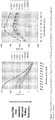
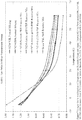
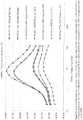
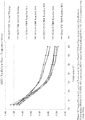
- Table 8 shows the performance advantages of the Inventive Compound compositions versus normal or Reference Compound compositions typically employed, and Figures 2 , 4 and 6 show these results graphically for this data for the dynamic elastic modulus, G ' as a function of strain, tangent delta maximum at 75°C as a function of strain, and for tangent delta as a function of temperature for rolling resistance and wet traction prediction, respectively.
- Compound 1 in Table 8 shows normal N234 in the normal Buna VSL 5025-2 as the Reference Compound 1.
- Compound 2 shows the normal N234 in the chemically modified PBR-4003 and only a slight 10% reduction in the tangent delta at 75°C as well as a 17% reduction in the Payne Effect is realized.
- Table 9 shows the performance advantages of the Inventive Compound compositions versus normal or Reference Compound compositions typically employed, and Figures 3 , 5 and 7 show these results graphically for this data for G ' as a function of strain, tangent delta at 75°C as a function of strain, and for tangent delta as a function of temperature for rolling resistance and wet traction prediction, respectively.
- Compound 1 in Table 9 shows normal N234 in the normal Buna VSL 5025-2 as the Reference Compound.
- Compound 2 shows the normal N234 in the chemically modified PBR-4003.
- Table 9 compares the Inventive Compounds 5 and 6 containing amine-treated carbon blacks to the Reference Compounds, Compounds 1, 2 and 7 and the Inventive Compounds 3 and 4 that contain oxidized carbon blacks. Note that the Compounds 5 and 6 that contain amine-treated carbon blacks also show large reductions in tangent delta at 75°C on the order of 34 and 39%, respectively versus the standard Compound 1. These tangent delta reductions for the Inventive Compounds 5 and 6 are very similar to the Inventive Compound 5 in Table 8 (also shown as Compound 4 in Table 9 ), which has the lowest tangent delta response of all Inventive Compounds containing oxidized carbon blacks.
- One additional advantage of the Inventive Compounds 5 and 6 containing amine-treated carbon blacks is that the cure rate, or time to 90% cure, (t 90 ) is also reduced due to a basic surface chemistry present on the amine-treated carbon blacks, which is a desirable feature.
- the Payne Effect also shows significant decreases in the range of 57 to 62% for the Inventive Compounds 5 and 6, respectively, which is a larger decrease than for the Inventive Compounds containing the ozonated only carbon-blacks.
- Table 10 compares the Inventive Compounds containing ozonated carbon blacks of higher surface area than N234, which includes N115, N134 and CD2115 and Figures 8 , 9 and 10 show these results graphically for this data for G ' as a function of strain, tangent delta at 75°C as a function of strain, and for tangent delta as a function of temperature for rolling resistance and wet traction prediction, respectively.
- Reference Compounds 1 and 2 in Table 10 show results for normal N234 and N134, respectively in the normal Buna VSL 5025-2.
- Compounds 3, 4, 5 and 6 show the results for the Inventive Compounds containing ozonated N234, N134, N115 and CD2115, respectively in the Lanxess PBR-4003, and for this data set, the amount of DPG was increased to 2.0 phr, which is more typical of formulations used in the rubber industry for silica compounds that require secondary accelerators due to their surface chemistry. The results show an overall better balance of cure, stress-strain and dynamic properties for all compounds.
- the Inventive Compound 3 (ozonated N234, 5.5 hours) shows a more significant and surprising drop in tangent delta of 50% relative to the Reference Compound 1, and in this case, now more closely matches the all-Silica Reference Compound 7, which has a 60% drop in tangent delta relative to the Reference Compound 1.
- the higher surface area carbon blacks, N115, N134 and CD2115 also show large reductions in tangent delta maximum at 75°C on the order of 40% relative to the Reference Compound 1 containing N234.
- the Payne Effect also shows significant decreases in the range of 40 to 75% for the Inventive Compounds 3, 4, 5 and 6, which again is a large change and surprising result.
- the all-Silica Compound 7 shows a 64% decrease in the Payne Effect relative to Reference Compound 1.
- the results in Table 10 also show directionally better wet traction prediction at -5°C for Inventive Compounds 3 and 4, as shown by the higher tangent delta for the Inventive Compounds 3 and 4 versus the Reference Compound 1.
- Tables 11-13 show the performance advantages of the compositions of the Inventive Compounds versus normal or Reference Compound Compositions typically employed, but in this case SBR/BR blends as described in Table 2, more typical of an actual tire tread compound, are shown.
- Table 11 shows the basic stress-strain properties indicating a very good balance of modulus, tensile strength and elongation for the Inventive Compounds 4, 6 and 8 versus the normal Reference Carbon Black Compound Compositions 1,9 and Silica Compound Compositions 10, 11.
- Table 12 shows the Amplitude Sweep dynamic properties at 60°C, and shows that all Inventive Compounds 4, 6 and 8 give reduced tangent delta in the range of 9% to 21%, relative to the Reference Compound 1 and 9 for N234.
- the improved predicted rolling resistance and wet traction of Inventive Compound 8 versus the Normal Reference N234 Compound 1 and the Silica Reference Compound 10, is shown graphically in Figure 11 .
- Table 13 shows the DIN Abrasion, Shore A Hardness and Rebound for the SRB/BR Reference and Inventive Compounds.
- the DIN Abrasion for the Inventive Compounds 4, 6 and 8 is similar to the Reference Compounds 1 and 9, and both are approximately 18% lower in DIN Abrasion than the Silica Reference Compound 10.
- a lower number indicates better resistance to abrasion, and hence, better or higher predicted treadwear.
- This result indicates that the Inventive Compounds 4, 6 and 8 have an overall improved compound performance versus the Silica Reference Compound 10, meaning the Inventive Compound 8 has equal to better predicted rolling resistance, wet traction and treadwear than the corresponding Silica Reference Compound 10.
- a compound composition comprised of a surface-treated-carbon-black and a functionalized polymer with functionalization along the polymer chain, with the polymer representing a solution SBR including, but not limited to blends of the SBR with BR, NR and EPDM, and the SBR polymer functionalization composed of polar, oxygen-containing functional groups resulting in a compound with very low hysteresis and rolling resistance, improved wet traction, excellent abrasion resistance and excellent mixing and compound costs as would be used in passenger, truck and racing tires. 2.
- composition in claim 1 wherein the surface-treated carbon blacks' surface area and structure range from 60 to 300 m 2 /g and 50 to 180 cc/100g, respectively, and as might be produced from the furnace, impingement over lampblack process.
- the compound is reactively mixed to facilitate chemical interaction between a surface-treated-carbon black and a functionalized-elastomer, where reactive mixing is accomplished in a rubber mixer such that the compound is held at an elevated temperature for a certain time period.
- the components are mixed in such a manner such that the carbon-black-elastomer interaction is increased through the interaction between the elastomer functional groups along the polymer chain and the surface-treated carbon black. 5.
- the compound composition in claim 1 wherein the components are mixed in such a manner such that the carbon-black-elastomer interaction is increased through acid-base interaction between the polymer-carboxylic-acid-functional groups and the surface-treated-carbon-black, where the surface treatment is accomplished with chlorination of the surface followed by treatment with ammonia.
- the compound composition in claim 1 such that increased carbon-black-elastomer interaction and reactive mixing reduces the filler-filler interaction and increases the filler-elastomer interaction and results in a carbon-black-containing solution-SBR-based compound with improved wet traction, comparable to all-Silica-based compounds. 10.
- the compound composition in Claim 1 such that increased carbon-black-elastomer interaction and reactive mixing reduces the filler-filler interaction and increases the filler-elastomer interaction and results in a carbon-black containing solution-SBR-based compound with excellent DIN abrasion resistance, significantly better than all-Silica-based compounds. 11.
- a compound composition comprising a surface-treated-carbon-black, preferably treated with peroxide or ozone, resulting in oxidation of the surface with polar, oxygen-containing functionalities, and a functionalized polymer with functionalization along the polymer chain, with the polymer representing a solution SBR, and the functionalization representing a polar, carboxylic-acid functionality.
- a compound composition comprising a surface-treated-carbon-black, preferably treated with an oxidizing agent followed by treatment with a diamine-based compound, resulting in amine functionalization, and a functionalized polymer with functionalization along the polymer chain, with the polymer representing a solution SBR, and the functionalization representing a polar, carboxylic-acid functionality.
- a compound composition comprising a surface-treated-carbon-black, preferably treated with a chlorinating agent followed by treatment with ammonia, resulting in amine functionalization, and a functionalized polymer with functionalization along the polymer chain, with the polymer representing a solution SBR, and the functionalization representing a polar, carboxylic-acid functionality.
- a compound composition comprising the components from claims 1 or 2 and mixed in such a manner such that the carbon-black-elastomer interaction is increased through polar-polar or intermolecular hydrogen bonding between the carboxylic-acid functional groups along the polymer chain and the oxygen-containing functional groups on the surface-treated, oxidized carbon black. 17.
- a compound composition comprising the components from claims 1 or 2 and mixed in such a manner such that the carbon-black-elastomer interaction is increased through acid-base interactions between the carboxylic-acid functional groups along the polymer chain and the amine-containing functional groups on the surface-treated oxidized/chlorinated and amine/ammonia-treated carbon-black surface. 18.
- a compound composition comprising the components from claims 1 or 2 and mixed in such a manner such that the carbon-black-elastomer interaction is increased simultaneously through both polar-polar or intermolecular hydrogen bonding and acid-base interactions between the carboxylic acid functional groups along the polymer chain and the oxygen containing functional groups, and the amine containing functional groups on the oxidized/chlorinated and amine/ammonia-treated carbon-black surface. 19.
- a compound composition comprising an oxidized/chlorinated and amine/ammonia-treated carbon-black surface with oxygen containing functional groups and/or amine-containing functional groups, and a functionalized polymer with carboxylic-acid functionalization along the polymer chain, with the polymer representing a solution SBR including, but not limited to blends of the SBR (PBR4003) with BR, NR and EPDM, with reduced compound hysteresis and rolling resistance, improved wet traction and excellent treadwear as would be used passenger, truck and racing tires.
- Table 1 Solution SBR Test Recipe Ingredient phr First Pass* Variable 1: SSBR 125 Varwable 2: Filler 84 Variable 3: Counting 0 or 6 Sundex 790 6 Zinc Oxide 2.5 Second Pass* Stearic Acid 1.0 Santoflex 6PPD 2.0 Microwax, SP-89 1.0 Finish Sulfur 1.4 CBS 1.7 DPG 0.2, 2.0 Table 3 Normal versus Reactive Mixing Schemes Normal Mixing Reactive Mixing First Pass First Pass Mini Mixer: 45°C, 77 rpm Mini Mix: 90°C, 85 rpm min:sec min:sec 0:00 s-SBR (VSL-5025-2) 0:00 s-SBR (PBR-4003) 1:00 ZnO, 1 ⁇ 2 Oil, 1 ⁇ 2 CB 1:00 ZnO, 1 ⁇ 2 Oil, 1 ⁇ 2 CB 2:30 1 ⁇ 2 Oil, 1 ⁇ 2 CB 2:30 1 ⁇ 2 Oil, 1 ⁇ 2 CB 4:00 Sweep Varied Sweep, Adjust rpm to maintain an internal mixing temperature between
Landscapes
- Chemical & Material Sciences (AREA)
- Health & Medical Sciences (AREA)
- Chemical Kinetics & Catalysis (AREA)
- Medicinal Chemistry (AREA)
- Polymers & Plastics (AREA)
- Organic Chemistry (AREA)
- Engineering & Computer Science (AREA)
- Mechanical Engineering (AREA)
- Compositions Of Macromolecular Compounds (AREA)
- Pigments, Carbon Blacks, Or Wood Stains (AREA)
- Tires In General (AREA)
Applications Claiming Priority (3)
| Application Number | Priority Date | Filing Date | Title |
|---|---|---|---|
| US23759309P | 2009-08-27 | 2009-08-27 | |
| EP10814124.3A EP2470604B8 (en) | 2009-08-27 | 2010-07-27 | Use of surface-treated carbon blacks in an elastomer to reduce compound hysteresis and tire rolling resistance and improve wet traction |
| PCT/US2010/043384 WO2011028337A2 (en) | 2009-08-27 | 2010-07-27 | Use of surface-treated carbon blacks in an elastomer to reduce compound hysteresis and tire rolling resistance and improve wet traction |
Related Parent Applications (2)
| Application Number | Title | Priority Date | Filing Date |
|---|---|---|---|
| EP10814124.3A Division EP2470604B8 (en) | 2009-08-27 | 2010-07-27 | Use of surface-treated carbon blacks in an elastomer to reduce compound hysteresis and tire rolling resistance and improve wet traction |
| EP10814124.3A Division-Into EP2470604B8 (en) | 2009-08-27 | 2010-07-27 | Use of surface-treated carbon blacks in an elastomer to reduce compound hysteresis and tire rolling resistance and improve wet traction |
Publications (1)
| Publication Number | Publication Date |
|---|---|
| EP3666825A1 true EP3666825A1 (en) | 2020-06-17 |
Family
ID=43649851
Family Applications (2)
| Application Number | Title | Priority Date | Filing Date |
|---|---|---|---|
| EP19208378.0A Withdrawn EP3666825A1 (en) | 2009-08-27 | 2010-07-27 | Use of surface-treated carbon blacks in an elastomer to reduce compound hysteresis and tire rolling resistance and improve wet traction |
| EP10814124.3A Active EP2470604B8 (en) | 2009-08-27 | 2010-07-27 | Use of surface-treated carbon blacks in an elastomer to reduce compound hysteresis and tire rolling resistance and improve wet traction |
Family Applications After (1)
| Application Number | Title | Priority Date | Filing Date |
|---|---|---|---|
| EP10814124.3A Active EP2470604B8 (en) | 2009-08-27 | 2010-07-27 | Use of surface-treated carbon blacks in an elastomer to reduce compound hysteresis and tire rolling resistance and improve wet traction |
Country Status (18)
| Country | Link |
|---|---|
| US (1) | US20130046064A1 (pl) |
| EP (2) | EP3666825A1 (pl) |
| JP (1) | JP5976538B2 (pl) |
| KR (1) | KR101679455B1 (pl) |
| CN (1) | CN102575082B (pl) |
| AR (1) | AR078145A1 (pl) |
| BR (1) | BR112012004206A2 (pl) |
| ES (1) | ES2771474T3 (pl) |
| HU (1) | HUE047720T2 (pl) |
| IN (1) | IN2012DN02519A (pl) |
| MX (1) | MX365870B (pl) |
| MY (1) | MY170989A (pl) |
| PL (1) | PL2470604T3 (pl) |
| RU (1) | RU2552728C2 (pl) |
| SG (2) | SG10201405280VA (pl) |
| TW (1) | TWI534187B (pl) |
| WO (1) | WO2011028337A2 (pl) |
| ZA (1) | ZA201202207B (pl) |
Families Citing this family (27)
| Publication number | Priority date | Publication date | Assignee | Title |
|---|---|---|---|---|
| TWI465500B (zh) | 2010-09-03 | 2014-12-21 | Cabot Corp | 經修飾充填物及包含其之彈性複合物 |
| US9175150B2 (en) | 2012-03-02 | 2015-11-03 | Cabot Corporation | Modified carbon blacks having low PAH amounts and elastomers containing the same |
| KR101696529B1 (ko) | 2012-03-02 | 2017-01-13 | 캐보트 코포레이션 | 개질된 충전제 및 관능화 엘라스토머를 함유하는 엘라스토머 복합재 |
| JP5977079B2 (ja) * | 2012-05-17 | 2016-08-24 | 住友ゴム工業株式会社 | タイヤ用ゴム組成物及び空気入りタイヤ |
| JP5977078B2 (ja) * | 2012-05-17 | 2016-08-24 | 住友ゴム工業株式会社 | タイヤ用ゴム組成物及び空気入りタイヤ |
| JP2013241480A (ja) * | 2012-05-17 | 2013-12-05 | Sumitomo Rubber Ind Ltd | タイヤ用ゴム組成物及び空気入りタイヤ |
| WO2015178309A1 (ja) * | 2014-05-23 | 2015-11-26 | ダイキン工業株式会社 | フッ素ゴム組成物及びフッ素ゴム成形品 |
| DE102016201801A1 (de) | 2015-11-21 | 2017-05-24 | Suncoal Industries Gmbh | Partikelförmiges Kohlenstoffmaterial herstellbar aus nachwachsenden Rohstoffen und Verfahren zu dessen Herstellung |
| CN109414959A (zh) | 2016-06-29 | 2019-03-01 | 汉森和罗森塔尔公司 | 包含酯的组合物 |
| US20180171114A1 (en) | 2016-12-21 | 2018-06-21 | The Goodyear Tire & Rubber Company | Rubber composition and pneumatic tire |
| US10457797B2 (en) | 2017-04-04 | 2019-10-29 | The Goodyear Tire & Rubber Company | Tire with tread with oxidized carbon black |
| US10208189B2 (en) * | 2017-04-04 | 2019-02-19 | The Goodyear Tire & Rubber Company | Tire with tread with oxidized carbon black |
| EP3642043A4 (en) * | 2017-06-21 | 2021-04-14 | Birla Carbon U.S.A., Inc. | CARBON BLACK FUNCTIONALIZED FOR INTERACTION WITH LIQUID OR POLYMERIC SYSTEMS |
| US20200131344A1 (en) * | 2017-07-07 | 2020-04-30 | Birla Carbon U.S.A., Inc. | Epoxidized Natural Rubber Composition |
| US20190061424A1 (en) | 2017-08-31 | 2019-02-28 | The Goodyear Tire & Rubber Company | Heavy duty tire with natural rubber based tread containing oxidized carbon black reinforcing filler |
| WO2019094926A1 (en) * | 2017-11-13 | 2019-05-16 | Birla Carbon U.S.A. Inc. | High resistivity rubber compositions comprising oxidized carbon black |
| WO2020028903A1 (en) * | 2018-08-03 | 2020-02-06 | Birla Carbon U.S.A., Inc. | Rubber composition with surface-modified carbon black and functionalized process oil |
| DE102018220946A1 (de) | 2018-12-04 | 2020-06-04 | Suncoal Industries Gmbh | Partikelförmige Kohlenstoffmaterialien und Verfahren zu deren Auftrennung |
| WO2020169809A2 (de) | 2019-02-21 | 2020-08-27 | Suncoal Industries Gmbh | Verfahren zur geruchsreduktion partikelförmiger kohlenstoffmaterialien |
| US11220595B2 (en) | 2019-03-04 | 2022-01-11 | The Goodyear Tire & Rubber Company | Reinforced rubber containing silylated triglyceride oil |
| US20200399497A1 (en) | 2019-06-20 | 2020-12-24 | The Goodyear Tire & Rubber Company | Wire coat composition and a tire comprising a wire coat composition |
| CN114127163B (zh) * | 2019-07-02 | 2024-03-08 | 欧励隆工程炭知识产权有限两合公司 | 官能化炭黑、其制备和在可硫化橡胶组合物中的用途 |
| US12522627B2 (en) | 2019-07-10 | 2026-01-13 | Suncoal Industries Gmbh | Method for producing stabilized lignin |
| EP3960491A1 (en) | 2020-08-27 | 2022-03-02 | Orion Engineered Carbons GmbH | Solid carbon black material, preparation thereof and compositions and articles containing the same |
| US11753549B2 (en) * | 2021-01-29 | 2023-09-12 | Continental Carbon Co. | Surface modified carbon black to simultaneously improve rolling resistance, wet traction, and wear resistance |
| US12391835B2 (en) | 2021-01-29 | 2025-08-19 | Continental Carbon Co. | Refined surface modified carbon black and methods of making same |
| EP4650395A1 (en) | 2024-05-16 | 2025-11-19 | Orion Engineered Carbons IP GmbH & Co. KG | Functionalized carbon black and use thereof in vulcanizable rubber compositions |
Citations (10)
| Publication number | Priority date | Publication date | Assignee | Title |
|---|---|---|---|---|
| US5227425A (en) | 1991-02-25 | 1993-07-13 | Compagnie Generale Des Etablissements Michelin-Michelin & Cie | Copolymer rubber composition with silica filler, tires having a base of said composition and method of preparing same |
| US5248722A (en) | 1992-06-02 | 1993-09-28 | Bridgestone Corporation | Tire tread composition |
| US5494955A (en) | 1994-04-08 | 1996-02-27 | Columbian Chemicals Company | Use of silane coupling agent with carbon black to enhance the balance of reinforcement properties of rubber compounds |
| US5708055A (en) | 1995-02-01 | 1998-01-13 | Columbian Chemicals Company | Thermoplastic composition comprising chemically modified carbon black and their applications |
| US6120594A (en) | 1997-01-29 | 2000-09-19 | Columbian Chemicals Company | Hydrogen peroxide oxidation of carbon black |
| US6471933B1 (en) | 1995-02-21 | 2002-10-29 | Anderson Oliver Dotson | Ozone-oxidized carbon black composition with low conductivity and improved color |
| EP1400560A1 (en) * | 2002-09-17 | 2004-03-24 | The Goodyear Tire & Rubber Company | Tire with component comprised of rubber composite of styrene/butadiene elastomer containing pendent silanol and/or siloxy groups |
| US20060178467A1 (en) | 2005-01-14 | 2006-08-10 | Yasuo Fukushima | Tire treads with reduced hysteresis loss |
| US7238747B2 (en) | 1999-09-03 | 2007-07-03 | Exxonmobil Chemical Patents Inc. | Plasticized polypropylene thermoplastics |
| DE102007044174A1 (de) * | 2007-09-15 | 2009-03-19 | Lanxess Deutschland Gmbh | Funktionalisierte rußhaltige Kautschuke |
Family Cites Families (23)
| Publication number | Priority date | Publication date | Assignee | Title |
|---|---|---|---|---|
| US3364156A (en) * | 1965-08-12 | 1968-01-16 | Phillips Petroleum Co | Rubber reinforced with carbon black blends |
| US3330799A (en) * | 1966-01-24 | 1967-07-11 | Huber Corp J M | Electrically insulating vulcanizates containing oxidized carbon black |
| US3565657A (en) * | 1967-06-19 | 1971-02-23 | Cabot Corp | Process for treating furnace carbon black |
| SU1068445A1 (ru) * | 1981-05-12 | 1984-01-23 | Научно-исследовательский и проектно-конструкторский институт углеродистых пигментов и наполнителей | Вулканизуема резинова смесь |
| JPH068366B2 (ja) * | 1987-04-23 | 1994-02-02 | 株式会社ブリヂストン | タイヤ用ゴム組成物 |
| US5264290A (en) * | 1988-01-29 | 1993-11-23 | The United States Of America As Represented By The Secretary Of The Army | Rubber compound for tracked vehicle track pads |
| JP3157034B2 (ja) * | 1992-03-12 | 2001-04-16 | 日本エラストマー株式会社 | カルボキシル基含有共役ジエン系重合体の製造方法 |
| US6323273B1 (en) * | 1995-05-22 | 2001-11-27 | Cabot Corporation | Elastomeric compounds incorporating silicon-treated carbon blacks |
| FR2740778A1 (fr) * | 1995-11-07 | 1997-05-09 | Michelin & Cie | Composition de caoutchouc a base de silice et de polymere dienique fonctionalise ayant une fonction silanol terminale |
| US5723531A (en) * | 1997-04-30 | 1998-03-03 | The Goodyear Tire & Rubber Company | Rubber composition and tire having tread thereof |
| FR2763074B1 (fr) * | 1997-05-07 | 1999-06-25 | Michelin & Cie | Composition de caoutchouc a base de noir de carbone ayant de la silice fixee a sa surface et de polymere dyenique fonctionalise ou modifie par des fonctions silanols |
| FR2765882B1 (fr) * | 1997-07-11 | 1999-09-03 | Michelin & Cie | Composition de caoutchouc a base de noir de carbone ayant de la silice fixee a sa surface et de polymere dienique fonctionnalise alcoxysilane |
| DE59907363D1 (de) * | 1998-11-16 | 2003-11-20 | Bayer Ag | Carboxylgruppen-haltige Lösungskautschuke enthaltende Kautschukmischungen |
| US6245860B1 (en) * | 1999-06-16 | 2001-06-12 | The Goodyear Tire & Rubber Company | Rubber composition which contains irregular-shaped hollow inorganic particles and article having component thereof |
| DE19954260A1 (de) * | 1999-11-11 | 2001-06-28 | Degussa | Wäßrige Rußdispersionen |
| WO2001092402A1 (fr) * | 2000-05-26 | 2001-12-06 | Societe De Technologie Michelin | Composition de caoutchouc utilisable comme bande de roulement de pneumatique |
| US20020045686A1 (en) * | 2000-08-24 | 2002-04-18 | The Yokohama Rubber Co., Ltd | Rubber composition having improved wet skid resistance and rolling resistance |
| RU2215756C2 (ru) * | 2001-06-08 | 2003-11-10 | Химический факультет МГУ им. М.В. Ломоносова | Резиновая композиция |
| US6759464B2 (en) * | 2001-12-21 | 2004-07-06 | The Goodyear Tire & Rubber Company | Process for preparing nanocomposite, composition and article thereof |
| JP4357220B2 (ja) * | 2003-06-27 | 2009-11-04 | 横浜ゴム株式会社 | ゴム組成物 |
| JP2005047956A (ja) * | 2003-07-29 | 2005-02-24 | Yokohama Rubber Co Ltd:The | タイヤトレッド用ゴム組成物 |
| JP2007031587A (ja) * | 2005-07-27 | 2007-02-08 | Sumitomo Rubber Ind Ltd | タイヤ用ゴム組成物 |
| JP5474334B2 (ja) * | 2008-11-11 | 2014-04-16 | 東洋ゴム工業株式会社 | ゴム組成物及び空気入りタイヤ |
-
2010
- 2010-07-27 IN IN2519DEN2012 patent/IN2012DN02519A/en unknown
- 2010-07-27 ES ES10814124T patent/ES2771474T3/es active Active
- 2010-07-27 EP EP19208378.0A patent/EP3666825A1/en not_active Withdrawn
- 2010-07-27 MX MX2012002304A patent/MX365870B/es active IP Right Grant
- 2010-07-27 US US13/391,085 patent/US20130046064A1/en not_active Abandoned
- 2010-07-27 WO PCT/US2010/043384 patent/WO2011028337A2/en not_active Ceased
- 2010-07-27 KR KR1020127007848A patent/KR101679455B1/ko active Active
- 2010-07-27 BR BR112012004206A patent/BR112012004206A2/pt not_active Application Discontinuation
- 2010-07-27 HU HUE10814124A patent/HUE047720T2/hu unknown
- 2010-07-27 CN CN201080037772.2A patent/CN102575082B/zh active Active
- 2010-07-27 SG SG10201405280VA patent/SG10201405280VA/en unknown
- 2010-07-27 EP EP10814124.3A patent/EP2470604B8/en active Active
- 2010-07-27 PL PL10814124T patent/PL2470604T3/pl unknown
- 2010-07-27 SG SG2012011722A patent/SG178513A1/en unknown
- 2010-07-27 JP JP2012526792A patent/JP5976538B2/ja active Active
- 2010-07-27 MY MYPI2012000787A patent/MY170989A/en unknown
- 2010-07-27 RU RU2012111684/05A patent/RU2552728C2/ru active
- 2010-08-23 TW TW099128121A patent/TWI534187B/zh active
- 2010-08-26 AR ARP100103131A patent/AR078145A1/es active IP Right Grant
-
2012
- 2012-03-27 ZA ZA2012/02207A patent/ZA201202207B/en unknown
Patent Citations (10)
| Publication number | Priority date | Publication date | Assignee | Title |
|---|---|---|---|---|
| US5227425A (en) | 1991-02-25 | 1993-07-13 | Compagnie Generale Des Etablissements Michelin-Michelin & Cie | Copolymer rubber composition with silica filler, tires having a base of said composition and method of preparing same |
| US5248722A (en) | 1992-06-02 | 1993-09-28 | Bridgestone Corporation | Tire tread composition |
| US5494955A (en) | 1994-04-08 | 1996-02-27 | Columbian Chemicals Company | Use of silane coupling agent with carbon black to enhance the balance of reinforcement properties of rubber compounds |
| US5708055A (en) | 1995-02-01 | 1998-01-13 | Columbian Chemicals Company | Thermoplastic composition comprising chemically modified carbon black and their applications |
| US6471933B1 (en) | 1995-02-21 | 2002-10-29 | Anderson Oliver Dotson | Ozone-oxidized carbon black composition with low conductivity and improved color |
| US6120594A (en) | 1997-01-29 | 2000-09-19 | Columbian Chemicals Company | Hydrogen peroxide oxidation of carbon black |
| US7238747B2 (en) | 1999-09-03 | 2007-07-03 | Exxonmobil Chemical Patents Inc. | Plasticized polypropylene thermoplastics |
| EP1400560A1 (en) * | 2002-09-17 | 2004-03-24 | The Goodyear Tire & Rubber Company | Tire with component comprised of rubber composite of styrene/butadiene elastomer containing pendent silanol and/or siloxy groups |
| US20060178467A1 (en) | 2005-01-14 | 2006-08-10 | Yasuo Fukushima | Tire treads with reduced hysteresis loss |
| DE102007044174A1 (de) * | 2007-09-15 | 2009-03-19 | Lanxess Deutschland Gmbh | Funktionalisierte rußhaltige Kautschuke |
Also Published As
| Publication number | Publication date |
|---|---|
| EP2470604B1 (en) | 2019-11-13 |
| SG178513A1 (en) | 2012-03-29 |
| ES2771474T3 (es) | 2020-07-06 |
| SG10201405280VA (en) | 2014-10-30 |
| US20130046064A1 (en) | 2013-02-21 |
| HK1172361A1 (en) | 2013-04-19 |
| CN102575082A (zh) | 2012-07-11 |
| RU2012111684A (ru) | 2013-10-10 |
| MX365870B (es) | 2019-06-18 |
| EP2470604A2 (en) | 2012-07-04 |
| WO2011028337A3 (en) | 2011-05-12 |
| JP2013503240A (ja) | 2013-01-31 |
| RU2552728C2 (ru) | 2015-06-10 |
| IN2012DN02519A (pl) | 2015-08-28 |
| PL2470604T3 (pl) | 2020-06-15 |
| KR101679455B1 (ko) | 2016-11-24 |
| EP2470604A4 (en) | 2015-08-26 |
| CN102575082B (zh) | 2014-10-29 |
| TWI534187B (zh) | 2016-05-21 |
| AR078145A1 (es) | 2011-10-19 |
| ZA201202207B (en) | 2013-09-25 |
| HUE047720T2 (hu) | 2020-05-28 |
| EP2470604B8 (en) | 2019-12-25 |
| BR112012004206A2 (pt) | 2017-05-30 |
| TW201118122A (en) | 2011-06-01 |
| MX2012002304A (es) | 2012-06-19 |
| JP5976538B2 (ja) | 2016-08-23 |
| KR20120104171A (ko) | 2012-09-20 |
| MY170989A (en) | 2019-09-23 |
| WO2011028337A2 (en) | 2011-03-10 |
Similar Documents
| Publication | Publication Date | Title |
|---|---|---|
| EP2470604B1 (en) | Use of surface-treated carbon blacks in an elastomer to reduce compound hysteresis and tire rolling resistance and improve wet traction | |
| EP2819854B1 (en) | Elastomeric composites containing modified fillers and functionalized elastomers | |
| EP3181631B1 (en) | Pneumatic tire | |
| US20120270966A1 (en) | Composition based on natural rubber and a reinforcing inorganic filler comprising dihydrazide | |
| JP6627293B2 (ja) | 空気入りタイヤ | |
| EP3086928B1 (en) | Vulcanizates and tire components prepared from compositions including mercapto-functional siloxanes | |
| EP3450468A1 (en) | Process for producing modified polymer, modified polymer, rubber composition, and tire | |
| CN108570170A (zh) | 用于轮胎和充气轮胎的橡胶组合物 | |
| EP4696723A1 (en) | Conjugated diene-based polymer and rubber composition comprising the same | |
| KR102405234B1 (ko) | 고무 보강 충전용 함수 규산 | |
| JP6068020B2 (ja) | ゴム組成物の製造方法 | |
| JP5393315B2 (ja) | タイヤ用ゴム組成物及びそれを用いたタイヤ | |
| JP2000219779A (ja) | ゴム組成物の製造方法 | |
| JP2024008000A (ja) | タイヤ用ゴム組成物およびそれを用いたタイヤ | |
| US20250179304A1 (en) | Modification of commercial carbon black grades via surface modification | |
| HK1172361B (en) | Use of surface-treated carbon blacks in an elastomer to reduce compound hysteresis and tire rolling resistance and improve wet traction | |
| JP7749101B2 (ja) | ゴム組成物 | |
| JP5171017B2 (ja) | ゴム組成物及びそれを用いた空気入りタイヤ | |
| JP2012077134A (ja) | タイヤトレッド用ゴム組成物および空気入りタイヤ | |
| JP2019094379A (ja) | タイヤ用ゴム組成物の製造方法 | |
| JP2006002045A (ja) | 重荷重用タイヤトレッドゴム組成物 |
Legal Events
| Date | Code | Title | Description |
|---|---|---|---|
| PUAI | Public reference made under article 153(3) epc to a published international application that has entered the european phase |
Free format text: ORIGINAL CODE: 0009012 |
|
| STAA | Information on the status of an ep patent application or granted ep patent |
Free format text: STATUS: THE APPLICATION HAS BEEN PUBLISHED |
|
| AC | Divisional application: reference to earlier application |
Ref document number: 2470604 Country of ref document: EP Kind code of ref document: P |
|
| AK | Designated contracting states |
Kind code of ref document: A1 Designated state(s): AL AT BE BG CH CY CZ DE DK EE ES FI FR GB GR HR HU IE IS IT LI LT LU LV MC MK MT NL NO PL PT RO SE SI SK SM TR |
|
| STAA | Information on the status of an ep patent application or granted ep patent |
Free format text: STATUS: THE APPLICATION IS DEEMED TO BE WITHDRAWN |
|
| 18D | Application deemed to be withdrawn |
Effective date: 20201218 |