EP3626783B1 - Resin composition - Google Patents
Resin composition Download PDFInfo
- Publication number
- EP3626783B1 EP3626783B1 EP19204509.4A EP19204509A EP3626783B1 EP 3626783 B1 EP3626783 B1 EP 3626783B1 EP 19204509 A EP19204509 A EP 19204509A EP 3626783 B1 EP3626783 B1 EP 3626783B1
- Authority
- EP
- European Patent Office
- Prior art keywords
- starting temperature
- resin component
- thermally expandable
- expandable graphite
- carbon atoms
- Prior art date
- Legal status (The legal status is an assumption and is not a legal conclusion. Google has not performed a legal analysis and makes no representation as to the accuracy of the status listed.)
- Revoked
Links
Images
Classifications
-
- C—CHEMISTRY; METALLURGY
- C08—ORGANIC MACROMOLECULAR COMPOUNDS; THEIR PREPARATION OR CHEMICAL WORKING-UP; COMPOSITIONS BASED THEREON
- C08K—Use of inorganic or non-macromolecular organic substances as compounding ingredients
- C08K3/00—Use of inorganic substances as compounding ingredients
- C08K3/02—Elements
- C08K3/04—Carbon
-
- C—CHEMISTRY; METALLURGY
- C08—ORGANIC MACROMOLECULAR COMPOUNDS; THEIR PREPARATION OR CHEMICAL WORKING-UP; COMPOSITIONS BASED THEREON
- C08K—Use of inorganic or non-macromolecular organic substances as compounding ingredients
- C08K3/00—Use of inorganic substances as compounding ingredients
- C08K3/01—Use of inorganic substances as compounding ingredients characterized by their specific function
- C08K3/013—Fillers, pigments or reinforcing additives
-
- C—CHEMISTRY; METALLURGY
- C08—ORGANIC MACROMOLECULAR COMPOUNDS; THEIR PREPARATION OR CHEMICAL WORKING-UP; COMPOSITIONS BASED THEREON
- C08K—Use of inorganic or non-macromolecular organic substances as compounding ingredients
- C08K3/00—Use of inorganic substances as compounding ingredients
- C08K3/18—Oxygen-containing compounds, e.g. metal carbonyls
- C08K3/20—Oxides; Hydroxides
- C08K3/22—Oxides; Hydroxides of metals
- C08K3/2279—Oxides; Hydroxides of metals of antimony
-
- C—CHEMISTRY; METALLURGY
- C08—ORGANIC MACROMOLECULAR COMPOUNDS; THEIR PREPARATION OR CHEMICAL WORKING-UP; COMPOSITIONS BASED THEREON
- C08K—Use of inorganic or non-macromolecular organic substances as compounding ingredients
- C08K3/00—Use of inorganic substances as compounding ingredients
- C08K3/18—Oxygen-containing compounds, e.g. metal carbonyls
- C08K3/24—Acids; Salts thereof
- C08K3/26—Carbonates; Bicarbonates
-
- C—CHEMISTRY; METALLURGY
- C08—ORGANIC MACROMOLECULAR COMPOUNDS; THEIR PREPARATION OR CHEMICAL WORKING-UP; COMPOSITIONS BASED THEREON
- C08K—Use of inorganic or non-macromolecular organic substances as compounding ingredients
- C08K3/00—Use of inorganic substances as compounding ingredients
- C08K3/32—Phosphorus-containing compounds
-
- C—CHEMISTRY; METALLURGY
- C08—ORGANIC MACROMOLECULAR COMPOUNDS; THEIR PREPARATION OR CHEMICAL WORKING-UP; COMPOSITIONS BASED THEREON
- C08K—Use of inorganic or non-macromolecular organic substances as compounding ingredients
- C08K5/00—Use of organic ingredients
- C08K5/04—Oxygen-containing compounds
- C08K5/09—Carboxylic acids; Metal salts thereof; Anhydrides thereof
- C08K5/098—Metal salts of carboxylic acids
-
- C—CHEMISTRY; METALLURGY
- C08—ORGANIC MACROMOLECULAR COMPOUNDS; THEIR PREPARATION OR CHEMICAL WORKING-UP; COMPOSITIONS BASED THEREON
- C08L—COMPOSITIONS OF MACROMOLECULAR COMPOUNDS
- C08L101/00—Compositions of unspecified macromolecular compounds
-
- C—CHEMISTRY; METALLURGY
- C08—ORGANIC MACROMOLECULAR COMPOUNDS; THEIR PREPARATION OR CHEMICAL WORKING-UP; COMPOSITIONS BASED THEREON
- C08L—COMPOSITIONS OF MACROMOLECULAR COMPOUNDS
- C08L23/00—Compositions of homopolymers or copolymers of unsaturated aliphatic hydrocarbons having only one carbon-to-carbon double bond; Compositions of derivatives of such polymers
- C08L23/02—Compositions of homopolymers or copolymers of unsaturated aliphatic hydrocarbons having only one carbon-to-carbon double bond; Compositions of derivatives of such polymers not modified by chemical after-treatment
- C08L23/04—Homopolymers or copolymers of ethene
- C08L23/08—Copolymers of ethene
- C08L23/0846—Copolymers of ethene with unsaturated hydrocarbons containing atoms other than carbon or hydrogen
- C08L23/0853—Ethylene vinyl acetate copolymers
-
- C—CHEMISTRY; METALLURGY
- C08—ORGANIC MACROMOLECULAR COMPOUNDS; THEIR PREPARATION OR CHEMICAL WORKING-UP; COMPOSITIONS BASED THEREON
- C08L—COMPOSITIONS OF MACROMOLECULAR COMPOUNDS
- C08L23/00—Compositions of homopolymers or copolymers of unsaturated aliphatic hydrocarbons having only one carbon-to-carbon double bond; Compositions of derivatives of such polymers
- C08L23/02—Compositions of homopolymers or copolymers of unsaturated aliphatic hydrocarbons having only one carbon-to-carbon double bond; Compositions of derivatives of such polymers not modified by chemical after-treatment
- C08L23/16—Ethylene-propylene or ethylene-propylene-diene copolymers
-
- C—CHEMISTRY; METALLURGY
- C08—ORGANIC MACROMOLECULAR COMPOUNDS; THEIR PREPARATION OR CHEMICAL WORKING-UP; COMPOSITIONS BASED THEREON
- C08L—COMPOSITIONS OF MACROMOLECULAR COMPOUNDS
- C08L23/00—Compositions of homopolymers or copolymers of unsaturated aliphatic hydrocarbons having only one carbon-to-carbon double bond; Compositions of derivatives of such polymers
- C08L23/02—Compositions of homopolymers or copolymers of unsaturated aliphatic hydrocarbons having only one carbon-to-carbon double bond; Compositions of derivatives of such polymers not modified by chemical after-treatment
- C08L23/18—Homopolymers or copolymers of hydrocarbons having four or more carbon atoms
- C08L23/20—Homopolymers or copolymers of hydrocarbons having four or more carbon atoms having four to nine carbon atoms
- C08L23/22—Copolymers of isobutene; Butyl rubber; Homopolymers or copolymers of other iso-olefins
-
- C—CHEMISTRY; METALLURGY
- C08—ORGANIC MACROMOLECULAR COMPOUNDS; THEIR PREPARATION OR CHEMICAL WORKING-UP; COMPOSITIONS BASED THEREON
- C08L—COMPOSITIONS OF MACROMOLECULAR COMPOUNDS
- C08L23/00—Compositions of homopolymers or copolymers of unsaturated aliphatic hydrocarbons having only one carbon-to-carbon double bond; Compositions of derivatives of such polymers
- C08L23/26—Compositions of homopolymers or copolymers of unsaturated aliphatic hydrocarbons having only one carbon-to-carbon double bond; Compositions of derivatives of such polymers modified by chemical after-treatment
- C08L23/28—Compositions of homopolymers or copolymers of unsaturated aliphatic hydrocarbons having only one carbon-to-carbon double bond; Compositions of derivatives of such polymers modified by chemical after-treatment by reaction with halogens or halogen-containing compounds
- C08L23/286—Chlorinated polyethylene
-
- C—CHEMISTRY; METALLURGY
- C08—ORGANIC MACROMOLECULAR COMPOUNDS; THEIR PREPARATION OR CHEMICAL WORKING-UP; COMPOSITIONS BASED THEREON
- C08L—COMPOSITIONS OF MACROMOLECULAR COMPOUNDS
- C08L27/00—Compositions of homopolymers or copolymers of compounds having one or more unsaturated aliphatic radicals, each having only one carbon-to-carbon double bond, and at least one being terminated by a halogen; Compositions of derivatives of such polymers
- C08L27/02—Compositions of homopolymers or copolymers of compounds having one or more unsaturated aliphatic radicals, each having only one carbon-to-carbon double bond, and at least one being terminated by a halogen; Compositions of derivatives of such polymers not modified by chemical after-treatment
- C08L27/04—Compositions of homopolymers or copolymers of compounds having one or more unsaturated aliphatic radicals, each having only one carbon-to-carbon double bond, and at least one being terminated by a halogen; Compositions of derivatives of such polymers not modified by chemical after-treatment containing chlorine atoms
-
- C—CHEMISTRY; METALLURGY
- C08—ORGANIC MACROMOLECULAR COMPOUNDS; THEIR PREPARATION OR CHEMICAL WORKING-UP; COMPOSITIONS BASED THEREON
- C08L—COMPOSITIONS OF MACROMOLECULAR COMPOUNDS
- C08L27/00—Compositions of homopolymers or copolymers of compounds having one or more unsaturated aliphatic radicals, each having only one carbon-to-carbon double bond, and at least one being terminated by a halogen; Compositions of derivatives of such polymers
- C08L27/02—Compositions of homopolymers or copolymers of compounds having one or more unsaturated aliphatic radicals, each having only one carbon-to-carbon double bond, and at least one being terminated by a halogen; Compositions of derivatives of such polymers not modified by chemical after-treatment
- C08L27/04—Compositions of homopolymers or copolymers of compounds having one or more unsaturated aliphatic radicals, each having only one carbon-to-carbon double bond, and at least one being terminated by a halogen; Compositions of derivatives of such polymers not modified by chemical after-treatment containing chlorine atoms
- C08L27/06—Homopolymers or copolymers of vinyl chloride
-
- C—CHEMISTRY; METALLURGY
- C08—ORGANIC MACROMOLECULAR COMPOUNDS; THEIR PREPARATION OR CHEMICAL WORKING-UP; COMPOSITIONS BASED THEREON
- C08L—COMPOSITIONS OF MACROMOLECULAR COMPOUNDS
- C08L27/00—Compositions of homopolymers or copolymers of compounds having one or more unsaturated aliphatic radicals, each having only one carbon-to-carbon double bond, and at least one being terminated by a halogen; Compositions of derivatives of such polymers
- C08L27/22—Compositions of homopolymers or copolymers of compounds having one or more unsaturated aliphatic radicals, each having only one carbon-to-carbon double bond, and at least one being terminated by a halogen; Compositions of derivatives of such polymers modified by chemical after-treatment
- C08L27/24—Compositions of homopolymers or copolymers of compounds having one or more unsaturated aliphatic radicals, each having only one carbon-to-carbon double bond, and at least one being terminated by a halogen; Compositions of derivatives of such polymers modified by chemical after-treatment halogenated
-
- C—CHEMISTRY; METALLURGY
- C08—ORGANIC MACROMOLECULAR COMPOUNDS; THEIR PREPARATION OR CHEMICAL WORKING-UP; COMPOSITIONS BASED THEREON
- C08L—COMPOSITIONS OF MACROMOLECULAR COMPOUNDS
- C08L33/00—Compositions of homopolymers or copolymers of compounds having one or more unsaturated aliphatic radicals, each having only one carbon-to-carbon double bond, and only one being terminated by only one carboxyl radical, or of salts, anhydrides, esters, amides, imides or nitriles thereof; Compositions of derivatives of such polymers
- C08L33/04—Homopolymers or copolymers of esters
- C08L33/06—Homopolymers or copolymers of esters of esters containing only carbon, hydrogen and oxygen, which oxygen atoms are present only as part of the carboxyl radical
- C08L33/10—Homopolymers or copolymers of methacrylic acid esters
- C08L33/12—Homopolymers or copolymers of methyl methacrylate
-
- C—CHEMISTRY; METALLURGY
- C08—ORGANIC MACROMOLECULAR COMPOUNDS; THEIR PREPARATION OR CHEMICAL WORKING-UP; COMPOSITIONS BASED THEREON
- C08L—COMPOSITIONS OF MACROMOLECULAR COMPOUNDS
- C08L43/00—Compositions of homopolymers or copolymers of compounds having one or more unsaturated aliphatic radicals, each having only one carbon-to-carbon double bond, and containing boron, silicon, phosphorus, selenium, tellurium or a metal; Compositions of derivatives of such polymers
- C08L43/02—Homopolymers or copolymers of monomers containing phosphorus
-
- C—CHEMISTRY; METALLURGY
- C08—ORGANIC MACROMOLECULAR COMPOUNDS; THEIR PREPARATION OR CHEMICAL WORKING-UP; COMPOSITIONS BASED THEREON
- C08L—COMPOSITIONS OF MACROMOLECULAR COMPOUNDS
- C08L47/00—Compositions of homopolymers or copolymers of compounds having one or more unsaturated aliphatic radicals, at least one having two or more carbon-to-carbon double bonds; Compositions of derivatives of such polymers
-
- E—FIXED CONSTRUCTIONS
- E06—DOORS, WINDOWS, SHUTTERS, OR ROLLER BLINDS IN GENERAL; LADDERS
- E06B—FIXED OR MOVABLE CLOSURES FOR OPENINGS IN BUILDINGS, VEHICLES, FENCES OR LIKE ENCLOSURES IN GENERAL, e.g. DOORS, WINDOWS, BLINDS, GATES
- E06B5/00—Doors, windows, or like closures for special purposes; Border constructions therefor
- E06B5/10—Doors, windows, or like closures for special purposes; Border constructions therefor for protection against air-raid or other war-like action; for other protective purposes
- E06B5/16—Fireproof doors or similar closures; Adaptations of fixed constructions therefor
- E06B5/164—Sealing arrangements between the door or window and its frame, e.g. intumescent seals specially adapted therefor
-
- E—FIXED CONSTRUCTIONS
- E06—DOORS, WINDOWS, SHUTTERS, OR ROLLER BLINDS IN GENERAL; LADDERS
- E06B—FIXED OR MOVABLE CLOSURES FOR OPENINGS IN BUILDINGS, VEHICLES, FENCES OR LIKE ENCLOSURES IN GENERAL, e.g. DOORS, WINDOWS, BLINDS, GATES
- E06B5/00—Doors, windows, or like closures for special purposes; Border constructions therefor
- E06B5/10—Doors, windows, or like closures for special purposes; Border constructions therefor for protection against air-raid or other war-like action; for other protective purposes
- E06B5/16—Fireproof doors or similar closures; Adaptations of fixed constructions therefor
- E06B5/168—Shape of edges of wing and/or its frame specially adapted therefor
-
- C—CHEMISTRY; METALLURGY
- C08—ORGANIC MACROMOLECULAR COMPOUNDS; THEIR PREPARATION OR CHEMICAL WORKING-UP; COMPOSITIONS BASED THEREON
- C08K—Use of inorganic or non-macromolecular organic substances as compounding ingredients
- C08K3/00—Use of inorganic substances as compounding ingredients
- C08K3/18—Oxygen-containing compounds, e.g. metal carbonyls
- C08K3/24—Acids; Salts thereof
- C08K3/26—Carbonates; Bicarbonates
- C08K2003/265—Calcium, strontium or barium carbonate
-
- C—CHEMISTRY; METALLURGY
- C08—ORGANIC MACROMOLECULAR COMPOUNDS; THEIR PREPARATION OR CHEMICAL WORKING-UP; COMPOSITIONS BASED THEREON
- C08K—Use of inorganic or non-macromolecular organic substances as compounding ingredients
- C08K3/00—Use of inorganic substances as compounding ingredients
- C08K3/32—Phosphorus-containing compounds
- C08K2003/321—Phosphates
- C08K2003/322—Ammonium phosphate
- C08K2003/323—Ammonium polyphosphate
-
- C—CHEMISTRY; METALLURGY
- C08—ORGANIC MACROMOLECULAR COMPOUNDS; THEIR PREPARATION OR CHEMICAL WORKING-UP; COMPOSITIONS BASED THEREON
- C08L—COMPOSITIONS OF MACROMOLECULAR COMPOUNDS
- C08L2201/00—Properties
- C08L2201/02—Flame or fire retardant/resistant
-
- C—CHEMISTRY; METALLURGY
- C08—ORGANIC MACROMOLECULAR COMPOUNDS; THEIR PREPARATION OR CHEMICAL WORKING-UP; COMPOSITIONS BASED THEREON
- C08L—COMPOSITIONS OF MACROMOLECULAR COMPOUNDS
- C08L2205/00—Polymer mixtures characterised by other features
- C08L2205/03—Polymer mixtures characterised by other features containing three or more polymers in a blend
-
- E—FIXED CONSTRUCTIONS
- E06—DOORS, WINDOWS, SHUTTERS, OR ROLLER BLINDS IN GENERAL; LADDERS
- E06B—FIXED OR MOVABLE CLOSURES FOR OPENINGS IN BUILDINGS, VEHICLES, FENCES OR LIKE ENCLOSURES IN GENERAL, e.g. DOORS, WINDOWS, BLINDS, GATES
- E06B5/00—Doors, windows, or like closures for special purposes; Border constructions therefor
- E06B5/10—Doors, windows, or like closures for special purposes; Border constructions therefor for protection against air-raid or other war-like action; for other protective purposes
- E06B5/16—Fireproof doors or similar closures; Adaptations of fixed constructions therefor
- E06B5/161—Profile members therefor
Definitions
- the present invention relates to a resin composition that allows the production of a fire-resistant molded product.
- Synthetic resins are widely used as building materials because they have good moldability and enable mass production of uniform products. However, since synthetic resins easily melt or burn, generating gas or smoke, materials with a low level of smoke emission and excellent fire resistance have been desired for safety in case of fire. In particular, door or window sashes require a material that is flame-retardant, and that can also retain the shapes of door or window sashes even during fire and prevent fire from reaching outside (back side) the doors or windows.
- Patent Literature 1 and 2 disclose a chlorinated polyvinyl chloride resin composition exhibiting fire-resistance performance and a low level of smoke emission during combustion.
- the chlorinated polyvinyl chloride resin composition comprises a chlorinated polyvinyl chloride resin, a phosphorous compound, neutralized thermally expandable graphite, and an inorganic filler.
- the total amount of the phosphorous compound and the neutralized thermally expandable graphite is 20 to 200 parts by weight
- the amount of the inorganic filler is 30 to 500 parts by weight relative to 100 parts by weight of the chlorinated polyvinyl chloride resin
- the neutralized thermally expandable graphite:phosphorous compound weight ratio is 9:1 to 1:9.
- Patent Literature 3 discloses a chlorinated polyvinyl chloride resin composition capable of long-time stable extrusion molding of a profile molded product having a complicated cross-sectional shape such as a sash.
- the chlorinated polyvinyl chloride resin composition comprises 100 parts by weight of a chlorinated polyvinyl chloride resin, 3 to 300 parts by weight of thermally expandable graphite, 3 to 300 parts by weight of an inorganic filler, and 20 to 200 parts by weight of a plasticizer, and does not contain a phosphorus compound (excluding a phosphate plasticizer).
- Patent literature 4 relates to a fireproof tape which is obtained by forming an adhesive layer on one or both surfaces of a substrate layer.
- the substrate layer comprises a phosphorus compound, a thermally expandable graphite undergoing the neutralization treatment and an inorganic filter in an ethylene-vinyl acetate copolymer with 10-50wt.% content of the vinyl acetate.
- Thermally expandable resin compositions were generally considered to have difficulty in attaining both high expansion and high residue hardness after combustion of the resin compositions, because the residue hardness is remarkably reduced when expansion is high. This problem was not discussed in the above literature.
- An object of the present invention is to provide a resin composition attaining both high expansion and high residue hardness.
- the inventors conducted extensive research. As a result, the inventors surprisingly found that when the expansion starting temperature of thermally expandable graphite is lower than the decomposition starting temperature of a resin component, and when the difference therebetween is large, high expansion and high residue hardness after combustion can be obtained. The present invention has thus been accomplished.
- the resin composition of the present invention enables long-time stable extrusion molding, in particular, long-time stable extrusion molding of a profile molded product having a complicated cross-sectional shape such as a sash, and has excellent fire resistance because the resulting molded product has high expansion and high residue hardness.
- the resin composition of the present invention comprises a resin component in an amount of 100 parts by weight, thermally expandable graphite in an amount of 3 to 300 parts by weight, an inorganic filler in an amount of 2 to 200 parts by weight, and a phosphorous compound selected from red phosphorus; metal salts of phosphoric acids such as sodium phosphate, potassium phosphate, and magnesium phosphate; ammonium polyphosphates; compounds represented by formula (1) wherein in the formula, R 1 and R 3 represents hydrogen, a linear or branched alkyl group having 1 to 16 carbon atoms, or an aryl group having 6 to 16 carbon atoms.
- R 2 represents a hydroxyl group, a linear or branched alkyl group having 1 to 16 carbon atoms, a linear or branched alkoxyl group having 1 to 16 carbon atoms, an aryl group having 6 to 16 carbon atoms, or an aryloxy group having 6 to 16 carbon atoms, wherein the resin component includes EVA (ethylene-vinyl acetate copolymer resin), and the expansion starting temperature of the thermally expandable graphite is lower than the decomposition starting temperature of the resin component, and the expansion starting temperature of the thermally expandable graphite is 200°C or less, and the decomposition starting temperature of the resin component exceeds 200°C.
- EVA ethylene-vinyl acetate copolymer resin
- the resin component used in the present invention includes ethylene-vinyl acetate copolymer.
- thermoplastic resin examples include polyolefin resins such as polypropylene resins, polyethylene resins, poly(1-)butene resins, and polypentene resins; polystyrene resins; acrylonitrile-butadiene-styrene (ABS) resins; polycarbonate resins; polyphenylene ether resins; acrylic resins; polyamide resins; polyvinyl chloride resins; polyisobutylene resins; and the like.
- polyolefin resins such as polypropylene resins, polyethylene resins, poly(1-)butene resins, and polypentene resins
- polystyrene resins acrylonitrile-butadiene-styrene (ABS) resins
- ABS acrylonitrile-butadiene-styrene
- polycarbonate resins polyphenylene ether resins
- acrylic resins polyamide resins
- polyvinyl chloride resins polyisobuty
- thermosetting resin examples include urethane resins, isocyanurate resins, epoxy resins, phenol resins, urea resins, unsaturated polyester resins, alkyd resins, melamine resins, diallyl phthalate resins, silicone resins, and the like.
- the rubber examples include resins of rubbers such as natural rubber, butyl rubber, silicone rubber, polychloroprene rubber, polybutadiene rubber, polyisoprene rubber, polyisobutylene rubber, styrene-butadiene rubber, butadiene-acrylonitrile rubber, nitrile rubber, rubber of ethylene- ⁇ olefin copolymer, e.g., an ethylene-propylene-diene copolymer, and the like.
- rubbers of rubbers such as natural rubber, butyl rubber, silicone rubber, polychloroprene rubber, polybutadiene rubber, polyisoprene rubber, polyisobutylene rubber, styrene-butadiene rubber, butadiene-acrylonitrile rubber, nitrile rubber, rubber of ethylene- ⁇ olefin copolymer, e.g., an ethylene-propylene-diene copolymer, and the like.
- These synthetic resins and/or rubbers can be used singly, or in a combination of two or more.
- two or more resin components can be mixed and used as a base resin.
- the resin component may be crosslinked or modified to an extent such that the fire resistance property is not impaired.
- the resin component may be crosslinked or modified in advance, or the resin component may be crosslinked or modified when or after other components such as a phosphorus compound or an inorganic filler described below are incorporated.
- the method for crosslinking the resin component is not particularly limited. Examples thereof include crosslinking methods generally employed for the resin component, e.g., crosslinking methods using various crosslinking agents or peroxides, and crosslinking methods using electron beam irradiation.
- the resin component comprises EVA (ethylene-vinyl acetate copolymer).
- the chlorinated vinyl chloride resin is a chlorinated product of vinyl chloride resin, and is preferably contained in an amount within the range of 60 to 72% by weight because a decrease in the chlorine content reduces heat resistance, and an increase in the chlorine content makes melt extrusion molding difficult.
- the vinyl chloride resin is not particularly limited as long as it is a conventionally known vinyl chloride resin.
- examples thereof include a vinyl chloride homopolymer; a copolymer of a vinyl chloride monomer and a monomer having an unsaturated bond copolymerizable with the vinyl chloride monomer; a graft copolymer obtained by graft copolymerization of vinyl chloride with a (co)polymer other than vinyl chloride; and the like.
- These resins can be used singly, or in a combination of two or more.
- the monomer having an unsaturated bond copolymerizable with the vinyl chloride monomer is not particularly limited as long as it is copolymerizable with a vinyl chloride monomer.
- examples thereof include ⁇ -olefins such as ethylene, propylene, and butylene; vinyl esters such as vinyl acetate and vinyl propionate; vinyl ethers such as butyl vinyl ether and cetyl vinyl ether; (meth)acrylic acid esters such as methyl(meth)acrylate, ethyl(meth)acrylate, and butyl acrylate; aromatic vinyls such as styrene and ⁇ -methylstyrene; N- substituted maleimides such as N -phenyl maleimide and N- cyclohexyl maleimide; and the like. These monomers can be used singly, or in a combination of two or more.
- the (co)polymer to be graft copolymerized with the vinyl chloride is not particularly limited as long as it can be graft (co)polymerized with vinyl chloride.
- examples thereof include an ethylene-vinyl acetate copolymer, an ethylene-vinyl acetate-carbon monoxide copolymer, an ethylene-ethyl acrylate copolymer, an ethylene-butyl acrylate-carbon monoxide copolymer, an ethylene-methyl methacrylate copolymer, an ethylene-propylene copolymer, an acrylonitrile-butadiene copolymer, polyurethane, chlorinated polyethylene, chlorinated polypropylene, and the like.
- These (co)polymers can be used singly, or in a combination of two or more.
- the average degree of polymerization of the vinyl chloride resin is not particularly limited, and is preferably 600 to 1500 because a decrease in the average degree of polymerization reduces the mechanical physical properties of the molded product, and an increase in the average degree of polymerization increases the melt viscosity, making melt extrusion molding difficult.
- EPDM used in the present invention is, for example, a ternary copolymer of ethylene, propylene and a crosslinking diene monomer.
- crosslinking diene monomer used in EPDM examples include, but are not particularly limited, cyclic dienes such as 5-ethylidene-2-norbornene, 5-propylidene-5-norbornene, dicyclopentadiene, 5-vinyl-2-norbornene, 5-methylene-2-norbornene, 5-isopropylidene-2-norbornene, and norbornadiene; chain unconjugated dienes such as 1,4-hexadiene, 4-methyl-1,4-hexadiene, 5-methyl-1,4-hexadiene, 5-methyl-1,5-heptadiene, 6-methyl-1,5-heptadiene, and 6-methyl-1,7-octadiene; and the like.
- cyclic dienes such as 5-ethylidene-2-norbornene, 5-propylidene-5-norbornene, dicyclopentadiene, 5-vinyl-2-norbornene,
- EPDM preferably has a Mooney viscosity (ML 1+4 100°C) of 4 to 100, and more preferably 20 to 75.
- a Mooney viscosity of 4 or more provides excellent flexibility, and a Mooney viscosity of 100 or less can prevent EPDM from becoming too hard.
- the Mooney viscosity means an EPDM viscosity measured by Mooney viscometer.
- EPDM preferably has a crosslinking diene monomer content of 2.0 to 20% by weight, and more preferably 5.0 to 15% by weight.
- a crosslinking diene monomer content of 2.0% by weight or more provides excellent flexibility because of a promoting crosslinking reaction among molecules, and a crosslinking diene monomer content of 20% by weight or less provides excellent weather resistance.
- polybutadiene commercially available products can be suitably selected and used.
- examples thereof include homopolymer-type butadienes such as Kuraprene LBR-305 (produced by Kuraray Co., Ltd.), copolymers of 1,2-bond type butadiene and 1,4-bond type butadiene such as Poly bd (produced by Idemitsu Kosan Co., Ltd.), copolymers of ethylene, 1,4-bond type butadiene, and 1,2-bond type butadiene such as Kuraprene L-SBR-820 (produced by Kuraray Co., Ltd.).
- homopolymer-type butadienes such as Kuraprene LBR-305 (produced by Kuraray Co., Ltd.)
- copolymers of 1,2-bond type butadiene and 1,4-bond type butadiene such as Poly bd (produced by Idemitsu Kosan Co., Ltd.)
- Polybutene preferably has a weight average molecular weight of 300 to 2000, which is measured in accordance with ASTM D 2503.
- weight average molecular weight When the weight average molecular weight is less than 300, polybutene tends to exude on the surface of the product after molding because of low viscosity. When the weight average molecular weight exceeds 2000, extrusion molding tends to be difficult because of high viscosity.
- Examples of the polybutene used in the present invention include “100R” and “300R” (weight average molecular weight: 940 and 1450) produced by Idemitsu Sekiyu Kagaku Co., Ltd., "HV-100” (weight average molecular weight: 970) produced by Japan Oil Chemistry Co., Ltd.,”H-100” (weight average molecular weight: 940) produced by Amoco Corporation, and the like.
- the amount of the at least either of polybutene or polybutadiene to be added is preferably in the range of 1 to 30 parts by weight, and more preferably 3 to 25 parts by weight relative to 100 parts by weight of resin component.
- the thermally expandable graphite is a conventionally known substance that is produced as a graphite intercalation compound by treating a powder of natural flake graphite, thermal decomposition graphite, kish graphite, or the like, with an inorganic acid such as concentrated sulfuric acid, nitric acid, and selenic acid, and a strong oxidant such as concentrated nitric acid, perchloric acid, perchlorate, permanganate, dichromate, and hydrogen peroxide.
- the thermally expandable graphite is a crystalline compound in which a carbon layer structure is maintained.
- thermally expandable graphite obtained by acid treatment may be neutralized with ammonia, lower aliphatic amine, an alkali metal compound, an alkaline earth metal compound, or the like.
- Examples of the lower aliphatic amine include monomethyl amine, dimethyl amine, trimethyl amine, ethyl amine, propyl amine, butyl amine, and the like.
- Examples of the alkali metal compound and the alkaline earth metal compound include a hydroxide, an oxide, a carbonate, a sulfate, an organic acid salt, etc., of potassium, sodium, calcium, barium, magnesium, etc.
- Specific examples of the thermally expandable graphite may include "CA-60S" produced by Nippon Kasei Chemical Co., Ltd., and the like.
- thermally expandable graphite When the particle size of the thermally expandable graphite is too small, the graphite expansion degree becomes small, which reduces foamability. When the particle size of the thermally expandable graphite is too large, the expansion degree becomes large, which is effective; however, dispersibility at the time of mixing with a resin is poor, which reduces moldability, reducing the mechanical physical properties of the resulting extrusion molded product. Accordingly, thermally expandable graphite having a particle size of 20 to 200 meshes is preferable.
- the amount of the thermally expandable graphite to be added is small, fire resistance performance and foamability are reduced. When it is large, extrusion molding becomes difficult and the surface property of the resulting molded product is deteriorated, which reduces mechanical physical properties. Accordingly, the amount of the thermally expandable graphite to be added is 3 to 300 parts by weight relative to 100 parts by weight of the resin component.
- the amount of the thermally expandable graphite to be added is preferably within the range of 10 to 200 parts by weight relative to 100 parts by weight of the resin component.
- the resin composition of the present invention attains high expansion and high residue hardness after combustion because the expansion starting temperature of the thermally expansion graphite is lower than the decomposition starting temperature of the resin component.
- the decomposition starting temperature of the resin component indicates a temperature at which the solid resin component starts decomposition, decreasing its weight. Without wishing to be bound by theory, this is apparently because of the following reason. When the resin composition is heated, if the expansion starting temperature of the thermally expandable graphite is lower than the decomposition starting temperature of the resin component, the thermally expandable graphite starts to expand prior to the decomposition of the resin component.
- a hard heat-insulating layer of the expandable graphite is formed, which delays the decomposition of the resin component, allowing the resin component to be placed to fill in gaps in the heat-insulating layer.
- the resin composition of the present invention ensures high expansion and high residue hardness.
- the expansion starting temperature of the thermally expandable graphite is generally 215°C or less.
- the resin component includes EVA.
- the expansion starting temperature of the thermally expandable graphite is 15°C or more lower than the decomposition starting temperature of the resin component. In another embodiment, the expansion starting temperature of the thermally expandable graphite is 15 to 80°C lower than the decomposition starting temperature of the resin component. The expansion starting temperature of the thermally expandable graphite is 200°C or less, and the decomposition starting temperature of the resin component exceeds 200°C.
- the expansion rate of the resin composition after heating exceeds 10
- the residue hardness exceeds 24.5 kPa (0.25 kgf/cm 2 ).
- the expansion rate of the resin composition after heating exceeds 10
- the residue hardness exceeds 24.5 kPa (0.25 kgf/cm 2 ).
- the residue hardness is 29.4 kPa (0.3 kgf/cm 2 ) or more to 196 kPa (2 kgf/cm 2 ) or less. In an even more preferable embodiment, the residue hardness is 49.0 kPa (0.5 kgf/cm 2 ) or more to 196 kPa (2 kgf/cm 2 ) or less.
- the expansion rate is calculated as (the thickness of the resin composition specimen after heating)/(the thickness of the resin composition specimen before heating).
- the residue hardness is calculated by compressing the specimen after heating using a known compression tester, and measuring the stress at a break point. In this application, the residue hardness is obtained by compressing the specimen using a compression tester with an indenter of 0.25 cm 2 at a speed of 0.1 cm/s, and then measuring the stress at a break point.
- the inorganic filler is not particularly limited as long as it is an inorganic filler generally used for producing vinyl chloride resin molded products.
- examples thereof include silica, diatomite, alumina, zinc oxide, titanium oxide, calcium oxide, magnesium oxide, iron oxide, tin oxide, antimony oxide, ferrite, calcium hydroxide, magnesium hydroxide, aluminum hydroxide, basic magnesium carbonate, calcium carbonate, magnesium carbonate, zinc carbonate, barium carbonate, dawsonite, hydrotalcite, calcium sulfate, barium sulfate, gypsum fibers, calcium silicate, talc, clay, mica, montmorillonite, bentonite, activated clay, sepiolite, imogolite, sericite, glass fibers, glass beads, silica balloons, aluminum nitride, boron nitride, silicon nitride, carbon black, graphite, carbon fibers, carbon balloons, charcoal powder, various metal powders, potassium titanate,
- Calcium carbonate and hydrous inorganic compounds such as calcium hydroxide, magnesium hydroxide, and aluminum hydroxide, which are dehydrated during heating and have an endothermic effect, are preferable. Further, antimony oxide is preferable since it has an effect of improving flame retardancy.
- These inorganic fillers can be used singly, or in a combination of two or more.
- the amount of the inorganic filler to be added is small, the fire resistance performance is reduced; while when it is large, extrusion molding becomes difficult and the surface property of the resulting molded product is deteriorated, which reduces mechanical physical properties. Accordingly, the amount of the inorganic filler to be added is 3 to 200 parts by weight relative to 100 parts by weight of the resin component.
- the amount of the inorganic filler to be added is preferably within the range of 10 to 150 parts by weight relative to 100 parts by weight of the resin component.
- the resin composition of the present invention contains a resin component, thermally expandable graphite, an inorganic filler, and a phosphorus compound as defined in claim 1.
- the extrusion moldability is reduced.
- a phosphate plasticizer which is a plasticizer described below, cannot be contained.
- a phosphorus compound inhibiting extrusion moldability is as follows.
- Red phosphorus Red phosphorus
- metal salts of phosphoric acids such as sodium phosphate, potassium phosphate, and magnesium phosphate
- ammonium polyphosphates compounds represented by formula (1).
- R 1 and R 3 represents hydrogen, a linear or branched alkyl group having 1 to 16 carbon atoms, or an aryl group having 6 to 16 carbon atoms.
- R 2 represents a hydroxyl group, a linear or branched alkyl group having 1 to 16 carbon atoms, a linear or branched alkoxyl group having 1 to 16 carbon atoms, an aryl group having 6 to 16 carbon atoms, or an aryloxy group having 6 to 16 carbon atoms.
- Examples of the compound represented by formula (1) include methylphosphonic acid, dimethyl methylphosphate, diethyl methylphosphate, ethylphosphonic acid, propylphosphonic acid, butylphosphonic acid, 2-methylpropylphosphonic acid, t-butylphosphonic acid, 2,3-dimethyl-butylphosphonic acid, octylphosphonic acid, phenylphosphonic acid, dioctylphenylphosphonate, dimethylphosphinic acid, methylethylphosphinic acid, methylpropylphosphinic acid, diethylphosphinic acid, dioctylphosphinic acid, phenylphosphinic acid, diethylphenylphosphinic acid, diphenylphosphinic acid, bis(4-methoxyphenyl)phosphinic acid, and the like.
- ammonium polyphosphate examples include, but are not particularly limited to, ammonium polyphosphate, melamine-modified ammonium polyphosphate, and the like.
- these phosphorus compounds inhibiting extrusion moldability are not used.
- the resin composition of the present invention may further comprise a plasticizer.
- the plasticizer is not particularly limited as long as it can be generally used for the production of vinyl chloride resin molded products.
- phthalate plasticizers such as di-2-ethylhexyl phthalate (DOP), dibutyl phthalate (DBP), diheptyl phthalate (DHP), and diisodecyl phthalate (DIDP); fatty acid ester plasticizers such as di-2-ethylhexyl adipate (DOA), diisobutyl adipate (DIBA), and dibutyl adipate (DBA); epoxidized ester plasticizers such as epoxidized soy bean oil; polyester plasticizers such as adipic acid ester and adipic acid polyester; trimellitate plasticizers such as tri-2-ethylhexyl trimellitate (TOTM) and triisononyl trimellitate (TINTM. These plasticizers can be used singly, or in a combination of two or more.
- the amount of the plasticizer to be added is small, the extrusion moldability is reduced; while when it is large, the resulting molded product becomes too soft. Accordingly, the amount of the plasticizer to be added is 20 to 200 parts by weight relative to 100 parts by weight of the resin component.
- the resin composition of the present invention may optionally include, within a range not impairing its physical properties, a heat stabilizer, a lubricant, a process aid, a thermally decomposing foaming agent, an antioxidant, an antistatic agent, a pigment, and the like other than a phosphorus compound.
- heat stabilizer examples include lead heat stabilizers such as tribasic lead sulfate, tribasic lead sulfite, dibasic lead phosphite, lead stearate, and dibasic lead stearate; organic tin heat stabilizers such as organic tin mercapto, organic tin malate, organic tin laurate, and dibutyl tin malate; metal soap heat stabilizers such as zinc stearate and calcium stearate; and the like. These heat stabilizers can be used singly, or in a combination of two or more.
- lubricant examples include waxes such as polyethylene, paraffin, and montanic acid; various ester waxes; organic acids such as stearic acid and ricinoleic acid; organic alcohols such as stearyl alcohol; amido compounds such as dimethyl bisamide; and the like. These lubricants can be used singly, or in a combination of two or more.
- process aid examples include chlorinated polyethylene, methyl methacrylate-ethyl acrylate copolymer, high-molecular-weight poly(methyl methacrylate), and the like.
- thermally decomposing foaming agent examples include azodicarbonamide (ADCA), dinitrosopentamethylenetetramine (DPT), p,p-oxybis(benzenesulfonyl hydrazide) (OBSH), azobisisobutyronitrile (AIBN), and the like.
- ADCA azodicarbonamide
- DPT dinitrosopentamethylenetetramine
- OBSH p,p-oxybis(benzenesulfonyl hydrazide)
- AIBN azobisisobutyronitrile
- the resin composition of the present invention can produce a long molded product by melt extrusion at 130 to 170°C using an extruder such as a single-screw extruder and a twinscrew extruder, in accordance with a conventional method.
- the resin composition of the present invention is used for imparting fire resistance to fittings such as windows, shoji [paper sliding doors], doors, sliding doors, fusuma [Japanese sliding screens], and ramma [transoms]; ships; elevator structures; and the like.
- the resin composition of the present invention has excellent moldability, a long-profile molded product having a complicated cross-sectional shape can be easily obtained.
- the present invention includes a fire-resistant member such as a molded product comprising the resin composition of the present invention, and a fitting comprising the fire-resistant member.
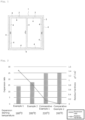
- Fig. 1 is a schematic view showing the sash frame of window 1, which is a fitting, in which molded products 4 formed of the resin composition of the present invention are provided.
- the sash frame comprises two inner frames 2 and one outer frame 3 surrounding two inner frames 2, and molded products 4 are provided inside inner frames 2 and outer frame 3 along each side of inner frames 2 and outer frame 3.
- a mixture comprising a chlorinated vinyl chloride resin ("HA-53F” produced by Tokuyama Sekisui Co., Ltd., polymerization degree: 1000, chlorine content: 64.0% by weight, decomposition starting temperature: 230°C, hereinafter referred to as "CPVC"), neutralized thermally expandable graphite, calcium carbonate ("WHITON BF300” produced by Shiraishi Calcium Kaisha, Ltd.), antimony trioxide ("PATOX-C” produced by Nihon Seiko Co., Ltd.), diisodecyl phthalate (“DIDP” produced by J-PLUS Co., Ltd., hereinafter referred to as "DIDP”), a Ca-Zn composite stabilizer ("NT-231” produced by Mizusawa Industrial Chemicals, Ltd.), calcium stearate (“SC-100” produced by Sakai Chemical Industry Co., Ltd.), chlorinated polyethylene (“135A” produced by Weihai Jinhong Chemical Industry Co., Ltd.), and polymethyl meth
- a specimen (length: 100 mm, width: 100 mm, thickness: 2.0 mm) prepared from the resulting molded product was placed in an electric furnace, and heated at 600°C for 30 minutes. The thickness of the specimen was measured, and (the thickness of the specimen after heating)/(the thickness of the specimen before heating) was calculated as the expansion rate.
- the heated specimen after the measurement of expansion rate was placed in a compression tester ("Finger-Feeling Tester" produced by Kato Tech Co., Ltd.), and compressed with an indenter of 0.25 cm 2 at a speed of 0.1 cm/s to measure the stress at a break point.
- the measurement results of the expansion rate and residue hardness of the resulting molded product are as shown in Fig. 2 .
- Examples 1 and 2 in which the expansion starting temperature of the thermally expandable graphite was lower than the decomposition starting temperature of the resin component a relatively high expansion rate and high residue hardness were maintained.
- Comparative Examples 1 and 2 in which the expansion starting temperature of the thermally expandable graphite was higher than the decomposition starting temperature of the resin component the residue hardness was drastically reduced.
- the residue hardness is an indicator of the hardness of the residue after expansion.
- the measurement is performed only on the front surface part of the residue; therefore, it may not be an indicator of the hardness of the entire residue. Accordingly, the residue shape retention was measured as an indicator of the hardness of the entire residue.
- both ends of the specimen after the measurement of expansion rate were lifted by hand, and the brittleness of the residue during lifting was measured visually. A case where the specimen was lifted without collapsing was evaluated as PASS, and a case where the specimen was collapsed and not lifted was evaluated as FAIL.
- CPVC polyvinyl chloride resin (polymerization degree of 1000, decomposition starting temperature of 215°C, referred to as "PVC") in Examples 7 to 10, an ethylene-vinyl acetate copolymer resin (decomposition starting temperature of 225°C, referred to as "EVA”) in Reference Examples 11 to 15, ethylene-propylene-diene rubber (decomposition starting temperature of 230°C, referred to as "EPDM”) in Reference Examples 16 to 20, and an epoxy resin (decomposition starting temperature of 275°C, referred to as "epoxy”) in Reference Examples 21 and 22 were used.
- PVC polyvinyl chloride resin
- EVA ethylene-vinyl acetate copolymer resin
- EPDM ethylene-propylene-diene rubber
- epoxy resin decomposition starting temperature of 275°C, referred to as "epoxy
- a specimen (length: 100 mm, width: 100 mm, thickness: 2.0 mm) prepared from the resulting molded product was placed in an electric furnace, and heated at 600°C for 30 minutes. The thickness of the specimen was measured, and (the thickness of the specimen after heating)/(the thickness of the specimen before heating) was calculated as the expansion rate.
- the heated specimen after the measurement of expansion rate was placed in a compression tester ("Finger-Feeling Tester" produced by Kato Tech Co., Ltd.), and compressed with an indenter of 0.25 cm 2 at a speed of 0.1 cm/s to measure the stress at a break point.
- the residue hardness is an indicator of the hardness of the residue after expansion.
- the measurement is performed only on the front surface part of the residue; therefore, it may not be an indicator of the hardness of the entire residue.
- the residue shape retention was measured as an indicator of the hardness of the entire residue.
- both ends of the heated specimen after the measurement of expansion rate were lifted by hand, and the brittleness of the residue during lifting was measured visually. A case where the specimen was lifted without collapsing was evaluated as PASS, and a case where the specimen was collapsed and not lifted was evaluated as FAIL.
Landscapes
- Chemical & Material Sciences (AREA)
- Health & Medical Sciences (AREA)
- Chemical Kinetics & Catalysis (AREA)
- Medicinal Chemistry (AREA)
- Polymers & Plastics (AREA)
- Organic Chemistry (AREA)
- General Chemical & Material Sciences (AREA)
- Civil Engineering (AREA)
- Engineering & Computer Science (AREA)
- Structural Engineering (AREA)
- Compositions Of Macromolecular Compounds (AREA)
- Fireproofing Substances (AREA)
- Building Environments (AREA)
- Wing Frames And Configurations (AREA)
- Special Wing (AREA)
- Carbon And Carbon Compounds (AREA)
Applications Claiming Priority (3)
| Application Number | Priority Date | Filing Date | Title |
|---|---|---|---|
| JP2014172997 | 2014-08-27 | ||
| EP15835152.8A EP3187548B1 (en) | 2014-08-27 | 2015-08-27 | Resin composition |
| PCT/JP2015/074195 WO2016031905A1 (ja) | 2014-08-27 | 2015-08-27 | 樹脂組成物 |
Related Parent Applications (2)
| Application Number | Title | Priority Date | Filing Date |
|---|---|---|---|
| EP15835152.8A Division EP3187548B1 (en) | 2014-08-27 | 2015-08-27 | Resin composition |
| EP15835152.8A Division-Into EP3187548B1 (en) | 2014-08-27 | 2015-08-27 | Resin composition |
Publications (2)
| Publication Number | Publication Date |
|---|---|
| EP3626783A1 EP3626783A1 (en) | 2020-03-25 |
| EP3626783B1 true EP3626783B1 (en) | 2023-03-22 |
Family
ID=55399790
Family Applications (2)
| Application Number | Title | Priority Date | Filing Date |
|---|---|---|---|
| EP19204509.4A Revoked EP3626783B1 (en) | 2014-08-27 | 2015-08-27 | Resin composition |
| EP15835152.8A Active EP3187548B1 (en) | 2014-08-27 | 2015-08-27 | Resin composition |
Family Applications After (1)
| Application Number | Title | Priority Date | Filing Date |
|---|---|---|---|
| EP15835152.8A Active EP3187548B1 (en) | 2014-08-27 | 2015-08-27 | Resin composition |
Country Status (7)
| Country | Link |
|---|---|
| US (1) | US20170253716A1 (enExample) |
| EP (2) | EP3626783B1 (enExample) |
| JP (8) | JP6243925B2 (enExample) |
| KR (1) | KR20170045199A (enExample) |
| CN (1) | CN106661334A (enExample) |
| AU (1) | AU2015309842A1 (enExample) |
| WO (1) | WO2016031905A1 (enExample) |
Families Citing this family (29)
| Publication number | Priority date | Publication date | Assignee | Title |
|---|---|---|---|---|
| EP3626783B1 (en) * | 2014-08-27 | 2023-03-22 | Sekisui Chemical Co., Ltd. | Resin composition |
| JP2017078100A (ja) * | 2015-10-19 | 2017-04-27 | 三井化学株式会社 | 樹脂組成物、該組成物からなる成形体およびパイプ |
| JP6533538B2 (ja) * | 2016-01-26 | 2019-06-19 | 積水化学工業株式会社 | 耐火樹脂組成物 |
| SE539376C2 (en) * | 2016-02-03 | 2017-08-29 | Deflamo Ab | A Polymer composition comprising a fire suppressant |
| KR20180117091A (ko) * | 2016-02-29 | 2018-10-26 | 세키스이가가쿠 고교가부시키가이샤 | 내화 엘라스토머 조성물 및 그 성형체 |
| WO2018003783A1 (ja) * | 2016-06-28 | 2018-01-04 | 住友化学株式会社 | ゴム組成物、ゴム成形体、及びゴム成形体の製造方法 |
| KR102324958B1 (ko) | 2016-09-29 | 2021-11-12 | 삼성전자 주식회사 | 무선 통신 시스템에서 다양한 서비스를 지원하기 위한 방법 및 장치 |
| JP7088657B2 (ja) * | 2016-10-24 | 2022-06-21 | 積水化学工業株式会社 | 熱膨張性耐火性シート |
| JP6527571B2 (ja) * | 2016-10-24 | 2019-06-05 | 積水化学工業株式会社 | 熱膨張性耐火性シート |
| EP3533851B1 (en) | 2016-10-26 | 2024-07-03 | Riken Technos Corporation | Adhesive film |
| JP7095985B2 (ja) * | 2016-12-21 | 2022-07-05 | 積水化学工業株式会社 | 耐火性樹脂組成物 |
| JP6748194B2 (ja) * | 2017-03-06 | 2020-08-26 | 積水化学工業株式会社 | 剛性と耐火性に優れる多色成形品成形材 |
| EP3689964A4 (en) | 2017-09-27 | 2021-06-23 | Sekisui Chemical Co., Ltd. | RESIN COMPOSITION FOR MOLDING |
| JP2019070119A (ja) * | 2017-10-10 | 2019-05-09 | 積水化学工業株式会社 | 耐火性樹脂組成物、耐火成形部材及び建具 |
| CN107805033A (zh) * | 2017-11-13 | 2018-03-16 | 蒋艳玲 | 一种石膏板及其制备方法 |
| JP7410635B2 (ja) * | 2018-01-30 | 2024-01-10 | 積水化学工業株式会社 | 熱膨張性耐火樹脂組成物、熱膨張性耐火シート及び該熱膨張性耐火シートを備えたバッテリーセル |
| JP7078419B2 (ja) * | 2018-02-20 | 2022-05-31 | 積水化学工業株式会社 | 塩化ビニル系樹脂成形体 |
| JP7201373B2 (ja) * | 2018-09-14 | 2023-01-10 | 積水化学工業株式会社 | 耐火性樹脂組成物、及び熱膨張性シート |
| CN109786118B (zh) * | 2019-01-05 | 2021-03-26 | 淄博职业学院 | 一种大规模制备粒径可控的氮氧掺杂碳微球及其制备方法和应用 |
| US11118035B2 (en) * | 2019-01-14 | 2021-09-14 | Armacell Enterprise Gmbh & Co. Kg | Highly fire-resistant expanded polymeric material |
| EP3680284B1 (en) * | 2019-01-14 | 2021-08-11 | Armacell Enterprise GmbH & Co. KG | Highly fire-resistant expanded polymeric material |
| CN111434710B (zh) * | 2019-01-14 | 2022-11-11 | 阿乐斯企业有限及两合公司 | 高耐火性发泡聚合物材料 |
| WO2020196395A1 (ja) * | 2019-03-26 | 2020-10-01 | 日本ゼオン株式会社 | 塩化ビニル樹脂組成物、塩化ビニル樹脂成形体および積層体 |
| CN110410616B (zh) * | 2019-07-10 | 2024-08-09 | 广东安普智信电气有限公司 | 一种高强度耐冲击复合套管 |
| JP6936402B2 (ja) * | 2019-08-26 | 2021-09-15 | 積水化学工業株式会社 | 熱膨張性耐火材 |
| US20210154894A1 (en) * | 2019-11-26 | 2021-05-27 | Ut-Battelle, Llc | Polymeric vacuum insulation boards |
| JP7007424B2 (ja) * | 2020-06-01 | 2022-01-24 | 積水化学工業株式会社 | 耐火性樹脂組成物、耐火シート及び建具 |
| CN117181991B (zh) * | 2023-09-27 | 2026-01-20 | 浙江大学温州研究院 | 利用固废石膏副产物改善田东铸造膨润土性能的方法 |
| JP7688343B1 (ja) | 2024-08-09 | 2025-06-04 | 株式会社レグルス | 樹脂組成物、耐火性部材及び建具 |
Citations (4)
| Publication number | Priority date | Publication date | Assignee | Title |
|---|---|---|---|---|
| JPH10330108A (ja) | 1997-05-30 | 1998-12-15 | Nippon Kasei Chem Co Ltd | 熱膨張性黒鉛 |
| EP1498463A1 (de) | 2003-07-17 | 2005-01-19 | Gluske GmbH | Intumeszierende Dichtung für den vorbeugenden Brandschutz |
| WO2009013931A1 (ja) | 2007-07-20 | 2009-01-29 | Air Water Inc. | 熱膨張性黒鉛およびその製造方法 |
| EP3187548A1 (en) | 2014-08-27 | 2017-07-05 | Sekisui Chemical Co., Ltd. | Resin composition |
Family Cites Families (32)
| Publication number | Priority date | Publication date | Assignee | Title |
|---|---|---|---|---|
| JPH0994838A (ja) * | 1995-09-28 | 1997-04-08 | Mitsubishi Plastics Ind Ltd | 可撓性シート材の成形方法 |
| JPH1095887A (ja) | 1995-12-22 | 1998-04-14 | Sekisui Chem Co Ltd | ポリ塩化ビニル系樹脂組成物 |
| JPH09176579A (ja) * | 1995-12-22 | 1997-07-08 | Sekisui Chem Co Ltd | 耐火テープ |
| JPH09227747A (ja) | 1995-12-22 | 1997-09-02 | Sekisui Chem Co Ltd | 塩素化ポリ塩化ビニル系樹脂組成物 |
| JP3838780B2 (ja) * | 1998-05-20 | 2006-10-25 | 積水化学工業株式会社 | 耐火性シート状成形体及びシート積層体 |
| JP4146571B2 (ja) * | 1998-07-29 | 2008-09-10 | 積水化学工業株式会社 | 耐火構成体 |
| JP3832703B2 (ja) * | 1998-11-30 | 2006-10-11 | 積水化学工業株式会社 | 耐火性塗料 |
| JP2000291176A (ja) | 1999-04-09 | 2000-10-17 | Sekisui Chem Co Ltd | 耐火用パネル |
| DE10024421A1 (de) * | 2000-05-19 | 2001-11-22 | Bayer Ag | Flammwidrige intumeszierende Mischungen |
| JP3455801B2 (ja) * | 2000-06-06 | 2003-10-14 | シー・アール・ケイ株式会社 | 熱膨張性防火用組成物 |
| TWI331640B (en) * | 2003-05-26 | 2010-10-11 | Sekisui Chemical Co Ltd | Fire retardant resin sash |
| JP4238192B2 (ja) * | 2004-09-02 | 2009-03-11 | 電気化学工業株式会社 | 防火用目地材及びその製造方法 |
| JP2007162319A (ja) * | 2005-12-13 | 2007-06-28 | Sekisui Chem Co Ltd | 鉄骨用耐火被覆シート |
| JP4440287B2 (ja) * | 2006-08-04 | 2010-03-24 | 積水化学工業株式会社 | 建築用配管材およびこの建築用配管材の成形方法 |
| CN101796129B (zh) * | 2007-08-29 | 2012-09-26 | 积水化学工业株式会社 | 耐火管道材料 |
| JP4312254B2 (ja) * | 2008-10-24 | 2009-08-12 | 電気化学工業株式会社 | 耐火ゴム組成物 |
| JP5547909B2 (ja) * | 2009-05-29 | 2014-07-16 | 積水化学工業株式会社 | 塩化ビニル樹脂三層管 |
| JP2011036290A (ja) * | 2009-08-06 | 2011-02-24 | Sekisui Chem Co Ltd | 防火区画貫通部構造 |
| WO2011058999A1 (ja) * | 2009-11-13 | 2011-05-19 | 日立化成工業株式会社 | フィルム状接着剤の製造方法、接着シート並びに半導体装置及びその製造方法 |
| JP5508048B2 (ja) * | 2010-01-28 | 2014-05-28 | 積水化学工業株式会社 | 耐火排水集合継手 |
| JP4669573B1 (ja) * | 2010-07-07 | 2011-04-13 | 電気化学工業株式会社 | 防火用熱膨張性目地材 |
| JP5961101B2 (ja) * | 2011-11-29 | 2016-08-02 | 積水化学工業株式会社 | サッシ用熱膨張性多層枠材 |
| JP5347103B1 (ja) * | 2011-11-29 | 2013-11-20 | 積水化学工業株式会社 | 建材用熱膨張性多層パッキン |
| KR101875991B1 (ko) * | 2011-11-29 | 2018-07-06 | 도쿠야마 세키스이 고교 가부시키가이샤 | 압출 성형용 염소화 염화비닐 수지조성물 |
| MX389327B (es) * | 2011-12-29 | 2025-03-20 | Holcim Technology Ltd | Membranas para techos con grafito expandible como retardantes de llama. |
| US9994693B2 (en) * | 2012-10-11 | 2018-06-12 | Sekisui Chemical Co., Ltd. | Thermally expandable resin composition |
| US9523203B2 (en) * | 2013-01-23 | 2016-12-20 | Firestone Building Products Co., LLC | Fire-resistant roof system and membrane composite |
| JP6131641B2 (ja) | 2013-03-08 | 2017-05-24 | 新日鐵住金株式会社 | コークス炉ガスの回収方法 |
| JP2015098773A (ja) * | 2013-10-17 | 2015-05-28 | 積水化学工業株式会社 | 樹脂サッシの防火構造 |
| EP3187549B1 (en) * | 2014-08-27 | 2019-04-24 | Sekisui Chemical Co., Ltd. | Thermally expandable fire resistant resin composition |
| JP6416679B2 (ja) * | 2015-03-27 | 2018-10-31 | 東京エレクトロン株式会社 | タングステン膜の成膜方法 |
| JP6616726B2 (ja) | 2016-04-01 | 2019-12-04 | 富士フイルム株式会社 | 複合膜、非水二次電池用セパレータおよび非水二次電池 |
-
2015
- 2015-08-27 EP EP19204509.4A patent/EP3626783B1/en not_active Revoked
- 2015-08-27 KR KR1020177002862A patent/KR20170045199A/ko not_active Ceased
- 2015-08-27 JP JP2015548520A patent/JP6243925B2/ja active Active
- 2015-08-27 CN CN201580046126.5A patent/CN106661334A/zh active Pending
- 2015-08-27 US US15/506,461 patent/US20170253716A1/en not_active Abandoned
- 2015-08-27 AU AU2015309842A patent/AU2015309842A1/en not_active Abandoned
- 2015-08-27 WO PCT/JP2015/074195 patent/WO2016031905A1/ja not_active Ceased
- 2015-08-27 EP EP15835152.8A patent/EP3187548B1/en active Active
-
2016
- 2016-09-23 JP JP2016186094A patent/JP6182250B2/ja active Active
-
2017
- 2017-10-24 JP JP2017204948A patent/JP6375040B2/ja active Active
-
2018
- 2018-06-12 JP JP2018112307A patent/JP6947692B2/ja active Active
-
2021
- 2021-03-30 JP JP2021058804A patent/JP7130082B2/ja active Active
-
2022
- 2022-08-23 JP JP2022132380A patent/JP7419459B2/ja active Active
-
2024
- 2024-01-10 JP JP2024001642A patent/JP7547660B2/ja active Active
- 2024-08-27 JP JP2024146052A patent/JP2024161143A/ja active Pending
Patent Citations (5)
| Publication number | Priority date | Publication date | Assignee | Title |
|---|---|---|---|---|
| JPH10330108A (ja) | 1997-05-30 | 1998-12-15 | Nippon Kasei Chem Co Ltd | 熱膨張性黒鉛 |
| EP1498463A1 (de) | 2003-07-17 | 2005-01-19 | Gluske GmbH | Intumeszierende Dichtung für den vorbeugenden Brandschutz |
| WO2009013931A1 (ja) | 2007-07-20 | 2009-01-29 | Air Water Inc. | 熱膨張性黒鉛およびその製造方法 |
| EP3187548A1 (en) | 2014-08-27 | 2017-07-05 | Sekisui Chemical Co., Ltd. | Resin composition |
| EP3626783A1 (en) | 2014-08-27 | 2020-03-25 | Sekisui Chemical Co., Ltd. | Resin composition |
Non-Patent Citations (8)
| Title |
|---|
| "FUNCTIONAL FILLERS FOR PLASTICS", 1 January 2005, article MARINO XANTHOS: "FUNCTIONAL FILLERS FOR PLASTICS (passage)", pages: 12 - 16, XP093152727 |
| "Polymer Material Encyclopedia", 30 July 1999, NIKKAN KOGYO SHINBUN SHA, ISBN: 978-4-526-04412-0, article KURIHARA FUKUJI: "13.4.7 Thermogravimetric Measurement", pages: 897 - 898, XP093190351 |
| A DURIN- FRANCE ET AL.: "Magnesium hydroxide/zinc borate/talc compositions as flame- retardants in EVA copolymer", POLYMER INTERNATIONAL, vol. 49, 2000, pages 1101 - 1105, XP093152728, DOI: 10.1002/1097-0126(200010)49:10<1101::AID-PI523>3.0.CO;2-5 |
| ANONYMOUS: "Allgemeine bauaufsichtliche Zulassung für Hensotherm Spachtel universal", DIBT, 22 January 2014 (2014-01-22), XP093173842 |
| ANONYMOUS: "Stoffdatenblatt für Hensotherm Spachtel universal", DIBT, 19 December 2013 (2013-12-19), XP093173837 |
| ARKEMA: "Evatane HT", SAFETY DATA SHEET, 2 March 2007 (2007-03-02), pages 1 - 4, XP093152721 |
| GÜNTER BEYER: "Flame retardant properties of EVA‐nanocomposites and improvements by combination of nanofillers with aluminium trihydrate", FIRE AND MATERIALS, NEW YORK, NY, US, vol. 25, no. 5, 9 April 2002 (2002-04-09), US , pages 193 - 197, XP071612791, ISSN: 0308-0501, DOI: 10.1002/fam.776 |
| HENSEL: "HENSOTHERM® Spachtel - universal - Brandschultzdichtmasse fur Einzelleitungen (LAR)", PRODUCT LEAFLET, 1 February 2014 (2014-02-01), pages 1 - 2, XP093152718 |
Also Published As
| Publication number | Publication date |
|---|---|
| EP3626783A1 (en) | 2020-03-25 |
| JP2021101027A (ja) | 2021-07-08 |
| JP6947692B2 (ja) | 2021-10-13 |
| KR20170045199A (ko) | 2017-04-26 |
| EP3187548B1 (en) | 2020-08-12 |
| EP3187548A1 (en) | 2017-07-05 |
| JP7419459B2 (ja) | 2024-01-22 |
| US20170253716A1 (en) | 2017-09-07 |
| JP6243925B2 (ja) | 2017-12-06 |
| JP2024161143A (ja) | 2024-11-15 |
| WO2016031905A1 (ja) | 2016-03-03 |
| JP6375040B2 (ja) | 2018-08-15 |
| JP6182250B2 (ja) | 2017-08-16 |
| AU2015309842A1 (en) | 2017-03-09 |
| JP2022167948A (ja) | 2022-11-04 |
| JP2017057395A (ja) | 2017-03-23 |
| JP2018135541A (ja) | 2018-08-30 |
| JP7130082B2 (ja) | 2022-09-02 |
| JP7547660B2 (ja) | 2024-09-09 |
| CN106661334A (zh) | 2017-05-10 |
| JP2024028427A (ja) | 2024-03-04 |
| EP3187548A4 (en) | 2018-04-04 |
| JPWO2016031905A1 (ja) | 2017-04-27 |
| JP2018048338A (ja) | 2018-03-29 |
Similar Documents
| Publication | Publication Date | Title |
|---|---|---|
| EP3187548B1 (en) | Resin composition | |
| EP3187549B1 (en) | Thermally expandable fire resistant resin composition | |
| EP2787036B1 (en) | Chlorinated vinyl chloride resin composition for extrusion molding | |
| JP6200572B2 (ja) | 耐火性樹脂組成物 | |
| JP6386600B2 (ja) | 耐火性樹脂組成物 |
Legal Events
| Date | Code | Title | Description |
|---|---|---|---|
| PUAI | Public reference made under article 153(3) epc to a published international application that has entered the european phase |
Free format text: ORIGINAL CODE: 0009012 |
|
| STAA | Information on the status of an ep patent application or granted ep patent |
Free format text: STATUS: THE APPLICATION HAS BEEN PUBLISHED |
|
| AC | Divisional application: reference to earlier application |
Ref document number: 3187548 Country of ref document: EP Kind code of ref document: P |
|
| AK | Designated contracting states |
Kind code of ref document: A1 Designated state(s): AL AT BE BG CH CY CZ DE DK EE ES FI FR GB GR HR HU IE IS IT LI LT LU LV MC MK MT NL NO PL PT RO RS SE SI SK SM TR |
|
| TPAC | Observations filed by third parties |
Free format text: ORIGINAL CODE: EPIDOSNTIPA |
|
| STAA | Information on the status of an ep patent application or granted ep patent |
Free format text: STATUS: REQUEST FOR EXAMINATION WAS MADE |
|
| 17P | Request for examination filed |
Effective date: 20200713 |
|
| RBV | Designated contracting states (corrected) |
Designated state(s): AL AT BE BG CH CY CZ DE DK EE ES FI FR GB GR HR HU IE IS IT LI LT LU LV MC MK MT NL NO PL PT RO RS SE SI SK SM TR |
|
| STAA | Information on the status of an ep patent application or granted ep patent |
Free format text: STATUS: EXAMINATION IS IN PROGRESS |
|
| 17Q | First examination report despatched |
Effective date: 20200824 |
|
| GRAP | Despatch of communication of intention to grant a patent |
Free format text: ORIGINAL CODE: EPIDOSNIGR1 |
|
| STAA | Information on the status of an ep patent application or granted ep patent |
Free format text: STATUS: GRANT OF PATENT IS INTENDED |
|
| INTG | Intention to grant announced |
Effective date: 20221021 |
|
| GRAS | Grant fee paid |
Free format text: ORIGINAL CODE: EPIDOSNIGR3 |
|
| GRAA | (expected) grant |
Free format text: ORIGINAL CODE: 0009210 |
|
| STAA | Information on the status of an ep patent application or granted ep patent |
Free format text: STATUS: THE PATENT HAS BEEN GRANTED |
|
| AC | Divisional application: reference to earlier application |
Ref document number: 3187548 Country of ref document: EP Kind code of ref document: P |
|
| AK | Designated contracting states |
Kind code of ref document: B1 Designated state(s): AL AT BE BG CH CY CZ DE DK EE ES FI FR GB GR HR HU IE IS IT LI LT LU LV MC MK MT NL NO PL PT RO RS SE SI SK SM TR |
|
| REG | Reference to a national code |
Ref country code: GB Ref legal event code: FG4D |
|
| REG | Reference to a national code |
Ref country code: CH Ref legal event code: EP |
|
| REG | Reference to a national code |
Ref country code: IE Ref legal event code: FG4D |
|
| REG | Reference to a national code |
Ref country code: DE Ref legal event code: R096 Ref document number: 602015082933 Country of ref document: DE |
|
| REG | Reference to a national code |
Ref country code: AT Ref legal event code: REF Ref document number: 1555292 Country of ref document: AT Kind code of ref document: T Effective date: 20230415 |
|
| P01 | Opt-out of the competence of the unified patent court (upc) registered |
Effective date: 20230524 |
|
| REG | Reference to a national code |
Ref country code: LT Ref legal event code: MG9D |
|
| REG | Reference to a national code |
Ref country code: NL Ref legal event code: MP Effective date: 20230322 |
|
| PG25 | Lapsed in a contracting state [announced via postgrant information from national office to epo] |
Ref country code: RS Free format text: LAPSE BECAUSE OF FAILURE TO SUBMIT A TRANSLATION OF THE DESCRIPTION OR TO PAY THE FEE WITHIN THE PRESCRIBED TIME-LIMIT Effective date: 20230322 Ref country code: NO Free format text: LAPSE BECAUSE OF FAILURE TO SUBMIT A TRANSLATION OF THE DESCRIPTION OR TO PAY THE FEE WITHIN THE PRESCRIBED TIME-LIMIT Effective date: 20230622 Ref country code: LV Free format text: LAPSE BECAUSE OF FAILURE TO SUBMIT A TRANSLATION OF THE DESCRIPTION OR TO PAY THE FEE WITHIN THE PRESCRIBED TIME-LIMIT Effective date: 20230322 Ref country code: LT Free format text: LAPSE BECAUSE OF FAILURE TO SUBMIT A TRANSLATION OF THE DESCRIPTION OR TO PAY THE FEE WITHIN THE PRESCRIBED TIME-LIMIT Effective date: 20230322 Ref country code: HR Free format text: LAPSE BECAUSE OF FAILURE TO SUBMIT A TRANSLATION OF THE DESCRIPTION OR TO PAY THE FEE WITHIN THE PRESCRIBED TIME-LIMIT Effective date: 20230322 |
|
| REG | Reference to a national code |
Ref country code: AT Ref legal event code: MK05 Ref document number: 1555292 Country of ref document: AT Kind code of ref document: T Effective date: 20230322 |
|
| PG25 | Lapsed in a contracting state [announced via postgrant information from national office to epo] |
Ref country code: SE Free format text: LAPSE BECAUSE OF FAILURE TO SUBMIT A TRANSLATION OF THE DESCRIPTION OR TO PAY THE FEE WITHIN THE PRESCRIBED TIME-LIMIT Effective date: 20230322 Ref country code: NL Free format text: LAPSE BECAUSE OF FAILURE TO SUBMIT A TRANSLATION OF THE DESCRIPTION OR TO PAY THE FEE WITHIN THE PRESCRIBED TIME-LIMIT Effective date: 20230322 Ref country code: GR Free format text: LAPSE BECAUSE OF FAILURE TO SUBMIT A TRANSLATION OF THE DESCRIPTION OR TO PAY THE FEE WITHIN THE PRESCRIBED TIME-LIMIT Effective date: 20230623 Ref country code: FI Free format text: LAPSE BECAUSE OF FAILURE TO SUBMIT A TRANSLATION OF THE DESCRIPTION OR TO PAY THE FEE WITHIN THE PRESCRIBED TIME-LIMIT Effective date: 20230322 |
|
| PG25 | Lapsed in a contracting state [announced via postgrant information from national office to epo] |
Ref country code: SM Free format text: LAPSE BECAUSE OF FAILURE TO SUBMIT A TRANSLATION OF THE DESCRIPTION OR TO PAY THE FEE WITHIN THE PRESCRIBED TIME-LIMIT Effective date: 20230322 Ref country code: RO Free format text: LAPSE BECAUSE OF FAILURE TO SUBMIT A TRANSLATION OF THE DESCRIPTION OR TO PAY THE FEE WITHIN THE PRESCRIBED TIME-LIMIT Effective date: 20230322 Ref country code: PT Free format text: LAPSE BECAUSE OF FAILURE TO SUBMIT A TRANSLATION OF THE DESCRIPTION OR TO PAY THE FEE WITHIN THE PRESCRIBED TIME-LIMIT Effective date: 20230724 Ref country code: ES Free format text: LAPSE BECAUSE OF FAILURE TO SUBMIT A TRANSLATION OF THE DESCRIPTION OR TO PAY THE FEE WITHIN THE PRESCRIBED TIME-LIMIT Effective date: 20230322 Ref country code: EE Free format text: LAPSE BECAUSE OF FAILURE TO SUBMIT A TRANSLATION OF THE DESCRIPTION OR TO PAY THE FEE WITHIN THE PRESCRIBED TIME-LIMIT Effective date: 20230322 Ref country code: AT Free format text: LAPSE BECAUSE OF FAILURE TO SUBMIT A TRANSLATION OF THE DESCRIPTION OR TO PAY THE FEE WITHIN THE PRESCRIBED TIME-LIMIT Effective date: 20230322 |
|
| PG25 | Lapsed in a contracting state [announced via postgrant information from national office to epo] |
Ref country code: SK Free format text: LAPSE BECAUSE OF FAILURE TO SUBMIT A TRANSLATION OF THE DESCRIPTION OR TO PAY THE FEE WITHIN THE PRESCRIBED TIME-LIMIT Effective date: 20230322 Ref country code: PL Free format text: LAPSE BECAUSE OF FAILURE TO SUBMIT A TRANSLATION OF THE DESCRIPTION OR TO PAY THE FEE WITHIN THE PRESCRIBED TIME-LIMIT Effective date: 20230322 Ref country code: IS Free format text: LAPSE BECAUSE OF FAILURE TO SUBMIT A TRANSLATION OF THE DESCRIPTION OR TO PAY THE FEE WITHIN THE PRESCRIBED TIME-LIMIT Effective date: 20230722 |
|
| REG | Reference to a national code |
Ref country code: DE Ref legal event code: R026 Ref document number: 602015082933 Country of ref document: DE |
|
| PLBI | Opposition filed |
Free format text: ORIGINAL CODE: 0009260 |
|
| PLAX | Notice of opposition and request to file observation + time limit sent |
Free format text: ORIGINAL CODE: EPIDOSNOBS2 |
|
| REG | Reference to a national code |
Ref country code: DE Ref legal event code: R082 Ref document number: 602015082933 Country of ref document: DE Representative=s name: TER MEER STEINMEISTER & PARTNER PATENTANWAELTE, DE |
|
| PG25 | Lapsed in a contracting state [announced via postgrant information from national office to epo] |
Ref country code: SI Free format text: LAPSE BECAUSE OF FAILURE TO SUBMIT A TRANSLATION OF THE DESCRIPTION OR TO PAY THE FEE WITHIN THE PRESCRIBED TIME-LIMIT Effective date: 20230322 Ref country code: DK Free format text: LAPSE BECAUSE OF FAILURE TO SUBMIT A TRANSLATION OF THE DESCRIPTION OR TO PAY THE FEE WITHIN THE PRESCRIBED TIME-LIMIT Effective date: 20230322 Ref country code: CZ Free format text: LAPSE BECAUSE OF FAILURE TO SUBMIT A TRANSLATION OF THE DESCRIPTION OR TO PAY THE FEE WITHIN THE PRESCRIBED TIME-LIMIT Effective date: 20230322 |
|
| 26 | Opposition filed |
Opponent name: RUDOLF HENSEL GMBH Effective date: 20231222 |
|
| PG25 | Lapsed in a contracting state [announced via postgrant information from national office to epo] |
Ref country code: MC Free format text: LAPSE BECAUSE OF FAILURE TO SUBMIT A TRANSLATION OF THE DESCRIPTION OR TO PAY THE FEE WITHIN THE PRESCRIBED TIME-LIMIT Effective date: 20230322 |
|
| REG | Reference to a national code |
Ref country code: CH Ref legal event code: PL |
|
| PG25 | Lapsed in a contracting state [announced via postgrant information from national office to epo] |
Ref country code: MC Free format text: LAPSE BECAUSE OF FAILURE TO SUBMIT A TRANSLATION OF THE DESCRIPTION OR TO PAY THE FEE WITHIN THE PRESCRIBED TIME-LIMIT Effective date: 20230322 |
|
| PG25 | Lapsed in a contracting state [announced via postgrant information from national office to epo] |
Ref country code: LU Free format text: LAPSE BECAUSE OF NON-PAYMENT OF DUE FEES Effective date: 20230827 |
|
| PG25 | Lapsed in a contracting state [announced via postgrant information from national office to epo] |
Ref country code: LU Free format text: LAPSE BECAUSE OF NON-PAYMENT OF DUE FEES Effective date: 20230827 Ref country code: CH Free format text: LAPSE BECAUSE OF NON-PAYMENT OF DUE FEES Effective date: 20230831 |
|
| REG | Reference to a national code |
Ref country code: BE Ref legal event code: MM Effective date: 20230831 |
|
| PLBB | Reply of patent proprietor to notice(s) of opposition received |
Free format text: ORIGINAL CODE: EPIDOSNOBS3 |
|
| REG | Reference to a national code |
Ref country code: IE Ref legal event code: MM4A |
|
| PG25 | Lapsed in a contracting state [announced via postgrant information from national office to epo] |
Ref country code: IT Free format text: LAPSE BECAUSE OF FAILURE TO SUBMIT A TRANSLATION OF THE DESCRIPTION OR TO PAY THE FEE WITHIN THE PRESCRIBED TIME-LIMIT Effective date: 20230322 |
|
| PG25 | Lapsed in a contracting state [announced via postgrant information from national office to epo] |
Ref country code: IE Free format text: LAPSE BECAUSE OF NON-PAYMENT OF DUE FEES Effective date: 20230827 |
|
| PG25 | Lapsed in a contracting state [announced via postgrant information from national office to epo] |
Ref country code: IE Free format text: LAPSE BECAUSE OF NON-PAYMENT OF DUE FEES Effective date: 20230827 |
|
| PG25 | Lapsed in a contracting state [announced via postgrant information from national office to epo] |
Ref country code: BE Free format text: LAPSE BECAUSE OF NON-PAYMENT OF DUE FEES Effective date: 20230831 |
|
| PG25 | Lapsed in a contracting state [announced via postgrant information from national office to epo] |
Ref country code: BG Free format text: LAPSE BECAUSE OF FAILURE TO SUBMIT A TRANSLATION OF THE DESCRIPTION OR TO PAY THE FEE WITHIN THE PRESCRIBED TIME-LIMIT Effective date: 20230322 |
|
| PG25 | Lapsed in a contracting state [announced via postgrant information from national office to epo] |
Ref country code: BG Free format text: LAPSE BECAUSE OF FAILURE TO SUBMIT A TRANSLATION OF THE DESCRIPTION OR TO PAY THE FEE WITHIN THE PRESCRIBED TIME-LIMIT Effective date: 20230322 |
|
| PG25 | Lapsed in a contracting state [announced via postgrant information from national office to epo] |
Ref country code: CY Free format text: LAPSE BECAUSE OF FAILURE TO SUBMIT A TRANSLATION OF THE DESCRIPTION OR TO PAY THE FEE WITHIN THE PRESCRIBED TIME-LIMIT; INVALID AB INITIO Effective date: 20150827 |
|
| PG25 | Lapsed in a contracting state [announced via postgrant information from national office to epo] |
Ref country code: HU Free format text: LAPSE BECAUSE OF FAILURE TO SUBMIT A TRANSLATION OF THE DESCRIPTION OR TO PAY THE FEE WITHIN THE PRESCRIBED TIME-LIMIT; INVALID AB INITIO Effective date: 20150827 |
|
| PGFP | Annual fee paid to national office [announced via postgrant information from national office to epo] |
Ref country code: DE Payment date: 20250702 Year of fee payment: 11 |
|
| PGFP | Annual fee paid to national office [announced via postgrant information from national office to epo] |
Ref country code: GB Payment date: 20250703 Year of fee payment: 11 |
|
| PGFP | Annual fee paid to national office [announced via postgrant information from national office to epo] |
Ref country code: FR Payment date: 20250703 Year of fee payment: 11 |
|
| REG | Reference to a national code |
Ref country code: DE Ref legal event code: R064 Ref document number: 602015082933 Country of ref document: DE Ref country code: DE Ref legal event code: R103 Ref document number: 602015082933 Country of ref document: DE |
|
| PG25 | Lapsed in a contracting state [announced via postgrant information from national office to epo] |
Ref country code: TR Free format text: LAPSE BECAUSE OF FAILURE TO SUBMIT A TRANSLATION OF THE DESCRIPTION OR TO PAY THE FEE WITHIN THE PRESCRIBED TIME-LIMIT Effective date: 20230322 |
|
| RDAF | Communication despatched that patent is revoked |
Free format text: ORIGINAL CODE: EPIDOSNREV1 |
|
| RDAG | Patent revoked |
Free format text: ORIGINAL CODE: 0009271 |
|
| STAA | Information on the status of an ep patent application or granted ep patent |
Free format text: STATUS: PATENT REVOKED |
|
| REG | Reference to a national code |
Ref country code: CH Ref legal event code: N12 Free format text: ST27 STATUS EVENT CODE: U-0-0-N10-N12 (AS PROVIDED BY THE NATIONAL OFFICE) Effective date: 20260402 |
|
| 27W | Patent revoked |
Effective date: 20251118 |
|
| GBPR | Gb: patent revoked under art. 102 of the ep convention designating the uk as contracting state |
Effective date: 20251118 |