EP3616777A1 - High pd content diesel oxidation catalyst with improved hydrothermal durability - Google Patents
High pd content diesel oxidation catalyst with improved hydrothermal durability Download PDFInfo
- Publication number
- EP3616777A1 EP3616777A1 EP19199595.0A EP19199595A EP3616777A1 EP 3616777 A1 EP3616777 A1 EP 3616777A1 EP 19199595 A EP19199595 A EP 19199595A EP 3616777 A1 EP3616777 A1 EP 3616777A1
- Authority
- EP
- European Patent Office
- Prior art keywords
- catalyst
- overcoat
- gcf
- slurry
- zeolite
- Prior art date
- Legal status (The legal status is an assumption and is not a legal conclusion. Google has not performed a legal analysis and makes no representation as to the accuracy of the status listed.)
- Withdrawn
Links
Images







Classifications
-
- F—MECHANICAL ENGINEERING; LIGHTING; HEATING; WEAPONS; BLASTING
- F01—MACHINES OR ENGINES IN GENERAL; ENGINE PLANTS IN GENERAL; STEAM ENGINES
- F01N—GAS-FLOW SILENCERS OR EXHAUST APPARATUS FOR MACHINES OR ENGINES IN GENERAL; GAS-FLOW SILENCERS OR EXHAUST APPARATUS FOR INTERNAL-COMBUSTION ENGINES
- F01N3/00—Exhaust or silencing apparatus having means for purifying, rendering innocuous, or otherwise treating exhaust
- F01N3/08—Exhaust or silencing apparatus having means for purifying, rendering innocuous, or otherwise treating exhaust for rendering innocuous
- F01N3/10—Exhaust or silencing apparatus having means for purifying, rendering innocuous, or otherwise treating exhaust for rendering innocuous by thermal or catalytic conversion of noxious components of exhaust
- F01N3/105—General auxiliary catalysts, e.g. upstream or downstream of the main catalyst
- F01N3/106—Auxiliary oxidation catalysts
-
- B—PERFORMING OPERATIONS; TRANSPORTING
- B01—PHYSICAL OR CHEMICAL PROCESSES OR APPARATUS IN GENERAL
- B01D—SEPARATION
- B01D53/00—Separation of gases or vapours; Recovering vapours of volatile solvents from gases; Chemical or biological purification of waste gases, e.g. engine exhaust gases, smoke, fumes, flue gases, aerosols
- B01D53/34—Chemical or biological purification of waste gases
- B01D53/92—Chemical or biological purification of waste gases of engine exhaust gases
- B01D53/94—Chemical or biological purification of waste gases of engine exhaust gases by catalytic processes
- B01D53/944—Simultaneously removing carbon monoxide, hydrocarbons or carbon making use of oxidation catalysts
-
- B—PERFORMING OPERATIONS; TRANSPORTING
- B01—PHYSICAL OR CHEMICAL PROCESSES OR APPARATUS IN GENERAL
- B01D—SEPARATION
- B01D53/00—Separation of gases or vapours; Recovering vapours of volatile solvents from gases; Chemical or biological purification of waste gases, e.g. engine exhaust gases, smoke, fumes, flue gases, aerosols
- B01D53/34—Chemical or biological purification of waste gases
- B01D53/92—Chemical or biological purification of waste gases of engine exhaust gases
- B01D53/94—Chemical or biological purification of waste gases of engine exhaust gases by catalytic processes
- B01D53/9459—Removing one or more of nitrogen oxides, carbon monoxide, or hydrocarbons by multiple successive catalytic functions; systems with more than one different function, e.g. zone coated catalysts
- B01D53/9463—Removing one or more of nitrogen oxides, carbon monoxide, or hydrocarbons by multiple successive catalytic functions; systems with more than one different function, e.g. zone coated catalysts with catalysts positioned on one brick
- B01D53/9468—Removing one or more of nitrogen oxides, carbon monoxide, or hydrocarbons by multiple successive catalytic functions; systems with more than one different function, e.g. zone coated catalysts with catalysts positioned on one brick in different layers
-
- B—PERFORMING OPERATIONS; TRANSPORTING
- B01—PHYSICAL OR CHEMICAL PROCESSES OR APPARATUS IN GENERAL
- B01J—CHEMICAL OR PHYSICAL PROCESSES, e.g. CATALYSIS OR COLLOID CHEMISTRY; THEIR RELEVANT APPARATUS
- B01J23/00—Catalysts comprising metals or metal oxides or hydroxides, not provided for in group B01J21/00
- B01J23/38—Catalysts comprising metals or metal oxides or hydroxides, not provided for in group B01J21/00 of noble metals
- B01J23/40—Catalysts comprising metals or metal oxides or hydroxides, not provided for in group B01J21/00 of noble metals of the platinum group metals
-
- B—PERFORMING OPERATIONS; TRANSPORTING
- B01—PHYSICAL OR CHEMICAL PROCESSES OR APPARATUS IN GENERAL
- B01J—CHEMICAL OR PHYSICAL PROCESSES, e.g. CATALYSIS OR COLLOID CHEMISTRY; THEIR RELEVANT APPARATUS
- B01J23/00—Catalysts comprising metals or metal oxides or hydroxides, not provided for in group B01J21/00
- B01J23/38—Catalysts comprising metals or metal oxides or hydroxides, not provided for in group B01J21/00 of noble metals
- B01J23/40—Catalysts comprising metals or metal oxides or hydroxides, not provided for in group B01J21/00 of noble metals of the platinum group metals
- B01J23/44—Palladium
-
- B—PERFORMING OPERATIONS; TRANSPORTING
- B01—PHYSICAL OR CHEMICAL PROCESSES OR APPARATUS IN GENERAL
- B01J—CHEMICAL OR PHYSICAL PROCESSES, e.g. CATALYSIS OR COLLOID CHEMISTRY; THEIR RELEVANT APPARATUS
- B01J23/00—Catalysts comprising metals or metal oxides or hydroxides, not provided for in group B01J21/00
- B01J23/38—Catalysts comprising metals or metal oxides or hydroxides, not provided for in group B01J21/00 of noble metals
- B01J23/54—Catalysts comprising metals or metal oxides or hydroxides, not provided for in group B01J21/00 of noble metals combined with metals, oxides or hydroxides provided for in groups B01J23/02 - B01J23/36
- B01J23/56—Platinum group metals
- B01J23/58—Platinum group metals with alkali- or alkaline earth metals
-
- B—PERFORMING OPERATIONS; TRANSPORTING
- B01—PHYSICAL OR CHEMICAL PROCESSES OR APPARATUS IN GENERAL
- B01J—CHEMICAL OR PHYSICAL PROCESSES, e.g. CATALYSIS OR COLLOID CHEMISTRY; THEIR RELEVANT APPARATUS
- B01J23/00—Catalysts comprising metals or metal oxides or hydroxides, not provided for in group B01J21/00
- B01J23/38—Catalysts comprising metals or metal oxides or hydroxides, not provided for in group B01J21/00 of noble metals
- B01J23/54—Catalysts comprising metals or metal oxides or hydroxides, not provided for in group B01J21/00 of noble metals combined with metals, oxides or hydroxides provided for in groups B01J23/02 - B01J23/36
- B01J23/56—Platinum group metals
- B01J23/63—Platinum group metals with rare earths or actinides
-
- B—PERFORMING OPERATIONS; TRANSPORTING
- B01—PHYSICAL OR CHEMICAL PROCESSES OR APPARATUS IN GENERAL
- B01J—CHEMICAL OR PHYSICAL PROCESSES, e.g. CATALYSIS OR COLLOID CHEMISTRY; THEIR RELEVANT APPARATUS
- B01J35/00—Catalysts, in general, characterised by their form or physical properties
- B01J35/19—Catalysts containing parts with different compositions
-
- B—PERFORMING OPERATIONS; TRANSPORTING
- B01—PHYSICAL OR CHEMICAL PROCESSES OR APPARATUS IN GENERAL
- B01J—CHEMICAL OR PHYSICAL PROCESSES, e.g. CATALYSIS OR COLLOID CHEMISTRY; THEIR RELEVANT APPARATUS
- B01J35/00—Catalysts, in general, characterised by their form or physical properties
- B01J35/40—Catalysts, in general, characterised by their form or physical properties characterised by dimensions, e.g. grain size
-
- B—PERFORMING OPERATIONS; TRANSPORTING
- B01—PHYSICAL OR CHEMICAL PROCESSES OR APPARATUS IN GENERAL
- B01J—CHEMICAL OR PHYSICAL PROCESSES, e.g. CATALYSIS OR COLLOID CHEMISTRY; THEIR RELEVANT APPARATUS
- B01J37/00—Processes, in general, for preparing catalysts; Processes, in general, for activation of catalysts
- B01J37/02—Impregnation, coating or precipitation
- B01J37/0234—Impregnation and coating simultaneously
-
- B—PERFORMING OPERATIONS; TRANSPORTING
- B01—PHYSICAL OR CHEMICAL PROCESSES OR APPARATUS IN GENERAL
- B01J—CHEMICAL OR PHYSICAL PROCESSES, e.g. CATALYSIS OR COLLOID CHEMISTRY; THEIR RELEVANT APPARATUS
- B01J37/00—Processes, in general, for preparing catalysts; Processes, in general, for activation of catalysts
- B01J37/02—Impregnation, coating or precipitation
- B01J37/024—Multiple impregnation or coating
- B01J37/0242—Coating followed by impregnation
-
- B—PERFORMING OPERATIONS; TRANSPORTING
- B01—PHYSICAL OR CHEMICAL PROCESSES OR APPARATUS IN GENERAL
- B01J—CHEMICAL OR PHYSICAL PROCESSES, e.g. CATALYSIS OR COLLOID CHEMISTRY; THEIR RELEVANT APPARATUS
- B01J37/00—Processes, in general, for preparing catalysts; Processes, in general, for activation of catalysts
- B01J37/02—Impregnation, coating or precipitation
- B01J37/024—Multiple impregnation or coating
- B01J37/0244—Coatings comprising several layers
-
- B—PERFORMING OPERATIONS; TRANSPORTING
- B01—PHYSICAL OR CHEMICAL PROCESSES OR APPARATUS IN GENERAL
- B01J—CHEMICAL OR PHYSICAL PROCESSES, e.g. CATALYSIS OR COLLOID CHEMISTRY; THEIR RELEVANT APPARATUS
- B01J37/00—Processes, in general, for preparing catalysts; Processes, in general, for activation of catalysts
- B01J37/02—Impregnation, coating or precipitation
- B01J37/024—Multiple impregnation or coating
- B01J37/0246—Coatings comprising a zeolite
-
- F—MECHANICAL ENGINEERING; LIGHTING; HEATING; WEAPONS; BLASTING
- F01—MACHINES OR ENGINES IN GENERAL; ENGINE PLANTS IN GENERAL; STEAM ENGINES
- F01N—GAS-FLOW SILENCERS OR EXHAUST APPARATUS FOR MACHINES OR ENGINES IN GENERAL; GAS-FLOW SILENCERS OR EXHAUST APPARATUS FOR INTERNAL-COMBUSTION ENGINES
- F01N3/00—Exhaust or silencing apparatus having means for purifying, rendering innocuous, or otherwise treating exhaust
- F01N3/08—Exhaust or silencing apparatus having means for purifying, rendering innocuous, or otherwise treating exhaust for rendering innocuous
- F01N3/10—Exhaust or silencing apparatus having means for purifying, rendering innocuous, or otherwise treating exhaust for rendering innocuous by thermal or catalytic conversion of noxious components of exhaust
- F01N3/103—Oxidation catalysts for HC and CO only
-
- B—PERFORMING OPERATIONS; TRANSPORTING
- B01—PHYSICAL OR CHEMICAL PROCESSES OR APPARATUS IN GENERAL
- B01D—SEPARATION
- B01D2255/00—Catalysts
- B01D2255/10—Noble metals or compounds thereof
- B01D2255/102—Platinum group metals
- B01D2255/1021—Platinum
-
- B—PERFORMING OPERATIONS; TRANSPORTING
- B01—PHYSICAL OR CHEMICAL PROCESSES OR APPARATUS IN GENERAL
- B01D—SEPARATION
- B01D2255/00—Catalysts
- B01D2255/10—Noble metals or compounds thereof
- B01D2255/102—Platinum group metals
- B01D2255/1023—Palladium
-
- B—PERFORMING OPERATIONS; TRANSPORTING
- B01—PHYSICAL OR CHEMICAL PROCESSES OR APPARATUS IN GENERAL
- B01D—SEPARATION
- B01D2255/00—Catalysts
- B01D2255/90—Physical characteristics of catalysts
- B01D2255/902—Multilayered catalyst
- B01D2255/9022—Two layers
-
- B—PERFORMING OPERATIONS; TRANSPORTING
- B01—PHYSICAL OR CHEMICAL PROCESSES OR APPARATUS IN GENERAL
- B01D—SEPARATION
- B01D2255/00—Catalysts
- B01D2255/90—Physical characteristics of catalysts
- B01D2255/903—Multi-zoned catalysts
- B01D2255/9032—Two zones
-
- B—PERFORMING OPERATIONS; TRANSPORTING
- B01—PHYSICAL OR CHEMICAL PROCESSES OR APPARATUS IN GENERAL
- B01D—SEPARATION
- B01D2255/00—Catalysts
- B01D2255/90—Physical characteristics of catalysts
- B01D2255/908—O2-storage component incorporated in the catalyst
-
- B—PERFORMING OPERATIONS; TRANSPORTING
- B01—PHYSICAL OR CHEMICAL PROCESSES OR APPARATUS IN GENERAL
- B01D—SEPARATION
- B01D2255/00—Catalysts
- B01D2255/90—Physical characteristics of catalysts
- B01D2255/912—HC-storage component incorporated in the catalyst
-
- B—PERFORMING OPERATIONS; TRANSPORTING
- B01—PHYSICAL OR CHEMICAL PROCESSES OR APPARATUS IN GENERAL
- B01D—SEPARATION
- B01D2257/00—Components to be removed
- B01D2257/50—Carbon oxides
- B01D2257/502—Carbon monoxide
-
- B—PERFORMING OPERATIONS; TRANSPORTING
- B01—PHYSICAL OR CHEMICAL PROCESSES OR APPARATUS IN GENERAL
- B01D—SEPARATION
- B01D2257/00—Components to be removed
- B01D2257/70—Organic compounds not provided for in groups B01D2257/00 - B01D2257/602
- B01D2257/702—Hydrocarbons
-
- B—PERFORMING OPERATIONS; TRANSPORTING
- B01—PHYSICAL OR CHEMICAL PROCESSES OR APPARATUS IN GENERAL
- B01D—SEPARATION
- B01D2258/00—Sources of waste gases
- B01D2258/01—Engine exhaust gases
- B01D2258/012—Diesel engines and lean burn gasoline engines
-
- B—PERFORMING OPERATIONS; TRANSPORTING
- B01—PHYSICAL OR CHEMICAL PROCESSES OR APPARATUS IN GENERAL
- B01J—CHEMICAL OR PHYSICAL PROCESSES, e.g. CATALYSIS OR COLLOID CHEMISTRY; THEIR RELEVANT APPARATUS
- B01J29/00—Catalysts comprising molecular sieves
-
- B—PERFORMING OPERATIONS; TRANSPORTING
- B01—PHYSICAL OR CHEMICAL PROCESSES OR APPARATUS IN GENERAL
- B01J—CHEMICAL OR PHYSICAL PROCESSES, e.g. CATALYSIS OR COLLOID CHEMISTRY; THEIR RELEVANT APPARATUS
- B01J29/00—Catalysts comprising molecular sieves
- B01J29/04—Catalysts comprising molecular sieves having base-exchange properties, e.g. crystalline zeolites
- B01J29/06—Crystalline aluminosilicate zeolites; Isomorphous compounds thereof
- B01J29/70—Crystalline aluminosilicate zeolites; Isomorphous compounds thereof of types characterised by their specific structure not provided for in groups B01J29/08 - B01J29/65
- B01J29/7007—Zeolite Beta
-
- B—PERFORMING OPERATIONS; TRANSPORTING
- B01—PHYSICAL OR CHEMICAL PROCESSES OR APPARATUS IN GENERAL
- B01J—CHEMICAL OR PHYSICAL PROCESSES, e.g. CATALYSIS OR COLLOID CHEMISTRY; THEIR RELEVANT APPARATUS
- B01J37/00—Processes, in general, for preparing catalysts; Processes, in general, for activation of catalysts
- B01J37/0009—Use of binding agents; Moulding; Pressing; Powdering; Granulating; Addition of materials ameliorating the mechanical properties of the product catalyst
- B01J37/0027—Powdering
- B01J37/0036—Grinding
-
- F—MECHANICAL ENGINEERING; LIGHTING; HEATING; WEAPONS; BLASTING
- F01—MACHINES OR ENGINES IN GENERAL; ENGINE PLANTS IN GENERAL; STEAM ENGINES
- F01N—GAS-FLOW SILENCERS OR EXHAUST APPARATUS FOR MACHINES OR ENGINES IN GENERAL; GAS-FLOW SILENCERS OR EXHAUST APPARATUS FOR INTERNAL-COMBUSTION ENGINES
- F01N2370/00—Selection of materials for exhaust purification
- F01N2370/02—Selection of materials for exhaust purification used in catalytic reactors
-
- F—MECHANICAL ENGINEERING; LIGHTING; HEATING; WEAPONS; BLASTING
- F01—MACHINES OR ENGINES IN GENERAL; ENGINE PLANTS IN GENERAL; STEAM ENGINES
- F01N—GAS-FLOW SILENCERS OR EXHAUST APPARATUS FOR MACHINES OR ENGINES IN GENERAL; GAS-FLOW SILENCERS OR EXHAUST APPARATUS FOR INTERNAL-COMBUSTION ENGINES
- F01N2570/00—Exhaust treating apparatus eliminating, absorbing or adsorbing specific elements or compounds
- F01N2570/12—Hydrocarbons
-
- F—MECHANICAL ENGINEERING; LIGHTING; HEATING; WEAPONS; BLASTING
- F01—MACHINES OR ENGINES IN GENERAL; ENGINE PLANTS IN GENERAL; STEAM ENGINES
- F01N—GAS-FLOW SILENCERS OR EXHAUST APPARATUS FOR MACHINES OR ENGINES IN GENERAL; GAS-FLOW SILENCERS OR EXHAUST APPARATUS FOR INTERNAL-COMBUSTION ENGINES
- F01N3/00—Exhaust or silencing apparatus having means for purifying, rendering innocuous, or otherwise treating exhaust
- F01N3/08—Exhaust or silencing apparatus having means for purifying, rendering innocuous, or otherwise treating exhaust for rendering innocuous
- F01N3/10—Exhaust or silencing apparatus having means for purifying, rendering innocuous, or otherwise treating exhaust for rendering innocuous by thermal or catalytic conversion of noxious components of exhaust
Definitions
- the exhaust emissions from motor vehicles are a well known and significant source of air pollution.
- the most significant gaseous vehicular emissions comprise pollutants such as carbon monoxide (CO), oxides of nitrogen (NO and NO2 collectively NOx), and unburnt hydrocarbons (HC).
- the diesel exhaust stream also contains entrained solids, commonly referred to as particulate matter or soot, upon which may additionally be adsorbed volatile/soluble organic fraction (SOF).
- SOF volatile/soluble organic fraction
- diesel/compression ignition engines are their inherent lean burn operation, i.e. combustion occurs due to fuel compression under conditions of excess O2, which results in increased fuel economy and decreased emissions (in g/km) of CO, HC and CO2 cf. the stoichiometric gasoline engine.
- diesel engines offer increased durability and are able to provide high torque at low engine rpm and these attractive characteristics have helped diesel passenger cars gain a >50% market share in the Western Europe market.
- conventional diesel engines still do not meet the aforementioned legislative targets and thus a range of exhaust after-treatment technologies have been developed to address this requirement.
- the DOC is both the most widely studied and implemented technology, for examples see U.S. Pat. No. 5,371,056 , U.S. Pat. No. 5,462,907 , U.S. Pat. No. 6,153,160 , U.S. Pat. No. 6,274,107 , J. A. A. van den Tillaart, J. Leyrer, S. Eckhoff and E. S. Lox in Applied Catalysis B vol. 10, 1-3, p 53-68 (1996 ).
- the design of these systems and materials employed therein are somewhat generic and typically consist of a refractory oxide support e.g. an (modified) alumina, a hydrocarbon storage/release component and an active Precious Group Metal (PGM) to catalyse the oxidative conversion of the pollutants into more benign products (H2O and CO2).
- PGM Precious Group Metal
- HC storage/release component conventionally a microporous crystalline aluminosilicate also known as a Zeolite or molecular sieve
- a microporous crystalline aluminosilicate also known as a Zeolite or molecular sieve
- Zeolite or molecular sieve The introduction of the Zeolite in the DOC provides a mechanism for the low temperature condensative adsorption of a significant portion of the higher molecular weight unburnt HC species emitted during 'cold start' of the engine. This limits the potential for HC adsorption on active precious metal centres and their resultant poisoning by 'site-blocking'.
- the choice of metal(s) in the DOC is based upon their ability to offer the highest turnover frequency (number of reactions per second) with respect to the oxidation of CO and Hydrocarbon to CO2 and H2O at low temperatures and low concentrations of active component within the DOC formulation.
- Pt e.g. U.S. Pat. No. 5,627,124
- Pd has been employed as the primary catalytic species (e.g. US2008/0045405 A1 , U. Neuhausen, K. V. Klementiev, F.-W. Schütze, G. Miehe, H. Fuess and E. S. Lox in Applied Catalysis B: Environmental, vol. 60, 3-4, (2005), p 191-199 and references therein).
- the invention disclosed herein describes a new class of layered and zoned DOC systems capable of addressing the challenges and requirements outlined previously.
- This new class of Pd-rich DOCs provides both high activity but also enhanced hydrothermal durability, especially with regards to the cycle post-injection DPF regeneration cycles typical of modern vehicular applications, as compared to conventional DOC technologies.
- These benefits are realised by the combination of functionalised layers to introduce the capability of the DOC to resist 'quenching' i.e. transient active site blocking arising from (especially) HC or CO under lower temperatures i.e. 'cold start' conditions.
- the use of 'quench' tolerant overcoat with a second dedicated oxidation layer which itself may also be Pd rich, provides a synergy which enables high conversion of pollutants at lower temperatures and with increased hydrothermal durability.
- the present invention describes a method for removal of gaseous pollutants from the exhaust stream of a diesel/compression ignition engine. This is achieved by contacting the exhaust stream with the novel catalyst described herein, where the catalyst comprises a novel washcoat design comprising two functionalised layers which enable high catalytic performance over a range of PGM contents and ratios of Pt:Pd, including technologies enriched in Pd content.
- the present invention provides an oxidation catalyst, for the remediation of pollutants from the exhaust of a compression ignition comprising a carrier or substrate upon which is disposed at least two layers of washcoat wherein:
- the Pt:Pd ratio of the undercoat is about 1:1 and the Pt:Pd ratio of the overcoat is about 1:2.
- the overcoat may optionally contain salts or oxides of barium or lantherium.
- the refractory oxide support in the undercoat and/or the overcoat is alumina, a modified or heteroatom doped alumina, zirconia or titania or combinations thereof.
- the heteroatom dopant can be Si, Fe, Zr, Ba or La or combinations thereof.
- the optional zeolite in the undercoat and/or overcoat is selected from the group Beta (i), Chabazite, Clinoptilolite, Faujastie, Ferrierite, Mordenite, Offretite, Silicalite, zeolite X, zeolite Y, ultrastable zeolite Y, ZSM5, ZSM11, ZSM22 or other ZSM series material or structural isomorphs thereof, e.g. SAPO34 or mixtures thereof.
- the catalyst device of the invention has an inlet and an outlet and, and the overcoat is optionally applied to cover a length of about 5% to about 75% from the inlet, and the undercoat is applied to cover a length of about 95% to about 25% from the inlet.
- Another aspect of the invention relates to a diesel oxidation catalyst wherein the catalyst has an inlet and an outlet, wherein a washcoat zone is applied to cover a length of about 25% to about 95% from the inlet and the washcoat contains Pt:Pd at a ratio of about 2:3 to about 0:1 and a second washcoat zone is optionally applied to cover a length of about 5% to about 75% from the outlet and the washcoat contains Pt:Pd at a ratio of about 2:1 to about 1:2.
- a still further aspect of the invention relates to a method of treating exhaust gas comprising passing an exhaust gas over a catalytic device, comprising: a housing disposed around a substrate; an oxidation catalyst, for the remediation of pollutants from the exhaust of a compression ignition comprising a carrier or substrate upon which is disposed at least two layers of washcoat wherein:
- the catalytic device of the invention further includes a retention material disposed between the housing and the substrate.
- the present invention relates to the development and use of novel high Pd content diesel oxidation catalyst (DOC) for emission aftertreatment catalysis.
- DOC diesel oxidation catalyst
- This is made possible by the development of a specific layered or zoned strategy, wherein the distinct layers afford specific functionalities to the catalyst and work in concert to provide an effective synergy for overall improvements in performance and durability.
- the design herein employs a more conventional undercoat (pass 1) to facilitate the required CO, HC and NO oxidation reactions and a second layer or zone (pass 2), which is enriched in Pd or indeed Pd-only, which has been developed to provide the catalyst with a characteristic dubbed 'quench' tolerance.
- Both layers comprise typical base metal components e.g. alumina (or other suitable refractory oxide e.g. ZrO2, TiO2), zeolite for bulk HC storage/release and optionally an oxygen storage material based upon CeZrOx.
- Typical aluminas that may be employed in this invention include ⁇ -Al2O3, ⁇ -Al2O3, ⁇ -Al2O3, or other transition alumina. Additionally, the alumina could be modified e.g. by the inclusion of heteroatom species with cationic doping by Si, Fe, Zr, Ba or La preferred. However, notwithstanding these modifications the novel invention herein is not related to specific material development but rather to the demonstration of a previously less well understood transient deactivation mechanism and a means to overcome this limitation and thus gain significant improvements in the activity and hydrothermal durability of DOCs and especially Pd-rich DOCs.
- quench tolerance is proposed, without wishing to be bound by theory, to be based upon the transient active site blocking of PGM sites by 'toxic' HC species in the exhaust. While the idea of HC poisoning is well known it has been previously believed that the presence of zeolite in the DOC washcoat was sufficient to address this issue ( Applied Catalysis B, vol. 70, (2007), p 2 , Applied Catalysis A vol. 221, (2001), p 443 , U.S. Pat. No. 2,125,231 ). The data herein however contradict this assertion (see hereafter).
- zeolites have well defined channel and/or cage structures arising from the combination of primary building units (repeating structures derived from the assemblages of TO 4 tetrahedra, where T is Si or Al) e.g. for MFI zeolites the primary building unit is the 5-1 ring structure (see http://www.iza-structure.org/databases for further details).
- the combination of these primary building units gives rise to the secondary order within the zeolite and thus enforces limits upon the maximum size of species which may enter the structure, i.e. provides the 'molecular sieve' function.
- zeolite ⁇ the structure contains two 12 ring structures, one a regular ring of 5.6 by 5.6 ⁇ and a second more irregular ring of ca. 7.7 by 6.6 ⁇ (at maximum and minimum), and hence molecules with diameters (so-called critical diameters) larger than this are excluded and thus the zeolite cannot prevent adsorption of such large HCs e.g. poly-substituted aromatics or poly-aromatic species on active PGM sites.
- the first layer/pass/zone applied to the substrate hereafter the undercoat, comprises a refractory oxide support e.g. (modified/doped) alumina, zirconia etc. and optionally a zeolite and also optionally an OS material.
- the undercoat is characterised by possessing Pt and optionally Pd at a ratio of about Pt:Pd 20:1 to about 1:2.
- the second layer/zone hereafter overcoat.
- This overcoat again comprises a refractory oxide support e.g. (modified/doped) alumina, zirconia, titania etc. and optionally a zeolite and also optionally an OS material.
- the base metal oxide components of the undercoat and overcoat may be identical. This enables production of a 'white' washcoat which is split into two batches prior to coating and the appropriate PGM loads and ratios added individually.
- the overcoat also contains precious metal, but in this instance the washcoat is enriched in Pd such that the ratio of Pt:Pd is about 0:1 (i.e. Pd-only) to about 2:3.
- Pd i.e. Pd-only
- This strategy is contra to the teachings in US 2005/0045405 A1 wherein a layered design is also employed but this design is based upon a Pt-enriched overcoat and Pd-enriched undercoat.
- US 2005/0045405 A1 stresses the importance of avoiding Pd migration to the overcoat and that it is necessary to omit zeolite (HC storage component) from the undercoat, neither of these teachings are consistent with the current invention.
- this design is intended to maximise NO 2 production rather than provide optimised CO, HC and NO oxidation function. Further differentiation will be drawn in the following examples.
- the novel oxidation catalyst described herein is intended for the remediation of pollutants from the exhaust of a compression ignition engine. It comprises a carrier or substrate upon which is disposed at least two layers of washcoat wherein at least both layers comprise a refractory oxide support (alumina, heteroatom doped alumina e.g. Si, Fe, Zr, Ba or La, or zirconia as ZrO2, titania etc.), optionally a zeolite e.g.
- a refractory oxide support alumina, heteroatom doped alumina e.g. Si, Fe, Zr, Ba or La, or zirconia as ZrO2, titania etc.
- Beta ( ⁇ ), Chabazite, Clinoptilolite, Faujasite, Ferrierite, Mordenite, Offretite, Silicalite, zeolite X, zeolite Y, Ultrastable zeolite Y, ZSM5, ZSM11, ZSM22 or other ZSM series material or structural isomorphs thereof e.g. SAPO34 or mixtures thereof, optionally an oxygen storage material and primary catalytic metal(s) selected from the group of Precious Group Metals consisting of platinum, palladium, iridium, rhodium, ruthenium, alloys thereof, and combinations thereof.
- Precious Group Metals consisting of platinum, palladium, iridium, rhodium, ruthenium, alloys thereof, and combinations thereof.
- the layers of the catalyst may contain different base metal components or indeed identical components but the two layers are especially differentiated in that the second layer (overcoat) is substantially enriched in Pd content and particularly wherein the Pd to Pt ratio of the overcoat is greater than that of the undercoat.
- the Pt:Pd ratio of the undercoat is from about 20:1 to about 1:2 while the Pt:Pd ratio of the overcoat is from about 2:3 to about 0:1 i.e. a Pt-free, Pd-only layer.
- the catalyst may contain two layers wherein the Pt:Pd ratio of the undercoat is about 1:1 and the Pt:Pd ratio of the overcoat is about 1:2.
- the overcoat may additionally contain Rhodium.
- the overcoat may additionally be modified by the inclusion of salts or oxides of Barium and Lanthanum.
- the layers of the catalyst may also be expressed as zones e.g. wherein the catalyst has an inlet and an outlet, and the overcoat is applied to cover a length of about 5% to about 75% from the inlet.
- the undercoat is applied to cover a length of about 95% to about 25% from the inlet.
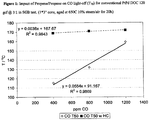
- FIG. 1 illustrates the Synthetic Gas Bench (SGB) performance data for a commercial Pt-Pd DOC (120 gram per cubic foot, hereafter gcf @ 3Pt:1Pd) after aging/stabilisation at 650° C. in steam/air for 20 h.
- the data contrasts the CO light-off temperatures (T50) at 400, 800 or 1200 ppm CO in the presence or absence of 150 ppm C1 propene/propane (3:1) (12% O2, 150 ppm NO, 5% CO2, 5% H2O, balance N2 at a total flow of 30 l/min, ramp 75-325° C. at 15° C./min).
- T50 CO light-off temperatures
- this phenomenon is a transient inhibition effect involving the preferential adsorption of propene on the active centres of the Pt-Pd required for O2 dissociative adsorption (the proposed rate limiting step in CO oxidation).
- This is consistent with the high sticking probability of propene on the high defect planes of PGM surfaces resulting in a site-blocking phenomenon which is only overcome at temperatures sufficient to facilitate oxidative desorption of the HC ( R. Burch and P. J. Millington, Catalysis Today, Vol 26(2), 1995, p 185 ). Since this temperature is independent of CO concentration then catalyst light-off exhibits the independent activity trace in FIG. 1 .
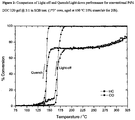
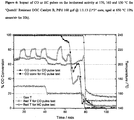
- FIG. 2 shows the full light-off (positive temperature ramp) and quench (negative temperature ramp/cooling cycle) for the commercial DOC of FIG. 1 .
- FIG. 2 shows the full light-off (positive temperature ramp) and quench (negative temperature ramp/cooling cycle) for the commercial DOC of FIG. 1 .
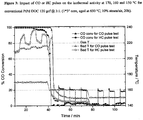
- FIG. 3 further examines the ability of CO and propene to 'quench' the catalytic oxidation function of the commercial DOC.
- This Figure contrasts the performance of the 120 gcf 3:1 DOC under isothermal conditions with transient pulses of either CO or HC viz.
- the DOC is exposed to 12% O2, C3H6/C3H8 (3:1) @ 150 ppm C1, 150 ppm NO, 5% CO2, 5% H2O and N2 (30 l/min) plus 400 ppm CO, which is increased to 1200 ppm for 5 min to attempt to quench catalytic function.
- the pulse is repeated 3 times (5 min low CO, 5 min high CO) at 170° C., and then again at 160° C.
- HC pulse test a comparable gas mix, with CO at 400 ppm, is employed but herein HC is introduced at 150 ppm C1, or 450 ppm C1, again in 3 cycles and again at 170, 160 and 150° C.
- the responses for the tests in FIG. 3 again show significant differences.
- the catalyst maintains 100% CO conversion at 170° C. under both low and high CO conditions but upon decreasing the temperature to 160° C. the catalyst is thermally deactivated and ⁇ 20% conversion is seen for both low and high CO at 160 and 150° C., consistent with catalyst deactivation due to domination of the surface by HC and CO species.
- the bed temperature of the catalyst reflects the various processes.
- Table 1 summarizes the impact of HC content and species, and the role of zeolite or 'quench' resistant pre-bed on the activity of a 3% Pd-ZrO 2 model DOC.
- Table 1 The impact of HC content, HC speciation, and the presence or absence of zeolite on the activity of a 3% Pd-ZrO 2 model DOC in SGB powder studies.
- 1:1 Mix denotes 1:1 mixture of Propene and n-Octane (350 ppm C1 of each HC).
- the performance of the commercial DOC of FIG. 2 is now contrasted with that for Catalyst A (aged as per reference), a next generation DOC ( FIG. 4 ).
- the DOC herein contains Rh, which is included in the overcoat, and is employed specifically for its ability to oxidise CO with far less inhibition or competition from HC i.e. Rh is oxo-phillic and hence the surface is found to contain significantly higher O coverage under all conditions. Due to this characteristic the CO light-off and quench occur at far lower temperatures than for the commercial DOC. Moreover, the CO and HC light-off features are no longer interconnected further reflecting the change in surface competition vis-à-vis O, HC and CO for this technology. However, it should also be noted that the concept technology described herein achieves high performance at a significant price premium due to the use of Rh. Hence what is required is to achieve comparable activity benefits at competitive price.
- FIGS. 6 and 7 show the enhanced performance of the high Pd DOCs. Indeed, unlike the commercial DOC both technologies exhibit stable performance at 170° C. under CO and especially HC pulsing. Also, neither exhibit quenching under steady state conditions as the temperature is decreased to 160° C., which it is noted, is below the T50 for catalyst B in standard light-off testing. This further reflects the impact surface coverage of HC and CO versus O has upon activity. Further pulsing at 160° C. differentiates the DOCs further as well as the comparative impact of CO versus HC pulses.
- Catalyst B maintains full CO conversion at 160° C. at both high and low CO concentration but in contrast exhibits stepwise deactivation with subsequent pulses of high HC, akin to titration of the active sites by retention of 'toxic', site-blocking propene-derived species. Moreover, as the temperature is cooled to 150° C. the test ex HC pulse sample again exhibits a near instantaneous decrease to 0% CO conversion, while for the ex CO pulse test again shows the propagation of exotherm/deactivation front through the core before the catalyst is quenched, consistent with FIG. 3 and the mechanism proposed therein. The performance of Catalyst C is even better.
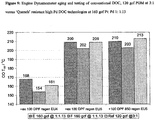
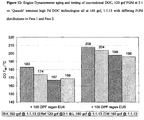
- FIG. 9 compares the dyno aging and testing performance of the commercial DOC 120 gcf @ 3:1 versus two further layered DOC technologies E and F.
- the samples were aged by standard DPF regeneration or by aggressive DPF regeneration (with 400° C. catalyst inlet and 850° C. catalyst bed temperature during post injection).
- the latter DOCs are equivalent with respect to PGM load and type (160 gcf @ 1:1.13), base metal components and base metal loads.
- the only difference in the latter parts is that the 2 layer system employed therein is reversed.
- catalyst F follows the new generation design i.e. more conventional Pt-Pd layer in the undercoat and a Pd-only (Pd-rich) layer in the overcoat, while in catalyst E the layers are reversed.
- the enhanced performance obtained with this new DOC design is possible with a range of Pt:Pd ratios.
- the Pt:Pd ratio of the undercoat is from about 20:1 to about 1:2 and the Pt:Pd ratio of the overcoat is from about 2:3 to about 0:1.
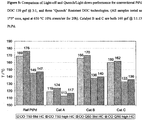
- catalysts G, H and J all offer competitive performance versus the commercial DOC reference, as shown in the dyno performance summary in FIG. 10 . It should be stressed that in all cases the performance is equal, or typically better, whilst offering PGM savings of 2.84, 2 and 4.88% respectively.
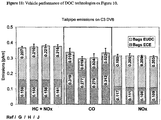
- FIG. 11 compares vehicle performance data for the DOC parts of FIG. 10 .
- This testing on a typical Euro 4 engine confirms the benefits seen on the dyno. All test parts offer equal, or better, activity with up >10% decrease in CO emissions seen for Catalysts G and H. In all cases the benefits are ascribed to superior EUDC performance i.e. better light-off and increased tolerance to quenching from HC poisons.
- FIG. 13 examines the potential for applying the second layer of the quench resistant DOC as a partial or zone pass. Additionally, it reports the performance for a series of parts wherein Pd is again 'thrifted' from the second pass and moved into the first. The data suggest that by zone coating, again in combination with the type of higher zeolite contents as employed in FIG. 13 , it becomes possible to increase the Pt:Pd ratio in the second layer (zone) without the adverse effects noted previously. Thus parts N, O and P display equivalent performance. Note no comparison is drawn here versus the reference since the PGM cost of the test parts is too high for meaningful comparison.
- FIG. 14 reports vehicle performance data for three DOCs tested after 70 h of post injection aging performed at a major OEM.
- the three DOCs comprise an internal OEM reference versus a conventional DOC 70 gcf @ 3:2 (catalyst Q) and zone coated quench resistant DOC also 70 gcf @ 3:2 (Catalyst R).
- the data show again a clear performance benefit for the new generation DOC which provides 79% CO and 86% HC conversion respectively over the NEDC cycle for a vehicle with comparatively cool engine out temperatures (average 150° C. for first 800 s) consistent with the enhanced light-off and decreased 'quenching' of the new generation design.
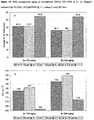
- FIGS. 15A /B and 16A/B show the SGB performance data after increasingly severe hydrothermal oven aging cycles for two commercial DOCs 150 gcf @ 4:1 versus the new generation DOC 210 @ 1:1.10. Samples were tested as cores 2.22 cm ⁇ 2.54 cm after aging at 700° C., 25 hours, 10% steam, air and 800° C., 25 hours, 10% steam, air. Two SGB test protocols were employed to fuirther differentiate the impact of HC concentration and speciation on performance.
- the first test conditions were selected to mimic a Euro V exhaust and comprised 1000 ppm CO, 600 ppm C1 n-Octane, 180 ppm C1 Methyl-Benzene, 75 ppm C1 Propene, 75 ppm C1 Methane, 80 ppm NO, 3 ppm SO 2 , 3.5% CO 2 , 13% O 2 , 3.5% H 2 O, balance N 2 and total flow 5 l/min with ramp from 50 to 300° C. at 10° C./min (hereafter complex HC mix test).
- the second set of test conditions were more typical 'SGB' conditions, employing only light HC species and comprised 350 ppm CO, 120 ppm H2, 90 ppm C1 propene, 180 ppm C1 propane, 2 ppm SO 2 , 270 ppm NO, 6% O 2 , 10.7% CO 2 , 3.5% H 2 O and balance N 2 and total flow 5 l/min with ramp from 100 to 400° C. at 15° C./min (hereafter C3 only HC mix test).
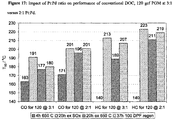
- FIG. 17 A further differentiation between conventional DOCs and the new generation technology may be found by comparing FIG. 17 and FIG. 18 wherein the effect Pt:Pd ratio on performance is examined.
- FIG. 17 the activity of commercial DOCs at equal PGM content but differing Pt:Pd ratio (120 @ 3:1 versus 120 @ 2:1) are shown.
- decreased Pt and increased Pd content correlates with increasing light-off temperatures and HC weaker oxidation performance.
- the 2:1 DOC also exhibits a more severe deactivation profile with the performance gap being increasingly large with harsher aging.
- the recovery of the technology after SOx aging is particularly weak. These trends are reflected in a comparison of HC performance.
- the DOC exhibits exactly the kind of weaknesses associated with increased Pd content in a conventional DOC design, as outlined in US2005/0045405 A1 .
- the performance data in FIG. 18 are in even more marked contrast.
- the fresh and 800 air/steam oven aged performance of three next generation quench resistant DOCs are compared.
- the performances of the 2:1 and 1:1 technologies, fresh and aged, and under conditions of low CO, high CO or high HC are within a few degrees. Indeed, after aging the light-off temperatures are within experimental error and likely reflect the intrinsic activity of the pass 1 washcoats and that the PGM content of the pass 2 is still sufficient to scavenge the transient toxic HC species believed to be responsible for inhibition of light-off.
- the performance of the 1:2 is somewhat weaker but after aging it is still quite competitive, particularly given that this technology represents a PGM saving of 35%.
- a catalytic device can comprise a housing disposed around a substrate with a compression ignition oxidation catalyst disposed at the substrate.
- the method for treating a compression ignition exhaust stream can comprise: introducing a diesel exhaust stream to a compression ignition oxidation catalyst; and oxidising an exhaust stream component.
- the catalyst materials are included in the formulation by combining alumina, or other appropriate support, with other catalyst materials to form a mixture, drying (actively or passively), and optionally calcining. More specifically, a slurry can be formed by combining alumina and water, and optionally pH control agents (such as inorganic or organic acids and bases) and/or other components.
- the catalytic materials e.g. catalytic metals, such as Pt
- This slurry can then be washcoated onto a suitable substrate.
- the washcoated product can be dried and heat treated to fix the washcoat onto the substrate.
- the catalyst can further comprise a zeolite.
- Possible zeolites include Y-type zeolite, beta ( ⁇ ) zeolite, ZSM-5, silica alumina phosphate (SAPO e.g. SAPO34) and the like, as well as combinations comprising at least one of the foregoing zeolites.
- SAPO silica alumina phosphate
- the zeolite can, for example, have a silica to alumina ratio (Si:Al) of about 25 to about 80, or, more specifically, about 35 to about 60. If the zeolite is employed, it can be added to the slurry along with the catalytic material (e.g., before the catalytic material has been calcined).
- This slurry can be dried and heat treated, e.g., at temperatures of about 500° C. to about 1,000°C., or more specifically about 500°C. to about 700°C., to form the finished catalyst formulation.
- the slurry can be washcoated onto the substrate and then heat treated as described above, to adjust the surface area and crystalline nature of the support.
- catalyst metals may optionally be disposed on the support. The catalyst metals, therefore, can be added after the washcoat is fixed onto the substrate by additional washcoat steps and/or by exposing the washcoated substrate to a liquid containing the catalytic metal.
- the supported catalyst comprises a PGM (Pt, Pd, Rh etc.) or more preferred a combination of PGMs, (modified) alumina, and zeolite, and optionally oxygen storage (OS) material.
- the amounts of these components in the catalyst can be: about 0.1 wt % to about 10 wt % PGM, about 50 wt % to about 80 wt % (modified) alumina, about 5 wt % to about 50 wt % OS, and about 10 wt % to about 50 wt % zeolite; or, more specifically, about 1 wt % to about 5 wt % PGM, about 40 wt % to about 60 wt % modified alumina, about 5 wt % to about 20 wt % of OS, and about 20 wt % to about 40 wt % zeolite.
- the supported catalyst can be disposed on a substrate.
- the substrate can comprise any material designed for use in the desired environment, e.g., a compression ignition engine (e.g., a diesel engine) environment.
- a compression ignition engine e.g., a diesel engine
- Some possible materials include cordierite, silicon carbide, metal, metal oxides (e.g., alumina, and the like), glasses, and the like, and mixtures comprising at least one of the foregoing materials.
- These materials can be in the form of packing material, extrudates, foils, perform, mat, fibrous material, monoliths (e.g., a honeycomb structure, and the like), other porous structures (e.g., porous glasses, sponges), foams, molecular sieves, and the like (depending upon the particular device), and combinations comprising at least one of the foregoing materials and forms, e.g., metallic foils, open pore alumina sponges, and porous ultra-low expansion glasses.
- these substrates can be coated with oxides and/or hexaaluminates, such as stainless steel foil coated with a hexaaluminate scale.
- the substrate can have any size or geometry, the size and geometry are preferably chosen to optimise geometric area in the given exhaust emission control device design parameters.
- the substrate has a honeycomb geometry, with the combs through-channel having any multi-sided or rounded shape, with substantially square, triangular, pentagonal, hexagonal, heptagonal, or octagonal or similar geometries preferred due to ease of manufacturing and increased surface area.
- the substrate can be disposed in a housing to form the converter.
- the housing can have any design and comprise any material suitable for the application. Suitable materials for the housing can comprise metals, alloys, and the like, such as ferritic stainless steels (including stainless steels such as, e.g., the 400-Series such as SS-409, SS-439, and SS-441), and other alloys (e.g. those containing nickel, chromium, aluminium, yttrium and the like, e.g., to permit increased stability and/or corrosion resistance at operating temperatures or under oxidising or reducing atmospheres).
- ferritic stainless steels including stainless steels such as, e.g., the 400-Series such as SS-409, SS-439, and SS-441
- other alloys e.g. those containing nickel, chromium, aluminium, yttrium and the like, e.g., to permit increased stability and/or corrosion resistance at operating temperatures or under oxidising or
- end cone(s), end plate(s), exhaust manifold cover(s), and the like can be concentrically fitted about the one or both ends and secured to the housing to provide a gas tight seal.
- These components can be formed separately (e.g., moulded or the like), or can be formed integrally with the housing using methods such as, e.g., a spin forming, or the like.
- the retention material Disposed between the housing and the substrate can be a retention material.
- the retention material which may be in the form of a mat, particulates, or the like, may be an intumescent material e.g., a material that comprises vermiculite component, i.e., a component that expands upon the application of heat, a non-intumescent material, or a combination thereof.
- intumescent material e.g., a material that comprises vermiculite component, i.e., a component that expands upon the application of heat
- non-intumescent material a non-intumescent material
- These materials may comprise ceramic materials e.g., ceramic fibres and other materials such as organic and inorganic binders and the like, or combinations comprising at least one of the foregoing materials.
- the coated monolith containing the high Pd-content layered DOC is incorporated into the exhaust flow of the compression ignition engine.
- This provides a means for treating said compression ignition exhaust stream to reduce the concentrations of environmental toxins by passing said diesel exhaust stream over the aforementioned compression ignition oxidation catalyst under net oxidising conditions (oxygen rich) to facilitate catalytic conversion/oxidation into more environmentally benign products.
- Part A The procedure for making Part A, is as follows: Slurry Alumina at pH ca. 4.5 and mill to d50 (diameter of 50% of the particles) of 4 ⁇ 0.5 microns, confirm d90. Add required ⁇ 40 as powder, correct for loss on ignition (LOI), to slurry. Re-mill combined slurry to maintain d50, if required. Next take the required concentration of Pt nitrate solution and slowly dilute with appropriate rheology modifier as required prior to adding solution dropwise to milled slurry. Slurry must be at a pH lower than 6.0 prior to metal addition and during Pt addition, monitor pH and prevent slurry from going to pH values below 3.0 with the judicious use of base.
- LOI loss on ignition
- the procedure for making Part B entails the following: Slurry SCFA-90 at pH ca. 4.5 and mill to d50 of 4 ⁇ 0.5 microns, confirm d90. Next take the required concentration of Pt nitrate solution and slowly dilute with appropriate rheology modifier as required prior to adding solution dropwise to slurry. Slurry must be at a pH lower than 6.0 prior to metal addition and during Pt addition, monitor pH and prevent pH from going to values below 3.0 with the judicious use of base. After metal addition, adjust to 3.5 with base and stir slurry for two hours. Next add the required concentration of Pd Nitrate solution dropwise, again during metal addition, monitor pH and prevent slurry from going to pH values below 3.0 with the judicious use of base.
- Part C The procedure for making Part C, as employed as a test technology is as follows: Slurry Alumina at pH ca. 4.5 and mill to d50 of 4 ⁇ 0.5 microns, confirm d90. Add the ⁇ 40 powder, correct for LOI, with minimal D.I. water to maintain slurry rheology and viscosity. Lightly mill resultant slurry to maintain d50, d90, d100, as required. Next take the required concentration of Pt nitrate solution and slowly dilute with appropriate rheology modifier as required prior to adding solution dropwise to milled Alumina slurry.
- Slurry must be at a pH lower than 6.0 prior to metal addition and during Pt addition, monitor pH and prevent slurry from going to pH values below 3.0 with the judicious use of base. After metal addition, adjust to 3.5 with base and stir slurry for two hours. Next add the required concentration of Pd Nitrate solution dropwise, again during metal addition, monitor pH and prevent slurry from going to pH values below 3.0 with the judicious use of base. Stir resultant mixture for one hour to allow for fall chemisorption of metal. Then coat monolith in 1 pass and calcine at temperatures ⁇ 540° C. for ⁇ 1 hour. Pass 2: Add Barium salt to deionised water and required rheology pH modifiers and mix.
- the procedure for making Part G is as follows: Slurry Alumina at pH of 3.5-5 and mill to d50 of ⁇ 10.5 microns, confirm d90. Add the ⁇ 40 powder, correct for LOI, with minimal D.I. water to maintain slurry rheology and viscosity. Lightly mill resultant slurry to maintain d50, d90, d100, as required. Take the required concentration of Pt nitrate and dilute with appropriate rheology modifier as required prior to adding dropwise to milled Alumina slurry. Slurry must be at a pH ⁇ 6.0 prior to metal add and during Pt addition, monitor pH and prevent slurry from going to pH values below 3.0 with the judicious use of base.
- Part R The procedure for making Part R, as submitted in OEM test trials: First prepare the 'white' washcoat master batch i.e. complete batching of metal oxide components. Add HP14/150 Zr Alumina, with constant mixing, at 15 ⁇ T ⁇ 25° C. to deionised water containing any required rheology and pH modifiers to maintain pH of 4.5 and a smooth flowing slurry. During the addition it may be necessary to begin milling to ensure slurry maintains free flowing characteristics. Mill to d50 of 6-8 microns, d90 of 20-25 and 100% pass ⁇ 60 microns. Add ⁇ 40 powder, correct for LOI, with minimal D.I. water to maintain slurry rheology and viscosity.
- Slurry must be at a pH lower than 6.0 prior to metal addition and during Pt addition, monitor pH and prevent slurry from going to pH values below 3.0 with the judicious use of base. After metal addition, adjust to a pH of 3.5 with base and stir slurry for two hours. Examine d50, d90 and d100 to confirm no agglomeration of PGM has occurred. Next add the required concentration of Pd Nitrate solution dropwise, again during metal addition, monitor pH and prevent slurry from going to pH values below 3.0 with the judicious use of base. Stir resultant mixture for three hours to allow full chemisorption of metal. Re-confirm d50, d90, d100. Adjust pH of slurry to 3-3.5 and coat monolith in 1 pass using appropriate piston or other metered charge coater along 75% of length of part and calcine at temperatures ⁇ 540° C. for ⁇ 1 hour.
- Parts X, Y and Z as employed as test technologies is as follows: First prepare the 'white' washcoat master batch i.e. complete batching of metal oxide components. Add alumina, with constant mixing, at 15 ⁇ T ⁇ 25° C. to deionised water containing any required rheology and pH modifiers to maintain pH of 4.5. Mill to d50 of 6-8 microns, d90 of 20-25 and 100% pass ⁇ 60 microns. Add the ⁇ 40 powder, correct for LOI, with minimal D.I. water to maintain slurry rheology and viscosity. Lightly mill resultant slurry to maintain d50, d90 and d100, as required. Split slurry into two batches for pass 1 and 2.
Landscapes
- Chemical & Material Sciences (AREA)
- Engineering & Computer Science (AREA)
- Chemical Kinetics & Catalysis (AREA)
- Materials Engineering (AREA)
- Organic Chemistry (AREA)
- Combustion & Propulsion (AREA)
- Health & Medical Sciences (AREA)
- General Engineering & Computer Science (AREA)
- Mechanical Engineering (AREA)
- Toxicology (AREA)
- Biomedical Technology (AREA)
- Oil, Petroleum & Natural Gas (AREA)
- General Chemical & Material Sciences (AREA)
- Analytical Chemistry (AREA)
- Environmental & Geological Engineering (AREA)
- Crystallography & Structural Chemistry (AREA)
- Catalysts (AREA)
- Exhaust Gas After Treatment (AREA)
- Exhaust Gas Treatment By Means Of Catalyst (AREA)
Applications Claiming Priority (3)
| Application Number | Priority Date | Filing Date | Title |
|---|---|---|---|
| US12/467,771 US8246923B2 (en) | 2009-05-18 | 2009-05-18 | High Pd content diesel oxidation catalysts with improved hydrothermal durability |
| PCT/EP2010/002904 WO2010133309A1 (en) | 2009-05-18 | 2010-05-11 | HIGH Pd CONTENT DIESEL OXIDATION CATALYSTS WITH IMPROVED HYDROTHERMAL DURABILITY |
| EP10721975A EP2432577A1 (en) | 2009-05-18 | 2010-05-11 | HIGH Pd CONTENT DIESEL OXIDATION CATALYSTS WITH IMPROVED HYDROTHERMAL DURABILITY |
Related Parent Applications (1)
| Application Number | Title | Priority Date | Filing Date |
|---|---|---|---|
| EP10721975A Division EP2432577A1 (en) | 2009-05-18 | 2010-05-11 | HIGH Pd CONTENT DIESEL OXIDATION CATALYSTS WITH IMPROVED HYDROTHERMAL DURABILITY |
Publications (1)
| Publication Number | Publication Date |
|---|---|
| EP3616777A1 true EP3616777A1 (en) | 2020-03-04 |
Family
ID=42537605
Family Applications (2)
| Application Number | Title | Priority Date | Filing Date |
|---|---|---|---|
| EP19199595.0A Withdrawn EP3616777A1 (en) | 2009-05-18 | 2010-05-11 | High pd content diesel oxidation catalyst with improved hydrothermal durability |
| EP10721975A Withdrawn EP2432577A1 (en) | 2009-05-18 | 2010-05-11 | HIGH Pd CONTENT DIESEL OXIDATION CATALYSTS WITH IMPROVED HYDROTHERMAL DURABILITY |
Family Applications After (1)
| Application Number | Title | Priority Date | Filing Date |
|---|---|---|---|
| EP10721975A Withdrawn EP2432577A1 (en) | 2009-05-18 | 2010-05-11 | HIGH Pd CONTENT DIESEL OXIDATION CATALYSTS WITH IMPROVED HYDROTHERMAL DURABILITY |
Country Status (8)
| Country | Link |
|---|---|
| US (1) | US8246923B2 (enExample) |
| EP (2) | EP3616777A1 (enExample) |
| JP (1) | JP2012527338A (enExample) |
| KR (1) | KR20120026096A (enExample) |
| CN (1) | CN102413904B (enExample) |
| BR (1) | BRPI1013026A2 (enExample) |
| RU (1) | RU2011151282A (enExample) |
| WO (1) | WO2010133309A1 (enExample) |
Families Citing this family (69)
| Publication number | Priority date | Publication date | Assignee | Title |
|---|---|---|---|---|
| JP2009262098A (ja) * | 2008-04-28 | 2009-11-12 | Ne Chemcat Corp | 選択還元触媒を用いた排気ガス浄化方法 |
| US9079162B2 (en) * | 2008-04-28 | 2015-07-14 | BASF SE Ludwigshafen | Fe-BEA/Fe-MFI mixed zeolite catalyst and process for the treatment of NOX in gas streams |
| US8637426B2 (en) | 2009-04-08 | 2014-01-28 | Basf Corporation | Zoned catalysts for diesel applications |
| US20100310441A1 (en) * | 2009-06-05 | 2010-12-09 | Basf Corporation | Catalytic Article for Removal of Volatile Organic Compounds in Low Temperature Applications |
| US8557203B2 (en) * | 2009-11-03 | 2013-10-15 | Umicore Ag & Co. Kg | Architectural diesel oxidation catalyst for enhanced NO2 generator |
| EP2508725A1 (en) * | 2009-12-01 | 2012-10-10 | Toyota Jidosha Kabushiki Kaisha | Exhaust purification device for internal combustion engine |
| GB201003781D0 (en) * | 2010-03-08 | 2010-04-21 | Johnson Matthey Plc | Improvements in the control of vehicle emissions |
| US8734743B2 (en) * | 2010-06-10 | 2014-05-27 | Basf Se | NOx storage catalyst with improved hydrocarbon conversion activity |
| US8557204B2 (en) | 2010-11-22 | 2013-10-15 | Umicore Ag & Co. Kg | Three-way catalyst having an upstream single-layer catalyst |
| KR20170110168A (ko) * | 2010-12-14 | 2017-10-10 | 우미코레 아게 운트 코 카게 | 강화된 no2 발생기용 구조적 디젤 산화 촉매 |
| US8839605B2 (en) * | 2011-03-30 | 2014-09-23 | GM Global Technology Operations LLC | Exhaust methane control systems and methods |
| JP5664918B2 (ja) * | 2011-04-08 | 2015-02-04 | トヨタ自動車株式会社 | 排ガス浄化用触媒 |
| JP5789126B2 (ja) * | 2011-05-25 | 2015-10-07 | ジョンソン、マッセイ、パブリック、リミテッド、カンパニーJohnson Matthey Publiclimited Company | 排ガス酸化触媒 |
| US9012353B2 (en) * | 2011-08-10 | 2015-04-21 | Clean Diesel Technologies, Inc. | Palladium solid solution catayst and methods of making |
| US9044734B2 (en) | 2011-09-23 | 2015-06-02 | Basf Se | Diesel oxidation catalyst with layered structure containing ceria composition as palladium support material for enhanced HC and CO gas conversion |
| IN2014MN00836A (enExample) * | 2011-10-06 | 2015-05-22 | Mack Trucks | |
| GB2497598A (en) * | 2011-12-12 | 2013-06-19 | Johnson Matthey Plc | Catalysed substrate monolith and its use in an exhaust system for a lean burn ic engine |
| JP5938819B2 (ja) | 2011-10-06 | 2016-06-22 | ジョンソン、マッセイ、パブリック、リミテッド、カンパニーJohnson Matthey Public Limited Company | 排気ガス処理用酸化触媒 |
| GB201200783D0 (en) | 2011-12-12 | 2012-02-29 | Johnson Matthey Plc | Substrate monolith comprising SCR catalyst |
| GB201200784D0 (en) | 2011-12-12 | 2012-02-29 | Johnson Matthey Plc | Exhaust system for a lean-burn internal combustion engine including SCR catalyst |
| GB201200781D0 (en) | 2011-12-12 | 2012-02-29 | Johnson Matthey Plc | Exhaust system for a lean-burn ic engine comprising a pgm component and a scr catalyst |
| GB2497597A (en) | 2011-12-12 | 2013-06-19 | Johnson Matthey Plc | A Catalysed Substrate Monolith with Two Wash-Coats |
| EP2623183B1 (de) * | 2012-02-03 | 2015-08-26 | Umicore AG & Co. KG | Katalytisch aktives partikelfilter und dessen verwendung |
| DE102012005508A1 (de) | 2012-03-17 | 2013-09-19 | Daimler Ag | Katalysatorbauteil einer Kraftfahrzeug-Abgasreinigungsanlage und Verwendung eines Katalysatorbauteils |
| EP2674584B2 (de) | 2012-06-14 | 2020-04-29 | Umicore AG & Co. KG | Verwendung eines Oxidationskatalysators zur Verhinderung der Kontamination eines SCR-Katalysators mit Platin |
| US8568674B1 (en) * | 2012-08-10 | 2013-10-29 | Basf Corporation | Diesel oxidation catalyst composites |
| WO2014072504A1 (en) | 2012-11-12 | 2014-05-15 | Basf Se | Oxidation catalyst and method for its preparation |
| US10464052B2 (en) * | 2012-11-12 | 2019-11-05 | Basf Se | Oxidation catalyst and method for its preparation |
| GB201220912D0 (en) | 2012-11-21 | 2013-01-02 | Johnson Matthey Plc | Oxidation catalyst for treating the exhaust gas of a compression ignition engine |
| EP2772302A1 (en) | 2013-02-27 | 2014-09-03 | Umicore AG & Co. KG | Hexagonal oxidation catalyst |
| US9034287B2 (en) * | 2013-03-13 | 2015-05-19 | Basf Corporation | Catalyst compositions, articles, methods and systems |
| US9333490B2 (en) * | 2013-03-14 | 2016-05-10 | Basf Corporation | Zoned catalyst for diesel applications |
| US9511355B2 (en) | 2013-11-26 | 2016-12-06 | Clean Diesel Technologies, Inc. (Cdti) | System and methods for using synergized PGM as a three-way catalyst |
| US9511350B2 (en) | 2013-05-10 | 2016-12-06 | Clean Diesel Technologies, Inc. (Cdti) | ZPGM Diesel Oxidation Catalysts and methods of making and using same |
| US9511353B2 (en) | 2013-03-15 | 2016-12-06 | Clean Diesel Technologies, Inc. (Cdti) | Firing (calcination) process and method related to metallic substrates coated with ZPGM catalyst |
| US9545626B2 (en) | 2013-07-12 | 2017-01-17 | Clean Diesel Technologies, Inc. | Optimization of Zero-PGM washcoat and overcoat loadings on metallic substrate |
| GB2519403A (en) | 2013-07-30 | 2015-04-22 | Johnson Matthey Plc | Ammonia slip catalyst |
| CN110681377A (zh) * | 2013-08-28 | 2020-01-14 | 巴斯夫公司 | 柴油机氧化催化剂复合材料 |
| DE112014004876T5 (de) * | 2013-10-23 | 2016-07-07 | Mazda Motor Corporation | Katalysatorvorrichtung für Abgasreinigung und Verfahren für Abgasreinigung |
| US9511358B2 (en) | 2013-11-26 | 2016-12-06 | Clean Diesel Technologies, Inc. | Spinel compositions and applications thereof |
| US9446395B2 (en) * | 2014-02-19 | 2016-09-20 | Ford Global Technologies, Llc | Low temperature catalyst/hydrocarbon trap |
| US9662636B2 (en) | 2014-04-17 | 2017-05-30 | Basf Corporation | Zoned catalyst composites |
| WO2016039747A1 (en) * | 2014-09-11 | 2016-03-17 | Clean Diesel Technologies, Inc. | Methods for oxidation and two-way and three-way zpgm catalyst systems and apparatus comprising same |
| JP6264261B2 (ja) * | 2014-11-05 | 2018-01-24 | マツダ株式会社 | 排気ガス浄化システム |
| MX395466B (es) | 2015-03-05 | 2025-03-25 | Basf Mobile Emissions Catalysts Llc | Catalizadores que contienen platino para motores de combustion. |
| JP6501115B2 (ja) * | 2015-05-15 | 2019-04-17 | 株式会社 Acr | 二元燃料酸化触媒、二元燃料scr排ガス処理機構、二元燃料ディーゼル内燃機関、および、その制御方法 |
| JP2015180498A (ja) * | 2015-05-19 | 2015-10-15 | ユミコア・アクチエンゲゼルシャフト・ウント・コムパニー・コマンディットゲゼルシャフトUmicore AG & Co.KG | No2生成器増強のための構造的ディーゼル酸化触媒 |
| US10201807B2 (en) * | 2015-06-18 | 2019-02-12 | Johnson Matthey Public Limited Company | Ammonia slip catalyst designed to be first in an SCR system |
| JP6999555B2 (ja) * | 2015-12-16 | 2022-02-10 | ビーエーエスエフ コーポレーション | 希薄ガソリン直接噴射エンジン用触媒システム |
| DE102016207484A1 (de) * | 2016-05-02 | 2017-11-02 | Umicore Ag & Co. Kg | Dieseloxidationskatalysator |
| KR102401150B1 (ko) * | 2016-07-19 | 2022-05-25 | 우미코레 아게 운트 코 카게 | 디젤 산화 촉매 컨버터 |
| GB201614677D0 (en) * | 2016-08-30 | 2016-10-12 | Johnson Matthey Plc | Oxidation catalyst for a diesel engine exhaust |
| GB201617349D0 (en) | 2016-10-13 | 2016-11-30 | Johnson Matthey Public Limited Company | Oxidation catalyst for hydrocarbons produced by an internal combustion engine |
| GB201617350D0 (en) * | 2016-10-13 | 2016-11-30 | Johnson Matthey Public Limited Company | Oxidation catalyst for a diesel engine exhaust |
| GB2557673A (en) * | 2016-12-15 | 2018-06-27 | Johnson Matthey Plc | NOx adsorber catalyst |
| EP3357558B1 (de) * | 2017-02-03 | 2019-06-26 | Umicore Ag & Co. Kg | Katalysator zur reinigung der abgase von dieselmotoren |
| US10335770B2 (en) | 2017-06-15 | 2019-07-02 | Ford Global Technologies, Llc | Method and system for diesel oxidation catalysts |
| CN108404975B (zh) * | 2018-04-27 | 2021-03-23 | 中自环保科技股份有限公司 | 一种具有良好低温起燃性能的氧化型催化系统及其制备工艺 |
| CN109342642A (zh) * | 2018-10-11 | 2019-02-15 | 成都信息工程大学 | 一种不同载体催化剂对甲醇催化氧化性能的测定方法 |
| CN109364905B (zh) * | 2018-10-17 | 2021-11-09 | 宁波盈诺新材料科技有限公司 | 一种含助剂的氧化铝,其制备方法及含有该氧化铝的催化剂 |
| EP3894071A1 (en) * | 2018-12-13 | 2021-10-20 | Johnson Matthey Public Limited Company | Transition metal doped alumina for improved osc and twc performance |
| EP3815780B1 (en) | 2019-10-30 | 2024-06-19 | Umicore AG & Co. KG | Diesel oxidation catalyst |
| CN110773159B (zh) * | 2019-10-31 | 2022-05-17 | 中自环保科技股份有限公司 | 一种Pt/Pd/Rh氧化催化剂制备工艺及其制备的催化剂 |
| EP3865209A1 (en) | 2020-02-17 | 2021-08-18 | UMICORE AG & Co. KG | Diesel oxidation catalyst |
| US20230313719A1 (en) * | 2020-05-22 | 2023-10-05 | Briggs & Stratton, Llc | Small air-cooled engine with catalytic converter with ruthenium catalyst |
| JP2023135093A (ja) * | 2022-03-15 | 2023-09-28 | トヨタ自動車株式会社 | 排ガス浄化用触媒の製造方法 |
| CN115387886B (zh) * | 2022-09-23 | 2024-06-07 | 天津瑞合环保科技有限公司 | 带催化剂浆料涂层的内燃机车颗粒过滤器 |
| CN116474554A (zh) * | 2023-04-18 | 2023-07-25 | 江苏上交碳中和科技有限公司 | 基于分子筛催化剂和臭氧的低浓度甲烷氧化方法 |
| EP4570360B1 (en) | 2023-12-14 | 2026-01-28 | Johnson Matthey Public Limited Company | Low pgm loaded diesel oxidation catalyst for exotherm generation |
Citations (15)
| Publication number | Priority date | Publication date | Assignee | Title |
|---|---|---|---|---|
| US2125231A (en) | 1937-12-17 | 1938-07-26 | Hurst George | Packer for oil wells |
| US4740292A (en) | 1985-09-12 | 1988-04-26 | Mobil Oil Corporation | Catalytic cracking with a mixture of faujasite-type zeolite and zeolite beta |
| US5371056A (en) | 1992-04-21 | 1994-12-06 | Degussa Aktiengesellschaft | Oxidative diesel control catalyst |
| US5462907A (en) | 1991-11-26 | 1995-10-31 | Engelhard Corporation | Ceria-alumina oxidation catalyst |
| US6153160A (en) | 1991-11-26 | 2000-11-28 | Engelhard Corporation | Catalytic oxidation method |
| US6274107B1 (en) | 1992-11-19 | 2001-08-14 | Engelhard Corporation | Zeolite-containing oxidation catalyst and method of use |
| US20030100447A1 (en) * | 2001-10-26 | 2003-05-29 | Engelhard Corporation | Layered catalyst composite |
| US20040001781A1 (en) * | 2002-06-27 | 2004-01-01 | Engelhard Corporation | Multi-zone catalytic converter |
| US20050045405A1 (en) | 2002-05-31 | 2005-03-03 | Masaki Yugo | Power device for an automotive vehicle |
| WO2005031132A1 (en) | 2003-09-30 | 2005-04-07 | Westport Research Inc. | Method and apparatus for providing for high egr gaseous-fuelled direct injection internal combustion engine |
| DE60121554T2 (de) * | 2000-03-17 | 2007-08-09 | Engelhard Corp. | Mehrzonen-speicherkatalysator und verfahren zu dessen herstellung und dessen verwendung |
| US20080045405A1 (en) | 2006-06-09 | 2008-02-21 | Tilman Wolfram Beutel | Pt-Pd diesel oxidation catalyst with CO/HC light-off and HC storage function |
| US20080047261A1 (en) * | 2006-08-28 | 2008-02-28 | Heesung Catalysts Corporation | Three-layered catalyst system for purifying exhaust gases of internal engines |
| US20080219906A1 (en) * | 2007-02-02 | 2008-09-11 | Chen Shau-Lin F | Multilayered Catalyst Compositions |
| KR20090023786A (ko) * | 2007-09-03 | 2009-03-06 | 현대자동차주식회사 | 디젤 산화촉매 및 그 제조 방법 |
Family Cites Families (96)
| Publication number | Priority date | Publication date | Assignee | Title |
|---|---|---|---|---|
| JPS6384635A (ja) | 1986-09-26 | 1988-04-15 | Nissan Motor Co Ltd | 排気ガス浄化用触媒 |
| DE3906136C1 (enExample) | 1989-02-28 | 1990-08-09 | Degussa Ag, 6000 Frankfurt, De | |
| US4961917A (en) * | 1989-04-20 | 1990-10-09 | Engelhard Corporation | Method for reduction of nitrogen oxides with ammonia using promoted zeolite catalysts |
| JP2909553B2 (ja) | 1989-10-18 | 1999-06-23 | トヨタ自動車株式会社 | 排気ガス浄化用触媒及び排気ガスの浄化方法 |
| US5010051A (en) * | 1989-11-08 | 1991-04-23 | Engelhard Corporation | Staged three-way conversion catalyst and method of using the same |
| DE3940758A1 (de) | 1989-12-09 | 1991-06-13 | Degussa | Verfahren zur reinigung der abgase von dieselmotoren |
| JPH04118053A (ja) | 1989-12-29 | 1992-04-20 | Tokyo Roki Kk | エンジンの排気ガス浄化用触媒 |
| JP3285614B2 (ja) * | 1992-07-30 | 2002-05-27 | 日本碍子株式会社 | 排ガス浄化用触媒及びその製造方法 |
| US5597771A (en) * | 1993-06-25 | 1997-01-28 | Engelhard Corporation | Layered catalyst composite |
| JP3411942B2 (ja) | 1993-09-30 | 2003-06-03 | マツダ株式会社 | 排気ガス浄化用のhc吸着剤、排気ガス浄化用触媒及び排気ガス浄化装置 |
| EP0661089B1 (en) * | 1993-12-28 | 1998-03-11 | Kabushiki Kaisha Riken | Device and method for cleaning exhaust gas |
| AU1843795A (en) | 1994-06-17 | 1996-01-15 | Engelhard Corporation | Layered catalyst composite |
| JPH08281110A (ja) * | 1995-04-11 | 1996-10-29 | Nissan Motor Co Ltd | 排気ガス浄化用触媒及びその製造方法 |
| DE19614540A1 (de) * | 1996-04-12 | 1997-10-16 | Degussa | Dieselkatalysator |
| US6087298A (en) * | 1996-05-14 | 2000-07-11 | Engelhard Corporation | Exhaust gas treatment system |
| JP3589383B2 (ja) * | 1997-09-02 | 2004-11-17 | トヨタ自動車株式会社 | 排ガス浄化用触媒 |
| DE19734627C1 (de) | 1997-08-09 | 1999-01-14 | Man Nutzfahrzeuge Ag | Vorrichtung und Verfahren zur katalytischen NO¶x¶-Reduktion in sauerstoffhaltigen Motorabgasen |
| DE19753738A1 (de) * | 1997-12-04 | 1999-06-10 | Degussa | Verfahren zur Herstellung eines Katalysators |
| GB9802504D0 (en) * | 1998-02-06 | 1998-04-01 | Johnson Matthey Plc | Improvements in emission control |
| US20020048542A1 (en) * | 1999-04-02 | 2002-04-25 | Michel Deeba | Catalytic trap and methods of making and using the same |
| EP1046423B8 (en) | 1999-04-23 | 2007-11-21 | Umicore AG & Co. KG | Layered noble metal-containing exhaust gas catalyst and its preparation |
| EP1196234B1 (en) | 1999-07-02 | 2007-04-18 | Engelhard Corporation | Catalyst system for treating diesel engine exhaust gases and method |
| JP4412299B2 (ja) * | 1999-07-09 | 2010-02-10 | 日産自動車株式会社 | 排ガス浄化触媒及びその製造方法 |
| FR2796986B1 (fr) | 1999-07-28 | 2002-09-06 | Renault | Systeme et procede de traitement des gaz d'echappement d'un moteur a combustion |
| US20020021745A1 (en) * | 2000-04-07 | 2002-02-21 | Negus Kevin J. | Multi-channel-bandwidth frequency-hopping system |
| DE10020100A1 (de) | 2000-04-22 | 2001-10-31 | Dmc2 Degussa Metals Catalysts | Verfahren und Katalysator zur Reduktion von Stickoxiden |
| JP4642978B2 (ja) * | 2000-08-08 | 2011-03-02 | 株式会社キャタラー | 排ガス浄化用触媒 |
| US6826906B2 (en) | 2000-08-15 | 2004-12-07 | Engelhard Corporation | Exhaust system for enhanced reduction of nitrogen oxides and particulates from diesel engines |
| US6689709B1 (en) | 2000-11-15 | 2004-02-10 | Engelhard Corporation | Hydrothermally stable metal promoted zeolite beta for NOx reduction |
| US20030175192A1 (en) * | 2001-01-26 | 2003-09-18 | Engelhard Corporation | SOx trap for enhancing NOx trap performance and methods of making and using the same |
| US6777370B2 (en) | 2001-04-13 | 2004-08-17 | Engelhard Corporation | SOx tolerant NOx trap catalysts and methods of making and using the same |
| US6914026B2 (en) * | 2001-09-07 | 2005-07-05 | Engelhard Corporation | Hydrothermally stable metal promoted zeolite beta for NOx reduction |
| US6930073B2 (en) * | 2001-11-05 | 2005-08-16 | Delphi Technologies, Inc. | NiO catalyst configurations, methods for making NOx adsorbers, and methods for reducing emissions |
| US20030103886A1 (en) * | 2001-12-03 | 2003-06-05 | Danan Dou | NOx adsorber catalyst configurations and method for reducing emissions |
| EP2322267B1 (en) * | 2002-02-01 | 2017-08-23 | Cataler Corporation | Catalyst for purifying exhaust gases |
| US7084086B2 (en) * | 2002-02-01 | 2006-08-01 | Cataler Corporation | Catalyst for purifying exhaust gases |
| US7022644B2 (en) * | 2002-02-20 | 2006-04-04 | Engelhard Corporation | Hydrogen sulfide-suppressing catalyst compositions |
| US7071141B2 (en) * | 2002-10-24 | 2006-07-04 | Ford Global Technologies, Llc | Perovskite catalyst system for lean burn engines |
| US7329629B2 (en) * | 2002-10-24 | 2008-02-12 | Ford Global Technologies, Llc | Catalyst system for lean burn engines |
| DE10300298A1 (de) * | 2003-01-02 | 2004-07-15 | Daimlerchrysler Ag | Abgasnachbehandlungseinrichtung und -verfahren |
| US7022646B2 (en) * | 2003-01-31 | 2006-04-04 | Engelhard Corporation | Layered catalyst composite |
| EP1594594B1 (en) | 2003-02-12 | 2012-05-23 | Delphi Technologies, Inc. | SYSTEM FOR NOx ABATEMENT |
| DE10308287B4 (de) | 2003-02-26 | 2006-11-30 | Umicore Ag & Co. Kg | Verfahren zur Abgasreinigung |
| DE10308288B4 (de) * | 2003-02-26 | 2006-09-28 | Umicore Ag & Co. Kg | Verfahren zur Entfernung von Stickoxiden aus dem Abgas eines mager betriebenen Verbrennungsmotors und Abgasreinigungsanlage hierzu |
| US20040254061A1 (en) * | 2003-06-12 | 2004-12-16 | Danan Dou | Diesel exhaust emissions control device and methods of making thereof |
| KR101117039B1 (ko) * | 2003-08-29 | 2012-03-15 | 다우 글로벌 테크놀로지스 엘엘씨 | 개선된 디젤 배기 필터 |
| US7875250B2 (en) * | 2003-12-11 | 2011-01-25 | Umicore Ag & Co. Kg | Exhaust treatment device, and methods of making the same |
| US20050164879A1 (en) * | 2004-01-28 | 2005-07-28 | Engelhard Corporation | Layered SOx tolerant NOx trap catalysts and methods of making and using the same |
| KR101077814B1 (ko) * | 2004-02-11 | 2011-10-31 | 우미코레 아게 운트 코 카게 | 귀금속 농도가 담체 축을 따라 변하는 배기 가스 세정용촉매 및 당해 촉매의 제조방법 |
| JP2005248787A (ja) * | 2004-03-03 | 2005-09-15 | Mitsubishi Fuso Truck & Bus Corp | 排気浄化装置 |
| US20050197244A1 (en) * | 2004-03-05 | 2005-09-08 | L'vovich Moroz B. | Exhaust treatment system and catalyst system |
| US7374729B2 (en) * | 2004-03-30 | 2008-05-20 | Basf Catalysts Llc | Exhaust gas treatment catalyst |
| WO2009100097A2 (en) * | 2008-02-05 | 2009-08-13 | Basf Catalysts Llc | Gasoline engine emissions treatment systems having particulate traps |
| US7795172B2 (en) * | 2004-06-22 | 2010-09-14 | Basf Corporation | Layered exhaust treatment catalyst |
| US20050282698A1 (en) * | 2004-06-22 | 2005-12-22 | Southward Barry W | Particulate filter device and exhaust treatment system, and methods of regenerating the same |
| DE102004040548A1 (de) | 2004-08-21 | 2006-02-23 | Umicore Ag & Co. Kg | Verfahren zum Beschichten eines Wandflußfilters mit feinteiligen Feststoffen und damit erhaltenes Partikelfilter und seine Verwendung |
| DE102004040549B4 (de) | 2004-08-21 | 2017-03-23 | Umicore Ag & Co. Kg | Katalytisch beschichtetes Partikelfilter und seine Verwendung |
| JP5021188B2 (ja) * | 2005-08-01 | 2012-09-05 | 株式会社キャタラー | 排ガス浄化用触媒 |
| FR2892765B1 (fr) | 2005-10-27 | 2010-09-03 | Peugeot Citroen Automobiles Sa | Ligne d'echappement des gaz notamment pour moteur diesel de vehicule automobile |
| US7506504B2 (en) * | 2005-12-21 | 2009-03-24 | Basf Catalysts Llc | DOC and particulate control system for diesel engines |
| JP2007224747A (ja) * | 2006-02-21 | 2007-09-06 | Mitsubishi Motors Corp | ディーゼルエンジンの排ガス浄化用フィルタおよび排ガス浄化装置 |
| US7562522B2 (en) * | 2006-06-06 | 2009-07-21 | Eaton Corporation | Enhanced hybrid de-NOx system |
| JP4935219B2 (ja) * | 2006-07-20 | 2012-05-23 | トヨタ自動車株式会社 | 排ガス浄化用触媒 |
| WO2008011146A1 (en) * | 2006-07-21 | 2008-01-24 | Dow Global Technologies Inc. | Improved zone catalyzed soot filter |
| JP2008023501A (ja) * | 2006-07-25 | 2008-02-07 | Toyota Motor Corp | 排ガス浄化用触媒 |
| US7749472B2 (en) * | 2006-08-14 | 2010-07-06 | Basf Corporation | Phosgard, a new way to improve poison resistance in three-way catalyst applications |
| US7517510B2 (en) * | 2006-08-21 | 2009-04-14 | Basf Catalysts Llc | Layered catalyst composite |
| US20080044330A1 (en) * | 2006-08-21 | 2008-02-21 | Shau-Lin Franklin Chen | Layered catalyst composite |
| US7550124B2 (en) * | 2006-08-21 | 2009-06-23 | Basf Catalysts Llc | Layered catalyst composite |
| US7758834B2 (en) * | 2006-08-21 | 2010-07-20 | Basf Corporation | Layered catalyst composite |
| JP4787704B2 (ja) * | 2006-09-15 | 2011-10-05 | 第一稀元素化学工業株式会社 | 自動車用排気ガス浄化装置に用いられる触媒系、それを用いた排気ガス浄化装置、及び排気ガス浄化方法 |
| JP5037888B2 (ja) * | 2006-09-26 | 2012-10-03 | 株式会社キャタラー | 排ガス浄化用触媒 |
| JP5100085B2 (ja) * | 2006-10-31 | 2012-12-19 | 株式会社キャタラー | 排ガス浄化用触媒 |
| JP5258119B2 (ja) * | 2006-11-20 | 2013-08-07 | ナノステラー インコーポレイテッド | 金属ナノ粒子を含む不均一系触媒を製造するための方法 |
| US8258070B2 (en) * | 2006-11-27 | 2012-09-04 | WGCH Technology Limited | Engine exhaust catalysts containing palladium-gold |
| KR20080047950A (ko) * | 2006-11-27 | 2008-05-30 | 나노스텔라 인코포레이티드 | 팔라듐-금을 포함하는 엔진 배기가스 촉매 |
| US20080120970A1 (en) * | 2006-11-29 | 2008-05-29 | Marcus Hilgendorff | NOx Storage Materials and Traps Resistant to Thermal Aging |
| KR101051874B1 (ko) * | 2007-01-17 | 2011-07-25 | 나노스텔라 인코포레이티드 | 팔라듐-금을 함유하는 엔진 배기가스 촉매 |
| DE102007008954B4 (de) | 2007-02-21 | 2009-12-17 | Umicore Ag & Co. Kg | Katalysatorsystem und seine Verwendung |
| DE502007003465D1 (de) | 2007-02-23 | 2010-05-27 | Umicore Ag & Co Kg | Katalytisch aktiviertes Dieselpartikelfilter mit Ammoniak-Sperrwirkung |
| JP5110954B2 (ja) * | 2007-05-09 | 2012-12-26 | エヌ・イーケムキャット株式会社 | 選択還元型触媒を用いた排気ガス浄化触媒装置並びに排気ガス浄化方法 |
| KR100999616B1 (ko) * | 2007-12-14 | 2010-12-08 | 기아자동차주식회사 | 배기 가스 내의 질소산화물 저감 장치 |
| DE102007060623B4 (de) | 2007-12-15 | 2011-04-14 | Umicore Ag & Co. Kg | Entstickung von Dieselmotorenabgasen unter Verwendung eines temperierten Vorkatalysators zur bedarfsgerechten NO2-Bereitstellung |
| US7976784B2 (en) * | 2007-12-18 | 2011-07-12 | Basf Corporation | Methods and systems including CO oxidation catalyst with low NO to NO2 conversion |
| US7945573B1 (en) * | 2008-02-11 | 2011-05-17 | Sprint Communications Company L.P. | Dynamic transcoding to stitch streaming digital content |
| EP2112339A1 (de) | 2008-04-24 | 2009-10-28 | Umicore AG & Co. KG | Verfahren und Vorrichtung zur Reinigung von Abgasen eines Verbrennungsmotors |
| EP2123345B1 (de) * | 2008-05-23 | 2010-08-04 | Umicore AG & Co. KG | Vorrichtung zur Reinigung von Dieselabgasen |
| US8475752B2 (en) * | 2008-06-27 | 2013-07-02 | Basf Corporation | NOx adsorber catalyst with superior low temperature performance |
| US8524185B2 (en) * | 2008-11-03 | 2013-09-03 | Basf Corporation | Integrated SCR and AMOx catalyst systems |
| WO2010077843A2 (en) * | 2008-12-29 | 2010-07-08 | Basf Catalysts Llc | Oxidation catalyst with low co and hc light-off and systems and methods |
| US8211392B2 (en) * | 2009-01-16 | 2012-07-03 | Basf Corporation | Diesel oxidation catalyst composite with layer structure for carbon monoxide and hydrocarbon conversion |
| US8252258B2 (en) * | 2009-01-16 | 2012-08-28 | Basf Corporation | Diesel oxidation catalyst with layer structure for improved hydrocarbon conversion |
| US8329607B2 (en) | 2009-01-16 | 2012-12-11 | Basf Corporation | Layered diesel oxidation catalyst composites |
| US9440192B2 (en) * | 2009-01-16 | 2016-09-13 | Basf Corporation | Diesel oxidation catalyst and use thereof in diesel and advanced combustion diesel engine systems |
| US8637426B2 (en) | 2009-04-08 | 2014-01-28 | Basf Corporation | Zoned catalysts for diesel applications |
| US8557203B2 (en) * | 2009-11-03 | 2013-10-15 | Umicore Ag & Co. Kg | Architectural diesel oxidation catalyst for enhanced NO2 generator |
-
2009
- 2009-05-18 US US12/467,771 patent/US8246923B2/en active Active
-
2010
- 2010-05-11 BR BRPI1013026A patent/BRPI1013026A2/pt not_active Application Discontinuation
- 2010-05-11 WO PCT/EP2010/002904 patent/WO2010133309A1/en not_active Ceased
- 2010-05-11 EP EP19199595.0A patent/EP3616777A1/en not_active Withdrawn
- 2010-05-11 EP EP10721975A patent/EP2432577A1/en not_active Withdrawn
- 2010-05-11 JP JP2012511173A patent/JP2012527338A/ja active Pending
- 2010-05-11 RU RU2011151282/05A patent/RU2011151282A/ru not_active Application Discontinuation
- 2010-05-11 CN CN201080017819.9A patent/CN102413904B/zh active Active
- 2010-05-11 KR KR1020117030295A patent/KR20120026096A/ko not_active Ceased
Patent Citations (16)
| Publication number | Priority date | Publication date | Assignee | Title |
|---|---|---|---|---|
| US2125231A (en) | 1937-12-17 | 1938-07-26 | Hurst George | Packer for oil wells |
| US4740292A (en) | 1985-09-12 | 1988-04-26 | Mobil Oil Corporation | Catalytic cracking with a mixture of faujasite-type zeolite and zeolite beta |
| US5462907A (en) | 1991-11-26 | 1995-10-31 | Engelhard Corporation | Ceria-alumina oxidation catalyst |
| US5627124A (en) | 1991-11-26 | 1997-05-06 | Engelhard Corporation | Ceria-alumina oxidation catalyst |
| US6153160A (en) | 1991-11-26 | 2000-11-28 | Engelhard Corporation | Catalytic oxidation method |
| US5371056A (en) | 1992-04-21 | 1994-12-06 | Degussa Aktiengesellschaft | Oxidative diesel control catalyst |
| US6274107B1 (en) | 1992-11-19 | 2001-08-14 | Engelhard Corporation | Zeolite-containing oxidation catalyst and method of use |
| DE60121554T2 (de) * | 2000-03-17 | 2007-08-09 | Engelhard Corp. | Mehrzonen-speicherkatalysator und verfahren zu dessen herstellung und dessen verwendung |
| US20030100447A1 (en) * | 2001-10-26 | 2003-05-29 | Engelhard Corporation | Layered catalyst composite |
| US20050045405A1 (en) | 2002-05-31 | 2005-03-03 | Masaki Yugo | Power device for an automotive vehicle |
| US20040001781A1 (en) * | 2002-06-27 | 2004-01-01 | Engelhard Corporation | Multi-zone catalytic converter |
| WO2005031132A1 (en) | 2003-09-30 | 2005-04-07 | Westport Research Inc. | Method and apparatus for providing for high egr gaseous-fuelled direct injection internal combustion engine |
| US20080045405A1 (en) | 2006-06-09 | 2008-02-21 | Tilman Wolfram Beutel | Pt-Pd diesel oxidation catalyst with CO/HC light-off and HC storage function |
| US20080047261A1 (en) * | 2006-08-28 | 2008-02-28 | Heesung Catalysts Corporation | Three-layered catalyst system for purifying exhaust gases of internal engines |
| US20080219906A1 (en) * | 2007-02-02 | 2008-09-11 | Chen Shau-Lin F | Multilayered Catalyst Compositions |
| KR20090023786A (ko) * | 2007-09-03 | 2009-03-06 | 현대자동차주식회사 | 디젤 산화촉매 및 그 제조 방법 |
Non-Patent Citations (11)
| Title |
|---|
| "Euro 5 or Euro 6, Regulation (EC) No 715/2007 of the European Parliament and of the Council", OFFICIAL JOURNAL OF THE EUROPEAN UNION L 171/1, 20 June 2007 (2007-06-20) |
| A. BOURANED. BIANCHI, J. CATALYSIS, vol. 222, 2004, pages 499 - 510 |
| APPLIED CATALYSIS A, vol. 221, 2001, pages 443 |
| J. A. A. VAN DEN TILLAARTJ. LEYRERS. ECKHOFFE. S., LOX IN APPLIED CATALYSIS B, vol. 10, no. 1-3, 1996, pages 53 - 68 |
| M. CHENL. D. SCHMIDT, J. CATAL., vol. 56, 1979, pages 198 |
| M. V. TWIGG, APPLIED CATALYSIS B, vol. 70, 2007, pages 2 - 25 |
| R. BURCHP. FORNASIEROB. W. L. SOUTHWARD, J. CATAL., vol. 182, 1999, pages 234 |
| R. BURCHP. J. MILLINGTON, CATALYSIS TODAY, vol. 26, no. 2, 1995, pages 185 |
| R. M. HECKR. J., FARRAUTO APPLIED CATALYSIS A, vol. 221, 2001, pages 443 - 457 |
| TWIGG, APPLIED CATALYSIS B, vol. 70, pages 2 - 25 |
| U. NEUHAUSENK. V. KLEMENTIEVF.-W. SCHUTZEG. MIEHEH. FUESSE. S. LOX, APPLIED CATALYSIS B: ENVIRONMENTAL, vol. 60, no. 3-4, 2005, pages 191 - 199 |
Also Published As
| Publication number | Publication date |
|---|---|
| RU2011151282A (ru) | 2013-06-27 |
| US20100290964A1 (en) | 2010-11-18 |
| US8246923B2 (en) | 2012-08-21 |
| CN102413904A (zh) | 2012-04-11 |
| KR20120026096A (ko) | 2012-03-16 |
| EP2432577A1 (en) | 2012-03-28 |
| CN102413904B (zh) | 2016-02-24 |
| BRPI1013026A2 (pt) | 2016-04-05 |
| WO2010133309A1 (en) | 2010-11-25 |
| JP2012527338A (ja) | 2012-11-08 |
Similar Documents
| Publication | Publication Date | Title |
|---|---|---|
| US8246923B2 (en) | High Pd content diesel oxidation catalysts with improved hydrothermal durability | |
| CN111742121B (zh) | 具有上游scr催化剂的排气处理系统 | |
| CN107405606B (zh) | 柴油机氧化催化剂 | |
| CN102006923B (zh) | 使用常规流动基底和在其上配置的活性直接烟灰氧化催化剂以最小背压惩罚的连续柴油机烟灰控制 | |
| US10137414B2 (en) | Diesel oxidation catalyst and use thereof in diesel and advanced combustion diesel engine systems | |
| US8637426B2 (en) | Zoned catalysts for diesel applications | |
| US8778831B2 (en) | Base metal and base metal modified diesel oxidation catalysts | |
| US8263033B2 (en) | Palladium-contaning oxidation catalyst | |
| Theis et al. | Assessment of zeolite-based Low temperature NOx adsorbers: Effect of reductants during multiple sequential cold starts | |
| EP3554697B1 (en) | Nox adsorber catalyst | |
| EP2969190B1 (en) | Catalyst compositions comprising metal oxid support particles with specific particle size distributions | |
| CN102015536A (zh) | 贱金属和贱金属改性的柴油氧化催化剂 | |
| JP2016513014A (ja) | 内燃機関排気ガス処理用の酸化触媒 | |
| CN102355951A (zh) | 层状柴油机氧化催化剂复合材料 | |
| CN112246276A (zh) | 含锰的柴油氧化催化剂 | |
| EP2922629A1 (en) | Zoned catalyst on monolithic substrate | |
| GB2554029A (en) | Co Slip catalyst and method of using | |
| GB2562873A (en) | NOx adsorber catalyst | |
| Malamis et al. | Optimizing the lean hydrocarbon NOx trap: Sequential and dual-layer configurations | |
| Rohart et al. | Acidic Zirconia mixed oxides for NH 3-SCR catalysts for PC and HD applications |
Legal Events
| Date | Code | Title | Description |
|---|---|---|---|
| PUAI | Public reference made under article 153(3) epc to a published international application that has entered the european phase |
Free format text: ORIGINAL CODE: 0009012 |
|
| STAA | Information on the status of an ep patent application or granted ep patent |
Free format text: STATUS: THE APPLICATION HAS BEEN PUBLISHED |
|
| AC | Divisional application: reference to earlier application |
Ref document number: 2432577 Country of ref document: EP Kind code of ref document: P |
|
| AK | Designated contracting states |
Kind code of ref document: A1 Designated state(s): AL AT BE BG CH CY CZ DE DK EE ES FI FR GB GR HR HU IE IS IT LI LT LU LV MC MK MT NL NO PL PT RO SE SI SK SM TR |
|
| RIN1 | Information on inventor provided before grant (corrected) |
Inventor name: NUNAN, JOHN G. Inventor name: SOUTHWARD, BARRY W. L. |
|
| RIN1 | Information on inventor provided before grant (corrected) |
Inventor name: NUNAN, JOHN G. Inventor name: SOUTHWARD, BARRY W. L. |
|
| 18D | Application deemed to be withdrawn |
Effective date: 20200905 |