EP3589704B1 - Beschichtungszusammensetzung mit einem hydrophilen vernetzer, ein hydrophober vernetzer und gegebenenfalls ein hydrogel und verfahren zur herstellung und verwendung davon - Google Patents
Beschichtungszusammensetzung mit einem hydrophilen vernetzer, ein hydrophober vernetzer und gegebenenfalls ein hydrogel und verfahren zur herstellung und verwendung davon Download PDFInfo
- Publication number
- EP3589704B1 EP3589704B1 EP18761192.6A EP18761192A EP3589704B1 EP 3589704 B1 EP3589704 B1 EP 3589704B1 EP 18761192 A EP18761192 A EP 18761192A EP 3589704 B1 EP3589704 B1 EP 3589704B1
- Authority
- EP
- European Patent Office
- Prior art keywords
- coating
- substrate
- crosslinker
- gradient
- molecular weight
- Prior art date
- Legal status (The legal status is an assumption and is not a legal conclusion. Google has not performed a legal analysis and makes no representation as to the accuracy of the status listed.)
- Active
Links
Images
Classifications
-
- C—CHEMISTRY; METALLURGY
- C08—ORGANIC MACROMOLECULAR COMPOUNDS; THEIR PREPARATION OR CHEMICAL WORKING-UP; COMPOSITIONS BASED THEREON
- C08J—WORKING-UP; GENERAL PROCESSES OF COMPOUNDING; AFTER-TREATMENT NOT COVERED BY SUBCLASSES C08B, C08C, C08F, C08G or C08H
- C08J3/00—Processes of treating or compounding macromolecular substances
- C08J3/24—Crosslinking, e.g. vulcanising, of macromolecules
- C08J3/245—Differential crosslinking of one polymer with one crosslinking type, e.g. surface crosslinking
-
- A—HUMAN NECESSITIES
- A61—MEDICAL OR VETERINARY SCIENCE; HYGIENE
- A61L—METHODS OR APPARATUS FOR STERILISING MATERIALS OR OBJECTS IN GENERAL; DISINFECTION, STERILISATION OR DEODORISATION OF AIR; CHEMICAL ASPECTS OF BANDAGES, DRESSINGS, ABSORBENT PADS OR SURGICAL ARTICLES; MATERIALS FOR BANDAGES, DRESSINGS, ABSORBENT PADS OR SURGICAL ARTICLES
- A61L29/00—Materials for catheters, medical tubing, cannulae, or endoscopes or for coating catheters
- A61L29/08—Materials for coatings
- A61L29/085—Macromolecular materials
-
- A—HUMAN NECESSITIES
- A61—MEDICAL OR VETERINARY SCIENCE; HYGIENE
- A61L—METHODS OR APPARATUS FOR STERILISING MATERIALS OR OBJECTS IN GENERAL; DISINFECTION, STERILISATION OR DEODORISATION OF AIR; CHEMICAL ASPECTS OF BANDAGES, DRESSINGS, ABSORBENT PADS OR SURGICAL ARTICLES; MATERIALS FOR BANDAGES, DRESSINGS, ABSORBENT PADS OR SURGICAL ARTICLES
- A61L29/00—Materials for catheters, medical tubing, cannulae, or endoscopes or for coating catheters
- A61L29/14—Materials characterised by their function or physical properties, e.g. lubricating compositions
- A61L29/145—Hydrogels or hydrocolloids
-
- C—CHEMISTRY; METALLURGY
- C08—ORGANIC MACROMOLECULAR COMPOUNDS; THEIR PREPARATION OR CHEMICAL WORKING-UP; COMPOSITIONS BASED THEREON
- C08J—WORKING-UP; GENERAL PROCESSES OF COMPOUNDING; AFTER-TREATMENT NOT COVERED BY SUBCLASSES C08B, C08C, C08F, C08G or C08H
- C08J3/00—Processes of treating or compounding macromolecular substances
- C08J3/28—Treatment by wave energy or particle radiation
-
- C—CHEMISTRY; METALLURGY
- C08—ORGANIC MACROMOLECULAR COMPOUNDS; THEIR PREPARATION OR CHEMICAL WORKING-UP; COMPOSITIONS BASED THEREON
- C08J—WORKING-UP; GENERAL PROCESSES OF COMPOUNDING; AFTER-TREATMENT NOT COVERED BY SUBCLASSES C08B, C08C, C08F, C08G or C08H
- C08J7/00—Chemical treatment or coating of shaped articles made of macromolecular substances
- C08J7/04—Coating
- C08J7/0427—Coating with only one layer of a composition containing a polymer binder
-
- C—CHEMISTRY; METALLURGY
- C08—ORGANIC MACROMOLECULAR COMPOUNDS; THEIR PREPARATION OR CHEMICAL WORKING-UP; COMPOSITIONS BASED THEREON
- C08J—WORKING-UP; GENERAL PROCESSES OF COMPOUNDING; AFTER-TREATMENT NOT COVERED BY SUBCLASSES C08B, C08C, C08F, C08G or C08H
- C08J7/00—Chemical treatment or coating of shaped articles made of macromolecular substances
- C08J7/04—Coating
- C08J7/043—Improving the adhesiveness of the coatings per se, e.g. forming primers
-
- C—CHEMISTRY; METALLURGY
- C08—ORGANIC MACROMOLECULAR COMPOUNDS; THEIR PREPARATION OR CHEMICAL WORKING-UP; COMPOSITIONS BASED THEREON
- C08J—WORKING-UP; GENERAL PROCESSES OF COMPOUNDING; AFTER-TREATMENT NOT COVERED BY SUBCLASSES C08B, C08C, C08F, C08G or C08H
- C08J7/00—Chemical treatment or coating of shaped articles made of macromolecular substances
- C08J7/04—Coating
- C08J7/056—Forming hydrophilic coatings
-
- C—CHEMISTRY; METALLURGY
- C09—DYES; PAINTS; POLISHES; NATURAL RESINS; ADHESIVES; COMPOSITIONS NOT OTHERWISE PROVIDED FOR; APPLICATIONS OF MATERIALS NOT OTHERWISE PROVIDED FOR
- C09D—COATING COMPOSITIONS, e.g. PAINTS, VARNISHES OR LACQUERS; FILLING PASTES; CHEMICAL PAINT OR INK REMOVERS; INKS; CORRECTING FLUIDS; WOODSTAINS; PASTES OR SOLIDS FOR COLOURING OR PRINTING; USE OF MATERIALS THEREFOR
- C09D139/00—Coating compositions based on homopolymers or copolymers of compounds having one or more unsaturated aliphatic radicals, each having only one carbon-to-carbon double bond, and at least one being terminated by a single or double bond to nitrogen or by a heterocyclic ring containing nitrogen; Coating compositions based on derivatives of such polymers
- C09D139/04—Homopolymers or copolymers of monomers containing heterocyclic rings having nitrogen as ring member
- C09D139/06—Homopolymers or copolymers of N-vinyl-pyrrolidones
-
- C—CHEMISTRY; METALLURGY
- C09—DYES; PAINTS; POLISHES; NATURAL RESINS; ADHESIVES; COMPOSITIONS NOT OTHERWISE PROVIDED FOR; APPLICATIONS OF MATERIALS NOT OTHERWISE PROVIDED FOR
- C09D—COATING COMPOSITIONS, e.g. PAINTS, VARNISHES OR LACQUERS; FILLING PASTES; CHEMICAL PAINT OR INK REMOVERS; INKS; CORRECTING FLUIDS; WOODSTAINS; PASTES OR SOLIDS FOR COLOURING OR PRINTING; USE OF MATERIALS THEREFOR
- C09D5/00—Coating compositions, e.g. paints, varnishes or lacquers, characterised by their physical nature or the effects produced; Filling pastes
-
- C—CHEMISTRY; METALLURGY
- C09—DYES; PAINTS; POLISHES; NATURAL RESINS; ADHESIVES; COMPOSITIONS NOT OTHERWISE PROVIDED FOR; APPLICATIONS OF MATERIALS NOT OTHERWISE PROVIDED FOR
- C09D—COATING COMPOSITIONS, e.g. PAINTS, VARNISHES OR LACQUERS; FILLING PASTES; CHEMICAL PAINT OR INK REMOVERS; INKS; CORRECTING FLUIDS; WOODSTAINS; PASTES OR SOLIDS FOR COLOURING OR PRINTING; USE OF MATERIALS THEREFOR
- C09D5/00—Coating compositions, e.g. paints, varnishes or lacquers, characterised by their physical nature or the effects produced; Filling pastes
- C09D5/14—Paints containing biocides, e.g. fungicides, insecticides or pesticides
-
- C—CHEMISTRY; METALLURGY
- C09—DYES; PAINTS; POLISHES; NATURAL RESINS; ADHESIVES; COMPOSITIONS NOT OTHERWISE PROVIDED FOR; APPLICATIONS OF MATERIALS NOT OTHERWISE PROVIDED FOR
- C09D—COATING COMPOSITIONS, e.g. PAINTS, VARNISHES OR LACQUERS; FILLING PASTES; CHEMICAL PAINT OR INK REMOVERS; INKS; CORRECTING FLUIDS; WOODSTAINS; PASTES OR SOLIDS FOR COLOURING OR PRINTING; USE OF MATERIALS THEREFOR
- C09D7/00—Features of coating compositions, not provided for in group C09D5/00; Processes for incorporating ingredients in coating compositions
-
- C—CHEMISTRY; METALLURGY
- C09—DYES; PAINTS; POLISHES; NATURAL RESINS; ADHESIVES; COMPOSITIONS NOT OTHERWISE PROVIDED FOR; APPLICATIONS OF MATERIALS NOT OTHERWISE PROVIDED FOR
- C09D—COATING COMPOSITIONS, e.g. PAINTS, VARNISHES OR LACQUERS; FILLING PASTES; CHEMICAL PAINT OR INK REMOVERS; INKS; CORRECTING FLUIDS; WOODSTAINS; PASTES OR SOLIDS FOR COLOURING OR PRINTING; USE OF MATERIALS THEREFOR
- C09D7/00—Features of coating compositions, not provided for in group C09D5/00; Processes for incorporating ingredients in coating compositions
- C09D7/40—Additives
- C09D7/43—Thickening agents
-
- C—CHEMISTRY; METALLURGY
- C08—ORGANIC MACROMOLECULAR COMPOUNDS; THEIR PREPARATION OR CHEMICAL WORKING-UP; COMPOSITIONS BASED THEREON
- C08J—WORKING-UP; GENERAL PROCESSES OF COMPOUNDING; AFTER-TREATMENT NOT COVERED BY SUBCLASSES C08B, C08C, C08F, C08G or C08H
- C08J2323/00—Characterised by the use of homopolymers or copolymers of unsaturated aliphatic hydrocarbons having only one carbon-to-carbon double bond; Derivatives of such polymers
- C08J2323/02—Characterised by the use of homopolymers or copolymers of unsaturated aliphatic hydrocarbons having only one carbon-to-carbon double bond; Derivatives of such polymers not modified by chemical after treatment
- C08J2323/04—Homopolymers or copolymers of ethene
- C08J2323/06—Polyethene
-
- C—CHEMISTRY; METALLURGY
- C08—ORGANIC MACROMOLECULAR COMPOUNDS; THEIR PREPARATION OR CHEMICAL WORKING-UP; COMPOSITIONS BASED THEREON
- C08J—WORKING-UP; GENERAL PROCESSES OF COMPOUNDING; AFTER-TREATMENT NOT COVERED BY SUBCLASSES C08B, C08C, C08F, C08G or C08H
- C08J2327/00—Characterised by the use of homopolymers or copolymers of compounds having one or more unsaturated aliphatic radicals, each having only one carbon-to-carbon double bond, and at least one being terminated by a halogen; Derivatives of such polymers
- C08J2327/02—Characterised by the use of homopolymers or copolymers of compounds having one or more unsaturated aliphatic radicals, each having only one carbon-to-carbon double bond, and at least one being terminated by a halogen; Derivatives of such polymers not modified by chemical after-treatment
- C08J2327/04—Characterised by the use of homopolymers or copolymers of compounds having one or more unsaturated aliphatic radicals, each having only one carbon-to-carbon double bond, and at least one being terminated by a halogen; Derivatives of such polymers not modified by chemical after-treatment containing chlorine atoms
- C08J2327/06—Homopolymers or copolymers of vinyl chloride
-
- C—CHEMISTRY; METALLURGY
- C08—ORGANIC MACROMOLECULAR COMPOUNDS; THEIR PREPARATION OR CHEMICAL WORKING-UP; COMPOSITIONS BASED THEREON
- C08J—WORKING-UP; GENERAL PROCESSES OF COMPOUNDING; AFTER-TREATMENT NOT COVERED BY SUBCLASSES C08B, C08C, C08F, C08G or C08H
- C08J2439/00—Characterised by the use of homopolymers or copolymers of compounds having one or more unsaturated aliphatic radicals, each having only one carbon-to-carbon double bond, and at least one being terminated by a single or double bond to nitrogen or by a heterocyclic ring containing nitrogen; Derivatives of such polymers
- C08J2439/04—Homopolymers or copolymers of monomers containing heterocyclic rings having nitrogen as ring member
- C08J2439/06—Homopolymers or copolymers of N-vinyl-pyrrolidones
-
- C—CHEMISTRY; METALLURGY
- C09—DYES; PAINTS; POLISHES; NATURAL RESINS; ADHESIVES; COMPOSITIONS NOT OTHERWISE PROVIDED FOR; APPLICATIONS OF MATERIALS NOT OTHERWISE PROVIDED FOR
- C09D—COATING COMPOSITIONS, e.g. PAINTS, VARNISHES OR LACQUERS; FILLING PASTES; CHEMICAL PAINT OR INK REMOVERS; INKS; CORRECTING FLUIDS; WOODSTAINS; PASTES OR SOLIDS FOR COLOURING OR PRINTING; USE OF MATERIALS THEREFOR
- C09D7/00—Features of coating compositions, not provided for in group C09D5/00; Processes for incorporating ingredients in coating compositions
- C09D7/40—Additives
-
- C—CHEMISTRY; METALLURGY
- C09—DYES; PAINTS; POLISHES; NATURAL RESINS; ADHESIVES; COMPOSITIONS NOT OTHERWISE PROVIDED FOR; APPLICATIONS OF MATERIALS NOT OTHERWISE PROVIDED FOR
- C09D—COATING COMPOSITIONS, e.g. PAINTS, VARNISHES OR LACQUERS; FILLING PASTES; CHEMICAL PAINT OR INK REMOVERS; INKS; CORRECTING FLUIDS; WOODSTAINS; PASTES OR SOLIDS FOR COLOURING OR PRINTING; USE OF MATERIALS THEREFOR
- C09D7/00—Features of coating compositions, not provided for in group C09D5/00; Processes for incorporating ingredients in coating compositions
- C09D7/40—Additives
- C09D7/65—Additives macromolecular
-
- G—PHYSICS
- G02—OPTICS
- G02B—OPTICAL ELEMENTS, SYSTEMS OR APPARATUS
- G02B1/00—Optical elements characterised by the material of which they are made; Optical coatings for optical elements
- G02B1/04—Optical elements characterised by the material of which they are made; Optical coatings for optical elements made of organic materials, e.g. plastics
Definitions
- the present invention relates to a method of coating a substrate, and to a coated substrate obtained by the aforementioned method.
- WO 2016/010031 A1 discloses a polarizing film, in which a transparent protective film is laminated to a polarizer, wherein the transparent protective film exhibits a concentration gradient of ingredients across its thickness.
- the polarizing film exhibits high adhesive strength when the polarizer and transparent protective film are laminated, and is provided with an adhesive layer having superior water resistance.
- EP 2 371 402 A2 discloses a guidewire coated by a hydrophilic cross-linking agent, wherein the degree of cross-linking of the agent decreases from the inner to the outer side of the coat.
- WO 2012/027678 A1 discloses the formation of interpenetrating polymer networks made from hydrophilic monomers and hydrophobic thermosets.
- JP H09165459 A discloses the preparation of molded polymeric articles, which are characterized by a gradient structure of repeating units.
- EP 3 505 34 4A1 discloses hydrophilic materials formed by crosslinked resins, having a surface enriched with hydrophilic groups.
- US 2011/250442 A1 discloses a coating layer containing a surface portion rich in hydrophilic surfactant so that the coating layer when residing on a transparent substrate forms a laminate having good abrasion resistant properties, as well as good anti-fog properties.
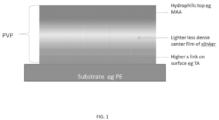
- Figure 1 illustrates an embodiment of the present invention utilizing two crosslinkers or network former to form the crosslinked polymer, and a high molecular weight polymer.
- the invention in a first aspect, relates to a coated substrate.
- the substrate includes a polar characteristic on its exterior surface.
- the coating includes at least one crosslinker.
- the crosslinker includes a variable concentration between a substrate surface of the coating and an outer surface of the coating.
- the substrate surface of the coating has a first coating polar characteristic and the outer surface of the coating has a second coating polar characteristic.
- the substrate surface of the coating is adjacent or in contact with the surface of the exterior surface of the substrate.
- the substrate can be contact lenses, catheters (including cardiovascular catheters and urological catheters), wires (including guidewires), springs, leads (for example a pacemaker lead), stents, implants, antennas, sensors, tubing, syringes, catheters, i.v. bag needles, needles, ventricular assist device components, and trochars, or combinations of two or more of these devices.
- the material of the substrate can be a polymer, a metal, a glass, polyester block amides (for example Pebax TM , a silicone rubber, nylons, polyvinyl chlorides, styrene ethylene butadienes (SEBs), and combinations thereof.
- the polar characteristic of the exterior surface of the substrate can be altered to assist in bonding of the coating, or to alter the stratification of the components based on the components polarity or hydrophobic/hydrophilic nature at the surface between the coating and the substrate or on the exterior or outer surface of the coating.
- the polar characteristic of the exterior surface of a substrate can be altered from hydrophobic to less hydrophobic as compared to its initial polar characteristic, or from hydrophilic to less hydrophilic as compared to its initial polar characteristic.
- the polar characteristic of the substrate can be different at different locations corresponding to the different materials.
- the medical device can be used in contact with blood, plasma, and the like.
- the polar characteristic of the substrate can result in the substrate being hydrophobic or hydrophilic.
- the polar characteristic can vary through the coating, such that the coating is hydrophobic at a substrate surface of the coating, gradually increasing in hydrophilic properties to the exterior surface which is more hydrophilic, or at least less hydrophobic, compared to the characteristic at the substrate surface of the coating.
- the polar characteristic can vary through the coating, such that the coating is hydrophilic at a substrate surface of the coating, then gradually decreases in hydrophilic properties, such that the exterior surface is hydrophobic, or at least less hydrophilic, compared to the characteristic at the substrate surface of the coating.
- the additional crosslinker can also vary in a similar manner as the first crosslinking material.
- first crosslinker is more hydrophilic than a second crosslinker
- second crosslinker in the coating is closer to the outer surface of the coating.
- additional crosslinkers are used in the coating, the variation and alignment of the additional crosslinkers can be located in the coating based on the polarity and hydrophobic/hydrophilic nature compared to other crosslinking materials in the coating.
- the different crosslinkers can not only crosslink with other similar crosslinkers, but can also crosslink with different crosslinkers, which can result in additional polarities of the crosslinked material within the overall crosslinked material.
- the variation can be a result of variable concentrations of the crosslinker in the coating.
- Figure 1 illustrates an embodiment of the present invention utilizing two crosslinkers and PVP as the polymer.
- crosslinker is used throughout the description of the invention to include both monomers that crosslink to form a crosslinked polymer and network formers, which are long chain compounds that can intertwine with itself, for example methacrylic acid.
- layering of the coating can be achieved based on the density variations in the coatings.
- the coating can be more dense at a substrate surface where the coating bonds or associates to a surface of the substrate and less dense on the exterior surface of the coating. In other embodiments, the coating can be less dense at a substrate surface compared to the density of the coating at an outer surface.
- the polar characteristic of the coating can allow for the coating and the substrate to create a bond.
- an advantage of the present invention is that the coating adheres to the substrate.
- the strength of the bond between the substrate and the coating can be between about 1 g and about 500 g.
- the coating can bond to itself forming a sleeve around the substrate.
- the sleeve embodiment can be useful where the substrate is not likely to bond to the coating, but can also provide additional strength between the coating and the substrate even when the coating and the substrate create a bond.
- the coating can be tailored for particular applications. For example, if an application requires that the bond between the substrate and the coating is strong, then the coating can be tailored so that it bonds with the substrate. For example, if the substrate is a polymer and the exterior surface of the polymer substrate is hydrophobic, then the coating can be formed such that the coating exhibits a gradient where the hydrophobic crosslinker is close to the substrate and more hydrophilic crosslinkers are located at the surface.
- Embodiments of the invention can result in the middle of the film providing additional strength to the coating by mono-functional network formers that have intermediate concentration of the crosslinker that is designed to adsorb to the surface of the substrate and that of the crosslinker or network former selected to reside on the film surface.
- embodiments can increase the water content of the coating by addition of hydroxylated compounds as methacrylic acid (MAA), which can be used as a crosslinker. More than one of these embodiments can be combined to tailor the coating for a particular application. Furthermore, it is possible to produce more than one layer or more than one coating layers such that there are multiple layers in the coating created by using the same or different coating materials on the substrate. In some embodiments, the coating can comprise between about one and about five layers, where each layer can be the same or different. The coating can be on a portion of the first surface of the substrate such that between about 1% and about 99% of the first surface is coated with the coating.
- MAA methacrylic acid
- the coating can be on a portion of one or more surfaces of the substrate such that between about 1% and about 99% of at least one surface of the substrate can be coated. In some embodiments, the coating can be on the entire first surface or on more than one surface of the substrate such that it covers each surface of the substrate.
- the gradient can be modulated by the choice of solvent used with the coating, the drying time (evaporation rate), temperature, and its polarity.
- a less polar crosslinker or network former can disperse into the coating.
- a more polar solvent can force a less polar crosslinker to the surface of the coating.
- the solvent can be any suitable alcohol, including isopropanol, propanol, ethanol, methanol, dimethyl sulfoxide (DMSO), water and combinations thereof.
- the drying time can be between about 2 minutes and about 10 minutes, in some embodiments between about 4 minutes and about 5 minutes.
- the drying temperature can be between about 20°C and about 50°C, in some embodiments between about 27°C and about 40°C, in some embodiments about 35°C.
- the drying time can depend on the coating thickness and solvent vapor pressure.
- At least one crosslinker or network former can be used to create the crosslinked polymer, or the networked polymer.
- the crosslinker can be a vinyl compound (including vinyl pyrrolidone, vinyl silanes), ethyleneglycol dimethacrylate, an acrylate compound (for example MAA), an epoxy compound, a urethane compound, an isocyanate compound, triacrylate (for example, trimethylolpropane triacrylate), methacrylate, methacrylic acid, and hydroxyethyl methacrylate, and combinations of two or more of these crosslinkers.
- the crosslinker can be activated by free radical or ionic mechanisms or by dehydration to produce the crosslinked polymer with an initiator.
- the initiator can be a photo or radioactive initiator, for example a UV initiator.
- the wavelength to react the initiator will depend upon the initiator properties. Initiators useful for the present invention preferably do not react with visible light typically found in a room or a lab as such an initiator would require additional equipment in order to prevent the reaction from occurring prematurely. Rather, in some embodiments, the initiator can react at a wavelength less than about 280 nm and a luminance between about 3 to about 5 mW/cm 3 .
- the initiator does not need to be attached to the crosslinker prior to reacting the crosslinker. Rather, when the initiator is used, it can simply be added to the reaction. Furthermore, the initiator becomes active without heat.
- Suitable photo initiators include 1-hydroxy-cyclohexyl-phenyl-ketone (for example Ciba ® IRGACURE ® 184), or 13-4-(2-Hydroxyethoxy)-phenyl8-2-hydroxy-2-methyl-1-propane-1-one (for example Ciba ® IRGACURE ® 2959), 2-Hydroxy-4'-(2-hydroxyethoxy)-2-methylpropiophenone, or combinations thereof.
- 1-hydroxy-cyclohexyl-phenyl-ketone for example Ciba ® IRGACURE ® 184
- 13-4-(2-Hydroxyethoxy)-phenyl8-2-hydroxy-2-methyl-1-propane-1-one for example Ciba ® IRGACURE ® 2959
- 2-Hydroxy-4'-(2-hydroxyethoxy)-2-methylpropiophenone or combinations thereof.
- the crosslinkers or network formers serve at least two purposes relevant to the invention.
- the crosslinkers can be used to bond the coating to a surface of the substrate.
- the crosslinker can be used to entrap the hydrating polymer and/or an additive.
- Combinations of more than one crosslinkers can be utilized for a particular application.
- a first crosslinker can be chosen based on its polarity to provide good adhesion to a surface of a substrate.
- a second crosslinker can be selected to provide lubricity to the coating and to increase the strength of entanglement of the high molecular weight hydrating polymer.
- a high molecular weight polymer is entrapped in the crosslinked polymer.
- Suitable high molecular weight polymers have an average molecular weight above about 30,000.
- the average molecular weight of the high molecular weight polymers can be between about 30,000 and about 1.5M.
- Low molecular weight polymers are not suitable for the invention because they would not entrap within the crosslinked polymer.
- the suitable high molecular weight polymer is a polyvinylpyrrolidone (PVP).
- the concentration of each crosslinker components in the coating can be between about 0.01 wt. % and 0.5 wt. % of the total mass of the coating. When more than one crosslinker is utilized, then the total concentration of all crosslinker components is between about 0.02 wt. % and about 2 wt. % of the total mass of the coating. In some embodiments where more than one crosslinker is utilized, the coating can include between 0.01 wt. % and about 2 wt. % of a crosslinker or chain extending compound, and between about 0.01 wt. % and about 2.0 wt. % of each additional crosslinking or chain extending compound.
- the ratio of the first crosslinker to a second crosslinker can be between about 1:0.1 and about 1:1.
- the concentration of the high molecular weight polymer in the coating can be between about 3 wt. % and about 15 wt. % of the coating.
- the concentration of the coating solution in a solvent can be between about 3 wt. % and about 15 wt. %.
- the solvent can be present in the coating in an amount between about 85 wt. % and about 97 wt. %.
- Additives can be present in the coating in an amount between 0.05 wt. % and 0.1 wt. %.
- Other incidental materials for example unreacted components
- the thickness of the coating on the substrate can be between about 0.5 microns and about 10 microns.
- the use of the substrate can dictate the thickness of the coating.
- a thickness of between about 0.5 microns and about 10 micron can provide if the coating requires a longer dry-out time.
- additives can be incorporated into the coating.
- Suitable additives include antimicrobial (including antibacterial) agents, binders, rheology modifiers, or colorants, and combinations of two or more additives.
- Suitable antimicrobial agents can include a silver compound, chlorhexidine, ciprofloxacin, and combinations thereof.
- Suitable rheology modifiers can include pluronics, alginates, carboxymethyl cellulose and combinations thereof.
- Suitable colorants can include dyes or oxide pigments, and combinations thereof.
- the total concentration of the additives in the coating can be between about 0.05 wt. % and about 0.1 wt. % of the total weight of the coating, with each additive used contributing to a portion of this total weight.
- the ratio of the high molecular weight polymer to the crosslinker ranges from about 1: 0.05 to about 1:1 for all formulations regardless of the number of components.
- the ratio of the high molecular weight polymer to the initiator is between about 1: 0.001 and about 1:01.
- the ratio of a first crosslinker of the second crosslinker is between about 1:0.1 and about 1:1.
- the ratio of a crosslinker, a high molecular weight polymer and the initiator is between about 1:0.1:0.005 and about 0.02:1.0:0.02.
- the invention in another aspect, relates to a method to coat a substrate.
- the method includes mixing at least one crosslinker, at least one polymer, and an initiator to produce a pre-coating mixture.
- the pre-coating mixture is applied to a substrate.
- a reaction is initiated to crosslink the crosslinker(s) in the pre-coating mixture to produce a gradient crosslinked coating on the substrate.
- the crosslinked coating entraps the polymer, and the gradient coating includes a variable concentration of the crosslinker between a substrate surface of the coating and an outer surface of the coating such that the substrate surface of the gradient coating comprises a first coating polar characteristic and the outer surface of the coating comprises a second coating polar characteristic.
- the substrate surface of the coating is adjacent to the exterior surface of the substrate.
- the thickness can be controlled by the concentration of the coating solution in the solvent, by the extraction rate used during application of the coating, the amount of polymer in the coating solution, or a combination of these methods to control the thickness.
- the thickness of the coating on the substrate can be between about 0.5 microns and about 10 microns.
- a higher concentration of the coating solution in the solvent can be used.
- the higher concentration can be between about 5 wt. % and about 15 wt. % of the coating solution in the solvent.
- the substrate can be withdrawn from the coating solution at a faster rate compared to the rate used for a thinner coating.
- the extraction rate for a thick coating i.e. between about 0.5 microns and about 10 microns
- the extraction rate in general can be between about 0.2 cm/s and 1 cm/s.
- the pre-coating mixture can be applied using any suitable means.
- the pre-coating mixture can be applied to the substrate by dipping, spraying, painting, submerging, or other methods.
- the pre-coating mixture can be applied uniformly on the substrate or can vary on the substrate.
- the pre-coating mixture includes at least one solvent.
- the solvent can be any suitable alcohol, including isopropanol, polypropanol, propanol, ethanol, methanol, dimethyl sulfoxide (DMSO), water and combinations thereof.
- the gradient can be modulated by the choice of solvent used with the coating, the drying time (evaporation rate), temperature, and its polarity. By decreasing the polarity with a less polar solvent, a less polar crosslinker or network former can disperse into the coating. A more polar solvent can force a less polar crosslinker to the surface of the coating.
- the drying time can be between about 2 minutes and about 10 minutes, in some embodiments between about 4 minutes and about 5 minutes.
- the drying temperature can be between about 20°C and about 50°C, in some embodiments between about 27°C and about 40°C, in some embodiments about 35°C.
- the drying time can depend on the coating thickness and solvent vapor pressure.
- the substrate can be contact lenses, catheters (including cardiovascular catheters and urological catheters), wires (including guidewires), springs, leads (for example a pacemaker lead), stents, implants, antennas, sensors, tubing, syringes, catheters, i.v. bag needles, needles, ventricular assist device components, and trochars, or combinations of two or more of these devices.
- the material of the substrate can be a polymer, a metal, a glass, polyester block amides (for example Pebax TM , a silicone rubber, nylons, polyvinyl chlorides, SEBs, and combinations thereof.
- the polar characteristic of the exterior surface of the substrate can be altered to assist in bonding of the coating, or to alter the stratification of the components based on the components polarity or hydrophobic/hydrophilic nature at the surface between the coating and the substrate or on the exterior or outer surface of the coating.
- the polar characteristic of the exterior surface of a substrate can be altered from hydrophobic to less hydrophobic as compared to its initial polar characteristic, or from hydrophilic to less hydrophilic as compared to its initial polar characteristic.
- the polar characteristic of the substrate can be different at different locations corresponding to the different materials.
- the medical device can be used in contact with blood, plasma, and the like.
- the polar characteristic of the substrate can result in the substrate being hydrophobic or hydrophilic.
- the polar characteristic can vary through the coating, such that the coating is hydrophobic at a substrate surface of the coating, gradually increasing in hydrophilic properties to the exterior surface which is more hydrophilic, or at least less hydrophobic, compared to the characteristic at the substrate surface of the coating.
- the polar characteristic can vary through the coating, such that the coating is hydrophilic at an substrate surface of the coating, then gradually decreases in hydrophilic properties, such that the exterior surface is hydrophobic, or at least less hydrophilic, compared to the characteristic at the substrate surface of the coating.
- the additional crosslinker can also vary in a similar manner as the first crosslinking material.
- the crosslinking components can align such that the first crosslinker is adjacent to the surface of the substrate and second crosslinker in the coating is closer to the outer surface of the coating.
- additional crosslinkers are used in the coating, the variation and alignment of the additional crosslinkers can be located in the coating based on the polarity and hydrophobic/hydrophilic nature compared to other crosslinking materials in the coating.
- the different crosslinkers can not only crosslink with other similar crosslinkers, but can also crosslink with different crosslinkers, which can result in additional polarities of the crosslinked material within the overall crosslinked material.
- layering of the coating can be achieved based on the density variations in the coatings.
- the coating can be more dense at an substrate surface where the coating bonds or associates to a surface of the substrate and less dense on the exterior surface of the coating. In other embodiments, the coating can be less dense at an substrate surface compared to the density of the coating at an outer surface.
- the polar characteristic of the coating can allow for the coating and the substrate to create a bond.
- an advantage of the present invention is that the coating adheres to the substrate.
- the strength of the bond between the substrate and the coating can be between about 1 g and about 500 g.
- the coating can bond to itself forming a sleeve around the substrate.
- the sleeve embodiment can be useful where the substrate is not likely to bond to the coating, but can also provide additional strength between the coating and the substrate even when the coating and the substrate create a bond.
- the coating can be tailored for particular applications. For example, if an application requires that the bond between the substrate and the coating is strong, then the coating can be tailored so that it bonds with the substrate. For example, if the substrate is a polymer and the exterior surface of the polymer substrate is hydrophobic, then the coating can be formed such that the coating exhibits a gradient where the hydrophobic crosslinker is close to the substrate and more hydrophilic crosslinkers are located at the surface.
- Embodiments of the invention can result in the middle of the film providing additional strength to the coating by mono-functional network formers that have intermediate concentration of the crosslinker that is designed to adsorb to the surface of the substrate and that of the crosslinker or network former selected to reside on the film surface.
- the vinyl polyethylene and polypropylene oxides are such compounds which can be used as a crosslinker.
- Other embodiments can increase the water content of the coating by addition of hydroxylated compounds as methacrylic acid (MAA), which can be used as a crosslinker. More than one of these embodiments can be combined to tailor the coating for a particular application. Furthermore, it is possible to produce more than one layer or more than one coating layers such that there are multiple layers in the coating created by using the same or different coating materials on the substrate.
- the coating can comprise between about one and about five layers, where each layer can be the same or different.
- the coating can be on a portion of the first surface of the substrate such that between about 1% and about 99% of the first surface is coated with the coating.
- the coating can be on a portion of one or more surfaces of the substrate such that between about 1% and about 99% of at least one surface of the substrate can be coated. In some embodiments, the coating can be on the entire first surface or on more than one surface of the substrate such that it covers each surface of the substrate.
- At least one crosslinker or network former can be used to create the crosslinked polymer, or the networked polymer.
- the crosslinker can be a vinyl compound (including vinyl pyrrolidone, vinyl silanes,), ethyleneglycol dimethacrylate, an acrylate compound (for example MAA), an epoxy compound, a urethane compound, an isocyanate compounds, triacrylate (for example, trimethylolpropane triacrylate), methacrylate, methacrylic acid, and hydroxyethyl methacrylate, and combinations of two or more of these crosslinkers.
- the crosslinker can be activated by free radical or ionic mechanisms or by dehydration to produce the crosslinked polymer with an initiator.
- the initiator can be a photo or radioactive initiator, for example a UV initiator.
- the wavelength to react the initiator will depend upon the initiator properties. Initiators useful for the present invention preferably do not react with visible light typically found in a room or a lab as such an initiator would require additional equipment in order to prevent the reaction from occurring prematurely. Rather, in some embodiments, the initiator can react at a wavelength less than about 280 nm and a luminance between about 3 to about 5 mW/cm 3 .
- the initiator does not need to be attached to the crosslinker prior to reacting the crosslinker. Rather, when the initiator is used, it can simply be added to the reaction. Furthermore, the initiator becomes active without heat.
- Suitable photo initiators include 1-hydroxy-cyclohexyl-phenyl-ketone (for example Ciba ® IRGACURE ® 184), or 13-4-(2-Hydroxyethoxy)-phenyl8-2-hydroxy-2-methyl-1-propane-1-one (for example Ciba ® IRGACURE ® 2959), 2-Hydroxy-4'-(2-hydroxyethoxy)-2-methylpropiophenone, or combinations thereof.
- 1-hydroxy-cyclohexyl-phenyl-ketone for example Ciba ® IRGACURE ® 184
- 13-4-(2-Hydroxyethoxy)-phenyl8-2-hydroxy-2-methyl-1-propane-1-one for example Ciba ® IRGACURE ® 2959
- 2-Hydroxy-4'-(2-hydroxyethoxy)-2-methylpropiophenone or combinations thereof.
- the crosslinkers or network formers serve at least two purposes relevant to the invention.
- the crosslinkers can be used to bond the coating to a surface of the substrate.
- the crosslinker can be used to entrap the hydrating polymer and/or an additive.
- Combinations of more than one crosslinkers can be utilized for a particular application.
- a first crosslinker can be chosen based on its polarity to provide good adhesion to a surface of a substrate.
- a second crosslinker can be selected to provide lubricity to the coating and to increase the strength of entanglement of the high molecular weight hydrating polymer.
- a high molecular weight polymer is entrapped in the crosslinked polymer.
- Suitable high molecular weight polymers will have an average molecular weight above about 30,000.
- the average molecular weight of the high molecular weight polymers can be between about 30,000 and about 1.5M.
- Low molecular weight polymers would not be suitable for the invention because they would not entrap within the crosslinked polymer.
- the suitable high molecular weight polymer is a polyvinylpyrrolidone (PVP).
- the concentration of each crosslinker components in the coating can be between about 0.01 wt. % and 0.5 wt. % of the total mass of the coating. When more than one crosslinker is utilized, then the total concentration of all crosslinker components is between about 0.02 wt. % and about 2 wt. % of the total mass of the coating. In some embodiments where more than one crosslinker is utilized, the coating can include between 0.01 wt. % and about 2 wt. % of a crosslinker or chain extending compound, and between about 0.01 wt. % and about 2.0 wt. % of each additional crosslinking or chain extending compound.
- the ratio of the first crosslinker to a second crosslinker can be between about 1:0.1 and about 1:1.
- the concentration of the high molecular weight polymer in the coating can be between about 3 wt. % and about 15 wt. % of the coating.
- the concentration of the coating solution in a solvent can be between about 3 wt. % and about 15 wt. %.
- the solvent can be present in the coating in an amount between about 85 wt. % and about 97 wt. %.
- Additives can be present in the coating in an amount between 0.05 wt. % and 0.1 wt. %.
- Other incidental materials for example unreacted components
- additives can be incorporated into the coating.
- Suitable additives include antimicrobial (including antibacterial) agents, binders, rheology modifiers, or colorants, and combinations of two or more additives.
- Suitable antimicrobial agents can include a silver compound, chlorhexidine, ciprofloxacin, and combinations thereof.
- Suitable rheology modifiers can include pluronics, alginates, carboxymethyl cellulose and combinations thereof.
- Suitable colorants can include dyes or oxide pigments, and combinations thereof.
- the total concentration of the additives in the coating can be between about 0.05 wt. % and about 0.1 wt. % of the total weight of the coating, with each additive used contributing to a portion of this total weight.
- the ratio of the high molecular weight polymer to the crosslinker ranges from about 1: 0.05 to about 1:1 for all formulations regardless of the number of components.
- the ratio of the high molecular weight polymer to the initiator is between about 1: 0.001 and about 1:01.
- the ratio of a first crosslinker of the second crosslinker is between about 1:0.1 and about 1:1.
- the ratio of a crosslinker, a high molecular weight polymer and the initiator is between about 1:0.1:0.005 and about 0.02:1.0:0.02.
- the method includes providing at least one crosslinker, the high molecular weight polymer, and an initiator.
- the method to produce the pre-coating does not require the reaction to take place in a special room or contained area to protect the molecules against premature reaction with visible light. Rather, since the present invention utilizes initiators that operate over the ultraviolet spectrum, the materials do not require special handling during mixture to produce the precoating.
- This example illustrates the preparation of two coating compositions in accordance with the present invention.
- Coating compositions A and B were prepared by combining the ingredients in the relative amounts by mass shown in Table 1.
- Table 1 Component Composition A
- Composition B Composition C
- Polyvinylpyrrolidone (PVP) 1.0 3.0
- Trimethylolpropane triacrylate (TMPTA) 0.15 0.025 0.15
- Methacrylic acid (MAA) 0.15
- Isopropyl alcohol was added as a solvent in an amount of 5 weight percent of the composition.
- This example illustrates the production of a catheter coated with Composition A.
- a urological catheter made of polyethylene was coated with Composition A and then subjected to UV radiation with a wavelength below 280 nm and luminance of 3 to 5 mW/ cm 2 to initiate crosslinking.
- the resulting coated catheter has a coating that is well bonded to the catheter and has a high water content and a long dry out time.
- This example illustrates the production of a catheter coated with Composition B.
- a urological catheter made of polyethylene was coated with Composition B and then subjected to UV radiation with a wavelength below 280 nm and luminance of 3 to 5 mW/ cm 2 to initiate crosslinking.
- the resulting coated catheter has a coating that is well bonded to the catheter and has a high water content and a long dry out time.
- This example illustrates the production of a catheter coated with Composition C.
- the total concentration of the coating solution ranges between about 3% and about 7%.
- a urological catheter made of polyvinylchloride was coated with Composition A and then subjected to UV radiation with a wavelength below 280 nm and luminance of 3 to 5 mW/ cm 2 to initiate crosslinking.
- the resulting coated catheter has a coating that is well bonded to the catheter and has a high water content and a long dry out time.
- This example illustrates the average frictional force of the coating for fifty cycles (unless noted) for different compositions.
- Table 2 provides the average frictional force for these compositions.
- the nomenclature of the different compositions is as follows: First number corresponds with a solvent - 5 is IPA, and 6 is methanol; the second number corresponds with the composition of the coating - 1 is Composition A, 2 is Composition B; the third number indicates whether a low amount of a crosslinker was used which is indicated by the number 0, while a high amount of the crosslinker is indicated with 6; the letter indicates a test sample.
- This data therefore accounts for different solvents used in the coatings, and whether there is a low total amount of a crosslinker (about 0.05 wt.
Landscapes
- Chemical & Material Sciences (AREA)
- Organic Chemistry (AREA)
- Health & Medical Sciences (AREA)
- Life Sciences & Earth Sciences (AREA)
- Polymers & Plastics (AREA)
- Medicinal Chemistry (AREA)
- Chemical Kinetics & Catalysis (AREA)
- Wood Science & Technology (AREA)
- Engineering & Computer Science (AREA)
- Materials Engineering (AREA)
- Veterinary Medicine (AREA)
- Public Health (AREA)
- General Health & Medical Sciences (AREA)
- Animal Behavior & Ethology (AREA)
- Epidemiology (AREA)
- Plant Pathology (AREA)
- Dispersion Chemistry (AREA)
- Materials For Medical Uses (AREA)
- Paints Or Removers (AREA)
Claims (12)
- Verfahren zum Beschichten eines Substrats, umfassend:Mischen mindestens eines Vernetzers, mindestens eines hochmolekularen Polymers mit einem durchschnittlichen Molekulargewicht über 30.000, eines Initiators und eines Lösungsmittels, um eine Vorbeschichtungsmischung herzustellen;Auftragen der Vorbeschichtungsmischung auf das Substrat, wobei die Vorbeschichtungsmischung gleichmäßig auf das Substrat aufgetragen werden kann oder auf dem Substrat variieren kann;Initiieren einer Reaktion zum Vernetzen des mindestens einen Vernetzers in der Vorbeschichtungsmischung, um eine vernetzte Gradientenbeschichtung auf dem Substrat zu erzeugen, wobei die vernetzte Beschichtung das mindestens eine hochmolekulare Polymer einschließt, unddie Gradientenbeschichtung eine variable Konzentration des Vernetzers zwischen einer Substratoberfläche der Gradientenbeschichtung und einer äußeren Oberfläche der Gradientenbeschichtung enthält, so dass die Substratoberfläche der Gradientenbeschichtung eine erste polare Beschichtungseigenschaft aufweist und die äußere Oberfläche der Gradientenbeschichtung eine zweite polare Beschichtungseigenschaft aufweist, wobei die Substratoberfläche der Gradientenbeschichtung an die Außenoberfläche des Substrats angrenzt, wobei die polare Eigenschaft des Substrats dazu führt, dass das Substrat hydrophob oder hydrophil ist; undwobei der Gradient durch die Wahl des Lösungsmittels, die Trocknungszeit, die Temperatur und seine Polarität moduliert wird; undwobei das Polymer mit hohem Molekulargewicht ein Polyvinylpyrrolidon ist.
- Verfahren nach Anspruch 1, wobei es sich bei dem Substrat um eine Kontaktlinse, einen Katheterdraht, eine Feder, eine Leitung, einen Stent, ein Implantat, eine Antenne, einen Sensor, einen Schlauch, eine Spritze, einen Katheter, eine intravenöse Beutelnadel, eine Nadel, eine Komponente einer Herzunterstützungsvorrichtung, einen Trokar oder Kombinationen von zwei oder mehr dieser Teile handelt.
- Verfahren nach Anspruch 1, wobei mindestens ein Material des Substrats ein Polymer, ein Metall, ein Silikonkautschuk, ein Styrol-Butadien oder ein Glas ist.
- Verfahren nach Anspruch 1, wobei die Gradientenbeschichtung mit dem Substrat verbunden ist.
- Verfahren nach Anspruch 1, wobei die Gradientenbeschichtung eine Hülle um das Substrat bildet.
- Verfahren nach Anspruch 1, wobei der mindestens eine Vernetzer eine Vinylverbindung ist, Ethylenglykoldimethacrylat, eine Acrylatverbindung, eine Epoxyverbindung, eine Urethanverbindung, eine Isocyanatverbindung, ein Triacrylat, ein Methacrylat, eine Methacrylsäure oder ein Hydroxymethylmethacrylat.
- Verfahren nach Anspruch 1, wobei der mindestens eine Vernetzer ferner einen ersten Vernetzer und einen zweiten Vernetzer umfasst, wobei das Verhältnis des ersten Vernetzers zum zweiten Vernetzers zwischen 1:0,1 und 1:1 liegt.
- Verfahren nach Anspruch 1, wobei die Gradientenbeschichtung weiter mindestens ein Additiv enthält.
- Verfahren nach Anspruch 8, wobei das mindestens eine Additiv ein antimikrobielles Mittel ist ausgewählt aus der Gruppe bestehend aus einer Silberverbindung, einem Chlorhexidin, einem Ciprofloxacin und Kombinationen davon.
- Verfahren nach Anspruch 8, wobei das mindestens eine Additiv ein Rheologiemodifikator, ein Färbemittel oder eine Kombination davon ist.
- Verfahren nach Anspruch 1, wobei das Lösungsmittel ausgewählt ist aus der Gruppe bestehend aus Isopropanol, Propanol, Ethanol, Methanol, Dimethylsulfoxid, Wasser und Kombinationen davon.
- Beschichtetes Substrat, umfassend:ein Substrat, wobei das Substrat eine polare Eigenschaft an einer äußeren Oberfläche aufweist und eine Gradientenbeschichtung, die mindestens einen Vernetzer enthält, wobei der mindestens eine Vernetzer ein vernetztes Polymer bildet;wobei ein hochmolekulares Polymer mit einem durchschnittlichen Molekulargewicht über 30.000 in dem vernetzten Polymer der Gradientenbeschichtung eingeschlossen ist;und die Gradientenbeschichtung eine variable Konzentration des Vernetzungsmittels zwischen einer Substratoberfläche der Gradientenbeschichtung und einer Außenoberfläche der Gradientenbeschichtung enthält, wobei die Substratoberfläche der Gradientenbeschichtung an die Außenoberfläche des Substrats angrenzt, und wobei die Substratoberfläche der Gradientenbeschichtung eine erste polare Beschichtungseigenschaft aufweist und die äußere Oberfläche der Gradientenbeschichtung eine zweite polare Beschichtungseigenschaft aufweist;erhältlich durch ein Verfahren wie in einem der Ansprüche 1 bis 11 definiert.
Applications Claiming Priority (2)
| Application Number | Priority Date | Filing Date | Title |
|---|---|---|---|
| US201762466541P | 2017-03-03 | 2017-03-03 | |
| PCT/US2018/020924 WO2018161079A1 (en) | 2017-03-03 | 2018-03-05 | Coating composition comprised of a hydrophilic crosslinker, a hydrophobic crosslinker and optionally a hydrogel and methods of making and using the same |
Publications (3)
| Publication Number | Publication Date |
|---|---|
| EP3589704A1 EP3589704A1 (de) | 2020-01-08 |
| EP3589704A4 EP3589704A4 (de) | 2020-12-16 |
| EP3589704B1 true EP3589704B1 (de) | 2025-05-14 |
Family
ID=63371190
Family Applications (1)
| Application Number | Title | Priority Date | Filing Date |
|---|---|---|---|
| EP18761192.6A Active EP3589704B1 (de) | 2017-03-03 | 2018-03-05 | Beschichtungszusammensetzung mit einem hydrophilen vernetzer, ein hydrophober vernetzer und gegebenenfalls ein hydrogel und verfahren zur herstellung und verwendung davon |
Country Status (3)
| Country | Link |
|---|---|
| US (2) | US11220582B2 (de) |
| EP (1) | EP3589704B1 (de) |
| WO (1) | WO2018161079A1 (de) |
Families Citing this family (4)
| Publication number | Priority date | Publication date | Assignee | Title |
|---|---|---|---|---|
| EP3589704B1 (de) * | 2017-03-03 | 2025-05-14 | Harland Medical Systems, Inc. | Beschichtungszusammensetzung mit einem hydrophilen vernetzer, ein hydrophober vernetzer und gegebenenfalls ein hydrogel und verfahren zur herstellung und verwendung davon |
| WO2019050962A1 (en) | 2017-09-05 | 2019-03-14 | Harland Medical Systems, Inc. | COATING APPARATUS WITH AUTOMATIC FLUID LEVEL SYSTEM, AND METHODS OF USING THE SAME |
| CN111223901B (zh) * | 2019-11-29 | 2022-07-29 | 云谷(固安)科技有限公司 | 一种显示面板及其制备方法 |
| CN112940567B (zh) * | 2021-02-06 | 2022-04-19 | 青岛科凯达橡塑有限公司 | 一种高耐候橡胶涂层及其制备方法 |
Family Cites Families (63)
| Publication number | Priority date | Publication date | Assignee | Title |
|---|---|---|---|---|
| CS108895A (de) * | 1961-12-27 | |||
| NL128305C (de) * | 1963-09-11 | |||
| US4053317A (en) * | 1973-08-07 | 1977-10-11 | Teijin Limited | Light-sensitive composition |
| GB1496345A (en) | 1973-11-29 | 1977-12-30 | Nippon Hydron Co Ltd | Resinous coating composition forming a hygroscopic non-fogging coating film with a high surface hardness and method of forming such coating films |
| US4197266A (en) * | 1974-05-06 | 1980-04-08 | Bausch & Lomb Incorporated | Method for forming optical lenses |
| US4113224A (en) * | 1975-04-08 | 1978-09-12 | Bausch & Lomb Incorporated | Apparatus for forming optical lenses |
| SU1052564A1 (ru) | 1978-03-30 | 1983-11-07 | Республиканский Государственный Институт По Проектированию Объектов Производственной Базы Водохозяйственных Организаций "Росгипроводпром" | Агрегат дл эмалировани труб |
| US4330612A (en) * | 1979-01-23 | 1982-05-18 | Japan Synthetic Rubber Co., Ltd. | Laminate of monolayer film of cyclized butadiene polymer and other photosensitive layer |
| JPS5820263A (ja) | 1981-07-28 | 1983-02-05 | Mitsubishi Rayon Co Ltd | 合成樹脂成形品の表面硬化処理方法およびその装置 |
| US4661573A (en) * | 1986-04-14 | 1987-04-28 | Paragon Optical Inc. | Lens composition articles and method of manufacture |
| GB8729977D0 (en) | 1987-12-23 | 1988-02-03 | Bard Ltd | Catheter |
| US5201724A (en) * | 1987-12-23 | 1993-04-13 | The Victoria University Of Manchester | Catheter |
| US5262033A (en) | 1989-05-18 | 1993-11-16 | Nisshin Steel Co., Ltd. | Apparatus for the continuous etchings and aluminum plating of stainless steel strips |
| US4983716A (en) * | 1990-01-16 | 1991-01-08 | The Sherwin-Williams Company | Non-aqueous dispersions |
| JP2858045B2 (ja) | 1991-05-31 | 1999-02-17 | バクスター インターナショナル インコーポレーテッド | 脱泡用途に関する抗凝血性コーチング |
| EP0597593A1 (de) | 1992-10-30 | 1994-05-18 | Medtronic, Inc. | Gerinnungsbeständige Gegenstände |
| US5538512A (en) | 1993-02-25 | 1996-07-23 | Zenzon; Wendy J. | Lubricious flow directed catheter |
| US5531715A (en) | 1993-05-12 | 1996-07-02 | Target Therapeutics, Inc. | Lubricious catheters |
| JPH06328821A (ja) | 1993-05-19 | 1994-11-29 | Brother Ind Ltd | テープカセット |
| WO1995028184A1 (en) | 1994-04-15 | 1995-10-26 | Cobe Laboratories, Inc. | Biocompatible coated article |
| US5443453A (en) | 1994-04-21 | 1995-08-22 | Sherwood Medical Company | Stop-cock valve |
| US5688855A (en) * | 1995-05-01 | 1997-11-18 | S.K.Y. Polymers, Inc. | Thin film hydrophilic coatings |
| US5603991A (en) | 1995-09-29 | 1997-02-18 | Target Therapeutics, Inc. | Method for coating catheter lumens |
| JPH09165459A (ja) * | 1995-12-18 | 1997-06-24 | Dainippon Ink & Chem Inc | 表面疎水性成形物の製造方法および表面疎水性成形物 |
| US6020445A (en) * | 1997-10-09 | 2000-02-01 | Johnson & Johnson Vision Products, Inc. | Silicone hydrogel polymers |
| US6254921B1 (en) | 1999-12-08 | 2001-07-03 | Surmodics, Inc. | Coating process and apparatus |
| JP4103302B2 (ja) | 2000-05-15 | 2008-06-18 | 株式会社日立製作所 | キャピラリアレイを用いた電気泳動装置及びそれに用いられるサンプルプレートアセンブリ |
| JP3970595B2 (ja) | 2001-12-10 | 2007-09-05 | 綜研化学株式会社 | 熱重合型アクリル塗料、その塗料による塗装金属板及び塗装金属板の製造方法 |
| US8158695B2 (en) * | 2002-09-06 | 2012-04-17 | Johnson & Johnson Vision Care, Inc. | Forming clear, wettable silicone hydrogel articles without surface treatments |
| DE10260919A1 (de) * | 2002-12-20 | 2004-07-01 | Röhm GmbH & Co. KG | Verfahren zur Herstellung von überzogenen Arzneiformen und Nahrungsergänzungsmitteln mit Konzentrationsgradienten im Überzug |
| IES20030294A2 (en) * | 2003-04-17 | 2004-10-20 | Medtronic Vascular Connaught | Coating for biomedical devices |
| BRPI0406354A (pt) | 2004-10-25 | 2006-06-13 | Ramatis Piscirilli Ramos | processos de combate de focos de calor e/ou incêndios de qualquer magnitude, e equipamentos para operacionalização, equipamentos para extinção, e composições de extinção resultantes - projeto salamandras |
| US8105259B2 (en) * | 2005-02-22 | 2012-01-31 | Kaneka Corporation | Catheter |
| US7381273B2 (en) | 2005-03-15 | 2008-06-03 | Curingsolutions, Llc | Apparatus and method for coating medical devices |
| WO2007109333A2 (en) | 2006-03-21 | 2007-09-27 | Harland Medical Systems, Llc | Apparatus and method for coating of elongate flimsy members |
| US8545865B2 (en) * | 2006-03-24 | 2013-10-01 | Boston Scientific Scimed, Inc. | Medical devices having polymer brushes |
| US8092818B2 (en) * | 2006-05-17 | 2012-01-10 | Boston Scientific Scimed, Inc. | Medical devices having bioactive surfaces |
| JP5085958B2 (ja) | 2007-02-28 | 2012-11-28 | 関西ペイント株式会社 | 着色塗料粒子分散物の製造方法 |
| WO2008134575A2 (en) | 2007-04-25 | 2008-11-06 | Harland Medical Systems Llc | Coating sleeve |
| WO2009035457A1 (en) | 2007-09-13 | 2009-03-19 | Reilly Dillon | Dip coating apparatus with height adjustable coating tubes and method of coating |
| WO2009054509A1 (ja) | 2007-10-26 | 2009-04-30 | Terumo Kabushiki Kaisha | カテーテル |
| US9072868B2 (en) * | 2008-10-27 | 2015-07-07 | Pursuit Vascular, Inc. | Device for delivery of antimicrobial agent into trans-dermal catheter |
| US8389050B2 (en) | 2008-11-21 | 2013-03-05 | Corning Incorporated | Method of coating tubes using a self-assembly process |
| US20120058355A1 (en) * | 2009-06-02 | 2012-03-08 | Hyomin Lee | Coatings |
| JP4896245B2 (ja) | 2010-03-31 | 2012-03-14 | 朝日インテック株式会社 | ガイドワイヤ |
| US8758894B2 (en) | 2010-04-09 | 2014-06-24 | Nanofilm, Ltd. | Fog and abrasion resistant hardcoat for plastics having hydrophilic surfactant rich surface portion with surfactant concentration gradient |
| AU2011293169A1 (en) | 2010-08-27 | 2013-03-21 | Biomimedica, Inc. | Hydrophobic and hydrophilic interpenetrating polymer networks derived from hydrophobic polymers and methods of preparing the same |
| US8691342B2 (en) * | 2011-02-03 | 2014-04-08 | The University Of Akron | Multi-phase self-stratifying coating exhibiting gradient behavior |
| RU2488644C2 (ru) | 2011-10-25 | 2013-07-27 | Александр Александрович Кулаковский | Устройство для нанесения покрытия на протяженное изделие |
| KR20140088895A (ko) * | 2011-11-01 | 2014-07-11 | 루브리졸 어드밴스드 머티어리얼스, 인코포레이티드 | 아크릴레이트올레핀 공중합체,이를 생산하는 방법 및 이를 이용한 조성물 |
| US9555217B2 (en) * | 2012-01-31 | 2017-01-31 | Terumo Kabushiki Kaisha | Catheter |
| CN104023781B (zh) | 2012-01-31 | 2016-09-28 | 泰尔茂株式会社 | 导管 |
| US20130341811A1 (en) * | 2012-06-25 | 2013-12-26 | Johnson & Johnson Vision Care, Inc. | Lens comprising low and high molecular weight polyamides |
| US20150329604A1 (en) * | 2012-11-29 | 2015-11-19 | President And Fellows Of Harvard College | Pigment structures, pigment granules, pigment proteins, and uses thereof |
| US9570751B2 (en) * | 2013-02-26 | 2017-02-14 | Samsung Sdi Co., Ltd. | Binder composition for secondary battery, anode including the binder composition, and lithium battery including the anode |
| EP2775351B1 (de) * | 2013-03-07 | 2017-02-22 | Agfa Graphics NV | Vorrichtung und Verfahren zur Verarbeitung einer Lithografiedruckplatte |
| WO2016010031A1 (ja) * | 2014-07-16 | 2016-01-21 | 日東電工株式会社 | 偏光フィルムおよびその製造方法 |
| JP6780227B2 (ja) * | 2015-03-17 | 2020-11-04 | 株式会社リコー | 活性エネルギー線硬化型組成物 |
| JP2017025124A (ja) * | 2015-07-15 | 2017-02-02 | 株式会社リコー | 活性エネルギー線硬化型組成物 |
| JP6317299B2 (ja) | 2015-08-28 | 2018-04-25 | 株式会社荏原製作所 | めっき装置、めっき方法、及び基板ホルダ |
| JP6731486B2 (ja) | 2016-08-26 | 2020-07-29 | 三井化学株式会社 | 防曇性積層体 |
| EP3589704B1 (de) | 2017-03-03 | 2025-05-14 | Harland Medical Systems, Inc. | Beschichtungszusammensetzung mit einem hydrophilen vernetzer, ein hydrophober vernetzer und gegebenenfalls ein hydrogel und verfahren zur herstellung und verwendung davon |
| WO2019050962A1 (en) | 2017-09-05 | 2019-03-14 | Harland Medical Systems, Inc. | COATING APPARATUS WITH AUTOMATIC FLUID LEVEL SYSTEM, AND METHODS OF USING THE SAME |
-
2018
- 2018-03-05 EP EP18761192.6A patent/EP3589704B1/de active Active
- 2018-03-05 WO PCT/US2018/020924 patent/WO2018161079A1/en not_active Ceased
- 2018-03-05 US US16/490,752 patent/US11220582B2/en active Active
-
2022
- 2022-01-07 US US17/570,912 patent/US11505658B2/en active Active
Also Published As
| Publication number | Publication date |
|---|---|
| US11505658B2 (en) | 2022-11-22 |
| US11220582B2 (en) | 2022-01-11 |
| US20220127425A1 (en) | 2022-04-28 |
| EP3589704A4 (de) | 2020-12-16 |
| US20200002565A1 (en) | 2020-01-02 |
| EP3589704A1 (de) | 2020-01-08 |
| WO2018161079A1 (en) | 2018-09-07 |
Similar Documents
| Publication | Publication Date | Title |
|---|---|---|
| US11505658B2 (en) | Coating composition comprised of a hydrophilic crosslinker, a hydrophobic crosslinker and optionally a hydrogel and methods of making and using the same | |
| JP6959396B2 (ja) | 抗菌層付き支持体及び積層体 | |
| US20230033929A1 (en) | Polyelectrolyte hydrogel coating with strong substrate binding performance and method of manufacturing the same | |
| DE60016449T2 (de) | Beschichtungsverfahren | |
| DE602004005727T2 (de) | Reaktive hydrophile oligomere | |
| EP2275154B1 (de) | Antibakterielle zusammensetzung zur medizinischen verwendung und medizinisches gerät | |
| US5019100A (en) | Use of a polymer network, method for preparing a prepolymer and also preparation which yields a polymer network after curing | |
| CN104042295A (zh) | 一种亲水润滑抗菌泪道管及其制备方法 | |
| KR102110885B1 (ko) | 온도 감응성 소프트 엑추에이터 및 이의 제조방법 | |
| CN108690211B (zh) | 眼用镜片及其制造方法 | |
| AU2018261179B2 (en) | Lubricious hydrophilic coatings and methods of forming the same | |
| CN103289499A (zh) | 一种可光固化亲水润滑性涂层及其制备方法和使用方法 | |
| EP3124237A1 (de) | Substrat mit antibakterieller schicht und antibakteriellem bogen, radiographievorrichtung und berührungstafel | |
| WO2018016207A1 (ja) | 抗菌組成物、抗菌膜、抗菌膜付き基材、抗菌膜の製造方法、及び、抗菌膜付き基材の製造方法 | |
| CN108601858A (zh) | 设备和其制造方法 | |
| EP3126416B1 (de) | Silikon-acrylamid-copolymer | |
| JP6092144B2 (ja) | 抗菌層付き基材、抗菌シート、放射線撮影装置、タッチパネル | |
| WO2011058171A1 (en) | Hydrophilic copolymer | |
| CN109337492B (zh) | 亲水超滑涂层以及免激活涂层导尿管 | |
| JPWO2017146101A1 (ja) | デバイスおよびその製造方法 | |
| KR20180012777A (ko) | 피부 점착 시트 및 시트상 피부 외용제 | |
| JPWO2011108520A1 (ja) | 皮膚用材料および皮膚用材料の製造方法 | |
| JP2013172764A (ja) | 低含水性軟質デバイス、低含水性軟質デバイス用組成物およびこれらの製造方法 | |
| US10251981B2 (en) | Coating layer, coating solution, method for forming coating layer, and method for producing medical tool | |
| DE3708954A1 (de) | Beschichteter formgegenstand |
Legal Events
| Date | Code | Title | Description |
|---|---|---|---|
| STAA | Information on the status of an ep patent application or granted ep patent |
Free format text: STATUS: THE INTERNATIONAL PUBLICATION HAS BEEN MADE |
|
| PUAI | Public reference made under article 153(3) epc to a published international application that has entered the european phase |
Free format text: ORIGINAL CODE: 0009012 |
|
| STAA | Information on the status of an ep patent application or granted ep patent |
Free format text: STATUS: REQUEST FOR EXAMINATION WAS MADE |
|
| 17P | Request for examination filed |
Effective date: 20191002 |
|
| AK | Designated contracting states |
Kind code of ref document: A1 Designated state(s): AL AT BE BG CH CY CZ DE DK EE ES FI FR GB GR HR HU IE IS IT LI LT LU LV MC MK MT NL NO PL PT RO RS SE SI SK SM TR |
|
| AX | Request for extension of the european patent |
Extension state: BA ME |
|
| DAV | Request for validation of the european patent (deleted) | ||
| DAX | Request for extension of the european patent (deleted) | ||
| A4 | Supplementary search report drawn up and despatched |
Effective date: 20201117 |
|
| RIC1 | Information provided on ipc code assigned before grant |
Ipc: C08J 3/24 20060101ALI20201110BHEP Ipc: G02B 1/04 20060101ALI20201110BHEP Ipc: C09D 5/14 20060101ALI20201110BHEP Ipc: C09D 7/40 20180101AFI20201110BHEP Ipc: C08J 3/28 20060101ALI20201110BHEP Ipc: C08J 7/04 20200101ALI20201110BHEP Ipc: C09D 7/00 20180101ALI20201110BHEP Ipc: C09D 7/43 20180101ALI20201110BHEP Ipc: C09D 5/00 20060101ALI20201110BHEP |
|
| STAA | Information on the status of an ep patent application or granted ep patent |
Free format text: STATUS: EXAMINATION IS IN PROGRESS |
|
| 17Q | First examination report despatched |
Effective date: 20220113 |
|
| REG | Reference to a national code |
Ref country code: DE Ref legal event code: R079 Free format text: PREVIOUS MAIN CLASS: C09D0007400000 Ipc: C08J0007043000 Ref country code: DE Ref legal event code: R079 Ref document number: 602018081927 Country of ref document: DE Free format text: PREVIOUS MAIN CLASS: C09D0007400000 Ipc: C08J0007043000 |
|
| GRAP | Despatch of communication of intention to grant a patent |
Free format text: ORIGINAL CODE: EPIDOSNIGR1 |
|
| STAA | Information on the status of an ep patent application or granted ep patent |
Free format text: STATUS: GRANT OF PATENT IS INTENDED |
|
| RIC1 | Information provided on ipc code assigned before grant |
Ipc: C09D 5/00 20060101ALI20240711BHEP Ipc: G02B 1/04 20060101ALI20240711BHEP Ipc: C09D 7/43 20180101ALI20240711BHEP Ipc: C09D 7/00 20180101ALI20240711BHEP Ipc: C09D 5/14 20060101ALI20240711BHEP Ipc: C08J 7/04 20200101ALI20240711BHEP Ipc: C08J 3/28 20060101ALI20240711BHEP Ipc: C08J 3/24 20060101ALI20240711BHEP Ipc: C08J 7/056 20200101ALI20240711BHEP Ipc: C08J 7/043 20200101AFI20240711BHEP |
|
| INTG | Intention to grant announced |
Effective date: 20240725 |
|
| GRAJ | Information related to disapproval of communication of intention to grant by the applicant or resumption of examination proceedings by the epo deleted |
Free format text: ORIGINAL CODE: EPIDOSDIGR1 |
|
| STAA | Information on the status of an ep patent application or granted ep patent |
Free format text: STATUS: EXAMINATION IS IN PROGRESS |
|
| GRAP | Despatch of communication of intention to grant a patent |
Free format text: ORIGINAL CODE: EPIDOSNIGR1 |
|
| STAA | Information on the status of an ep patent application or granted ep patent |
Free format text: STATUS: GRANT OF PATENT IS INTENDED |
|
| INTC | Intention to grant announced (deleted) | ||
| INTG | Intention to grant announced |
Effective date: 20241212 |
|
| GRAS | Grant fee paid |
Free format text: ORIGINAL CODE: EPIDOSNIGR3 |
|
| GRAA | (expected) grant |
Free format text: ORIGINAL CODE: 0009210 |
|
| STAA | Information on the status of an ep patent application or granted ep patent |
Free format text: STATUS: THE PATENT HAS BEEN GRANTED |
|
| P01 | Opt-out of the competence of the unified patent court (upc) registered |
Free format text: CASE NUMBER: APP_15003/2025 Effective date: 20250327 |
|
| AK | Designated contracting states |
Kind code of ref document: B1 Designated state(s): AL AT BE BG CH CY CZ DE DK EE ES FI FR GB GR HR HU IE IS IT LI LT LU LV MC MK MT NL NO PL PT RO RS SE SI SK SM TR |
|
| REG | Reference to a national code |
Ref country code: GB Ref legal event code: FG4D |
|
| REG | Reference to a national code |
Ref country code: CH Ref legal event code: EP |
|
| REG | Reference to a national code |
Ref country code: IE Ref legal event code: FG4D |
|
| REG | Reference to a national code |
Ref country code: DE Ref legal event code: R096 Ref document number: 602018081927 Country of ref document: DE |
|
| REG | Reference to a national code |
Ref country code: NL Ref legal event code: FP |
|
| PG25 | Lapsed in a contracting state [announced via postgrant information from national office to epo] |
Ref country code: PT Free format text: LAPSE BECAUSE OF FAILURE TO SUBMIT A TRANSLATION OF THE DESCRIPTION OR TO PAY THE FEE WITHIN THE PRESCRIBED TIME-LIMIT Effective date: 20250915 Ref country code: FI Free format text: LAPSE BECAUSE OF FAILURE TO SUBMIT A TRANSLATION OF THE DESCRIPTION OR TO PAY THE FEE WITHIN THE PRESCRIBED TIME-LIMIT Effective date: 20250514 Ref country code: ES Free format text: LAPSE BECAUSE OF FAILURE TO SUBMIT A TRANSLATION OF THE DESCRIPTION OR TO PAY THE FEE WITHIN THE PRESCRIBED TIME-LIMIT Effective date: 20250514 |
|
| REG | Reference to a national code |
Ref country code: LT Ref legal event code: MG9D |
|
| PG25 | Lapsed in a contracting state [announced via postgrant information from national office to epo] |
Ref country code: GR Free format text: LAPSE BECAUSE OF FAILURE TO SUBMIT A TRANSLATION OF THE DESCRIPTION OR TO PAY THE FEE WITHIN THE PRESCRIBED TIME-LIMIT Effective date: 20250815 Ref country code: NO Free format text: LAPSE BECAUSE OF FAILURE TO SUBMIT A TRANSLATION OF THE DESCRIPTION OR TO PAY THE FEE WITHIN THE PRESCRIBED TIME-LIMIT Effective date: 20250814 |
|
| PG25 | Lapsed in a contracting state [announced via postgrant information from national office to epo] |
Ref country code: PL Free format text: LAPSE BECAUSE OF FAILURE TO SUBMIT A TRANSLATION OF THE DESCRIPTION OR TO PAY THE FEE WITHIN THE PRESCRIBED TIME-LIMIT Effective date: 20250514 |
|
| REG | Reference to a national code |
Ref country code: AT Ref legal event code: MK05 Ref document number: 1794771 Country of ref document: AT Kind code of ref document: T Effective date: 20250514 |
|
| PG25 | Lapsed in a contracting state [announced via postgrant information from national office to epo] |
Ref country code: BG Free format text: LAPSE BECAUSE OF FAILURE TO SUBMIT A TRANSLATION OF THE DESCRIPTION OR TO PAY THE FEE WITHIN THE PRESCRIBED TIME-LIMIT Effective date: 20250514 |
|
| PG25 | Lapsed in a contracting state [announced via postgrant information from national office to epo] |
Ref country code: HR Free format text: LAPSE BECAUSE OF FAILURE TO SUBMIT A TRANSLATION OF THE DESCRIPTION OR TO PAY THE FEE WITHIN THE PRESCRIBED TIME-LIMIT Effective date: 20250514 |
|
| PG25 | Lapsed in a contracting state [announced via postgrant information from national office to epo] |
Ref country code: AT Free format text: LAPSE BECAUSE OF FAILURE TO SUBMIT A TRANSLATION OF THE DESCRIPTION OR TO PAY THE FEE WITHIN THE PRESCRIBED TIME-LIMIT Effective date: 20250514 |
|
| PG25 | Lapsed in a contracting state [announced via postgrant information from national office to epo] |
Ref country code: RS Free format text: LAPSE BECAUSE OF FAILURE TO SUBMIT A TRANSLATION OF THE DESCRIPTION OR TO PAY THE FEE WITHIN THE PRESCRIBED TIME-LIMIT Effective date: 20250814 |
|
| PG25 | Lapsed in a contracting state [announced via postgrant information from national office to epo] |
Ref country code: IS Free format text: LAPSE BECAUSE OF FAILURE TO SUBMIT A TRANSLATION OF THE DESCRIPTION OR TO PAY THE FEE WITHIN THE PRESCRIBED TIME-LIMIT Effective date: 20250914 |
|
| PG25 | Lapsed in a contracting state [announced via postgrant information from national office to epo] |
Ref country code: LV Free format text: LAPSE BECAUSE OF FAILURE TO SUBMIT A TRANSLATION OF THE DESCRIPTION OR TO PAY THE FEE WITHIN THE PRESCRIBED TIME-LIMIT Effective date: 20250514 |