EP3545011B1 - Copolymere und deren verwendung in reinigungsmittel-zusammensetzungen - Google Patents
Copolymere und deren verwendung in reinigungsmittel-zusammensetzungen Download PDFInfo
- Publication number
- EP3545011B1 EP3545011B1 EP17808833.2A EP17808833A EP3545011B1 EP 3545011 B1 EP3545011 B1 EP 3545011B1 EP 17808833 A EP17808833 A EP 17808833A EP 3545011 B1 EP3545011 B1 EP 3545011B1
- Authority
- EP
- European Patent Office
- Prior art keywords
- structural units
- mol
- represented
- different
- same
- Prior art date
- Legal status (The legal status is an assumption and is not a legal conclusion. Google has not performed a legal analysis and makes no representation as to the accuracy of the status listed.)
- Active
Links
- JAPMJSVZDUYFKL-UHFFFAOYSA-N C1C2C1CCC2 Chemical compound C1C2C1CCC2 JAPMJSVZDUYFKL-UHFFFAOYSA-N 0.000 description 1
Classifications
-
- C—CHEMISTRY; METALLURGY
- C08—ORGANIC MACROMOLECULAR COMPOUNDS; THEIR PREPARATION OR CHEMICAL WORKING-UP; COMPOSITIONS BASED THEREON
- C08F—MACROMOLECULAR COMPOUNDS OBTAINED BY REACTIONS ONLY INVOLVING CARBON-TO-CARBON UNSATURATED BONDS
- C08F220/00—Copolymers of compounds having one or more unsaturated aliphatic radicals, each having only one carbon-to-carbon double bond, and only one being terminated by only one carboxyl radical or a salt, anhydride ester, amide, imide or nitrile thereof
- C08F220/02—Monocarboxylic acids having less than ten carbon atoms; Derivatives thereof
- C08F220/52—Amides or imides
- C08F220/54—Amides, e.g. N,N-dimethylacrylamide or N-isopropylacrylamide
-
- B—PERFORMING OPERATIONS; TRANSPORTING
- B08—CLEANING
- B08B—CLEANING IN GENERAL; PREVENTION OF FOULING IN GENERAL
- B08B3/00—Cleaning by methods involving the use or presence of liquid or steam
- B08B3/04—Cleaning involving contact with liquid
- B08B3/08—Cleaning involving contact with liquid the liquid having chemical or dissolving effect
-
- C—CHEMISTRY; METALLURGY
- C08—ORGANIC MACROMOLECULAR COMPOUNDS; THEIR PREPARATION OR CHEMICAL WORKING-UP; COMPOSITIONS BASED THEREON
- C08F—MACROMOLECULAR COMPOUNDS OBTAINED BY REACTIONS ONLY INVOLVING CARBON-TO-CARBON UNSATURATED BONDS
- C08F220/00—Copolymers of compounds having one or more unsaturated aliphatic radicals, each having only one carbon-to-carbon double bond, and only one being terminated by only one carboxyl radical or a salt, anhydride ester, amide, imide or nitrile thereof
- C08F220/02—Monocarboxylic acids having less than ten carbon atoms; Derivatives thereof
- C08F220/52—Amides or imides
- C08F220/54—Amides, e.g. N,N-dimethylacrylamide or N-isopropylacrylamide
- C08F220/56—Acrylamide; Methacrylamide
-
- C—CHEMISTRY; METALLURGY
- C08—ORGANIC MACROMOLECULAR COMPOUNDS; THEIR PREPARATION OR CHEMICAL WORKING-UP; COMPOSITIONS BASED THEREON
- C08F—MACROMOLECULAR COMPOUNDS OBTAINED BY REACTIONS ONLY INVOLVING CARBON-TO-CARBON UNSATURATED BONDS
- C08F226/00—Copolymers of compounds having one or more unsaturated aliphatic radicals, each having only one carbon-to-carbon double bond, and at least one being terminated by a single or double bond to nitrogen or by a heterocyclic ring containing nitrogen
- C08F226/02—Copolymers of compounds having one or more unsaturated aliphatic radicals, each having only one carbon-to-carbon double bond, and at least one being terminated by a single or double bond to nitrogen or by a heterocyclic ring containing nitrogen by a single or double bond to nitrogen
-
- C—CHEMISTRY; METALLURGY
- C08—ORGANIC MACROMOLECULAR COMPOUNDS; THEIR PREPARATION OR CHEMICAL WORKING-UP; COMPOSITIONS BASED THEREON
- C08F—MACROMOLECULAR COMPOUNDS OBTAINED BY REACTIONS ONLY INVOLVING CARBON-TO-CARBON UNSATURATED BONDS
- C08F226/00—Copolymers of compounds having one or more unsaturated aliphatic radicals, each having only one carbon-to-carbon double bond, and at least one being terminated by a single or double bond to nitrogen or by a heterocyclic ring containing nitrogen
- C08F226/06—Copolymers of compounds having one or more unsaturated aliphatic radicals, each having only one carbon-to-carbon double bond, and at least one being terminated by a single or double bond to nitrogen or by a heterocyclic ring containing nitrogen by a heterocyclic ring containing nitrogen
- C08F226/10—N-Vinyl-pyrrolidone
-
- C—CHEMISTRY; METALLURGY
- C08—ORGANIC MACROMOLECULAR COMPOUNDS; THEIR PREPARATION OR CHEMICAL WORKING-UP; COMPOSITIONS BASED THEREON
- C08F—MACROMOLECULAR COMPOUNDS OBTAINED BY REACTIONS ONLY INVOLVING CARBON-TO-CARBON UNSATURATED BONDS
- C08F236/00—Copolymers of compounds having one or more unsaturated aliphatic radicals, at least one having two or more carbon-to-carbon double bonds
- C08F236/02—Copolymers of compounds having one or more unsaturated aliphatic radicals, at least one having two or more carbon-to-carbon double bonds the radical having only two carbon-to-carbon double bonds
- C08F236/04—Copolymers of compounds having one or more unsaturated aliphatic radicals, at least one having two or more carbon-to-carbon double bonds the radical having only two carbon-to-carbon double bonds conjugated
- C08F236/14—Copolymers of compounds having one or more unsaturated aliphatic radicals, at least one having two or more carbon-to-carbon double bonds the radical having only two carbon-to-carbon double bonds conjugated containing elements other than carbon and hydrogen
-
- C—CHEMISTRY; METALLURGY
- C11—ANIMAL OR VEGETABLE OILS, FATS, FATTY SUBSTANCES OR WAXES; FATTY ACIDS THEREFROM; DETERGENTS; CANDLES
- C11D—DETERGENT COMPOSITIONS; USE OF SINGLE SUBSTANCES AS DETERGENTS; SOAP OR SOAP-MAKING; RESIN SOAPS; RECOVERY OF GLYCEROL
- C11D3/00—Other compounding ingredients of detergent compositions covered in group C11D1/00
- C11D3/0005—Other compounding ingredients characterised by their effect
- C11D3/0036—Soil deposition preventing compositions; Antiredeposition agents
-
- C—CHEMISTRY; METALLURGY
- C11—ANIMAL OR VEGETABLE OILS, FATS, FATTY SUBSTANCES OR WAXES; FATTY ACIDS THEREFROM; DETERGENTS; CANDLES
- C11D—DETERGENT COMPOSITIONS; USE OF SINGLE SUBSTANCES AS DETERGENTS; SOAP OR SOAP-MAKING; RESIN SOAPS; RECOVERY OF GLYCEROL
- C11D3/00—Other compounding ingredients of detergent compositions covered in group C11D1/00
- C11D3/16—Organic compounds
- C11D3/37—Polymers
- C11D3/3746—Macromolecular compounds obtained by reactions only involving carbon-to-carbon unsaturated bonds
- C11D3/3769—(Co)polymerised monomers containing nitrogen, e.g. carbonamides, nitriles or amines
-
- C—CHEMISTRY; METALLURGY
- C11—ANIMAL OR VEGETABLE OILS, FATS, FATTY SUBSTANCES OR WAXES; FATTY ACIDS THEREFROM; DETERGENTS; CANDLES
- C11D—DETERGENT COMPOSITIONS; USE OF SINGLE SUBSTANCES AS DETERGENTS; SOAP OR SOAP-MAKING; RESIN SOAPS; RECOVERY OF GLYCEROL
- C11D3/00—Other compounding ingredients of detergent compositions covered in group C11D1/00
- C11D3/16—Organic compounds
- C11D3/37—Polymers
- C11D3/3746—Macromolecular compounds obtained by reactions only involving carbon-to-carbon unsaturated bonds
- C11D3/3769—(Co)polymerised monomers containing nitrogen, e.g. carbonamides, nitriles or amines
- C11D3/3773—(Co)polymerised monomers containing nitrogen, e.g. carbonamides, nitriles or amines in liquid compositions
-
- C—CHEMISTRY; METALLURGY
- C11—ANIMAL OR VEGETABLE OILS, FATS, FATTY SUBSTANCES OR WAXES; FATTY ACIDS THEREFROM; DETERGENTS; CANDLES
- C11D—DETERGENT COMPOSITIONS; USE OF SINGLE SUBSTANCES AS DETERGENTS; SOAP OR SOAP-MAKING; RESIN SOAPS; RECOVERY OF GLYCEROL
- C11D3/00—Other compounding ingredients of detergent compositions covered in group C11D1/00
- C11D3/16—Organic compounds
- C11D3/37—Polymers
- C11D3/3746—Macromolecular compounds obtained by reactions only involving carbon-to-carbon unsaturated bonds
- C11D3/3769—(Co)polymerised monomers containing nitrogen, e.g. carbonamides, nitriles or amines
- C11D3/3776—Heterocyclic compounds, e.g. lactam
-
- C—CHEMISTRY; METALLURGY
- C11—ANIMAL OR VEGETABLE OILS, FATS, FATTY SUBSTANCES OR WAXES; FATTY ACIDS THEREFROM; DETERGENTS; CANDLES
- C11D—DETERGENT COMPOSITIONS; USE OF SINGLE SUBSTANCES AS DETERGENTS; SOAP OR SOAP-MAKING; RESIN SOAPS; RECOVERY OF GLYCEROL
- C11D3/00—Other compounding ingredients of detergent compositions covered in group C11D1/00
- C11D3/16—Organic compounds
- C11D3/37—Polymers
- C11D3/3746—Macromolecular compounds obtained by reactions only involving carbon-to-carbon unsaturated bonds
- C11D3/378—(Co)polymerised monomers containing sulfur, e.g. sulfonate
-
- C—CHEMISTRY; METALLURGY
- C11—ANIMAL OR VEGETABLE OILS, FATS, FATTY SUBSTANCES OR WAXES; FATTY ACIDS THEREFROM; DETERGENTS; CANDLES
- C11D—DETERGENT COMPOSITIONS; USE OF SINGLE SUBSTANCES AS DETERGENTS; SOAP OR SOAP-MAKING; RESIN SOAPS; RECOVERY OF GLYCEROL
- C11D2111/00—Cleaning compositions characterised by the objects to be cleaned; Cleaning compositions characterised by non-standard cleaning or washing processes
- C11D2111/10—Objects to be cleaned
- C11D2111/14—Hard surfaces
Definitions
- the present invention relates to copolymers which contain cationic structural units and macromonomeric structural units, detergent compositions which contain such copolymers, and the use of the copolymers or detergent compositions, in particular for producing gloss on hard surfaces, for making hard surfaces hydrophilic and for achieving a repair effect on hard surfaces.
- ⁇ cleaning formulations enable the efficient cleaning of hard surfaces in industry, households or the general public. They generally consist of an aqueous solution of surface-active agents, in particular nonionic and anionic surface-active agents, alcohol (s) to facilitate drying, bases to adjust the pH and optionally quaternary amines as disinfectants.
- surface-active agents in particular nonionic and anionic surface-active agents, alcohol (s) to facilitate drying, bases to adjust the pH and optionally quaternary amines as disinfectants.
- WO 2013/170001 and WO 2013/170002 describe cleaning formulations which contain alkoxylated polyethyleneimine polymers and improve the gloss on hard surfaces.
- WO 2009/156067 describes cleaning formulations that contain graft copolymers of saccharides and can be used to improve the retention of gloss on hard surfaces and / or have hydrophilizing properties.
- WO 2003/031546 describes aqueous antimicrobial cleaning compositions for treating hard surfaces, with the result of maintaining or improving the gloss of the hard surfaces.
- WO 98/49263 describes aqueous, acidic surface cleaners that contain a polymer additive and improve the gloss of the surface.
- US 2014/0005095 describes cleaning compositions for hard surfaces that achieve a shiny, streak-free surface.
- US 2014378639 A1 discloses the use of a copolymer containing 5 to 45% by weight of at least one cationic monomer and 50 to 95% by weight of a macromonomer in a cleaning agent composition.
- US 2014213748 A1 discloses the use of a copolymer containing 1 to 40% by weight of at least one cationic monomer, 0.01 to 10% by weight of a macromonomer and 59.99 to 98% by weight of at least one nonionic monomer in a cleaning agent composition.
- EP 1196523 B1 describes cleaning agent compositions which are intended for the treatment of hard surfaces in industry, the household or also in general, and which aim in particular to impart hydrophilic properties and protective properties to these surfaces.
- EP 0467472 A2 discloses the use of a homopolymer of MDAEM in a cleaning agent composition for producing gloss, hydrophilizing and achieving a repair effect on a hard surface made of ceramic or porcelain. Although good results can already be achieved with the known systems, there is still a great deal of room for improvement. A major deficiency of these cleaning formulations is often that residues of the cleaning formulation can be seen on the hard surface after drying in the form of streaks, streaks or stains, thereby minimizing the gloss of the surface.
- the object of the present invention was to develop polymer additives which are water-soluble or water-dispersible and which can be added to detergent compositions, in particular with the result that, after their use on hard surfaces, advantageous gloss effects can be observed on the hard surfaces.
- hard surface means in the context of the invention a surface made of dimensionally stable materials, eg. B. made of plastic, ceramic, stone such. B. natural stone, porcelain, glass, wood, linoleum or metal such. B. stainless steel, typically surfaces in the kitchen and sanitary area, for example in kitchens, bathrooms and toilets, in the household, but also in the industrial area, for example in butchers, slaughterhouses, dairies, storage tanks for food or industrial products, as well as in public areas, such . B. building facades, in swimming pools or in train stations.
- WO 2012/076365 A1 discloses cationic copolymers containing cationic structural units and macromonomeric structural units and their use as additives for building material systems, in particular based on calcium sulfate.
- WO 2008/049549 A2 describes hydrophobically modified cationic copolymers which have at least three different structural units and of which one structural unit has a terminal phenyl group or a specially substituted phenyl group. With the aid of the copolymers, particularly in combination with anionic surfactants, a considerable improvement in water retention in aqueous building material systems based on hydraulic binders such as cement can be achieved even in the case of high salt loads.
- WO 2008/141844 A1 describes dispersions comprising inorganic particles, water and at least one water-soluble polymer.
- the at least one water-soluble polymer has repeat units which are derived from monomers with at least one quaternary ammonium group, repeat units which are derived from monomers with at least one carboxy group, and repeat units which are derived from polyalkoxyalkylene group-containing ester monomers with a number average molecular weight in the range of 3000 g / mol to 10,000 g / mol are derived.
- the dispersions can be used in particular for the production of concrete and can be processed over a very long period of time.
- WO 2008/046652 A1 describes graft polymers obtainable by copolymerization of at least one specific macromonomer and at least one further monomer which has a polymerizable ethylenically unsaturated double bond and their use as dispersants, for example in pigment concentrates.
- Copolymers with a number average molecular weight of 5000 to 1,000,000 which contain structural units which are formed by the polymerization of certain cationic monomers, polyoxyalkylene-modified monomers and crosslinkable monomers and which can additionally contain further structural units which are formed by the polymerization of further monomers, which can be copolymerized with the aforementioned monomers.
- the copolymers can e.g. B. can be used as antistatic agents for thermoplastic polymers.
- One advantage of the invention is that the copolymers according to the invention can be added to detergent compositions and, when used on a hard surface, these can bring about an advantageous cleaning effect.
- a further advantage of the invention is that the copolymers according to the invention can be added to detergent compositions and thereby produce a gloss effect on the hard surface on which they have been applied.
- Another advantage of the invention is that the copolymers according to the invention can be added to detergent compositions and impart hydrophilic properties to the hard surface on which they have been applied.
- the contact angle between the treated surface and a drop of water or a drop of an aqueous detergent composition can be reduced.
- the presence of traces or stains left on the hard surfaces by water or aqueous detergent compositions that have come into contact with them is related to the phenomenon of contraction Drops of water or drops of aqueous detergent compositions in contact with the hard surface, which leave traces on the surface when it dries later.
- the drying speed of a surface can be improved.
- Repair effects can also advantageously be achieved on the hard surface on which the copolymers according to the invention or the cleaning agent compositions containing them have been applied.
- copolymers according to the invention or the cleaning agent compositions containing them can be used in such a way that they remain on the hard surface after application ("leave on” application) or are removed from it and are preferably rinsed off with water (“rinse off”). -Application).
- copolymers according to the invention or of the detergent compositions containing them can, for. B. advantageously take place on hard surfaces in bathrooms or kitchens, on floors or on toilets.
- the one or more structural units (A) of the copolymers according to the invention preferably represents the polymerization product of at least one monomer species selected from the group consisting of [2- (acryloyloxy) ethyl] trimethylammonium chloride, [2- (acryloylamino) ethyl] trimethylammonium chloride, [2- (Acryloyloxy) ethyl] trimethylammonium methosulfate, [2- (methacryloyloxy) ethyl] trimethylammonium chloride or methosulfate, [3- (acryloylamino) propyl] trimethylammonium chloride, [3- (methacryloylamino) propyl ] trimethylammonium chloride and diallyldimethylammonium chloride (DADMAC), particularly preferably the one or more structural units (A) of the copolymers according to the invention represent the polymerization product of at least one monomer species selected from the group consist
- the one or more macromonomer structural units (B) of the formula (III) of the copolymers according to the invention preferably represents the polymerization product of at least one monomer species selected from the group consisting of polyethylene glycol-vinyloxy-butyl ether, polyethylene glycol-co-polypropylene glycol-vinyloxybutyl ether (in which I, im molar mean, a number from 1 to 7, preferably from 2 to 6 and particularly preferably from 3 to 6, and polyethylene glycol-co-polypropylene glycol (meth) acrylate (where I, on the molar mean, a number from 1 to 7, preferably from 2 to 6 and particularly preferably from 3 to 6, means).
- (meth) acrylate encompasses both the corresponding acrylate compound and the corresponding methacrylate compound.
- the copolymers according to the invention contain one or more structural units (C) which differ from the structural units (A) and (B), and preferably 0.1 to 99.4 mol%, particularly preferably 15.0 to 84.5 mol% and particularly preferably 20.0 to 74.0 mol% of the one or more structural units (C).
- the copolymers according to the invention contain one or more structural units (C) which differ from the structural units (A) and (B) and wherein the one or more copolymers preferably 0.1 to 99.4 mol% of the one or more cationic structural units (A), 0.4 to 4.5 mol% of the one or more macromonomer structural units (B) and 0.1 to 99.4 Contain mol% of the one or more structural units (C), particularly preferably 15.0 to 84.5 mol% of the one or more cationic structural units (A), 0.5 to 4.4 mol% of the one or more macromonomer structural units (B), and 15.0 to 84 Contain 5 mol% of the one or more structural units (C), and particularly preferably 23.0 to 79.0 mol% of the one or more cationic structural units (A), 1.0 to 4.4 mol% of the one or more macromonomer structural units (B) and 20.0 to 74, Contain 0
- the copolymers according to the invention particularly preferably contain the one or more cationic structural units (A) in proportions of 23.0 to 79.0 mol%, and the one or more macromonomer structural units (B) in proportions of 0.4 to 4.4 Mol%, preferably 0.5 to 4.4 mol% and particularly preferably 1.0 to 4.4 mol%, and the one or more structural units (C) in proportions of 20.0 to 74.0 mol -%.
- the one or more structural units (C) of the copolymers according to the invention represent the polymerization product of at least one monomer species selected from the group consisting of non-cationic acrylamides, non-cationic methacrylamides and N-vinyl-substituted lactams with 5 to 7 ring atoms.
- the polymerization product selected from N-vinyl-substituted lactams having 5 to 7 ring atoms is preferred.
- the groups SO 3 H, PO 3 H 2 , O-PO 3 H 2 and para-substituted C 6 H 4 -SO 3 H in the structural units of the formula (V) can also be present in salt form, preferably as NH 4 + -, Alkali or alkaline earth salt and particularly preferably as NH 4 + or as Na + salt.
- those are preferred which contain the polymerization product of at least one monomer species selected from the group consisting of [3- (acryloylamino) propyl] dimethylamine, [3- (methacryloylamino) propyl] dimethylamine, 2- Acryloylamino-2-methylpropanesulfonic acid and the salts of 2-acryloylamino-2-methylpropanesulfonic acid and particularly preferably those which are the polymerization product of at least one monomer species selected from the group consisting of 2-acryloylamino-2-methylpropanesulfonic acid and the salts of 2-acryloylamino-2 represent -methylpropanesulfonic acid.
- the one or more structural units (C) of the copolymers according to the invention are extremely preferably the polymerization product of at least one monomer species selected from the group consisting of acrylamide, methacrylamide, N-methylacrylamide, N, N-dimethylacrylamide, N-ethylacrylamide, N-cyclohexyl acrylamide, N-benzyl acrylamide, N-methylol acrylamide, N-isopropyl acrylamide and N-tertiary butyl acrylamide and very particularly preferably the one or more structural units (C) of the copolymers according to the invention represent the polymerization product of at least one monomer species selected from the group consisting of N, N -Dimethylacrylamide and N-isopropylacrylamide.
- the copolymers according to the invention contain structural units (A), (B) and (C) as recurring structural units, but beyond that no further recurring structural units.
- the recurring structural units of the copolymers according to the invention consist of: 4.0 to 90.0 mol%, preferably 15.0 to 83.5 mol% and particularly preferably 23.0 to 78.0 mol% %, one or more cationic structural units (A), which are the polymerization product of at least one monomer species selected from the group consisting of [3- (acryloylamino) propyl] trimethylammonium chloride, [3- (methacryloylamino) propyl] trimethylammonium chloride and diallyldimethylammonium chloride and preferably the polymerization product of at least one monomer species selected from the group consisting of [3- (methacryloylamino) propyl] trimethylammonium chloride and diallyldimethylammonium chloride represent, 1.0 to 4.5 mol%, preferably 1.5 to 4.5 mol% and particularly preferably 2.0 to 4.4 mol%, of one or more macromonomeric structural units (B
- the copolymers according to the invention contain, in addition to the structural units (A), (B) and (C), one or more structural units (D) which differ from the structural units (A), (B) and (C) differ, and preferably 0.1 to 99.4 mol%, particularly preferably 0.1 to 40.0 mol% and particularly preferably 0.1 to 30.0 mol%, of the one or more structural units (D).
- the copolymers according to the invention contain, in addition to the structural units (A), (B) and (C), one or more structural units (D) which differ from the structural units (A), (B) and (C) differ and where the one or more copolymers preferably 0.1 to 99.4 mol% of the one or more structural units (A), 0.4 to 4.5 mol% of the one or more structural units (B), 0.1 to 99.4 mol% of the one or more structural units (C) and 0.1 to 99.4 mol% of the one or more structural units (D), particularly preferably 15.0 to 84.4 Mol% of the one or more structural units (A), 0.5 to 4.4 mol% of the one or more structural units (B), 15.0 to 80.0 mol% of the one or more structural units ( C) and 0.1 to 40.0 mol% of the one or more structural units (D), and particularly preferably 23.0 to 78.9 mol% of the one or more structural units (A), 1.0 to 4.4
- copolymers according to the invention contain one or more structural units (D), in a particularly preferred embodiment of the invention these are selected from the structural units of the formula (VIII).
- those are preferred which are the polymerization product of at least one monomer species selected from the group consisting of [2- (methacryloyloxy) -ethyl] -dimethylamine, [2- (acryloyloxy) -ethyl] -dimethylamine, [2 - (Methacryloyloxy) ethyl] diethylamine and [2- (acryloyloxy) ethyl] diethylamine.
- copolymers according to the invention contain one or more structural units (D), in a further particularly preferred embodiment of the invention, these are selected from the structural units of the formulas (IX) and / or (X).
- the structural units of the formula (X) can also be present in salt form, preferably as an NH 4 + , alkali or alkaline earth salt and particularly preferably as an NH 4 + or as an Na + salt.
- copolymers according to the invention contain one or more structural units (D), in a further particularly preferred embodiment of the invention, these are selected from the structural units of the formula (VII).
- those are preferred which are the polymerization product of at least one monomer species selected from the group consisting of acrylic acid, sodium acrylate, potassium acrylate, methacrylic acid, sodium methacrylate and potassium methacrylate.
- copolymers according to the invention contain one or more structural units (D), in a further particularly preferred embodiment of the invention, these are selected from the structural units of the formulas (Va), (Vb) and / or (Vc).
- the groups SO 3 H, PO 3 H 2 , O-PO 3 H 2 and para-substituted C 6 H 4 -SO 3 H in the structural units of the formula (Vb) can also be present in salt form, preferably as NH 4 + -, Alkali or alkaline earth salt and particularly preferably as NH 4 + or as Na + salt.
- the copolymers according to the invention contain structural units (A), (B), (C) and (D) as recurring structural units, but beyond that no further recurring structural units.
- the structural units (A), (B), (C) and, if appropriate, (D) of the copolymers according to the invention are preferably present in the copolymer in a random, block-like, alternating or gradient-like distribution.
- the weight-average molecular weights M w of the copolymers according to the invention are preferably from 10,000 to 250,000 g / mol, particularly preferably from 15,000 to 200,000 g / mol and particularly preferably from 20,000 to 150,000 g / mol.
- radicals R s1 , R s2 , R s3 and R s4 are not defined in more detail here, but are only given for the sake of completeness as radicals bonded to the corresponding carbon atoms "C" (C) and the structural unit (D) optionally additionally contained in the copolymers according to the invention are, for example, such recurring structural units.
- Structural units which originate, for example, from free-radical initiators or from chain transfer regulators that may be used in the copolymerization do not represent recurring structural units. Accordingly, recurring structural units are not understood to mean, for example, terminal groups.
- the amounts given in mol% for the structural units (A), (B), (C) and (D) are based on the total amount of the recurring structural units contained in the respective copolymers according to the invention.
- the copolymers according to the invention can be prepared by methods which are familiar to the person skilled in the art.
- the copolymers according to the invention can particularly preferably be prepared by free-radical solvent polymerization.
- Common solvents can preferably be polar solvents such as alcohols or water, as well as alcohol-water mixtures.
- the polymerization is caused by radical sources such as. B. inorganic persulfates, organic Azo compounds, peroxides, inorganic redox systems, or UV light started.
- Chain transfer regulators which form less reactive radicals, can also be used in order to control the molecular weight of the copolymers. Such chain transfer regulators are z. B.
- the monomers for the preparation of the copolymers according to the invention and optionally a chain transfer regulator are dissolved in the solvent, oxygen is expelled, the temperature is then increased, and the free radical initiator is metered in.
- the copolymerization is then carried out at the desired temperature for the desired length of time.
- the reaction mixture is then optionally cooled and the copolymer formed is either processed further in solution or worked up, e.g. B.
- the solution containing the copolymer can be concentrated by partial evaporation of the solvent, optionally under reduced pressure, or the solvent can be completely removed by evaporation or the copolymer can be isolated in some other way, for example by freeze-drying or precipitation.
- the copolymers according to the invention can advantageously be used in cleaning agent compositions.
- the copolymers according to the invention represent component Z1). These cleaning agent compositions are described in more detail below.
- the detergent compositions preferably contain one or more copolymers of component Z1) in an amount of 0.005 to 10% by weight, particularly preferably in an amount of 0.01 to 5% by weight and particularly preferably in an amount of 0, 1 to 0.5% by weight, based in each case on the total weight of the cleaning agent composition.
- the cleaning agent compositions contain one or more surfactants as component Z2).
- the one or more surfactants of component Z2) of the cleaning agent compositions is preferably selected from the group consisting of anionic, nonionic, amphoteric and cationic surfactants.
- the detergent compositions can optionally contain anionic surfactants, e.g. B. alkylbenzenesulfonates, alkyl sulfates, alkyl ether sulfates, alkanesulfonates, alkyl ether carboxylic acids, sulfosuccinates, isethionates, taurates, glycinates and / or acyl glutamates.
- anionic surfactants e.g. B. alkylbenzenesulfonates, alkyl sulfates, alkyl ether sulfates, alkanesulfonates, alkyl ether carboxylic acids, sulfosuccinates, isethionates, taurates, glycinates and / or acyl glutamates.
- the alkyl chains of the surfactants mentioned can be of synthetic or natural origin and consist of 8 to 30, preferably 8 to 18 and particularly preferably 12 to 14 carbon atoms in
- Anionic surfactants which are used according to the invention are preferably aliphatic sulfates such as fatty alcohol sulfates, fatty alcohol ether sulfates, dialkyl ether sulfates, monoglyceride sulfates and aliphatic sulfonates such as alkane sulfonates, olefin sulfonates, ether sulfonates, n-alkyl ether sulfonates, ester sulfonates and lignin sulfonates.
- aliphatic sulfates such as fatty alcohol sulfates, fatty alcohol ether sulfates, dialkyl ether sulfates, monoglyceride sulfates and aliphatic sulfonates such as alkane sulfonates, olefin sulfonates, ether sulfonates, n-alkyl ether
- alkylbenzenesulfonates fatty acid cyanamides, sulfosuccinates (sulfosuccinic acid esters), sulfosuccinamates, sulfosuccinamides, fatty acid isethionates, acylaminoalkanesulfonates (fatty acid taurides), fatty acid sarcosinates, fatty acid sarcosinates, ether glyceryl ether sulfates, fatty acid sulfates and alkyl fatty ether sulfates, alpha-glyceryl ether sulfates, and alkyl (alpha-ether) alkyl ether sulfates, alkyl ether carboxylic acids and alkyl ether carboxylic acids Glycerol disulfate.
- fatty alcohol sulfates and / or fatty alcohol ether sulfates are preferred.
- Fatty alcohol sulfates are products of sulfation reactions on corresponding alcohols
- fatty alcohol ether sulfates are products of sulfation reactions on alkoxylated alcohols.
- alkoxylated alcohols generally understands alkoxylated alcohols to be the reaction products of alkylene oxide, preferably ethylene oxide, with alcohols, for the purposes of the present invention preferably with longer-chain alcohols.
- alkoxylated alcohols to be the reaction products of alkylene oxide, preferably ethylene oxide, with alcohols, for the purposes of the present invention preferably with longer-chain alcohols.
- n moles of ethylene oxide and one mole of alcohol depending on the reaction conditions a complex mixture of addition products with different degrees of ethoxylation.
- alkoxylation consists in using mixtures of the alkylene oxides, preferably the mixture of ethylene oxide and propylene oxide.
- Preferred fatty alcohol ether sulfates are the sulfates of lower ethoxylated fatty alcohols with 1 to 4 ethylene oxide units (EO), in particular 1 to 2 EO, for example 1.3 EO.
- Alkylbenzenesulfonate, alkanesulfonate, alkyl ether sulfate or alkyl sulfate are particularly preferred.
- the anionic surfactants are usually used as salts, but also as acids.
- the salts are preferably alkali metal salts, alkaline earth metal salts, ammonium salts and mono-, di- or trialkanolammonium salts, for example mono-, di- or triethanolammonium salts, in particular lithium, sodium, potassium or ammonium salts, particularly preferably sodium or potassium salts, particularly preferably sodium salts.
- surfactants can be nonionic, amphoteric and / or cationic surfactants, for example betaines, amidobetaines, amine oxides, amidoamine oxides, fatty alcohol polyglycol ethers, alkyl polyglycosides or also quaternary ammonium compounds.
- nonionic surfactants can be, for example, alkoxylates such as polyglycol ethers, fatty alcohol polyglycol ethers (fatty alcohol alkoxylates), alkylphenol polyglycol ethers, end-capped polyglycol ethers, mixed ethers and hydroxy mixed ethers and fatty acid polyglycol esters. Ethylene oxide-propylene oxide block copolymers and fatty acid alkanolamides and fatty acid polyglycol ethers can also be used.
- Another important class of nonionic surfactants that can be used according to the invention are the polyol surfactants and here especially the glycoturfactants, such as alkyl polyglycosides, in particular alkyl polyglucosides.
- Suitable fatty alcohol polyglycol ethers are straight or branched, saturated or unsaturated C 8 -C 22 alcohols with a degree of alkoxylation of up to 30, preferably ethoxylated C 10 -C 18 fatty alcohols with a degree of ethoxylation, alkoxylated with ethylene oxide (EO) and / or propylene oxide (PO) from less than 30, particularly preferably 1 to 20, particularly preferably 1 to 12 and extremely preferably 1 to 8, for example C 12 -C 14 fatty alcohol ethoxylates with 8 EO.
- EO ethylene oxide
- PO propylene oxide
- Alkyl polyglycosides are surfactants which can be obtained by the reaction of sugars and alcohols according to the relevant methods of preparative organic chemistry, with a mixture of monoalkylated, oligomeric or polymeric sugars occurring depending on the type of production.
- Preferred alkyl polyglycosides are the alkyl polyglucosides, the alcohol being particularly preferably a long-chain fatty alcohol or a mixture of long-chain fatty alcohols with branched or unbranched C 8 to C 18 alkyl chains and the degree of oligomerization (DP) of the sugars from 1 to 10, preferably from 1 to 6 , particularly preferably from 1.1 to 3 and particularly preferably from 1.1 to 1.7, is, for example, C 8 -C 10 -alkyl-1,5-glucoside (DP of 1.5).
- amphoteric surfactants that can be used according to the invention include betaines, amine oxides, alkylamidoalkylamines, alkyl-substituted amino acids, acylated amino acids or biosurfactants.
- Suitable betaines are the alkyl betaines, the alkyl amido betaines, the imidazolinium betaines, the sulfobetaines (INCI Sultaines) and the amidosulfobetaines and the phosphobetaines.
- betaines and sulfobetaines are the following compounds named according to INCI: Almondamidopropyl betaines, apricotamidopropyl betaines, avocadamidopropyl betaines, babassuamidopropyl betaines, behenamidopropyl betaines, behenyl betaines, betaines, canolamidopropyl betaines, cocamido propine, coco-oxo-propyl betaines, cocamidopropyl betaine, coco-amidopropyl betaines, coco-amidexopropyl betaines, coco-amidopropyl betaines, coco-amidexopropyl betaines, coco-amidexopropyl betaines, coco-amidexopropyl betaines, coco-amidexopropyl betaines, coco-amidexopropyl betaines, coco-amido-propethyl betaines, coco-
- the amine oxides suitable according to the invention include alkylamine oxides, in particular alkyldimethylamine oxides, alkylamidoamine oxides and alkoxyalkylamine oxides.
- Suitable amine oxides are the following named according to INCI compounds: Almondamidopropylamine oxides, Babassuamidopropylamine oxides, Behenamine oxides, Cocamidopropyl Amine Oxide, Cocamidopropylamine Oxide, Cocamine Oxide, Coco-Morpholine Oxide, Decylamine Oxide, Decyltetradecylamine oxides, Diaminopyrimidine Oxide, Dihydroxyethyl C 8 -C 10 Alkoxypropylamine Oxide, Dihydroxyethyl C 9 -C 11 Alkoxypropylamine Oxide, Dihydroxyethyl C 12 -C 15 Alkoxypropylamine Oxide, Dihydroxyethyl Cocamine Oxide, Dihydroxyethyl Lauramine Oxide, Dihydroxyethyl Stearamine Oxide, Dihydroxyethyl Tallowamine Oxide, Hydrogenated Palm Kernel Amine Oxide, Hydroxypropyl Tallowamine Oxide 12 -C 15 Alk
- alkylamidoalkylamines are the following named according to INCI compounds: Cocoamphodipropionic Acid, Cocobetainamido amphopropionates, DEA-Cocoamphodipropionate, Disodium Caproamphodiacetate, Disodium Caproamphodipropionate, Disodium Capryloamphodiacetate, Disodium Capryloamphodipropionate, Disodium Cocoamphocarboxyethylhydroxypropylsulfonate, Disodium Cocoamphodiacetate, Disodium Cocoamphodipropionate, Disodium Isostearoamphodiacetate, Disodium Isostearoamphodipropionate, Disodium laureth 5 Carboxyamphodiacetate, Disodium Lauroamphodiacetate, Disodium Lauroamphodipropionate, Disodium Oleoamphodipropionate, Disodium PPG-2-Isodeceth-7 Carboxyamphodia
- Exemplary alkyl-substituted amino acids are the following compounds named in accordance with INCI: Aminopropyl Laurylglutamine, Cocaminobutyric Acid, Cocaminopropionic Acid, DEA-Lauraminopropionate, Disodium Cocaminopropyl Iminodiacetate, Disodium Dicarboxyethyl Cocopropylenediamine, Disodium Lauriminodipylaminopropylamine, Disodium Lauriminodipylaminopropylamine, Disodium Lauriminodipylaminopropylamine, Disodium Lauriminodipylaminopropylamine, Disodium Lauriminodipylaminopropylamine, Disodium Lauriminodipylaminopropylamine, Disodium lauriminodipylaminopropylamine, Disodium lauriminodipylamine, Disodium lauriminodipylamine, Disodium lauriminodipylamine, Diso
- the one or more surfactants of component Z2) of the cleaning agent compositions selected from the group consisting of fatty alcohol polyglycol ethers, alkyl polyglycosides, alkyl benzene sulfonates, alkane sulfonates, alkyl ether sulfates, alkyl sulfates and quaternary ammonium compounds.
- the proportion of the one or more surfactants of component Z2) in the cleaning agent composition is preferably from 0.1 to 20% by weight and particularly preferably from 0.1 to 6.0% by weight, based in each case on the total weight the detergent composition.
- the cleaning agent compositions contain water as component Z3).
- the proportion of water in the cleaning agent compositions is preferably from 10.00 to 99.89% by weight, particularly preferably from 40.00 to 98.00% by weight and particularly preferably from 70 to 97.00% by weight, based in each case on the total weight of the cleaning agent compositions.
- the acids can be inorganic acids, e.g. B. hydrochloric acid, sulfuric acid, nitric acid, sulfamic acid and / or phosphoric acid act.
- the acids contained are organic acids, particularly preferably non-complexing acids such as lactic acid, formic acid, acetic acid, glycolic acid and / or gluconic acid. Further preferred acids are malic acid, citric acid, tartaric acid, adipic acid and / or succinic acid.
- the cleaning agent compositions contain an acid. In a further preferred embodiment of the invention, the cleaning agent compositions contain a mixture of two or more acids.
- the amount of acid used is preferably from 0.1 to 10% by weight, particularly preferably from 0.2 to 5% by weight and particularly preferably from 1 to 3% by weight, each based on the total weight of the detergent composition.
- a salt of an acid can also be added to buffer the pH, in particular the sodium, potassium or magnesium salt, but also other alkali or alkaline earth salts or ammonium salts, in particular volatile amines such as monoethanolamine, ammonia , Diethanolamine, but also triethanolamine.
- the salt or salts of the acid or acids already present are used.
- Suitable complexing agents are known to the person skilled in the art and are exemplified in US Pat DE-A-10 2009 001 559 described.
- Complexing agents are ingredients that are able to complex and inactivate metal ions in order to prevent their adverse effects on the stability or appearance of the agent, for example cloudiness.
- it is important to complex the calcium and magnesium ions of water hardness, which are incompatible with numerous ingredients.
- the complexation of the ions of heavy metals such as iron or copper delays the oxidative decomposition of the finished product.
- the complexing agents support the cleaning effect.
- the following complexing agents designated according to INCI are suitable: aminotrimethylene, phosphonic acid, beta-alanine diacetic acid, calcium disodium EDTA, citric acid, cyclodextrin, cyclohexanediamine tetraacetic acid, diammonium citrate, diammonium EDTA, diethylenetriamine, pentamethylene disodium phosphonic EDTA, dipotassium diphosphonic acid, dipotassium diphosphate , Disodium EDTA, Disodium Pyrophosphate, EDTA, Etidronic Acid, Galactaric Acid, Gluconic Acid, Glucuronic Acid, HEDTA, Hydroxypropyl Cyclodextrin, Methyl Cyclodextrin, Pentapotassium Triphosphate, Pentasodium Aminotrimethylene Phosphonate, Pentasodium Ethylenediamine Tetramethylene Phosphonate, Pentasodium Pentetate, Penta
- the proportion of component Z5) in the cleaning agent composition is preferably from 0.1 to 10% by weight, particularly preferably from 0.1 to 3.0% by weight and particularly preferred from 0.1 to 1.0% by weight, based in each case on the total weight of the cleaning agent composition.
- Suitable water-soluble solvents are known to the person skilled in the art and are exemplified in US Pat US 2005/0239674 described. Preference is given to using alcohols, glycerol, glycols and glycol ethers, preferably lower alcohols such as ethanol, isopropanol, butanol, isobutanol or alkylene glycols, e.g. B. propylene glycol, and glycol ethers, e.g. B. ethylene glycol n-butyl ether or propylene glycol n-butyl ether.
- mixtures of several solvents are used.
- the proportion of component Z6) in the cleaning agent composition is preferably from 0.1 to 10% by weight, particularly preferably from 0.1 to 3% by weight and particularly preferably from 0 , 5 to 1.5% by weight, based on the total weight of the detergent composition.
- Suitable additives are other common ingredients of cleaning agents, for example disinfectants, pH adjusters, dyes, fragrances, buffers, viscosity regulators, corrosion inhibitors, organic and inorganic salts, optical brighteners, bleaches, antioxidants, opacifiers, hydrotropes, abrasives, preservatives, oxidizing agents and / or Insecticides.
- disinfectants pH adjusters, dyes, fragrances, buffers, viscosity regulators, corrosion inhibitors, organic and inorganic salts, optical brighteners, bleaches, antioxidants, opacifiers, hydrotropes, abrasives, preservatives, oxidizing agents and / or Insecticides.
- bleaches can be added to the cleaning agent composition.
- Suitable bleaching agents include peroxides, peracids and / or perborates; H 2 O 2 is particularly preferred.
- the detergent compositions can also contain enzymes, preferably proteases, lipases, amylases, hydrolases and / or cellulases. They can be added to the detergent compositions in any form established in the prior art. In the case of liquid or gel-form cleaning agent compositions, these include in particular solutions of the enzymes, advantageously as concentrated as possible, with little water and / or with stabilizers.
- the enzymes can be encapsulated, for example by spray drying or extrusion of the enzyme solution together with a preferably natural polymer or in the form of capsules, for example those in which the enzymes are enclosed as in a solidified gel or in those of the core-shell type , in which an enzyme-containing core is covered with a protective layer impermeable to water, air and / or chemicals.
- a protective layer impermeable to water, air and / or chemicals.
- additional active ingredients for example stabilizers, emulsifiers, pigments, bleaches or dyes.
- Such capsules are applied by methods known per se, for example by shaking or rolling granulation or in fluid-bed processes. Such granulates are advantageously low in dust, for example through the application of polymeric film-forming agents, and due to the coating are stable in storage.
- enzyme stabilizers can be present in enzyme-containing detergent compositions in order to protect an enzyme contained in a detergent composition from damage such as inactivation, denaturation or disintegration, for example through physical influences, oxidation or proteolytic cleavage.
- Particularly suitable enzyme stabilizers are: benzamidine hydrochloride, borax, boric acids, boronic acids or their salts or esters, especially derivatives with aromatic groups, for example substituted phenylboronic acids or their salts or esters; Peptide aldehydes (oligopeptides with a reduced C terminus), amino alcohols such as mono-, di-, triethanol and propanolamine and mixtures thereof, aliphatic carboxylic acids up to C 12 , such as succinic acid, other dicarboxylic acids or salts of the acids mentioned; end-capped fatty acid amide alkoxylates; lower aliphatic alcohols and especially polyols, for example glycerol, ethylene glycol,
- Combinations of stabilizers are preferably used, for example the combination of polyols, boric acid and / or borax, the combination of boric acid or borate, reducing salts and succinic acid or other dicarboxylic acids or the combination of boric acid or borate with polyols or polyamino compounds and with reducing salts.
- suitable disinfectants and / or preservatives are, for example, antimicrobial agents from the groups of alcohols, Aldehydes, antimicrobial acids or their salts, carboxylic acid esters, acid amides, phenols, phenol derivatives, diphenyls, diphenylalkanes, urea derivatives, oxygen, nitrogen acetals and formals, benzamidines, isothiazoles and their derivatives such as isothiazolines and isothiazolinones, phthalimide derivatives, antim Compounds, guanidines, antimicrobial amphoteric compounds, quinolines, 1,2-dibromo-2,4-dicyanobutane, iodo-2-propynyl-butyl-carbamate, iodine, iodophores and peroxides.
- antimicrobial agents from the groups of alcohols, Aldehydes, antimicrobial acids or their salts, carboxylic acid esters, acid
- Preferred antimicrobial agents are preferably selected from the group comprising ethanol, n-propanol, i-propanol, 1,3-butanediol, phenoxyethanol, 1,2-propylene glycol, glycerol, undecylenic acid, citric acid, lactic acid, benzoic acid, salicylic acid, thymol, 2- Benzyl-4-chlorophenol, 2,2'-methylene-bis- (6-bromo-4-chlorophenol), 2,4,4'-trichloro-2'-hydroxydiphenyl ether, N- (4-chlorophenyl) -N- ( 3,4-dichlorophenyl) urea, N, N '- (1,10-decanediyldi-1-pyridinyl-4-ylidene) -bis- (1-octanamine) -dihydrochloride, N, N'-bis- (4- Chlorophenyl) -3,12-d
- Preferred antimicrobial surface-active quaternary compounds contain an ammonium, sulfonium, phosphonium, iodonium or arsonium group, such as those for example KH Walljunusser in "Practice of Sterilization, Disinfection - Preservation: Germ Identification - Industrial Hygiene” (5th edition - Stuttgart; New York: Thieme, 1995 ) describes.
- disinfection, sanitation, antimicrobial effect and antimicrobial active ingredient have within the scope of the invention the meaning customary in the art, for example from KH Wallophusser in "Practice of Sterilization, Disinfection - Preservation: Germ Identification - Industrial Hygiene” (5th edition - Stuttgart; New York: Thieme, 1995 ) is played back. While disinfection in the narrower sense of medical practice means the killing of - theoretically all - infectious germs, sanitation means the elimination of all germs as far as possible, including saprophytic germs that are normally harmless to humans.
- Further thickeners are the polysaccharides and heteropolysaccharides, in particular the polysaccharide gums, for example gum arabic, agar, alginates, carrageenans and their salts, guar, guar, tragacanth, gellan, ramsan, dextran or xanthan and their derivatives, e.g. B. propoxylated guar and their mixtures.
- Other polysaccharide thickeners such as starches or cellulose derivatives, can be used as an alternative, but preferably in addition to a polysaccharide gum, for example starches of various origins and starch derivatives, e.g. B.
- hydroxyethyl starch starch phosphate esters or starch acetates, or carboxymethyl cellulose or its sodium salt, methyl, ethyl, hydroxyethyl, hydroxypropyl, hydroxypropylmethyl or hydroxyethylmethyl cellulose or cellulose acetate.
- a particularly preferred polysaccharide thickener is the microbial anionic heteropolysaccharide xanthan gum, which is produced by Xanthomonas campestris and some other species under aerobic conditions with a molecular weight of 2-15 x 10 6 and, for example, by the company Kelco under the trade names Keltrol® and Kelzan® or is also available from Rhodia under the trade name Rhodopol®.
- Sheet silicates can also be used as thickeners. These include, for example, the magnesium or sodium-magnesium phyllosilicates available under the trade name Laponite® from Solvay Alkali, in particular Laponite® RD or Laponite® RDS, as well as the magnesium silicates from Süd-Chemie, especially Optigel® SH.
- the amount of viscosity regulator if it differs from 0%, is preferably up to 0.5% by weight, particularly preferably from 0.001 to 0.3% by weight, particularly preferably from 0.01 to 0.2% by weight. -% and extremely preferably from 0.01 to 0.15% by weight, each based on the total weight of the Detergent composition.
- the viscosity of the cleaning agent composition is preferably from 0.4 to 400 m ⁇ Pas.
- the cleaning agent compositions can contain one or more corrosion inhibitors.
- Suitable corrosion inhibitors are, for example, the following substances named in accordance with INCI: Cyclohexylamine, Diammonium Phosphate, Dilithium Oxalate, Dimethylamino Methylpropanol, Dipotassium Oxalate, Dipotassium Phosphate, Disodium Phosphate, Disodium Pyrophosphate, Disodium Tetrapropenyl Phosphane, Nitromethylsuccinate, Potassium oxyethyl Silicates, Sodium Aluminate, Sodium Hexametaphosphate, Sodium Metasilicate, Sodium Molybdate, Sodium Nitrite, Sodium Oxalate, Sodium Silicate, Stearamidopropyl Dimethicone, Tetrapotassium Pyrophosphate, Tetrasodium Pyrophosphate and Triisopropanolamine.
- fragrances individual fragrance compounds such. B. the synthetic products of the type of esters, ethers, aldehydes, ketones, alcohols and hydrocarbons can be used. Fragrance compounds of the ester type are, for. B. benzyl acetate, phenoxyethyl isobutyrate, p-tert-butylcyclohexyl acetate, linalyl acetate, dimethylbenzylcarbinylacetate, phenylethyl acetate, linalyl benzoate, benzyl formate, ethylmethylphenylglycinate, allylcyclohexyl propionate, styrallyl propionate and.
- the ethers include, for example, benzyl ethyl ether, the aldehydes such.
- the hydrocarbons mainly include the terpenes and balms. Mixtures of different fragrances are preferably used, which together produce an appealing fragrance note.
- Natural fragrance mixtures can also be used as fragrances, such as are available from vegetable or animal sources, e.g. B. pine, citrus, jasmine, lily, rose, or ylang-ylang oil.
- Essential oils of lower volatility which are mostly used as aroma components, are also suitable as perfume oils, e.g. B. sage oil, chamomile oil, clove oil, lemon balm oil, mint oil, cinnamon leaf oil, linden blossom oil, juniper berry oil, vetiver oil, oliban oil, galbanum oil and ladanum oil.
- the amount of fragrances in the detergent compositions is preferably from 0.001 to 2% by weight and particularly preferably from 0.01 to 2% by weight, based in each case on the total weight of the detergent. Compositions.
- the dyes and pigments optionally contained in the cleaning agent compositions can be selected from the corresponding positive list of the Cosmetics Ordinance or the EC list of cosmetic colorants.
- Pearlescent pigments e.g. B. fish silver (guanine / hypoxanthine mixed crystals from fish scales) and mother-of-pearl (ground mussel shells), monocrystalline pearlescent pigments such.
- mica / metal oxide silver-white pearlescent pigments made of TiO 2 , interference pigments (TiO 2 , different layer thickness), colored luster pigments (Fe 2 O 3 ) and combination pigments (TiO 2 / Fe 2 O 3 , TiO 2 / Cr 2 O 3 , TiO 2 / Berlin blue, TiO 2 / carmine).
- the amount of the dyes and pigments in the detergent compositions is preferably from 0.01 to 1.0% by weight, based on the total weight of the detergent compositions.
- the proportion of component Z7) in the cleaning agent compositions is preferably from 0.01 to 10% by weight, particularly preferably from 0.1 to 1% by weight and particularly preferably from 0.1 to 0.5% by weight, based in each case on the total weight of the cleaning agent compositions.
- the present invention also relates to the cleaning agent compositions which contain one or more copolymers according to the invention.
- copolymers according to the invention and the cleaning agent compositions according to the invention are advantageously used for producing gloss on hard surfaces, preferably on hard surfaces made of plastic, ceramic, stone such as, for. B. natural stone, porcelain, glass, wood, linoleum or metal such. B. stainless steel, suitable.
- Another object of the present invention is therefore the use of one or more copolymers according to the invention, preferably in a cleaning agent composition according to the invention, or a cleaning agent composition according to the invention for producing gloss on hard surfaces, preferably on hard surfaces made of plastic, ceramic, stone such. B. natural stone, porcelain, glass, wood, linoleum or metal such. B. stainless steel.
- copolymers according to the invention and the cleaning agent compositions according to the invention are also advantageously used for the hydrophilization of hard surfaces, preferably hard surfaces made of plastic, ceramic, stone such as, for. B. natural stone, porcelain, glass, wood, linoleum or metal such. B. stainless steel, suitable.
- Another object of the present invention is therefore the use of one or more copolymers according to the invention, preferably in a cleaning agent composition according to the invention, or a cleaning agent composition according to the invention for hydrophilizing a hard surface, preferably a hard surface made of plastic, ceramic, stone such. B. natural stone, porcelain, glass, wood, linoleum or metal such. B. stainless steel.
- copolymers according to the invention and the cleaning agent compositions according to the invention are also advantageously to achieve a repair effect on hard surfaces, preferably on hard surfaces made of plastic, ceramic, stone such. B. natural stone, porcelain, glass, wood, linoleum or metal such. B. stainless steel, suitable.
- the present invention therefore further provides the use of one or more copolymers according to the invention, preferably in a cleaning agent composition according to the invention, or a cleaning agent composition according to the invention to achieve a repair effect on a hard surface, preferably on a hard surface made of plastic, ceramic, stone such as z. B. natural stone, porcelain, glass, wood, linoleum or metal such. B. stainless steel.
- copolymers according to the invention also apply in a corresponding manner to the cleaning agent compositions according to the invention and to the inventive use of the copolymers according to the invention or the cleaning agent compositions according to the invention, in particular for To create a gloss on hard surfaces, to make hard surfaces hydrophilic and to achieve a repair effect on hard surfaces.
- AAPTAC [3- (acryloylamino) propyl] trimethylammonium chloride (75% by weight active in aqueous solution)
- DADMAC Diallyl dimethyl ammonium chloride (65% by weight active in aqueous solution)
- MAPTAC [3- (methacryloylamino) propyl] trimethylammonium chloride (50% by weight active in aqueous solution)
- MS Na salt Maleic acid, sodium salt (100% active)
- NIPAM N-isopropyl acrylamide (100% active)
- NVP N-vinyl pyrrolidone (100% active)
- alkali carbonate for example potassium carbonate
- the aqueous solution is then flushed with nitrogen for 30 minutes and heated to 60.degree.
- the amount of initiator (VA-44) given in Table 1 is dissolved in 10 g of distilled water and added over a period of 90 minutes.
- the mixture is subsequently stirred at an internal temperature of 60 ° C. for a further hour.
- the conversion of the reaction is checked by a subsequent analysis of the solid and any unconverted monomers are reacted, if necessary by adding a small 10% strength by weight aqueous solution of the initiator already used, until complete conversion is achieved.
- the reaction mixture is then cooled to room temperature (20-23 ° C.).
- Black, glossy ceramic tiles (10 x 10 cm) are pre-cleaned and then about 10 drops of the cleaning agent composition are applied to the center of the tiles.
- the detergent composition is evenly spread over the tile using a folded cellulose kitchen towel. After the tiles have dried vertically for at least 30 minutes, the tiles are visually assessed (grade 1 - 10), with 1 being the best and 10 being the worst.
- Example formulations were prepared with and without the copolymer according to the invention, and gloss tests were carried out with these formulations.
- the example formulations and gloss results are shown in Table 2.
- Table 2 Example formulations and gloss results cleanser A.
- G H C11 alcohol ethoxylate [% by weight] 4.0 2.5 4.5 4.0 2.5 4.5 1.0 - Propylene glycol butyl ether [% by weight] 1.0 0.6 0.5 1.0 0.6 0.5 0.6 - - Alkyl polyglucoside [% by weight] - 1.0 - - 1.0 - - - Sodium alkylbenzenesulfonate [wt .-%] - - - - - 2.0 0.5 Lactic acid [% by weight] - - - - - - 1.5 - Dipropylene glycol monobutyl ether [% by weight] - - - - - - 0.25 Ammonium hydroxide
- Table 3 shows that the use of the copolymers according to the invention in market cleaners allows better gloss results to be achieved in comparison with the corresponding market cleaners without the addition of a copolymer according to the invention.
- the tests were carried out with the quartz crystal microbalance QCM-D ("Quartz Microbalance with Dissipation Monitoring", Q-Sense, Västra Frölinda, Sweden).
- the method is based on the natural frequency change of a piezoelectric quartz crystal as soon as it is loaded with a mass.
- the surface of the quartz can be modified by spin coating or vapor deposition.
- the quartz oscillator is located in a measuring cell.
- a flow cell is used as the measuring cell, into which the solution to be examined is pumped from storage vessels.
- the pumping speed is kept constant during the measurement time. Typical pumping speeds are between 50 and 250 ⁇ l / minute. During a measurement, make sure that the hoses and measuring cell are free of air bubbles.
- Every measurement begins with the recording of the baseline, with respect to which all frequency and dissipation measured values are set as zero point.
- quartz crystals with a 50 nm thick silicon dioxide coating QSX303, Q-Sense, Västra Frölinda, Sweden
- quartz crystals with a 50 nm thick stainless steel (SS2343) coating QSX304 Q-Sense, Västra Frölinda, Sweden
- Aqueous solutions of the copolymers according to the invention with an active content of 2000 ppm were investigated. Tap water with 20 ° dH was used as the water. The pH was adjusted to pH 10 with NaOH or citric acid. Table 4 Adsorption of the copolymers on silica Copolymer no. Adsorbed mass [ng / cm 2 ] 6th 355.8 3 142.5 7th 348.0 22nd 102.7 23 330.4 Copolymer no. Adsorbed mass [ng / cm 2 ] 22nd 121.0 23 156.6
- the contact angles were measured on different surfaces (ceramic, glass, stainless steel) by modifying the surfaces according to the following method: The surfaces were immersed three times for 2 minutes in fresh fully demineralized water (DI water) and then added for 20 minutes for modification Immersed in the respective aqueous copolymer solution with stirring at room temperature. The surfaces were then dried with a gentle stream of nitrogen. The contact angle was measured with deionized water on the surfaces prepared in this way (apparatus: drop analyzer from Krüss, Hamburg, model DSA 100).
- the height of the contact angle of a water drop on a surface is a measure of its hydrophilization.
- a very hydrophilic surface is completely wetted by a drop of water. This phenomenon is also known as the droplet spreading.
- Copolymers according to the invention were investigated as an aqueous solution with an active content of 2000 ppm. Tap water with 20 ° dH was used as the water. The pH was adjusted to pH 10 with NaOH or citric acid. Table 6 Contact angle on black ceramic tile Copolymer no. Contact angle of water Untreated 18 ° 6th 4.2 ° 3 15 ° 7th 5 ° 22nd Drop spreads 23 Drop spreads Copolymer no. Contact angle of water Untreated 39 ° 6th Drop spreads 3 Drop spreads 7th Drop spreads Copolymer no. Contact angle of water untreated 15 ° 22nd 8 ° 23 13 °
- the topography of the surface of a damaged black tile was determined before and after treatment with aqueous solutions of the copolymers according to the invention with an active content of 2000 ppm (apparatus: contact-free optical 3D surface characterization from Sensofar, Barcelona, Model S neox).
- various 3D parameters can be calculated by segmenting the topography of a surface into surface elements. These parameters provide information about height information (calculation is based on ISO 25178) and roughness (calculation is based on ISO 4287).
Landscapes
- Chemical & Material Sciences (AREA)
- Chemical Kinetics & Catalysis (AREA)
- Organic Chemistry (AREA)
- Health & Medical Sciences (AREA)
- Medicinal Chemistry (AREA)
- Polymers & Plastics (AREA)
- Engineering & Computer Science (AREA)
- Oil, Petroleum & Natural Gas (AREA)
- Wood Science & Technology (AREA)
- Life Sciences & Earth Sciences (AREA)
- General Chemical & Material Sciences (AREA)
- Macromonomer-Based Addition Polymer (AREA)
- Detergent Compositions (AREA)
- Addition Polymer Or Copolymer, Post-Treatments, Or Chemical Modifications (AREA)
Description
- Die vorliegende Erfindung betrifft Copolymere, die kationische Struktureinheiten und makromonomere Struktureinheiten enthalten, Reinigungsmittel-Zusammensetzungen, die derartige Copolymere enthalten, sowie die Verwendung der Copolymere oder der Reinigungsmittel-Zusammensetzungen, insbesondere zur Glanzerzeugung auf harten Oberflächen, zur Hydrophilisierung harter Oberflächen und zur Erzielung eines Reparatureffektes auf harten Oberflächen.
- Kommerzielle Reinigungsformulierungen ermöglichen die effiziente Reinigung von harten Oberflächen der Industrie, des Haushalts oder der Allgemeinheit. Sie bestehen im Allgemeinen aus einer wässrigen Lösung von oberflächenaktiven Mitteln, insbesondere nichtionischen und anionischen oberflächenaktiven Mitteln, Alkohol(en) zur Erleichterung des Trocknens, Basen zur Einstellung des pH-Wertes und gegebenenfalls quaternären Aminen als Desinfektionsmittel.
-
WO 2013/170001 undWO 2013/170002 beschreiben Reinigerformulierungen, die alkoxylierte polyethlyenimin Polymere enthalten und zur Verbesserung des Glanzes auf harten Oberflächen führen. -
WO 2009/156067 beschreibt Reinigerformulierungen, die graft Copolymere von Sacchariden enthalten und zur Verbesserung des Glanzerhaltes von harten Oberflächen verwendet werden können und/oder hydrophilisierende Eigenschaften haben. -
WO 2003/031546 beschreibt wässrige antimikrobielle Reiniger-Zusammensetzungen zur Behandlung von harten Oberflächen, mit dem Ergebnis, einen Glanzerhalt oder eine Glanzverbesserung der harten Oberflächen zu erzielen. -
WO 98/49263 -
US 2014/0005095 beschreibt Reiniger-Zusammensetzungen für harte Oberflächen, die eine glänzende, streifenfreie Oberfläche erzielen.US 2014378639 A1 offenbart die Verwendung eines Copolymeren enthaltend 5 bis 45 Gew.% mindestens eines kationischen Monomeren und 50 bis 95 Gew.% eines Makromonomeren in einer Reinigungsmittel-Zusammensetzung.US 2014213748 A1 offenbart die Verwendung eines Copolymeren enthaltend 1 bis 40 Gew.% mindestens eines kationischen Monomeren, 0,01 bis 10 Gew.% eines Makromonomeren und 59,99 bis 98 Gew.% mindestens eines nichtionischen Monomeren in einer Reinigungsmittel-Zusammensetzung. -
EP 1196523 B1 beschreibt Reinigungsmittelzusammensetzungen, die zur Behandlung von harten Oberflächen in der Industrie, dem Haushalt oder auch der Allgemeinheit vorgesehen sind und insbesondere darauf abzielen, diesen Oberflächen hydrophile Eigenschaften sowie Schutzeigenschaften zu verleihen. -
EP 0467472 A2 offenbart die Verwendung eines Homopolymeren des MDAEM in einer Reinigungsmittel-Zusammensetzung zur Glanzerzeugung, Hydrophilisierung und Erzielung eines Reparatureffektes einer harten Oberfläche aus Keramik oder Porzellan. Obwohl mit den bekannten Systemen bereits gute Ergebnisse erzielt werden können, bleibt doch ein breiter Raum für Verbesserungen. Ein wesentlicher Mangel dieser Reinigungsformulierungen besteht oftmals darin, dass auf der harten Oberfläche nach dem Trocknen Rückstände der Reinigerformulierung in Form von Streifen, Schlieren oder Flecken zu sehen sind und dadurch der Glanz der Oberfläche minimiert wird. - Die Aufgabe der vorliegenden Erfindung lag darin, Polymeradditive zu entwickeln, die wasserlöslich oder wasserdispergierbar sind und Reinigungsmittel-Zusammensetzungen zugesetzt werden können, insbesondere mit dem Resultat, dass nach deren Anwendung auf harten Oberflächen vorteilhafte Glanzeffekte auf den harten Oberflächen zu beobachten sind.
- Überraschenderweise wurde gefunden, dass diese Aufgabe gelöst werden kann durch Copolymere enthaltend
- a) 0,1 bis 99,4 Mol-%, vorzugsweise 15,0 bis 84,5 Mol-% und besonders bevorzugt 23,0 bis 79,0 Mol-%, einer oder mehrerer kationischer Struktureinheiten (A),
- b) 0,4 bis 4,5 Mol-%, vorzugsweise 0,5 bis 4,4 Mol-% und besonders bevorzugt 1,0 bis 4,4 Mol-%, einer oder mehrerer makromonomerer Struktureinheiten (B) und
- c) eine oder mehrere Struktureinheiten (C), die sich von den Struktureinheiten (A) und (B) unterscheiden, vorzugsweise 0,1 bis 99,4 Mol-%, besonders bevorzugt 15,0 bis 84,5 Mol-% und insbesondere bevorzugt 20,0 bis 74,0 Mol-%, der einen oder der mehreren Struktureinheiten (C),
- R1 und R1a
- jeweils gleich oder verschieden sind und unabhängig voneinander jeweils für Wasserstoff und/oder einen Methylrest stehen,
- R1b, R3, R4 und R5
- jeweils gleich oder verschieden sind und unabhängig voneinander jeweils durch Wasserstoff, einen aliphatischen Kohlenwasserstoffrest mit 1 bis 20, vorzugsweise 1 bis 4, C-Atomen, einen cycloaliphatischen Kohlenwasserstoffrest mit 5 bis 20, vorzugsweise 5 bis 8, C-Atomen, einen Arylrest mit 6 bis 14 C-Atomen und/oder Polyethylenglykol (PEG) repräsentiert werden, vorzugsweise jeweils gleich oder verschieden sind und unabhängig voneinander jeweils durch Wasserstoff und/oder Methyl repräsentiert werden und besonders bevorzugt jeweils Methyl bedeuten,
- Y
- gleich oder verschieden ist und durch Sauerstoff, NH und/oder NR3 repräsentiert wird,
- V
- gleich oder verschieden ist und durch -(CH2)x-,

- x
- gleich oder verschieden ist und durch eine ganze Zahl von 1 bis 6 repräsentiert wird,
- X und X1
- jeweils gleich oder verschieden sind und unabhängig voneinander jeweils durch ein Halogenatom, C1- bis C4-Alkylsulfat und/oder C1- bis C4-Alkylsulfonat repräsentiert werden,
- Rx
- gleich oder verschieden ist und durch H und/oder Methyl repräsentiert wird,
- Z
- gleich oder verschieden ist und durch C=O und/oder O(CH2)4 repräsentiert wird und vorzugsweise O(CH2)4 ist,
- I
- im molaren Mittel, eine Zahl von 0 bis 7 und vorzugsweise von 0 bis 6 ist, und
- p
- im molaren Mittel, eine Zahl von 1 bis 150, vorzugsweise von 11 bis 150 und besonders bevorzugt von 12 bis 150 ist,
- Gegenstand der vorliegenden Erfindung sind daher Copolymere enthaltend
- a) 0,1 bis 99,4 Mol-%, vorzugsweise 15,0 bis 84,5 Mol-% und besonders bevorzugt 23,0 bis 79,0 Mol-%, einer oder mehrerer kationischer Struktureinheiten (A),
- b) 0,4 bis 4,5 Mol-%, vorzugsweise 0,5 bis 4,4 Mol-% und besonders bevorzugt 1,0 bis 4,4 Mol-%, einer oder mehrerer makromonomerer Struktureinheiten (B) und
- c) eine oder mehrere Struktureinheiten (C), die sich von den Struktureinheiten (A) und (B) unterscheiden, vorzugsweise 0,1 bis 99,4 Mol-%, besonders bevorzugt 15,0 bis 84,5 Mol-% und insbesondere bevorzugt 20,0 bis 74,0 Mol-%, der einen oder der mehreren Struktureinheiten (C),
- R1 und R1a
- jeweils gleich oder verschieden sind und unabhängig voneinander jeweils für Wasserstoff und/oder einen Methylrest stehen,
- R1b, R3, R4 und R5
- jeweils gleich oder verschieden sind und unabhängig voneinander jeweils durch Wasserstoff, einen aliphatischen Kohlenwasserstoffrest mit 1 bis 20, vorzugsweise 1 bis 4, C-Atomen, einen cycloaliphatischen Kohlenwasserstoffrest mit 5 bis 20, vorzugsweise 5 bis 8, C-Atomen, einen Arylrest mit 6 bis 14 C-Atomen und/oder Polyethylenglykol (PEG) repräsentiert werden, vorzugsweise jeweils gleich oder verschieden sind und unabhängig voneinander jeweils durch Wasserstoff und/oder Methyl repräsentiert werden und besonders bevorzugt jeweils Methyl bedeuten,
- Y
- gleich oder verschieden ist und durch Sauerstoff, NH und/oder NR3 repräsentiert wird,
- V
- gleich oder verschieden ist und durch -(CH2)x-,

- x
- gleich oder verschieden ist und durch eine ganze Zahl von 1 bis 6 repräsentiert wird,
- X und X1
- jeweils gleich oder verschieden sind und unabhängig voneinander jeweils durch ein Halogenatom, C1- bis C4-Alkylsulfat und/oder C1- bis C4-Alkylsulfonat repräsentiert werden,
- Rx
- gleich oder verschieden ist und durch H und/oder Methyl repräsentiert wird,
- Z
- gleich oder verschieden ist und durch C=O und/oder O(CH2)4 repräsentiert wird und vorzugsweise O(CH2)4 ist,
- I
- im molaren Mittel, eine Zahl von 0 bis 7 und vorzugsweise von 0 bis 6 ist, und
- p
- im molaren Mittel, eine Zahl von 1 bis 150, vorzugsweise von 11 bis 150 und besonders bevorzugt von 12 bis 150 ist,
- Der Begriff "harte Oberfläche" bedeutet im Sinne der Erfindung eine Oberfläche aus formfesten Materialien, z. B. aus Kunststoff, Keramik, Stein wie z. B. Naturstein, Porzellan, Glas, Holz, Linoleum oder Metall wie z. B. Edelstahl, typischerweise Oberflächen im Küchen- und Sanitärbereich, beispielsweise in Küchen, Bädern und Toiletten, im Haushalt, aber auch im industriellen Bereich, beispielsweise in Metzgereien, Schlachthöfen, Molkereien, Lagertanks für Lebensmittel oder Industrieprodukte, sowie im öffentlichen Bereich, wie z. B. Gebäudefassaden, in Schwimmbädern oder in Bahnhöfen.
-
WO 2012/076365 A1 offenbart kationische Copolymere enthaltend kationische Struktureinheiten und makromonomere Struktureinheiten sowie deren Verwendung als Zusatzmittel für Baustoffsysteme, insbesondere basierend auf Calciumsulfat. -
WO 2008/049549 A2 beschreibt hydrophob modifizierte kationische Copolymere, welche mindestens drei verschiedene Struktureinheiten aufweisen und wovon eine Struktureinheit eine terminale Phenylgruppe oder speziell substituierte Phenylgruppe aufweist. Mit Hilfe der Copolymere kann insbesondere in Kombination mit anionischen Tensiden selbst im Falle von hohen Salzfrachten eine erhebliche Verbesserung der Wasserretention in wässrigen Baustoffsystemen auf der Basis von hydraulischen Bindemitteln, wie Zement, erzielt werden. - In
WO 2008/141844 A1 werden Dispersionen umfassend anorganische Partikel, Wasser und mindestens ein wasserlösliches Polymer beschrieben. Das mindestens eine wasserlösliche Polymer weist Wiederholungseinheiten, die von Monomeren mit mindestens einer quartären Ammoniumgruppe abgeleitet sind, Wiederholungseinheiten, die von Monomeren mit mindestens einer Carboxygruppe abgeleitet sind, und Wiederholungseinheiten, die von Polyalkoxyalkylengruppen-haltigen Estermonomeren mit einem Zahlenmittel des Molekulargewichts im Bereich von 3000 g/mol bis 10 000 g/mol abgeleitet sind, auf. Die Dispersionen können insbesondere zur Herstellung von Beton eingesetzt werden und können über einen sehr langen Zeitraum verarbeitet werden. -
WO 2008/046652 A1 beschreibt Propfpolymere erhältlich durch Copolymerisation von zumindest einem spezifischen Makromonomer und zumindest einem weiteren Monomer, welches eine polymerisierbare ethylenisch ungesättigte Doppelbindung aufweist sowie deren Verwendung als Dispergiermittel, beispielsweise in Pigmentkonzentraten. - In der
US 2011/0144264 A1 wird die Verwendung von Substanzen wie z. B. Polyethylenglykol- oder Poly(ethylen-co-propylen)glykol-(meth)acrylsäureestern, die während des Prozesses einer Latexherstellung durch Emulsionspolymerisation mindestens eines polymerisierbaren Monomers zur Stabilisierung beitragen können, beschrieben. - In
JP 2008-056711 A - Ein Vorteil der Erfindung ist, dass die erfindungsgemäßen Copolymere Reinigungsmittel-Zusammensetzungen zugesetzt werden können, und diese bei Anwendung auf einer harten Oberfläche einen vorteilhaften Reinigungseffekt bewirken können.
- Ein weiterer Vorteil der Erfindung ist, dass die erfindungsgemäßen Copolymere Reinigungsmittel-Zusammensetzungen zugesetzt werden können, und dadurch einen Glanzeffekt auf der harten Oberfläche, auf der sie angewendet wurden, hervorrufen.
- Ein weiterer Vorteil der Erfindung ist, dass die erfindungsgemäßen Copolymere Reinigungsmittel-Zusammensetzungen zugesetzt werden können, und der harten Oberfläche, auf der sie angewendet wurden, hydrophile Eigenschaften verleihen. Der Kontaktwinkel zwischen der behandelten Oberfläche und einem Wassertropfen oder einem Tropfen einer wässrigen Reinigungsmittel-Zusammensetzung kann verringert werden. Die Anwesenheit von Spuren oder Flecken, die auf den harten Oberflächen durch Wasser oder wässrige Reinigungsmittel-Zusammensetzungen zurückgelassen werden, die mit ihnen in Kontakt gekommen sind, steht mit dem Phänomen des Zusammenziehens der Wassertropfen oder Tropfen wässriger Reinigungsmittel-Zusammensetzungen bei Kontakt mit der harten Oberfläche in Zusammenhang, die bei der späteren Trocknung auf der Oberfläche Spuren hinterlassen. Zudem kann durch die Verringerung des Kontaktwinkels zwischen der behandelten Oberfläche und einem Wassertropfen die Geschwindigkeit der Trocknung einer Oberfläche verbessert werden.
- Auf der harten Oberfläche, auf der die erfindungsgemäßen Copolymere oder die sie enthaltenden Reinigungsmittel-Zusammensetzungen angewendet wurden, können zudem in vorteilhafter Weise Reparatureffekte erzielt werden.
- Die Anwendung der erfindungsgemäßen Copolymere oder der sie enthaltenden Reinigungsmittel-Zusammensetzungen kann so erfolgen, dass sie nach dem Auftrag auf der harten Oberfläche verbleiben ("leave on"-Anwendung) oder von ihr entfernt werden und vorzugsweise mit Wasser abgespült werden ("rinse off"-Anwendung).
- Die Anwendung der erfindungsgemäßen Copolymere oder der sie enthaltenden Reinigungsmittel-Zusammensetzungen kann z. B. in vorteilhafter Weise auf harten Oberflächen in Badezimmern oder in Küchen, auf Fußböden oder an Toiletten stattfinden.
- Vorzugsweise stellt die eine oder stellen die mehreren Struktureinheiten (A) der erfindungsgemäßen Copolymere das Polymerisationsprodukt mindestens einer Monomerspezies ausgewählt aus der Gruppe bestehend aus [2-(Acryloyloxy)-ethyl]-trimethylammoniumchlorid, [2-(Acryloylamino)-ethyl]-trimethylammoniumchlorid, [2-(Acryloyloxy)-ethyl]-trimethylammoniummethosulfat, [2-(Methacryloyloxy)-ethyl]-trimethylammonium-chlorid bzw. -methosulfat, [3-(Acryloylamino)-propyl]-trimethylammoniumchlorid, [3-(Methacryloylamino)-propyl]-trimethylammoniumchlorid und Diallyldimethylammoniumchlorid (DADMAC) dar, besonders bevorzug stellt die eine oder stellen die mehreren Struktureinheiten (A) der erfindungsgemäßen Copolymere das Polymerisationsprodukt mindestens einer Monomerspezies ausgewählt aus der Gruppe bestehend aus [3-(Acryloylamino)-propyl]-trimethylammoniumchlorid, [3-(Methacryloylamino)-propyl]-trimethylammoniumchlorid und Diallyldimethylammoniumchlorid dar und insbesondere bevorzugt stellt die eine oder stellen die mehreren Struktureinheiten (A) der erfindungsgemäßen Copolymere das Polymerisationsprodukt mindestens einer Monomerspezies ausgewählt aus der Gruppe bestehend aus [3-(Methacryloylamino)-propyl]-trimethylammoniumchlorid und Diallyldimethylammoniumchlorid, dar.
- Vorzugsweise stellt die eine oder stellen die mehreren makromonomeren Struktureinheiten (B) der Formel (III) der erfindungsgemäßen Copolymere das Polymerisationsprodukt mindestens einer Monomerspezies ausgewählt aus der Gruppe bestehend aus Polyethylenglykol-vinyloxy-butylether, Polyethylenglykol-co-polypropylenglykol-vinyloxybutylether (worin I, im molaren Mittel, eine Zahl von 1 bis 7, vorzugsweise von 2 bis 6 und besonders bevorzugt von 3 bis 6, bedeutet), und Polyethylenglykol-co-polypropylenglykol-(meth)acrylat (worin I, im molaren Mittel, eine Zahl von 1 bis 7, vorzugsweise von 2 bis 6 und besonders bevorzugt von 3 bis 6, bedeutet) dar.
- Im Rahmen der vorliegenden Erfindung umfasst der Ausdruck "(meth)acrylat" sowohl die entsprechende Acrylat-Verbindung als auch die entsprechende Methacrylat-Verbindung.
- Besonders bevorzugt ist in der einen oder den mehreren makromonomeren Struktureinheiten (B) der Formel (III) der erfindungsgemäßen Copolymere
- i) Rx H, I = 0 und p, im molaren Mittel, eine Zahl von 1 bis 150, vorzugsweise von 11 bis 150 und besonders bevorzugt von 12 bis 150, wenn Z O(CH2)4 bedeutet.
- Die erfindungsgemäßen Copolymere enthalten eine oder mehrere Struktureinheiten (C), die sich von den Struktureinheiten (A) und (B) unterscheiden, und vorzugsweise 0,1 bis 99,4 Mol-%, besonders bevorzugt 15,0 bis 84,5 Mol-% und insbesondere bevorzugt 20,0 bis 74,0 Mol-%, der einen oder der mehreren Struktureinheiten (C).
- In einer hierunter bevorzugten Ausführungsform der Erfindung enthalten die erfindungsgemäßen Copolymere eine oder mehrere Struktureinheiten (C), die sich von den Struktureinheiten (A) und (B) unterscheiden und wobei das eine oder die mehreren Copolymere
vorzugsweise 0,1 bis 99,4 Mol-% der einen oder der mehreren kationischen Struktureinheiten (A), 0,4 bis 4,5 Mol-% der einen oder der mehreren makromonomeren Struktureinheiten (B) und 0,1 bis 99,4 Mol-% der einen oder der mehreren Struktureinheiten (C) enthalten,
besonders bevorzugt 15,0 bis 84,5 Mol-% der einen oder der mehreren kationischen Struktureinheiten (A), 0,5 bis 4,4 Mol-% der einen oder der mehreren makromonomeren Struktureinheiten (B), und 15,0 bis 84,5 Mol-% der einen oder der mehreren Struktureinheiten (C) enthalten, und
insbesondere bevorzugt 23,0 bis 79,0 Mol-% der einen oder der mehreren kationischen Struktureinheiten (A), 1,0 bis 4,4 Mol-% der einen oder der mehreren makromonomeren Struktureinheiten (B) und 20,0 bis 74,0 Mol-% der einen oder der mehreren Struktureinheiten (C) enthalten. - Besonders bevorzugt enthalten die erfindungsgemäßen Copolymere die eine oder die mehreren kationischen Struktureinheiten (A) in Anteilen von 23,0 bis 79,0 Mol-%, die eine oder die mehreren makromonomeren Struktureinheiten (B) in Anteilen von 0,4 bis 4,4 Mol-%, vorzugsweise 0,5 bis 4,4 Mol-% und besonders bevorzugt 1,0 bis 4,4 Mol-%, und die eine oder die mehreren Struktureinheiten (C) in Anteilen von 20,0 bis 74,0 Mol-%.
- Die eine oder die mehreren Struktureinheiten (C) der erfindungsgemäßen Copolymere stellen das Polymerisationsprodukt mindestens einer Monomerspezies ausgewählt aus der Gruppe bestehend aus nicht-kationischen Acrylamiden, nicht-kationischen Methacrylamiden und N-Vinyl-substituierten Lactamen mit 5 bis 7 Ringatomen dar.
- Besonders bevorzugt ist die eine oder sind die mehreren Struktureinheiten (C) der erfindungsgemäßen Copolymere ausgewählt aus der Gruppe bestehend aus dem Polymerisationsprodukt mindestens eines N-Vinyl-substituierten Lactams mit 5 bis 7 Ringatomen und den Struktureinheiten der folgenden allgemeinen Formeln (IV) und/oder (V):

- R1
- gleich oder verschieden ist und Wasserstoff und/oder Methyl bedeutet, und
- R3 und R4
- jeweils gleich oder verschieden sind und unabhängig voneinander jeweils durch Wasserstoff, einen aliphatischen Kohlenwasserstoffrest mit 1 bis 20, vorzugsweise 1 bis 4, C-Atomen, einen cycloaliphatischen Kohlenwasserstoffrest mit 5 bis 20, vorzugsweise 5 bis 8, C-Atomen, einen Arylrest mit 6 bis 14 C-Atomen, einen Alkylarylrest mit 7 bis 14 C-Atomen, eine verzweigte oder unverzweigte C1-C5-Monohydroxyalkylgruppe und/oder Polyethylenglykol (PEG) repräsentiert werden
- R11
- gleich oder verschieden ist und repräsentiert wird durch H und/oder Methyl;
- X
- gleich oder verschieden ist und repräsentiert wird durch NH-(CnH2n) mit n = 1, 2, 3 oder 4; und
- R13
- gleich oder verschieden ist und repräsentiert wird durch OH, SO3H, PO3H2, O-PO3H2 und/oder para-substituiertes C6H4-SO3H.
- Unter dem Polymerisationsprodukt ausgewählt aus N-Vinyl-substituierten Lactamen mit 5 bis 7 Ringatomen ist das Polymerisationsprodukt von N-Vinylpyrrolidon bevorzugt.
- Die Gruppen SO3H, PO3H2, O-PO3H2 und para-substituiertes C6H4-SO3H in den Struktureinheiten der Formel (V) können auch in Salzform vorliegen, vorzugsweise als NH4 +-, Alkali- oder Erdalkali-Salz und besonders bevorzugt als NH4 +- oder als Na+-Salz.
- Unter den Struktureinheiten der Formel (V), in denen R13 N(CH3)2 ist, sind diejenigen Struktureinheiten bevorzugt, welche das Polymerisationsprodukt mindestens einer Monomerspezies ausgewählt aus der Gruppe bestehend aus [3-(Methacryloylamino)-propyl]-dimethylamin (R11 = Methyl; X = NH-(CnH2n) mit n = 3 und R13 = N(CH3)2) und [3-(Acryloylamino)-propyl]-dimethylamin (R11 = H; X = NH-(CnH2n) mit n = 3 und R13 = N(CH3)2) darstellen.
- Unter den Struktureinheiten der Formel (V) sind diejenigen bevorzugt, welche das Polymerisationsprodukt mindestens einer Monomerspezies ausgewählt aus der Gruppe bestehend aus [3-(Acryloylamino)-propyl]-dimethylamin, [3-(Methacryloylamino)-propyl]-dimethylamin, 2-Acryloylamino-2-methylpropansulfonsäure und den Salzen der 2-Acryloylamino-2-methylpropansulfonsäure darstellen und besonders bevorzugt diejenigen, welche das Polymerisationsprodukt mindestens einer Monomerspezies ausgewählt aus der Gruppe bestehend aus 2-Acryloylamino-2-methylpropansulfonsäure und den Salzen der 2-Acryloylamino-2-methylpropansulfonsäure darstellen.
- Insbesondere bevorzugt ist die eine oder sind die mehreren Struktureinheiten (C) der erfindungsgemäßen Copolymere ausgewählt aus den Struktureinheiten der Formel (IV).
- Außerordentlich bevorzugt stellt die die eine oder stellen die mehreren Struktureinheiten (C) der erfindungsgemäßen Copolymere das Polymerisationsprodukt mindestens einer Monomerspezies ausgewählt aus der Gruppe bestehend aus Acrylamid, Methacrylamid, N-Methylacrylamid, N,N-Dimethylacrylamid, N-Ethylacrylamid, N-Cyclohexylacrylamid, N-Benzylacrylamid, N-Methylolacrylamid, N-Isopropylacrylamid und N-tertiär Butylacrylamid dar und ganz besonders bevorzugt stellt die die eine oder stellen die mehreren Struktureinheiten (C) der erfindungsgemäßen Copolymere das Polymerisationsprodukt mindestens einer Monomerspezies ausgewählt aus der Gruppe bestehend aus N,N-Dimethylacrylamid und N-Isopropylacrylamid dar.
- In einer bevorzugten Ausführungsform der Erfindung enthalten die erfindungsgemäßen Copolymere Struktureinheiten (A), (B) und (C) als wiederkehrende Struktureinheiten, aber darüber hinaus keine weiteren wiederkehrenden Struktureinheiten.
- In einer hierunter bevorzugten Ausführungsform der Erfindung bestehen die wiederkehrenden Struktureinheiten der erfindungsgemäßen Copolymere aus: 4,0 bis 90,0 Mol-%, vorzugsweise 15,0 bis 83,5 Mol-% und besonders bevorzugt 23,0 bis 78,0 Mol-%, einer oder mehrerer kationischer Struktureinheiten (A), die das Polymerisationsprodukt mindestens einer Monomerspezies ausgewählt aus der Gruppe bestehend aus [3-(Acryloylamino)-propyl]-trimethylammoniumchlorid, [3-(Methacryloylamino)-propyl]-trimethylammoniumchlorid und Diallyldimethylammoniumchlorid und vorzugsweise das Polymerisationsprodukt mindestens einer Monomerspezies ausgewählt aus der Gruppe bestehend aus [3-(Methacryloylamino)-propyl]-trimethylammoniumchlorid und Diallyldimethylammoniumchlorid, darstellen,
1,0 bis 4,5 Mol-%, vorzugsweise 1,5 bis 4,5 Mol-% und besonders bevorzugt 2,0 bis 4,4 Mol-%, einer oder mehrerer makromonomerer Struktureinheiten (B) der allgemeinen Formel (III), worin Rx gleich oder verschieden ist und durch H und/oder Methyl repräsentiert wird, Z C=O ist, I, im molaren Mittel, eine Zahl von 1 bis 7, vorzugsweise von 2 bis 6 und besonders bevorzugt von 3 bis 6 ist, und p, im molaren Mittel, eine Zahl von 1 bis 150, vorzugsweise von 11 bis 150 und besonders bevorzugt von 12 bis 150 ist, oder Rx H ist, Z O(CH2)4 bedeutet, I = 0 ist und p, im molaren Mittel, eine Zahl von 1 bis 150, vorzugsweise von 11 bis 150 und besonders bevorzugt von 22 bis 150 ist, und vorzugsweise einer oder mehrerer makromonomerer Struktureinheiten (B) der allgemeinen Formel (III), worin Rx H ist, Z O(CH2)4 bedeutet, I = 0 ist und p, im molaren Mittel, eine Zahl von 1 bis 150, vorzugsweise von 11 bis 150 und besonders bevorzugt von 22 bis 150 ist, und
9,0 bis 95,0 Mol-%, vorzugsweise 15,0 bis 80,5 Mol-% und besonders bevorzugt 20,0 bis 73,0 Mol-%, einer oder mehrerer Struktureinheiten (C), die das Polymerisationsprodukt mindestens einer Monomerspezies ausgewählt aus der Gruppe bestehend aus N-Vinylpyrrolidon, N,N-Dimethylacrylamid und N-Isopropylacrylamid darstellen und vorzugsweise das Polymerisationsprodukt mindestens einer Monomerspezies ausgewählt aus der Gruppe bestehend aus N,N-Dimethylacrylamid und N-Isopropylacrylamid darstellen. - In einer weiteren bevorzugten Ausführungsform der Erfindung enthalten die erfindungsgemäßen Copolymere zusätzlich zu den Struktureinheiten (A), (B) und (C) eine oder mehrere Struktureinheiten (D), die sich von den Struktureinheiten (A), (B) und (C) unterscheiden, und vorzugsweise 0,1 bis 99,4 Mol-%, besonders bevorzugt 0,1 bis 40,0 Mol-% und insbesondere bevorzugt 0,1 bis 30,0 Mol-%, der einen oder mehreren Struktureinheiten (D).
- In einer besonders bevorzugten Ausführungsform der Erfindung enthalten die erfindungsgemäßen Copolymere zusätzlich zu den Struktureinheiten (A), (B) und (C) eine oder mehrere Struktureinheiten (D), die sich von den Struktureinheiten (A), (B) und (C) unterscheiden und wobei das eine oder die mehreren Copolymere vorzugsweise 0,1 bis 99,4 Mol-% der einen oder der mehreren Struktureinheiten (A), 0,4 bis 4,5 Mol-% der einen oder der mehreren Struktureinheiten (B), 0,1 bis 99,4 Mol-% der einen oder der mehreren Struktureinheiten (C) und 0,1 bis 99,4 Mol-% der einen oder der mehreren Struktureinheiten (D) enthalten, besonders bevorzugt 15,0 bis 84,4 Mol-% der einen oder der mehreren Struktureinheiten (A), 0,5 bis 4,4 Mol-% der einen oder der mehreren Struktureinheiten (B), 15,0 bis 80,0 Mol-% der einen oder der mehreren Struktureinheiten (C) und 0,1 bis 40,0 Mol-% der einen oder der mehreren Struktureinheiten (D) enthalten, und
insbesondere bevorzugt 23,0 bis 78,9 Mol-% der einen oder der mehreren Struktureinheiten (A), 1,0 bis 4,4 Mol-% der einen oder der mehreren Struktureinheiten (B), 20,0 bis 74,0 Mol-% der einen oder der mehreren Struktureinheiten (C) und 0,1 bis 30,0 Mol-% der einen oder der mehreren Struktureinheiten (D) enthalten. - Sofern die erfindungsgemäßen Copolymere eine oder mehrere Struktureinheiten (D) enthalten, enthalten sie in einer besonders bevorzugten Ausführungsform der Erfindung eine oder mehrere Struktureinheiten (D) ausgewählt aus den Struktureinheiten der folgenden allgemeinen Formel (VIII):

- W
- gleich oder verschieden ist und durch -CO-O-(CH2)x repräsentiert wird,
- x
- eine ganze Zahl von 1 bis 6, bevorzugt 2 oder 3 ist,
- R1
- gleich oder verschieden ist und Wasserstoff und/oder Methyl bedeutet, und
- R3 und R4
- jeweils gleich oder verschieden sind und unabhängig voneinander jeweils durch Wasserstoff, einen aliphatischen Kohlenwasserstoffrest mit 1 bis 20, vorzugsweise 1 bis 4, C-Atomen, einen cycloaliphatischen Kohlenwasserstoffrest mit 5 bis 20, vorzugsweise 5 bis 8, C-Atomen, einen Arylrest mit 6 bis 14 C-Atomen und/oder Polyethylenglykol (PEG) repräsentiert werden.
- Sofern die erfindungsgemäßen Copolymere eine oder mehrere Struktureinheiten (D) enthalten, sind diese in einer insbesondere bevorzugten Ausführungsform der Erfindung ausgewählt aus den Struktureinheiten der Formel (VIII).
- Unter den Struktureinheiten der Formel (VIII) sind diejenigen bevorzugt, welche das Polymerisationsprodukt mindestens einer Monomerspezies ausgewählt aus der Gruppe bestehend aus [2-(Methacryloyloxy)-ethyl]-dimethylamin, [2-(Acryloyloxy)-ethyl]-dimethylamin, [2-(Methacryloyloxy)-ethyl]-diethylamin und [2-(Acryloyloxy)-ethyl]-diethylamin darstellen.
- Sofern die erfindungsgemäßen Copolymere eine oder mehrere Struktureinheiten (D) enthalten, enthalten sie in einer weiteren besonders bevorzugten Ausführungsform der Erfindung eine oder mehrere Struktureinheiten (D) ausgewählt aus den Struktureinheiten der folgenden allgemeinen Formeln (IX) und/oder (X):

- R11
- gleich oder verschieden ist und repräsentiert wird durch H und/oder Methyl;
- Z
- gleich oder verschieden ist und repräsentiert wird durch O und/oder NH;
- R11
- gleich oder verschieden ist und repräsentiert wird durch H und/oder Methyl;
- Q
- gleich oder verschieden ist und repräsentiert wird durch O und/oder NH;
- R15
- gleich oder verschieden ist und repräsentiert wird durch H, (CnH2n)-SO3H mit n = 0, 1, 2, 3 oder 4; (CnH2n)-OH mit n = 0, 1, 2, 3 oder 4; (CnH2n)-PO3H2 mit n = 0, 1, 2, 3 oder 4; (CnH2n)-OPO3H2 mit n = 0, 1, 2, 3 oder 4; (C6H4)-SO3H; (C6H4)-PO3H2; (C6H4)-OPO3H2 und/oder (CmH2m)e-O-(A'O)u-R16 mit m = 0, 1, 2, 3 oder 4, e = 0, 1, 2, 3 oder 4,
A' = Cx'H2x' mit x' = 2, 3, 4 oder 5, u = eine ganze Zahl von 1 bis 350 und R16 gleich oder verschieden sowie repräsentiert durch eine unverzweigte oder verzweigte C1-C4-Alkylgruppe. - Sofern die erfindungsgemäßen Copolymere eine oder mehrere Struktureinheiten (D) enthalten, sind diese in einer weiteren insbesondere bevorzugten Ausführungsform der Erfindung ausgewählt aus den Struktureinheiten der Formeln (IX) und/oder (X).
- Die Struktureinheiten der Formel (X) können auch in Salzform vorliegen, vorzugsweise als NH4 +-, Alkali- oder Erdalkali-Salz und besonders bevorzugt als NH4 +- oder als Na+-Salz.
- Unter den Struktureinheiten der Formeln (IX) und (X) sind diejenigen bevorzugt, welche das Polymerisationsprodukt mindestens einer Monomerspezies ausgewählt aus der Gruppe bestehend aus Maleinsäureanhydrid, Maleinsäure und den Salzen der Maleinsäure darstellen.
- Sofern die erfindungsgemäßen Copolymere eine oder mehrere Struktureinheiten (D) enthalten, enthalten sie in einer weiteren besonders bevorzugten Ausführungsform der Erfindung eine oder mehrere Struktureinheiten (D) ausgewählt aus den Struktureinheiten der folgenden allgemeinen Formel (VII):

- S
- gleich oder verschieden ist und durch -COOMk repräsentiert wird,
- R1
- gleich oder verschieden ist und repräsentiert wird durch H und/oder eine unverzweigte oder verzweigte C1-C4-Alkylgruppe und vorzugsweise repräsentiert wird durch H oder Methyl; und
- M
- ein Kation ausgewählt aus der Gruppe bestehend aus Wasserstoffion, Alkaliion, Erdalkaliion und Erdalkaliion ist, mit k = Wertigkeit.
- Sofern die erfindungsgemäßen Copolymere eine oder mehrere Struktureinheiten (D) enthalten, sind diese in einer weiteren insbesondere bevorzugten Ausführungsform der Erfindung ausgewählt aus den Struktureinheiten der Formel (VII).
- Unter den Struktureinheiten der Formel (VII) sind diejenigen bevorzugt, welche das Polymerisationsprodukt mindestens einer Monomerspezies ausgewählt aus der Gruppe bestehend aus Acrylsäure, Natriumacrylat, Kaliumacrylat, Methacrylsäure, Natriummethacrylat und Kaliummethacrylat darstellen.
- Sofern die erfindungsgemäßen Copolymere eine oder mehrere Struktureinheiten (D) enthalten, enthalten sie in einer weiteren besonders bevorzugten Ausführungsform der Erfindung eine oder mehrere Struktureinheiten (D) ausgewählt aus den Struktureinheiten der folgenden allgemeinen Formeln (Va), (Vb) und/oder (Vc):

- R11
- gleich oder verschieden ist und repräsentiert wird durch H und/oder Methyl;
- W
- gleich oder verschieden ist und repräsentiert wird durch O;
- R12
- gleich oder verschieden ist und repräsentiert wird durch eine verzweigte oder unverzweigte C1-C5-Monohydroxyalkylgruppe
- R11
- gleich oder verschieden ist und repräsentiert wird durch H und/oder Methyl;
- X
- gleich oder verschieden ist und repräsentiert wird durch O-(CnH2n) mit n = 1, 2, 3 oder 4;
- R13
- gleich oder verschieden ist und repräsentiert wird durch OH, SO3H, PO3H2, O-PO3H2 und/oder para-substituiertes C6H4-SO3H
- R14, R15 und R16
- jeweils gleich oder verschieden sind und jeweils unabhängig voneinander repräsentiert werden durch H und/oder eine unverzweigte oder verzweigte C1-C4-Alkylgruppe;
- n
- gleich oder verschieden ist und repräsentiert wird durch 0, 1, 2, 3 und/oder 4;
- R17
- gleich oder verschieden ist und repräsentiert wird durch (C6H5), OH, ORy, wobei Ry eine Alkylgruppe mit 1 bis 8 und vorzugsweise 4 Kohlenstoffatomen bedeutet, und/oder -OOCCH3.
- Sofern die erfindungsgemäßen Copolymere eine oder mehrere Struktureinheiten (D) enthalten, sind diese in einer weiteren insbesondere bevorzugten Ausführungsform der Erfindung ausgewählt aus den Struktureinheiten der Formeln (Va), (Vb) und/oder (Vc).
- Die Gruppen SO3H, PO3H2, O-PO3H2 und para-substituiertes C6H4-SO3H in den Struktureinheiten der Formel (Vb) können auch in Salzform vorliegen, vorzugsweise als NH4 +-, Alkali- oder Erdalkali-Salz und besonders bevorzugt als NH4 +- oder als Na+-Salz.
- Unter den Struktureinheiten der Formel (Vc) sind diejenigen bevorzugt, welche das Polymerisationsprodukt mindestens einer Monomerspezies ausgewählt aus der Gruppe bestehend aus Vinylbutylether und Vinylacetat darstellen.
- In einer weiteren bevorzugten Ausführungsform der Erfindung enthalten die erfindungsgemäßen Copolymere Struktureinheiten (A), (B), (C) und (D) als wiederkehrende Struktureinheiten, aber darüber hinaus keine weiteren wiederkehrenden Struktureinheiten.
- In einer hierunter bevorzugten Ausführungsform der Erfindung bestehen die wiederkehrenden Struktureinheiten der erfindungsgemäßen Copolymere aus:
- 0,1 bis 99,4 Mol-%, vorzugsweise 15,0 bis 84,4 Mol-% und besonders bevorzugt 23,0 bis 78,9 Mol-% einer oder mehrerer kationischer Struktureinheiten (A), die vorzugsweise das Polymerisationsprodukt mindestens einer Monomerspezies ausgewählt aus der Gruppe bestehend aus [3-(Acryloylamino)-propyl]-trimethylammoniumchlorid, [3-(Methacryloylamino)-propyl]-trimethylammoniumchlorid und Diallyldimethylammoniumchlorid darstellen und besonders bevorzugt das Polymerisationsprodukt von [3-(Methacryloylamino)-propyl]-trimethylammoniumchlorid darstellen,
- 0,4 bis 4,5 Mol-%, vorzugsweise 0,5 bis 4,4 Mol-% und besonders bevorzugt 1,0 bis 4,4 Mol-% vorzugsweise einer oder mehrerer makromonomerer Struktureinheiten (B) der allgemeinen Formel (III), worin Rx gleich oder verschieden ist und durch H und/oder Methyl repräsentiert wird, Z C=O ist, I, im molaren Mittel, eine Zahl von 1 bis 5, vorzugsweise von 1 bis 4 und besonders bevorzugt von 2 bis 4 ist, und p, im molaren Mittel, eine Zahl von 1 bis 150, vorzugsweise von 11 bis 150 und besonders bevorzugt von 22 bis 150 ist, oder Rx H ist, Z O(CH2)4 bedeutet, I = 0 ist und p, im molaren Mittel, eine Zahl von 1 bis 150, vorzugsweise von 11 bis 150 und besonders bevorzugt von 22 bis 150 ist, und besonders bevorzugt einer oder mehrerer makromonomerer Struktureinheiten (B) der allgemeinen Formel (III), worin Rx H ist, Z O(CH2)4 bedeutet, I = 0 ist und p, im molaren Mittel, eine Zahl von 1 bis 150, vorzugsweise von 11 bis 150 und besonders bevorzugt von 22 bis 150 ist,
- 0,1 bis 99,4 Mol-%, vorzugsweise 15,0 bis 80,0 Mol-% und besonders bevorzugt 20,0 bis 74,0 Mol-% einer oder mehrerer Struktureinheiten (C), die vorzugsweise das Polymerisationsprodukt mindestens einer Monomerspezies ausgewählt aus der Gruppe bestehend aus N,N-Dimethylacrylamid und N-Isopropylacrylamid darstellen, und besonders bevorzugt das Polymerisationsprodukt von N,N-Dimethylacrylamid darstellen und
- 0,1 bis 99,4 Mol-%, vorzugsweise 0,1 bis 40,0 Mol-% und besonders bevorzugt 0,1 bis 30,0 Mol-% einer oder mehrerer Struktureinheiten (D) enthalten, die vorzugsweise das Polymerisationsprodukt mindestens einer Monomerspezies ausgewählt aus der Gruppe bestehend aus Maleinsäureanhydrid, Maleinsäure und den Salzen der Maleinsäure darstellen.
- Vorzugsweise liegen die Struktureinheiten (A), (B), (C) und gegebenenfalls (D) der erfindungsgemäßen Copolymere in statistischer, blockförmiger, alternierender oder gradientenartiger Verteilung im Copolymer vor.
- Vorzugsweise betragen die gewichtsmittleren Molekulargewichte Mw der erfindungsgemäßen Copolymere von 10 000 bis 250 000 g/mol, besonders bevorzugt von 15 000 bis 200 000 g/mol und insbesondere bevorzugt von 20 000 bis 150 000 g/mol.
- Die erfindungsgemäßen Copolymere enthalten wiederkehrende Struktureinheiten (allgemein -C(Rs1)(Rs2)-C(Rs3)(Rs4)-), die das Polymerisationsprodukt von entsprechenden Monomeren mit polymerisierbaren olefinischen Doppelbindungen (allgemein C(Rs1)(Rs2)=C(Rs3)(Rs4)) darstellen. Die Reste Rs1, Rs2, Rs3 und Rs4 sind hier nicht näher definiert, sondern nur der Vollständigkeit halber als an die entsprechenden Kohlenstoffatome "C" gebundene Reste angegeben Die in den erfindungsgemäßen Copolymeren enthaltenen Struktureinheiten (A), (B) und (C) sowie die gegebenenfalls zusätzlich in den erfindungsgemäßen Copolymeren enthaltene Struktureinheit (D) sind beispielsweise derartige wiederkehrende Struktureinheiten. Struktureinheiten, die beispielsweise aus Radikalstartern oder aus gegebenenfalls bei der Copolymerisation verwendeten Kettenübertragungsreglern stammen, stellen keine wiederkehrenden Struktureinheiten dar. Demzufolge werden unter wiederkehrenden Struktureinheiten beispielsweise keine terminalen Gruppen verstanden. Die für die Struktureinheiten (A), (B), (C) und (D) angegebenen Mengenangaben in Mol-% sind auf die Gesamtmenge der in den jeweiligen erfindungsgemäßen Copolymeren enthaltenen wiederkehrenden Struktureinheiten bezogen.
- Die erfindungsgemäßen Copolymere können nach Methoden, die dem Fachmann geläufig sind, hergestellt werden. Besonders bevorzugt können die erfindungsgemäßen Copolymere durch radikalische Lösemittel-Polymerisation hergestellt werden. Gängige Lösemittel können bevorzugt polare Lösemittel wie Alkohole oder Wasser, sowie Alkohol-Wasser-Gemische sein. Die Polymerisation wird durch Radikalquellen wie z. B. anorganische Persulfate, organische Azoverbindungen, Peroxide, anorganische Redoxsysteme, oder UV-Licht gestartet. Außerdem können Kettenübertragungsregler eingesetzt werden, welche weniger reaktive Radikale bilden, um das Molekulargewicht der Copolymere zu kontrollieren. Solche Kettenübertragungsregler sind z. B. Phenole, Thiole, beispielsweise 2-Mercaptoethansulfonat-Natrium, oder Natriumhypophosphit. In einer beispielhaften Durchführung werden die Monomere zur Herstellung der erfindungsgemäßen Copolymere und gegebenenfalls ein Kettenübertragungsregler im Lösemittel gelöst, Sauerstoff ausgetrieben, dann die Temperatur erhöht, und der Radikal-Initiator zudosiert. Die Copolymerisation wird dann bei der gewünschten Temperatur für die gewünschte Zeitdauer durchgeführt. Der Reaktionsansatz wird danach gegebenenfalls abgekühlt und das gebildete Copolymer entweder in Lösung weiter verarbeitet oder aufgearbeitet, z. B. kann die das Copolymer enthaltende Lösung durch teilweises Abdampfen des Lösungsmittels, gegebenenfalls unter vermindertem Druck, aufkonzentriert werden oder das Lösungsmittel durch Abdampfen vollständig entfernt werden oder auch das Copolymer anderweitig isoliert werden, beispielsweise durch Gefriertrocknung oder Präzipitation.
- Wie bereits erwähnt können die erfindungsgemäßen Copolymere in vorteilhafter Weise in Reinigungsmittel-Zusammensetzungen eingesetzt werden. In den Reinigungsmittel-Zusammensetzungen stellen die erfindungsgemäßen Copolymere die Komponente Z1) dar. Diese Reinigungsmittel-Zusammensetzungen werden im Folgenden näher beschrieben.
- Vorzugsweise enthalten die Reinigungsmittel-Zusammensetzungen ein oder mehrere Copolymere der Komponente Z1) in einer Menge von 0,005 bis 10 Gew.-%, besonders bevorzugt in einer Menge von 0,01 bis 5 Gew.-% und insbesondere bevorzugt in einer Menge von 0,1 bis 0,5 Gew.-%, jeweils bezogen auf das Gesamtgewicht der Reinigungsmittel-Zusammensetzung.
- Die Reinigungsmittel-Zusammensetzungen enthalten als Komponente Z2) ein oder mehrere Tenside.
- Vorzugsweise ist das eine oder sind die mehreren Tenside der Komponente Z2) der Reinigungsmittel-Zusammensetzungen ausgewählt aus der Gruppe bestehend aus anionischen, nichtionischen, amphoteren und kationischen Tensiden.
- Die Reinigungsmittel-Zusammensetzungen können gegebenenfalls anionische Tenside, z. B. Alkylbenzolsulfonate, Alkylsulfate, Alkylethersulfate, Alkansulfonate, Alkylethercarbonsäuren, Sulfosuccinate, Isethionate, Taurate, Glycinate und/oder Acylglutamate enthalten. Die Alkylketten der genannten Tenside können synthetisch oder natürlichen Ursprungs sein und bestehen aus 8 bis 30, vorzugsweise 8 bis 18 und besonders bevorzugt 12 bis 14 C-Atomen in linearer oder verzweigter Anordnung.
- Anionische Tenside, die erfindungsgemäß eingesetzt werden, sind bevorzugt aliphatische Sulfate wie Fettalkoholsulfate, Fettalkoholethersulfate, Dialkylethersulfate, Monoglyceridsulfate und aliphatische Sulfonate wie Alkansulfonate, Olefinsulfonate, Ethersulfonate, n-Alkylethersulfonate, Estersulfonate und Ligninsulfonate. Ebenfalls im Rahmen der vorliegenden Erfindung verwendbar sind Alkylbenzolsulfonate, Fettsäurecyanamide, Sulfosuccinate (Sulfobernsteinsäureester), Sulfosuccinamate, Sulfosuccinamide, Fettsäureisethionate, Acylaminoalkansulfonate (Fettsäuretauride), Fettsäuresarcosinate, Ethercarbonsäuren und Alkyl(ether)phosphate sowie [alpha]-Sulfofettsäuresalze, Acylglutamate, Monoglyceriddisulfate und Alkylether des Glycerindisulfats.
- Bevorzugt davon sind die Fettalkoholsulfate und/oder Fettalkoholethersulfate, insbesondere die Fettalkoholsulfate. Fettalkoholsulfate sind Produkte von Sulfatierreaktionen an entsprechenden Alkoholen, während Fettalkoholethersulfate Produkte von Sulfatierreaktionen an alkoxylierten Alkoholen sind. Dabei versteht der Fachmann allgemein unter alkoxylierten Alkoholen die Reaktionsprodukte von Alkylenoxid, bevorzugt Ethylenoxid, mit Alkoholen, im Sinne der vorliegenden Erfindung bevorzugt mit längerkettigen Alkoholen. In der Regel entsteht aus n Molen Ethylenoxid und einem Mol Alkohol, abhängig von den Reaktionsbedingungen, ein komplexes Gemisch von Additionsprodukten unterschiedlicher Ethoxylierungsgrade. Eine weitere Ausführungsform der Alkoxylierung besteht im Einsatz von Gemischen der Alkylenoxide, bevorzugt des Gemisches von Ethylenoxid und Propylenoxid. Bevorzugte Fettalkoholethersulfate sind die Sulfate niederethoxylierter Fettalkohole mit 1 bis 4 Ethylenoxideinheiten (EO), insbesondere 1 bis 2 EO, beispielsweise 1,3 EO.
- Besonders bevorzugt sind Alkylbenzolsulfonat, Alkansulfonat, Alkyethersulfat oder Alkylsulfat.
- Die anionischen Tenside werden üblicherweise als Salze, aber auch als Säure eingesetzt. Bei den Salzen handelt es sich bevorzugt um Alkalimetallsalze, Erdalkalimetallsalze, Ammoniumsalze sowie Mono-, Di- bzw. Trialkanolammoniumsalze, beispielsweise Mono-, Di- bzw. Triethanolammoniumsalze, insbesondere um Lithium-, Natrium-, Kalium- oder Ammoniumsalze, besonders bevorzugt Natrium- oder Kaliumsalze, insbesondere bevorzugt Natriumsalze.
- Weitere Tenside können nichtionische, amphotere und/oder kationische Tenside sein, beispielsweise Betaine, Amidobetaine, Aminoxide, Amidoaminoxide, Fettalkoholpolyglykolether, Alkylpolyglykoside oder auch quartäre Ammoniumverbindungen.
- Weitere nichtionische Tenside können beispielsweise Alkoxylate sein wie Polyglykolether, Fettalkoholpolyglykolether (Fettalkoholalkoxylate), Alkylphenolpolyglykolether, endgruppenverschlossene Polyglykolether, Mischether und Hydroxymischether und Fettsäurepolyglykolester. Ebenfalls verwendbar sind Ethylenoxid-Propylenoxid-Blockcopolymere und Fettsäurealkanolamide und Fettsäurepolyglykolether. Eine weitere wichtige Klasse nichtionischer Tenside, die erfindungsgemäß verwendet werden kann, sind die Polyol-Tenside und hier besonders die Glykotenside, wie Alkylpolyglykoside, insbesondere Alkylpolyglucoside.
- Geeignete Fettalkoholpolyglykolether sind mit Ethylenoxid (EO) und/oder Propylenoxid (PO) alkoxylierte, unverzweigte oder verzweigte, gesättigte oder ungesättigte C8-C22-Alkohole mit einem Alkoxylierungsgrad bis zu 30, vorzugsweise ethoxylierte C10-C18-Fettalkohole mit einem Ethoxylierungsgrad von weniger als 30, besonders bevorzugt 1 bis 20, insbesondere bevorzugt 1 bis 12 und außerordentlich bevorzugt 1 bis 8, beispielsweise C12-C14-Fettalkoholethoxylate mit 8 EO.
- Alkylpolyglykoside sind Tenside, die durch die Reaktion von Zuckern und Alkoholen nach den einschlägigen Verfahren der präparativen organischen Chemie erhalten werden können, wobei es je nach Art der Herstellung zu einem Gemisch monoalkylierter, oligomerer oder polymerer Zucker kommt. Bevorzugte Alkylpolyglykoside sind die Alkylpolyglukoside, wobei besonders bevorzugt der Alkohol ein langkettiger Fettalkohol oder ein Gemisch langkettiger Fettalkohole mit verzweigten oder unverzweigten C8- bis C18-Alkylketten ist und der Oligomerisierungsgrad (DP) der Zucker von 1 bis 10, vorzugsweise von 1 bis 6, besonders bevorzugt von 1,1 bis 3 und insbesondere bevorzugt von 1,1 bis 1,7, beträgt, beispielsweise C8-C10-Alkyl-1,5-glucosid (DP von 1,5).
- Zu den Amphotensiden (zwitterionischen Tensiden), die erfindungsgemäß eingesetzt werden können, zählen Betaine, Aminoxide, Alkylamidoalkylamine, alkylsubstituierte Aminosäuren, acylierte Aminosäuren bzw. Biotenside.
- Geeignete Betaine sind die Alkylbetaine, die Alkylamidobetaine, die Imidazoliniumbetaine, die Sulfobetaine (INCI Sultaines) und die Amidosulfobetaine sowie die Phosphobetaine. Beispiele geeigneter Betaine und Sulfobetaine sind die folgenden gemäss INCI benannten Verbindungen: Almondamidopropyl Betaine, Apricotamidopropylbetaine, Avocadamidopropylbetaine, Babassuamidopropylbetaine, Behenamidopropylbetaine, Behenylbetaine, Betaine, Canolamidopropylbetaine, Capryl/Capramidopropylbetaine, Carnitine, Cetylbetaine, Cocamidoethylbetaine, Cocamidopropylbetaine, Cocamidopropylhydroxysultaine, Cocobetaine, Cocohydroxysultaine, Coco/Oleamidopropylbetaine, Coco-Sultaine, Decylbetaine, Dihydroxyethyloleylglycinate, Dihydroxyethyl Soy Glycinate, Dihydroxyethylstearylglycinate, Dihydroxyethyl Tallow Glycinate, Dimethicone Propyl PG-Betaine, Erucamidopropylhydroxysultaine, Hydrogenated Tallow Betaine, Isostearamidopropylbetaine, Lauramidopropylbetaine, Laurylbetaine, Laurylhydroxysultaine, Laurylsultaine, Milkamidopropylbetaine, Minkamidopropylbetaine, Myristamidopropylbetaine, Myristylbetaine, Oleamidopropylbetaine, Oleamidopropylhydroxysultaine, Oleylbetaine, Olivamidopropylbetaine, Palmamidopropylbetaine, Palmitamidopropylbetaine, Palmitoyl Carnitine, Palm Kernelamidopropyl Betaine, Polytetrafluoroethylene Acetoxypropyl Betaine, Ricinoleamidopropylbetaine, Sesamidopropylbetaine, Soyamidopropylbetaine, Stearamidopropylbetaine, Stearylbetaine, Tallowamidopropylbetaine, Tallowamidopropylhydroxysultaine, Tallowbetaine, Tallowdihydroxyethylbetaine, Undecylenamidopropylbetaine und Wheat Germamidopropyl Betaine.
- Zu den erfindungsgemäß geeigneten Aminoxiden gehören Alkylaminoxide, insbesondere Alkyldimethylaminoxide, Alkylamidoaminoxide und Alkoxyalkylaminoxide.
- Beispiele geeigneter Aminoxide sind die folgenden gemäß INCI benannten Verbindungen: Almondamidopropylamine Oxide, Babassuamidopropylamine Oxide, Behenamine Oxide, Cocamidopropyl Amine Oxide, Cocamidopropylamine Oxide, Cocamine Oxide, Coco-Morpholine Oxide, Decylamine Oxide, Decyltetradecylamine Oxide, Diaminopyrimidine Oxide, Dihydroxyethyl C8-C10 Alkoxypropylamine Oxide, Dihydroxyethyl C9-C11 Alkoxypropylamine Oxide, Dihydroxyethyl C12-C15 Alkoxypropylamine Oxide, Dihydroxyethyl Cocamine Oxide, Dihydroxyethyl Lauramine Oxide, Dihydroxyethyl Stearamine Oxide, Dihydroxyethyl Tallowamine Oxide, Hydrogenated Palm Kernel Amine Oxide, Hydrogenated Tallowamine Oxide, Hydroxyethyl Hydroxypropyl C12-C15 Alkoxypropylamine Oxide, Isostearamidopropylamine Oxide, Isostearamidopropyl Morpholine Oxide, Lauramidopropylamine Oxide, Lauramine Oxide, Methyl Morpholine Oxide, Milkamidopropyl Amine Oxide, Minkamidopropylamine Oxide, Myristamidopropylamine Oxide, Myristamine Oxide, Myristyl/Cetyl Amine Oxide, Oleamidopropylamine Oxide, Oleamine Oxide, Olivamidopropylamine Oxide, Palmitamidopropylamine Oxide, Palmitamine Oxide, PEG-3 Lauramine Oxide, Potassium Dihydroxyethyl Cocamine Oxide Phosphate, Potassium Trisphosphonomethylamine Oxide, Sesamidopropylamine Oxide, Soyamidopropylamine Oxide, Stearamidopropylamine Oxide, Stearamine Oxide, Tallowamidopropylamine Oxide, Tallowamine Oxide, Undecylenamidopropylamine Oxide und Wheat Germamidopropylamine Oxide.
- Beispielhafte Alkylamidoalkylamine sind die folgenden gemäß INCI benannten Verbindungen: Cocoamphodipropionic Acid, Cocobetainamido Amphopropionate, DEA-Cocoamphodipropionate, Disodium Caproamphodiacetate, Disodium Caproamphodipropionate, Disodium Capryloamphodiacetate, Disodium Capryloamphodipropionate, Disodium Cocoamphocarboxyethylhydroxypropylsulfonate, Disodium Cocoamphodiacetate, Disodium Cocoamphodipropionate, Disodium Isostearoamphodiacetate, Disodium Isostearoamphodipropionate, Disodium Laureth-5 Carboxyamphodiacetate, Disodium Lauroamphodiacetate, Disodium Lauroamphodipropionate, Disodium Oleoamphodipropionate, Disodium PPG-2-Isodeceth-7 Carboxyamphodiacetate, Disodium Stearoamphodiacetate, Disodium Tallowamphodiacetate, Disodium Wheatgermamphodiacetate, Lauroamphodipropionic Acid, Quaternium-85, Sodium Caproamphoacetate, Sodium Caproamphohydroxypropylsulfonate, Sodium Caproamphopropionate, Sodium Capryloamphoacetate, Sodium Capryloamphohydroxypropylsulfonate, Sodium Capryloamphopropionate, Sodium Cocoamphoacetate, Sodium Cocoamphohydroxypropylsulfonate, Sodium Cocoamphopropionate, Sodium Cornamphopropionate, Sodium Isostearoamphoacetate, Sodium Isostearoamphopropionate, Sodium Lauroamphoacetate, Sodium Lauroamphohydroxypropylsulfonate, Sodium Lauroampho PG-Acetate Phosphate, Sodium Lauroamphopropionate, Sodium Myristoamphoacetate, Sodium Oleoamphoacetate, Sodium Oleoamphohydroxypropylsulfonate, Sodium Oleoamphopropionate, Sodium Ricinoleoamphoacetate, Sodium Stearoamphoacetate, Sodium Stearoamphohydroxypropylsulfonate, Sodium Stearoamphopropionate, Sodium Tallamphopropionate, Sodium Tallowamphoacetate, Sodium Undecylenoamphoacetate, Sodium Undecylenoamphopropionate, Sodium Wheat Germamphoacetate und Trisodium Lauroampho PG-Acetate Chloride Phosphate.
- Beispielhafte alkylsubstituierte Aminosäuren sind die folgenden gemäß INCI benannten Verbindungen: Aminopropyl Laurylglutamine, Cocaminobutyric Acid, Cocaminopropionic Acid, DEA-Lauraminopropionate, Disodium Cocaminopropyl Iminodiacetate, Disodium Dicarboxyethyl Cocopropylenediamine, Disodium Lauriminodipropionate, Disodium Steariminodipropionate, Disodium Tallowiminodipropionate, Lauraminopropionic Acid, Lauryl Aminopropylglycine, Lauryl Diethylenediaminoglycine, Myristaminopropionic Acid, Sodium C12-C15 Alkoxypropyl Iminodipropionate, Sodium Cocaminopropionate, Sodium Lauraminopropionate, Sodium Lauriminodipropionate, Sodium Lauroyl Methylaminopropionate, TEA-Lauraminopropionate und TEA-Myristam inopropionate.
- Besonders bevorzugt ist das eine oder sind die mehreren Tenside der Komponente Z2) der Reinigungsmittel-Zusammensetzungen ausgewählt aus der Gruppe bestehend aus Fettalkoholpolyglykolethern, Alkylpolyglykosiden, Alkylbenzolsulfonaten, Alkansulfonaten, Alkylethersulfaten, Alkylsulfaten und quartären Ammoniumverbindungen.
- Der Anteil des einen oder der mehreren Tenside der Komponente Z2) an der Reinigungsmittel-Zusammensetzung beträgt vorzugsweise von 0,1 bis 20 Gew.-% und besonders bevorzugt von 0,1 bis 6,0 Gew.-%, jeweils bezogen auf das Gesamtgewicht der Reinigungsmittel-Zusammensetzung.
- Die Reinigungsmittel-Zusammensetzungen enthalten Wasser als Komponente Z3).
- Der Anteil von Wasser an den Reinigungsmittel-Zusammensetzungen beträgt vorzugsweise von 10,00 bis 99,89 Gew.-%, besonders bevorzugt von 40,00 bis 98,00 Gew.-% und insbesondere bevorzugt von 70 bis 97,00 Gew.-%, jeweils bezogen auf das Gesamtgewicht der Reinigungsmittel-Zusammensetzungen.
- Vorzugsweise enthalten die Reinigungsmittel-Zusammensetzungen zusätzlich zu dem einen oder den mehreren Copolymeren der Komponente Z1), dem einen oder den mehreren Tensiden der Komponente Z2) und Wasser der Komponente Z3) eine oder mehrere weitere Substanzen ausgewählt aus den Komponenten Z4), Z5), Z6) oder/oder Z7):
- Z4) eine oder mehrere anorganische oder organische Säuren als Komponente Z4),
- Z5) einen oder mehrere Komplexbildner als Komponente Z5),
- Z6) ein oder mehrere von Wasser verschiedene Lösungsmittel als Komponente Z6),
- Z7) ein oder mehrere weitere Additive, vorzugsweise ausgewählt aus der Gruppe bestehend aus Viskositätsreglern, Enzymen, Bleichmitteln, Konservierungsmitteln, Duftstoffen und Farbstoffen, als Komponente Z7),
- Bei den Säuren kann es sich um anorganische Säuren, z. B. Salzsäure, Schwefelsäure, Salpetersäure, Amidosulfonsäure und/oder Phosphorsäure handeln.
- In einer bevorzugten Ausführungsform der Erfindung sind die enthaltenden Säuren organische Säuren, besonders bevorzugt nicht-komplexierende Säuren wie Milchsäure, Ameisensäure, Essigsäure, Glykolsäure und/oder Gluconsäure. Weitere bevorzugte Säuren sind Apfelsäure, Zitronensäure, Weinsäure, Adipinsäure und/oder Bernsteinsäure. In einer bevorzugten Ausführungsform enthalten die Reinigungsmittel-Zusammensetzungen eine Säure. In einer weiteren bevorzugten Ausführungsform der Erfindung enthalten die Reinigungsmittel-Zusammensetzungen eine Mischung von zwei oder mehreren Säuren.
- Die eingesetzte Säuremenge beträgt, wenn sie von 0% verschieden ist, vorzugsweise von 0,1 bis 10 % Gew.-%, besonders bevorzugt von 0,2 bis 5 Gew.-% und insbesondere bevorzugt von 1 bis 3 Gew.-%, jeweils bezogen auf das Gesamtgewicht der Reinigungsmittel-Zusammensetzung.
- In einer weiteren bevorzugten Ausführungsform der Erfindung kann zur Pufferung des pH-Werts auch ein Salz einer Säure zugesetzt werden, insbesondere das Natrium-, Kalium- oder Magnesiumsalz, aber auch weitere Alkali- oder Erdalkalisalze oder auch Ammoniumsalze, insbesondere flüchtiger Amine wie Monoethanolamin, Ammoniak, Diethanolamine, aber auch Triethanolamin. In einer besonders bevorzugten Ausführungsform der Erfindung kommen das Salz oder die Salze der bereits enthaltenen Säure oder Säuren zum Einsatz.
- Geeignete Komplexbildner sind dem Fachmann bekannt und beispielhaft in der
DE-A-10 2009 001 559 beschrieben. - Komplexbildner (INCI Chelating Agents), auch Sequestriermittel genannt, sind Inhaltsstoffe, die Metallionen zu komplexieren und inaktivieren vermögen, um ihre nachteiligen Wirkungen auf die Stabilität oder das Aussehen der Mittel, beispielsweise Trübungen, zu verhindern. Einerseits ist es dabei wichtig, die mit zahlreichen Inhaltsstoffen inkompatiblen Calcium- und Magnesiumionen der Wasserhärte zu komplexieren. Die Komplexierung der Ionen von Schwermetallen wie Eisen oder Kupfer verzögert andererseits die oxidative Zersetzung der fertigen Mittel. Zudem unterstützen die Komplexbildner die Reinigungswirkung.
- Geeignet sind beispielsweise die folgenden gemäß INCI bezeichneten Komplexbildner: Aminotrimethylene, Phosphonsäure, Beta-Alanine Diacetic Acid, Calcium Disodium EDTA, Citric Acid, Cyclodextrin, Cyclohexanediamine Tetraacetic Acid, Diammonium Citrate, Diammonium EDTA, Diethylenetriamine Pentamethylene Phosphonic Acid, Dipotassium EDTA, Disodium Azacycloheptane Diphosphonate, Disodium EDTA, Disodium Pyrophosphate, EDTA, Etidronic Acid, Galactaric Acid, Gluconic Acid, Glucuronic Acid, HEDTA, Hydroxypropyl Cyclodextrin, Methyl Cyclodextrin, Pentapotassium Triphosphate, Pentasodium Aminotrimethylene Phosphonate, Pentasodium Ethylenediamine Tetramethylene Phosphonate, Pentasodium Pentetate, Pentasodium Triphosphate, Pentetic Acid, Phytic Acid, Potassium Citrate, Potassium EDTMP, Potassium Gluconate, Potassium Polyphosphate, Potassium Trisphosphonomethylamine Oxide, Ribonic Acid, Sodium Chitosan Methylene Phosphonate, Sodium Citrate, Sodium Diethylenetriamine Pentamethylene Phosphonate, Sodium Dihydroxyethylglycinate, Sodium EDTMP, Sodium Gluceptate, Sodium Gluconate, Sodium Glycereth-1 Polyphosphate, Sodium Hexametaphosphate, Sodium Metaphosphate, Sodium Metasilicate, Sodium Phytate, Sodium Polydimethylglycinophenolsulfonate, Sodium Trimetaphosphate, TEA-EDTA, TEA-Polyphosphate, Tetrahydroxyethyl Ethylenediamine, Tetrahydroxypropyl Ethylenediamine, Tetrapotassium Etidronate, Tetrapotassium Pyrophosphate, Tetrasodium EDTA, Tetrasodium Etidronate, Tetrasodium Pyrophosphate, Tripotassium EDTA, Trisodium Dicarboxymethyl Alaninate, Trisodium EDTA, Trisodium HEDTA, Trisodium NTA und Trisodium Phosphate.
- Der Anteil der Komponente Z5) an der Reinigungsmittel-Zusammensetzung beträgt, wenn er von 0 % verschieden ist, vorzugsweise von 0,1 bis 10 Gew.-%, besonders bevorzugt von 0,1 bis 3,0 Gew.-% und insbesondere bevorzugt von 0,1 bis 1,0 Gew.-%, jeweils bezogen auf das Gesamtgewicht der Reinigungsmittel-Zusammensetzung.
- Geeignete wasserlösliche Lösungsmittel sind dem Fachmann bekannt und beispielhaft in der
US 2005/0239674 beschrieben. Bevorzugt kommen Alkohole, Glycerin, Glykole und Glykolether zum Einsatz, bevorzugt niedere Alkohole wie Ethanol, Isopropanol, Butanol, Isobutanol oder Alkylenlykole, z. B. Propylenglykol, sowie Glykolether, z. B. Ethylenglykol-n-butylether oder Propylenglykol-n-butylether. - In einer bevorzugten Ausführungsform kommen Mischungen mehrerer Lösungsmittel zum Einsatz.
- Der Anteil der Komponente Z6) an der Reinigungsmittel-Zusammensetzung beträgt, wenn er von 0 % verschieden ist, vorzugsweise von 0,1 bis 10 Gew.-%, besonders bevorzugt von 0,1 bis 3 Gew.-% und insbesondere bevorzugt von 0,5 bis 1,5 Gew.-%, bezogen auf das Gesamtgewicht der Reinigungsmittel-Zusammensetzung.
- Geeignete Additive sind weitere übliche Inhaltsstoffe von Reinigungsmitteln, beispielsweise Desinfektionsmittel, pH-Stellmittel, Farbstoffe, Duftstoffe, Puffer, Viskositätsregulatoren, Korrosionsinhibitoren, organische und anorganische Salze, optische Aufheller, Bleichmittel, Antioxidantien, Opacifier, Hydrotrope, Abrasiva, Konservierungsmittel, Oxidationsmittel und/oder Insektizide. Diese Additive sind dem Fachmann hinlänglich bekannt und beispielhaft in der
DE-A-10 2009 001 559 beschrieben. - Erfindungsgemäß können der Reinigungsmittel-Zusammensetzung Bleichmittel zugesetzt werden. Geeignete Bleichmittel umfassen Peroxide, Persäuren und/oder Perborate, besonders bevorzugt ist H2O2.
- Die Reinigungsmittel-Zusammensetzungen können auch Enzyme enthalten, vorzugsweise Proteasen, Lipasen, Amylasen, Hydrolasen und/oder Cellulasen. Sie können den Reinigungsmittel-Zusammensetzungen in jeder nach dem Stand der Technik etablierten Form zugesetzt werden. Hierzu gehören bei flüssigen oder gelförmigen Reinigungsmittel-Zusammensetzungen insbesondere Lösungen der Enzyme, vorteilhafterweise möglichst konzentriert, wasserarm und/oder mit Stabilisatoren versetzt. Alternativ können die Enzyme verkapselt werden, beispielsweise durch Sprühtrocknung oder Extrusion der Enzymlösung zusammen mit einem, vorzugsweise natürlichen Polymer oder in Form von Kapseln, beispielsweise solchen, bei denen die Enzyme wie in einem erstarrten Gel eingeschlossen sind oder in solchen vom Kern-Schale-Typ, bei dem ein enzymhaltiger Kern mit einer Wasser-, Luft- und/oder Chemikalienundurchlässigen Schutzschicht überzogen ist. In aufgelagerten Schichten können zusätzlich weitere Wirkstoffe, beispielsweise Stabilisatoren, Emulgatoren, Pigmente, Bleich- oder Farbstoffe aufgebracht werden. Derartige Kapseln werden nach an sich bekannten Methoden, beispielsweise durch Schüttel- oder Rollgranulation oder in Fluid-bed-Prozessen aufgebracht. Vorteilhafterweise sind derartige Granulate, beispielsweise durch Aufbringen polymerer Filmbildner, staubarm und aufgrund der Beschichtung lagerstabil.
- Weiterhin können in enzymhaltigen Reinigungsmittel-Zusammensetzungen Enzymstabilisatoren vorhanden sein, um ein in einer Reinigungsmittel-Zusammensetzung enthaltenes Enzym vor Schädigungen wie beispielsweise Inaktivierung, Denaturierung oder Zerfall etwa durch physikalische Einflüsse, Oxidation oder proteolytische Spaltung zu schützen. Als Enzymstabilisatoren sind, jeweils in Abhängigkeit vom verwendeten Enzym, insbesondere geeignet: Benzamidin-Hydrochlorid, Borax, Borsäuren, Boronsäuren oder deren Salze oder Ester, vor allem Derivate mit aromatischen Gruppen, etwa substituierte Phenylboronsäuren beziehungsweise deren Salze oder Ester; Peptidaldehyde (Oligopeptide mit reduziertem C-Terminus), Aminoalkohole wie Mono-, Di-, Triethanol- und -Propanolamin und deren Mischungen, aliphatische Carbonsäuren bis zu C12, wie Bernsteinsäure, andere Dicarbonsäuren oder Salze der genannten Säuren; endgruppenverschlossene Fettsäureamidalkoxylate; niedere aliphatische Alkohole und vor allem Polyole, beispielsweise Glycerin, Ethylenglykol, Propylenglykol oder Sorbit; sowie Reduktionsmittel und Antioxidantien wie Natrium-Sulfit und reduzierende Zucker. Weitere geeignete Stabilisatoren sind aus dem Stand der Technik bekannt.
- Bevorzugt werden Kombinationen von Stabilisatoren verwendet, beispielsweise die Kombination aus Polyolen, Borsäure und/oder Borax, die Kombination von Borsäure oder Borat, reduzierenden Salzen und Bernsteinsäure oder anderen Dicarbonsäuren oder die Kombination von Borsäure oder Borat mit Polyolen oder Polyaminoverbindungen und mit reduzierenden Salzen.
- Erfindungsgemäß geeignet als Desinfektions- und/oder Konservierungsmittel sind beispielsweise antimikrobielle Wirkstoffe aus den Gruppen der Alkohole, Aldehyde, antimikrobiellen Säuren bzw. deren Salze, Carbonsäureester, Säureamide, Phenole, Phenolderivate, Diphenyle, Diphenylalkane, Harnstoffderivate, Sauerstoff-, Stickstoff-Acetale sowie -Formale, Benzamidine, Isothiazole und deren Derivate wie Isothiazoline und Isothiazolinone, Phthalimidderivate, Pyridinderivate, antimikrobiellen oberflächenaktiven Verbindungen, Guanidine, antimikrobiellen amphoteren Verbindungen, Chinoline, 1,2-Dibrom-2,4-dicyanobutan, Iodo-2-propinyl-butyl-carbamat, Iod, lodophore und Peroxide. Bevorzugte antimikrobielle Wirkstoffe werden vorzugsweise ausgewählt aus der Gruppe umfassend Ethanol, n-Propanol, i-Propanol, 1,3-Butandiol, Phenoxyethanol, 1,2-Propylenglykol, Glycerin, Undecylensäure, Zitronensäure, Milchsäure, Benzoesäure, Salicylsäure, Thymol, 2-Benzyl-4-chlorphenol, 2,2'-Methylen-bis-(6-brom-4-chlorphenol), 2,4,4'-Trichlor-2'-hydroxydiphenylether, N-(4-Chlorphenyl)-N-(3,4-dichlorphenyl)-harnstoff, N,N'-(1,10-decandiyldi-1-pyridinyl-4-yliden)-bis-(1-octanamin)-dihydrochlorid, N,N'-Bis-(4-Chlorphenyl)-3,12-diimino-2,4,11,13-tetraazatetradecandiimidamid, antimikrobielle quaternäre oberflächenaktive Verbindungen, Guanidine. Bevorzugte antimikrobiell wirkende oberflächenaktive quaternäre Verbindungen enthalten eine Ammonium-, Sulfonium-, Phosphonium-, Jodonium- oder Arsoniumgruppe, wie sie beispielsweise K. H. Wallhäusser in "Praxis der Sterilisation, Desinfektion - Konservierung: Keimidentifizierung - Betriebshygiene" (5. Auflage - Stuttgart; New York: Thieme, 1995) beschreibt.
- Die Begriffe Desinfektion, Sanitation, antimikrobielle Wirkung und antimikrobieller Wirkstoff haben im Rahmen der Erfindung die fachübliche Bedeutung, die beispielsweise von K. H. Wallhäusser in "Praxis der Sterilisation, Desinfektion - Konservierung: Keimidentifizierung - Betriebshygiene" (5. Auflage - Stuttgart; New York: Thieme, 1995) wiedergegeben wird. Während Desinfektion im engeren Sinne der medizinischen Praxis die Abtötung von - theoretisch allen - Infektionskeimen bedeutet, ist unter Sanitation die möglichst weitgehende Eliminierung aller - auch der für den Menschen normalerweise unschädlichen saprophytischen - Keime zu verstehen.
- Zu den Polyacryl- und Polymethacryl-Verbindungen zählen beispielsweise die hochmolekularen mit einem Polyalkenylpolyether, insbesondere einem Allylether von Saccharose, Pentaerythrit oder Propylen, vernetzten Homopolymere der Acrylsäure (INCI-Bezeichnung gemäß International Dictionary of Cosmetic Ingredients der The Cosmetic, Toiletry, and Fragrance Association (CTFA): Carbomer), die auch als Carboxyvinylpolymere bezeichnet werden. Solche Polyacrylsäuren sind u. a. von der Firma 3V Sigma unter dem Handelsnamen Polygel®, z. B. Polygel® DA, und von der Firma BFGoodrich unter dem Handelsnamen Carbopol® erhältlich, z. B. Carbopol® 940 (Molekulargewicht ca. 4 000 000), Carbopol® 941 (Molekulargewicht ca. 1 250 000) oder Carbopol® 934 (Molekulargewicht ca. 3 000 000). Weiterhin fallen darunter folgende Acrylsäure-Copolymere:
- (i) Copolymere von zwei oder mehr Monomeren aus der Gruppe der Acrylsäure, Methacrylsäure und ihrer einfachen, vorzugsweise mit C1-4-Alkanolen gebildeten, Ester (INCI Acrylates Copolymer), zu denen etwa die Copolymere von Methacrylsäure, Butylacrylat und Methylmethacrylat (CAS-Bezeichnung gemäß Chemical Abstracts Service: 25035-69-2) oder von Butylacrylat und Methylmethacrylat (CAS 25852-37-3) gehören und die beispielsweise von der Firma Rohm & Haas unter den Handelsnamen Aculyn® und Acusol® sowie von der Firma Degussa (Goldschmidt) unter dem Handelsnamen Tego® Polymer erhältlich sind, z. B. die anionischen nicht-assoziativen Polymere Aculyn® 22, Aculyn® 28, Aculyn® 33 (vernetzt), Acusol® 810, Acusol® 823 und Acusol® 830 (CAS 25852-37-3);
- (ii) vernetzte hochmolekulare Acrylsäurecopolymere, zu denen etwa die mit einem Allylether der Saccharose oder des Pentaerythrits vernetzten Copolymere von C10-30-Alkylacrylaten mit einem oder mehreren Monomeren aus der Gruppe der Acrylsäure, Methacrylsäure und ihrer einfachen, vorzugsweise mit C1-C4-Alkanolen gebildeten, Ester (INCI Acrylates/C10-C30 Alkyl Acrylate Crosspolymer) gehören und die beispielsweise von der Firma BFGoodrich unter dem Handelsnamen Carbopol® erhältlich sind, z. B. das hydrophobierte Carbopol® ETD 2623 und Carbopol® 1382 (INCI Acrylates/C10-30 Alkyl Acrylate Grosspolymer) sowie Carbopol® AQUA 30 (früher Carbopol® EX 473).
- Weitere Verdickungsmittel sind die Polysaccharide und Heteropolysaccharide, insbesondere die Polysaccharidgummen, beispielsweise Gummi arabicum, Agar, Alginate, Carrageene und ihre Salze, Guar, Guaran, Traganth, Gellan, Ramsan, Dextran oder Xanthan und ihre Derivate, z. B. propoxyliertes Guar, sowie ihre Mischungen. Andere Polysaccharidverdicker, wie Stärken oder Cellulosederivate, können alternativ, vorzugsweise aber zusätzlich zu einem Polysaccharidgummi eingesetzt werden, beispielsweise Stärken verschiedensten Ursprungs und Stärkederivate, z. B. Hydroxyethylstärke, Stärkephosphatester oder Stärkeacetate, oder Carboxymethylcellulose bzw. ihr Natriumsalz, Methyl-, Ethyl-, Hydroxyethyl-, Hydroxypropyl-, Hydroxypropylmethyl- oder Hydroxyethylmethylcellulose oder Celluloseacetat.
- Ein besonders bevorzugter Polysaccharidverdicker ist das mikrobielle anionische Heteropolysaccharid Xanthan Gum, das von Xanthomonas campestris und einigen anderen Spezies unter aeroben Bedingungen mit einem Molekulargewicht von 2 - 15 x 106 produziert wird und beispielsweise von der Firma Kelco unter den Handelsnamen Keltrol® und Kelzan® oder auch von der Firma Rhodia unter dem Handelsnamen Rhodopol® erhältlich ist.
- Als Verdickungsmittel können weiterhin Schichtsilikate eingesetzt werden. Hierzu zählen beispielsweise die unter dem Handelsnamen Laponite® erhältlichen Magnesium- oder Natrium-Magnesium-Schichtsilikate der Firma Solvay Alkali, insbesondere das Laponite® RD oder auch Laponite® RDS, sowie die Magnesiumsilikate der Firma Süd-Chemie, vor allem das Optigel® SH.
- Die Menge an Viskositätsregulator, wenn sie von 0% verschieden ist, beträgt vorzugsweise bis zu 0,5 Gew.-%, besonders bevorzugt von 0,001 bis 0,3 Gew.-%, insbesondere bevorzugt von 0,01 bis 0,2 Gew.-% und außerordentlich bevorzugt von 0,01 bis 0,15 Gew.-%, jeweils bezogen auf das Gesamtgewicht der Reinigungsmittel-Zusammensetzung. Die Viskosität der Reinigungsmittel-Zusammensetzung beträgt vorzugsweise von 0,4 bis 400 m·Pas.
- Weiterhin können die Reinigungsmittel-Zusammensetzungen einen oder mehrere Korrosionsinhibitoren enthalten.
- Geeignete Korrosionsinhibitoren (INCI Corrosion Inhibitors) sind beispielsweise folgende gemäß INCI benannte Substanzen: Cyclohexylamine, Diammonium Phosphate, Dilithium Oxalate, Dimethylamino Methylpropanol, Dipotassium Oxalate, Dipotassium Phosphate, Disodium Phosphate, Disodium Pyrophosphate, Disodium Tetrapropenyl Succinate, Hexoxyethyl Diethylammonium, Phosphate, Nitromethane, Potassium Silicate, Sodium Aluminate, Sodium Hexametaphosphate, Sodium Metasilicate, Sodium Molybdate, Sodium Nitrite, Sodium Oxalate, Sodium Silicate, Stearamidopropyl Dimethicone, Tetrapotassium Pyrophosphate, Tetrasodium Pyrophosphate und Triisopropanolamine.
- Als Duftstoffe können einzelne Riechstoffverbindungen, z. B. die synthetischen Produkte vom Typ der Ester, Ether, Aldehyde, Ketone, Alkohole und Kohlenwasserstoffe verwendet werden. Riechstoffverbindungen vom Typ der Ester sind z. B. Benzylacetat, Phenoxyethylisobutyrat, p-tert.-Butylcyclohexylacetat, Linalylacetat, Dimethylbenzylcarbinylacetat, Phenylethylacetat, Linalylbenzoat, Benzylformiat, Ethylmethylphenylglycinat, Allylcyclohexylpropionat, Styrallylpropionat und Benzylsalicylat. Zu den Ethern zählen beispielsweise Benzylethylether, zu den Aldehyden z. B. die linearen Alkanale mit 8 bis 18 C-Atomen, Citral, Citronellal, Citronellyloxyacetaldehyd, Hydroxycitronellal, Lilial und Bourgeonal, zu den Ketonen z. B. die Ionone, alpha-Isomethylionon und Methylcedrylketon, zu den Alkoholen Anethol, Citronellol, Eugenol, Geranion, Linalol, Phenylethylalkohol und Terpineol, zu den Kohlenwasserstoffen gehören hauptsächlich die Terpene und Balsame. Bevorzugt werden Mischungen verschiedener Riechstoffe verwendet, die gemeinsam eine ansprechende Duftnote erzeugen.
- Als Duftstoffe können auch natürliche Riechstoffgemische verwendet werden, wie sie aus pflanzlichen oder tierischen Quellen zugänglich sind, z. B. Pinien-, Citrus-, Jasmin-, Lilien-, Rosen-, oder Ylang-Ylang-Öl. Auch ätherische Öle geringerer Flüchtigkeit, die meist als Aromakomponenten verwendet werden, eignen sich als Parfümöle, z. B. Salbeiöl, Kamillenöl, Nelkenöl, Melissenöl, Minzenöl, Zimtblätteröl, Lindenblütenöl, Wacholderbeerenöl, Vetiveröl, Olibanöl, Galbanumöl und Ladanumöl.
- Die Menge der Duftstoffe in den Reinigungsmittel-Zusammensetzungen beträgt, wenn sie von 0% verschieden ist, vorzugsweise von 0,001 bis 2 Gew.-% und besonders bevorzugt von 0,01 bis 2 Gew.-%, jeweils bezogen auf das Gesamtgewicht der Reinigungsmittel-Zusammensetzungen.
- Die in den Reinigungsmittel-Zusammensetzungen gegebenenfalls enthaltenen Farbstoffe und -pigmente, sowohl organische als auch anorganische Farbstoffe, können aus der entsprechenden Positivliste der Kosmetikverordnung bzw. der EG-Liste kosmetischer Färbemittel ausgewählt werden. Vorteilhaft eingesetzt werden auch Perlglanzpigmente, z. B. Fischsilber (Guanin/ Hypoxanthin-Mischkristalle aus Fischschuppen) und Perlmutt (vermahlene Muschelschalen), monokristalline Perlglanzpigmente wie z. B. Bismuthoxychlorid (BiOCI), Schicht-Substrat Pigmente, z. B. Glimmer/Metalloxid, silberweiße Perlglanzpigmente aus TiO2, Interferenzpigmente (TiO2, unterschiedliche Schichtdicke), Farbglanzpigmente (Fe2O3) und Kombinationspigmente (TiO2/Fe2O3, TiO2/Cr2O3, TiO2/Berliner Blau, TiO2/Carmin).
- Die Menge der Farbstoffe und Pigmente in den Reinigungsmittel-Zusammensetzungen beträgt, wenn sie von 0% verschieden ist, vorzugsweise von 0,01 bis 1,0 Gew.-%, bezogen auf das Gesamtgewicht der Reinigungsmittel-Zusammensetzungen.
- Der Anteil der Komponente Z7) an den Reinigungsmittel-Zusammensetzungen beträgt, wenn er von 0 % verschieden ist, vorzugsweise von 0,01 bis 10 Gew.-%, besonders bevorzugt von 0,1 bis 1 Gew.-% und insbesondere bevorzugt von 0,1 bis 0,5 Gew.-%, jeweils bezogen auf das Gesamtgewicht der Reinigungsmittel-Zusammensetzungen.
- Vorzugsweise enthalten die Reinigungsmittel-Zusammensetzungen
- Z1) 0,005 bis 10,00 Gew.-% der Komponente Z1),
- Z2) 0,10 bis 20,00 Gew.-% der Komponente Z2),
- Z3) 10,00 bis 99,8 Gew.-% der Komponente Z3),
- Z4) 0 bis 10 Gew.-% der Komponente Z4),
- Z5) 0 bis 10 Gew.-% der Komponente Z5),
- Z6) 0 bis 10 Gew.-% der Komponente Z6), und
- Z7) 0 bis 10 Gew.-% der Komponente Z7),
- Weiterer Gegenstand der vorliegenden Erfindung sind auch die Reinigungsmittel-Zusammensetzungen, die ein oder mehrere erfindungsgemäße Copolymere enthalten.
- Die erfindungsgemäßen Copolymere und die erfindungsgemäßen Reinigungsmittel-Zusammensetzungen sind in vorteilhafter Weise zur Glanzerzeugung auf harten Oberflächen, vorzugsweise auf harten Oberflächen aus Kunststoff, Keramik, Stein wie z. B. Naturstein, Porzellan, Glas, Holz, Linoleum oder Metall wie z. B. Edelstahl, geeignet.
- Weiterer Gegenstand der vorliegenden Erfindung ist daher die Verwendung eines oder mehrerer erfindungsgemäßer Copolymere, vorzugsweise in einer erfindungsgemäßen Reinigungsmittel-Zusammensetzung, oder einer erfindungsgemäßen Reinigungsmittel-Zusammensetzung zur Glanzerzeugung auf harten Oberflächen, vorzugsweise auf harten Oberflächen aus Kunststoff, Keramik, Stein wie z. B. Naturstein, Porzellan, Glas, Holz, Linoleum oder Metall wie z. B. Edelstahl.
- Die erfindungsgemäßen Copolymere und die erfindungsgemäßen Reinigungsmittel-Zusammensetzungen sind zudem in vorteilhafter Weise zur Hydrophilisierung von harten Oberflächen, vorzugsweise von harten Oberflächen aus Kunststoff, Keramik, Stein wie z. B. Naturstein, Porzellan, Glas, Holz, Linoleum oder Metall wie z. B. Edelstahl, geeignet.
- Weiterer Gegenstand der vorliegenden Erfindung ist daher die Verwendung eines oder mehrerer erfindungsgemäßer Copolymere, vorzugsweise in einer erfindungsgemäßen Reinigungsmittel-Zusammensetzung, oder einer erfindungsgemäßen Reinigungsmittel-Zusammensetzung zur Hydrophilisierung einer harten Oberfläche, vorzugsweise einer harten Oberfläche aus Kunststoff, Keramik, Stein wie z. B. Naturstein, Porzellan, Glas, Holz, Linoleum oder Metall wie z. B. Edelstahl.
- Die erfindungsgemäßen Copolymere und die erfindungsgemäßen Reinigungsmittel-Zusammensetzungen sind darüber hinaus in vorteilhafter Weise zur Erzielung eines Reparatureffektes auf harten Oberflächen, vorzugsweise auf harten Oberflächen aus Kunststoff, Keramik, Stein wie z. B. Naturstein, Porzellan, Glas, Holz, Linoleum oder Metall wie z. B. Edelstahl, geeignet.
- Weiterer Gegenstand der vorliegenden Erfindung ist daher die Verwendung eines oder mehrerer erfindungsgemäßer Copolymere, vorzugsweise in einer erfindungsgemäßen Reinigungsmittel-Zusammensetzung, oder einer erfindungsgemäßen Reinigungsmittel-Zusammensetzung zur Erzielung eines Reparatureffektes auf einer harten Oberfläche, vorzugsweise auf einer harten Oberfläche aus Kunststoff, Keramik, Stein wie z. B. Naturstein, Porzellan, Glas, Holz, Linoleum oder Metall wie z. B. Edelstahl.
- Die oben für die erfindungsgemäßen Copolymere angegebenen bevorzugten Ausführungsformen gelten auch in entsprechender Weise für die erfindungsgemäßen Reinigungsmittel-Zusammensetzungen und für die erfindungsgemäße Verwendung der erfindungsgemäßen Copolymere oder der erfindungsgemäßen Reinigungsmittel-Zusammensetzungen, insbesondere zur Glanzerzeugung auf harten Oberflächen, zur Hydrophilisierung von harten Oberflächen und zur Erzielung eines Reparatureffektes auf harten Oberflächen.
- Die Erfindung wird im Folgenden durch Beispiele näher erläutert ohne sie darauf einzuschränken. Sofern nicht explizit in den Beispielen anders angegeben, sind die Prozentangaben in den Beispielen als Gewichtsprozent (Gew.-%) zu verstehen.
- Es werden folgende Abkürzungen verwendet:
AAPTAC [3-(Acryloylamino)-propyl]-trimethylammoniumchlorid (75 Gew.-% aktiv in wässriger Lösung) DADMAC Diallyldimethylammoniumchlorid (65 Gew.-% aktiv in wässriger Lösung) DMAA N,N-Dimethylacrylamid (100 % aktiv) MAPTAC [3-(Methacryloylamino)-propyl]-trimethylammoniumchlorid (50 Gew.-% aktiv in wässriger Lösung) MESNA 2-Mercaptoethansulfonat-Natrium (100 % aktiv) Meth 5000 Polyethylenglykol-co-polypropylenglykol-methacrylat 5000 g/mol, 4-5 Propylenglykol-Einheiten (50 Gew.-% aktiv in wässriger Lösung) MS-Na-Salz Maleinsäure, Na-Salz (100 % aktiv) NIPAM N-Isopropylacrylamid (100 % aktiv) NVP N-Vinylpyrrolidon (100 % aktiv) VA-44 2,2'-Azobis[2-(2-imidazolin-2-yl)propan]dihydrochlorid (100 % aktiv) V-PEG 5000 Polyethylenglykol-vinyloxy-butylether 5000 g/mol (100 % aktiv) - Allgemeine Vorschrift zur Herstellung der erfindungsgemäßen Copolymere: In einem Mehrhalskolben bestückt mit einem KPG-Rührer, Rückflusskühler und N2-Anschluss werden unter Stickstoff (5 Liter/Stunde) für die in Tabelle 1 angegebenen Beispiele zur Herstellung von erfindungsgemäßen Copolymeren die angegebenen Mengen an Chemikalien (den Initiator ausgenommen) in der angegebenen Menge destilliertem Wasser gelöst. Es ist zu beachten, dass einige der zur Herstellung der erfindungsgemäßen Copolymere verwendeten Substanzen in wässriger Form eingesetzt werden (siehe die Angaben zu den für die Herstellung der erfindungsgemäßen Copolymere verwendeten Substanzen). Das in der Tabelle 1 angegebene destillierte Wasser wird zusätzlich zu dem über diese Substanzen eingebrachten Wasser zugegeben. Im Falle von sauren Monomeren werden diese mit Base wie z. B. Alkalicarbonat, beispielsweise Kaliumcarbonat, vorneutralisiert. Anschließend wird die wässrige Lösung für 30 Minuten mit Stickstoff gespült und auf 60 °C erhitzt. Im nächsten Schritt wird die in Tabelle 1 angegebene Menge an Initiator (VA-44) in 10 g destilliertem Wasser gelöst und über einen Zeitraum von 90 Minuten hinzu dosiert. Nach beendeter Dosierung wird für eine weitere Stunde bei einer Innentemperatur von 60 °C nachgerührt. Durch eine anschließende Analyse des Feststoffes wird der Umsatz der Reaktion geprüft und eventuell nicht umgesetzte Monomere gegebenenfalls durch geringe Zugabe einer 10 Gew.-%igen wässrigen Lösung des vorher schon eingesetzten Initiators zur Reaktion gebracht, bis ein vollständiger Umsatz erreicht ist. Danach wird das Reaktionsgemisch auf Raumtemperatur (20 - 23 °C) abgekühlt.
- In Tabelle 1 sind Synthesebeispiele für erfindungsgemäße Copolymere aufgeführt.
Tabelle 1 Zur Herstellung der Copolymere verwendete Substanzen Copolymer Nr. V-PEG 5000 [mmol] Meth 5000 [mmol] AAPTAC [mmol] NIPAM [mmol] DMAA [mmol] DADMAC [mmol] MAPTAC [mmol] NVP [mmol] MS-Na-Salz [mmol] Na-Hypophosphit [g] MESNA [g] VA-44 [g] dest. H2O [g] Mw [g/mol] 1 4,816 - 32,985 80,064 - - - - - 0,120 - 1,560 149,450 39284 2 4,816 - 32,985 - 91,395 - - - - 0,120 - 1,560 149,450 3 4,816 - - - 22,899 83,755 - - - - - 1,560 142,250 6 4,816 - - - 57,198 - 46,163 - - - - 1,560 139,500 7 4,816 - - 80,064 - - 30,760 - - 0,120 - 1,560 144,860 35849 11 4,816 - - 80,064 - - 30,760 - - - - 1,560 724,300 118920 16 - 6,875 15,146 69,017 - - - 154,580 - - 0,540 1,560 142,100 18 - 6,874 30,328 55,232 - - - 140,543 - - 0,540 1,560 141,060 19 - 4,816 - 80,064 - 42,015 - - - - 0,180 1,560 99,070 20 - 4,816 - 80,064 - 42,015 - - - - 0,360 1,560 99,070 21 - 4,816 - 80,064 - 42,015 - - - - 0,540 1,560 99,070 22 4,816 - - - 91,395 - 30,760 - - 0,120 - 1,560 149,450 23 4,816 - - - 91,395 - 30,760 - 1,090 - - 1,560 149,450 Die in Tabelle 1 angegebenen Mengen sind auf den Aktivstoff bezogen Tabelle 1a: Relative Mengen gemäß Tabelle 1 Copolymer Nr. Gesamtmenge der eingesetzten Monomere [mmol] Struktur - einheiten (A) [Mol-%] Struktur - einheiten (B) [Mol-%] Struktur - einheiten (C) [Mol-%] Struktur - einheiten (D) [Mol-%] 1 117,865 28,0 4,1 67,9 - 2 129,196 25,5 3,7 70,7 - 3 111,470 75,1 4,3 20,5 - 6 108,177 42,7 4,5 52,9 - 7 115,640 26,6 4,2 69,2 - 11 115,640 26,6 4,2 69,2 - 16 245,618 6,2 2,8 91,0 - 18 232,977 13,0 3,0 84,0 - 19 126,895 33,1 3,8 63,1 - 20 126,895 33,1 3,8 63,1 - 21 126,895 33,1 3,8 63,1 - 22 126,971 24,2 3,8 72,0 - 23 128,061 24,0 3,8 71,4 0,9 - Bestimmung der gewichtsmittleren Molekulargewichte Mw per GPC:
Methodenbeschreibung: Säule: PSS NOVEMA MAX Guard, 1x30Å & 2x1000Å 10 µm, 300 mm x 8 mm Detektor: RI Ofentemperatur: 25 °C Durchfluss: 1 ml/ Minute Injektionsvolumen: 50 µl Eluent: 79,7 Vol-% 0,1 M NaCl + 0,3 Vol-% TFA (Trifluoressigsäure) + 20,0 Vol-% ACN (Acetonitril) Kalibrationsmethode: konventionelle Kalibration Standards: Poly(2-vinylpyridin) im Bereich von 1110 bis 1 060 000 Dalton - Gemessene gewichtsmittlere Molekulargewichte Mw für erfindungsgemäße Copolymere sind in Tabelle 1 angegeben.
- Schwarze, glänzende Keramikfliesen (10 x 10 cm) werden vorgereinigt und dann werden ca. 10 Tropfen der Reinigungsmittel-Zusammensetzung mittig auf die Fliesen aufgebracht. Die Reinigungsmittel-Zusammensetzung wird gleichmäßig mit Hilfe eines gefalteten Zellulose-Küchentuchs auf der Fliese verteilt. Nachdem die Fliesen mindestens 30 Minuten vertikal getrocknet sind, erfolgt eine visuelle Bewertung (Note 1 - 10) der Fliesen, wobei 1 als beste und 10 als schlechteste Note anzusehen ist.
- Es wurden Beispielformulierungen mit und ohne erfindungsgemäßem Copolymer hergestellt und Glanztests mit diesen Formulierungen durchgeführt. Die Beispielformulierungen und Glanzergebnisse sind in Tabelle 2 dargestellt.
Tabelle 2 Beispielformulierungen und Glanzergebnisse Reiniger A B C D E F G H C11-Alkoholethoxylat [Gew%] 4,0 2,5 4,5 4,0 2,5 4,5 1,0 - Propylenglykol butylether [Gew.-%] 1,0 0,6 0,5 1,0 0,6 0,5 - - Alkylpolyglucosid [Gew.-%] - 1,0 - - 1,0 - - - Natriumalkylbenzolsulfonat [Gew.-%] - - - - - - 2,0 0,5 Milchsäure [Gew.-%] - - - - - - 1,5 - Dipropylenglykolmonobutylether [Gew.-%] - - - - - - - 0,25 Ammoniumhydroxid [Gew.-%] - - - - - - - 0,3 Benzalkoniumchlorid [Gew.-%] - 0,4 - - 0,4 - - - Isopropanol [Gew.-%] - - - - - - - 7,0 Wasser [Gew.-%] ad 100 ad 100 ad 100 ad 100 ad 100 ad 100 ad 100 ad 100 pH (mit NaOH oder Zitronensäure eingestellt) 7 7 7 10 10 10 3,4 11,3 Visuelle Bewertung Ohne Additiv 6,3 2,5 10,0 9,2 3,0 10,0 10,0 7,0 + 0,2 Gew.-% Copolymer 1 2,0 2,0 2,0 1,7 2,0 2,0 + 0,2 Gew.-% Copolymer 2 2,0 2,7 + 0,2 Gew.-% Copolymer 3 3,3 2,3 1,3 + 0,2 Gew.-% Copolymer 6 3,7 2,0 - Die Ergebnisse der Tabelle 2 zeigen, dass sich durch den Einsatz der erfindungsgemäßen Copolymere in den Beispielformulierungen bessere Glanzergebnisse erzielen lassen im Vergleich zu den entsprechenden Beispielformulierungen ohne erfindungsgemäßes Copolymer.
- Es wurden Marktreiniger mit erfindungsgemäßen Copolymeren versetzt und Glanztests mit den Marktreinigern mit und ohne Copolymer durchgeführt. Die Ergebnisse sind in Tabelle 3 dargestellt.
Tabelle 3 Einsatz von Copolymeren in Marktreinigern Reiniger Marktreiniger 1 Spray-Allzweckreiniger Marktreiniger 2 Spray-Badreiniger Marktreiniger 3 Spray-Reiniger pH 11 2,9 2,5 Ohne Additiv 10 6,3 5,3 + 0,2 Gew.-% Copolymer 6 2,0 1,0 1,0 + 0,2 Gew.-% Copolymer 3 2,0 1,0 2,7 - Tabelle 3 zeigt, dass sich durch den Einsatz der erfindungsgemäßen Copolymere in Marktreinigern bessere Glanzergebnisse erzielen lassen im Vergleich zu den entsprechenden Marktreinigern ohne Zusatz eines erfindungsgemäßen Copolymers.
- Die Versuche erfolgten mit der Quarzkristall-Mikrowaage QCM-D (Englisch "Quartz Microbalance with Dissipation Monitoring", Q-Sense, Västra Frölinda, Schweden). Das Verfahren basiert auf der Eigenfrequenzänderung eines piezoelektrischen Quarzkristalls, sobald dieser mit einer Masse beladen wird. Die Oberfläche des Quarzes kann durch Spin-Coating oder Bedampfen modifiziert sein. Der Schwingquarz befindet sich in einer Messzelle. Als Messzelle dient eine Durchflusszelle, in die aus Vorlagengefäßen die zu untersuchende Lösung gepumpt wird. Die Pumpgeschwindigkeit wird während der Messzeit konstant gehalten. Typische Pumpgeschwindigkeiten liegen zwischen 50 - 250 µl/Minute. Es ist während einer Messung darauf zu achten, dass die Schläuche und Messzelle frei von Luftblasen sind. Jede Messung beginnt mit der Aufnahme der Basislinie, bezüglich derer alle Frequenz- und Dissipationsmesswerte als Nullpunkt gesetzt werden.
In diesem Beispiel wurden kommerziell erhältliche Schwingquarzkristalle mit einer 50 nm dicken Siliziumdioxid Beschichtung (QSX303, Q-Sense, Västra Frölinda, Schweden) und Schwingquarzkristalle mit einer 50 nm dicken Edelstahl (SS2343) Beschichtung (QSX304 Q-Sense, Västra Frölinda, Schweden) verwendet. - Es wurden wässrige Lösungen der erfindungsgemäßen Copolymere mit einem Aktivgehalt von 2000 ppm untersucht. Als Wasser wurde Leitungswasser mit 20° dH verwendet. Der pH Wert wurde mit NaOH oder Zitronensäure auf pH 10 eingestellt.
Tabelle 4 Adsorption der Copolymere an Silika Copolymer Nr. Adsorbierte Masse [ng/cm2] 6 355,8 3 142,5 7 348,0 22 102,7 23 330,4 Tabelle 5 Adsorption der Copolymere an Edelstahl Copolymer Nr. Adsorbierte Masse [ng/cm2] 22 121,0 23 156,6 - Die Ergebnisse der Tabellen 4 und 5 zeigen, dass die erfindungsgemäßen Copolymere für die Anwendung auf harten Oberflächen geeignet sind, da diese auf den untersuchten anorganischen Oberflächen adsorbieren.
- Die Kontaktwinkel wurden auf verschiedenen Oberflächen (Keramik, Glas, Edelstahl) gemessen, indem die Oberflächen nach folgender Methode modifiziert wurden: Die Oberflächen wurden drei Mal für 2 Minuten in frisches vollentsalztes Wasser (VE-Wasser) getaucht und anschließend zur Modifizierung für 20 Minuten bei Raumtemperatur unter Rühren in die jeweilige wässrige Copolymerlösung getaucht. Danach wurden die Oberflächen mit einem sanften Stickstoffstrom getrocknet. Auf den so präparierten Oberflächen wurde der Kontaktwinkel mit VE Wasser gemessen (Apparatur: Tropfenanalysator der Firma Krüss, Hamburg, Model DSA 100).
- Die Höhe des Kontaktwinkels von einem Wassertropfen auf einer Oberfläche ist ein Maß für deren Hydrophilisierung. Eine sehr hydrophile Oberfläche wird vollständig von einem Wassertropfen benetzt. Dieses Phänomen wird auch als Spreiten des Tropfens bezeichnet.
- Es wurden erfindungsgemäße Copolymere als wässrige Lösung mit einem Aktivgehalt von 2000 ppm untersucht. Als Wasser wurde Leitungswasser mit 20° dH verwendet. Der pH Wert wurde mit NaOH oder Zitronensäure auf pH 10 eingestellt.
Tabelle 6 Kontaktwinkel auf schwarzer Keramikfliese Copolymer Nr. Kontaktwinkel von Wasser Unbehandelt 18° 6 4,2° 3 15° 7 5° 22 Tropfen spreitet 23 Tropfen spreitet Tabelle 7 Kontaktwinkel auf Glas Copolymer Nr. Kontaktwinkel von Wasser Unbehandelt 39° 6 Tropfen spreitet 3 Tropfen spreitet 7 Tropfen spreitet Tabelle 8 Kontaktwinkel auf Stahl Copolymer Nr. Kontaktwinkel von Wasser unbehandelt 15° 22 8° 23 13° - Die Ergebnisse der Tabellen 6, 7 und 8 zeigen, dass die erfindungsgemäßen Copolymere geeignet sind, den Kontaktwinkel von Wasser auf anorganischen Oberflächen zu verringern (d. h. anorganische Oberflächen zu hydrophilisieren).
- Von der Oberfläche einer beschädigten schwarzen Fliese wurden vor und nach dem Behandeln mit wässrigen Lösungen der erfindungsgemäßen Copolymere mit einem Aktivgehalt von 2000 ppm die Topographie bestimmt (Apparatur: Kontaktfreie optische 3D Oberflächencharakterisierung der Firma Sensofar, Barcelona, Model S neox). Mit Hilfe der Software MountainsMap (Digital Surf SARL, Besancon, France) können durch Segmentierung der Topografie einer Oberfläche in Flächenelemente verschiedene 3D-Kenngrößen berechnet werden. Diese Kenngrößen liefern Aussagen u.a. über Höheninformationen (Berechnung erfolgt nach ISO 25178) und Rauigkeiten (Berechnung erfolgt nach ISO 4287).
Tabelle 9 Rauigkeit einer schwarzen beschädigten Fliese vor und nach Copolymerbehandlung Copolymer Nr. Rauigkeit unbehandelt [nm] Rauigkeit nach Behandlung [nm] 6 140 94,6 3 110 108 7 86 85 * Änderung der Rauigkeit einer schwarzen Fliese - Die Untersuchungen zeigen deutlich den Reparatureffekt der erfindungsgemäßen Copolymere.



und die eine oder die mehreren Struktureinheiten (C) das Polymerisationsprodukt mindestens einer Monomerspezies ausgewählt aus der Gruppe bestehend aus nicht-kationischen Acrylamiden, nicht-kationischen Methacrylamiden und N-Vinyl-substituierten Lactamen mit 5 bis 7 Ringatomen darstellen.


und die eine oder die mehreren Struktureinheiten (C) das Polymerisationsprodukt mindestens einer Monomerspezies ausgewählt aus der Gruppe bestehend aus nicht-kationischen Acrylamiden, nicht-kationischen Methacrylamiden und N-Vinyl-substituierten Lactamen mit 5 bis 7 Ringatomen darstellen.


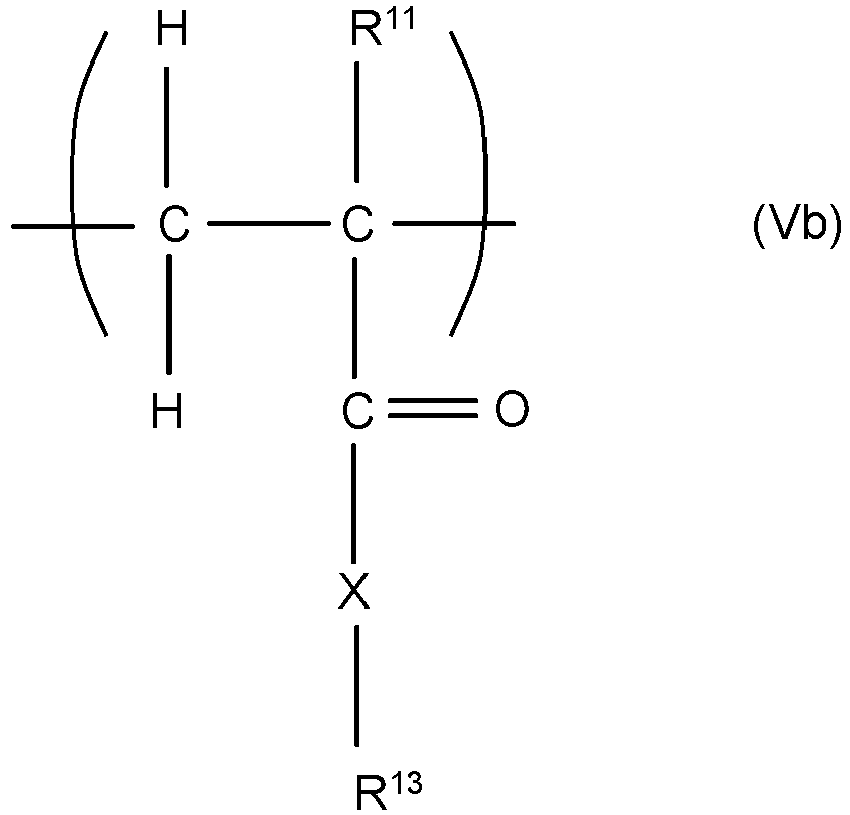
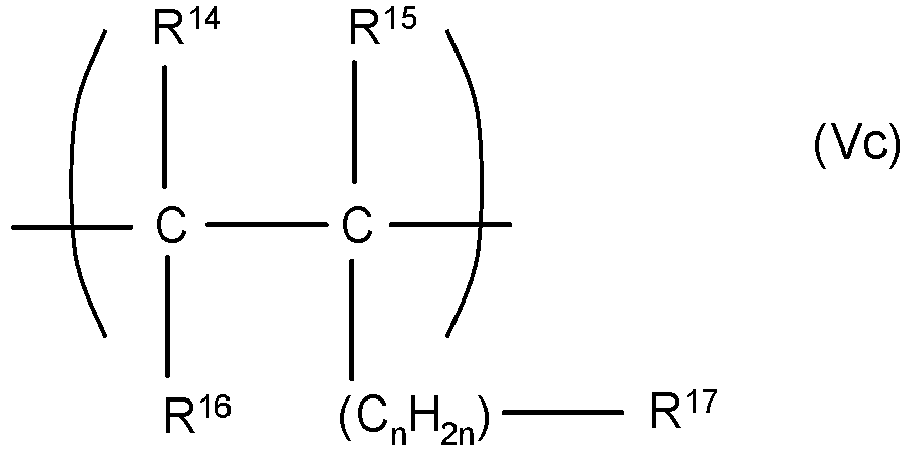
Claims (16)
- Copolymer enthaltenda) 0,1 bis 99,4 Mol-%, vorzugsweise 15,0 bis 84,5 Mol-% und besonders bevorzugt 23,0 bis 79,0 Mol-%, einer oder mehrerer kationischer Struktureinheiten (A),b) 0,4 bis 4,5 Mol-%, vorzugsweise 0,5 bis 4,4 Mol-% und besonders bevorzugt 1,0 bis 4,4 Mol-%, einer oder mehrerer makromonomerer Struktureinheiten (B) undc) eine oder mehrere Struktureinheiten (C), die sich von den Struktureinheiten (A) und (B) unterscheiden, vorzugsweise 0,1 bis 99,4 Mol-%, besonders bevorzugt 15,0 bis 84,5 Mol-% und insbesondere bevorzugt 20,0 bis 74,0 Mol-%, der einen oder der mehreren Struktureinheiten (C),wobei die eine oder mehreren Struktureinheiten (A) durch die folgenden allgemeinen Formeln (I) und/oder (II) repräsentiert werden:
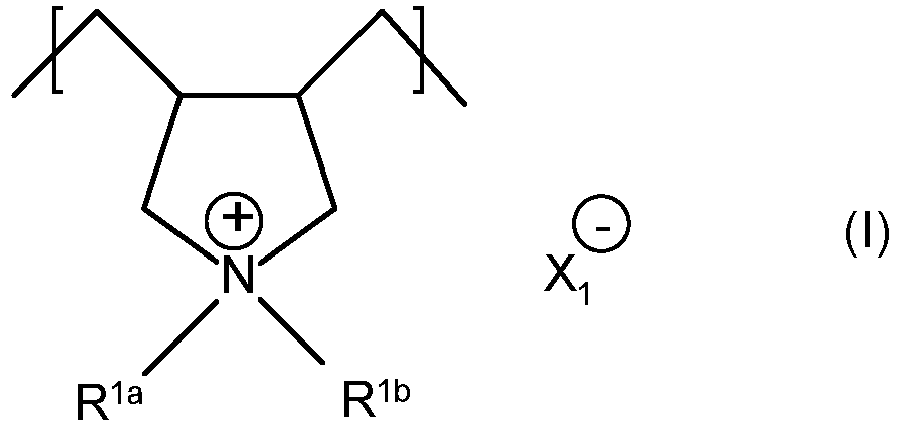
 R1 und R1a jeweils gleich oder verschieden sind und unabhängig voneinander jeweils für Wasserstoff und/oder einen Methylrest stehen,R1b, R3, R4 und R5 jeweils gleich oder verschieden sind und unabhängig voneinander jeweils durch Wasserstoff, einen aliphatischen Kohlenwasserstoffrest mit 1 bis 20, vorzugsweise 1 bis 4, C-Atomen, einen cycloaliphatischen Kohlenwasserstoffrest mit 5 bis 20, vorzugsweise 5 bis 8, C-Atomen, einen Arylrest mit 6 bis 14 C-Atomen und/oder Polyethylenglykol (PEG) repräsentiert werden, vorzugsweise jeweils gleich oder verschieden sind und unabhängig voneinander jeweils durch Wasserstoff und/oder Methyl repräsentiert werden und besonders bevorzugt jeweils Methyl bedeuten,Y gleich oder verschieden ist und durch Sauerstoff, NH und/oder NR3 repräsentiert wird,V gleich oder verschieden ist und durch -(CH2)x-,
 x gleich oder verschieden ist und durch eine ganze Zahl von 1 bis 6 repräsentiert wird,X und X1 jeweils gleich oder verschieden sind und unabhängig voneinander jeweils durch ein Halogenatom, C1- bis C4-Alkylsulfat und/oder C1- bis C4-Alkylsulfonat repräsentiert werden,die eine oder die mehreren makromonomeren Struktureinheiten (B) durch die allgemeine Formel (III) repräsentiert werden:
 Rx gleich oder verschieden ist und durch H und/oder Methyl repräsentiert wird,Z gleich oder verschieden ist und durch C=O und/oder O(CH2)4 repräsentiert wird und vorzugsweise O(CH2)4 ist,I im molaren Mittel, eine Zahl von 0 bis 7 und vorzugsweise von 0 bis 6 ist, undp im molaren Mittel, eine Zahl von 1 bis 150, vorzugsweise von 11 bis 150 und besonders bevorzugt von 12 bis 150 ist,wobei, wenn Z C=O bedeutet,
Rx gleich oder verschieden ist und durch H und/oder Methyl repräsentiert wird, I, im molaren Mittel, eine Zahl von 1 bis 7, vorzugsweise von 2 bis 6 und besonders bevorzugt von 3 bis 6 ist, und p, im molaren Mittel, eine Zahl von 1 bis 150, vorzugsweise von 11 bis 150 und besonders bevorzugt von 12 bis 150 ist,
und die eine oder die mehreren Struktureinheiten (C) das Polymerisationsprodukt mindestens einer Monomerspezies ausgewählt aus der Gruppe bestehend aus nicht-kationischen Acrylamiden, nicht-kationischen Methacrylamiden und N-Vinyl-substituierten Lactamen mit 5 bis 7 Ringatomen darstellen. - Copolymer nach Anspruch 1, dadurch gekennzeichnet, dass die eine oder die mehreren Struktureinheiten (A) das Polymerisationsprodukt mindestens einer Monomerspezies ausgewählt aus der Gruppe bestehend aus [2-(Acryloyloxy)-ethyl]-trimethylammoniumchlorid, [2-(Acryloylamino)-ethyl]-trimethylammoniumchlorid, [2-(Acryloyloxy)-ethyl]-trimethylammoniummethosulfat, [2-(Methacryloyloxy)-ethyl]-trimethylammonium-chlorid bzw. -methosulfat, [3-(Acryloylamino)-propyl]-trimethylammoniumchlorid, [3-(Methacryloylamino)-propyl]-trimethylammoniumchlorid und Diallyldimethylammoniumchlorid (DADMAC) darstellen, vorzugsweise ausgewählt aus der Gruppe bestehend aus [3-(Acryloylamino)-propyl]-trimethylammoniumchlorid, [3-(Methacryloylamino)-propyl]-trimethylammoniumchlorid und Diallyldimethylammoniumchlorid darstellen und besonders bevorzugt ausgewählt aus der Gruppe bestehend aus [3-(Methacryloylamino)-propyl]-trimethylammoniumchlorid und Diallyldimethylammoniumchlorid, darstellen.
- Copolymer nach Anspruch 1 oder 2, dadurch gekennzeichnet, dass die eine oder die mehreren makromonomeren Struktureinheiten (B) der Formel (III) das Polymerisationsprodukt mindestens einer Monomerspezies ausgewählt aus der Gruppe bestehend aus Polyethylenglykol-vinyloxy-butylether, Polyethylenglykolco-polypropylenglykol-vinyloxybutylether, worin
I, im molaren Mittel, eine Zahl von 1 bis 7, vorzugsweise von 2 bis 6 und besonders bevorzugt von 3 bis 6, bedeutet,
und Polyethylenglykol-co-polypropylenglykol-(meth)acrylat, worin I, im molaren Mittel, eine Zahl von 1 bis 7, vorzugsweise von 2 bis 6 und besonders bevorzugt von 3 bis 6, bedeutet, darstellen. - Copolymer gemäß einem oder mehreren der Ansprüche 1 bis 3, dadurch gekennzeichnet, dass in der einen oder den mehreren makromonomeren Struktureinheiten der Formel (III) Rx H ist, I = 0 ist und p, im molaren Mittel, eine Zahl von 1 bis 150, vorzugsweise von 11 bis 150 und besonders bevorzugt von 12 bis 150 ist, wenn Z O(CH2)4 bedeutet.
- Copolymer gemäß einem oder mehreren der Ansprüche 1 bis 4, dadurch gekennzeichnet, dass es die eine oder die mehreren kationischen Struktureinheiten (A) in Anteilen von 23,0 bis 79,0 Mol-%, die eine oder die mehreren makromonomeren Struktureinheiten (B) in Anteilen von 0,4 bis 4,4 Mol-%, vorzugsweise 0,5 bis 4,4 Mol-% und besonders bevorzugt 1,0 bis 4,4 Mol-%, und die eine oder die mehreren Struktureinheiten (C) in Anteilen von 20,0 bis 74,0 Mol-% enthält.
- Copolymer nach einem oder mehreren der Ansprüche 1 bis 5, dadurch gekennzeichnet, dass die eine oder die mehreren Struktureinheiten (C) ausgewählt sind aus der Gruppe bestehend aus dem Polymerisationsprodukt mindestens eines N-Vinyl-substituierten Lactams mit 5 bis 7 Ringatomen und den Struktureinheiten der folgenden allgemeinen Formeln (IV) und/oder (V):
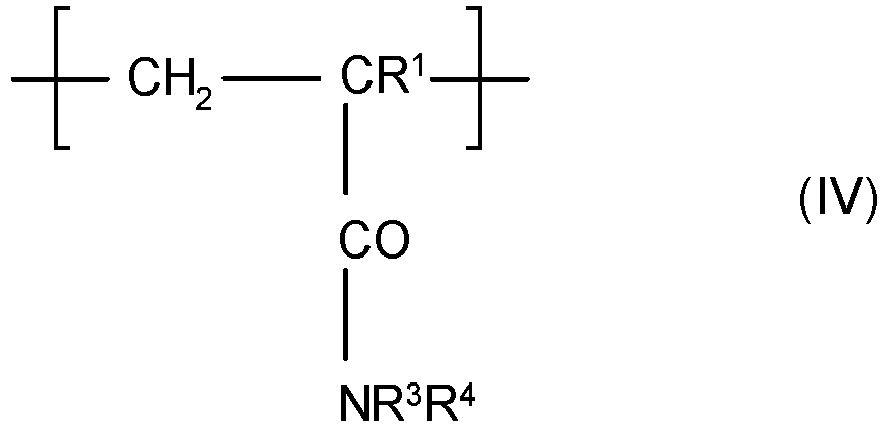 R1 gleich oder verschieden ist und Wasserstoff und/oder Methyl bedeutet, undR3 und R4 jeweils gleich oder verschieden sind und unabhängig voneinander jeweils durch Wasserstoff, einen aliphatischen Kohlenwasserstoffrest mit 1 bis 20, vorzugsweise 1 bis 4, C-Atomen, einen cycloaliphatischen Kohlenwasserstoffrest mit 5 bis 20, vorzugsweise 5 bis 8, C-Atomen, einen Arylrest mit 6 bis 14 C-Atomen, einen Alkylarylrest mit 7 bis 14 C-Atomen, eine verzweigte oder unverzweigte C1-C5-Monohydroxyalkylgruppe und/oder Polyethylenglykol (PEG) repräsentiert werden
 R11 gleich oder verschieden ist und repräsentiert wird durch H und/oder Methyl;X gleich oder verschieden ist und repräsentiert wird durch NH-(CnH2n) mit n = 1, 2, 3 oder 4; undR13 gleich oder verschieden ist und repräsentiert wird durch OH, SO3H, PO3H2, O-PO3H2 und/oder para-substituiertes C6H4-SO3H.
 - Copolymer nach Anspruch -6, dadurch gekennzeichnet, dass die eine oder die mehreren Struktureinheiten (C) ausgewählt sind aus den Struktureinheiten der Formel (IV).
- Copolymer nach einem oder mehreren der Ansprüche 1 bis 7, dadurch gekennzeichnet, dass die eine oder die mehreren Struktureinheiten (C) das Polymerisationsprodukt mindestens einer Monomerspezies ausgewählt aus der Gruppe bestehend aus Acrylamid, Methacrylamid, N-Methylacrylamid, N,N-Dimethylacrylamid, N-Ethylacrylamid, N-Cyclohexylacrylamid, N-Benzylacrylamid, N-Methylolacrylamid, N-Isopropylacrylamid und N-tertiär Butylacrylamid darstellen und vorzugsweise ausgewählt aus der Gruppe bestehend aus N,N-Dimethylacrylamid und N-Isopropylacrylamid darstellen.
- Copolymer nach einem oder mehreren der Ansprüche 1 bis 8, dadurch gekennzeichnet, dass es zusätzlich zu den Struktureinheiten (A), (B) und (C) eine oder mehrere Struktureinheiten (D) enthält, die sich von den Struktureinheiten (A), (B) und (C) unterscheiden, und vorzugsweise 0,1 bis 99,4 Mol-%, besonders bevorzugt 0,1 bis 40,0 Mol-% und insbesondere bevorzugt 0,1 bis 30,0 Mol-%, der einen oder mehreren Struktureinheiten (D) enthält.
- Copolymer nach Anspruch 9, dadurch gekennzeichnet, dass es eine oder mehrere Struktureinheiten (D) ausgewählt aus den Struktureinheiten der folgenden allgemeinen Formeln (IX) und/oder (X) enthält:
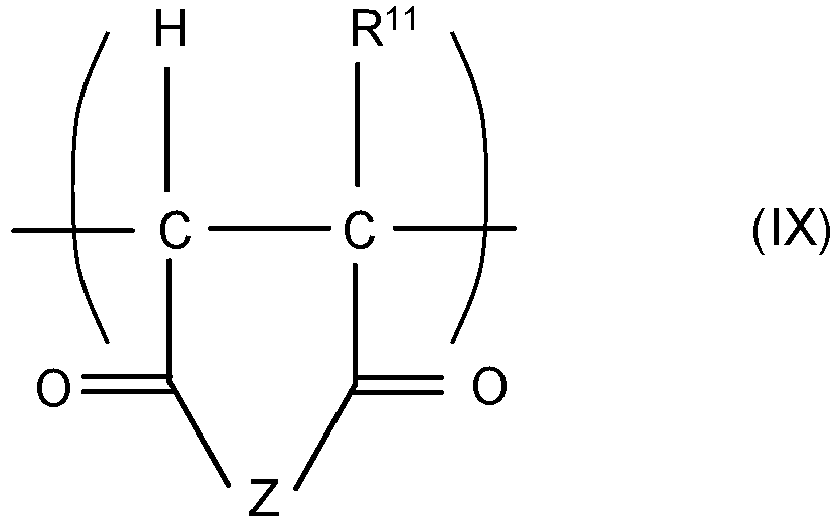 R11 gleich oder verschieden ist und repräsentiert wird durch H und/oder Methyl;Z gleich oder verschieden ist und repräsentiert wird durch O und/oder NH;
 R11 gleich oder verschieden ist und repräsentiert wird durch H und/oder Methyl;Q und gleich oder verschieden ist und repräsentiert wird durch O und/oder NH;R15 gleich oder verschieden ist und repräsentiert wird durch H, (CnH2n)-SO3H mit n = 0, 1, 2, 3 oder 4; (CnH2n)-OH mit n = 0, 1, 2, 3 oder 4; (CnH2n)-PO3H2 mit n = 0, 1, 2, 3 oder 4; (CnH2n)-OPO3H2 mit n = 0, 1, 2, 3 oder 4; (C6H4)-SO3H; (C6H4)-PO3H2; (C6H4)-OPO3H2 und/oder (CmH2m)e-O-(A'O)u-R16 mit m = 0, 1, 2, 3 oder 4, e = 0, 1, 2, 3 oder 4, A' = Cx'H2x' mit x' = 2, 3, 4 oder 5, u = eine ganze Zahl von 1 bis 350 und R16 gleich oder verschieden sowie repräsentiert durch eine unverzweigte oder verzweigte C1-C4-Alkylgruppe,wobei die Struktureinheiten der Formel (X) auch in Salzform vorliegen können, vorzugsweise als NH4 +-, Alkali- oder Erdalkali-Salz, besonders bevorzugt als NH4 +- oder als Na+-Salz.
 - Copolymer gemäß einem oder mehreren der Ansprüche 1 bis 10, dadurch gekennzeichnet, dass die Struktureinheiten (A), (B), (C) und gegebenenfalls (D) in statistischer, blockförmiger, alternierender oder gradientenartiger Verteilung im Copolymer vorliegen.
- Copolymer gemäß einem oder mehreren der Ansprüche 1 bis 11, dadurch gekennzeichnet, dass sein gewichtsmittleres Molekulargewicht Mw, bestimmt mittels GPC mit Poly(2-vinylpyridin) als Standard, von 10 000 bis 250 000 g/mol, vorzugsweise von 15 000 bis 200 000 g/mol und besonders bevorzugt von 20 000 bis 150 000 g/mol beträgt.
- Reinigungsmittel-Zusammensetzung, dadurch gekennzeichnet, dass sie ein oder mehrere Copolymere gemäß einem oder mehreren der Ansprüche 1 bis 12 enthält.
- Verwendung eines oder mehrerer Copolymere gemäß einem oder mehreren der Ansprüche 1 bis 12 oder einer Reinigungsmittel-Zusammensetzung nach Anspruch 13 zur Glanzerzeugung auf harten Oberflächen, vorzugsweise auf harten Oberflächen aus Kunststoff, Keramik, Stein wie z. B. Naturstein, Porzellan, Glas, Holz, Linoleum oder Metall wie z. B. Edelstahl.
- Verwendung eines oder mehrerer Copolymere gemäß einem oder mehreren der Ansprüche 1 bis 12 oder einer Reinigungsmittel-Zusammensetzung nach Anspruch 13 zur Hydrophilisierung einer harten Oberfläche, vorzugsweise einer harten Oberfläche aus Kunststoff, Keramik, Stein wie z. B. Naturstein, Porzellan, Glas, Holz, Linoleum oder Metall wie z. B. Edelstahl.
- Verwendung eines oder mehrerer Copolymere gemäß einem oder mehreren der Ansprüche 1 bis 12 oder einer Reinigungsmittel-Zusammensetzung nach Anspruch 13 zur Erzielung eines Reparatureffektes auf einer harten Oberfläche, vorzugsweise auf einer harten Oberfläche aus Kunststoff, Keramik, Stein wie z. B. Naturstein, Porzellan, Glas, Holz, Linoleum oder Metall wie z. B. Edelstahl.
Priority Applications (1)
| Application Number | Priority Date | Filing Date | Title |
|---|---|---|---|
| PL17808833T PL3545011T3 (pl) | 2016-11-28 | 2017-11-21 | Kopolimery oraz ich zastosowanie w kompozycjach środków czyszczących |
Applications Claiming Priority (2)
| Application Number | Priority Date | Filing Date | Title |
|---|---|---|---|
| DE102016223588.5A DE102016223588A1 (de) | 2016-11-28 | 2016-11-28 | Copolymere und deren verwendung in reinigungsmittel-zusammensetzungen |
| PCT/EP2017/079948 WO2018095918A1 (de) | 2016-11-28 | 2017-11-21 | Copolymere und deren verwendung in reinigungsmittel-zusammensetzungen |
Publications (2)
| Publication Number | Publication Date |
|---|---|
| EP3545011A1 EP3545011A1 (de) | 2019-10-02 |
| EP3545011B1 true EP3545011B1 (de) | 2021-04-14 |
Family
ID=60574558
Family Applications (1)
| Application Number | Title | Priority Date | Filing Date |
|---|---|---|---|
| EP17808833.2A Active EP3545011B1 (de) | 2016-11-28 | 2017-11-21 | Copolymere und deren verwendung in reinigungsmittel-zusammensetzungen |
Country Status (11)
| Country | Link |
|---|---|
| US (1) | US11649310B2 (de) |
| EP (1) | EP3545011B1 (de) |
| JP (1) | JP2019535878A (de) |
| CN (1) | CN110177816B (de) |
| AR (1) | AR110257A1 (de) |
| BR (1) | BR112019009978A2 (de) |
| DE (1) | DE102016223588A1 (de) |
| ES (1) | ES2880486T3 (de) |
| MX (1) | MX2019006133A (de) |
| PL (1) | PL3545011T3 (de) |
| WO (1) | WO2018095918A1 (de) |
Families Citing this family (8)
| Publication number | Priority date | Publication date | Assignee | Title |
|---|---|---|---|---|
| DE102016223586A1 (de) | 2016-11-28 | 2018-05-30 | Clariant International Ltd | Copolymere und deren verwendung in reinigungsmittel-zusammensetzungen |
| DE102016223590A1 (de) | 2016-11-28 | 2018-05-30 | Clariant International Ltd | Copolymer enthaltende reinigungsmittelzusammensetzungen |
| DE102016223588A1 (de) | 2016-11-28 | 2018-05-30 | Clariant International Ltd | Copolymere und deren verwendung in reinigungsmittel-zusammensetzungen |
| WO2020245788A1 (en) * | 2019-06-05 | 2020-12-10 | Fater S.P.A. | Cleaning composition for hard surfaces |
| EP4034623A1 (de) | 2019-09-26 | 2022-08-03 | Ecolab USA Inc. | Hochalkalisches entfettungs- und reinigungsmittel auf lösungsmittelbasis und reinigungsmittel mit diutangummi als primäres verdickungssystem |
| EP4134422A1 (de) * | 2021-08-13 | 2023-02-15 | Clariant International Ltd | (co)polymere und deren verwendung in reinigungszusammensetzungen |
| CN120359286A (zh) * | 2022-12-19 | 2025-07-22 | 联合利华知识产权控股有限公司 | 可发泡硬表面清洁组合物 |
| WO2025219144A1 (en) | 2024-04-16 | 2025-10-23 | Unilever Ip Holdings B.V. | A hard surface cleaning composition |
Family Cites Families (109)
| Publication number | Priority date | Publication date | Assignee | Title |
|---|---|---|---|---|
| US2182306A (en) | 1935-05-10 | 1939-12-05 | Ig Farbenindustrie Ag | Polymerization of ethylene imines |
| US2208095A (en) | 1937-01-05 | 1940-07-16 | Ig Farbenindustrie Ag | Process of producing insoluble condensation products containing sulphur and nitrogen |
| US2553696A (en) | 1944-01-12 | 1951-05-22 | Union Carbide & Carbon Corp | Method for making water-soluble polymers of lower alkylene imines |
| US2806839A (en) | 1953-02-24 | 1957-09-17 | Arnold Hoffman & Co Inc | Preparation of polyimines from 2-oxazolidone |
| US2809971A (en) | 1955-11-22 | 1957-10-15 | Olin Mathieson | Heavy-metal derivatives of 1-hydroxy-2-pyridinethiones and method of preparing same |
| BE615597A (de) | 1958-06-19 | |||
| NL132418C (de) | 1962-04-13 | |||
| US3128287A (en) | 1963-01-31 | 1964-04-07 | Pfizer & Co C | 2,2'-oxodisuccinic acid, derivatives thereof, and process for preparing |
| US3213030A (en) | 1963-03-18 | 1965-10-19 | Procter & Gamble | Cleansing and laundering compositions |
| CA777769A (en) | 1963-03-18 | 1968-02-06 | H. Roy Clarence | Substituted methylene diphosphonic acid compounds and detergent compositions |
| US3236733A (en) | 1963-09-05 | 1966-02-22 | Vanderbilt Co R T | Method of combatting dandruff with pyridinethiones metal salts detergent compositions |
| US3400148A (en) | 1965-09-23 | 1968-09-03 | Procter & Gamble | Phosphonate compounds |
| CA790610A (en) | 1965-12-28 | 1968-07-23 | T. Quimby Oscar | Diphosphonate compounds and detergent compositions |
| US3761418A (en) | 1967-09-27 | 1973-09-25 | Procter & Gamble | Detergent compositions containing particle deposition enhancing agents |
| US3635830A (en) | 1968-05-24 | 1972-01-18 | Lever Brothers Ltd | Detergent compositions containing oxydisuccing acid salts as builders |
| US3753196A (en) | 1971-10-05 | 1973-08-14 | Kulite Semiconductor Products | Transducers employing integral protective coatings and supports |
| US3958581A (en) | 1972-05-17 | 1976-05-25 | L'oreal | Cosmetic composition containing a cationic polymer and divalent metal salt for strengthening the hair |
| CA1018893A (en) | 1972-12-11 | 1977-10-11 | Roger C. Birkofer | Mild thickened shampoo compositions with conditioning properties |
| US4605509A (en) | 1973-05-11 | 1986-08-12 | The Procter & Gamble Company | Detergent compositions containing sodium aluminosilicate builders |
| US4009256A (en) | 1973-11-19 | 1977-02-22 | National Starch And Chemical Corporation | Novel shampoo composition containing a water-soluble cationic polymer |
| US3985669A (en) | 1974-06-17 | 1976-10-12 | The Procter & Gamble Company | Detergent compositions |
| US4323683A (en) | 1980-02-07 | 1982-04-06 | The Procter & Gamble Company | Process for making pyridinethione salts |
| US4345080A (en) | 1980-02-07 | 1982-08-17 | The Procter & Gamble Company | Pyridinethione salts and hair care compositions |
| US4379753A (en) | 1980-02-07 | 1983-04-12 | The Procter & Gamble Company | Hair care compositions |
| US4470982A (en) | 1980-12-22 | 1984-09-11 | The Procter & Gamble Company | Shampoo compositions |
| US4529773A (en) | 1982-03-17 | 1985-07-16 | David Witiak | Alkali-soluble emulsion polymers in acidic surfactant compositions |
| DE3413571A1 (de) | 1984-04-11 | 1985-10-24 | Hoechst Ag, 6230 Frankfurt | Verwendung von kristallinen schichtfoermigen natriumsilikaten zur wasserenthaertung und verfahren zur wasserenthaertung |
| US4566984A (en) | 1984-11-16 | 1986-01-28 | The Procter & Gamble Company | Ether polycarboxylates |
| US4702857A (en) | 1984-12-21 | 1987-10-27 | The Procter & Gamble Company | Block polyesters and like compounds useful as soil release agents in detergent compositions |
| US4663071A (en) | 1986-01-30 | 1987-05-05 | The Procter & Gamble Company | Ether carboxylate detergent builders and process for their preparation |
| CA2001927C (en) | 1988-11-03 | 1999-12-21 | Graham Thomas Brown | Aluminosilicates and detergent compositions |
| US5104646A (en) | 1989-08-07 | 1992-04-14 | The Procter & Gamble Company | Vehicle systems for use in cosmetic compositions |
| CA2047085A1 (en) | 1990-07-16 | 1992-01-17 | Karen L. Wisniewski | Hard surface liquid cleaning composition with soil release polymer |
| SK46293A3 (en) | 1990-09-28 | 1994-01-12 | Procter & Gamble | Polyhydroxy fatty acid amide surfactants to enhance enzyme performance |
| US5194639A (en) | 1990-09-28 | 1993-03-16 | The Procter & Gamble Company | Preparation of polyhydroxy fatty acid amides in the presence of solvents |
| GB9116871D0 (en) | 1991-08-05 | 1991-09-18 | Unilever Plc | Hair care composition |
| DE69519372T3 (de) | 1994-02-18 | 2004-06-09 | Unilever Plc | Hautreinigungsmittel |
| GB9507130D0 (en) | 1995-04-06 | 1995-05-31 | Unilever Plc | Hair treatment composition |
| CA2240711C (en) | 1995-12-22 | 2003-09-16 | Janice E. Losasso | Low molecular weight structured polymers |
| US6255267B1 (en) | 1996-03-04 | 2001-07-03 | Hpd Laboratories, Inc. | Manual toilet bowl cleaner |
| US5858948A (en) | 1996-05-03 | 1999-01-12 | Procter & Gamble Company | Liquid laundry detergent compositions comprising cotton soil release polymers and protease enzymes |
| CN1224451A (zh) | 1996-05-03 | 1999-07-28 | 普罗格特-甘布尔公司 | 含有改性聚胺的织物处理组合物 |
| EP0859045B1 (de) | 1997-02-14 | 2003-12-03 | The Procter & Gamble Company | Flüssige Reinigungsmittelzusammensetzungen für harte Oberflächen |
| ES2201264T3 (es) | 1997-04-30 | 2004-03-16 | THE PROCTER & GAMBLE COMPANY | Composiciones acidas para eliminar costras de cal. |
| US5977275A (en) | 1998-02-17 | 1999-11-02 | National Starch And Chemical Investment Holding Corporation | Polymers having pendant polysaccharide moieties and uses thereof |
| US6361768B1 (en) * | 1998-12-29 | 2002-03-26 | Pmd Holdings Corp. | Hydrophilic ampholytic polymer |
| FR2796392B1 (fr) | 1999-07-15 | 2003-09-19 | Rhodia Chimie Sa | Composition nettoyante comprenant un polymere hydrosoluble ou hydrodispersable |
| JP2001181354A (ja) | 1999-12-28 | 2001-07-03 | Lion Corp | カチオン性ポリマー |
| US7202200B1 (en) | 2000-11-28 | 2007-04-10 | The Clorox Company | Hard surface cleaner with improved stain repellency comprising a fluoropolymer and a quaternary ammonium surfactant |
| ES2244624T3 (es) | 2000-05-09 | 2005-12-16 | Unilever N.V. | Polimeros de eliminacion de suciedad y composiciones detergentes para lavanderia que los contienen. |
| US6410005B1 (en) | 2000-06-15 | 2002-06-25 | Pmd Holdings Corp. | Branched/block copolymers for treatment of keratinous substrates |
| DE60131634T2 (de) | 2000-10-13 | 2008-10-30 | Kansai Paint Co., Ltd., Amagasaki | Pigment-dispergierendes harz |
| DE10059827A1 (de) | 2000-12-01 | 2002-06-20 | Clariant Gmbh | Kosmetische und dermatologische Haarbehandlungsmittel |
| MXPA04003306A (es) | 2001-10-09 | 2004-07-23 | Procter & Gamble | Composiciones acuosas para tratar superficies. |
| GB0130499D0 (en) | 2001-12-20 | 2002-02-06 | Unilever Plc | Polymers for laundry cleaning compositions |
| GB0229147D0 (en) | 2002-12-13 | 2003-01-15 | Unilever Plc | Polymers and laundry detergent compositions containing them |
| DE10258831A1 (de) | 2002-12-17 | 2004-07-08 | Henkel Kgaa | Reinigungsmittel für harte Oberflächen |
| DE10358587A1 (de) | 2003-12-12 | 2005-07-07 | Hans Schwarzkopf & Henkel Gmbh & Co. Kg | Volumengebendes kosmetisches Mittel |
| DE102004040848A1 (de) | 2004-08-23 | 2006-03-02 | Henkel Kgaa | Reiniger mit Fäkalschmutz-abweisenden Eigenschaften |
| JP2006316035A (ja) | 2005-05-16 | 2006-11-24 | Lion Corp | シャンプー組成物及びその製造方法 |
| EP1888729A4 (de) | 2005-06-01 | 2009-07-08 | Rhodia | Koazervatsysteme mit anti-bodenhaftungs- und anti-ablagerungseigenschaften auf hydrophilen oberflächen |
| US7807766B2 (en) | 2005-09-21 | 2010-10-05 | Cognis Ip Management Gmbh | Polymers for use in cleaning compositions |
| EP1948702A2 (de) | 2005-11-17 | 2008-07-30 | The Procter and Gamble Company | Verwendung und applikation von definiertem zwitterionischem copolymer |
| DE102005060431A1 (de) | 2005-12-15 | 2007-06-21 | Henkel Kgaa | Maschinelles Geschirrspülmittel |
| FR2896248B1 (fr) | 2006-01-18 | 2008-03-07 | Arkema Sa | Procede de preparation de latex stabilises par polymerisation en emulsion |
| DE102006007004A1 (de) | 2006-02-15 | 2007-08-16 | Construction Research & Technology Gmbh | Wasserlösliche sulfogruppenhaltige Copolymere, Verfahren zu deren Herstellung und ihre Verwendung |
| ES2349236T3 (es) | 2006-05-31 | 2010-12-29 | Basf Se | Polímeros anfifílicos de injerto con base en óxidos de polialquileno y ésteres de vinil. |
| JP4868981B2 (ja) | 2006-08-29 | 2012-02-01 | 竹本油脂株式会社 | 熱可塑性高分子用帯電防止剤及び熱可塑性高分子成形体の帯電防止方法並びに帯電防止性熱可塑性高分子成形体 |
| DE102006049381A1 (de) | 2006-10-19 | 2008-04-24 | Süd-Chemie AG | Amphiphile Pfropfpolymere |
| DE102006050761A1 (de) | 2006-10-27 | 2008-05-08 | Construction Research & Technology Gmbh | Hydrophob modifizierte kationische Copolymere |
| DE102007013141A1 (de) | 2007-03-15 | 2008-09-18 | Cognis Ip Management Gmbh | Amphotere Polymere als Soil Release Additive in Wasch- und Reinigungsmitteln |
| DE102007023813A1 (de) | 2007-05-21 | 2008-11-27 | Evonik Röhm Gmbh | Dispersion umfassend anorganische Partikel, Wasser und mindestens ein polymeres Additiv |
| DE102007061970A1 (de) | 2007-12-21 | 2008-07-03 | Clariant International Limited | Kosmetische, pharmazeutische oder dermatologische Zusammensetzungen enthaltend einen hohen Gehalt an wasserlöslichen Pflegekomponenten |
| JP5502337B2 (ja) * | 2008-03-04 | 2014-05-28 | 花王株式会社 | 毛髪用洗浄剤組成物 |
| DE102008013171A1 (de) | 2008-03-07 | 2009-09-10 | Beiersdorf Ag | Volumengebender Haarfestiger mit ampholytischem Copolymer |
| EP2110117A1 (de) | 2008-04-15 | 2009-10-21 | KPSS-Kao Professional Salon Services GmbH | Volumenspendende Reinigungszusammensetzung |
| DE102008001661A1 (de) | 2008-05-08 | 2009-11-12 | Beiersdorf Ag | Haarpflegeformulierungen mit kationisch amphoteren Polymeren |
| DE502008002614D1 (de) | 2008-06-24 | 2011-03-31 | Cognis Ip Man Gmbh | Reinigungsmittel enthaltend Pfropfcopolymere |
| EP2116225A1 (de) | 2008-10-16 | 2009-11-11 | Beiersdorf AG | Ausspülhaarspülungen zur Steigerung des Frisurvolumens |
| US8852353B2 (en) | 2008-12-10 | 2014-10-07 | Michael Oberlander | Solid dishmachine detergent not requiring a separate rinse additive |
| DE102009001559A1 (de) | 2009-03-16 | 2009-12-31 | Henkel Ag & Co. Kgaa | Kalklösendes Reinigungsmittel |
| CA2755982A1 (en) | 2009-03-20 | 2010-09-23 | Ciba Corporation | Fast drying ampholytic polymers for cleaning compositions |
| US20110236582A1 (en) | 2010-03-29 | 2011-09-29 | Scheuing David R | Polyelectrolyte Complexes |
| US9017652B1 (en) | 2010-04-09 | 2015-04-28 | Lubrizol Advanced Materials, Inc. | Combination of crosslinked cationic and ampholytic polymers for personal and household applications |
| AU2010363642B2 (en) | 2010-11-10 | 2014-07-24 | Colgate-Palmolive Company | Fabric conditioners containing soil releasing polymer |
| EP2463317A1 (de) | 2010-12-09 | 2012-06-13 | BASF Construction Polymers GmbH | Additiv für fließmittel enthaltende Baustoffmischungen |
| WO2013060708A1 (en) | 2011-10-25 | 2013-05-02 | Basf Se | Use of comb or block copolymers as soil antiredeposition agents and soil release agents in laundry processes |
| FR2985727B1 (fr) * | 2012-01-16 | 2014-05-09 | Snf Sas | Nouveaux polymeres peignes utilisables en cosmetique et detergence |
| KR102012188B1 (ko) | 2012-03-30 | 2019-08-20 | 가부시키가이샤 코세 | 모발 화장료 |
| JP6117592B2 (ja) | 2012-03-30 | 2017-04-19 | 株式会社コーセー | 整髪用化粧料 |
| JP6106492B2 (ja) | 2012-03-30 | 2017-03-29 | 株式会社コーセー | 整髪用化粧料 |
| US8623806B2 (en) | 2012-05-11 | 2014-01-07 | The Procter & Gamble Company | Liquid detergent composition for improved shine |
| US8759271B2 (en) | 2012-05-11 | 2014-06-24 | The Procter & Gamble Company | Liquid detergent composition for improved shine |
| IN2014DN09936A (de) | 2012-05-30 | 2015-08-14 | Clariant Int Ltd | |
| JP2014012818A (ja) | 2012-06-27 | 2014-01-23 | Rohm & Haas Co | 硬表面をクリーニングおよびコーティングするための縞模様のつかない配合物 |
| JP6058359B2 (ja) | 2012-11-14 | 2017-01-11 | 互応化学工業株式会社 | 毛髪化粧料用基剤及び毛髪化粧料 |
| FR3001457B1 (fr) * | 2013-01-31 | 2015-02-06 | Snf Sas | Nouveaux polymeres peignes utilisables en cosmetique et detergence |
| BR112016011665A2 (pt) | 2013-11-27 | 2017-09-19 | Basf Se | Copolímero aleatório, uso de um copolímero aleatório, e, detergente |
| US9522971B2 (en) | 2014-12-31 | 2016-12-20 | Chung Yuan Christian University | Amine modifying material and application thereof |
| CN105037644A (zh) | 2015-07-01 | 2015-11-11 | 广东灵捷制造化工有限公司 | 一种高分子阳离子表面活性剂、其制备方法及用途 |
| CN105542090B (zh) | 2015-12-08 | 2018-02-23 | 江苏苏博特新材料股份有限公司 | 一种混凝土用流变改性剂及其制备方法 |
| DE102016223589A1 (de) | 2016-11-28 | 2018-05-30 | Clariant International Ltd | Copolymer enthaltendes maschinelles geschirrspülmittel |
| DE102016223588A1 (de) | 2016-11-28 | 2018-05-30 | Clariant International Ltd | Copolymere und deren verwendung in reinigungsmittel-zusammensetzungen |
| BR112019010685B1 (pt) | 2016-11-28 | 2023-02-07 | Clariant International Ltd | Composição cosmética compreendendo um copolímero catiônico, seu uso, processo de formulação da mesma e método para utilização da composição cosmética |
| DE102016223584A1 (de) | 2016-11-28 | 2018-05-30 | Clariant International Ltd | Copolymer enthaltende waschmittelzusammensetzungen |
| DE102016223585A1 (de) | 2016-11-28 | 2018-05-30 | Clariant International Ltd | Copolymere und deren verwendung in waschmittel-zusammensetzungen |
| DE102016223590A1 (de) | 2016-11-28 | 2018-05-30 | Clariant International Ltd | Copolymer enthaltende reinigungsmittelzusammensetzungen |
| DE102016223586A1 (de) | 2016-11-28 | 2018-05-30 | Clariant International Ltd | Copolymere und deren verwendung in reinigungsmittel-zusammensetzungen |
| EP3868854A1 (de) | 2020-02-20 | 2021-08-25 | Clariant International Ltd | Reinigungszusammensetzungen mit copolymeren und deren verwendung |
-
2016
- 2016-11-28 DE DE102016223588.5A patent/DE102016223588A1/de not_active Withdrawn
-
2017
- 2017-11-21 WO PCT/EP2017/079948 patent/WO2018095918A1/de not_active Ceased
- 2017-11-21 EP EP17808833.2A patent/EP3545011B1/de active Active
- 2017-11-21 PL PL17808833T patent/PL3545011T3/pl unknown
- 2017-11-21 ES ES17808833T patent/ES2880486T3/es active Active
- 2017-11-21 JP JP2019527796A patent/JP2019535878A/ja active Pending
- 2017-11-21 BR BR112019009978A patent/BR112019009978A2/pt not_active Application Discontinuation
- 2017-11-21 CN CN201780073355.5A patent/CN110177816B/zh active Active
- 2017-11-21 MX MX2019006133A patent/MX2019006133A/es unknown
- 2017-11-21 US US16/463,825 patent/US11649310B2/en active Active
- 2017-11-28 AR ARP170103310A patent/AR110257A1/es unknown
Non-Patent Citations (1)
| Title |
|---|
| None * |
Also Published As
| Publication number | Publication date |
|---|---|
| CN110177816A (zh) | 2019-08-27 |
| JP2019535878A (ja) | 2019-12-12 |
| US20190382686A1 (en) | 2019-12-19 |
| CN110177816B (zh) | 2022-04-26 |
| DE102016223588A1 (de) | 2018-05-30 |
| MX2019006133A (es) | 2019-08-14 |
| ES2880486T3 (es) | 2021-11-24 |
| AR110257A1 (es) | 2019-03-13 |
| US11649310B2 (en) | 2023-05-16 |
| PL3545011T3 (pl) | 2021-10-18 |
| BR112019009978A2 (pt) | 2019-08-27 |
| EP3545011A1 (de) | 2019-10-02 |
| WO2018095918A1 (de) | 2018-05-31 |
Similar Documents
| Publication | Publication Date | Title |
|---|---|---|
| EP3545066B1 (de) | Copolymer enthaltende reinigungsmittelzusammensetzungen | |
| EP3545011B1 (de) | Copolymere und deren verwendung in reinigungsmittel-zusammensetzungen | |
| EP3545012B1 (de) | Copolymere und deren verwendung in reinigungsmittel-zusammensetzungen | |
| EP1781717B1 (de) | Copolymerhaltige reinigungsmittel | |
| WO2018095916A1 (de) | Copolymere und deren verwendung in waschmittel-zusammensetzungen | |
| EP3868854A1 (de) | Reinigungszusammensetzungen mit copolymeren und deren verwendung | |
| EP3545063A1 (de) | Copolymer enthaltende waschmittelzusammensetzungen | |
| WO2010115813A1 (de) | Verwendung einer präbiotisch wirksamen tensidkombination | |
| EP1564283A2 (de) | Tensidkombination | |
| WO2015120990A1 (de) | Saure reiniger für harte oberflächen | |
| EP4134422A1 (de) | (co)polymere und deren verwendung in reinigungszusammensetzungen | |
| BR112019009247B1 (pt) | Copolímeros, composição de agente de limpeza que os compreende, e usos dos mesmos |
Legal Events
| Date | Code | Title | Description |
|---|---|---|---|
| STAA | Information on the status of an ep patent application or granted ep patent |
Free format text: STATUS: UNKNOWN |
|
| STAA | Information on the status of an ep patent application or granted ep patent |
Free format text: STATUS: THE INTERNATIONAL PUBLICATION HAS BEEN MADE |
|
| PUAI | Public reference made under article 153(3) epc to a published international application that has entered the european phase |
Free format text: ORIGINAL CODE: 0009012 |
|
| STAA | Information on the status of an ep patent application or granted ep patent |
Free format text: STATUS: REQUEST FOR EXAMINATION WAS MADE |
|
| 17P | Request for examination filed |
Effective date: 20190628 |
|
| AK | Designated contracting states |
Kind code of ref document: A1 Designated state(s): AL AT BE BG CH CY CZ DE DK EE ES FI FR GB GR HR HU IE IS IT LI LT LU LV MC MK MT NL NO PL PT RO RS SE SI SK SM TR |
|
| AX | Request for extension of the european patent |
Extension state: BA ME |
|
| DAV | Request for validation of the european patent (deleted) | ||
| DAX | Request for extension of the european patent (deleted) | ||
| GRAP | Despatch of communication of intention to grant a patent |
Free format text: ORIGINAL CODE: EPIDOSNIGR1 |
|
| STAA | Information on the status of an ep patent application or granted ep patent |
Free format text: STATUS: GRANT OF PATENT IS INTENDED |
|
| RIC1 | Information provided on ipc code assigned before grant |
Ipc: C11D 11/00 20060101ALI20200512BHEP Ipc: C08F 220/54 20060101AFI20200512BHEP Ipc: C08F 226/10 20060101ALI20200512BHEP Ipc: C08F 226/02 20060101ALI20200512BHEP Ipc: C11D 3/37 20060101ALI20200512BHEP |
|
| INTG | Intention to grant announced |
Effective date: 20200608 |
|
| GRAJ | Information related to disapproval of communication of intention to grant by the applicant or resumption of examination proceedings by the epo deleted |
Free format text: ORIGINAL CODE: EPIDOSDIGR1 |
|
| STAA | Information on the status of an ep patent application or granted ep patent |
Free format text: STATUS: REQUEST FOR EXAMINATION WAS MADE |
|
| GRAP | Despatch of communication of intention to grant a patent |
Free format text: ORIGINAL CODE: EPIDOSNIGR1 |
|
| STAA | Information on the status of an ep patent application or granted ep patent |
Free format text: STATUS: GRANT OF PATENT IS INTENDED |
|
| INTC | Intention to grant announced (deleted) | ||
| INTG | Intention to grant announced |
Effective date: 20201117 |
|
| GRAS | Grant fee paid |
Free format text: ORIGINAL CODE: EPIDOSNIGR3 |
|
| GRAA | (expected) grant |
Free format text: ORIGINAL CODE: 0009210 |
|
| STAA | Information on the status of an ep patent application or granted ep patent |
Free format text: STATUS: THE PATENT HAS BEEN GRANTED |
|
| AK | Designated contracting states |
Kind code of ref document: B1 Designated state(s): AL AT BE BG CH CY CZ DE DK EE ES FI FR GB GR HR HU IE IS IT LI LT LU LV MC MK MT NL NO PL PT RO RS SE SI SK SM TR |
|
| REG | Reference to a national code |
Ref country code: GB Ref legal event code: FG4D Free format text: NOT ENGLISH |
|
| REG | Reference to a national code |
Ref country code: CH Ref legal event code: EP |
|
| REG | Reference to a national code |
Ref country code: DE Ref legal event code: R096 Ref document number: 502017010106 Country of ref document: DE |
|
| REG | Reference to a national code |
Ref country code: IE Ref legal event code: FG4D Free format text: LANGUAGE OF EP DOCUMENT: GERMAN |
|
| REG | Reference to a national code |
Ref country code: AT Ref legal event code: REF Ref document number: 1382327 Country of ref document: AT Kind code of ref document: T Effective date: 20210515 |
|
| REG | Reference to a national code |
Ref country code: LT Ref legal event code: MG9D |
|
| REG | Reference to a national code |
Ref country code: NL Ref legal event code: MP Effective date: 20210414 |
|
| PG25 | Lapsed in a contracting state [announced via postgrant information from national office to epo] |
Ref country code: FI Free format text: LAPSE BECAUSE OF FAILURE TO SUBMIT A TRANSLATION OF THE DESCRIPTION OR TO PAY THE FEE WITHIN THE PRESCRIBED TIME-LIMIT Effective date: 20210414 Ref country code: LT Free format text: LAPSE BECAUSE OF FAILURE TO SUBMIT A TRANSLATION OF THE DESCRIPTION OR TO PAY THE FEE WITHIN THE PRESCRIBED TIME-LIMIT Effective date: 20210414 Ref country code: NL Free format text: LAPSE BECAUSE OF FAILURE TO SUBMIT A TRANSLATION OF THE DESCRIPTION OR TO PAY THE FEE WITHIN THE PRESCRIBED TIME-LIMIT Effective date: 20210414 Ref country code: BG Free format text: LAPSE BECAUSE OF FAILURE TO SUBMIT A TRANSLATION OF THE DESCRIPTION OR TO PAY THE FEE WITHIN THE PRESCRIBED TIME-LIMIT Effective date: 20210714 Ref country code: HR Free format text: LAPSE BECAUSE OF FAILURE TO SUBMIT A TRANSLATION OF THE DESCRIPTION OR TO PAY THE FEE WITHIN THE PRESCRIBED TIME-LIMIT Effective date: 20210414 |
|
| REG | Reference to a national code |
Ref country code: ES Ref legal event code: FG2A Ref document number: 2880486 Country of ref document: ES Kind code of ref document: T3 Effective date: 20211124 |
|
| PG25 | Lapsed in a contracting state [announced via postgrant information from national office to epo] |
Ref country code: GR Free format text: LAPSE BECAUSE OF FAILURE TO SUBMIT A TRANSLATION OF THE DESCRIPTION OR TO PAY THE FEE WITHIN THE PRESCRIBED TIME-LIMIT Effective date: 20210715 Ref country code: IS Free format text: LAPSE BECAUSE OF FAILURE TO SUBMIT A TRANSLATION OF THE DESCRIPTION OR TO PAY THE FEE WITHIN THE PRESCRIBED TIME-LIMIT Effective date: 20210814 Ref country code: NO Free format text: LAPSE BECAUSE OF FAILURE TO SUBMIT A TRANSLATION OF THE DESCRIPTION OR TO PAY THE FEE WITHIN THE PRESCRIBED TIME-LIMIT Effective date: 20210714 Ref country code: LV Free format text: LAPSE BECAUSE OF FAILURE TO SUBMIT A TRANSLATION OF THE DESCRIPTION OR TO PAY THE FEE WITHIN THE PRESCRIBED TIME-LIMIT Effective date: 20210414 Ref country code: PT Free format text: LAPSE BECAUSE OF FAILURE TO SUBMIT A TRANSLATION OF THE DESCRIPTION OR TO PAY THE FEE WITHIN THE PRESCRIBED TIME-LIMIT Effective date: 20210816 Ref country code: RS Free format text: LAPSE BECAUSE OF FAILURE TO SUBMIT A TRANSLATION OF THE DESCRIPTION OR TO PAY THE FEE WITHIN THE PRESCRIBED TIME-LIMIT Effective date: 20210414 Ref country code: SE Free format text: LAPSE BECAUSE OF FAILURE TO SUBMIT A TRANSLATION OF THE DESCRIPTION OR TO PAY THE FEE WITHIN THE PRESCRIBED TIME-LIMIT Effective date: 20210414 |
|
| REG | Reference to a national code |
Ref country code: DE Ref legal event code: R097 Ref document number: 502017010106 Country of ref document: DE |
|
| PG25 | Lapsed in a contracting state [announced via postgrant information from national office to epo] |
Ref country code: SK Free format text: LAPSE BECAUSE OF FAILURE TO SUBMIT A TRANSLATION OF THE DESCRIPTION OR TO PAY THE FEE WITHIN THE PRESCRIBED TIME-LIMIT Effective date: 20210414 Ref country code: SM Free format text: LAPSE BECAUSE OF FAILURE TO SUBMIT A TRANSLATION OF THE DESCRIPTION OR TO PAY THE FEE WITHIN THE PRESCRIBED TIME-LIMIT Effective date: 20210414 Ref country code: EE Free format text: LAPSE BECAUSE OF FAILURE TO SUBMIT A TRANSLATION OF THE DESCRIPTION OR TO PAY THE FEE WITHIN THE PRESCRIBED TIME-LIMIT Effective date: 20210414 Ref country code: DK Free format text: LAPSE BECAUSE OF FAILURE TO SUBMIT A TRANSLATION OF THE DESCRIPTION OR TO PAY THE FEE WITHIN THE PRESCRIBED TIME-LIMIT Effective date: 20210414 Ref country code: CZ Free format text: LAPSE BECAUSE OF FAILURE TO SUBMIT A TRANSLATION OF THE DESCRIPTION OR TO PAY THE FEE WITHIN THE PRESCRIBED TIME-LIMIT Effective date: 20210414 Ref country code: RO Free format text: LAPSE BECAUSE OF FAILURE TO SUBMIT A TRANSLATION OF THE DESCRIPTION OR TO PAY THE FEE WITHIN THE PRESCRIBED TIME-LIMIT Effective date: 20210414 |
|
| PLBE | No opposition filed within time limit |
Free format text: ORIGINAL CODE: 0009261 |
|
| STAA | Information on the status of an ep patent application or granted ep patent |
Free format text: STATUS: NO OPPOSITION FILED WITHIN TIME LIMIT |
|
| 26N | No opposition filed |
Effective date: 20220117 |
|
| PG25 | Lapsed in a contracting state [announced via postgrant information from national office to epo] |
Ref country code: IS Free format text: LAPSE BECAUSE OF FAILURE TO SUBMIT A TRANSLATION OF THE DESCRIPTION OR TO PAY THE FEE WITHIN THE PRESCRIBED TIME-LIMIT Effective date: 20210814 Ref country code: AL Free format text: LAPSE BECAUSE OF FAILURE TO SUBMIT A TRANSLATION OF THE DESCRIPTION OR TO PAY THE FEE WITHIN THE PRESCRIBED TIME-LIMIT Effective date: 20210414 |
|
| PG25 | Lapsed in a contracting state [announced via postgrant information from national office to epo] |
Ref country code: MC Free format text: LAPSE BECAUSE OF FAILURE TO SUBMIT A TRANSLATION OF THE DESCRIPTION OR TO PAY THE FEE WITHIN THE PRESCRIBED TIME-LIMIT Effective date: 20210414 |
|
| REG | Reference to a national code |
Ref country code: CH Ref legal event code: PL |
|
| PG25 | Lapsed in a contracting state [announced via postgrant information from national office to epo] |
Ref country code: LU Free format text: LAPSE BECAUSE OF NON-PAYMENT OF DUE FEES Effective date: 20211121 Ref country code: BE Free format text: LAPSE BECAUSE OF NON-PAYMENT OF DUE FEES Effective date: 20211130 |
|
| REG | Reference to a national code |
Ref country code: BE Ref legal event code: MM Effective date: 20211130 |
|
| PG25 | Lapsed in a contracting state [announced via postgrant information from national office to epo] |
Ref country code: LI Free format text: LAPSE BECAUSE OF NON-PAYMENT OF DUE FEES Effective date: 20211130 Ref country code: CH Free format text: LAPSE BECAUSE OF NON-PAYMENT OF DUE FEES Effective date: 20211130 |
|
| PG25 | Lapsed in a contracting state [announced via postgrant information from national office to epo] |
Ref country code: IE Free format text: LAPSE BECAUSE OF NON-PAYMENT OF DUE FEES Effective date: 20211121 |
|
| P01 | Opt-out of the competence of the unified patent court (upc) registered |
Effective date: 20230506 |
|
| PG25 | Lapsed in a contracting state [announced via postgrant information from national office to epo] |
Ref country code: CY Free format text: LAPSE BECAUSE OF FAILURE TO SUBMIT A TRANSLATION OF THE DESCRIPTION OR TO PAY THE FEE WITHIN THE PRESCRIBED TIME-LIMIT Effective date: 20210414 |
|
| PG25 | Lapsed in a contracting state [announced via postgrant information from national office to epo] |
Ref country code: HU Free format text: LAPSE BECAUSE OF FAILURE TO SUBMIT A TRANSLATION OF THE DESCRIPTION OR TO PAY THE FEE WITHIN THE PRESCRIBED TIME-LIMIT; INVALID AB INITIO Effective date: 20171121 |
|
| REG | Reference to a national code |
Ref country code: AT Ref legal event code: MM01 Ref document number: 1382327 Country of ref document: AT Kind code of ref document: T Effective date: 20221121 |
|
| PG25 | Lapsed in a contracting state [announced via postgrant information from national office to epo] |
Ref country code: AT Free format text: LAPSE BECAUSE OF NON-PAYMENT OF DUE FEES Effective date: 20221121 |
|
| PG25 | Lapsed in a contracting state [announced via postgrant information from national office to epo] |
Ref country code: MK Free format text: LAPSE BECAUSE OF FAILURE TO SUBMIT A TRANSLATION OF THE DESCRIPTION OR TO PAY THE FEE WITHIN THE PRESCRIBED TIME-LIMIT Effective date: 20210414 |
|
| PG25 | Lapsed in a contracting state [announced via postgrant information from national office to epo] |
Ref country code: MT Free format text: LAPSE BECAUSE OF FAILURE TO SUBMIT A TRANSLATION OF THE DESCRIPTION OR TO PAY THE FEE WITHIN THE PRESCRIBED TIME-LIMIT Effective date: 20210414 |
|
| PGFP | Annual fee paid to national office [announced via postgrant information from national office to epo] |
Ref country code: DE Payment date: 20241128 Year of fee payment: 8 |
|
| PGFP | Annual fee paid to national office [announced via postgrant information from national office to epo] |
Ref country code: PL Payment date: 20241108 Year of fee payment: 8 |
|
| PGFP | Annual fee paid to national office [announced via postgrant information from national office to epo] |
Ref country code: GB Payment date: 20241126 Year of fee payment: 8 |
|
| PGFP | Annual fee paid to national office [announced via postgrant information from national office to epo] |
Ref country code: FR Payment date: 20241126 Year of fee payment: 8 |
|
| PGFP | Annual fee paid to national office [announced via postgrant information from national office to epo] |
Ref country code: IT Payment date: 20241125 Year of fee payment: 8 Ref country code: ES Payment date: 20241218 Year of fee payment: 8 |
|
| PG25 | Lapsed in a contracting state [announced via postgrant information from national office to epo] |
Ref country code: TR Free format text: LAPSE BECAUSE OF FAILURE TO SUBMIT A TRANSLATION OF THE DESCRIPTION OR TO PAY THE FEE WITHIN THE PRESCRIBED TIME-LIMIT Effective date: 20210414 |