EP3504272B1 - Polycarbonatzusammensetzung umfassend talk - Google Patents
Polycarbonatzusammensetzung umfassend talk Download PDFInfo
- Publication number
- EP3504272B1 EP3504272B1 EP17755514.1A EP17755514A EP3504272B1 EP 3504272 B1 EP3504272 B1 EP 3504272B1 EP 17755514 A EP17755514 A EP 17755514A EP 3504272 B1 EP3504272 B1 EP 3504272B1
- Authority
- EP
- European Patent Office
- Prior art keywords
- weight
- talc
- component
- bis
- polycarbonate
- Prior art date
- Legal status (The legal status is an assumption and is not a legal conclusion. Google has not performed a legal analysis and makes no representation as to the accuracy of the status listed.)
- Active
Links
Classifications
-
- C—CHEMISTRY; METALLURGY
- C08—ORGANIC MACROMOLECULAR COMPOUNDS; THEIR PREPARATION OR CHEMICAL WORKING-UP; COMPOSITIONS BASED THEREON
- C08L—COMPOSITIONS OF MACROMOLECULAR COMPOUNDS
- C08L69/00—Compositions of polycarbonates; Compositions of derivatives of polycarbonates
-
- C—CHEMISTRY; METALLURGY
- C08—ORGANIC MACROMOLECULAR COMPOUNDS; THEIR PREPARATION OR CHEMICAL WORKING-UP; COMPOSITIONS BASED THEREON
- C08G—MACROMOLECULAR COMPOUNDS OBTAINED OTHERWISE THAN BY REACTIONS ONLY INVOLVING UNSATURATED CARBON-TO-CARBON BONDS
- C08G64/00—Macromolecular compounds obtained by reactions forming a carbonic ester link in the main chain of the macromolecule
- C08G64/18—Block or graft polymers
- C08G64/186—Block or graft polymers containing polysiloxane sequences
-
- C—CHEMISTRY; METALLURGY
- C08—ORGANIC MACROMOLECULAR COMPOUNDS; THEIR PREPARATION OR CHEMICAL WORKING-UP; COMPOSITIONS BASED THEREON
- C08K—Use of inorganic or non-macromolecular organic substances as compounding ingredients
- C08K3/00—Use of inorganic substances as compounding ingredients
- C08K3/34—Silicon-containing compounds
-
- C—CHEMISTRY; METALLURGY
- C08—ORGANIC MACROMOLECULAR COMPOUNDS; THEIR PREPARATION OR CHEMICAL WORKING-UP; COMPOSITIONS BASED THEREON
- C08K—Use of inorganic or non-macromolecular organic substances as compounding ingredients
- C08K3/00—Use of inorganic substances as compounding ingredients
- C08K3/34—Silicon-containing compounds
- C08K3/346—Clay
-
- C—CHEMISTRY; METALLURGY
- C08—ORGANIC MACROMOLECULAR COMPOUNDS; THEIR PREPARATION OR CHEMICAL WORKING-UP; COMPOSITIONS BASED THEREON
- C08L—COMPOSITIONS OF MACROMOLECULAR COMPOUNDS
- C08L23/00—Compositions of homopolymers or copolymers of unsaturated aliphatic hydrocarbons having only one carbon-to-carbon double bond; Compositions of derivatives of such polymers
- C08L23/02—Compositions of homopolymers or copolymers of unsaturated aliphatic hydrocarbons having only one carbon-to-carbon double bond; Compositions of derivatives of such polymers not modified by chemical after-treatment
- C08L23/04—Homopolymers or copolymers of ethene
- C08L23/08—Copolymers of ethene
- C08L23/0846—Copolymers of ethene with unsaturated hydrocarbons containing atoms other than carbon or hydrogen
- C08L23/0869—Copolymers of ethene with unsaturated hydrocarbons containing atoms other than carbon or hydrogen with unsaturated acids, e.g. [meth]acrylic acid; with unsaturated esters, e.g. [meth]acrylic acid esters
-
- C—CHEMISTRY; METALLURGY
- C08—ORGANIC MACROMOLECULAR COMPOUNDS; THEIR PREPARATION OR CHEMICAL WORKING-UP; COMPOSITIONS BASED THEREON
- C08L—COMPOSITIONS OF MACROMOLECULAR COMPOUNDS
- C08L23/00—Compositions of homopolymers or copolymers of unsaturated aliphatic hydrocarbons having only one carbon-to-carbon double bond; Compositions of derivatives of such polymers
- C08L23/02—Compositions of homopolymers or copolymers of unsaturated aliphatic hydrocarbons having only one carbon-to-carbon double bond; Compositions of derivatives of such polymers not modified by chemical after-treatment
- C08L23/10—Homopolymers or copolymers of propene
- C08L23/14—Copolymers of propene
- C08L23/147—Copolymers of propene with monomers containing atoms other than carbon or hydrogen
-
- C—CHEMISTRY; METALLURGY
- C08—ORGANIC MACROMOLECULAR COMPOUNDS; THEIR PREPARATION OR CHEMICAL WORKING-UP; COMPOSITIONS BASED THEREON
- C08L—COMPOSITIONS OF MACROMOLECULAR COMPOUNDS
- C08L23/00—Compositions of homopolymers or copolymers of unsaturated aliphatic hydrocarbons having only one carbon-to-carbon double bond; Compositions of derivatives of such polymers
- C08L23/26—Compositions of homopolymers or copolymers of unsaturated aliphatic hydrocarbons having only one carbon-to-carbon double bond; Compositions of derivatives of such polymers modified by chemical after-treatment
-
- C—CHEMISTRY; METALLURGY
- C08—ORGANIC MACROMOLECULAR COMPOUNDS; THEIR PREPARATION OR CHEMICAL WORKING-UP; COMPOSITIONS BASED THEREON
- C08L—COMPOSITIONS OF MACROMOLECULAR COMPOUNDS
- C08L2203/00—Applications
- C08L2203/20—Applications use in electrical or conductive gadgets
- C08L2203/206—Applications use in electrical or conductive gadgets use in coating or encapsulating of electronic parts
Definitions
- the present invention relates to a composition
- a composition comprising a polycarbonate, talc, the talc used being uncoated, and a special anhydride-modified alpha-olefin polymer, the amounts of the talc and the special anhydride-modified alpha-olefin polymer having a specific ratio.
- the present invention also relates to processes for sizing talc, the production of the composition according to the invention, its use for producing molded parts and the molded parts themselves.
- the composition according to the invention is used in particular for producing molded parts with improved multiaxial impact strength.
- the invention also relates to the stabilization of polycarbonate in a composition to which unsized talc is added.
- compositions which contain 45 to 97% by weight of an aromatic polycarbonate with 3 to 55% by weight of an inorganic filler (glass flakes, metal flakes, mica or talc) and 0.02 to 3% by weight, preferably 0.03 up to 1% by weight of an olefinic wax (corresponding to 0.006 to 3.33 parts of wax per 10 parts of filler) which contains carboxylic groups or derivatives thereof.
- an olefinic wax corresponding to 0.006 to 3.33 parts of wax per 10 parts of filler
- a silane-coated material should be used in order to avoid basic degradation of the polycarbonate.
- Example 11 a composition comprising 0.05 Parts of wax to 10 parts of talc.
- JP 08-188708 A no indication of how the additional step of prior sizing of the filler can be avoided.
- this document does not contain any information on the optimization of the wax to be used with regard to the filler talc and the resulting properties of the molded bodies, in particular the multiaxial impact strength.
- compositions which, in addition to an aromatic polycarbonate, a graft-modified olefin rubber, a polyorganosiloxane rubber and a reinforcing fiber, contain one or more olefinic waxes and / or olefinic polymers which have carboxylic or carboxylic acid anhydride groups. Quantity ranges from 0.02 to 150 parts wax per 10 parts fiber are disclosed. This document speaks exclusively of the reinforcement by fibers, which are advantageously sized. Talc and fibers behave differently with regard to the reinforcement effect.
- the WO 2013/045552 A1 describes a polycarbonate composition which contains 2 to 40 parts by weight of an inorganic filler, which can also be talc, among other things, and 0.01 to 0.5 parts by weight of an anhydride-modified alpha-olefin terpolymer.
- an inorganic filler which can also be talc, among other things, and 0.01 to 0.5 parts by weight of an anhydride-modified alpha-olefin terpolymer.
- talc 0.5 or 1.0 parts of a wax per 10 parts of glass fiber or quartz powder.
- Talc is not used in the examples.
- the specific problem of degradation through the use of talc is not addressed overall.
- the person skilled in the art cannot infer any teaching from this document about a possible optimization of the wax to be used with regard to talc and a possible improvement in the multiaxial impact strength.
- compositions which comprise aromatic polycarbonate, a flame retardant, a rubber-free anhydride-modified alpha-olefin terpolymer, a glass fiber and an anti-dripping agent.
- 0.20 to 1.50 parts by weight of the rubber-free anhydride-modified alpha-olefin terpolymer can be used for 5.0 to 40.0 parts by weight of the glass fiber (corresponds to 0.05 to 3 parts of the rubber-free anhydride-modified alpha-olefin terpolymer. Terpolymers to 10 parts glass fiber).
- the EP 2574642 A1 describes flame-retardant molding compositions with good flow behavior and good (notch) impact strength, which in addition to polycarbonate always contain graft polymers.
- the EP 1860155 A1 describes filled thermoplastic compositions with high chemical resistance, which are mainly achieved through a targeted mixture of certain types of PET and polycarbonate.
- the free carboxyl groups of the polyester have a stabilizing effect on the base load given by the talc.
- the WO 2015/189753 A1 describes filled polycarbonate compositions with good impact performance.
- the BDP and PET always contained have a stabilizing effect on these compositions.
- the present invention was based on the object of providing a composition containing a polycarbonate and talc as filler, the use of pretreated talc, ie. H. the use of coated talc can be avoided.
- these compositions should continue to retain the properties known from the prior art, such as good flowability, high rigidity and high toughness.
- the profile of the properties, including flowability, high rigidity and high toughness, should preferably be improved compared to the prior art.
- the present invention was based on the object of providing a composition containing a polycarbonate and talc as filler, in which unsized talc is used and from the molded body with good, preferably improved, multiaxial impact strength, in particular in accordance with DIN EN ISO 6603-2: 2002, and reinforcement (modulus of elasticity) can be obtained.
- the compositions according to the invention have good thermal conductivity, in particular in the area of an injection molded body tested in accordance with ASTM E 1461. Compositions with low to medium thermal conductivity in the range from 0.3 to 2 W / (mK) are particularly advantageous for the production of molded parts such as housings or housing parts in the electronics sector, housings for mobile electronics or body parts in the automotive sector.
- compositions according to the invention were provided, the process according to the invention for sizing talc, the molded part according to the invention and the use according to the invention, all of which are explained in more detail below.
- anhydride-modified alpha-olefin polymer with an acid number determined by potentiometric titration with alcoholic potassium hydroxide solution according to DIN ISO 17025: 2005, of at least 30 mg KOH / g and an average molecular weight Mw of 4,000 up to 40,000 g / mol, the average molecular weight Mw being determined by means of gel permeation chromatography in ortho-dichlorobenzene at 150 ° C with polystyrene calibration, to stabilize polycarbonate in a composition to which unsized talc is added, with 0.10 parts by weight of unsized talc up to 1.4 parts by weight, preferably 0.3 to 1.0 part by weight, of the anhydride-modified alpha-olefin polymer can be used
- compositions according to the invention are distinguished by the fact that in this way the properties such as good flowability, high rigidity and high toughness of the polycarbonate / talc compositions can be retained and even improved compared with the prior art. This makes it possible to avoid the additional step of pretreating the talc or the talc mixture B) with a size and thus to provide a more cost-effective and efficient composition.
- the acid number and the molar mass of the wax C have an influence on the efficiency of the in-situ sizing and also on the resulting properties of a molding obtainable from the composition according to the invention.
- a minimum amount of a special wax C) must be present so that the level of properties can be maintained or even improved.
- too much wax has a negative effect on the multiaxial impact strength of the resulting molded body. Only with a certain acid number and molar mass of the wax C) and an optimized ratio of talc to wax can compositions with good multiaxial impact strength be obtained with the compositions according to the invention despite the use of an unsized talc or talc mixture B).
- the term “mixing” / “mixing” is preferably understood to mean “bringing components A) to C) into contact with one another”. Mechanical aids are preferably used for this purpose.
- the mixing takes place at temperatures at which component A) is at least partially melted.
- Mixing preferably takes place at temperatures in the range from 250.degree. C. to 350.degree.
- Temperatures of 260 ° C. to 310 ° C. are particularly preferred for essentially bisphenol A-based polycarbonates.
- “Essentially” here means a proportion of preferably at least 90% by weight, more preferably at least 95% by weight, very particularly preferably at least 98% by weight of bisphenol A, based on the total amount of diphenols used.
- the temperatures are preferably in the range from 280.degree. C. to 350.degree.
- the mixing can be carried out on conventional compounding units. Screw extruders, ring extruders or (co) kneaders are preferred.
- Component A) is at least one polycarbonate. Mixtures can therefore also be used as component A).
- Polycarbonates in the context of the present invention are both homopolycarbonates and copolycarbonates; the polycarbonates can be linear or branched in a known manner.
- the at least one polycarbonate is preferably an aromatic polycarbonate.
- the polycarbonates are produced in a known manner from diphenols, carbonic acid derivatives, optionally chain terminators and branching agents. In the case of the homopolycarbonates, only one diphenol is used; in the case of the copolycarbonates, several diphenols are used. Likewise, 1 to 25% by weight, preferably 2.5 to 25% by weight, based on the total amount of diphenols to be used, of polydiorganosiloxanes with hydroxyaryloxy end groups can be used to produce the copolycarbonates according to the invention. These are known (e.g. U.S. 3,419,634 A ) and can be produced by processes known from the literature. Polydiorganosiloxane-containing copolycarbonates are also suitable; the preparation of the polydiorganosiloxane-containing copolycarbonates is for example in the DE-A 3 334 782 described.
- the manufacture of polycarbonates takes place e.g. by reacting diphenols with carbonic acid halides, preferably phosgene, and / or with dicarboxylic acid dihalides, preferably aromatic dicarboxylic acid dihalides, preferably benzenedicarboxylic acid dihalides, according to the interfacial process, optionally using chain terminators and optionally using trifunctional or more than trifunctional branching agents. Production via a melt polymerization process by reacting diphenols with diphenyl carbonate, for example, is also possible.
- Diphenols suitable for the production of the polycarbonates are, for example, hydroquinone, resorcinol, dihydroxydiphenyls, bis (hydroxyphenyl) alkanes, bis (hydroxyphenyl) cycloalkanes, bis (hydroxyphenyl) sulfides, bis (hydroxyphenyl) ethers, bis ( hydroxyphenyl) ketones, bis (hydroxyphenyl) sulfones, bis (hydroxyphenyl) sulfoxides, ⁇ - ⁇ '-bis (hydroxyphenyl) diisopropylbenzenes, phthalimidines derived from isatin or Phenolphthalein derivatives and their ring-alkylated, ring-arylated and ring-halogenated compounds.
- Preferred diphenols are selected from at least one from the group consisting of 4,4'-dihydroxydiphenyl, 2,2-bis- (4-hydroxyphenyl) -propane (bisphenol A), 2,4-bis- (4-hydroxyphenyl) -2-methylbutane , 1,1-bis- (4-hydroxyphenyl) -p-diisopropylbenzene, 2,2-bis- (3-methyl-4-hydroxyphenyl) -propane, dimethyl-bisphenol A, bis- (3,5-dimethyl-4 hydroxyphenyl) methane, 2,2-bis (3,5-dimethyl-4-hydroxyphenyl) propane, bis (3,5-dimethyl-4-hydroxyphenyl) sulfone, 2,4-bis (3 , 5-dimethyl-4-hydroxyphenyl) -2-methylbutane, 1,1-bis- (3,5-dimethyl-4-hydroxyphenyl) -p-diisopropylbenzene, and 1,1-bis- (4-hydroxy
- Particularly preferred diphenols are selected from at least one from the group consisting of 2,2-bis (4-hydroxyphenyl) propane (bisphenol A), 2,2-bis (3,5-dimethyl-4-hydroxyphenyl) propane , 1,1-bis- (4-hydroxyphenyl) -cyclohexane, 1,1-bis- (4-hydroxyphenyl) -3,3,5-trimethylcyclohexane, dimethyl bisphenol A and the diphenols of the formulas (I), (II ) and / or (III).
- diphenols are for example in US-A-3,028,635 , US-A 2,999,825 , US-A 3,148,172 , US-A-2,991,273 , US-A 3,271,367 , US-A 4,982,014 and US-A 2 999 846 , in DE-A 1 570 703 , DE-A 2063 050 , DE-A 2 036 052 , DE-A 2 211 956 and DE-A 3 832 396 , in FR-A 1 561 518 , in the monograph " H. Schnell, Chemistry and Physics of Polycarbonates, Interscience Publishers, New York 1964 " as in JP-A 62039/1986 , JP-A 62040/1986 and JP-A 105550/1986 described.
- Suitable carbonic acid derivatives are, for example, phosgene or diphenyl carbonate.
- Suitable chain terminators which can be used in the production of the polycarbonates used according to the invention are monophenols.
- Suitable monophenols are, for example, phenol itself, alkylphenols such as cresols, p-tert-butylphenol, cumylphenol, and mixtures thereof.
- Preferred chain terminators are the phenols which are mono- or polysubstituted by C 1 - to C 30 -alkyl radicals, linear or branched, preferably unsubstituted, or substituted by tert-butyl. Particularly preferred chain terminators are phenol, cumylphenol and / or p-tert-butylphenol.
- the amount of chain terminator to be used is preferably 0.1 to 5 mol%, based on the moles of diphenols used in each case.
- the chain terminators can be added before, during or after the reaction with a carbonic acid derivative.
- Suitable branching agents are the trifunctional or more than trifunctional compounds known in polycarbonate chemistry, in particular those with three or more than three phenolic OH groups.
- Suitable branching agents are, for example, 1,3,5-tri- (4-hydroxyphenyl) -benzene, 1,1,1-tri- (4-hydroxyphenyl) -ethane, tri- (4-hydroxyphenyl) -phenylmethane, 2,4- Bis (4-hydroxyphenylisopropyl) phenol, 2,6-bis (2-hydroxy-5'-methyl-benzyl) -4-methylphenol, 2- (4-hydroxyphenyl) -2- (2,4-dihydroxyphenyl) propane, tetra (4-hydroxyphenyl) methane, tetra (4- (4-hydroxyphenylisopropyl) phenoxy) methane and 1,4-bis ((4 ', 4 "-dihydroxytriphenyl) methyl) benzene and 3,3-bis (3-methyl-4-hydroxyphenyl) -2-oxo-2,3-dihydroindole.
- the amount of branching agents to be optionally used is preferably 0.05 mol% to 2.00 mol%, based on the moles of the diphenols used in each case.
- the branching agents can either be initially introduced with the diphenols and the chain terminators in the aqueous alkaline phase or dissolved in an organic solvent and added before the phosgenation. In the case of the transesterification process, the branching agents are used together with the diphenols.
- Preferred methods of production of the polycarbonates to be used according to the invention, including the polyester carbonates, are the known interfacial process and the known melt transesterification process (cf. e.g. WO 2004/063249 A1 , WO 2001/05866 A1 , WO 2000/105867 , US-A 5,340,905 , US-A 5,097,002 , US-A 5,717,057 ).
- phosgene and optionally dicarboxylic acid dichlorides are used as acid derivatives, in the latter case preferably diphenyl carbonate and optionally dicarboxylic acid diester.
- acid derivatives in the latter case preferably diphenyl carbonate and optionally dicarboxylic acid diester.
- Catalysts, solvents, work-up, reaction conditions, etc. for polycarbonate production or polyester carbonate production are adequately described and known in both cases.
- Particularly preferred polycarbonates are homopolycarbonate based on bisphenol A, homopolycarbonate based on 1,1-bis- (4-hydroxyphenyl) -3,3,5-trimethylcyclohexane and copolycarbonates based on the two monomers bisphenol A and 1,1- Bis (4-hydroxyphenyl) -3,3,5-trimethylcyclohexane.
- siloxane-containing polycarbonates as described above, particularly preferably made from dimethylsiloxanes with bisphenol A as monomer units.
- the polycarbonates with the exception of the siloxane-containing polycarbonates, the molecular weight of which is given in the description of the siloxane-containing polycarbonates, preferably have a weight-average molecular weight Mw of 15,000 g / mol to 40,000 g / mol, particularly preferably 18,000 g / mol to 35,000 g / mol, very particularly preferably from 22,000 g / mol to 32,000 g / mol, measured by gel permeation chromatography based on DIN 55672-1: 2016-03 using a bisphenol A polycarbonate calibration and dichloromethane as eluent, according to method 2301-0257502-09D (from 2009 in German) from Currenta GmbH & Co.
- the molecular weight is also preferably determined using a PSS SECcurity system; Polycarbonate calibration, dichloromethane as eluent, column 1 (PL-PC5) with a concentration of 2 g / l, flow rate 1.0 ml / min at a temperature of 30 ° C using UV and / or RI detection .
- Very particularly preferred structural units (2) are dimethylsiloxane or diphenylsiloxane, methyl / phenylsiloxane or mixtures of dimethylsiloxane and diphenylsiloxane units.
- R1 is preferably derived from dihydroxyaryl compounds which correspond to formula (3): HO-Z-OH (3), in which Z is an aromatic radical with 6 to 30 carbon atoms, which can contain one or more aromatic nuclei, can be substituted and can contain aliphatic radicals or alkylaryls or heteroatoms as bridge members.
- X is preferably C 1 to C 5 alkylene, C 2 to Cs alkylidene, C 6 to C 9 cyclohexylidene, -O-, -SO-, -CO-, -S-, -SO 2 - , particularly preferred for isopropylidene, 3,3,5-trimethylcyclohexylidene or -O-, especially for isopropylidene.
- Diphenols of the formula (3) suitable for preparing the SiCoPCs according to the invention are, for example, hydroquinone, resorcinol, bis (hydroxyphenyl) alkanes, bis (hydroxyphenyl) sulfides, bis (hydroxyphenyl) ethers, bis (hydroxyphenyl) ketones , Bis (hydroxyphenyl) sulfones, bis (hydroxyphenyl) sulfoxides, [alpha], [alpha] '- bis (hydroxyphenyl) diisopropylbenzenes and their alkylated, ring alkylated and ring halogenated compounds.
- diphenols of the formula (3) are 4,4'-dihydroxydiphenyl, 2,2-bis- (4-hydroxyphenyl) -1-phenyl-propane, 1,1-bis- (4-hydroxyphenyl) -phenyl-ethane, 2,2-bis (4-hydroxyphenyl) propane, 2,2-bis (3-methyl-4-hydroxyphenyl) propane, 2,4-bis (4-hydroxyphenyl) -2-methylbutane, 1,3 -Bis- [2- (4-hydroxyphenyl) -2-propyl] benzene (Bisphenol M), 2,2-bis- (3-methyl-4-hydroxyphenyl) -propane, bis- (3,5-dimethyl-4 hydroxyphenyl) methane, 2,2-bis (3,5-dimethyl-4-hydroxyphenyl) propane, bis (3,5-dimethyl-4-hydroxyphenyl) sulfone, 2,4-bis (3 , 5-dimethyl-4-hydroxyphenyl) -2-methylbutane, 1,3-bis
- Particularly preferred diphenols of formula (3) are 2,2-bis- (4-hydroxyphenyl) -propane (BPA), hydroquinone, 1,1-bis- (4-hydroxyphenyl) -3,3,5-trimethylcyclohexane and 2, 2-bis (3-methyl, 4-hydroxyphenyl) propane.
- BPA 2,2-bis- (4-hydroxyphenyl) -propane
- hydroquinone 1,1-bis- (4-hydroxyphenyl) -3,3,5-trimethylcyclohexane
- 2-bis (3-methyl, 4-hydroxyphenyl) propane 2,2-bis- (4-hydroxyphenyl) -propane
- the siloxane block can have the following structure (4) where R2 has the meaning given above, n is an average number from 10 to 400, preferably 10 to 100, particularly preferably 15 to 50 and k is 0 or 1.
- the siloxane block can comprise the following structures: where a in the formulas (7) and (8) stands for an average number from 10 to 400, preferably 10 to 100 and particularly preferably 15 to 50.
- siloxane blocks can be linked one or more times via terephthalic acid or isophthalic acid to the following structural elements shown by way of example: where p is 0 or 1, R2, R3, n and k have the meanings given above for structural element (4).
- Corresponding siloxane blocks for reaction with polycarbonate or for reaction with diphenols of the formula (3) or (3a) with phosgene or diarylc each have terminal phenolic OH groups, ie where R2, R3, n, k and p have the meanings given for structural element (9).
- Preferred siloxane blocks are hydroxyaryl-terminated polysiloxane and correspond to the formula (10)
- R 5 stands for hydrogen or C 1 - to C 4 -alkyl, C 1 - to C 4 -alkoxy, preferably for hydrogen or methyl, methyloxy, preferably for hydrogen.
- R 6 and R 7 independently of one another represent aryl, preferably phenyl, C 1 - to C 4 -alkyl, preferably methyl, in particular methyl.
- Y stands for a single bond, -CO-, -O-, C 1 - to C 5 -alkylene, C 2 - to C 5 -alkylidene or for a C 5 - to C 6 -cycloalkylidene radical which is one or more times with C 1 - may be substituted up to C 4 -alkyl, preferably represents a single bond, -O-, isopropylidene, or a C 5 - to C 6 -Cycloalkylidenrest which is monosubstituted or polysubstituted by C 1 - to C 4 alkyl substituted can be , and especially for isopropylidene.
- V stands for oxygen, C 1 - to C 6 -alkylene or C 2 - to C 5 -alkylidene, preferably for a single bond, oxygen, C 3 -alkylene, in particular oxygen or isopropylidene.
- W stands for a single bond, S, C 1 - to C 6 -alkylene or C 2 - to Cs-alkylidene, preferably for a single bond, C 3 -alkylene or isopropylidene, where W is not a single bond when q is 1.
- p and q each independently represent 0 or 1.
- o stands for an average number of repeat units from 10 to 400, preferably from 10 to 100, particularly preferably from 15 to 50, and
- m stands for an average number from 1 to 10, preferably from 1 to 6 and particularly preferably from 1.5 to 5.
- siloxane blocks The production of the siloxane blocks is known in principle and can be carried out by methods such as, for example, in US 2013/0267665 A1 described.
- polycarbonates are also known.
- the polycarbonates are produced in a known manner from diphenols, carbonic acid derivatives, optionally chain terminators and branching agents.
- Preferred production methods for polycarbonates are the known interfacial process and the known melt transesterification process (e.g. WO 2004/063249 A1 , WO 2001/05866 A1 , WO 2000/105867 , US-A 5,340,905 , U.S. 5,097,002 , US-A 5,717,057 ).
- the content of siloxane blocks in the SiCoPC is greater than 0, preferably 0.5 to 40% by weight, preferably 1 to 20% by weight, particularly preferably 2 to 15% by weight and very particularly preferably 2 to 10% by weight , in each case based on the siloxane blocks and polycarbonate blocks used.
- the proportion of polycarbonate blocks in the block cocondensate is 60 to less than 100 (preferably 99.5)% by weight, preferably 99 to 80% by weight, particularly preferably 98 to 85% by weight and very particularly preferably 98 to 90% by weight. -%.
- siloxane blocks are preferably made with polycarbonates with molecular weights from 15,000 to 27,000 g / mol, particularly preferably from 17,000 to 27,000 g / mol and particularly preferably from 18,000 to 26,500 g / mol (measured by GPC with BPA polycarbonate as the standard, as above described) implemented.
- the diphenols for producing the polycarbonates are the structural units (3) mentioned above.
- siloxane block and polycarbonate block are reacted by the reactive extrusion process or, alternatively, the siloxane blocks with diphenols of the formula (3) are reacted with phosgene or diaryl carbonates by the known phase boundary process.
- This process for polycarbonate synthesis is described in various ways in the literature; be exemplary H. Schnell, Chemistry and Physics of Polycarbonates, Polymer Reviews, Vol. 9, Interscience Publishers, New York 1964 p. 33 ff ., on Polymer Reviews, Vol. 10, "Condensation Polymers by Interfacial and Solution Methods", Paul W. Morgan, Interscience Publishers, New York 1965, chap. VIII, p. 325 , on Dres. U. Grigo, K.
- the production of the SiCoPCs can be in a reactive extrusion process, as it is for example in WO 2015/052110 A1 is described.
- unsized talc is used as component B). This means that the talc does not have any size before it is mixed with component A).
- Talc in the context of the present invention is preferably a talc which has essentially the same chemical composition, particle diameter, porosity and / or BET surface area, or a talc mixture.
- Talc is generally a layered silicate. It can be described as magnesium silicate hydrate with the general chemical composition Mg 3 [Si 4 O 10 (OH) 2 ]. However, different types of talc contain different impurities, so that there may be deviations from this general composition.
- the talc or the talc mixture is uncoated at the time of addition to components A) and C).
- a size is regarded as a targeted (chemically or physisorbed) enrichment of molecules different from talc, in particular Mg 3 [Si 4 O 10 (OH) 2 ], on the surface.
- Uncoated talc is therefore not surface-treated talc, ie after the talc particles with the desired particle diameter had been obtained and, if necessary, compacted, the talc was preferably not subjected to any further process step which specifically changed the surface of the talc through chemisorption or physisorption.
- the talc is coated only when it is mixed with component C).
- the talc preferably has a pH of 8 to 10, particularly preferably 8.5 to 9.8, very particularly preferably 9.0 to 9.7, the pH being determined in accordance with EN ISO 787-9: 1995 .
- EN ISO 787-9: 1995 also mentions the possibility of adding ethanol or other organic solvents to improve the dispersion of the solid to be measured. According to the invention, preference is given to using only distilled water to determine the pH in accordance with EN ISO 787-9: 1995.
- Component B) preferably has an iron (II) oxide and / or iron (III) oxide content of 0.2 to 2.5% by weight, particularly preferably 0.3 to 2.3% by weight, entirely particularly preferably from 0.3 to 2.0% by weight.
- This content is preferably measured by X-ray fluorescence or atomic absorption spectroscopy. It has been found that the content of iron oxide in the talc has an influence on the degree of degradation of the polycarbonate. In the iron oxide content range specified according to the invention, particularly good results with regard to reducing the degradation of the polycarbonate were achieved.
- Component B) also preferably has an aluminum oxide content of 0.01 to 0.5% by weight, particularly preferably 0.05 to 0.48% by weight, very particularly preferably 0.15 to 0.45 % By weight.
- Component B) preferably has an average particle diameter D 50 of 0.01 to 9.5 ⁇ m, particularly preferably 0.25 to 8.00 ⁇ m, furthermore preferably 0.5 to 6.00 ⁇ m and very particularly preferably 0.5 ⁇ m to less than or equal to 3.0 ⁇ m, the particle diameter D 50 being determined by sedimentation analysis.
- the person skilled in the art understands the mean value D 50 to mean a mean particle diameter at which 50% of the particles are smaller than the defined value.
- the particle diameter D 50 is preferably determined in accordance with ISO13317-3: 2001.
- Component B) preferably has a BET surface area of 7.5 to 20.0 m 2 / g, particularly preferably 9.0 to 15.0 m 2 / g, very particularly preferably 9.5 to 14.0 m 2 / g on.
- the determination of the surface according to Brunauer, Emmett and Teller by means of gas adsorption is known per se to the person skilled in the art.
- the BET surface area is preferably determined in accordance with ISO 4652: 2012. This preferred BET surface area is particularly preferably associated with the above-described mean particle diameter D 50 of the talc. It has been found that, with such a combination, component B) used according to the invention is optimally matched to component C) used according to the invention.
- the special acid number and molar mass of component C) can minimize the degradation of the polycarbonate, which is caused by component B), since under these conditions, in particular, the pores of the talc are also accessible to wax C).
- the talc particularly preferably has a talc content of 96% by weight, particularly preferably 97% by weight, very particularly preferably 98% by weight.
- the talc have a loss on ignition at 1050 ° C. of 5.0 to 7.0% by weight, particularly preferably from 5.2 to 6.5% by weight and very particularly preferably from 5.3 to 6.2% by weight.
- the loss on ignition is preferably determined using DIN51081: 2002.
- the talc or the talc mixture according to component B) is preferably compacted.
- Component C) in the context of the present invention is an anhydride-modified alpha-olefin polymer with an acid number of at least 30 mg KOH / g and an average molecular weight Mw of 4,000 to 40,000 g / mol. This can also be a mixture of different polymers which meet the characteristics according to component C).
- the alpha-olefin polymer preferably contains at least one building block selected from the group consisting of ethylene, 1-propene, 1-butene, 1-isobutene, 1-pentene, 1-hexene, 1-heptene, 1-octene, 1- Nonene, 1-decene, 1-undecene, 1-dodecene, 1-tridecene, 1-tetradecene, 1-octadecene, 1-nonadecene and mixtures of these.
- the alpha-olefin polymer particularly preferably comprises at least one building block which is selected from the group consisting of ethylene, 1-propene and 1-octene.
- a preferred anhydride as a further building block for modification is an unsaturated carboxylic acid anhydride, which is preferably selected from at least one selected from the group consisting of maleic anhydride, phthalic anhydride, fumaric anhydride, itaconic anhydride. Maleic anhydride is particularly preferred.
- the anhydride-modified alpha-olefin polymer is preferably rubber-free.
- the olefinic part Ca) of the alpha-olefin polymer is preferably characterized in that the ethylene content 80.0-96.0% by weight, preferably 84.0-92.0% by weight, the propylene content 2.0-10.0% by weight, preferably 4.0-8.0% by weight and the octene content is 2.0-10.0% by weight, preferably 4.0-8.0% by weight.
- the olefinic part Ca) of the alpha-olefin polymer also preferably consists of propylene and / or ethylene.
- the olefinic part Ca) of the alpha-olefin polymer also preferably consists of propylene.
- the acid number of the wax of component C) used according to the invention is at least 30 mg KOH / g.
- the acid number is preferably 30 to 110 mg KOH / g, particularly preferably 40 to 95 mg KOH / g.
- the acid number was determined by Currenta GmbH by means of potentiometric titration with alcoholic potassium hydroxide solution in accordance with DIN ISO 17025: 2005.
- the average molecular weight Mw of the anhydride-modified alpha-olefin polymer is 4,000 to 40,000 g / mol, preferably 4,000 to 32,000 g / mol, particularly preferably 4,800 to 25,000 g / mol.
- the molecular weight Mw is determined by means of gel permeation chromatography in ortho-dichlorobenzene at 150 ° C. with polystyrene calibration.
- the stated value is preferably the mean value from a double determination.
- the acid number is preferably 30 to 65 mg, particularly preferably 40 to 60 mg KOH / g.
- the molecular weight for the respective acid number mentioned is particularly preferably from 30 mg to 65 mg or from 40 to 60 mg KOH / g 4,500 to 8,000 g / mol and in particular 5,000 to 7,000 g / mol.
- the acid number is preferably 30 mg to 100 mg KOH / g, in particular 35 mg to 95 mg KOH / g.
- the molecular weight for the acid number mentioned is from 30 mg to 100 mg or 35 to 95 mg KOH / g 12,000 to 32,000 g / mol and in particular 15,000 to 25,000 g / mol, very particularly preferably 17,500 to 23,000 g / mol.
- the combination of the (minimum) acid number and molar mass of the wax C) as indicated above is particularly suitable for optimizing, in particular, the multiaxial impact strength of molded parts produced from the compositions according to the invention.
- the amounts of B) and C) are coordinated with one another before the mixing of components A) to C) such that 0.10 to 1.4 parts by weight of component C) are used per 10 parts by weight of component B).
- composition according to the invention preferably contains 5.00 to 45.00% by weight of component B).
- composition particularly preferably contains 10.00 to 42.00% by weight, very particularly preferably 13.00 to 40.00% by weight of component B).
- amount of component C) results from the amounts given above per 10 parts by weight of component B).
- the amount of component B) for high multiaxial impact strength in combination with good reinforcement (modulus of elasticity) is preferably 5.00 to 31.00% by weight, particularly preferably 8.00 to 25.00% by weight.
- the amounts of components A) to C) each relate to the total composition.
- the amount of component B) is particularly preferably 18.00 to 40.00% by weight of component B).
- composition is free from graft polymers and polyesters, preferably from impact modifiers other than component C).
- “Graft polymers” are understood as meaning, in particular, graft polymers with rubber-elastic properties that are essentially obtainable from at least two of the following monomers: chloroprene, 1,3-butadiene, isoprene, styrene, acrylonitrile, ethylene, propylene, vinyl acetate and (meth) acrylic acid esters with 1 up to 18 carbon atoms in the alcohol component; that is, polymers, such as those in " Methods of Organic Chemistry "(Houben-Weyl), Vol. 14/1, Georg Thieme-Verlag, Stuttgart 1961, pp. 393-406 and in CB Bucknall, "Toughened Plastics", Appl. Science Publishers, London 1977 are described.
- Graft polymers can be partially crosslinked and have gel contents (measured in toluene) of more than 20% by weight, preferably more than 40% by weight, in particular more than 60% by weight, the gel content being a suitable one at 25 ° C Solvent is determined ( M. Hoffmann, H. Krömer, R. Kuhn, Polymeranalytik I and II, Georg Thieme-Verlag, Stuttgart 1977 ).
- Graft polymers are, in particular, those with a graft base based on a polybutadiene rubber.
- (Meth) acrylic acid esters I are esters of acrylic acid or methacrylic acid and monohydric alcohols having 1 to 18 carbon atoms, in particular methacrylic acid methyl ester, methyl ester and propyl ester.
- the graft base II can also contain residues of other ethylenically unsaturated monomers, such as styrene, acrylonitrile, esters of acrylic or methacrylic acid with 1 to 4 carbon atoms in the alcohol component (such as methyl acrylate, ethyl acrylate, methyl methacrylate, ethyl methacrylate), vinyl esters and / or vinyl ethers contain.
- a graft base II consists, for example, of pure polybutadiene.
- graft polymers B are also understood to mean those products which are obtained by polymerization of the graft monomers in the presence of the graft base.
- the acrylate rubbers (a) of the graft polymer are, in particular, polymers of acrylic acid alkyl esters, optionally with other polymerizable, ethylenically unsaturated monomers.
- Polymerizable acrylic acid esters are C 1 - to C 8 -alkyl esters, for example methyl, ethyl, n-butyl, n-octyl and 2-ethylhexyl esters and mixtures of these monomers.
- monomers with more than one polymerizable double bond can be copolymerized.
- crosslinking monomers are esters of unsaturated monocarboxylic acids with 3 to 8 carbon atoms and unsaturated monohydric alcohols with 3 to 12 carbon atoms or saturated polyols with 2 to 4 OH groups and 2 to 20 carbon atoms, such as, for example, ethylene glycol dimethacrylate, allyl methacrylate; polyunsaturated heterocyclic compounds such as trivinyl and triallyl cyanurate; polyfunctional vinyl compounds such as di- and trivinylbenzenes; but also triallyl phosphate and diallyl phthalate.
- Preferred "other" polymerizable, ethylenically unsaturated monomers which, in addition to the acrylic acid esters, can optionally be used to produce the graft base (a) are, for example, acrylonitrile, styrene, ⁇ -methylstyrene, acrylamides, vinyl C 1 -C 6 -alkyl ethers, methyl methacrylate , Butadiene.
- ABS acrylonitrile-butadiene-styrene
- SBR styrene-butadiene rubber
- SAN styrene-acrylonitrile
- Impact modifiers are also vinyl (co) polymers.
- Silicone rubbers are also graft bases.
- Impact modifiers are also core-shell systems, e.g. Silicone-acrylic impact modifier, for example with a silicone elastomer core and MMA copolymer shell, such as Metablen S-2001.
- Impact modifiers are also higher molecular weight, possibly functionalized, polyolefins, both homo- and copolymers, which are different from component C). These are functionalized e.g. by means of aromatic monovinyl monomers, acrylic acids or methacrylic acids and / or their esters, conjugated dienes.
- Polyesters commonly used as impact modifiers can be represented in the broadest sense as condensates of dicarboxylic acids and diols (dialcohols), in particular polyethylene terephthalate, polybutylene terephthalate and polyethylene naphthalate or the copolyester Tritan from Eastman Chemical Company.
- the composition consists essentially of components A) to C), but it may contain conventional additives, which are listed below, and in principle also other constituents that do not adversely affect the desired properties, in particular the multiaxial impact strength impact.
- the composition very particularly preferably consists of components A) to C) and the additives mentioned below and is therefore in particular free of impact modifiers other than component C).
- “Different from component C)” is designated because anhydride-modified alpha-olefin polymers are sometimes referred to in the literature as impact modifiers, but are then usually used in larger amounts and / or with a higher average molecular weight.
- composition according to the invention preferably comprises at least one additive selected from the group consisting of flame retardants, anti-drip agents, thermal stabilizers, mold release agents, antioxidants, UV absorbers, IR absorbers, Antistatic agents, optical brighteners, light scattering agents, colorants.
- additives selected from the group consisting of flame retardants, anti-drip agents, thermal stabilizers, mold release agents, antioxidants, UV absorbers, IR absorbers, Antistatic agents, optical brighteners, light scattering agents, colorants.
- the additives are optionally contained in the composition according to the invention up to 10.0% by weight, preferably from 0.10 to 8.0% by weight, particularly preferably from 0.2 to 3.0% by weight, whereby these percentages by weight relate to the total mass of the composition.
- Such additives as they are usually added to polycarbonates, are for example in EP-A-0 839 623 , WO-A 96/15102 , EP-A 0 500 496 or in the " Plastics Additives Handbook ", Hans Zweifel, 5th Edition 2000, Hanser Verlag , Kunststoff.
- Preferred mold release agents are esters of aliphatic long-chain carboxylic acids with mono- or polyvalent aliphatic and / or aromatic hydroxy compounds. Pentaerythritol tetrastearate, glycerol monostearate, stearyl stearate and propanediol distearate, or mixtures thereof, are particularly preferred.
- UV stabilizers have the lowest possible transmission below 400 nm and the highest possible transmission above 400 nm.
- Ultraviolet absorbers particularly suitable for use in the composition according to the invention are benzotriazoles, triazines, benzophenones and / or arylated cyanoacrylates.
- Particularly suitable ultraviolet absorbers are hydroxy-benzotriazoles, such as 2- (3 ', 5'-bis (1,1-dimethylbenzyl) -2'-hydroxyphenyl) -benzotriazole (Tinuvin® 234, Ciba Specialty Chemicals, Basel), 2- (2'-Hydroxy-5 '- (tert-octyl) -phenyl) -benzotriazole (Tinuvin® 329, Ciba Specialty Chemicals, Basel), 2- (2'-Hydroxy-3' - (2-butyl) - 5 '- (tert-butyl) -phenyl) -benzotriazole (Tinuvin® 350, Ciba Specialty Chemicals, Basel), bis- (3- (2H-benztriazolyl) -2-hydroxy-5-tert-octyl) methane, (Tinuvin ® 360, Ciba Specialty Chemicals, Basel), (2- (4,
- Particularly preferred special UV stabilizers are, for example, Tinuvin® 360, Tinuvin® 350, Tinuvin® 329, Hostavin® B-CAP, particularly preferably TIN 329 and Hostavin® B-Cap. Mixtures of these ultraviolet absorbers can also be used.
- the composition contains ultraviolet absorbers in an amount of 0 ppm to 6000 ppm, preferably 500 ppm to 5000 ppm, and more preferably 1000 ppm to 2000 ppm, based on the total composition.
- Suitable colorants can be pigments, including inorganic pigments, carbon black and / or dyes. Fillers other than component B) can also be added, provided that their type and amount do not impair the level of properties of the present invention.
- Particularly suitable inorganic fillers are titanium dioxide, generally in an amount of from 0 to 2.5% by weight, based on the sum of the total composition, or barium sulfate.
- the polymer compositions according to the invention containing the mixed components A) to C) and optionally additives and further constituents, are produced, if appropriate, using powder premixes, as long as components B) and C) are actually only mixed in the melt of component A) .
- premixes of granules or granules and powders with the additives according to the invention can also be used. It is also possible to use premixes which have been prepared from solutions of the mixture components in suitable solvents, with homogenization if necessary in solution and the solvent then removed.
- the further constituents of the composition according to the invention can be introduced by known methods or as a masterbatch. The use of masterbatches is particularly preferred for introducing additives and other constituents, with masterbatches based on the respective polymer matrix being used in particular.
- composition according to the invention can, for example, be extruded. After the extrusion, the extrudate can be cooled and shredded. A premix in the melt can also be brought together and mixed in the plasticizing unit of an injection molding machine. In the subsequent step, the melt is converted directly into a shaped body.
- composition according to the invention is particularly suitable for the production of extrudates, preferably for the extrusion of profiles and sheets.
- a further aspect of the present invention is a process for sizing talc B) with at least one anhydride-modified alpha-olefin polymer, as described above as component B), which is characterized in that the sizing is carried out during the mixing of the talc or talc mixture B) is carried out with at least one polycarbonate and / or copolycarbonate according to component A) described above in the melt.
- Component C) can either be fed in simultaneously with component B), or component C) is added to component A) before component B) is added.
- component A) is at least partially present in the melt when mixed with components B) and C).
- components A) to C) can be used in all preferences and combinations.
- the method according to the invention is preferably used to produce the composition according to the invention. It is particularly preferred that the amounts of B) and C) are coordinated with one another such that 0.10 to 1.4 parts by weight of component C) are used per 10 parts by weight of component B). Further preferred embodiments have already been described above and can also be used here.
- a method for improving the multiaxial impact strength according to DIN EN ISO 6603-2: 2002 of a composition comprising A) a polycarbonate and B) talc is provided, the method including the step of sizing component B) an anhydride-modified alpha-olefin polymer C) with an acid number of at least 30 mg KOH / g and an average molecular weight Mw of 4000 to 40,000 g / mol, the average molecular weight Mw being determined by means of gel permeation chromatography in ortho-dichlorobenzene at 150 ° C Polystyrene calibration, comprises and wherein the amounts of B) and C) are coordinated with one another such that 0.10 to 1.4 parts by weight of component C) are used per 10 parts by weight of component B).
- a special wax preferably in combination with a special talc B) described in more detail above, leads to molded parts with improved multiaxial impact
- components A) to C), as already explained in more detail above, can be used in all preferences and combinations.
- the method according to the invention is preferably used to produce the composition according to the invention.
- the sizing of the talc or talc mixture B) with at least one polycarbonate A) takes place in the melt.
- a method for increasing the flowability of a composition comprising a polycarbonate A) comprising the step of mixing talc B) and an anhydride-modified alpha-olefin polymer C) having an acid number of at least 30 mg KOH / g, determined by means of potentiometric titration with alcoholic potassium hydroxide solution according to DIN ISO 17025: 2005, and an average molecular weight Mw of 4000 to 40,000 g / mol, the average molecular weight Mw being determined by means of gel permeation chromatography in ortho-dichlorobenzene 150 ° C with polystyrene calibration, with a polycarbonate A).
- components A) to C can be used in all preferences and combinations.
- component B) was added in combination with component C
- no reduction in the flowability of the thermoplastic molding composition according to the invention was observed.
- the flowability of the thermoplastic molding composition according to the invention exceeded the flowability of the pure component A). This is particularly surprising for the person skilled in the art, since the addition of a filler such as talc is normally associated with a reduction in flowability.
- the present invention relates to a molded part which comprises the composition according to the invention.
- the molded part is preferably a housing or housing parts in the electronic sector, housings for mobile electronics, protective equipment parts or body parts in the automobile sector.
- the moldings according to the invention are distinguished by a unique combination of properties, intrinsic thermal conductivity with electrical insulation, high rigidity, high toughness, in particular with multiaxial loading, improved flowability and high surface quality in thermoplastic processing.
- the present invention also provides the use of the composition according to the invention for producing a molded part, the molded part being housings or housing parts in the electronics sector, housings for mobile electronics, protective equipment parts or body parts in the automotive sector.
- the molded parts are suitable for the following applications: vehicle parts or interior fittings for motor vehicles, buses, trucks, mobile homes, rail vehicles, aircraft, watercraft or other vehicles, cover plates for the construction sector, flat wall elements, partition walls, wall protection and edge protection strips, profiles for electrical installation ducts, cable ladders, Power rail covers, window and door profiles, furniture parts, traffic signs.
- the starting material for reactive extrusion is linear bisphenol A polycarbonate with end groups, based on phenol with a melt volume index of 59 - 62 cm 3 / (10 min) (measured at 300 ° C and 1.2 kg load according to ISO 1133 (year 2011 )) used.
- This polycarbonate does not contain any additives such as UV stabilizers, mold release agents or thermal stabilizers.
- the polycarbonate was prepared using a melt transesterification process, as in DE 102008019503 described.
- the polycarbonate has a phenolic end group content of approx. 600 ppm.
- the catalyst used is tetraphenylphosphonium phenolate from Rhein Chemie Rheinau GmbH (Mannheim Germany) in the form of a masterbatch. Tetraphenylphosphonium phenolate is used as a mixed crystal with phenol and contains approx. 70% tetraphenylphosphonium phenolate. The following amounts relate to the substance obtained from Rhein Chemie (as mixed crystal with phenol).
- the masterbatch is produced as a 0.25% mixture.
- 4982 g with 18 g of tetraphenylphosphonium phenolate are rolled up in a gymnastics wheel mixer for 30 minutes.
- the masterbatch is metered in at a ratio of 1:10 so that the catalyst is present in a proportion of 0.025% by weight of the total amount of polycarbonate.
- the block cocondensate is produced from the polycarbonate component and the siloxane component using a reactive extrusion process in accordance with WO 2015/052110 A1 .
- the melt volume flow rate was determined in accordance with ISO 1133-1: 2012 at a test temperature of 300 ° C., mass 1.2 kg using the Zwick 4106 device from Zwick Roell.
- the abbreviation MVR stands for the initial melt volume flow rate (after 4 minutes of preheating time), the abbreviation IMVR for the melt volume flow rate after 19 minutes.
- the relative solution viscosity "eta rel” / " ⁇ rel " was determined by double determination in accordance with ISO1628-1: 2009 with an Ubbelohde viscometer at a concentration of 5 g / l in dichloromethane. The mean values of the relative solution viscosity are always given below.
- the characteristic values of the puncture experiment were determined at 23 ° C. in accordance with DIN EN ISO 6603-2: 2002 on test plates measuring 60 mm x 60 mm x 2 mm.
- the Charpy impact strength was measured in accordance with ISO 179 / 1eU (version from 2010) on test bars of dimensions 80 mm ⁇ 10 mm ⁇ 4 mm at 23 ° C. that were molded on one side.
- the Charpy notched impact strength was measured in accordance with ISO 179 / 1eA (version from 2010) on test specimens with a geometry of 80 mm ⁇ 10 mm ⁇ 4 mm 3 at 23 ° C.
- the Vicat softening temperature VST / B50 as a measure of the heat resistance was determined according to ISO 306 (version from 2014) on test specimens measuring 80 mm x 10 mm x 4 mm with a stamp load of 50 N and a heating rate of 50 ° C / h with the Device Coesfeld Eco 2920 from Coesfeld Materialtest determined.
- the modulus of elasticity and the elongation at break were measured in accordance with ISO 527 (version from 1996) on shoulder bars molded on one side with a core measuring 80 mm ⁇ 10 mm ⁇ 4 mm at 23 ° C.
- thermoplastic molding compositions The flowability of the thermoplastic molding compositions was compared in each case with the pure component A used in the molding compositions: the flow path of component A was set to a defined flow length in the tool used (cavity 2 mm ⁇ 8 mm ⁇ 1000 mm). The molding compounds to be compared were then processed with the injection molding parameters kept constant (including temperature of the melt, temperature of the mold, injection time, injection speed). The molded part was ejected without further holding pressure time.
- the achieved flow length of a molding compound is the mean value from 5 flow spirals, whereby the deviation in a series of flow spirals may not exceed ⁇ 10 mm.
- the flow length achieved is indicated as a percentage of the previously set flow length of component A.
- the thermal conductivity was determined according to ASTM E 1461 (version from 2013, nano flash method).
- CLTE coefficient of linear thermal expansion
- the fire behavior is measured in accordance with UL 94V on rods measuring 127 mm x 12.7 mm x "the mm indicated in the table".
- Table 1 Stabilization of the composition (tests 1 to 9 (according to the invention) and comparative tests V1 to V8) component V1 1 2 3 4th 5 V2 V3 V4 V5 V6 6th 7th 8th 9 V7 V8 (A2) Wt% 79.90 79.75 79.50 79.25 79.00 78.00 77.00 100.0 0 77.00 100.0 0 79.90 79.75 79.50 79.25 79.00 80.00 100.0 0 (B1) Wt% 20.00 20.00 20.00 20.00 20.00 20.00 20.00 20.00 20.00 20.00 20.00 20.00 20.00 20.00 20.00 20.00 20.00 20.00 20.00 20.00 (C1) Wt% 0.10 0.25 0.50 0.75 1.00 2.00 3.00 (C2) Wt% 1.00 2.00 3.00 (C5) Wt% 0.10 0.25 0.50 0.75 1.00 method unit MVR cm 3 / (10 min) 27.0 17.3 10.2 8.8 7.7 6.8 7.1 14.2 10.7 8.0 2
- Table 1 shows that, depending on the acid number and the amount of component C used, the relative solution viscosity of component A can be stabilized despite the presence of component B: the more component C is added and the higher the acid number of component C, the closer it is the solution viscosity corresponds to the level of pure component A (V8).
- the relative solution viscosity of component A) is usually between 1.275 and 1.290. If component C) is missing, the solution viscosity of A) is markedly reduced (V7).
- the observed stabilization of the relative solution viscosity is also shown by a reduction in the MVR and IMVR and in a smaller difference between IMVR and MVR.
- the more component C is added and the higher the acid number of component C the closer the MVR and IMVR to the level of the pure component A (V8) and the smaller the difference between IMVR and MVR, which indicates a strong weakening of the Molecular weight-reducing reactions under temperature indicates.
- a noticeable effect on MVR and IMVR only occurs from concentrations of component C) of 0.10 parts by weight to 10 parts by weight of component B) (comparison of tests V7, V8 and V1 with 1 and V6 with 6 ).
- component C) also results in a significant improvement in the toughness of the molding composition from 0.10 parts by weight of component C) per 10 parts by weight of component B). From concentrations of 1.5 parts by weight of component C) per 10 parts by weight of component B), however, deterioration occurs in the puncture test (multiaxial impact strength) (puncture test; comparison of tests 5 and V2).
- Table 3 Properties of the compositions (tests 13 to 16 (according to the invention)) component 13 14th 15th 16 (A1) Wt% 89.50 79.00 68.50 58.00 (B1) Wt% 10.00 20.00 30.00 40.00 (C1) Wt% 0.50 1.00 1.50 2.00 method conditions unit MVR cm 3 / (10 min) 16.1 13.3 9.7 6.4 Flow path Flow path towards A1) % 106 108 108 108 VICAT B ° C 143.9 143.4 144.0 143.3 Thermal conductivity in plane W / (mK) 0.335 0.563 0.965 1.372 through plane W / (mK) 0.217 0.228 0.25 0.282 CLTE parallel ppm / K 51.74 42.04 36.92 30.75 transverse ppm / K 59.24 55.52 52.1 52.15 Puncture attempt Maximum force [Fm] N 2591 683 Energy at maximum force [Wm] J 10.4 2.3 Total energy [Wp] J 12.2 3.3 Total de
- Examples 13-16 according to the invention also have a unique combination of high flowability and high filler content, with additional advantageous properties such as thermal conductivity and heat resistance being achieved via the filler content.
- Table 4 Properties of the compositions (tests 17 and 18 (according to the invention)) component 17th 18th (A2) Wt% 77.00 100.00 (B1) Wt% 20.00 (C1) Wt% 1.00 (D) Wt% 2.00 method conditions unit MVR cm 3 / (10 min) 8.7 8.7 Flow path Flow path towards A2) % 115 100
- Table 5 Stabilization of a filled polysiloxane-polycarbonate block cocondensate (experiment 19 (according to the invention) and comparative experiment C13) component V13 19th (A3) Wt% 80.00 79.00 (B2) Wt% 20.00 20.00 (C1) Wt% 1.00 method conditions unit MVR cm 3 / (10 min) 39.1 6.7 IMVR cm 3 / (10 min) 39.3 8.4 relative solution viscosity 1.189 1.267 Puncture attempt Maximum force [Fm] N 745 3282 Energy at maximum force [Wm] J 1.2 17.4 Total energy [Wp] J 1.7 21.6 Total deformation [Sp] mm 4.8 13 Charpy 23 ° C kJ / m 2 45 157 VICAT B 50 K / h ° C 140.3 141.9 23 ° C Tensile test E module (1 mm / min) MPa 4341 4005 Yield stress (5 mm / min) MPa 0 51.4 Elongation at stretch (5 mm
Landscapes
- Chemical & Material Sciences (AREA)
- Health & Medical Sciences (AREA)
- Chemical Kinetics & Catalysis (AREA)
- Medicinal Chemistry (AREA)
- Polymers & Plastics (AREA)
- Organic Chemistry (AREA)
- Dispersion Chemistry (AREA)
- General Chemical & Material Sciences (AREA)
- Compositions Of Macromolecular Compounds (AREA)
- Other Resins Obtained By Reactions Not Involving Carbon-To-Carbon Unsaturated Bonds (AREA)
Description
- Die vorliegende Erfindung betrifft eine Zusammensetzung, umfassend ein Polycarbonat, Talk, wobei der eingesetzte Talk unbeschlichtet ist, und ein spezielles anhydridmodifiziertes alpha-Olefin-Polymer, wobei die Mengen des Talks und des speziellen anhydridmodifizierten alpha-Olefin-Polymers ein bestimmtes Verhältnis aufweisen. Des Weiteren betrifft die vorliegende Erfindung Verfahren zur Beschlichtung von Talk, die Herstellung der erfindungsgemäßen Zusammensetzung, deren Verwendung zur Herstellung von Formteilen sowie die Formteile selbst. Dabei wird die erfindungsgemäße Zusammensetzung insbesondere zur Herstellung von Formteilen mit verbesserter multiaxialer Schlagzähigkeit verwendet. Die Erfindung betrifft außerdem die Stabilisierung von Polycarbonat in einer Zusammensetzung, der unbeschlichteter Talk zugesetzt wird.
- Es ist bekannt, dass die Zugabe von Talk zu aufgeschmolzenen Polycarbonaten zu einem Abbau der Polymerketten führt, was sich letztendlich in schlechteren mechanischen Eigenschaften der resultierenden Polycarbonatformkörper niederschlägt. Dabei ist die Verstärkung von Polycarbonaten durch den Füllstoff Talk auf Grund der Wärmeleitfähigkeit von Talk für viele Anwendungen wünschenswert.
- Um dennoch Formkörper, umfassend Polycarbonate und Talk, mit ausreichenden mechanischen Eigenschaften zu realisieren, werden für die Herstellung der Formkörper stabilisierte Zusammensetzungen verwendet. Ein Ansatzpunkt stellt hier die vorherige Beschlichtung des Talks dar, wodurch die basischen Gruppen des Talks, welche für die Esterspaltung im Polycarbonat verantwortlich sind, chemisch maskiert werden und somit ein Abbau der Polymerketten im Wesentlichen verhindert werden kann. Eine solche Beschlichtung des Talks stellt jedoch einen zusätzlichen Verfahrensschritt dar, dem der Füllstoff Talk zuvor unterzogen werden muss. Ein solcher zusätzlicher Verfahrensschritt ist immer mit erhöhten Kosten sowie Zeitaufwand verbunden und daher nachteilig.
- Aus der
JP 08-188708 A JP 08-188708 A - In der
JP 07-238213 A - Die
WO 2013/045552 A1 beschreibt eine Polycarbonatzusammensetzung, welche 2 bis 40 Gewichtsteile eins anorganischen Füllstoffes, welcher unter anderem auch Talk sein kann, enthält und 0,01 bis 0,5 Gewichtsteile eines anyhdridmodifizierten alpha-Olefin-Terpolymers. In einigen Beispielen derWO 2013/045552 A1 wird die Verwendung von 0,5 oder 1,0 Teilen eines Wachses auf 10 Teile Glasfaser oder Quarzmehl beschrieben. Talk wird in den Beispielen nicht verwendet. Die spezielle Problematik des Abbaus durch die Verwendung von Talk wird insgesamt nicht angesprochen. Auch kann der Fachmann diesem Dokument keine Lehre über eine mögliche Optimierung des zu verwendenden Wachses in Bezug auf Talk und eine mögliche Verbesserung der multiaxialen Schlagzähigkeit entnehmen. - Aus der
WO 2013/079634 A1 sind Zusammensetzungen bekannt, welche aromatisches Polycarbonat, ein Flammschutzmittel, ein kautschukfreies anhydrid-modifiziertes alpha-Olefin-Terpolymer, eine Glasfaser sowie ein Antidrippingmittel umfassen. Dabei können 0,20 bis 1,50 Gewichtsteile des kautschukfreien anhydrid-modifzierten alpha-Olefin-Terpolymers auf 5,0 bis 40,0 Gewichtsteile der Glasfaser verwendet werden (entsprechen 0,05 bis 3 Teile des kautschukfreien anhydrid-modifzierten alpha-Olefin-Terpolymers auf 10 Teile Glasfaser). In den Beispielen werden 0,7 Teile eines Wachses auf 10 Teile einer Glasfaser verwendet und deren Einfluss auf die multiaxiale Schlagzähigkeit (Durchstoßexperiment nach ISO 6603-2) untersucht. Dieses Dokument gibt jedoch keinerlei Hinweis darauf, welchen Einfluss spezielle Wachse auf Talk als Füllstoff aufweisen. - Die
EP 2574642 A1 beschreibt flammwidrige Formmassen mit gutem Fließverhalten und guter (Kerb)Schlagzähigkeit, die neben Polycarbonat stets Pfropfpolymerisate enthalten. - Die
EP 1860155 A1 beschreibt gefüllte thermoplastische Zusammensetzungen mit hoher Chemikalienbeständigkeit, die maßgeblich durch eine gezielte Mischung bestimmter PET- und Polycarbonat-Typen erzielt wird. Die freien Carboxylgruppen der Polyester wirken stabilisierend auf die durch den Talk gegebene Basenlast. - Die
WO 2015/189753 A1 beschreibt gefüllte Polycarbonat-Zusammensetzungen mit guter Impact Performance. Das stets enthaltene BDP und das PET wirken stabilisierend auf diese Zusammensetzungen. - Ausgehend vom Stand der Technik lag der vorliegenden Erfindung die Aufgabe zu Grunde, eine Zusammensetzung, enthaltend ein Polycarbonat und Talk als Füllstoff, bereitzustellen, wobei die Verwendung von vorbehandeltem Talk, d. h. die Verwendung von beschlichtetem Talk, vermieden werden kann. Insbesondere sollen diese Zusammensetzungen weiterhin die aus dem Stand der Technik bekannten Eigenschaften wie gute Fließfähigkeit, hohe Steifigkeit und hohe Zähigkeit beibehalten. Bevorzugt soll das Profil der Eigenschaften, umfassend Fließfähigkeit, hohe Steifigkeit und hohe Zähigkeit gegenüber dem Stand der Technik verbessert werden. Insbesondere lag der vorliegenden Erfindung die Aufgabe zu Grunde, eine Zusammensetzung, enthaltend ein Polycarbonat und Talk als Füllstoff, bereitzustellen, in welcher unbeschlichteter Talk verwendet wird und aus der Formkörper mit guter, bevorzugt verbesserter multiaxialer Schlagzähigkeit, insbesondere gemäß DIN EN ISO 6603-2:2002, und Verstärkung (E-Modul) erhalten werden können. Weiterhin weisen die erfindungsgemäßen Zusammensetzungen eine gute Wärmeleitfähigkeit auf, insbesondere in der Fläche eines nach ASTM E 1461 geprüften Spritzgusskörpers. Zusammensetzungen mit geringer bis mittlerer Wärmeleitfähigkeit im Bereich von 0,3 bis 2 W/(mK) sind insbesondere vorteilhaft für die Herstellung von Formteilen wie Gehäusen oder Gehäuseteilen im elektronischen Bereich, Gehäusen für mobile Elektronik oder Karosserieteile im Automobilbereich.
- Gelöst wurden diese Aufgabe durch die Bereitstellung der erfindungsgemäßen Zusammensetzungen, das erfindungsgemäße Verfahren zur Beschlichtung von Talk, das erfindungsgemäße Formteil sowie die erfindungsgemäße Verwendung, welche alle unten näher erläutert werden.
- Es wurde überraschenderweise gefunden, dass durch die Vermischung eines speziellen Wachses, welches eine spezielle Säurezahl und ein spezielles Molekulargewicht aufweist, mit einem unbeschlichteten Talk, insbesondere einem Talk mit einem alkalischen pH-Wert bevorzugt von 8 bis 10, ab dem Zeitpunkt der Zugabe des Talks als Füllstoff zur Polycarbonatschmelze eine Beschlichtung erzielt werden kann, die ausreichend ist, um den Abbau ("Degradation") der Estergruppen des Polycarbonats zu reduzieren. Dies bedeutet, dass ein unbeschlichteter Talk, worunter auch ein Talkgemisch verstanden wird, B) ohne Vorbehandlung direkt zu Polycarbonat A) gegeben werden kann, wenn gleichzeitig ein anhydridmodifiziertes alpha-Olefin-Polymer C) zugegeben wird. Obwohl der Talk unbeschlichtet ist, findet bei der Vermischung der Komponenten A) bis C) eine ausreichende Anlagerung des Wachses C) an der Oberfläche des Talks B) statt ("in-situ Beschlichtung"). Die Aufgabe wird somit weiterhin gelöst durch die Verwendung von anhydridmodifiziertem alpha-Olefin-Polymer mit einer Säurezahl, bestimmt mittels potentiometrischer Titration mit alkoholischer Kaliumhydroxid-Lösung gemäß DIN ISO 17025:2005, von mindestens 30 mg KOH/g und einem mittleren Molekulargewicht Mw von 4.000 bis 40.000 g/mol, wobei das mittlere Molekulargewicht Mw bestimmt wird mittels Gelpermeationschromatographie in ortho-Dichlorbenzol bei 150 °C mit Polystyrolkalibrierung, zur Stabilisierung von Polycarbonat in einer Zusammensetzung, der unbeschlichteter Talk zugesetzt wird, wobei pro 10 Gewichtsteile des unbeschlichteten Talks 0,10 bis 1,4 Gewichtsteile, bevorzugt 0,3 bis 1,0 Gewichtsteile des anhydridmodifizierten alpha-Olefin-Polymers eingesetzt werden. Bevorzugt enthält die Zusammensetzung keinen Polyester und kein Pfropfpolymerisat, ganz besonders bevorzugt überhaupt keinen Impact Modifier außer dem teilweise in der Literatur als Impact Modifier bezeichneten anhydridmodifizierte alpha-Olefin-Polymer gemäß Komponente C).
- Die erfindungsgemäßen Zusammensetzungen zeichnen sich dadurch aus, dass auf diese Weise die Eigenschaften wie gute Fließfähigkeit, hohe Steifigkeit und hohe Zähigkeit der Polycarbonat/Talk-Zusammensetzungen beibehalten, gegenüber dem Stand der Technik sogar auch verbessert werden können. Dadurch ist es möglich, den zusätzlichen Schritt der Vorbehandlung des Talks bzw. des Talkgemisches B) mit einer Schlichte zu vermeiden und somit eine kostengünstiger und effizienter herzustellende Zusammensetzung bereitzustellen.
- Dabei konnte beobachtet werden, dass die Säurezahl und die Molmasse des Wachses C) einen Einfluss auf die Effizienz der in-situ Beschlichtung sowie auch auf die resultierenden Eigenschaften eines Formkörpers, erhältlich aus der erfindungsgemäßen Zusammensetzung, aufweisen. Insbesondere wurde überraschenderweise gefunden, dass eine Mindestmenge an einem speziellen Wachs C) vorhanden sein muss, damit das Eigenschaftsniveau beibehalten oder sogar verbessert werden kann. Gleichzeitig wirkt sich eine zu hohe Menge an Wachs negativ auf die multiaxiale Schlagzähigkeit des resultierenden Formkörpers aus. Nur mit einer bestimmten Säurezahl und Molmasse des Wachses C) sowie einem optimierten Verhältnis von Talk zu Wachs können mit den erfindungsgemäßen Zusammensetzungen trotz Verwendung eines unbeschlichteten Talks bzw. Talkgemisches B) Zusammensetzungen mit guter multiaxialer Schlagzähigkeit erhalten werden.
- Es wurde weiterhin überraschend festgestellt, dass die Fließfähigkeit der erfindungsgemäßen Zusammensetzung gegenüber Polycarbonat vor der Vermischung mit den Komponenten B) und C) verbessert ist. Dies konnte vom Fachmann so nicht erwartet werden, insbesondere dann nicht, wenn die Zusammensetzung keinen Polyester als Impact Modifier enthält. Selbst bei hohen Füllgraden mit Talk kann dieser Effekt beobachtet werden.
- Gegenstand der vorliegenden Erfindung ist daher eine Zusammensetzung, erhältlich durch Vermischen zumindest der Komponenten A) bis C), wobei
- A) ein Polycarbonat ist,
- B) unbeschlichteter Talk ist, und
- C) mindestens ein anhydridmodifiziertes alpha-Olefin-Polymer mit einer Säurezahl von mindestens 30 mg KOH/g, bestimmt mittels potentiometrischer Titration mit alkoholischer Kaliumhydroxid-Lösung gemäß DIN ISO 17025:2005, und einem mittleren Molekulargewicht Mw von 4.000 bis 40.000 g/mol ist, wobei das mittlere Molekulargewicht Mw bestimmt wird mittels Gelpermeationschromatographie in ortho-Dichlorbenzol bei 150 °C mit Polystyrolkalibrierung,
wobei die Mengen der Komponenten B) und C) vor der Vermischung mit Komponente C) so aufeinander abgestimmt sind, dass pro 10 Gewichtsteile der Komponente B) 0,10 bis 1,4 Gewichtsteile der Komponente C) eingesetzt werden und wobei die Zusammensetzung frei ist von Pfropfpolymerisaten und Polyestern, bevorzugt frei ist von von Komponente C) - welche in der Literatur teilweise als Impact Modifier bezeichnet wird, verschiedenen Impact Modifiern. - Im Sinne der vorliegenden Erfindung wird unter dem Begriff "Vermischung"/"vermischen" bevorzugt das "miteinander in Kontakt Bringen" der Komponenten A) bis C) verstanden. Bevorzugt werden dazu mechanische Hilfsmittel verwendet. Die Vermischung findet bei Temperaturen statt, in denen die Komponente A) zumindest teilweise aufgeschmolzen ist. Bevorzugt findet die Vermischung bei Temperaturen im Bereich von 250 °C bis 350 °C statt. Besonders bevorzugt sind Temperaturen von 260 °C bis 310 °C für im Wesentlichen Bisphenol A basierte Polycarbonate. "Im Wesentlichen" bedeutet hierbei einen Anteil von bevorzugt mindestens 90 Gew.-%, weiter bevorzugt mindestens 95 Gew.-%, ganz besonders bevorzugt mindestens 98 Gew.-% Bisphenol A, bezogen auf die Gesamtmenge an eingesetzten Diphenolen. Für Copolycarbonate mit beispielsweise Diphenolen, ausgewählt aus 1,1-Bis-(4-hydroxyphenyl)-3,3,5-trimethylcyclohexan, Diphenolen der nachfolgend dargestellten Formeln (I), (II) und/oder (III) und/oder siloxanhaltigen Copolycarbonaten liegen die Temperaturen vorzugsweise im Bereich von 280 °C bis 350 °C. Die Vermischung kann auf üblichen Compoundieraggregaten durchgeführt werden. Bevorzugt sind Schneckenextruder, Ringextruder oder (Ko-)Kneter.
- Bei Komponente A) handelt es sich um mindestens ein Polycarbonat. Als Komponente A) können somit auch Mischungen eingesetzt werden. Polycarbonate im Sinne der vorliegenden Erfindung sind sowohl Homopolycarbonate als auch Copolycarbonate; die Polycarbonate können in bekannter Weise linear oder verzweigt sein. Bevorzugt handelt es sich bei dem mindestens einen Polycarbonat um ein aromatisches Polycarbonat.
- Die Herstellung der Polycarbonate erfolgt in bekannter Weise aus Diphenolen, Kohlensäurederivaten, gegebenenfalls Kettenabbrechern und Verzweigern. Im Fall der Homopolycarbonate wird nur ein Diphenol eingesetzt, im Fall der Copolycarbonate werden mehrere Diphenole eingesetzt. Ebenso können zur Herstellung der erfindungsgemäßen Copolycarbonate 1 bis 25 Gew.%, vorzugsweise 2,5 bis 25 Gew.%, bezogen auf die Gesamtmenge an einzusetzenden Diphenolen, Polydiorganosiloxane mit Hydroxyaryloxy-Endgruppen eingesetzt werden. Diese sind bekannt (z. B.
US 3 419 634 A ) und nach literaturbekannten Verfahren herstellbar. Ebenfalls geeignet sind polydiorganosiloxanhaltige Copolycarbonate; die Herstellung der polydiorganosiloxanhaltiger Copolycarbonate ist beispielsweise in derDE-A 3 334 782 beschrieben. - Die Herstellung von Polycarbonaten erfolgt z.B. durch Umsetzung von Diphenolen mit Kohlensäurehalogeniden, vorzugsweise Phosgen, und/oder mit Dicarbonsäuredihalogeniden, vorzugsweise aromatischen Dicarbonsäuredihalogeniden, vorzugsweise Benzoldicarbonsäuredihalogeniden, nach dem Phasengrenzflächenverfahren, gegebenenfalls unter Verwendung von Kettenabbrechern und gegebenenfalls unter Verwendung von trifunktionellen oder mehr als trifunktionellen Verzweigern. Ebenso ist eine Herstellung über ein Schmelzepolymerisationsverfahren durch Umsetzung von Diphenolen mit beispielsweise Diphenylcarbonat möglich.
- Für die Herstellung der Polycarbonate geeignete Diphenole sind beispielsweise Hydrochinon, Resorcin, Dihydroxydiphenyle, Bis-(hydroxyphenyl)-alkane, Bis-(hydroxyphenyl)-cycloalkane, Bis-(hydroxyphenyl)-sulfide, Bis-(hydroxyphenyl)-ether, Bis-(hydroxyphenyl)-ketone, Bis-(hydroxyphenyl)-sulfone, Bis-(hydroxyphenyl)-sulfoxide, α-α'-Bis-(hydroxyphenyl)-diisopropylbenzole, Phtalimidine abgeleitet von Isatin- oder Phenolphthaleinderivaten sowie deren kernalkylierte, kernarylierte und kernhalogenierte Verbindungen.
- Bevorzugte Diphenole sind ausgewählt aus mindestens einem aus der Gruppe 4,4'-Dihydroxydiphenyl, 2,2-Bis-(4-hydroxyphenyl)-propan (Bisphenol A), 2,4-Bis-(4-hydroxyphenyl)-2-methylbutan, 1,1-Bis-(4-hydroxyphenyl)-p-diisopropylbenzol, 2,2-Bis-(3-methyl-4-hydroxyphenyl)-propan, Dimethyl-Bisphenol A, Bis-(3,5-dimethyl-4-hydroxyphenyl)-methan, 2,2-Bis-(3,5-dimethyl-4-hydroxyphenyl)-propan, Bis-(3,5-dimethyl-4-hydroxyphenyl)-sulfon, 2,4-Bis-(3,5-dimethyl-4-hydroxyphenyl)-2-methylbutan, 1,1-Bis-(3,5-dimethyl-4-hydroxyphenyl)-p-diisopropylbenzol, und 1,1-Bis-(4-hydroxyphenyl)-3,3,5-trimethylcyclohexan, sowie den Diphenolen (I) bis (III)

- Besonders bevorzugte Diphenole sind ausgewählt aus mindestens einem aus der Gruppe bestehend aus 2,2-Bis-(4-hydroxyphenyl)-propan (Bisphenol A), 2,2-Bis-(3,5-dimethyl-4-hydroxyphenyl)-propan, 1,1 -Bis-(4-hydroxyphenyl)-cyclohexan, 1,1-Bis-(4-hydroxyphenyl)-3,3,5-trimethylcyclohexan, Dimethyl-Bisphenol A sowie den Diphenolen der Formeln (I), (II) und/oder (III).
- Diese und weitere geeignete Diphenole sind z.B. in
US-A 3 028 635 ,US-A 2 999 825 ,US-A 3 148 172 ,US-A 2 991 273 ,US-A 3 271 367 ,US-A 4 982 014 undUS-A 2 999 846 , inDE-A 1 570 703 ,DE-A 2063 050 ,DE-A 2 036 052 ,DE-A 2 211 956 undDE-A 3 832 396 , inFR-A 1 561 518 JP-A 62039/1986 JP-A 62040/1986 JP-A 105550/1986 - Geeignete Kohlensäurederivate sind beispielsweise Phosgen oder Diphenylcarbonat.
- Geeignete Kettenabbrecher, die bei der Herstellung der erfindungsgemäß verwendeten Polycarbonate eingesetzt werden können, sind Monophenole. Geeignete Monophenole sind beispielsweise Phenol selbst, Alkylphenole wie Kresole, p-tert.-Butylphenol, Cumylphenol, sowie deren Mischungen.
- Bevorzugte Kettenabbrecher sind die Phenole, welche ein- oder mehrfach mit C1- bis C30-Alkylresten, linear oder verzweigt, bevorzugt unsubstituiert, oder mit tert-Butyl substituiert sind. Besonders bevorzugte Kettenabbrecher sind Phenol, Cumylphenol und/oder p-tert-Butylphenol.
- Die Menge an einzusetzendem Kettenabbrecher beträgt bevorzugt 0,1 bis 5 Mol-%, bezogen auf Mole an jeweils eingesetzten Diphenolen. Die Zugabe der Kettenabbrecher kann vor, während oder nach der Umsetzung mit einem Kohlensäurederivat erfolgen.
- Geeignete Verzweiger sind die in der Polycarbonatchemie bekannten tri- oder mehr als trifunktionellen Verbindungen, insbesondere solche mit drei oder mehr als drei phenolischen OH-Gruppen.
- Geeignete Verzweiger sind beispielsweise 1,3,5-Tri-(4-hydroxyphenyl)-benzol, 1,1,1-Tri-(4-hydroxyphenyl)-ethan, Tri-(4-hydroxyphenyl)-phenylmethan, 2,4-Bis-(4-hydroxyphenylisopropyl)-phenol, 2,6-Bis-(2-hydroxy-5'-methyl-benzyl)-4-methylphenol, 2-(4-Hydroxyphenyl)-2-(2,4-dihydroxyphenyl)-propan, Tetra-(4-hydroxyphenyl)-methan, Tetra-(4-(4-hydroxyphenylisopropyl)-phenoxy)-methan und 1,4-Bis-((4',4"-dihydroxytriphenyl)-methyl)-benzol und 3,3-Bis-(3-methyl-4-hydroxyphenyl)-2-oxo-2,3-dihydroindol.
- Die Menge der gegebenenfalls einzusetzenden Verzweiger beträgt bevorzugt 0,05 Mol-% bis 2,00 Mol-%, bezogen auf Mole an jeweils eingesetzten Diphenolen.
- Die Verzweiger können entweder mit den Diphenolen und den Kettenabbrechern in der wässrig alkalischen Phase vorgelegt werden oder in einem organischen Lösungsmittel gelöst vor der Phosgenierung zugegeben werden. Im Fall des Umesterungsverfahrens werden die Verzweiger zusammen mit den Diphenolen eingesetzt.
- Bevorzugte Herstellungsweisen der erfindungsgemäß zu verwendenden Polycarbonate, einschließlich der Polyestercarbonate, sind das bekannte Grenzflächenverfahren und das bekannte Schmelzumesterungsverfahren (vgl. z. B.
WO 2004/063249 A1 ,WO 2001/05866 A1 WO 2000/105867 ,US-A 5,340,905 ,US-A 5,097,002 ,US-A 5,717,057 ). - Im ersten Fall dienen als Säurederivate vorzugsweise Phosgen und gegebenenfalls Dicarbonsäuredichloride, im letzteren Fall vorzugsweise Diphenylcarbonat und gegebenenfalls Dicarbonsäurediester. Katalysatoren, Lösungsmittel, Aufarbeitung, Reaktionsbedingungen etc. für die Polycarbonatherstellung bzw. Polyestercarbonatherstellung sind in beiden Fällen hinreichend beschrieben und bekannt.
- Besonders bevorzugte Polycarbonate sind das Homopolycarbonat auf Basis von Bisphenol A, das Homopolycarbonat auf Basis von 1,1-Bis-(4-hydroxyphenyl)-3,3,5-trimethylcyclohexan sowie Copolycarbonate auf Basis der beiden Monomere Bisphenol A und 1,1-Bis-(4-hydroxyphenyl)-3,3,5-trimethylcyclohexan. Ebenso bevorzugt sind siloxanhaltige Polycarbonate wie oben beschrieben, besonders bevorzugt aus Dimethylsiloxanen mit Bisphenol A als Monomerbausteine.
- Die Polycarbonate, bis auf die siloxanhaltigen Polycarbonate, deren Molekulargewicht bei der Beschreibung der siloxanhaltigen Polycarbonate angegeben ist, weisen bevorzugt ein gewichtsmittleres Molekulargewicht Mw von 15.000 g/mol bis 40.000 g/mol, besonders bevorzugt von 18.000 g/mol bis 35.000 g/mol, ganz besonders bevorzugt von 22.000 g/mol bis 32.000 g/mol auf, gemessen über Gelpermeationschromotographie in Anlehnung an DIN 55672-1:2016-03 unter Verwendung einer Bisphenol A Polycarbonat-Kalibrierung und Dichlormethan als Elutionsmittel, nach der Methode 2301-0257502-09D (aus dem Jahre 2009 in deutscher Sprache) des Unternehmens Currenta GmbH & Co. OHG, Leverkusen. Ebenso bevorzugt erfolgt die Molekulargewichtsbestimmung mit einem PSS SECcurity System; Polycarbonat-Kalibrierung, Dichlormethan als Elutionsmittel, Säule 1 (PL-PC5) mit einer Konzentration von 2 g/l, Flussrate 1,0 ml/min bei einer Temperatur von 30 °C unter der Verwendung einer UV- und/oder RI-Detektion.
- Die Siloxan-haltigen Polycarbonate (im Folgenden auch als SiCoPC bezeichnet) betreffen Blockcokondensate mit folgenden Struktureinheiten:

- wobei R1 ein divalenter substituierter oder unsubstituierter aromatischer Rest, ein divalenter linearer oder cyclischer aliphatischer Rest ist
- oder die Struktureinheit (1) eine Mischung aus Bausteinen ist, wobei R1 ein divalenter substituierter oder unsubstituierter aromatischer Rest bzw. R1 ein divalenter linearer oder cyclischer aliphatischer Rest ist. Der Anteil an aromatischen R1-Resten beträgt bevorzugt 60 - 100 Gew.-% und der Anteil an aliphatischen Resten 0 - 40 Gew.-%, bezogen auf die Summe der eingesetzten Diphenole der Formel (3) in Gew.-%
- und

- Ganz besonders bevorzugte Struktureinheiten (2) sind Dimethylsiloxan-, oder Diphenylsiloxan-, Methyl/Phenylsiloxan- oder Mischungen aus Dimethylsiloxan- und Diphenylsiloxaneinheiten.
- In der Struktureinheit (1) ist R1 bevorzugt von Dihydroxyarylverbindungen abgeleitet, welche der Formel (3) entsprechen:
HO-Z-OH (3),
in welcher
Z ein aromatischer Rest mit 6 bis 30 C-Atomen ist, der einen oder mehrere aromatische Kerne enthalten kann, substituiert sein kann und aliphatische Reste bzw. Alkylaryle oder Heteroatome als Brückenglieder enthalten kann. - Bevorzugt steht Z in Formel (3) für einen Rest der Formel (3a)
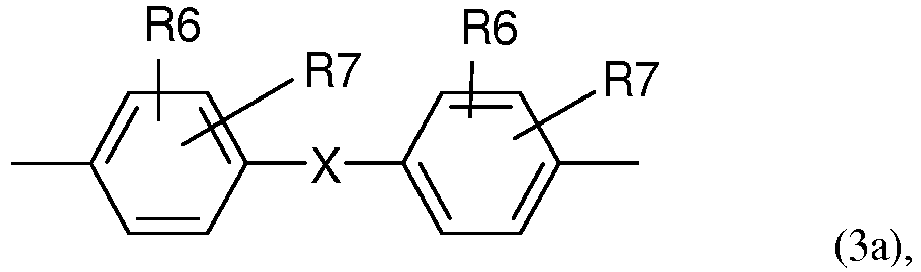
- R6 und R7 unabhängig voneinander für H, C1- bis C18-Alkyl, C1- bis C18-Alkoxy, Halogen wie Cl oder Br oder für jeweils gegebenenfalls substituiertes Aryl- oder Aralkyl, bevorzugt unabhängig voneinander für H oder C1- bis C12-Alkyl, besonders bevorzugt für H oder C1-bis C8-Alkyl und ganz besonders bevorzugt unabhängig voneinander für H oder Methyl stehen, und
- X für -CO-, -O- , -S-, C1- bis C6-Alkylen, C2- bis C5-Alkyliden, C6- bis C10-Cycloalkyliden oder für C6- bis C12-Arylen, welches gegebenenfalls mit weiteren Heteroatome enthaltenden aromatischen Ringen kondensiert sein kann, steht.
- Bevorzugt steht X für C1- bis C5-Alkylen, C2- bis Cs-Alkyliden, C6- bis C9-Cyclohexyliden, -O- , -SO- , -CO- , -S- , -SO2-, besonders bevorzugt für Isopropyliden, 3,3,5-Trimethylcyclohexyliden oder -O-, insbesondere für Isopropyliden.
- Für die Herstellung der erfindungsgemäßen SiCoPCs geeignete Diphenole der Formel (3) sind beispielsweise Hydrochinon, Resorcin, Bis-(hydroxyphenyl)-alkane, Bis-(hydroxyphenyl)-sulfide, Bis-(hydroxyphenyl)-ether, Bis-(hydroxyphenyl)-ketone, Bis-(hydroxyphenyl)-sulfone, Bis-(hydroxyphenyl)-sulfoxide, [alpha],[alpha]'-Bis-(hydroxyphenyl)-diisopropylbenzole sowie deren alkylierte, kernalkylierte und kernhalogenierte Verbindungen.
- Ferner bevorzugte Diphenole der Formel (3) sind 4,4'-Dihydroxydiphenyl, 2,2-Bis-(4-hydroxyphenyl)-1-phenyl-propan, 1,1-Bis-(4-hydroxyphenyl)-phenyl-ethan, 2,2-Bis-(4-hydroxyphenyl)propan, 2,2-Bis-(3-methyl-4-hydroxyphenyl)-propan, 2,4-Bis-(4-hydroxyphenyl)-2-methylbutan, 1,3-Bis-[2-(4-hydroxyphenyl)-2-propyl]benzol (Bisphenol M), 2,2-Bis-(3-methyl-4-hydroxyphenyl)-propan, Bis-(3,5-dimethyl-4-hydroxyphenyl)-methan, 2,2-Bis-(3,5-dimethyl-4-hydroxyphenyl)-propan, Bis-(3,5-dimethyl-4-hydroxyphenyl)-sulfon, 2,4-Bis-(3,5-dimethyl-4-hydroxyphenyl)-2-methylbutan, 1,3-Bis-[2-(3,5-dimethy1-4-hydroxyphenyl)-2-propyl]-benzol, 1,1-Bis-(4-hydroxyphenyl)-cyclohexan und 1,1-Bis-(4-hydroxyphenyl)-3,3,5-trimethylcyclohexan.
- Besonders bevorzugte Diphenole der Formel (3) sind 2,2-Bis-(4-hydroxyphenyl)-propan (BPA), Hydrochinon, 1,1-Bis-(4-hydroxyphenyl)-3,3,5-trimethylcyclohexan und 2,2-Bis-(3-methyl, 4-hydroxyphenyl)-propan.
- Diese und weitere geeignete Diphenole sind kommerziell erhältlich und z. B. in "H. Schnell, Chemistry and Physics of Polycarbonates, Interscience Publishers, New York 1964, S. 28 ff; S. 102 ff" , und in "D. G. Legrand, J. T. Bendler, Handbook of Polycarbonate Science and Technology, Marcel Dekker New York 2000, S. 72 ff." beschrieben.
- In einer Ausführungsform kann der Siloxanblock folgende Struktur (4) haben

n eine durchschnittliche Zahl von 10 bis 400, bevorzugt 10 bis 100, besonders bevorzugt 15 bis 50, ist
und k für 0 oder 1 steht. - R3 umfasst unabhängig voneinander folgende Strukturelemente (5) oder (6)

- wobei R4 unabhängig voneinander Wasserstoff, Halogen und/oder jeweils ein C1- bis C10-, bevorzugt ein C1- bis C4-, linearer oder verzweigter, unsubstituierter oder ein- bis vierfach substituierter Alkylrest oder Alkoxyrest ist, bevorzugt sind die Alkyl- und Alkoxyreste unsubstituiert, insbesondere bevorzugt ist R4 Wasserstoff,
- e 0 oder eine natürliche Zahl von 2 bis 12, bevorzugt 2 bis 6, ist, wobei im Falle, dass e gleich 0 ist, k gleich 1 ist;
- oder Strukturelement der Formel (6)

- Beispielsweise und bevorzugt kann der Siloxanblock folgende Strukturen umfassen:


- In einer weiteren Ausführungsform können die oben genannten Siloxanblöcke einfach oder mehrfach über Terephthalsäure oder Isophthalsäure verknüpft sein zu folgenden beispielhaft gezeigten Strukturelementen:

R2, R3, n und k die oben bei dem Strukturelement (4) angegebenen Bedeutungen haben. - Entsprechende Siloxanblöcke zur Umsetzung mit Polycarbonat oder zur Umsetzung mit Diphenolen der Formel (3) oder (3a) mit Phosgen oder Diarylc weisen jeweils terminal phenolische OH Gruppen auf, d.h.
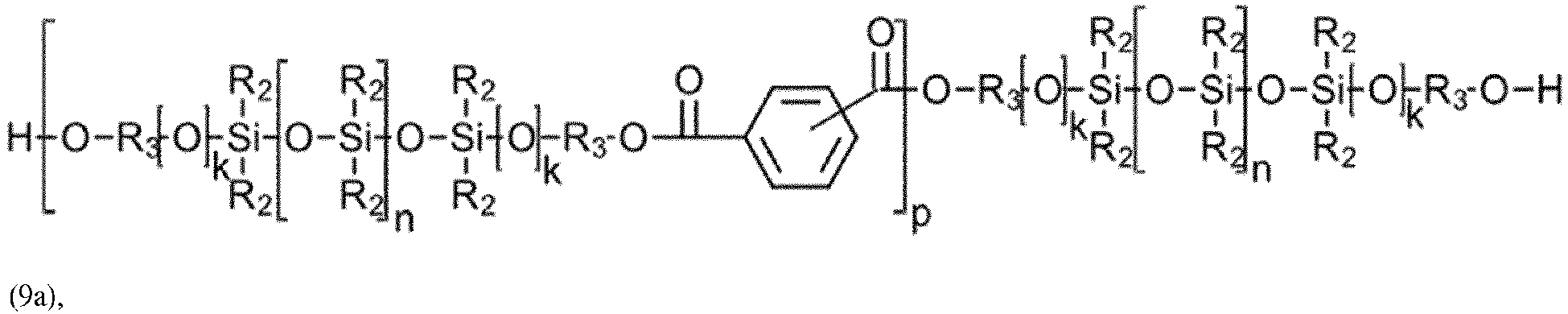
- Bevorzugte Siloxanblöcke sind Hydroxyaryl-terminiertes Polysiloxan und entsprechen der Formel (10)

- In der allgemeinen Formel (10) steht R5 für Wasserstoff oder C1- bis C4-Alkyl, C1- bis C4-Alkoxy, vorzugsweise für Wasserstoff oder Methyl, Methyloxy, be bevorzugt für Wasserstoff.
- R6 und R7 stehen unabhängig voneinander für Aryl, bevorzugt Phenyl, C1- bis C4-Alkyl, vorzugsweise für Methyl, insbesondere für Methyl.
- Y steht für eine Einfachbindung, -CO-, -O-, C1- bis C5-Alkylen, C2- bis C5-Alkyliden oder für einen C5- bis C6-Cycloalkylidenrest, der ein- oder mehrfach mit C1- bis C4-Alkyl substituiert sein kann, bevorzugt für eine Einfachbindung, -O-, Isopropyliden oder für einen C5- bis C6-Cycloalkylidenrest, der ein- oder mehrfach mit C1- bis C4-Alkyl substituiert sein kann, und insbesondere für Isopropyliden.
- V steht für Sauerstoff, C1- bis C6-Alkylen oder C2- bis C5-Alkyliden, bevorzugt für eine Einfachbindung, Sauerstoff, C3-Alkylen, insbesondere Sauerstoff oder Isopropyliden.
- W steht für eine Einfachbindung, S, C1- bis C6-Alkylen oder C2- bis Cs-Alkyliden, bevorzugt für eine Einfachbindung, C3-Alkylen oder Isopropyliden, wobei W keine Einfachbindung ist, wenn q für 1steht.
- p und q stehen unabhängig voneinander jeweils für 0 oder 1.
- o steht für eine durchschnittliche Anzahl von Wiederholungseinheiten von 10 bis 400, bevorzugt 10 bis 100, besonders bevorzugt von 15 bis 50, und
- m steht für eine durchschnittliche Zahl von 1 bis 10, bevorzugt von 1 bis 6 und besonders bevorzugt von 1,5 bis 5.
- Insbesondere bevorzugt sind Siloxane der Formeln (11) und (12)


- wobei R1 für H, Cl, Br oder C1- bis C4-Alkyl, vorzugsweise für H oder Methyl, steht und insbesondere bevorzugt für Wasserstoff steht,
- R2 für Aryl oder C1- bis C4-Alkyl, bevorzugt für Methyl, steht,
- X für eine Einfachbindung, -SO2-, -CO-, -O-, -S-, C1- bis C6-Alkylen, C2- bis C5-Alkyliden oder für C6- bis C12-Arylen, welches gegebenenfalls mit weiteren Heteroatome enthaltenden aromatischen Ringen kondensiert sein kann, steht. Bevorzugt steht X für eine Einfachbindung, Isopropyliden, 3,3,5-Trimethylcyclohexyliden oder Sauerstoff, und ganz besonders bevorzugt für Isopropyliden,
- n steht für eine durchschnittliche Zahl von 10 bis 400, bevorzugt 10 bis 100, besonders bevorzugt 10 bis 50,
- m steht für eine durchschnittliche Zahl von 1 bis 10, bevorzugt von 1 bis 6 und insbesondere bevorzugt von 1,5 bis 5. Das Molekulargewicht der Siloxanblöcke beträgt 3000 g/mol bis 20.000 g/mol, bevorzugt 3500 g/mol bis 15.000 g/mol, bestimmt mittels Gelpermeationschromatographie (GPC) und Polycarbonat aus Bisphenol A als Diphenol als Standar, wie oben beschrieben.
- Die Herstellung der Siloxanblöcke ist prinzipiell bekannt und kann nach Verfahren wie beispielsweise in
US 2013/0267665 A1 beschrieben hergestellt werden. - Die Herstellung von Polycarbonaten ist ebenfalls bekannt. Die Herstellung der Polycarbonate erfolgt in bekannter Weise aus Diphenolen, Kohlensäurederivaten, gegebenenfalls Kettenabbrechern und Verzweigern.
- Einzelheiten der Herstellung von Polycarbonaten sind in vielen Patentschriften seit etwa 40 Jahren niedergelegt. Beispielhaft sei hier nur auf Schnell, "Chemistry and Physics of Polycarbonates", Polymer Reviews, Volume 9, Interscience Publishers, New York, London, Sydney 1964, auf D. Freitag, U. Grigo, P.R. Müller, H. Nouvertne', BAYER AG, "Polycarbonates" in Encyclopedia of Polymer Science and Engineering, Volume 11, Second Edition, 1988, Seiten 648-718 und schließlich auf Dres. U. Grigo, K. Kirchner und P.R. Müller "Polycarbonate" in Becker/Braun, Kunststoff-Handbuch, Band 3/1, Polycarbonate, Polyacetale, Polyester, Celluloseester, Carl Hanser Verlag München, Wien 1992, Seiten 117-299 verwiesen.
- Bevorzugte Herstellungsweisen für Polycarbonate sind das bekannte Grenzflächenverfahren und das bekannte Schmelzumesterungsverfahren (z. B.
WO 2004/063249 A1 ,WO 2001/05866 A1 WO 2000/105867 ,US-A 5,340,905 ,US 5,097,002 ,US-A 5,717,057 ). - Der Gehalt an Siloxanblöcken im SiCoPC beträgt größer 0, bevorzugt 0,5 bis 40 Gew.-%, bevorzugt 1 bis 20 Gew.-%, insbesondere bevorzugt 2 bis 15 Gew.-% und ganz besonders bevorzugt 2 bis 10 Gew.-%, jeweils bezogen auf die eingesetzten Siloxanblöcke und Polycarbonatblöcke. Entsprechend beträgt der Anteil der Polycarbonatblöcke im Blockcokondensat 60 bis kleiner 100 (bevorzugt 99,5) Gew.-%, bevorzugt 99 bis 80 Gew.-%, insbesondere bevorzugt 98 bis 85 Gew.-% und ganz besonders bevorzugt 98 bis 90 Gew.-%.
- Die oben genannten Siloxanblöcke werden bevorzugt mit Polycarbonaten mit Molekulargewichten von 15.000 bis 27.000 g/mol, insbesondere bevorzugt von 17.000 bis 27.000 g/mol und insbesondere bevorzugt von 18.000 bis 26.500 g/mol (gemessen mittels GPC mit BPA-Polycarbonat als Standard, wie oben beschrieben) umgesetzt.
- Die Diphenole zur Herstellung der Polycarbonate sind die oben genannten Struktureinheiten (3).
- Dabei werden die einzelnen Komponenten (Siloxan-Block und Polycarbonat-Block) nach dem Reaktivextrusionsverfahren oder alternativ die Siloxanblöcke mit Diphenolen der Formel (3) mit Phosgen oder Diarylcarbonaten nach dem bekannten Phasengrenzflächenverfahren umgesetzt. Dieses Verfahren zur Polycarbonatsynthese ist mannigfaltig in der Literatur beschrieben; beispielhaft sei auf H. Schnell, Chemistry and Physics of Polycarbonates, Polymer Reviews, Vol. 9, Interscience Publishers, New York 1964 S. 33 ff., auf Polymer Reviews, Vol. 10, "Condensation Polymers by Interfacial and Solution Methods", Paul W. Morgan, Interscience Publishers, New York 1965, Kap. VIII, S. 325, auf Dres. U. Grigo, K. Kircher und P. R- Müller "Polycarbonate" in Becker/Braun, Kunststoff-Handbuch, Band 3/1, Polycarbonate, Polyacetale, Polyester, Celluloseester, Carl Hanser Verlag München, Wien 1992, S. 118-145 sowie auf
EP-A 0 517 044 verwiesen. Die Umsetzung von Polyorganosiloxanen im Phasengrenzflächenverfahren ist z.B. inUS 3821325 A beschrieben. - Die Herstellung der SiCoPCs kann in einem Reaktivextrusionsverfahren, wie es beispielsweise in
WO 2015/052110 A1 beschrieben ist, erfolgen. - Erfindungsgemäß wird als Komponente B) unbeschlichteter Talk verwendet. Dies bedeutet, dass der Talk vor der Vermischung mit Komponente A) keine Schlichte aufweist.
- Talk im Sinne der vorliegenden Erfindung ist bevorzugt ein Talk, welcher im Wesentlichen die gleiche chemische Zusammensetzung, Partikeldurchmesser, Porosität und/oder BET-Oberfläche aufweist, oder ein Talkgemisch.
- Bei Talk handelt es sich im Allgemeinen um ein Schichtsilikat. Es kann beschrieben werden als Magnesiumsilikathydrat mit der allgemeinen chemischen Zusammensetzung Mg3[Si4O10(OH)2]. Unterschiedliche Talkarten enthalten jedoch unterschiedliche Verunreinigungen, so dass Abweichungen von dieser allgemeinen Zusammensetzung vorliegen können.
- Der Talk oder das Talkgemisch ist erfindungsgemäß zum Zeitpunkt der Zugabe zur Komponente A) und C) unbeschlichtet. Im Sinne der vorliegenden Erfindung wird eine Schlichte als eine gezielte (chemi- oder physisorbierte) Anreicherung von Molekülen unterschiedlich von Talkum, insbesondere Mg3[Si4O10(OH)2], an der Oberfläche betrachtet. Bei unbeschlichtetem Talk handelt es sich somit um nicht oberflächen-behandelten Talk, d. h. nach der Gewinnung der Talkpartikel mit dem gewünschten Partikeldurchmesser und gegebenenfalls einer Kompaktierung wurde der Talk bevorzugt keinem weiteren Verfahrensschritt unterzogen, welcher die Oberfläche des Talks durch Chemisorption oder Physisorption gezielt verändert. Dies schließt jedoch nicht aus, dass unbeabsichtigt Verunreinigungen, Staub oder ähnliche Partikel während der weiteren Handhabung des Talks an Teile der Oberfläche gelangen, solange die Oberfläche des Talks nicht wesentlich ihre Eigenschaften, insbesondere in Bezug auf den pH-Wert, verliert. Erfindungsgemäß wird der Talk erst durch die Vermischung mit der Komponente C) beschlichtet.
- Bevorzugt weist der Talk einen pH-Wert von 8 bis 10, besonders bevorzugt 8,5 bis 9,8, ganz besonders bevorzugt 9,0 bis 9,7 auf, wobei der pH-Wert bestimmt wird gemäß EN ISO 787-9:1995. Es ist zu beachten, dass die EN ISO 787-9:1995 auch die Möglichkeit der Zugabe von Ethanol oder anderen organischen Lösungsmitteln zur Verbesserung der Dispergierung des zu vermessenden Feststoffes erwähnt. Bevorzugt wird erfindungsgemäß nur destilliertes Wasser zur Bestimmung des pH-Wertes gemäß EN ISO 787-9:1995 eingesetzt.
- Die Komponente B) weist bevorzugt einen Gehalt an Eisen(II)oxid und/oder Eisen(III)oxid von 0,2 bis 2,5 Gew.-%, besonders bevorzugt 0,3 bis 2,3 Gew.-%, ganz besonders bevorzugt von 0,3 bis 2,0 Gew.-% auf. Dieser Gehalt wird bevorzugt gemessen durch Röntgenfluoreszenz oder Atomabsorptionsspektroskopie. Es hat sich herausgestellt, dass der Gehalt an Eisenoxid im Talk einen Einfluss auf den Grad des Abbau des Polycarbonats aufweist. Im erfindungsgemäß angegebenen Gehaltsbereich an Eisenoxid wurden besonders gute Ergebnisse in Bezug auf die Verminderung des Abbaus des Polycarbonats erzielt.
- Ebenso bevorzugt weist die Komponente B) einen Gehalt an Aluminiumoxid von 0,01 bis 0,5 Gew.-%, besonders bevorzugt von 0,05 bis 0,48 Gew.-%, ganz besonders bevorzugt von 0,15 bis 0,45 Gew.-% auf.
- Die Komponente B) weist bevorzugt einen mittleren Partikeldurchmesser D50 von 0,01 bis 9,5 µm auf, besonders bevorzugt 0,25 bis 8,00 µm, weiterhin bevorzugt 0,5 bis 6,00 µm und ganz besonders bevorzugt 0,5 µm bis kleiner oder gleich 3,0 µm auf, wobei der Partikeldurchmesser D50 bestimmt wird durch Sedimentationsanalyse. Unter dem Mittelwert D50 versteht der Fachmann einen mittleren Partikeldurchmesser, bei dem 50 % der Partikel kleiner sind als der definierte Wert. Bevorzugt wird der Partikeldurchmesser D50 bestimmt gemäß ISO13317-3:2001.
- Komponente B) weist bevorzugt eine BET-Oberfläche von 7,5 bis 20,0 m2/g, besonders bevorzugt von 9,0 bis 15,0 m2/g, ganz besonders bevorzugt 9,5 bis 14,0 m2/g auf. Die Bestimmung der Oberfläche nach Brunauer, Emmett und Teller mittels Gasadsorption ist dem Fachmann an sich bekannt. Bevorzugt wird die BET-Oberfläche gemäß ISO 4652:2012 bestimmt. Diese bevorzugte BET-Oberfläche wird besonders bevorzugt mit dem oben beschriebenen mittleren Partikeldurchmesser D50 des Talks verbunden. Es hat sich herausgestellt, dass bei einer solchen Kombination die erfindungsgemäß eingesetzte Komponente B) optimal auf die erfindungsgemäß eingesetzte Komponente C) abgestimmt ist. Durch die spezielle Säurezahl und Molmasse der Komponente C) kann der Abbau des Polycarbonats, welcher durch die Komponente B) verursacht wird, minimiert werden, da unter diesen Bedingungen insbesondere auch die Poren des Talks für das Wachs C) zugänglich sind.
- Besonders bevorzugt weist der Talk einen Talkgehalt von ≥ 96 Gew.-%, besonders bevorzugt ≥ 97 Gew.-%, ganz besonders bevorzugt ≥ 98 Gew.-% auf.
- Ebenso ist es bevorzugt, dass der Talk einen Glühverlust bei 1050 °C von 5,0 bis 7,0 Gew.-%, besonders bevorzugt von 5,2 bis 6,5 Gew.-% und ganz besonders bevorzugt von 5,3 bis 6,2 Gew.-% aufweist. Der Glühverlust wird bevorzugt mittels DIN51081:2002 bestimmt.
- Der Talk oder das Talkgemisch gemäß Komponente B) liegt bevorzugt kompaktiert vor.
- Die Komponente C) im Sinne der vorliegenden Erfindung ist ein anhydridmodifiziertes alpha-Olefin-Polymer mit einer Säurezahl von mindestens 30 mg KOH/g und einem mittleren Molekulargewicht Mw von 4.000 bis 40.000 g/mol. Dabei kann es sich auch um eine Mischung verschiedener Polymere handeln, welche die Merkmale gemäß Komponente C) erfüllen.
- Das alpha-Olefin-Polymer enthält vorzugsweise mindestens einen Baustein ausgewählt aus der Gruppe, bestehend aus Ethylen, 1-Propen, 1-Buten, 1-Isobuten, 1-Penten, 1-Hexen, 1-Hepten, 1-Octen, 1-Nonen, 1-Decen, 1-Undecen, 1-Dodecen, 1-Tridecen, 1-Tetradecen, 1-Octadecen, 1-Nonadecen sowie Gemische aus diesen. Besonders bevorzugt umfasst das alpha-Olefin-Polymer mindestens einen Baustein, welcher ausgewählt ist aus der Gruppe, bestehend aus Ethylen, 1-Propen, 1-Octen.
- Bevorzugtes Anhydrid als weiterer Baustein zur Modifizierung ist ein ungesättigtes Carbonsäureanhydrid, welches vorzugsweise ausgewählt ist aus mindestens einem, ausgewählt aus der Gruppe, bestehend aus Maleinsäureanhydrid, Phthalsäureanhydrid, Fumarsäureanhydrid, Itaconsäureanhydrid. Besonders bevorzugt ist Maleinsäureanhydrid.
- Das anhydridmodifizierte alpha-Olefin-Polymer ist bevorzugt kautschukfrei.
- Bevorzugt umfasst das alpha-Olefin-Polymer (Komponente C)
- Ca) 90,0-98,0 Gew.-%, vorzugsweise 92,0-97,5 Gew.-%, besonders bevorzugt 94,0-97,0 Gew.-% alpha-Olefin-Polymer und
- Cb) 2,0-10,0 Gew.-%, vorzugsweise 2,5-8,0 Gew.-%, und besonders bevorzugt 3,0-6,0 Gew.-% Anhydrid.
- Der olefinische Teil Ca) des alpha-Olefin-Polymers ist bevorzugt dadurch gekennzeichnet, dass
der Ethylenanteil 80,0-96,0 Gew.-%, bevorzugt 84,0-92,0 Gew.-%,
der Propylenanteil 2,0-10,0 Gew.-%, bevorzugt 4,0-8,0 Gew.-% und
der Octenanteil 2,0-10,0 Gew.-%, bevorzugt 4,0-8,0 Gew.-%, ist. - Ebenso bevorzugt besteht der olefinische Teil Ca) des alpha-Olefin-Polymers aus Propylen und/oder Ethylen. Weiterhin bevorzugt besteht der olefinische Teil Ca) des alpha-Olefin-Polymers aus Propylen.
- Die Säurezahl des erfindungsgemäß eingesetzten Wachses der Komponente C) beträgt mindestens 30 mg KOH/g. Bevorzugt beträgt die Säurezahl 30 bis 110 mg KOH/g, besonders bevorzugt 40 bis 95 mg KOH/g. Die Säurezahl wurde von der Currenta GmbH mittels potentiometrischer Titration mit alkoholischer Kaliumhydroxid-Lösung gemäß DIN ISO 17025:2005 bestimmt.
- Das mittlere Molekulargewicht Mw des anhydridmodifzierten alpha-Olefin-Polymers beträgt 4.000 bis 40.000 g/mol, bevorzugt 4.000 bis 32.000 g/mol, besonders bevorzugt 4.800 bis 25.000 g/mol. Das Molekulargewicht Mw wird bestimmt mittels Gelpermeationschromatographie in ortho-Dichlorbenzol bei 150 °C mit Polystyrolkalibrierung. Hierbei ist der angegebene Wert bevorzugt der Mittelwert aus einer Doppelbestimmung.
- Bevorzugt beträgt bei kleineren Molekulargewichten von 4.000 bis 10.000 g/mol die Säurezahl 30 bis 65 mg, besonders bevorzugt 40 bis 60 mg KOH/g. Besonders bevorzugt beträgt das Molekulargewicht für die jeweils genannten Säurezahl von 30 mg bis 65 mg bzw. 40 bis 60 mg KOH/g 4.500 bis 8.000 g/mol und insbesondere 5.000 bis 7.000 g/mol.
- Bevorzugt beträgt bei größeren Molekulargewichten von 12.000 bis 40.000 g/mol die Säurezahl 30 mg bis 100 mg KOH/g, insbesondere 35 mg bis 95 mg KOH/g. Besonders bevorzugt beträgt das Molekulargewicht für die jeweils genannten Säurezahl von 30 mg bis 100 mg bzw. 35 bis 95 mg KOH/g 12.000 bis 32.000 g/mol und insbesondere 15.000 bis 25.000 g/mol, ganz besonders bevorzugt 17.500 bis 23.000 g/mol.
- Die Kombination der (Mindest)Säurezahl und Molmasse des Wachses C) wie oben angegeben ist besonders geeignet, um insbesondere die multiaxiale Schlagzähigkeit von aus den erfindungsgemäßen Zusammensetzungen hergestellten Formteilen zu optimieren.
- In der erfindungsgemäßen Zusammensetzung sind die Mengen von B) und C) vor der Vermischung der Komponenten A) bis C) so aufeinander abgestimmt, dass pro 10 Gewichtsteile der Komponente B) 0,10 bis 1,4 Gewichtsteile der Komponente C) eingesetzt werden. Bevorzugt werden pro 10 Gewichtsteile der Komponente B) 0,2 bis 1,2, besonders bevorzugt 0,3 bis 1,1 Gewichtsteile der Komponente C), ganz besonders bevorzugt 0,4 bis 1,0 Gewichtsteile der Komponente C) eingesetzt.
- Bevorzugt enthält die erfindungsgemäße Zusammensetzung
5,00 bis 45,00 Gew.-% der Komponente B). - Besonders bevorzugt enthält die Zusammensetzung 10,00 bis 42,00 Gew.-%, ganz besonders bevorzugt 13,00 bis 40,00 Gew.-% der Komponente B). Die Menge der Komponente C) ergibt sich aus den oben angegebenen Mengen pro 10 Gewichtsteile Komponente B).
- Die Menge der Komponente B) beträgt für hohe multiaxiale Schlagzähigkeit in Kombination mit guter Verstärkung (E-Modul) bevorzugt 5,00 bis 31,00 Gew.-%, besonders bevorzugt 8,00 bis 25,00 Gew.-%. Die Mengen der Komponenten A) bis C) beziehen sich jeweils auf die Gesamtzusammensetzung.
- Für gute multiaxiale Schlagzähigkeit in Kombination mit guter Wärmeleitfähigkeit beträgt die Menge der Komponente B) besonders bevorzugt 18,00 bis 40,00 Gew.-% der Komponente B).
- Die Zusammensetzung ist frei von Pfropfpolymerisaten und Polyestern, bevorzugt von von Komponente C) verschiedenen Impact Modifiern.
- Unter "Pfropfpolymerisaten" werden insbesondere Pfropfpolymerisate mit kautschukelastischen Eigenschaften verstanden, die im Wesentlichen aus mindestens zwei der nachfolgenden Monomere erhältlich sind: Chloropren, 1,3-Butadien, Isopren, Styrol, Acrylnitril, Ethylen, Propylen, Vinylacetat und (Meth)Acrylsäureester mit 1 bis 18 C-Atomen in der Alkoholkomponente; also Polymerisate, wie sie z.B. in "Methoden der Organischen Chemie" (Houben-Weyl), Bd. 14/1, Georg Thieme-Verlag, Stuttgart 1961, S. 393-406 und in C.B. Bucknall, "Toughened Plastics", Appl. Science Publishers, London 1977, beschrieben sind. Pfropfpolymerisate können partiell vernetzt sein und Gelgehalte (gemessen in Toluol) von über 20 Gew.-% aufweisen, vorzugsweise über 40 Gew.-%, insbesondere über 60 Gew.-%, wobei der Gelgehalt bei 25°C in einem geeigneten Lösungsmittel bestimmt wird (M. Hoffmann, H. Krömer, R. Kuhn, Polymeranalytik I und II, Georg Thieme-Verlag, Stuttgart 1977).
- Pfropfpolymerisate sind beispielsweise Pfropfpolymerisate aus:
- a.i) 5 bis 95 Gew.-Teile, vorzugsweise 30 bis 80 Gew.-Teile, einer Mischung aus
- a.i.1) 50 bis 95 Gew.-Teilen Styrol, α-Methylstyrol, methylkemsubstituiertem Styrol, C1- bis C8-Alkylmethacrylat, insbesondere Methylmethacrylat, C1- bis C8-Alkylacrylat, insbesondere Methylacrylat, oder Mischungen dieser Verbindungen
und - a.i.2) 5 bis 50 Gew.-Teilen Acrylnitril, Methacrylnitril C1- bis C8-Alkylmethacrylaten, insbesondere Methylmethacrylat, C1- bis C8-Alkylacrylat, insbesondere Methylacrylat, Maleinsäureanhydrid, C1- bis C4-Alkyl- bzw. -Phenyl-N-substituierte Maleinimide oder Mischungen dieser Verbindungen auf
- a.ii) 5 bis 95 Gew.-Teile, vorzugsweise 20 bis 70 Gew.-Teilen einer kautschukhaltigen Pfropfgrundlage.
- Pfropfpolymere sind insbesondere solche mit einer Pfropfgrundlage auf Basis eines Polybutadienkautschuks.
- Pfropfpolymerisate sind z.B. mit Styrol und/oder Acrylnitril und/oder (Meth- )Acrylsäurealkylestern gepfropfte Polybutadiene, Butadien/Styrol-Copolymerisate und Acrylatkautschuke; d.h. Copolymerisate der in der DEOS 1 694 173 (=
US-PS 3 564 077 ) beschriebenen Art; mit Acryl- oder Methacrylsäurealkylestern, Vinylacetat, Acrylnitril, Styrol und/oder Alkylstyrolen gepfropfte Polybutadiene, Butadien/Styrol- oder Butadien/Acrylnitril-Copolymerisate, Polyisobutene oder Polyisoprene, wie sie z.B. in derDE-OS 2 348 377 (=US-PS 3 919 353 ) beschrieben sind. - Pfropfpolymerisate sind insbesondere auch solche, die durch Pfropfreaktion von
- I. mindestens einem (Meth-)Acrylsäureester oder einem Gemisch aus Acrylnitril oder (Meth-)Acrylsäureester und Styrol auf
- II. einem Butadien-Polymerisat mit Butadienresten als Pfropfgrundlage
erhältlich sind. - (Meth-)Acrylsäureester I sind Ester der Acrylsäure oder Methacrylsäure und einwertiger Alkohole mit 1 bis 18 C-Atomen, insbesondere Methacrylsäuremethylester, -ethylester und - propylester.
- Die Pfropfgrundlage II kann neben Butadienresten auch Reste anderer ethylenisch ungesättigter Monomerer, wie Styrol, Acrylnitril, Ester der Acryl- oder Methacrylsäure mit 1 bis 4 C-Atomen in der Alkoholkomponente (wie Methylacrylat, Ethylacrylat, Methylmethacrylat, Ethylmethacrylat), Vinylester und/oder Vinylether enthalten. Eine Pfropfgrundlage II besteht beispielsweise aus reinem Polybutadien.
- Da bei der Pfropfreaktion die Pfropfmonomeren bekanntlich nicht unbedingt vollständig auf die Pfropfgrundlage aufgepfropft werden, werden erfindungsgemäß unter Pfropfpolymerisaten B auch solche Produkte verstanden, die durch Polymerisation der Pfropfmonomeren in Gegenwart der Pfropfgrundlage gewonnen werden.
- Pfropfpolymerisate sind z.B. auch Pfropfpolymerisate aus
- (a) Acrylatkautschuk als Pfropfgrundlage und
- (b) einem polymerisierbaren, ethylenisch ungesättigten Monomeren, dessen bzw. deren in Abwesenheit von a) entstandenen Homo- bzw. Copolymerisate als Pfropfmonomere.
- Die Acrylatkautschuke (a) des Pfropfpolymerisats sind insbesondere Polymerisate aus Acrylsäurealkylestern, gegebenenfalls mit anderen polymerisierbaren, ethylenisch ungesättigten Monomeren.
- Polymerisierbare Acrylsäureester sind C1- bis C8-Alkylester, beispielsweise Methyl-, Ethyl-, n-Butyl-, n-Octyl- und 2-Ethylhexylester sowie Mischungen dieser Monomeren.
- Zur Vernetzung können Monomere mit mehr als einer polymerisierbaren Doppelbindung copolymerisiert werden.
- Beispiele für vernetzende Monomere sind Ester ungesättigter Monocarbonsäuren mit 3 bis 8 C-Atomen und ungesättigter einwertiger Alkohole mit 3 bis 12 C-Atomen oder gesättigter Polyole mit 2 bis 4 OH-Gruppen und 2 bis 20 C-Atomen, wie z.B. Ethylenglykoldimethacrylat, Allylmethacrylat; mehrfach ungesättigte heterocyclische Verbindungen, wie z.B. Trivinyl- und Triallylcyanurat; polyfunktionelle Vinylverbindungen, wie Di- und Trivinylbenzole; aber auch Triallylphosphat und Diallylphthalat.
- Bevorzugte "andere" polymerisierbare, ethylenisch ungesättigte Monomere, die neben den Acrylsäureestern gegebenenfalls zur Herstellung der Pfropfgrundlage (a) dienen können, sind z.B. Acrylnitril, Styrol, α-Methylstyrol, Acrylamide, Vinyl-C1- bis -C6-alkylether, Methylmethacrylat, Butadien.
- Beispiele für entsprechende Impact Modifier sind ABS (Acrylnitril-Butadien-Styrol), SBR (Styrol-Butadien-Rubber) und SAN (Styrol-Acrylnitril).
- Impact Modifier sind auch Vinyl(co)polymerisate.
- Pfropfgrundlagen sind auch Silikonkautschuke.
- Impact-Modifier sind auch Kern-Schale-Systeme, z.B. Silikon-Acryl-Schlagzähmodifizierer, etwa mit Silikonelastomer-Kern und MMA-Copolymer-Schale, wie Metablen S-2001.
- Impact Modifier sind auch höhermolekulare, ggf. funktionalisierte, Polyolefine, sowohl Homo- als auch Copolymere, die von Komponente C) verschieden sind. Bei diesen erfolgt die Funktionalisierung z.B. mittels aromatischer Monovinyl-Monomere, Acrylsäuren bzw. Methacrylsäuren und/oder deren Estern, konjugierten Dienen.
- Als Impact Modifier üblicherweise verwendete Polyester sind im weitesten Sinne als Kondensate aus Dicarbonsäuren und Diolen (Dialkoholen) darstellbar, insbesondere Polyethylenterephthalat, Polybutylenterephthalat sowie Polyethylennaphthalat oder der Copolyester Tritan der Eastman Chemical Company.
- Besonders bevorzugt besteht die Zusammensetzung im Wesentlichen aus den Komponenten A) bis C), wobei aber übliche Additive, die im Folgenden aufgeführt sind, enthalten sein können, und grundsätzlich auch weitere Bestandteile, die sich nicht negativ auf die gewünschten Eigenschaften, insbesondere die multiaxiale Schlagzähigkeit auswirken. Ganz besonders bevorzugt besteht die Zusammensetzung aus den Komponenten A) bis C) sowie den unten genannten Additiven und ist also insbesondere frei von von Komponente C) verschiedenen Impact Modifiern. "Von Komponente C) verschieden" ist so bezeichnet, da anhydridmodifierte alpha-Olefin-Polymere in der Literatur teilweise als Impact Modifier bezeichnet werden, dann üblicherweise aber in höheren Mengen und/oder mit höherem mittleren Molekulargewicht eingesetzt werden.
- Die erfindungsgemäße Zusammensetzung umfasst bevorzugt mindestens ein Additiv, ausgewählt aus der Gruppe, bestehend aus Flammschutzmitteln, Antitropfmitteln, Thermostabilisatoren, Entformungsmitteln, Antioxidantien, UV-Absorbern, IR-Absorbern, Antistatika, optischen Aufhellern, Lichtstreumitteln, Farbmitteln. Dabei können diese weiteren Bestandteile vor der Vermischung der Komponenten A) bis C), bei der Vermischung der Komponenten A) bis C) oder nach der Vermischung der Komponenten A) bis C) hinzugegeben werden.
- Die Additive sind optional bis zu 10,0 Gew.-%, bevorzugt zu 0,10 bis 8,0 Gew.-%, besonders bevorzugt zu 0,2 bis 3,0 Gew.-% in der erfindungsgemäßen Zusammensetzung enthalten, wobei sich diese Gewichtsprozente auf die Gesamtmasse der Zusammensetzung beziehen.
- Solche Additive, wie sie üblicherweise Polycarbonaten zugesetzt werden, sind beispielsweise in
EP-A 0 839 623 ,WO-A 96/15102 EP-A 0 500 496 oder im "Plastics Additives Handbook", Hans Zweifel, 5th Edition 2000, Hanser Verlag, München beschrieben. - Bevorzugte Entformungsmittel sind Ester aliphatischer langkettiger Carbonsäuren mit ein- oder mehrwertigen aliphatischen und/oder aromatischen Hydroxyverbindungen. Besonders bevorzugt sind Pentaerythrittetrastearat, Glycerinmonostearat, Stearylstearat und Propandioldistearat, bzw. Gemische daraus.
- Bevorzugte UV-Stabilisatoren weisen eine möglichst geringe Transmission unterhalb 400 nm und eine möglichst hohe Transmission oberhalb von 400 nm auf. Für den Einsatz in der erfindungsgemäßen Zusammensetzung besonders geeignete Ultraviolett-Absorber sind Benzotriazole, Triazine, Benzophenone und/oder arylierte Cyanoacrylate.
- Besonders geeignete Ultraviolett-Absorber sind Hydroxy-Benzotriazole, wie 2-(3',5'-Bis-(1,1-dimethylbenzyl)-2'-hydroxy-phenyl)-benzotriazol (Tinuvin® 234, Ciba Spezialitätenchemie, Basel), 2-(2'-Hydroxy-5'-(tert.-octyl)-phenyl)-benzotriazol (Tinuvin® 329, Ciba Spezialitätenchemie, Basel), 2-(2'-Hydroxy-3'-(2-butyl)-5'-(tert.butyl)-phenyl)-benzotriazol (Tinuvin® 350, Ciba Spezialitätenchemie, Basel), Bis-(3-(2H-benztriazolyl)-2-hydroxy-5-tert.-octyl)methan, (Tinuvin® 360, Ciba Spezialitätenchemie, Basel), (2-(4,6-Diphenyl-1,3,5-triazin-2-yl)-5-(hexyloxy)-phenol (Tinuvin® 1577, Ciba Spezialitätenchemie, Basel), sowie der Benzophenone 2,4-Dihydroxy-benzophenon (Chimasorb® 22, Ciba Spezialitätenchemie, Basel) und 2-Hydroxy-4-(octyloxy)-benzophenon (Chimassorb® 81, Ciba, Basel), 2-Cyano-3,3-diphenyl-2-propensäure-2-ethylhexylester, 2,2-Bis[[(2-cyano-1-oxo-3,3-diphenyl-2-propenyl)oxy]-methyl] -1,3-propandiylester (9CI) (Uvinul® 3030, BASF AG Ludwigshafen), 2-[2-Hydroxy-4-(2-ethylhexyl)oxy]phenyl-4,6-di(4-phenyl)phenyl-1,3,5-triazin (CGX UVA 006, Ciba Spezialitätenchemie, Basel) oder Tetraethyl-2,2'-(1,4-phenylen-dimethyliden)-bismalonat (Hostavin® B-Cap, Clariant AG).
- Besonders bevorzugte spezielle UV-Stabilisatoren sind beispielsweise Tinuvin® 360, Tinuvin® 350, Tinuvin® 329, Hostavin® B-CAP, besonders bevorzugt TIN 329 und Hostavin® B-Cap. Es können auch Mischungen dieser Ultraviolett-Absorber eingesetzt werden.
- Gemäß einer speziellen Ausführungsform der Erfindung enthält die Zusammensetzung Ultraviolett-Absorber in einer Menge von 0 ppm bis 6000 ppm, bevorzugt 500 ppm bis 5000 ppm, und weiter bevorzugt 1000 ppm bis 2000 ppm, bezogen auf die Gesamtzusammensetzung.
- Geeignete Farbmittel können Pigmente, auch anorganische Pigmente, Ruß und/oder Farbstoffe sein. Füllstoffe verschieden von Komponente B) können ebenfalls zugesetzt werden, sofern sie nach Art und Menge das Eigenschaftsniveau der vorliegenden Erfindung nicht beeinträchtigen. Als anorganische Füllstoffe kommen insbesondere Titandioxid, im allgemeinen in einer Menge von 0 bis 2,5 Gew.-%, bezogen auf die Summe der Gesamtzusammensetzung, oder Bariumsulfat in Betracht.
- Darüber hinaus können weitere Bestandteile zugesetzt werden, die nach Art des Bestandteils und Menge das Eigenschaftsniveau der vorliegenden Erfindung nicht beeinträchtigen.
- Die Herstellung der erfindungsgemäßen Polymer-Zusammensetzungen, enthaltend die vermischten Komponenten A) bis C) und optional Additive sowie weitere Bestandteile, erfolgt gegebenenfalls unter Verwendung von Pulvervormischungen, solange die Komponenten B) und C) tatsächlich erst in der Schmelze der Komponente A) vermischt werden. Unter dieser Voraussetzung können auch Vormischungen aus Granulaten oder Granulaten und Pulvern mit den erfindungsgemäßen Zusätzen verwendet werden. Es können auch Vormischungen verwendet werden, die aus Lösungen der Mischungskomponenten in geeigneten Lösungsmitteln, wobei gegebenenfalls in Lösung homogenisiert wird und das Lösungsmittel anschließend entfernt wird, hergestellt worden sind. Insbesondere können hierbei die weiteren Bestandteile der erfindungsgemäßen Zusammensetzung durch bekannte Verfahren oder als Masterbatch eingebracht werden. Die Verwendung von Masterbatchen ist insbesondere zum Einbringen von Additiven und weiteren Bestandteilen bevorzugt, wobei insbesondere Masterbatche auf Basis der jeweiligen Polymermatrix verwendet werden.
- Die erfindungsgemäße Zusammensetzung kann beispielsweise extrudiert werden. Nach der Extrusion kann das Extrudat abgekühlt und zerkleinert werden. Die Zusammenführung und Durchmischung einer Vormischung in der Schmelze kann auch in der Plastifiziereinheit einer Spritzgussmaschine erfolgen. Hierbei wird die Schmelze im anschließenden Schritt direkt in einen Formkörper überführt.
- Es hat sich insbesondere herausgestellt, dass die erfindungsgemäße Zusammensetzung besonders geeignet ist für die Herstellung von Extrudaten, bevorzugt für die Extrusion von Profilen und Platten.
- Ein weiterer Aspekt der vorliegenden Erfindung ist ein Verfahren zur Beschlichtung von Talk B) durch mindestens ein anhydridmodifiziertes alpha-Olefin-Polymer, wie oben als Komponente B) beschrieben, welches dadurch gekennzeichnet ist, dass die Beschlichtung während der Vermischung des Talks oder Talkgemisches B) mit mindestens einem Polycarbonat und/oder Copolycarbonat gemäß der oben beschriebenen Komponente A) in der Schmelze erfolgt. Die Komponente C) kann dabei entweder gleichzeitig mit der Komponente B) zugeführt werden, oder die Komponente C) wird der Komponente A) zugegeben, bevor die Zugabe der Komponente B) erfolgt.
- Dies bedeutet, dass, wie bereits oben näher erläutert, die Komponente A) bei der Vermischung mit den Komponenten B) und C) zumindest teilweise in der Schmelze vorliegt. Bei dem erfindungsgemäßen Verfahren können die Komponenten A) bis C), wie sie bereits oben näher erläutert wurden, in sämtlichen Bevorzugungen und Kombinationen eingesetzt werden. Bevorzugt dient das erfindungsgemäße Verfahren zur Herstellung der erfindungsgemäßen Zusammensetzung. Dabei ist es besonders bevorzugt, dass die Mengen von B) und C) so aufeinander abgestimmt sind, dass pro 10 Gewichtsteile der Komponente B) 0,10 bis 1,4 Gewichtsteile der Komponente C) eingesetzt werden. Weitere bevorzugte Ausführungsformen sind bereits oben beschrieben und sind auch hier anwendbar.
- Es hat sich überraschenderweise herausgestellt, dass eine in-situ Beschlichtung, d. h. die Anlagerung des Wachses C) an die Oberfläche des Talks B) erst während der Vermischung mit dem Polycarbonat A), trotz der Tatsache, dass der unbeschlichtete Talk C) somit zumindest teilweise mit dem Polycarbonat A) in Kontakt kommt, ausreichend ist, um einen wesentlichen Abbau des Polycarbonats A) zu vermeiden. Hierbei spiegelt sich die Tatsache, dass kein wesentlicher Abbau stattfindet, insbesondere in den hervorragenden mechanischen Eigenschaften der Zusammensetzung und der resultierenden Formkörper wider. Insgesamt kann somit zur Erzeugung der erfindungsgemäßen Zusammensetzung und Formteile ein Verfahrensschritt gespart werden, da eine vorherige Beschlichtung/Behandlung des Talks nicht notwendig ist. Dadurch wird das erfindungsgemäße Verfahren besonders effizient und kostengünstig.
- In einem weiteren Aspekt der vorliegenden Erfindung wird ein Verfahren zur Verbesserung der multiaxialen Schlagzähigkeit gemäß DIN EN ISO 6603-2:2002 einer Zusammensetzung, umfassend A) ein Polycarbonat und B) Talk bereitgestellt, wobei das Verfahren den Schritt der Beschlichtung der Komponente B) mit einem anhydridmodifizierten alpha-Olefin-Polymer C) mit einer Säurezahl von mindestens 30 mg KOH/g und einem mittleren Molekulargewicht Mw von 4000 bis 40.000 g/mol, wobei das mittlere Molekulargewicht Mw bestimmt wird mittels Gelpermeationschromatographie in ortho-Dichlorbenzol bei 150 °C mit Polystyrolkalibrierung, umfasst und wobei die Mengen von B) und C) so aufeinander abgestimmt sind, dass pro 10 Gewichtsteile der Komponente B) 0,10 bis 1,4 Gewichtsteile der Komponente C) eingesetzt werden. Wie bereits oben näher erläutert, konnte überraschenderweise herausgefunden werden, dass die Verwendung eines speziellen Wachses, bevorzugt in Kombination mit einem speziellen, oben näher beschriebenen Talk B), zu Formteilen mit einer verbesserten multiaxialen Schlagzähigkeit führt.
- Bei dem erfindungsgemäßen Verfahren können die Komponenten A) bis C), wie sie bereits oben näher erläutert wurden, in sämtlichen Bevorzugungen und Kombinationen eingesetzt werden. Bevorzugt dient das erfindungsgemäße Verfahren zur Herstellung der erfindungsgemäßen Zusammensetzung. Die Beschlichtung des Talks oder Talkgemisches B) mit mindestens einem Polycarbonat A) erfolgt in der Schmelze.
- Ebenso wird in einem weiteren Aspekt der vorliegenden Erfindung ein Verfahren zur Erhöhung der Fließfähigkeit einer Zusammensetzung, umfassend ein Polycarbonat A) bereitgestellt, wobei das Verfahren den Schritt der Vermischung von Talk B) und einem anhydridmodifizierten alpha-Olefin-Polymer C) mit einer Säurezahl von mindestens 30 mg KOH/g, bestimmt mittels potentiometrischer Titration mit alkoholischer Kaliumhydroxid-Lösung gemäß DIN ISO 17025:2005, und einem mittleren Molekulargewicht Mw von 4000 bis 40.000 g/mol, wobei das mittlere Molekulargewicht Mw bestimmt wird mittels Gelpermeationschromatographie in ortho-Dichlorbenzol bei 150 °C mit Polystyrolkalibrierung, mit einem Polycarbonat A) umfasst. Bei dem erfindungsgemäßen Verfahren können die Komponenten A) bis C), wie sie bereits oben näher erläutert wurden, in sämtlichen Bevorzugungen und Kombinationen eingesetzt werden. Bevorzugt dient das erfindungsgemäße Verfahren zur Herstellung der erfindungsgemäßen Zusammensetzung. Insbesondere in Bezug auf den Schritt der Vermischung wird auf die Ausführungen oben verwiesen. Überraschend wurde gefunden, dass bei Zugabe der Komponente B) in Kombination mit Komponente C) keine Verminderung der Fließfähigkeit der erfindungsgemäßen thermoplastischen Formmasse zu beobachten war. Im Gegenteil übertraf die Fließfähigkeit der erfindungsgemäßen thermoplastischen Formmasse die Fließfähigkeit der reinen Komponente A). Dies ist für den Fachmann besonders überraschend, da die Zugabe eines Füllstoffs wie Talk normalerweise mit einer Herabsetzung der Fließfähigkeit verbunden ist.
- In einem weiteren Aspekt betrifft die vorliegende Erfindung ein Formteil, welches die erfindungsgemäße Zusammensetzung umfasst. Bevorzugt handelt es sich bei dem Formteil um Gehäuse oder Gehäuseteile im elektronischen Bereich, Gehäuse für mobile Elektronik, Schutzausrüstungsteile oder Karosserieteile im Automobilbereich. Die erfindungsgemäßen Formteile zeichnen sich durch eine einzigartige Eigenschaftskombination intrinsischer Wärmeleitfähigkeit bei elektrischer Isolation, hoher Steifigkeit, hoher Zähigkeit, insbesondere bei multiaxialer Beanspruchung, verbesserter Fließfähigkeit und hoher Oberflächenqualität bei thermoplastischer Verarbeitung aus.
- Ebenso stellt die vorliegende Erfindung die Verwendung der erfindungsgemäßen Zusammensetzung zur Herstellung eines Formteils bereit, wobei es sich bei dem Formteil um Gehäuse oder Gehäuseteile im elektronischen Bereich, Gehäuse für mobile Elektronik, Schutzausrüstungsteile oder Karosserieteile im Automobilbereich handelt.
- Die Formteile sind für folgende Anwendungen geeignet: Fahrzeugteile oder Innenausbauteile für Kraftfahrzeuge, Busse, Lastwagen, Wohnmobile, Schienenfahrzeuge, Luftfahrzeuge, Wasserfahrzeuge oder sonstige Fahrzeuge, Abdeckplatten für den Bausektor, flächige Wandelemente, Trennwände, Wandschutz- und Kantenschutzleisten, Profile für Elektroinstallationskanäle, Kabelleiter, Stromschienenabdeckungen, Fenster-, Türprofile, Möbelteile, Verkehrsschilder.
- Die folgenden Beispiele dienen der weiteren Erläuterung der Erfindung.
-
- Material A1: ein lineares Bisphenol-A-Polycarbonat mit einem MVR (300 °C/1,2 kg) von 19 cm3/(10 min) und einem mittleren Molekulargewicht Mw von ca. 24.000 g/mol der Covestro Deutschland AG.
- Material A2: ein lineares Bisphenol-A-Polycarbonat mit einem MVR (300 °C/1,2 kg) von 9 cm3/(10 min) und einem mittleren Molekulargewicht Mw von ca. 28.000 g/mol der Covestro Deutschland AG.
- Material A3: Polysiloxan-Polycarbonat-Blockcokondensat mit einem MVR (300 °C; 1,2 kg) von ca. 14 cm3/(10 min) und einem Polydimethylsiloxangehalt von ca. 5 Gew.-%; Lösungsviskosität ηrel 1,26. Der zur Herstellung des SiCoPC eingesetzte Block entspricht der Formel (11);
- Als Ausgangsstoff für die Reaktivextrusion wird lineares Bisphenol-A-Polycarbonat mit Endgruppen, basierend auf Phenol mit einem Schmelzvolumenindex von 59 - 62 cm3/(10 min) (gemessen bei 300 °C und 1,2 kg Belastung gemäß ISO 1133 (Jahr 2011)) eingesetzt. Dieses Polycarbonat enthält keine Additive wie UV-Stabilisatoren, Entformungsmittel oder Thermostabilisatoren. Die Darstellung des Polycarbonats erfolgte über einen Schmelzeumesterungsprozess, wie in
DE 102008019503 beschrieben. Das Polycarbonat weist einen Gehalt an phenolischen Endgruppen von ca. 600 ppm auf. - Hydrochinon-terminiertes Polydimethylsiloxan der Formel (11) mit n von ca. 30 und m im Bereich von 3 bis 4 (R1 = H, R2 = Methyl), mit einem Hydroxy-Gehalt von 12 mg KOH/g und einer Viskosität von 370 mPa·s (23°C); der Natrium-Gehalt beträgt ca. 1,5 ppm.
- Als Katalysator wird Tetraphenylphosphoniumphenolat der Firma Rhein Chemie Rheinau GmbH (Mannheim Deutschland) in Form eines Masterbatches eingesetzt. Tetraphenylphosphoniumphenolat wird als Mischkristall mit Phenol eingesetzt und enthält ca. 70 % Tetraphenylphosphoniumphenolat. Die nachfolgenden Mengen beziehen sich auf die von der Firma Rhein Chemie erhaltene Substanz (als Mischkristall mit Phenol).
- Der Masterbatch wird als 0,25-%ige Mischung hergestellt. Hierzu werden 4982 g mit 18 g Tetraphenylphosphoniumphenolat im Rhönradmischer für 30 Minuten aufgetrudelt. Der Masterbatch wird im Verhältnis 1:10 dosiert, so dass in der Gesamtmenge an Polycarbonat der Katalysator mit einem Anteil von 0,025 Gew.-% vorliegt.
- Die Herstellung des Blockcokondensats aus der Polycarbonat-Komponente und der Siloxan-Komponente erfolgt über ein Reaktivextrusionsverfahren gemäß
WO 2015/052110 A1 . - Natriumgehalt: Der Natriumgehalt wird über Massenspektrometrie mit induktiv gekoppeltem Plasma (ICP-MS) bestimmt.
- Material B1: Kompaktierter Talk mit einem Talkgehalt von 98 Gew.-%, einem Eisenoxidgehalt von 1,9 Gew.-%, einem Aluminiumoxidgehalt von 0,2 Gew.-%, Glühverlust (DIN 51081/1000 °C) von 5,4 Gew.-%, pH-Wert (nach EN ISO 787-9:1995) von 9,15, D50 (Sedimentationsanalyse) von 2,2 µm; BET-Oberfläche nach ISO 4652:2012) 10 m2/g, Typ: Finntalc M05SLC, Hersteller: Mondo Minerals B. V.
- Material B2: Kompaktierter Talk mit einem Talkgehalt von 99 Gew.-%, einem Eisenoxidgehalt von 0,4 Gew.-%, einem Aluminiumoxidgehalt von 0,4 Gew.-%, Glühverlust von 6,0 Gew.-%, pH-Wert (nach EN ISO 787-9:1995) von 9,55, D50 (Sedimentationsanalyse) von 0,65 µm; BET-Oberfläche 13,5 m2/g, Typ: HTP Ultra5c, Hersteller: Imifabi.
- Material Cl: Ethylen-Propylen-Octen-Terpolymer mit Maleinsäureanhydrid (Ethylen:Propylen:Octen 87:6:7 (Gewichtsverhältnis)), CAS-Nr. 31069-12-2, mit Molekulargewicht (Gelpermeationschromatographie in ortho-Dichlorbenzol bei 150 °C mit Polystyrolkalibrierung) Mw = 6.301 g/mol, Mn = 1159 g/mol, Dichte 940 kg/m3, Säurezahl 53 mg KOH/g, Maleinsäureanhydridanteil 4,4 Gew.-%, bezogen auf das Terpolymer Cl.
- Material C2: Ethylen-Propylen-Octen-Terpolymer mit Maleinsäureanhydrid mit einem mittleren Molekulargewicht (Gelpermeationschromatographie in ortho-Dichlorbenzol bei 150 °C mit Polystyrolkalibrierung) Mw = 14400 g/mol, Mn = 1.880 g/mol, Säurezahl 23 mg KOH/g.
- Material C3: Propylen-Maleinsäureanhydrid-Polymer mit einem mittleren Molekulargewicht (Gelpermeationschromatographie in ortho-Dichlorbenzol bei 150 °C mit Polystyrolkalibrierung) Mw = 170.300 g/mol, Mn = 10.100 g/mol, Säurezahl 6 mg KOH/g.
- Material C4: HD-Polyethylen-Maleinsäureanhydrid-Polymer, mit einem mittleren Molekulargewicht (Gelpermeationschromatographie in ortho-Dichlorbenzol bei 150 °C mit Polystyrolkalibrierung) Mw = 153.500 g/mol, Mn = 18.500 g/mol, Säurezahl 0 mg KOH/g.
- Material C5: Propylen-Maleinsäureanhydrid-Polymer mit einem mittleren Molekulargewicht (Gelpermeationschromatographie in ortho-Dichlorbenzol bei 150 °C mit Polystyrolkalibrierung) Mw = 20700 g/mol, Mn = 1460 g/mol, Säurezahl 78 mg KOH/g.
- Material C6: Propylen-Ethylen-Maleinsäureanhydrid-Copolymer mit einem mittleren Molekulargewicht (Gelpermeationschromatographie in ortho-Dichlorbenzol bei 150 °C mit Polystyrolkalibrierung) Mw = 20670 g/mol, Mn = 2081 g/mol, Säurezahl 46 mg KOH/g.
- Material C7: Ethylen-Octen-Maleinsäureanhydrid-Copolymer mit einem mittleren Molekulargewicht (Gelpermeationschromatographie in ortho-Dichlorbenzol bei 150 °C mit Polystyrolkalibrierung) Mw = 196000 g/mol, Mn = 13140 g/mol, Säurezahl 0,2 mg KOH/g.
- Material C8: HD-Ethylen-Maleinsäureanhydrid-Polymer mit einem mittleren Molekulargewicht (Gelpermeationschromatographie in ortho-Dichlorbenzol bei 150 °C mit Polystyrolkalibrierung) Mw = 96550 g/mol, Mn = 6258 g/mol, Säurezahl 5 mg KOH/g.
- Material D: Titandioxid, beschlichtetes Titandioxid, Kronos® 2230 (Kronos Titan GmbH, Deutschland).
- Alle Säurezahlen der Komponenten C1 bis C8 wurden nach DIN ISO 17025:2005 von der Firma Currenta GmbH u. Co. OHG, Leverkusen, über potentiometrische Titration mit alkoholischer Kaliumhydroxid-Lösung bestimmt.
- Die Bestimmung der Schmelze-Volumenfließrate (MVR) erfolgte nach ISO 1133-1:2012 bei einer Prüftemperatur von 300 °C, Masse 1,2 kg mit dem Gerät Zwick 4106 der Firma Zwick Roell. Dabei steht die Abkürzung MVR für die Anfangs-Schmelze-Volumenfließrate (nach 4 Minuten Vorwärmzeit), die Abkürzung IMVR für die Schmelze-Volumenfließrate nach 19 min.
- Die Bestimmung der relativen Lösungsviskosität "eta rel"/"ηrel" erfolgte durch Doppelbestimmung nach ISO1628-1:2009 mit einem Ubbelohde-Viskosimeter in einer Konzentration von 5g/l in Dichlormethan. Im Folgenden werden immer die Mittelwerte der relativen Lösungsviskosität angegeben.
- Die Bestimmung der Kennwerte des Durchstoßexperimentes (multiaxiale Schlagzähigkeit) erfolgte bei 23 °C gemäß DIN EN ISO 6603-2:2002 an Prüfplatten der Maße 60 mm x 60 mm x 2 mm.
- Die Schlagzähigkeit nach Charpy wurde nach ISO 179/1eU (Version von 2010) an einseitig angespritzten Prüfstäben der Dimension 80 mm x 10 mm x 4 mm bei 23 °C gemessen.
- Die Messung der Kerbschlagzähigkeit nach Charpy wurde nach ISO 179/1eA (Version von 2010) an Probekörpern der Geometrie 80 mm x 10 mm x 4 mm3 bei 23 °C durchgeführt.
- Die Vicat-Erweichungstemperatur VST/B50 als Maß für die Wärmeformbeständigkeit wurde gemäß ISO 306 (Version von 2014) an Prüfkörpern der Abmessung 80 mm x 10 mm x 4 mm mit einer Stempellast von 50 N und einer Aufheizgeschwindigkeit von 50°C/h mit dem Gerät Coesfeld Eco 2920 der Firma Coesfeld Materialtest bestimmt.
- Der E-Modul und die Bruchdehnung wurden gemäß ISO 527 (Version von 1996) an einseitig angespritzten Schulterstäben mit einem Kern der Dimension 80 mm x 10 mm x 4 mm bei 23 °C gemessen.
- Der Vergleich der Fließfähigkeit der thermoplastischen Formmassen wurde jeweils gegenüber der in den Formmassen verwendeten reinen Komponente A angestellt: Der Fließweg der Komponente A wurde in dem verwendeten Werkzeug (Kavität 2 mm x 8 mm x 1000 mm) auf eine definierte Fließlänge eingestellt. Die zu vergleichenden Formmassen wurden anschließend bei konstant gehaltenen Spritzgussparametern (u.a. Temperatur der Schmelze, Temperatur des Werkzeugs, Einspritzzeit, Einspritzgeschwindigkeit) verarbeitet. Das Formteil wurde ohne weitere Nachdruckzeit ausgeworfen. Die erreichte Fließlänge einer Formmasse ist der Mittelwert aus 5 Fließspiralen, wobei die Abweichung in einer Reihe von Fließspiralen maximal ± 10 mm betragen darf. Die erreichte Fließlänge wird im prozentualen Verhältnis zur zuvor eingestellten Fließlänge der Komponente A angegeben.
- Die Wärmeleitfähigkeit wurde bestimmt gemäß ASTM E 1461 (Version von 2013, Nano Flash Methode).
- Der lineare Wärmeausdehnungskoeffizient (CLTE) wurde bestimmt gemäß DIN 53752-1980-12.
- Das Brandverhalten wird nach UL 94V an Stäben der Abmessung 127 mm x 12,7 mm x,,in der Tabelle angegebene mm" gemessen.
- Die in den folgenden Tabellen angegebenen Komponenten wurden entweder in einem Doppelschneckenextruder (Tabellen 1, 2, 4-6) oder in einem Co-Kneter (Tabellen 3 und 3a) compoundiert, wobei die Komponenten B) erst später zu den bereits aufgeschmolzenen oder in der Schmelze dispergierten Komponenten A), C) und ggf. D) gegeben wurden. Die Dosierung von C) und D) erfolgte zeitgleich mit A) oder unmittelbar nach dem Aufschmelzen der Komponente A). Die Compoundierung erfolgte in einem Temperaturbereich von 260 °C bis 340 °C, bezogen auf die Schmelzetemperatur der Komponente A). Im Doppelschneckenextruder wurden Temperaturen von 280 °C bis 330 °C verwendet, im Co-Kneter Temperaturen von 260-280 °C.
- Die folgenden Tabellen zeigen die Zusammensetzungen und jeweiligen Ergebnisse.
Tabelle 1: Stabilisierung der Zusammensetzung (Versuche 1bis 9 (erfindungsgemäß) und Vergleichsversuche V1 bis V8) Komponente V1 1 2 3 4 5 V2 V3 V4 V5 V6 6 7 8 9 V7 V8 (A2) Gew.-% 79,90 79,75 79,50 79,25 79,00 78,00 77,00 100,0 0 77,00 100,0 0 79,90 79,75 79,50 79,25 79,00 80,00 100,0 0 (B1) Gew.-% 20,00 20,00 20,00 20,00 20,00 20,00 20,00 20,00 20,00 20,00 20,00 20,00 20,00 20,00 20,00 20,00 (C1) Gew.-% 0,10 0,25 0,50 0,75 1,00 2,00 3,00 (C2) Gew.-% 1,00 2,00 3,00 (C5) Gew.-% 0,10 0,25 0,50 0,75 1,00 Methode Einheit MVR cm3/(10 min) 27,0 17,3 10,2 8,8 7,7 6,8 7,1 14,2 10,7 8,0 25,5 13,0 9,3 7,9 7,2 25,7 8,7 IMVR cm3/(10 min) 26,6 23,9 17,5 12,7 10,4 8,1 8,5 19,9 13,6 9,3 32,3 21,3 13,7 10,3 9,0 25,2 8,9 Relative Lösungsviskosität 1,207 1,227 1,250 1,261 1,261 1,264 1,267 1,218 1,241 1,263 1,206 1,240 1,257 1,269 1,270 1,207 1,288 Durchstoßversuch Maximalkraft [Fm] N 1587 2593 3887 4316 4304 4151 1699 3664 1553 1490 1778 3763 4498 4415 4496 1234 5471 Energie bei Maximalkraft [Wm] J 3,4 8,1 21,7 29,1 29,3 28,4 4,8 22,4 4 4,7 4,0 19,7 31,5 30,4 32,6 2,4 56,6 Gesamtenergie [Wp] J 4,0 9,4 23,8 31,5 31,9 31 10,1 24,4 7,4 8,8 4,8 21,4 33,8 33,0 35,3 2,9 59,2 Gesamtverformung [Sp] mm 5,6 7,7 11,9 13,9 14 14,2 10,4 12,1 8,7 10,3 5,9 11,0 14,1 14,1 14,7 5,2 19,5 Charpy kJ/m2 55 65 123 185 209 215 296 176 235 254 57 78 159 201 249 48 VICAT-Temperatur °C 141,6 141,9 143,3 143,6 143,8 143,5 143,0 143,0 143,9 142,6 141,0 143,0 144,5 145,3 145,2 141,8 145,1 Zugversuch E-Modul (1 mm/min) MPa 4629 4786 4723 4712 4834 4602 4388 4635 4173 3975 4703 4898 4773 4928 4895 4686 2352 Streckspannung (5 mm/min) MPa 66 64,4 61,4 60,4 59,5 56,3 54,7 58,1 55,5 53,4 66,6 64,8 62,6 61,6 60,6 0 61,5 Streckdehnung (5 mm/min) % 3,6 3,6 3,8 4,0 3,9 4,0 4,1 3,9 4,1 4,4 3,8 3,7 3,9 3,9 4,0 0 6,1 Bruchspannung (5 mm/min) MPa 65,8 62,5 54,7 50,2 47,5 37,4 27,1 49,2 44,6 47,3 65,5 60,5 53,8 49,6 43,7 66,1 67,3 Bruchdehnung (5 mm/min) % 3,5 4,6 6,4 7,9 8,3 10,2 10 9 20,5 12,5 4,5 5,5 6,9 8,4 11,1 3,4 113,6 Nominelle Bruchdehnung (5 mm/min) % 3 4 5 5 6 7 6 6 12 8 4 4 5 6 7 3,0 94 - Die Tabelle 1 zeigt, dass abhängig von der Säurezahl und der verwendeten Menge der Komponente C die relative Lösungsviskosität der Komponente A trotz Gegenwart der Komponente B stabilisiert werden kann: Je mehr Komponente C zugesetzt wird und je höher die Säurezahl der Komponente C, desto mehr nähert sich die Lösungsviskosität dem Niveau der reinen Komponente A (V8) an. Die relative Lösungsviskosität der Komponente A) liegt üblicherweise zwischen 1,275 und 1,290. Fehlt die Komponente C), so wird die Lösungsviskosität von A) merklich herabgesetzt (V7).
- Die beobachtete Stabilisierung der relativen Lösungsviskosität zeigt sich auch durch eine Senkung des MVR und IMVR sowie in einer kleineren Differenz von IMVR und MVR. Je mehr Komponente C zugesetzt wird und je höher die Säurezahl der Komponente C ist, desto mehr nähern sich MVR und IMVR dem Niveau der reinen Komponente A (V8) an und desto geringer wird die Differenz zwischen IMVR und MVR, was auf eine starke Abschwächung der Molekulargewichts-verringernden Reaktionen unter Temperatur hinweist. Ein merklicher Effekt auf MVR und IMVR tritt erst ab Konzentrationen der Komponente C) von 0,10 Gew.-Teile auf 10 Gew.-Teile der Komponente B) auf (Vergleich der Versuche V7, V8 und V1 mit 1 bzw. V6 mit 6).
- Durch die Verwendung der Komponente C) wird zudem eine signifikante Verbesserung der Zähigkeit der Formmasse ab 0,10 Gew.-Teile der Komponente C) pro 10 Gew.-Teile der Komponente B) erreicht. Ab Konzentrationen von 1,5 Gewichtsteile Komponente C) pro 10 Gewichtsteile Komponente B) tritt jedoch eine Verschlechterung im Durchstoßversuch (multiaxiale Schlagzähigkeit) ein (Durchstoßversuch; Vergleich der Versuche 5 und V2).
- Liegt zudem die Säurezahl der Komponente C) unterhalb von 30 mg KOH/g, so wird eine Stabilisierung der Lösungsviskosität und eine Senkung des MVR/IMVR erst bei höheren Konzentrationen von C) erzielt (siehe Versuche V3 und V4 im Vergleich zu V5 sowie zu 4, 5 und 9), wobei sich diese höheren Konzentrationen von C) aber wiederum negativ auf den Durchstoßversuch auswirken.
- Bei nahezu allen Versuchen ist zu erkennen, dass eine gute Schlagzähigkeit nach Charpy erzielt wird. Es wird jedoch auch deutlich, dass auf Basis dieser Schlagzähigkeit nach Charpy keine Rückschlüsse auf die multiaxiale Schlagzähigkeit im Durchstoßversuch gezogen werden können. Diese sind überraschenderweise jeweils nur für die erfindungsgemäßen Versuche auf hohem Niveau.
- Zudem ist weiterhin zu erkennen, dass sich die Vicat-Temperatur im erfindungsgemäßen Gehaltsbereich der Komponente C) der Vicat-Temperatur der reinen Komponente A) (Versuch V8) annähert. Diese Tendenz ist umso ausgeprägter, je höher die Säurezahl und je höher das Molekulargewicht der Komponente C) ist und je näher die relative Lösungsviskosität bei gleicher Menge der Komponente C) an der relativen Lösungsviskosität der reinen Komponente A liegt.
- Insgesamt kann der Tabelle 1 somit entnommen werden, dass nur spezielle Wachse C) mit speziellen Säurezahlen und Molmassen geeignet sind, um eine ausgewogene Balance von Lösungsviskosität, Vicat-Temperatur, Verstärkung (E-Modul) und multiaxialer Schlagzähigkeit zu erzielen. Insbesondere für gute multiaxiale Schlagzähigkeit und eine hohe Vicat-Temperatur hat die Konzentration der Komponente C) eine Obergrenze. Wird zuviel der Komponente C) zugesetzt, verschlechtern sich multiaxialer Durchstoß, Vicat-Temperatur sowie E-Modul, Versuche Tabelle 1, 1-5 und 6-9 gegen V2-V5, insbesondere 4-5 und 9 gegen V3-V4.
Tabelle 2: Vergleich unterschiedlicher Wachse C) (Versuche 10 bis 12 (erfindungsgemäß) und Vergleichsversuche V9 bis V12) Komponente 10 V9 V10 11 12 V11 V12 (A1) Gew.-% 79,00 79,00 79,00 79,00 79,00 79,00 79,00 (B1) Gew.-% 20,00 20,00 20,00 20,00 20,00 20,00 20,00 (C1) Gew.-% 1,00 (C3) Gew.-% 1,00 (C4) Gew.-% 1,00 (C5) Gew.-% 1,00 (C6) Gew.-% 1,00 (C7) Gew.-% 1,00 (C8) Gew.-% 1,00 Methode Einheit MVR cm3/(10 min) 12,7 28,5 19,9 12,1 15,0 17,4 16,9 Durchstoßversuch Maximalkraft [Fm] N 3286 935 706 3157 3123 1004 922 Energie bei Maximalkraft [Wm] J 16 1,9 1,7 13,3 12,8 2,1 2 Gesamtenergie [Wp] J 18,7 2,6 2,3 15,2 14,6 2,8 2,8 Gesamtverformung [Sp] mm 11,5 5,2 5,7 9,9 9,7 5,5 5,6 Charpy kJ/m2 108 44 41 93 93 58 47 VICAT B °C 144,0 142,0 140,8 146,4 144,8 140,7 141,7 - Wie der Tabelle 2 entnommen werden kann, führen unterschiedliche Komponenten C) zu unterschiedlichen Ergebnissen im Durchstoßversuch. Der Vergleich in Tabelle 2 verdeutlicht, dass nur mit den erfindungsgemäßen Komponenten C1), C5) und C6) mit erfindungsgemäßer Säurezahl und Molmasse gute multiaxiale Schlagzähigkeiten in Kombination mit hoher Vicat-Temperatur erzielt werden.
Tabelle 3: Eigenschaften der Zusammensetzungen (Versuche 13 bis 16 (erfindungsgemäß)) Komponente 13 14 15 16 (A1) Gew.-% 89,50 79,00 68,50 58,00 (B1) Gew.-% 10,00 20,00 30,00 40,00 (C1) Gew.-% 0,50 1,00 1,50 2,00 Methode Bedingungen Einheit MVR cm3/(10 min) 16,1 13,3 9,7 6,4 Fließweg Fließstrecke gegen A1) % 106 108 108 108 VICAT B °C 143,9 143,4 144,0 143,3 Wärmeleitfähigkeit in plane W/(mK) 0,335 0,563 0,965 1,372 through plane W/(mK) 0,217 0,228 0,25 0,282 CLTE parallel ppm/K 51,74 42,04 36,92 30,75 transverse ppm/K 59,24 55,52 52,1 52,15 Durchstoßversuch Maximalkraft [Fm] N 2591 683 Energie bei Maximalkraft [Wm] J 10,4 2,3 Gesamtenergie [Wp] J 12,2 3,3 Gesamtverformung [Sp] mm 9,4 6,4 Charpy kJ/m2 83,5 20,1 Tabelle 3a - Beispiel 15 und 16 mit Titandioxid: Komponente 15a 16a (A1) Gew.-% 66,50 56,00 (B1) Gew.-% 30,00 40,00 (C1) Gew.-% 1,50 2,00 (D) Gew.-% 2,00 2,00 Methode Einheit MVR cm3/10min 9,4 4,6 IMVR cm3/10min 11,2 5,8 relative Lösungsviskosität 1,254 1,255 Durchstoßversuch Maximalkraft [Fm] N 2924 670 Energie bei Maximalkraft [Wm] J 13,2 2,2 Gesamt-energie [Wp] J 15,5 3,2 Gesamt-verformung [Sp] mm 10,8 6,9 Charpy kJ/m2 78 20 VICAT Temperatur °C 144,4 144,6 Zugversuch E-Modul (1 mm/min) MPa 5866 7176 Streckspannung (5 mm/min) MPa 51,6 0 Streckdehnung (5 mm/min) % 2,9 0 Bruchspannung (5 mm/min) MPa 49,5 44,8 Bruchdehnung (5 mm/min) % 3,6 1,3 Nominelle Bruchdehnung (5 mm/min) % 3 1 Wärmeleitfähigkeit in plane, W/(mK) 0,91 1,41 through plane, W/(mK) 0,23 0,28 CLTE parallel, ppm/K 35,24 31,88 transverse, ppm/K 54,03 51,20 - Wie der Tabelle 3 entnommen werden kann, bleibt der in der Fließspirale zurückgelegte Fließweg der Zusammensetzungen 13 bis 16 immer konstant höher als der Fließ weg des reinen Polycarbonats A, obwohl der Fachmann bei Betrachtung der MVR-Werte eigentlich erwarten würde, dass die Fließfähigkeit bei steigendem Gehalt der Komponente B) sinkt. Auch bei 50 Gew.-% B) können noch sehr gute Fließwege realisiert werden. Die erfindungsgemäßen Beispiele 13-16 weisen darüber hinaus eine einzigartige Kombination von hoher Fließfähigkeit und hohem Füllstoffgehalt auf, wobei über den Füllstoffgehalt zusätzliche vorteilhafte Eigenschaften wie Wärmeleitfähigkeit und Wärmeformbeständigkeit erreicht werden. Überraschenderweise können trotz Zugabe der Komponente C), welche sich an die Oberfläche der Talk-Partikel anlagert, dennoch hervorragende Wärmeleitfähigkeiten von bis zu 2 W/(mK), bezogen auf die Fläche des Spritzgusskörpers nach ASTM E 1461:2013, erzielt werden. Die Zähigkeit im Durchstoß-Versuch bleibt trotz signifikantem Füllstoffgehalt von 30 bzw. 40 Gew.-% der Komponente B) auf hohem Niveau (Beispiele 15 und 16).
Tabelle 4: Eigenschaften der Zusammensetzungen (Versuche 17 und 18 (erfindungsgemäß)) Komponente 17 18 (A2) Gew.-% 77,00 100,00 (B1) Gew.-% 20,00 (C1) Gew.-% 1,00 (D) Gew.-% 2,00 Methode Bedingungen Einheit MVR cm3/(10 min) 8,7 8,7 Fließweg Fließstrecke gegen A2) % 115 100 - Anhand von Tabelle 4 lässt sich erkennen, dass die Fließwegverbesserung bei einem viskoseren Polycarbonat (A2) deutlicher ausfällt als bei einem Polycarbonat mit geringerer Viskosität (Vergleich mit Tabelle 3). Erneut korreliert der verbesserte Fließweg nicht mit dem erhaltenen MVR.
Tabelle 5: Stabilisierung eines gefüllten Polysiloxan-Polycarbonat-Blockcokondensats (Versuch 19 (erfindungsgemäß) und Vergleichsversuch V13) Komponente V13 19 (A3) Gew.-% 80,00 79,00 (B2) Gew.-% 20,00 20,00 (C1) Gew.-% 1,00 Methode Bedingungen Einheit MVR cm3/(10 min) 39,1 6,7 IMVR cm3/(10 min) 39,3 8,4 relative Lösungsviskosität 1,189 1,267 Durchstoßversuch Maximalkraft [Fm] N 745 3282 Energie bei Maximalkraft [Wm] J 1,2 17,4 Gesamtenergie [Wp] J 1,7 21,6 Gesamtverformung [Sp] mm 4,8 13 Charpy 23 °C kJ/m2 45 157 VICAT B 50 K/h °C 140,3 141,9 23 °C Zugversuch E-Modul (1 mm/min) MPa 4341 4005 Streckspannung (5 mm/min) MPa 0 51,4 Streckdehnung (5 mm/min) % 0 3,8 Bruchspannung (5 mm/min) MPa 59,7 32,6 Bruchdehnung (5 mm/min) % 2,8 14,2 Nominelle Bruchdehnung (5 mm/min) % 3 9 - Die Ergebnisse der Tabelle 5 belegen, dass auch unter Verwendung eines Polysiloxan-Polycarbonat-Blockcokondensats als Komponente A) eine Stabilisierung durch die erfindungsgemäße in-situ Beschlichtung des Talks B) durch die Komponente C1) auftritt, was an einer höheren relativen Lösungsviskosität und einem niedrigeren MVR sowie IMVR ersichtlich wird. Auch wird durch die erfindungsgemäße Komponente C) eine signifikante Verbesserung der (multiaxialen) Schlagzähigkeit erzielt.
Claims (12)
- Zusammensetzung, erhalten durch Vermischen zumindest der Komponenten A) bis C), wobeiA) Polycarbonat ist,B) unbeschlichteter Talk ist undC) mindestens ein anhydridmodifiziertes alpha-Olefin-Polymer mit einer Säurezahl von mindestens 30 mg KOH/g und einem mittleren Molekulargewicht Mw von 4.000 bis 40.000 g/mol ist, wobei das mittlere Molekulargewicht Mw bestimmt wird mittels Gelpermeationschromatographie in ortho-Dichlorbenzol bei 150 °C mit Polystyrolkalibrierung und die Säurezahl bestimmt wird mittels potentiometrischer Titration mit alkoholischer Kaliumhydroxid-Lösung gemäß DIN ISO 17025:2005,wobei die Mengen von B) und C) vor der Vermischung so aufeinander abgestimmt sind, dass pro 10 Gewichtsteile der Komponente B) 0,10 bis 1,4 Gewichtsteile der Komponente C) eingesetzt werden und
wobei die Zusammensetzung frei von Polyestern und Pfropfpolymerisaten ist. - Zusammensetzung gemäß Anspruch 1, wobei der Talk kompaktiert ist.
- Zusammensetzung gemäß Anspruch 1 oder 2, wobei Komponente C)Ca) 90,0-98,0 Gew.-% alpha-Olefin-Polymer undCb) 2,0-10,0 Gew.-% Anhydridumfasst.
- Zusammensetzung gemäß einem der vorhergehenden Ansprüche, wobei die Säurezahl der Komponente C) 30 bis 110 mg KOH/g beträgt.
- Zusammensetzung gemäß einem der vorhergehenden Ansprüche, enthaltend 50 bis 94,9 Gew.-% der Komponente A) und 5,00 bis 45,00 Gew.-% Komponente B).
- Zusammensetzung gemäß einem der vorhergehenden Ansprüche, wobei Komponente A) ausgewählt ist aus mindestens einem aus der Gruppe der aromatischen Homopolycarbonate und Copolycarbonate oder Mischungen hieraus.
- Zusammensetzung gemäß einem der vorhergehenden Ansprüche, wobei Komponente A) ein siloxanhaltiges Polycarbonat ist.
- Zusammensetzung nach einem der Ansprüche 1 bis 7, dadurch gekennzeichnet, dass die Zusammensetzung mindestens einen weiteren Bestandteil umfasst, welcher ausgewählt ist aus der Gruppe, bestehend aus Flammschutzmitteln, Antitropfmitteln, Thermostabilisatoren, Entformungsmitteln, Antioxidantien, UV-Absorbern, IR-Absorbern, Antistatika, optischen Aufhellern, Lichtstreumitteln, Farbmitteln und/oder Füllstoffen, welche von Talk verschieden sind.
- Zusammensetzung, bestehend ausA) aromatischem Polycarbonat,B) Talk, wobei der eingesetzte Talk unbeschlichtet ist,C) mindestens einem anhydridmodifizierten alpha-Olefin-Polymer mit einer Säurezahl von mindestens 30 mg KOH/g und einem mittleren Molekulargewicht Mw von 4.000 bis 40.000 g/mol, wobei das mittlere Molekulargewicht Mw bestimmt wird mittels Gelpermeationschromatographie in ortho-Dichlorbenzol bei 150 °C mit Polystyrolkalibrierung und die Säurezahl bestimmt wird mittels potentiometrischer Titration mit alkoholischer Kaliumhydroxid-Lösung gemäß DIN ISO 17025:2005,und optional einem oder mehreren Additiven, ausgewählt aus der Gruppe, bestehend aus Flammschutzmitteln, Antitropfmitteln, Thermostabilisatoren, Entformungsmitteln, Antioxidantien, UV-Absorbern, IR-Absorbern, Antistatika, optischen Aufhellern, Lichtstreumitteln, Farbmitteln, wobei die Mengen von B) und C) vor der Vermischung so aufeinander abgestimmt sind, dass pro 10 Gewichtsteile unbeschlichtetem Talk 0,10 bis 1,4 Gewichtsteile der Komponente C) eingesetzt werden,
- Verwendung von anhydridmodifiziertem alpha-Olefin-Polymer mit einer Säurezahl, bestimmt mittels potentiometrischer Titration mit alkoholischer Kaliumhydroxid-Lösung gemäß DIN ISO 17025:2005, von mindestens 30 mg KOH/g und einem mittleren Molekulargewicht Mw von 4.000 bis 40.000 g/mol, wobei das mittlere Molekulargewicht Mw bestimmt wird mittels Gelpermeationschromatographie in ortho-Dichlorbenzol bei 150 °C mit Polystyrolkalibrierung, zur Stabilisierung von Polycarbonat in einer Zusammensetzung, der unbeschlichteter Talk zugesetzt wurde,
wobei pro 10 Gewichtsteile des unbeschlichteten Talks 0,10 bis 1,4 Gewichtsteile des anhydridmodifizierten alpha-Olefin-Polymers eingesetzt werden und wobei die Zusammensetzung frei von Polyestern und Pfropfpolymerisaten ist. - Verwendung der Zusammensetzung nach einem der Ansprüche 1 bis 9 zur Herstellung eines Formteils, wobei es sich bei dem Formteil um ein Gehäuse oder ein Gehäuseteil im elektronischen Bereich, ein Gehäuse für mobile Elektronik, ein Schutzausrüstungsteil oder ein Karosserieteil im Automobilbereich handelt.
- Formteil, umfassend die Zusammensetzung nach einem der Ansprüche 1 bis 9.
Applications Claiming Priority (2)
| Application Number | Priority Date | Filing Date | Title |
|---|---|---|---|
| EP16185526 | 2016-08-24 | ||
| PCT/EP2017/071215 WO2018037037A1 (de) | 2016-08-24 | 2017-08-23 | Polycarbonatzusammensetzung umfassend talk |
Publications (2)
| Publication Number | Publication Date |
|---|---|
| EP3504272A1 EP3504272A1 (de) | 2019-07-03 |
| EP3504272B1 true EP3504272B1 (de) | 2020-09-23 |
Family
ID=56800202
Family Applications (1)
| Application Number | Title | Priority Date | Filing Date |
|---|---|---|---|
| EP17755514.1A Active EP3504272B1 (de) | 2016-08-24 | 2017-08-23 | Polycarbonatzusammensetzung umfassend talk |
Country Status (7)
| Country | Link |
|---|---|
| US (1) | US11795323B2 (de) |
| EP (1) | EP3504272B1 (de) |
| JP (1) | JP7104692B2 (de) |
| KR (1) | KR20190042578A (de) |
| CN (1) | CN109863203B (de) |
| TW (1) | TW201825593A (de) |
| WO (1) | WO2018037037A1 (de) |
Cited By (1)
| Publication number | Priority date | Publication date | Assignee | Title |
|---|---|---|---|---|
| WO2024146774A1 (de) | 2023-01-05 | 2024-07-11 | Covestro Deutschland Ag | Mineralgefüllte polycarbonat- und/oder polyestercarbonat-formmasse mit guter thermischer stabilität |
Families Citing this family (10)
| Publication number | Priority date | Publication date | Assignee | Title |
|---|---|---|---|---|
| EP3620485A1 (de) * | 2018-09-04 | 2020-03-11 | Covestro Deutschland AG | Verfahren zur herstellung einer formmasse mit verbesserten eigenschaften |
| WO2020120119A1 (de) | 2018-12-12 | 2020-06-18 | Covestro Intellectual Property Gmbh & Co. Kg | Verfahren zur herstellung einer formmasse mit verbesserten eigenschaften |
| CN113785017B (zh) * | 2019-04-18 | 2024-03-05 | 科思创知识产权两合公司 | 具有通过硫酸钡改进的阻燃性的导热聚碳酸酯 |
| EP4077514B1 (de) | 2019-12-16 | 2024-08-28 | Covestro Deutschland AG | Verfahren zur herstellung einer formmasse mit verbesserten oberflächeneigenschaften |
| HUE064281T2 (hu) | 2019-12-16 | 2024-02-28 | Covestro Intellectual Property Gmbh & Co Kg | Eljárás javított tulajdonságokkal bíró mesterkeverékek és formázó masszák elõállítására |
| WO2023198594A1 (de) | 2022-04-14 | 2023-10-19 | Covestro Deutschland Ag | Flammgeschützte, thermisch leitfähige polycarbonat-zusammensetzungen mit hoher kriechstromfestigkeit |
| JP2025512094A (ja) | 2022-04-14 | 2025-04-16 | コベストロ、ドイチュラント、アクチエンゲゼルシャフト | 高い比較トラッキング指数を有する熱伝導性防炎性ポリカーボネート組成物 |
| EP4311839A1 (de) | 2022-07-28 | 2024-01-31 | Covestro Deutschland AG | Mineralgefüllte polycarbonat-blend-formmasse mit niedrigem bpa-gehalt und verfahren zu ihrer herstellung |
| CN118271821B (zh) * | 2024-04-29 | 2024-12-17 | 金发科技股份有限公司 | 一种pc/pet合金材料及其制备方法 |
| WO2025242778A1 (en) | 2024-05-23 | 2025-11-27 | Covestro Deutschland Ag | Talc filled polycarbonate composition with good surface appearance and low content of free bisphenol a |
Family Cites Families (56)
| Publication number | Priority date | Publication date | Assignee | Title |
|---|---|---|---|---|
| BE532543A (de) | 1953-10-16 | |||
| DE1007996B (de) | 1955-03-26 | 1957-05-09 | Bayer Ag | Verfahren zur Herstellung thermoplastischer Kunststoffe |
| US2991273A (en) | 1956-07-07 | 1961-07-04 | Bayer Ag | Process for manufacture of vacuum moulded parts of high molecular weight thermoplastic polycarbonates |
| US3148172A (en) | 1956-07-19 | 1964-09-08 | Gen Electric | Polycarbonates of dihydroxyaryl ethers |
| US2999846A (en) | 1956-11-30 | 1961-09-12 | Schnell Hermann | High molecular weight thermoplastic aromatic sulfoxy polycarbonates |
| BE585496A (de) | 1958-12-12 | |||
| US3028635A (en) | 1959-04-17 | 1962-04-10 | Schlumberger Cie N | Advancing screw for gill box |
| GB1122003A (en) | 1964-10-07 | 1968-07-31 | Gen Electric | Improvements in aromatic polycarbonates |
| US3419634A (en) | 1966-01-03 | 1968-12-31 | Gen Electric | Organopolysiloxane polycarbonate block copolymers |
| NL152889B (nl) | 1967-03-10 | 1977-04-15 | Gen Electric | Werkwijze ter bereiding van een lineair polycarbonaatcopolymeer, alsmede orienteerbare textielvezel van dit copolymeer. |
| DE1694173A1 (de) | 1967-07-22 | 1971-06-09 | Hoechst Ag | Thermoplastische Polyesterformmassen |
| DE2036052A1 (en) | 1970-07-21 | 1972-01-27 | Milchwirtschafthche Forschungs und Untersuchungs Gesellschaft mbH, 2100 Hamburg | Working up of additives in fat and protein - contng foodstuffs |
| US3879348A (en) | 1970-12-22 | 1975-04-22 | Bayer Ag | Saponification-resistant polycarbonates |
| DE2063052A1 (de) | 1970-12-22 | 1972-07-13 | Bayer | Verseifungsbeständige Polycarbonate |
| DE2063050C3 (de) | 1970-12-22 | 1983-12-15 | Bayer Ag, 5090 Leverkusen | Verseifungsbeständige Polycarbonate, Verfahren zu deren Herstellung und deren Verwendung |
| DE2211956A1 (de) | 1972-03-11 | 1973-10-25 | Bayer Ag | Verfahren zur herstellung verseifungsstabiler blockcopolycarbonate |
| IT963692B (it) | 1972-08-03 | 1974-01-21 | Montedison Spa | Poliesteri antiurto |
| US3821325A (en) | 1973-03-23 | 1974-06-28 | Gen Electric | Organopolysiloxane-polycarbonate block copolymers |
| DE3334782A1 (de) | 1983-04-19 | 1984-10-25 | Bayer Ag, 5090 Leverkusen | Verfahren zur herstellung von polydiorganosiloxanen mit hydroxyaryloxy-endgruppen |
| JPS6162039A (ja) | 1984-09-04 | 1986-03-29 | Fuji Xerox Co Ltd | 電子写真用感光体 |
| JPS6162040A (ja) | 1984-09-04 | 1986-03-29 | Fuji Xerox Co Ltd | 電子写真用感光体 |
| JPS61105550A (ja) | 1984-10-29 | 1986-05-23 | Fuji Xerox Co Ltd | 電子写真用感光体 |
| BR8903379A (pt) | 1988-07-11 | 1990-03-13 | Ge Plastics Japan Ltd | Processo para preparacao de policarbonatos |
| DE3844633A1 (de) | 1988-08-12 | 1990-04-19 | Bayer Ag | Dihydroxydiphenylcycloalkane, ihre herstellung und ihre verwendung zur herstellung von hochmolekularen polycarbonaten |
| NO170326C (no) | 1988-08-12 | 1992-10-07 | Bayer Ag | Dihydroksydifenylcykloalkaner |
| TW222292B (de) | 1991-02-21 | 1994-04-11 | Ciba Geigy Ag | |
| DE4118232A1 (de) | 1991-06-04 | 1992-12-10 | Bayer Ag | Kontinuierliche herstellung von polycarbonaten |
| DE4238123C2 (de) | 1992-11-12 | 2000-03-09 | Bayer Ag | Verfahren zur Herstellung von thermoplastischen Polycarbonaten |
| JP3474251B2 (ja) | 1994-03-01 | 2003-12-08 | 帝人化成株式会社 | 繊維強化熱可塑性樹脂組成物 |
| MX9703351A (es) | 1994-11-10 | 1997-08-30 | Basf Ag | Esteres 2-cianoacrilicos. |
| US5717057A (en) | 1994-12-28 | 1998-02-10 | General Electric Company | Method of manufacturing polycarbonate |
| JP3212468B2 (ja) | 1995-01-13 | 2001-09-25 | 帝人化成株式会社 | 強化芳香族ポリカーボネート樹脂組成物および成形品 |
| DE59702969D1 (de) | 1996-10-30 | 2001-03-08 | Ciba Sc Holding Ag | Stabilisatorkombination für das Rotomolding-Verfahren |
| JP2000057744A (ja) | 1998-08-05 | 2000-02-25 | Teijin Chem Ltd | 円盤状回転部材 |
| DE19933128A1 (de) | 1999-07-19 | 2001-01-25 | Bayer Ag | Polycarbonat und dessen Formkörper |
| DE19933132A1 (de) | 1999-07-19 | 2001-01-25 | Bayer Ag | Verfahren zur Herstellung von modifizierten Polycarbonaten |
| DE19962930A1 (de) | 1999-12-24 | 2001-06-28 | Bayer Ag | Flammwidrige Polycarbonat-Formmassen mit Talk besonderer Reinheit |
| JP2002292799A (ja) * | 2001-03-29 | 2002-10-09 | Teijin Chem Ltd | プラスチックカード積層体 |
| DE10300598A1 (de) | 2003-01-10 | 2004-07-22 | Bayer Ag | Verfahren zur Herstellung von Polycarbonaten |
| JP4469149B2 (ja) * | 2003-08-07 | 2010-05-26 | ダイセルポリマー株式会社 | 熱可塑性樹脂組成物及び成形品 |
| KR101268740B1 (ko) * | 2005-03-16 | 2013-06-04 | 테이진 카세이 가부시키가이샤 | 수지 조성물 |
| JP5123480B2 (ja) | 2005-11-01 | 2013-01-23 | 帝人化成株式会社 | 芳香族ポリカーボネート樹脂組成物 |
| DE102008019503A1 (de) | 2008-04-18 | 2009-10-22 | Bayer Materialscience Ag | Polycarbonate mit Umlagerungsstrukturen, cyclischen und linearen Oligomeren sowie verbessertem Fließverhalten |
| JP2012020544A (ja) | 2010-07-16 | 2012-02-02 | Sekisui Chem Co Ltd | 射出発泡成形品 |
| EP2574642B1 (de) * | 2011-09-28 | 2013-11-20 | Bayer Intellectual Property GmbH | Flammgeschützte PC/ABS-Zusammensetzungen mit guter Schlagzähigkeit, Fließfähigkeit und Chemikalienbeständigkeit |
| CN103874734B (zh) * | 2011-09-28 | 2015-12-09 | 拜耳知识产权有限责任公司 | 含有玻璃纤维的聚碳酸酯 |
| KR102039755B1 (ko) | 2011-11-30 | 2019-11-01 | 코베스트로 도이칠란드 아게 | Ee 섹터를 위한 유리 섬유 강화된 난연성 폴리카르보네이트 내 충격 개질제로서의 에틸렌-프로필렌-말레산 무수물 공중합체 |
| JPWO2013081161A1 (ja) | 2011-12-02 | 2015-04-27 | 帝人株式会社 | ポリカーボネート−ポリジオルガノシロキサン共重合樹脂を含有する難燃性樹脂組成物およびその成形品 |
| WO2013155046A1 (en) | 2012-04-10 | 2013-10-17 | Momentive Performance Materials Gmbh | Process for producing functional siloxanes of controlled structure |
| EP3055341B1 (de) | 2013-10-08 | 2019-10-02 | Covestro Deutschland AG | Herstellung von siloxanhaltigen blockcopolycarbonaten mittels reaktiver extrusion |
| JP2015096568A (ja) | 2013-11-15 | 2015-05-21 | 三菱エンジニアリングプラスチックス株式会社 | タルクマスターバッチ及びその製造方法 |
| US20150353732A1 (en) * | 2014-06-09 | 2015-12-10 | Sabic Global Technologies B.V. | Impact improved filled polycarbonate or polyester compositions |
| KR101935087B1 (ko) * | 2014-12-31 | 2019-01-03 | 롯데첨단소재(주) | 폴리카보네이트 수지 조성물 및 이를 포함하는 성형품 |
| WO2016108539A1 (ko) * | 2014-12-31 | 2016-07-07 | 삼성에스디아이 주식회사 | 폴리카보네이트 수지 조성물 및 이를 포함하는 성형품 |
| WO2018016411A1 (ja) * | 2016-07-19 | 2018-01-25 | Dic株式会社 | ポリアリーレンスルフィド樹脂組成物、成形品及び製造方法 |
| CN113785017B (zh) * | 2019-04-18 | 2024-03-05 | 科思创知识产权两合公司 | 具有通过硫酸钡改进的阻燃性的导热聚碳酸酯 |
-
2017
- 2017-08-23 JP JP2019510965A patent/JP7104692B2/ja active Active
- 2017-08-23 WO PCT/EP2017/071215 patent/WO2018037037A1/de not_active Ceased
- 2017-08-23 EP EP17755514.1A patent/EP3504272B1/de active Active
- 2017-08-23 US US16/326,950 patent/US11795323B2/en active Active
- 2017-08-23 CN CN201780065851.6A patent/CN109863203B/zh active Active
- 2017-08-23 KR KR1020197005007A patent/KR20190042578A/ko not_active Ceased
- 2017-08-24 TW TW106128707A patent/TW201825593A/zh unknown
Non-Patent Citations (1)
| Title |
|---|
| None * |
Cited By (1)
| Publication number | Priority date | Publication date | Assignee | Title |
|---|---|---|---|---|
| WO2024146774A1 (de) | 2023-01-05 | 2024-07-11 | Covestro Deutschland Ag | Mineralgefüllte polycarbonat- und/oder polyestercarbonat-formmasse mit guter thermischer stabilität |
Also Published As
| Publication number | Publication date |
|---|---|
| CN109863203A (zh) | 2019-06-07 |
| CN109863203B (zh) | 2022-03-15 |
| TW201825593A (zh) | 2018-07-16 |
| KR20190042578A (ko) | 2019-04-24 |
| JP2019524970A (ja) | 2019-09-05 |
| JP7104692B2 (ja) | 2022-07-21 |
| EP3504272A1 (de) | 2019-07-03 |
| US20220162442A1 (en) | 2022-05-26 |
| US11795323B2 (en) | 2023-10-24 |
| WO2018037037A1 (de) | 2018-03-01 |
Similar Documents
| Publication | Publication Date | Title |
|---|---|---|
| WO2018037037A1 (de) | Polycarbonatzusammensetzung umfassend talk | |
| EP1527138B1 (de) | Flammwidrige polycarbonat-formmassen | |
| EP2257590B1 (de) | Schlagzähmodifizierte polycarbonat-zusammensetzungen mit einer guten kombination aus rohton, hydrolyse- und schmelzestabilität | |
| EP3887449B1 (de) | Sicopc blend enthaltend phosphazen und silikon/acrylat schlagzähmodifikator | |
| EP2225320B1 (de) | Flammgeschützte schlagzähmodifizierte polyalkylenterephthalat/polycarbonat-zusammensetzungen | |
| EP2928953A1 (de) | Flammgeschützte polycarbonatformmassen vi | |
| EP3774955B1 (de) | Zusammensetzung und thermoplastische formmasse zur herstellung von formkörpern mit erhöhtem glanz | |
| EP2657298A1 (de) | PC/ABS-Zusammensetzungen mit guter thermischer und chemischer Beständigkeit | |
| DE102009059075A1 (de) | Flammgeschützte, schlagzähmodifizierte, kratzfeste Polycarbonat-Formmassen mit guten mechanischen Eigenschaften | |
| EP3697847A1 (de) | Flammwidrige, füllstoff-verstärkte polycarbonat-zusammensetzung mit geringem bisphenol-a gehalt | |
| EP3562883B1 (de) | Zusammensetzung und thermoplastische formmasse mit reduziertem glanz und guter chemikalienbeständigkeit | |
| EP1373408B1 (de) | Flammwidrige polycarbonat-zusammensetzungen mit erhöhter chemikalienbeständigkeit | |
| EP3502306B1 (de) | Mehrschichtkörper, umfassend eine substratschicht enthaltend polycarbonat, talk und wachs | |
| EP3707210A1 (de) | Glasfasergefüllte thermoplastische zusammensetzung mit guten mechanischen eigenschaften | |
| EP3502182B1 (de) | Stabilisierte, gefüllte polycarbonat-zusammensetzungen | |
| EP3502183B1 (de) | Talk-gefüllte polycarbonat-zusammensetzungen | |
| EP3555210B1 (de) | Thermoplastische zusammensetzungen mit guten mechanischen eigenschaften | |
| EP3707209A1 (de) | Mineralgefüllte thermoplastische zusammensetzung mit guten mechanischen eigenschaften | |
| EP3697845A1 (de) | Flammwidrige polycarbonat-acrylat-kautschuk-zusammensetzung mit geringem bisphenol-a-gehalt | |
| EP3794073B1 (de) | Gefüllte polycarbonat-zusammensetzungen mit guter kratzfestigkeit und reduzierter vergilbung | |
| EP3697846A1 (de) | Flammwidrige polycarbonat-zusammensetzung mit geringem bisphenol-a gehalt | |
| EP3662017A1 (de) | Polycarbonat-zusammensetzung und polycarbonat-formmasse mit verbesserter fliessfähigkeit |
Legal Events
| Date | Code | Title | Description |
|---|---|---|---|
| STAA | Information on the status of an ep patent application or granted ep patent |
Free format text: STATUS: UNKNOWN |
|
| STAA | Information on the status of an ep patent application or granted ep patent |
Free format text: STATUS: THE INTERNATIONAL PUBLICATION HAS BEEN MADE |
|
| PUAI | Public reference made under article 153(3) epc to a published international application that has entered the european phase |
Free format text: ORIGINAL CODE: 0009012 |
|
| STAA | Information on the status of an ep patent application or granted ep patent |
Free format text: STATUS: REQUEST FOR EXAMINATION WAS MADE |
|
| 17P | Request for examination filed |
Effective date: 20190325 |
|
| AK | Designated contracting states |
Kind code of ref document: A1 Designated state(s): AL AT BE BG CH CY CZ DE DK EE ES FI FR GB GR HR HU IE IS IT LI LT LU LV MC MK MT NL NO PL PT RO RS SE SI SK SM TR |
|
| AX | Request for extension of the european patent |
Extension state: BA ME |
|
| DAV | Request for validation of the european patent (deleted) | ||
| DAX | Request for extension of the european patent (deleted) | ||
| GRAP | Despatch of communication of intention to grant a patent |
Free format text: ORIGINAL CODE: EPIDOSNIGR1 |
|
| STAA | Information on the status of an ep patent application or granted ep patent |
Free format text: STATUS: GRANT OF PATENT IS INTENDED |
|
| INTG | Intention to grant announced |
Effective date: 20200303 |
|
| GRAS | Grant fee paid |
Free format text: ORIGINAL CODE: EPIDOSNIGR3 |
|
| GRAA | (expected) grant |
Free format text: ORIGINAL CODE: 0009210 |
|
| STAA | Information on the status of an ep patent application or granted ep patent |
Free format text: STATUS: THE PATENT HAS BEEN GRANTED |
|
| RAP1 | Party data changed (applicant data changed or rights of an application transferred) |
Owner name: COVESTRO DEUTSCHLAND AG |
|
| RAP1 | Party data changed (applicant data changed or rights of an application transferred) |
Owner name: COVESTRO INTELLECTUAL PROPERTY GMBH & CO. KG |
|
| AK | Designated contracting states |
Kind code of ref document: B1 Designated state(s): AL AT BE BG CH CY CZ DE DK EE ES FI FR GB GR HR HU IE IS IT LI LT LU LV MC MK MT NL NO PL PT RO RS SE SI SK SM TR |
|
| REG | Reference to a national code |
Ref country code: GB Ref legal event code: FG4D Free format text: NOT ENGLISH |
|
| REG | Reference to a national code |
Ref country code: CH Ref legal event code: EP |
|
| REG | Reference to a national code |
Ref country code: DE Ref legal event code: R096 Ref document number: 502017007423 Country of ref document: DE |
|
| REG | Reference to a national code |
Ref country code: IE Ref legal event code: FG4D Free format text: LANGUAGE OF EP DOCUMENT: GERMAN |
|
| REG | Reference to a national code |
Ref country code: AT Ref legal event code: REF Ref document number: 1316370 Country of ref document: AT Kind code of ref document: T Effective date: 20201015 |
|
| PG25 | Lapsed in a contracting state [announced via postgrant information from national office to epo] |
Ref country code: SE Free format text: LAPSE BECAUSE OF FAILURE TO SUBMIT A TRANSLATION OF THE DESCRIPTION OR TO PAY THE FEE WITHIN THE PRESCRIBED TIME-LIMIT Effective date: 20200923 Ref country code: HR Free format text: LAPSE BECAUSE OF FAILURE TO SUBMIT A TRANSLATION OF THE DESCRIPTION OR TO PAY THE FEE WITHIN THE PRESCRIBED TIME-LIMIT Effective date: 20200923 Ref country code: FI Free format text: LAPSE BECAUSE OF FAILURE TO SUBMIT A TRANSLATION OF THE DESCRIPTION OR TO PAY THE FEE WITHIN THE PRESCRIBED TIME-LIMIT Effective date: 20200923 Ref country code: GR Free format text: LAPSE BECAUSE OF FAILURE TO SUBMIT A TRANSLATION OF THE DESCRIPTION OR TO PAY THE FEE WITHIN THE PRESCRIBED TIME-LIMIT Effective date: 20201224 Ref country code: BG Free format text: LAPSE BECAUSE OF FAILURE TO SUBMIT A TRANSLATION OF THE DESCRIPTION OR TO PAY THE FEE WITHIN THE PRESCRIBED TIME-LIMIT Effective date: 20201223 Ref country code: NO Free format text: LAPSE BECAUSE OF FAILURE TO SUBMIT A TRANSLATION OF THE DESCRIPTION OR TO PAY THE FEE WITHIN THE PRESCRIBED TIME-LIMIT Effective date: 20201223 |
|
| PG25 | Lapsed in a contracting state [announced via postgrant information from national office to epo] |
Ref country code: LV Free format text: LAPSE BECAUSE OF FAILURE TO SUBMIT A TRANSLATION OF THE DESCRIPTION OR TO PAY THE FEE WITHIN THE PRESCRIBED TIME-LIMIT Effective date: 20200923 Ref country code: RS Free format text: LAPSE BECAUSE OF FAILURE TO SUBMIT A TRANSLATION OF THE DESCRIPTION OR TO PAY THE FEE WITHIN THE PRESCRIBED TIME-LIMIT Effective date: 20200923 |
|
| REG | Reference to a national code |
Ref country code: LT Ref legal event code: MG4D |
|
| PG25 | Lapsed in a contracting state [announced via postgrant information from national office to epo] |
Ref country code: LT Free format text: LAPSE BECAUSE OF FAILURE TO SUBMIT A TRANSLATION OF THE DESCRIPTION OR TO PAY THE FEE WITHIN THE PRESCRIBED TIME-LIMIT Effective date: 20200923 Ref country code: CZ Free format text: LAPSE BECAUSE OF FAILURE TO SUBMIT A TRANSLATION OF THE DESCRIPTION OR TO PAY THE FEE WITHIN THE PRESCRIBED TIME-LIMIT Effective date: 20200923 Ref country code: PT Free format text: LAPSE BECAUSE OF FAILURE TO SUBMIT A TRANSLATION OF THE DESCRIPTION OR TO PAY THE FEE WITHIN THE PRESCRIBED TIME-LIMIT Effective date: 20210125 Ref country code: RO Free format text: LAPSE BECAUSE OF FAILURE TO SUBMIT A TRANSLATION OF THE DESCRIPTION OR TO PAY THE FEE WITHIN THE PRESCRIBED TIME-LIMIT Effective date: 20200923 Ref country code: SM Free format text: LAPSE BECAUSE OF FAILURE TO SUBMIT A TRANSLATION OF THE DESCRIPTION OR TO PAY THE FEE WITHIN THE PRESCRIBED TIME-LIMIT Effective date: 20200923 Ref country code: EE Free format text: LAPSE BECAUSE OF FAILURE TO SUBMIT A TRANSLATION OF THE DESCRIPTION OR TO PAY THE FEE WITHIN THE PRESCRIBED TIME-LIMIT Effective date: 20200923 |
|
| PG25 | Lapsed in a contracting state [announced via postgrant information from national office to epo] |
Ref country code: IS Free format text: LAPSE BECAUSE OF FAILURE TO SUBMIT A TRANSLATION OF THE DESCRIPTION OR TO PAY THE FEE WITHIN THE PRESCRIBED TIME-LIMIT Effective date: 20210123 Ref country code: PL Free format text: LAPSE BECAUSE OF FAILURE TO SUBMIT A TRANSLATION OF THE DESCRIPTION OR TO PAY THE FEE WITHIN THE PRESCRIBED TIME-LIMIT Effective date: 20200923 Ref country code: ES Free format text: LAPSE BECAUSE OF FAILURE TO SUBMIT A TRANSLATION OF THE DESCRIPTION OR TO PAY THE FEE WITHIN THE PRESCRIBED TIME-LIMIT Effective date: 20200923 Ref country code: AL Free format text: LAPSE BECAUSE OF FAILURE TO SUBMIT A TRANSLATION OF THE DESCRIPTION OR TO PAY THE FEE WITHIN THE PRESCRIBED TIME-LIMIT Effective date: 20200923 |
|
| REG | Reference to a national code |
Ref country code: DE Ref legal event code: R097 Ref document number: 502017007423 Country of ref document: DE |
|
| PG25 | Lapsed in a contracting state [announced via postgrant information from national office to epo] |
Ref country code: SK Free format text: LAPSE BECAUSE OF FAILURE TO SUBMIT A TRANSLATION OF THE DESCRIPTION OR TO PAY THE FEE WITHIN THE PRESCRIBED TIME-LIMIT Effective date: 20200923 |
|
| PLBE | No opposition filed within time limit |
Free format text: ORIGINAL CODE: 0009261 |
|
| STAA | Information on the status of an ep patent application or granted ep patent |
Free format text: STATUS: NO OPPOSITION FILED WITHIN TIME LIMIT |
|
| PG25 | Lapsed in a contracting state [announced via postgrant information from national office to epo] |
Ref country code: SI Free format text: LAPSE BECAUSE OF FAILURE TO SUBMIT A TRANSLATION OF THE DESCRIPTION OR TO PAY THE FEE WITHIN THE PRESCRIBED TIME-LIMIT Effective date: 20200923 Ref country code: DK Free format text: LAPSE BECAUSE OF FAILURE TO SUBMIT A TRANSLATION OF THE DESCRIPTION OR TO PAY THE FEE WITHIN THE PRESCRIBED TIME-LIMIT Effective date: 20200923 |
|
| 26N | No opposition filed |
Effective date: 20210624 |
|
| REG | Reference to a national code |
Ref country code: NL Ref legal event code: FP |
|
| REG | Reference to a national code |
Ref country code: CH Ref legal event code: PL |
|
| PG25 | Lapsed in a contracting state [announced via postgrant information from national office to epo] |
Ref country code: MC Free format text: LAPSE BECAUSE OF FAILURE TO SUBMIT A TRANSLATION OF THE DESCRIPTION OR TO PAY THE FEE WITHIN THE PRESCRIBED TIME-LIMIT Effective date: 20200923 |
|
| REG | Reference to a national code |
Ref country code: BE Ref legal event code: MM Effective date: 20210831 |
|
| GBPC | Gb: european patent ceased through non-payment of renewal fee |
Effective date: 20210823 |
|
| PG25 | Lapsed in a contracting state [announced via postgrant information from national office to epo] |
Ref country code: LI Free format text: LAPSE BECAUSE OF NON-PAYMENT OF DUE FEES Effective date: 20210831 Ref country code: CH Free format text: LAPSE BECAUSE OF NON-PAYMENT OF DUE FEES Effective date: 20210831 |
|
| PG25 | Lapsed in a contracting state [announced via postgrant information from national office to epo] |
Ref country code: LU Free format text: LAPSE BECAUSE OF NON-PAYMENT OF DUE FEES Effective date: 20210823 |
|
| PG25 | Lapsed in a contracting state [announced via postgrant information from national office to epo] |
Ref country code: IE Free format text: LAPSE BECAUSE OF NON-PAYMENT OF DUE FEES Effective date: 20210823 Ref country code: GB Free format text: LAPSE BECAUSE OF NON-PAYMENT OF DUE FEES Effective date: 20210823 Ref country code: BE Free format text: LAPSE BECAUSE OF NON-PAYMENT OF DUE FEES Effective date: 20210831 |
|
| PG25 | Lapsed in a contracting state [announced via postgrant information from national office to epo] |
Ref country code: CY Free format text: LAPSE BECAUSE OF FAILURE TO SUBMIT A TRANSLATION OF THE DESCRIPTION OR TO PAY THE FEE WITHIN THE PRESCRIBED TIME-LIMIT Effective date: 20200923 |
|
| PG25 | Lapsed in a contracting state [announced via postgrant information from national office to epo] |
Ref country code: HU Free format text: LAPSE BECAUSE OF FAILURE TO SUBMIT A TRANSLATION OF THE DESCRIPTION OR TO PAY THE FEE WITHIN THE PRESCRIBED TIME-LIMIT; INVALID AB INITIO Effective date: 20170823 |
|
| REG | Reference to a national code |
Ref country code: AT Ref legal event code: MM01 Ref document number: 1316370 Country of ref document: AT Kind code of ref document: T Effective date: 20220823 |
|
| PG25 | Lapsed in a contracting state [announced via postgrant information from national office to epo] |
Ref country code: AT Free format text: LAPSE BECAUSE OF NON-PAYMENT OF DUE FEES Effective date: 20220823 |
|
| PG25 | Lapsed in a contracting state [announced via postgrant information from national office to epo] |
Ref country code: MK Free format text: LAPSE BECAUSE OF FAILURE TO SUBMIT A TRANSLATION OF THE DESCRIPTION OR TO PAY THE FEE WITHIN THE PRESCRIBED TIME-LIMIT Effective date: 20200923 |
|
| PG25 | Lapsed in a contracting state [announced via postgrant information from national office to epo] |
Ref country code: TR Free format text: LAPSE BECAUSE OF FAILURE TO SUBMIT A TRANSLATION OF THE DESCRIPTION OR TO PAY THE FEE WITHIN THE PRESCRIBED TIME-LIMIT Effective date: 20200923 |
|
| PG25 | Lapsed in a contracting state [announced via postgrant information from national office to epo] |
Ref country code: MT Free format text: LAPSE BECAUSE OF FAILURE TO SUBMIT A TRANSLATION OF THE DESCRIPTION OR TO PAY THE FEE WITHIN THE PRESCRIBED TIME-LIMIT Effective date: 20200923 |
|
| PGFP | Annual fee paid to national office [announced via postgrant information from national office to epo] |
Ref country code: NL Payment date: 20250724 Year of fee payment: 9 |
|
| PGFP | Annual fee paid to national office [announced via postgrant information from national office to epo] |
Ref country code: DE Payment date: 20250722 Year of fee payment: 9 |
|
| PGFP | Annual fee paid to national office [announced via postgrant information from national office to epo] |
Ref country code: IT Payment date: 20250728 Year of fee payment: 9 |
|
| PGFP | Annual fee paid to national office [announced via postgrant information from national office to epo] |
Ref country code: FR Payment date: 20250721 Year of fee payment: 9 |