EP3450431B1 - Process for the production of alpha-tocotrienol and derivatives - Google Patents
Process for the production of alpha-tocotrienol and derivatives Download PDFInfo
- Publication number
- EP3450431B1 EP3450431B1 EP18200523.1A EP18200523A EP3450431B1 EP 3450431 B1 EP3450431 B1 EP 3450431B1 EP 18200523 A EP18200523 A EP 18200523A EP 3450431 B1 EP3450431 B1 EP 3450431B1
- Authority
- EP
- European Patent Office
- Prior art keywords
- alpha
- tocotrienol
- less
- tocols
- extract
- Prior art date
- Legal status (The legal status is an assumption and is not a legal conclusion. Google has not performed a legal analysis and makes no representation as to the accuracy of the status listed.)
- Active
Links
Images



Classifications
-
- C—CHEMISTRY; METALLURGY
- C07—ORGANIC CHEMISTRY
- C07D—HETEROCYCLIC COMPOUNDS
- C07D311/00—Heterocyclic compounds containing six-membered rings having one oxygen atom as the only hetero atom, condensed with other rings
- C07D311/02—Heterocyclic compounds containing six-membered rings having one oxygen atom as the only hetero atom, condensed with other rings ortho- or peri-condensed with carbocyclic rings or ring systems
- C07D311/04—Benzo[b]pyrans, not hydrogenated in the carbocyclic ring
- C07D311/58—Benzo[b]pyrans, not hydrogenated in the carbocyclic ring other than with oxygen or sulphur atoms in position 2 or 4
- C07D311/70—Benzo[b]pyrans, not hydrogenated in the carbocyclic ring other than with oxygen or sulphur atoms in position 2 or 4 with two hydrocarbon radicals attached in position 2 and elements other than carbon and hydrogen in position 6
- C07D311/72—3,4-Dihydro derivatives having in position 2 at least one methyl radical and in position 6 one oxygen atom, e.g. tocopherols
-
- C—CHEMISTRY; METALLURGY
- C07—ORGANIC CHEMISTRY
- C07C—ACYCLIC OR CARBOCYCLIC COMPOUNDS
- C07C46/00—Preparation of quinones
- C07C46/02—Preparation of quinones by oxidation giving rise to quinoid structures
-
- C—CHEMISTRY; METALLURGY
- C07—ORGANIC CHEMISTRY
- C07C—ACYCLIC OR CARBOCYCLIC COMPOUNDS
- C07C46/00—Preparation of quinones
- C07C46/02—Preparation of quinones by oxidation giving rise to quinoid structures
- C07C46/06—Preparation of quinones by oxidation giving rise to quinoid structures of at least one hydroxy group on a six-membered aromatic ring
Definitions
- This invention relates generally to a process for production, enrichment and/or isolation of pure d-alpha-tocotrienol from natural extracts that comprise mixed tocols.
- the invention relates to a novel and effective process for production, enrichment and/or isolation of d-alpha-tocotrienol of high purity from plant extracts, e.g. palm oil extract such as Tocomin ® , that is economically feasible on a commercial scale.
- the invention also relates to a process for the synthesis of alpha-tocotrienol quinone of high purity. Also disclosed is the alpha-tocotrienol-containing product produced by the process.
- the present invention provides a process for the production, enrichment and/or isolation of pure d-alpha-tocotrienol enriched tocotrienol compositions from naturally occurring extracts. This process can be performed without chromatography, or with minimal use of chromatography, and is economically feasible on a commercial scale.
- Tocopherols and tocotrienols are molecules characterized by a 6-chromanol ring structure and a side chain at the C-2-position. Tocotrienols possess a 4', 8', 12' trimethyltridecyl unsaturated phytol side chain with the presence of double bonds at 3',7', and 11' positions of the side chain, while tocopherols have a saturated side chain. The geometry of each of these double bond sites is trans (also referred to as E) in all four natural tocotrienols. There are four naturally occurring tocotrienols, d-alpha-, d-beta-, d-gamma-, and d-delta-tocotrienol.
- the four naturally occurring tocotrienols have the (R) absolute configuration at the C-2 chroman ring position.
- R 1 R 2 R 3 Alpha-tocotrienol methyl methyl methyl
- Tocotrienols are present in the oils, seeds, and other parts of many plants used as foods (see pp. 99-165 in L. Machlin, ed., "Vitamin E: A Comprehensive Treatise " for a discussion of the occurrence of tocotrienols in foods).
- Tocotrienol-containing concentrates can be prepared from certain plant oils and plant oil by-products such as rice bran oil or palm oil distillate. For examples of such isolation processes, see for instance A. G. Top et al., U.S. Pat. No. 5,190,618 (1993 ) or Tanaka, Y. et al, Japanese Patent No. JP2003-171376 (2003 ).
- Tocotrienols occur largely in palm oil, rice bran oil, and barley. While synthetic and natural tocopherols are readily available in the market, the supply of natural tocotrienols is limited, and generally comprises a mixture of tocotrienols. Crude palm oil which is rich in tocotrienols (800-1500 ppm) offers a potential source of natural tocotrienols.
- Carotech located in Malaysia, is an industrial plant able to extract and concentrate tocotrienols from crude palm oil. Carotech uses a molecular distillation process (employing ultra-high vacuum and very low temperature) in its production plant. This process (see U.S. Pat. No.
- Tocomin ® -50 typically comprises about 25.32% mixed tocotrienols (7.00% alpha-tocotrienol, 14.42% gamma tocotrienol, 3.30% delta tocotrienol and 0.6% beta tocotrienol ), 6.90% alpha-tocopherol and other phytonutrients such as plant squalene, phytosterols, co-enzyme Q10 and mixed carotenoids.
- Nu Triene Tocotrienol ® (30% content, a product of Eastman Chemical Company), various Oryza ® tocotrienol products of different tocotrienol concentrations from Oryza Oil & Fat Co.
- Qureshi A A et al. "Isolation and Identification of Novel Tocotrienols from Rice Bran with Hypocholesterolemic, Antioxidant, and Antitumor Properties", Journal of Agricultural and Food Chemistry 2000 48 (8), 3130-3140 discloses the isolation of tocotrienols from rice-bran by HPLC purification.
- the present invention provides a process for the production, enrichment and/or isolation of d-alpha-tocotrienol from a plant extract that comprises at least one non-alpha tocotrienol and that optionally comprises alpha-tocopherol and optionally comprises other tocols, non-tocols and/or organic impurities, comprising the steps of:
- this invention relates to a novel process for the production, enrichment, and/or isolation of d-alpha-tocotrienol from a plant extract comprising at least one tocotrienol which is not alpha-tocotrienol.
- the at least one tocotrienol which is not alpha-tocotrienol comprises beta-tocotrienol, gamma-tocotrienol, or delta-tocotrienol; or any two of beta-tocotrienol, gamma-tocotrienol, or delta-tocotrienol; or all three of beta-tocotrienol, gamma-tocotrienol, and delta-tocotrienol.
- the source material can optionally also comprise alpha tocopherol.
- this invention relates to a novel process for the production, enrichment and/or isolation of pure d-alpha-tocotrienol from plant extracts comprising naturally occurring mixed tocotrienols.
- this invention relates to a novel process for the production, enrichment and/or isolation of pure d-alpha-tocotrienol from plant extracts enriched in naturally occurring mixed tocotrienols.
- the invention does not need the use of chromatography, and is amenable to large commercial production of d-alpha-tocotrienol.
- the invention needs minimal use of chromatography and is amenable to large commercial production of d-alpha-tocotrienol
- the invention relates to a novel process for the production, enrichment and/or isolation of pure d-alpha-tocotrienol from naturally occurring plant extracts comprising a mixture of tocotrienols and alpha tocopherol.
- the naturally occurring extract is a palm oil extract, a palm fruit extract, or a palm oil/palm fruit extract.
- the naturally occurring extract is a palm oil extract, a palm fruit extract, or a palm oil/palm fruit extract which has been concentrated.
- the naturally occurring extract is a palm oil extract, a palm fruit extract, or a palm oil/palm fruit extract from Elaeis guineensis.
- the naturally occurring extract is a palm oil extract, a palm fruit extract, or a palm oil/palm fruit extract from Elaeis guineensis which has been concentrated.
- the naturally occurring extract is the commercial palm oil concentrate Tocomin ® , a product of Carotech Bhd. (Malaysia), which comprises a mixture of tocotrienols and alpha-tocopherol extracted and concentrated from virgin crude palm oil/palm fruits ( Elaeis guineensis ) and which also includes non-tocol phytonutrients such as plant squalene, phytosterols, co-enzyme Q10 and mixed carotenoids that are naturally extracted together with tocotrienols from palm fruits.
- the naturally occurring extract is an extract of palm oil, rice bran oil, barley or annatto, or any combination of two or more of the foregoing oils.
- the formulation of the present invention comprises an enriched tocotrienol extract from palm oil, as sold by Carotech, Golden Hope Bioorganic, Davos Life Science, Beijing Gingko Group, Eisai, Eastman Corporation, Sime Darby Biorganic Sdn Bhd or Palm Nutraceuticals.
- Another embodiment of the invention comprises the production, enrichment and/or isolation of natural d-alpha-tocotrienol from a material comprising at least one compound selected from:
- the present invention comprises the production, enrichment and/or isolation of natural d-alpha-tocotrienol from natural plant sources that comprise at least one non-alpha tocotrienol, and optionally additional tocotrienols, and that optionally also include alpha tocopherol and optionally other tocols and optionally non-tocol phytonutrients or impurities, comprising the steps of:
- step 1b) is followed by an optional step 1b1) of filtering a solution of the one or more non-alpha-tocols homologues that have been functionalized.
- Filtration can be performed using diatomaceous earth such as Celite ® or any other method of filtration known to the skilled artisan.
- step 1d) is followed by an optional step 1d1), wherein a solution of the alpha-tocotrienol (in a solvent such as toluene) produced by the reduction is mixed with silica gel.
- a solution of the alpha-tocotrienol (in a solvent such as toluene) produced by the reduction is mixed with silica gel.
- the silica gel is removed by filtration, and the remaining filtrate is concentrated to give alpha-tocotrienol of high purity.
- both steps 1b1) and 1d1) are performed.
- the plant extract is a palm oil plant extract. In another embodiment, the plant extract is a palm fruit plant extract. In another embodiment, the plant extract is a rice extract. In another embodiment, the plant extract is a rice bran oil extract. In another embodiment, the plant extract is a barley extract. In another embodiment, the plant extract is an annatto extract. In another embodiment, the plant extract is a mixture of two or more of the foregoing plant extracts.
- introduction of a functional group in the free 5 and/or 7 positions of the non-alpha tocol homologues comprises introduction of a group which provides for increased differential solubility of the functionalized non-alpha tocol homologues compared to non-functionalized compounds in the starting material, source material, or extract.
- the increased differential solubility can be differential solubility in a single solvent, or increased differential solubility between two or more solvents in a mixed solvent system.
- the introduction of a functional group in the free 5 and/or 7 positions of the non-alpha tocol homologues is accomplished without reducing the double bonds present in tocotrienol compounds and/or without causing isomerization of the double bonds present in tocotrienol compounds.
- the step of chemically reacting the non-alpha tocol functionalized homologues to produce alpha-tocotrienol is accomplished without reducing the double bonds present in tocotrienol compounds and/or without causing isomerization of the double bonds present in tocotrienol compounds.
- the functionalization is introduced by amino-alkylation with a formaldehyde equivalent, such as paraformaldehyde, and an amine, wherein the amine comprises 1-methylpiperazine.
- the functionalization is introduced by amino-alkylation with paraformaldehyde and 1-methylpiperazine.
- the functionalization is introduced by amino-alkylation followed by acidification, thus converting the non-alpha-tocotrienol into the corresponding amino-alkylated product and converting said products to acid salts.
- the separation of the amino-alkylation products from the alpha-tocotrienol, the optional alpha tocopherol and other non-tocol compounds that may be present is done by partitioning between two organic layers. In one embodiment, the separation of the amino-alkylation products from the alpha-tocotrienol, the optional alpha tocopherol and other non-tocol compounds that may be present is done by partitioning between an organic layer and an aqueous layer. In one embodiment, the separation of the amino-alkylation products from the alpha-tocotrienol, the optional alpha tocopherol and other non-tocol compounds that may be present is done by partitioning using an acidic organic layer such as acetonitrile comprising formic acid.
- an acidic organic layer such as acetonitrile comprising formic acid.
- the non-alpha-tocotrienol functionalized homologues are reduced with a hydride reagent such as sodium cyano borohydride (NaCNBH 3 ).
- the non-alpha-tocotrienol functionalized homologues are reduced with a hydride reagent such as sodium borohydride.
- the non-alpha-tocotrienol functionalized homologues are reduced with lithium borohydride, zinc borohydride, or tetraalkylammonium hydride.
- the non-alpha-tocotrienol functionalized homologues are reduced with a hydride reagent such as lithium aluminum hydride.
- the non-alpha-tocotrienol functionalized homologues are reduced with a borane, diborane, or a borane complex, such as borane-t-butyl amine complex.
- the non-alpha-tocotrienol functionalized homologues are reduced electrochemically or with an electron donor such as sodium, lithium, magnesium, potassium, zinc, nickel, or amalgams thereof, in the presence of a suitable proton source such as ammonium salts or carboxylic acids.
- the processes of the invention can yield alpha-tocotrienol of high purity.
- the purity is in the range of 80% to 99.9%, or in the range of 85% to 99.9%, or in the range of 90% to 99.9%, or in the range of 95% to 99.9%.
- the purity is in the range of about 80% to about 99.9%, or in the range of about 85% to about 99.9%, or in the range of about 90% to about 99.9%, or in the range of about 95% to about 99.9%.
- the purity is more than 80%, or more than 85%, or more than 90%, or more than 91%, or more than 92%, or more than 93%, or more than 94%, or more than 95%, or more than 96%, or more than 97%, or more than 98%, or more than 99%, or more than 99.5%, or more than 99.9%.
- the purity is more than about 80%, or more than about 85%, or more than about 90%, or more than about 91%, or more than about 92%, or more than about 93%, or more than about 94%, or more than about 95%, or more than about 96%, or more than about 97%, or more than about 98%, or more than about 99%, or more than about 99.5%, or more than about 99.9%.
- the impurities in the final product are less than 20%, or less than 15%, or less than 10%, or less than 5%, or less than 4%, or less than 3%, or less than 2%, or less than 1%, or less than 0.5%, or less than 0.1%.
- the impurities in the final product are less than about 20%, or less than about 15%, or less than about 10%, or less than about 5%, or less than about 4%, or less than about 3%, or less than about 2%, or less than about 1%, or less than about 0.5%, or less than about 0.1%.
- the impurities consisting of tocols or tocol derivatives in the final product are less than 5%, less than 4%, less than 3%, less than 2%, less than 1%, less than 0.5% or less than 0.1%.
- the impurities consisting of tocols or tocol derivatives in the final product are less than about 5%, less than about 4%, less than about 3%, less than about 2%, less than about 1%, less than about 0.5% or less than about 0.1%.
- the invention provides a method for large-scale production, enrichment, and/or isolation of alpha-tocotrienol, such as quantities of material containing alpha-tocotrienol of at least 50 grams, at least 100 grams, at least 250 grams, at least 500 grams, at least 1 kilogram, at least 2 kilograms, at least 5 kilograms, or at least 10 kilograms, or at least about 50 grams, at least about 100 grams, at least about 250 grams, at least about 500 grams, at least about 1 kilogram, at least about 2 kilograms, at least about 5 kilograms, or at least about 10 kilograms.
- the quantity of material containing alpha-tocotrienol can have any purity level as recited herein.
- the process involves an additional optional step, wherein the alpha-tocotrienol of high purity is oxidized to produce alpha-tocotrienol quinone of high purity.
- the conversion of alpha-tocotrienol to alpha-tocotrienol quinone is carried out under buffered conditions.
- the buffer and/or base employed during conversion of alpha-tocotrienol to alpha-tocotrienol quinone is sodium carbonate, sodium hydrogen carbonate, potassium carbonate, potassium hydrogen carbonate, phosphate buffer, or any mixture in any proportion of two or more of the foregoing buffers.
- the processes of the invention can yield alpha-tocotrienol quinone of high purity.
- the purity is in the range of 80% to 99.9%, or in the range of 85% to 99.9%, or in the range of 90% to 99.9%, or in the range of 95% to 99.9%.
- the purity is in the range of about 80% to about 99.9%, or in the range of about 85% to about 99.9%, or in the range of about 90% to about 99.9%, or in the range of about 95% to about 99.9%.
- the purity is more than 80%, or more than 85%, or more than 90%, or more than 91%, or more than 92%, or more than 93%, or more than 94%, or more than 95%, or more than 96%, or more than 97%, or more than 98%, or more than 99%, or more than 99.5%, or more than 99.9%.
- the purity is more than about 80%, or more than about 85%, or more than about 90%, or more than about 91%, or more than about 92%, or more than about 93%, or more than about 94%, or more than about 95%, or more than about 96%, or more than about 97%, or more than about 98%, or more than about 99%, or more than about 99.5%, or more than about 09.9%.
- the impurities in the final product are less than 20%, or less than 15%, or less than 10%, or less than 5%, or less than 4%, or less than 3%, or less than 2%, or less than 1%, or less than 0.5%, or less than 0.1%.
- the impurities in the final product are less than about 20%, or less than about 15%, or less than about 10%, or less than about 5%, or less than about 4%, or less than about 3%, or less than about 2%, or less than about 1%, or less than about 0.5%, or less than about 0.1%.
- the impurities consisting of tocols or tocol derivatives in the final product are less than 5%, less than 4%, less than 3%, less than 2%, less than 1%, less than 0.5% or less than 0.1%.
- the impurities consisting of tocols or tocol derivatives in the final product are less than about 5%, less than about 4%, less than about 3%, less than about 2%, less than about 1%, less than about 0.5% or less than about 0.1%.
- the invention provides a method for large-scale production, enrichment, and/or isolation of alpha-tocotrienol quinone, such as quantities of material containing alpha-tocotrienol quinone of at least 50 grams, at least 100 grams, at least 250 grams, at least 500 grams, at least 1 kilogram, at least 2 kilograms, at least 5 kilograms, or at least 10 kilograms, or at least about 50 grams, at least about 100 grams, at least about 250 grams, at least about 500 grams, at least about 1 kilogram, at least about 2 kilograms, at least about 5 kilograms, or at least about 10 kilograms.
- the quantity of material containing alpha-tocotrienol quinone can have any purity level as recited herein.
- the invention comprises a method for oxidizing alpha-tocotrienol to alpha-tocotrienol quinone with minimal isomerization of the double bonds of the triene moiety.
- the alpha-tocotrienol quinone, 2-((6E,10E)-3R-hydroxy-3,7,11,15-tetramethylhexadeca-6,10,14-trienyl)-3,5,6-trimethylcyclohexa-2,5-diene-1,4-dione, produced by the method comprises at least about 80%, at least about 90%, at least about 95%, at least about 96%, at least about 97%, at least about 98%, at least about 99%, at least about 99.5%, or at least about 99.9% of the 2-(3-hydroxy-3,7,11,15-tetramethylhexadeca-6,10,14-trienyl)-3,5,6-trimethylcyclohexa-2,5-diene-1,4-d
- the oxidation of alpha-tocotrienol to alpha-tocotrienol quinone can be performed with cerium (IV) ammonium nitrate.
- a solution of alpha-tocotrienol quinone, in a solvent such as isopropyl acetate, n-heptane, or a mixture of isopropylacetate and n-heptane is placed on a chromatography column packed with silica gel.
- the silica gel can contain between about 0.1-5% by weight of sodium hydrogen carbonate, such as about 0.5-2% by weight or about 1% by weight of sodium hydrogen carbonate.
- the alpha-tocotrienol quinone can be eluted from the silica gel/NaHCO 3 with solvents, such as n-heptane, isopropylacetate, or n-heptane:isopropylacetate in ratios of about 100:1, about 100:5, about 100:10, or about 100:15.
- solvents such as n-heptane, isopropylacetate, or n-heptane:isopropylacetate in ratios of about 100:1, about 100:5, about 100:10, or about 100:15.
- the recovered solution of alpha-tocotrienol quinone can be concentrated to give alpha-tocotrienol quinone of high purity.
- the foregoing quantities of alpha-tocotrienol or alpha-tocotrienol quinone can be produced using a single performance of the method, that is, with a single iteration of the steps of the method.
- One embodiment of the invention comprises the production, enrichment and/or isolation of natural d-alpha-tocotrienol from a natural plant source extract from palm oil, wherein said extract comprises at least one non-alpha tocotrienol, comprising the steps of:
- the alpha-tocotrienol separated from the one or more amino-alkyl tocotrienol homologues in step (2b) is not recovered, thus allowing for a process yielding pure alpha-tocotrienol without the need of intensive and/or expensive chromatography.
- the process does not comprise an additional step wherein the alpha-tocotrienol from step (2b) is recovered, thus allowing for a more economical commercial process.
- step 2b) is followed by an optional step 2b1) of filtering a solution of the one or more non-alpha-tocols homologues that have been functionalized.
- Filtration can be performed using diatomaceous earth such as Celite ® or any other method of filtration known to the skilled artisan.
- step 2c) is followed by an optional step 2c1), wherein a solution of the alpha-tocotrienol (in a solvent such as toluene) produced by the reduction is mixed with silica gel.
- a solution of the alpha-tocotrienol (in a solvent such as toluene) produced by the reduction is mixed with silica gel.
- the silica gel is removed by filtration, and the remaining filtrate is concentrated to give alpha-tocotrienol of high purity.
- step 2b1) and 2c1) are performed.
- the palm oil extract is commercially available Tocomin ® . In another embodiment, the palm oil extract is commercially available Tocomin ® -50.
- introduction of an aminoalkyl group in the free 5 and/or 7 positions of the non-alpha tocol homologues provides for increased differential solubility of the functionalized non-alpha tocol homologues compared to non-functionalized compounds in the starting material, source material, or extract.
- the increased differential solubility can be differential solubility in a single solvent, or increased differential solubility between two or more solvents in a mixed solvent system.
- the introduction of an aminoalkyl group in the free 5 and/or 7 positions of the non-alpha tocol homologues is accomplished without reducing the double bonds present in tocotrienol compounds and/or without causing isomerization of the double bonds present in tocotrienol compounds.
- the step of reducing the non-alpha tocol functionalized homologues to produce alpha-tocotrienol is accomplished without reducing the double bonds present in tocotrienol compounds and/or without causing isomerization of the double bonds present in tocotrienol compounds.
- the amino-alkylation is performed with a formaldehyde equivalent, such as paraformaldehyde, and an amine, wherein the amine comprises 1-methylpiperazine .
- the amino-alkylation is performed with paraformaldehyde and 1-methylpiperazine.
- the reduction is performed with a hydride reagent such as lithium aluminum hydride, lithium borohydride, zinc borohydride, tetraalkylammonium hydride, sodium borohydride or sodium cyano borohydride.
- a hydride reagent such as lithium aluminum hydride, lithium borohydride, zinc borohydride, tetraalkylammonium hydride, sodium borohydride or sodium cyano borohydride.
- the reduction is performed with a borane, diborane, or a borane complex, such as borane t-butyl amine complex.
- the reduction is performed electrochemically or with an electron donor such as sodium, lithium, potassium, magnesium, zinc or nickel or amalgams thereof in the presence of a suitable proton source, such as a protic solvent such as an organic alcohol or liquid ammonia, or such as ammonium salts or carboxylic acids.
- a suitable proton source such as a protic solvent such as an organic alcohol or liquid ammonia, or such as ammonium salts or carboxylic acids.
- the processes of the invention can yield alpha-tocotrienol of high purity.
- the purity is in the range of 80% to 99.9%, or in the range of 85% to 99.9%, or in the range of 90% to 99.9%, or in the range of 95% to 99.9%.
- the purity is in the range of about 80% to about 99.9%, or in the range of about 85% to about 99.9%, or in the range of about 90% to about 99.9%, or in the range of about 95% to about 99.9%.
- the purity is more than 80%, or more than 85%, or more than 90%, or more than 91%, or more than 92%, or more than 93%, or more than 94%, or more than 95%, or more than 96%, or more than 97%, or more than 98%, or more than 99%, or more than 99.5%, or more than 99.9%.
- the purity is more than about 80%, or more than about 85%, or more than about 90%, or more than about 91%, or more than about 92%, or more than about 93%, or more than about 94%, or more than about 95%, or more than about 96%, or more than about 97%, or more than about 98%, or more than about 99%, or more than about 99.5%, or more than about 99.9%.
- the impurities in the final product are less than 20%, or less than 15%, or less than 10%, or less than 5%, or less than 4%, or less than 3%, or less than 2%, or less than 1%, or less than 0.5%, or less than 0.1%.
- the impurities in the final product are less than about 20%, or less than about 15%, or less than about 10%, or less than about 5%, or less than about 4%, or less than about 3%, or less than about 2%, or less than about 1%, or less than about 0.5%, or less than about 0.1%.
- the impurities consisting of tocols or tocol derivatives in the final product are less than 5%, less than 4%, less than 3%, less than 2%, less than 1%, less than 0.5% or less than 0.1%.
- the impurities consisting of tocols or tocol derivatives in the final product are less than about 5%, less than about 4%, less than about 3%, less than about 2%, less than about 1%, less than about 0.5% or less than about 0.1%.
- the invention provides a method for large-scale production, enrichment, and/or isolation of alpha-tocotrienol, such as quantities of material containing alpha-tocotrienol of at least 50 grams, at least 100 grams, at least 250 grams, at least 500 grams, at least 1 kilogram, at least 2 kilograms, at least 5 kilograms, or at least 10 kilograms, or at least about 50 grams, at least about 100 grams, at least about 250 grams, at least about 500 grams, at least about 1 kilogram, at least about 2 kilograms, at least about 5 kilograms, or at least about 10 kilograms.
- the quantity of material containing alpha-tocotrienol can have any purity level as recited herein.
- the process involves an additional optional step, wherein the alpha-tocotrienol of high purity is oxidized to produce alpha-tocotrienol quinone of high purity.
- the conversion of alpha-tocotrienol to alpha-tocotrienol quinone is carried out under buffered conditions.
- the buffer and/or base employed during conversion of alpha-tocotrienol to alpha-tocotrienol quinone is sodium carbonate, sodium hydrogen carbonate, potassium carbonate, potassium hydrogen carbonate, phosphate buffer, or any mixture in any proportion of two or more of the foregoing buffers.
- the processes of the invention can yield alpha-tocotrienol quinone of high purity.
- the purity is in the range of 80% to 99.9%, or in the range of 85% to 99.9%, or in the range of 90% to 99.9%, or in the range of 95% to 99.9%.
- the purity is in the range of about 80% to about 99.9%, or in the range of about 85% to about 99.9%, or in the range of about 90% to about 99.9%, or in the range of about 95% to about 99.9%.
- the purity is more than 80%, or more than 85%, or more than 90%, or more than 91%, or more than 92%, or more than 93%, or more than 94%, or more than 95%, or more than 96%, or more than 97%, or more than 98%, or more than 99%, or more than 99.5%, or more than 99.9%.
- the purity is more than about 80%, or more than about 85%, or more than about 90%, or more than about 91%, or more than about 92%, or more than about 93%, or more than about 94%, or more than about 95%, or more than about 96%, or more than about 97%, or more than about 98%, or more than about 99%, or more than about 99.5%, or more than about 99.9%.
- the impurities in the final product are less than 20%, or less than 15%, or less than 10%, or less than 5%, or less than 4%, or less than 3%, or less than 2%, or less than 1%, or less than 0.5%, or less than 0.1%.
- the impurities in the final product are less than about 20%, or less than about 15%, or less than about 10%, or less than about 5%, or less than about 4%, or less than about 3%, or less than about 2%, or less than about 1%, or less than about 0.5%, or less than about 0.1%.
- the impurities consisting of tocols or tocol derivatives in the final product are less than 5%, less than 4%, less than 3%, less than 2%, less than 1%, less than 0.5% or less than 0.1%.
- the impurities consisting of tocols or tocol derivatives in the final product are less than about 5%, less than about 4%, less than about 3%, less than about 2%, less than about 1%, less than about 0.5% or less than about 0.1%.
- the invention provides a method for large-scale production, enrichment, and/or isolation of alpha-tocotrienol quinone, such as quantities of material containing alpha-tocotrienol quinone of at least 50 grams, at least 100 grams, at least 250 grams, at least 500 grams, at least 1 kilogram, at least 2 kilograms, at least 5 kilograms, or at least 10 kilograms, or at least about 50 grams, at least about 100 grams, at least about 250 grams, at least about 500 grams, at least about 1 kilogram, at least about 2 kilograms, at least about 5 kilograms, or at least about 10 kilograms.
- the quantity of material containing alpha-tocotrienol quinone can have any purity level as recited herein.
- the invention comprises a method for oxidizing alpha-tocotrienol to alpha-tocotrienol quinone with minimal isomerization of the double bonds of the triene moiety.
- the alpha-tocotrienol quinone, 2-((6E,10E)-3R-hydroxy-3,7,11,15-tetramethylhexadeca-6,10,14-trienyl)-3,5,6-trimethylcyclohexa-2,5-diene-1,4-dione, produced by the method comprises at least about 80%, at least about 90%, at least about 95%, at least about 96%, at least about 97%, at least about 98%, at least about 99%, at least about 99.5%, or at least about 99.9% of the 2-(3-hydroxy-3,7,11,15-tetramethylhexadeca-6,10,14-trienyl)-3,5,6-trimethylcyclohexa-2,5-diene-1,4-d
- the oxidation of alpha-tocotrienol to alpha-tocotrienol quinone can be performed with cerium (IV) ammonium nitrate.
- a solution of alpha-tocotrienol quinone, in a solvent such as isopropyl acetate, n-heptane, or a mixture of isopropylacetate and n-heptane is placed on a chromatography column packed with silica gel.
- the silica gel can contain between about 0.1-5% by weight of sodium hydrogen carbonate, such as about 0.5-2% by weight or about 1% by weight of sodium hydrogen carbonate.
- the alpha-tocotrienol quinone can be eluted from the silica gel/NaHCO 3 with solvents, such as n-heptane, isopropylacetate, or n-heptane:isopropylacetate in ratios of about 100:1, about 100:5, about 100:10, or about 100:15.
- solvents such as n-heptane, isopropylacetate, or n-heptane:isopropylacetate in ratios of about 100:1, about 100:5, about 100:10, or about 100:15.
- the recovered solution of alpha-tocotrienol quinone can be concentrated to give alpha-tocotrienol quinone of high purity.
- the foregoing quantities of alpha-tocotrienol or alpha-tocotrienol quinone can be produced using a single performance of the method, that is, with a single iteration of the steps of the method.
- the process comprises the steps of:
- step 3b) is followed by an optional step 3b1) of filtering a solution of the one or more non-alpha-tocols homologues that have been functionalized.
- Filtration can be performed using diatomaceous earth such as Celite ® or any other method of filtration known to the skilled artisan.
- step 3d) is followed by an optional step 3d1), and/or step 3e) is followed by an optional step 3e1), wherein a solution of the alpha-tocotrienol (in a solvent such as toluene) produced by the reduction is mixed with silica gel.
- a solution of the alpha-tocotrienol (in a solvent such as toluene) produced by the reduction is mixed with silica gel.
- the silica gel is removed by filtration, and the remaining filtrate is concentrated to give alpha-tocotrienol of high purity.
- both steps 3b1) and 3d1), both steps 3b1) and 3e1), or all three steps 3b1), 3d1), and 3e1) are performed.
- introduction of a functional group in the free 5 and/or 7 positions of the non-alpha tocol homologues comprises introduction of a group which provides for increased differential solubility of the functionalized non-alpha tocol homologues compared to non-functionalized compounds in the starting material, source material, or extract.
- the increased differential solubility can be differential solubility in a single solvent, or increased differential solubility between two or more solvents in a mixed solvent system.
- the introduction of a functional group in the free 5 and/or 7 positions of the non-alpha tocol homologues is accomplished without reducing the double bonds present in tocotrienol compounds and/or without causing isomerization of the double bonds present in tocotrienol compounds.
- the step of chemically reacting the non-alpha tocol functionalized homologues to produce alpha-tocotrienol is accomplished without reducing the double bonds present in tocotrienol compounds and/or without causing isomerization of the double bonds present in tocotrienol compounds.
- the functionalization is introduced by amino-alkylation followed by acidification, thus converting the non-alpha-tocotrienol into the corresponding amino-alkylated product and converting said products to acid salts.
- the functionalization is introduced by amino-alkylation with a formaldehyde equivalent, such as paraformaldehyde, and an amine, such as a secondary amine, such as a cyclic amine such as 1-methylpiperazine, piperidine or morpholine.
- the functionalization is introduced by amino-alkylation with paraformaldehyde and 1-methylpiperazine.
- the functionalization is introduced by amino-alkylation with paraformaldehyde and morpholine.
- the processes of the invention can yield alpha-tocotrienol of high purity.
- the purity is in the range of 80% to 99.9%, or in the range of 85% to 99.9%, or in the range of 90% to 99.9%, or in the range of 95% to 99.9%.
- the purity is in the range of about 80% to about 99.9%, or in the range of about 85% to about 99.9%, or in the range of about 90% to about 99.9%, or in the range of about 95% to about 99.9%.
- the purity is more than 80%, or more than 85%, or more than 90%, or more than 91%, or more than 92%, or more than 93%, or more than 94%, or more than 95%, or more than 96%, or more than 97%, or more than 98%, or more than 99%, or more than 99.5%, or more than 99.9%.
- the purity is more than about 80%, or more than about 85%, or more than about 90%, or more than about 91%, or more than about 92%, or more than about 93%, or more than about 94%, or more than about 95%, or more than about 96%, or more than about 97%, or more than about 98%, or more than about 99%, or more than about 99.5%, or more than about 99.9%.
- the impurities in the final product are less than 20%, or less than 15%, or less than 10%, or less than 5%, or less than 4%, or less than 3%, or less than 2%, or less than 1%, or less than 0.5%, or less than 0.1%.
- the impurities in the final product are less than about 20%, or less than about 15%, or less than about 10%, or less than about 5%, or less than about 4%, or less than about 3%, or less than about 2%, or less than about 1%, or less than about 0.5%, or less than about 0.1%.
- the impurities consisting of tocols or tocol derivatives in the final product are less than 5%, less than 4%, less than 3%, less than 2%, less than 1%, less than 0.5% or less than 0.1%.
- the impurities consisting of tocols or tocol derivatives in the final product are less than about 5%, less than about 4%, less than about 3%, less than about 2%, less than about 1%, less than about 0.5% or less than about 0.1%.
- the invention provides a method for large-scale production, enrichment, and/or isolation of alpha-tocotrienol, such as quantities of material containing alpha-tocotrienol of at least 50 grams, at least 100 grams, at least 250 grams, at least 500 grams, at least 1 kilogram, at least 2 kilograms, at least 5 kilograms, or at least 10 kilograms, or at least about 50 grams, at least about 100 grams, at least about 250 grams, at least about 500 grams, at least about 1 kilogram, at least about 2 kilograms, at least about 5 kilograms, or at least about 10 kilograms.
- the quantity of material containing alpha-tocotrienol can have any purity level as recited herein.
- the processes of the invention can yield alpha-tocotrienol quinone of high purity.
- the purity is in the range of 80% to 99.9%, or in the range of 85% to 99.9%, or in the range of 90% to 99.9%, or in the range of 95% to 99.9%.
- the purity is in the range of about 80% to about 99.9%, or in the range of about 85% to about 99.9%, or in the range of about 90% to about 99.9%, or in the range of about 95% to about 99.9%.
- the purity is more than 80%, or more than 85%, or more than 90%, or more than 91%, or more than 92%, or more than 93%, or more than 94%, or more than 95%, or more than 96%, or more than 97%, or more than 98%, or more than 99%, or more than 99.5%, or more than 99.9%.
- the purity is more than about 80%, or more than about 85%, or more than about 90%, or more than about 91%, or more than about 92%, or more than about 93%, or more than about 94%, or more than about 95%, or more than about 96%, or more than about 97%, or more than about 98%, or more than about 99%, or more than about 99.5%, or more than about 99.9%.
- the impurities in the final product are less than 20%, or less than 15%, or less than 10%, or less than 5%, or less than 4%, or less than 3%, or less than 2%, or less than 1%, or less than 0.5%, or less than 0.1%.
- the impurities in the final product are less than about 20%, or less than about 15%, or less than about 10%, or less than about 5%, or less than about 4%, or less than about 3%, or less than about 2%, or less than about 1%, or less than about 0.5%, or less than about 0.1%.
- the impurities consisting of tocols or tocol derivatives in the final product are less than 5%, less than 4%, less than 3%, less than 2%, less than 1%, less than 0.5% or less than 0.1%.
- the impurities consisting of tocols or tocol derivatives in the final product are less than about 5%, less than about 4%, less than about 3%, less than about 2%, less than about 1%, less than about 0.5% or less than about 0.1%.
- the invention provides a method for large-scale production, enrichment, and/or isolation of alpha-tocotrienol quinone, such as quantities of material containing alpha-tocotrienol quinone of at least 50 grams, at least 100 grams, at least 250 grams, at least 500 grams, at least 1 kilogram, at least 2 kilograms, at least 5 kilograms, or at least 10 kilograms, or at least about 50 grams, at least about 100 grams, at least about 250 grams, at least about 500 grams, at least about 1 kilogram, at least about 2 kilograms, at least about 5 kilograms, or at least about 10 kilograms.
- the quantity of material containing alpha-tocotrienol quinone can have any purity level as recited herein.
- the conversion of alpha-tocotrienol to alpha-tocotrienol quinone of step 3f) is carried out under buffered conditions.
- the buffer and/or base employed during conversion of alpha-tocotrienol to alpha-tocotrienol quinone of step 3f) is sodium carbonate, sodium hydrogen carbonate, potassium carbonate, potassium hydrogen carbonate, phosphate buffer, or any mixture in any proportion of two or more of the foregoing buffers.
- the invention comprises a method for oxidizing alpha-tocotrienol to alpha-tocotrienol quinone with minimal isomerization of the double bonds of the triene moiety.
- the alpha-tocotrienol quinone, 2-((6E,10E)-3R-hydroxy-3,7,11,15-tetramethylhexadeca-6,10,14-trienyl)-3,5,6-trimethylcyclohexa-2,5-diene-1,4-dione, produced by the method comprises at least about 80%, at least about 90%, at least about 95%, at least about 96%, at least about 97%, at least about 98%, at least about 99%, at least about 99.5%, or at least about 99.9% of the 2-(3-hydroxy-3,7,11,15-tetramethylhexadeca-6,10,14-trienyl)-3,5,6-trimethylcyclohexa-2,5-diene-1,4-d
- the oxidation of alpha-tocotrienol to alpha-tocotrienol quinone can be performed with cerium (IV) ammonium nitrate.
- a solution of alpha-tocotrienol quinone, in a solvent such as isopropyl acetate, n-heptane, or a mixture of isopropylacetate and n-heptane is placed on a chromatography column packed with silica gel.
- the silica gel can contain between about 0.1-5% by weight of sodium hydrogen carbonate, such as about 0.5-2% by weight or about 1% by weight of sodium hydrogen carbonate.
- the alpha-tocotrienol quinone can be eluted from the silica gel/NaHCO 3 with solvents, such as n-heptane, isopropylacetate, or n-heptane:isopropylacetate in ratios of about 100:1, about 100:5, about 100:10, or about 100:15.
- solvents such as n-heptane, isopropylacetate, or n-heptane:isopropylacetate in ratios of about 100:1, about 100:5, about 100:10, or about 100:15.
- the recovered solution of alpha-tocotrienol quinone can be concentrated to give alpha-tocotrienol quinone of high purity.
- the foregoing quantities of alpha-tocotrienol or alpha-tocotrienol quinone can be produced using a single performance of the method, that is, with a single iteration of the steps of the method.
- the process comprises the steps of:
- step 4b) is followed by an optional step 4b1) of filtering a solution of the one or more non-alpha-tocols homologues that have been functionalized.
- Filtration can be performed using diatomaceous earth such as Celite ® or any other method of filtration known to the skilled artisan.
- step 4c) is followed by an optional step 4c1), wherein a solution of the alpha-tocotrienol (in a solvent such as toluene) produced by the reduction is mixed with silica gel.
- a solution of the alpha-tocotrienol (in a solvent such as toluene) produced by the reduction is mixed with silica gel.
- the silica gel is removed by filtration, and the remaining filtrate is concentrated to give alpha-tocotrienol of high purity.
- both steps 4b1) and 4c1) are performed.
- the conversion of alpha-tocotrienol to alpha-tocotrienol quinone of step 4d) is carried out under buffered conditions.
- the buffer and/or base employed during conversion of alpha-tocotrienol to alpha-tocotrienol quinone of step 4d) is sodium carbonate, sodium hydrogen carbonate, potassium carbonate, potassium hydrogen carbonate, phosphate buffer, or any mixture in any proportion of two or more of the foregoing buffers.
- introduction of an aminoalkyl group in the free 5 and/or 7 positions of the non-alpha tocol homologues provides for increased differential solubility of the functionalized non-alpha tocol homologues compared to non-functionalized compounds in the starting material, source material, or extract.
- the increased differential solubility can be differential solubility in a single solvent, or increased differential solubility between two or more solvents in a mixed solvent system.
- the introduction of an aminoalkyl group in the free 5 and/or 7 positions of the non-alpha tocol homologues is accomplished without reducing the double bonds present in tocotrienol compounds and/or without causing isomerization of the double bonds present in tocotrienol compounds.
- the step of reducing the non-alpha tocol functionalized homologues to produce alpha-tocotrienol is accomplished without reducing the double bonds present in tocotrienol compounds and/or without causing isomerization of the double bonds present in tocotrienol compounds.
- the amino-alkylation is performed with a formaldehyde equivalent, such as paraformaldehyde, and an amine, such as a secondary amine, such as a cyclic amine selected from 1-methylpiperazine, piperidine or morpholine.
- a formaldehyde equivalent such as paraformaldehyde
- an amine such as a secondary amine, such as a cyclic amine selected from 1-methylpiperazine, piperidine or morpholine.
- the amino-alkylation is performed with paraformaldehyde and 1-methylpiperazine.
- the amino-alkylation is performed with paraformaldehyde and morpholine.
- a solution of alpha-tocotrienol quinone, in a solvent such as isopropyl acetate, n-heptane, or a mixture of isopropylacetate and n-heptane is placed on a chromatography column packed with silica gel.
- the silica gel can contain between about 0.1-5% by weight of sodium hydrogen carbonate, such as about 0.5-2% by weight or about 1% by weight of sodium hydrogen carbonate.
- the alpha-tocotrienol quinone can be eluted from the silica gel/NaHCO 3 with solvents, such as n-heptane, isopropylacetate, or n-heptane:isopropylacetate in ratios of about 100:1, about 100:5, about 100:10, or about 100:15.
- solvents such as n-heptane, isopropylacetate, or n-heptane:isopropylacetate in ratios of about 100:1, about 100:5, about 100:10, or about 100:15.
- the recovered solution of alpha-tocotrienol quinone can be concentrated to give alpha-tocotrienol quinone of high purity.
- the processes of the invention can yield alpha-tocotrienol of high purity.
- the purity is in the range of 80% to 99.9%, or in the range of 85% to 99.9%, or in the range of 90% to 99.9%, or in the range of 95% to 99.9%.
- the purity is in the range of about 80% to about 99.9%, or in the range of about 85% to about 99.9%, or in the range of about 90% to about 99.9%, or in the range of about 95% to about 99.9%.
- the purity is more than 80%, or more than 85%, or more than 90%, or more than 91%, or more than 92%, or more than 93%, or more than 94%, or more than 95%, or more than 96%, or more than 97%, or more than 98%, or more than 99%, or more than 99.5%, or more than 99.9%.
- the purity is more than about 80%, or more than about 85%, or more than about 90%, or more than about 91%, or more than about 92%, or more than about 93%, or more than about 94%, or more than about 95%, or more than about 96%, or more than about 97%, or more than about 98%, or more than about 99%, or more than about 99.5%, or more than about 99.9%.
- the impurities in the final product are less than 20%, or less than 15%, or less than 10%, or less than 5%, or less than 4%, or less than 3%, or less than 2%, or less than 1%, or less than 0.5%, or less than 0.1%.
- the impurities in the final product are less than about 20%, or less than about 15%, or less than about 10%, or less than about 5%, or less than about 4%, or less than about 3%, or less than about 2%, or less than about 1%, or less than about 0.5%, or less than about 0.1%.
- the impurities consisting of tocols or tocol derivatives in the final product are less than 5%, less than 4%, less than 3%, less than 2%, less than 1%, less than 0.5% or less than 0.1%.
- the impurities consisting of tocols or tocol derivatives in the final product are less than about 5%, less than about 4%, less than about 3%, less than about 2%, less than about 1%, less than about 0.5% or less than about 0.1%.
- the invention provides a method for large-scale production, enrichment, and/or isolation of alpha-tocotrienol, such as quantities of material containing alpha-tocotrienol of at least 50 grams, at least 100 grams, at least 250 grams, at least 500 grams, at least 1 kilogram, at least 2 kilograms, at least 5 kilograms, or at least 10 kilograms, or at least about 50 grams, at least about 100 grams, at least about 250 grams, at least about 500 grams, at least about 1 kilogram, at least about 2 kilograms, at least about 5 kilograms, or at least about 10 kilograms.
- the quantity of material containing alpha-tocotrienol can have any purity level as recited herein.
- the alpha-tocotrienol quinone is of high purity.
- the purity is in the range of 80% to 99%, or in the range of 85% to 99% or in the range of 90% to 99%, or in the range of 95% to 99%.
- the purity is more than 80%, or more than 85%, more than 90%, or more than 91%, or more than 92%, or more than 93%, or more than 94%, or more than 95%, or more than 96%, or more than 97%, or more than 98%, or more than 99%, or more than 99.5%, or more than 99.9%.
- the impurities in the final product are less than 20%, or less than 15%, or less than 10%, or less than 5%, or less than 4%, or less than 3%, or less than 2%, or less than 1%, or less than 0.5%, or less than 0.1%.
- the impurities consisting of tocols or tocol derivatives in the final product are less than 5%, or less than 4%, or less than 3%, or less than 2%, or less than 1%, or less than 0.5%, or less than 0.1%.
- the purity is in the range of about 80% to about 99%, or in the range of about 85% to about 99% or in the range of about 90% to about 99%, or in the range of about 95% to about 99%.
- the purity is more than about 80%, or more than about 85%, more than about 90%, or more than about 91%, or more than about 92%, or more than about 93%, or more than about 94%, or more than about 95%, or more than about 96%, or more than about 97%, or more than about 98%, or more than about 99%, or more than about 99.5%, or more than about 99.9%.
- the impurities in the final product are less than about 20%, or less than about 15%, or less than about 10%, or less than about 5%, or less than about 4%, or less than about 3%, or less than about 2%, or less than about 1%, or less than about 0.5%, or less than about 0.1%.
- the impurities consisting of tocols or tocol derivatives in the final product are less than about 5%, or less than about 4%, or less than about 3%, or less than about 2%, or less than about 1%, or less than about 0.5%, or less than about 0.1%.
- the invention comprises a method for oxidizing alpha-tocotrienol to alpha-tocotrienol quinone with minimal isomerization of the double bonds of the triene moiety.
- the alpha-tocotrienol quinone, 2-((6E,10E)-3R-hydroxy-3,7,11,15-tetramethylhexadeca-6,10,14-trienyl)-3,5,6-trimethylcyclohexa-2,5-diene-1,4-dione, produced by the method comprises at least about 80%, at least about 90%, at least about 95%, at least about 96%, at least about 97%, at least about 98%, at least about 99%, at least about 99.5%, or at least about 99.9% of the 2-(3-hydroxy-3,7,11,15-tetramethylhexadeca-6,10,14-trienyl)-3,5,6-trimethylcyclohexa-2,5-diene-1,4-d
- the non-alpha tocols can be reacted with a formaldehyde equivalent and at least one amine compound of the formula H-N(R 11 )(R 12 ), where R 11 and R 12 are independently selected from the group consisting of H and C 1 -C 8 alkyl, or where R 11 and R 12 are combined together with the nitrogen to which they are bonded to form a five-to-eight membered heterocyclic ring, said heterocyclic ring having zero, one, or two additional heteroatoms in addition to the nitrogen to which R 11 and R 12 are bonded.
- the oxidation of alpha-tocotrienol to alpha-tocotrienol quinone can be performed with cerium (IV) ammonium nitrate.
- the quantities of alpha-tocotrienol or alpha-tocotrienol quinone described herein, at any level of purity described herein, can be produced using a single performance of a method recited herein, that is, with a single iteration of the steps of the method.
- the invention embraces a method for production, enrichment and/or isolation of pure alpha-tocotrienol from natural extracts that comprise mixed tocotrienols.
- tocols refers to tocopherols and tocotrienols as described herein.
- non-tocols refers to phytonutrients or organic materials that may be present in the extract, but are not tocopherols or tocotrienols.
- amino-alkylation also known as the Mannich reaction, is a reaction that effects amino-alkyl addition.
- the reaction can be conducted from at about room temperature up to about 140° C for a sufficient length of time to effectuate amino-alkylation.
- the reagents necessary are a source of formaldehyde (a "formaldehyde equivalent") and an amine.
- formaldehyde equivalent a "formaldehyde equivalent”
- any primary or secondary amine including amines such as cyclic and aromatic amines, alkyl amines, and polyamines, as well as ammonia, can be used.
- Suitable amines that can be used in general are dibutyl amine, di-isopropyl amine, dimethyl amine, diethyl amine, dipropyl amine, 1-methylpiperazine, N,N,N'-trimethylethylenediamine, piperidine, pyrrolidine and morpholine.
- 1-methylpiperazine is used as the amine.
- Sources of formaldehyde include, but are not limited to, paraformaldehyde, formaline, formaldehyde gas, trioxane and hexamethylenetetramine.
- the relative molar concentration of the formaldehyde equivalent and the amine are maintained in equimolar amounts, but the relative concentrations may be varied as long as there is at least one mole of amine and at least one mole of formaldehyde for every mole of free aromatic position on the tocotrienols, and, if present, any other compounds that will react with the formaldehyde and amine reagents.
- Either the amine or formaldehyde component may be present in an amount of from about 1 to about 20 moles per mole of free aromatic position on tocotrienol, and, if present, any other compounds that will react with the formaldehyde and amine reagents, particularly in a molar amount of at least about four times greater than the free aromatic positions on tocotrienol present, and, if present, any other compounds that will react with the formaldehyde and amine reagents.
- This process could also be accomplished step-wise, for example by formylation followed by reductive amination, or by pre-formation of the "Mannich" reagent-the alkyliminium or functional equivalent intermediate.
- the starting material is a mixed tocotrienol plant extract that may also optionally comprise alpha tocopherol in amounts that may vary depending on the source of the extract.
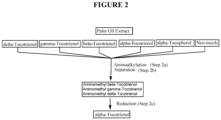
- Naturally produced alpha-tocotrienol and optional alpha tocopherol are separated from the beta, gamma, and delta-tocotrienol homologues of alpha-tocotrienol, by reacting the mixture of tocotrienols and optional alpha tocopherol with an appropriate reagent or reagents to introduce a functional group at the free 5 and/or 7 positions of the non-alpha-tocotrienols.
- the starting material can be amino-alkylated to introduce amino-alkylated groups on the beta, gamma, and delta-tocotrienols.
- any alpha-tocotrienol present in the mixture will not be amino-alkylated.
- the amino-alkylated groups will allow the separation of the amino-alkylated beta, gamma, and delta-tocotrienols from alpha-tocotrienol, alpha tocopherol and other non-tocol phytonutrients that may be present. The separation will be accomplished by partitioning between different organic solvents.
- Any non-polar organic solvents such as hexanes, heptanes, pentanes, petroleum ether, or mixtures thereof, can be used to take up the alpha tocopherol, alpha-tocotrienol and other phytonutrients or hydrocarbon impurities.
- the amino-alkylated products optionally having been converted to an acid salt, can be partitioned in an acidic organic layer such as acetonitrile comprising formic acid. In another embodiment of the invention, the partitioning can be performed between an organic layer and an aqueous layer.
- the products from the amino-alkylation can be removed by first permethylating to the tetra alkyl ammonium salt, followed by reductive deamination under basic conditions (see for example Maeda, Y. et al., JOC (1994) 59, 7897-7901 ; and Tayama, E. et al, Chem Letters (2006) 35, 478-479 ).
- reducing agent is contemplated hydrides such as lithium aluminum hydride, sodium borohydride, and sodium cyano borohydride, borane complexes and electron donors such as sodium, lithium, magnesium, potassium, zinc, nickel, or amalgams thereof in the presence of a suitable proton source such as ammonium salts or carboxylic acids.
- impurities consisting of tocols or tocol derivatives in the final product refers to beta-tocotrienol, gamma-tocotrienol, delta-tocotrienol, alpha-tocopherol, beta-tocopherol, gamma-tocopherol, or delta-tocopherol.
- Reference to "impurities" in the final product, without further specification, can refer to beta-tocotrienol, gamma-tocotrienol, delta-tocotrienol, alpha-tocopherol, beta-tocopherol, gamma-tocopherol, delta-tocopherol, and/or other non-tocol impurities.
- solvents which can be readily removed by evaporation are not considered as impurities when determining the percentage of impurities present.
- the quinone (cyclohexadienedione) form and dihydroquinone (benzenediol) form of the compounds disclosed herein are readily interconverted with appropriate reagents.
- the quinone can be treated in a biphasic mixture of an ethereal solvent with a basic aqueous solution of Na 2 S 2 O 4 ( Vogel, A.I. et al. Vogel's Textbook of Practical Organic Chemistry, 5th Edition, Prentice Hall: New York, 1996; Section 9.6.14 Quinones, "Reduction to the Hydroquinone "). Standard workup in the absence of oxygen yields the desired hydroquinone.
- the hydroquinone form can be oxidized to the quinone form with oxidizing agents such as ceric ammonium nitrate (CAN) or ferric chloride.
- oxidizing agents such as ceric ammonium nitrate (CAN) or ferric chloride.
- CAN ceric ammonium nitrate
- ferric chloride ferric chloride
- the oxidation can be carried out under buffered conditions. This can be accomplished by including sodium carbonate, sodium hydrogen carbonate, other carbonates such as potassium carbonate or potassium hydrogen carbonate, phosphate buffers, other buffers, or mixtures of any two or more of the foregoing buffers in any proportion, during the oxidation. Removal of acid during oxidation reduces isomerization of the double bonds in the triene moiety of the tocotrienol and tocotrienol quinone.
- Buffered conditions can also be maintained during workup of the alpha-tocotrienol quinone, for example, by mixing a percentage of a solid buffer such as sodium hydrogen carbonate with silica gel prior to placing the alpha-tocotrienol on the silica gel for elution.
- a solid buffer such as sodium hydrogen carbonate
- silica gel When silica gel is used in the workup, the grade of silica gel used can be that used for standard preparative flash chromatography. For example, silica gel of about 60 ⁇ pore size with a particle distribution of about 40 to 63 microns can be used. It can be used as is from the supplier, without further activation, or can be activated by heating in air or an oxygen-containing atmosphere.
- R 1 ,R 2 H or 4-Me-Piperazine
- R 1 ,R 2 H or 4-Me-Piperazine
- Tocomin TM -50 (1.0 wt,) was added paraformaldehyde (0.08 wt, 95%) and 1-Methylpiperazine (0.3 vol). The suspension was stirred at room temperature for 30 min, and then at 75°C for 2 to 3 h. The solution was heated at 125°C and monitored for conversion of starting material components to product components. The mixture was cooled to 30 to 40°C, diluted with acetonitrile (3.5 mL/g) and heptane (3.5 mL/g), and then cooled to 5°C, and treated dropwise with formic acid (1.0 vol). The bottom acetonitrile layer was separated and extracted with heptane (2 x 3.5 mL/g).
- the acetonitrile layer was diluted with tert -butyl methyl ether (3 mL/g) and cooled to 0°C. 45% w/w aqueous tribasic potassium phosphate solution (7 mL/g) was added dropwise (exothermic) so as to keep the temperature below 20°C.
- the organic layer was separated at room temperature, washed with saturated aqueous sodium chloride solution (23.1% w/w; 3 mL/g), and solvents were removed by distillation at up to 50°C under vacuum.
- To the concentrated solution was added toluene (5 mL/g). Solvent (5 mL/g) was removed by distillation at up to 50°C under vacuum.
- Step 1 To the residue prepared in Step 1 was added toluene (8 vol). A solvent exchange to a solution in 3-methylbutanol (3.0 vol) was then prepared by distillation at up to 50°C under vacuum, with additions of 3-methylbutanol.
- the mixture was cooled to 50°C, diluted with heptane (5 vol), then cooled to 0°C, and treated with 45% w/w aqueous tribasic potassium phosphate solution (5.0 vol) (exothermic, gas evolution) so as to maintain a temperature below 25°C.
- the two-phase mixture was stirred at room temperature for 2 h, the organic layer was separated, washed with 45% w/w aqueous tribasic potassium phosphate solution (3 vol), and concentrated by distillation at up to 50°C under vacuum. To the residue was added toluene (7 vol). The resulting solution was added to a mixture of silica gel (2 wt) and toluene (5.5vol) with an additional rinse of toluene (2 vol).
- the silica gel suspension was stirred at room temperature for 1 h.
- the silica gel was removed by filtration and washed with toluene (2 x 5 vol).
- the combined filtrates were concentrated by distillation at up to 50°C under vacuum.
- the residue solution was cooled to 30°C and transferred to a rotoevaporator with toluene (2 x 1.4 vol) and further evaporated to dryness by distillation at up to 60°C under vacuum to give alpha-tocotrienol.
- Step 3 all relative weight (wt) and volume (mL/g) equivalents in Step 3 are with respect to the mass of this stage's starting material, the product of Step 2-alpha-tocotrienol.
- Step 2 The residue of Step 2 was dissolved in isopropyl acetate (10 vol), water (0.5 vol) was added, and the mixture was cooled to 0°C.
- the buffered cerium (IV) ammonium nitrate solution was added over 30 min to the prepared mixture of alpha-tocotrienol from step 2 in isopropylacetate and water while maintaining the temperature at 0°C.
- the mixture was stirred at 0°C and monitored for conversion of starting material components to product components.
- the organic layer was separated and treated for 2 h with a slurry of solid sodium hydrogen carbonate (2 wt) and solid sodium sulfate (2 wt) in isopropylacetate (5 vol).
- the suspension was filtered, the solids washed with isopropylacetate (1.5 vol), and the combined filtrates treated with sodium hydrogen carbonate (2 x 0.05 wt).
- the suspension was concentrated to a maximum extent while maintaining an agitable mixture by distillation at up to 45°C under vacuum.
- the residue was cooled to 30°C and diluted with n-heptane (10 vol).
- a chromatography column of silica gel (5 wt) and sodium hydrogen carbonate (0.05 wt) was prepared from a slurry in n-heptane.
- the mixture was eluted on the chromatography column and further eluted with mixtures of n-heptane/isopropylacetate in relative volume-ratios of 100:5 and then 100:10.
- Fractions were collected, treated with solid sodium hydrogen carbonate (ca. 0.1 to 1g/L eluent), and analyzed for product content and purity. Acceptable fractions were combined, treated with additional solid sodium hydrogen carbonate (0.05 wt), and concentrated to a maximum extent while maintaining an agitable mixture by distillation of solvent at up to 45°C under vacuum. Isopropylacetate (1 to 3 vol) was added and the mixture passed through a 0.45 to 1 um filter.
Landscapes
- Chemical & Material Sciences (AREA)
- Organic Chemistry (AREA)
- Pyrane Compounds (AREA)
- Organic Low-Molecular-Weight Compounds And Preparation Thereof (AREA)
- Pharmaceuticals Containing Other Organic And Inorganic Compounds (AREA)
Applications Claiming Priority (4)
| Application Number | Priority Date | Filing Date | Title |
|---|---|---|---|
| US19758508P | 2008-10-28 | 2008-10-28 | |
| PCT/US2009/062212 WO2010051277A1 (en) | 2008-10-28 | 2009-10-27 | Process for the production of alpha-tocotrienol and derivatives |
| EP15175938.8A EP2963006B1 (en) | 2008-10-28 | 2009-10-27 | Composition containing alpha-tocotrienol quinone,and intermediates thereof |
| EP09824070.8A EP2362875B1 (en) | 2008-10-28 | 2009-10-27 | Process for the production of alpha-tocotrienol and derivatives |
Related Parent Applications (2)
| Application Number | Title | Priority Date | Filing Date |
|---|---|---|---|
| EP09824070.8A Division EP2362875B1 (en) | 2008-10-28 | 2009-10-27 | Process for the production of alpha-tocotrienol and derivatives |
| EP15175938.8A Division EP2963006B1 (en) | 2008-10-28 | 2009-10-27 | Composition containing alpha-tocotrienol quinone,and intermediates thereof |
Publications (2)
| Publication Number | Publication Date |
|---|---|
| EP3450431A1 EP3450431A1 (en) | 2019-03-06 |
| EP3450431B1 true EP3450431B1 (en) | 2023-09-13 |
Family
ID=42118126
Family Applications (3)
| Application Number | Title | Priority Date | Filing Date |
|---|---|---|---|
| EP18200523.1A Active EP3450431B1 (en) | 2008-10-28 | 2009-10-27 | Process for the production of alpha-tocotrienol and derivatives |
| EP15175938.8A Active EP2963006B1 (en) | 2008-10-28 | 2009-10-27 | Composition containing alpha-tocotrienol quinone,and intermediates thereof |
| EP09824070.8A Active EP2362875B1 (en) | 2008-10-28 | 2009-10-27 | Process for the production of alpha-tocotrienol and derivatives |
Family Applications After (2)
| Application Number | Title | Priority Date | Filing Date |
|---|---|---|---|
| EP15175938.8A Active EP2963006B1 (en) | 2008-10-28 | 2009-10-27 | Composition containing alpha-tocotrienol quinone,and intermediates thereof |
| EP09824070.8A Active EP2362875B1 (en) | 2008-10-28 | 2009-10-27 | Process for the production of alpha-tocotrienol and derivatives |
Country Status (17)
| Country | Link |
|---|---|
| US (6) | US8106223B2 (enExample) |
| EP (3) | EP3450431B1 (enExample) |
| JP (7) | JP5775459B2 (enExample) |
| CN (2) | CN105753829B (enExample) |
| BR (1) | BRPI0920414B1 (enExample) |
| CA (2) | CA2741767C (enExample) |
| DK (2) | DK2362875T3 (enExample) |
| EA (2) | EA026417B1 (enExample) |
| ES (2) | ES2553557T3 (enExample) |
| HU (1) | HUE041714T2 (enExample) |
| MX (1) | MX2011004440A (enExample) |
| MY (2) | MY185183A (enExample) |
| PL (2) | PL2963006T3 (enExample) |
| PT (2) | PT2362875E (enExample) |
| SI (1) | SI2963006T1 (enExample) |
| TR (1) | TR201819154T4 (enExample) |
| WO (1) | WO2010051277A1 (enExample) |
Families Citing this family (36)
| Publication number | Priority date | Publication date | Assignee | Title |
|---|---|---|---|---|
| US20050065099A1 (en) | 2003-09-19 | 2005-03-24 | Gail Walkinshaw | Treatment of mitochondrial diseases |
| WO2006130775A2 (en) * | 2005-06-01 | 2006-12-07 | Edison Pharmaceuticals, Inc. | Redox-active therapeutics for treatment of mitochondrial diseases and other conditions and modulation of energy biomakers |
| CA2635280C (en) | 2006-02-22 | 2017-12-12 | Edison Pharmaceuticals, Inc. | Side chain variants of redox-active therapeutics for treatment of mitochondrial diseases and other conditions and modulation of energy biomarkers |
| ES2564179T3 (es) | 2007-11-06 | 2016-03-18 | Edison Pharmaceuticals, Inc. | Derivados de 4-(p-quinonil)-2-hidroxibutanamida para tratamiento de enfermedades mitocondriales |
| CA2708961C (en) | 2008-01-08 | 2017-03-28 | Edison Pharmaceuticals, Inc. | (het)aryl-p-quinone derivatives for treatment of mitochondrial diseases |
| CA2717734A1 (en) | 2008-03-05 | 2009-09-11 | Edison Pharmaceuticals, Inc | 2-substituted-p-quinone derivatives for treatment of oxidative stress diseases |
| EP2303824B1 (en) * | 2008-06-25 | 2015-03-25 | Edison Pharmaceuticals, Inc. | 2-heterocyclylaminoalkyl-(p-quinone) derivatives for treatment of oxidative stress diseases |
| MX363223B (es) | 2008-09-10 | 2019-03-15 | Bioelectron Tech Corp | Tratamiento de trastornos generalizados del desarrollo con terapeuticos con actividad redox. |
| WO2010045220A1 (en) | 2008-10-14 | 2010-04-22 | Edison Pharmaceuticals, Inc. | Treatment of oxidative stress disorders including contrast nephropathy, radiation damage and disruptions in the function of red cells |
| BRPI0920414B1 (pt) * | 2008-10-28 | 2018-05-22 | Bioelectron Technology Corporation | Processo para a produção, o enriquecimento e/ou o isolamento do alfa-tocotrienol a partir de um material de planta que compreende alfa- tocotrienol e pelo menos um não-alfa tocotrienol |
| US20100273894A1 (en) | 2009-04-28 | 2010-10-28 | Miller Guy M | Treatment of leber's hereditary optic neuropathy and dominant optic atrophy with tocotrienol quinones |
| CA2772294C (en) | 2009-08-26 | 2018-08-21 | Guy M. Miller | Methods for the prevention and treatment of cerebral ischemia |
| WO2012154613A1 (en) * | 2011-05-06 | 2012-11-15 | Edison Pharmaceuticals, Inc. | Improved process for the preparation of d-alpha-tocotrienol from natural extracts |
| EP2720689A4 (en) | 2011-06-14 | 2014-11-26 | Edison Pharmaceuticals Inc | CATECHOL DERIVATIVES FOR THE TREATMENT OF DISEASES ASSOCIATED WITH OXIDATIVE STRESS |
| US9162957B2 (en) * | 2011-07-19 | 2015-10-20 | Edison Pharmaceuticals, Inc. | Methods for oxidation of alpha tocotrienol in the presence of non-alpha tocotrienols |
| MY162508A (en) * | 2011-07-21 | 2017-06-15 | Sime Darby Malaysia Berhad | External preparation for skin |
| US20150216820A1 (en) | 2012-09-07 | 2015-08-06 | Edison Pharmaceuticals, Inc. | Quinone derivatives for use in the modulation of redox status of individuals |
| US8937191B2 (en) | 2012-12-20 | 2015-01-20 | Orochem Technologies, Inc. | Recovery of highly pure alpha-tocotrienol from crude palm oil extract |
| JP2016515526A (ja) | 2013-03-15 | 2016-05-30 | エジソン ファーマシューティカルズ, インコーポレイテッド | 酸化ストレス障害の処置のためのアルキル−ヘテロアリール置換されたキノン誘導体 |
| US9296712B2 (en) | 2013-03-15 | 2016-03-29 | Edison Pharmaceuticals, Inc. | Resorufin derivatives for treatment of oxidative stress disorders |
| US9868711B2 (en) | 2013-03-15 | 2018-01-16 | Bioelectron Technology Corporation | Phenazine-3-one and phenothiazine-3-one derivatives for treatment of oxidative stress disorders |
| US9670170B2 (en) | 2013-03-15 | 2017-06-06 | Bioelectron Technology Corporation | Resorufin derivatives for treatment of oxidative stress disorders |
| EP3074460A1 (en) * | 2013-11-29 | 2016-10-05 | Saudi Basic Industries Corporation | Stabilised polyolefin composition |
| US9512098B1 (en) | 2014-02-03 | 2016-12-06 | Board Of Trustees Of The University Of Arkansas | Process of producing purified gamma- and delta-tocotrienols from tocol-rich oils or distillates |
| CN104262315A (zh) * | 2014-09-05 | 2015-01-07 | 宁波大红鹰生物工程股份有限公司 | 一种生育三烯酚的分离提纯方法 |
| RU2770091C2 (ru) | 2014-12-16 | 2022-04-14 | ПиТиСи ТЕРАПЬЮТИКС, ИНК. | Полиморфные и аморфные формы (r)-2-гидрокси-2-метил-4-(2,4,5-триметил-3,6-диоксоциклогекса-1,4-диенил)бутанамида |
| JP2018502127A (ja) | 2015-01-12 | 2018-01-25 | バイオエレクトロン テクノロジー コーポレイション | 放射線被曝に対する防護のためのキノン |
| EP3390377A1 (en) | 2015-12-16 | 2018-10-24 | BioElectron Technology Corporation | Improved methods for enriching alpha-tocotrienol from mixed tocol compositions |
| JP6905527B2 (ja) | 2015-12-17 | 2021-07-21 | ピーティーシー セラピューティクス, インコーポレイテッド | 酸化ストレス障害を処置するためのフルオロアルキル、フルオロアルコキシ、フェノキシ、ヘテロアリールオキシ、アルコキシ、およびアミノ1,4−ベンゾキノン誘導体 |
| US20190029975A1 (en) | 2016-01-12 | 2019-01-31 | Bioelectron Technology Corporation | Tocopherol and tocotrienol quinone derivatives for increasing thiosulfate levels or decreasing hydrogen sulfide levels |
| JP2018083799A (ja) | 2016-11-15 | 2018-05-31 | バイオエレクトロン テクノロジー コーポレイション | 2−置換アミノ−ナフト[1,2−d]イミダゾール−5−オン化合物またはその製薬学上許容される塩 |
| US20200121618A1 (en) | 2017-04-14 | 2020-04-23 | Bioelectron Technology Corporation | Methods and compositions for treatment of inflammation and oxidative stress |
| SG11202103887VA (en) | 2018-10-17 | 2021-05-28 | Ptc Therapeutics Inc | 2,3,5-TRIMETHYL-6-NONYLCYCLOHEXA-2,5-DIENE-1,4-DIONE FOR SUPPRESSING AND TREATING a-SYNUCLEINOPATHIES, TAUOPATHIES, AND OTHER DISORDERS |
| WO2021067836A1 (en) | 2019-10-04 | 2021-04-08 | Stealth Biotherapeutics Corp | Chinone-, hydrochinome- and naphthochinone-analogues of vatiquione for treatment of mitochondrial disorder diseases |
| AU2021246142A1 (en) | 2020-04-03 | 2022-10-20 | Stealth Biotherapeutics Inc. | Compositions and methods for the prevention and/or treatment of mitochondrial disease, including Friedreich's ataxia |
| JP2024525232A (ja) | 2021-07-08 | 2024-07-10 | ピーティーシー セラピューティクス、インコーポレイテッド | 2,3,5-トリメチル-6-ノニルシクロヘキサ-2,5-ジエン-1,4-ジオンを含む医薬組成物 |
Family Cites Families (94)
| Publication number | Priority date | Publication date | Assignee | Title |
|---|---|---|---|---|
| US2519863A (en) * | 1949-05-14 | 1950-08-22 | Eastman Kodak Co | Conversion of beta-, gamma-, and delta-tocopherol to alpha-tocopherol by aminoalkylation and reduction |
| US4977282A (en) * | 1984-04-17 | 1990-12-11 | Henkel Corporation | Production of d-alpha-tocopherol from natural plant sources |
| EP0159018A3 (en) * | 1984-04-17 | 1986-10-01 | HENKEL CORPORATION (a Delaware corp.) | Production of d-alpha-tocopherol from natural plant sources |
| US4603142A (en) | 1984-06-01 | 1986-07-29 | Wisconsin Alumni Research Foundation | Cholesterol lowering method of use |
| JPS636186A (ja) | 1986-06-23 | 1988-01-12 | タツタ電線株式会社 | 点滴監視装置 |
| JPH0788376B2 (ja) | 1986-09-02 | 1995-09-27 | エーザイ株式会社 | 光学活性α−トコトリエノ−ルの製造方法 |
| JP2685785B2 (ja) | 1988-03-11 | 1997-12-03 | エーザイ株式会社 | 光学活性α−トコトリエノールの製造方法 |
| AU618791B2 (en) | 1988-03-16 | 1992-01-09 | Bioindustry Development Centre | Production of high concentration tocopherols and tocotrienols from palm oil by-product |
| US5157132A (en) | 1990-05-18 | 1992-10-20 | Carotech Associates | Integrated process for recovery of carotenoids and tocotrienols from oil |
| EP0543417A1 (en) | 1991-11-22 | 1993-05-26 | Lipogenics, Incorporated | Tocotrienols and tocotrienol-like compounds and methods for their use |
| ES2148616T3 (es) * | 1995-03-28 | 2000-10-16 | Hoffmann La Roche | Aminometilacion de los tocoferoles. |
| US5660691A (en) * | 1995-11-13 | 1997-08-26 | Eastman Chemical Company | Process for the production of tocotrienol/tocopherol blend concentrates |
| US6232060B1 (en) | 1996-01-19 | 2001-05-15 | Galileo Laboratories, Inc. | Assay system for anti-stress agents |
| US5801159A (en) | 1996-02-23 | 1998-09-01 | Galileo Laboratories, Inc. | Method and composition for inhibiting cellular irreversible changes due to stress |
| US5932748A (en) * | 1997-06-06 | 1999-08-03 | Roche Vitamins Inc. | Process for permethylating non-α-tocopherols to produce α-tocopherol |
| CN1137077C (zh) * | 1997-10-29 | 2004-02-04 | 弗莱克斯塞思美国有限合伙公司 | 使用过氧化氢和催化剂由苯二胺制备醌二亚胺的方法 |
| EP1051411B1 (en) | 1998-01-29 | 2002-08-28 | Eastman Chemical Company | Methods for separating a tocol from a tocol-containing mixture |
| KR20010033917A (ko) * | 1998-11-06 | 2001-04-25 | 니시다 야스마사 | 토코트리엔올류 함유 분말, 이의 제조방법 및 이를 압축성형하여 제조한 정제 |
| US6395915B1 (en) | 1999-09-10 | 2002-05-28 | Technikrom, Inc. | Method for producing purified tocotrienols and tocopherols using liquid chromatography |
| MY127451A (en) | 1999-11-04 | 2006-12-29 | Malaysian Palm Oil Board | A method of chromatographic isolation for vitamin e isomers |
| DE10034233A1 (de) * | 2000-07-14 | 2002-01-24 | Basf Ag | Tocotrienolchinon-Cyclisierungsprodukte |
| US7034054B2 (en) | 2000-12-15 | 2006-04-25 | Galileo Pharmaceuticals, Inc. | Methods for the prevention and treatment of cerebral ischemia using non-alpha tocopherols |
| US6838104B2 (en) | 2000-12-20 | 2005-01-04 | Archer Daniels Midland Company | Process for the production of tocotrienols |
| US6608196B2 (en) | 2001-05-03 | 2003-08-19 | Galileo Pharmaceuticals, Inc. | Process for solid supported synthesis of pyruvate-derived compounds |
| JP4842455B2 (ja) | 2001-06-13 | 2011-12-21 | コマツNtc株式会社 | 半導体単結晶引上げ装置及びそのライン構成 |
| JP2003171376A (ja) | 2001-09-27 | 2003-06-20 | Lion Corp | トコフェロール類及びトコトリエノール類濃縮物、その製造方法 |
| US6667330B2 (en) | 2002-01-31 | 2003-12-23 | Galileo Pharmaceuticals, Inc. | Furanone derivatives |
| US6653346B1 (en) | 2002-02-07 | 2003-11-25 | Galileo Pharmaceuticals, Inc. | Cytoprotective benzofuran derivatives |
| US6590113B1 (en) * | 2002-03-26 | 2003-07-08 | Ronald T. Sleeter | Process for treating oils containing antioxidant compounds |
| AU2003287250B9 (en) | 2002-10-30 | 2010-01-28 | Ptc Therapeutics, Inc. | Identifying therapeutic compounds based on their physical-chemical properties |
| MY130618A (en) * | 2002-11-27 | 2007-07-31 | Malaysian Palm Oil Board | A method of extracting and isolating minor components from vegetable oil |
| US20050065099A1 (en) | 2003-09-19 | 2005-03-24 | Gail Walkinshaw | Treatment of mitochondrial diseases |
| WO2005035490A2 (en) | 2003-10-10 | 2005-04-21 | Yasoo Health, Inc. | PROCESS FOR SYNTHESIZING d-TOCOTRIENOLS |
| MY173044A (en) * | 2003-11-19 | 2019-12-20 | Carotech Bhd | Recovery of phytonutriens from oils |
| US7393662B2 (en) | 2004-09-03 | 2008-07-01 | Centocor, Inc. | Human EPO mimetic hinge core mimetibodies, compositions, methods and uses |
| WO2006130775A2 (en) * | 2005-06-01 | 2006-12-07 | Edison Pharmaceuticals, Inc. | Redox-active therapeutics for treatment of mitochondrial diseases and other conditions and modulation of energy biomakers |
| US7432305B2 (en) | 2005-09-15 | 2008-10-07 | Edison Pharmaceuticals, Inc. | Tail variants of redox-active therapeutics for treatment of mitochondrial diseases and other conditions and modulation of energy biomarkers |
| CA2635280C (en) | 2006-02-22 | 2017-12-12 | Edison Pharmaceuticals, Inc. | Side chain variants of redox-active therapeutics for treatment of mitochondrial diseases and other conditions and modulation of energy biomarkers |
| WO2007105297A1 (ja) * | 2006-03-13 | 2007-09-20 | Kabushiki Kaisha Hayashibara Seibutsu Kagaku Kenkyujo | メチン系色素とその用途 |
| EP2101808A4 (en) | 2007-01-10 | 2011-11-30 | Edison Pharmaceuticals Inc | TREATMENT OF BREATHLY TROUBLES USING COMPOUNDS OF ERYTHROPOIETIN OR THROMBOPOIETIN ACTIVITY |
| US8673967B2 (en) | 2007-05-24 | 2014-03-18 | Loders Croklaan B.V. | Process |
| ES2564179T3 (es) | 2007-11-06 | 2016-03-18 | Edison Pharmaceuticals, Inc. | Derivados de 4-(p-quinonil)-2-hidroxibutanamida para tratamiento de enfermedades mitocondriales |
| MX2010007443A (es) | 2008-01-07 | 2010-08-16 | Centocor Ortho Biotech Inc | Metodo para tratar anemias de respuesta baja a eritropoyetina. |
| CA2708961C (en) | 2008-01-08 | 2017-03-28 | Edison Pharmaceuticals, Inc. | (het)aryl-p-quinone derivatives for treatment of mitochondrial diseases |
| CA2717734A1 (en) | 2008-03-05 | 2009-09-11 | Edison Pharmaceuticals, Inc | 2-substituted-p-quinone derivatives for treatment of oxidative stress diseases |
| US20110046156A1 (en) | 2008-03-05 | 2011-02-24 | Miller Guy M | Treatment of hearing and balance impairments with redox-active therapeutics |
| US20110142834A1 (en) | 2008-05-15 | 2011-06-16 | Edison Pharmaceuticals, Inc. | Treatment of hearing and balance impairments using compounds having erythropoietin activity |
| EP2303309A2 (en) | 2008-05-22 | 2011-04-06 | Edison Pharmaceuticals, Inc. | Treatment of mitochondrial diseases with an erythropoietin mimetic |
| EP2303824B1 (en) | 2008-06-25 | 2015-03-25 | Edison Pharmaceuticals, Inc. | 2-heterocyclylaminoalkyl-(p-quinone) derivatives for treatment of oxidative stress diseases |
| WO2010005989A1 (en) | 2008-07-09 | 2010-01-14 | Edison Pharmaceuticals, Inc. | Dermatological compositions with anti-aging and skin even-toning properties |
| WO2010014361A1 (en) | 2008-07-30 | 2010-02-04 | Edison Pharmaceuticals, Inc. | Naphthoquinone compositions with anti-aging, anti- inflammatory and skin even-toning properties |
| US20100029706A1 (en) | 2008-07-30 | 2010-02-04 | Edison Parmaceuticals, Inc. a Delaware Corporation | HYDROGENATED PYRIDO[4,3-b]INDOLES FOR THE TREATMENT OF OXIDATIVE STRESS |
| MX363223B (es) * | 2008-09-10 | 2019-03-15 | Bioelectron Tech Corp | Tratamiento de trastornos generalizados del desarrollo con terapeuticos con actividad redox. |
| WO2010045220A1 (en) | 2008-10-14 | 2010-04-22 | Edison Pharmaceuticals, Inc. | Treatment of oxidative stress disorders including contrast nephropathy, radiation damage and disruptions in the function of red cells |
| BRPI0920414B1 (pt) * | 2008-10-28 | 2018-05-22 | Bioelectron Technology Corporation | Processo para a produção, o enriquecimento e/ou o isolamento do alfa-tocotrienol a partir de um material de planta que compreende alfa- tocotrienol e pelo menos um não-alfa tocotrienol |
| CA2760357A1 (en) | 2009-04-28 | 2010-11-04 | Ampere Life Sciences, Inc. | Topical, periocular, or intraocular use of tocotrienols for the treatment of ophthalmic diseases |
| US20100273894A1 (en) | 2009-04-28 | 2010-10-28 | Miller Guy M | Treatment of leber's hereditary optic neuropathy and dominant optic atrophy with tocotrienol quinones |
| CA2759984A1 (en) | 2009-04-28 | 2010-11-04 | Edison Pharmaceuticals, Inc. | Formulation of tocotrienol quinones for the treatment of ophthalmic diseases |
| MX2011013558A (es) | 2009-06-25 | 2012-04-30 | Ampere Life Sciences Inc | Tratamiento del trastorno pervasivo del desarrollo con tocotrienoles o extractos de tocotrienoles enriquecidos. |
| CA2772294C (en) | 2009-08-26 | 2018-08-21 | Guy M. Miller | Methods for the prevention and treatment of cerebral ischemia |
| US20110172312A1 (en) | 2009-12-31 | 2011-07-14 | Miller Guy M | Treatment of leigh syndrome and leigh-like syndrome with tocotrienol quinones |
| CA2792520A1 (en) | 2010-03-09 | 2011-09-15 | Edison Pharmaceuticals, Inc. | Synthesis of alpha-tocopherolquinone derivatives, and methods of using the same |
| WO2011113018A1 (en) | 2010-03-12 | 2011-09-15 | Ampere Life Sciences, Inc. | Measurement and control of biological time |
| EP2555765A4 (en) | 2010-04-06 | 2013-08-14 | Edison Pharmaceuticals Inc | TREATMENT OF ATAXIE TÉLANGIECTASIE |
| US20130109759A1 (en) | 2010-04-27 | 2013-05-02 | Edison Pharmaceuticals, Inc. | Formulations of quinones for the treatment of ophthalmic diseases |
| US20120101169A1 (en) | 2010-07-14 | 2012-04-26 | Penwest Pharmaceuticals Co. | Methods of providing anticoagulation effects in subjects |
| EA201300215A1 (ru) | 2010-08-06 | 2013-07-30 | Эдисон Фармасьютикалз, Инк. | Лечение митохондриальных болезней нафтохинонами |
| WO2012068552A1 (en) | 2010-11-19 | 2012-05-24 | Edison Pharmaceuticals, Inc. | Methods for improving blood glucose control |
| WO2012154613A1 (en) | 2011-05-06 | 2012-11-15 | Edison Pharmaceuticals, Inc. | Improved process for the preparation of d-alpha-tocotrienol from natural extracts |
| WO2012170773A1 (en) | 2011-06-08 | 2012-12-13 | Edison Pharmaceuticals, Inc. | Adjunctive therapy for the treatment of mitochondrial disorders with quinones and naphthoquinones |
| EP2720689A4 (en) | 2011-06-14 | 2014-11-26 | Edison Pharmaceuticals Inc | CATECHOL DERIVATIVES FOR THE TREATMENT OF DISEASES ASSOCIATED WITH OXIDATIVE STRESS |
| WO2013006737A1 (en) | 2011-07-06 | 2013-01-10 | Edison Pharmaceuticals, Inc. | Treatment of methylmalonic aciduria, isovaleric aciduria, and other organic acidurias with tocotrienol quinones |
| WO2013006736A1 (en) | 2011-07-06 | 2013-01-10 | Edison Pharmaceuticals, Inc | Treatment of leigh syndrome and leigh-like syndrome, including complications of sucla2 mutations, with tocotrienol quinones |
| US9162957B2 (en) | 2011-07-19 | 2015-10-20 | Edison Pharmaceuticals, Inc. | Methods for oxidation of alpha tocotrienol in the presence of non-alpha tocotrienols |
| US20150216820A1 (en) | 2012-09-07 | 2015-08-06 | Edison Pharmaceuticals, Inc. | Quinone derivatives for use in the modulation of redox status of individuals |
| US8937191B2 (en) | 2012-12-20 | 2015-01-20 | Orochem Technologies, Inc. | Recovery of highly pure alpha-tocotrienol from crude palm oil extract |
| CN105142603B (zh) | 2013-03-08 | 2018-10-19 | 荷兰联合利华有限公司 | 用于皮肤病用途的间苯二酚化合物 |
| US9868711B2 (en) | 2013-03-15 | 2018-01-16 | Bioelectron Technology Corporation | Phenazine-3-one and phenothiazine-3-one derivatives for treatment of oxidative stress disorders |
| US9296712B2 (en) | 2013-03-15 | 2016-03-29 | Edison Pharmaceuticals, Inc. | Resorufin derivatives for treatment of oxidative stress disorders |
| JP2016515526A (ja) | 2013-03-15 | 2016-05-30 | エジソン ファーマシューティカルズ, インコーポレイテッド | 酸化ストレス障害の処置のためのアルキル−ヘテロアリール置換されたキノン誘導体 |
| US9670170B2 (en) | 2013-03-15 | 2017-06-06 | Bioelectron Technology Corporation | Resorufin derivatives for treatment of oxidative stress disorders |
| US20140275045A1 (en) | 2013-03-15 | 2014-09-18 | Edison Pharmaceuticals, Inc. | Phenazine-3-one and phenothiazine-3-one derivatives for treatment of oxidative stress disorders |
| EP3004071A1 (en) | 2013-05-31 | 2016-04-13 | Edison Pharmaceuticals, Inc. | Carboxylic acid derivatives for treatment of oxidative stress disorders |
| RU2770091C2 (ru) | 2014-12-16 | 2022-04-14 | ПиТиСи ТЕРАПЬЮТИКС, ИНК. | Полиморфные и аморфные формы (r)-2-гидрокси-2-метил-4-(2,4,5-триметил-3,6-диоксоциклогекса-1,4-диенил)бутанамида |
| JP2018500317A (ja) | 2014-12-16 | 2018-01-11 | バイオエレクトロン テクノロジー コーポレイション | トロロックスのキラル分割のための方法 |
| JP2018502127A (ja) | 2015-01-12 | 2018-01-25 | バイオエレクトロン テクノロジー コーポレイション | 放射線被曝に対する防護のためのキノン |
| EP3390377A1 (en) | 2015-12-16 | 2018-10-24 | BioElectron Technology Corporation | Improved methods for enriching alpha-tocotrienol from mixed tocol compositions |
| JP6905527B2 (ja) | 2015-12-17 | 2021-07-21 | ピーティーシー セラピューティクス, インコーポレイテッド | 酸化ストレス障害を処置するためのフルオロアルキル、フルオロアルコキシ、フェノキシ、ヘテロアリールオキシ、アルコキシ、およびアミノ1,4−ベンゾキノン誘導体 |
| WO2017123823A1 (en) | 2016-01-12 | 2017-07-20 | Bioelectron Technology Corporation | Alkyl-, acyl-, urea-, and aza-uracil sulfide:quinone oxidoreductase inhibitors |
| US20190029975A1 (en) | 2016-01-12 | 2019-01-31 | Bioelectron Technology Corporation | Tocopherol and tocotrienol quinone derivatives for increasing thiosulfate levels or decreasing hydrogen sulfide levels |
| WO2018081644A1 (en) | 2016-10-28 | 2018-05-03 | Bioelectron Technology Corporation | Methods of analyzing p-hydroquinone levels and ratios |
| WO2018093957A1 (en) | 2016-11-15 | 2018-05-24 | Bioelectron Technology Corporation | 2-substituted amino-naphth[1,2-d]imidazol-5-one compounds or pharmaceutically acceptable salts thereof cross reference to related applications |
| WO2018129411A1 (en) | 2017-01-06 | 2018-07-12 | Bioelectron Technology Corporation | Aryl- and heteroaryl-resorufin derivatives for treatment of oxidative stress disorders and liver and kidney disorders |
| US20200121618A1 (en) | 2017-04-14 | 2020-04-23 | Bioelectron Technology Corporation | Methods and compositions for treatment of inflammation and oxidative stress |
-
2009
- 2009-10-27 BR BRPI0920414-8A patent/BRPI0920414B1/pt active IP Right Grant
- 2009-10-27 PL PL15175938T patent/PL2963006T3/pl unknown
- 2009-10-27 EA EA201100699A patent/EA026417B1/ru not_active IP Right Cessation
- 2009-10-27 ES ES09824070.8T patent/ES2553557T3/es active Active
- 2009-10-27 CA CA2741767A patent/CA2741767C/en active Active
- 2009-10-27 US US12/606,923 patent/US8106223B2/en active Active
- 2009-10-27 CN CN201610142967.2A patent/CN105753829B/zh active Active
- 2009-10-27 CN CN200980152635.0A patent/CN102264730B/zh active Active
- 2009-10-27 EP EP18200523.1A patent/EP3450431B1/en active Active
- 2009-10-27 EP EP15175938.8A patent/EP2963006B1/en active Active
- 2009-10-27 ES ES15175938T patent/ES2701260T3/es active Active
- 2009-10-27 MY MYPI2014003438A patent/MY185183A/en unknown
- 2009-10-27 PL PL09824070T patent/PL2362875T3/pl unknown
- 2009-10-27 PT PT98240708T patent/PT2362875E/pt unknown
- 2009-10-27 TR TR2018/19154T patent/TR201819154T4/tr unknown
- 2009-10-27 JP JP2011534678A patent/JP5775459B2/ja active Active
- 2009-10-27 CA CA2974482A patent/CA2974482C/en active Active
- 2009-10-27 DK DK09824070.8T patent/DK2362875T3/en active
- 2009-10-27 EA EA201692046A patent/EA201692046A1/ru unknown
- 2009-10-27 MY MYPI2011001873A patent/MY157119A/en unknown
- 2009-10-27 SI SI200931894T patent/SI2963006T1/sl unknown
- 2009-10-27 DK DK15175938.8T patent/DK2963006T3/en active
- 2009-10-27 EP EP09824070.8A patent/EP2362875B1/en active Active
- 2009-10-27 WO PCT/US2009/062212 patent/WO2010051277A1/en not_active Ceased
- 2009-10-27 PT PT15175938T patent/PT2963006T/pt unknown
- 2009-10-27 MX MX2011004440A patent/MX2011004440A/es active IP Right Grant
- 2009-10-27 HU HUE15175938A patent/HUE041714T2/hu unknown
-
2012
- 2012-01-25 US US13/358,451 patent/US8575369B2/en active Active
-
2013
- 2013-09-26 US US14/038,675 patent/US20140221674A1/en not_active Abandoned
-
2014
- 2014-09-02 JP JP2014177733A patent/JP6001025B2/ja active Active
-
2015
- 2015-07-14 JP JP2015140302A patent/JP2015187169A/ja not_active Withdrawn
-
2016
- 2016-03-11 US US15/068,452 patent/US10071978B2/en active Active
-
2018
- 2018-06-06 JP JP2018108448A patent/JP7181708B2/ja active Active
- 2018-09-10 US US16/127,102 patent/US11312697B2/en active Active
-
2019
- 2019-01-22 JP JP2019008496A patent/JP2019065041A/ja not_active Withdrawn
-
2021
- 2021-02-04 JP JP2021016310A patent/JP2021066745A/ja not_active Withdrawn
-
2022
- 2022-03-18 US US17/699,061 patent/US20220204469A1/en not_active Abandoned
-
2023
- 2023-03-31 JP JP2023057343A patent/JP2023073469A/ja not_active Withdrawn
Non-Patent Citations (1)
| Title |
|---|
| QURESHI A A ET AL: "ISOLATION AND IDENTIFICATION OF NOVEL TOCOTRIENOLS FROM RICE BRAN WITH HYPOCHOLESTEROLEMIC, ANTIOXIDANT, AND ANTITUMOR PROPERTIES", JOURNAL OF AGRICULTURAL AND FOOD CHEMISTRY, AMERICAN CHEMICAL SOCIETY, BOOKS AND JOURNALS DIVISION, US, vol. 48, no. 8, 1 January 2000 (2000-01-01), pages 3130 - 3140, XP009002497, ISSN: 0021-8561, DOI: 10.1021/JF000099T * |
Also Published As
Similar Documents
| Publication | Publication Date | Title |
|---|---|---|
| US20220204469A1 (en) | Process for the production of alpha-tocotrienol and derivatives | |
| WO2012154613A1 (en) | Improved process for the preparation of d-alpha-tocotrienol from natural extracts | |
| EP1828159B1 (en) | Asymmetric hydrogenation of alkenes using chiral iridium complexes | |
| HK1219718B (en) | Composition containing alpha-tocotrienol quinone,and intermediates thereof | |
| HK1161876B (en) | Process for the production of alpha-tocotrienol and derivatives | |
| EA040327B1 (ru) | Способ получения альфа-токотриенола и его производных |
Legal Events
| Date | Code | Title | Description |
|---|---|---|---|
| PUAI | Public reference made under article 153(3) epc to a published international application that has entered the european phase |
Free format text: ORIGINAL CODE: 0009012 |
|
| STAA | Information on the status of an ep patent application or granted ep patent |
Free format text: STATUS: THE APPLICATION HAS BEEN PUBLISHED |
|
| AC | Divisional application: reference to earlier application |
Ref document number: 2362875 Country of ref document: EP Kind code of ref document: P Ref document number: 2963006 Country of ref document: EP Kind code of ref document: P |
|
| AK | Designated contracting states |
Kind code of ref document: A1 Designated state(s): AT BE BG CH CY CZ DE DK EE ES FI FR GB GR HR HU IE IS IT LI LT LU LV MC MK MT NL NO PL PT RO SE SI SK SM TR |
|
| STAA | Information on the status of an ep patent application or granted ep patent |
Free format text: STATUS: REQUEST FOR EXAMINATION WAS MADE |
|
| 17P | Request for examination filed |
Effective date: 20191129 |
|
| RAP1 | Party data changed (applicant data changed or rights of an application transferred) |
Owner name: PTC THERAPEUTICS, INC. |
|
| RBV | Designated contracting states (corrected) |
Designated state(s): AT BE BG CH CY CZ DE DK EE ES FI FR GB GR HR HU IE IS IT LI LT LU LV MC MK MT NL NO PL PT RO SE SI SK SM TR |
|
| STAA | Information on the status of an ep patent application or granted ep patent |
Free format text: STATUS: EXAMINATION IS IN PROGRESS |
|
| 17Q | First examination report despatched |
Effective date: 20200702 |
|
| GRAP | Despatch of communication of intention to grant a patent |
Free format text: ORIGINAL CODE: EPIDOSNIGR1 |
|
| STAA | Information on the status of an ep patent application or granted ep patent |
Free format text: STATUS: GRANT OF PATENT IS INTENDED |
|
| INTG | Intention to grant announced |
Effective date: 20230504 |
|
| P01 | Opt-out of the competence of the unified patent court (upc) registered |
Effective date: 20230526 |
|
| GRAS | Grant fee paid |
Free format text: ORIGINAL CODE: EPIDOSNIGR3 |
|
| GRAA | (expected) grant |
Free format text: ORIGINAL CODE: 0009210 |
|
| STAA | Information on the status of an ep patent application or granted ep patent |
Free format text: STATUS: THE PATENT HAS BEEN GRANTED |
|
| AC | Divisional application: reference to earlier application |
Ref document number: 2362875 Country of ref document: EP Kind code of ref document: P Ref document number: 2963006 Country of ref document: EP Kind code of ref document: P |
|
| AK | Designated contracting states |
Kind code of ref document: B1 Designated state(s): AT BE BG CH CY CZ DE DK EE ES FI FR GB GR HR HU IE IS IT LI LT LU LV MC MK MT NL NO PL PT RO SE SI SK SM TR |
|
| REG | Reference to a national code |
Ref country code: GB Ref legal event code: FG4D |
|
| REG | Reference to a national code |
Ref country code: CH Ref legal event code: EP |
|
| REG | Reference to a national code |
Ref country code: DE Ref legal event code: R096 Ref document number: 602009065020 Country of ref document: DE |
|
| REG | Reference to a national code |
Ref country code: IE Ref legal event code: FG4D |
|
| REG | Reference to a national code |
Ref country code: LT Ref legal event code: MG9D |
|
| REG | Reference to a national code |
Ref country code: NL Ref legal event code: MP Effective date: 20230913 |
|
| PG25 | Lapsed in a contracting state [announced via postgrant information from national office to epo] |
Ref country code: GR Free format text: LAPSE BECAUSE OF FAILURE TO SUBMIT A TRANSLATION OF THE DESCRIPTION OR TO PAY THE FEE WITHIN THE PRESCRIBED TIME-LIMIT Effective date: 20231214 |
|
| PG25 | Lapsed in a contracting state [announced via postgrant information from national office to epo] |
Ref country code: SE Free format text: LAPSE BECAUSE OF FAILURE TO SUBMIT A TRANSLATION OF THE DESCRIPTION OR TO PAY THE FEE WITHIN THE PRESCRIBED TIME-LIMIT Effective date: 20230913 Ref country code: NO Free format text: LAPSE BECAUSE OF FAILURE TO SUBMIT A TRANSLATION OF THE DESCRIPTION OR TO PAY THE FEE WITHIN THE PRESCRIBED TIME-LIMIT Effective date: 20231213 Ref country code: LV Free format text: LAPSE BECAUSE OF FAILURE TO SUBMIT A TRANSLATION OF THE DESCRIPTION OR TO PAY THE FEE WITHIN THE PRESCRIBED TIME-LIMIT Effective date: 20230913 Ref country code: LT Free format text: LAPSE BECAUSE OF FAILURE TO SUBMIT A TRANSLATION OF THE DESCRIPTION OR TO PAY THE FEE WITHIN THE PRESCRIBED TIME-LIMIT Effective date: 20230913 Ref country code: HR Free format text: LAPSE BECAUSE OF FAILURE TO SUBMIT A TRANSLATION OF THE DESCRIPTION OR TO PAY THE FEE WITHIN THE PRESCRIBED TIME-LIMIT Effective date: 20230913 Ref country code: GR Free format text: LAPSE BECAUSE OF FAILURE TO SUBMIT A TRANSLATION OF THE DESCRIPTION OR TO PAY THE FEE WITHIN THE PRESCRIBED TIME-LIMIT Effective date: 20231214 Ref country code: FI Free format text: LAPSE BECAUSE OF FAILURE TO SUBMIT A TRANSLATION OF THE DESCRIPTION OR TO PAY THE FEE WITHIN THE PRESCRIBED TIME-LIMIT Effective date: 20230913 |
|
| REG | Reference to a national code |
Ref country code: AT Ref legal event code: MK05 Ref document number: 1611212 Country of ref document: AT Kind code of ref document: T Effective date: 20230913 |
|
| PG25 | Lapsed in a contracting state [announced via postgrant information from national office to epo] |
Ref country code: NL Free format text: LAPSE BECAUSE OF FAILURE TO SUBMIT A TRANSLATION OF THE DESCRIPTION OR TO PAY THE FEE WITHIN THE PRESCRIBED TIME-LIMIT Effective date: 20230913 |
|
| PG25 | Lapsed in a contracting state [announced via postgrant information from national office to epo] |
Ref country code: IS Free format text: LAPSE BECAUSE OF FAILURE TO SUBMIT A TRANSLATION OF THE DESCRIPTION OR TO PAY THE FEE WITHIN THE PRESCRIBED TIME-LIMIT Effective date: 20240113 |
|
| PG25 | Lapsed in a contracting state [announced via postgrant information from national office to epo] |
Ref country code: AT Free format text: LAPSE BECAUSE OF FAILURE TO SUBMIT A TRANSLATION OF THE DESCRIPTION OR TO PAY THE FEE WITHIN THE PRESCRIBED TIME-LIMIT Effective date: 20230913 |
|
| PG25 | Lapsed in a contracting state [announced via postgrant information from national office to epo] |
Ref country code: ES Free format text: LAPSE BECAUSE OF FAILURE TO SUBMIT A TRANSLATION OF THE DESCRIPTION OR TO PAY THE FEE WITHIN THE PRESCRIBED TIME-LIMIT Effective date: 20230913 |
|
| PG25 | Lapsed in a contracting state [announced via postgrant information from national office to epo] |
Ref country code: SM Free format text: LAPSE BECAUSE OF FAILURE TO SUBMIT A TRANSLATION OF THE DESCRIPTION OR TO PAY THE FEE WITHIN THE PRESCRIBED TIME-LIMIT Effective date: 20230913 Ref country code: RO Free format text: LAPSE BECAUSE OF FAILURE TO SUBMIT A TRANSLATION OF THE DESCRIPTION OR TO PAY THE FEE WITHIN THE PRESCRIBED TIME-LIMIT Effective date: 20230913 Ref country code: IS Free format text: LAPSE BECAUSE OF FAILURE TO SUBMIT A TRANSLATION OF THE DESCRIPTION OR TO PAY THE FEE WITHIN THE PRESCRIBED TIME-LIMIT Effective date: 20240113 Ref country code: ES Free format text: LAPSE BECAUSE OF FAILURE TO SUBMIT A TRANSLATION OF THE DESCRIPTION OR TO PAY THE FEE WITHIN THE PRESCRIBED TIME-LIMIT Effective date: 20230913 Ref country code: EE Free format text: LAPSE BECAUSE OF FAILURE TO SUBMIT A TRANSLATION OF THE DESCRIPTION OR TO PAY THE FEE WITHIN THE PRESCRIBED TIME-LIMIT Effective date: 20230913 Ref country code: CZ Free format text: LAPSE BECAUSE OF FAILURE TO SUBMIT A TRANSLATION OF THE DESCRIPTION OR TO PAY THE FEE WITHIN THE PRESCRIBED TIME-LIMIT Effective date: 20230913 Ref country code: AT Free format text: LAPSE BECAUSE OF FAILURE TO SUBMIT A TRANSLATION OF THE DESCRIPTION OR TO PAY THE FEE WITHIN THE PRESCRIBED TIME-LIMIT Effective date: 20230913 Ref country code: PT Free format text: LAPSE BECAUSE OF FAILURE TO SUBMIT A TRANSLATION OF THE DESCRIPTION OR TO PAY THE FEE WITHIN THE PRESCRIBED TIME-LIMIT Effective date: 20240115 Ref country code: SK Free format text: LAPSE BECAUSE OF FAILURE TO SUBMIT A TRANSLATION OF THE DESCRIPTION OR TO PAY THE FEE WITHIN THE PRESCRIBED TIME-LIMIT Effective date: 20230913 |
|
| PG25 | Lapsed in a contracting state [announced via postgrant information from national office to epo] |
Ref country code: PL Free format text: LAPSE BECAUSE OF FAILURE TO SUBMIT A TRANSLATION OF THE DESCRIPTION OR TO PAY THE FEE WITHIN THE PRESCRIBED TIME-LIMIT Effective date: 20230913 Ref country code: IT Free format text: LAPSE BECAUSE OF FAILURE TO SUBMIT A TRANSLATION OF THE DESCRIPTION OR TO PAY THE FEE WITHIN THE PRESCRIBED TIME-LIMIT Effective date: 20230913 |
|
| REG | Reference to a national code |
Ref country code: CH Ref legal event code: PL |
|
| RAP4 | Party data changed (patent owner data changed or rights of a patent transferred) |
Owner name: PTC THERAPEUTICS, INC. |
|
| REG | Reference to a national code |
Ref country code: DE Ref legal event code: R097 Ref document number: 602009065020 Country of ref document: DE |
|
| REG | Reference to a national code |
Ref country code: BE Ref legal event code: MM Effective date: 20231031 |
|
| PG25 | Lapsed in a contracting state [announced via postgrant information from national office to epo] |
Ref country code: LU Free format text: LAPSE BECAUSE OF NON-PAYMENT OF DUE FEES Effective date: 20231027 |
|
| PG25 | Lapsed in a contracting state [announced via postgrant information from national office to epo] |
Ref country code: LU Free format text: LAPSE BECAUSE OF NON-PAYMENT OF DUE FEES Effective date: 20231027 |
|
| PG25 | Lapsed in a contracting state [announced via postgrant information from national office to epo] |
Ref country code: MC Free format text: LAPSE BECAUSE OF FAILURE TO SUBMIT A TRANSLATION OF THE DESCRIPTION OR TO PAY THE FEE WITHIN THE PRESCRIBED TIME-LIMIT Effective date: 20230913 |
|
| PG25 | Lapsed in a contracting state [announced via postgrant information from national office to epo] |
Ref country code: DK Free format text: LAPSE BECAUSE OF FAILURE TO SUBMIT A TRANSLATION OF THE DESCRIPTION OR TO PAY THE FEE WITHIN THE PRESCRIBED TIME-LIMIT Effective date: 20230913 |
|
| PG25 | Lapsed in a contracting state [announced via postgrant information from national office to epo] |
Ref country code: CH Free format text: LAPSE BECAUSE OF NON-PAYMENT OF DUE FEES Effective date: 20231031 |
|
| PLBE | No opposition filed within time limit |
Free format text: ORIGINAL CODE: 0009261 |
|
| STAA | Information on the status of an ep patent application or granted ep patent |
Free format text: STATUS: NO OPPOSITION FILED WITHIN TIME LIMIT |
|
| PG25 | Lapsed in a contracting state [announced via postgrant information from national office to epo] |
Ref country code: MC Free format text: LAPSE BECAUSE OF FAILURE TO SUBMIT A TRANSLATION OF THE DESCRIPTION OR TO PAY THE FEE WITHIN THE PRESCRIBED TIME-LIMIT Effective date: 20230913 Ref country code: DK Free format text: LAPSE BECAUSE OF FAILURE TO SUBMIT A TRANSLATION OF THE DESCRIPTION OR TO PAY THE FEE WITHIN THE PRESCRIBED TIME-LIMIT Effective date: 20230913 Ref country code: CH Free format text: LAPSE BECAUSE OF NON-PAYMENT OF DUE FEES Effective date: 20231031 |
|
| 26N | No opposition filed |
Effective date: 20240614 |
|
| PG25 | Lapsed in a contracting state [announced via postgrant information from national office to epo] |
Ref country code: BE Free format text: LAPSE BECAUSE OF NON-PAYMENT OF DUE FEES Effective date: 20231031 |
|
| PG25 | Lapsed in a contracting state [announced via postgrant information from national office to epo] |
Ref country code: IE Free format text: LAPSE BECAUSE OF NON-PAYMENT OF DUE FEES Effective date: 20231027 |
|
| PG25 | Lapsed in a contracting state [announced via postgrant information from national office to epo] |
Ref country code: SI Free format text: LAPSE BECAUSE OF FAILURE TO SUBMIT A TRANSLATION OF THE DESCRIPTION OR TO PAY THE FEE WITHIN THE PRESCRIBED TIME-LIMIT Effective date: 20230913 |
|
| PG25 | Lapsed in a contracting state [announced via postgrant information from national office to epo] |
Ref country code: SI Free format text: LAPSE BECAUSE OF FAILURE TO SUBMIT A TRANSLATION OF THE DESCRIPTION OR TO PAY THE FEE WITHIN THE PRESCRIBED TIME-LIMIT Effective date: 20230913 Ref country code: IE Free format text: LAPSE BECAUSE OF NON-PAYMENT OF DUE FEES Effective date: 20231027 |
|
| PG25 | Lapsed in a contracting state [announced via postgrant information from national office to epo] |
Ref country code: BG Free format text: LAPSE BECAUSE OF FAILURE TO SUBMIT A TRANSLATION OF THE DESCRIPTION OR TO PAY THE FEE WITHIN THE PRESCRIBED TIME-LIMIT Effective date: 20230913 |
|
| PG25 | Lapsed in a contracting state [announced via postgrant information from national office to epo] |
Ref country code: BG Free format text: LAPSE BECAUSE OF FAILURE TO SUBMIT A TRANSLATION OF THE DESCRIPTION OR TO PAY THE FEE WITHIN THE PRESCRIBED TIME-LIMIT Effective date: 20230913 |
|
| PG25 | Lapsed in a contracting state [announced via postgrant information from national office to epo] |
Ref country code: CY Free format text: LAPSE BECAUSE OF FAILURE TO SUBMIT A TRANSLATION OF THE DESCRIPTION OR TO PAY THE FEE WITHIN THE PRESCRIBED TIME-LIMIT; INVALID AB INITIO Effective date: 20091027 |
|
| PG25 | Lapsed in a contracting state [announced via postgrant information from national office to epo] |
Ref country code: HU Free format text: LAPSE BECAUSE OF FAILURE TO SUBMIT A TRANSLATION OF THE DESCRIPTION OR TO PAY THE FEE WITHIN THE PRESCRIBED TIME-LIMIT; INVALID AB INITIO Effective date: 20091027 |
|
| PGFP | Annual fee paid to national office [announced via postgrant information from national office to epo] |
Ref country code: GB Payment date: 20250923 Year of fee payment: 17 |
|
| PGFP | Annual fee paid to national office [announced via postgrant information from national office to epo] |
Ref country code: FR Payment date: 20250923 Year of fee payment: 17 |
|
| PG25 | Lapsed in a contracting state [announced via postgrant information from national office to epo] |
Ref country code: TR Free format text: LAPSE BECAUSE OF FAILURE TO SUBMIT A TRANSLATION OF THE DESCRIPTION OR TO PAY THE FEE WITHIN THE PRESCRIBED TIME-LIMIT Effective date: 20230913 |
|
| PGFP | Annual fee paid to national office [announced via postgrant information from national office to epo] |
Ref country code: DE Payment date: 20250923 Year of fee payment: 17 |