EP3436077B1 - Lipidnanopartikelformulierungen für crispr/cas-komponenten - Google Patents
Lipidnanopartikelformulierungen für crispr/cas-komponenten Download PDFInfo
- Publication number
- EP3436077B1 EP3436077B1 EP17719387.7A EP17719387A EP3436077B1 EP 3436077 B1 EP3436077 B1 EP 3436077B1 EP 17719387 A EP17719387 A EP 17719387A EP 3436077 B1 EP3436077 B1 EP 3436077B1
- Authority
- EP
- European Patent Office
- Prior art keywords
- lipid
- lnp
- mrna
- sequence
- mol
- Prior art date
- Legal status (The legal status is an assumption and is not a legal conclusion. Google has not performed a legal analysis and makes no representation as to the accuracy of the status listed.)
- Active
Links
Images
















Classifications
-
- C—CHEMISTRY; METALLURGY
- C12—BIOCHEMISTRY; BEER; SPIRITS; WINE; VINEGAR; MICROBIOLOGY; ENZYMOLOGY; MUTATION OR GENETIC ENGINEERING
- C12N—MICROORGANISMS OR ENZYMES; COMPOSITIONS THEREOF; PROPAGATING, PRESERVING, OR MAINTAINING MICROORGANISMS; MUTATION OR GENETIC ENGINEERING; CULTURE MEDIA
- C12N15/00—Mutation or genetic engineering; DNA or RNA concerning genetic engineering, vectors, e.g. plasmids, or their isolation, preparation or purification; Use of hosts therefor
- C12N15/09—Recombinant DNA-technology
- C12N15/11—DNA or RNA fragments; Modified forms thereof; Non-coding nucleic acids having a biological activity
- C12N15/111—General methods applicable to biologically active non-coding nucleic acids
-
- A—HUMAN NECESSITIES
- A61—MEDICAL OR VETERINARY SCIENCE; HYGIENE
- A61P—SPECIFIC THERAPEUTIC ACTIVITY OF CHEMICAL COMPOUNDS OR MEDICINAL PREPARATIONS
- A61P1/00—Drugs for disorders of the alimentary tract or the digestive system
- A61P1/16—Drugs for disorders of the alimentary tract or the digestive system for liver or gallbladder disorders, e.g. hepatoprotective agents, cholagogues, litholytics
-
- A—HUMAN NECESSITIES
- A61—MEDICAL OR VETERINARY SCIENCE; HYGIENE
- A61P—SPECIFIC THERAPEUTIC ACTIVITY OF CHEMICAL COMPOUNDS OR MEDICINAL PREPARATIONS
- A61P43/00—Drugs for specific purposes, not provided for in groups A61P1/00-A61P41/00
-
- C—CHEMISTRY; METALLURGY
- C12—BIOCHEMISTRY; BEER; SPIRITS; WINE; VINEGAR; MICROBIOLOGY; ENZYMOLOGY; MUTATION OR GENETIC ENGINEERING
- C12N—MICROORGANISMS OR ENZYMES; COMPOSITIONS THEREOF; PROPAGATING, PRESERVING, OR MAINTAINING MICROORGANISMS; MUTATION OR GENETIC ENGINEERING; CULTURE MEDIA
- C12N15/00—Mutation or genetic engineering; DNA or RNA concerning genetic engineering, vectors, e.g. plasmids, or their isolation, preparation or purification; Use of hosts therefor
- C12N15/09—Recombinant DNA-technology
- C12N15/11—DNA or RNA fragments; Modified forms thereof; Non-coding nucleic acids having a biological activity
- C12N15/113—Non-coding nucleic acids modulating the expression of genes, e.g. antisense oligonucleotides; Antisense DNA or RNA; Triplex- forming oligonucleotides; Catalytic nucleic acids, e.g. ribozymes; Nucleic acids used in co-suppression or gene silencing
-
- C—CHEMISTRY; METALLURGY
- C12—BIOCHEMISTRY; BEER; SPIRITS; WINE; VINEGAR; MICROBIOLOGY; ENZYMOLOGY; MUTATION OR GENETIC ENGINEERING
- C12N—MICROORGANISMS OR ENZYMES; COMPOSITIONS THEREOF; PROPAGATING, PRESERVING, OR MAINTAINING MICROORGANISMS; MUTATION OR GENETIC ENGINEERING; CULTURE MEDIA
- C12N15/00—Mutation or genetic engineering; DNA or RNA concerning genetic engineering, vectors, e.g. plasmids, or their isolation, preparation or purification; Use of hosts therefor
- C12N15/09—Recombinant DNA-technology
- C12N15/87—Introduction of foreign genetic material using processes not otherwise provided for, e.g. co-transformation
- C12N15/88—Introduction of foreign genetic material using processes not otherwise provided for, e.g. co-transformation using microencapsulation, e.g. using amphiphile liposome vesicle
-
- C—CHEMISTRY; METALLURGY
- C12—BIOCHEMISTRY; BEER; SPIRITS; WINE; VINEGAR; MICROBIOLOGY; ENZYMOLOGY; MUTATION OR GENETIC ENGINEERING
- C12N—MICROORGANISMS OR ENZYMES; COMPOSITIONS THEREOF; PROPAGATING, PRESERVING, OR MAINTAINING MICROORGANISMS; MUTATION OR GENETIC ENGINEERING; CULTURE MEDIA
- C12N5/00—Undifferentiated human, animal or plant cells, e.g. cell lines; Tissues; Cultivation or maintenance thereof; Culture media therefor
- C12N5/06—Animal cells or tissues; Human cells or tissues
- C12N5/0602—Vertebrate cells
-
- C—CHEMISTRY; METALLURGY
- C12—BIOCHEMISTRY; BEER; SPIRITS; WINE; VINEGAR; MICROBIOLOGY; ENZYMOLOGY; MUTATION OR GENETIC ENGINEERING
- C12N—MICROORGANISMS OR ENZYMES; COMPOSITIONS THEREOF; PROPAGATING, PRESERVING, OR MAINTAINING MICROORGANISMS; MUTATION OR GENETIC ENGINEERING; CULTURE MEDIA
- C12N2310/00—Structure or type of the nucleic acid
- C12N2310/10—Type of nucleic acid
- C12N2310/20—Type of nucleic acid involving clustered regularly interspaced short palindromic repeats [CRISPR]
-
- C—CHEMISTRY; METALLURGY
- C12—BIOCHEMISTRY; BEER; SPIRITS; WINE; VINEGAR; MICROBIOLOGY; ENZYMOLOGY; MUTATION OR GENETIC ENGINEERING
- C12N—MICROORGANISMS OR ENZYMES; COMPOSITIONS THEREOF; PROPAGATING, PRESERVING, OR MAINTAINING MICROORGANISMS; MUTATION OR GENETIC ENGINEERING; CULTURE MEDIA
- C12N2320/00—Applications; Uses
- C12N2320/30—Special therapeutic applications
- C12N2320/32—Special delivery means, e.g. tissue-specific
-
- C—CHEMISTRY; METALLURGY
- C12—BIOCHEMISTRY; BEER; SPIRITS; WINE; VINEGAR; MICROBIOLOGY; ENZYMOLOGY; MUTATION OR GENETIC ENGINEERING
- C12N—MICROORGANISMS OR ENZYMES; COMPOSITIONS THEREOF; PROPAGATING, PRESERVING, OR MAINTAINING MICROORGANISMS; MUTATION OR GENETIC ENGINEERING; CULTURE MEDIA
- C12N2510/00—Genetically modified cells
-
- C—CHEMISTRY; METALLURGY
- C12—BIOCHEMISTRY; BEER; SPIRITS; WINE; VINEGAR; MICROBIOLOGY; ENZYMOLOGY; MUTATION OR GENETIC ENGINEERING
- C12N—MICROORGANISMS OR ENZYMES; COMPOSITIONS THEREOF; PROPAGATING, PRESERVING, OR MAINTAINING MICROORGANISMS; MUTATION OR GENETIC ENGINEERING; CULTURE MEDIA
- C12N9/00—Enzymes; Proenzymes; Compositions thereof; Processes for preparing, activating, inhibiting, separating or purifying enzymes
- C12N9/14—Hydrolases (3)
- C12N9/16—Hydrolases (3) acting on ester bonds (3.1)
- C12N9/22—Ribonucleases [RNase]; Deoxyribonucleases [DNase]
Definitions
- biologically active agents including therapeutically relevant compounds
- the delivery of biologically active agents to subjects is often hindered by difficulties in the agents reaching the target cell or tissue.
- trafficking of many biologically active agents into living cells can be restricted by the membrane systems of the cells.
- One class of biologically active agents that is particularly difficult to deliver to cells are biologics including proteins, nucleic acid-based drugs, and derivatives thereof. Certain nucleic acids and proteins are stable for only a limited duration in cells or plasma, and sometimes are highly charged, which can complicate delivery across cell membranes. Compositions that can stabilize and deliver such agents into cells are therefore of particular interest. Lipid carriers, biodegradable polymers and various conjugate systems can be used to improve delivery of these biologically active agents to cells.
- DSB double-stranded breaks
- CRISPR clustered regularly interspaced short palindromic repeats
- ZFN zinc finger nucleases
- TALEN transcription activator-like effector nucleases
- NHEJ non-homologous end joining
- nucleotides may be added or removed by the cell, resulting in a sequence altered from the cleaved sequence.
- cells repair DSBs by homology-directed repair (“HDR”) or homologous recombination ("HR”) mechanisms, where an endogenous or exogenous template with homology to each end of a DSB, for example, is used to direct repair of the break.
- HDR homology-directed repair
- HR homologous recombination
- CRISPR/Cas gene editing systems are active as ribonucleoprotein complexes in a cell.
- Compositions for delivery of the protein and nucleic acid components of CRISPR/Cas to a cell, such as a cell in a patient, are needed.
- WO 2014/204726 relates to delivery, engineering and optimization of systems, methods, and compositions for manipulation of sequences and/or activities of target sequences, including methods of dircting CRISPR complex formation in eukaryotic cells to edit or modify a target site in a genomic locus of interest to alter the status of a disease or a condition.
- WO 2010/129687 relates to methods of delivery of nucleic acid-based agents to immune cells.
- lipid nanoparticles comprising: a Class 2 Cas nuclease mRNA; a guide RNA nucleic acid; a CCD lipid; a helper lipid; a neutral lipid; and a stealth lipid.
- Lipid nanoparticles (LNPs) comprising a Class 2 Cas nuclease mRNA, a guide RNA nucleic acid, a CCD lipid, a helper lipid, a neutral lipid, and a stealth lipid are also provided.
- Described herein is a method of gene editing, comprising delivering a Class 2 Cas nuclease mRNA and a guide RNA nucleic acid to a liver cell, wherein the Class 2 Cas mRNA and the guide RNA nucleic acid are formulated as at least one LNP composition comprising: a CCD lipid; a helper lipid; a neutral lipid; and a stealth lipid.
- Described herein is a method of administering a CRISPR-Cas complex to a liver cell, comprising contacting a cell with LNPs comprising: a Class 2 Cas nuclease mRNA; a guide RNA nucleic acid; a CCD lipid; a helper lipid; a neutral lipid; and a stealth lipid.
- LNPs comprising: a Class 2 Cas nuclease mRNA; a guide RNA nucleic acid; a CCD lipid; a helper lipid; a neutral lipid; and a stealth lipid.
- Described herein is a method of altering expression of a gene in a liver cell, comprising administering to the subject a therapeutically effective amount of a Class 2 Cas nuclease mRNA and a guide RNA nucleic acid as one or more LNP formulations, wherein at least one LNP formulation comprises: a guide RNA nucleic acid or a Class 2 Cas nuclease mRNA; a CCD lipid; a helper lipid; a neutral lipid; and a stealth lipid is provided.
- the method of producing a genetically engineered liver cell may comprise contacting a cell with lipid nanoparticles (LNPs) comprising: a Class 2 Cas nuclease mRNA; a guide RNA nucleic acid that is or encodes a single-guide RNA (sgRNA); a CCD lipid; a helper lipid; a neutral lipid; and a stealth lipid.
- LNPs lipid nanoparticles
- the Class 2 Cas nuclease mRNA may be formulated in a first LNP composition and the guide RNA nucleic acid is formulated in a second LNP composition.
- the Class 2 Cas nuclease mRNA and the guide RNA nucleic acid are formulated together in an LNP composition.
- the present disclosure describes lipid nanoparticle (LNP) compositions of CRISPR/Cas components (the "cargo") for delivery to a cell and methods for their use.
- the LNP may contain (i) a CCD lipid, (ii) a neutral lipid, (iii) a helper lipid, and (iv) a stealth lipid.
- the cargo may include an mRNA encoding a Cas nuclease, such as Cas9, and a guide RNA or a nucleic acid encoding a guide RNA.
- the CRISPR/Cas cargo delivered via LNP formulation includes an mRNA molecule encoding a Cas nuclease, allowing for expression of the Cas nuclease in a cell.
- the cargo further contains one or more guide RNAs or nucleic acids encoding guide RNAs.
- the cargo may further include a template nucleic acid for repair or recombination.
- One component of the disclosed formulations may be an mRNA encoding a Cas nuclease, also called a Cas nuclease mRNA.
- the mRNA may be modified for improved stability and/or immunogenicity properties. The modifications may be made to one or more nucleosides within the mRNA. Examples of chemical modifications to mRNA nucleobases include pseudouridine, 1-methyl-pseudouridine, and 5-methyl-cytidine. Additional known modifications to improve stability, expression, and immunogenicity are contemplated.
- the mRNA encoding a Cas nuclease may be codon optimized for expression in a particular cell type, such as a eukaryotic cell, a mammalian cell, or more specifically, a human cell.
- the mRNA may encode a human codon optimized Cas9 nuclease or human codon optimized Cpf nuclease as the Cas nuclease.
- the mRNA may be purified.
- the mRNA may be purified using a precipation method (e.g., LiCl precipitation, alcohol precipitation, or an equivalent method, e.g., as described herein).
- the mRNA may be purified using a chromatography-based method, such as an HPLC-based method or an equivalent method (e.g., as described herein).
- the mRNA may be purified using both a precipitation method (e.g., LiCl precipitation) and an HPLC-based method.
- the mRNA may comprise a 3' or 5' untranslated region (UTR).
- the 3' or 5' UTR can be derived from a human gene sequence. Exemplary 3' and 5' UTRs include ⁇ - and ⁇ -globin, albumin, HSD17B4, and eukaryotic elongation factor 1 ⁇ .
- viral-derived 5' and 3' UTRs can also be used and include orthopoxvirus and cytomegalovirus UTR sequences.
- the mRNA may include a 5' cap, such as m7G(5')ppp(5')N.
- this cap may be a cap-0 where nucleotide N does not contain 2'OMe, or cap-1 where nucleotide N contains 2'OMe, or cap-2 where nucleotides N and N+1 contain 2'OMe.
- This cap may also be of the structure m 2 7,3'-O G(5')N as incorporated by the anti-reverse-cap analog (ARCA), and may also include similar cap-0, cap-1, and cap-2, etc., structures.
- the 5' cap may regulate nuclear export; prevent degradation by exonucleases; promote translation; and promote 5' proximal intron excision.
- Stabilizing elements for caps include phosphorothioate linkages, boranophosphate modifications, and methylene bridges.
- caps may also contain a non-nucleic acid entity that acts as the binding element for eukaryotic translation initiation factor 4E, eIF4E.
- the mRNA may include a poly(A) tail. This tail may be about 40 to about 300 nucleotides in length. The tail may be about 40 to about 100 nucleotides in length. The tail may be about 100 to about 300 nucleotides in length. The tail may be about 100 to about 300 nucleotides in length. The tail may be about 50 to about 200 nucleotides in length. The tail may be about 50 to about 250 nucleotides in length. The tail may be about 100, 150, or 200 nucleotides in length.
- the poly(A) tail may contain modifications to prevent exonuclease degradation including phosphorotioate linkages and modifications to the nucleobase.
- the poly(A) tail may contain a 3' "cap” which could include modified or non-natural nucleobases or other synthetic moieties.
- the mRNAs described herein may comprise at least one element that is capable of modifying the intracellular half-life of the RNA.
- the half-life of the RNA may be increased.
- the half-life of the RNA may be decreased.
- the element may be capable of increasing the stability of the RNA.
- the element may be capable of decreasing the stability of the RNA.
- the element may promote RNA decay.
- the element may activate translation.
- the element may be within the 3' UTR of the RNA.
- the element may be an mRNA decay signal.
- the element may include a polyadenylation signal (PA).
- PA may be in the 3' UTR of the RNA.
- the RNA may comprise no PA such that it is subject to quicker degradation in the cell after transcription.
- the element may include at least one AU-rich element (ARE).
- the element may not necessarily include an ARE.
- the AREs may be bound by ARE binding proteins (ARE-BPs) in a manner that is dependent upon tissue type, cell type, timing, cellular localization, and environment.
- the ARE may comprise 50 to 150 nucleotides in length.
- the ARE may comprise at least one copy of the sequence AUUUA.
- At least one ARE may be added to the 3' UTR of the RNA.
- the element may be a Woodchuck Hepatitis Virus (WHV) Posttranscriptional Regulatory Element (WPRE), which creates a tertiary structure to enhance expression from the transcript.
- WPRE may be added to the 3' UTR of the RNA.
- the element may be selected from other RNA sequence motifs that are present in fast- or slow-decaying transcripts. In addition, each element can be used alone. An element can be used in combination with one or more elements.
- the nuclease encoded by the delivered mRNA may include a Cas protein from a CRISPR/Cas system.
- the Cas protein may comprise at least one domain that interacts with a guide RNA ("gRNA"). Additionally, the Cas protein may be directed to a target sequence by a guide RNA.
- the guide RNA interacts with the Cas protein as well as the target sequence such that it directs binding to the target sequence.
- the guide RNA may provide the specificity for the targeted cleavage, and the Cas protein may be universal and paired with different guide RNAs to cleave different target sequences.
- the Cas protein may cleave single or double-stranded DNA.
- the Cas protein may cleave RNA.
- the Cas protein may nick RNA.
- the Cas protein may comprise at least one DNA binding domain and at least one nuclease domain.
- the nuclease domain may be heterologous to the DNA binding domain.
- the CRISPR/Cas system may comprise Class 1 or Class 2 system components, including ribonucleic acid protein complexes. See, e.g., Makarova et al., Nat Rev Microbiol, 13(11): 722-36 (2015 ); Shmakov et al., Molecular Cell, 60:385-397 (2015 ). Class 2 CRISPR/Cas systems have single protein effectors.
- Cas proteins of Types II, V, and VI may be single-protein, RNA-guided endonucleases, herein called "Class 2 Cas nucleases.”
- Class 2 Cas nucleases include, for example, Cas9, Cpfl, C2c1, C2c2, and C2c3 proteins.
- Cpfl protein Zetsche et al., Cell, 163: 1-13 (2015 ), is homologous to Cas9, and contains a RuvC-like nuclease domain. See, e.g., Zetsche, Tables S1 and S3.
- the Cas protein may be from a Type-II CRISPR/Cas system, i.e., a Cas9 protein from a CRISPR/Cas9 system, or a Type-V CRISPR/Cas system, e.g. , a Cpf1 protein.
- the Cas protein may be from a Class 2 CRISPR/Cas system, i.e., a single-protein Cas nuclease such as a Cas9 protein or a Cpfl protein.
- the Class 2 Cas nuclease families of proteins are enzymes with DNA endonuclease activity, and they can be directed to cleave a desired nucleic acid target by designing an appropriate guide RNA, as described further herein.
- a Class 2 CRISPR/Cas system component may be from a Type-IIA, Type-IIB, Type-IIC, Type V, or Type VI system.
- Cas9 and its orthologs are encompassed.
- Non-limiting exemplary species that the Cas9 protein or other components may be from include Streptococcus pyogenes, Streptococcus thermophilus, Streptococcus sp., Staphylococcus aureus, Listeria innocua, Lactobacillus gasseri, Francisella novicida, Wolinella succinogenes, Sutterella wadsworthensis, Gamma proteobacterium, Neisseria meningitidis, Campylobacter jejuni, Pasteurella multocida, Fibrobacter succinogene, Rhodospirillum rubrum, Nocardiopsis rougevillei, Streptomyces pristinaespiralis, Streptomyces viridoch
- the Cas9 protein may be from Streptococcus pyogenes.
- the Cas9 protein may be from Streptococcus thermophilus.
- the Cas9 protein may be from Staphylococcus aureus.
- a Cpfl protein may be from Francisella tularensis, Lachnospiraceae bacterium, Butyrivibrio proteoclasticus, Peregrinibacteria bacterium, Parcubacteria bacterium, Smithella, Acidaminococcus, Candidatus Methanoplasma termitum, Eubacterium eligens, Moraxella bovoculi, Leptospira inadai, Porphyromonas crevioricanis, Prevotella disiens, or Porphyromonas macacae.
- the Cpf1 protein may be from Acidaminococcus or Lachnospiraceae.
- a Class 2 Cas nuclease may comprise at least one RuvC-like nuclease domain, such as a Cas9 or Cpfl protein.
- a Class 2 Cas nuclease may comprise more than one nuclease domain.
- a Class 2 Cas nuclease may comprise at least one RuvC-like nuclease domain and at least one HNH-like nuclease domain.
- the Class 2 Cas nuclease may be capable of introducing a DSB in the target sequence.
- the Class 2 Cas nuclease may be modified to contain only one functional nuclease domain.
- the Class 2 Cas nuclease may be modified such that one of the nuclease domains is mutated or fully or partially deleted to reduce its nucleic acid cleavage activity.
- the Class 2 Cas nuclease may be modified to contain no functional RuvC-like nuclease domain.
- the Class 2 Cas nuclease e.g. a Cas9 protein, may be modified to contain no functional HNH-like nuclease domain.
- the Class 2 Cas nuclease may be a nickase that is capable of introducing a single-stranded break (a "nick") into the target sequence.
- a conserved amino acid within a nuclease domain of the Class 2 Cas nuclease may be substituted to reduce or alter a nuclease activity.
- the nuclease domain mutation may inactivate DNA cleavage activity.
- the nuclease domain mutation may inactivate one nuclease domain of the Class 2 Cas nuclease, resulting in a nickase.
- the nickase may comprise an amino acid substitution in the RuvC-like nuclease domain.
- Exemplary amino acid substitutions in the RuvC-like nuclease domain include D10A (based on the S.
- pyogenes Cas9 protein see, e.g ., UniProtKB - Q99ZW2 (CAS9_STRP1)).
- Further exemplary amino acid substitutions include D917A, E1006A, and D1255A (based on the Francisella novicida U112 Cpfl (FnCpf1) sequence (UniProtKB - A0Q7Q2 (CPF1_FRATN)).
- the nickase may comprise an amino acid substitution in the HNH-like nuclease domain.
- Exemplary amino acid substitutions in the HNH-like nuclease domain include E762A, H840A, N863A, H983A, and D986A (based on the S.
- the nuclease system described herein may comprise a nickase and a pair of guide RNAs that are complementary to the sense and antisense strands of the target sequence, respectively.
- the guide RNAs may direct the nickase to target and introduce a DSB by generating a nick on opposite strands of the target sequence (i.e., double nicking).
- a chimeric Class 2 Cas nuclease may also be used, where one domain or region of the protein may be replaced by a portion of a different protein.
- a nuclease domain may be replaced with a domain from a different nuclease such as Fok1.
- the Class 2 Cas nuclease may be modified to reduce or eliminate nuclease activity. It may be used to bind to and modulate the expression or activity of a DNA sequence.
- the Cas protein may be a component of the Cascade complex of a Type-I CRISPR/Cas system.
- the Cas protein may be a Cas3 protein.
- the Cas protein may be from a Type-II CRISPR/Cas system.
- the Cas protein may be from a Type-III CRISPR/Cas system.
- the Cas protein may be from a Type-IV CRISPR/Cas system.
- the Cas protein may be from a Type-V CRISPR/Cas system.
- the Cas protein may be from a Type-VI CRISPR/Cas system.
- the Cas protein may have an RNA cleavage activity.
- the nuclease may be fused with at least one heterologous protein domain. At least one protein domain may be located at the N-terminus, the C-terminus, or in an internal location of the nuclease. The protein domain may facilitate transport of the nuclease into the nucleus of a cell.
- the protein domain may be a nuclear localization signal (NLS).
- the nuclease may be fused with 1-10 NLS(s).
- the nuclease may be fused with 1-5 NLS(s).
- the nuclease may be fused with one NLS. Where one NLS is used, the NLS may be on the N-terminus or the C-terminus of the nuclease.
- the nuclease may be fused with more than one NLS.
- the nuclease may be fused with 2, 3, 4, or 5 NLSs.
- the nuclease may be fused with two NLSs. In certain circumstances, the two NLSs may be the same ( e.g ., two SV40 NLSs) or different.
- the nuclease may be fused to two SV40 NLS sequences at the carboxy terminus.
- the nuclease may be fused with two NLSs, one on the N-terminus and one on the C-terminus.
- the nuclease may be fused with 3 NLSs.
- the nuclease may be fused with no NLS.
- the NLS may be a monopartite sequence, such as, e.g., the SV40 NLS, PKKKRKV or PKKKRRV.
- the NLS may be a bipartite sequence, such as the NLS of nucleoplasmin, KRPAATKKAGQAKKKK.
- a single PKKKRKV NLS may be at the C-terminus of the nuclease.
- the protein domain may be capable of modifying the intracellular half-life of the nuclease.
- the half-life of the nuclease may be increased.
- the half-life of the nuclease may be reduced.
- the protein domain may be capable of increasing the stability of the nuclease.
- the protein domain may be capable of reducing the stability of the nuclease.
- the protein domain may act as a signal peptide for protein degradation.
- the protein degradation may be mediated by proteolytic enzymes, such as, for example, proteasomes, lysosomal proteases, or calpain proteases.
- the protein domain may comprise a PEST sequence.
- the nuclease may be modified by addition of ubiquitin or a polyubiquitin chain.
- the ubiquitin may be a ubiquitin-like protein (UBL).
- ULB ubiquitin-like protein
- Non-limiting examples of ubiquitin-like proteins include small ubiquitin-like modifier (SUMO), ubiquitin cross-reactive protein (UCRP, also known as interferon-stimulated gene-15 (ISG15)), ubiquitin-related modifier-1 (URM1), neuronal-precursor-cell-expressed developmentally downregulated protein-8 (NEDD8, also called Rub1 in S .
- SUMO small ubiquitin-like modifier
- ISG15 interferon-stimulated gene-15
- URM1 ubiquitin-related modifier-1
- NEDD8 neuronal-precursor-cell-expressed developmentally downregulated protein-8
- FUB1 human leukocyte antigen F-associated
- AAT8 autophagy-8
- AG12 autophagy-8
- AG12 - 12
- Fau ubiquitin-like protein FUB1
- MUB membrane-anchored UBL
- UFM1 ubiquitin fold-modifier-1
- UBM5 ubiquitin-like protein-5
- the protein domain may be a marker domain.
- marker domains include fluorescent proteins, purification tags, epitope tags, and reporter gene sequences.
- the marker domain may be a fluorescent protein.
- suitable fluorescent proteins include green fluorescent proteins (e.g.
- Non-limiting exemplary tags include glutathione-S-transferase (GST), chitin binding protein (CBP), maltose binding protein (MBP), thioredoxin (TRX), poly(NANP), tandem affinity purification (TAP) tag, myc, AcV5, AU1, AU5, E, ECS, E2, FLAG, HA, nus, Softag 1, Softag 3, Strep, SBP, Glu-Glu, HSV, KT3, S, S1, T7, V5, VSV-G, 6xHis, 8xHis, biotin carboxyl carrier protein (BCCP), poly-His, and calmodulin.
- GST glutathione-S-transferase
- CBP chitin binding protein
- MBP maltose binding protein
- TRX thioredoxin
- poly(NANP) tandem affinity purification
- TAP tandem affinity purification
- the protein domain may target the nuclease to a specific organelle, cell type, tissue, or organ.
- the protein domain may target the nuclease to mitochondria.
- the protein domain may be an effector domain.
- the effector domain may modify or affect the target sequence.
- the effector domain may be chosen from a nucleic acid binding domain, a nuclease domain, an epigenetic modification domain, a transcriptional activation domain, a methylation domain, or a transcriptional repressor domain.
- the DNA modification domain may be a methylation domain, such as a demethylation or methyltransferase domain.
- the effector domain may be a DNA modification domain, such as a base-editing domain.
- the cargo for the LNP formulation may include at least one guide RNA.
- the guide RNA may guide the Class 2 Cas nuclease to a target sequence on a target nucleic acid molecule, where the guide RNA hybridizes with and the Cas nuclease cleaves or modulates the target sequence.
- a guide RNA may bind with and provides specificity of cleavage by a Class 2 nuclease.
- the guide RNA and the Cas protein may form a ribonucleoprotein (RNP), e.g., a CRISPR/Cas complex.
- the CRISPR complex may be a Type-II CRISPR/Cas9 complex.
- the guide RNA may target any sequence of interest via the targeting sequence of the crRNA.
- the degree of complementarity between the targeting sequence of the guide RNA and the target sequence on the target nucleic acid molecule may be about 60%, 65%, 70%, 75%, 80%, 85%, 90%, 95%, 97%, 98%, 99%, or 100%.
- the targeting sequence of the guide RNA and the target sequence on the target nucleic acid molecule may be 100% complementary.
- the targeting sequence of the guide RNA and the target sequence on the target nucleic acid molecule may contain at least one mismatch.
- the targeting sequence of the guide RNA and the target sequence on the target nucleic acid molecule may contain 1, 2, 3, 4, 5, 6, 7, 8, 9, or 10 mismatches.
- the flagpole may comprise any sequence with sufficient complementarity with a tracr RNA to promote the formation of a functional CRISPR/Cas complex.
- the flagpole may comprise all or a portion of the sequence (also called a "tag” or "handle") of a naturally-occurring crRNA that is complementary to the tracr RNA in the same CRISPR/Cas system.
- the flagpole may comprise all or a portion of a repeat sequence from a naturally-occurring CRISPR/Cas system.
- the flagpole may comprise a truncated or modified tag or handle sequence.
- the flagpole may comprise 10-50 nucleotides, or more than 50 nucleotides in length.
- the flagpole may comprise 15-40 nucleotides in length.
- the flagpole may comprise 20-30 nucleotides in length.
- the flagpole may comprise 22 nucleotides in length.
- the length of the flagpole may have no upper limit.
- the tracr RNA may comprise all or a portion of a wild-type tracr RNA sequence from a naturally-occurring CRISPR/Cas system.
- the tracr RNA may comprise a truncated or modified variant of the wild-type tracr RNA.
- the length of the tracr RNA may depend on the CRISPR/Cas system used.
- the tracr RNA may comprise 5, 6, 7, 8, 9, 10, 11, 12, 13, 14, 15, 16, 17, 18, 19, 20, 25, 30, 40, 50, 60, 70, 80, 90, 100, or more than 100 nucleotides in length.
- the tracr may be at least 26 nucleotides in length.
- the tracr may be at least 40 nucleotides in length.
- the tracr RNA may comprise certain secondary structures, such as, e.g., one or more hairpins or stem-loop structures, or one or more bulge structures.
- the guide RNA may comprise two RNA molecules and is referred to herein as a "dual guide RNA" or "dgRNA".
- the dgRNA may comprise a first RNA molecule comprising a crRNA, and a second RNA molecule comprising a tracr RNA.
- the first and second RNA molecules may form a RNA duplex via the base pairing between the flagpole on the crRNA and the tracr RNA.
- the guide RNA may comprise a single RNA molecule and is referred to herein as a "single guide RNA" or "sgRNA".
- the sgRNA may comprise a crRNA covalently linked to a tracr RNA.
- the crRNA and the tracr RNA may be covalently linked via a linker.
- the single-molecule guide RNA may comprise a stem-loop structure via the base pairing between the flagpole on the crRNA and the tracr RNA.
- the sgRNA may be a "Cas9 sgRNA" capable of mediating RNA-guided DNA cleavage by a Cas9 protein.
- the sgRNA may be a "Cpfl sgRNA" capable of mediating RNA-guided DNA cleavage by a Cpf1 protein.
- the guide RNA may comprise a crRNA and tracr RNA sufficient for forming an active complex with a Cas9 protein and mediating RNA-guided DNA cleavage.
- the guide RNA may comprise a crRNA sufficient for forming an active complex with a Cpfl protein and mediating RNA-guided DNA cleavage. See Zetsche 2015.
- nucleic acids e.g ., expression cassettes, encoding the guide RNA described herein.
- a "guide RNA nucleic acid” is used herein to refer to a guide RNA (e.g. an sgRNA or a dgRNA) and a guide RNA expression cassette, which is a nucleic acid that encodes one or more guide RNAs.
- the nucleic acid may be a DNA molecule.
- the nucleic acid may comprise a nucleotide sequence encoding a crRNA.
- the nucleotide sequence encoding the crRNA may comprise a targeting sequence flanked by all or a portion of a repeat sequence from a naturally-occurring CRISPR/Cas system.
- the nucleic acid may comprise a nucleotide sequence encoding a tracr RNA.
- the crRNA and the tracr RNA may be encoded by two separate nucleic acids.
- the crRNA and the tracr RNA may be encoded by a single nucleic acid.
- the crRNA and the tracr RNA may be encoded by opposite strands of a single nucleic acid.
- the crRNA and the tracr RNA may be encoded by the same strand of a single nucleic acid.
- the expression cassette may encode an sgRNA.
- the expression cassette may encode a Cas9 nuclease sgRNA.
- the expression cassette may encode a Cpfl nuclease sgRNA.
- the nucleotide sequence encoding the guide RNA may be operably linked to a mouse or human U6 promoter.
- the expression cassette may be a modified nucleic acid.
- the expression cassette may include a modified nucleoside or nucleotide.
- the expression cassette may include a 5' end modification, for example a modified nucleoside or nucleotide to stabilize and prevent integration of the expression cassette.
- the expression cassette may comprise a double-stranded DNA having a 5' end modification on each strand.
- the expression cassette may include an inverted dideoxy-T or an inverted abasic nucleoside or nucleotide as the 5' end modification.
- the expression cassette may include a label such as biotin, desthiobioten-TEG, digoxigenin, and fluorescent markers, including, for example, FAM, ROX, TAMRA, and AlexaFluor.
- More than one guide RNA can be used with a CRISPR/Cas nuclease system.
- Each guide RNA may contain a different targeting sequence, such that the CRISPR/Cas system cleaves more than one target sequence.
- One or more guide RNAs may have the same or differing properties such as activity or stability within a CRISPR/Cas complex. Where more than one guide RNA is used, each guide RNA can be encoded on the same or on different expression cassettes. The promoters used to drive expression of the more than one guide RNA may be the same or different.
- Modified nucleosides or nucleotides can be present in a guide RNA or mRNA.
- a guide RNA or Cas nuclease encoding mRNA comprising one or more modified nucleosides or nucleotides is called a "modified” RNA to describe the presence of one or more non-naturally and/or naturally occurring components or configurations that are used instead of or in addition to the canonical A, G, C, and U residues.
- a modified RNA may be synthesized with a non-canonical nucleoside or nucleotide, here called "modified.”
- Modified nucleosides and nucleotides can include one or more of: (i) alteration, e.g.
- a constituent of the ribose sugar e.g., of the 2' hydroxyl on the ribose sugar (an exemplary sugar modification); (iii) wholesale replacement of the phosphate moiety with "dephospho" linkers (an exemplary backbone modification); (iv) modification or replacement of a naturally occurring nucleobase, including with a non-canonical nucleobase (an exemplary base modification); (v) replacement or modification of the ribose-phosphate backbone (an exemplary backbone modification); (vi) modification of the 3' end or 5' end of the oligonucleotide, e.g.
- modified RNAs comprising nucleosides and nucleotides (collectively "residues") that can have two, three, four, or more modifications.
- a modified residue can have a modified sugar and a modified nucleobase. Every base of a gRNA may be modified, e.g., all bases have a modified phosphate group, such as a phosphorothioate group. All, or substantially all, of the phosphate groups of an sgRNA molecule may be replaced with phosphorothioate groups.
- Modified RNAs may comprise at least one modified residue at or near the 5' end of the RNA.
- Modified RNAs may comprise at least one modified residue at or near the 3' end of the RNA.
- Modified residues may be incorporated into a guide RNA. Modified residues may be incorporated into an mRNA.
- the guide RNA may comprise one, two, three or more modified residues.
- the guide RNA may comprise one, two, three or more modified residues at each of the 5' and the 3' ends of the guide RNA.
- the mRNA may comprise 5, 10, 15, 50, 100, 200, 300, 400, 500, 600, 700, 800, 900, 1000, or more modified residues.
- At least 5% e.g., at least about 5%, at least about 10%, at least about 15%, at least about 20%, at least about 25%, at least about 30%, at least about 35%, at least about 40%, at least about 45%, at least about 50%, at least about 55%, at least about 60%, at least about 65%, at least about 70%, at least about 75%, at least about 80%, at least about 85%, at least about 90%, at least about 95%, or about 100%
- Unmodified nucleic acids can be prone to degradation by, e.g., cellular nucleases.
- nucleases can hydrolyze nucleic acid phosphodiester bonds.
- the guide RNAs described herein can contain one or more modified nucleosides or nucleotides, e.g. , to introduce stability toward nucleases.
- the mRNAs described herein may contain one or more modified nucleosides or nucleotides, e.g. , to introduce stability toward nucleases.
- the modified RNA molecules described herein can exhibit a reduced innate immune response when introduced into a population of cells, both in vivo and ex vivo.
- the term "innate immune response" includes a cellular response to exogenous nucleic acids, including single stranded nucleic acids, which involves the induction of cytokine expression and release, particularly the interferons, and cell death.
- the phosphate group of a modified residue can be modified by replacing one or more of the oxygens with a different substituent.
- the modified residue e.g. , modified residue present in a modified nucleic acid
- the backbone modification of the phosphate backbone can include alterations that result in either an uncharged linker or a charged linker with unsymmetrical charge distribution.
- the backbone can also be modified by replacement of a bridging oxygen, (i.e ., the oxygen that links the phosphate to the nucleoside), with nitrogen (bridged phosphoroamidates), sulfur (bridged phosphorothioates) and carbon (bridged methylenephosphonates).
- a bridging oxygen i.e ., the oxygen that links the phosphate to the nucleoside
- nitrogen bridged phosphoroamidates
- sulfur bridged phosphorothioates
- carbon bridged methylenephosphonates
- the phosphate group can be replaced by non-phosphorus containing connectors in certain backbone modifications.
- the charged phosphate group can be replaced by a neutral moiety.
- moieties which can replace the phosphate group can include, without limitation, e.g. , methyl phosphonate, hydroxylamino, siloxane, carbonate, carboxymethyl, carbamate, amide, thioether, ethylene oxide linker, sulfonate, sulfonamide, thioformacetal, formacetal, oxime, methyleneimino, methylenemethylimino, methylenehydrazo, methylenedimethylhydrazo and methyleneoxymethylimino.
- the modified nucleosides and modified nucleotides can include one or more modifications to the sugar group, i.e. at sugar modification.
- the 2' hydroxyl group (OH) can be modified, e.g. replaced with a number of different "oxy" or "deoxy” substituents. Modifications to the 2' hydroxyl group can enhance the stability of the nucleic acid since the hydroxyl can no longer be deprotonated to form a 2'-alkoxide ion.
- Examples of 2' hydroxyl group modifications can include alkoxy or aryloxy (OR, wherein "R” can be, e.g., alkyl, cycloalkyl, aryl, aralkyl, heteroaryl or a sugar); polyethyleneglycols (PEG), O(CH 2 CH 2 O) n CH 2 CH 2 OR wherein R can be, e.g., H or optionally substituted alkyl, and n can be an integer from 0 to 20 (e.g., from 0 to 4, from 0 to 8, from 0 to 10, from 0 to 16, from 1 to 4, from 1 to 8, from 1 to 10, from 1 to 16, from 1 to 20, from 2 to 4, from 2 to 8, from 2 to 10, from 2 to 16, from 2 to 20, from 4 to 8, from 4 to 10, from 4 to 16, and from 4 to 20).
- R can be, e.g., alkyl, cycloalkyl, aryl, aralkyl, heteroaryl or a sugar
- PEG polyethylene
- the 2' hydroxyl group modification can be 2'-O-Me.
- the 2' hydroxyl group modification can be a 2'-fluoro modification, which replaces the 2' hydroxyl group with a fluoride.
- the 2' hydroxyl group modification can include "locked" nucleic acids (LNA) in which the 2' hydroxyl can be connected, e.g.
- exemplary bridges can include methylene, propylene, ether, or amino bridges; O-amino (wherein amino can be, e.g., NH 2 ; alkylamino, dialkylamino, heterocyclyl, arylamino, diarylamino, heteroarylamino, or diheteroarylamino, ethylenediamine, or polyamino) and aminoalkoxy, O(CH 2 ) n -amino, (wherein amino can be, e.g., NH 2 ; alkylamino, dialkylamino, heterocyclyl, arylamino, diarylamino, heteroarylamino, or diheteroarylamino, ethylenediamine, or polyamino).
- the 2' hydroxyl group modification can include "unlocked" nucleic acids (UNA) in which the ribose ring lacks the C2'-C3' bond.
- the 2' hydroxyl group modification can include the methoxyethyl group (MOE), (OCH 2 CH 2 OCH 3 , e.g., a PEG derivative).
- Deoxy 2' modifications can include hydrogen (i.e. deoxyribose sugars, e.g., at the overhang portions of partially dsRNA); halo ( e.g. , bromo, chloro, fluoro, or iodo); amino (wherein amino can be, e.g., -NH 2 , alkylamino, dialkylamino, heterocyclyl, arylamino, diarylamino, heteroarylamino, diheteroarylamino, or amino acid); NH(CH 2 CH 2 NH) n CH2CH 2 - amino (wherein amino can be, e.g., as described herein), - NHC(O)R (wherein R can be, e.g., alkyl, cycloalkyl, aryl, aralkyl, heteroaryl or sugar), cyano; mercapto; alkyl-thio-alkyl; thioalkoxy; and alkyl
- the sugar modification can comprise a sugar group which may also contain one or more carbons that possess the opposite stereochemical configuration than that of the corresponding carbon in ribose.
- a modified nucleic acid can include nucleotides containing e.g ., arabinose, as the sugar.
- the modified nucleic acids can also include abasic sugars. These abasic sugars can also be further modified at one or more of the constituent sugar atoms.
- the modified nucleic acids can also include one or more sugars that are in the L form, e.g. L- nucleosides.
- the template may be used in gene editing mediated by non-homologous end joining. It may be that the template sequence has no similarity to the nucleic acid sequence near the cleavage site.
- the template or a portion of the template sequence may be incorporated.
- a single template may be provided. Two or more templates having different sequences may be inserted at two or more sites by non-homologous end joining. For example, different templates may be provided to insert a single template in a cell, or two different templates in a cell. The different templates may be provided in independent copy numbers.
- the template may include flanking inverted terminal repeat (ITR) sequences.
- the repair of the cleaved target nucleic acid molecule with the template may result in a mutation comprising an insertion, deletion, or substitution of one or more nucleotides of the target nucleic acid molecule.
- the mutation may result in one or more amino acid changes in a protein expressed from a gene comprising the target sequence.
- the mutation may result in one or more nucleotide changes in an RNA expressed from the target gene.
- the mutation may alter the expression level of the target gene.
- the mutation may result in increased or decreased expression of the target gene.
- the mutation may result in gene knockdown.
- the mutation may result in gene knockout.
- the mutation may result in restored gene function.
- the repair of the cleaved target nucleic acid molecule with the template may result in a change in an exon sequence, an intron sequence, a regulatory sequence, a transcriptional control sequence, a translational control sequence, a splicing site, or a non-coding sequence of the target gene.
- the template sequence may comprise an exogenous sequence.
- the exogenous sequence may comprise a protein or RNA coding sequence operably linked to an exogenous promoter sequence such that, upon integration of the exogenous sequence into the target nucleic acid molecule, the cell is capable of expressing the protein or RNA encoded by the integrated sequence.
- the expression of the integrated sequence may be regulated by an endogenous promoter sequence.
- the exogenous sequence may be a chromosomal or extrachromosomal sequence.
- the exogenous sequence may provide a cDNA sequence encoding a protein or a portion of the protein.
- the exogenous sequence may comprise an exon sequence, an intron sequence, a regulatory sequence, a transcriptional control sequence, a translational control sequence, a splicing site, or a non-coding sequence.
- the integration of the exogenous sequence may result in restored gene function.
- the integration of the exogenous sequence may result in a gene knock-in.
- the integration of the exogenous sequence may result in a gene knock-out.
- the template may be of any suitable length.
- the template may comprise 10, 15, 20, 25, 50, 75, 100, 150, 200, 500, 1000, 1500, 2000, 2500, 3000, 3500, 4000, 4500, 5000, 5500, 6000, or more nucleotides in length.
- the template may be a single-stranded nucleic acid.
- the template can be double-stranded or partially double-stranded nucleic acid.
- the single stranded template may be 20, 30, 40, 50, 75, 100, 125, 150, 175, or 200 nucleotides in length.
- the template may comprise a nucleotide sequence that is complementary to a portion of the target nucleic acid molecule comprising the target sequence ( i.e., a "homology arm").
- the template may comprise a homology arm that is complementary to the sequence located upstream or downstream of the cleavage site on the target nucleic acid molecule.
- the template may comprise a first homology arm and a second homology arm (also called a first and second nucleotide sequence) that are complementary to sequences located upstream and downstream of the cleavage site, respectively.
- each arm can be the same length or different lengths, and the sequence between the homology arms can be substantially similar or identical to the target sequence between the homology arms, or it can be entirely unrelated.
- the degree of complementarity between the first nucleotide sequence on the template and the sequence upstream of the cleavage site, and between the second nucleotide sequence on the template and the sequence downstream of the cleavage site, may permit homologous recombination, such as, e.g. , high-fidelity homologous recombination, between the template and the target nucleic acid molecule.
- the degree of complementarity may be about 50%, 55%, 60%, 65%, 70%, 75%, 80%, 85%, 90%, 95%, 97%, 98%, 99%, or 100%.
- the degree of complementarity may be about 95%, 97%, 98%, 99%, or 100%.
- the degree of complementarity may be at least 98%, 99%, or 100%.
- the degree of complementarity may be 100%.
- the template may contain ssDNA or dsDNA containing flanking invert-terminal repeat (ITR) sequences.
- the template may be supplied as a plasmid, minicircle, nanocircle, or PCR product.
- a CRISPR/Cas system of the present disclosure may be directed to and cleave a target sequence on a target nucleic acid molecule.
- the target sequence may be recognized and cleaved by the Cas nuclease.
- a Class 2 Cas nuclease may be directed by a guide RNA to a target sequence of a target nucleic acid molecule, where the guide RNA hybridizes with and the Cas protein cleaves the target sequence.
- the guide RNA may hybridize with and a Cas protein cleave the target sequence comprising its cognate PAM.
- the target sequence may be complementary to the targeting sequence of the guide RNA.
- the target sequence and the targeting sequence of the guide RNA may contain 1, 2, 3, 4, 5, 6, 7, 8, 9, or 10 mismatches, optionally in a portion of the target sequence adjacent to the PAM.
- the target sequence and the targeting sequence of the guide RNA may contain 1-9 mismatches.
- the target sequence and the targeting sequence of the guide RNA may contain 3-6 mismatches.
- the target sequence and the targeting sequence of the guide RNA may contain 5 or 6 mismatches.
- the length of the target sequence may depend on the nuclease system used.
- the targeting sequence of a guide RNA for a CRISPR/Cas system may comprise 5, 6, 7, 8, 9, 10, 11, 12, 13, 14, 15, 16, 17, 18, 19, 20, 21, 22, 23, 24, 25, 26, 27, 28, 29, 30, 35, 40, 45, 50, or more than 50 nucleotides in length and the target sequence is a corresponding length, optionally adjacent to a PAM sequence.
- the target sequence may comprise 15-24 nucleotides in length.
- the target sequence may comprise 17-21 nucleotides in length.
- the target sequence may comprise 20 nucleotides in length.
- the target sequence may comprise a pair of target sequences recognized by a pair of nickases that cleave opposite strands of the DNA molecule.
- the target sequence may comprise a pair of target sequences recognized by a pair of nickases that cleave the same strands of the DNA molecule.
- the target sequence may comprise a part of target sequences recognized by one or more Cas nucleases.
- the target nucleic acid molecule may be any DNA or RNA molecule that is endogenous or exogenous to a cell.
- the target nucleic acid molecule may be an episomal DNA, a plasmid, a genomic DNA, viral genome, mitochondrial DNA, or a chromosome from a cell or in the cell.
- the target sequence of the target nucleic acid molecule may be a genomic sequence from a cell or in a cell.
- the cell may be a mammalian cell.
- the cell may be a rodent cell.
- the cell may be a human cell.
- the cell may be a liver cell.
- the cell may be a human liver cell.
- the liver cell may be a hepatocyte.
- the hepatocyte may be a human hepatocyte.
- the liver cell may be a stem cell.
- the human liver cell may be a liver sinusoidal endothelial cell (LSEC).
- the human liver cell may be a Kupffer cell
- the human liver cell may be a hepatic stellate cell.
- the human liver cell may be a tumor cell.
- the cell may comprise ApoE-binding receptors.
- the human liver cell may be a liver stem cell. See, e.g., Wang, et al. Nature, 2015 ; Font-Burgada, et al. Cell, 2015, 162:766-799 .
- the target sequence may be a viral sequence.
- the target sequence may be a pathogen sequence.
- the target sequence may be a synthesized sequence.
- the target sequence may be a chromosomal sequence.
- the target sequence may comprise a translocation junction, e.g., a translocation associated with a cancer.
- the target sequence may be on a eukaryotic chromosome, such as a human chromosome.
- the target sequence is a liver-specific sequence, in that it is expressed in liver cells.
- the target sequence may be located in a coding sequence of a gene, an intron sequence of a gene, a regulatory sequence, a transcriptional control sequence of a gene, a translational control sequence of a gene, a splicing site or a non-coding sequence between genes.
- the gene may be a protein coding gene.
- the gene may be a non-coding RNA gene.
- the target sequence may comprise all or a portion of a disease-associated gene. In certain cases, the gene may be expressed in liver.
- the target sequence may be located in a non-genic functional site in the genome that controls aspects of chromatin organization, such as a scaffold site or locus control region.
- the target sequence may be adjacent to a protospacer adjacent motif ("PAM").
- the PAM may be adjacent to or within 1, 2, 3, or 4, nucleotides of the 3' end of the target sequence.
- the length and the sequence of the PAM may depend on the Cas protein used.
- the PAM may be selected from a consensus or a particular PAM sequence for a specific Cas9 protein or Cas9 ortholog, including those disclosed in Figure 1 of Ran et al., Nature, 520: 186-191 (2015 ), and Figure S5 of Zetsche 2015.
- the PAM may be 2, 3, 4, 5, 6, 7, 8, 9, or 10 nucleotides in length.
- LNP formulations for CRISPR/Cas cargoes.
- Such LNP formulations may include a CCD lipid, along with a helper lipid, a neutral lipid, and a stealth lipid.
- lipid nanoparticle is meant a particle that comprises a plurality of ( i.e. more than one) lipid molecules physically associated with each other by intermolecular forces.
- the LNPs may be, e.g ., microspheres (including unilamellar and multilamellar vesicles, e.g ., "liposomes"-lamellar phase lipid bilayers that may be substantially spherical-and may comprise an aqueous core, e.g ., comprising a substantial portion of RNA molecules), a dispersed phase in an emulsion, micelles, or an internal phase in a suspension.
- Emulsions, micelles, and suspensions may be suitable compositions for local and/or topical delivery.
- the LNP compositions provided herein are preferentially taken up by liver cells (e.g., hepatocytes). Moreover, the LNP compositions are biodegradable, in that they do not accumulate to cytotoxic levels in vivo at a therapeutically effective dose. Thus some LNP compositions do not cause an innate immune response that leads to substantial adverse effects at a therapeutic dose level. Some LNP compositions provided herein do not cause toxicity at a therapeutic dose level.
- the LNP compositions specifically bind to apolipoproteins such as apolipoprotein E (ApoE) in the blood. Apolipoproteins are proteins circulating in plasma that are key in regulating lipid transport.
- Apolipoproteins are proteins circulating in plasma that are key in regulating lipid transport.
- ApoE represents one class of apolipoproteins which interacts with cell surface heparin sulfate proteoglycans in the liver during the uptake of lipoprotein. (See e.g., Scherphof and Kamps, The role of hepatocytes in the clearance of liposomes from the blood circulation. Prog Lipid Res. 2001 May;40(3):149-66 ).
- Lipid compositions for the delivery of biologically active agents can be adjusted to preferentially target a liver cell or organ.
- Certain lipid compositions preferentially target apolipoprotein E (ApoE)-binding cells, such as cells expressing an ApoE receptor.
- Lipid compositions for delivery of CRISPR/Cas mRNA and guide RNA components to a liver cell comprise a CCD Lipid.
- the CCD lipid may be Lipid A, which is (9Z,12Z)-3-((4,4-bis(octyloxy)butanoyl)oxy)-2-((((3-(diethylamino)propoxy)carbonyl)oxy)methyl)propyl octadeca-9,12-dienoate, also called 3-((4,4-bis(octyloxy)butanoyl)oxy)-2-(((3-(diethylamino)propoxy)carbonyl)oxy)methyl)propyl (9Z,12Z)-octadeca-9,12-dienoate.
- Lipid A can be depicted as:
- Lipid A may be synthesized according to WO2015/095340 (e.g., pp. 84-86).
- the CCD lipid may be Lipid B, which is ((5-((dimethylamino)methyl)-1,3-phenylene)bis(oxy))bis(octane-8,1-diyl)bis(decanoate), also called ((5-((dimethylamino)methyl)-1,3-phenylene)bis(oxy))bis(octane-8,1-diyl) bis(decanoate).
- Lipid B can be depicted as:
- Lipid B may be synthesized according to WO2014/136086 ( e.g ., pp. 107-09).
- the CCD lipid may be Lipid C, which is 2-((4-(((3-(dimethylamino)propoxy)carbonyl)oxy)hexadecanoyl)oxy)propane-1,3-diyl (9Z,9'Z,12Z,12'Z)-bis(octadeca-9,12-dienoate).
- Lipid C can be depicted as:
- mice were perfused with saline before tissue collection and blood samples were processed to obtain plasma. All samples were processed and analyzed by LC-MS. Further, Maier describes a procedure for assessing toxicity after administration of LNP-siRNA formulations. For example, a luciferase-targeting siRNA was administered at 0, 1, 3, 5, and 10 mg/kg (5 animals/group) via single intravenous bolus injection at a dose volume of 5 mL/kg to male Sprague-Dawley rats. After 24 hours, about 1 mL of blood was obtained from the jugular vein of conscious animals and the serum was isolated. At 72 hours post-dose, all animals were euthanized for necropsy.
- a luciferase-targeting siRNA was administered at 0, 1, 3, 5, and 10 mg/kg (5 animals/group) via single intravenous bolus injection at a dose volume of 5 mL/kg to male Sprague-Dawley rats. After 24 hours, about 1 mL of blood
- Neutral lipids for use in a lipid composition of the disclosure are neutral, uncharged or zwitterionic lipids.
- Examples of neutral phospholipids suitable for use in the present disclosure include, but are not limited to, 5-heptadecylbenzene-1,3-diol (resorcinol), dipalmitoylphosphatidylcholine (DPPC), distearoylphosphatidylcholine (DSPC), pohsphocholine (DOPC), dimyristoylphosphatidylcholine (DMPC), phosphatidylcholine (PLPC), 1,2-distearoyl-sn-glycero-3-phosphocholine (DAPC), phosphatidylethanolamine (PE), egg phosphatidylcholine (EPC), dilauryloylphosphatidylcholine (DLPC), dimyristoylphosphatidylcholine (DMPC), 1-myristoyl-2-palmitoyl phosphatidy
- the neutral phospholipid may be selected from the group consisting of distearoylphosphatidylcholine (DSPC) and dimyristoyl phosphatidyl ethanolamine (DMPE).
- the neutral phospholipid may be distearoylphosphatidylcholine (DSPC).
- Neutral lipids function to stabilize and improve processing of the LNPs.
- Helper lipids are lipids that enhance transfection (e.g. transfection of the nanoparticle including the biologically active agent).
- the mechanism by which the helper lipid enhances transfection includes enhancing particle stability.
- the helper lipid may enhance membrane fusogenicity.
- the helper lipid is selected from a steroid, a sterol, and an alkyl resorcinol.
- Helper lipids suitable for use in the present disclosure include, but are not limited to, cholesterol, 5-heptadecylresorcinol, and cholesterol hemisuccinate.
- the helper lipid may be cholesterol.
- the helper lipid may be cholesterol hemisuccinate.
- Stealth lipids are lipids that alter the length of time the nanoparticles can exist in vivo (e.g., in the blood). Stealth lipids may assist in the formulation process by, for example, reducing particle aggregation and controlling particle size. Stealth lipids used herein may modulate pharmacokinetic properties of the LNP. Stealth lipids have a hydrophilic head group linked to a lipid moiety. Stealth lipids suitable for use in a lipid composition of the present disclosure and information about the biochemistry of such lipids can be found in Romberg et al., Pharmaceutical Research, Vol. 25, No. 1, 2008, pg. 55-71 and Hoekstra et al., Biochimica et Biophysica Acta 1660 (2004) 41-52 . Additional suitable PEG lipids are disclosed, e.g., in WO 2006/007712 .
- the hydrophilic head group of stealth lipid may comprise a polymer moiety selected from polymers based on PEG (sometimes referred to as poly(ethylene oxide)), poly(oxazoline), poly(vinyl alcohol), poly(glycerol), poly(N-vinylpyrrolidone), polyaminoacids and poly[N-(2-hydroxypropyl)methacrylamide].
- PEG sometimes referred to as poly(ethylene oxide)
- poly(oxazoline) poly(vinyl alcohol), poly(glycerol), poly(N-vinylpyrrolidone), polyaminoacids and poly[N-(2-hydroxypropyl)methacrylamide].
- Stealth lipids may comprise a lipid moiety.
- may havelipid moiety of the stealth lipid may be derived from diacylglycerol or diacylglycamide, including those comprising a dialkylglycerol or dialkylglycamide group having alkyl chain length independently comprising from about C4 to about C40 saturated or unsaturated carbon atoms, wherein the chain may comprise one or more functional groups such as, for example, an amide or ester.
- the dialkylglycerol or dialkylglycamide group can further comprise one or more substituted alkyl groups.
- PEG polyethylene glycol or other polyalkylene ether polymer.
- PEG may be an optionally substituted linear or branched polymer of ethylene glycol or ethylene oxide. PEG may be unsubstituted. The PEG may be substituted, e.g ., by one or more alkyl, alkoxy, acyl, hydroxy, or aryl groups.
- the term may include PEG copolymers such as PEG-polyurethane or PEG-polypropylene (see, e.g., J. Milton Harris, Poly(ethylene glycol) chemistry: biotechnical and, biomedical applications (1992 )); Alternatively, the term does not include PEG copolymers.
- the PEG may have a molecular weight of from about 130 to about 50,000, about 150 to about 30,000, about 150 to about 20,000, about 150 to about 15,000, about 150 to about 10,000, about 150 to about 6,000, about 150 to about 5,000, about 150 to about 4,000, about 150 to about 3,000, about 300 to about 3,000, about 1,000 to about 3,000, or about 1,500 to about 2,500.
- the PEG (e.g ., conjugated to a lipid, such as a stealth lipid), may be a "PEG-2K,” also termed “PEG 2000,” which has an average molecular weight of about 2,000 daltons.
- PEG-2K is represented herein by the following formula (I), wherein n is 45, meaning that the number averaged degree of polymerization comprises about 45 subunits
- n may range from about 30 to about 60.
- n may range from about 35 to about 55.
- n may range from about 40 to about 50.
- n may range from about 42 to about 48.
- n may be 45.
- R may be selected from H, substituted alkyl, and unsubstituted alkyl.
- R may be unsubstit
- the stealth lipid may be selected from PEG-dilauroylglycerol, PEG-dimyristoylglycerol (PEG-DMG) (catalog # GM-020 from NOF, Tokyo, Japan), PEG-dipalmitoylglycerol, PEG-distearoylglycerol (PEG-DSPE) (catalog # DSPE-020CN, NOF, Tokyo, Japan), PEG-dilaurylglycamide, PEG-dimyristylglycamide, PEG-dipalmitoylglycamide, and PEG-distearoylglycamide, PEG-cholesterol (1-[8'-(Cholest-5-en-3[beta]-oxy)carboxamido-3',6'-dioxaoctanyl]carbamoyl-[omega]-methyl-poly(ethylene glycol), PEG-DMB (3,4-ditetradec
- the stealth lipid may be PEG2k-DMG.
- the stealth lipid may be PEG2k-DSPE.
- the stealth lipid may be PEG2k-DMA.
- the stealth lipid may be PEG2k-DSA.
- the stealth lipid may be PEG2k-C11.
- the stealth lipid may be PEG2k-C14.
- the stealth lipid may be PEG2k-C16.
- the stealth lipid may be PEG2k-C18.
- the LNP may contain (i) a CCD lipid for encapsulation and for endosomal escape, (ii) a neutral lipid for stabilization, (iii) a helper lipid, also for stabilization, and (iv) a stealth lipid.
- the cargo includes an mRNA encoding a Cas nuclease, such as Cas9, and a guide RNA or a nucleic acid encoding a guide RNA.
- An LNP composition comprises a CCD lipid, selected from Lipid A, Lipid B, Lipid C, or Lipid D.
- the CCD lipid may be Lipid A.
- the CCD lipid may be Lipid B.
- An LNP composition may comprise a CCD lipid, a neutral lipid, a helper lipid, and a stealth lipid.
- the helper lipid may be cholesterol.
- the neutral lipid may be DSPC.
- the stealth lipid may be PEG2k-DMG.
- An LNP composition may comprise a Lipid A, a helper lipid, a neutral lipid, and a stealth lipid.
- An LNP composition may comprise a CCD lipid, DSPC, cholesterol, and a stealth lipid.
- the LNP composition may comprise a stealth lipid comprising PEG.
- the CCD lipid is selected from Lipid A, Lipid B, Lipid C, or Lipid D.
- An LNP composition may comprise a CCD lipid selected from Lipid A or Lipid B, cholesterol, DSPC, and PEG2k-DMG.
- An LNP composition may comprise a CCD lipid and an mRNA encoding a Cas nuclease.
- An LNP composition may comprise a CCD lipid, an mRNA encoding a Cas nuclease, and at least one other lipid component.
- the LNP may include at least one other lipid component chosen from a helper lipid, a neutral lipid, or a stealth lipid.
- the helper lipid may be cholesterol.
- the neutral lipid may be DSPC.
- the stealth lipid may be PEG2k-DMG.
- An LNP composition may comprise a CCD lipid, a helper lipid, a neutral lipid, a stealth lipid, and an mRNA encoding a Cas nuclease.
- the CCD lipid may be selected from Lipid A, Lipid B, Lipid C, or Lipid D.
- An LNP composition may comprise a CCD lipid and a Class 2 Cas nuclease mRNA.
- An LNP composition may comprise a CCD lipid, a Class 2 Cas nuclease mRNA, and at least one other lipid component.
- the LNP includes at least one other lipid component chosen from a helper lipid, a neutral lipid, or a stealth lipid.
- the helper lipid is cholesterol.
- the neutral lipid is DSPC.
- the stealth lipid may be PEG2k-DMG.
- An LNP composition may comprise a CCD lipid, a helper lipid, a neutral lipid, a stealth lipid, and a Class 2 Cas nuclease mRNA.
- the CCD lipid is selected from Lipid A, Lipid B, Lipid C, or Lipid D.
- the CCD lipid is selected from Lipid A, Lipid B, Lipid C, or Lipid D
- the helper lipid is cholesterol
- the neutral lipid is DSPC
- the stealth lipid is PEG2k-DMG.
- the CCD lipid in compositions comprising a Class 2 Cas nuclease mRNA may be Lipid A.
- the CCD lipid in compositions comprising a Class 2 Cas nuclease mRNA may be Lipid B.
- the CCD lipid in compositions comprising a Class 2 Cas nuclease mRNA may be Lipid C.
- the CCD lipid in compositions comprising a Class 2 Cas nuclease mRNA may be Lipid D.
- An LNP composition may comprise a guide RNA.
- An LNP composition may comprise a CCD lipid, a guide RNA, a helper lipid, a neutral lipid, and a stealth lipid.
- the helper lipid is cholesterol.
- the neutral lipid is DSPC.
- the stealth lipid may be PEG2k-DMG or PEG2k-C11.
- the LNP composition comprises Lipid A, Lipid B, Lipid C, or Lipid D; a helper lipid; a neutral lipid; a stealth lipid; and a guide RNA.
- the CCD lipid Lipid A. In certain compositions comprising a guide RNA, the CCD lipid is Lipid B. In certain compositions comprising a guide RNA, the CCD lipid is Lipid C. In certain compositions comprising a guide RNA, the CCD lipid is Lipid D. In additional compositions comprising a guide RNA, the CCD lipid is Lipid A, Lipid B, Lipid C, or Lipid D; the helper lipid is cholesterol; the neutral lipid is DSPC; and the stealth lipid is PEG2k-DMG.
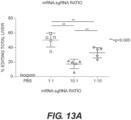
- the LNP formulation may include a ratio of Class 2 Cas nuclease mRNA to gRNA nucleic acid ranging from about 25:1 to about 1:25.
- the LNP formulation may include a ratio of Class 2 Cas nuclease mRNA to gRNA nucleic acid ranging from about 10:1 to about 1:10. As measured herein, the ratios are by weight.
- the LNP formulation may include a ratio of Class 2 Cas nuclease mRNA to gRNA nucleic acid ranging from about 5:1 to about 1:5.
- the LNP formulation may include a ratio of Class 2 Cas nuclease mRNA to gRNA nucleic acid of about 1:1.
- the LNP formulation may include a ratio of Class 2 Cas nuclease mRNA to gRNA nucleic acid from about 1:1 to about 1:5.
- the LNP formulation may include a ratio of Class 2 Cas nuclease mRNA to gRNA nucleic acid of about 10:1.
- the LNP formulation may include a ratio of Class 2 Cas nuclease mRNA to gRNA nucleic acid of about 1:10. The ratio may be about 25:1, 10:1, 5:1, 3:1, 1:1, 1:3, 1:5, 1:10, or 1:25.
- An LNP composition may comprise an sgRNA.
- An LNP composition may comprise a Cas9 sgRNA.
- An LNP composition may comprise a Cpfl sgRNA.
- the LNP includes a CCD lipid, a helper lipid, a neutral lipid, and a stealth lipid.
- the helper lipid may be cholesterol.
- the neutral lipid may be DSPC.
- the stealth lipid may be PEG2k-DMG or PEG2k-C11.
- An LNP composition may comprise a CCD lipid, a helper lipid, a neutral lipid, a stealth lipid, and an sgRNA.
- the CCD lipid is Lipid A, Lipid B, Lipid C, or Lipid D.
- the CCD lipid is Lipid A, Lipid B, Lipid C, or Lipid D;
- the helper lipid may be cholesterol;
- the neutral lipid may be DSPC; and the stealth lipid may be PEG2k-DMG.
- An LNP composition comprises an mRNA encoding a Cas nuclease and a guide RNA, which may be an sgRNA.
- An LNP composition may comprise a CCD lipid, an mRNA encoding a Cas nuclease, a guide RNA, a helper lipid, a neutral lipid, and a stealth lipid.
- the helper lipid may be cholesterol.
- the neutral lipid may be DSPC.
- the stealth lipid may be PEG2k-DMG or PEG2k-C11.
- An LNP composition may comprise a CCD lipid, a helper lipid, a neutral lipid, a stealth lipid, an mRNA encoding a Cas nuclease, and a guide RNA.
- the CCD lipid may be Lipid A, Lipid B, Lipid C, or Lipid D.
- the CCD lipid is Lipid A, Lipid B, Lipid C, or Lipid D;
- the helper lipid may be cholesterol;
- the neutral lipid may be DSPC; and
- the stealth lipid may be PEG2k-DMG.
- the LNP compositions disclosed herein may include a template nucleic acid.
- the template nucleic acid may be co-formulated with an mRNA encoding a Cas nuclease, such as a Class 2 Cas nuclease mRNA.
- the template nucleic acid may be co-formulated with a guide RNA.
- the template nucleic acid may be co-formulated with both an mRNA encoding a Cas nuclease and a guide RNA.
- the template nucleic acid may be formulated separately from an mRNA encoding a Cas nuclease or a guide RNA. In such formulations, the template nucleic acid may be single- or double-stranded, depending on the desired repair mechanism.
- the template may have regions of homology to the target DNA, or to sequences adjacent to the target DNA.
- the present disclosure also provides lipid compositions described according to the respective molar ratios of the component lipids in the formulation.
- the mol-% of the CCD lipid is from about 30 mol-% to about 60 mol-%.
- the mol-% of the CCD lipid may be from about 35 mol-% to about 55 mol-%.
- the mol-% of the CCD lipid may be from about 40 mol-% to about 50 mol-%.
- the mol-% of the CCD lipid may be from about 42 mol-% to about 47 mol-%.
- the mol-% of the CCD lipid may be about 45%.
- the CCD lipid mol-% of the LNP batch may be ⁇ 30%, ⁇ 25%, ⁇ 20%, ⁇ 15%, ⁇ 10%, ⁇ 5%, or ⁇ 2.5% of the target mol-%.
- LNP inter-lot variability may be less than 15%, less than 10% or less than 5%.
- the mol-% of the helper lipid is from about 30 mol-% to about 60 mol-%.
- the mol-% of the helper lipid may be from about 35 mol-% to about 55 mol-%.
- the mol-% of the helper lipid may be from about 40 mol-% to about 50 mol-%.
- the mol-% of the helper lipid may be from about 41 mol-% to about 46 mol-%.
- the mol-% of the helper lipid may be about 44 mol-%.
- the helper mol-% of the LNP batch may be ⁇ 30%, ⁇ 25%, ⁇ 20%, ⁇ 15%, ⁇ 10%, ⁇ 5%, or ⁇ 2.5% of the target mol-%.
- the LNP inter-lot variability may be less than 15%, less than 10% or less than 5%.
- the mol-% of the neutral lipid is from about 1 mol-% to about 20 mol-%.
- the mol-% of the neutral lipid may be from about 5 mol-% to about 15 mol-%.
- the mol-% of the neutral lipid may be from about 7 mol-% to about 12 mol-%.
- the mol-% of the neutral lipid may be about 9 mol-%.
- the neutral lipid mol-% of the LNP batch may be ⁇ 30%, ⁇ 25%, ⁇ 20%, ⁇ 15%, ⁇ 10%, ⁇ 5%, or ⁇ 2.5% of thae target molLNP inter-lot variability may be less than 15%, less than 10% or less than 5%.
- the mol-% of the stealth lipid is from about 1 mol-% to about 10 mol-%.
- the mol-% of the stealth lipid may be from about 1 mol-% to about 5 mol-%.
- the mol-% of the stealth lipid may be from about 1 mol-% to about 3 mol-%.
- the mol-% of the stealth lipid may be about 2 mol-%.
- the mol-% of the stealth lipid may be about 1 mol-%.
- the stealth lipid mol-% of the LNP batch may be ⁇ 30%, ⁇ 25%, ⁇ 20%, ⁇ 15%, ⁇ 10%, ⁇ 5%, or ⁇ 2.5% of the target mol-%.
- LNP inter-lot variability may be less than 15%, less than 10% or less than 5%.
- the present disclosure also provides lipid compositions described according to the ratio between the positively charged amine groups of the CCD lipid (N) and the negatively charged phosphate groups (P) of the nucleic acid to be encapsulated.
- This may be mathematically represented by the equation N/P.
- the N/P ratio may be from about 0.5 to about 100.
- the N/P ratio may be from about 1 to about 50.
- the N/P ratio may be from about 1 to about 25.
- the N/P ratio may be from about 1 to about 10.
- the N/P ratio may be from about 1 to about 7.
- the N/P ratio may be from about 3 to about 5.
- the N/P ratio may be from about 4 to about 5.
- the N/P ratio may be about 4.
- the N/P ratio may be about 4.5.
- the N/P ratio may be about 5.
- LNPs may be formed by mixing an aqueous RNA solution with an organic solvent-based lipid solution, e.g., 100% ethanol. Suitable solutions or solvents include or may contain: water, PBS, Tris buffer, NaCl, citrate buffer, ethanol, chloroform, diethylether, cyclohexane, tetrahydrofuran, methanol, isopropanol.
- a pharmaceutically acceptable buffer e.g., for in vivo administration of LNPs, may be used.
- a buffer may be used to maintain the pH of the composition comprising LNPs at or above pH 7.0.
- the composition may have a pH ranging from about 7.3 to about 7.7 or ranging from about 7.4 to about 7.6.
- the buffer may comprise a phosphate buffer (PBS), a Tris buffer, a citrate buffer, and mixtures thereof.
- the buffer comprises NaCl. Exemplary amounts of NaCl may range from about 40 mM to about 50 mM. The amount of NaCl may be about 45 mM.
- the buffer may be a Tris buffer. Exemplary amounts of Tris may range from about 40 mM to about 60 mM. The amount of Tris may be about 50 mM.
- the buffer comprises NaCl and Tris.
- the LNP compositions may contain 5% sucrose and 45 mM NaCl in Tris buffer. The compositions may contain sucrose in an amount of about 5% w/v, about 45 mM NaCl, and about 50 mM Tris.
- the salt, buffer, and cryoprotectant amounts may be varied such that the osmolality of the overall formulation is maintained.
- the final osmolality may be maintained at less than 450 mOsm/L.
- the osmolality may be between 350 and 250 mOsm/L.
- the final osmolality may be 300 +/- 20 mOsm/L.
- LNPs or LNP compositions may be concentrated or purified, e.g., via dialysis or chromatography.
- the LNPs may be stored as a suspension, an emulsion, or a lyophilized powder, for example.
- the LNP compositions may be stored at 2-8° C, in certain aspects, the LNP compositions are stored at room temperature.
- the LNP composition may be stored frozen, for example at -20° C or -80° C.
- the LNP composition may be stored at a temperature ranging from about 0° C to about -80° C.
- Frozen LNP compositions may be thawed before use, for example on ice, at room temperature, or at 25° C
- DLS Dynamic Light Scattering
- pdi Polydispersity index
- size of the LNPs of the present disclosure can be used to characterize the polydispersity index (“pdi”) and size of the LNPs of the present disclosure.
- DLS measures the scattering of light that results from subjecting a sample to a light source.
- PDI as determined from DLS measurements, represents the distribution of particle size (around the mean particle size) in a population, with a perfectly uniform population having a PDI of zero.
- the pdi may range from about 0.005 to about 0.75.
- the pdi may range from about 0.01 to about 0.5.
- the pdi may range from about 0.02 to about 0.4.
- the pdi may range from about 0.03 to about 0.35.
- the pdi may range from about 0.1 to about 0.35.
- the nanoparticle sample may be diluted in phosphate buffered saline (PBS) so that the count rate is approximately 200-400 kcts.
- PBS phosphate buffered saline
- the data may be presented as a weighted-average of the intensity measure.
- the LNPs may be formed with an average encapsulation efficiency ranging from about 50% to about 100%.
- the LNPs may be formed with an average encapsulation efficiency ranging from about 50% to about 70%.
- the LNPs may be formed with an average encapsulation efficiency ranging from about 70% to about 90%.
- the LNPs may be formed with an average encapsulation efficiency ranging from about 90% to about 100%.
- the LNPs may be formed with an average encapsulation efficiency ranging from about 75% to about 95%.
- the LNP compositions disclosed herein may be used in methods for engineering cells through gene editing, both in vivo and in vitro.
- the methods may involve contacting a cell with an LNP composition described herein.
- the cell may be a mammalian cell.
- the cell may be a rodent cell.
- the cell may be a human cell.
- the cell may be a liver cell.
- the cell may be a human liver cell.
- the liver cell may be a hepatocyte.
- the hepatocyte may be a human hepatocyte.
- the liver cell may be a stem cell.
- the human liver cell may be a liver sinusoidal endothelial cell (LSEC).
- the human liver cell may be a Kupffer cell.
- the human liver cell may be a hepatic stellate cell.
- the human liver cell may be a tumor cell.
- the human liver cell may be a liver stem cell.
- the cell may comprise ApoE-binding receptors.
- Engineered cells are provided, for example an engineered cell derived from any one of the cell types in the preceding paragraph. Such engineered cells are produced according to the methods described herein.
- the engineered cell may reside within a tissue or organ, e.g., a liver within a subject.
- a cell comprises a modification, for example an in sertion or de letion ("indel") or substitution of nucleotides in a target sequence.
- the modification may comprise an insertion of 1, 2, 3, 4 or 5 or more nucleotides in a target sequence.
- the modification may comprise an insertion of either 1 or 2 nucleotides in a target sequence.
- the modification may comprise a deletion of 1, 2, 3, 4, 5, 6, 7, 8, 9, 10, 15, 20 or 25 or more nucleotides in a target sequence.
- the modification may comprise a deletion of either 1 or 2 nucleotides in a target sequence.
- the modification may comprise an indel which results in a frameshift mutation in a target sequence.
- the modification may comprise a substitution of 1, 2, 3, 4, 5, 6, 7, 8, 9, 10, 15, 20 or 25 or more nucleotides in a target sequence.
- the modification may comprise a substitution of either 1 or 2 nucleotides in a target sequence.
- the modification may comprise one or more of an insertion, deletion, or substitution of nucleotides resulting from the incorporation of a template nucleic acid, for example any of the template nucleic acids described herein.
- a population of cells comprising engineered cells may be provided, for example a population of cells comprising cells engineered according to the methods described herein.
- the population may comprise engineered cells cultured in vitro.
- the population may reside within a tissue or organ, e.g., a liver within a subject. At least 5%, at least 10%, at least 15%, at least 20%, at least 25%, at least 30%, at least 35%, at least 40%, at least 45%, at least 50%, at least 55%, at least 60%, at least 65%, at least 70%, at least 75%, at least 80%, at least 85%, at least 90% or at least 95% or more of the cells within the population may be engineered.
- a method disclosed herein may result in at least 5%, at least 10%, at least 15%, at least 20%, at least 25%, at least 30%, at least 35%, at least 40%, at least 45%, at least 50%, at least 55%, at least 60%, at least 65%, at least 70%, at least 75%, at least 80%, at least 85%, at least 90% or at least 95% editing efficiency (or "percent editing"), defined by detetion of indels.
- a method disclosed herein may result in at least 5%, at least 10%, at least 15%, at least 20%, at least 25%, at least 30%, at least 35%, at least 40%, at least 45%, at least 50%, at least 55%, at least 60%, at least 65%, at least 70%, at least 75%, at least 80%, at least 85%, at least 90% or at least 95% DNA modification efficiency, defined by detecting a change in sequence, whether by insertion, deletion, substitution or otherwise.
- a method disclosed herein may result in an editing efficiency level or a DNA modification efficiency level of between about 5% to about 100%, about 10% to about 50%, about 20 to about 100%, about 20 to about 80%, about 40 to about 100%, or about 40 to about 80%.
- cells within the population comprise a modification, e.g., an indel or substitution at a target sequence.
- the modification may comprise an insertion of 1, 2, 3, 4 or 5 or more nucleotides in a target sequence.
- the modification may comprise an insertion of either 1 or 2 nucleotides in a target sequence.
- the modification may comprise a deletion of 1, 2, 3, 4, 5, 6, 7, 8, 9, 10, 15, 20 or 25 or more nucleotides in a target sequence.
- the modification may comprise a deletion of either 1 or 2 nucleotides in a target sequence.
- the modification may comprise an indel which results in a frameshift mutation in a target sequence.
- At least 80%, at least 85%, at least 90%, at least 91%, at least 92%, at least 93%, at least 94%, at least 95%, at least 96%, at least 97%, at least 98%, or at least 99% or more of the engineered cells in the population may comprise a frameshift mutation.
- the modification may comprise a substitution of 1, 2, 3, 4, 5, 6, 7, 8, 9, 10, 15, 20 or 25 or more nucleotides in a target sequence.
- the modification may comprise a substitution of either 1 or 2 nucleotides in a target sequence.
- the modification may comprise one or more of an insertion, deletion, or substitution of nucleotides resulting from the incorporation of a template nucleic acid, for example any of the template nucleic acids described herein.
- references to methods of treatment in the subsequent paragraphs of this description are to be interpreted as references to the compounds, pharmaceutical compositions and medicaments of the present invention for use in a method for treatment of the human (or animal) body by therapy (or for in vivo diagnosis).
- the LNP compositions disclosed herein may be used for gene editing in vivo and in vitro.
- one or more LNP compositions described herein may be administered to a subject in need thereof.
- a therapeutically effective amount of a composition described herein may contact a cell of a subject in need thereof.
- a genetically engineered cell may be produced by contacting a cell with an LNP composition described herein.
- the methods may involve administering the tLNP composition to a cell associated with a liver disorder.
- the methods may involve treating a liver disorder.
- the methods may involve contacting a hepatic cell with the LNP composition.
- the methods may involve contacting a hepatocyte with the LNP composition.
- the methods may involve contacting an ApoE binding cell with the LNP composition.
- An LNP composition comprising an mRNA encoding a Cas nuclease, a gRNA, and a template may be administered to a cell, such as an ApoE binding cell.
- an LNP composition comprising a Cas nuclease and an sgRNA may be administered to a cell, such as an ApoE binding cell.
- An LNP composition comprising an mRNA encoding a Cas nuclease, a gRNA, and a template may be administered to a liver cell.
- an LNP composition comprising a Cas nuclease and an sgRNA may be administered to a liver cell. In some cases, the liver cell may be in a subject.
- a subject may receive a single dose of an LNP composition.
- a subject may receive multiple doses of an LNP composition. Where more than one dose is administered, the doses may be administered about 1, 2, 3, 4, 5, 6, 7, 14, 21, or 28 days apart; about 2, 3, 4, 5, or 6 months apart; or about 1, 2, 3, 4, or 5 years apart.
- An LNP composition comprising an mRNA encoding a Cas nuclease may be administered to a liver cell (also called a hepatic cell), followed by the administration of a composition comprising a gRNA and optionally a template.
- a liver cell also called a hepatic cell
- An LNP composition comprising an mRNA encoding a Cas nuclease and a gRNA may be administered to a liver cell, followed by the administration of a composition comprising a template to the cell.
- An LNP composition comprising an mRNA encoding a Cas nuclease may be administered to a liver cell, followed by the sequential administration of an LNP composition comprising a gRNA and then an LNP composition comprising a template to the cell.
- an LNP composition comprising an mRNA encoding a Cas nuclease is administered before an LNP composition comprising a gRNA
- the administrations may be separated by about 4, 6, 8, 12, or 24 hours; or 2, 3, 4, 5, 6, or 7 days.
- the LNP compositions may be used to edit a gene resulting in a gene knockout.
- the LNP compositions may be used to edit a gene resulting in a gene correction.
- the LNP compositions may be used to edit a cell resulting in gene insertion.
- Administration of the LNP compositions may result in gene editing which results in persistent response. For example, administration may result in a duration of response of a day, a month, a year, or longer.
- “duration of response” means that, after cells have been edited using an LNP composition disclosed herein, the resulting modification is still present for a certain period of time after administration of the LNP composition.
- the modification may be detected by measuring target protein levels.
- the modification may be detected by detecting the target DNA.
- the duration of response may be at least 1 week.
- the duration of response may be at least 2 weeks.
- the duration of response may be at least 1 month.
- the duration of response may be at least 2 months.
- the duration of response may be at least 4 months.
- the duration of response may be at least 6 months.
- the duration of response may be about 26 weeks.
- the duration of response may be at least 1 year.
- the duration of response may be at least 5 years.
- the duration of response may be at least 10 years.
- a persistent response may be detectable after at least 6 months, either by measuring target protein levels or by detection of the target DNA.
- the LNP compositions can be administered parenterally.
- the LNP compositions may be administered directly into the blood stream, into tissue, into muscle, or into an internal organ. Administration may be systemic, e.g., to injection or infusion. Administration may be local. Suitable means for administration include intravenous, intraarterial, intrathecal, intraventricular, intraurethral, intrasternal, intracranial, subretinal, intravitreal, intra-anterior chamber, intramuscular, intrasynovial and subcutaneous.
- Suitable devices for administration include needle (including microneedle) injectors, needle-free injectors and infusion techniques.
- the LNP compositions will generally, but not necessarily, be administered as a formulation in association with one or more pharmaceutically acceptable excipients.
- excipient includes any ingredient other than the compound(s) of the disclosure, the other lipid component(s) and the biologically active agent.
- An excipient may impart either a functional (e . g . drug release rate controlling) and/or a non-functional ( e . g . processing aid or diluent) characteristic to the formulations.
- the choice of excipient will to a large extent depend on factors such as the particular mode of administration, the effect of the excipient on solubility and stability, and the nature of the dosage form.
- Parenteral formulations are typically aqueous or oily solutions or suspensions. Where the formulation is aqueous, excipients such as sugars (including but not restricted to glucose, mannitol, sorbitol, etc.) salts, carbohydrates and buffering agents (preferably to a pH of from 3 to 9), but, for some applications, they may be more suitably formulated with a sterile non-aqueous solution or as a dried form to be used in conjunction with a suitable vehicle such as sterile, pyrogen-free water (WFI).
- excipients such as sugars (including but not restricted to glucose, mannitol, sorbitol, etc.) salts, carbohydrates and buffering agents (preferably to a pH of from 3 to 9), but, for some applications, they may be more suitably formulated with a sterile non-aqueous solution or as a dried form to be used in conjunction with a suitable vehicle such as sterile, pyrogen-free water (WFI).
- WFI ster
- the methods of gene editing may modify a Factor VII target gene.
- the LNP compositions may be administered to a liver cell to modify a Factor VII gene.
- the LNP compositions may be used for treating a liver disorder, such as Factor VII deficiency.
- the methods may modulate aberrant Factor VII activity.
- the LNP composition may be administered to treat or prevent hemophilia, or the inability to control blood clotting. See, e.g., Lapecorella, M. and Mariani, G. Factor VII deficiency: defining the clinical picture and optimizing therapeutic options. Haemophilia (2008), 14, 1170-1175 .
- the LNP compositions may be administered to treat or prevent thrombophilia, a condition where blood has an increased tendency to form clots.
- the methods of treatment of a Factor VII-associated disorder include methods of increasing Factor VIIa coagulation, methods of improving blood clotting, or methods of improving a blood coagulation profile.
- the methods may be used to administer an LNP composition to a subject with a Factor VII deficiency.
- the methods may be used to administer an LNP composition to a subject previously treated for Factor VII deficiency, e.g. with recombinant Factor VIIa.
- the methods of gene editing may modify a TTR target gene.
- the LNP compositions may be used for treating a disorder associated with TTR expression in the liver, such as amyloidosis.
- the LNP composition may be administered to treat or prevent amyloidosis, including transthyretin type amyloidosis. See, e.g., Patel, K. and Hawkins, P. Cardiac amyloidosis: where are we today? J. Intern. Med. (2008), 278, 126-144 .
- the TTR-associated disorder can lead to accumulation of amyloid deposits.
- the methods to treat or prevent a TTR-associated disorder include methods of reducing TTR levels, methods of reducing TTR production, methods of reducing amyloid deposits, methods of treating inherited transthyretin type amyloidosis, methods of treating nonhereditary transthyretin type amyloidosis, or methods of affecting amyloid deposits in the heart, and autonomic and peripheral nerves.
- the methods of treating or preventing a TTR-associated disorder may comprise administering an LNP composition to a subject diagnosed amyloid deposits.
- the methods may be used to administer an LNP composition to a subject in need of reduced TTR production
- the methods of gene editing target a gene that may be selected from SERPINA1, FVIII, FIX, SERPING1, KLKBl, KNGl, FXII, ASS1, ASL, BCKDHA, BCKDHB, G6PC, GO / HAO1, AGXT, PCCA, PCCB, OTC, LIPA, ABCB11 , GALT, ATP7B, and PAH.
- the methods of gene editing may be used to treat a subject afflicted with a disease selected from Alpha 1 Antitrypsin Deficiency, Hemophilia A, Hemophilia B, HAE, Type 1 Citrullinemia, Arginiosuccinic aciduria, Maple syrup urine disease, Glycogen storage disease, Primary hyperoxaluria type 1, Propionic academia, Ornithine transcarbamylase deficiency, Cholesteryl ester storage disease, Progressive familial intrahepatic cholestasis, Galactosemia, Wilson's disease, and Phenylketonuria.
- a disease selected from Alpha 1 Antitrypsin Deficiency, Hemophilia A, Hemophilia B, HAE, Type 1 Citrullinemia, Arginiosuccinic aciduria, Maple syrup urine disease, Glycogen storage disease, Primary hyperoxaluria type 1, Propionic academia, Ornithine transcarbamylase deficiency,
- the LNPs were formulated with a CCD lipid amine to RNA phosphate (N:P) molar ratio of about 4.5.
- the lipid nanoparticle components were dissolved in 100% ethanol with the following molar ratios: 45 mol-% (12.7 mM) CCD lipid (e.g., Lipid A or Lipid B); 44 mol-% (12.4 mM) helper lipid ( e . g ., cholesterol); 9 mol-% (2.53 mM) neutral lipid (e.g., DSPC); and 2 mol-% (.563 mM) PEG ( e.g., PEG2k-DMG or PEG2k-C11).
- the RNA cargo were dissolved in 50 mM acetate buffer, pH 4.5, resulting in a concentration of RNA cargo of approximately 0.45 mg/mL.
- the LNPs were formed by microfluidic mixing of the lipid and RNA solutions using a Precision Nanosystems NanoAssemblr TM Benchtop Instrument, according to the manufacturer's protocol. A 2:1 ratio of aqueous to organic solvent was maintained during mixing using differential flow rates. After mixing, the LNPs were collected, diluted in phosphate buffered saline (PBS, approximately 1:1), and then remaining buffer was exchanged into PBS (100-fold excess of sample volume), overnight at 4°C under gentle stirring using a 10 kDa Slide-a-Lyzer TM G2 Dialysis Cassette (ThermoFisher Scientific). The resulting mixture was then filtered using a 0.2 ⁇ m sterile filter. The resulting filtrate was stored at 2-8 °C. The isolated LNPs were characterized to determine the encapsulation efficiency, polydispersity index, and average particle size, as described below.
- IVTT In vitro transcription
- sgRNA single guide RNA
- Capped and polyadenylated Cas9 mRNA containing N1-methyl pseudo-U was generated by in vitro transcription using a linearized plasmid DNA template and T7 RNA polymerase.
- Plasmid DNA containing a T7 promoter and a 100 nt poly(A/T) region was linearized by incubating at 37 °C for 2 hrs with XbaI with the following conditions: 200 ng/ ⁇ L plasmid, 2 U/ ⁇ L XbaI (NEB), and 1x reaction buffer.
- the XbaI was inactivated by heating the reaction at 65 °C for 20 min.
- the linearized plasmid was purified from enzyme and buffer salts using a silica maxi spin column (Epoch Life Sciences) and analyzed by agarose gel to confirm linearization.
- the IVT reaction to generate Cas9 modified mRNA was incubated at 37 °C for 4 hours in the following conditions: 50 ng/ ⁇ L linearized plasmid; 2 mM each of GTP, ATP, CTP, and N1-methyl pseudo-UTP (Trilink); 10 mM ARCA (Trilink); 5 U/ ⁇ L T7 RNA polymerase (NEB); 1 U/ ⁇ L Murine RNase inhibitor (NEB); 0.004 U/ ⁇ L Inorganic E. coli pyrophosphatase (NEB); and 1x reaction buffer.
- the mRNA was precipitated by adding 0.21x vol of a 7.5 M LiCl solution and mixing, and the precipitated mRNA was pelleted by centrifugation. Once the supernatant was removed, the mRNA was reconstituted in water. The mRNA was precipitated again using ammonium acetate and ethanol. 5M Ammonium acetate was added to the mRNA solution for a final concentration of 2M along with 2x volume of 100% EtOH. The solution was mixed and incubated at -20 °C for 15 min. The precipitated mRNA was again pelleted by centrifugation, the supernatant was removed, and the mRNA was reconstituted in water.
- the mRNA was precipitated using sodium acetate and ethanol. 1/10 volume of 3 M sodium acetate (pH 5.5) was added to the solution along with 2x volume of 100% EtOH. The solution was mixed and incubated at -20 °C for 15 min. The precipitated mRNA was again pelleted by centrifugation, the supernatant was removed, the pellet was washed with 70% cold ethanol and allowed to air dry. The mRNA was reconstituted in water. For HPLC purified mRNA, after the LiCl precipitation and reconstitution, the mRNA was purified by RP-IP HPLC (see, e.g., Kariko, et al. Nucleic Acids Research, 2011, Vol. 39, No.
- transcript concentration was determined by measuring the light absorbance at 260 nm (Nanodrop), and the transcript was analyzed by capillary electrophoresis by Bioanlayzer (Agilent).
- IVT was also used to generate sgRNA in a similar process.
- DNA template for sgRNA was generated by annealing a top oligo composed of only the T7 RNA polymerase promoter sequence and a bottom strand containing the sgRNA template and the complementary sequence to the promoter site.
- the annealed template was used directly in an IVT reaction in the following conditions: 125 nM template; 7.5 mM each of GTP, ATP, CTP, and UTP; 5 U/ ⁇ L T7 RNA polymerase (NEB); 1 U/ ⁇ L Murine RNase inhibitor (NEB); 0.004 U/ ⁇ L Inorganic E. coli pyrophosphatase (NEB); and 1x reaction buffer.
- the reaction was incubated at 37 °C for 8 hours, after which TURBO DNase (ThermoFisher) was added to a final concentration of 0.01 U/ ⁇ L, and the reaction was incubated another 30 minutes to remove the DNA template.
- the sgRNA transcript was purified by a MegaClear Transcription Clean-up kit according to the manufacturer's protocol (ThermoFisher). The transcript concentration was determined by absorbance at 260 nm (Nanodrop), and the transcript was analyzed by PAGE.
- LNP formulations were analyzed for average particle size, polydispersity (pdi), total RNA content and encapsulation efficiency of RNA.
- Average particle size and polydispersity were measured by dynamic light scattering (DLS) using a Malvern Zetasizer DLS instrument. LNP samples were diluted 30X in PBS prior to being measured by DLS. Z-average diameter which is intensity based measurement of average particle size was reported along with pdi.
- LNPs were diluted 75X with 1x TE buffer to be within the linear range of the RiboGreen ® dye (ThermoFisher Scientific, catalog number R11491). 50 ⁇ l of diluted LNP were further mixed with either 50 ⁇ l 1x TE buffer or 1x TE buffer with 0.2% Triton X-100 in duplicate. Samples were incubated at 37 °C for 10 minutes to allow Triton to completely disrupt the LNPs and expose total RNA to interact with the RiboGreen ® dye. Samples for standard curve were prepared by utilizing the starting RNA solution used to make the LNPs and following the same steps as above.
- Diluted RiboGreen ® dye (100 ⁇ L, 100X in 1xTE buffer, according to the manufacturer's instructions) was then added to each of the samples and allowed to incubate for 10 minutes at room temperature, in the absence of light.
- a SpectraMax M5 Microplate Reader (Molecular Devices) was used to read the samples with excitation, auto cutoff and emission wavelengths set to 488 nm, 515 nm, and 525 nm respectively.
- %EE Encapsulation efficiency
- a T7E1 assay was used in some Examples to detect mutation events in genomic DNA such as insertions, deletions and substitutions created through non-homologous end joining (NHEJ) following DNA cleavage by Cas9 (See, e.g., Cho et al., Targeted genome engineering in human cells with the Cas9 RNA-guided endonuclease. Nature Biotechnology. 2013; 31, 230-232 ).
- NHEJ non-homologous end joining
- the genomic DNA regions targeted by CRISPR/Cas9 were amplified by PCR, denatured at 95° C for 10 minutes, and then re-annealed by ramping down the temperature from 95° C to 25° C at a rate of 0.5° C/second.
- the combination of DNA to form heteroduplexes indicated the presence of mutations in the amplified region.
- the re-annealed heteroduplexes were then digested with bacteriophage resolvase T7E1 (New England Biolabs) at 37° C for 25 minutes or longer to generate double-stranded breaks where the T7E1 nuclease recognized mismatches.
- the resulting DNA fragments were analyzed using a Fragment Analyzer and quantified to determine an approximation of editing efficiency. For quantitative analysis of editing efficiency, Next-Generation Sequencing was used as described herein.
- PCR primers were designed around the target site (e.g., TTR, FVII), and the genomic area of interest was amplified. Primer sequences are provided below. Additional PCR was performed according to the manufacturer's protocols (Illumina) to add the necessary chemistry for sequencing. The amplicons were sequenced on an Illumina MiSeq instrument. The reads were aligned to the human reference genome ( e . g ., hg38) after eliminating those having low quality scores. The resulting files containing the reads were mapped to the reference genome (BAM files), where reads that overlapped the target region of interest were selected and the number of wild type reads versus the number of reads which contain an insertion, substitution, or deletion was calculated. The editing percentage (e . g ., the "editing efficiency" or “percent editing”) is defined as the total number of sequence reads with insertions or deletions over the total number of sequence reads, including wild type.
- the editing percentage e . g ., the "editing
- Mouse cells lines (Neuro2A and Hepa1.6 ) were cultured in DMEM media supplemented with 10% fetal bovine serum and were plated at a density of 15,000 cells/well 24 hours prior to transfection with LNPs for 18-24 hours prior to lysis and analysis as described herein ( e . g ., reporter expression, T7E1 assay, NGS).
- Mouse primary hepatocytes (Invitrogen) were cultured at 15,000 cells per well in hepatocyte plating media (Invitrogen) using collagen coated 96 well plates. After 5 hours, the plating media was removed and replaced with hepatocyte maintenance media containing LNPs and 3% mouse serum (pre-incubated for 5 min at 37° C).
- Cells were transfected for 42-48 hours prior to lysis and analysis as described herein (e.g., T7E1 assay, NGS).
- T7E1 assay NGS
- the LNPs were diluted and added to cells starting at 100 ng Cas9 mRNA and approximately 30 nM guide RNA per well, carrying out serial dilutions in a semi-log manner down to 0.1 ng Cas9 mRNA and 0.03 nM guide RNA per well.
- CD-1 female mice ranging from 6-10 weeks of age were used in each study. Animals were weighed and grouped according to body weight for preparing dosing solutions based on group average weight. LNPs were dosed via the lateral tail vein in a volume of 0.2 mL per animal (approximately 10 mL per kilogram body weight). The animals were observed at approximately 6 hours post dose for adverse effects. Body weight was measured at twenty-four hours post-administration, and animals were euthanized at various time points by exsanguination via cardiac puncture under isoflourane anesthesia. Blood was collected into serum separator tubes or into tubes containing buffered sodium citrate for plasma as described herein.
- liver tissue was collected from the median lobe or from three independent lobes (e.g., the right median, left median, and left lateral lobes) from each animal for DNA extraction and analysis.
- spleen tissue was also collected.
- Genomic DNA was extracted from 10 mg of tissue using Invitrogen PureLink Genomic DNA Kit (Cat. K1820-02) according to manufacturer's protocol, which includes homogenizing the tissue in lysis buffer (approximately 200 ⁇ L/10 mg tissue) and precipitating the DNA. All DNA samples were normalized to 100 ng/ ⁇ L concentration for PCR and subsequent NGS analysis, as described herein.
- TTR Transthyretin
- Mouse Prealbumin (Transthyretin) ELISA Kit (Aviva Systems Biology, Cat. OKIA00111). Kit reagents and standards were prepared according to the manufacture's protocol. Mouse serum was diluted to a final dilution of 10,000-fold with 1x assay diluent. This was done by carrying out two sequential 50-fold dilutions resulting in a 2,500-fold dilution. A final 4-fold dilution step was carried out for a total sample dilution of 10,000-fold. Both standard curve dilutions (100 ⁇ L each) and diluted serum samples were added to each well of the ELISA plate pre-coated with capture antibody.
- the plate was incubated at room temperature for 30 minutes before washing. Enzyme-antibody conjugate (100 ⁇ L per well) was added for a 20 minute incubation. Unbound antibody conjugate was removed and the plate was washed again before the addition of the chromogenic substrate solution. The plate was incubated for 10 minutes before adding 100 ⁇ L of the stop solution, e . g ., sulfuric acid (approximately 0.3 M). The plate was read on a SpectraMax M5 plate reader at an absorbance of 450 nm. Serum TTR levels were calculated by SoftMax Pro software ver. 6.4.2 using a four parameter logistic curve fit off the standard curve. Final serum values were adjusted for the assay dilution.
- the stop solution e . g ., sulfuric acid (approximately 0.3 M).
- Plasma Factor VII activity levels were measured using BIOPHEN FVII assay kit (Anaria Diagnostics, Cat. A221304). Kit reagents were prepared according to the manufacturer's protocol. Plasma was diluted 10,000-fold with the kit sample dilution buffer by carrying out two sequential 50-fold dilutions resulting in a 2,500-fold dilution. A final 4-fold dilution step was carried out for a total sample dilution of 10,000-fold. Diluted sample (30 ⁇ L) was added to kit reagent 1 (30 ⁇ L). Next, kit reagent 2 (60 ⁇ L) was added to the plate, which was subsequently incubated at 37° C for 7 minutes.
- Kit reagent 3 (60 ⁇ L) was then added to the plate and the plate was incubated for an additional 5 minutes at 37° C, before adding acetic acid (20% v/v in water, 60 ⁇ L) to stop the enzyme reaction.
- the plate was read on a SoftMax M5 plate reader at 405 nM.
- the relative values of FVII activity were calculated based upon a calibration curve prepared from plasma of control animals and reported as a percent of vehicle control.
- Example 2 In vitro delivery of eGFP mRNA encapsulated LNPs.
- LNPs comprising mRNA encoding eGFP were prepared as described in Example 1.
- the components of each LNP preparation include a CCD lipid (45 mol-%), cholesterol (44 mol-%), DSPC (9 mol-%), and PEG2k-DMG or PEG2k-C11 (2 mol-%).
- LNP-002, -006, -007, -010, and -011 include Lipid A as the CCD lipid
- LNP-012 and -013 include Lipid B as the CCD lipid.
- LNP-002, -010, and -012 include PEG2k-DMG, and LNP-006, -007, -011, and -013 include PEG2k-C11.
- LNP details are provided in Table 1, including average particle size, polydispersity, and encapsulation efficiency.
- LNPs were delivered to a mouse hepatocyte cell line (Hepa1.6) as described in Example 1, with total amounts of eGFP mRNA delivered being either 100 ng or 500 ng per well, for each LNP. Cells were incubated with LNPs for approximately 18 hours, and eGFP expression was measured using a CytoFLEX Cell Analyzer (Beckman Coulter).
- LNP formulations comprising Lipid A (LNP-002, -006, -007, -010, and -011) successfully delivered eGFP mRNA.
- LNP formulations comprising Lipid B (LNP-012 and -013) also delivered eGFP mRNA.
- LNPs that include PEG2k-C11 and PEG2k-DMG stealth lipids both deliver mRNA effectively in these experiments, demonstrating delivery of mRNA to a mouse hepatocyte cell line using LNPs in vitro.
- Example 3 In vivo delivery of gLUC mRNA encapsulated LNPs.
- LNPs comprising mRNA encoding Gaussia luciferase (gLUC) (TriLink, Cat. L-6123) were prepared as described in Example 1 and tested for mRNA delivery to animals in vivo.
- the components of each LNP preparation include a CCD lipid (45 mol-%), cholesterol (44 mol-%), DSPC (9 mol-%), and PEG2k-DMG (2 mol-%).
- LNP-015 included Lipid B. Details for these formulations are provided in Table 1, such as average particle size, polydispersity, and encapsulation efficiency.
- gLUC mRNA doses of 0.1 mg/kg and 0.3 mg/kg were delivered with each LNP formulation.
- Example 2 Serum luciferase expression was measured using a Pierce TM Gaussia Luciferase Flash Assay Kit (ThermoFisher Scientific, catalog number 16158) according to the manufacturer's protocol.
- LNPs comprising either Lipid A or Lipid B showed effective in vivo delivery and expression of mRNA as measured by luciferase activity.
- Example 4 In vivo delivery and editing using Cas9 mRNA encapsulated LNPs (mRNA-LNP) with dual guide RNA encapsulated LNPs (dgRNA-LNP).
- mRNA-LNP Cas9 mRNA encapsulated LNPs
- dgRNA-LNP dual guide RNA encapsulated LNPs
- LNPs for delivering CRISPR/Cas RNA components e.g., gRNA and mRNA encoding Cas9 for in vivo editing in the liver were tested in CD-1 mice.
- CRISPR/Cas RNA components e.g., gRNA and mRNA encoding Cas9
- dgRNA and mRNA were formulated separately.
- LNPs were formulated with in vitro transcribed Cas9 mRNA and chemically modified dgRNA (targeting either TTR or FVII), separately, as described in Example 1.
- the dgRNAs used in this Example were chemically synthesized and sourced from commercial suppliers, with phosphorothioate linkages between the three terminal nucleotides at both the 5' and 3' ends of the crRNA and the trRNA making up the dual guide.
- each LNP preparation includes a CCD lipid (Lipid A) (45 mol-%), cholesterol (44 mol-%), DSPC (9 mol-%), and PEG2k-DMG (2 mol-%). Details for these formulations are provided in Table 1, including average particle size, polydispersity, and encapsulation efficiency.
- Two different dosing regimens were employed: (1) combining the mRNA-LNP formulation (LNP-097) and a dgRNA-LNP formulation (LNP-093, -094, -095 or -096) together in equal parts (by weight of RNA) and dosing the combined formulation on two consecutive days (each day dosed at 1 mg /kg of each RNA component formulation, for a total of 2 mg/kg); or (2) dosing the mRNA-LNP (LNP-097) four hours prior to dosing a dgRNA-LNP (LNP-093, -094, -095, and -096), on two consecutive days (each formulation dosed at 1 mg/kg).
- in vivo editing (approximately 1.8% editing - 2.8% editing) was observed in the livers of animals that received LNPs targeting FVII using either a co-dosing (A1 (LNP-093/-097) or A2 (LNP-094/-097)) or pre-dosing (A3 (LNP-093/-097)) dosing regimen.
- A1 LNP-093/-097
- A2 LNP-094/-097
- pre-dosing A3 (LNP-093/-097)
- Animals that received LNPs targeting TTR showed approximately 2% - 4.5% editing in the livers of animals receiving dgRNA co-dosed with Cas9 mRNA (B1 (LNP-095/LNP-097) or B2 (LNP-096/-097)) or when pre-dosed (B3 (LNP-095/-097) or B4 (LNP-096/-097)).
- Serum and plasma analyses were conducted for all of the animals, as described in Example 1, with none of the animals displaying statistically significant differences (as compared to animals administered PBS) in either total serum levels of TTR or plasma FVII activity (not shown).
- Example 5 In vitro and in vivo delivery and editing using dgRNA-LNPs and IVT sgRNA-LNPs.
- LNPs comprising chemically modified dgRNA and LNPs comprising in vitro transcribed (IVT) sgRNA were tested in the context of co-dosing with Cas9 mRNA-LNPs.
- IVT in vitro transcribed
- LNP-115, -116, -117, -120, -121, and -123 were formulated according to Example 1, and the details about the specific formulations are provided in Table 1.
- the formulations of this Example were tested for delivery to Neuro2A cells, using the procedure as described in Example 1.
- LNP-121 (gRNA) and LNP-120 (Cas9 mRNA) were mixed together and administered at gRNA concentrations of 152 nM, 76 nM, and 38 nM, plus mRNA at 570 ng, 285 ng, and 142 ng per well, respectively;
- LNP-123 (gRNA) and LNP-120 were mixed together and administered at gRNA concentrations of 156 nM, 78 nM, and 39 nM, plus mRNA at 528 ng, 264 ng, and 132 ng per well, respectively;
- LNP-116 (gRNA) was mixed with LNP-120 (Cas9 mRNA) and administered at gRNA concentrations of 124 nM, 62 nM, and 31 nM, plus mRNA at 460 ng, 229 ng, and 114 ng per well, respectively.
- LNP-121 was administered at gRNA concentrations of 198 nM, 99 nM, and 49.5 nM; LNP-123 was administered at gRNA concentrations of 189 nM, 94.5 nM, and 47 nM; and LNP-116 was administered at gRNA concentrations of 124 nM, 62 nM, and 31 nM, and the Cas9 mRNA (100 ng per well) was added by LF2K to the experiments according to the manufacturer's instructions.
- Example 6 In vitro and in vivo delivery and editing using modified dgRNA-LNPs or modified sgRNA-LNPs.
- LNPs comprising chemically modified dgRNA and LNPs comprising chemically modified sgRNA were also tested by co-dosing with Cas9 mRNA-LNPs.
- LNPs were formulated with chemically modified dgRNA (targeting TTR or FVII), chemically modified sgRNA (targeting TTR or FVII), and IVT Cas9 mRNA, as described in Example 1.
- the dgRNA in this Example were chemically synthesized and sourced from commercial suppliers, with phosphorothioate linkages between the three terminal nucleotides at both the 5' and 3' ends of both the crRNA and the trRNA making up the dual guide.
- the sgRNA in this Example was also chemically synthesized and sourced from a commercial supplier with 2'-O-methyl modifications and phosphorothioate linkages at and between the three terminal nucleotides at both the 5' and 3' ends of the sgRNA.
- each LNP preparation includes a CCD lipid (Lipid A, 45 mol-%), cholesterol (44 mol-%), DSPC (9 mol-%), and PEG2k-DMG (2 mol-%).
- LNP-136, -137, -138, -139, and -140 were used in these experiments.
- Example 2 The formulations of this Example were tested for delivery to Neuro2A cells, as described in Example 1.
- Cells were co-transfected with guide LNP and Cas9 mRNA LNP by adding each formulation directly to the cell culture media, resulting in the concentrations listed in Table 2, and percent editing was determined using the T7E1 assay, as described in Example 1.
- the labels represent the formulations, as described in Table 2. Table 2.
- A1 and A2 represent administration of the mixture of formulations LNP-136 and LNP-140; B1 and B2 represent administration of the mixture of formulations LNP-139 and LNP-140; C1 and C2 represent administration of the mixture of formulations LNP-137 and LNP-140; and D1 and D2 represent administration of the mixture of formulations LNP-138 and LNP-140.
- increases in editing approximately 10% editing-32% editing
- mice receiving the dgRNA-LNP formulations targeting TTR resulted in less than 5% editing across two liver biopsies, while sgRNA-LNP formulations resulted in average percent editing of over 20% (with a peak of over 30% in one animal).
- animals receiving the dgRNA-LNP formulations targeting FVII displayed less than 3% editing across two liver biopsies, while sgRNA-LNP formulations resulted in average percent editing of approximately 10% (with a peak of over 12% in one animal).
- Example 7 In vitro and in vivo delivery and editing using LNPs comprising sgRNA co-formulated with Cas9 mRNA.
- LNPs formulated for delivery of Cas9 mRNA and sgRNA encapsulated together in an LNP composition also effectively deliver the CRISPR/Cas components.
- LNPs were formulated with IVT Cas9 mRNA together with chemically modified sgRNA (targeting TTR or FVII), as described in Example 1.
- the ratio of mRNA:sgRNA was approximately 1:1, by weight of the RNA component.
- the sgRNA in this Example was chemically synthesized and sourced from a commercial supplier, with 2'-O-methyl modifications and phosphorothioate linkages at and between the three terminal nucleotides at both the 5' and 3' ends of the sgRNA, respectively.
- the components of each LNP preparation include a CCD lipid (Lipid A, 45 mol-%), cholesterol (44 mol-%), DSPC (9 mol-%), and PEG2k-DMG (2 mol-%).
- LNP-152, - 153, -154, and -155 were used in these experiments, and details of these formulations are provided in Table 1, including average particle size, polydispersity, and encapsulation efficiency.
- Example 1 The formulations of this Example were tested for delivery to Neuro2A cells, as described in Example 1. Cells were transfected with the formulations and percent editing was determined using NGS, as described in Example 1.
- Each formulation was administered at 300 ng Cas9 mRNA and 93 nM gRNA; 100 ng Cas9 mRNA and 31 nM gRNA; 30 ng Cas9 mRNA and 10 nM gRNA; and 10 ng Cas9 mRNA and 3 nM gRNA.
- administration of each LNP formulation resulted in robust editing efficiency, with some formulations resulting in more than 80% of cells being edited (LNP-153 and -155).
- LNP-152 and LNP-153 were treated with a combination of two of the LNP formulations (LNP-152 and LNP-153) targeting FVII, which also resulted in efficient editing (approximately 70-90% editing), as well as excision of a portion of the FVII gene lying between the two sgRNAs delivered ( Fig. 7 , and data not shown).
- A represents administration of LNP-152
- B represents administration of LNP-153
- C represents administration of a combination of LNP-152 and LNP-153.
- Each formulation was tested in four animals. As shown in Fig. 8A and 8B , each LNP formulation that was tested resulted in robust in vivo editing efficiencies. For animals treated with LNP formulations targeting a TTR sequence, more than 50% of liver cells from each biopsy for some animals displayed indels at the target site, with overall averages (across all biopsies of all animals) for each treatment group of 45.2 ⁇ 6.4% (LNP-154) and 51.1 ⁇ 3.7% (LNP-155) ( Fig. 8A ).
- Animals treated with LNPs targeting an FVII sequence displayed a range of percentage editing in liver biopsies, with a maximum observed editing of greater than 70% of liver cells being edited from biopsy samples (e.g., having either an indel or excision event at or between the target site(s)) for one animal receiving both LNP formulations targeting an FVII sequence.
- Overall averages (across all biopsies of all animals) for each treatment group (LNP-152, LNP-153, and LNP-152 and LNP-153) were 16.9 ⁇ 6.5%, 38.6 ⁇ 13.2%, and 50.7 ⁇ 15.0%, respectively ( Fig. 8B ).
- excision of the intervening genomic DNA between the target sites for each sgRNA was detected by PCR, as were indels at one or both of the target sites ( Fig. 9 ).
- the robust in vivo editing that was observed when the LNP formulations were administered in this Example also resulted in phenotypic changes.
- large decreases (of up to approximately 75%) in serum TTR levels were observed in animals treated with LNPs targeting a TTR sequence (but not in controls or animals treated with LNPs targeting FVII).
- reduced levels of plasma FVII activity were observed in animals treated with LNPs targeting FVII (but not in controls or animals treated with LNPs targeting TTR) ( Fig. 11 ).
- LNPs formulated for delivery of Cas9 mRNA and gRNA together in one formulation were tested (1) across a range of doses; (2) with altered ratios of mRNA:gRNA; (3) for efficacy with a single dose versus two doses; and (4) whether the LNPs are taken up by and result in editing in the spleen.
- LNPs were formulated with IVT Cas9 mRNA together with chemically modified sgRNA (targeting TTR), as described in Example 1.
- the ratios tested (by weight of RNA component) of mRNA:sgRNA were approximately 1:1 (LNP-169), approximately 10:1 (LNP-170), or approximately 1:10 (LNP-171).
- the sgRNA used in this Example comprises 2'-O-methyl modifications and phosphorothioate linkages at and between the three terminal nucleotides at both the 5' and 3' ends of the sgRNA, respectively.
- the components of each LNP preparation included Lipid A (45 mol-%), cholesterol (44 mol-%), DSPC (9 mol-%), and PEG2k-DMG (2 mol-%).
- LNP-169, -170 and LNP-171 were used in these experiments. Details are provided in Table 1, including average particle size, polydispersity, and encapsulation efficiency.
- Liver and spleen were collected at necropsy on day 9 for NGS analysis, as described in Example 1.
- Fig. 12A administration of all three doses resulted in significant editing efficiency in the liver, with a linear dose response observed having an r 2 value of 0.9441.
- the highest dose group (2 mg/kg)
- nearly 60% of liver cells in one animal were edited at the TTR target site, with the group having an average of about 50% of liver cells edited.
- Each animal that was administered the highest dose also displayed statistically significant reductions in serum TTR levels when measured at days 5 and 9 post-administration, with an average reduction 75% of serum TTR levels (as compared to animals that were administered PBS; Fig. 12B ).
- LNP-169 mRNA:gRNA ratio of 1:1
- Animals that received 1:10 and 10:1 LNP formulations also demonstrated editing, with the average percent editing for the group receiving LNP-171 showing approximately 32% editing and the group receiving LNP-170 showing approximately 17% editing in this experiment.
- Fig. 13B statistically significant reductions in serum TTR levels were detected for each treatment group at day 5 (as compared to PBS control). By day 9, the groups receiving 1:1 mRNA:sgRNA and 1:10 mRNA:sgRNA retained statistically significant reductions in serum TTR levels.
- the group and data receiving a single dose of LNP-169 is the same group and data as described in the dose response and mRNA:gRNA ratio studies in this Example, supra ). Blood was collected for TTR serum levels from both groups at day 5 (prior to administration of the second dose for the group receiving the second dose), and again at necropsy on day 9, as described in Example 1.
- A represents LNP-169 administered at 2 mg/kg for 2 doses; B represents LNP-169 with a 1:1 ratio of mRNA:gRNA at 0.1 mg/kg as a single dose; C represents LNP-169 with a 1:1 ratio of mRNA:gRNA at 0.5 mg/kg as a single dose; D represents LNP-169 with a 1:1 ratio of mRNA:gRNA at 2 mg/kg as a single dose; E represents LNP-170 with a 10:1 ratio of mRNA:gRNA at 2 mg/kg as a single dose; and F represents LNP-171 with a 1:10 ratio of mRNA:gRNA at 2 mg/kg as a single dose. As shown in Fig.
- Example 9 Comparative in vivo study between (1) modified dgRNA-LNPs co-dosed with Cas9 mRNA-LNPs and (2) LNPs comprising Cas9 mRNA and modified dgRNA together in one formulation.
- LNPs were formulated with IVT Cas9 mRNA either together with (LNP-174, -175) or separately from (LNP-172, -173) chemically modified dgRNA (targeting TTR), as described in Example 1.
- Both the crRNA and the trRNA making up the dgRNA in this Example comprised phosphorothioate linkages between the three terminal nucleotides at both the 5' and 3' ends of each RNA.
- each LNP preparation includes a CCD lipid (Lipid A, 45 mol-%), cholesterol (44 mol-%), DSPC (9 mol-%), and PEG2k-DMG (2 mol-%).
- LNP-172, -173, -174, and -175 were used in these experiments.
- the compositions of LNP-174 and LNP-175 were identical, except that the crRNA and trRNA making up the dgRNA in LNP-175 were first pre-annealed to one another prior to being formulated with the LNP. This was accomplished by first incubating the crRNA and trRNA together at 95° C for 10 minutes before cooling to room temperature and proceeding to formulation, as previously described.
- Other details concerning the LNPs are provided in Table 1, including average particle size, polydispersity, and encapsulation efficiency.
- A represents administration of the dgRNA split-formulation (LNP-172 and LNP-173; B represents administration of the dgRNA co-formulation (LNP-174); and C represents administration of the formulation wherein the dgRNA was pre-annealed (LNP-175).
- editing was detected in livers from each group (with approximately 4-6% editing). Animals that received LNP that was co-formulated with Cas9 mRNA and dgRNA together and animals that received the mRNA and dgRNA from separately formulated LNPs showed editing.
- the editing efficiencies measured using LNPs formulated with dgRNA are substantially lower than those detected using LNPs formulated with sgRNA ( see, e.g., Examples 6-8).
- Example 10 ApoE binding of LNPs and transfection of primary hepatocytes.
- Example 8 LNPs provided herein are effectively taken up by the liver, and only to a minor extent by the spleen.
- This Example provides data regarding ApoE-mediated uptake in primary hepatocytes and provides an assay for testing LNP-ApoE binding which demonstrated that the LNPs bind ApoE.
- serum provides a source of ApoE in culture media, and therefore whether the LNPs require serum (e . g ., as a source of ApoE) for uptake into primary hepatocytes was tested. This was accomplished by adding LNPs to primary hepatocytes in vitro, with and without the presence of serum.
- LNPs were delivered to mouse primary hepatocytes as described in Example 1. In the absence of any serum, no editing was detected by T7E1 assay for any LNP tested (data not shown). However, when LNPs were incubated with 3% mouse serum prior to transfection, LNPs were taken up by the hepatocytes resulting in editing. A representative data set is shown in Fig. 17 . In this experiment, LNP-169 (targeting TTR) was pre-incubated in 3% mouse serum, and then added to mouse primary hepatocytes at various concentrations. The labels in Fig. 17 are defined in Table 3 and describe the concentration of the LNP-169 that was administered. As shown in Fig.
- LNPs were incubated with recombinant ApoE3, the most common form of ApoE, and then separated with a heparin affinity column using a salt gradient on an HPLC. There were two peak groups in the HPLC run, corresponding to LNPs bound to ApoE3 and unbound LNPs. Un-bound is free LNP that did not bind with ApoE3 and flowed freely though the heparin column. Bound was a peak with a longer retention time representing the LNP/ApoE3 complex that was bound to the heparin column and was eluted in the salt gradient. To calculate the binding, the percentage of the bound peak area was calculated by dividing the peak area corresponding to the LNPs bound to ApoE3 and dividing that number by the sum of the area of both peaks.
- LNPs were formulated with Cas9 mRNA and chemically modified sgRNA, as described in Example 1.
- the sgRNAs used in this Example were chemically synthesized and sourced from commercial suppliers, with 2'-O-methyl modifications and phosphorothioate linkages at and between the three terminal nucleotides at both the 5' and 3' ends of the sgRNA, respectively.
- the components of each LNP preparation include Lipid A (45 mol-%), cholesterol (44 mol-%), DSPC (9 mol-%), and PEG2k-DMG (2 mol-%). Details for these formulations are provided in Table 1, including average particle size, polydispersity, and encapsulation efficiency.
- ApoE3 Recombinant Human Apolipoprotein E3 , R&D Systems, cat #4144-AE-500
- ApoE3 was added to LNP samples at 25 ⁇ g/mL, 50 ⁇ g/mL, 100 ⁇ g/mL, 200 ⁇ g/mL, and 300 ⁇ g/mL. The samples were incubated overnight at room temperature.
- Buffer A is a 20 mM Tris buffer, adjusted to pH 8.0
- Buffer B is a 20 mM Tris buffer, with 1 M NaCl, adjusted to pH 8.0.
- the gradient and flow rate for the HPLC analysis is as described below.
- each sample was analyzed by HPLC and the percent area of the bound peak was calculated as previously described.
- Example 11 In vitro and in vivo delivery and editing using LNPs with sgRNA expressed from DNA expression cassettes.
- This example demonstrates gene editing using LNPs loaded with Cas9 mRNA and an expression cassette encoding an sgRNA.
- Amplicons encoding sgRNA were prepared by PCR amplification of a DNA sequence containing a U6 promoter linked to as sgRNA targeting mouse TTR. Each primer contained an inverted dideoxyT nucleotide at the 5' end to prevent integration of the DNA amplicon into genomic DNA. PCR product was purified by phenol/chloroform extraction followed by ethanol precipitation. The DNA pellet was dried and resuspended in TE buffer.
- LNPs were formulated with IVT Cas9 mRNA ("mRNA-LNP” or LNP-178) or the sgRNA expression cassette ("DNA-LNP” or LNP-176) as described in Example 1.
- IVT Cas9 mRNA and the sgRNA expression cassette were also separately formulated with Lipofectamine 2000 (Thermo Fisher) according to manufacturer's instructions ("mRNA LF2K” or "DNA LF2K", respectively).
- Formulations were applied to mouse Neuro2A cells (100 ng Cas9 mRNA and 100 ng sgRNA expression cassette) by diluting directly into the cell culture media in each well according to the following regimens:
- Cas9 mRNA and chemically modified sgRNA targeting different mouse TTR sequences were formulated and dosed to mice (2 mg/kg) as described in Example 1.
- the same LNP preparations were used to transfect mouse primary hepatocytes in vitro.
- the sgRNA in this Example was chemically synthesized and sourced from a commercial supplier, with 2'-O-methyl modifications and phosphorothioate linkages at and between the three terminal nucleotides at both the 5' and 3' ends of the sgRNA, respectively.
- Table 4 Formulations Employed in Example 12 LNP # Target RNA Cargo CCD Lipid Stealth Lipid Avg.
- FIG 21 shows representative data demonstrating that insertion and deletion patterns differ significantly between mouse Neuro2A cells (transfected with Cas9 mRNA and gRNA) and mouse primary hepatocytes (transfected with LNPs containing Cas9 mRNA and gRNA).
- Mouse primary hepatocytes yielded editing patterns very similar to those observed in vivo (transfected with LNPs containing Cas9 mRNA and gRNA) ( Figure 22 ).
- Example 13 Pharmacokinetics of CRISPR/Cas9 components delivered by LNP.
- Figure 23 shows plasma concentrations of these components
- Figure 24 shows concentrations in liver
- Figure 25 shows concentrations in spleen.
- the following pharmacokinetic parameters were calculated for plasma concentrations: Table 5.
- Pharmacokinetic parameters Parameter sg009 (sgRNA) Cas9 (mRNA) Dose (mg/kg) 1 (25mcg/ms) 1 (25mcg/ms) C max (mcg/mL) 39.049 18.15 T max (hr) 0.083 0.5 T 1/2 (hr) 2.32 2.54 Vd (mL/kg) 195.6 208.4 Cl (mL/hr*kg) 58.4 56.7 AUC last (mcg*hr/mL) 21.99 18.39
- Figure 26A shows the relative ratios of the sgRNA to Cas9 mRNA in plasma and tissue.
- Cytokine induction in the treated mice was also measured. For this analysis, approximately 50-100 ⁇ L of blood was collected by tail vein nick for serum cytokine measurements. Blood was allowed to clot at room temperature for approximately 2 hours, and then centrifuged at 1000xg for 10 minutes before collecting the serum. A Luminex based magnetic bead multiplex assay (Affymetrix ProcartaPlus, catalog number Exp040-00000-801) measuring IL-6, TNF-alpha, IFN-alpha, and MCP-1 was used for cytokine analysis in collected in samples. Kit reagents and standards were prepared as directed in the manufacturer's protocol.
- Mouse serum was diluted 4-fold using the sample diluent provided and 50 ⁇ L was added to wells containing 50 ⁇ L of the diluted antibody coated magnetic beads. The plate was incubated for 2 hours at room temperature and then washed. Diluted biotin antibody (50 ⁇ L) was added to the beads and incubated for 1 hour at room temperature. The beads were washed again before adding 50 ⁇ L of diluted streptavidin-PE to each well, followed by incubation for 30 minutes. The beads were washed once again and then suspended in 100 ⁇ L of wash buffer and read on the Bio-Plex 200 instrument (Bio-Rad). The data was analyzed using Bioplex Manager ver.
- FIG. 27 shows plasma cytokine levels for the treated mice over time. As shown in Figure 27 , each of the cytokines had a measureable increase between 2-4 hours post treatment, and each returned to baseline by 12-24 hours.
- Cas9 mRNA and chemically modified sgRNA targeting a mouse TTR sequence were formulated as described in Example 1: Table 6. Formulation information for LNP 402. LNP # Target RNA Cargo CCD Lipid Stealth Lipid Avg. Particle Size (nm) pdi EE (%) LNP402 TTR sg282 + Cas9 mRNA Lipid A PEG2k-DMG 82.3 0.171 97.43
- mice were dosed to mice (single dose at 3 mg/kg, 1 mg/kg, or 0.3 mg/kg) as described in Example 1. Cohorts of mice were measured for serum TTR levels at 1, 2, 4, 9, 13, and 16 weeks post-dosing, and liver TTR editing at 1, 2, 9, and 16 weeks post-dosing.
- liver TTR editing tissue sample from the liver was collected from the median lobe from each animal of the particular cohort for DNA extraction and analysis.
- the genomic DNA was extracted from 10 mg of tissue using a bead-based extraction kit, MagMAX-96 DNA Multi-Sample Kit (ThermoFisher, Catalog No.
- Figure 28 shows mouse serum TTR levels over time
- Figure 29A shows corresponding editing percentages as measured by NGS
- Figure 29B shows both mouse serum TTR levels over time and the corresponding editing percentages as measured by NGS, through 16 weeks post-dosing.
- Cas9 mRNA was prepared as described in Example 1 using both the precipitation-only and HPLC purification protocols LNP was formulated using the HPLC purified mRNA (LNP492), and compared to LNP formulated using the precipitation-only processed mRNA (LNP490, LNP494).
- the Cas9 mRNA cargo of LNP494 was prepared using a differnent synthesis lot of precipitation-only mRNA. Table 7. Formulations employed in Example 15. LNP # Target RNA Cargo CCD Lipid Stealth Lipid Avg.
- mice were dosed with 0.5 or 1 mg/kg of each formulation as described in Example 1, LNP Delivery in vivo.
- the sgRNA used in this Example was sg282, as described in Example 14.
- Figure 30 shows mouse serum cytokine activity at 4 hours post dosing.
- Figure 31 shows mouse serum TTR concentration levels, and
- Figure 32 shows mouse liver TTR editing levels.
- LNPs were formulated with a Lipid A to RNA phosphate (N:P) molar ratio of about 4.5.
- the lipid nanoparticle components were dissolved in 100% ethanol with the following molar ratios: 45 mol-% (12.7 mM) Lipid A; 44 mol-% (12.4 mM) cholesterol; 9 mol-% (2.53 mM) DSPC; and 2 mol-% (0.563 mM) PEG2k-DMG.
- the RNA cargo were dissolved in 50 mM acetate buffer, pH 4.5, resulting in a concentration of RNA cargo of approximately 0.45 mg/mL.
- sg282 described in Example 14 was used. Table 9. LNP formulations employed in Example 16.
- the LNPs (LNP493, LNP496) were formed by microfluidic mixing of the lipid and RNA solutions using a Precision Nanosystems NanoAssemblr TM Benchtop Instrument, according to the manufacturer's protocol. A 2:1 ratio of aqueous to organic solvent was maintained during mixing using differential flow rates. After mixing, the LNPs were collected, diluted in 50 mM Tris buffer, pH 7.5 The formulated LNPs were filtered using a 0.2 ⁇ m sterile filter. The resulting filtrate was mixed 1:1 with 10% w/v sucrose 90 mM NaCl prepared in 50 mM Tris buffer at pH 7.5. The final LNP formulation at 5% w/v sucrose, 45 mM NaCl, 50 mM Tris buffer was stored at 4° C and -80° C for 1.5 days until the day of dosing.
- Figure 33 shows mouse serum TTR concentration levels
- Figure 34 shows mouse liver TTR editing levels after dosing. Table 10.
- LNPs were formulated with a Lipid A to RNA phosphate (N:P) molar ratio of about 4.5.
- the lipid nanoparticle components were dissolved in 100% ethanol with the following molar ratios: 45 mol-% (12.7 mM) Lipid A; 44 mol-% (12.4 mM) cholesterol; 9 mol-% (2.53 mM) DSPC; and 2 mol-% (0.563 mM) PEG2k-DMG.
- RNA cargo were dissolved in either acetate buffer (in a final concentration of 25 mM sodium acetate, pH 4.5), or citrate buffer (in a final concentration of 25mM sodium citrate, 100 mM NaCl, pH 5) resulting in a concentration of RNA cargo of approximately 0.45 mg/mL.
- acetate buffer in a final concentration of 25 mM sodium acetate, pH 4.5
- citrate buffer in a final concentration of 25mM sodium citrate, 100 mM NaCl, pH 5
- the LNPs were formed either by by microfluidic mixing of the lipid and RNA solutions using a Precision Nanosystems NanoAssemblr TM Benchtop Instrument, per the manufacturer's protocol, or cross-flow mixing.
- LNP563 and LNP564 were prepared using the NanoAssemblr preparation, where a 2:1 ratio of aqueous to organic solvent was maintained during mixing using differential flow rates, 8 mL/min for aqueous and 4 mL/min for the organic phase. After mixing, the LNPs were collected and 1:1 diluted in 50 mM Tris buffer, pH 7.5. The LNPs were dialyzed in 50 mM Tris, pH 7.5 overnight and the next day filtered using a 0.2 ⁇ m sterile filter.
- LNP561 and LNP562 were prepared using the cross-flow technique a syringe pump was used with two syringes of RNA at 0.45 mg/mL, one syringe of organice phase containing lipids and one syringe of water. These were mixed at 40 mL/min with variable tubing lengths, aqueous and organic phases were pushed through a 0.5 mm peek cross and this output was introduced into a 1 mm tee connected to the water tubing. LNPs were incubated at room temperature for one hour and then diluted 1: 1 with water. Briefly, LNPs and water were introduced at 25 mL/min in a 1 mm tee by a syringe pump.
- tangential flow filtration was used.
- Vivaflow 50 cartridges from Sartorius are primed with 500 mL water and then LNPs are introduced using Pall Minimate systems at feed rate of 60 mL/min.
- the permeate line is clamped to maintain a fixed flow rate of around 1.7 mL/min.
- Once the LNPs are concentrated a 15 times volume of either PBS or 5% sucrose, 45 mM NaCl, 50 mM Tris at pH 7.5 is introduced under vacuum at a feed rate of 80 mL/min.
- the permeate line is clamped to maintain a flow rate of 1.9 mL/min.
- LNPs are concentrated and collected in a sterile DNase RNase free collection tube and stored at 4° C for PBS formulations, or 4° C or -80° C for TSS (i.e., Tris, sucrose, and salt) formulations until the day of dosing.
- TSS i.e., Tris, sucrose, and salt
- Figure Labels in Figures 35 and 36 Figure Label LNP Dose (mg/kg) Control N/A (TSS buffer) N/A A1 LNP561 2 A2 1 B1 LNP 562 (LNPs stored at 2-8° C) 2 B2 1 C1 LNP562 (LNPs stored at -80° C) 2 C2 1 D1 LNP563 2 D2 1 E1 LNP564 2 E2 1
- Formulations were prepared similar to those described in Example 14.
- the sgRNA was modified with the same chemical modifications as in sg282, but with targeting sequences specific to rat TTR sequences. Efficient editing in rat liver was observed. A 2 mg/kg (total cargo) dose and a 5 mg/kg (total cargo) dose were well tolerated in the experiment. Similar formulations containing mRNA encoding GFP were also well-tolerated by non-human primates at doses of 1 mg/kg and 3 mg/kg.
- Primer pairs for NGS analysis of FVII target site targeted by sg002 Reverse: GGAGTTCAGACGTGTGCTCTTCCGATCTGACATAGGTGTGACCCTCACAATC
Landscapes
- Health & Medical Sciences (AREA)
- Engineering & Computer Science (AREA)
- Life Sciences & Earth Sciences (AREA)
- Genetics & Genomics (AREA)
- Biomedical Technology (AREA)
- Chemical & Material Sciences (AREA)
- Bioinformatics & Cheminformatics (AREA)
- Organic Chemistry (AREA)
- Wood Science & Technology (AREA)
- Zoology (AREA)
- Biotechnology (AREA)
- General Engineering & Computer Science (AREA)
- Molecular Biology (AREA)
- General Health & Medical Sciences (AREA)
- Microbiology (AREA)
- Biochemistry (AREA)
- Physics & Mathematics (AREA)
- Biophysics (AREA)
- Plant Pathology (AREA)
- Medicinal Chemistry (AREA)
- Animal Behavior & Ethology (AREA)
- Veterinary Medicine (AREA)
- General Chemical & Material Sciences (AREA)
- Nuclear Medicine, Radiotherapy & Molecular Imaging (AREA)
- Pharmacology & Pharmacy (AREA)
- Chemical Kinetics & Catalysis (AREA)
- Public Health (AREA)
- Cell Biology (AREA)
- Gastroenterology & Hepatology (AREA)
- Medicines That Contain Protein Lipid Enzymes And Other Medicines (AREA)
- Pharmaceuticals Containing Other Organic And Inorganic Compounds (AREA)
- Medicinal Preparation (AREA)
- Micro-Organisms Or Cultivation Processes Thereof (AREA)
- Enzymes And Modification Thereof (AREA)
Claims (17)
- Lipidnanopartikel(LNP-)Zusammensetzung, umfassend:eine mRNA, die eine Cas-Nuklease kodiert;eine Führungs-RNA-Nukleinsäure; undeine Vielzahl von Komponentenlipiden, umfassend:ein Helferlipid, wobei das Helferlipid ausgewählt ist aus einem Steroid, einem Sterol und einem Alkylresorcin;ein neutrales Lipid, wobei das neutrale Lipid ein neutrales, ungeladenes oder zwitterionisches Lipid ist;ein Stealth-Lipid, wobei das Stealth-Lipid eine hydrophile Kopfgruppe aufweist, die mit einer Lipideinheit verbunden ist; undein ionisierbares Lipid ausgewählt aus:Lipid A: (9Z,12Z)-3-((4,4-bis(Octyloxy)butanoyl)oxy)-2-((((3-(diethylamino)propoxy)carbonyl)oxy)methyl)propyl-octadeca-9,12-dienoat,Lipid B: ((5-((Dimethylamino)methyl)-1,3-phenylen)bis(oxy))bis(octan-8,1-diyl)bis(decanoat),Lipid C: 2-((4-(((3-(Dimethylamino)propoxy)carbonyl)oxy)hexadecanoyl)oxy)propan-1,3-diyl(9Z,9'Z,12Z,12'Z)-bis(octadeca-9,12-dienoat), undLipid D: 3-(((3-(Dimethylamino)propoxy)carbonyl)oxy)-13-(octanoyloxy)tridecyl-3-octylundecanoat;wobei die Komponentenlipide 30 Mol-% bis 60 Mol-% des ionisierbaren Lipids, 30 Mol-% bis 60 Mol-% des Helferlipids, 1 Mol-% bis 20 Mol-% des neutralen Lipids und 1 Mol-% bis 10 Mol-% des Stealth-Lipids umfassen.
- LNP-Zusammensetzung nach Anspruch 1, wobei die mRNA, die eine Cas-Nuklease kodiert, eine Klasse-2-Cas-Nuklease-mRNA ist; und die Führungs-RNA-Nukleinsäure eine sgRNA ist oder kodiert.
- LNP-Zusammensetzung nach einem der vorhergehenden Ansprüche, wobei die Führungs-RNA-Nukleinsäure eine sgRNA ist.
- LNP-Zusammensetzung nach einem der vorhergehenden Ansprüche, wobei das Helferlipid ausgewählt ist aus Cholesterin, 5-Heptadecylresorcin und Cholesterinhemisuccinat.
- LNP-Zusammensetzung nach einem der vorhergehenden Ansprüche, wobei das Helferlipid Cholesterin ist.
- LNP-Zusammensetzung nach einem der vorhergehenden Ansprüche, wobei das neutrale Lipid ausgewählt ist aus DSPC und DMPE.
- LNP-Zusammensetzung nach einem der vorhergehenden Ansprüche, wobei das neutrale Lipid DSPC ist.
- LNP-Zusammensetzung nach einem der vorhergehenden Ansprüche, wobei das Stealth-Lipid ausgewählt ist aus PEG2k-DMG und PEG2k-C11.
- LNP-Zusammensetzung nach einem der vorhergehenden Ansprüche, wobei das Stealth-Lipid PEG2k-DMG ist.
- LNP-Zusammensetzung nach einem der vorhergehenden Ansprüche, wobei das ionisierbare Lipid Lipid A ist.
- LNP-Zusammensetzung nach einem der Ansprüche 1 bis 3, wobei zumindest eine LNP-Zusammensetzung Lipid B, Cholesterin, DSPC und PEG2k-DMG umfasst.
- LNP-Zusammensetzung nach einem der Ansprüche 1 bis 3, wobei zumindest eine LNP-Zusammensetzung Lipid A, Cholesterin, DSPC und PEG2k-DMG umfasst.
- LNP-Zusammensetzung nach einem der vorhergehenden Ansprüche, wobei die Lipidpartikel der LNP-Zusammensetzung eine durchschnittliche Größe von 75 nm bis 150 nm aufweisen.
- LNP-Zusammensetzung nach einem der vorhergehenden Ansprüche, wobei die mRNA und die Führungs-RNA-Nukleinsäure co-verkapselt in der LNP-Zusammensetzung sind.
- LNP-Zusammensetzung nach einem vorhergehenden Anspruch zur Verwendung beim genetischen Editieren einer Leberzelle.
- LNP-Zusammensetzung zur Verwendung nach Anspruch 15, wobei die Leberzelle ein Hepatozyt ist.
- LNP-Zusammensetzung zur Verwendung nach Anspruch 15, wobei die Leberzelle eine Stammzelle ist.
Priority Applications (5)
| Application Number | Priority Date | Filing Date | Title |
|---|---|---|---|
| SI201731610T SI3436077T1 (sl) | 2016-03-30 | 2017-03-30 | Formulacije lipidnih nanodelcev za komponente crispr/cas |
| RS20250554A RS66865B1 (sr) | 2016-03-30 | 2017-03-30 | Formulacije lipidnih nanočestica za komponente crispr/cas |
| SM20250211T SMT202500211T1 (it) | 2016-03-30 | 2017-03-30 | Formulazioni di nanoparticelle lipidiche per componenti crispr/cas |
| HRP20250670TT HRP20250670T1 (hr) | 2016-03-30 | 2017-03-30 | Formulacije lipidnih nanočestica za crispr/cas komponente |
| EP25164405.0A EP4585272A3 (de) | 2016-03-30 | 2017-03-30 | Lipidnanopartikelformulierungen für crispr/cas-komponenten |
Applications Claiming Priority (5)
| Application Number | Priority Date | Filing Date | Title |
|---|---|---|---|
| US201662315602P | 2016-03-30 | 2016-03-30 | |
| US201662375776P | 2016-08-16 | 2016-08-16 | |
| US201662433228P | 2016-12-12 | 2016-12-12 | |
| US201762468300P | 2017-03-07 | 2017-03-07 | |
| PCT/US2017/024973 WO2017173054A1 (en) | 2016-03-30 | 2017-03-30 | Lipid nanoparticle formulations for crispr/cas components |
Related Child Applications (2)
| Application Number | Title | Priority Date | Filing Date |
|---|---|---|---|
| EP25164405.0A Division EP4585272A3 (de) | 2016-03-30 | 2017-03-30 | Lipidnanopartikelformulierungen für crispr/cas-komponenten |
| EP25164405.0A Division-Into EP4585272A3 (de) | 2016-03-30 | 2017-03-30 | Lipidnanopartikelformulierungen für crispr/cas-komponenten |
Publications (2)
| Publication Number | Publication Date |
|---|---|
| EP3436077A1 EP3436077A1 (de) | 2019-02-06 |
| EP3436077B1 true EP3436077B1 (de) | 2025-05-07 |
Family
ID=58632585
Family Applications (2)
| Application Number | Title | Priority Date | Filing Date |
|---|---|---|---|
| EP25164405.0A Pending EP4585272A3 (de) | 2016-03-30 | 2017-03-30 | Lipidnanopartikelformulierungen für crispr/cas-komponenten |
| EP17719387.7A Active EP3436077B1 (de) | 2016-03-30 | 2017-03-30 | Lipidnanopartikelformulierungen für crispr/cas-komponenten |
Family Applications Before (1)
| Application Number | Title | Priority Date | Filing Date |
|---|---|---|---|
| EP25164405.0A Pending EP4585272A3 (de) | 2016-03-30 | 2017-03-30 | Lipidnanopartikelformulierungen für crispr/cas-komponenten |
Country Status (23)
| Country | Link |
|---|---|
| US (2) | US20190136231A1 (de) |
| EP (2) | EP4585272A3 (de) |
| JP (3) | JP7245651B2 (de) |
| KR (1) | KR102617874B1 (de) |
| CN (2) | CN109475646A (de) |
| AU (2) | AU2017244143B2 (de) |
| BR (1) | BR112018069795A2 (de) |
| CA (1) | CA3018978A1 (de) |
| CO (1) | CO2018011554A2 (de) |
| DK (1) | DK3436077T3 (de) |
| ES (1) | ES3030658T3 (de) |
| FI (1) | FI3436077T3 (de) |
| HR (1) | HRP20250670T1 (de) |
| HU (1) | HUE071550T2 (de) |
| LT (1) | LT3436077T (de) |
| MX (1) | MX2024008101A (de) |
| PL (1) | PL3436077T3 (de) |
| PT (1) | PT3436077T (de) |
| RS (1) | RS66865B1 (de) |
| SI (1) | SI3436077T1 (de) |
| SM (1) | SMT202500211T1 (de) |
| TW (1) | TWI773666B (de) |
| WO (1) | WO2017173054A1 (de) |
Families Citing this family (369)
| Publication number | Priority date | Publication date | Assignee | Title |
|---|---|---|---|---|
| US10323236B2 (en) | 2011-07-22 | 2019-06-18 | President And Fellows Of Harvard College | Evaluation and improvement of nuclease cleavage specificity |
| US9163284B2 (en) | 2013-08-09 | 2015-10-20 | President And Fellows Of Harvard College | Methods for identifying a target site of a Cas9 nuclease |
| US9359599B2 (en) | 2013-08-22 | 2016-06-07 | President And Fellows Of Harvard College | Engineered transcription activator-like effector (TALE) domains and uses thereof |
| US9526784B2 (en) | 2013-09-06 | 2016-12-27 | President And Fellows Of Harvard College | Delivery system for functional nucleases |
| US9322037B2 (en) | 2013-09-06 | 2016-04-26 | President And Fellows Of Harvard College | Cas9-FokI fusion proteins and uses thereof |
| US9228207B2 (en) | 2013-09-06 | 2016-01-05 | President And Fellows Of Harvard College | Switchable gRNAs comprising aptamers |
| US20150165054A1 (en) | 2013-12-12 | 2015-06-18 | President And Fellows Of Harvard College | Methods for correcting caspase-9 point mutations |
| HUE060907T2 (hu) | 2014-06-25 | 2023-04-28 | Acuitas Therapeutics Inc | Új lipidek és lipid nanorészecske formulációk nukleinsavak bevitelére |
| US10077453B2 (en) | 2014-07-30 | 2018-09-18 | President And Fellows Of Harvard College | CAS9 proteins including ligand-dependent inteins |
| AU2016253972B2 (en) | 2015-04-27 | 2020-01-02 | Acuitas Therapeutics Inc. | Nucleoside-modified RNA for inducing an adaptive immune response |
| PT3313829T (pt) | 2015-06-29 | 2024-07-08 | Acuitas Therapeutics Inc | Formulações de lípidos e de nanopartículas lipídicas para a administração de ácidos nucleicos |
| IL310721B2 (en) | 2015-10-23 | 2025-11-01 | Harvard College | Nucleobase editors and uses thereof |
| HRP20230209T1 (hr) | 2015-10-28 | 2023-04-14 | Acuitas Therapeutics Inc. | Novi lipidi i lipidne formulacije nanočestica za isporuku nukleinskih kiselina |
| CN109642231A (zh) * | 2016-06-17 | 2019-04-16 | 博德研究所 | Vi型crispr直向同源物和系统 |
| WO2018007871A1 (en) * | 2016-07-08 | 2018-01-11 | Crispr Therapeutics Ag | Materials and methods for treatment of transthyretin amyloidosis |
| CN110214183A (zh) | 2016-08-03 | 2019-09-06 | 哈佛大学的校长及成员们 | 腺苷核碱基编辑器及其用途 |
| WO2018031683A1 (en) | 2016-08-09 | 2018-02-15 | President And Fellows Of Harvard College | Programmable cas9-recombinase fusion proteins and uses thereof |
| US11542509B2 (en) | 2016-08-24 | 2023-01-03 | President And Fellows Of Harvard College | Incorporation of unnatural amino acids into proteins using base editing |
| KR102622411B1 (ko) | 2016-10-14 | 2024-01-10 | 프레지던트 앤드 펠로우즈 오브 하바드 칼리지 | 핵염기 에디터의 aav 전달 |
| US12491261B2 (en) | 2016-10-26 | 2025-12-09 | Acuitas Therapeutics, Inc. | Lipid nanoparticle formulations |
| SG10202106058WA (en) | 2016-12-08 | 2021-07-29 | Intellia Therapeutics Inc | Modified guide rnas |
| TWI851534B (zh) * | 2016-12-22 | 2024-08-11 | 美商英特利亞醫療公司 | 用於治療α-1抗胰蛋白酶缺乏症之組合物及方法 |
| WO2018119359A1 (en) | 2016-12-23 | 2018-06-28 | President And Fellows Of Harvard College | Editing of ccr5 receptor gene to protect against hiv infection |
| CA3049991A1 (en) | 2017-01-11 | 2018-07-19 | The Trustees Of The University Of Pennsylvania | Nucleoside-modified rna for inducing an immune response against zika virus |
| US12390514B2 (en) | 2017-03-09 | 2025-08-19 | President And Fellows Of Harvard College | Cancer vaccine |
| EP3592853A1 (de) | 2017-03-09 | 2020-01-15 | President and Fellows of Harvard College | Unterdrückung von schmerzen durch geneditierung |
| US11542496B2 (en) | 2017-03-10 | 2023-01-03 | President And Fellows Of Harvard College | Cytosine to guanine base editor |
| KR20240116572A (ko) | 2017-03-23 | 2024-07-29 | 프레지던트 앤드 펠로우즈 오브 하바드 칼리지 | 핵산 프로그램가능한 dna 결합 단백질을 포함하는 핵염기 편집제 |
| WO2018191657A1 (en) | 2017-04-13 | 2018-10-18 | Acuitas Therapeutics, Inc. | Lipids for delivery of active agents |
| US11596679B2 (en) | 2017-04-27 | 2023-03-07 | Vanderbilt University | Hepatitis C virus gene sequences and methods of use therefor |
| CN110799492B (zh) | 2017-04-28 | 2023-06-27 | 爱康泰生治疗公司 | 用于递送核酸的新型羰基脂质和脂质纳米颗粒制剂 |
| US11560566B2 (en) | 2017-05-12 | 2023-01-24 | President And Fellows Of Harvard College | Aptazyme-embedded guide RNAs for use with CRISPR-Cas9 in genome editing and transcriptional activation |
| MX2019013752A (es) | 2017-05-16 | 2020-07-20 | Translate Bio Inc | Tratamiento de la fibrosis quística mediante el suministro de arnm que codifica cftr optimizado en codones. |
| EP3641834B1 (de) | 2017-06-19 | 2023-10-04 | Translate Bio, Inc. | Messenger-rna-therapie zur behandlung von friedreich-ataxie |
| CN111801345A (zh) | 2017-07-28 | 2020-10-20 | 哈佛大学的校长及成员们 | 使用噬菌体辅助连续进化(pace)的进化碱基编辑器的方法和组合物 |
| EP3585161A1 (de) | 2017-07-31 | 2020-01-01 | Regeneron Pharmaceuticals, Inc. | In-vivo-beurteilung von crispr/cas-induzierter rekombination mit einer exogenen donornukleinsäure |
| CN110891420B (zh) | 2017-07-31 | 2022-06-03 | 瑞泽恩制药公司 | Cas转基因小鼠胚胎干细胞和小鼠及其应用 |
| KR20200033259A (ko) | 2017-07-31 | 2020-03-27 | 리제너론 파마슈티칼스 인코포레이티드 | 생체내에서 CRISPR/Cas-매개된 파괴 또는 삭제 및 외인성 도너 핵산과의 CRISPR/Cas-유도된 재조합을 평가하기 위한 방법 및 조성물 |
| CA3073020A1 (en) | 2017-08-16 | 2019-02-21 | Acuitas Therapeutics, Inc. | Lipids for use in lipid nanoparticle formulations |
| WO2019036030A1 (en) | 2017-08-17 | 2019-02-21 | Acuitas Therapeutics, Inc. | LIPIDS FOR USE IN LIPID NANOPARTICLE FORMULATIONS |
| WO2019036028A1 (en) | 2017-08-17 | 2019-02-21 | Acuitas Therapeutics, Inc. | LIPIDS FOR USE IN LIPID NANOPARTICULAR FORMULATIONS |
| EP4501322A3 (de) | 2017-08-17 | 2025-04-16 | Acuitas Therapeutics, Inc. | Lipide zur verwendung in lipidnanopartikelformulierungen |
| EP3676376B1 (de) | 2017-08-30 | 2025-01-15 | President and Fellows of Harvard College | Hocheffiziente baseneditoren mit gam |
| KR102832035B1 (ko) | 2017-09-29 | 2025-07-09 | 인텔리아 테라퓨틱스, 인크. | 지질 나노파티클을 이용한 mRNA 전달의 체외 방법 |
| US20190098879A1 (en) | 2017-09-29 | 2019-04-04 | Regeneron Pharmaceuticals, Inc. | Non-Human Animals Comprising A Humanized TTR Locus And Methods Of Use |
| EP3688161A1 (de) * | 2017-09-29 | 2020-08-05 | Intellia Therapeutics, Inc. | Zusammensetzungen und verfahren zur ttr-genbearbeitung und behandlung von attr-amyloidose |
| WO2019067910A1 (en) | 2017-09-29 | 2019-04-04 | Intellia Therapeutics, Inc. | POLYNUCLEOTIDES, COMPOSITIONS AND METHODS FOR GENOMIC EDITION |
| US20230140670A1 (en) * | 2017-09-29 | 2023-05-04 | Intellia Therapeutics, Inc. | Formulations |
| KR20250107288A (ko) | 2017-10-16 | 2025-07-11 | 더 브로드 인스티튜트, 인코퍼레이티드 | 아데노신 염기 편집제의 용도 |
| WO2019084025A1 (en) * | 2017-10-23 | 2019-05-02 | Montrose Biosystems Llc | NANOPARTICLES OF METAL AND MIXED METAL, CONJUGATES OF NANOPARTICLES, DEVICES FOR MANUFACTURING NANOPARTICLES, AND METHODS OF USE THEREOF |
| US12406749B2 (en) | 2017-12-15 | 2025-09-02 | The Broad Institute, Inc. | Systems and methods for predicting repair outcomes in genetic engineering |
| US11167043B2 (en) | 2017-12-20 | 2021-11-09 | Translate Bio, Inc. | Composition and methods for treatment of ornithine transcarbamylase deficiency |
| EP3592140A1 (de) | 2018-03-19 | 2020-01-15 | Regeneron Pharmaceuticals, Inc. | Transkriptionsmodulation bei tieren unter verwendung von crispr/cas-systemen |
| MA52074A (fr) | 2018-03-19 | 2021-01-27 | Bayer Healthcare Llc | Nouveaux systèmes d'endonucléase à arn programmable et leurs utilisations |
| AU2019265019B2 (en) | 2018-05-11 | 2025-11-06 | Beam Therapeutics Inc. | Methods of substituting pathogenic amino acids using programmable base editor systems |
| AU2019271132B2 (en) | 2018-05-15 | 2026-02-05 | Translate Bio, Inc. | Subcutaneous delivery of messenger RNA |
| US12157760B2 (en) | 2018-05-23 | 2024-12-03 | The Broad Institute, Inc. | Base editors and uses thereof |
| JP7488193B2 (ja) | 2018-05-24 | 2024-05-21 | トランスレイト バイオ, インコーポレイテッド | チオエステルカチオン性脂質 |
| US12240824B2 (en) | 2018-05-30 | 2025-03-04 | Translate Bio, Inc. | Vitamin cationic lipids |
| WO2019232208A1 (en) | 2018-05-30 | 2019-12-05 | Translate Bio, Inc. | Cationic lipids comprising a steroidal moiety |
| CA3101484A1 (en) | 2018-05-30 | 2019-12-05 | Translate Bio, Inc. | Phosphoester cationic lipids |
| CA3101454A1 (en) | 2018-05-30 | 2019-12-05 | Translate Bio, Inc. | Messenger rna vaccines and uses thereof |
| AU2019282824C1 (en) * | 2018-06-08 | 2026-04-23 | Intellia Therapeutics, Inc. | Modified guide RNAS for gene editing |
| WO2020051223A1 (en) * | 2018-09-04 | 2020-03-12 | The Board Of Regents Of The University Of Texas System | Compositions and methods for organ specific delivery of nucleic acids |
| US12357580B2 (en) | 2018-06-19 | 2025-07-15 | The Board Of Regents Of The University Of Texas System | Lipid nanoparticle compositions for delivery of mRNA and long nucleic acids |
| EP3810782A2 (de) | 2018-06-22 | 2021-04-28 | Asklepios Biopharmaceutical, Inc. | Vektoren zur genfreisetzung, die in zellen persistieren |
| US12522807B2 (en) | 2018-07-09 | 2026-01-13 | The Broad Institute, Inc. | RNA programmable epigenetic RNA modifiers and uses thereof |
| JP7422977B2 (ja) | 2018-07-23 | 2024-01-29 | トランスレイト バイオ, インコーポレイテッド | メッセンジャーrna用乾燥粉末製剤 |
| MX2021001070A (es) | 2018-07-31 | 2021-05-27 | Intellia Therapeutics Inc | Composiciones y métodos para editar el gen hidroxiácido oxidasa 1 (hao1) para tratar la hiperoxaluria primaria tipo 1 (ph1). |
| EP3844272A1 (de) * | 2018-08-28 | 2021-07-07 | Flagship Pioneering Innovations VI, LLC | Verfahren und zusammensetzungen zum modulieren eines genoms |
| KR20210091120A (ko) | 2018-08-29 | 2021-07-21 | 트랜슬레이트 바이오 인코포레이티드 | Mrna-로딩된 지질 나노입자를 제조하는 개선된 공정 |
| EP3846857A4 (de) * | 2018-09-04 | 2022-10-12 | The Board Of Regents Of The University Of Texas System | Zusammensetzungen und verfahren zur organspezifischen abgabe von nukleinsäuren |
| EP3847254A4 (de) | 2018-09-07 | 2022-08-10 | Beam Therapeutics Inc. | Zusammensetzungen und verfahren zur abgabe eines systems zum editieren von nukleobasen |
| WO2020051562A2 (en) | 2018-09-07 | 2020-03-12 | Beam Therapeutics Inc. | Compositions and methods for improving base editing |
| EP3849617A1 (de) | 2018-09-14 | 2021-07-21 | Translate Bio, Inc. | Zusammensetzung und verfahren zur behandlung von methylmalonazidämie |
| IL281615B2 (en) | 2018-09-21 | 2026-01-01 | Acuitas Therapeutics Inc | Systems and methods for producing lipid nanoparticles and liposomes |
| TW202028460A (zh) | 2018-09-28 | 2020-08-01 | 美商英特利亞醫療公司 | 用於乳酸脫氫酶(ldha)基因編輯之組合物及方法 |
| CN113227374A (zh) | 2018-10-16 | 2021-08-06 | 因特利亚治疗公司 | 用于免疫疗法的组合物和方法 |
| CN113272428A (zh) | 2018-10-18 | 2021-08-17 | 英特利亚治疗股份有限公司 | 核酸构建体和使用方法 |
| AU2019360270B2 (en) | 2018-10-18 | 2025-08-07 | Intellia Therapeutics, Inc. | Compositions and methods for expressing factor IX. |
| WO2020082047A1 (en) | 2018-10-18 | 2020-04-23 | Intellia Therapeutics, Inc. | Compositions and methods for treating alpha-1 antitrypsin deficiencey |
| US20200270617A1 (en) | 2018-10-18 | 2020-08-27 | Intellia Therapeutics, Inc. | Compositions and methods for transgene expression from an albumin locus |
| CA3116576A1 (en) | 2018-10-18 | 2020-04-23 | Acuitas Therapeutics, Inc. | Lipids for lipid nanoparticle delivery of active agents |
| CA3112837A1 (en) | 2018-10-19 | 2020-04-23 | Translate Bio, Inc. | Pumpless encapsulation of messenger rna |
| WO2020092453A1 (en) | 2018-10-29 | 2020-05-07 | The Broad Institute, Inc. | Nucleobase editors comprising geocas9 and uses thereof |
| AU2019377525B2 (en) | 2018-11-09 | 2025-10-16 | Translate Bio, Inc. | Multi-PEG lipid compounds |
| AU2019376660B2 (en) | 2018-11-09 | 2025-06-26 | Translate Bio, Inc. | 2,5-dioxopiperazine lipids with intercalated ester, thioester, disulfide and anhydride moieities |
| AU2019374871B2 (en) | 2018-11-09 | 2025-09-11 | Translate Bio, Inc. | PEG lipidoid compounds |
| EP3876914A2 (de) | 2018-11-09 | 2021-09-15 | Translate Bio, Inc. | Messenger-rna-therapie zur behandlung von augenerkrankungen |
| CA3119449A1 (en) | 2018-11-12 | 2020-05-22 | Translate Bio, Inc. | Methods for inducing immune tolerance |
| CA3119976A1 (en) | 2018-11-21 | 2020-05-28 | Translate Bio, Inc. | Cationic lipid compounds |
| CN113710799B (zh) | 2018-11-28 | 2024-11-12 | 克里斯珀医疗股份公司 | 用于在LNP中使用的编码CAS9的优化mRNA |
| BR112021010853A2 (pt) | 2018-12-05 | 2021-08-31 | Intellia Therapeutics, Inc. | Lipídios de amina modificados |
| KR102925054B1 (ko) | 2018-12-20 | 2026-02-10 | 리제너론 파마슈티칼스 인코포레이티드 | 뉴클레아제-매개 반복부 팽창 |
| JP2022516356A (ja) | 2019-01-07 | 2022-02-25 | トランスレイト バイオ, インコーポレイテッド | 原発性線毛機能不全症の治療のための組成物および方法 |
| PT3908568T (pt) | 2019-01-11 | 2024-09-30 | Acuitas Therapeutics Inc | Lípidos para a administração de agentes ativos por nanopartículas lipídicas |
| US12351837B2 (en) | 2019-01-23 | 2025-07-08 | The Broad Institute, Inc. | Supernegatively charged proteins and uses thereof |
| AU2020213609B2 (en) * | 2019-01-31 | 2025-08-07 | Newsouth Innovations Pty Limited | Liposomal nanoparticle |
| WO2020168088A1 (en) * | 2019-02-13 | 2020-08-20 | Beam Therapeutics Inc. | Compositions and methods for treating glycogen storage disease type 1a |
| CN120174005A (zh) | 2019-02-13 | 2025-06-20 | 比姆医疗股份有限公司 | 具有用于修饰靶标序列中核碱基的腺苷脱氨酶碱基编辑器的经修饰的免疫细胞 |
| SG11202109741VA (en) | 2019-03-12 | 2021-10-28 | Crispr Therapeutics Ag | Novel high fidelity rna-programmable endonuclease systems and uses thereof |
| CN120648640A (zh) | 2019-03-18 | 2025-09-16 | 瑞泽恩制药公司 | 用于鉴定tau接种或聚集的基因修饰因子的CRISPR/Cas筛选平台 |
| EP3769090B1 (de) | 2019-03-18 | 2023-11-15 | Regeneron Pharmaceuticals, Inc. | Aussondernde crispr/cas-screeningplattform zur entdeckung genetischer verwundbarkeiten im zusammenhang mit tau-aggregation |
| WO2020191233A1 (en) | 2019-03-19 | 2020-09-24 | The Broad Institute, Inc. | Methods and compositions for editing nucleotide sequences |
| AU2020248337A1 (en) | 2019-03-28 | 2021-11-04 | Intellia Therapeutics, Inc. | Compositions and methods for ttr gene editing and treating ATTR amyloidosis comprising a corticosteroid or use thereof |
| JP7631215B2 (ja) * | 2019-03-28 | 2025-02-18 | インテリア セラピューティクス,インコーポレイテッド | Ttrガイドrnaと、rnaガイドdna結合剤をコードするポリヌクレオチドとを含む組成物および方法 |
| MX2021011757A (es) | 2019-03-28 | 2021-12-10 | Intellia Therapeutics Inc | Polinucleótidos, composiciones y métodos para la expresión de polipéptidos. |
| AU2020256225B9 (en) | 2019-04-03 | 2025-04-10 | Regeneron Pharmaceuticals, Inc. | Methods and compositions for insertion of antibody coding sequences into a safe harbor locus |
| KR102661779B1 (ko) | 2019-04-04 | 2024-04-30 | 리제너론 파마슈티칼스 인코포레이티드 | 인간화 응고 인자 12 좌위를 포함하는 비-인간 동물 |
| RU2771374C1 (ru) | 2019-04-04 | 2022-05-04 | Редженерон Фармасьютикалс, Инк. | Способы для бесшовного внесения целевых модификаций в направленные векторы |
| US12473543B2 (en) | 2019-04-17 | 2025-11-18 | The Broad Institute, Inc. | Adenine base editors with reduced off-target effects |
| US20220177423A1 (en) | 2019-04-18 | 2022-06-09 | Translate Bio, Inc. | Cystine cationic lipids |
| US20220233444A1 (en) | 2019-04-22 | 2022-07-28 | Translate Bio, Inc. | Thioester cationic lipids |
| CN114127044A (zh) * | 2019-04-25 | 2022-03-01 | 英特利亚治疗股份有限公司 | 可电离的胺类脂质和脂质纳米颗粒 |
| WO2020227085A1 (en) | 2019-05-03 | 2020-11-12 | Translate Bio, Inc. | Di-thioester cationic lipids |
| CN110157778A (zh) * | 2019-05-30 | 2019-08-23 | 浙江大学 | 一种用于核酸扩增产物防污染检测的crispr试剂体系的储存方法及检测管 |
| WO2020243540A1 (en) | 2019-05-31 | 2020-12-03 | Translate Bio, Inc. | Macrocyclic lipids |
| US11891618B2 (en) | 2019-06-04 | 2024-02-06 | Regeneron Pharmaceuticals, Inc. | Mouse comprising a humanized TTR locus with a beta-slip mutation and methods of use |
| MX2021015122A (es) | 2019-06-07 | 2022-04-06 | Regeneron Pharma | Animales no humanos que comprenden un locus de albumina humanizado. |
| WO2020252455A1 (en) | 2019-06-13 | 2020-12-17 | The General Hospital Corporation | Engineered human-endogenous virus-like particles and methods of use thereof for delivery to cells |
| CN113906134B (zh) | 2019-06-14 | 2025-06-24 | 瑞泽恩制药公司 | Tau蛋白病模型 |
| WO2020257611A1 (en) | 2019-06-21 | 2020-12-24 | Translate Bio, Inc. | Cationic lipids comprising an hydroxy moiety |
| CA3144457A1 (en) | 2019-06-21 | 2020-12-24 | Translate Bio, Inc. | Tricine and citric acid lipids |
| US20230181483A1 (en) | 2019-07-08 | 2023-06-15 | Translate Bio, Inc. | Improved mrna-loaded lipid nanoparticles and processes of making the same |
| JP7759311B2 (ja) | 2019-07-19 | 2025-10-23 | フラッグシップ パイオニアリング イノベーションズ シックス,エルエルシー | リコンビナーゼ組成物及び使用方法 |
| CA3146675A1 (en) | 2019-07-23 | 2021-01-28 | Translate Bio, Inc. | Stable compositions of mrna-loaded lipid nanoparticles and processes of making |
| CA3145913A1 (en) * | 2019-07-29 | 2021-02-04 | James Everett Dahlman | Nanomaterials containing constrained lipids and uses thereof |
| EP4028063A1 (de) * | 2019-09-13 | 2022-07-20 | Regeneron Pharmaceuticals, Inc. | Transkriptionsmodulation bei tieren unter verwendung von durch lipid-nanopartikeln abgegeben crispr-/cas-systemen |
| EP4031662A1 (de) | 2019-09-20 | 2022-07-27 | Translate Bio, Inc. | Mrna-codierendes technisches cftr |
| EP4034138A4 (de) | 2019-09-27 | 2024-07-31 | Beam Therapeutics, Inc. | Zusammensetzungen und verfahren zur behandlung von blutkrebs |
| US12435330B2 (en) | 2019-10-10 | 2025-10-07 | The Broad Institute, Inc. | Methods and compositions for prime editing RNA |
| CN115279418A (zh) | 2019-10-21 | 2022-11-01 | 川斯勒佰尔公司 | 信使rna的组合物、方法和用途 |
| US12521451B2 (en) | 2019-11-08 | 2026-01-13 | Regeneron Pharmaceuticals, Inc. | CRISPR and AAV strategies for x-linked juvenile retinoschisis therapy |
| WO2021108363A1 (en) | 2019-11-25 | 2021-06-03 | Regeneron Pharmaceuticals, Inc. | Crispr/cas-mediated upregulation of humanized ttr allele |
| JP2023508881A (ja) | 2019-12-20 | 2023-03-06 | トランスレイト バイオ, インコーポレイテッド | Mrna担持脂質ナノ粒子を調製する改善されたプロセス |
| CN115515559B (zh) | 2019-12-20 | 2026-03-24 | 翻译生物公司 | 信使rna的直肠递送 |
| IL294318A (en) | 2020-01-09 | 2022-08-01 | Guide Therapeutics Llc | Nanomaterials |
| WO2021142245A1 (en) | 2020-01-10 | 2021-07-15 | Translate Bio, Inc. | Compounds, pharmaceutical compositions and methods for modulating expression of muc5b in lung cells and tissues |
| WO2021154791A1 (en) | 2020-01-28 | 2021-08-05 | Regeneron Pharmaceuticals, Inc. | Non-human animals comprising a humanized pnpla3 locus and methods of use |
| BR112022015380A2 (pt) | 2020-02-07 | 2022-09-27 | Intellia Therapeutics Inc | Composições e métodos para edição de gene de calicreína (klkb1) |
| EP4099821A1 (de) | 2020-02-07 | 2022-12-14 | Regeneron Pharmaceuticals, Inc. | <smallcaps/>? ? ?klkb1? ? ? ? nichtmenschliche tiere mit humanisiertem locus und verfahren zur verwendung |
| CN115427021A (zh) | 2020-02-25 | 2022-12-02 | 翻译生物公司 | 制备负载mrna的脂质纳米颗粒的改进方法 |
| GB2613225B (en) | 2020-03-04 | 2024-01-03 | Verve Therapeutics Inc | Compositions and methods for targeted RNA delivery |
| CN116209756A (zh) | 2020-03-04 | 2023-06-02 | 旗舰先锋创新Vi有限责任公司 | 调控基因组的方法和组合物 |
| KR20230004456A (ko) | 2020-03-04 | 2023-01-06 | 리제너론 파아마슈티컬스, 인크. | 면역 요법에 대한 종양 세포의 감작화를 위한 방법 및 조성물 |
| US20230102342A1 (en) | 2020-03-23 | 2023-03-30 | Regeneron Pharmaceuticals, Inc. | Non-human animals comprising a humanized ttr locus comprising a v30m mutation and methods of use |
| CN111388677B (zh) * | 2020-03-24 | 2021-08-06 | 河南大学 | 药物载体、基于crispr基因编辑技术的脑靶向纳米药物及其制备方法和应用 |
| MX2022012683A (es) | 2020-04-09 | 2023-01-11 | Verve Therapeutics Inc | Edicion de bases de pcsk9 y metodos de uso de la misma para el tratamiento de enfermedades. |
| CA3181340A1 (en) | 2020-04-28 | 2021-11-04 | Intellia Therapeutics, Inc. | Methods of in vitro cell delivery |
| EP4146680A1 (de) | 2020-05-07 | 2023-03-15 | Translate Bio, Inc. | Zusammensetzung und verfahren zur behandlung von primärer ziliardyskinesie |
| WO2021226468A1 (en) | 2020-05-07 | 2021-11-11 | Translate Bio, Inc. | Improved compositions for cftr mrna therapy |
| EP4146265A1 (de) | 2020-05-07 | 2023-03-15 | Translate Bio, Inc. | Für sars-cov-2-antigene codierende optimierte nukleotidsequenzen |
| IL297761A (en) | 2020-05-08 | 2022-12-01 | Broad Inst Inc | Methods and compositions for simultaneously editing two helices of a designated double-helix nucleotide sequence |
| US12514932B2 (en) | 2020-05-14 | 2026-01-06 | Translate Bio, Inc. | PEG lipidoid compounds |
| JP2023526284A (ja) | 2020-05-15 | 2023-06-21 | トランスレイト バイオ, インコーポレイテッド | mRNA送達のための脂質ナノ粒子製剤 |
| IL298362A (en) | 2020-05-20 | 2023-01-01 | Flagship Pioneering Innovations Vi Llc | Coronavirus antigen compositions and their uses |
| EP4153223A1 (de) | 2020-05-20 | 2023-03-29 | Flagship Pioneering Innovations VI, LLC | Immunogene zusammensetzungen und verwendungen davon |
| WO2021243301A2 (en) | 2020-05-29 | 2021-12-02 | Flagship Pioneering Innovations Vi, Llc. | Trem compositions and methods relating thereto |
| KR20230029685A (ko) | 2020-05-29 | 2023-03-03 | 플래그쉽 파이어니어링 이노베이션스 브이아이, 엘엘씨 | Trem 조성물 및 이에 관련된 방법 |
| US20240307556A1 (en) | 2020-07-02 | 2024-09-19 | Maritime Therapeutics, Inc. | Compositions and methods for reverse gene therapy |
| ES3054438T3 (en) | 2020-07-16 | 2026-02-03 | Acuitas Therapeutics Inc | Cationic lipids for use in lipid nanoparticles |
| CA3189601A1 (en) | 2020-07-24 | 2022-01-27 | The General Hospital Corporation | Enhanced virus-like particles and methods of use thereof for delivery to cells |
| AU2021336976A1 (en) | 2020-09-03 | 2023-03-23 | Flagship Pioneering Innovations Vi, Llc | Immunogenic compositions and uses thereof |
| JP2023549011A (ja) | 2020-09-15 | 2023-11-22 | ヴァーヴ・セラピューティクス,インコーポレーテッド | 遺伝子編集のための脂質製剤 |
| CA3196831A1 (en) | 2020-09-25 | 2022-03-31 | Beam Therapeutics Inc. | Fratricide resistant modified immune cells and methods of using the same |
| WO2022076562A1 (en) | 2020-10-06 | 2022-04-14 | Translate Bio, Inc. | Improved process and formulation of lipid nanoparticles |
| US20220133631A1 (en) | 2020-10-12 | 2022-05-05 | Translate Bio, Inc. | Process of preparing ice-based lipid nanoparticles |
| KR20230087536A (ko) | 2020-10-12 | 2023-06-16 | 트랜슬레이트 바이오 인코포레이티드 | Mrna-로딩된 지질 나노입자를 제조하는 개선된 프로세스 |
| AU2021373892A1 (en) | 2020-11-09 | 2023-07-06 | Translate Bio, Inc. | Improved compositions for delivery of codon-optimized mrna |
| WO2022115645A1 (en) | 2020-11-25 | 2022-06-02 | Akagera Medicines, Inc. | Lipid nanoparticles for delivery of nucleic acids, and related methods of use |
| CN116723829A (zh) * | 2020-11-25 | 2023-09-08 | 翻译生物公司 | 稳定的液体脂质纳米颗粒配制品 |
| WO2022120022A1 (en) | 2020-12-02 | 2022-06-09 | Regeneron Pharmaceuticals, Inc. | Crispr sam biosensor cell lines and methods of use thereof |
| IL303506A (en) | 2020-12-11 | 2023-08-01 | Intellia Therapeutics Inc | Polynucleotides, compositions, and methods for genome editing involving deamination |
| MX2023006878A (es) | 2020-12-11 | 2023-07-31 | Intellia Therapeutics Inc | Composiciones y métodos para reducir el mhc de clase ii en una célula. |
| IL303886A (en) | 2020-12-23 | 2023-08-01 | Flagship Pioneering Inc | Compositions of modified trems and uses thereof |
| WO2022140587A1 (en) | 2020-12-23 | 2022-06-30 | Intellia Therapeutics, Inc. | Compositions and methods for genetically modifying ciita in a cell |
| CR20230320A (es) | 2020-12-23 | 2023-10-23 | Intellia Therapeutics Inc | Composiciones y métodos para reducir los hla-a en una célula |
| CN116848235A (zh) | 2020-12-30 | 2023-10-03 | 因特利亚治疗公司 | 工程化t细胞 |
| WO2022155404A1 (en) | 2021-01-14 | 2022-07-21 | Translate Bio, Inc. | Methods and compositions for delivering mrna coded antibodies |
| EP4281080A4 (de) | 2021-01-20 | 2025-09-24 | Beam Therapeutics Inc | Nanomaterialien mit einem biologisch abbaubaren merkmal |
| US12171813B2 (en) | 2021-02-05 | 2024-12-24 | Christiana Care Gene Editing Institute, Inc. | Methods of and compositions for reducing gene expression and/or activity |
| IL305021A (en) | 2021-02-08 | 2023-10-01 | Univ Texas | Unsaturated Dendrimer Compositions, Related Formulations, and Methods of Using Them |
| EP4288525A1 (de) | 2021-02-08 | 2023-12-13 | Intellia Therapeutics, Inc. | Natürliche killerzellenrezeptor 2b4-zusammensetzungen und verfahren zur immuntherapie |
| CN117042793A (zh) | 2021-02-08 | 2023-11-10 | 因特利亚治疗公司 | 用于免疫疗法的淋巴细胞活化基因3(lag3)组合物和方法 |
| EP4288089A2 (de) | 2021-02-08 | 2023-12-13 | Intellia Therapeutics, Inc. | T-zell immunglobulin und mucin domäne 3 (tim3) zusammensetzungen und verfahren zur immuntherapie |
| WO2022183043A1 (en) * | 2021-02-26 | 2022-09-01 | Northwestern University | Strategies to develop genome editing spherical nucleic acids (snas) |
| JP2024511463A (ja) | 2021-03-22 | 2024-03-13 | リコード セラピューティクス,インク. | 細胞への標的送達のための組成物および方法 |
| CA3213107A1 (en) | 2021-03-23 | 2022-09-29 | Mirko HENNIG | Polynucleotide compositions, related formulations, and methods of use thereof |
| EP4313115A1 (de) | 2021-03-25 | 2024-02-07 | Translate Bio, Inc. | Optimierte nukleotidsequenzen, die die extrazelluläre domäne des humanen ace2-proteins oder eines teils davon kodieren |
| EP4313109A1 (de) | 2021-03-31 | 2024-02-07 | Flagship Pioneering Innovations V, Inc. | Apotransmission-polypeptide und deren verwendung bei der behandlung von krebs |
| IL307740A (en) | 2021-04-17 | 2023-12-01 | Intellia Therapeutics Inc | DNA-dependent protein kinase inhibitors and their compositions and uses |
| JP2024515668A (ja) | 2021-04-19 | 2024-04-10 | トランスレイト バイオ, インコーポレイテッド | Mrnaの送達のための改善された組成物 |
| CA3218511A1 (en) | 2021-05-10 | 2022-11-17 | Sqz Biotechnologies Company | Methods for delivering genome editing molecules to the nucleus or cytosol of a cell and uses thereof |
| WO2022246266A1 (en) * | 2021-05-21 | 2022-11-24 | Beam Therapeutics Inc. | Base editing of transthyretin gene |
| WO2022261292A1 (en) | 2021-06-10 | 2022-12-15 | Intellia Therapeutics, Inc. | Modified guide rnas comprising an internal linker for gene editing |
| AU2022290382A1 (en) | 2021-06-11 | 2023-11-23 | Bayer Aktiengesellschaft | Type v rna programmable endonuclease systems |
| EP4101928A1 (de) | 2021-06-11 | 2022-12-14 | Bayer AG | Programmierbare typ-v-rna-endonukleasesysteme |
| KR20240038705A (ko) | 2021-06-22 | 2024-03-25 | 인텔리아 테라퓨틱스, 인크. | 간 유전자의 생체 내 편집 방법 |
| CN113403313B (zh) * | 2021-06-23 | 2022-08-19 | 北京理工大学 | 一种特异识别人PLK1位点的sgRNA、质粒、纳米复合物和应用 |
| JP2024527541A (ja) | 2021-07-01 | 2024-07-25 | トランスレイト バイオ, インコーポレイテッド | Mrnaの送達のための組成物 |
| KR20240095529A (ko) * | 2021-07-16 | 2024-06-25 | 오르토바이오 테라퓨틱스, 인크. | 관절 기능 개선을 위한 유전자 편집 |
| EP4377457A1 (de) | 2021-07-26 | 2024-06-05 | Flagship Pioneering Innovations VI, LLC | Trem-zusammensetzungen und verwendungen davon |
| WO2023015223A2 (en) | 2021-08-03 | 2023-02-09 | Verve Therapeutics, Inc. | Compositions and methods for targeted rna delivery |
| CN113637708B (zh) * | 2021-08-09 | 2023-07-25 | 中国科学院过程工程研究所 | 一种CRISPR-cas9基因编辑系统递送载体及其制备方法和应用 |
| JP2024534114A (ja) | 2021-08-24 | 2024-09-18 | インテリア セラピューティクス,インコーポレイテッド | 細胞療法用のプログラム細胞死タンパク質1(pd1)組成物及び方法 |
| EP4144841A1 (de) | 2021-09-07 | 2023-03-08 | Bayer AG | Neue programmierbare rna-endonuklease-systeme mit verbesserter pam-spezifität und deren verwendung |
| AU2022343268A1 (en) | 2021-09-08 | 2024-03-28 | Flagship Pioneering Innovations Vi, Llc | Methods and compositions for modulating a genome |
| MX2024003262A (es) | 2021-09-17 | 2024-06-19 | Flagship Pioneering Innovations Vi Llc | Composiciones y metodos para producir poliribonucleotidos circulares. |
| CA3235625A1 (en) | 2021-10-18 | 2023-04-27 | Flagship Pioneering Innovations Vi, Llc | Compositions and methods for purifying polyribonucleotides |
| US20250295755A1 (en) | 2021-10-22 | 2025-09-25 | Sail Biomedicines, Inc. | Mrna vaccine composition |
| WO2023076944A1 (en) | 2021-10-26 | 2023-05-04 | Regeneron Pharmaceuticals, Inc. | Overexpression of lemd2, lemd3, or chmp7 as a therapeutic modality for tauopathy |
| US20240415980A1 (en) | 2021-10-28 | 2024-12-19 | Regeneron Pharmaceuticals, Inc. | Crispr/cas-related methods and compositions for knocking out c5 |
| JP2024540723A (ja) | 2021-11-03 | 2024-11-01 | インテリア セラピューティクス,インコーポレーテッド | 免疫療法のためのcd38組成物及び方法 |
| CA3237303A1 (en) | 2021-11-03 | 2023-05-11 | Intellia Therapeutics, Inc. | Polynucleotides, compositions, and methods for genome editing |
| TW202334080A (zh) | 2021-11-08 | 2023-09-01 | 美商歐納醫療公司 | 用於遞送環狀聚核苷酸之脂質奈米粒子組合物 |
| WO2023086893A1 (en) | 2021-11-10 | 2023-05-19 | Translate Bio, Inc. | Composition and methods for treatment of primary ciliary dyskinesia |
| CA3238764A1 (en) | 2021-11-23 | 2023-06-01 | Siddharth Patel | A bacteria-derived lipid composition and use thereof |
| CN118401544A (zh) | 2021-11-24 | 2024-07-26 | 旗舰创业创新六公司 | 水痘-带状疱疹病毒免疫原组合物及其用途 |
| IL312965A (en) | 2021-11-24 | 2024-07-01 | Flagship Pioneering Innovations Vi Llc | Immunogenic compositions and their uses |
| EP4436984A1 (de) | 2021-11-24 | 2024-10-02 | Flagship Pioneering Innovations VI, LLC | Coronavirus-immunogen-zusammensetzungen und ihre verwendungen |
| EP4441074A2 (de) | 2021-12-03 | 2024-10-09 | The Broad Institute, Inc. | Zusammensetzungen und verfahren zur effizienten in-vivo-abgabe |
| KR20240117571A (ko) | 2021-12-08 | 2024-08-01 | 리제너론 파마슈티칼스 인코포레이티드 | 돌연변이 마이오실린 질환 모델 및 이의 용도 |
| CA3242402A1 (en) | 2021-12-16 | 2023-06-22 | Acuitas Therapeutics, Inc. | Lipids for use in lipid nanoparticle formulations |
| KR20240118174A (ko) | 2021-12-17 | 2024-08-02 | 플래그쉽 파이어니어링 이노베이션스 브이아이, 엘엘씨 | 변성 조건 하에서의 원형 rna의 풍부화를 위한 방법 |
| EP4452239A1 (de) | 2021-12-20 | 2024-10-30 | Sail Biomedicines, Inc. | Zusammensetzungen mit mrna und lipidrekonstruierten pflanzenbotenstoffpackungen |
| EP4453201A1 (de) | 2021-12-22 | 2024-10-30 | Flagship Pioneering Innovations VI, LLC | Zusammensetzungen und verfahren zur reinigung von polyribonukleotiden |
| AU2022420615A1 (en) * | 2021-12-22 | 2024-07-04 | Tome Biosciences, Inc. | Co-delivery of a gene editor construct and a donor template |
| KR20240118881A (ko) | 2021-12-23 | 2024-08-05 | 플래그쉽 파이어니어링 이노베이션스 브이아이, 엘엘씨 | 항푸소제닉 폴리펩티드를 인코딩하는 원형 폴리리보뉴클레오티드 |
| EP4453191A1 (de) | 2021-12-23 | 2024-10-30 | Bayer Aktiengesellschaft | Neuartige programmierbare endonukleasesysteme für kleine v-rna |
| CA3242731A1 (en) | 2022-02-02 | 2023-08-10 | Regeneron Pharmaceuticals, Inc. | Anti-tfr:gaa and anti-cd63:gaa insertions for treatment of pompe disease |
| US20250381213A1 (en) | 2022-02-10 | 2025-12-18 | Christiana Care Gene Editing Institute, Inc. | Methods for lipid nanoparticle delivery of crispr/cas system |
| AU2023218391A1 (en) | 2022-02-11 | 2024-07-11 | Regeneron Pharmaceuticals, Inc. | Compositions and methods for screening 4r tau targeting agents |
| US20230293646A1 (en) * | 2022-03-21 | 2023-09-21 | Crispr Therapeutics Ag | Methods and compositions for treating lipoprotein-related diseases |
| KR20240166554A (ko) | 2022-03-25 | 2024-11-26 | 세일 바이오메디슨스, 인크. | 신규한 이온화 가능 지질 및 지질 나노입자, 및 이를 사용하는 방법 |
| WO2023185697A2 (en) | 2022-03-29 | 2023-10-05 | Accuredit Therapeutics (Suzhou) Co., Ltd. | Compositions and methods for treatment of transthyretin amyloidosis |
| WO2023196634A2 (en) | 2022-04-08 | 2023-10-12 | Flagship Pioneering Innovations Vii, Llc | Vaccines and related methods |
| EP4508211A2 (de) | 2022-04-13 | 2025-02-19 | Caribou Biosciences, Inc. | Therapeutische anwendungen von crispr-typ-v-systemen |
| AU2023255614A1 (en) | 2022-04-18 | 2024-10-24 | Vertex Pharmaceuticals Incorporated | Compositions and methods for enhancing aav therapy and decreasing tropism of aav to the liver. |
| EP4511397A1 (de) | 2022-04-19 | 2025-02-26 | Intellia Therapeutics, Inc. | Chimäre antigenrezeptorzusammensetzungen und verwendungen |
| WO2023212677A2 (en) | 2022-04-29 | 2023-11-02 | Regeneron Pharmaceuticals, Inc. | Identification of tissue-specific extragenic safe harbors for gene therapy approaches |
| CA3257006A1 (en) | 2022-05-09 | 2023-11-16 | Flagship Pioneering Innovations Vi, Llc | TREM COMPOSITIONS AND METHODS OF USE FOR TREATING PROLIFERATIVE DISORDERS |
| US20250302998A1 (en) | 2022-05-09 | 2025-10-02 | Regeneron Pharmaceuticals, Inc. | Vectors and methods for in vivo antibody production |
| TW202409283A (zh) | 2022-05-13 | 2024-03-01 | 美商旗艦先鋒創新有限責任(Vii)公司 | 雙股dna組合物及相關方法 |
| CN120303407A (zh) | 2022-05-17 | 2025-07-11 | 恩维洛普治疗有限责任公司 | 用于有效体内递送的组合物和方法 |
| CA3256897A1 (en) | 2022-05-25 | 2023-11-30 | Akagera Medicines, Inc. | Lipid nanoparticles for the administration of nucleic acids and their methods of use |
| WO2023235725A2 (en) | 2022-05-31 | 2023-12-07 | Regeneron Pharmaceuticals, Inc. | Crispr-based therapeutics for c9orf72 repeat expansion disease |
| JP2025521154A (ja) | 2022-05-31 | 2025-07-08 | リジェネロン・ファーマシューティカルズ・インコーポレイテッド | C9orf72反復伸長疾患のためのcrispr干渉療法 |
| CN119403922A (zh) | 2022-06-10 | 2025-02-07 | 拜耳公司 | 新的小型v型rna可编程内切核酸酶系统 |
| EP4536293A1 (de) * | 2022-06-10 | 2025-04-16 | Renagade Therapeutics Management Inc. | Nukleobaseneditiersystem und verfahren zur verwendung davon zur modifizierung von nukleinsäuresequenzen |
| CN119384498A (zh) | 2022-06-16 | 2025-01-28 | 因特利亚治疗公司 | 用于对细胞进行遗传修饰的方法和组合物 |
| US20250179492A1 (en) | 2022-06-22 | 2025-06-05 | Flagship Pioneering Innovations Vi, Llc | Compositions of modified trems and uses thereof |
| WO2024006955A1 (en) | 2022-06-29 | 2024-01-04 | Intellia Therapeutics, Inc. | Engineered t cells |
| CA3260437A1 (en) | 2022-07-20 | 2024-01-25 | Beam Therapeutics Inc. | NANOMATERIALS INCLUDING TRIOLS |
| CN120659627A (zh) | 2022-07-29 | 2025-09-16 | 瑞泽恩制药公司 | 用于转铁蛋白受体(tfr)介导的脑和肌肉递送的组合物和方法 |
| EP4565604A2 (de) | 2022-08-01 | 2025-06-11 | Flagship Pioneering Innovations VII, LLC | Immunmodulatorische proteine und zugehörige verfahren |
| JP2025525745A (ja) | 2022-08-05 | 2025-08-07 | リジェネロン・ファーマシューティカルズ・インコーポレイテッド | Tdp-43の凝集耐性バリアント |
| WO2024035952A1 (en) | 2022-08-12 | 2024-02-15 | Remix Therapeutics Inc. | Methods and compositions for modulating splicing at alternative splice sites |
| US20260060926A1 (en) | 2022-08-31 | 2026-03-05 | Sail Biomedicines, Inc. | Novel ionizable lipids and lipid nanoparticles and methods of using the same |
| WO2024061296A2 (en) | 2022-09-22 | 2024-03-28 | Accuredit Therapeutics (Suzhou) Co., Ltd. | Compositions and methods for treatment of hypercholesterolemia and/or cardiovascular disease |
| IL319704A (en) | 2022-09-23 | 2025-05-01 | Nchroma Bio Inc | Compositions and methods for epigenetic regulation of HBV gene expression |
| US20240174732A1 (en) | 2022-10-05 | 2024-05-30 | Flagship Pioneering Innovations V, Inc. | Nucleic acid molecules encoding trif and additional polypeptides and their use in treating cancer |
| EP4612296A1 (de) | 2022-10-31 | 2025-09-10 | Flagship Pioneering Innovations VI, LLC | Zusammensetzungen und verfahren zur reinigung von polyribonukleotiden |
| EP4612184A1 (de) | 2022-11-04 | 2025-09-10 | Regeneron Pharmaceuticals, Inc. | An die calcium-spannungsabhängige kanalhilfsuntereinheit gamma 1 (cacng1) bindende proteine und cacng1-vermittelte abgabe an skelettmuskeln |
| CN120500329A (zh) * | 2022-11-07 | 2025-08-15 | 拉莫特特拉维夫大学有限公司 | 用于治疗剂的靶向递送的自组装脂质纳米颗粒 |
| WO2024102677A1 (en) | 2022-11-08 | 2024-05-16 | Orna Therapeutics, Inc. | Circular rna compositions |
| TW202434728A (zh) | 2022-11-08 | 2024-09-01 | 美商旗艦先鋒創新有限責任公司 | 用於產生環狀多核糖核苷酸的組成物和方法 |
| WO2024102762A1 (en) | 2022-11-08 | 2024-05-16 | Orna Therapeutics, Inc. | Lipids and lipid nanoparticle compositions for delivering polynucleotides |
| WO2024102730A1 (en) | 2022-11-08 | 2024-05-16 | Orna Therapeutics, Inc. | Lipids and nanoparticle compositions for delivering polynucleotides |
| WO2024102434A1 (en) | 2022-11-10 | 2024-05-16 | Senda Biosciences, Inc. | Rna compositions comprising lipid nanoparticles or lipid reconstructed natural messenger packs |
| KR20250116795A (ko) | 2022-11-14 | 2025-08-01 | 리제너론 파마슈티칼스 인코포레이티드 | 별아교세포로의 섬유아세포 성장 인자 수용체 3-매개된 전달을 위한 조성물 및 방법 |
| CN120112547A (zh) | 2022-11-16 | 2025-06-06 | 瑞泽恩制药公司 | 包含膜结合il-12和蛋白酶可裂解接头的嵌合蛋白 |
| EP4622630A1 (de) | 2022-11-21 | 2025-10-01 | Translate Bio, Inc. | Zusammensetzungen aus trockenpulverformulierungen von messenger-rna und verfahren zur verwendung davon |
| EP4630057A1 (de) | 2022-12-08 | 2025-10-15 | Recode Therapeutics, Inc. | Lipidnanopartikelzusammensetzungen und verwendungen davon |
| IL321270A (en) | 2022-12-13 | 2025-08-01 | Bayer Ag | Engineered RNA-type programmable endonucleases and their uses |
| TW202430215A (zh) | 2022-12-14 | 2024-08-01 | 美商旗艦先鋒創新有限責任(Vii)公司 | 用於將治療劑遞送至骨之組成物和方法 |
| WO2024126809A1 (en) | 2022-12-15 | 2024-06-20 | Sanofi | Mrna encoding influenza virus-like particle |
| AU2023398825A1 (en) | 2022-12-15 | 2025-06-26 | Orna Therapeutics, Inc. | Circular rna compositions and methods |
| EP4637813A1 (de) | 2022-12-20 | 2025-10-29 | Sanofi Pasteur | Rhinovirus-mrna-impfstoff |
| KR20250124819A (ko) | 2022-12-21 | 2025-08-20 | 인텔리아 테라퓨틱스, 인크. | 프로단백질 전환효소 서브틸리신 켁신 9(pcsk9) 편집을 위한 조성물 및 방법 |
| EP4638783A2 (de) | 2022-12-22 | 2025-10-29 | Intellia Therapeutics, Inc. | Verfahren zur analyse von nukleinsäurefrachten von lipidnukleinsäureanordnungen |
| CN120418427A (zh) | 2022-12-23 | 2025-08-01 | 因特利亚治疗公司 | 用于基因组编辑的系统和方法 |
| WO2024151687A1 (en) | 2023-01-09 | 2024-07-18 | Flagship Pioneering Innovations V, Inc. | Genetic switches and their use in treating cancer |
| WO2024151583A2 (en) | 2023-01-09 | 2024-07-18 | Flagship Pioneering Innovations Vii, Llc | Vaccines and related methods |
| US20240252520A1 (en) | 2023-01-09 | 2024-08-01 | Beth Israel Deaconess Medical Center, Inc. | Therapeutic agents and their use for treating chronic wounds |
| WO2024151673A2 (en) | 2023-01-09 | 2024-07-18 | President And Fellows Of Harvard College | Recombinant nucleic acid molecules and their use in wound healing |
| CN121057577A (zh) | 2023-01-27 | 2025-12-02 | 赛欧生物医药股份有限公司 | 经修饰的脂质组合物及其用途 |
| WO2024156291A1 (en) * | 2023-01-29 | 2024-08-02 | Geneditbio Limited | Cationic lipids and lipid nanoparticles |
| WO2024167885A1 (en) | 2023-02-06 | 2024-08-15 | Flagship Pioneering Innovations Vii, Llc | Immunomodulatory compositions and related methods |
| CN121263425A (zh) | 2023-02-13 | 2026-01-02 | 旗舰创业创新第七有限责任公司 | 含可裂解接头的可电离脂质和用于治疗性组合物的脂质载体 |
| EP4665405A1 (de) | 2023-02-17 | 2025-12-24 | Flagship Pioneering Innovations VII, LLC | Dns-zusammensetzungen mit modifiziertem uracil |
| IL322378A (en) | 2023-02-17 | 2025-09-01 | Flagship Pioneering Innovations Vii Llc | DNA compositions containing modified cytosine |
| TW202436622A (zh) | 2023-03-06 | 2024-09-16 | 美商英特利亞醫療公司 | 用於b型肝炎病毒(hbv)基因體編輯之組合物及方法 |
| WO2024186971A1 (en) | 2023-03-07 | 2024-09-12 | Intellia Therapeutics, Inc. | Cish compositions and methods for immunotherapy |
| EP4680750A1 (de) | 2023-03-15 | 2026-01-21 | Flagship Pioneering Innovations VI, LLC | Zusammensetzungen mit polyribonukleotiden und verwendungen davon |
| CN121358494A (zh) | 2023-03-15 | 2026-01-16 | 旗舰创业创新第六有限责任公司 | 免疫原性组合物及其用途 |
| WO2024205657A2 (en) | 2023-03-29 | 2024-10-03 | Orna Therapeutics, Inc. | Lipids and lipid nanoparticle compositions for delivering polynucleotides |
| EP4695393A1 (de) | 2023-04-12 | 2026-02-18 | Flagship Pioneering Innovations VI, LLC | Modifizierte treme, zusammensetzungen und zugehörige verfahren |
| EP4695391A1 (de) | 2023-04-12 | 2026-02-18 | Flagship Pioneering Innovations VI, LLC | Trems zur verwendung bei der korrektur von fehlmessungsmutationen |
| WO2024218166A1 (en) | 2023-04-17 | 2024-10-24 | Sanofi | Reconstitutable dry powder formulations and methods of use thereof |
| WO2024220752A2 (en) | 2023-04-19 | 2024-10-24 | Sail Biomedicines, Inc. | Rna therapeutic compositions |
| WO2024220625A1 (en) | 2023-04-19 | 2024-10-24 | Sail Biomedicines, Inc. | Delivery of polynucleotides from lipid nanoparticles comprising rna and ionizable lipids |
| WO2024220712A2 (en) | 2023-04-19 | 2024-10-24 | Sail Biomedicines, Inc. | Vaccine compositions |
| WO2024220746A2 (en) | 2023-04-21 | 2024-10-24 | Flagship Pioneering Innovations Vii, Llc | Rnai agents targeting fatty acid synthase and related methods |
| EP4705481A2 (de) | 2023-05-05 | 2026-03-11 | Orna Therapeutics, Inc. | Zirkuläre rna-zusammensetzungen und verfahren |
| AU2024270764A1 (en) | 2023-05-15 | 2025-12-04 | Nchroma Bio, Inc. | Compositions and methods for epigenetic regulation of hbv gene expression |
| WO2024238700A1 (en) | 2023-05-15 | 2024-11-21 | Chroma Medicine, Inc. | Compositions and methods for epigenetic regulation of hbv gene expression |
| WO2024254376A1 (en) | 2023-06-08 | 2024-12-12 | Regeneron Pharmaceuticals, Inc. | Animal model with rapid onset of alzheimer's amyloid beta plaque pathology |
| WO2024258829A1 (en) | 2023-06-12 | 2024-12-19 | Flagship Pioneering Innovations Vii, Llc | Sars-cov-2 vaccine compositions and related methods |
| WO2024259135A1 (en) | 2023-06-13 | 2024-12-19 | Intellia Therapeutics, Inc. | Assays for analysis of ribonucleic acid (rna) molecules |
| KR20260026049A (ko) | 2023-06-15 | 2026-02-25 | 리제너론 파아마슈티컬스, 인크. | 청력 장애에 대한 유전자 치료 |
| WO2025006684A1 (en) | 2023-06-28 | 2025-01-02 | Flagship Pioneering Innovations Vi, Llc | Circular polyribonucleotides encoding antifusogenic polypeptides |
| KR20260032927A (ko) | 2023-06-30 | 2026-03-10 | 리제너론 파마슈티칼스 인코포레이티드 | 상동성 지향 복구를 증가시키는 방법 및 조성물 |
| US20250001010A1 (en) | 2023-06-30 | 2025-01-02 | Christiana Care Gene Editing Institute, Inc. | Nras gene knockout for treatment of cancer |
| KR20260044217A (ko) | 2023-07-25 | 2026-04-01 | 플래그쉽 파이어니어링 이노베이션스 Vii, 엘엘씨 | Cas 엔도뉴클레아제 및 관련 방법 |
| CN121693566A (zh) | 2023-07-28 | 2026-03-17 | 瑞泽恩制药公司 | 使用bGH-SV40L串联PolyA在单向基因插入期间增强转基因表达 |
| IL326018A (en) | 2023-07-28 | 2026-03-01 | Regeneron Pharma | Introduction of anti-TFR:GAA and anti-CD63:GAA for the treatment of Pompe disease |
| US20250049896A1 (en) | 2023-07-28 | 2025-02-13 | Regeneron Pharmaceuticals, Inc. | Anti-tfr:acid sphingomyelinase for treatment of acid sphingomyelinase deficiency |
| WO2025038637A1 (en) | 2023-08-14 | 2025-02-20 | Intellia Therapeutics, Inc. | Compositions and methods for genetically modifying transforming growth factor beta receptor type 2 (tgfβr2) |
| WO2025038642A1 (en) | 2023-08-14 | 2025-02-20 | Intellia Therapeutics, Inc. | Compositions and methods for genetically modifying cd70 |
| WO2025038646A1 (en) | 2023-08-14 | 2025-02-20 | Intellia Therapeutics, Inc. | Cd70 car-t compositions and methods for cell-based therapy |
| IL326191A (en) | 2023-08-14 | 2026-03-01 | Intellia Therapeutics Inc | Compositions and methods for genetic modification of transforming growth factor beta receptor type 2 (tgfβr2) |
| WO2025042786A1 (en) | 2023-08-18 | 2025-02-27 | Flagship Pioneering Innovations Vi, Llc | Compositions comprising circular polyribonucleotides and uses thereof |
| WO2025049481A1 (en) | 2023-08-28 | 2025-03-06 | Intellia Therapeutics, Inc. | Methods of editing an hla-a gene in vitro |
| WO2025054236A2 (en) | 2023-09-06 | 2025-03-13 | Flagship Pioneering Innovations Vii, Llc | Sars-cov-2 vaccine compositions and related methods |
| WO2025064475A2 (en) | 2023-09-18 | 2025-03-27 | Flagship Pioneering Innovations Vii, Llc | Ionizable lipidoid compositions and therapeutic uses thereof |
| WO2025072331A1 (en) | 2023-09-26 | 2025-04-03 | Flagship Pioneering Innovations Vii, Llc | Cas nucleases and related methods |
| WO2025076291A1 (en) | 2023-10-06 | 2025-04-10 | Bluerock Therapeutics Lp | Engineered type v rna programmable endonucleases and their uses |
| WO2025090926A1 (en) * | 2023-10-26 | 2025-05-01 | The Penn State Research Foundation | Ultrasound-sensitive peptide particles with surface-bound gene editing tools for spatially resolved molecule delivery |
| WO2025096807A2 (en) | 2023-10-31 | 2025-05-08 | Flagship Pioneering Innovations Vii, Llc | Novel therapeutic dna forms |
| WO2025101501A1 (en) | 2023-11-07 | 2025-05-15 | Orna Therapeutics, Inc. | Circular rna compositions |
| WO2025106670A1 (en) | 2023-11-14 | 2025-05-22 | Flagship Pioneering Innovations Vii, Llc | Ionizable lipidoid compositions and therapeutic uses thereof |
| WO2025106930A1 (en) | 2023-11-17 | 2025-05-22 | Sail Biomedicines, Inc. | Circular polyribonucleotides encoding glucagon-like peptide 2 (glp-2) and uses thereof |
| WO2025106915A1 (en) | 2023-11-17 | 2025-05-22 | Sail Biomedicines, Inc. | Circular polyribonucleotides encoding glucagon-like peptide 1 (glp-1) and uses thereof |
| US20250161347A1 (en) | 2023-11-22 | 2025-05-22 | Flagship Pioneering Innovations Vii, Llc | Methods and compositions for treating non-alcoholic fatty liver disease |
| WO2025117969A1 (en) * | 2023-12-01 | 2025-06-05 | Orna Therapeutics, Inc. | Process for manufacturing lipid nanoparticles |
| US12364773B2 (en) | 2023-12-01 | 2025-07-22 | Recode Therapeutics, Inc. | Lipid nanoparticle compositions and uses thereof |
| US12553042B2 (en) | 2023-12-01 | 2026-02-17 | Recode Therapeutics, Inc. | Method for quantifying an amount of capped messenger RNA |
| WO2025117877A2 (en) | 2023-12-01 | 2025-06-05 | Flagship Pioneering Innovations Vii, Llc | Cas nucleases and related methods |
| WO2025128871A2 (en) | 2023-12-13 | 2025-06-19 | Renagade Therapeutics Management Inc. | Lipid nanoparticles comprising coding rna molecules for use in gene editing and as vaccines and therapeutic agents |
| WO2025137301A1 (en) | 2023-12-20 | 2025-06-26 | Intellia Therapeutics, Inc. | Methods for rapid engineering of cells |
| WO2025137439A2 (en) | 2023-12-20 | 2025-06-26 | Intellia Therapeutics, Inc. | Engineered t cells |
| WO2025137646A1 (en) | 2023-12-22 | 2025-06-26 | Recode Therapeutics, Inc. | Gene editing methods and compositions for treating cystic fibrosis |
| US20250242018A1 (en) | 2024-01-26 | 2025-07-31 | Regeneron Pharmaceuticals, Inc. | Combination immunosuppression for inhibiting an immune response and enabling immunogen administration and re-administration |
| TW202545974A (zh) | 2024-01-26 | 2025-12-01 | 美商旗艦先鋒創新有限責任(Vii)公司 | 免疫受體抑制蛋白及相關方法 |
| WO2025166325A1 (en) * | 2024-02-02 | 2025-08-07 | Editas Medicine, Inc. | MODIFIED GUIDE RNAs |
| WO2025184520A1 (en) | 2024-02-29 | 2025-09-04 | Intellia Therapeutics, Inc. | Compositions and methods for angiopoietin like 3 (angptl3) editing |
| US20250276092A1 (en) | 2024-03-01 | 2025-09-04 | Regeneron Pharmaceuticals, Inc. | Methods and compositions for re-dosing aav using anti-cd40 antagonistic antibody to suppress host anti-aav antibody response |
| WO2025194019A1 (en) | 2024-03-14 | 2025-09-18 | Flagship Pioneering Innovations Vii, Llc | Methods for treating liver fibrosis and non-alcoholic fatty liver disease |
| WO2025196065A1 (en) | 2024-03-20 | 2025-09-25 | Sanofi | Novel homocysteine based lipids and their use for delivery of nucleic acids |
| US12460600B2 (en) | 2024-03-26 | 2025-11-04 | Ekstera Inc. | Engine displacer with regenerator channels |
| US20250319206A1 (en) | 2024-04-04 | 2025-10-16 | Christina Care Gene Editing Institute, Inc. | Crispr/cas gene editing of neh4 and/or neh5 domains in nrf2 |
| WO2025217275A2 (en) | 2024-04-10 | 2025-10-16 | Flagship Pioneering Innovations Vii, Llc | Immune cell targeted compositions and related methods |
| WO2025226816A1 (en) | 2024-04-23 | 2025-10-30 | Christiana Care Gene Editing Institute, Inc. | Methods of identifying and correlating crispr-induced exon skipping to phenotypic outcomes |
| WO2025235388A1 (en) | 2024-05-06 | 2025-11-13 | Regeneron Pharmaceuticals, Inc. | Transgene genomic identification by nuclease-mediated long read sequencing |
| US20250353881A1 (en) | 2024-05-16 | 2025-11-20 | Flagship Pioneering Innovations Vii, Llc | Immunoreceptor inhibitory proteins and related methods |
| WO2025245188A2 (en) | 2024-05-21 | 2025-11-27 | Flagship Pioneering Innovations Vii, Llc | Methods of treating liver steatosis and non-alcoholic fatty liver disease |
| WO2025245111A1 (en) | 2024-05-22 | 2025-11-27 | Flagship Pioneering Innovations Vii, Llc | Immunoreceptor targeting proteins and related methods |
| WO2025255308A1 (en) | 2024-06-07 | 2025-12-11 | Intellia Therapeutics, Inc. | Cd8 co-receptor chimeric polypeptides in tcr cell therapy |
| WO2025265017A1 (en) | 2024-06-20 | 2025-12-26 | Regeneron Pharmaceuticals, Inc. | Ass1 gene insertion for the treatment of citrullinemia type i |
| US20260000702A1 (en) | 2024-06-26 | 2026-01-01 | Flagship Pioneering Innovations Vii, Llc | Therapeutic circular dna forms |
| WO2026008743A1 (en) | 2024-07-02 | 2026-01-08 | Sanofi Pasteur Inc. | Water-soluble polyanionic polymer as adjuvant for carrier-formulated nucleic acid |
| WO2026060637A1 (en) * | 2024-09-20 | 2026-03-26 | Shanghai Vitalgen Biopharma Co., Ltd. | Engineered mrna for gene editing using crispr/cas12b |
| WO2026033123A1 (en) | 2024-08-08 | 2026-02-12 | Sanofi Pasteur Inc. | Lipid nanoparticle formulations for mrna delivery |
| WO2026055543A1 (en) | 2024-09-06 | 2026-03-12 | Flagship Pioneering Innovations Vii, Llc | Modified dna compositions and related methods |
| WO2026055547A1 (en) | 2024-09-06 | 2026-03-12 | Flagship Pioneering Innovations Vii, Llc | Dna compositions and related methods |
| WO2026064313A1 (en) | 2024-09-17 | 2026-03-26 | Flagship Pioneering Innovations Vii, Llc | Rna compositions and related methods |
| WO2026072529A1 (en) | 2024-09-24 | 2026-04-02 | University Of Florida Research Foundation, Incorporated | Mettl7a for improved embryo competence |
| WO2026080515A2 (en) | 2024-10-08 | 2026-04-16 | Regeneron Pharmaceuticals, Inc. | Crispr sam biosensor cells and cell lines and methods of use thereof |
| WO2026085300A1 (en) | 2024-10-16 | 2026-04-23 | Flagship Pioneering Innovations Vii, Llc | Compositions and methods |
Family Cites Families (15)
| Publication number | Priority date | Publication date | Assignee | Title |
|---|---|---|---|---|
| US20060051405A1 (en) | 2004-07-19 | 2006-03-09 | Protiva Biotherapeutics, Inc. | Compositions for the delivery of therapeutic agents and uses thereof |
| EP3243504A1 (de) * | 2009-01-29 | 2017-11-15 | Arbutus Biopharma Corporation | Verbesserte lipidformulierung |
| CA3045126A1 (en) * | 2009-05-05 | 2010-11-11 | Arbutus Biopharma Corporation | Methods of delivering oligonucleotides to immune cells |
| US8691750B2 (en) * | 2011-05-17 | 2014-04-08 | Axolabs Gmbh | Lipids and compositions for intracellular delivery of biologically active compounds |
| AU2013335451C1 (en) * | 2012-10-23 | 2024-07-04 | Toolgen Incorporated | Composition for cleaving a target DNA comprising a guide RNA specific for the target DNA and Cas protein-encoding nucleic acid or Cas protein, and use thereof |
| EP3031921B1 (de) * | 2012-12-12 | 2025-03-12 | The Broad Institute, Inc. | Ausgabe, bearbeitung und optimierung von systeme, verfahren und zusammensetzungen für sequenzmanipulation und therapeutische anwendungen |
| CN107879960B (zh) | 2013-03-08 | 2021-06-22 | 诺华股份有限公司 | 用于传递活性成分的脂质和脂质组合物 |
| WO2014197748A2 (en) * | 2013-06-05 | 2014-12-11 | Duke University | Rna-guided gene editing and gene regulation |
| RU2716420C2 (ru) * | 2013-06-17 | 2020-03-11 | Те Брод Инститьют Инк. | Доставка и применение систем crispr-cas, векторов и композиций для целенаправленного воздействия и терапии в печени |
| US20150165054A1 (en) | 2013-12-12 | 2015-06-18 | President And Fellows Of Harvard College | Methods for correcting caspase-9 point mutations |
| US10426737B2 (en) | 2013-12-19 | 2019-10-01 | Novartis Ag | Lipids and lipid compositions for the delivery of active agents |
| EP3083556B1 (de) | 2013-12-19 | 2019-12-25 | Novartis AG | Lipide und lipidzusammensetzungen zur verabreichung von wirkstoffen |
| JP2017500865A (ja) | 2013-12-19 | 2017-01-12 | ノバルティス アーゲー | レプチンmRNAの組成物および製剤 |
| US10125092B2 (en) * | 2014-09-05 | 2018-11-13 | Novartis Ag | Lipids and lipid compositions for the delivery of active agents |
| US9879283B2 (en) * | 2014-10-09 | 2018-01-30 | Life Technologies Corporation | CRISPR oligonucleotides and gene editing |
-
2017
- 2017-03-30 LT LTEPPCT/US2017/024973T patent/LT3436077T/lt unknown
- 2017-03-30 DK DK17719387.7T patent/DK3436077T3/da active
- 2017-03-30 WO PCT/US2017/024973 patent/WO2017173054A1/en not_active Ceased
- 2017-03-30 PT PT177193877T patent/PT3436077T/pt unknown
- 2017-03-30 EP EP25164405.0A patent/EP4585272A3/de active Pending
- 2017-03-30 PL PL17719387.7T patent/PL3436077T3/pl unknown
- 2017-03-30 TW TW106110909A patent/TWI773666B/zh active
- 2017-03-30 RS RS20250554A patent/RS66865B1/sr unknown
- 2017-03-30 CN CN201780032950.4A patent/CN109475646A/zh active Pending
- 2017-03-30 BR BR112018069795-8A patent/BR112018069795A2/pt active Search and Examination
- 2017-03-30 CA CA3018978A patent/CA3018978A1/en active Pending
- 2017-03-30 JP JP2018551306A patent/JP7245651B2/ja active Active
- 2017-03-30 KR KR1020187031386A patent/KR102617874B1/ko active Active
- 2017-03-30 SI SI201731610T patent/SI3436077T1/sl unknown
- 2017-03-30 FI FIEP17719387.7T patent/FI3436077T3/fi active
- 2017-03-30 ES ES17719387T patent/ES3030658T3/es active Active
- 2017-03-30 CN CN202311619829.5A patent/CN117731805A/zh active Pending
- 2017-03-30 HR HRP20250670TT patent/HRP20250670T1/hr unknown
- 2017-03-30 AU AU2017244143A patent/AU2017244143B2/en active Active
- 2017-03-30 EP EP17719387.7A patent/EP3436077B1/de active Active
- 2017-03-30 US US16/090,082 patent/US20190136231A1/en not_active Abandoned
- 2017-03-30 SM SM20250211T patent/SMT202500211T1/it unknown
- 2017-03-30 HU HUE17719387A patent/HUE071550T2/hu unknown
-
2018
- 2018-09-28 MX MX2024008101A patent/MX2024008101A/es unknown
- 2018-10-26 CO CONC2018/0011554A patent/CO2018011554A2/es unknown
-
2022
- 2022-08-29 US US17/897,878 patent/US20230203480A1/en active Pending
-
2023
- 2023-03-13 JP JP2023038297A patent/JP7581405B2/ja active Active
-
2024
- 2024-08-20 AU AU2024211012A patent/AU2024211012A1/en active Pending
- 2024-10-30 JP JP2024191247A patent/JP2025028848A/ja active Pending
Also Published As
Similar Documents
| Publication | Publication Date | Title |
|---|---|---|
| US20230203480A1 (en) | Lipid nanoparticle formulations for crispr/cas components | |
| EP3688162B1 (de) | Formulierungen | |
| US11795460B2 (en) | Compositions and methods for TTR gene editing and treating ATTR amyloidosis | |
| AU2020244887A1 (en) | Compositions and methods comprising a TTR guide RNA and a polynucleotide encoding an RNA-guided DNA binding agent | |
| HK40129152A (en) | Lipid nanoparticle formulations for crispr/cas components | |
| HK40003257B (en) | Lipid nanoparticle formulations for crispr/cas components | |
| HK40003257A (en) | Lipid nanoparticle formulations for crispr/cas components | |
| HK40112168A (en) | Formulations | |
| HK40005508A (en) | Lipid nanoparticle formulations for crispr/cas components | |
| HK40025999B (en) | Formulations | |
| HK40025999A (en) | Formulations | |
| HK40067192A (zh) | 用於多肽表达的多核苷酸、组合物和方法 |
Legal Events
| Date | Code | Title | Description |
|---|---|---|---|
| REG | Reference to a national code |
Ref country code: HR Ref legal event code: TUEP Ref document number: P20250670T Country of ref document: HR |
|
| STAA | Information on the status of an ep patent application or granted ep patent |
Free format text: STATUS: UNKNOWN |
|
| STAA | Information on the status of an ep patent application or granted ep patent |
Free format text: STATUS: THE INTERNATIONAL PUBLICATION HAS BEEN MADE |
|
| PUAI | Public reference made under article 153(3) epc to a published international application that has entered the european phase |
Free format text: ORIGINAL CODE: 0009012 |
|
| STAA | Information on the status of an ep patent application or granted ep patent |
Free format text: STATUS: REQUEST FOR EXAMINATION WAS MADE |
|
| 17P | Request for examination filed |
Effective date: 20181022 |
|
| AK | Designated contracting states |
Kind code of ref document: A1 Designated state(s): AL AT BE BG CH CY CZ DE DK EE ES FI FR GB GR HR HU IE IS IT LI LT LU LV MC MK MT NL NO PL PT RO RS SE SI SK SM TR |
|
| AX | Request for extension of the european patent |
Extension state: BA ME |
|
| DAV | Request for validation of the european patent (deleted) | ||
| DAX | Request for extension of the european patent (deleted) | ||
| STAA | Information on the status of an ep patent application or granted ep patent |
Free format text: STATUS: EXAMINATION IS IN PROGRESS |
|
| 17Q | First examination report despatched |
Effective date: 20191028 |
|
| REG | Reference to a national code |
Ref country code: HK Ref legal event code: DE Ref document number: 40003257 Country of ref document: HK |
|
| RIC1 | Information provided on ipc code assigned before grant |
Ipc: A61P 43/00 20060101ALI20240927BHEP Ipc: A61P 1/16 20060101ALI20240927BHEP Ipc: C12N 15/88 20060101ALI20240927BHEP Ipc: C12N 9/22 20060101ALI20240927BHEP Ipc: C12N 15/11 20060101ALI20240927BHEP Ipc: A61K 48/00 20060101AFI20240927BHEP |
|
| GRAP | Despatch of communication of intention to grant a patent |
Free format text: ORIGINAL CODE: EPIDOSNIGR1 |
|
| STAA | Information on the status of an ep patent application or granted ep patent |
Free format text: STATUS: GRANT OF PATENT IS INTENDED |
|
| INTG | Intention to grant announced |
Effective date: 20241111 |
|
| GRAS | Grant fee paid |
Free format text: ORIGINAL CODE: EPIDOSNIGR3 |
|
| GRAA | (expected) grant |
Free format text: ORIGINAL CODE: 0009210 |
|
| STAA | Information on the status of an ep patent application or granted ep patent |
Free format text: STATUS: THE PATENT HAS BEEN GRANTED |
|
| P01 | Opt-out of the competence of the unified patent court (upc) registered |
Free format text: CASE NUMBER: APP_11291/2025 Effective date: 20250307 |
|
| AK | Designated contracting states |
Kind code of ref document: B1 Designated state(s): AL AT BE BG CH CY CZ DE DK EE ES FI FR GB GR HR HU IE IS IT LI LT LU LV MC MK MT NL NO PL PT RO RS SE SI SK SM TR |
|
| REG | Reference to a national code |
Ref country code: GB Ref legal event code: FG4D |
|
| REG | Reference to a national code |
Ref country code: CH Ref legal event code: EP |
|
| REG | Reference to a national code |
Ref country code: DE Ref legal event code: R096 Ref document number: 602017089324 Country of ref document: DE |
|
| REG | Reference to a national code |
Ref country code: IE Ref legal event code: FG4D |
|
| REG | Reference to a national code |
Ref country code: PT Ref legal event code: SC4A Ref document number: 3436077 Country of ref document: PT Date of ref document: 20250606 Kind code of ref document: T Free format text: AVAILABILITY OF NATIONAL TRANSLATION Effective date: 20250603 |
|
| REG | Reference to a national code |
Ref country code: DK Ref legal event code: T3 Effective date: 20250625 |
|
| REG | Reference to a national code |
Ref country code: ES Ref legal event code: FG2A Ref document number: 3030658 Country of ref document: ES Kind code of ref document: T3 Effective date: 20250701 |
|
| REG | Reference to a national code |
Ref country code: NL Ref legal event code: FP |
|
| REG | Reference to a national code |
Ref country code: FI Ref legal event code: FGE |
|
| REG | Reference to a national code |
Ref country code: SE Ref legal event code: TRGR |
|
| REG | Reference to a national code |
Ref country code: HR Ref legal event code: T1PR Ref document number: P20250670 Country of ref document: HR |
|
| REG | Reference to a national code |
Ref country code: SK Ref legal event code: T3 Ref document number: E 46627 Country of ref document: SK |
|
| REG | Reference to a national code |
Ref country code: GR Ref legal event code: EP Ref document number: 20250401232 Country of ref document: GR Effective date: 20250707 |
|
| REG | Reference to a national code |
Ref country code: EE Ref legal event code: FG4A Ref document number: E025126 Country of ref document: EE Effective date: 20250604 |
|
| REG | Reference to a national code |
Ref country code: HU Ref legal event code: AG4A Ref document number: E071550 Country of ref document: HU |
|
| REG | Reference to a national code |
Ref country code: DE Ref legal event code: R097 Ref document number: 602017089324 Country of ref document: DE |
|
| PLBE | No opposition filed within time limit |
Free format text: ORIGINAL CODE: 0009261 |
|
| STAA | Information on the status of an ep patent application or granted ep patent |
Free format text: STATUS: NO OPPOSITION FILED WITHIN TIME LIMIT |
|
| REG | Reference to a national code |
Ref country code: CH Ref legal event code: L10 Free format text: ST27 STATUS EVENT CODE: U-0-0-L10-L00 (AS PROVIDED BY THE NATIONAL OFFICE) Effective date: 20260318 |
|
| REG | Reference to a national code |
Ref country code: CH Ref legal event code: U11 Free format text: ST27 STATUS EVENT CODE: U-0-0-U10-U11 (AS PROVIDED BY THE NATIONAL OFFICE) Effective date: 20260401 |
|
| PGFP | Annual fee paid to national office [announced via postgrant information from national office to epo] |
Ref country code: SM Payment date: 20260310 Year of fee payment: 10 |
|
| PGFP | Annual fee paid to national office [announced via postgrant information from national office to epo] |
Ref country code: SE Payment date: 20260327 Year of fee payment: 10 |
|
| PGFP | Annual fee paid to national office [announced via postgrant information from national office to epo] |
Ref country code: GB Payment date: 20260327 Year of fee payment: 10 Ref country code: LT Payment date: 20260303 Year of fee payment: 10 |
|
| PGFP | Annual fee paid to national office [announced via postgrant information from national office to epo] |
Ref country code: MC Payment date: 20260305 Year of fee payment: 10 |
|
| REG | Reference to a national code |
Ref country code: HR Ref legal event code: ODRP Ref document number: P20250670 Country of ref document: HR Payment date: 20260319 Year of fee payment: 10 |
|
| PGFP | Annual fee paid to national office [announced via postgrant information from national office to epo] |
Ref country code: NO Payment date: 20260327 Year of fee payment: 10 Ref country code: DE Payment date: 20260327 Year of fee payment: 10 Ref country code: DK Payment date: 20260325 Year of fee payment: 10 Ref country code: IE Payment date: 20260327 Year of fee payment: 10 |
|
| PGFP | Annual fee paid to national office [announced via postgrant information from national office to epo] |
Ref country code: AT Payment date: 20260327 Year of fee payment: 10 Ref country code: HR Payment date: 20260319 Year of fee payment: 10 |
|
| 26N | No opposition filed |
Effective date: 20260210 |
|
| PGFP | Annual fee paid to national office [announced via postgrant information from national office to epo] |
Ref country code: FI Payment date: 20260325 Year of fee payment: 10 Ref country code: RO Payment date: 20260304 Year of fee payment: 10 Ref country code: LU Payment date: 20260327 Year of fee payment: 10 Ref country code: BE Payment date: 20260327 Year of fee payment: 10 Ref country code: IT Payment date: 20260319 Year of fee payment: 10 |
|
| PGFP | Annual fee paid to national office [announced via postgrant information from national office to epo] |
Ref country code: HU Payment date: 20260311 Year of fee payment: 10 Ref country code: NL Payment date: 20260326 Year of fee payment: 10 |
|
| PGFP | Annual fee paid to national office [announced via postgrant information from national office to epo] |
Ref country code: RS Payment date: 20260303 Year of fee payment: 10 |
|
| PGFP | Annual fee paid to national office [announced via postgrant information from national office to epo] |
Ref country code: IS Payment date: 20260327 Year of fee payment: 10 Ref country code: FR Payment date: 20260325 Year of fee payment: 10 |
|
| PGFP | Annual fee paid to national office [announced via postgrant information from national office to epo] |
Ref country code: TR Payment date: 20260310 Year of fee payment: 10 |
|
| PGFP | Annual fee paid to national office [announced via postgrant information from national office to epo] |
Ref country code: PT Payment date: 20260312 Year of fee payment: 10 Ref country code: CZ Payment date: 20260311 Year of fee payment: 10 |
|
| PGFP | Annual fee paid to national office [announced via postgrant information from national office to epo] |
Ref country code: GR Payment date: 20260326 Year of fee payment: 10 Ref country code: PL Payment date: 20260303 Year of fee payment: 10 Ref country code: MT Payment date: 20260304 Year of fee payment: 10 |
|
| PGFP | Annual fee paid to national office [announced via postgrant information from national office to epo] |
Ref country code: LV Payment date: 20260303 Year of fee payment: 10 Ref country code: EE Payment date: 20260305 Year of fee payment: 10 Ref country code: SK Payment date: 20260304 Year of fee payment: 10 |