EP3371248B1 - Kontinuierliches verfahren für reaktionen mit feinteiligen alkalimetall-dispersionen - Google Patents
Kontinuierliches verfahren für reaktionen mit feinteiligen alkalimetall-dispersionen Download PDFInfo
- Publication number
- EP3371248B1 EP3371248B1 EP16787873.5A EP16787873A EP3371248B1 EP 3371248 B1 EP3371248 B1 EP 3371248B1 EP 16787873 A EP16787873 A EP 16787873A EP 3371248 B1 EP3371248 B1 EP 3371248B1
- Authority
- EP
- European Patent Office
- Prior art keywords
- ppm
- alkali metal
- reaction
- use according
- reactions
- Prior art date
- Legal status (The legal status is an assumption and is not a legal conclusion. Google has not performed a legal analysis and makes no representation as to the accuracy of the status listed.)
- Active
Links
Images
Classifications
-
- C—CHEMISTRY; METALLURGY
- C08—ORGANIC MACROMOLECULAR COMPOUNDS; THEIR PREPARATION OR CHEMICAL WORKING-UP; COMPOSITIONS BASED THEREON
- C08G—MACROMOLECULAR COMPOUNDS OBTAINED OTHERWISE THAN BY REACTIONS ONLY INVOLVING UNSATURATED CARBON-TO-CARBON BONDS
- C08G77/00—Macromolecular compounds obtained by reactions forming a linkage containing silicon with or without sulfur, nitrogen, oxygen or carbon in the main chain of the macromolecule
- C08G77/80—Siloxanes having aromatic substituents, e.g. phenyl side groups
-
- B—PERFORMING OPERATIONS; TRANSPORTING
- B01—PHYSICAL OR CHEMICAL PROCESSES OR APPARATUS IN GENERAL
- B01F—MIXING, e.g. DISSOLVING, EMULSIFYING OR DISPERSING
- B01F25/00—Flow mixers; Mixers for falling materials, e.g. solid particles
- B01F25/70—Spray-mixers, e.g. for mixing intersecting sheets of material
- B01F25/74—Spray-mixers, e.g. for mixing intersecting sheets of material with rotating parts, e.g. discs
-
- B—PERFORMING OPERATIONS; TRANSPORTING
- B01—PHYSICAL OR CHEMICAL PROCESSES OR APPARATUS IN GENERAL
- B01J—CHEMICAL OR PHYSICAL PROCESSES, e.g. CATALYSIS OR COLLOID CHEMISTRY; THEIR RELEVANT APPARATUS
- B01J19/00—Chemical, physical or physico-chemical processes in general; Their relevant apparatus
- B01J19/18—Stationary reactors having moving elements inside
-
- B—PERFORMING OPERATIONS; TRANSPORTING
- B01—PHYSICAL OR CHEMICAL PROCESSES OR APPARATUS IN GENERAL
- B01J—CHEMICAL OR PHYSICAL PROCESSES, e.g. CATALYSIS OR COLLOID CHEMISTRY; THEIR RELEVANT APPARATUS
- B01J8/00—Chemical or physical processes in general, conducted in the presence of fluids and solid particles; Apparatus for such processes
- B01J8/0015—Feeding of the particles in the reactor; Evacuation of the particles out of the reactor
-
- C—CHEMISTRY; METALLURGY
- C07—ORGANIC CHEMISTRY
- C07C—ACYCLIC OR CARBOCYCLIC COMPOUNDS
- C07C1/00—Preparation of hydrocarbons from one or more compounds, none of them being a hydrocarbon
- C07C1/26—Preparation of hydrocarbons from one or more compounds, none of them being a hydrocarbon starting from organic compounds containing only halogen atoms as hetero-atoms
-
- C—CHEMISTRY; METALLURGY
- C07—ORGANIC CHEMISTRY
- C07F—ACYCLIC, CARBOCYCLIC OR HETEROCYCLIC COMPOUNDS CONTAINING ELEMENTS OTHER THAN CARBON, HYDROGEN, HALOGEN, OXYGEN, NITROGEN, SULFUR, SELENIUM OR TELLURIUM
- C07F7/00—Compounds containing elements of Groups 4 or 14 of the Periodic Table
- C07F7/02—Silicon compounds
- C07F7/08—Compounds having one or more C—Si linkages
- C07F7/0803—Compounds with Si-C or Si-Si linkages
- C07F7/0825—Preparations of compounds not comprising Si-Si or Si-cyano linkages
- C07F7/0827—Syntheses with formation of a Si-C bond
-
- C—CHEMISTRY; METALLURGY
- C08—ORGANIC MACROMOLECULAR COMPOUNDS; THEIR PREPARATION OR CHEMICAL WORKING-UP; COMPOSITIONS BASED THEREON
- C08G—MACROMOLECULAR COMPOUNDS OBTAINED OTHERWISE THAN BY REACTIONS ONLY INVOLVING UNSATURATED CARBON-TO-CARBON BONDS
- C08G77/00—Macromolecular compounds obtained by reactions forming a linkage containing silicon with or without sulfur, nitrogen, oxygen or carbon in the main chain of the macromolecule
- C08G77/04—Polysiloxanes
- C08G77/06—Preparatory processes
- C08G77/08—Preparatory processes characterised by the catalysts used
-
- C—CHEMISTRY; METALLURGY
- C08—ORGANIC MACROMOLECULAR COMPOUNDS; THEIR PREPARATION OR CHEMICAL WORKING-UP; COMPOSITIONS BASED THEREON
- C08G—MACROMOLECULAR COMPOUNDS OBTAINED OTHERWISE THAN BY REACTIONS ONLY INVOLVING UNSATURATED CARBON-TO-CARBON BONDS
- C08G77/00—Macromolecular compounds obtained by reactions forming a linkage containing silicon with or without sulfur, nitrogen, oxygen or carbon in the main chain of the macromolecule
- C08G77/60—Macromolecular compounds obtained by reactions forming a linkage containing silicon with or without sulfur, nitrogen, oxygen or carbon in the main chain of the macromolecule in which all the silicon atoms are connected by linkages other than oxygen atoms
-
- B—PERFORMING OPERATIONS; TRANSPORTING
- B01—PHYSICAL OR CHEMICAL PROCESSES OR APPARATUS IN GENERAL
- B01J—CHEMICAL OR PHYSICAL PROCESSES, e.g. CATALYSIS OR COLLOID CHEMISTRY; THEIR RELEVANT APPARATUS
- B01J2208/00—Processes carried out in the presence of solid particles; Reactors therefor
- B01J2208/00743—Feeding or discharging of solids
- B01J2208/00752—Feeding
-
- B—PERFORMING OPERATIONS; TRANSPORTING
- B01—PHYSICAL OR CHEMICAL PROCESSES OR APPARATUS IN GENERAL
- B01J—CHEMICAL OR PHYSICAL PROCESSES, e.g. CATALYSIS OR COLLOID CHEMISTRY; THEIR RELEVANT APPARATUS
- B01J2219/00—Chemical, physical or physico-chemical processes in general; Their relevant apparatus
- B01J2219/00002—Chemical plants
- B01J2219/00027—Process aspects
- B01J2219/00033—Continuous processes
-
- B—PERFORMING OPERATIONS; TRANSPORTING
- B01—PHYSICAL OR CHEMICAL PROCESSES OR APPARATUS IN GENERAL
- B01J—CHEMICAL OR PHYSICAL PROCESSES, e.g. CATALYSIS OR COLLOID CHEMISTRY; THEIR RELEVANT APPARATUS
- B01J2219/00—Chemical, physical or physico-chemical processes in general; Their relevant apparatus
- B01J2219/00049—Controlling or regulating processes
- B01J2219/00164—Controlling or regulating processes controlling the flow
- B01J2219/00166—Controlling or regulating processes controlling the flow controlling the residence time inside the reactor vessel
-
- B—PERFORMING OPERATIONS; TRANSPORTING
- B01—PHYSICAL OR CHEMICAL PROCESSES OR APPARATUS IN GENERAL
- B01J—CHEMICAL OR PHYSICAL PROCESSES, e.g. CATALYSIS OR COLLOID CHEMISTRY; THEIR RELEVANT APPARATUS
- B01J2219/00—Chemical, physical or physico-chemical processes in general; Their relevant apparatus
- B01J2219/00274—Sequential or parallel reactions; Apparatus and devices for combinatorial chemistry or for making arrays; Chemical library technology
- B01J2219/00718—Type of compounds synthesised
- B01J2219/0072—Organic compounds
Definitions
- the present invention relates to a continuous process in which fine alkali metal dispersions in organic solvents are generated on a spinning disc reactor (SDR) and used for the coupling of organic esters and halides as well as organohalosilanes.
- SDR spinning disc reactor
- Alkali metals, and especially sodium have long been established as reagents in organic chemistry, for example for the preparation of alcoholates, for the glycidyl ester condensation according to Darzens, for the Birch reduction for the conversion of aromatic into aliphatic compounds or for the acyloin condensation of esters to ⁇ -hydroxycarbonyl compounds ( K. Rühlmann Synthesis (1971), (1971(5), 236-253 ).
- the latter reaction in particular is important in organic chemistry for the intramolecular cyclization of dicarboxylic acid esters to medium and large ring systems.
- the substances to be coupled are added to this under strictly controlled conditions.
- this process entails a number of safety risks and process engineering problems. Firstly, handling the liquid alkali metals, but also some of the reactants such as the highly reactive chlorosilanes, is very complex on a production scale. For example, moisture must be completely excluded in all cases.
- the reaction is highly exothermic, the reproducibility of the product properties is influenced by even small fluctuations within different batches. Even on a laboratory scale, for example, poor reproducibility of the results of a Wurtz coupling for the production of polysilanes has been observed.
- EP 1162187 B1 For the reaction of alkali metals with alcohols above the melting point of the metals, EP 1162187 B1 a microreactor with a static mixer and heat exchanger with channel dimensions of around 500 ⁇ m was used.
- SDRs are state of the art for the epoxidation of substituted cyclohexanones EP 1 20 6460 B1 , reactions of carboxylic acids and esters WO 2002/018328 A1 , the production of nanoparticles US 8,870,998 B2 , for the hydrogenation of nitrile rubber in solution EP 1 862 477 B1 , for heterogeneously catalyzed reactions EP 1 152 823 B2 , as well as for carrying out radical emulsion polymerizations US 7,683,142 B2 .
- DE 696 00 862 T2 discloses a safe, efficient process for the preparation of sodium C4-C8 alkoxide using a less than stoichiometric Amount of a C4-C8 alcohol and the possibility of continuous recycling of the unreacted sodium metal.
- US 2,631,175 A describes a process for producing polybutadiene.
- a continuous process is disclosed in which a finely divided sodium dispersion is used as a catalyst.
- WO 2006/084878 A1 discloses processes for the preparation of tertiary phosphines by reacting a compound of the general formula (I) A,BP-L1, in which A is R1 or L2, B is R2 or L3, the radicals R1 and R2 independently of one another are an organic radical each having 1 to 30 carbon atoms, where the radicals R1 and R2 can also be bonded to one another; and the leaving groups L1 to L3 independently of one another are halogen, alkyloxy having 1 to 10 carbon atoms or aryloxy having 6 to 10 carbon atoms, (a) with an alkali metal in an organic aprotic solvent and (b) a compound of the general formula (II) L4-R3 in which the radical R3 is an organic radical each having 1 to 30 carbon atoms; and the leaving group L4 represents halogen, alkyloxy having 1 to 10 carbon atoms or aryloxy having 6 to 10 carbon atoms, in which the resulting reaction mixture is hydroly
- the present invention is based on the object of providing a continuous process for carrying out chemical reactions with liquid finely divided alkali metal dispersions in inert solvents which is not limited by the problems described in the semi-batch process.
- PFRs plug-flow reactors
- CSTRs continuously stirred tank reactors
- MRT microreaction technology
- PFRs plug-flow reactors
- CSTRs continuously stirred tank reactors
- MRT microreaction technology
- highly efficient mixing is essential to ensure the highest possible mass flow of reactants and products to or from the surface, as well as to quickly dissipate the resulting heat. This can be achieved, for example, with static mixers in flow tube or microreactors. These also exhibit an ideal residence time distribution. Good mixing is also possible in CSTRs; they have the additional advantage of being comparatively easy to clean, thus preventing fouling or blocking in multiphase reactions. (e.g. with two immiscible liquid components or solid reaction products) is a minor problem.
- SDR spinning disc reactor
- the essential problems of a semi-batch process for conducting reactions with finely divided alkali metal dispersions can be eliminated by a continuous procedure:
- a continuous reaction process only small amounts of hazardous substances are combined per unit of time and, ideally, are mixed efficiently. If a highly exothermic reaction is handled, the resulting heat can be easily dissipated due to a high surface-to-volume ratio, resulting in a homogeneous temperature profile in the reaction mixture. All of this leads to a significant improvement in the safety aspect of such reactions, as well as to a significantly improved reproducibility of product quality in the steady state of such a continuous process.
- the present invention is particularly applicable to the Wurtz coupling of halogen compounds and the acyloin condensation of esters.
- the liquid two-phase system present before the reaction and the concentrated salt dispersion formed during the Wurtz coupling do not lead to fouling or blockage in continuously operated SDRs due to the high shear forces in this dynamic system.
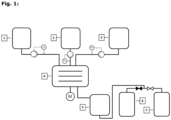
- Fig. 1 shows an exemplary flow diagram for the present invention:
- Reference numeral 1 stands for a metering container with liquid alkali metal or alkali metal mixture/alloy;
- Reference numeral 2 stands for a metering container of the reactant or a reactant mixture;
- Reference numeral 3 stands for a metering container of the solvent or a solvent mixture;
- Reference numeral 4 stands for a spinning disc reactor (SDR);
- Reference numeral 5 stands for an optional residence time unit (for example stirred tank, stirred tank cascade, heat exchanger);
- Reference numeral 6 stands for a collecting container for the product mixture;
- Reference numeral 7 stands for a collecting container for the by-product mixture.
- the rotating disk reactor was developed as a suitable technology for conducting reactions with liquid alkali metal dispersions in inert organic solvents, in particular the Wurtz coupling of halogen compounds and acyloin condensation, with the formation of solid precipitates.
- This reactor type was developed for process intensification to particularly optimize heat transfer (heating, cooling, heat exchange) and mass transfer processes (mixing, dispersing):
- the technology is based on one or more disks mounted horizontally on a rotating axis driven by an electric motor. A liquid applied to the surface of this disk is propelled to the edge of the disk or beyond by the centrifugal force acting on it. In the thin layer formed High shear forces act on the film, resulting in excellent heat and mass transfer rates.
- the high shear forces introduced into the flowing liquid film also lead to strong turbulence, which offers crucial advantages, especially for reactions in multiphase systems:
- the high shear forces cause the dispersed phase to be very finely distributed and the interface between two immiscible phases to be maximized. This optimizes mass transport to and from the interface.
- the rotational movement is strong enough to eject solid deposits from the disk surface, triggering a type of self-cleaning mechanism and reducing fouling or blocking through the formation of precipitation.
- the use described in this invention takes place in a liquid medium consisting of an inert solvent or solvent mixture and the reactants dissolved therein (for example, haloalkanes, halosilanes, esters).
- the reactants dissolved therein for example, haloalkanes, halosilanes, esters.
- the alkali metal or alkali metal mixture or alloy, the reactants, and solvent are each metered separately into the reactor.
- the reaction of the alkali metal or alkali metal mixture or alloy with the reactants produces an alkali metal salt that is insoluble in the reaction mixture. and, depending on the reaction type, a coupling product that is soluble or insoluble in the liquid medium.
- This is a continuously conducted multiphase reaction in which the reactive phases are liquid and one or more reaction products precipitate as a solid.
- alkali metals, their mixtures, and/or alloys are suitable for producing the alkali metal dispersion.
- Alkali metals, or mixtures and/or alloys thereof, whose melting points are in the range between -20 and 190°C are preferred.
- Lithium, sodium, and potassium, as well as their mixtures and alloys, are particularly preferred, as they are readily available and melt within a temperature range that is easily manageable.
- aprotic organic solvents in which the reactants (for example, halogen compounds of the elements of main group IV or organic esters) are soluble and which do not react with the alkali metal or the alkali metal mixture or alloy used can be used as inert solvents.
- Hydrocarbons such as benzene, toluene, xylene and aliphatic hydrocarbons, as well as ethers such as dioxane, anisole and THF, are preferred.
- the inert solvent can also be a mixture of the solvents mentioned. e.g., from a hydrocarbon and an ether, for example, toluene and THF.
- the alkali metal salt formed in the reaction is insoluble in the solvent used and can be separated by filtration of the precipitate.
- the process according to the invention can be used to convert all substrates commonly used for Wurtz coupling, such as mono-, di-, tri-, and polyfunctional alkyl and aryl halides and mixtures thereof, as well as mono-, di-, tri-, and polyfunctional haloorganosilanes and mixtures thereof.
- Fluorine, chlorine, bromine, and iodine can be used as halogens in the halogen compounds; chlorine, bromine, and iodine are preferred, and chlorine and bromine are particularly preferred.
- the invention is particularly suitable for preparing polysilanes and polycarbosilanes from halogenated organosilane building blocks that are not polysilanes.
- the halogenated organosilane building blocks are defined by having fewer than 5 silicon atoms, preferably a maximum of 3 silicon atoms, particularly preferably a maximum of 2 silicon atoms, and very particularly preferably only one silicon atom.
- Monoesters, diesters, triesters, and polyesters are used for acyloin condensation. Monoesters and diesters are preferred.
- the described process is particularly suitable for the intramolecular cyclization of dicarboxylic acid esters to form medium and large ring systems.
- the amount of solvent, alkali metal and reactants is to be chosen so that the reaction medium remains flowable even after the formation of the solid alkali metal halides and, if applicable, the insoluble products, so that fouling and blockage of the SDR are minimized.
- 5 to 99 wt.% solvent is used based on the total reaction mixture, preferably 50 to 97 wt.%, with 70 to 95 wt.% solvent content being particularly preferred.
- the ratio of the alkali metals or their mixtures and/or alloys to the reactants used is selected so as to achieve the most complete conversion possible.
- stoichiometric use is preferred.
- an excess of the alkali metal over the halide is typically required, preferably an excess of up to 20 wt. %, more preferably an excess of up to 10 wt. %, most preferably an excess of up to 5 wt. %.
- the process described in this invention can be carried out over a wide temperature range.
- the temperature range is limited by the fact that it is a multi-phase process with two liquids, more precisely the molten alkali metal or the molten alkali metal mixture or alloy and the reaction medium consisting of solvent and reactants.
- the lower limit for the temperature range is the melting temperature of the alkali metal or the alkali metal alloy/mixture.
- the upper limit is determined by the boiling range of the reaction mixture and the technical design of the SDRs.
- the reaction is preferably carried out in a range between 50 and 200 °C, particularly preferably between 100 and 115 °C.
- the rotation speed of the SDR turntable must be selected so that optimal dispersion of the liquid alkali metal or alkali metal mixture/alloy in the solvent is achieved.
- a further advantage of the present invention is the high surface-to-volume ratio of the reaction mixture and its efficient mixing, which enables efficient removal of the heat generated in the exothermic reaction.
- This results in a short residence time of the reaction mixture in the SDR and thus a short overall process time while simultaneously reducing the hazard potential of the reaction.
- the resulting high space-time yield makes the described process economically highly attractive compared to established semibatch processes.
- the residence time of the reaction mixture in the SDR is ⁇ 10 min, particularly preferably ⁇ 5 min. During this time, the majority of the exothermic energy of the reaction is released and dissipated.
- a residence time unit can optionally be installed downstream. All suitable units known to those skilled in the art are suitable for this purpose, in particular a continuous stirred tank, a stirred tank cascade, a heat exchanger, and thermostatically controlled loop reactors.
- the reaction product can be separated from the reaction mixture and, if necessary, purified by any suitable method known to those skilled in the art. If, for example, the product is soluble in the reaction medium, the solid alkali metal salt precipitate, along with any residual alkali metal, is first separated by filtration. The product is then obtained, for example, by fractional distillation or by distilling off the solvent. If the product is insoluble in the reaction medium, it can be separated by filtration together with the solid alkali metal salt precipitate and any residual alkali metal. Unreacted alkali metal is, if necessary, deactivated with protic solvents, and the alkali metal salts are extracted with water. These are examples.
- the SDR was set to a rotation speed of 1000 or 2500 rpm, a heating oil temperature of 100 or 105°C, and an initial xylene flow of 6.5 kg/h.
- a constant temperature had been established in the reactor, the sodium dosing was started.
- the mass ratio of dichloromethylphenylsilane to sodium remained constant at 5:1 in all experiments.
- the onset of the reaction was immediately recognizable by the temperature increase on the first and second plate of the reactor. Later, the deep purple reaction mixture emerged into the collection vessel.
- the dosing rates and oil temperatures were varied as listed in the table.
- the product was filtered under nitrogen through a G4-F ceramic filter, and the solvent was completely distilled off under vacuum.
- the polymer was characterized by 1 H NMR, 13 C NMR, and 29 Si NMR spectroscopy. (each in C 6 D 6 ) and gel permeation chromatography (in THF with light scattering detector).
Landscapes
- Chemical & Material Sciences (AREA)
- Organic Chemistry (AREA)
- Chemical Kinetics & Catalysis (AREA)
- Health & Medical Sciences (AREA)
- Medicinal Chemistry (AREA)
- Polymers & Plastics (AREA)
- Organic Low-Molecular-Weight Compounds And Preparation Thereof (AREA)
- Silicon Polymers (AREA)
Description
- Die vorliegende Erfindung betrifft ein kontinuierliches Verfahren, bei dem auf einem Drehscheibenreaktor (engl.: Spinning Disc Reactor (SDR)) feine Alkalimetalldispersionen in organischen Lösungsmitteln generiert und zur Kupplung organischer Ester und Halogenide sowie von Organohalogensilanen eingesetzt werden.
- Alkalimetalle, und unter ihnen vor allem Natrium, sind in der organischen Chemie schon lange als Reagenzien etabliert, beispielsweise zur Herstellung von Alkoholaten, für die Glycidesterkondensation nach Darzens, für die Birch-Reduktion zur Umwandlung von aromatischen in aliphatische Verbindungen oder zur Acyloinkondensation von Estern zu α-Hydroxycarbonylverbindungen (K. Rühlmann Synthesis (1971), (1971(5), 236-253). Vor allem letztere Reaktion ist in der organischen Chemie zur intramolekularen Zyklisierung von Dicarbonsäureestern zu mittleren und großen Ringsystemen von Bedeutung.
- Ein weiteres großes Anwendungsfeld für elementare Alkalimetalle bietet die 1854 vom französischen Chemiker Adolphe Wurtz entdeckte Wurtz-Kupplung oder Wurtz'sche Synthese, welche anfangs v.a. der Synthese von (Cyclo-)Alkanen ausgehend von Halogenalkanen diente. Mittels der Wurtz'schen-Synthese sind Cycloalkane der Ringgröße von drei bis sechs Kohlenstoffatomen zugänglich. Die Wurtz-Kupplung ist ebenfalls die Haupt-Route zur Herstellung σ-π-konjugierter Siliziumpolymere über die Polykondensation von Halogensilanen in aprotischen organischen Lösungsmitteln (R. D. Miller, J. Michl Chemical Reviews (1989), 89 (6), 1359-1410).
- Die genannten Reaktionen werden nach dem heutigen Stand der Technik im Semibatch-Verfahren durchgeführt (unter anderem beschrieben in den Patenten
EP 0 123 934 B1 ,EP 0 632 086 B1 ,EP 0 382 651 A1 ,EP 1 769 019 A1 ,DE 10 2012 223 260 A1 ,EP 2 872 547 A1 ,EP 0 230 499 B1 ,JP 3087921 B2 JP 2736916 B2 CN 103508869 B ,US 4324901 A ,US 4276424 A ). Hierfür wird in einem Reaktionsgefäß die Suspension eines Alkalimetalls (beispielsweise Natrium) vorgelegt. Zu dieser werden unter streng kontrollierten Bedingungen die zu kuppelnden Substanzen (Halogenalkane, Halogensilane oder Di-/Ester) zu dosiert. Dieses Verfahren birgt allerdings eine Vielzahl sicherheitstechnischer Risiken und verfahrenstechnischer Probleme. Zum einen ist der Umgang mit den flüssigen Alkalimetallen, aber auch mit einigen der Reaktanden wie zum Beispiel den hochreaktiven Chlorsilanen im Produktionsmaßstab sehr komplex. So muss in jedem Fall Feuchtigkeit komplett ausgeschlossen werden. Da die Reaktion stark exotherm ist, wird zum anderen die Reproduzierbarkeit der Produkteigenschaften schon durch geringe Schwankungen innerhalb verschiedener Batchansätze beeinflusst. Schon im Labormaßstab wird zum Beispiel eine schlechte Reproduzierbarkeit der Ergebnisse einer Wurtz-Kupplung zur Herstellung von Polysilanen beobachtet. - Da es sich bei Reaktionen mit Alkalimetalldispersionen um Grenzflächenreaktionen handelt, sind eine möglichst feinteilige Dispersion und damit eine hohe Partikeloberfläche vorteilhaft für schnelle und vollständige Reaktionen. Für ein Semibatch-Verfahren ist dies in der Produktion aber nur schwer exakt einstellbar, was zu Abweichungen im Prozess führt. Auch eine exakte Zudosierung der Reaktanden (beispielsweise Halogenverbindungen, Ester) ist für eine exakte Reaktionsführung essentiell, da unterschiedliche Dosierraten zu Abweichungen im Temperaturverlauf führen können. Aus den genannten Gründen ist leicht verständlich, dass diese Faktoren auch das Upscaling des Semibatch-Verfahrens und die damit verbundene großtechnische Nutzung der Reaktion erheblich erschweren.
- Für die Reaktion von Alkalimetallen mit Alkoholen über dem Schmelzpunkt der Metalle wurde in
EP 1162187 B1 ein Mikroreaktor mit statischem Mischer und Wärmetauscher mit Kanal-Dimensionen um 500 µm verwendet. - Die Verwendung von SDRs ist Stand der Technik für die Epoxidierung von substituierten Cyclohexanonen
EP 1 20 6460 B1 , Umsetzungen von Carboxysäuren und EsternWO 2002/018328 A1 , die Herstellung von NanopartikelnUS 8,870,998 B2 , zur Hydrogenierung von Nitrilkautschuk in LösungEP 1 862 477 B1 , für heterogen katalysierte ReaktionenEP 1 152 823 B2 , sowie zur Durchführung von radikalischen EmulsionspolymerisationenUS 7,683,142 B2 . - Darüber hinaus sind in der wissenschaftlichen Literatur Anwendungen für die Herstellung von Titandioxid-Partikeln (S. Mohammadi; A. Harvey; K. V. K. Boodhoo Chemical Engineering Journal (2014), 258, 171-184), zur kationischen Polymerisation von Styrol mithilfe eines immobilisierten Katalysators (K. V. K. Boodhoo; W.A.E. Dunk; M. Vicevic; R. J. Jachuck; V. Sage; D. J. Macquarrie; J. H. Clark Journal of Applied Polymer Science (2006), 101(1), 8-19), zur Photopolymerisation von n-Butylacrylat (K. V. K. Boodhoo; W.A.E. Dunk; R. J. Jachuck ACS Symposium Series (2003), 847 (Photoinitiated Polymerization), 437-450), sowie zur Herstellung von Mayonnaise (M. Akhtar; B. S. Murray; S. Dowu Food Hydrocolloids (2014), 42(S), 223-228), Apfelsaftkonzentrat (M. Akhtar; P. Chan; N. Safriani; B. Murray; G. Clayton Journal of Food Processing & Technology (2011), 2(2), 1000108) und Eiscreme-Basisemulsionen (M. Akhtar; I. Blakemore; G. Clayton; S. Knapper International Journal of Food Science and Technology (2009), 44(6), 1139-1145) beschrieben. Weiterhin hat die Firma Flowid einen Lithium-Halogen-Austausch bei Raumtemperatur mit einem Produktfluss von 100 kg/h Rohmaterial beziehungsweise 20kg/h Produkt für Biogen realisiert (http://www.flowid.nl/successful-scale-up-of-butyl-lithium-usingthe-spinpro/ 08.08.2015). Außerdem sind in der Literatur viele Beispiele zu Rekristallisation beziehungsweise Partikelsynthese beschrieben. Die Vorteile der SDR-Technologie für diese mehrphasigen Systeme wurden in der Fachliteratur ausführlich besprochen und mit Beispielen belegt (K. Boodhoo & A. Harvey Process Intensification for Green Chemistry: Engineering Solutions for Sustainable Chemical Processing (2013), Chapter 3, John Whiley & Sons Ltd, pp 59-90), S. D. Pask, O. Nuyken, Z. Cai Polymer Chemistry (2012), 3, 2698), P. Oxley, C. Brechtelsbauer, F. Ricard, N. Lewis, C. Ramshaw Industrial & Engineering Chemistry Research (2000), 39(7), 2175-2182).
-
DE 696 00 862 T2 offenbart ein sicheres, effizientes Verfahren zur Herstellung von Natrium-C4-C8-Alkoxid, das eine weniger als stöchiometrische Menge eines C4-C8-Alkohols und die Möglichkeit einer kontinuierlichen Rückführung des nicht umgesetzten Natriummetalls verwendet. -
US 2,631,175 A beschreibt ein Verfahren zur Herstellung von Polybutadien. Insbesondere wird ein kontinuierliches Verfahren offenbart, in welchem eine feinteilige Natriumdispersion als Katalysator eingesetzt wird. -
WO 2006/084878 A1 offenbart Verfahren zur Herstellung tertiärer Phosphine durch Umsetzung einer Verbindung der allgemeinen Formel (I) A,B-P-L1, in der A für R1 oder L2, B für R2 oder L3, die Reste R1 und R2 unabhängig voneinander für einen organischen Rest mit jeweils 1 bis 30 Kohlenstoffatomen, wobei die Reste R1 und R2 auch miteinander verbunden sein können; und die Abgangsgruppen L1 bis L3 unabhängig voneinander für Halogen, Alkyloxy mit 1 bis 10 Kohlenstoffatomen oder Aryloxy mit 6 bis 10 Kohlenstoffatomen stehen, (a) mit einem Alkalimetall in einem organischen aprotischen Lösungsmittel und (b) einer Verbindung der allgemeinen Formel (II) L4-R3 in der der Rest R3 für einen organischen Rest mit jeweils 1 bis 30 Kohlenstoffatomen; und die Abgangsgruppe L4 für Halogen, Alkyloxy mit 1 bis 10 Kohlenstoffatomen oder Aryloxy mit 6 bis 10 Kohlenstoffatomen, bei dem man das erhaltene Reaktionsgemisch mit einer wässrigen Base, welche einen pH-Wert von >= 10 aufweist, hydrolysiert und die organische Phase von der wässrigen Phase abtrennt. - Der vorliegenden Erfindung liegt nun die Aufgabe zugrunde, ein kontinuierliches Verfahren zur Durchführung von chemischen Reaktionen mit flüssigen feinteiligen Alkalimetall-Dispersionen in inerten Lösungsmitteln zur Verfügung zu stellen, welches nicht durch die beschriebenen Probleme der Semibatch-Fahrweise limitiert ist.
- Überraschenderweise wurde gefunden, dass die vorgenannte Aufgabe in einer ersten Ausführungsform gelöst wird durch die Verwendung einer Vorrichtung zur Durchführung kontinuierlicher chemischer Reaktionen zur Umsetzung von feinteiligen Alkalimetall-Dispersionen in inerten Lösungsmitteln, beziehungsweise erfindungsgemäß durch die Verwendung eines Drehscheibenreaktors zur Durchführung von kontinuierlichen chemischen Verfahren unter Einsatz von flüssigen feinteiligen Dispersionen von Alkalimetallen, Alkalimetallgemischen und/ oder Alkalimetalllegierungen in inerten Lösungsmitteln.
- Bekannte Systeme der kontinuierlichen Produktionstechnik sind sogenannte Strömungsrohrreaktoren (engl. Plug Flow Reactors, PFRs), kontinuierliche Rührkessel (engl. Continuously Stirred Tank Reactor, CSTR) und deren Kaskaden, sowie die Mikroreaktionstechnik (MRT). Für die normalerweise stark exothermen Grenzflächenreaktionen an dispergierten Alkalimetallen ist eine hocheffiziente Durchmischung essentiell, um einen möglichst hohen Massefluss der Reaktanden und Produkte an die beziehungsweise von der Oberfläche zu gewährleisten, sowie die entstehende Wärme schnell abzuführen. Dies kann zum Beispiel mit statischen Mixern in Strömungsrohr- beziehungsweise Mikroreaktoren erreicht werden. Diese weisen weiterhin eine ideale Verweilzeitverteilung auf. Auch in CSTRs ist eine gute Durchmischung möglich; sie haben den zusätzlichen Vorteil, dass sie vergleichsweise leicht zu reinigen sind, wodurch Fouling beziehungsweise Blocking bei mehrphasigen Reaktionen (z.B. mit zwei nicht mischbaren flüssigen Komponenten oder festen Reaktionsprodukten) ein geringes Problem darstellt.
- Ein bevorzugtes bisher technisch wenig eingesetztes System der kontinuierlichen Produktionstechnik ist der Drehscheibenreaktor (engl. Spinning Disc Reactor, SDR).
- Erfindungsgemäß können die wesentlichen Probleme eines Semibatchverfahrens für die Durchführung von Reaktionen mit feinteiligen Alkalimetalldispersionen durch eine kontinuierliche Fahrweise beseitigt werden: Bei einem kontinuierlichen Reaktionsprozess werden nur kleine Mengen von Gefahrstoffen pro Zeiteinheit zusammengeführt und hierbei idealerweise effizient durchmischt. Wird eine stark exotherme Reaktion gehandhabt, kann die entstehende Wärme durch ein hohes Oberfläche-Volumen-Verhältnis gut abgeführt werden und es resultiert ein homogenes Temperaturprofil in der Reaktionsmischung. Dies alles führt erfindungsgemäß zu einer signifikanten Verbesserung des Sicherheitsaspekts solcher Reaktionen, sowie zu einer deutlich verbesserten Reproduzierbarkeit der Produktqualität im stationären Zustand eines solchen kontinuierlichen Prozesses.
- Die vorliegende Erfindung findet insbesondere Anwendung für die Wurtz-Kupplung von Halogenverbindungen, sowie für die Acyloinkondensation von Estern. Das hierbei jeweils vorliegende flüssige Zweiphasensystem vor der Reaktion bzw. die bei der Wurtz-Kupplung entstehende konzentrierte Salzdispersion führt im kontinuierlich betriebenen SDR aufgrund der hohen Scherkräfte in diesem dynamischen System nicht zu Fouling und Verblockungen.
-
Fig. 1 zeigt ein exemplarisches Fließschema für die vorliegende Erfindung: Das Bezugszeichen 1 steht für einen Dosierbehälter mit flüssigem Alkalimetall beziehungsweise Alkalimetallmischung/-legierung; Das Bezugszeichen 2 steht für einen Dosierbehälter des Reaktanden beziehungsweise eine Reaktandenmischung; Das Bezugszeichen 3 steht für einen Dosierbehälter des Lösungsmittels beziehungsweise eine Lösungsmittelmischung; Das Bezugszeichen 4 steht für einen Drehscheibenreaktor (Spinning Disc Reaktor, SDR); Das Bezugszeichen 5 steht für eine optionale Verweilzeiteinheit (beispielsweise Rührkessel, Rührkesselkaskade, Wärmetauscher); Das Bezugszeichen 6 steht für einen Auffangbehälter der Produktmischung; Das Bezugszeichen 7 steht für einen Auffangbehälter der Nebenproduktmischung. - Aufgrund der oben genannten Beispiele konnte erfindungsgemäß der Drehscheibenreaktor für die Durchführung von Reaktionen mit flüssigen Alkalimetalldispersionen in inerten organischen Lösungsmitteln, insbesondere der Wurtz-Kupplung von Halogenverbindungen sowie der Acyloinkondensation, unter Bildung fester Niederschläge als geeignete Technologie entwickelt werden. Dieser Reaktortypus wurde für die Prozessintensivierung entwickelt um besonders Wärmetransport (Heizen, Kühlen, Wärmeaustausch) und Stofftransportprozesse (Mischen, Dispergieren) zu optimieren: Die Technologie basiert auf einer oder mehreren Scheiben, die horizontal auf einer rotierenden Achse angebracht sind, welche von einem elektrischen Motor angetrieben wird. Eine auf die Oberfläche dieser Scheibe aufgebrachte Flüssigkeit wird durch die wirkende Zentrifugalbeschleunigung an den Rand der Platte beziehungsweise darüber hinausgeschleudert. In dem gebildeten dünnen Film wirken hohe Scherkräfte und damit ausgezeichnete Wärme- und Massentransferraten. So kann bei stark exothermen Reaktionen die entstehende Wärme schnell abgeführt werden, sowie bei diffusionslimitierten Prozessen der Stofftransport maximiert werden. Die hohen in den durchfließenden Flüssigkeitsfilm eingebrachten Scherkräfte führen außerdem zu starken Verwirbelungen, was vor allem bei Reaktionen in mehrphasigen Systemen entscheidende Vorteile bietet: Durch die hohen Scherkräfte wird die dispergierte Phase sehr fein verteilt und die Grenzfläche zwischen zwei nicht mischbaren Phasen maximiert. Dadurch wird der Massentransport zur Grenzfläche hin und von dieser fort optimiert. Weiterhin ist die Rotationsbewegung stark genug, um feste Ablagerungen von der Scheibenoberfläche zu schleudern, wodurch eine Art Selbstreinigungsmechanismus eintritt und Fouling beziehungsweise Blocking durch die Bildung von Niederschlag reduziert wird.
- Typischerweise findet die in dieser Erfindung beschriebene Verwendung in einem flüssigen Medium statt, welches aus einem inerten Lösungsmittel beziehungsweise Lösungsmittelgemisch sowie den darin gelösten Reaktanden (beispielsweise Halogenalkane, Halogensilane, Ester) besteht. Im Allgemeinen ist es zum Erreichen einer hohen Reaktionsgeschwindigkeit notwendig, dass das verwendete Alkalimetall beziehungsweise die verwendete Alkalimetallmischung oder-legierung in geschmolzenem Zustand vorliegt, um es in dem Reaktionsmedium feinteilig zu dispergieren. Das Alkalimetall beziehungsweise die Alkalimetallmischung oder -legierung, die Reaktanden und Lösungsmittel werden jeweils separat in den Reaktor dosiert. Bei der Reaktion des Alkalimetalls beziehungsweise der Alkalimetallmischung beziehungsweise -legierung mit den Reaktanden entsteht ein im Reaktionsgemisch unlösliches Alkalimetallsalz, sowie je nach Reaktionstypus ein im flüssigen Medium lösliches oder auch unlösliches Kupplungsprodukt. Es handelt sich damit um eine kontinuierlich durchgeführte Mehrphasenreaktion, bei der die reaktiven Phasen flüssig vorliegen und ein oder mehrere Reaktionsprodukte als fester Niederschlag ausfallen.
- Alle Reaktionsschritte finden typischerweise unter Inertgasatmosphäre statt, um Nebenreaktionen durch Sauerstoff oder Luftfeuchtigkeit, insbesondere die Bildung von Wasserstoff und Chlorwasserstoff, zu verhindern.
- Zur Herstellung der Alkalimetalldispersion sind prinzipiell alle Alkalimetalle, deren Mischungen und/oder Legierungen geeignet. Bevorzugt sind Alkalimetalle beziehungsweise Mischungen und/oder Legierungen dieser, deren Schmelzpunkt im Bereich zwischen -20 und 190°C liegt. Besonders bevorzugt sind Lithium, Natrium und Kalium sowie deren Mischungen und Legierungen, da sie technisch gut zugänglich sind und in einem Temperaturbereich schmelzen, der technisch gut handhabbar ist.
- Als inerte Lösungsmittel können alle technisch gängigen aprotischen organischen Lösungsmittel eingesetzt werden, in denen die Reaktanden (beispielsweise Halogenverbindungen der Elemente der IV. Hauptgruppe beziehungsweise organische Ester) löslich sind und die nicht mit dem eingesetzten Alkalimetall beziehungsweise der eingesetzten Alkalimetallmischung oder -legierung reagieren. Zum Einsatz kommen bevorzugt Kohlenwasserstoffe wie Benzol, Toluol, Xylol und aliphatische Kohlenwasserstoffe, sowie Ether wie Dioxan, Anisol und THF. Das inerte Lösungsmittel kann ebenfalls eine Mischung der genannten Lösungsmittel sein, z. B. aus einem Kohlenwasserstoff und einem Ether, also beispielsweise Toluol und THF. Typischerweise ist das in der Reaktion gebildete Alkalimetallsalz in dem verwendeten Lösungsmittel nicht löslich und kann durch Filtration des Niederschlages abgetrennt werden.
- Als Reaktanden kommen verschiedene Substanzen in Frage:
Mit dem erfindungsgemäßen Verfahren können alle für die Wurtz-Kupplung gängigen Substrate wie mono-, di-, tri- und polyfunktionelle Alkyl- und Aryl-Halogenide und deren Mischungen sowie mono-, di-, tri- und polyfunktionelle Halogenorganosilane und deren Mischungen umgesetzt werden. Als Halogene in den Halogenverbindungen können Fluor, Chlor, Brom und Iod zum Einsatz kommen, bevorzugt kommen Chlor, Brom und Iod, besonders bevorzugt Chlor und Brom zum Einsatz. Insbesondere ist die Erfindung zur Herstellung von Polysilanen und Polycarbosilanen aus halogenierten Organosilan-Bausteinen, die keine Polysilane sind, geeignet. Die halogenierten Organosilan-Bausteine sind definiert dadurch, dass sie weniger als 5 Siliziumatome, bevorzugt maximal 3 Siliziumatome, besonders bevorzugt maximal 2 Siliziumatome und ganz besonders bevorzugt lediglich ein Siliziumatom aufweisen. - Für die Acyloinkondensation kommen Monoester, Diester, Triester und Poly-Ester zum Einsatz. Bevorzugt kommen Mono- und Diester zum Einsatz. Insbesondere ist das beschriebene Verfahren geeignet zur intramolekularen Zyklisierung von Dicarbonsäureestern zu mittleren und großen Ringsystemen.
- Bei der vorliegenden Erfindung ist die Menge des Lösungsmittels, des Alkalimetalls und der Reaktanden so zu wählen, dass das Reaktionsmedium auch nach Bildung der fest ausfallenden Alkalimetallhalogenide und ggf. der unlöslichen Produkte fließfähig bleibt, damit Fouling und Verblockungen des SDR minimiert bleiben. Typischerweise werden 5 bis 99 Gew. % Lösungsmittel bezogen auf die Gesamtreaktionsmischung eingesetzt, bevorzugt 50 bis 97 Gew. %, besonders bevorzugt sind 70 bis 95 Gew. % Lösungsmittelanteil.
- Erfindungsgemäß wird das Verhältnis der eingesetzten Alkalimetalle beziehungsweise deren Mischungen und/oder Legierungen zu den Reaktanden so gewählt, dass ein möglichst vollständiger Umsatz erzielt wird. Bei der Herstellung von niedermolekularen Kopplungsprodukten ist ein möglichst stöchiometrischer Einsatz bevorzugt. Für die Herstellung von polymeren Kupplungsprodukten benötigt man typischerweise einen Überschuss des Alkalimetalls gegenüber dem Halogenid, bevorzugt einen Überschuss von bis zu 20 Gew. %, besonders bevorzugt einen Überschuss von bis zu 10 Gew. %, ganz besonders bevorzugt einen Überschuss von bis zu 5 Gew. %.
- Der in dieser Erfindung beschriebene Prozess kann in einem weiten Temperaturbereich durchgeführt werden. Der Temperaturbereich ist dadurch limitiert, dass es sich um einen mehrphasigen Prozess mit zwei Flüssigkeiten, genauer dem geschmolzenen Alkalimetall beziehungsweise der geschmolzenen Alkalimetallmischung beziehungsweise -legierung und dem Reaktionsmedium aus Lösungsmittel und Reaktanden, handelt. Damit ergibt sich als untere Grenze für den Temperaturbereich die Schmelztemperatur des Alkalimetalls beziehungsweise der Alkalimetalllegierung/-mischung. Die obere Grenze ergibt sich aus dem Siedebereich des Reaktionsgemisches und der technischen Auslegung des SDRs. Bevorzugt wird die Reaktion in einem Bereich zwischen 50 und 200 °C ausgeführt, besonders bevorzugt zwischen 100 und 115°C.
- Die Rotationsgeschwindigkeit der Drehscheibe des SDR muss so gewählt werden, dass eine optimale Dispersion des flüssigen Alkalimetalls beziehungsweise der Alkalimetallmischung /-legierung im Lösungsmittel erzielt wird.
- Ein weiterer Vorteil der vorliegenden Erfindung ist das hohe Verhältnis von Oberfläche zu Volumen der Reaktionsmischung und die effiziente Durchmischung dieser, wodurch ein effizienter Abtransport der in der exothermen Reaktion generierten Wärmemenge möglich ist. Daraus resultieren eine kurze Verweilzeit der Reaktionsmischung im SDR und damit eine kurze Gesamtprozessdauer bei gleichzeitiger Verminderung des Gefahrenpotentials der Reaktion. Die daraus resultierende hohe Raum-Zeit-Ausbeute macht das beschriebene Verfahren im Vergleich zu etablierten Semibatch-Verfahren wirtschaftlich höchst interessant. Typischerweise ist die Verweilzeit der Reaktionsmischung im SDR <10 min, besonders bevorzugt <5 min. In dieser Zeit wird der größte Teil der Exothermie der Reaktion freigesetzt und abgeführt. Um speziell bei der Herstellung von polymeren Reaktionsprodukten den Umsatz der reaktiven Gruppen zu maximieren, kann gegebenenfalls eine Verweilzeiteinheit nachgeschaltet werden. Hierbei kommen alle dem Fachmann bekannten geeigneten Einheiten in Frage, insbesondere ein kontinuierlicher Rührkessel, eine Rührkesselkaskade, ein Wärmetauscher und thermostatierbare Schlaufenreaktoren.
- Wenn die Reaktion den gewünschten Umsetzungsgrad erreicht hat, kann das Reaktionsprodukt aus der Reaktionsmischung durch jegliche dem Fachmann bekannte geeignete Methode abgetrennt und ggf. aufgereinigt. Ist beispielsweise das Produkt im Reaktionsmedium löslich, wird zuerst der feste Alkalimetallsalz-Niederschlag mit gegebenenfalls restlichem Alkalimetall durch Filtration abgetrennt. Dann wird das Produkt beispielsweise durch fraktionierte Destillation oder Abdestillation des Lösungsmittels erhalten. Ist das Produkt unlöslich im Reaktionsmedium, kann es durch Filtration zusammen mit dem festen Alkalimetallsalz-Niederschlag und ggf. restlichem Alkalimetall durch Filtration abgetrennt werden. Nicht umgesetztes Alkalimetall wird ggf. mit protischen Lösungsmitteln deaktiviert und die Alkalimetallsalze mit Wasser extrahiert. Dies sind Beispiele.
- Für die durchgeführten Reaktionen wurde ein handelsüblicher SpinPro Reactor der Firma Flowid (Eindhoven, Niederlande, http://www.flowid.nl/spinpro-reactor/) mit drei Drehscheiben und integriertem Wärmetauscher verwendet. Der Abstand der Drehscheiben von der Wandung betrug 2 mm. Das Reaktorvolumen betrug 230 ml. Für alle Reaktionen wurde der Reaktor zur Inertisierung 20 mal evakuiert und mit 8 bar Stickstoff belüftet. Für die Synthese der Polysilane (Beispiele 1 und 2) wurde als Verweilzeiteinheit ein kontinuierlicher Rührkessel mit einer Verweilzeit von 20 min (Fluss 7,2 kg/h => 2,8 L; Fluss 10,8 kg/h => 4,1 L) nach den SDR geschaltet.
- Semibatch-Verfahren zur Herstellung von Poly(methylphenylsilan):
Unter Verwendung von Standard-Schlenk-Technik wurde eine Apparatur aus einem 1000mL Vierhalskolben mit Tropftrichter, Rückflusskühler, KPG-Rührer und Temperaturfühler evakuiert und unter Argon gesetzt. Im Vierhalskolben wurden 215 g Xylol und 17,9 g Natrium vorgelegt. Der Tropftrichter wurde ebenfalls unter Inertgasatmosphäre mit 67,3 g Dichlormethylphenylsilan befüllt. Unter langsamem Rühren wurde der Kolben im Ölbad auf ca. 102 °C erhitzt, so dass das Natrium geschmolzen vorlag. Nun wurde die Rührgeschwindigkeit auf genau 300 rpm eingestellt und etwa fünf Minuten gerührt. Nach dieser Zeit hatte sich eine homogene, feinteilige Dispersion gebildet (optische Beurteilung). Zu dieser Suspension wurde über einen Zeitraum von etwa 30 min das Dichlorphenylmethylsilan zu dosiert. Das Anspringen der Reaktion konnte über ein Ansteigen der Temperatur, sowie eine intensive Violettfärbung der Reaktionsmischung beobachtet werden. Die Dosiergeschwindigkeit war dabei so zu wählen, dass das Dichlorphenylmethylsilan gleichmäßig über die Dosierzeit hinweg zugegeben wurde und gleichzeitig die Reaktionstemperatur stets im Temperaturfenster von 102 - 106°C blieb. - Die Reaktionsmischung wurde nach Ende der Dosierung noch 2 h bei 102°C nachgerührt. Die gebildete Suspension wurde nach Abkühlen auf Raumtemperatur unter Schutzgas über eine Keramikfritte (G4) filtriert. Das Filtrat wurde durch Abdestillieren des Lösungsmittelgemisches im Vakuum konzentriert, um den löslichen Anteil des gebildeten Po-ly(methylphenylsilans) zu erhalten. Das Polymer wurde mittels 1H-NMR-13C-NMR-, 29Si-NMR-Spektroskopie (jeweils in C6D6) und Gelpermeationschromatographie (in THF mit Lichtstreudetektor) charakterisiert.
- Ausbeute: 32 %
- Molmasse: 2000 g/mol
- 1H-NMR (δ [ppm], CDCl3): 6,5-7,5 ppm, 0,5 ppm.
- 13C-NMR (δ [ppm], CDCl3): 134-138 ppm, 125-130 ppm, 21 ppm.
- 29Si-NMR (δ [ppm], CDCl3): -41 ppm, -40 ppm, -39 ppm, +15 ppm.
- Zum Anfahren der Reaktion wurde der SDR auf eine Umdrehungsgeschwindigkeit von 1000 oder 2500 rpm, eine Heizöltemperatur von 100 oder 105°C und anfangs einen Xylolfluss von 6,5 kg/h eingestellt. Sobald die sich eine konstante Temperatur im Reaktor eingestellt hatte, wurde die Natrium-Dosierung gestartet. Sobald der Austritt einer grauen Dispersion in den Auffangbehälter beobachtet wurde, wurde die Dosierung des Dichlormethylphenylsilans gestartet. Das Masseverhältnis von Dichlormethylphenylsilan zu Natrium war bei allen Versuchen mit 5/1 konstant. Der Beginn der Reaktion war sofort erkennbar durch den Temperaturanstieg auf der ersten und zweiten Platte des Reaktors. Später trat das tief-violett gefärbte Reaktionsgemisch in den Auffangbehälter aus. Die Dosierraten und Öltemperaturen wurden wie in der Tabelle aufgeführt variiert.
- Das Produkt wurde unter Stickstoff über eine G4-FKeramikfitte abfiltriert und das Lösemittel wurde unter Vakuum vollständig abdestilliert. Das Polymer wurde mittels 1H-NMR-, 13C-NMR-, 29Si-NMR-Spektroskopie (jeweils in C6D6) und Gelpermeationschromatographie (in THF mit Lichtstreudetektor) charakterisiert.
Drehzahl [rpm] THeizöl [°C] Gesamtfluss [kg/h] Feststoffgehalt [%] T1./2./3.Platte [°C] Molmasse [g/mol] Ausbeute Isl. Polysilan [%] 1.1 2500 105 7,2 10 109/107/104 3100 46 1.2 -"- -"- 10,8 -"- 112/108/105 2900 43 1.3 2500 105 10,8 20 119/114/109 1900 35 1.4 -"- -"- 7,2 -"- 116/113/108 2200 38 1.5 1000 105 7,2 20 106/111/107 2400 41 1.6 -"- -"- 10,8 -"- 107/118/109 2100 37 1.7 2500 100 10,8 20 110/106/101 2900 42 1.8 -"- -"- 7,2 -"- 107/103/100 3200 47 1H-NMR (δ [ppm], CDCl3): 6,5-7,5 ppm, 0,5 ppm.
13C-NMR (δ [ppm], CDCl3): 134-138 ppm, 125-130 ppm, 21 ppm.
29Si-NMR (δ [ppm], CDCl3): -41 ppm, -40 ppm, -39 ppm, +15 ppm. - Bei einer Umdrehungsgeschwindigkeit von 2500 rpm, einer Heizöltemperatur von 125°C und einem Xylolfluss von 6,5 kg/h wurde die Natrium-Dosierung mit 2 g/min gestartet. Die Temperatur im Reaktor pendelte sich auf 122°C ein. Sobald der Austritt einer grauen Dispersion aus dem Reaktor beobachtet wurde, wurde die Monomerdosierung mit 10 g/min gestartet. Der Beginn der Reaktion war sofort erkennbar durch den Temperaturanstieg im Reaktor auf 129°C auf der ersten Platte. Etwas später trat das tiefviolett gefärbte Reaktionsgemisch in den Auffangbehälter aus. Das Produkt wurde unter Stickstoff abfiltriert und das Lösemittel wurde abdestilliert. Das Polymer wurde mittels 1H-NMR-, 13C-NMR-, 29Si-NMR-Spektroskopie (jeweils in C6D6) und Gelpermeationschromatographie (in THF mit Lichtstreudetektor) charakterisiert.
- GPC (Elutionsmittel Toluol, RI-Detektor, Kalibrierung: Polysiloxan-Standard): 300 g/mol, 900 g/mol
- GPC (Elutionsmittel THF, LS-Detektor, probenspezifische Kalibrierung): 1300 g/mol, Ð=1,6
- 1H-NMR (δ [ppm], CDCl3): 6,5-7,5 ppm, 0,5 ppm.
- 13C-NMR ([δ ppm], CDCl3): 134-138 ppm, 125-130 ppm, 21 ppm.
- 29Si-NMR (δ [ppm], CDCl3): -41 ppm, -40 ppm, -39 ppm.
- Bei einer Umdrehungsgeschwindigkeit von 2500 rpm, einer Heizöltemperatur von 110°C und einem Xylolfluss von 6,5 kg/h wurde die Natrium-Dosierung mit 1,0 g/min gestartet. Die Temperatur im Reaktor pendelte sich auf 122°C ein. Sobald der Austritt einer grauen Dispersion aus dem Reaktor beobachtet wurde, wurde die Dosierung von 1,6-Dibromhexan mit 4 g/min gestartet. Der Beginn der Reaktion war sofort erkennbar durch den Temperaturanstieg im Reaktor auf 127°C auf der ersten Platte. Etwas später trat das tief-violett gefärbte Reaktionsgemisch in den Auffangbehälter aus. Das Produkt wurde unter Stickstoff abfiltriert, die Zusammensetzung des Filtrats mittels GC-MS analysiert und ein Umsatz von 98,5 % bestimmt. Das reine Produkt wurde durch fraktionierte Destillation des Filtrats in 91 % Ausbeute erhalten und mittels 1H- und 13C-NMR-Spektroskopie analysiert.
- 1H-NMR (δ [ppm], CDCl3): 1,44.
- 13C-NMR (δ [ppm], CDCl3): 26,9.
Claims (9)
- Verwendung einer Vorrichtung zur Durchführung kontinuierlicher chemischer Reaktionen zur Umsetzung von feinteiligen Alkalimetall-Dispersionen in inerten Lösungsmitteln, dadurch gekennzeichnet, dass man als Vorrichtung einen Drehscheibenreaktor einsetzt.
- Verwendung nach Anspruch 1, dadurch gekennzeichnet, dass man als Alkalimetall Lithium, Natrium, Kalium, deren Gemische und/oder Legierungen einsetzt.
- Verwendung nach Anspruch 1 oder 2, dadurch gekennzeichnet, dass das chemische Verfahren eine Wurtz'sche Synthese ist.
- Verwendung nach Anspruch 3, dadurch gekennzeichnet, dass man als Reaktanden für die Wurtz'sche Synthese mono-, di- oder multifunktionellen Halogenverbindungen der Elemente der IV. Hauptgruppe einsetzt.
- Verwendung nach Anspruch 3 oder 4 zur Herstellung von linearen, verzweigten und cyclischen Kohlenwasserstoffen aus mono-, di- oder multifunktionellen organischen Halogenverbindungen und Mischungen dieser bei der Wurtz'sche Synthese.
- Verwendung nach Anspruch 4 oder 5 zur Herstellung von Polysilanen, insbesondere Polycarbosilanen aus mono-, di- oder multifunktionellen Halogensilanen und Mischungen dieser.
- Verwendung nach Anspruch 1 oder 2, dadurch gekennzeichnet, dass das chemische Verfahren eine Acyloinkondensation ist.
- Verwendung nach Anspruch 7, dadurch gekennzeichnet, dass man als Reaktanden für die Acyloinkondensation organische Mono-, Di-, Tri- oder Poly-Ester-Verbindungen einsetzt.
- Verwendung nach einem der Ansprüche 1 bis 8, dadurch gekennzeichnet, dass der Drehscheibenreaktor eine nachgeschaltete Verweilzeiteinheit aufweist.
Applications Claiming Priority (2)
| Application Number | Priority Date | Filing Date | Title |
|---|---|---|---|
| DE102015221529.6A DE102015221529A1 (de) | 2015-11-03 | 2015-11-03 | Kontinuierliches Verfahren für Reaktionen mit feinteiligen Alkalimetall-Dispersionen |
| PCT/EP2016/075956 WO2017076744A1 (de) | 2015-11-03 | 2016-10-27 | Kontinuierliches verfahren für reaktionen mit feinteiligen alkalimetall-dispersionen |
Publications (2)
| Publication Number | Publication Date |
|---|---|
| EP3371248A1 EP3371248A1 (de) | 2018-09-12 |
| EP3371248B1 true EP3371248B1 (de) | 2025-03-26 |
Family
ID=57208301
Family Applications (1)
| Application Number | Title | Priority Date | Filing Date |
|---|---|---|---|
| EP16787873.5A Active EP3371248B1 (de) | 2015-11-03 | 2016-10-27 | Kontinuierliches verfahren für reaktionen mit feinteiligen alkalimetall-dispersionen |
Country Status (9)
| Country | Link |
|---|---|
| US (1) | US10494486B2 (de) |
| EP (1) | EP3371248B1 (de) |
| JP (1) | JP6850810B2 (de) |
| KR (1) | KR102567309B1 (de) |
| CN (1) | CN108431092B (de) |
| AU (1) | AU2016349664B2 (de) |
| DE (1) | DE102015221529A1 (de) |
| RU (1) | RU2728775C2 (de) |
| WO (1) | WO2017076744A1 (de) |
Families Citing this family (2)
| Publication number | Priority date | Publication date | Assignee | Title |
|---|---|---|---|---|
| CN109384932A (zh) * | 2018-10-29 | 2019-02-26 | 北京瑞思达化工设备有限公司 | 一种连续生产碳化硅基陶瓷先驱体聚甲基硅烷的工艺 |
| CN118221506A (zh) * | 2024-05-22 | 2024-06-21 | 天津凯莱英医药科技发展有限公司 | 一种连续化偶姻缩合的方法 |
Citations (3)
| Publication number | Priority date | Publication date | Assignee | Title |
|---|---|---|---|---|
| US2631175A (en) * | 1948-12-23 | 1953-03-10 | Phillips Petroleum Co | Production of liquid polybutadiene |
| DE69600862T2 (de) * | 1995-06-02 | 1999-03-18 | American Cyanamid Co., Madison, N.J. | Kontinuierliches Verfahren zur Herstellung von Natrium-C4-C8-Alkoxiden |
| WO2006084878A1 (de) * | 2005-02-10 | 2006-08-17 | Basf Aktiengesellschaft | Verfahren zur herstellung tertiärer phosphine |
Family Cites Families (30)
| Publication number | Priority date | Publication date | Assignee | Title |
|---|---|---|---|---|
| GB896301A (en) | 1958-10-06 | 1962-05-16 | Napier & Son Ltd | Synthetic organosilicon resins and manufacture thereof |
| GB1070851A (en) | 1963-08-14 | 1967-06-07 | Nat Distillers Chem Corp | Continuous process for sodium dispersions |
| DE2705563C2 (de) * | 1977-02-10 | 1982-10-14 | Bayer Ag, 5090 Leverkusen | Verfahren zur kontinuierlichen Herstellung von hochviskosen Polydiorganosiloxanen |
| JPS54117441A (en) * | 1978-03-02 | 1979-09-12 | T Hasegawa Co Ltd | Preparation of 2-hydroxy-2-cycloalken-1-ones and their intermediates |
| US4276424A (en) * | 1979-12-03 | 1981-06-30 | Petrarch Systems | Methods for the production of organic polysilanes |
| US4324901A (en) * | 1981-04-29 | 1982-04-13 | Wisconsin Alumni Research Foundation | Soluble polysilastyrene and method for preparation |
| US4783516A (en) | 1983-03-31 | 1988-11-08 | Union Carbide Corporation | Polysilane precursors containing olefinic groups for silicon carbide |
| EP0230499B1 (de) | 1984-08-28 | 1991-07-03 | Nippon Mining Company Limited | Verfahren zur Herstellung von makrozyklischen Ketonen |
| EP0303616A1 (de) * | 1986-04-14 | 1989-02-22 | ZEIGLER, John M. | Verfahren zur herstellung von polysilanen |
| JPS63243054A (ja) * | 1987-03-31 | 1988-10-07 | Nippon Mining Co Ltd | 大環状ケトンの製造法 |
| FR2642080B1 (fr) | 1989-01-23 | 1992-10-02 | Onera (Off Nat Aerospatiale) | Polysilanes et leur procede de preparation |
| JP2736916B2 (ja) | 1989-03-14 | 1998-04-08 | 日本ゼオン株式会社 | シベトンの製造法 |
| JP3087921B2 (ja) | 1991-12-02 | 2000-09-18 | 株式会社ジャパンエナジー | 大環状ケトンの製造方法 |
| EP0632086B1 (de) | 1993-06-18 | 1999-10-06 | Nippon Oil Co., Ltd. | Verfahren zur Herstellung eines Halbleitermaterials |
| JPH08120082A (ja) * | 1994-10-27 | 1996-05-14 | Sumitomo Chem Co Ltd | ポリシランの製造方法 |
| CN1048989C (zh) * | 1995-10-17 | 2000-02-02 | 中国石油化工总公司 | 多官能团有机碱金属引发剂及其合成方法 |
| GB9903474D0 (en) | 1999-02-17 | 1999-04-07 | Univ Newcastle | Process for the conversion of a fluid phase substrate by dynamic heterogenous contact with an agent |
| GB9920152D0 (en) | 1999-08-25 | 1999-10-27 | Smithkline Beecham Plc | Novel process |
| DE10028754A1 (de) * | 2000-06-09 | 2001-12-13 | Clariant Gmbh | Verfahren zur Herstellung von alkoholischen Lösungen von Alkalialkoholaten |
| GB2366564A (en) | 2000-08-30 | 2002-03-13 | Procter & Gamble | Preparation of Esters and Amides |
| JP4254371B2 (ja) * | 2003-06-19 | 2009-04-15 | 株式会社日立製作所 | 金属ナトリウム分散体による有機塩素化合物処理装置の起動・停止方法 |
| CN1954018A (zh) | 2004-05-14 | 2007-04-25 | 陶氏康宁公司 | 支化聚硅烷的制备方法 |
| US7683142B2 (en) | 2005-10-11 | 2010-03-23 | Xerox Corporation | Latex emulsion polymerizations in spinning disc reactors or rotating tubular reactors |
| EP1862477B1 (de) | 2006-06-01 | 2013-03-06 | LANXESS Deutschland GmbH | Verfahren zur Herstellung von hydriertem Nitrilkautschuk |
| JP4654450B2 (ja) * | 2007-11-09 | 2011-03-23 | エム・テクニック株式会社 | 有機化合物の製造方法 |
| DE102009015470A1 (de) | 2008-12-12 | 2010-06-17 | Byk-Chemie Gmbh | Verfahren zur Herstellung von Metallnanopartikeln und auf diese Weise erhaltene Metallnanopartikel und ihre Verwendung |
| JP2013081570A (ja) | 2011-10-07 | 2013-05-09 | Akira Suzuki | Pcbの無害化処理方法 |
| DE102012212365B4 (de) | 2012-07-13 | 2021-05-20 | Bjs Ceramics Gmbh | Verfahren zur Herstellung eines Polysilans |
| DE102012223260A1 (de) | 2012-12-14 | 2014-06-18 | Sgl Carbon Se | Hochmolekulares Polysilan und dessen Herstellungsverfahren zur Produktion präkeramischer Formkörper |
| CN103508869B (zh) | 2013-10-24 | 2015-04-22 | 昆山力田医化科技有限公司 | 2-苄基环戊酮的合成方法 |
-
2015
- 2015-11-03 DE DE102015221529.6A patent/DE102015221529A1/de active Pending
-
2016
- 2016-10-27 JP JP2018543433A patent/JP6850810B2/ja active Active
- 2016-10-27 EP EP16787873.5A patent/EP3371248B1/de active Active
- 2016-10-27 CN CN201680063034.2A patent/CN108431092B/zh active Active
- 2016-10-27 KR KR1020187012136A patent/KR102567309B1/ko active Active
- 2016-10-27 US US15/771,768 patent/US10494486B2/en active Active
- 2016-10-27 RU RU2018119678A patent/RU2728775C2/ru active
- 2016-10-27 AU AU2016349664A patent/AU2016349664B2/en not_active Ceased
- 2016-10-27 WO PCT/EP2016/075956 patent/WO2017076744A1/de not_active Ceased
Patent Citations (3)
| Publication number | Priority date | Publication date | Assignee | Title |
|---|---|---|---|---|
| US2631175A (en) * | 1948-12-23 | 1953-03-10 | Phillips Petroleum Co | Production of liquid polybutadiene |
| DE69600862T2 (de) * | 1995-06-02 | 1999-03-18 | American Cyanamid Co., Madison, N.J. | Kontinuierliches Verfahren zur Herstellung von Natrium-C4-C8-Alkoxiden |
| WO2006084878A1 (de) * | 2005-02-10 | 2006-08-17 | Basf Aktiengesellschaft | Verfahren zur herstellung tertiärer phosphine |
Also Published As
| Publication number | Publication date |
|---|---|
| DE102015221529A1 (de) | 2017-05-04 |
| JP2018536029A (ja) | 2018-12-06 |
| US10494486B2 (en) | 2019-12-03 |
| RU2018119678A (ru) | 2019-12-05 |
| KR102567309B1 (ko) | 2023-08-16 |
| EP3371248A1 (de) | 2018-09-12 |
| JP6850810B2 (ja) | 2021-03-31 |
| RU2018119678A3 (de) | 2019-12-05 |
| KR20180079315A (ko) | 2018-07-10 |
| CN108431092A (zh) | 2018-08-21 |
| RU2728775C2 (ru) | 2020-07-31 |
| US20180346655A1 (en) | 2018-12-06 |
| WO2017076744A1 (de) | 2017-05-11 |
| AU2016349664A1 (en) | 2018-04-26 |
| AU2016349664B2 (en) | 2020-09-10 |
| CN108431092B (zh) | 2021-03-02 |
Similar Documents
| Publication | Publication Date | Title |
|---|---|---|
| DE69820223T2 (de) | Verfahren zur herstellung von monodispersen polymeren, verfahren zur kontinuierlichen polymerisation von cyclischen monomeren und daraus hergestellte polymere | |
| DE3723608A1 (de) | Cyclische heterocarbonate, verfahren zu ihrer herstellung und ihre verwendung | |
| DE68906968T2 (de) | Ferroelektrisches Flüssigkristallpolymer und Epoxyd zur Herstellung des Polymers. | |
| DE69429091T2 (de) | Verfahren zur herstellung von aromatischem polycarbonat | |
| DE2635895A1 (de) | Verfahren zur isolierung von polymeren | |
| DE112016001236T5 (de) | Aromatische Polysulfone | |
| DE69824646T2 (de) | Verfahren zur herstellung von aromatischem polycarbonat | |
| DE102015212508A1 (de) | Polymeradditiv und Verfahren zu seiner Herstellung | |
| EP0798329B1 (de) | Zweistufenverfahren zur Herstellung von thermoplastischem Polycarbonat | |
| WO2017076744A1 (de) | Kontinuierliches verfahren für reaktionen mit feinteiligen alkalimetall-dispersionen | |
| DE3780014T2 (de) | Verfahren zum polymerisieren von zyklischen polykarbonatoligomeren. | |
| EP3728392B1 (de) | Verfahren zur herstellung von polycarbonat | |
| DE68905563T2 (de) | Fluessigkristallverbindungen und fluessigkristallpolymere. | |
| DE60016248T2 (de) | Herstellung von copolycarbonat durch polymerisation in fester phase | |
| EP0287602A1 (de) | Verfahren zur herstellung aromatischer polyester. | |
| DE69713560T2 (de) | Verfahren zur Herstellung von Polycarbonat | |
| DE69122655T2 (de) | Verfahren zur Herstellung von aromatischem Polythiazol | |
| EP0362140B1 (de) | Epoxidharzgemische | |
| EP1240233B1 (de) | Feste partikel | |
| DE69921799T2 (de) | Polyester die Maleateinheiten enthalten | |
| DE3723610A1 (de) | Stickstoff enthaltende bisphenol-zubereitungen | |
| DE10059616A1 (de) | Verfahren zum Erzeugen von Polycarbonaten | |
| DE69124361T2 (de) | Verfahren zur herstellung von hochreinen carbonsäure-phenylestern | |
| DE1811497A1 (de) | Siliziumorganische Verbindungen | |
| EP2198066B1 (de) | Verfahren zur herstellung von milchsäuredilactid oder daraus herstellbaren polyestern |
Legal Events
| Date | Code | Title | Description |
|---|---|---|---|
| STAA | Information on the status of an ep patent application or granted ep patent |
Free format text: STATUS: UNKNOWN |
|
| STAA | Information on the status of an ep patent application or granted ep patent |
Free format text: STATUS: THE INTERNATIONAL PUBLICATION HAS BEEN MADE |
|
| PUAI | Public reference made under article 153(3) epc to a published international application that has entered the european phase |
Free format text: ORIGINAL CODE: 0009012 |
|
| STAA | Information on the status of an ep patent application or granted ep patent |
Free format text: STATUS: REQUEST FOR EXAMINATION WAS MADE |
|
| 17P | Request for examination filed |
Effective date: 20180410 |
|
| AK | Designated contracting states |
Kind code of ref document: A1 Designated state(s): AL AT BE BG CH CY CZ DE DK EE ES FI FR GB GR HR HU IE IS IT LI LT LU LV MC MK MT NL NO PL PT RO RS SE SI SK SM TR |
|
| AX | Request for extension of the european patent |
Extension state: BA ME |
|
| RIN1 | Information on inventor provided before grant (corrected) |
Inventor name: MUELLER, KAI-SVEN Inventor name: HEES, MICHAEL Inventor name: GEORGI, ULRIKE Inventor name: BACHUS, HERBERT |
|
| DAV | Request for validation of the european patent (deleted) | ||
| DAX | Request for extension of the european patent (deleted) | ||
| RAP1 | Party data changed (applicant data changed or rights of an application transferred) |
Owner name: CHT GERMANY GMBH |
|
| STAA | Information on the status of an ep patent application or granted ep patent |
Free format text: STATUS: EXAMINATION IS IN PROGRESS |
|
| 17Q | First examination report despatched |
Effective date: 20220318 |
|
| GRAP | Despatch of communication of intention to grant a patent |
Free format text: ORIGINAL CODE: EPIDOSNIGR1 |
|
| STAA | Information on the status of an ep patent application or granted ep patent |
Free format text: STATUS: GRANT OF PATENT IS INTENDED |
|
| RIC1 | Information provided on ipc code assigned before grant |
Ipc: C08G 77/60 20060101AFI20241014BHEP |
|
| INTG | Intention to grant announced |
Effective date: 20241024 |
|
| GRAS | Grant fee paid |
Free format text: ORIGINAL CODE: EPIDOSNIGR3 |
|
| GRAA | (expected) grant |
Free format text: ORIGINAL CODE: 0009210 |
|
| STAA | Information on the status of an ep patent application or granted ep patent |
Free format text: STATUS: THE PATENT HAS BEEN GRANTED |
|
| AK | Designated contracting states |
Kind code of ref document: B1 Designated state(s): AL AT BE BG CH CY CZ DE DK EE ES FI FR GB GR HR HU IE IS IT LI LT LU LV MC MK MT NL NO PL PT RO RS SE SI SK SM TR |
|
| P01 | Opt-out of the competence of the unified patent court (upc) registered |
Free format text: CASE NUMBER: APP_7689/2025 Effective date: 20250214 |
|
| REG | Reference to a national code |
Ref country code: GB Ref legal event code: FG4D Free format text: NOT ENGLISH |
|
| REG | Reference to a national code |
Ref country code: CH Ref legal event code: EP |
|
| REG | Reference to a national code |
Ref country code: DE Ref legal event code: R096 Ref document number: 502016016929 Country of ref document: DE |
|
| REG | Reference to a national code |
Ref country code: IE Ref legal event code: FG4D Free format text: LANGUAGE OF EP DOCUMENT: GERMAN |
|
| PG25 | Lapsed in a contracting state [announced via postgrant information from national office to epo] |
Ref country code: RS Free format text: LAPSE BECAUSE OF FAILURE TO SUBMIT A TRANSLATION OF THE DESCRIPTION OR TO PAY THE FEE WITHIN THE PRESCRIBED TIME-LIMIT Effective date: 20250626 |
|
| PG25 | Lapsed in a contracting state [announced via postgrant information from national office to epo] |
Ref country code: FI Free format text: LAPSE BECAUSE OF FAILURE TO SUBMIT A TRANSLATION OF THE DESCRIPTION OR TO PAY THE FEE WITHIN THE PRESCRIBED TIME-LIMIT Effective date: 20250326 |
|
| REG | Reference to a national code |
Ref country code: LT Ref legal event code: MG9D |
|
| PG25 | Lapsed in a contracting state [announced via postgrant information from national office to epo] |
Ref country code: NO Free format text: LAPSE BECAUSE OF FAILURE TO SUBMIT A TRANSLATION OF THE DESCRIPTION OR TO PAY THE FEE WITHIN THE PRESCRIBED TIME-LIMIT Effective date: 20250626 |
|
| PG25 | Lapsed in a contracting state [announced via postgrant information from national office to epo] |
Ref country code: HR Free format text: LAPSE BECAUSE OF FAILURE TO SUBMIT A TRANSLATION OF THE DESCRIPTION OR TO PAY THE FEE WITHIN THE PRESCRIBED TIME-LIMIT Effective date: 20250326 |
|
| PG25 | Lapsed in a contracting state [announced via postgrant information from national office to epo] |
Ref country code: LV Free format text: LAPSE BECAUSE OF FAILURE TO SUBMIT A TRANSLATION OF THE DESCRIPTION OR TO PAY THE FEE WITHIN THE PRESCRIBED TIME-LIMIT Effective date: 20250326 |
|
| PG25 | Lapsed in a contracting state [announced via postgrant information from national office to epo] |
Ref country code: GR Free format text: LAPSE BECAUSE OF FAILURE TO SUBMIT A TRANSLATION OF THE DESCRIPTION OR TO PAY THE FEE WITHIN THE PRESCRIBED TIME-LIMIT Effective date: 20250627 Ref country code: BG Free format text: LAPSE BECAUSE OF FAILURE TO SUBMIT A TRANSLATION OF THE DESCRIPTION OR TO PAY THE FEE WITHIN THE PRESCRIBED TIME-LIMIT Effective date: 20250326 |
|
| REG | Reference to a national code |
Ref country code: NL Ref legal event code: MP Effective date: 20250326 |
|
| PG25 | Lapsed in a contracting state [announced via postgrant information from national office to epo] |
Ref country code: NL Free format text: LAPSE BECAUSE OF FAILURE TO SUBMIT A TRANSLATION OF THE DESCRIPTION OR TO PAY THE FEE WITHIN THE PRESCRIBED TIME-LIMIT Effective date: 20250326 |
|
| PG25 | Lapsed in a contracting state [announced via postgrant information from national office to epo] |
Ref country code: SE Free format text: LAPSE BECAUSE OF FAILURE TO SUBMIT A TRANSLATION OF THE DESCRIPTION OR TO PAY THE FEE WITHIN THE PRESCRIBED TIME-LIMIT Effective date: 20250326 |
|
| PG25 | Lapsed in a contracting state [announced via postgrant information from national office to epo] |
Ref country code: SM Free format text: LAPSE BECAUSE OF FAILURE TO SUBMIT A TRANSLATION OF THE DESCRIPTION OR TO PAY THE FEE WITHIN THE PRESCRIBED TIME-LIMIT Effective date: 20250326 |
|
| PG25 | Lapsed in a contracting state [announced via postgrant information from national office to epo] |
Ref country code: ES Free format text: LAPSE BECAUSE OF FAILURE TO SUBMIT A TRANSLATION OF THE DESCRIPTION OR TO PAY THE FEE WITHIN THE PRESCRIBED TIME-LIMIT Effective date: 20250326 Ref country code: PT Free format text: LAPSE BECAUSE OF FAILURE TO SUBMIT A TRANSLATION OF THE DESCRIPTION OR TO PAY THE FEE WITHIN THE PRESCRIBED TIME-LIMIT Effective date: 20250728 |
|
| PG25 | Lapsed in a contracting state [announced via postgrant information from national office to epo] |
Ref country code: PL Free format text: LAPSE BECAUSE OF FAILURE TO SUBMIT A TRANSLATION OF THE DESCRIPTION OR TO PAY THE FEE WITHIN THE PRESCRIBED TIME-LIMIT Effective date: 20250326 Ref country code: IT Free format text: LAPSE BECAUSE OF FAILURE TO SUBMIT A TRANSLATION OF THE DESCRIPTION OR TO PAY THE FEE WITHIN THE PRESCRIBED TIME-LIMIT Effective date: 20250326 |
|
| PG25 | Lapsed in a contracting state [announced via postgrant information from national office to epo] |
Ref country code: EE Free format text: LAPSE BECAUSE OF FAILURE TO SUBMIT A TRANSLATION OF THE DESCRIPTION OR TO PAY THE FEE WITHIN THE PRESCRIBED TIME-LIMIT Effective date: 20250326 |
|
| PG25 | Lapsed in a contracting state [announced via postgrant information from national office to epo] |
Ref country code: RO Free format text: LAPSE BECAUSE OF FAILURE TO SUBMIT A TRANSLATION OF THE DESCRIPTION OR TO PAY THE FEE WITHIN THE PRESCRIBED TIME-LIMIT Effective date: 20250326 |
|
| PG25 | Lapsed in a contracting state [announced via postgrant information from national office to epo] |
Ref country code: SK Free format text: LAPSE BECAUSE OF FAILURE TO SUBMIT A TRANSLATION OF THE DESCRIPTION OR TO PAY THE FEE WITHIN THE PRESCRIBED TIME-LIMIT Effective date: 20250326 |
|
| PG25 | Lapsed in a contracting state [announced via postgrant information from national office to epo] |
Ref country code: IS Free format text: LAPSE BECAUSE OF FAILURE TO SUBMIT A TRANSLATION OF THE DESCRIPTION OR TO PAY THE FEE WITHIN THE PRESCRIBED TIME-LIMIT Effective date: 20250726 |
|
| REG | Reference to a national code |
Ref country code: DE Ref legal event code: R097 Ref document number: 502016016929 Country of ref document: DE |
|
| PGFP | Annual fee paid to national office [announced via postgrant information from national office to epo] |
Ref country code: DE Payment date: 20250915 Year of fee payment: 10 |
|
| PG25 | Lapsed in a contracting state [announced via postgrant information from national office to epo] |
Ref country code: DK Free format text: LAPSE BECAUSE OF FAILURE TO SUBMIT A TRANSLATION OF THE DESCRIPTION OR TO PAY THE FEE WITHIN THE PRESCRIBED TIME-LIMIT Effective date: 20250326 |
|
| PGFP | Annual fee paid to national office [announced via postgrant information from national office to epo] |
Ref country code: FR Payment date: 20251027 Year of fee payment: 10 |
|
| PG25 | Lapsed in a contracting state [announced via postgrant information from national office to epo] |
Ref country code: CZ Free format text: LAPSE BECAUSE OF FAILURE TO SUBMIT A TRANSLATION OF THE DESCRIPTION OR TO PAY THE FEE WITHIN THE PRESCRIBED TIME-LIMIT Effective date: 20250326 |
|
| PLBE | No opposition filed within time limit |
Free format text: ORIGINAL CODE: 0009261 |
|
| STAA | Information on the status of an ep patent application or granted ep patent |
Free format text: STATUS: NO OPPOSITION FILED WITHIN TIME LIMIT |
|
| REG | Reference to a national code |
Ref country code: CH Ref legal event code: L10 Free format text: ST27 STATUS EVENT CODE: U-0-0-L10-L00 (AS PROVIDED BY THE NATIONAL OFFICE) Effective date: 20260211 |
|
| 26N | No opposition filed |
Effective date: 20260105 |