EP3370540B1 - Adsorptionssystem und verfahren zum betreiben eines adsorptionssystems - Google Patents
Adsorptionssystem und verfahren zum betreiben eines adsorptionssystems Download PDFInfo
- Publication number
- EP3370540B1 EP3370540B1 EP16794265.5A EP16794265A EP3370540B1 EP 3370540 B1 EP3370540 B1 EP 3370540B1 EP 16794265 A EP16794265 A EP 16794265A EP 3370540 B1 EP3370540 B1 EP 3370540B1
- Authority
- EP
- European Patent Office
- Prior art keywords
- ppm
- vol
- fluid
- beer
- sorbent
- Prior art date
- Legal status (The legal status is an assumption and is not a legal conclusion. Google has not performed a legal analysis and makes no representation as to the accuracy of the status listed.)
- Active
Links
Images




Classifications
-
- C—CHEMISTRY; METALLURGY
- C12—BIOCHEMISTRY; BEER; SPIRITS; WINE; VINEGAR; MICROBIOLOGY; ENZYMOLOGY; MUTATION OR GENETIC ENGINEERING
- C12C—BEER; PREPARATION OF BEER BY FERMENTATION; PREPARATION OF MALT FOR MAKING BEER; PREPARATION OF HOPS FOR MAKING BEER
- C12C5/00—Other raw materials for the preparation of beer
- C12C5/02—Additives for beer
- C12C5/026—Beer flavouring preparations
-
- A—HUMAN NECESSITIES
- A23—FOODS OR FOODSTUFFS; TREATMENT THEREOF, NOT COVERED BY OTHER CLASSES
- A23L—FOODS, FOODSTUFFS OR NON-ALCOHOLIC BEVERAGES, NOT OTHERWISE PROVIDED FOR; PREPARATION OR TREATMENT THEREOF
- A23L2/00—Non-alcoholic beverages; Dry compositions or concentrates therefor; Preparation or treatment thereof
- A23L2/52—Adding ingredients
- A23L2/56—Flavouring or bittering agents
-
- A—HUMAN NECESSITIES
- A23—FOODS OR FOODSTUFFS; TREATMENT THEREOF, NOT COVERED BY OTHER CLASSES
- A23L—FOODS, FOODSTUFFS OR NON-ALCOHOLIC BEVERAGES, NOT OTHERWISE PROVIDED FOR; PREPARATION OR TREATMENT THEREOF
- A23L27/00—Spices; Flavouring agents or condiments; Artificial sweetening agents; Table salts; Dietetic salt substitutes; Preparation or treatment thereof
- A23L27/70—Fixation, conservation, or encapsulation of flavouring agents
-
- A—HUMAN NECESSITIES
- A23—FOODS OR FOODSTUFFS; TREATMENT THEREOF, NOT COVERED BY OTHER CLASSES
- A23L—FOODS, FOODSTUFFS OR NON-ALCOHOLIC BEVERAGES, NOT OTHERWISE PROVIDED FOR; PREPARATION OR TREATMENT THEREOF
- A23L27/00—Spices; Flavouring agents or condiments; Artificial sweetening agents; Table salts; Dietetic salt substitutes; Preparation or treatment thereof
- A23L27/70—Fixation, conservation, or encapsulation of flavouring agents
- A23L27/72—Encapsulation
-
- A—HUMAN NECESSITIES
- A23—FOODS OR FOODSTUFFS; TREATMENT THEREOF, NOT COVERED BY OTHER CLASSES
- A23L—FOODS, FOODSTUFFS OR NON-ALCOHOLIC BEVERAGES, NOT OTHERWISE PROVIDED FOR; PREPARATION OR TREATMENT THEREOF
- A23L5/00—Preparation or treatment of foods or foodstuffs, in general; Food or foodstuffs obtained thereby; Materials therefor
- A23L5/20—Removal of unwanted matter, e.g. deodorisation or detoxification
- A23L5/27—Removal of unwanted matter, e.g. deodorisation or detoxification by chemical treatment, by adsorption or by absorption
- A23L5/273—Removal of unwanted matter, e.g. deodorisation or detoxification by chemical treatment, by adsorption or by absorption using adsorption or absorption agents, resins, synthetic polymers, or ion exchangers
-
- C—CHEMISTRY; METALLURGY
- C11—ANIMAL OR VEGETABLE OILS, FATS, FATTY SUBSTANCES OR WAXES; FATTY ACIDS THEREFROM; DETERGENTS; CANDLES
- C11B—PRODUCING, e.g. BY PRESSING RAW MATERIALS OR BY EXTRACTION FROM WASTE MATERIALS, REFINING OR PRESERVING FATS, FATTY SUBSTANCES, e.g. LANOLIN, FATTY OILS OR WAXES; ESSENTIAL OILS; PERFUMES
- C11B9/00—Essential oils; Perfumes
- C11B9/02—Recovery or refining of essential oils from raw materials
- C11B9/022—Refining
-
- C—CHEMISTRY; METALLURGY
- C12—BIOCHEMISTRY; BEER; SPIRITS; WINE; VINEGAR; MICROBIOLOGY; ENZYMOLOGY; MUTATION OR GENETIC ENGINEERING
- C12H—PASTEURISATION, STERILISATION, PRESERVATION, PURIFICATION, CLARIFICATION OR AGEING OF ALCOHOLIC BEVERAGES; METHODS FOR ALTERING THE ALCOHOL CONTENT OF FERMENTED SOLUTIONS OR ALCOHOLIC BEVERAGES
- C12H3/00—Methods for reducing the alcohol content of fermented solutions or alcoholic beverage to obtain low alcohol or non-alcoholic beverages
-
- C—CHEMISTRY; METALLURGY
- C12—BIOCHEMISTRY; BEER; SPIRITS; WINE; VINEGAR; MICROBIOLOGY; ENZYMOLOGY; MUTATION OR GENETIC ENGINEERING
- C12H—PASTEURISATION, STERILISATION, PRESERVATION, PURIFICATION, CLARIFICATION OR AGEING OF ALCOHOLIC BEVERAGES; METHODS FOR ALTERING THE ALCOHOL CONTENT OF FERMENTED SOLUTIONS OR ALCOHOLIC BEVERAGES
- C12H3/00—Methods for reducing the alcohol content of fermented solutions or alcoholic beverage to obtain low alcohol or non-alcoholic beverages
- C12H3/04—Methods for reducing the alcohol content of fermented solutions or alcoholic beverage to obtain low alcohol or non-alcoholic beverages using semi-permeable membranes
-
- C—CHEMISTRY; METALLURGY
- C12—BIOCHEMISTRY; BEER; SPIRITS; WINE; VINEGAR; MICROBIOLOGY; ENZYMOLOGY; MUTATION OR GENETIC ENGINEERING
- C12H—PASTEURISATION, STERILISATION, PRESERVATION, PURIFICATION, CLARIFICATION OR AGEING OF ALCOHOLIC BEVERAGES; METHODS FOR ALTERING THE ALCOHOL CONTENT OF FERMENTED SOLUTIONS OR ALCOHOLIC BEVERAGES
- C12H6/00—Methods for increasing the alcohol content of fermented solutions or alcoholic beverages
- C12H6/02—Methods for increasing the alcohol content of fermented solutions or alcoholic beverages by distillation
-
- A—HUMAN NECESSITIES
- A23—FOODS OR FOODSTUFFS; TREATMENT THEREOF, NOT COVERED BY OTHER CLASSES
- A23V—INDEXING SCHEME RELATING TO FOODS, FOODSTUFFS OR NON-ALCOHOLIC BEVERAGES AND LACTIC OR PROPIONIC ACID BACTERIA USED IN FOODSTUFFS OR FOOD PREPARATION
- A23V2002/00—Food compositions, function of food ingredients or processes for food or foodstuffs
-
- C—CHEMISTRY; METALLURGY
- C12—BIOCHEMISTRY; BEER; SPIRITS; WINE; VINEGAR; MICROBIOLOGY; ENZYMOLOGY; MUTATION OR GENETIC ENGINEERING
- C12G—WINE; PREPARATION THEREOF; ALCOHOLIC BEVERAGES; PREPARATION OF ALCOHOLIC BEVERAGES NOT PROVIDED FOR IN SUBCLASSES C12C OR C12H
- C12G2200/00—Special features
- C12G2200/21—Wine additives, e.g. flavouring or colouring agents
Definitions
- the invention relates to an adsorption system for enriching flavorings from a flavoring-containing fluid, which is a foodstuff from the group of beer-containing foodstuffs and/or beverages, beer wort, hops, hop extract, malt water, malt beer, malt wort, and brewery-specific raw materials and products, and/or is obtained by means of a dealcoholization device from an ethanol-containing foodstuff from the group of beer-containing foodstuffs and/or beverages.
- the invention further relates to a method for operating such an adsorption system and to a beer obtained by blending an at least partially dealcoholized and/or fermentation-stopped beer with a flavoring concentrate.
- beer In the brewing industry, various methods of producing beer and beer-based food and beverages with low alcohol content are known.
- the term beer generally refers to a food and beverage produced by partial or complete fermentation of saccharified starch, without the need for a distillation process.
- beer is understood to be a food and beverage obtained from malt and/or starchy raw grains, i.e., from malt substitutes, and not distilled.
- the term "beer-based food and beverage” therefore includes unadulterated beer as well as beer that has been blended or mixed with other food and/or beverages, such as fruit juices (beer mixes), spices, or the like.
- Beer both draft and full-strength typically has an alcohol content between approximately 4 and 6% by volume, although light and single-strength beers with lower alcohol content and strong beers such as Bock, Doppelbock, or Trippelbock beers, sometimes with significantly higher alcohol content, are also known. Classification is usually based on the original wort content used in production.
- aroma substances are removed from the aromatic and alcoholic permeate by cold adsorption in an aroma adsorber, resulting in both an aroma phase and an aroma-free permeate, from which, however, the alcohol has been removed by alcohol separation, resulting in an aqueous, largely dearomatized and dealcoholized permeate water phase.
- the final mixing of aroma phase, permeate water phase and retentate takes place in a final mixing module to produce a dealcoholized beverage.
- a process for producing a non-alcoholic or low-alcohol beer comprises thermally crushing malt slurry to obtain a malt slurry from a substrate selected from the group consisting of a full-strength or high-alcohol brewer's base or a protein fraction derived therefrom.
- the adsorption system makes it possible to produce particularly authentic aroma substance concentrates, i.e., aroma substance concentrates in which all aroma substances present in the original fluid are at least predominantly or essentially uniformly enriched and with little loss. Furthermore, very high enrichment factors can be achieved with the aid of the adsorption system according to the invention.
- the ratio of average cross-sectional thickness to total length of all working spaces can be provided to be at least 1.0 * 10 -7 .
- the concentration or enrichment factor of at least one flavoring in the flavoring concentrate compared to the original fluid can in principle be at least 1.01, in particular at least 10, preferably at least 100, preferably at least 1000 and in particular at least 15000.
- the concentration factor of at least one flavoring substance can be at least 2, 5, 10, 50, 100, 500, 1000, 1500, 2000, 2500, 3000, 3500, 4000, 4500, 5000, 5500, 6000, 6500, 7000, 7500, 8000, 8500, 9000, 9500, 10000, 10500, 11000, 11500, 12000, 12500, 13000, 13500, 14000, 14500, 15000, 15500, 16000, 16500, 17000, 17500, 18000, 18500, 19000, 19500, 20000, 20000, 25000, 30000, 35000, 40000, 45000, 50000, 55000, 60000, 65000, 70000, 75000, 80000, 85000, 90000, 95000, 100000 or more, whereby corresponding intermediate values
- the flavoring concentrate must be rediluted by an appropriate factor so that the flavoring returns to its original concentration as in the fluid.
- concentration factor the smaller the storage and transport space required and the easier the further processing of the flavor concentrate.
- proportion of solvent(s) decreases with the concentration, so that, for example, ethanol-free flavoring concentrates can also be produced that comply with Halal regulations.
- concentration or enrichment factor of at least one flavoring in the flavoring concentrate is determined based on an ethanol content of the fluid, i.e.
- the ratio of the concentrations c (in mol/l or in g/l) C flavoring :C ethanol in the fluid and in the flavoring concentrate is formed and compared with one another, wherein the ratio c flavoring :c ethanol in the concentrate is greater than the ratio c flavoring :c ethanol in the fluid and for at least one flavoring is at least 1.01, in particular at least 10, preferably at least 100, preferably at least 1000 and in particular at least 15000.
- the total volume of the first flavoring concentrate decreases only insignificantly compared to the fluid, remains essentially the same or even increases, but that the ratio of flavoring concentration to ethanol concentration is nevertheless greater in the flavoring concentrate than in the fluid, since ethanol is depleted relative to the at least one other flavoring.
- concentration factor ethanol is not understood as a flavoring, although ethanol can in principle also contribute to the overall flavor of the fluid.
- the concentration of at least one flavoring in the flavoring concentrate is higher than in the fluid and/or that at least one flavoring is enriched in the flavoring concentrate relative to ethanol relative to the fluid, i.e.
- ethanol in the flavoring concentrate is depleted at least relative to the concentration of the at least one flavoring. It can be provided that at least two flavorings, a plurality of flavorings, a large number of flavorings, a predominant number of flavorings or all flavorings contained in the fluid have a respective concentration factor of at least 1.01.
- the average cross-sectional thickness is understood to be the arithmetic mean of the cross-sectional thicknesses over the entire length of the working chamber or chambers.
- the working chamber is circular in cross-section, so that the cross-sectional thickness corresponds to the inner diameter of the working chamber.
- the cross-sectional geometry is not restricted to specific designs and can, for example, also be rectangular, polygonal, elliptical, irregular, etc.
- the total length results in the case of a single working chamber from its length or height (in the flow direction) or, in the case of two or more working chambers, from the addition of the lengths or heights of all working chambers.
- the at least one working chamber is preferably filled to at least 50 vol.% with one or more sorbents.
- each working chamber be filled to at least 50 vol.%, 55 vol.%, 60 vol.%, 65 vol.%, 70 vol.%, 75 vol.%, 80 vol.%, 85 vol.%, 90 vol.%, 95 vol.%, 98 vol.%, 99 vol.% or more with a sorbent or a mixture of two or more sorbents.
- a flavoring agent is generally understood to mean flavors and/or fragrances.
- the fluid is preferably in liquid and/or gaseous form, at least under standard conditions (SATP, Standard Ambient Temperature and Pressure, 25 °C/1.013 bar).
- SATP Standard Ambient Temperature and Pressure
- the total content of flavoring agents in the fluid can be between approximately 99 vol.% and 0.0001 vol.% or 1 ppb (1 ⁇ g/kg) or less, whereby all ingredients of the fluid naturally always and exclusively add up to 100%.
- percentages are generally to be understood as volume percent, unless otherwise stated.
- the flavoring agents can generally be dissolved and/or suspended or dispersed in the fluid.
- the fluid can optionally have an ethanol content of between 0.0001 vol.% and 99 vol.%.
- the fluid has a total content of flavorings or an ethanol content of, for example, 0.0001 vol.%, 0.001 vol.%, 0.01 vol.%, 0.1 vol.%, 0.2 vol.%, 0.3 vol.%, 0.4 vol.%, 0.5 vol.%, 0.6 vol.%, 0.7 vol.%, 0.8 vol.%, 0.9 vol.%, 1 vol.%, 2 vol.%, 3 vol.%, 4 vol.%, 5 vol.%, 6 vol.%, 7 vol.%, 8 vol.%, 9 vol.%, 10 vol.%, 11 vol.%, 12 vol.%, 13 vol.%, 14 vol.%, 15 vol.%, 16 vol.%, 17 vol.%, 18 vol.%, 19 vol.%, 20 vol.%, 21 vol.%, 22 vol.%, 23 vol.%, 24 % Vol., 25 Vol.-%, 26 Vol.-%, 27 Vol.-%, 28 Vol.-%, 29 Vol.-%, 30 Vol.-%,
- the geometry of the at least one working chamber can be designed particularly simply to ensure a recovery of at least 2/3, that is to say, for example, of 66.6 mol%, 67 mol%, 68 mol%, 69 mol%, 70 mol%, 71 mol%, 72 mol%, 73 mol%, 74 mol%, 75 mol%, 76 mol%, 77 mol%, 78 mol%, 79 mol%, 80 mol%, 81 mol%, 82 mol%, 83 mol%, 84 mol%, 85 mol%, 86 mol%, 87 mol%, 88 mol%, 89 mol%, 90 mol%, 91 mol%, 92 mol%, 93 mol%, 94 mol%, 95 mol%, 96 mol%, 97 mol%, 98 mol%, 99 mol%, or 100 mol% of the polar aroma substances 3-methylbutan-1-ol and 2-
- first and second fluid paths have different lengths and/or different average cross-sectional thicknesses and/or different volumes.
- the second fluid path can have a total volume that is at least twice as high as the first fluid path in order to sorb substances in the desired quantity that cannot or should not be adequately sorbed in the first fluid path due to their physicochemical properties.
- the pH value or the salt content upstream of the first and/or second fluid path can be varied or adjusted so that certain substances are preferentially sorbed in the respective designated part of the system.
- the adsorption system comprises a collection container and/or fraction collector that can be fluidically coupled to at least one working chamber.
- a collection container and/or fraction collector that can be fluidically coupled to at least one working chamber.
- the adsorption system comprises at least two working spaces which are independently supplied with the aroma-containing fluid and/or with the Desorption agents can flow through them. This enables continuous or at least semi-continuous operation of the adsorption system, thus enabling a correspondingly high throughput.
- an average cross-sectional thickness of the at least one working space is between 3 mm and 6.0 m and/or that the ratio of average cross-sectional thickness to total length of the at least one working space is at most 0.04.
- a total length of all existing work spaces of at least 4.0 m includes in particular total lengths of 4.0 m, 4.5 m, 5.0 m, 5.5 m, 6.0 m, 6.5 m, 7.0 m, 7.5 m, 8.0 m, 8.5 m, 9.0 m, 9.5 m, 10.0 m, 10.5 m, 11.0 m, 11.5 m, 12.0 m, 12.5 m, 13.0 m, 13.5 m, 14.0 m, 14.5 m, 15.0 m, 15.5 m, 16.0 m, 16.5 m, 17.0 m, 17.5 m, 18.0 m, 18.5 m, 19.0 m, 19.5 m, 20.0 m, 21m, 22m, 23m,
- the cross-sectional thickness can be selected depending on the planned volume flow. With a ratio of average cross-sectional thickness to total length of at least one working space of at most 0.04, corresponding values of 0.040, 0.039, 0.038, 0.037, 0.036, 0.035, 0.034, 0.033, 0.032, 0.031, 0.030, 0.029, 0.028, 0.027, 0.026, 0.025, 0.024, 0.023, 0.022, 0.021, 0.020, 0.019, 0.018, 0.017, 0.016, 0.015, 0.014, 0.013, 0.012, 0.011, 0.010, 0.009, 0.008, 0.007, 0.006, 0.005, 0.004, 0.003, 0.002, 0.001, 0.0005, 0.0001 or less, whereby corresponding intermediate values are generally to be regarded as disclosed.
- the adsorption system comprises a high-concentration device by means of which at least a portion of the first flavor concentrate, which is obtainable by applying the fluid desorption agent to the at least one sorbent, can be separated into at least one permeate and at least one second flavor concentrate, which has a lower ratio of ethanol to 3-methylbutan-1-ol than the first flavor concentrate.
- a high-concentration device thus allows, starting from the first flavor concentrate, the production of a second flavor concentrate with a relative depletion of ethanol relative to one or more other flavors, for example relative to the flavor 3-methylbutan-1-ol, which is important for a typical beer aroma.
- the first enrichment stage which results in the first flavor concentrate, enables a focused application in the subsequent high-concentration device, thus minimizing or completely avoiding losses of poorly adsorbed, highly polar flavors with log P ow values (decadic logarithm of the n-octanol-water partition coefficient K ow ) ⁇ 1.5, such as fusel alcohols, ethyl acetate, and the like. It can also be provided that the first flavor concentrate can be concentrated two or more times using the high-concentration device.
- the factor can in principle also be greater than 2 and can be, for example, 3, 4, 5, 6, 7, 8, 9, 10, 11, 12, 13, 14, 15, 16, 17, 18, 19, 20, 21, 22, 23, 24, 25, 26, 27, 28, 29, 30, 31, 32, 33, 34, 35, 36, 37, 38, 39, 40, 41, 42, 43, 44, 45, 46, 47, 48, 49, 50, 51, 52, 53, 54, 55, 56, 57, 58, 59, 60, 61, 62, 63, 64, 65, 66, 67, 68, 69, 70, 71, 72, 73, 74, 75, 76, 77, 78, 79, 80, 81, 82, 83, 84, 85, 86, 87, 88, 89, 90, 91, 92, 93, 94, 95, 96, 97, 98, 99, 100 or more.
- the at least one working chamber has a total length of at least 4.5 m.
- the average cross-sectional thickness of the at least one working chamber can be between 3 mm and 6.0 m.
- a total length of all existing work spaces of the high concentration facility of at least 4.5 m includes, in particular, total lengths of 4.5 m, 5.0 m, 5.5 m, 6.0 m, 6.5 m, 7.0 m, 7.5 m, 8.0 m, 8.5 m, 9.0 m, 9.5 m, 10.0 m, 10.5 m, 11.0 m, 11.5 m, 12.0 m, 12.5 m, 13.0 m, 13.5 m, 14.0 m, 14.5 m, 15.0 m, 15.5 m, 16.0 m, 16.5 m, 17.0 m, 17.5 m, 18.0 m, 18.5 m, 19.0 m, 19.5 m, 20.0 m, 21 m, 22m, 23m, 24m, 25
- the high-concentration device comprises at least one pumping device designed to pump the flavor concentrate through the at least one working chamber, preferably at a percolation rate of at least 20 ml/(min*cm 2 ). This allows for particularly precise process control.
- the high-concentration device comprises at least two working chambers that can be fluidically coupled to one another, with at least one pumping device for conveying the fluid through the working chambers being arranged upstream of a working chamber and/or between two working chambers and/or with all working chambers being fluidically arranged between two pumping devices.
- the fluidic coupling of the two or more working chambers in conjunction with the at least one pumping device achieves significantly higher flow rates during loading, particularly in contrast to a single working chamber with the same volume.
- the overall length of the adsorption system increases, so that a correspondingly higher recovery rate or a high final concentration can be achieved in the second or each subsequent flavor concentrate.
- the high-concentration device is designed to apply a fluid desorption agent to the at least one sorbent in order to desorb aroma substances adsorbed on the sorbent as an aroma-enriched second aroma concentrate.
- the desorption agent can, in principle, be the same desorption agent as used in the above-described extraction of the first aroma concentrate.
- the desorption agent of the high-concentration device can be the same desorption agent/desorption agent mixture or the same desorption agent gradient as used in the extraction of the first aroma concentrate. Alternatively, a different desorption agent/desorption agent mixture or a different desorption agent gradient can be provided.
- ethanol can (also) be used as the desorbent in the high-concentration device, or an ethanol-containing desorbent mixture can be used to obtain the second or each subsequent flavor concentrate.
- the high-concentration device comprises at least one temperature control device, by means of which at least one region of the high-concentration device can be heated to a predetermined temperature. This allows the adsorption and/or desorption characteristics of the high-concentration device to be optimally adapted to the composition of the first flavor concentrate and/or the desired second flavor concentrate.
- the fluid is passed serially through at least two working chambers, wherein preferably at least one downstream working chamber has a larger volume than at least one upstream working chamber.
- two or more working chambers arranged one after the other in the loading direction are flowed through serially, wherein the working chambers have increasing volumes in the loading direction.
- the volume ratios of the individual working chambers correlate with the amount of sorbent that can be introduced and with the amount of aroma substance to be bound. Further advantages are that the at least two working chambers can be subjected to desorption in different ways or independently of one another.
- the temperature in at least one upstream working chamber is set to a higher value than the temperature in at least one downstream working chamber. This allows the adsorption characteristics to be optimally adjusted, so that particularly authentic flavor concentrates with high recovery rates can be obtained.
- the sorbent is exposed to the fluid desorption agent, so that the flavorings adsorbed on the sorbent are at least partially desorbed. This allows the recovery of the adsorbed flavorings in the form of a flavoring concentrate containing them.
- the desorption agent being passed through the at least one working chamber in the opposite flow direction to the flavor-containing fluid.
- the working chamber(s) or the sorbent arranged therein are flowed through in the opposite direction to the flow direction used for loading for unloading. This ensures at least substantially complete recovery of all flavorings adsorbed on the respective sorbent, thereby achieving a correspondingly complete recovery of the flavorings contained in the original fluid in a highly concentrated form.
- the desorption agent is passed serially through at least two working chambers. This also ensures at least largely complete recovery of the aroma substances adsorbed on the respective sorbent in the at least two working chambers.
- the desorption agent is pumped against the flow direction of the fluid at a higher differential pressure. This makes it easy to switch between adsorption or loading and desorption or unloading.
- one or more downstream working chambers can be supplied with a fluid that is enriched in aroma substances compared to the original fluid, whereby an (ever) higher aroma substance enrichment with correspondingly high concentration factors can be achieved in the one or more downstream working chambers.
- a first working chamber can be equipped with a desorption agent at room temperature (25 °C) and a second A working chamber is subjected to a temperature which is higher than room temperature (e.g. 50°C, 75°C, 100°C or more) in order to achieve a specific desorption characteristic.
- room temperature e.g. 50°C, 75°C, 100°C or more
- only predetermined areas of the at least one working chamber are subjected to desorption agent, whereby only certain aroma substances or aroma substance groups or fractions can be selectively desorbed in order to specifically modulate the aroma profile of the resulting aroma substance concentrate.
- at least one working chamber is subjected to a desorption agent which is under increased pressure compared to normal pressure. This can also achieve a specific desorption characteristic.
- a desorption agent from the group consisting of ethanol and an ethanol-water mixture is used. This allows, in particular, the parameters of enrichment factor, recovery rate, and ethanol content of the flavor concentrate to be specifically influenced.
- a flavor concentrate is produced in which, based on the initial concentrations in the fluid, a recovery ratio of 3-methylbutan-1-ol : 2-phenylethanol is at least 2/3 and/or in which, based on the initial concentration in the fluid, at least 30 mol%, i.e.
- a flavoring-containing distillate and/or a flavoring-containing membrane permeate of an at least partially dealcoholized beer is used as the fluid, wherein the ethanol quantity of the first flavoring concentrate amounts to a maximum of 1/10 of the ethanol quantity of the fluid used (distillate, membrane permeate).
- beers with a residual ethanol content of less than 0.1 vol.%, in particular of a maximum of 0.045 vol.% can be produced that nevertheless have an authentic flavor profile, corresponding, for example, to that of a full-bodied beer, without the need to add synthesized or natural or nature-identical flavors to the beer, in particular those flavors that were not derived from beer.
- all flavorings added to beer can be recovered from the brewery’s own raw materials and products.
- An ethanol quantity of 1/10 or less includes, in particular, ethanol quantities of 1/10, 1/20, 1/30, 1/40, 1/50, 1/60, 1/70, 1/80, 1/90, 1/100, 1/110, 1/120, 1/130, 1/140, 1/150, 1/160, 1/170, 1/180, 1/190, 1/200, 1/300, 1/400, 1/500, 1/600, 1/700, 1/800, 1/900, 1/1000, 1/1100, 1/1200, 1/1300, 1/1400, 1/1500, 1/1600, 1/1700, 1/1800, 1/1900, 1/2000, 1/2100, 1/2200, 1/2300, 1/2400, 1/2500, 1/2600, 1/2700, 1/2800, 1/2900, 1/3000, 1/3100, 1/3200, 1/3300, 1/3400, 1/3500, 1/3600, 1/3700, 1/3800, 1/3900, 1/4000, 1/4100, 1/4200, 1/4300, 1/4400, 1/4500, 1/4600, 1/4700, 1/4800, 1/4900, 1/5000 or less
- the ethanol content of the flavoring concentrate is preferably adjusted to a value between 0.5 vol.% and 40 vol.% by adding brewing water.
- the ethanol content can thus be set to, for example, 0.5 vol%, 1.0 vol%, 1.5 vol%, 2.0 vol%, 2.5 vol%, 3.0 vol%, 3.5 vol%, 4.0 vol%, 4.5 vol%, 5.0 vol%, 5.5 vol%, 6.0 vol%, 6.5 vol%, 7.0 vol%, 7.5 vol%, 8.0 vol%, 8.5 vol%, 9.0 vol%, 9.5 vol%, 10.0 vol%, 10.5 vol%, 11.0 vol%, 11.5 vol%, 12.0 vol%, 12.5 vol%, 13.0 vol%, 13.5 vol%, 14.0 vol%, 14.5 vol%, 15.0 vol%, 15.5 vol%, 16.0 % Vol., 16.5 Vol.-%, 17.0 Vol.-%, 17.5 Vol.-%, 18.0 Vol.-%, 18.5 Vol.-%, 19.0 Vol.-%,
- Brewing water that is already available in breweries is preferably used for this purpose.
- ethanol content By adjusting the ethanol content, it can be ensured that a desired loading characteristic of the sorbent(s) is achieved during partial or complete further processing of the first flavor concentrate in the high concentration device.
- the flavor-depleted permeate can either be discarded or used to produce alcoholic beverages whose taste should not be pronounced of beer.
- the second flavor concentrate which is further enriched than the first flavor concentrate, can be used particularly well to adjust the flavor profile of a dealcoholized or non-alcoholic beer without increasing its ethanol content.
- the second flavor concentrate can be used to flavor other foods and beverages, perfumes, and the like.
- at least a portion of the first flavor concentrate is mixed with at least a portion of the second flavor concentrate to form a third flavor concentrate.
- additional enrichment of the flavor concentrate is made possible by passing the flavor concentrate through at least one working chamber of the high concentration device, in which at least one sorbent is arranged as a stationary phase and deposits flavor substances of the flavor concentrate passed through the working chamber as a mobile phase.
- a fluid desorption agent to the at least one sorbent of the high concentration device and desorbing aroma substances adsorbed on the sorbent as a second aroma substance concentrate, wherein at least the aroma substances 3-methylbutan-1-ol and 2-phenylethanol are preferably increased by at least a factor of 10 relative to the first aroma substance concentrate, for example by a factor of 10, 11, 12, 13, 14, 15, 16, 17, 18, 19, 20, 21, 22, 23, 24, 25, 26, 27, 28, 29, 30, 31, 32, 33, 34, 35, 36, 37, 38, 39, 40, 41, 42, 43, 44, 45, 46, 47, 48, 49, 50, 51, 52, 53, 54, 55, 56, 57, 58, 59, 60, 61, 62, 63, 64, 65, 66, 67, 68, 69, 70, 71, 72, 73, 74, 75, 76, 77, 78, 79, 80, 81, 82, 83, 84, 85, 86, 87, 88,
- At least one desorption agent from the group consisting of ethanol, water, steam, and ethanol-water mixtures to desorb the at least one sorbent of the high-concentration device. This allows, in particular, the parameters of enrichment factor, recovery rate, and ethanol content of the flavor concentrate to be specifically influenced.
- a flavor-containing distillate and/or a flavor-containing membrane permeate of an at least partially dealcoholized beer is used as the fluid, wherein the ethanol quantity of the second flavor concentrate is at most 1/10 of the ethanol quantity of the fluid used.
- An ethanol quantity of 1/10 or less includes, in particular, ethanol quantities of 1/10, 1/20, 1/30, 1/40, 1/50, 1/60, 1/70, 1/80, 1/90, 1/100, 1/110, 1/120, 1/130, 1/140, 1/150, 1/160, 1/170, 1/180, 1/190, 1/200, 1/300, 1/400, 1/500, 1/600, 1/700, 1/800, 1/900, 1/1000, 1/1100, 1/1200, 1/1300, 1/1400, 1/1500, 1/1600, 1/1700, 1/1800, 1/1900, 1/2000, 1/2100, 1/2200, 1/2300, 1/2400, 1/2500, 1/2600, 1/2700, 1/2800, 1/2900, 1/3000, 1/3100, 1/3200, 1/3300, 1/3400, 1/3500, 1/3600, 1/3700, 1/3800, 1/3900, 1/4000, 1/4100, 1/4200, 1/4300, 1/4400, 1/4500, 1/4600, 1/4700, 1/4800, 1/4900, 1/5000 or less
- a second flavor concentrate is produced in which, based on the initial concentrations in the fluid, a recovery ratio of 3-methylbutan-1-ol : 2-phenylethanol is at least 2/3 and/or in which, based on the initial concentration in the fluid, at least 30 mol% of 2-phenylethanol has been recovered and/or in which, based on the initial concentration in the fluid, the concentrations of 3-methylbutan-1-ol and 2-phenylethanol have been reduced by at least a factor of 10, for example by a factor of 10, 11, 12, 13, 14, 15, 16, 17, 18, 19, 20, 21, 22, 23, 24, 25, 26, 27, 28, 29, 30, 31, 32, 33, 34, 35, 36, 37, 38, 39, 40, 41, 42, 43, 44, 45, 46, 47, 48, 49, 50, 51, 52, 53, 54, 55, 56, 57, 58, 59, 60, 61, 62, 63, 64, 65, 66, 67, 68, 69, 70, 71, 72, 73,
- Blending can be done manually via batch processing or automatically. in a continuous in-line process.
- the entire volume or only one or more fractions of the first flavor concentrate and/or second flavor concentrate and/or flavor-containing fluid and/or dearomatized permeate and/or beer-containing food and/or beverage is/are blended.
- This provides a particularly flexible option for adjusting desired flavor profiles and producing desired food and beverage products.
- the goal of blending can, for example, be to fill or compensate for an "aroma gap" between an actual aroma profile and a target aroma profile, for example, between the aroma profile of a 0.0% beer and the aroma profile of a 0.5% beer or a full-bodied beer.
- the goal of blending can be to establish a specific balance of certain flavorings in order to create a desired aroma profile.
- the aroma profile of a 0.0% beer can be adjusted by blending in such a way that, based on the actual aroma profile, certain aroma substances are balanced analogously to a 0.5% beer or a full-strength beer, without the total concentration of the relevant aroma substances in the blended beer necessarily corresponding to the total concentration in a full-strength beer.
- a flavor concentrate not according to the invention which is obtainable and/or obtained from a flavoring fluid by means of an adsorption system according to the first aspect of the invention and/or by a method according to the second aspect of the invention, wherein the flavoring fluid is a foodstuff from the group of beer-containing foodstuffs and/or luxury items, beer wort, hops, hop extract, malt water, malt beer, malt wort, and brewery-specific raw materials and products, and/or is obtained from an ethanol-containing foodstuff from the group of beer-containing foodstuffs and/or luxury items by means of a dealcoholization device.
- the flavoring concentrate can be used to flavor the following food and beverages: Non-alcoholic beverages; preparations for making beverages; non-alcoholic cocktail mixes; non-alcoholic cocktails; non-alcoholic drinks with fruit juices; non-alcoholic Cocktail bases; non-alcoholic wines; non-alcoholic aperitifs; flavored carbonated drinks; dealcoholized wines; non-alcoholic wines; smoothies; non-alcoholic fruit drinks; sorbet drinks; sorbets; sorbets in the form of drinks; semi-frozen soft drinks [slush drinks]; frozen fruit-based drinks; non-alcoholic wines; dealcoholized wines; non-alcoholic wines; non-alcoholic drinks; dealcoholized drinks; soft drinks; non-alcoholic fruit drinks; non-alcoholic fruit extracts; beverages made from fruit; iced fruit drinks; fruit drinks; non-alcoholic fruit drinks; fruit drinks and fruit juices; fruit nectars; fruit juices; fruit juices with pulp; fruit juice drinks; fruit juice concentrates; fruit syrups; fruit-based beverages; carbonated juices; concentrated fruit juices; Concentrated fruit juice
- a dearomatized permeate not according to the invention is disclosed, obtainable and/or obtained from a flavoring-containing fluid by means of an adsorption system according to the first aspect of the invention and/or by a method according to a second aspect of the invention, wherein the flavoring-containing fluid is a foodstuff from the group of beer-containing foodstuffs and/or luxury items, beer wort, hops, hop extract, malt water, malt beer, malt wort, and brewery-specific raw materials and products, and/or is obtained by means of a dealcoholization device from an ethanol-containing foodstuff from the group of beer-containing foodstuffs and/or luxury items.
- the permeate Since at least extensive recovery of the flavorings contained in the fluid is possible with the aid of the adsorption system or the method, the permeate is correspondingly greatly depleted and at least virtually odorless to humans. Therefore, the dearomatized permeate can advantageously be used to produce foodstuffs and luxury items that are not intended to have a typical beer flavor profile.
- a list of suitable food and beverages can be found in the description of the flavoring concentrate and is also applicable to the present aspect of the invention.
- "0.0% beer” or very low-alcohol beers ( ⁇ 0.3%) generally require larger amounts of typical beer flavorings to be added, as “0.0% beers” have significantly lower levels, particularly of polar, fermentative flavorings, than both full-bodied beers and “alcohol-free” beers (0.3-0.5% vol. ethanol). Accordingly, the "0.0% beer” must be rearomatized with larger volumes of flavoring concentrate and/or with a more highly concentrated flavoring concentrate (e.g., a highly enriched second flavoring concentrate using a high-concentration device) or with specific blends of the first and second flavoring concentrates.
- a more highly concentrated flavoring concentrate e.g., a highly enriched second flavoring concentrate using a high-concentration device
- the aroma compound 3-methylbutan-1-ol which is a comparatively highly polar compound, is important for a typical beer aroma profile, but is also significantly depleted during the production of non-alcoholic beer, either through dealcoholization and/or fermentation stoppage, or is not formed at all or only in small quantities.
- 3-methylbutan-1-ol isoamyl alcohol
- 3-methylbutan-1-ol represents both an important aroma component and an important indicator for the presence of the most authentic beer aroma possible, which can only be achieved or restored through the most uniform recovery of both polar and non-polar aroma compounds.
- authentic aroma concentrates can be obtained from brewery-owned raw materials and products by means of an adsorption system according to the first aspect of the invention and/or a process according to the second aspect of the invention. These can be used by blending to produce non-alcoholic beer with a full-bodied beer-like aroma profile or with an aroma profile that would correspond to that of the original non-dealcoholized or fully fermented beer.
- aqueous flavoring concentrates with possibly relatively low concentration factors, but which are ethanol-free or at least essentially ethanol-free, so that their addition to a dealcoholized and/or fermentation-stopped beer in an amount sufficient to ensure a beer-typical aroma results in no, or at least no relevant ( ⁇ 0.1 vol.%, in particular ⁇ 0.01 vol.%, preferably ⁇ 0.005 vol.%), increase in the ethanol content of the finished beer.
- the dealcoholized and/or fermentation-stopped beer can, for example, be a top- or bottom-fermented beer or a mixture of top- and bottom-fermented beers.
- Top-fermented beers include, for example, ale, Altbier, Principle Weisse, spelt beer, Emmer beer, Gose, oat beer, Kölsch, W convince, porter, rye beer, stout, and wheat beer
- bottom-fermented beers include, for example, Exportbier, Helles, lager,Interen, Kunststoff Bis, porter, Pils, Schwarzbier, Rotbier, or Zoigl, although this list is not exhaustive.
- the flavor concentrate with which the beer is blended can also be obtained from the aforementioned beers, individually or in any combination, or from a fluid that is associated with the production of one or more of the aforementioned beers in the brewing industry.
- ppm parts per million, "parts of a million,” millionths
- a mass fraction of at least 0.01 ppm includes in particular 0.01 ppm, 0.02 ppm, 0.03 ppm, 0.04 ppm, 0.05 ppm, 0.06 ppm, 0.07 ppm, 0.08 ppm, 0.09 ppm, 0.10 ppm, 0.11 ppm, 0.12 ppm, 0.13 ppm, 0.14 ppm, 0.15 ppm, 0.16 ppm, 0.17 ppm, 0.18 ppm, 0.19 ppm, 0.20 ppm, 0.21 ppm, 0.22 ppm, 0.23 ppm, 0.24 ppm, 0.25 ppm, 0.26 ppm, 0.27 ppm, 0.28ppm, 0.29ppm, 0.30ppm, 0.31ppm, 0.32ppm, 0.33 ppm
- the beer has an ethanol content of no more than 0.1% by volume, in particular no more than 0.045% by volume.
- the beer-containing food and/or beverage has an ethanol content of 0.100 vol.%, 0.099 vol.%, 0.098 vol.%, 0.097 vol.%, 0.096 vol.%, 0.095 vol.%, 0.094 vol.%, 0.093 vol.%, 0.092 vol.%, 0.091 vol.%, 0.090 vol.%, 0.089 vol.%, 0.088 vol.%, 0.087 vol.%, 0.086 vol.%, 0.085 vol.%, 0.084 vol.%, 0.083 vol.%, 0.082 vol.%, 0.081 vol.%, 0.080 vol.%, 0.079 vol.%, 0.078 vol%, 0.077 vol%, 0.076 vol%, 0.075 vol%, 0.074 vol%, 0.073 vol%, 0.072 vol%, 0.071 vol%, 0.0
- Beers with an ethanol content of 0.099% or less are also referred to as "0.0% beers.” This allows such food and/or beverages to be produced or sold in countries where any consumption of ethanol is prohibited, while still possessing a typical beer flavor profile, for example, similar to or identical to a draft beer, lager, or full-strength beer.
- non-alcoholic beers that contain 0.1% alcohol by volume or less, yet still possess a full-bodied beer flavor profile and additionally comply with the requirements of the German Beer Regulation ("German Purity Law") or similar regulations, or contain no declarable ingredients other than water, grain, hops, and possibly yeast. For spontaneously fermented beer, an implicit yeast addition is assumed.
- a sorbent not according to the invention which comprises a polymer with substituted and/or unsubstituted phenylethene and divinylbenzene monomers.
- the sorbent comprises a monomer of the formula and one or more monomers of the formula and comprises or consists of these monomers, whereby the individual monomers can be substituted or unsubstituted.
- corresponding flavor-enriched flavor concentrates and flavor-depleted permeates each with an authentic odor impression, can be produced from flavor-containing fluids.
- the sorbent In contrast to sorbents known from the prior art, the sorbent also allows the binding of polar substances, whereby both polar and non-polar substances are enriched or depleted evenly. In addition, polar aromas and flavors can also be completely or at least predominantly desorbed. Therefore, with the help of the sorbent, it is possible to remove even colorants and flavors, especially those with a bitter taste, from the fluid, enrich them in the sorbent, and finally, after desorption, provide them as a concentrate.
- the composition of the concentrate and the enrichment factors of the individual flavorings can be influenced, so that an authentic flavor concentrate can be produced in every case.
- the mass fraction of phenylethene monomers in the total weight of the sorbent can be 1%, 2%, 3%, 4%, 5%, 6%, 7%, 8%, 9%, 10%, 11%, 12%, 13%, 14%, 15%, 16%, 17%, 18%, 19%, 20%, 21%, 22%, 23%, 24%, 25%, 26%, 27%, 28%, 29%, 30%, 31%, 32%, 33%, 34%, 35%, 36%, 37%, 38%, 39%, 40%, 41%, 42%, 43%, 44%, 45%, 46%, 47%, 48%, 49%, 50%, 51%, 52%, 53%, 54%, 55%, 56%, 57%.
- the sorbent is preferably a polystyrene-divinylbenzene copolymer, whereby in principle random, alternating, block-shaped and grafted copolymers can be provided. Furthermore, it can be provided that the copolymers are modified or comprise substituted monomers in order to provide, for example, basic or acidic properties. Other monomers or other compounds that can be introduced into the polymer are also provided, which, if appropriate in addition to acidic and/or basic groups, give the polymer the desired sorption properties, in particular with regard to polar flavorings, depending on the desired application.
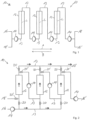
- Fig. 1 shows a schematic diagram of an adsorption system 10 according to a first exemplary embodiment not according to the invention.
- the adsorption system 10 shown enables a process for isolating flavorings as a flavoring concentrate from a flavoring-containing fluid, whereby, on the one hand, a particularly high concentration of the flavorings in the flavoring concentrate or extract and, on the other hand, the retention of an authentic flavor profile are ensured.
- the adsorption system 10 in the exemplary embodiment shown comprises three working chambers 12, which are fluidically coupled to one another via a line system 13, which forms a first fluid path, and are each filled with a sorbent as a stationary phase.
- the working chambers 12 can in principle also be designed as a column or Extraction cells are referred to as extraction cells and, in the illustrated embodiment, each have a circular-cylindrical shape with identical geometric dimensions. Thus, all working chambers 12 have constant cross-sectional thicknesses along their respective longitudinal axes L. Furthermore, instead of three working chambers 12, only one, two, or four or more working chambers 12 can be provided. In the present embodiment, all working chambers 12 are filled with the same, pure styrene-divinylbenzene copolymer as sorbent.
- Particularly effective sorbents include sulfonic acid groups, ternary (e.g., methacrylic acid diethylamine) and quaternary ammonium groups (e.g., phenyltrimethylammonium), amides (e.g., benzamides), amines, and halogen-modified aromatics, heterocycles such as 3-pyrrolidone, 2-pyrrolidone, 2-pyrroline, 3-pyrroline, pyrrole, and/or piperazine, as well as halogenated aliphatic side chains.
- Gel-like polymers can also be used.
- Modified polyacrylates can also be used, particularly those containing the following monomers: acrylic acid, acrylonitrile, and alkyl acrylates such as methyl methacrylate, methyl acrylate, ethyl acrylate, 2-chloroethyl vinyl ether, 2-ethylhexyl acrylate, hydroxyethyl methacrylate, butyl acrylate, and butyl methacrylate.
- CMS sorbents CMS: carbon molecular sieve
- CMS carbon molecular sieve
- SGPC spherical graphitized polymer carbon
- GCB GCB sorbents
- Alternatives include polymers based on 2,6-diphenylene oxide, e.g., poly(2,6-diphenyl-p-phenylene oxide), or those with iminodiacetate functionality.
- sorbents individually or in any combination, ensure particularly high adsorption of the flavoring agent(s) and thus a particularly high recovery rate. Furthermore, the sorbent can be optimally selected depending on the respective fluid and the flavoring agents it contains. These polymers are preferably additionally functionalized using suitable reagents during the polymerization of the base polymer or by post-treating the base polymer with appropriate reagents to achieve the desired sorption characteristics.
- At least one of the working chambers 12 is filled with a mixture of two or more sorbents and/or that different working chambers 12 are filled with different sorbents or sorbent mixtures in order to achieve a specific adsorption behavior that is optimally adapted to the respective fluid to be processed.
- the three working chambers 12 together provide a particularly long and, at the same time, comparatively thin sorbent bed, since the ratio of the average cross-sectional thickness to the combined total length of the working chambers 12 is less than 0.3.
- the average cross-sectional thickness is between 3 mm and 80 cm, while the total length is between 2.6 m and 80 m.
- the adsorption system 10 comprises a total of four pumping devices 14, which are arranged before, between and after the working spaces 12.
- the adsorption system 10 is operated in an absorption mode.
- the flavoring-containing fluid is introduced as a mobile phase through the inlet 16 into the line system 13 and is passed serially through the working spaces 12 according to arrow A with the aid of the pumping devices 14.
- the fluid can be, for example, an aqueous flavoring.
- the fluid is a foodstuff from the group of beer-containing foodstuffs and/or luxury items, beer wort, hops, hop extract, malt water, malt beer, malt wort, and brewery-specific raw materials and products, and/or is obtained by means of a dealcoholization device from an ethanol-containing foodstuff from the group of beer-containing foodstuffs and/or luxury items.
- the flavorings present in the fluid adsorb onto the sorbent.
- the dearomatized fluid or permeate is then removed from the line system 13 at the outlet 18.
- the ethanol content of the fluid can be adjusted to a value of at least 0.5 vol% and/or to a value of at most 50 vol% before passing through the adsorption system 10. This allows for a particularly high recovery rate, while additionally ensuring that a particularly "authentic" flavor concentrate is obtained, i.e., a flavor concentrate in which both polar and non-polar flavors are enriched at least substantially evenly.
- the ethanol content can generally be adjusted to the required value by adding ethanol or an ethanol-rich solvent mixture and/or by adding an ethanol-free solvent, for example, water, or by adding a low-ethanol solvent mixture.
- the ethanol content can be set to a value of 0.5 vol%, 1.0 vol%, 1.5 vol%, 2.0 vol%, 2.5 vol%, 3.0 vol%, 3.5 vol%, 4.0 vol%, 4.5 vol%, 5.0 vol%, 5.5 vol%, 6.0 vol%, 6.5 vol%, 7.0 vol%, 7.5 vol%, 8.0 vol%, 8.5% by volume, 9.0% by volume, 9.5% by volume, 10.0% by volume, 10.5% by volume, 11.0% by volume, 11.5% by volume, 12.0% by volume, 12.5% by volume, 13.0% by volume, 13.5% by volume, 14.0% by volume, 14.5% vol., 15.0% vol., 15.5% vol., 16.0% vol., 16.5% vol., 17.0% vol., 17.5% vol., 18.0% vol., 18.5% vol Vol.-%, 20.5 Vol.-%, 21.0 Vol.-%, 21.5 Vol.-%, 22.0 Vol.-%, 22.5 Vol.-%, 23.0 Vol.-%, 23.5 % Vol., 24.0 Vol.-%,
- the ethanol content is preferably set to a value between approximately 1.5 vol.% and approximately 10 vol.% ethanol.
- the fluid can also be free of ethanol.
- the ethanol content of the fluid is not adjusted, but that the fluid is used in its current form or with a given ethanol content, including a content of 0%.
- the adsorption system 10 is then switched to a desorption mode.
- a desorption agent for example, water, ethanol, or an ethanol/water mixture
- the line system 13 via an inlet 16' and is serially conveyed through the working chambers 12 in the opposite direction according to arrow B by means of the reversible pumping devices 14.
- the aroma substances bound to the sorbent desorb again, so that an aroma concentrate is obtained at the outlet 18' and removed from the line system 13.
- the ratios of the mass fractions of the up to five most aroma-defining aroma substances different from the desorption agent in the aroma substance concentrate differ by a maximum of ⁇ 50% from the corresponding ratios of their mass fractions in the fluid and/or that, with respect to the fluid, each aroma substance different from the desorption agent is enriched by a mass-related factor of a maximum of 1.49 in individual comparison with each other aroma substance different from the desorption agent in the aroma substance concentrate.
- At least the 2, 3, 4 or 5 flavorings which, of all the flavorings present in the fluid or flavoring concentrate, contribute significantly to the overall flavor of the fluid are enriched as evenly as possible in the flavoring concentrate, so that their mass-related concentrations in the fluid and in the flavoring concentrate, in a pairwise comparison, differ by a maximum of 1%, 2%, 3%, 4%, 5%, 6%, 7%, 8%, 9%, 10%, 11%, 12%, 13%, 14%, 15%, 16% , 17%, 18%, 19%, 20%, 21%, 22%, 23%, 24%, 25%, 26%, 27%, 28%, 29%, 30%, 31%, 32%, 33%, 34%, 35%, 36%, 37%, 38%, 39%, 40%, 41%, 42 %, 43 %, 44 %, 45 %, 46 %, 47 %, 48 %, 49 % or 50 % can be distinguished.
- the flavorings of the first group can, for example, be selected from the group ethyl butyrate, ethyl methyl butyrate-2, methyl capronate, linalool, alpha-ionone, beta-ionone, delta-decalactone, 2E-hexenol, 2E-hexenal, hexanal, beta-damascenone, octanal, nootkatone, p-menthenethiol-1, 8, benzaldehyde, gamma-decalactone, linalool oxide, furfurylthiol-2, 4-vinylguaiacol, isomeric isopropylmethoxypyrazines, isomeric ethyldimethylpyrazines, indole, methyl jasmonate, jasmine lactone, dipropyl disulfide, dipropyl trisulfide, methylpropyl disulfide, L-
- the ratios of the mass fractions of at least two and preferably at least three different flavoring substances in the flavoring concentrate differ by a maximum of ⁇ 50% from the corresponding ratios of their mass fractions in the fluid, wherein at least one of the flavoring substances is hydrophobic (selected from the first group) and at least one further flavoring substance is hydrophilic (selected from the second group).
- the concentration or enrichment factor of each flavoring in the flavoring concentrate compared to the original fluid can in principle be at least 1.01, in particular at least 10, preferably at least 100, preferably at least 1000 and in particular at least 15000.
- the concentration factor of each flavoring agent can be 1.01, 1.02, 1.03, 1.04, 1.05, 1.06, 1.07, 1.08, 1.09, 1.10, 1.11, 1.12, 1.13, 1.14, 1.15, 1.16, 1.17, 1.18, 1.19, 1.20, 1.21, 1.22, 1.23, 1.24, 1.25, 1.26, 1.27, 1.28, 1.29, 1.30, 1.31, 1.32, 1.33, 1.34, 1.35, 1.36, 1.37, 1.38, 1.39, 1.40, 1.41, 1.42, 1.43, 1.44, 1.45, 1.46, 1.47, 1.48, 1.49, 1.50, 1.51, 1.52, 1.53, 1.54, 1.55, 1.56, 1.57, 1.58, 1.59, 1.60, 1.61, 1.62, 1.63, 1.64, 1.65,
- the flavoring concentrate must be diluted by an appropriate factor so that the flavorings are present again in their original concentration as in the fluid.
- concentration factor the smaller the storage and transport space required and the easier the further processing of the flavoring concentrate.
- High concentration factors also facilitate the production of powdered or encapsulated flavors.
- the proportion of solvent(s), especially ethanol decreases with concentration, so that, for example, ethanol-free flavoring concentrates can also be produced that comply with Halal regulations.
- the desorption agent is the same chemical compound as a flavoring agent contained in the fluid.
- the flavoring agent in question is preferably not taken into account when determining its degree of enrichment in the flavoring agent concentrate, since no meaningful statements about its enrichment and depletion in the concentrate or permeate are possible from the outset.
- the original fluid may contain ethanol as a flavoring agent, so that this chemical compound is preferably not included in the assessment of the above-mentioned mass fraction ratios when ethanol is used as the desorption agent.
- the relative enrichment of one or more flavoring agents with respect to ethanol can be used to determine the concentration factor. between the original fluid and the flavor concentrate.
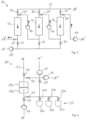
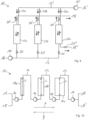
- Fig. 2 shows a schematic diagram of the adsorption system 10 according to the invention according to a further exemplary embodiment.
- the adsorption system 10 is optimized for particularly fast loading speed while simultaneously maximizing the extract concentration in the flavor concentrate.
- the adsorption system 10 comprises, in addition to three working chambers 12 and four pumping devices 14, several controllable and/or regulatable valve devices 20, 20', as well as a line system 13 that is differently designed compared to the previous exemplary embodiment. It should be emphasized that, of course, a different number of working chambers 12, pumping devices 14, and valve devices 20 can also be provided in this case.
- Fig. 3 shows a schematic diagram of the adsorption system 10 operated in desorption mode.
- the valve devices marked 20' are now opened, while the valve devices marked 20 are closed.
- a desorbent is now pumped through the inlet 16' according to the arrows into the line system 13 and, with the aid of the reversible pump devices 14, is passed serially through the working spaces 12 in the opposite direction.
- the aroma substances bound to the sorbent desorb again, so that an aroma substance concentrate is obtained at the outlet 18' and removed from the line system 13.
- the loading of the sorbents takes place in parallel, while the unloading or desorption is again carried out serially. This enables the particularly Fast loading speed while maximizing the extract concentration in the flavor concentrate.
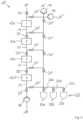
- Fig. 4 shows a schematic diagram of the adsorption system 10 according to the invention according to a further exemplary embodiment.
- the adsorption system 10 comprises a first working chamber 12a and a second working chamber 12b, which are fluidically connected to one another and arranged directly or indirectly one behind the other.
- the working chambers 12a, 12b are arranged in separate housings or in a common housing.
- the working chambers 12a, 12b are separated from one another by a liquid-permeable separating floor or the like in order to prevent mixing of the sorbents arranged in the working chambers 12a, 12b.
- the working chamber 12b is filled with a so-called normal phase and/or a polar bound phase as a sorbent.
- Normal phases are, for example, modified or unmodified silica gels or aluminum oxides, on which adsorption processes on polar OH groups are predominantly utilized for separation.
- Polar bonded phases are also typically based on silica gels to which chains containing specific functional groups are bound. This makes these sorbents polar to varying degrees. Separation occurs through different mechanisms and usually through a combination of several effects (molecular size exclusion, adsorption, partitioning, ion exchange).
- Working space 12a is filled with a so-called reversed phase sorbent.
- reversed phases the polarity relationships are "reversed" compared to normal phases.
- nonpolar side chains are bound to a silica gel framework or a polymer. This makes them hydrophobic. With increasing chain length, the phases become less polar. The separation mechanism is predominantly based on van der Waals forces. The more similar an aromatic compound is to the hydrocarbon chain of the phase, the greater its interactions with the sorbent and the better its adsorption to the reversed phase.
- an aqueous fluid containing flavorings is passed through the inlet 16 and the pumping device 14 against gravity through the working chamber 12b to remove any air pockets.
- the normal phase/polar phase retains predominantly polar flavorings, while non-polar ones at least partially pass further into the working chamber 12a.
- the dearomatized fluid is then removed from the adsorption system 10 through the outlet 18.
- the valve devices 20 are open in adsorption mode, while the valve devices 20' are closed.
- valve devices 20 are closed, while the valve devices 20' are opened.
- the valve device 20" can be opened or closed as needed.
- a first desorbent for example, ethanol, or a first desorbent mixture can be introduced via the inlet 16' and guided in the direction of gravity through the working spaces 12a, 12b to a fraction collector 22 with, in this case, three collection containers 22a-c.
- the collection containers 22a-c can be opened or closed independently of one another via the valve devices 20a-c in order to collect corresponding fractions as needed. It is understood that the number and type of collection containers can be varied.
- a second desorbent or a second desorbent mixture can be passed through the working spaces 12a, 12b via a further inlet 16" via the line system 13.
- both the first and the second desorbent can be passed either against the force of gravity through the working space 12b and then through the working space 12a or with the force of gravity through the working space 12a and then through the working space 12b.
- first and second desorbents in order to achieve a specific desorption behavior of the adsorbed aroma substances.
- 3, 4, 5, 6, or more desorbents can of course also be used as a mixture and/or gradient.
- the adsorption system 10 thus enables a particularly variable and needs-based process control.
- the use of different sorbent types, i.e. at least one normal phase/polar phase and at least one reversed phase in the working spaces 12a, 12b enables an improved separation of the aroma substances through combined adsorption and partition chromatography effects.
- a separation of aroma substances can be carried out based on compound-specific retention capacities on different sorbents in an adsorption system 10.
- the separation of certain fractions can, for example, be carried out according to their penetration depth into the reversed phase (working space 12a).
- specific fractions can be separated according to their retention time on the normal phase (working chamber 12b).
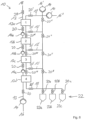
- Fig. 5 shows a schematic diagram of the adsorption system 10 according to the invention according to a further embodiment.
- the basic structure of the adsorption system 10 corresponds to that of the Fig. 4 shown adsorption system 10.
- the present adsorption system 10 comprises a total of four working chambers 12a-d for the fractional separation of different aroma substances.
- the four working chambers 12a-d are filled with identical sorbents or sorbent mixtures and thus form four zones in which the aroma substances are distributed from the fluid through a combination of adsorption and distribution chromatographic effects.
- the working chambers 12a-d can be filled with different sorbents or sorbent mixtures, with at least one sorbent selected from the group of normal phases and/or polar bound phases and at least one other sorbent selected from the group of reversed phases.
- the adsorption system 10 comprises a correspondingly larger number of independently controllable or adjustable valve devices 20, 20', 20", in order to switch between the adsorption and desorption modes as needed.
- the present adsorption system 10 makes it possible to individually load and unload each working chamber 12a-d with flavorings. This makes it possible, for example, to desorb only the flavorings adsorbed in the working chamber 12c or only the flavorings adsorbed in the working chambers 12a, 12b, and 12d, thus enabling particularly flexible process control while simultaneously reducing dead space.
- Fig. 6 shows a schematic diagram of the adsorption system 10 according to the invention according to a further embodiment.
- the basic structure of the present adsorption system 10 is similar to that of the adsorption system 10 described in connection with Fig. 5 described adsorption system 10.
- the adsorption system 10 shown here comprises, in addition to a line system 13, which is provided for passing the flavoring-containing fluid, a second line system 13', which is provided for passing the desorbent(s) and has a smaller volume or a smaller cross-section than the line system 13.
- two pipeline systems 13, 13' are used, which accordingly form a first and a second fluid path, wherein a line system 13 with a comparatively larger average diameter or a relatively larger average cross-sectional area for loading and a line system 13' with a comparatively smaller average diameter is used for discharging.
- a further difference from the previous embodiment is the additional pumping devices 14a-c, which are generally considered optional and can also be provided in different numbers and arrangements.
- the pumping devices 14a-c are each arranged between the working spaces 12a-c and improve the fluid throughput or the loading rate of the sorbents arranged in the working spaces 12a-c with flavorings.
- the line system 13' provided for the desorption agents comprises additional valve devices 20"', which are generally closed in adsorption mode and can be switched independently of one another in desorption mode in order to obtain individual or combined fractions from the working spaces 12a-d.
- the valve devices 20" can, in the simplest design, be check valves or ball valves, since these shut-off devices switch automatically via pressure differences, but do not need to be actively controlled and are therefore very cost-effective and reliable.
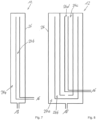
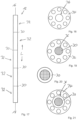
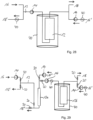
- Fig. 7 shows a schematic longitudinal section through a working chamber 12 with two fluidically interconnected channels 24a, 24b, which are nested within one another in a common housing 26.
- the housing 26 is formed by a wall of the outer channel 24a, which surrounds the inner channel 24b.
- the inner channel 24b opens into an inlet 16, through which a fluid or a desorption agent enters the working chamber 12 and is or can be guided to the mouth of the outer channel 24a.
- the respective fluid is redirected and flows through the channel 24a to the outlet 18, where it leaves the working chamber 12 again.
- the working chamber 12 widens in a stepwise manner at the transition from the inner channel 24b to the outer channel 24, so that aroma substances that bind less well to and break through the sorbent (mixture) arranged in the inner channel 24b can still be reliably captured with the aid of the larger capacity of the outer channel 24a.
- the area through which the sorbent flows or can flow, and thus its capacity increases gradually from the inlet 16 toward the outlet 18. This enables the extraction of particularly authentic aroma concentrates.
- the working chamber 12 or its channels 24a, 24b can be partially or completely filled independently of one another with one or more sorbents of the same type or quality. It can also be provided that the channels 24a, 24b are filled with different sorbent types, for example, with a normal phase and a reverse phase. Furthermore, it can of course be provided that fluid or desorbent is introduced through the outlet 18 and discharged through the inlet 16.
- the working chamber 12 is arranged on In a particularly simple and easily scalable manner, it provides a flow path that is as long as possible and, at the same time, relatively "thin,” in which the ratio of average cross-sectional thickness to total length is at most 0.3 or less.
- the cross-sectional area or thickness of the outer channel 24a essentially corresponds to the cross-sectional area of the working chamber 12 minus the cross-sectional area of the inner channel 24b.
- Fig. 8 shows a schematic sectional view of a working chamber 12 with four fluidically interconnected channels 24a-d, which are nested within a common housing 26.
- the cross-sectional area expands gradually at each transition from one channel 24a-d to the next.
- the working chamber 12 thus provides a particularly long and simultaneously "thin" flow path, in which the ratio of average cross-sectional thickness to total length is 0.03 or less.
- the number of channels 24a-d can be varied as needed, so that three, five, or more channels 24 can be provided.
- two or more channels 24 are not nested within one another, but are arranged next to one another, for example.
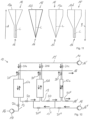
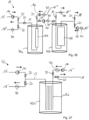
- Fig. 9 shows a schematic diagram of the adsorption system 10 according to another exemplary embodiment.
- the flavor-containing fluid which can also be referred to as the water phase, is first continuously supplied through the inlet 16 in adsorption mode, pumped into the line system 13 with the aid of the pumping device 14, and flows through all working chambers 12a-c or the sorbents arranged therein in parallel against the direction of gravity.
- the pressure difference between the inlet and the outlet of the working chambers 12a-c is approximately 4 bar.
- the dearomatized water phase is removed from the line system 13 again through the outlet 18.
- a desorbent In desorption mode, a desorbent, ethanol, is slowly fed from above through the inlet 16' and the line system 13' at intervals into the first working chamber 12a by generating a slightly higher pressure than that prevailing at the inlet 16 by means of the pump device 14' and by opening the valve devices 20a while closing the valve devices 20b, 20c.
- aroma extract adsorbed on the sorbent is pumped back into the water phase and, due to the lower flow rates and volumes, is diluted to such an extent that the concentration of the desorbent in the fluid at least substantially does not lead to the desorption of already adsorbed aroma substances in the downstream working chambers 12b, 12c.
Landscapes
- Chemical & Material Sciences (AREA)
- Engineering & Computer Science (AREA)
- Organic Chemistry (AREA)
- Life Sciences & Earth Sciences (AREA)
- Health & Medical Sciences (AREA)
- Food Science & Technology (AREA)
- Wood Science & Technology (AREA)
- Biochemistry (AREA)
- Bioinformatics & Cheminformatics (AREA)
- General Engineering & Computer Science (AREA)
- General Health & Medical Sciences (AREA)
- Genetics & Genomics (AREA)
- Zoology (AREA)
- Polymers & Plastics (AREA)
- Nutrition Science (AREA)
- Chemical Kinetics & Catalysis (AREA)
- Oil, Petroleum & Natural Gas (AREA)
- Seasonings (AREA)
- Fats And Perfumes (AREA)
- Distillation Of Fermentation Liquor, Processing Of Alcohols, Vinegar And Beer (AREA)
- Solid-Sorbent Or Filter-Aiding Compositions (AREA)
- General Preparation And Processing Of Foods (AREA)
- Microbiology (AREA)
- Tea And Coffee (AREA)
- Disinfection, Sterilisation Or Deodorisation Of Air (AREA)
Priority Applications (1)
| Application Number | Priority Date | Filing Date | Title |
|---|---|---|---|
| EP25198196.5A EP4656057A2 (de) | 2015-11-06 | 2016-11-04 | Adsorptionssystem und verfahren zum betreiben eines adsorptionssystems |
Applications Claiming Priority (6)
| Application Number | Priority Date | Filing Date | Title |
|---|---|---|---|
| DE102015119154.7A DE102015119154A1 (de) | 2015-11-06 | 2015-11-06 | Verfahren und Vorrichtung zum Herstellen eines Aromastoffkonzentrats aus einem alkoholhaltigen Lebensmittel |
| DE102015119155.5A DE102015119155A1 (de) | 2015-11-06 | 2015-11-06 | Verfahren und Vorrichtung zum Herstellen eines Aromastoffkonzentrats aus einem Aromastoff-haltigen Edukt |
| DE102016105993.5A DE102016105993A1 (de) | 2016-04-01 | 2016-04-01 | Adsorptions- und Desorptionsverfahren |
| DE102016105992.7A DE102016105992A1 (de) | 2016-04-01 | 2016-04-01 | Verfahren und Adsorptionssystem zum Herstellen eines Aromastoffkonzentrats |
| DE102016105997.8A DE102016105997A1 (de) | 2016-04-01 | 2016-04-01 | Adsorptionssystem und Verfahren zum Betreiben eines Adsorptionssystems |
| PCT/EP2016/076743 WO2017077084A1 (de) | 2015-11-06 | 2016-11-04 | Adsorptionssystem und verfahren zum betreiben eines adsorptionssystems |
Related Child Applications (1)
| Application Number | Title | Priority Date | Filing Date |
|---|---|---|---|
| EP25198196.5A Division EP4656057A2 (de) | 2015-11-06 | 2016-11-04 | Adsorptionssystem und verfahren zum betreiben eines adsorptionssystems |
Publications (3)
| Publication Number | Publication Date |
|---|---|
| EP3370540A1 EP3370540A1 (de) | 2018-09-12 |
| EP3370540B1 true EP3370540B1 (de) | 2025-07-02 |
| EP3370540C0 EP3370540C0 (de) | 2025-07-02 |
Family
ID=57226993
Family Applications (3)
| Application Number | Title | Priority Date | Filing Date |
|---|---|---|---|
| EP16794265.5A Active EP3370540B1 (de) | 2015-11-06 | 2016-11-04 | Adsorptionssystem und verfahren zum betreiben eines adsorptionssystems |
| EP16790626.2A Active EP3370539B1 (de) | 2015-11-06 | 2016-11-04 | Adsorptionssystem und verfahren zum betreiben eines adsorptionssystems |
| EP25198196.5A Pending EP4656057A2 (de) | 2015-11-06 | 2016-11-04 | Adsorptionssystem und verfahren zum betreiben eines adsorptionssystems |
Family Applications After (2)
| Application Number | Title | Priority Date | Filing Date |
|---|---|---|---|
| EP16790626.2A Active EP3370539B1 (de) | 2015-11-06 | 2016-11-04 | Adsorptionssystem und verfahren zum betreiben eines adsorptionssystems |
| EP25198196.5A Pending EP4656057A2 (de) | 2015-11-06 | 2016-11-04 | Adsorptionssystem und verfahren zum betreiben eines adsorptionssystems |
Country Status (9)
| Country | Link |
|---|---|
| US (2) | US11124748B2 (pl) |
| EP (3) | EP3370540B1 (pl) |
| JP (2) | JP6888001B2 (pl) |
| CN (2) | CN109475143A (pl) |
| AU (2) | AU2016348735B2 (pl) |
| BR (1) | BR112018007297B1 (pl) |
| ES (2) | ES3042370T3 (pl) |
| PL (2) | PL3370540T3 (pl) |
| WO (3) | WO2017077086A1 (pl) |
Families Citing this family (18)
| Publication number | Priority date | Publication date | Assignee | Title |
|---|---|---|---|---|
| US12214298B2 (en) | 2018-04-18 | 2025-02-04 | University Of Houston System | Systems and method for detection of analytes in high volumetric flow applications |
| BR112021002601A2 (pt) * | 2018-08-13 | 2021-05-11 | Chr. Hansen A/S | produção de suco de vegetais fermentado livre de álcool com levedura de pichia kluyveri. |
| AU2020253196B2 (en) * | 2019-04-04 | 2025-07-10 | Heineken Supply Chain B.V. | Fermented beverage and method of producing a fermented beverage |
| CN110270134A (zh) * | 2019-05-31 | 2019-09-24 | 江苏哈工药机科技股份有限公司 | 一种高纯度cbd分离纯化装置及其分离纯化方法 |
| EP4013843A1 (en) | 2019-08-16 | 2022-06-22 | Heineken Supply Chain B.V. | Production of an alcohol-free beverage |
| CN114585264B (zh) * | 2019-10-28 | 2024-06-04 | 三得利控股株式会社 | 无酒精啤酒风味饮料 |
| US20210253986A1 (en) * | 2019-12-14 | 2021-08-19 | Onyemaechi Ahanotu | Methods for producing monocotyledon wines and derivative products |
| JP7646568B2 (ja) * | 2019-12-24 | 2025-03-17 | サントリーホールディングス株式会社 | 脱アルコール飲料の製造方法、アルコール飲料の製造方法及びアルコール含有飲料由来のアロマ成分の製造方法 |
| CN111140946A (zh) * | 2020-01-19 | 2020-05-12 | 张和平 | 一种绿色环保空气净化器 |
| JP7488052B2 (ja) * | 2020-01-29 | 2024-05-21 | サッポロビール株式会社 | ビールテイスト飲料 |
| JP7340469B2 (ja) * | 2020-01-29 | 2023-09-07 | サッポロビール株式会社 | ビールテイスト飲料 |
| CN111228856A (zh) * | 2020-02-26 | 2020-06-05 | 苏州费斯特工业设备有限公司 | 化学品提纯装置的安全监控系统及控制方法 |
| CN111939610A (zh) * | 2020-08-11 | 2020-11-17 | 钟锦泉 | 一种保健药酒及其制备工艺与制备系统 |
| JP2023034034A (ja) * | 2021-08-30 | 2023-03-13 | サッポロビール株式会社 | ビールテイスト飲料及びその製造方法 |
| DE102023200425A1 (de) * | 2023-01-20 | 2024-07-25 | Volkswagen Aktiengesellschaft | Fahrzeug mit einer CO2-Adsorptionsvorrichtung und Servicestation |
| KR102692659B1 (ko) * | 2023-07-21 | 2024-08-05 | 에스케이이노베이션 주식회사 | 복수의 베드에 대한 유체 공급 루트를 제어하는 흡착탑 및 그의 구동 제어 방법 |
| JP7723230B2 (ja) * | 2023-08-07 | 2025-08-13 | アサヒグループホールディングス株式会社 | 低アルコールビールテイスト飲料及びその製造方法 |
| WO2025233414A1 (en) | 2024-05-07 | 2025-11-13 | Heineken Supply Chain B.V. | Low carb beer and low carb beer concentrate |
Family Cites Families (39)
| Publication number | Priority date | Publication date | Assignee | Title |
|---|---|---|---|---|
| CH591214A5 (pl) | 1974-10-03 | 1977-09-15 | Nestle Sa | |
| JPS5548347A (en) | 1978-10-02 | 1980-04-07 | Hiyozo Konno | Pickle composition |
| CA1141229A (en) * | 1978-12-26 | 1983-02-15 | Thomas P.J. Izod | Removal of caffeine by selective adsorption using zeolite adsorbents |
| DE3145673A1 (de) * | 1981-11-19 | 1983-05-26 | Merck Patent Gmbh, 6100 Darmstadt | "verfahren zur gewinnung oder anreicherung von aromastoffen" |
| JPS607363U (ja) | 1983-06-24 | 1985-01-19 | 株式会社日立製作所 | 摺動軸の水密部構造 |
| DE3522744A1 (de) | 1985-06-26 | 1987-01-08 | Binding Brauerei Ag | Verfahren zur herstellung von alkoholfreiem bzw. alkoholarmem bier |
| JPS63304973A (ja) * | 1987-06-08 | 1988-12-13 | Jgc Corp | 醗酵ガスよりエステル類を回収する方法 |
| JP2597117B2 (ja) * | 1987-12-09 | 1997-04-02 | サントリー株式会社 | フレーバー含有液よりフレーバーを回収する方法 |
| JPH0391456A (ja) * | 1989-09-01 | 1991-04-17 | Kikkoman Corp | 香気成分の濃縮法 |
| CA2105018C (en) * | 1992-09-10 | 1998-06-23 | Mary R. Jensen | High-yield roasted coffee with balanced flavor |
| EP0627485A1 (de) | 1993-06-02 | 1994-12-07 | Döhler GmbH | Verfahren zur Entfernung von störenden Inhaltsstoffen aus fermentativ gewinnbaren Nahrungs- und/oder Genussmitteln |
| JPH07178308A (ja) * | 1993-12-24 | 1995-07-18 | Mitsubishi Heavy Ind Ltd | ガス分離回収装置 |
| JP3776465B2 (ja) * | 1994-05-02 | 2006-05-17 | クローダジャパン株式会社 | 油ないしロウの分離精製方法およびそれに用いる装置 |
| US5666186A (en) | 1994-07-20 | 1997-09-09 | Eastman Kodak Company | Text interface for still photographic camera with data recording capability |
| US5530293A (en) | 1994-11-28 | 1996-06-25 | International Business Machines Corporation | Carbon-free hydrogen silsesquioxane with dielectric constant less than 3.2 annealed in hydrogen for integrated circuits |
| EP0768117B1 (en) | 1995-04-27 | 2002-06-26 | Nippon Sanso Corporation | Carbonaceous adsorbent, process for producing the same, and method and apparatus for gas separation |
| DE19525552A1 (de) | 1995-07-13 | 1997-01-16 | Teves Gmbh Alfred | Verfahren und Anordnung zum Halten eines Fahrzeugs auf geneigter Fahrbahn |
| JP3894462B2 (ja) * | 1996-09-24 | 2007-03-22 | 三井製糖株式会社 | 消臭物質 |
| JPH10165938A (ja) * | 1996-12-10 | 1998-06-23 | Jiro Sasaoka | 流体浄化法、装置と多孔質吸着体 |
| JPH10263393A (ja) * | 1997-01-26 | 1998-10-06 | Taiyo Eng Kk | 活性炭粒子集合体からなる微量金属吸着剤 |
| FR2771418B1 (fr) * | 1997-11-25 | 2001-02-02 | Inst Francais Du Petrole | Procede de separation d'une charge c5-c8 ou d'une charge intermediaire, en trois effluents respectivement riches en paraffines lineaires, monobranchees et multibranchees |
| JPH11333102A (ja) | 1998-05-29 | 1999-12-07 | Sankyo Kk | 弾球遊技機 |
| JPH11334909A (ja) | 1998-06-01 | 1999-12-07 | Canon Inc | シート搬送装置 |
| JP2000098610A (ja) | 1998-09-17 | 2000-04-07 | Fuji Photo Film Co Ltd | ポジ型感光性組成物 |
| JP2000132168A (ja) | 1998-10-27 | 2000-05-12 | Kawai Musical Instr Mfg Co Ltd | 電子ピアノ |
| JP3955414B2 (ja) | 1999-05-11 | 2007-08-08 | サントリー株式会社 | 酒類の製造方法 |
| JP2001059898A (ja) | 1999-08-24 | 2001-03-06 | Fuji Photo Film Co Ltd | 放射線像変換パネルの製造方法 |
| JP3978564B2 (ja) * | 2000-08-01 | 2007-09-19 | 三栄源エフ・エフ・アイ株式会社 | 精製紫トウモロコシ色素 |
| EP2075320A1 (de) | 2007-12-17 | 2009-07-01 | Symrise GmbH & Co. KG | Verfahren zur Herstellung eines Aromakonzentrates sowie ein Aromakonzentrat |
| CN101560461A (zh) * | 2008-04-18 | 2009-10-21 | 3M创新有限公司 | 蒸馏酒催陈净化处理设备以及蒸馏酒催陈净化方法 |
| JP2012135283A (ja) | 2010-12-27 | 2012-07-19 | Kirin Brewery Co Ltd | 不快な麦汁フレーバーが低減された未発酵のビール風味麦芽飲料およびその製造方法 |
| US20130129866A1 (en) | 2011-10-19 | 2013-05-23 | Daniel Paul Phillips | Caffeinated Creamer |
| JP5846865B2 (ja) | 2011-11-09 | 2016-01-20 | 三栄源エフ・エフ・アイ株式会社 | 濃色モルトエキス、及びその製造方法、並びにモルトエキス由来の、味又は臭いのマスキング剤、及びその製造方法 |
| EP2615159A1 (en) * | 2012-01-16 | 2013-07-17 | Anheuser-Busch InBev S.A. | Low alcohol or alcohol free fermented malt based beverage and method for producing it. |
| AU2014203179C1 (en) | 2013-06-14 | 2017-05-04 | Aker Biomarine Antarctic As | Lipid extraction processes |
| US20140377411A1 (en) | 2013-06-20 | 2014-12-25 | David Hadasz | Beverage Coffee Product with Vitamins and Minerals Added |
| EP2893817B1 (de) * | 2014-01-10 | 2017-07-19 | Wia Wine AG | Vorrichtung und Verfahren zur Herstellung eines entalkoholisierten Getränks |
| MX2017005876A (es) | 2014-11-07 | 2017-06-26 | Basf Se | Metodo para extraer productos aromaticos de valor de composiciones que contienen lignina. |
| CN104498189A (zh) * | 2014-12-05 | 2015-04-08 | 东南大学 | 基于纳米材料的洋葱油提取方法 |
-
2016
- 2016-11-04 ES ES16794265T patent/ES3042370T3/es active Active
- 2016-11-04 ES ES16790626T patent/ES3039966T3/es active Active
- 2016-11-04 JP JP2018518516A patent/JP6888001B2/ja active Active
- 2016-11-04 CN CN201680065049.2A patent/CN109475143A/zh active Pending
- 2016-11-04 JP JP2018519970A patent/JP2018534049A/ja active Pending
- 2016-11-04 WO PCT/EP2016/076748 patent/WO2017077086A1/de not_active Ceased
- 2016-11-04 BR BR112018007297-4A patent/BR112018007297B1/pt active IP Right Grant
- 2016-11-04 PL PL16794265.5T patent/PL3370540T3/pl unknown
- 2016-11-04 CN CN201680065069.XA patent/CN108601366B/zh active Active
- 2016-11-04 US US15/773,924 patent/US11124748B2/en active Active
- 2016-11-04 US US15/773,908 patent/US11118147B2/en active Active
- 2016-11-04 PL PL16790626.2T patent/PL3370539T3/pl unknown
- 2016-11-04 WO PCT/EP2016/076743 patent/WO2017077084A1/de not_active Ceased
- 2016-11-04 AU AU2016348735A patent/AU2016348735B2/en active Active
- 2016-11-04 EP EP16794265.5A patent/EP3370540B1/de active Active
- 2016-11-04 WO PCT/EP2016/076731 patent/WO2017077075A1/de not_active Ceased
- 2016-11-04 EP EP16790626.2A patent/EP3370539B1/de active Active
- 2016-11-04 EP EP25198196.5A patent/EP4656057A2/de active Pending
- 2016-11-04 AU AU2016348733A patent/AU2016348733B2/en active Active
Also Published As
| Publication number | Publication date |
|---|---|
| PL3370539T3 (pl) | 2025-11-12 |
| US11118147B2 (en) | 2021-09-14 |
| CN108601366B (zh) | 2022-06-14 |
| AU2016348735A1 (en) | 2018-05-24 |
| EP4656057A2 (de) | 2025-12-03 |
| US20190144802A1 (en) | 2019-05-16 |
| PL3370540T3 (pl) | 2025-11-12 |
| AU2016348733B2 (en) | 2021-05-13 |
| WO2017077086A1 (de) | 2017-05-11 |
| WO2017077084A1 (de) | 2017-05-11 |
| EP3370539C0 (de) | 2025-07-02 |
| JP2018534049A (ja) | 2018-11-22 |
| ES3039966T3 (en) | 2025-10-28 |
| EP3370539B1 (de) | 2025-07-02 |
| JP2018531601A (ja) | 2018-11-01 |
| EP3370540A1 (de) | 2018-09-12 |
| US11124748B2 (en) | 2021-09-21 |
| WO2017077075A1 (de) | 2017-05-11 |
| ES3042370T3 (en) | 2025-11-20 |
| JP6888001B2 (ja) | 2021-06-16 |
| BR112018007297A2 (pt) | 2018-10-23 |
| EP3370539A1 (de) | 2018-09-12 |
| CN109475143A (zh) | 2019-03-15 |
| US20180317527A1 (en) | 2018-11-08 |
| BR112018007297B1 (pt) | 2022-07-05 |
| AU2016348735B2 (en) | 2021-04-29 |
| EP3370540C0 (de) | 2025-07-02 |
| AU2016348733A1 (en) | 2018-05-24 |
| CN108601366A (zh) | 2018-09-28 |
Similar Documents
| Publication | Publication Date | Title |
|---|---|---|
| EP3370540B1 (de) | Adsorptionssystem und verfahren zum betreiben eines adsorptionssystems | |
| DE69213969T2 (de) | Vorrichtung zur Aromagewinnung und Verfahren | |
| WO2015104357A1 (de) | Vorrichtung und verfahren zur herstellung eines entalkoholisierten getränks | |
| EP3535378B1 (de) | Vorrichtung und verfahren zur extraktion von aromastoffen aus pflanzlichen aromaträgern in einer brauflüssigkeit | |
| DE60219426T2 (de) | Verfahren zur herstellung aromatischen essigs | |
| DE102015119154A1 (de) | Verfahren und Vorrichtung zum Herstellen eines Aromastoffkonzentrats aus einem alkoholhaltigen Lebensmittel | |
| DE102010031729A1 (de) | Verfahren zur Dealkoholisierung von Getränken und zugehörige Vorrichtung | |
| EP0193206B1 (de) | Verfahren und Vorrichtung zur Entalkoholisierung von Bier, Bierhefe, Wein, Sekt, Schaumwein oder dergleichen | |
| WO2019174722A1 (de) | Herstellung von gewürzpflanzenteil-partikeln | |
| EP4117451A1 (de) | Verfahren zur herstellung eines aromabeladenen gases, aromabeladenes gas und verwendung des aromabeladenen gases | |
| EP1567020B1 (de) | Verfahren zur selektiven abtrennung von flüchtigen aromastoffen aus einphasigen, (halb-)flüssigen ausgangsmaterialien mit einem fett- und/oder öl-gehalt 20gew.-% | |
| WO2003086566A2 (de) | Verfahren und vorrichtung zur gewinnung von pflanzen-inhaltsstoffen | |
| DE102008063304A1 (de) | Verfahren und Vorrichtung zur Bierbereitung | |
| AT508722B1 (de) | Verfahren und vorrichtung zur bierbereitung sowie damit hergestellte biere | |
| AT524242B1 (de) | Verfahren zur separaten isomerisierung von bitterstoffen | |
| EP3303543B1 (en) | Method for extracting unwanted very weak acidic compounds from a drinkable liquid, in particular from a wine | |
| DE4220536C1 (en) | Sepn. of tri:glyceride fractions from milk fat - using supercritical carbon di:oxide, with removal of aromas and collection of tri:glyceride(s) of differing mol. wt. | |
| DE102008017539A1 (de) | Bier, Verfahren zu dessen Herstellung, Verfahren zu dessen Verwertung sowie Vorrichtung zu dessen Herstellung | |
| DE102016105992A1 (de) | Verfahren und Adsorptionssystem zum Herstellen eines Aromastoffkonzentrats | |
| DE102009007898A1 (de) | Verfahren und Vorrichtung zur Würzekochung | |
| EP2921550B1 (de) | Verfahren zur reduzierung des alkoholgehalts von alkoholhaltigen getränken, insbesondere von bier | |
| EP3819363A1 (de) | Verfahren und vorrichtung zur extraktion von wertgebenden inhaltsstoffen aus pflanzlichen inhaltsstoffträgern in eine brauflüssigkeit | |
| DE102018125145A1 (de) | Verfahren zur Gewinnung natürlicher Folsäure und Produkt, aufweisend einen erhöhten Gehalt an natürlicher Folsäure |
Legal Events
| Date | Code | Title | Description |
|---|---|---|---|
| STAA | Information on the status of an ep patent application or granted ep patent |
Free format text: STATUS: UNKNOWN |
|
| STAA | Information on the status of an ep patent application or granted ep patent |
Free format text: STATUS: THE INTERNATIONAL PUBLICATION HAS BEEN MADE |
|
| PUAI | Public reference made under article 153(3) epc to a published international application that has entered the european phase |
Free format text: ORIGINAL CODE: 0009012 |
|
| STAA | Information on the status of an ep patent application or granted ep patent |
Free format text: STATUS: REQUEST FOR EXAMINATION WAS MADE |
|
| 17P | Request for examination filed |
Effective date: 20180608 |
|
| AK | Designated contracting states |
Kind code of ref document: A1 Designated state(s): AL AT BE BG CH CY CZ DE DK EE ES FI FR GB GR HR HU IE IS IT LI LT LU LV MC MK MT NL NO PL PT RO RS SE SI SK SM TR |
|
| AX | Request for extension of the european patent |
Extension state: BA ME |
|
| DAV | Request for validation of the european patent (deleted) | ||
| DAX | Request for extension of the european patent (deleted) | ||
| STAA | Information on the status of an ep patent application or granted ep patent |
Free format text: STATUS: EXAMINATION IS IN PROGRESS |
|
| 17Q | First examination report despatched |
Effective date: 20190603 |
|
| GRAP | Despatch of communication of intention to grant a patent |
Free format text: ORIGINAL CODE: EPIDOSNIGR1 |
|
| STAA | Information on the status of an ep patent application or granted ep patent |
Free format text: STATUS: GRANT OF PATENT IS INTENDED |
|
| RIC1 | Information provided on ipc code assigned before grant |
Ipc: C12H 6/02 20190101ALI20250110BHEP Ipc: C12H 3/04 20060101ALI20250110BHEP Ipc: C11B 9/02 20060101ALI20250110BHEP Ipc: A23L 27/00 20160101ALI20250110BHEP Ipc: A23L 2/56 20060101ALI20250110BHEP Ipc: A24B 15/24 20060101ALI20250110BHEP Ipc: A23F 5/26 20060101ALI20250110BHEP Ipc: C12C 12/04 20060101ALI20250110BHEP Ipc: C12C 5/02 20060101ALI20250110BHEP Ipc: A23L 27/10 20160101ALI20250110BHEP Ipc: A23F 5/48 20060101ALI20250110BHEP Ipc: A23F 3/42 20060101AFI20250110BHEP |
|
| INTG | Intention to grant announced |
Effective date: 20250122 |
|
| GRAS | Grant fee paid |
Free format text: ORIGINAL CODE: EPIDOSNIGR3 |
|
| GRAA | (expected) grant |
Free format text: ORIGINAL CODE: 0009210 |
|
| STAA | Information on the status of an ep patent application or granted ep patent |
Free format text: STATUS: THE PATENT HAS BEEN GRANTED |
|
| AK | Designated contracting states |
Kind code of ref document: B1 Designated state(s): AL AT BE BG CH CY CZ DE DK EE ES FI FR GB GR HR HU IE IS IT LI LT LU LV MC MK MT NL NO PL PT RO RS SE SI SK SM TR |
|
| REG | Reference to a national code |
Ref country code: GB Ref legal event code: FG4D Free format text: NOT ENGLISH |
|
| REG | Reference to a national code |
Ref country code: CH Ref legal event code: EP |
|
| REG | Reference to a national code |
Ref country code: DE Ref legal event code: R096 Ref document number: 502016017013 Country of ref document: DE |
|
| REG | Reference to a national code |
Ref country code: IE Ref legal event code: FG4D Free format text: LANGUAGE OF EP DOCUMENT: GERMAN |
|
| U01 | Request for unitary effect filed |
Effective date: 20250729 |
|
| U07 | Unitary effect registered |
Designated state(s): AT BE BG DE DK EE FI FR IT LT LU LV MT NL PT RO SE SI Effective date: 20250804 |
|
| REG | Reference to a national code |
Ref country code: ES Ref legal event code: FG2A Ref document number: 3042370 Country of ref document: ES Kind code of ref document: T3 Effective date: 20251120 |
|
| REG | Reference to a national code |
Ref country code: CH Ref legal event code: U11 Free format text: ST27 STATUS EVENT CODE: U-0-0-U10-U11 (AS PROVIDED BY THE NATIONAL OFFICE) Effective date: 20251201 |