EP3336062B1 - Matériau de cathode sphérique ou quasi-sphérique pour batterie au lithium, batterie et procédé de préparation et ses applications - Google Patents
Matériau de cathode sphérique ou quasi-sphérique pour batterie au lithium, batterie et procédé de préparation et ses applications Download PDFInfo
- Publication number
- EP3336062B1 EP3336062B1 EP17175190.2A EP17175190A EP3336062B1 EP 3336062 B1 EP3336062 B1 EP 3336062B1 EP 17175190 A EP17175190 A EP 17175190A EP 3336062 B1 EP3336062 B1 EP 3336062B1
- Authority
- EP
- European Patent Office
- Prior art keywords
- cathode material
- spherical
- lithium
- ion battery
- lithium ion
- Prior art date
- Legal status (The legal status is an assumption and is not a legal conclusion. Google has not performed a legal analysis and makes no representation as to the accuracy of the status listed.)
- Active
Links
Images


Classifications
-
- H—ELECTRICITY
- H01—ELECTRIC ELEMENTS
- H01M—PROCESSES OR MEANS, e.g. BATTERIES, FOR THE DIRECT CONVERSION OF CHEMICAL ENERGY INTO ELECTRICAL ENERGY
- H01M4/00—Electrodes
- H01M4/02—Electrodes composed of, or comprising, active material
- H01M4/13—Electrodes for accumulators with non-aqueous electrolyte, e.g. for lithium-accumulators; Processes of manufacture thereof
- H01M4/131—Electrodes based on mixed oxides or hydroxides, or on mixtures of oxides or hydroxides, e.g. LiCoOx
-
- C—CHEMISTRY; METALLURGY
- C01—INORGANIC CHEMISTRY
- C01G—COMPOUNDS CONTAINING METALS NOT COVERED BY SUBCLASSES C01D OR C01F
- C01G53/00—Compounds of nickel
- C01G53/40—Complex oxides containing nickel and at least one other metal element
- C01G53/42—Complex oxides containing nickel and at least one other metal element containing alkali metals, e.g. LiNiO2
- C01G53/44—Complex oxides containing nickel and at least one other metal element containing alkali metals, e.g. LiNiO2 containing manganese
- C01G53/50—Complex oxides containing nickel and at least one other metal element containing alkali metals, e.g. LiNiO2 containing manganese of the type (MnO2)n-, e.g. Li(NixMn1-x)O2 or Li(MyNixMn1-x-y)O2
-
- H—ELECTRICITY
- H01—ELECTRIC ELEMENTS
- H01M—PROCESSES OR MEANS, e.g. BATTERIES, FOR THE DIRECT CONVERSION OF CHEMICAL ENERGY INTO ELECTRICAL ENERGY
- H01M4/00—Electrodes
- H01M4/02—Electrodes composed of, or comprising, active material
- H01M4/36—Selection of substances as active materials, active masses, active liquids
- H01M4/48—Selection of substances as active materials, active masses, active liquids of inorganic oxides or hydroxides
- H01M4/485—Selection of substances as active materials, active masses, active liquids of inorganic oxides or hydroxides of mixed oxides or hydroxides for inserting or intercalating light metals, e.g. LiTi2O4 or LiTi2OxFy
-
- H—ELECTRICITY
- H01—ELECTRIC ELEMENTS
- H01M—PROCESSES OR MEANS, e.g. BATTERIES, FOR THE DIRECT CONVERSION OF CHEMICAL ENERGY INTO ELECTRICAL ENERGY
- H01M4/00—Electrodes
- H01M4/02—Electrodes composed of, or comprising, active material
- H01M4/36—Selection of substances as active materials, active masses, active liquids
- H01M4/48—Selection of substances as active materials, active masses, active liquids of inorganic oxides or hydroxides
- H01M4/50—Selection of substances as active materials, active masses, active liquids of inorganic oxides or hydroxides of manganese
- H01M4/505—Selection of substances as active materials, active masses, active liquids of inorganic oxides or hydroxides of manganese of mixed oxides or hydroxides containing manganese for inserting or intercalating light metals, e.g. LiMn2O4 or LiMn2OxFy
-
- H—ELECTRICITY
- H01—ELECTRIC ELEMENTS
- H01M—PROCESSES OR MEANS, e.g. BATTERIES, FOR THE DIRECT CONVERSION OF CHEMICAL ENERGY INTO ELECTRICAL ENERGY
- H01M4/00—Electrodes
- H01M4/02—Electrodes composed of, or comprising, active material
- H01M4/36—Selection of substances as active materials, active masses, active liquids
- H01M4/48—Selection of substances as active materials, active masses, active liquids of inorganic oxides or hydroxides
- H01M4/52—Selection of substances as active materials, active masses, active liquids of inorganic oxides or hydroxides of nickel, cobalt or iron
- H01M4/525—Selection of substances as active materials, active masses, active liquids of inorganic oxides or hydroxides of nickel, cobalt or iron of mixed oxides or hydroxides containing iron, cobalt or nickel for inserting or intercalating light metals, e.g. LiNiO2, LiCoO2 or LiCoOxFy
-
- C—CHEMISTRY; METALLURGY
- C01—INORGANIC CHEMISTRY
- C01P—INDEXING SCHEME RELATING TO STRUCTURAL AND PHYSICAL ASPECTS OF SOLID INORGANIC COMPOUNDS
- C01P2002/00—Crystal-structural characteristics
- C01P2002/20—Two-dimensional structures
-
- C—CHEMISTRY; METALLURGY
- C01—INORGANIC CHEMISTRY
- C01P—INDEXING SCHEME RELATING TO STRUCTURAL AND PHYSICAL ASPECTS OF SOLID INORGANIC COMPOUNDS
- C01P2002/00—Crystal-structural characteristics
- C01P2002/50—Solid solutions
-
- C—CHEMISTRY; METALLURGY
- C01—INORGANIC CHEMISTRY
- C01P—INDEXING SCHEME RELATING TO STRUCTURAL AND PHYSICAL ASPECTS OF SOLID INORGANIC COMPOUNDS
- C01P2002/00—Crystal-structural characteristics
- C01P2002/70—Crystal-structural characteristics defined by measured X-ray, neutron or electron diffraction data
-
- C—CHEMISTRY; METALLURGY
- C01—INORGANIC CHEMISTRY
- C01P—INDEXING SCHEME RELATING TO STRUCTURAL AND PHYSICAL ASPECTS OF SOLID INORGANIC COMPOUNDS
- C01P2002/00—Crystal-structural characteristics
- C01P2002/70—Crystal-structural characteristics defined by measured X-ray, neutron or electron diffraction data
- C01P2002/72—Crystal-structural characteristics defined by measured X-ray, neutron or electron diffraction data by d-values or two theta-values, e.g. as X-ray diagram
-
- C—CHEMISTRY; METALLURGY
- C01—INORGANIC CHEMISTRY
- C01P—INDEXING SCHEME RELATING TO STRUCTURAL AND PHYSICAL ASPECTS OF SOLID INORGANIC COMPOUNDS
- C01P2004/00—Particle morphology
- C01P2004/01—Particle morphology depicted by an image
- C01P2004/03—Particle morphology depicted by an image obtained by SEM
-
- C—CHEMISTRY; METALLURGY
- C01—INORGANIC CHEMISTRY
- C01P—INDEXING SCHEME RELATING TO STRUCTURAL AND PHYSICAL ASPECTS OF SOLID INORGANIC COMPOUNDS
- C01P2004/00—Particle morphology
- C01P2004/30—Particle morphology extending in three dimensions
- C01P2004/32—Spheres
-
- C—CHEMISTRY; METALLURGY
- C01—INORGANIC CHEMISTRY
- C01P—INDEXING SCHEME RELATING TO STRUCTURAL AND PHYSICAL ASPECTS OF SOLID INORGANIC COMPOUNDS
- C01P2004/00—Particle morphology
- C01P2004/50—Agglomerated particles
-
- C—CHEMISTRY; METALLURGY
- C01—INORGANIC CHEMISTRY
- C01P—INDEXING SCHEME RELATING TO STRUCTURAL AND PHYSICAL ASPECTS OF SOLID INORGANIC COMPOUNDS
- C01P2004/00—Particle morphology
- C01P2004/51—Particles with a specific particle size distribution
-
- C—CHEMISTRY; METALLURGY
- C01—INORGANIC CHEMISTRY
- C01P—INDEXING SCHEME RELATING TO STRUCTURAL AND PHYSICAL ASPECTS OF SOLID INORGANIC COMPOUNDS
- C01P2004/00—Particle morphology
- C01P2004/60—Particles characterised by their size
- C01P2004/61—Micrometer sized, i.e. from 1-100 micrometer
-
- C—CHEMISTRY; METALLURGY
- C01—INORGANIC CHEMISTRY
- C01P—INDEXING SCHEME RELATING TO STRUCTURAL AND PHYSICAL ASPECTS OF SOLID INORGANIC COMPOUNDS
- C01P2004/00—Particle morphology
- C01P2004/60—Particles characterised by their size
- C01P2004/62—Submicrometer sized, i.e. from 0.1-1 micrometer
-
- C—CHEMISTRY; METALLURGY
- C01—INORGANIC CHEMISTRY
- C01P—INDEXING SCHEME RELATING TO STRUCTURAL AND PHYSICAL ASPECTS OF SOLID INORGANIC COMPOUNDS
- C01P2006/00—Physical properties of inorganic compounds
- C01P2006/12—Surface area
-
- C—CHEMISTRY; METALLURGY
- C01—INORGANIC CHEMISTRY
- C01P—INDEXING SCHEME RELATING TO STRUCTURAL AND PHYSICAL ASPECTS OF SOLID INORGANIC COMPOUNDS
- C01P2006/00—Physical properties of inorganic compounds
- C01P2006/40—Electric properties
-
- H—ELECTRICITY
- H01—ELECTRIC ELEMENTS
- H01M—PROCESSES OR MEANS, e.g. BATTERIES, FOR THE DIRECT CONVERSION OF CHEMICAL ENERGY INTO ELECTRICAL ENERGY
- H01M10/00—Secondary cells; Manufacture thereof
- H01M10/05—Accumulators with non-aqueous electrolyte
- H01M10/052—Li-accumulators
- H01M10/0525—Rocking-chair batteries, i.e. batteries with lithium insertion or intercalation in both electrodes; Lithium-ion batteries
-
- H—ELECTRICITY
- H01—ELECTRIC ELEMENTS
- H01M—PROCESSES OR MEANS, e.g. BATTERIES, FOR THE DIRECT CONVERSION OF CHEMICAL ENERGY INTO ELECTRICAL ENERGY
- H01M2220/00—Batteries for particular applications
- H01M2220/20—Batteries in motive systems, e.g. vehicle, ship, plane
-
- H—ELECTRICITY
- H01—ELECTRIC ELEMENTS
- H01M—PROCESSES OR MEANS, e.g. BATTERIES, FOR THE DIRECT CONVERSION OF CHEMICAL ENERGY INTO ELECTRICAL ENERGY
- H01M2220/00—Batteries for particular applications
- H01M2220/30—Batteries in portable systems, e.g. mobile phone, laptop
-
- H—ELECTRICITY
- H01—ELECTRIC ELEMENTS
- H01M—PROCESSES OR MEANS, e.g. BATTERIES, FOR THE DIRECT CONVERSION OF CHEMICAL ENERGY INTO ELECTRICAL ENERGY
- H01M4/00—Electrodes
- H01M4/02—Electrodes composed of, or comprising, active material
- H01M4/36—Selection of substances as active materials, active masses, active liquids
- H01M4/362—Composites
- H01M4/366—Composites as layered products
-
- Y—GENERAL TAGGING OF NEW TECHNOLOGICAL DEVELOPMENTS; GENERAL TAGGING OF CROSS-SECTIONAL TECHNOLOGIES SPANNING OVER SEVERAL SECTIONS OF THE IPC; TECHNICAL SUBJECTS COVERED BY FORMER USPC CROSS-REFERENCE ART COLLECTIONS [XRACs] AND DIGESTS
- Y02—TECHNOLOGIES OR APPLICATIONS FOR MITIGATION OR ADAPTATION AGAINST CLIMATE CHANGE
- Y02E—REDUCTION OF GREENHOUSE GAS [GHG] EMISSIONS, RELATED TO ENERGY GENERATION, TRANSMISSION OR DISTRIBUTION
- Y02E60/00—Enabling technologies; Technologies with a potential or indirect contribution to GHG emissions mitigation
- Y02E60/10—Energy storage using batteries
-
- Y—GENERAL TAGGING OF NEW TECHNOLOGICAL DEVELOPMENTS; GENERAL TAGGING OF CROSS-SECTIONAL TECHNOLOGIES SPANNING OVER SEVERAL SECTIONS OF THE IPC; TECHNICAL SUBJECTS COVERED BY FORMER USPC CROSS-REFERENCE ART COLLECTIONS [XRACs] AND DIGESTS
- Y02—TECHNOLOGIES OR APPLICATIONS FOR MITIGATION OR ADAPTATION AGAINST CLIMATE CHANGE
- Y02T—CLIMATE CHANGE MITIGATION TECHNOLOGIES RELATED TO TRANSPORTATION
- Y02T10/00—Road transport of goods or passengers
- Y02T10/60—Other road transportation technologies with climate change mitigation effect
- Y02T10/70—Energy storage systems for electromobility, e.g. batteries
Definitions
- the invention belongs to a technical field of lithium ion battery, and relates to a lithium ion battery cathode material of a spherical or spherical-like layered structure, preparation methods thereof and a secondary lithium ion battery made of the cathode material.
- Nickel-cobalt-manganese (NCM) ternary materials have advantages of high specific capacity, low cost and good thermal stability etc., therefore, they have a very broad application prospect in the field of energy storage and electric vehicle.
- poor cycling performance is an important factor affecting the application of NCM ternary materials for a long time.
- the main transition elements are Ni, Co and Mn in NCM ternary materials, in which NCM ternary materials with different properties can be obtained with different ratios of the three elements.
- the stability of the material also changes due to the different ratios of elements.
- the factors affecting the cycle life of the ternary materials are: 1. Reconstruction of the surface crystal structure during the cycling process; 2.
- NCM ternary materials are modified by bulk doping and surface coating modification, which is an effective method.
- the bulk doping of NCM ternary materials can effectively restrain the structure change, enhance the reversibility of materials and restrain the increase of the charge transfer impedance during the cycling process.
- the surface coating modification of NCM ternary materials can effectively avoid direct contact of the materials with the electrolyte, especially with HF in the electrolyte, thus prevent the occurrence of side reactions, inhibit crystal phase changes of the materials, thereby improve cycling stability and multiplication of the materials etc.
- the positive electrode active material powder of this invention comprised primary particles and aggregated particles by primary particles, and the average particle diameter on volume basis of the primary particles and the aggregated particles by the primary particles is 0.1 ⁇ m to 3 ⁇ m, and the percentage of the sum of the volume of particles having a particle diameter of 5 ⁇ m or more to the sum of the volume of all the particles is below 10%, and a BET specific surface area of the powder is more than 2 m 2 /g and less than 7 m 2 /g. It was reported in Chinese invention patent of Application No. 200780013765.7 , Publication No.
- the positive electrode powder of this invention contains a positive electrode active material powder and a graphite powder, wherein the positive electrode active material powder contains primary particles and aggregated particles by primary particles, and more than 90% of the particles have a particle diameter of 0.1 ⁇ m to 5 ⁇ m, and a BET specific surface area of the powder is 1 m 2 /g to 7 m 2 /g. It was reported in Chinese invention patent of Application No. 200780004424.3 , Publication No.
- CN101379637A entitled "A lithium transition metal compound powder of cathode material for lithium secondary battery and preparation methods thereof, a spray-dried body and calcined precursor thereof, a positive electrode for a lithium secondary battery and a lithium secondary battery using the lithium transition metal compound powder" that, the lithium-nickel-manganese-cobalt based composite oxide powder of cathode material for lithium secondary battery in this patent has a half width of the (110) diffraction peak in the vicinity of a diffraction angle 2 ⁇ of 64.5° of between 0.01 and 0.2 in the powder X-ray diffraction EP2 264 815 discloses a positive electrode active material for a non-aqueous electrolyte secondary battery that includes composite oxide particles including lithium, nickel and cobalt and a dopant.
- the present invention aims to provide lithium ion battery cathode material of a spherical or spherical-like layered structure, and the material has an integrity structure, a good processing performance, without cases of particle fragmentation in the cycling process, effectively prevent direct contact of the surface of material with the electrolytic solution, especially contact with HF in the electrolytic solution, thus prevent occurrence of side reactions, stabilize the crystal structure of the material, and can effectively improve the battery cycling performance under high temperature and high voltage, especially stability under high temperature and safety performance when applied to the lithium-ion battery, especially the power lithium-ion battery.
- the cathode material powder comprises primary particles of a morphology of spherical or spherical-like shape and a small amount of secondary particles agglomerated by primary particles under scanning electron microscope (SEM), wherein cumulative percentage of the number of particles having a particle diameter of 5 ⁇ m or less is generally greater than 60% in the number-basis sizes of primary particles and secondary particles agglomerated by primary particles of the cathode material.
- SEM scanning electron microscope
- the particle size of the cathode material powder is determined by the particle size distribution of the laser diffraction scattering method, and the cumulative distribution is obtained by the frequency distribution accumulation.
- a doping amount b of the doping element M is 0.001 to 0.5, and also preferably 0.002 to 0.03.
- a single ⁇ -NaFeO 2 type layered structure of the cathode material is shown by the powder X-ray diffraction spectrum (XRD).
- full width at half maximum FWHM (110) of the (110) diffraction peak near a diffraction angel 2 ⁇ of 64.9° is 0.073 to 0.145 in the powder X-ray diffraction spectrum (XRD) of the cathode material.
- the lithium ion battery cathode material of a spherical or spherical-like layered structure is characterized in that a specific surface area measured by BET method is 0.3 to 0.9 m 2 / g.
- the lithium ion battery cathode material of a spherical or spherical-like layered structure is characterized in that a median particle diameter of the cathode material is 3.0 to 8.0 ⁇ m, preferably a particle median diameter of 4.0 to 7.0 ⁇ m.
- the present invention also aims to provide a preparation method for a lithium-nickel-cobalt-manganese-oxygen cathode material of a spherical or spherical-like layered structure, comprising at least the following steps: mixing a lithium source, a M source and a nickel-cobalt-manganese precursor in a following molar ratio of Li, M and (Ni+Co+Mn) , respectively a is 1.0 to 1.2 , 0.0 ⁇ b ⁇ 0.05, Ni + Co + Mn is 0.95 to 1.0, and sintering the obtained mixture at 800 to 1000°C (preferably sintering the mixture for 4 to 30 hours), and cooling, and pulverizing and classifying to obtain a lithium ion battery cathode material of a spherical or spherical-like layered structure.
- said pre-sintering is carried out for 4 to 8 hours, and said sintering is carried out for 8 to 20 hours, and said post-sintering is carried out for 4 to 10 hours.
- a pressure of said pre-pulverizing is 0.1 to 1.0 MPa, preferably 0.3 to 0.4 MPa, and a pressure of said pulverizing is 0.1 to 0.8 MPa, preferably 0.4 to 0.7 MPa.
- the above-mentioned preparation method of the cathode material is characterized in that a median particle diameter D50 of the nickel-cobalt-manganese precursor is 3 to 12 ⁇ m, preferably 4 to 10 ⁇ m.
- the above-mentioned preparation method of the cathode material wherein the lithium source used is one or two or more mixture of lithium carbonate, lithium hydroxide monohydrate, lithium nitrate and lithium acetate.
- the above-mentioned preparation method of the cathode material wherein, the preparation method of the cathode material is characterized in that the nickel-cobalt-manganese precursor used is one or more of the group consisting of nickel-cobalt-manganese hydroxide, nickel-cobalt-manganese carboxyl oxide, and nickel-cobalt-manganese oxide.
- the nickel-cobalt-manganese precursor used is one or more of the group consisting of nickel-cobalt-manganese hydroxide, nickel-cobalt-manganese carboxyl oxide, and nickel-cobalt-manganese oxide.
- a method of adding the M source includes, but is not limited to, one or two or more of mechanical mixing, co-precipitation, and emulsification etc.
- the M source is an oxide of one or two or more selected from the group consisting of Mg, Al, Ti, Zr, Y, Co, Ni, Mn, Ba and a rare earth element, or a salt thereof or an organic compound thereof, and includes but is not limited to, acetic acid salt, sulfate, hydroxyl compound or ester compound etc., preferably ester compound, more preferably selected from tetrabutyl zirconate, or a mixture of cobalt hydroxide and nickel hydroxide.
- the present invention also provides a lithium ion battery, which is characterized by comprising at least one of the cathode material of the present invention or the cathode material obtained by the preparation method of the present invention as a positive electrode active material.
- a circulation capacity retention ratio of the lithium ion battery is more than 90%.
- the present invention also provides a lithium ion battery cathode material obtained by any one of the preceding preparation methods.
- the cathode material of the present invention as a positive electrode active material is used for preparing a positive electrode of lithium ion battery
- the positive electrode of the battery contains less than or equal to 10% by weight, preferably less than or equal to 8% by weight, more preferably 3 to 5% by weight of conductive carbon black, in addition to the positive electrode active material.
- the present invention also provides a communication, an electric power, an energy storage system or a mobile storage device, which is characterized in that it is prepared by using the lithium ion battery described above.
- the present invention also provides a use of a lithium ion battery as a power source for communication, power or energy storage system, mobile storage device, or electric vehicle.
- the present invention also provides a use of the lithium ion battery in a mobile digital product (3C), an electric vehicle (xEV), an electric bicycle, a fast charge bus or a passenger car.
- 3C mobile digital product
- xEV electric vehicle
- xEV electric bicycle
- fast charge bus or a passenger car.
- a cobalt-nickel-manganese precursor, a M-source and a lithium source are mixed, sintered and pulverized to prepare a cathode material by the present invention.
- a single ⁇ -NaFeO 2 type layered structure of the cathode material is shown by the powder X-ray diffraction spectrum (XRD) and full width at half maximum FWHM(110) of the (110) diffraction peak near the diffraction angle 2 ⁇ of 64.9° is generally 0.073 to 0.145.
- the morphology of the cathode material is shown as primary particle of spherical or spherical-like shape and a small amount of secondary particles agglomerated by primary particles under the scanning electron microscope (SEM).
- the cumulative percentage of the number of particles having a particle diameter of 5 ⁇ m or less is generally larger than 60% in the number-basis sizes of primary particles and secondary particles agglomerated by primary particles of the cathode material; the cumulative percentage of the volume of particles having a particle diameter of 5 ⁇ m or less is generally greater than 25% in the volume sizes of primary particles and secondary particles agglomerated by primary particles of the cathode material.
- the cathode material provided by the present invention has excellent cycling performance, storage performance and safety performance under high temperature and high voltage, and is suitable for digital product, electric vehicle, electric bicycle, fast charge bus, passenger car, communication, electric power and energy storage system etc.
- the lithium ion battery cathode material of spherical or spherical-like layered structure mainly based on primary particles of the present invention can effectively avoid the occurrence of secondary aggregated particle fragmentation, the cathode material has excellent cycling performance and safety performance under high temperature and high voltage, and is suitable for digital product, electric vehicle, electric bicycle, fast charging bus, passenger cars, communication, electricity, energy storage systems etc.
- the preparation method of the present invention is simple, the preparation process is easy to control and operate, and the production cost is low.
- a preparation method of a lithium ion battery cathode material of a spherical or spherical-like layered structure of the present invention is prepared by one of two methods comprising the following steps:
- the mass concentration of the polyethylene glycol or the acrylamide aqueous colloid used as raw materials when dispersing are preferably as follows: the mass concentration of polyethylene glycol in the polyethylene glycol aqueous colloid is preferably 1 to 3%, the mass concentration of the acrylamide aqueous colloid is preferably 2 to 5%.
- the cathode material powder comprises primary particles of a morphology of spherical or spherical-like and a small amount of secondary particles agglomerated by primary particles under scanning electron microscope (SEM), wherein the cumulative percentage of the number of particles having a particle diameter of 5 ⁇ m or less is generally greater than 60% in the number-basis sizes of primary particles and secondary particles agglomerated by primary particles of the cathode material.
- SEM scanning electron microscope
- a cathode material of the present invention used as a positive electrode active material is coated on a positive electrode current collector to prepare and obtain a positive electrode together with a conventional adhesive agent and a conventional conductive additive and so on.
- a conventional adhesive agent for example, carbon black is preferred as a conventional conductive additive.
- PVDF polyvinylidene fluoride
- the amount of the carbon black added is usually not more than 10%, preferably not more than 8%, more preferably between 3% and 5% of the total cathode material.
- CN101421867A is required to be disclosed in Chinese Patent Publication No. CN101421867A is required to be mixed with a larger amount of graphite powder (content: 5% to 20% by weight).
- the discharge capacity of the positive electrode of the patent prepared by the powder used for positive electrode at 1C is up to 143 mAh/g (condition of 4.3-3.0 V), which is much smaller than the average discharge capacity in the present invention of about 160-175 mAh/g (condition of 4.35-3.0 V) (the average discharge capacity of the present invention is about 155-171 mAh/g under 4.3-3.0 V ), and the capacitance value of the present invention can be up to 202 mAh/g.
- the cathode material prepared by the present invention has a stronger stability, a moderate specific surface area, a complete material structure and a good processability, and does not cause particle fragmentation during the cycling process, and thus the battery prepared by the cathode material of the present invention has an excellent circulation capacity retention ratio.
- the sintering equipment used in the examples muffle furnace of Yixing Qianjin Furnace Industry Equipment Co., Ltd.
- Pulverizing equipment SHQM Type of Dual Planetary Ball Mill of Lian yungang Chunlong Experimental Instrument Co., Ltd; Airflow Pulverizing: MX-50 Airflow Pulverizer of Yixing Juneng Pulverizing Equipment Company.
- the pressure of airflow pulverizing in the following Examples 1-7 of the present invention is 0.1-1.0MPa.
- the secondary lithium ion battery of the present invention is composed of an electrode, a non-aqueous electrolyte, a separator and a container.
- the electrode includes a positive electrode and a negative electrode
- the positive electrode is made of a material including a positive electrode current collector and a positive electrode active material coated on the positive electrode current collector with a conventional adhesive and a conventional conductive additive or the like
- the positive electrode active material is the lithium ion battery cathode material of primary spherical or spherical-like of the present invention.
- the negative electrode is made of a material including collector and a conventional negative electrode active material coated on the collector with a conventional adhesive and a conventional conductive additive or the like.
- the separator is a PP / PE film conventionally used in the industry for separating the positive and negative electrodes from each other;
- the container is a containing object of a positive electrode, a negative electrode, a separator, and an electrolyte.
- the specific method of manufacturing the secondary lithium ion button cell with the lithium ion battery cathode material of spherical or spherical-like layered structure prepared by the present invention is shown as follows: Positive electrode preparation: the lithium ion battery cathode material of spherical or spherical-like layered structure of the present invention, a conductive carbon black (SP) and an adhesive of polyvinylidene fluoride (PVDF) were added into N-methylpyrrolidone (NMP) (a weight ratio of lithium-nickel-cobalt-manganese cathode material to NMP is 2.1: 1) in a weight ratio of 90: 5: 5 and the mixture was mixed thoroughly, and stirred to form a uniform slurry, and coated on the aluminum foil collector, and dried and pressed into pole pieces.
- SP conductive carbon black
- PVDF polyvinylidene fluoride
- the pressed positive pole piece was punched, weighed and baked, and then was assembled into battery in a vacuum glove box.
- Put the bottom shell of the button cell firstly, and foamed nickel (2.5 mm) and negative lithium metal sheet (produced by Tianjin, 99.9%) were put on the top of the bottom shell, 0.5g electrolytic solution was injected in the condition of relative humidity of less than 1.5% using a mixed solvent of EC, DEC, and DMC with a mass ratio of EC: DEC: DMC 1: 1: 1, the electrolyte was 1M hexafluorophosphate, putted the separator and the positive electrode, and then covered the button cell cover and sealed the battery.
- the model of the button cell is CR2430.
- the method of preparing the secondary lithium ion battery by the lithium ion battery cathode material of the spherical or spherical-like layered structure prepared by the present invention is shown as follows: Positive cathode preparation: The lithium ion battery cathode material of the spherical or spherical-like layered structure of the present invention, conductive carbon black (SP) and an adhesive of polyvinylidene fluoride (PVDF) were added into N-Methylpyrrolidone (NMP) (a weight ratio of lithium-nickel-cobalt-manganese cathode material to NMP is 2.1: 1) in a weight ratio of 94: 3: 3, the mixture was mixed thoroughly, stirred to form a uniform slurry, coated on the aluminum foil collector, dried and pressed to form an electrode.
- NMP N-Methylpyrrolidone
- Negative electrode preparation negative artificial graphite, conductive carbon black (S.P), carboxymethyl cellulose (CMC) and an adhesive (SBR) at a weight ratio of 95: 1: 1: 3 were added into a sufficient amount of pure water, and the mixture was mixed and stirred to form a uniform slurry, coated on a copper foil collector, dried and pressed to form an electrode.
- S.P conductive carbon black
- CMC carboxymethyl cellulose
- SBR adhesive
- the battery model is 454261.
- the charging and discharging test of the secondary lithium ion experiment battery prepared by the present invention was tested on the Wuhan LAND electronics battery tester according to the test method of GB / T18287-2000 .
- the mixture C was put in a muffle furnace and heated in an air atmosphere at a heating rate of 15°C / min to 960°C to be sintered (Hereinafter referred to as "post-sintering", the following experiments are the same) for 4 hours, and cooled to room temperature, and air pulverized at a pressure of 0.7 MPa, and classified by a 300-mesh metal mesh to obtain a lithium ion battery cathode material D1 of spherical or spherical-like layered structure. According to Taylor Standard Sieve, the SI equivalent of 300 mesh is 48 ⁇ m.
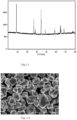
- the cathode material D1 powder was measured by the X-ray diffraction pattern, as shown in Fig. 1-1 .
- the test results showed that full width at half maximum FWHM (110) of the (110) diffraction peak at diffraction angle 2 ⁇ of 64.92 was 0.073, and the structure of the cathode material was a single ⁇ -NaFeO 2 type layered structure.
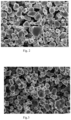
- the cathode material D1 powder was subjected to a scanning electron microscope test, as shown in Fig. 1-2 .
- the cathode material D1 powder mainly included the primary particles of a morphology of spherical or spherical-like and a small amount of secondary particles agglomerated by primary particles.
- the cathode material D1 powder was subjected to particle size and specific surface area tests, the D50 was 3.0 ⁇ m, the cumulative percentage of the number of particles having a particle diameter of 5 ⁇ m or less was 94.4%, the cumulative percentage of the volume of the particles having a particle diameter of 5 ⁇ m or less was 63.5%, and the BET specific surface was 0.90 m 2 /g.
- the corresponding conditions (sintering temperature, sintering time, airflow pulverizing pressure, M source and product) in the sintering step of the cathode material D1 are summarized in Table 1a, Table 1b and Table 1c, as shown in Table 1a, Table 1b and Table 1c.
- the index data of the cathode material D1 (the diffraction angle of the (110) plane of the X-ray diffraction, the half-width of the crystal plane, the cumulative percentages of number and the volume basis of the particle size of 5 ⁇ m or less; D50 and BET) are summarized in Table 2.
- the test results of the battery performance preparing by powder D1 as the active material of the cathode material are shown in Table 3.
- the mixture C was put in a muffle furnace and heated in an oxygen atmosphere at a heating rate of 18 °C / min to 910°C to be sintered for 5 hours, and cooled to room temperature, and air pulverized at a pressure of 0.5 MPa, and classified by a 300-mesh metal mesh to obtain a lithium ion battery cathode material D2 of spherical or spherical-like layered structure.
- the cathode material D2 powder was tested by the X-ray diffraction pattern, and the test results showed that full width at half maximum FWHM (110) of the (110) diffraction peak at diffraction angle 2 ⁇ of 64.89 was 0.120, and the structure of the cathode material was a single ⁇ -NaFeO 2 type layered structure.
- the cathode material D2 powder was subjected to a scanning electron microscope test, as shown in Fig. 2 .
- the cathode material D2 powder mainly included the primary particles of morphology of spherical or spherical-like and a small amount of secondary particles agglomerated by primary particles.
- the cathode material D2 powder was subjected to particle size and specific surface area tests, the D50 was 3.4 ⁇ m, the cumulative percentage of the number of particles having a particle diameter of 5 ⁇ m or less was 91.2%, the cumulative percentage of the volume of the particles having a particle diameter of 5 ⁇ m or less was 62.3%, and the BET specific surface was 0.78 m 2 /g.
- the corresponding conditions (sintering temperature, sintering time, airflow pulverizing pressure, M source and product) in the sintering step of the cathode material D2 are summarized in Table 1a, Table 1b and Table 1c, as shown in Table 1a, Table 1b and Table 1c.
- the index data of the cathode material D2 (the diffraction angle of the (110) plane of the X-ray diffraction, the half-width of the crystal plane, the cumulative percentages of number and the volume basis of the particle size of 5 ⁇ m or less; D50 and BET) are summarized in Table 2.
- the test results of the battery performance preparing by powder D2 as the active material of the cathode material are shown in Table 3.
- the cathode material D3 powder was tested by the X-ray diffraction pattern, and the test results showed that full width at half maximum FWHM (110) of the (110) diffraction peak at diffraction angle 2 ⁇ of 64.90 was 0.098, and the structure of the cathode material was a single ⁇ -NaFeO 2 type layered structure.
- the cathode material D3 powder was subjected to a scanning electron microscope test, as shown in Fig. 3 .
- the cathode material D3 powder mainly included the primary particles of a morphology of spherical or spherical-like and a small amount of secondary particles agglomerated by primary particles.
- the cathode material D3 powder was subjected to particle size and specific surface area tests, the D50 was 5.6 ⁇ m, the cumulative percentage of the number of particles having a particle diameter of 5 ⁇ m or less was 86.15%, the volume cumulative percentage of the particles having a particle diameter of 5 ⁇ m or less was 53.2%, and the BET specific surface was 0.58 m 2 /g.
- the corresponding conditions (sintering temperature, sintering time, airflow pulverizing pressure, M source and product) in the sintering step of the cathode material D3 are summarized in Table 1a, Table 1b and Table 1c, as shown in Table 1a, Table 1b and Table 1c.
- the index data of the cathode material D3 (the diffraction angle of the (110) plane of the X-ray diffraction, the half-width of the crystal plane, the cumulative percentages of number and the volume basis of the particle size of 5 ⁇ m or less; D50 and BET) are summarized in Table 2.
- the test results of the battery performance preparing by powder D3 as the active material of the cathode material are shown in Table 3.
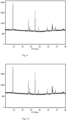
- the cathode material D4 powder was tested by the X-ray diffraction pattern, as shown in Fig.4 .
- the test results showed that full width at half maximum FWHM (110) of the (110) diffraction peak at diffraction angle 2 ⁇ of 64.88 was 0.110, and the structure of the cathode material was a single ⁇ -NaFeO 2 type layered structure.
- the cathode material D4 powder was subjected to a scanning electron microscope test, the cathode material D4 powder mainly included primary particles of morphology of a spherical or spherical-like and a small amount of secondary particles agglomerated by primary particles.
- the cathode material D4 powder was subjected to particle size and specific surface area tests, the D50 was 7.0 ⁇ m, the cumulative percentage of the number of particles having a particle diameter of 5 ⁇ m or less was 74.2%, the volume cumulative percentage of the particles having a particle diameter of 5 ⁇ m or less was 35.5%, and the BET specific surface was 0.40 m 2 /g.
- the corresponding conditions (sintering temperature, sintering time, airflow pulverizing pressure, M source and product) in the sintering step of the cathode material D4 are summarized in Table 1a, Table 1b and Table 1c, as shown in Table 1a, Table 1b and Table 1c.
- the index data of the cathode material D4 (the diffraction angle of the (110) plane of the X-ray diffraction, the half-width of the crystal plane, the cumulative percentages of number and the volume basis of the particle size of 5 ⁇ m or less; D50 and BET) are summarized in Table 2.
- the test results of the battery performance preparing by powder D4 as the active material of the cathode material are shown in Table 3.
- the mixture C was put in a muffle furnace and heated in an oxygen atmosphere at a heating rate of 25°C / min to 500°C to be sintered for 10 hours, and cooled to room temperature, and air pulverized at a pressure of 0.1 MPa, and classified by a 300-mesh metal mesh to obtain a lithium ion battery cathode material D5 of spherical or spherical-like layered structure.
- the cathode material D5 powder was tested by the X-ray diffraction pattern, and the test results showed that full width at half maximum FWHM (110) of the (110) diffraction peak at diffraction angle 2 ⁇ of 64.86 was 0.145, and the structure of the cathode material was a single ⁇ -NaFeO 2 type layered structure.
- the cathode material D5 powder was subjected to a scanning electron microscope test, the cathode material D5 powder was mainly include the primary particles of morphology of a spherical or spherical-like and a small amount of secondary particles agglomerated by primary particles.
- the cathode material D5 powder was subjected to particle size and specific surface area tests, the D50 was 6.2 ⁇ m, the cumulative percentage of the number of particles having a particle diameter of 5 ⁇ m or less was 79.37%, the cumulative percentage of the volume of the particles having a particle diameter of 5 ⁇ m or less was 38.7%, and the BET specific surface was 0.62 m 2 /g.
- the corresponding conditions (sintering temperature, sintering time, airflow pulverizing pressure, M source and product) in the sintering step of the cathode material D5 are summarized in Table 1a, Table 1b and Table 1c, as shown in Table 1a, Table 1b and Table 1c.
- the index data of the cathode material D5 (the diffraction angle of the (110) plane of the X-ray diffraction, the half-width of the crystal plane, the cumulative percentages of number and the volume basis of the particle size of 5 ⁇ m or less; D50 and BET) are summarized in Table 2.
- the test results of the battery performance preparing by powder D5 as the active material of the cathode material are shown in Table 3.
- the mixture C was put in a muffle furnace and heated in an oxygen atmosphere at a heating rate of 22°C / min to 850°C to be sintered for 6 hours, and cooled to room temperature, and air pulverized at a pressure of 0.4 MPa, and classified by a 300-mesh metal mesh to obtain a lithium ion battery cathode material D6 of spherical or spherical-like layered structure.
- the cathode material D6 powder was tested by the X-ray diffraction pattern, and the test results showed that full width at half maximum FWHM (110) of the (110) diffraction peak at diffraction angle 2 ⁇ of 64.95 was 0.082, and the structure of the cathode material was a single ⁇ -NaFeO 2 type layered structure.
- the cathode material D6 powder was subjected to a scanning electron microscope test, the cathode material D6 powder was mainly include the primary particles of morphology of a spherical or spherical-like and a small amount of secondary particles agglomerated by primary particles.
- the cathode material D6 powder was subjected to particle size and specific surface area tests, the D50 was 4.0 ⁇ m, the cumulative percentage of the number of particles having a particle diameter of 5 ⁇ m or less was 88.5%, the cumulative percentage of the volume of the particles having a particle diameter of 5 ⁇ m or less was 57.5%, and the BET specific surface was 0.71 m 2 /g.
- the corresponding conditions (sintering temperature, sintering time, airflow pulverizing pressure, M source and product) in the sintering step of the cathode material D6 are summarized in Table 1a, Table 1b and Table 1c, as shown in Table 1a, Table 1b and Table 1c.
- the index data of the cathode material D6 (the diffraction angle of the (110) plane of the X-ray diffraction, the half-width of the crystal plane, the cumulative percentages of number and the volume basis of the particle size of 5 ⁇ m or less; D50 and BET) are summarized in Table 2.
- the test results of the battery performance preparing by powder D6 as the active material of the cathode material are shown in Table 3.
- the cathode material D7 powder was tested by the X-ray diffraction pattern, and the test results showed that full width at half maximum FWHM (110) of the (110) diffraction peak at diffraction angle 2 ⁇ of 64.93 was 0.130, and the structure of the cathode material was a single ⁇ -NaFeO 2 type layered structure.
- the cathode material D7 powder was subjected to a scanning electron microscope test, the cathode material D4 powder was mainly include the primary particles of morphology of a spherical or spherical-like and a small amount of secondary particles agglomerated by primary particles.
- the cathode material D7 powder was subjected to particle size and specific surface area tests, the D50 was 8.0 ⁇ m, the cumulative percentage of the number of particles having a particle diameter of 5 ⁇ m or less was 68.5%, the cumulative percentage of the volume of the particles having a particle diameter of 5 ⁇ m or less was 28.3%, and the BET specific surface was 0.30 m 2 /g.
- the corresponding conditions (sintering temperature, sintering time, airflow pulverizing pressure, M source and product) in the sintering step of the cathode material D7 are summarized in Table 1a, Table 1b and Table 1c, as shown in Table 1a, Table 1b and Table 1c.
- the index data of the cathode material D7 (the diffraction angle of the (110) plane of the X-ray diffraction, the half-width of the crystal plane, the cumulative percentages of number and volume basis of the particle size of 5 ⁇ m or less; D50 and BET) are summarized in Table 2.
- the test results of the battery performance preparing by powder D7 as the active material of the cathode material are shown in Table 3.
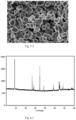
- the cathode material E1 powder was tested by the X-ray diffraction pattern, as shown in Fig. 5-1 .
- the test results showed that full width at half maximum FWHM (110) of the (110) diffraction peak at diffraction angle 2 ⁇ of 64.87 was 0.070, and the structure of the cathode material was a single ⁇ -NaFeO 2 type layered structure.
- the cathode material E1 powder was subjected to a scanning electron microscope test, as shown in Fig. 5-2 .
- the cathode material E3 powder mainly included the primary particles of morphology of spherical or spherical-like and a small amount of secondary particles agglomerated by primary particles.
- the cathode material E1 powder was subjected to particle size and specific surface area tests, the D50 was 5.8 ⁇ m, the cumulative percentage of the number of particles having a particle diameter of 5 ⁇ m or less was 81.63%, the cumulative percentage of the volume of the particles having a particle diameter of 5 ⁇ m or less was 49.8%, and the BET specific surface was 0.56 m 2 /g.
- the corresponding conditions (sintering temperature, sintering time, airflow pulverizing pressure, M source and product) in the sintering step of the cathode material E1 are summarized in Table 1a, Table 1b and Table 1c, as shown in Table 1a, Table 1b and Table 1c.
- the index data of the cathode material E1 (the diffraction angle of the (110) plane of the X-ray diffraction, the half-width of the crystal plane, the cumulative percentages of number and the volume basis of the particle size of 5 ⁇ m or less; D50 and BET) are summarized in Table 2.
- the test results of the battery performance preparing by powder E1 as the active material of the cathode material are shown in Table 3.
- tetrabutyl titanate 0.06 mol was added to 0.2 mol of isopropanol and the mixture was stirred for 10 min to obtain a solution B containing element titanium for stand-by.
- the organic solution B was added to the cathode material intermediate A of lithium-nickel-cobalt-manganese and the mixture was stirred for 30 min to obtain a mixture C, the mixture C was put in a muffle furnace and heated in an air atmosphere at a heating rate of 25°C / min to 500°C to be sintered for 10 hours, and cooled to room temperature, and air pulverized at a pressure of 0.1 MPa, and classified by a 300-mesh metal mesh to obtain a lithium ion battery cathode material E2 of spherical or spherical-like layered structure.
- the cathode material E2 powder was tested by the X-ray diffraction pattern, as shown in Fig. 6-1 .
- the test results showed that full width at half maximum FWHM (110) of the (110) diffraction peak at diffraction angle 2 ⁇ of 64.96 was 0.150, the structure of the cathode material and was a single ⁇ -NaFeO 2 type layered structure.
- the cathode material E2 powder was subjected to a scanning electron microscope test, as shown in Fig. 6-2 , the cathode material E2 powder was mainly include the primary particles of a morphology of spherical or spherical-like and a small amount of secondary particles agglomerated by primary particles.
- the cathode material E2 powder was subjected to particle size and specific surface area tests, the D50 was 3.2 ⁇ m, the cumulative percentage of the number of particles having a particle diameter of 5 ⁇ m or less was 92.3%, the cumulative percentage of the volume of the particles having a particle diameter of 5 ⁇ m or less was 62.8%, and the BET specific area was 0.87 m 2 /g.
- the corresponding conditions (sintering temperature, sintering time, airflow pulverizing pressure, M source and product) in the sintering step of the cathode material E2 are summarized in Table 1a, Table 1b and Table 1c, as shown in Table 1a, Table 1b and Table 1c.
- the index data of the cathode material E2 (the diffraction angle of the (110) plane of the X-ray diffraction, the half-width of the crystal plane, the cumulative percentages of number and the volume basis of the particle size of 5 ⁇ m or less; D50 and BET) are summarized in Table 2,
- Table 3 The test results of the battery performance preparing by powder E2 as the active material of the cathode material are shown in Table 3.
- Table 1a Examples M source amount of M source heating rate °C/min pre-sintering temperature pre-sintering time °C h
- Example 1 Ti 0.002 15 800 4
- Example 2 Co/Mn 0.03/0.02 18 650 5
- Example3 Y/Mg 0.001/0.005 / / / Example4
- Examples Co/Ni 0.02/0.01 25 400
- Example7 Mg 0.003 / / / Comparative Example 1 / / / / / Comp. Ex.
- the cumulative percentage of the number of particles having a particle size of 5 ⁇ m or less was between 68.5 and 94.4% of the lithium ion battery cathode material of spherical or spherical-like layered structure based on primary particles prepared by the invention, that is to say more than 60%, and the cumulative percentage of the volume of the particles having a particle diameter of 5 ⁇ m or less is usually larger than 25% in the volume particle of primary particles and secondary particles agglomerated by the primary particles of the cathode material, and is in the range of 28.3 to 63.5 %.
- the capacity retention ratio of the batteries prepared by the cathode material was more than 90%, the maximum capacity retention ratio was even up to 98.2%.
- the capacity retention ratio of the batteries prepared by the cathode material was more than 90%, the maximum capacity retention ratio was even up to 97.5%; the case of secondary aggregated particles fragmentation in the process of circulation can be effectively avoided.
- the material has excellent cycling performance and safety performance under high temperature and high voltage, and is suitable for digital product, electric vehicles, electric bicycles, fast charge bus, passenger cars, communications, electricity, energy storage systems.
Landscapes
- Chemical & Material Sciences (AREA)
- Chemical Kinetics & Catalysis (AREA)
- Electrochemistry (AREA)
- General Chemical & Material Sciences (AREA)
- Inorganic Chemistry (AREA)
- Organic Chemistry (AREA)
- Engineering & Computer Science (AREA)
- Materials Engineering (AREA)
- Manufacturing & Machinery (AREA)
- Composite Materials (AREA)
- Battery Electrode And Active Subsutance (AREA)
- Secondary Cells (AREA)
Claims (15)
- Matériau de cathode de batterie lithium-ion présentant une structure en couches sphérique ou de type sphérique, caractérisé en ce qu'une formule chimique dudit matériau de cathode est LiaNixCoyMnzMbO2, dans lequel 1,0 ≦a ≦1,2 ; 0,0 < b ≦ 0,05 ; 0,30 ≦ x ≦ 0,90 ; 0,05 ≦ y ≦ 0,40 ; 0,05 ≦ z ≦ 0,50 ; x+y+z+b=1 ; M est un élément dopant et M est un ou deux éléments ou plus parmi Mg, Ti, Al, Zr, Y, Co, Mn, Ni, Ba et un élément de terre rare ;
dans lequel le diamètre médian de particule dudit matériau de cathode est de 3,0 à 8,0 µm et la poudre de matériau de cathode comprend des particules primaires d'une morphologie de forme sphérique ou de type sphérique et une petite quantité de particules secondaires agglomérées à partir de particules primaires comme visible au microscope électronique à balayage, selon lequel le pourcentage des particules présentant un diamètre de particule inférieur ou égal à 5 µm est supérieur à 60 % en nombre du total des particules primaires et des particules secondaires agglomérées à partir des particules primaires du matériau de cathode. - Matériau de cathode de batterie lithium-ion présentant une structure en couches sphérique ou de type sphérique selon la revendication 1, caractérisé en ce qu'une quantité de dopage b de l'élément dopant M est de 0,001 à 0,05, de préférence de 0,002 à 0,03.
- Matériau de cathode de batterie lithium-ion présentant une structure en couches sphérique ou de type sphérique selon l'une quelconque des revendications 1 à 2, caractérisé en ce qu'une structure en couches unique de type α-NaFeO2 dudit matériau de cathode est présentée par un spectre de diffraction de rayons X (XRD) sur poudre, et la largeur totale à mi-hauteur FWHM (110) du pic de diffraction (110) à un angle de diffraction 2θ de 64,9° est de 0,073 à 0,145 dans le spectre de diffraction de rayons X (XRD) sur poudre.
- Matériau de cathode pour batterie lithium-ion présentant une structure en couches sphérique ou de type sphérique selon l'une quelconque des revendications 1 à 3, caractérisé en ce qu'une surface spécifique dudit matériau de cathode mesurée par le procédé BET est de 0,3 à 0,9 m2 / g.
- Matériau de cathode de batterie lithium-ion présentant une structure en couches sphérique ou de type sphérique selon l'une quelconque des revendications 1 à 4, caractérisé en ce qu'un diamètre médian de particule dudit matériau de cathode est de 4,0 à 7,0 µm.
- Procédé de préparation dudit matériau de cathode de batterie lithium-ion présentant une structure en couches sphérique ou de type sphérique selon l'une quelconque des revendications 1 à 5, qui est caractérisé en ce qu'il comprend au moins les étapes suivantes :le mélange d'une source de lithium, d'une source de M et d'un précurseur de nickel-cobalt-manganèse dans un rapport molaire suivant de Li, M et (Ni+Co+Mn), respectivement : a est 1,0 à 1,2, 0,0 < b ≦ 0,05, Ni + Co + Mn est 0,95 à 1,0, dans lequel a est la quantité molaire de Li et b est la quantité molaire de l'élément dopant M ;et le frittage du mélange obtenu à 800-1 000 °C, de préférence le frittage du mélange pendant 4 à 30 heures, et le refroidissement, et la pulvérisation d'air et la classification pour obtenir un matériau de cathode de batterie lithium-ion présentant une structure en couches sphérique ou de type sphérique.
- Procédé de préparation du matériau de cathode selon la revendication 6, qui est caractérisé en ce qu'il comprend au moins les étapes suivantes :
la dispersion d'une source de lithium dans un colloïde aqueux de polyéthylène glycol ou d'acrylamide pour préparer un colloïde, et l'ajout d'un précurseur de nickel-cobalt-manganèse selon un rapport molaire de Li:(Ni + Co + Mn) = (1,0-1,2):(0,95-1,0) dans le colloïde pour obtenir un matériau mélangé, et le pré-frittage du matériau mélangé à 400-800 °C, puis le frittage à 800-980 °C, et le refroidissement, et la pré-pulvérisation et la classification pour obtenir un matériau de cathode lithium-nickel-cobalt-manganèse-oxygène intermédiaire A, l'ajout d'une solution B de la source M dans A pour obtenir un mélange C, puis le post-frittage du mélange C à 500-960 °C, et le refroidissement, et la pulvérisation d'air et la classification pour obtenir un matériau de cathode de batterie lithium-ion présentant une structure en couches sphérique ou de type sphérique. - Procédé de préparation du matériau de cathode selon la revendication 7, dans lequel ledit pré-frittage est effectué pendant 4 à 8 heures, et ledit frittage est effectué pendant 8 à 20 heures, et ledit post-frittage est effectué pendant 4 à 10 heures.
- Procédé de préparation du matériau de cathode selon la revendication 7 ou 8, dans lequel une pression de ladite pré-pulvérisation est de 0,1 à 1,0 MPa, de préférence de 0,3 à 0,4 MPa, et une pression de ladite pulvérisation est de 0,1 à 0,8 MPa, de préférence de 0,4 à 0,7 MPa.
- Procédé de préparation du matériau de cathode selon l'une quelconque des revendications 6 à 9, dans lequel la source de lithium utilisée est un ou deux éléments ou plus choisis dans le groupe consistant en du carbonate de lithium, du monohydrate d'hydroxyde de lithium, du nitrate de lithium et de l'acétate de lithium.
- Procédé de préparation du matériau de cathode selon l'une quelconque des revendications 6 à 10, dans lequel le précurseur de nickel-cobalt-manganèse utilisé est un ou deux éléments ou plus choisis dans le groupe consistant en de l'hydroxyde de nickel-cobalt-manganèse et de l'oxyde de nickel-cobalt-manganèse.
- Procédé de préparation du matériau de cathode selon l'une quelconque des revendications 6 à 11, dans lequel la source de M est un oxyde d'un ou deux éléments ou plus choisis dans le groupe consistant en Mg, Al, Ti, Zr, Y, Co, Ni, Mn, Ba et un élément de terre rare, ou un sel de celui-ci ou un composé organique de celui-ci, et est de préférence un sel, un sulfate, un composé hydroxyle ou un composé ester d'acide acétique d'un ou deux éléments ou plus choisis dans le groupe consistant en Mg, Al, Ti, Zr, Y, Co, Ni, Mn, Ba et un élément de terre rare, plus préférentiellement choisi parmi le zirconate de tétrabutyle, ou un mélange d'hydroxyde de cobalt et d'hydroxyde de nickel.
- Batterie lithium-ion, caractérisée en ce qu'elle comprend au moins l'un du matériau de cathode selon l'une quelconque des revendications 1 à 5 comme matériau actif d'électrode positive.
- Système de communication, d'alimentation, de stockage d'énergie ou dispositif de stockage mobile, caractérisé en ce qu'il est préparé en utilisant la batterie lithium-ion selon la revendication 13.
- Utilisation de la batterie lithium-ion selon la revendication 13 comme source d'alimentation pour un système de communication, d'alimentation ou de stockage d'énergie, un dispositif de stockage mobile ou un produit numérique mobile, un véhicule électrique, de préférence un vélo électrique ou un bus à charge rapide.
Applications Claiming Priority (1)
| Application Number | Priority Date | Filing Date | Title |
|---|---|---|---|
| CN201611168653.6A CN106532005B (zh) | 2016-12-16 | 2016-12-16 | 球形或类球形锂电池正极材料、电池及制法和应用 |
Publications (2)
| Publication Number | Publication Date |
|---|---|
| EP3336062A1 EP3336062A1 (fr) | 2018-06-20 |
| EP3336062B1 true EP3336062B1 (fr) | 2024-09-25 |
Family
ID=58339990
Family Applications (1)
| Application Number | Title | Priority Date | Filing Date |
|---|---|---|---|
| EP17175190.2A Active EP3336062B1 (fr) | 2016-12-16 | 2017-06-09 | Matériau de cathode sphérique ou quasi-sphérique pour batterie au lithium, batterie et procédé de préparation et ses applications |
Country Status (5)
| Country | Link |
|---|---|
| US (2) | US10566606B2 (fr) |
| EP (1) | EP3336062B1 (fr) |
| JP (1) | JP6919112B2 (fr) |
| KR (2) | KR20180070435A (fr) |
| CN (1) | CN106532005B (fr) |
Families Citing this family (28)
| Publication number | Priority date | Publication date | Assignee | Title |
|---|---|---|---|---|
| JP6614202B2 (ja) | 2017-06-01 | 2019-12-04 | 日亜化学工業株式会社 | 非水系電解質二次電池用正極活物質及びその製造方法 |
| CN107359334B (zh) * | 2017-07-11 | 2020-06-19 | 贵州振华新材料有限公司 | 球形或类球形锂离子电池正极材料及锂离子电池 |
| CN107978744B (zh) * | 2017-11-20 | 2020-06-12 | 无锡市产品质量监督检验院 | 一种高容量锂二次电池用正极材料及其制备方法 |
| JP6962838B2 (ja) * | 2018-03-13 | 2021-11-05 | 住友化学株式会社 | リチウム金属複合酸化物粉末、リチウム二次電池用正極活物質、正極、及びリチウム二次電池 |
| JP6542421B1 (ja) | 2018-03-29 | 2019-07-10 | 住友化学株式会社 | リチウム金属複合酸化物粉末、リチウム二次電池用正極活物質、リチウム二次電池用正極、及びリチウム二次電池 |
| KR102288292B1 (ko) * | 2018-06-07 | 2021-08-10 | 주식회사 엘지화학 | 이차전지용 양극 활물질, 그 제조방법 및 이를 포함하는 리튬 이차전지 |
| KR102288295B1 (ko) | 2018-06-20 | 2021-08-10 | 주식회사 엘지화학 | 리튬 이차 전지용 양극 활물질 및 리튬 이차 전지 |
| KR102288296B1 (ko) | 2018-06-28 | 2021-08-10 | 주식회사 엘지화학 | 리튬 이차전지용 양극 활물질, 이의 제조방법, 이를 포함하는 리튬 이차전지용 양극 및 리튬 이차전지 |
| WO2020111893A1 (fr) * | 2018-11-30 | 2020-06-04 | 주식회사 포스코 | Matériau actif de cathode pour batterie secondaire au lithium, et batterie secondaire au lithium comportant ledit matériau actif |
| KR102724456B1 (ko) | 2018-11-30 | 2024-11-01 | 주식회사 엘지에너지솔루션 | 양극 활물질, 상기 양극 활물질을 포함하는 양극 및 리튬 이차전지 |
| CN110723758A (zh) * | 2018-12-25 | 2020-01-24 | 北京当升材料科技股份有限公司 | 一种锂电正极材料前驱体合成装置及方法 |
| CN109888207B (zh) * | 2019-01-25 | 2022-05-17 | 高点(深圳)科技有限公司 | 高镍低游离锂的锂离子三元正极材料及其制法和应用 |
| JP7497903B2 (ja) | 2020-01-29 | 2024-06-11 | エルジー エナジー ソリューション リミテッド | 二次電池用正極活物質およびこれを含むリチウム二次電池 |
| EP4064391B1 (fr) * | 2020-01-30 | 2024-10-23 | LG Energy Solution, Ltd. | Matériau actif d `electrode positive pour batterie secondaire au lithium et son procédé de preparation |
| GB202005682D0 (en) * | 2020-04-20 | 2020-06-03 | Johnson Matthey Plc | Process |
| CN112342605A (zh) * | 2020-09-10 | 2021-02-09 | 陕西彩虹新材料有限公司 | 一种低成本低钴单晶三元正极材料及其制备方法 |
| KR102868735B1 (ko) | 2021-02-16 | 2025-10-02 | 에스케이온 주식회사 | 리튬 이차 전지 |
| WO2023173403A1 (fr) * | 2022-03-18 | 2023-09-21 | 宁德时代新能源科技股份有限公司 | Matériau d'électrode positive ternaire à haute teneur en nickel et son procédé de préparation, batterie secondaire, module de batterie, bloc-batterie et dispositif électrique |
| CN116924480B (zh) * | 2022-03-31 | 2025-10-17 | 中国科学院上海硅酸盐研究所 | 一种制备锂离子电池高镍三元正极材料一次颗粒的预粉化方法及应用 |
| CN119318031B (zh) * | 2023-03-22 | 2026-01-27 | 宁德时代新能源科技股份有限公司 | 正极活性材料、电池单体、电池和用电装置 |
| CN116504979A (zh) * | 2023-04-17 | 2023-07-28 | 北京当升材料科技股份有限公司 | 多元正极材料及其制备方法、锂离子电池 |
| CN116960276B (zh) * | 2023-09-20 | 2023-12-29 | 中创新航科技集团股份有限公司 | 一种正极极片、包含该正极极片的电化学装置和电子装置 |
| CN117374260A (zh) * | 2023-12-07 | 2024-01-09 | 河南科隆新能源股份有限公司 | 一种类单晶锂镍钴锰复合氧化物的制备方法 |
| CN118231646B (zh) * | 2023-12-29 | 2025-12-12 | 比亚迪股份有限公司 | 一种三元材料、其制备方法、正极片、锂离子电池及用电设备 |
| CN118231645B (zh) * | 2023-12-29 | 2025-11-07 | 比亚迪股份有限公司 | 一种锂离子电池用正极材料及其制备方法、正极片、锂离子电池 |
| CN118231644B (zh) * | 2023-12-29 | 2025-10-31 | 比亚迪股份有限公司 | 一种三元材料、其制备方法、正极片、锂离子电池及用电设备 |
| KR20250145916A (ko) * | 2024-03-29 | 2025-10-13 | (주)포스코퓨처엠 | 리튬 이차 전지용 양극 활물질 및 이를 포함하는 리튬 이차 전지 |
| CN121035133A (zh) * | 2025-10-29 | 2025-11-28 | 宁德时代新能源科技股份有限公司 | 锂离子二次电池、正极活性材料及其制备方法和用电装置 |
Family Cites Families (18)
| Publication number | Priority date | Publication date | Assignee | Title |
|---|---|---|---|---|
| JP2004355824A (ja) * | 2003-05-27 | 2004-12-16 | Sumitomo Metal Mining Co Ltd | 非水系二次電池用正極活物質および正極 |
| JP4216669B2 (ja) * | 2003-08-07 | 2009-01-28 | 日鉱金属株式会社 | リチウム・ニッケル・マンガン・コバルト複合酸化物並びにそれを正極活物質として用いたリチウムイオン二次電池 |
| CN101379637A (zh) | 2006-04-07 | 2009-03-04 | 三菱化学株式会社 | 锂二次电池正极材料用锂过渡金属系化合物粉体及其制造方法、其喷雾干燥体及其煅烧前驱体、使用该锂过渡金属系化合物粉体的锂二次电池用正极及锂二次电池 |
| CN101427403B (zh) | 2006-04-21 | 2011-03-23 | 住友化学株式会社 | 正极活物质粉末 |
| WO2007123248A1 (fr) | 2006-04-21 | 2007-11-01 | Sumitomo Chemical Company, Limited | Poudre pour électrode positive et composite d'électrode positive |
| JP5428251B2 (ja) | 2007-09-04 | 2014-02-26 | 三菱化学株式会社 | リチウム遷移金属系化合物粉体、それを用いたリチウム二次電池用正極及びリチウム二次電池 |
| EP2466671A3 (fr) | 2007-09-04 | 2012-08-22 | Mitsubishi Chemical Corporation | Poudre de composé à base de métal de transition au lithium, son procédé de fabrication, substance à séchage par atomisation servant de précurseur de frittage et électrode positive de batterie secondaire au lithium et batterie secondaire au lithium l'utilisant |
| JP2010211925A (ja) | 2009-03-06 | 2010-09-24 | Panasonic Corp | 非水電解質二次電池用正極活物質、その製造方法、および非水電解質二次電池 |
| EP2418718A4 (fr) * | 2009-04-09 | 2014-01-01 | Lg Chemical Ltd | Matériau cathodique actif pour batterie secondaire au lithium |
| WO2011075921A1 (fr) | 2009-12-27 | 2011-06-30 | 深圳市振华新材料股份有限公司 | Matériau d'anode polycristallin à haute teneur en manganèse, procédé de préparation de ce matériau et batterie au lithium dynamique |
| JP2012023015A (ja) | 2010-01-08 | 2012-02-02 | Mitsubishi Chemicals Corp | リチウム二次電池用正極材料用粉体及びその製造方法、並びにそれを用いたリチウム二次電池用正極及びリチウム二次電池 |
| WO2012163660A1 (fr) | 2011-05-30 | 2012-12-06 | Umicore | Matériau d'électrode positive présentant une composition dépendant de la taille |
| CN102394293A (zh) * | 2011-10-17 | 2012-03-28 | 江苏科捷锂电池有限公司 | 高性能锂离子电池正极材料ncm及其制备方法 |
| CN102509784B (zh) * | 2011-10-17 | 2014-03-26 | 北大先行科技产业有限公司 | 一种锂离子电池三元正极材料的制备方法 |
| JP5204913B1 (ja) | 2012-04-27 | 2013-06-05 | 三井金属鉱業株式会社 | 層構造を有するリチウム金属複合酸化物 |
| US20160156020A1 (en) * | 2014-11-27 | 2016-06-02 | Hitachi Metals, Ltd. | Method for manufacturing cathode electrode materials |
| CN104966833B (zh) * | 2015-07-28 | 2017-07-14 | 宁德时代新能源科技股份有限公司 | 正极材料、其制备方法及包含该正极材料的锂离子电池 |
| CN105958062A (zh) * | 2016-06-12 | 2016-09-21 | 湖南杉杉新能源有限公司 | 锂离子电池用多晶高镍正极材料及其制备方法 |
-
2016
- 2016-12-16 CN CN201611168653.6A patent/CN106532005B/zh active Active
-
2017
- 2017-05-23 US US15/602,311 patent/US10566606B2/en active Active
- 2017-06-09 KR KR1020170072220A patent/KR20180070435A/ko not_active Ceased
- 2017-06-09 EP EP17175190.2A patent/EP3336062B1/fr active Active
- 2017-08-10 JP JP2017155475A patent/JP6919112B2/ja active Active
-
2019
- 2019-03-27 KR KR1020190035363A patent/KR20190035670A/ko not_active Ceased
-
2020
- 2020-01-24 US US16/751,337 patent/US11289691B2/en active Active
Also Published As
| Publication number | Publication date |
|---|---|
| US10566606B2 (en) | 2020-02-18 |
| US11289691B2 (en) | 2022-03-29 |
| EP3336062A1 (fr) | 2018-06-20 |
| KR20180070435A (ko) | 2018-06-26 |
| CN106532005B (zh) | 2020-06-09 |
| JP2018098173A (ja) | 2018-06-21 |
| JP6919112B2 (ja) | 2021-08-18 |
| CN106532005A (zh) | 2017-03-22 |
| KR20190035670A (ko) | 2019-04-03 |
| US20200161633A1 (en) | 2020-05-21 |
| US20180175368A1 (en) | 2018-06-21 |
Similar Documents
| Publication | Publication Date | Title |
|---|---|---|
| EP3336062B1 (fr) | Matériau de cathode sphérique ou quasi-sphérique pour batterie au lithium, batterie et procédé de préparation et ses applications | |
| US10790506B2 (en) | Spherical or spherical-like cathode material for lithium-ion battery and lithium-ion battery | |
| US11108043B2 (en) | Method for producing positive electrode active material for nonaqueous electrolyte secondary battery | |
| KR101970909B1 (ko) | 리튬 복합 화합물 입자 분말 및 그의 제조 방법, 비수전해질 이차 전지 | |
| EP3296267B1 (fr) | Matériau cathodique pour batterie lithium-ion sphérique ou quasi-sphérique, procédé de préparation et application associée | |
| US7504180B2 (en) | Positive electrode material for lithium secondary battery and process for producing the same | |
| EP3267517B1 (fr) | Substance active d'électrode positive pour batterie secondaire à électrolyte non aqueux, et son procédé de production | |
| EP3550643A1 (fr) | Précurseur de matériau actif de nickel pour pile rechargeable au lithium et son procédé de fabrication, matériau actif de nickel pour pile rechargeable au lithium fabriquée au moyen dudit procédé, et pile rechargeable au lithium ayant une cathode contenant ledit matériau actif de nickel | |
| GB2617726A (en) | Lithium transition metal oxide material coated with fast ion conductor and preparation method therefor | |
| EP2264815A1 (fr) | Substance active d'électrode positive pour batterie secondaire à électrolyte non aqueux, procédé de fabrication de cette substance, et batterie secondaire à électrolyte non aqueux | |
| CN108807860B (zh) | 阴极添加剂及其制备方法、阴极片及锂电池 | |
| US20200227742A1 (en) | Precursor of lithium cobalt oxide and preparation method thereof and composite of lithium cobalt oxide prepared from the precursor of lithium cobalt oxide | |
| EP2395582A1 (fr) | Matériau actif positif pour batterie au lithium rechargeable, procédé de préparation de celui-ci, et batterie au lithium rechargeable comprenant celui-ci | |
| US11329274B2 (en) | Positive electrode active material for nonaqueous electrolyte secondary batteries, and production method thereof | |
| CN116799201A (zh) | 一种卤化物基正极活性材料及其合成方法与应用 | |
| CN101209824B (zh) | 锂离子二次电池正极活性物质磷酸亚铁锂的制备方法 | |
| KR101298719B1 (ko) | 리튬 이차 전지용 양극 활물질, 이의 제조 방법 및 이를 포함하는 리튬 이차 전지 | |
| WO2025223412A1 (fr) | Oxyde métallique composite de lithium et son procédé de préparation, et batterie au lithium-ion | |
| CN117581397B (zh) | 镍锰酸锂正极活性材料及其制备方法、以及使用其的二次电池 | |
| JP5926746B2 (ja) | 酸化物およびその製造方法 | |
| KR102618005B1 (ko) | 양극 활물질의 제조 방법 | |
| JP7308586B2 (ja) | 非水系電解質二次電池用正極活物質 | |
| CN121757815A (zh) | 一种正极前驱体材料及其制备方法和应用 | |
| CN119920862A (zh) | 正极活性物质、电池和正极活性物质的制造方法 | |
| CN118281295A (zh) | 一种富锂锰基正极材料及其制备方法和锂离子电池 |
Legal Events
| Date | Code | Title | Description |
|---|---|---|---|
| PUAI | Public reference made under article 153(3) epc to a published international application that has entered the european phase |
Free format text: ORIGINAL CODE: 0009012 |
|
| STAA | Information on the status of an ep patent application or granted ep patent |
Free format text: STATUS: REQUEST FOR EXAMINATION WAS MADE |
|
| 17P | Request for examination filed |
Effective date: 20170609 |
|
| AK | Designated contracting states |
Kind code of ref document: A1 Designated state(s): AL AT BE BG CH CY CZ DE DK EE ES FI FR GB GR HR HU IE IS IT LI LT LU LV MC MK MT NL NO PL PT RO RS SE SI SK SM TR |
|
| AX | Request for extension of the european patent |
Extension state: BA ME |
|
| RBV | Designated contracting states (corrected) |
Designated state(s): AL AT BE BG CH CY CZ DE DK EE ES FI FR GB GR HR HU IE IS IT LI LT LU LV MC MK MT NL NO PL PT RO RS SE SI SK SM TR |
|
| STAA | Information on the status of an ep patent application or granted ep patent |
Free format text: STATUS: EXAMINATION IS IN PROGRESS |
|
| 17Q | First examination report despatched |
Effective date: 20191210 |
|
| RAP1 | Party data changed (applicant data changed or rights of an application transferred) |
Owner name: GUIZHOU ZHENHUA E-CHEM INC. |
|
| GRAP | Despatch of communication of intention to grant a patent |
Free format text: ORIGINAL CODE: EPIDOSNIGR1 |
|
| RIC1 | Information provided on ipc code assigned before grant |
Ipc: C01G 53/00 20060101AFI20240502BHEP |
|
| STAA | Information on the status of an ep patent application or granted ep patent |
Free format text: STATUS: GRANT OF PATENT IS INTENDED |
|
| INTG | Intention to grant announced |
Effective date: 20240606 |
|
| GRAS | Grant fee paid |
Free format text: ORIGINAL CODE: EPIDOSNIGR3 |
|
| GRAA | (expected) grant |
Free format text: ORIGINAL CODE: 0009210 |
|
| STAA | Information on the status of an ep patent application or granted ep patent |
Free format text: STATUS: THE PATENT HAS BEEN GRANTED |
|
| AK | Designated contracting states |
Kind code of ref document: B1 Designated state(s): AL AT BE BG CH CY CZ DE DK EE ES FI FR GB GR HR HU IE IS IT LI LT LU LV MC MK MT NL NO PL PT RO RS SE SI SK SM TR |
|
| REG | Reference to a national code |
Ref country code: GB Ref legal event code: FG4D |
|
| REG | Reference to a national code |
Ref country code: CH Ref legal event code: EP |
|
| REG | Reference to a national code |
Ref country code: DE Ref legal event code: R096 Ref document number: 602017085024 Country of ref document: DE |
|
| REG | Reference to a national code |
Ref country code: IE Ref legal event code: FG4D |
|
| REG | Reference to a national code |
Ref country code: LT Ref legal event code: MG9D |
|
| PG25 | Lapsed in a contracting state [announced via postgrant information from national office to epo] |
Ref country code: NO Free format text: LAPSE BECAUSE OF FAILURE TO SUBMIT A TRANSLATION OF THE DESCRIPTION OR TO PAY THE FEE WITHIN THE PRESCRIBED TIME-LIMIT Effective date: 20241225 |
|
| PG25 | Lapsed in a contracting state [announced via postgrant information from national office to epo] |
Ref country code: GR Free format text: LAPSE BECAUSE OF FAILURE TO SUBMIT A TRANSLATION OF THE DESCRIPTION OR TO PAY THE FEE WITHIN THE PRESCRIBED TIME-LIMIT Effective date: 20241226 Ref country code: FI Free format text: LAPSE BECAUSE OF FAILURE TO SUBMIT A TRANSLATION OF THE DESCRIPTION OR TO PAY THE FEE WITHIN THE PRESCRIBED TIME-LIMIT Effective date: 20240925 |
|
| PG25 | Lapsed in a contracting state [announced via postgrant information from national office to epo] |
Ref country code: BG Free format text: LAPSE BECAUSE OF FAILURE TO SUBMIT A TRANSLATION OF THE DESCRIPTION OR TO PAY THE FEE WITHIN THE PRESCRIBED TIME-LIMIT Effective date: 20240925 |
|
| PG25 | Lapsed in a contracting state [announced via postgrant information from national office to epo] |
Ref country code: LV Free format text: LAPSE BECAUSE OF FAILURE TO SUBMIT A TRANSLATION OF THE DESCRIPTION OR TO PAY THE FEE WITHIN THE PRESCRIBED TIME-LIMIT Effective date: 20240925 |
|
| PG25 | Lapsed in a contracting state [announced via postgrant information from national office to epo] |
Ref country code: RS Free format text: LAPSE BECAUSE OF FAILURE TO SUBMIT A TRANSLATION OF THE DESCRIPTION OR TO PAY THE FEE WITHIN THE PRESCRIBED TIME-LIMIT Effective date: 20241225 |
|
| REG | Reference to a national code |
Ref country code: NL Ref legal event code: MP Effective date: 20240925 |
|
| PG25 | Lapsed in a contracting state [announced via postgrant information from national office to epo] |
Ref country code: RS Free format text: LAPSE BECAUSE OF FAILURE TO SUBMIT A TRANSLATION OF THE DESCRIPTION OR TO PAY THE FEE WITHIN THE PRESCRIBED TIME-LIMIT Effective date: 20241225 Ref country code: NO Free format text: LAPSE BECAUSE OF FAILURE TO SUBMIT A TRANSLATION OF THE DESCRIPTION OR TO PAY THE FEE WITHIN THE PRESCRIBED TIME-LIMIT Effective date: 20241225 Ref country code: LV Free format text: LAPSE BECAUSE OF FAILURE TO SUBMIT A TRANSLATION OF THE DESCRIPTION OR TO PAY THE FEE WITHIN THE PRESCRIBED TIME-LIMIT Effective date: 20240925 Ref country code: GR Free format text: LAPSE BECAUSE OF FAILURE TO SUBMIT A TRANSLATION OF THE DESCRIPTION OR TO PAY THE FEE WITHIN THE PRESCRIBED TIME-LIMIT Effective date: 20241226 Ref country code: FI Free format text: LAPSE BECAUSE OF FAILURE TO SUBMIT A TRANSLATION OF THE DESCRIPTION OR TO PAY THE FEE WITHIN THE PRESCRIBED TIME-LIMIT Effective date: 20240925 Ref country code: BG Free format text: LAPSE BECAUSE OF FAILURE TO SUBMIT A TRANSLATION OF THE DESCRIPTION OR TO PAY THE FEE WITHIN THE PRESCRIBED TIME-LIMIT Effective date: 20240925 |
|
| REG | Reference to a national code |
Ref country code: AT Ref legal event code: MK05 Ref document number: 1726544 Country of ref document: AT Kind code of ref document: T Effective date: 20240925 |
|
| PG25 | Lapsed in a contracting state [announced via postgrant information from national office to epo] |
Ref country code: NL Free format text: LAPSE BECAUSE OF FAILURE TO SUBMIT A TRANSLATION OF THE DESCRIPTION OR TO PAY THE FEE WITHIN THE PRESCRIBED TIME-LIMIT Effective date: 20240925 |
|
| PG25 | Lapsed in a contracting state [announced via postgrant information from national office to epo] |
Ref country code: IS Free format text: LAPSE BECAUSE OF FAILURE TO SUBMIT A TRANSLATION OF THE DESCRIPTION OR TO PAY THE FEE WITHIN THE PRESCRIBED TIME-LIMIT Effective date: 20250125 Ref country code: PT Free format text: LAPSE BECAUSE OF FAILURE TO SUBMIT A TRANSLATION OF THE DESCRIPTION OR TO PAY THE FEE WITHIN THE PRESCRIBED TIME-LIMIT Effective date: 20250127 |
|
| PG25 | Lapsed in a contracting state [announced via postgrant information from national office to epo] |
Ref country code: RO Free format text: LAPSE BECAUSE OF FAILURE TO SUBMIT A TRANSLATION OF THE DESCRIPTION OR TO PAY THE FEE WITHIN THE PRESCRIBED TIME-LIMIT Effective date: 20240925 Ref country code: SM Free format text: LAPSE BECAUSE OF FAILURE TO SUBMIT A TRANSLATION OF THE DESCRIPTION OR TO PAY THE FEE WITHIN THE PRESCRIBED TIME-LIMIT Effective date: 20240925 |
|
| PG25 | Lapsed in a contracting state [announced via postgrant information from national office to epo] |
Ref country code: ES Free format text: LAPSE BECAUSE OF FAILURE TO SUBMIT A TRANSLATION OF THE DESCRIPTION OR TO PAY THE FEE WITHIN THE PRESCRIBED TIME-LIMIT Effective date: 20240925 |
|
| PG25 | Lapsed in a contracting state [announced via postgrant information from national office to epo] |
Ref country code: EE Free format text: LAPSE BECAUSE OF FAILURE TO SUBMIT A TRANSLATION OF THE DESCRIPTION OR TO PAY THE FEE WITHIN THE PRESCRIBED TIME-LIMIT Effective date: 20240925 Ref country code: AT Free format text: LAPSE BECAUSE OF FAILURE TO SUBMIT A TRANSLATION OF THE DESCRIPTION OR TO PAY THE FEE WITHIN THE PRESCRIBED TIME-LIMIT Effective date: 20240925 |
|
| PG25 | Lapsed in a contracting state [announced via postgrant information from national office to epo] |
Ref country code: CZ Free format text: LAPSE BECAUSE OF FAILURE TO SUBMIT A TRANSLATION OF THE DESCRIPTION OR TO PAY THE FEE WITHIN THE PRESCRIBED TIME-LIMIT Effective date: 20240925 Ref country code: PL Free format text: LAPSE BECAUSE OF FAILURE TO SUBMIT A TRANSLATION OF THE DESCRIPTION OR TO PAY THE FEE WITHIN THE PRESCRIBED TIME-LIMIT Effective date: 20240925 |
|
| PG25 | Lapsed in a contracting state [announced via postgrant information from national office to epo] |
Ref country code: SK Free format text: LAPSE BECAUSE OF FAILURE TO SUBMIT A TRANSLATION OF THE DESCRIPTION OR TO PAY THE FEE WITHIN THE PRESCRIBED TIME-LIMIT Effective date: 20240925 Ref country code: IT Free format text: LAPSE BECAUSE OF FAILURE TO SUBMIT A TRANSLATION OF THE DESCRIPTION OR TO PAY THE FEE WITHIN THE PRESCRIBED TIME-LIMIT Effective date: 20240925 |
|
| P01 | Opt-out of the competence of the unified patent court (upc) registered |
Free format text: CASE NUMBER: APP_22613/2025 Effective date: 20250513 |
|
| REG | Reference to a national code |
Ref country code: DE Ref legal event code: R097 Ref document number: 602017085024 Country of ref document: DE |
|
| PGFP | Annual fee paid to national office [announced via postgrant information from national office to epo] |
Ref country code: DE Payment date: 20250623 Year of fee payment: 9 |
|
| PG25 | Lapsed in a contracting state [announced via postgrant information from national office to epo] |
Ref country code: DK Free format text: LAPSE BECAUSE OF FAILURE TO SUBMIT A TRANSLATION OF THE DESCRIPTION OR TO PAY THE FEE WITHIN THE PRESCRIBED TIME-LIMIT Effective date: 20240925 |
|
| PGFP | Annual fee paid to national office [announced via postgrant information from national office to epo] |
Ref country code: GB Payment date: 20250523 Year of fee payment: 9 |
|
| PGFP | Annual fee paid to national office [announced via postgrant information from national office to epo] |
Ref country code: FR Payment date: 20250603 Year of fee payment: 9 |
|
| PLBE | No opposition filed within time limit |
Free format text: ORIGINAL CODE: 0009261 |
|
| STAA | Information on the status of an ep patent application or granted ep patent |
Free format text: STATUS: NO OPPOSITION FILED WITHIN TIME LIMIT |
|
| 26N | No opposition filed |
Effective date: 20250626 |
|
| PG25 | Lapsed in a contracting state [announced via postgrant information from national office to epo] |
Ref country code: SE Free format text: LAPSE BECAUSE OF FAILURE TO SUBMIT A TRANSLATION OF THE DESCRIPTION OR TO PAY THE FEE WITHIN THE PRESCRIBED TIME-LIMIT Effective date: 20240925 |
|
| PG25 | Lapsed in a contracting state [announced via postgrant information from national office to epo] |
Ref country code: HR Free format text: LAPSE BECAUSE OF FAILURE TO SUBMIT A TRANSLATION OF THE DESCRIPTION OR TO PAY THE FEE WITHIN THE PRESCRIBED TIME-LIMIT Effective date: 20240925 |
|
| REG | Reference to a national code |
Ref country code: CH Ref legal event code: H13 Free format text: ST27 STATUS EVENT CODE: U-0-0-H10-H13 (AS PROVIDED BY THE NATIONAL OFFICE) Effective date: 20260127 |
|
| PG25 | Lapsed in a contracting state [announced via postgrant information from national office to epo] |
Ref country code: MC Free format text: LAPSE BECAUSE OF FAILURE TO SUBMIT A TRANSLATION OF THE DESCRIPTION OR TO PAY THE FEE WITHIN THE PRESCRIBED TIME-LIMIT Effective date: 20240925 |
|
| PG25 | Lapsed in a contracting state [announced via postgrant information from national office to epo] |
Ref country code: LU Free format text: LAPSE BECAUSE OF NON-PAYMENT OF DUE FEES Effective date: 20250609 |
|
| REG | Reference to a national code |
Ref country code: BE Ref legal event code: MM Effective date: 20250630 |
|
| PG25 | Lapsed in a contracting state [announced via postgrant information from national office to epo] |
Ref country code: IE Free format text: LAPSE BECAUSE OF NON-PAYMENT OF DUE FEES Effective date: 20250609 |
|
| PG25 | Lapsed in a contracting state [announced via postgrant information from national office to epo] |
Ref country code: BE Free format text: LAPSE BECAUSE OF NON-PAYMENT OF DUE FEES Effective date: 20250630 |
|
| PG25 | Lapsed in a contracting state [announced via postgrant information from national office to epo] |
Ref country code: CH Free format text: LAPSE BECAUSE OF NON-PAYMENT OF DUE FEES Effective date: 20250630 |