EP3288166A1 - Steuerungsvorrichtung eines leistungswandlers - Google Patents
Steuerungsvorrichtung eines leistungswandlers Download PDFInfo
- Publication number
- EP3288166A1 EP3288166A1 EP16782844.1A EP16782844A EP3288166A1 EP 3288166 A1 EP3288166 A1 EP 3288166A1 EP 16782844 A EP16782844 A EP 16782844A EP 3288166 A1 EP3288166 A1 EP 3288166A1
- Authority
- EP
- European Patent Office
- Prior art keywords
- circuit
- current
- output
- constant
- control circuit
- Prior art date
- Legal status (The legal status is an assumption and is not a legal conclusion. Google has not performed a legal analysis and makes no representation as to the accuracy of the status listed.)
- Withdrawn
Links
Images


Classifications
-
- H—ELECTRICITY
- H02—GENERATION; CONVERSION OR DISTRIBUTION OF ELECTRIC POWER
- H02J—ELECTRIC POWER NETWORKS; CIRCUIT ARRANGEMENTS OR SYSTEMS FOR SUPPLYING OR DISTRIBUTING ELECTRIC POWER; SYSTEMS FOR STORING ELECTRIC ENERGY
- H02J1/00—Circuit arrangements for DC mains or DC distribution networks
- H02J1/02—Arrangements for reducing harmonics or ripples
-
- H—ELECTRICITY
- H02—GENERATION; CONVERSION OR DISTRIBUTION OF ELECTRIC POWER
- H02J—ELECTRIC POWER NETWORKS; CIRCUIT ARRANGEMENTS OR SYSTEMS FOR SUPPLYING OR DISTRIBUTING ELECTRIC POWER; SYSTEMS FOR STORING ELECTRIC ENERGY
- H02J3/00—Circuit arrangements for AC mains or AC distribution networks
- H02J3/36—Arrangements for transfer of electric power between AC networks via high-voltage DC [HVDC] links; Arrangements for transfer of electric power between generators and networks via HVDC links
-
- H—ELECTRICITY
- H02—GENERATION; CONVERSION OR DISTRIBUTION OF ELECTRIC POWER
- H02M—APPARATUS FOR CONVERSION BETWEEN AC AND AC, BETWEEN AC AND DC, OR BETWEEN DC AND DC, AND FOR USE WITH MAINS OR SIMILAR POWER SUPPLY SYSTEMS; CONVERSION OF DC OR AC INPUT POWER INTO SURGE OUTPUT POWER; CONTROL OR REGULATION THEREOF
- H02M1/00—Details of apparatus for conversion
- H02M1/14—Arrangements for reducing ripples from DC input or output
- H02M1/15—Arrangements for reducing ripples from DC input or output using active elements
-
- H—ELECTRICITY
- H02—GENERATION; CONVERSION OR DISTRIBUTION OF ELECTRIC POWER
- H02M—APPARATUS FOR CONVERSION BETWEEN AC AND AC, BETWEEN AC AND DC, OR BETWEEN DC AND DC, AND FOR USE WITH MAINS OR SIMILAR POWER SUPPLY SYSTEMS; CONVERSION OF DC OR AC INPUT POWER INTO SURGE OUTPUT POWER; CONTROL OR REGULATION THEREOF
- H02M7/00—Conversion of AC power input into DC power output; Conversion of DC power input into AC power output
- H02M7/42—Conversion of DC power input into AC power output without possibility of reversal
- H02M7/44—Conversion of DC power input into AC power output without possibility of reversal by static converters
- H02M7/48—Conversion of DC power input into AC power output without possibility of reversal by static converters using discharge tubes with control electrode or semiconductor devices with control electrode
- H02M7/505—Conversion of DC power input into AC power output without possibility of reversal by static converters using discharge tubes with control electrode or semiconductor devices with control electrode using devices of a thyratron or thyristor type requiring extinguishing means
- H02M7/515—Conversion of DC power input into AC power output without possibility of reversal by static converters using discharge tubes with control electrode or semiconductor devices with control electrode using devices of a thyratron or thyristor type requiring extinguishing means using semiconductor devices only
- H02M7/521—Conversion of DC power input into AC power output without possibility of reversal by static converters using discharge tubes with control electrode or semiconductor devices with control electrode using devices of a thyratron or thyristor type requiring extinguishing means using semiconductor devices only in a bridge configuration
-
- H—ELECTRICITY
- H02—GENERATION; CONVERSION OR DISTRIBUTION OF ELECTRIC POWER
- H02M—APPARATUS FOR CONVERSION BETWEEN AC AND AC, BETWEEN AC AND DC, OR BETWEEN DC AND DC, AND FOR USE WITH MAINS OR SIMILAR POWER SUPPLY SYSTEMS; CONVERSION OF DC OR AC INPUT POWER INTO SURGE OUTPUT POWER; CONTROL OR REGULATION THEREOF
- H02M7/00—Conversion of AC power input into DC power output; Conversion of DC power input into AC power output
- H02M7/66—Conversion of AC power input into DC power output; Conversion of DC power input into AC power output with possibility of reversal
- H02M7/68—Conversion of AC power input into DC power output; Conversion of DC power input into AC power output with possibility of reversal by static converters
- H02M7/72—Conversion of AC power input into DC power output; Conversion of DC power input into AC power output with possibility of reversal by static converters using discharge tubes with control electrode or semiconductor devices with control electrode
- H02M7/75—Conversion of AC power input into DC power output; Conversion of DC power input into AC power output with possibility of reversal by static converters using discharge tubes with control electrode or semiconductor devices with control electrode using devices of a thyratron or thyristor type requiring extinguishing means
- H02M7/757—Conversion of AC power input into DC power output; Conversion of DC power input into AC power output with possibility of reversal by static converters using discharge tubes with control electrode or semiconductor devices with control electrode using devices of a thyratron or thyristor type requiring extinguishing means using semiconductor devices only
- H02M7/7575—Conversion of AC power input into DC power output; Conversion of DC power input into AC power output with possibility of reversal by static converters using discharge tubes with control electrode or semiconductor devices with control electrode using devices of a thyratron or thyristor type requiring extinguishing means using semiconductor devices only for high voltage direct transmission link
-
- H—ELECTRICITY
- H02—GENERATION; CONVERSION OR DISTRIBUTION OF ELECTRIC POWER
- H02M—APPARATUS FOR CONVERSION BETWEEN AC AND AC, BETWEEN AC AND DC, OR BETWEEN DC AND DC, AND FOR USE WITH MAINS OR SIMILAR POWER SUPPLY SYSTEMS; CONVERSION OF DC OR AC INPUT POWER INTO SURGE OUTPUT POWER; CONTROL OR REGULATION THEREOF
- H02M1/00—Details of apparatus for conversion
- H02M1/08—Circuits specially adapted for the generation of control voltages for semiconductor devices incorporated in static converters
- H02M1/081—Circuits specially adapted for the generation of control voltages for semiconductor devices incorporated in static converters wherein the phase of the control voltage is adjustable with reference to the AC source
-
- H—ELECTRICITY
- H02—GENERATION; CONVERSION OR DISTRIBUTION OF ELECTRIC POWER
- H02M—APPARATUS FOR CONVERSION BETWEEN AC AND AC, BETWEEN AC AND DC, OR BETWEEN DC AND DC, AND FOR USE WITH MAINS OR SIMILAR POWER SUPPLY SYSTEMS; CONVERSION OF DC OR AC INPUT POWER INTO SURGE OUTPUT POWER; CONTROL OR REGULATION THEREOF
- H02M5/00—Conversion of AC power input into AC power output, e.g. for change of voltage, for change of frequency, for change of number of phases
- H02M5/40—Conversion of AC power input into AC power output, e.g. for change of voltage, for change of frequency, for change of number of phases with intermediate conversion into DC
- H02M5/42—Conversion of AC power input into AC power output, e.g. for change of voltage, for change of frequency, for change of number of phases with intermediate conversion into DC by static converters
- H02M5/44—Conversion of AC power input into AC power output, e.g. for change of voltage, for change of frequency, for change of number of phases with intermediate conversion into DC by static converters using discharge tubes or semiconductor devices to convert the intermediate DC into AC
- H02M5/443—Conversion of AC power input into AC power output, e.g. for change of voltage, for change of frequency, for change of number of phases with intermediate conversion into DC by static converters using discharge tubes or semiconductor devices to convert the intermediate DC into AC using devices of a thyratron or thyristor type requiring extinguishing means
- H02M5/45—Conversion of AC power input into AC power output, e.g. for change of voltage, for change of frequency, for change of number of phases with intermediate conversion into DC by static converters using discharge tubes or semiconductor devices to convert the intermediate DC into AC using devices of a thyratron or thyristor type requiring extinguishing means using semiconductor devices only
- H02M5/4505—Conversion of AC power input into AC power output, e.g. for change of voltage, for change of frequency, for change of number of phases with intermediate conversion into DC by static converters using discharge tubes or semiconductor devices to convert the intermediate DC into AC using devices of a thyratron or thyristor type requiring extinguishing means using semiconductor devices only having a rectifier with controlled elements
-
- Y—GENERAL TAGGING OF NEW TECHNOLOGICAL DEVELOPMENTS; GENERAL TAGGING OF CROSS-SECTIONAL TECHNOLOGIES SPANNING OVER SEVERAL SECTIONS OF THE IPC; TECHNICAL SUBJECTS COVERED BY FORMER USPC CROSS-REFERENCE ART COLLECTIONS [XRACs] AND DIGESTS
- Y02—TECHNOLOGIES OR APPLICATIONS FOR MITIGATION OR ADAPTATION AGAINST CLIMATE CHANGE
- Y02E—REDUCTION OF GREENHOUSE GAS [GHG] EMISSIONS, RELATED TO ENERGY GENERATION, TRANSMISSION OR DISTRIBUTION
- Y02E60/00—Enabling technologies; Technologies with a potential or indirect contribution to GHG emissions mitigation
- Y02E60/60—Arrangements for transfer of electric power between AC networks or generators via a high voltage DC link [HVCD]
Definitions
- Embodiments of the present disclosure relate to a control device for a power converter applied to, for example, DC power transmission.
- two power converters are connected to respective AC systems via respective transformers.
- the two power converters configure an AC-DC converter and an inverter, respectively, and those are connected with each other via a DC reactor and a DC line.
- AC power from one AC system is converted into DC power by the AC-DC converter, and is transmitted via the DC reactor and the DC line.
- the transmitted DC power is converted into AC power by the inverter.
- control devices for a power converter are provided with a circuit that suppresses an oscillation of a DC current.
- the DC current at the AC-DC converter side oscillates due to a system fault, etc.
- the following scheme of cancelling the oscillation has been proposed; detecting the magnitude of the oscillation component and producing an oscillation of the DC current with an inverted phase relative to the oscillation of the input DC current by an oscillation suppressing circuit.
- Patent Document 1 JP H09-046897 A
- Non-Patent Document 1 Takehiko MACHIDA, "DC power transmission optics", the TOKYO DENKI University press, January 30, 1999, p. 151-154
- the power transmission cables which are DC lines are also extended.
- a DC line is installed in ocean, in accordance with a power transmission distance, the electrostatic capacitance of a DC line increases.
- the DC circuit for DC power transmission includes a DC reactor and a DC line, etc.
- the resonant frequency of the DC circuit due to the electrostatic capacitance of the DC reactor and that of the power transmission cable decreases.
- this resonant frequency decreases down to around the frequency where a normal operation of the DC power transmission is operated, the DC current is affected by resonance, and may become oscillatory and unstable.
- the DC current at the inverter side is not taken into consideration for control.
- the DC current keenly changes due to a system fault and a stepwise change in the DC current setting value, etc., a resonance of the DC circuit is induced, the DC current at the inverter side oscillates, possibly making the DC circuit unstable.
- Embodiments of the present disclosure have been proposed in order to address the foregoing problems of conventional technologies.
- the objective is to provide a control device for a power converter which promptly suppresses an oscillation when a DC current oscillates, and which stabilizes a DC power transmission.
- a control device for a power converter that is an inverter converting DC power into AC power between two power converters connected with each other via a DC line, and the control device includes :
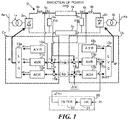
- FIG. 1 is a block diagram illustrating an example structure of a control device for a power converter according to this embodiment. First, an outline of the power system to which the control device for the power converter is applied will be described.
- the power system includes AC systems Aa, Ab, and a DC system D.
- the AC systems Aa and Ab are power systems that supply AC power, and the AC system Ab is a power transmitting side, while the AC system Ab is a power receiving side. In addition, both the AC systems Aa and Ab can be the power transmitting side or the power receiving side.
- the AC systems Aa and Ab each include facilities, such as a power supply, a load, and an AC lines.
- a transformer 1a is connected to the AC system Aa, and a transformer 1b is connected to the AC system Ab, respectively.
- the DC system D is a power system that supplies DC power, and has a one end connected to the AC system Aa via the transformer 1a. The other end is connected to the AC system Ab via the transformer 1b.
- the DC system D is provided with DC power transmission facilities.
- the transformers 1a and 1b are each a converter transformer that supplies a voltage to power converters 2a and 2b to be described later.
- the DC power transmission facilities establish a link between the AC systems Aa, Ab and the DC system D.
- the DC power transmission facilities include power converters 2a and 2b, DC lines 3a and 3b, DC reactors 4a and 4b, voltage detectors 5a and 5b, and current detectors 6a and 6b.
- the power converters 2a and 2b are each a separate-excitation type converter that utilizes a thyristor as a semiconductor device.
- the power converter 2a is connected to a control device Ca, and the power converter 2b is connected to a control device Cb.
- the power converter 2a is an AC-DC converter, and is connected to the AC system Aa via the transformer 1a.
- the power converter 2a converts AC power into DC power by turning ON the thyristor in accordance with a turn-ON signal from the control device Ca.
- the power converter 2b is an inverter, and is connected to the AC system Ab via the transformer 1b.
- the power converter 2b converts DC power into AC power by turning ON the thyristor in accordance with a turn-ON signal from the control device Cb.
- the power converter 2a can be an inverter
- the power converter 2b can be an AC-DC converter.
- the power converter 2a and the power converter 2b are connected to each other via the DC lines 3a and 3b.
- the DC reactor 4a is provided at the DC side of the power converter 2a in the DC line 3a.
- the DC reactor 4b is provided at the DC side of the power converter 2b in the DC line 3a.
- the DC reactors 4a and 4b are each a smoothing reactor which performs smoothing on a DC current and suppresses a DC eddy current. According to the above structure, the DC power converted by the power converter 2a is smoothed by the DC reactor 4a, is transmitted via the DC lines 3a and 3b, and is again smoothed by the DC reactor 4b, and eventually converted into AC power by the power converter 2b.
- the voltage detectors 5a and 5b are each a sensor that detects the DC voltage across both ends of the DC line 3a.
- the voltage detector 5a is provided between the end of the DC line 3a at the power-converter-2a side and the DC reactor 4a.
- a DC voltage Vd 1 detected by the voltage detector 5a is output to the control device Cb.
- the voltage detector 5b is provided between the end of the DC line 3a at the power-converter-2b side and the DC reactor 4b.
- a DC voltage Vd 2 detected by the voltage detector 5b is output to the control device Ca.
- the current detectors 6a and 6b are each a sensor that detects a DC current between both ends of the DC line 3a.
- the current detector 6a is provided between the end of the DC line 3a at the power-converter-2a side and the DC reactor 4a.
- a DC current Id 1 detected by the current detector 6a is output to the control device Ca.
- the current detector 6b is provided between the end of the DC line 3a at the power-converter-2b side and the DC reactor 4b.
- a DC current Id 2 detected by the current detector 6b is output to the control device Cb.
- control device Ca controls the power converter 2a, and includes a constant margin angle control circuit 10a, a constant voltage control circuit 11a, a constant current control circuit 12a, and a minimum value selecting circuit 13a.
- control device Cb controls the power converter 2b, and includes a constant margin angle control circuit 10b, a constant voltage control circuit 11b, a constant current control circuit 12b, and a minimum value selecting circuit 13b. That is, the power converters 2a and 2b basically employ the same structure.
- control device Ca includes adders 14a and 15a.
- control device Cb includes adders 14b, 15b, and 16b.
- Each adder is an arithmetic processing unit that adds a value input with a polarity indicated in FIG. 1 .
- the adder can also be considered as a subtractor.
- the constant margin angle control circuit 10a calculates a control angle that maintains a margin angle necessary for a commutation operation. Since the power converter 2a is a separate excitation type converter, when the margin angle for a converter decreases, a commutation failure is likely to occur. Hence, the constant margin angle control circuit 10a performs a control of ensuring the margin angle during the reverse converter operation, and suppressing a commutation failure of the converter. A control angle ⁇ 1A ⁇ R calculated by the constant margin angle control circuit 10a is output to the minimum value selecting circuit 13a.
- the constant voltage control circuit 11a performs a control of maintaining the DC voltage Vd 2 as constant. Input to the constant voltage control circuit 11a is a value obtained by adding the DC voltage Vd 2 detected by the voltage detector 5b and a predetermined DC voltage reference value Vdp by the adder 14a. The adder 14a calculates a difference of the DC voltage Vd 2 from the DC voltage reference value Vdp. The constant voltage control circuit 11a controls the DC voltage Vd 2 so as to be the value of the DC voltage reference value Vdp. A control angle ⁇ 1AVR calculated by the constant voltage control circuit 11a is output to the minimum value selecting circuit 13a.
- the constant current control circuit 12a performs a control of maintaining the DC current Id 1 as constant. Input to the constant current control circuit 12a is a value obtained by adding the DC current Id 1 detected by the current detector 6a and a predetermined DC current reference value Idp by the adder 15a. The adder 15a calculates a difference of the DC current reference value Idp from the DC current Id 1 . The constant current control circuit 12a controls the DC current Id 1 so as to be a value of the DC current reference value Idp. A control angle ⁇ 1ACR calculated by the constant current control circuit 12a is output to the minimum value selecting circuit 13a.
- the minimum value selecting circuit 13a compares, for example, multiple values, and determines the large-small relationship of the numerical values.
- the minimum value selecting circuit 13a selects the minimum value among the control angles input from the constant margin angle control circuit 10a, the constant voltage control circuit 11a, and the constant current control circuit 12a.
- An output ⁇ 1 by the minimum value selecting circuit 13a is a phase control angle for the gate pulse to the power converter 2a, and the power converter 2a is controlled based on this control angle.
- the constant margin angle control circuit 10b calculates a control angle for maintaining the margin angle necessary for a commutation operation. Since the power converter 2b is a separate excitation type converter, when the margin angle for the converter decreases, a commutation failure is likely to occur. Hence, the constant margin angle control circuit 10b performs a control of ensuring the margin angle during the reverse converter operation, and suppressing a commutation failure of the converter. A control angle ⁇ 2A ⁇ R calculated by the constant margin angle control circuit 10b is output to the minimum value selecting circuit 13b.
- the constant voltage control circuit 11b performs a control of maintaining the DC voltage Vd 1 as constant.
- Input to the constant voltage control circuit 11b is a value obtained by adding the DC voltage Vd 1 detected by the voltage detector 5a and the predetermined DC voltage reference value Vdp by the adder 14b.
- the adder 14b calculates a difference of the DC voltage Vd 1 from the DC voltage reference value Vdp.
- the constant voltage control circuit 11b controls the DC voltage Vd 1 so as to be the value of the DC voltage reference value Vdp.
- the control angle ⁇ 2AvR calculated by the constant voltage control circuit 11b is output to the adder 15b.
- An output ⁇ Id2 by an oscillation suppressing circuit 20 to be described later is also input to the adder 15b.
- the adder 15b adds the control angle ⁇ 2AvR of the constant voltage control circuit 11b and the output ⁇ Id2 of the oscillation suppressing circuit 20, and outputs the addition result to the minimum value selecting circuit 13b.
- the output ⁇ Id2 by the oscillation suppressing circuit 20 may be input to the adder 14b.
- the reverse characteristic of the constant voltage control circuit 11b i.e., the inverse of the transfer function of the constant voltage control circuit 11b may be applied, and the same characteristic as that of the case in which data is input the adder 15b may be achieved.
- the constant current control circuit 12b performs a control of maintaining the DC current Id 2 as constant.
- Input to the constant current control circuit 12b is a value obtained by adding the DC current Id 2 detected by the current detector 6b, the predetermined DC reference value Idp, and a current margin ⁇ Id by the adder 16b.
- the adder 16b adds the current margin ⁇ Id to a difference of the DC current Id 2 from the DC current reference value Idp.
- the constant current control circuit 12b controls the DC current Id 2 so as to be the value of the DC current reference value Idp.
- the control angle ⁇ 2ACR calculated by the constant current control circuit 12b is output to the minimum value selecting circuit 13b.
- the minimum value selecting circuit 13b compares, for example, multiple values, and determines the large-small relationship of the numerical values.
- the minimum value selecting circuit 13b selects the minimum value among the control angles input from the constant margin angle control circuit 10b, the adder 15b, and the constant current control circuit 12b.
- An output ⁇ 2 by this minimum value selecting circuit 13b is a phase control angle for the gate pulse to the power converter 2b, and the power converter 2b is controlled based on this phase control angle.
- the oscillation suppressing circuit 20 suppresses oscillation in the DC current, and includes an approximation differential value calculating circuit 21, and a filter circuit 22.
- the DC current Id 2 is input to the approximation differential value calculating circuit 21.
- the approximation differential value calculating circuit 21 calculates a differential value d(Id 2 )/dt of the DC current Id 2 .
- the calculated differential value d(Id 2 )/dt is input to the filter circuit 22.
- the filter circuit 22 allows only the frequency band within the predetermined range to pass.
- the filter circuit 22 is configured to cause the frequency band at which a suppression of an oscillation of the DC current Id 2 is desired to pass.
- the filter circuit 22 may be achieved by, for example, a circuit that includes a coil, a reactor, and a capacitor.
- the filter circuit 22 is applied to the input differential values d(Id 2 )/dt, and causes the differential value d(Id 2 )/dt of the frequency band at which a suppression of an oscillation of the DC current Id 2 is desired to pass.
- An output ⁇ Id 2 by the filter circuit 22 is output to the adder 15b.
- the adder 15b adds the outputs by the constant voltage control circuit 11b and the oscillation suppressing circuit 20, and outputs the addition result to the minimum value selecting circuit 13b.
- the AC system Aa is the transmitting side
- the AC system Ab is the power receiving side
- the power converter 2a operates as the Ac-DC converter
- the power converter 2b operates as the inverter.
- the control angle of the constant current control circuit 12a becomes smaller than the output by the constant margin angle control circuit 10a and that by the constant voltage control circuit 11a.
- the minimum value selecting circuit 13a outputs the control angle of the constant current control circuit 12a.
- the power converter 2a performs a constant current operation that maintains the DC current Id 1 as constant based on the control angle of the constant current control circuit 12a.
- the control angle of the constant voltage control circuit 11b becomes smaller than the output by the constant margin angle control circuit 10b and that by the constant current control circuit 12b.
- the differential value d (Id 2 ) /dt of the DC current Id 2 becomes substantially zero in the approximation differential value calculating circuit 21 of the oscillation suppressing circuit 20, the output ⁇ Id 2 by the filter circuit 22 also becomes substantially zero.
- the minimum value selecting circuit 13b outputs the control angle of the constant voltage control circuit 11b.
- the power converter 2b performs a constant voltage operation of maintaining the DC voltage Vd 1 as constant based on the control angle of the constant voltage control circuit 11b.
- V ac2 is a bus-line voltage of the AC system Ab
- X 2 is a reactance of the transformer 1b
- the control angle for the power converter 2b becomes ⁇ 2 > ⁇ /2.
- Vd 2 ⁇ 3 2 ⁇ V ac 2 cos ⁇ 2 ⁇ 3 ⁇ X 2 I d 2
- the output ⁇ Id2 by the oscillation suppressing circuit 20 becomes ⁇ Id2 > 0 when the oscillation waveform of the DC voltage Id 2 is increasing.
- the control angle ⁇ 2 in the formula 1 is increased, and this acts so as to increase the DC voltage Id 2 .
- the magnitude of the DC current Id 2 depends on the DC voltage Vd 1 - the DC voltage Vd 2 , the DC current Id 2 decreases when the DC voltage Vd 2 increases.
- the output ⁇ Id2 by the oscillation suppressing circuit 20 becomes ⁇ Id2 ⁇ 0 when the oscillation waveform of the DC current Id 2 is decreasing.
- the control angle ⁇ 2 in the formula 1 is decreased, and this acts so as to decrease the DC voltage Vd 2 , and increase the DC current Id 2 .
- the output ⁇ Id2 by the oscillation suppressing circuit 20 changes the DC current Id 2 so as to be decreased when the oscillation waveform is increasing, and to be increased when the oscillation waveform is decreasing. Therefore, oscillation is canceled by including the reverse phase component of the DC current Id 2 in the output by the constant voltage control circuit 11b.
- the structure of a control device for a power converter according to a second embodiment is basically the same as that of the first embodiment.
- the control angle ⁇ 1ACR calculated by the constant current control circuit 12a is output to the adder 16a.
- the output ⁇ Id2 ' by the oscillation suppressing circuit 20 to be described later is also input to the adder 16a.
- the adder 16a adds the control angle ⁇ 1ACR of the constant current control circuit 12a and the output ⁇ Id2 ' by the oscillation suppressing circuit 20, and outputs the addition result to the minimum value selecting circuit 13a.
- the output ⁇ Id2 ' by the oscillation suppressing circuit 20 may be input to the adder 15a.
- the reverse characteristic of the constant current control circuit 12a i.e., the inverse of the transfer function of the constant current control circuit 12a is applied, and the same characteristic as that of the case in which data is input to the adder 16a is achieved.
- the output by the oscillation suppressing circuit 20 of this embodiment is input to the control device Ca for the power converter 2a.
- the oscillation suppressing circuit 20 includes a DC circuit characteristic calculating circuit 23.
- the output ⁇ Id2 by the filter circuit 22 is input to the DC circuit characteristic calculating circuit 23.
- the DC circuit characteristic calculating circuit 23 is a filter circuit that has a characteristic which is a reverse characteristic of the transfer function from the DC voltage Vd 1 at the power-converter-2a side to the DC current Id 2 .
- the transfer function that indicates the characteristic at which the DC voltage Vd 1 acts on the DC current Id 2 will be described.
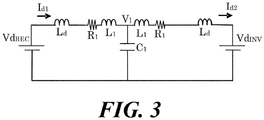
- FIG. 3 illustrates the equivalent circuit of the DC system D. The symbols in FIG. 3 indicate the following values.
- the following formula 3 indicates a transfer function that indicates the characteristic of the DC system D obtained by carrying out Laplace transformation on this formula 2, and arranging the transformation result.
- Id 1 P 11 s Vd REC + P 12 s Vd INV
- Id 2 P 21 s Vd REC + P 22 s Vd INV
- P 11 (s) is a transfer function to the DC current Id 1 from the DC voltage Vd REC
- P 12 (s) is a transfer function to the DC current Id 1 from the DC voltage Vd INV
- P 21 (s) is a transfer function to the DC current Id 2 from the DC voltage Vd REC
- P 22 (s) is a transfer function to the DC current Id 2 from the DC voltage Vd INV .
- V ac1 is a bus-line voltage of the AC system Aa
- X 1 is a reactance of the transformer 1a
- the control angle for the power converter 2a is ⁇ 1 ⁇ ⁇ /2.
- Vd 1 3 2 ⁇ V ac 1 cos ⁇ 1 ⁇ 3 ⁇ X 1 I d 1
- the DC circuit characteristic calculating circuit 23 reflects, on the differential value of the DC current Id 2 , the reverse characteristic P 21 (s) -1 of the influence of the DC voltage Vd REC on the DC current Id 2 .
- the output ⁇ Id2 ' by the DC circuit characteristic calculating circuit 23 is input to the adder 16a, and is added to the control angle ⁇ 1ACR of the constant current control circuit 12a.
- the control angle ⁇ 1 for the power converter 2a can be obtained from the control angle ⁇ 1ACR + the output ⁇ Id2 '.
- the output ⁇ Id2 ' by the oscillation suppressing circuit 20 compensates the characteristic of the DC circuit to the DC current Id 2 when the DC voltage Vd 1 is changed, when the oscillation waveform of the DC current Id 2 is increasing.
- the control angle ⁇ 1 in the formula 5 increases, and this acts so as to decrease the DC voltage Vd 1 and decrease the DC current Id 2 .
- the output ⁇ Id2 ' by the oscillation suppressing circuit 20 decreases the control angle ⁇ 1 when the oscillation waveform of the DC current Id 2 is decreasing, which acts so as to increase the DC voltage Vd 1 , and increase the DC current Id 2 .
- the DC circuit characteristic calculating circuit 23 puts the reverse-characteristic component of the transfer function to the DC current Id 2 from the DC voltage Vd 1 in the control angle ⁇ 1ACR of the constant current control circuit 12a, thereby canceling an oscillation of the DC current Id 2 .
- the structure of a control device for a power converter according to a third embodiment is basically the same as that of the first embodiment. As illustrated in FIG. 4 , however, in addition to the oscillation suppressing circuit 20, an ⁇ bias circuit 30 is provided.
- the ⁇ bias circuit 30 outputs a bias that decreases the control angle ⁇ 2 when the margin angle ⁇ is decreasing in addition to the DC current Id 2 .
- the ⁇ bias circuit 30 includes a ⁇ - ⁇ bias ' conversion circuit 31, an approximation differential value calculating circuit 32, and a primary delay circuit 33.
- the ⁇ - ⁇ bias ' conversion circuit 31 temporarily decreases the control angle ⁇ 2 when the DC current Id 2 oscillates and the margin angle ⁇ becomes equal to or smaller than a set value ⁇ min stored beforehand.
- the margin angle ⁇ of the power converter 2b is input to the ⁇ - ⁇ bias ' conversion circuit 31.
- the ⁇ - ⁇ bias ' conversion circuit 31 output ⁇ bias ' proportional to ⁇ min- ⁇ when ( ⁇ min- ⁇ ) becomes equal to or greater than a constant value.
- the output ⁇ bias ' by the ⁇ - ⁇ bias ' conversion circuit 31 is output to the approximation differential value calculating circuit 32.
- the approximation differential value calculating circuit 32 is an approximation differential value calculating circuit with a limiter which obtains a differential value d( ⁇ bias ')/dt of the output ⁇ bias ' by the ⁇ - ⁇ bias ' conversion circuit 31.
- the approximation differential value calculating circuit 32 outputs the differential value d( ⁇ bias ')/dt to the primary delay circuit 32 only when the differential value d( ⁇ bias ')/dt > 0 so as to detect only the increase in the output ⁇ bias ' by the ⁇ - ⁇ bias ' conversion circuit 31.
- the primary delay circuit 33 is a circuit that has the lower limiter which is the output d( ⁇ bias ')/dt by the approximation differential value calculating circuit 32.
- the primary delay circuit 33 has the output ⁇ bias gradually decreasing in accordance with a time constant T once d( ⁇ bias ') /dt > 0 even if d( ⁇ bias ') /dt decreases thereafter.
- the output ⁇ bias by the primary delay circuit 33 is output to a subtractor 24 of the oscillation suppressing circuit 20.
- the oscillation suppressing circuit 20 includes the subtractor 24.
- the subtractor 24 subtracts the output ⁇ bias by the ⁇ bias circuit 30 from the output ⁇ Id2 by the oscillation suppressing circuit 20.
- the output ⁇ Id2 ' by the oscillation suppressing circuit 20 is output to the constant margin angle control circuit 10b.
- the constant margin angle control circuit 10b includes adder 17b at the input side.
- the DC current Id 2 and the output ⁇ Id2 ' by the oscillation suppressing circuit 20 are input to the adder 17b and added by the adder.
- the adder 17b adds the DC current Id 2 and the output ⁇ Id2 ' by the oscillation suppressing circuit 20, and the constant margin angle control circuit 10b calculates the control angle using the output Id 2 '.
- the adder 17c may be utilized instead of the adder 17b to add the DC current Id 2 and the output ⁇ Id2 ' by the oscillation suppressing circuit 20.
- the oscillation suppressing circuit 20 stabilizes the DC current Id 2 of the power converter 2b that is operating under the constant margin angle control.
- the ⁇ bias circuit 30 prevents, by the oscillation suppressing circuit 20, the power converter 2b from failing commutation.
- the approximation differential value calculating circuit 21 outputs the differential value d(Id 2 )/dt of the DC current Id 2 .
- the filter circuit 22 applies, to the differential value d(Id 2 )/dt, the filter (e.g., bandpass filter) set beforehand for the frequency band at which a suppression of an oscillation of the DC current Id 2 is desired.
- the output ⁇ Id2 obtained by the filter circuit 22 is output to the constant margin angle control circuit 10b via the subtractor 24.
- the output ⁇ Id2 by the filter circuit 22 becomes ⁇ Id2 > 0 when the oscillation waveform of the DC voltage Id 2 is increasing.
- the control angle ⁇ 2 in the formula 1 increases, and this acts so as to increase the DC voltage Vd 2 .
- the output ⁇ Id2 by the filter circuit 22 becomes ⁇ Id2 ⁇ 0 when the oscillation waveform of the DC current Id 2 is decreasing.
- the control angle ⁇ 2 in the formula 1 is decreased, and this acts so as to decrease the DC voltage Vd 2 , and increase the DC current Id 2 .
- the output ⁇ Id2 by the filter circuit 22 increases the control angle ⁇ 2 when the DC voltage Id 2 is increasing. That is, since the control angle ⁇ 2 in the formula 1 becomes close to ⁇ , a commutation failure may occur the time of the constant margin angle control. Accordingly, when the DC current Id 2 oscillates and the margin angle ⁇ becomes equal to or smaller than the setting value, the ⁇ bias circuit 30 temporarily decreases ⁇ 2 , thereby preventing a commutation failure.
- the ⁇ - ⁇ bias ' conversion circuit 31 of the ⁇ bias circuit 30 outputs ⁇ bias ' proportional to ⁇ min- ⁇ when the margin angle ⁇ decreases and ( ⁇ min - ⁇ ) becomes equal to or greater than a certain value.
- the approximation differential value calculating circuit 32 outputs the differential value d( ⁇ bias ')/dt only when the differential value d( ⁇ bias ')/dt > 0, and detects only the increase in the output ⁇ bias ' by the ⁇ - ⁇ bias ' conversion circuit 31.
- the primary delay circuit 33 has the lower limit value that is the output d( ⁇ bias ') /dt by the differential value calculating circuit 32, and when d( ⁇ bias ')/dt > 0, gradually decreases the output ⁇ bias in accordance with the time constant T even if d( ⁇ bias ') /dt decreases.
- the ⁇ bias circuit 30 outputs ⁇ bias when the margin angle ⁇ is equal to or smaller than the certain value so as to act to prevent a commutation failure.
- the output by the approximation differential value calculating circuit 32 becomes d( ⁇ bias ')/dt ⁇ 0.
- the ⁇ bias circuit 30 does not act on the constant margin angle control circuit 10b in the stationary condition.
Landscapes
- Engineering & Computer Science (AREA)
- Power Engineering (AREA)
- Inverter Devices (AREA)
- Direct Current Feeding And Distribution (AREA)
- Supply And Distribution Of Alternating Current (AREA)
Applications Claiming Priority (2)
| Application Number | Priority Date | Filing Date | Title |
|---|---|---|---|
| JP2015088148A JP2016208681A (ja) | 2015-04-23 | 2015-04-23 | 電力変換器の制御装置 |
| PCT/JP2016/053799 WO2016170822A1 (ja) | 2015-04-23 | 2016-02-09 | 電力変換器の制御装置 |
Publications (2)
| Publication Number | Publication Date |
|---|---|
| EP3288166A1 true EP3288166A1 (de) | 2018-02-28 |
| EP3288166A4 EP3288166A4 (de) | 2018-09-12 |
Family
ID=57143918
Family Applications (1)
| Application Number | Title | Priority Date | Filing Date |
|---|---|---|---|
| EP16782844.1A Withdrawn EP3288166A4 (de) | 2015-04-23 | 2016-02-09 | Steuerungsvorrichtung eines leistungswandlers |
Country Status (3)
| Country | Link |
|---|---|
| EP (1) | EP3288166A4 (de) |
| JP (1) | JP2016208681A (de) |
| WO (1) | WO2016170822A1 (de) |
Cited By (2)
| Publication number | Priority date | Publication date | Assignee | Title |
|---|---|---|---|---|
| CN108521138A (zh) * | 2018-04-27 | 2018-09-11 | 武汉大学 | 一种直流系统对交流故障换相失败整体免疫能力评价方法 |
| CN110187201A (zh) * | 2019-04-24 | 2019-08-30 | 中国电力科学研究院有限公司 | 考虑交直流交互的直流换相失败判别方法 |
Families Citing this family (7)
| Publication number | Priority date | Publication date | Assignee | Title |
|---|---|---|---|---|
| CN106505592A (zh) * | 2016-12-22 | 2017-03-15 | 北京四方继保自动化股份有限公司 | 一种抑制次同步振荡的柔性直流附加控制方法 |
| CN107681683B (zh) * | 2017-11-10 | 2020-05-19 | 浙江大学 | 一种基于参数化戴维南等值的交直流受端电网换相失败故障预防方法 |
| JP6997605B2 (ja) * | 2017-12-01 | 2022-01-17 | 東芝産業機器システム株式会社 | 直流アクティブフィルタ、変換装置 |
| CN109861263A (zh) * | 2018-11-30 | 2019-06-07 | 中国电力科学研究院有限公司 | 一种降低特高压直流非故障层换相失败风险的方法及系统 |
| CN110460086B (zh) * | 2019-09-11 | 2021-01-12 | 郑州轻工业学院 | 一种抑制混合多馈入直流换相失败的附加控制方法 |
| CN111884206B (zh) * | 2020-07-15 | 2021-09-17 | 山东大学 | 抑制多直流换相失败连锁的关键线路阻抗调节方法及系统 |
| CN113394788B (zh) * | 2021-06-15 | 2023-03-24 | 南方电网科学研究院有限责任公司 | 交直流并联的两区域系统的控制方法及装置 |
Family Cites Families (8)
| Publication number | Priority date | Publication date | Assignee | Title |
|---|---|---|---|---|
| JPS58112475A (ja) * | 1981-12-26 | 1983-07-04 | Tokyo Electric Power Co Inc:The | 交直変換装置の起動方法 |
| JPS60235219A (ja) * | 1984-05-08 | 1985-11-21 | Toshiba Corp | 調相設備の制御方法 |
| JPS60249824A (ja) * | 1984-05-24 | 1985-12-10 | 株式会社東芝 | 交直変換装置の制御方法 |
| JPH05207650A (ja) * | 1992-01-23 | 1993-08-13 | Toshiba Corp | 直流送電系統制御装置 |
| JPH1014256A (ja) * | 1996-06-27 | 1998-01-16 | Toshiba Corp | 電力変換装置 |
| JP2001197669A (ja) * | 2000-01-07 | 2001-07-19 | Electric Power Dev Co Ltd | 交直変換装置の制御装置 |
| JP2016005374A (ja) * | 2014-06-17 | 2016-01-12 | 株式会社東芝 | 電力変換器の制御装置 |
| JP2016152733A (ja) * | 2015-02-18 | 2016-08-22 | 株式会社東芝 | 電力変換器の制御装置 |
-
2015
- 2015-04-23 JP JP2015088148A patent/JP2016208681A/ja active Pending
-
2016
- 2016-02-09 WO PCT/JP2016/053799 patent/WO2016170822A1/ja not_active Ceased
- 2016-02-09 EP EP16782844.1A patent/EP3288166A4/de not_active Withdrawn
Cited By (4)
| Publication number | Priority date | Publication date | Assignee | Title |
|---|---|---|---|---|
| CN108521138A (zh) * | 2018-04-27 | 2018-09-11 | 武汉大学 | 一种直流系统对交流故障换相失败整体免疫能力评价方法 |
| CN108521138B (zh) * | 2018-04-27 | 2022-02-01 | 武汉大学 | 一种直流系统对交流故障换相失败整体免疫能力评价方法 |
| CN110187201A (zh) * | 2019-04-24 | 2019-08-30 | 中国电力科学研究院有限公司 | 考虑交直流交互的直流换相失败判别方法 |
| CN110187201B (zh) * | 2019-04-24 | 2021-11-16 | 中国电力科学研究院有限公司 | 考虑交直流交互的直流换相失败判别方法 |
Also Published As
| Publication number | Publication date |
|---|---|
| JP2016208681A (ja) | 2016-12-08 |
| EP3288166A4 (de) | 2018-09-12 |
| WO2016170822A1 (ja) | 2016-10-27 |
Similar Documents
| Publication | Publication Date | Title |
|---|---|---|
| EP3288166A1 (de) | Steuerungsvorrichtung eines leistungswandlers | |
| KR101706406B1 (ko) | Ac 시스템을 지원하기 위한 고전압 dc 시스템의 인버터 디바이스의 제어 | |
| JP4067021B2 (ja) | インバータ装置 | |
| KR20130044351A (ko) | 전력변환장치의 고조파전류억제장치 및 고조파전류억제방법 | |
| JP2013034386A (ja) | インバータ制御装置および電力変換装置 | |
| US10938209B2 (en) | Fault ride-through circuit with variable frequency transformer and control method thereof | |
| KR102142288B1 (ko) | 분산전원 계통연계 장치의 제어 시스템 | |
| JP2021093849A (ja) | 直流電源装置および直流電源装置の制御方法 | |
| US10008937B1 (en) | Apparatus for controlling DC link voltage in power cell of medium-voltage inverter | |
| JP4320228B2 (ja) | 自励式変換器の制御装置 | |
| EP3340459B1 (de) | Verfahren zur steuerung eines wechselrichters | |
| EP3832867B1 (de) | Stabilisierung einer gleichstromverbindungsspannung mit adaptiver verstärkung | |
| JP4868585B2 (ja) | 交流励磁発電電動機の制御装置 | |
| JP5378244B2 (ja) | 電力変換装置 | |
| JP6658111B2 (ja) | 交流電源装置およびその制御方法 | |
| JP4779777B2 (ja) | フリッカ抑制装置 | |
| JP2005278224A (ja) | エレベータの制御装置 | |
| JP7599894B2 (ja) | 電力変換装置 | |
| JP4849310B2 (ja) | 交流交流電力変換器の制御装置 | |
| JP2002044866A (ja) | 直列補償装置とサイリスタ制御直列コンデンサの制御装置 | |
| JP6747756B2 (ja) | 電力変換システム | |
| EP3160030A1 (de) | Leistungswandlersteuerungsvorrichtung | |
| JP6822110B2 (ja) | 電力変換装置および電力変換システム | |
| JP2020156146A (ja) | 電力変換装置 | |
| JP3911601B2 (ja) | 発電電動機の制御装置及びこれを用いた発電システム |
Legal Events
| Date | Code | Title | Description |
|---|---|---|---|
| PUAI | Public reference made under article 153(3) epc to a published international application that has entered the european phase |
Free format text: ORIGINAL CODE: 0009012 |
|
| 17P | Request for examination filed |
Effective date: 20171123 |
|
| AK | Designated contracting states |
Kind code of ref document: A1 Designated state(s): AL AT BE BG CH CY CZ DE DK EE ES FI FR GB GR HR HU IE IS IT LI LT LU LV MC MK MT NL NO PL PT RO RS SE SI SK SM TR |
|
| AX | Request for extension of the european patent |
Extension state: BA ME |
|
| DAV | Request for validation of the european patent (deleted) | ||
| DAX | Request for extension of the european patent (deleted) | ||
| A4 | Supplementary search report drawn up and despatched |
Effective date: 20180809 |
|
| RIC1 | Information provided on ipc code assigned before grant |
Ipc: H02M 5/42 20060101ALI20180804BHEP Ipc: H02M 7/48 20070101AFI20180804BHEP Ipc: H02M 7/72 20060101ALI20180804BHEP Ipc: H02J 3/36 20060101ALI20180804BHEP Ipc: H02J 1/02 20060101ALI20180804BHEP Ipc: H02J 1/00 20060101ALI20180804BHEP |
|
| STAA | Information on the status of an ep patent application or granted ep patent |
Free format text: STATUS: THE APPLICATION HAS BEEN WITHDRAWN |
|
| 18W | Application withdrawn |
Effective date: 20181116 |