EP3171976B1 - Synthesis of metal complexes and uses thereof - Google Patents
Synthesis of metal complexes and uses thereof Download PDFInfo
- Publication number
- EP3171976B1 EP3171976B1 EP15745739.1A EP15745739A EP3171976B1 EP 3171976 B1 EP3171976 B1 EP 3171976B1 EP 15745739 A EP15745739 A EP 15745739A EP 3171976 B1 EP3171976 B1 EP 3171976B1
- Authority
- EP
- European Patent Office
- Prior art keywords
- certain embodiments
- group
- optionally substituted
- nitrogen
- metal carbonyl
- Prior art date
- Legal status (The legal status is an assumption and is not a legal conclusion. Google has not performed a legal analysis and makes no representation as to the accuracy of the status listed.)
- Active
Links
Images

Classifications
-
- B—PERFORMING OPERATIONS; TRANSPORTING
- B01—PHYSICAL OR CHEMICAL PROCESSES OR APPARATUS IN GENERAL
- B01J—CHEMICAL OR PHYSICAL PROCESSES, e.g. CATALYSIS OR COLLOID CHEMISTRY; THEIR RELEVANT APPARATUS
- B01J31/00—Catalysts comprising hydrides, coordination complexes or organic compounds
- B01J31/16—Catalysts comprising hydrides, coordination complexes or organic compounds containing coordination complexes
- B01J31/18—Catalysts comprising hydrides, coordination complexes or organic compounds containing coordination complexes containing nitrogen, phosphorus, arsenic or antimony as complexing atoms, e.g. in pyridine ligands, or in resonance therewith, e.g. in isocyanide ligands C=N-R or as complexed central atoms
- B01J31/1805—Catalysts comprising hydrides, coordination complexes or organic compounds containing coordination complexes containing nitrogen, phosphorus, arsenic or antimony as complexing atoms, e.g. in pyridine ligands, or in resonance therewith, e.g. in isocyanide ligands C=N-R or as complexed central atoms the ligands containing nitrogen
- B01J31/181—Cyclic ligands, including e.g. non-condensed polycyclic ligands, comprising at least one complexing nitrogen atom as ring member, e.g. pyridine
- B01J31/1825—Ligands comprising condensed ring systems, e.g. acridine, carbazole
- B01J31/183—Ligands comprising condensed ring systems, e.g. acridine, carbazole with more than one complexing nitrogen atom, e.g. phenanthroline
-
- B—PERFORMING OPERATIONS; TRANSPORTING
- B01—PHYSICAL OR CHEMICAL PROCESSES OR APPARATUS IN GENERAL
- B01J—CHEMICAL OR PHYSICAL PROCESSES, e.g. CATALYSIS OR COLLOID CHEMISTRY; THEIR RELEVANT APPARATUS
- B01J31/00—Catalysts comprising hydrides, coordination complexes or organic compounds
- B01J31/16—Catalysts comprising hydrides, coordination complexes or organic compounds containing coordination complexes
- B01J31/22—Organic complexes
- B01J31/2204—Organic complexes the ligands containing oxygen or sulfur as complexing atoms
- B01J31/2208—Oxygen, e.g. acetylacetonates
- B01J31/2226—Anionic ligands, i.e. the overall ligand carries at least one formal negative charge
- B01J31/2243—At least one oxygen and one nitrogen atom present as complexing atoms in an at least bidentate or bridging ligand
-
- B—PERFORMING OPERATIONS; TRANSPORTING
- B01—PHYSICAL OR CHEMICAL PROCESSES OR APPARATUS IN GENERAL
- B01J—CHEMICAL OR PHYSICAL PROCESSES, e.g. CATALYSIS OR COLLOID CHEMISTRY; THEIR RELEVANT APPARATUS
- B01J31/00—Catalysts comprising hydrides, coordination complexes or organic compounds
- B01J31/16—Catalysts comprising hydrides, coordination complexes or organic compounds containing coordination complexes
- B01J31/18—Catalysts comprising hydrides, coordination complexes or organic compounds containing coordination complexes containing nitrogen, phosphorus, arsenic or antimony as complexing atoms, e.g. in pyridine ligands, or in resonance therewith, e.g. in isocyanide ligands C=N-R or as complexed central atoms
- B01J31/1805—Catalysts comprising hydrides, coordination complexes or organic compounds containing coordination complexes containing nitrogen, phosphorus, arsenic or antimony as complexing atoms, e.g. in pyridine ligands, or in resonance therewith, e.g. in isocyanide ligands C=N-R or as complexed central atoms the ligands containing nitrogen
- B01J31/181—Cyclic ligands, including e.g. non-condensed polycyclic ligands, comprising at least one complexing nitrogen atom as ring member, e.g. pyridine
- B01J31/1815—Cyclic ligands, including e.g. non-condensed polycyclic ligands, comprising at least one complexing nitrogen atom as ring member, e.g. pyridine with more than one complexing nitrogen atom, e.g. bipyridyl, 2-aminopyridine
-
- C—CHEMISTRY; METALLURGY
- C07—ORGANIC CHEMISTRY
- C07C—ACYCLIC OR CARBOCYCLIC COMPOUNDS
- C07C45/00—Preparation of compounds having >C = O groups bound only to carbon or hydrogen atoms; Preparation of chelates of such compounds
- C07C45/78—Separation; Purification; Stabilisation; Use of additives
- C07C45/86—Use of additives, e.g. for stabilisation
-
- C—CHEMISTRY; METALLURGY
- C07—ORGANIC CHEMISTRY
- C07D—HETEROCYCLIC COMPOUNDS
- C07D487/00—Heterocyclic compounds containing nitrogen atoms as the only ring hetero atoms in the condensed system, not provided for by groups C07D451/00 - C07D477/00
- C07D487/22—Heterocyclic compounds containing nitrogen atoms as the only ring hetero atoms in the condensed system, not provided for by groups C07D451/00 - C07D477/00 in which the condensed system contains four or more hetero rings
-
- C—CHEMISTRY; METALLURGY
- C07—ORGANIC CHEMISTRY
- C07F—ACYCLIC, CARBOCYCLIC OR HETEROCYCLIC COMPOUNDS CONTAINING ELEMENTS OTHER THAN CARBON, HYDROGEN, HALOGEN, OXYGEN, NITROGEN, SULFUR, SELENIUM OR TELLURIUM
- C07F5/00—Compounds containing elements of Groups 3 or 13 of the Periodic Table
- C07F5/06—Aluminium compounds
- C07F5/069—Aluminium compounds without C-aluminium linkages
-
- B—PERFORMING OPERATIONS; TRANSPORTING
- B01—PHYSICAL OR CHEMICAL PROCESSES OR APPARATUS IN GENERAL
- B01J—CHEMICAL OR PHYSICAL PROCESSES, e.g. CATALYSIS OR COLLOID CHEMISTRY; THEIR RELEVANT APPARATUS
- B01J2231/00—Catalytic reactions performed with catalysts classified in B01J31/00
- B01J2231/30—Addition reactions at carbon centres, i.e. to either C-C or C-X multiple bonds
- B01J2231/32—Addition reactions to C=C or C-C triple bonds
- B01J2231/321—Hydroformylation, metalformylation, carbonylation or hydroaminomethylation
-
- B—PERFORMING OPERATIONS; TRANSPORTING
- B01—PHYSICAL OR CHEMICAL PROCESSES OR APPARATUS IN GENERAL
- B01J—CHEMICAL OR PHYSICAL PROCESSES, e.g. CATALYSIS OR COLLOID CHEMISTRY; THEIR RELEVANT APPARATUS
- B01J2531/00—Additional information regarding catalytic systems classified in B01J31/00
- B01J2531/02—Compositional aspects of complexes used, e.g. polynuclearity
- B01J2531/0202—Polynuclearity
- B01J2531/0205—Bi- or polynuclear complexes, i.e. comprising two or more metal coordination centres, without metal-metal bonds, e.g. Cp(Lx)Zr-imidazole-Zr(Lx)Cp
-
- B—PERFORMING OPERATIONS; TRANSPORTING
- B01—PHYSICAL OR CHEMICAL PROCESSES OR APPARATUS IN GENERAL
- B01J—CHEMICAL OR PHYSICAL PROCESSES, e.g. CATALYSIS OR COLLOID CHEMISTRY; THEIR RELEVANT APPARATUS
- B01J2531/00—Additional information regarding catalytic systems classified in B01J31/00
- B01J2531/02—Compositional aspects of complexes used, e.g. polynuclearity
- B01J2531/0238—Complexes comprising multidentate ligands, i.e. more than 2 ionic or coordinative bonds from the central metal to the ligand, the latter having at least two donor atoms, e.g. N, O, S, P
- B01J2531/0241—Rigid ligands, e.g. extended sp2-carbon frameworks or geminal di- or trisubstitution
- B01J2531/025—Ligands with a porphyrin ring system or analogues thereof, e.g. phthalocyanines, corroles
-
- B—PERFORMING OPERATIONS; TRANSPORTING
- B01—PHYSICAL OR CHEMICAL PROCESSES OR APPARATUS IN GENERAL
- B01J—CHEMICAL OR PHYSICAL PROCESSES, e.g. CATALYSIS OR COLLOID CHEMISTRY; THEIR RELEVANT APPARATUS
- B01J2531/00—Additional information regarding catalytic systems classified in B01J31/00
- B01J2531/02—Compositional aspects of complexes used, e.g. polynuclearity
- B01J2531/0238—Complexes comprising multidentate ligands, i.e. more than 2 ionic or coordinative bonds from the central metal to the ligand, the latter having at least two donor atoms, e.g. N, O, S, P
- B01J2531/0241—Rigid ligands, e.g. extended sp2-carbon frameworks or geminal di- or trisubstitution
- B01J2531/0252—Salen ligands or analogues, e.g. derived from ethylenediamine and salicylaldehyde
-
- B—PERFORMING OPERATIONS; TRANSPORTING
- B01—PHYSICAL OR CHEMICAL PROCESSES OR APPARATUS IN GENERAL
- B01J—CHEMICAL OR PHYSICAL PROCESSES, e.g. CATALYSIS OR COLLOID CHEMISTRY; THEIR RELEVANT APPARATUS
- B01J2531/00—Additional information regarding catalytic systems classified in B01J31/00
- B01J2531/30—Complexes comprising metals of Group III (IIIA or IIIB) as the central metal
- B01J2531/31—Aluminium
-
- B—PERFORMING OPERATIONS; TRANSPORTING
- B01—PHYSICAL OR CHEMICAL PROCESSES OR APPARATUS IN GENERAL
- B01J—CHEMICAL OR PHYSICAL PROCESSES, e.g. CATALYSIS OR COLLOID CHEMISTRY; THEIR RELEVANT APPARATUS
- B01J2531/00—Additional information regarding catalytic systems classified in B01J31/00
- B01J2531/80—Complexes comprising metals of Group VIII as the central metal
- B01J2531/84—Metals of the iron group
- B01J2531/845—Cobalt
Definitions
- Bimetallic complexes containing a cationic metal-centered Lewis acid in combination with an anionic metal carbonyl are highly active catalysts for the ring-expanding carbonylation of strained heterocycles, including epoxides, aziridines, oxetanes and lactones.
- bimetallic catalysts comprising a cationic aluminum complex as a Lewis-acidic component and a carbonyl cobaltate anion are useful for the double carbonylation of epoxides to succinic anhydrides ( Rowley et al., J. Am. Chem. Soc., 2007, 129, 4948-4960 ).
- a highly active catalytic system for the carbonylation of meso- and terminal epoxides to ⁇ -lactones is described ( Ganji et al., Org Letters, 2011, 13, 3142-3145 ) .
- the active catalyst analogous to Coates' catalyst, is generated in situ from commercially available (TPP)CrCl and Co(2)(CO)(8). This practical system circumvents the preparation of air sensitive cobaltate salts, operates at low catalyst loadings, and allows the carbonylation of functionalized, sterically demanding and heterocyclic meso-epoxides.
- the present invention provides methods of synthesizing ionic aluminum-based carbonylation catalysts as claimed.
- the present invention provides methods for preparing an aluminum-based carbonylation catalyst of formula: the method comprising a step of contacting a compound of formula I: with a neutral metal carbonyl compound having a formula Q' d M e (CO) w' , where each of Q, R q , M, Q', d, e, w, and y is as defined below and in the classes and subclasses herein.
- the present invention provides methods for preparing an aluminum-based carbonylation catalyst of formula: the method comprising a step of contacting a compound of formula I': with a neutral metal carbonyl compound having a formula Q' d M e (CO) w' , , where each of Q, R q' , M, Q', d, e, w , and y is as defined below and in the classes and subclasses herein.
- the present invention provides methods of synthesizing neutral aluminum-based carbonylation catalysts as claimed.
- the present invention provides methods for preparing an aluminum-based carbonylation catalyst of formula: the method comprising a step of contacting a compound of formula I: with a neutral metal carbonyl compound having a formula Q' d M e (CO) w ' in the presence of carbon monoxide and an epoxide of formula: Where each of Q, M, Q', R q , R a' , R b' , R c' , R d' , w , and d are as defined above and in the classes and subclasses herein.
- the present invention provides methods for preparing an aluminum-based carbonylation catalyst of formula: the method comprising a step of contacting a compound of formula I': with a neutral metal carbonyl compound having a formula Q' d M e (CO) w ' in the presence of carbon monoxide and an epoxide of formula: where each of Q, M, Q', R q , R a' , R b' , R c' , R d' , w , and d are as defined above and in the classes and subclasses herein,
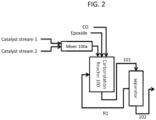
- the present invention encompasses methods for providing carbonylation catalysts to an epoxide carbonylation reaction as claimed.
- the epoxide carbonylation reaction comprises a reaction zone where an epoxide (or mixture of two or more epoxides) is contacted with carbon monoxide.
- such methods entail feeding the reaction zone with carbonylation catalyst by providing two separate catalyst feed streams: a first catalyst feed stream containing a compound of formula I or I' (as defined above and in the classes and subclasses herein) and a second catalyst feed stream containing a neutral metal carbonyl compound having a formula Q' d M e (CO) w ' (as defined above and in the classes and subclasses herein).
- such methods comprise the step of contacting an aluminum compound of formula I: with a neutral metal carbonyl compound (as defined below and in the classes and subclasses herein) to provide a product having a formula: where each of Q and R q are as defined below and in the classes and subclasses herein.
- halo and "halogen” as used herein refer to an atom selected from fluorine (fluoro, - F), chlorine (chloro, -Cl), bromine (bromo, -Br), and iodine (iodo, -I).
- aliphatic or "aliphatic group”, as used herein, denotes a hydrocarbon moiety that may be straight-chain (i.e., unbranched), branched, or cyclic (including fused, bridging, and spiro-fused polycyclic) and may be completely saturated or may contain one or more units of unsaturation, but which is not aromatic. Unless otherwise specified, aliphatic groups contain 1-30 carbon atoms. In certain embodiments, aliphatic groups contain 1-12 carbon atoms. In certain embodiments, aliphatic groups contain 1-8 carbon atoms. In certain embodiments, aliphatic groups contain 1-6 carbon atoms.
- aliphatic groups contain 1-5 carbon atoms, in some embodiments, aliphatic groups contain 1-4 carbon atoms, in yet other embodiments aliphatic groups contain 1-3 carbon atoms, and in yet other embodiments aliphatic groups contain 1-2 carbon atoms.
- Suitable aliphatic groups include, but are not limited to, linear or branched, alkyl, alkenyl, and alkynyl groups, and hybrids thereof such as (cycloalkyl)alkyl, (cycloalkenyl)alkyl, or (cycloalkyl)alkenyl.
- heteroaliphatic or “heteroaliphatic group”, as used herein, denotes an optionally substituted hydrocarbon moiety having, in addition to carbon atoms, from one to five heteroatoms, that may be straight-chain ( i.e., unbranched), branched, or cyclic ("heterocyclic”) and may be completely saturated or may contain one or more units of unsaturation, but which is not aromatic.
- heteroatom refers to nitrogen, oxygen, or sulfur, and includes any oxidized form of nitrogen or sulfur, and any quaternized form of a basic nitrogen.
- nitrogen also includes a substituted nitrogen.
- heteroaliphatic groups contain 1-6 carbon atoms wherein 1-3 carbon atoms are optionally and independently replaced with heteroatoms selected from oxygen, nitrogen, and sulfur. In some embodiments, heteroaliphatic groups contain 1-4 carbon atoms, wherein 1-2 carbon atoms are optionally and independently replaced with heteroatoms selected from oxygen, nitrogen, and sulfur. In yet other embodiments, heteroaliphatic groups contain 1-3 carbon atoms, wherein 1 carbon atom is optionally and independently replaced with a heteroatom selected from oxygen, nitrogen, and sulfur. Suitable heteroaliphatic groups include, but are not limited to, linear or branched, heteroalkyl, heteroalkenyl, and heteroalkynyl groups.
- epoxide refers to a substituted oxirane.
- substituted oxiranes include monosubstituted oxiranes, disubstituted oxiranes, trisubstituted oxiranes, and tetrasubstituted oxiranes.
- Such epoxides may be further optionally substituted as defined herein.
- epoxides comprise a single oxirane moiety.
- epoxides comprise two or more oxirane moieties.
- cycloaliphatic used alone or as part of a larger moiety, refer to a saturated or partially unsaturated monocyclic, bicyclic, or polycyclic ring systems, as described herein, having from 3 to 20 members, wherein the aliphatic ring system is optionally substituted as defined above and described herein.
- Cycloaliphatic groups include, without limitation, cyclopropyl, cyclobutyl, cyclopentyl, cyclopentenyl, cyclohexyl, cyclohexenyl, cycloheptyl, cycloheptenyl, cyclooctyl, cyclooctenyl, bicyclo[2.2.1]heptyl, norbornyl, spiro[4.5]decyl, and cyclooctadienyl.
- a cycloaliphatic group has 3-6 carbons.
- cycloaliphatic also include aliphatic rings that are fused to one or more aromatic or nonaromatic rings, such as decahydronaphthyl or tetrahydronaphthyl, where the radical or point of attachment is on the aliphatic ring.
- a carbocyclic group is bicyclic.
- a carbocyclic group is tricyclic.
- a carbocyclic group is polycyclic.
- C 3- C 14 carbocycle refer to a 3- to 8-membered saturated or partially unsaturated monocyclic carbocyclic ring, or a 7- to 14-membered saturated or partially unsaturated polycyclic carbocyclic ring.
- alkyl refers to saturated, straight- or branched-chain hydrocarbon radicals derived from an aliphatic moiety containing between one and six carbon atoms by removal of a single hydrogen atom. Unless otherwise specified, alkyl groups contain 1-12 carbon atoms. In certain embodiments, alkyl groups contain 1-8 carbon atoms. In certain embodiments, alkyl groups contain 1-6 carbon atoms. In some embodiments, alkyl groups contain 1-5 carbon atoms. In some embodiments, alkyl groups contain 1-4 carbon atoms. In certain embodiments, alkyl groups contain 1-3 carbon atoms. In some embodiments, alkyl groups contain 1-2 carbon atoms.
- alkyl radicals include, but are not limited to, methyl, ethyl, n-propyl, isopropyl, n-butyl, iso-butyl, sec-butyl, sec-pentyl, iso-pentyl, tert-butyl, n-pentyl, neopentyl, n-hexyl, sec-hexyl, n-heptyl, n-octyl, n-decyl, n-undecyl, dodecyl, and the like.
- alkenyl denotes a monovalent group derived from a straight- or branched-chain aliphatic moiety having at least one carbon-carbon double bond by the removal of a single hydrogen atom. Unless otherwise specified, alkenyl groups contain 2-12 carbon atoms. In certain embodiments, alkenyl groups contain 2-8 carbon atoms. In certain embodiments, alkenyl groups contain 2-6 carbon atoms. In some embodiments, alkenyl groups contain 2-5 carbon atoms. In some embodiments, alkenyl groups contain 2-4 carbon atoms. In some embodiments, alkenyl groups contain 2-3 carbon atoms. In some embodiments, alkenyl groups contain 2 carbon atoms. Alkenyl groups include, for example, ethenyl, propenyl, butenyl, 1-methyl-2-buten-1-yl, and the like.
- alkynyl refers to a monovalent group derived from a straight or branched-chain aliphatic moiety having at least one carbon-carbon triple bond by the removal of a single hydrogen atom. Unless otherwise specified, alkynyl groups contain 2-12 carbon atoms. In certain embodiments, alkynyl groups contain 2-8 carbon atoms. In certain embodiments, alkynyl groups contain 2-6 carbon atoms. In some embodiments, alkynyl groups contain 2-5 carbon atoms, in some embodiments, alkynyl groups contain 2-4 carbon atoms, in yet other embodiments alkynyl groups contain 2-3 carbon atoms, and in yet other embodiments alkynyl groups contain 2 carbon atoms. Representative alkynyl groups include, but are not limited to, ethynyl, 2-propynyl (propargyl), 1-propynyl, and the like.
- aryl used alone or as part of a larger moiety as in “aralkyl”, “aralkoxy”, or “aryloxyalkyl”, refers to monocyclic and polycyclic ring systems having a total of five to 20 ring members, wherein at least one ring in the system is aromatic and wherein each ring in the system contains three to twelve ring members.
- aryl may be used interchangeably with the term “aryl ring”.
- aryl refers to an aromatic ring system which includes, but is not limited to, phenyl, biphenyl, naphthyl, anthracyl and the like, which may bear one or more substituents.
- aryl is a group in which an aromatic ring is fused to one or more additional rings, such as benzofuranyl, indanyl, phthalimidyl, naphthimidyl, phenantriidinyl, or tetrahydronaphthyl, and the like.
- the terms "6- to 10-membered aryl” and “C 6 -C 10 aryl” refer to a phenyl or an 8- to 10-membered polycyclic aryl ring.
- heteroaryl and “heteroar-”, used alone or as part of a larger moiety refer to groups having 5 to 14 ring atoms, preferably 5, 6, or 9 ring atoms; having 6, 10, or 14 ⁇ electrons shared in a cyclic array; and having, in addition to carbon atoms, from one to five heteroatoms.
- heteroatom refers to nitrogen, oxygen, or sulfur, and includes any oxidized form of nitrogen or sulfur, and any quaternized form of a basic nitrogen.
- Heteroaryl groups include, without limitation, thienyl, furanyl, pyrrolyl, imidazolyl, pyrazolyl, triazolyl, tetrazolyl, oxazolyl, isoxazolyl, oxadiazolyl, thiazolyl, isothiazolyl, thiadiazolyl, pyridyl, pyridazinyl, pyrimidinyl, pyrazinyl, indolizinyl, purinyl, naphthyridinyl, benzofuranyl and pteridinyl.
- heteroaryl and “heteroar-”, as used herein, also include groups in which a heteroaromatic ring is fused to one or more aryl, cycloaliphatic, or heterocyclyl rings, where the radical or point of attachment is on the heteroaromatic ring.
- Nonlimiting examples include indolyl, isoindolyl, benzothienyl, benzofuranyl, dibenzofuranyl, indazolyl, benzimidazolyl, benzthiazolyl, quinolyl, isoquinolyl, cinnolinyl, phthalazinyl, quinazolinyl, quinoxalinyl, 4 H- quinolizinyl, carbazolyl, acridinyl, phenazinyl, phenothiazinyl, phenoxazinyl, tetrahydroquinolinyl, tetrahydroisoquinolinyl, and pyrido[2,3-b]-1,4-oxazin-3(4H)-one.
- heteroaryl group may be mono- or bicyclic.
- heteroaryl may be used interchangeably with the terms “heteroaryl ring", “heteroaryl group”, or “heteroaromatic”, any of which terms include rings that are optionally substituted.
- heteroarylkyl refers to an alkyl group substituted by a heteroaryl, wherein the alkyl and heteroaryl portions independently are optionally substituted.
- heteroarylkyl refers to an alkyl group substituted by a heteroaryl, wherein the alkyl and heteroaryl portions independently are optionally substituted.
- the terms "5- to 10-membered heteroaryl” and “C 5 -C 10 heteroaryl” refer to a 5- to 6-membered heteroaryl ring having 1 to 3 heteroatoms independently selected from nitrogen, oxygen, or sulfur, or an 8- to 10-membered bicyclic heteroaryl ring having 1 to 4 heteroatoms independently selected from nitrogen, oxygen, or sulfur.
- heterocyclyl As used herein, the terms “heterocyclyl,” “heterocyclic radical,” and “heterocyclic ring” are used interchangeably and refer to a stable 3- to 7-membered monocyclic or 7-14-membered bicyclic heterocyclic moiety that is either saturated or partially unsaturated, and having, in addition to carbon atoms, one or more, preferably one to four, heteroatoms, as defined above.
- nitrogen includes a substituted nitrogen.
- the nitrogen may be N (as in 3,4-dihydro-2 H -pyrrolyl), NH (as in pyrrolidinyl), or + NR (as in N -substituted pyrrolidinyl).
- C 3 -C 14 heterocycle refers to a 3- to 8-membered saturated or partially unsaturated monocyclic heterocyclic ring having 1 to 2 heteroatoms independently selected from nitrogen, oxygen, or sulfur, or a 7- to 14-membered saturated or partially unsaturated polycyclic heterocyclic ring having 1-3 heteroatoms independently selected from nitrogen, oxygen, or sulfur.
- a heterocyclic ring can be attached to its pendant group at any heteroatom or carbon atom that results in a stable structure and any of the ring atoms can be optionally substituted.
- saturated or partially unsaturated heterocyclic radicals include, without limitation, tetrahydrofuranyl, tetrahydrothienyl, pyrrolidinyl, pyrrolidonyl, piperidinyl, pyrrolinyl, tetrahydroquinolinyl, tetrahydroisoquinolinyl, decahydroquinolinyl, oxazolidinyl, piperazinyl, dioxanyl, dioxolanyl, diazepinyl, oxazepinyl, thiazepinyl, morpholinyl, and quinuclidinyl.
- heterocyclyl refers to an alkyl group substituted by a heterocyclyl, wherein the alkyl and heterocyclyl portions independently are optionally substituted.
- partially unsaturated refers to a ring moiety that includes at least one double or triple bond.
- partially unsaturated is intended to encompass rings having multiple sites of unsaturation, but is not intended to include aryl or heteroaryl moieties, as herein defined.
- compounds of the invention may contain "optionally substituted” moieties.
- substituted whether preceded by the term “optionally” or not, means that one or more hydrogens of the designated moiety are replaced with a suitable substituent.
- an “optionally substituted” group may have a suitable substituent at each substitutable position of the group, and when more than one position in any given structure may be substituted with more than one substituent selected from a specified group, the substituent may be either the same or different at every position.
- Combinations of substituents envisioned by this invention are preferably those that result in the formation of stable or chemically feasible compounds.
- stable refers to compounds that are not substantially altered when subjected to conditions to allow for their production, detection, and, in certain embodiments, their recovery, purification, and use for one or more of the purposes disclosed herein.
- substituents are shown attached to a bond which crosses a bond in a ring of the depicted molecule. It will be appreciated that this indicates that one or more of the substituents may be attached to the ring at any available position (usually in place of a hydrogen atom of the parent structure). In cases where an atom of a ring so substituted has two substitutable positions, two groups may be present on the same ring atom. Unless otherwise indicated, when more than one substituent is present, each is defined independently of the others, and each may have a different structure. In cases where the substituent shown crossing a bond of the ring is, e.g., "-R", this has the same meaning as if the ring were said to be "optionally substituted" as described in the preceding paragraph.
- Suitable monovalent substituents on R° are independently halogen, -(CH 2 ) 0-2 R • , -(haloR • ), -(CH 2 ) 0-2 OH, -(CH 2 ) 0-2 OR • , -(CH 2 ) 0-2 CH(OR • ) 2 ; -O(haloR • ), -CN, -N 3 , - (CH 2 ) 0-2 C(O)R • , -(CH 2 ) 0-2 C(O)OH, -(CH 2 ) 0-2 C(O)OR • , -(CH 2 ) 0-4 C(O)N(R°) 2 ; -(CH 2 ) 0- 2SR • , - (CH 2 ) 0-2 SH, -(CH 2 ) 0-2 NH 2 , -(CH 2 ) 0-2
- Suitable divalent substituents that are bound to vicinal substitutable carbons of an "optionally substituted” group include: -O(CR ⁇ 2 ) 2-3 O-, wherein each independent occurrence of R* is selected from hydrogen, C 1-6 aliphatic which may be substituted as defined below, or an unsubstituted 5-6-membered saturated, partially unsaturated, or aryl ring having 0-4 heteroatoms independently selected from nitrogen, oxygen, or sulfur.
- Suitable substituents on the aliphatic group of R ⁇ include halogen, -R • , -(haloR • ), -OH, -OR • , - O(haloR • ), -CN, -C(O)OH, -C(O)OR • , -NH 2 , -NHR • , -NR • 2 , or -NO 2 , wherein each R • is unsubstituted or where preceded by "halo" is substituted only with one or more halogens, and is independently C 1-4 aliphatic, -CH 2 Ph, -O(CH 2 ) 0-1 Ph, or a 5- to 6-membered saturated, partially unsaturated, or aryl ring having 0-4 heteroatoms independently selected from nitrogen, oxygen, or sulfur.
- Suitable substituents on a substitutable nitrogen of an "optionally substituted" group include -R ⁇ , -NR ⁇ 2 , -C(O)R ⁇ , -C(O)OR ⁇ , -C(O)C(O)R ⁇ , -C(O)CH 2 C(O)R ⁇ , -S(O) 2 R ⁇ , -S(O) 2 NR ⁇ 2 , - C(S)NR ⁇ 2 , -C(NH)NR ⁇ 2 , or -N(R ⁇ )S(O) 2 R ⁇ ; wherein each R ⁇ is independently hydrogen, C 1-6 aliphatic which may be substituted as defined below, unsubstituted -OPh, or an unsubstituted 5-6-membered saturated, partially unsaturated, or aryl ring having 0-4 heteroatoms independently selected from nitrogen, oxygen, or sulfur, or, notwithstanding the definition above, two independent occurrence
- a substitutable nitrogen may be substituted with three R ⁇ substituents to provide a charged ammonium moiety - N + (R ⁇ ) 3 , wherein the ammonium moiety is further complexed with a suitable counterion.
- Suitable substituents on the aliphatic group of R ⁇ are independently halogen, -R • , -(haloR*), - OH, -OR*, -O(haloR'), -CN, -C(O)OH, -C(O)OR*, -NH 2 , -NHR • , -NR • 2 , or -NO 2 , wherein each R* is unsubstituted or where preceded by "halo" is substituted only with one or more halogens, and is independently C 1-4 aliphatic, -CH 2 Ph, -O(CH 2 ) 0-1 Ph, or a 5-6-membered saturated, partially unsaturated, or aryl ring having 0
- catalyst refers to a substance the presence of which increases the rate and/or extent of a chemical reaction, while not being consumed or undergoing a permanent chemical change itself.
- the present invention provides methods of synthesizing ionic aluminum-based carbonylation catalysts.
- the present invention provides methods for preparing an aluminum-based carbonylation catalyst of formula: the method comprising a step of contacting a compound of formula I: with a neutral metal carbonyl compound having a formula Q' d M e (CO) w' , where
- the metal carbonyl anion in the aluminum-based carbonylation catalyst produced in the methods above comprises a monoanionic carbonyl complex of any metal from group 5, 7, or 9 of the periodic table or a dianionic carbonyl complex of any metal from group 4 or 8 of the periodic table. It should be understood that in cases where the metal carbonyl anion is dianionic, there will typically be two aluminum complexes associated with each dianionic metal carbonyl. In some embodiments, the metal carbonyl anion contains cobalt or manganese. In some embodiments, the metal carbonyl anion contains rhodium.
- Exemplary metal carbonyl anions include, but are not limited to: [Co(CO) 4 ] - , [Ti(CO) 6 ] 2- , [V(CO) 6 ] - , [Rh(CO) 4 ] - , [Fe(CO) 4 ] 2- , [Ru(CO) 4 ] 2- , [Os(CO) 4 ] 2- , [Cr 2 (CO) 10 ] 2- , [Fe 2 (CO) 8 ] 2- , [Tc(CO) 5 ] - , [Re(CO) 5 ] - , and [Mn(CO) 5 ] - .
- the metal carbonyl anion comprises [Co(CO) 4 ] - .
- a mixture of two or more metal carbonyl anions may be present.
- metals which can form stable metal carbonyl complexes have known coordinative capacities and propensities to form polynuclear complexes which, together with the number and character of optional ligands Q' that may be present and the charge on the complex will determine the number of sites available for CO to coordinate and therefore the value of w .
- such compounds conform to the "18-electron rule".
- one or more of the CO ligands of any of the metal carbonyl anions described above is replaced with a ligand Q'.
- Q' is a phosphine ligand.
- Q' is a triaryl phosphine.
- Q' is trialkyl phosphine.
- Q' is a phosphite ligand.
- Q' is an optionally substituted cyclopentadienyl ligand.
- Q' is cp (e.g., cyclopentadienyl).
- Q' is cp* (e.g., pentamethylcyclopentadienyl).
- R q is an optionally substituted aliphatic group or aryl group.
- R q is a C 1-12 aliphatic group.
- R q is a C 1-8 aliphatic group.
- R q is a C 1-6 aliphatic group.
- R q is a C 1-4 aliphatic group.
- R q is selected from the group consisting of methyl, ethyl, n -propyl, i- propyl, n - butyl, i -butyl, and octyl. In certain embodiments, R q is methyl. In certain embodiments, R q is ethyl. In certain embodiments, R q is i -propyl. In certain embodiments, R q is i -butyl. In certain embodiments, R q is n -butyl. In certain embodiments, R q is n -hexyl. In certain embodiments, R q is n -octyl. In certain embodiments, R q is ethyl. In certain embodiments, R q is methyl.
- R q corresponds to an alkyl group of an available trialkyl aluminum compound.
- trialkylaluminum reagents are commercially available and processes for the preparation trialkylaluminum reagents are well known in the art: for example, by methods described in US Pat. Nos. 3,006,942 and 3,960,912 .
- a trialkylaluminum reagent is trimethylaluminum.
- a trialkylaluminum reagent is triethylaluminum.
- a trialkylaluminum reagent is tripropylaluminum.
- a trialkylaluminum reagent is triisobutylaluminum.
- a trialkylaluminum reagent is trioctylaluminum.
- the step of contacting the compound of formula I with a neutral metal carbonyl is performed in the presence one or more solvents.
- the provided organic solvent is selected from aliphatic hydrocarbons, aromatic hydrocarbons, halogenated solvents, ethers, esters, ketones, nitriles, amides, carbonates, alcohols, amines, sulfones, or mixtures of any two or more of these.
- the organic solvent comprises an ether.
- an ether is selected from diethyl ether, methy-t-butyl ether, tetrahydrofuran, 1,4-dioxane, glyme, diglyme, triglyme, higher glymes, or mixtures of any two or more of these.
- the organic solvent comprises a hydrocarbon.
- the hydrocarbon is a C 5-20 aliphatic hydrocarbon solvent.
- the aliphatic hydrocarbon is selected from pentanes, hexanes, heptanes, and mixtures of higher aliphatic hydrocarbons.
- the hydrocarbon is an aromatic hydrocarbon solvent.
- the aromatic hydrocarbon is selected from benzene, toluene, xylenes, mesitylene, halogenated aromatics, and compositions comprising mixtures of aromatic hydrocarbons.
- compound I and the metal carbonyl are provided as solutions in the organic solvent.
- compound I and the metal carbonyl are each provided as solutions in the same solvent or mixture of solvents.
- compound I and the metal carbonyl are both provided as solutions in an ether.
- compound I and the metal carbonyl are both provided as solutions in 1,4-dioxane.
- compound I and the metal carbonyl are both provided as solutions in tetrahydrofuran.
- compound I and the metal carbonyl are both provided as solutions in diglyme.
- compound I is at least partially insoluble and is present as a suspension or slurry.
- the metal carbonyl compound is substantially soluble in the hydrocarbon solvent.
- the product catalyst is obtained as an insoluble solid.
- the product of the method is a homogenous solution of the aluminum cobaltate catalyst.
- the method comprises one or more additional steps to isolate the catalyst. Such isolation processes are well known in the art and may include steps such removing solvent, crystallizing the product, precipitating the product, extracting the product, or combinations of any two or more of these.
- a neutral metal carbonyl compound provided in any of the methods herein has the general formula Q' d M e (CO) w' , where each Q', M, d , and e, is as defined above and in the classes and subclasses herein and w' is a number such as to provide a stable neutral metal carbonyl complex.
- a neutral metal carbonyl has the general formula Q'M(CO) w ' .
- a neutral metal carbonyl has the general formula M(CO) w ' .
- a neutral metal carbonyl has the general formula Q'M 2 (CO) w ' .
- a neutral metal carbonyl has the general formula M 2 (CO) w ' .
- Suitable neutral metal carbonyl compounds include, but are not limited to: Ti(CO) 7 , V 2 (CO) 12 , Cr(CO) 6 , Mo(CO) 6 , W(CO) 6 , Mn 2 (CO) 10 , Tc 2 (CO) 10 , Re 2 (CO) 10 , Fe(CO) 5 , Ru(CO) 5 , Os(CO) 5 , Ru 3 (CO) 12 , Os 3 (CO) 12 , Fe 3 (CO) 12 , Fe 2 (CO) 9 , Co 4 (CO) 12 , Rh 4 (CO) 12 , Rh 6 (CO) 16 , Ir 4 (CO) 12 , Co 2 (CO) 8 , and Ni(CO) 4 .
- Q' d M e (CO) w ' is a species characterizable by analytical means, e.g., NMR, IR, X-ray crystallography, Raman spectroscopy and/or electron spin resonance (EPR) and isolable in pure form or a species formed in situ.
- analytical means e.g., NMR, IR, X-ray crystallography, Raman spectroscopy and/or electron spin resonance (EPR) and isolable in pure form or a species formed in situ.
- metals which can form stable metal carbonyl complexes have known coordinative capacities and propensities to form polynuclear complexes which, together with the number and character of optional ligands Q that may be present will determine the number of sites available for CO to coordinate and therefore the value of w '.
- such compounds conform to stoichiometries conforming to the "18-electron rule".
- one or more of the CO ligands of any of the neutral metal carbonyl compounds described above is replaced with a ligand Q'.
- Q' is a phosphine ligand.
- Q' is a triaryl phosphine.
- Q' is trialkyl phosphine.
- Q' is a phosphite ligand.
- Q' is an optionally substituted cyclopentadienyl ligand.
- Q' is cp. In certain embodiments, Q' is cp*.
- a provided neutral metal carbonyl compound in the methods herein comprises a cobalt carbonyl compound.
- a provided neutral metal carbonyl compound is Co 2 (CO) 8 .
- a provided neutral metal carbonyl compound is Co 4 (CO) 12 .
- a provided neutral metal carbonyl compound is a mixture of two or more cobalt carbonyl species.
- the present invention provides methods for preparing an aluminum-based carbonylation catalyst of formula: the method comprising a step of contacting a compound of formula I: with a neutral cobalt carbonyl compound, where each of Q and R q is as defined above and in the classes and subclasses herein.
- the molar ratio of compound I to the neutral metal carbonyl compound is in the range of from about 0.1: 1 to about 10:1. In certain embodiments, the molar ratio of compound I to the neutral metal carbonyl compound is in the range of from 0.1: 1 to 2:1; or from 0.5:1 to 1.5:1; or from 0.7:1 to 1.5:1; or from 0.8:1 to 1.2:1; or from 0.9:1 to 1.1:1.
- the molar ratio of compound I to the neutral metal carbonyl compound is in the range of from 1:1 to 5:1; or from 1:1 to 4:1; or from 1:1 to 3:1; or from 1:1 to 2:1; or from 1.2:1 to 2.5:1; or from 1.4:1 to 2: 1; or from 1.2: 1 to 2:1; or from 1.5:1 to 2:1.
- the molar ratio of compound I to a neutral metal carbonyl compound is controlled in the methods herein such that the molar ratio of metal atoms in a provided neutral metal carbonyl compound to aluminum atoms in a provided compound I is in the range of about 0.5: 1 to about 2:1.
- a neutral metal carbonyl compound is dicobalt octacarbonyl
- compound I is an aluminum porphyrin complex
- a 1:2 molar ratio of a neutral metal carbonyl to compound I would provide a 1:1 molar ratio of cobalt to aluminum atoms.
- the molar ratio of metal atoms in a provided neutral metal carbonyl compound to aluminum atoms in a provided compound I is in the range of from about 0.5:1 to about 1.5:1, or from about 0.7: 1 to about 1.3:1, or from about 0.8:1 to about 1.2:1, or from about 0.9:1 to about 1.2:1, or from about 0.9:1 to about 1.1:1, or from about 0.95:1 to about 1.05:1.
- the molar ratio of metal atoms in a provided neutral metal carbonyl compound to aluminum atoms in a provided compound I is in the range of from about 1:1 to about 2:1, or from about 1:1 to about 1.8:1, or from about 1:1 to about 1.5:1, or from about 1:1 to about 1.4:1, or from about 1:1 to about 1.3:1, or from about 1:1 to about 1.2:1 or from about 1:1 to about 1.1:1.
- the molar ratio of compound I to a neutral metal carbonyl compound is controlled in the methods herein such that the molar ratio of metal atoms in a provided neutral metal carbonyl compound to aluminum atoms in the provided compound I is about 1:1.
- the step of contacting a compound of formula I with a neutral metal carbonyl compound entails adding compound I to a vessel containing a neutral metal carbonyl compound.
- compound I is added to the vessel as a solution in an organic solvent ( vide supra ) .
- a neutral metal carbonyl present in the vessel to which compound I is added is present as a solution in an organic solvent.
- compound I is added as a solid or a slurry to the vessel containing a neutral metal carbonyl compound.
- a neutral metal carbonyl compound is present as a solid or a slurry in the vessel to which compound I is added.
- the step of contacting a compound of formula I with a neutral metal carbonyl compound entails adding the neutral metal carbonyl compound to a vessel containing compound I.
- a neutral metal carbonyl compound is added to the vessel as a solution in an organic solvent ( vide supra ) .
- compound I is present in the vessel to which a neutral metal carbonyl compound is added as a solution in an organic solvent.
- a neutral metal carbonyl compound is added as a solid or a slurry to the vessel containing the compound of formula I.
- a compound of formula I is present as a solid or a slurry in the vessel to which the neutral metal carbonyl compound is added.
- the step of contacting a compound of formula I with a neutral metal carbonyl compound entails simultaneously adding the neutral metal carbonyl compound and compound I to a vessel.
- a neutral metal carbonyl compound is added to the vessel as a solution in an organic solvent ( vide supra ) .
- a neutral metal carbonyl compound is added to the vessel as a solid or a slurry.
- compound I is added to the vessel as a solution in an organic solvent ( vide supra ) .
- compound I is added to the vessel as a solid or a slurry.
- compound I and a neutral metal carbonyl are each added to the vessel as solutions in an organic solvent.
- the solutions are combined enroute to the vessel---e.g. by using a mixing tee or flowing the combined solutions through a static mixer.
- compound I and a neutral metal carbonyl compound are contacted under an atmosphere comprising CO.
- the CO is present at a pressure from about 1 atmosphere to about 400 atmospheres.
- compound I and a neutral metal carbonyl compound are contacted under an atmosphere comprising CO at a pressure between about 1 atmosphere and about 100 atmospheres, or between about 1 atmosphere and about 50 atmospheres, or between about 10 atmospheres and about 20 atmospheres, or between about 5 atmospheres and about 10 atmospheres, or between about 1 atmosphere and about 5 atmospheres.
- the step of contacting compound I with a neutral metal carbonyl includes heating.
- the contacting step is performed at a temperature between about 30 °C and about 250 °C.
- the contacting step is performed at between 30 and 200 °C, between 30 and 150 °C, between 30 and 100 °C, between 30 and 80 °C, between 40 and 100 °C, between 50 and 100 °C, between 100 and 200 °C, between 100 and 150 °C, or between 30 and 50 °C.
- a product of the contacting step is a ketone of formula (R q ) 2 CO where R q is as defined above and in the classes and subclasses herein.
- the present invention encompasses a method of preparing an aluminum-based carbonylation catalyst of formula: and a ketone of formula
- the present invention provides methods for preparing an aluminum-based carbonylation catalyst of formula:
- the metal carbonyl anion ([Q' d M e (CO) w ] y- ) in the aluminum-based carbonylation catalyst produced in the methods above comprises a monoanionic carbonyl complex of any metal from group 5, 7 or 9 of the periodic table or a dianionic carbonyl complex of any metal from group 4 or 8 of the periodic table. It should be understood that in cases where the metal carbonyl anion is dianionic, there will typically be two aluminum complexes associated with each dianionic metal carbonyl. In some embodiments, the metal carbonyl anion contains cobalt or manganese. In some embodiments, the metal carbonyl anion contains rhodium.
- Exemplary metal carbonyl anions include, but are not limited to: [Co(CO) 4 ] - , [Ti(CO) 6 ] 2- , [V(CO) 6 ] - , [Rh(CO) 4 ] - , [Fe(CO) 4 ] 2- , [Ru(CO) 4 ] 2- , [Os(CO) 4 ] 2- , [Cr 2 (CO) 10 ] 2- , [Fe 2 (CO) 8 ] 2- , [Tc(CO) 5 ] - , [Re(CO) 5 ] - , and [Mn(CO) 5 ] - .
- the metal carbonyl anion comprises [Co(CO) 4 ] - .
- a mixture of two or more metal carbonyl anions may be present.
- metals which can form stable metal carbonyl complexes have known coordinative capacities and propensities to form polynuclear complexes which, together with the number and character of optional ligands Q' that may be present and the charge on the complex will determine the number of sites available for CO to coordinate and therefore the value of w .
- such compounds conform to the "18-electron rule".
- one or more of the CO ligands of any of the metal carbonyl anions described above is replaced with a ligand Q'.
- Q' is a phosphine ligand.
- Q' is a triaryl phosphine.
- Q' is trialkyl phosphine.
- Q' is a phosphite ligand.
- Q' is an optionally substituted cyclopentadienyl ligand.
- Q' is cp. In certain embodiments, Q' is cp*.
- R q ' is selected from the group consisting of hydrogen, an optionally substituted aliphatic group or an optionally substituted aryl group.
- R q' is a C 1-40 aliphatic group.
- R q' is a C 1-20 aliphatic group.
- R q is a C 1-8 aliphatic group.
- R q is a substituted C 1-8 aliphatic group.
- R q' is a C 1-12 aliphatic group.
- R q' is a C 1-6 aliphatic group.
- R q' is a C 1-4 aliphatic group.
- R q' is -H. In certain embodiments, R q' is selected from the group consisting of methyl, ethyl, n -propyl, i -propyl, n - butyl, i -butyl, and octyl. In certain embodiments, R q' is selected from the group consisting of chloromethyl, dichloromethyl, trichloromethyl, trifluoromethyl 1,1,1-trifluoromethyl, and pentafluoromethyl. In certain embodiments, R q' is methyl. In certain embodiments, R q' is ethyl. In certain embodiments, R q' is i -propyl.
- R q' is i -butyl. In certain embodiments, R q' is n -butyl. In certain embodiments, R q' is n -hexyl. In certain embodiments, R q' is n -octyl. In certain embodiments, R q' is a C 8-32 fatty acid chain.
- R q' is an optionally substituted aromatic group.
- R q' is phenyl.
- R q' is selected from the group consisting of: phenyl, o- toluyl, m -toluyl, p -toluyl, chlorophenyl, and nitrophenyl.
- R q' is phenyl.
- R q' is substituted phenyl.
- the step of contacting a compound of formula I' with a neutral metal carbonyl is performed in the presence one or more solvents.
- the provided organic solvent is selected from aliphatic hydrocarbons, aromatic hydrocarbons, halogenated solvents, ethers, esters, ketones, nitriles, amides, carbonates, alcohols, amines, sulfones, or mixtures of any two or more of these.
- the organic solvent comprises an ether.
- an ether is selected from diethyl ether, methy-t-butyl ether, tetrahydrofuran, 1,4-dioxane, glyme, diglyme, triglyme, higher glymes, or mixtures of any two or more of these.
- the organic solvent comprises a hydrocarbon.
- the hydrocarbon is a C 5-20 aliphatic hydrocarbon solvent.
- the aliphatic hydrocarbon is selected from pentanes, hexanes, heptanes, and liquid mixtures of higher aliphatic hydrocarbons.
- the hydrocarbon is an aromatic hydrocarbon solvent.
- the aromatic hydrocarbon is selected from benzene, toluene, xylenes, mesitylene, halogenated aromatics, and compositions comprising mixtures of aromatic hydrocarbons.
- compound I' and a metal carbonyl are provided as solutions in the organic solvent.
- compound I' and a metal carbonyl are each provided as solutions in the same solvent or mixture of solvents.
- compound I' and a metal carbonyl are both provided as solutions in an ether.
- compound I' and the metal carbonyl are both provided as solutions in 1,4-dioxane.
- compound I' and the metal carbonyl are both provided as solutions in tetrahydrofuran.
- compound I' and the metal carbonyl are both provided as solutions in diglyme.
- compound I' is at least partially insoluble and is present as a suspension or slurry.
- a metal carbonyl compound is substantially soluble in the hydrocarbon solvent.
- a product catalyst is obtained as an insoluble solid.
- the product of the method is a homogenous solution of the aluminum cobaltate catalyst.
- the method comprises one or more additional steps to isolate the catalyst. Such isolation processes are well known in the art and may include steps such as removing solvent, crystallizing the product, precipitating the product, extracting the product, or combinations of any two or more of these.
- a neutral metal carbonyl compound provided in any of the methods herein has the general formula Q' d M e (CO) w' , where each Q', M, d , and e, is as defined above and in the classes and subclasses herein and w' is a number such as to provide a stable neutral metal carbonyl complex.
- a neutral metal carbonyl has the general formula Q'M(CO) w ' .
- a neutral metal carbonyl has the general formula M(CO) w ' .
- a neutral metal carbonyl has the general formula Q'M 2 (CO) w ' .
- a neutral metal carbonyl has the general formula M 2 (CO) w ' .
- Suitable neutral metal carbonyl compounds include, but are not limited to: Ti(CO) 7 , V 2 (CO) 12 , Cr(CO) 6 , Mo(CO) 6 , W(CO) 6 , Mn 2 (CO) 10 , Tc 2 (CO) 10 , Re 2 (CO) 10 , Fe(CO) 5 , Ru(CO) 5 , Os(CO) 5 , Ru 3 (CO) 12 , Os 3 (CO) 12 , Fe 3 (CO) 12 , Fe 2 (CO) 9 , Co 4 (CO) 12 , Rh 4 (CO) 12 , Rh 6 (CO) 16 , Ir 4 (CO) 12 , Co 2 (CO) 8 , and Ni(CO) 4 .
- Q' d M e (CO) w' is a species characterizable by analytical means, e.g., NMR, IR, X-ray crystallography, Raman spectroscopy and/or electron spin resonance (EPR) and isolable in pure form or a species formed in situ.
- analytical means e.g., NMR, IR, X-ray crystallography, Raman spectroscopy and/or electron spin resonance (EPR) and isolable in pure form or a species formed in situ.
- metals which can form stable metal carbonyl complexes have known coordinative capacities and propensities to form polynuclear complexes which, together with the number and character of optional ligands Q that may be present will determine the number of sites available for CO to coordinate and therefore the value of w '.
- such compounds conform to stoichiometries conforming to the "18-electron rule".
- one or more of the CO ligands of any of the metal carbonyl compounds described above is replaced with a ligand Q'.
- Q' is a phosphine ligand.
- Q' is a triaryl phosphine.
- Q' is trialkyl phosphine.
- Q' is a phosphite ligand.
- Q' is an optionally substituted cyclopentadienyl ligand.
- Q' is cp (e.g., cyclopentadienyl).
- Q' is cp* (e.g., pentamethylcyclopentadienyl).
- a provided neutral metal carbonyl compound in the methods herein comprises a cobalt carbonyl compound.
- a provided neutral metal carbonyl compound is Co 2 (CO) 8 .
- a provided neutral metal carbonyl compound is Co 4 (CO) 12 .
- a provided neutral metal carbonyl compound is a mixture of two or more cobalt carbonyl species.
- the present invention provides methods for preparing an aluminum-based carbonylation catalyst of formula:
- the molar ratio of compound I' to a neutral metal carbonyl compound is in the range of from about 0.1: 1 to about 10:1. In certain embodiments, the molar ratio of compound I' to a neutral metal carbonyl compound is in the range of from 0.1:1 to 2: 1; or from 0.5:1 to 1.5:1; or from 0.7:1 to 1.5:1; or from 0.8:1 to 1.2:1; or from 0.9:1 to 1.1:1.
- the molar ratio of compound I' to a neutral metal carbonyl compound is in the range of from 1:1 to 5:1; or from 1:1 to 4:1; or from 1:1 to 3:1; or from 1:1 to 2:1; or from 1.2:1 to 2.5:1; or from 1.4:1 to 2: 1; or from 1.2: 1 to 2:1; or from 1.5:1 to 2:1.
- the molar ratio of compound I' to a neutral metal carbonyl compound is controlled in the methods herein such that the molar ratio of metal atoms in the provided neutral metal carbonyl compound to aluminum atoms in the provided compound I' is in the range of about 0.5: 1 to about 2: 1.
- a neutral metal carbonyl compound is dicobalt octacarbonyl
- compound I' is an aluminum porphyrin complex
- a 1:2 molar ratio of a neutral metal carbonyl to compound I' would provide a 1:1 molar ratio of cobalt to aluminum atoms.
- the molar ratio of metal atoms in the provided neutral metal carbonyl compound to aluminum atoms in the provided compound I' is in the range of from about 0.5:1 to about 1.5:1, or from about 0.7:1 to about 1.3:1, or from about 0.8:1 to about 1.2:1, or from about 0.9:1 to about 1.2:1, or from about 0.9:1 to about 1.1:1, or from about 0.95:1 to about 1.05:1.
- the molar ratio of metal atoms in the provided neutral metal carbonyl compound to aluminum atoms in the provided compound I' is in the range of from about 1:1 to about 2:1, or from about 1:1 to about 1.8:1, or from about 1:1 to about 1.5:1, or from about 1:1 to about 1.4:1, or from about 1:1 to about 1.3:1, or from about 1:1 to about 1.2:1 or from about 1:1 to about 1.1:1.
- the molar ratio of compound I' to a neutral metal carbonyl compound is controlled in the methods herein such that the molar ratio of metal atoms in the provided neutral metal carbonyl compound to aluminum atoms in the provided compound I' is about 1:1.
- the step of contacting a compound of formula I' with a neutral metal carbonyl compound entails adding compound I' to a vessel containing a neutral metal carbonyl compound.
- compound I' is added to the vessel as a solution in an organic solvent ( vide supra ) .
- a neutral metal carbonyl present in the vessel to which compound I' is added is present as a solution in an organic solvent.
- compound I' is added as a solid or a slurry to the vessel containing a neutral metal carbonyl compound.
- a neutral metal carbonyl compound is present as a solid or a slurry in the vessel to which compound I' is added.
- the step of contacting a compound of formula I' with a neutral metal carbonyl compound entails adding the neutral metal carbonyl compound to a vessel containing compound I'.
- a neutral metal carbonyl compound is added to the vessel as a solution in an organic solvent ( vide supra ) .
- compound I' is present in the vessel to which a neutral metal carbonyl compound is added as a solution in an organic solvent.
- a neutral metal carbonyl compound is added as a solid or a slurry to the vessel containing the compound of formula I'.
- a compound of formula I' is present as a solid or a slurry in the vessel to which a neutral metal carbonyl compound is added.
- the step of contacting a compound of formula I' with a neutral metal carbonyl compound entails simultaneously adding a neutral metal carbonyl compound and compound I' to a vessel.
- a neutral metal carbonyl compound is added to the vessel as a solution in an organic solvent ( vide supra ) .
- a neutral metal carbonyl compound is added to the vessel as a solid or a slurry.
- compound I' is added to the vessel as a solution in an organic solvent ( vide supra ) .
- compound I' is added to the vessel as a solid or a slurry.
- compound I' and a neutral metal carbonyl are each added to the vessel as solutions in an organic solvent.
- the solutions are combined en route to the vessel---e.g. by using a mixing tee or flowing the combined solutions through a static mixer.
- compound I' and a neutral metal carbonyl compound are contacted under an atmosphere comprising CO.
- the CO is present at a pressure from about 1 atmosphere to about 400 atmospheres.
- compound I' and a neutral metal carbonyl compound are contacted under an atmosphere comprising CO at a pressure between about 1 atmosphere and about 100 atmospheres, or between about 1 atmosphere and about 50 atmospheres, or between about 10 atmospheres and about 20 atmospheres, or between about 5 atmospheres and about 10 atmospheres, or between about 1 atmosphere and about 5 atmospheres.
- the step of contacting compound I' with a neutral metal carbonyl includes heating.
- the contacting step is performed at a temperature between about 30 °C and about 250 °C.
- the contacting step is performed at between 30 and 200 °C, between 30 and 150 °C, between 30 and 100 °C, between 30 and 80 °C, between 40 and 100 °C, between 50 and 100 °C, between 100 and 200 °C, between 100 and 150 °C, or between 30 and 50 °C.
- the present invention encompasses the Applicant's recognition that catalysts made utilizing the salt metathesis methods of the prior art (described above) are contaminated with alkali metal salts and/or halides. Such contamination has been found to have undesirable effects in continuous reaction systems where it can lead to formation of precipitates that can foul pumps and/or interfere with catalyst recycling systems. Contrary to expectation, these contamination problems have been found to remain even after rigorous purification of catalysts made by salt metathesis (for example after recrystallization of the catalyst from organic solvents).
- the present invention encompasses methods of producing aluminum cobaltate catalysts that are essentially free of halide impurities and/or essentially free of alkali metal contaminants. Therefore, in certain embodiments, the methods described above (e.g.
- each of Q, Q', M, d, e, w, and y is as defined above and described in classes and subclasses herein, are characterized in that the catalyst compositions thus formed have little or no contamination with halide and/or alkali metal salts.
- the methods are characterized in that the catalyst composition formed is essentially free of halide.
- the methods are characterized in that they provide a catalyst composition having a halide content less than about 200 ppm.
- the methods are characterized in that the catalyst composition formed has a halide content less than about 150 ppm, less than about 100 ppm, less than about 50 ppm, less than about 40 ppm, less than about 30 ppm, less than about 20 ppm, less than about 10 ppm, less than about 5 ppm, less than about 2 ppm, or less than about 1 ppm.
- the methods are characterized in that the catalyst composition formed is essentially free of alkali metal salts.
- the methods are characterized in that the catalyst composition formed has an alkali metal salt content less than about 200 ppm.
- the methods are characterized in that the catalyst composition formed has an alkali metal salt content less than about 150 ppm, less than about 100 ppm, less than about 50 ppm, less than about 40 ppm, less than about 30 ppm, less than about 20 ppm, less than about 10 ppm, less than about 5 ppm, less than about 2 ppm, or less than about 1 ppm.
- the amounts of halide or alkali metal salts in this paragraph refer to contaminant impurities or byproducts, not halogen atoms or counterions that are part of the desired catalyst.
- the present invention provides methods of synthesizing neutral aluminum-based carbonylation catalysts.
- the present invention provides methods for preparing an aluminum-based carbonylation catalyst of formula: the method comprising a step of contacting a compound of formula I: with a neutral metal carbonyl compound having a formula Q' d M e (CO) w' in the presence of carbon monoxide and an epoxide of formula:
- a compound of formula I and a neutral metal carbonyl compound are contacted in the presence of an epoxide selected from the group consisting of: ethylene oxide, propylene oxide, 1,2 butylene oxide, 2,3 butylene oxide, epoxides of higher alpha olefins, epichlorohydrin, glycidyl ethers, cyclohexene oxide, cyclopentene oxide, 3-vinyl cyclohexene oxide, and 3-ethyl cyclohexene oxide.
- an epoxide selected from the group consisting of: ethylene oxide, propylene oxide, 1,2 butylene oxide, 2,3 butylene oxide, epoxides of higher alpha olefins, epichlorohydrin, glycidyl ethers, cyclohexene oxide, cyclopentene oxide, 3-vinyl cyclohexene oxide, and 3-ethyl cyclohexene oxide.
- a compound of formula I and a neutral metal carbonyl compound are contacted in the presence of ethylene oxide.
- a compound of formula I and a neutral metal carbonyl compound are contacted in the presence of propylene oxide.
- an epoxide is present in a molar excess relative to compound I and a neutral metal carbonyl compound. In certain embodiments, an epoxide is present in at least a 2-fold molar excess, at least a 5-fold molar excess, at least a 10-fold molar excess, at least a 20-fold molar excess, at least a 50-fold molar excess, at least a 100-fold molar excess, at least a 500-fold molar excess, or at least a 1,000-fold molar excess, relative to compound I or a neutral metal carbonyl compound.
- a compound of formula I and a neutral metal carbonyl compound are contacted under CO pressure.
- the CO pressure is in the range from about 1 atmosphere to about 400 atmospheres.
- compound I and a neutral metal carbonyl compound are contacted under an atmosphere comprising CO at a pressure between about 2 atmospheres and about 100 atmospheres, or between about 5 atmosphere and about 50 atmospheres, or between about 10 atmospheres and about 20 atmospheres, or between about 20 atmospheres and about 50 atmospheres, or between about 50 atmospheres and about 100 atmospheres.
- a neutral metal carbonyl compound provided has the general formula Q' d M e (CO) w ' , where each Q', M, d , and e, is as defined above and in the classes and subclasses herein and w ' is a number such as to provide a stable neutral metal carbonyl complex.
- a neutral metal carbonyl has the general formula Q'M(CO) w ' .
- a neutral metal carbonyl has the general formula M(CO) w ' .
- a neutral metal carbonyl has the general formula Q'M 2 (CO) w ' .
- a neutral metal carbonyl has the general formula M 2 (CO) w ' .
- Suitable neutral metal carbonyl compounds include, but are not limited to: Ti(CO) 7 , V 2 (CO) 12 , Cr(CO) 6 , Mo(CO) 6 , W(CO) 6 , Mn 2 (CO) 10 , Tc 2 (CO) 10 , Re 2 (CO) 10 , Fe(CO) 5 , Ru(CO) 5 , Os(CO) 5 , Ru 3 (CO) 12 , Os 3 (CO) 12 , Fe 3 (CO) 12 , Fe 2 (CO) 9 , Co 4 (CO) 12 , Rh 4 (CO) 12 , Rh 6 (CO) 16 , Ir 4 (CO) 12 , Co 2 (CO) 8 , and Ni(CO) 4 .
- Q' d M e (CO) w ' is a species characterizable by analytical means, e.g., NMR, IR, X-ray crystallography, Raman spectroscopy and/or electron spin resonance (EPR) and isolable in pure form or a species formed in situ.
- analytical means e.g., NMR, IR, X-ray crystallography, Raman spectroscopy and/or electron spin resonance (EPR) and isolable in pure form or a species formed in situ.
- metals which can form stable metal carbonyl complexes have known coordinative capacities and propensities to form polynuclear complexes which, together with the number and character of optional ligands Q that may be present will determine the number of sites available for CO to coordinate and therefore the value of w '.
- such compounds have stoichiometries conforming to the "18-electron rule".
- one or more of the CO ligands of any of the metal carbonyl compounds described above is replaced with a ligand Q'.
- Q' is a phosphine ligand.
- Q' is a triaryl phosphine.
- Q' is trialkyl phosphine.
- Q' is a phosphite ligand.
- Q' is an optionally substituted cyclopentadienyl ligand.
- Q' is cp. In certain embodiments, Q' is cp*.
- a provided neutral metal carbonyl compound in the methods comprises a cobalt carbonyl compound.
- a provided neutral metal carbonyl compound is Co 2 (CO) 8 .
- a provided neutral metal carbonyl compound is Co 4 (CO) 12 .
- a provided neutral metal carbonyl compound is a mixture of two or more cobalt carbonyl species.
- the step of contacting the compound of formula I with a neutral metal carbonyl is performed in the presence one or more solvents in addition to the epoxide and CO.
- the provided organic solvent is selected from aliphatic hydrocarbons, aromatic hydrocarbons, halogenated solvents, ethers, esters, ketones, nitriles, amides, carbonates, alcohols, amines, sulfones, or mixtures of any two or more of these.
- the organic solvent comprises an ether.
- an ether is selected from diethyl ether, methy-t-butyl ether, tetrahydrofuran, 1,4-dioxane, glyme, diglyme, triglyme, higher glymes, or mixtures of any two or more of these.
- compound I and a metal carbonyl are provided as solutions in the organic solvent.
- compound I and a metal carbonyl are each provided as solutions in the same solvent or mixture of solvents.
- compound I and a metal carbonyl are both provided as solutions in an ether.
- compound I and a metal carbonyl are both provided as solutions in 1,4-dioxane.
- compound I and a metal carbonyl are both provided as solutions in tetrahydrofuran.
- compound I and a metal carbonyl are both provided as solutions in diglyme.
- a neutral metal carbonyl compound is provided as a solution in the epoxide.
- the present invention provides methods for preparing an aluminum-based carbonylation catalyst of formula: the method comprising the step of contacting a compound of formula I: with a neutral cobalt carbonyl compound in the presence of ethylene oxide and carbon monoxide, where each of Q and R q is as defined above and in the classes and subclasses herein.
- a neutral cobalt carbonyl compound comprises dicobalt octacarbonyl. In certain embodiments, a neutral cobalt carbonyl compound comprises tetracobalt dodecacarbonyl. In certain embodiments, a neutral cobalt carbonyl compound comprises a mixture of two or more cobalt carbonyl species.
- the molar ratio of compound I to the neutral metal carbonyl compound is in the range of from about 0.1:1 to about 10:1. In certain embodiments, the molar ratio of compound I to the neutral metal carbonyl compound is in the range of from 0.1:1 to 2:1; or from 0.5:1 to 1.5:1; or from 0.7: 1 to 1.5:1; or from 0.8:1 to 1.2:1; or from 0.9:1 to 1.1:1.
- the molar ratio of compound I to the neutral metal carbonyl compound is in the range of from 1:1 to 5:1; or from 1:1 to 4:1; or from 1:1 to 3:1; or from 1:1 to 2:1; or from 1.2:1 to 2.5:1; or from 1.4:1 to 2:1; or from 1.2:1 to 2:1; or from 1.5:1 to 2:1.
- the molar ratio of compound I to the neutral metal carbonyl compound is controlled in the methods herein such that the molar ratio of metal atoms in the provided neutral metal carbonyl compound to aluminum atoms in the provided compound I is in the range of about 0.5:1 to about 2:1.
- the neutral metal carbonyl compound is dicobalt octacarbonyl, and compound I is an aluminum porphyrin complex
- a 1:2 molar ratio of the neutral metal carbonyl to compound I would provide a 1:1 molar ratio of cobalt to aluminum atoms.
- the molar ratio of metal atoms in the provided neutral metal carbonyl compound to aluminum atoms in the provided compound I is in the range of from about 0.5:1 to about 1.5:1, or from about 0.7: 1 to about 1.3:1, or from about 0.8:1 to about 1.2:1, or from about 0.9:1 to about 1.2:1, or from about 0.9:1 to about 1.1:1, or from about 0.95:1 to about 1.05:1.
- the molar ratio of metal atoms in the provided neutral metal carbonyl compound to aluminum atoms in the provided compound I is in the range of from about 1:1 to about 2:1, or from about 1:1 to about 1.8:1, or from about 1:1 to about 1.5:1, or from about 1:1 to about 1.4:1, or from about 1:1 to about 1.3:1, or from about 1:1 to about 1.2: 1 or from about 1:1 to about 1.1:1.
- the molar ratio of compound I to the neutral metal carbonyl compound is controlled in the methods herein such that the molar ratio of metal atoms in a provided neutral metal carbonyl compound to aluminum atoms in a provided compound I is about 1: 1.
- the step of contacting compound I with a neutral metal carbonyl includes heating. In certain embodiments, the contacting step is performed at a temperature between about 30 °C and about 100 °C. In certain embodiments, the contacting step is performed at a temperature between 30 and 80 °C, between 40 and 100 °C, between 50 and 100 °C, between 100 and 200 °C, between 100 and 150 °C, or between 30 and 50 °C.
- the methods in section II(a) are characterized in that a product of the contacting step is a ketone of formula (R q ) 2 CO where R q is as defined above and in the classes and subclasses herein.
- the present invention encompasses a method of preparing an aluminum-based carbonylation catalyst of formula: and a ketone of formula the method comprising a step of contacting a compound of formula I: with a neutral metal carbonyl compound in the presence of carbon monoxide and an epoxide of formula: where each of Q, R q , Q', R a ', R b ', R c ', R d ', d, e, w, and y is as defined above and in the classes and subclasses herein.
- the present invention provides methods for preparing an aluminum-based carbonylation catalyst of formula: the method comprising a step of contacting a compound of formula I: with a neutral metal carbonyl compound having a formula Q' d M e (CO) w ' in the presence of carbon monoxide and an epoxide of formula: where each of Q, M, Q', R q ', w , d, R a ', R b ', R c ', w ' and R d ' are as defined above and in the classes and subclasses herein,
- a compound of formula I' and a neutral metal carbonyl compound are contacted in the presence of an epoxide selected from the group consisting of: ethylene oxide, propylene oxide, 1,2 butylene oxide, 2,3 butylene oxide, epoxides of higher alpha olefins, epichlorohydrin, glycidyl ethers, cyclohexene oxide, cyclopentene oxide, 3-vinyl cyclohexene oxide, and 3-ethyl cyclohexene oxide.
- an epoxide selected from the group consisting of: ethylene oxide, propylene oxide, 1,2 butylene oxide, 2,3 butylene oxide, epoxides of higher alpha olefins, epichlorohydrin, glycidyl ethers, cyclohexene oxide, cyclopentene oxide, 3-vinyl cyclohexene oxide, and 3-ethyl cyclohexene oxide
- a compound of formula I' and a neutral metal carbonyl compound are contacted in the presence of ethylene oxide.
- a compound of formula I' and a neutral metal carbonyl compound are contacted in the presence of propylene oxide.
- an epoxide is present in a molar excess relative to compound I' and a neutral metal carbonyl compound. In certain embodiments, an epoxide is present in at least a 2-fold molar excess, at least a 5-fold molar excess, at least a 10-fold molar excess, at least a 20-fold molar excess, at least a 50-fold molar excess, at least a 100-fold molar excess, at least a 500-fold molar excess, at least a 1,000-fold molar excess, relative to compound I' or the neutral metal carbonyl compound.
- a compound of formula I' and a neutral metal carbonyl compound are contacted under CO pressure.
- the CO pressure is in the range from about 1 atmosphere to to about 400 atmospheres.
- compound I' and a neutral metal carbonyl compound are contacted under an atmosphere comprising CO at a pressure between about 2 atmospheres and about 100 atmospheres, or between about 5 atmosphere and about 50 atmospheres, or between about 10 atmospheres and about 20 atmospheres, or between about 20 atmospheres and about 50 atmospheres, or between about 50 atmospheres and about 100 atmospheres.
- a neutral metal carbonyl compound provided has the general formula Q' d M e (CO) w' , where each Q', M, d , and e, is as defined above and in the classes and subclasses herein and w ' is a number such as to provide a stable neutral metal carbonyl complex.
- a neutral metal carbonyl has the general formula Q'M(CO) w ' .
- a neutral metal carbonyl has the general formula M(CO) w ' .
- a neutral metal carbonyl has the general formula Q'M 2 (CO) w ' .
- a neutral metal carbonyl has the general formula M 2 (CO) w ' .
- Suitable neutral metal carbonyl compounds include, but are not limited to: Ti(CO) 7 , V 2 (CO) 12 , Cr(CO) 6 , Mo(CO) 6 , W(CO) 6 , Mn 2 (CO) 10 , Tc 2 (CO) 10 , Re 2 (CO) 10 , Fe(CO) 5 , Ru(CO) 5 , Os(CO) 5 , Ru 3 (CO) 12 , Os 3 (CO) 12 , Fe 3 (CO) 12 , Fe 2 (CO) 9 , Co 4 (CO) 12 , Rh 4 (CO) 12 , Rh 6 (CO) 16 , Ir 4 (CO) 12 , Co 2 (CO) 8 , and Ni(CO) 4 .
- Q' d M e (CO) w ' is a species characterizable by analytical means, e.g., NMR, IR, X-ray crystallography, Raman spectroscopy and/or electron spin resonance (EPR) and isolable in pure form or a species formed in situ.
- analytical means e.g., NMR, IR, X-ray crystallography, Raman spectroscopy and/or electron spin resonance (EPR) and isolable in pure form or a species formed in situ.
- metals which can form stable metal carbonyl complexes have known coordinative capacities and propensities to form polynuclear complexes which, together with the number and character of optional ligands Q' that may be present will determine the number of sites available for CO to coordinate and therefore the value of w '.
- such compounds conform to stoichiometries conforming to the "18-electron rule".
- one or more of the CO ligands of any of the metal carbonyl compounds described above is replaced with a ligand Q'.
- Q' is a phosphine ligand.
- Q' is a triaryl phosphine.
- Q' is trialkyl phosphine.
- Q' is a phosphite ligand.
- Q' is an optionally substituted cyclopentadienyl ligand.
- Q' is cp. In certain embodiments, Q' is cp*.
- a provided neutral metal carbonyl compound in the methods comprises a cobalt carbonyl compound.
- a provided neutral metal carbonyl compound is Co 2 (CO) 8 .
- a provided neutral metal carbonyl compound is Co 4 (CO) 12 .
- a provided neutral metal carbonyl compound is a mixture of two or more cobalt carbonyl species.
- R q' is selected from the group consisting of hydrogen, an optionally substituted aliphatic group or an optionally substituted aryl group.
- R q' is a C 1-40 aliphatic group.
- R q' is a C 1-20 aliphatic group.
- R q' is a C 1-8 aliphatic group.
- R q' is a substituted C 1-8 aliphatic group.
- R q' is a C 1-12 aliphatic group.
- R q' is a C 1-6 aliphatic group.
- R q' is a C 1-4 aliphatic group.
- R q' is -H. In certain embodiments, R q' is selected from the group consisting of methyl, ethyl, n -propyl, i -propyl, n - butyl, i -butyl, and octyl. In certain embodiments, R q' is selected from the group consisting of chloromethyl, dichloromethyl, trichloromethyl, trifluoromethyl 1,1,1-trifluoromethyl, and pentafluoromethyl. In certain embodiments, R q' is methyl. In certain embodiments, R q' is ethyl. In certain embodiments, R q' is i -propyl.
- R q' is i -butyl. In certain embodiments, R q' is n -butyl. In certain embodiments, R q' is n -hexyl. In certain embodiments, R q' is n -octyl. In certain embodiments, R q' is a C 8-32 fatty acid chain.
- R q' is an optionally substituted aromatic group.
- R q' is phenyl.
- R q' is selected from the group consisting of: phenyl, o- toluyl, m -toluyl, p -toluyl chlorophenyl, and nitrophenyl.
- R q' is phenyl.
- R q' is substituted phenyl.
- the step of contacting the compound of formula I' with a neutral metal carbonyl is performed in the presence one or more solvents in addition to the epoxide and CO.
- a provided organic solvent is selected from aliphatic hydrocarbons, aromatic hydrocarbons, halogenated solvents, ethers, esters, ketones, nitriles, amides, carbonates, alcohols, amines, sulfones, or mixtures of any two or more of these.
- an organic solvent comprises an ether.
- an ether is selected from diethyl ether, methy-t-butyl ether, tetrahydrofuran, 1,4-dioxane, glyme, diglyme, triglyme, higher glymes, or mixtures of any two or more of these.
- compound I' and the metal carbonyl are provided as solutions in the organic solvent.
- compound I' and the metal carbonyl are each provided as solutions in the same solvent or mixture of solvents.
- compound I' and a metal carbonyl are both provided as solutions in an ether.
- compound I' and a metal carbonyl are both provided as solutions in 1,4-dioxane.
- compound I' and a metal carbonyl are both provided as solutions in tetrahydrofuran.
- compound I' and a metal carbonyl are both provided as solutions in diglyme.
- a neutral metal carbonyl compound is provided as a solution in an epoxide.
- the present invention provides methods for preparing an aluminum-based carbonylation catalyst of formula: the method comprising the step of contacting a compound of formula I': with a neutral cobalt carbonyl compound in the presence of ethylene oxide and carbon monoxide, where each of Q and R q' is as defined above and in the classes and subclasses herein, and x is such that a stable complex is formed. In some embodiments, x is 3.
- a neutral cobalt carbonyl compound comprises dicobalt octacarbonyl. In certain embodiments, a neutral cobalt carbonyl compound comprises tetracobalt dodecacarbonyl. In certain embodiments, a neutral cobalt carbonyl compound comprises a mixture of two or more cobalt carbonyl species.
- the molar ratio of compound I' to the neutral metal carbonyl compound is in the range of from about 0.1:1 to about 10:1. In certain embodiments, the molar ratio of compound I' to the neutral metal carbonyl compound is in the range of from 0.1:1 to 2:1; or from 0.5:1 to 1.5:1; or from 0.7:1 to 1.5:1; or from 0.8:1 to 1.2:1; or from 0.9:1 to 1.1:1.
- the molar ratio of compound I' to the neutral metal carbonyl compound is in the range of from 1:1 to 5:1; or from 1:1 to 4:1; or from 1:1 to 3:1; or from 1:1 to 2:1; or from 1.2:1 to 2.5:1; or from 1.4:1 to 2:1; or from 1.2:1 to 2:1; or from 1.5:1 to 2:1.
- the molar ratio of compound I' to the neutral metal carbonyl compound is controlled in the methods herein such that the molar ratio of metal atoms in the provided neutral metal carbonyl compound to aluminum atoms in the provided compound I' is in the range of about 0.5:1 to about 2:1.
- the neutral metal carbonyl compound is dicobalt octacarbonyl
- compound I' is an aluminum porphyrin complex
- a 1:2 molar ratio of the neutral metal carbonyl to compound I' would provide a 1:1 molar ratio of cobalt to aluminum atoms.
- the molar ratio of metal atoms in the provided neutral metal carbonyl compound to aluminum atoms in the provided compound I' is in the range of from about 0.5:1 to about 1.5:1, or from about 0.7:1 to about 1.3:1, or from about 0.8:1 to about 1.2:1, or from about 0.9:1 to about 1.2:1, or from about 0.9:1 to about 1.1:1, or from about 0.95:1 to about 1.05:1.
- the molar ratio of metal atoms in the provided neutral metal carbonyl compound to aluminum atoms in the provided compound I' is in the range of from about 1:1 to about 2:1, or from about 1:1 to about 1.8:1, or from about 1:1 to about 1.5:1, or from about 1:1 to about 1.4:1, or from about 1:1 to about 1.3:1, or from about 1:1 to about 1.2:1 or from about 1:1 to about 1.1:1.
- the molar ratio of compound I' to the neutral metal carbonyl compound is controlled in the methods herein such that the molar ratio of metal atoms in the provided neutral metal carbonyl compound to aluminum atoms in the provided compound I' is about 1:1.
- the step of contacting compound I' with the neutral metal carbonyl includes heating. In certain embodiments, the contacting step is performed at a temperature between about 30 °C and about 100 °C. In certain embodiments, the contacting step is performed at a temperature between 30 and 80 °C, between 40 and 100 °C, between 50 and 100 °C, between 100 and 200 °C, between 100 and 150 °C, or between 30 and 50 °C.
- the methods described herein for preparing an aluminum-based carbonylation catalyst of formula: where each of Q, M, Q', w , d, R a ', R b ', R c ', and R d ' are as defined above and in the classes and subclasses herein, are characterized in that the catalysts thus formed have little or no contamination with halide and/or alkali metal salts.
- the methods are characterized in that the catalyst formed is essentially free of halide.
- the methods are characterized in that the catalyst composition formed has a halide content less than about 200 ppm.
- the methods are characterized in that the catalyst composition formed has a halide content less than about 150 ppm, less than about 100 ppm, less than about 50 ppm, less than about 40 ppm, less than about 30 ppm, less than about 20 ppm, less than about 10 ppm, less than about 5 ppm, less than about 2 ppm, or less than about 1 ppm.
- the methods are characterized in that the catalyst composition formed is essentially free of alkali metal salts.
- the methods are characterized in that the catalyst composition formed has an alkali metal salt content less than about 200 ppm.
- the methods are characterized in that the catalyst formed has an alkali metal salt content less than about 150 ppm, less than about 100 ppm, less than about 50 ppm, less than about 40 ppm, less than about 30 ppm, less than about 20 ppm, less than about 10 ppm, less than about 5 ppm, less than about 2 ppm, or less than about 1 ppm.
- the amounts of halide or alkali metal salts in this paragraph refer to contaminant impurities or byproducts, not halogen atoms or counterions that are part of the desired catalyst.
- the present invention encompasses methods for providing carbonylation catalysts to an epoxide carbonylation reaction as claimed.
- the epoxide carbonylation reaction comprises a reaction zone where an epoxide (or mixture of two or more epoxides) is contacted with carbon monoxide.
- such methods entail feeding the reaction zone with carbonylation catalyst by providing two separate catalyst feed streams: a first catalyst feed stream containing a compound of formulae I or I' (as defined above and in the classes and subclasses herein) and a second catalyst feed stream containing a neutral metal carbonyl compound (as defined above and in the classes and subclasses herein).
- such methods comprise feeding the reaction zone with a first catalyst feed stream containing a compound of formulae I or I' (as defined above and in the classes and subclasses herein) and a second catalyst feed stream containing a neutral cobalt carbonyl compound.
- such methods comprise feeding the reaction zone with a first catalyst feed stream containing a compound of formulae I or I' (as defined above and in the classes and subclasses herein) and a second catalyst feed stream containing dicobalt octacarbonyl.
- the first feed stream and the second feed stream are fed to the reaction zone at rates such that approximately equimolar amounts of cobalt and aluminum are fed to the reaction zone per unit time.
- the epoxide carbonylation zone to which the two catalyst feed streams is fed is part of a continuous epoxide carbonylation process.
- the reaction zone comprises a continuous epoxide carbonylation reactor.
- the continuous carbonylation reactor comprises one or more continuous stirred tank reactors (CSTRs).
- the continuous carbonylation reactor comprises one or more plug flow reactors (PFRs).
- the continuous carbonylation reactor is also fed with an epoxide feed stream and carbon monoxide.
- the continuous reactor is also fed with an epoxide feed stream and carbon monoxide.
- the first catalyst feed stream and the second catalyst feed stream are fed to the reaction zone at rates such that a molar ratio of epoxide to carbonylation catalyst fed to the continuous reactor per unit time is between about 10 and about 100,000 moles of epoxide per mole of carbonylation catalyst.
- the molar ratio of epoxide to carbonylation catalyst fed to the reactor per unit time is between about 50 and about 50,000, between about 100 and about 20,000, between about 100 and about 10,000, between about 100 and about 5,000, or between about 100 and about 2,500.
- the molar ratio of epoxide to carbonylation catalyst fed to the reactor per unit time is between about 100 and about 50,000, between about 100 and about 20,000, between about 100 and about 10,000, between about 100 and about 5,000, or between about 100 and about 2,500. In certain embodiments, the molar ratio of epoxide to carbonylation catalyst fed to the reactor per unit time is between about 200 and about 20,000, between about 500 and about 10,000, between about 500 and about 5,000, between about 1,000 and about 5,000, between about 2,000 and about 5,000 between about 2,000 and about 3,000, or between about 5,000 and about 10,000.
- one or both of the first catalyst feedstream and the second catalyst feedstream comprises solvent.
- such feed streams comprise an organic solvent selected from the group consisting of: aliphatic hydrocarbons, aromatic hydrocarbons, halogenated solvents, ethers, esters, ketones, nitriles, amides, carbonates, alcohols, amines, sulfones, or mixtures of any two or more of these.
- such feed streams comprise one or more ethers.
- an ether is selected from diethyl ether, methy-t-butyl ether, tetrahydrofuran, 1,4-dioxane, glyme, diglyme, triglyme, higher glymes, or mixtures of any two or more of these.
- such feed streams comprise 1,4-dioxane.
- such feed streams comprise tetrahydrofuran.
- such feed streams comprise diglyme.
- the first catalyst feed stream comprises a homogenous solution of an aluminum complex of formulae I or I' in an organic solvent. In certain embodiments, the first catalyst feed stream comprises a slurry of an aluminum complex of formulae I or I' in an organic solvent. In certain embodiments, the first catalyst feed stream comprises an ether. In certain embodiments, the first catalyst feed stream comprises 1,4-dioxane. In certain embodiments, such feed streams comprise tetrahydrofuran. In certain embodiments, such feed streams comprise diglyme.
- the second catalyst feed stream comprises a homogenous solution of a neutral metal carbonyl compound in an organic solvent. In certain embodiments, the second catalyst feed stream comprises a slurry of a neutral metal carbonyl compound in an organic solvent. In certain embodiments, the second catalyst feed stream comprises an ether. In certain embodiments, the second catalyst feed stream comprises 1,4-dioxane. In certain embodiments, the second catalyst feed stream comprises a hydrocarbon solvent. In certain embodiments, the second catalyst feed stream comprises tetrahydrofuran. In certain embodiments, the second catalyst feed stream comprises diglyme.
- the method is characterized in that there are no additional solvent feeds to the continuous reactor. Or put another way, the method is characterized in that all of the reaction solvent fed to the continuous epoxide carbonylation reaction is provided via the catalyst feed streams.
- the present invention encompasses methods for feeding the reaction zone of an epoxide carbonylation reaction with carbonylation catalyst characterized in that the epoxide carbonylation reaction zone remains essentially free of halide and/or alkali metal salt impurities introduced with the epoxide carbonylation catalyst.
- such methods are characterized in that the epoxide carbonylation reaction zone is essentially free of halide.
- the methods are characterized in that the epoxide carbonylation reaction zone has a halide content less than about 200 ppm. In certain embodiments, the methods are characterized in that the epoxide carbonylation reaction zone has a halide content less than about 150 ppm, less than about 100 ppm, less than about 50 ppm, less than about 40 ppm, less than about 30 ppm, less than about 20 ppm, less than about 10 ppm, less than about 5 ppm, less than about 2 ppm, or less than about 1 ppm. In certain embodiments, the methods are characterized in that the epoxide carbonylation reaction zone is essentially free of alkali metal salts.
- the methods are characterized in that the epoxide carbonylation reaction zone has an alkali metal salt content less than about 200 ppm. In certain embodiments, the methods are characterized in that the epoxide carbonylation reaction zone has an alkali metal salt content less than about 150 ppm, less than about 100 ppm, less than about 50 ppm, less than about 40 ppm, less than about 30 ppm, less than about 20 ppm, less than about 10 ppm, less than about 5 ppm, less than about 2 ppm, or less than about 1 ppm.
- a neutral metal carbonyl compound provided in the second catalyst feed stream has the general formula Q' d M e (CO) w' , where each of Q', M, d, e, and w ' is as defined above and in the classes and subclasses herein.
- the neutral metal carbonyl provided in the second catalyst feed stream has the general formula Q'M (CO) w ' .
- a neutral metal carbonyl provided in the second catalyst feed stream has the general formula M(CO) w ' .
- a neutral metal carbonyl provided in the second catalyst feed stream has the general formula Q'M 2 (CO) w ' . In certain embodiments, a neutral metal carbonyl provided in the second catalyst feed stream has the general formula M 2 (CO) w ' .
- Suitable neutral metal carbonyl compounds include, but are not limited to: Ti(CO) 7 , V 2 (CO) 12 , Cr(CO) 6 , Mo(CO) 6 , W(CO) 6 , Mn 2 (CO) 10 , Tc 2 (CO) 10 , Re 2 (CO) 10 , Fe(CO) 5 , Ru(CO) 5 , Os(CO) 5 , Ru 3 (CO) 12 , Os 3 (CO) 12 , Fe 3 (CO) 12 , Fe 2 (CO) 9 , Co 4 (CO) 12 , Rh 4 (CO) 12 , Ph 6 (CO) 16 , Ir 4 (CO) 12 , Co 2 (CO) 8 , and Ni(CO) 4 .
- a neutral metal carbonyl compound provided in the second catalyst feed stream comprises a cobalt carbonyl compound.
- a neutral metal carbonyl compound provided in the second catalyst feed stream is Co 2 (CO) 8 .
- a neutral metal carbonyl compound provided in the second catalyst feed stream is Co 4 (CO) 12 .
- a neutral metal carbonyl compound provided in the second catalyst feed stream is a mixture of two or more cobalt carbonyl species.
- the rate of addition of the first feed stream and the rate of addition of the second feed stream are controlled to provide a particular molar ratio of compound I or I' to the neutral metal carbonyl compound.
- the ratio of the molar quantity of compound I or I' fed to the carbonylation reactor per unit time to the molar quantity of metal carbonyl compound fed to the carbonylation reactor per unit time is in the range of from about 0.1: 1 to about 10:1.
- the molar ratio of compound I or I' to the neutral metal carbonyl compound fed to the carbonylation reactor per unit time is in the range of from 0.1:1 to 2:1; or from 0.5:1 to 1.5:1; or from 0.7:1 to 1.5:1; or from 0.8:1 to 1.2:1; or from 0.9:1 to 1.1:1.
- the molar ratio of compound I or I' to the neutral metal carbonyl compound fed to the carbonylation reactor per unit time is in the range of from 1:1 to 5:1; or from 1:1 to 4:1; or from 1:1 to 3:1; or from 1:1 to 2:1; or from 1.2:1 to 2.5:1; or from 1.4:1 to 2:1; or from 1.2:1 to 2:1; or from 1.5:1 to 2:1.
- the molar ratio of compound I or I' to the neutral metal carbonyl compound fed to the carbonylation reactor per unit time is controlled in the methods herein such that the molar ratio of aluminum atoms from the provided compound I or I' to metal atoms from the provided neutral metal carbonyl compound is in the range of about 0.5:1 to about 2:1.
- a feed rate providing 2:1 molar ratio of compound I or I' to a neutral metal carbonyl per unit time would provide a 1:1 molar ratio of cobalt to aluminum atoms in the reaction zone.
- the ratio of the of aluminum atoms provided by addition of the first catalyst feed stream to metal atoms in a neutral metal carbonyl compound provided by addition the second catalyst feed stream is in the range of from 0.5:1 to about 1.5:1, or from 0.7:1 to about 1.3:1, or from 0.8:1 to about 1.2:1, or from 0.9:1 to about 1.2:1, or from 0.9:1 to about 1.1:1, or from 0.95:1 to about 1.05:1.
- the ratio of the of aluminum atoms provided by addition of the first catalyst feed stream to metal atoms in a neutral metal carbonyl compound provided by addition the second catalyst feed stream is in the range of from about 1:1 to about 1:2, or from about 1:1 to about 1:1.8, or from about 1:1 to about 1:1.5, or from about 1:1 to about 1:1.4, or from about 1:1 to about 1:1.3, or from about 1:1 to about 1:1.2 or from about 1:1 to about 1:1.1.
- the rate of addition of the first catalyst feed stream and the rate of addition of the second catalyst feed stream are set such that within the epoxide carbonylation reaction zone, the molar ratio of metal atoms from a provided neutral metal carbonyl compound to aluminum atoms from the provided compound I or I' is maintained at a ratio of about 1:1.
- the present invention encompasses a method for providing carbonylation catalysts to an epoxide carbonylation reaction, the method comprising the step of feeding a carbonylation reactor comprising a reaction zone where one or more epoxides is in contact with carbon monoxide with carbonylation catalyst by providing two separate catalyst feed streams: a first catalyst feed stream containing a compound of formula I or I' (as defined above and in the classes and subclasses herein) and a second catalyst feed stream containing a neutral cobalt carbonyl compound.
- the first catalyst feed stream and the second catalyst feed stream are added to the epoxide carbonylation reactor at two separate entry points. In other embodiments, the first catalyst feed stream and the second catalyst feed stream are combined at the entry to the epoxide carbonylation reactor. In certain embodiments, the first catalyst feed stream and the second catalyst feed stream are combined prior to their entry to the epoxide carbonylation reactor, for example by flowing through a mixing tee or a static mixer prior to entry to the epoxide carbonylation reactor. In certain embodiments where the first catalyst feed stream and the second catalyst feed stream are combined prior to their entry to the epoxide carbonylation reactor they are combined in the presence of carbon monoxide.
- the controlled contact time is in the range of 0.5 seconds to 60 minutes. In certain embodiments, the controlled contact time is in the range from 0.5 seconds to 30 seconds, from 0.5 seconds to 10 seconds, from 10 seconds to 30 seconds, or from 20 seconds to 30 seconds. In certain embodiments, the controlled contact time is in the range from 30 seconds to 5 minutes, from 30 seconds to 1 minute, from 1 minute to 2 minutes, or from 2 minutes to 5 minutes. In certain embodiments, the controlled contact time is in the range from 5 minutes to 10 minutes, from 10 minutes to 20 minutes, from 15 minutes to 30 minutes, or from 30 minutes to 60 minutes.
- the contact time is controlled by a control loop based on an analytical measurement of the combined catalyst feed streams.
- Suitable analytical methods include, but are not limited to: infrared (IR) spectroscopy, ultraviolet-visible absorption (UV-vis) spectroscopy, mass spectroscopy, gas chromatography (GC), liquid chromatography, and combinations of two or more of these.
- the analytical method measures one or more of: disappearance of the neutral metal carbonyl compound, disappearance of the aluminum precursor (e.g. I or I '), formation of the desired catalyst, formation of a ketone (e.g. R q COR q ), or combinations of two or more of these.
- the epoxide present in the epoxide carbonylation reactor may be ethylene oxide, or any substituted epoxide.
- the epoxide present in the epoxide carbonylation reactor has a formula: wherein:
- an epoxide present in the epoxide carbonylation reactor is selected from the group consisting of: ethylene oxide, propylene oxide, 1,2 butylene oxide, 2,3 butylene oxide, epoxides of higher alpha olefins, epichlorohydrin, glycidyl ethers, cyclohexene oxide, cyclopentene oxide, 3-vinyl cyclohexene oxide, 3-ethyl cyclohexene oxide, and diepoxides.
- an epoxide present in the epoxide carbonylation reactor may comprise a mixture of any two or more of the above epoxides.
- an epoxide "comprises”, e.g., ethylene oxide it is understood that the provided epoxide can be ethylene oxide, or ethylene oxide in combination with one or more epoxides.
- the provided epoxide consists of ethylene oxide.
- a provided epoxide consists of propylene oxide.
- the provided propylene oxide is enantioenriched.
- epoxide carbonylation reactions in the methods above are characterized in that a product of the epoxide carbonylation is selected from the group consisting of: beta lactone, cyclic anhydride, 3-hydroxy carboxylic acid or an ester thereof, or a polyester formed by alternating copolymerization of the epoxide and carbon monoxide.
- the epoxide carbonylation reactions in the methods above are characterized in that a product of the epoxide carbonylation is a beta propiolactone derivative:
- the epoxide carbonylation reactions in the methods above are characterized in that a product of the epoxide carbonylation is an ester of a 3-hydroxy propionic acid derivative: where each R a ', R b ', R c ', and R d ' is as defined above and in the classes and subclasses herein, and R v is selected from the group consisting of optionally susbstituted C 1-12 aliphatic and optionally substituted aryl, or R v is selected from the group consisting of methyl, ethyl, n-propyl, isopropyl, n-butyl, i-butyl, s-butyl, t-butyl, and 2-ethylhexyl, or R v is selected from the group consisting of methyl, ethyl, n-butyl, and 2-ethylhexyl.
- the epoxide carbonylation reactions in the methods above are characterized in that a product of the epoxide carbonylation is a poly-3-hydroxy propionic acid derivative: where each R a ', R b ', R c ', and R d ' is as defined above and in the classes and subclasses herein.
- the epoxide is ethylene oxide and the product of the epoxide carbonylation reaction comprises beta propiolactone. In certain embodiments, the epoxide is ethylene oxide and the product of the epoxide carbonylation reaction comprises succinic anhydride. In certain embodiments, the epoxide is ethylene oxide and the product of the epoxide carbonylation reaction comprises 3-hydroxy propionic acid. In certain embodiments, the epoxide is ethylene oxide and the product of the epoxide carbonylation reaction comprises the methyl-, ethyl-, propyl-, butyl-, or 2-ethylhexyl ester of 3-hydroxy propionic acid. In certain embodiments, the epoxide is ethylene oxide and the product of the epoxide carbonylation reaction comprises polypropiolactone.
- the epoxide is propylene oxide and the product of the epoxide carbonylation reaction comprises beta butyrolactone. In certain embodiments, the epoxide is propylene oxide and the product of the epoxide carbonylation reaction comprises methyl succinic anhydride. In certain embodiments, the epoxide is propylene oxide and the product of the epoxide carbonylation reaction comprises 3-hydroxy butyric acid. In certain embodiments, the epoxide is propylene oxide and the product of the epoxide carbonylation reaction comprises poly-3-hydroxy butyrate (PHB).
- PHB poly-3-hydroxy butyrate
- the methods above are adapted to feed a carbonylation reactor where the substrate is other than an epoxide.
- Such non-epoxide substrates include beta lactones, aziridines, and oxetanes.
- the methods above are adapted to feed a continuous carbonylation reactor where beta propiolactone is carbonylated to provide succinic anhydride.
- the four Q groups associated with the aluminum atom in the compounds herein are part of a single tetradentate ligand. In certain embodiments, the four Q groups are part of two or more separate ligands, for example, a combination of two bidendate ligands (which may be the same or different), or a combination of a tridentate ligand and a monodentate ligand. In certain embodiments, all four Q groups comprise nitrogen atoms. In certain embodiments, the Q groups comprise nitrogen and oxygen atoms (for example two N and two O, three N and one O, or three O and one N). In certain embodiments, all four Q groups comprise oxygen atoms.
- the tetradentate ligand is selected from the group consisting of: porphyrin derivatives 1, salen derivatives 2, dibenzotetramethyltetraaza[14]annulene (tmtaa) derivatives 3, phthalocyaninate derivatives 4, derivatives of the Trost ligand 5, and tetraphenylporphyrin derivatives 6, as depicted below.
- the multidentate ligand is a salen derivative.
- the multidentate ligand is a tetraphenylporphyrin derivative.
- the moiety in the methods and compounds above comprises an aluminum-porphinato complex.
- the aluminum-porphinato complex has a structure: where each R d is independently as defined above and in the classes and subclasses herein.
- the aluminum-porphinato complex has a structure selected from the group consisting of:
- the aluminum-porphinato complex has the structure: where each R d is independently as defined above and in the classes and subclasses herein.
- the aluminum-porphinato complex has the structure:
- the aluminum-porphinato complex has a structure selected from the group consisting of:
- the moiety in the compounds and methods above comprises an aluminum-phthalocyanine complex.
- the moiety in the compounds and methods described herein has a structure: where R d is independently at each occurrence as defined above and in the classes and subclasses herein.
- the moiety in the compounds and methods above comprises an aluminum-salen complex.
- the moiety in the compounds and methods described herein has a structure: where each of R 1a , R 1a' , R 2a , R 2a' , R 3a , R 3a' and R 4a , is as defined above and in the classes and subclasses herein.
- the moiety in the compounds and methods described herein has the structure Ia: where each R d and R 4a is independently as defined above and in the classes and subclasses herein.
- the moiety in the compounds and methods described herein has the structure: where each R d and R 4a is independently as defined above and in the classes and subclasses herein.
- the moiety in the compounds and methods described herein has the structure:
- R 1' and R 3' are, independently at each occurrence, selected from the group consisting of: hydrogen, optionally substituted C 1-12 aliphatic and optionally substituted aryl. In certain embodiments, at least one occurrence of R 1' or R 3' is hydrogen. In certain embodiments, at least one occurrence of R 1' or R 3 is C 1-6 aliphatic. In certain embodiments, at least one occurrence of R 1' or R 3' is substituted C 1-6 aliphatic. In certain embodiments, at least one occurrence of R 1' or R 3' is optionally substituted aryl.
- the moiety in the compounds and methods described herein has the structure: where each R c and R d is independently as defined above and in the classes and subclasses herein.
- the moiety in the compounds and methods described herein has the structure: where each R c , R 1' , and R 3' is independently as defined above and in the classes and subclasses herein.
- the moiety in the compounds and methods described herein has the structure: where each R 1' , and R 3' is independently as defined above and in the classes and subclasses herein.
- the moiety in the compounds and methods described herein is selected from the group consisting of:
- the moiety in the compounds and methods described herein has the structure: where each R 1' and R 3' is independently as defined above and in the classes and subclasses herein.
- the moiety in the compounds and methods described herein is selected from the group consisting of:
- the moiety in the compounds and methods described herein has the structure: where each R d is independently as defined above in the classes and subclasses herein.
- the moiety in the compounds and methods described herein has the structure: where each R d , R 1' , and R 3' is independently as defined above and in the classes and subclasses herein.
- the moiety in the compounds and methods described herein is selected from the group consisting of:
- the moiety in the compounds and methods described herein comprises an aluminum- tmtaa complex.
- the moiety in the compounds and methods described herein has the structure:
- the moiety in the compounds and methods described herein has the structure: where each of R c and R d is as defined above and in the classes and subclasses herein.
- each occurrence of R d is independently selected from the group consisting of: hydrogen, halogen, optionally substituted C 1-6 aliphatic, or optionally substituted aryl.
- each R d is hydrogen, optionally substituted C 1-6 aliphatic, or optionally substituted aryl.
- each R d is hydrogen.
- at least one R d is optionally substituted C 1-6 aliphatic.
- at least one R d is optionally substituted C 1-4 aliphatic.
- at least one R d is optionally substituted aryl.
- R d is substituted phenyl. In some embodiments, at least one R d is unsubstituted phenyl. In some embodiments, at least one R d is phenyl substituted with one or more substituents selected from the group consisting of halogen, -NO 2 , -CN, C 1-6 aliphatic optionally substituted with one or more halogens, and -OC 1-6 aliphatic.
- each occurrence of R c is independently selected from the group consisting of: hydrogen, halogen, optionally substituted C 1-6 aliphatic and optionally substituted aryl.
- each R 2 is hydrogen, halogen, or optionally substituted C 1-6 aliphatic.
- each R 2 is hydrogen.
- R 2 is optionally substituted C 1-6 aliphatic.
- R 2 is ethyl.
- R 2 is methyl.
- R q is an optionally substituted aliphatic group or aryl group.
- R q is a C 1-20 aliphatic group.
- R q is a C 1-12 aliphatic group.
- R q is a C 1-8 aliphatic group.
- R q is a C 1-6 aliphatic group.
- R q is a C 1-4 aliphatic group.
- R q is selected from the group consisting of methyl, ethyl, n-propyl, i-propyl, n- butyl, i-butyl, and octyl. In certain embodiments, R q is ethyl. In certain embodiments, R q is methyl.
- R q may correspond to an alkyl group of an available trialkyl aluminum compound.
- trialkylaluminum reagents are commercially available and processes for the preparation trialkylaluminum reagents are well known in the art: for example, by methods described in US Pat. Nos. 3,006,942 and 3,960,912 .
- a trialkylaluminum reagent is trimethylaluminum.
- a trialkylaluminum reagent is triethylaluminum.
- a trialkylaluminum reagent is tripropylaluminum.
- a trialkylaluminum reagent is triisobutylaluminum.
- a trialkylaluminum reagent is trioctylaluminum.
- compounds of formula I may be conveniently obtained by treatment of suitable protic ligands (e.g. compounds having one or more Q-H groups) with a trialkyl aluminum reagent such as those described above. This typically results in the displacement of one or more of the alkyl groups from the aluminum by Q-groups.
- suitable protic ligands e.g. compounds having one or more Q-H groups
- trialkyl aluminum reagent such as those described above.
- such methods comprise the step of contacting an aluminum compound of formula I : with a neutral metal carbonyl compound (as defined above and in the classes and subclasses herein) to provide a product having a formula: where each of Q and R q are as defined above and in the classes and subclasses herein.
- compound I comprises an aluminum porphyrin complex.
- R q is a C 1-20 aliphatic group. In certain instances, R q is a C 1-12 aliphatic group. In certain instances, R q is a C 1-8 aliphatic group. In certain instances, R q is a C 1-6 aliphatic group. In certain instances, R q is a C 1-4 aliphatic group.
- R q is selected from the group consisting of methyl, ethyl, n -propyl, i -propyl, n - butyl, i -butyl, and octyl. In certain instances, R q is ethyl. In certain instances, R q is methyl.
- the neutral metal carbonyl compound provided has the general formula Q' d M e (CO) w ' , where each Q', M, d , and e , is as defined above and in the classes and subclasses herein and w ' is a number such as to provide a stable neutral metal carbonyl complex.
- the neutral metal carbonyl has the general formula Q'M(CO) w ' . In certain instances, the neutral metal carbonyl has the general formula M(CO) w ' . In certain instances, the neutral metal carbonyl has the general formula Q'M 2 (CO) w ' . In certain instances, the neutral metal carbonyl has the general formula M 2 (CO) w ' .
- Suitable neutral metal carbonyl compounds include, but are not limited to: Ti(CO) 7 , V 2 (CO) 12 , Cr(CO) 6 , Mo(CO) 6 , W(CO) 6 , Mn 2 (CO) 10 , Tc 2 (CO) 10 , Re 2 (CO) 10 , Fe(CO) 5 , Ru(CO) 5 , Os(CO)s, Ru 3 (CO) 12 , Os 3 (CO) 12 , Fe 3 (CO) 12 , Fe 2 (CO) 9 , Co 4 (CO) 12 , Rh 4 (CO) 12 , Rh 6 (CO) 16 , Ir 4 (CO) 12 , Co 2 (CO) 8 , and Ni(CO) 4 .
- Q' d M e (CO) w ' is a species characterizable by analytical means, e.g., NMR, IR, X-ray crystallography, Raman spectroscopy and/or electron spin resonance (EPR) and isolable in pure form or a species formed in situ.
- analytical means e.g., NMR, IR, X-ray crystallography, Raman spectroscopy and/or electron spin resonance (EPR) and isolable in pure form or a species formed in situ.
- metals which can form stable metal carbonyl complexes have known coordinative capacities and propensities to form polynuclear complexes which, together with the number and character of optional ligands Q that may be present will determine the number of sites available for CO to coordinate and therefore the value of w '.
- such compounds conform to stoichiometries conforming to the "18-electron rule".
- a neutral metal carbonyl compound provided is a cobalt carbonyl compound. In certain instances of the methods for synthesizing ketones, a neutral metal carbonyl compound provided is dicobalt octacarbonyl.
- a compound of formula I and a neutral metal carbonyl compound are contacted under CO pressure.
- the CO pressure is in the range from about 2 atmospheres to to about 400 atmospheres.
- compound I and the neutral metal carbonyl compound are contacted under an atmosphere comprising CO at a pressure between about 2 atmospheres and about 100 atmospheres, or between about 5 atmosphere and about 50 atmospheres, or between about 10 atmospheres and about 20 atmospheres, or between about 20 atmospheres and about 50 atmospheres, or between about 50 atmospheres and about 100 atmospheres.
- the sodium content of the products of Examples 1 and 2 was measured and found to be below the detectable limit.
- the sodium content of the same complexes prepared by salt metathesis were found to have sodium wt% in the range of 0.04 to 0.23 for 10 different preparations.
- the aluminum complexes [(OEP)Al(THF) 2 ][Co(CO) 4 ] and [(MeOTPP)Al(THF) 2 ][Co(CO) 4 ] can also be made by starting with the appropriate aluminum ligand (i.e., octaethylporphyrin or 5,10,15,20-tetrakis(4-methoxyphenyl)porphyrin).
- the appropriate aluminum ligand i.e., octaethylporphyrin or 5,10,15,20-tetrakis(4-methoxyphenyl)porphyrin.
- FIG. 1 An exemplary embodiment for a continuous carbonylation process is depicted in Figure 1 .
- Carbon monoxide, epoxide, a first catalyst stream (1), and a second catalyst stream (2) as described here are fed to a carbonylation reactor 100 (e.g., a CSTR).
- the product stream 101 is fed to catalyst separator 100b for the removal (e.g., via nanofiltration) of carbonylation catalyst.
- the carbonylation product stream is withdrawn via 102, while a recycling loop R1 feeds carbonylation catalyst back to the carbonylation reactor 100.
- Figure 2 depicts a similar embodiment with an alternative approach of pre-mixing the first catalyst stream and second catalyst stream in a mixer 100a prior to feeding into the carbonylation reactor 100.
Landscapes
- Chemical & Material Sciences (AREA)
- Organic Chemistry (AREA)
- Inorganic Chemistry (AREA)
- Engineering & Computer Science (AREA)
- Materials Engineering (AREA)
- Chemical Kinetics & Catalysis (AREA)
- Organic Low-Molecular-Weight Compounds And Preparation Thereof (AREA)
- Catalysts (AREA)
- Nitrogen Condensed Heterocyclic Rings (AREA)
- Plural Heterocyclic Compounds (AREA)
- Low-Molecular Organic Synthesis Reactions Using Catalysts (AREA)
Applications Claiming Priority (2)
| Application Number | Priority Date | Filing Date | Title |
|---|---|---|---|
| US201462028993P | 2014-07-25 | 2014-07-25 | |
| PCT/US2015/042124 WO2016015019A1 (en) | 2014-07-25 | 2015-07-24 | Synthesis of metal complexes and uses thereof |
Publications (2)
| Publication Number | Publication Date |
|---|---|
| EP3171976A1 EP3171976A1 (en) | 2017-05-31 |
| EP3171976B1 true EP3171976B1 (en) | 2023-09-06 |
Family
ID=53777038
Family Applications (1)
| Application Number | Title | Priority Date | Filing Date |
|---|---|---|---|
| EP15745739.1A Active EP3171976B1 (en) | 2014-07-25 | 2015-07-24 | Synthesis of metal complexes and uses thereof |
Country Status (8)
| Country | Link |
|---|---|
| US (3) | US20170225157A1 (https=) |
| EP (1) | EP3171976B1 (https=) |
| JP (3) | JP6670011B2 (https=) |
| KR (1) | KR20170047248A (https=) |
| CN (1) | CN106714966B (https=) |
| AU (1) | AU2015292361B2 (https=) |
| SA (1) | SA517380784B1 (https=) |
| WO (1) | WO2016015019A1 (https=) |
Families Citing this family (34)
| Publication number | Priority date | Publication date | Assignee | Title |
|---|---|---|---|---|
| EP2707353B1 (en) | 2011-05-13 | 2021-03-31 | Novomer, Inc. | Carbonylation catalysts and method |
| CN103987682B (zh) | 2011-10-26 | 2017-06-16 | 诺沃梅尔公司 | 用于由环氧化物制备丙烯酸酯的工艺 |
| EP3077091A4 (en) | 2013-12-07 | 2017-12-20 | Novomer, Inc. | Nanofiltration membranes and methods of use |
| WO2015171372A1 (en) | 2014-05-05 | 2015-11-12 | Novomer, Inc. | Catalyst recycle methods |
| EP3148959B1 (en) | 2014-05-30 | 2023-11-22 | Novomer Inc. | Integrated methods for chemical synthesis |
| EP3171976B1 (en) | 2014-07-25 | 2023-09-06 | Novomer, Inc. | Synthesis of metal complexes and uses thereof |
| US20180029005A1 (en) | 2015-02-13 | 2018-02-01 | Novomer, Inc. | Flexible chemical production platform |
| MA41513A (fr) | 2015-02-13 | 2017-12-19 | Novomer Inc | Procédé de distillation pour la production d'acide acrylique |
| HK1245308A1 (zh) | 2015-02-13 | 2018-08-24 | 诺沃梅尔公司 | 聚丙内酯生产方法和系统 |
| MA41514A (fr) | 2015-02-13 | 2017-12-19 | Novomer Inc | Procédés intégrés de synthèse chimique |
| MA41508A (fr) | 2015-02-13 | 2017-12-19 | Novomer Inc | Systèmes et procédés de production d'acide polyacrylique |
| MA41507A (fr) | 2015-02-13 | 2017-12-19 | Novomer Inc | Systèmes et procédés de production de polymères |
| US10221150B2 (en) | 2015-02-13 | 2019-03-05 | Novomer, Inc. | Continuous carbonylation processes |
| MA41510A (fr) | 2015-02-13 | 2017-12-19 | Novomer Inc | Procédé de production d'acide acrylique |
| KR20180027631A (ko) | 2015-07-31 | 2018-03-14 | 노보머, 인코포레이티드 | 아크릴산 및 이의 전구체를 위한 제조 시스템/제조 방법 |
| JP6997459B2 (ja) | 2016-03-21 | 2022-02-04 | ノボマー, インコーポレイテッド | 改良されたアクリル酸製造プロセス |
| US20180305286A1 (en) | 2016-03-21 | 2018-10-25 | Novomer, Inc. | Systems and Processes for Producing Organic Acids Direct from Beta-Lactones |
| KR20180127429A (ko) | 2016-03-21 | 2018-11-28 | 노보머, 인코포레이티드 | 초흡수성 중합체의 제조를 위한 시스템 및 방법 |
| CA3042253A1 (en) | 2016-11-02 | 2018-05-11 | Han Lee | Absorbent polymers, and methods and systems of producing thereof and uses thereof |
| US10144802B2 (en) | 2016-12-05 | 2018-12-04 | Novomer, Inc. | Beta-propiolactone based copolymers containing biogenic carbon, methods for their production and uses thereof |
| US10500104B2 (en) | 2016-12-06 | 2019-12-10 | Novomer, Inc. | Biodegradable sanitary articles with higher biobased content |
| KR20190126412A (ko) | 2017-03-17 | 2019-11-11 | 노보머, 인코포레이티드 | 폴리아미드 및 이의 제조방법 |
| US10065914B1 (en) | 2017-04-24 | 2018-09-04 | Novomer, Inc. | Thermolysis of polypropiolactone to produce acrylic acid |
| US10676426B2 (en) | 2017-06-30 | 2020-06-09 | Novomer, Inc. | Acrylonitrile derivatives from epoxide and carbon monoxide reagents |
| US10590099B1 (en) | 2017-08-10 | 2020-03-17 | Novomer, Inc. | Processes for producing beta-lactone with heterogenous catalysts |
| CN112423962A (zh) | 2018-07-13 | 2021-02-26 | 诺沃梅尔公司 | 聚内酯发泡体及其制造方法 |
| CN113614064A (zh) | 2019-03-08 | 2021-11-05 | 诺沃梅尔公司 | 用于产生酰胺和腈化合物的集成方法和系统 |
| EP3750936A1 (de) | 2019-06-12 | 2020-12-16 | Covestro Deutschland AG | Verfahren zur carbonylierung von epoxiden |
| JP2022543388A (ja) * | 2019-08-02 | 2022-10-12 | ノボマー, インコーポレイテッド | 不均一触媒及びその用途 |
| EP4015077A1 (de) | 2020-12-15 | 2022-06-22 | Covestro Deutschland AG | Verfahren zur carbonylierung von epoxiden |
| KR20230138465A (ko) | 2021-01-29 | 2023-10-05 | 노보머, 인코포레이티드 | 기체 반응물과 액체 반응물을 반응시키기 위한 개선된반응기 및 방법 |
| EP4433210A1 (en) | 2021-11-17 | 2024-09-25 | Novomer, Inc. | Synthesis of carbonylation catalysts |
| KR20260019652A (ko) | 2023-06-16 | 2026-02-10 | 노보머, 인코포레이티드 | 코발트염으로부터 카보닐화 촉매의 합성 |
| WO2024259298A1 (en) | 2023-06-16 | 2024-12-19 | Novomer, Inc. | Synthesis of carbonylation catalyst using an alkylaluminum reduction |
Family Cites Families (121)
| Publication number | Priority date | Publication date | Assignee | Title |
|---|---|---|---|---|
| US2302321A (en) | 1942-11-17 | Process for the production of the | ||
| US2245404A (en) | 1939-02-03 | 1941-06-10 | Solvay Process Co | Manufacture of succinic anhydride |
| US2469704A (en) | 1946-04-06 | 1949-05-10 | Eastman Kodak Co | Continuous process of producing beta lactones at reduced pressure |
| US2526554A (en) | 1947-07-28 | 1950-10-17 | Goodrich Co B F | Preparation of beta-hydroxy carboxylic acid esters by alcoholysis of linear polyesters derived from beta-lactones |
| GB762138A (en) | 1953-05-07 | 1956-11-21 | Pechiney Prod Chimiques Sa | Improvements in or relating to processes for the preparation of hydracrylic esters |
| US3006942A (en) | 1957-07-11 | 1961-10-31 | Nat Distillers Chem Corp | Recovery of by-product aluminum and preparation of aluminum alkyls |
| US3002017A (en) | 1959-07-13 | 1961-09-26 | Goodrich Co B F | Method for preparing acrylic acid |
| US3326938A (en) | 1962-11-09 | 1967-06-20 | Du Pont | Beta-lactone production |
| US3800006A (en) | 1968-05-25 | 1974-03-26 | Denki Onkyo Co Ltd | Graft polymers from vinyl compounds with beta-propiolactone, epsilon-caprolactone and ethylene oxide |
| NL7002062A (https=) | 1970-02-13 | 1970-04-22 | ||
| DE2361988C3 (de) | 1973-12-13 | 1982-06-16 | Schering Ag, 1000 Berlin Und 4619 Bergkamen | Verfahren zur Herstellung von Aluminiumtrialkylen |
| US4026967A (en) | 1976-06-25 | 1977-05-31 | E. I. Du Pont De Nemours And Company | Process for making grafted polymeric material |
| US4081253A (en) | 1976-12-10 | 1978-03-28 | Texaco Development Corporation | Production of purified synthesis gas and carbon monoxide |
| JPS5714596A (en) * | 1980-06-30 | 1982-01-25 | Denki Kagaku Kogyo Kk | Accelerating method of disproportionation |
| US4590293A (en) | 1982-01-18 | 1986-05-20 | Ashland Oil, Inc. | Process and apparatus for further processing of pressurized exothermic reactions |
| US5198578A (en) | 1986-07-17 | 1993-03-30 | Union Carbide Chemicals | Anhydrous diluents for the propylene oxidation reaction to acrolein and acrolein oxidation to acrylic acid |
| US4873378A (en) | 1986-08-20 | 1989-10-10 | Hoechst Celanese Corporation | Process for making 1,3-diols from epoxides |
| CA1339317C (en) | 1988-07-25 | 1997-08-19 | Ann Marie Lauritzen | Process for producing ethylene oxide |
| CA2034971A1 (en) | 1990-02-05 | 1991-08-06 | Eit Drent | Carbonylation catalyst system |
| US5096470A (en) | 1990-12-05 | 1992-03-17 | The Boc Group, Inc. | Hydrogen and carbon monoxide production by hydrocarbon steam reforming and pressure swing adsorption purification |
| HUP9901881A3 (en) | 1995-10-27 | 1999-12-28 | Hoechst Celanese Corp Somervil | Process for improving productivity of a carbonylation catalyst solution and improved carbonylation of methanol |
| IT1298535B1 (it) | 1998-02-02 | 2000-01-12 | Lonza Spa | Procedimento per la produzione di gamma-butirrolattone |
| US6147126A (en) | 1998-02-10 | 2000-11-14 | Exxon Research And Engineering Company | Gas conversion using hydrogen from syngas gas and hydroconversion tail gas |
| US6392078B1 (en) | 2000-06-12 | 2002-05-21 | Catalytic Distillation Technologies | Process and catalyst for making dialkyl carbonates |
| WO2002009781A2 (en) | 2000-07-28 | 2002-02-07 | The Dow Chemical Company | Sulfonated substantially random interpolymer-based absorbent materials |
| US6573340B1 (en) | 2000-08-23 | 2003-06-03 | Biotec Biologische Naturverpackungen Gmbh & Co. Kg | Biodegradable polymer films and sheets suitable for use as laminate coatings as well as wraps and other packaging materials |
| US6773578B1 (en) | 2000-12-05 | 2004-08-10 | Chevron U.S.A. Inc. | Process for preparing lubes with high viscosity index values |
| KR100447932B1 (ko) | 2001-10-19 | 2004-09-08 | 한국화학연구원 | 실리콘이 함유된 내유기용매성 폴리아미드 나노복합막과 이의 제조방법 |
| ATE437854T1 (de) | 2001-12-06 | 2009-08-15 | Cornell Res Foundation Inc | Katalytische carbonylierung von drei- und viergliedrigen heterocyklen |
| EP1501779B1 (en) | 2002-05-06 | 2009-12-23 | Eastman Chemical Company | Continuous carbonylation process |
| DE10221176A1 (de) | 2002-05-13 | 2003-11-27 | Basf Ag | Verfahren zur Herstellung geruchsarmer Hydrogelbildender Polymerisate |
| DE10235316A1 (de) | 2002-08-01 | 2004-02-12 | Basf Ag | Katalysator und Verfahren zur Carbonylierung von Oxiranen |
| US6872753B2 (en) | 2002-11-25 | 2005-03-29 | Conocophillips Company | Managing hydrogen and carbon monoxide in a gas to liquid plant to control the H2/CO ratio in the Fischer-Tropsch reactor feed |
| JP2006524213A (ja) * | 2003-04-09 | 2006-10-26 | シエル・インターナシヨネイル・リサーチ・マーチヤツピイ・ベー・ウイ | エポキシドのカルボニル化法 |
| KR101143206B1 (ko) | 2003-07-25 | 2012-05-18 | 디에스엠 아이피 어셋츠 비.브이. | 팔라듐 촉매 시스템을 사용하여 공액 다이엔을카본일화시키는 방법 |
| MXPA06009440A (es) | 2004-02-17 | 2007-03-15 | Thomas E Johnson | Metodos, composiciones y aparatos para la formacion de compuestos macrociclicos. |
| WO2005089106A2 (en) | 2004-02-27 | 2005-09-29 | Molecular Therapeutics, Inc. | Degradable nanoparticles |
| WO2005095320A1 (en) | 2004-04-02 | 2005-10-13 | Ciba Specialty Chemicals Water Treatments Limited | Preparation of acrylic acid derivatives from alpha or beta-hydroxy carboxylic acids |
| JP4759236B2 (ja) | 2004-07-28 | 2011-08-31 | 住友精化株式会社 | カルボキシル基含有水溶性重合体の製造方法 |
| AU2005333585B2 (en) | 2004-10-06 | 2010-12-16 | Research Foundation Of Suny | High flux and low fouling filtration media |
| GB2423300A (en) | 2005-02-17 | 2006-08-23 | Membrane Extraction Tech Ltd | Separating enantiomers & isomers by formation, separation & decomposition of host-guest complex, & separation of host & guest molecules with membrane |
| DE102005017049A1 (de) | 2005-04-12 | 2006-10-19 | Basf Ag | Verfahren zur Herstellung von Polyhydroxyalkanoaten |
| DE102005039156B4 (de) | 2005-08-17 | 2014-12-24 | Evonik Degussa Gmbh | Verfahren zur Herstellung von (Meth)Acrylsäure mit Schwersiedeaufarbeitung durch Kristallisation |
| WO2007064841A2 (en) | 2005-11-30 | 2007-06-07 | North Carolina State University | Porphyrinic compounds for use in flow cytometry |
| US7569709B2 (en) | 2006-03-10 | 2009-08-04 | Cornell Research Foundation, Inc. | Low pressure carbonylation of heterocycles |
| DE102006019242A1 (de) | 2006-04-21 | 2007-10-25 | Bayer Technology Services Gmbh | Prozessanalysensystem mit steriler Probenahme von mechanisch empfindlichem Material aus einem Bioreaktor |
| US7582792B2 (en) | 2006-06-15 | 2009-09-01 | Eastman Chemical Company | Carbonylation process |
| KR101477491B1 (ko) | 2006-09-15 | 2014-12-31 | 알케마 인코포레이티드 | 아크릴산의 제조방법 |
| DE102006045282C5 (de) | 2006-09-22 | 2012-11-22 | Helmholtz-Zentrum Geesthacht Zentrum für Material-und Küstenforschung GmbH | Isoporöse Membran und Verfahren zu ihrer Herstellung |
| CN104672473A (zh) | 2007-03-12 | 2015-06-03 | 巴斯夫欧洲公司 | 再润湿的表面交联的超吸收剂的制备方法 |
| US7858729B2 (en) | 2008-05-29 | 2010-12-28 | Novomer, Inc. | Methods of controlling molecular weight distribution of polymers and compositions thereof |
| RU2503465C2 (ru) | 2008-12-19 | 2014-01-10 | Ска Хайджин Продактс Аб | Супервпитывающий полимерный композит, содержащий супервпитывающий полимер и целлюлозные нанофибриллы |
| CA2757835A1 (en) | 2009-04-08 | 2010-10-14 | Novomer, Inc. | Process for beta-lactone production |
| WO2010137974A1 (en) | 2009-05-25 | 2010-12-02 | Universiteit Twente | Polymer composition comprising a blend of a multi-block thermoplastic elastomer and a polymer comprising a group 14 metal |
| US8829066B2 (en) | 2009-07-03 | 2014-09-09 | Lg Chem, Ltd. | Polymerization reactor for producing super absorbent polymers and method of producing super absorbent polymers using the polymerization reactor |
| WO2011035195A1 (en) | 2009-09-18 | 2011-03-24 | Nano Terra Inc. | Functional nanofibers and methods of making and using the same |
| JP5731390B2 (ja) | 2009-09-30 | 2015-06-10 | 株式会社日本触媒 | ポリアクリル酸(塩)系吸水性樹脂およびその製造方法 |
| EP2325214B1 (en) | 2009-11-20 | 2015-11-18 | King Saud University | Synthesis of acrylic or methacrylic acid/acrylate or methacrylate ester polymers using pervaporation |
| BR112012021569A2 (pt) | 2010-03-09 | 2020-08-25 | Polymers Crc Ltd | composição de polímero, membrana, processo para a preparação de uma membrana, uso da composição de polímero, e, composto oligo- ou poliuretano. |
| EP2371869A1 (en) | 2010-03-30 | 2011-10-05 | Evonik Stockhausen GmbH | A process for the production of a superabsorbent polymer |
| WO2011123558A1 (en) * | 2010-04-01 | 2011-10-06 | Novomer, Inc. | Synthesis of metal complexes |
| WO2011163309A2 (en) | 2010-06-22 | 2011-12-29 | Cornell University | Carbonylative polymerization methods |
| EP2609090A4 (en) | 2010-08-28 | 2013-12-25 | Novomer Inc | AMMONIC ACID ANHYDRIDE FROM ETHYLENE OXIDE |
| WO2012051219A2 (en) | 2010-10-11 | 2012-04-19 | Novomer, Inc. | Polymer blends |
| EP2476724A1 (en) | 2011-01-17 | 2012-07-18 | ETH Zurich | Pourous polymer membranes |
| EP2707353B1 (en) | 2011-05-13 | 2021-03-31 | Novomer, Inc. | Carbonylation catalysts and method |
| US20110319849A1 (en) | 2011-07-01 | 2011-12-29 | Dimitris Ioannis Collias | Absorbent article comprising a synthetic polymer derived from a renewable resource and methods of producing said article |
| CN103987682B (zh) | 2011-10-26 | 2017-06-16 | 诺沃梅尔公司 | 用于由环氧化物制备丙烯酸酯的工艺 |
| WO2013067460A1 (en) | 2011-11-04 | 2013-05-10 | Novomer, Inc. | Metal complexes for the copolymerization of carbon dioxide and epoxides |
| PH12014500980A1 (en) | 2011-11-09 | 2019-06-26 | Evonik Membrane Extraction Tech Ltd | Membrane-based processes for reducing at least one impurity and making a concentrate comprising at least one natural component from a non-marine fatty acid oil mixture , and compositions resulting thereof |
| US9403788B2 (en) | 2012-02-13 | 2016-08-02 | Novomer, Inc. | Process for the production of acid anhydrides from epoxides |
| RS58521B1 (sr) | 2012-02-22 | 2019-04-30 | Novomer Inc | Postupci dobijanja akrilne kiseline |
| US10106484B2 (en) | 2012-04-11 | 2018-10-23 | The Procter & Gamble Company | Catalysts for the conversion of hydroxypropionic acid or its derivatives to acrylic acid or its derivatives |
| US20150136690A1 (en) | 2012-06-01 | 2015-05-21 | National Unibersity of Singapore | Method of making a membrane and a membrane for water filtration |
| CN104350034B (zh) | 2012-06-08 | 2018-07-31 | Cj 第一制糖株式会社 | 可再生丙烯酸生产和自其制备的产物 |
| JP2015522091A (ja) | 2012-06-27 | 2015-08-03 | ノボマー, インコーポレイテッド | ポリエステル生成のための触媒および方法 |
| BR112015000002A2 (pt) | 2012-07-02 | 2017-06-27 | Novomer Inc | processo para produção de acrilato |
| DE102012212437A1 (de) | 2012-07-16 | 2014-01-16 | Basf Se | Verfahren zur Herstellung von Acrylsäure aus Ethylenoxid und Kohlenmonoxid |
| DE102012212424A1 (de) | 2012-07-16 | 2014-01-16 | Basf Se | Verfahren zur Herstellung von Acrylsäure durch eine mit wenigstens einer molekularen Wirkverbindung katalysierte Thermolyse von Poly-3-hydroxypropionat |
| KR20180069137A (ko) | 2013-09-25 | 2018-06-22 | 후지필름 가부시키가이샤 | 고체 전해질 조성물, 이를 이용한 전지용 전극 시트 및 전고체 이차전지 |
| EP3077091A4 (en) | 2013-12-07 | 2017-12-20 | Novomer, Inc. | Nanofiltration membranes and methods of use |
| CN105916527B (zh) | 2014-01-24 | 2019-06-18 | 巴斯夫欧洲公司 | 一种通过使单体溶液的液滴聚合来制备吸水聚合物颗粒的方法 |
| CN103822811B (zh) | 2014-02-28 | 2016-01-27 | 中国地质大学(武汉) | 一种测试有机物类样品14c丰度的前处理方法和设备 |
| CA2941714A1 (en) | 2014-03-14 | 2015-09-17 | Novomer, Inc. | Catalysts for epoxide carbonylation |
| WO2015171372A1 (en) | 2014-05-05 | 2015-11-12 | Novomer, Inc. | Catalyst recycle methods |
| EP3148959B1 (en) | 2014-05-30 | 2023-11-22 | Novomer Inc. | Integrated methods for chemical synthesis |
| EP3171976B1 (en) | 2014-07-25 | 2023-09-06 | Novomer, Inc. | Synthesis of metal complexes and uses thereof |
| MA41514A (fr) | 2015-02-13 | 2017-12-19 | Novomer Inc | Procédés intégrés de synthèse chimique |
| MA41508A (fr) | 2015-02-13 | 2017-12-19 | Novomer Inc | Systèmes et procédés de production d'acide polyacrylique |
| US10221150B2 (en) | 2015-02-13 | 2019-03-05 | Novomer, Inc. | Continuous carbonylation processes |
| MA41510A (fr) | 2015-02-13 | 2017-12-19 | Novomer Inc | Procédé de production d'acide acrylique |
| US20180029005A1 (en) | 2015-02-13 | 2018-02-01 | Novomer, Inc. | Flexible chemical production platform |
| MA41507A (fr) | 2015-02-13 | 2017-12-19 | Novomer Inc | Systèmes et procédés de production de polymères |
| MA41513A (fr) | 2015-02-13 | 2017-12-19 | Novomer Inc | Procédé de distillation pour la production d'acide acrylique |
| HK1245308A1 (zh) | 2015-02-13 | 2018-08-24 | 诺沃梅尔公司 | 聚丙内酯生产方法和系统 |
| CN107922602A (zh) | 2015-07-01 | 2018-04-17 | 诺沃梅尔公司 | 由生物基乙醇制造的聚合物组合物 |
| US20170001946A1 (en) | 2015-07-02 | 2017-01-05 | Sadesh Sookraj | Terephthalate derivatives and compositions thereof |
| KR20180027631A (ko) | 2015-07-31 | 2018-03-14 | 노보머, 인코포레이티드 | 아크릴산 및 이의 전구체를 위한 제조 시스템/제조 방법 |
| KR20180127429A (ko) | 2016-03-21 | 2018-11-28 | 노보머, 인코포레이티드 | 초흡수성 중합체의 제조를 위한 시스템 및 방법 |
| US20180305286A1 (en) | 2016-03-21 | 2018-10-25 | Novomer, Inc. | Systems and Processes for Producing Organic Acids Direct from Beta-Lactones |
| JP6997459B2 (ja) | 2016-03-21 | 2022-02-04 | ノボマー, インコーポレイテッド | 改良されたアクリル酸製造プロセス |
| US20180282251A1 (en) | 2017-03-21 | 2018-10-04 | Novomer, Inc. | Systems and processes for producing organic acids direct from beta-lactones |
| CA3042253A1 (en) | 2016-11-02 | 2018-05-11 | Han Lee | Absorbent polymers, and methods and systems of producing thereof and uses thereof |
| KR20190083349A (ko) | 2016-11-02 | 2019-07-11 | 노보머, 인코포레이티드 | 흡수성 중합체, 및 이의 제조 방법 및 이의 용도 |
| US20180155490A1 (en) | 2016-12-05 | 2018-06-07 | Novomer, Inc. | Biodegradable polyols having higher biobased content |
| US10144802B2 (en) | 2016-12-05 | 2018-12-04 | Novomer, Inc. | Beta-propiolactone based copolymers containing biogenic carbon, methods for their production and uses thereof |
| US10500104B2 (en) | 2016-12-06 | 2019-12-10 | Novomer, Inc. | Biodegradable sanitary articles with higher biobased content |
| AR110833A1 (es) | 2017-01-19 | 2019-05-08 | Novomer Inc | Métodos y sistemas para el tratamiento de óxido de etileno |
| KR20190126412A (ko) | 2017-03-17 | 2019-11-11 | 노보머, 인코포레이티드 | 폴리아미드 및 이의 제조방법 |
| US10065914B1 (en) | 2017-04-24 | 2018-09-04 | Novomer, Inc. | Thermolysis of polypropiolactone to produce acrylic acid |
| US10676426B2 (en) | 2017-06-30 | 2020-06-09 | Novomer, Inc. | Acrylonitrile derivatives from epoxide and carbon monoxide reagents |
| US10781156B2 (en) | 2017-06-30 | 2020-09-22 | Novomer, Inc. | Compositions for improved production of acrylic acid |
| US20190002385A1 (en) | 2017-06-30 | 2019-01-03 | Novomer, Inc. | Compositions for improved production of acrylic acid |
| US10899622B2 (en) | 2017-06-30 | 2021-01-26 | Novomer, Inc. | Biobased carbon fibers and carbon black and methods of making the same |
| US10961209B2 (en) | 2017-08-10 | 2021-03-30 | Novomer, Inc. | Processes for producing beta-lactone and beta-lactone derivatives with heterogenous catalysts |
| CN111094237A (zh) | 2017-09-09 | 2020-05-01 | 诺沃梅尔公司 | 酰胺化合物和腈化合物及其生产与使用方法 |
| US20190076835A1 (en) | 2017-09-11 | 2019-03-14 | Novomer, Inc. | Processses using multifunctional catalysts |
| US20190076834A1 (en) | 2017-09-11 | 2019-03-14 | Novomer, Inc. | Processes Using Multifunctional Catalysts |
| EP3691785A4 (en) | 2017-10-05 | 2021-08-04 | Novomer, Inc. | ISOCYANATES, DERIVATIVES AND METHOD FOR THEIR MANUFACTURING |
| US11685809B2 (en) | 2018-03-22 | 2023-06-27 | Novomer, Inc. | Phosphorus-containing polymers, and methods of producing thereof |
| JP7495123B2 (ja) | 2018-04-06 | 2024-06-04 | ノボマー, インコーポレイテッド | ポリプロピオラクトンフィルム及びその製造方法 |
-
2015
- 2015-07-24 EP EP15745739.1A patent/EP3171976B1/en active Active
- 2015-07-24 KR KR1020177005459A patent/KR20170047248A/ko not_active Withdrawn
- 2015-07-24 AU AU2015292361A patent/AU2015292361B2/en not_active Ceased
- 2015-07-24 WO PCT/US2015/042124 patent/WO2016015019A1/en not_active Ceased
- 2015-07-24 CN CN201580048681.1A patent/CN106714966B/zh active Active
- 2015-07-24 US US15/329,027 patent/US20170225157A1/en not_active Abandoned
- 2015-07-24 JP JP2017504029A patent/JP6670011B2/ja active Active
-
2017
- 2017-01-24 SA SA517380784A patent/SA517380784B1/ar unknown
-
2018
- 2018-08-03 US US16/054,904 patent/US10974234B2/en active Active
-
2019
- 2019-08-20 JP JP2019150396A patent/JP2020019014A/ja active Pending
-
2020
- 2020-02-13 JP JP2020022408A patent/JP6933872B2/ja active Active
-
2021
- 2021-03-04 US US17/192,452 patent/US12377405B2/en active Active
Non-Patent Citations (1)
| Title |
|---|
| FONTAINE BYDICODALTOCTAWRBONYL M ET AL: "Printed in Great Britain Pergamcm Press plc sYNTHEs1s OF SYWETRICAL RETONES FHOMALDEHYDES CATALYSED", 1 January 1990 (1990-01-01), pages 3117 - 3124, XP055851600, Retrieved from the Internet <URL:https://reader.elsevier.com/reader/sd/pii/S0040403900947099?token=0E408991A4CAE5C12A4BC6BB07ABD89C2E774EF72C66FD0946A61C521C39DE424783D9F4AA8DE8BCA036F8516BDEAB38&originRegion=eu-west-1&originCreation=20211015150407> [retrieved on 20211015] * |
Also Published As
| Publication number | Publication date |
|---|---|
| JP2020019014A (ja) | 2020-02-06 |
| AU2015292361B2 (en) | 2019-07-18 |
| JP6933872B2 (ja) | 2021-09-08 |
| US20190030520A1 (en) | 2019-01-31 |
| SA517380784B1 (ar) | 2021-07-12 |
| JP2017523038A (ja) | 2017-08-17 |
| US20210291153A1 (en) | 2021-09-23 |
| WO2016015019A1 (en) | 2016-01-28 |
| US20170225157A1 (en) | 2017-08-10 |
| US12377405B2 (en) | 2025-08-05 |
| EP3171976A1 (en) | 2017-05-31 |
| JP2020097035A (ja) | 2020-06-25 |
| CN106714966B (zh) | 2021-02-02 |
| KR20170047248A (ko) | 2017-05-04 |
| CN106714966A (zh) | 2017-05-24 |
| AU2015292361A1 (en) | 2017-02-16 |
| US10974234B2 (en) | 2021-04-13 |
| JP6670011B2 (ja) | 2020-03-18 |
Similar Documents
| Publication | Publication Date | Title |
|---|---|---|
| EP3171976B1 (en) | Synthesis of metal complexes and uses thereof | |
| US10738022B2 (en) | Continuous carbonylation processes | |
| CN103140482B (zh) | 由环氧乙烷制备的丁二酸酐 | |
| EP2707353B1 (en) | Carbonylation catalysts and method | |
| EP3798247B1 (en) | Process and system for production of polypropiolactone | |
| EP2734532B1 (en) | Metal complexes | |
| JP2017511303A (ja) | エポキシドカルボニル化のための触媒 | |
| JP2017171681A (ja) | エポキシドからアクリレートの生成のためのプロセス | |
| WO2011123558A1 (en) | Synthesis of metal complexes | |
| HK1237300A1 (en) | Synthesis of metal complexes and uses thereof | |
| Kim | Synthetic and Structural Studies of Novel 1, 10-Phenanthroline Derivatives | |
| WO2013033209A1 (en) | Poly (hydroxy alkanoate) co-polymers | |
| HK1241850A1 (zh) | 连续羰基化方法 |
Legal Events
| Date | Code | Title | Description |
|---|---|---|---|
| STAA | Information on the status of an ep patent application or granted ep patent |
Free format text: STATUS: THE INTERNATIONAL PUBLICATION HAS BEEN MADE |
|
| PUAI | Public reference made under article 153(3) epc to a published international application that has entered the european phase |
Free format text: ORIGINAL CODE: 0009012 |
|
| STAA | Information on the status of an ep patent application or granted ep patent |
Free format text: STATUS: REQUEST FOR EXAMINATION WAS MADE |
|
| 17P | Request for examination filed |
Effective date: 20170210 |
|
| AK | Designated contracting states |
Kind code of ref document: A1 Designated state(s): AL AT BE BG CH CY CZ DE DK EE ES FI FR GB GR HR HU IE IS IT LI LT LU LV MC MK MT NL NO PL PT RO RS SE SI SK SM TR |
|
| AX | Request for extension of the european patent |
Extension state: BA ME |
|
| DAV | Request for validation of the european patent (deleted) | ||
| DAX | Request for extension of the european patent (deleted) | ||
| REG | Reference to a national code |
Ref country code: HK Ref legal event code: DE Ref document number: 1238601 Country of ref document: HK |
|
| PUAG | Search results despatched under rule 164(2) epc together with communication from examining division |
Free format text: ORIGINAL CODE: 0009017 |
|
| STAA | Information on the status of an ep patent application or granted ep patent |
Free format text: STATUS: EXAMINATION IS IN PROGRESS |
|
| 17Q | First examination report despatched |
Effective date: 20211025 |
|
| B565 | Issuance of search results under rule 164(2) epc |
Effective date: 20211025 |
|
| RIC1 | Information provided on ipc code assigned before grant |
Ipc: B01J 31/18 20060101ALI20211020BHEP Ipc: B01J 31/22 20060101AFI20211020BHEP |
|
| GRAP | Despatch of communication of intention to grant a patent |
Free format text: ORIGINAL CODE: EPIDOSNIGR1 |
|
| GRAJ | Information related to disapproval of communication of intention to grant by the applicant or resumption of examination proceedings by the epo deleted |
Free format text: ORIGINAL CODE: EPIDOSDIGR1 |
|
| GRAP | Despatch of communication of intention to grant a patent |
Free format text: ORIGINAL CODE: EPIDOSNIGR1 |
|
| STAA | Information on the status of an ep patent application or granted ep patent |
Free format text: STATUS: GRANT OF PATENT IS INTENDED |
|
| INTG | Intention to grant announced |
Effective date: 20230227 |
|
| P01 | Opt-out of the competence of the unified patent court (upc) registered |
Effective date: 20230510 |
|
| GRAS | Grant fee paid |
Free format text: ORIGINAL CODE: EPIDOSNIGR3 |
|
| GRAA | (expected) grant |
Free format text: ORIGINAL CODE: 0009210 |
|
| STAA | Information on the status of an ep patent application or granted ep patent |
Free format text: STATUS: THE PATENT HAS BEEN GRANTED |
|
| AK | Designated contracting states |
Kind code of ref document: B1 Designated state(s): AL AT BE BG CH CY CZ DE DK EE ES FI FR GB GR HR HU IE IS IT LI LT LU LV MC MK MT NL NO PL PT RO RS SE SI SK SM TR |
|
| REG | Reference to a national code |
Ref country code: GB Ref legal event code: FG4D |
|
| REG | Reference to a national code |
Ref country code: CH Ref legal event code: EP |
|
| REG | Reference to a national code |
Ref country code: IE Ref legal event code: FG4D |
|
| REG | Reference to a national code |
Ref country code: DE Ref legal event code: R096 Ref document number: 602015085565 Country of ref document: DE |
|
| REG | Reference to a national code |
Ref country code: NL Ref legal event code: FP |
|
| REG | Reference to a national code |
Ref country code: LT Ref legal event code: MG9D |
|
| PG25 | Lapsed in a contracting state [announced via postgrant information from national office to epo] |
Ref country code: GR Free format text: LAPSE BECAUSE OF FAILURE TO SUBMIT A TRANSLATION OF THE DESCRIPTION OR TO PAY THE FEE WITHIN THE PRESCRIBED TIME-LIMIT Effective date: 20231207 |
|
| PG25 | Lapsed in a contracting state [announced via postgrant information from national office to epo] |
Ref country code: SE Free format text: LAPSE BECAUSE OF FAILURE TO SUBMIT A TRANSLATION OF THE DESCRIPTION OR TO PAY THE FEE WITHIN THE PRESCRIBED TIME-LIMIT Effective date: 20230906 Ref country code: RS Free format text: LAPSE BECAUSE OF FAILURE TO SUBMIT A TRANSLATION OF THE DESCRIPTION OR TO PAY THE FEE WITHIN THE PRESCRIBED TIME-LIMIT Effective date: 20230906 Ref country code: NO Free format text: LAPSE BECAUSE OF FAILURE TO SUBMIT A TRANSLATION OF THE DESCRIPTION OR TO PAY THE FEE WITHIN THE PRESCRIBED TIME-LIMIT Effective date: 20231206 Ref country code: LV Free format text: LAPSE BECAUSE OF FAILURE TO SUBMIT A TRANSLATION OF THE DESCRIPTION OR TO PAY THE FEE WITHIN THE PRESCRIBED TIME-LIMIT Effective date: 20230906 Ref country code: LT Free format text: LAPSE BECAUSE OF FAILURE TO SUBMIT A TRANSLATION OF THE DESCRIPTION OR TO PAY THE FEE WITHIN THE PRESCRIBED TIME-LIMIT Effective date: 20230906 Ref country code: HR Free format text: LAPSE BECAUSE OF FAILURE TO SUBMIT A TRANSLATION OF THE DESCRIPTION OR TO PAY THE FEE WITHIN THE PRESCRIBED TIME-LIMIT Effective date: 20230906 Ref country code: GR Free format text: LAPSE BECAUSE OF FAILURE TO SUBMIT A TRANSLATION OF THE DESCRIPTION OR TO PAY THE FEE WITHIN THE PRESCRIBED TIME-LIMIT Effective date: 20231207 Ref country code: FI Free format text: LAPSE BECAUSE OF FAILURE TO SUBMIT A TRANSLATION OF THE DESCRIPTION OR TO PAY THE FEE WITHIN THE PRESCRIBED TIME-LIMIT Effective date: 20230906 |
|
| REG | Reference to a national code |
Ref country code: AT Ref legal event code: MK05 Ref document number: 1607767 Country of ref document: AT Kind code of ref document: T Effective date: 20230906 |
|
| REG | Reference to a national code |
Ref country code: HK Ref legal event code: WD Ref document number: 1238601 Country of ref document: HK |
|
| PG25 | Lapsed in a contracting state [announced via postgrant information from national office to epo] |
Ref country code: IS Free format text: LAPSE BECAUSE OF FAILURE TO SUBMIT A TRANSLATION OF THE DESCRIPTION OR TO PAY THE FEE WITHIN THE PRESCRIBED TIME-LIMIT Effective date: 20240106 |
|
| PG25 | Lapsed in a contracting state [announced via postgrant information from national office to epo] |
Ref country code: AT Free format text: LAPSE BECAUSE OF FAILURE TO SUBMIT A TRANSLATION OF THE DESCRIPTION OR TO PAY THE FEE WITHIN THE PRESCRIBED TIME-LIMIT Effective date: 20230906 |
|
| PG25 | Lapsed in a contracting state [announced via postgrant information from national office to epo] |
Ref country code: ES Free format text: LAPSE BECAUSE OF FAILURE TO SUBMIT A TRANSLATION OF THE DESCRIPTION OR TO PAY THE FEE WITHIN THE PRESCRIBED TIME-LIMIT Effective date: 20230906 |
|
| PG25 | Lapsed in a contracting state [announced via postgrant information from national office to epo] |
Ref country code: SM Free format text: LAPSE BECAUSE OF FAILURE TO SUBMIT A TRANSLATION OF THE DESCRIPTION OR TO PAY THE FEE WITHIN THE PRESCRIBED TIME-LIMIT Effective date: 20230906 Ref country code: RO Free format text: LAPSE BECAUSE OF FAILURE TO SUBMIT A TRANSLATION OF THE DESCRIPTION OR TO PAY THE FEE WITHIN THE PRESCRIBED TIME-LIMIT Effective date: 20230906 Ref country code: IS Free format text: LAPSE BECAUSE OF FAILURE TO SUBMIT A TRANSLATION OF THE DESCRIPTION OR TO PAY THE FEE WITHIN THE PRESCRIBED TIME-LIMIT Effective date: 20240106 Ref country code: ES Free format text: LAPSE BECAUSE OF FAILURE TO SUBMIT A TRANSLATION OF THE DESCRIPTION OR TO PAY THE FEE WITHIN THE PRESCRIBED TIME-LIMIT Effective date: 20230906 Ref country code: EE Free format text: LAPSE BECAUSE OF FAILURE TO SUBMIT A TRANSLATION OF THE DESCRIPTION OR TO PAY THE FEE WITHIN THE PRESCRIBED TIME-LIMIT Effective date: 20230906 Ref country code: CZ Free format text: LAPSE BECAUSE OF FAILURE TO SUBMIT A TRANSLATION OF THE DESCRIPTION OR TO PAY THE FEE WITHIN THE PRESCRIBED TIME-LIMIT Effective date: 20230906 Ref country code: AT Free format text: LAPSE BECAUSE OF FAILURE TO SUBMIT A TRANSLATION OF THE DESCRIPTION OR TO PAY THE FEE WITHIN THE PRESCRIBED TIME-LIMIT Effective date: 20230906 Ref country code: SK Free format text: LAPSE BECAUSE OF FAILURE TO SUBMIT A TRANSLATION OF THE DESCRIPTION OR TO PAY THE FEE WITHIN THE PRESCRIBED TIME-LIMIT Effective date: 20230906 Ref country code: PT Free format text: LAPSE BECAUSE OF FAILURE TO SUBMIT A TRANSLATION OF THE DESCRIPTION OR TO PAY THE FEE WITHIN THE PRESCRIBED TIME-LIMIT Effective date: 20240108 |
|
| PG25 | Lapsed in a contracting state [announced via postgrant information from national office to epo] |
Ref country code: PL Free format text: LAPSE BECAUSE OF FAILURE TO SUBMIT A TRANSLATION OF THE DESCRIPTION OR TO PAY THE FEE WITHIN THE PRESCRIBED TIME-LIMIT Effective date: 20230906 Ref country code: IT Free format text: LAPSE BECAUSE OF FAILURE TO SUBMIT A TRANSLATION OF THE DESCRIPTION OR TO PAY THE FEE WITHIN THE PRESCRIBED TIME-LIMIT Effective date: 20230906 |
|
| REG | Reference to a national code |
Ref country code: DE Ref legal event code: R097 Ref document number: 602015085565 Country of ref document: DE |
|
| PG25 | Lapsed in a contracting state [announced via postgrant information from national office to epo] |
Ref country code: DK Free format text: LAPSE BECAUSE OF FAILURE TO SUBMIT A TRANSLATION OF THE DESCRIPTION OR TO PAY THE FEE WITHIN THE PRESCRIBED TIME-LIMIT Effective date: 20230906 |
|
| PLBE | No opposition filed within time limit |
Free format text: ORIGINAL CODE: 0009261 |
|
| STAA | Information on the status of an ep patent application or granted ep patent |
Free format text: STATUS: NO OPPOSITION FILED WITHIN TIME LIMIT |
|
| PG25 | Lapsed in a contracting state [announced via postgrant information from national office to epo] |
Ref country code: DK Free format text: LAPSE BECAUSE OF FAILURE TO SUBMIT A TRANSLATION OF THE DESCRIPTION OR TO PAY THE FEE WITHIN THE PRESCRIBED TIME-LIMIT Effective date: 20230906 Ref country code: SI Free format text: LAPSE BECAUSE OF FAILURE TO SUBMIT A TRANSLATION OF THE DESCRIPTION OR TO PAY THE FEE WITHIN THE PRESCRIBED TIME-LIMIT Effective date: 20230906 |
|
| 26N | No opposition filed |
Effective date: 20240607 |
|
| PG25 | Lapsed in a contracting state [announced via postgrant information from national office to epo] |
Ref country code: BG Free format text: LAPSE BECAUSE OF FAILURE TO SUBMIT A TRANSLATION OF THE DESCRIPTION OR TO PAY THE FEE WITHIN THE PRESCRIBED TIME-LIMIT Effective date: 20230906 |
|
| PG25 | Lapsed in a contracting state [announced via postgrant information from national office to epo] |
Ref country code: BG Free format text: LAPSE BECAUSE OF FAILURE TO SUBMIT A TRANSLATION OF THE DESCRIPTION OR TO PAY THE FEE WITHIN THE PRESCRIBED TIME-LIMIT Effective date: 20230906 |
|
| PG25 | Lapsed in a contracting state [announced via postgrant information from national office to epo] |
Ref country code: MC Free format text: LAPSE BECAUSE OF FAILURE TO SUBMIT A TRANSLATION OF THE DESCRIPTION OR TO PAY THE FEE WITHIN THE PRESCRIBED TIME-LIMIT Effective date: 20230906 |
|
| REG | Reference to a national code |
Ref country code: CH Ref legal event code: PL |
|
| PG25 | Lapsed in a contracting state [announced via postgrant information from national office to epo] |
Ref country code: LU Free format text: LAPSE BECAUSE OF NON-PAYMENT OF DUE FEES Effective date: 20240724 |
|
| PG25 | Lapsed in a contracting state [announced via postgrant information from national office to epo] |
Ref country code: LU Free format text: LAPSE BECAUSE OF NON-PAYMENT OF DUE FEES Effective date: 20240724 |
|
| PG25 | Lapsed in a contracting state [announced via postgrant information from national office to epo] |
Ref country code: CH Free format text: LAPSE BECAUSE OF NON-PAYMENT OF DUE FEES Effective date: 20240731 |
|
| PG25 | Lapsed in a contracting state [announced via postgrant information from national office to epo] |
Ref country code: IE Free format text: LAPSE BECAUSE OF NON-PAYMENT OF DUE FEES Effective date: 20240724 |
|
| PGFP | Annual fee paid to national office [announced via postgrant information from national office to epo] |
Ref country code: NL Payment date: 20250826 Year of fee payment: 11 |
|
| PGFP | Annual fee paid to national office [announced via postgrant information from national office to epo] |
Ref country code: DE Payment date: 20250827 Year of fee payment: 11 |
|
| PGFP | Annual fee paid to national office [announced via postgrant information from national office to epo] |
Ref country code: GB Payment date: 20250827 Year of fee payment: 11 Ref country code: BE Payment date: 20250827 Year of fee payment: 11 |
|
| PGFP | Annual fee paid to national office [announced via postgrant information from national office to epo] |
Ref country code: FR Payment date: 20250825 Year of fee payment: 11 |
|
| PG25 | Lapsed in a contracting state [announced via postgrant information from national office to epo] |
Ref country code: CY Free format text: LAPSE BECAUSE OF FAILURE TO SUBMIT A TRANSLATION OF THE DESCRIPTION OR TO PAY THE FEE WITHIN THE PRESCRIBED TIME-LIMIT; INVALID AB INITIO Effective date: 20150724 |
|
| PG25 | Lapsed in a contracting state [announced via postgrant information from national office to epo] |
Ref country code: HU Free format text: LAPSE BECAUSE OF FAILURE TO SUBMIT A TRANSLATION OF THE DESCRIPTION OR TO PAY THE FEE WITHIN THE PRESCRIBED TIME-LIMIT; INVALID AB INITIO Effective date: 20150724 |