EP3160959B1 - Stereochemisch angereicherte zusammensetzungen zur freisetzung von nukleinsäuren - Google Patents
Stereochemisch angereicherte zusammensetzungen zur freisetzung von nukleinsäuren Download PDFInfo
- Publication number
- EP3160959B1 EP3160959B1 EP15811080.9A EP15811080A EP3160959B1 EP 3160959 B1 EP3160959 B1 EP 3160959B1 EP 15811080 A EP15811080 A EP 15811080A EP 3160959 B1 EP3160959 B1 EP 3160959B1
- Authority
- EP
- European Patent Office
- Prior art keywords
- formula
- composition
- mrna
- threshold amount
- chemical entities
- Prior art date
- Legal status (The legal status is an assumption and is not a legal conclusion. Google has not performed a legal analysis and makes no representation as to the accuracy of the status listed.)
- Active
Links
Images
Classifications
-
- C—CHEMISTRY; METALLURGY
- C07—ORGANIC CHEMISTRY
- C07D—HETEROCYCLIC COMPOUNDS
- C07D241/00—Heterocyclic compounds containing 1,4-diazine or hydrogenated 1,4-diazine rings
- C07D241/02—Heterocyclic compounds containing 1,4-diazine or hydrogenated 1,4-diazine rings not condensed with other rings
- C07D241/06—Heterocyclic compounds containing 1,4-diazine or hydrogenated 1,4-diazine rings not condensed with other rings having one or two double bonds between ring members or between ring members and non-ring members
- C07D241/08—Heterocyclic compounds containing 1,4-diazine or hydrogenated 1,4-diazine rings not condensed with other rings having one or two double bonds between ring members or between ring members and non-ring members with oxygen atoms directly attached to ring carbon atoms
-
- A—HUMAN NECESSITIES
- A61—MEDICAL OR VETERINARY SCIENCE; HYGIENE
- A61K—PREPARATIONS FOR MEDICAL, DENTAL OR TOILETRY PURPOSES
- A61K31/00—Medicinal preparations containing organic active ingredients
- A61K31/33—Heterocyclic compounds
- A61K31/395—Heterocyclic compounds having nitrogen as a ring hetero atom, e.g. guanethidine or rifamycins
- A61K31/495—Heterocyclic compounds having nitrogen as a ring hetero atom, e.g. guanethidine or rifamycins having six-membered rings with two or more nitrogen atoms as the only ring heteroatoms, e.g. piperazine or tetrazines
-
- A—HUMAN NECESSITIES
- A61—MEDICAL OR VETERINARY SCIENCE; HYGIENE
- A61K—PREPARATIONS FOR MEDICAL, DENTAL OR TOILETRY PURPOSES
- A61K31/00—Medicinal preparations containing organic active ingredients
- A61K31/70—Carbohydrates; Sugars; Derivatives thereof
- A61K31/7088—Compounds having three or more nucleosides or nucleotides
-
- A—HUMAN NECESSITIES
- A61—MEDICAL OR VETERINARY SCIENCE; HYGIENE
- A61K—PREPARATIONS FOR MEDICAL, DENTAL OR TOILETRY PURPOSES
- A61K31/00—Medicinal preparations containing organic active ingredients
- A61K31/70—Carbohydrates; Sugars; Derivatives thereof
- A61K31/7088—Compounds having three or more nucleosides or nucleotides
- A61K31/7105—Natural ribonucleic acids, i.e. containing only riboses attached to adenine, guanine, cytosine or uracil and having 3'-5' phosphodiester links
-
- A—HUMAN NECESSITIES
- A61—MEDICAL OR VETERINARY SCIENCE; HYGIENE
- A61K—PREPARATIONS FOR MEDICAL, DENTAL OR TOILETRY PURPOSES
- A61K47/00—Medicinal preparations characterised by the non-active ingredients used, e.g. carriers or inert additives; Targeting or modifying agents chemically bound to the active ingredient
- A61K47/06—Organic compounds, e.g. natural or synthetic hydrocarbons, polyolefins, mineral oil, petrolatum or ozokerite
- A61K47/22—Heterocyclic compounds, e.g. ascorbic acid, tocopherol or pyrrolidones
-
- A—HUMAN NECESSITIES
- A61—MEDICAL OR VETERINARY SCIENCE; HYGIENE
- A61K—PREPARATIONS FOR MEDICAL, DENTAL OR TOILETRY PURPOSES
- A61K9/00—Medicinal preparations characterised by special physical form
- A61K9/10—Dispersions; Emulsions
- A61K9/127—Synthetic bilayered vehicles, e.g. liposomes or liposomes with cholesterol as the only non-phosphatidyl surfactant
- A61K9/1271—Non-conventional liposomes, e.g. PEGylated liposomes or liposomes coated or grafted with polymers
-
- A—HUMAN NECESSITIES
- A61—MEDICAL OR VETERINARY SCIENCE; HYGIENE
- A61K—PREPARATIONS FOR MEDICAL, DENTAL OR TOILETRY PURPOSES
- A61K9/00—Medicinal preparations characterised by special physical form
- A61K9/10—Dispersions; Emulsions
- A61K9/127—Synthetic bilayered vehicles, e.g. liposomes or liposomes with cholesterol as the only non-phosphatidyl surfactant
- A61K9/1271—Non-conventional liposomes, e.g. PEGylated liposomes or liposomes coated or grafted with polymers
- A61K9/1272—Non-conventional liposomes, e.g. PEGylated liposomes or liposomes coated or grafted with polymers comprising non-phosphatidyl surfactants as bilayer-forming substances, e.g. cationic lipids or non-phosphatidyl liposomes coated or grafted with polymers
-
- A—HUMAN NECESSITIES
- A61—MEDICAL OR VETERINARY SCIENCE; HYGIENE
- A61P—SPECIFIC THERAPEUTIC ACTIVITY OF CHEMICAL COMPOUNDS OR MEDICINAL PREPARATIONS
- A61P43/00—Drugs for specific purposes, not provided for in groups A61P1/00-A61P41/00
Definitions
- nucleic acids such as short interfering RNA (siRNA) and messenger RNA (mRNA) with high efficiency and low toxicity.
- siRNA short interfering RNA
- mRNA messenger RNA
- US 2013/158021 A1 describes "compounds and compositions characterized... by conjugation of various groups, such as lipophilic groups, to an amino or amide group of an amino acid, a linear or cyclic peptide, a linear cyclic polypeptide, or structural isomer thereof.
- the present invention provides compositions comprising stereochemically enriched lipids for delivering mRNA.
- the invention is based, in part, on the surprising discovery that compositions comprising stereochemically enriched lipid of formula I , below, are highly effective and have unexpectedly low toxicity in delivering mRNA and producing encoded protein in vivo :
- the present inventors found that when used for mRNA delivery, stereochemically enriched compositions of I have surprisingly low toxicity compared to stereochemically non-enriched, or stereochemically less enriched, compositions of the same lipid, as evidenced, for example, by the dramatically lower alanine aminotransferase (ALT) and aspartate aminotransferase (AST) expression levels. See Table 1.
- the present invention provides a composition comprising one or more chemical entities of formula I , each of which is a compound of formula I :
- the present invention provides a composition comprising an mRNA encoding a protein, encapsulated within a liposome wherein said liposome comprises a cationic lipid composition of the present invention, for use in a method of delivery of messenger RNA (mRNA) in vivo, said method comprising administering to a subject in need of delivery said composition such that the administering of the composition results in the expression of the protein encoded by the mRNA in vivo.
- mRNA messenger RNA
- the present invention provides a composition comprising one or more chemical entities of formula I , each of which is a compound of formula I :
- Chemical entities of formula I can be chemical entities of formula I.b.1:
- Chemical entities of formula I can be chemical entities of formula I.b.2:
- Chemical entities of formula I can be chemical entities of formula I.c:
- Chemical entities of formula I can be chemical entities of formula I.d:
- Chemical entities of formula I can be chemical entities of formula I.e:
- Chemical entities of formula I can be chemical entities of formula I.f:
- Chemical entities of formula I can be chemical entities of formula I.g:
- Chemical entities of formula I can be chemical entities of formula I.h:
- the first threshold amount is 60%, 70%, 80%, 85%, 90%, 91%, 92%, 93%, 94%, 95%, 96%, 97%, 98% or 99%. In some embodiments, the first threshold amount is 70%. In some embodiments, the first threshold amount is 80%. In some embodiments, the first threshold amount is 95%.
- greater than or equal to a second threshold amount of the total amount of chemical entities of formula I.a in the composition is a chemical entity of formula I.a.i :
- greater than or equal to a second threshold amount of the total amount of chemical entities of formula I.a in the composition is a chemical entity of formula I.a.ii :
- a chemical entity of formula I can be a chemical entity of formula I.b.1.i:
- a chemical entity of formula I can be a chemical entity of formula I.b.1.ii:
- a chemical entity of formula I can be a chemical entity of formula I.b.2.i :
- a chemical entity of formula I can be a chemical entity of formula I.b.2.ii :
- the second threshold amount is 50%, 60%, 70%, 80%, 85%, 90%, 91%, 92%, 93%, 94%, 95%, 96%, 97%, 98% or 99%. In some embodiments, the second threshold amount is 50%. In some embodiments, the second threshold amount is 70%. In some embodiments, the second threshold amount is 80%. In some embodiments, the second threshold amount is 95%.
- a stereoisomer of formula I has the structure of formula I.a.i, I.a.ii, I.b.1.i, I.b.1.ii, I.b.2.i, or I.b.2.ii.
- greater than or equal to the third threshold amount of the total amount of the composition is a chemical entity of formula I.a.i, or I.a.ii. In some embodiments, greater than or equal to the third threshold amount of the total amount of the composition is a chemical entity of formula I.a.i . In some embodiments, greater than or equal to the third threshold amount of the total amount of the composition is a chemical entity of formula I.a.ii.
- the third threshold amount is 50%, 60%, 70%, 80%, 85%, 90%, 91%, 92%, 93%, 94%, 95%, 96%, 97%, 98% or 99% (w/w). In some embodiments, the third threshold amount is 50% (w/w). In some embodiments, the third threshold amount is 70% (w/w). In some embodiments, the third threshold amount is 80% (w/w). In some embodiments, the third threshold amount is 85% (w/w). In some embodiments, the third threshold amount is 95% (w/w).
- a provided composition further comprises one or more mRNA for mRNA delivery and expression of the encoded protein in vivo.
- the present invention provides a composition comprising an mRNA encoding a protein, encapsulated within a liposome wherein said liposome comprises a cationic lipid composition of the present invention, for use in methods for highly efficient delivery and expression of mRNA and encoded protein in vivo.
- the present invention provides a composition comprising an mRNA encoding a protein, encapsulated within a liposome wherein said liposome comprises a cationic lipid composition of the present invention, for use in a method of delivery of mRNA in vivo, comprising administering to a subject in need of delivery said composition.
- a provide composition permits more delivered mRNA, higher protein expression level and/or lower administration frequency, thereby providing a more potent, safer, and more patent-friendly mRNA therapy.
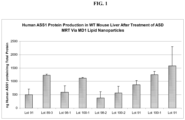
- FIG. 1 depicts the results of in vivo human ASS1 protein production in wild type mouse liver upon treatment with lipid nanoparticles that include compounds of formula I.
- amino acid in its broadest sense, refers to any compound and/or substance that can be incorporated into a polypeptide chain.
- an amino acid has the general structure H E N-C(H)(R)-COHO.
- an amino acid is a naturally occurring amino acid.
- an amino acid is a synthetic amino acid; in some embodiments, an amino acid is a d-amino acid; in some embodiments, an amino acid is an l-amino acid.
- Standard amino acid refers to any of the twenty standard l-amino acids commonly found in naturally occurring peptides.
- Nonstandard amino acid refers to any amino acid, other than the standard amino acids, regardless of whether it is prepared synthetically or obtained from a natural source.
- synthetic amino acid encompasses chemically modified amino acids, including but not limited to salts, amino acid derivatives (such as amides), and/or substitutions.
- Amino acids, including carboxyl- and/or amino-terminal amino acids in peptides, can be modified by methylation, amidation, acetylation, protecting groups, and/or substitution with other chemical groups that can change the peptide's circulating half-life without adversely affecting their activity. Amino acids may participate in a disulfide bond.
- Amino acids may comprise one or posttranslational modifications, such as association with one or more chemical entities (e.g ., methyl groups, acetate groups, acetyl groups, phosphate groups, formyl moieties, isoprenoid groups, sulfate groups, polyethylene glycol moieties, lipid moieties, carbohydrate moieties, biotin moieties, etc. ) .
- chemical entities e.g methyl groups, acetate groups, acetyl groups, phosphate groups, formyl moieties, isoprenoid groups, sulfate groups, polyethylene glycol moieties, lipid moieties, carbohydrate moieties, biotin moieties, etc.
- amino acid is used interchangeably with "amino acid residue,” and may refer to a free amino acid and/or to an amino acid residue of a peptide. It will be apparent from the context in which the term is used whether it refers to a free amino acid or a residue of
- animal refers to any member of the animal kingdom. In some embodiments, “animal” refers to humans, at any stage of development. In some embodiments, “animal” refers to non-human animals, at any stage of development. In certain embodiments, the non-human animal is a mammal ( e.g ., a rodent, a mouse, a rat, a rabbit, a monkey, a dog, a cat, a sheep, cattle, a primate, and/or a pig). In some embodiments, animals include, but are not limited to, mammals, birds, reptiles, amphibians, fish, insects, and/or worms. In some embodiments, an animal may be a transgenic animal, genetically-engineered animal, and/or a clone.
- Chemical entity As used herein, the term “chemical entity” includes a compound, salt, or solvate thereof, or any combination of compounds, salts, or solvates thereof.
- delivery encompasses both local and systemic delivery.
- delivery of mRNA encompasses situations in which an mRNA is delivered to a target tissue and the encoded protein is expressed and retained within the target tissue (also referred to as “local distribution” or “local delivery”), and situations in which an mRNA is delivered to a target tissue and the encoded protein is expressed and secreted into patient's circulation system (e.g., serum) and systematically distributed and taken up by other tissues (also referred to as “systemic distribution” or “systemic delivery).
- patient's circulation system e.g., serum
- expression refers to translation of an mRNA into a polypeptide, assemble multiple polypeptides (e.g., heavy chain or light chain of antibody) into an intact protein (e.g., antibody) and/or post-translational modification of a polypeptide or fully assembled protein (e.g., antibody).
- expression and “production,” and grammatical equivalent, are used inter-changeably.
- a "functional" biological molecule is a biological molecule in a form in which it exhibits a property and/or activity by which it is characterized.
- Half-life is the time required for a quantity such as nucleic acid or protein concentration or activity to fall to half of its value as measured at the beginning of a time period.
- the terms “improve,” “increase” or “reduce,” or grammatical equivalents, indicate values that are relative to a baseline measurement, such as a measurement in the same individual prior to initiation of the treatment described herein, or a measurement in a control subject (or multiple control subject) in the absence of the treatment described herein.
- a “control subject” is a subject afflicted with the same form of disease as the subject being treated, who is about the same age as the subject being treated.
- in vitro refers to events that occur in an artificial environment, e.g., in a test tube or reaction vessel, in cell culture, etc., rather than within a multicellular organism.
- in vivo refers to events that occur within a multicellular organism, such as a human and a non-human animal. In the context of cell-based systems, the term may be used to refer to events that occur within a living cell (as opposed to, for example, in vitro systems).
- Isolated refers to a substance and/or entity that has been (1) separated from at least some of the components with which it was associated when initially produced (whether in nature and/or in an experimental setting), and/or (2) produced, prepared, and/or manufactured by the hand of man. Isolated substances and/or entities may be separated from about 10%, about 20%, about 30%, about 40%, about 50%, about 60%, about 70%, about 80%, about 90%, about 91%, about 92%, about 93%, about 94%, about 95%, about 96%, about 97%, about 98%, about 99%, or more than about 99% of the other components with which they were initially associated.
- isolated agents are about 80%, about 85%, about 90%, about 91%, about 92%, about 93%, about 94%, about 95%, about 96%, about 97%, about 98%, about 99%, or more than about 99% pure.
- a substance is "pure” if it is substantially free of other components.
- calculation of percent purity of isolated substances and/or entities should not include excipients ( e.g ., buffer, solvent, water, etc. ) .
- local distribution or delivery refers to tissue specific delivery or distribution.
- local distribution or delivery requires a protein (e.g., enzyme) encoded by mRNAs be translated and expressed intracellularly or with limited secretion that avoids entering the patient's circulation system.
- messenger RNA As used herein, the term "messenger RNA (mRNA)" refers to a polynucleotide that encodes at least one polypeptide. mRNA as used herein encompasses both modified and unmodified RNA. mRNA may contain one or more coding and non-coding regions. mRNA can be purified from natural sources, produced using recombinant expression systems and optionally purified, chemically synthesized, etc. Where appropriate, e.g., in the case of chemically synthesized molecules, mRNA can comprise nucleoside analogs such as analogs having chemically modified bases or sugars, backbone modifications, etc. An mRNA sequence is presented in the 5' to 3' direction unless otherwise indicated.
- an mRNA is or comprises natural nucleosides (e.g ., adenosine, guanosine, cytidine, uridine); nucleoside analogs (e.g ., 2-aminoadenosine, 2-thiothymidine, inosine, pyrrolo-pyrimidine, 3-methyl adenosine, 5-methylcytidine, C-5 propynyl-cytidine, C-5 propynyl-uridine, 2-aminoadenosine, C5-bromouridine, CS-fluorouridine, C5-iodouridine, C5-propynyl-uridine, C5-propynyl-cytidine, C5-methylcytidine, 2-aminoadenosine, 7-deazaadenosine, 7-deazaguanosine, 8-oxoadenosine, 8-oxoguanosine,
- the mRNA comprises one or more nonstandard nucleotide residues.
- the nonstandard nucleotide residues may include, e.g., 5-methyl-cytidine ("5mC"), pseudouridine, and/or 2-thio-uridine (“2sU”).
- 5mC 5-methyl-cytidine
- 2sU 2-thio-uridine
- the mRNA may be RNA, which is defined as RNA in which 25% of U residues are 2-thio-uridine and 25% of C residues are 5-methylcytidine. Teachings for the use of RNA are disclosed US Patent Publication US20120195936 and internation publication WO2011012316 .
- the presence of nonstandard nucleotide residues may render an mRNA more stable and/or less immunogenic than a control mRNA with the same sequence but containing only standard residues.
- the mRNA may comprise one or more nonstandard nucleotide residues chosen from isocytosine, pseudoisocytosine, 5-bromouracil, 5-propynyluracil, 6-aminopurine, 2-aminopurine, inosine, diaminopurine and 2-chloro-6-aminopurine cytosine, as well as combinations of these modifications and other nucleobase modifications. Certain embodiments may further include additional modifications to the furanose ring or nucleobase.
- Additional modifications may include, for example, sugar modifications or substitutions (e.g., one or more of a 2'-O-alkyl modification, a locked nucleic acid (LNA)).
- the RNAs may be complexed or hybridized with additional polynucleotides and/or peptide polynucleotides (PNA).
- PNA polypeptide polynucleotides
- such modification may include, but are not limited to a 2'-deoxy-2'-fluoro modification, a 2'-O-methyl modification, a 2'-O-methoxyethyl modification and a 2'-deoxy modification.
- any of these modifications may be present in 0-100% of the nucleotides-for example, more than 0%, 1%, 10%, 25%, 50%, 75%, 85%, 90%, 95%, or 100% of the constituent nucleotides individually or in combination.
- nucleic acid refers to any compound and/or substance that is or can be incorporated into a polynucleotide chain.
- a nucleic acid is a compound and/or substance that is or can be incorporated into a polynucleotide chain via a phosphodiester linkage.
- nucleic acid refers to individual nucleic acid residues ( e.g ., nucleotides and/or nucleosides).
- nucleic acid refers to a polynucleotide chain comprising individual nucleic acid residues.
- nucleic acid encompasses RNA as well as single and/or double-stranded DNA and/or cDNA.
- a patient refers to any organism to which a provided composition may be administered, e.g ., for experimental, diagnostic, prophylactic, cosmetic, and/or therapeutic purposes.
- Typical patients include animals (e.g ., mammals such as mice, rats, rabbits, non-human primates, and/or humans).
- a patient is a human.
- a human includes pre and post natal forms.
- pharmaceutically acceptable refers to substances that, within the scope of sound medical judgment, are suitable for use in contact with the tissues of human beings and animals without excessive toxicity, irritation, allergic response, or other problem or complication, commensurate with a reasonable benefit/risk ratio.
- polymer refers to a compound comprised of at least 3 (e.g., at least 10, 20, 30, 40, 50, 60, 70, 80, 90, 100, etc.) repeating covalently bound structural units.
- salt refers to those salts which are, within the scope of sound medical judgment, suitable for use in contact with the tissues of humans and lower animals without undue toxicity, irritation, allergic response and the like, and are commensurate with a reasonable benefit/risk ratio.
- Pharmaceutically acceptable salts are well known in the art. For example, S. M. Berge et al., describes pharmaceutically acceptable salts in detail in J. Pharmaceutical Sciences (1977) 66:1-19 .
- Pharmaceutically acceptable salts include those derived from suitable inorganic and organic acids and bases.
- Examples of pharmaceutically acceptable, nontoxic acid addition salts are salts of an amino group formed with inorganic acids such as hydrochloric acid, hydrobromic acid, phosphoric acid, sulfuric acid and perchloric acid or with organic acids such as acetic acid, oxalic acid, maleic acid, tartaric acid, citric acid, succinic acid or rnalonic acid or by using other methods used in the art such as ion exchange.
- Other pharmaceutically acceptable salts include adipate, alginate, ascorbate, aspartate, benzenesulfonate, benzoate, bisulfate, borate, butyrate, camphorate, camphorsulfonate, citrate, cyclopentanepropionate.
- Salts derived from appropriate bases include alkali metal, alkaline earth metal, ammonium and N+(C1-4alkyl)4 salts.
- Representative alkali or alkaline earth metal salts include sodium, lithium, potassium, calcium, magnesium, and the like.
- Further pharmaceutically acceptable salts include, when appropriate, nontoxic ammonium. quaternary ammonium, and amine cations formed using counterions such as halide, hydroxide, carboxylate, sulfate, phosphate, nitrate, sulfonate and aryl sulfonate.
- Further pharmaceutically acceptable salts include salts formed from the quarternization of an amine using an appropriate electrophile, e.g., an alkyl halide, to form a quarternized alkylated amino salt.
- systemic distribution or delivery refers to a delivery or distribution mechanism or approach that affect the entire body or an entire organism. Typically, systemic distribution or delivery is accomplished via body's circulation system, e.g., blood stream. Compared to the definition of "local distribution or delivery.”
- subject refers to a human or any non-human animal (e.g., mouse, rat, rabbit, dog, cat, cattle, swine, sheep, horse or primate).
- a human includes pre- and post-natal forms.
- a subject is a human being.
- a subject can be a patient, which refers to a human presenting to a medical provider for diagnosis or treatment of a disease.
- the term "subject” is used herein interchangeably with “individual” or "patient.”
- a subject can be afflicted with or is susceptible to a disease or disorder but may or may not display symptoms of the disease or disorder.
- the term “substantially” refers to the qualitative condition of exhibiting total or near-total extent or degree of a characteristic or property of interest.
- One of ordinary skill in the biological arts will understand that biological and chemical phenomena rarely, if ever, go to completion and/or proceed to completeness or achieve or avoid an absolute result.
- the term “substantially” is therefore used herein to capture the potential lack of completeness inherent in many biological and chemical phenomena.
- Target tissues refers to any tissue that is affected by a disease to be treated.
- target tissues include those tissues that display disease-associated pathology, symptom, or feature.
- therapeutically effective amount of a therapeutic agent means an amount that is sufficient, when administered to a subject suffering from or susceptible to a disease, disorder, and/or condition, to treat, diagnose, prevent, and/or delay the onset of the symptom(s) of the disease, disorder, and/or condition. It will be appreciated by those of ordinary skill in the art that a therapeutically effective amount is typically administered via a dosing regimen comprising at least one unit dose.
- Treating refers to any method used to partially or completely alleviate, ameliorate, relieve, inhibit, prevent, delay onset of, reduce severity of and/or reduce incidence of one or more symptoms or features of a particular disease, disorder, and/or condition. Treatment may be administered to a subject who does not exhibit signs of a disease and/or exhibits only early signs of the disease for the purpose of decreasing the risk of developing pathology associated with the disease.
- the present invention provides, among other things, lipid compositions and their use in methods for delivering mRNA in vivo using stereochemically enriched lipid compositions.
- a "chemical entity" of a formula is a compound of the formula, a pharmaceutically acceptable salt thereof, a solvate thereof, or a solvate of a pharmaceutically acceptable salt thereof.
- the first threshold amount is 60%, 70%, 80%, 85%, 90%, 91%, 92%, 93%, 94%, 95%, 96%, 97%, 98% or 99%. In some embodiments, the first threshold amount is 70%. In some embodiments, the first threshold amount is 80%. In some embodiments, the first threshold amount is 95%.
- the composition is characterized in that greater than or equal to a first threshold amount of the total amount of chemical entities of formula I in the composition are chemical entities of formula I.a . In some embodiments, the composition is characterized in that greater than a first threshold amount of the total amount of chemical entities of formula I in the composition are chemical entities of formula I.a . In embodiments, the composition is characterized in that a first threshold amount of the total amount of chemical entities of formula I in the composition are chemical entities of formula I.a . In some embodiments, a first threshold amount is 50%. In some embodiments, a first threshold amount is 70%. In some embodiments, a first threshold amount is 80%. In some embodiments, a first threshold amount is 90%. In some embodiments, a first threshold amount is 95%.
- greater than a first threshold amount of the total amount of chemical entities of formula I in the composition are chemical entities of a first formula selected from formulae I.a.. In embodiments, a first threshold amount of the total amount of chemical entities of formula I in the composition are chemical entities of a first formula selected from formulae I.a. In some embodiments, greater than a second threshold amount of the total amount of the chemical entities of the first formula in the composition are chemical entities of the same stereoisomer of the first formula. In some embodiments, a second threshold amount of the total amount of the chemical entities of the first formula in the composition are chemical entities of the same stereoisomer of the first formula.
- a first formula is formula I.a.
- greater than or equal to the first threshold amount of the total amount of chemical entities of formula I in the composition are chemical entities of formula I.a
- greater than or equal to a second threshold amount of the total amount of the chemical entities of formula I.a in the composition are chemical entities of the same stereoisomer of formula I.a .
- a stereoisomer of formula I.a has the structure of formula I.a.i:
- a stereoisomer of formula I.a has the structure of formula I.a.ii :
- a stereoisomer of formula I.a has the structure of formula I.a.iii :
- a stereoisomer of formula I.a has the structure of formula I.a.iv:
- a stereoisomer of formula I.a has the structure of formula I.a.v :
- a stereoisomer of formula I.a has the structure of formula I.a.vi:
- a stereoisomer of formula I.a has the structure of formula I.a.vii :
- a stereoisomer of formula I.a has the structure of formula I.a.viii :
- a stereoisomer of formula I.a has the structure of formula I.a.ix:
- a stereoisomer of formula I.a has the structure of formula I.a.x:
- greater than or equal to a second threshold amount of the total amount of chemical entities of formula I.a in the composition are chemical entities of formula I.a.i. In some embodiments, greater than or equal to a second threshold amount of the total amount of chemical entities of formula I.a in the composition are chemical entities of formula I.a.ii. In some embodiments, greater than or equal to a second threshold amount of the total amount of chemical entities of formula I.a in the composition are chemical entities of formula I.a.iii. In some embodiments, greater than or equal to a second threshold amount of the total amount of chemical entities of formula I.a in the composition are chemical entities of formula I.a.iv.
- greater than or equal to a second threshold amount of the total amount of chemical entities of formula I.a in the composition are chemical entities of formula I.a.v. In some embodiments, greater than or equal to a second threshold amount of the total amount of chemical entities of formula I.a in the composition are chemical entities of formula I.a.vi. In some embodiments, greater than or equal to a second threshold amount of the total amount of chemical entities of formula I.a in the composition are chemical entities of formula I.a.vii. In some embodiments, greater than or equal to a second threshold amount of the total amount of chemical entities of formula I.a in the composition are chemical entities of formula I.a.viii. In some embodiments, greater than or equal to a second threshold amount of the total amount of chemical entities of formula I.a in the composition are chemical entities of formula I.a.ix.
- a chemical entity of formula I can be a stereoisomer of formula I.b.1 having the structure of formula I.b.1.i ( i.e., R4-SS-cKK-E12 ) .
- a chemical entity of formula I can be a stereoisomer of formula I.b.1 having the structure of formula I.b.1.ii ( i.e., S4-SS-cKK-E12 ) .
- a chemical entity of formula I can be a stereoisomer of formula I.b.1 having the structure of formula I.b.1.iii:
- a chemical entity of formula I can be a stereoisomer of formula I.b.1 having the structure of formula I.b.1.iv:
- a chemical entity of formula I can be a stereoisomer of formula I.b.1 having the structure of formula I.b.1.v:
- a chemical entity of formula I can be a stereoisomer of formula I.b.1 having the structure of formula I.b.1.vi:
- a chemical entity of formula I can be a stereoisomer of formula I.b.2 having the structure of formula I.b.2.i ( i.e., R4-RR-cKK-E12 ) .
- a chemical entity of formula I can be a stereoisomer of formula I.b.2 having the structure of formula I.b.2.ii ( i.e., S4-RR-cKK-E12 ) .
- a chemical entity of formula I can be a stereoisomer of formula I.b.2 having the structure of formula I.b.2.iii:
- a chemical entity of formula I can be a stereoisomer of formula I.b.2 having the structure of formula I.b.2.iv :
- a chemical entity of formula I can be a stereoisomer of formula I.b.2 having the structure of formula I.b.2.v :
- a chemical entity of formula I can be a stereoisomer of formula I.b.2 having the structure of formula I.b.2.vi:
- the second threshold amount is 10%, 20%, 30%, 40%, 50%, 60%, 70%, 80%, 85%, 90%, 91%, 92%, 93%, 94%, 95%, 96%, 97%, 98% or 99%. In some embodiments, the second threshold amount is 50%. In some embodiments, the second threshold amount is 70%. In some embodiments, the second threshold amount is 80%. In some embodiments, the second threshold amount is 85%. In some embodiments, the second threshold amount is 90%. In some embodiments, the second threshold amount is 95%.
- a provided composition is characterized in that greater than or equal to a third threshold amount of the total amount of chemical entities of formula I in the composition are chemical entities of formula I.a. In embodiments, a provided composition is characterized in that greater than or equal to a third threshold amount of the total amount of chemical entities of formula I in the composition are chemical entities of formula I.a.
- a provided composition is characterized in that greater than or equal to a third threshold amount of the total amount of chemical entities of formula I in the composition are chemical entities of formula I.a.i, I.a.ii, I.a.iii, I.a.iv, I.a.v, I.a.vi, I.a.vii, I.a.viii, and I.a.ix .
- a stereoisomer of formula I has the structure of formula I.a.i, I.a.ii, I.a.iii, I.a.iv, I.a.v, I.a.vi, I.a.vii, I.a.viii, or I.a.ix.
- a stereoisomer of formula I has the structure of formula I.a.i .
- a stereoisomer of formula I has the structure of formula I.a.ii.
- a stereoisomer of formula I has the structure of formula I.a.iii.
- a stereoisomer of formula I has the structure of formula I.a.iv .
- a stereoisomer of formula I has the structure of formula I.a.v . In some embodiments, a stereoisomer of formula I has the structure of formula I.a.vi . In some embodiments, a stereoisomer of formula I has the structure of formula I.a.vii. In some embodiments, a stereoisomer of formula I has the structure of formula I.a.viii. In some embodiments, a stereoisomer of formula I has the structure of formula I.a.ix .
- a stereoisomer of formula I has the structure of formula I.b.1.i, Lb.1.ii, Lb.1.iii, Lb.1.iv, I.b.1.v, or I.b.1.vi.
- a stereoisomer of formula I has the structure of formula I.b.1.i.
- a stereoisomer of formula I has the structure of formula I.b.1.ii.
- a stereoisomer of formula I has the structure of formula I.b.1.iii.
- a stereoisomer of formula I has the structure of formula Lb.1.iv.
- a stereoisomer of formula I has the structure of formula I.b.1.v.
- a stereoisomer of formula I has the structure of formula Lb.1.vi.
- a stereoisomer of formula I has the structure of formula I.b.2.i, I.b.2.ii, I.b.2.iii, I.b.2.iv, I.b.2.v, or I.b.2.vi.
- a stereoisomer of formula I has the structure of formula I.b.2.i.
- a stereoisomer of formula I has the structure of formula I.b.2.ii.
- a stereoisomer of formula I has the structure of formula I.b.2.iii.
- a stereoisomer of formula I has the structure of formula I.b.2.iv.
- a stereoisomer of formula I has the structure of formula I.b.2.v.
- a stereoisomer of formula I has the structure of formula I.b.2.vi.
- the third threshold amount is 50%, 60%, 70%, 80%, 85%, 90%, 91%, 92%, 93%, 94%, 95%, 96%, 97%, 98% or 99% (w/w). In some embodiments, the third threshold amount is 50% (w/w). In some embodiments, the third threshold amount is 70% (w/w). In some embodiments, the third threshold amount is 80% (w/w). In some embodiments, the third threshold amount is 85% (w/w). In some embodiments, the third threshold amount is 90% (w/w). In some embodiments, the third threshold amount is 95% (w/w). In some embodiments, the third threshold amount is 96% (w/w). In some embodiments, the third threshold amount is 97% (w/w). In some embodiments, the third threshold amount is 98% (w/w). In some embodiments, the third threshold amount is 99% (w/w).
- the present invention provides a composition comprising one or more chemical entities of formula I , each of which is a compound of formula I :
- the present invention provides a composition comprising one or more chemical entities of formula I , each of which is a compound of formula I :
- the second threshold amount is 50%, 60%, 70%, 80%, 85%, 90%, 91%, 92%, 93%, 94%, 95%, 96%, 97%, 98% or 99%. In some embodiments, the second threshold amount is 50%. In some embodiments, the second threshold amount is 70%. In some embodiments, the second threshold amount is 80%. In some embodiments, the second threshold amount is 95%.
- Liposomes for the Delivery of Agents Such as mRNA
- a composition provided is a lipid based nanoparticle, such as a liposome.
- a liposome refers to any lamellar, multilamellar, or solid lipid nanoparticle vesicle.
- a liposome as used herein can be formed by mixing one or more lipids or by mixing one or more lipids and polymer(s).
- liposome as used herein encompasses both lipid and polymer based nanoparticles.
- a liposome according to the present invention incorporates a lipid compound described herein as a cationic lipid component.
- a liposome according to the present invention includes a composition comprising one or more chemical entities of formula I .
- a suitable liposome may also contain second or additional cationic lipids, helper lipids (e.g., non-cationic lipids and/or cholesterol-based lipids), PEG-modified lipids, and/or polymers.
- cationic lipid(s) constitute(s) about 30-50% (e.g., about 30-45%, about 30-40%, about 35-50%, about 35-45%, or about 35-40%) of the liposome by molar ratio.
- the cationic lipid e.g., the composition comprising one or more chemical entities of formula I
- the liposome comprises a second lipid or additional cationic lipids.
- liposomes may comprise a second or additional cationic lipid.
- cationic lipid refers to any of a number of lipid species that have a net positive charge at a selected pH, such as physiological pH.
- Particularly suitable cationic lipids for use in the compositions and compositions for use in methods of the invention include those described in international patent publications WO 2010/053572 (and particularly, C12-200 described at paragraph [00225]), WO 2012/170930 and WO 2013063468 .
- compositions and their use in methods of the invention employ a lipid nanoparticles comprising an ionizable cationic lipid described in International Patent Application No. PCT/US2013/034602, filed March 29, 2013 , Publ. No.
- WO 2013/149140 such as, e.g, (15Z, 18Z)-N,N-dimethyl-6-(9Z, 12Z)-octadeca-9, 12-dien-1 -yl)tetracosa- 15,18-dien- 1 -amine (HGT5000), ( 15Z, 18Z)-N,N-dimethyl-6-((9Z, 12Z)-octadeca-9, 12-dien- 1 -yl)tetracosa-4,15,18-trien-1 -amine (HGT5001), and (15Z,18Z)-N,N-dimethyl-6-((9Z, 12Z)-octadeca-9, 12-dien- 1 -yl)tetracosa-5, 15 , 18-trien- 1 -amine (HGT5002).
- the second or additional cationic lipid N-[1-(2,3-dioleyloxy)propyl]-N,N,N-trimethylammonium chloride or "DOTMA" is used.
- DOTMA can be formulated alone or can be combined with the neutral lipid, dioleoylphosphatidyl-ethanolamine or "DOPE" or other cationic or non-cationic lipids into a liposomal transfer vehicle or a lipid nanoparticle, and such liposomes can be used to enhance the delivery of nucleic acids into target cells.
- suitable cationic lipids include, for example, 5-carboxyspermylglycinedioctadecylamide or "DOGS,” 2,3-dioleyloxy-N-[2(spermine-carboxamido)ethyl]-N,N-dimethyl-1-propanaminium or "DOSPA" ( Behr et al. Proc.
- Additional exemplary cationic lipids also include 1,2-distearyloxy-N,N-dimethyl-3-aminopropane or "DSDMA", 1,2-dioleyloxy-N,N-dimethyl-3-aminopropane or "DODMA", 1 ,2-dilinoleyloxy-N,N-dimethyl-3-aminopropane or "DLinDMA", 1,2-dilinolenyloxy-N,N-dimethyl-3-aminopropane or "DLenDMA", N-dioleyl-N,N-dimethylammonium chloride or "DODAC", N,N-distearyl-N,N-dimethylarnrnonium bromide or "DDAB", N-(1,2-dimyristyloxyprop-3-yl)-N,N-dimethyl-N-hydroxyethyl ammonium bromide or "DMRIE", 3-dimethylamino-2-(cholest-5
- one or more of the cationic lipids comprise at least one of an imidazole, dialkylamino, or guanidinium moiety.
- the second or additional cationic lipid may be chosen from XTC (2,2-Dilinoleyl-4-dimethylaminoethy1-[1,3]-dioxolane), MC3 (((6Z,9Z,28Z,31Z)-heptatriaconta-6,9,28,31-tetraen-19-yl 4-(dimethylamino)butanoate), ALNY-100 ((3aR,5s,6aS)-N,N-dimethyl-2,2-di((9Z,12Z)-octadeca-9,12-dienyl)tetrahydro-3aH-cyclopenta[d] [1 ,3]dioxol-5-amine)), NC98-5 (4,7,13-tris(3-oxo-3-(undecylamino)propyl)-N1,N16-diundecyl-4,7,10,13-tetra
- provided liposomes contain one or more non-cationic ("helper") lipids.
- non-cationic lipid refers to any neutral, zwitterionic or anionic lipid.
- anionic lipid refers to any of a number of lipid species that carry a net negative charge at a selected H, such as physiological pH.
- Non-cationic lipids include, but are not limited to, distearoylphosphatidylcholine (DSPC), dioleoylphosphatidylcholine (DOPC), dipalmitoylphosphatidylcholine (DPPC), dioleoylphosphatidylglycerol (DOPG), dipalmitoylphosphatidylglycerol (DPPG), dioleoylphosphatidylethanolamine (DOPE), palmitoyloleoylphosphatidylcholine (POPC), palmitoyloleoyl-phosphatidylethanolamine (POPE), dioleoyl-phosphatidylethanolamine 4-(N-maleimidomethyl)-cyclohexane-l-carboxylate (DOPE-mal), dipalmitoyl phosphatidyl ethanolamine (DPPE), dimyristoylphosphoethanolamine (DMPE), distearoyl-phosphatidylethanolamine (DSPE
- non-cationic lipids may be used alone, but are preferably used in combination with other excipients, for example, cationic lipids.
- the non-cationic lipid may comprise a molar ratio of about 5% to about 90%, or about 10 % to about 70% of the total lipid present in a liposome.
- a non-cationic lipid is a neutral lipid, i.e., a lipid that does not carry a net charge in the conditions under which the composition is formulated and/or administered.
- the percentage of non-cationic lipid in a liposome may be greater than 5%, greater than 10%, greater than 20%, greater than 30%, or greater than 40%.
- provided liposomes comprise one or more cholesterol-based lipids.
- suitable cholesterol-based cationic lipids include, for example, DC-Choi (N,N-dimethyl-N-ethylcarboxamidocholesterol), 1,4-bis(3-N-oleylamino-propyl)piperazine ( Gao, et al. Biochem. Biophys. Res. Comm. 179, 280 (1991 ); Wolf et al. BioTechniques 23, 139 (1997 ); U.S. Pat. No. 5,744,335 ), or ICE.
- DC-Choi N,N-dimethyl-N-ethylcarboxamidocholesterol
- 1,4-bis(3-N-oleylamino-propyl)piperazine Gao, et al. Biochem. Biophys. Res. Comm. 179, 280 (1991 ); Wolf et al. BioTechniques 23, 139 (1997 ); U.S. Pat. No
- the cholesterol-based lipid may comprise a molar ration of about 2% to about 30%, or about 5% to about 20% of the total lipid present in a liposome. In some embodiments, The percentage of cholesterol-based lipid in the lipid nanoparticle may be greater than 5, %, 10%, greater than 20%, greater than 30%, or greater than 40%.
- provided liposomes comprise one or more PEGylated lipids.
- PEG polyethylene glycol
- derivatized lipids such as derivatized ceramides (PEG-CER), including N-Octanoyl-Sphingosine-l-[Succinyl(Methoxy Polyethylene Glycol)-2000] (C8 PEG-2000 ceramide) is also contemplated by the present invention in combination with one or more of the cationic and, in some embodiments, other lipids together which comprise the liposome.
- Contemplated PEG-modified lipids include, but are not limited to, a polyethylene glycol chain of up to 5 kDa in length covalently attached to a lipid with alkyl chain(s) of C 6 -C 20 length.
- a PEG-modified or PEGylated lipid is PEGylated cholesterol or PEG-2K.
- the addition of such components may prevent complex aggregation and may also provide a means for increasing circulation lifetime and increasing the delivery of the lipid-nucleic acid composition to the target cell, ( Klibanov et al. (1990) FEBS Letters, 268 (1): 235-237 ), or they may be selected to rapidly exchange out of the formulation in vivo (see U.S. Pat. No. 5,885,613 ).
- particularly useful exchangeable lipids are PEG-ceramides having shorter acyl chains (e.g., C 14 or C 18 ).
- the PEG-modified phospholipid and derivitized lipids of the present invention may comprise a molar ratio from about 0% to about 15%, about 0.5% to about 15%, about 1% to about 15%, about 4% to about 10%, or about 2% of the total lipid present in the liposome.
- the selection of second or additional cationic lipids, non-cationic lipids and/or PEG-modified lipids which comprise the lipid nanoparticle, as well as the relative molar ratio of such lipids to each other is based upon the characteristics of the selected lipid(s), the nature of the intended target cells, the characteristics of the mRNA to be delivered. Additional considerations include, for example, the saturation of the alkyl chain, as well as the size, charge, pH, pKa, fusogenicity and toxicity of the selected lipid(s). Thus the molar ratios may be adjusted accordingly.
- the percentage of PEG-modified lipid in a liposome may be greater than 1%, greater than 2%, greater than 5%, greater than 10%, or greater than 15%.
- a suitable liposome according to the present invention further includes a polymer, in combination with one or more cationic lipids as described and, in some embodiments, other carriers including various lipids described herein.
- liposomal delivery vehicles as used herein, also encompass polymer containing nanoparticles.
- Suitable polymers may include, for example, polyacrylates, polyalkycyanoacrylates, polylactide, polylactide-polyglycolide copolymers, polycaprolactones, dextran, albumin, gelatin, alginate, collagen, chitosan, cyclodextrins, protamine, PEGylated protamine, PLL, PEGylated PLL and polyethylenimine (PEI).
- PEI polyethylenimine
- it may be branched PEI of a molecular weight ranging from 10 to 40 kDA, e.g., 25 kDa branched PEI (Sigma #408727).
- the present invention may be used to delivery any therapeutic agents.
- any therapeutic agents to be administered to a subject may be delivered using the complexes, picoparticles, nanoparticles, microparticles, micelles, or liposomes, described herein.
- the agent may be an organic molecule (e.g., a therapeutic agent, a drug), inorganic molecule, nucleic acid, protein, amino acid, peptide, polypeptide, polynucleotide, targeting agent, isotopically labeled organic or inorganic molecule, vaccine, immunological agent, etc.
- the agent to be delivered may be a mixture of agents.
- the therapeutic agents are organic molecules with pharmaceutical activity, e.g., a drug.
- the drug is an antibiotic, anti-viral agent, anesthetic, steroidal agent, anti-inflammatory agent, anti-neoplastic agent, anti-cancer agent, antigen, vaccine, antibody, decongestant, antihypertensive, sedative, birth control agent, progestational agent, anti-cholinergic, analgesic, anti-depressant, anti-psychotic, I3-adrenergic blocking agent, diuretic, cardiovascular active agent, vasoactive agent, non-steroidal anti-inflammatory agent, nutritional agent, etc.
- Diagnostic agents include gases; metals; commercially available imaging agents used in positron emissions tomography (PET), computer assisted tomography (CAT), single photon emission computerized tomography, x-ray, fluoroscopy, and magnetic resonance imaging (MRI); and contrast agents.
- PET positron emissions tomography
- CAT computer assisted tomography
- MRI magnetic resonance imaging
- suitable materials for use as contrast agents in MRI include gadolinium chelates, as well as iron, magnesium, manganese, copper, and chromium.
- Examples of materials useful for CAT and x-ray imaging include iodinebased materials.
- Therapeutic and prophylactic agents include, but are not limited to, antibiotics, nutritional supplements, and vaccines.
- Vaccines may comprise isolated proteins or peptides, inactivated organisms and viruses, dead organisms and viruses, genetically altered organisms or viruses, and cell extracts.
- RNAi interfering RNA
- the phenomenon of RNAi is discussed in greater detail, for example, in the following references: Elbashir et al., 2001, Genes Dev., 15:188 ; Fire et al., 1998, Nature, 391:806 ; Tabara et al., 1999, Cell, 99:123 ; Hammond et al., Nature, 2000, 404:293 ; Zamore et al., 2000, Cell, 101:25 ; Chakraborty, 2007, Curr.
- Elbashir et al. 2001, Genes Dev., 15:188 ; Fire et al., 1998, Nature, 391:806 ; Tabara et al., 1999, Cell, 99:123 ; Hammond et al., Nature, 2000, 404:293 ; Zamore et al., 2000, Cell, 101:25 ; Chakraborty, 2007, Curr.
- the polynucleotide is a dsRNA (double-stranded RNA).
- the polynucleotide is an siRNA (short interfering RNA).
- the polynucleotide is an shRNA (short hairpin RNA).
- the polynucleotide is an miRNA (micro RNA).
- Micro RNAs (miRNAs) are genomically encoded non-coding RNAs of about 21 - 23 nucleotides in length that help regulate gene expression, particularly during development.
- the polynucleotide is an antisense RNA.
- the polynucleotide may be provided as an antisense agent or RNA interference (RNAi).
- RNAi RNA interference
- Antisense therapy is meant to include, e.g., administration or in situ provision of single- or double-stranded oligonucleotides or their derivatives which specifically hybridize, e.g., bind, under cellular conditions, with cellular mRNA and/or genomic DNA, or mutants thereof, so as to inhibit expression of the encoded protein, e.g., by inhibiting transcription and/or translation. See, e.g., Crooke "Molecular mechanisms of action of antisense drugs" Biochim. Biophys.
- the binding may be by conventional base pair complementarity, or, for example, in the case of binding to DNA duplexes, through specific interactions in the major groove of the double helix (i.e., triple helix formation). See, e.g., Chan et al., J. Mol. Med. 75(4):267-282, 1997 .
- dsRNA, siRNA, shRNA, miRNA, antisense RNA, and/or RNAi can be designed and/or predicted using one or more of a large number of available algorithms.
- the following resources can be utilized to design and/or predict polynucleotides: algorithms found at Alnylum Online, Dharmacon Online, OligoEngine Online, Molecula Online, Ambion Online, BioPredsi Online, RNAi Web Online, Chang Bioscience Online, Invitrogen Online, LentiWeb Online GenScript Online, Protocol Online; Reynolds et al., 2004, Nat.
- the polynucleotides may be of any size or sequence, and they may be single- or double-stranded. In certain embodiments, the polynucleotide is greater than 100 base pairs long. In certain embodiments, the polynucleotide is greater than 1000 base pairs long and may be greater than 10,000 base pairs long.
- the polynucleotide may be provided by any means known in the art. In certain embodiments, the polynucleotide has been engineered using recombinant techniques. See, e.g., Ausubel et al., Current Protocols in Molecular Biology (John Wiley & Sons, Inc., New York, 1999 ); Molecular Cloning: A Laboratory Manual, 2nd Ed., ed.
- the polynucleotide may also be obtained from natural sources and purified from contaminating components found normally in nature.
- the polynucleotide may also be chemically synthesized in a laboratory. In certain embodiments, the polynucleotide is synthesized using standard solid phase chemistry.
- the polynucleotide may be modified by chemical or biological means. In certain embodiments, these modifications lead to increased stability of the polynucleotide. Modifications include methylation, phosphorylation, end-capping, etc.
- mRNA is typically thought of as the type of RNA that carries information from DNA to the ribosome.
- the existence of mRNA is usually very brief and includes processing and translation, followed by degradation.
- mRNA processing comprises the addition of a "cap” on the N-terminal (5') end, and a "tail” on the C-terminal (3') end.
- a typical cap is a 7-methylguanosine cap, which is a guanosine that is linked through a 5'-5'-triphosphate bond to the first transcribed nucleotide. The presence of the cap is important in providing resistance to nucleases found in most eukaryotic cells.
- the tail is typically a polyadenylation event whereby a polyadenylyl moiety is added to the 3' end of the mRNA molecule.
- the presence of this "tail” serves to protect the mRNA from exonuclease degradation.
- Messenger RNA typically is translated by the ribosomes into a series of amino acids that make up a protein.
- an mRNA capable of being translated into one or more peptides (e.g., proteins) or peptide fragments is contemplated as within the scope of the present invention.
- an mRNA encodes one or more naturally occurring peptides.
- an mRNA encodes one or more modified or non-natural peptides.
- an mRNA encodes an intracellular protein. In some embodiments, an mRNA encodes a cytosolic protein. In some embodiments, an mRNA encodes a protein associated with the actin cytoskeleton. In some embodiments, an mRNA encodes a protein associated with the plasma membrane. In some specific embodiments, an mRNA encodes a transmembrane protein. In some specific embodiments an mRNA encodes an ion channel protein. In some embodiments, an mRNA encodes a perinuclear protein. In some embodiments, an mRNA encodes a nuclear protein. In some specific embodiments, an mRNA encodes a transcription factor. In some embodiments, an mRNA encodes a chaperone protein.
- an mRNA encodes an intracellular enzyme (e.g., mRNA encoding an enzyme associated with urea cycle or lysosomal storage metabolic disorders).
- an mRNA encodes a protein involved in cellular metabolism, DNA repair, transcription and/or translation.
- an mRNA encodes an extracellular protein.
- an mRNA encodes a protein associated with the extracellular matrix.
- an mRNA encodes a secreted protein.
- an mRNA used in the composition and compositions for use in methods of the invention may be used to express functional proteins or enzymes that are excreted or secreted by one or more target cells into the surrounding extracellular fluid (e.g., mRNA encoding hormones and/or neurotransmitters).
- mRNAs according to the present invention may be synthesized according to any of a variety of known methods.
- mRNAs according to the present invention may be synthesized via in vitro transcription (IVT).
- IVT in vitro transcription
- IVT is typically performed with a linear or circular DNA template containing a promoter, a pool of ribonucleotide triphosphates, a buffer system that may include DTT and magnesium ions, and an appropriate RNA polymerase (e.g., T3, T7 or SP6 RNA polymerase), DNAse I, pyrophosphatase, and/or RNAse inhibitor.
- RNA polymerase e.g., T3, T7 or SP6 RNA polymerase
- a DNA template is transcribed in vitro.
- a suitable DNA template typically has a promoter, for example a T3, T7 or SP6 promoter, for in vitro transcription, followed by desired nucleotide sequence for desired mRNA and a termination signal.
- Desired mRNA sequence(s) according to the invention may be determined and incorporated into a DNA template using standard methods. For example, starting from a desired amino acid sequence (e.g., an enzyme sequence), a virtual reverse translation is carried out based on the degenerated genetic code. Optimization algorithms may then be used for selection of suitable codons. Typically, the G/C content can be optimized to achieve the highest possible G/C content on one hand, taking into the best possible account the frequency of the tRNAs according to codon usage on the other hand. The optimized RNA sequence can be established and displayed, for example, with the aid of an appropriate display device and compared with the original (wild-type) sequence. A secondary structure can also be analyzed to calculate stabilizing and destabilizing properties or, respectively, regions of the RNA.
- a desired amino acid sequence e.g., an enzyme sequence
- Optimization algorithms may then be used for selection of suitable codons.
- the G/C content can be optimized to achieve the highest possible G/C content on one hand, taking into the best possible account the frequency
- mRNA according to the present invention may be synthesized as unmodified or modified mRNA.
- mRNAs are modified to enhance stability.
- Modifications of mRNA can include, for example, modifications of the nucleotides of the RNA.
- An modified mRNA according to the invention can thus include, for example, backbone modifications, sugar modifications or base modifications.
- mRNAs may be synthesized from naturally occurring nucleotides and/or nucleotide analogues (modified nucleotides) including, but not limited to, purines (adenine (A), guanine (G)) or pyrimidines (thymine (T), cytosine (C), uracil (U)), and as modified nucleotides analogues or derivatives of purines and pyrimidines, such as e.g.
- purines adenine (A), guanine (G)
- pyrimidines thymine (T), cytosine (C), uracil (U)
- modified nucleotides analogues or derivatives of purines and pyrimidines, such as e.g.
- mRNAs may contain RNA backbone modifications.
- a backbone modification is a modification in which the phosphates of the backbone of the nucleotides contained in the RNA are modified chemically.
- Exemplary backbone modifications typically include, but are not limited to, modifications from the group consisting of methylphosphonates, methylphosphoramidates, phosphoramidates, phosphorothioates (e.g. cytidine 5'-O-(1-thiophosphate)), boranophosphates, positively charged guanidinium groups etc., which means by replacing the phosphodiester linkage by other anionic, cationic or neutral groups.
- mRNAs may contain sugar modifications.
- a typical sugar modification is a chemical modification of the sugar of the nucleotides it contains including, but not limited to, sugar modifications chosen from the group consisting of 2'-deoxy-2'-fluoro-oligoribonucleotide (2'-fluoro-2'-deoxycytidine 5'-triphosphate, 2'-fluoro-2'-deoxyuridine 5'-triphosphate), 2'-deoxy-2'-deamine-oligoribonucleotide (2'-amino-2'-deoxycytidine 5'-triphosphate, 2'-amino-2'-deoxyuridine 5'-triphosphate), 2'-O-alkyloligoribonucleotide, 2'-deoxy-2'-C-alkyloligoribonucleotide (2'-O-methylcytidine 5'-triphosphate, 2'-methyluridine 5'-triphosphat
- mRNAs may contain modifications of the bases of the nucleotides (base modifications).
- base modifications A modified nucleotide which contains a base modification is also called a base-modified nucleotide.
- base-modified nucleotides include, but are not limited to, 2-amino-6-chloropurine riboside 5'-triphosphate, 2-aminoadenosine 5'-triphosphate, 2-thiocytidine 5'-triphosphate, 2-thiouridine 5'-triphosphate, 4-thiouridine 5'-triphosphate, 5-aminoallylcytidine 5'-triphosphate, 5-aminoallyl-uridine 5'-triphosphate, 5-bromocytidine 5'-triphosphate, 5-bromouridine 5'-triphosphate, 5-iodo-cytidine 5'-triphosphate, 5-iodouridine 5'-triphosphate, 5-methylcytidine 5'-triphosphate, 5-methyluridine 5'-triphosphate, 6-azacytidine 5'-triphosphate, 6-azauridine 5'-triphosphate, 6-chloropurine riboside 5'-triphosphate, 7-d
- mRNA synthesis includes the addition of a "cap” on the N-terminal (5') end, and a “tail” on the C-terminal (3') end.
- the presence of the cap is important in providing resistance to nucleases found in most eukaryotic cells.
- the presence of a "tail” serves to protect the mRNA from exonuclease degradation.
- mRNAs include a 5' cap structure.
- a 5' cap is typically added as follows: first, an RNA terminal phosphatase removes one of the terminal phosphate groups from the 5' nucleotide, leaving two terminal phosphates; guanosine triphosphate (GTP) is then added to the terminal phosphates via a guanylyl transferase, producing a 5'5'5 triphosphate linkage; and the 7-nitrogen of guanine is then methylated by a methyltransferase.
- GTP guanosine triphosphate
- cap structures include, but are not limited to, m7G(5')ppp (5'(A,G(5')ppp(5')A and G(5')ppp(5')G.
- naturally occurring cap structures comprise a 7-methyl guanosine that is linked via a triphosphate bridge to the 5'-end of the first transcribed nucleotide, resulting in a dinucleotide cap of m 7 G(5')ppp(5')N, where N is any nucleoside.
- the cap is added enzymatically. The cap is added in the nucleus and is catalyzed by the enzyme guanylyl transferase. The addition of the cap to the 5' terminal end of RNA occurs immediately after initiation of transcription.
- the terminal nucleoside is typically a guanosine, and is in the reverse orientation to all the other nucleotides, i.e., G(5')ppp(5')GpNpNp.
- a common cap for mRNA produced by in vitro transcription is m 7 G(5')ppp(5')G, which has been used as the dinucleotide cap in transcription with T7 or SP6 RNA polymerase in vitro to obtain RNAs having a cap structure in their 5'-termini.
- the prevailing method for the in vitro synthesis of capped mRNA employs a pre-formed dinucleotide of the form m 7 G(5')ppp(5')G ("m 7 GpppG”) as an initiator of transcription.
- ARCA Anti-Reverse Cap Analog
- modified ARCA which is generally a modified cap analog in which the 2' or 3' OH group is replaced with -OCH 3 .
- Additional cap analogs include, but are not limited to, chemical structures selected from the group consisting of m 7 GpppG, m 7 GpppA, m 7 GpppC; unmethylated cap analogs (e.g., GpppG); dimethylated cap analog (e.g., m 2,7 GpppG), trimethylated cap analog (e.g., m 2,2,7 GpppG), dimethylated symmetrical cap analogs (e.g., m 7 Gpppm 7 G), or anti reverse cap analogs (e.g., ARCA; m 7 , 2'Ome GpppG, m 72'd GpppG, m 7,3'Ome GpppG, m 7,3'd GpppG and their tetraphosphate derivatives) (see, e.g., Jemielity, J. et al., "Novel 'anti-reverse' cap analogs with superior translational properties", RNA, 9: 1108-1122 (2003 )).
- a suitable cap is a 7-methyl guanylate ("m 7 G") linked via a triphosphate bridge to the 5'-end of the first transcribed nucleotide, resulting in m 7 G(5')ppp(5')N, where N is any nucleoside.
- m 7 G 7-methyl guanylate
- a preferred embodiment of a m 7 G cap utilized in embodiments of the invention is m 7 G(5')ppp(5')G.
- the cap is a Cap0 structure.
- Cap0 structures lack a 2'-O-methyl residue of the ribose attached to bases 1 and 2.
- the cap is a Cap1 structure.
- Cap1 structures have a 2'-O-methyl residue at base 2.
- the cap is a Cap2 structure.
- Cap2 structures have a 2'-O-methyl residue attached to both bases 2 and 3.
- m 7 G cap analogs are known in the art, many of which are commercially available. These include the m 7 GpppG described above, as well as the ARCA 3'-OCH 3 and 2'-OCH 3 cap analogs ( Jemielity, J. et al., RNA, 9: 1108-1122 (2003 )). Additional cap analogs for use in embodiments of the invention include N7-benzylated dinucleoside tetraphosphate analogs (described in Grudzien, E.
- a tail serves to protect the mRNA from exonuclease degradation.
- the poly A tail is thought to stabilize natural messengers and synthetic sense RNA. Therefore, in certain embodiments a long poly A tail can be added to an mRNA molecule thus rendering the RNA more stable.
- Poly A tails can be added using a variety of art-recognized techniques. For example, long poly A tails can be added to synthetic or in vitro transcribed RNA using poly A polymerase ( Yokoe, et al. Nature Biotechnology. 1996; 14: 1252-1256 ). A transcription vector can also encode long poly A tails. In addition, poly A tails can be added by transcription directly from PCR products.
- Poly A may also be ligated to the 3' end of a sense RNA with RNA ligase (see, e.g., Molecular Cloning A Laboratory Manual, 2nd Ed., ed. by Sambrook, Fritsch and Maniatis (Cold Spring Harbor Laboratory Press: 1991 editi on)).
- mRNAs include a 3' poly(A) tail structure.
- the length of the poly A tail can be at least about 10, 50, 100, 200, 300, 400 at least 500 nucleotides.
- a poly-A tail on the 3' terminus of mRNA typically includes about 10 to 300 adenosine nucleotides (e.g., about 10 to 200 adenosine nucleotides, about 10 to 150 adenosine nucleotides, about 10 to 100 adenosine nucleotides, about 20 to 70 adenosine nucleotides, or about 20 to 60 adenosine nucleotides).
- mRNAs include a 3' poly(C) tail structure.
- a suitable poly-C tail on the 3' terminus of mRNA typically include about 10 to 200 cytosine nucleotides (e.g., about 10 to 150 cytosine nucleotides, about 10 to 100 cytosine nucleotides, about 20 to 70 cytosine nucleotides, about 20 to 60 cytosine nucleotides, or about 10 to 40 cytosine nucleotides).
- the poly-C tail may be added to the poly-A tail or may substitute the poly-A tail.
- the length of the poly A or poly C tail is adjusted to control the stability of a modified sense mRNA molecule of the invention and, thus, the transcription of protein.
- the length of the poly A tail can influence the half-life of a sense mRNA molecule, the length of the poly A tail can be adjusted to modify the level of resistance of the mRNA to nucleases and thereby control the time course of polynucleotide expression and/or polypeptide production in a target cell.
- mRNAs include a 5' and/or 3' untranslated region.
- a 5' untranslated region includes one or more elements that affect an mRNA's stability or translation, for example, an iron responsive element.
- a 5' untranslated region may be between about 50 and 500 nucleotides in length.
- a 3' untranslated region includes one or more of a polyadenylation signal, a binding site for proteins that affect an mRNA's stability of location in a cell, or one or more binding sites for miRNAs. In some embodiments, a 3' untranslated region may be between 50 and 500 nucleotides in length or longer.
- Exemplary 3' and/or 5' UTR sequences can be derived from mRNA molecules which are stable (e.g., globin, actin, GAPDH, tubulin, histone, or citric acid cycle enzymes) to increase the stability of the sense mRNA molecule.
- a 5' UTR sequence may include a partial sequence of a CMV immediate-early 1 (IE1) gene, or a fragment thereof to improve the nuclease resistance and/or improve the half-life of the polynucleotide.
- IE1 immediate-early 1
- hGH human growth hormone
- modifications improve the stability and/or pharmacokinetic properties (e.g., half-life) of the polynucleotide relative to their unmodified counterparts, and include, for example modifications made to improve such polynucleotides' resistance to in vivo nuclease digestion.
- any size mRNA may be encapsulated by provided liposomes.
- the provided liposomes may encapsulate mRNA of greater than about 0.5 kb, 1 kb, 1.5 kb, 2 kb, 2.5 kb, 3 kb, 3.5 kb, 4 kb, 4.5 kb, or 5 kb in length.
- the liposomes for use in provided compositions can be prepared by various techniques which are presently known in the art.
- multilamellar vesicles may be prepared according to conventional techniques, such as by depositing a selected lipid on the inside wall of a suitable container or vessel by dissolving the lipid in an appropriate solvent, and then evaporating the solvent to leave a thin film on the inside of the vessel or by spray drying. An aqueous phase may then added to the vessel with a vortexing motion which results in the formation of MLVs.
- Uni-lamellar vesicles UUV
- unilamellar vesicles can be formed by detergent removal techniques.
- compositions comprise a liposome wherein an agent, such as a nucleic acid e.g., mRNA, is associated on both the surface of the liposome and encapsulated within the same liposome.
- an agent such as a nucleic acid e.g., mRNA
- cationic liposomes may associate with the mRNA through electrostatic interactions.
- cationic liposomes may associate with the mRNA through electrostatic interactions.
- the compositions and compositions for use in methods of the invention comprise mRNA encapsulated in a liposome.
- the one or more mRNA species may be encapsulated in the same liposome.
- the one or more mRNA species may be encapsulated in different liposomes.
- the mRNA is encapsulated in one or more liposomes, which differ in their lipid composition, molar ratio of lipid components, size, charge (Zeta potential), targeting ligands and/or combinations thereof.
- the one or more liposome may have a different composition of cationic lipids, neutral lipid, PEG-modified lipid and/or combinations thereof.
- the one or more lipisomes may have a different molar ratio of cationic lipid, neutral lipid, cholesterol and PEG-modified lipid used to create the liposome.
- a desired therapeutic agent such as a nucleic acid (e.g., mRNA)
- a desired therapeutic agent such as a nucleic acid (e.g., mRNA)
- loading Exemplary methods are described in Lasic, et al., FEBS Lett., 312: 255-258, 1992 .
- the liposome-incorporated nucleic acids may be completely or partially located in the interior space of the liposome, within the bilayer membrane of the liposome, or associated with the exterior surface of the liposome membrane.
- the incorporation of a nucleic acid into liposomes is also referred to herein as "encapsulation" wherein the nucleic acid is entirely contained within the interior space of the liposome.
- a suitable delivery vehicle is capable of enhancing the stability of the mRNA contained therein and/or facilitate the delivery of mRNA to the target cell or tissue.
- Suitable liposomes in accordance with the present invention may be made in various sizes.
- provided liposomes may be made smaller than previously known mRNA encapsulating liposomes.
- decreased size of liposomes is associated with more efficient delivery of mRNA. Selection of an appropriate liposome size may take into consideration the site of the target cell or tissue and to some extent the application for which the liposome is being made.
- an appropriate size of liposome is selected to facilitate systemic distribution of antibody encoded by the mRNA.
- a liposome may be sized such that its dimensions are smaller than the fenestrations of the endothelial layer lining hepatic sinusoids in the liver; in such cases the liposome could readily penetrate such endothelial fenestrations to reach the target hepatocytes.
- a liposome may be sized such that the dimensions of the liposome are of a sufficient diameter to limit or expressly avoid distribution into certain cells or tissues.
- a liposome may be sized such that its dimensions are larger than the fenestrations of the endothelial layer lining hepatic sinusoids to thereby limit distribution of the liposomes to hepatocytes.
- a suitable liposome has a size of or less than about 500 nm, 450 nm, 400 nm, 350 nm, 300 nm, 250 nm, 200 nm, 150 nm, 125 nm, 110 nm, 100 nm, 95 nm, 90 nm, 85 nm, 80 nm, 75 nm, 70 nm, 65 nm, 60 nm, 55 nm, or 50 nm.
- a suitable liposome has a size no greater than about 250 nm (e.g., no greater than about 225 nm, 200 nm, 175 nm, 150 nm, 125 nm, 100 nm, 75 nm, or 50 nm). In some embodiments, a suitable liposome has a size ranging from about 10 - 250 nm (e.g., ranging from about 10 - 225 nm, 10 - 200 nm, 10 - 175 nm, 10 - 150 nm, 10 - 125 nm, 10 - 100 nm, 10 - 75 nm, or 10 - 50 nm).
- a suitable liposome has a size ranging from about 100 - 250 nm (e.g., ranging from about 100 - 225 nm, 100 - 200 nm, 100 - 175 nm, 100 - 150 nm). In some embodiments, a suitable liposome has a size ranging from about 10 - 100 nm (e.g., ranging from about 10 - 90 nm, 10 - 80 nm, 10 - 70 nm, 10 - 60 nm, or 10 - 50 nm).
- the size of the liposomes may be determined by quasi-electric light scattering (QELS) as described in Bloomfield, Ann. Rev. Biophys. Bioeng., 10:421-150 (1981 ). Average liposome diameter may be reduced by sonication of formed liposomes. Intermittent sonication cycles may be alternated with QELS assessment to guide efficient liposome synthesis.
- QELS quasi-electric light scattering
- delivery vehicles such as liposomes can be formulated in combination with one or more additional nucleic acids, carriers, targeting ligands or stabilizing reagents, or in pharmacological compositions where it is mixed with suitable excipients.
- Provided liposomally-encapsulated agents such as a nucleic acid e.g., mRNA and compositions containing the same, may be administered and dosed in accordance with current medical practice, taking into account the clinical condition of the subject, the site and method of administration, the scheduling of administration, the subject's age, sex, body weight and other factors relevant to clinicians of ordinary skill in the art.
- the "effective amount" for the purposes herein may be determined by such relevant considerations as are known to those of ordinary skill in experimental clinical research, pharmacological, clinical and medical arts.
- the amount administered is effective to achieve at least some stabilization, improvement or elimination of symptoms and other indicators as are selected as appropriate measures of disease progress, regression or improvement by those of skill in the art.
- a suitable amount and dosing regimen is one that causes at least transient protein (e.g., enzyme) production.
- Suitable routes of administration include, for example, oral, rectal, vaginal, transmucosal, pulmonary including intratracheal or inhaled, or intestinal administration; parenteral delivery, including intradermal, transdermal (topical), intramuscular, subcutaneous, intramedullary injections, as well as intrathecal, direct intraventricular, intravenous, intraperitoneal, and/or intranasal administration.
- liposomally encapsulated agents such as a nucleic acid e.g., mRNA and compositions of the invention may be administered in a local rather than systemic manner, for example, via injection of the pharmaceutical composition directly into a targeted tissue, preferably in a sustained release formulation. Local delivery can be affected in various ways, depending on the tissue to be targeted.
- compositions of the present invention can be inhaled (for nasal, tracheal, or bronchial delivery); compositions of the present invention can be injected into the site of injury, disease manifestation, or pain, for example; compositions can be provided in lozenges for oral, tracheal, or esophageal application; can be supplied in liquid, tablet or capsule form for administration to the stomach or intestines, can be supplied in suppository form for rectal or vaginal application; or can even be delivered to the eye by use of creams, drops, or even injection.
- Formulations containing provided compositions complexed with therapeutic molecules or ligands can even be surgically administered, for example in association with a polymer or other structure or substance that can allow the compositions to diffuse from the site of implantation to surrounding cells. Alternatively, they can be applied surgically without the use of polymers or supports.
- provided liposomes and/or compositions are formulated such that they are suitable for extended-release of the agent, e.g., mRNA contained therein.
- extended-release compositions may be conveniently administered to a subject at extended dosing intervals.
- the compositions of the present invention are administered to a subject twice day, daily or every other day.
- the compositions of the present invention are administered to a subject twice a week, once a week, every ten days, every two weeks, every three weeks, or more preferably every four weeks, once a month, every six weeks, every eight weeks, every other month, every three months, every four months, every six months, every eight months, every nine months or annually.
- compositions and liposomes which are formulated for depot administration (e.g., intramuscularly, subcutaneously, intravitreally) to either deliver or release a mRNA over extended periods of time.
- depot administration e.g., intramuscularly, subcutaneously, intravitreally
- the extended-release means employed are combined with modifications made to the mRNA to enhance stability.
- lyophilized pharmaceutical compositions comprising one or more of the liposomes disclosed herein and compositions for use in methods as disclosed for example, in International Patent Application No. PCT/US2012/041663, filed June 8, 2012 , Publ. No. WO 2012/170889 .
- lyophilized pharmaceutical compositions according to the invention may be reconstituted prior to administration or can be reconstituted in vivo.
- a lyophilized pharmaceutical composition can be formulated in an appropriate dosage form (e.g., an intradermal dosage form such as a disk, rod or membrane) and administered such that the dosage form is rehydrated over time in vivo by the individual's bodily fluids.
- Provided liposomes and compositions may be administered to any desired tissue.
- the agent e.g., mRNA delivered by provided liposomes or compositions is expressed in the tissue in which the liposomes and/or compositions were administered.
- the mRNA delivered is expressed in a tissue different from the tissue in which the liposomes and/or compositions were administered
- Exemplary tissues in which delivered mRNA may be delivered and/or expressed include, but are not limited to the liver, kidney, heart, spleen, serum, brain, skeletal muscle, lymph nodes, skin, and/or cerebrospinal fluid.
- the timing of expression of delivered agents can be tuned to suit a particular medical need.
- the expression of the protein encoded by delivered mRNA is detectable 1, 2, 3, 6, 12, 18, 24, 30, 36, 42, 48, 54, 60, 66, and/or 72 hours in serum or target tissues after a single administration of provided liposomes or compositions.
- the expression of the protein encoded by the mRNA is detectable 1 day, 2 days, 3 days, 4 days, 5 days, 6 days, and/or 7 days in serum or target tissues after a single administration of provided liposomes or compositions.
- the expression of the protein encoded by the mRNA is detectable 1 week, 2 weeks, 3 weeks, and/or 4 weeks in serum or target tissues after a single administration of provided liposomes or compositions. In some embodiments, the expression of the protein encoded by the mRNA is detectable after a month or longer after a single administration of provided liposomes or compositions.
- Racemic compound 10 was prepared from protected lysine derivative 1 , Boc-Lys(Z)-OSu, by cleavage of the alpha-amino tert -butyl carbamate with trifluoroacetic acid and dimerization of the resulting free amine to form 3,6-dioxopiperazine 2. Hydrogenation of 2 over catalytic palladium yields primary diamine 3 , which is treated with four equivalents of epoxide 4 and triethylamine to form the racemic 3,6-dioxopiperazine 10 of formula I.
- Chiral compound 10 was synthesized via N-alkylation of protected lysine derivative 5 with two equivalents of epoxide 4 to form diol 6 . Hydrogenation of diol 6 over catalytic palladium forms alpha amino acid 7 , which is divided into two portions. The first portion of alpha amino acid 7 has its alpha amino group protected as the tert -butyl carbamate, upon treatment with Boc anhydride, to form carboxylic acid 8 . The second portion of alpha amino acid 7 has its free acid converted to the methyl ester to form amine 9 .
- Carboxylic acid 8 and amine 9 are coupled to an amide intermediate via peptide coupling reagents such as HATU and diethanolamine in aprotic solvent such as DMF, the tert -butyl carbamate group of the amide intermediate is cleaved with trifluoroacetic acid in dichloromethane, and the resulting amino ester product is cyclized to the piperazine-2,5-dione 10 .
- peptide coupling reagents such as HATU and diethanolamine in aprotic solvent such as DMF
- aprotic solvent such as DMF
- the tert -butyl carbamate group of the amide intermediate is cleaved with trifluoroacetic acid in dichloromethane
- the resulting amino ester product is cyclized to the piperazine-2,5-dione 10 .
- the stereochemistry at all chiral centers is preserved via this route.
- Chiral compounds 12-15 are prepared via described synthetic routes using respective chiral epoxide starting materials.
- Example 3 The compound of Formula I.a.i ( i.e., R4-SR-cKK-E12)
- Method B To a suspension of 8.1 (50 g, 0.2 mol) in MeOH (600 mL) was added DIPEA (45 mL), then compound 5.1 (150 g, 0.813 mol, 4.0 equiv) was added. The reaction mixture was stirred at room temperature for 7 days. Solvents were removed, the residue was purified by column (1.0 kg of SiO 2 , eluted with 0 - 30% MeOH in EtOAc) to give 9.1 as a waxy solid (83 g, 67%).
- Example 4 The compound of Formula I.a.ii (i.e., S4-SR-cKK-E12)
- Example 5 The compound of Formula I.b.1.i (i.e., R4-SS-cKK-E12)
- Example 6 The compound of Formula I.b.1.ii (i.e., S4-SS-cKK-E12)
- the resulting mixture was allowed to warm up to room temperature and stirred for 45 min. TFA was then removed and DCM (120 ml) was added to the residue, and then co-evaporated to remove residual TFA.
- the crude 5.4 was dissolved in anhydrous pyridine (1.6 L) at 0 ° C under N 2 , and the resulting mixture was stirred at room temperature overnight. The pyridine was then removed by rotavap, and the residue was diluted with diethyl ether (1 L). The white solid formed was removed by filtration and washed with diethyl ether (200 ml).
- Boc 2 0 (0.22 g, 1.0 mmol) was added. The mixture was stirred at room temperature for 2 h. The solvent was removed and the residue was purified by column chromatography on silica gel (120 g) eluting with 0-50% (3%NH 4 OH/7%MeOH/90%EtOAc)/EtOAc to give 5.7 g (84%) of pure product S4-SS-cKK-E12 which was free of an amine side product.
- Example 7 The compound of Formula Lb.2.i (i.e., R4-RR-cKK-E12)
- Example 8 The compound of Formula I.b.2.ii (i.e., S4-RR-cKK-E12)
- the formulations described herein consisted of a multi-component lipid mixture of varying ratios employing one or more cationic lipids, helper lipids and PEGylated lipids designed to encapsulate various nucleic acid-based materials.
- the cationic lipid utilized throughout is the compound of formula I (3,6-bis(4-(bis(2-hydroxydodecyl)amino)butyl)piperazine-2,5-dione).
- Helper lipids can include (but not exclusively) DSPC (1,2-distearoyl-sn-glycero-3-phosphocholine), DPPC (1,2-dipalmitoyl-sn-glycero-3-phosphocholine), DOPE (1,2-dioleyl-sn-glycero-3-phosphoethanolamine), DOPC (1,2-dioleyl-sn-glycero-3-phosphotidylcholine) DPPE (1,2-dipalmitoyl-sn-glycero-3-phosphoethanolamine), DMPE (1,2-dimyristoyl-sn-glycero-3-phosphoethanolamine), DOPG (,2-dioleoyl-sn-glycero-3-phospho-(1'- rac -glycerol)), cholesterol, etc.
- the PEGylated lipids can include (but not exclusively) a poly(ethylene) glycol chain of up to 5 kDa in length covalently attached to
- FIX Human Factor IX
- FFL codon-optimized Firefly Luciferase
- ASS1 codon-optimized human argininosuccinate synthetase
- Example 10 Analysis of ASS1 protein produced via intravenously delivered ASS1 mRNA-loaded nanoparticles:
- liver, spleen, kidney and heart of each mouse was harvested, apportioned into separate parts, and stored in either 10% neutral buffered formalin or snap-frozen and stored at - 80°C for analysis.
- All animals were euthanized by CO 2 asphyxiation at designated time points post dose administration ( ⁇ 5%) followed by thoracotomy and terminal cardiac blood collection.
- Whole blood (maximal obtainable volume) will be collected via cardiac puncture on euthanized animals into serum separator tubes, allowed to clot at room temperature for at least 30 minutes, centrifuged at 22°C ⁇ 5°C at 9300 g for 10 minutes, and the serum will be extracted. For interim blood collections, approximately 40-50 ⁇ L of whole blood will be collected via facial vein puncture or tail snip. Samples collected from non treatment animals were used as a baseline ASS1 levels for comparison to study animals.
- Human ASS1 ELISA Standard ELISA procedures were followed employing mouse anti-ASS1 2D1-2E12 IgG as the capture antibody with rabbit anti-ASS1 #3285 IgG as the secondary (detection) antibody (Shire Human Genetic Therapies). Horseradish peroxidase (HRP)-conjugated goat anti-rabbit IgG was used for activation of the 3,3',5,5'-tetramethylbenzidine (TMB) substrate solution. The reaction was quenched using 2N H 2 SO 4 after 20 minutes. Detection was monitored via absorption (450 nm) on a Molecular Device SpectraMax instrument. Untreated mouse serum and organs and human ASS1 protein were used as negative and positive controls, respectively.
- HRP horseradish peroxidase
- TMB 3,3',5,5'-tetramethylbenzidine
- FIG. 1 depicts the amount of human ASS1 protein detected via ELISA when treating mice human ASS1 mRNA-loaded lipid nanoparticles, with various racemic and chiral compounds of formula I, at 1.0 mg/kg doses. The mice were sacrificed twenty-four hours post-injection and organs, such as livers, were harvested.
- ALT and AST alanine aminotransferase
- AST aspartate aminotransferase
- Increased expression levels of AST and/or ALT generally caused by agents that cause liver toxicity.
- the chiral compounds of formula I generally yielded lower expression levels of ALT and/or AST, i.e., correlating to lower liver toxicity issues, compared to stereochemically non-enriched, or stereochemically less enriched, compositions of the same lipid. See Tables 1 and 2 below. Table 1.
Landscapes
- Health & Medical Sciences (AREA)
- Chemical & Material Sciences (AREA)
- Life Sciences & Earth Sciences (AREA)
- Animal Behavior & Ethology (AREA)
- Veterinary Medicine (AREA)
- Public Health (AREA)
- General Health & Medical Sciences (AREA)
- Medicinal Chemistry (AREA)
- Pharmacology & Pharmacy (AREA)
- Epidemiology (AREA)
- Organic Chemistry (AREA)
- Molecular Biology (AREA)
- Dispersion Chemistry (AREA)
- Engineering & Computer Science (AREA)
- General Chemical & Material Sciences (AREA)
- Chemical Kinetics & Catalysis (AREA)
- Biochemistry (AREA)
- Biophysics (AREA)
- Oil, Petroleum & Natural Gas (AREA)
- Bioinformatics & Cheminformatics (AREA)
- Nuclear Medicine, Radiotherapy & Molecular Imaging (AREA)
- Pharmaceuticals Containing Other Organic And Inorganic Compounds (AREA)
- Medicinal Preparation (AREA)
- Medicines That Contain Protein Lipid Enzymes And Other Medicines (AREA)
- Peptides Or Proteins (AREA)
- Biotechnology (AREA)
- Genetics & Genomics (AREA)
- Physics & Mathematics (AREA)
- Biomedical Technology (AREA)
- Nanotechnology (AREA)
- Optics & Photonics (AREA)
- Agricultural Chemicals And Associated Chemicals (AREA)
Claims (17)
- Zusammensetzung, umfassend eine oder mehrere chemische Einheiten der Formel I, von denen jede eine Verbindung der Formel I:
 ein pharmazeutisch akzeptables Salz davon, ein Solvat davon oder ein Solvat eines pharmazeutisch akzeptablen Salzes davon ist,wobei die Zusammensetzung dadurch gekennzeichnet ist, dass mehr als eine oder gleich einer erste (n) Schwellenmenge von der Gesamtmenge an chemischen Einheiten der Formel I in der Zusammensetzung:
chemische Einheiten der Formel I.a sind: wobei die erste Schwellenmenge 50 % ist.
 - Zusammensetzung nach Anspruch 1, wobei die erste Schwellenmenge(A) 70 % oder(B) 80 % oder(C) 95 % ist.
- Zusammensetzung nach Anspruch 1 oder Anspruch 2, dadurch gekennzeichnet, dass mehr als eine oder gleich einer zweite(n) Schwellenmenge von der Gesamtmenge an chemischen Einheiten der Formel I.a in der Zusammensetzung eine chemische Einheit der(i) Formel I.a.i:
 (ii) Formel I.a.ii ist:
- Zusammensetzung nach Anspruch 3, wobei die zweite Schwellenmenge(a) 70 % oder(b) 80 % oder(c) 90 % oder(d) 95 % ist.
- Zusammensetzung nach Anspruch 1 oder Anspruch 2, dadurch gekennzeichnet, dass mehr als eine oder gleich einer dritte(n) Schwellenmenge von der Gesamtmenge der Zusammensetzung chemische Einheiten der Formel I.a sind, wobei die dritte Schwellenmenge 85 % (Gew./Gew.) ist.
- Zusammensetzung nach Anspruch 5, wobei die dritte Schwellenmenge(a) 90 % oder(b) 95 % oder(c) 98 % ist.
- Zusammensetzung nach Anspruch 6, wobei die dritte Schwellenmenge 98 % ist und(i) wobei mehr als oder gleich 90 % (Gew./Gew.) von der Gesamtmenge der Zusammensetzung eine chemische Einheit der Formel I.a.i ist:
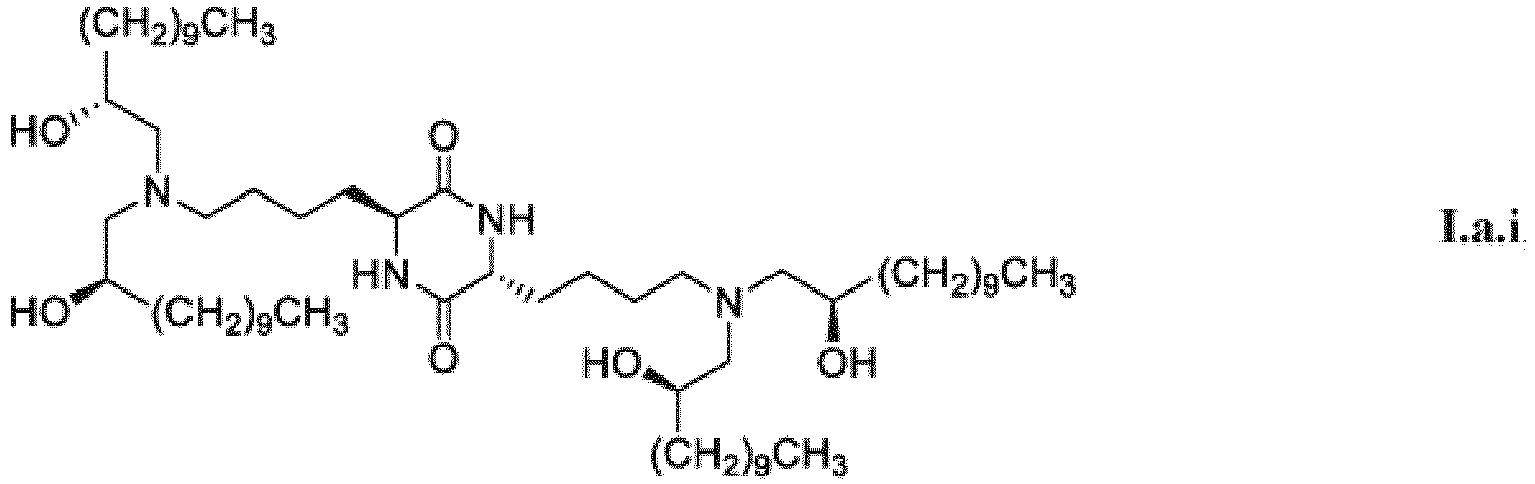 (ii) wobei mehr als oder gleich 90 % (Gew./Gew.) von der Gesamtmenge der Zusammensetzung eine chemische Einheit der Formel I.a.ii ist:
- Zusammensetzung, umfassend eine mRNA, die ein Protein codiert und in einem Liposom eingekapselt ist, wobei das Liposom eine Zusammensetzung kationischer Lipide nach einem der Ansprüche 1-7 umfasst, zur Verwendung bei einem Verfahren zur Zuführung von Messenger-RNA (mRNA) in vivo, wobei das Verfahren das Verabreichen der Zusammensetzung an ein Individuum umfasst, das eine Zuführung benötigt, so dass die Verabreichung der Zusammensetzung zur In vivo-Expression des von der mRNA codierten Proteins führt.
- Zusammensetzung zur Verwendung nach Anspruch 8, wobei das Liposom ferner ein oder mehrere nichtkationische Lipide, ein oder mehrere Lipide auf Cholesterinbasis und/oder ein oder mehrere PEGmodifizierte Lipide umfasst,
wobei optional das eine oder die mehreren nichtkationischen Lipide aus DSPC (1,2-Distearoyl-sn-glycero-3-phosphocholin), DPPC (1,2-Dipalmitoyl-sn-glycero-3-phosphocholin), DOPE (1,2-Dioleyl-sn-glycero-3-phosphoethanolamin), DOPC (1,2-Dioleyl-sn-glycero-3-phosphatidylcholin), DPPE (1,2-Dipalmitoyl-sn-glycero-3-phosphoethanolamin), DMPE (1,2-Dimyristoyl-sn-glycero-3-phosphoethanolamin), DOPG (1,2-Dioleoyl-sn-glycero-3-phospho-(1'-rac-glycerin)) ausgewählt ist bzw. sind. - Zusammensetzung zur Verwendung nach Anspruch 9, wobei es sich bei dem einen oder den mehreren Lipiden auf Cholesterinbasis um Cholesterin und/oder PEGyliertes Cholesterin handelt.
- Zusammensetzung zur Verwendung nach einem der Ansprüche 9-10, wobei das eine oder die mehreren PEGmodifizierten Lipide eine Poly(ethylenglykol)-Kette mit einer Länge von bis zu 5 kDa umfasst bzw. umfassen, die kovalent an ein Lipid mit Alkylkette(n) einer Länge von C6-C20 gebunden ist.
- Zusammensetzung zur Verwendung nach einem der Ansprüche 8-11, wobei das Liposom eine Größe von weniger als etwa 250 nm, 200 nm, 150 nm, 100 nm, 75 nm oder 50 nm hat.
- Zusammensetzung zur Verwendung nach einem der Ansprüche 8-12, wobei die mRNA eine Länge von oder mehr als etwa 0,5 kb, 1 kb, 1,5 kb, 2 kb, 2,5 kb, 3 kb, 3,5 kb, 4 kb, 4,5 kb oder 5 kb hat.
- Zusammensetzung zur Verwendung nach einem der Ansprüche 8-13, wobei(a) das von der mRNA codierte Protein ein cytosolisches Protein ist oder(b) das von der mRNA codierte Protein ein sezerniertes Protein ist oder(c) das von der mRNA codierte Protein ein Enzym ist.
- Zusammensetzung zur Verwendung nach einem der Ansprüche 8-14, wobei die mRNA ein oder mehrere modifizierte Nukleotide umfasst; wobei optional das eine oder die mehreren modifizierten Nukleotide Pseudouridin, N-1-Methylpseudouridin, 2-Aminoadenosin, 2-Thiothymidin, Inosin, Pyrrolopyrimidin, 3-Methyladenosin, 5-Methylcytidin, C-5-Propinylcytidin, C-5-Propinyluridin, 2-Aminoadenosin, C5-Bromuridin, C5-Fluoruridin, C5-Ioduridin, C5-Propinyluridin, C5-Propinylcytidin, C5-Methylcytidin, 2-Aminoadenosin, 7-Deazaadenosin, 7-Deazaguanosin, 8-Oxoadenosin, 8-Oxoguanosin, 0(6)-Methylguanin und/oder 2-Thiocytidin umfasst bzw. umfassen.
- Zusammensetzung zur Verwendung nach einem der Ansprüche 8-15, wobei die mRNA unmodifiziert ist.
- Zusammensetzung zur Verwendung nach einem der Ansprüche 8-16, wobei die Zusammensetzung zur Verwendung bei einem Verfahren zur Behandlung einer Krankheit oder Störung dient, das einen Schritt der Zuführung einer mRNA, die ein therapeutisches Protein codiert, umfasst.
Applications Claiming Priority (2)
| Application Number | Priority Date | Filing Date | Title |
|---|---|---|---|
| US201462016512P | 2014-06-24 | 2014-06-24 | |
| PCT/US2015/037392 WO2015200465A1 (en) | 2014-06-24 | 2015-06-24 | Stereochemically enriched compositions for delivery of nucleic acids |
Publications (4)
| Publication Number | Publication Date |
|---|---|
| EP3160959A1 EP3160959A1 (de) | 2017-05-03 |
| EP3160959A4 EP3160959A4 (de) | 2018-02-28 |
| EP3160959C0 EP3160959C0 (de) | 2023-08-30 |
| EP3160959B1 true EP3160959B1 (de) | 2023-08-30 |
Family
ID=54929772
Family Applications (1)
| Application Number | Title | Priority Date | Filing Date |
|---|---|---|---|
| EP15811080.9A Active EP3160959B1 (de) | 2014-06-24 | 2015-06-24 | Stereochemisch angereicherte zusammensetzungen zur freisetzung von nukleinsäuren |
Country Status (17)
| Country | Link |
|---|---|
| US (4) | US10138213B2 (de) |
| EP (1) | EP3160959B1 (de) |
| JP (1) | JP6599373B2 (de) |
| KR (3) | KR102559979B1 (de) |
| CN (3) | CN116059170A (de) |
| AU (4) | AU2015279968B2 (de) |
| CA (1) | CA2952824C (de) |
| CL (1) | CL2016003263A1 (de) |
| EA (1) | EA033966B1 (de) |
| ES (1) | ES2964588T3 (de) |
| IL (1) | IL249615A0 (de) |
| MA (1) | MA40241A (de) |
| MX (3) | MX389802B (de) |
| PE (1) | PE20171238A1 (de) |
| SG (1) | SG11201610670WA (de) |
| UA (1) | UA121863C2 (de) |
| WO (1) | WO2015200465A1 (de) |
Families Citing this family (28)
| Publication number | Priority date | Publication date | Assignee | Title |
|---|---|---|---|---|
| EP4074693A1 (de) | 2011-06-08 | 2022-10-19 | Translate Bio, Inc. | Spaltbare lipide |
| ES3032935T3 (en) * | 2013-10-22 | 2025-07-29 | Translate Bio Inc | Lipid formulations for delivery of messenger rna |
| WO2015184256A2 (en) | 2014-05-30 | 2015-12-03 | Shire Human Genetic Therapies, Inc. | Biodegradable lipids for delivery of nucleic acids |
| WO2018144709A2 (en) * | 2017-02-01 | 2018-08-09 | The Trustees Of The University Of Pennsylvania | Gene therapy for treating citrullenemia |
| IL268856B2 (en) | 2017-02-27 | 2024-09-01 | Translate Bio Inc | Methods for purification of messenger rna |
| ES2899323T3 (es) | 2017-02-27 | 2022-03-10 | Translate Bio Inc | Métodos de purificación de ARN mensajero |
| US11975110B2 (en) | 2018-02-02 | 2024-05-07 | Translate Bio, Inc. | Cationic polymers |
| EP3793689A1 (de) * | 2018-05-15 | 2021-03-24 | Translate Bio, Inc. | Subkutane verabreichung von messenger-rna |
| US11174500B2 (en) | 2018-08-24 | 2021-11-16 | Translate Bio, Inc. | Methods for purification of messenger RNA |
| DK3864163T3 (da) | 2018-10-09 | 2024-05-06 | Univ British Columbia | Sammensætninger og systemer omfattende transfektionskompetente vesikler fri for organiske opløsningsmidler og rengøringsmidler og fremgangsmåder forbundet dermed |
| CA3115119A1 (en) | 2018-11-08 | 2020-05-14 | Translate Bio, Inc. | Methods and compositions for messenger rna purification |
| EP3959195B1 (de) * | 2019-04-22 | 2023-11-08 | Translate Bio, Inc. | Kationische thioester-lipide |
| CA3162019A1 (en) | 2019-12-20 | 2021-06-24 | Gemma NAVARRO | Lipid nanoparticles for delivery of nucleic acids |
| CN111658782A (zh) * | 2020-06-10 | 2020-09-15 | 深圳近邻生物科技有限公司 | mRNA疫苗递送载体及制备方法、mRNA疫苗及制备方法 |
| JP7844452B2 (ja) | 2020-09-23 | 2026-04-13 | トランスレイト バイオ, インコーポレイテッド | Tesベースのカチオン性脂質 |
| WO2022066916A1 (en) * | 2020-09-23 | 2022-03-31 | Translate Bio, Inc. | Piperazine-based cationic lipids |
| CZ310613B6 (cs) | 2020-09-23 | 2026-01-28 | Ústav organické chemie a biochemie AV ČR, v. v. i. | Lipidoidy pro transfekci nukleových kyselin a jejich použití |
| MX2023004371A (es) | 2020-10-14 | 2023-07-26 | George Mason Res Foundation Inc | Lípidos ionizables, y métodos de fabricación y uso de los mismos. |
| WO2022099003A1 (en) | 2020-11-06 | 2022-05-12 | Sanofi | Lipid nanoparticles for delivering mrna vaccines |
| CZ310443B6 (cs) | 2021-07-19 | 2025-06-25 | Ústav organické chemie a biochemie AV ČR, v. v. i. | Cyklohexanové lipidoidy pro transfekci nukleových kyselin a jejich použití |
| EP4763287A2 (de) | 2021-09-03 | 2026-06-24 | CureVac SE | Neue lipidnanopartikel zur abgabe von nukleinsäuren |
| EP4422698A1 (de) | 2021-10-29 | 2024-09-04 | CureVac SE | Verbesserte zirkuläre rna zur expression therapeutischer proteine |
| EP4469091A1 (de) | 2022-01-28 | 2024-12-04 | CureVac SE | Nukleinsäure-kodierte transkriptionsfaktor-inhibitoren |
| CA3248209A1 (en) | 2022-05-25 | 2023-11-30 | CureVac SE | Escherichia coli Antigenic Polypeptide-Based Nucleic Acid Vaccine (FIMH) |
| WO2024089638A1 (en) | 2022-10-28 | 2024-05-02 | Glaxosmithkline Biologicals Sa | Nucleic acid based vaccine |
| KR20250153298A (ko) | 2023-03-08 | 2025-10-24 | 큐어백 에스이 | 핵산 전달을 위한 신규의 지질 나노입자 제형 |
| WO2024230934A1 (en) | 2023-05-11 | 2024-11-14 | CureVac SE | Therapeutic nucleic acid for the treatment of ophthalmic diseases |
| CN118852328A (zh) * | 2024-07-02 | 2024-10-29 | 北京大学 | 肽基可离子化脂质合成及其应用 |
Family Cites Families (334)
| Publication number | Priority date | Publication date | Assignee | Title |
|---|---|---|---|---|
| US2647121A (en) | 1951-02-02 | 1953-07-28 | Ruth P Jacoby | Diamine-bis-acetamides |
| US2819718A (en) | 1953-07-16 | 1958-01-14 | Isidore H Goldman | Drainage tube |
| US2717909A (en) | 1953-09-24 | 1955-09-13 | Monsanto Chemicals | Hydroxyethyl-keryl-alkylene-ammonium compounds |
| US2844629A (en) | 1956-04-25 | 1958-07-22 | American Home Prod | Fatty acid amides and derivatives thereof |
| US3096560A (en) | 1958-11-21 | 1963-07-09 | William J Liebig | Process for synthetic vascular implants |
| FR1378382A (fr) | 1962-12-01 | 1964-11-13 | Sandoz Sa | Amides de l'acide amino-propionique, utilisables en particulier pour le traitement des fibres textiles |
| GB1072118A (en) | 1962-12-01 | 1967-06-14 | Sandoz Ag | Amides of aminopropionic acid |
| JPS5141663B1 (de) | 1966-03-12 | 1976-11-11 | ||
| JPS4822365B1 (de) | 1968-10-25 | 1973-07-05 | ||
| NL143127B (nl) | 1969-02-04 | 1974-09-16 | Rhone Poulenc Sa | Versterkingsorgaan voor een defecte hartklep. |
| US3614954A (en) | 1970-02-09 | 1971-10-26 | Medtronic Inc | Electronic standby defibrillator |
| US3614955A (en) | 1970-02-09 | 1971-10-26 | Medtronic Inc | Standby defibrillator and method of operation |
| JPS5024216B1 (de) | 1970-12-29 | 1975-08-14 | ||
| JPS5012146Y2 (de) | 1971-07-27 | 1975-04-15 | ||
| US3945052A (en) | 1972-05-01 | 1976-03-23 | Meadox Medicals, Inc. | Synthetic vascular graft and method for manufacturing the same |
| US3805301A (en) | 1972-07-28 | 1974-04-23 | Meadox Medicals Inc | Tubular grafts having indicia thereon |
| US4022833A (en) | 1973-02-14 | 1977-05-10 | Sterling Drug Inc. | N,N'-bridged-bis[2-alkyl-2-hydroxyethylamines] |
| JPS49127908A (de) | 1973-04-20 | 1974-12-07 | ||
| JPS5624664B2 (de) | 1973-06-28 | 1981-06-08 | ||
| US4013507A (en) | 1973-09-18 | 1977-03-22 | California Institute Of Technology | Ionene polymers for selectively inhibiting the vitro growth of malignant cells |
| JPS5123537A (ja) | 1974-04-26 | 1976-02-25 | Adeka Argus Chemical Co Ltd | Kasozaisoseibutsu |
| GB1527592A (en) | 1974-08-05 | 1978-10-04 | Ici Ltd | Wound dressing |
| US3995623A (en) | 1974-12-23 | 1976-12-07 | American Hospital Supply Corporation | Multipurpose flow-directed catheter |
| JPS5813576B2 (ja) | 1974-12-27 | 1983-03-14 | アデカ ア−ガスカガク カブシキガイシヤ | 安定化された合成高分子組成物 |
| DE2520814A1 (de) | 1975-05-09 | 1976-11-18 | Bayer Ag | Lichtstabilisierung von polyurethanen |
| US4281669A (en) | 1975-05-09 | 1981-08-04 | Macgregor David C | Pacemaker electrode with porous system |
| JPS5210847A (en) | 1975-07-16 | 1977-01-27 | Nippon Steel Corp | Pinch roll |
| US4096860A (en) | 1975-10-08 | 1978-06-27 | Mclaughlin William F | Dual flow encatheter |
| CA1069652A (en) | 1976-01-09 | 1980-01-15 | Alain F. Carpentier | Supported bioprosthetic heart valve with compliant orifice ring |
| US4134402A (en) | 1976-02-11 | 1979-01-16 | Mahurkar Sakharam D | Double lumen hemodialysis catheter |
| US4072146A (en) | 1976-09-08 | 1978-02-07 | Howes Randolph M | Venous catheter device |
| US4335723A (en) | 1976-11-26 | 1982-06-22 | The Kendall Company | Catheter having inflatable retention means |
| US4099528A (en) | 1977-02-17 | 1978-07-11 | Sorenson Research Co., Inc. | Double lumen cannula |
| US4140126A (en) | 1977-02-18 | 1979-02-20 | Choudhury M Hasan | Method for performing aneurysm repair |
| US4265745A (en) | 1977-05-25 | 1981-05-05 | Teijin Limited | Permselective membrane |
| US4182833A (en) | 1977-12-07 | 1980-01-08 | Celanese Polymer Specialties Company | Cationic epoxide-amine reaction products |
| US4180068A (en) | 1978-04-13 | 1979-12-25 | Motion Control, Incorporated | Bi-directional flow catheter with retractable trocar/valve structure |
| DE2960875D1 (en) | 1978-04-19 | 1981-12-10 | Ici Plc | A method of preparing a tubular product by electrostatic spinning |
| US4284459A (en) | 1978-07-03 | 1981-08-18 | The Kendall Company | Method for making a molded catheter |
| US4227533A (en) | 1978-11-03 | 1980-10-14 | Bristol-Myers Company | Flushable urinary catheter |
| US4375817A (en) | 1979-07-19 | 1983-03-08 | Medtronic, Inc. | Implantable cardioverter |
| US4500707A (en) | 1980-02-29 | 1985-02-19 | University Patents, Inc. | Nucleosides useful in the preparation of polynucleotides |
| US4458066A (en) | 1980-02-29 | 1984-07-03 | University Patents, Inc. | Process for preparing polynucleotides |
| US5132418A (en) | 1980-02-29 | 1992-07-21 | University Patents, Inc. | Process for preparing polynucleotides |
| DE3010841A1 (de) | 1980-03-21 | 1981-10-08 | Ulrich Dr.med. 6936 Haag Uthmann | Katheder |
| US4308085A (en) | 1980-07-28 | 1981-12-29 | Jenoptik Jena Gmbh | Process for the preparation of high molecular thermoplastic epoxide-amine-polyadducts |
| US4973679A (en) | 1981-03-27 | 1990-11-27 | University Patents, Inc. | Process for oligonucleo tide synthesis using phosphormidite intermediates |
| US4668777A (en) | 1981-03-27 | 1987-05-26 | University Patents, Inc. | Phosphoramidite nucleoside compounds |
| US4415732A (en) | 1981-03-27 | 1983-11-15 | University Patents, Inc. | Phosphoramidite compounds and processes |
| US4339369A (en) | 1981-04-23 | 1982-07-13 | Celanese Corporation | Cationic epoxide-amine reaction products |
| US4373071A (en) | 1981-04-30 | 1983-02-08 | City Of Hope Research Institute | Solid-phase synthesis of polynucleotides |
| US4401796A (en) | 1981-04-30 | 1983-08-30 | City Of Hope Research Institute | Solid-phase synthesis of polynucleotides |
| US4406656A (en) | 1981-06-01 | 1983-09-27 | Brack Gillium Hattler | Venous catheter having collapsible multi-lumens |
| US4475972A (en) | 1981-10-01 | 1984-10-09 | Ontario Research Foundation | Implantable material |
| US4401472A (en) | 1982-02-26 | 1983-08-30 | Martin Marietta Corporation | Hydraulic cement mixes and processes for improving hydraulic cement mixes |
| US4568329A (en) | 1982-03-08 | 1986-02-04 | Mahurkar Sakharam D | Double lumen catheter |
| US4546499A (en) | 1982-12-13 | 1985-10-15 | Possis Medical, Inc. | Method of supplying blood to blood receiving vessels |
| US4530113A (en) | 1983-05-20 | 1985-07-23 | Intervascular, Inc. | Vascular grafts with cross-weave patterns |
| US4647416A (en) | 1983-08-03 | 1987-03-03 | Shiley Incorporated | Method of preparing a vascular graft prosthesis |
| US4550447A (en) | 1983-08-03 | 1985-11-05 | Shiley Incorporated | Vascular graft prosthesis |
| US5104399A (en) | 1986-12-10 | 1992-04-14 | Endovascular Technologies, Inc. | Artificial graft and implantation method |
| US4710169A (en) | 1983-12-16 | 1987-12-01 | Christopher T Graham | Urinary catheter with collapsible urethral tube |
| US4571241A (en) | 1983-12-16 | 1986-02-18 | Christopher T Graham | Urinary catheter with collapsible urethral tube |
| US4737518A (en) | 1984-04-03 | 1988-04-12 | Takeda Chemical Industries, Ltd. | Lipid derivatives, their production and use |
| US4562596A (en) | 1984-04-25 | 1986-01-07 | Elliot Kornberg | Aortic graft, device and method for performing an intraluminal abdominal aortic aneurysm repair |
| US4782836A (en) | 1984-05-24 | 1988-11-08 | Intermedics, Inc. | Rate adaptive cardiac pacemaker responsive to patient activity and temperature |
| US4897355A (en) | 1985-01-07 | 1990-01-30 | Syntex (U.S.A.) Inc. | N[ω,(ω-1)-dialkyloxy]- and N-[ω,(ω-1)-dialkenyloxy]-alk-1-yl-N,N,N-tetrasubstituted ammonium lipids and uses therefor |
| US4662382A (en) | 1985-01-16 | 1987-05-05 | Intermedics, Inc. | Pacemaker lead with enhanced sensitivity |
| US4762915A (en) | 1985-01-18 | 1988-08-09 | Liposome Technology, Inc. | Protein-liposome conjugates |
| US4860751A (en) | 1985-02-04 | 1989-08-29 | Cordis Corporation | Activity sensor for pacemaker control |
| CA1320724C (en) | 1985-07-19 | 1993-07-27 | Koichi Kanehira | Terpene amino alcohols and medicinal uses thereof |
| ATE77806T1 (de) | 1985-08-05 | 1992-07-15 | Miyoshi Yushi Kk | Verfahren fuer die abscheidung von metallen. |
| US4701162A (en) | 1985-09-24 | 1987-10-20 | The Kendall Company | Foley catheter assembly |
| US4737323A (en) | 1986-02-13 | 1988-04-12 | Liposome Technology, Inc. | Liposome extrusion method |
| US5153319A (en) | 1986-03-31 | 1992-10-06 | University Patents, Inc. | Process for preparing polynucleotides |
| DE3616824A1 (de) | 1986-05-17 | 1987-11-19 | Schering Ag | Verwendung von haertbaren kunstharzmischungen fuer oberflaechenbeschichtungen und druckfarben und verfahren zu ihrer herstellung |
| EP0255899B1 (de) | 1986-07-31 | 1992-07-15 | Werner Prof. Dr.-Ing. Irnich | Frequenzadaptierender Herzschrittmacher |
| US4960409A (en) | 1986-09-11 | 1990-10-02 | Catalano Marc L | Method of using bilumen peripheral venous catheter with adapter |
| JPH0829776B2 (ja) | 1986-10-29 | 1996-03-27 | 東燃化学株式会社 | 合成樹脂製容器及びその製造用金型 |
| US4720517A (en) | 1986-11-24 | 1988-01-19 | Ciba-Geigy Corporation | Compositions stabilized with N-hydroxyiminodiacetic and dipropionic acids and esters thereof |
| US4873370A (en) | 1987-03-03 | 1989-10-10 | Pennzoil Products Company | Alkylene diamines for use in friction and wear reducing compositions |
| DE3728917A1 (de) | 1987-08-29 | 1989-03-09 | Roth Hermann J | Neue lipide mit unsymmetrisch substituierter disulfidbruecke |
| US5138067A (en) | 1987-12-17 | 1992-08-11 | Shionogi & Co. Ltd. | Lipid derivatives |
| US5047540A (en) | 1987-12-17 | 1991-09-10 | Shionogi & Co., Ltd. | Lipid derivatives |
| US4892540A (en) | 1988-04-21 | 1990-01-09 | Sorin Biomedica S.P.A. | Two-leaflet prosthetic heart valve |
| US5176661A (en) | 1988-09-06 | 1993-01-05 | Advanced Cardiovascular Systems, Inc. | Composite vascular catheter |
| US5024671A (en) | 1988-09-19 | 1991-06-18 | Baxter International Inc. | Microporous vascular graft |
| US5200395A (en) | 1988-10-18 | 1993-04-06 | Ajinomoto Company, Inc. | Pharmaceutical composition of BUF-5 for treating anemia |
| CA2001401A1 (en) | 1988-10-25 | 1990-04-25 | Claude Piantadosi | Quaternary amine containing ether or ester lipid derivatives and therapeutic compositions |
| US5262530A (en) | 1988-12-21 | 1993-11-16 | Applied Biosystems, Inc. | Automated system for polynucleotide synthesis and purification |
| US5047524A (en) | 1988-12-21 | 1991-09-10 | Applied Biosystems, Inc. | Automated system for polynucleotide synthesis and purification |
| FR2645866B1 (fr) | 1989-04-17 | 1991-07-05 | Centre Nat Rech Scient | Nouvelles lipopolyamines, leur preparation et leur emploi |
| US5101824A (en) | 1990-04-16 | 1992-04-07 | Siemens-Pacesetter, Inc. | Rate-responsive pacemaker with circuitry for processing multiple sensor inputs |
| US5405379A (en) | 1990-07-26 | 1995-04-11 | Lane; Rodney J. | Self expanding vascular endoprosthesis for aneurysms |
| US5693338A (en) | 1994-09-29 | 1997-12-02 | Emisphere Technologies, Inc. | Diketopiperazine-based delivery systems |
| DK0480667T3 (da) | 1990-10-09 | 1996-06-10 | Cook Inc | Perkutan stentkonstruktion |
| ATE120971T1 (de) | 1990-12-19 | 1995-04-15 | Osypka Peter | Herzschrittmacherleitung mit einem inneren kanal und mit einem elektrodenkopf. |
| US5116360A (en) | 1990-12-27 | 1992-05-26 | Corvita Corporation | Mesh composite graft |
| US5405363A (en) | 1991-03-15 | 1995-04-11 | Angelon Corporation | Implantable cardioverter defibrillator having a smaller displacement volume |
| US5330768A (en) | 1991-07-05 | 1994-07-19 | Massachusetts Institute Of Technology | Controlled drug delivery using polymer/pluronic blends |
| US5545449A (en) | 1991-10-02 | 1996-08-13 | Weyerhaeuser Company | Polyether-reinforced fiber-based materials |
| US5151105A (en) | 1991-10-07 | 1992-09-29 | Kwan Gett Clifford | Collapsible vessel sleeve implant |
| US5284491A (en) | 1992-02-27 | 1994-02-08 | Medtronic, Inc. | Cardiac pacemaker with hysteresis behavior |
| US5352461A (en) | 1992-03-11 | 1994-10-04 | Pharmaceutical Discovery Corporation | Self assembling diketopiperazine drug delivery system |
| SE9200951D0 (sv) | 1992-03-27 | 1992-03-27 | Kabi Pharmacia Ab | Pharmaceutical composition containing a defined lipid system |
| KR950702628A (ko) | 1992-08-01 | 1995-07-29 | 치세이 라 | 항알레르기 조성물(Antiallergic agent) |
| US5334761A (en) | 1992-08-28 | 1994-08-02 | Life Technologies, Inc. | Cationic lipids |
| US5380778A (en) | 1992-09-30 | 1995-01-10 | Minnesota Mining And Manufacturing Company | Fluorochemical aminoalcohols |
| US5461223A (en) | 1992-10-09 | 1995-10-24 | Eastman Kodak Company | Bar code detecting circuitry |
| JPH06211978A (ja) | 1992-10-28 | 1994-08-02 | Takeda Chem Ind Ltd | 新規ポリエーテルポリオール及びそれを用いる軟質ウレタンフォームの製造法 |
| US5300022A (en) | 1992-11-12 | 1994-04-05 | Martin Klapper | Urinary catheter and bladder irrigation system |
| US5496362A (en) | 1992-11-24 | 1996-03-05 | Cardiac Pacemakers, Inc. | Implantable conformal coil patch electrode with multiple conductive elements for cardioversion and defibrillation |
| US5716395A (en) | 1992-12-11 | 1998-02-10 | W.L. Gore & Associates, Inc. | Prosthetic vascular graft |
| AU6044994A (en) | 1993-02-19 | 1994-09-14 | Nippon Shinyaku Co. Ltd. | Glycerol derivative, device and pharmaceutical composition |
| US5395619A (en) | 1993-03-03 | 1995-03-07 | Liposome Technology, Inc. | Lipid-polymer conjugates and liposomes |
| US5697953A (en) | 1993-03-13 | 1997-12-16 | Angeion Corporation | Implantable cardioverter defibrillator having a smaller displacement volume |
| US5624976A (en) | 1994-03-25 | 1997-04-29 | Dentsply Gmbh | Dental filling composition and method |
| US5314430A (en) | 1993-06-24 | 1994-05-24 | Medtronic, Inc. | Atrial defibrillator employing transvenous and subcutaneous electrodes and method of use |
| DE4325848A1 (de) | 1993-07-31 | 1995-02-02 | Basf Ag | Verfahren zur Herstellung von N-(2-Hydroxyethyl)-piperazin |
| EP1062998B1 (de) | 1993-10-06 | 2003-03-26 | The Kansai Electric Power Co., Inc. | Verfahren zur Abscheidung von Kohlendioxid aus Verbrennungsabgasen |
| US5609624A (en) | 1993-10-08 | 1997-03-11 | Impra, Inc. | Reinforced vascular graft and method of making same |
| SE9303481L (sv) | 1993-10-22 | 1995-04-23 | Berol Nobel Ab | Hygienkomposition |
| AU1091095A (en) | 1993-11-08 | 1995-05-29 | Harrison M. Lazarus | Intraluminal vascular graft and method |
| KR960705798A (ko) | 1993-11-24 | 1996-11-08 | 벤자민 에프 맥그로우 | 피페라진의 양쪽친화성 유도체(amphiphilic derivatives of piperazine) |
| US5464924A (en) | 1994-01-07 | 1995-11-07 | The Dow Chemical Company | Flexible poly(amino ethers) for barrier packaging |
| US5840576A (en) | 1994-07-20 | 1998-11-24 | Cytotherapeutics, Inc. | Methods and compositions of growth control for cells encapsulated within bioartificial organs |
| US5885613A (en) | 1994-09-30 | 1999-03-23 | The University Of British Columbia | Bilayer stabilizing components and their use in forming programmable fusogenic liposomes |
| GB9524630D0 (en) | 1994-12-24 | 1996-01-31 | Zeneca Ltd | Chemical compounds |
| US5965434A (en) | 1994-12-29 | 1999-10-12 | Wolff; Jon A. | Amphipathic PH sensitive compounds and delivery systems for delivering biologically active compounds |
| US5830430A (en) | 1995-02-21 | 1998-11-03 | Imarx Pharmaceutical Corp. | Cationic lipids and the use thereof |
| EP0822835A1 (de) | 1995-04-17 | 1998-02-11 | Imarx Pharmaceutical Corp. | Hybride magnetische resonanz kontrastmittel |
| US6428771B1 (en) | 1995-05-15 | 2002-08-06 | Pharmaceutical Discovery Corporation | Method for drug delivery to the pulmonary system |
| US5772694A (en) | 1995-05-16 | 1998-06-30 | Medical Carbon Research Institute L.L.C. | Prosthetic heart valve with improved blood flow |
| US5700642A (en) | 1995-05-22 | 1997-12-23 | Sri International | Oligonucleotide sizing using immobilized cleavable primers |
| US5609629A (en) | 1995-06-07 | 1997-03-11 | Med Institute, Inc. | Coated implantable medical device |
| JP4335310B2 (ja) | 1995-06-07 | 2009-09-30 | ザ ユニバーシティ オブ ブリティッシュ コロンビア | 疎水性脂質−核酸複合中間体を通して調製される脂質−核酸粒子、及び遺伝子移送のための使用 |
| US5705385A (en) | 1995-06-07 | 1998-01-06 | Inex Pharmaceuticals Corporation | Lipid-nucleic acid particles prepared via a hydrophobic lipid-nucleic acid complex intermediate and use for gene transfer |
| US7422902B1 (en) | 1995-06-07 | 2008-09-09 | The University Of British Columbia | Lipid-nucleic acid particles prepared via a hydrophobic lipid-nucleic acid complex intermediate and use for gene transfer |
| US5981501A (en) | 1995-06-07 | 1999-11-09 | Inex Pharmaceuticals Corp. | Methods for encapsulating plasmids in lipid bilayers |
| US5607385A (en) | 1995-08-17 | 1997-03-04 | Medtronic, Inc. | Device and algorithm for a combined cardiomyostimulator and a cardiac pacer-carioverter-defibrillator |
| US5728844A (en) | 1995-08-29 | 1998-03-17 | Celgene Corporation | Immunotherapeutic agents |
| US5744335A (en) | 1995-09-19 | 1998-04-28 | Mirus Corporation | Process of transfecting a cell with a polynucleotide mixed with an amphipathic compound and a DNA-binding protein |
| FR2740978B1 (fr) | 1995-11-10 | 1998-01-02 | Ela Medical Sa | Dispositif medical actif du type defibrillateur/cardioverteur implantable |
| US5874105A (en) | 1996-01-31 | 1999-02-23 | Collaborative Laboratories, Inc. | Lipid vesicles formed with alkylammonium fatty acid salts |
| US6667053B1 (en) * | 1996-02-16 | 2003-12-23 | Elan Pharmaceuticals, Inc. | D and L etherlipid stereoisomers and liposomes |
| US5913848A (en) | 1996-06-06 | 1999-06-22 | Luther Medical Products, Inc. | Hard tip over-the-needle catheter and method of manufacturing the same |
| US5736573A (en) | 1996-07-31 | 1998-04-07 | Galat; Alexander | Lipid and water soluble derivatives of drugs |
| TW520297B (en) | 1996-10-11 | 2003-02-11 | Sequus Pharm Inc | Fusogenic liposome composition and method |
| US6887665B2 (en) | 1996-11-14 | 2005-05-03 | Affymetrix, Inc. | Methods of array synthesis |
| US6204297B1 (en) | 1996-11-26 | 2001-03-20 | Rhodia Inc. | Nonionic gemini surfactants |
| JPH10197978A (ja) | 1997-01-09 | 1998-07-31 | Mitsubishi Paper Mills Ltd | ハロゲン化銀写真感光材料 |
| FR2760193B1 (fr) | 1997-02-28 | 1999-05-28 | Transgene Sa | Lipides et complexes de lipides cationiques et de substances actives, notamment pour la transfection de cellules |
| US5837283A (en) | 1997-03-12 | 1998-11-17 | The Regents Of The University Of California | Cationic lipid compositions targeting angiogenic endothelial cells |
| US5945326A (en) | 1997-03-20 | 1999-08-31 | New England Biolabs, Inc. | Method for cloning and producing the Spel restriction endonuclease |
| NZ501289A (en) | 1997-05-28 | 2001-06-29 | Nielsen Peter E | Conjugated peptide nucleic acids having enhanced cellular uptake |
| JPH115786A (ja) | 1997-06-13 | 1999-01-12 | Pola Chem Ind Inc | 新規アミノヒドロキシプロピルピペラジン誘導体 |
| US6067471A (en) | 1998-08-07 | 2000-05-23 | Cardiac Pacemakers, Inc. | Atrial and ventricular implantable cardioverter-defibrillator and lead system |
| JPH1180142A (ja) | 1997-09-05 | 1999-03-26 | Pola Chem Ind Inc | ジフェニルアルキル化合物の製造法 |
| US6096075A (en) | 1998-01-22 | 2000-08-01 | Medical Carbon Research Institute, Llc | Prosthetic heart valve |
| US6271209B1 (en) | 1998-04-03 | 2001-08-07 | Valentis, Inc. | Cationic lipid formulation delivering nucleic acid to peritoneal tumors |
| US6176877B1 (en) | 1998-04-20 | 2001-01-23 | St. Jude Medical, Inc. | Two piece prosthetic heart valve |
| DE19822602A1 (de) | 1998-05-20 | 1999-11-25 | Goldschmidt Ag Th | Verfahren zur Herstellung von Polyaminosäureestern durch Veresterung von sauren Polyaminosäuren oder Umesterung von Polyaminosäureestern |
| NO313244B1 (no) | 1998-07-08 | 2002-09-02 | Crew Dev Corp | Fremgangsmåte for isolering og produksjon av magnesitt eller magnesiumklorid |
| US6055454A (en) | 1998-07-27 | 2000-04-25 | Cardiac Pacemakers, Inc. | Cardiac pacemaker with automatic response optimization of a physiologic sensor based on a second sensor |
| WO2000010622A1 (en) | 1998-08-20 | 2000-03-02 | Cook Incorporated | Coated implantable medical device |
| US6379698B1 (en) | 1999-04-06 | 2002-04-30 | Isis Pharmaceuticals, Inc. | Fusogenic lipids and vesicles |
| HUP0201425A3 (en) | 1999-04-23 | 2006-07-28 | Hadasit Med Res Service | Conjugate having a cleavable linkage for use in a liposome |
| US6169923B1 (en) | 1999-04-23 | 2001-01-02 | Pacesetter, Inc. | Implantable cardioverter-defibrillator with automatic arrhythmia detection criteria adjustment |
| US6696424B1 (en) | 1999-05-28 | 2004-02-24 | Vical Incorporated | Cytofectin dimers and methods of use thereof |
| ES2395096T3 (es) | 1999-06-29 | 2013-02-08 | Mannkind Corporation | Purificación y estabilización de agentes farmacéuticos a base de péptidos y proteínas |
| EP1202714A1 (de) | 1999-07-16 | 2002-05-08 | Purdue Research Foundation | Vinyletherlipide mit spaltbaren hydrophilen kopfgruppen |
| US6358278B1 (en) | 1999-09-24 | 2002-03-19 | St. Jude Medical, Inc. | Heart valve prosthesis with rotatable cuff |
| US6371983B1 (en) | 1999-10-04 | 2002-04-16 | Ernest Lane | Bioprosthetic heart valve |
| EP1242609A2 (de) | 1999-12-30 | 2002-09-25 | Novartis AG | Neue kolloidale synthetische vektoren zur gentherapie |
| US6370434B1 (en) | 2000-02-28 | 2002-04-09 | Cardiac Pacemakers, Inc. | Cardiac lead and method for lead implantation |
| US6331381B1 (en) | 2000-04-14 | 2001-12-18 | International Business Machines Corporation | Method for making a liquid crystal alignment layer |
| US6565960B2 (en) | 2000-06-01 | 2003-05-20 | Shriners Hospital Of Children | Polymer composite compositions |
| WO2002000870A2 (en) | 2000-06-26 | 2002-01-03 | Christian Plank | Method for transfecting cells using a magnetic field |
| IL138474A0 (en) | 2000-09-14 | 2001-10-31 | Epox Ltd | Highly branched water-soluble polyamine oligomers, process for their preparation and applications thereof |
| US6998115B2 (en) | 2000-10-10 | 2006-02-14 | Massachusetts Institute Of Technology | Biodegradable poly(β-amino esters) and uses thereof |
| US7427394B2 (en) | 2000-10-10 | 2008-09-23 | Massachusetts Institute Of Technology | Biodegradable poly(β-amino esters) and uses thereof |
| USRE43612E1 (en) | 2000-10-10 | 2012-08-28 | Massachusetts Institute Of Technology | Biodegradable poly(β-amino esters) and uses thereof |
| US20020094528A1 (en) | 2000-11-29 | 2002-07-18 | Salafsky Joshua S. | Method and apparatus using a surface-selective nonlinear optical technique for detection of probe-target interations |
| JP2002167368A (ja) | 2000-12-01 | 2002-06-11 | Nitto Denko Corp | アルキル置換デンドリマーおよびその製造法 |
| US20020192721A1 (en) | 2001-03-28 | 2002-12-19 | Engeneos, Inc. | Modular molecular clasps and uses thereof |
| KR100823815B1 (ko) | 2001-04-23 | 2008-04-21 | 신에쓰 가가꾸 고교 가부시끼가이샤 | 에스테르 구조를 갖는 신규 3급 아민 화합물 및 그 제조방법 |
| US6656977B2 (en) | 2001-07-20 | 2003-12-02 | Air Products And Chemical, Inc. | Alkyl glycidyl ether-capped polyamine foam control agents |
| EP2428570B1 (de) | 2001-09-28 | 2018-05-23 | Max-Planck-Gesellschaft zur Förderung der Wissenschaften e.V. | Mikrorna-moleküle |
| WO2003040288A2 (de) | 2001-11-09 | 2003-05-15 | Bayer Healthcare Ag | Isotopencodierte affinitätsmarker 3 |
| DE10207178A1 (de) | 2002-02-19 | 2003-09-04 | Novosom Ag | Komponenten für die Herstellung amphoterer Liposomen |
| US20030215395A1 (en) | 2002-05-14 | 2003-11-20 | Lei Yu | Controllably degradable polymeric biomolecule or drug carrier and method of synthesizing said carrier |
| US7601367B2 (en) | 2002-05-28 | 2009-10-13 | Mirus Bio Llc | Compositions and processes using siRNA, amphipathic compounds and polycations |
| EP1519714B1 (de) | 2002-06-28 | 2010-10-20 | Protiva Biotherapeutics Inc. | Verfahren und vorrichtung zur herstellung von liposomen |
| US20040028804A1 (en) | 2002-08-07 | 2004-02-12 | Anderson Daniel G. | Production of polymeric microarrays |
| CA2495535A1 (en) | 2002-08-22 | 2004-03-04 | Celltran Limited | Cell culture surface |
| CA2504910A1 (en) | 2002-11-04 | 2004-05-21 | Ge Bayer Silicones Gmbh & Co. Kg | Linear polyamino and/or polyammonium polysiloxane copolymers i |
| AU2003281978A1 (en) | 2002-11-22 | 2004-06-18 | Boehringer Ingelheim International Gmbh | 2,5-diketopiperazines for the treatment of obesity |
| US6998508B2 (en) | 2003-03-10 | 2006-02-14 | Air Products And Chemicals, Inc. | Tertiary alkanolamines containing surface active alkyl groups |
| US7619017B2 (en) | 2003-05-19 | 2009-11-17 | Wacker Chemical Corporation | Polymer emulsions resistant to biodeterioration |
| EP1644479A4 (de) | 2003-06-16 | 2008-04-23 | Mark W Grinstaff | Funktionelle synthetische moleküle und makromoleküle für die genzuführung |
| EP1675943A4 (de) | 2003-09-15 | 2007-12-05 | Massachusetts Inst Technology | Synthese von in einem array angeordneten biomaterialien im nanolitermassstab und screening davon |
| CN1882693B (zh) | 2003-09-15 | 2012-08-15 | 普洛体维生物治疗公司 | 聚乙二醇修饰的脂质化合物及其应用 |
| US20050069590A1 (en) | 2003-09-30 | 2005-03-31 | Buehler Gail K. | Stable suspensions for medicinal dosages |
| AU2004287652A1 (en) | 2003-11-10 | 2005-05-19 | Nippon Kayaku Kabushiki Kaisha | Diimonium salt compound and use thereof |
| US7022214B2 (en) | 2004-01-21 | 2006-04-04 | Bio-Rad Laboratories, Inc. | Carrier ampholytes of high pH range |
| US7556684B2 (en) | 2004-02-26 | 2009-07-07 | Construction Research & Technology Gmbh | Amine containing strength improvement admixture |
| US20060228404A1 (en) | 2004-03-04 | 2006-10-12 | Anderson Daniel G | Compositions and methods for treatment of hypertrophic tissues |
| EP1737899B1 (de) | 2004-04-20 | 2015-07-08 | Dendritic Nanotechnologies, Inc. | Dendritische polymere mit verbesserter amplifikation und innerer funktion |
| CA2569664C (en) | 2004-06-07 | 2013-07-16 | Protiva Biotherapeutics, Inc. | Lipid encapsulated interfering rna |
| US7745651B2 (en) | 2004-06-07 | 2010-06-29 | Protiva Biotherapeutics, Inc. | Cationic lipids and methods of use |
| DE102004043342A1 (de) | 2004-09-08 | 2006-03-09 | Bayer Materialscience Ag | Blockierte Polyurethan-Prepolymere als Klebstoffe |
| GB0502482D0 (en) | 2005-02-07 | 2005-03-16 | Glaxo Group Ltd | Novel compounds |
| CA2597724A1 (en) | 2005-02-14 | 2007-08-02 | Sirna Therapeutics, Inc. | Cationic lipids and formulated molecular compositions containing them |
| WO2006105043A2 (en) | 2005-03-28 | 2006-10-05 | Dendritic Nanotechnologies, Inc. | Janus dendrimers and dendrons |
| WO2006138380A2 (en) | 2005-06-15 | 2006-12-28 | Massachusetts Institute Of Technology | Amine-containing lipids and uses thereof |
| PL2578685T3 (pl) | 2005-08-23 | 2020-01-31 | The Trustees Of The University Of Pennsylvania | Rna zawierający zmodyfikowane nukleozydy i sposoby jego zastosowania |
| MX373000B (es) | 2005-09-14 | 2020-05-21 | Mannkind Corp | Metodo para formulacion de farmaco basado en el aumento de la afinidad de agentes activos hacia las superficies de microparticulas cristalinas. |
| WO2007031091A2 (en) | 2005-09-15 | 2007-03-22 | Santaris Pharma A/S | Rna antagonist compounds for the modulation of p21 ras expression |
| EP1948674A4 (de) | 2005-11-02 | 2009-02-04 | Protiva Biotherapeutics Inc | Modifizierte sirna-moleküle und anwendungen davon |
| US20090221684A1 (en) | 2005-12-22 | 2009-09-03 | Trustees Of Boston University | Molecules for Gene Delivery and Gene Therapy, and Methods of Use Thereof |
| CN100569877C (zh) | 2005-12-30 | 2009-12-16 | 财团法人工业技术研究院 | 含多uv交联反应基的分枝状结构化合物及其应用 |
| CN104383546B (zh) | 2006-02-22 | 2021-03-02 | 曼金德公司 | 用于改善包含二酮哌嗪和活性剂的微粒的药物性质的方法 |
| WO2007096662A2 (en) | 2006-02-27 | 2007-08-30 | Technische Universität München | Cancer imaging and treatment |
| US20070275923A1 (en) | 2006-05-25 | 2007-11-29 | Nastech Pharmaceutical Company Inc. | CATIONIC PEPTIDES FOR siRNA INTRACELLULAR DELIVERY |
| US8808681B2 (en) | 2006-06-05 | 2014-08-19 | Massachusetts Institute Of Technology | Crosslinked, degradable polymers and uses thereof |
| ES2293834B1 (es) | 2006-07-20 | 2009-02-16 | Consejo Superior Investig. Cientificas | Compuesto con actividad inhibidora de las interacciones ubc13-uev, composiciones farmaceuticas que lo comprenden y sus aplicaciones terapeuticas. |
| EP2046266A4 (de) | 2006-07-21 | 2009-11-04 | Massachusetts Inst Technology | Endmodizifierte poly(beta-amino-ester) und ihre verwendung |
| EP2049665A2 (de) | 2006-07-28 | 2009-04-22 | Applera Corporation | DINUKLEOTID-mRNA-CAP-ANALOGA |
| CA3144493A1 (en) | 2006-10-03 | 2008-04-10 | Arbutus Biopharma Corporation | Lipid containing formulations |
| EP2139461A2 (de) | 2007-03-20 | 2010-01-06 | Recepticon Aps | Amino-derivate zur verhinderung von nephrotoxizität und krebs |
| JP5186126B2 (ja) | 2007-03-29 | 2013-04-17 | 公益財団法人地球環境産業技術研究機構 | 新規トリアジン誘導体ならびにその製法およびそのガス分離膜としての用途 |
| US8678686B2 (en) | 2007-05-01 | 2014-03-25 | Pgr-Solutions | Multi-chain lipophilic polyamines |
| GB0716897D0 (en) | 2007-08-30 | 2007-10-10 | Univ Muenchen Tech | Cancer imaging and treatment |
| WO2009030254A1 (en) | 2007-09-04 | 2009-03-12 | Curevac Gmbh | Complexes of rna and cationic peptides for transfection and for immunostimulation |
| AU2008308679B2 (en) | 2007-10-02 | 2015-01-29 | Marina Biotech, Inc. | Lipopeptides for delivery of nucleic acids |
| WO2009058911A2 (en) | 2007-10-31 | 2009-05-07 | Applied Biosystems Inc. | Preparation and isolation of 5' capped mrna |
| EP2229186A2 (de) | 2007-12-04 | 2010-09-22 | Alnylam Pharmaceuticals Inc. | Kohlenhydrat-konjugate als mittel zur abgabe von oligonukleotiden |
| US9006191B2 (en) | 2007-12-27 | 2015-04-14 | Protiva Biotherapeutics, Inc. | Silencing of polo-like kinase expression using interfering RNA |
| US8575123B2 (en) | 2008-04-11 | 2013-11-05 | Tekmira Pharmaceuticals Corporation | Site-specific delivery of nucleic acids by combining targeting ligands with endosomolytic components |
| EP2279254B1 (de) | 2008-04-15 | 2017-07-05 | Protiva Biotherapeutics Inc. | Neue lipidformulierungen zur nukleinsäurezuführung |
| WO2009127230A1 (en) | 2008-04-16 | 2009-10-22 | Curevac Gmbh | MODIFIED (m)RNA FOR SUPPRESSING OR AVOIDING AN IMMUNOSTIMULATORY RESPONSE AND IMMUNOSUPPRESSIVE COMPOSITION |
| US20090263407A1 (en) | 2008-04-16 | 2009-10-22 | Abbott Laboratories | Cationic Lipids and Uses Thereof |
| JP5024216B2 (ja) | 2008-07-23 | 2012-09-12 | トヨタ自動車株式会社 | 内燃機関の点火時期制御装置及び点火時期制御方法 |
| WO2010037408A1 (en) | 2008-09-30 | 2010-04-08 | Curevac Gmbh | Composition comprising a complexed (m)rna and a naked mrna for providing or enhancing an immunostimulatory response in a mammal and uses thereof |
| AU2009303345B2 (en) | 2008-10-09 | 2015-08-20 | Arbutus Biopharma Corporation | Improved amino lipids and methods for the delivery of nucleic acids |
| CN104382853A (zh) | 2008-10-16 | 2015-03-04 | 玛瑞纳生物技术有限公司 | 基因沉默治疗剂的脂质体有效递送方法和组合物 |
| WO2010062322A2 (en) | 2008-10-27 | 2010-06-03 | Massachusetts Institute Of Technology | Modulation of the immune response |
| WO2010053572A2 (en) | 2008-11-07 | 2010-05-14 | Massachusetts Institute Of Technology | Aminoalcohol lipidoids and uses thereof |
| EP3699172A3 (de) | 2008-11-10 | 2020-11-18 | Arbutus Biopharma Corporation | Neuartige lipide und zusammensetzungen zur verabreichung von therapeutika |
| US8314106B2 (en) | 2008-12-29 | 2012-11-20 | Mannkind Corporation | Substituted diketopiperazine analogs for use as drug delivery agents |
| EP2405921A4 (de) | 2009-01-26 | 2013-05-22 | Protiva Biotherapeutics Inc | Zusammensetzungen und verfahren zur dämpfung der apolipoprotien-c-iii-expression |
| US20100222489A1 (en) | 2009-02-27 | 2010-09-02 | Jiang Dayue D | Copolymer composition, membrane article, and methods thereof |
| PT2414322T (pt) * | 2009-03-20 | 2022-12-07 | Egen Inc | Derivados de poliamina |
| EP2415124B1 (de) | 2009-04-02 | 2017-02-15 | The Siemon Company | Telekommunikations schalttafel |
| CA3042927C (en) | 2009-05-05 | 2022-05-17 | Arbutus Biopharma Corporation | Lipid compositions for the delivery of therapeutic agents |
| US20120196923A1 (en) | 2009-05-15 | 2012-08-02 | Kaushal Rege | Polymers for delivering a substance into a cell |
| KR20220038506A (ko) | 2009-06-10 | 2022-03-28 | 알닐람 파마슈티칼스 인코포레이티드 | 향상된 지질 조성물 |
| US9051567B2 (en) | 2009-06-15 | 2015-06-09 | Tekmira Pharmaceuticals Corporation | Methods for increasing efficacy of lipid formulated siRNA |
| US8569256B2 (en) | 2009-07-01 | 2013-10-29 | Protiva Biotherapeutics, Inc. | Cationic lipids and methods for the delivery of therapeutic agents |
| EP2449106B1 (de) | 2009-07-01 | 2015-04-08 | Protiva Biotherapeutics Inc. | Zusammensetzungen und verfahren zur ausschaltung von apolipoprotein b |
| US9018187B2 (en) | 2009-07-01 | 2015-04-28 | Protiva Biotherapeutics, Inc. | Cationic lipids and methods for the delivery of therapeutic agents |
| WO2011011447A1 (en) | 2009-07-20 | 2011-01-27 | Protiva Biotherapeutics, Inc. | Compositions and methods for silencing ebola virus gene expression |
| CA2769408C (en) | 2009-07-30 | 2017-09-05 | Laboratorios Salvat, S.A. | Apaf-1 inhibitor compounds |
| EA022786B1 (ru) | 2009-07-31 | 2016-03-31 | Этрис Гмбх | Рнк с комбинацией из немодифицированных и модифицированных нуклеотидов для экспрессии белков |
| DE102009043342A1 (de) | 2009-09-29 | 2011-03-31 | Bayer Technology Services Gmbh | Stoffe für selbstorganisierte Träger zur kontrollierten Freisetzung eines Wirkstoffs |
| SI2506857T1 (en) | 2009-12-01 | 2018-08-31 | Translate Bio, Inc. | Delivery of mRNA for the enrichment of proteins and enzymes in human genetic diseases |
| EP2338520A1 (de) | 2009-12-21 | 2011-06-29 | Ludwig Maximilians Universität | Konjugat mit Zielfindungsligand und dessen Verwendung |
| WO2011076807A2 (en) | 2009-12-23 | 2011-06-30 | Novartis Ag | Lipids, lipid compositions, and methods of using them |
| US20130123338A1 (en) | 2010-05-12 | 2013-05-16 | Protiva Biotherapeutics, Inc. | Novel cationic lipids and methods of use thereof |
| CN101863544B (zh) | 2010-06-29 | 2011-09-28 | 湖南科技大学 | 一种氰尿酸基重金属螯合絮凝剂及其制备方法 |
| CA2807552A1 (en) | 2010-08-06 | 2012-02-09 | Moderna Therapeutics, Inc. | Engineered nucleic acids and methods of use thereof |
| US9193827B2 (en) | 2010-08-26 | 2015-11-24 | Massachusetts Institute Of Technology | Poly(beta-amino alcohols), their preparation, and uses thereof |
| EP2857499A1 (de) | 2010-10-01 | 2015-04-08 | Moderna Therapeutics, Inc. | Manipulierte Nukleinsäuren und Verfahren zur Verwendung davon |
| US8853377B2 (en) | 2010-11-30 | 2014-10-07 | Shire Human Genetic Therapies, Inc. | mRNA for use in treatment of human genetic diseases |
| CA2831392C (en) | 2011-03-28 | 2020-04-28 | Massachusetts Institute Of Technology | Conjugated lipomers and uses thereof |
| CA2831613A1 (en) | 2011-03-31 | 2012-10-04 | Moderna Therapeutics, Inc. | Delivery and formulation of engineered nucleic acids |
| WO2012133737A1 (ja) | 2011-03-31 | 2012-10-04 | 公益財団法人地球環境産業技術研究機構 | 架橋性アミン化合物、該化合物を用いた高分子膜及びその製造方法 |
| CN103687957A (zh) | 2011-05-17 | 2014-03-26 | 现代治疗公司 | 工程化核酸及其用于非人类脊椎动物的方法 |
| EP2532649B1 (de) | 2011-06-07 | 2015-04-08 | Incella GmbH | Aminolipide, deren Synthese und Verwendungen davon |
| KR20220025112A (ko) | 2011-06-08 | 2022-03-03 | 샤이어 휴먼 지네틱 테라피즈 인크. | Mrna 전달을 위한 지질 나노입자 조성물 및 방법 |
| EP4074693A1 (de) | 2011-06-08 | 2022-10-19 | Translate Bio, Inc. | Spaltbare lipide |
| US9464124B2 (en) | 2011-09-12 | 2016-10-11 | Moderna Therapeutics, Inc. | Engineered nucleic acids and methods of use thereof |
| EP3384938A1 (de) | 2011-09-12 | 2018-10-10 | Moderna Therapeutics, Inc. | Manipulierte nukleinsäuren und verfahren zur verwendung davon |
| WO2013039857A1 (en) | 2011-09-12 | 2013-03-21 | modeRNA Therapeutics | Engineered nucleic acids and methods of use thereof |
| PT3682905T (pt) * | 2011-10-03 | 2022-04-07 | Modernatx Inc | Nucleósidos, nucleótidos e ácidos nucleicos modificados e respetivas utilizações |
| CA2850792A1 (en) | 2011-10-05 | 2013-04-11 | Protiva Biotherapeutics Inc. | Compositions and methods for silencing aldehyde dehydrogenase |
| US9512073B2 (en) | 2011-10-27 | 2016-12-06 | Massachusetts Institute Of Technology | Amino acid-, peptide-and polypeptide-lipids, isomers, compositions, and uses thereof |
| EP2791159A4 (de) | 2011-12-14 | 2015-10-14 | Moderna Therapeutics Inc | Modifizierte nucleinsäuren und akutbehandlungsverwendungen davon |
| WO2013130161A1 (en) | 2011-12-14 | 2013-09-06 | modeRNA Therapeutics | Methods of responding to a biothreat |
| ES2923757T3 (es) | 2011-12-16 | 2022-09-30 | Modernatx Inc | Composiciones de ARNm modificado |
| AU2012358384A1 (en) | 2011-12-21 | 2014-07-31 | Moderna Therapeutics, Inc. | Methods of increasing the viability or longevity of an organ or organ explant |
| US20140371302A1 (en) | 2011-12-29 | 2014-12-18 | Modema Therapeutics, Inc. | Modified mrnas encoding cell-penetrating polypeptides |
| US9352042B2 (en) | 2012-02-24 | 2016-05-31 | Protiva Biotherapeutics, Inc. | Trialkyl cationic lipids and methods of use thereof |
| WO2013151664A1 (en) | 2012-04-02 | 2013-10-10 | modeRNA Therapeutics | Modified polynucleotides for the production of proteins |
| BR112014024131A2 (pt) | 2012-03-29 | 2017-07-25 | Shire Human Genetic Therapies | lipídios catiônicos ionizáveis |
| US10501512B2 (en) | 2012-04-02 | 2019-12-10 | Modernatx, Inc. | Modified polynucleotides |
| US20150050354A1 (en) | 2012-04-02 | 2015-02-19 | Moderna Therapeutics, Inc. | Modified polynucleotides for the treatment of otic diseases and conditions |
| CN104411338A (zh) | 2012-04-02 | 2015-03-11 | 现代治疗公司 | 用于产生与人类疾病相关的生物制剂和蛋白质的修饰多核苷酸 |
| US9283287B2 (en) | 2012-04-02 | 2016-03-15 | Moderna Therapeutics, Inc. | Modified polynucleotides for the production of nuclear proteins |
| US20140275229A1 (en) | 2012-04-02 | 2014-09-18 | Moderna Therapeutics, Inc. | Modified polynucleotides encoding udp glucuronosyltransferase 1 family, polypeptide a1 |
| US9572897B2 (en) | 2012-04-02 | 2017-02-21 | Modernatx, Inc. | Modified polynucleotides for the production of cytoplasmic and cytoskeletal proteins |
| WO2014028487A1 (en) | 2012-08-13 | 2014-02-20 | Massachusetts Institute Of Technology | Amine-containing lipidoids and uses thereof |
| PT2922554T (pt) | 2012-11-26 | 2022-06-28 | Modernatx Inc | Arn modificado nas porções terminais |
| US20150366997A1 (en) | 2012-12-07 | 2015-12-24 | Shire Human Genetics Therapies, Inc. | COMPOSITIONS AND METHODS FOR mRNA DELIVERY |
| WO2014093574A1 (en) | 2012-12-13 | 2014-06-19 | Moderna Therapeutics, Inc. | Modified polynucleotides for altering cell phenotype |
| EP3434774A1 (de) | 2013-01-17 | 2019-01-30 | ModernaTX, Inc. | Signal-sensor-polynukleotide zur veränderung zellulärer phänotypen |
| JP5991937B2 (ja) | 2013-03-06 | 2016-09-14 | Jxエネルギー株式会社 | 摩擦調整剤および潤滑油組成物 |
| US20160022774A1 (en) | 2013-03-12 | 2016-01-28 | Moderna Therapeutics, Inc. | Diagnosis and treatment of fibrosis |
| US20160024181A1 (en) | 2013-03-13 | 2016-01-28 | Moderna Therapeutics, Inc. | Long-lived polynucleotide molecules |
| US10258698B2 (en) | 2013-03-14 | 2019-04-16 | Modernatx, Inc. | Formulation and delivery of modified nucleoside, nucleotide, and nucleic acid compositions |
| US20160032273A1 (en) | 2013-03-15 | 2016-02-04 | Moderna Therapeutics, Inc. | Characterization of mrna molecules |
| EP2971033B8 (de) | 2013-03-15 | 2019-07-10 | ModernaTX, Inc. | Herstellungsverfahren zur herstellung von rna-transkripten |
| WO2014144767A1 (en) | 2013-03-15 | 2014-09-18 | Moderna Therapeutics, Inc. | Ion exchange purification of mrna |
| US10077439B2 (en) | 2013-03-15 | 2018-09-18 | Modernatx, Inc. | Removal of DNA fragments in mRNA production process |
| WO2014144711A1 (en) | 2013-03-15 | 2014-09-18 | Moderna Therapeutics, Inc. | Analysis of mrna heterogeneity and stability |
| EP4279610A3 (de) | 2013-03-15 | 2024-01-03 | ModernaTX, Inc. | Ribonukleinsäurereinigung |
| US8980864B2 (en) | 2013-03-15 | 2015-03-17 | Moderna Therapeutics, Inc. | Compositions and methods of altering cholesterol levels |
| US9315472B2 (en) | 2013-05-01 | 2016-04-19 | Massachusetts Institute Of Technology | 1,3,5-triazinane-2,4,6-trione derivatives and uses thereof |
| WO2014210356A1 (en) | 2013-06-26 | 2014-12-31 | Massachusetts Institute Of Technology | Multi-tailed lipids and uses thereof |
| PL3019619T3 (pl) | 2013-07-11 | 2022-01-10 | Modernatx, Inc. | Kompozycje zawierające syntetyczne polinkleotydy kodujące białka powiązane z crispr i syntetyczne sgrna oraz sposoby ich stosowania |
| WO2015011633A1 (en) | 2013-07-23 | 2015-01-29 | Protiva Biotherapeutics, Inc. | Compositions and methods for delivering messenger rna |
| CA2923029A1 (en) | 2013-09-03 | 2015-03-12 | Moderna Therapeutics, Inc. | Chimeric polynucleotides |
| WO2015034925A1 (en) | 2013-09-03 | 2015-03-12 | Moderna Therapeutics, Inc. | Circular polynucleotides |
| US10023626B2 (en) | 2013-09-30 | 2018-07-17 | Modernatx, Inc. | Polynucleotides encoding immune modulating polypeptides |
| EP3052511A4 (de) | 2013-10-02 | 2017-05-31 | Moderna Therapeutics, Inc. | Polynukleotidmoleküle und verwendungen davon |
| WO2015051173A2 (en) | 2013-10-02 | 2015-04-09 | Moderna Therapeutics, Inc | Polynucleotide molecules and uses thereof |
| KR101355583B1 (ko) | 2013-10-04 | 2014-01-24 | 한국지질자원연구원 | 간이 유용광물 분리 장치 및 이를 이용한 유용광물 분리 방법 |
| US20160243221A1 (en) | 2013-10-18 | 2016-08-25 | Moderna Therapeutics, Inc. | Compositions and methods for tolerizing cellular systems |
| US10415037B2 (en) | 2014-10-02 | 2019-09-17 | Arbutus Biopharma Corporation | Compositions and methods for silencing hepatitis B virus gene expression |
| WO2016071857A1 (en) | 2014-11-07 | 2016-05-12 | Protiva Biotherapeutics, Inc. | Compositions and methods for silencing ebola virus expression |
| EP3461904A1 (de) | 2014-11-10 | 2019-04-03 | ModernaTX, Inc. | Alternative nukleinsäuremoleküle mit reduziertem uracilgehalt und verwendungen davon |
| EP4324473A3 (de) | 2014-11-10 | 2024-05-29 | ModernaTX, Inc. | Optimierung multiparametrischer nukleinsäuren |
| WO2016118724A1 (en) | 2015-01-21 | 2016-07-28 | Moderna Therapeutics, Inc. | Lipid nanoparticle compositions |
| EP3247398A4 (de) | 2015-01-23 | 2018-09-26 | Moderna Therapeutics, Inc. | Lipidnanopartikelzusammensetzungen |
-
2015
- 2015-06-24 KR KR1020237008910A patent/KR102559979B1/ko active Active
- 2015-06-24 WO PCT/US2015/037392 patent/WO2015200465A1/en not_active Ceased
- 2015-06-24 CN CN202211265951.2A patent/CN116059170A/zh active Pending
- 2015-06-24 EP EP15811080.9A patent/EP3160959B1/de active Active
- 2015-06-24 JP JP2016575045A patent/JP6599373B2/ja active Active
- 2015-06-24 AU AU2015279968A patent/AU2015279968B2/en active Active
- 2015-06-24 US US14/749,027 patent/US10138213B2/en active Active
- 2015-06-24 SG SG11201610670WA patent/SG11201610670WA/en unknown
- 2015-06-24 MX MX2017000143A patent/MX389802B/es unknown
- 2015-06-24 PE PE2016002773A patent/PE20171238A1/es not_active Application Discontinuation
- 2015-06-24 MA MA040241A patent/MA40241A/fr unknown
- 2015-06-24 UA UAA201612749A patent/UA121863C2/uk unknown
- 2015-06-24 CN CN202010289575.5A patent/CN111588695A/zh active Pending
- 2015-06-24 CA CA2952824A patent/CA2952824C/en active Active
- 2015-06-24 KR KR1020227012131A patent/KR102511554B1/ko active Active
- 2015-06-24 KR KR1020177000718A patent/KR102387898B1/ko active Active
- 2015-06-24 EA EA201692309A patent/EA033966B1/ru not_active IP Right Cessation
- 2015-06-24 CN CN201580043663.4A patent/CN106795142B/zh active Active
- 2015-06-24 ES ES15811080T patent/ES2964588T3/es active Active
-
2016
- 2016-12-18 IL IL249615A patent/IL249615A0/en unknown
- 2016-12-20 CL CL2016003263A patent/CL2016003263A1/es unknown
-
2017
- 2017-01-04 MX MX2022001292A patent/MX2022001292A/es unknown
- 2017-01-04 MX MX2022001291A patent/MX2022001291A/es unknown
-
2018
- 2018-11-01 US US16/178,142 patent/US11104652B2/en active Active
-
2020
- 2020-01-23 AU AU2020200489A patent/AU2020200489B2/en active Active
-
2021
- 2021-03-02 AU AU2021201357A patent/AU2021201357B2/en active Active
- 2021-07-22 US US17/382,757 patent/US20220048867A1/en not_active Abandoned
-
2023
- 2023-03-16 AU AU2023201655A patent/AU2023201655A1/en not_active Abandoned
-
2024
- 2024-09-20 US US18/890,983 patent/US20250145577A1/en active Pending
Also Published As
Similar Documents
| Publication | Publication Date | Title |
|---|---|---|
| US20250145577A1 (en) | Stereochemically enriched compositions for delivery of nucleic acids | |
| US20240009281A1 (en) | Mrna therapy for pompe disease | |
| EP3469074B1 (de) | Messenger-rna-therapie zur behandlung von ornithintranscarbamylasemangel | |
| WO2020056294A1 (en) | Composition and methods for treatment of methylmalonic acidemia | |
| EP3908597A1 (de) | Zusammensetzung und verfahren zur behandlung der primären ciliären dyskinesie |
Legal Events
| Date | Code | Title | Description |
|---|---|---|---|
| STAA | Information on the status of an ep patent application or granted ep patent |
Free format text: STATUS: THE INTERNATIONAL PUBLICATION HAS BEEN MADE |
|
| PUAI | Public reference made under article 153(3) epc to a published international application that has entered the european phase |
Free format text: ORIGINAL CODE: 0009012 |
|
| STAA | Information on the status of an ep patent application or granted ep patent |
Free format text: STATUS: REQUEST FOR EXAMINATION WAS MADE |
|
| 17P | Request for examination filed |
Effective date: 20170123 |
|
| AK | Designated contracting states |
Kind code of ref document: A1 Designated state(s): AL AT BE BG CH CY CZ DE DK EE ES FI FR GB GR HR HU IE IS IT LI LT LU LV MC MK MT NL NO PL PT RO RS SE SI SK SM TR |
|
| AX | Request for extension of the european patent |
Extension state: BA ME |
|
| RAP1 | Party data changed (applicant data changed or rights of an application transferred) |
Owner name: TRANSLATE BIO, INC. |
|
| A4 | Supplementary search report drawn up and despatched |
Effective date: 20180130 |
|
| RIC1 | Information provided on ipc code assigned before grant |
Ipc: C07D 403/06 20060101AFI20180124BHEP Ipc: C07D 413/06 20060101ALI20180124BHEP |
|
| RAP1 | Party data changed (applicant data changed or rights of an application transferred) |
Owner name: TRANSLATE BIO, INC. |
|
| STAA | Information on the status of an ep patent application or granted ep patent |
Free format text: STATUS: EXAMINATION IS IN PROGRESS |
|
| 17Q | First examination report despatched |
Effective date: 20190717 |
|
| RAP3 | Party data changed (applicant data changed or rights of an application transferred) |
Owner name: TRANSLATE BIO, INC. |
|
| REG | Reference to a national code |
Ref country code: DE Ref legal event code: R079 Ref document number: 602015085430 Country of ref document: DE Free format text: PREVIOUS MAIN CLASS: C07D0403060000 Ipc: A61K0031495000 |
|
| GRAJ | Information related to disapproval of communication of intention to grant by the applicant or resumption of examination proceedings by the epo deleted |
Free format text: ORIGINAL CODE: EPIDOSDIGR1 |
|
| GRAP | Despatch of communication of intention to grant a patent |
Free format text: ORIGINAL CODE: EPIDOSNIGR1 |
|
| GRAP | Despatch of communication of intention to grant a patent |
Free format text: ORIGINAL CODE: EPIDOSNIGR1 |
|
| RIC1 | Information provided on ipc code assigned before grant |
Ipc: A61K 31/495 20060101AFI20220915BHEP |
|
| STAA | Information on the status of an ep patent application or granted ep patent |
Free format text: STATUS: GRANT OF PATENT IS INTENDED |
|
| INTG | Intention to grant announced |
Effective date: 20221019 |
|
| GRAS | Grant fee paid |
Free format text: ORIGINAL CODE: EPIDOSNIGR3 |
|
| GRAA | (expected) grant |
Free format text: ORIGINAL CODE: 0009210 |
|
| STAA | Information on the status of an ep patent application or granted ep patent |
Free format text: STATUS: THE PATENT HAS BEEN GRANTED |
|
| AK | Designated contracting states |
Kind code of ref document: B1 Designated state(s): AL AT BE BG CH CY CZ DE DK EE ES FI FR GB GR HR HU IE IS IT LI LT LU LV MC MK MT NL NO PL PT RO RS SE SI SK SM TR |
|
| REG | Reference to a national code |
Ref country code: GB Ref legal event code: FG4D |
|
| REG | Reference to a national code |
Ref country code: CH Ref legal event code: EP |
|
| REG | Reference to a national code |
Ref country code: DE Ref legal event code: R096 Ref document number: 602015085430 Country of ref document: DE |
|
| REG | Reference to a national code |
Ref country code: IE Ref legal event code: FG4D |
|
| U01 | Request for unitary effect filed |
Effective date: 20230928 |
|
| U07 | Unitary effect registered |
Designated state(s): AT BE BG DE DK EE FI FR IT LT LU LV MT NL PT SE SI Effective date: 20231120 |
|
| PG25 | Lapsed in a contracting state [announced via postgrant information from national office to epo] |
Ref country code: GR Free format text: LAPSE BECAUSE OF FAILURE TO SUBMIT A TRANSLATION OF THE DESCRIPTION OR TO PAY THE FEE WITHIN THE PRESCRIBED TIME-LIMIT Effective date: 20231201 |
|
| PG25 | Lapsed in a contracting state [announced via postgrant information from national office to epo] |
Ref country code: IS Free format text: LAPSE BECAUSE OF FAILURE TO SUBMIT A TRANSLATION OF THE DESCRIPTION OR TO PAY THE FEE WITHIN THE PRESCRIBED TIME-LIMIT Effective date: 20231230 |
|
| PG25 | Lapsed in a contracting state [announced via postgrant information from national office to epo] |
Ref country code: RS Free format text: LAPSE BECAUSE OF FAILURE TO SUBMIT A TRANSLATION OF THE DESCRIPTION OR TO PAY THE FEE WITHIN THE PRESCRIBED TIME-LIMIT Effective date: 20230830 Ref country code: NO Free format text: LAPSE BECAUSE OF FAILURE TO SUBMIT A TRANSLATION OF THE DESCRIPTION OR TO PAY THE FEE WITHIN THE PRESCRIBED TIME-LIMIT Effective date: 20231130 Ref country code: IS Free format text: LAPSE BECAUSE OF FAILURE TO SUBMIT A TRANSLATION OF THE DESCRIPTION OR TO PAY THE FEE WITHIN THE PRESCRIBED TIME-LIMIT Effective date: 20231230 Ref country code: HR Free format text: LAPSE BECAUSE OF FAILURE TO SUBMIT A TRANSLATION OF THE DESCRIPTION OR TO PAY THE FEE WITHIN THE PRESCRIBED TIME-LIMIT Effective date: 20230830 Ref country code: GR Free format text: LAPSE BECAUSE OF FAILURE TO SUBMIT A TRANSLATION OF THE DESCRIPTION OR TO PAY THE FEE WITHIN THE PRESCRIBED TIME-LIMIT Effective date: 20231201 |
|
| PG25 | Lapsed in a contracting state [announced via postgrant information from national office to epo] |
Ref country code: PL Free format text: LAPSE BECAUSE OF FAILURE TO SUBMIT A TRANSLATION OF THE DESCRIPTION OR TO PAY THE FEE WITHIN THE PRESCRIBED TIME-LIMIT Effective date: 20230830 |
|
| REG | Reference to a national code |
Ref country code: ES Ref legal event code: FG2A Ref document number: 2964588 Country of ref document: ES Kind code of ref document: T3 Effective date: 20240408 |
|
| PG25 | Lapsed in a contracting state [announced via postgrant information from national office to epo] |
Ref country code: SM Free format text: LAPSE BECAUSE OF FAILURE TO SUBMIT A TRANSLATION OF THE DESCRIPTION OR TO PAY THE FEE WITHIN THE PRESCRIBED TIME-LIMIT Effective date: 20230830 Ref country code: RO Free format text: LAPSE BECAUSE OF FAILURE TO SUBMIT A TRANSLATION OF THE DESCRIPTION OR TO PAY THE FEE WITHIN THE PRESCRIBED TIME-LIMIT Effective date: 20230830 Ref country code: CZ Free format text: LAPSE BECAUSE OF FAILURE TO SUBMIT A TRANSLATION OF THE DESCRIPTION OR TO PAY THE FEE WITHIN THE PRESCRIBED TIME-LIMIT Effective date: 20230830 Ref country code: SK Free format text: LAPSE BECAUSE OF FAILURE TO SUBMIT A TRANSLATION OF THE DESCRIPTION OR TO PAY THE FEE WITHIN THE PRESCRIBED TIME-LIMIT Effective date: 20230830 |
|
| REG | Reference to a national code |
Ref country code: DE Ref legal event code: R097 Ref document number: 602015085430 Country of ref document: DE |
|
| PLBE | No opposition filed within time limit |
Free format text: ORIGINAL CODE: 0009261 |
|
| STAA | Information on the status of an ep patent application or granted ep patent |
Free format text: STATUS: NO OPPOSITION FILED WITHIN TIME LIMIT |
|
| U20 | Renewal fee for the european patent with unitary effect paid |
Year of fee payment: 10 Effective date: 20240605 |
|
| 26N | No opposition filed |
Effective date: 20240603 |
|
| PG25 | Lapsed in a contracting state [announced via postgrant information from national office to epo] |
Ref country code: MC Free format text: LAPSE BECAUSE OF FAILURE TO SUBMIT A TRANSLATION OF THE DESCRIPTION OR TO PAY THE FEE WITHIN THE PRESCRIBED TIME-LIMIT Effective date: 20230830 |
|
| PG25 | Lapsed in a contracting state [announced via postgrant information from national office to epo] |
Ref country code: IE Free format text: LAPSE BECAUSE OF NON-PAYMENT OF DUE FEES Effective date: 20240624 |
|
| U20 | Renewal fee for the european patent with unitary effect paid |
Year of fee payment: 11 Effective date: 20250509 |
|
| PGFP | Annual fee paid to national office [announced via postgrant information from national office to epo] |
Ref country code: ES Payment date: 20250703 Year of fee payment: 11 |
|
| PGFP | Annual fee paid to national office [announced via postgrant information from national office to epo] |
Ref country code: CH Payment date: 20250701 Year of fee payment: 11 |
|
| VS25 | Lapsed in a validation state [announced via postgrant information from nat. office to epo] |
Ref country code: MA Free format text: FAILURE TO ELECT DOMICILE IN THE NATIONAL COUNTRY Effective date: 20231130 |
|
| PG25 | Lapsed in a contracting state [announced via postgrant information from national office to epo] |
Ref country code: CY Free format text: LAPSE BECAUSE OF FAILURE TO SUBMIT A TRANSLATION OF THE DESCRIPTION OR TO PAY THE FEE WITHIN THE PRESCRIBED TIME-LIMIT; INVALID AB INITIO Effective date: 20150624 |
|
| PG25 | Lapsed in a contracting state [announced via postgrant information from national office to epo] |
Ref country code: HU Free format text: LAPSE BECAUSE OF FAILURE TO SUBMIT A TRANSLATION OF THE DESCRIPTION OR TO PAY THE FEE WITHIN THE PRESCRIBED TIME-LIMIT; INVALID AB INITIO Effective date: 20150624 |
|
| PG25 | Lapsed in a contracting state [announced via postgrant information from national office to epo] |
Ref country code: TR Free format text: LAPSE BECAUSE OF FAILURE TO SUBMIT A TRANSLATION OF THE DESCRIPTION OR TO PAY THE FEE WITHIN THE PRESCRIBED TIME-LIMIT Effective date: 20230830 |
|
| U20 | Renewal fee for the european patent with unitary effect paid |
Year of fee payment: 12 Effective date: 20260507 |
|
| REG | Reference to a national code |
Ref country code: CH Ref legal event code: U11 Free format text: ST27 STATUS EVENT CODE: U-0-0-U10-U11 (AS PROVIDED BY THE NATIONAL OFFICE) Effective date: 20260701 |
|
| PGFP | Annual fee paid to national office [announced via postgrant information from national office to epo] |
Ref country code: GB Payment date: 20260409 Year of fee payment: 12 |