EP3148938B1 - Metallic complex catalyst, polymerization methods employing same - Google Patents
Metallic complex catalyst, polymerization methods employing same Download PDFInfo
- Publication number
- EP3148938B1 EP3148938B1 EP15800182.6A EP15800182A EP3148938B1 EP 3148938 B1 EP3148938 B1 EP 3148938B1 EP 15800182 A EP15800182 A EP 15800182A EP 3148938 B1 EP3148938 B1 EP 3148938B1
- Authority
- EP
- European Patent Office
- Prior art keywords
- mer
- polymer
- group
- polymerization
- catalyst
- Prior art date
- Legal status (The legal status is an assumption and is not a legal conclusion. Google has not performed a legal analysis and makes no representation as to the accuracy of the status listed.)
- Active
Links
Images



Classifications
-
- C—CHEMISTRY; METALLURGY
- C07—ORGANIC CHEMISTRY
- C07F—ACYCLIC, CARBOCYCLIC OR HETEROCYCLIC COMPOUNDS CONTAINING ELEMENTS OTHER THAN CARBON, HYDROGEN, HALOGEN, OXYGEN, NITROGEN, SULFUR, SELENIUM OR TELLURIUM
- C07F17/00—Metallocenes
-
- C—CHEMISTRY; METALLURGY
- C07—ORGANIC CHEMISTRY
- C07F—ACYCLIC, CARBOCYCLIC OR HETEROCYCLIC COMPOUNDS CONTAINING ELEMENTS OTHER THAN CARBON, HYDROGEN, HALOGEN, OXYGEN, NITROGEN, SULFUR, SELENIUM OR TELLURIUM
- C07F7/00—Compounds containing elements of Groups 4 or 14 of the Periodic Table
- C07F7/02—Silicon compounds
- C07F7/08—Compounds having one or more C—Si linkages
- C07F7/10—Compounds having one or more C—Si linkages containing nitrogen having a Si-N linkage
-
- C—CHEMISTRY; METALLURGY
- C08—ORGANIC MACROMOLECULAR COMPOUNDS; THEIR PREPARATION OR CHEMICAL WORKING-UP; COMPOSITIONS BASED THEREON
- C08F—MACROMOLECULAR COMPOUNDS OBTAINED BY REACTIONS ONLY INVOLVING CARBON-TO-CARBON UNSATURATED BONDS
- C08F210/00—Copolymers of unsaturated aliphatic hydrocarbons having only one carbon-to-carbon double bond
- C08F210/02—Ethene
-
- C—CHEMISTRY; METALLURGY
- C08—ORGANIC MACROMOLECULAR COMPOUNDS; THEIR PREPARATION OR CHEMICAL WORKING-UP; COMPOSITIONS BASED THEREON
- C08F—MACROMOLECULAR COMPOUNDS OBTAINED BY REACTIONS ONLY INVOLVING CARBON-TO-CARBON UNSATURATED BONDS
- C08F236/00—Copolymers of compounds having one or more unsaturated aliphatic radicals, at least one having two or more carbon-to-carbon double bonds
- C08F236/02—Copolymers of compounds having one or more unsaturated aliphatic radicals, at least one having two or more carbon-to-carbon double bonds the radical having only two carbon-to-carbon double bonds
- C08F236/04—Copolymers of compounds having one or more unsaturated aliphatic radicals, at least one having two or more carbon-to-carbon double bonds the radical having only two carbon-to-carbon double bonds conjugated
- C08F236/06—Butadiene
-
- C—CHEMISTRY; METALLURGY
- C08—ORGANIC MACROMOLECULAR COMPOUNDS; THEIR PREPARATION OR CHEMICAL WORKING-UP; COMPOSITIONS BASED THEREON
- C08F—MACROMOLECULAR COMPOUNDS OBTAINED BY REACTIONS ONLY INVOLVING CARBON-TO-CARBON UNSATURATED BONDS
- C08F297/00—Macromolecular compounds obtained by successively polymerising different monomer systems using a catalyst of the ionic or coordination type without deactivating the intermediate polymer
- C08F297/06—Macromolecular compounds obtained by successively polymerising different monomer systems using a catalyst of the ionic or coordination type without deactivating the intermediate polymer using a catalyst of the coordination type
-
- C—CHEMISTRY; METALLURGY
- C08—ORGANIC MACROMOLECULAR COMPOUNDS; THEIR PREPARATION OR CHEMICAL WORKING-UP; COMPOSITIONS BASED THEREON
- C08F—MACROMOLECULAR COMPOUNDS OBTAINED BY REACTIONS ONLY INVOLVING CARBON-TO-CARBON UNSATURATED BONDS
- C08F4/00—Polymerisation catalysts
- C08F4/42—Metals; Metal hydrides; Metallo-organic compounds; Use thereof as catalyst precursors
- C08F4/44—Metals; Metal hydrides; Metallo-organic compounds; Use thereof as catalyst precursors selected from light metals, zinc, cadmium, mercury, copper, silver, gold, boron, gallium, indium, thallium, rare earths or actinides
- C08F4/54—Metals; Metal hydrides; Metallo-organic compounds; Use thereof as catalyst precursors selected from light metals, zinc, cadmium, mercury, copper, silver, gold, boron, gallium, indium, thallium, rare earths or actinides together with other compounds thereof
- C08F4/545—Metals; Metal hydrides; Metallo-organic compounds; Use thereof as catalyst precursors selected from light metals, zinc, cadmium, mercury, copper, silver, gold, boron, gallium, indium, thallium, rare earths or actinides together with other compounds thereof rare earths being present, e.g. triethylaluminium + neodymium octanoate
-
- C—CHEMISTRY; METALLURGY
- C08—ORGANIC MACROMOLECULAR COMPOUNDS; THEIR PREPARATION OR CHEMICAL WORKING-UP; COMPOSITIONS BASED THEREON
- C08F—MACROMOLECULAR COMPOUNDS OBTAINED BY REACTIONS ONLY INVOLVING CARBON-TO-CARBON UNSATURATED BONDS
- C08F4/00—Polymerisation catalysts
- C08F4/42—Metals; Metal hydrides; Metallo-organic compounds; Use thereof as catalyst precursors
- C08F4/44—Metals; Metal hydrides; Metallo-organic compounds; Use thereof as catalyst precursors selected from light metals, zinc, cadmium, mercury, copper, silver, gold, boron, gallium, indium, thallium, rare earths or actinides
- C08F4/60—Metals; Metal hydrides; Metallo-organic compounds; Use thereof as catalyst precursors selected from light metals, zinc, cadmium, mercury, copper, silver, gold, boron, gallium, indium, thallium, rare earths or actinides together with refractory metals, iron group metals, platinum group metals, manganese, rhenium technetium or compounds thereof
- C08F4/62—Refractory metals or compounds thereof
- C08F4/639—Component covered by group C08F4/62 containing a transition metal-carbon bond
- C08F4/6392—Component covered by group C08F4/62 containing a transition metal-carbon bond containing at least one cyclopentadienyl ring, condensed or not, e.g. an indenyl or a fluorenyl ring
-
- C—CHEMISTRY; METALLURGY
- C08—ORGANIC MACROMOLECULAR COMPOUNDS; THEIR PREPARATION OR CHEMICAL WORKING-UP; COMPOSITIONS BASED THEREON
- C08L—COMPOSITIONS OF MACROMOLECULAR COMPOUNDS
- C08L9/00—Compositions of homopolymers or copolymers of conjugated diene hydrocarbons
-
- C—CHEMISTRY; METALLURGY
- C08—ORGANIC MACROMOLECULAR COMPOUNDS; THEIR PREPARATION OR CHEMICAL WORKING-UP; COMPOSITIONS BASED THEREON
- C08F—MACROMOLECULAR COMPOUNDS OBTAINED BY REACTIONS ONLY INVOLVING CARBON-TO-CARBON UNSATURATED BONDS
- C08F2420/00—Metallocene catalysts
- C08F2420/03—Cp or analog not bridged to a non-Cp X ancillary neutral donor
-
- C—CHEMISTRY; METALLURGY
- C08—ORGANIC MACROMOLECULAR COMPOUNDS; THEIR PREPARATION OR CHEMICAL WORKING-UP; COMPOSITIONS BASED THEREON
- C08F—MACROMOLECULAR COMPOUNDS OBTAINED BY REACTIONS ONLY INVOLVING CARBON-TO-CARBON UNSATURATED BONDS
- C08F2800/00—Copolymer characterised by the proportions of the comonomers expressed
- C08F2800/10—Copolymer characterised by the proportions of the comonomers expressed as molar percentages
-
- C—CHEMISTRY; METALLURGY
- C08—ORGANIC MACROMOLECULAR COMPOUNDS; THEIR PREPARATION OR CHEMICAL WORKING-UP; COMPOSITIONS BASED THEREON
- C08F—MACROMOLECULAR COMPOUNDS OBTAINED BY REACTIONS ONLY INVOLVING CARBON-TO-CARBON UNSATURATED BONDS
- C08F2810/00—Chemical modification of a polymer
- C08F2810/40—Chemical modification of a polymer taking place solely at one end or both ends of the polymer backbone, i.e. not in the side or lateral chains
Definitions
- Rubber goods such as tire treads often are made from elastomeric compositions that contain one or more reinforcing materials such as, for example, particulate carbon black and silica; see, e.g., The Vanderbilt Rubber Handbook, 13th ed. (1990), pp. 603-04 .
- treads made from compositions designed to provide good road traction usually exhibit increased rolling resistance and vice versa.
- Filler(s), polymer(s), and additives typically are chosen so as to provide an acceptable compromise or balance of these properties. Ensuring that reinforcing filler(s) are well dispersed throughout the elastomeric material(s) both enhances processability and acts to improve physical properties. Dispersion of fillers can be improved by increasing their interaction with the elastomer(s), which commonly results in reductions in hysteresis (see above). Examples of efforts of this type include high temperature mixing in the presence of selectively reactive promoters, surface oxidation of compounding materials, surface grafting, and chemically modifying the polymer, typically at a terminus thereof.
- Various natural and synthetic elastomeric materials often are used in the manufacture of vulcanizates such as, e.g., tire components.
- Some of the most commonly employed synthetic materials include high-cis polybutadiene, often made by processes employing catalysts, and substantially random styrene/butadiene interpolymers, often made by processes employing free radical or anionic initiators.
- certain portions of pneumatic tires particularly sidewalls, preferably exhibit good resistance to atmospheric degradation, particularly ozone degradation.
- Such components can benefit from inclusion of substantially saturated elastomer(s).
- typical options have included ethylene/propylene/non-conjugated diene (EPDM) interpolymers or brominated copolymers of isobutylene and para-methyl styrene. Alternatives to these materials also remain desirable.
- EPDM ethylene/propylene/non-conjugated diene
- CN 101220060 A describes catalysts employing a single-indenyl rare-earth composition which can catalyze polymerization of ethylene, styrene, ⁇ -olefins and certain combinations thereof.
- Chem. Abstract XP-002776968 (MX pat. publ. no. 2001001160 A ) describes the use of Yb complexes which include a trimethylsilyl-substituted indenyl ligand used to polymerize methyl methacrylate.
- Chem. Abstract XP-002776969 S. Knjazhanski et al., "Stereospecific polymerization of methyl methacrylate with bis(indenyl)La complexes," Polymer Preprints, 2000, 41(2), 1294-95 ) describes the use of lanthanide complexes which include a trimethylsilyl-substituted indenyl ligand used to polymerize methyl methacrylate.
- EP 3138860 A1 describes the use of Group 3 metal-based catalysts that include two indenyl ligands to polymerize conjugated dienes and ⁇ -olefins.
- a specific catalyst employed to polymerize ethylene and 1,3-butadiene is (tribenzylsilylindene)-gadolinium bis[di(trimethylsilyl)amide].
- the catalyst system can be used in polymerizations of ethylenically unsaturated hydrocarbon monomers, including mixtures or blends of polyenes and olefins.
- the class of metallic complexes can be represented by the general formula where M represents a Group 3 metal atom; L represents a neutral Lewis base; z is an integer of from 0 to 3 inclusive; m is 1 or 2 with the proviso that, when m is 2, the silyl groups are at the 1 and 3 positions of the indenyl ligand, and when m is 1, the silyl group is at the 1-position of the indenyl ligand; n is 1 or 2; each R 1 independently is a C 1 -C 20 alkyl group, or a -(CH 2 )R 3 group with R 3 being a phenyl group optionally substituted with an alkyl group, with the proviso that at least one R 1 is -(CH 2 )R 3 ; and R 2 is an X-type, monoanionic ligand, wherein, when z is not zero, one L group and one R 2 group can join so as to provide, together with the M atom to which each is bonded, a cycl
- aspects of the invention include a catalyst composition that includes the formula (I) complex, certain of which also involve a catalyst activator.
- a process for providing a polymer comprising contacting one or more ethylenically unsaturated hydrocarbons with the aforedescribed catalyst composition, said ethylenically unsaturated hydrocarbons comprising at least one conjugated diene, and allowing said polymer to form therefrom.
- the resulting conjugated diene mer advantageously can incorporate preferentially in a 1,4- configuration, i.e., the polymer product can have low amounts of vinyl mer.
- the ethylenically unsaturated hydrocarbon monomers also can include one or more types of olefin and, in some embodiments, the resulting polymer can include large amounts of olefin mer (e.g., at least about 50 mole percent) which, in many embodiments, can be incorporated substantially random throughout the polymer chain or, in other embodiments, can be present in a block of randomly distributed olefin and polyene mer.
- the process can be conducted in a solvent system that is primarily, or even completely, composed of C 5 -C 10 alkanes.
- the process optionally can include providing the resulting polymer with a terminal moiety that includes one or more heteroatoms, a step that can enhance the ability of a polymer to interact with a variety of types of particulate fillers.
- the foregoing polymerization processes also optionally can include providing the resulting polymer with a terminal moiety that includes one or more heteroatoms so as to enhance the ability of the polymer to interact with a variety of types of particulate filler such as, e.g., carbon black and/or silica.
- compositions including vulcanizates, that include particulate fillers and the resulting polymers, certain embodiments of which may also include terminal functionality, as are methods of providing and using such compositions.
- the catalyst composition can be used to polymerize one or more types of polyenes, optionally but in some respects preferably in combination with one or more types of olefins.
- the resulting polymer can be elastomeric, including mer that themselves include ethylenic unsaturation.
- Mer units that include ethylenic unsaturation can be derived from polyenes, particularly dienes and trienes (e.g., myrcene).
- Illustrative polyenes include C 4 -C 30 dienes, preferably C 4 -C 12 dienes.
- conjugated dienes such as, but not limited to, 1,3-butadiene, 1,3-pentadiene, 1,3-hexadiene, 1,3-octadiene, 2,3-dimethyl-1,3-butadiene, 2-ethyl-1,3-butadiene, 2-methyl-1,3-pentadiene, 3-methyl-1,3-pentadiene, 4-methyl-1,3-pentadiene, 2,4-hexadiene, and the like.
- Polymers having overall 1,2-microstructures of no more than 50%, preferably no more than 35%, based on total moles of polyene mer is considered to be “substantially linear.”
- Certain end use applications argue for even lower amounts of 1,2-linkages, e.g., less than 20%, less than 15%, or even less than 10%.
- the present catalyst compositions have been found to be capable of providing polymers that have from ⁇ 2 to ⁇ 10% 1,2-linkages.
- Those polyene mer not incorporating into a polymer chain in a vinyl (1,2-) configuration can have either a cis or trans isomeric configuration.
- Polymers that have high cis-1,4-linkage contents are desirable for certain end use applications but can be difficult or inefficient to achieve via free radical or anionic (living) polymerizations.
- Polymers with high amounts of cis-1,4 diene mer therefore, commonly are prepared by processes using selective catalysts.
- the present process can provide polymers with polydiene mer having a cis-1,4-linkage content of ⁇ 40% to ⁇ 70%, typically ⁇ 45% to ⁇ 60%, with each of the foregoing representing a numerical percentage relative to total number of mer. While these percentages are not as high as seen in polymers prepared using other catalyst systems, the polymers that result from the present process have other characteristics not previously obtainable via previously known processes.
- ethylene constitutes a preferred olefin.
- the polymerization process can provide olefin/polyene interpolymers having a wide range of amounts of each type of mer, i.e., embodiments of the process employing certain formula (I)-type complexes in a catalyst system can result in interpolymers having predominant amounts of polyene mer, e.g., olefin/conjugated diene copolymers that include more conjugated diene mer than olefin mer, while embodiments of the process employing catalyst systems that involve certain other formula (I)-type complexes can result in interpolymers having predominant amounts of olefin mer.
- Resulting interpolymers can contain at least 10, 20, 30, 40, 50, 60 or even up to 70% olefin mer, even where the interpolymers are prepared in solvent systems that contain predominantly or only C 5 -C 10 alkanes. (All of the foregoing percentages are mole percents, and it is envisioned to combine these percentages into pairs so as to form ranges, e.g., at least 10 to 70%, at least 10 to 60%, at least 20 to 70%, etc.)
- the number average molecular weight (M n ) of a polymer produced according to the disclosed methods typically is such that a quenched sample exhibits a gum Mooney viscosity (ML 1+4 /100°C) of from ⁇ 2 to ⁇ 150, more commonly from ⁇ 2.5 to ⁇ 125, even more commonly from ⁇ 5 to ⁇ 100, and most commonly from ⁇ 10 to ⁇ 75; the foregoing generally corresponds to a M n of from ⁇ 5,000 to ⁇ 250,000 Daltons, commonly from ⁇ 10,000 to ⁇ 150,000 Daltons, more commonly from ⁇ 50,000 to ⁇ 120,000 Daltons, and most commonly from ⁇ 10,000 to ⁇ 100,000 Daltons or even ⁇ 10,000 to ⁇ 80,000 Daltons.
- the resulting interpolymer typically has a molecular weight distribution (M w /M n ) of from 1 to 20, commonly from 2 to 15, and more commonly from 3 to 10. (Both M n and M w can be determined by GPC using polystyrene standards for calibration.)
- Suitable solvents include those organic compounds that do not undergo polymerization or incorporation into propagating polymer chains (i.e., are inert toward and unaffected by the catalyst composition) and preferably are liquid at ambient temperature and pressure.
- suitable organic solvents include hydrocarbons with relatively low boiling points such as aromatic hydrocarbons including benzene and toluene as well as (cyclo)aliphatic hydrocarbons such as, e.g., cyclohexane.
- Exemplary polymerization solvents also include various C 5 -C 12 cyclic and acyclic alkanes (e.g., n-pentane, n-hexane, n-heptane, n-octane, n-nonane, n-decane, isopentane, isohexanes, isooctanes, 2,2-dimethylbutane, cyclopentane, cyclohexane, methylcyclopentane, methylcyclohexane, etc.) as well as their alkylated derivatives, certain liquid aromatic compounds (e.g., benzene, toluene, xylenes, ethylbenzene, diethylbenzene, and mesitylene), petroleum ether, kerosene, petroleum spirits, and mixtures thereof.
- C 5 -C 12 cyclic and acyclic alkanes e.g., n
- organic compounds that can be used as solvents include high-boiling hydrocarbons of high molecular weights such as paraffinic oil, aromatic oil, or other hydrocarbon oils that are commonly used to oil-extend polymers.
- high-boiling hydrocarbons of high molecular weights such as paraffinic oil, aromatic oil, or other hydrocarbon oils that are commonly used to oil-extend polymers.
- paraffinic oil such as paraffinic oil, aromatic oil, or other hydrocarbon oils that are commonly used to oil-extend polymers.
- aromatic oil aromatic oil
- hydrocarbon oils that are commonly used to oil-extend polymers.
- a solution polymerization can be performed in a solvent system that includes at least 50% (by wt.) of one or more C 5 -C 10 alkanes, preferably C 5 -C 10 linear alkanes.
- the solvent system can include only such C 5 -C 10 linear alkanes.
- embodiments of the polymerization process conducted in a solvent system that is mostly or only C 5 -C 10 linear alkanes can yield polymers having high levels of olefin mer, e.g., a diene/ethylene interpolymer having at least 10, at least 15, at least 20, at least 25, at least 33, at least 40 or even at least 50 mole percent ethylene mer.
- the polymerization process employs a catalyst composition that includes a particular class of Group 3 metal complexes.
- catalyst composition encompasses a simple mixture of ingredients, a complex of various ingredients that results from physical or chemical forces of attraction, a chemical reaction product of some or all of the ingredients, or a combination of the foregoing.
- Exemplary catalyst compositions include (a) a formula (I) complex, an alkylating agent and optionally a halogen-containing compound (where neither the formula (I) complex or the alkylating agent contains a halogen atom); (b) a formula (I) complex and an aluminoxane; or (c) a formula (I) complex, an alkylating agent, and a non-coordinating anion or precursor thereof. Certain embodiments of a formula (I) complex might be able to be used alone as a catalyst. Each component of these exemplary compositions is discussed separately below.
- the polymerization processes described herein employ a specific genus of Group 3 metal complexes, specifically, those defined by formula (I) set forth above.
- the complex can be formed prior to introduction to the polymerization vessel, or components (reactants) can be added separately and permitted to react so as to form the complex, and therefore the catalyst, in situ.
- M represents a Group 3 metal atom.
- M is a lanthanide series metal, it preferably is Nd or Gd.
- M can be in any of a number of oxidation states, with +2 to +5 being common and +3 being perhaps the most common.
- L represents a neutral Lewis base, examples of which include but are not limited to cyclic or acyclic (thio)ethers, amines, and phosphines.
- L groups include THF, diethyl ether, dimethyl aniline, trimethyl phosphine, neutral olefins, neutral diolefins, and the like.
- Use of ethers and cyclic ethers as L in formula (I) complexes can be preferred.
- z can be an integer of from 0 to 3 (determined by the available coordination number(s) of M), so the complex can contain no L groups, one L group, or a plurality of L groups.
- preference can be given to complexes where z is 0; examples of such embodiments are given below in the examples section.
- z is 2 or 3
- each L can be the same or different, although preference can be given to those complexes where each L is the same.
- each R 2 independently is an X-type, monoanionic ligand (of the CBC method, see Green, M.L.H., "A new approach to the formal classification of covalent compounds of the elements," J. Organomet. Chem., 500 (1-2), pp. 127-48 (1995 )).
- R 2 include H; a halogen atom, especially Cl or Br; a silyl group; a siloxy group; a nitro group; a sulfonate group; an amido group; a silylalkyl group; an alkoxy, particularly a C 1 -C 6 alkoxy, group; and a C 1 -C 20 , particularly a C 1 -C 12 , substituted or unsubstituted, straight-chain or branched (perfluoro)alkyl group (including, but not limited to, methyl, ethyl, n-propyl, isopropyl, n-butyl, isobutyl, sec-butyl, tert-butyl, neopentyl, n-hexyl, and octyl), aralkyl group, allyl group, amino group or substituted or unsubstituted aryl group (including, but not limited to,
- Al- and B-containing groups represented, respectively, by AlR 7 4 and BR 7 4 where R 7 is H, a halogen atom, a substituted or unsubstituted aryl group, etc., also can serve as an R 2 group.
- R 7 is H, a halogen atom, a substituted or unsubstituted aryl group, etc.
- R 2 bonds to or associates with M via a C atom might permit the use of simpler catalysts systems, a point discussed in more detail below.
- Any of a variety of bis(silyl) amino groups constitute preferred R 2 groups in certain embodiments.
- exemplary substituents include, but are not limited to halogen atoms, halo-substituted groups (e.g., halogenated C 1 -C 30 , particularly C 1 -C 8 , hydrocarbyl groups such as trifluoromethyl, pentafluorophenyl, and chlorophenyl), other C 1 -C 30 , particularly C 1 -C 8 , hydrocarbyl groups (e.g., aryl-substituted alkyl groups such as benzyl and cumyl), heteroatom-containing groups (e.g., alkoxy, aryloxy such as 2,6-dimethylphenoxy or 2,4,6-trimethylphenoxy, acyl such as p-chlorobenzoyl or p-methoxybenzoyl, (thio)carboxyl, carbonato, hydroxy, peroxy, (thio)ester such as acetyloxy or benzoyloxy, (thio)
- one R 2 and one L, together with the M atom, can join to form a cyclic moiety, typically a 5- or 6-membered ring that optionally contains one or more heteroatoms in addition to the M atom.
- the cyclic moiety can include one or more pendent substituents such as, but not limited to, substituted or unsubstituted aryl and C 1 -C 20 (particularly C 1 -C 6 ) alkyl groups.
- each R 1 independently is a C 1 -C 20 (particularly C 1 -C 6 ) alkyl group, or a -(CH 2 )R 3 group with R 3 being a phenyl group optionally substituted with an alkyl group, with the proviso that at least one R 1 is -(CH 2 )R 3 .
- R 3 of a -(CH 2 )R 3 group is an alkyl-substituted phenyl group
- the position of the alkyl substituent can impact the properties of the resulting polymer, e.g., a methyl group at the 4- position of the phenyl ring can yield a polymer with more isolated polyene mer than an analogous complex with a methyl group at the 2- position.
- isolated relates to the numerical amount of polyene mer not adjacent to at least one other polyene mer, as evidenced by peak(s) at ⁇ 32.1 and/or ⁇ 32.2 ppm in a 13 C NMR spectroscopy plot and/or by peak(s) at between ⁇ 1.85 and ⁇ 2.02 ppm in a 1 H NMR spectroscopy plot.
- the percentage of such isolated polyene mer can be calculated by dividing the heights of the peaks at these shifts by the sum of the heights of all peaks due to polyene mer, e.g., all peaks between ⁇ 1.85 and ⁇ 2.20 ppm for 1 H NMR and peaks at ⁇ 27.3, 32.1, 32.2, and 32.4 ppm for 13 C NMR
- all R 1 groups can be selected from alkyl and -(CH 2 )R 3 groups; in certain of these, as well as other embodiments, all R 1 groups can be the same.
- formula (I)-type complexes where each R 1 is an alkyl group tend to yield polymers with the lowest levels of vinyl mer, i.e., diene mer having 1,2-microstructure.
- these types of complexes can provide olefin/polyene interpolymers having a high amounts of polyene mer incorporated in a 1,4-configuration
- those interpolymers can be random (i.e., few to no blocks of either olefin or polyene mer and having large amounts of isolated polyene mer) or can include a block of polyene mer along with at least one segment (a block or microblock) that has randomly distributed polyene and olefin mer; advantageously, the block interpolymer embodiments can be achieved without the need for staged addition of different monomers, although such staged addition is not excluded from the process of the present invention. Additionally or alternatively, these types of complexes can result in interpolymers having higher amounts of ethylene than can analogous complexes not including at least one -(CH 2 )R 3 group as an R 1 .
- formula (I)-type complexes where at least one R 1 is a -(CH 2 )R 3 group can produce polymers where the amount of such "isolated" polyene mer is quite high i.e., typically more than 25 mole percent, commonly more than ⁇ 30 mole percent and often more than 40 mole percent; in certain embodiments, the amount of such "isolated" polyene mer can be above 75, 80 or even 85 mole percent. (All percentages in this paragraph are based on the total moles of polyene mer.)
- the cyclic moiety can include one or more pendent substituents such as, but not limited to, substituted or unsubstituted C 1 -C 6 alkyl groups.
- exemplary substituents include, but are not limited to halogen atoms, halo-substituted groups (e.g., halogenated C 1 -C 30 hydrocarbyl groups such as trifluoromethyl, pentafluorophenyl, and chlorophenyl), other hydrocarbyl groups (e.g., aryl-substituted alkyl groups such as benzyl and cumyl), heteroatom-containing groups (e.g., alkoxy, aryloxy such as 2,6-dimethylphenoxy or 2,4,6-trimethylphenoxy, acyl such as p-chlorobenzoyl or p-methoxybenzoyl, (thio)carboxyl, carbonato, hydroxy, peroxy, (thio)ester such as acetyloxy or benzoyloxy, (thio)ether, anhydride, amino, imino, amide such as acetamido
- Al- and B-containing groups can be represented, respectively, by AlR 7 4 and BR 7 4 where R 7 is H, a halogen atom, a substituted or unsubstituted aryl group, etc.
- n can be either 1 or 2, with the resulting complexes being represented below by, respectively, formulas (Ia) and (Ib):
- M in the formula (Ia) complexes can be involved in from 3 to 6 bonds.
- the coordination numbers of Group 3 metal atoms, particularly lanthanide metal atoms, in organometallic complexes can range from 3 to 12, with the bulkiness of the ligands being the primary deciding factor on the upper limit.
- Such metal atoms typically have a coordination number of at least 6, but bulky ligands can result in lower coordination numbers. Therefore, particularly where R 2 is a relatively bulky ligand, z might be limited to 0 to 2 inclusive, or even 0 or 1.
- n and z also can impact the identity of the R 2 group(s).
- one of the alkyl groups attached to the silyl Si atom might need to be replaced with a smaller group or atom, e.g., an H atom. (This is intended to be an exemplary teaching, which the ordinarily skilled artisan can use to guide selection of appropriate number and types of ligands.)
- variable m in formula (I)-type complexes is 1 or 2.
- m 2
- the -SiR 1 3 groups typically are located at the 1 and 3 positions of the indenyl ligand.
- Formula (I)-type complexes can be prepared by known procedures, examples of which are described in the examples section below, the teaching of which can be extended or modified readily by the ordinarily skilled artisan.
- Component (b) of the catalyst composition includes an alkylating agent and/or a compound containing a non-coordinating anion or a non-coordinating anion precursor.
- An alkylating agent can be considered to be an organometallic compound that can transfer hydrocarbyl groups to another metal. These agents typically are organometallic compounds of electropositive metals such as Groups 1, 2, and 13 metals.
- Exemplary alkylating agents include organoaluminum compounds such as those having the general formula AlR 8 o X 3-o where o is an integer of from 1 to 3 inclusive; each R 8 independently is a monovalent organic group, which may contain heteroatoms such as N, O, B, Si, S, P, and the like, connected to the Al atom via a C atom; and each X independently is H, a halogen atom, a carboxylate group, an alkoxide group, or an aryloxide group.
- each R 8 independently can be a hydrocarbyl group such as, for example, alkyl, cycloalkyl, substituted cycloalkyl, alkenyl, cycloalkenyl, substituted cycloalkenyl, aryl, substituted aryl, aralkyl, alkaryl, allyl, and alkynyl groups, with each group containing from a single C atom, or the appropriate minimum number of C atoms to form the group, up to about 20 C atoms.
- These hydrocarbyl groups may contain heteroatoms including, but not limited to, N, O, B, Si, S, and P atoms.
- Non-limiting species of organoaluminum compounds within this general formula include trihydrocarbylaluminum compounds such as trimethylaluminum, triethylaluminum, triisobutylaluminum (TIBA), tri-n-propylaluminum, triisopropylaluminum, tri-n-butylaluminum, tri-t-butylaluminum, tri-n-pentylaluminum, trineopentylaluminum, tri-n-hexyl-aluminum, tri-n-octylaluminum, tris(2-ethylhexyl)aluminum, tricyclohexylaluminum, tris(1-methylcyclopentyl)aluminum, triphenylaluminum, tri-p-tolylaluminum, tris(2,6-dimethylphenyl)aluminum, tribenzylaluminum, diethylphenylaluminum, die
- organoaluminum compounds that can serve as alkylating agents include, but are not limited to, dimethylaluminum hexanoate, diethylaluminum octoate, diisobutylaluminum 2-ethylhexanoate, dimethylaluminum neodecanoate, diethylaluminum stearate, diisobutylaluminum oleate, methylaluminum bis(hexanoate), ethylaluminum bis(octoate), isobutylaluminum bis(2-ethylhexanoate), methylaluminum bis(neodecanoate), ethylaluminum bis(stearate), isobutylaluminum bis(oleate), dimethylaluminum methoxide, diethylaluminum methoxide, diisobutylaluminum methoxide, dimethylaluminum ethoxide,
- Aluminoxanes constitute another class of organoaluminum compounds suitable for use as an alkylating agent. (These compounds also can serve as activators after the alkylating activity is complete.)
- This class includes oligomeric linear aluminoxanes and oligomeric cyclic aluminoxanes, formulas for both being provided in a variety of references including, for example, U.S. Patent No. 8,017,695 .
- the number of moles refers to the number of moles of Al atoms rather than the number of moles of oligomeric molecules, a convention commonly employed in the art of catalyst systems utilizing aluminoxanes.
- Aluminoxanes can be prepared by reacting trihydrocarbylaluminum compounds with water. This reaction can be performed according to known methods such as, for example, (1) dissolving the trihydrocarbylaluminum compound in an organic solvent and then contacting it with water, (2) reacting the trihydrocarbylaluminum compound with water of crystallization contained in, for example, metal salts, or water adsorbed in inorganic or organic compounds, or (3) reacting the trihydrocarbylaluminum compound with water in the presence of the monomer(s) to be polymerized.
- Suitable aluminoxane compounds include, but are not limited to, methylaluminoxane (MAO), modified methylaluminoxane (MMAO, formed by substituting ⁇ 20 to 80% of the methyl groups of MAO with C 2 -C 12 hydrocarbyl groups, preferably with isobutyl groups, using known techniques), ethylaluminoxane, n-propylaluminoxane, isopropylalumin-oxane, butylaluminoxane, isobutylaluminoxane, n-pentylaluminoxane, neopentylaluminoxane, n-hexylaluminoxane, n-octylaluminoxane, 2-ethylhexylaluminoxane, cyclohexylaluminoxane, 1-methylcyclopentylaluminoxane, phenylaluminoxane, and 2,6-di
- Aluminoxanes can be used alone or in combination with other organoaluminum compounds.
- MAO and at least one other organoaluminum compound such as DIBAH can be employed in combination.
- DIBAH organoaluminum compound
- the interested reader is directed to U.S. Patent No. 8,017,695 for other examples of aluminoxanes and organoaluminum compounds employed in combination.
- organozinc (particularly dialkyl zinc) compounds as well as organomagnesium compounds such as those having the general formula R 9 g MgX 2-g where X is defined as above, g is 1 or 2, and R 9 is the same as R 8 except that each monovalent organic group is connected to the Mg atom via a C atom.
- organomagnesium compounds include, but are not limited to, diethylmagnesium, di-n-propyl-magnesium, diisopropylmagnesium, dibutylmagnesium, dihexylmagnesium, diphenylmagnesium, dibenzylmagnesium, hydrocarbylmagnesium hydride (e.g., methylmagnesium hydride, ethylmagnesium hydride, butylmagnesium hydride, hexylmagnesium hydride, phenylmagnesium hydride, and benzylmagnesium hydride), hydrocarbylmagnesium halide (e.g., methylmagnesium chloride, ethylmagnesium chloride, butylmagnesium chloride, hexylmagnesium chloride, phenylmagnesium chloride, benzylmagnesium chloride, methylmagnesium bromide, ethylmagnesium bro
- the catalyst composition also or alternatively can contain a non-coordinating anion or a non-coordinating anion precursor.
- exemplary non-coordinating anions include borate anions, particularly fluorinated tetraarylborate anions.
- Specific examples of non-coordinating anions include tetraphenylborate, tetrakis(monofluorophenyl) borate, tetrakis-(difluorophenyl) borate, tetrakis(trifluororphenyl) borate, tetrakis(tetrafluorophenyl) borate, tetrakis(pentafluorophenyl) borate, tetrakis(tetrafluoromethylphenyl) borate, tetra(tolyl) borate, tetra(xylyl) borate, [tris(phenyl), pentafluorophenyl] borate, [tris(pentafluoropheny
- Compounds containing a non-coordinating anion also contain a countercation such as a carbonium (e.g., tri-substituted carbonium cation such as triphenylcarbonium cation, tri(substituted phenyl)carbonium cation (e.g., tri(methylphenyl)carbonium cation), oxonium, ammonium (e.g., trialkyl ammonium cations, N , N -dialkylanilinium cations, dialkyl ammonium cations, etc.), phosphonium (e.g., triaryl phosphonium cations such as triphenyl phosphonium cation, tri(methylphenyl)phosphonium cation, tri(dimethylphenyl)phosphonium cation, etc.), cycloheptatrieneyl, or ferrocenium cation (or similar).
- a countercation such as a carbonium (e.g.,
- Examples of compounds containing a non-coordinating anion and a counter cation include triphenylcarbonium tetrakis(pentafluorophenyl)borate, N , N -dimethylanilinium tetrakis(pentafluorophenyl)borate, triphenylcarbonium tetrakis[3,5-bis(trifluoromethyl)-phenyl]borate, and N,N-dimethylanilinium tetrakis[3,5-bis(trifluoromethyl)phenyl]borate.
- non-coordinating anion precursors include boron compounds that include strong electron-withdrawing groups.
- Specific examples include triarylboron compounds where each aryl group is strongly electron withdrawing, e.g., pentafluorophenyl or 3,5-bis(trifluoromethyl)phenyl.
- Certain species of a formula (I) complex having an R 2 group which bonds to or associates with M via a C atom can be used in a catalyst composition without a non-coordinating anion or a non-coordinating anion precursor.
- Catalyst compositions of the type just described have very high catalytic activity for polymerizing polyenes such as conjugated dienes (and optionally olefins, particularly ⁇ -olefins including ethylene) into stereospecific polymers over a wide range of concentrations and ratios, although polymers having the most desirable properties typically are obtained from systems that employ a relatively narrow range of concentrations and ratios of ingredients.
- the catalyst composition ingredients are believed to interact to form an active catalyst species, so the optimum concentration for each ingredient can depend on the concentrations of the other ingredients.
- the following molar ratios are considered to be relatively exemplary for a variety of different systems based on the foregoing ingredients:
- the molecular weight of polymers produced with a formula (I) complex-containing catalyst composition can be impacted by adjusting the amount of metallic complex used and/or the amounts of co-catalyst compound concentrations within the catalyst composition; polymers having a wide range of molecular weights can be produced in this manner.
- increasing the metallic complex and co-catalyst concentrations reduces the molecular weight of resulting polymers, although very low molecular weight polymers (e.g., liquid polydienes) require extremely high catalyst concentrations. Typically, this necessitates removal of catalyst residues from the polymer to avoid adverse effects such as retardation of the sulfur cure rate.
- a formula (I) complex-containing catalyst composition can be formed using any of the following methods:
- the catalyst composition can be supported on an inert carrier.
- the support can be a porous solid such as talc, a sheet silicate, an inorganic oxide or a finely divided polymer powder.
- Suitable inorganic oxides are oxides of elements from any of Groups 2-5 and 13-16.
- Exemplary supports include SiO 2 , aluminum oxide, and also mixed oxides of the elements Ca, Al, Si, Mg or Ti and also corresponding oxide mixtures, Mg halides, styrene/divinylbenzene copolymers, polyethylene or polypropylene.
- varying the amounts of the components of a catalyst composition can greatly affect both the efficiency of the catalyst system as well as the composition and microstructure of the resulting polymer.
- increasing the relative concentration of the alkylating agent might result in polymers with lower molecular weights (regardless of whether measured as M n , M w , or M p ) and/or less isolated polyene units, although the latter characteristic might be at least somewhat dependent on the composition of the solvent system (e.g., the effect might be more evident in an aromatic solvent like toluene).
- the amount of time that the catalyst composition is permitted to contact the monomers can affect the size, mer composition and, to a lesser extent, microstructure of the resulting polymer.
- solvent systems made from one or more alkanes often require higher concentrations of the catalyst composition than do solvent systems consisting of other organic liquid(s).
- polymerization processes conducted in such solvent systems can yield interpolymers with higher amounts of olefin mer than can an essentially identical process conducted in another type of solvent system, perhaps due to increased solubility of olefin monomer in an alkane-based solvent system.
- Choice of M, m, n, z, R 1 and R 2 likewise can have major impacts on process and product characteristics.
- formula (I)-type complexes where M is Gd and particularly Nd often yield interpolymers having higher levels of isolated polyene mer.
- polymers such as polydienes (or interpolymers that include diene mer) is accomplished by polymerizing conjugated diene monomer(s) in the presence of a catalytically effective amount of a catalyst composition as described above.
- the total catalyst concentration to be employed in the polymerization mass depends on the interplay of multiple factors such as the purity of ingredients, the polymerization temperature, the polymerization rate and conversion desired, and the molecular weight desired. Accordingly, a specific total catalyst concentration cannot be definitively set forth except to say that catalytically effective amounts of the respective catalyst ingredients should be used.
- the amount of the formula (I) complex used generally ranges from ⁇ 0.005 to ⁇ 2 mmol, commonly from ⁇ 0.01 to ⁇ 1 mmol, typically from ⁇ 0.02 to ⁇ 0.5 mmol per 100 g monomer. All other ingredients generally can be added in amounts based on the amount of formula (I) complex; see the various ratios set forth above.
- the molar ratio of polyene (e.g., conjugated diene) to olefin introduced into the reaction vessel can vary over a wide range.
- the molar ratio of polyene (e.g., conjugated diene) to olefin can range from ⁇ 100:1 to 1:100, commonly from ⁇ 20:1 to 1:20, and typically from ⁇ 5:1 to 1:5.
- Polymerization preferably is carried out in one or more organic solvents of the type(s) set forth above, i.e., as a solution polymerization (where both the monomer(s) and the polymers formed are soluble in the solvent) or precipitation polymerization (where the monomer is in a condensed phase but the polymer products are insoluble).
- the catalyst ingredients preferably are solubilized or suspended in the organic liquid, and additional solvent (beyond that used in preparing the catalyst composition) usually is added to the polymerization system; the additional solvent(s) may be the same as or different from the solvent(s) used in preparing the catalyst composition.
- the solvent content of the polymerization mixture may be more than 20%, more than 50%, or even more than 80% (by wt.) of the total weight of the polymerization mixture.
- concentration of monomer present at the beginning of the polymerization generally ranges from ⁇ 3 to ⁇ 80%, commonly from ⁇ 5 to ⁇ 50%, and typically from ⁇ 10% to ⁇ 30% (by wt.).
- a bulk polymerization system that includes no more than a minimal amount of solvent can be used, i.e., a bulk polymerization process where one or more of the monomers act(s) as the solvent; examples of potentially useful bulk polymerization processes are disclosed in U.S. Patent No. 7,351,776 .
- the solvent content of the polymerization mixture may be less than ⁇ 20%, less than ⁇ 10%, or even less than ⁇ 5% (by wt.) of the total weight of the polymerization mixture.
- the polymerization mixture even can be substantially devoid of solvent, i.e., contain less than that amount of solvent which otherwise would have an appreciable impact on the polymerization process.
- the polymerization can be conducted in any of a variety of reaction vessels.
- solution polymerizations can be conducted in a conventional stirred-tank reactor.
- Bulk polymerizations also can be conducted in a stirred-tank reaction if the monomer conversion is less than ⁇ 60%. Where monomer conversion is higher than ⁇ 60%, which typically results in a highly viscous polymer cement (i.e., mixture of solvent, polymers and any remaining monomer(s)), bulk polymerization can be conducted in an elongated reactor in which the viscous cement is driven by, for example, piston or self-cleaning single- or double-screw agitator.
- All components used in or during the polymerization can be combined in a single vessel (e.g., a stirred-tank reactor), and the entirety of the polymerization process can be conducted in that vessel.
- a single vessel e.g., a stirred-tank reactor
- two or more of the ingredients can be combined outside the polymerization vessel and transferred to another vessel where polymerization of the monomer(s), or at least a major portion thereof, can be conducted.
- polymerizations performed in solvent systems that include at least 50% (by wt.) of one or more C 5 -C 10 alkanes can result in polyene/ethylene interpolymers having at least 10 mole percent, 20 mole percent, 25 mole percent, 33 mole percent, 40 mole percent or even 50 mole percent ethylene mer.
- These high amounts of ethylene mer contents are believed to have been previously unattainable in alkane-rich (or alkane-only) solvent systems.
- Catalyst systems employing formula (I)-type complexes can result in polymers having previously unattainable mer content distributions and/or microstructures, certain of which are described in the following paragraphs (in which 1,3-butadiene is used as an exemplary polyene and ethylene as an exemplary but preferred ⁇ -olefin).
- Catalyst compositions employing certain embodiments of the indenyl-metal complex can yield copolymers with randomly distributed butadiene and ethylene mer, but at least 40%, preferably at least 45% and more preferably at least 50% of the butadiene mer are present in a cis isomeric configuration.
- Catalyst compositions employing certain other embodiments of the indenyl-metal complex can yield copolymers with both a block of high cis butadiene mer (i.e., a block having the type of high cis isomeric configuration described in the preceding sentence) and a block of randomly distributed butadiene and ethylene mer.
- the polymerization can be carried out as a batch, continuous, or semi-continuous process.
- the conditions under which the polymerization proceeds can be controlled to maintain the temperature of the polymerization mixture in a range of from -10° to ⁇ 200°C, commonly from ⁇ 0° to ⁇ 150°C, and typically from ⁇ 20° to ⁇ 100°C.
- Heat generated by the polymerization can be removed by external cooling by a thermally controlled reactor jacket and/or internal cooling (by evaporation and condensation of the monomer through use of a reflux condenser connected to the reactor).
- conditions may be controlled to conduct the polymerization under a pressure of from ⁇ 0.01 to ⁇ 5 MPa, commonly from ⁇ 0.05 to ⁇ 3 MPa, typically from ⁇ 0.1 to ⁇ 2 MPa; the pressure at which the polymerization is carried out can be such that the majority of monomers are in the liquid phase.
- the polymerization mixture may be maintained under anaerobic conditions, typically provided by an inert protective gas such as N 2 , Ar or He.
- the polymerization preferably is conducted with moderate to vigorous agitation.
- reaction between the functionalizing agent and the reactive polymer can proceed via an addition or substitution reaction.
- the terminal functionality can be reactive or interactive with other polymer chains (propagating and/or non-propagating) or with other materials in a rubber compound such as particulate reinforcing fillers (e.g., carbon black).
- particulate reinforcing fillers e.g., carbon black
- certain functionalizing agents can impart a terminal functionality that includes a heteroatom to the polymer chain; such a functionalized polymer can be used in rubber compounds from which vulcanizates can be provided, and that vulcanizates can possess high temperature (e.g., 50°C) hysteresis losses (as indicated by a reduction in high temperature tan ⁇ values) that are less than those possessed by vulcanizates prepared from similar rubber compounds that do not include such functionalized polymers. Reductions in high temperature hysteresis loss can be at least 5%, at least 10%, or even at least 15%.
- the functionalizing agent(s) can be introduced after a desired monomer conversion is achieved but prior to introduction of a quenching agent (a compound with a protic H atom) or after the polymerization mixture has been partially quenched.
- the functionalizing agent can be added to the polymerization mixture after a monomer conversion of at least 5%, at least 10%, at least 20%, at least 50%, or at least 80%.
- the functionalizing agent is added after complete, or substantially complete, monomer conversion.
- a functionalizing agent may be introduced to the polymerization mixture immediately prior to, together with, or after the introduction of a Lewis base as disclosed in U.S. Patent No. 8,324,329 .
- Useful functionalizing agents include compounds that, upon reaction, provide a functional group at the end of a polymer chain without joining two or more polymer chains together, as well as compounds that can couple or join two or more polymer chains together via a functional linkage to form a single macromolecule.
- the ordinarily skilled artisan is familiar with numerous examples of terminal functionalities that can be provided through this type of post-polymerization functionalization with terminating reagents, coupling agents and/or linking agents. For additional details, the interested reader is directed to any of U.S. Patent Nos.
- Specific exemplary functionalizing compounds include metal halides (e.g., SnCl 4 ), R 10 3 SnCl, R 10 2 SnCl 2 , R 10 SnCl 3 , metalloid halides (e.g., SiCl 4 ), carbodiimides, ketones, aldehydes, esters, quinones, N-cyclic amides, N,N'-disubstituted cyclic ureas, cyclic amides, cyclic ureas, Schiff bases, iso(thio)cyanates, metal ester-carboxylate complexes (e.g., dioxtyltin bis(octylmaleate), 4,4'- bis (diethylamino) benzophenone, alkyl thiothiazolines, alkoxysilanes (e.g., Si(OR 10 ) 4 , R 10 Si(OR 10 ) 3 , R 10 2 Si(OR 10 ) 2 , etc
- each R 10 independently is a C 1 -C 20 alkyl group, C 3 -C 20 cycloalkyl group, C 6 -C 20 aryl group, or C 7 -C 20 aralkyl group.
- Commonly used exemplary functionalizing compounds include SnCl 4 , tributyl tin chloride, dibutyl tin dichloride, and 1,3-dimethyl-2-imidazolidinone (DMI).
- the amount of functionalizing agent added to the polymerization mixture can depend on various factors including the amount of formula (I) complex used, the type of functionalizing agent, the desired level of functionality, etc. In one or more embodiments, the amount of functionalizing agent may be in a range of from ⁇ 1 to ⁇ 200 moles, commonly from ⁇ 5 to ⁇ 150 moles, and typically from ⁇ 10 to ⁇ 100 moles per mole of formula (I) complex.
- the functionalizing agent can be added to the polymerization mixture when or soon after a peak polymerization temperature is observed or, at least in some embodiments, within 30 ⁇ 10 minutes thereafter. Reaction of these types of compounds with a terminally active polymer can be performed relatively quickly (a few minutes to a few hours) at moderate temperatures (e.g., 0° to 75°C).
- the functionalizing agent can be introduced to the polymerization mixture at a location (e.g., within a vessel) where the polymerization, or at least a portion thereof, has been conducted or at a location distinct therefrom.
- the functionalizing agent can be introduced to the polymerization mixture in downstream vessels including downstream reactors or tanks, in-line reactors or mixers, extruders, or devolatilizers.
- quenching can be performed to inactivate any residual reactive copolymer chains and the catalyst composition. Quenching can be conducted by stirring the polymer and an active hydrogen-containing compound, such as an alcohol or acid, for up to ⁇ 120 minutes at temperatures of from 25° to ⁇ 150°C.
- the quenching agent can include a polyhydroxy compound as disclosed in U.S. Patent No. 7,879,958 .
- An antioxidant such as 2,6-di-t-butyl-4-methylphenol (BHT) may be added along with, before, or after the addition of the quenching agent; the amount of antioxidant employed can be from ⁇ 0.2 to 1% (by wt.) of the polymer product.
- BHT 2,6-di-t-butyl-4-methylphenol
- the quenching agent and the antioxidant can be added neat or, if necessary, dissolved in a hydrocarbon solvent or liquid monomer prior to being added to the polymerization mixture.
- the polymer product can be recovered from the polymerization mixture using known techniques.
- the polymerization mixture can be passed through a heated screw apparatus, such as a desolventizing extruder, in which volatile substances (e.g., low boiling solvents and unreacted monomers) are removed by evaporation at appropriate temperatures (e.g., ⁇ 100° to ⁇ 170°C) and under atmospheric or sub-atmospheric pressure.
- a heated screw apparatus such as a desolventizing extruder, in which volatile substances (e.g., low boiling solvents and unreacted monomers) are removed by evaporation at appropriate temperatures (e.g., ⁇ 100° to ⁇ 170°C) and under atmospheric or sub-atmospheric pressure.
- Another option involves steam desolvation followed by drying the resulting polymer crumbs in a hot air tunnel.
- Yet another option involves recovering the polymer directly by drying the polymerization mixture on a drum dryer. Any of the foregoing can be combined with coagulation with water
- Recovered polymer can be grafted with other monomers and/or blended with other polymers (e.g., polyolefins) and additives to form resin compositions useful for various applications.
- the polymer regardless of whether further reacted, is particularly suitable for use in the manufacture of various tire components including, but not limited to, tire treads, sidewalls, subtreads, and bead fillers. It also can be used as a compatibilizer for elastomeric blends and/or used in the manufacture of hoses, belts, shoe soles, window seals, other seals, vibration damping rubber, and other industrial or consumer products.
- the resulting polymer when utilized in a tread stock compound, it can be used alone or blended with any conventionally employed tread stock rubber including natural rubber and/or non-functionalized synthetic rubbers such as, e.g., one or more of homo- and interpolymers that include just polyene-derived mer units (e.g., poly(butadiene), poly(isoprene), and copolymers incorporating butadiene, isoprene, and the like), SBR, butyl rubber, neoprene, EPR, EPDM, acrylonitrile/butadiene rubber (NBR), silicone rubber, fluoroelastomers, ethylene/acrylic rubber, EVA, epichlorohydrin rubbers, chlorinated polyethylene rubbers, chlorosulfonated polyethylene rubbers, hydrogenated nitrile rubber, tetrafluoroethylene/propylene rubber and the like.
- a functionalized polymer(s) when blended with conventional rubber(s), the amounts can vary from ⁇
- the resulting polymer when utilized in a tread stock compound, it can be used alone or blended with any conventionally employed tread stock rubber including natural rubber and/or non-functionalized synthetic rubbers such as, e.g., one or more of homo- and interpolymers that include just polyene-derived mer units (e.g., poly(butadiene), poly(isoprene), and copolymers incorporating butadiene, isoprene, and the like), SBR, butyl rubber, neoprene, EPR, EPDM, acrylonitrile/butadiene rubber (NBR), silicone rubber, fluoroelastomers, ethylene/acrylic rubber, EVA, epichlorohydrin rubbers, chlorinated polyethylene rubbers, chlorosulfonated polyethylene rubbers, hydrogenated nitrile rubber, tetrafluoroethylene/propylene rubber and the like.
- a functionalized polymer(s) when blended with conventional rubber(s), the amounts can vary from ⁇
- Amorphous silica can be utilized as a filler.
- Silicas are generally classified as wet-process, hydrated silicas because they are produced by a chemical reaction in water, from which they are precipitated as ultrafine, spherical particles. These primary particles strongly associate into aggregates, which in turn combine less strongly into agglomerates.
- “Highly dispersible silica” is any silica having a very substantial ability to de-agglomerate and to disperse in an elastomeric matrix, which can be observed by thin section microscopy.
- BET surface area gives a reliable measure of the reinforcing character of different silicas; the Brunauer, Emmet and Teller (“BET”) method (described in J. Am. Chem. Soc., vol. 60, p. 309 et seq.) is a recognized method for determining surface area.
- BET surface area of silicas generally is less than 450 m 2 /g, and useful ranges of surface include from ⁇ 32 to ⁇ 400 m 2 /g, ⁇ 100 to ⁇ 250 m 2 /g, and ⁇ 150 to ⁇ 220 m 2 /g.
- the pH of the silica filler is generally from ⁇ 5 to ⁇ 7 or slightly over, preferably from ⁇ 5.5 to ⁇ 6.8.
- Hi-SilTM 215, Hi-SilTM 233, and Hi-SilTM 190 PPG Industries, Inc.; Pittsburgh, Pennsylvania.
- Other suppliers of commercially available silica include Grace Engineered Materials (Baltimore, Maryland), Evonik Industries (Parsippany, New Jersey), Solvay (Cranbury, New Jersey), and J.M. Huber Corp. (Edison, New Jersey).
- Silica can be employed in the amount of 1 to 100 phr, commonly in an amount from ⁇ 5 to ⁇ 80 phr.
- the useful upper range is limited by the high viscosity that such fillers can impart.
- Other useful fillers include all forms of carbon black including, but not limited to, furnace black, channel blacks and lamp blacks. More specifically, examples of the carbon blacks include super abrasion furnace blacks, high abrasion furnace blacks, fast extrusion furnace blacks, fine furnace blacks, intermediate super abrasion furnace blacks, semi-reinforcing furnace blacks, medium processing channel blacks, hard processing channel blacks, conducting channel blacks, and acetylene blacks; mixtures of two or more of these can be used. Carbon blacks having a surface area (EMSA) of at least 20 m 2 /g, preferably at least ⁇ 35 m 2 /g, are preferred; surface area values can be determined by ASTM D-1765 using the CTAB technique. The carbon blacks may be in pelletized form or an unpelletized flocculent mass, although unpelletized carbon black can be preferred for use in certain mixers.
- MSA surface area
- the amount of carbon black can be up to ⁇ 50 phr, with 5 to 40 phr being typical.
- the amount of silica can be decreased to as low as ⁇ 1 phr; as the amount of silica decreases, lesser amounts of the processing aids, plus silane if any, can be employed.
- Elastomeric compounds typically are filled to a volume fraction, which is the total volume of filler(s) added divided by the total volume of the elastomeric stock, of ⁇ 25%; accordingly, typical (combined) amounts of reinforcing fillers, i.e., silica and carbon black, is ⁇ 30 to 100 phr.
- silica When silica is employed as a reinforcing filler, addition of a coupling agent such as a silane is customary so as to ensure good mixing in, and interaction with, the elastomer(s).
- a coupling agent such as a silane
- the amount of silane that is added ranges between ⁇ 4 and 20%, based on the weight of silica filler present in the elastomeric compound.
- Coupling agents generally include a functional group capable of bonding physically and/or chemically with a group on the surface of the silica filler (e.g., surface silanol groups) and a functional group capable of bonding with the elastomer, e.g., via a sulfur-containing linkage.
- Such coupling agents include organosilanes, in particular polysulfurized alkoxysilanes (see, e.g., U.S. Pat. Nos.
- An exemplary coupling agent is bis[3-(triethoxysilyl)propyl]tetrasulfide.
- Addition of a processing aid can be used to reduce the amount of silane employed. See, e.g., U.S. Pat. No. 6,525,118 for a description of fatty acid esters of sugars used as processing aids.
- Additional fillers useful as processing aids include, but are not limited to, mineral fillers, such as clay (hydrous aluminum silicate), talc (hydrous magnesium silicate), and mica as well as non-mineral fillers such as urea and sodium sulfate.
- Preferred micas contain principally alumina, silica and potash, although other variants also can be useful.
- the additional fillers can be utilized in an amount of up to ⁇ 40 phr, typically up to ⁇ 20 phr.
- All of the ingredients can be mixed using standard equipment such as, e.g., Banbury or Brabender mixers. Typically, mixing occurs in two or more stages. During the first stage (often referred to as the masterbatch stage), mixing typically is begun at temperatures of 120° to 130°C and increases until a so-called drop temperature, typically 163° ⁇ 3°C, is reached.
- a so-called drop temperature typically 163° ⁇ 3°C
- a separate re-mill stage often is employed for separate addition of the silane component(s). This stage often is performed at temperatures similar to, although often slightly lower than, those employed in the masterbatch stage, i.e., ramping from ⁇ 90°C to a drop temperature of ⁇ 150°C.
- Reinforced rubber compounds conventionally are cured with ⁇ 0.2 to ⁇ 5 phr of one or more known vulcanizing agents such as, for example, sulfur or peroxide-based curing systems.
- vulcanizing agents such as, for example, sulfur or peroxide-based curing systems.
- Vulcanizing agents, accelerators, etc. are added at a final mixing stage. To ensure that onset of vulcanization does not occur prematurely, this mixing step often is done at lower temperatures, e.g., starting at ⁇ 60° to ⁇ 65°C and not going higher than ⁇ 105° to ⁇ 110°C.
- chlorotrimethylsilane, tert-butyldimethylsilyl chloride, tribenzylsilyl chloride, benzyldimethylsilyl chloride and n-butyllithium were purchased from Sigma-Aldrich (St. Louis, Missouri), N,N -dimethylanilinium tetra(pentafluorophenyl)borate from Albemarle Corp. (Baton Rouge, Louisiana), and trityltetra(pentafluorophenyl)borate from Strem Chemicals, Inc. (Newburyport, Massachusetts).
- Me represents a methyl group
- the flask was transferred to an ice bath, and the contents were stirred for another ⁇ 30 minutes before 5.0 g (14.8 mmol) tribenzylsilyl chloride was added in one portion. After removal of the ice bath, the flask contents were allowed to warm to room temperature before being stirred for an additional ⁇ 16 hours.
- the flask was transferred to an ice bath, and the contents were stirred for another ⁇ 30 minutes before 5.0 g (27.2 mmol) benzyldimethylsilyl chloride was added in one portion. After removal of the ice bath, the flask contents were allowed to warm to room temperature before being stirred for an additional ⁇ 16 hours.
- Example 2a Complex with 1-tribenzylsilylindenyl ligand
- the reaction vessel was cooled to room temperature before all volatiles were removed under vacuum.
- Example 2b Complex with 1-benzyldimethylsilylindenyl ligands
- Example 2c The reaction from Example 2c was repeated except that 2.116 g (6.1 mmol) 1,3-bis( tert -butyldimethylsilyl)indene was used in place of 1- tert -butyldimethylsilylindene.
- Example 2d The process from Example 2d was repeated except that 1.600 g (6.1 mmol) 1,3-bis(trimethylsilyl)indene was used in place of 1,3-bis( tert -butyldimethylsilyl)indene.
- the product recovered was 2.46 g ( ⁇ 99% yield) of, as a yellow oil:
- Each of the complexes from Reference Examples 2c, 2d and 2e and Examples 2a, 2b, 2f, 2g and 2h was used to prepare a catalyst for at least one polymerization of butadiene and ethylene.
- Monoethylenically unsaturated monomers e.g., ⁇ -olefins
- polyenes other than butadiene certainly can be used alternatively or additionally.
- Other parameters of the polymerization also can be changed.
- the contents of the small bottle were injected into the reactor, and gaseous dried ethylene was allowed to fill the reactor to a final pressure of 1.72 MPa.
- the jacket temperature of the reactor was increased (see Table 1 below).
- each polymer cement was dropped into a vat of 2-propanol containing 2,6-di- tert -butyl-4-methylphenol.
- Recovered polymer was drum dried at 120°C.
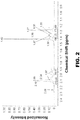
- the 1 H NMR spectrograph is shown in FIG. 2 .
- the peak centered at a chemical shift of ⁇ 1.95-1.97 ppm is believed to represent so-called isolated butadiene mer, i.e., butadiene mer that is not part of a block or microblock of butadiene mer and, instead, sandwiched by ethylene mer.
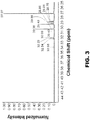
- the 13 C NMR spectrograph is shown in FIG. 3 .
- the peaks centered at chemical shifts of ⁇ 32.1 and ⁇ 32.2 ppm are believed to represent the presence of the same isolated butadiene mer discussed in the preceding paragraph.
- Example 10 The polymerization of Example 10 was modified by including 0.25 g 1,3-butadiene to the catalyst composition bottle prior to addition of the DIBAH solution.
- Table 3 Catalyst information and polymer properties 8 9 10 11* 12* 13* 14* 15* complex (IIb) (IIb) (IIb) (IIc) (IId) (IId) (IIe) (IIe) Amt. of complex, mmol 0.045 0.045 0.045 0.045 0.138 0.138 Amt. borate, mmol 0.0473 0.0473 0.0473 0.0473 0.0473 0.0473 0.0473 n/a n/a Amt.
- Table 4 Catalyst information and polymer properties, formula (IIf)-type complex 16 17 18 19 20 Amt. of complex, mmol 0.138 0.138 0.138 0.045 0.060 Amt. borate, mmol 0.145 0.145 0.145 0.0473 0.063 Amt. DIBAH, mmol 6.1 6.1 3.0 3.6 3.0 Catalyst aging time (min.) 0 0 0 15 15 Solvent hexane hexane hexane toluene toluene Amt. 1,3-BD (g), reactor 230 230 230 200 200 Polymerization temp. (°C) 100 100 100 100 85 85 Polymerization time, min.
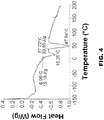
- a DSC plot over a temperature range of -150° to ⁇ 200°C for a 3.83 mg sample of the polymer of Example 16 is shown in FIG. 4 .
- the presence of distinct melting points indicates that the interpolymer includes blocks, and the location of the second one on the curve (T ⁇ 45°-50°C) tends to suggest a block that contains both butadiene and ethylene mer.
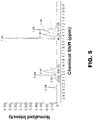
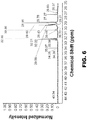
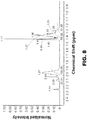
- the 1 H NMR and 13 C NMR spectrographs are shown in, respectively, FIGs. 5 and 6 .
- the large peaks at approximately the same chemical shifts discussed above in connection with FIGs. 2 and 3 are believed to indicate an extremely high level of isolated butadiene mer.
- Table 6 Catalyst information and polymer properties, formula (IIg)-type complex 21 22 Amt. of complex, mmol 0.045 0.138 Amt. borate, mmol 0.0473 0.145 Amt. DIBAH, mmol 3.6 6.1 Catalyst aging time (min.) 20 0 Solvent toluene hexane Amt. 1,3-BD (g), reactor 200 230 Polymerization temp. (°C) 80 100 Polymerization time, min. 60 120 Amt.
- Table 7 Catalyst information and polymer properties, formula (IIh)-type complex 23 24 25 Amt. of complex, mmol 0.045 0.138 0.138 Amt. borate, mmol 0.0473 0.210 0.145 Amt. DIBAH, mmol 3.6 6.1 6.1 Catalyst aging time (min.) 20 0 0 Solvent toluene hexane hexane Amt. 1,3-BD (g), reactor 200 230 230 Polymerization temp. (°C) 100 100 100 Polymerization time, min. 135 240 330 Amt.
- a DSC plot over a temperature range of -150° to ⁇ 200°C for a 4.08 mg sample of the polymer of Example 24 is shown in FIG. 7 .
- the presence of a relatively broad melting point at T ⁇ 40°-60°C indicates a block that contains both butadiene and ethylene mer, likely one that involves significant randomness and, perhaps, asymmetry.
- the 1 H NMR and 13 C NMR spectrographs are shown in, respectively, FIGs. 8 and 9 .
- the large peaks at approximately the same chemical shifts discussed above in connection with FIGs. 2 and 3 are believed to indicate an extremely high level of isolated butadiene mer.
Landscapes
- Chemical & Material Sciences (AREA)
- Organic Chemistry (AREA)
- Chemical Kinetics & Catalysis (AREA)
- Health & Medical Sciences (AREA)
- Medicinal Chemistry (AREA)
- Polymers & Plastics (AREA)
- Inorganic Chemistry (AREA)
- Engineering & Computer Science (AREA)
- Materials Engineering (AREA)
- Crystallography & Structural Chemistry (AREA)
- Transition And Organic Metals Composition Catalysts For Addition Polymerization (AREA)
- Addition Polymer Or Copolymer, Post-Treatments, Or Chemical Modifications (AREA)
- Compositions Of Macromolecular Compounds (AREA)
- Polymerization Catalysts (AREA)
- Graft Or Block Polymers (AREA)
Priority Applications (1)
| Application Number | Priority Date | Filing Date | Title |
|---|---|---|---|
| EP20184452.9A EP3738927A1 (en) | 2014-05-31 | 2015-05-26 | Metallic complex catalyst, polymerization methods employing same and polymer products thereof |
Applications Claiming Priority (3)
| Application Number | Priority Date | Filing Date | Title |
|---|---|---|---|
| US201462006119P | 2014-05-31 | 2014-05-31 | |
| US201562136302P | 2015-03-20 | 2015-03-20 | |
| PCT/US2015/032373 WO2015183781A1 (en) | 2014-05-31 | 2015-05-26 | Metallic complex catalyst, polymerization methods employing same and polymer products thereof |
Related Child Applications (1)
| Application Number | Title | Priority Date | Filing Date |
|---|---|---|---|
| EP20184452.9A Division EP3738927A1 (en) | 2014-05-31 | 2015-05-26 | Metallic complex catalyst, polymerization methods employing same and polymer products thereof |
Publications (3)
| Publication Number | Publication Date |
|---|---|
| EP3148938A1 EP3148938A1 (en) | 2017-04-05 |
| EP3148938A4 EP3148938A4 (en) | 2018-05-30 |
| EP3148938B1 true EP3148938B1 (en) | 2020-07-08 |
Family
ID=54699635
Family Applications (2)
| Application Number | Title | Priority Date | Filing Date |
|---|---|---|---|
| EP15800182.6A Active EP3148938B1 (en) | 2014-05-31 | 2015-05-26 | Metallic complex catalyst, polymerization methods employing same |
| EP20184452.9A Pending EP3738927A1 (en) | 2014-05-31 | 2015-05-26 | Metallic complex catalyst, polymerization methods employing same and polymer products thereof |
Family Applications After (1)
| Application Number | Title | Priority Date | Filing Date |
|---|---|---|---|
| EP20184452.9A Pending EP3738927A1 (en) | 2014-05-31 | 2015-05-26 | Metallic complex catalyst, polymerization methods employing same and polymer products thereof |
Country Status (7)
| Country | Link |
|---|---|
| US (2) | US10457765B2 (OSRAM) |
| EP (2) | EP3148938B1 (OSRAM) |
| JP (2) | JP6673596B2 (OSRAM) |
| CN (2) | CN106660819B (OSRAM) |
| BR (1) | BR112016027987B1 (OSRAM) |
| RU (3) | RU2723019C2 (OSRAM) |
| WO (1) | WO2015183781A1 (OSRAM) |
Families Citing this family (10)
| Publication number | Priority date | Publication date | Assignee | Title |
|---|---|---|---|---|
| JP6607615B2 (ja) | 2014-05-30 | 2019-11-20 | 株式会社ブリヂストン | 金属錯体触媒及びそれを用いた重合方法 |
| EP3680265B1 (en) * | 2017-09-04 | 2024-01-17 | Bridgestone Corporation | Method for producing copolymer, copolymer, rubber composition, and tire |
| WO2019191440A1 (en) | 2018-03-30 | 2019-10-03 | Dow Global Technologies Llc | Highly soluble bis-borate as binuclear co-catalysts for olefin polymerizations |
| JP7495880B2 (ja) * | 2018-03-30 | 2024-06-05 | ダウ グローバル テクノロジーズ エルエルシー | オレフィン重合のための助触媒としての高溶解性アルキル置換ホウ酸カルベニウム |
| JP7041585B2 (ja) * | 2018-05-21 | 2022-03-24 | 株式会社ブリヂストン | 重合触媒、及び、共重合体の製造方法 |
| JP7009307B2 (ja) * | 2018-05-21 | 2022-01-25 | 株式会社ブリヂストン | 重合触媒、及び、共重合体の製造方法 |
| EP4005782B1 (en) | 2020-11-25 | 2023-02-15 | Nidek Co., Ltd. | Dye-deposited base body manufacturing apparatus and dyeing system |
| JP7654963B2 (ja) | 2020-11-25 | 2025-04-02 | 株式会社ニデック | 染料付基体製造装置および染色システム |
| KR20250141250A (ko) | 2023-02-08 | 2025-09-26 | 엑손모빌 테크놀로지 앤드 엔지니어링 컴퍼니 | 공중합을 위한 촉매 |
| WO2024253829A1 (en) | 2023-06-06 | 2024-12-12 | ExxonMobil Technology and Engineering Company | Solution catalyst systems and uses thereof |
Citations (1)
| Publication number | Priority date | Publication date | Assignee | Title |
|---|---|---|---|---|
| EP3138860A1 (en) * | 2014-05-02 | 2017-03-08 | Bridgestone Corporation | Multiblock copolymer, rubber composition, and tire |
Family Cites Families (88)
| Publication number | Priority date | Publication date | Assignee | Title |
|---|---|---|---|---|
| JPS4926307B1 (OSRAM) * | 1970-06-10 | 1974-07-08 | ||
| US3978103A (en) | 1971-08-17 | 1976-08-31 | Deutsche Gold- Und Silber-Scheideanstalt Vormals Roessler | Sulfur containing organosilicon compounds |
| US3873489A (en) | 1971-08-17 | 1975-03-25 | Degussa | Rubber compositions containing silica and an organosilane |
| GB1423016A (en) * | 1972-12-20 | 1976-01-28 | Snam Progetti | Mono-olefin-conjugated diene copolymerisation using a ternary catalyst system |
| SU580840A3 (ru) | 1974-02-07 | 1977-11-15 | Дегусса (Фирма) | Способ получени серосодержащих кремнийорганических соединений |
| US4015061A (en) | 1975-02-14 | 1977-03-29 | The Firestone Tire & Rubber Company | Protected amino-functional initiators and amino-terminated polymers and their production |
| US4002594A (en) | 1975-07-08 | 1977-01-11 | Ppg Industries, Inc. | Scorch retardants for rubber reinforced with siliceous pigment and mercapto-type coupling agent |
| DE3021273A1 (de) * | 1979-06-12 | 1981-01-08 | Mitsubishi Petrochemical Co | Ungesaettigte mischpolymerisate |
| DE2943129A1 (de) * | 1979-10-25 | 1981-05-07 | Bayer Ag, 5090 Leverkusen | Alternierende isopren-ethylen-copolymere sowie ein verfahren zu ihrer herstellung |
| DE3017539A1 (de) * | 1980-05-08 | 1981-11-12 | Bayer Ag, 5090 Leverkusen | Verfahren zur herstellung von alternierenden butadien-propylen-copolymeren |
| US4616069A (en) | 1984-10-26 | 1986-10-07 | Nippon Zeon Co., Ltd. | Process for making diene polymer rubbers |
| US5191052A (en) * | 1985-06-21 | 1993-03-02 | Exxon Chemical Patents Inc. | Copolymers of ethylene and 1,3-butadiene |
| US4906706A (en) | 1986-09-05 | 1990-03-06 | Japan Synthetic Rubber Co., Ltd. | Modified conjugated diene polymer and process for production thereof |
| US5064910A (en) | 1986-09-05 | 1991-11-12 | Japan Synthetic Rubber Co., Ltd. | Preparation of conjugated diene polymers modified with an organo-tin or germanium halide |
| US4935471A (en) | 1987-10-15 | 1990-06-19 | The Goodyear Tire & Rubber Company | Capped polydienes |
| IT1230756B (it) | 1989-02-17 | 1991-10-29 | Enichem Elastomers | Metodo per la preparazione di polibutadiene a lavorabilita' migliorata. |
| US5196138A (en) | 1989-06-30 | 1993-03-23 | Cyprus Foote Mineral Company | Preparation of mixed lithium amide reagents |
| US5149457A (en) | 1989-06-30 | 1992-09-22 | Cyprus Foote Mineral Company | Stable mixed lithium amide reagent compositions |
| US5153159A (en) | 1990-04-09 | 1992-10-06 | Bridgestone/Firestone, Inc. | Elastomers and products having reduced hysteresis |
| US5329005A (en) | 1992-10-02 | 1994-07-12 | Bridgestone Corporation | Soluble anionic polymerization initiators and preparation thereof |
| BE1006438A3 (fr) * | 1992-12-17 | 1994-08-30 | Solvay | Systeme catalytique, utilisation de ce systeme catalytique pour la (co)polymerisation d'olefines, procede de preparation de ce systeme catalytique et procede de (co)polymerisation d'olefines. |
| WO1995004090A1 (en) | 1993-07-30 | 1995-02-09 | Nippon Zeon Co., Ltd. | Modified conjugated diene copolymer, process for producing the same, and composition thereof |
| WO1996020225A2 (en) * | 1994-12-20 | 1996-07-04 | Montell Technology Company B.V. | Reactor blend polypropylene, process for the preparation thereof and process for preparing metallocene ligands |
| US5567815A (en) | 1994-07-18 | 1996-10-22 | Bridgestone Corporation | Teritary amine containing antonic initiators used in preparing polymers and process for the preparation thereof |
| DE4436059A1 (de) | 1994-10-10 | 1996-04-11 | Bayer Ag | Verfahren zur Herstellung von mittels Nd-Katalysatoren polymerisierten Dienkautschuken mit niedrigem cold-flow und geringem Eigengeruch |
| US5521309A (en) | 1994-12-23 | 1996-05-28 | Bridgestone Corporation | Tertiary-amino allyl-or xylyl-lithium initiators and method of preparing same |
| US5496940A (en) | 1995-02-01 | 1996-03-05 | Bridgestone Corporation | Alkyllithium compounds containing cyclic amines and their use in polymerization |
| US5580919A (en) | 1995-03-14 | 1996-12-03 | The Goodyear Tire & Rubber Company | Silica reinforced rubber composition and use in tires |
| US5610227A (en) | 1995-06-07 | 1997-03-11 | Bridgestone/Firestone, Inc. | Lithium amino magnesiate polymerization initiators and elastomers having reduced hysteresis |
| US5583245A (en) | 1996-03-06 | 1996-12-10 | The Goodyear Tire & Rubber Company | Preparation of sulfur-containing organosilicon compounds |
| RU2178422C2 (ru) | 1996-03-27 | 2002-01-20 | Дзе Дау Кемикал Компани | Активатор катализаторов полимеризации олефинов, каталитическая система и способ полимеризации |
| US5663398A (en) | 1996-05-17 | 1997-09-02 | Fmc Corporation | Processes for preparing functionalized alkyllithium compounds |
| US5696197A (en) | 1996-06-21 | 1997-12-09 | The Goodyear Tire & Rubber Company | Heterogeneous silica carbon black-filled rubber compound |
| US5663396A (en) | 1996-10-31 | 1997-09-02 | The Goodyear Tire & Rubber Company | Preparation of sulfur-containing organosilicon compounds |
| US5786441A (en) | 1996-12-31 | 1998-07-28 | Bridgestone Corporation | Polymers, elastomeric compounds and products thereof, derived from novel amine compounds containing side-chain organolithium moieties |
| US5684171A (en) | 1997-02-11 | 1997-11-04 | The Goodyear Tire & Rubber Company | Process for the preparation of organosilicon polysulfide compounds |
| US5684172A (en) | 1997-02-11 | 1997-11-04 | The Goodyear Tire & Rubber Company | Process for the preparation of organosilicon polysulfide compounds |
| ES2198651T3 (es) | 1997-03-05 | 2004-02-01 | Jsr Corporation | Metodo para producir polimeros dieno conjugados. |
| TW420693B (en) | 1997-04-25 | 2001-02-01 | Mitsui Chemicals Inc | Olefin polymerization catalysts, transition metal compounds, and <alpha>-olefin/conjugated diene copolymers |
| US6525118B2 (en) | 1997-07-11 | 2003-02-25 | Bridgestone Corporation | Processability of silica-filled rubber stocks with reduced hysteresis |
| JP3577978B2 (ja) * | 1998-03-06 | 2004-10-20 | 住友化学工業株式会社 | エチレン−イソプレンランダム共重合体、エラストマー組成物及び架橋エラストマー組成物 |
| SG75157A1 (en) * | 1998-03-06 | 2000-09-19 | Sumitomo Chemical Co | Etylene-isoprene random copolymer |
| JP2001081143A (ja) * | 1999-09-17 | 2001-03-27 | Nippon Zeon Co Ltd | 共役ジエン単量体と極性ビニル単量体との交互共重合体および交互共重合体の製造方法 |
| FR2799468B1 (fr) | 1999-10-12 | 2006-04-28 | Michelin Soc Tech | Systeme catalytique utilisable pour la copolymerisation de l'ethylene et d'un diene conjugue, procede de preparation de ce systeme catalytique et d'un copolymere d'ethylene et d'un diene conjugue |
| CA2424815C (en) | 1999-11-12 | 2009-12-29 | Bridgestone Corporation | Modified polymers prepared with lanthanide-based catalysts |
| ES2261156T3 (es) | 1999-11-12 | 2006-11-16 | Jsr Corporation | Polimeros de dieno conjugado modificados, metodo para la produccion y composicion de caucho que comprende el mismo. |
| US6977281B1 (en) | 1999-11-12 | 2005-12-20 | Bridgestone Corporation | Modified polymers prepared with lanthanide-based catalysts |
| WO2002038615A1 (en) | 2000-11-10 | 2002-05-16 | Bridgestone Corporation | Functionalized high cis-1,4-polybutadiene prepared using novel functionalizing agents |
| MXPA01001160A (es) | 2001-01-31 | 2002-08-05 | Ct De Investigacion En Quimica | Poli(metacrilato de metilo) semicristalino con alta temperatura de fusion y proceso para su separacion. |
| WO2002060958A2 (en) | 2001-02-01 | 2002-08-08 | Fmc Corporation | Functionalized initiators for anionic polymerization, protected funtionalized polymers, deprotected analogues thereof, and methods of making the same |
| WO2004035639A1 (fr) | 2002-10-16 | 2004-04-29 | Societe De Technologie Michelin | Copolymères éthylène/ butadiène, system catalytique et les produires et production desdits polymers |
| US7153919B2 (en) | 2002-10-30 | 2006-12-26 | Bridgestone Corporation | Use of sulfur containing initiators for anionic polymerization of monomers |
| FR2858817B1 (fr) | 2003-08-13 | 2006-02-03 | Michelin Soc Tech | Systeme catalytique pour l'obtention de copolymeres diene(s) conjugue(s)/ mono-olefine(s) et ces copolymeres |
| EP3056523A1 (en) | 2004-03-02 | 2016-08-17 | Bridgestone Corporation | Bulk polymerization process |
| WO2005105867A1 (ja) * | 2004-04-28 | 2005-11-10 | Mitsui Chemicals, Inc. | 非共役ポリエン系共重合体、ゴム組成物およびこれらの用途 |
| KR101344592B1 (ko) * | 2004-07-02 | 2013-12-26 | 도꾸리쯔교세이호징 리가가쿠 겐큐소 | 메탈로센 착체를 포함하는 중합 촉매 조성물, 및 이를 이용하여 제조되는 중합체 |
| ES2533455T3 (es) | 2004-10-26 | 2015-04-10 | Bridgestone Corporation | Polímero funcionalizado con grupo enlazante |
| US7816483B2 (en) | 2005-08-11 | 2010-10-19 | Bridgestone Corporation | Amine functionalized polymer |
| JP5079294B2 (ja) | 2005-10-04 | 2012-11-21 | 株式会社ブリヂストン | アミンで官能化されたポリマー |
| US7879952B2 (en) | 2005-12-28 | 2011-02-01 | Bridgestone Corporation | Functionalized polymers |
| WO2007129670A1 (ja) | 2006-05-09 | 2007-11-15 | Riken | メタロセン錯体、およびそれを含む重合触媒組成物 |
| US7671138B2 (en) | 2006-05-26 | 2010-03-02 | Bridgestone Corporation | Polymers functionized with hydrobenzamides |
| US7732534B2 (en) | 2006-08-28 | 2010-06-08 | Bridgestone Corporation | Polymers functionalized with nitro compounds |
| US9456877B2 (en) * | 2006-12-01 | 2016-10-04 | Boston Scientific Scimed, Inc. | Direct drive instruments and methods of use |
| US8088868B2 (en) | 2006-12-19 | 2012-01-03 | Bridgestone Corporation | Polymers functionalized with protected oxime compounds |
| ZA200711158B (en) | 2006-12-28 | 2009-03-25 | Bridgestone Corp | A method for producing functionalized cis-1,4-polydienes having high cis-1,4-linkage content and high functionality |
| US7879958B2 (en) | 2007-08-07 | 2011-02-01 | Bridgestone Corporation | Polyhydroxy compounds as polymerization quenching agents |
| US8324329B2 (en) | 2007-08-07 | 2012-12-04 | Bridgestone Corporation | Process for producing functionalized polymers |
| CN101220060B (zh) | 2008-01-23 | 2012-08-29 | 中国科学院上海有机化学研究所 | 单茚基稀土配合物、合成方法以及应用 |
| JP2011524447A (ja) | 2008-06-18 | 2011-09-01 | ダウ グローバル テクノロジーズ エルエルシー | ポリマー組成物、該ポリマー組成物の作製方法及び該ポリマー組成物からの調製物 |
| US8183324B2 (en) | 2008-07-16 | 2012-05-22 | Japan Exlan Company Limited | Antistatic acrylic fiber and a method for manufacturing the same |
| US8513368B2 (en) * | 2009-03-30 | 2013-08-20 | Mitsui Chemicals, Inc. | Copolymer of olefin and conjugated diene, and process for producing the same |
| US8853339B2 (en) * | 2009-08-07 | 2014-10-07 | Bridgestone Corporation | Method for producing copolymer |
| EP2599805B1 (en) | 2010-07-30 | 2016-01-13 | Bridgestone Corporation | Copolymer of conjugated diene compounds and non-conjugated olefins, rubber composition, and tyre |
| JP5918132B2 (ja) | 2010-07-30 | 2016-05-18 | 株式会社ブリヂストン | 共役ジエン化合物と非共役オレフィンとの共重合体、ゴム組成物、架橋ゴム組成物、及びタイヤ |
| CN103154045B (zh) | 2010-07-30 | 2016-05-11 | 株式会社普利司通 | 共聚物及其制造方法 |
| US9074035B2 (en) | 2010-07-30 | 2015-07-07 | Bridgestone Corporation | Copolymer of conjugated diene compound and non-conjugated olefin, rubber composition, cross-linked rubber composition and tire |
| EP2599809B1 (en) | 2010-07-30 | 2015-09-23 | Bridgestone Corporation | Copolymer, rubber composition, cross-linked rubber composition, and tire |
| RU2528410C1 (ru) * | 2010-07-30 | 2014-09-20 | Бриджстоун Корпорейшн | Сополимер, каучуковая композиция, сшитая каучуковая композиция и покрышка |
| BR112013002290B1 (pt) * | 2010-07-30 | 2020-02-04 | Bridgestone Corp | método para controlar estrutura de cadeia de copolímeros |
| US10072146B2 (en) | 2010-12-30 | 2018-09-11 | Dow Global Technologies Llc | Compositions, methods of making the same, and articles prepared from the same |
| JP5731217B2 (ja) * | 2011-02-04 | 2015-06-10 | 株式会社ブリヂストン | 共重合体、ゴム組成物、架橋ゴム組成物、及びタイヤ |
| JP5932224B2 (ja) * | 2011-02-04 | 2016-06-08 | 株式会社ブリヂストン | 共重合体、ゴム組成物、架橋ゴム組成物、及びタイヤ |
| JP5722664B2 (ja) * | 2011-03-01 | 2015-05-27 | 株式会社ブリヂストン | 積層体 |
| US9422383B2 (en) | 2011-12-20 | 2016-08-23 | Dow Global Technologies Llc | Ethylene/alpha-olefin/nonconjugated polyene interpolymers and processes to form the same |
| JP6257613B2 (ja) * | 2012-06-29 | 2018-01-10 | ダウ グローバル テクノロジーズ エルエルシー | 熱可塑性加硫物のためのエチレン/αオレフィン/非共役ポリエン系組成物 |
| JP5902587B2 (ja) | 2012-08-20 | 2016-04-13 | 株式会社ブリヂストン | 共重合体の製造方法 |
| JP6607615B2 (ja) | 2014-05-30 | 2019-11-20 | 株式会社ブリヂストン | 金属錯体触媒及びそれを用いた重合方法 |
-
2015
- 2015-05-26 JP JP2017514996A patent/JP6673596B2/ja active Active
- 2015-05-26 US US15/315,011 patent/US10457765B2/en active Active
- 2015-05-26 WO PCT/US2015/032373 patent/WO2015183781A1/en not_active Ceased
- 2015-05-26 RU RU2019115933A patent/RU2723019C2/ru active
- 2015-05-26 CN CN201580040332.5A patent/CN106660819B/zh not_active Expired - Fee Related
- 2015-05-26 EP EP15800182.6A patent/EP3148938B1/en active Active
- 2015-05-26 BR BR112016027987-5A patent/BR112016027987B1/pt not_active IP Right Cessation
- 2015-05-26 RU RU2016147087A patent/RU2690373C2/ru active
- 2015-05-26 CN CN201910502320.XA patent/CN110283280B/zh not_active Expired - Fee Related
- 2015-05-26 EP EP20184452.9A patent/EP3738927A1/en active Pending
-
2019
- 2019-09-30 US US16/589,043 patent/US11124591B2/en active Active
- 2019-12-19 JP JP2019229141A patent/JP7187432B2/ja active Active
-
2020
- 2020-06-01 RU RU2020117998A patent/RU2020117998A/ru unknown
Patent Citations (1)
| Publication number | Priority date | Publication date | Assignee | Title |
|---|---|---|---|---|
| EP3138860A1 (en) * | 2014-05-02 | 2017-03-08 | Bridgestone Corporation | Multiblock copolymer, rubber composition, and tire |
Also Published As
| Publication number | Publication date |
|---|---|
| RU2019115933A3 (OSRAM) | 2019-08-12 |
| BR112016027987B1 (pt) | 2022-04-19 |
| RU2016147087A (ru) | 2018-05-30 |
| EP3738927A1 (en) | 2020-11-18 |
| JP2020041166A (ja) | 2020-03-19 |
| CN106660819A (zh) | 2017-05-10 |
| CN110283280B (zh) | 2022-11-04 |
| RU2019115933A (ru) | 2019-05-31 |
| US11124591B2 (en) | 2021-09-21 |
| EP3148938A4 (en) | 2018-05-30 |
| JP7187432B2 (ja) | 2022-12-12 |
| CN110283280A (zh) | 2019-09-27 |
| RU2690373C2 (ru) | 2019-06-03 |
| RU2020117998A (ru) | 2021-12-01 |
| US10457765B2 (en) | 2019-10-29 |
| JP6673596B2 (ja) | 2020-03-25 |
| JP2017516911A (ja) | 2017-06-22 |
| CN106660819B (zh) | 2019-06-28 |
| EP3148938A1 (en) | 2017-04-05 |
| US20170114170A1 (en) | 2017-04-27 |
| RU2723019C2 (ru) | 2020-06-08 |
| RU2016147087A3 (OSRAM) | 2018-12-11 |
| BR112016027987A2 (OSRAM) | 2017-08-22 |
| WO2015183781A1 (en) | 2015-12-03 |
| US20200031974A1 (en) | 2020-01-30 |
Similar Documents
| Publication | Publication Date | Title |
|---|---|---|
| US11124591B2 (en) | Ethylene interpolymer | |
| EP2673280B1 (en) | Metal complex catalysts and polymerization methods employing same | |
| JP6445629B2 (ja) | 有機金属触媒錯体及びこれを使用する重合方法 | |
| US9416205B2 (en) | Organometallic complex catalyst and polymerization method employing same | |
| EP2670759B1 (en) | Lanthanide complex catalyst and polymerization method employing same | |
| EP2670760B1 (en) | Lanthanide complex catalyst and polymerization method employing same | |
| EP3148937B1 (en) | Metallic complex catalyst and polymerization methods employing same | |
| EP3344667B1 (en) | Copolymerization of polyenes and alkenes |
Legal Events
| Date | Code | Title | Description |
|---|---|---|---|
| STAA | Information on the status of an ep patent application or granted ep patent |
Free format text: STATUS: THE INTERNATIONAL PUBLICATION HAS BEEN MADE |
|
| PUAI | Public reference made under article 153(3) epc to a published international application that has entered the european phase |
Free format text: ORIGINAL CODE: 0009012 |
|
| STAA | Information on the status of an ep patent application or granted ep patent |
Free format text: STATUS: REQUEST FOR EXAMINATION WAS MADE |
|
| 17P | Request for examination filed |
Effective date: 20161129 |
|
| AK | Designated contracting states |
Kind code of ref document: A1 Designated state(s): AL AT BE BG CH CY CZ DE DK EE ES FI FR GB GR HR HU IE IS IT LI LT LU LV MC MK MT NL NO PL PT RO RS SE SI SK SM TR |
|
| AX | Request for extension of the european patent |
Extension state: BA ME |
|
| DAV | Request for validation of the european patent (deleted) | ||
| DAX | Request for extension of the european patent (deleted) | ||
| RIC1 | Information provided on ipc code assigned before grant |
Ipc: C08F 4/52 20060101ALI20180226BHEP Ipc: C08F 210/02 20060101ALI20180226BHEP Ipc: C08F 236/06 20060101ALI20180226BHEP Ipc: C07F 7/10 20060101ALI20180226BHEP Ipc: C07F 17/00 20060101ALI20180226BHEP Ipc: C08F 4/54 20060101ALI20180226BHEP Ipc: C01F 17/00 20060101AFI20180226BHEP |
|
| A4 | Supplementary search report drawn up and despatched |
Effective date: 20180503 |
|
| RIC1 | Information provided on ipc code assigned before grant |
Ipc: C08F 4/54 20060101ALI20180425BHEP Ipc: C01F 17/00 20060101AFI20180425BHEP Ipc: C07F 17/00 20060101ALI20180425BHEP Ipc: C08F 210/02 20060101ALI20180425BHEP Ipc: C08F 4/52 20060101ALI20180425BHEP Ipc: C08F 236/06 20060101ALI20180425BHEP Ipc: C07F 7/10 20060101ALI20180425BHEP |
|
| STAA | Information on the status of an ep patent application or granted ep patent |
Free format text: STATUS: EXAMINATION IS IN PROGRESS |
|
| 17Q | First examination report despatched |
Effective date: 20190308 |
|
| GRAP | Despatch of communication of intention to grant a patent |
Free format text: ORIGINAL CODE: EPIDOSNIGR1 |
|
| STAA | Information on the status of an ep patent application or granted ep patent |
Free format text: STATUS: GRANT OF PATENT IS INTENDED |
|
| INTG | Intention to grant announced |
Effective date: 20200116 |
|
| GRAJ | Information related to disapproval of communication of intention to grant by the applicant or resumption of examination proceedings by the epo deleted |
Free format text: ORIGINAL CODE: EPIDOSDIGR1 |
|
| STAA | Information on the status of an ep patent application or granted ep patent |
Free format text: STATUS: EXAMINATION IS IN PROGRESS |
|
| GRAR | Information related to intention to grant a patent recorded |
Free format text: ORIGINAL CODE: EPIDOSNIGR71 |
|
| GRAS | Grant fee paid |
Free format text: ORIGINAL CODE: EPIDOSNIGR3 |
|
| STAA | Information on the status of an ep patent application or granted ep patent |
Free format text: STATUS: GRANT OF PATENT IS INTENDED |
|
| GRAA | (expected) grant |
Free format text: ORIGINAL CODE: 0009210 |
|
| STAA | Information on the status of an ep patent application or granted ep patent |
Free format text: STATUS: THE PATENT HAS BEEN GRANTED |
|
| INTC | Intention to grant announced (deleted) | ||
| AK | Designated contracting states |
Kind code of ref document: B1 Designated state(s): AL AT BE BG CH CY CZ DE DK EE ES FI FR GB GR HR HU IE IS IT LI LT LU LV MC MK MT NL NO PL PT RO RS SE SI SK SM TR |
|
| INTG | Intention to grant announced |
Effective date: 20200602 |
|
| REG | Reference to a national code |
Ref country code: CH Ref legal event code: EP Ref country code: AT Ref legal event code: REF Ref document number: 1288270 Country of ref document: AT Kind code of ref document: T Effective date: 20200715 |
|
| REG | Reference to a national code |
Ref country code: DE Ref legal event code: R096 Ref document number: 602015055520 Country of ref document: DE |
|
| REG | Reference to a national code |
Ref country code: IE Ref legal event code: FG4D |
|
| REG | Reference to a national code |
Ref country code: LT Ref legal event code: MG4D |
|
| REG | Reference to a national code |
Ref country code: AT Ref legal event code: MK05 Ref document number: 1288270 Country of ref document: AT Kind code of ref document: T Effective date: 20200708 |
|
| REG | Reference to a national code |
Ref country code: NL Ref legal event code: MP Effective date: 20200708 |
|
| PG25 | Lapsed in a contracting state [announced via postgrant information from national office to epo] |
Ref country code: FI Free format text: LAPSE BECAUSE OF FAILURE TO SUBMIT A TRANSLATION OF THE DESCRIPTION OR TO PAY THE FEE WITHIN THE PRESCRIBED TIME-LIMIT Effective date: 20200708 Ref country code: BG Free format text: LAPSE BECAUSE OF FAILURE TO SUBMIT A TRANSLATION OF THE DESCRIPTION OR TO PAY THE FEE WITHIN THE PRESCRIBED TIME-LIMIT Effective date: 20201008 Ref country code: GR Free format text: LAPSE BECAUSE OF FAILURE TO SUBMIT A TRANSLATION OF THE DESCRIPTION OR TO PAY THE FEE WITHIN THE PRESCRIBED TIME-LIMIT Effective date: 20201009 Ref country code: SE Free format text: LAPSE BECAUSE OF FAILURE TO SUBMIT A TRANSLATION OF THE DESCRIPTION OR TO PAY THE FEE WITHIN THE PRESCRIBED TIME-LIMIT Effective date: 20200708 Ref country code: NO Free format text: LAPSE BECAUSE OF FAILURE TO SUBMIT A TRANSLATION OF THE DESCRIPTION OR TO PAY THE FEE WITHIN THE PRESCRIBED TIME-LIMIT Effective date: 20201008 Ref country code: HR Free format text: LAPSE BECAUSE OF FAILURE TO SUBMIT A TRANSLATION OF THE DESCRIPTION OR TO PAY THE FEE WITHIN THE PRESCRIBED TIME-LIMIT Effective date: 20200708 Ref country code: AT Free format text: LAPSE BECAUSE OF FAILURE TO SUBMIT A TRANSLATION OF THE DESCRIPTION OR TO PAY THE FEE WITHIN THE PRESCRIBED TIME-LIMIT Effective date: 20200708 Ref country code: PT Free format text: LAPSE BECAUSE OF FAILURE TO SUBMIT A TRANSLATION OF THE DESCRIPTION OR TO PAY THE FEE WITHIN THE PRESCRIBED TIME-LIMIT Effective date: 20201109 Ref country code: ES Free format text: LAPSE BECAUSE OF FAILURE TO SUBMIT A TRANSLATION OF THE DESCRIPTION OR TO PAY THE FEE WITHIN THE PRESCRIBED TIME-LIMIT Effective date: 20200708 Ref country code: LT Free format text: LAPSE BECAUSE OF FAILURE TO SUBMIT A TRANSLATION OF THE DESCRIPTION OR TO PAY THE FEE WITHIN THE PRESCRIBED TIME-LIMIT Effective date: 20200708 |
|
| PG25 | Lapsed in a contracting state [announced via postgrant information from national office to epo] |
Ref country code: PL Free format text: LAPSE BECAUSE OF FAILURE TO SUBMIT A TRANSLATION OF THE DESCRIPTION OR TO PAY THE FEE WITHIN THE PRESCRIBED TIME-LIMIT Effective date: 20200708 Ref country code: LV Free format text: LAPSE BECAUSE OF FAILURE TO SUBMIT A TRANSLATION OF THE DESCRIPTION OR TO PAY THE FEE WITHIN THE PRESCRIBED TIME-LIMIT Effective date: 20200708 Ref country code: RS Free format text: LAPSE BECAUSE OF FAILURE TO SUBMIT A TRANSLATION OF THE DESCRIPTION OR TO PAY THE FEE WITHIN THE PRESCRIBED TIME-LIMIT Effective date: 20200708 Ref country code: IS Free format text: LAPSE BECAUSE OF FAILURE TO SUBMIT A TRANSLATION OF THE DESCRIPTION OR TO PAY THE FEE WITHIN THE PRESCRIBED TIME-LIMIT Effective date: 20201108 |
|
| PG25 | Lapsed in a contracting state [announced via postgrant information from national office to epo] |
Ref country code: NL Free format text: LAPSE BECAUSE OF FAILURE TO SUBMIT A TRANSLATION OF THE DESCRIPTION OR TO PAY THE FEE WITHIN THE PRESCRIBED TIME-LIMIT Effective date: 20200708 |
|
| REG | Reference to a national code |
Ref country code: DE Ref legal event code: R097 Ref document number: 602015055520 Country of ref document: DE |
|
| PG25 | Lapsed in a contracting state [announced via postgrant information from national office to epo] |
Ref country code: CZ Free format text: LAPSE BECAUSE OF FAILURE TO SUBMIT A TRANSLATION OF THE DESCRIPTION OR TO PAY THE FEE WITHIN THE PRESCRIBED TIME-LIMIT Effective date: 20200708 Ref country code: DK Free format text: LAPSE BECAUSE OF FAILURE TO SUBMIT A TRANSLATION OF THE DESCRIPTION OR TO PAY THE FEE WITHIN THE PRESCRIBED TIME-LIMIT Effective date: 20200708 Ref country code: EE Free format text: LAPSE BECAUSE OF FAILURE TO SUBMIT A TRANSLATION OF THE DESCRIPTION OR TO PAY THE FEE WITHIN THE PRESCRIBED TIME-LIMIT Effective date: 20200708 Ref country code: RO Free format text: LAPSE BECAUSE OF FAILURE TO SUBMIT A TRANSLATION OF THE DESCRIPTION OR TO PAY THE FEE WITHIN THE PRESCRIBED TIME-LIMIT Effective date: 20200708 Ref country code: SM Free format text: LAPSE BECAUSE OF FAILURE TO SUBMIT A TRANSLATION OF THE DESCRIPTION OR TO PAY THE FEE WITHIN THE PRESCRIBED TIME-LIMIT Effective date: 20200708 |
|
| PLBE | No opposition filed within time limit |
Free format text: ORIGINAL CODE: 0009261 |
|
| STAA | Information on the status of an ep patent application or granted ep patent |
Free format text: STATUS: NO OPPOSITION FILED WITHIN TIME LIMIT |
|
| PG25 | Lapsed in a contracting state [announced via postgrant information from national office to epo] |
Ref country code: AL Free format text: LAPSE BECAUSE OF FAILURE TO SUBMIT A TRANSLATION OF THE DESCRIPTION OR TO PAY THE FEE WITHIN THE PRESCRIBED TIME-LIMIT Effective date: 20200708 |
|
| 26N | No opposition filed |
Effective date: 20210409 |
|
| PG25 | Lapsed in a contracting state [announced via postgrant information from national office to epo] |
Ref country code: SK Free format text: LAPSE BECAUSE OF FAILURE TO SUBMIT A TRANSLATION OF THE DESCRIPTION OR TO PAY THE FEE WITHIN THE PRESCRIBED TIME-LIMIT Effective date: 20200708 |
|
| PG25 | Lapsed in a contracting state [announced via postgrant information from national office to epo] |
Ref country code: SI Free format text: LAPSE BECAUSE OF FAILURE TO SUBMIT A TRANSLATION OF THE DESCRIPTION OR TO PAY THE FEE WITHIN THE PRESCRIBED TIME-LIMIT Effective date: 20200708 |
|
| REG | Reference to a national code |
Ref country code: CH Ref legal event code: PL |
|
| GBPC | Gb: european patent ceased through non-payment of renewal fee |
Effective date: 20210526 |
|
| PG25 | Lapsed in a contracting state [announced via postgrant information from national office to epo] |
Ref country code: LI Free format text: LAPSE BECAUSE OF NON-PAYMENT OF DUE FEES Effective date: 20210531 Ref country code: MC Free format text: LAPSE BECAUSE OF FAILURE TO SUBMIT A TRANSLATION OF THE DESCRIPTION OR TO PAY THE FEE WITHIN THE PRESCRIBED TIME-LIMIT Effective date: 20200708 Ref country code: LU Free format text: LAPSE BECAUSE OF NON-PAYMENT OF DUE FEES Effective date: 20210526 Ref country code: CH Free format text: LAPSE BECAUSE OF NON-PAYMENT OF DUE FEES Effective date: 20210531 |
|
| REG | Reference to a national code |
Ref country code: BE Ref legal event code: MM Effective date: 20210531 |
|
| PG25 | Lapsed in a contracting state [announced via postgrant information from national office to epo] |
Ref country code: IE Free format text: LAPSE BECAUSE OF NON-PAYMENT OF DUE FEES Effective date: 20210526 Ref country code: GB Free format text: LAPSE BECAUSE OF NON-PAYMENT OF DUE FEES Effective date: 20210526 |
|
| PG25 | Lapsed in a contracting state [announced via postgrant information from national office to epo] |
Ref country code: BE Free format text: LAPSE BECAUSE OF NON-PAYMENT OF DUE FEES Effective date: 20210531 |
|
| PGFP | Annual fee paid to national office [announced via postgrant information from national office to epo] |
Ref country code: IT Payment date: 20220524 Year of fee payment: 8 |
|
| PG25 | Lapsed in a contracting state [announced via postgrant information from national office to epo] |
Ref country code: HU Free format text: LAPSE BECAUSE OF FAILURE TO SUBMIT A TRANSLATION OF THE DESCRIPTION OR TO PAY THE FEE WITHIN THE PRESCRIBED TIME-LIMIT; INVALID AB INITIO Effective date: 20150526 |
|
| PG25 | Lapsed in a contracting state [announced via postgrant information from national office to epo] |
Ref country code: CY Free format text: LAPSE BECAUSE OF FAILURE TO SUBMIT A TRANSLATION OF THE DESCRIPTION OR TO PAY THE FEE WITHIN THE PRESCRIBED TIME-LIMIT Effective date: 20200708 |
|
| P01 | Opt-out of the competence of the unified patent court (upc) registered |
Effective date: 20230531 |
|
| PGFP | Annual fee paid to national office [announced via postgrant information from national office to epo] |
Ref country code: DE Payment date: 20230519 Year of fee payment: 9 |
|
| PG25 | Lapsed in a contracting state [announced via postgrant information from national office to epo] |
Ref country code: MK Free format text: LAPSE BECAUSE OF FAILURE TO SUBMIT A TRANSLATION OF THE DESCRIPTION OR TO PAY THE FEE WITHIN THE PRESCRIBED TIME-LIMIT Effective date: 20200708 Ref country code: IT Free format text: LAPSE BECAUSE OF NON-PAYMENT OF DUE FEES Effective date: 20230526 |
|
| PG25 | Lapsed in a contracting state [announced via postgrant information from national office to epo] |
Ref country code: MT Free format text: LAPSE BECAUSE OF FAILURE TO SUBMIT A TRANSLATION OF THE DESCRIPTION OR TO PAY THE FEE WITHIN THE PRESCRIBED TIME-LIMIT Effective date: 20200708 |
|
| REG | Reference to a national code |
Ref country code: DE Ref legal event code: R119 Ref document number: 602015055520 Country of ref document: DE |
|
| PG25 | Lapsed in a contracting state [announced via postgrant information from national office to epo] |
Ref country code: DE Free format text: LAPSE BECAUSE OF NON-PAYMENT OF DUE FEES Effective date: 20241203 |
|
| PGFP | Annual fee paid to national office [announced via postgrant information from national office to epo] |
Ref country code: FR Payment date: 20250528 Year of fee payment: 11 |