EP3133441A1 - Folie für transparenten bildschirm, verfahren zur herstellung davon und transparenter bildschirm damit - Google Patents
Folie für transparenten bildschirm, verfahren zur herstellung davon und transparenter bildschirm damit Download PDFInfo
- Publication number
- EP3133441A1 EP3133441A1 EP15779560.0A EP15779560A EP3133441A1 EP 3133441 A1 EP3133441 A1 EP 3133441A1 EP 15779560 A EP15779560 A EP 15779560A EP 3133441 A1 EP3133441 A1 EP 3133441A1
- Authority
- EP
- European Patent Office
- Prior art keywords
- resin
- film
- transparent screen
- particles
- screen according
- Prior art date
- Legal status (The legal status is an assumption and is not a legal conclusion. Google has not performed a legal analysis and makes no representation as to the accuracy of the status listed.)
- Granted
Links
Images

Classifications
-
- G—PHYSICS
- G03—PHOTOGRAPHY; CINEMATOGRAPHY; ANALOGOUS TECHNIQUES USING WAVES OTHER THAN OPTICAL WAVES; ELECTROGRAPHY; HOLOGRAPHY
- G03B—APPARATUS OR ARRANGEMENTS FOR TAKING PHOTOGRAPHS OR FOR PROJECTING OR VIEWING THEM; APPARATUS OR ARRANGEMENTS EMPLOYING ANALOGOUS TECHNIQUES USING WAVES OTHER THAN OPTICAL WAVES; ACCESSORIES THEREFOR
- G03B21/00—Projectors or projection-type viewers; Accessories therefor
- G03B21/54—Accessories
- G03B21/56—Projection screens
- G03B21/60—Projection screens characterised by the nature of the surface
- G03B21/62—Translucent screens
-
- G—PHYSICS
- G02—OPTICS
- G02B—OPTICAL ELEMENTS, SYSTEMS OR APPARATUS
- G02B5/00—Optical elements other than lenses
- G02B5/02—Diffusing elements; Afocal elements
-
- B—PERFORMING OPERATIONS; TRANSPORTING
- B32—LAYERED PRODUCTS
- B32B—LAYERED PRODUCTS, i.e. PRODUCTS BUILT-UP OF STRATA OF FLAT OR NON-FLAT, e.g. CELLULAR OR HONEYCOMB, FORM
- B32B27/00—Layered products comprising a layer of synthetic resin
- B32B27/14—Layered products comprising a layer of synthetic resin next to a particulate layer
-
- B—PERFORMING OPERATIONS; TRANSPORTING
- B32—LAYERED PRODUCTS
- B32B—LAYERED PRODUCTS, i.e. PRODUCTS BUILT-UP OF STRATA OF FLAT OR NON-FLAT, e.g. CELLULAR OR HONEYCOMB, FORM
- B32B5/00—Layered products characterised by the non- homogeneity or physical structure, i.e. comprising a fibrous, filamentary, particulate or foam layer; Layered products characterised by having a layer differing constitutionally or physically in different parts
- B32B5/16—Layered products characterised by the non- homogeneity or physical structure, i.e. comprising a fibrous, filamentary, particulate or foam layer; Layered products characterised by having a layer differing constitutionally or physically in different parts characterised by features of a layer formed of particles, e.g. chips, powder or granules
-
- C—CHEMISTRY; METALLURGY
- C08—ORGANIC MACROMOLECULAR COMPOUNDS; THEIR PREPARATION OR CHEMICAL WORKING-UP; COMPOSITIONS BASED THEREON
- C08K—Use of inorganic or non-macromolecular organic substances as compounding ingredients
- C08K3/00—Use of inorganic substances as compounding ingredients
- C08K3/02—Elements
- C08K3/08—Metals
-
- C—CHEMISTRY; METALLURGY
- C08—ORGANIC MACROMOLECULAR COMPOUNDS; THEIR PREPARATION OR CHEMICAL WORKING-UP; COMPOSITIONS BASED THEREON
- C08K—Use of inorganic or non-macromolecular organic substances as compounding ingredients
- C08K3/00—Use of inorganic substances as compounding ingredients
- C08K3/18—Oxygen-containing compounds, e.g. metal carbonyls
- C08K3/20—Oxides; Hydroxides
- C08K3/22—Oxides; Hydroxides of metals
-
- C—CHEMISTRY; METALLURGY
- C08—ORGANIC MACROMOLECULAR COMPOUNDS; THEIR PREPARATION OR CHEMICAL WORKING-UP; COMPOSITIONS BASED THEREON
- C08K—Use of inorganic or non-macromolecular organic substances as compounding ingredients
- C08K3/00—Use of inorganic substances as compounding ingredients
- C08K3/30—Sulfur-, selenium- or tellurium-containing compounds
-
- C—CHEMISTRY; METALLURGY
- C09—DYES; PAINTS; POLISHES; NATURAL RESINS; ADHESIVES; COMPOSITIONS NOT OTHERWISE PROVIDED FOR; APPLICATIONS OF MATERIALS NOT OTHERWISE PROVIDED FOR
- C09D—COATING COMPOSITIONS, e.g. PAINTS, VARNISHES OR LACQUERS; FILLING PASTES; CHEMICAL PAINT OR INK REMOVERS; INKS; CORRECTING FLUIDS; WOODSTAINS; PASTES OR SOLIDS FOR COLOURING OR PRINTING; USE OF MATERIALS THEREFOR
- C09D101/00—Coating compositions based on cellulose, modified cellulose, or cellulose derivatives
- C09D101/08—Cellulose derivatives
- C09D101/10—Esters of organic acids
- C09D101/12—Cellulose acetate
-
- C—CHEMISTRY; METALLURGY
- C09—DYES; PAINTS; POLISHES; NATURAL RESINS; ADHESIVES; COMPOSITIONS NOT OTHERWISE PROVIDED FOR; APPLICATIONS OF MATERIALS NOT OTHERWISE PROVIDED FOR
- C09D—COATING COMPOSITIONS, e.g. PAINTS, VARNISHES OR LACQUERS; FILLING PASTES; CHEMICAL PAINT OR INK REMOVERS; INKS; CORRECTING FLUIDS; WOODSTAINS; PASTES OR SOLIDS FOR COLOURING OR PRINTING; USE OF MATERIALS THEREFOR
- C09D123/00—Coating compositions based on homopolymers or copolymers of unsaturated aliphatic hydrocarbons having only one carbon-to-carbon double bond; Coating compositions based on derivatives of such polymers
- C09D123/02—Coating compositions based on homopolymers or copolymers of unsaturated aliphatic hydrocarbons having only one carbon-to-carbon double bond; Coating compositions based on derivatives of such polymers not modified by chemical after-treatment
- C09D123/10—Homopolymers or copolymers of propene
- C09D123/12—Polypropene
-
- C—CHEMISTRY; METALLURGY
- C09—DYES; PAINTS; POLISHES; NATURAL RESINS; ADHESIVES; COMPOSITIONS NOT OTHERWISE PROVIDED FOR; APPLICATIONS OF MATERIALS NOT OTHERWISE PROVIDED FOR
- C09D—COATING COMPOSITIONS, e.g. PAINTS, VARNISHES OR LACQUERS; FILLING PASTES; CHEMICAL PAINT OR INK REMOVERS; INKS; CORRECTING FLUIDS; WOODSTAINS; PASTES OR SOLIDS FOR COLOURING OR PRINTING; USE OF MATERIALS THEREFOR
- C09D125/00—Coating compositions based on homopolymers or copolymers of compounds having one or more unsaturated aliphatic radicals, each having only one carbon-to-carbon double bond, and at least one being terminated by an aromatic carbocyclic ring; Coating compositions based on derivatives of such polymers
- C09D125/02—Homopolymers or copolymers of hydrocarbons
- C09D125/04—Homopolymers or copolymers of styrene
- C09D125/06—Polystyrene
-
- C—CHEMISTRY; METALLURGY
- C09—DYES; PAINTS; POLISHES; NATURAL RESINS; ADHESIVES; COMPOSITIONS NOT OTHERWISE PROVIDED FOR; APPLICATIONS OF MATERIALS NOT OTHERWISE PROVIDED FOR
- C09D—COATING COMPOSITIONS, e.g. PAINTS, VARNISHES OR LACQUERS; FILLING PASTES; CHEMICAL PAINT OR INK REMOVERS; INKS; CORRECTING FLUIDS; WOODSTAINS; PASTES OR SOLIDS FOR COLOURING OR PRINTING; USE OF MATERIALS THEREFOR
- C09D129/00—Coating compositions based on homopolymers or copolymers of compounds having one or more unsaturated aliphatic radicals, each having only one carbon-to-carbon double bond, and at least one being terminated by an alcohol, ether, aldehydo, ketonic, acetal, or ketal radical; Coating compositions based on hydrolysed polymers of esters of unsaturated alcohols with saturated carboxylic acids; Coating compositions based on derivatives of such polymers
- C09D129/14—Homopolymers or copolymers of acetals or ketals obtained by polymerisation of unsaturated acetals or ketals or by after-treatment of polymers of unsaturated alcohols
-
- C—CHEMISTRY; METALLURGY
- C09—DYES; PAINTS; POLISHES; NATURAL RESINS; ADHESIVES; COMPOSITIONS NOT OTHERWISE PROVIDED FOR; APPLICATIONS OF MATERIALS NOT OTHERWISE PROVIDED FOR
- C09D—COATING COMPOSITIONS, e.g. PAINTS, VARNISHES OR LACQUERS; FILLING PASTES; CHEMICAL PAINT OR INK REMOVERS; INKS; CORRECTING FLUIDS; WOODSTAINS; PASTES OR SOLIDS FOR COLOURING OR PRINTING; USE OF MATERIALS THEREFOR
- C09D133/00—Coating compositions based on homopolymers or copolymers of compounds having one or more unsaturated aliphatic radicals, each having only one carbon-to-carbon double bond, and at least one being terminated by only one carboxyl radical, or of salts, anhydrides, esters, amides, imides, or nitriles thereof; Coating compositions based on derivatives of such polymers
- C09D133/04—Homopolymers or copolymers of esters
- C09D133/06—Homopolymers or copolymers of esters of esters containing only carbon, hydrogen and oxygen, the oxygen atom being present only as part of the carboxyl radical
- C09D133/10—Homopolymers or copolymers of methacrylic acid esters
- C09D133/12—Homopolymers or copolymers of methyl methacrylate
-
- C—CHEMISTRY; METALLURGY
- C09—DYES; PAINTS; POLISHES; NATURAL RESINS; ADHESIVES; COMPOSITIONS NOT OTHERWISE PROVIDED FOR; APPLICATIONS OF MATERIALS NOT OTHERWISE PROVIDED FOR
- C09D—COATING COMPOSITIONS, e.g. PAINTS, VARNISHES OR LACQUERS; FILLING PASTES; CHEMICAL PAINT OR INK REMOVERS; INKS; CORRECTING FLUIDS; WOODSTAINS; PASTES OR SOLIDS FOR COLOURING OR PRINTING; USE OF MATERIALS THEREFOR
- C09D145/00—Coating compositions based on homopolymers or copolymers of compounds having no unsaturated aliphatic radicals in a side chain, and having one or more carbon-to-carbon double bonds in a carbocyclic or in a heterocyclic system; Coating compositions based on derivatives of such polymers
-
- C—CHEMISTRY; METALLURGY
- C09—DYES; PAINTS; POLISHES; NATURAL RESINS; ADHESIVES; COMPOSITIONS NOT OTHERWISE PROVIDED FOR; APPLICATIONS OF MATERIALS NOT OTHERWISE PROVIDED FOR
- C09D—COATING COMPOSITIONS, e.g. PAINTS, VARNISHES OR LACQUERS; FILLING PASTES; CHEMICAL PAINT OR INK REMOVERS; INKS; CORRECTING FLUIDS; WOODSTAINS; PASTES OR SOLIDS FOR COLOURING OR PRINTING; USE OF MATERIALS THEREFOR
- C09D167/00—Coating compositions based on polyesters obtained by reactions forming a carboxylic ester link in the main chain; Coating compositions based on derivatives of such polymers
- C09D167/02—Polyesters derived from dicarboxylic acids and dihydroxy compounds
-
- C—CHEMISTRY; METALLURGY
- C09—DYES; PAINTS; POLISHES; NATURAL RESINS; ADHESIVES; COMPOSITIONS NOT OTHERWISE PROVIDED FOR; APPLICATIONS OF MATERIALS NOT OTHERWISE PROVIDED FOR
- C09D—COATING COMPOSITIONS, e.g. PAINTS, VARNISHES OR LACQUERS; FILLING PASTES; CHEMICAL PAINT OR INK REMOVERS; INKS; CORRECTING FLUIDS; WOODSTAINS; PASTES OR SOLIDS FOR COLOURING OR PRINTING; USE OF MATERIALS THEREFOR
- C09D169/00—Coating compositions based on polycarbonates; Coating compositions based on derivatives of polycarbonates
-
- C—CHEMISTRY; METALLURGY
- C09—DYES; PAINTS; POLISHES; NATURAL RESINS; ADHESIVES; COMPOSITIONS NOT OTHERWISE PROVIDED FOR; APPLICATIONS OF MATERIALS NOT OTHERWISE PROVIDED FOR
- C09D—COATING COMPOSITIONS, e.g. PAINTS, VARNISHES OR LACQUERS; FILLING PASTES; CHEMICAL PAINT OR INK REMOVERS; INKS; CORRECTING FLUIDS; WOODSTAINS; PASTES OR SOLIDS FOR COLOURING OR PRINTING; USE OF MATERIALS THEREFOR
- C09D5/00—Coating compositions, e.g. paints, varnishes or lacquers, characterised by their physical nature or the effects produced; Filling pastes
- C09D5/006—Anti-reflective coatings
-
- G—PHYSICS
- G02—OPTICS
- G02B—OPTICAL ELEMENTS, SYSTEMS OR APPARATUS
- G02B1/00—Optical elements characterised by the material of which they are made; Optical coatings for optical elements
- G02B1/04—Optical elements characterised by the material of which they are made; Optical coatings for optical elements made of organic materials, e.g. plastics
-
- G—PHYSICS
- G02—OPTICS
- G02B—OPTICAL ELEMENTS, SYSTEMS OR APPARATUS
- G02B5/00—Optical elements other than lenses
- G02B5/02—Diffusing elements; Afocal elements
- G02B5/0205—Diffusing elements; Afocal elements characterised by the diffusing properties
- G02B5/0236—Diffusing elements; Afocal elements characterised by the diffusing properties the diffusion taking place within the volume of the element
- G02B5/0242—Diffusing elements; Afocal elements characterised by the diffusing properties the diffusion taking place within the volume of the element by means of dispersed particles
-
- G—PHYSICS
- G02—OPTICS
- G02B—OPTICAL ELEMENTS, SYSTEMS OR APPARATUS
- G02B5/00—Optical elements other than lenses
- G02B5/02—Diffusing elements; Afocal elements
- G02B5/0268—Diffusing elements; Afocal elements characterized by the fabrication or manufacturing method
-
- G—PHYSICS
- G03—PHOTOGRAPHY; CINEMATOGRAPHY; ANALOGOUS TECHNIQUES USING WAVES OTHER THAN OPTICAL WAVES; ELECTROGRAPHY; HOLOGRAPHY
- G03B—APPARATUS OR ARRANGEMENTS FOR TAKING PHOTOGRAPHS OR FOR PROJECTING OR VIEWING THEM; APPARATUS OR ARRANGEMENTS EMPLOYING ANALOGOUS TECHNIQUES USING WAVES OTHER THAN OPTICAL WAVES; ACCESSORIES THEREFOR
- G03B21/00—Projectors or projection-type viewers; Accessories therefor
- G03B21/54—Accessories
- G03B21/56—Projection screens
- G03B21/60—Projection screens characterised by the nature of the surface
-
- G—PHYSICS
- G09—EDUCATION; CRYPTOGRAPHY; DISPLAY; ADVERTISING; SEALS
- G09F—DISPLAYING; ADVERTISING; SIGNS; LABELS OR NAME-PLATES; SEALS
- G09F19/00—Advertising or display means not otherwise provided for
- G09F19/12—Advertising or display means not otherwise provided for using special optical effects
- G09F19/18—Advertising or display means not otherwise provided for using special optical effects involving the use of optical projection means, e.g. projection of images on clouds
-
- H—ELECTRICITY
- H04—ELECTRIC COMMUNICATION TECHNIQUE
- H04N—PICTORIAL COMMUNICATION, e.g. TELEVISION
- H04N5/00—Details of television systems
- H04N5/74—Projection arrangements for image reproduction, e.g. using eidophor
-
- B—PERFORMING OPERATIONS; TRANSPORTING
- B32—LAYERED PRODUCTS
- B32B—LAYERED PRODUCTS, i.e. PRODUCTS BUILT-UP OF STRATA OF FLAT OR NON-FLAT, e.g. CELLULAR OR HONEYCOMB, FORM
- B32B2264/00—Composition or properties of particles which form a particulate layer or are present as additives
- B32B2264/10—Inorganic particles
-
- B—PERFORMING OPERATIONS; TRANSPORTING
- B32—LAYERED PRODUCTS
- B32B—LAYERED PRODUCTS, i.e. PRODUCTS BUILT-UP OF STRATA OF FLAT OR NON-FLAT, e.g. CELLULAR OR HONEYCOMB, FORM
- B32B2264/00—Composition or properties of particles which form a particulate layer or are present as additives
- B32B2264/10—Inorganic particles
- B32B2264/105—Metal
-
- B—PERFORMING OPERATIONS; TRANSPORTING
- B32—LAYERED PRODUCTS
- B32B—LAYERED PRODUCTS, i.e. PRODUCTS BUILT-UP OF STRATA OF FLAT OR NON-FLAT, e.g. CELLULAR OR HONEYCOMB, FORM
- B32B2307/00—Properties of the layers or laminate
- B32B2307/40—Properties of the layers or laminate having particular optical properties
- B32B2307/412—Transparent
-
- C—CHEMISTRY; METALLURGY
- C08—ORGANIC MACROMOLECULAR COMPOUNDS; THEIR PREPARATION OR CHEMICAL WORKING-UP; COMPOSITIONS BASED THEREON
- C08K—Use of inorganic or non-macromolecular organic substances as compounding ingredients
- C08K3/00—Use of inorganic substances as compounding ingredients
- C08K3/02—Elements
- C08K3/08—Metals
- C08K2003/0806—Silver
-
- C—CHEMISTRY; METALLURGY
- C08—ORGANIC MACROMOLECULAR COMPOUNDS; THEIR PREPARATION OR CHEMICAL WORKING-UP; COMPOSITIONS BASED THEREON
- C08K—Use of inorganic or non-macromolecular organic substances as compounding ingredients
- C08K3/00—Use of inorganic substances as compounding ingredients
- C08K3/18—Oxygen-containing compounds, e.g. metal carbonyls
- C08K3/20—Oxides; Hydroxides
- C08K3/22—Oxides; Hydroxides of metals
- C08K2003/2206—Oxides; Hydroxides of metals of calcium, strontium or barium
-
- C—CHEMISTRY; METALLURGY
- C08—ORGANIC MACROMOLECULAR COMPOUNDS; THEIR PREPARATION OR CHEMICAL WORKING-UP; COMPOSITIONS BASED THEREON
- C08K—Use of inorganic or non-macromolecular organic substances as compounding ingredients
- C08K3/00—Use of inorganic substances as compounding ingredients
- C08K3/18—Oxygen-containing compounds, e.g. metal carbonyls
- C08K3/20—Oxides; Hydroxides
- C08K3/22—Oxides; Hydroxides of metals
- C08K2003/221—Oxides; Hydroxides of metals of rare earth metal
- C08K2003/2213—Oxides; Hydroxides of metals of rare earth metal of cerium
-
- C—CHEMISTRY; METALLURGY
- C08—ORGANIC MACROMOLECULAR COMPOUNDS; THEIR PREPARATION OR CHEMICAL WORKING-UP; COMPOSITIONS BASED THEREON
- C08K—Use of inorganic or non-macromolecular organic substances as compounding ingredients
- C08K3/00—Use of inorganic substances as compounding ingredients
- C08K3/18—Oxygen-containing compounds, e.g. metal carbonyls
- C08K3/20—Oxides; Hydroxides
- C08K3/22—Oxides; Hydroxides of metals
- C08K2003/2237—Oxides; Hydroxides of metals of titanium
-
- C—CHEMISTRY; METALLURGY
- C08—ORGANIC MACROMOLECULAR COMPOUNDS; THEIR PREPARATION OR CHEMICAL WORKING-UP; COMPOSITIONS BASED THEREON
- C08K—Use of inorganic or non-macromolecular organic substances as compounding ingredients
- C08K3/00—Use of inorganic substances as compounding ingredients
- C08K3/18—Oxygen-containing compounds, e.g. metal carbonyls
- C08K3/20—Oxides; Hydroxides
- C08K3/22—Oxides; Hydroxides of metals
- C08K2003/2244—Oxides; Hydroxides of metals of zirconium
-
- C—CHEMISTRY; METALLURGY
- C08—ORGANIC MACROMOLECULAR COMPOUNDS; THEIR PREPARATION OR CHEMICAL WORKING-UP; COMPOSITIONS BASED THEREON
- C08K—Use of inorganic or non-macromolecular organic substances as compounding ingredients
- C08K3/00—Use of inorganic substances as compounding ingredients
- C08K3/30—Sulfur-, selenium- or tellurium-containing compounds
- C08K2003/3045—Sulfates
-
- C—CHEMISTRY; METALLURGY
- C08—ORGANIC MACROMOLECULAR COMPOUNDS; THEIR PREPARATION OR CHEMICAL WORKING-UP; COMPOSITIONS BASED THEREON
- C08K—Use of inorganic or non-macromolecular organic substances as compounding ingredients
- C08K2201/00—Specific properties of additives
- C08K2201/002—Physical properties
- C08K2201/003—Additives being defined by their diameter
-
- C—CHEMISTRY; METALLURGY
- C08—ORGANIC MACROMOLECULAR COMPOUNDS; THEIR PREPARATION OR CHEMICAL WORKING-UP; COMPOSITIONS BASED THEREON
- C08K—Use of inorganic or non-macromolecular organic substances as compounding ingredients
- C08K2201/00—Specific properties of additives
- C08K2201/002—Physical properties
- C08K2201/005—Additives being defined by their particle size in general
-
- C—CHEMISTRY; METALLURGY
- C08—ORGANIC MACROMOLECULAR COMPOUNDS; THEIR PREPARATION OR CHEMICAL WORKING-UP; COMPOSITIONS BASED THEREON
- C08K—Use of inorganic or non-macromolecular organic substances as compounding ingredients
- C08K2201/00—Specific properties of additives
- C08K2201/011—Nanostructured additives
Definitions
- the present invention relates to a film for a highly transparent projection type image display screen (hereinafter, referred to as "a film for a transparent screen").
- a film for a transparent screen also relates to a method for manufacturing the film for a transparent screen and a transparent screen comprising the film.
- a screen having a recess on its surface is proposed (see Patent Document 1).
- a transmission type screen comprising a transparent thin film layer including diamond microparticles having a median diameter of 0.01 to 1 ⁇ m obtained by subjecting nanodiamond having a graphite phase obtained by an exposure method to an oxidation treatment is proposed (see Patent Document 2).
- a film for a highly transparent reflection type screen composed of a polymer film composed of a matrix phase and a disperse phase containing a thermoplastic resin is proposed (see
- Patent Document 3
- Patent Document 4 In order to prevent a reflection on the surface of a variety of screens such as a transmission type screen or a reflection type screen, it is proposed that an antiglare member having an antiglare layer composed of black microparticles and a transparent binder is disposed on the surface of such screens (see Patent Document 4). Further, in order to prevent a decrease in the contrast, it is proposed to provide a transmission type screen on which a condenser is provided (Patent Document 5). Still further, it is proposed to provide a reflection type screen comprising a substrate, an optical absorbing layer, an optical multilayer film, and an optical diffusion layer in the order mentioned (see Patent Document 6).
- Patent Documents 1 to 6 When a screen described in Patent Document 1 is applied to a transparent partition or the like of a show window or an event venue, there is a technical problem that the screen cannot maintain the performance for a long period of time since the concavoconvex portion wears with its usage. There is also a technical problem that a film clouds and the transparency is compromised since the diameter of optical diffusion particles is 1 to 20 ⁇ m. Nanodiamond particles used for a transparent screen described in Patent Document 2 have a technical problem that many treatment processes are required, resulting in reduced production efficiency or deteriorated production cost.
- a screen described in Patent Document 3 is obtained by stretching in at least one direction in order to exhibit the anisotropy of refraction.
- the stretching for exhibiting the anisotropy of refraction has a technical problem that the property in a direction perpendicular to a drawing direction may be nonuniform, and a further improvement is desired.
- a screen described in Patent Document 4 has a technical problem that the transparency is poor and the screen is grayish due to an influence of a carbon black since the screen comprises an antiglare member including black microparticles such as a carbon black having an average particle size of 1 to 6 ⁇ m.
- black microparticles such as a carbon black having an average particle size of 1 to 6 ⁇ m.
- a transmission type screen described in Patent Document 5 comprises a condenser.
- a reflection type screen described in Patent Document 6 comprises an optical multilayer film formed by layering a low refractive index layer made of a fluorine resin and a high refractive index layer containing a metal oxide, and there is a technical problem that a light reflects on the interface of these layers, which compromises the transparency.
- the present invention has been made in view of the above-described technical problems, and an object of the present invention is to provide a film for a transparent screen which can clearly display merchandise information, advertisement, or the like on a transparent partition or the like by projection without compromising the transmission visibility.
- An object of the present invention is to provide a method for manufacturing the film for a transparent screen, and a transparent screen comprising the film.
- the present inventors intensively studied to find that the above described technical problems can be solved by adding a small amount of inorganic particles having the median diameter and the maximum particle size of primary particles in specified ranges to a resin layer.
- the present invention has been completed based on such findings.
- a film for a transparent screen comprising:
- the inorganic particles are metal particles.
- the inorganic particles are at least one selected from the group consisting of zirconium oxide particles, titanium oxide particles, cerium oxide particles, barium titanate particles, barium sulfate particles, and silver particles.
- the resin layer comprises a thermoplastic resin.
- the thermoplastic resin comprises at least one selected from the group consisting of an acrylic resin, a polyester resin, a polyolefin resin, a cellulose resin, a vinyl resin, a polycarbonate resin, and a polystyrene resin.
- the thermoplastic resin comprises at least one selected from the group consisting of a polymethyl methacrylate resin, a polyethylene terephthalate resin, a polyethylene naphthalate resin, a polypropylene resin, a cycloolefin polymer resin, a cellulose acetate propionate resin, a polyvinyl butyral resin, a polycarbonate resin, and a polystyrene resin.
- the total light transmittance of the film for a transparent screen is 70% or higher, and the haze value thereof is from 1.3% to 35%.
- the image clarity of the film for a transparent screen is 70% or higher.
- the thickness of the resin layer is from 20 to 400 ⁇ m.
- a transparent screen comprising the film for a transparent screen described above.
- a layered body comprising the transparent screen described above.
- a member for a vehicle comprising the transparent screen described above.
- a member for a house comprising the transparent screen described above.
- an image projection device comprising the transparent screen described above and a projection device.
- a method for manufacturing the film for a transparent screen described above comprising:
- the twin-screw kneading extruder comprises a flight screw including at least one mixing and kneading element selected from the group consisting of a kneading element, a mixing element, and a rotary element.
- a method for manufacturing the film for a transparent screen described above comprising:
- the step of kneading and/or the step of forming a film are performed by using a single- or twin- screw kneading extruder.
- a film for a transparent screen which can clearly display merchandise information, advertisement, or the like on a transparent partition or the like by projection without compromising the transmission visibility can be provided. Since such a film for a transparent screen has excellent transparency or image clarity, it can be suitably used as a transparent screen. Further, a transparent screen comprising the film can be provided, and can be suitably used for a windshield or side glass of a vehicle, a window glass for housing, or the like.
- a film for a transparent screen according to the present invention comprises a resin layer and inorganic particles at least a portion of which is contained in an aggregated state.
- the film can be suitably used as a film to be stuck to a transparent partition, a glass for a vehicle, a glass for housing, or the like, and such a transparent partition, a glass for a vehicle, a glass for housing, or the like can be suitably used as a transparent screen. Since it is demanded that the transmission visibility of a transparent screen such as a transparent partition, a glass for a vehicle, or a glass for housing be not compromised, preferably, the transmittance of a film for a transparent screen for a visible light is high and the transparency thereof is high.
- the term "transparent” includes "translucent" which can attain a transmission visibility depending on applications.
- the total light transmittance of a film for a transparent screen is preferably 70% or higher, more preferably 75% or higher, further preferably 80% or higher, and still more preferably 85% or higher, and the haze value thereof is preferably from 1.3% to less than 35%, and more preferably from 1.5% to less than 30%.
- the parallel light transmittance of a film for a transparent screen is preferably 60% or higher, more preferably 65% or higher.
- the total light transmittance, the parallel light transmittance, and the haze value of a film for a transparent screen can be measured by using a haze meter (manufactured by NIPPON DENSHOKU INDUSTRIES CO., LTD., trade name: NDH-5000) in accordance with JIS-K-7361 and JIS-K-7136.
- a haze meter manufactured by NIPPON DENSHOKU INDUSTRIES CO., LTD., trade name: NDH-5000
- the image clarity of a film for a transparent screen is preferably 70% or higher, more preferably 75% or higher, further preferably 80% or higher, still more preferably 85% or higher, and particularly preferably 90% or higher.
- the image clarity of the film for a transparent screen is in the above-described range, an image appeared through such a transparent screen is considerably clear.
- the image clarity is a value of definition (%) when measured with an optical comb having a width of 0.125 mm in accordance with JIS K7374.
- FIG. 1 is a schematic diagram illustrating one embodiment of a film for a transparent screen according to the present invention.
- a film for a transparent screen 10 comprises a resin layer 11 and inorganic particles 12 at least a portion of which is present in the resin layer 11 in an aggregated state.
- the film for a transparent screen may have a monolayer configuration composed of a resin layer or may have a layered body configuration having a plurality of layers further comprising a protection layer, a backing layer, and an adhesive layer.
- FIG. 2 is a cross-sectional view in the thickness direction of one embodiment of a film for a transparent screen having such a configuration of a plurality of layers.
- a resin layer 21 is layered on one surface of a backing layer 23, and a protection layer 22 is further layered on the resin layer 21.
- An adhesive layer 24 is layered on the other surface (the surface opposite to the resin layer 21) of the backing layer 23.
- a highly transparent resin is preferably used in order to obtain a highly transparent film.
- a thermoplastic resin, a thermoset resin, an ionizing radiation-curable resin, and the like can be used.
- the highly transparent resin include an acrylic resin, an acrylic urethane resin, a polyester acrylate resin, a polyurethane acrylate resin, an epoxy acrylate resin, a polyester resin, a polyolefin resin, a urethane resin, an epoxy resin, a polycarbonate resin, a cellulose resin, an acetal resin, a vinyl resin, a polystyrene resin, a polyamide resin, a polyimide resin, a melamine resin, a phenol resin, a silicone resin, and a fluorocarbon resin.
- thermoplastic resin is preferably used from the viewpoint of the formability of a film.
- thermoplastic resins preferably, an acrylic resin, a polyester resin, a polyolefin resin, a cellulose resin, a vinyl resin, a polycarbonate resin, and a polystyrene resin are used, and more preferably, a polymethyl methacrylate resin, a polyethylene terephthalate resin, a polyethylene naphthalate resin, a polypropylene resin, a cycloolefin polymer resin, a cellulose acetate propionate resin, a polyvinyl butyral resin, a polycarbonate resin, and a polystyrene resin are used. These resins may be used singly, or in combination of two or more kinds thereof.
- the ionizing radiation-curable resin examples include an acrylic resin, a urethane resin, an acrylic urethane resin, an epoxy resin, and a silicone resin.
- those having an acrylate functional group for example, those containing a relatively large amount of a monofunctional monomer such as ethyl (meth)acrylate, ethylhexyl (meth)acrylate, styrene, methyl styrene, N-vinylpyrrolidone and a polyfunctional monomer, such as polymethylolpropane tri(meth)acrylate, hexane diol (meth)acrylate, tripropylene glycol di(meth)acrylate, diethylene glycol di(meth)acrylate, pentaerythritol tri(meth)acrylate, dipentaerythritol hexa(meth)acrylate, 1,6-hexane diol di(meth)acrylate, neopen
- thermoset resin examples include a phenol resin, an epoxy resin, a silicone resin, a melamine resin, a urethane resin, and a urea resin.
- an epoxy resin and a silicone resin are preferable.
- the thickness of the resin layer is not particularly restricted, and from the viewpoint of the formability, the handleability, and the conveyability of a film, the thickness is preferably from 20 to 400 ⁇ m, and more preferably from 50 to 300 ⁇ m when the resin layer is a monolayer. When the thickness of the resin layer is in the above-described range, the strength of the film is likely to be maintained and the film is likely to be wound in a manufacturing process.
- the film may be a layered body in which two or more resin layers are layered, and the thickness of the layered body is preferably from 40 ⁇ m to 10 m.
- An aggregated state is a state in which, for example, a plurality of, preferably from 2 to about 20, and more preferably from 3 to about 15 primary particles of the inorganic particles in the resin layer are aggregated and bonded to each other.
- such inorganic particles are aggregated in a shape of a bunch of grave or a pearl necklace.
- the primary particles of the inorganic particles have a median diameter (D 50 ) of from 0.1 to 50 nm, preferably from 0.5 to 40 nm, more preferably from 1 to 35 nm, and further preferably from 1.5 to 30 nm, and have a maximum particle size of from 10 to 500 nm, preferably from 15 to 300 nm, more preferably from 20 to 200 nm, and further preferably from 20 to 130 nm.
- D 50 median diameter
- the median diameter and the maximum particle size of the primary particles of the inorganic particles in the above-described ranges, when a film is used as a film for a transparent screen, an effect of sufficiently scattering a projection light without compromising the transmission visibility is obtained, thereby displaying merchandise information, advertisement, or the like on a transparent partition or the like by projection.
- the median diameter (D 50 ) and the maximum particle size of the primary particles of the inorganic particles can be determined from a particle size distribution measured using a particle size distribution measurement apparatus (manufactured by Otsuka Electronics Co., Ltd., trade name: DLS-8000) by a dynamic light scattering method.
- the content of the inorganic particles in the resin layer is, with respect to the resin, from 0.015 to 1.2% by mass, preferably from 0.02 to 1.1% by mass, more preferably from 0.05 to 1.0% by mass, and further preferably from 0.1 to 0.8% by mass.
- the content of the inorganic particles in the resin layer in the above-described range, when the film is used as a film for a transparent screen, an effect of sufficiently scattering a projection light without compromising the transmission visibility is obtained, thereby displaying information, advertisement, an image, or the like on a transparent partition, a glass for a vehicle, a glass for housing or the like by projection.
- inorganic particles is contained in a resin layer in an aggregated state, whereby a projection light forms an image on the film.
- a projection light forms an image on the film.
- the median diameter of the inorganic particles is from several hundreds nm to several ⁇ m, or the maximum particle size is several ⁇ m, the film clouds, and a formed image becomes unclear. Further, when the content of inorganic particles is 1.5% by mass or more, the film clouds, and a formed image becomes unclear.
- the content of inorganic particles is 0.01% by mass or less, an effect of sufficiently scattering a projection light is not obtained, and an image is less likely to be formed on the film. Therefore, in the present invention, when a resin layer constituting the film contains a specific amount of inorganic particles having a median diameter and a maximum particle size in specified ranges, an effect of sufficiently scattering a projection light without compromising the transmission visibility can be obtained. For this reason, the surface of the film according to the present invention needs not be subjected to a post-treatment such as a molding treatment in order to obtain an effect of sufficiently scattering a projection light, and the film according to the present invention is excellent from the viewpoint of the manufacturing cost.
- inorganic particles an inorganic matter which can be atomized in a nano size may be used.
- inorganic particles preferably, inorganic particles excepting carbon particles, and more preferably metal particles are used.
- carbon particles refer to microparticles having carbon such as carbon black or diamond particles as a main component.
- metal particles those obtained by pulverizing a metal oxide or a substance other than metal oxide are used.
- the metal oxide include zirconium oxide, titanium oxide, oxidation zinc, oxidation aluminum, and cerium oxide.
- the substance other than metal oxide include an alloy such as barium titanate, a pure metal such as silver, gold, platinum, and palladium, and barium sulfate.
- zirconium oxide particles, titanium oxide particles, cerium oxide particles, barium titanate particles, barium sulfate particles, and silver particles are preferably used.
- zirconium oxide particles, titanium oxide particles, cerium oxide particles, and barium titanate particles are more preferably used.
- inorganic particles commercially available inorganic particles may be used, and for the zirconium oxide particles, SZR-W, SZR-CW, SZR-M, SZR-K, and the like (the above, manufactured by SAKAI CHEMICAL INDUSTRY CO.,LTD., trade name) can be suitably used.
- additives may be added in addition to the inorganic particles depending on applications.
- the additives include an antioxidant, an ultraviolet absorber, a light stabilizer, an antistatic agent, a release agent, a flame retardant, a plasticizer, a lubricant, and a color material.
- a color material a pigment or dye such as carbon black, azo pigment, anthraquinone pigment, or perinone pigment can be used.
- a liquid crystalline compound or the like may be mixed thereto.
- a backing layer is a layer for supporting a resin layer described above, which can improve the strength of a film for a transparent screen.
- a backing layer is preferably formed by using a highly transparent material such as a glass or a resin, which does not compromise the transmission visibility or the desired optical property of a film for a transparent screen.
- a highly transparent resin similar to the resin layer described above can be used.
- a composite film or sheet formed by layering two or more resin described above may be used.
- the thickness of the backing layer can be appropriately changed depending on the type of the material so that the strength thereof is suitable, and the thickness may be, for example, in the range of from 10 to 1000 ⁇ m.
- a protection layer is layered on the front side (observer side) of a film for a transparent screen, and is a layer for imparting a function such as a light resistance, a scratch resistance, and a stain resistance.
- the protection layer is preferably formed by using a resin which does not compromise the transmission visibility or the desired optical property of a film for a transparent screen.
- a resin for example, a resin cured by an ultraviolet light or electron ray, i.e., an ionizing radiation-curable resin, a mixture obtained by adding a thermoplastic resin and a solvent to an radiation curable resin, and a heat setting resin.
- an ionizing radiation-curable resin is particularly preferable.
- a film forming component of the ionizing radiation-curable resin composition preferably, those having an acrylate functional group, for example, those containing a relatively large amount of a monofunctional monomer such as ethyl (meth)acrylate, ethylhexyl (meth)acrylate, styrene, methyl styrene, N -vinylpyrrolidone and a polyfunctional monomer, such as polymethylolpropane tri(meth)acrylate, hexane diol (meth)acrylate, tripropylene glycol di(meth)acrylate, diethylene glycol di(meth)acrylate, pentaerythritol tri(meth)acrylate, dipentaerythritol hexa(meth)acrylate, 1,6-hexane diol di(meth)acrylate, neopentyl glycol di(meth)acrylate as an oligomer or a prepo
- acetophenones, benzophenons, Michler's benzoyl benzoates, ⁇ -amidoxime esters, tetramethyl thiuram monosulfides, and thioxanthones as photopolymerization initiators, and n -butyl amine, triethylamine, and poly- n -butylphosphine as photosensitizers may be added thereto to be used.
- a urethane acrylate as an oligomer and a dipentaerythritol hexa(meth)acrylate or the like as a monomer are preferably mixed.
- An ionizing radiation-curable resin composition can be cured by irradiation of an electron beam or an ultraviolet light using a normal curing method as a curing method.
- a normal curing method as a curing method.
- an electron beam having an energy of 50 to 1000KeV, and preferably 100 to 300KeV released from a variety of electron beam accelerators such as Cockcroft-Walton-type, Van de Graaff-type, resonance transformer-type, insulating core transformer-type, linear-type, Dynamitron-type, and high-frequency-type is used
- a ultraviolet light or the like emitted from a light beam such as an ultra-high pressure mercury lamp, a high pressure mercury lamp, a low pressure mercury lamp, a carbon arc, a xenon arc, and a metal halide lamp can be used.
- a protection layer can be formed by apply a coating of the above-described ionizing radiation (ultraviolet light)-curable resin composition on the surface of the above-described resin layer by a method such as spin coating, die coating, dip coating, bar coating, flow coating, roll coating, or gravure coating, and by curing the coating by the above-described means.
- a microstructure such as a concavoconvex structure, a prism structure, or a microlens structure can also be provided depending on the purposes.
- An adhesive layer is a layer for sticking a film to a transparent screen.
- the adhesive layer is preferably formed by using an adhesive composition which does not compromise the transmission visibility or the desired optical property of a film for a transparent screen.
- the adhesive composition include a natural rubber, a synthetic rubber, an acryl resin, a polyvinyl ether resin, a urethane resin, and a silicone resin.
- the synthetic rubber examples include a styrene-butadiene rubber, an acrylonitrile-butadiene rubber, a polyisobutylene rubber, an isobutylene-isoprene rubber, a styrene-isoprene block copolymer, a styrene-butadiene block copolymer, and a styrene-ethylene-butylene block copolymer.
- Specific examples of the silicone resin include a dimethyl polysiloxane.
- An acrylic resin adhesive at least includes an alkyl (meth)acrylate monomer and is formed by polymerization. Copolymerization of an alkyl (meth)acrylate monomer having an alkyl group having the number of carbon atoms of 1 to about 18 and a monomer having a carboxyl group is usually employed.
- a (meth)acrylic acid means an acrylic acid and/or a methacrylic acid.
- alkyl (meth)acrylate monomer examples include methyl (meth)acrylate, ethyl (meth)acrylate, n -propyl (meth)acrylate, sec -propyl (meth)acrylate, n -butyl (meth)acrylate, sec -butyl (meth)acrylate, tert -butyl (meth)acrylate, isoamyl (meth)acrylate, n -hexyl (meth)acrylate, cyclohexyl (meth)acrylate, n -octyl (meth)acrylate, isooctyl (meth)acrylate, 2-ethylhexyl (meth)acrylate, undecyl (meth)acrylate, and lauryl (meth)acrylate.
- the above-described alkyl (meth)acrylate is usually copolymerized at a ratio of 30 to 99.5 parts by mass in the acrylic adhesive.
- Examples of the monomer having a carboxyl group forming an acrylic resin adhesive include a monomer containing a carboxyl group such as a (meth)acrylic acid, an itaconic acid, a crotonic acid, a maleic acid, a monobutyl maleate, and ⁇ -carboxyl ethyl acrylate.
- a monomer containing a carboxyl group such as a (meth)acrylic acid, an itaconic acid, a crotonic acid, a maleic acid, a monobutyl maleate, and ⁇ -carboxyl ethyl acrylate.
- a monomer having another functional group other than the above may be copolymerized as long as the property of the acrylic resin adhesive is not compromised.
- the monomer having another functional group include: a monomer having a functional group such as a monomer containing a hydroxyl group such as 2-hydroxyethyl (meth)acrylate, 2-hydroxy propyl (meth)acrylate, and allyl alcohol; a monomer containing an amide group such as (meth)acrylamide, N -methyl(meth)acrylamide, and N -ethyl (meth)acrylamide; a monomer containing a methylol group and an amide group such as N -methylol (meth)acrylamide and dimethylol (meth)acrylamide; a monomer containing an amino group such as aminomethyl (meth)acrylate, dimethylamino ethyl (meth)acrylate, and vinyl pyridine; a monomer containing an epoxy group such as allyl gly
- Examples of the monomer having another functional group other than the above include fluorine substituted alkyl (meth)acrylate, (meth)acrylonitrile, an aromatic compound containing a vinyl group such as styrene and methyl styrene, vinyl acetate, a halogenated vinyl compound.
- the acrylic resin adhesive other than the monomer having a functional group as described above, another monomer having an ethylenic double bond can be used.
- the monomer having an ethylenic double bond include a diester of an ⁇ , ⁇ -unsaturated dibasic acid such as dibutyl maleate, dioctyl maleate, or dibutyl fumarate; a vinyl ester such as vinyl acetate, vinyl propionate; vinyl ether; a vinyl aromatic compound such as styrene, ⁇ -methyl styrene, and vinyl toluene; and (meth)acrylonitrile.
- a compound having two or more ethylenic double bonds may be used in combination.
- examples of such a compound include divinylbenzene, diallyl maleate, diallyl phthalate, ethylene glycol di(meth)acrylate, trimethylol propane tri(meth)acrylate, and methylene bis(meth)acrylamide.
- alkoxyalkyl (meth)acrylate examples include 2-methoxyethyl (meth)acrylate, methoxyethyl (meth)acrylate, 2-methoxypropyl (meth)acrylate, 3-methoxypropyl (meth)acrylate, 2-methoxybutyl (meth)acrylate, 4-methoxybutyl (meth)acrylate, 2-ethoxyethyl (meth)acrylate, 3-ethoxypropyl (meth)acrylate, and 4-ethoxybutyl (meth)acrylate.
- a homopolymer of a alkyl (meth)acrylate monomer may also be used.
- the (meth)acrylate homopolymer include methyl poly(meth)acrylate, ethyl poly(meth)acrylate, propyl poly(meth)acrylate, butyl poly(meth)acrylate, and octyl poly(meth)acrylate.
- Examples of a copolymer containing two types of acrylic acid ester units include ethyl (meth)acrylate-methyl (meth)acrylate copolymer, butyl (meth)acrylate- methyl (meth)acrylate copolymer, 2-hydroxyethyl (meth)acrylate-methyl (meth)acrylate copolymer, and methyl (meth)acrylate-2-hydroxy 3-phenyloxypropyl (meth)acrylate copolymer.
- Examples of a copolymer of a (meth)acrylic ester and another functional monomer include a methyl (meth)acrylate- styrene copolymer, a methyl (meth)acrylate- ethylene copolymer, and a methyl (meth)acrylate- 2-hydroxyethyl (meth)acrylate- styrene copolymer.
- a commercially available one may be used, and examples thereof include SK-Dyne 2094, SK-Dyne 2147, SK-Dyne 1811L, SK-Dyne 1442, SK-Dyne 1435, and SK-Dyne 1415 (manufactured by Soken Chemical & Engineering Co.,Ltd.), Oribain EG-655, and Oribain BPS5896 (manufactured by TOYO INK CO., LTD.) or the like (trade name), which can be suitably used.
- a reflection protection layer is a layer for preventing a reflection or a reflection of an external light on the outermost surface of a film for a transparent screen or a layered body of such a film.
- the reflection protection layer may be layered on the front side (the observer side) of a film for a transparent screen or a layered body thereof or may be layered on both sides thereof.
- the reflection protection layer is particularly preferably layered on the observer side.
- the reflection protection layer is preferably formed by using a resin which does not compromise the transmission visibility or a desired optical property of a film for a transparent screen or a layered body thereof.
- a resin cured by an ultraviolet light /electron beam i.e., an ionizing radiation-curable resin
- an ionizing radiation-curable resin those obtained by adding a thermoplastic resin and a solvent to an ionizing radiation-curable resin, and a heat setting resin
- an ionizing radiation-curable resin is particularly preferable.
- a microstructure such as a concavoconvex structure, a prism structure, or a microlens structure can be imparted depending on the purposes.
- a method of forming the reflection protection layer is not particularly restricted, and a dry coating method such as pasting of a coating film, or direct deposition or sputtering on a film substrate; and a wet coating treatment method such as gravure coating, microgravure coating, bar coating, slide die coating, slot die coating, and dip coating.
- a film for a transparent screen according to the present invention may comprise, other than the layers described above, a variety of conventionally known functional layers.
- the functional layer include a light absorbing layer containing a dye, a colorant, or the like, a optical diffusion layer such as a prism sheet, a microlens sheet, a Fresnel lens sheet, and a lenticular lens sheet, and light beam cut layer for an ultraviolet light and an infrared ray.
- a method for manufacturing a film for a transparent screen according to the present invention comprises a kneading process and a film manufacturing process, and can further comprise a layering process.
- a kneading process and a film manufacturing process can further comprise a layering process.
- a kneading process is a process in which a resin and inorganic particles are kneaded by using a twin-screw kneading extruder while applying a shear stress of 3 to 1,800 kPa, preferably 6 to 1,400 kPa on average over the whole length of a screw of the twin-screw kneading extruder to obtain a resin composition.
- a shear stress is in the above-described range, the inorganic particles can be sufficiently dispersed in the resin.
- the shear stress when the shear stress is 3 kPa or higher, the dispersion homogeneity of the inorganic particles can be more improved, and when the the shear stress is 1,800 kPa or lower, degradation of the resin is prevented, thereby preventing contamination of an air bubble.
- the shear stress can be set in a desired range by regulating a twin-screw kneading extruder.
- a resin (master batch) to which inorganic particles are added in advance and a resin to which inorganic particles are not added may be mixed together to be kneaded by a twin-screw kneading extruder, thereby obtaining a resin composition.
- the inorganic particle-attached resin composition and a resin can also be kneaded by using a single- or twin- screw kneading extruder to obtain an inorganic particle-dispersed resin composition.
- a container revolution type mixer such as KRT series manufactured by KATO-RIKI MFG. CO., LTD.
- a revolution blade type mixer such as a ribbon type mixer manufactured by TOKUJU CORPORATION, or the like can be used.
- a resin composition sufficiently mixed by such a mixer By using a resin composition sufficiently mixed by such a mixer, generation of a large inorganic particle aggregation can be suppressed, and a single-screw extruder can be used.
- the screw shape of the single-screw kneading extruder and the shear stress are not particularly restricted, and a so-called full flight screw having a conveying element over the full length of the screw or a screw partially including a mixing and kneading element can also be used.
- a resin (master batch) to which inorganic particles are added in advance and a resin to which inorganic particles are not added may be mixed together to be kneaded by a single-screw kneading extruder, thereby obtaining a resin composition.
- a dispersing agent which is usually used may also be used.
- additives may be added as long as the transmission visibility or a desired optical performance of a film for a transparent screen is not compromised.
- the additives include an antioxidant, a lubricant, an ultraviolet absorber, and a stabilizer.
- the resin and the inorganic particles are as described above.
- a twin-screw kneading extruder used in the kneading process comprises a cylinder and two screws therein and is configured by combining screw elements.
- a flight screw at least including a conveying element and a mixing and kneading element is suitably used.
- the mixing and kneading element preferably includes at least one selected from the group consisting of a kneading element, a mixing element, and a rotary element.
- the single-screw kneading extruder used in the kneading process comprises a cylinder and one screw therein, and the shape of the screw is not particularly restricted.
- a film manufacturing process is a process in which a film is made of a resin composition obtained in the kneading process.
- a film manufacturing method is not particularly restricted, and a film made of a resin composition can be made by a conventionally known method.
- a resin composition obtained in the kneading process is provided to a melt extruder heated to a temperature (Tm to Tm + 70°C) of the melting point of the resin composition or higher to melt the resin composition.
- Tm to Tm + 70°C a temperature of the melting point of the resin composition or higher to melt the resin composition.
- a single-screw extruder, a twin-screw extruder, a vent extruder, or a tandem extruder can be used depending on the purposes.
- the molten resin composition is, for example, extruded into a sheet shape by a die such as a T-die, and the extruded sheet is quenched and solidified by a revolving cooling drum or the like, thereby forming a flim.
- a resin composition obtained in the kneading process in a molten state can be directly extruded into a sheet shape by a die to form a film.
- the film obtained in the film manufacturing process can be further uniaxially stretched or biaxially stretched by a conventionally known method. By stretching the film, the strength of the film can be improved.
- a layering process is a process in which a backing layer, a protection layer, an adhesive layer, and the like are further layered on the resin film obtained in the film manufacturing process.
- the layering method for each layer is not particularly restricted, and a conventionally known method can be used.
- an adhesive or the like may be used as long as the transmission visibility or a desired optical property of the film for a transparent screen is not compromised.
- the transparent screen according to the present invention comprises a film for a transparent screen described above.
- the transparent screen may be only compsed of a film for a transparent screen described above, or may further comprises a support such as a transparent partition.
- the transparent screen may be a back projection screen (transmission type screen) or may be a front projection screen (reflection type screen). That is, in an image display apparatus comprising a transparent screen according to the present invention, a projection device (light source) may be positioned on the observer side with respect to the screen or may be positioned on the opposite side of the observer.
- the transparent screen may have a plane surface or a curved surface.
- a member for a vehicle according to the present invention comprises a transparent screen as described above.
- the member for a vehicle may be composed only of a transparent screen described above, or may be a layered body which further comprises a reflection protection layer or the like. Examples of the member for a vehicle include a windshield or a side glass.
- a clear image can be displayed on a member for a vehicle without providing a separate screen.
- a member for a house according to the present invention comprises a transparent screen described above.
- the member for a house may be composed only of a transparent screen described above, or may be a layered body further comprising a reflection protection layer or the like.
- Examples of the member for a house include a window glass for a house, a glass wall for a convenient store or a shop along the street.
- a clear image can be displayed on a member for a house without providing a separate screen.
- An image projection device comprises a transparent screen described above and a projection device.
- the projection device is not particularly restricted as long as the device can project an image on a screen, and for example, a commercially available rear projector or a front projector can be used.
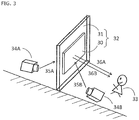
- FIG. 3 is a schematic diagram illustrating one embodiment of a transparent screen and an image projection device according to the present invention.
- a transparent screen 32 comprises a transparent partition 31 and a film for a transparent screen 30 on the observer 33 side of the transparent partition 31. Since the film for a transparent screen 30 is stuck to the transparent partition 31, the film preferably includes an adhesive layer.
- the image projection device comprises the transparent screen 32 and a projection device 34A provided on the opposite side (back side) of the observer 32 with respect to the transparent screen 32.
- a projection light 35A emitted from the projection device 34A enters from the back side of the transparent screen 32 and anisotropically diffuses by the transparent screen 32, whereby the observer 33 can visually recognize a diffused light 36A.
- the image projection device comprises the transparent screen 32 and a projection device 34B provided on the side (front side) of the observer 33 with respect to the transparent screen 32.
- a projection light 35B emitted from the projection device 34B enters from the front side of the transparent screen 32 and anisotropically diffuses by the transparent screen 32, whereby the observer 33 can visually recognize a diffused light 36B.
- a support is for supporting a film for a transparent screen. Any support may be used as long as the support does not compromise the transmission visibility or a desired optical property of the transparent screen, and examples thereof include a transparent partition, a glass window, a head-up display, and a wearable display.
- thermoplastic resin pellet to which inorganic particles are added
- a methanol dispersion (ZrO 2 concentration: 30% by mass, manufactured by SAKAI CHEMICAL INDUSTRY CO., LTD., trade name: SZR-M) of zirconium oxide (ZrO 2 ) particles was prepared.
- the particle size distribution of the ZrO 2 particles was measured by a dynamic light scattering method by using a particle size distribution measurement apparatus (manufactured by Otsuka Electronics Co., Ltd., trade name: DLS-8000), and as the result, the median diameter was 2 nm, and the maximum particle size was 23 nm.
- This dispersion was sprayed on a polymethyl methacrylate resin pellet (PMMA pellet) (manufactured by Mitsubishi Rayon Co., Ltd., trade name: ACRYPET VH) by using a sprayer, whereby ZrO 2 powder was uniformly adhered to the surface of the PMMA pellet.
- PMMA pellet polymethyl methacrylate resin pellet
- the PMMA pellet on which the ZrO 2 dispersion was sprayed was dried in a vacuum clean oven having a vacuum of 2 torr at 70°C for 24 hours to obtain a ZrO 2 particle-added PMMA pellet.
- the mass of the obtained ZrO 2 particle-added PMMA pellet was measured, and as the result, the addition amount of the ZrO 2 particles was 1% by mass based on the PMMA pellet.
- the ZrO 2 particle-added PMMA pellet obtained in the above-described 1. was contained in a hopper of a twin-screw kneading extruder (manufactured by TECHNOVEL CORPORATION, trade name: KZW-30 MG) to manufacture a film (unstretched) having a thickness of 100 ⁇ m.
- the screw diameter of the twin-screw kneading extruder was 20 mm, and the screw effective length (L/D) was 30.
- a hanger coat-type T-die was placed on the twin-screw kneading extruder through an adapter.
- the extrusion temperature was 270°C
- the number of screw revolution was 500 rpm
- the shear stress was 300 kPa.
- the used screw had the total length of 670 mm, comprised a mixing element in a portion between a position 160 mm and a position 185 mm from the hopper side of the screw and a kneading element in a portion between a position 185 mm and a position 285 mm from the hopper side of the screw, and other portions of the screw had a flight shape.
- a PMMA pellet to which 1% by mass of ZrO 2 particle was added and a PMMA pellet to which ZrO 2 was not added were placed at a ratio of 50:50 in a plastic bag, and the plastic bag was sufficiently shaken to obtain a uniformly mixed pellet.
- a film was manufactured in a similar manner to Example 1 except that the mixed pellet was contained in the hopper of the twin-screw kneading extruder. The content of ZrO 2 particle in the obtained film was 0.5% by mass based on the mixed pellet.
- a PMMA pellet to which 1% by mass of ZrO 2 particle was added and a PMMA pellet to which ZrO 2 was not added were placed at a ratio of 10:90 in a plastic bag, and the plastic bag was sufficiently shaken to obtain a uniformly mixed pellet.
- a film was manufactured in a similar manner to Example 1 except that the mixed pellet was contained in the hopper of the twin-screw kneading extruder. The content of ZrO 2 particle in the obtained film was 0.1% by mass based on the mixed pellet.
- a PMMA pellet to which 1% by mass of ZrO 2 particle was added and a PMMA pellet to which ZrO 2 was not added were placed at a ratio of 2:98 in a plastic bag, and the plastic bag was sufficiently shaken to obtain a uniformly mixed pellet.
- a film was manufactured in a similar manner to Example 1 except that the mixed pellet was contained in the hopper of the twin-screw kneading extruder. The content of ZrO 2 particle in the obtained film was 0.02% by mass based on the mixed pellet.
- ZrO 2 particles (manufactured by Kanto Denka Kogyo Co., Ltd.) were dispersed in methanol.
- the particle size distribution of the ZrO 2 particles was measured by a dynamic light scattering method, and as the result, the median diameter was 11 nm, and the maximum particle size was 120 nm.
- 0.1% by mass of the ZrO 2 particles based on the PMMA pellet were placed in a plastic bag in which the PMMA pellet (manufactured by Mitsubishi Rayon Co., Ltd., trade name: ACRYPET VH) was placed, and the plastic bag was sufficiently shaken to obtain a PMMA pellet on the surface of which ZrO 2 particles were uniformly adhered.
- a film was manufactured in a similar manner to Example 1 except that the ZrO 2 particle-added PMMA pellet was contained in the hopper of the twin-screw kneading extruder.
- barium titanate (BaTiO 3 ) particles (manufactured by Kanto Denka Kogyo Co., Ltd.) were dispersed in methanol.
- the particle size distribution of the BaTiO 3 particles was measured by a dynamic light scattering method, and as the result, the median diameter was 26 nm, and the maximum particle size was 135 nm.
- a film was manufactured in a similar manner to Example 5 except that a polyethylene terephthalate pellet (manufactured by Bell Polyester Products,Inc., brand name: IPI121B) was used in place of the PMMA pellet (manufactured by Mitsubishi Rayon Co., Ltd., trade name: ACRYPET VH).
- a film was manufactured in a similar manner to Example 7 except that the addition amount of ZrO 2 particle was changed to 1% by mass.
- a film was manufactured in a similar manner to Example 5 except that a polycarbonate pellet (manufactured by Sumika Styron Polycarbonate Limited, brand name: SD2201W) was used in place of the PMMA pellet (manufactured by Mitsubishi Rayon Co., Ltd., trade name: ACRYPET VH).
- a polycarbonate pellet manufactured by Sumika Styron Polycarbonate Limited, brand name: SD2201W
- PMMA pellet manufactured by Mitsubishi Rayon Co., Ltd., trade name: ACRYPET VH
- a film was manufactured in a similar manner to Example 9 except that the addition amount of ZrO 2 particle was changed to 1 % by mass.
- a film was manufactured in a similar manner to Example 5 except that a polystyrene pellet (manufactured by PS JAPAN CORPORATION, brand name: HF77) was used in place of the PMMA pellet (manufactured by Mitsubishi Rayon Co., Ltd., trade name: ACRYPET VH), and that the extrusion temperature was changed to 250°C.
- a polystyrene pellet manufactured by PS JAPAN CORPORATION, brand name: HF77
- PMMA pellet manufactured by Mitsubishi Rayon Co., Ltd., trade name: ACRYPET VH
- a film was manufactured in a similar manner to Example 11 except that the addition amount of ZrO 2 particle was changed to 1% by mass.
- a film was manufactured in a similar manner to Example 5 except that a cellulose acetate propionate pellet (manufactured by Eastman Chemical Company, brand name: CAP-482-0.5) was used in place of the PMMA pellet (manufactured by Mitsubishi Rayon Co., Ltd., trade name: ACRYPET VH), and that the extrusion temperature was changed to 220°C.
- a cellulose acetate propionate pellet manufactured by Eastman Chemical Company, brand name: CAP-482-0.5
- PMMA pellet manufactured by Mitsubishi Rayon Co., Ltd., trade name: ACRYPET VH
- a film was manufactured in a similar manner to Example 13 except that the addition amount of ZrO 2 particle was changed to 1% by mass.
- a film was manufactured in a similar manner to Example 5 except that a polypropylene pellet (manufactured by SunAllomer Ltd., brand name: PL-400A) was used in place of the PMMA pellet (manufactured by Mitsubishi Rayon Co., Ltd., trade name: ACRYPET VH), and that the extrusion temperature was changed to 240°C.
- a polypropylene pellet manufactured by SunAllomer Ltd., brand name: PL-400A
- PMMA pellet manufactured by Mitsubishi Rayon Co., Ltd., trade name: ACRYPET VH
- a film was manufactured in a similar manner to Example 15 except that the addition amount of ZrO 2 particle was changed to 1% by mass.
- a film was manufactured in a similar manner to Example 5 except that a polyethylene naphthalate pellet (manufactured by TEIJIN LIMITED, brand name: Teonex TN-8065S) was used in place of the PMMA pellet (manufactured by Mitsubishi Rayon Co., Ltd., trade name: ACRYPET VH), and that the extrusion temperature was changed to 290°C.
- a polyethylene naphthalate pellet manufactured by TEIJIN LIMITED, brand name: Teonex TN-8065S
- PMMA pellet manufactured by Mitsubishi Rayon Co., Ltd., trade name: ACRYPET VH
- a film was manufactured in a similar manner to Example 15 except that the addition amount of ZrO 2 particle was changed to 1% by mass.
- a film was manufactured in a similar manner to Example 5 except that a cycloolefin polymer pellet (manufactured by Zeon Corporation, brand name: ZEONOR 1020R) was used in place of the PMMA pellet (manufactured by Mitsubishi Rayon Co., Ltd., trade name: ACRYPET VH), and that the extrusion temperature was changed to 260°C.
- a cycloolefin polymer pellet manufactured by Zeon Corporation, brand name: ZEONOR 1020R
- PMMA pellet manufactured by Mitsubishi Rayon Co., Ltd., trade name: ACRYPET VH
- a film was manufactured in a similar manner to Example 19 except that the addition amount of ZrO 2 particle was changed to 1% by mass.
- a film was manufactured in a similar manner to Example 5 except that a polyvinyl butyral powder (manufactured by KURARAY CO., LTD., brand name: Mowital B30H) was used in place of the PMMA pellet (manufactured by Mitsubishi Rayon Co., Ltd., trade name: ACRYPET VH), and that the extrusion temperature was changed to 170°C.
- a polyvinyl butyral powder manufactured by KURARAY CO., LTD., brand name: Mowital B30H
- PMMA pellet manufactured by Mitsubishi Rayon Co., Ltd., trade name: ACRYPET VH
- a film was manufactured in a similar manner to Example 21 except that the addition amount of ZrO 2 particle was changed to 1% by mass.
- TiO 2 particles for inorganic particles, titanium oxide (TiO 2 ) particles (manufactured by TAYCA CORPORATION) were dispersed in methanol. The particle size distribution of the TiO 2 particles were measured by a dynamic light scattering method, and as the result, the median diameter was 13 nm, and the maximum particle size was 165 nm. Next, 0.3% by mass of the TiO 2 particles based on the PMMA pellet were placed in a plastic bag in which the PMMA pellet (manufactured by Mitsubishi Rayon Co., Ltd., trade name: ACRYPET VH) was placed, and the plastic bag was sufficiently shaken to obtain a PMMA pellet on the surface of which TiO 2 particles were uniformly adhered. A film was manufactured in a similar manner to Example 1 except that the TiO 2 particle-added PMMA pellet was contained in the hopper of the twin-screw kneading extruder.
- barium sulfate (BaSO 4 ) particles (manufactured by SAKAI CHEMICAL INDUSTRY CO.,LTD., brand name: BF-40) were dispersed in methanol.
- the particle size distribution of the BaSO 4 particles were measured by a dynamic light scattering method, and as the result, the median diameter was 13 nm, and the maximum particle size was 265 nm.
- cerium oxide (CeO 2 ) particles were dispersed in water.
- the particle size distribution of the CeO 2 particles were measured by a dynamic light scattering method, and as the result, the median diameter was 22 nm, and the maximum particle size was 305 nm.
- 0.3% by mass of the CeO 2 particles based on the PMMA pellet were placed in a plastic bag in which the PMMA pellet (manufactured by Mitsubishi Rayon Co., Ltd., trade name: ACRYPET VH) was placed, and the plastic bag was sufficiently shaken to obtain a PMMA pellet on the surface of which CeO 2 particles were uniformly adhered.
- a film was manufactured in a similar manner to Example 1 except that the CeO 2 particle-added PMMA pellet was contained in the hopper of the twin-screw kneading extruder.
- a silver nanoparticle water dispersion (manufactured by Sigma-Aldrich Japan K.K., brand name: 730785) was prepared.
- the particle size distribution of the silver nanoparticles in the silver nanoparticle water dispersion was measured by a dynamic light scattering method, and as the result, the median diameter was 11 nm, and the maximum particle size was 205 nm.
- the dispersion was sprayed on a PMMA pellet (manufactured by Mitsubishi Rayon Co., Ltd., trade name: ACRYPET VH) manufactured by Mitsubishi Rayon Co., Ltd. by using a sprayer, whereby the silver nanoparticles were uniformly adhered to the surface of the PMMA pellet.
- the PMMA pellet on which the silver nanoparticles were sprayed was dried in a vacuum clean oven having a vacuum of 2 torr at 70°C for 24 hours to obtain a silver nanoparticle-added PMMA pellet.
- the weight of the obtained silver nanoparticle-added PMMA pellet was measured, and as the result, the addition amount of the silver nanoparticles were 1% by mass based on the PMMA pellet.
- a film was manufactured in a similar manner to Example 1 except that the silver nanoparticle-added PMMA pellet was contained in the hopper of the twin-screw kneading extruder.
- a film for a transparent screen was manufactured in a similar manner to Example 7 except that the content of ZrO 2 particles (median diameter: 11 nm, maximum particle size: 120 nm) was changed to 0.15% by mass.
- a film for a transparent screen was manufactured in a similar manner to Example 7 except that the content of ZrO 2 particles (median diameter: 11 nm, maximum particle size: 120 nm) was changed to 0.5% by mass.
- a film was manufactured in a similar manner to Example 7 except that the thickness (before stretching) was changed to 150 ⁇ m.
- the manufactured unstretched film was uniaxially stretched under stretching conditions of a drawing magnification: 1.5 fold and a drawing temperature: Tg (80°C) + 20°C to manufacture a film having a thickness of 100 ⁇ m.
- a film was manufactured in a similar manner to Example 7 except that the thickness (before stretching) was changed to 144 ⁇ m.
- the manufactured unstretched film was biaxially stretched under stretching conditions of a drawing magnification: 1.2 ⁇ 1.2 fold and a drawing temperature: Tg (80°C) + 20°C to manufacture a film having a thickness of 100 ⁇ m.
- the ZrO 2 particle powder and the polyethylene terephthalate pellet used in Example 7 were mixed by using a container revolution-type mixer (manufactured by KATO-RIKI MFG. CO., LTD., KRT-50T) so that the addition amount of the ZrO 2 particles was 0.6% by mass.
- the number of revolution of the container was 30 rpm, the treatment time was 30 minutes, and a pellet on the surface of which the ZrO 2 particles were uniformly adhered was obtained.
- the obtained pellet was contained in a hopper of a single-screw kneading extruder (manufactured by GM engineering co., ltd., model number: GM50) comprising a strand die to obtain a pellet into which 0.6% by mass of ZrO 2 particles were kneaded.
- the pellet and a polyethylene terephthalate pellet (manufactured by Bell Polyester Products, Inc., trade name IPI121B) were mixed by using the container revolution-type mixer at a mass ratio of 1:5.
- the number of revolution of the container was 30 rpm, and the treatment time was 15 minutes.
- the obtained pellet was contained in a hopper of the single-screw kneading extruder comprising a T-die to manufacture a film (unstretched) having a thickness of 100 ⁇ m.
- the screw diameter of the single-screw kneading extruder was 50 mm, and the screw effective length (L/D) was 32.
- a hanger coat-type T-die was placed on the single-screw kneading extruder through an adapter.
- the extrusion temperature was 250°C, and the number of revolution of the screw was 30 rpm.
- the screw used was a screw having a full flight shape comprising a conveying element over the full length of the screw.
- the concentration of the ZrO 2 particles in the obtained film was 0.1% by mass.
- a film was manufactured in a similar manner to Example 31 except that the single-screw kneading extruder (manufactured by GM engineering co., ltd., model number: GM50) used in Example 31 was changed to a twin-screw kneading extruder (manufactured by TECHNOVEL CORPORATION, trade name: KZW-30 MG).
- the single-screw kneading extruder manufactured by GM engineering co., ltd., model number: GM50
- twin-screw kneading extruder manufactured by TECHNOVEL CORPORATION, trade name: KZW-30 MG.
- a film was manufactured in a similar manner to Example 1 except that the addition amount of the ZrO 2 particles in the above-described 1. (Manufacturing of ZrO 2 particle-added PMMA pellet) was 1.5% by mass based on the PMMA pellet.
- a PMMA pellet to which 1% by mass of ZrO 2 particles were added and a PMMA pellet to which ZrO 2 was not added were placed in a plastic bag at a ratio of 1:99, and the plastic bag was sufficiently shaken to obtain a uniformly mixed pellet.
- a film was manufactured in a similar manner to Example 1 except that the mixed pellet was contained in the hopper of the twin-screw kneading extruder. The content of the ZrO 2 particles in the obtained film was 0.01% by mass based on the PMMA pellet.
- ZrO 2 particles (manufactured by Daiichi Kigenso Kagaku Kogyo Co., Ltd., trade name: UEP zirconium oxide) were dispersed in methanol.
- the particle size distribution of the ZrO 2 particles was measured by a dynamic light scattering method, and as the result, the median diameter was 400 nm, and the maximum particle size was 1.1 ⁇ m.
- carbon black particles manufactured by Asahi Carbon Co., Ltd., brand name: Asahi #78
- the particle size distribution of the carbon black particles were measured by a dynamic light scattering method, and as the result, the median diameter was 23 nm, and the maximum particle size was 325 nm.
- 0.3% by mass of the carbon black particles based on the PMMA pellet were placed in a plastic bag in which the PMMA pellet (manufactured by Mitsubishi Rayon Co., Ltd., trade name: ACRYPET VH) was placed, and the plastic bag was sufficiently shaken to obtain a PMMA pellet on the surface of which carbon black particles were uniformly adhered.
- a film was manufactured in a similar manner to Example 1 except that the carbon black particle-added PMMA pellet was contained in the hopper of the twin-screw kneading extruder.
- carbon black particles manufactured by Asahi Carbon Co., Ltd., brand name: SB935
- the particle size distribution of the carbon black particles were measured by a dynamic light scattering method, and as the result, the median diameter was 13 nm, and the maximum particle size was 225 nm.
- 0.3% by mass of the carbon black particles based on the PMMA pellet were placed in a plastic bag in which the PMMA pellet (manufactured by Mitsubishi Rayon Co., Ltd., trade name: ACRYPET VH) was placed, and the plastic bag was sufficiently shaken to obtain a PMMA pellet on the surface of which carbon black particles were uniformly adhered.
- a film was manufactured in a similar manner to Example 1 except that the carbon black particle-added PMMA pellet was contained in the hopper of the twin-screw kneading extruder.
- a film for a transparent screen was manufactured in a similar manner to Example 7 except that 0.15% by mass of silica particles (median diameter: 3000 nm, maximum particle size: 4200 nm) were added in place of the ZrO 2 particles (median diameter: 11 nm, maximum particle diameter: 120 nm).
- a film for a transparent screen was manufactured in a similar manner to Example 7 except that 0.5% by mass of acrylic resin microparticles (median diameter: 3000 nm, maximum particle diameter: 3600 nm) were added in place of the ZrO 2 particles (median diameter: 11 nm, maximum particle diameter: 120 nm).
- a film for a transparent screen was manufactured in a similar manner to Comparative Example 6 except that the content of the silica particles (median diameter: 3000 nm, maximum particle size: 4200 nm) was changed to 0.5% by mass.
- a film for a transparent screen was manufactured in a similar manner to Comparative Example 7 except that the content of the acrylic resin microparticles (median diameter: 3000 nm, maximum particle size: 3600 nm) was changed to 0.5% by mass.
- a film for a transparent screen was manufactured in a similar manner to Example 7 except that the content of the ZrO 2 particles (median diameter: 11 nm, maximum particle diameter: 120 nm) was changed to 0.01% by mass.
- a film for a transparent screen was manufactured in a similar manner to Example 7 except that the content of the ZrO 2 particles (median diameter: 11 nm, maximum particle diameter: 120 nm) was changed to 1.8% by mass.
- a film for a transparent screen was manufactured in a similar manner to Example 7 except that 0.15% by mass of ZrO 2 particles (median diameter: 400 nm, maximum particle size: 1100 nm) were added in place of the ZrO 2 particles (median diameter: 11 nm, maximum particle diameter: 120 nm).
- the optical property of the film manufactured in the above-described Examples and Comparative Examples was evaluated in the following manner. First, the transparency of the film was evaluated by visual inspection based on the following criteria. The evaluation results are listed on Table 2.
- the total light transmittance (%), the parallel beam transmittance (%), and the haze (%) of the film was measured by using a haze meter (manufactured by NIPPON DENSHOKU INDUSTRIES CO., LTD., trade name: NDH-5000) in accordance with JIS-K-7361 and JIS-K-7136.
- the value of definition (%) measured by using an image clarity meter (manufactured by Suga Test Instruments Co., Ltd., product number: ICM-1T) with an optical comb width of 0.125 mm in accordance with JIS K7374 was defined as an image clarity. The larger the value of the definition is, the higher the transmission image clarity is.
- the measurement results are listed on Table 2.
- the film manufactured in the above-described Examples and Comparative Examples was placed at a position 50 cm away from an image projection lens of a mobile LED mini projector (manufactured by Onkyo Digital Solutions Co., Ltd., trade name: PP-D1S).
- a focus knob of the projector was adjusted so that the focus was located on the screen.
- an image was projected on the screen from two positions 1 m backward obliquely at an angle of 45° from the screen and 1 m frontward obliquely at an angle of 45° from the screen.
- the image visibility on the screen was evaluated by visual inspection based on the following criteria. The evaluation results are listed on Table 2.
- Example 1 Inorganic particle Resin Type Median diameter (nm) Maximum particle size (nm) Content (% by mass) Type Example 1 Zirconium oxide 2 23 1 Acrylic Example 2 Zirconium oxide 2 23 0.5 Acrylic Example 3 Zirconium oxide 2 23 0.1 Acrylic Example 4 Zirconium oxide 2 23 0.02 Acrylic Example 5 Zirconium oxide 11 120 0.1 Acrylic Example 6 Barium titanate 26 135 0.1 Acrylic Example 7 Zirconium oxide 11 120 0.1 Polyester Example 8 Zirconium oxide 11 120 1 Polyester Example 9 Zirconium oxide 11 120 0.1 Polyca rbonate Example 10 Zirconium oxide 11 120 1 Polyca rbonate Example 11 Zirconium oxide 11 120 0.1 Polystyrene Example 12 Zirconium oxide 11 120 1 Polystyrene Example 13 Zirconium oxide 11 120 0.1 Cellulose Example 14 Zirconium oxide 11 120 1 Cellulose Example 15
Landscapes
- Chemical & Material Sciences (AREA)
- Physics & Mathematics (AREA)
- Engineering & Computer Science (AREA)
- Organic Chemistry (AREA)
- General Physics & Mathematics (AREA)
- Wood Science & Technology (AREA)
- Life Sciences & Earth Sciences (AREA)
- Materials Engineering (AREA)
- Optics & Photonics (AREA)
- Chemical Kinetics & Catalysis (AREA)
- Health & Medical Sciences (AREA)
- Medicinal Chemistry (AREA)
- Polymers & Plastics (AREA)
- Multimedia (AREA)
- Signal Processing (AREA)
- Dispersion Chemistry (AREA)
- Manufacturing & Machinery (AREA)
- Business, Economics & Management (AREA)
- Accounting & Taxation (AREA)
- Marketing (AREA)
- Theoretical Computer Science (AREA)
- Overhead Projectors And Projection Screens (AREA)
- Laminated Bodies (AREA)
- Optical Elements Other Than Lenses (AREA)
- Transforming Electric Information Into Light Information (AREA)
Applications Claiming Priority (3)
| Application Number | Priority Date | Filing Date | Title |
|---|---|---|---|
| JP2014082965 | 2014-04-14 | ||
| JP2014138824 | 2014-07-04 | ||
| PCT/JP2015/061276 WO2015159829A1 (ja) | 2014-04-14 | 2015-04-10 | 透明スクリーン用フィルムおよびその製造方法ならびにそれを備えた透明スクリーン |
Publications (3)
| Publication Number | Publication Date |
|---|---|
| EP3133441A1 true EP3133441A1 (de) | 2017-02-22 |
| EP3133441A4 EP3133441A4 (de) | 2018-03-21 |
| EP3133441B1 EP3133441B1 (de) | 2020-09-16 |
Family
ID=54324036
Family Applications (1)
| Application Number | Title | Priority Date | Filing Date |
|---|---|---|---|
| EP15779560.0A Not-in-force EP3133441B1 (de) | 2014-04-14 | 2015-04-10 | Folie für transparenten bildschirm, verfahren zur herstellung davon und transparenter bildschirm damit |
Country Status (7)
| Country | Link |
|---|---|
| US (1) | US9846356B2 (de) |
| EP (1) | EP3133441B1 (de) |
| JP (1) | JP6563383B2 (de) |
| KR (1) | KR102308494B1 (de) |
| CN (1) | CN106462048B (de) |
| TW (1) | TWI644162B (de) |
| WO (1) | WO2015159829A1 (de) |
Cited By (1)
| Publication number | Priority date | Publication date | Assignee | Title |
|---|---|---|---|---|
| EP3251831A4 (de) * | 2015-03-06 | 2018-07-04 | JXTG Nippon Oil & Energy Corporation | Transparentes laminat, damit ausgestatteter transparenter bildschirm und damit ausgestattete bildprojektionsvorrichtung |
Families Citing this family (31)
| Publication number | Priority date | Publication date | Assignee | Title |
|---|---|---|---|---|
| CN107209292B (zh) * | 2014-12-22 | 2018-06-22 | Jxtg能源株式会社 | 片状透明成型体、具备该片状透明成型体的透明屏幕、及包括该片状透明成型体或透明屏幕的图像投影装置 |
| CN108027551B (zh) * | 2015-09-03 | 2021-10-26 | Agc株式会社 | 透明屏幕、透明屏幕组装体、透明屏幕的制造方法以及透明屏幕组装体的制造方法 |
| JP6578908B2 (ja) * | 2015-11-27 | 2019-09-25 | Agc株式会社 | 透明スクリーン |
| JP6806082B2 (ja) * | 2015-12-01 | 2021-01-06 | Agc株式会社 | 透明スクリーンシート、透明スクリーン、および映像表示システム |
| EP3385787A4 (de) * | 2015-12-02 | 2019-05-29 | JXTG Nippon Oil & Energy Corporation | Reflektierender transparenter schirm und bildprojektionsvorrichtung damit |
| JP7046791B2 (ja) | 2016-02-25 | 2022-04-04 | 日華化学株式会社 | 反射型スクリーン及び反射型スクリーン用シート |
| JPWO2017150408A1 (ja) * | 2016-03-04 | 2018-04-19 | Jxtgエネルギー株式会社 | 映像投影システム |
| US10641933B2 (en) | 2016-04-25 | 2020-05-05 | Jxtg Nippon Oil & Energy Corporation | Transparent light scattering body, reflective transparent screen comprising same, and video image projection system comprising same |
| JP6691809B2 (ja) * | 2016-04-28 | 2020-05-13 | Jxtgエネルギー株式会社 | 映像投影システム |
| US10732497B2 (en) * | 2016-06-20 | 2020-08-04 | Panasonic Intellectual Property Management Co., Ltd. | Transparent screen and image display system |
| JP6896409B2 (ja) * | 2016-12-02 | 2021-06-30 | 三菱瓦斯化学株式会社 | 透明スクリーン用シート又はフィルム、及びそれを備えた透明スクリーン |
| KR102200307B1 (ko) * | 2017-03-31 | 2021-01-07 | 주식회사 엘지화학 | 디스플레이 패널용 시인성 개선 필름 및 이를 포함하는 디스플레이 장치 |
| CN108285751A (zh) * | 2017-07-18 | 2018-07-17 | 上海全鹰智能科技有限公司 | 一种透明显示膜以及搭载这种透明显示膜的投射系统 |
| KR102166845B1 (ko) | 2017-09-15 | 2020-10-16 | 주식회사 엘지화학 | 하드 코팅 필름 |
| CN107809721B (zh) * | 2017-10-31 | 2020-05-12 | 武平县旺发电子商务有限公司 | 一种汽车音响屏幕贴片装置 |
| FR3086293B1 (fr) * | 2018-09-26 | 2021-07-16 | Arkema France | Composition comprenant des particules diffusantes |
| CN109581802A (zh) * | 2018-10-23 | 2019-04-05 | 崔林杰 | 一种环保型投影透射屏及其制备方法 |
| WO2020100382A1 (ja) * | 2018-11-14 | 2020-05-22 | 三菱瓦斯化学株式会社 | 樹脂成形体およびスクリーン |
| US11022533B2 (en) * | 2019-05-06 | 2021-06-01 | The Boeing Company | Method of controlling particles size of fillers in extrudable compositions, compositions comprising the fillers and devices made from the compositions |
| JP7605104B2 (ja) | 2019-05-07 | 2024-12-24 | Agc株式会社 | 車両 |
| JP6780751B2 (ja) * | 2019-08-23 | 2020-11-04 | Agc株式会社 | 透明スクリーン |
| CN110722759B (zh) * | 2019-10-26 | 2022-06-07 | 重庆融豪太视科技有限公司 | 一种投影屏幕板的制备方法 |
| CN110698833B (zh) * | 2019-10-26 | 2021-12-17 | 重庆融豪太视科技有限公司 | 一种用于制备投影屏幕的材料 |
| TW202132485A (zh) * | 2020-02-18 | 2021-09-01 | 南亞塑膠工業股份有限公司 | 表面塗佈液組成物及聚酯膜結構 |
| JP7340687B2 (ja) * | 2020-03-13 | 2023-09-07 | 富士フイルム株式会社 | 反射スクリーン、投映像表示システム |
| FR3108614B1 (fr) * | 2020-03-26 | 2022-12-09 | Arkema France | Composition comprenant des particules |
| JP2022169991A (ja) * | 2021-04-28 | 2022-11-10 | 株式会社きもと | 成型拡散積層フィルム |
| CN115466545A (zh) * | 2022-09-26 | 2022-12-13 | 张磊 | 一种智能镜片用涂料组合物及其制备方法 |
| CN116626979A (zh) * | 2023-05-24 | 2023-08-22 | 深圳申鲲科技有限公司 | 灰色纳米晶体显像层、高清高透全息影像膜、制备方法 |
| KR102921649B1 (ko) * | 2023-07-17 | 2026-02-03 | 대진대학교 산학협력단 | 미디어월을 포함한 수장고 관리 시스템 |
| KR20250094370A (ko) * | 2023-12-18 | 2025-06-25 | 주식회사 슈퍼셀 | 양방향에서 영상 시청이 가능한 사이니지 시스템 |
Family Cites Families (34)
| Publication number | Priority date | Publication date | Assignee | Title |
|---|---|---|---|---|
| GB1367485A (en) * | 1970-02-26 | 1974-09-18 | Union Carbide Corp | Extruding apparatus for thermoplastic materials |
| JP2001281416A (ja) * | 2000-04-03 | 2001-10-10 | Dainippon Printing Co Ltd | 反射防止フィルム |
| US6531214B2 (en) * | 2001-02-14 | 2003-03-11 | 3M Innovative Properties Company | Replacement for plasticized polyvinyl chloride |
| FR2849932B1 (fr) * | 2003-01-15 | 2005-02-18 | Saint Gobain | Ecran de retroprojection et/ou de projection |
| DE10336129A1 (de) * | 2003-08-04 | 2005-02-24 | Röhm GmbH & Co. KG | Kratzunempfindlicher Rückprojektionsschirm und Verfahren zu dessen Herstellung |
| JP2005099675A (ja) | 2003-08-21 | 2005-04-14 | Sony Corp | 塗布型光学積層膜、光学多層膜及び反射スクリーン |
| JP4752224B2 (ja) * | 2004-09-24 | 2011-08-17 | ソニー株式会社 | 微粒子層の形成方法及びスクリーン |
| JP2006131713A (ja) * | 2004-11-04 | 2006-05-25 | Fuji Photo Film Co Ltd | ハードコート用塗布組成物、ハードコートフィルム、反射防止フィルム及び画像表示装置 |
| JP2006146019A (ja) | 2004-11-24 | 2006-06-08 | Fujimori Kogyo Co Ltd | スクリーン |
| JP4760237B2 (ja) * | 2005-09-02 | 2011-08-31 | 株式会社日立製作所 | 光学部品及びそれを用いた投射型画像表示装置 |
| EP1760497B1 (de) | 2005-09-02 | 2016-11-09 | Hitachi Maxell, Ltd. | Optische Komponente und Projektions-Anzeigevorrichtung damit |
| JP4923634B2 (ja) | 2006-03-07 | 2012-04-25 | 大日本印刷株式会社 | 光拡散シート、その製造方法及び透過型スクリーン並びに背面投射型表示装置 |
| US8372505B2 (en) * | 2006-08-09 | 2013-02-12 | Kimoto Co., Ltd. | Anti-glare member, display and screen using the same |
| JP5186097B2 (ja) * | 2006-10-31 | 2013-04-17 | 帝人デュポンフィルム株式会社 | 高透明反射型スクリーン用フィルム |
| JP2008176116A (ja) | 2006-12-20 | 2008-07-31 | Konica Minolta Opto Inc | 防眩性フィルム、防眩性反射防止フィルム、これらを用いた偏光板、及び表示装置 |
| KR100901213B1 (ko) | 2007-06-20 | 2009-06-08 | 삼회산업 (주) | 화각 조절이 가능한 렌즈튜브 어셈블리 |
| JP5380025B2 (ja) * | 2007-09-27 | 2014-01-08 | 富士フイルム株式会社 | 反射防止フィルム、偏光板、画像表示装置、および反射防止フィルム用透明支持体の製造方法 |
| JP5163085B2 (ja) | 2007-12-11 | 2013-03-13 | 東洋紡株式会社 | 表面光拡散性ポリエステルフィルム |
| JP2009204927A (ja) | 2008-02-28 | 2009-09-10 | Konica Minolta Opto Inc | 防眩性光学フィルムの製造方法、防眩性光学フィルム、偏光板、及び画像表示装置 |
| MY192479A (en) * | 2008-10-17 | 2022-08-23 | Showa Denko Materials Co Ltd | Film having low refractive index film and method for producing the same, anti-reflection film and method for producing the same, coating liquid set for low refractive index film, substrate having microparticle-laminated thin film and method for producing the same, and optical member |
| JP5336161B2 (ja) | 2008-12-11 | 2013-11-06 | 株式会社カネカ | 金属酸化物微粒子含有硬化性樹脂組成物、その硬化物、及び光拡散材 |
| US8000006B2 (en) | 2009-07-02 | 2011-08-16 | Morgan Adhesives Company | Rear-projection screen |
| JP4780242B2 (ja) | 2009-11-20 | 2011-09-28 | 東洋紡績株式会社 | 光拡散性ポリエステルフィルム |
| JP5214577B2 (ja) | 2009-11-30 | 2013-06-19 | ビジョン開発株式会社 | ダイヤモンド微粒子を含有する透過型スクリーン及びそれを用いたヘッドアップディスプレー用スクリーン |
| KR20110113068A (ko) | 2010-04-08 | 2011-10-14 | 에스케이케미칼주식회사 | 원기둥형 콘크리트 구조물 보강용 섬유강화 합성수지 성형품 |
| KR101775194B1 (ko) * | 2010-10-22 | 2017-09-05 | 다이니폰 인사츠 가부시키가이샤 | 방현성 필름, 편광판 및 화상 표시 장치 |
| JP2012208465A (ja) | 2011-03-16 | 2012-10-25 | Adeka Corp | 光拡散性樹脂組成物及びこれを用いた光拡散シート |
| JP6141592B2 (ja) * | 2011-11-16 | 2017-06-07 | 富士フイルム株式会社 | 光学フィルム、偏光板、画像表示装置、及び光学フィルムの製造方法 |
| JP5876326B2 (ja) | 2012-03-02 | 2016-03-02 | 三菱製紙株式会社 | 透視可能な透過型スクリーン |
| US9360747B2 (en) * | 2012-03-02 | 2016-06-07 | Mitsubishi Paper Mills Limited | Transmission type screen |
| JP6078938B2 (ja) * | 2012-03-15 | 2017-02-15 | 大日本印刷株式会社 | 光学フィルム、偏光板、液晶パネルおよび画像表示装置 |
| JP6044118B2 (ja) | 2012-05-28 | 2016-12-14 | 大日本印刷株式会社 | 光学積層体、偏光板及び画像表示装置 |
| JP6105930B2 (ja) * | 2012-06-28 | 2017-03-29 | 日東電工株式会社 | 防眩性フィルムの製造方法、防眩性フィルム、塗工液、偏光板および画像表示装置 |
| TWI616688B (zh) * | 2014-10-13 | 2018-03-01 | 鴻海精密工業股份有限公司 | 擴散膜及其製備方法、及背光模組、顯示裝置和電子裝置 |
-
2015
- 2015-04-10 CN CN201580018711.4A patent/CN106462048B/zh not_active Expired - Fee Related
- 2015-04-10 US US15/303,911 patent/US9846356B2/en not_active Expired - Fee Related
- 2015-04-10 WO PCT/JP2015/061276 patent/WO2015159829A1/ja not_active Ceased
- 2015-04-10 JP JP2016513765A patent/JP6563383B2/ja not_active Expired - Fee Related
- 2015-04-10 KR KR1020167027751A patent/KR102308494B1/ko not_active Expired - Fee Related
- 2015-04-10 EP EP15779560.0A patent/EP3133441B1/de not_active Not-in-force
- 2015-04-14 TW TW104111984A patent/TWI644162B/zh not_active IP Right Cessation
Cited By (3)
| Publication number | Priority date | Publication date | Assignee | Title |
|---|---|---|---|---|
| EP3251831A4 (de) * | 2015-03-06 | 2018-07-04 | JXTG Nippon Oil & Energy Corporation | Transparentes laminat, damit ausgestatteter transparenter bildschirm und damit ausgestattete bildprojektionsvorrichtung |
| US10585279B2 (en) | 2015-03-06 | 2020-03-10 | Jxtg Nippon Oil & Energy Corporation | See-through layered body, transparent screen comprising same, and image projection device comprising same |
| US10684472B2 (en) | 2015-03-06 | 2020-06-16 | Jxtg Nippon Oil & Energy Corporation | See-through layered body, transparent screen comprising same, and image projection device comprising same |
Also Published As
| Publication number | Publication date |
|---|---|
| JPWO2015159829A1 (ja) | 2017-04-13 |
| US20170059982A1 (en) | 2017-03-02 |
| US9846356B2 (en) | 2017-12-19 |
| KR20160143670A (ko) | 2016-12-14 |
| CN106462048B (zh) | 2018-08-28 |
| TW201543132A (zh) | 2015-11-16 |
| WO2015159829A1 (ja) | 2015-10-22 |
| TWI644162B (zh) | 2018-12-11 |
| CN106462048A (zh) | 2017-02-22 |
| KR102308494B1 (ko) | 2021-10-01 |
| JP6563383B2 (ja) | 2019-08-21 |
| EP3133441A4 (de) | 2018-03-21 |
| EP3133441B1 (de) | 2020-09-16 |
Similar Documents
| Publication | Publication Date | Title |
|---|---|---|
| EP3133441B1 (de) | Folie für transparenten bildschirm, verfahren zur herstellung davon und transparenter bildschirm damit | |
| US10222521B2 (en) | Sheet-form transparent molding, transparent screen comprising same, and image projection device comprising same | |
| JP5752834B1 (ja) | 透明スクリーン用フィルムおよびその製造方法ならびにそれを備えた透明スクリーン | |
| US10684472B2 (en) | See-through layered body, transparent screen comprising same, and image projection device comprising same | |
| US10495964B2 (en) | Transparent screen and video image projection system comprising same | |
| US20180257335A1 (en) | Transparent sheet, transparent screen comprising same, and image projection device comprising same | |
| JP6266844B2 (ja) | シート状透明積層体、それを備えた透明スクリーン、およびそれを備えた映像投影システム | |
| JP6147932B2 (ja) | 透明フィルム、それを備えた透明スクリーン、およびそれを備えた画像投影装置 | |
| JP2017015824A (ja) | シート状透明積層体、それを備えた透明スクリーン、およびそれを備えた画像投影装置 | |
| JP6707462B2 (ja) | 透視可能な積層体、それを備えた反射型スクリーン、およびそれを備えた画像投影装置 |
Legal Events
| Date | Code | Title | Description |
|---|---|---|---|
| STAA | Information on the status of an ep patent application or granted ep patent |
Free format text: STATUS: THE INTERNATIONAL PUBLICATION HAS BEEN MADE |
|
| PUAI | Public reference made under article 153(3) epc to a published international application that has entered the european phase |
Free format text: ORIGINAL CODE: 0009012 |
|
| STAA | Information on the status of an ep patent application or granted ep patent |
Free format text: STATUS: REQUEST FOR EXAMINATION WAS MADE |
|
| 17P | Request for examination filed |
Effective date: 20161111 |
|
| AK | Designated contracting states |
Kind code of ref document: A1 Designated state(s): AL AT BE BG CH CY CZ DE DK EE ES FI FR GB GR HR HU IE IS IT LI LT LU LV MC MK MT NL NO PL PT RO RS SE SI SK SM TR |
|
| AX | Request for extension of the european patent |
Extension state: BA ME |
|
| RIN1 | Information on inventor provided before grant (corrected) |
Inventor name: MATSUO, AKIRA Inventor name: YAMAKI, KOUSUKE Inventor name: WATANABE, JUNJI Inventor name: SAKAJIRI, KOICHI Inventor name: NISHIMURA, SUZUSHI |
|
| DAV | Request for validation of the european patent (deleted) | ||
| DAX | Request for extension of the european patent (deleted) | ||
| RIC1 | Information provided on ipc code assigned before grant |
Ipc: C09D 125/06 20060101ALI20171017BHEP Ipc: C09D 145/00 20060101ALI20171017BHEP Ipc: C09D 123/12 20060101ALI20171017BHEP Ipc: G02B 5/02 20060101ALI20171017BHEP Ipc: B32B 5/16 20060101ALI20171017BHEP Ipc: G03B 21/62 20140101AFI20171017BHEP Ipc: C08K 3/30 20060101ALI20171017BHEP Ipc: C09D 167/02 20060101ALI20171017BHEP Ipc: C09D 133/12 20060101ALI20171017BHEP Ipc: C09D 169/00 20060101ALI20171017BHEP Ipc: C09D 5/00 20060101ALI20171017BHEP Ipc: C09D 101/12 20060101ALI20171017BHEP Ipc: G03B 21/60 20140101ALI20171017BHEP Ipc: H04N 5/74 20060101ALI20171017BHEP Ipc: G09F 19/18 20060101ALI20171017BHEP Ipc: C08K 3/22 20060101ALI20171017BHEP Ipc: C09D 129/14 20060101ALI20171017BHEP Ipc: C08K 3/08 20060101ALI20171017BHEP Ipc: B32B 27/14 20060101ALI20171017BHEP |
|
| A4 | Supplementary search report drawn up and despatched |
Effective date: 20180220 |
|
| RIC1 | Information provided on ipc code assigned before grant |
Ipc: C09D 123/12 20060101ALI20180214BHEP Ipc: G02B 5/02 20060101ALI20180214BHEP Ipc: C09D 167/02 20060101ALI20180214BHEP Ipc: C09D 133/12 20060101ALI20180214BHEP Ipc: C09D 145/00 20060101ALI20180214BHEP Ipc: C09D 169/00 20060101ALI20180214BHEP Ipc: C09D 5/00 20060101ALI20180214BHEP Ipc: B32B 27/14 20060101ALI20180214BHEP Ipc: C08K 3/22 20060101ALI20180214BHEP Ipc: H04N 5/74 20060101ALI20180214BHEP Ipc: C08K 3/08 20060101ALI20180214BHEP Ipc: C08K 3/30 20060101ALI20180214BHEP Ipc: C09D 101/12 20060101ALI20180214BHEP Ipc: G09F 19/18 20060101ALI20180214BHEP Ipc: C09D 129/14 20060101ALI20180214BHEP Ipc: C09D 125/06 20060101ALI20180214BHEP Ipc: G03B 21/62 20140101AFI20180214BHEP Ipc: G03B 21/60 20140101ALI20180214BHEP Ipc: B32B 5/16 20060101ALI20180214BHEP |
|
| STAA | Information on the status of an ep patent application or granted ep patent |
Free format text: STATUS: EXAMINATION IS IN PROGRESS |
|
| 17Q | First examination report despatched |
Effective date: 20190930 |
|
| GRAP | Despatch of communication of intention to grant a patent |
Free format text: ORIGINAL CODE: EPIDOSNIGR1 |
|
| STAA | Information on the status of an ep patent application or granted ep patent |
Free format text: STATUS: GRANT OF PATENT IS INTENDED |
|
| INTG | Intention to grant announced |
Effective date: 20200417 |
|
| GRAS | Grant fee paid |
Free format text: ORIGINAL CODE: EPIDOSNIGR3 |
|
| GRAA | (expected) grant |
Free format text: ORIGINAL CODE: 0009210 |
|
| STAA | Information on the status of an ep patent application or granted ep patent |
Free format text: STATUS: THE PATENT HAS BEEN GRANTED |
|
| AK | Designated contracting states |
Kind code of ref document: B1 Designated state(s): AL AT BE BG CH CY CZ DE DK EE ES FI FR GB GR HR HU IE IS IT LI LT LU LV MC MK MT NL NO PL PT RO RS SE SI SK SM TR |
|
| REG | Reference to a national code |
Ref country code: GB Ref legal event code: FG4D |
|
| REG | Reference to a national code |
Ref country code: CH Ref legal event code: EP |
|
| REG | Reference to a national code |
Ref country code: DE Ref legal event code: R096 Ref document number: 602015059201 Country of ref document: DE |
|
| REG | Reference to a national code |
Ref country code: IE Ref legal event code: FG4D |
|
| REG | Reference to a national code |
Ref country code: AT Ref legal event code: REF Ref document number: 1314691 Country of ref document: AT Kind code of ref document: T Effective date: 20201015 |
|
| REG | Reference to a national code |
Ref country code: DE Ref legal event code: R082 Ref document number: 602015059201 Country of ref document: DE Representative=s name: BOEHMERT & BOEHMERT ANWALTSPARTNERSCHAFT MBB -, DE |
|
| PG25 | Lapsed in a contracting state [announced via postgrant information from national office to epo] |
Ref country code: FI Free format text: LAPSE BECAUSE OF FAILURE TO SUBMIT A TRANSLATION OF THE DESCRIPTION OR TO PAY THE FEE WITHIN THE PRESCRIBED TIME-LIMIT Effective date: 20200916 Ref country code: HR Free format text: LAPSE BECAUSE OF FAILURE TO SUBMIT A TRANSLATION OF THE DESCRIPTION OR TO PAY THE FEE WITHIN THE PRESCRIBED TIME-LIMIT Effective date: 20200916 Ref country code: BG Free format text: LAPSE BECAUSE OF FAILURE TO SUBMIT A TRANSLATION OF THE DESCRIPTION OR TO PAY THE FEE WITHIN THE PRESCRIBED TIME-LIMIT Effective date: 20201216 Ref country code: NO Free format text: LAPSE BECAUSE OF FAILURE TO SUBMIT A TRANSLATION OF THE DESCRIPTION OR TO PAY THE FEE WITHIN THE PRESCRIBED TIME-LIMIT Effective date: 20201216 Ref country code: GR Free format text: LAPSE BECAUSE OF FAILURE TO SUBMIT A TRANSLATION OF THE DESCRIPTION OR TO PAY THE FEE WITHIN THE PRESCRIBED TIME-LIMIT Effective date: 20201217 Ref country code: SE Free format text: LAPSE BECAUSE OF FAILURE TO SUBMIT A TRANSLATION OF THE DESCRIPTION OR TO PAY THE FEE WITHIN THE PRESCRIBED TIME-LIMIT Effective date: 20200916 |
|
| REG | Reference to a national code |
Ref country code: AT Ref legal event code: MK05 Ref document number: 1314691 Country of ref document: AT Kind code of ref document: T Effective date: 20200916 |
|
| REG | Reference to a national code |
Ref country code: NL Ref legal event code: MP Effective date: 20200916 |
|
| PG25 | Lapsed in a contracting state [announced via postgrant information from national office to epo] |
Ref country code: RS Free format text: LAPSE BECAUSE OF FAILURE TO SUBMIT A TRANSLATION OF THE DESCRIPTION OR TO PAY THE FEE WITHIN THE PRESCRIBED TIME-LIMIT Effective date: 20200916 Ref country code: LV Free format text: LAPSE BECAUSE OF FAILURE TO SUBMIT A TRANSLATION OF THE DESCRIPTION OR TO PAY THE FEE WITHIN THE PRESCRIBED TIME-LIMIT Effective date: 20200916 |
|
| REG | Reference to a national code |
Ref country code: LT Ref legal event code: MG4D |
|
| PG25 | Lapsed in a contracting state [announced via postgrant information from national office to epo] |
Ref country code: CZ Free format text: LAPSE BECAUSE OF FAILURE TO SUBMIT A TRANSLATION OF THE DESCRIPTION OR TO PAY THE FEE WITHIN THE PRESCRIBED TIME-LIMIT Effective date: 20200916 Ref country code: LT Free format text: LAPSE BECAUSE OF FAILURE TO SUBMIT A TRANSLATION OF THE DESCRIPTION OR TO PAY THE FEE WITHIN THE PRESCRIBED TIME-LIMIT Effective date: 20200916 Ref country code: NL Free format text: LAPSE BECAUSE OF FAILURE TO SUBMIT A TRANSLATION OF THE DESCRIPTION OR TO PAY THE FEE WITHIN THE PRESCRIBED TIME-LIMIT Effective date: 20200916 Ref country code: SM Free format text: LAPSE BECAUSE OF FAILURE TO SUBMIT A TRANSLATION OF THE DESCRIPTION OR TO PAY THE FEE WITHIN THE PRESCRIBED TIME-LIMIT Effective date: 20200916 Ref country code: RO Free format text: LAPSE BECAUSE OF FAILURE TO SUBMIT A TRANSLATION OF THE DESCRIPTION OR TO PAY THE FEE WITHIN THE PRESCRIBED TIME-LIMIT Effective date: 20200916 Ref country code: PT Free format text: LAPSE BECAUSE OF FAILURE TO SUBMIT A TRANSLATION OF THE DESCRIPTION OR TO PAY THE FEE WITHIN THE PRESCRIBED TIME-LIMIT Effective date: 20210118 Ref country code: EE Free format text: LAPSE BECAUSE OF FAILURE TO SUBMIT A TRANSLATION OF THE DESCRIPTION OR TO PAY THE FEE WITHIN THE PRESCRIBED TIME-LIMIT Effective date: 20200916 |
|
| PG25 | Lapsed in a contracting state [announced via postgrant information from national office to epo] |
Ref country code: ES Free format text: LAPSE BECAUSE OF FAILURE TO SUBMIT A TRANSLATION OF THE DESCRIPTION OR TO PAY THE FEE WITHIN THE PRESCRIBED TIME-LIMIT Effective date: 20200916 Ref country code: AT Free format text: LAPSE BECAUSE OF FAILURE TO SUBMIT A TRANSLATION OF THE DESCRIPTION OR TO PAY THE FEE WITHIN THE PRESCRIBED TIME-LIMIT Effective date: 20200916 Ref country code: AL Free format text: LAPSE BECAUSE OF FAILURE TO SUBMIT A TRANSLATION OF THE DESCRIPTION OR TO PAY THE FEE WITHIN THE PRESCRIBED TIME-LIMIT Effective date: 20200916 Ref country code: PL Free format text: LAPSE BECAUSE OF FAILURE TO SUBMIT A TRANSLATION OF THE DESCRIPTION OR TO PAY THE FEE WITHIN THE PRESCRIBED TIME-LIMIT Effective date: 20200916 Ref country code: IS Free format text: LAPSE BECAUSE OF FAILURE TO SUBMIT A TRANSLATION OF THE DESCRIPTION OR TO PAY THE FEE WITHIN THE PRESCRIBED TIME-LIMIT Effective date: 20210116 |
|
| REG | Reference to a national code |
Ref country code: DE Ref legal event code: R097 Ref document number: 602015059201 Country of ref document: DE |
|
| PG25 | Lapsed in a contracting state [announced via postgrant information from national office to epo] |
Ref country code: SK Free format text: LAPSE BECAUSE OF FAILURE TO SUBMIT A TRANSLATION OF THE DESCRIPTION OR TO PAY THE FEE WITHIN THE PRESCRIBED TIME-LIMIT Effective date: 20200916 |
|
| PLBE | No opposition filed within time limit |
Free format text: ORIGINAL CODE: 0009261 |
|
| STAA | Information on the status of an ep patent application or granted ep patent |
Free format text: STATUS: NO OPPOSITION FILED WITHIN TIME LIMIT |
|
| 26N | No opposition filed |
Effective date: 20210617 |
|
| PG25 | Lapsed in a contracting state [announced via postgrant information from national office to epo] |
Ref country code: DK Free format text: LAPSE BECAUSE OF FAILURE TO SUBMIT A TRANSLATION OF THE DESCRIPTION OR TO PAY THE FEE WITHIN THE PRESCRIBED TIME-LIMIT Effective date: 20200916 Ref country code: SI Free format text: LAPSE BECAUSE OF FAILURE TO SUBMIT A TRANSLATION OF THE DESCRIPTION OR TO PAY THE FEE WITHIN THE PRESCRIBED TIME-LIMIT Effective date: 20200916 |
|
| PG25 | Lapsed in a contracting state [announced via postgrant information from national office to epo] |
Ref country code: IT Free format text: LAPSE BECAUSE OF FAILURE TO SUBMIT A TRANSLATION OF THE DESCRIPTION OR TO PAY THE FEE WITHIN THE PRESCRIBED TIME-LIMIT Effective date: 20200916 |
|
| PG25 | Lapsed in a contracting state [announced via postgrant information from national office to epo] |
Ref country code: MC Free format text: LAPSE BECAUSE OF FAILURE TO SUBMIT A TRANSLATION OF THE DESCRIPTION OR TO PAY THE FEE WITHIN THE PRESCRIBED TIME-LIMIT Effective date: 20200916 |
|
| GBPC | Gb: european patent ceased through non-payment of renewal fee |
Effective date: 20210410 |
|
| PG25 | Lapsed in a contracting state [announced via postgrant information from national office to epo] |
Ref country code: LU Free format text: LAPSE BECAUSE OF NON-PAYMENT OF DUE FEES Effective date: 20210410 |
|
| REG | Reference to a national code |
Ref country code: BE Ref legal event code: MM Effective date: 20210430 |
|
| PG25 | Lapsed in a contracting state [announced via postgrant information from national office to epo] |
Ref country code: GB Free format text: LAPSE BECAUSE OF NON-PAYMENT OF DUE FEES Effective date: 20210410 Ref country code: LI Free format text: LAPSE BECAUSE OF NON-PAYMENT OF DUE FEES Effective date: 20210430 Ref country code: CH Free format text: LAPSE BECAUSE OF NON-PAYMENT OF DUE FEES Effective date: 20210430 |
|
| PG25 | Lapsed in a contracting state [announced via postgrant information from national office to epo] |
Ref country code: IE Free format text: LAPSE BECAUSE OF NON-PAYMENT OF DUE FEES Effective date: 20210410 |
|
| PG25 | Lapsed in a contracting state [announced via postgrant information from national office to epo] |
Ref country code: IS Free format text: LAPSE BECAUSE OF FAILURE TO SUBMIT A TRANSLATION OF THE DESCRIPTION OR TO PAY THE FEE WITHIN THE PRESCRIBED TIME-LIMIT Effective date: 20210116 |
|
| PG25 | Lapsed in a contracting state [announced via postgrant information from national office to epo] |
Ref country code: BE Free format text: LAPSE BECAUSE OF NON-PAYMENT OF DUE FEES Effective date: 20210430 |
|
| PGFP | Annual fee paid to national office [announced via postgrant information from national office to epo] |
Ref country code: FR Payment date: 20220421 Year of fee payment: 8 Ref country code: DE Payment date: 20220420 Year of fee payment: 8 |
|
| PG25 | Lapsed in a contracting state [announced via postgrant information from national office to epo] |
Ref country code: HU Free format text: LAPSE BECAUSE OF FAILURE TO SUBMIT A TRANSLATION OF THE DESCRIPTION OR TO PAY THE FEE WITHIN THE PRESCRIBED TIME-LIMIT; INVALID AB INITIO Effective date: 20150410 |
|
| PG25 | Lapsed in a contracting state [announced via postgrant information from national office to epo] |
Ref country code: CY Free format text: LAPSE BECAUSE OF FAILURE TO SUBMIT A TRANSLATION OF THE DESCRIPTION OR TO PAY THE FEE WITHIN THE PRESCRIBED TIME-LIMIT Effective date: 20200916 |
|
| REG | Reference to a national code |
Ref country code: DE Ref legal event code: R119 Ref document number: 602015059201 Country of ref document: DE |
|
| PG25 | Lapsed in a contracting state [announced via postgrant information from national office to epo] |
Ref country code: FR Free format text: LAPSE BECAUSE OF NON-PAYMENT OF DUE FEES Effective date: 20230430 Ref country code: DE Free format text: LAPSE BECAUSE OF NON-PAYMENT OF DUE FEES Effective date: 20231103 |
|
| PG25 | Lapsed in a contracting state [announced via postgrant information from national office to epo] |
Ref country code: MK Free format text: LAPSE BECAUSE OF FAILURE TO SUBMIT A TRANSLATION OF THE DESCRIPTION OR TO PAY THE FEE WITHIN THE PRESCRIBED TIME-LIMIT Effective date: 20200916 |
|
| PG25 | Lapsed in a contracting state [announced via postgrant information from national office to epo] |
Ref country code: MT Free format text: LAPSE BECAUSE OF FAILURE TO SUBMIT A TRANSLATION OF THE DESCRIPTION OR TO PAY THE FEE WITHIN THE PRESCRIBED TIME-LIMIT Effective date: 20200916 |
|
| PG25 | Lapsed in a contracting state [announced via postgrant information from national office to epo] |
Ref country code: TR Free format text: LAPSE BECAUSE OF FAILURE TO SUBMIT A TRANSLATION OF THE DESCRIPTION OR TO PAY THE FEE WITHIN THE PRESCRIBED TIME-LIMIT Effective date: 20200916 |