EP3100991B1 - Verfahren zur herstellung eines hydrothermal gehärteten poren- oder schaumbetonformkörpers - Google Patents
Verfahren zur herstellung eines hydrothermal gehärteten poren- oder schaumbetonformkörpers Download PDFInfo
- Publication number
- EP3100991B1 EP3100991B1 EP16181093.2A EP16181093A EP3100991B1 EP 3100991 B1 EP3100991 B1 EP 3100991B1 EP 16181093 A EP16181093 A EP 16181093A EP 3100991 B1 EP3100991 B1 EP 3100991B1
- Authority
- EP
- European Patent Office
- Prior art keywords
- precipitated calcium
- porous
- carbonate
- process according
- foamed concrete
- Prior art date
- Legal status (The legal status is an assumption and is not a legal conclusion. Google has not performed a legal analysis and makes no representation as to the accuracy of the status listed.)
- Active
Links
Images




Classifications
-
- C—CHEMISTRY; METALLURGY
- C04—CEMENTS; CONCRETE; ARTIFICIAL STONE; CERAMICS; REFRACTORIES
- C04B—LIME, MAGNESIA; SLAG; CEMENTS; COMPOSITIONS THEREOF, e.g. MORTARS, CONCRETE OR LIKE BUILDING MATERIALS; ARTIFICIAL STONE; CERAMICS; REFRACTORIES; TREATMENT OF NATURAL STONE
- C04B28/00—Compositions of mortars, concrete or artificial stone, containing inorganic binders or the reaction product of an inorganic and an organic binder, e.g. polycarboxylate cements
- C04B28/18—Compositions of mortars, concrete or artificial stone, containing inorganic binders or the reaction product of an inorganic and an organic binder, e.g. polycarboxylate cements containing mixtures of the silica-lime type
-
- C—CHEMISTRY; METALLURGY
- C04—CEMENTS; CONCRETE; ARTIFICIAL STONE; CERAMICS; REFRACTORIES
- C04B—LIME, MAGNESIA; SLAG; CEMENTS; COMPOSITIONS THEREOF, e.g. MORTARS, CONCRETE OR LIKE BUILDING MATERIALS; ARTIFICIAL STONE; CERAMICS; REFRACTORIES; TREATMENT OF NATURAL STONE
- C04B2201/00—Mortars, concrete or artificial stone characterised by specific physical values
- C04B2201/30—Mortars, concrete or artificial stone characterised by specific physical values for heat transfer properties such as thermal insulation values, e.g. R-values
- C04B2201/32—Mortars, concrete or artificial stone characterised by specific physical values for heat transfer properties such as thermal insulation values, e.g. R-values for the thermal conductivity, e.g. K-factors
-
- Y—GENERAL TAGGING OF NEW TECHNOLOGICAL DEVELOPMENTS; GENERAL TAGGING OF CROSS-SECTIONAL TECHNOLOGIES SPANNING OVER SEVERAL SECTIONS OF THE IPC; TECHNICAL SUBJECTS COVERED BY FORMER USPC CROSS-REFERENCE ART COLLECTIONS [XRACs] AND DIGESTS
- Y02—TECHNOLOGIES OR APPLICATIONS FOR MITIGATION OR ADAPTATION AGAINST CLIMATE CHANGE
- Y02P—CLIMATE CHANGE MITIGATION TECHNOLOGIES IN THE PRODUCTION OR PROCESSING OF GOODS
- Y02P40/00—Technologies relating to the processing of minerals
- Y02P40/60—Production of ceramic materials or ceramic elements, e.g. substitution of clay or shale by alternative raw materials, e.g. ashes
Definitions
- the present invention relates to a process for the production of a pore or foam concrete molded body from hydrothermally hardened pore or foam concrete material.
- Aerated concrete material is a hydrothermally cured, porosated calcium silicate hydrate material. It is prepared from aqueous mixtures of at least one mineral binder which contains at least one CaO component which is reactive in the hydrothermal process, for example cement or quicklime or hydrated lime, and at least one SiO 2 component which is reactive in the hydrothermal process, for example quartz flour or fly ash, a propellant, in particular aluminum powder and / or paste, and optionally, in particular inert, additives.
- the aqueous mixture may contain at least one aggregate (aggregate) and / or conventional additives and a calcium sulfate component. The aqueous mixture is poured into molds, floated and stiffened, optionally cut and then subjected to steam curing.
- Pore and foam concrete material consists essentially of a solid scaffold of calcium silicate hydrate phases (CSH phases), residual quartz grains, optionally the inert additives and / or the aggregate and other minor constituents, such as anhydrite.
- CSH phases calcium silicate hydrate phases
- the residual quartz grains, the inert additives and the aggregate are embedded in the CSH phases.
- the solid scaffold has micropores that are embedded in the CSH phases or distributed in these. The micropores are part of the solid scaffold framework.
- the CSH phases of the solid scaffold thus act as a binding phase in the solid scaffold. you are mostly cryptocrystalline and crystalline, usually CSH (I) and mainly 11 ⁇ tobermorite.
- Pore or Schaumbetonform analyses are building blocks of pore and foam concrete material. Unreinforced pore or Schaumbetonform analyses be used mainly as bricks. They are referred to as pores or Schaumbetonplansteine- or blocks depending on the manufacturing tolerances. Reinforced pore or foam concrete moldings are mainly used as large-sized components.
- Pore and foam concrete material has good building physics properties as a building material.
- pore and foam concrete material has high compressive strengths with relatively low bulk density and low thermal conductivity. From a mathematical relation of the compressive strength to the dry bulk density results in the so-called A-number. It represents the relative compressive strength of the pore or foam concrete material. The larger the A-number, the better the compressive strength level.
- the DE 100 41 368 A1 a method for producing aerated concrete, wherein for controlling the strength and / or modulus of elasticity and / or the heat density and the thermal conductivity of the hardened porous concrete, the particle size distribution of the sand component is adjusted so that at least one fine SiO 2 -rich fraction is present which, in terms of its surface area and reactivity, is such that it forms CSH phases, in particular tobermorite, with the reactive limestone present during autoclaving, and at least one coarse one Grain fraction is added as Stauerge Valgestoryner.
- limestone flour or calcite flour or secondary raw material flours such as fly ash flour, filter dusts, flours of metallurgical slags can be used as supporting structure formers.
- the Stauerge Collgesentner preferably has a particle size distribution of 30 to 400 .mu.m, in particular 50 to 300 .mu.m, preferably 80 to 200 .mu.m.
- the DE 20 2008 017 703 U1 deals with the reduction of thermal conductivity. According to the DE 20 2008 017 703 U1 This is achieved by the fact that the solid scaffold contains up to 10 wt .-% residual quartz grains and / or rock grains. This results in particular from the use of quartz powder with a Blaine surface area of at least 6000 cm 2 / g and a corresponding autoclaving time.
- EP 1 892 226 A2 An attempt is made to reduce the thermal conductivity of an aerated concrete building block by adding particles of a microporous or nanoporous material during production to one or more starting materials and / or intermediates. Mentioned are microporous or nanoporous silica or zeolite material. These materials should survive the process of autoclaving without damage and be integrated into the matrix of the calcium silicate material or in the hydrothermally hardened building block in its basic matrix. Due to the nature of the particles, the hygric susceptibility of the aerated concrete produced therefrom increases, and shrinkage and sorption moisture increase while the compressive strength decreases due to the reduction in the strength-giving CSH phases.
- the DE 10 2005 014 704 A1 discloses the production of a pore lightweight concrete which may contain limestone flour and fly ash and as fillers and aggregates, inter alia, expanded polystyrene (EPS), perlite, sands, gravels, slags, cork, rubber, vermiculite, glass granules, recycled material and fibers.
- EPS expanded polystyrene
- the CN 101 905 964 A discloses the production of a high strength aerated concrete to which nano-calcium carbonate previously prepared using a charring reactor is added. 1% by weight of nano-calcium carbonate, based on the total amount of dry material, is added. This should serve to fill the gaps and fine holes and thereby increase the compressive strength of the concrete.
- the nano-calcium carbonate acts as a crystal nucleus and increases the degree of crystallization of tobermorite.
- the object of the present invention is to provide a process for the production of a porous or foam concrete molded body from pore or foam concrete material with low thermal conductivity and at the same time good strength.
- the invention proposes to use precipitated calcium carbonate (PCC) and / or precipitated calcium magnesium carbonate as additive in the production of the pore or foamed concrete molding according to the invention.
- PCC precipitated calcium carbonate
- the invention proposes to use precipitated calcium carbonate (PCC) and / or precipitated calcium magnesium carbonate as additive in the production of the pore or foamed concrete molding according to the invention.
- PCC p recipitated c alcium c arbonate
- CaCO 3 calcium carbonate
- GCC g round c aluminum c arbonate
- KSM limestone meal
- the production PCC is carried out by reaction of carbon dioxide with milk of lime or a hydrated lime suspension.
- the hydrated lime suspension is prepared either by quenching quicklime or by dispersing calcium hydroxide in water.
- PCC is produced in a biogas upgrading plant, while separating CO 2 from biogas by washing with a hydrated lime suspension. Depending on the process, five different shapes can be produced.
- calcite Mainly the scalenohedral (acicular) crystal form of calcite is formed.
- the rhombohedral crystals of calcite are used primarily as a coating material or filler for paper.
- amorphous PCC can be produced, it has no technical relevance.
- PCC can be produced in the modifications aragonite and vaterite (rare). According to the invention, calcitic and / or aragonitic PCC is preferably used.
- Precipitated calcium magnesium carbonate (CaMg (CO 3 ) 2 ) is prepared by passing CO 2 -containing gas into a suspension containing extinguished dolomite.
- precipitated calcium carbonate or precipitated calcium magnesium carbonate is that it is chemically inert and autoclave resistant, as is natural limestone powder.
- the C / S ratio remains constant and a shift in the optimum phase equilibrium, in particular 11 ⁇ tobermorite / CSH (I), is avoided.
- precipitated calcium carbonate or precipitated calcium magnesium carbonate can be produced in finer, narrower and more uniform grain distributions than ground, natural calcium carbonate or calcium magnesium carbonate.
- the use of precipitated calcium carbonate or precipitated calcium magnesium carbonate instead of limestone meal of natural origin surprisingly leads to significantly improved properties of the pore or foam concrete molded body.
- the thermal conductivity is significantly lower when using precipitated calcium carbonate or precipitated calcium magnesium carbonate.
- the thermal conductivity also decreases more with increasing content of precipitated calcium carbonate or precipitated calcium magnesium carbonate than with natural limestone powder.
- the thermal conductivity of the pore or SchaumbetonformMechs produced according to the invention at ⁇ 10tr ⁇ 0.085 [W / mK], preferably ⁇ 10tr ⁇ 0.075 [W / mK], in particular ⁇ 10tr ⁇ 0.071 [W / mK] according to DIN EN 12664.
- the shrinkage behavior is also significantly improved.
- the shrinkage is also significantly lower by the use of precipitated calcium carbonate or precipitated calcium magnesium carbonate and surprisingly also decreases more rapidly with increasing content of precipitated calcium carbonate or precipitated calcium magnesium carbonate than when using natural limestone powder.
- the RILEM shrinkage (determined according to "RILEM Recommended Practice", 1993) is 20/43 0.25 to 0.45 [mm / m], preferably 0.25 to 0.40 [mm / m].
- the A number decreases with increasing content of precipitated calcium carbonate and / or calcium magnesium carbonate, but surprisingly the precipitate is lower in precipitated calcium carbonate / calcium magnesium carbonate than in natural, ground limestone powder. That is, an inventively prepared pore or SchaumbetonformMech with precipitated calcium carbonate and / or calcium magnesium carbonate has a significantly lower thermal conductivity and lower shrinkage than a pore or SchaumbetonformMech with the same amount of natural limestone powder. In addition, the A-number of pores or foam concrete moldings produced with precipitated calcium carbonate and / or calcium magnesium carbonate is higher.
- a pore or foam concrete molded body produced according to the invention preferably has a dry bulk density ⁇ 0 of 75 to 500 [kg / m 3 ], preferably 90 to 350 [kg / m 3 ] according to DIN EN 772-13.
- the A number is preferably above 1300 [], in particular above 1700 [], particularly preferably above 2000 [].
- the solid scaffold of the pore or Schaumbetonform stresses invention preferably 8 to 28 M .-%, in particular 13 to 18 M .-%, precipitated calcium carbonate or calcium magnesium carbonate, based on the solids content of the solid scaffold on.
- the same amounts apply to the sum of PCC and precipitated calcium magnesium carbonate when both precipitated carbonates are present.
- the phase composition of the solid scaffold is determined by X-ray diffraction analysis and evaluation with the Rietveld method.
- the precipitated calcium carbonate or calcium magnesium carbonate, the fresh pore or Foamed concrete mixtures stabilized at high water / solids (w / f values) by increasing the viscosity. Sedimentation and collapse due to escape of hydrogen after flashing are significantly reduced.
- precipitated calcium carbonate or calcium magnesium carbonate increases the water requirement of the fresh pore or foam concrete mixture compared to natural limestone powder. Because of this, when using precipitated calcium carbonate or calcium magnesium carbonate, it is possible to work as an additive with higher w / f values. This increases the proportion of gel pores.
- the amount of aluminum used can be kept constant at a correspondingly adjusted amount of water.
- the carbonate particles 1 are nanoparticles having a particle size ⁇ 500 nm, in particular ⁇ 200 nm, particularly preferably ⁇ 120 nm, determined by means of scanning electron microscopy.
- the particle size distribution of the carbonate particles 1 is preferably 2-200 nm, more preferably 40-120 nm. The smaller the particle size, the better the supporting effect of the carbonate particles 1 in the solid-state framework. It is advantageous that precipitated calcium carbonate and precipitated calcium magnesium carbonate can be produced in very narrow and uniform grain distributions and high purities and high whiteness.
- the properties of the pore or foam concrete material according to the invention can be set very precisely and easily varied.
- the particle shape of the carbonate particles 1, in particular for the stabilization of the fresh pore or foam concrete mixtures, plays a role.
- a compact grain shape, in particular an isometric grain shape of the carbonate particles 1, is preferred. Advantages of the compact grain shape are a uniform orientation of the particles without any preferred direction.
- the assessment of the grain shape can be carried out, for example, by means of scanning electron microscopy in conjunction with known granulometric criteria such as the length / width ratio.
- the length / width ratio is ⁇ 3, more preferably ⁇ 2.
- aerated concrete moldings were prepared by a conventional production process with limestone powder and precipitated calcium carbonate in different proportions by weight and the A-number (determined from the compressive strength according to DIN EN 722-1 and the dry density ⁇ 0 determined according to DIN EN 772-13), the thermal conductivity ⁇ 10tr according to DIN EN 12664 and the RILEM shrinkage determined. Furthermore, the phase composition of the solid scaffold was analyzed by XRD.
- the used limestone meal had a sieve residue of 2% at 90 ⁇ m (sieve).
- the PCC used was PCC from biogas purification. It had a grain size ⁇ 100 nm after SEM investigations.
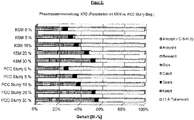
- Fig. 3 shows reflections of tobermorite (Tob (220) and Tob (222)) as well as calcite (CC (104)) from natural limestone meal (KSM) and PCC.
- Tob (220) and Tob (222) were measured with 30 wt .-% limestone powder or PCC. It can be seen that the reflections of tobermorite are the same for both samples.
- the Calcitreflexe differ however significantly.
- the Calcitreflex of the sample with PCC has a much higher intensity and lower half width.
- its position corresponds to that of synthetically precipitated CaCO 3 and thus is slightly adjacent to the d value of calcite the nature. The use of PCC is thus detectable on the produced aerated concrete molded body.
- Fig. 4 shows the calculated from the measured compressive strengths and dry apparent densities ⁇ 0 A-numbers depending on the CaCO 3 content (KSM or PCC) of the solid mixtures of the fresh concrete masses.
- the A numbers of the corresponding samples of limestone meal and PCC are substantially the same, respectively. Both with the use of limestone flour and with the use of PCC, the A-number decreases equally with increasing content of additive.
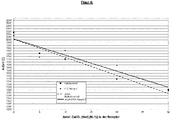
- Fig. 5 the measured thermal conductivities ⁇ 10tr are shown as a function of the CaCO 3 content (KSM or PCC) of the solid mixtures of the fresh concrete masses. It can be clearly seen that the thermal conductivities ⁇ 10tr of the samples with PCC are significantly lower than the thermal conductivities ⁇ 10tr of the samples with the corresponding content of limestone powder . Furthermore, the thermal conductivity ⁇ 10tr in the samples with PCC decreases significantly more with increasing CaCO 3 content than with the samples with limestone powder. This is illustrated by the linear regressions.
- Fig. 6 shows the measured RILEM shrinkage 20/43 as a function of the CaCO 3 content (KSM or PCC) of the solid mixtures of the fresh concrete masses. This shows the same tendency as with the thermal conductivity.
- the shrinkage of the sample with PCC is in each case significantly lower than the shrinkage of the sample with the corresponding content of limestone powder. Furthermore, the shrinkage in the samples with PCC decreases significantly more with increasing CaCO 3 content than with the samples with limestone meal. This again shows the linear regression.
- the experiments thus prove the reduction of the thermal conductivity as well as the shrinkage through the use of PCC.
- the compressive strength decreases in comparison less than when using limestone powder.
- the reinforced or unreinforced pore or foam concrete molded bodies consisting of the pore or foam concrete material according to the invention thus have outstanding structural properties.
- the production of the pore or Schaumbetonform manipulate can be carried out in a conventional manner. Only PCC is used as an additive. Because of this is chemically inert, it does not affect the phase composition of the CSH phases.
- the content of precipitated calcium carbonate and / or calcium magnesium carbonate in the mixture for producing the pore or Schaumbetonform momentss is according to the invention 10 to 30 M .-%, in particular 15 to 25 M .-% (based on the dry mixture or the total solids content of the fresh concrete mass ).
- suspension formed in the preparation of the precipitated calcium carbonate or calcium magnesium carbonate can be used directly.
- a complex dry is not required.
- the fresh concrete masses for the production of the pore or foam concrete material according to the invention have a water / solids value of 0.5 to 2.2, preferably 1.0 to 2.1. This increases the gel fraction.
- additives such as e.g. Aerated concrete meal and / or limestone meal, and / or conventional additives, such as e.g. Plasticizers and / or accelerators, and / or aggregates and / or fibers are added.
- aerated concrete flour which was prepared from inventively produced pore or foam concrete material.
- dispersants e.g., polyphosphates
- dispersants e.g., polyphosphates
Landscapes
- Chemical & Material Sciences (AREA)
- Engineering & Computer Science (AREA)
- Ceramic Engineering (AREA)
- Chemical Kinetics & Catalysis (AREA)
- Inorganic Chemistry (AREA)
- Materials Engineering (AREA)
- Structural Engineering (AREA)
- Organic Chemistry (AREA)
- Curing Cements, Concrete, And Artificial Stone (AREA)
- Porous Artificial Stone Or Porous Ceramic Products (AREA)
Priority Applications (1)
| Application Number | Priority Date | Filing Date | Title |
|---|---|---|---|
| PL16181093T PL3100991T3 (pl) | 2013-07-12 | 2014-05-20 | Sposób wytwarzania hydrotermalnie utwardzanego elementu kształtowego z porowatego lub spienionego betonu |
Applications Claiming Priority (2)
| Application Number | Priority Date | Filing Date | Title |
|---|---|---|---|
| DE102013011742.9A DE102013011742B3 (de) | 2013-07-12 | 2013-07-12 | Hydrothermal gehärtetes Poren- oder Schaumbetonmaterial, hydrothermal gehärteter Poren- oder Schaumbetonformkörper, Verfahren zu dessen Herstellung und Verwendung von gefälltem Calciumcarbonat und/oder Calciummagnesiumcarbonat |
| EP14169131.1A EP2824086B1 (de) | 2013-07-12 | 2014-05-20 | Hydrothermal gehärtetes Poren- oder Schaumbetonmaterial sowie Verfahren zu dessen Herstellung |
Related Parent Applications (2)
| Application Number | Title | Priority Date | Filing Date |
|---|---|---|---|
| EP14169131.1A Division EP2824086B1 (de) | 2013-07-12 | 2014-05-20 | Hydrothermal gehärtetes Poren- oder Schaumbetonmaterial sowie Verfahren zu dessen Herstellung |
| EP14169131.1A Division-Into EP2824086B1 (de) | 2013-07-12 | 2014-05-20 | Hydrothermal gehärtetes Poren- oder Schaumbetonmaterial sowie Verfahren zu dessen Herstellung |
Publications (2)
| Publication Number | Publication Date |
|---|---|
| EP3100991A1 EP3100991A1 (de) | 2016-12-07 |
| EP3100991B1 true EP3100991B1 (de) | 2017-09-13 |
Family
ID=50726298
Family Applications (2)
| Application Number | Title | Priority Date | Filing Date |
|---|---|---|---|
| EP16181093.2A Active EP3100991B1 (de) | 2013-07-12 | 2014-05-20 | Verfahren zur herstellung eines hydrothermal gehärteten poren- oder schaumbetonformkörpers |
| EP14169131.1A Revoked EP2824086B1 (de) | 2013-07-12 | 2014-05-20 | Hydrothermal gehärtetes Poren- oder Schaumbetonmaterial sowie Verfahren zu dessen Herstellung |
Family Applications After (1)
| Application Number | Title | Priority Date | Filing Date |
|---|---|---|---|
| EP14169131.1A Revoked EP2824086B1 (de) | 2013-07-12 | 2014-05-20 | Hydrothermal gehärtetes Poren- oder Schaumbetonmaterial sowie Verfahren zu dessen Herstellung |
Country Status (4)
| Country | Link |
|---|---|
| EP (2) | EP3100991B1 (enExample) |
| JP (1) | JP2015017035A (enExample) |
| DE (1) | DE102013011742B3 (enExample) |
| PL (2) | PL2824086T3 (enExample) |
Families Citing this family (4)
| Publication number | Priority date | Publication date | Assignee | Title |
|---|---|---|---|---|
| DE102013011742B3 (de) | 2013-07-12 | 2014-06-05 | Xella Baustoffe Gmbh | Hydrothermal gehärtetes Poren- oder Schaumbetonmaterial, hydrothermal gehärteter Poren- oder Schaumbetonformkörper, Verfahren zu dessen Herstellung und Verwendung von gefälltem Calciumcarbonat und/oder Calciummagnesiumcarbonat |
| DE102015121553B4 (de) * | 2015-12-10 | 2023-03-23 | RODGAUER BAUSTOFFWERKE GmbH & Co KG | Verfahren zur Herstellung von Porenbeton und Porenbeton |
| DE102023204964A1 (de) | 2023-05-26 | 2024-11-28 | Xella Technologie- Und Forschungsgesellschaft Mbh | Verfahren zur Herstellung von hydrothermal gehärteten Poren- oder Schaumbetonformkörpern und mittels des Verfahrens hergestellter Poren- oder Schaumbetonformkörper |
| DE102023208724A1 (de) | 2023-09-08 | 2025-03-13 | Xella Technologie- Und Forschungsgesellschaft Mbh | Verfahren zur Herstellung von hydrothermal gehärteten Poren- oder Schaumbetonformkörpern und mittels des Verfahrens hergestellter Poren- oder Schaumbetonformkörper |
Citations (25)
| Publication number | Priority date | Publication date | Assignee | Title |
|---|---|---|---|---|
| DE660373C (de) | 1934-12-04 | 1938-05-21 | E H Harry Pauling Dipl Ing Dr | Verfahren zur Faellung von Calciumcarbonat aus Saccharatloesungen mittels Kohlensaeure |
| DE889438C (de) | 1937-10-30 | 1953-09-10 | Blendax Werke Schneider Co | Verfahren zur Herstellung von gefaelltem Calciumcarbonat mit besonders hohem Schwemmvolumen |
| DE923007C (de) | 1941-10-15 | 1955-01-31 | Blendax Werke Schneider Co | Verfahren zur Herstellung von reinweissem Calciumcarbonat |
| DE1671263B1 (de) | 1967-03-03 | 1971-06-03 | Kaspar Winkler & Co | Verfahren zur Herstellung von Injektionsmoertel oder Porenbeton |
| DE2744365A1 (de) | 1977-10-01 | 1979-04-05 | Ytong Ag | Verfahren zur herstellung von gasbeton |
| JPS5874553A (ja) | 1981-10-23 | 1983-05-06 | 住友金属鉱山株式会社 | 水蒸気養生軽量気泡コンクリ−トの製造法 |
| DE3633471A1 (de) | 1985-10-01 | 1987-04-02 | Sumitomo Metal Mining Co | Verfahren zur herstellung von autoklavengehaertetem gasleichtbeton |
| DD298372A5 (de) | 1989-11-29 | 1992-02-20 | Bergakademie Freiberg,De | Verfahren zur herstellung von besonders als fuellstoff geeigneten calciumcarbonatpulvern aus waessrigen loesungen |
| DE19915149A1 (de) | 1999-03-26 | 2000-10-05 | Hunger Hans Dieter | Leichtbaustoffe und Verfahren zu ihrer Herstellung |
| JP2001058884A (ja) | 1999-08-19 | 2001-03-06 | Asahi Chem Ind Co Ltd | 珪酸カルシウム硬化体の製造方法 |
| JP2001302367A (ja) | 2000-04-26 | 2001-10-31 | Clion Co Ltd | 軽量気泡コンクリートの製造方法 |
| EP1151966A1 (de) | 2000-04-14 | 2001-11-07 | Schaefer Kalk | Stabiles, plättchenförmiges, calcitisches Calciumcarbonat, Verfahren zu dessen Herstellung und seine Verwendung |
| DE10041368A1 (de) | 2000-08-23 | 2002-03-07 | Ytong Deutschland Ag | Verfahren zum Herstellen von Porenbeton |
| DE102005014704A1 (de) | 2004-03-26 | 2005-12-08 | F & B GmbH Feuerschutz & Brandbekämpfung | Verfahren und Anlage zur Herstellung eines Leichtwerkstoffes |
| DE102005005259A1 (de) | 2005-02-04 | 2006-08-17 | Xella Dämmsysteme GmbH | Mineralisches Dämmelement und Verfahren zu seiner Herstellung |
| WO2006134080A1 (en) | 2005-06-15 | 2006-12-21 | Solvay (Société Anonyme) | Use of particles of calcium carbonate in the production of construction materials |
| DE10066270B4 (de) | 2000-08-23 | 2007-05-24 | Xella Baustoffe Gmbh | Verfahren zum Herstellen von Porenbeton |
| DE102006046311A1 (de) | 2006-09-29 | 2008-04-03 | Xella Baustoffe Gmbh | Verfahren und Bewehrungsmittel zur Herstellung bewehrter Poren- oder Schaumbetonkörper und Bewehrungshalterahmen zur Verwendung für ein derartiges Verfahren |
| WO2009121635A1 (de) | 2008-04-04 | 2009-10-08 | Xella Technologie- Und Forschungsgesellschaft Mbh | Verfahren zur herstellung von porenbeton und schaumbeton sowie anlage zur durchführung des verfahrens |
| DE202008017703U1 (de) | 2008-09-15 | 2010-05-12 | Xella Technologie- Und Forschungsgesellschaft Mbh | Porenbetonmaterial |
| CN101905964A (zh) | 2010-07-29 | 2010-12-08 | 浙江大学 | 一种高强度蒸压加气混凝土的制备方法 |
| DE102010005361A1 (de) | 2010-01-21 | 2011-07-28 | Veit Dennert KG Baustoffbetriebe, 96132 | Mineralischer Formkörper, Verwendung und Verfahren zur Herstellung des mineralischen Formkörpers |
| EP2371783A1 (de) | 2010-04-01 | 2011-10-05 | Xella Technologie- und Forschungsgesellschaft mbH | Porenbetonformkörper sowie Verfahren zu seiner Herstellung |
| DE102006045091B4 (de) | 2006-09-21 | 2013-04-25 | Universität Dortmund | Verfahren zur Herstellung eines Porenbetons sowie verfahrensgemäß hergestellter Porenbeton |
| EP2599750A1 (de) | 2011-11-29 | 2013-06-05 | HF Biotec Berlin GmbH | Verfahren und Anlage zur semikontinuierlichen Herstellung von kristallinem Calciumcarbonat |
Family Cites Families (11)
| Publication number | Priority date | Publication date | Assignee | Title |
|---|---|---|---|---|
| JPS6278173A (ja) * | 1985-10-01 | 1987-04-10 | 住友金属鉱山株式会社 | Alcの製造方法 |
| JPS62162679A (ja) * | 1986-01-14 | 1987-07-18 | 住友金属鉱山株式会社 | 水蒸気養生軽量気泡コンクリ−トの製造法 |
| JP2825905B2 (ja) * | 1990-02-02 | 1998-11-18 | 株式会社アスク | 珪酸カルシウム成形体 |
| JP2006075717A (ja) * | 2004-09-09 | 2006-03-23 | Nippon Steel Corp | 炭酸ガスの利用方法 |
| JP2006206425A (ja) * | 2004-12-28 | 2006-08-10 | Showa Denko Kk | アルカリ土類金属炭酸塩微粒子およびその製造方法 |
| EP1892226A3 (de) | 2006-08-25 | 2010-02-17 | H+H Deutschland GmbH | Verfahren zur Reduzierung der Wärmeleitfähigkeit von Bausteinen aus einem kalzium-Silikate-Material sowie Baustein aus einem Kalzium-Silikat-Material mit verbesserter Wärmeleitfähigkeit |
| US20080210134A1 (en) | 2007-02-28 | 2008-09-04 | Hanks Dallas A | Precipitated Calcium Carbonate (PCC) from Sugar Processing Byproducts for use in Cementitious Applications and Methods Thereof |
| KR101666005B1 (ko) * | 2009-08-12 | 2016-10-13 | 뉴페이지 코포레이션 | 잉크젯 기록 매체 |
| JP2012106885A (ja) * | 2010-11-17 | 2012-06-07 | Clion Co Ltd | 軽量気泡コンクリート |
| US8859663B2 (en) * | 2011-12-27 | 2014-10-14 | Hankuk Paper Mfg. Co., Ltd. | Calcium carbonate having a surface charge, the preparing process thereof and filler for producing a paper using the same |
| DE102013011742B3 (de) | 2013-07-12 | 2014-06-05 | Xella Baustoffe Gmbh | Hydrothermal gehärtetes Poren- oder Schaumbetonmaterial, hydrothermal gehärteter Poren- oder Schaumbetonformkörper, Verfahren zu dessen Herstellung und Verwendung von gefälltem Calciumcarbonat und/oder Calciummagnesiumcarbonat |
-
2013
- 2013-07-12 DE DE102013011742.9A patent/DE102013011742B3/de not_active Revoked
-
2014
- 2014-05-20 EP EP16181093.2A patent/EP3100991B1/de active Active
- 2014-05-20 PL PL14169131T patent/PL2824086T3/pl unknown
- 2014-05-20 EP EP14169131.1A patent/EP2824086B1/de not_active Revoked
- 2014-05-20 PL PL16181093T patent/PL3100991T3/pl unknown
- 2014-07-10 JP JP2014142152A patent/JP2015017035A/ja not_active Withdrawn
Patent Citations (26)
| Publication number | Priority date | Publication date | Assignee | Title |
|---|---|---|---|---|
| DE660373C (de) | 1934-12-04 | 1938-05-21 | E H Harry Pauling Dipl Ing Dr | Verfahren zur Faellung von Calciumcarbonat aus Saccharatloesungen mittels Kohlensaeure |
| DE889438C (de) | 1937-10-30 | 1953-09-10 | Blendax Werke Schneider Co | Verfahren zur Herstellung von gefaelltem Calciumcarbonat mit besonders hohem Schwemmvolumen |
| DE923007C (de) | 1941-10-15 | 1955-01-31 | Blendax Werke Schneider Co | Verfahren zur Herstellung von reinweissem Calciumcarbonat |
| DE1671263B1 (de) | 1967-03-03 | 1971-06-03 | Kaspar Winkler & Co | Verfahren zur Herstellung von Injektionsmoertel oder Porenbeton |
| DE2744365A1 (de) | 1977-10-01 | 1979-04-05 | Ytong Ag | Verfahren zur herstellung von gasbeton |
| JPS5874553A (ja) | 1981-10-23 | 1983-05-06 | 住友金属鉱山株式会社 | 水蒸気養生軽量気泡コンクリ−トの製造法 |
| DE3633471A1 (de) | 1985-10-01 | 1987-04-02 | Sumitomo Metal Mining Co | Verfahren zur herstellung von autoklavengehaertetem gasleichtbeton |
| DD298372A5 (de) | 1989-11-29 | 1992-02-20 | Bergakademie Freiberg,De | Verfahren zur herstellung von besonders als fuellstoff geeigneten calciumcarbonatpulvern aus waessrigen loesungen |
| DE19915149A1 (de) | 1999-03-26 | 2000-10-05 | Hunger Hans Dieter | Leichtbaustoffe und Verfahren zu ihrer Herstellung |
| JP2001058884A (ja) | 1999-08-19 | 2001-03-06 | Asahi Chem Ind Co Ltd | 珪酸カルシウム硬化体の製造方法 |
| EP1151966A1 (de) | 2000-04-14 | 2001-11-07 | Schaefer Kalk | Stabiles, plättchenförmiges, calcitisches Calciumcarbonat, Verfahren zu dessen Herstellung und seine Verwendung |
| JP2001302367A (ja) | 2000-04-26 | 2001-10-31 | Clion Co Ltd | 軽量気泡コンクリートの製造方法 |
| DE10041368A1 (de) | 2000-08-23 | 2002-03-07 | Ytong Deutschland Ag | Verfahren zum Herstellen von Porenbeton |
| DE10066270B4 (de) | 2000-08-23 | 2007-05-24 | Xella Baustoffe Gmbh | Verfahren zum Herstellen von Porenbeton |
| DE102005014704A1 (de) | 2004-03-26 | 2005-12-08 | F & B GmbH Feuerschutz & Brandbekämpfung | Verfahren und Anlage zur Herstellung eines Leichtwerkstoffes |
| DE102005005259A1 (de) | 2005-02-04 | 2006-08-17 | Xella Dämmsysteme GmbH | Mineralisches Dämmelement und Verfahren zu seiner Herstellung |
| WO2006134080A1 (en) | 2005-06-15 | 2006-12-21 | Solvay (Société Anonyme) | Use of particles of calcium carbonate in the production of construction materials |
| DE102006045091B4 (de) | 2006-09-21 | 2013-04-25 | Universität Dortmund | Verfahren zur Herstellung eines Porenbetons sowie verfahrensgemäß hergestellter Porenbeton |
| DE102006046311A1 (de) | 2006-09-29 | 2008-04-03 | Xella Baustoffe Gmbh | Verfahren und Bewehrungsmittel zur Herstellung bewehrter Poren- oder Schaumbetonkörper und Bewehrungshalterahmen zur Verwendung für ein derartiges Verfahren |
| WO2009121635A1 (de) | 2008-04-04 | 2009-10-08 | Xella Technologie- Und Forschungsgesellschaft Mbh | Verfahren zur herstellung von porenbeton und schaumbeton sowie anlage zur durchführung des verfahrens |
| DE202008017703U1 (de) | 2008-09-15 | 2010-05-12 | Xella Technologie- Und Forschungsgesellschaft Mbh | Porenbetonmaterial |
| DE102010005361A1 (de) | 2010-01-21 | 2011-07-28 | Veit Dennert KG Baustoffbetriebe, 96132 | Mineralischer Formkörper, Verwendung und Verfahren zur Herstellung des mineralischen Formkörpers |
| EP2371783A1 (de) | 2010-04-01 | 2011-10-05 | Xella Technologie- und Forschungsgesellschaft mbH | Porenbetonformkörper sowie Verfahren zu seiner Herstellung |
| DE102010013667A1 (de) | 2010-04-01 | 2011-10-06 | Xella Technologie- Und Forschungsgesellschaft Mbh | Porenbetonformkörper sowie Verfahren zu seiner Herstellung |
| CN101905964A (zh) | 2010-07-29 | 2010-12-08 | 浙江大学 | 一种高强度蒸压加气混凝土的制备方法 |
| EP2599750A1 (de) | 2011-11-29 | 2013-06-05 | HF Biotec Berlin GmbH | Verfahren und Anlage zur semikontinuierlichen Herstellung von kristallinem Calciumcarbonat |
Non-Patent Citations (13)
| Title |
|---|
| "Calciumcarbonat", AUSZUG AUS WIKIPEDIA ZUM STICHWORT ?CALCIUMCARBONAT, April 2018 (2018-04-01), XP055501330 |
| "Particle Size Distribution and Suspension Stability in Aqueous Submicron Grinding of CaC03 and Ti02", DISSERTATION BY KATJA OHENOJA, 2014, Oulu, XP055664235, Retrieved from the Internet <URL:http://jultika.oulu.fi/files/isbn9789526205502.pdf> |
| "Pigmente, Füllstoffe und Farbmetrik", AUSZUG AUS H. KITTEL LEHRBUCH DER LACKE UND BESCHICHTUNGEN, vol. 5, 2003, Stuttgart , Leipzig, XP055501312 |
| "SOCAL® Chemisch gefälltes Calciumcarbonat - Herstellung, Eigenschaften", PROSPEKT, January 1995 (1995-01-01), XP055501322 |
| AUSZÜGE FÜR CALCIUMCARBONATE UND DEREN RÖNTGENOGRAPHI- SCHEN SPEKTREN AUS RRUFF.INFO, Retrieved from the Internet <URL:http://rruff.info/calcite/dis- play = default/R040070> |
| CHRISTOPHER PUST, DIE HERSTELLUNG VON GEFÄLLTEM CALCIUMCARBONAT -PCC, December 1992 (1992-12-01), XP055407453 |
| CHRISTOPHER PUST: "Die Herstellung von gefälltem Calciumcarbonat - PCC", December 1992 (1992-12-01), Aachen, XP055407453 |
| F.A. BROCKHAUS: "Stichworte „Kreide", "Kalkspat, Calcit", "Kalkstein, Kalk"", AUSZUG AUS BROCKHAUS ENZYKLOPÄDIE IN ZWANZIG BÄNDEN, 1970, Wiesbaden, XP055407496 |
| GRANULOMETRIE, vol. 2, 2006, Retrieved from the Internet <URL:https://tu-dresden.de/ing/maschinenwesen/ifvu/mvt/ressourcen/da- teien/downloads/ba gvt/zerkleinerung .pdf> [retrieved on 20100715] |
| H. KITTEL: "Lehrbuch der Lacke und Beschichtungen", BAND, vol. 5, 2003, Stuttgart /Leipzig, pages 446 - 457, XP055500792 |
| INTERNETDARSTELLUNG DER CEMTEC CEMENT AND MINING TECHNO- LOGY GMBH ZU DEM VON DIESER ANGEBOTENEN MAHL- UND ANALYSEVERFAHREN NACH BOND, Retrieved from the Internet <URL:http://www.cemtec.at/de/technikum/labor-und-analysetech- nik/mahlbarkeit> |
| JIMOH ET AL.: "Understanding the Precipitated Calcium Carbonate (PCC) Production Mechanism and Its Characteristics in the Liquid-Gas System Using Milk of Lime (MOL) Suspension", S. AFR. J. CHEM., vol. 70, 2017, pages 1 - 7, XP055664226 |
| PRODUKTDATENBLATT ZU BOND INDEX TESTER BT 100 DER FIRMA RETSCH GMBH, Retrieved from the Internet <URL:https://www.retsch.de/de/produkte/assistieren/pruefgeraete/bt-1 00/funktion- merkmale> |
Also Published As
| Publication number | Publication date |
|---|---|
| EP2824086A2 (de) | 2015-01-14 |
| PL2824086T3 (pl) | 2017-05-31 |
| JP2015017035A (ja) | 2015-01-29 |
| EP2824086A9 (de) | 2015-07-22 |
| DE102013011742B3 (de) | 2014-06-05 |
| EP2824086A3 (de) | 2015-01-21 |
| PL3100991T3 (pl) | 2018-02-28 |
| EP2824086B1 (de) | 2016-11-09 |
| EP3100991A1 (de) | 2016-12-07 |
Similar Documents
| Publication | Publication Date | Title |
|---|---|---|
| DE4135144C2 (de) | Verfahren zur Herstellung eines gehärteten, faserverstärkten Schlacke/Gibs/Zement-Leichtbauprodukts | |
| EP2163534B1 (de) | Porenbetonmaterial sowie verfahren zu seiner herstellung | |
| EP2234940A1 (de) | Verfahren zur herstellung von porenbeton und schaumbeton sowie anlage zur durchführung des verfahrens | |
| EP3789362B1 (de) | Verfahren zur herstellung von hydrothermal gehärteten poren- oder schaumbetonformkörpern | |
| EP2371783A1 (de) | Porenbetonformkörper sowie Verfahren zu seiner Herstellung | |
| EP2824086B1 (de) | Hydrothermal gehärtetes Poren- oder Schaumbetonmaterial sowie Verfahren zu dessen Herstellung | |
| EP3241813B1 (de) | Verfahren zur herstellung eines mineralischen dämmmaterials | |
| EP1069090A1 (de) | Faserverstärkter Schaumbeton sowie Verfahren zu seiner Herstellung | |
| DE2832194C3 (de) | Verfahren zur Herstellung von Calciumsilikatgranulaten bzw. -pulvern mit Mikroporenstruktur | |
| DE10066270B9 (de) | Verfahren zum Herstellen von Porenbeton | |
| EP3945083A1 (de) | Kalksandformkörper sowie verfahren zu dessen herstellung | |
| DE10041368B4 (de) | Verfahren zum Herstellen von Porenbeton | |
| DE2900613C2 (de) | Verfahren zum Herstellen eines faserverstärkten, ausgehärteten Gips-Formkörpers | |
| DE102015121553B4 (de) | Verfahren zur Herstellung von Porenbeton und Porenbeton | |
| DE2617218C3 (enExample) | ||
| DE19728525C1 (de) | Verfahren zur Herstellung von hydrothermal gehärtetem Porenbeton und danach hergestellter Porenbeton-Formkörper | |
| DE3303042A1 (de) | Verfahren zum herstellen bindemittelgebundener formkoerper | |
| DE102023208724A1 (de) | Verfahren zur Herstellung von hydrothermal gehärteten Poren- oder Schaumbetonformkörpern und mittels des Verfahrens hergestellter Poren- oder Schaumbetonformkörper | |
| DE102023204964A1 (de) | Verfahren zur Herstellung von hydrothermal gehärteten Poren- oder Schaumbetonformkörpern und mittels des Verfahrens hergestellter Poren- oder Schaumbetonformkörper | |
| DE10121098A1 (de) | Verfahren zur Herstellung von Calciumsilikathydratgranulat und Verwendung desselben | |
| DE3834751A1 (de) | Verfahren zur herstellung von leichtzuschlagstoffen mit geringer dichte | |
| AT347319B (de) | Feinfoerniger leichtzuschlag fuer betone geringer rohdichte und hoher festigkeit und verfahren zu dessen herstellung | |
| CH713947B1 (de) | Nichtcalcinierte zementöse Zusammensetzungen, nichtcalcinierte Betonzusammensetzungen, nichtcalcinierter Beton und Verfahren zu deren Herstellung. | |
| DE102023100032A1 (de) | Hydrothermal erzeugte Materialien sowie deren Herstellung und Verwendung | |
| DE102019009214A1 (de) | Verfahren zur Herstellung von hydrothermal gehärteten Poren- oder Schaumbetonformkörpern und mittels des Verfahrens hergestellter Poren- oder Schaumbetonformkörper |
Legal Events
| Date | Code | Title | Description |
|---|---|---|---|
| PUAI | Public reference made under article 153(3) epc to a published international application that has entered the european phase |
Free format text: ORIGINAL CODE: 0009012 |
|
| STAA | Information on the status of an ep patent application or granted ep patent |
Free format text: STATUS: REQUEST FOR EXAMINATION WAS MADE |
|
| 17P | Request for examination filed |
Effective date: 20160725 |
|
| AC | Divisional application: reference to earlier application |
Ref document number: 2824086 Country of ref document: EP Kind code of ref document: P |
|
| AK | Designated contracting states |
Kind code of ref document: A1 Designated state(s): AL AT BE BG CH CY CZ DE DK EE ES FI FR GB GR HR HU IE IS IT LI LT LU LV MC MK MT NL NO PL PT RO RS SE SI SK SM TR |
|
| RIN1 | Information on inventor provided before grant (corrected) |
Inventor name: STUMM, ANDREAS DR. Inventor name: BOENKENDORF, ULF DR. |
|
| TPAC | Observations filed by third parties |
Free format text: ORIGINAL CODE: EPIDOSNTIPA |
|
| GRAP | Despatch of communication of intention to grant a patent |
Free format text: ORIGINAL CODE: EPIDOSNIGR1 |
|
| STAA | Information on the status of an ep patent application or granted ep patent |
Free format text: STATUS: GRANT OF PATENT IS INTENDED |
|
| TPAC | Observations filed by third parties |
Free format text: ORIGINAL CODE: EPIDOSNTIPA |
|
| INTG | Intention to grant announced |
Effective date: 20170321 |
|
| RIN1 | Information on inventor provided before grant (corrected) |
Inventor name: STUMM, ANDREAS Inventor name: BOENKENDORF, ULF |
|
| GRAS | Grant fee paid |
Free format text: ORIGINAL CODE: EPIDOSNIGR3 |
|
| GRAA | (expected) grant |
Free format text: ORIGINAL CODE: 0009210 |
|
| STAA | Information on the status of an ep patent application or granted ep patent |
Free format text: STATUS: THE PATENT HAS BEEN GRANTED |
|
| AC | Divisional application: reference to earlier application |
Ref document number: 2824086 Country of ref document: EP Kind code of ref document: P |
|
| AK | Designated contracting states |
Kind code of ref document: B1 Designated state(s): AL AT BE BG CH CY CZ DE DK EE ES FI FR GB GR HR HU IE IS IT LI LT LU LV MC MK MT NL NO PL PT RO RS SE SI SK SM TR |
|
| REG | Reference to a national code |
Ref country code: GB Ref legal event code: FG4D Free format text: NOT ENGLISH |
|
| REG | Reference to a national code |
Ref country code: CH Ref legal event code: EP |
|
| REG | Reference to a national code |
Ref country code: IE Ref legal event code: FG4D Free format text: LANGUAGE OF EP DOCUMENT: GERMAN |
|
| REG | Reference to a national code |
Ref country code: AT Ref legal event code: REF Ref document number: 927972 Country of ref document: AT Kind code of ref document: T Effective date: 20171015 |
|
| REG | Reference to a national code |
Ref country code: DE Ref legal event code: R096 Ref document number: 502014005488 Country of ref document: DE |
|
| REG | Reference to a national code |
Ref country code: NL Ref legal event code: MP Effective date: 20170913 |
|
| REG | Reference to a national code |
Ref country code: LT Ref legal event code: MG4D |
|
| PG25 | Lapsed in a contracting state [announced via postgrant information from national office to epo] |
Ref country code: FI Free format text: LAPSE BECAUSE OF FAILURE TO SUBMIT A TRANSLATION OF THE DESCRIPTION OR TO PAY THE FEE WITHIN THE PRESCRIBED TIME-LIMIT Effective date: 20170913 Ref country code: SE Free format text: LAPSE BECAUSE OF FAILURE TO SUBMIT A TRANSLATION OF THE DESCRIPTION OR TO PAY THE FEE WITHIN THE PRESCRIBED TIME-LIMIT Effective date: 20170913 Ref country code: HR Free format text: LAPSE BECAUSE OF FAILURE TO SUBMIT A TRANSLATION OF THE DESCRIPTION OR TO PAY THE FEE WITHIN THE PRESCRIBED TIME-LIMIT Effective date: 20170913 Ref country code: LT Free format text: LAPSE BECAUSE OF FAILURE TO SUBMIT A TRANSLATION OF THE DESCRIPTION OR TO PAY THE FEE WITHIN THE PRESCRIBED TIME-LIMIT Effective date: 20170913 Ref country code: NO Free format text: LAPSE BECAUSE OF FAILURE TO SUBMIT A TRANSLATION OF THE DESCRIPTION OR TO PAY THE FEE WITHIN THE PRESCRIBED TIME-LIMIT Effective date: 20171213 |
|
| PG25 | Lapsed in a contracting state [announced via postgrant information from national office to epo] |
Ref country code: GR Free format text: LAPSE BECAUSE OF FAILURE TO SUBMIT A TRANSLATION OF THE DESCRIPTION OR TO PAY THE FEE WITHIN THE PRESCRIBED TIME-LIMIT Effective date: 20171214 Ref country code: LV Free format text: LAPSE BECAUSE OF FAILURE TO SUBMIT A TRANSLATION OF THE DESCRIPTION OR TO PAY THE FEE WITHIN THE PRESCRIBED TIME-LIMIT Effective date: 20170913 Ref country code: RS Free format text: LAPSE BECAUSE OF FAILURE TO SUBMIT A TRANSLATION OF THE DESCRIPTION OR TO PAY THE FEE WITHIN THE PRESCRIBED TIME-LIMIT Effective date: 20170913 Ref country code: ES Free format text: LAPSE BECAUSE OF FAILURE TO SUBMIT A TRANSLATION OF THE DESCRIPTION OR TO PAY THE FEE WITHIN THE PRESCRIBED TIME-LIMIT Effective date: 20170913 Ref country code: BG Free format text: LAPSE BECAUSE OF FAILURE TO SUBMIT A TRANSLATION OF THE DESCRIPTION OR TO PAY THE FEE WITHIN THE PRESCRIBED TIME-LIMIT Effective date: 20171213 |
|
| PG25 | Lapsed in a contracting state [announced via postgrant information from national office to epo] |
Ref country code: NL Free format text: LAPSE BECAUSE OF FAILURE TO SUBMIT A TRANSLATION OF THE DESCRIPTION OR TO PAY THE FEE WITHIN THE PRESCRIBED TIME-LIMIT Effective date: 20170913 |
|
| REG | Reference to a national code |
Ref country code: SK Ref legal event code: T3 Ref document number: E 26085 Country of ref document: SK |
|
| REG | Reference to a national code |
Ref country code: FR Ref legal event code: PLFP Year of fee payment: 5 |
|
| PG25 | Lapsed in a contracting state [announced via postgrant information from national office to epo] |
Ref country code: SM Free format text: LAPSE BECAUSE OF FAILURE TO SUBMIT A TRANSLATION OF THE DESCRIPTION OR TO PAY THE FEE WITHIN THE PRESCRIBED TIME-LIMIT Effective date: 20170913 Ref country code: EE Free format text: LAPSE BECAUSE OF FAILURE TO SUBMIT A TRANSLATION OF THE DESCRIPTION OR TO PAY THE FEE WITHIN THE PRESCRIBED TIME-LIMIT Effective date: 20170913 Ref country code: IS Free format text: LAPSE BECAUSE OF FAILURE TO SUBMIT A TRANSLATION OF THE DESCRIPTION OR TO PAY THE FEE WITHIN THE PRESCRIBED TIME-LIMIT Effective date: 20180113 |
|
| REG | Reference to a national code |
Ref country code: DE Ref legal event code: R026 Ref document number: 502014005488 Country of ref document: DE |
|
| PLBI | Opposition filed |
Free format text: ORIGINAL CODE: 0009260 |
|
| PLAX | Notice of opposition and request to file observation + time limit sent |
Free format text: ORIGINAL CODE: EPIDOSNOBS2 |
|
| 26 | Opposition filed |
Opponent name: BUNDESVERBAND PORENBETONINDUSTRIE E.V. Effective date: 20180613 Opponent name: H+H DEUTSCHLAND GMBH Effective date: 20180613 |
|
| PG25 | Lapsed in a contracting state [announced via postgrant information from national office to epo] |
Ref country code: DK Free format text: LAPSE BECAUSE OF FAILURE TO SUBMIT A TRANSLATION OF THE DESCRIPTION OR TO PAY THE FEE WITHIN THE PRESCRIBED TIME-LIMIT Effective date: 20170913 |
|
| PG25 | Lapsed in a contracting state [announced via postgrant information from national office to epo] |
Ref country code: MT Free format text: LAPSE BECAUSE OF FAILURE TO SUBMIT A TRANSLATION OF THE DESCRIPTION OR TO PAY THE FEE WITHIN THE PRESCRIBED TIME-LIMIT Effective date: 20170913 |
|
| PLAF | Information modified related to communication of a notice of opposition and request to file observations + time limit |
Free format text: ORIGINAL CODE: EPIDOSCOBS2 |
|
| PG25 | Lapsed in a contracting state [announced via postgrant information from national office to epo] |
Ref country code: SI Free format text: LAPSE BECAUSE OF FAILURE TO SUBMIT A TRANSLATION OF THE DESCRIPTION OR TO PAY THE FEE WITHIN THE PRESCRIBED TIME-LIMIT Effective date: 20170913 |
|
| REG | Reference to a national code |
Ref country code: CH Ref legal event code: PL |
|
| PLBB | Reply of patent proprietor to notice(s) of opposition received |
Free format text: ORIGINAL CODE: EPIDOSNOBS3 |
|
| GBPC | Gb: european patent ceased through non-payment of renewal fee |
Effective date: 20180520 |
|
| PG25 | Lapsed in a contracting state [announced via postgrant information from national office to epo] |
Ref country code: MC Free format text: LAPSE BECAUSE OF FAILURE TO SUBMIT A TRANSLATION OF THE DESCRIPTION OR TO PAY THE FEE WITHIN THE PRESCRIBED TIME-LIMIT Effective date: 20170913 |
|
| REG | Reference to a national code |
Ref country code: IE Ref legal event code: MM4A |
|
| PG25 | Lapsed in a contracting state [announced via postgrant information from national office to epo] |
Ref country code: LI Free format text: LAPSE BECAUSE OF NON-PAYMENT OF DUE FEES Effective date: 20180531 Ref country code: CH Free format text: LAPSE BECAUSE OF NON-PAYMENT OF DUE FEES Effective date: 20180531 |
|
| PG25 | Lapsed in a contracting state [announced via postgrant information from national office to epo] |
Ref country code: LU Free format text: LAPSE BECAUSE OF NON-PAYMENT OF DUE FEES Effective date: 20180520 |
|
| PG25 | Lapsed in a contracting state [announced via postgrant information from national office to epo] |
Ref country code: GB Free format text: LAPSE BECAUSE OF NON-PAYMENT OF DUE FEES Effective date: 20180520 Ref country code: IE Free format text: LAPSE BECAUSE OF NON-PAYMENT OF DUE FEES Effective date: 20180520 |
|
| APBM | Appeal reference recorded |
Free format text: ORIGINAL CODE: EPIDOSNREFNO |
|
| APBP | Date of receipt of notice of appeal recorded |
Free format text: ORIGINAL CODE: EPIDOSNNOA2O |
|
| APAH | Appeal reference modified |
Free format text: ORIGINAL CODE: EPIDOSCREFNO |
|
| APBM | Appeal reference recorded |
Free format text: ORIGINAL CODE: EPIDOSNREFNO |
|
| APBP | Date of receipt of notice of appeal recorded |
Free format text: ORIGINAL CODE: EPIDOSNNOA2O |
|
| PG25 | Lapsed in a contracting state [announced via postgrant information from national office to epo] |
Ref country code: PT Free format text: LAPSE BECAUSE OF FAILURE TO SUBMIT A TRANSLATION OF THE DESCRIPTION OR TO PAY THE FEE WITHIN THE PRESCRIBED TIME-LIMIT Effective date: 20170913 |
|
| APBQ | Date of receipt of statement of grounds of appeal recorded |
Free format text: ORIGINAL CODE: EPIDOSNNOA3O |
|
| APBQ | Date of receipt of statement of grounds of appeal recorded |
Free format text: ORIGINAL CODE: EPIDOSNNOA3O |
|
| PG25 | Lapsed in a contracting state [announced via postgrant information from national office to epo] |
Ref country code: HU Free format text: LAPSE BECAUSE OF FAILURE TO SUBMIT A TRANSLATION OF THE DESCRIPTION OR TO PAY THE FEE WITHIN THE PRESCRIBED TIME-LIMIT; INVALID AB INITIO Effective date: 20140520 Ref country code: RO Free format text: LAPSE BECAUSE OF FAILURE TO SUBMIT A TRANSLATION OF THE DESCRIPTION OR TO PAY THE FEE WITHIN THE PRESCRIBED TIME-LIMIT Effective date: 20170913 Ref country code: CY Free format text: LAPSE BECAUSE OF FAILURE TO SUBMIT A TRANSLATION OF THE DESCRIPTION OR TO PAY THE FEE WITHIN THE PRESCRIBED TIME-LIMIT Effective date: 20170913 Ref country code: MK Free format text: LAPSE BECAUSE OF NON-PAYMENT OF DUE FEES Effective date: 20170913 |
|
| PG25 | Lapsed in a contracting state [announced via postgrant information from national office to epo] |
Ref country code: AL Free format text: LAPSE BECAUSE OF FAILURE TO SUBMIT A TRANSLATION OF THE DESCRIPTION OR TO PAY THE FEE WITHIN THE PRESCRIBED TIME-LIMIT Effective date: 20170913 |
|
| REG | Reference to a national code |
Ref country code: AT Ref legal event code: MM01 Ref document number: 927972 Country of ref document: AT Kind code of ref document: T Effective date: 20190520 |
|
| PG25 | Lapsed in a contracting state [announced via postgrant information from national office to epo] |
Ref country code: AT Free format text: LAPSE BECAUSE OF NON-PAYMENT OF DUE FEES Effective date: 20190520 |
|
| PLAB | Opposition data, opponent's data or that of the opponent's representative modified |
Free format text: ORIGINAL CODE: 0009299OPPO |
|
| R26 | Opposition filed (corrected) |
Opponent name: H+H DEUTSCHLAND GMBH Effective date: 20180613 |
|
| REG | Reference to a national code |
Ref country code: DE Ref legal event code: R100 Ref document number: 502014005488 Country of ref document: DE |
|
| APBU | Appeal procedure closed |
Free format text: ORIGINAL CODE: EPIDOSNNOA9O |
|
| PLCK | Communication despatched that opposition was rejected |
Free format text: ORIGINAL CODE: EPIDOSNREJ1 |
|
| STAA | Information on the status of an ep patent application or granted ep patent |
Free format text: STATUS: OPPOSITION REJECTED |
|
| PLBN | Opposition rejected |
Free format text: ORIGINAL CODE: 0009273 |
|
| 27O | Opposition rejected |
Effective date: 20220602 |
|
| PGFP | Annual fee paid to national office [announced via postgrant information from national office to epo] |
Ref country code: DE Payment date: 20250725 Year of fee payment: 12 |
|
| PGFP | Annual fee paid to national office [announced via postgrant information from national office to epo] |
Ref country code: PL Payment date: 20260316 Year of fee payment: 13 |
|
| PGFP | Annual fee paid to national office [announced via postgrant information from national office to epo] |
Ref country code: IT Payment date: 20260416 Year of fee payment: 13 |
|
| PGFP | Annual fee paid to national office [announced via postgrant information from national office to epo] |
Ref country code: BE Payment date: 20260413 Year of fee payment: 13 |
|
| PGFP | Annual fee paid to national office [announced via postgrant information from national office to epo] |
Ref country code: CZ Payment date: 20260401 Year of fee payment: 13 Ref country code: TR Payment date: 20260417 Year of fee payment: 13 |
|
| PGFP | Annual fee paid to national office [announced via postgrant information from national office to epo] |
Ref country code: FR Payment date: 20260413 Year of fee payment: 13 |
|
| PGFP | Annual fee paid to national office [announced via postgrant information from national office to epo] |
Ref country code: SK Payment date: 20260408 Year of fee payment: 13 |