EP3049371B1 - Titania particles and a process for their production - Google Patents
Titania particles and a process for their production Download PDFInfo
- Publication number
- EP3049371B1 EP3049371B1 EP14772218.5A EP14772218A EP3049371B1 EP 3049371 B1 EP3049371 B1 EP 3049371B1 EP 14772218 A EP14772218 A EP 14772218A EP 3049371 B1 EP3049371 B1 EP 3049371B1
- Authority
- EP
- European Patent Office
- Prior art keywords
- particles
- titania
- controlled
- sol
- dried
- Prior art date
- Legal status (The legal status is an assumption and is not a legal conclusion. Google has not performed a legal analysis and makes no representation as to the accuracy of the status listed.)
- Active
Links
Images


Classifications
-
- B—PERFORMING OPERATIONS; TRANSPORTING
- B01—PHYSICAL OR CHEMICAL PROCESSES OR APPARATUS IN GENERAL
- B01J—CHEMICAL OR PHYSICAL PROCESSES, e.g. CATALYSIS OR COLLOID CHEMISTRY; THEIR RELEVANT APPARATUS
- B01J21/00—Catalysts comprising the elements, oxides, or hydroxides of magnesium, boron, aluminium, carbon, silicon, titanium, zirconium, or hafnium
- B01J21/06—Silicon, titanium, zirconium or hafnium; Oxides or hydroxides thereof
- B01J21/063—Titanium; Oxides or hydroxides thereof
-
- B—PERFORMING OPERATIONS; TRANSPORTING
- B01—PHYSICAL OR CHEMICAL PROCESSES OR APPARATUS IN GENERAL
- B01J—CHEMICAL OR PHYSICAL PROCESSES, e.g. CATALYSIS OR COLLOID CHEMISTRY; THEIR RELEVANT APPARATUS
- B01J23/00—Catalysts comprising metals or metal oxides or hydroxides, not provided for in group B01J21/00
- B01J23/38—Catalysts comprising metals or metal oxides or hydroxides, not provided for in group B01J21/00 of noble metals
- B01J23/48—Silver or gold
-
- B—PERFORMING OPERATIONS; TRANSPORTING
- B01—PHYSICAL OR CHEMICAL PROCESSES OR APPARATUS IN GENERAL
- B01J—CHEMICAL OR PHYSICAL PROCESSES, e.g. CATALYSIS OR COLLOID CHEMISTRY; THEIR RELEVANT APPARATUS
- B01J23/00—Catalysts comprising metals or metal oxides or hydroxides, not provided for in group B01J21/00
- B01J23/38—Catalysts comprising metals or metal oxides or hydroxides, not provided for in group B01J21/00 of noble metals
- B01J23/54—Catalysts comprising metals or metal oxides or hydroxides, not provided for in group B01J21/00 of noble metals combined with metals, oxides or hydroxides provided for in groups B01J23/02 - B01J23/36
- B01J23/56—Platinum group metals
-
- B—PERFORMING OPERATIONS; TRANSPORTING
- B01—PHYSICAL OR CHEMICAL PROCESSES OR APPARATUS IN GENERAL
- B01J—CHEMICAL OR PHYSICAL PROCESSES, e.g. CATALYSIS OR COLLOID CHEMISTRY; THEIR RELEVANT APPARATUS
- B01J23/00—Catalysts comprising metals or metal oxides or hydroxides, not provided for in group B01J21/00
- B01J23/70—Catalysts comprising metals or metal oxides or hydroxides, not provided for in group B01J21/00 of the iron group metals or copper
-
- B—PERFORMING OPERATIONS; TRANSPORTING
- B01—PHYSICAL OR CHEMICAL PROCESSES OR APPARATUS IN GENERAL
- B01J—CHEMICAL OR PHYSICAL PROCESSES, e.g. CATALYSIS OR COLLOID CHEMISTRY; THEIR RELEVANT APPARATUS
- B01J35/00—Catalysts, in general, characterised by their form or physical properties
- B01J35/40—Catalysts, in general, characterised by their form or physical properties characterised by dimensions, e.g. grain size
- B01J35/45—Nanoparticles
-
- B—PERFORMING OPERATIONS; TRANSPORTING
- B01—PHYSICAL OR CHEMICAL PROCESSES OR APPARATUS IN GENERAL
- B01J—CHEMICAL OR PHYSICAL PROCESSES, e.g. CATALYSIS OR COLLOID CHEMISTRY; THEIR RELEVANT APPARATUS
- B01J35/00—Catalysts, in general, characterised by their form or physical properties
- B01J35/60—Catalysts, in general, characterised by their form or physical properties characterised by their surface properties or porosity
- B01J35/61—Surface area
- B01J35/613—10-100 m2/g
-
- B—PERFORMING OPERATIONS; TRANSPORTING
- B01—PHYSICAL OR CHEMICAL PROCESSES OR APPARATUS IN GENERAL
- B01J—CHEMICAL OR PHYSICAL PROCESSES, e.g. CATALYSIS OR COLLOID CHEMISTRY; THEIR RELEVANT APPARATUS
- B01J35/00—Catalysts, in general, characterised by their form or physical properties
- B01J35/60—Catalysts, in general, characterised by their form or physical properties characterised by their surface properties or porosity
- B01J35/61—Surface area
- B01J35/615—100-500 m2/g
-
- B—PERFORMING OPERATIONS; TRANSPORTING
- B01—PHYSICAL OR CHEMICAL PROCESSES OR APPARATUS IN GENERAL
- B01J—CHEMICAL OR PHYSICAL PROCESSES, e.g. CATALYSIS OR COLLOID CHEMISTRY; THEIR RELEVANT APPARATUS
- B01J35/00—Catalysts, in general, characterised by their form or physical properties
- B01J35/60—Catalysts, in general, characterised by their form or physical properties characterised by their surface properties or porosity
- B01J35/63—Pore volume
- B01J35/633—Pore volume less than 0.5 ml/g
-
- B—PERFORMING OPERATIONS; TRANSPORTING
- B01—PHYSICAL OR CHEMICAL PROCESSES OR APPARATUS IN GENERAL
- B01J—CHEMICAL OR PHYSICAL PROCESSES, e.g. CATALYSIS OR COLLOID CHEMISTRY; THEIR RELEVANT APPARATUS
- B01J35/00—Catalysts, in general, characterised by their form or physical properties
- B01J35/60—Catalysts, in general, characterised by their form or physical properties characterised by their surface properties or porosity
- B01J35/64—Pore diameter
-
- B—PERFORMING OPERATIONS; TRANSPORTING
- B01—PHYSICAL OR CHEMICAL PROCESSES OR APPARATUS IN GENERAL
- B01J—CHEMICAL OR PHYSICAL PROCESSES, e.g. CATALYSIS OR COLLOID CHEMISTRY; THEIR RELEVANT APPARATUS
- B01J37/00—Processes, in general, for preparing catalysts; Processes, in general, for activation of catalysts
- B01J37/0009—Use of binding agents; Moulding; Pressing; Powdering; Granulating; Addition of materials ameliorating the mechanical properties of the product catalyst
- B01J37/0027—Powdering
- B01J37/0045—Drying a slurry, e.g. spray drying
-
- B—PERFORMING OPERATIONS; TRANSPORTING
- B01—PHYSICAL OR CHEMICAL PROCESSES OR APPARATUS IN GENERAL
- B01J—CHEMICAL OR PHYSICAL PROCESSES, e.g. CATALYSIS OR COLLOID CHEMISTRY; THEIR RELEVANT APPARATUS
- B01J37/00—Processes, in general, for preparing catalysts; Processes, in general, for activation of catalysts
- B01J37/02—Impregnation, coating or precipitation
- B01J37/03—Precipitation; Co-precipitation
- B01J37/031—Precipitation
-
- B—PERFORMING OPERATIONS; TRANSPORTING
- B01—PHYSICAL OR CHEMICAL PROCESSES OR APPARATUS IN GENERAL
- B01J—CHEMICAL OR PHYSICAL PROCESSES, e.g. CATALYSIS OR COLLOID CHEMISTRY; THEIR RELEVANT APPARATUS
- B01J37/00—Processes, in general, for preparing catalysts; Processes, in general, for activation of catalysts
- B01J37/02—Impregnation, coating or precipitation
- B01J37/03—Precipitation; Co-precipitation
- B01J37/036—Precipitation; Co-precipitation to form a gel or a cogel
-
- B—PERFORMING OPERATIONS; TRANSPORTING
- B01—PHYSICAL OR CHEMICAL PROCESSES OR APPARATUS IN GENERAL
- B01J—CHEMICAL OR PHYSICAL PROCESSES, e.g. CATALYSIS OR COLLOID CHEMISTRY; THEIR RELEVANT APPARATUS
- B01J37/00—Processes, in general, for preparing catalysts; Processes, in general, for activation of catalysts
- B01J37/04—Mixing
-
- C—CHEMISTRY; METALLURGY
- C01—INORGANIC CHEMISTRY
- C01G—COMPOUNDS CONTAINING METALS NOT COVERED BY SUBCLASSES C01D OR C01F
- C01G23/00—Compounds of titanium
- C01G23/04—Oxides; Hydroxides
- C01G23/047—Titanium dioxide
- C01G23/053—Producing by wet processes, e.g. hydrolysing titanium salts
-
- C—CHEMISTRY; METALLURGY
- C01—INORGANIC CHEMISTRY
- C01G—COMPOUNDS CONTAINING METALS NOT COVERED BY SUBCLASSES C01D OR C01F
- C01G23/00—Compounds of titanium
- C01G23/04—Oxides; Hydroxides
- C01G23/047—Titanium dioxide
- C01G23/053—Producing by wet processes, e.g. hydrolysing titanium salts
- C01G23/0532—Producing by wet processes, e.g. hydrolysing titanium salts by hydrolysing sulfate-containing salts
-
- C—CHEMISTRY; METALLURGY
- C01—INORGANIC CHEMISTRY
- C01G—COMPOUNDS CONTAINING METALS NOT COVERED BY SUBCLASSES C01D OR C01F
- C01G23/00—Compounds of titanium
- C01G23/04—Oxides; Hydroxides
- C01G23/047—Titanium dioxide
- C01G23/08—Drying; Calcining ; After treatment of titanium oxide
-
- C—CHEMISTRY; METALLURGY
- C01—INORGANIC CHEMISTRY
- C01P—INDEXING SCHEME RELATING TO STRUCTURAL AND PHYSICAL ASPECTS OF SOLID INORGANIC COMPOUNDS
- C01P2004/00—Particle morphology
- C01P2004/01—Particle morphology depicted by an image
- C01P2004/03—Particle morphology depicted by an image obtained by SEM
-
- C—CHEMISTRY; METALLURGY
- C01—INORGANIC CHEMISTRY
- C01P—INDEXING SCHEME RELATING TO STRUCTURAL AND PHYSICAL ASPECTS OF SOLID INORGANIC COMPOUNDS
- C01P2004/00—Particle morphology
- C01P2004/01—Particle morphology depicted by an image
- C01P2004/04—Particle morphology depicted by an image obtained by TEM, STEM, STM or AFM
-
- C—CHEMISTRY; METALLURGY
- C01—INORGANIC CHEMISTRY
- C01P—INDEXING SCHEME RELATING TO STRUCTURAL AND PHYSICAL ASPECTS OF SOLID INORGANIC COMPOUNDS
- C01P2004/00—Particle morphology
- C01P2004/60—Particles characterised by their size
- C01P2004/61—Micrometer sized, i.e. from 1-100 micrometer
-
- C—CHEMISTRY; METALLURGY
- C01—INORGANIC CHEMISTRY
- C01P—INDEXING SCHEME RELATING TO STRUCTURAL AND PHYSICAL ASPECTS OF SOLID INORGANIC COMPOUNDS
- C01P2006/00—Physical properties of inorganic compounds
- C01P2006/12—Surface area
-
- C—CHEMISTRY; METALLURGY
- C01—INORGANIC CHEMISTRY
- C01P—INDEXING SCHEME RELATING TO STRUCTURAL AND PHYSICAL ASPECTS OF SOLID INORGANIC COMPOUNDS
- C01P2006/00—Physical properties of inorganic compounds
- C01P2006/16—Pore diameter
-
- C—CHEMISTRY; METALLURGY
- C01—INORGANIC CHEMISTRY
- C01P—INDEXING SCHEME RELATING TO STRUCTURAL AND PHYSICAL ASPECTS OF SOLID INORGANIC COMPOUNDS
- C01P2006/00—Physical properties of inorganic compounds
- C01P2006/21—Attrition-index or crushing strength of granulates
Definitions
- the invention relates, in general, to titania particles and to processes for their production and use.
- Titanium dioxide (titania) is well known and has a variety of applications, including cosmetics, personal care products, plastics, surface coatings, self-cleaning surfaces, drug delivery and medical devices, as a catalytic carrier material and in photovoltaic applications.
- EP 1 657 219 discloses a nanostructural substance constituted from primary particles having a particle diameter of not more than 30 nm. Titanium oxide particles constituted from the nanostructural substance comprising primary particles having a small particle diameter and a small contact area therebetween are described as exhibiting a high catalytic activity.
- US 2 448 683 describes obtaining substantially anhydrous TiO 2 in uniform particle size by forming a colloid through the peptization of hydrous TiO 2 with hydrochloric acid, neutralizing said colloid by treatment with ammonium hydroxide, drying the neutralized and coagulated product in the presence of the ammonium chloride formed in the neutralization, and then calcining the dried product at a moderate temperature ranging from about 500 to 650°C.
- the sulfate process is based on the digestion of ilmenite or titania slag in concentrated sulfuric acid. After iron removal as iron sulfate, the solution is heated and diluted with water. The titanium hydrolyzes, forming a titanium oxysulfate precipitate, which is further treated to produce TiO 2 pigment.
- the chloride process relies on carbochlorination of titanium containing ore or intermediate products to form TiCl 4 , followed by the gas phase oxidation of TiCl 4 .
- Titanium dioxide can be flocculated and/or precipitated out of a slurry containing titanium dioxide by pH adjustment of the slurry.
- the finishing process for titanium dioxide may include one or more of: drying, milling, filtering, washing, and packaging.
- titania Many applications require the titania to have a large specific surface area (e.g. greater than 200m 2 /g), in order to increase efficacy. In particular this is due to the fact that such larger surface areas result in increased gas to solid contact ratios or increased liquid to solid contact ratios.
- a large specific surface area can be achieved by the use of nano particles of titania (i.e. particles with a diameter of less than 100nm) and this is the current normal approach.
- titania material that has a particle shape suited to the desired end use of the material. Dependent on the intended use, different shapes of particles may be more appropriate.
- the morphology may in particular relate to the pore size in the titania particles (which in turn impacts on the specific surface area of the particles) and/or the shape of the titania particles (e.g. in terms of whether the particles are spherical in shape or present an alternative shape such as a toroid (i.e. a doughnut-type shape), and whether the particles are "fluffy" or have a smooth surface).
- the invention provides, in a first aspect, a process for the production of titania particles with a desired morphology.
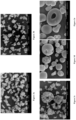
- the process comprises providing a titania sol; and then drying the sol to provide dried titania particles, characterised in that: the shape of the dried titania particles is controlled by applying the following criteria: the titania sol is dried by application of heat and spray drying is used and the temperature used during the spray drying step is controlled to be in the range of from 50 to 350°C, whereby the shape of the dried titania particles is controlled by using a higher spray drying temperature to obtain toroidal particles and by using a lower spray drying temperature to obtain more spherically shaped particles.
- the morphology refers to the form and structure of the titania particles.
- the morphology includes, but is not limited to, the size of pores in the titania particles (which in turn impacts on the specific surface area of the particles) and the shape of the titania particles. In the claimed invention, the shape of the titania particles is controlled.
- the present disclosure also describes the use of a controlled nucleation during preparation of a titania sol by a precipitation step in a sulphate process, before then drying said sol, wherein the size of micelles formed during the precipitation is controlled so as to control the morphology of the resultant dried titania particles.
- the precipitation is controlled so as to control the pore size and/or specific surface area of the resultant dried titania particles.
- the present disclosure also describes the use of a controlled flocculation during preparation of a titania sol from a titania slurry, before then drying said sol, wherein the extent to which the sol is flocculated is controlled by adjusting the pH of the slurry, so as to control the morphology of the resultant dried titania particles.
- the flocculation is controlled so as to control the pore size and/or specific surface area and/or particle shape of the resultant dried titania particles.
- the pH may be adjusted to be closer to the iso-electric point of the titania, so there is a greater degree of flocculation, or the pH may be adjusted to be further from the iso-electric point of the titania, so there is a lesser degree of flocculation.
- the present disclosure also describes the use of a controlled flocculation during or after the formation of a titania sol, before then drying said sol, wherein the extent to which the sol is flocculated is controlled by adjusting the iso-electric point of the titania, so as to control the morphology of the resultant dried titania particles.
- the flocculation is controlled so as to control the pore size and/or specific surface area of the resultant dried titania particles.
- the iso-electric point may be adjusted so as to be closer to the pH of the slurry/sol, so there is a greater degree of flocculation, or the iso-electric point may be adjusted to be further from the pH of the slurry/sol, so there is a lesser degree of flocculation.
- the present disclosure also describes the use of a controlled drying during preparation of dried titania particles from a titania sol, wherein the temperature used during the drying step is controlled so as to control the morphology of the resultant dried titania particles.
- the temperature is controlled so as to control the particle shape of the resultant dried titania particles.
- the invention permits the formation of titania with desired morphology in terms of desired particle shape.
- the invention may be practised on titania with a range of particle sizes, including nano, meso and macro particles.
- titania may, for example, be used to provide titania with large specific surface areas but which can be used in applications where there is a desire to avoid the need to use nano materials.
- the morphology of the dried titania particles is further controlled by:
- This process is beneficial in that by controlling the pH during peptisation to be away from the iso-electric point (which will normally be at about pH 5-6), or by adjusting the iso-electric point to be away from the pH of the slurry, the sol will be fully dispersed (not flocculated).
- a spray drying treatment results in a particulate product that has a smooth curved outer surface, that is relatively small in size (particle diameter of 30 ⁇ m or less), and that has high integrity, being resistant to external forces including high shear mixing.
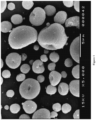
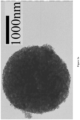
- the particles may be spherical or toroidal but have a continuous exterior curved (convex) surface.
- the pH of the slurry is adjusted to be 3.5 pH units or more, or 4 pH units or more, such as from 4 to 6 pH units, away from the iso-electric point of the titania, by the addition of peptising agent, in order to reduce the extent to which the titania sol is flocculated.
- the pH of the slurry is adjusted by the addition of any suitable peptising agent (examples of which are set out below).
- One suitable peptising agent is a monoprotic acid, such as hydrochloric acid, which will lower the pH and take it away from the iso-electric point.
- the iso-electric point of the titania is adjusted to be 3.5 pH units or more, or 4 pH units or more, such as from 4 to 6 pH units, away from the pH of the slurry, by the addition of a dispersant, in order to reduce the extent to which the titania sol is flocculated.
- the iso-electric point of the titania is adjusted by the addition of any suitable dispersant (examples of which are set out below).
- One suitable dispersant is an ⁇ -hydroxy carboxylic acid, such as citric acid.
- the morphology of the dried titania particles is further controlled by: the titania sol being produced from a TiO 2 containing slurry and the pH of the slurry being controlled to be in the range of from 1 to 3, by the addition of peptising agent, in order to the reduce the extent to which the titania sol is flocculated.
- This process is beneficial in that by controlling the pH during peptisation to be low the sol will be fully dispersed (not flocculated).
- a spray drying treatment results in a particulate product that has a smooth curved outer surface, that is relatively small in size (particle diameter of 30 ⁇ m or less), and that has high integrity, being resistant to external forces including high shear mixing.
- the particles may be spherical or toroidal but have a continuous exterior curved (convex) surface.
- the pH of the slurry is controlled to be in the range of from 1 to 2, especially from 1 to 1.5, by the addition of peptising agent, in order to the reduce/minimise the extent to which the titania sol is flocculated.
- the pH of the slurry is controlled by the addition of hydrochloric acid, or another monoprotic acid, as peptising agent.
- the sol is then neutralised (e.g. with monoisopropanolamine - known as MIPA).
- MIPA monoisopropanolamine
- Excess soluble salts may be removed to a desired conductivity, e.g. using cross-flow filtration, for example the washing may reduce the conductivity to ⁇ 2mS/cm.
- the shape of the dried titania particles is controlled by applying the following criteria: the titania sol is dried by application of heat and the temperature used during the drying step is controlled to be in the range of from 50 to 350°C, whereby the shape of the dried titania particles is controlled by using a higher spray drying temperature to obtain toroidal particles and by using a lower spray drying temperature to obtain more spherically shaped particles.
- the morphology of the dried titania particles is controlled by the temperature used during the spray drying step being controlled to be in the range of from 50 to 350°C; in one such embodiment the temperature of spray drying is controlled to be in the range of from 50 to 150°C, such as from 75 to 140°C, or from 100 to 125°C. This further assists in the production of small strong particles, which are preferably spherical.
- the sol as spray dried may in one embodiment have a solids content of from 1% to 35% wt/wt, e.g. from 2 to 25% wt/wt or from 5 to 20% wt/wt or from 10 to 18% wt/wt.
- the morphology of the dried titania particles is further controlled by the titania sol being produced from a TiOz containing slurry obtained using a precipitation step in a sulphate process, wherein the size of micelles formed during the precipitation is controlled to be in the range of 10 to 150nm, such as from 15 to 125nm, or from 20 to 100nm.
- the size of micelles formed during the precipitation is controlled to be in the range of from 20 to 50nm.
- they may be sized from 20 to 45nm or from 20 to 40nm or from 25 to 45nm or from 25 to 40nm.
- the size of micelles formed during the precipitation is controlled by the use of a Mecklenburg precipitation with a nucleation level in the range of from 6 to 8wt%.
- the size of micelles formed during the precipitation is controlled by the use of a Blumenfeld precipitation with a drop ratio of from 50:50 to 75:25 (such as from 60:40 to 75:25).
- the invention also provides, in a second aspect, titania in the form of particles that are obtainable by the process of the first exemplary embodiment of the first aspect of the invention.
- These particles each have a continuous exterior convex surface, being spherical in shape or toroidal in shape, wherein the particles have a diameter, as measured by using laser diffraction, of from 2 ⁇ m to 30 ⁇ m, wherein the particle size is a geometric weight mean value, wherein the particles have a BET specific surface area of 50m 2 /g or more, and wherein the particles are porous, having pore diameters, as measured using mercury porosimetry, which are greater than 2nm.
- the particles have a diameter, as measured by using laser diffraction, of from 2 to 20 ⁇ m.
- the particles have a BET specific surface area of 80m 2 /g or more, such as from 80 to 320m 2 /g.
- the particles of the second aspect are beneficial in that they have high integrity, being resistant to external forces, including high shear mixing. This high integrity is preserved even after heat treatment (e.g. after being thermally treated at 500°C for 7 days), as is shown in the examples. Therefore these novel particles have the ability to retain their size and shape even when exposed to a high level of external force.
- novel particles may, in a third aspect, be used as a catalyst or as a catalytic support. They may in particular be used as a catalyst or as a catalytic support where that catalyst or catalytic support is produced by a method that involves exposure to external forces, e.g. extrusion or high shear mixing.
- the porous titania of the second aspect is mixed with a binder and extruded to create high surface area titania pellets for use as a catalyst or catalyst support.
- the titania is to be used as a support, it may be a support for any catalytic material.
- the catalytic material may, however, suitably be selected from the group consisting of: ruthenium, rhodium, palladium, iridium, platinum, osmium, iron, cobalt, nickel, copper, silver, vanadium, tungsten, chromium and molybdenum, and combinations thereof.
- the titania may be coated with silica or the like to provide improved thermal stability.
- the porous titania particles or extrudate formed therefrom may undergo an impregnation process, whereby catalytic promoters (such as molybdenum, nickel, cobalt, or a mixture thereof) are impregnated into the pores of the porous titania.
- catalytic promoters such as molybdenum, nickel, cobalt, or a mixture thereof
- a thermal stabiliser such as tungsten trioxide from a precursor such as ammonium metatungstate or ammonium paratungstate, lanthanum oxide from a precursor such as lanthanum nitrate hexahydrate, cerium oxide from a precursor such as cerium nitrate hexahydrate, or silica from a precursor such as silicic acid
- a thermal stabiliser such as tungsten trioxide from a precursor such as ammonium metatungstate or ammonium paratungstate, lanthanum oxide from a precursor such as lanthanum nitrate hexahydrate, cerium oxide from a precursor such as cerium nitrate hexahydrate, or silica from a precursor such as silicic acid
- the titania particles of the second aspect are used as a catalyst or as a catalytic support in an application selected from the group consisting of: emissions catalysis; catalysis of industrial chemical reactions; and photocatalysis.
- the particles (or an extrudate formed therefrom) are used as a catalyst or as a catalytic support in an application selected from the group consisting of: selective catalytic reduction of nitrogen-based gases (including in combined diesel particle filter/ selective catalytic reduction units); desulphurisation of gases in the petroleum industry by the Claus process; and photocatalytic cleaning, purification or disinfection.
- SCR selective catalytic reduction
- novel particles of the second aspect are extruded under high pressure, through extrusion dies, to produce a catalytic product suitable for use in exhaust systems.
- Active catalysts are mixed into the carrier prior to extruding.
- Active catalysts may suitably be selected from the group consisting of: ruthenium, rhodium, palladium, iridium, platinum, osmium, iron, cobalt, nickel, copper, silver, vanadium, tungsten, chromium and molybdenum, and combinations thereof.
- platinum, palladium, tungsten and/or vanadium tend to be preferred.
- the active catalyst is platinum and/or vanadium.
- novel particles of the second aspect may be mixed with any other desired materials (e.g. other carrier or support materials, or binder materials), before extrusion.
- the particles may be mixed with a cordierite and a binder as well as with active catalyst material before then being extruded to form a supported catalyst product.
- the strength characteristics of the novel particles of the second aspect mean that they are less likely to collapse under external forces, e.g. high pressures. Therefore they retain their shape, size and porosity characteristics.
- Known porous products may, in contrast, be found to exhibit some degree of collapse or reduction in pore size under pressure.
- a process for preparing a supported catalyst product comprising the steps of:
- the active catalyst material may be one or more active catalysts, preferably selected from those discussed above in relation to the third aspect.
- the process also includes the step of mixing the particles with other carrier or support materials (e.g. ceramics, such as alumina or cordierite, or zeolites) and/or binder materials. This may be carried out before or after the step of mixing the particles with active catalyst material, but must be carried out before the extrusion step.
- carrier or support materials e.g. ceramics, such as alumina or cordierite, or zeolites
- the step of providing dried titania particles according to the second aspect is carried out by carrying out the process of the first exemplary embodiment of the first aspect.
- the supported catalyst product made by the process of the fourth aspect is particularly suitable for use in exhaust systems. Due to the improved robustness of the titania particles in the product, the supported catalyst product has improved catalytic properties, because the titania particles retain their porosity even after the extrusion process involved in the manufacturing process. As will be appreciated by the skilled reader, improved porosity for the carrier/support is influential on the properties of a catalyst product.
- a supported catalyst product comprising a titania support and active catalyst material, wherein the active catalyst material is supported by the titania support and wherein the supported catalyst product is obtainable by the process of the fourth aspect.
- the present invention permits the control of the morphology of titania particles in terms of the overall shape of the particles (e.g. spherical or toroidal, smooth outer surface or rough outer surface, dense or hollow). In some embodiments, there may also be control in terms of pore size (which in turn will impact on the specific surface area).
- the first aspect of the claimed invention provides a process for the production of titania particles with a desired morphology.
- the process comprises providing a titania sol; and then drying the sol to provide dried titania particles, characterised in that: the shape of the dried titania particles is controlled by applying the following criteria: the titania sol is dried by application of heat and spray drying is used and the temperature used during the spray drying step is controlled to be in the range of from 50 to 350°C, whereby the shape of the dried titania particles is controlled by using a higher spray drying temperature to obtain toroidal particles and by using a lower spray drying temperature to obtain more spherically shaped particles.
- the second aspect of the claimed invention provides titania in the form of particles that are obtainable by the process of the first exemplary embodiment of the first aspect of the invention, wherein the particles each have a continuous exterior convex surface, being spherical in shape or toroidal in shape, wherein the particles have a diameter, as measured by using laser diffraction, of from 2 ⁇ m to 30 ⁇ m, wherein the particle size is a geometric weight mean value, wherein the particles have a BET specific surface area of 50m 2 /g or more, and wherein the particles are porous, having pore diameters, as measured using mercury porosimetry, which are greater than 2nm.
- the particle size is a geometric weight mean value for the particle size (appropriate for the approximately log normal distribution which is often found with such particles).
- the particle size may alternatively be determined by laser diffraction and may be measured using a laser diffraction machine, such as those available from Malvern Instruments Ltd, e.g. a MasterSizer machine.
- the titania particles of the second aspect of the invention have a diameter, as measured by using laser diffraction, of from 2 ⁇ m to 30 ⁇ m, wherein the particle size is a geometric weight mean value.
- the particle size may alternatively be determined by X-ray sedimentation and may be measured using a X-ray disc centrifuge, such as those available from Brookhaven, e.g. a BI-XDC machine.
- Crystal size is distinct from particle size.
- Crystal size relates to the size of the fundamental crystal units having internally consistent lattice planes, which make up the particulate material.
- Conventional manufacturing processes that manufacture titanium dioxide as a pigment will generate crystallites during a precipitation process; these are considered fundamental particles and are generally accepted to be in the order of 100 ⁇ .
- the crystallites self-assemble into "rafts" known as micelles. These are lenticular in shape and generally have an aspect ratio of about 3:1, having a major axis of about 350 ⁇ for rutile and about 600 ⁇ for anatase.
- Conventional manufacturing processes that manufacture titanium dioxide as a pigment will incorporate a thermal processing step that causes the crystal centres of these crystallites to combine and create much larger crystals.
- conventional titanium dioxide product in a rutile crystal form has a crystal size of about 0.17 ⁇ m - 0.29 ⁇ m and a particle size of about 0.25 ⁇ m - 0.40 ⁇ m while conventional titanium dioxide product in an anatase crystal form has a crystal size of about 0.10 ⁇ m - 0.25 ⁇ m and a particle size of about 0.20 ⁇ m - 0.40 ⁇ m.
- the particle size is thus affected by factors such as the crystal size and incomplete fusion of crystals - as well as milling techniques used during production, such as dry, wet or incorporative milling, and subsequent treatments that cause aggregation of crystals.
- the crystal size and particle size of the titanium dioxide may be determined by methods well known to those skilled in the art. For example, the crystal size may be determined by transmission electron microscopy on a rubbed out sample with image analysis of the resulting photograph. The results of the crystal size may further be validated by reference using latex NANOSHPHERE TM Size Standards (available from Thermo Scientific). As noted above, a method which may be used for determining the particle size of the titanium dioxide is laser diffraction. X-ray sedimentation may be used as an alternative.
- the particle size of the titanium dioxide may therefore be greater than or about equal to the crystal size.
- titanium dioxide In general, to produce titanium dioxide, natural ores (such as ilmenite and mineral rutile), enriched ores (such as titanium slag and beneficiated ilmenite), or mixtures thereof may be used as the starting raw material. These ores may be processed by any suitable means, such as the sulphate process or the chloride process, to produce titanium dioxide crystallites and micelles of a required purity and size. This is known in the art and is conventional. It will be appreciated that the titanium dioxide as provided in sol form in the process of the invention can, on the whole, be obtained by any suitable technique and the invention is not limited to any method of manufacture. However, it may be preferred to use the sulphate process as this then permits the use of a controlled nucleation during preparation of the titania sol by a Mecklenburg, Blumenfeld or other precipitation step in this sulphate process.
- One or more of the conditions discussed above may be controlled in order to select the pore diameters of the titania particles (i.e. the actual pores within the particles themselves, as compared to the packing between particles or the pores within the micelles that make up the particles).
- the titania particles produced by the first aspect of the invention have pore diameters which are greater than 2nm.
- the titania particles of the second aspect of the invention are porous, having pore diameters, as measured using mercury porosimetry, which are greater than 2nm.
- the titania particles are mesoporous, having pore diameters which are greater than 2nm but less than 50nm, e.g. from 3nm to 45nm or from 5nm to 40nm.
- the titania particles are macroporous, having pore diameters which are 50nm or greater, e.g. from 50nm up to 1000nm or from 50nm to 500nm.
- pore diameters may be from 4nm to 50nm, e.g. from 5nm to 50nm or from 10nm to 50nm, such as from 20nm to 45nm or from 25nm to 40nm.
- Pore diameter may be measured using mercury porosimetry (for a pore diameter range of about 3nm up to 200 ⁇ m), e.g. using a Micromeritics AutoPore IV porosimeter, and/or by nitrogen isotherms (for pore diameters in the nanometre range), e.g. using a Micromeritics TriStar 3020 TM machine.
- the titania particles of the second aspect of the invention have a BET specific surface area of 50m 2 /g or more.
- the titania particles of the invention may have a specific surface area which is greater than 100m 2 /g.
- the titania particles of the invention may have a specific surface area of greater than 125m 2 /g, e.g. of 150m 2 /g or higher or 175m 2 /g or higher. In one embodiment, they have a specific surface area of 200m 2 /g or higher, such as 210m 2 /g or higher, or 220m 2 /g or higher, or 225m 2 /g or higher.
- they have a specific surface area of 230m 2 /g or higher, such as 235m 2 /g or higher, or 245m 2 /g or higher or 250m 2 /g or higher. It may be that the titania particles have a specific surface area of 260m 2 /g or higher, or 270m 2 /g or higher, or 275m 2 /g or higher, or 280m 2 /g or higher, or 290m 2 /g or higher. It may even be that the titania particles of the invention have a specific surface area of greater than 300m 2 /g.
- the specific surface area may be determined using the Brunauer, Emmett and Teller method (BET method) as described in J. Am. Chem. Soc., 1938, 60, 309.
- BET method Brunauer, Emmett and Teller method
- One or more of the conditions discussed above may be controlled in order to control the shapes of the titania particles. It may be that the titania particles produced by the first aspect of the invention have shapes that are spherical or toroidal (doughnut-shaped).
- the titania particles produced by the first aspect of the invention may have smooth outer surfaces or the outer surfaces may be rough. It may be that the titania particles produced by the first aspect of the invention are dense or they may be hollow.
- the titania particles of the second aspect of the invention have a continuous exterior convex surface, being spherical in shape or toroidal in shape.
- a titania sol is a colloidal suspension of TiOz particles.
- the TiO 2 particles used may be anatase, rutile or amorphous or a mixture thereof.
- a sol is a colloidal suspension of solid particles in a liquid.
- a colloid is a suspension of particles whereby the particle size is small enough so as not to be affected by gravitational forces and so the particles remain suspended over an extended period of time under standard conditions, e.g. for a day or more, a week or more, or a month or more (such as a year or more) at room temperature and pressure.
- the liquid in which the titanium dioxide particles are provided is preferably polar.
- the liquid is aqueous; this may be water or an aqueous solution.
- other polar carriers for the particles could also be contemplated, e.g. they may be selected from polar organic solvents or alcohols.
- the liquid carrier may also be a mixture of two or more polar carriers, e.g., it may be a mixture of water and alcohol.
- the titania particles in the titania sol may be derived from any suitable precursor.
- they are derived from a titanium dioxide obtained from a sulphate manufacturing process (e.g. a Mecklenburg or Blumenfeld precipitation). They may, in one embodiment, be derived from a titanium dioxide obtained from a titanium oxysulphate precursor.
- the titania sol is produced from TiO 2 prepared by a precipitation step in a sulphate process (e.g. a Mecklenburg or Blumenfeld precipitation).
- the obtained titania hydrate may be filtered, washed free of impurities, and contacted with an aqueous base to form a suspension having a pH of about neutral.
- Sulphate ions can then be removed from the neutralized suspension by filtration and washing. It may be that the filter cake obtained after filtration is washed until the SO 4 2- content of the wash filtrate is less than 0.1 g/l (which may be determined by barium chloride solution titration).
- the filter cake is then slurried in water to produce an aqueous suspension of titania hydrate.
- This can then be peptized with acid pH adjustment (e.g. with a strong monoprotic acid pH adjustment) to provide the nano titania sol.
- the titania sol that is provided is a concentrated, neutral titania sol made in accordance with the process described in WO2011/033286 .
- the titania sol that is provided has been obtained by preparing a pulp via a sulphate process (e.g. with a Mecklenburg or Blumenfeld precipitation). Said pulp is then neutralised (e.g. with aqueous ammonia). Optionally, the material is washed free from sulphates. The slurry is then peptised (e.g. using hydrochloric acid).
- the iso-electric point of the titania is lowered (e.g. with the addition of citric acid).
- the slurry may then be neutralised (e.g. with monoisopropanolamine).
- Excess soluble salts may then be removed to a desired conductivity, e.g. using cross-flow filtration, followed by water removal to concentrate the sol.
- the present invention is based around the ability to control the shape of the particles, and optionally to also control the pore size in the particles, to obtain a particulate product that has characteristics suitable for a given end use.
- the factors to be controlled in the present invention are described in more detail below:
- the shape of the dried titania particles is controlled by applying the following criteria:
- the pore size of the dried titania particles is controlled, due to the titania sol being produced from a TiO 2 containing slurry obtained using a precipitation step in a sulphate process, wherein the size of micelles formed during the precipitation is controlled to be in the range of from 10 to 150nm.
- micelles are the fundamental structural units of titania manufactured from the sulphate process. During the sulphate process crystallites precipitate out from a titanium and sulphuric acid solution; these are of the order of 100 ⁇ in diameter. The micelles are then formed by these crystallites being bound together by sulphate ions and water; usually these stable micelles are formed from hundreds of crystallites. The micelles are lenticular in shape and the major axis is usually sized of the order of 600 ⁇ .
- the size of the micelles created at precipitation may be controlled by varying the level of nuclei used in the process for preparing the sol.
- nuclei which are finely sized titania particles, to initiate or enhance crystal growth.
- self nucleation occurs, and the conditions are controlled to impact the extent of self nucleation.
- Other precipitation methods are also known and during these precipitation methods the size of the micelles can likewise be controlled.
- each micelle contains one nucleus and that the number of micelles remains constant during precipitation.
- the number of micelles is a function of the number of nucleating sites introduced.
- the ultimate size of the micelle is therefore also a function of the number of nucleating sites: the more nucleating sites available, the smaller the final micelles.
- These micelle particles will then flocculate into larger, less well defined particles in a standard precipitation; these are generally in the order of up to ⁇ 2 ⁇ m in a standard sulphate process precipitation.
- aqueous TiOSO 4 (referenced as the "TiOSO 4 -containing liquor”) is introduced at a carefully controlled rate into a volume of water (referenced as the "foot water”) that is initially large in volume in comparison with the volume of the added TiOSO 4 solution (TiOSO 4 -containing liquor).
- foot water a volume of water
- TiOSO 4 + nuclei + OH - ⁇ TiO 2 nH 2 O + H 2 SO 4 to the right and so promotes the nucleation of anatase.
- the nano titania sol that is provided is one where the precipitated titania micelles have been controlled so as to be sized from 20 to 50nm.
- the precipitated titania micelles may be sized from 20 to 45nm or from 20 to 40nm or from 25 to 45nm or from 25 to 40nm.
- Micelle size can be controlled in the Mecklenburg process by controlling the nucleation level.
- a lower level of nuclei gives larger micelles.
- the sol is prepared with a nucleation level of from 6 to 8 wt%.
- micelle size can be controlled in the Blumenfeld process by varying the drop ratio. An increased drop ratio gives larger micelles.
- the sol is prepared using a drop ratio (ratio of liquor to water used by volume) of 50:50 to 75:25, smaller micelles are obtained and thus a smaller pore size (diameter).
- the pH of the slurry can be controlled in order to the affect the extent to which the titania sol is flocculated.
- This controlled flocculation by pH control is an optional feature of the process of the first aspect of the invention.
- the nano titania sol used in the process is flocculated, such that the sol as provided for drying is flocculated to a desired extent.
- the flocculation can be controlled so as to control the pore size and/or specific surface area and/or particle shape of the resultant dried titania particles.
- the pH may be adjusted to be closer to the iso-electric point of the titania, so there is a greater degree of flocculation, or the pH may be adjusted to be further from the iso-electric point of the titania, so there is a lesser degree of flocculation.
- the iso-electric point is normally at a pH of from 5 to 6.
- the pH adjustment may be effected using acid (to lower the pH) or using base (to raise the pH).
- a strong monoprotic acid may be used, e.g. a monoprotic acid that has a pKa less than or equal to -1.0, especially one having a pKa less than or equal to -1.5, and in one embodiment having a pKa less than or equal to -1.74.
- acids that may be used include hydrochloric acid, hydrobromic acid and nitric acid. Preferably hydrochloric acid is used.
- a strong monoprotic base may be used, e.g. a monoprotic base that has a pKb less than or equal to 1.0, especially one having a pKb less than or equal to 0.5, and in one embodiment having a pKa less than or equal to 0.3.
- bases include sodium hydroxide and potassium hydroxide.
- acid or base may be added in a controlled manner such that the pH is adjusted to be close to the iso-electric point or away from the iso-electric point.
- the pH can suitably be adjusted to be in the range of from 4 to 7, preferably from 4.5 to 6.5, such as from 5 to 6.
- the pH is adjusted to be within 2.5 pH units of the iso-electric point, preferably within 2 pH units, more preferably within 1.5 pH units, and most preferably within 1 pH unit of the iso-electric point, so as to obtain larger pore sizes and/or to obtain particles that have a rough outer surface and that appear "fluffy".
- the pH can be adjusted to be in the range of from 0.5 to 4, preferably from 1 to 3.5, or from 1 to 3, such as from 1.5 to 3.
- the pH can be adjusted to be in the range of from 7 to 12, preferably from 7.5 to 11.5, such as from 8 to 11.
- the pH is adjusted to be 3 pH units or more from the iso-electric point, preferably 3.5 pH units or more from the iso-electric point, more preferably 4 pH units or more from the iso-electric point, and most preferably 4.5 pH units or more, such as 5 units or more, or 5.5 units or more, from the iso-electric point, so as to obtain smaller pore sizes and/or to obtain particles that have a smooth outer surface and that are either toroidal or spherical.
- a titania sol it is known to peptise the slurry. This is carried out using acid, especially a strong monoprotic acid, e.g. a monoprotic acid that has a pKa less than or equal to - 1.0, especially one having a pKa less than or equal to -1.5, and in one embodiment having a pKa less than or equal to -1.74.
- acid especially a strong monoprotic acid, e.g. a monoprotic acid that has a pKa less than or equal to - 1.0, especially one having a pKa less than or equal to -1.5, and in one embodiment having a pKa less than or equal to -1.74.
- hydrochloric acid is used.
- this peptisation step may be carried out in a controlled manner such that the pH is adjusted either to be closer to the iso-electric point or to be away from the iso-electric point.
- the iso-electric point of the titania can be controlled in order to the affect the extent to which the titania sol is flocculated. This controlled flocculation by iso-electric point control is an optional feature of the process of the first aspect of the invention.
- the nano titania sol used in the process is flocculated, such that the sol as provided for drying is flocculated to a desired extent.
- the flocculation may occur during the formation of the sol or after its formation.
- the sol as provided for drying must be flocculated.
- the flocculation can be controlled so as to control the pore size and/or specific surface area and/or particle shape of the resultant dried titania particles.
- the iso-electric point may be adjusted so as to be closer to the pH of the slurry/sol, so there is a greater degree of flocculation, or the iso-electric point may be adjusted to be further from the pH of the slurry/sol, so there is a lesser degree of flocculation.
- the iso-electric point is normally at a pH of from 5 to 6. However, this iso-electric point can be adjusted, e.g. by the addition of a dispersant, which can raise or lower the iso-electric point.
- the iso-electric point is adjusted before, during or after the peptisation stage of sol formation. In one embodiment, this adjustment may be carried out at the peptisation stage of sol formation.
- the slurry When the iso-electric point is adjusted to be close to the pH, the slurry is less dispersed (more flocculated). This leads towards larger pore sizes. It also leads towards particles that have a rough outer surface and that appear "fluffy".
- the iso-electric point is adjusted to be within 3 pH units of the pH, preferably within 2.5 pH units, more preferably within 2 pH units, e.g. within 1.5 units, and most preferably within 1 pH unit of the pH, so as to obtain larger pore sizes and/or to obtain particles that have a rough outer surface and that appear "fluffy".
- the slurry When the iso-electric point is adjusted to be away from the pH, the slurry is more dispersed (less flocculated). This leads towards smaller pore sizes. It also leads towards particles that have a smooth outer surface and that are either toroidal or spherical.
- the iso-electric point is adjusted to be 3 pH units or more from the pH, preferably 3.5 pH units or more from the pH, more preferably 4 pH units or more from the pH, and most preferably 4.5 pH units or more,such as 5 units or more, or 5.5 units or more, from the pH, so as to obtain smaller pore sizes and/or to obtain particles that have a smooth outer surface and that are either toroidal or spherical.
- the controlled flocculation is achieved by contacting the nano titania sol with a dispersant.
- the dispersant may suitably comprise one or more dispersant material selected from: water soluble carboxylic acids, water soluble salts of carboxylic acids, water soluble polycarboxylic acids, water soluble salts of polycarboxylic acids, phosphates and silicates.
- the water soluble carboxylic acid is an ⁇ -hydroxy carboxylic acid.
- the ⁇ -hydroxy carboxylic acid may comprise one, two or three carboxylic acid groups. Examples of the ⁇ -hydroxy carboxylic acid that can be used are lactic acid, glycolic acid, malic acid, tartaric acid, mandelic acid and citric acid.
- the water soluble carboxylic acid is a ⁇ -hydroxy carboxylic acid.
- the water soluble polycarboxylic acid may be a dicarboxylic acid or a tricarboxylic acid.
- citric acid may be a preferred choice due to its low cost and ready availability.
- the dispersant will be added to the sol at a level so as to achieve the desired adjustment of the iso-electric point and hence to cause either more or less flocculation. Greater flocculation will lead to a larger size for the flocculated particles.
- the dispersant is added to the sol in an amount of from 0.1 to 15wt%, such as from 0.2 to 12wt% or from 0.5 to 10wt%.
- the slurry will be at a pH close to the natural iso-electric point and therefore the use of a low amount of dispersant ensures that there is closeness between the iso-electric point and the pH. This leads to larger pore sizes and higher specific surface areas for the titania particles.
- the amount of dispersant may be from 0.1 to 5wt%, such as from 0.3 to 4wt% or from 0.5 to 3wt%, e.g. from 1 to 2.5wt%.
- the use of a higher amount of dispersant ensures that there is a greater gap between the iso-electric point and the pH. This leads to smaller pore sizes and lower specific surface areas for the titania particles.
- the amount of dispersant may be from 6 to 15wt%, such as from 7 to 13wt% or from 8 to 12wt%, e.g. about 9 to 10wt%.
- the shape of the dried titania particles is controlled by applying the following criteria: the titania sol is dried by application of heat and spray drying is used and the temperature used during the spray drying step is controlled to be in the range of from 50 to 350°C, whereby the shape of the dried titania particles is controlled by using a higher spray drying temperature to obtain toroidal particles and by using a lower spray drying temperature to obtain more spherically shaped particles.
- the sol is then subjected to a drying process.
- the temperature used during the drying step is controlled so as to control the morphology of the resultant dried titania particles. Specifically, the temperature is controlled so as to control the particle shape of the resultant dried titania particles.
- a higher drying temperature results in toroidal (doughnut shaped) particles and a lower drying temperature results in more spherically shaped particles.
- the drying temperature is from 50 to 350°C, such as from 75 to 325°C, or from 100 to 300°C.
- drying temperature may be from 50 to 150°C, such as from 75 to 140°C, or from 100 to 125°C.
- the drying temperature may be from 160 to 350°C, such as from 200 to 300°C, or from 220 to 280°C.
- the drying process used in the claimed invention is spray drying.
- the sol as dried may in one embodiment have a solids content of from 1% to 35% wt/wt, e.g. from 2 to 25% wt/wt or from 5 to 20% wt/wt or from 10 to 18% wt/wt.
- the titania particles are washed, but this is not essential. If the particles are washed, it may be that the washing is carried out to reduce the level of salts and thus the conductivity. In one embodiment washing is carried out to give a conductivity of less than 2mS/cm.
- the particles are not washed.
- titania Depending on the intended end use of the titania, other components can also be present during the manufacture of the titania. These may, for example, be incorporated into the sol before the sol is dried.
- one or more active catalytic components such as tungsten or vanadium, are included during the manufacture of the titania particles. These make the product suitable for catalytic reduction units, such as SCR (selective catalytic reduction) units for automobile and static applications.
- SCR selective catalytic reduction
- one or more thermal stabiliser components such as silica, ceria or lanthana, are included during the manufacture of the titania particles. These assist with ensuring large specific surface areas can be maintained when the product is used in applications where elevated temperatures occur.
- one or more templating agents such as polystyrene latex nano spheres (PSL).
- PSL or any other templating agent can be mixed with the sol prior to dying.
- the resultant particle can then be further heat treated to remove the templating agent to form highly porous particles.
- Templating agents are known to those skilled in the art and the use of templating agents is discussed in, for example, Nandiyanto et al., Chemical Engineering Journal 152 (2009) 293-296 .
- the products obtained by the invention can be provided with a higher level of internal pores.
- the present invention may be used to manufacture titania particles suitable for use in numerous applications, as described further below.
- the skilled person will be able to identify desired morphology characteristics of the titania, e.g. in terms of pore size and/or particle shape, and can then control the manufacturing method as described above to obtain said desired characteristics.
- the particles are in the manufacture of catalyst products, e.g. the particles may be used as a catalyst support, but other suitable end uses are also contemplated, as discussed below.
- the titania particles may be produced in a manner that gives rise to large pore sizes, and hence high surface areas, when end uses are envisaged that involve providing the titania as a catalytic support, such as in relation to emissions catalysts.
- the titania particles may be used as a carrier for catalysts used to reduce or eliminate noxious gases prior to release to the atmosphere.
- uses include applications in mobile road systems (such as cars, motorcycles and trucks); mobile non-road applications (such as rail and marine) and static applications (such as power stations and waste incinerators).
- Catalysts that can be provided on the titania particles include ruthenium, rhodium, palladium, iridium, platinum, osmium, iron, cobalt, nickel, copper, silver, vanadium, tungsten, chromium and molybdenum. In these fields platinum, palladium and vanadium tend to be preferred. These catalysts can convert nitrogen oxides, carbon monoxide and sulphur oxides into less noxious substances. Tungsten is also used, especially in selective catalytic reduction.
- Selective catalytic reduction (SCR) of nitrogen-based gases is possible in the presence of ammonia.
- These nitrogen-based gases include nitric oxide (NO), nitrogen dioxide (NO 2 ) and nitrous oxide (N 2 O); these have detrimental effects environmentally such as contributing to ground level ozone, generation of acid rain and global warming. They also cause and/or aggravate medical issues, such as respiratory problems.
- Removal of these gases can be achieved by passing emissions gases together with ammonia over a catalyst, such as platinum or vanadium.
- a catalyst such as platinum or vanadium.
- Titania, alumina and zeolites are common catalytic carriers that can provide this large surface area.
- the catalytic porous titania is present on a support.
- support materials include glass, ceramic, metal, plastic, cement, concrete, asphalt, textile and paper.
- the support may be porous or non-porous.
- porous supports include a mat of fibers, a zeolite, or a porous film.
- the term "on a support” refers to the catalytic porous titania being provided on at least a portion of a surface of the support. If the support is porous, the term "on a support” further includes the possibility that catalytic porous titania is present within some or all of the pores of the support.
- the titania particles can be used as a carrier or washcoat for selective catalytic reduction units. In such an embodiment, it will be desired to prepare titania particles that have large pore sizes, because then the porous titania will impart a large surface area.
- the titania particles may be prepared so as to have a toroidal shape because this shape may lend itself to improved permeability when used in applications such as selective catalytic reduction (SCR) units for automobile and static applications.
- SCR selective catalytic reduction
- the titania sol when preparing the particles, may be mixed with active catalysts prior to spray drying.
- active catalysts include ruthenium, rhodium, palladium, iridium, platinum, osmium, iron, cobalt, nickel, copper, silver, tungsten, vanadium, chromium and molybdenum.
- titania particles are prepared that have large pore sizes, because then the porous titania will impart a large surface area, and the titania sol is mixed with compounds prior to spray drying that help maintain its large surface area when exposed to elevated temperatures.
- titania used for ceramic extrusions or as washcoats can be prone to a reduction in surface area as a result of the elevated temperatures at which the catalysts are operated. By using certain compounds, this effect can be mitigated.
- These compounds include tungsten (vi) oxide from a precursor such as ammonium metatungstate or ammonium paratungstate, lanthanum oxide from a precursor such as lanthanum nitrate hexahydrate, cerium oxide from a precursor such as cerium nitrate hexahydrate and silica from a precursor such as silicic acid.
- tungsten (vi) oxide from a precursor such as ammonium metatungstate or ammonium paratungstate
- lanthanum oxide from a precursor such as lanthanum nitrate hexahydrate
- cerium oxide from a precursor such as cerium nitrate hexahydrate
- silica from a precursor such as silicic acid.
- Such compounds may be added to the sol prior to spray drying. These may be incorporated immediately prior to spray drying, or may be added during parts of the sulphate process.
- ammonium metatungstate may be incorporated into the precipitation step of the sulphate process.
- Another embodiment is the use of porous titania in the manufacture of diesel particle filter (DPF)/ SCR combination units.
- DPF diesel particle filter
- SCR SCR combination units
- the titania particles may be prepared so as to have a toroidal shape because this shape offers improved permeability for gas flow (DPF) as well as improved specific surface area for the selective catalytic reduction (SCR).
- DPF gas flow
- SCR selective catalytic reduction
- titania may be coated with silica or the like to provide improved thermal stability.
- the titania particles may be produced in a manner that gives rise to large pore sizes, and hence high surface areas. This may be beneficial when end uses are envisaged that involve providing the titania as a catalytic support, such as in relation to chemical catalysts.
- Examples include the desulphurisation of gases in the petroleum industry by the Claus process, whereby the porous titania beads act as a catalyst to promote the hydrolysis of carbonyl sulphide and carbon disulphide to hydrogen sulphide and carbon dioxide. Titania is known to give an improved conversion rate compared to alumina based catalysts. In one embodiment, the porous titania will impart improved gas to solid contact and so enhance chemical catalysis processes such as the Claus process.
- porous titania may be mixed with a binder and extruded to create high surface area titania pellets for use as a chemical catalyst or chemical catalyst support.
- the porous titania beads or extrudate may undergo an impregnation process, whereby catalytic promoters such as molybdenum, nickel, cobalt etc. or a mixture thereof, may be impregnated into the pores of the porous titania.
- catalytic promoters such as molybdenum, nickel, cobalt etc. or a mixture thereof
- thermal stabiliser such as ammonium metatungstate or ammonium paratungstate, lanthanum oxide from a precursor such as lanthanum nitrate hexahydrate, cerium oxide from a precursor such as cerium nitrate hexahydrate and silica from a precursor such as silicic acid
- a thermal stabiliser such as ammonium metatungstate or ammonium paratungstate, lanthanum oxide from a precursor such as lanthanum nitrate hexahydrate, cerium oxide from a precursor such as cerium nitrate hexahydrate and silica from a precursor such as silicic acid
- the titania particles may be produced in a manner that gives rise to large pore sizes, and hence high surface areas. This may be beneficial when catalytic end uses are envisaged, such as in relation to photocatalysis.
- TiOz is an efficient and benign photocatalyst. Photons with an energy greater than or equal to the band gap of TiOz (3.2eV for the anatase phase) that strike a TiOz crystal, energise an electron which in turn jump from the valance band into an unoccupied conduction band. This results in electron pairs in the conduction band and positive electron holes in the valence band. These in turn can then react with O 2 to form the hydroxyl radical of O 2 - and with H 2 O to form the hydroxyl radical OH respectively. These radicals are extremely reactive and will degrade organic matter.
- a porous titania with a large surface area can be provided, as this will result in more electron pairs and holes at the surface and will therefore be more photocatalytic. It may be used for self cleaning purposes when incorporated into materials such as exterior coatings, concrete, tiles, extruded ceramic fascias, plastics, textiles etc.
- a titania material that is porous but that is not nano sized (e.g. with a particle size of 1 micron or more) can be provided, which will result in lower degree of light scattering / lower refractive index, permitting the porous titania to be used for self cleaning in coloured systems while having a lower tinting strength compared to pigmentary titania.
- dopants can be added during the production of the titania particles. This leads to further improvements in catalytic efficacy in the porous titania. Additionally, certain dopants can alter the band gap and so can alter the responsiveness of the catalyst at different wavelengths of light.
- dopants include i) noble metals: gold, nickel, nitrogen, palladium, platinum, rhodium, silver, tin and vanadium, ii) cationic metals: aluminium, cerium, chromium, cobalt, copper, erbium, europium, gadolimium, iron, lanthanum, manganese, molybdenum, neodymium, nickel, osmium, praseodymium, rhenium, ruthenium, samarium, vanadium and zinc and iii) anionic non-metals: carbon, fluorine, nitrogen, phosphorus and sulphur.
- the catalytic porous titania may be mixed with a reactant fluid and irradiated with visible light to provide for a chemical reaction of one or more components of the reactant fluid.
- the catalytic porous titania may then be recovered from the fluid and recycled for use in another portion of the reactant fluid.
- the catalytic porous titania may be used in place of general metal catalysts such as cobalt, nickel, copper, gold, iridium, lanthanum, nickel, osmium, platinum, palladium, rhodium, ruthenium, silver, strontium, yttrium, zirconium and tin.
- the catalytic porous titania is present on a support, and the reactant fluid may flow in contact with the support and the composition, and when irradiated with light, provides for a chemical reaction of one or more components of the reactant fluid.
- the catalytic porous titania may be exposed to a constant stream of fluid and does not require separation of the catalytic porous titania from the fluid after the reaction is performed.
- a catalytic porous titania may be applied to a support, for example an automobile exhaust system, where the exhaust system has been fitted with a visible or UV light source, such as a fiber optic light source or an LED light source. Irradiation of the catalytic porous titania during operation of the automobile engine may provide for degradation of organics and other pollutants generated in the engine into environmentally acceptable substances.
- the catalytic porous titania may be present on a surface that is contacted with various environmental contaminants or pollutants, such as dirt, grease and other organic and inorganic contaminants and pollutants.
- the catalytic porous titania optionally in the form of a formulation comprising the catalytic porous titania, is applied to the surface and the surface is irradiated with UV/visible light while the contaminants or pollutants contact the surface.
- the surface Upon exposure to UV/visible light, the surface becomes "self-cleaning" because it degrades or inactivates the contaminants or pollutants.
- self-cleaning glass may have a transparent or translucent coating of the catalytic porous titania applied on one or both sides of the glass. Contaminants that contact the glass may then be degraded when the glass is exposed To UV/visible light.
- the catalytic porous titania may be present on a surface that is exposed to microbes (such as bacteria and fungi) and/or viruses.
- a surface may be a "disinfecting surface" because it destroys or inactivates microbes and/or viruses that are present on the surface.
- surfaces in residential, commercial or hospital environments may have a coating of the catalytic porous titania applied on the surface.
- Microbes and/or viruses that contact the surface may then be destroyed or inactivated when the surface is exposed to UV/visible light. Examples of surfaces that may be made into disinfecting surfaces include countertops, flooring, walls, handles, switches, knobs, keypads, telephones, bed frames and surfaces of medical instruments.
- the catalytic porous titania may also be applied to a surface to provide temporary disinfection of the surface.
- the catalytic porous titania may be introduced into a cleaning composition.
- the cleaning composition may be in the form of a liquid, foam or a lotion.
- Application of the cleaning composition to a surface, followed by exposure of the surface to UV/visible light, may cause the destruction or inactivation of microbes or viruses that are present on the surface.
- Such cleaning compositions may be formulated for use on skin to provide a disinfecting personal care product.
- the catalytic porous titania may be used in composite materials, including polymer composites, fabrics and nonwoven materials.
- the catalytic porous titania may be incorporated with fibers into textile fabrics. These fabrics may provide for degradation of contaminants in contact with the fabric when exposed to UV/visible light, resulting in self-cleaning and/or self-disinfecting fabrics.
- the catalytic porous titania may also be used for air and/or water purification.
- the catalytic porous titania may be mixed with contaminated air or water and irradiated with UV/visible light.
- Contaminants in the air or water may be degraded into substances that are volatile or that are more easily separated from the air or water.
- contaminants containing organic substances and halogenated substances may be degraded into carbon dioxide and halide ions, which may then be separated from the air or water.
- the degradation of contaminants such as NO and NO 2 either individually or collectively and VOCs may also result in cleaner air and control of odours in the air.
- titania particles may be prepared in accordance with the invention so as to be hollow, or porous with large size pores, or spherical with highly rough surfaces. These titania particles may be used as a carrier in a drug delivery system, whereby the active ingredient is impregnated into the hollow particle or into the pores of the highly porous particle.
- the low density, porous particles are ideal for pulmonary drug delivery due to their aerodynamic shape which gives rise to good pulmonary dispersibility.
- titania particles may be prepared in accordance with the invention so as to be hollow, or porous with large size pores, or spherical with highly rough surfaces, and these particles are impregnated with an active ingredient and then coated in a degradable coating, whereby the coating is degraded following delivery, e.g. to the GI tract.
- Types of delivery include immediate, 32hermos-sensitive release and controlled release.
- titania particles with large pore sizes in a method whereby there is also impregnation of magnetite, or another detectable substance, into the porous titania.
- the titania particles with large pore sizes are prepared, followed by the encapsulation of magnetite (or another detectable substance) by spray drying the titania sol with the magnetite or other detectable substance.
- the particles prepared in this manner are suitable for use as intravascular probes for diagnostic purposes such as imaging.
- titania particles with large pore sizes and/or hollow titania particles and/or highly rough spherical titania particles, in a method whereby there is also impregnation of active substance(s) into the hollow/ porous/rough surfaced titania.
- active substance(s) may be used as a drug delivery system used for both active and passive targeting.
- titania particles may be prepared in accordance with the invention so as to be hollow, or porous with large size pores, or spherical with highly rough surfaces. These titania particles may be used as a means to biodegrade packaging following a predetermined time period.
- titania particles may be prepared in accordance with the invention so as to be hollow, or porous with large size pores. These titania particles may be doped with niobium. Accordingly, the semiconductor nature of the titania can be modified, so that the particles instead become a conductor. The particles may then be used in conductive coatings.
- Porous or hollow titania particles that have a relatively large particle size (above nano size, e.g. 1 micron in diameter or more) exhibit a lower degree of light scattering compared to titania manufactured for its pigmentary properties. As a result, it is possible to create a transparent coating which can be utilised for display purposes.
- porous or hollow titania particles are produced by the process of the invention and that have been doped with niobium during the production process. These exhibit transparency and conductivity and can be used in applications such as display screen equipment or organic light emitting diodes.
- DSSCs Dye Sensitised Solar Cells
- titania particles may be prepared in accordance with the invention so as to be porous with large size pores and so as to have a high surface area.
- the semiconductor properties of the titania in combination with this large surface area and highly porous structure, means these particles may be used as semiconductor films in DSSCs (Dye Sensitised Solar Cells).
- an electric current is produced when dye molecules are excited by exposure to light.
- the excited dye molecules transfer electrons into the conduction band of the titania material, which conducts the electrons to a current collector connected to an electrical circuit with a load.
- the highly porous structure of the titania gives a high surface area and therefore a high level of absorption of dye molecules onto the porous titania structure thus resulting in increased cell efficiency.
- the porous titania material may be used as a semiconductor film in a flexible DSSC.
- Low temperature curing is possible due to the improved primary particle contacts in the aggregated particles, thus resulting in effective electrical conductivity across the particles.
- a DSSC can be created on a flexible plastic substrate that requires low curing temperatures.
- a sensitizing dye for use in DSSCs can be added into the pore structure of the titania during manufacture of the titania or after the dried titania has been obtained.
- the material would therefore be supplied pre-loaded with dye, thus eliminating the lengthy process of dying the electrode when fabricating DSSCs. This would reduce both the time and complexity of DSSC production, and potentially increase the dye absorption onto the catalytic material, therefore increasing the potential efficiency of the cell.
- titania particles may be prepared in accordance with the invention so as to be porous with a controlled size of pores.
- the titania particles In DSSC applications it can be useful for the titania particles to have their pore structures specifically "tuned” for the end use.
- the TiO 2 has dye adsorbed onto its surface and the more dye that is accessible by the electrolyte, and the more that is in contact with the TiO 2 , the better the electron transfer. Therefore by tuning the pore system (e.g. in terms of the number of pores, size of pores), the potential efficiency of the solar cell can be improved.
- titania particles may be prepared in accordance with the invention so as to be porous with large size pores and so as to have a high surface area.
- the particles are larger than nano size, e.g. 1 micron in diameter or more.
- the titania particles according to the second aspect of the invention have a diameter, as measured by using laser diffraction, of from 2 ⁇ m to 30 ⁇ m.
- the particles Due to these particles having a relatively large particle size, along with the highly structured porous nature, similar to that of an aerogel, the particles will have a low refractive index. Therefore the particles can be used to provide a material, e.g. a coating, with UV protection properties.
- the material may be transparent.
- the porous titania can be given a coating of silica; this would lock in the photo-activity of the TiO 2 , and hence make an excellent product for UV protection.
- These particles could be used in personal care products and cosmetic formulations, such as sunscreens, moisturizers, color foundations, lipstick, lip balm, foot care products and ointments. These particles could also be used in coatings and masonry formulations, such as in automotive coatings, wood coatings, building coatings, glass coatings, flooring, swimming pool surfaces, and cement or concrete coatings.
- the porous titania particles could be silica coated to provide an effective UV protector for use in plastics.
- the silica coated particles could be incorporated into a polymer, such as plastic containers, window frames, building sidings or the like, and could provide protection to the polymer from UV light. This would lead to greater durability and life span of the plastics exposed to UV light.
- the particles may be encapsulated in silica, for example a stable nano silica sol may be mixed with the TiOz sol prior to drying. The mix would then be spray dried in conditions to favor encapsulation; this would result in a titania bead encapsulated in silica, due to the smaller silica nano particles migrating to the outer edge of the droplet in the spray drying process. This would provide a particle fully encapsulated in silica and therefore provide a particle with effective UV protection properties that could be used in any situation where a UV protective coating is required.
- the porous titania material can be doped with metals, such as Fe, Cr, Mn, Ce, Ni, Cu, Sn, Al, Pb, Ag, Zr, Zn, Co, Mo and W, or non-metals such as B, C, N, P, As, S, Se, Te, F, Cl, Br and I.
- metals such as Fe, Cr, Mn, Ce, Ni, Cu, Sn, Al, Pb, Ag, Zr, Zn, Co, Mo and W
- non-metals such as B, C, N, P, As, S, Se, Te, F, Cl, Br and I.
- a co-precipitation can be used to dope transition metals into the titanium dioxide lattice, whereby a dopant is added to the titania sulphate liquor; this is then precipitated out resulting in doped titania. This would then improve the UV protection due to a change in band gap to reduce the photo-catalysis.
- the porous titania may be subject to calcination; this converts the crystal structure from the anatase structure to the rutile structure. This therefore makes the particles less photoactive, as the rutile structure of titanium dioxide is less photoactive than that of the anatase form.
- rutile titania particles may also be prepared in the sol in the first place. Use of rutile titania may be helpful in UV protection applications such as those noted above.
- titania particles may be prepared in accordance with the invention so as to be porous with large size pores and so as to have a high surface area.
- This porous titania material can be used as a base for CICP materials, due to its highly porous nature and high surface area.
- the titanium dioxide base can be combined with one or more metal ions, such as antimony, chromium, nickel, manganese, iron, niobium, tin, tungsten, vanadium, zinc or cobalt.
- the mix can then be calcined to give highly coloured, high chroma pigments.
- titania particles may be prepared in accordance with the invention so as to be porous with large size pores
- the porous titania material may be used as a catalytic material for the production of hydrogen and oxygen via water splitting.
- water containing the catalytic composition may be decomposed into hydrogen and oxygen by photo-catalysis when the water is irradiated with UV/visible light.
- this decomposition may be carried out in a photo-chemical cell having a photo-anode containing a quaternary oxide.
- the use of a photo-electrochemical cell has the benefit that it can provide for separate collection of hydrogen and oxygen from the cell.
- titania particles may be prepared in accordance with the invention so as to be porous with large size pores
- the porous titania material may be used as an electrode in a lithium-ion battery, due to the highly porous nature and the good inter-particle contacts in the aggregated particle. This provides efficient transport of lithium ions and favoured ion-exchange ratio, which results in a high value of charge/discharge capacity and good kinetic characteristics. There are also fewer safety concerns than with use of conventional carbon negative electrode batteries.
- titania particles may be prepared in accordance with the invention so as to be porous with large size pores and so as to have a high surface area.
- the semiconductor and catalytic properties of the titania can be used for sensing gases. Therefore the titania particles may be used as a sensor material.
- the sensing process is mainly a surface process between the TiO 2 surface and the gas molecules; therefore the porous particles prove excellent candidates, due to the highly porous structure and large surface area.
- Titanium dioxide can be used as a gas sensor because the electrical conductivity of titanium dioxide can change depending on the chemical composition of the environment.
- the electrical resistance of the titania particles (or a material containing the titania particles) may be measured in an environment and compared with the electrical resistance in a control environment. The difference between the measured resistance and the control resistance may be correlated with the amount and/or identity of a gas in the environment.
- gases examples include hydrogen, carbon monoxide, hydrogen sulfide, and water, acetone, ethanol and methanol.
- gases include hydrogen, carbon monoxide, hydrogen sulfide, and water, acetone, ethanol and methanol.
- Certain titanium dioxide based gas sensors can be used at low temperatures, whilst other are suited to elevated temperatures.
- porous titania can be doped with metals such as Al, Pd, Pt, Nb, Cr, Pt, Ta, K and La; this will improve the selectivity and sensitivity of the porous titania particles for use as a gas analyser.
- titania particles may be prepared in accordance with the invention so as to be porous with large size pores and so as to have a high surface area.
- the porous titania particles can be used as a catalyst support in a fuel cell, especially in proton exchange membrane fuel cells (PEMFC).
- PEMFC proton exchange membrane fuel cells
- a PEMFC works by using a fuel (usually hydrogen, but in some cases organic compounds such as methanol).
- the fuel cell consists of an anode, cathode and an electrolyte.
- the anode consists of a catalyst (usually platinum); this oxidizes the fuel.
- the positively charged particles travel through a polymer electrolyte membrane whereas the negatively charged electrons must run through an external circuit to the cathode, thus resulting in the generation of electricity.
- the cathode also consists of a catalyst (usually platinum) to reduce the positively charged particles to H 2 O.
- the platinum catalysts are usually supported on a porous carbon support; however porous titania particles made by the process of the invention would prove a effective support medium, due to their large surface area and excellent electron transfer properties. They will also have improved stability as compared to carbon supports.
- titania particles may be prepared in accordance with the invention so as to be porous with large size pores and so as to have a high surface area.
- the particles are larger than nano size, e.g. 1 micron in diameter or more.
- the titania particles according to the second aspect of the invention have a diameter, as measured by using laser diffraction, of from 2 ⁇ m to 30 ⁇ m.
- the highly porous product with a large surface area and large particle size in combination with its catalytic composition, means the porous titania particles can be used in the field of water purification. Therefore the titania particles may be used as a water purification material.
- the titania particles may be mixed with contaminated water and irradiated with UV/visible light.
- Contaminants in the water may be degraded into substances that are volatile or that are more easily separated from the water.
- contaminants containing organic substances and halogenated substances may be degraded into carbon dioxide and halide ions, which may then be separated from the water.
- the porous titania particles made according to the process of the invention can have a larger than nano particle size, thus filtering the TiO 2 particles from the water will be easier and more effective.
- the particles still exhibit the beneficial properties of the nano titania, however, such as large surface area and high photocatalytic activity. Therefore the particles are as effective, if not more effective, than nano titanium dioxide particles.
- the porous titania particles can be doped with metals, such as Fe, Cr, Mn, Ce, Ni, Cu, Sn, Al, Pb, Ag, Zr, Zn, Co, Mo and W, or non-metals such as B, C, N, P, As, S, Se, Te, F, Cl, Br and I.
- metals such as Fe, Cr, Mn, Ce, Ni, Cu, Sn, Al, Pb, Ag, Zr, Zn, Co, Mo and W
- non-metals such as B, C, N, P, As, S, Se, Te, F, Cl, Br and I.
- a concentrated anatase titania sol was obtained by a 6% nucleated precipitation that was carried out in accordance with the method of WO2011/033286 . Samples of the sol were thermally dried at (a) 105°C and (b) 200°C.
- the particles When repeated with a higher drying temperature being applied, the particles were more toroidal in shape and had a higher specific surface area.
- a concentrated titania sol was prepared using clean Scarlino rutile nuclei (washed free of salts, 0.5mS/cm).
- the sol was produced as in method outlined in WO2011/033286 .
- the washed Scarlino nuclei were peptised to pH 1.5, 10% citric acid was added, MIPA was added to take the pH to 8, and then the particles were washed to ⁇ 2mS/cm.
- the concentrated sol was then spray dried at 17% at 110°C using a Lab Plant Super 7 laboratory spray drier.
- SEM Scanning electron microscopy
- Samples from each product were spray dried using a LabPlant SD-05 laboratory spray drier.
- the pore size was measured using mercury porosimetry, using a Micromeritics AutoPore IV porosimeter. % Nucleation at precipitation 1 2 6 BET SSA (m 2 /g) 219.8 269.1 314.5 Pore Size (nm) 9.5 6.7 4.3
- a desired set of properties in the end product can be obtained by suitable control of the parameters in the process of manufacture of the titania.
- TEM Transmission electron microscopy
- TEM Transmission electron microscopy
- the present inventors have determined that by controlling the micelle size the pore size in the resultant titania particles can be controlled, with larger micelles giving rise to larger pore sizes in the resultant titania particles.
- a desired set of properties in the end product can be obtained by suitable control of the parameters in the process of manufacture of the titania.
- a range of concentrated slurries were obtained by Mecklenberg precipitation, in accordance with the method of WO2011/033286 .
- a 6% nucleation level was used at precipitation.
- the titania slurries were peptised with a peptising agent to achieve various pH levels (1.5, 2, 3.25, 4.5 and 5.5). Hydrochloric acid was used as the peptising agent.
- the flocculation size of the slurries was determined using X-ray sedimentation method on a Brookhaven machine (BI-XDC X-ray Disc Centrifuge). pH from peptisation 5.5 4.5 3.25 2 1.5 Size of Flocculated product in slurry (nm) 1319 962 957 33 14
- FIG. 3a is pH 5.5
- Figure 3b is pH 4.5
- Figure 3c is pH 3.25
- Figure 3d is pH 2
- Figure 3e is pH 1.5.
- a range of concentrated sols were prepared by Mecklenberg precipitation, in accordance with the method of WO2011/033286 .
- a 1.8% nucleation level was used at precipitation, peptisation was effected to pH 1.5, and citric acid (dispersant) was added.
- the sols were prepared with various levels of citric acid (1%, 2.3%, 3% and 10%) as the dispersant, to give a range of sols with differing extents of flocculation. Subsequently, MIPA was added to take the pH to 8. The particles were then either left unwashed or were washed (to give a conductivity of ⁇ 2mS/cm). The sols were then spray dried using a LabPlant Super 7 laboratory spray dryer.
- the washing of the particles reduces the level of salt and therefore the conductivity. As the salt level (and therefore conductivity) is reduced, there are fewer charges present causing repulsion between particles and therefore the particles can pack together more closely. In addition, gaps are left behind that were previously filled by salts. This means that a higher surface area can be achieved.
- the gelling behaviour of the sol appears to reduce when the conductivity is lowered, and higher concentrations of particles in the sol may be possible.
- a range of sols were prepared using a Blumenfeld process with a 70:30 drop ratio and a 10 minute drop time to give a modal micelle size of 23nm.
- One sol was prepared in the standard method outlined in WO2011/033286 .
- Another sol was doped with 10% WOs in the form of ammonium metatungstate at precipitation, and then processed according to the method outlined in WO2011/033286 .
- a final sol was prepared with 10% silica added in the form of silicic acid; this was added after the peptisation stage, by passing sodium silicate through an ion exchange column to produce silicic acid, after this the sol was prepared as in WO2011/033286 .
- the sols were then spray dried using a Lab Plant Super 7 laboratory spray dryer.
- the spray dried porous titania samples were then calcined at 500°C for 5 hours, 1 day, 3 days and 7 days.
- the specific surface areas of the calcined samples were then measured via the BET method.
- a range of sols were prepared by the Mecklenberg method with a 6% nucleation level at precipitation.
- the sols were prepared in the standard way and the diluted to different levels to give sols at a range of solids content (1%, 10%, 17% & 25% wt/wt % solids).
- sols were then dried via a Lab Plant laboratory spray dryer, and particle size measured via the laser diffraction method using a Malvern Instruments Ltd MasterSizer instrument. Dryer Feed Concentration (wt/wt %) 1% 10% 17% 25% Particle Size ( ⁇ m) Malvern 3.05 6.75 8.59 10.17
- particle size can be controlled by controlling the solids content of the spray dryer feed, with higher solids contents leading to larger particles.
- the inlet temperature to the dryer was altered (110°C, 150°C, 200°C, 250°C) to assess the effect of this drying temperature on sols with 1% solids, 10% solids and 17% solids.
- image a is after drying at 110°C
- image b is after drying at 150°C
- image c is after drying at 200°C
- image d is after drying at 250°C.
- particle shape can be controlled via the spray dryer inlet temperature.
- a lower inlet temperature gives more spherical particles (which can be hollow), whilst a higher temperature leads to the formation of toroidal (doughnut shaped) particles.
- a concentrated titania sol was obtained by precipitation that was carried out in accordance with the method of WO2011/033286 .
- the samples used were from a 6% nucleated Mecklenburg precipitation, that had been peptised to pH 1.5, addition with 10% citric acid, MIPA neutralised and CFF washed to ⁇ 2mS/cm.
- the sol was spray dried using a laboratory scale Lab Plant Super 7 spray dryer, to form porous spherical particles.
- the sol was at a solids concentration of 17% wt/wt, and was spray dried at a temperature of 110°C.
- the dried particles were then dispersed in water at a concentration of 100g/l.
- the resulting dispersion was then milled for 30 minutes using a high shear Silverson mixer.
- the particle size was measured using a Malvern Instruments Ltd MasterSizer laser diffraction instrument. Measurements were taken prior to milling (0 minutes), during milling (at 10 minutes and 20 minutes) and after milling (at 30 minutes). Milling time 0 min 10 min 20 min 30 min d(v,0.1) ⁇ m 2.24 1.99 1.95 1.98 d(v, 0.5) ⁇ m 6.55 6.09 5.98 5.79 d(4, 3) ⁇ m 8.05 6.89 6.55 6.18 d(v, 0.9) ⁇ m 14.64 12.64 11.9 10.81 Modal particle size ⁇ m 7.99 7.15 7.13 7.02
- the particle size was measured using a Malvern Instruments Ltd MasterSizer laser diffraction instrument. Measurements were taken prior to milling (0 minutes), during milling (at 10 minutes and 20 minutes) and after milling (at 30 minutes). Milling time 0 min 10 min 20 min 30 min d(v,0.1) ⁇ m 2.64 2.96 2.34 2.30 d(v, 0.5) ⁇ m 6.64 7.46 6.01 5.78 d(4, 3) ⁇ m 8.03 8.85 6.95 6.65 d(v, 0.9) ⁇ m 14.70 16.02 11.85 11.32 Modal particle size ⁇ m 7.92 9.16 7.05 6.94
- High shear mixing stability is important of a predictor of robustness and would indicate good resistance to mechanical stresses, including compressive forces such as those within catalyst installations.
- This robustness may, for example, be important in end uses relating to catalysis, and especially where extrusion of is required in the manufacture of the catalyst product, such as in SCR and combined SCR/DPF.
- the toroidal sample was one that had been spray dried at a concentration of 10% wt/wt solids and spray dried at 250°C (i.e. the product shown in Figure 6d ).
- the spherical sample was one that had spray dried at a concentration of 10% wt/wt solids and spray dried at 110°C (i.e. the product shown in Figure 6a ).
- Sample Toroidal Spherical Blaine Porosity 0.720 0.688 Blaine Test - cm 2 /g 21180 19869 SG (Pycnometer) - g/cm 3 3.08 2.98
- the toroidal particles obtained by the invention have improved porosity as compared to spherical particles obtained by the invention.
- Concentrated titania sol products were obtained by precipitation that was carried out in accordance with the method of WO2011/033286 . These were obtained via the Blumenfeld method using various drop ratios. Each had a 10 minute drop time.
- the micelle size of the titania sols were measured by CPS disc centrifuge particle size analyser.
- Samples from each product were spray dried using a LabPlant SD-05 laboratory spray drier.
- the specific surface areas of each of the dried samples were tested using the BET method.
- the pore size was measured using mercury porosimetry, using a Micromeritics AutoPore IV porosimeter.
- a desired set of properties in the end product can be obtained by suitable control of the parameters in the process of manufacture of the titania. For example, if smaller pore sizes (and a higher SSA) is desired in the product, a lower drop ratio can be selected.
Landscapes
- Chemical & Material Sciences (AREA)
- Organic Chemistry (AREA)
- Engineering & Computer Science (AREA)
- Materials Engineering (AREA)
- Chemical Kinetics & Catalysis (AREA)
- Environmental & Geological Engineering (AREA)
- Life Sciences & Earth Sciences (AREA)
- General Life Sciences & Earth Sciences (AREA)
- Geology (AREA)
- Inorganic Chemistry (AREA)
- Dispersion Chemistry (AREA)
- Inorganic Compounds Of Heavy Metals (AREA)
- Catalysts (AREA)
- Treatment Of Water By Oxidation Or Reduction (AREA)
Applications Claiming Priority (3)
| Application Number | Priority Date | Filing Date | Title |
|---|---|---|---|
| GB201316874A GB201316874D0 (en) | 2013-09-23 | 2013-09-23 | Titania particles and a process for their production |
| GB201415175A GB201415175D0 (en) | 2014-08-27 | 2014-08-27 | Titania particles and a process for their production |
| PCT/GB2014/052878 WO2015040426A1 (en) | 2013-09-23 | 2014-09-22 | Titania particles and a process for their production |
Publications (3)
| Publication Number | Publication Date |
|---|---|
| EP3049371A1 EP3049371A1 (en) | 2016-08-03 |
| EP3049371C0 EP3049371C0 (en) | 2024-08-28 |
| EP3049371B1 true EP3049371B1 (en) | 2024-08-28 |
Family
ID=51610398
Family Applications (1)
| Application Number | Title | Priority Date | Filing Date |
|---|---|---|---|
| EP14772218.5A Active EP3049371B1 (en) | 2013-09-23 | 2014-09-22 | Titania particles and a process for their production |
Country Status (15)
| Country | Link |
|---|---|
| US (2) | US10173198B2 (enExample) |
| EP (1) | EP3049371B1 (enExample) |
| JP (1) | JP6753781B2 (enExample) |
| KR (1) | KR102298817B1 (enExample) |
| CN (2) | CN109399703B (enExample) |
| AU (2) | AU2014322870A1 (enExample) |
| BR (2) | BR112016006256B1 (enExample) |
| CA (1) | CA2923123C (enExample) |
| ES (1) | ES2987940T3 (enExample) |
| MX (2) | MX387833B (enExample) |
| MY (1) | MY176021A (enExample) |
| SA (1) | SA516370782B1 (enExample) |
| TW (1) | TWI651269B (enExample) |
| UA (1) | UA119753C2 (enExample) |
| WO (1) | WO2015040426A1 (enExample) |
Families Citing this family (29)
| Publication number | Priority date | Publication date | Assignee | Title |
|---|---|---|---|---|
| TWI561251B (en) * | 2015-07-31 | 2016-12-11 | Univ Nat Tsing Hua | Sun protection composition and application the same |
| GB201520463D0 (en) * | 2015-11-20 | 2016-01-06 | Huntsman P&A Uk Ltd | Coatings |
| EP3190159A1 (de) * | 2016-01-08 | 2017-07-12 | Kronos International, Inc. | Verfahren zur oberflächenbeschichtung eines substrats |
| CN105879611B (zh) * | 2016-05-09 | 2019-11-08 | 西安天宇环保科技有限公司 | 纳米技术甲醛清除剂的制备方法 |
| US11111151B2 (en) | 2016-09-13 | 2021-09-07 | National Institute For Materials Science | Layered silicate powder granules and method for producing the same |
| CN110536746B (zh) * | 2016-10-04 | 2023-02-21 | Rh-成像系统有限公司 | 铁掺杂的二氧化钛纳米晶体及其作为光催化剂的用途 |
| US10850262B2 (en) * | 2016-12-19 | 2020-12-01 | Khalifa University of Science and Technology | Fibrous zeolite catalyst for hydrocracking |
| DE102017200565A1 (de) * | 2017-01-16 | 2018-07-19 | BSH Hausgeräte GmbH | Beschichtungsmaterial für selbstreinigende Beschichtung und Verfahren zur Herstellung |
| US10815941B2 (en) * | 2017-03-02 | 2020-10-27 | Rodrigo COQUIS SÁNCHEZ-CONCHA | Fluid mechanics system for the performance optimization of catalytic alloys and the improvement of its microbiological contaminants elimination properties in hydrocarbons |
| KR102739089B1 (ko) * | 2017-06-16 | 2024-12-06 | 코보 프로덕츠, 아이엔씨. | Ir 보호를 위한 이산화 티타늄 입자를 사용하는 화장품 조성물 |
| CN108126693A (zh) * | 2017-12-08 | 2018-06-08 | 西安交通大学 | 负载超小贵金属纳米粒子汽车尾气净化催化剂及制备方法 |
| CN108634428A (zh) * | 2018-06-12 | 2018-10-12 | 广东省生物资源应用研究所 | 一种利用二氧化钛紫外线反射的驱鸟方法及马甲 |
| US11557767B2 (en) * | 2018-10-03 | 2023-01-17 | University Of Ontario Institute Of Technology | Fuel cell catalyst support based on doped titanium sub oxides |
| EP3924301B1 (en) * | 2019-02-15 | 2022-11-30 | Tiotech As | Manufacture of titanium dioxide structures |
| BR112021017597A2 (pt) * | 2019-03-08 | 2021-11-09 | Johnson Matthey Plc | Catalisador de redução catalítica seletiva, revestimento washcoat, e, método de preparação de um catalisador de redução catalítica seletiva |
| CN110302827A (zh) * | 2019-06-27 | 2019-10-08 | 杭州森井空气净化技术有限公司 | 一种超细纳米光触媒制剂及其制备工艺 |
| CN111115783A (zh) * | 2020-01-11 | 2020-05-08 | 南京大学 | 一种制备聚钛混凝剂的方法及其应用 |
| CN112538283A (zh) * | 2020-11-30 | 2021-03-23 | 攀钢集团重庆钛业有限公司 | 高耐候和高遮盖钛白粉的制备方法 |
| US11926532B2 (en) | 2021-01-11 | 2024-03-12 | University Of Kansas | Processes for the production of metal oxides |
| WO2022174264A1 (en) * | 2021-02-11 | 2022-08-18 | Drexel University | Bottom-up, scalable synthesis of oxide-based sub-nano and nanofilaments and nanofilament-based two-dimensional flakes and mesoporous powders |
| CN115140766B (zh) * | 2021-03-31 | 2024-09-24 | 江苏镇钛化工有限公司 | 一种金红石型钛白粉的低能耗生产工艺 |
| CN113398910A (zh) * | 2021-05-21 | 2021-09-17 | 魏富春 | 一种抗菌性废水处理剂及其制备方法 |
| CN113415824B (zh) * | 2021-06-24 | 2022-05-03 | 宁波航天米瑞科技有限公司 | 一种二氧化钛粒子及其制备方法和应用 |
| CN113428895B (zh) * | 2021-08-06 | 2022-10-28 | 龙佰四川钛业有限公司 | 一种硫酸法偏钛酸的煅烧方法 |
| CN114736424B (zh) * | 2022-04-29 | 2023-09-22 | 常州大学 | 一种不对称纳米TiO2粒子填充仿生超滑表面及其制备方法和应用 |
| CN115216325B (zh) * | 2022-07-13 | 2023-09-08 | 中国矿业大学 | 一种高硫石油焦高效脱硫工艺 |
| KR102820667B1 (ko) * | 2022-10-07 | 2025-06-17 | 한국생산기술연구원 | 이종 산화물 세라믹 나노섬유 및 이의 제조방법 |
| KR102846805B1 (ko) * | 2022-11-14 | 2025-08-13 | 동국대학교 산학협력단 | 중공사형 광촉매의 제조방법, 이에 의해 제조된 중공사형 광촉매 및 이를 포함하는 광촉매 필터 |
| WO2025010340A1 (en) | 2023-07-05 | 2025-01-09 | Dickinson Corporation | Polycrystalline magnesia assemblies and associated catalysts |
Citations (1)
| Publication number | Priority date | Publication date | Assignee | Title |
|---|---|---|---|---|
| US2448683A (en) * | 1944-02-09 | 1948-09-07 | Du Pont | Titanium oxide production |
Family Cites Families (30)
| Publication number | Priority date | Publication date | Assignee | Title |
|---|---|---|---|---|
| US3018186A (en) * | 1957-03-20 | 1962-01-23 | Monsanto Chemicals | Laminar titanium dioxide |
| GB944292A (en) | 1959-12-09 | 1963-12-11 | British Titan Products | Preparation of titanium dioxide pigments |
| US3642912A (en) * | 1967-12-11 | 1972-02-15 | Coal Tar Research Ass The | Alkylation of phenols |
| US4166147A (en) * | 1973-04-16 | 1979-08-28 | Minnesota Mining And Manufacturing Company | Shaped and fired articles of tio2 |
| US4732750A (en) * | 1986-08-11 | 1988-03-22 | Allied-Signal Inc. | Preparation of monodisperse titania by titanium alkoxide hydrolysis |
| US5128291A (en) * | 1990-12-11 | 1992-07-07 | Wax Michael J | Porous titania or zirconia spheres |
| DE4321555C1 (de) * | 1993-06-29 | 1994-09-15 | Bayer Ag | Verfahren zur Herstellung von Mischoxidpulvern für Entstickungskatalysatoren |
| WO2001042140A1 (en) * | 1999-12-13 | 2001-06-14 | Jonathan Sherman | Nanoparticulate titanium dioxide coatings, and processes for the production and use thereof |
| AUPQ573300A0 (en) | 2000-02-21 | 2000-03-16 | Australian Nuclear Science & Technology Organisation | Controlled release ceramic particles, compositions thereof, processes of preparation and methods of use |
| KR100639719B1 (ko) * | 2001-12-21 | 2006-10-31 | 쇼와 덴코 가부시키가이샤 | 고활성 광촉매 입자, 그의 제조 방법 및 그의 용도 |
| WO2003106334A1 (ja) * | 2002-06-12 | 2003-12-24 | 日本板硝子株式会社 | 多孔質薄片状金属酸化物、その製造方法ならびにそれを配合した化粧料、塗料組成物、樹脂組成物、インキ組成物および紙 |
| JP4269595B2 (ja) * | 2002-08-23 | 2009-05-27 | トヨタ自動車株式会社 | 酸化物半導体電極及びその製造方法 |
| US7081433B2 (en) * | 2003-03-12 | 2006-07-25 | The United States Of America As Represented By The Secretary Of The Navy | Catalytic three dimensional aerogels having mesoporous nanoarchitecture |
| JP4123185B2 (ja) * | 2004-04-27 | 2008-07-23 | トヨタ自動車株式会社 | 金属酸化物粒子の製造方法 |
| JP4805156B2 (ja) * | 2004-09-02 | 2011-11-02 | 日揮触媒化成株式会社 | チタニウム含有シリカゾルおよびその製造方法、防汚被膜およびインク受容層付基材、ならびに記録用基材の再生方法 |
| JP5241994B2 (ja) * | 2004-11-05 | 2013-07-17 | 戸田工業株式会社 | 酸化チタン粒子粉末及び光触媒 |
| DE102005021623A1 (de) * | 2005-05-04 | 2006-11-09 | Sasol Germany Gmbh | Verfahren zur Herstellung eines temperaturstabilen TiO2/SiO2 - Mischoxids und dessen Verwendung als Katalysatorträger |
| CN100348499C (zh) * | 2006-04-07 | 2007-11-14 | 浙江工业大学 | 一种介孔空心球状二氧化钛粉体的制备方法 |
| US7763565B2 (en) | 2007-08-31 | 2010-07-27 | Millennium Inorganic Chemicals, Inc. | Transparent, stable titanium dioxide sols |
| US7648936B2 (en) * | 2008-01-29 | 2010-01-19 | Lyondell Chemical Technology, L.P. | Spray-dried transition metal zeolite and its use |
| JP2009263577A (ja) * | 2008-04-28 | 2009-11-12 | Akebono Brake Ind Co Ltd | 摩擦調整材、その製造方法および摩擦材 |
| US20110159109A1 (en) * | 2008-09-02 | 2011-06-30 | Drexel University | Titania dispersion and method for making |
| GB0916329D0 (en) * | 2009-09-17 | 2009-10-28 | Tioxide Europe Ltd | Stable nano titania sols and a process for their production |
| US8247343B2 (en) * | 2009-11-13 | 2012-08-21 | Chapman David M | Stable sub-micron titania sols |
| JP2012028302A (ja) * | 2010-06-25 | 2012-02-09 | Sony Corp | 色素増感型太陽電池およびその製造方法 |
| DE102011053753A1 (de) * | 2010-09-22 | 2012-04-26 | Sachtleben Chemie Gmbh | Poröses, sphärisches Titandioxid |
| US8802585B2 (en) * | 2011-09-22 | 2014-08-12 | Celanese International Corporation | Catalysts for producing acrylic acids and acrylates |
| US8735314B2 (en) * | 2011-09-29 | 2014-05-27 | Celanese International Corporation | Catalysts for producing acrylic acids and acrylates |
| CN102583530B (zh) * | 2012-04-07 | 2013-11-27 | 河南工业大学 | 一种具有超高比表面积的纳米二氧化钛的制备方法 |
| US8906711B2 (en) * | 2012-07-01 | 2014-12-09 | Mohammad-Reza Mohammadi | Method for preparing titania pastes for use in dye-sensitized solar cells |
-
2014
- 2014-09-17 TW TW103132143A patent/TWI651269B/zh active
- 2014-09-22 CA CA2923123A patent/CA2923123C/en active Active
- 2014-09-22 WO PCT/GB2014/052878 patent/WO2015040426A1/en not_active Ceased
- 2014-09-22 AU AU2014322870A patent/AU2014322870A1/en not_active Abandoned
- 2014-09-22 CN CN201811211695.2A patent/CN109399703B/zh active Active
- 2014-09-22 KR KR1020167010765A patent/KR102298817B1/ko active Active
- 2014-09-22 CN CN201480051998.6A patent/CN105555713B/zh active Active
- 2014-09-22 MY MYPI2016000495A patent/MY176021A/en unknown
- 2014-09-22 BR BR112016006256-6A patent/BR112016006256B1/pt not_active IP Right Cessation
- 2014-09-22 JP JP2016543462A patent/JP6753781B2/ja active Active
- 2014-09-22 US US15/023,918 patent/US10173198B2/en active Active
- 2014-09-22 UA UAA201604460A patent/UA119753C2/uk unknown
- 2014-09-22 ES ES14772218T patent/ES2987940T3/es active Active
- 2014-09-22 MX MX2016003740A patent/MX387833B/es unknown
- 2014-09-22 MX MX2021011661A patent/MX391899B/es unknown
- 2014-09-22 BR BR122020005772-6A patent/BR122020005772B1/pt not_active IP Right Cessation
- 2014-09-22 EP EP14772218.5A patent/EP3049371B1/en active Active
-
2016
- 2016-03-20 SA SA516370782A patent/SA516370782B1/ar unknown
-
2018
- 2018-04-05 AU AU2018202398A patent/AU2018202398B2/en active Active
- 2018-11-14 US US16/190,180 patent/US10717066B2/en active Active
Patent Citations (1)
| Publication number | Priority date | Publication date | Assignee | Title |
|---|---|---|---|---|
| US2448683A (en) * | 1944-02-09 | 1948-09-07 | Du Pont | Titanium oxide production |
Also Published As
Similar Documents
| Publication | Publication Date | Title |
|---|---|---|
| US10717066B2 (en) | Titania particles and a process for their production | |
| Ismail et al. | Mesoporous titania photocatalysts: preparation, characterization and reaction mechanisms | |
| Khataee et al. | Nanostructured titanium dioxide materials: properties, preparation and applications | |
| Shao et al. | Preparation and photocatalytic activity of hierarchically mesoporous-macroporous TiO2− xNx | |
| Zhang et al. | Bi2WO6 micro/nano-structures: synthesis, modifications and visible-light-driven photocatalytic applications | |
| Wu et al. | Synthesis of highly monodispersed teardrop-shaped core–shell SiO2/TiO2 nanoparticles and their photocatalytic activities | |
| EP2519348B1 (en) | Method of production of photocatalytic powder comprising titanium dioxide and manganese dioxide active under ultraviolet and visible light | |
| Uddin et al. | Preparation of nanostructured TiO2-based photocatalyst by controlling the calcining temperature and pH | |
| Yang et al. | One-step synthesis of Bi2WO6/TiO2 heterojunctions with enhanced photocatalytic and superhydrophobic property via hydrothermal method | |
| Prabhu et al. | Synthesis, surface acidity and photocatalytic activity of WO3/TiO2 nanocomposites–an overview | |
| Wei et al. | Synthesis of hierarchically structured ZnO spheres by facile methods and their photocatalytic deNOx properties | |
| KR100475687B1 (ko) | 티타니아계 촉매의 제조방법 | |
| Eraiah et al. | Metal–metal charge transfer and interfacial charge transfer mechanism for the visible light photocatalytic activity of cerium and nitrogen co-doped TiO2 | |
| KR20090072745A (ko) | 수소 생성용 메조다공성 이산화티타늄 광촉매의 제조방법 | |
| Durgadevi et al. | Synthesis and characterization of CdS nanoparticle anchored Silica-Titania mixed Oxide mesoporous particles: Efficient photocatalyst for discoloration of textile effluent | |
| KR102427956B1 (ko) | 가시광 활성이 향상된 열안정성 다공성 티타늄산화물 및 이의 제조방법 | |
| KR101264878B1 (ko) | 이산화티탄을 함유하는 티타네이트 나노튜브의 제조방법 | |
| Yoshida et al. | Sol-Gel Processed Photocatalytic Titania Films | |
| Yoshida et al. | Sol–gel processed photocatalytic titania films | |
| Warrier et al. | Nanocrystalline Titanium Oxide—Its Potential Functional Applications | |
| Vaizogullar et al. | SYNTHESIS AND CHARACTERIZATION OF TiO2 AND TiO2/CeO2 MICRO-SPONGE HETERO STRUCTURE: PHOTOCATALYTIC APPLICATIONS UNDER UV LIGHT | |
| Wang et al. | 7 Preparation of Nanoporous |
Legal Events
| Date | Code | Title | Description |
|---|---|---|---|
| PUAI | Public reference made under article 153(3) epc to a published international application that has entered the european phase |
Free format text: ORIGINAL CODE: 0009012 |
|
| 17P | Request for examination filed |
Effective date: 20160318 |
|
| AK | Designated contracting states |
Kind code of ref document: A1 Designated state(s): AL AT BE BG CH CY CZ DE DK EE ES FI FR GB GR HR HU IE IS IT LI LT LU LV MC MK MT NL NO PL PT RO RS SE SI SK SM TR |
|
| AX | Request for extension of the european patent |
Extension state: BA ME |
|
| STAA | Information on the status of an ep patent application or granted ep patent |
Free format text: STATUS: REQUEST FOR EXAMINATION WAS MADE |
|
| DAX | Request for extension of the european patent (deleted) | ||
| STAA | Information on the status of an ep patent application or granted ep patent |
Free format text: STATUS: EXAMINATION IS IN PROGRESS |
|
| 17Q | First examination report despatched |
Effective date: 20170511 |
|
| GRAP | Despatch of communication of intention to grant a patent |
Free format text: ORIGINAL CODE: EPIDOSNIGR1 |
|
| STAA | Information on the status of an ep patent application or granted ep patent |
Free format text: STATUS: GRANT OF PATENT IS INTENDED |
|
| INTG | Intention to grant announced |
Effective date: 20240322 |
|
| GRAS | Grant fee paid |
Free format text: ORIGINAL CODE: EPIDOSNIGR3 |
|
| GRAA | (expected) grant |
Free format text: ORIGINAL CODE: 0009210 |
|
| STAA | Information on the status of an ep patent application or granted ep patent |
Free format text: STATUS: THE PATENT HAS BEEN GRANTED |
|
| RAP3 | Party data changed (applicant data changed or rights of an application transferred) |
Owner name: VENATOR MATERIALS UK LIMITED |
|
| AK | Designated contracting states |
Kind code of ref document: B1 Designated state(s): AL AT BE BG CH CY CZ DE DK EE ES FI FR GB GR HR HU IE IS IT LI LT LU LV MC MK MT NL NO PL PT RO RS SE SI SK SM TR |
|
| REG | Reference to a national code |
Ref country code: GB Ref legal event code: FG4D |
|
| REG | Reference to a national code |
Ref country code: CH Ref legal event code: EP |
|
| REG | Reference to a national code |
Ref country code: DE Ref legal event code: R096 Ref document number: 602014090768 Country of ref document: DE |
|
| REG | Reference to a national code |
Ref country code: IE Ref legal event code: FG4D |
|
| U01 | Request for unitary effect filed |
Effective date: 20240926 |
|
| REG | Reference to a national code |
Ref country code: ES Ref legal event code: FG2A Ref document number: 2987940 Country of ref document: ES Kind code of ref document: T3 Effective date: 20241118 |
|
| U07 | Unitary effect registered |
Designated state(s): AT BE BG DE DK EE FI FR IT LT LU LV MT NL PT RO SE SI Effective date: 20241016 |
|
| U20 | Renewal fee for the european patent with unitary effect paid |
Year of fee payment: 11 Effective date: 20241017 |
|
| PG25 | Lapsed in a contracting state [announced via postgrant information from national office to epo] |
Ref country code: NO Free format text: LAPSE BECAUSE OF FAILURE TO SUBMIT A TRANSLATION OF THE DESCRIPTION OR TO PAY THE FEE WITHIN THE PRESCRIBED TIME-LIMIT Effective date: 20241128 |
|
| PG25 | Lapsed in a contracting state [announced via postgrant information from national office to epo] |
Ref country code: GR Free format text: LAPSE BECAUSE OF FAILURE TO SUBMIT A TRANSLATION OF THE DESCRIPTION OR TO PAY THE FEE WITHIN THE PRESCRIBED TIME-LIMIT Effective date: 20241129 Ref country code: PL Free format text: LAPSE BECAUSE OF FAILURE TO SUBMIT A TRANSLATION OF THE DESCRIPTION OR TO PAY THE FEE WITHIN THE PRESCRIBED TIME-LIMIT Effective date: 20240828 |
|
| PG25 | Lapsed in a contracting state [announced via postgrant information from national office to epo] |
Ref country code: IS Free format text: LAPSE BECAUSE OF FAILURE TO SUBMIT A TRANSLATION OF THE DESCRIPTION OR TO PAY THE FEE WITHIN THE PRESCRIBED TIME-LIMIT Effective date: 20241228 |
|
| PG25 | Lapsed in a contracting state [announced via postgrant information from national office to epo] |
Ref country code: HR Free format text: LAPSE BECAUSE OF FAILURE TO SUBMIT A TRANSLATION OF THE DESCRIPTION OR TO PAY THE FEE WITHIN THE PRESCRIBED TIME-LIMIT Effective date: 20240828 |
|
| PG25 | Lapsed in a contracting state [announced via postgrant information from national office to epo] |
Ref country code: RS Free format text: LAPSE BECAUSE OF FAILURE TO SUBMIT A TRANSLATION OF THE DESCRIPTION OR TO PAY THE FEE WITHIN THE PRESCRIBED TIME-LIMIT Effective date: 20241128 |
|
| PGFP | Annual fee paid to national office [announced via postgrant information from national office to epo] |
Ref country code: ES Payment date: 20241002 Year of fee payment: 11 |
|
| PG25 | Lapsed in a contracting state [announced via postgrant information from national office to epo] |
Ref country code: RS Free format text: LAPSE BECAUSE OF FAILURE TO SUBMIT A TRANSLATION OF THE DESCRIPTION OR TO PAY THE FEE WITHIN THE PRESCRIBED TIME-LIMIT Effective date: 20241128 Ref country code: PL Free format text: LAPSE BECAUSE OF FAILURE TO SUBMIT A TRANSLATION OF THE DESCRIPTION OR TO PAY THE FEE WITHIN THE PRESCRIBED TIME-LIMIT Effective date: 20240828 Ref country code: NO Free format text: LAPSE BECAUSE OF FAILURE TO SUBMIT A TRANSLATION OF THE DESCRIPTION OR TO PAY THE FEE WITHIN THE PRESCRIBED TIME-LIMIT Effective date: 20241128 Ref country code: IS Free format text: LAPSE BECAUSE OF FAILURE TO SUBMIT A TRANSLATION OF THE DESCRIPTION OR TO PAY THE FEE WITHIN THE PRESCRIBED TIME-LIMIT Effective date: 20241228 Ref country code: HR Free format text: LAPSE BECAUSE OF FAILURE TO SUBMIT A TRANSLATION OF THE DESCRIPTION OR TO PAY THE FEE WITHIN THE PRESCRIBED TIME-LIMIT Effective date: 20240828 Ref country code: GR Free format text: LAPSE BECAUSE OF FAILURE TO SUBMIT A TRANSLATION OF THE DESCRIPTION OR TO PAY THE FEE WITHIN THE PRESCRIBED TIME-LIMIT Effective date: 20241129 |
|
| PG25 | Lapsed in a contracting state [announced via postgrant information from national office to epo] |
Ref country code: SM Free format text: LAPSE BECAUSE OF FAILURE TO SUBMIT A TRANSLATION OF THE DESCRIPTION OR TO PAY THE FEE WITHIN THE PRESCRIBED TIME-LIMIT Effective date: 20240828 |
|
| PG25 | Lapsed in a contracting state [announced via postgrant information from national office to epo] |
Ref country code: CZ Free format text: LAPSE BECAUSE OF FAILURE TO SUBMIT A TRANSLATION OF THE DESCRIPTION OR TO PAY THE FEE WITHIN THE PRESCRIBED TIME-LIMIT Effective date: 20240828 |
|
| PG25 | Lapsed in a contracting state [announced via postgrant information from national office to epo] |
Ref country code: SK Free format text: LAPSE BECAUSE OF FAILURE TO SUBMIT A TRANSLATION OF THE DESCRIPTION OR TO PAY THE FEE WITHIN THE PRESCRIBED TIME-LIMIT Effective date: 20240828 |
|
| REG | Reference to a national code |
Ref country code: CH Ref legal event code: PL |
|
| PLBE | No opposition filed within time limit |
Free format text: ORIGINAL CODE: 0009261 |
|
| STAA | Information on the status of an ep patent application or granted ep patent |
Free format text: STATUS: NO OPPOSITION FILED WITHIN TIME LIMIT |
|
| PG25 | Lapsed in a contracting state [announced via postgrant information from national office to epo] |
Ref country code: MC Free format text: LAPSE BECAUSE OF FAILURE TO SUBMIT A TRANSLATION OF THE DESCRIPTION OR TO PAY THE FEE WITHIN THE PRESCRIBED TIME-LIMIT Effective date: 20240828 |
|
| PG25 | Lapsed in a contracting state [announced via postgrant information from national office to epo] |
Ref country code: CH Free format text: LAPSE BECAUSE OF NON-PAYMENT OF DUE FEES Effective date: 20240930 |
|
| PG25 | Lapsed in a contracting state [announced via postgrant information from national office to epo] |
Ref country code: IE Free format text: LAPSE BECAUSE OF NON-PAYMENT OF DUE FEES Effective date: 20240922 |
|
| 26N | No opposition filed |
Effective date: 20250530 |
|
| PGFP | Annual fee paid to national office [announced via postgrant information from national office to epo] |
Ref country code: GB Payment date: 20250923 Year of fee payment: 12 |
|
| U20 | Renewal fee for the european patent with unitary effect paid |
Year of fee payment: 12 Effective date: 20250923 |