EP3041069B1 - Batterieelektrodenpastenzusammensetzung - Google Patents
Batterieelektrodenpastenzusammensetzung Download PDFInfo
- Publication number
- EP3041069B1 EP3041069B1 EP15202563.1A EP15202563A EP3041069B1 EP 3041069 B1 EP3041069 B1 EP 3041069B1 EP 15202563 A EP15202563 A EP 15202563A EP 3041069 B1 EP3041069 B1 EP 3041069B1
- Authority
- EP
- European Patent Office
- Prior art keywords
- maleimide
- lithium
- electrode paste
- paste composition
- battery electrode
- Prior art date
- Legal status (The legal status is an assumption and is not a legal conclusion. Google has not performed a legal analysis and makes no representation as to the accuracy of the status listed.)
- Active
Links
Classifications
-
- H—ELECTRICITY
- H01—ELECTRIC ELEMENTS
- H01M—PROCESSES OR MEANS, e.g. BATTERIES, FOR THE DIRECT CONVERSION OF CHEMICAL ENERGY INTO ELECTRICAL ENERGY
- H01M4/00—Electrodes
- H01M4/02—Electrodes composed of, or comprising, active material
- H01M4/62—Selection of inactive substances as ingredients for active masses, e.g. binders, fillers
- H01M4/628—Inhibitors, e.g. gassing inhibitors, corrosion inhibitors
-
- H—ELECTRICITY
- H01—ELECTRIC ELEMENTS
- H01M—PROCESSES OR MEANS, e.g. BATTERIES, FOR THE DIRECT CONVERSION OF CHEMICAL ENERGY INTO ELECTRICAL ENERGY
- H01M4/00—Electrodes
- H01M4/02—Electrodes composed of, or comprising, active material
- H01M4/36—Selection of substances as active materials, active masses, active liquids
- H01M4/48—Selection of substances as active materials, active masses, active liquids of inorganic oxides or hydroxides
- H01M4/50—Selection of substances as active materials, active masses, active liquids of inorganic oxides or hydroxides of manganese
- H01M4/505—Selection of substances as active materials, active masses, active liquids of inorganic oxides or hydroxides of manganese of mixed oxides or hydroxides containing manganese for inserting or intercalating light metals, e.g. LiMn2O4 or LiMn2OxFy
-
- H—ELECTRICITY
- H01—ELECTRIC ELEMENTS
- H01M—PROCESSES OR MEANS, e.g. BATTERIES, FOR THE DIRECT CONVERSION OF CHEMICAL ENERGY INTO ELECTRICAL ENERGY
- H01M10/00—Secondary cells; Manufacture thereof
- H01M10/05—Accumulators with non-aqueous electrolyte
- H01M10/052—Li-accumulators
- H01M10/0525—Rocking-chair batteries, i.e. batteries with lithium insertion or intercalation in both electrodes; Lithium-ion batteries
-
- H—ELECTRICITY
- H01—ELECTRIC ELEMENTS
- H01M—PROCESSES OR MEANS, e.g. BATTERIES, FOR THE DIRECT CONVERSION OF CHEMICAL ENERGY INTO ELECTRICAL ENERGY
- H01M4/00—Electrodes
- H01M4/02—Electrodes composed of, or comprising, active material
- H01M4/13—Electrodes for accumulators with non-aqueous electrolyte, e.g. for lithium-accumulators; Processes of manufacture thereof
- H01M4/131—Electrodes based on mixed oxides or hydroxides, or on mixtures of oxides or hydroxides, e.g. LiCoOx
-
- H—ELECTRICITY
- H01—ELECTRIC ELEMENTS
- H01M—PROCESSES OR MEANS, e.g. BATTERIES, FOR THE DIRECT CONVERSION OF CHEMICAL ENERGY INTO ELECTRICAL ENERGY
- H01M4/00—Electrodes
- H01M4/02—Electrodes composed of, or comprising, active material
- H01M4/36—Selection of substances as active materials, active masses, active liquids
- H01M4/48—Selection of substances as active materials, active masses, active liquids of inorganic oxides or hydroxides
- H01M4/485—Selection of substances as active materials, active masses, active liquids of inorganic oxides or hydroxides of mixed oxides or hydroxides for inserting or intercalating light metals, e.g. LiTi2O4 or LiTi2OxFy
-
- H—ELECTRICITY
- H01—ELECTRIC ELEMENTS
- H01M—PROCESSES OR MEANS, e.g. BATTERIES, FOR THE DIRECT CONVERSION OF CHEMICAL ENERGY INTO ELECTRICAL ENERGY
- H01M4/00—Electrodes
- H01M4/02—Electrodes composed of, or comprising, active material
- H01M4/36—Selection of substances as active materials, active masses, active liquids
- H01M4/48—Selection of substances as active materials, active masses, active liquids of inorganic oxides or hydroxides
- H01M4/52—Selection of substances as active materials, active masses, active liquids of inorganic oxides or hydroxides of nickel, cobalt or iron
- H01M4/525—Selection of substances as active materials, active masses, active liquids of inorganic oxides or hydroxides of nickel, cobalt or iron of mixed oxides or hydroxides containing iron, cobalt or nickel for inserting or intercalating light metals, e.g. LiNiO2, LiCoO2 or LiCoOxFy
-
- H—ELECTRICITY
- H01—ELECTRIC ELEMENTS
- H01M—PROCESSES OR MEANS, e.g. BATTERIES, FOR THE DIRECT CONVERSION OF CHEMICAL ENERGY INTO ELECTRICAL ENERGY
- H01M4/00—Electrodes
- H01M4/02—Electrodes composed of, or comprising, active material
- H01M4/62—Selection of inactive substances as ingredients for active masses, e.g. binders, fillers
-
- H—ELECTRICITY
- H01—ELECTRIC ELEMENTS
- H01M—PROCESSES OR MEANS, e.g. BATTERIES, FOR THE DIRECT CONVERSION OF CHEMICAL ENERGY INTO ELECTRICAL ENERGY
- H01M4/00—Electrodes
- H01M4/02—Electrodes composed of, or comprising, active material
- H01M4/62—Selection of inactive substances as ingredients for active masses, e.g. binders, fillers
- H01M4/621—Binders
- H01M4/622—Binders being polymers
-
- H—ELECTRICITY
- H01—ELECTRIC ELEMENTS
- H01M—PROCESSES OR MEANS, e.g. BATTERIES, FOR THE DIRECT CONVERSION OF CHEMICAL ENERGY INTO ELECTRICAL ENERGY
- H01M10/00—Secondary cells; Manufacture thereof
- H01M10/05—Accumulators with non-aqueous electrolyte
- H01M10/052—Li-accumulators
-
- H—ELECTRICITY
- H01—ELECTRIC ELEMENTS
- H01M—PROCESSES OR MEANS, e.g. BATTERIES, FOR THE DIRECT CONVERSION OF CHEMICAL ENERGY INTO ELECTRICAL ENERGY
- H01M4/00—Electrodes
- H01M4/02—Electrodes composed of, or comprising, active material
- H01M4/13—Electrodes for accumulators with non-aqueous electrolyte, e.g. for lithium-accumulators; Processes of manufacture thereof
- H01M4/139—Processes of manufacture
- H01M4/1391—Processes of manufacture of electrodes based on mixed oxides or hydroxides, or on mixtures of oxides or hydroxides, e.g. LiCoOx
-
- H—ELECTRICITY
- H01—ELECTRIC ELEMENTS
- H01M—PROCESSES OR MEANS, e.g. BATTERIES, FOR THE DIRECT CONVERSION OF CHEMICAL ENERGY INTO ELECTRICAL ENERGY
- H01M4/00—Electrodes
- H01M4/02—Electrodes composed of, or comprising, active material
- H01M4/36—Selection of substances as active materials, active masses, active liquids
- H01M4/58—Selection of substances as active materials, active masses, active liquids of inorganic compounds other than oxides or hydroxides, e.g. sulfides, selenides, tellurides, halogenides or LiCoFy; of polyanionic structures, e.g. phosphates, silicates or borates
- H01M4/5825—Oxygenated metallic salts or polyanionic structures, e.g. borates, phosphates, silicates, olivines
-
- H—ELECTRICITY
- H01—ELECTRIC ELEMENTS
- H01M—PROCESSES OR MEANS, e.g. BATTERIES, FOR THE DIRECT CONVERSION OF CHEMICAL ENERGY INTO ELECTRICAL ENERGY
- H01M4/00—Electrodes
- H01M4/02—Electrodes composed of, or comprising, active material
- H01M4/62—Selection of inactive substances as ingredients for active masses, e.g. binders, fillers
- H01M4/624—Electric conductive fillers
- H01M4/625—Carbon or graphite
-
- Y—GENERAL TAGGING OF NEW TECHNOLOGICAL DEVELOPMENTS; GENERAL TAGGING OF CROSS-SECTIONAL TECHNOLOGIES SPANNING OVER SEVERAL SECTIONS OF THE IPC; TECHNICAL SUBJECTS COVERED BY FORMER USPC CROSS-REFERENCE ART COLLECTIONS [XRACs] AND DIGESTS
- Y02—TECHNOLOGIES OR APPLICATIONS FOR MITIGATION OR ADAPTATION AGAINST CLIMATE CHANGE
- Y02E—REDUCTION OF GREENHOUSE GAS [GHG] EMISSIONS, RELATED TO ENERGY GENERATION, TRANSMISSION OR DISTRIBUTION
- Y02E60/00—Enabling technologies; Technologies with a potential or indirect contribution to GHG emissions mitigation
- Y02E60/10—Energy storage using batteries
Definitions
- the present disclosure relates to a battery electrode paste composition, and more specifically, to a battery electrode paste composition for a lithium battery.
- the energy density of a lithium-ion battery is about 260 k Wh/m 3 to 270 k Wh/m 3 , which is about twice the energy density of a nickel-cadmium alkaline secondary battery or even more.
- a lithium-ion/lithium polymer secondary battery has the advantages like fast charge, high power discharge, high energy density and long cycle life, etc. Hence, among all of the secondary batteries, the lithium ion battery and the lithium polymer battery are important for application to small electronic products.
- Electrochemical principles of the lithium ion battery or the lithium-polymer battery are the same as those of conventional batteries.
- Main components of each of the batteries include an anode, a cathode, an isolating membrane and an electrolyte.
- lithium ions migrate from the anode toward the cathode; and during discharging, the lithium ions migrate from the cathode toward the anode.
- Both the anode and cathode include an electron collecting plate and an electrode surface coating, wherein both of the anode and cathode electrode surface coatings contain an electrode activator, conductive powders and an electrode adhesive.
- US Patent Publication No. 2014/0175337A1 discloses a modified maleimide oligomer.
- the modified maleimide oligomer is made by performing a reaction of a compound having a barbituric acid structure, a free radical capture, and a compound having a maleimide structure.
- a composition including the modified maleimide oligomer for a battery is also disclosed.
- Patent Publication No. 103311552A discloses a method for improving the adhesive force of a lithium ion battery negative electrode material lithium titanate.
- US Patent Publication No. 2015/0086849A1 discloses a preparation method of an oligomer-polymer, wherein a maleimide is reacted with a barbituric acid to form a first oligomer-polymer, and the first oligomer-polymer is then reacted with a phenylsiloxane oligomer to form a second oligomer-polymer.
- metal oxide powder including an anode active substance such as high-density lithium cobalt oxide (LiCoO 2 ), low-density carbon powder and graphite
- an anode active substance such as high-density lithium cobalt oxide (LiCoO 2 ), low-density carbon powder and graphite
- PVDF polyvinylidene difluoride
- NMP N-methylpyrrolidone
- Such combination may destroy original pliable stiffness of the electrode additive, causing cracks of the anode when high-density rolling it for forming a battery core, and thereby resulting in a low production yield, loss of the electrolyte, and reduction in capacitance.
- a battery electrode paste composition which includes a silane coupling agent-modified active substance, a conductive additive, an adhesive additive and a maleimide additive.
- the silane coupling agent-modified active substance contains lithium and at least one non-lithium metal.
- the maleimide additive contains a compound having a maleimide structure.
- the battery electrode paste composition of the present application contains an active substance, a conductive additive, an adhesive and a melaimide additive.
- the silane coupling agent-modified active substance contains lithium and at least one non-lithium metal.
- the silane coupling agent-modified active substance is obtained by binding the silane coupling agent to the active substance.
- the silane coupling agent-modified active substance is obtained by a reaction of the silane coupling agent and the active material in a solvent such as n-hexane.
- a solvent such as n-hexane.
- the silane coupling agent-modified active substance, the weight ratio of the silane coupling agent and the active substance is from 1:10000 to 15:10000, the weight ratio of the active substance and the n-hexane is from 20:1 to 3:1, and the reaction temperature is from 130°C to 190°C.
- silane coupling agent-modified active substance examples include, but are not limited to, lithium nickel cobalt aluminum oxide (NCA), lithium nickel cobalt manganese oxide (LNCM) or an active substance of metal oxides, e.g., lithium cobalt oxide (LiCoO 2 ), lithium manganese oxide (LiMnO 2 ), lithium nickel oxide (LiNiO 2 ), lithium iron phosphate oxide (LiFePO 4 ), or lithium nickel cobalt manganese oxide (LiNi 0.5 Co 0.2 Mn 0.3 O 2 ).
- NCA lithium nickel cobalt aluminum oxide
- LNCM lithium nickel cobalt manganese oxide
- metal oxides e.g., lithium cobalt oxide (LiCoO 2 ), lithium manganese oxide (LiMnO 2 ), lithium nickel oxide (LiNiO 2 ), lithium iron phosphate oxide (LiFePO 4 ), or lithium nickel cobalt manganese oxide (LiNi 0.5 Co 0.2 Mn
- the maleimide additive contains the compound having the structure of maleimide.
- the amount of the maleimide additive ranges from 0.1 wt% to 5 wt% based on the total weight of the solid content of the battery electrode paste composition.
- the compound having a structure of maleimide has a structure of poly maleimide.
- the amount of the maleimide additive ranges from 0.1 wt% to 1 wt% based on the total weight of the solid content of the battery electrode paste composition of the present application.
- the compound having a structure of polymaleimide has two or more structures of melaimide.
- the compound having the structure of maleimide has a structure of mono maleimide or is modified with a compound having a structure of the barbituric acid.
- the compound having the structure of maleimide is modified with a compound having a structure of the barbituric acid, or is indicated as modified maleimide, which is obtained by a reaction of the compound having a structure of the barbituric acid and the compound having the structure of maleimide.
- the amount of such maleimide additive ranges from 0.5 wt% to 5 wt% based on the total weight of the solid content of the battery paste composition of the present application.
- the molar ratio of the compound having the structure of maleimide and the compound having the structure of the barbituric acid ranges from 25:1 to 1:1.
- the compound having the structure of the barbituric acid has a structure represented by the formula (I): wherein X, Y and Z are all oxygen atoms or at least one of them is substituted by an oxygen atom, and R 1 , R 2 , R 3 and R 4 are independently selected from hydrogen or (C 1 -C 5 )alkyl.
- X, Y and Z are all oxygen atoms, R 3 and R 4 are both hydrogen.
- R 1 as well as R 2 are independently selected from hydrogen or (C 1 -C 5 )alkyl, but R 1 and R 2 are not hydrogen at the same time
- X, Y and Z are all oxygen atoms or at least one of them is replaced with a sulfur atom, and R 1 , R 2 , R 3 and R 4 are independently selected from hydrogen or (C 1 -C 5 )alkyl.
- the compound as the maleimide additive or the compound having the structure of maleimide to react with the compound having the structure of the barbituric acid may have the structure of polymaleimide and/or mono maleimide
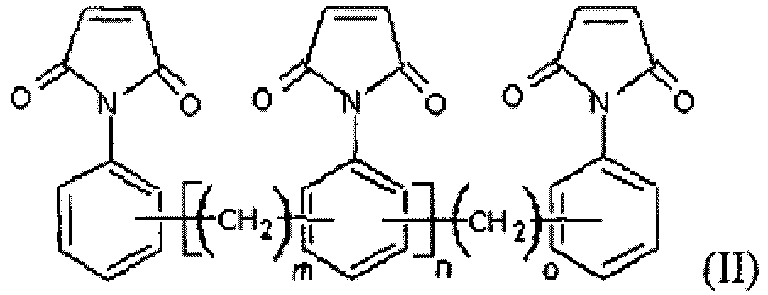
- the compound comprising the structure of maleimide has a structure represented by the formula (II): wherein m, n and o are independently an integer of 0 or more, and m, n as well as o are not 0 at the same time.
- n, n and o are independently an integer of 1 or more.
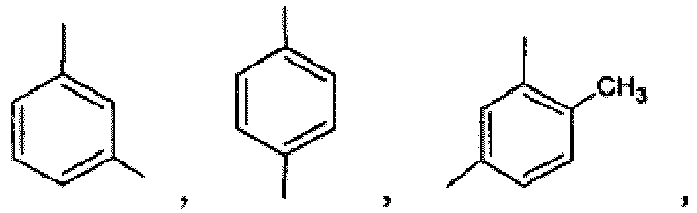
- the compound having the structure of maleimide has a structure represented by the formula (III): wherein R 5 is (C 1 -C 12 )alkylene,
- the (C 1 -C 12 )alkylene may be -(CH 2 ) 2 -, -(CH 2 ) 6 -, -(CH 2 ) 8 -, -(CH 2 ) 12 - or -CH 2 -C(CH 3 ) 2 -CH 2 -CH(CH 3 )-(CH 2 ) 2 -.
- the compound comprising the structure of maleimide is at least one selected from the group consisting of compounds having the structure of maleimide: Phenylmaleimide, N-(p-methylphenyl) maleimide, N-(o-methylphenyl) maleimide, N-(m-methylphenyl) maleimide, N-cyclohexyl maleimide, Maleimide, Maleimidophenol, Maleimidobenzocyclobutene, Phosphorus-containing maleimide, Phosphonate-containing maleimide, Siloxane-containing maleimide, N-(4-tetrahydropyranyl-oxyphenyl) maleimide and 2,6-Xylyl-maleimide.
- propylene carbonate (PC) or N-methylpyrrolidone (NMP) may be used, for example, as a solvent.
- a weight ratio of a total weight of the compound having the structure of the barbituric acid, a radical scavenger as well as the compound having the structure of maleimide and a weight of the solvent is from 3:97 to 40:60.
- the modification reaction may proceed in the temperature from 110°C to 130°C for 2 to 7 hours.
- the modified maleimide having a hyperbranched (dendrimer-like) structure may form a stable complex compound with the electrode active substance such as metal oxides in the battery electrode paste composition to increase dispersibility and maintain stability of viscosity for long time.
- the present application may use a cathode electrode active substance at least one selected from of the group consisting of Mesophase Carbon Mocro Beads (MCMB) and natural graphite powders as the electrode active substance in the paste composition.
- MCMB Mesophase Carbon Mocro Beads
- natural graphite powders as the electrode active substance in the paste composition.
- the amount of the active substance is not specifically limited as long as an amount thereof is enough to provide desired capacity without influencing electrode coating process. In one embodiment, the amount of the active substance is from 20 wt% to 80 wt% based on the total weight of the composition.
- Examples of the conductive additive of the composition include, but are not limited to, at least one of grain graphite KS4 (4 ⁇ m), grain graphite KS6 (6 ⁇ m), Vapor Grown Carbon Fiber (VGCF) and small particles of carbon black (SP). Typically, Vapor Grown Carbon Fiber (VGCF) is used.
- Functional groups may be introduced into the conductive additive by surface treatment process, so that the surface of the additive has a functional group with a double bond which may react with maleimide.
- the solid content of the conductive additive is from 0.1 wt% to 5 wt% based on the total weight of the composition.
- the adhesive of the battery electrode pasted composition examples include, but not limited to, polyvinylidene difluoride (PVDF), acrylic resin as well as styrene-butadiene rubber (SBR), and at least one adhesive may be used.
- PVDF polyvinylidene difluoride
- SBR styrene-butadiene rubber
- the adhesive with the modified maleimide dispersant is mixed to be a network uniform structure to improve the coating properties of the paste.
- the amount of the adhesive composition is from 0.1 wt% to 15 wt% based on the total weight of the composition.
- the battery electrode paste composition may further include other additives, for example, a surfactant, and a reaction initiator such as a peroxide or 2,2'-azobisisobutyronitrile (AIBN).
- AIBN 2,2'-azobisisobutyronitrile
- the silane coupling agent-modified active substance, maleimide, the barbituric acid, conductive powders and the electrode adhesive are dispersed in a solvent of N-methyl pyrrolidone to form structurally homogenous paste coating on the anode aluminum metal collector plate as a component of an anode electrode paste of a lithium-ion battery or a lithium polymer battery.
- the lithium battery produced based on such process may be safer, and have lower impedance as well as higher capacity.
- a weight ratio of lithium cobalt oxide (LiCoO 2 ): 3-aminopropyl triethoxy silane (APTES): n-hexane for mixing is 87.00: 0.02: 12.98.
- the aforementioned mixture is treated in the temperature of 70°C for about 1 hour, then in the temperature raised to 105°C for another 1 hour, and finally in the temperature raised to 190°C for 1 more hour again to obtain an initial product of lithium cobalt oxide modified with the silane coupling agent.
- the initial product of lithium cobalt oxide modified with the silane coupling agent is washed with n-hexane for three times, and is then baked in an oven in 110°C for 2-3 hours to obtain a final purified product, which is lithium cobalt oxide modified with the silane coupling agent in powder.
- a weight ratio of lithium ternary oxide (LiNi 0.5 Co 0.2 Mn 0.3 O 2 ): 3-aminopropyl triethoxy silane (APTES): n-hexane for mixing is 87.00: 0.02: 12.98.
- the aforementioned mixture is treated in the temperature of 70°C for about 1 hour, then in the temperature raised to 105°C for another 1 hour, and finally in the temperature raised to 190°C for 1 more hour again to obtain an initial product of lithium ternary oxide modified with the silane coupling agent.
- the initial product of lithium ternary oxide modified with the silane coupling agent is washed with n-hexane for three times, and is then baked in an oven in 110°C for 2-3 hours to obtain a final purified product, which is lithium ternary oxide modified with the silane coupling agent in powder.
- a weight ratio of lithium nickel cobalt aluminum oxide (NCA): 3-aminopropyl triethoxy silane (APTES): n-hexane for mixing is 87.00: 0.02: 12.98.
- the aforementioned mixture is treated in the temperature of 70°C for about 1 hour, then in the temperature raised to 105°C for another 1 hour, and finally in the temperature raised to 190°C for 1 more hour again to obtain an initial product of lithium nickel cobalt aluminum oxide modified with the silane coupling agent.
- the initial product of lithium nickel cobalt aluminum oxide modified with the silane coupling agent is washed with n-hexane for three times, and is then baked in an oven in 110°C for 2-3 hours to obtain a final purified product, which is lithium nickel cobalt aluminum oxide modified with the silane coupling agent in powder.
- a weight ratio of bismaleimide: N-methyl-pyrrolidone (NMP) solvent for mixing is 3: 97.
- a reaction of the aforementioned mixture proceeds to obtain polymaleimide, which is used as an additive for the formulation of the lithium battery electrode material composition, in N-methyl-pyrrolidone as a solvent in 130°C for about 24 hours.
- the bismaleimide is a compound represented by the following formula (IV):
- the bismaleimide: barbituric acid (BTA) (by a molar ratio of 2: 1) is added into N-methyl pyrrolidone, wherein a weight ratio of bismaleimide + barbituric acid: N-methyl-pyrrolidone is 5: 95.
- a reaction of the aforementioned mixture proceeds to obtain the modified maleimide, which is used as an additive in the formulation of the lithium battery electrode material composition, in N-methyl-pyrrolidone as a solvent in 130°C for about 24 hours.
- the bismaleimide is a compound represented by the following formula (IV):
- Example 1 Preparation of a lithium-ion battery of lithium cobalt oxide modified with the silane coupling agent
- the pasted is coated on surface of an aluminum foil to obtain an anode electrode plate.
- cathode electrode paste and a cathode electrode plate are prepared. That is, 930 g of Mesocarbon Microbeads (MCMB 2528), 20 g of conductive graphite (KS4), 60 g of polyvinylidene difluoride (PVDF), 45g of oxalic acid and 750 g of N-methylpyrrolidone are placed in Planetary Mixer to obtain cathode electrode plate paste, followed by coating the paste on surface of a copper foil to obtain a negative electrode plate.
- MCMB 2528 Mesocarbon Microbeads
- KS4 conductive graphite
- PVDF polyvinylidene difluoride
- oxalic acid 45g
- N-methylpyrrolidone N-methylpyrrolidone
- PC / EC ethylene carbonate
- DEC diethyl carbonate
- Example 2 Preparation of a lithium-ion battery containing lithium cobalt oxide modified with the silane coupling agent
- Comparative Example 1 Preparation of a lithium-ion battery containing lithium cobalt oxide without modification
- a lithium-ion battery is prepared, but the battery additive is not added; moreover, lithium cobalt oxide modified with the silane coupling agent is replaced by lithium cobalt oxide without modification.
- Example 1 Based on the method of Example 1, a lithium-ion battery is prepared, but lithium cobalt oxide modified with the silane coupling agent is replaced by lithium cobalt oxide without modification.
- lithium-ion battery is prepared, but lithium cobalt oxide modified with the silane coupling agent is replaced by lithium cobalt oxide without modification.
- Example 1-1 Preparation of a lithium-ion battery containing lithium ternary oxide modified with the silane coupling agent
- lithium-ion battery is prepared, but lithium cobalt oxide modified with the silane coupling agent of Synthesis Example 1 is replaced by lithium ternary oxide modified with the silane coupling agent of Synthesis Example 2.
- Example 2-1 Preparation of a lithium-ion battery containing lithium ternary oxide modified with the silane coupling agent
- Example 1-1 Based on the method of Example 1-1, a lithium-ion battery is prepared, but the battery additive is replaced by 7.0g of Synthesis Example 5 added into this anode electrode paste.
- Comparative Example 1-1 Preparation of a lithium-ion battery containing lithium ternary oxide without modification
- Example 1-1 Based on the method of Example 1-1, a lithium-ion battery is prepared, but the battery additive is not added; moreover, lithium ternary oxide modified with the silane coupling agent is replaced by lithium ternary oxide without modification.
- Example 1-1 Based on the method of Example 1-1, a lithium-ion battery is prepared, but lithium ternary oxide modified with the silane coupling agent is replaced by lithium ternary oxide without modification.
- Comparative Example 3-1 Preparation of a lithium-ion battery containing lithium ternary oxide without modification
- Example 2-1 Based on the method of Example 2-1, a lithium-ion battery is prepared, but lithium ternary oxide modified with the silane coupling agent is replaced by lithium ternary oxide without modification.
- Example 1-2 Preparation of a lithium-ion battery containing lithium nickel cobalt aluminum oxide modified with the silane coupling agent
- lithium-ion battery is prepared, but lithium cobalt oxide modified with the silane coupling agent of Synthesis Example 1 is replaced by lithium nickel cobalt aluminum oxide modified with the silane coupling agent of Synthesis Example 3.
- Example 2-2 Preparation of a lithium-ion battery containing lithium nickel cobalt aluminum oxide modified with the silane coupling agent
- Example 1-2 Based on the method of Example 1-2, a lithium-ion battery is prepared, but the battery additive is replaced by 7.0g of Synthesis Example 5 added into this anode electrode paste.
- Comparative Example 1-2 Preparation of a lithium-ion battery containing lithium nickel cobalt aluminum oxide without modification
- Example 1-2 Based on the method of Example 1-2, a lithium-ion battery is prepared, but the battery additive is not added; moreover, lithium nickel cobalt aluminum oxide modified with the silane coupling agent is replaced by lithium nickel cobalt aluminum oxide without modification.
- Comparative Example 2-2 Preparation of a lithium-ion battery containing lithium nickel cobalt aluminum oxide without modification
- Example 1-2 Based on the method of Example 1-2, a lithium-ion battery is prepared, but lithium nickel cobalt aluminum oxide modified with the silane coupling agent is replaced by lithium nickel cobalt aluminum oxide without modification.
- Comparative Example 3-2 Preparation of a lithium-ion battery containing lithium nickel cobalt aluminum oxide without modification
- Example 2-2 Based on the method of Example 2-2, a lithium-ion battery is prepared, but lithium nickel cobalt aluminum oxide modified with the silane coupling agent is replaced by lithium nickel cobalt aluminum oxide without modification.
- Test Example 1 Rolling test of final density of the anode electrode plate
- the rolling machine for the manufacture of lithium batteries is the commonly used one, and in the present disclosure is Japan Ono rolling machine (maximum output power of 150 tons, the general operating range is 10-30 tons), by which values of rolling density of examples and comparative examples in the present application are thus obtained as shown Tables 1 to 3 as follows.
- Example Comparative Example 1 2 1 2 3 Rolling density (g/cm 3 ) 4.0 4.0 3.7 3.6 Table 2
- Example Comparative Example 1-1 2-1 1-1 2-1 3-1 Rolling density (g/cm 3 ) 3.4 a 3.4 a 3.4 a 3.4 b 3.4 b a an electrode plate remaining pliable as before, and folding twice not causing cracks b an electrode plate less pliable than before, and folding twice causing cracks
- Rolling density (g/cm 3 ) 2.9 a 2.9 a 2.9 a 2.9 a 2.9 b 2.9 b a an electrode plate remaining pliable as before, and folding twice not causing cracks b an electrode plate less pliable than before, and folding twice causing cracks
- Test Example 2 Test of performance of the lithium-ion battery
- Test Example 3 Test of the lithium-ion battery safety
Landscapes
- Chemical & Material Sciences (AREA)
- Chemical Kinetics & Catalysis (AREA)
- Electrochemistry (AREA)
- General Chemical & Material Sciences (AREA)
- Inorganic Chemistry (AREA)
- Engineering & Computer Science (AREA)
- Materials Engineering (AREA)
- Manufacturing & Machinery (AREA)
- Battery Electrode And Active Subsutance (AREA)
- Addition Polymer Or Copolymer, Post-Treatments, Or Chemical Modifications (AREA)
- Compositions Of Macromolecular Compounds (AREA)
- Crystallography & Structural Chemistry (AREA)
- Secondary Cells (AREA)
Claims (15)
- Batterieelektrodenpasten-Zusammensetzung, aufweisend:eine mit einem Silan-Kopplungsmittel modifizierte Aktivsubstanz aufweisend Lithium und zumindest ein nicht-Lithium Metall, wobei die Silan-Kopplungsmittel modifizierte Aktivsubstanz durch Binden eines Silan-Kopplungsmittels an eine Aktivsubstanz erhalten wird;ein leitfähiges Additiv;ein Haftmittel; undein Maleimid-Additiv aufweisend eine Verbindung mit einer Maleimid-Struktur.
- Batterieelektrodenpasten-Zusammensetzung nach Anspruch 1, wobei das Silan-Kopplungsmittel eine -NH2-Reaktivgruppe oder eine -CH=CH2-Reaktivgruppe hat.
- Batterieelektrodenpasten-Zusammensetzung nach einem der vorstehenden Ansprüche, wobei das Silan-Kopplungsmittel eine chemische Struktur hat, die durch H2N-(CH2)3Si(OCnH2n+1)3 oder CH2=CH-R-Si(OCnH2n+1)3 dargestellt wird, und wobei n eine Ganzzahl von größer gleich 1 ist, und R (C1-C12)Alkylen ist.
- Batterieelektrodenpasten-Zusammensetzung nach einem der vorstehenden Ansprüche, wobei das Silan-Kopplungsmittel 3-Aminopropyltriethoxysilan ist.
- Batterieelektrodenpasten-Zusammensetzung nach einem der vorstehenden Ansprüche, wobei die Aktivsubstanz ein Metalloxid ausgewählt aus der Gruppe bestehend aus Lithium-Nickel-Cobalt-Aluminiumoxid (NCA), Lithium-Nickel-Cobalt-Manganoxid (LNCM), Lithium-Cobaltoxid (LiCo02), Lithium-Manganoxid (LiMn02), Lithium-Nickeloxid (LiNi02), Lithiumeisenphosphat (LiFePO4) und Lithium-Nickel-Cobalt-Manganoxid (LiNi0.5Co0.2Mn0.3O2) ist.
- Batterieelektrodenpasten-Zusammensetzung nach einem der vorstehenden Ansprüche, wobei die Verbindung mit einer Maleimid-Struktur eine Polymaleimid-Struktur hat.
- Batterieelektrodenpasten-Zusammensetzung nach einem der vorstehenden Ansprüche, wobei die Verbindung mit einer Maleimidstruktur mit einer Verbindung mit einer Barbitursäurestruktur modifiziert ist.
- Batterieelektrodenpasten-Zusammensetzung nach Anspruch 7, wobei die Verbindung mit einer Barbitursäurestruktur eine Struktur hat, die durch Formel (I) dargestellt wird:

- Batterieelektrodenpasten-Zusammensetzung nach Anspruch 8, wobei X, Y und Z jeweils ein Sauerstoffatom ist, R3 und R4 jeweils Wasserstoff ist, und R1 und R2 unabhängig ausgewählt sind aus der Gruppe bestehend auf Wasserstoff und (C1-C5)-Alkyl, vorausgesetzt, dass R1 und R2 nicht gleichzeitig Wasserstoff sind.
- Batterieelektrodenpasten-Zusammensetzung nach einem der vorstehenden Ansprüche, wobei die Verbindung mit einer Maleimid-Struktur eine Struktur hat, die durch Formel (II) dargestellt wird:
- Batterieelektrodenpasten-Zusammensetzung nach einem der vorstehenden Ansprüche, wobei die Verbindung mit einer Maleimidstruktur eine Struktur hat, die durch Formel (III) dargestellt wird:


- Batterieelektrodenpasten-Zusammensetzung nach einem der vorstehenden Ansprüche, wobei die Verbindung mit einer Maleimidstruktur zumindest eine ist ausgewählt aus der Gruppe bestehend aus Phenylmaleimid, N-(p-Methylphenyl) Maleimid, N-(o-methylphenyl) Maleimid, N-(m-methylphenyl) Maleimid, N-cyclohexyl Maleimid, Maleimid, Maleimidophenol, Maleimidobenzocyclobuten, Phosphor-haltiges Maleimid, Phosphonat-haltiges Maleimid, Siloxan-haltiges Maleimid, N-(4-tetrahydropyranyl-oxyphenyl) Maleimid und 2,6-xylyl- Maleimid.
- Batterieelektrodenpasten-Zusammensetzung nach einem der vorstehenden Ansprüche, wobei eine Menge des Maleimid-Additivs basierend auf einem Gesamtgewicht des Festgehalts der Batterieelektrodenpasten-Zusammensetzung zwischen 0,1 Gewichtsprozent und 5 Gewichtsprozent liegt.
- Batterieelektrodenpasten-Zusammensetzung nach einem der vorstehenden Ansprüche, wobei eine Menge des Haftmittels basierend auf einem Gesamtgewicht der Batterieelektrodenpasten-Zusammensetzung zwischen 0,1 Gewichtsprozent und 15 Gewichtsprozent liegt.
- Batterieelektrodenpasten-Zusammensetzung nach einem der vorstehenden Ansprüche, wobei eine Menge des leitfähigen Additivs basierend auf einem Gesamtgewicht des Festgehalts der Batterieelektrodenpasten-Zusammensetzung zwischen 0,1 Gewichtsprozent und 5 Gewichtsprozent liegt.
Applications Claiming Priority (2)
| Application Number | Priority Date | Filing Date | Title |
|---|---|---|---|
| TW103146517 | 2014-12-31 | ||
| TW104143101A TWI581484B (zh) | 2014-12-31 | 2015-12-22 | 電池電極漿料組成物 |
Publications (2)
| Publication Number | Publication Date |
|---|---|
| EP3041069A1 EP3041069A1 (de) | 2016-07-06 |
| EP3041069B1 true EP3041069B1 (de) | 2018-03-14 |
Family
ID=55070769
Family Applications (1)
| Application Number | Title | Priority Date | Filing Date |
|---|---|---|---|
| EP15202563.1A Active EP3041069B1 (de) | 2014-12-31 | 2015-12-23 | Batterieelektrodenpastenzusammensetzung |
Country Status (6)
| Country | Link |
|---|---|
| US (1) | US20160190580A1 (de) |
| EP (1) | EP3041069B1 (de) |
| JP (1) | JP6178878B2 (de) |
| KR (1) | KR101777680B1 (de) |
| CN (1) | CN105742639B (de) |
| TW (1) | TWI581484B (de) |
Families Citing this family (17)
| Publication number | Priority date | Publication date | Assignee | Title |
|---|---|---|---|---|
| CN107845812A (zh) * | 2016-09-18 | 2018-03-27 | 宁德新能源科技有限公司 | 正极极片及其制备方法以及二次电池 |
| TWI602849B (zh) * | 2016-11-18 | 2017-10-21 | 國立臺灣科技大學 | 寡聚物高分子與鋰電池 |
| US20180159182A1 (en) * | 2016-12-07 | 2018-06-07 | Robert Bosch Gmbh | Linker-functionalized cathodes for solid state batteries |
| CN108232129A (zh) * | 2016-12-21 | 2018-06-29 | 深圳市比克动力电池有限公司 | 锂离子电池负极材料、负极片和锂离子电池 |
| DE102017009620A1 (de) | 2017-10-17 | 2019-04-18 | Daimler Ag | Verfahren zur Herstellung eines Aktivmaterials für eine Elektrode |
| TWI682578B (zh) * | 2017-12-12 | 2020-01-11 | 財團法人工業技術研究院 | 正極板與正極板漿料的形成方法 |
| CN108269986B (zh) * | 2018-01-25 | 2020-06-16 | 清陶(昆山)能源发展有限公司 | 一种固态电池用的复合硅烷偶联剂三元复合正极材料及其制备方法以及应用 |
| CN108306016B (zh) * | 2018-02-02 | 2020-07-07 | 哈尔滨工业大学 | 一种利用偶联剂对电池正极材料表面进行修饰的方法 |
| JP7155802B2 (ja) * | 2018-09-21 | 2022-10-19 | 日立金属株式会社 | リチウムイオン二次電池用正極活物質、その製造方法及びリチウムイオン二次電池用正極、並びにリチウムイオン二次電池 |
| TWI767157B (zh) | 2019-11-12 | 2022-06-11 | 國立臺灣科技大學 | 鋰電池的正極材料的製備方法 |
| US11043676B1 (en) * | 2019-12-05 | 2021-06-22 | Enevate Corporation | Method and system for silosilazanes, silosiloxanes, and siloxanes as additives for silicon dominant anodes |
| JP2021103681A (ja) * | 2019-12-09 | 2021-07-15 | 財團法人工業技術研究院Industrial Technology Research Institute | 正極材料、これを用いる正極および電池 |
| JP7768559B2 (ja) * | 2020-03-11 | 2025-11-12 | 国立大学法人信州大学 | リチウムイオン二次電池用電極およびリチウムイオン二次電池 |
| CN114989642B (zh) * | 2022-06-16 | 2024-05-17 | 惠州市豪鹏科技有限公司 | 一种导电炭黑改性方法、改性导电炭黑、正极片及电池 |
| CN116574481B (zh) * | 2023-07-07 | 2023-10-03 | 宁德新能源科技有限公司 | 粘结剂、正极极片以及正极极片的制备方法 |
| EP4574854A1 (de) * | 2023-12-22 | 2025-06-25 | Belenos Clean Power Holding AG | Polymerelektrolyte und verfahren zu ihrer herstellung |
| EP4574898A1 (de) * | 2023-12-22 | 2025-06-25 | Belenos Clean Power Holding AG | Polymerelektrolyte und verfahren zu ihrer herstellung |
Family Cites Families (12)
| Publication number | Priority date | Publication date | Assignee | Title |
|---|---|---|---|---|
| JPH10125307A (ja) * | 1996-10-23 | 1998-05-15 | Sony Corp | リチウムイオン二次電池 |
| JP5128779B2 (ja) * | 2006-03-06 | 2013-01-23 | パナソニック株式会社 | リチウムイオン二次電池 |
| TWI332284B (en) * | 2006-12-29 | 2010-10-21 | Ind Tech Res Inst | A battery electrode paste composition containing modified maleimides |
| CN101399332A (zh) * | 2007-09-29 | 2009-04-01 | 深圳市比克电池有限公司 | 一种提高锂离子电池正极浆料附着力的方法 |
| TWI402278B (zh) * | 2008-07-23 | 2013-07-21 | Ind Tech Res Inst | 高分岐聚合物之形成方法 |
| TWI411149B (zh) * | 2008-12-31 | 2013-10-01 | Ind Tech Res Inst | 鋰電池及其製造方法 |
| JP5794116B2 (ja) * | 2011-11-08 | 2015-10-14 | オムロン株式会社 | 安全制御システム |
| JP5985975B2 (ja) * | 2012-02-15 | 2016-09-06 | 日立マクセル株式会社 | リチウムイオン二次電池およびリチウムイオン二次電池用正極活物質の製造方法 |
| JP5894513B2 (ja) * | 2012-07-20 | 2016-03-30 | 日立マクセル株式会社 | リチウムイオン二次電池用正極及びその製造方法 |
| TWI502786B (zh) * | 2012-12-21 | 2015-10-01 | Ind Tech Res Inst | 用於電池之改質型馬來醯亞胺寡聚物及含有該寡聚物之組成物 |
| CN103311552A (zh) * | 2013-06-25 | 2013-09-18 | 湖南友能高新技术有限公司 | 一种提高电池负极材料钛酸锂附着力的方法 |
| TWI494350B (zh) * | 2013-09-26 | 2015-08-01 | Univ Nat Taiwan Science Tech | 寡聚物高分子的製備方法及鋰電池 |
-
2015
- 2015-12-22 TW TW104143101A patent/TWI581484B/zh active
- 2015-12-23 EP EP15202563.1A patent/EP3041069B1/de active Active
- 2015-12-30 CN CN201511022500.6A patent/CN105742639B/zh active Active
- 2015-12-30 US US14/983,997 patent/US20160190580A1/en not_active Abandoned
- 2015-12-30 KR KR1020150190090A patent/KR101777680B1/ko active Active
-
2016
- 2016-01-04 JP JP2016000125A patent/JP6178878B2/ja active Active
Non-Patent Citations (1)
| Title |
|---|
| None * |
Also Published As
| Publication number | Publication date |
|---|---|
| CN105742639B (zh) | 2018-07-20 |
| JP6178878B2 (ja) | 2017-08-09 |
| JP2016146322A (ja) | 2016-08-12 |
| EP3041069A1 (de) | 2016-07-06 |
| KR20160081842A (ko) | 2016-07-08 |
| US20160190580A1 (en) | 2016-06-30 |
| CN105742639A (zh) | 2016-07-06 |
| KR101777680B1 (ko) | 2017-09-13 |
| TWI581484B (zh) | 2017-05-01 |
| TW201624820A (zh) | 2016-07-01 |
Similar Documents
| Publication | Publication Date | Title |
|---|---|---|
| KR101777680B1 (ko) | 전지 전극 페이스트 조성물 | |
| KR101875436B1 (ko) | 첨가제 제제 및 리튬 이온 전지용 조성물 및 이를 포함하는 리튬 이온 전지 | |
| US9484577B2 (en) | Positive electrode materials for lithium ion batteries and process for preparing the same | |
| CN108475817B (zh) | 固体电解质组合物及全固态二次电池的制造方法 | |
| US9287563B2 (en) | Electrode for lithium secondary battery and lithium secondary battery including the same | |
| US9160005B2 (en) | Modified maleimide oligomer, preparation method thereof and composition containing the same | |
| CN108475786B (zh) | 二次电池电极用水系粘合剂组合物、二次电池电极用浆料、粘合剂、二次电池电极及二次电池 | |
| US20240178453A1 (en) | Lithium-ion battery | |
| JP2021512461A (ja) | ゲルポリマー電解質用組成物及びこれから形成されたゲルポリマー電解質を含むリチウム二次電池 | |
| KR102828354B1 (ko) | 고분자 전해질용 공중합체, 이를 포함하는 겔 폴리머 전해질 및 리튬 이차전지 | |
| EP4379869A1 (de) | Bindemittelzusammensetzung für elektroden von wasserfreien sekundärbatterien, schlammzusammensetzung für elektroden von wasserfreien sekundärbatterien, elektrode für wasserfreie sekundärbatterien und wasserfreie sekundärbatterie | |
| JP6868751B1 (ja) | 非水系二次電池電極、電極スラリー、及び非水系二次電池 | |
| EP3825337B1 (de) | Copolymer für bindemittel für wasserfreie batterieelektrode und aufschlämmung zur herstellung einer wasserfreien batterieelektrode | |
| KR102687193B1 (ko) | 비수계 전지 전극용 슬러리의 제조 방법 | |
| KR20210045136A (ko) | 전해질용 공중합체, 이를 포함하는 전해질 조성물 및 이로부터 형성된 겔 폴리머 전해질 | |
| EP4273992B1 (de) | Lithium-sekundärbatterie mit erhöhter hochtemperatursicherheit | |
| CN108539198B (zh) | 二次电池正极活性物质涂覆用溶剂、包含其的正极活性物质浆料及由其制造的二次电池 | |
| KR102298292B1 (ko) | 겔 폴리머 전해질 조성물, 이에 의해 제조된 겔 폴리머 전해질, 및 이를 포함하는 리튬 이차전지 | |
| KR20200039585A (ko) | 고분자 전해질용 조성물 및 이로부터 제조된 고분자 전해질을 포함하는 리튬 이차전지 | |
| KR20190010470A (ko) | 이차전지용 양극 슬러리 조성물, 이를 포함하는 이차전지용 양극 및 리튬 이차전지 | |
| JP5676733B1 (ja) | 電解質溶液、リチウム電池および電気化学キャリア構造 | |
| TW202532447A (zh) | 非水系二次電池用黏結劑聚合物、非水系二次電池用黏結劑、非水系二次電池用黏結劑組成物、非水系二次電池用電極漿料、非水系二次電池用電極、非水系二次電池、非水系二次電池用黏結劑聚合物的製造方法、非水系二次電池用黏結劑的製造方法、非水系二次電池用黏結劑組成物的製造方法、非水系二次電池用電極漿料的製造方法、及非水系二次電池用電極的製造方法 | |
| JP2023176321A (ja) | 非水系二次電池用電極スラリーの製造方法、及び非水系二次電池電極の製造方法 |
Legal Events
| Date | Code | Title | Description |
|---|---|---|---|
| PUAI | Public reference made under article 153(3) epc to a published international application that has entered the european phase |
Free format text: ORIGINAL CODE: 0009012 |
|
| AK | Designated contracting states |
Kind code of ref document: A1 Designated state(s): AL AT BE BG CH CY CZ DE DK EE ES FI FR GB GR HR HU IE IS IT LI LT LU LV MC MK MT NL NO PL PT RO RS SE SI SK SM TR |
|
| AX | Request for extension of the european patent |
Extension state: BA ME |
|
| 17P | Request for examination filed |
Effective date: 20161121 |
|
| RBV | Designated contracting states (corrected) |
Designated state(s): AL AT BE BG CH CY CZ DE DK EE ES FI FR GB GR HR HU IE IS IT LI LT LU LV MC MK MT NL NO PL PT RO RS SE SI SK SM TR |
|
| GRAP | Despatch of communication of intention to grant a patent |
Free format text: ORIGINAL CODE: EPIDOSNIGR1 |
|
| RIC1 | Information provided on ipc code assigned before grant |
Ipc: H01M 4/1391 20100101ALI20170914BHEP Ipc: H01M 4/505 20100101ALI20170914BHEP Ipc: H01M 4/62 20060101ALI20170914BHEP Ipc: H01M 10/052 20100101ALI20170914BHEP Ipc: H01M 4/525 20100101ALI20170914BHEP Ipc: H01M 4/58 20100101ALI20170914BHEP Ipc: H01M 4/131 20100101AFI20170914BHEP |
|
| INTG | Intention to grant announced |
Effective date: 20171018 |
|
| GRAS | Grant fee paid |
Free format text: ORIGINAL CODE: EPIDOSNIGR3 |
|
| GRAA | (expected) grant |
Free format text: ORIGINAL CODE: 0009210 |
|
| RAP1 | Party data changed (applicant data changed or rights of an application transferred) |
Owner name: INDUSTRIAL TECHNOLOGY RESEARCH INSTITUTE |
|
| AK | Designated contracting states |
Kind code of ref document: B1 Designated state(s): AL AT BE BG CH CY CZ DE DK EE ES FI FR GB GR HR HU IE IS IT LI LT LU LV MC MK MT NL NO PL PT RO RS SE SI SK SM TR |
|
| REG | Reference to a national code |
Ref country code: GB Ref legal event code: FG4D |
|
| REG | Reference to a national code |
Ref country code: CH Ref legal event code: EP Ref country code: AT Ref legal event code: REF Ref document number: 979683 Country of ref document: AT Kind code of ref document: T Effective date: 20180315 |
|
| REG | Reference to a national code |
Ref country code: IE Ref legal event code: FG4D |
|
| REG | Reference to a national code |
Ref country code: DE Ref legal event code: R096 Ref document number: 602015008741 Country of ref document: DE |
|
| REG | Reference to a national code |
Ref country code: SE Ref legal event code: TRGR |
|
| REG | Reference to a national code |
Ref country code: NL Ref legal event code: MP Effective date: 20180314 |
|
| REG | Reference to a national code |
Ref country code: LT Ref legal event code: MG4D |
|
| PG25 | Lapsed in a contracting state [announced via postgrant information from national office to epo] |
Ref country code: CY Free format text: LAPSE BECAUSE OF FAILURE TO SUBMIT A TRANSLATION OF THE DESCRIPTION OR TO PAY THE FEE WITHIN THE PRESCRIBED TIME-LIMIT Effective date: 20180314 Ref country code: LT Free format text: LAPSE BECAUSE OF FAILURE TO SUBMIT A TRANSLATION OF THE DESCRIPTION OR TO PAY THE FEE WITHIN THE PRESCRIBED TIME-LIMIT Effective date: 20180314 Ref country code: NO Free format text: LAPSE BECAUSE OF FAILURE TO SUBMIT A TRANSLATION OF THE DESCRIPTION OR TO PAY THE FEE WITHIN THE PRESCRIBED TIME-LIMIT Effective date: 20180614 Ref country code: FI Free format text: LAPSE BECAUSE OF FAILURE TO SUBMIT A TRANSLATION OF THE DESCRIPTION OR TO PAY THE FEE WITHIN THE PRESCRIBED TIME-LIMIT Effective date: 20180314 Ref country code: HR Free format text: LAPSE BECAUSE OF FAILURE TO SUBMIT A TRANSLATION OF THE DESCRIPTION OR TO PAY THE FEE WITHIN THE PRESCRIBED TIME-LIMIT Effective date: 20180314 |
|
| REG | Reference to a national code |
Ref country code: AT Ref legal event code: MK05 Ref document number: 979683 Country of ref document: AT Kind code of ref document: T Effective date: 20180314 |
|
| PG25 | Lapsed in a contracting state [announced via postgrant information from national office to epo] |
Ref country code: BG Free format text: LAPSE BECAUSE OF FAILURE TO SUBMIT A TRANSLATION OF THE DESCRIPTION OR TO PAY THE FEE WITHIN THE PRESCRIBED TIME-LIMIT Effective date: 20180614 Ref country code: RS Free format text: LAPSE BECAUSE OF FAILURE TO SUBMIT A TRANSLATION OF THE DESCRIPTION OR TO PAY THE FEE WITHIN THE PRESCRIBED TIME-LIMIT Effective date: 20180314 Ref country code: GR Free format text: LAPSE BECAUSE OF FAILURE TO SUBMIT A TRANSLATION OF THE DESCRIPTION OR TO PAY THE FEE WITHIN THE PRESCRIBED TIME-LIMIT Effective date: 20180615 Ref country code: LV Free format text: LAPSE BECAUSE OF FAILURE TO SUBMIT A TRANSLATION OF THE DESCRIPTION OR TO PAY THE FEE WITHIN THE PRESCRIBED TIME-LIMIT Effective date: 20180314 |
|
| PG25 | Lapsed in a contracting state [announced via postgrant information from national office to epo] |
Ref country code: EE Free format text: LAPSE BECAUSE OF FAILURE TO SUBMIT A TRANSLATION OF THE DESCRIPTION OR TO PAY THE FEE WITHIN THE PRESCRIBED TIME-LIMIT Effective date: 20180314 Ref country code: PL Free format text: LAPSE BECAUSE OF FAILURE TO SUBMIT A TRANSLATION OF THE DESCRIPTION OR TO PAY THE FEE WITHIN THE PRESCRIBED TIME-LIMIT Effective date: 20180314 Ref country code: NL Free format text: LAPSE BECAUSE OF FAILURE TO SUBMIT A TRANSLATION OF THE DESCRIPTION OR TO PAY THE FEE WITHIN THE PRESCRIBED TIME-LIMIT Effective date: 20180314 Ref country code: RO Free format text: LAPSE BECAUSE OF FAILURE TO SUBMIT A TRANSLATION OF THE DESCRIPTION OR TO PAY THE FEE WITHIN THE PRESCRIBED TIME-LIMIT Effective date: 20180314 Ref country code: ES Free format text: LAPSE BECAUSE OF FAILURE TO SUBMIT A TRANSLATION OF THE DESCRIPTION OR TO PAY THE FEE WITHIN THE PRESCRIBED TIME-LIMIT Effective date: 20180314 Ref country code: AL Free format text: LAPSE BECAUSE OF FAILURE TO SUBMIT A TRANSLATION OF THE DESCRIPTION OR TO PAY THE FEE WITHIN THE PRESCRIBED TIME-LIMIT Effective date: 20180314 |
|
| PG25 | Lapsed in a contracting state [announced via postgrant information from national office to epo] |
Ref country code: AT Free format text: LAPSE BECAUSE OF FAILURE TO SUBMIT A TRANSLATION OF THE DESCRIPTION OR TO PAY THE FEE WITHIN THE PRESCRIBED TIME-LIMIT Effective date: 20180314 Ref country code: SM Free format text: LAPSE BECAUSE OF FAILURE TO SUBMIT A TRANSLATION OF THE DESCRIPTION OR TO PAY THE FEE WITHIN THE PRESCRIBED TIME-LIMIT Effective date: 20180314 Ref country code: SK Free format text: LAPSE BECAUSE OF FAILURE TO SUBMIT A TRANSLATION OF THE DESCRIPTION OR TO PAY THE FEE WITHIN THE PRESCRIBED TIME-LIMIT Effective date: 20180314 Ref country code: CZ Free format text: LAPSE BECAUSE OF FAILURE TO SUBMIT A TRANSLATION OF THE DESCRIPTION OR TO PAY THE FEE WITHIN THE PRESCRIBED TIME-LIMIT Effective date: 20180314 |
|
| REG | Reference to a national code |
Ref country code: DE Ref legal event code: R097 Ref document number: 602015008741 Country of ref document: DE |
|
| PG25 | Lapsed in a contracting state [announced via postgrant information from national office to epo] |
Ref country code: PT Free format text: LAPSE BECAUSE OF FAILURE TO SUBMIT A TRANSLATION OF THE DESCRIPTION OR TO PAY THE FEE WITHIN THE PRESCRIBED TIME-LIMIT Effective date: 20180716 |
|
| PLBE | No opposition filed within time limit |
Free format text: ORIGINAL CODE: 0009261 |
|
| STAA | Information on the status of an ep patent application or granted ep patent |
Free format text: STATUS: NO OPPOSITION FILED WITHIN TIME LIMIT |
|
| PG25 | Lapsed in a contracting state [announced via postgrant information from national office to epo] |
Ref country code: DK Free format text: LAPSE BECAUSE OF FAILURE TO SUBMIT A TRANSLATION OF THE DESCRIPTION OR TO PAY THE FEE WITHIN THE PRESCRIBED TIME-LIMIT Effective date: 20180314 |
|
| 26N | No opposition filed |
Effective date: 20181217 |
|
| PG25 | Lapsed in a contracting state [announced via postgrant information from national office to epo] |
Ref country code: SI Free format text: LAPSE BECAUSE OF FAILURE TO SUBMIT A TRANSLATION OF THE DESCRIPTION OR TO PAY THE FEE WITHIN THE PRESCRIBED TIME-LIMIT Effective date: 20180314 |
|
| REG | Reference to a national code |
Ref country code: CH Ref legal event code: PL |
|
| PG25 | Lapsed in a contracting state [announced via postgrant information from national office to epo] |
Ref country code: LU Free format text: LAPSE BECAUSE OF NON-PAYMENT OF DUE FEES Effective date: 20181223 Ref country code: MC Free format text: LAPSE BECAUSE OF FAILURE TO SUBMIT A TRANSLATION OF THE DESCRIPTION OR TO PAY THE FEE WITHIN THE PRESCRIBED TIME-LIMIT Effective date: 20180314 |
|
| REG | Reference to a national code |
Ref country code: IE Ref legal event code: MM4A |
|
| REG | Reference to a national code |
Ref country code: BE Ref legal event code: MM Effective date: 20181231 |
|
| PG25 | Lapsed in a contracting state [announced via postgrant information from national office to epo] |
Ref country code: IE Free format text: LAPSE BECAUSE OF NON-PAYMENT OF DUE FEES Effective date: 20181223 |
|
| PG25 | Lapsed in a contracting state [announced via postgrant information from national office to epo] |
Ref country code: BE Free format text: LAPSE BECAUSE OF NON-PAYMENT OF DUE FEES Effective date: 20181231 |
|
| PG25 | Lapsed in a contracting state [announced via postgrant information from national office to epo] |
Ref country code: LI Free format text: LAPSE BECAUSE OF NON-PAYMENT OF DUE FEES Effective date: 20181231 Ref country code: CH Free format text: LAPSE BECAUSE OF NON-PAYMENT OF DUE FEES Effective date: 20181231 |
|
| PG25 | Lapsed in a contracting state [announced via postgrant information from national office to epo] |
Ref country code: MT Free format text: LAPSE BECAUSE OF NON-PAYMENT OF DUE FEES Effective date: 20181223 |
|
| PG25 | Lapsed in a contracting state [announced via postgrant information from national office to epo] |
Ref country code: TR Free format text: LAPSE BECAUSE OF FAILURE TO SUBMIT A TRANSLATION OF THE DESCRIPTION OR TO PAY THE FEE WITHIN THE PRESCRIBED TIME-LIMIT Effective date: 20180314 |
|
| PG25 | Lapsed in a contracting state [announced via postgrant information from national office to epo] |
Ref country code: MK Free format text: LAPSE BECAUSE OF NON-PAYMENT OF DUE FEES Effective date: 20180314 Ref country code: HU Free format text: LAPSE BECAUSE OF FAILURE TO SUBMIT A TRANSLATION OF THE DESCRIPTION OR TO PAY THE FEE WITHIN THE PRESCRIBED TIME-LIMIT; INVALID AB INITIO Effective date: 20151223 |
|
| PGFP | Annual fee paid to national office [announced via postgrant information from national office to epo] |
Ref country code: IS Payment date: 20251219 Year of fee payment: 11 |
|
| PGFP | Annual fee paid to national office [announced via postgrant information from national office to epo] |
Ref country code: GB Payment date: 20251229 Year of fee payment: 11 |
|
| PGFP | Annual fee paid to national office [announced via postgrant information from national office to epo] |
Ref country code: IT Payment date: 20251219 Year of fee payment: 11 |
|
| PGFP | Annual fee paid to national office [announced via postgrant information from national office to epo] |
Ref country code: FR Payment date: 20251226 Year of fee payment: 11 |
|
| PGFP | Annual fee paid to national office [announced via postgrant information from national office to epo] |
Ref country code: SE Payment date: 20251227 Year of fee payment: 11 |
|
| PGFP | Annual fee paid to national office [announced via postgrant information from national office to epo] |
Ref country code: DE Payment date: 20251229 Year of fee payment: 11 |