EP2984692B1 - Organische elektrolumineszenzvorrichtung mit thermisch aktiviertem verzögertem fluoreszenzmaterial - Google Patents
Organische elektrolumineszenzvorrichtung mit thermisch aktiviertem verzögertem fluoreszenzmaterial Download PDFInfo
- Publication number
- EP2984692B1 EP2984692B1 EP14711446.6A EP14711446A EP2984692B1 EP 2984692 B1 EP2984692 B1 EP 2984692B1 EP 14711446 A EP14711446 A EP 14711446A EP 2984692 B1 EP2984692 B1 EP 2984692B1
- Authority
- EP
- European Patent Office
- Prior art keywords
- group
- aromatic
- radicals
- atoms
- substituted
- Prior art date
- Legal status (The legal status is an assumption and is not a legal conclusion. Google has not performed a legal analysis and makes no representation as to the accuracy of the status listed.)
- Active
Links
Classifications
-
- H—ELECTRICITY
- H10—SEMICONDUCTOR DEVICES; ELECTRIC SOLID-STATE DEVICES NOT OTHERWISE PROVIDED FOR
- H10K—ORGANIC ELECTRIC SOLID-STATE DEVICES
- H10K85/00—Organic materials used in the body or electrodes of devices covered by this subclass
- H10K85/60—Organic compounds having low molecular weight
- H10K85/649—Aromatic compounds comprising a hetero atom
- H10K85/654—Aromatic compounds comprising a hetero atom comprising only nitrogen as heteroatom
-
- H—ELECTRICITY
- H10—SEMICONDUCTOR DEVICES; ELECTRIC SOLID-STATE DEVICES NOT OTHERWISE PROVIDED FOR
- H10K—ORGANIC ELECTRIC SOLID-STATE DEVICES
- H10K50/00—Organic light-emitting devices
- H10K50/10—OLEDs or polymer light-emitting diodes [PLED]
- H10K50/11—OLEDs or polymer light-emitting diodes [PLED] characterised by the electroluminescent [EL] layers
-
- H—ELECTRICITY
- H10—SEMICONDUCTOR DEVICES; ELECTRIC SOLID-STATE DEVICES NOT OTHERWISE PROVIDED FOR
- H10K—ORGANIC ELECTRIC SOLID-STATE DEVICES
- H10K50/00—Organic light-emitting devices
- H10K50/10—OLEDs or polymer light-emitting diodes [PLED]
- H10K50/14—Carrier transporting layers
- H10K50/16—Electron transporting layers
-
- H—ELECTRICITY
- H10—SEMICONDUCTOR DEVICES; ELECTRIC SOLID-STATE DEVICES NOT OTHERWISE PROVIDED FOR
- H10K—ORGANIC ELECTRIC SOLID-STATE DEVICES
- H10K50/00—Organic light-emitting devices
- H10K50/10—OLEDs or polymer light-emitting diodes [PLED]
- H10K50/18—Carrier blocking layers
-
- H—ELECTRICITY
- H10—SEMICONDUCTOR DEVICES; ELECTRIC SOLID-STATE DEVICES NOT OTHERWISE PROVIDED FOR
- H10K—ORGANIC ELECTRIC SOLID-STATE DEVICES
- H10K71/00—Manufacture or treatment specially adapted for the organic devices covered by this subclass
-
- H—ELECTRICITY
- H10—SEMICONDUCTOR DEVICES; ELECTRIC SOLID-STATE DEVICES NOT OTHERWISE PROVIDED FOR
- H10K—ORGANIC ELECTRIC SOLID-STATE DEVICES
- H10K71/00—Manufacture or treatment specially adapted for the organic devices covered by this subclass
- H10K71/10—Deposition of organic active material
- H10K71/12—Deposition of organic active material using liquid deposition, e.g. spin coating
-
- H—ELECTRICITY
- H10—SEMICONDUCTOR DEVICES; ELECTRIC SOLID-STATE DEVICES NOT OTHERWISE PROVIDED FOR
- H10K—ORGANIC ELECTRIC SOLID-STATE DEVICES
- H10K71/00—Manufacture or treatment specially adapted for the organic devices covered by this subclass
- H10K71/10—Deposition of organic active material
- H10K71/12—Deposition of organic active material using liquid deposition, e.g. spin coating
- H10K71/13—Deposition of organic active material using liquid deposition, e.g. spin coating using printing techniques, e.g. ink-jet printing or screen printing
-
- H—ELECTRICITY
- H10—SEMICONDUCTOR DEVICES; ELECTRIC SOLID-STATE DEVICES NOT OTHERWISE PROVIDED FOR
- H10K—ORGANIC ELECTRIC SOLID-STATE DEVICES
- H10K85/00—Organic materials used in the body or electrodes of devices covered by this subclass
- H10K85/60—Organic compounds having low molecular weight
-
- H—ELECTRICITY
- H10—SEMICONDUCTOR DEVICES; ELECTRIC SOLID-STATE DEVICES NOT OTHERWISE PROVIDED FOR
- H10K—ORGANIC ELECTRIC SOLID-STATE DEVICES
- H10K85/00—Organic materials used in the body or electrodes of devices covered by this subclass
- H10K85/60—Organic compounds having low molecular weight
- H10K85/631—Amine compounds having at least two aryl rest on at least one amine-nitrogen atom, e.g. triphenylamine
- H10K85/633—Amine compounds having at least two aryl rest on at least one amine-nitrogen atom, e.g. triphenylamine comprising polycyclic condensed aromatic hydrocarbons as substituents on the nitrogen atom
-
- H—ELECTRICITY
- H10—SEMICONDUCTOR DEVICES; ELECTRIC SOLID-STATE DEVICES NOT OTHERWISE PROVIDED FOR
- H10K—ORGANIC ELECTRIC SOLID-STATE DEVICES
- H10K85/00—Organic materials used in the body or electrodes of devices covered by this subclass
- H10K85/60—Organic compounds having low molecular weight
- H10K85/649—Aromatic compounds comprising a hetero atom
- H10K85/657—Polycyclic condensed heteroaromatic hydrocarbons
- H10K85/6572—Polycyclic condensed heteroaromatic hydrocarbons comprising only nitrogen in the heteroaromatic polycondensed ring system, e.g. phenanthroline or carbazole
-
- H—ELECTRICITY
- H10—SEMICONDUCTOR DEVICES; ELECTRIC SOLID-STATE DEVICES NOT OTHERWISE PROVIDED FOR
- H10K—ORGANIC ELECTRIC SOLID-STATE DEVICES
- H10K2101/00—Properties of the organic materials covered by group H10K85/00
- H10K2101/10—Triplet emission
-
- H—ELECTRICITY
- H10—SEMICONDUCTOR DEVICES; ELECTRIC SOLID-STATE DEVICES NOT OTHERWISE PROVIDED FOR
- H10K—ORGANIC ELECTRIC SOLID-STATE DEVICES
- H10K2101/00—Properties of the organic materials covered by group H10K85/00
- H10K2101/20—Delayed fluorescence emission
-
- H—ELECTRICITY
- H10—SEMICONDUCTOR DEVICES; ELECTRIC SOLID-STATE DEVICES NOT OTHERWISE PROVIDED FOR
- H10K—ORGANIC ELECTRIC SOLID-STATE DEVICES
- H10K2101/00—Properties of the organic materials covered by group H10K85/00
- H10K2101/30—Highest occupied molecular orbital [HOMO], lowest unoccupied molecular orbital [LUMO] or Fermi energy values
-
- H—ELECTRICITY
- H10—SEMICONDUCTOR DEVICES; ELECTRIC SOLID-STATE DEVICES NOT OTHERWISE PROVIDED FOR
- H10K—ORGANIC ELECTRIC SOLID-STATE DEVICES
- H10K2101/00—Properties of the organic materials covered by group H10K85/00
- H10K2101/40—Interrelation of parameters between multiple constituent active layers or sublayers, e.g. HOMO values in adjacent layers
-
- H—ELECTRICITY
- H10—SEMICONDUCTOR DEVICES; ELECTRIC SOLID-STATE DEVICES NOT OTHERWISE PROVIDED FOR
- H10K—ORGANIC ELECTRIC SOLID-STATE DEVICES
- H10K85/00—Organic materials used in the body or electrodes of devices covered by this subclass
- H10K85/30—Coordination compounds
-
- H—ELECTRICITY
- H10—SEMICONDUCTOR DEVICES; ELECTRIC SOLID-STATE DEVICES NOT OTHERWISE PROVIDED FOR
- H10K—ORGANIC ELECTRIC SOLID-STATE DEVICES
- H10K85/00—Organic materials used in the body or electrodes of devices covered by this subclass
- H10K85/60—Organic compounds having low molecular weight
- H10K85/615—Polycyclic condensed aromatic hydrocarbons, e.g. anthracene
- H10K85/624—Polycyclic condensed aromatic hydrocarbons, e.g. anthracene containing six or more rings
-
- H—ELECTRICITY
- H10—SEMICONDUCTOR DEVICES; ELECTRIC SOLID-STATE DEVICES NOT OTHERWISE PROVIDED FOR
- H10K—ORGANIC ELECTRIC SOLID-STATE DEVICES
- H10K85/00—Organic materials used in the body or electrodes of devices covered by this subclass
- H10K85/60—Organic compounds having low molecular weight
- H10K85/615—Polycyclic condensed aromatic hydrocarbons, e.g. anthracene
- H10K85/626—Polycyclic condensed aromatic hydrocarbons, e.g. anthracene containing more than one polycyclic condensed aromatic rings, e.g. bis-anthracene
Definitions
- the present invention relates to organic electroluminescent devices containing mixtures of a luminescent material with a small singlet-triplet distance and an electron-conducting material.
- OLEDs organic electroluminescent devices
- OLEDs organic electroluminescent devices
- emissive materials MA Baldo et al., Appl. Phys. Lett. 1999, 75, 4-6 .
- organometallic compounds for quantum mechanical reasons, up to four times energy and power efficiency is possible using organometallic compounds as phosphorescence emitters.
- iridium and platinum are rare and expensive metals. It would therefore be desirable to conserve resources to avoid the use of these rare metals. Furthermore, such metal complexes sometimes have lower thermal stability during sublimation than purely organic compounds, so that the use of purely organic compounds would also be advantageous for this reason, provided that they lead to comparably good efficiencies. Furthermore, blue, especially deep blue phosphorescent iridium or platinum mesh with high efficiency and lifetime technically difficult to implement, so there is room for improvement. Furthermore, there is room for improvement in the lifetime of phosphorescent OLEDs containing Ir or Pt emitters when the OLED is operated at a higher temperature, as required for some applications.
- thermoly activated delayed fluorescence e.g. BH Uoyama et al., Nature 2012, Vol. 492, 234
- TADF thermally activated delayed fluorescence
- organic materials in which the energy gap between the lowest triplet state T 1 and the first excited singlet state S 1 is so small that this energy gap is smaller or in the range of thermal energy.
- electronic excited excitation in the OLED causes excited states to be 75% in the triplet state and 25% in the singlet state. Since purely organic molecules usually can not emit from the triplet state, 75% of the excited states can not be used for the emission, whereby in principle only 25% of the excitation energy can be converted into light.
- the first excited singlet state of the molecule can be accessed from the triplet state by thermal excitation and can be thermally occupied become. Since this singlet state is an emissive state from which fluorescence is possible, this state can be used to generate light. Thus, in principle, the conversion of up to 100% of the electrical energy in light is possible when using purely organic materials as an emitter. Thus, the prior art describes an external quantum efficiency of more than 19%, which is of the same order of magnitude as for phosphorescent OLEDs. Thus, it is possible with such purely organic materials to achieve very good efficiencies and at the same time to avoid the use of rare metals such as iridium or platinum. Furthermore, it is also possible with such materials to achieve highly efficient blue-emitting OLEDs.
- TADF compound thermally activated delayed fluorescence
- carbazole derivatives for example carbazole derivatives
- organic electroluminescent devices which exhibit emission by the TADF mechanism still require further improvement, in particular with regard to efficiency, voltage, service life and roll-off behavior.
- the technical problem underlying the present invention is therefore to provide OLEDs whose emission is based on TADF and which have improved properties, in particular with respect to one or more of the abovementioned properties.
- organic electroluminescent devices which have an organic TADF molecule and an electron-conducting matrix material in the emitting layer solve this problem and lead to improvements in the organic electroluminescent device.
- organic electroluminescent devices are therefore the subject of the present invention.
- organic compound in the sense of the present invention is a carbon-containing compound which contains no metals.
- the organic compound is composed of the elements C, H, D, B, Si, N, P, O, S, F, Cl, Br and I.
- a luminescent compound in the sense of the present invention is a compound which is capable of emitting light at room temperature under optical excitation in an environment as present in the organic electroluminescent device.
- the compound preferably has a luminescence quantum efficiency of at least 40%, particularly preferably of at least 50%, very particularly preferably of at least 60% and particularly preferably of at least 70%.
- the luminescence quantum efficiency is determined in a layer in admixture with the matrix material as it is to be used in the organic electroluminescent device. How the determination of the luminescence quantum yield in the sense of the present invention is carried out is described in detail in the examples section in general terms.
- the decay time is preferably ⁇ 50 ⁇ s. How the determination of the decay time is carried out in the sense of the present invention is described in detail in the example section in general terms.
- the energy of the lowest excited singlet state (S 1 ) and the lowest triplet state (T 1 ) are determined by quantum chemical calculation. How this determination is carried out in the sense of the present invention is described in detail in the example section in detail.
- the distance between S 1 and T 1 must not exceed 0.15 eV, so that the connection is a TADF connection in the sense of the present invention.
- the distance between S 1 and T 1 ⁇ 0.10 eV, more preferably ⁇ 0.08 eV, most preferably ⁇ 0.05 eV.
- the TADF compound is preferably an aromatic compound having both donor and acceptor substituents, with the LUMO and the HOMO of the compound overlapping only slightly in space.
- donor or acceptor substituents are known in principle to the person skilled in the art.
- Suitable donor substituents are, in particular, diaryl or heteroarylamino groups as well as carbazole groups or carbazole derivatives, which are each preferably linked via N to the aromatic compound. These groups may also be further substituted.
- Suitable acceptor substituents are in particular cyano groups, but also, for example, electron-deficient heteroaryl groups, which may also be further substituted.
- LUMO LUMO
- matrix ie the HOMO of the electron-transporting matrix
- LUMO TADF - HOMO matrix > S 1 TADF - 0.4 eV
- LUMO TADF - HOMO matrix > S 1 TADF - 0.3 eV
- LUMO TADF - HOMO matrix > S 1 TADF - 0.2 eV
- S 1 (TADF) is the first excited singlet state S 1 of the TADF compound.
- Suitable molecules that exhibit TADF are the structures listed in the following table.
- An electron transporting compound in the sense of the present invention is a compound which has a LUMO ⁇ -2.50 eV.
- the LUMO ⁇ -2.60 eV more preferably ⁇ -2.65 eV, most preferably ⁇ -2.70 eV.
- the LUMO is the lowest unoccupied molecular orbital. The value of the LUMO of the compound is determined by quantum chemical calculation, as generally described in the back of the examples section.
- the electron-conducting compound in the mixture is the matrix material that does not or does not significantly contribute to the emission of the mixture
- the TADF compound is the emitting compound, i. H. the compound whose emission is observed from the emitting layer.
- the emitting layer consists only of the electron-conducting compound and the TADF compound.
- the lowest triplet energy of the electron-conducting compound be at most 0.1 eV lower than the triplet energy of the TADF compound.
- T 1 (matrix) ⁇ T 1 (TADF) is preferred.
- T 1 (matrix) is the lowest triplet energy of the electron-transporting compound
- T 1 (TADF) is the lowest triplet energy of the TADF compound.
- the triplet energy of the matrix T 1 (matrix) is determined by quantum-chemical calculation, as generally described in the back of the example section.
- Suitable electron-conducting compounds are selected from the substance classes of the triazines, the pyrimidines, the lactams, the metal complexes, in particular the Be, Zn or Al complexes, the aromatic ketones, the aromatic phosphine oxides, the azaphospholes, the azaboroles, which with at least an electron-conducting substituent, and the quinoxaline. It is essential to the invention that these materials have a LUMO of ⁇ -2.50 eV. Many derivatives of the abovementioned substance classes have such a LUMO, so that these substance classes can generally be considered suitable, even if individual compounds of these substance classes possibly have a LUMO> -2.50 eV.
- the electron-conducting compound is a purely organic compound, i. a compound that does not contain metals.
- adjacent substituents are substituents which are either bonded to the same carbon atom or which are bonded to carbon atoms which are bonded directly to one another.
- An aryl group in the sense of this invention contains 6 to 60 C atoms; a heteroaryl group in the context of this invention contains 2 to 60 carbon atoms and at least one heteroatom, with the proviso that the sum of C atoms and heteroatoms at least 5 yields.
- the heteroatoms are preferably selected from N, O and / or S.
- aryl group or heteroaryl either a simple aromatic cycle, ie benzene, or a simple heteroaromatic cycle, for example pyridine, pyrimidine, thiophene, etc., or a fused (fused) aryl or heteroaryl group, for example naphthalene, anthracene, phenanthrene, quinoline, isoquinoline, etc., understood.
- aromatics linked to one another by single bond such as, for example, biphenyl, are not designated as aryl or heteroaryl group but as aromatic ring system.
- An aromatic ring system in the sense of this invention contains 6 to 80 carbon atoms in the ring system.
- a heteroaromatic ring system in the sense of this invention contains 2 to 60 C atoms and at least one heteroatom in the ring system, with the proviso that the sum of C atoms and heteroatoms gives at least 5.
- the heteroatoms are preferably selected from N, O and / or S.
- An aromatic or heteroaromatic ring system in the sense of this invention is to be understood as meaning a system which does not necessarily contain only aryl or heteroaryl groups but in which also several aryl or heteroaryl groups a non-aromatic moiety, such as As a C, N or O atom can be connected.
- systems such as fluorene, 9,9'-spirobifluorene, 9,9-diarylfluorene, triarylamine, diaryl ether, stilbene, etc. are to be understood as aromatic ring systems in the context of this invention, and also systems in which two or more aryl groups, for example are linked by a short alkyl group.
- an aliphatic hydrocarbon radical or an alkyl group or an alkenyl or alkynyl group which may contain 1 to 40 C atoms, and in which also individual H atoms or CH 2 groups, may be represented by the abovementioned groups
- the radicals are methyl, ethyl, n-propyl, i-propyl, n-butyl, i-butyl, s-butyl, t-butyl, 2-methylbutyl, n-pentyl, s-pentyl, neo-pentyl , Cyclopentyl, n-hexyl, neo -hexyl, cyclohexyl, n-heptyl, cycloheptyl, n-octyl, cyclooctyl, 2-ethylhexyl, trifluoromethyl, pentafluoroeth radical or n-propyl,
- alkoxy group having 1 to 40 carbon atoms methoxy, trifluoromethoxy, ethoxy, n-propoxy, i-propoxy, n-butoxy, i-butoxy, s-butoxy, t-butoxy, n-pentoxy, s-pentoxy, 2-methylbutoxy, n-hexoxy, cyclohexyloxy, n-heptoxy, cycloheptyloxy, n-octyloxy, cyclooctyloxy, 2-ethylhexyloxy, pentafluoroethoxy and 2,2,2-trifluoroethoxy understood.
- alkyl, alkoxy or thioalkyl groups according to the present invention may be straight-chain, branched or cyclic, wherein one or more non-adjacent CH 2 groups may be replaced by the above-mentioned groups;
- one or more H atoms can also be replaced by D, F, Cl, Br, I, CN or NO 2 , preferably F, Cl or CN, more preferably F or CN, particularly preferably CN.
- An aromatic or heteroaromatic ring system having 5 to 30 or 5 to 60 aromatic ring atoms, which may be substituted in each case by the abovementioned radicals R, R 1 or R 2 , is understood in particular to mean groups which are derived from benzene, naphthalene, Anthracene, benzanthracene, phenanthrene, pyrene, chrysene, perylene, fluoranthene, naphthacene, pentacene, benzpyrene, biphenyl, biphenylene, terphenyl, triphenylene, fluorene, spirobifluorene, dihydrophenanthrene, dihydropyrene, tetrahydropyrene, cis- or trans-indenofluorene, cis- or trans- Indenocarbazole, cis or trans indolocarbazole, truxene, isotruxene, spir
- At least one of the substituents R is an aromatic or heteroaromatic ring system.
- all three substituents R are particularly preferably an aromatic or heteroaromatic ring system which may each be substituted by one or more radicals R 1 .
- formula (2) are particularly preferably one, two or three substituents R is an aromatic or heteroaromatic ring system, which may be substituted by one or more radicals R 1 , and the other substituents R are H.
- Particularly preferred embodiments are thus the Compounds of the following formulas (1a) or (2a) to (2d), wherein R is the same or different for an aromatic or heteroaromatic ring system having 5 to 60 aromatic ring atoms, the each may be substituted with one or more radicals R 1 , and R 1 has the abovementioned meaning.
- the compounds of the formulas (2a) and (2d) are preferred, in particular compounds of the formula (2d).
- Preferred aromatic or heteroaromatic ring systems containing 5 to 30 aromatic ring atoms, in particular 6 to 24 aromatic ring atoms, and may be substituted by one or more radicals R 1 .
- the aromatic or heteroaromatic ring systems preferably contain no condensed aryl or heteroaryl groups in which more than two aromatic six-membered rings are directly fused to one another. With particular preference, they contain no aryl or heteroaryl groups at all, in which aromatic six-membered rings are directly fused to one another. This preference is due to the higher triplet energy of such substituents.
- R has, for example, no naphthyl groups or higher condensed aryl groups and likewise no quinoline groups, acridine groups, etc.
- R it is possible for R to have, for example, carbazole groups, dibenzofurangroups, etc., since in these structures no 6-ring Aromatics or heteroaromatics are condensed directly to each other.
- Preferred substituents R are the same or different at each occurrence selected from the group consisting of benzene, ortho-, meta- or para-biphenyl, ortho, meta, para or branched terphenyl, ortho, meta, para or branched Quaterphenyl, 1-, 2-, 3- or 4-fluorenyl, 1-, 2-, 3- or 4-spirobifluorenyl, 1- or 2-naphthyl, pyrrole, furan, thiophene, indole, benzofuran, benzothiophene, 1-, 2- or 3-carbazole, 1-, 2- or 3-dibenzofuran, 1-, 2- or 3-dibenzothiophene, indenocarbazole, indolocarbazole, 2-, 3- or 4-pyridine, 2-, 4- or 5-pyrimidine , Pyrazine, pyridazine, triazine, phenanthrene, or combinations of two or three of these groups, each of which may be substituted with one
- cycle refers to any single 5- or 6-membered ring within the structure.
- At most one symbol X per cycle represents N. More preferably, the symbol X is the same or different at each occurrence as CR 1 , in particular CH.
- groups of the formulas (3) to (44) have several groups Y, then all combinations from the definition of Y are suitable for this purpose. Preference is given to groups of the formulas (3) to (44) in which one group Y is NR 1 and the other group Y is C (R 1 ) 2 or in which both groups Y are NR 1 or in which both groups Y are stand for O
- At least one group Y in the formulas (3) to (44) is identical or different at each occurrence for C (R 1 ) 2 or for NR 1 .
- substituent R 1 which is bonded directly to a nitrogen atom, for an aromatic or heteroaromatic ring system having 5 to 24 aromatic ring atoms, which may also be substituted by one or more radicals R 2 .
- this substituent R 1 is identical or different at each occurrence for an aromatic or heteroaromatic ring system having 6 to 24 aromatic ring atoms, which has no condensed aryl groups and which does not have condensed heteroaryl groups in which two or more aromatic or heteroaromatic 6-membered groups are directly fused to each other, and which may each be substituted by one or more groups R 2 .
- R 1 is preferably the same or different each occurrence of a linear alkyl group having 1 to 10 C atoms or a branched or cyclic alkyl group having 3 to 10 C atoms or an aromatic or heteroaromatic ring system having 5 to 24 aromatic ring atoms, which may also be substituted by one or more radicals R 2 .
- R 1 is a methyl group or a phenyl group, which can be formed by ring formation of the two phenyl groups and a spiro system.
- the group of the abovementioned formulas (3) to (44) does not bind directly to the triazine in formula (1) or the pyrimidine in formula (2) but via a bridging group.
- This bridging group is then preferably selected from an aromatic or heteroaromatic ring system having 5 to 24 aromatic ring atoms, in particular having 6 to 12 aromatic ring atoms, each of which may be substituted by one or more radicals R 1 .
- the aromatic or heteroaromatic ring system preferably contains no aryl or heteroaryl groups in which more than two aromatic six-membered rings are fused together.
- the aromatic or heteroaromatic ring system contains no aryl or heteroaryl groups in which aromatic six-membered rings are fused together.
- Examples of preferred compounds according to formula (1) or (2) are the compounds listed in the following table.
- the group Ar 2 is a group according to one of the following formulas (53), (54) or (55), where the dashed bond indicates linkage with N, # indicates the position of the linkage with E and Ar 3 , * the linkage with E and Ar 1 indicates and W and V have the abovementioned meanings.
- the group Ar 3 is a group according to one of the following formulas (56), (57), (58) or (59), wherein the dashed bond indicates the linkage with N, * indicates the linkage with E and W and V have the meanings mentioned above.
- At least one group E is a single bond.
- Ar 1 , Ar 2 and Ar 3 are a 6-membered aryl or a 6-membered heteroaryl group.
- Ar 1 particularly preferably represents a group of the formula (47) and simultaneously Ar 2 represents a group of the formula (53), or Ar 1 represents a group of the formula (47) and at the same time Ar 3 represents a group of the formula (56) or Ar 2 represents a group of the formula (53) and at the same time, Ar 3 is a group of formula (59).
- W is CR or N and not a group of formula (51) or (52).
- a maximum of one symbol W stands for N per cycle and the remaining symbols W stand for CR.
- all symbols W stand for CR. Therefore, particularly preferred are the compounds according to the following formulas (60a) to (69a), wherein the symbols used have the meanings given above.
- the bridging group L in the compounds of the formula (46a) is preferably selected from a single bond or an aromatic or heteroaromatic ring system having 5 to 30 aromatic ring atoms, which may be substituted by one or more radicals R.
- the aromatic or heteroaromatic ring systems preferably contain no condensed aryl or heteroaryl groups in which more than two aromatic six-membered rings are directly fused to one another. With particular preference, they contain no aryl or heteroaryl groups at all, in which aromatic six-membered rings are directly fused to one another.
- the index m in compounds of the formula (46) is 2 or 3, in particular equal to 2. Very particular preference is given to using compounds of the formula (45).
- R in the abovementioned formulas is the same or different at each occurrence selected from the group consisting of H, D, F, Cl, Br, CN, a straight-chain alkyl group having 1 to 10 C atoms or a a branched or cyclic alkyl group having 3 to 10 carbon atoms, each of which may be substituted by one or more R 1 radicals, wherein one or more H atoms may be replaced by D or F, an aromatic or heteroaromatic ring system having 5 to 18 aromatic Ring atoms, which may each be substituted by one or more radicals R 1 , or a combination of these systems.
- radicals R when they contain aromatic or heteroaromatic ring systems, preferably contain no fused aryl or heteroaryl groups in which more than two aromatic six-membered rings are directly fused to one another. With particular preference, they contain no aryl or heteroaryl groups at all, in which aromatic six-membered rings are directly fused to one another. Particular preference is given here to phenyl, biphenyl, terphenyl, quaterphenyl, carbazole, dibenzothiophene, dibenzofuran, indenocarbazole, indolocarbazole, triazine or pyrimidine, which in each case may also be substituted by one or more radicals R 1 .
- the alkyl groups preferably have not more than five carbon atoms, more preferably not more than 4 carbon atoms, most preferably not more than 1 carbon atom.
- aromatic ketones or aromatic phosphine oxides are suitable as an electron-conducting compound, provided that the LUMO of these compounds ⁇ -2.5 eV.
- an aromatic ketone is understood as meaning a carbonyl group to which two aromatic or heteroaromatic groups or aromatic or heteroaromatic ring systems are directly bonded.
- Suitable compounds according to formula (70) and (71) are in particular those described in WO 2004/093207 and WO 2010/006680 revealed ketones and those in WO 2005/003253 disclosed phosphine oxides. These are via quote part of the present invention.
- the group Ar 4 in compounds of the formula (70) or (71) is preferably an aromatic ring system having 6 to 40 aromatic ring atoms, ie it contains no heteroaryl groups.
- the aromatic ring system need not necessarily have only aromatic groups, but also two aryl groups may be interrupted by a non-aromatic group, for example by another carbonyl group or phosphine oxide group.
- the group Ar 4 has no more than two condensed rings. It is therefore preferably composed only of phenyl and / or naphthyl groups, particularly preferably only of phenyl groups, but does not contain any larger condensed aromatics, such as, for example, anthracene.
- Preferred groups Ar 4 which are bonded to the carbonyl group, are the same or different at each occurrence, phenyl, 2-, 3- or 4-tolyl, 3- or 4-o-xylyl, 2- or 4-m-xylyl, 2 -p-xylyl, o-, m- or p-tert-butylphenyl, o-, m- or p-fluorophenyl, benzophenone, 1-, 2- or 3-phenylmethanone, 2-, 3- or 4-biphenyl, 2 -, 3- or 4-o-terphenyl, 2-, 3- or 4-m-terphenyl, 2-, 3- or 4-p-terphenyl, 2'-p-terphenyl, 2'-, 4'- or 5'-m-terphenyl, 3'- or 4'-o-terphenyl, p-, m, p-, o, p-, m, m-, o, m- or o, p
- the groups Ar 4 may be substituted by one or more radicals R.
- the group Ar is the same or different at each occurrence, an aromatic ring system having 6 to 24 aromatic ring atoms, which may be substituted by one or more radicals R 1 .
- Ar identical or different at each occurrence, an aromatic ring system having 6 to 12 aromatic ring atoms.
- benzophenone derivatives each substituted at the 3,5,3 ', 5' positions by an aromatic or heteroaromatic ring system having from 5 to 30 aromatic ring atoms which in turn are substituted by one or more Rs as defined above can be.
- Preference is furthermore given to ketones which are substituted by at least one spirobifluorene group.
- Ar 4 in the abovementioned formula (72) and (75) preferably represents an aromatic or heteroaromatic ring system having from 5 to 30 aromatic groups Ring atoms, which may be substituted by one or more radicals R 1 . Particularly preferred are the abovementioned groups Ar.
- Examples of suitable compounds according to formulas (70) and (71) are the compounds depicted in the following table.
- Suitable metal complexes which can be used as the electron-conducting matrix material in the organic electroluminescent device according to the invention are Be, Zn or Al complexes, if the LUMO of these compounds is ⁇ -2.5 eV. Suitable examples are the in WO 2009/062578 revealed Zn complexes.
- Suitable metal complexes are the complexes listed in the following table.
- Suitable azaphospholes which can be used as the electron-conducting matrix material in the organic electroluminescent device according to the invention are those compounds as described in US Pat WO 2010/054730 are disclosed, provided that the LUMO of these compounds ⁇ -2.5 eV. This application is via quotation part of the present invention.
- Suitable azaboroles which can be used as electron-conducting matrix material in the organic electroluminescent device according to the invention are azaborol derivatives which are substituted by at least one electron-conducting substituent, provided that the LUMO of these compounds is ⁇ -2.5 eV.
- Such compounds are in the not yet disclosed application EP 11010103.7 disclosed. This application is via quotation part of the present invention.
- the organic electroluminescent device includes cathode, anode and emitting layer. In addition to these layers, they may also contain further layers, for example one or more hole injection layers, hole transport layers, hole blocking layers, electron transport layers, electron injection layers, exciton blocking layers, electron blocking layers and / or charge generation layers. It should be noted, however, that not necessarily each of these layers must be present.
- the hole transport layers may also be p-doped or the electron transport layers may also be n-doped.
- a p-doped layer is understood as meaning a layer in which free holes are produced and whose conductivity is thereby increased.
- the p-dopant is able to oxidize the hole transport material in the hole transport layer, thus has a sufficiently high redox potential, in particular a higher redox potential than the hole transport material.
- dopants in principle, all compounds are suitable which represent electron acceptor compounds and the conductivity of the organic Layer can increase by oxidation of the host.
- dopants are those in WO 2011/073149 . EP 1968131 . EP 2276085 . EP 2213662 . EP 1722602 . EP 2045848 . DE 102007031220 . US 8044390 . US 8057712 . WO 2009/003455 . WO 2010/094378 . WO 2011/120709 and US 2010/0096600 disclosed compounds.
- low work function metals, metal alloys or multilayer structures of various metals are preferable, such as alkaline earth metals, alkali metals, main group metals or lathanoids (eg, Ca, Ba, Mg, Al, In, Mg, Yb, Sm, etc.).
- alkaline earth metals alkali metals
- main group metals or lathanoids eg, Ca, Ba, Mg, Al, In, Mg, Yb, Sm, etc.
- alloys of an alkali or alkaline earth metal and silver for example an alloy of magnesium and silver.
- further metals which have a relatively high work function such as, for example, B. Ag, which then usually combinations of metals, such as Ca / Ag or Ba / Ag are used.
- a metallic cathode and the organic semiconductor may also be preferred to introduce between a metallic cathode and the organic semiconductor a thin intermediate layer of a material with a high dielectric constant.
- Suitable examples of these are alkali metal or alkaline earth metal fluorides, but also the corresponding oxides or carbonates (eg LiF, Li 2 O, BaF 2 , MgO, NaF, CsF, Cs 2 CO 3 , etc.).
- the layer thickness of this layer is preferably between 0.5 and 5 nm.
- the anode high workfunction materials are preferred.
- the anode has a work function greater than 4.5 eV. Vacuum up.
- metals with a high redox potential such as Ag, Pt or Au, are suitable for this purpose.
- metal / metal oxide electrons for example Al / Ni / NiO x , Al / PtO x
- at least one of the electrodes must be transparent or partially transparent to the To enable coupling of light.
- a preferred construction uses a transparent anode.
- Preferred anode materials here are conductive mixed metal oxides. Particularly preferred are indium tin oxide (ITO) or indium zinc oxide (IZO). Preference is furthermore given to conductive, doped organic materials, in particular conductive doped polymers.
- the device is structured accordingly (depending on the application), contacted and finally hermetically sealed because the life of such devices drastically shortened in the presence of water and / or air.
- an organic electroluminescent device characterized in that one or more layers are coated with a sublimation process.
- the materials are vapor-deposited in vacuum sublimation systems at an initial pressure of less than 10 -5 mbar, preferably less than 10 -6 mbar. But it is also possible that the initial pressure is even lower, for example less than 10 -7 mbar.
- an organic electroluminescent device characterized in that one or more layers are coated with the OVPD (Organic Vapor Phase Deposition) method or with the aid of a carrier gas sublimation.
- the materials are applied at a pressure between 10 -5 mbar and 1 bar.
- OVJP Organic Vapor Jet Printing
- the materials are applied directly through a nozzle and thus structured (eg. MS Arnold et al., Appl. Phys. Lett. 2008, 92, 053301 ).
- an organic electroluminescent device characterized in that one or more layers of solution, such. B. by spin coating, or with any printing process, such.
- any printing process such as screen printing, flexographic printing, offset printing, LITI (Light Induced Thermal Imaging, thermal transfer printing), ink-jet printing (ink jet printing) or Nozzle Printing, are produced.
- soluble compounds are necessary, which are obtained for example by suitable substitution become.
- Another object of the present invention is therefore a method for producing an organic electroluminescent device according to the invention, characterized in that at least one layer is applied by a sublimation and / or that at least one layer with an OVPD (Organic Vapor Phase Deposition) method or by means of a Carrier gas sublimation is applied and / or that at least one layer of solution, by spin coating or by a printing process is applied.
- OVPD Organic Vapor Phase Deposition
- the HOMO and LUMO energy levels as well as the energy of the lowest triplet state T 1 and the lowest excited singlet state S 1 of the materials are determined by quantum-chemical calculations.
- the program package "Gaussian09W” (Gaussian Inc.) is used.
- a geometry optimization with the method “Ground State / Semi-empirical / Default Spin / AM1 / Batch 0 / Spin Singlet” is carried out first. This is followed by an energy bill based on the optimized geometry.
- the method “TD-SFC / DFT / Default Spin / B3PW91” with the basic set “6-31G (d)” is used (batch 0, spin singlet).
- M-org metal-containing compounds
- Table 4 For metal-containing compounds (referred to as "M-org.”
- the geometry is optimized using the "Ground State / Hartree-Fock / Default Spin / LanL2MB / Batch 0 / Spin Singlet” method.
- the energy calculation is analogous to the organic substances, as described above, with the difference that for the metal atom, the base set “LanL2DZ” and for the ligands of the basic set “6-31G (d)” is used.
- the energy bill gives the HOMO energy level HEh or LUMO energy level LEh in Hartree units.
- these values are to be regarded as HOMO or LUMO energy levels of the materials.
- the lowest triplet state T 1 is defined as the energy of the triplet state with the lowest energy, which results from the described quantum chemical calculation.
- the lowest excited singlet state S 1 is defined as the energy of the excited singlet state with the lowest energy, which results from the described quantum chemical calculation.
- Table 4 shows the HOMO and LUMO energy levels as well as S 1 and T 1 of the various materials.
- a 50 nm thick film is applied to a suitable transparent substrate, preferably quartz, ie the layer contains the same materials in the same concentration as in the OLED.
- the same manufacturing conditions as in the production of the emission layer for the OLEDs are used.
- an absorption spectrum in the wavelength range of 350-500 nm is measured.
- the reflection spectrum R ( ⁇ ) and the transmission spectrum T ( ⁇ ) of the sample is determined at an angle of incidence of 6 ° (ie almost vertical incidence).
- a ( ⁇ ) ⁇ 0.3 is in the range 350-500 nm, then the wavelength belonging to the maximum of the absorption spectrum is in the range 350-500 nm as ⁇ exc defined. If, for any wavelength ⁇ ( ⁇ )> 0.3, ⁇ exc is the maximum wavelength at which A ( ⁇ ) changes from a value less than 0.3 to a value greater than 0.3 or from a value greater than 0.3 to a value less than 0.3.
- a measuring station Hamamatsu C9920-02 is used for the determination of the PLQE.
- the principle is based on the excitation of the sample with light of defined wavelength and the measurement of the absorbed and emitted radiation.
- the sample is in an integrating sphere during the measurement.
- the spectrum of the excitation light is defined approximately Gaussian with a half-width of ⁇ 10 nm and the peak wavelength ⁇ exc above.
- the PLQE is determined according to the usual evaluation procedure for the named measuring station. It is very important to ensure that the sample does not come into contact with oxygen at any time, since the PLQE of materials with a small energetic distance between S 1 and T 1 is greatly reduced by oxygen ( H. Uoyama et al., Nature 2012, Vol. 492, 234 ).
- Table 2 shows the PLQE for the emission layers of the OLEDs as defined above together with the excitation wavelength used.
- a sample prepared as described above under “Determining the PL Quantum Efficiency (PLQE)" is used.
- the sample is excited by a laser pulse at a temperature of 295 K (wavelength 266 nm, pulse duration 1.5 ns, pulse energy 200 ⁇ J, beam diameter 4 mm).
- the sample is in a vacuum ( ⁇ 10 -5 mbar).
- t 0
- Photoluminescence initially shows a steep drop due to the prompt fluorescence of the TADF compound. In the further course of time, a slower decrease can be observed, the delayed fluorescence (see, for example, US Pat. H.
- the decay time t a for the purposes of this application is the decay time of the delayed fluorescence and is determined as follows: One chooses a time t d at which the prompt fluorescence has subsided well below the intensity of the delayed fluorescence ( ⁇ 1%), so that the following determination of the cooldown is not affected. This choice can be made by a person skilled in the art and is part of its general expertise.
- Table 2 shows the values of t a and t d , which are determined for the emission layers of the OLEDs according to the invention.
- Glass plates coated with structured ITO (Indium Tin Oxide) of thickness 50 nm form the substrates for the OLEDs.
- the substrates are wet-cleaned (dishwasher, Merck Extran cleaner), then baked at 250 ° C. for 15 minutes and treated with an oxygen plasma for 130 seconds before coating. These plasma-treated glass slides form the substrates to which the OLEDs are applied.
- the substrates remain in vacuum before coating.
- the coating begins at the latest 10 minutes after the plasma treatment.
- the OLEDs have in principle the following layer structure: Substrate / optional hole injection layer (HIL) / hole transport layer (HTL) / optional interlayer (IL) / electron blocker layer (EBL) / emission layer (EML) / optional hole blocking layer (HBL) / electron transport layer (ETL) / optional electron injection layer ( EIL) and finally a cathode.
- the cathode is formed by a 100 nm thick aluminum layer.
- the exact structure of the OLEDs is shown in Table 1.
- the Materials required to make the OLEDs are shown in Table 3.
- the emission layer always consists of a matrix material (host material, host material) and the emitting TADF compound, ie the material that shows a small energetic distance between S 1 and T 1 . This is added to the matrix material by co-evaporation in a certain volume fraction.
- An indication such as IC1: D1 (95%: 5%) here means that the material IC1 is present in a volume fraction of 95% and D1 in a proportion of 5% in the layer.
- the electron transport layer may consist of a mixture of two materials.
- the OLEDs are characterized by default.
- the electroluminescence spectra are determined at a luminance of 1000 cd / m 2 and from this the CIE 1931 x and y color coordinates are calculated.
- the indication U1000 in Table 2 indicates the voltage required for a luminance of 1000 cd / m 2 .
- SE1000 and LE1000 denote the current and power efficiency which can be reached at 1000 cd / m 2.
- EQE1000 refers to external quantum efficiency at an operating luminance of 1000 cd / m 2 .
- the roll-off is defined as EQE at 5000 cd / m 2 divided by EQE at 500 cd / m 2 , ie a high value corresponds to a small decrease in efficiency at high luminance, which is beneficial.
- the lifetime LD is defined as the time after which the luminance decreases from the start luminance to a certain proportion L1 when operating with a constant current.
- the compound D1 As the emitting dopant in the emission layer either the compound D1 is used, which has an energetic distance between S 1 and T 1 of 0.09 eV or the compound D2, for the difference between S 1 and T 1 is 0.06 eV.
- Examples V1-V10 are comparative examples according to the prior art, examples E1-E19 show data of OLEDs according to the invention.
- emission layers according to the invention provide significant improvements in terms of voltage and efficiency, which leads to a significant improvement in power efficiency.
- Z. B is obtained with the electron-conducting compound IC1 compared to CBP a 0.6 V lower operating voltage, about 45% better quantum efficiency and about 70% better power efficiency, at the same time improves the roll-off significantly from 0.60 to 0.72 (Examples V2, E2).
- Table 1 Structure of the OLEDs
Landscapes
- Physics & Mathematics (AREA)
- Engineering & Computer Science (AREA)
- Spectroscopy & Molecular Physics (AREA)
- Chemical & Material Sciences (AREA)
- Materials Engineering (AREA)
- Optics & Photonics (AREA)
- Manufacturing & Machinery (AREA)
- Electroluminescent Light Sources (AREA)
Description
- Die vorliegende Erfindung betrifft organische Elektrolumineszenzvorrichtungen, welche Mischungen aus einem lumineszenten Material mit einem geringen Singulett-Triplett-Abstand und einem elektronenleitenden Material enthalten.
- Der Aufbau organischer Elektrolumineszenzvorrichtungen (OLEDs), in denen organische Halbleiter als funktionelle Materialien eingesetzt werden, ist beispielsweise in
US 4539507 ,US 5151629 ,EP 0676461 undWO 98/27136 - Trotz der guten Ergebisse, die mit metallorganischen Iridum- und Platinkomplexen erzielt werden, weisen diese jedoch auch eine Reihe von Nachteilen auf: So handelt es sich bei Iridium und Platin um seltene und teure Metalle. Es wäre daher zur Ressourcenschonung wünschenswert, die Verwendung dieser seltenen Metalle vermeiden zu können. Weiterhin weisen derartige Metallkomplexe teilweise bei der Sublimation eine geringere thermische Stabilität auf als rein organische Verbindungen, so dass auch aus diesem Grund die Verwendung rein organischer Verbindungen vorteilhaft wäre, sofern diese zu vergleichbar guten Effizienzen führen. Weiterhin sind blau, insbesondere tiefblau phosphoreszierende Iridium- bzw. Platinemitter mit hoher Effizienz und Lebensdauer technisch nur schwierig zu verwirklichen, so dass es auch hier Verbesserungsbedarf gibt. Weiterhin gibt es insbesondere bei der Lebensdauer phosphoreszierender OLEDs, welche Ir- oder Pt-Emitter enthalten, Verbesserungsbedarf, wenn die OLED bei höherer Temperatur betrieben wird, wie dies für einige Anwendungen erforderlich ist.
- Eine alternative Entwicklung ist die Verwendung von Emittern, die thermisch aktivierte verzögerte Fluoreszenz (thermally activated delayed fluorescence, TADF) zeigen (z. B. H. Uoyama et al., Nature 2012, Vol. 492, 234). Hier handelt es sich um organische Materialien, bei denen der energetische Abstand zwischen dem niedrigsten Triplettzustand T1 und dem ersten angeregten Singulettzustand S1 so klein ist, dass dieser Energieabstand kleiner oder im Bereich der thermischen Energie liegt. Aus quantenstatistischen Gründen entstehen bei elektronischer Anregung in der OLED die angeregten Zustände zu 75 % im Triplettzustand und zu 25 % im Singulettzustand. Da rein organische Moleküle üblicherweise nicht aus dem Triplettzustand emittieren können, können 75 % der angeregten Zustände nicht für die Emission genutzt werden, wodurch prinzipiell nur 25 % der Anregungsenergie in Licht umgewandelt werden können. Ist nun jedoch der energetische Abstand zwischen dem niedrigsten Triplettzustand und dem niedrigsten angeregten Singulettzustand nicht oder nicht wesentlich größer als die thermische Energie, die durch kT beschrieben wird, so ist aus dem Triplettzustand durch thermische Anregung der erste angeregte Singulettzustand des Moleküls zugänglich und kann thermisch besetzt werden. Da dieser Singulettzustand ein emissiver Zustand ist, aus dem Fluoreszenz möglich ist, kann dieser Zustand zur Erzeugung von Licht verwendet werden. Somit ist prinzipiell die Umwandlung von bis zu 100 % der elektrischen Energie in Licht möglich bei der Verwendung rein organischer Materialien als Emitter. So wird im Stand der Technik eine externe Quanteneffizienz von mehr als 19 % beschrieben, was in derselben Größenordnung wie für phosphoreszierende OLEDs liegt. Somit ist es mit derartigen rein organischen Materialien möglich, sehr gute Effizienzen zu erreichen und gleichzeitig die Verwendung seltener Metalle wie Iridium oder Platin zu vermeiden. Weiterhin ist es mit solchen Materialien auch möglich, hocheffiziente blau emittierende OLEDs zu erzielen.
- Im Stand der Technik wird die Verwendung verschiedener Matrixmaterialien in Verbindung mit Emittern, die thermisch aktivierte verzögerte Fluoreszenz zeigen (im Folgenden TADF-Verbindung genannt), beschrieben, beispielsweise Carbazolderivate (H. Uoyama et al., Nature 2012, 492, 234; Endo et al., Appl. Phys. Lett. 2011, 98, 083302; Nakagawa et al. Chem. Commun. 2012, 48, 9580; Lee et al. Appl. Phys. Lett. 2012, 101, 093306/1), Phosphinoxid-Dibenzothiophenderivate (H. Uoyama et al., Nature 2012, 492, 234) oder Silanderivate (Mehes et al., Angew. Chem. Int. Ed. 2012, 51, 11311; Lee et al., Appl. Phys. Lett. 2012, 101, 093306/1). Diesen Matrixmaterialien ist gemeinsam, dass es sich dabei um lochleitende bzw. zumindest nicht um gut elektronenleitende Materialien handelt. Tanaka et al. (Chem. Commun. 2012, 48(93), 11392) offenbaren eine OLED, welche gemäß dem TADF-Mechanismus emittiert, wobei die TADF-Verbindung einen Abstand zwischen dem niedrigsten Triplettzustand T1 und dem ersten angeregten Singulettzustand S1 von 0.07 eV aufweist und die OLED CBP als Matrix für die TADF-Verbindung verwendet.
- Generell gibt es bei organischen Elektrolumineszenzvorrichtungen, die Emission nach dem TADF-Mechanismus zeigen, noch weiteren Verbesserungsbedarf, insbesondere im Hinblick auf Effizienz, Spannung, Lebensdauer und Roll-Off-Verhalten. Die der vorliegenden Erfindung zugrunde liegende technische Aufgabe ist somit die Bereitstellung von OLEDs, deren Emission auf TADF basiert und die verbesserte Eigenschaften aufweisen, insbesondere in Bezug auf eine oder mehrere der oben genannten Eigenschaften.
- Überraschend wurde gefunden, dass organische Elektrolumineszenzvorrichtungen, die in der emittierenden Schicht ein organisches TADF-Molekül und ein elektronenleitendes Matrixmaterial aufweisen, diese Aufgabe lösen und zu Verbesserungen der organischen Elektrolumineszenzvorrichtung führen. Derartige organische Elektrolumineszenzvorrichtungen sind daher der Gegenstand der vorliegenden Erfindung.
- Gegenstand der vorliegenden Erfindung ist eine organische Elektrolumineszenzvorrichtung, enthaltend Kathode, Anode und eine emittierende Schicht, die die folgenden Verbindungen enthält:
- (A) eine elektronentransportierende Verbindung, die ein LUMO ≤ -2.5 eV aufweist; und
- (B) eine lumineszente organische Verbindung, die einen Abstand zwischen dem niedrigsten Triplettzustand T1 und dem ersten angeregten Singulettzustand S1 von ≤ 0.15 eV aufweist.
- Die Begriffe "elektronentransportierend" und "elektronenleitend" werden in der nachfolgenden Beschreibung synonym verwendet.
- Im Folgenden wird die lumineszente organische Verbindung, die einen Abstand zwischen dem niedrigsten Triplettzustand T1 und dem ersten angeregten Singulettzustand S1 von ≤ 0.15 eV aufweist, näher beschrieben. Hierbei handelt es sich um eine Verbindung, die TADF (thermally activated delayed fluorescence) zeigt. Diese Verbindung wird in der folgenden Beschreibung mit "TADF-Verbindung" abgekürzt.
- Eine organische Verbindung im Sinne der vorliegenden Erfindung ist eine kohlenstoffhaltige Verbindung, die keine Metalle enthält. Insbesondere ist die organische Verbindung aus den Elementen C, H, D, B, Si, N, P, O, S, F, Cl, Br und I aufgebaut.
- Eine lumineszente Verbindung im Sinne der vorliegenden Erfindung ist eine Verbindung, die in der Lage ist, unter optischer Anregung in einer Umgebung, wie sie in der organischen Elektrolumineszenzvorrichtung vorliegt, bei Raumtemperatur Licht zu emittieren. Dabei weist die Verbindung bevorzugt eine Lumineszenzquanteneffizienz von mindestens 40 % auf, besonders bevorzugt von mindestens 50 %, ganz besonders bevorzugt von mindestens 60 % und insbesondere bevorzugt von mindestens 70 %. Dabei wird die Lumineszenzquanteneffizienz bestimmt in einer Schicht in Mischung mit dem Matrixmaterial, wie sie in der organischen Elektrolumineszenzvorrichtung verwendet werden soll. Wie die Bestimmung der Lumineszenzquantenausbeute im Sinne der vorliegenden Erfindung durchgeführt wird, ist im Beispielteil ausführlich allgemein beschrieben.
- Weiterhin ist es bevorzugt, wenn die TADF-Verbindung eine kurze Abklingzeit aufweist. Dabei ist die Abklingzeit bevorzugt ≤ 50 µs. Wie die Bestimmung der Abklingzeit im Sinne der vorliegenden Erfindung durchgeführt wird, ist im Beispielteil ausführlich allgemein beschrieben.
- Die Energie des niedrigsten angeregten Singulettzustands (S1) und des niedrigsten Triplettzustands (T1) werden durch quantenchemische Rechnung bestimmt. Wie diese Bestimmung im Sinne der vorliegenden Erfindung durchgeführt wird, ist im Beispielteil ausführlich allgemein beschrieben.
- Wie oben beschrieben, darf der Abstand zwischen S1 und T1 maximal 0.15 eV betragen, damit es sich bei der Verbindung um eine TADF-Verbindung im Sinne der vorliegenden Erfindung handelt. Bevorzugt ist der Abstand zwischen S1 und T1 ≤ 0.10 eV, besonders bevorzugt ≤ 0.08 eV, ganz besonders bevorzugt ≤ 0.05 eV.
- Bei der TADF-Verbindung handelt es sich bevorzugt um eine aromatische Verbindung, die sowohl Donor- wie auch Akzeptorsubstituenten aufweist, wobei das LUMO und das HOMO der Verbindung räumlich nur schwach überlappen. Was unter Donor- bzw. Akzeptorsubstituenten verstanden wird, ist dem Fachmann prinzipiell bekannt. Geeignete Donorsubstituenten sind insbesondere Diaryl- bzw. -heteroarylaminogruppen sowie Carbazolgruppen bzw. Carbazolderivate, die jeweils bevorzugt über N an die aromatische Verbindung gebunden sind. Dabei können diese Gruppen auch weiter substituiert sein. Geeignete Akzeptorsubstituenten sind insbesondere Cyanogruppen, aber auch beispielsweise elektronenarme Heteroarylgruppen, die auch weiter substituiert sein können.
- Um Exziplexbildung in der emittierenden Schicht zu vermeiden, ist es bevorzugt, wenn für LUMO(TADF), also das LUMO der TADF-Verbindung, und das HOMO(Matrix), also das HOMO der elektronentransportierenden Matrix, gilt:


- Dabei ist S1(TADF) der erste angeregte Singulettzustand S1 der TADF-Verbindung.
- Beispiele für geeignete Moleküle, die TADF zeigen, sind die in der folgenden Tabelle aufgeführten Strukturen.

- Eine elektronentransportierende Verbindung im Sinne der vorliegenden Erfindung, wie sie in der emittierenden Schicht der erfindungsgemäßen organischen Elektrolumineszenzvorrichtung vorliegt, ist eine Verbindung, die ein LUMO ≤ -2.50 eV aufweist. Bevorzugt ist das LUMO ≤ -2.60 eV, besonders bevorzugt ≤ -2.65 eV, ganz besonders bevorzugt ≤ -2.70 eV. Dabei ist das LUMO das niedrigste unbesetzte Molekülorbital (lowest unoccupied molecular orbital). Der Wert des LUMO der Verbindung wird durch quantenchemische Rechnung bestimmt, wie hinten im Beispielteil allgemein beschrieben.
- In einer bevorzugten Ausführungsform der Erfindung ist die elektronenleitende Verbindung in der Mischung das Matrixmaterial, das nicht oder nicht wesentlich zur Emission der Mischung beiträgt, und die TADF-Verbindung ist die emittierende Verbindung, d. h. die Verbindung, deren Emission aus der emittierenden Schicht beobachtet wird.
- In einer bevorzugten Ausführungsform der Erfindung besteht die emittierende Schicht nur aus der elektronenleitenden Verbindung und der TADF-Verbindung.
- Damit die TADF-Verbindung die emittierende Verbindung in der Mischung der emittierenden Schicht ist, ist es bevorzugt, dass die niedrigste Triplettenergie der elektronenleitenden Verbindung maximal 0.1 eV niedriger ist als die Triplettenergie der TADF-Verbindung. Insbesondere bevozugt ist T1(Matrix) ≥ T1(TADF).
Besonders bevorzugt gilt: T1(Matrix) - T1(TADF) ≥ 0.1 eV;
ganz besonders bevorzugt T1 (Matrix) - T1(TADF) ≥ 0.2 eV.
Dabei steht T1(Matrix) für die niedrigste Triplettenergie der elektronentransportierenden Verbindung und T1(TADF) für die niedrigste Triplettenergie der TADF-Verbindung. Dabei wird die Triplettenergie der Matrix T1(Matrix) durch quantenchemische Rechnung bestimmt, wie hinten im Beispielteil allgemein beschrieben. - Im Folgenden werden Verbindungsklassen beschrieben, die sich bevorzugt als elektronenleitende Verbindung in der erfindungsgemäßen organischen Elektrolumineszenzvorrichtung eignen.
- Geeignete elektronenleitende Verbindungen sind ausgewählt aus den Stoffklassen der Triazine, der Pyrimidine, der Lactame, der Metallkomplexe, insbesondere der Be-, Zn- bzw. Al-Komplexe, der aromatischen Ketone, der aromatischen Phosphinoxide, der Azaphosphole, der Azaborole, welche mit mindestens einem elektronenleitenden Substituenten substituiert sind, und der Chinoxaline. Dabei ist es erfindungswesentlich, dass diese Materialien ein LUMO von ≤ -2.50 eV aufweisen. Viele Derivate der oben genannten Stoffklassen weisen ein solches LUMO auf, so dass diese Stoffklassen generell als geeignet gelten können, auch wenn einzelne Verbindungen dieser Stoffklassen möglicherweise ein LUMO > -2.50 eV aufweisen. Erfindungsgemäß werden jedoch nur solche Materialien eingesetzt, die ein LUMO ≤ -2.50 eV aufweisen. Der Fachmann kann ohne erfinderisches Zutun aus den Materialien dieser Stoffklassen, von denen viele Materialien bereits bekannt sind, Verbindungen auswählen, die diese Bedingung für das LUMO erfüllen.
- In einer bevorzugten Ausführungsform der Erfindung handelt es sich bei der elektronenleitenden Verbindung um eine rein organische Verbindung, d.h. um eine Verbindung, die keine Metalle einthält.
- Wenn die elektronenleitende Verbindung eine Triazin- oder Pyrimidinverbindung ist, dann ist diese Verbindung bevorzugt ausgewählt aus den Verbindungen der folgenden Formeln (1) bzw. (2),

- R
- ist bei jedem Auftreten gleich oder verschieden ausgewählt aus der Gruppe bestehend aus H, D, F, Cl, Br, I, CN, NO2, N(Ar)2, N(R1)2, C(=O)Ar, C(=O)R1, P(=O)(Ar)2, einer geradkettigen Alkyl-, Alkoxy- oder Thioalkylgruppe mit 1 bis 40 C-Atomen oder einer verzweigten oder cyclischen Alkyl-, Alkoxy- oder Thioalkylgruppe mit 3 bis 40 C-Atomen oder einer Alkenyl- oder Alkinylgruppe mit 2 bis 40 C-Atomen, die jeweils mit einem oder mehreren Resten R1 substituiert sein kann, wobei eine oder mehrere nicht-benachbarte CH2-Gruppen durch R1C=CR1, C≡C, Si(R1)2, C=O, C=S, C=NR1, P(=O)(R1), SO, SO2, NR1, O, S oder CONR1 ersetzt sein können und wobei ein oder mehrere H-Atome durch D, F, Cl, Br, I, CN oder NO2 ersetzt sein können, einem aromatischen oder heteroaromatischen Ringsystem mit 5 bis 80, bevorzugt 5 bis 60, aromatischen Ringatomen, das jeweils mit einem oder mehreren Resten R1 substituiert sein kann, einer Aryloxy- oder Heteroaryloxygruppe mit 5 bis 60 aromatischen Ringatomen, die mit einem oder mehreren Resten R1 substituiert sein kann, oder einer Aralkyloder Heteroaralkylgruppe mit 5 bis 60 aromatischen Ringatomen, die mit einem oder mehreren Resten R1 substituiert sein kann, wobei optional zwei oder mehr benachbarte Substituenten R ein monocyclisches oder polycyclisches, aliphatisches, aromatisches oder heteroaromatisches Ringsystem bilden können, das mit einem oder mehreren Resten R1 substituiert sein kann;
- R1
- ist bei jedem Auftreten gleich oder verschieden ausgewählt aus der Gruppe bestehend aus H, D, F, Cl, Br, I, CN, NO2, N(Ar)2, N(R2)2, C(=O)Ar, C(=O)R2, P(=O)(Ar)2, einer geradkettigen Alkyl-, Alkoxy- oder Thioalkylgruppe mit 1 bis 40 C-Atomen oder einer verzweigten oder cyclischen Alkyl-, Alkoxy- oder Thioalkylgruppe mit 3 bis 40 C-Atomen oder einer Alkenyl- oder Alkinylgruppe mit 2 bis 40 C-Atomen, die jeweils mit einem oder mehreren Resten R2 substituiert sein kann, wobei eine oder mehrere nicht-benachbarte CH2-Gruppen durch R2C=CR2, C=C, Si(R2)2, C=O, C=S, C=NR2, P(=O)(R2), SO, SO2, NR2, O, S oder CONR2 ersetzt sein können und wobei ein oder mehrere H-Atome durch D, F, Cl, Br, I, CN oder NO2 ersetzt sein können, einem aromatischen oder heteroaromatischen Ringsystem mit 5 bis 60 aromatischen Ringatomen, das jeweils mit einem oder mehreren Resten R2 substituiert sein kann, einer Aryloxy- oder Heteroaryloxygruppe mit 5 bis 60 aromatischen Ringatomen, die mit einem oder mehreren Resten R2 substituiert sein kann, oder eine Aralkyl- oder Heteroaralkylgruppe mit 5 bis 60 aromatischen Ringatomen, wobei optional zwei oder mehr benachbarte Substituenten R1 ein monocyclisches oder polycyclisches, aliphatisches, aromatisches oder heteroaromatisches Ringsystem bilden können, das mit einem oder mehreren Resten R2 substituiert sein kann;
- Ar
- ist bei jedem Auftreten gleich oder verschieden ein aromatisches oder heteroaromatisches Ringsystem mit 5-30 aromatischen Ringatomen, das mit einem oder mehreren nicht-aromatischen Resten R2 substituiert sein kann; dabei können zwei Reste Ar, welche an dasselbe N-Atom oder P-Atom binden, auch durch eine Einfachbindung oder eine Brücke, ausgewählt aus N(R2), C(R2)2, O oder S, miteinander verbrückt sein;
- R2
- ist ausgewählt aus der Gruppe bestehend aus H, D, F, CN, einem aliphatischem Kohlenwasserstoffrest mit 1 bis 20 C-Atomen, einem aromatischem oder heteroaromatischem Ringsystem mit 5 bis 30 aromatischen Ringatomen, in dem ein oder mehrere H-Atome durch D, F, Cl, Br, I oder CN ersetzt sein können, wobei zwei oder mehr benachbarte Substituenten R2 miteinander ein mono- oder polycyclisches, aliphatisches, aromatisches oder heteroaromatisches Ringsystem bilden können.
- Benachbarte Substituenten im Sinne der vorliegenden Anmeldung sind Substituenten, die entweder an dasselbe Kohlenstoffatom gebunden sind oder die an Kohlenstoffatome gebunden sind, welche direkt aneinander gebunden sind.
- Eine Arylgruppe im Sinne dieser Erfindung enthält 6 bis 60 C-Atome; eine Heteroarylgruppe im Sinne dieser Erfindung enthält 2 bis 60 C-Atome und mindestens ein Heteroatom, mit der Maßgabe, dass die Summe aus C-Atomen und Heteroatomen mindestens 5 ergibt. Die Heteroatome sind bevorzugt ausgewählt aus N, O und/oder S. Dabei wird unter einer Arylgruppe bzw. Heteroarylgruppe entweder ein einfacher aromatischer Cyclus, also Benzol, bzw. ein einfacher heteroaromatischer Cyclus, beispielsweise Pyridin, Pyrimidin, Thiophen, etc., oder eine kondensierte (anellierte) Aryl- oder Heteroarylgruppe, beispielsweise Naphthalin, Anthracen, Phenanthren, Chinolin, Isochinolin, etc., verstanden. Miteinander durch Einfachbindung verknüpfte Aromaten, wie zum Beispiel Biphenyl, werden dagegen nicht als Aryl- oder Heteroarylgruppe, sondern als aromatisches Ringsystem bezeichnet.
- Ein aromatisches Ringsystem im Sinne dieser Erfindung enthält 6 bis 80 C-Atome im Ringsystem. Ein heteroaromatisches Ringsystem im Sinne dieser Erfindung enthält 2 bis 60 C-Atome und mindestens ein Heteroatom im Ringsystem, mit der Maßgabe, dass die Summe aus C-Atomen und Heteroatomen mindestens 5 ergibt. Die Heteroatome sind bevorzugt ausgewählt aus N, O und/oder S. Unter einem aromatischen oder heteroaromatischen Ringsystem im Sinne dieser Erfindung soll ein System verstanden werden, das nicht notwendigerweise nur Aryl- oder Heteroarylgruppen enthält, sondern in dem auch mehrere Aryl- oder Heteroarylgruppen durch eine nicht-aromatische Einheit, wie z. B. ein C-, N- oder O-Atom, verbunden sein können. So sollen beispielsweise auch Systeme wie Fluoren, 9,9'-Spirobifluoren, 9,9-Diarylfluoren, Triarylamin, Diarylether, Stilben, etc. als aromatische Ringsysteme im Sinne dieser Erfindung verstanden werden, und ebenso Systeme, in denen zwei oder mehrere Arylgruppen beispielsweise durch eine kurze Alkylgruppe verbunden sind.
- Im Rahmen der vorliegenden Erfindung werden unter einem aliphatischen Kohlenwasserstoffrest bzw. einer Alkylgruppe bzw. einer Alkenyl- oder Alkinylgruppe, die 1 bis 40 C-Atome enthalten kann, und in der auch einzelne H-Atome oder CH2-Gruppen durch die oben genannten Gruppen substituiert sein können, bevorzugt die Reste Methyl, Ethyl, n-Propyl, i-Propyl, n-Butyl, i-Butyl, s-Butyl, t-Butyl, 2-Methylbutyl, n-Pentyl, s-Pentyl, neo-Pentyl, Cyclopentyl, n-Hexyl, neo-Hexyl, Cyclohexyl, n-Heptyl, Cycloheptyl, n-Octyl, Cyclooctyl, 2-Ethylhexyl, Trifluormethyl, Pentafluorethyl, 2,2,2-Trifluorethyl, Ethenyl, Propenyl, Butenyl, Pentenyl, Cyclopentenyl, Hexenyl, Cyclohexenyl, Heptenyl, Cycloheptenyl, Octenyl, Cyclooctenyl, Ethinyl, Propinyl, Butinyl, Pentinyl, Hexinyl, Heptinyl oder Octinyl verstanden. Unter einer Alkoxygruppe mit 1 bis 40 C-Atomen werden bevorzugt Methoxy, Trifluormethoxy, Ethoxy, n-Propoxy, i-Propoxy, n-Butoxy, i-Butoxy, s-Butoxy, t-Butoxy, n-Pentoxy, s-Pentoxy, 2-Methylbutoxy, n-Hexoxy, Cyclohexyloxy, n-Heptoxy, Cycloheptyloxy, n-Octyloxy, Cyclooctyloxy, 2-Ethylhexyloxy, Pentafluorethoxy und 2,2,2-Trifluorethoxy verstanden. Unter einer Thioalkylgruppe mit 1 bis 40 C-Atomen werden insbesondere Methylthio, Ethylthio, n-Propylthio, i-Propylthio, n-Butylthio, i-Butylthio, s-Butylthio, t-Butylthio, n-Pentylthio, s-Pentylthio, n-Hexylthio, Cyclohexylthio, n-Heptylthio, Cycloheptylthio, n-Octylthio, Cyclooctylthio, 2-Ethylhexylthio, Trifluormethylthio, Pentafluorethylthio, 2,2,2-Trifluorethylthio, Ethenylthio, Propenylthio, Butenylthio, Pentenylthio, Cyclopentenylthio, Hexenylthio, Cyclohexenylthio, Heptenylthio, Cycloheptenylthio, Octenylthio, Cyclooctenylthio, Ethinylthio, Propinylthio, Butinylthio, Pentinylthio, Hexinylthio, Heptinylthio oder Octinylthio verstanden. Allgemein können Alkyl-, Alkoxy- oder Thioalkylgruppen gemäß der vorliegenden Erfindung geradkettig, verzweigt oder cyclisch sein, wobei eine oder mehrere nicht-benachbarte CH2-Gruppen durch die oben genannten Gruppen ersetzt sein können; weiterhin können auch ein oder mehrere H-Atome durch D, F, Cl, Br, I, CN oder NO2, bevorzugt F, Cl oder CN, weiter bevorzugt F oder CN, besonders bevorzugt CN ersetzt sein.
- Unter einem aromatischen oder heteroaromatischen Ringsystem mit 5 - 30 bzw. 5 - 60 aromatischen Ringatomen, welches noch jeweils mit den oben genannten Resten R, R1 oder R2 substituiert sein kann, werden insbesondere Gruppen verstanden, die abgeleitet sind von Benzol, Naphthalin, Anthracen, Benzanthracen, Phenanthren, Pyren, Chrysen, Perylen, Fluoranthen, Naphthacen, Pentacen, Benzpyren, Biphenyl, Biphenylen, Terphenyl, Triphenylen, Fluoren, Spirobifluoren, Dihydrophenanthren, Dihydropyren, Tetrahydropyren, cis- oder trans-Indenofluoren, cis- oder trans-Indenocarbazol, cis- oder trans-Indolocarbazol, Truxen, Isotruxen, Spirotruxen, Spiroisotruxen, Furan, Benzofuran, Isobenzofuran, Dibenzofuran, Thiophen, Benzothiophen, Isobenzothiophen, Dibenzothiophen, Pyrrol, Indol, Isoindol, Carbazol, Pyridin, Chinolin, Isochinolin, Acridin, Phenanthridin, Benzo-5,6-chinolin, Benzo-6,7-chinolin, Benzo-7,8-chinolin, Phenothiazin, Phenoxazin, Pyrazol, Indazol, Imidazol, Benzimidazol, Naphthimidazol, Phenanthrimidazol, Pyridimidazol, Pyrazinimidazol, Chinoxalinimidazol, Oxazol, Benzoxazol, Naphthoxazol, Anthroxazol, Phenanthroxazol, Isoxazol, 1,2-Thiazol, 1,3-Thiazol, Benzothiazol, Pyridazin, Hexaazatriphenylen, Benzopyridazin, Pyrimidin, Benzpyrimidin, Chinoxalin, 1,5-Diazaanthracen, 2,7-Diazapyren, 2,3-Diazapyren, 1,6-Diazapyren, 1,8-Diazapyren, 4,5-Diazapyren, 4,5,9,10-Tetraazaperylen, Pyrazin, Phenazin, Phenoxazin, Phenothiazin, Fluorubin, Naphthyridin, Azacarbazol, Benzocarbolin, Phenanthrolin, 1,2,3-Triazol, 1,2,4-Triazol, Benzotriazol, 1,2,3-Oxadiazol, 1,2,4-Oxadiazol, 1,2,5-Oxadiazol, 1,3,4-Oxadiazol, 1,2,3-Thiadiazol, 1,2,4-Thiadiazol, 1,2,5-Thiadiazol, 1,3,4-Thiadiazol, 1,3,5-Triazin, 1,2,4-Triazin, 1,2,3-Triazin, Tetrazol, 1,2,4,5-Tetrazin, 1,2,3,4-Tetrazin, 1,2,3,5-Tetrazin, Purin, Pteridin, Indolizin und Benzothiadiazol oder Gruppen, die abgeleitet sind von Kombination dieser Systeme.
- In einer bevorzugten Ausführungsform der Verbindungen gemäß Formel (1) bzw. Formel (2) steht mindestens einer der Substituenten R für ein aromatisches oder heteroaromatisches Ringsystem. In Formel (1) stehen besonders bevorzugt alle drei Substituenten R für ein aromatisches oder heteroaromatisches Ringsystem, das jeweils durch einen oder mehrere Reste R1 substituiert sein kann. In Formel (2) stehen besonders bevorzugt ein, zwei oder drei Substituenten R für ein aromatisches oder heteroaromatisches Ringsystem, das jeweils durch einen oder mehrere Reste R1 substituiert sein kann, und die anderen Substituenten R stehen für H. Besonders bevorzugte Ausführungsformen sind somit die Verbindungen der folgenden Formeln (1a) bzw. (2a) bis (2d),

- Dabei sind bei Pyrimidin-Verbindungen die Verbindungen der Formeln (2a) und (2d) bevorzugt, insbesondere Verbindungen der Formel (2d).
- Bevorzugte aromatische oder heteroaromatische Ringsysteme enthaltend 5 bis 30 aromatische Ringatome, insbesondere 6 bis 24 aromatische Ringatome, und können durch einen oder mehrere Reste R1 substituiert sein. Dabei enthalten die aromatischen bzw. heteroaromatischen Ringsysteme bevorzugt keine kondensierten Aryl- bzw. Heteroarylgruppen, in denen mehr als zwei aromatische Sechsringe direkt aneinander ankondensiert sind. Besonders bevorzugt enthalten sie überhaupt keine Aryl- bzw. Heteroarylgruppen, in denen aromatische Sechsringe direkt aneinander ankondensiert sind. Diese Bevorzugung ist mit der höheren Triplettenergie derartiger Substituenten zu begründen. So ist es bevorzugt, wenn R beispielsweise keine Naphthylgruppen oder höhere kondensierte Arylgruppen aufweist und ebenso keine Chinolingruppen, Acridingruppen, etc.. Dagegen ist es möglich, dass R beispielsweise Carbazolgruppen, Dibenzofurangruppen, etc. aufweist, weil in diesen Strukturen keine 6-Ring-Aromaten bzw. -Heteroaromaten direkt aneinander ankondensiert sind.
- Bevorzugte Substituenten R sind gleich oder verschieden bei jedem Auftreten ausgewählt aus der Gruppe bestehend aus Benzol, ortho-, meta- oder para-Biphenyl, ortho-, meta-, para- oder verzweigtem Terphenyl, ortho-, meta-, para- oder verzweigtem Quaterphenyl, 1-, 2-, 3- oder 4-Fluorenyl, 1-, 2-, 3- oder 4-Spirobifluorenyl, 1-oder 2-Naphthyl, Pyrrol, Furan, Thiophen, Indol, Benzofuran, Benzothiophen, 1-, 2- oder 3-Carbazol, 1-, 2- oder 3-Dibenzofuran, 1-, 2- oder 3-Dibenzothiophen, Indenocarbazol, Indolocarbazol, 2-, 3- oder 4-Pyridin, 2-, 4- oder 5-Pyrimidin, Pyrazin, Pyridazin, Triazin, Phenanthren oder Kombinationen aus zwei oder drei dieser Gruppen, welche jeweils mit einem oder mehreren Resten R1 substituiert sein können.
- Insbesondere bevorzugt ist es, wenn mindestens eine Gruppe R ausgewählt ist aus den Strukturen der folgenden Formeln (3) bis (44),


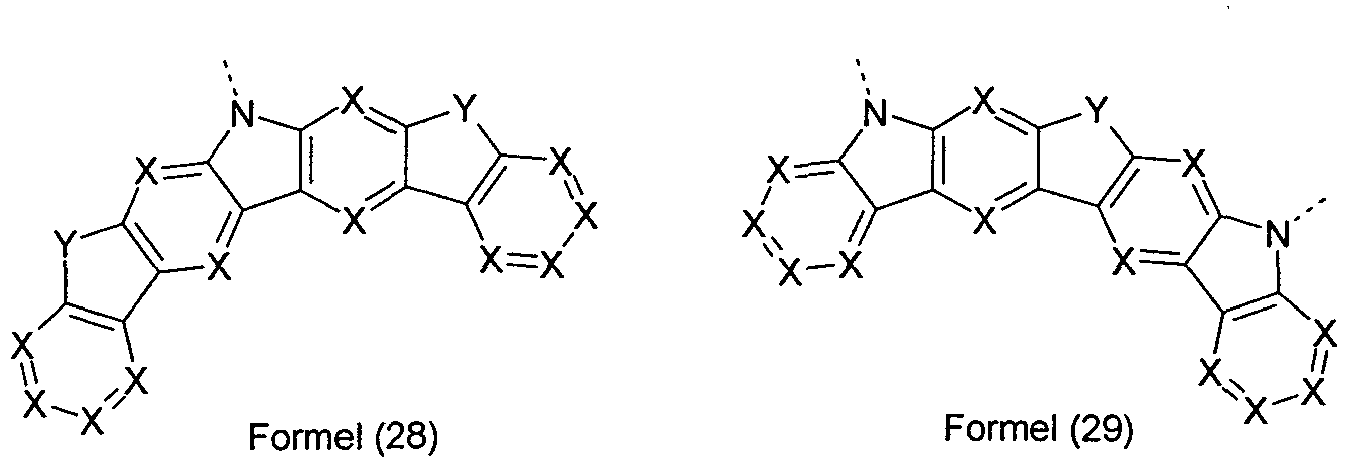


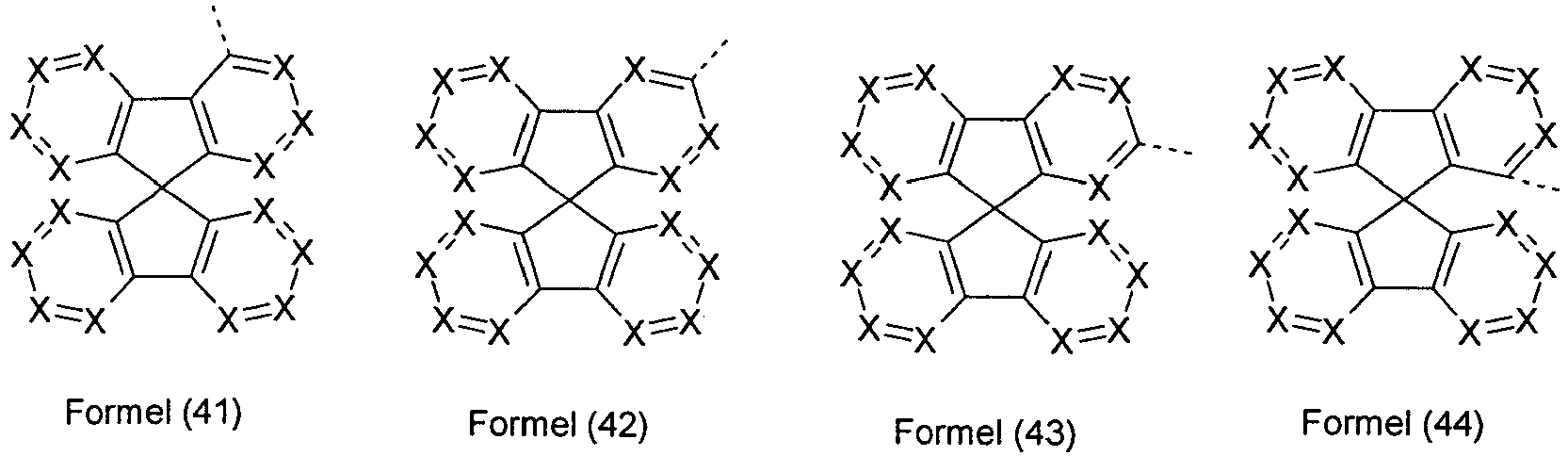
- X
- ist bei jedem Auftreten gleich oder verschieden CR1 oder N, wobei bevorzugt maximal 2 Symbole X pro Cyclus für N stehen;
- Y
- ist bei jedem Auftreten gleich oder verschieden C(R1)2, NR1, O oder S;
- n
- ist 0 oder 1, wobei n gleich 0 bedeutet, dass an dieser Position keine Gruppe Y gebunden ist und an den entsprechenden Kohlenstoffatomen statt dessen Reste R1 gebunden sind.
- Der Begriff "Cyclus", wie er in der Definition von X und im Folgenden verwendet wird, bezieht sich auf jeden einzelnen 5- oder 6-Ring innerhalb der Struktur.
- In bevorzugten Gruppen der oben genannten Formeln (3) bis (44) steht maximal ein Symbol X pro Cyclus für N. Besonders bevorzugt steht das Symbol X gleich oder verschieden bei jedem Auftreten für CR1, insbesondere für CH.
- Wenn die Gruppen der Formeln (3) bis (44) mehrere Gruppen Y aufweisen, so kommen hierfür alle Kombinationen aus der Definition von Y in Frage. Bevorzugt sind Gruppen der Formeln (3) bis (44), in denen eine Gruppe Y für NR1 und die andere Gruppe Y für C(R1)2 steht oder in denen beide Gruppen Y für NR1 stehen oder in denen beide Gruppen Y für O stehen.
- In einer weiteren bevorzugten Ausführungsform der Erfindung steht mindestens eine Gruppe Y in den Formeln (3) bis (44) gleich oder verschieden bei jedem Auftreten für C(R1)2 oder für NR1.
- Weiterhin bevorzugt steht in diesen Gruppen der Substituent R1, der direkt an ein Stickstoffatom gebunden ist, für ein aromatisches oder heteroaromatisches Ringsystem mit 5 bis 24 aromatischen Ringatomen, welches auch durch einen oder mehrere Reste R2 substituiert sein kann. In einer besonders bevorzugten Ausführungsform steht dieser Substituent R1 gleich oder verschieden bei jedem Auftreten für ein aromatisches oder heteroaromatisches Ringsystem mit 6 bis 24 aromatischen Ringatomen, welches keine kondensierten Arylgruppen aufweist und welches keine kondensierten Heteroarylgruppen, in welchen zwei oder mehr aromatische bzw. heteroaromatische 6-Ring-Gruppen direkt aneinander ankondensiert sind, aufweist und welches jeweils auch durch einen oder mehrere Reste R2 substituiert sein kann.
- Wenn Y für C(R1)2 steht, steht R1 bevorzugt gleich oder verschieden bei jedem Auftreten für eine lineare Alkylgruppe mit 1 bis 10 C-Atomen oder für eine verzweigte oder cyclische Alkylgruppe mit 3 bis 10 C-Atomen oder für ein aromatisches oder heteroaromatisches Ringsystem mit 5 bis 24 aromatischen Ringatomen, welches auch durch einen oder mehrere Reste R2 substituiert sein kann. Ganz besonders bevorzugt steht R1 für eine Methylgruppe oder für eine Phenylgruppe, wobei durch Ringbildung der beiden Phenylgruppen auch ein Spirosystem gebildet werden kann.
- Weiterhin kann es bevorzugt sein, wenn die Gruppe der oben genannten Formeln (3) bis (44) nicht direkt an das Triazin in Formel (1) bzw. das Pyrimidin in Formel (2) binden, sondern über eine verbrückende Gruppe. Diese verbrückende Gruppe ist dann bevorzugt ausgewählt aus einem aromatischen oder heteroaromatischen Ringsystem mit 5 bis 24 aromatischen Ringatomen, insbesondere mit 6 bis 12 aromatischen Ringatomen, welches jeweils mit einem oder mehreren Resten R1 substituiert sein kann. Dabei enthält das aromatische bzw. heteroaromatische Ringsystem bevorzugt keine Aryl- oder Heteroarylgruppen, in denen mehr als zwei aromatische Sechsringe aneinander ankondensiert sind. Besonders bevorzugt enthält das aromatische bzw. heteroaromatische Ringsystem keine Aryl- oder Heteroarylgruppen, in denen aromatische Sechsringe aneinander ankondensiert sind.
- Beispiele für bevorzugte Verbindungen gemäß Formel (1) bzw. (2) sind die in der folgenden Tabelle aufgeführten Verbindungen.


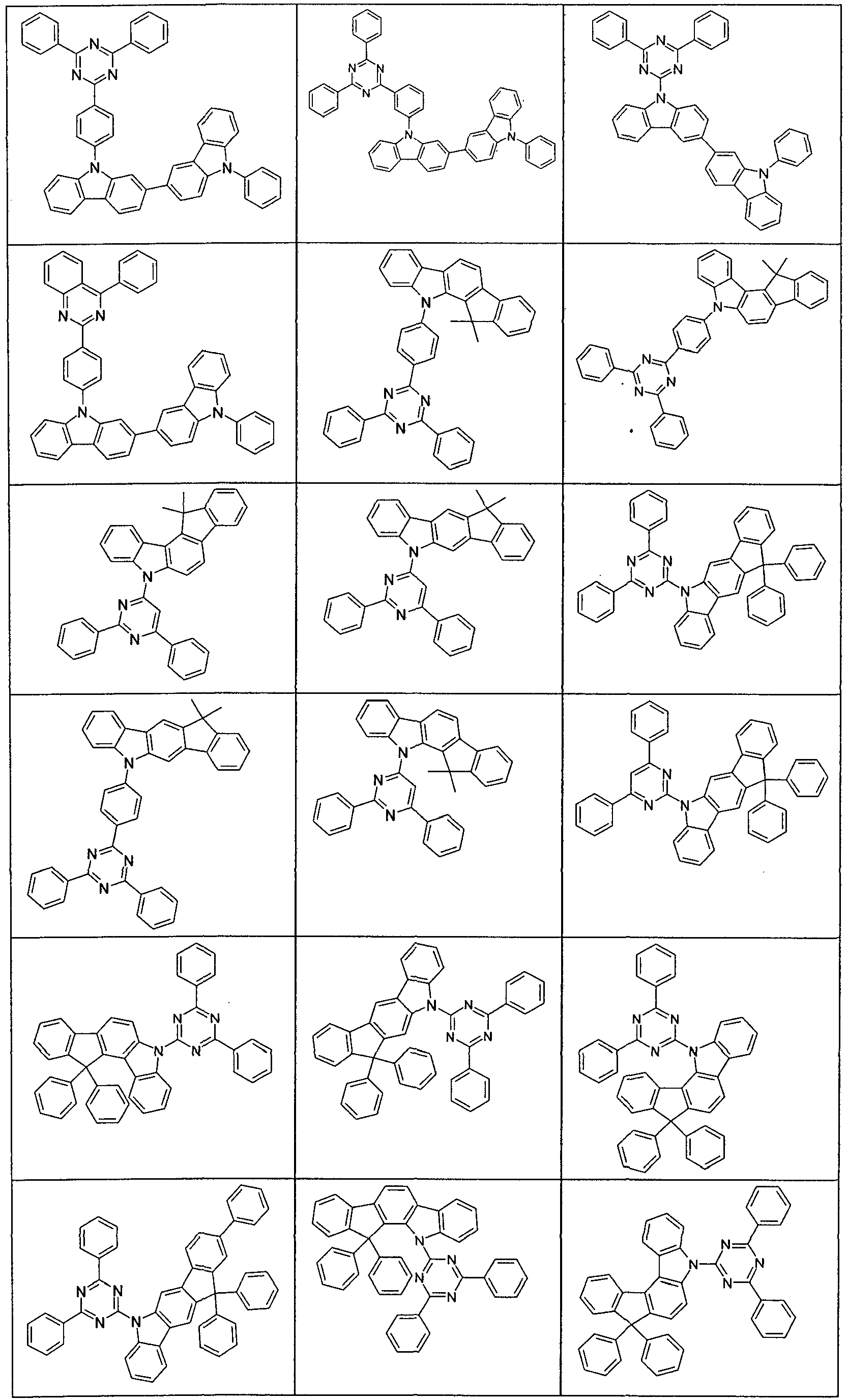
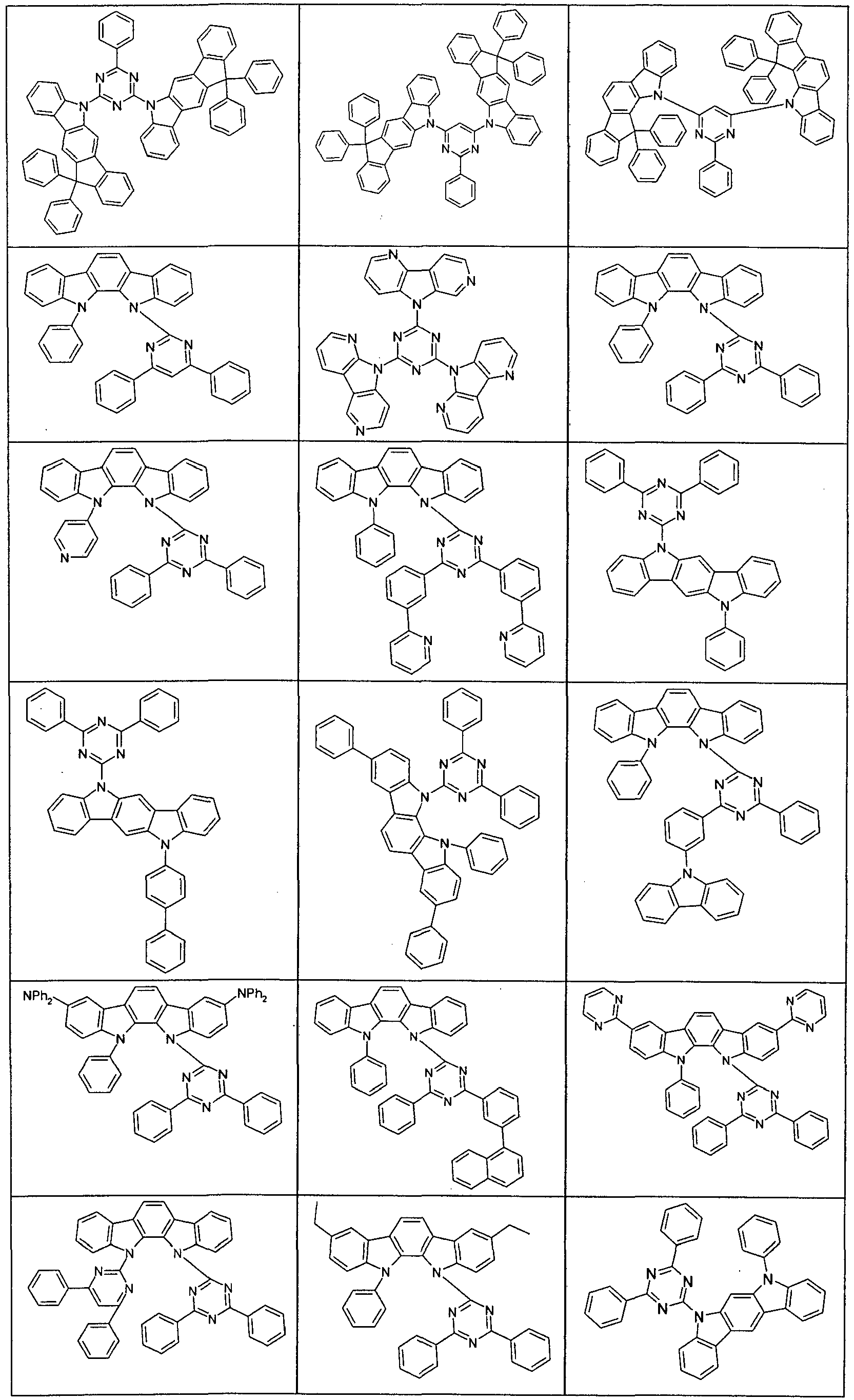

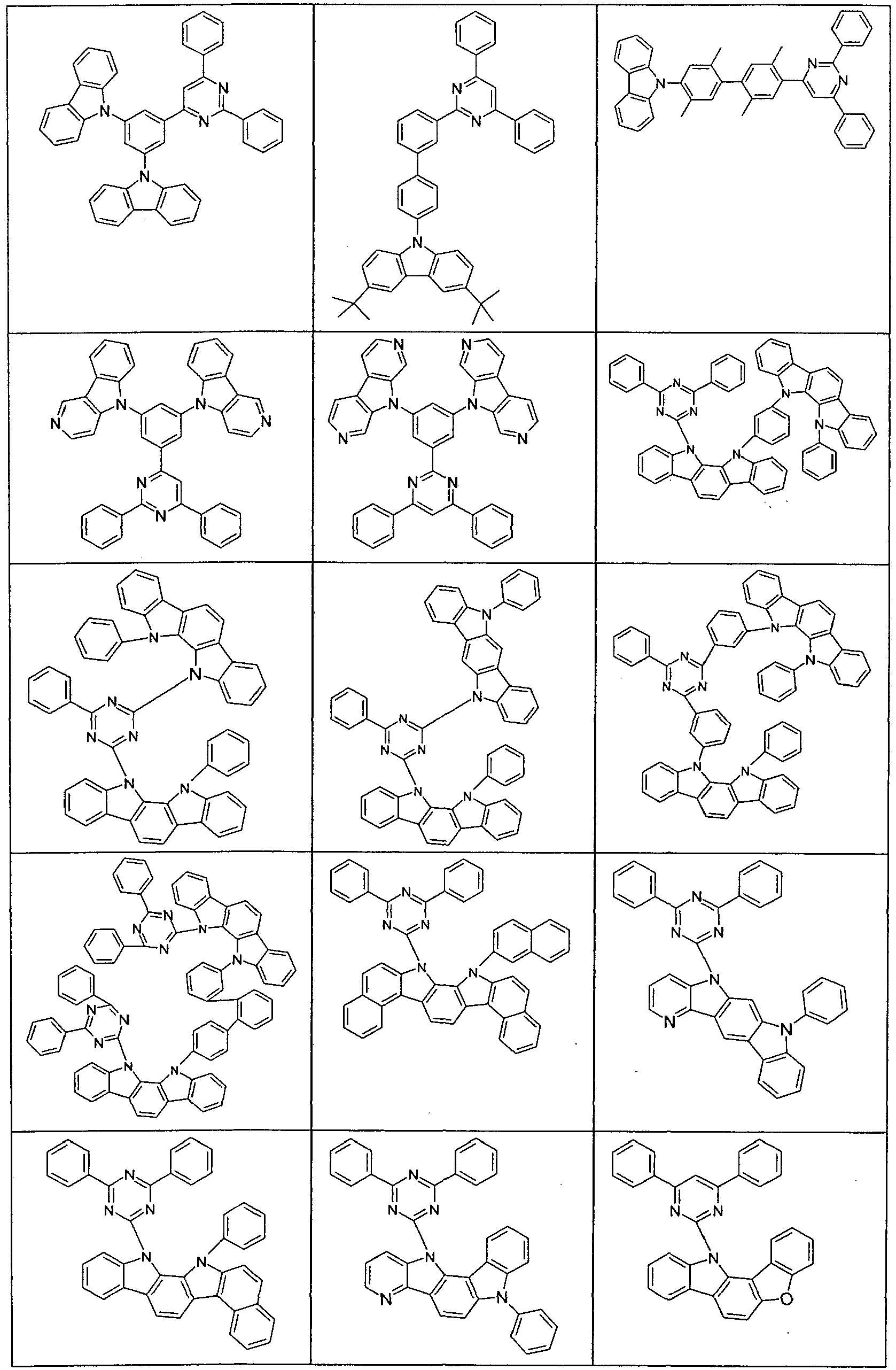


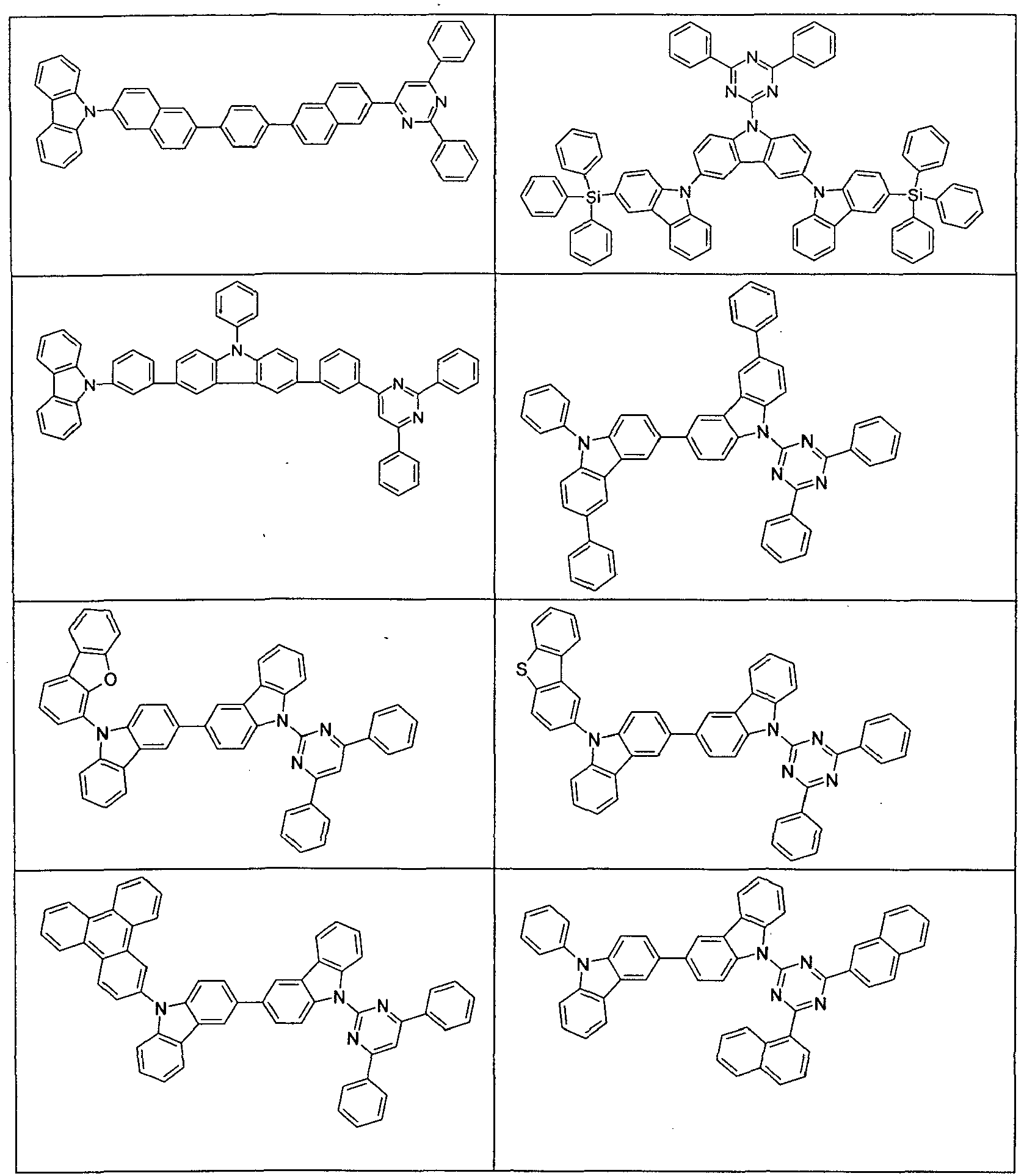
- Wenn die elektronenleitende Verbindung ein Lactam ist, dann ist diese Verbindung bevorzugt ausgewählt aus den Verbindungen der folgenden Formeln (45) bzw. (46),
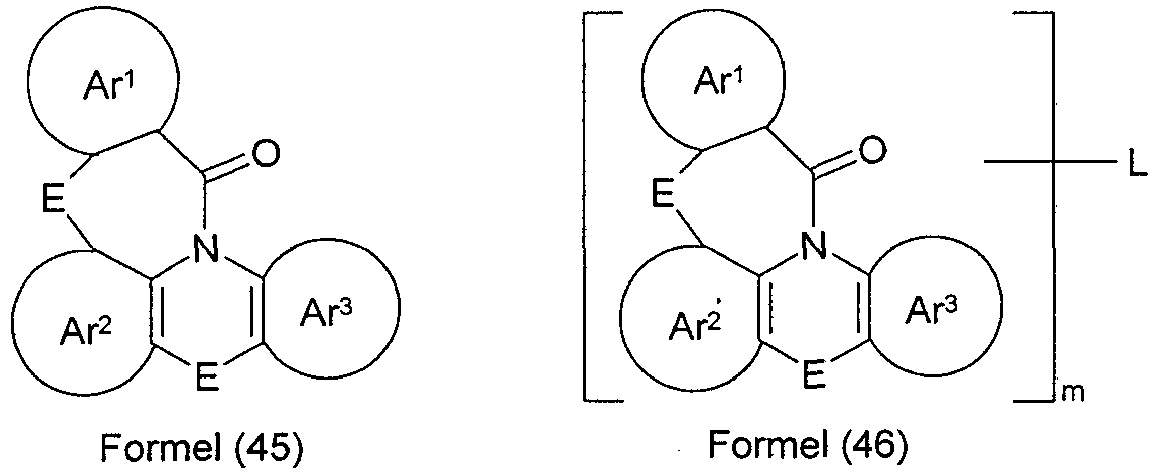
- E
- ist gleich oder verschieden bei jedem Auftreten eine Einfachbindung, NR, CR2, O oder S;
- Ar1
- ist zusammen mit den explizit dargestellten Kohlenstoffatomen ein aromatisches oder heteroaromatisches Ringsystem mit 5 bis 30 aromatischen Ringatomen, welches durch einen oder mehrere Reste R substituiert sein kann;
- Ar2, Ar3
- ist gleich oder verschieden bei jedem Auftreten zusammen mit den explizit dargestellten Kohlenstoffatomen ein aromatisches oder heteroaromatisches Ringsystem mit 5 bis 30 aromatischen Ringatomen, welches durch einen oder mehrere Reste R substituiert sein kann;
- L
- ist für m = 2 eine Einfachbindung oder eine bivalente Gruppe, bzw. für m = 3 eine trivalente Gruppe bzw. für m = 4 eine tetravalente Gruppe, welche jeweils an eine beliebige Position an Ar1, Ar2 oder Ar3 oder statt einem Rest R an E gebunden ist;
- m
- ist 2, 3 oder 4.
- In einer bevorzugten Ausführungsform der Verbindung gemäß Formel (45) bzw. (46) steht die Gruppe Ar1 für eine Gruppe der folgenden Formel (47), (48), (49) oder (50),

- W
- ist gleich oder verschieden bei jedem Auftreten CR oder N; oder zwei benachbarte Gruppen W stehen für eine Gruppe der folgenden Formel (51) oder (52),

- V
- ist NR, O oder S.
- In einer weiteren bevorzugten Ausführungsform der Erfindung steht die Gruppe Ar2 für eine Gruppe gemäß einer der folgenden Formeln (53), (54) oder (55),

- In einer weiteren bevorzugten Ausführungsform der Erfindung steht die Gruppe Ar3 für eine Gruppe gemäß einer der folgenden Formeln (56), (57), (58) oder (59),

- Dabei können die oben genannten bevorzugten Gruppen Ar1, Ar2 und Ar3 beliebig miteinander kombiniert werden.
- In einer weiteren bevorzugten Ausführungsform der Erfindung steht mindestens eine Gruppe E für eine Einfachbindung.
- In einer bevorzugten Ausführungsform der Erfindung treten die oben genannten Bevorzugungen gleichzeitig auf. Besonders bevorzugt sind daher Verbindungen gemäß Formel (45) bzw. (46), für die gilt:
- Ar1
- ist ausgewählt aus den Gruppen der oben genannten Formeln (47), (48), (49) oder (50);
- Ar2
- ist ausgewählt aus den Gruppen der oben genannten Formeln (53), (54) oder (55);
- Ar3
- ist ausgewählt aus den Gruppen der oben genannten Formeln (56), (57), (58) oder (59).
- Besonders bevorzugt stehen mindestens zwei der Gruppen Ar1, Ar2 und Ar3 für eine 6-Ring-Aryl- oder eine 6-Ring-Heteroarylgruppe. Besonders bevorzugt steht Ar1 für eine Gruppe der Formel (47) und gleichzeitig steht Ar2 für eine Gruppe der Formel (53), oder Ar1 steht für eine Gruppe der Formel (47) und gleichzeitig steht Ar3 für eine Gruppe der Formel (56), oder Ar2 steht für eine Gruppe der Formel (53) und gleichzeitig steht Ar3 für eine Gruppe der Formel (59).
- Besonders bevorzugte Ausführungsformen der Formel (45) sind daher die Verbindungen der folgenden Formeln (60) bis (69),


- Es ist weiterhin bevorzugt, wenn W für CR oder N steht und nicht für eine Gruppe der Formel (51) oder (52). In einer bevorzugten Ausführungsform der Verbindungen gemäß Formel (60) bis (69) steht pro Cyclus insgesamt maximal ein Symbol W für N, und die verbleibenden Symbole W stehen für CR. In einer besonders bevorzugten Ausführungsform der Erfindung stehen alle Symbole W für CR. Besonders bevorzugt sind daher die Verbindungen gemäß den folgenden Formeln (60a) bis (69a),


- Ganz besonders bevorzugt sind die Strukturen der Formeln (60b) bis (69b),


- Ganz besonders bevorzugt sind die Verbindungen der Formel (60) bzw. (60a) bzw. (60b).
- Die verbrückende Gruppe L in den Verbindungen der Formeln (46a) ist bevorzugt ausgewählt aus einer Einfachbindung oder einem aromatischen oder heteroaromatischen Ringsystem mit 5 bis 30 aromatischen Ringatomen, welches durch einen oder mehrere Reste R substituiert sein kann. Dabei enthalten die aromatischen bzw. heteroaromatischen Ringsysteme bevorzugt keine kondensierten Aryl- bzw. Heteroarylgruppen, in denen mehr als zwei aromatische Sechsringe direkt aneinander ankondensiert sind. Besonders bevorzugt enthalten sie überhaupt keine Aryl- bzw. Heteroarylgruppen, in denen aromatische Sechsringe direkt aneinander ankondensiert sind.
- In einer weiteren bevorzugten Ausführungsform der Erfindung ist der Index m in Verbindungen der Formel (46) = 2 oder 3, insbesondere gleich 2. Ganz besonders bevorzugt werden Verbindungen der Formel (45) eingesetzt.
- In einer bevorzugten Ausführungsform der Erfindung ist R in den oben genannten Formeln gleich oder verschieden bei jedem Auftreten ausgewählt aus der Gruppe bestehend aus H, D, F, Cl, Br, CN, N(Ar)2, C(=O)Ar, einer geradkettigen Alkyl- oder Alkoxygruppe mit 1 bis 10 C-Atomen oder einer verzweigten oder cyclischen Alkyl- oder Alkoxygruppe mit 3 bis 10 C-Atomen oder einer Alkenylgruppe mit 2 bis 10 C-Atomen, die jeweils mit einem oder mehreren Resten R1 substituiert sein kann, wobei eine oder mehrere nicht-benachbarte CH2-Gruppen durch O ersetzt sein können und wobei ein oder mehrere H-Atome durch D oder F ersetzt sein können, einem aromatischen oder heteroaromatischen Ringsystem mit 5 bis 30 aromatischen Ringatomen, das jeweils mit einem oder mehreren Resten R1 substituiert sein kann, einer Aryloxy- oder Heteroaryloxygruppe mit 5 bis 30 aromatischen Ringatomen, die mit einem oder mehreren Resten R1 substituiert sein kann, oder einer Kombination dieser Systeme.
- In einer besonders bevorzugten Ausführungsform der Erfindung ist R in den oben genannten Formeln gleich oder verschieden bei jedem Auftreten ausgewählt aus der Gruppe bestehend aus H, D, F, Cl, Br, CN, einer geradkettigen Alkylgruppe mit 1 bis 10 C-Atomen oder einer verzweigten oder cyclischen Alkylgruppe mit 3 bis 10 C-Atomen, die jeweils mit einem oder mehreren Resten R1 substituiert sein kann, wobei ein oder mehrere H-Atome durch D oder F ersetzt sein können, einem aromatischen oder heteroaromatischen Ringsystem mit 5 bis 18 aromatischen Ringatomen, das jeweils mit einem oder mehreren Resten R1 substituiert sein kann, oder einer Kombination dieser Systeme.
- Dabei enthalten die Reste R, wenn diese aromatische oder heteroaromatischen Ringsysteme enthalten, bevorzugt keine kondensierten Aryl- bzw. Heteroarylgruppen, in denen mehr als zwei aromatische Sechsringe direkt aneinander ankondensiert sind. Besonders bevorzugt enthalten sie überhaupt keine Aryl- bzw. Heteroarylgruppen, in denen aromatische Sechsringe direkt aneinander ankondensiert sind. Insbesondere bevorzugt sind hier Phenyl, Biphenyl, Terphenyl, Quaterphenyl, Carbazol, Dibenzothiophen, Dibenzofuran, Indenocarbazol, Indolocarbazol, Triazin oder Pyrimidin, welches jeweils auch durch einen oder mehrere Reste R1 substituiert sein kann.
- Dabei haben für Verbindungen, die durch Vakuumverdampfung verarbeitet werden, die Alkylgruppen bevorzugt nicht mehr als fünf C-Atome, besonders bevorzugt nicht mehr als 4 C-Atome, ganz besonders bevorzugt nicht mehr als 1 C-Atom.
- Die Verbindungen der Formeln (45) und (46) sind prinzipiell bekannt. Die Synthese dieser Verbindungen kann gemäß den in der
WO 2011/116865 undWO 2011/137951 beschriebenen Verfahren erfolgen. - Beispiele für bevorzugte Verbindungen gemäß den oben aufgeführten Ausführungsformen sind die in der folgenden Tabelle aufgeführten Verbindungen.
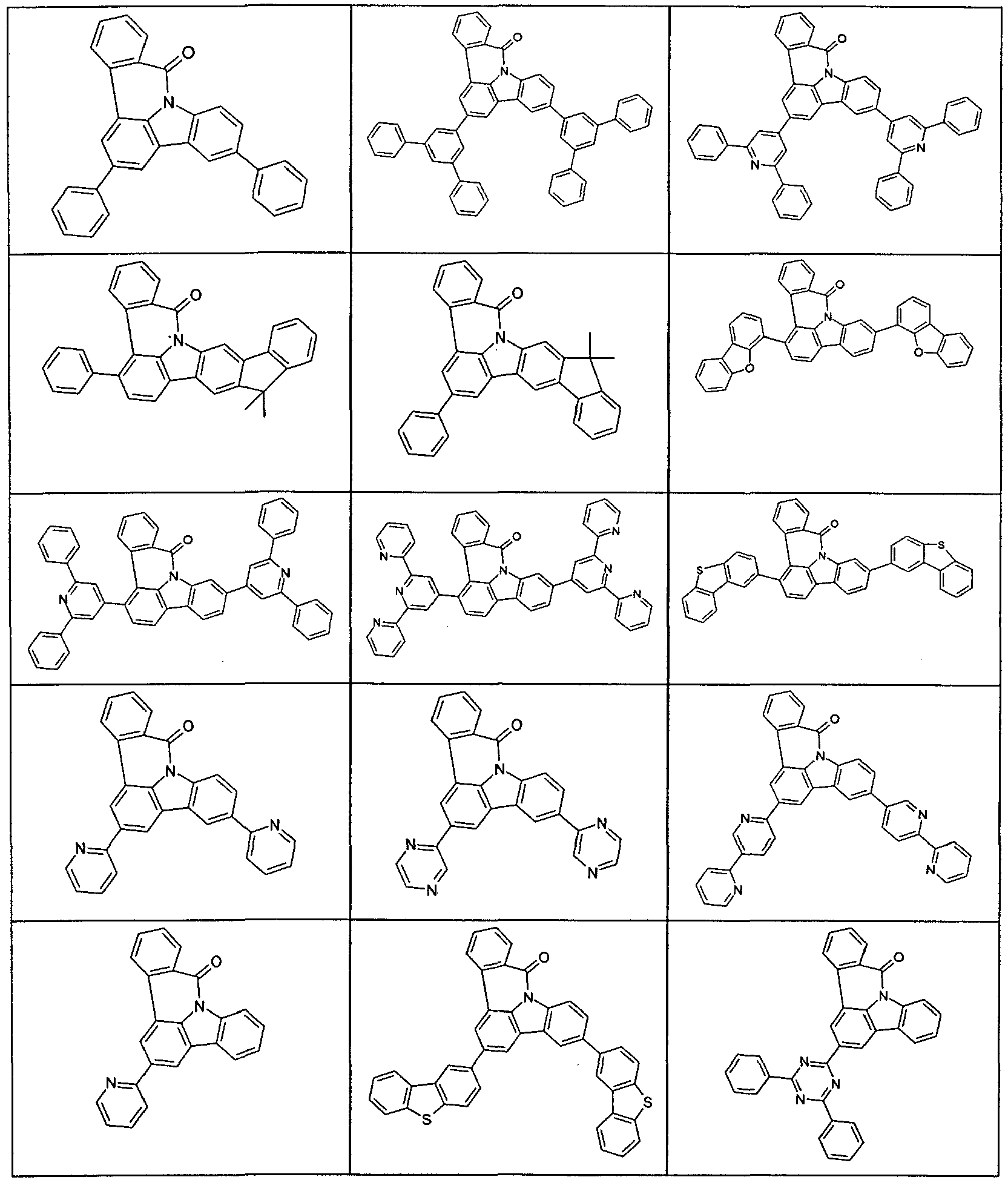


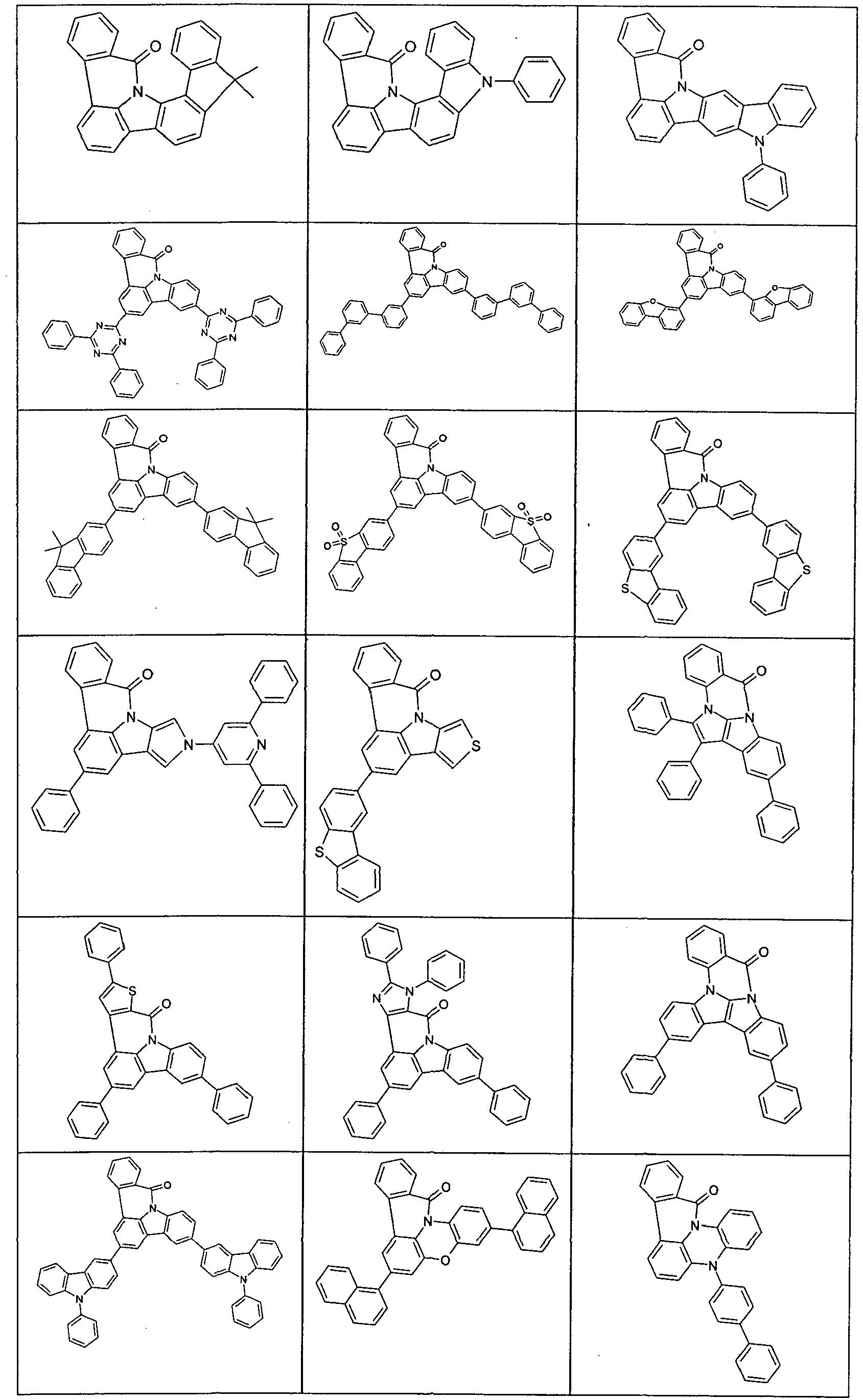
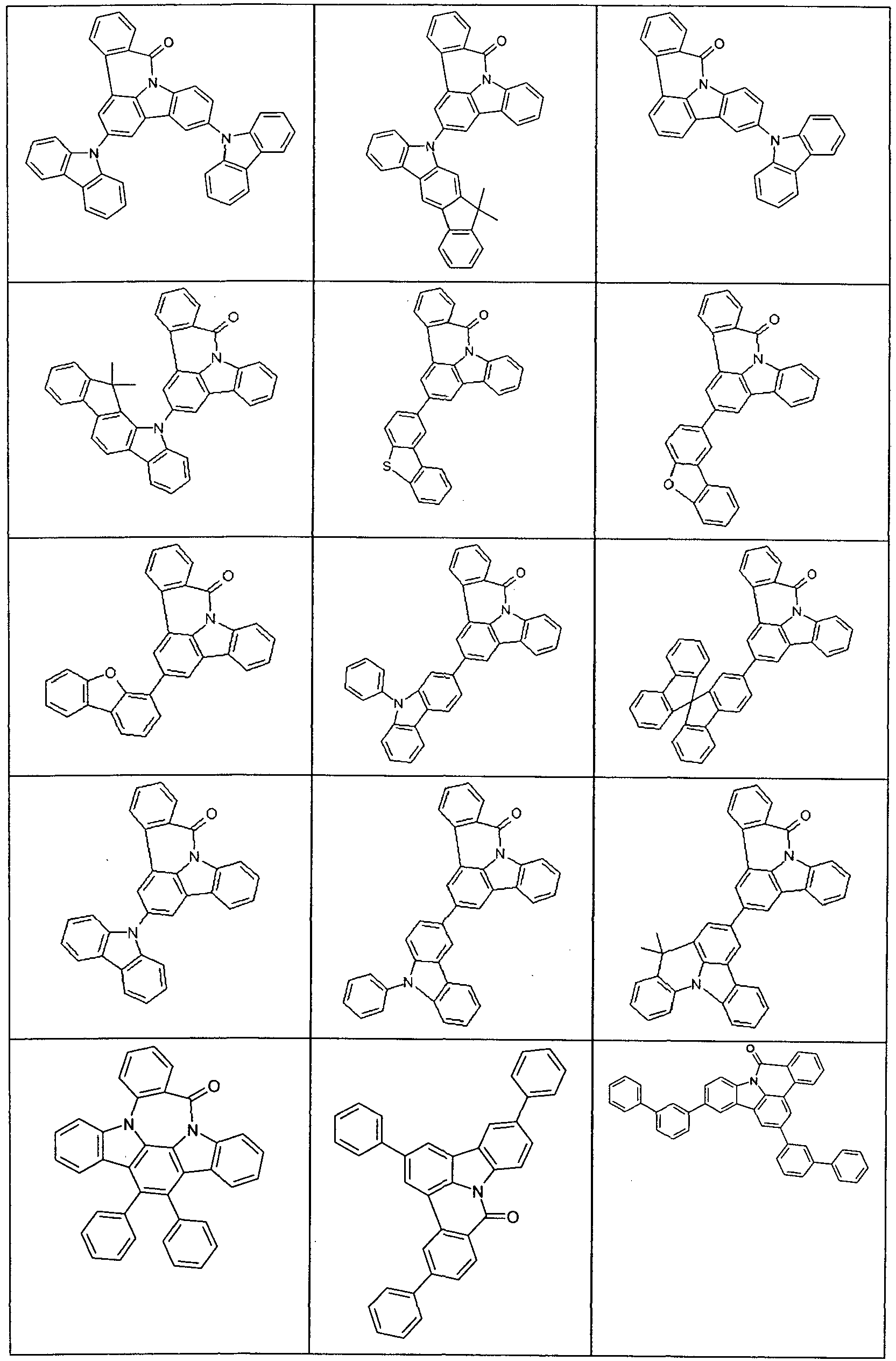
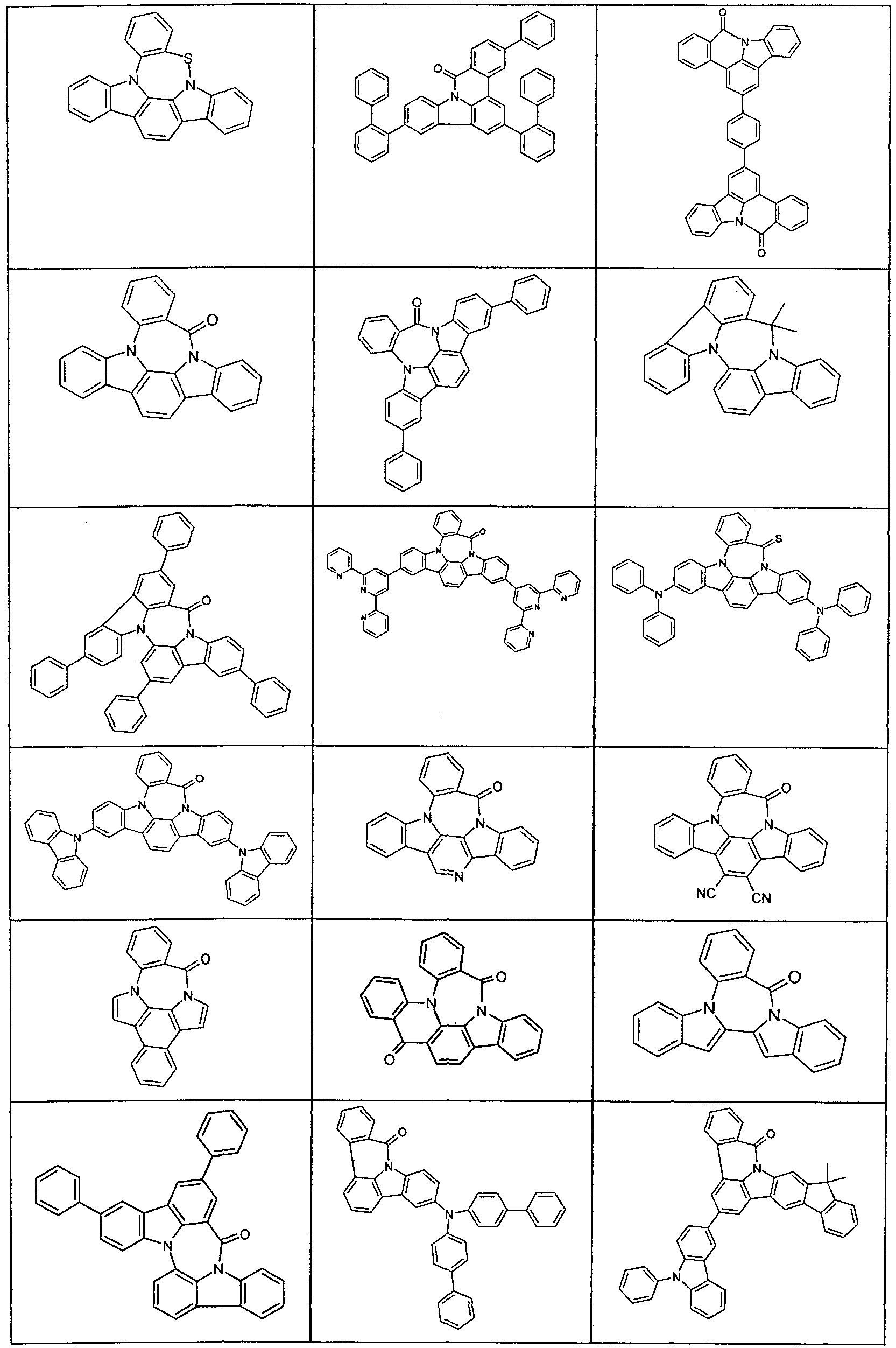

- Weiterhin eignen sich aromatische Ketone oder aromatische Phosphinoxide als elektronenleitende Verbindung, sofern das LUMO dieser Verbindungen ≤ -2.5 eV ist. Unter einem aromatischen Keton im Sinne dieser Anmeldung wird eine Carbonylgruppe verstanden, an die zwei aromatische oder heteroaromatische Gruppen bzw. aromatische oder heteroaromatische Ringsysteme direkt gebunden sind. Unter einem aromatischen Phosphinoxid im Sinne dieser Anmeldung wird eine P=O Gruppe verstanden, an die drei aromatische oder heteroaromatische Gruppen bzw. aromatische oder heteroaromatische Ringsysteme direkt gebunden sind.
- Wenn die elektronenleitende Verbindung ein aromatisches Keton oder ein aromatisches Phosphinoxid ist, dann ist diese Verbindung bevorzugt ausgewählt aus den Verbindungen der folgenden Formeln (70) bzw. (71),

- Ar4
- ist bei jedem Auftreten gleich oder verschieden ein aromatisches oder heteroaromatisches Ringsystem mit 5 bis 80 aromatischen Ringatomen, bevorzugt bis 60 aromatischen Ringatomen, welches jeweils mit einer oder mehreren Gruppen R substituiert sein kann.
- Geeignete Verbindungen gemäß Formel (70) und (71) sind insbesondere die in
WO 2004/093207 undWO 2010/006680 offenbarten Ketone und die inWO 2005/003253 offenbarten Phosphinoxide. Diese sind via Zitat Bestandteil der vorliegenden Erfindung. - Aus der Definition der Verbindung gemäß Formel (70) und (70) geht hervor, dass diese nicht nur eine Carbonylgruppe bzw. Phosphinoxidgruppe enthalten muss, sondern auch mehrere dieser Gruppen enthalten kann.
- Bevorzugt ist die Gruppe Ar4 in Verbindungen gemäß Formel (70) bzw. (71) ein aromatisches Ringsystem mit 6 bis 40 aromatischen Ringatomen, d. h. sie enthält keine Heteroarylgruppen. Wie oben definiert, muss das aromatische Ringsystem nicht notwendigerweise nur aromatische Gruppen aufweisen, sondern es können auch zwei Arylgruppen durch eine nicht-aromatische Gruppe, beispielsweise durch eine weitere Carbonylgruppe bzw. Phosphinoxidgruppe unterbrochen sein.
- In einer weiteren bevorzugten Ausführungsform der Erfindung weist die Gruppe Ar4 nicht mehr als zwei kondensierte Ringe auf. Sie ist also bevorzugt nur aus Phenyl- und/oder Naphthylgruppen, besonders bevorzugt nur aus Phenylgruppen, aufgebaut, enthält aber keine größeren kondensierten Aromaten, wie beispielsweise Anthracen.
- Bevorzugte Gruppen Ar4, die an die Carbonylgruppe gebunden sind, sind gleich oder verschieden bei jedem Auftreten Phenyl, 2-, 3- oder 4-Tolyl, 3- oder 4-o-Xylyl, 2- oder 4-m-Xylyl, 2-p-Xylyl, o-, m- oder p-tert-Butylphenyl, o-, m- oder p-Fluorphenyl, Benzophenon, 1-, 2- oder 3-Phenylmethanon, 2-, 3- oder 4-Biphenyl, 2-, 3- oder 4-o-Terphenyl, 2-, 3- oder 4-m-Terphenyl, 2-, 3- oder 4-p-Terphenyl, 2'-p-Terphenyl, 2'-, 4'- oder 5'-m-Terphenyl, 3'- oder 4'-o-Terphenyl, p-, m,p-, o,p-, m,m-, o,m- oder o,o-Quaterphenyl, Quinquephenyl, Sexiphenyl, 1-, 2-, 3- oder 4-Fluorenyl, 2-, 3- oder 4-Spiro-9,9'-bifluorenyl, 1-, 2-, 3- oder 4-(9,10-Dihydro)-phenanthrenyl, 1- oder 2-Naphthyl, 2-, 3-, 4-, 5-, 6-, 7- oder 8-Chinolinyl, 1-, 3-, 4-, 5-, 6-, 7- oder 8-iso-Chinolinyl, 1- oder 2-(4-Methylnaphthyl), 1- oder 2-(4-Phenylnaphthyl), 1- oder 2-(4-Naphthyl-naphthyl), 1-, 2- oder 3-(4-naphthyl-phenyl), 2-, 3- oder 4-Pyridyl, 2-, 4- oder 5-Pyrimidinyl, 2- oder 3-Pyrazinyl, 3- oder 4-Pyridanzinyl, 2-(1,3,5-Triazin)yl-, 2-, 3- oder 4-(Phenylpyridyl), 3-, 4-, 5- oder 6-(2,2'-Bipyridyl), 2-, 4-, 5- oder 6-(3,3'-Bipyridyl), 2- oder 3-(4,4'-Bipyridyl) und Kombinationen eines oder mehrerer dieser Reste.
- Die Gruppen Ar4 können durch einen oder mehrere Reste R substituiert sein. Diese Reste R sind bevorzugt gleich oder verschieden bei jedem Auftreten gewählt aus der Gruppe bestehend aus H, D, F, C(=O)Ar, P(=O)(Ar)2, S(=O)Ar, S(=O)2Ar, einer geradkettigen Älkylgruppe mit 1 bis 4 C-Atomen oder einer verzweigten oder cyclischen Alkylgruppe mit 3 bis 5 C-Atomen, die jeweils mit einem oder mehreren Resten R1 substituiert sein kann, wobei ein oder mehrere H-Atome durch F ersetzt sein können, oder einem aromatischen Ringsystem mit 6 bis 24 aromatischen Ringatomen, das durch einen oder mehrere Reste R1 substituiert sein kann, oder eine Kombination dieser Systeme; dabei können zwei oder mehrere benachbarte Substituenten R auch miteinander ein mono- oder polycyclisches, aliphatisches oder aromatisches Ringsystem bilden. Wenn die organische Elektrolumineszenzvorrichtung aus Lösung aufgebracht wird, sind auch geradkettige, verzweigte oder cyclische Alkylgruppen mit bis zu 10 C-Atomen als Substituenten R bevorzugt. Die Reste R sind besonders bevorzugt gleich oder verschieden bei jedem Auftreten gewählt aus der Gruppe bestehend aus H, C(=O)Ar oder einem aromatischen Ringsystem mit 6 bis 24 aromatischen Ringatomen, das durch einen oder mehrere Reste R1 substituiert sein kann, bevorzugt aber unsubstituiert ist.
- In nochmals einer bevorzugten Ausführungsform der Erfindung ist die Gruppe Ar gleich oder verschieden bei jedem Auftreten ein aromatisches Ringsystem mit 6 bis 24 aromatischen Ringatomen, das mit einem oder mehreren Resten R1 substituiert sein kann. Besonders bevorzugt ist Ar gleich oder verschieden bei jedem Auftreten ein aromatisches Ringsystem mit 6 bis 12 aromatischen Ringatomen.
- Besonders bevorzugt sind Benzophenon-Derivate, die jeweils an den 3,5,3',5'-Positionen durch ein aromatisches oder heteroaromatisches Ringsystem mit 5 bis 30 aromatischen Ringatomen substituiert sind, welche wiederum durch einen oder mehrere Reste R gemäß der obigen Definition substituiert sein kann. Weiterhin bevorzugt sind Ketone, welche mit mindestens einer Spirobifluorengruppe substituiert sind.
- Bevorzugte aromatische Ketone und Phosphinoxide sind daher die Verbindungen der folgenden Formel (72) bis (75),


- T
- ist gleich oder verschieden bei jedem Auftreten C oder P(Ar4);
- n
- ist gleich oder verschieden bei jedem Auftreten 0 oder 1.
- Bevorzugt steht Ar4 in der oben genannten Formel (72) und (75) für ein aromatisches oder heteroaromatisches Ringsystem mit 5 bis 30 aromatischen Ringatomen, welches mit einem oder mehreren Resten R1 substituiert sein kann. Besonders bevorzugt sind die oben genannten Gruppen Ar.
- Beispiele für geeignete Verbindungen gemäß Formel (70) und (71) sind die in der folgenden Tabelle abgebildeten Verbindungen.


- Geeignete Metallkomplexe, die als die als elektronenleitendes Matrixmaterial in der erfindungsgemäßen organischen Elektrolumineszenzvorrichtung eingesetzt werden können, sind Be-, Zn- bzw. Al-Komplexe, sofern das LUMO dieser Verbindungen ≤ -2.5 eV beträgt. Geeignet sind beispielsweise die in
WO 2009/062578 offenbarten Zn-Komplexe. - Beispiele für geeignete Metallkomplexe sind die in der folgenden Tabelle aufaeführten Komplexe.

- Geeignete Azaphosphole, die als elektronenleitendes Matrixmaterial in der erfindungsgemäßen organischen Elektrolumineszenzvorrichtung eingesetzt werden können, sind solche Verbindungen, wie sie in
WO 2010/054730 offenbart sind, sofern das LUMO dieser Verbindungen ≤ -2.5 eV beträgt. Diese Anmeldung ist via Zitat Bestandteil der vorliegenden Erfindung. - Geeignete Azaborole, die als elektronenleitendes Matrixmaterial in der erfindungsgemäßen organischen Elektrolumineszenzvorrichtung eingesetzt werden können, sind Azaborolderivate, welche mit mindestens einem elektronenleitenden Substituenten substituiert sind, sofern das LUMO dieser Verbindungen ≤ -2.5 eV beträgt. Solche Verbindungen sind in der noch nicht offen gelegten Anmeldung
EP 11010103.7 - Im Folgenden wird die organische Elektrolumineszenzvorrichtung näher beschrieben.
- Die organische Elektrolumineszenzvorrichtung enthält Kathode, Anode und emittierende Schicht. Außer diesen Schichten kann sie noch weitere Schichten enthalten, beispielsweise jeweils eine oder mehrere Lochinjektionsschichten, Lochtransportschichten, Lochblockierschichten, Elektronentransportschichten, Elektroneninjektionsschichten, Exzitonenblockierschichten, Elektronenblockierschichten und/oder Ladungserzeugungsschichten (Charge-Generation Layers). Es sei aber darauf hingewiesen, dass nicht notwendigerweise jede dieser Schichten vorhanden sein muss.
- In den weiteren Schichten der erfindungsgemäßen organischen Elektrolumineszenzvorrichtung, insbesondere in den Lochinjektions- und -transportschichten und in den Elektroneninjektions- und -transportschichten, können alle Materialien verwendet werden, wie sie üblicherweise gemäß dem Stand der Technik eingesetzt werden. Dabein können die Lochtransportschichten auch p-dotiert bzw. die Elektronentransportschichten auch n-dotiert sein. Dabei wird unter einer p-dotierten Schicht eine Schicht verstanden, in der freie Löcher erzeugt werden und deren Leitfähigkeit dadurch erhöht ist. Eine umfassende Diskussion von dotierten Transportschichten in OLEDs findet sich in Chem. Rev. 2007, 107, 1233. Besonders bevorzugt ist der p-Dotand in der Lage, das Lochtransportmaterial in der Lochtransportschicht zu oxidieren, hat also ein ausreichend hohes Redoxpotential, insbesondere ein höheres Redoxpotential als das Lochtransportmaterial. Als Dotanden sind prinzipiell alle Verbindungen geeignet, welche Elektronenakzeptorverbindungen darstellen und die Leitfähigkeit der organischen Schicht durch Oxidation des Hosts erhöhen können. Der Fachmann kann im Rahmen seines allgemeinen Fachwissens ohne größeren Aufwand geeignete Verbindungen identifizieren. Insbesondere geeignet als Dotanden sind die in
WO 2011/073149 ,EP 1968131 ,EP 2276085 ,EP 2213662 ,EP 1722602 ,EP 2045848 ,DE 102007031220 ,US 8044390 ,US 8057712 ,WO 2009/003455 ,WO 2010/094378 ,WO 2011/120709 undUS 2010/0096600 offenbarten Verbindungen. - Der Fachmann kann daher ohne erfinderisches Zutun alle für organische Elektrolumineszenzvorrichtungen bekannten Materialien in Kombination mit der erfindungsgemäßen emittierenden Schicht einsetzen.
- Als Kathode sind Metalle mit geringer Austrittsarbeit, Metalllegierungen oder mehrlagige Strukturen aus verschiedenen Metallen bevorzugt, wie beispielsweise Erdalkalimetalle, Alkalimetalle, Hauptgruppenmetalle oder Lathanoide (z. B. Ca, Ba, Mg, Al, In, Mg, Yb, Sm, etc.). Weiterhin eignen sich Legierungen aus einem Alkali- oder Erdalkalimetall und Silber, beispielsweise eine Legierung aus Magnesium und Silber. Bei mehrlagigen Strukturen können auch zusätzlich zu den genannten Metallen weitere Metalle verwendet werden, die eine relativ hohe Austrittsarbeit aufweisen, wie z. B. Ag, wobei dann in der Regel Kombinationen der Metalle, wie beispielsweise Ca/Ag oder Ba/Ag verwendet werden. Es kann auch bevorzugt sein, zwischen einer metallischen Kathode und dem organischen Halbleiter eine dünne Zwischenschicht eines Materials mit einer hohen Dielektrizitätskonstante einzubringen. Hierfür kommen beispielsweise Alkalimetall- oder Erdalkalimetallfluoride, aber auch die entsprechenden Oxide oder Carbonate in Frage (z. B. LiF, Li2O, BaF2, MgO, NaF, CsF, Cs2CO3, etc.). Die Schichtdicke dieser Schicht beträgt bevorzugt zwischen 0.5 und 5 nm.
- Als Anode sind Materialien mit hoher Austrittsarbeit bevorzugt. Bevorzugt weist die Anode eine Austrittsarbeit größer 4.5 eV vs. Vakuum auf. Hierfür sind einerseits Metalle mit hohem Redoxpotential geeignet, wie beispielsweise Ag, Pt oder Au. Es können andererseits auch Metall/Metalloxid-Elektronen (z. B. Al/Ni/NiOx, Al/PtOx) bevorzugt sein. Dabei muss mindestens eine der Elektroden transparent oder teiltransparent sein, um die Auskopplung von Licht zu ermöglichen. Ein bevorzugter Aufbau verwendet eine transparente Anode. Bevorzugte Anodenmaterialien sind hier leitfähige gemischte Metalloxide. Besonders bevorzugt sind Indium-Zinn-Oxid (ITO) oder Indium-Zink Oxid (IZO). Bevorzugt sind weiterhin leitfähige, dotierte organische Materialien, insbesondere leitfähige dotierte Polymere.
- Die Vorrichtung wird entsprechend (je nach Anwendung) strukturiert, kontaktiert und schließlich hermetisch versiegelt, da sich die Lebensdauer derartiger Vorrichtungen bei Anwesenheit von Wasser und/oder Luft drastisch verkürzt.
- Weiterhin bevorzugt ist eine organische Elektrolumineszenzvorrichtung, dadurch gekennzeichnet, dass eine oder mehrere Schichten mit einem Sublimationsverfahren beschichtet werden. Dabei werden die Materialien in Vakuum-Sublimationsanlagen bei einem Anfangsdruck kleiner 10-5 mbar, bevorzugt kleiner 10-6 mbar aufgedampft. Es ist aber auch möglich, dass der Anfangsdruck noch geringer ist, beispielsweise kleiner 10-7 mbar.
- Bevorzugt ist ebenfalls eine organische Elektrolumineszenzvorrichtung, dadurch gekennzeichnet, dass eine oder mehrere Schichten mit dem OVPD (Organic Vapour Phase Deposition) Verfahren oder mit Hilfe einer Trägergassublimation beschichtet werden. Dabei werden die Materialien bei einem Druck zwischen 10-5 mbar und 1 bar aufgebracht. Ein Spezialfall dieses Verfahrens ist das OVJP (Organic Vapour Jet Printing) Verfahren, bei dem die Materialien direkt durch eine Düse aufgebracht und so strukturiert werden (z. B. M. S. Arnold et al., Appl. Phys. Lett. 2008, 92, 053301).
- Weiterhin bevorzugt ist eine organische Elektrolumineszenzvorrichtung, dadurch gekennzeichnet, dass eine oder mehrere Schichten aus Lösung, wie z. B. durch Spincoating, oder mit einem beliebigen Druckverfahren, wie z. B. Siebdruck, Flexodruck, Offsetdruck, LITI (Light Induced Thermal Imaging, Thermotransferdruck), Ink-Jet Druck (Tintenstrahldruck) oder Nozzle Printing, hergestellt werden. Hierfür sind lösliche Verbindungen nötig, welche beispielsweise durch geeignete Substitution erhalten werden. Diese Verfahren eignen sich insbesondere auch für Oligomere, Dendrimere und Polymere.
- Diese Verfahren sind dem Fachmann generell bekannt und können von ihm ohne erfinderisches Zutun auf organische Elektrolumineszenzvorrichtungen enthaltend die erfindungsgemäßen Verbindungen angewandt werden.
- Ein weiterer Gegenstand der vorliegenden Erfindung ist daher ein Verfahren zur Herstellung einer erfindungsgemäßen organischen Elektrolumineszenzvorrichtung, dadurch gekennzeichnet, dass mindestens eine Schicht mit einem Sublimationsverfahren aufgebracht wird und/oder dass mindestens eine Schicht mit einem OVPD (Organic Vapour Phase Deposition) Verfahren oder mit Hilfe einer Trägergassublimation aufgebracht wird und/oder dass mindestens eine Schicht aus Lösung, durch Spincoating oder mit einem Druckverfahren aufgebracht wird.
- Die erfindungsgemäßen organischen Elektrolumineszenzvorrichtungen zeichnen sich durch einen oder mehrere der folgenden überraschenden Vorteile gegenüber dem Stand der Technik aus:
- 1. Die erfindungsgemäßen organischen Elektrolumineszenzvorrichtungen weisen eine gute und gegenüber Vorrichtungen gemäß dem Stand der Technik, die ebenfalls TADF zeigen, verbesserte Effizienz auf.
- 2. Die erfindungsgemäßen organischen Elektrolumineszenzvorrichtungen weisen eine sehr geringe Spannung auf.
- 3. Die erfindungsgemäßen organischen Elektrolumineszenzvorrichtungen weisen eine gegenüber Vorrichtungen gemäß dem Stand der Technik, die ebenfalls TADF zeigen, verbesserte Lebensdauer auf.
- 4. Die erfindungsgemäßen organischen Elektrolumineszenzvorrichtungen weisen ein verbessertes Roll-Off-Verhalten auf, also einen geringeren Abfall der Effizienz bei hohen Leuchtdichten.
- 5. Im Vergleich zu organischen Elektrolumineszenzvorrichtungen gemäß dem Stand der Technik, die Iridium- oder Platinkomplexe als emittierende Verbindungen enthalten, weisen die erfindungsgemäßen Elektrolumineszenzvorrichtungen eine verbesserte Lebensdauer bei erhöhter Temperatur auf.
- Diese oben genannten Vorteile gehen nicht mit einer Verschlechterung der weiteren elektronischen Eigenschaften einher.
- Die Erfindung wird durch die nachfolgenden Beispiele näher erläutert, ohne sie dadurch einschränken zu wollen. Der Fachmann kann aus den Schilderungen die Erfindung im gesamten offenbarten Bereich ausführen und ohne erfinderisches Zutun weitere erfindungsgemäße organische Elektrolumineszenzvorrichtungen herstellen.
- Die HOMO- und LUMO-Energieniveaus sowie die Energie des niedrigsten Triplettzustands T1 bzw. des niedrigsten angeregten Singulettzustands S1 der Materialien werden über quantenchemische Rechnungen bestimmt. Hierzu wird das Programmpaket "Gaussian09W" (Gaussian Inc.) verwendet. Zur Berechnung organischer Substanzen ohne Metalle (in Tabelle 4 mit Methode "org." bezeichnet) wird zuerst eine Geometrieoptimierung mit der Methode "Ground State/Semi-empirical/Default Spin/AM1/Charge 0/Spin Singlet" durchgeführt. Im Anschluss erfolgt auf Grundlage der optimierten Geometrie eine Energierechnung. Hierbei wird die Methode "TD-SFC/DFT/Default Spin/B3PW91" mit dem Basissatz "6-31G(d)" verwendet (Charge 0, Spin Singlet). Für metallhaltige Verbindungen (in Tabelle 4 mit Methode "M-org." bezeichnet) wird die Geometrie über die Methode "Ground State/ Hartree-Fock/Default Spin/LanL2MB/Charge 0/Spin Singlet" optimiert. Die Energierechnung erfolgt analog zu den organischen Substanzen, wie oben beschrieben, mit dem Unterschied, dass für das Metallatom der Basissatz "LanL2DZ" und für die Liganden der Basissatz "6-31G(d)" verwendet wird. Aus der Energierechnung erhält man das HOMO-Energieniveau HEh bzw. LUMO-Energieniveau LEh in Hartree-Einheiten. Daraus werden die anhand von Cyclovoltammetriemessungen kalibrierten HOMO- und LUMO-Energieniveaus in Elektronenvolt wie folgt bestimmt:


- Diese Werte sind im Sinne dieser Anmeldung als HOMO- bzw. LUMO-Energieniveaus der Materialien anzusehen.
- Der niedrigste Triplettzustand T1 ist definiert als die Energie des Triplettzustands mit der niedrigsten Energie, der sich aus der beschriebenen quantenchemischen Rechnung ergibt.
- Der niedrigste angeregte Singulettzustand S1 ist definiert als die Energie des angeregten Singulettzustands mit der niedrigsten Energie, der sich aus der beschriebenen quantenchemischen Rechnung ergibt.
- In Tabelle 4 sind die HOMO- und LUMO-Energieniveaus sowie S1 und T1 der verschiedenen Materialien angegeben.
- Von den in den verschiedenen OLEDs verwendeten Emissionsschichten wird ein 50 nm dicker Film auf ein geeignetes transparentes Substrat, vorzugsweise Quarz, aufgebracht, d. h. die Schicht enthält dieselben Materialien in derselben Konzentration wie in der OLED. Hierbei werden die gleichen Herstellungsbedingungen wie bei der Herstellung der Emissionsschicht für die OLEDs verwendet. Von diesem Film wird ein Absorptionsspektrum im Wellenlängenbereich von 350-500 nm gemessen. Hierzu wird das Reflexionsspektrum R(λ) sowie das Transmissionsspektrum T(λ) der Probe unter einem Einfallswinkel von 6° (also nahezu senkrechter Einfall) bestimmt. Als Absorptionsspektrum im Sinne dieser

- Gilt A(λ) ≤ 0.3 im Bereich 350-500nm, so wird die zum Maximum des Absorptionsspektrums gehörige Wellenlänge im Bereich 350-500 nm als λexc definiert. Gilt für irgendeine Wellenlänge A(λ) > 0.3, so wird als λexc die größte Wellenlänge definiert, bei der A(λ) von einem Wert kleiner 0.3 zu einem Wert größer 0.3 oder von einem Wert größer 0.3 zu einem Wert kleiner 0.3 wechselt.
- Zur Bestimmung der PLQE wird ein Messplatz Hamamatsu C9920-02 verwendet. Das Prinzip beruht auf der Anregung der Probe mit Licht definierter Wellenlänge und der Messung der absorbierten und emittierten Strahlung. Die Probe befindet sich während der Messung in einer Ulbrichtkugel ("integrating sphere"). Das Spektrum des Anregungslichts ist in etwa gaußförmig mit einer Halbwertsbreite < 10 nm und Peakwellenlänge λexc wie oben definiert.
- Die PLQE wird nach dem für den genannten Messplatz üblichen Auswerteverfahren bestimmt. Es ist strengstens darauf zu achten, dass die Probe zu keinem Zeitpunkt mit Sauerstoff in Berührung kommt, da die PLQE von Materialien mit kleinem energetischen Abstand zwischen S1 und T1 durch Sauerstoff sehr stark reduziert wird (H. Uoyama et al., Nature 2012, Vol. 492, 234).
- In Tabelle 2 ist die PLQE für die Emissionsschichten der OLEDs wie oben definiert zusammen mit der verwendeten Anregungswellenlänge angegeben.
- Zur Bestimmung der Abklingzeit wird eine Probe verwendet, die wie oben unter "Bestimmung der PL-Quanteneffizienz (PLQE)" beschrieben hergestellt wird. Die Probe wird bei einer Temperatur von 295 K durch einen Laserpuls angeregt (Wellenlänge 266 nm, Pulsdauer 1.5 ns, Pulsenergie 200 µJ, Strahldurchmesser 4 mm). Die Probe befindet sich hierbei im Vakuum (<10-5 mbar). Nach der Anregung (definiert als t = 0) wird der zeitliche Verlauf der Intensität der emittierten Photolumineszenz gemessen. Die Photolumineszenz zeigt am Anfang einen steilen Abfall, der auf die prompte Fluoreszenz der TADF-Verbindung zurückzuführen ist. Im weiteren zeitlichen Verlauf ist ein langsamerer Abfall zu beobachten, die verzögerte Fluoreszenz (siehe z. B. H. Uoyama et al., Nature, vol. 492, no. 7428, 234-238, 2012 sowie K. Masui et al., Organic Electronics, vol. 14, no. 11, pp. 2721-2726, 2013). Die Abklingzeit ta im Sinne dieser Anmeldung ist die Abklingzeit der verzögerten Fluoreszenz und wird wie folgt bestimmt: Man wählt einen Zeitpunkt td, zu dem die prompte Fluoreszenz deutlich unter die Intensität der verzögerten Fluoreszenz abgeklungen ist (<1%), so dass die folgende Bestimmung der Abklingzeit davon nicht beeinflusst wird. Diese Wahl kann von einem Fachmann durchgeführt werden und gehört zu dessen allgemeinem Fachwissen. Für die Messdaten ab dem Zeitpunkt td wird die Abklingzeit ta = te -td bestimmt. Dabei ist te derjenige Zeitpunkt nach t = td, bei dem die Intensität erstmals auf 1/e ihres Wertes bei t = td abgefallen ist.
- Tabelle 2 zeigt die Werte von ta und td, die für die Emissionsschichten der erfindungsgemäßen OLEDs ermittelt werden.
- In den folgenden Beispieten V1 bis E10 (siehe Tabellen 1 und 2) werden die Daten verschiedener OLEDs vorgestellt.
- Glasplättchen, die mit strukturiertem ITO (Indium Zinn Oxid) der Dicke 50 nm beschichtet sind, bilden die Substrate für die OLEDs. Die Substrate werden nass gereinigt (Spülmaschine, Reiniger Merck Extran), anschließend 15 min lang bei 250 °C ausgeheizt und vor der Beschichtung 130s lang mit einem Sauerstoffplasma behandelt. Diese mit Plasma behandelten Glasplättchen bilden die Substrate, auf welche die OLEDs aufgebracht werden. Die Substrate verbleiben vor der Beschichtung im Vakuum. Die Beschichtung beginnt spätestens 10min nach der Plasmabehandlung.
- Die OLEDs haben prinzipiell folgenden Schichtaufbau: Substrat / optionale Lochinjektionsschicht (HIL) / Lochtransportschicht (HTL) / optionale Zwischenschicht (IL) / Elektronenblockerschicht (EBL) / Emissionsschicht (EML) / optionale Lochblockierschicht (HBL) / Elektronentransportschicht (ETL) / optionale Elektroneninjektionsschicht (EIL) und abschließend eine Kathode. Die Kathode wird durch eine 100 nm dicke Aluminiumschicht gebildet. Der genaue Aufbau der OLEDs ist Tabelle 1 zu entnehmen. Die zur Herstellung der OLEDs benötigten Materialien sind in Tabelle 3 gezeigt.
- Alle Materialien werden in einer Vakuumkammer thermisch aufgedampft. Dabei besteht die Emissionsschicht immer aus einem Matrixmaterial (Hostmaterial, Wirtsmaterial) und der emittierenden TADF-Verbindung, also dem Material, das einen kleinen energetischen Abstand zwischen S1 und T1 zeigt. Dieses wird dem Matrixmaterial durch Coverdampfung in einem bestimmten Volumenanteil beigemischt. Eine Angabe wie IC1:D1 (95%:5%) bedeutet hierbei, dass das Material IC1 in einem Volumenanteil von 95% und D1 in einem Anteil von 5% in der Schicht vorliegt. Analog kann auch die Elektronentransportschicht aus einer Mischung von zwei Materialien bestehen.
- Die OLEDs werden standardmäßig charakterisiert. Hierfür werden die Elektrolumineszenzspektren, die Stromeffizienz (gemessen in cd/A), die Leistungseffizienz (gemessen in lm/W) und die externe Quanteneffizienz (EQE, gemessen in Prozent) in Abhängigkeit der Leuchtdichte, berechnet aus Strom-Spannungs-Leuchtdichte-Kennlinien (IUL-Kennlinien) unter Annahme einer lambertschen Abstrahlcharakteristik sowie die Lebensdauer bestimmt. Die Elektrolumineszenzspektren werden bei einer Leuchtdichte von 1000 cd/m2 bestimmt und daraus die CIE 1931 x und y Farbkoordinaten berechnet. Die Angabe U1000 in Tabelle 2 bezeichnet die Spannung, die für eine Leuchtdichte von 1000 cd/m2 benötigt wird. SE1000 und LE1000 bezeichnen die Strom- bzw. Leistungseffizienz, die bei 1000 cd/m2 erreicht werden. EQE1000 schließlich bezeichnet die externe Quanteneffizienz bei einer Betriebsleuchtdichte von 1000 cd/m2.
- Der Roll-off wird definiert als EQE bei 5000 cd/m2 geteilt durch EQE bei 500 cd/m2, d.h. ein hoher Wert entspricht einem geringen Abfall der Effizienz bei hohen Leuchtdichten, was vorteilhaft ist.
- Als Lebensdauer LD wird die Zeit definiert, nach der die Leuchtdichte bei Betrieb mit konstantem Strom von der Startleuchtdichte auf einen gewissen Anteil L1 absinkt. Eine Angabe von j0 = 10mA/cm2, L1 = 80% in Tabelle 2 bedeutet, dass die Leuchtdichte bei Betrieb mit 10 mA/cm2 nach der Zeit LD auf 80% ihres Anfangswertes absinkt.
- Als emittierender Dotand in der Emissionsschicht wird entweder die Verbindung D1 eingesetzt, die einen energetischen Abstand zwischen S1 und T1 von 0.09 eV aufweist oder die Verbindung D2, für die Differenz zwischen S1 und T1 0.06 eV beträgt.
- Die Daten der verschiedenen OLEDs sind in Tabelle 2 zusammengefasst. Die Beispiele V1-V10 sind Vergleichsbeispiele gemäß dem Stand der Technik, die Beispiele E1-E19 zeigen Daten von erfindungsgemäßen OLEDs.
- Im Folgenden werden einige der Beispiele näher erläutert, um die Vorteile der erfindungsgemäßen Verbindungen zu verdeutlichen. Es sei jedoch darauf hingewiesen, dass dies nur eine Auswahl der in Tabelle 2 gezeigten Daten darstellt.
- Wie sich der Tabelle entnehmen lässt, erhält man mit erfindungsgemäßen Emissionsschichten deutliche Verbesserungen bezüglich Spannung und Effizienz, was zu einer deutlichen Verbesserung der Leistungseffizienz führt. Z. B erhält man mit der elektronenleitenden Verbindung IC1 im Vergleich zu CBP eine um 0.6 V niedrigere Betriebsspannung, eine ca. 45% bessere Quanteneffizienz und eine etwa 70% bessere Leistungseffizienz, gleichzeitig verbessert sich der Roll-Off deutlich von 0.60 auf 0.72 (Beispiele V2, E2).
- Weiterhin erhält man mit erfindungsgemäßen Emissionsschichten deutlich bessere Lebensdauern der OLEDs. Gegenüber CBP als Matrixmaterial erhöht sich die Lebensdauer bei Einsatz von IC1 um ca. 80% (Beispiele V2, E2), bei Einsatz von IC5 im gleichen Aufbau sogar um 140% (Beispiele V2, E4).
Tabelle 1: Aufbau der OLEDs Bsp HIL Dicke HTL Dicke IL Dicke EBL Dicke EML Dicke HBL Dicke ETL Dicke EIL Dicke V1 HAT 5nm SpA1 70nm HAT 5nm SpMA1 20nm CBP:D1 (95%:5%) 15nm --- ST2:LiQ (50%:50%) 50nm --- V2 HAT 5nm SpA1 70nm HAT 5nm SpMA1 20nm CBP:D1 (95%:5%) 15nm IC1 10nm ST2:LiQ (50%:50%) 40nm --- V3 HAT 5nm SpA1 70nm HAT 5nm SpMA1 20nm BCP:D1 (95%:5%) 15nm IC1 10nm ST2 40nm LiQ 3nm V4 HAT 5nm SpA1 70nm HAT 5nm SpMA1 20nm BCP:D1 (95%:5%) 15nm BCP 10nm ST2 40nm LiQ 3nm V5 HAT 5nm SpA1 70nm HAT 5nm SpMA1 20nm BCP:D1 (95%:5%) 15nm IC5 10nm ST2 40nm LiQ 3nm V6 HAT 5nm SpA1 70nm HAT 5nm SpMA1 20nm CBP:D1 (95%:5%) 30nm IC1 10nm ST2 40nm LiQ 3nm V7 SpMA1:F4T (95%:5%) 10nm SpMA1 80nm --- IC2 10nm CBP:D1 (95%:5%) 15nm IC1 10nm ST2:LiQ (50%:50%) 40nm --- V8 --- --- --- SpMA1 90nm CBP:D2 (95%:5%) 15nm IC1 10nm ST2 45nm LiQ 3nm V9 --- --- --- SpMA1 90nm CBP:D2 (95%:5%) 15nm IC1 10nm TPBI 45nm LiQ 3nm V10 --- --- --- SpMA1 90nm CBP:D2 (90%:10%) 15nm IC1 10nm ST2 45nm LiQ 3nm E1 HAT 5nm SpA1 70nm HAT 5nm SpMA1 20nm IC1:D1 (95%:5%) 15nm --- ST2:LiQ (50%:50%) 50nm --- E2 HAT 5nm SpA1 70nm HAT 5nm SpMA1 20nm IC1:D1 (95%:5%) 15nm IC1 10nm ST2:LiQ (50%:50%) 40nm --- E3 HAT 5nm SpA1 70nm HAT 5nm SpMA1 20nm IC5:D1 (95%:5%) 15nm --- ST2:LiQ (50%:50%) 50nm --- E4 HAT 5nm SpA1 70nm HAT 5nm SpMA1 20nm IC5:D1 (95%:5%) 15nm IC1 10nm ST2:LiQ (50%:50%) 40nm --- E5 HAT 5nm SpA1 70nm HAT 5nm SpMA1 20nm IC1:D1 (95%:5%) 15nm IC1 10nm ST2 40nm LiQ 3nm E6 HAT 5nm SpA1 70nm HAT 5nm SpMA1 20nm IC1:D1 (95%:5%) 15nm BCP 10nm ST2 40nm LiQ 3nm E7 HAT 5nm SpA1 70nm HAT 5nm SpMA1 20nm IC1:D1 (95%:5%) 15nm IC5 10nm ST2 40nm LiQ 3nm E8 HAT 5nm SpA1 70nm HAT 5nm SpMA1 20nm IC1:D1 (95%:5%) 30nm IC1 10nm ST2 40nm LiQ 3nm E9 SpMA1:F4T (95%:5%) 10nm SpMA1 80nm --- IC2 10nm IC1:D1 (95%:5%) 15nm IC1 10nm ST2:LiQ (50%:50%) 40nm --- E10 HAT 5nm SpA1 70nm HAT 5nm SpMA1 20nm IC3:D1 (95%:5%) 15nm IC1 10nm ST2:LiQ (50%:50%) 40nm --- E11 --- --- --- SpMA1 90nm IC1:D2 (95%:5%) 15nm IC1 10nm ST2 45nm LiQ 3nm E12 --- --- --- SpMA1 90nm IC1:D2 (95%:5%) 15nm IC1 10nm TPBI 45nm LiQ 3nm E13 --- --- --- SpMA1 90nm IC1:D2 (90%:10%) 15nm IC1 10nm ST2 45nm LiQ 3nm E14 --- --- --- SpMA1 90nm IC6:D2 (95%:5%) 15nm IC1 10nm ST2 45nm LiQ 3nm E15 --- --- --- SpMA1 90nm IC6:D2 (95%:5%) 15nm IC1 10nm TPBI 45nm LiQ 3nm E16 --- --- --- SpMA1 90nm IC6:D2 (90%:10%) 15nm IC1 10nm ST2 45nm LiQ 3nm E17 --- --- --- SpMA1 90nm L1:D2 (95%:5%) 15nm IC1 10nm ST2 45nm LiQ 3nm E18 --- --- --- SpMA1 90nm L1:D2 (95%:5%) 15nm IC1 10nm TPBI 45nm LiQ 3nm E19 --- --- --- SpMA1 90nm L1:D2 (90%:10%) 15nm IC1 10nm ST2 45nm LiQ 3nm Tabelle 2: Daten der OLEDs Bsp. U1000 (V) SE1000 (cd/A) LE1000 (lm/W) EQE 1000 CIE x/y bei 1000 cd/m2 Roll-Off L0;j0 L1 % LD (h) PLQE % λexc nm td µs ta µs V1 5.3 8.2 4.9 2.6% 0.27/0.58 0.43 10mA/cm2 90 107 100 350 7 4.5 V2 4.2 44 33 14.1% 0.25/0.58 0.60 10mA/cm2 80 23 100 350 7 4.5 V3 6.7 4.9 2.3 1.6% 0.26/0.56 0.65 10mA/cm2 80 1 59 350 6 5.9 V4 7.8 4.2 1.7 1.4% 0.27/0.55 0.63 10mA/cm2 80 1 59 350 6 5.9 V5 6.8 4.3 2.0 1.4% 0.27/0.54 0.53 10mA/cm2 80 1 59 350 6 5.9 V6 5.1 44 27 13.6% 0.27/0.58 0.73 10mA/cm2 80 21 100 350 7 4.5 V7 4.1 49 38 15.4% 0.27/0.58 0.63 10mA/cm2 80 34 100 350 7 4.5 V8 8.1 20 7.6 6.7% 0.49/0.49 0.64 10mA/cm2 80 14 43 350 6 5.1 V9 9.2 12.5 4.3 4.7% 0.49/0.47 0.72 10mA/cm2 80 5 43 350 6 5.1 V10 8.1 14.6 5.7 6.3% 0.54/0.45 0.71 10mA/cm2 80 25 35 350 5 4.9 E1 4.3 18.7 13.7 5.9% 0.26/0.58 0.69 10mA/cm2 90 131 92 350 7 5.4 E2 3.6 65 56 20.8% 0.25/0.58 0.72 10mA/cm2 80 44 92 350 7 5.4 E3 4.3 12.1 8.9 3.8% 0.33/0.58 0.67 10mA/cm2 90 178 57 350 4 4.0 E4 3.5 43 39 13.3% 0.32/0.58 0.66 10mA/cm2 80 63 57 350 4 4.0 E5 3.3 67 64 21.0% 0.26/0.58 0.79 10mA/cm2 80 28 92 350 7 5.4 E6 4.1 17.2 13.2 5.4% 0.26/0.58 0.69 10mA/cm2 80 12 92 350 7 5.4 E7 3.2 56 56 17.6% 0.27/0.58 0.75 10mA/cm2 80 22 92 350 7 5.4 E8 3.9 65 53 20.1% 0.27/0.59 0.79 10mA/cm2 80 30 92 350 7 5.4 E9 3.6 68 59 21.5% 0.26/0.58 0.73 10mA/cm2 80 52 92 350 7 5.4 E10 3.2 52 52 15.7% 0.31/0.60 0.71 10mA/cm2 80 88 77 350 7 7.0 E11 5.3 27 16 9.6% 0.51/0.48 0.80 10mA/cm2 80 69 41 350 7 4.6 E12 7.0 15.0 6.7 5.6% 0.50/0.48 0.84 10mA/cm2 80 15 41 350 7 4.6 E13 5.9 16.2 8.6 7.3% 0.55/0.44 0.80 10mA/cm2 80 95 33 350 6 6.2 E14 8.1 14.4 5.6 5.8% 0.52/0.46 0.77 10mA/cm2 80 68 37 350 6 5.3 E15 9.2 10.5 3.6 4.3% 0.51/0.46 0.81 10mA/cm2 80 26 37 350 6 5.3 E16 8.0 12.7 5.0 5.7% 0.54/0.44 0.80 10mA/cm2 80 76 29 350 6 5.0 E17 5.8 20 10.8 7.8% 0.52/0.47 0.76 10mA/cm2 80 165 46 368 7 4.3 E18 7.1 15.5 6.9 6.1% 0.51/0.47 0.79 10mA/cm2 80 31 46 368 7 4.3 E19 6.4 14.5 7.2 6.5% 0.55/0.44 0.78 10mA/cm2 80 210 37 370 7 4.6 Tabelle 3: Strukturformeln der Materialien für die OLEDs 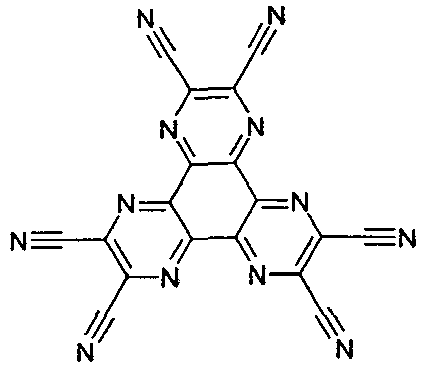

HAT SpA1 

F4T SpMA1 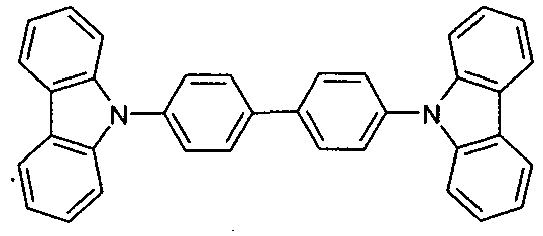

CBP ST2 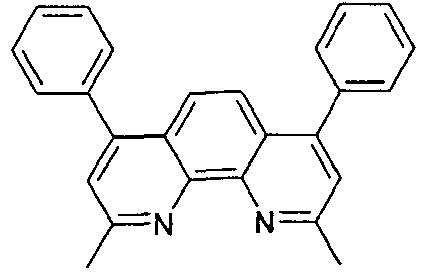

BCP LiQ 
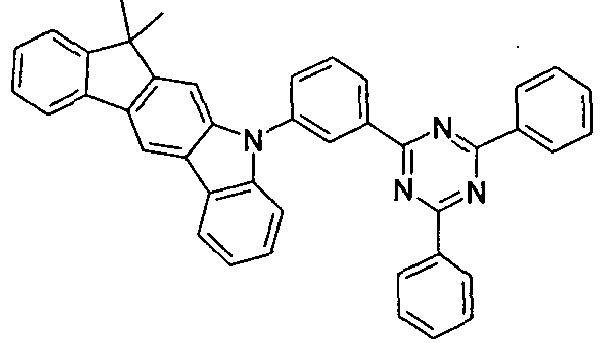
IC1 IC5 
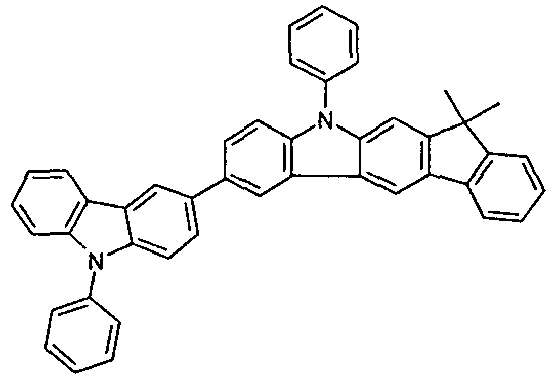
D1 IC2 

IC3 D2 

TPBI L1 
IC6 Tabelle 4: HOMO, LUMO, T1, S1 der relevanten Materialien Material Methode HOMO (eV) LUMO (eV) S1 (eV) T1 (eV) D1 org. -6.11 -3.40 2.50 2.41 D2 org. -5.92 -3.61 2.09 2.03 CBP org. -5.67 -2.38 3.59 3.11 BCP org. -6.15 -2.44 3.61 2.70 IC1 org. -5.79 -2.83 3.09 2.69 IC5 org. -5.56 -2.87 2.87 2.72 IC3 org. -5.62 -2.75 3.02 2.75 SpA1 org. -4.87 -2.14 2.94 2.34 SpMA1 org. -5.25 -2.18 3.34 2.58 IC2 org. -5.40 -2.11 3.24 2.80 HAT org. -8.86 -4.93 F4T org. -7.91 -5.21 ST2 org. -6.03 -2.82 3.32 2.68 LiQ M-org. -5.17 -2.39 2.85 2.13 TPBI org. -6.26 -2.48 3.47 3.04 L1 org. -6.09 -2.80 2.70 3.46 IC6 org. -5.87 -2.85 2.72 3.14
Claims (16)
- Organische Elektrolumineszenzvorrichtung, enthaltend Kathode, Anode und eine emittierende Schicht, die die folgenden Verbindungen enthält:a) eine elektronentransportierende Verbindung, undb) eine lumineszente organische Verbindung, die einen Abstand zwischen dem niedrigsten Triplettzustand T1 und dem ersten angeregten Singulettzustand S1 von ≤ 0.15 eV aufweist;dabei wird das LUMO, der T1-Zustand und der S1-Zustand über quantenchemische Rechnungen mit dem Programmpaket "Gaussian09W" (Gaussian Inc.) wie folgt bestimmt:- zur Berechnung organischer Substanzen ohne Metalle wird eine Geometrieoptimierung mit der Methode "Ground State/Semi-empirical /Default Spin/AM1/Charge 0/Spin Singlet" durchgeführt;- dann erfolgt auf Grundlage der optimierten Geometrie eine Energierechnung mit der Methode "TD-SFC/DFT/Default Spin/B3PW91" mit dem Basissatz "6-31G(d)" (Charge 0, Spin Singlet);- zur Berechnung metallhaltiger Verbindungen wird die Geometrie über die Methode "Ground State/ Hartree-Fock/Default Spin/LanL2MB/ Charge 0/Spin Singlet" optimiert und die Energierechnung analog zu den organischen Substanzen durchgeführt, mit dem Unterschied, dass für das Metallatom der Basissatz "LanL2DZ" und für die Liganden der Basissatz "6-31G(d)" verwendet wird;- aus dem aus der Energierechnung erhaltenen LUMO-Energieniveau LEh in Hartree-Einheiten wird das anhand von Cyclovoltammetriemessungen kalibrierte LUMO-Energieniveau in Elektronenvolt wie folgt bestimmt:
 - T1 ist die Energie des Triplettzustands mit der niedrigsten Energie, der sich aus der beschriebenen quantenchemischen Rechnung ergibt;- S1 ist die Energie des angeregten Singulettzustands mit der niedrigsten Energie, der sich aus der beschriebenen quantenchemischen Rechnung ergibt.dadurch gekennzeichnet, dass die elektronentransportierende Verbindung ein LUMO ≤ -2.5 eV aufweist.
 - Organische Elektrolumineszenzvorrichtung nach Anspruch 1, dadurch gekennzeichnet, dass die lumineszente organische Verbindung, die einen Abstand zwischen dem niedrigsten Triplettzustand T1 und dem ersten angeregten Singulettzustand S1 von ≤ 0.15 eV aufweist, in einer Schicht in Mischung mit der elektronentransportierenden Verbindung eine Lumineszenzquanteneffizienz von mindestens 40 % aufweist
- Organische Elektrolumineszenzvorrichtung nach Anspruch 1 oder 2, dadurch gekennzeichnet, dass der Abstand zwischen S1 und T1 der lumineszenten organischen Verbindung ≤ 0.10 eV, bevorzugt ≤ 0.08 eV und besonders bevorzugt ≤ 0.05 eV ist.
- Organische Elektrolumineszenzvorrichtung nach einem oder mehreren der Ansprüche 1 bis 3, dadurch gekennzeichnet, dass die lumineszente organische Verbindung, die einen Abstand zwischen dem niedrigsten Triplettzustand T1 und dem ersten angeregten Singulettzustand S1 von ≤ 0.15 eV aufweist, eine aromatische Verbindung ist, die sowohl Donorwie auch Akzeptorsubstituenten aufweist.
- Organische Elektrolumineszenzvorrichtung nach einem oder mehreren der Ansprüche 1 bis 4, dadurch gekennzeichnet, dass für das LUMO der lumineszenten organischen Verbindung, die einen Abstand zwischen dem niedrigsten Triplettzustand T1 und dem ersten angeregten Singulettzustand S1 von ≤ 0.15 eV aufweist, LUMO(TADF) und das HOMO der elektronentransportierenden Matrix HOMO(Matrix) gilt:

- Organische Elektrolumineszenzvorrichtung nach einem oder mehreren der Ansprüche 1 bis 5, dadurch gekennzeichnet, dass die elektronentransportierende Verbindung ein LUMO ≤ -2.60 eV aufweist, bevorzugt ≤ -2.65 eV.
- Organische Elektrolumineszenzvorrichtung nach einem oder mehreren der Ansprüche 1 bis 6, dadurch gekennzeichnet, dass die niedrigste Triplettenergie der elektronentransportierenden Verbindung maximal 0.1 eV niedriger ist als die Triplettenergie der lumineszenten organischen Verbindung, die einen Abstand zwischen dem niedrigsten Triplettzustand T1 und dem ersten angeregten Singulettzustand S1 von ≤ 0.15 eV aufweist.
- Organische Elektrolumineszenzvorrichtung nach einem oder mehreren der Ansprüche 1 bis 7, dadurch gekennzeichnet, dass die elektronentransportierende Verbindung ausgewählt ist aus den Stoffklassen der Triazine, der Pyrimidine, der Lactame, der Metallkomplexe, insbesondere der Be-, Zn- bzw. Al-Komplexe, der aromatischen Ketone, der aromatischen Phosphinoxide, der Azaphosphole, der Azaborole, welche mit mindestens einem elektronenleitenden Substituenten substituiert sind, und der Chinoxaline.
- Organische Elektrolumineszenzvorrichtung nach einem oder mehreren der Ansprüche 1 bis 8, dadurch gekennzeichnet, dass die elektronentransportierende Verbindung ausgewählt ist aus den Verbindungen der folgenden Formeln (1) bzw. (2),
 R ist bei jedem Auftreten gleich oder verschieden ausgewählt aus der Gruppe bestehend aus H, D, F, Cl, Br, I, CN, NO2, N(Ar)2, N(R1)2, C(=O)Ar, C(=O)R1, P(=O)(Ar)2, einer geradkettigen Alkyl-, Alkoxyoder Thioalkylgruppe mit 1 bis 40 C-Atomen oder einer verzweigten oder cyclischen Alkyl-, Alkoxy- oder Thioalkylgruppe mit 3 bis 40 C-Atomen oder einer Alkenyl- oder Alkinylgruppe mit 2 bis 40 C-Atomen, die jeweils mit einem oder mehreren Resten R1 substituiert sein kann, wobei eine oder mehrere nicht-benachbarte CH2-Gruppen durch R1C=CR1, C=C, Si(R1)2, C=O, C=S, C=NR1, P(=O)(R1), SO, SO2, NR1, O, S oder CONR1 ersetzt sein können und wobei ein oder mehrere H-Atome durch D, F, Cl, Br, I, CN oder NO2 ersetzt sein können, einem aromatischen oder heteroaromatischen Ringsystem mit 5 bis 80, bevorzugt 5 bis 60, aromatischen Ringatomen, das jeweils mit einem oder mehreren Resten R1 substituiert sein kann, einer Aryloxy- oder Heteroaryloxygruppe mit 5 bis 60 aromatischen Ringatomen, die mit einem oder mehreren Resten R1 substituiert sein kann, oder einer Aralkyl- oder Heteroaralkylgruppe mit 5 bis 60 aromatischen Ringatomen, die mit einem oder mehreren Resten R1 substituiert sein kann, wobei optional zwei oder mehr benachbarte Substituenten R ein monocyclisches oder polycyclisches, aliphatisches, aromatisches oder heteroaromatisches Ringsystem bilden können, das mit einem oder mehreren Resten R1 substituiert sein kann;R1 ist bei jedem Auftreten gleich oder verschieden ausgewählt aus der Gruppe bestehend aus H, D, F, Cl, Br, I, CN, NO2, N(Ar)2, N(R2)2, C(=O)Ar, C(=O)R2, P(=O)(Ar)2, einer geradkettigen Alkyl-, Alkoxy- oder Thioalkylgruppe mit 1 bis 40 C-Atomen oder einer verzweigten oder cyclischen Alkyl-, Alkoxy- oder Thioalkylgruppe mit 3 bis 40 C-Atomen oder einer Alkenyl- oder Alkinylgruppe mit 2 bis 40 C-Atomen, die jeweils mit einem oder mehreren Resten R2 substituiert sein kann, wobei eine oder mehrere nicht-benachbarte CH2-Gruppen durch R2C=CR2, C≡C, Si(R2)2, C=O, C=S, C=NR2, P(=O)(R2), SO, SO2, NR2, O, S oder CONR2 ersetzt sein können und wobei ein oder mehrere H-Atome durch D, F, Cl, Br, I, CN oder NO2 ersetzt sein können, einem aromatischen oder heteroaromatischen Ringsystem mit 5 bis 60 aromatischen Ringatomen, das jeweils mit einem oder mehreren Resten R2 substituiert sein kann, einer Aryloxy- oder Heteroaryloxygruppe mit 5 bis 60 aromatischen Ringatomen, die mit einem oder mehreren Resten R2 substituiert sein kann, oder eine Aralkyl- oder Heteroaralkylgruppe mit 5 bis 60 aromatischen Ringatomen, wobei optional zwei oder mehr benachbarte Substituenten R1 ein monocyclisches oder polycyclisches, aliphatisches, aromatisches oder heteroaromatisches Ringsystem bilden können, das mit einem oder mehreren Resten R2 substituiert sein kann;Ar ist bei jedem Auftreten gleich oder verschieden ein aromatisches oder heteroaromatisches Ringsystem mit 5-30 aromatischen Ring-atomen, das mit einem oder mehreren nicht-aromatischen Resten R2 substituiert sein kann; dabei können zwei Reste Ar, welche an dasselbe N-Atom oder P-Atom binden, auch durch eine Einfachbindung oder eine Brücke, ausgewählt aus N(R2), C(R2)2, O oder S, miteinander verbrückt sein;R2 ist ausgewählt aus der Gruppe bestehend aus H, D, F, CN, einem aliphatischem Kohlenwasserstoffrest mit 1 bis 20 C-Atomen, einem aromatischem oder heteroaromatischem Ringsystem mit 5 bis 30 aromatischen Ringatomen, in dem ein oder mehrere H-Atome durch D, F, Cl, Br, I oder CN ersetzt sein können, wobei zwei oder mehr benachbarte Substituenten R2 miteinander ein mono- oder polycyclisches, aliphatisches, aromatisches oder heteroaromatisches Ringsystem bilden können.
 - Organische Elektrolumineszenzvorrichtung nach einem oder mehreren der Ansprüche 1 bis 9, dadurch gekennzeichnet, dass die elektronentransportierende Verbindung ausgewählt ist aus den Verbindungen der folgenden Formeln (1a) bzw. (2a) bis (2d),
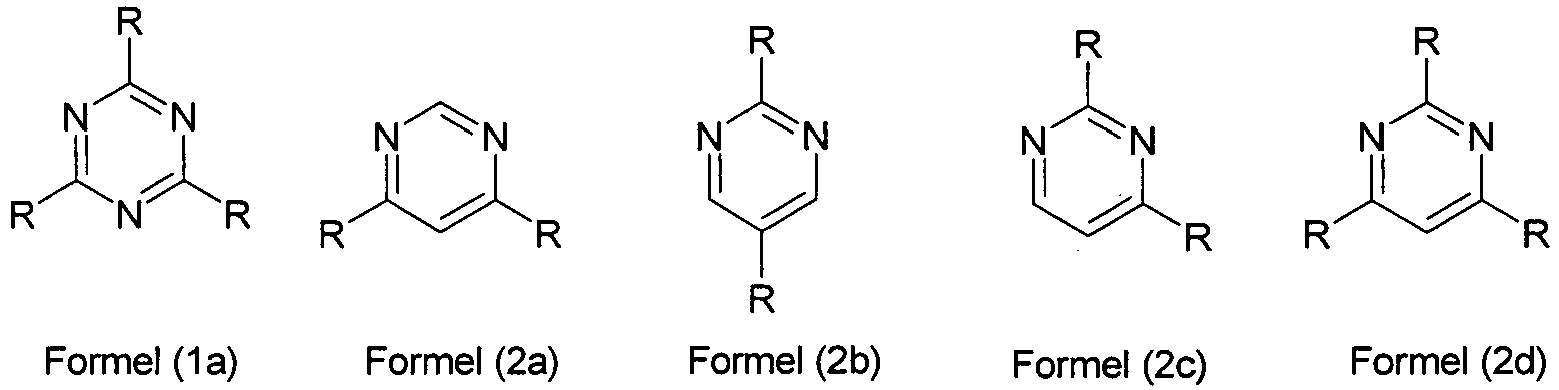
- Organische Elektrolumineszenzvorrichtung nach Anspruch 10, dadurch gekennzeichnet, dass R gleich oder verschieden bei jedem Auftreten ausgewählt ist aus der Gruppe bestehend aus Benzol, ortho-, meta- oder para-Biphenyl, ortho-, meta-, para- oder verzweigtem Terphenyl, ortho-, meta-, para- oder verzweigtem Quaterphenyl, 1-, 2-, 3-oder 4-Fluorenyl, 1-, 2-, 3- oder 4-Spirobifluorenyl, 1-oder 2-Naphthyl, Pyrrol, Furan, Thiophen, Indol, Benzofuran, Benzothiophen, 1-, 2- oder 3-Carbazol, 1-, 2- oder 3-Dibenzofuran, 1-, 2- oder 3-Dibenzothiophen, Indenocarbazol, Indolocarbazol, 2-, 3- oder 4-Pyridin, 2-, 4- oder 5-Pyrimidin, Pyrazin, Pyridazin, Triazin, Anthracen, Phenanthren, Triphenylen, Pyren, Benzanthracen oder Kombinationen aus zwei oder drei dieser Gruppen, welche jeweils mit einem oder mehreren Resten R1 substituiert sein können, oder aus
den Strukturen der folgenden Formeln (3) bis (44),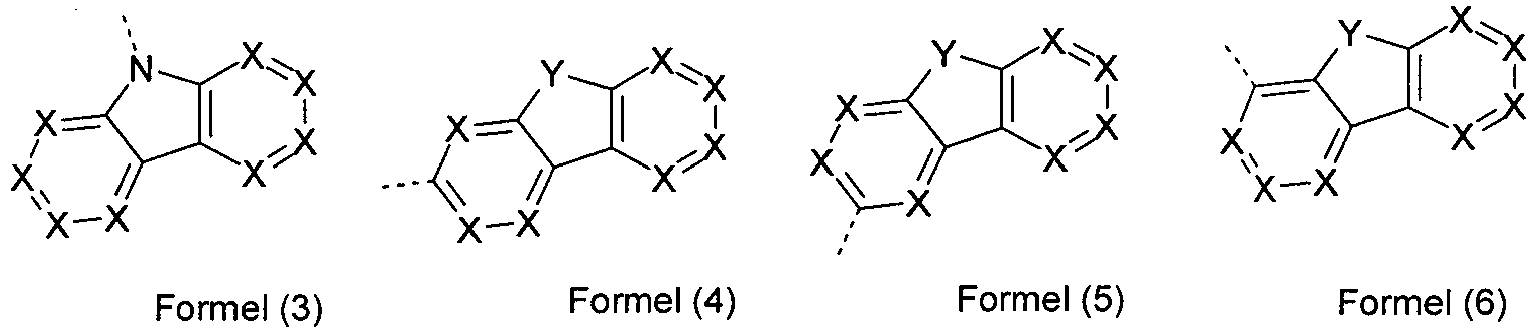


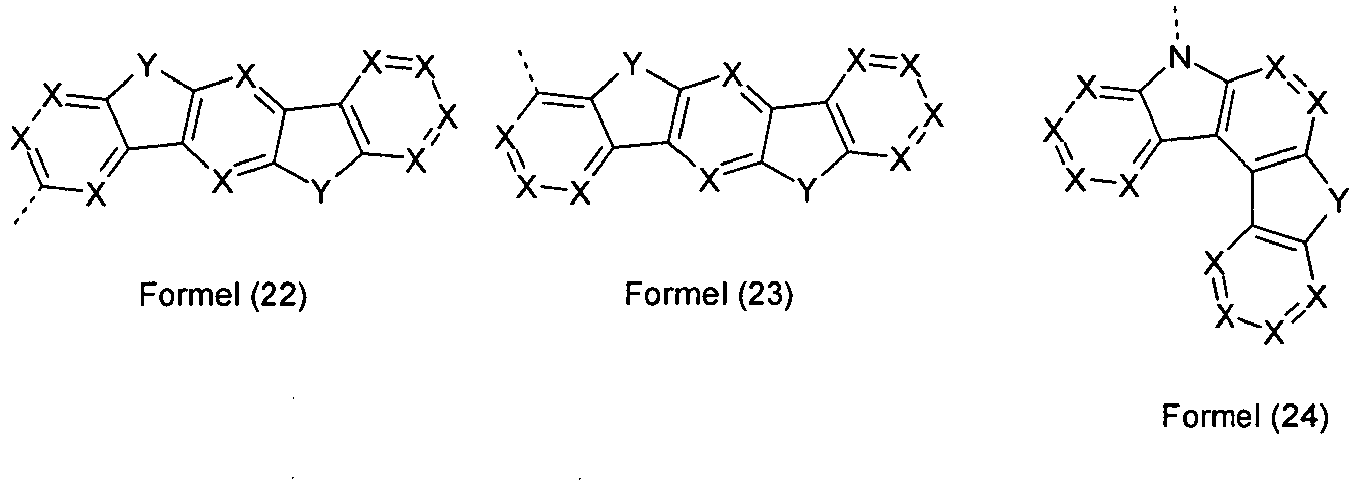


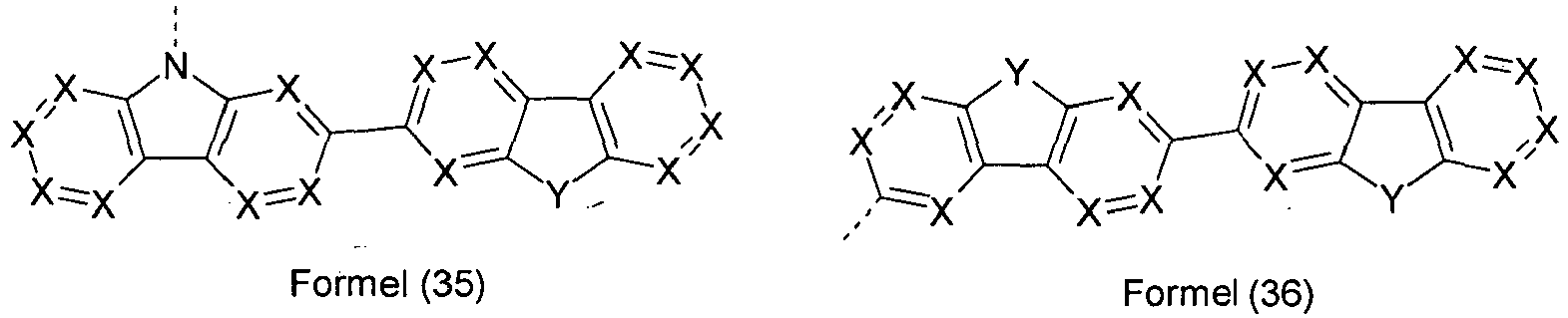


 X ist bei jedem Auftreten gleich oder verschieden CR1 oder N, wobei bevorzugt maximal 2 Symbole X pro Cyclus für N stehen;Y ist bei jedem Auftreten gleich oder verschieden C(R1)2, NR1, O oder S;n ist 0 oder 1, wobei n gleich 0 bedeutet, dass an dieser Position keine Gruppe Y gebunden ist und an den entsprechenden Kohlenstoffatomen statt dessen Reste R1 gebunden sind.
 - Organische Elektrolumineszenzvorrichtung nach einem oder mehreren der Ansprüche 1 bis 8, dadurch gekennzeichnet, dass die elektronentransportierende Verbindung ausgewählt ist aus den Verbindungen der Formeln (45) oder (46),
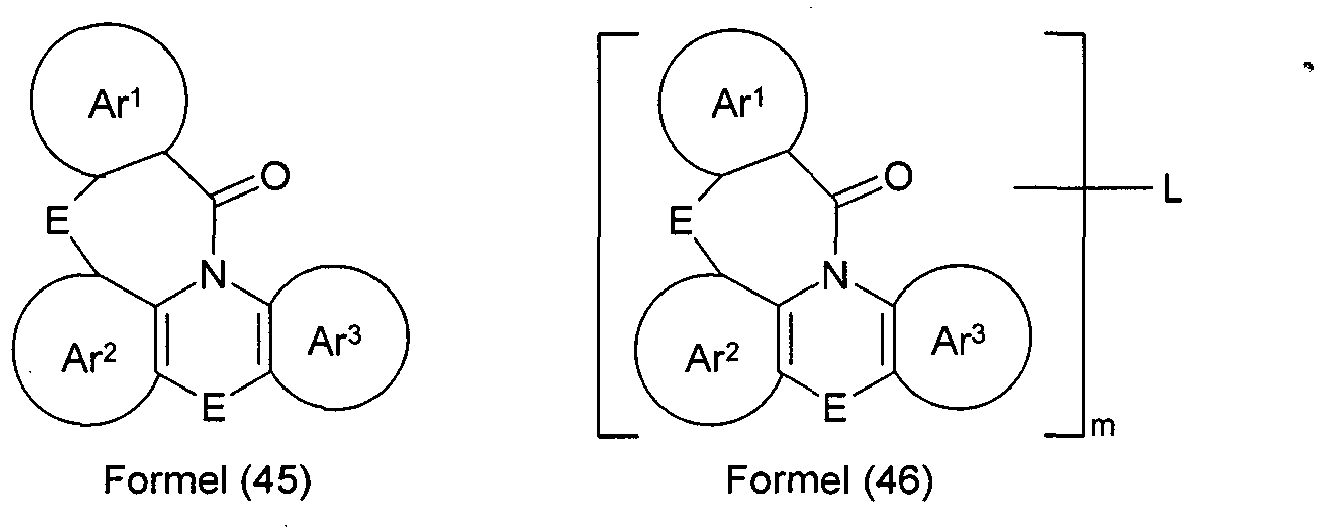 E ist gleich oder verschieden bei jedem Auftreten eine Einfachbindung, NR, CR2, O oder S;Ar1 ist zusammen mit den explizit dargestellten Kohlenstoffatomen ein aromatisches oder heteroaromatisches Ringsystem mit 5 bis 30 aromatischen Ringatomen, welches durch einen oder mehrere Reste R substituiert sein kann;Ar2, Ar3 ist gleich oder verschieden bei jedem Auftreten zusammen mit den explizit dargestellten Kohlenstoffatomen ein aromatisches oder heteroaromatisches Ringsystem mit 5 bis 30 aromatischen Ring-atomen, welches durch einen oder mehrere Reste R substituiert sein kann;L ist für m = 2 eine Einfachbindung oder eine bivalente Gruppe, bzw. für m = 3 eine trivalente Gruppe bzw. für m = 4 eine tetravalente Gruppe, welche jeweils an eine beliebige Position an Ar1, Ar2 oder Ar3 oder statt einem Rest R an E gebunden ist;m ist 2, 3 oder 4.
 - Organische Elektrolumineszenzvorrichtung nach Anspruch 12, dadurch gekennzeichnet, dass die Gruppe Ar1 für eine Gruppe der folgenden Formel (47), (48), (49) oder (50) steht,
 W ist gleich oder verschieden bei jedem Auftreten CR oder N; oder zwei benachbarte Gruppen W stehen für eine Gruppe der Formel (51) oder (52),
 V ist NR, O oder S;und/oder dass die Gruppe Ar2 für eine Gruppe gemäß einer der Formeln (53), (54) oder (55) steht,
und/oder dass die Gruppe Ar3 für eine Gruppe gemäß einer der Formeln (56), (57), (58) oder (59) steht,
- Organische Elektrolumineszenzvorrichtung nach Anspruch 8, dadurch gekennzeichnet, dass die elektronentransportierende Verbindung ausgewählt ist aus den Verbindungen der Formeln (70) bzw. (71),
 Ar4 ist bei jedem Auftreten gleich oder verschieden ein aromatisches oder heteroaromatisches Ringsystem mit 5 bis 80 aromatischen Ringatomen, bevorzugt bis 60 aromatischen Ringatomen, welches jeweils mit einer oder mehreren Gruppen R substituiert sein kann.
 - Organische Elektrolumineszenzvorrichtung nach Anspruch 14, dadurch gekennzeichnet, dass Ar4 gleich oder verschieden bei jedem Auftreten ausgewählt ist aus Phenyl, 2-, 3- oder 4-Tolyl, 3- oder 4-o-Xylyl, 2- oder 4-m-Xylyl, 2-p-Xylyl, o-, m- oder p-tert-Butylphenyl, o-, m- oder p-Fluorphenyl, Benzophenon, 1-, 2- oder 3-Phenylmethanon, 2-, 3- oder 4-Biphenyl, 2-, 3- oder 4-o-Terphenyl, 2-, 3- oder 4-m-Terphenyl, 2-, 3- oder 4-p-Terphenyl, 2'-p-Terphenyl, 2'-, 4'- oder 5'-m-Terphenyl, 3'- oder 4'-o-Terphenyl, p-, m,p-, o,p-, m,m-, o,m- oder o,o-Quaterphenyl, Quinquephenyl, Sexiphenyl, 1-, 2-, 3- oder 4-Fluorenyl, 2-, 3- oder 4-Spiro-9,9'-bifluorenyl, 1-, 2-, 3- oder 4-(9,10-Dihydro)phenanthrenyl, 1- oder 2-Naphthyl, 2-, 3-, 4-, 5-, 6-, 7- oder 8-Chinolinyl, 1-, 3-, 4-, 5-, 6-, 7- oder 8-iso-Chinolinyl, 1- oder 2-(4-Methylnaphthyl), 1- oder 2-(4-Phenylnaphthyl), 1- oder 2-(4-Naphthyl-naphthyl), 1-, 2- oder 3-(4-naphthyl-phenyl), 2-, 3- oder 4-Pyridyl, 2-, 4- oder 5-Pyrimidinyl, 2- oder 3-Pyrazinyl, 3- oder 4-Pyridanzinyl, 2-(1,3,5-Triazin)yl-, 2-, 3- oder 4-(Phenylpyridyl), 3-, 4-, 5- oder 6-(2,2'-Bipyridyl), 2-, 4-, 5- oder 6-(3,3'-Bipyridyl), 2- oder 3-(4,4'-Bipyridyl) und Kombinationen eines oder mehrerer dieser Reste, welche durch einen oder mehrere Reste R substituiert sein können.
- Verfahren zur Herstellung einer organischen Elektrolumineszenzvorrichtung nach einem oder mehreren der Ansprüche 1 bis 15, dadurch gekennzeichnet, dass mindestens eine Schicht mit einem Sublimationsverfahren aufgebracht wird und/oder dass mindestens eine Schicht mit einem OVPD (Organic Vapour Phase Deposition) Verfahren oder mit Hilfe einer Trägergassublimation aufgebracht wird und/oder dass mindestens eine Schicht aus Lösung, durch Spincoating oder mit einem Druckverfahren aufgebracht wird.
Priority Applications (1)
| Application Number | Priority Date | Filing Date | Title |
|---|---|---|---|
| EP14711446.6A EP2984692B1 (de) | 2013-04-08 | 2014-03-18 | Organische elektrolumineszenzvorrichtung mit thermisch aktiviertem verzögertem fluoreszenzmaterial |
Applications Claiming Priority (3)
| Application Number | Priority Date | Filing Date | Title |
|---|---|---|---|
| EP13001797 | 2013-04-08 | ||
| EP14711446.6A EP2984692B1 (de) | 2013-04-08 | 2014-03-18 | Organische elektrolumineszenzvorrichtung mit thermisch aktiviertem verzögertem fluoreszenzmaterial |
| PCT/EP2014/000739 WO2014166584A1 (de) | 2013-04-08 | 2014-03-18 | Organische elektrolumineszenzvorrichtung mit thermisch aktiviertem verzögertem fluoreszenzmaterial |
Publications (2)
| Publication Number | Publication Date |
|---|---|
| EP2984692A1 EP2984692A1 (de) | 2016-02-17 |
| EP2984692B1 true EP2984692B1 (de) | 2018-01-31 |
Family
ID=48128051
Family Applications (1)
| Application Number | Title | Priority Date | Filing Date |
|---|---|---|---|
| EP14711446.6A Active EP2984692B1 (de) | 2013-04-08 | 2014-03-18 | Organische elektrolumineszenzvorrichtung mit thermisch aktiviertem verzögertem fluoreszenzmaterial |
Country Status (7)
| Country | Link |
|---|---|
| US (1) | US10069079B2 (de) |
| EP (1) | EP2984692B1 (de) |
| JP (2) | JP6567498B2 (de) |
| KR (2) | KR102361072B1 (de) |
| CN (1) | CN105074950B (de) |
| TW (1) | TWI676669B (de) |
| WO (1) | WO2014166584A1 (de) |
Families Citing this family (37)
| Publication number | Priority date | Publication date | Assignee | Title |
|---|---|---|---|---|
| US9847501B2 (en) | 2011-11-22 | 2017-12-19 | Idemitsu Kosan Co., Ltd. | Aromatic heterocyclic derivative, material for organic electroluminescent element, and organic electroluminescent element |
| EP3005433B1 (de) * | 2013-06-06 | 2023-02-22 | Merck Patent GmbH | Organische elektrolumineszenzvorrichtung |
| JP6580571B2 (ja) | 2013-09-11 | 2019-09-25 | メルク パテント ゲーエムベーハー | 電子素子 |
| EP3040335B1 (de) | 2013-11-13 | 2019-04-03 | Idemitsu Kosan Co., Ltd | Verbindung, organisches elektrolumineszierendes element und elektronische vorrichtung |
| US10734587B2 (en) * | 2014-03-13 | 2020-08-04 | Merck Patent Gmbh | Formulations of luminescent compounds |
| WO2015170930A1 (en) * | 2014-05-08 | 2015-11-12 | Rohm And Haas Electronic Materials Korea Ltd. | An electron transport material and an organic electroluminescence device comprising the same |
| WO2016084962A1 (ja) | 2014-11-28 | 2016-06-02 | 出光興産株式会社 | 化合物、有機エレクトロルミネッセンス素子用材料、有機エレクトロルミネッセンス素子および電子機器 |
| CN107004777B (zh) | 2014-12-04 | 2019-03-26 | 广州华睿光电材料有限公司 | 聚合物,包含其的混合物、组合物、有机电子器件,及其单体 |
| WO2016091353A1 (de) * | 2014-12-12 | 2016-06-16 | Merck Patent Gmbh | Organische verbindungen mit löslichen gruppen |
| WO2016125807A1 (ja) * | 2015-02-06 | 2016-08-11 | 出光興産株式会社 | 有機エレクトロルミネッセンス素子および電子機器 |
| KR102343572B1 (ko) * | 2015-03-06 | 2021-12-28 | 삼성디스플레이 주식회사 | 유기 발광 소자 |
| KR102626916B1 (ko) | 2015-09-09 | 2024-01-19 | 삼성전자주식회사 | 축합환 화합물 및 이를 포함한 유기 발광 소자 |
| CN105322099B (zh) * | 2015-11-30 | 2018-01-05 | 华南理工大学 | 一种全荧光白光有机发光二极管及其制备方法 |
| JP6788314B2 (ja) * | 2016-01-06 | 2020-11-25 | コニカミノルタ株式会社 | 有機エレクトロルミネッセンス素子、有機エレクトロルミネッセンス素子の製造方法、表示装置及び照明装置 |
| CN107056748B (zh) * | 2016-04-25 | 2020-12-11 | 中节能万润股份有限公司 | 一种以三嗪和酮为核心的化合物及其在有机电致发光器件上的应用 |
| US11925114B2 (en) | 2016-10-19 | 2024-03-05 | Hodogaya Chemical Co., Ltd. | Indenocarbazole compound and organic electroluminescence device |
| CN106946850B (zh) * | 2017-02-17 | 2019-02-15 | 中节能万润股份有限公司 | 一种热激活延迟荧光发光材料及其应用 |
| CN107123749B (zh) * | 2017-04-01 | 2019-08-27 | 中山大学 | 一种高显色指数白光有机电致发光器件及其制备方法 |
| KR102536248B1 (ko) | 2017-06-21 | 2023-05-25 | 삼성디스플레이 주식회사 | 헤테로시클릭 화합물 및 이를 포함한 유기 발광 소자 |
| KR102415376B1 (ko) | 2017-08-04 | 2022-07-01 | 삼성디스플레이 주식회사 | 축합환 화합물 및 이를 포함한 유기 발광 소자 |
| KR102414108B1 (ko) * | 2017-08-08 | 2022-06-29 | 삼성디스플레이 주식회사 | 헤테로고리 화합물 및 이를 포함한 유기 발광 소자 |
| KR102824094B1 (ko) * | 2017-09-26 | 2025-06-25 | 삼성디스플레이 주식회사 | 유기 발광 소자 |
| EP3467894B1 (de) * | 2017-09-26 | 2023-08-02 | Samsung Display Co., Ltd. | Organische lichtemittierende vorrichtung |
| CN108048077B (zh) * | 2017-12-11 | 2019-04-30 | 中节能万润股份有限公司 | 一种热活化延迟荧光材料及其应用 |
| KR102536246B1 (ko) | 2018-03-23 | 2023-05-25 | 삼성디스플레이 주식회사 | 헤테로고리 화합물 및 이를 포함한 유기 발광 소자 |
| CN108219781A (zh) * | 2018-04-02 | 2018-06-29 | 长春海谱润斯科技有限公司 | 一种四嗪衍生物的热激活延迟荧光材料及其有机电致发光器件 |
| KR102692561B1 (ko) * | 2018-06-26 | 2024-08-06 | 삼성전자주식회사 | 유기 발광 소자 |
| CN111372918B (zh) | 2018-07-27 | 2023-09-05 | 出光兴产株式会社 | 化合物、用于有机电致发光元件的材料、有机电致发光元件以及电子设备 |
| WO2020061103A1 (en) | 2018-09-18 | 2020-03-26 | Nikang Therapeutics, Inc. | Fused tricyclic ring derivatives as src homology-2 phosphatase inhibitors |
| TWI767148B (zh) | 2018-10-10 | 2022-06-11 | 美商弗瑪治療公司 | 抑制脂肪酸合成酶(fasn) |
| EP3640999B1 (de) * | 2018-10-15 | 2022-01-05 | cynora GmbH | Blaulichtemittierende organische elektrolumineszente vorrichtung |
| CN109400590A (zh) * | 2018-11-21 | 2019-03-01 | 苏州大学 | 一种热活化延迟荧光材料及其在有机发光二极管中的应用 |
| CN110128423A (zh) * | 2019-05-21 | 2019-08-16 | 武汉华星光电半导体显示技术有限公司 | 热活化延迟荧光材料和其制作方法、电致发光器件 |
| CN110790751A (zh) * | 2019-11-07 | 2020-02-14 | 浙江虹舞科技有限公司 | 一种热活性延迟荧光材料及有机发光元件 |
| KR20220033736A (ko) | 2020-09-10 | 2022-03-17 | 엘지디스플레이 주식회사 | 유기 화합물, 이를 포함하는 유기발광다이오드 및 유기발광장치 |
| CN115669264B (zh) | 2021-04-16 | 2025-08-22 | 京东方科技集团股份有限公司 | 有机电致发光器件和显示装置 |
| CN117362292B (zh) * | 2023-06-15 | 2025-07-22 | 闽都创新实验室 | 酰胺衍生物热活化延迟荧光材料及其制备方法和应用 |
Citations (5)
| Publication number | Priority date | Publication date | Assignee | Title |
|---|---|---|---|---|
| US20120037896A1 (en) | 2009-04-09 | 2012-02-16 | Merck Patent Gmbh | Organic electroluminescence device |
| US20120091438A1 (en) | 2009-04-01 | 2012-04-19 | Idemitsu Kosan Co., Ltd. | Organic electroluminescent element |
| US20120256535A1 (en) | 2011-04-07 | 2012-10-11 | Semiconductor Energy Laboratory Co., Ltd. | Light-emitting element |
| EP2687530A1 (de) | 2011-03-16 | 2014-01-22 | Nippon Steel & Sumikin Chemical Co., Ltd. | Stickstoffhaltige aromatische verbindungen und organische elektrolumineszenzelemente damit |
| EP2733761A1 (de) | 2011-07-15 | 2014-05-21 | Kyushu University, National University Corporation | Material mit verzögerter fluoreszenz und organisches elektrolumineszenzelement damit |
Family Cites Families (18)
| Publication number | Priority date | Publication date | Assignee | Title |
|---|---|---|---|---|
| DE10224021B4 (de) | 2002-05-24 | 2006-06-01 | Novaled Gmbh | Phosphoreszentes lichtemittierendes Bauelement mit organischen Schichten |
| EP1645610A1 (de) | 2004-10-11 | 2006-04-12 | Covion Organic Semiconductors GmbH | Phenanthren-Derivate |
| EP1956022B1 (de) | 2005-12-01 | 2012-07-25 | Nippon Steel Chemical Co., Ltd. | Verbindung für organisches elektrolumineszentes element und organisches elektrolumineszentes element |
| EP2080762B1 (de) | 2006-11-09 | 2016-09-14 | Nippon Steel & Sumikin Chemical Co., Ltd. | Verbindung für organische elektrolumineszenzvorrichtung und organische elektrolumineszenzvorrichtung |
| CN101848882B (zh) | 2007-09-20 | 2015-04-29 | 巴斯夫欧洲公司 | 电致发光器件 |
| JP2010114070A (ja) * | 2008-10-10 | 2010-05-20 | Canon Inc | 白色有機el素子 |
| DE102009009277B4 (de) | 2009-02-17 | 2023-12-07 | Merck Patent Gmbh | Organische elektronische Vorrichtung, Verfahren zu deren Herstellung und Verwendung von Verbindungen |
| KR101759966B1 (ko) | 2009-03-31 | 2017-07-20 | 신닛테츠 수미킨 가가쿠 가부시키가이샤 | 유기 전계 발광 소자 |
| DE102009023155A1 (de) | 2009-05-29 | 2010-12-02 | Merck Patent Gmbh | Materialien für organische Elektrolumineszenzvorrichtungen |
| DE102009031021A1 (de) | 2009-06-30 | 2011-01-05 | Merck Patent Gmbh | Materialien für organische Elektrolumineszenzvorrichtungen |
| CN102648268B (zh) | 2009-12-07 | 2014-08-13 | 新日铁住金化学株式会社 | 有机发光材料及有机发光元件 |
| US9487548B2 (en) | 2009-12-14 | 2016-11-08 | Udc Ireland Limited | Metal complexes comprising diazabenzimidazolocarbene ligands and the use thereof in OLEDs |
| DE102010019306B4 (de) * | 2010-05-04 | 2021-05-20 | Merck Patent Gmbh | Organische Elektrolumineszenzvorrichtungen |
| KR101877582B1 (ko) * | 2010-07-30 | 2018-07-12 | 메르크 파텐트 게엠베하 | 유기 전계발광 디바이스 |
| WO2012133188A1 (ja) * | 2011-03-25 | 2012-10-04 | 出光興産株式会社 | 有機エレクトロルミネッセンス素子 |
| US9142710B2 (en) * | 2012-08-10 | 2015-09-22 | Semiconductor Energy Laboratory Co., Ltd. | Light-emitting element, light-emitting device, display device, electronic device, and lighting device |
| JP2014187130A (ja) * | 2013-03-22 | 2014-10-02 | Nippon Hoso Kyokai <Nhk> | 有機エレクトロルミネッセンス素子、表示装置および照明装置、正孔輸送材料の評価方法 |
| WO2014157610A1 (ja) * | 2013-03-29 | 2014-10-02 | コニカミノルタ株式会社 | 有機エレクトロルミネッセンス素子、照明装置、表示装置、有機ルミネッセンス素子用発光性薄膜と組成物及び発光方法 |
-
2014
- 2014-03-18 WO PCT/EP2014/000739 patent/WO2014166584A1/de not_active Ceased
- 2014-03-18 JP JP2016506799A patent/JP6567498B2/ja active Active
- 2014-03-18 EP EP14711446.6A patent/EP2984692B1/de active Active
- 2014-03-18 KR KR1020157031344A patent/KR102361072B1/ko active Active
- 2014-03-18 US US14/782,974 patent/US10069079B2/en active Active
- 2014-03-18 CN CN201480018865.9A patent/CN105074950B/zh active Active
- 2014-03-18 KR KR1020207033152A patent/KR20200133011A/ko not_active Ceased
- 2014-04-03 TW TW103112533A patent/TWI676669B/zh not_active IP Right Cessation
-
2019
- 2019-03-27 JP JP2019061067A patent/JP2019145807A/ja active Pending
Patent Citations (5)
| Publication number | Priority date | Publication date | Assignee | Title |
|---|---|---|---|---|
| US20120091438A1 (en) | 2009-04-01 | 2012-04-19 | Idemitsu Kosan Co., Ltd. | Organic electroluminescent element |
| US20120037896A1 (en) | 2009-04-09 | 2012-02-16 | Merck Patent Gmbh | Organic electroluminescence device |
| EP2687530A1 (de) | 2011-03-16 | 2014-01-22 | Nippon Steel & Sumikin Chemical Co., Ltd. | Stickstoffhaltige aromatische verbindungen und organische elektrolumineszenzelemente damit |
| US20120256535A1 (en) | 2011-04-07 | 2012-10-11 | Semiconductor Energy Laboratory Co., Ltd. | Light-emitting element |
| EP2733761A1 (de) | 2011-07-15 | 2014-05-21 | Kyushu University, National University Corporation | Material mit verzögerter fluoreszenz und organisches elektrolumineszenzelement damit |
Non-Patent Citations (6)
| Title |
|---|
| AYATAKA ENDO, KEIGO SATO, CHIHAYA ADACHI: "PL characteristics of high efficiency thermally activated delayed fluorescence materials and their application to organic light emitting diodes (English translation enclosed)", THE 57TH ANNUAL MEETING OF THE JAPAN SOCIETY OF APPLIED PHYSICS AND RELATED SOCIETIES, PROCEEDINGS, 2010, Tokai University, pages 12-340, XP055524913 |
| KEIGO SATO, AYATAKA ENDO, CHIHAYA ADACHI: "Emission mechenism of high efficiency thermally activated delayed fluorescence (English translation enclosed)", THE 57TH ANNUAL MEETING OF THE JAPAN SOCIETY OF APPLIED PHYSICS AND RELATED SOCIETIES, PROCEEDINGS, 2010, Tokai University, pages 12-341, XP055524910 |
| SHI-JIAN SU ET AL: "SUPPLEMENTARY INFORMATION - Tuning Energy Levels of Electron-Transport Materials by Nitrogen Orientation for Electrophosphorescent Devices with an 'Ideal' Operating Voltage", ADVANCED MATERIALS, vol. 22, no. 30, 15 June 2010 (2010-06-15), DE, pages 3311 - 3316, XP055322581, ISSN: 0935-9648, DOI: 10.1002/adma.200904249 * |
| TOMONORI YAMADA ET AL: "Supplementary Material - Revealing Bipolar Charge-Transport Property of 4,4'-N,N'-dicarbazolylbiphenyl (CBP) by Quantum Chemical Calculations", ORGANIC ELECTRONICS, 12 November 2010 (2010-11-12), pages 169 - 178, XP055322751, Retrieved from the Internet <URL:http://www.sciencedirect.com/science/MiamiMultiMediaURL/1-s2.0-S1566119910003551/1-s2.0-S1566119910003551-mmc1.doc/272178/html/S1566119910003551/5064d845ae00fec596af0c84ddfda12b/mmc1.doc> [retrieved on 20161124], DOI: 10.1016/j.orgel.2010.10.022 * |
| UOYAMA ET AL.: "Highly efficient organic light-emitting diodes from delayed fluorescence", NATURE, vol. 492, 13 December 2012 (2012-12-13), pages 234 - 238, XP055048388 |
| YAMADA T ET AL: "Revealing bipolar charge-transport property of 4,4'-N,N'-dicarbazolylbiphenyl (CBP) by quantum chemical calculations", ORGANIC ELECTRONICS, ELSEVIER, AMSTERDAM, NL, vol. 12, no. 1, 1 January 2011 (2011-01-01), pages 169 - 178, XP027577002, ISSN: 1566-1199, [retrieved on 20101227] * |
Also Published As
| Publication number | Publication date |
|---|---|
| JP2016521455A (ja) | 2016-07-21 |
| TW201502240A (zh) | 2015-01-16 |
| US10069079B2 (en) | 2018-09-04 |
| EP2984692A1 (de) | 2016-02-17 |
| TWI676669B (zh) | 2019-11-11 |
| CN105074950A (zh) | 2015-11-18 |
| KR20150140322A (ko) | 2015-12-15 |
| WO2014166584A1 (de) | 2014-10-16 |
| KR20200133011A (ko) | 2020-11-25 |
| KR102361072B1 (ko) | 2022-02-09 |
| US20160315268A1 (en) | 2016-10-27 |
| CN105074950B (zh) | 2018-05-11 |
| JP2019145807A (ja) | 2019-08-29 |
| JP6567498B2 (ja) | 2019-08-28 |
Similar Documents
| Publication | Publication Date | Title |
|---|---|---|
| EP2984152B1 (de) | Organische elektrolumineszenzvorrichtung | |
| EP2984151B1 (de) | Organische elektrolumineszenzvorrichtung | |
| EP3005433B1 (de) | Organische elektrolumineszenzvorrichtung | |
| EP2907173B1 (de) | Elektronische vorrichtung | |
| EP3117470B1 (de) | Organische elektrolumineszenzvorrichtung | |
| EP2695213B1 (de) | Organische elektrolumineszenzvorrichtung | |
| EP2984691B1 (de) | Organische lichtemittierende vorrichtung mit verzögerter fluoreszenz | |
| EP3044286B1 (de) | Organische elektrolumineszenzvorrichtung | |
| DE112011102558B4 (de) | Organische Elektrolumineszenzvorrichtung | |
| EP2898042B1 (de) | Materialien für elektronische vorrichtungen | |
| WO2014166584A1 (de) | Organische elektrolumineszenzvorrichtung mit thermisch aktiviertem verzögertem fluoreszenzmaterial | |
| EP3210248B2 (de) | Materialien für elektronische vorrichtungen | |
| EP2764558B1 (de) | Organische elektrolumineszenzvorrichtung | |
| EP3120396B1 (de) | Organische elektrolumineszenzvorrichtung | |
| EP2936577B1 (de) | Organische elektrolumineszenzvorrichtung | |
| DE102009014513A1 (de) | Organische Elektrolumineszenzvorrichtung | |
| EP4707357A2 (de) | Elektronische vorrichtungen | |
| EP3887479B1 (de) | Elektronische vorrichtung | |
| EP3209746B1 (de) | Organische elektrolumineszenzvorrichtung | |
| EP4193399B1 (de) | Elektronische vorrichtung | |
| WO2020108899A1 (de) | Elektronische vorrichtung | |
| WO2021028513A1 (de) | Elektronische vorrichtung | |
| EP3963641A1 (de) | Elektronische vorrichtung | |
| WO2023036747A1 (de) | Elektronische vorrichtung |
Legal Events
| Date | Code | Title | Description |
|---|---|---|---|
| PUAI | Public reference made under article 153(3) epc to a published international application that has entered the european phase |
Free format text: ORIGINAL CODE: 0009012 |
|
| 17P | Request for examination filed |
Effective date: 20150810 |
|
| AK | Designated contracting states |
Kind code of ref document: A1 Designated state(s): AL AT BE BG CH CY CZ DE DK EE ES FI FR GB GR HR HU IE IS IT LI LT LU LV MC MK MT NL NO PL PT RO RS SE SI SK SM TR |
|
| AX | Request for extension of the european patent |
Extension state: BA ME |
|
| DAX | Request for extension of the european patent (deleted) | ||
| STAA | Information on the status of an ep patent application or granted ep patent |
Free format text: STATUS: EXAMINATION IS IN PROGRESS |
|
| 17Q | First examination report despatched |
Effective date: 20161130 |
|
| GRAP | Despatch of communication of intention to grant a patent |
Free format text: ORIGINAL CODE: EPIDOSNIGR1 |
|
| STAA | Information on the status of an ep patent application or granted ep patent |
Free format text: STATUS: GRANT OF PATENT IS INTENDED |
|
| RIC1 | Information provided on ipc code assigned before grant |
Ipc: H01L 51/54 20060101ALI20170911BHEP Ipc: H01L 51/50 20060101AFI20170911BHEP |
|
| INTG | Intention to grant announced |
Effective date: 20171013 |
|
| GRAS | Grant fee paid |
Free format text: ORIGINAL CODE: EPIDOSNIGR3 |
|
| GRAA | (expected) grant |
Free format text: ORIGINAL CODE: 0009210 |
|
| STAA | Information on the status of an ep patent application or granted ep patent |
Free format text: STATUS: THE PATENT HAS BEEN GRANTED |
|
| AK | Designated contracting states |
Kind code of ref document: B1 Designated state(s): AL AT BE BG CH CY CZ DE DK EE ES FI FR GB GR HR HU IE IS IT LI LT LU LV MC MK MT NL NO PL PT RO RS SE SI SK SM TR |
|
| REG | Reference to a national code |
Ref country code: GB Ref legal event code: FG4D Free format text: NOT ENGLISH Ref country code: CH Ref legal event code: EP |
|
| REG | Reference to a national code |
Ref country code: AT Ref legal event code: REF Ref document number: 968105 Country of ref document: AT Kind code of ref document: T Effective date: 20180215 |
|
| REG | Reference to a national code |
Ref country code: IE Ref legal event code: FG4D Free format text: LANGUAGE OF EP DOCUMENT: GERMAN |
|
| REG | Reference to a national code |
Ref country code: DE Ref legal event code: R096 Ref document number: 502014007117 Country of ref document: DE |
|
| REG | Reference to a national code |
Ref country code: NL Ref legal event code: MP Effective date: 20180131 |
|
| REG | Reference to a national code |
Ref country code: LT Ref legal event code: MG4D |
|
| PG25 | Lapsed in a contracting state [announced via postgrant information from national office to epo] |
Ref country code: ES Free format text: LAPSE BECAUSE OF FAILURE TO SUBMIT A TRANSLATION OF THE DESCRIPTION OR TO PAY THE FEE WITHIN THE PRESCRIBED TIME-LIMIT Effective date: 20180131 Ref country code: HR Free format text: LAPSE BECAUSE OF FAILURE TO SUBMIT A TRANSLATION OF THE DESCRIPTION OR TO PAY THE FEE WITHIN THE PRESCRIBED TIME-LIMIT Effective date: 20180131 Ref country code: FI Free format text: LAPSE BECAUSE OF FAILURE TO SUBMIT A TRANSLATION OF THE DESCRIPTION OR TO PAY THE FEE WITHIN THE PRESCRIBED TIME-LIMIT Effective date: 20180131 Ref country code: NO Free format text: LAPSE BECAUSE OF FAILURE TO SUBMIT A TRANSLATION OF THE DESCRIPTION OR TO PAY THE FEE WITHIN THE PRESCRIBED TIME-LIMIT Effective date: 20180430 Ref country code: LT Free format text: LAPSE BECAUSE OF FAILURE TO SUBMIT A TRANSLATION OF THE DESCRIPTION OR TO PAY THE FEE WITHIN THE PRESCRIBED TIME-LIMIT Effective date: 20180131 Ref country code: NL Free format text: LAPSE BECAUSE OF FAILURE TO SUBMIT A TRANSLATION OF THE DESCRIPTION OR TO PAY THE FEE WITHIN THE PRESCRIBED TIME-LIMIT Effective date: 20180131 |
|
| PG25 | Lapsed in a contracting state [announced via postgrant information from national office to epo] |
Ref country code: IS Free format text: LAPSE BECAUSE OF FAILURE TO SUBMIT A TRANSLATION OF THE DESCRIPTION OR TO PAY THE FEE WITHIN THE PRESCRIBED TIME-LIMIT Effective date: 20180531 Ref country code: RS Free format text: LAPSE BECAUSE OF FAILURE TO SUBMIT A TRANSLATION OF THE DESCRIPTION OR TO PAY THE FEE WITHIN THE PRESCRIBED TIME-LIMIT Effective date: 20180131 Ref country code: LV Free format text: LAPSE BECAUSE OF FAILURE TO SUBMIT A TRANSLATION OF THE DESCRIPTION OR TO PAY THE FEE WITHIN THE PRESCRIBED TIME-LIMIT Effective date: 20180131 Ref country code: BG Free format text: LAPSE BECAUSE OF FAILURE TO SUBMIT A TRANSLATION OF THE DESCRIPTION OR TO PAY THE FEE WITHIN THE PRESCRIBED TIME-LIMIT Effective date: 20180430 Ref country code: SE Free format text: LAPSE BECAUSE OF FAILURE TO SUBMIT A TRANSLATION OF THE DESCRIPTION OR TO PAY THE FEE WITHIN THE PRESCRIBED TIME-LIMIT Effective date: 20180131 Ref country code: PL Free format text: LAPSE BECAUSE OF FAILURE TO SUBMIT A TRANSLATION OF THE DESCRIPTION OR TO PAY THE FEE WITHIN THE PRESCRIBED TIME-LIMIT Effective date: 20180131 Ref country code: GR Free format text: LAPSE BECAUSE OF FAILURE TO SUBMIT A TRANSLATION OF THE DESCRIPTION OR TO PAY THE FEE WITHIN THE PRESCRIBED TIME-LIMIT Effective date: 20180501 |
|
| PG25 | Lapsed in a contracting state [announced via postgrant information from national office to epo] |
Ref country code: MT Free format text: LAPSE BECAUSE OF FAILURE TO SUBMIT A TRANSLATION OF THE DESCRIPTION OR TO PAY THE FEE WITHIN THE PRESCRIBED TIME-LIMIT Effective date: 20180131 |
|
| REG | Reference to a national code |
Ref country code: DE Ref legal event code: R026 Ref document number: 502014007117 Country of ref document: DE |
|
| PLBI | Opposition filed |
Free format text: ORIGINAL CODE: 0009260 |
|
| PG25 | Lapsed in a contracting state [announced via postgrant information from national office to epo] |
Ref country code: AL Free format text: LAPSE BECAUSE OF FAILURE TO SUBMIT A TRANSLATION OF THE DESCRIPTION OR TO PAY THE FEE WITHIN THE PRESCRIBED TIME-LIMIT Effective date: 20180131 Ref country code: RO Free format text: LAPSE BECAUSE OF FAILURE TO SUBMIT A TRANSLATION OF THE DESCRIPTION OR TO PAY THE FEE WITHIN THE PRESCRIBED TIME-LIMIT Effective date: 20180131 Ref country code: EE Free format text: LAPSE BECAUSE OF FAILURE TO SUBMIT A TRANSLATION OF THE DESCRIPTION OR TO PAY THE FEE WITHIN THE PRESCRIBED TIME-LIMIT Effective date: 20180131 Ref country code: IT Free format text: LAPSE BECAUSE OF FAILURE TO SUBMIT A TRANSLATION OF THE DESCRIPTION OR TO PAY THE FEE WITHIN THE PRESCRIBED TIME-LIMIT Effective date: 20180131 |
|
| REG | Reference to a national code |
Ref country code: CH Ref legal event code: PL |
|
| PLAX | Notice of opposition and request to file observation + time limit sent |
Free format text: ORIGINAL CODE: EPIDOSNOBS2 |
|
| 26 | Opposition filed |
Opponent name: NIPPON STEEL CHEMICAL & MATERIAL CO., LTD. Effective date: 20181024 |
|
| PG25 | Lapsed in a contracting state [announced via postgrant information from national office to epo] |
Ref country code: DK Free format text: LAPSE BECAUSE OF FAILURE TO SUBMIT A TRANSLATION OF THE DESCRIPTION OR TO PAY THE FEE WITHIN THE PRESCRIBED TIME-LIMIT Effective date: 20180131 Ref country code: SK Free format text: LAPSE BECAUSE OF FAILURE TO SUBMIT A TRANSLATION OF THE DESCRIPTION OR TO PAY THE FEE WITHIN THE PRESCRIBED TIME-LIMIT Effective date: 20180131 Ref country code: MC Free format text: LAPSE BECAUSE OF FAILURE TO SUBMIT A TRANSLATION OF THE DESCRIPTION OR TO PAY THE FEE WITHIN THE PRESCRIBED TIME-LIMIT Effective date: 20180131 Ref country code: CZ Free format text: LAPSE BECAUSE OF FAILURE TO SUBMIT A TRANSLATION OF THE DESCRIPTION OR TO PAY THE FEE WITHIN THE PRESCRIBED TIME-LIMIT Effective date: 20180131 Ref country code: SM Free format text: LAPSE BECAUSE OF FAILURE TO SUBMIT A TRANSLATION OF THE DESCRIPTION OR TO PAY THE FEE WITHIN THE PRESCRIBED TIME-LIMIT Effective date: 20180131 |
|
| REG | Reference to a national code |
Ref country code: BE Ref legal event code: MM Effective date: 20180331 |
|
| GBPC | Gb: european patent ceased through non-payment of renewal fee |
Effective date: 20180430 |
|
| REG | Reference to a national code |
Ref country code: IE Ref legal event code: MM4A |
|
| PG25 | Lapsed in a contracting state [announced via postgrant information from national office to epo] |
Ref country code: LU Free format text: LAPSE BECAUSE OF NON-PAYMENT OF DUE FEES Effective date: 20180318 |
|
| PG25 | Lapsed in a contracting state [announced via postgrant information from national office to epo] |
Ref country code: IE Free format text: LAPSE BECAUSE OF NON-PAYMENT OF DUE FEES Effective date: 20180318 |
|
| PG25 | Lapsed in a contracting state [announced via postgrant information from national office to epo] |
Ref country code: BE Free format text: LAPSE BECAUSE OF NON-PAYMENT OF DUE FEES Effective date: 20180331 Ref country code: CH Free format text: LAPSE BECAUSE OF NON-PAYMENT OF DUE FEES Effective date: 20180331 Ref country code: LI Free format text: LAPSE BECAUSE OF NON-PAYMENT OF DUE FEES Effective date: 20180331 Ref country code: SI Free format text: LAPSE BECAUSE OF FAILURE TO SUBMIT A TRANSLATION OF THE DESCRIPTION OR TO PAY THE FEE WITHIN THE PRESCRIBED TIME-LIMIT Effective date: 20180131 Ref country code: GB Free format text: LAPSE BECAUSE OF NON-PAYMENT OF DUE FEES Effective date: 20180430 |
|
| PLAF | Information modified related to communication of a notice of opposition and request to file observations + time limit |
Free format text: ORIGINAL CODE: EPIDOSCOBS2 |
|
| PLBB | Reply of patent proprietor to notice(s) of opposition received |
Free format text: ORIGINAL CODE: EPIDOSNOBS3 |
|
| PG25 | Lapsed in a contracting state [announced via postgrant information from national office to epo] |
Ref country code: FR Free format text: LAPSE BECAUSE OF NON-PAYMENT OF DUE FEES Effective date: 20180331 |
|
| PLCK | Communication despatched that opposition was rejected |
Free format text: ORIGINAL CODE: EPIDOSNREJ1 |
|
| REG | Reference to a national code |
Ref country code: DE Ref legal event code: R100 Ref document number: 502014007117 Country of ref document: DE |
|
| PG25 | Lapsed in a contracting state [announced via postgrant information from national office to epo] |
Ref country code: TR Free format text: LAPSE BECAUSE OF FAILURE TO SUBMIT A TRANSLATION OF THE DESCRIPTION OR TO PAY THE FEE WITHIN THE PRESCRIBED TIME-LIMIT Effective date: 20180131 |
|
| PG25 | Lapsed in a contracting state [announced via postgrant information from national office to epo] |
Ref country code: PT Free format text: LAPSE BECAUSE OF FAILURE TO SUBMIT A TRANSLATION OF THE DESCRIPTION OR TO PAY THE FEE WITHIN THE PRESCRIBED TIME-LIMIT Effective date: 20180131 |
|
| PG25 | Lapsed in a contracting state [announced via postgrant information from national office to epo] |
Ref country code: HU Free format text: LAPSE BECAUSE OF FAILURE TO SUBMIT A TRANSLATION OF THE DESCRIPTION OR TO PAY THE FEE WITHIN THE PRESCRIBED TIME-LIMIT; INVALID AB INITIO Effective date: 20140318 Ref country code: CY Free format text: LAPSE BECAUSE OF FAILURE TO SUBMIT A TRANSLATION OF THE DESCRIPTION OR TO PAY THE FEE WITHIN THE PRESCRIBED TIME-LIMIT Effective date: 20180131 Ref country code: MK Free format text: LAPSE BECAUSE OF NON-PAYMENT OF DUE FEES Effective date: 20180131 |
|
| PLBN | Opposition rejected |
Free format text: ORIGINAL CODE: 0009273 |
|
| STAA | Information on the status of an ep patent application or granted ep patent |
Free format text: STATUS: OPPOSITION REJECTED |
|
| 27O | Opposition rejected |
Effective date: 20200306 |
|
| REG | Reference to a national code |
Ref country code: AT Ref legal event code: MM01 Ref document number: 968105 Country of ref document: AT Kind code of ref document: T Effective date: 20190318 |
|
| PG25 | Lapsed in a contracting state [announced via postgrant information from national office to epo] |
Ref country code: AT Free format text: LAPSE BECAUSE OF NON-PAYMENT OF DUE FEES Effective date: 20190318 |
|
| REG | Reference to a national code |
Ref country code: DE Ref legal event code: R079 Ref document number: 502014007117 Country of ref document: DE Free format text: PREVIOUS MAIN CLASS: H01L0051500000 Ipc: H10K0050000000 |
|
| P01 | Opt-out of the competence of the unified patent court (upc) registered |
Effective date: 20230518 |
|
| PGFP | Annual fee paid to national office [announced via postgrant information from national office to epo] |
Ref country code: DE Payment date: 20260219 Year of fee payment: 13 |