EP2949414B2 - Circular saw blade - Google Patents
Circular saw blade Download PDFInfo
- Publication number
- EP2949414B2 EP2949414B2 EP14754288.0A EP14754288A EP2949414B2 EP 2949414 B2 EP2949414 B2 EP 2949414B2 EP 14754288 A EP14754288 A EP 14754288A EP 2949414 B2 EP2949414 B2 EP 2949414B2
- Authority
- EP
- European Patent Office
- Prior art keywords
- rake face
- tip
- circular saw
- base metal
- saw blade
- Prior art date
- Legal status (The legal status is an assumption and is not a legal conclusion. Google has not performed a legal analysis and makes no representation as to the accuracy of the status listed.)
- Active
Links
Images


Classifications
-
- B—PERFORMING OPERATIONS; TRANSPORTING
- B23—MACHINE TOOLS; METAL-WORKING NOT OTHERWISE PROVIDED FOR
- B23D—PLANING; SLOTTING; SHEARING; BROACHING; SAWING; FILING; SCRAPING; LIKE OPERATIONS FOR WORKING METAL BY REMOVING MATERIAL, NOT OTHERWISE PROVIDED FOR
- B23D61/00—Tools for sawing machines or sawing devices; Clamping devices for these tools
- B23D61/02—Circular saw blades
- B23D61/04—Circular saw blades with inserted saw teeth, i.e. the teeth being individually inserted
-
- B—PERFORMING OPERATIONS; TRANSPORTING
- B23—MACHINE TOOLS; METAL-WORKING NOT OTHERWISE PROVIDED FOR
- B23D—PLANING; SLOTTING; SHEARING; BROACHING; SAWING; FILING; SCRAPING; LIKE OPERATIONS FOR WORKING METAL BY REMOVING MATERIAL, NOT OTHERWISE PROVIDED FOR
- B23D61/00—Tools for sawing machines or sawing devices; Clamping devices for these tools
- B23D61/02—Circular saw blades
- B23D61/021—Types of set; Variable teeth, e.g. variable in height or gullet depth; Varying pitch; Details of gullet
Definitions
- the present invention relates to a circular saw blade for cutting workpieces, such as steel materials, with tips provided in its peripheral portion, according to the preamble of claim 1.
- Document DE3943321A1 discloses on the figures 4 and 13(c) the preamble of claim 1.
- Another circular saw is known from US2003/0233927A1 .
- tips are brazed, at a predetermined interval, on the peripheral portion of a circular base metal, and cutting edges are formed on the tips (see, for example, JP07116916A ).
- Each tip has a clearance face formed on the outer periphery of the tip, and a rake face formed on the front of the tip in the rotational direction, and a cutting edge is formed at an edge where the clearance face and the rake face intersect.
- the rake angle of its rake face which is contiguous with the cutting edge, is set to a negative angle, and a second rake face is contiguously formed radially inward of the rake face to control the shapes of chips.
- the second rake face is formed on a virtual line that connects the rotation center of the circular saw blade and the cutting edge, or formed at a positive angle relative to the virtual line so that it is inclined in the direction opposite the rotational direction in order to secure a large gullet that is defined in front of the tip in the rotational direction.
- each tip is bonded on a stepwise installation portion formed on a tooth body in the peripheral portion of the base metal by brazing the back surface, which faces in the direction opposite the rotational direction, and the bottom surface, which faces the rotation center, with the second rake face facing the gullet.
- Patent Document 1 Japanese Unexamined Patent Application Publication No. H07-116916 .
- the present invention has been proposed to provide a circular saw blade in which tips are not easily damaged and the brazed portions are not easily broken.
- the circular saw blade of the invention is a circular saw blade having a plurality of tips bonded at intervals on a peripheral portion of a base metal for cutting a workpiece with cutting edges formed on the plurality of tips, wherein each of the tips has a first rake face that is contiguous with the cutting edge, and a second rake face that faces a gullet provided in front of the tip in the rotational direction and has a radially inward inner edge that is in contact with an outer peripheral edge of the base metal that defines the gullet, the first rake face is formed such that a first rake angle is a negative angle relative to a first reference line drawn from a rotation center of the circular saw blade to the cutting edge; and the second rake face is formed such that a second rake angle, which is formed between the first reference line and a second reference line that passes through the radially inward inner edge along the second rake face, is a negative angle.
- the tip is fixed by fitting a basal portion, which extends radially inward of the inner edge of the second rake face, into an installation portion, which is formed on the base metal such that it is recessed inward radially to conform to the periphery of the basal portion, so as to bond the periphery of the basal portion to the base metal, and the tip has a slant on the periphery of the basal portion, which is formed radially inward of and contiguous with the inner edge of the second rake face and inclined in the direction opposite the rotational direction relative to the second reference line.
- the second rake face of the tip allows discharge of chips or the like from the gullet in the outer peripheral direction, while reducing the load applied on the borderline between the tip and the base metal. This reduces the detachment of the tip from the base metal or the tip itself becoming damaged resulting from the concentration of stress. Furthermore, it is possible to reduce the stress applied on the borderline facing the gullet between the second rake face of the tip and the base metal by providing a slant that inclines on the positive side relative to the second rake face with the second rake face.
- the second rake face is formed radially inward of the first rake face, and the second rake angle is set to be larger on the positive side than the first rake angle.
- the slant is inclined at a positive angle relative to the first reference line.
- the tips are less likely to be damaged and the brazed portions are less likely to be broken.
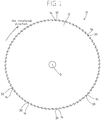
- the circular saw blade 10 includes a substantially circular base metal 12, and each of tips 30 arranged on a plurality of tooth bodies 14 formed at the periphery of the base metal 12.
- the circular saw blade 10 rotates in a predetermined direction around an axis that passes through a rotation center O of the base metal 12. Under the rotation of the circular saw blade 10, a workpiece (an object to be cut) is cut with the cutting edges 32 formed on the tips 30.
- the base metal 12 is made of a steel, such as a carbon tool steel and an alloy tool steel, and each the tooth body 14 is formed on the body portion of the base metal 12 such that they protrude radially outwardly therefrom.
- the tooth bodies 14 are formed in the peripheral portion of the base metal 12 to be spaced apart from one another at regular intervals or at irregular intervals in the rotational direction (peripheral direction).
- a gullet 16 is also formed in front of each tip 30 in the rotational direction between the tooth bodies 14, 14 adjacent to each other in the rotational direction. The gullet 16 can accommodate chips or the like of the workpiece generated while it is being cut with the tips 30. As shown in FIG.
- the base metal 12 includes installation portions 18 each formed on the front side in the rotational direction of the tooth bodies 14.
- the tips 30 are housed in the respective installation portions 18, and the tips 30 are brazed to the base metal 12.
- the installation portion 18 of the Embodiment is defined by a longitudinal wall surface 18a, which is formed in such a manner to radially extend corresponding to conform to the back surface 34 on the back side of the tip 30 in the rotational direction and a recessed surface 18b, which is formed in such a manner to be further recessed radially inward than a gullet bottom 17 corresponding to a basal portion 31 of the tip 30.
- the plurality of tooth bodies 14 are formed in the same shape, and the plurality of tips 30 are formed in the same shape, so that all the gullet 16 have the same shape.
- the tip 30 is a block-like article composed of a simple substance, such as cemented carbide, cermet, CBN (cubic boron nitride) or polycrystalline diamond, or of a composite of these substances.
- the tip 30 may have a coating on its external surface.
- the coating may be of a single-layered structure, or of a multi-layered structure of the same or different substances. Examples of such layer(s) include a layer of metal, nitride, carbide, carbonitride, oxide, and oxynitride, containing one or more elements, such as chrome, titanium, and aluminum.
- the back surface 34 of the tips 30 is joined to the longitudinal wall surface 18a and the periphery of the basal portion 31 thereof is joined to a recessed surface 18b.
- Both side surfaces 36, 36 of the tips 30, which face the width direction (the direction along the rotation axis of the circular saw blade 10), and the clearance face 38 thereof formed on the outer periphery facing outward in the radial direction, are exposed from the base metal 12.
- the tip 30 is formed such that the size in the width direction is slightly larger than the thickness of the base metal 12.
- the tip 30 is also formed such that each side surface 36 is flat, and both side surfaces 36, 36 gradually separate in the radially outward direction.
- the tip 30 of the Embodiment has a wider width on the side of the cutting edge 32 than on the side of the basal portion 31.
- the front edge in the clearance face 38 in the rotational direction of the tip 30 is the cutting edge 32, and the first rake face 40, which faces in the rotational direction, is formed contiguous with this cutting edge 32.
- the clearance face 38 is formed such that it is gradually inclined in the direction opposite the rotational direction radially inward from the cutting edge 32 relative to the surface perpendicular to the virtual first reference line L1, which connects the rotation center O with the cutting edge 32 in a straight line.
- the cutting edge 32 may be a straight edge as shown in FIG. 2 , or may be in the form of a chevron that tapers radially inward from the center portion in the width direction, or may be in the other forms.
- a round notch 38a may also be provided in the clearance face 38 to divide chips (see FIG. 3 ).
- a round notch 38a which is recessed radially inward, is formed over the entire length of the clearance face 38 in the rotational direction, and is disposed off the center in the width direction.
- the two corners of the clearance face 38 in the width direction are chamfered.
- the first rake face 40 is flat across the entire surface in the radial and width directions, and is formed such that the first rake angle ⁇ 1 is a negative angle relative to the first reference line L1. In other words, the first rake face 40 is formed such that it is inclined in the rotational direction from the outside toward the inside in the radial direction.
- the second rake face 42 is formed further inward radially than the first rake face 40, and faces a gullet 16, which is formed in front of the tip in the rotational direction.
- the radially inward inner edge contacts the outer peripheral edge of the base metal 12 that defines the gullet 16.
- the inner edge is in contact with the gullet bottom 17, which extends substantially along the rotational direction.
- the borderline P between the tip 30 that is exposed in the gullet 16 and the outer peripheral edge of the base metal 12 is formed at the intersection of the second rake face 42 and the gullet bottom 17. As shown in FIG.
- the first rake face 40 of the tip 30 may be contiguous with the second rake face 42, or one or more supplementary rake faces may be provided between the first rake face 40 and the second rake face 42.
- the second rake face 42 may be flat across the entire surface in the radial and width directions, or may be a radially curved surface so that the surface facing the gullet 16 may be concave or convex.
- the second rake face 42 is formed such that the second rake angle ⁇ 2 formed between the first reference line L1 and the second reference line L2, which is a virtual straight line that is collinear with the second rake face 42 and extends beyond the second rake face 42 passing through the inner edge of the second rake face 42, is a negative angle.
- the second rake face 42 is inclined in the rotational direction relative to the first reference line L1 from the outside toward the inside in the radial direction, so that the second rake face 42 is not in parallel with the first reference line L1.
- the second reference line L2 is collinear with the second rake face 42, and when the second rake face 42 is a curved surface, the second reference line L2 is a tangent line that passes the inner edge.
- the second rake face 42 is formed so that the angle ⁇ 3, which is formed between a third virtual reference line L3 that connects the rotation center O of the circular saw blade 10 with the inner edge of the second rake face 42 in a straight line and the second reference line L2, is also a negative angle.
- the second rake face 42 is inclined at a different angle from that of the first rake face 40, and the second rake angle ⁇ 2 is preferably formed larger on the positive side than the first rake angle ⁇ 1 (
- the second rake face 42 (the second reference line L2) is formed such that it is inclined in the direction opposite the rotational direction (on the positive side) relative to the first rake face 40.
- the second rake face 42 is preferably inclined in the range of 5° to 45° on the positive side relative to the first rake face 40.
- the second rake face 42 of the Embodiment is formed to have a radially larger size than that of the first rake face 40.
- the tip 30 is also formed such that the back surface 34 is in parallel with the first reference line L1 or is inclined in the rotational direction from the outside toward the inside in the radial direction.
- the tip 30 may have the same width between the second rake face 42 and the back surface 34 in the rotational direction across the entire radial direction, the width of the tip preferably widens from the outside toward the inside in the radial direction as shown in FIG. 2 .
- the tip 30 of the Embodiment has a basal portion 31, on its radially inward side, that extends inward radially of the inner edge of the second rake face 42.
- a slant 44 is formed contiguously with the inner edge of the second rake face 42 on the periphery of the basal portion 31 on the radially inward side of the inner edge such that the slant 44 is inclined in the direction opposite the rotational direction relative to the second reference line L2.
- the slant 44 is inclined radially inward from the inner edge of the second rake face 42 in the direction opposite the rotational direction (positive side), so that it forms an angle of slant ⁇ 4, which is a positive angle relative to the first reference line L1.
- the slant 44 forms a positive angle relative to the second reference line L2 as well.
- a bottom surface 46 is provided that is contiguous with the slant 44 such that the bottom surface 46 lies radially inward of the slant 44 and is orthogonal to the first reference line L1.
- a slope 48 is formed between the back surface 34 and the bottom surface 46. The slope 48 is inclined forward (negative side) in the rotational direction 34 from the back surface toward radially inward side so that it forms a negative angle relative to the first reference line L1.
- the periphery of the basal portion 31 is formed in such a shape as if its front and back corners have been chamfered in the rotational direction. The resultant multifaceted periphery is fitted into the recessed surface 18b of the installation portion 18.
- the outer peripheral edge 14a of a tooth body 14 is contiguous with the back surface 34 of the tip 30, which is positioned on the front side in the rotational direction, and the outer peripheral edge 14a of a tooth body 14 extends radially inward of the cutting edge 32 of the tip 30.
- the outer peripheral edge 14a of the tooth body 14 is formed such that it is inclined radially outward from the gullet 16 side toward the front side in the rotational direction.
- a protrusion 20 is formed such that it protrudes radially outward from the outer peripheral edge 14a, and the radially outward top of the protrusion 20 is positioned radially inward of the cutting edge 32 of the tip 30.
- the protrusion 20 is provided on the front side of the gullet 16 in the rotational direction, and the top of the protrusion is preferably formed within 1.5 mm radially inward of the rotational track of the cutting edge 32 of the tip 30.
- the protrusion 20 of the Embodiment protrudes like a lump from the outer peripheral edge of the tooth body 14, and the top is formed like an arc.
- the protrusion 20 is formed such that its periphery in the rotational direction is inclined radially inward of its top in the rotational direction.
- the second rake face 42 facing the gullet 16 is inclined at a negative angle relative to the first reference line L1, so that chips or the like caught in the gullet 16 can be discharged from the gullet 16 because of the inclination of the second rake face 42. That is, the circular saw blade 10 having tips 30 with the above-described second rake face 42 can reduce the impact at the borderline P between the tip 30 that is exposed in the gullet 16 and the base metal 12 of the gullet 16.
- the second rake face 42 is inclined at a negative angle relative to the first reference line L1, it can prevent the impact created when chips or the like strike the front surface of the tip 30 in the rotational direction from concentrating on the borderline P between the tip 30 and the base metal 12.
- this can reduce the load applied on the borderline P between the tip 30 and the base metal 12 in the circular saw blade 10, which is relatively weak in strength.
- This can reduce detachment of the tip 30 from the base metal 12 as a result of breakage of the joint portion in the borderline P or the damage to the tip itself due to the concentration of stress.
- this enables easy cutting of even a workpiece such as a tubular steel pipe that has been produced by welding the edges of rolled steel plates and inside of which not only chips but also weld beads are likely to remain during cutting. Since the circular saw blade 10 has a second rake face 42 inclined at a negative angle on the positive side relative to the first rake face 40, the load on borderline P between the tip 30 and the base metal 12 can be further reduced.
- the basal portion 31 located radially inward of the second rake face 42 of the tip 30 is fitted into the installation portion 18 of the base metal 12, which is recessed to conform to the basal portion 31, so that not only the back surface 34 but also the periphery of the basal portion 31 are joined to the base metal 12.
- the cutting force applied to the tip 30 is received at the joint portion between the periphery of the basal portion 31 in the tip 30 and the recessed surface 18b of the installation portion 18 in the base metal 12, so that the stress applied at the joint portion during cutting decreases.
- damage of the joint portion at the borderline P can be reduced so that the damage to and the detachment of the tip 30 may be reduced when impact is applied on the borderline P between the second rake face 42 of the tip 30 and the gullet 16 of the base metal 12, compared to configurations in which the bottom surface of the basal portion of the tip 30 lies from the inner edge (the borderline P with the base metal 12) of the second rake face 42 along the rotational direction, or in which the bottom surface of the basal portion inclines radially outward from the inner edge of the second rake face 42 in the direction opposite the rotational direction.
- the basal portion of the tip 30 further has a slant 44 that is formed contiguous to the second rake face 42 and inclined on the positive side relative to the second rake face 42. This reduces the stress applied at the borderline P between the second rake face 42 and the base metal 12 of the tip 30, so that the brazed portion of the tip 30 is less likely to be damaged and the tip 30 is less likely to be detached.
- the periphery of the basal portion 31 is multifaceted and the joint surface of the base metal 12 is formed to conform to the periphery, so that the joint area between the tip 30 and the base metal 12 is increased. This enhances the strength in the joint between the tip 30 and the base metal 12.
- the tip 30 is also formed such that the width between the second rake face 42 and the back surface 34, which are positioned on the front side and on the back side in the rotational direction respectively, increases from the outside toward the inside in the radial direction so that the basal portion 31 joins to the base metal 12 on a wider periphery. This further enhances the strength at the joint between the tip 30 and the base metal 12.
- the circular saw blade 10 is provided with a protrusion 20 that protrudes radially outward on the outer peripheral edge 14a of the tooth body 14 that extends in front of the gullet 16 in the rotational direction.
- the protrusion 20 helps prevent chips from getting caught into the gullet 16 during cutting.
- the protrusion 20 can prevent or reduce biting itself of chips in the gullet 16, which is one of the factors that increase the load on the tip 30, occurrence of damage to the tip 30 and breakage of the base metal 12 around the tip 30, or neck-breaking, may be reduced in the circular saw blade 10.
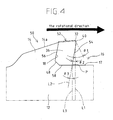
- a test to cut a workpiece was performed using the circular saw blade 10 of the Embodiment as shown in FIGs. 1 to 3 and a circular saw blade 50 of the Comparative Example not according to the invention as shown in FIG. 4 for comparison.
- a carbon steel pipe for mechanical structure STKM13A
- the workpiece has an outer diameter of 50.8 mm and a thickness of 5 mm.
- the circular saw blades 10, 50 of the Embodiment and the Comparative Example both include a base metal 12 having a thickness of 1.7 mm, an outer diameter of 285 mm, and 80 teeth.
- the tips 30, 52 with a cutting edge having a width of 2 mm are brazed on the base metal 12.
- the tips 30, 52 of the Embodiment and the Comparative Example are made of cemented carbide coated with a TiAlN coating on the external surface.
- the width in the radial direction of the first rake face 40 is 0.3 mm and the widths in the radial direction of the second rake faces 42, 54 are the same in both of the tips 30, 52 of the Embodiment and the Comparative Example.
- the first rake face 40 has a first rake angle ⁇ 1 of -25°
- the second rake face 42 has a second rake angle ⁇ 2 of -5°
- the slant 44 has an angle of slant ⁇ 4 of 45°
- the back surface 34 is in parallel with the first reference line L1.
- a protrusion 20 is formed on the front side in the rotational direction of the gullet 16, whereas in the circular saw blade 50 of the Comparative Embodiment, a corresponding protrusion 20 is not provided on the outer peripheral edge 14a of a tooth body 14 extending on the front side in the rotational direction of the gullet 16.
- the first rake face 40 has a first rake angle ⁇ 1 of -25°
- the second rake face 52 has a second rake angle ⁇ 2 of 10°
- the back surface 56 extends in parallel with the second rake face 52.
- the bottom surface 58 extends from the borderline P between the second rake face 42 and the base metal 12 along the rotational direction, and, unlike the Embodiment, the basal portion 31 is not fitted into the base metal 12.
- a workpiece was cut using the circular saw blade 10 of the Embodiment and the circular saw blade 50 the Comparative Example under the conditions of a cutting speed of 358 m/min and a feeding per tooth of 0.07 mm, while supplying a mist. The test was conducted twice using two each of the circular saw blade 10 of the Embodiment and the circular saw blade 50 of the Comparative Example.
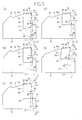
- analytical model 1 of a circular saw blade according to the present invention As shown in FIG. 5 , analytical model 1 of a circular saw blade according to the present invention, analytical models 2 to 4 of circular saw blades not according to the present invention, and analytical model 5 according to the Comparative Example not according to the invention were prepared by the finite element method.
- the main stress applied on the borderline P between the tips 30, 52 and the base metal 12 facing the gullet 16 were analyzed for the respective analytical models 1 to 5.
- Analytical model 1 shown in FIG. 5(a) is set under the same conditions as described above for the Embodiment except that the width of the cutting edge 32 is 3 mm and the tip has no slope 48.
- the analytical model 3 shown in FIG. 5(c) is a tip 30 having the same shape as that of the analytical model 2 except that the basal portion 31 of the tip 30 is not fitted into the base metal 12.
- Analytical model 4 is such that the bottom surface 46 is formed from the second rake face 42 of analytical model 1 along the rotational direction, without the basal portion being fitted into the base metal 12.
- Analytical model 5 as shown in FIG. 5(e) is set under the same conditions as described above for the Comparative Example except that the width of the cutting edge 32 is 3 mm and the tip has no slope 48.
- a force of 30 kgf was applied to the cutting edges of the analytical models of the tips 30, 52 in the direction opposite the rotational direction of the tips, and the main stress applied to the borderline P between the tips 30, 52 and the base metal 12 facing the gullet 16 was calculated.
- the stress was 15.3 kgf/mm 2 for analytical model 1, 16.6 kgf/mm 2 for analytical model 2, 17.3 kgf/mm 2 for analytical model 3, 16.8 kgf/mm 2 for analytical model 4, and 22.5 kgf/mm 2 for analytical model 5.
Landscapes
- Engineering & Computer Science (AREA)
- Mechanical Engineering (AREA)
- Cutting Tools, Boring Holders, And Turrets (AREA)
- Drilling Tools (AREA)
- Processing Of Stones Or Stones Resemblance Materials (AREA)
- Milling Processes (AREA)
- Harvester Elements (AREA)
Applications Claiming Priority (2)
| Application Number | Priority Date | Filing Date | Title |
|---|---|---|---|
| JP2013034207A JP6339764B2 (ja) | 2013-02-25 | 2013-02-25 | 丸鋸 |
| PCT/JP2014/052160 WO2014129285A1 (ja) | 2013-02-25 | 2014-01-30 | 丸鋸 |
Publications (4)
| Publication Number | Publication Date |
|---|---|
| EP2949414A1 EP2949414A1 (en) | 2015-12-02 |
| EP2949414A4 EP2949414A4 (en) | 2016-11-02 |
| EP2949414B1 EP2949414B1 (en) | 2017-12-20 |
| EP2949414B2 true EP2949414B2 (en) | 2020-10-28 |
Family
ID=51391081
Family Applications (1)
| Application Number | Title | Priority Date | Filing Date |
|---|---|---|---|
| EP14754288.0A Active EP2949414B2 (en) | 2013-02-25 | 2014-01-30 | Circular saw blade |
Country Status (5)
| Country | Link |
|---|---|
| US (1) | US20160001383A1 (enExample) |
| EP (1) | EP2949414B2 (enExample) |
| JP (1) | JP6339764B2 (enExample) |
| CN (1) | CN105008077B (enExample) |
| WO (1) | WO2014129285A1 (enExample) |
Cited By (1)
| Publication number | Priority date | Publication date | Assignee | Title |
|---|---|---|---|---|
| PL129948U1 (pl) * | 2018-12-14 | 2023-11-13 | Politechnika Lubelska | Piła z łamaczami wiórów |
Families Citing this family (9)
| Publication number | Priority date | Publication date | Assignee | Title |
|---|---|---|---|---|
| JP6583921B2 (ja) * | 2016-06-30 | 2019-10-02 | 株式会社谷テック | コンポジット材用チップソー |
| CN109963677B (zh) * | 2016-10-18 | 2021-09-07 | 兼房株式会社 | 具有刀尖片的圆锯刀 |
| CN117021258A (zh) * | 2018-09-07 | 2023-11-10 | 大连金河精密工具有限公司 | 单片式开槽刀 |
| JP7260671B2 (ja) * | 2019-12-19 | 2023-04-18 | 兼房株式会社 | チップソー |
| US20230112025A1 (en) | 2020-02-28 | 2023-04-13 | Kanefusa Kabushiki Kaisha | Cicular Saw Blade |
| KR102148275B1 (ko) * | 2020-02-29 | 2020-08-26 | 곽기웅 | 칩배출부재를 갖는 원형톱 |
| DE102020128920A1 (de) * | 2020-11-03 | 2022-05-05 | WIKUS-Sägenfabrik Wilhelm H. Kullmann GmbH & Co. KG | Superlegierungssägeblatt |
| NO347919B1 (en) * | 2023-05-03 | 2024-05-13 | Ra Jacobsen Kenneth | System providing increased cutting accuracy of fibre insulation batts |
| WO2026070982A1 (ja) * | 2024-09-27 | 2026-04-02 | 兼房株式会社 | 丸鋸刃 |
Citations (1)
| Publication number | Priority date | Publication date | Assignee | Title |
|---|---|---|---|---|
| DE102009027896A1 (de) † | 2009-07-21 | 2011-02-03 | WIKUS-Sägenfabrik Wilhelm H. Kullmann GmbH & Co. KG | Sägeblatt mit Zähnen mit einem Spanumformelement |
Family Cites Families (24)
| Publication number | Priority date | Publication date | Assignee | Title |
|---|---|---|---|---|
| GB191321297A (en) * | 1913-09-20 | 1914-04-02 | Elmer Ellsworth Smith | Improvements in Milling Cutters, Circular Saws and like Cutting Devices. |
| DE1957024A1 (de) * | 1969-11-13 | 1971-05-27 | Albert Knebel | Kreissaegeblatt zur Metallbearbeitung mit Zaehnen mit eingesetzten Hartmetallkoerpern |
| US4463645A (en) * | 1983-02-22 | 1984-08-07 | Speedcut, Inc. | Circular saw |
| US4604933A (en) * | 1983-10-28 | 1986-08-12 | North American Products Corp. | Carbide-tipped circular saw for metal cutting at low surface speeds |
| US4784033A (en) * | 1986-01-22 | 1988-11-15 | Milford Products Corporation | Triple chip ground carbide tip bandsaw blade with ductile filler |
| DE3711228A1 (de) * | 1987-04-03 | 1988-10-20 | Wagner Maschf Gustav | Schneidezahn sowie mit solchen schneidezaehnen versehene metallsaegen, insbesondere kreissaegeblaetter |
| DE3943321A1 (de) * | 1988-12-29 | 1990-07-05 | Ryobi Ltd | Schneideinsaetze fuer kreissaegeblaetter |
| JPH07116916A (ja) | 1993-10-25 | 1995-05-09 | Shinkoonan:Kk | ろう付けホットソー及びその製造方法 |
| JPH09216121A (ja) * | 1996-02-14 | 1997-08-19 | Tsune Wagner Carbide:Kk | 丸 鋸 |
| JP3170498B2 (ja) * | 1999-01-29 | 2001-05-28 | 兼房株式会社 | 丸 鋸 |
| US20030233927A1 (en) * | 2002-06-19 | 2003-12-25 | Johnson David N. | Circular saw blade for cutting ferrous materials |
| JP2005059124A (ja) * | 2003-08-08 | 2005-03-10 | Tenryu Saw Mfg Co Ltd | 回転鋸 |
| JP2006289558A (ja) * | 2005-04-12 | 2006-10-26 | Tenryu Saw Mfg Co Ltd | ディスクカッター |
| CN100406177C (zh) * | 2005-11-02 | 2008-07-30 | 天龙制锯株式会社 | 旋转锯 |
| JP4853958B2 (ja) * | 2006-06-28 | 2012-01-11 | 株式会社谷テック | チップソー |
| DE102007022001B4 (de) * | 2007-05-08 | 2011-06-30 | Leitz GmbH & Co. KG, 73447 | Werkzeug zur spanabhebenden Bearbeitung, insbesondere Kreissägeblatt |
| DE102007054600B4 (de) * | 2007-11-15 | 2013-07-25 | WIKUS-Sägenfabrik Wilhelm H. Kullmann GmbH & Co. KG | Sägeblatt mit einem Grundkörper und Zähnen mit Schneiden |
| DE102007054601A1 (de) * | 2007-11-15 | 2009-05-20 | WIKUS-Sägenfabrik Wilhelm H. Kullmann GmbH & Co. KG | Sägeblatt mit einem Grundkörper und Zähnen mit Schneiden |
| JP4522472B2 (ja) * | 2008-12-08 | 2010-08-11 | リョービ株式会社 | 切断機の複合鋸刃 |
| JP5582386B2 (ja) * | 2010-02-17 | 2014-09-03 | 株式会社トリガー | チップソー及びその製造方法 |
| JP5600029B2 (ja) * | 2010-04-19 | 2014-10-01 | アクトテック株式会社 | 回転鋸 |
| US8695465B2 (en) * | 2010-08-18 | 2014-04-15 | Advanced Machine & Engineering Co. | Saw blade stabilizer and method |
| CN202367276U (zh) * | 2011-12-23 | 2012-08-08 | 佛山市南海日东工具制造有限公司 | 抗变形耐切割不掉齿的新型切铁锯片 |
| WO2013098963A1 (ja) * | 2011-12-27 | 2013-07-04 | 株式会社谷テック | 金属切断用チップソー |
-
2013
- 2013-02-25 JP JP2013034207A patent/JP6339764B2/ja active Active
-
2014
- 2014-01-30 CN CN201480010372.0A patent/CN105008077B/zh active Active
- 2014-01-30 WO PCT/JP2014/052160 patent/WO2014129285A1/ja not_active Ceased
- 2014-01-30 EP EP14754288.0A patent/EP2949414B2/en active Active
- 2014-01-30 US US14/767,204 patent/US20160001383A1/en not_active Abandoned
Patent Citations (1)
| Publication number | Priority date | Publication date | Assignee | Title |
|---|---|---|---|---|
| DE102009027896A1 (de) † | 2009-07-21 | 2011-02-03 | WIKUS-Sägenfabrik Wilhelm H. Kullmann GmbH & Co. KG | Sägeblatt mit Zähnen mit einem Spanumformelement |
Cited By (1)
| Publication number | Priority date | Publication date | Assignee | Title |
|---|---|---|---|---|
| PL129948U1 (pl) * | 2018-12-14 | 2023-11-13 | Politechnika Lubelska | Piła z łamaczami wiórów |
Also Published As
| Publication number | Publication date |
|---|---|
| WO2014129285A1 (ja) | 2014-08-28 |
| CN105008077A (zh) | 2015-10-28 |
| US20160001383A1 (en) | 2016-01-07 |
| CN105008077B (zh) | 2018-04-24 |
| EP2949414B1 (en) | 2017-12-20 |
| JP2014161942A (ja) | 2014-09-08 |
| EP2949414A4 (en) | 2016-11-02 |
| JP6339764B2 (ja) | 2018-06-06 |
| EP2949414A1 (en) | 2015-12-02 |
Similar Documents
| Publication | Publication Date | Title |
|---|---|---|
| EP2949414B1 (en) | Circular saw blade | |
| EP2100683B1 (en) | End mill | |
| CN102123810B (zh) | 锯片及其制造方法 | |
| EP2379262B1 (en) | End mill for orbital drilling | |
| US8579556B2 (en) | Insert for drill, drill and method of cutting work material | |
| KR101478695B1 (ko) | 절삭 인서트와 절삭 공구, 및 그것들을 사용한 절삭 가공물의 제조 방법 | |
| US20130199353A1 (en) | Saw tooth for circular saw | |
| EP2272611A1 (en) | Deep-hole boring throwaway tip, and deep-hole boring drill head | |
| US20110027025A1 (en) | Tool body of plunge cutting cutter, plunge cutting cutter, and plunge cutting method | |
| WO2022181123A1 (ja) | 切削インサートおよび刃先交換式切削工具 | |
| EP3603862B1 (en) | Milling tool | |
| JP4941082B2 (ja) | スローアウェイ式切削工具およびこれに装着される切刃チップ | |
| JP2006015418A (ja) | 縦送り加工用エンドミル | |
| JP2004276142A (ja) | エンドミル | |
| WO2010148471A1 (en) | Saw tooth tip | |
| JP4090248B2 (ja) | 深孔切削用スローアウエイチップと深孔切削用スローアウエイドリル | |
| JP2008110453A (ja) | エンドミル | |
| JP4608933B2 (ja) | ドリル、スローアウェイ式ドリル及びスローアウェイチップ | |
| JP4090493B2 (ja) | 深孔切削用ドリルを用いた深孔切削方法 | |
| JP2011101928A (ja) | 鑞付けドリル | |
| JPH0516971B2 (enExample) | ||
| JP7535353B1 (ja) | 金属切断用丸鋸のチップおよびその製造方法 | |
| JP4055141B2 (ja) | ドリル、スローアウェイ式ドリル及びスローアウェイチップ | |
| JP3995952B2 (ja) | 深孔切削用ドリル | |
| WO2013015404A1 (ja) | 刃先交換式回転切削工具およびこれに用いる切削インサート |
Legal Events
| Date | Code | Title | Description |
|---|---|---|---|
| PUAI | Public reference made under article 153(3) epc to a published international application that has entered the european phase |
Free format text: ORIGINAL CODE: 0009012 |
|
| 17P | Request for examination filed |
Effective date: 20150825 |
|
| AK | Designated contracting states |
Kind code of ref document: A1 Designated state(s): AL AT BE BG CH CY CZ DE DK EE ES FI FR GB GR HR HU IE IS IT LI LT LU LV MC MK MT NL NO PL PT RO RS SE SI SK SM TR |
|
| AX | Request for extension of the european patent |
Extension state: BA ME |
|
| DAX | Request for extension of the european patent (deleted) | ||
| A4 | Supplementary search report drawn up and despatched |
Effective date: 20160929 |
|
| RIC1 | Information provided on ipc code assigned before grant |
Ipc: B23D 61/04 20060101AFI20160923BHEP Ipc: B23D 61/02 20060101ALI20160923BHEP |
|
| GRAP | Despatch of communication of intention to grant a patent |
Free format text: ORIGINAL CODE: EPIDOSNIGR1 |
|
| INTG | Intention to grant announced |
Effective date: 20170623 |
|
| GRAS | Grant fee paid |
Free format text: ORIGINAL CODE: EPIDOSNIGR3 |
|
| GRAA | (expected) grant |
Free format text: ORIGINAL CODE: 0009210 |
|
| AK | Designated contracting states |
Kind code of ref document: B1 Designated state(s): AL AT BE BG CH CY CZ DE DK EE ES FI FR GB GR HR HU IE IS IT LI LT LU LV MC MK MT NL NO PL PT RO RS SE SI SK SM TR |
|
| REG | Reference to a national code |
Ref country code: GB Ref legal event code: FG4D |
|
| REG | Reference to a national code |
Ref country code: CH Ref legal event code: EP |
|
| REG | Reference to a national code |
Ref country code: IE Ref legal event code: FG4D |
|
| REG | Reference to a national code |
Ref country code: AT Ref legal event code: REF Ref document number: 955919 Country of ref document: AT Kind code of ref document: T Effective date: 20180115 |
|
| REG | Reference to a national code |
Ref country code: FR Ref legal event code: PLFP Year of fee payment: 5 |
|
| REG | Reference to a national code |
Ref country code: DE Ref legal event code: R096 Ref document number: 602014018809 Country of ref document: DE |
|
| REG | Reference to a national code |
Ref country code: NL Ref legal event code: FP |
|
| PG25 | Lapsed in a contracting state [announced via postgrant information from national office to epo] |
Ref country code: SE Free format text: LAPSE BECAUSE OF FAILURE TO SUBMIT A TRANSLATION OF THE DESCRIPTION OR TO PAY THE FEE WITHIN THE PRESCRIBED TIME-LIMIT Effective date: 20171220 Ref country code: NO Free format text: LAPSE BECAUSE OF FAILURE TO SUBMIT A TRANSLATION OF THE DESCRIPTION OR TO PAY THE FEE WITHIN THE PRESCRIBED TIME-LIMIT Effective date: 20180320 Ref country code: LT Free format text: LAPSE BECAUSE OF FAILURE TO SUBMIT A TRANSLATION OF THE DESCRIPTION OR TO PAY THE FEE WITHIN THE PRESCRIBED TIME-LIMIT Effective date: 20171220 Ref country code: FI Free format text: LAPSE BECAUSE OF FAILURE TO SUBMIT A TRANSLATION OF THE DESCRIPTION OR TO PAY THE FEE WITHIN THE PRESCRIBED TIME-LIMIT Effective date: 20171220 |
|
| REG | Reference to a national code |
Ref country code: LT Ref legal event code: MG4D |
|
| REG | Reference to a national code |
Ref country code: AT Ref legal event code: MK05 Ref document number: 955919 Country of ref document: AT Kind code of ref document: T Effective date: 20171220 |
|
| PG25 | Lapsed in a contracting state [announced via postgrant information from national office to epo] |
Ref country code: HR Free format text: LAPSE BECAUSE OF FAILURE TO SUBMIT A TRANSLATION OF THE DESCRIPTION OR TO PAY THE FEE WITHIN THE PRESCRIBED TIME-LIMIT Effective date: 20171220 Ref country code: BG Free format text: LAPSE BECAUSE OF FAILURE TO SUBMIT A TRANSLATION OF THE DESCRIPTION OR TO PAY THE FEE WITHIN THE PRESCRIBED TIME-LIMIT Effective date: 20180320 Ref country code: GR Free format text: LAPSE BECAUSE OF FAILURE TO SUBMIT A TRANSLATION OF THE DESCRIPTION OR TO PAY THE FEE WITHIN THE PRESCRIBED TIME-LIMIT Effective date: 20180321 Ref country code: LV Free format text: LAPSE BECAUSE OF FAILURE TO SUBMIT A TRANSLATION OF THE DESCRIPTION OR TO PAY THE FEE WITHIN THE PRESCRIBED TIME-LIMIT Effective date: 20171220 Ref country code: RS Free format text: LAPSE BECAUSE OF FAILURE TO SUBMIT A TRANSLATION OF THE DESCRIPTION OR TO PAY THE FEE WITHIN THE PRESCRIBED TIME-LIMIT Effective date: 20171220 |
|
| PG25 | Lapsed in a contracting state [announced via postgrant information from national office to epo] |
Ref country code: ES Free format text: LAPSE BECAUSE OF FAILURE TO SUBMIT A TRANSLATION OF THE DESCRIPTION OR TO PAY THE FEE WITHIN THE PRESCRIBED TIME-LIMIT Effective date: 20171220 Ref country code: SK Free format text: LAPSE BECAUSE OF FAILURE TO SUBMIT A TRANSLATION OF THE DESCRIPTION OR TO PAY THE FEE WITHIN THE PRESCRIBED TIME-LIMIT Effective date: 20171220 Ref country code: CZ Free format text: LAPSE BECAUSE OF FAILURE TO SUBMIT A TRANSLATION OF THE DESCRIPTION OR TO PAY THE FEE WITHIN THE PRESCRIBED TIME-LIMIT Effective date: 20171220 Ref country code: CY Free format text: LAPSE BECAUSE OF FAILURE TO SUBMIT A TRANSLATION OF THE DESCRIPTION OR TO PAY THE FEE WITHIN THE PRESCRIBED TIME-LIMIT Effective date: 20171220 Ref country code: EE Free format text: LAPSE BECAUSE OF FAILURE TO SUBMIT A TRANSLATION OF THE DESCRIPTION OR TO PAY THE FEE WITHIN THE PRESCRIBED TIME-LIMIT Effective date: 20171220 |
|
| PG25 | Lapsed in a contracting state [announced via postgrant information from national office to epo] |
Ref country code: PL Free format text: LAPSE BECAUSE OF FAILURE TO SUBMIT A TRANSLATION OF THE DESCRIPTION OR TO PAY THE FEE WITHIN THE PRESCRIBED TIME-LIMIT Effective date: 20171220 Ref country code: RO Free format text: LAPSE BECAUSE OF FAILURE TO SUBMIT A TRANSLATION OF THE DESCRIPTION OR TO PAY THE FEE WITHIN THE PRESCRIBED TIME-LIMIT Effective date: 20171220 Ref country code: IS Free format text: LAPSE BECAUSE OF FAILURE TO SUBMIT A TRANSLATION OF THE DESCRIPTION OR TO PAY THE FEE WITHIN THE PRESCRIBED TIME-LIMIT Effective date: 20180420 Ref country code: AT Free format text: LAPSE BECAUSE OF FAILURE TO SUBMIT A TRANSLATION OF THE DESCRIPTION OR TO PAY THE FEE WITHIN THE PRESCRIBED TIME-LIMIT Effective date: 20171220 Ref country code: SM Free format text: LAPSE BECAUSE OF FAILURE TO SUBMIT A TRANSLATION OF THE DESCRIPTION OR TO PAY THE FEE WITHIN THE PRESCRIBED TIME-LIMIT Effective date: 20171220 |
|
| REG | Reference to a national code |
Ref country code: CH Ref legal event code: PL |
|
| REG | Reference to a national code |
Ref country code: DE Ref legal event code: R026 Ref document number: 602014018809 Country of ref document: DE |
|
| PG25 | Lapsed in a contracting state [announced via postgrant information from national office to epo] |
Ref country code: MC Free format text: LAPSE BECAUSE OF FAILURE TO SUBMIT A TRANSLATION OF THE DESCRIPTION OR TO PAY THE FEE WITHIN THE PRESCRIBED TIME-LIMIT Effective date: 20171220 |
|
| PLBI | Opposition filed |
Free format text: ORIGINAL CODE: 0009260 |
|
| PLAX | Notice of opposition and request to file observation + time limit sent |
Free format text: ORIGINAL CODE: EPIDOSNOBS2 |
|
| PG25 | Lapsed in a contracting state [announced via postgrant information from national office to epo] |
Ref country code: LU Free format text: LAPSE BECAUSE OF NON-PAYMENT OF DUE FEES Effective date: 20180130 |
|
| REG | Reference to a national code |
Ref country code: IE Ref legal event code: MM4A |
|
| 26 | Opposition filed |
Opponent name: WIKUS-SAEGENFABRIK WILHELM H. KULLMANN GMBH & CO. Effective date: 20180919 |
|
| REG | Reference to a national code |
Ref country code: BE Ref legal event code: MM Effective date: 20180131 |
|
| PG25 | Lapsed in a contracting state [announced via postgrant information from national office to epo] |
Ref country code: CH Free format text: LAPSE BECAUSE OF NON-PAYMENT OF DUE FEES Effective date: 20180131 Ref country code: LI Free format text: LAPSE BECAUSE OF NON-PAYMENT OF DUE FEES Effective date: 20180131 Ref country code: BE Free format text: LAPSE BECAUSE OF NON-PAYMENT OF DUE FEES Effective date: 20180131 Ref country code: DK Free format text: LAPSE BECAUSE OF FAILURE TO SUBMIT A TRANSLATION OF THE DESCRIPTION OR TO PAY THE FEE WITHIN THE PRESCRIBED TIME-LIMIT Effective date: 20171220 |
|
| PG25 | Lapsed in a contracting state [announced via postgrant information from national office to epo] |
Ref country code: IE Free format text: LAPSE BECAUSE OF NON-PAYMENT OF DUE FEES Effective date: 20180130 |
|
| PLBB | Reply of patent proprietor to notice(s) of opposition received |
Free format text: ORIGINAL CODE: EPIDOSNOBS3 |
|
| PG25 | Lapsed in a contracting state [announced via postgrant information from national office to epo] |
Ref country code: SI Free format text: LAPSE BECAUSE OF FAILURE TO SUBMIT A TRANSLATION OF THE DESCRIPTION OR TO PAY THE FEE WITHIN THE PRESCRIBED TIME-LIMIT Effective date: 20171220 |
|
| PG25 | Lapsed in a contracting state [announced via postgrant information from national office to epo] |
Ref country code: MT Free format text: LAPSE BECAUSE OF NON-PAYMENT OF DUE FEES Effective date: 20180130 |
|
| PG25 | Lapsed in a contracting state [announced via postgrant information from national office to epo] |
Ref country code: TR Free format text: LAPSE BECAUSE OF FAILURE TO SUBMIT A TRANSLATION OF THE DESCRIPTION OR TO PAY THE FEE WITHIN THE PRESCRIBED TIME-LIMIT Effective date: 20171220 |
|
| PG25 | Lapsed in a contracting state [announced via postgrant information from national office to epo] |
Ref country code: PT Free format text: LAPSE BECAUSE OF FAILURE TO SUBMIT A TRANSLATION OF THE DESCRIPTION OR TO PAY THE FEE WITHIN THE PRESCRIBED TIME-LIMIT Effective date: 20171220 |
|
| PG25 | Lapsed in a contracting state [announced via postgrant information from national office to epo] |
Ref country code: HU Free format text: LAPSE BECAUSE OF FAILURE TO SUBMIT A TRANSLATION OF THE DESCRIPTION OR TO PAY THE FEE WITHIN THE PRESCRIBED TIME-LIMIT; INVALID AB INITIO Effective date: 20140130 Ref country code: MK Free format text: LAPSE BECAUSE OF NON-PAYMENT OF DUE FEES Effective date: 20171220 |
|
| PG25 | Lapsed in a contracting state [announced via postgrant information from national office to epo] |
Ref country code: AL Free format text: LAPSE BECAUSE OF FAILURE TO SUBMIT A TRANSLATION OF THE DESCRIPTION OR TO PAY THE FEE WITHIN THE PRESCRIBED TIME-LIMIT Effective date: 20171220 |
|
| PUAH | Patent maintained in amended form |
Free format text: ORIGINAL CODE: 0009272 |
|
| STAA | Information on the status of an ep patent application or granted ep patent |
Free format text: STATUS: PATENT MAINTAINED AS AMENDED |
|
| 27A | Patent maintained in amended form |
Effective date: 20201028 |
|
| AK | Designated contracting states |
Kind code of ref document: B2 Designated state(s): AL AT BE BG CH CY CZ DE DK EE ES FI FR GB GR HR HU IE IS IT LI LT LU LV MC MK MT NL NO PL PT RO RS SE SI SK SM TR |
|
| REG | Reference to a national code |
Ref country code: DE Ref legal event code: R102 Ref document number: 602014018809 Country of ref document: DE |
|
| REG | Reference to a national code |
Ref country code: NL Ref legal event code: FP |
|
| PGFP | Annual fee paid to national office [announced via postgrant information from national office to epo] |
Ref country code: NL Payment date: 20260121 Year of fee payment: 13 |
|
| PGFP | Annual fee paid to national office [announced via postgrant information from national office to epo] |
Ref country code: GB Payment date: 20260123 Year of fee payment: 13 |
|
| PGFP | Annual fee paid to national office [announced via postgrant information from national office to epo] |
Ref country code: DE Payment date: 20260121 Year of fee payment: 13 |
|
| PGFP | Annual fee paid to national office [announced via postgrant information from national office to epo] |
Ref country code: IT Payment date: 20260126 Year of fee payment: 13 |
|
| PGFP | Annual fee paid to national office [announced via postgrant information from national office to epo] |
Ref country code: FR Payment date: 20260123 Year of fee payment: 13 |