EP2933844B1 - Verkapselungsmaterialfilm - Google Patents
Verkapselungsmaterialfilm Download PDFInfo
- Publication number
- EP2933844B1 EP2933844B1 EP13869433.6A EP13869433A EP2933844B1 EP 2933844 B1 EP2933844 B1 EP 2933844B1 EP 13869433 A EP13869433 A EP 13869433A EP 2933844 B1 EP2933844 B1 EP 2933844B1
- Authority
- EP
- European Patent Office
- Prior art keywords
- group
- ethylene
- encapsulant
- olefin resin
- olefin copolymer
- Prior art date
- Legal status (The legal status is an assumption and is not a legal conclusion. Google has not performed a legal analysis and makes no representation as to the accuracy of the status listed.)
- Active
Links
Images

Classifications
-
- C—CHEMISTRY; METALLURGY
- C08—ORGANIC MACROMOLECULAR COMPOUNDS; THEIR PREPARATION OR CHEMICAL WORKING-UP; COMPOSITIONS BASED THEREON
- C08F—MACROMOLECULAR COMPOUNDS OBTAINED BY REACTIONS ONLY INVOLVING CARBON-TO-CARBON UNSATURATED BONDS
- C08F8/00—Chemical modification by after-treatment
- C08F8/42—Introducing metal atoms or metal-containing groups
-
- C—CHEMISTRY; METALLURGY
- C08—ORGANIC MACROMOLECULAR COMPOUNDS; THEIR PREPARATION OR CHEMICAL WORKING-UP; COMPOSITIONS BASED THEREON
- C08F—MACROMOLECULAR COMPOUNDS OBTAINED BY REACTIONS ONLY INVOLVING CARBON-TO-CARBON UNSATURATED BONDS
- C08F210/00—Copolymers of unsaturated aliphatic hydrocarbons having only one carbon-to-carbon double bond
- C08F210/16—Copolymers of ethene with alpha-alkenes, e.g. EP rubbers
-
- C—CHEMISTRY; METALLURGY
- C08—ORGANIC MACROMOLECULAR COMPOUNDS; THEIR PREPARATION OR CHEMICAL WORKING-UP; COMPOSITIONS BASED THEREON
- C08F—MACROMOLECULAR COMPOUNDS OBTAINED BY REACTIONS ONLY INVOLVING CARBON-TO-CARBON UNSATURATED BONDS
- C08F255/00—Macromolecular compounds obtained by polymerising monomers on to polymers of hydrocarbons as defined in group C08F10/00
- C08F255/02—Macromolecular compounds obtained by polymerising monomers on to polymers of hydrocarbons as defined in group C08F10/00 on to polymers of olefins having two or three carbon atoms
-
- C—CHEMISTRY; METALLURGY
- C08—ORGANIC MACROMOLECULAR COMPOUNDS; THEIR PREPARATION OR CHEMICAL WORKING-UP; COMPOSITIONS BASED THEREON
- C08J—WORKING-UP; GENERAL PROCESSES OF COMPOUNDING; AFTER-TREATMENT NOT COVERED BY SUBCLASSES C08B, C08C, C08F, C08G or C08H
- C08J5/00—Manufacture of articles or shaped materials containing macromolecular substances
- C08J5/18—Manufacture of films or sheets
-
- C—CHEMISTRY; METALLURGY
- C08—ORGANIC MACROMOLECULAR COMPOUNDS; THEIR PREPARATION OR CHEMICAL WORKING-UP; COMPOSITIONS BASED THEREON
- C08K—Use of inorganic or non-macromolecular organic substances as compounding ingredients
- C08K5/00—Use of organic ingredients
- C08K5/04—Oxygen-containing compounds
- C08K5/13—Phenols; Phenolates
- C08K5/132—Phenols containing keto groups, e.g. benzophenones
-
- C—CHEMISTRY; METALLURGY
- C08—ORGANIC MACROMOLECULAR COMPOUNDS; THEIR PREPARATION OR CHEMICAL WORKING-UP; COMPOSITIONS BASED THEREON
- C08K—Use of inorganic or non-macromolecular organic substances as compounding ingredients
- C08K5/00—Use of organic ingredients
- C08K5/04—Oxygen-containing compounds
- C08K5/13—Phenols; Phenolates
- C08K5/134—Phenols containing ester groups
- C08K5/1345—Carboxylic esters of phenolcarboxylic acids
-
- C—CHEMISTRY; METALLURGY
- C08—ORGANIC MACROMOLECULAR COMPOUNDS; THEIR PREPARATION OR CHEMICAL WORKING-UP; COMPOSITIONS BASED THEREON
- C08K—Use of inorganic or non-macromolecular organic substances as compounding ingredients
- C08K5/00—Use of organic ingredients
- C08K5/04—Oxygen-containing compounds
- C08K5/14—Peroxides
-
- C—CHEMISTRY; METALLURGY
- C08—ORGANIC MACROMOLECULAR COMPOUNDS; THEIR PREPARATION OR CHEMICAL WORKING-UP; COMPOSITIONS BASED THEREON
- C08K—Use of inorganic or non-macromolecular organic substances as compounding ingredients
- C08K5/00—Use of organic ingredients
- C08K5/49—Phosphorus-containing compounds
- C08K5/51—Phosphorus bound to oxygen
- C08K5/52—Phosphorus bound to oxygen only
-
- C—CHEMISTRY; METALLURGY
- C08—ORGANIC MACROMOLECULAR COMPOUNDS; THEIR PREPARATION OR CHEMICAL WORKING-UP; COMPOSITIONS BASED THEREON
- C08K—Use of inorganic or non-macromolecular organic substances as compounding ingredients
- C08K5/00—Use of organic ingredients
- C08K5/54—Silicon-containing compounds
- C08K5/541—Silicon-containing compounds containing oxygen
- C08K5/5425—Silicon-containing compounds containing oxygen containing at least one C=C bond
-
- C—CHEMISTRY; METALLURGY
- C08—ORGANIC MACROMOLECULAR COMPOUNDS; THEIR PREPARATION OR CHEMICAL WORKING-UP; COMPOSITIONS BASED THEREON
- C08K—Use of inorganic or non-macromolecular organic substances as compounding ingredients
- C08K5/00—Use of organic ingredients
- C08K5/54—Silicon-containing compounds
- C08K5/544—Silicon-containing compounds containing nitrogen
-
- C—CHEMISTRY; METALLURGY
- C08—ORGANIC MACROMOLECULAR COMPOUNDS; THEIR PREPARATION OR CHEMICAL WORKING-UP; COMPOSITIONS BASED THEREON
- C08L—COMPOSITIONS OF MACROMOLECULAR COMPOUNDS
- C08L23/00—Compositions of homopolymers or copolymers of unsaturated aliphatic hydrocarbons having only one carbon-to-carbon double bond; Compositions of derivatives of such polymers
-
- C—CHEMISTRY; METALLURGY
- C08—ORGANIC MACROMOLECULAR COMPOUNDS; THEIR PREPARATION OR CHEMICAL WORKING-UP; COMPOSITIONS BASED THEREON
- C08L—COMPOSITIONS OF MACROMOLECULAR COMPOUNDS
- C08L23/00—Compositions of homopolymers or copolymers of unsaturated aliphatic hydrocarbons having only one carbon-to-carbon double bond; Compositions of derivatives of such polymers
- C08L23/02—Compositions of homopolymers or copolymers of unsaturated aliphatic hydrocarbons having only one carbon-to-carbon double bond; Compositions of derivatives of such polymers not modified by chemical after-treatment
- C08L23/04—Homopolymers or copolymers of ethene
- C08L23/08—Copolymers of ethene
-
- C—CHEMISTRY; METALLURGY
- C08—ORGANIC MACROMOLECULAR COMPOUNDS; THEIR PREPARATION OR CHEMICAL WORKING-UP; COMPOSITIONS BASED THEREON
- C08L—COMPOSITIONS OF MACROMOLECULAR COMPOUNDS
- C08L23/00—Compositions of homopolymers or copolymers of unsaturated aliphatic hydrocarbons having only one carbon-to-carbon double bond; Compositions of derivatives of such polymers
- C08L23/02—Compositions of homopolymers or copolymers of unsaturated aliphatic hydrocarbons having only one carbon-to-carbon double bond; Compositions of derivatives of such polymers not modified by chemical after-treatment
- C08L23/04—Homopolymers or copolymers of ethene
- C08L23/08—Copolymers of ethene
- C08L23/0807—Copolymers of ethene with unsaturated hydrocarbons only containing four or more carbon atoms
- C08L23/0815—Copolymers of ethene with unsaturated hydrocarbons only containing four or more carbon atoms with aliphatic 1-olefins containing one carbon-to-carbon double bond
-
- C—CHEMISTRY; METALLURGY
- C08—ORGANIC MACROMOLECULAR COMPOUNDS; THEIR PREPARATION OR CHEMICAL WORKING-UP; COMPOSITIONS BASED THEREON
- C08L—COMPOSITIONS OF MACROMOLECULAR COMPOUNDS
- C08L51/00—Compositions of graft polymers in which the grafted component is obtained by reactions only involving carbon-to-carbon unsaturated bonds; Compositions of derivatives of such polymers
- C08L51/003—Compositions of graft polymers in which the grafted component is obtained by reactions only involving carbon-to-carbon unsaturated bonds; Compositions of derivatives of such polymers grafted on to macromolecular compounds obtained by reactions only involving unsaturated carbon-to-carbon bonds
-
- C—CHEMISTRY; METALLURGY
- C08—ORGANIC MACROMOLECULAR COMPOUNDS; THEIR PREPARATION OR CHEMICAL WORKING-UP; COMPOSITIONS BASED THEREON
- C08L—COMPOSITIONS OF MACROMOLECULAR COMPOUNDS
- C08L51/00—Compositions of graft polymers in which the grafted component is obtained by reactions only involving carbon-to-carbon unsaturated bonds; Compositions of derivatives of such polymers
- C08L51/06—Compositions of graft polymers in which the grafted component is obtained by reactions only involving carbon-to-carbon unsaturated bonds; Compositions of derivatives of such polymers grafted on to homopolymers or copolymers of aliphatic hydrocarbons containing only one carbon-to-carbon double bond
-
- C—CHEMISTRY; METALLURGY
- C09—DYES; PAINTS; POLISHES; NATURAL RESINS; ADHESIVES; COMPOSITIONS NOT OTHERWISE PROVIDED FOR; APPLICATIONS OF MATERIALS NOT OTHERWISE PROVIDED FOR
- C09D—COATING COMPOSITIONS, e.g. PAINTS, VARNISHES OR LACQUERS; FILLING PASTES; CHEMICAL PAINT OR INK REMOVERS; INKS; CORRECTING FLUIDS; WOODSTAINS; PASTES OR SOLIDS FOR COLOURING OR PRINTING; USE OF MATERIALS THEREFOR
- C09D143/00—Coating compositions based on homopolymers or copolymers of compounds having one or more unsaturated aliphatic radicals, each having only one carbon-to-carbon double bond, and containing boron, silicon, phosphorus, selenium, tellurium, or a metal; Coating compositions based on derivatives of such polymers
- C09D143/04—Homopolymers or copolymers of monomers containing silicon
-
- C—CHEMISTRY; METALLURGY
- C09—DYES; PAINTS; POLISHES; NATURAL RESINS; ADHESIVES; COMPOSITIONS NOT OTHERWISE PROVIDED FOR; APPLICATIONS OF MATERIALS NOT OTHERWISE PROVIDED FOR
- C09D—COATING COMPOSITIONS, e.g. PAINTS, VARNISHES OR LACQUERS; FILLING PASTES; CHEMICAL PAINT OR INK REMOVERS; INKS; CORRECTING FLUIDS; WOODSTAINS; PASTES OR SOLIDS FOR COLOURING OR PRINTING; USE OF MATERIALS THEREFOR
- C09D151/00—Coating compositions based on graft polymers in which the grafted component is obtained by reactions only involving carbon-to-carbon unsaturated bonds; Coating compositions based on derivatives of such polymers
- C09D151/06—Coating compositions based on graft polymers in which the grafted component is obtained by reactions only involving carbon-to-carbon unsaturated bonds; Coating compositions based on derivatives of such polymers grafted on to homopolymers or copolymers of aliphatic hydrocarbons containing only one carbon-to-carbon double bond
-
- C—CHEMISTRY; METALLURGY
- C09—DYES; PAINTS; POLISHES; NATURAL RESINS; ADHESIVES; COMPOSITIONS NOT OTHERWISE PROVIDED FOR; APPLICATIONS OF MATERIALS NOT OTHERWISE PROVIDED FOR
- C09J—ADHESIVES; NON-MECHANICAL ASPECTS OF ADHESIVE PROCESSES IN GENERAL; ADHESIVE PROCESSES NOT PROVIDED FOR ELSEWHERE; USE OF MATERIALS AS ADHESIVES
- C09J151/00—Adhesives based on graft polymers in which the grafted component is obtained by reactions only involving carbon-to-carbon unsaturated bonds; Adhesives based on derivatives of such polymers
- C09J151/06—Adhesives based on graft polymers in which the grafted component is obtained by reactions only involving carbon-to-carbon unsaturated bonds; Adhesives based on derivatives of such polymers grafted on to homopolymers or copolymers of aliphatic hydrocarbons containing only one carbon-to-carbon double bond
-
- H—ELECTRICITY
- H10—SEMICONDUCTOR DEVICES; ELECTRIC SOLID-STATE DEVICES NOT OTHERWISE PROVIDED FOR
- H10F—INORGANIC SEMICONDUCTOR DEVICES SENSITIVE TO INFRARED RADIATION, LIGHT, ELECTROMAGNETIC RADIATION OF SHORTER WAVELENGTH OR CORPUSCULAR RADIATION
- H10F19/00—Integrated devices, or assemblies of multiple devices, comprising at least one photovoltaic cell covered by group H10F10/00, e.g. photovoltaic modules
- H10F19/80—Encapsulations or containers for integrated devices, or assemblies of multiple devices, having photovoltaic cells
-
- H—ELECTRICITY
- H10—SEMICONDUCTOR DEVICES; ELECTRIC SOLID-STATE DEVICES NOT OTHERWISE PROVIDED FOR
- H10F—INORGANIC SEMICONDUCTOR DEVICES SENSITIVE TO INFRARED RADIATION, LIGHT, ELECTROMAGNETIC RADIATION OF SHORTER WAVELENGTH OR CORPUSCULAR RADIATION
- H10F19/00—Integrated devices, or assemblies of multiple devices, comprising at least one photovoltaic cell covered by group H10F10/00, e.g. photovoltaic modules
- H10F19/80—Encapsulations or containers for integrated devices, or assemblies of multiple devices, having photovoltaic cells
- H10F19/804—Materials of encapsulations
-
- H—ELECTRICITY
- H10—SEMICONDUCTOR DEVICES; ELECTRIC SOLID-STATE DEVICES NOT OTHERWISE PROVIDED FOR
- H10F—INORGANIC SEMICONDUCTOR DEVICES SENSITIVE TO INFRARED RADIATION, LIGHT, ELECTROMAGNETIC RADIATION OF SHORTER WAVELENGTH OR CORPUSCULAR RADIATION
- H10F19/00—Integrated devices, or assemblies of multiple devices, comprising at least one photovoltaic cell covered by group H10F10/00, e.g. photovoltaic modules
- H10F19/80—Encapsulations or containers for integrated devices, or assemblies of multiple devices, having photovoltaic cells
- H10F19/85—Protective back sheets
-
- H—ELECTRICITY
- H10—SEMICONDUCTOR DEVICES; ELECTRIC SOLID-STATE DEVICES NOT OTHERWISE PROVIDED FOR
- H10W—GENERIC PACKAGES, INTERCONNECTIONS, CONNECTORS OR OTHER CONSTRUCTIONAL DETAILS OF DEVICES COVERED BY CLASS H10
- H10W74/00—Encapsulations, e.g. protective coatings
- H10W74/40—Encapsulations, e.g. protective coatings characterised by their materials
-
- H—ELECTRICITY
- H10—SEMICONDUCTOR DEVICES; ELECTRIC SOLID-STATE DEVICES NOT OTHERWISE PROVIDED FOR
- H10W—GENERIC PACKAGES, INTERCONNECTIONS, CONNECTORS OR OTHER CONSTRUCTIONAL DETAILS OF DEVICES COVERED BY CLASS H10
- H10W74/00—Encapsulations, e.g. protective coatings
- H10W74/40—Encapsulations, e.g. protective coatings characterised by their materials
- H10W74/47—Encapsulations, e.g. protective coatings characterised by their materials comprising organic materials, e.g. plastics or resins
- H10W74/476—Organic materials comprising silicon
-
- C—CHEMISTRY; METALLURGY
- C08—ORGANIC MACROMOLECULAR COMPOUNDS; THEIR PREPARATION OR CHEMICAL WORKING-UP; COMPOSITIONS BASED THEREON
- C08J—WORKING-UP; GENERAL PROCESSES OF COMPOUNDING; AFTER-TREATMENT NOT COVERED BY SUBCLASSES C08B, C08C, C08F, C08G or C08H
- C08J2323/00—Characterised by the use of homopolymers or copolymers of unsaturated aliphatic hydrocarbons having only one carbon-to-carbon double bond; Derivatives of such polymers
- C08J2323/02—Characterised by the use of homopolymers or copolymers of unsaturated aliphatic hydrocarbons having only one carbon-to-carbon double bond; Derivatives of such polymers not modified by chemical after treatment
- C08J2323/04—Homopolymers or copolymers of ethene
- C08J2323/08—Copolymers of ethene
-
- C—CHEMISTRY; METALLURGY
- C08—ORGANIC MACROMOLECULAR COMPOUNDS; THEIR PREPARATION OR CHEMICAL WORKING-UP; COMPOSITIONS BASED THEREON
- C08J—WORKING-UP; GENERAL PROCESSES OF COMPOUNDING; AFTER-TREATMENT NOT COVERED BY SUBCLASSES C08B, C08C, C08F, C08G or C08H
- C08J2451/00—Characterised by the use of graft polymers in which the grafted component is obtained by reactions only involving carbon-to-carbon unsaturated bonds; Derivatives of such polymers
- C08J2451/06—Characterised by the use of graft polymers in which the grafted component is obtained by reactions only involving carbon-to-carbon unsaturated bonds; Derivatives of such polymers grafted on to homopolymers or copolymers of aliphatic hydrocarbons containing only one carbon-to-carbon double bond
-
- C—CHEMISTRY; METALLURGY
- C08—ORGANIC MACROMOLECULAR COMPOUNDS; THEIR PREPARATION OR CHEMICAL WORKING-UP; COMPOSITIONS BASED THEREON
- C08J—WORKING-UP; GENERAL PROCESSES OF COMPOUNDING; AFTER-TREATMENT NOT COVERED BY SUBCLASSES C08B, C08C, C08F, C08G or C08H
- C08J2451/00—Characterised by the use of graft polymers in which the grafted component is obtained by reactions only involving carbon-to-carbon unsaturated bonds; Derivatives of such polymers
- C08J2451/08—Characterised by the use of graft polymers in which the grafted component is obtained by reactions only involving carbon-to-carbon unsaturated bonds; Derivatives of such polymers grafted on to macromolecular compounds obtained otherwise than by reactions only involving carbon-to-carbon unsaturated bonds
-
- C—CHEMISTRY; METALLURGY
- C08—ORGANIC MACROMOLECULAR COMPOUNDS; THEIR PREPARATION OR CHEMICAL WORKING-UP; COMPOSITIONS BASED THEREON
- C08L—COMPOSITIONS OF MACROMOLECULAR COMPOUNDS
- C08L2203/00—Applications
- C08L2203/20—Applications use in electrical or conductive gadgets
- C08L2203/204—Applications use in electrical or conductive gadgets use in solar cells
-
- C—CHEMISTRY; METALLURGY
- C08—ORGANIC MACROMOLECULAR COMPOUNDS; THEIR PREPARATION OR CHEMICAL WORKING-UP; COMPOSITIONS BASED THEREON
- C08L—COMPOSITIONS OF MACROMOLECULAR COMPOUNDS
- C08L2203/00—Applications
- C08L2203/20—Applications use in electrical or conductive gadgets
- C08L2203/206—Applications use in electrical or conductive gadgets use in coating or encapsulating of electronic parts
-
- C—CHEMISTRY; METALLURGY
- C08—ORGANIC MACROMOLECULAR COMPOUNDS; THEIR PREPARATION OR CHEMICAL WORKING-UP; COMPOSITIONS BASED THEREON
- C08L—COMPOSITIONS OF MACROMOLECULAR COMPOUNDS
- C08L2205/00—Polymer mixtures characterised by other features
- C08L2205/02—Polymer mixtures characterised by other features containing two or more polymers of the same C08L -group
- C08L2205/025—Polymer mixtures characterised by other features containing two or more polymers of the same C08L -group containing two or more polymers of the same hierarchy C08L, and differing only in parameters such as density, comonomer content, molecular weight, structure
-
- Y—GENERAL TAGGING OF NEW TECHNOLOGICAL DEVELOPMENTS; GENERAL TAGGING OF CROSS-SECTIONAL TECHNOLOGIES SPANNING OVER SEVERAL SECTIONS OF THE IPC; TECHNICAL SUBJECTS COVERED BY FORMER USPC CROSS-REFERENCE ART COLLECTIONS [XRACs] AND DIGESTS
- Y02—TECHNOLOGIES OR APPLICATIONS FOR MITIGATION OR ADAPTATION AGAINST CLIMATE CHANGE
- Y02E—REDUCTION OF GREENHOUSE GAS [GHG] EMISSIONS, RELATED TO ENERGY GENERATION, TRANSMISSION OR DISTRIBUTION
- Y02E10/00—Energy generation through renewable energy sources
- Y02E10/20—Hydro energy
-
- Y—GENERAL TAGGING OF NEW TECHNOLOGICAL DEVELOPMENTS; GENERAL TAGGING OF CROSS-SECTIONAL TECHNOLOGIES SPANNING OVER SEVERAL SECTIONS OF THE IPC; TECHNICAL SUBJECTS COVERED BY FORMER USPC CROSS-REFERENCE ART COLLECTIONS [XRACs] AND DIGESTS
- Y02—TECHNOLOGIES OR APPLICATIONS FOR MITIGATION OR ADAPTATION AGAINST CLIMATE CHANGE
- Y02E—REDUCTION OF GREENHOUSE GAS [GHG] EMISSIONS, RELATED TO ENERGY GENERATION, TRANSMISSION OR DISTRIBUTION
- Y02E10/00—Energy generation through renewable energy sources
- Y02E10/50—Photovoltaic [PV] energy
Definitions
- Exemplary embodiments of the present application relate to an encapsulant film, a method for manufacturing an encapsulant film, an optoelectronic device, and a method for manufacturing an optoelectronic device.
- An optoelectronic device such as a photovoltaic cell, a light emitting diode (LED), or an organic light emitting diode (OLED) may include an encapsulant configured to encapsulate a light emission or light sensing region of the device.
- LED light emitting diode
- OLED organic light emitting diode
- photovoltaic modules may be typically manufactured using a lamination process of laminating a transparent front substrate serving as a light receiving substrate, an encapsulant, a photovoltaic device, an encapsulant and a back sheet and then heat pressing the laminated body while applying a suction to the laminated body under a vacuum.
- EVA ethylene-vinyl acetate
- the EVA resin exhibits low adhesive strength to elements, such as the front substrate or the back sheet, included in the optoelectronic device and coming in contact with the encapsulant. Therefore, when the modules are exposed to outdoor environments for a long period of time, they have a problem in that their delamination may occur easily. Also, in a method of manufacturing a photovoltaic module using an encapsulant including the EVA resin, the EVA resin may be thermally cracked under hot pressing conditions, resulting in the formation of acetic acid gas, etc. Such acetic acid gas causes problems in that it worsens working environments, has a negative influence on photovoltaic elements or electrodes included in the photovoltaic module, and also causes degradation of the modules and a decline in power generation efficiency, and the like.
- WO 2012/070915 A2 describes an encapsulation composition comprising an ethylene-alpha olefin copolymer having melt flow index (MI) of 0.2 to 50 g/10 min and which satisfies Re ⁇ Rc ⁇ 1.0 where Re represents kee/kec and Rc represents kcc/kce, where kee and kec represent the growth reaction rate constant when ethylene and alpha olefin comonomer respectively are added to a growing chain in which a terminal activating point is an ethylene monomer, and kcc and kce represents a growth reaction rate constant when an alpha olefin comonomer and ethylene monomer respectively are added to a growing chain in which a terminal activating point is an alpha olefin comonomer.
- MI melt flow index
- US 2012/048354 A1 describes a sheet for solar cell encapsulant including (A) an ethylene copolymer selected from la to 5a; and (B) an ethylene copolymer selected from 1b to 3b, the copolymer (A) having a melting point of 90°C or higher and containing constituent unit derived from ethylene: [1a: ethylene-vinyl acetate (VA) copolymer, 2a: ethylene-acrylate copolymer, 3a: high-pressure method low-density polyethylene, 4a: ethylene- ⁇ -olefin copolymer, 5a: ethylene-G(M)A copolymer other than the following-described 1b, 1b: ethylene-G(M)A copolymer, 2b: ethylene-VA-G(M)A copolymer, 3b: ethylene-acrylate-G(M)A copolymer]; wherein in the ethylene copolymer (B), the total ratio of the constituent unit derived from
- EP 2439239 A1 describes an ethylene resin composition that contains a modified product produced by modifying an ethylene polymer (A) that meets all of the following requirements a) to e) with an ethylenically unsaturated silane compound (B): a) the density is 900 to 940 kg/m 3 ; b) the melting peak temperature is 90 to 125°C as determined by DSC; c) the melt flow rate (MFR2) is 0.1 to 100 g/10 minutes as measured at 190°C and a load of 2.16 kg in accordance with JIS K-6721; d) the Mw/Mn ratio is 1.2 to 3.5; and e) the content of metal residues is 0.1 to 50 ppm.
- Exemplary embodiments of the present application are directed to providing an encapsulant film, a method for manufacturing an encapsulant film, an optoelectronic device, and a method for manufacturing an optoelectronic device.
- the present invention relates to a method for manufacturing an encapsulant film, comprising: preparing a modified olefin resin by extrusion reacting an olefin resin composition, which comprises an olefin resin, an unsaturated silane compound, and an aminosilane compound in an amount of 1 to 35 parts by weight based on 100 parts by weight of the unsaturated silane compound, and a radical initiator.
- an olefin resin composition which comprises an olefin resin, an unsaturated silane compound, and an aminosilane compound in an amount of 1 to 35 parts by weight based on 100 parts by weight of the unsaturated silane compound, and a radical initiator.
- the present invention also relates to a an encapsulant film which is obtainable by the method of the invention.
- the present invention further relates to an optoelectronic device comprising: a front substrate; a back sheet; the encapsulant film of the invention laminated between the front substrate and the back sheet; and an optoelectronic element encapsulated by the encapsulant film.
- the present invention also relates to a method for manufacturing an optoelectronic device, comprising: sequentially laminating a front substrate, the encapsulant film of the invention, an optoelectronic element, and a back sheet; and laminating the laminated body at a temperature of 110 to 160°C for 1 to 30 minutes.
- one aspect of the present application provides an encapsulant film for optoelectronic devices having excellent adhesion and durability to a substrate.
- modified olefin resin and “modified ethylene/ ⁇ -olefin copolymer” refer to copolymers including a moiety in which hydrocarbon groups in some silyl groups of an olefin resin engrafted with an unsaturated silane compound are converted into hydroxyl groups and also including a moiety containing an amine functional group, and thus may be used in the same meaning as a copolymer including a branched chain represented by Formula 1 to be described later.
- an ethylene/ ⁇ -olefin copolymer engrafted only with an unsaturated silane compound in the absence of an aminosilane compound is also defined as a "silane-modified olefin resin" or a "silane-modified ethylene/ ⁇ -olefin copolymer”.
- the encapsulant film according to one exemplary embodiment of the present application includes a copolymer to be described later, and thus exhibits excellent adhesion to a front substrate even when laminated at a low lamination temperature.
- the encapsulant film may have a peel strength measured after lamination at a temperature of 110 °C or more, for example, 110 °C, 130 °C, 140 °C, 150 °C or 160 °C of 50 N/15 mm or more, 60 N/15 mm or more, 70 N/15 mm or more, 80 N/15 mm or more, 90 N/15 mm or more, 100 N/15 mm or more, 110 N/15 mm or more, 120 N/15 mm or more, 130 N/15 mm or more, 140 N/15 mm or more, 150 N/15 mm or more, 160 N/15 mm or more, 165 N/15 mm or more, 170 N/15 mm or more, 180 N/15 mm or more, or 200 N/15 mm or more.
- the peel strength of the encapsulant film to the front substrate may be 160 N/15 mm or more, more preferably 180 N/15 mm or more.
- the peel strength to the front substrate may be measured at a peel angle of 90° and a peel rate of 50 mm/min. In this case, the peel strength may vary according to the content of the aminosilane compound to be described later.
- the front substrate may be a glass substrate.
- the adhesion between the encapsulant film and the glass substrate increases with an increasing lamination temperature.
- Equation 1 P represents a peel strength of the encapsulant film with respect to the glass substrate as measured at a peel angle of 90° and a peel rate of 50 mm/min, T L represents a lamination temperature of the encapsulant film and the glass substrate, ⁇ 1 is 1 or more, and ⁇ 1 is 40 or more.
- Equation 1 ⁇ 1 is in a range of 1.5 to 4, and ⁇ 1 is in a range of 50 to 150. More preferably, ⁇ 1 is in a range of 2.5 to 3.3, and ⁇ 1 is in a range of 70 to 130.
- the lamination temperature of the encapsulant film and the glass substrate may be greater than or equal to a temperature of 100 °C, for example, may be 110 °C, 120 °C, 130 °C, 140 °C, 150 °C, 160 °C, or 170 °C. Also, the lamination may be performed for 15 minutes 30 seconds, for example, performed for 5 minutes in a vacuum, for 30 seconds under a pressure condition, and for 10 minutes under a residual pressure condition.
- the encapsulant film according to one exemplary embodiment of the present application satisfies Equation 1, and thus exhibits excellent adhesion with respect to the glass substrate even when laminated at a temperature of 100 °C or more, and particularly at a low temperature of approximately 110 °C. Also, since the adhesive strength significantly increases with an increase in the lamination temperature, the encapsulant film has advantages in that it may be readily applied to a lamination process performed under various lamination conditions, and productivity may be improved, thereby cutting the production costs.
- the encapsulant film according to one exemplary embodiment of the present application may have a yellowness index (hereinafter referred to as "YI") value of 0.5 to 2.5, for example, a YI value of 0.5 to 1.0, 0.5 to 1.5, 1.0 to 1.5, 1.25 to 1.5, or 1.25 to 2.5. As the YI value decreases, the optoelectronic device may have superior power generation efficiency.
- YI yellowness index
- yellowness index refers to a value obtained by quantifying the yellowing phenomenon of the encapsulant film when exposed to ultraviolet (UV) rays, which may be measured using a UV/Vis spectrometer based on the ASTM D1925 standard.
- UV ultraviolet
- the reflectance of the encapsulant film at a wavelength region of 400 nm to 700 nm may be measured using the UV/Vis spectrometer, and the YI value may be calculated from the reflectance of the encapsulant film according to the following Equation 2.
- Equation 2 100 1.28 X CIE ⁇ 1.06 Z CIE / Y CIE
- Equation 2 YI is a value calculated by a UV/Vis spectrometer using a color difference analysis program, and X CIE , Y CIE , and Z CIE are relative values represented by red, green, and blue color coordinates, respectively.
- the encapsulant film according to one exemplary embodiment of the present application has excellent light transmittance.
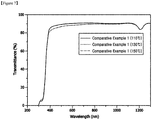
- the encapsulant film may have a total light transmittance value of 90.0 % or more, for example, a total light transmittance value of 91.0% or more, 91.2% or more, 91.3% or more, 91.5% or more, 91.7% or more, 91.9% or more, or 92.1% or more.
- the total light transmittance of the encapsulant film may be adjusted in this total light transmittance range in consideration of the photoelectric efficiency of the optoelectronic device.
- the encapsulant film exhibits excellent transparency since the encapsulant film has a low haze value.
- the encapsulant film may have a haze value of 4.0 % or less, for example 3.5% or less, 3.0% or less, 2.5% or less, 2.0% or less, or 1.5% or less, and the haze value of the encapsulant film may be adjusted within the above-described haze value range in consideration of the photoelectric efficiency of the optoelectronic device.
- the total light transmittance and the haze may be values measured for light with a wavelength of 200 nm or more, for example, light with a wavelength of 300 nm, 350 nm, 400 nm, 450 nm, 500 nm, 550 nm, or 600 nm, using a hazemeter, preferably values measured for light at a wavelength of 550 nm using a hazemeter.
- the total light transmittance and the haze may also be values measured after the encapsulant film is laminated on the glass substrate at a temperature of 110 °C, 130 °C, or 150 °C, but the present application is not limited thereto.
- the total light transmittance may be measured using UV/Vis spectroscopy.
- the total light transmittance may be a value measured for light with a wavelength of 200 nm or more, for example, light with a wavelength range of 200 nm to 1,300 nm, 250 to 1,300 nm, or 300 to 1,100 nm, using UV/Vis spectroscopy.
- the encapsulant film for optoelectronic devices includes a copolymer comprising a main chain including a polymerization unit derived from an olefin-based monomer; and a branched chain bound to the main chain and represented by the following Formula 1.
- the copolymer may be used as an encapsulant for encapsulating elements in various optoelectronic devices, but the present application is not limited thereto.
- the copolymer may be used as an industrial material applied to a heating lamination process, etc.
- R 1 and R 2 each independently represent a halogen, an amine group, -R 4 R 5 , or -R 5 , being bound to a silicon atom, where R 4 represents oxygen or a sulfur atom and R 5 represents hydrogen, an alkyl group, an aryl group, an aralkyl group, or an acyl group, and 1 is an integer of 1 or 2,
- R 3 represents -OSiR 6 m R 7 (2-m) R 8 bound to a silicon atom
- R 6 and R 7 each independently represent a halogen, an amine group, -R 9 R 10 , or - R 10 , being bound to a silicon atom, where R 9 represents oxygen or a sulfur atom and R 10 represents hydrogen, an alkyl group, an aryl group, an aralkyl group, or an acyl group
- R 8 represents -(CH 2 ) n NR 11 R 12 bound to a silicon atom, where R 11 and R 12 each independently represent hydrogen, or R 13
- the copolymer includes a branched chain represented by Formula 1 and engrafted into the main chain including a polymerization unit of the olefin-based monomer, and the branched chain may have a structure including a moiety in which hydrocarbon groups in some silyl groups are converted into hydroxyl groups and also includes a moiety containing an amine functional group.
- the copolymer includes the amine functional group as well as the moiety converted into the hydroxyl group, for example, hydrogen bonds between the amine functional group and the hydroxyl group on a surface of the glass substrate formed below the encapsulant in the optoelectronic device may be formed to give a superior adhesive strength, and many more hydrogen bonds to the back sheet formed of a fluoride resin on the encapsulant may be formed to further give a superior adhesive strength.
- the alkyl group in Formula 1 may have 1 to 20, 1 to 12, 1 to 8, or 1 to 4 carbon atoms, for example, may be a methyl group, an ethyl group, a propyl group, or a butyl group, but the present application is not limited thereto.
- the aryl group may have 6 to 20, 6 to 18, or 6 to 12 carbon atoms, for example, may be a phenyl group, or a naphthyl group, but the present application is not limited thereto.
- the aralkyl group refers to an alkyl group in which at least one hydrogen atom of the hydrocarbon group in the alkyl group are substituted with an aryl radical.
- the aralkyl group may have 7 to 40, 7 to 19, or 7 to 13 carbon atoms.
- the carbon atoms of the aralkyl group refer to the number of the sum of carbon atoms included in both the alkyl group and the aryl radical.
- the alkylene group may be a linear or branched alkylene group having 1 to 16 carbon atoms, 1 to 12 carbon atoms, 1 to 6 carbon atoms, or 1 to 4 carbon atoms, for example, may be an ethylene group, or a propylene group, but the present application is not limited thereto.
- R represents an alkyl group, or an aryl group.
- the acyl group may include formyl, acetyl, propionyl, or benzoyl, but the present application is not limited thereto.
- the alkyl group and the aryl group contained in the acyl group may have the same number of carbon atoms as described above.
- R 1 and R 2 may be a reactive functional group which may be hydrolyzed by accessing moisture present in the system.
- R 1 and/or R 2 may be an alkoxy group, an alkylthio group, an aryloxy group, an acyloxy group, a halogen group, or an amine group.
- examples of the alkoxy group may include an alkoxy group having 1 to 20 carbon atoms, 1 to 12 carbon atoms, 1 to 8 carbon atoms, or 1 to 4 carbon atoms
- examples of the acyloxy group may include an acyloxy group having 1 to 12 carbon atoms, 1 to 8 carbon atoms, or 1 to 4 carbon atoms
- examples of the alkylthio group may include an alkylthio group having 1 to 12 carbon atoms, 1 to 8 carbon atoms, or 1 to 4 carbon atoms.
- R 1 and/or R 2 in Formula 1 may also be an alkoxy group, particularly an alkoxy group having 1 to 12 carbon atoms, or 1 to 8 carbon atoms.
- R 1 and/or R 2 may be an alkoxy group having 1 to 4 carbon atoms, for example, may include a methoxy group, an ethoxy group, a propoxy group, an isopropoxy group, or a butoxy group.
- a methoxy group or an ethoxy group may be used according to some exemplary embodiments.
- R 1 or R 2 may be a non-reactive functional group.
- R 1 or R 2 may be hydrogen, an alkyl group, an aryl group, or an aralkyl group.
- the alkyl group may, for example, be an alkyl group having 1 to 12 carbon atoms, 1 to 8 carbon atoms, or 1 to 4 carbon atoms.
- the aryl group may be an aryl group having 6 to 18 carbon atoms, or 6 to 12 carbon atoms, for example, a phenyl group
- the aralkyl group may be an aralkyl group having 7 to 19 carbon atoms, or 7 to 13 carbon atoms, for example, a benzyl group.
- R 3 is a functional group containing both the above-described moiety converted into the hydroxyl group and the moiety containing the amine functional group.
- the copolymer may exhibit a superior adhesive strength since hydrogen bonds between amine functional groups and hydroxyl groups on a surface of the glass substrate formed below the encapsulant in the optoelectronic device are formed via R 3 .
- the copolymer may exhibit an excellent adhesive strength since more hydrogen bonds with the back sheet formed of a fluoride resin on the encapsulant are formed.
- R 1 and R 2 in Formula 1 may each independently represent a hydroxyl group or -R 4 R 5 bound to a silicon atom, where R 4 may represent oxygen and R 5 may represent an alkyl group, R 3 may represent - OSiR 6 m R 7 (2-m) R 8 bound to a silicon atom, where R 6 and R 7 may each independently represent a hydroxyl group or -R 9 R 10 bound to a silicon atom, where R 9 may represent oxygen and R 10 may represent an alkyl group, and R 8 may represent -(CH 2 ) n NR 11 R 12 bound to a silicon atom, where R 11 and R 12 each independently may represent hydrogen or R 13 NH 2 bound to a nitrogen atom, where R 13 may represent an alkylene group.
- R 1 and R 2 each independently may represent a hydroxyl group
- R 3 may represent -OSiR 6 m R 7 (2-m) R 8 bound to a silicon atom where R 6 and R 7 each independently may represent a hydroxyl group
- R 8 may represent -(CH 2 ) n NR 11 R 12 bound to a silicon atom where R 11 may represent hydrogen and R 12 may represent R 13 NH 2 , and R 13 may represent an alkylene group.
- alkyl group and the alkylene group are the same as described above.
- the copolymer may also further include a branched chain bound to the main chain and represented by the following Formula 2.
- Formula 2 [Formula 2] -SiR 14 o R 15 (3-o)
- R 14 and R 15 each independently represent a halogen, an amine group, -R 16 R 17 or - R 17 bound to a silicon atom, where R 16 represents oxygen or a sulfur atom and R 17 represents hydrogen, an alkyl group, an aryl group, an aralkyl group, or an acyl group, and o is an integer ranging from 1 to 3.
- R 14 and R 15 may each independently represent a hydroxyl group or -R 16 R 17 bound to a silicon atom, where R 16 may represent oxygen and R 17 may represent an alkyl group.
- the rate that some hydrocarbon groups of the silyl group are converted into a hydroxyl group may greatly increase , compared to a copolymer including only the branched chain represented by Formula 2, for example, a copolymer formed by copolymerizing only an unsaturated silane compound containing a vinyl group at the olefin resin.
- the copolymer when included in the encapsulant of the optoelectronic device according to one exemplary embodiment of the present application, more hydrogen bonds between the amine functional groups and the hydroxyl groups on a surface of the glass substrate formed below the encapsulant may be formed, compared to the copolymer including only the branched chain represented by Formula 2, to give a superior adhesive strength. Also, more hydrogen bonds with the back sheet formed of a fluoride resin on the encapsulant may be formed to give an excellent adhesive strength.
- the encapsulant film may exhibit excellent adhesive force to the front substrate since the encapsulant film includes the copolymer.
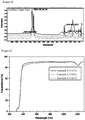
- a moiety (A) in which hydrocarbon groups in some silyl groups included in the copolymer in a polymerized form are converted into hydroxyl groups, and a moiety (B) into which a terminal amine functional group is introduced may be measured by a FT-IR assay, and a level of conversion of a methoxysilyl group (Si-O-CH 3 ) into a silanol group (Si-OH) caused by the promotion of hydrolysis by an aminosilane compound upon lamination of the encapsulant film may also be measured by the FT-IR assay.
- the copolymer may have a ratio (S a /S m ) of a peak area (S a ) of the silanol groups (Si-OH) and amine groups (NH 2 ) in a wavenumber range of 3,100 cm -1 to 3,600 cm -1 to a peak area (S m ) of methylene groups (CH 2 ) in a wavenumber range of 705 cm -1 to 735 cm -1 of 1.5 or more, for example, 2.0 or more, 2.5 or more, 2.85 or more, 3.5 or more, 5.0 or more, 5.25 or more, 6.0 or more, 6.5 or more, or 7.0 or more, as measured by FT-IR using an attenuated total reflection (ATR) method.
- ATR attenuated total reflection
- An upper limit of the peak area ratio (S a /S m ) of the copolymer is not particularly limited.
- the peak area ratio (S a /S m ) of the copolymer may be less than or equal to 10.0, 9.0, or 8.0.
- the peak area (S a ) of the silanol groups (Si-OH) and the amine groups (NH 2 ) of the copolymer measured by FT-IR may increase according to the content of the aminosilane compound.
- the encapsulant film may have a ratio (S a /S m ) of a peak area (S a ) of the silanol groups (Si-OH) and amine groups (NH 2 ) in a wavenumber range of 3,100 cm -1 to 3,600 cm -1 to a peak area (S m ) of the methylene groups (CH 2 ) in a wavenumber range of 705 cm -1 to 735 cm -1 of 0.6 or more, for example, 0.7 or more, 0.8 or more, 0.9 or more, 1.0 or more, 1.1 or more, 1.2 or more, 1.25 or more, 1.5 or more, or 2.0 or more, as measured by FT-IR using the ATR method.
- An upper limit of the peak area ratio (S a /S m ) of the encapsulant film is not particularly limited.
- the peak area ratio (S a /S m ) of the encapsulant film may be less than or equal to 10.0, 9.0, 8.0, 6.0, 5.0, or 4.0.
- the peak area (S a ) of the silanol groups (Si-OH) and the amine groups (NH 2 ) of the encapsulant film measured by FT-IR may increase according to the content of the aminosilane compound.
- the ATR method refers to a method of performing spectroscopic measurements using a phenomenon in which total reflection occurs when a sample (solid or liquid) comes in close contact with a transparent material having a high refractive index such as quartz and incident light irradiates from the side of transparent material, but the very low quantity of reflected light is absorbed into the sample in the vicinity of the closely contacted surface.
- the transparent material may be diamond/zinc selenide (ZnSe)
- the incidence angle of light may be 45°
- the peak value may be an average of values from measuring the reflected light 32 times.
- the peak area of the silanol groups (Si-OH) and the amine groups (NH 2 ) and the peak area of the methylene groups (CH 2 ) may be calculated by measuring absorbance of infrared rays having a wavelength region of 600 cm -1 to 4,000 cm -1 using a FT-IR measuring machine and measuring each peak area using the absorbance ratio of the infrared rays.
- the peak area of the silanol groups (Si-OH) and the amine groups (NH 2 ) may be calculated by setting a baseline in a wavenumber range of 2,400 cm -1 to 3,800 cm -1 and integrating the peak area in a wavenumber range of 3,100 cm -1 to 3,600 cm -1
- the peak area of the methylene groups (CH 2 ) may be calculated by setting a baseline in a wavenumber range of 690 cm -1 to 760 cm -1 and integrating the peak area in a wavenumber range of 705 cm -1 to 735 cm -1 .
- the wavenumber refers to a reciprocal (1/ ⁇ ) of the wavelength of the irradiated infrared rays.
- the method for manufacturing an encapsulant film includes preparing a modified olefin resin by reaction extruding an olefin resin composition.
- the olefin resin composition includes an olefin resin, an unsaturated silane compound, an aminosilane compound in an amount of 1 to 35 parts by weight based on 100 parts by weight of the unsaturated silane compound, and a radical initiator.
- the method of manufacturing the encapsulant film may further include preparing the olefin resin composition prior to preparing the modified olefin resin.
- the types of the olefin resin are not particularly limited as long as they can be classified as olefins.
- examples of the olefin resin may, for example, be a homopolymer or a copolymer of at least one olefin-based monomer selected from the group consisting of an ⁇ -olefin such as ethylene, propylene, isobutylene, 1-butene, 1-pentene, 1-hexene, 1-heptene, 1-octene, 1-nonene, 1-decene, 4-phenyl-1-butene, 6-phenyl-1-hexene, 2-methyl-1-butene, 3-methyl-1-butene, 4-methyl-1-butene, 3-methyl-1-pentene, 4-methyl-1-hexene, 5-methyl-1-hexene, 3,3-dimethyl-1-pentene, 3,4-dimethyl-1-pentene, 4,4-dimethyl-1-pentene, or vinylcyclohe
- the olefin resin includes all types of polymers having different configurations although the olefin resin is formed of a monomer(s) having the same compositions.
- the arrangement of the copolymer included in the olefin resin may be adjusted in a random type, an intersecting type, a block type or a type of different segments, and used to properly adjust a viscosity or physical properties of the resin composition according to a purpose.
- the olefin resin may be an ethylene/ ⁇ -olefin copolymer, an ethylene polymer, a propylene polymer, or an ethylene-vinylacetate copolymer, and, according to one exemplary embodiment, may be an ethylene/ ⁇ -olefin copolymer.
- ethylene/ ⁇ -olefin copolymer refers to a polyolefin including ethylene and ⁇ -olefin as main components in a polymerized form, and more particularly, to a copolymer including ethylene at a concentration of at least 50 mol% as a polymerization unit and including an olefin monomer having at least three carbon atoms, or another comonomer as a polymerization unit, as well as a homopolymer of ethylene.
- the ethylene/ ⁇ -olefin copolymer may be at least one selected from the group consisting of a low-density ethylene/ ⁇ -olefin copolymer, a medium-density ethylene/ ⁇ -olefin copolymer, a high-density ethylene/ ⁇ -olefin copolymer, a very low-density ethylene/ ⁇ -olefin copolymer, an extremely very low-density ethylene/ ⁇ -olefin copolymer, a linear low-density ethylene/ ⁇ -olefin copolymer, and a combination thereof.
- an ethylene/ ⁇ -olefin copolymer having many side chains has a low density
- an ethylene/ ⁇ -olefin copolymer having few side chains has a high density
- grafting efficiency may increase with an increase in the number of side chains. Therefore, according to one exemplary embodiment of the present application, a low-density ethylene/ ⁇ -olefin copolymer having many side chains may be used as the olefin resin engrafted with the unsaturated silane compound and aminosilane, thereby enhancing the grafting efficiency to improve the adhesion of the encapsulant.
- an ethylene/ ⁇ -olefin copolymer having a density of approximately 0.85 g/cm 3 to 0.96 g/cm 3 for example, a density of approximately 0.85 g/cm 3 to 0.92 g/cm 3 , 0.86 g/cm 3 to 0.91 g/cm 3 , 0.87 g/cm 3 to 0.90 g/cm 3 , 0.88 g/cm 3 to 0.91 g/cm 3 , or 0.87 g/cm 3 to 0.905 g/cm 3 may be particularly used, but the present application is not limited thereto.
- the ethylene/ ⁇ -olefin copolymer may have a melt flow rate (MFR) of approximately 1.0 g/10 minutes to approximately 50.0 g/10 minutes, approximately 1.0 g/10 minutes to 30.0 g/10 minutes, approximately 1.0 g/10 minutes to approximately 10.0 g/10 minutes, approximately 1.0 g/10 minutes to 8.0 g/10 minutes, or approximately 3.0 g/10 minutes to 7.0 g/10 minutes, as measured at a temperature of 190 °C and a load of 2.16 kg.
- MFR melt flow rate
- the ethylene/ ⁇ -olefin copolymer has an MFR within this range, for example, the olefin resin may have a low molecular weight, and thus, the olefin resin composition may exhibit excellent moldability, and the like.
- such an MFR may, for example, be measured at a temperature of 190 °C and a load of 2.16 kg, but the present application is not limited thereto.
- the unsaturated silane compound included in the olefin resin composition is an unsaturated silane compound represented by the following Formula 3, which may be included in a modified olefin resin or a silane-modified olefin resin in a polymerized form by engrafting the unsaturated silane compound into the main chain of the olefin resin including a polymerization unit of an olefin-based monomer in the presence of a radical initiator. That is, the olefin resin composition may be prepared into a graft polymer in which the unsaturated silane compound represented by the following Formula 3 is engrafted into the olefin resin. [Formula 3] DSiR 18 p R 19 (3-p)
- D represents an akenyl group bound to a silicon atom.
- the akenyl group refers to a functional group containing at least one unsaturated group, for example, a double bond.
- the akenyl group may have 2 to 20 carbon atoms, 2 to 12 carbon atoms, or 2 to 6 carbon atoms.
- the akenyl group, for example, D may be vinyl, allyl, propenyl, isopropenyl, butenyl, hexenyl, cyclohexenyl, or ⁇ -methacryloxypropyl.
- the akenyl group may be vinyl.
- R 18 may represent a hydroxyl group, a halogen, an amine group, or -R 20 R 21 bound to a silicon atom, where R 20 may represent oxygen, or a sulfur atom and R 21 may represent an alkyl group, an aryl group, or an acyl group, and R 19 may represent hydrogen, an alkyl group, an aryl group, or an aralkyl group bound to a silicon atom.
- R 18 may be a reactive functional group which may be hydrolyzed by accessing moisture present in the system. A description of R 18 is omitted since R 18 represents the same reactive functional group as described above.
- R 19 may be a non-reactive functional group. A description of R 19 is omitted since R 19 represents the same non-reactive functional group as described above.
- p in Formula 3 is an integer ranging from 1 to 3, and, according to some exemplary embodiments, may be 3.
- the unsaturated silane compound may be a vinyl alkoxy silane.
- the unsaturated silane compound may include vinyltrimethoxy silane, vinyltriethoxy silane, vinyltripropoxy silane, vinyltriisopropoxy silane, vinyltributoxy silane, vinyltripentoxy silane, vinyltriphenoxy silane, or vinyltriacetoxy silane.
- vinyltrimethoxy silane or vinyltriethoxy silane may, for example, be used herein, but the present application is not limited thereto.
- the olefin resin composition may include the unsaturated silane compound of Formula 3 in an amount of 0.1 parts by weight to 10.0 parts by weight, 0.5 parts by weight to 7.0 parts by weight, 1.0 part by weight to 5.5 parts by weight, or 0.5 parts by weight to 5.0 parts by weight, based on a total of 100 parts by weight of the solid contents of the olefin resin composition.
- adhesive properties of the copolymer for example, adhesive properties to a glass substrate, a back sheet and the like may be maintained excellently.
- the unit "part(s) by weight” refers to a weight ratio
- the olefin resin composition includes an aminosilane compound.
- the aminosilane compound may serve as a catalyst promoting hydrolysis in which reactive functional groups such as alkoxy groups in the unsaturated silane compound engrafted into the olefin resin are converted into hydroxyl groups in a process of modifying an olefin resin, for example, an ethylene/ ⁇ -olefin copolymer, thereby further improving the adhesive strength to the glass substrate or the back sheet formed of a fluoride resin, both of which are formed on and below the encapsulant film.
- the aminosilane compound also participates in a direct copolymerization reaction as a reactant to provide a moiety containing the amine functional group to the above-described copolymer.
- the aminosilane compound may be a compound represented by the following Formula 4. [Formula 4] SiR 22 q R 23 (4-q)
- R 22 represents -(CH 2 ) r N R 24 R 25 bound to a silicon atom where R 24 and R 25 each independently represent hydrogen or R 26 NH 2 bound to a nitrogen atom, where R 26 represents an alkylene group having 1 to 6 carbon atoms.
- R 23 represents a halogen, an amine group, -R 27 R 28 , or -R 28 bound to a silicon atom, where R 27 represents oxygen, or a sulfur atom and R 28 represents hydrogen, an alkyl group, an aryl group, an aralkyl group, or an acyl group.
- q is an integer ranging from 1 to 4
- r is an integer greater than or equal to 0.
- the alkyl group, the aryl group, the aralkyl group, the acyl group, and the alkylene group are the same as described above, and thus, descriptions of the alkyl group, the aryl group, the aralkyl group, the acyl group, and the alkylene group are omitted for clarity.
- R 23 may represent -R 27 R 28 bound to a silicon atom where R 27 may represent an oxygen atom and R 28 may represent hydrogen, an alkyl group, an aryl group, an aralkyl group, or an acyl group, and R 22 may represent - (CH 2 ) r NR 24 R 25 bound to a silicon atom where R 24 and R 25 may each independently represent hydrogen, or R 24 may represent hydrogen and R 25 may represent R 26 NH 2 .
- R 26 may be an alkylene group having 1 to 3 carbon atoms. In this case, r may also be an integer ranging from 2 to 5.
- the aminosilane compound may be introduced during the modification of the olefin resin, that is, the preparation of a modified olefin resin.
- the aminosilane compound does not have a negative influence on another component included in the composition, for example, a UV stabilizer to be described later, and may serve to stably maintain desired physical properties of the composition as a whole.
- the aminosilane compound that may be used according to exemplary embodiments of the present application includes a silane compound containing an amine group.
- a primary amine and a secondary amine may be used without limitation as long as they can be used as the silane compound.
- aminotrialkoxysilane, aminodialkoxysilane, and the like may be used as the aminosilane compound.
- aminosilane compound may include at least one selected from the group consisting of 3-aminopropyltrimethoxysilane (APTMS), 3-aminopropyltriethoxysilane (APTES), bis[(3-triethoxysilyl)propyl]amine, bis[(3-trimethoxysilyl)propyl] amine, 3-aminopropylmethyldiethoxysilane, 3-aminopropylmethyldimethoxysilane, N-[3-(trimethoxysilyl)propyl]ethylenediamine (DAS), aminoethylaminopropyltriethoxysilane, aminoethylaminopropylmethyldimethoxysilane, aminoethylaminopropylmethyldiethoxysilane, aminoethylaminomethyltriethoxysilane, aminoethylaminomethylmethyldiethoxysilane, diethylenetriaminopropyltrimethoxysilane
- the aminosilane compound may be included in an amount of 0.01 to 2.0 parts by weight, for example, an amount of 0.01 to 0.5 parts by weight, 0.1 to 0.25 parts by weight, 0.2 to 0.5 parts by weight, 0.5 to 1.25 parts by weight, 0.1 to 1.5 parts by weight, or 0.2 to 2.0 parts by weight, based on a total of 100 parts by weight of the solid contents of the olefin resin composition.
- physical properties of the resin composition may be effectively adjusted, adhesive force to the above-described front substrate and back sheet may be enhanced, and activities of other additives included in the resin composition may be maintained excellently.
- the aminosilane compound is added at an excessive amount, a resin may be discolored at the very beginning, or a large amount of gel may be formed during a process, thereby, negatively influencing the appearance of manufactured sheets.
- the aminosilane compound is included in an amount of 1 to 35 parts by weight, for example, a content of 2 to 6 parts by weight, 5 to 5.5 parts by weight, 2 to 15 parts by weight, 5 to 15 parts by weight, 10 to 35 parts by weight, 5 to 35 parts by weight, 15 to 33.3 parts by weight, or 2 to 33.3 parts by weight, based on a total of 100 parts by weight of the unsaturated silane compound in the olefin resin composition.
- the aminosilane compound may be included in an amount of 1 to 40 parts by weight, for example, a content of 2 to 30 parts by weight, 2 to 25 parts by weight, 1 to 25 parts by weight, 2 to 6 parts by weight, 1 to 10 parts by weight, 4 to 12 parts by weight, 5 to 10 parts by weight, 2 to 10 parts by weight, or 2 to 5 parts by weight, based on a total of 100 parts by weight of the silane compound in the olefin resin composition.
- the olefin resin composition in which the aminosilane compound is adjusted within a content range, is subjected to a reactive extrusion, an adhesive force between the manufactured encapsulant film and the front substrate appears to be excellent.
- the aminosilane compound is included at an excessive amount, an increase in the yellowness index of the manufactured encapsulant film may result, thereby affecting the other physical properties of the encapsulant film.
- the aminosilane compound and the unsaturated silane compound are similar in an aspect of including silyl groups, but differ in an aspect of including amine functional groups and unsaturated groups. Both the amino silane compound and the unsaturated silane compound are included in the olefin resin composition.
- the olefin resin composition may exhibit an excellent adhesive performance, compared to when the olefin resin composition includes only one of the aminosilane compound and the unsaturated silane compound.
- addition of the aminosilane compound may essentially improve adhesive performance, regardless of the content of the unsaturated silane compound. However, even when the unsaturated silane compound is used at the same content, addition of the aminosilane compound may further improve adhesive performance.
- an encapsulant exhibiting a superior adhesive performance may be provided, compared to when the encapsulant is simply prepared using an alkylsilane or an alkylamine.
- the alkylamine does not participate in a graft polymerization reaction unlike the vinyl silane or the aminosilane compound, and remains as a material remaining in the system. Later on, the alkylamine may move to a surface of the modified olefin resin, or move to a surface of a sheet when manufactured into an encapsulant in a sheet shape. Therefore, long-term durability may be degraded due to the presence of materials remaining in the system.
- some alkylamines have a melting point of approximately 27 to 29 °C, and thus may also exhibit poor miscibility with another reactive material, for example, a liquid silane compound, at a temperature less than or equal to the melting point.
- the olefin resin composition includes a radical initiator.
- the radical initiator may serve to initiate a reaction in which the unsaturated silane compound is engrafted into the olefin resin.
- radical initiator may be used without limitation as long as they can initiate a radical polymerization of a vinyl group.
- the radical initiator may include at least one selected from the group consisting of an organic peroxide, a hydroperoxide, an azo compound, and a combination thereof.
- the radical initiator may include at least one selected from the group consisting of dialkyl peroxides such as t-butylcumylperoxide, di-t-butyl peroxide, di-cumyl peroxide, 2,5-dimethyl-2,5-di(t-butylperoxy)hexane, and 2,5-dimethyl-2,5-di(t-butylperoxy)-3-hexyne; hydroperoxides such as cumene hydroperoxide, diisopropyl benzene hydroperoxide, 2,5-dimethyl-2,5-di(hydroperoxy)hexane, and t-butylhydroperoxide; diacylperoxides such as bis-3,5,5-trimethylhexanoyl peroxide, octanoyl peroxide, benzoyl peroxide, o-methylbenzoyl peroxide, and 2,4-dichlorobenzoyl per
- Such a radical initiator may be included in an amount of 0.001 parts by weight to 5 parts by weight, based on a total of 100 parts by weight of the solid contents of the olefin resin composition.
- the olefin resin composition may further include at least one additive selected from the group consisting of a photo stabilizer, a UV absorbent, and a thermal stabilizer, when necessary.
- the photostabilizer may serve to capture active species for initiating photo-induced degradation in an olefin resin and prevent photooxidation according to applications of the composition.
- Types of the photostabilizer that may be used herein are not particularly limited.
- a known compound such as a hindered amine-based compound or a hindered piperidine-based compound may be used herein.
- the UV absorbent may serve to absorb UV rays from solar light and the like, convert the UV rays into harmless heat energy in the molecules and prevent active species for initiating photo-induced degradation in the olefin resin from being excited according to applications of the composition.
- Specific types of the UV absorbent that may be used herein are not particularly limited.
- inorganic UV absorbents such as benzophenone-based, benzotriazol-based, acrylonitrile-based, metal complex salt-based, hindered amine-based, ultrafine titanium oxide-based and ultrafine zinc oxide-based UV absorbents may be used alone or in combination.
- thermal stabilizer may include phosphorus-based thermal stabilizers such as tris(2,4-di-tert-butylphenyl)phosphite, bis[2,4-bis(1,1-dimethylethyl)-6-methylphenyl]ethylester phosphorous acid, tetrakis(2,4-di-tert-butylphenyl)[1,1-biphenyl]-4,4'-diyl bisphosphonate, and bis(2,4-di-tert-butylphenyl)pentaerythritol diphosphite; and lactone-based thermal stabilizers such as a reaction product of 8-hydroxy-5,7-di-tert-butyl-furan-2-one and o-xylene, which may be used alone or in combination.
- phosphorus-based thermal stabilizers such as tris(2,4-di-tert-butylphenyl)phosphite, bis[2,4
- the contents of the photostabilizer, the UV absorbent and/or the thermal stabilizer are not particularly limited. That is, the contents of the additives may be properly chosen in consideration of the applications of the resin composition, the shapes or densities of the additives, and the like. Typically, the additives may be properly adjusted at a content of 0.01 parts by weight to 5 parts by weight, based on a total of 100 parts by weight of the solid contents of the resin composition.
- the olefin resin composition according to one exemplary embodiment may properly further include various additives known in the related art, depending on applications of the resin components.
- the method of preparing the modified olefin resin is not particularly limited.
- the modified olefin resin may, for example, be prepared by adding the above-described olefin resin composition into a reaction vessel, mixing the components of the composition in the reaction vessel, and grafting reactive extruding the mixture by hot-melting in the presence of a proper radical initiator.
- reactive silyl groups for example, methoxysilyl groups (Si-O-CH 3 )
- Si-O-CH 3 methoxysilyl groups
- silane-modified moiety of the modified olefin resin which becomes chemically unstable during an extrusion process is accelerated to be hydrolyzed by the aminosilane compound during a modulation process such as the above-described lamination, and converted into silanol groups (Si-OH).
- chemical covalent bonds may be formed through dehydration condensation with residues such as hydroxyl groups on a surface of the front substrate in the optoelectronic device, thereby, giving a high adhesive force.
- fluoride and a silanol group form a hydrogen bond at the interface with the back sheet having a surface layer including a fluoride polymer often used in recent years in order to show a high interface adhesive force unlike the conventional encapsulants.
- the number of non-covalent bond sites with fluoride may increase due to the presence of the moiety containing amine functional groups introduced by adding a small amount of the aminosilane compound in order to give a high adhesive strength.
- reaction vessel in which the modified olefin resin is prepared may be used without particular limitation as long as they can be used to prepare a desired resin by allowing components to react in a hot molten or liquid state.
- the reaction vessel may be an extruder, or an extruder provided with a hopper.
- the modified olefin resin may be prepared by adding a liquid unsaturated silane compound, an aminosilane compound and a radical initiator to the olefin resin hot-melted in an extruder and extruding the resulting mixture; or prepared by mixing an olefin resin, a radical initiator, an aminosilane compound and an unsaturated silane compound in a hopper, introducing the resulting mixture into an extruder, and hot-melting the mixture to react in the extruder.
- additives such as a UV absorbent, a thermal stabilizer, or a UV stabilizer may be added to the modified olefin resin prepared as described above, and the additives may be put into the reaction vessel before or after the modified olefin resin is formed.
- a process may be simplified by preparing the modified olefin resin and simultaneously mixing the modified olefin resin with the additives in one reaction vessel.
- the other additives themselves may be put into the reaction vessel, or may be added in the form of a master batch, and mixed.
- the master batch refers to a raw material in the form of a pellet which is obtained by concentrating additives to be added at a high concentration and dispersing the additives.
- the master batch may be used to introduce an additive having certain functions into finished products.
- a method of putting additives into a reaction vessel in which the modified olefin resin is formed is not particularly limited.
- a method of installing a side feeder at a proper position in an extruder or a cylinder and introducing an additive in the form of a master batch through the feeder, or a method of mixing an additive with an olefin resin in a hopper and introducing the resulting mixture may be used herein.
- the specific type and design of the reaction vessel, the conditions such as hot-melting, mixing, and reaction temperatures and times, or a method of preparing a master batch are not particularly limited, but may be properly chosen in consideration of raw materials used, and the like.
- the method of manufacturing the encapsulant film according to one exemplary embodiment of the present application may further include adding a non-modified olefin resin to the modified olefin resin and molding the resulting mixture into a film or sheet shape.
- non-modified olefin resin that may be used according to exemplary embodiments of the present application are not particularly limited.
- polyethylene may be used as the non-modified olefin resin.
- an ethylene/ ⁇ -olefin copolymer belonging to the same category as the ethylene/ ⁇ -olefin copolymer used upon preparation of the modified olefin resin as described above may be used.
- the content ratio of non-modified olefin resin and the modified olefin resin may be 1:1 to 20:1, for example, 1:1 to 10:1, 1:1 to 5:1, or 2:1 to 5:1.
- adhesive performance expressed by the modified olefin resin may be easily degraded.
- adhesive performance of the modified olefin resin may be expressed at the very beginning, resulting in degraded processability, and undesirable sheet moldability due to gel formation.
- the content of the non-modified olefin resin is not particularly limited, and may be chosen in consideration of desired physical properties.
- the non-modified olefin resin may be included at a content of 0.01 parts by weight to 3,000 parts by weight, 100 parts by weight to 2,000 parts by weight, or 90 parts by weight to 1,000 parts by weight, based on 100 parts by weight of the modified olefin resin.
- the respective components may be included in the encapsulant according to one exemplary embodiment of the present application in a state in which the components themselves are uniformly mixed in the encapsulant, and may be included in a state in which the components are molded using various molding methods such as hot melt extrusion, T die molding, and the like.
- the shape of the encapsulant is not particularly limited.
- the encapsulant may be in a shape of a film or sheet.
- the encapsulant may be adjusted to a thickness of approximately 10 ⁇ m to 2,000 ⁇ m, or approximately 100 ⁇ m to 1,250 ⁇ m in consideration of supporting efficiency and breakability of elements, weight reduction, workability of devices, and the like.
- the thickness of the encapsulant may vary according to specific applications.
- the encapsulant may be prepared by molding the above-described olefin resin composition into a shape of a film or sheet.
- a molding method is not particularly limited.
- the encapsulant may be prepared into a shape of a film or sheet using a conventional process such as a T die process, or extrusion.
- the preparation of the encapsulant may be performed in an in-situ process using a device in which a process of preparing a modified olefin resin from the above-described olefin resin composition is coupled to a film or sheet forming process.
- Still another aspect of the present application provides an optoelectronic device including an optoelectronic element encapsulated by the encapsulant including the modified olefin resin.
- the optoelectronic device includes a front substrate, a back sheet, an encapsulant film stacked between the front substrate and the back sheet, and an optoelectronic element encapsulated by the encapsulant film.
- the optoelectronic element encapsulated by the encapsulant film may, for example, be a light emitting or light sensing region of a photovoltaic cell, an LED, or an OLED.
- the specific structure of the optoelectronic device, or a method of encapsulating an optoelectronic element with the modified olefin resin as will be described later is not particularly limited, and may be properly applied to correspond to a purpose according to the corresponding device.
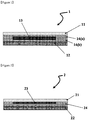
- the optoelectronic device when the optoelectronic device is a photovoltaic cell, the optoelectronic device may be a photovoltaic module including a front substrate 11 or 21, a back sheet 12 or 22 and a photovoltaic element 13 or 23 encapsulated by an encapsulant 14(a), 14(b), or 24 formed between the front substrate 11 or 21 and the back sheet 12 or 22, as shown in FIG. 1 or 2 .
- the encapsulant may be prepared from the olefin resin composition, and may include a copolymer to be described later, that is, a modified olefin resin.
- Such a photovoltaic module may be manufactured using a conventional molding method, such as a lamination process, which involves stacking the front substrate, the encapsulant, the photovoltaic element, and the back sheet, and pressing the stacked body at a high temperature while applying suction to the stacked body under a vacuum, depending on the desired structure.
- a lamination process which involves stacking the front substrate, the encapsulant, the photovoltaic element, and the back sheet, and pressing the stacked body at a high temperature while applying suction to the stacked body under a vacuum, depending on the desired structure.
- the processing conditions of the lamination process are not particularly limited.
- the lamination process may be performed at a temperature of 90 °C to 230 °C or 110 °C to 200 °C for 1 to 30 minutes or 1 to 10 minutes.
- the front substrate may be a conventional plate glass; or a transparent composite sheet obtained by stacking glass, a fluoride-based resin sheet, a weather-resistant film and a barrier film; and the back sheet may be a composite sheet obtained by stacking a metal such as aluminum, a fluoride-based resin sheet, a weather-resistant film, and a barrier film, and has a surface layer including a fluoride polymer.
- the front substrate and the back sheet may be multi-layered films obtained by forming fluoride polymer layers on both surfaces of a polyethylene terephthalate (PET) film.
- the photovoltaic element may, for example, be a silicon wafer-based active layer or a thin-film active layer formed by chemical vapor deposition (CVD), and the like.
- Yet another aspect of the present application provides a method for manufacturing the optoelectronic device.
- the optoelectronic device is manufactured by sequentially stacking the encapsulant film for optoelectronic devices, which is formed on a front substrate using the above-described method and includes a modified olefin resin, an optoelectronic element and a back sheet, and laminating the stacked body at a temperature of 110 to 160 °C for 1 to 30 minutes.
- a desired adhesive force may not be achieved at a lamination temperature of 110 °C or less.
- a sufficient adhesive force may be achieved even at a relatively low lamination temperature, for example, a lamination temperature of 110 °C.
- the encapsulant film having improved heat resistance and excellent adhesive force, especially, long-term adhesive properties, to the front substrate and the back sheet can be provided.
- the optoelectronic device capable of maintaining excellent workability and economic feasibility upon manufacture of the device without causing a negative influence on working environments and parts such as optoelectronic elements or wiring electrodes encapsulated by the encapsulant can be provided.
- Master batches of a modified ethylene/ ⁇ -olefin copolymer were prepared in the same manner as in Preparation Examples 1 and 3, respectively, except that an ethylene/ ⁇ -olefin copolymer having a density of 0.902 g/cm 3 and an MFR of 3 g/10 minutes at a temperature of 190 °C and a load of 2.16 kg was used instead of the ethylene/ ⁇ -olefin copolymer used in Preparation Examples 1 and 3.
- a master batch of a silane-modified ethylene/ ⁇ -olefin copolymer was prepared in the same manner as in Preparation Example 1, except that vinyltrimethoxysilane was used at a content of 4.89 parts by weight without using the 3-aminopropyltrimethoxysilane used in Preparation Example 1.
- a master batch of a silane-modified ethylene/ ⁇ -olefin copolymer was prepared in the same manner as in Comparative Preparation Example 1, except that an ethylene/ ⁇ -olefin copolymer having a density of 0.882 g/cm 3 and an MFR of 3 g/10 minutes at a temperature of 190 °C and a load of 2.16 kg was used instead of the ethylene/ ⁇ -olefin copolymer used in Comparative Preparation Example 1.
- a master batch of a silane-modified ethylene/ ⁇ -olefin copolymer was prepared in the same manner as in Comparative Preparation Example 1, except that an ethylene/ ⁇ -olefin copolymer having a density of 0.902 g/cm 3 and an MFR of 3 g/10 minutes at a temperature of 190 °C and a load of 2.16 kg was used instead of the ethylene/ ⁇ -olefin copolymer used in Comparative Preparation Example 1.
- a master batch of a modified ethylene/ ⁇ -olefin copolymer was prepared in the same manner as in Comparative Preparation Example 1, except that 2.44 parts by weight of the vinyltrimethoxysilane and 2.45 parts by weight of the 3-aminopropyltrimethoxysilane were used instead of 4.79 parts by weight of the vinyltrimethoxysilane and 0.1 parts by weight of the 3-aminopropyltrimethoxysilane used in Preparation Example 1, respectively.
- the resulting mixture was introduced into a hopper of a film molding machine provided with a twin-screw extruder ( ⁇ 19 mm) and a T die (width: 200 mm), and processed at an extrusion temperature of 180 °C and a ejection rate of 3 m/min to prepare a sheet-shaped encapsulant having a thickness of approximately 500 ⁇ m.
- a back sheet a stacked sheet including a polyvinyl fluoride resin sheet having a thickness of 20 ⁇ m, polyethylene terephthalate having a thickness of 250 ⁇ m, and a polyvinyl fluoride resin sheet having a thickness of 20 ⁇ m; PVDF/
- Sheet-shaped encapsulants and photovoltaic cell modules were manufactured in the same manner as in Example 1, except that resins, which were obtained by preparing 200 g of the master batches of the modified ethylene/ ⁇ -olefin copolymer prepared in Preparation Examples 6 and 7 respectively, and 400 g of an ethylene/ ⁇ -olefin copolymer having a density of 0.882 g/cm 3 and an MFR of 3 g/10 minutes at a temperature of 190 °C and a load of 2.16 kg, respectively, and mixing the master batches of the modified ethylene/ ⁇ -olefin copolymer and the ethylene/ ⁇ -olefin copolymer at a mixing ratio of 1:2, were used, respectively, instead of the mixed resin including the master batch of the modified ethylene/ ⁇ -olefin copolymer used in Example 1 and the ethylene/ ⁇ -olefin copolymer.
- Sheet-shaped encapsulants and photovoltaic cell modules were manufactured in the same manner as in Example 1, except that resins, which were obtained by preparing 200 g of the master batches of the modified ethylene/ ⁇ -olefin copolymer prepared in Preparation Examples 8 and 9 respectively, and 400 g of an ethylene/ ⁇ -olefin copolymer having a density of 0.902 g/cm 3 and an MFR of 3 g/10 minutes at a temperature of 190 °C and a load of 2.16 kg of 3 g/10 minutes, respectively, and mixing the master batches of the modified ethylene/ ⁇ -olefin copolymer and the ethylene/ ⁇ -olefin copolymer at a mixing ratio of 1:2, were used, respectively, instead of the mixed resin including the master batch of the modified ethylene/ ⁇ -olefin copolymer used in Example 1 and the ethylene/ ⁇ -olefin copolymer.
- a sheet-shaped encapsulant and a photovoltaic cell module were manufactured in the same manner as in Example 1, except that a resin, which was obtained by preparing 100 g of the master batch of the modified ethylene/ ⁇ -olefin copolymer prepared in Preparation Example 3, and 500 g of an ethylene/ ⁇ -olefin copolymer having a density of 0.870 g/cm 3 and an MFR of 5 g/10 minutes at a temperature of 190 °C and a load of 2.16 kg, respectively, and mixing the master batch of the modified ethylene/ ⁇ -olefin copolymer and the ethylene/ ⁇ -olefin copolymer at a mixing ratio of 1:5, was used instead of the mixed resin including the master batch of the modified ethylene/ ⁇ -olefm copolymer used in Example 1 and the ethylene/ ⁇ -olefin copolymer.
- a sheet-shaped encapsulant and a photovoltaic cell module were manufactured in the same manner as in Example 1, except that a resin, which was obtained by preparing 54.5 g of the master batch of the modified ethylene/ ⁇ -olefin copolymer prepared in Preparation Example 3, and 545.5 g of an ethylene/ ⁇ -olefin copolymer having a density of 0.870 g/cm 3 and an MFR of 5 g/10 minutes at a temperature of 190 °C and a load of 2.16 kg, respectively, and mixing the master batch of the modified ethylene/ ⁇ -olefin copolymer and the ethylene/ ⁇ -olefin copolymer at a mixing ratio of 1:10, was used instead of the mixed resin including the master batch of the modified ethylene/ ⁇ -olefin copolymer used in Example 1 and the ethylene/ ⁇ -olefin copolymer.
- a sheet-shaped encapsulant and a photovoltaic cell module were manufactured in the same manner as in Example 1, except that a resin, which was obtained by preparing 200 g of the master batch of the modified ethylene/ ⁇ -olefin copolymer prepared in Preparation Example 10, and 400 g of an ethylene/ ⁇ -olefin copolymer having a density of 0.870 g/cm 3 and an MFR of 3 g/10 minutes at a temperature of 190 °C and a load of 2.16 kg, respectively, and mixing the master batch of the modified ethylene/ ⁇ -olefin copolymer and the ethylene/ ⁇ -olefin copolymer at a mixing ratio of 1:2, was used instead of the mixed resin including the master batch of the modified ethylene/ ⁇ -olefin copolymer used in Example 1 and the ethylene/ ⁇ -olefin copolymer.
- Sheet-shaped encapsulants and photovoltaic cell modules were manufactured in the same manner as in Example 1, except that the master batches of the silane-modified ethylene/ ⁇ -olefin copolymer prepared in Comparative Preparation Examples 1 to 3 were used, respectively, instead of the master batch of the modified ethylene/ ⁇ -olefin copolymer used in Example 1.
- a sheet-shaped encapsulant and a photovoltaic cell module were manufactured in the same manner as in Example 1, except that a resin, which was obtained by preparing 200 g of the master batch of the silane-modified ethylene/ ⁇ -olefin copolymer prepared in Comparative Preparation Example 4, and 400 g of an ethylene/ ⁇ -olefin copolymer having a density of 0.882 g/cm 3 and an MFR of 3 g/10 minutes at a temperature of 190 °C and a load of 2.16 kg, respectively, and mixing the master batch of the silane-modified ethylene/ ⁇ -olefin copolymer and the ethylene/ ⁇ -olefin copolymer at a mixing ratio of 1:2, was used instead of the mixed resin including the master batch of the modified ethylene/ ⁇ -olefin copolymer used in Example 1 and the ethylene/ ⁇ -olefin copolymer.
- a sheet-shaped encapsulant and a photovoltaic cell module were manufactured in the same manner as in Example 1, except that a resin, which was obtained by preparing 200 g of the master batch of the silane-modified ethylene/ ⁇ -olefin copolymer prepared in Comparative Preparation Example 5, and 400 g of an ethylene/ ⁇ -olefin copolymer having a density of 0.902 g/cm 3 and an MFR of 3 g/10 minutes at a temperature of 190 °C and a load of 2.16 kg, respectively, and mixing the master batch of the silane-modified ethylene/ ⁇ -olefin copolymer and the ethylene/ ⁇ -olefin copolymer at a mixing ratio of 1:2, was used instead of the mixed resin including the master batch of the modified ethylene/ ⁇ -olefin copolymer used in Example 1 and the ethylene/ ⁇ -olefin copolymer.
- Sheet-shaped encapsulants and photovoltaic cell modules were manufactured in the same manner as in Example 1, except that the master batches of the ethylene/ ⁇ -olefin copolymer prepared in Comparative Preparation Examples 6 and 7 were used, respectively, instead of the master batch of the modified ethylene/ ⁇ -olefin copolymer used in Example 1.
- a sheet-shaped encapsulant and a photovoltaic cell module were manufactured in the same manner as in Example 1, except that a resin, which was obtained by preparing 200 g of the master batch of the modified ethylene/ ⁇ -olefin copolymer prepared in Comparative Preparation Example 8, and 400 g of an ethylene/ ⁇ -olefin copolymer having a density of 0.870 g/cm 3 and an MFR of 3 g/10 minutes at a temperature of 190 °C and a load of 2.16 kg, respectively, and mixing the master batch of the modified ethylene/ ⁇ -olefin copolymer and the ethylene/ ⁇ -olefin copolymer at a mixing ratio of 1:2, was used instead of the mixed resin including the master batch of the modified ethylene/ ⁇ -olefin copolymer used in Example 1 and the ethylene/ ⁇ -olefin copolymer.
- specimens similar to the manufactured photovoltaic cell modules were manufactured separately.
- a specimen was manufactured by stacking a plate glass (thickness: approximately 3 mm), the previously prepared encapsulant having a thickness of 500 ⁇ m, and a back sheet (a stacked sheet including a polyvinyl fluoride resin sheet having a thickness of 20 ⁇ m, polyethylene terephthalate having a thickness of 250 ⁇ m, and a polyvinyl fluoride resin sheet having a thickness of 20 ⁇ m; PVDF/PET/PVDF) in this stacking order and laminating the stacked components at 150 °C for 15 minutes 30 seconds in a vacuum laminator.
- the peel strength was measured according to the ASTM D1897 standard by fixing a lower glass plate of the manufactured specimen, and peeling the encapsulant attached to the back sheet together with the back sheet at a tensile speed of 50 mm/min and a peel angle of 90° in a rectangular shape with a width of 15 mm.
- the measured peel strengths are listed in the following Table 3.
- the sheet-shaped encapsulant including the master batch of the modified ethylene/ ⁇ -olefin copolymer prepared using both the vinyltrimethoxysilane and the aminosilane showed a superior adhesive strength, compared to the encapsulant sheets of Comparative Examples 1 and 3 to 7 in which the vinyltrimethoxysilane, the alkylsilane and the aminosilane were used alone, respectively. Also, it was revealed that the sheet-shaped encapsulant showed the highest adhesive strength when the master batch of the modified ethylene/ ⁇ -olefin copolymer and the non-modified ethylene/ ⁇ -olefin copolymer were present at a mixing ratio of 1:2.
- the average adhesive strength was greater than or equal to approximately 200 N/15 mm when the aminosilane compound in the olefin resin composition was present in a content range of 2 to 25% by weight, indicating that the sheet-shaped encapsulant showed a superior adhesive strength.
- the 90° peel strengths were measured in the same manner as in Experimental Example 1, except that the lamination conditions used in Experimental Example 1 upon manufacture of specimens similar to the photovoltaic cell modules manufactured with the encapsulants of Examples 1 and 3 were changed as listed in the following Table 5, and the lamination process was performed at temperatures of 110 °C, 130 °C, 140 °C, 150 °C, and 160 °C for 6 minutes 30 seconds, 10 minutes 30 seconds, and 15 minutes 30 seconds, respectively.
- the measured 90° peel strengths are listed in the following Table 5, and a graph obtained by plotting the adhesive strengths measured according to the lamination temperature is shown in FIG. 3 .
- the 90° peel strengths were measured in the same manner as in Experimental Example 1, except that the lamination conditions used in Experimental Example 1 upon manufacture of specimens similar to the photovoltaic cell module manufactured with the encapsulant of Comparative Example 1 were changed as listed in the following Table 5, and the lamination process was performed at temperatures of 110 °C, 130 °C, 140 °C, 150 °C, and 160 °C for 6 minutes 30 seconds, 10 minutes 30 seconds, and 15 minutes 30 seconds, respectively.
- the measured 90° peel strengths are listed in the following Table 5, and a graph obtained by plotting the adhesive strengths measured according to the lamination temperature is shown in FIG. 3 .
- the encapsulants had excellent adhesive strengths even under various conditions such as lamination temperature and time in the case of Examples 1 and 3 in which the aminosilane was used together with the vinyltrimethoxysilane, compared to Comparative Example 1 in which the vinyltrimethoxysilane was used alone. Also, it could be seen that the encapsulants had excellent adhesive strengths of 50 N/15 mm or more even when laminated at a low lamination temperature of 110 °C.
- encapsulant films for optoelectronic devices manufactured in Examples and Comparative Examples were measured for reflectance in a wavelength range of 400 nm to 700 nm using Colorflex (Hunter lab) according to the ASTM 1925 standard, and YI values were calculated from the measured reflectance values (see the following Equation 2).
- YI 100 1.28 X CIE ⁇ 1.06 Z CIE / Y CIE
- Equation 2 YI is a value calculated by a UV/Vis/NIR spectrometer using a color difference analysis program (ASTM, D1925), and X CIE , Y CIE and Z CIE are relative values represented by red, green and blue color coordinates, respectively.
- the modified master batches prepared in Preparation Examples 1 to 3 and Comparative Preparation Examples 1 and the encapsulant films prepared in Examples 1 to 3 and Comparative Examples 1 were measured for a peak area of methylene groups (CH 2 ) and a peak area of silanol groups (Si-OH) and amine groups (NH 2 ) in the modified master batches and the encapsulants. Each of the peak areas was measured under the following conditions using the following method.
- Diamond/zinc selenide (ZnSe) and each of the manufactured modified master batches and encapsulant specimens were closely adhered to each other in an ATR mode using Varian 660-IR, the incident light was irradiated from the side of the diamond/zinc selenide at an incidence angle of 45° to measure absorbance ratio of infrared rays with a region of wavelength 600 cm -1 to 4,000 cm -1 , and each peak area was measured using the measured absorption ratio.
- the peak value may be an average of values from measuring the reflected light 32 times.
- the peak area of the silanol groups (Si-OH) and amine groups (NH 2 ) was calculated by setting a baseline in a wavenumber range of 2,400 cm -1 to 3,800 cm -1 and integrating the peak area in a wavenumber range of 3,100 cm -1 to 3,600 cm -1
- the peak area of the methylene groups (CH 2 ) was calculated by setting a baseline in a wavenumber range of 690 cm -1 to 760 cm -1 and integrating the peak area in a wavenumber range of 705 cm -1 to 735 cm -1 .
- Example 3 To measure light transmittances of the encapsulants prepared in Example 3 and Comparative Example 1, additional specimens were prepared.
- a specimen was prepared by inserting the two previously prepared encapsulants having a thickness of 500 ⁇ m between two slide glasses for an optical microscope (thickness: approximately 1 mm), and laminating the encapsulants in a vacuum laminator under lamination temperature conditions as listed in the following Table 9.
- the specimen was prepared so that the sum of the thicknesses of the two overlapping encapsulant sheets became approximately 500 ⁇ 50 ⁇ m using a guide, and measured for total light transmittance and haze with respect to light at a wavelength of 550 nm using a hazemeter.
- the measured total light transmittance and haze values are listed in the following Table 9.
- the transmittance and haze values were calculated as averages of values measured in triplicate after the specimen was loaded into a specimen holder, and measured under conditions according to the JIS K 7105 standard.
- the lamination time was constant: under a vacuum for 5 min/pressed for 30 sec/pressure retained for 10 min.
- the encapsulant had a low adhesive strength at a lamination temperature of 110 °C, and thus, was unable to be used as a solar encapsulant in the case of Comparative Example 1 in which the vinyltrimethoxysilane was used alone, but the encapsulant showed a high adhesive strength and excellent light transmittance even at a low lamination temperature in the case of Example 3 in which the aminosilane was added.
Landscapes
- Chemical & Material Sciences (AREA)
- Organic Chemistry (AREA)
- Chemical Kinetics & Catalysis (AREA)
- Medicinal Chemistry (AREA)
- Polymers & Plastics (AREA)
- Health & Medical Sciences (AREA)
- Engineering & Computer Science (AREA)
- Materials Engineering (AREA)
- Manufacturing & Machinery (AREA)
- Wood Science & Technology (AREA)
- Life Sciences & Earth Sciences (AREA)
- General Chemical & Material Sciences (AREA)
- Compositions Of Macromolecular Compounds (AREA)
- Photovoltaic Devices (AREA)
- Addition Polymer Or Copolymer, Post-Treatments, Or Chemical Modifications (AREA)
- Manufacture Of Macromolecular Shaped Articles (AREA)
- Laminated Bodies (AREA)
- Electroluminescent Light Sources (AREA)
- Sealing Material Composition (AREA)
- Graft Or Block Polymers (AREA)
- Structures Or Materials For Encapsulating Or Coating Semiconductor Devices Or Solid State Devices (AREA)
- Polymerisation Methods In General (AREA)
- Encapsulation Of And Coatings For Semiconductor Or Solid State Devices (AREA)
Claims (10)
- Verfahren zur Herstellung einer Verkapselungsfolie, umfassend:
Herstellung eines modifizierten Olefinharzes durch Extrusionsreaktion einer Olefinharzzusammensetzung, die ein Olefinharz, eine ungesättigte Silanverbindung und eine Aminosilanverbindung in einer Menge von 1 bis 35 Gew.-Teilen, bezogen auf 100 Gew.-Teile der ungesättigten Silanverbindung, und einen Radikalinitiator umfasst. - Verfahren gemäss Anspruch 1, wobei die ungesättigte Silanverbindung eine Verbindung der nachstehenden Formel 3 ist:
[Formel 3] DSiR18 pR19 (3-p)
worinD eine an ein Siliciumatom gebundene Akenylgruppe darstellt,R18 eine Hydroxylgruppe, ein Halogen, eine Amingruppe oder an ein Siliciumatom gebundenes -R20R21 darstellt, worin R20 Sauerstoff oder ein Schwefelatom darstellt und R21 eine Alkylgruppe, eine Arylgruppe oder eine Acylgruppe darstellt,R19 Wasserstoff, eine Alkylgruppe, eine Arylgruppe oder eine an ein Siliciumatom gebundene Aralkylgruppe darstellt, undp eine ganze Zahl im Bereich von 1 bis 3 ist. - Verfahren gemäss Anspruch 1, wobei die Aminosilanverbindung eine Verbindung der nachstehenden Formel 4 ist:
[Formel 4] SiR22 qR23 (4-q)
R22 an ein Siliciumatom gebundenes - (CH2) NR24R25, worin R24 und R25 jeweils unabhängig Wasserstoff darstellen, oder an ein Stickstoffatom gebundenes R26NH2 darstellt, worin R26 eine Alkylengruppe darstellt,R23 ein Halogen, eine Amingruppe, an ein Siliciumatom gebundenes -R27R28 oder -R28 darstellt, worin R27 Sauerstoff oder ein Schwefelatom darstellt und R28 Wasserstoff, eine Alkylgruppe, eine Arylgruppe, eine Aralkylgruppe oder eine Acylgruppe darstellt,q eine ganze Zahl im Bereich von 1 bis 4 ist undr eine ganze Zahl grösser als oder gleich 0 ist. - Verfahren gemäss Anspruch 1, wobei das Olefinharz ein Ethylen/α-Olefin-Copolymer umfasst.
- Verfahren gemäss Anspruch 1, ferner umfassend:zusätzliche Zugabe eines nicht-modifizierten Olefinharzes zu dem modifizierten Olefinharz; undFormen der resultierenden Mischung zu einer Folien- oder Plattenform.
- Verfahren gemäss Anspruch 5, wobei das nichtmodifizierte Olefinharz und das modifizierte Olefinharz in einem Gehaltsverhältnis von 1:1 bis 20:1 gemischt sind.
- Verkapselungsfolie, die durch das in irgendeinem der Ansprüche 1 bis 6 definierte Verfahren erhältlich ist.
- Verkapselungsfolie gemäss Anspruch 7, wobei das Verhältnis (Sa/Sm) eines Peakbereichs (Sa) von Silanolgruppen und Amingruppen in einem Wellenzahlbereich von 3.100 bis 3.600 cm-1 zu einem Peakbereich (Sm) von Methylengruppen in einem Wellenzahlbereich von 705 bis 735 cm-1 0,6 oder mehr beträgt, wie durch FT-IR unter Verwendung eines abgeschwächten Totalreflexions (ATR)-Verfahrens gemessen.
- Optoelektronische Vorrichtung, umfassend:ein Vorderseitensubstrat;eine Rückseitenplatte;die in Anspruch 7 oder 8 definierte Verkapselungsfolie, die zwischen dem Vorderseitensubstrat und der Rückseitenplatte laminiert ist; undein optoelektronisches Element, das durch die Verkapselungsfolie verkapselt ist.
- Verfahren zur Herstellung einer optoelektronischen Vorrichtung, umfassend:sequentielles Laminieren eines Vorderseitensubstrats, der in Anspruch 7 oder 8 definierten Verkapselungsfolie, eines optoelektronischen Elements und einer Rückseitenplatte; undLaminieren des laminierten Körpers bei einer Temperatur von 110 bis 160°C für 1 bis 30 Minuten.
Applications Claiming Priority (6)
| Application Number | Priority Date | Filing Date | Title |
|---|---|---|---|
| KR20120151830 | 2012-12-24 | ||
| KR20130104467 | 2013-08-30 | ||
| KR20130104464 | 2013-08-30 | ||
| KR20130104466 | 2013-08-30 | ||
| KR20130104465 | 2013-08-30 | ||
| PCT/KR2013/012126 WO2014104722A1 (ko) | 2012-12-24 | 2013-12-24 | 봉지재 필름 |
Publications (3)
| Publication Number | Publication Date |
|---|---|
| EP2933844A1 EP2933844A1 (de) | 2015-10-21 |
| EP2933844A4 EP2933844A4 (de) | 2016-07-20 |
| EP2933844B1 true EP2933844B1 (de) | 2018-12-19 |
Family
ID=51733475
Family Applications (4)
| Application Number | Title | Priority Date | Filing Date |
|---|---|---|---|
| EP13869614.1A Active EP2933279B1 (de) | 2012-12-24 | 2013-12-24 | Copolymer |
| EP13869433.6A Active EP2933844B1 (de) | 2012-12-24 | 2013-12-24 | Verkapselungsmaterialfilm |
| EP13867457.7A Active EP2921522B1 (de) | 2012-12-24 | 2013-12-24 | Polyolefinharzzusammensetzung |
| EP13869797.4A Active EP2937909B1 (de) | 2012-12-24 | 2013-12-24 | Umhüllungsfolie |
Family Applications Before (1)
| Application Number | Title | Priority Date | Filing Date |
|---|---|---|---|
| EP13869614.1A Active EP2933279B1 (de) | 2012-12-24 | 2013-12-24 | Copolymer |
Family Applications After (2)
| Application Number | Title | Priority Date | Filing Date |
|---|---|---|---|
| EP13867457.7A Active EP2921522B1 (de) | 2012-12-24 | 2013-12-24 | Polyolefinharzzusammensetzung |
| EP13869797.4A Active EP2937909B1 (de) | 2012-12-24 | 2013-12-24 | Umhüllungsfolie |
Country Status (6)
| Country | Link |
|---|---|
| US (4) | US9815924B2 (de) |
| EP (4) | EP2933279B1 (de) |
| JP (4) | JP6115742B2 (de) |
| KR (4) | KR101433540B1 (de) |
| CN (4) | CN104937726B (de) |
| WO (4) | WO2014104718A1 (de) |
Families Citing this family (21)
| Publication number | Priority date | Publication date | Assignee | Title |
|---|---|---|---|---|
| JP5503770B1 (ja) * | 2013-03-29 | 2014-05-28 | 古河電気工業株式会社 | 封止剤組成物および該組成物から得られる封止用シート |
| EP3053954B1 (de) * | 2013-10-30 | 2023-12-06 | LG Chem, Ltd. | Modifizietes olefinharz |
| EP3112414B1 (de) * | 2014-02-26 | 2021-11-10 | LG Chem, Ltd. | Verkapselungsmaterial für optisches modul, verfahren zur herstellung davon und optisches modul |
| KR102176775B1 (ko) | 2014-07-02 | 2020-11-09 | 현대모비스 주식회사 | 어라운드 뷰 시스템 및 그 동작방법 |
| KR101604283B1 (ko) * | 2014-12-08 | 2016-03-17 | 엘에스산전 주식회사 | 태양전지 모듈 |
| JP6563796B2 (ja) * | 2015-12-03 | 2019-08-21 | 双葉電子工業株式会社 | 封止構造、有機el表示装置、及びセンサ |
| FR3053350B1 (fr) | 2016-06-29 | 2020-03-27 | Arkema France | Composition liquide ou sirop comprenant un polymere a phases multiples et un polymere (meth)acrylique, sirop pour procede d'impregnation, procede d'impregnation pour un substrat fibreux, procede depolymerisation et article structure obtenu de celui-ci |
| FR3053348B1 (fr) | 2016-06-29 | 2020-03-27 | Arkema France | Composition comprenant un polymere a phases multiples et deux polymeres (meth)acryliques differents, son procede de preparation et article la compenant |
| CN107068792B (zh) * | 2017-04-13 | 2019-06-11 | 英利能源(中国)有限公司 | 双面发电光伏结构及双面发电光伏组件 |
| JP7064585B2 (ja) * | 2017-10-31 | 2022-05-10 | ダウ グローバル テクノロジーズ エルエルシー | 太陽光発電封止材フィルムのためのポリオレフィン組成物 |
| WO2019201416A1 (en) * | 2018-04-16 | 2019-10-24 | CSEM Centre Suisse d'Electronique et de Microtechnique SA - Recherche et Développement | Photovoltaic modules and method of manufacture thereof |
| KR20200141050A (ko) * | 2018-04-16 | 2020-12-17 | 체에스에엠 센트레 스위쎄 데 엘렉트로니크 에트 데 미크로테크니크 에스아-르쉐르슈 에트 데블로프망 | 광기전력 모듈 제조 방법 |
| EP3782200A1 (de) * | 2018-04-16 | 2021-02-24 | CSEM Centre Suisse d'Electronique et de Microtechnique SA - Recherche et Développement | Verfahren zur herstellung eines fotovoltaikmoduls |
| US11661500B2 (en) | 2018-09-21 | 2023-05-30 | The Goodyear Tire & Rubber Company | Silica reinforced rubber composition containing a multi-functional group functionalized elastomer and tire with tread |
| CN110951163B (zh) * | 2018-09-26 | 2022-04-08 | 合肥杰事杰新材料股份有限公司 | 一种高表面张力、低密度聚丙烯复合材料及其制备方法 |
| MY209935A (en) * | 2019-12-26 | 2025-08-13 | Dow Global Technologies Llc | Ethylene/alpha-olefin interpolymer compositions with high glass adhesion |
| JP7258411B2 (ja) * | 2020-04-16 | 2023-04-17 | エルジー・ケム・リミテッド | エチレン/α-オレフィン共重合体を含む封止材フィルム用組成物およびそれを含む封止材フィルム |
| US12528898B2 (en) | 2020-04-16 | 2026-01-20 | Lg Chem, Ltd. | Ethylene/alpha-olefin copolymer with excellent electrical insulation |
| CN113690380A (zh) * | 2020-05-19 | 2021-11-23 | 咸阳彩虹光电科技有限公司 | 一种oled封装方法、器件及显示装置 |
| CN113629211A (zh) * | 2021-07-28 | 2021-11-09 | 武汉华星光电半导体显示技术有限公司 | 一种显示面板及其制备方法、显示装置 |
| CN119505057A (zh) * | 2023-08-16 | 2025-02-25 | 中国石油化工股份有限公司 | 一种乙烯与α-烯烃多元共聚物及其制备方法和应用 |
Family Cites Families (36)
| Publication number | Priority date | Publication date | Assignee | Title |
|---|---|---|---|---|
| JPS5787402A (en) * | 1980-11-20 | 1982-05-31 | Hitachi Chem Co Ltd | Modification of organic polymer |
| US5013771A (en) * | 1989-12-21 | 1991-05-07 | Union Carbide Chemicals And Plastics Technology Corporation | Process for the production of glass fiber reinforced composite material |
| JP2000086830A (ja) | 1998-09-14 | 2000-03-28 | Yazaki Corp | ノンハロゲン難燃ポリオレフィン系樹脂組成物 |
| JP2001131358A (ja) * | 1999-11-01 | 2001-05-15 | Bridgestone Corp | 封止用組成物及び封止方法 |
| CN1225498C (zh) * | 2000-12-22 | 2005-11-02 | 三星综合化学株式会社 | 具有耐热性,高刚性和低翘曲性的聚丙烯树脂组合物 |
| EP1743928A1 (de) | 2004-03-26 | 2007-01-17 | Kaneka Corporation | Dichtstoffzusammensetzung |
| JP5366109B2 (ja) | 2004-12-28 | 2013-12-11 | 三井化学東セロ株式会社 | 太陽電池封止材 |
| JP2007177034A (ja) * | 2005-12-27 | 2007-07-12 | Yokohama Rubber Co Ltd:The | 熱可塑性エラストマー組成物およびその積層体 |
| JP2007318008A (ja) * | 2006-05-29 | 2007-12-06 | Dainippon Printing Co Ltd | 太陽電池モジュール用充填材、太陽電池モジュール用充填材層、および太陽電池モジュール |
| JP2009256459A (ja) * | 2008-04-16 | 2009-11-05 | Bridgestone Corp | 太陽電池用封止膜及びこれを用いた太陽電池 |
| US8513357B2 (en) | 2008-06-20 | 2013-08-20 | Du Pont-Mitsui Polychemicals Co., Ltd. | Ethylene copolymer composition, sheet for sealing a solar cell element, and solar cell module |
| CN101823355B (zh) * | 2009-03-03 | 2013-09-25 | E.I.内穆尔杜邦公司 | 聚合物叠层膜和使用该叠层膜的太阳能电池板 |
| DE112010001988B4 (de) * | 2009-05-13 | 2021-05-06 | Dow-Mitsui Polychemicals Co.,Ltd. | Folie für SolarzelleneinkapselungsmateriaI und Solarzellenmodul |
| KR101448314B1 (ko) * | 2009-05-15 | 2014-10-08 | 주식회사 엘지화학 | 봉지재 시트, 이의 제조방법 및 이를 포함하는 태양전지 모듈 |
| KR101367050B1 (ko) * | 2009-06-01 | 2014-02-25 | 미쓰이 가가쿠 토세로 가부시키가이샤 | 에틸렌계 수지 조성물, 태양 전지 봉지재 및 그것을 이용한 태양 전지 모듈 |
| JP5444039B2 (ja) * | 2009-06-01 | 2014-03-19 | 三井化学東セロ株式会社 | 樹脂組成物、太陽電池封止材及びそれを用いた太陽電池モジュール |
| BRPI1015076A2 (pt) * | 2009-08-07 | 2016-04-19 | Toyo Ink Sc Holdings Co Ltd | método para produção de composição de resina para material de vedação de célula solar, composição de resina para material de vedação de célula solar, material de vedação solar e módulo de célula solar |
| JP2011077360A (ja) * | 2009-09-30 | 2011-04-14 | Asahi Kasei E-Materials Corp | 樹脂封止シート及びこれを用いた太陽電池モジュール |
| JP5466926B2 (ja) * | 2009-11-16 | 2014-04-09 | 三井・デュポンポリケミカル株式会社 | 太陽電池封止材用シート及び太陽電池モジュール |
| JP5591564B2 (ja) * | 2010-03-12 | 2014-09-17 | 株式会社ブリヂストン | 太陽電池用封止膜及びこれを用いた太陽電池 |
| JP2012019942A (ja) * | 2010-07-14 | 2012-02-02 | Funatsuki:Kk | 脚部用アクセサリー |
| CN101921425B (zh) * | 2010-08-30 | 2012-08-22 | 苏州度辰新材料有限公司 | 乙烯醋酸乙烯共聚物胶膜和太阳能电池组件 |
| JP2012092197A (ja) * | 2010-10-26 | 2012-05-17 | Denki Kagaku Kogyo Kk | 樹脂及びシート |
| US9130090B2 (en) | 2010-10-29 | 2015-09-08 | Lg Chem, Ltd. | Olefin composition |
| KR101367505B1 (ko) * | 2010-10-29 | 2014-02-27 | 주식회사 엘지화학 | 충진재 |
| EP2644652A4 (de) | 2010-11-26 | 2015-06-03 | Lg Chemical Ltd | Einbettungszusammensetzung und photovoltaikmodul |
| JP2012124340A (ja) | 2010-12-08 | 2012-06-28 | Dainippon Printing Co Ltd | 太陽電池モジュール用封止材組成物及びそれを用いた封止材シート |
| JP2012169472A (ja) * | 2011-02-15 | 2012-09-06 | Toppan Printing Co Ltd | 太陽電池モジュール用封止材シートおよび太陽電池モジュール |
| JP2012195561A (ja) | 2011-03-01 | 2012-10-11 | Dainippon Printing Co Ltd | 太陽電池モジュール用封止材シート |
| JP5852786B2 (ja) * | 2011-03-09 | 2016-02-03 | 株式会社イノアック技術研究所 | 太陽電池素子封止用材及びその製造方法 |
| JP2012214555A (ja) * | 2011-03-31 | 2012-11-08 | Mitsui Chemicals Inc | 樹脂組成物、シート成形物および太陽電池封止材 |
| JP5954639B2 (ja) * | 2011-04-19 | 2016-07-20 | エルジー・ケム・リミテッド | オレフィン系イオノマー樹脂組成物 |
| JP2012243775A (ja) * | 2011-05-13 | 2012-12-10 | Mitsubishi Chemicals Corp | 太陽電池モジュール |
| JP5640889B2 (ja) * | 2011-05-20 | 2014-12-17 | 日立金属株式会社 | 電線・ケーブル |
| CN103717631A (zh) * | 2011-08-03 | 2014-04-09 | 电气化学工业株式会社 | 封装材料 |
| CN102304332A (zh) | 2011-08-25 | 2012-01-04 | 詹显光 | 能阻断紫外线且耐老化的eva胶膜及制备方法 |
-
2013
- 2013-12-24 KR KR1020130162495A patent/KR101433540B1/ko active Active
- 2013-12-24 US US14/655,020 patent/US9815924B2/en active Active
- 2013-12-24 WO PCT/KR2013/012118 patent/WO2014104718A1/ko not_active Ceased
- 2013-12-24 JP JP2015549275A patent/JP6115742B2/ja active Active
- 2013-12-24 US US14/655,015 patent/US9732170B2/en active Active
- 2013-12-24 CN CN201380071379.9A patent/CN104937726B/zh active Active
- 2013-12-24 CN CN201380071338.XA patent/CN104955857B/zh active Active
- 2013-12-24 KR KR1020130162471A patent/KR101436759B1/ko active Active
- 2013-12-24 CN CN201380067697.8A patent/CN104870548B/zh active Active
- 2013-12-24 JP JP2015549271A patent/JP6168321B2/ja active Active
- 2013-12-24 EP EP13869614.1A patent/EP2933279B1/de active Active
- 2013-12-24 EP EP13869433.6A patent/EP2933844B1/de active Active
- 2013-12-24 WO PCT/KR2013/012125 patent/WO2014104721A1/ko not_active Ceased
- 2013-12-24 EP EP13867457.7A patent/EP2921522B1/de active Active
- 2013-12-24 KR KR1020130162537A patent/KR101465902B1/ko active Active
- 2013-12-24 CN CN201380071370.8A patent/CN104937725B/zh active Active
- 2013-12-24 EP EP13869797.4A patent/EP2937909B1/de active Active
- 2013-12-24 WO PCT/KR2013/012126 patent/WO2014104722A1/ko not_active Ceased
- 2013-12-24 WO PCT/KR2013/012114 patent/WO2014104715A1/ko not_active Ceased
- 2013-12-24 KR KR1020130162536A patent/KR101474671B1/ko active Active
- 2013-12-24 JP JP2015549273A patent/JP6252803B2/ja active Active
- 2013-12-24 JP JP2015549274A patent/JP6080062B2/ja active Active
-
2014
- 2014-09-25 US US14/496,833 patent/US9296845B2/en active Active
-
2015
- 2015-01-14 US US14/596,798 patent/US9574032B2/en active Active
Non-Patent Citations (1)
| Title |
|---|
| None * |
Also Published As
Similar Documents
| Publication | Publication Date | Title |
|---|---|---|
| EP2937909B1 (de) | Umhüllungsfolie | |
| KR101692609B1 (ko) | 광 모듈용 봉지재, 이의 제조방법 및 광 모듈 | |
| KR101707268B1 (ko) | 광전자 장치용 이면시트, 이를 포함하는 광전자 장치 및 그 제조방법 | |
| KR101718184B1 (ko) | 수지 조성물 | |
| KR20160068259A (ko) | 올레핀 수지 조성물 |
Legal Events
| Date | Code | Title | Description |
|---|---|---|---|
| PUAI | Public reference made under article 153(3) epc to a published international application that has entered the european phase |
Free format text: ORIGINAL CODE: 0009012 |
|
| 17P | Request for examination filed |
Effective date: 20150714 |
|
| AK | Designated contracting states |
Kind code of ref document: A1 Designated state(s): AL AT BE BG CH CY CZ DE DK EE ES FI FR GB GR HR HU IE IS IT LI LT LU LV MC MK MT NL NO PL PT RO RS SE SI SK SM TR |
|
| AX | Request for extension of the european patent |
Extension state: BA ME |
|
| DAX | Request for extension of the european patent (deleted) | ||
| REG | Reference to a national code |
Ref country code: DE Ref legal event code: R079 Ref document number: 602013048587 Country of ref document: DE Free format text: PREVIOUS MAIN CLASS: H01L0031048000 Ipc: C08F0255000000 |
|
| A4 | Supplementary search report drawn up and despatched |
Effective date: 20160622 |
|
| RIC1 | Information provided on ipc code assigned before grant |
Ipc: C08F 8/42 20060101ALI20160616BHEP Ipc: C08L 23/00 20060101ALI20160616BHEP Ipc: H01L 23/29 20060101ALI20160616BHEP Ipc: C08F 255/00 20060101AFI20160616BHEP |
|
| 17Q | First examination report despatched |
Effective date: 20180316 |
|
| GRAP | Despatch of communication of intention to grant a patent |
Free format text: ORIGINAL CODE: EPIDOSNIGR1 |
|
| INTG | Intention to grant announced |
Effective date: 20180529 |
|
| GRAS | Grant fee paid |
Free format text: ORIGINAL CODE: EPIDOSNIGR3 |
|
| GRAA | (expected) grant |
Free format text: ORIGINAL CODE: 0009210 |
|
| AK | Designated contracting states |
Kind code of ref document: B1 Designated state(s): AL AT BE BG CH CY CZ DE DK EE ES FI FR GB GR HR HU IE IS IT LI LT LU LV MC MK MT NL NO PL PT RO RS SE SI SK SM TR |
|
| REG | Reference to a national code |
Ref country code: GB Ref legal event code: FG4D |
|
| REG | Reference to a national code |
Ref country code: CH Ref legal event code: EP |
|
| REG | Reference to a national code |
Ref country code: IE Ref legal event code: FG4D |
|
| REG | Reference to a national code |
Ref country code: DE Ref legal event code: R096 Ref document number: 602013048587 Country of ref document: DE |
|
| REG | Reference to a national code |
Ref country code: AT Ref legal event code: REF Ref document number: 1078614 Country of ref document: AT Kind code of ref document: T Effective date: 20190115 |
|
| REG | Reference to a national code |
Ref country code: NL Ref legal event code: MP Effective date: 20181219 |
|
| PG25 | Lapsed in a contracting state [announced via postgrant information from national office to epo] |
Ref country code: NO Free format text: LAPSE BECAUSE OF FAILURE TO SUBMIT A TRANSLATION OF THE DESCRIPTION OR TO PAY THE FEE WITHIN THE PRESCRIBED TIME-LIMIT Effective date: 20190319 Ref country code: LT Free format text: LAPSE BECAUSE OF FAILURE TO SUBMIT A TRANSLATION OF THE DESCRIPTION OR TO PAY THE FEE WITHIN THE PRESCRIBED TIME-LIMIT Effective date: 20181219 Ref country code: FI Free format text: LAPSE BECAUSE OF FAILURE TO SUBMIT A TRANSLATION OF THE DESCRIPTION OR TO PAY THE FEE WITHIN THE PRESCRIBED TIME-LIMIT Effective date: 20181219 Ref country code: LV Free format text: LAPSE BECAUSE OF FAILURE TO SUBMIT A TRANSLATION OF THE DESCRIPTION OR TO PAY THE FEE WITHIN THE PRESCRIBED TIME-LIMIT Effective date: 20181219 Ref country code: BG Free format text: LAPSE BECAUSE OF FAILURE TO SUBMIT A TRANSLATION OF THE DESCRIPTION OR TO PAY THE FEE WITHIN THE PRESCRIBED TIME-LIMIT Effective date: 20190319 Ref country code: HR Free format text: LAPSE BECAUSE OF FAILURE TO SUBMIT A TRANSLATION OF THE DESCRIPTION OR TO PAY THE FEE WITHIN THE PRESCRIBED TIME-LIMIT Effective date: 20181219 |
|
| REG | Reference to a national code |
Ref country code: LT Ref legal event code: MG4D |
|
| REG | Reference to a national code |
Ref country code: AT Ref legal event code: MK05 Ref document number: 1078614 Country of ref document: AT Kind code of ref document: T Effective date: 20181219 |
|
| PG25 | Lapsed in a contracting state [announced via postgrant information from national office to epo] |
Ref country code: AL Free format text: LAPSE BECAUSE OF FAILURE TO SUBMIT A TRANSLATION OF THE DESCRIPTION OR TO PAY THE FEE WITHIN THE PRESCRIBED TIME-LIMIT Effective date: 20181219 Ref country code: SE Free format text: LAPSE BECAUSE OF FAILURE TO SUBMIT A TRANSLATION OF THE DESCRIPTION OR TO PAY THE FEE WITHIN THE PRESCRIBED TIME-LIMIT Effective date: 20181219 Ref country code: GR Free format text: LAPSE BECAUSE OF FAILURE TO SUBMIT A TRANSLATION OF THE DESCRIPTION OR TO PAY THE FEE WITHIN THE PRESCRIBED TIME-LIMIT Effective date: 20190320 Ref country code: RS Free format text: LAPSE BECAUSE OF FAILURE TO SUBMIT A TRANSLATION OF THE DESCRIPTION OR TO PAY THE FEE WITHIN THE PRESCRIBED TIME-LIMIT Effective date: 20181219 |
|
| PG25 | Lapsed in a contracting state [announced via postgrant information from national office to epo] |
Ref country code: NL Free format text: LAPSE BECAUSE OF FAILURE TO SUBMIT A TRANSLATION OF THE DESCRIPTION OR TO PAY THE FEE WITHIN THE PRESCRIBED TIME-LIMIT Effective date: 20181219 |
|
| PG25 | Lapsed in a contracting state [announced via postgrant information from national office to epo] |
Ref country code: PT Free format text: LAPSE BECAUSE OF FAILURE TO SUBMIT A TRANSLATION OF THE DESCRIPTION OR TO PAY THE FEE WITHIN THE PRESCRIBED TIME-LIMIT Effective date: 20190419 Ref country code: ES Free format text: LAPSE BECAUSE OF FAILURE TO SUBMIT A TRANSLATION OF THE DESCRIPTION OR TO PAY THE FEE WITHIN THE PRESCRIBED TIME-LIMIT Effective date: 20181219 Ref country code: CZ Free format text: LAPSE BECAUSE OF FAILURE TO SUBMIT A TRANSLATION OF THE DESCRIPTION OR TO PAY THE FEE WITHIN THE PRESCRIBED TIME-LIMIT Effective date: 20181219 Ref country code: PL Free format text: LAPSE BECAUSE OF FAILURE TO SUBMIT A TRANSLATION OF THE DESCRIPTION OR TO PAY THE FEE WITHIN THE PRESCRIBED TIME-LIMIT Effective date: 20181219 |
|
| REG | Reference to a national code |
Ref country code: CH Ref legal event code: PL |
|
| PG25 | Lapsed in a contracting state [announced via postgrant information from national office to epo] |
Ref country code: IS Free format text: LAPSE BECAUSE OF FAILURE TO SUBMIT A TRANSLATION OF THE DESCRIPTION OR TO PAY THE FEE WITHIN THE PRESCRIBED TIME-LIMIT Effective date: 20190419 Ref country code: RO Free format text: LAPSE BECAUSE OF FAILURE TO SUBMIT A TRANSLATION OF THE DESCRIPTION OR TO PAY THE FEE WITHIN THE PRESCRIBED TIME-LIMIT Effective date: 20181219 Ref country code: EE Free format text: LAPSE BECAUSE OF FAILURE TO SUBMIT A TRANSLATION OF THE DESCRIPTION OR TO PAY THE FEE WITHIN THE PRESCRIBED TIME-LIMIT Effective date: 20181219 Ref country code: SM Free format text: LAPSE BECAUSE OF FAILURE TO SUBMIT A TRANSLATION OF THE DESCRIPTION OR TO PAY THE FEE WITHIN THE PRESCRIBED TIME-LIMIT Effective date: 20181219 Ref country code: LU Free format text: LAPSE BECAUSE OF NON-PAYMENT OF DUE FEES Effective date: 20181224 Ref country code: SK Free format text: LAPSE BECAUSE OF FAILURE TO SUBMIT A TRANSLATION OF THE DESCRIPTION OR TO PAY THE FEE WITHIN THE PRESCRIBED TIME-LIMIT Effective date: 20181219 |
|
| REG | Reference to a national code |
Ref country code: IE Ref legal event code: MM4A |
|
| REG | Reference to a national code |
Ref country code: DE Ref legal event code: R097 Ref document number: 602013048587 Country of ref document: DE |
|
| REG | Reference to a national code |
Ref country code: BE Ref legal event code: MM Effective date: 20181231 |
|
| PLBE | No opposition filed within time limit |
Free format text: ORIGINAL CODE: 0009261 |
|
| STAA | Information on the status of an ep patent application or granted ep patent |
Free format text: STATUS: NO OPPOSITION FILED WITHIN TIME LIMIT |
|
| PG25 | Lapsed in a contracting state [announced via postgrant information from national office to epo] |
Ref country code: DK Free format text: LAPSE BECAUSE OF FAILURE TO SUBMIT A TRANSLATION OF THE DESCRIPTION OR TO PAY THE FEE WITHIN THE PRESCRIBED TIME-LIMIT Effective date: 20181219 Ref country code: IE Free format text: LAPSE BECAUSE OF NON-PAYMENT OF DUE FEES Effective date: 20181224 Ref country code: MC Free format text: LAPSE BECAUSE OF FAILURE TO SUBMIT A TRANSLATION OF THE DESCRIPTION OR TO PAY THE FEE WITHIN THE PRESCRIBED TIME-LIMIT Effective date: 20181219 Ref country code: AT Free format text: LAPSE BECAUSE OF FAILURE TO SUBMIT A TRANSLATION OF THE DESCRIPTION OR TO PAY THE FEE WITHIN THE PRESCRIBED TIME-LIMIT Effective date: 20181219 |
|
| 26N | No opposition filed |
Effective date: 20190920 |
|
| PG25 | Lapsed in a contracting state [announced via postgrant information from national office to epo] |
Ref country code: BE Free format text: LAPSE BECAUSE OF NON-PAYMENT OF DUE FEES Effective date: 20181231 |
|
| PG25 | Lapsed in a contracting state [announced via postgrant information from national office to epo] |
Ref country code: LI Free format text: LAPSE BECAUSE OF NON-PAYMENT OF DUE FEES Effective date: 20181231 Ref country code: CH Free format text: LAPSE BECAUSE OF NON-PAYMENT OF DUE FEES Effective date: 20181231 |
|
| PG25 | Lapsed in a contracting state [announced via postgrant information from national office to epo] |
Ref country code: MT Free format text: LAPSE BECAUSE OF NON-PAYMENT OF DUE FEES Effective date: 20181224 |
|
| PG25 | Lapsed in a contracting state [announced via postgrant information from national office to epo] |
Ref country code: SI Free format text: LAPSE BECAUSE OF FAILURE TO SUBMIT A TRANSLATION OF THE DESCRIPTION OR TO PAY THE FEE WITHIN THE PRESCRIBED TIME-LIMIT Effective date: 20181219 |
|
| PG25 | Lapsed in a contracting state [announced via postgrant information from national office to epo] |
Ref country code: TR Free format text: LAPSE BECAUSE OF FAILURE TO SUBMIT A TRANSLATION OF THE DESCRIPTION OR TO PAY THE FEE WITHIN THE PRESCRIBED TIME-LIMIT Effective date: 20181219 |
|
| PG25 | Lapsed in a contracting state [announced via postgrant information from national office to epo] |
Ref country code: CY Free format text: LAPSE BECAUSE OF FAILURE TO SUBMIT A TRANSLATION OF THE DESCRIPTION OR TO PAY THE FEE WITHIN THE PRESCRIBED TIME-LIMIT Effective date: 20181219 Ref country code: MK Free format text: LAPSE BECAUSE OF NON-PAYMENT OF DUE FEES Effective date: 20181219 Ref country code: HU Free format text: LAPSE BECAUSE OF FAILURE TO SUBMIT A TRANSLATION OF THE DESCRIPTION OR TO PAY THE FEE WITHIN THE PRESCRIBED TIME-LIMIT; INVALID AB INITIO Effective date: 20131224 |
|
| PGFP | Annual fee paid to national office [announced via postgrant information from national office to epo] |
Ref country code: DE Payment date: 20251120 Year of fee payment: 13 |
|
| PGFP | Annual fee paid to national office [announced via postgrant information from national office to epo] |
Ref country code: GB Payment date: 20251120 Year of fee payment: 13 |
|
| PGFP | Annual fee paid to national office [announced via postgrant information from national office to epo] |
Ref country code: IT Payment date: 20251121 Year of fee payment: 13 |
|
| PGFP | Annual fee paid to national office [announced via postgrant information from national office to epo] |
Ref country code: FR Payment date: 20251125 Year of fee payment: 13 |