EP2930205B2 - Polymer having a multimodal molecular weight distribution - Google Patents
Polymer having a multimodal molecular weight distribution Download PDFInfo
- Publication number
- EP2930205B2 EP2930205B2 EP15164618.9A EP15164618A EP2930205B2 EP 2930205 B2 EP2930205 B2 EP 2930205B2 EP 15164618 A EP15164618 A EP 15164618A EP 2930205 B2 EP2930205 B2 EP 2930205B2
- Authority
- EP
- European Patent Office
- Prior art keywords
- molecular weight
- polymer
- reactor
- weight ethylene
- higher molecular
- Prior art date
- Legal status (The legal status is an assumption and is not a legal conclusion. Google has not performed a legal analysis and makes no representation as to the accuracy of the status listed.)
- Active
Links
Images


Classifications
-
- C—CHEMISTRY; METALLURGY
- C08—ORGANIC MACROMOLECULAR COMPOUNDS; THEIR PREPARATION OR CHEMICAL WORKING-UP; COMPOSITIONS BASED THEREON
- C08F—MACROMOLECULAR COMPOUNDS OBTAINED BY REACTIONS ONLY INVOLVING CARBON-TO-CARBON UNSATURATED BONDS
- C08F10/00—Homopolymers and copolymers of unsaturated aliphatic hydrocarbons having only one carbon-to-carbon double bond
- C08F10/02—Ethene
-
- C—CHEMISTRY; METALLURGY
- C08—ORGANIC MACROMOLECULAR COMPOUNDS; THEIR PREPARATION OR CHEMICAL WORKING-UP; COMPOSITIONS BASED THEREON
- C08F—MACROMOLECULAR COMPOUNDS OBTAINED BY REACTIONS ONLY INVOLVING CARBON-TO-CARBON UNSATURATED BONDS
- C08F2/00—Processes of polymerisation
- C08F2/001—Multistage polymerisation processes characterised by a change in reactor conditions without deactivating the intermediate polymer
-
- C—CHEMISTRY; METALLURGY
- C08—ORGANIC MACROMOLECULAR COMPOUNDS; THEIR PREPARATION OR CHEMICAL WORKING-UP; COMPOSITIONS BASED THEREON
- C08F—MACROMOLECULAR COMPOUNDS OBTAINED BY REACTIONS ONLY INVOLVING CARBON-TO-CARBON UNSATURATED BONDS
- C08F110/00—Homopolymers of unsaturated aliphatic hydrocarbons having only one carbon-to-carbon double bond
- C08F110/02—Ethene
-
- C—CHEMISTRY; METALLURGY
- C08—ORGANIC MACROMOLECULAR COMPOUNDS; THEIR PREPARATION OR CHEMICAL WORKING-UP; COMPOSITIONS BASED THEREON
- C08F—MACROMOLECULAR COMPOUNDS OBTAINED BY REACTIONS ONLY INVOLVING CARBON-TO-CARBON UNSATURATED BONDS
- C08F210/00—Copolymers of unsaturated aliphatic hydrocarbons having only one carbon-to-carbon double bond
- C08F210/16—Copolymers of ethene with alpha-alkenes, e.g. EP rubbers
-
- C—CHEMISTRY; METALLURGY
- C08—ORGANIC MACROMOLECULAR COMPOUNDS; THEIR PREPARATION OR CHEMICAL WORKING-UP; COMPOSITIONS BASED THEREON
- C08L—COMPOSITIONS OF MACROMOLECULAR COMPOUNDS
- C08L23/00—Compositions of homopolymers or copolymers of unsaturated aliphatic hydrocarbons having only one carbon-to-carbon double bond; Compositions of derivatives of such polymers
- C08L23/02—Compositions of homopolymers or copolymers of unsaturated aliphatic hydrocarbons having only one carbon-to-carbon double bond; Compositions of derivatives of such polymers not modified by chemical after-treatment
- C08L23/04—Homopolymers or copolymers of ethene
- C08L23/06—Polyethylene
-
- C—CHEMISTRY; METALLURGY
- C08—ORGANIC MACROMOLECULAR COMPOUNDS; THEIR PREPARATION OR CHEMICAL WORKING-UP; COMPOSITIONS BASED THEREON
- C08L—COMPOSITIONS OF MACROMOLECULAR COMPOUNDS
- C08L23/00—Compositions of homopolymers or copolymers of unsaturated aliphatic hydrocarbons having only one carbon-to-carbon double bond; Compositions of derivatives of such polymers
- C08L23/02—Compositions of homopolymers or copolymers of unsaturated aliphatic hydrocarbons having only one carbon-to-carbon double bond; Compositions of derivatives of such polymers not modified by chemical after-treatment
- C08L23/04—Homopolymers or copolymers of ethene
- C08L23/08—Copolymers of ethene
-
- C—CHEMISTRY; METALLURGY
- C08—ORGANIC MACROMOLECULAR COMPOUNDS; THEIR PREPARATION OR CHEMICAL WORKING-UP; COMPOSITIONS BASED THEREON
- C08L—COMPOSITIONS OF MACROMOLECULAR COMPOUNDS
- C08L23/00—Compositions of homopolymers or copolymers of unsaturated aliphatic hydrocarbons having only one carbon-to-carbon double bond; Compositions of derivatives of such polymers
- C08L23/02—Compositions of homopolymers or copolymers of unsaturated aliphatic hydrocarbons having only one carbon-to-carbon double bond; Compositions of derivatives of such polymers not modified by chemical after-treatment
- C08L23/04—Homopolymers or copolymers of ethene
- C08L23/08—Copolymers of ethene
- C08L23/0807—Copolymers of ethene with unsaturated hydrocarbons only containing four or more carbon atoms
-
- C—CHEMISTRY; METALLURGY
- C08—ORGANIC MACROMOLECULAR COMPOUNDS; THEIR PREPARATION OR CHEMICAL WORKING-UP; COMPOSITIONS BASED THEREON
- C08L—COMPOSITIONS OF MACROMOLECULAR COMPOUNDS
- C08L23/00—Compositions of homopolymers or copolymers of unsaturated aliphatic hydrocarbons having only one carbon-to-carbon double bond; Compositions of derivatives of such polymers
- C08L23/02—Compositions of homopolymers or copolymers of unsaturated aliphatic hydrocarbons having only one carbon-to-carbon double bond; Compositions of derivatives of such polymers not modified by chemical after-treatment
- C08L23/04—Homopolymers or copolymers of ethene
- C08L23/08—Copolymers of ethene
- C08L23/0807—Copolymers of ethene with unsaturated hydrocarbons only containing four or more carbon atoms
- C08L23/0815—Copolymers of ethene with unsaturated hydrocarbons only containing four or more carbon atoms with aliphatic 1-olefins containing one carbon-to-carbon double bond
-
- C—CHEMISTRY; METALLURGY
- C08—ORGANIC MACROMOLECULAR COMPOUNDS; THEIR PREPARATION OR CHEMICAL WORKING-UP; COMPOSITIONS BASED THEREON
- C08F—MACROMOLECULAR COMPOUNDS OBTAINED BY REACTIONS ONLY INVOLVING CARBON-TO-CARBON UNSATURATED BONDS
- C08F2500/00—Characteristics or properties of obtained polyolefins; Use thereof
- C08F2500/01—High molecular weight, e.g. >800,000 Da.
-
- C—CHEMISTRY; METALLURGY
- C08—ORGANIC MACROMOLECULAR COMPOUNDS; THEIR PREPARATION OR CHEMICAL WORKING-UP; COMPOSITIONS BASED THEREON
- C08F—MACROMOLECULAR COMPOUNDS OBTAINED BY REACTIONS ONLY INVOLVING CARBON-TO-CARBON UNSATURATED BONDS
- C08F2500/00—Characteristics or properties of obtained polyolefins; Use thereof
- C08F2500/02—Low molecular weight, e.g. <100,000 Da.
-
- C—CHEMISTRY; METALLURGY
- C08—ORGANIC MACROMOLECULAR COMPOUNDS; THEIR PREPARATION OR CHEMICAL WORKING-UP; COMPOSITIONS BASED THEREON
- C08F—MACROMOLECULAR COMPOUNDS OBTAINED BY REACTIONS ONLY INVOLVING CARBON-TO-CARBON UNSATURATED BONDS
- C08F2500/00—Characteristics or properties of obtained polyolefins; Use thereof
- C08F2500/05—Bimodal or multimodal molecular weight distribution
-
- C—CHEMISTRY; METALLURGY
- C08—ORGANIC MACROMOLECULAR COMPOUNDS; THEIR PREPARATION OR CHEMICAL WORKING-UP; COMPOSITIONS BASED THEREON
- C08F—MACROMOLECULAR COMPOUNDS OBTAINED BY REACTIONS ONLY INVOLVING CARBON-TO-CARBON UNSATURATED BONDS
- C08F2500/00—Characteristics or properties of obtained polyolefins; Use thereof
- C08F2500/12—Melt flow index or melt flow ratio
-
- C—CHEMISTRY; METALLURGY
- C08—ORGANIC MACROMOLECULAR COMPOUNDS; THEIR PREPARATION OR CHEMICAL WORKING-UP; COMPOSITIONS BASED THEREON
- C08F—MACROMOLECULAR COMPOUNDS OBTAINED BY REACTIONS ONLY INVOLVING CARBON-TO-CARBON UNSATURATED BONDS
- C08F2500/00—Characteristics or properties of obtained polyolefins; Use thereof
- C08F2500/13—Environmental stress cracking resistance
-
- C—CHEMISTRY; METALLURGY
- C08—ORGANIC MACROMOLECULAR COMPOUNDS; THEIR PREPARATION OR CHEMICAL WORKING-UP; COMPOSITIONS BASED THEREON
- C08L—COMPOSITIONS OF MACROMOLECULAR COMPOUNDS
- C08L2203/00—Applications
- C08L2203/18—Applications used for pipes
-
- C—CHEMISTRY; METALLURGY
- C08—ORGANIC MACROMOLECULAR COMPOUNDS; THEIR PREPARATION OR CHEMICAL WORKING-UP; COMPOSITIONS BASED THEREON
- C08L—COMPOSITIONS OF MACROMOLECULAR COMPOUNDS
- C08L2205/00—Polymer mixtures characterised by other features
- C08L2205/02—Polymer mixtures characterised by other features containing two or more polymers of the same C08L -group
-
- C—CHEMISTRY; METALLURGY
- C08—ORGANIC MACROMOLECULAR COMPOUNDS; THEIR PREPARATION OR CHEMICAL WORKING-UP; COMPOSITIONS BASED THEREON
- C08L—COMPOSITIONS OF MACROMOLECULAR COMPOUNDS
- C08L2205/00—Polymer mixtures characterised by other features
- C08L2205/02—Polymer mixtures characterised by other features containing two or more polymers of the same C08L -group
- C08L2205/025—Polymer mixtures characterised by other features containing two or more polymers of the same C08L -group containing two or more polymers of the same hierarchy C08L, and differing only in parameters such as density, comonomer content, molecular weight, structure
-
- C—CHEMISTRY; METALLURGY
- C08—ORGANIC MACROMOLECULAR COMPOUNDS; THEIR PREPARATION OR CHEMICAL WORKING-UP; COMPOSITIONS BASED THEREON
- C08L—COMPOSITIONS OF MACROMOLECULAR COMPOUNDS
- C08L2205/00—Polymer mixtures characterised by other features
- C08L2205/03—Polymer mixtures characterised by other features containing three or more polymers in a blend
-
- C—CHEMISTRY; METALLURGY
- C08—ORGANIC MACROMOLECULAR COMPOUNDS; THEIR PREPARATION OR CHEMICAL WORKING-UP; COMPOSITIONS BASED THEREON
- C08L—COMPOSITIONS OF MACROMOLECULAR COMPOUNDS
- C08L23/00—Compositions of homopolymers or copolymers of unsaturated aliphatic hydrocarbons having only one carbon-to-carbon double bond; Compositions of derivatives of such polymers
- C08L23/02—Compositions of homopolymers or copolymers of unsaturated aliphatic hydrocarbons having only one carbon-to-carbon double bond; Compositions of derivatives of such polymers not modified by chemical after-treatment
- C08L23/04—Homopolymers or copolymers of ethene
-
- C—CHEMISTRY; METALLURGY
- C08—ORGANIC MACROMOLECULAR COMPOUNDS; THEIR PREPARATION OR CHEMICAL WORKING-UP; COMPOSITIONS BASED THEREON
- C08L—COMPOSITIONS OF MACROMOLECULAR COMPOUNDS
- C08L2314/00—Polymer mixtures characterised by way of preparation
- C08L2314/02—Ziegler natta catalyst
Definitions
- the present invention concerns a process for the preparation of a polyethylene comprising: (i) 20-70% wt of a lower molecular weight ethylene polymer having a weight average molecular weight Mw of 5,000 to 150,000 g/mol; (ii) 20-70% wt of a first higher molecular weight ethylene copolymer having a weight average molecular weight Mw of 200,000 to 700,000 g/mol; and (iii) 0.5-9.5% wt of a second higher molecular weight ethylene copolymer having a weight average molecular weight Mw of 200,000 to 2,000,000 g/mol, wherein the second higher molecular weight ethylene copolymer has a greater weight average molecular weight than the first higher molecular weight ethylene copolymer.
- Polyethylene is the mostly commonly used material for the manufacture of pipes that are used for water and gas distribution, often under pressure.
- a major area of interest is polyethylene for HDPE pipes. These employ polyethylene polymerised at moderate pressures, using coordination catalysts.
- Polyethylene used for the manufacture of HDPE pipes must meet certain requirements. They are often used at high inner pressure and subjected to external mechanical forces. Although the overall pressure is usually well below the yield stress of the polymer, mechanical failure almost always occurs before the polymer is chemically degraded. It is generally accepted that this is due to the existence of local heterogeneities of micrometer size in the polyethylene pipe causing a strong localized stress distribution around the flaws that exceeds the yield stress. Such a stress concentration induces the formation and growth of a craze by rupture of the craze fibrils. This apparently brittle failure mode, so called slow crack growth (SCG), is therefore observed and limits the lifetime of the polyethylene pipes.
- SCG slow crack growth
- Polyethylene pipes are particularly suited for non-conventional pipe installation due to their flexibility, deformability and availability in long lengths.
- the widespread use of modern relining techniques and fast pipe installation practices call for high material requirements and guarantees of performance, particularly with respect to the effect of scratches, notches, nicks and impingements that are inherent to these techniques and facilitates SCG.
- no-dig or trenchless installation methods e.g. pipe bursting, horizontal direction drilling
- the pipe is dragged horizontally through the ground. While often highly advantageous in that the surface of the ground, e.g.
- the no-dig methods give the disadvantage of a high tendency for protruding stones and rocks to scratch the outer surface of the pipe in the longitudinal direction. Furthermore, at the bottom of such longitudinal scratches, there will be a very high local tangential stress when pressure is applied inside the pipe. Thus, unfortunately, such scratches are very harmful since they often start cracks propagating through the wall that would otherwise never even have started. Additionally HDPE pipes are sometimes used for conducting abrasive slurries, e.g. in mining operations. For such use, it is important that the pipe has high abrasion resistance.
- a polyethylene with superior resistance both to initiation of cracks as well as propagation by SCG of any cracks initiated will permit better and longer lasting pipes and polyethylene volumes used in pipe production to increase even more. Pipes with abrasion resistance are particularly attractive.
- RCP rapid crack propagation
- SCG and RCP resistance means that a crack is less likely to propagate from an existing defect whilst resistance to scratches and depressions means that defects that can induce cracks are less likely to occur.
- the resistance of a HDPE to SCG is usually determined by measuring its environmental stress crack resistance (ESCR).
- the resistance of HDPE to RCP is usually determined by measuring its impact resistance.
- the polymers currently employed in HDPE pipes are mainly of two types:
- US2009/0105422 discloses a polyethylene moulding composition having a multimodal molecular mass distribution and comprising 45-55 % wt of a low molecular weight ethylene homopolymer, 20-40 % wt of a high molecular weight copolymer comprising ethylene and another olefin having from 4 to 8 carbons and 15-30 % wt of an ultrahigh molecular weight ethylene copolymer.
- the polymer is made in polymerisation steps with successively lower hydrogen/ethylene concentration for each step.
- the polyethylene is said to have an improved combination of environmental stress crack resistance, mechanical strength and processing behaviours.
- US'422 show that a trimodal polyethylene comprising 50 % wt low molecular weight ethylene homopolymer, 32 % wt high molecular weight ethylene/1-butene copolymer and 18 % wt ultrahigh molecular weight ethylene/1-butene copolymer has improved ESCR compared to a comparative bimodal polyethylene.
- the examples also show that its mechanical performance, specifically notched impact toughness and tensile creep, of the trimodal polyethylene is broadly similar to that of the bimodal comparative example. Resistance to scratching is not mentioned.
- US 6,713,561 discloses a similar polyethylene moulding composition made in a similar way and teaches that it provides a better ratio of stiffness to stress cracking resistance as well as a high swelling rate of its melt. The latter is particularly advantageous in the preparation of articles such as bottles and canisters by blow moulding.
- the examples of US'561 show that compared to a corresponding bimodal composition, the polyethylene moulding composition has improved stress cracking resistance and swelling rate as well as a comparable flexural creep resistance.
- a multimodal polyethylene preferably polyethylene having a trimodal composition and/or polyethylene having a trimodal molecular weight distribution
- a relatively small amount e.g. 0.5-9.5 % wt of polyethylene
- the degree to which the SCG is improved without deleterious effect on the other key properties e.g. RCP, hardness, abrasion resistance, scratch resistance and processability
- RCP hardness, abrasion resistance, scratch resistance and processability
- Such polymers may be manufactured by, for instance, extrusion blending of polymers polymerised separately or by sequential polymerisations.
- sequential polymerisation generally the polymers are prepared in the order of increasing molecular weight and/or increasing comonomer content or decreasing molecular weight and/or decreasing comonomer content.
- the present invention provides a process for the preparation of a polyethylene comprising:
- polyethylene refers to a polymer that comprises at least 50 % wt, still more preferably at least 75 % wt, still more preferably at least 85 % wt and yet more preferably at least 90 % wt units derived from ethylene.
- ethylene homopolymer refers to a polymer which consists essentially of repeat units deriving from ethylene.
- Homopolymers may, for example, comprise at least 99 %, preferably at least 99.5 %, more preferably at least 99.9 % and still more preferably at least 99.95 %, e.g. 100 %, by weight of repeat units deriving from ethylene.
- ethylene copolymer refers to a polymer comprising repeat units from ethylene and at least one other monomer. In typical copolymers at least 0.05 %, more preferably at least 0.1 % and still more preferably at least 0.4 % by weight of repeat units derive from at least one monomer other than ethylene. Typically ethylene copolymers will not comprise more than 15 % by weight of repeat units deriving from monomers other than ethylene.
- %wt is expressed relative to the weight of polyethylene unless otherwise specified.
- LMW polymer refers to the lower molecular weight ethylene polymer.
- HMW1 refers to the first higher molecular weight ethylene copolymer.
- HMW2 refers to the second higher molecular weight ethylene copolymer.
- HMW1 and HMW2 each have higher molecular weights than the LMW polymer.
- HMW2 has a higher molecular weight than HMW1.
- the polyethylene produced by the process of the invention is trimodal.
- multimodal refers to a polymer comprising a plurality of components or fractions, which have been produced under different polymerisation conditions and/or by using a multisite catalyst system (e.g. a system having more than one type of active site) in one stage or step and/or by using two or more different catalysts in a polymerisation stage or step resulting in different weight average molecular weights and molecular weight distributions for the components and/or in different comonomer contents.
- a multisite catalyst system e.g. a system having more than one type of active site
- multimodal composition refers to a composition comprising a plurality of components or fractions, which are each different in composition.
- the components or fractions each have a different constituent composition.
- a composition comprising an ethylene homopolymer, an ethylene copolymer comprising 0.1 % wt comonomer and an ethylene copolymer comprising 0.5 % wt comonomer is a multimodal composition, specifically a trimodal composition.
- multimodal molecular weight distribution refers to the form of the molecular weight distribution curve, i.e. the appearance of the graph of the polymer weight fraction as a function of its molecular weight.
- a polyethylene having a multimodal molecular weight distribution can show two or more maxima or at least be distinctly broadened in comparison with the curves for the individual components.
- multimodality may show as a difference in melting or crystallisation temperature curves of components.
- a polymer comprising one component produced under constant polymerisation conditions is referred to herein as unimodal.
- the term catalyst system refers to the total active entity that catalyses the polymerisation reaction.
- the catalyst system is a coordination catalyst system comprising a transition metal compound (the active site precursor) and an activator (sometimes referred to as a cocatalyst) that is able to activate the transition metal compound.
- ZN Ziegler Natta
- ZN Ziegler Natta
- Preferred Ziegler Natta catalysts optionally comprise a particle building material.
- slurry polymerisation refers to a polymerisation wherein the polymer forms as a solid in a liquid.
- the liquid may be a monomer of the polymer. In the latter case the polymerisation is sometimes referred to as a bulk polymerisation.
- the term slurry polymerisation encompasses what is sometimes referred to in the art as supercritical polymerisation, i.e. a polymerisation wherein the polymer is a solid suspended in a fluid that is relatively close to its critical point, or if the fluid is a mixture, its pseudocritical point.
- a fluid may be considered relatively close to its critical point if its compressibility factor is less than double its critical compressibility factor or, in the case of a mixture, its pseudocritical compressibility factor.
- multistage polymerisation refers to a polymerisation which is carried out in two or more stages. Generally each stage is carried out in a separate reactor.
- multistage polymerisation is used interchangeably with multistep polymerisation.
- the final polyethylene for processing into articles will often contain additives such as carbon black and colourants as described below which are typically compounded into the polyethylene as a concentrated masterbatch after polyethylene synthesis is completed.
- additives such as carbon black and colourants as described below which are typically compounded into the polyethylene as a concentrated masterbatch after polyethylene synthesis is completed.
- the following details in relation to the polyethylene refer to the polyethylene per se and do not include any further additives unless explicitly stated.
- the polyethylene produced by the process of the present invention is multimodal.
- the polyethylene has a multimodal (e.g. trimodal) molecular weight distribution.
- Preferably the polyethylene has a multimodal (e.g. trimodal) composition.
- the overall amount of ethylene monomer present in the polyethylene of the present invention is preferably 50-99.9 % wt, more preferably 50-99.5 % wt, still more preferably 75-99.0 % wt, e.g. 85 to 97 % wt.
- the overall amount of ethylene monomer in the polyethylene is 92-99.8 % wt and more preferably 98 to 99.9 % wt.
- the total comonomer content of the polyethylene of the present invention is preferably 0.1-10 % wt, still more preferably 0.2-5 % wt and yet more preferably 0.3-3 % wt.
- the amount of a given monomer present in a polymer is a certain amount, it is to be understood that the monomer is present in the polymer in the form of a repeat unit. The skilled man can readily determine what is the repeat unit for any given monomer.
- the comonomer is one or more (e.g. one) ⁇ -olefin.
- the comonomer is selected from propylene, 1-butene, 1-pentene, 4-methyl-1-pentene, 1-hexene, 1-octene and mixtures thereof.
- the ⁇ -olefin is 1-butene.
- the polyethylene produced by the process of the present invention is preferably a high density polyethylene (HDPE).
- HDPE has the advantage of having a relatively low inherent weight, yet high mechanical strength, corrosion and chemical resistance and long-term stability.
- the polyethylene produced by the process of the present invention has a density of 935-910 kg/m 3 , more preferably 935-970 kg/m 3 , still more preferably 940-965 kg/m 3 and yet more preferably 945-962 kg/m 3 .
- the polyethylene produced by the process of the present invention preferably has a MFR 5 of 0.05-2.0, more preferably 0.05-1.0, still more preferably 0.1 to 0.75 and yet more preferably 0.15 to 0.6 g/10min. This is an acceptable range of pipe applications, i.e. it ensures that the polyethylene may be extrusion moulded.
- the polyethylene produced by the process of the present invention preferably has a FRR (MFR 5 /MFR 2 ) of 2.6-10, more preferably 2.9-8 and still more preferably 3-6.
- the polyethylene produced by the process of the present invention preferably has a melting temperature of 100-140 °C, still more preferably 110-138 °C and yet more preferably 120-135 °C.
- the Mn (number average molecular weight) of the polyethylene produced by the process of the present invention is preferably 1,000-50,000 g/mol, still more preferably 3,000-40,000 g/mol and yet more preferably 5,000-30,000 g/mol.
- the weight average molecular weight (Mw) of the polyethylene produced by the process of the invention is preferably 100,000-1,000,000 g/mol, still more preferably 150,000-750,000 g/mol and yet more preferably 200,000-500,000 g/mol.
- the polyethylene produced by the process of the present invention is multimodal. Particularly preferably the polyethylene of the present invention is trimodal. Preferably the molecular weight distribution (Mw/Mn) of the polyethylene is 5-100, more preferably 10-50.
- the trimodality and broad molecular weight distribution of the polyethylene produced by the process of the present invention ensures that an attractive balance of polymer properties can be achieved.
- a small amount, i.e.. 0.5-9.5 % wt of a second higher molecular weight ethylene copolymer, and especially an ultra high weight ethylene copolymer yields polyethylene with excellent SCG resistance as well as high resistance to RCP, scratch resistance and hardness.
- the lower molecular weight polymer present in the polyethylene produced by the process of the present invention may be an ethylene homopolymer or ethylene copolymer.
- Preferred copolymers comprise one or more (e.g. one) ⁇ -olefin comonomers.
- Preferred ⁇ -olefin monomers are selected from propylene, 1-butene, 1-pentene, 4-methyl-1-pentene, 1-hexene, 1-octene and mixtures thereof.
- the ⁇ -olefin is 1-butene.
- the lower molecular weight ethylene polymer is an ethylene homopolymer.
- the lower molecular weight ethylene polymer has a density of 920-980 kg/m 3 and more preferably 920-970 kg/m 3 .
- the lower molecular weight ethylene polymer preferably has a density of 930-965 kg/m 3 and yet more preferably 940-960 kg/m 3 .
- the lower molecular weight ethylene polymer has a density of 960-975 kg/m 3 and more preferably 967-972 kg/m 3 .
- the lower molecular weight ethylene polymer has a MFR 2 of 10-5000 g/10min, still more preferably 20-2000 g/10min and yet more preferably 50-1500 g/10min.
- the lower molecular weight ethylene polymer preferably has a FRR (MFR 5 /MFR 2 ) of 2.6-10, still more preferably 2.9-8 and yet more preferably 3-6.
- the lower molecular weight ethylene polymer preferably has a melting temperature of 120-140 °C, still more preferably 125-138 °C and yet more preferably 127-135 °C.
- the Mn of the lower molecular weight ethylene polymer is preferably 1,000-100,000 g/mol, still more preferably 1,500-80,000 g/mol and yet more preferably 2,000-60,000 g/mol, e.g. 2500-5000 g/mol.
- the weight average molecular weight (Mw) of the lower molecular weight ethylene polymer is 5,000-150,000 g/mol, more preferably 10,000-100,000 g/mol and still more preferably 15,000-80,000 g/mol, e.g. 17000-35000 g/mol.
- the Mw/Mn of the lower molecular weight ethylene polymer is preferably 3-18, still more preferably 4-15 and yet more preferably 5-13.
- the amount of the lower molecular weight ethylene polymer present in the polyethylene produced by the process of the present invention is preferably 30-70 % wt, more preferably 35-65 % wt, still more preferably 40-60 % wt and yet more preferably 45-55 % wt, wherein % wt is based on the weight of the polyethylene.
- the lower molecular weight ethylene polymer is a Ziegler Natta polymer, i.e. it is prepared by Ziegler Natta catalysed polymerisation.
- the first higher molecular weight polymer present in the polyethylene produced by the process of the present invention is an ethylene copolymer, which comprises one or more (e.g. one) ⁇ -olefin comonomers.
- Preferred ⁇ -olefin comonomers are selected from propylene, 1-butene, 1-pentene, 4-methyl-1-pentene, 1-hexene, 1-octene and mixtures thereof.
- the comonomer is 1-butene, i.e. preferably the first higher molecular weight polymer is an ethylene 1-butene copolymer.
- the amount of ethylene monomer present in the first higher molecular weight polymer is preferably 50 to 99.9 % wt and more preferably 50-99.5 % wt. In some first higher molecular weight polymers the amount of ethylene monomer present is preferably 75-99.0 % wt, e.g. 85 to 97 % wt based on weight of the copolymer. In more preferred first higher molecular weight polymers the amount of ethylene monomer present is preferably 90-99.8 % wt and more preferably 98 to 99.7 %wt based on weight of the copolymer.
- the total comonomer content of the first higher molecular weight polymer is preferably 0.1-9.5 % wt, still more preferably 0.2-4.5 % wt and yet more preferably 0.3-2.5 % wt based on the weight of the copolymer.
- the comonomer content (based on % wt) of the first higher molecular weight polymer is more than 200 %, more preferably more than 400 % and still more preferably more than 900 % higher than that of the lower molecular weight copolymer.
- the first higher molecular weight ethylene copolymer has a density of 880-960 kg/m 3 and more preferably 880-940 kg/m 3 .
- the first higher molecular weight ethylene copolymer has a density of 890-930 kg/m 3 and yet more preferably 890-920 kg/m 3 . More preferably, however, the first higher molecular weight ethylene copolymer has a density of 920-955 kg/m 3 and still more preferably 930-950 kg/m 3 .
- the first higher molecular weight ethylene copolymer has a MFR 21 of 0.1-10 g/10min, still more preferably a MFR 21 of 0.2-5 g/10m in and yet more preferably a MFR 21 of 0.3-4 g/10 min.
- the first higher molecular weight ethylene copolymer preferably has a FRR (MFR 5 /MFR 2 ) of 2.6-10, more preferably 2.8-8 and yet more preferably 3-6.
- the Mn of the first higher molecular weight ethylene copolymer is preferably 10,000-150,000 g/mol, still more preferably 20,000-125,000 g/mol and yet more preferably 30,000-100,000 g/mol.
- the weight average molecular weight (Mw) of the first higher molecular weight ethylene copolymer is higher than the Mw of the lower molecular weight ethylene polymer.
- Mw of the first higher molecular weight ethylene copolymer is more than 100 %, more preferably more than 200 % and still more preferably 400 % higher than the Mw of the lower molecular weight ethylene polymer.
- the weight average molecular weight (Mw) of the first higher molecular weight ethylene copolymer is 200,000-700,000 g/mol.
- the Mw/Mn of the first higher molecular weight ethylene copolymer is preferably 3-25, more preferably 4-20 and yet more preferably 5-18.
- the amount of the first higher molecular weight ethylene polymer present in the polyethylene produced by the process of the present invention is preferably in the range 30-70 % wt, more preferably 35-65 % wt, still more preferably 40-60 % wt and still more preferably 40 to 50 % wt, wherein % wt is based on the weight of the polyethylene.
- the first higher molecular weight ethylene copolymer is a Ziegler Natta polymer, i.e. it is prepared by Ziegler Natta catalysed polymerisation.
- the second higher molecular weight polymer present in the polyethylene produced by the process of the present invention is an ethylene copolymer, which comprises one or more (e.g. one) ⁇ -olefin comonomers.
- Preferred ⁇ -olefin comonomers are selected from propylene, 1-butene, 1-pentene, 4-methyl-1-pentene, 1-hexene, 1-octene and mixtures thereof.
- the comonomer is 1-butene, i.e. preferably the second higher molecular weight polymer is an ethylene 1-butene copolymer.
- the amount of ethylene monomer present in the second higher molecular weight polymer is preferably 50-99.5 % wt, still more preferably 75-99.0 % wt, e.g. 85 to 97 % wt based on the weight of the copolymer.
- the total comonomer content of the second higher molecular weight polymer is preferably 0.1-30 % wt, still more preferably 0.5-25 % wt and yet more preferably 1-20 wt, e.g. 2-10 % wt based on the weight of the copolymer.
- the second higher molecular weight ethylene copolymer has a higher % wt comonomer content than the first higher molecular weight copolymer.
- the comonomer content (based on wt %) of the second higher molecular weight copolymer is more than 50 % higher, more preferably more than 100 % higher and still more preferably more than 300 % higher than that of the first higher molecular weight ethylene copolymer.
- the lower molecular weight ethylene polymer is a homopolymer, this provides a polyethylene having a multimodal, specifically a trimodal, composition.
- the second higher molecular weight ethylene copolymer has a density of 875-935 kg/m 3 .
- Some preferred second higher molecular weight ethylene copolymers have a density of 885-920 kg/m 3 and yet more preferably 890-915 kg/m 3 .
- More preferred second higher molecular weight ethylene copolymers have a density of 890-930 kg/m 3 and still more preferably 905-925 kg/m 3 .
- the second higher molecular weight ethylene copolymer has a MFR 21 of 0.001-40 g/10min, still more preferably 0.005-30 g/10min, yet more preferably 0.006-20 g/10min, particularly preferably 0.007-10 g/10m in, e.g. 0.0075-1 g/10min.
- the second higher molecular weight ethylene copolymer has a FRR (MFR 21 /MFR 5 ) of 4.4-20, more preferably 6-18 and still more preferably 7-15.
- the Mn of the second higher molecular weight ethylene copolymer is preferably 20,000-500,000 g/mol, still more preferably 30,000-400,000 g/mol and yet more preferably 40,000-300,000 g/mol.
- the weight average molecular weight (Mw) of the second higher molecular weight ethylene copolymer is greater than the Mw of the first higher molecular ethylene copolymer. Still more preferably the Mw of the second higher molecular weight ethylene copolymer is 5-1250%, still more preferably 10-1000 % and yet more preferably 15-750 %, e.g. 30-300 % greater than the Mw of the first higher molecular weight ethylene copolymer.
- the weight average molecular weight (Mw) of the second higher molecular weight ethylene copolymer is in the range 200,000-2,000,000 g/mol and yet more preferably 500,000-1,500,000. This polymer may be considered to be an ultra high molecular weight ethylene copolymer.
- the Mw/Mn of the second higher molecular weight ethylene copolymer is preferably 3-30, more preferably 4-25 and still more preferably 5-23.
- the amount of the second molecular weight ethylene copolymer present in the polyethylene produced by the process of the present invention is in the range 0.5-9.5 % wt.
- the amount of second molecular weight ethylene copolymer is greater than 1.0 % wt, e.g. 1.2 % wt or 1.5 %wt.
- the amount of second molecular weight ethylene copolymer is less than 9.5 % wt, e.g. 9.0 % wt or 8.5 % wt.
- the amount of second molecular weight ethylene copolymer is preferably 1.2 to 8.5 % wt, more preferably 1.0-7.5 % wt, still more preferably 1.5-6.0 % wt and yet more preferably 3-6 % wt, wherein % wt is based on the weight of the polyethylene.
- the second higher molecular weight ethylene copolymer is a Ziegler Natta polymer, i.e. it is prepared by Ziegler Natta catalysed polymerisation.
- the polyethylene described herein is prepared in a multistage polymerisation process.
- the reactors may be in parallel or in series but arrangement in series is preferred. If the polymer components are produced in a parallel arrangement, the powders are preferably mixed and extruded for homogenisation.
- the polyethylene produced by the process of the present invention is prepared using a Ziegler-Natta catalyst.
- the polyethylene is prepared using one or more Ziegler Natta catalyst system.
- the polyethylene is prepared using one Ziegler Natta catalyst system, e.g. in each stage of multistage polymerisation.
- the Ziegler Natta catalyst system preferably comprises a transition metal component and an activator.
- the transition metal component when added to the polymerisation reaction is contained within solid particles.
- at least some activator sometimes referred to as cocatalyst, is added to the polymerisation reaction in the form of a liquid or solution.
- the active site of the catalyst system is a transition metal.
- Group 4 e.g. Ti, Zr, Hf
- 5 e.g. V, Nb, Ta
- Group 4 transition metals e.g. Ti, Zr, Hf
- Group 4 metals e.g. Ti, Zr, Hf
- 5 e.g. V, Nb, Ta
- Group 4 transition metals e.g. Ti, Zr, Hf
- 5 e.g. V, Nb, Ta
- transition metals in the form of alkoxy or halide compounds, especially chlorides.
- Particularly preferably Ti at the stage of its introduction into the catalyst system preparation process, is provided as TiCl 4 .
- the content of transition metal in the final solid catalyst based on the weight of dry, solid, catalyst component is preferably 0.1-5 mmol/g.
- the final solid catalyst particles also comprise a group 2 metal, preferably a magnesium compound, still more preferably a Mg-Cl compound, e.g. MgCl 2 .
- the magnesium compound may be introduced into the catalyst preparation as the Mg-Cl (e.g. MgCl 2 compound itself), but it is preferred to make it in situ within the catalyst preparation procedure to ensure a high degree of dispersion, contact with the transition metal and porosity.
- Mg-Cl e.g. MgCl 2 compound itself
- the content of Mg in the final solid catalyst based on the weight of dry, solid, catalyst component is preferably 1-25 % wt.
- the particle building material present in the catalyst system comprising a Ziegler Natta catalyst may be an inorganic oxide support such as silica, alumina, titania, silica-alumina and silica-titania or it may be Mg or Ca compounds such as chlorides, oxychlorides, alkyls or alkoxides or metal salts with organic anions.
- the material is silica or MgCl 2 with optional other components. Still more preferably the material is MgCl 2 . This is particularly advantageous in the polymerisation to produce the second higher molecular weight ethylene copolymer.
- the particle building material preferably comprises 30 - 90 % wt of the final, dry, solid catalyst. If the particle building material comprises Mg-Cl compounds, then typically the building material will also function as the magnesium compound hereinbefore described. If the particle building material is a metal oxide, the metal oxide particles typically define the final catalyst system outer morphology and the other components of the catalyst system will be synthesised inside its pores.
- the activator is a compound that is capable of activating the transition metal component. It is sometimes referred to as a cocatalyst.
- Useful activators are, amongst others, aluminium alkyls and aluminium alkoxy compounds. Especially preferred activators are aluminium alkyls, in particular, aluminium trialkyls (e.g. trimethyl aluminium, triethyl aluminium and tri-isobutyl aluminium).
- the activator is preferably used in excess to the transition metal component. For instance, when an aluminium alkyl is used as an activator, the molar ratio of the aluminium in the activator to the transition metal in the transition metal component is preferably from 1 to 500 mol/mol, preferably 2 to 100 mol/mol, e.g. 5 to 50 mol/mol.
- the activator is typically not part of the solid, particulate catalyst but added to the polymerisation reactor as a liquid.
- the catalyst system comprising a Ziegler Natta catalyst may additionally comprise co-activators and/or modifiers.
- co-activators and/or modifiers for example, two or more alkyl aluminium compounds as described above may be used and/or the catalyst system components may be combined with different types of ethers, esters, silicon ethers to modify the activity and/or selectivity of the catalyst system as is known in the art.
- the catalyst system comprising a Ziegler Natta catalyst may be prepared by procedures known in the art, e.g. as disclosed in US6828267 , US4081674 and US4792588 .
- the solid catalyst system particles may optionally be washed prior to use to remove non bonded transition metal.
- the final catalyst system particle added to the polymerisation only very minor amounts of transition metal should be extractable in alkanes at 80 °C.
- the average particle size of the catalyst system particles is preferably in the range 1 to 250 ⁇ m, more preferably 4 to 100 ⁇ m, still more preferably 6 to 30 ⁇ m, e.g. 10 to 25 ⁇ m.
- the particles are preferably spherical.
- the surface area of the catalyst system particles is preferably in the range 1-500 m 2 /g, more preferably 2-300 m 2 /g.
- the pore volume of the catalyst system particles is preferably in the range 0.1-5 cm 3 /g, preferably 0.2-1.5 cm 3 /g.
- the polyethylene described herein is prepared in a multistage polymerisation process.
- the polyethylene is prepared in three stages or steps, still more preferably in three different reactors.
- the process is semi-continuous or continuous.
- the polyethylene described herein may be prepared by, for example, slurry, gas and/or solutions polymerisation reactions.
- Gas phase polymerisation and slurry phase polymerisation are collectively referred to as particle form polymerisation.
- the process of the present invention comprises particle form polymerisation.
- the process of the present invention comprises slurry polymerisation reactions.
- the polymerisation is preferably carried out in conventional circulating loop or stirred tank reactors, preferably in stirred tank reactors.
- the diluent is preferably a hydrocarbon of 3 - 10 carbon atoms.
- it is n-hexane or isobutane.
- it is n-hexane.
- the comonomer is preferably an alpha olefin of 3 - 10 carbon atoms.
- it is propylene, n-butene, n-pentene, 4-methyl-pentene-1, n-hexene or n-octene.
- the diluent is n-hexane
- the comonomer is propylene, n-butene, n-pentene or 4-methyl-pentene-1. More preferably, the comonomer is n-butene or n-pentene and most preferably it is n-butene.
- the comonomer is n-butene, n-pentene, 4-methyl-pentene-1, hexene or 1-octene. More preferably, the comonomer is n-butene, n-pentene, n-hexene or n-octene, and most preferably it is n-hexene.
- the conditions for carrying out slurry polymerisations are well established in the art.
- the reaction temperature is preferably in the range 30 to 120 °C, e.g. 50 to 100 °C.
- the reaction pressure will preferably be in the range 1 to 100 bar, e.g. 10 to 70 bar or 2 to 50 bar.
- the total residence time in the reactors is preferably in the range 0.5 to 6 hours, e.g. 1 to 4 hours.
- the diluent used will generally be an aliphatic hydrocarbon having a boiling point in the range -70 to 100 °C.
- Preferred diluents include n-hexane, isobutane and propane, especially n-hexane.
- Hydrogen is also preferably fed into at least one, and more preferably at least two, of the reactors to function as a molecular weight regulator.
- the ratio of partial pressures in the reactors between hydrogen and ethylene is 0.001-5.
- the polymerisation reactions are carried out as a continuous or semi-continuous process.
- monomers, diluent and hydrogen are preferably fed continuously or semi-continuously into the reactor.
- the slurry from any previous reactor may be fed continuously or semi-continuously.
- the catalyst system when a direct feed is required, is also fed continuously or semi-continuously into the reactor.
- polymer slurry is continuously or semi-continuously removed from the reactor.
- semi-continuously is meant that addition and/or removal is controlled so they occur at relatively short time intervals compared to the polymer residence time in the reactor, e.g. between 20 seconds to 2 minutes, for at least 75 % (e.g. 100 %) of the duration of the polymerisation.
- the concentration of polymer present in the reactor during polymerisation is in the range 15 to 55 % wt based on total, e.g. slurry, more preferably 25 to 50 % wt based on total, e.g. slurry.
- concentration can be maintained by controlling the rate of addition of monomer, the rate of addition of diluent (if present) and catalyst system and, to some extent, the rate of removal of polymer e.g. polymer slurry from the, e.g. slurry reactor.
- Each reactor system typically comprises a reactor and a gas recycle and cooling system, wherein the recycle and cooling system optionally condenses part of the gas.
- the reaction temperature is preferably in the range 50 to 125 °C, e.g. 70 to 120 °C.
- the reaction pressure is preferably in the range 1 to 100 bar, e.g. 10 to 30 bar.
- the total residence time in the reactors is preferably in the range 2 to 9 hours, e.g. 3 to 7 hours.
- Inert gases such as as nitrogen and low boiling alkanes, e.g. isopentane, are preferably present.
- Hydrogen is also preferably fed into at least two of the reactor systems to function as a molecular weight regulator.
- the ratio of partial pressures in the reactors between hydrogen and ethylene is preferably 0.001-5.
- the polymerisation reactions are carried out as a continuous or semi-continuous process.
- monomers, hydrogen, nitrogen and volatile hydrocarbons are preferably fed continuously or semi-continuously into the reactor system.
- the polymer powder from any previous reactor is preferably fed continuously or semi-continuously.
- the catalyst system when a direct feed is required, is also fed continuously or semi-continuously into the reactor.
- polymer is continuously or semi-continuously removed from the reactor.
- semi-continuously is meant that addition and/or removal is controlled so they occur at relatively short time intervals compared to the polymer residence time in the reactor, e.g. between 20 seconds to 5 minutes, for at least 75 % (e.g. 100 %) of the duration of the polymerisation.
- Particle form processes may be of hybrid nature, comprising both slurry and gas phase reactors.
- the polymer is in solution, preferably in a C 6-10 saturated hydrocarbon liquid, in the reactors.
- the temperature is preferably in the range 90 - 320 °C.
- the reaction pressure is preferably in the range 20 to 200 bar.
- the reaction pressure decreases for each step.
- the total residence time in the reactors is preferably 3 minutes to 1.5 hours.
- the solvent is preferably removed from the polymer by devolatilisation from the polymer melt.
- the present invention provides a process for the preparation of a polyethylene comprising:
- the polyethylene is multimodal.
- the polyethylene has a multimodal molecular weight distribution.
- the polyethylene has a multimodal composition.
- the polyethylene is prepared by preparing its ethylene polymer components in the sequence lower molecular weight ethylene polymer, second higher molecular weight ethylene copolymer and then first higher molecular weight ethylene copolymer.
- the multimodal polyethylene is prepared by preparing its ethylene polymer components in sequence lowest molecular weight, highest molecular weight and then second highest molecular weight, i.e. the molecular weight of the components increases in the order LMW ⁇ HMW1 ⁇ HMW2.
- the multimodal polyethylene is prepared by preparing its ethylene polymer components in sequence lowest comonomer content, highest comonomer content and then second highest comonomer content, i.e. the comonomer content of the components increases in the order LMW ⁇ HMW1 ⁇ HMW2.
- HMW2 has the highest comonomer content and the highest molecular weight.
- any lower molecular weight ethylene polymer that is not present in said second reactor preferably passes directly to the third reactor.
- the polymerisation of the second and third reactor may be performed as polymerization in different zones with different polymerisation conditions within a single reactor shell.
- this is not preferred.
- the polyethylene is preferably obtained by centrifugation or flashing.
- essentially all of the catalyst used in the reactors is preferably fed to the first reactor.
- To the first reactor is also preferably fed ethylene and hydrogen.
- Diluent or solvent is also preferably fed if the first reactor is a slurry or solvent reactor respectively.
- the conditions for carrying out the polymerisation in the first reactor are as follows: Temperature: 50 to 270 °C, more preferably 50 to 120 °C, more preferably 50 to 100°C, still more preferably 70 to 90 °C Pressure: 1 to 220 bar, preferably 1 to 70 bar, more preferably 1 to 20 bar, still more preferably 2 to 50 bar, still more preferably 3 to 20 bar, e.g.
- Partial pressure of ethylene 0.2 to 200 bar, more preferably 0.5 to 15 bar, still more preferably 1-10 bar, e.g. 2-10 bar Residence time: 1 minute to 6 hours, preferably 0.5 to 4 hours, more preferably 1-2 hours
- Diluent/solvent Either absent (for gas phase) or C 4-10 saturated alkane, preferably hexane or isobutane as diluents, and still more preferably hexane as diluent Partial pressure ratio of H 2 :ethylene: 5:1 to 0.5:1, preferably 3:1 to 1:1
- Comonomer in reactor 0-1 wt, preferably 0-0.1 %wt, more preferably 0 wt
- the optional comonomer is 1-butene, 1-pentene, 1-hexene or 1-octene and more preferably 1-butene.
- the polymerisation in the first reactor produces 20 - 70 % wt of the total polyethylene, preferably 30 - 70 % wt, more preferably 35 - 65 % wt, still more preferably 40-60 % wt and most preferably 45 - 55 % wt.
- the flow out of first reactor may all be transferred to the second reactor. More preferably however it is split between going directly to the third reactor and going via the second reactor. Preferably 5 - 100 % of flow goes via the second reactor, more preferably 10 - 70 %, most preferably 15 - 50 %, for example 20 - 40%. Optionally unwanted compounds are removed from the flow.
- the most volatile components are preferably removed from the outgoing flow of the first reactor, e.g. such that more than 96 % of the hydrogen is removed before the flow enters the second reactor and more than 80 % of the hydrogen is removed before flow enters third reactor directly.
- the flow entering the second reactor and the flow entering the third reactor directly therefore comprises mainly polyethylene and diluent.
- substantially all (e.g. all) of the hydrogen is removed before the flow is split.
- the optional split may be achieved using control via mass flow measurements of, e.g. the slurry, and/or using volumetric feeders or switch flow between the second and third reactors in short sequences.
- ethylene and comonomer To the second reactor is fed ethylene and comonomer. A significant fraction of the comonomer feed is preferably nonpurified recycle stream from the third reactor. Diluent or solvent is preferably fed if the second reactor is slurry phase or solution phase respectively. Optionally hydrogen is also fed to the reactor.
- the conditions for carrying out polymerisation in the second reactor are as follows: Temperature: 50 to 290 °C, preferably 55 to 120 °C, more preferably 50 to 100 °C, e.g. 60 to 100 °C, yet more preferably 70 to 90 °C Pressure: 0.5 to 220 bar, preferably 0.75 to 70 bar, more preferably 1 to 50 bar, still more preferably 1 to 16 bar, e.g.
- Partial pressure of ethylene 0.2 to 200 bar, preferably 0.3 to 10 bar, more preferably 0.3-4 bar Partial pressure ratio of H 2 :ethylene: 0.000:1 to 0.05:1, preferably 0.000:1 to 0.01:1
- Residence time 0.2 minutes to 1 hour, preferably 1 minute to 1 hour, preferably 2 to 20 minutes
- Diluent Either absent (for gas phase) or C 4-10 saturated alkane, more preferably hexane or isobutane as diluents, and still more preferably hexane as diluent Ratio of partial pressure of comonomer:ethylene in reactor: 0.001:1 to 0.2:1, preferably 0.003:1 to 0.03:1
- the comonomer is 1-butene, 1-pentene, 1-hexene or 1-octene and most preferably 1-butene.
- 0.5 - 9.5 % wt of the total polymer is made.
- at least 1.0 % wt, e.g. 1.2 % wt or 1.5 %wt of the total polyethylene is made in the second reactor.
- Preferably less than 9.5 % wt, e.g. 9.0 % wt or 8.5 % wt of the total polyethylene is made in the second reactor.
- Particularly preferably 1.2 to 8.5 % wt, more preferably 1.0 - 7.5 % wt, still more preferably 1.5-6 % wt and most preferably 3 - 6 % wt of the total polyethylene is made.
- Essentially all of the polymer flow out of second reactor is preferably fed into the third reactor.
- This flow comprises mainly polyethylene and diluent.
- volatiles are partially removed from the flow before it enters the third reactor, e.g. volatile comonomer (e.g. 1-butene) may be removed from the flow.
- Any polymer flow out of the first reactor that does not enter the second reactor is also preferably fed into the third reactor.
- ethylene comonomer
- hydrogen comonomer
- Diluent or solvent is preferably fed if the third reactor is slurry phase or solution phase respectively.
- the major amount of the comonomer feed comes with the polymer from the second reactor.
- the conditions for carrying out the polymerisation in the third reactor are as follows: Temperature: 50 to 320 °C, preferably 50 to 120 °C, more preferably 50 to 100 °C and still more preferably 70 to 90 °C Pressure: 1 to 220 bar preferably 1 to 70 bar, more preferably 1 to 50 bar, still more preferably 1 to 15 bar, and still more preferably 2 to 10 bar
- Residence time 1 minute to 4 hours, preferably 0.5 to 4 hours, more preferably 1-2 hours
- the comonomer is 1-butene, 1-pentene, 1-hexene or 1-octene and still more preferably 1-butene.
- the molar ratio comonomer/ethylene is preferably 5-90 % of that in the second reactor, more preferably 10-40 % of that in the second reactor.
- the pressure is preferably lower in the third reactor than in the second reactor.
- 20 - 70 % wt of the total polymer is made, preferably 30 - 70 % wt, more preferably 35 - 65 % wt, still more preferably 40-60 %wt and most preferably 40 - 50 % wt.
- a portion or part of the flow leaving the third reactor is recycled to the second reactor.
- the polyethylene is preferably obtained by centrifugation or flashing.
- the lower molecular weight ethylene polymer is preferably an ethylene homopolymer.
- the first higher molecular weight ethylene polymer is an ethylene copolymer.
- the second higher molecular weight ethylene polymer is an ethylene copolymer.
- the amount of said second higher molecular weight ethylene polymer is 0.5 to 9.5 % wt, more preferably 1 to 9.5 % wt, still more preferably 1.5 to 9.5 % wt and still more preferably 1.2 to 8.5 % wt, e.g. 1.5-6 % wt.
- the second higher molecular weight ethylene polymer has a higher % wt comonomer content than the first higher molecular weight ethylene polymer.
- the second higher molecular weight ethylene copolymer has a comonomer content of 1 to 20 % wt.
- the second higher molecular weight copolymer comprises one or more ⁇ -olefin comonomers, particularly preferably selected from propylene, 1-butene, 1-pentene, 4-methyl-1-pentene, 1-hexene, 1-octene and mixtures thereof.
- the second higher molecular weight copolymer is an ethylene 1-butene copolymer.
- the first higher molecular weight ethylene copolymer has a comonomer content of 0.3 to 2.5 %wt.
- the first higher molecular weight copolymer comprises one or more ⁇ -olefin comonomers, e.g. selected from propylene, 1-butene, 1-pentene, 4-methyl-1-pentene, 1-hexene, 1-octene and mixtures thereof.
- the first higher molecular weight copolymer is an ethylene 1-butene copolymer.
- the second higher molecular weight copolymer has a greater weight average molecular weight than said first higher molecular weight copolymer.
- the second higher molecular weight copolymer has a weight average molecular weight of 200,000 to 2,000,000 g/mol.
- the first higher molecular weight copolymer has a weight average molecular weight of 200,000 to 700,000 g/mol.
- the first higher molecular weight copolymer is present in an amount of 40-60 % wt.
- the lower molecular weight ethylene polymer is an ethylene homopolymer.
- the lower molecular weight ethylene polymer has a MFR 2 of 50-4000 g/10min.
- the polyethylene has a density of 945-962 kg/m 3 and/or a MFR S of 0.15-0.6 g/10min.
- each polymerisation is with a Ziegler Natta catalyst.
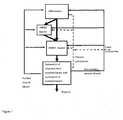
- Figure 1 shows how the flow from the first (LMW polymer) reactor is split between the second (HMW2 polymer) reactor and the third (HMW1 polymer) reactor.
- Figure 1 also shows how this process advantageously enables diluent and/or comonomer to be recycled.
- the dashed lines in Figure 1 illustrate recycling of comonomer separated from polyethylene product into each of the reactors.
- the thin solid lines in Figure 1 illustrate recycling of diluent, either in purified or non-purified form.
- non-purified diluent refers to diluent wherein wax (PE fraction soluble in hexane) has not been removed and comonomer has not been completely removed.
- hydrogen may optionally and is preferably removed, e.g. prior to recycling to the third reactor.
- purified diluent is meant diluent which is essentially free of wax and comonomer.
- purified diluent comprises 30 -100 % of the total diluent recycled.
- the first (LMW polymer) reactor is fed with purified diluent.
- the second (HMW2 polymer) reactor is fed with non-purified and/or purified diluent.
- the third (HMW1 polymer) reactor is fed with non-purified and/or purified diluent.
- an amount (e.g. 0.1 to 4 % v) of fresh diluent is preferably added to the reactor system, e.g. to replace diluent losses.
- the first (LMW polymer), second (HMW2 polymer) and third (HMW1 polymer) reactors are fed fresh comonomer and/or recycled comonomer.
- comonomer is not fed to the first (LMW polymer) reactor.
- more than 40 % by weight, still more preferably more than 60 % by weight (e.g. 40 to 80 % by weight) of the total feed of comonomer to the third (HMW1) reactor comes with the diluent and polymer flow from the second (HMW2) reactor
- the polymer When the final polyethylene is obtained from a slurry reactor, the polymer is removed therefrom and the diluent preferably separated from it by flashing or filtration. The major part of the diluent and unconverted comonomer is preferably recycled back to the polymerisation reactor(s). Preferably the polymer is then dried (e.g. to remove residues of liquids and gases from the reactor).
- the polymer is subjected to a deashing step, i.e. to washing with an alcohol, optionally mixed with a hydrocarbon liquid, or water. Preferably there is no deashing step.
- the polyethylene from the reactors is preferably in a free-flowing state, preferably by having relatively large particles of high bulk density, e.g. less than 20 % wt of the polymer powder being smaller than 100 ⁇ m size, and the loose bulk density being higher than 300 kg/m 3 .
- the processes from the polymerisation until the pelletisation extruder outlet are carried out under an inert (e.g. N 2 ) gas atmosphere.
- an inert e.g. N 2
- Antioxidants are preferably added (process stabilisers and long term antioxidants) to the polyethylene.
- antioxidant all types of compounds known for this purpose may be used, such as sterically hindered or semi-hindered phenols, aromatic amines, aliphatic sterically hindered amines, organic phosphates and sulphur-containing compounds (e.g. thioethers).
- Other additives antioxidants (antiblock, colour masterbatches, antistatics, slip agents, fillers, UV absorbers, lubricants, acid neutralisers and fluoroelastomer and other polymer processing agents) may optionally be added to the polymer.
- a pigment e.g. carbon black
- Pigments are preferably added in the form of a master batch.
- the polyethylene is preferably extruded and granulated into pellets.
- Preferred pellets have a loose bulk density of greater than 400 kg/m 3 and less than 10 % wt of pellets smaller than 2 mm in size.
- additives e.g. polymer processing agents or antiblock
- the additives are preferably used as masterbatches and pellets mixed therewith before being, e.g. moulded into articles.
- compositions comprising the polyethylene produced by the process of the present invention preferably have at least one of the following properties.
- the polyethylene preferably has a FNCT time to failure of greater than 10 hours, more preferably greater than 15 hours and still more preferably greater than 20 hours, e.g. under the conditions specified in the examples below.
- the maximum FNCT time to failure may be, e.g. 50 hours.
- the polyethylene preferably has a Charpy Impact at +23 °Cof greater than 5 kJ/m 2 , more preferably greater than 10 kJ/m 2 and still more preferably greater than 12 hours, e.g. under the conditions specified in the examples below.
- the maximum Charpy Impact may be, e.g. 50 kJ/m 2 .
- the polyethylene preferably has a Shore hardness of at least 30, more preferably at least 40 and still more preferably at least 50 and more preferably at least 60 e.g. under the conditions specified in the examples below.
- the maximum Shore hardness may be 90.
- the polyethylene preferably has an Abrasion of less than 40%, more preferably less than 30% and still more preferably less than 25%, e.g. under the conditions specified in the examples below.
- the mimimum abrasion may be 5 %.
- polyethylene composition described herein possess at least two, more preferably at least three and still more preferably all four of the following properties, e.g. as determined under the conditions specified in the examples below: FNCT time to failure: >10 hours Charpy Impact: >5 kJ/m 2 Shore hardness: >30 Abrasion: ⁇ 40%
- the polyethylene composition possesses at least two, more preferably at least three and still more preferably all four of the following properties, e.g. as determined under the conditions specified in the examples below: FNCT time to failure: >20 hours Charpy Impact: >12 kJ/m 2 Shore hardness: >50 Abrasion: ⁇ 25%
- the polyethylene produced by the process of the present invention may be used in any moulding application such as blow moulding or in extrusion such as pipe extrusion and film extrusion.
- the polyethylene is used in extrusion, especially in pipe extrusion.
- the polyethylene produced by the process of the present invention is preferably used in pipe applications.
- it is used in HDPE pipes, e.g. according to PE80 or PE100 standards.
- the pipes may be used e.g. for water and gas distribution, sewer, wastewater, agricultural uses, slurries, chemicals.
- MFR 2 , MFR 5 and MFR 21 were measured according to ISO 1133 at loads of 2.16, 5.0, and 21.6 kg respectively. The measurements were done at 190 °C.
- a Waters Alliance GPCV2000 instrument equipped with refractive index detector and online viscosimeter was used with 1 PLgel GUARD + 3 PLgel MIXED-B and 1,2,4-trichlorobenzene (TCB, stabilised with 250 mg/L 2,6-Di tert butyl-4-methyl-phenol) as solvent at 140 °C and at a constant flow rate of 1 mL/min. 200 ⁇ l of sample solution were injected per analysis.
- the column set was calibrated using universal calibration (according to ISO 16014-2:2003) with 15 narrow molecular weight distribution polystyrene (PS) standards in the range of 1.0 kg/mol to 12 000 kg/mol.
- PS narrow molecular weight distribution polystyrene
- Melting temperature was measured according to ISO 11357-1 on Perkin Elmer DSC-7 differential scanning calorimetry. Heating curves were taken from -10 °C to 200 °C at 10 °C/min. Hold for 10 min at 200 °C. Cooling curves were taken from 200 °C to -10 °C at 10 °C per min. Melting temperature was taken as the peak of the endotherm of the second heating. The degree of crystallinity was calculated by dividing the observed melting peak with the heat of melting of a perfectly crystalline polyethylene, generally taken to be 290 J/g.
- Comonomer content (% wt) was determined based on Fourier transform infrared spectroscopy (FTIR) determination calibrated with C13-NMR.
- FTIR Fourier transform infrared spectroscopy
- Density of materials is measured according to ISO 1183:1987 (E), method D, with isopropanol-water as gradient liquid.
- the cooling rate of the plaques when crystallising the samples was 15 C/min. Conditioning time was 16 hours.
- ⁇ * 0.05 is the complex viscosity at a frequency of 0.05 s -1 and ⁇ * 300 is the complex viscosity at 300 s -1 .
- the complex viscosity as a function of frequency measured by this dynamic method is the same as the viscosity as a function of shear rate for steady state flow (e.g. a capillary).
- Viscosity numbers were measured in decalin at 135°C according to EN-ISO 1628-3:20 and from this intrinsic viscosity was calculated as follows. From measurements after each of the polymerisation steps, Mv (viscosity average molecular weight) was calculated by the Marks-Houwink equation using preexponential factor of 0,0475 ml/g and exponent 0.725.
- Mv Mw Mw Mn 0.22
- Mw, Mn and Mv are respectively weight average, number average and viscosity average molecular weights
- W is weight fraction of polymer
- i polymer component
- n is the total number of components after the step.
- the two first equations are exact, the third is empirical.
- Mw/Mn of each polymer component was taken as 7.
- FNCT time to failure is measured according to ISO16770 with 8.5MPa load at a temperature of 80°C in 2 wt% Arkopal N110 in deionised water on 10mm compression molded dogbones, milled from compression molded plate, notch depth 1,6mm all round.
- Charpy Impact is measured according to ISO179-1/1eA using V-notched samples on compression moulded specimens at +23°C and at -20°C.
- Shore Hardness Shore D is measured on a digital shoremeter, Bareiss type HHP-2001 according to any cracks initiated. Sample conditioning is done according to ISO291:1997.
- Abrasion resistance is measured according to ISO 4649, type B test (non-rotating sample) with force 10 N at 23 °C.
- a compression moulded plate of the polymer composition was scratched at +23°C with an Erichsen scratch resistance tester with a tip diameter of 1 mm with 10 N normal force. The scratched plate was cut perpendicular to scratch, the cross section micrographed and from this the depth of the scratch was measured.
- a conventional Ziegler-Natta catalyst with Ti as the transition metal was used.
- the catalyst is described in US4792588 .
- the titanium content was 3.4 % wt.
- the reactor was purged with nitrogen and heated to 110°C. Hydrogen was then loaded at 20°C to give a pressure of 3.05 bar. 3000 ml liquid hexane was then added to the reactor and stirring started; 300 rpm. The reactor temperature was 70°C. Cocatalyst and TEA were then pre-contacted in mud for 5 min and loaded with 800 ml of hexane. Ethylene was then fed to get a total pressure of 12.3 bar. Ethylene was then fed continuously via a mass flow meter. When sufficient amount of powder is made, the polymerization is stopped and the hexane is evaporated.
- Hydrogen is loaded at 20°C to 0.16 bar. Stirring is then started at 300rpm. The reactor is then heated to >70°C. When the temperature reaches 72°, 35ml 1-butene is added and ethylene is fed to get a total pressure of 5.7 bar g. Ethylene and 1-butene are then fed continuously. When sufficient amount of powder is made, the polymerization is stopped and the hexane is evaporated.
- the reactor is heated to >70°C, 3000 ml hexane is loaded and stirring is started at 300 rpm.
- ethylene and 180 ml 1-butene is fed to get a total pressure of 5.3 bar.
- Ethylene and 1-butene were then fed continuously.
- the polymerization is stopped and the hexane is evaporated.
- the first comparative polymerisation (C1) was carried out in the same manner as above except that no 1-butene was added on the polymerization of the second higher molecular weight ethylene polymer.
- the comparative polymerisations (C2 and C4) were carried out in the same manner as above except that the polymerization was stopped after the polymerization of the first higher molecular weight ethylene.
- the comparative polymerisation (C3) was done with a higher amount (10 % wt) of the second higher molecular weight (HMW2) polymer.
- Table 1A Further details of the polymerisation procedure and polymerisation results is given in Table 1A and details of the resulting polyethylene polymers are summarised in Table 1 B below wherein RI refers to the polymerisation in and the product of the first reactor, RII refers to the polymerisation in the second reactor and the product of the first and second reactor together and RIII refers to the polymerisation in the third reactor and the product of the first, second and third reactor together, which is the final polyethylene product.
- Table 1B R1-RI R1-RII R1-RIII Ex. 2-RI Ex. 2-RII Ex.
- the activity results of the polymerisations were surprising in that the ratio of Effective average activity all steps over Activity of step RI was more than 10 % higher on the three-step run with HMW2 in the second step compared to the other three- and two-step polymerisations.
- This ratio is a relevant measure of the inverse of catalyst consumption in a production plant at given production rate with a given catalyst at a given total residence time.
- producing HMW2 polymer in the second polymerisation step and not in the third is expected to significantly lower consumption of catalyst in continuous, commercial production.
- producing HMW2 polymer in the second polymerisation step and not in the third is expected to significantly give lower consumption of catalyst than producing the polymer in only two steps.
- the cost of the catalyst consumption is a considerable production cost in commercial production, so this reduction represents a considerable saving to increase profits.
- producing HMW2 polymer in the third reactor is quite favourable compared to producing the polymer in only two steps.
- the extruder was run with an output rate of 1kg/h, 500rpm, no vacuum and with nitrogen flushing.
- the extruder temperature profile was 180-200x4-180(die).
- the resulting pellets were then pressed into 4mm plates following ISO293-1986, 1872-2 and 1873-2. Proper test specimens were then made from these plates.
- the polyethylene composition produced by the process of the present invention has a far higher FNCT result than each of the comparative polymer compositions C1-C4.
- FNCT is higher for polyethylene compositions which comprise a lower content of second higher molecular weight ethylene copolymer than those with a higher content of the same ethylene copolymer. This is also shown in Figure 2 .
- the third polymer having a relatively high molecular weight and a relatively high comonomer content increases the level of tie-chains and entanglements in the polyethylene composition. This increased level of tie-chains and entanglements will dissipate the energy associated with the stress field in an initiated crack and reduce the likeliness of a crack to propagate.
- the polymer described herein is also convenient to prepare using the process of the present invention.
- the relatively small amount of second high molecular weight copolymer may be made in a relatively small reactor, with a short residence time or alternatively in a medium size reactor where very conservative reactor conditions are employed.
Landscapes
- Chemical & Material Sciences (AREA)
- Health & Medical Sciences (AREA)
- Chemical Kinetics & Catalysis (AREA)
- Medicinal Chemistry (AREA)
- Polymers & Plastics (AREA)
- Organic Chemistry (AREA)
- Addition Polymer Or Copolymer, Post-Treatments, Or Chemical Modifications (AREA)
- Compositions Of Macromolecular Compounds (AREA)
- Polymerisation Methods In General (AREA)
Priority Applications (1)
| Application Number | Priority Date | Filing Date | Title |
|---|---|---|---|
| PL15164618T PL2930205T5 (pl) | 2012-01-31 | 2013-01-31 | Polimer mający multimodalny rozkład mas cząsteczkowych |
Applications Claiming Priority (3)
| Application Number | Priority Date | Filing Date | Title |
|---|---|---|---|
| GB1201578.0A GB2498936A (en) | 2012-01-31 | 2012-01-31 | Polyethylene with multi-modal molecular weight distribution |
| PCT/EP2013/051867 WO2013113797A1 (en) | 2012-01-31 | 2013-01-31 | Multimodal polyethylene polymers and process preparing said polymer |
| EP13702439.4A EP2809717B1 (en) | 2012-01-31 | 2013-01-31 | Multimodal polyethylene polymers and process preparing said polymer |
Related Parent Applications (2)
| Application Number | Title | Priority Date | Filing Date |
|---|---|---|---|
| EP13702439.4A Division EP2809717B1 (en) | 2012-01-31 | 2013-01-31 | Multimodal polyethylene polymers and process preparing said polymer |
| EP13702439.4A Division-Into EP2809717B1 (en) | 2012-01-31 | 2013-01-31 | Multimodal polyethylene polymers and process preparing said polymer |
Publications (3)
| Publication Number | Publication Date |
|---|---|
| EP2930205A1 EP2930205A1 (en) | 2015-10-14 |
| EP2930205B1 EP2930205B1 (en) | 2017-05-10 |
| EP2930205B2 true EP2930205B2 (en) | 2020-11-11 |
Family
ID=45876336
Family Applications (2)
| Application Number | Title | Priority Date | Filing Date |
|---|---|---|---|
| EP15164618.9A Active EP2930205B2 (en) | 2012-01-31 | 2013-01-31 | Polymer having a multimodal molecular weight distribution |
| EP13702439.4A Revoked EP2809717B1 (en) | 2012-01-31 | 2013-01-31 | Multimodal polyethylene polymers and process preparing said polymer |
Family Applications After (1)
| Application Number | Title | Priority Date | Filing Date |
|---|---|---|---|
| EP13702439.4A Revoked EP2809717B1 (en) | 2012-01-31 | 2013-01-31 | Multimodal polyethylene polymers and process preparing said polymer |
Country Status (11)
| Country | Link |
|---|---|
| EP (2) | EP2930205B2 (enExample) |
| JP (3) | JP6272237B2 (enExample) |
| KR (3) | KR102367034B1 (enExample) |
| CN (1) | CN104204068B (enExample) |
| ES (2) | ES2596272T3 (enExample) |
| GB (1) | GB2498936A (enExample) |
| HU (2) | HUE036018T2 (enExample) |
| PL (2) | PL2930205T5 (enExample) |
| PT (2) | PT2809717T (enExample) |
| SG (3) | SG10201913063XA (enExample) |
| WO (1) | WO2013113797A1 (enExample) |
Families Citing this family (37)
| Publication number | Priority date | Publication date | Assignee | Title |
|---|---|---|---|---|
| GB201313937D0 (en) | 2013-08-05 | 2013-09-18 | Ineos Europe Ag | Polymerisation process |
| EP2860201A1 (en) * | 2013-10-10 | 2015-04-15 | Borealis AG | High temperature resistant polyethylene and process for the production thereof |
| CN105440192B (zh) * | 2014-08-14 | 2018-04-03 | 中国石化扬子石油化工有限公司 | 一种耐热聚乙烯管材料的制备方法 |
| EP3056524B1 (en) | 2014-10-13 | 2021-09-22 | LG Chem, Ltd. | Ethylene/1-butene copolymer having excellent processibility and environmental stress cracking resistance |
| CN105585651B (zh) * | 2014-10-23 | 2018-04-03 | 中国石化扬子石油化工有限公司 | 一种高密度聚乙烯产品的制备方法 |
| GB2533770B (en) | 2014-12-22 | 2021-02-10 | Norner Verdandi As | Polyethylene for pipes |
| CN112979842B (zh) | 2015-02-05 | 2022-11-11 | 博里利斯股份公司 | 用于生产聚乙烯的方法 |
| CN106317546A (zh) * | 2015-07-01 | 2017-01-11 | 中国石油化工股份有限公司 | 一种大型中空容器用高密度聚乙烯树脂 |
| CN107200896A (zh) * | 2016-03-17 | 2017-09-26 | 中国石化扬子石油化工有限公司 | 一种耐快速裂纹扩展的聚乙烯管材料的制备方法 |
| CN107200898A (zh) * | 2016-03-17 | 2017-09-26 | 中国石化扬子石油化工有限公司 | 一种耐慢速裂纹增长的聚乙烯管材料的制备方法 |
| CN107304265B (zh) * | 2016-04-21 | 2019-12-24 | 中国石油化工股份有限公司 | 一种聚乙烯组合物和聚乙烯薄膜及其制备方法 |
| CN109415448B (zh) | 2016-06-22 | 2021-04-13 | 北欧化工公司 | 聚合物组合物以及制备聚合物组合物的方法 |
| GB201611295D0 (en) | 2016-06-29 | 2016-08-10 | Norner Verdandi As | Polyethylene for pipes |
| WO2018046169A1 (en) * | 2016-09-07 | 2018-03-15 | Sabic Global Technologies B.V. | Management of polymer fines in multimodal polyethylene production |
| ES2754386T3 (es) | 2016-09-12 | 2020-04-17 | Thai Polyethylene Co Ltd | Película fina de polietileno multimodal |
| JP7066682B2 (ja) | 2016-09-12 | 2022-05-13 | タイ ポリエチレン カンパニー リミテッド | 二峰性ポリエチレン組成物及びそれを含むパイプ |
| PT3293207T (pt) | 2016-09-12 | 2019-10-25 | Scg Chemicals Co Ltd | Tubo de polietileno multimodal |
| ES2755384T3 (es) | 2016-09-12 | 2020-04-22 | Thai Polyethylene Co Ltd | Contenedor de polietileno multimodal |
| EP3293214B1 (en) | 2016-09-12 | 2019-12-25 | Thai Polyethylene Co., Ltd. | High performances multimodal ultra high molecular weight polyethylene |
| HUE045071T2 (hu) | 2016-09-12 | 2019-12-30 | Thai Polyethylene Co Ltd | Multimodális polietilén film |
| EP3293206B1 (en) | 2016-09-12 | 2019-10-23 | Thai Polyethylene Co., Ltd. | Multimodal polyethylene pipe |
| HUE045763T2 (hu) | 2016-09-12 | 2020-01-28 | Thai Polyethylene Co Ltd | Multimodális polietilén csavaros kupak |
| HUE047204T2 (hu) | 2016-09-12 | 2020-04-28 | Thai Polyethylene Co Ltd | Reaktorrendszer multimodális polietilén polimerizáláshoz |
| US10982025B2 (en) * | 2016-11-25 | 2021-04-20 | Borealis Ag | Process for producing polyolefin film composition and films prepared thereof |
| CN110072893B (zh) * | 2016-12-07 | 2021-08-17 | Sabic环球技术有限责任公司 | 用于制造聚乙烯的方法 |
| US10538654B2 (en) | 2017-04-19 | 2020-01-21 | Nova Chemicals (International) S.A. | Multi reactor solution polymerization, polyethylene and polyethylene film |
| US9963529B1 (en) | 2017-04-19 | 2018-05-08 | Nova Chemicals (International) S.A. | Multi reactor solution polymerization |
| EP3418330B2 (en) | 2017-06-21 | 2023-07-19 | Borealis AG | Polymer composition and a process for production of the polymer composition |
| CN109422947B (zh) * | 2017-08-29 | 2021-03-09 | 中国石油天然气股份有限公司 | 多峰聚乙烯及其制备方法 |
| EP3732214B1 (en) * | 2017-12-26 | 2023-11-01 | Dow Global Technologies LLC | Compositions with multimodal ethylene-based polymers having improved toughness at low temperatures |
| JP7412849B2 (ja) * | 2020-08-19 | 2024-01-15 | エルジー・ケム・リミテッド | ペレット型ポリエチレン樹脂組成物およびその製造方法 |
| WO2022122622A2 (en) * | 2020-12-11 | 2022-06-16 | Sabic Global Technologies B.V. | Multimodal polyethylene |
| EP4201981B1 (en) * | 2021-12-23 | 2024-08-14 | Thai Polyethylene Co., Ltd. | Multimodal polyethylene composition |
| EP4230680A1 (en) | 2022-02-18 | 2023-08-23 | PCC ROKITA Spolka Akcyjna | A PROCESS FOR OBTAINING A POLYETHER POLYOL WITH A BIMODAL MOLECULAR WEIGHT 
DISTRIBUTION, FOR THE PRODUCTION OF FLEXIBLE POLYURETHANE FOAMS |
| CN114716589B (zh) * | 2022-04-20 | 2023-08-11 | 浙江大学 | 一种聚烯烃生产装置和方法 |
| EP4357407A1 (en) * | 2022-10-19 | 2024-04-24 | Thai Polyethylene Co., Ltd. | Multimodal polyethylene composition, resin composition comprising the multimodal polyethylene composition and a post-consumer resin, a method for preparing the same and an article comprising the same |
| WO2025177030A1 (en) * | 2024-02-25 | 2025-08-28 | Irpc Public Company Limited | Polymerization reactor system and process for producing a multimodal polyethylene composition, a multimodal polyethylene composition obtained therefrom and a pipe comprising the said composition |
Citations (5)
| Publication number | Priority date | Publication date | Assignee | Title |
|---|---|---|---|---|
| US4336352A (en) † | 1979-08-24 | 1982-06-22 | Asahi Kasei Kogyo Kabushiki Kaisha | Blend of three ethylene polymers |
| US4975485A (en) † | 1988-06-23 | 1990-12-04 | Tosoh Corporation | Ethylene polymer and process for preparing same |
| WO1994022948A1 (en) † | 1993-03-26 | 1994-10-13 | Borealis Polymers Oy | Process for manufacturing olefin polymers and products prepared by the process |
| WO2004111095A1 (en) † | 2003-06-06 | 2004-12-23 | Borealis Technology Oy | Process for the catalytic polymerization of olefins, a reactor system, its use in the process, the polyolefins obtained and their use |
| EP2011822A1 (en) † | 2007-07-04 | 2009-01-07 | Borealis Technology Oy | Multimodal polyethylene co-polymer resin composition, a preparation process therefore and a polymeric product comprising the same |
Family Cites Families (58)
| Publication number | Priority date | Publication date | Assignee | Title |
|---|---|---|---|---|
| US4081674A (en) | 1976-01-21 | 1978-03-28 | Hitachi, Ltd. | Ion microprobe analyzer |
| JPS5731945A (en) * | 1980-08-04 | 1982-02-20 | Asahi Chem Ind Co Ltd | Polyethylene composition and preparation of the same |
| JPS59196346A (ja) * | 1983-04-21 | 1984-11-07 | Asahi Chem Ind Co Ltd | ポリエチレン樹脂組成物 |
| JPS59227913A (ja) * | 1983-06-10 | 1984-12-21 | Idemitsu Petrochem Co Ltd | エチレン重合体あるいは共重合体の製造方法 |
| JPS6114207A (ja) * | 1984-06-29 | 1986-01-22 | Idemitsu Petrochem Co Ltd | エチレン共重合体組成物およびその製造方法 |
| JPH07116251B2 (ja) * | 1985-03-11 | 1995-12-13 | 東ソー株式会社 | 改質されたポリエチレンの製造方法 |
| WO1987000184A1 (fr) | 1985-06-27 | 1987-01-15 | Mitsui Petrochemical Industries, Ltd. | Composition de polyethylene |
| DE3782243T2 (de) | 1986-08-26 | 1993-03-04 | Mitsui Petrochemical Ind | Katalysator zur polymerisierung von alpha-olefin und verfahren. |
| US5055438A (en) | 1989-09-13 | 1991-10-08 | Exxon Chemical Patents, Inc. | Olefin polymerization catalysts |
| US5721185A (en) | 1991-06-24 | 1998-02-24 | The Dow Chemical Company | Homogeneous olefin polymerization catalyst by abstraction with lewis acids |
| US5240894A (en) | 1992-05-18 | 1993-08-31 | Exxon Chemical Patents Inc. | Method for making and using a supported metallocene catalyst system |
| DE9321056U1 (de) | 1993-02-10 | 1995-11-16 | Schüco International KG, 33609 Bielefeld | Eckverbindung auf Gehrung geschnittener Hohlprofile eines Rahmens für Fenster, Türen oder Fassaden |
| AU686836B2 (en) | 1994-06-24 | 1998-02-12 | Exxon Chemical Patents Inc. | Polymerization catalyst systems, their production and use |
| CZ293261B6 (cs) | 1994-11-17 | 2004-03-17 | The Dow Chemical Company | Nanesená katalytická komponenta, nanesený katalyzátor, způsob jejich přípravy a jejich použití |
| US5625015A (en) | 1994-11-23 | 1997-04-29 | Exxon Chemical Patents Inc. | Method for making supported catalyst systems and catalyst systems therefrom |
| FI101546B1 (fi) | 1994-12-16 | 1998-07-15 | Borealis Polymers Oy | Polyeteenikompositio |
| FI96216C (fi) | 1994-12-16 | 1996-05-27 | Borealis Polymers Oy | Prosessi polyeteenin valmistamiseksi |
| US5880241A (en) | 1995-01-24 | 1999-03-09 | E. I. Du Pont De Nemours And Company | Olefin polymers |
| US6090740A (en) | 1996-02-08 | 2000-07-18 | Exxon Chemical Patents Inc. | Supported metallocene catalyst systems |
| DE19606167A1 (de) | 1996-02-20 | 1997-08-21 | Basf Ag | Geträgerte Katalysatorsysteme |
| JP2000516644A (ja) | 1996-07-11 | 2000-12-12 | モービル・オイル・コーポレーション | オレフィン重合用の担持されたメタロセン触媒 |
| SE513632C2 (sv) | 1998-07-06 | 2000-10-09 | Borealis Polymers Oy | Multimodal polyetenkomposition för rör |
| SE9803501D0 (sv) | 1998-10-14 | 1998-10-14 | Borealis Polymers Oy | Polymer composition for pipes |
| EP1041113A1 (en) * | 1999-03-30 | 2000-10-04 | Fina Research S.A. | Polyolefins and uses thereof |
| GB9911934D0 (en) | 1999-05-21 | 1999-07-21 | Borealis As | Polymer |
| DE19945980A1 (de) | 1999-09-24 | 2001-03-29 | Elenac Gmbh | Polyethylen Formmasse mit verbesserter ESCR-Steifigkeitsrelation und Schwellrate, Verfahren zu ihrer Herstellung und daraus hergestellte Hohlkörper |
| CN1119354C (zh) | 2000-05-19 | 2003-08-27 | 中国石油化工集团公司 | 一种氯化镁-醇载体及其制备的烯烃聚合催化剂组分 |
| US7829646B2 (en) | 2000-08-18 | 2010-11-09 | Chevron Phillips Chemical Company Lp | Olefin polymers, method of making, and use thereof |
| DE10047861A1 (de) | 2000-09-27 | 2002-04-25 | Basell Polyolefine Gmbh | Polyethylen Formmasse geeignet als Rohrwerkstoff mit herausragenden Verarbeitungseigenschaften |
| WO2004058878A1 (en) * | 2002-12-24 | 2004-07-15 | Basell Polyolefine Gmbh | Polyethylene blow molding composition for producing large containers |
| DE10261065A1 (de) * | 2002-12-24 | 2004-07-08 | Basell Polyolefine Gmbh | Polyethylen Formmasse zum Herstellen von Behältern durch Blasformen und damit hergestellte Großhohlkörper |
| DE102004020524A1 (de) | 2004-04-26 | 2005-11-10 | Basell Polyolefine Gmbh | Polyethylen und Katalysatorzusammensetzung zu dessen Herstellung |
| GB0423555D0 (en) * | 2004-10-22 | 2004-11-24 | Borealis Tech Oy | Process |
| EP1655334B1 (en) | 2004-11-03 | 2006-12-27 | Borealis Technology Oy | Multimodal polyethylene composition with improved homogeneity |
| DE102004055588A1 (de) * | 2004-11-18 | 2006-05-24 | Basell Polyolefine Gmbh | Polyethylen Formmasse für die Beschichtung von Stahlrohren |
| DE102004055587A1 (de) * | 2004-11-18 | 2006-05-24 | Basell Polyolefine Gmbh | Polyethylen Formmasse für die äußere Ummantelung von Elektrokabeln |
| DE102005009916A1 (de) * | 2005-03-01 | 2006-09-07 | Basell Polyolefine Gmbh | Polyethylen Formmasse zum Herstellen von Blasfolien mit verbesserten mechanischen Eigenschaften |
| DE102005009895A1 (de) * | 2005-03-01 | 2006-09-07 | Basell Polyolefine Gmbh | Polyethylen Formmasse zum Herstellen von Blasfolien mit verbesserten mechanischen Eigenschaften |
| DE102005009896A1 (de) * | 2005-03-01 | 2006-09-07 | Basell Polyolefine Gmbh | Polyethylen Formmasse zum Herstellen von Blasfolien mit verbesserten mechanischen Eigenschaften |
| EP1710013A1 (en) * | 2005-04-08 | 2006-10-11 | Saudi Basic Industries Corporation | A process for the preparation of linear alpha-olefin oligomers |
| US7312283B2 (en) | 2005-08-22 | 2007-12-25 | Chevron Phillips Chemical Company Lp | Polymerization catalysts and process for producing bimodal polymers in a single reactor |
| DE102005040390A1 (de) * | 2005-08-25 | 2007-03-01 | Basell Polyolefine Gmbh | Multimodale Polyethylen Formmasse zur Herstellung von Rohren mit verbesserten mechanischen Eigenschaften |
| EP1772485A1 (en) | 2005-10-07 | 2007-04-11 | Borealis Technology Oy | Polyethylene composition with improved stress crack resistance/stiffness relation for blow moulding |
| EP1772486A1 (en) | 2005-10-07 | 2007-04-11 | Borealis Technology Oy | Polyethylene composition for injection moulding with improved stress crack/stiffness relation and impact resistance |
| ATE478921T1 (de) | 2005-10-21 | 2010-09-15 | Borealis Tech Oy | Zusammensetzung |
| ES2340789T3 (es) | 2006-10-04 | 2010-06-09 | Borealis Technology Oy | Composicion de polietileno para tubos de presion con flexibilidad mejorada. |
| EP2076546B1 (en) | 2006-10-24 | 2010-08-11 | Basell Polyolefine GmbH | Multimodal polyethylene molding composition for producing pipes having improved mechanical properties |
| WO2008077530A2 (en) * | 2006-12-22 | 2008-07-03 | Basell Polyolefine Gmbh | Multimodal polyethylene composition, mixed catalyst and process for preparing the composition |
| DE202007004346U1 (de) | 2007-03-21 | 2007-10-31 | Rehau Ag + Co | Rohranordnung |
| DE102007016348A1 (de) * | 2007-04-03 | 2008-10-09 | Basell Polyolefine Gmbh | Polyethylen Formmasse zum Herstellen von Hohlkörpern durch Thermoformen und damit hergestellte Kraftstoffbehälter |
| DE102007017903A1 (de) | 2007-04-13 | 2008-10-16 | Basell Polyolefine Gmbh | Polyethylen und Katalysatorzusammensetzung und Verfahren zu dessen Herstellung |
| CN102471547B (zh) * | 2009-06-30 | 2014-11-12 | 巴塞尔聚烯烃股份有限公司 | 聚乙烯模塑组合物 |
| EP2354183B1 (en) | 2010-01-29 | 2012-08-22 | Borealis AG | Moulding composition |
| EP2668231B1 (en) | 2011-01-28 | 2014-10-29 | Borealis AG | Polyethylene composition |
| EP2570455A1 (en) | 2011-09-16 | 2013-03-20 | Borealis AG | Polyethylene composition with broad molecular weight distribution and improved homogeneity |
| EP2583998B1 (en) | 2011-10-21 | 2018-02-28 | Borealis AG | Polyethylene composition with high rapid crack propagation resistance and pressure resistance |
| EP2599828A1 (en) * | 2011-12-01 | 2013-06-05 | Borealis AG | Multimodal polyethylene composition for the production of pipes with improved slow crack growth resistance |
| EP2607391A1 (en) | 2011-12-21 | 2013-06-26 | Basell Polyolefine GmbH | Process for controlling the polymer composition of an ethylene copolymer obtained by a catalyst system comprising a transition metal catalyst component and a Ziegler catalyst component |
-
2012
- 2012-01-31 GB GB1201578.0A patent/GB2498936A/en not_active Withdrawn
-
2013
- 2013-01-31 ES ES13702439.4T patent/ES2596272T3/es active Active
- 2013-01-31 PL PL15164618T patent/PL2930205T5/pl unknown
- 2013-01-31 HU HUE15164618A patent/HUE036018T2/hu unknown
- 2013-01-31 SG SG10201913063XA patent/SG10201913063XA/en unknown
- 2013-01-31 PT PT137024394T patent/PT2809717T/pt unknown
- 2013-01-31 PL PL13702439T patent/PL2809717T3/pl unknown
- 2013-01-31 WO PCT/EP2013/051867 patent/WO2013113797A1/en not_active Ceased
- 2013-01-31 PT PT151646189T patent/PT2930205T/pt unknown
- 2013-01-31 HU HUE13702439A patent/HUE030728T2/en unknown
- 2013-01-31 KR KR1020207037826A patent/KR102367034B1/ko active Active
- 2013-01-31 CN CN201380017952.8A patent/CN104204068B/zh active Active
- 2013-01-31 ES ES15164618T patent/ES2636781T5/es active Active
- 2013-01-31 JP JP2014555196A patent/JP6272237B2/ja active Active
- 2013-01-31 SG SG10201606270TA patent/SG10201606270TA/en unknown
- 2013-01-31 EP EP15164618.9A patent/EP2930205B2/en active Active
- 2013-01-31 KR KR1020147024238A patent/KR102049537B1/ko active Active
- 2013-01-31 KR KR1020197034461A patent/KR102198772B1/ko active Active
- 2013-01-31 SG SG11201404520UA patent/SG11201404520UA/en unknown
- 2013-01-31 EP EP13702439.4A patent/EP2809717B1/en not_active Revoked
-
2017
- 2017-12-27 JP JP2017251391A patent/JP6820249B2/ja active Active
-
2021
- 2021-01-04 JP JP2021000126A patent/JP7361733B2/ja active Active
Patent Citations (5)
| Publication number | Priority date | Publication date | Assignee | Title |
|---|---|---|---|---|
| US4336352A (en) † | 1979-08-24 | 1982-06-22 | Asahi Kasei Kogyo Kabushiki Kaisha | Blend of three ethylene polymers |
| US4975485A (en) † | 1988-06-23 | 1990-12-04 | Tosoh Corporation | Ethylene polymer and process for preparing same |
| WO1994022948A1 (en) † | 1993-03-26 | 1994-10-13 | Borealis Polymers Oy | Process for manufacturing olefin polymers and products prepared by the process |
| WO2004111095A1 (en) † | 2003-06-06 | 2004-12-23 | Borealis Technology Oy | Process for the catalytic polymerization of olefins, a reactor system, its use in the process, the polyolefins obtained and their use |
| EP2011822A1 (en) † | 2007-07-04 | 2009-01-07 | Borealis Technology Oy | Multimodal polyethylene co-polymer resin composition, a preparation process therefore and a polymeric product comprising the same |
Non-Patent Citations (1)
| Title |
|---|
| Brandup J. et al: "Polymer Handbook", United States of America, John Wiley & Sons, 1999, Ed Fourth, ISBN 0-471-16628-6 † |
Also Published As
| Publication number | Publication date |
|---|---|
| ES2636781T3 (es) | 2017-10-09 |
| PT2809717T (pt) | 2016-10-20 |
| CN104204068B (zh) | 2016-10-12 |
| KR20140120358A (ko) | 2014-10-13 |
| KR102198772B1 (ko) | 2021-01-08 |
| ES2596272T3 (es) | 2017-01-05 |
| KR20190133791A (ko) | 2019-12-03 |
| PT2930205T (pt) | 2017-08-10 |
| EP2809717A1 (en) | 2014-12-10 |
| PL2930205T5 (pl) | 2021-03-08 |
| JP6820249B2 (ja) | 2021-01-27 |
| WO2013113797A1 (en) | 2013-08-08 |
| KR102367034B1 (ko) | 2022-02-24 |
| EP2930205A1 (en) | 2015-10-14 |
| KR102049537B1 (ko) | 2019-11-27 |
| JP2021050359A (ja) | 2021-04-01 |
| ES2636781T5 (es) | 2021-07-22 |
| JP7361733B2 (ja) | 2023-10-16 |
| GB2498936A (en) | 2013-08-07 |
| HUE036018T2 (hu) | 2018-06-28 |
| JP6272237B2 (ja) | 2018-01-31 |
| SG11201404520UA (en) | 2014-10-30 |
| CN104204068A (zh) | 2014-12-10 |
| JP2015505573A (ja) | 2015-02-23 |
| JP2018104707A (ja) | 2018-07-05 |
| EP2809717B1 (en) | 2016-07-13 |
| SG10201606270TA (en) | 2016-09-29 |
| KR20210003306A (ko) | 2021-01-11 |
| PL2809717T3 (pl) | 2017-01-31 |
| HUE030728T2 (en) | 2017-06-28 |
| EP2930205B1 (en) | 2017-05-10 |
| GB201201578D0 (en) | 2012-03-14 |
| SG10201913063XA (en) | 2020-03-30 |
Similar Documents
| Publication | Publication Date | Title |
|---|---|---|
| EP2930205B1 (en) | Polymer having a multimodal molecular weight distribution | |
| US10995169B2 (en) | Polyethylene for pipes | |
| KR100849051B1 (ko) | 에틸렌 중합체 조성물 | |
| US11236179B2 (en) | High performances multimodal ultra high molecular weight polyethylene | |
| AU2014356524B2 (en) | Multimodal polymer | |
| EP1937769B1 (en) | Composition | |
| AU2012210433B2 (en) | Polyethylene composition | |
| EP3544814A1 (en) | A process for producing polyolefin film composition and films prepared thereof | |
| WO2014042898A2 (en) | Ethylene-based polymers and articles made therefrom | |
| KR20100087762A (ko) | 멀티모달 에틸렌 공중합체를 사용한 고효율의 파이프를 코팅하는 방법 및 그로 인해 얻어지는 코팅된 파이프 | |
| EP3475313A1 (en) | Polymer composition and a process for production of the polymer composition | |
| US11208504B2 (en) | Injection-molded articles comprising metallocene-catalyzed polyethylene resin | |
| EP1884527B1 (en) | Polyethylene resin, process for producing the same, and a pipe and joint comprising the resin | |
| JP6878942B2 (ja) | ポリエチレン樹脂組成物、並びにその成形体及び容器 | |
| JP6794867B2 (ja) | ポリエチレン樹脂組成物、並びにその成形体及び容器 | |
| RU2777964C1 (ru) | Композиция полиэтилена для труб высокого давления с улучшенной гомогенностью | |
| CN110036067A (zh) | 用于管件应用的导热pe组合物 |
Legal Events
| Date | Code | Title | Description |
|---|---|---|---|
| PUAI | Public reference made under article 153(3) epc to a published international application that has entered the european phase |
Free format text: ORIGINAL CODE: 0009012 |
|
| 17P | Request for examination filed |
Effective date: 20150422 |
|
| AC | Divisional application: reference to earlier application |
Ref document number: 2809717 Country of ref document: EP Kind code of ref document: P |
|
| AK | Designated contracting states |
Kind code of ref document: A1 Designated state(s): AL AT BE BG CH CY CZ DE DK EE ES FI FR GB GR HR HU IE IS IT LI LT LU LV MC MK MT NL NO PL PT RO RS SE SI SK SM TR |
|
| REG | Reference to a national code |
Ref country code: DE Ref legal event code: R079 Ref document number: 602013021133 Country of ref document: DE Free format text: PREVIOUS MAIN CLASS: H99Z9999999999 Ipc: C08F0010020000 Ref country code: DE Ref legal event code: R079 Free format text: PREVIOUS MAIN CLASS: H99Z9999999999 Ipc: C08F0010020000 |
|
| REG | Reference to a national code |
Ref country code: DE Ref legal event code: R079 Ref document number: 602013021133 Country of ref document: DE Free format text: PREVIOUS MAIN CLASS: C08F0010020000 Ipc: C08L0023040000 |
|
| GRAP | Despatch of communication of intention to grant a patent |
Free format text: ORIGINAL CODE: EPIDOSNIGR1 |
|
| RIC1 | Information provided on ipc code assigned before grant |
Ipc: C08L 23/04 20060101AFI20160519BHEP |
|
| INTG | Intention to grant announced |
Effective date: 20160617 |
|
| GRAJ | Information related to disapproval of communication of intention to grant by the applicant or resumption of examination proceedings by the epo deleted |
Free format text: ORIGINAL CODE: EPIDOSDIGR1 |
|
| STAA | Information on the status of an ep patent application or granted ep patent |
Free format text: STATUS: REQUEST FOR EXAMINATION WAS MADE |
|
| GRAP | Despatch of communication of intention to grant a patent |
Free format text: ORIGINAL CODE: EPIDOSNIGR1 |
|
| STAA | Information on the status of an ep patent application or granted ep patent |
Free format text: STATUS: GRANT OF PATENT IS INTENDED |
|
| INTC | Intention to grant announced (deleted) | ||
| INTG | Intention to grant announced |
Effective date: 20161118 |
|
| GRAS | Grant fee paid |
Free format text: ORIGINAL CODE: EPIDOSNIGR3 |
|
| GRAJ | Information related to disapproval of communication of intention to grant by the applicant or resumption of examination proceedings by the epo deleted |
Free format text: ORIGINAL CODE: EPIDOSDIGR1 |
|
| GRAL | Information related to payment of fee for publishing/printing deleted |
Free format text: ORIGINAL CODE: EPIDOSDIGR3 |
|
| STAA | Information on the status of an ep patent application or granted ep patent |
Free format text: STATUS: REQUEST FOR EXAMINATION WAS MADE |
|
| GRAR | Information related to intention to grant a patent recorded |
Free format text: ORIGINAL CODE: EPIDOSNIGR71 |
|
| STAA | Information on the status of an ep patent application or granted ep patent |
Free format text: STATUS: GRANT OF PATENT IS INTENDED |
|
| GRAA | (expected) grant |
Free format text: ORIGINAL CODE: 0009210 |
|
| STAA | Information on the status of an ep patent application or granted ep patent |
Free format text: STATUS: THE PATENT HAS BEEN GRANTED |
|
| INTC | Intention to grant announced (deleted) | ||
| AC | Divisional application: reference to earlier application |
Ref document number: 2809717 Country of ref document: EP Kind code of ref document: P |
|
| AK | Designated contracting states |
Kind code of ref document: B1 Designated state(s): AL AT BE BG CH CY CZ DE DK EE ES FI FR GB GR HR HU IE IS IT LI LT LU LV MC MK MT NL NO PL PT RO RS SE SI SK SM TR |
|
| INTG | Intention to grant announced |
Effective date: 20170404 |
|
| REG | Reference to a national code |
Ref country code: GB Ref legal event code: FG4D |
|
| REG | Reference to a national code |
Ref country code: AT Ref legal event code: REF Ref document number: 892284 Country of ref document: AT Kind code of ref document: T Effective date: 20170515 Ref country code: CH Ref legal event code: EP |
|
| REG | Reference to a national code |
Ref country code: IE Ref legal event code: FG4D |
|
| REG | Reference to a national code |
Ref country code: DE Ref legal event code: R096 Ref document number: 602013021133 Country of ref document: DE |
|
| REG | Reference to a national code |
Ref country code: RO Ref legal event code: EPE |
|
| REG | Reference to a national code |
Ref country code: PT Ref legal event code: SC4A Ref document number: 2930205 Country of ref document: PT Date of ref document: 20170810 Kind code of ref document: T Free format text: AVAILABILITY OF NATIONAL TRANSLATION Effective date: 20170804 |
|
| REG | Reference to a national code |
Ref country code: NL Ref legal event code: MP Effective date: 20170510 |
|
| REG | Reference to a national code |
Ref country code: LT Ref legal event code: MG4D |
|
| REG | Reference to a national code |
Ref country code: ES Ref legal event code: FG2A Ref document number: 2636781 Country of ref document: ES Kind code of ref document: T3 Effective date: 20171009 |
|
| PG25 | Lapsed in a contracting state [announced via postgrant information from national office to epo] |
Ref country code: HR Free format text: LAPSE BECAUSE OF FAILURE TO SUBMIT A TRANSLATION OF THE DESCRIPTION OR TO PAY THE FEE WITHIN THE PRESCRIBED TIME-LIMIT Effective date: 20170510 Ref country code: FI Free format text: LAPSE BECAUSE OF FAILURE TO SUBMIT A TRANSLATION OF THE DESCRIPTION OR TO PAY THE FEE WITHIN THE PRESCRIBED TIME-LIMIT Effective date: 20170510 Ref country code: NO Free format text: LAPSE BECAUSE OF FAILURE TO SUBMIT A TRANSLATION OF THE DESCRIPTION OR TO PAY THE FEE WITHIN THE PRESCRIBED TIME-LIMIT Effective date: 20170810 Ref country code: GR Free format text: LAPSE BECAUSE OF FAILURE TO SUBMIT A TRANSLATION OF THE DESCRIPTION OR TO PAY THE FEE WITHIN THE PRESCRIBED TIME-LIMIT Effective date: 20170811 Ref country code: LT Free format text: LAPSE BECAUSE OF FAILURE TO SUBMIT A TRANSLATION OF THE DESCRIPTION OR TO PAY THE FEE WITHIN THE PRESCRIBED TIME-LIMIT Effective date: 20170510 |
|
| PG25 | Lapsed in a contracting state [announced via postgrant information from national office to epo] |
Ref country code: IS Free format text: LAPSE BECAUSE OF FAILURE TO SUBMIT A TRANSLATION OF THE DESCRIPTION OR TO PAY THE FEE WITHIN THE PRESCRIBED TIME-LIMIT Effective date: 20170910 Ref country code: BG Free format text: LAPSE BECAUSE OF FAILURE TO SUBMIT A TRANSLATION OF THE DESCRIPTION OR TO PAY THE FEE WITHIN THE PRESCRIBED TIME-LIMIT Effective date: 20170810 Ref country code: NL Free format text: LAPSE BECAUSE OF FAILURE TO SUBMIT A TRANSLATION OF THE DESCRIPTION OR TO PAY THE FEE WITHIN THE PRESCRIBED TIME-LIMIT Effective date: 20170510 Ref country code: SE Free format text: LAPSE BECAUSE OF FAILURE TO SUBMIT A TRANSLATION OF THE DESCRIPTION OR TO PAY THE FEE WITHIN THE PRESCRIBED TIME-LIMIT Effective date: 20170510 Ref country code: RS Free format text: LAPSE BECAUSE OF FAILURE TO SUBMIT A TRANSLATION OF THE DESCRIPTION OR TO PAY THE FEE WITHIN THE PRESCRIBED TIME-LIMIT Effective date: 20170510 Ref country code: LV Free format text: LAPSE BECAUSE OF FAILURE TO SUBMIT A TRANSLATION OF THE DESCRIPTION OR TO PAY THE FEE WITHIN THE PRESCRIBED TIME-LIMIT Effective date: 20170510 |
|
| REG | Reference to a national code |
Ref country code: FR Ref legal event code: PLFP Year of fee payment: 6 |
|
| PG25 | Lapsed in a contracting state [announced via postgrant information from national office to epo] |
Ref country code: EE Free format text: LAPSE BECAUSE OF FAILURE TO SUBMIT A TRANSLATION OF THE DESCRIPTION OR TO PAY THE FEE WITHIN THE PRESCRIBED TIME-LIMIT Effective date: 20170510 Ref country code: CZ Free format text: LAPSE BECAUSE OF FAILURE TO SUBMIT A TRANSLATION OF THE DESCRIPTION OR TO PAY THE FEE WITHIN THE PRESCRIBED TIME-LIMIT Effective date: 20170510 Ref country code: DK Free format text: LAPSE BECAUSE OF FAILURE TO SUBMIT A TRANSLATION OF THE DESCRIPTION OR TO PAY THE FEE WITHIN THE PRESCRIBED TIME-LIMIT Effective date: 20170510 Ref country code: SK Free format text: LAPSE BECAUSE OF FAILURE TO SUBMIT A TRANSLATION OF THE DESCRIPTION OR TO PAY THE FEE WITHIN THE PRESCRIBED TIME-LIMIT Effective date: 20170510 |
|
| REG | Reference to a national code |
Ref country code: DE Ref legal event code: R026 Ref document number: 602013021133 Country of ref document: DE |
|
| PLBI | Opposition filed |
Free format text: ORIGINAL CODE: 0009260 |
|
| PG25 | Lapsed in a contracting state [announced via postgrant information from national office to epo] |
Ref country code: SM Free format text: LAPSE BECAUSE OF FAILURE TO SUBMIT A TRANSLATION OF THE DESCRIPTION OR TO PAY THE FEE WITHIN THE PRESCRIBED TIME-LIMIT Effective date: 20170510 |
|
| PLAX | Notice of opposition and request to file observation + time limit sent |
Free format text: ORIGINAL CODE: EPIDOSNOBS2 |
|
| 26 | Opposition filed |
Opponent name: BOREALIS AG Effective date: 20180209 |
|
| PG25 | Lapsed in a contracting state [announced via postgrant information from national office to epo] |
Ref country code: SI Free format text: LAPSE BECAUSE OF FAILURE TO SUBMIT A TRANSLATION OF THE DESCRIPTION OR TO PAY THE FEE WITHIN THE PRESCRIBED TIME-LIMIT Effective date: 20170510 |
|
| PLAF | Information modified related to communication of a notice of opposition and request to file observations + time limit |
Free format text: ORIGINAL CODE: EPIDOSCOBS2 |
|
| REG | Reference to a national code |
Ref country code: HU Ref legal event code: AG4A Ref document number: E036018 Country of ref document: HU |
|
| REG | Reference to a national code |
Ref country code: CH Ref legal event code: PL |
|
| PLBB | Reply of patent proprietor to notice(s) of opposition received |
Free format text: ORIGINAL CODE: EPIDOSNOBS3 |
|
| PG25 | Lapsed in a contracting state [announced via postgrant information from national office to epo] |
Ref country code: LU Free format text: LAPSE BECAUSE OF NON-PAYMENT OF DUE FEES Effective date: 20180131 |
|
| REG | Reference to a national code |
Ref country code: IE Ref legal event code: MM4A |
|
| PLAB | Opposition data, opponent's data or that of the opponent's representative modified |
Free format text: ORIGINAL CODE: 0009299OPPO |
|
| PG25 | Lapsed in a contracting state [announced via postgrant information from national office to epo] |
Ref country code: CH Free format text: LAPSE BECAUSE OF NON-PAYMENT OF DUE FEES Effective date: 20180131 Ref country code: LI Free format text: LAPSE BECAUSE OF NON-PAYMENT OF DUE FEES Effective date: 20180131 |
|
| R26 | Opposition filed (corrected) |
Opponent name: BOREALIS AG Effective date: 20180209 |
|
| PG25 | Lapsed in a contracting state [announced via postgrant information from national office to epo] |
Ref country code: IE Free format text: LAPSE BECAUSE OF NON-PAYMENT OF DUE FEES Effective date: 20180131 |
|
| PG25 | Lapsed in a contracting state [announced via postgrant information from national office to epo] |
Ref country code: MC Free format text: LAPSE BECAUSE OF FAILURE TO SUBMIT A TRANSLATION OF THE DESCRIPTION OR TO PAY THE FEE WITHIN THE PRESCRIBED TIME-LIMIT Effective date: 20170510 |
|
| REG | Reference to a national code |
Ref country code: AT Ref legal event code: UEP Ref document number: 892284 Country of ref document: AT Kind code of ref document: T Effective date: 20170510 |
|
| RIC2 | Information provided on ipc code assigned after grant |
Ipc: B32B 15/09 20060101ALI20191205BHEP Ipc: B32B 15/06 20060101AFI20191205BHEP Ipc: B32B 25/14 20060101ALI20191205BHEP Ipc: B32B 27/20 20060101ALI20191205BHEP Ipc: B32B 27/36 20060101ALI20191205BHEP |
|
| PG25 | Lapsed in a contracting state [announced via postgrant information from national office to epo] |
Ref country code: MT Free format text: LAPSE BECAUSE OF NON-PAYMENT OF DUE FEES Effective date: 20180131 |
|
| PG25 | Lapsed in a contracting state [announced via postgrant information from national office to epo] |
Ref country code: MK Free format text: LAPSE BECAUSE OF NON-PAYMENT OF DUE FEES Effective date: 20170510 Ref country code: CY Free format text: LAPSE BECAUSE OF FAILURE TO SUBMIT A TRANSLATION OF THE DESCRIPTION OR TO PAY THE FEE WITHIN THE PRESCRIBED TIME-LIMIT Effective date: 20170510 |
|
| PG25 | Lapsed in a contracting state [announced via postgrant information from national office to epo] |
Ref country code: AL Free format text: LAPSE BECAUSE OF FAILURE TO SUBMIT A TRANSLATION OF THE DESCRIPTION OR TO PAY THE FEE WITHIN THE PRESCRIBED TIME-LIMIT Effective date: 20170510 |
|
| PUAH | Patent maintained in amended form |
Free format text: ORIGINAL CODE: 0009272 |
|
| STAA | Information on the status of an ep patent application or granted ep patent |
Free format text: STATUS: PATENT MAINTAINED AS AMENDED |
|
| 27A | Patent maintained in amended form |
Effective date: 20201111 |
|
| AK | Designated contracting states |
Kind code of ref document: B2 Designated state(s): AL AT BE BG CH CY CZ DE DK EE ES FI FR GB GR HR HU IE IS IT LI LT LU LV MC MK MT NL NO PL PT RO RS SE SI SK SM TR |
|
| REG | Reference to a national code |
Ref country code: DE Ref legal event code: R102 Ref document number: 602013021133 Country of ref document: DE |
|
| REG | Reference to a national code |
Ref country code: ES Ref legal event code: DC2A Ref document number: 2636781 Country of ref document: ES Kind code of ref document: T5 Effective date: 20210722 |
|
| P01 | Opt-out of the competence of the unified patent court (upc) registered |
Effective date: 20230517 |
|
| PGFP | Annual fee paid to national office [announced via postgrant information from national office to epo] |
Ref country code: GB Payment date: 20251211 Year of fee payment: 14 |
|
| PGFP | Annual fee paid to national office [announced via postgrant information from national office to epo] |
Ref country code: FR Payment date: 20251208 Year of fee payment: 14 |
|
| PGFP | Annual fee paid to national office [announced via postgrant information from national office to epo] |
Ref country code: BE Payment date: 20251223 Year of fee payment: 14 |
|
| PGFP | Annual fee paid to national office [announced via postgrant information from national office to epo] |
Ref country code: PL Payment date: 20251212 Year of fee payment: 14 |
|
| PGFP | Annual fee paid to national office [announced via postgrant information from national office to epo] |
Ref country code: RO Payment date: 20251224 Year of fee payment: 14 |
|
| PGFP | Annual fee paid to national office [announced via postgrant information from national office to epo] |
Ref country code: HU Payment date: 20260112 Year of fee payment: 14 |
|
| PGFP | Annual fee paid to national office [announced via postgrant information from national office to epo] |
Ref country code: ES Payment date: 20260212 Year of fee payment: 14 |
|
| PGFP | Annual fee paid to national office [announced via postgrant information from national office to epo] |
Ref country code: DE Payment date: 20251210 Year of fee payment: 14 |
|
| PGFP | Annual fee paid to national office [announced via postgrant information from national office to epo] |
Ref country code: AT Payment date: 20251230 Year of fee payment: 14 |
|
| PGFP | Annual fee paid to national office [announced via postgrant information from national office to epo] |
Ref country code: IT Payment date: 20251219 Year of fee payment: 14 |
|
| PGFP | Annual fee paid to national office [announced via postgrant information from national office to epo] |
Ref country code: TR Payment date: 20260129 Year of fee payment: 14 |
|
| PGFP | Annual fee paid to national office [announced via postgrant information from national office to epo] |
Ref country code: PT Payment date: 20260128 Year of fee payment: 14 |